Cambridge IGCSE Economics 0455 — 2019 Feb/March Paper 1 · Variant 2
0455/12/F/M/19 · 30 questions · 30 marks · ≈34 min
The question paper and its mark scheme, free to read here and free to download. This is Cambridge’s own paper, exactly as it was sat.
Question paper12 pages


Mark scheme3 pages
Answers below. Sit the paper first if you are practising.

Questions as text
Q1 · All countries need to produce food
1 All countries need to produce food. Which type of agriculture would make the best use of the resources of developing and developed economies? developing developed A capital-intensive capital-intensive B capital-intensive labour-intensive C labour-intensive capital-intensive D labour-intensive labour-intensive
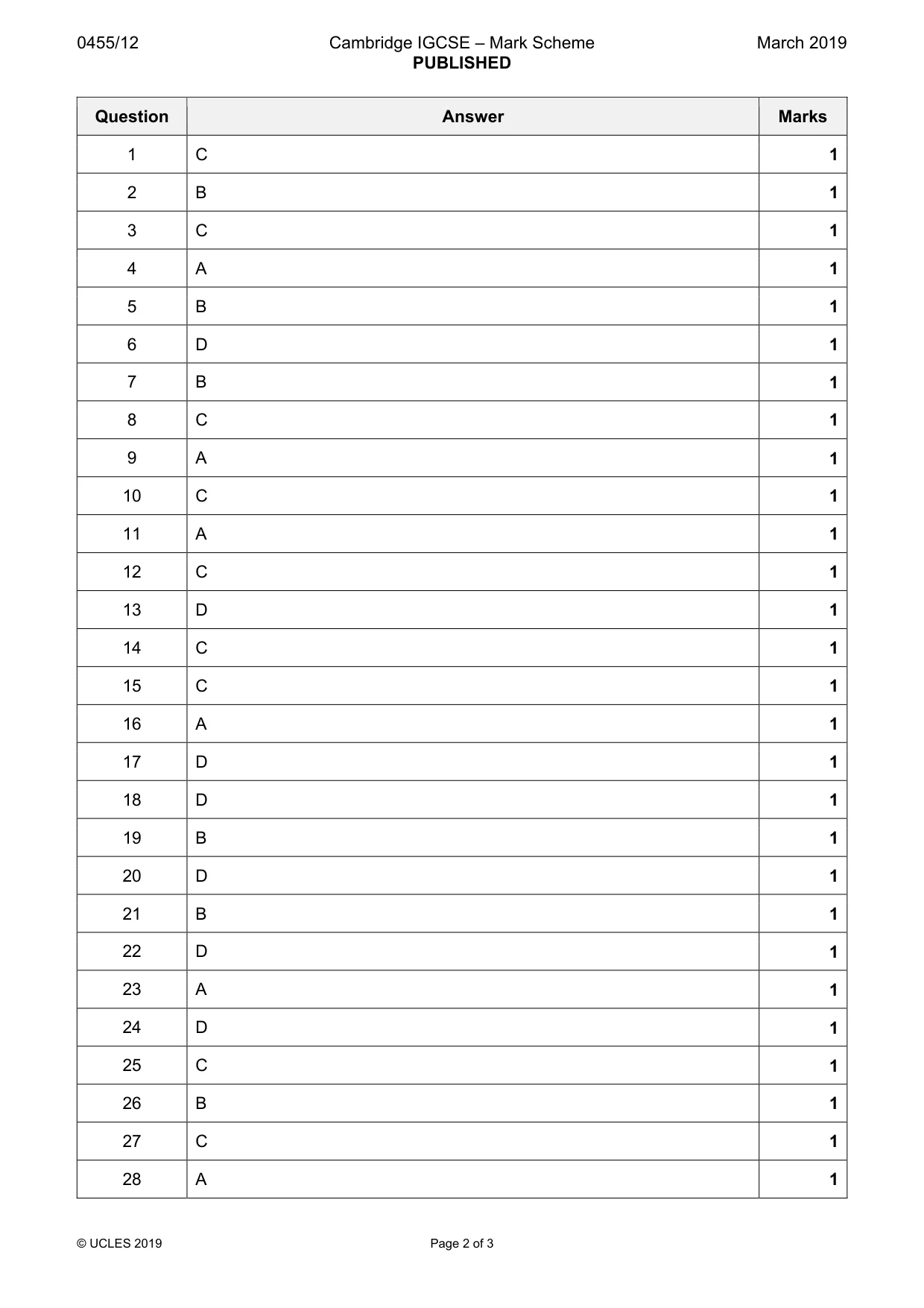
Mark scheme: C
Q2 · A farmer reduces the land used to grow wheat from 80 hectares to 60 hectares and…
2 A farmer reduces the land used to grow wheat from 80 hectares to 60 hectares and increases the use of the land for growing potatoes from 80 to 100 hectares. What is the opportunity cost of this change? A The output from 20 hectares used for growing potatoes. B The output from 20 hectares used for growing wheat. C The output from 60 hectares used for growing wheat. D The output from 80 hectares used for growing potatoes.
Mark scheme: B
Q3 · The diagram shows the change in an economy’s production possibility curve (PPC) from year…
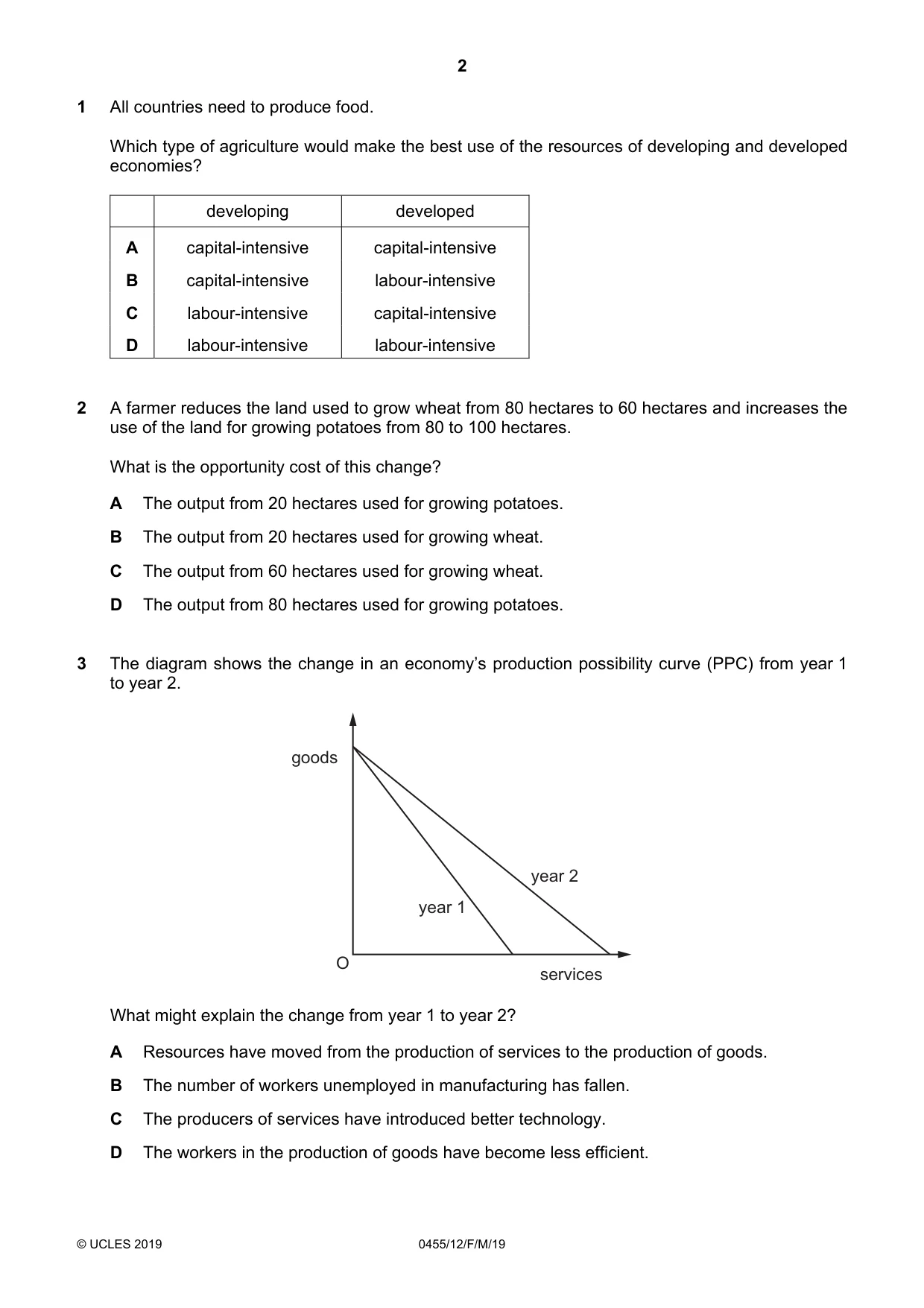
3 The diagram shows the change in an economy’s production possibility curve (PPC) from year 1 to year 2. goods year 2 year 1 O services What might explain the change from year 1 to year 2? A Resources have moved from the production of services to the production of goods. B The number of workers unemployed in manufacturing has fallen. C The producers of services have introduced better technology. D The workers in the production of goods have become less efficient.
Mark scheme: C
More questions on Production possibility curve (PPC) diagrams
Q4 · What can be found in a market economy?
4 What can be found in a market economy? A externalities and monopolies B interest rates and public goods C public corporations and market prices D tax rates and commercial banks
Mark scheme: A
Q5 · A private sector firm is given a contract by the government to supply a country’s water
5 A private sector firm is given a contract by the government to supply a country’s water. Which government directive will minimise the risk of market failure? A allow the firm to ration water rather than meet demand B ensure the firm’s supply includes all areas which are expensive to service C insist that the firm aims to maximise profits D instruct the firm to provide water only to those who can pay for it
Mark scheme: B
Q6 · What is meant by the equilibrium price in the market for a good?
6 What is meant by the equilibrium price in the market for a good? A the average price paid by consumers B the price at which maximum profit is made C the price at which the producer breaks even D the price at which the supply and demand curves intersect
Mark scheme: D
Q7 · The table shows the effect of a change in the market price from $5 to $6 on the supply of…
7 The table shows the effect of a change in the market price from $5 to $6 on the supply of mobile (cell) phones. price supply ($) (units) 5 10 000 6 15 000 Which statement about the price elasticity of supply of mobile phones is correct? A Price elasticity of supply is 0.4. B Price elasticity of supply is 2.5. C Supply is perfectly elastic. D There is unit elasticity.
Mark scheme: B
Q8 · What could discourage women from seeking employment?
8 What could discourage women from seeking employment? A More education and training are provided. B More flexible and part-time jobs are available. C There are fewer promotion opportunities for women. D There is a shift in employment to the services sector.
Mark scheme: C
Q9 · What would be least likely to act as a store of value during a period of rapid inflation?
9 What would be least likely to act as a store of value during a period of rapid inflation? A cash B gold C property D shares
Mark scheme: A
Q10 · The table shows how three people (X, Y and Z) spend their income
10 The table shows how three people (X, Y and Z) spend their income. person X person Y person Z food, clothing and housing 30% 25% 50% entertainment and leisure 35% 35% 25% luxury goods 35% 40% 25% For these three people, what is the most likely order of income, from lowest income to highest income? A Y → X → Z B Y → Z → X C Z → X → Y D Z → Y → X
Mark scheme: C
Q11 · The table shows the weekly values of certain items for the average person in each group
11 The table shows the weekly values of certain items for the average person in each group. In which group does the average person save the most? income ($) spending ($) borrowing ($) A employed workers 500 400 50 B retired people 150 140 0 C school students 25 30 5 D unemployed 200 300 100
Mark scheme: A
Q12 · Which type of business is always in the public sector?
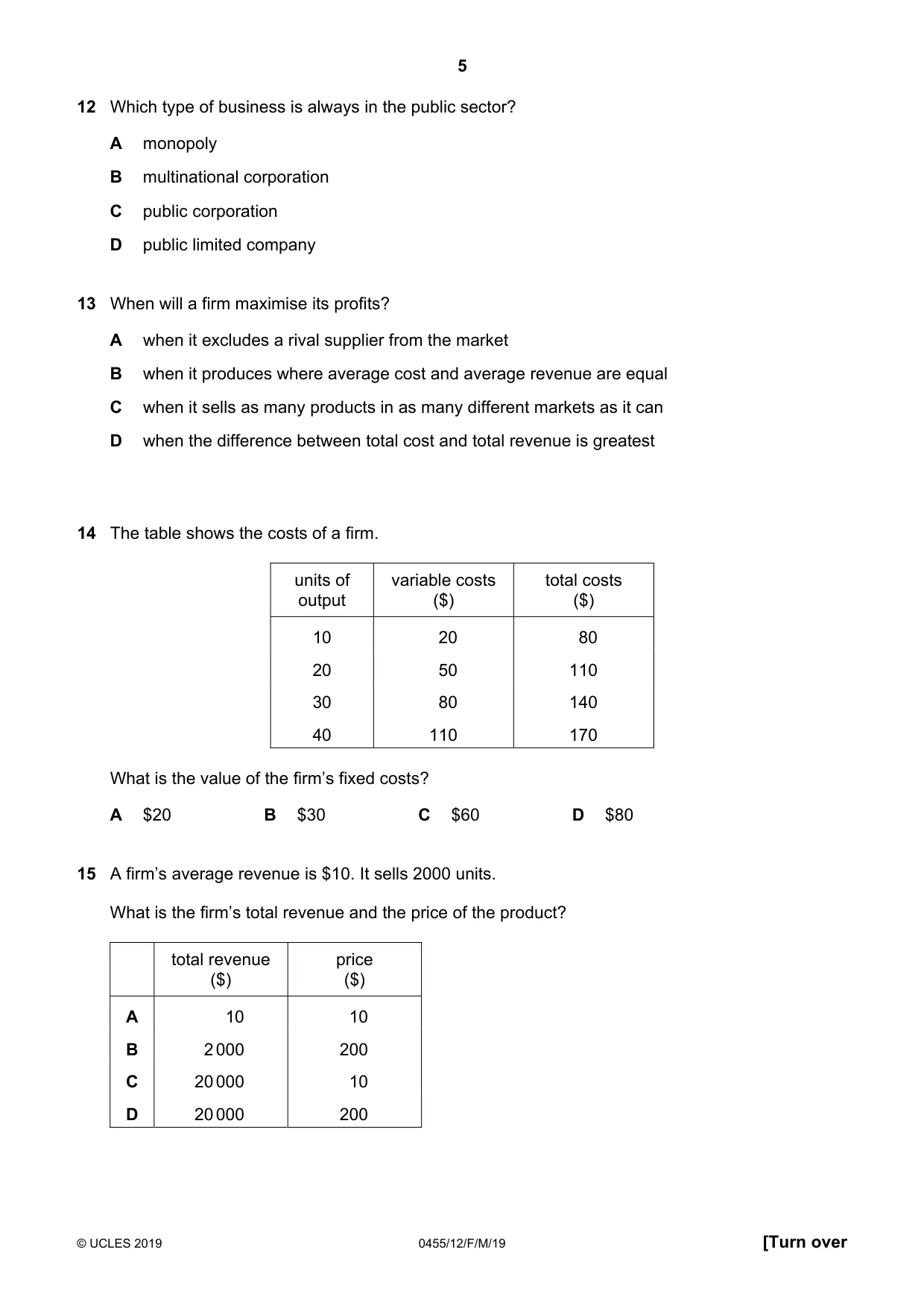
12 Which type of business is always in the public sector? A monopoly B multinational corporation C public corporation D public limited company
Mark scheme: C
Q13 · When will a firm maximise its profits?
13 When will a firm maximise its profits? A when it excludes a rival supplier from the market B when it produces where average cost and average revenue are equal C when it sells as many products in as many different markets as it can D when the difference between total cost and total revenue is greatest
Mark scheme: D
Q14 · The table shows the costs of a firm
14 The table shows the costs of a firm. units of variable costs total costs output ($) ($) 10 20 80 20 50 110 30 80 140 40 110 170 What is the value of the firm’s fixed costs? A $20 B $30 C $60 D $80
Mark scheme: C
Q15 · A firm’s average revenue is $10
15 A firm’s average revenue is $10. It sells 2000 units. What is the firm’s total revenue and the price of the product? total revenue price ($) ($) A 10 10 B 2 000 200 C 20 000 10 D 20 000 200
Mark scheme: C
Q16 · Which measure would a government take to reduce a current account deficit?
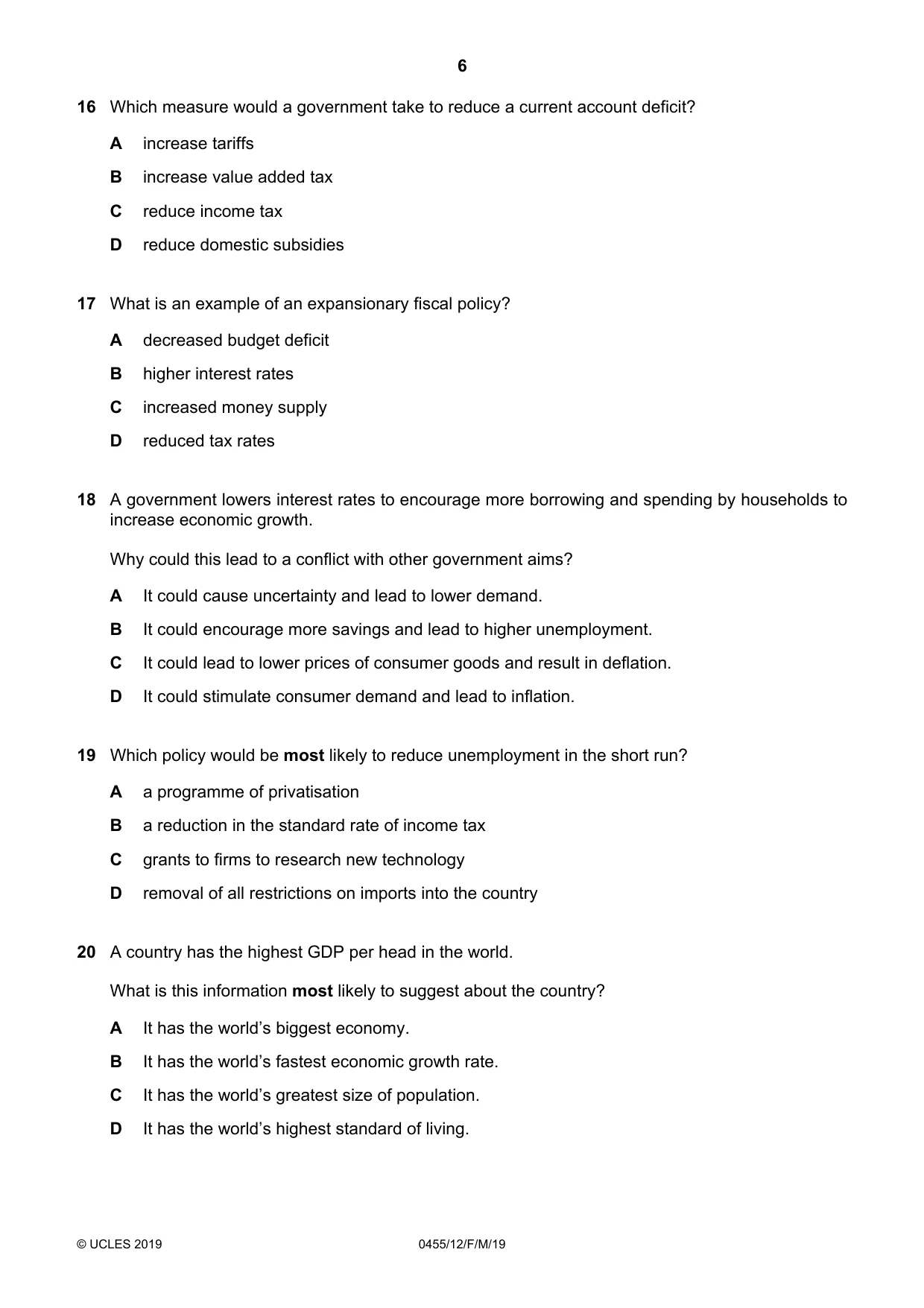
16 Which measure would a government take to reduce a current account deficit? A increase tariffs B increase value added tax C reduce income tax D reduce domestic subsidies
Mark scheme: A
Q17 · What is an example of an expansionary fiscal policy?
17 What is an example of an expansionary fiscal policy? A decreased budget deficit B higher interest rates C increased money supply D reduced tax rates
Mark scheme: D
Q18 · A government lowers interest rates to encourage more borrowing and spending by households…
18 A government lowers interest rates to encourage more borrowing and spending by households to increase economic growth. Why could this lead to a conflict with other government aims? A It could cause uncertainty and lead to lower demand. B It could encourage more savings and lead to higher unemployment. C It could lead to lower prices of consumer goods and result in deflation. D It could stimulate consumer demand and lead to inflation.
Mark scheme: D
Q19 · Which policy would be most likely to reduce unemployment in the short run?
19 Which policy would be most likely to reduce unemployment in the short run? A a programme of privatisation B a reduction in the standard rate of income tax C grants to firms to research new technology D removal of all restrictions on imports into the country
Mark scheme: B
Q20 · A country has the highest GDP per head in the world
20 A country has the highest GDP per head in the world. What is this information most likely to suggest about the country? A It has the world’s biggest economy. B It has the world’s fastest economic growth rate. C It has the world’s greatest size of population. D It has the world’s highest standard of living.
Mark scheme: D
Q21 · What is included in the Human Development Index (HDI) of a country?
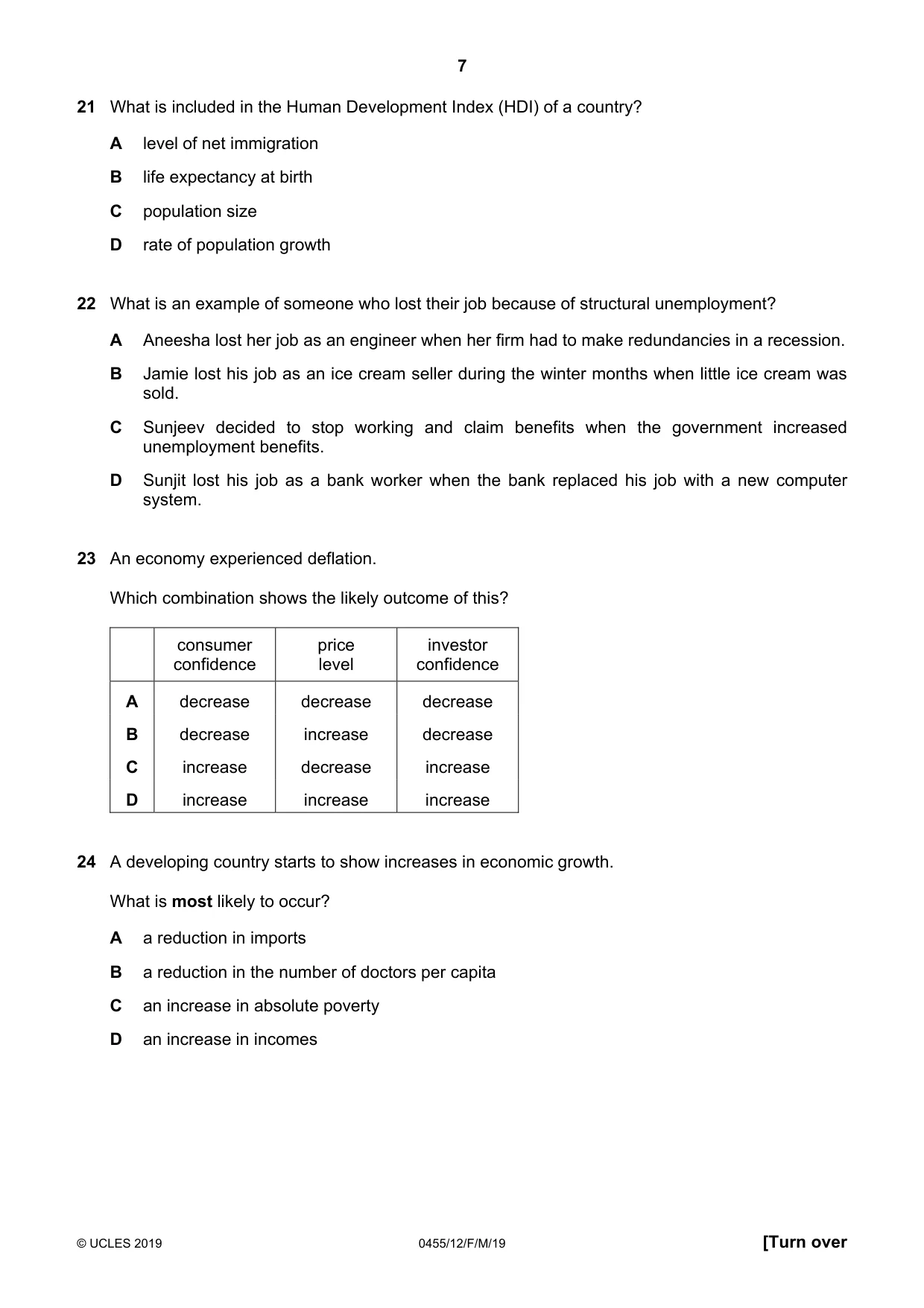
21 What is included in the Human Development Index (HDI) of a country? A level of net immigration B life expectancy at birth C population size D rate of population growth
Mark scheme: B
More questions on Differences in economic development between countries
Q22 · What is an example of someone who lost their job because of structural unemployment?
22 What is an example of someone who lost their job because of structural unemployment? A Aneesha lost her job as an engineer when her firm had to make redundancies in a recession. B Jamie lost his job as an ice cream seller during the winter months when little ice cream was sold. C Sunjeev decided to stop working and claim benefits when the government increased unemployment benefits. D Sunjit lost his job as a bank worker when the bank replaced his job with a new computer system.
Mark scheme: D
Q23 · An economy experienced deflation
23 An economy experienced deflation. Which combination shows the likely outcome of this? consumer price investor confidence level confidence A decrease decrease decrease B decrease increase decrease C increase decrease increase D increase increase increase
Mark scheme: A
Q24 · A developing country starts to show increases in economic growth
24 A developing country starts to show increases in economic growth. What is most likely to occur? A a reduction in imports B a reduction in the number of doctors per capita C an increase in absolute poverty D an increase in incomes
Mark scheme: D
Q25 · A country’s minister for agriculture said “the biggest challenge the country faces is to…
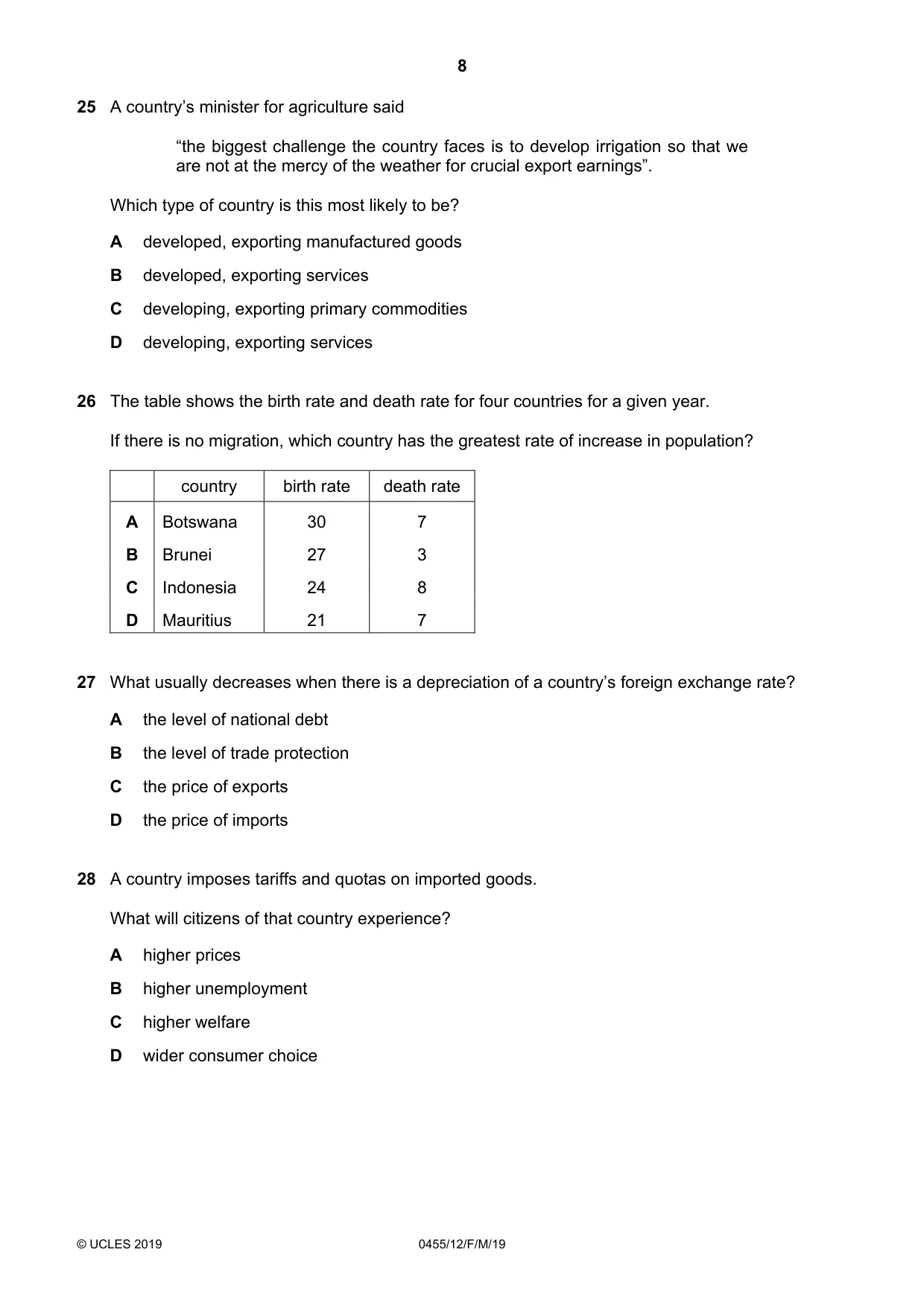
25 A country’s minister for agriculture said “the biggest challenge the country faces is to develop irrigation so that we are not at the mercy of the weather for crucial export earnings”. Which type of country is this most likely to be? A developed, exporting manufactured goods B developed, exporting services C developing, exporting primary commodities D developing, exporting services
Mark scheme: C
More questions on Differences in economic development between countries
Q26 · The table shows the birth rate and death rate for four countries for a given year
26 The table shows the birth rate and death rate for four countries for a given year. If there is no migration, which country has the greatest rate of increase in population? country birth rate death rate A Botswana 30 7 B Brunei 27 3 C Indonesia 24 8 D Mauritius 21 7
Mark scheme: B
Q27 · What usually decreases when there is a depreciation of a country’s foreign exchange rate?
27 What usually decreases when there is a depreciation of a country’s foreign exchange rate? A the level of national debt B the level of trade protection C the price of exports D the price of imports
Mark scheme: C
Q28 · A country imposes tariffs and quotas on imported goods
28 A country imposes tariffs and quotas on imported goods. What will citizens of that country experience? A higher prices B higher unemployment C higher welfare D wider consumer choice
Mark scheme: A
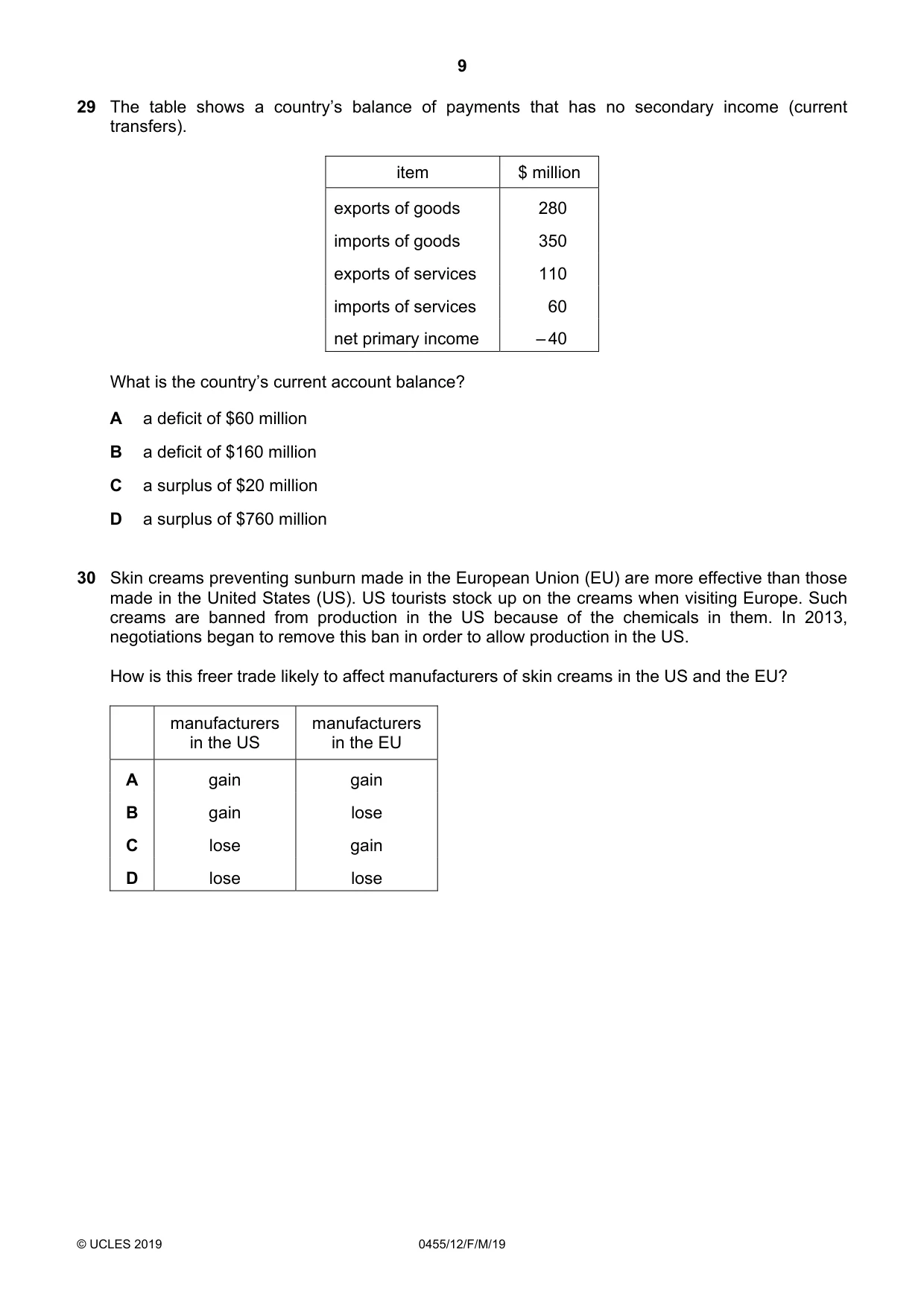
Q29 · The table shows a country’s balance of payments that has no secondary income (current…
29 The table shows a country’s balance of payments that has no secondary income (current transfers). item $ million exports of goods 280 imports of goods 350 exports of services 110 imports of services 60 net primary income – 40 What is the country’s current account balance? A a deficit of $60 million B a deficit of $160 million C a surplus of $20 million D a surplus of $760 million
Mark scheme: A
Q30 · Skin creams preventing sunburn made in the European Union (EU) are more effective than…
30 Skin creams preventing sunburn made in the European Union (EU) are more effective than those made in the United States (US). US tourists stock up on the creams when visiting Europe. Such creams are banned from production in the US because of the chemicals in them. In 2013, negotiations began to remove this ban in order to allow production in the US. How is this freer trade likely to affect manufacturers of skin creams in the US and the EU? manufacturers manufacturers in the US in the EU A gain gain B gain lose C lose gain D lose lose
Mark scheme: B
What was in this paper
The subtopics covered by these 30 questions, and how many questions each got. Open one in a new tab to see every Cambridge question on it.
3Globalisation, free trade and protection3Differences in economic development between countries2Fiscal policy2Living standards2Current account of balance of payments1Economic growth1Employment and unemployment1Foreign exchange rates1Households1Inflation and deflation1Market economic system1Market failure1Mixed economic system1Money and banking1Opportunity cost1Population1Price determination1Price elasticity of supply (PES)1Production possibility curve (PPC) diagrams1The factors of production1The macroeconomic aims of government1Workers1What you needed in this session
Cambridge’s own grade thresholds for 2019 Feb/March, Paper 1 · Variant 2. A higher threshold means an easier paper — the bar moves with how the cohort did.