Cambridge IGCSE Economics 0455 — 2013 Oct/Nov Paper 1 · Variant 1
0455/11/O/N/13 · 30 questions · 30 marks · ≈34 min
The question paper and its mark scheme, free to read here and free to download. This is Cambridge’s own paper, exactly as it was sat.
Question paper12 pages


Mark scheme2 pages
Answers below. Sit the paper first if you are practising.
Questions as text
Q1 · What is a reason why firms making similar products sometimes locate near each other?
1 What is a reason why firms making similar products sometimes locate near each other? A competition is decreased B there are external economies of scale C there are internal economies of scale D transport costs may be eliminated
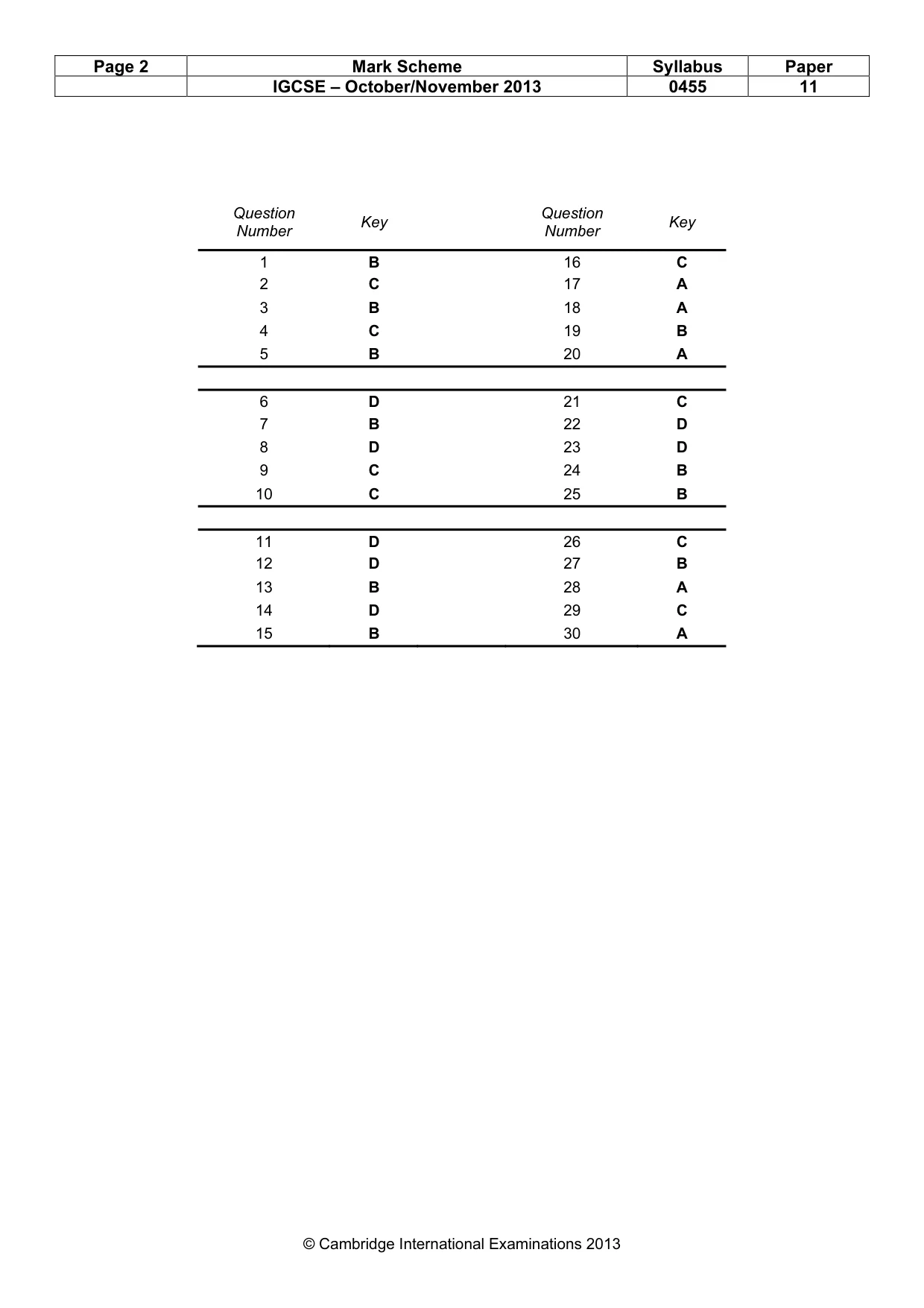
Mark scheme: B
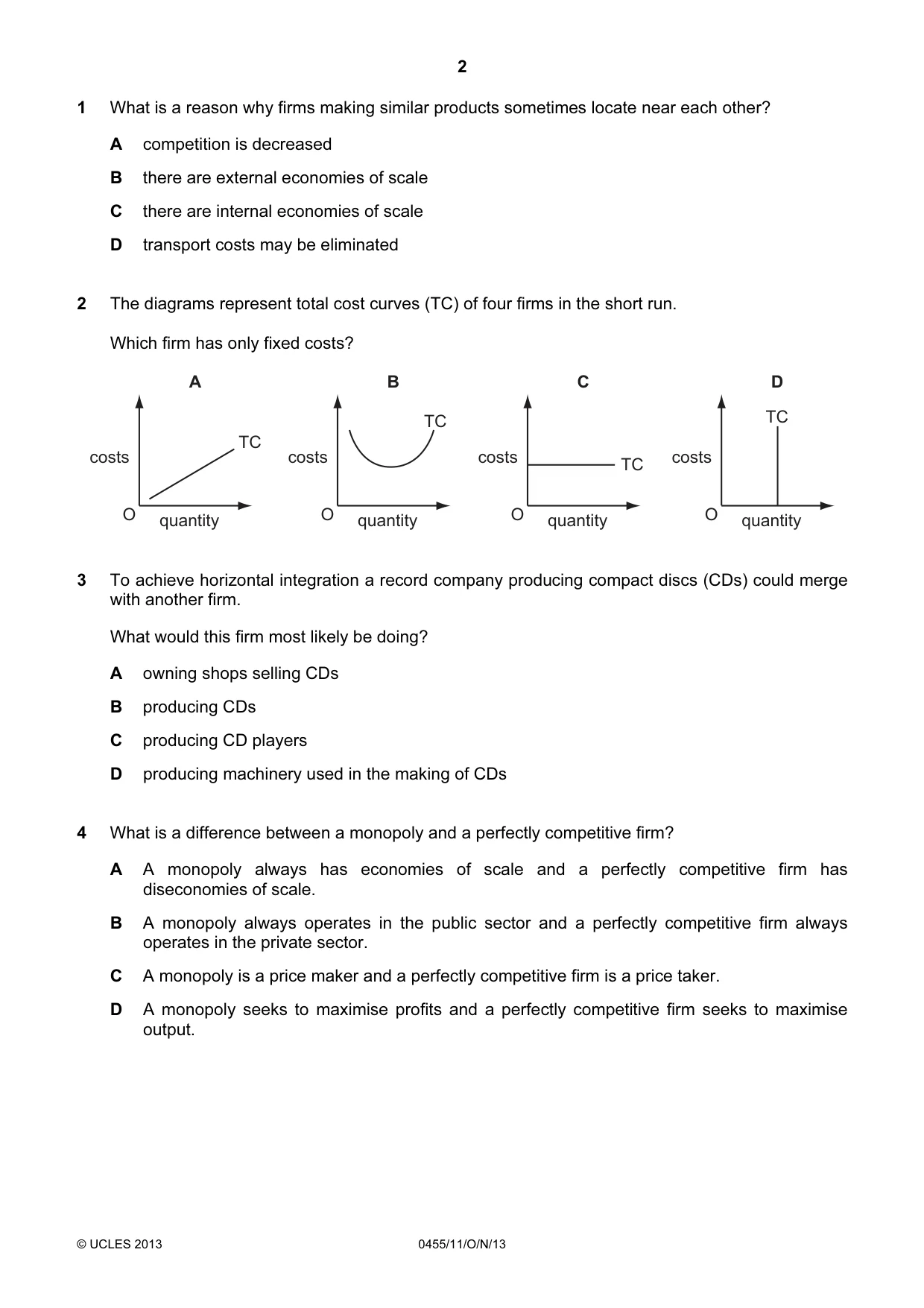
Q2 · The diagrams represent total cost curves (TC) of four firms in the short run
2 The diagrams represent total cost curves (TC) of four firms in the short run. Which firm has only fixed costs? A B C D TC TC TC costs costs costs TC costs O quantity O quantity O quantity O quantity
Mark scheme: C
Q3 · To achieve horizontal integration a record company producing compact discs (CDs) could…
3 To achieve horizontal integration a record company producing compact discs (CDs) could merge with another firm. What would this firm most likely be doing? A owning shops selling CDs B producing CDs C producing CD players D producing machinery used in the making of CDs
Mark scheme: B
Q4 · What is a difference between a monopoly and a perfectly competitive firm?
4 What is a difference between a monopoly and a perfectly competitive firm? A A monopoly always has economies of scale and a perfectly competitive firm has diseconomies of scale. B A monopoly always operates in the public sector and a perfectly competitive firm always operates in the private sector. C A monopoly is a price maker and a perfectly competitive firm is a price taker. D A monopoly seeks to maximise profits and a perfectly competitive firm seeks to maximise output.
Mark scheme: C
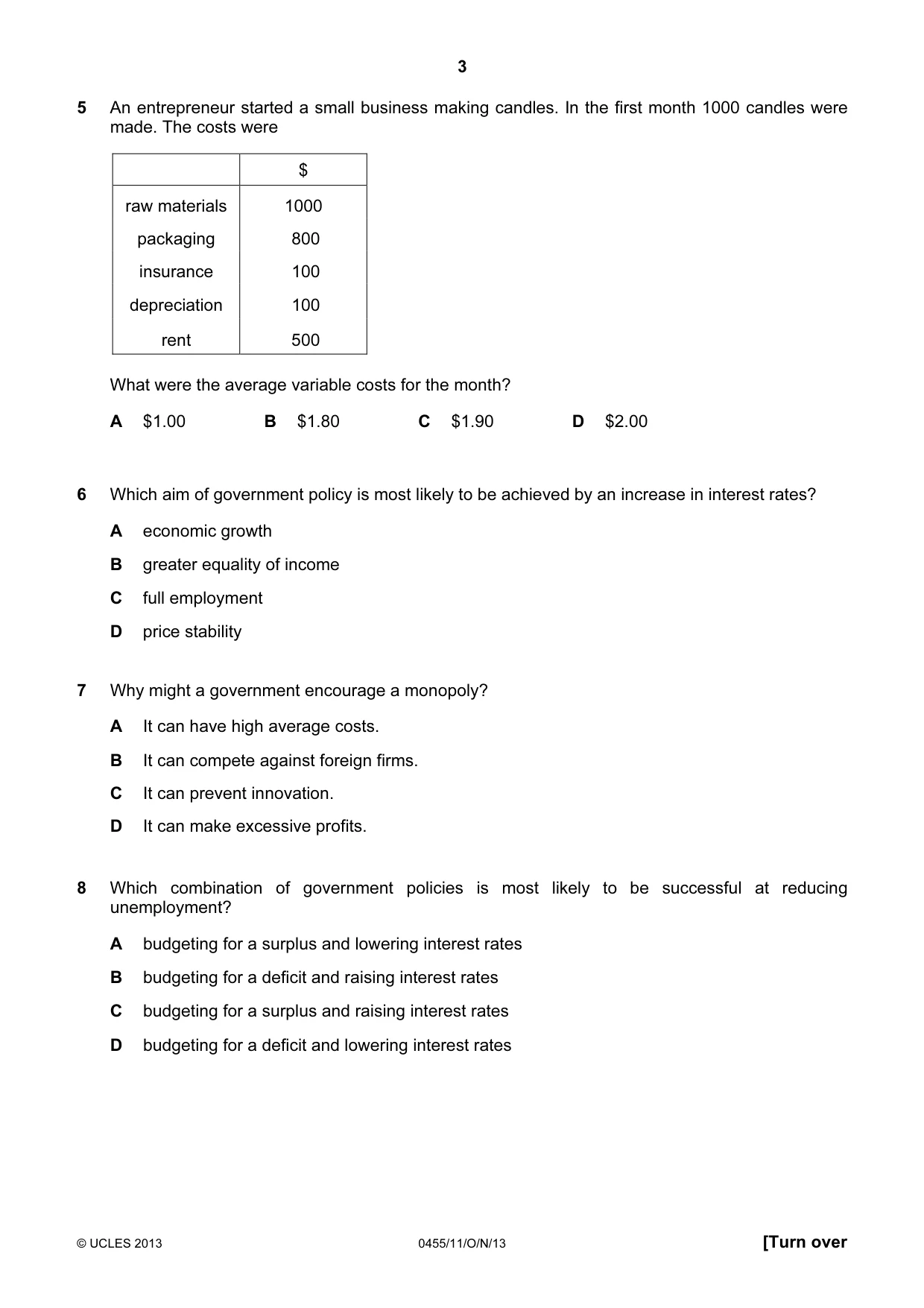
Q5 · An entrepreneur started a small business making candles
5 An entrepreneur started a small business making candles. In the first month 1000 candles were made. The costs were $ raw materials 1000 packaging 800 insurance 100 depreciation 100 rent 500 What were the average variable costs for the month? A $1.00 B $1.80 C $1.90 D $2.00
Mark scheme: B
Q6 · Which aim of government policy is most likely to be achieved by an increase in interest…
6 Which aim of government policy is most likely to be achieved by an increase in interest rates? A economic growth B greater equality of income C full employment D price stability
Mark scheme: D
Q7 · Why might a government encourage a monopoly?
7 Why might a government encourage a monopoly? A It can have high average costs. B It can compete against foreign firms. C It can prevent innovation. D It can make excessive profits.
Mark scheme: B
Q8 · Which combination of government policies is most likely to be successful at reducing…
8 Which combination of government policies is most likely to be successful at reducing unemployment? A budgeting for a surplus and lowering interest rates B budgeting for a deficit and raising interest rates C budgeting for a surplus and raising interest rates D budgeting for a deficit and lowering interest rates
Mark scheme: D
Q9 · A government wishes to raise the general standard of living in its country
9 A government wishes to raise the general standard of living in its country. In the short run, which policy would be the most likely to achieve this aim? A preventing the merger of two companies into a monopoly B raising taxation to repay government debts C reducing the rate of income tax while maintaining the services it provides D spending more on roads in rural areas rather than in city centres
Mark scheme: C
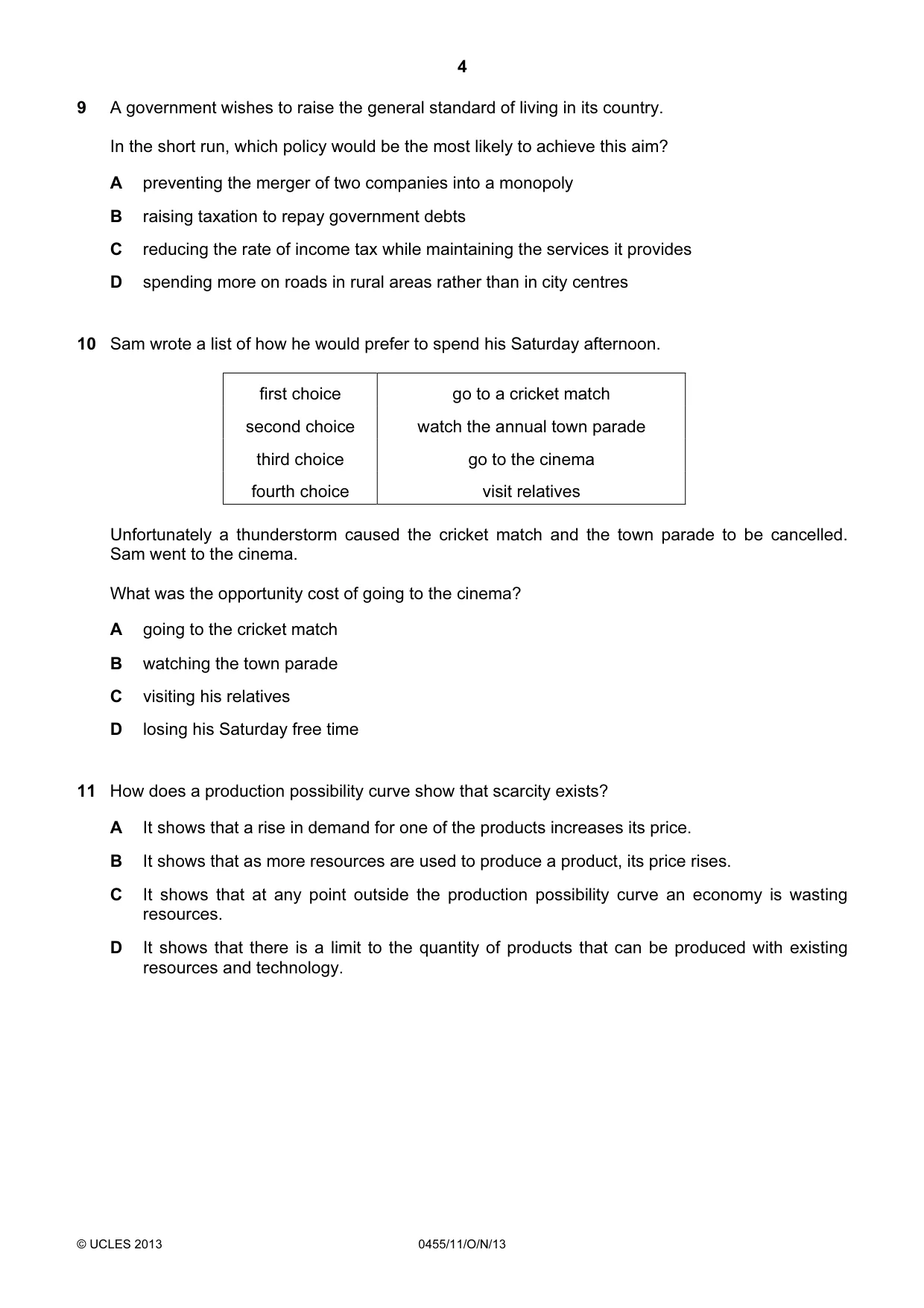
Q10 · Sam wrote a list of how he would prefer to spend his Saturday afternoon
10 Sam wrote a list of how he would prefer to spend his Saturday afternoon. first choice go to a cricket match second choice watch the annual town parade third choice go to the cinema fourth choice visit relatives Unfortunately a thunderstorm caused the cricket match and the town parade to be cancelled. Sam went to the cinema. What was the opportunity cost of going to the cinema? A going to the cricket match B watching the town parade C visiting his relatives D losing his Saturday free time
Mark scheme: C
Q11 · How does a production possibility curve show that scarcity exists?
11 How does a production possibility curve show that scarcity exists? A It shows that a rise in demand for one of the products increases its price. B It shows that as more resources are used to produce a product, its price rises. C It shows that at any point outside the production possibility curve an economy is wasting resources. D It shows that there is a limit to the quantity of products that can be produced with existing resources and technology.
Mark scheme: D
More questions on Production possibility curve (PPC) diagrams
Q12 · In which case is it possible to set the level of reward before production takes place for…
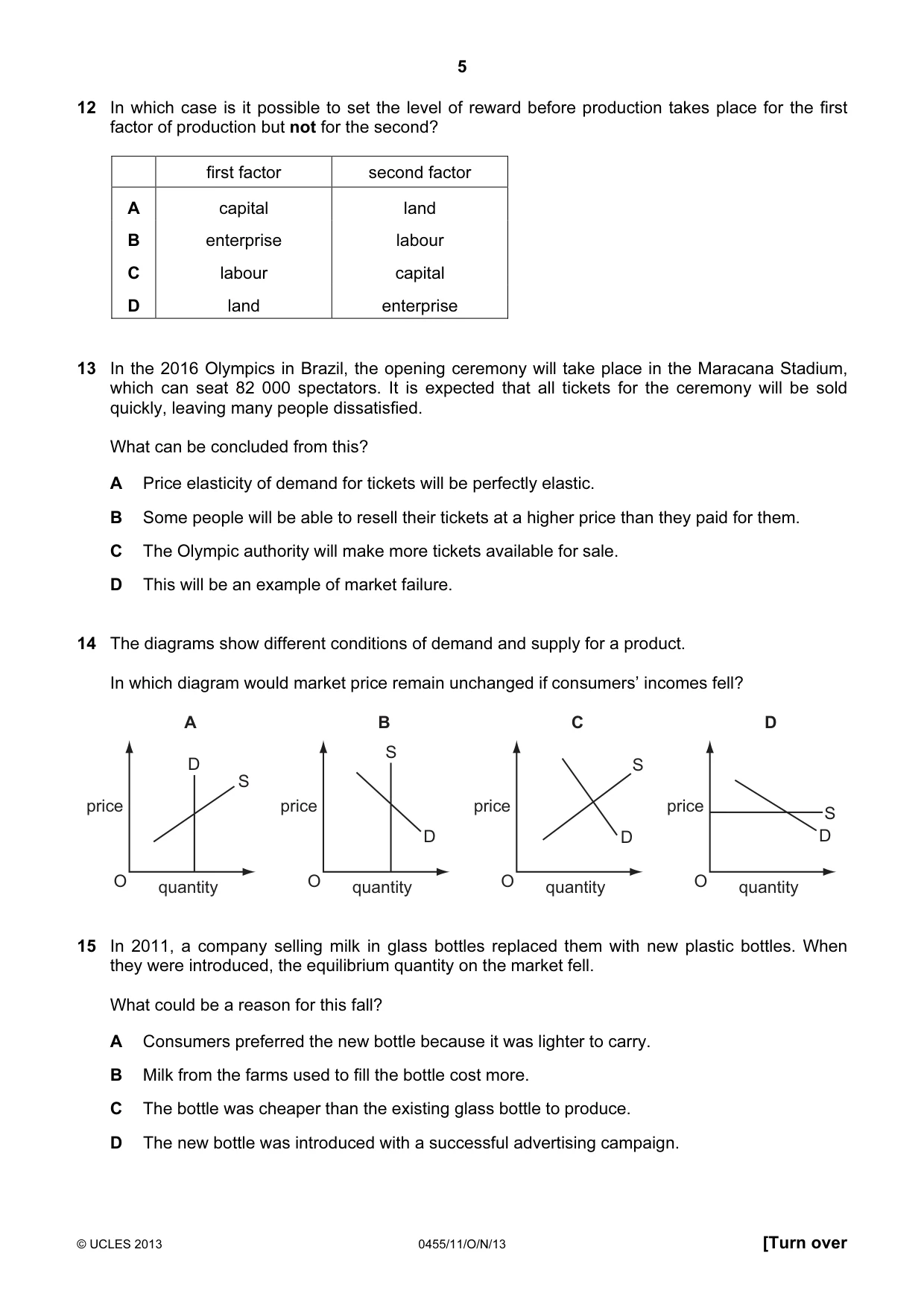
12 In which case is it possible to set the level of reward before production takes place for the first factor of production but not for the second? first factor second factor A capital land B enterprise labour C labour capital D land enterprise
Mark scheme: D
Q13 · In the 2016 Olympics in Brazil, the opening ceremony will take place in the Maracana…
13 In the 2016 Olympics in Brazil, the opening ceremony will take place in the Maracana Stadium, which can seat 82 000 spectators. It is expected that all tickets for the ceremony will be sold quickly, leaving many people dissatisfied. What can be concluded from this? A Price elasticity of demand for tickets will be perfectly elastic. B Some people will be able to resell their tickets at a higher price than they paid for them. C The Olympic authority will make more tickets available for sale. D This will be an example of market failure.
Mark scheme: B
Q14 · The diagrams show different conditions of demand and supply for a product
14 The diagrams show different conditions of demand and supply for a product. In which diagram would market price remain unchanged if consumers’ incomes fell? A B C D S D S S price price price price S D D D O quantity O quantity O quantity O quantity
Mark scheme: D
Q15 · In 2011, a company selling milk in glass bottles replaced them with new plastic bottles
15 In 2011, a company selling milk in glass bottles replaced them with new plastic bottles. When they were introduced, the equilibrium quantity on the market fell. What could be a reason for this fall? A Consumers preferred the new bottle because it was lighter to carry. B Milk from the farms used to fill the bottle cost more. C The bottle was cheaper than the existing glass bottle to produce. D The new bottle was introduced with a successful advertising campaign.
Mark scheme: B
Q16 · Which change would make the supply of a product more price elastic?
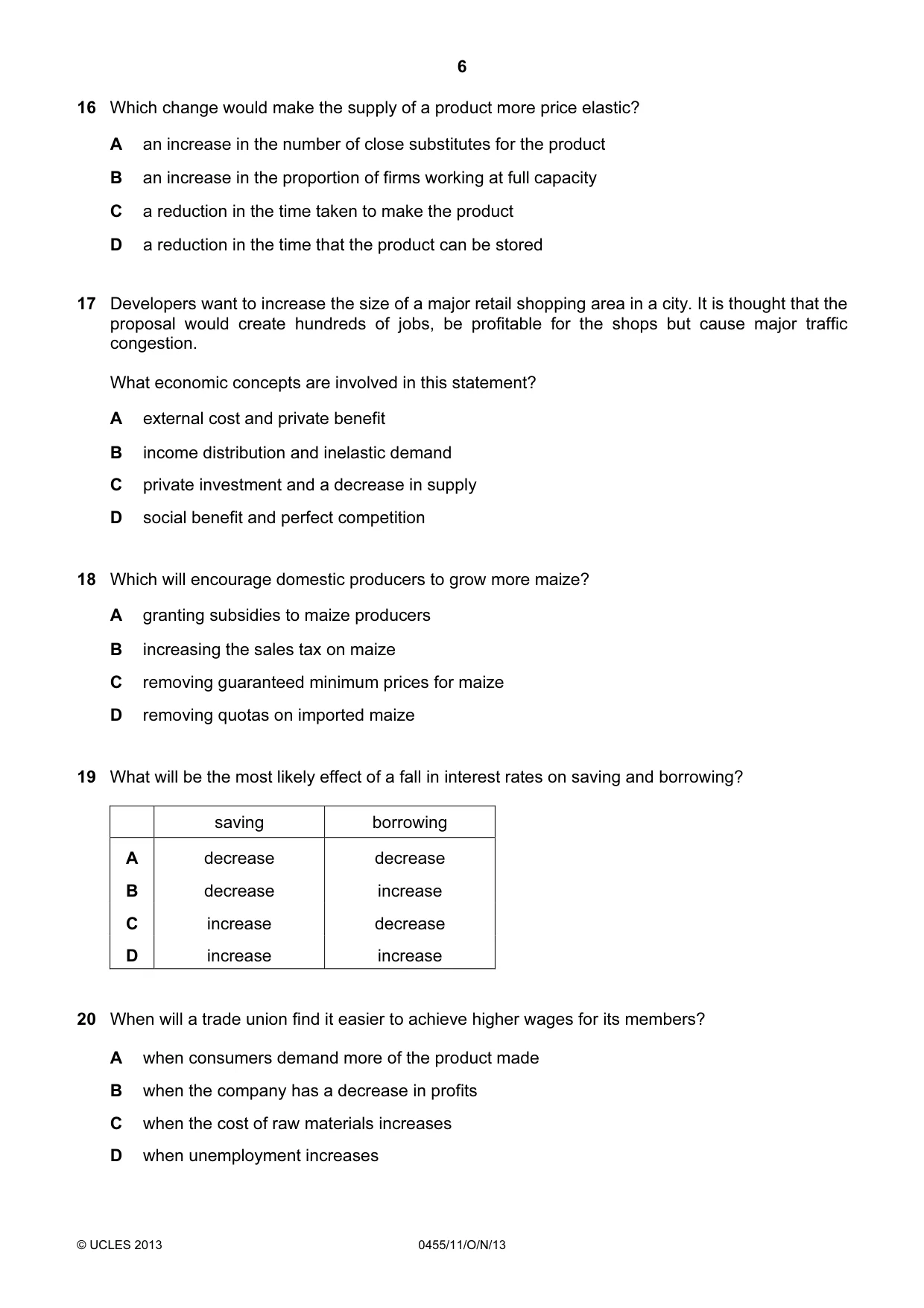
16 Which change would make the supply of a product more price elastic? A an increase in the number of close substitutes for the product B an increase in the proportion of firms working at full capacity C a reduction in the time taken to make the product D a reduction in the time that the product can be stored
Mark scheme: C
Q17 · Developers want to increase the size of a major retail shopping area in a city
17 Developers want to increase the size of a major retail shopping area in a city. It is thought that the proposal would create hundreds of jobs, be profitable for the shops but cause major traffic congestion. What economic concepts are involved in this statement? A external cost and private benefit B income distribution and inelastic demand C private investment and a decrease in supply D social benefit and perfect competition
Mark scheme: A
Q18 · Which will encourage domestic producers to grow more maize?
18 Which will encourage domestic producers to grow more maize? A granting subsidies to maize producers B increasing the sales tax on maize C removing guaranteed minimum prices for maize D removing quotas on imported maize
Mark scheme: A
Q19 · What will be the most likely effect of a fall in interest rates on saving and borrowing?
19 What will be the most likely effect of a fall in interest rates on saving and borrowing? saving borrowing A decrease decrease B decrease increase C increase decrease D increase increase
Mark scheme: B
Q20 · When will a trade union find it easier to achieve higher wages for its members?
20 When will a trade union find it easier to achieve higher wages for its members? A when consumers demand more of the product made B when the company has a decrease in profits C when the cost of raw materials increases D when unemployment increases
Mark scheme: A
Q21 · What might be a direct benefit to the individual worker of a specialised job?
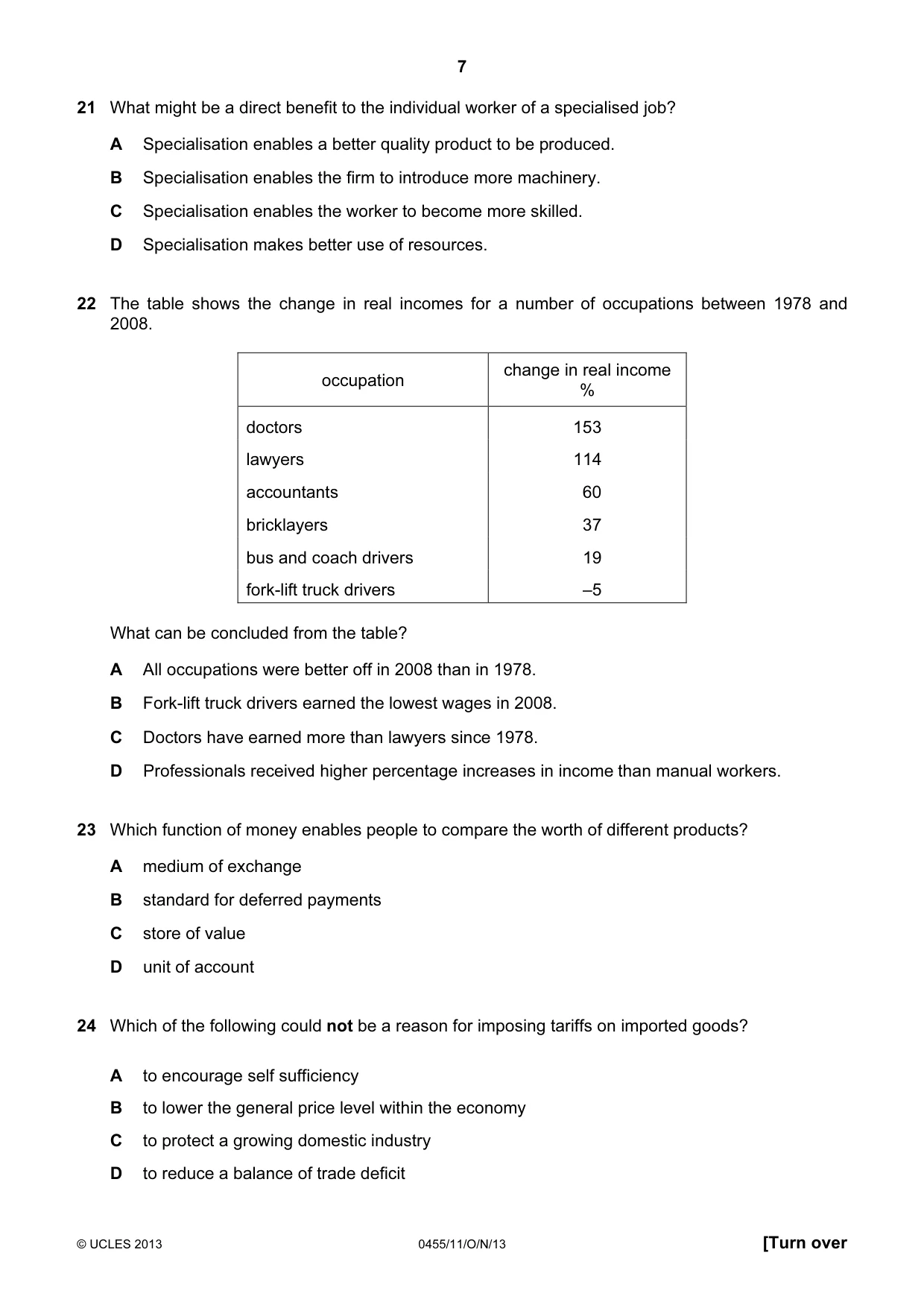
21 What might be a direct benefit to the individual worker of a specialised job? A Specialisation enables a better quality product to be produced. B Specialisation enables the firm to introduce more machinery. C Specialisation enables the worker to become more skilled. D Specialisation makes better use of resources.
Mark scheme: C
Q22 · The table shows the change in real incomes for a number of occupations between 1978 and…
22 The table shows the change in real incomes for a number of occupations between 1978 and 2008. change in real income occupation % doctors 153 lawyers 114 accountants 60 bricklayers 37 bus and coach drivers 19 fork-lift truck drivers –5 What can be concluded from the table? A All occupations were better off in 2008 than in 1978. B Fork-lift truck drivers earned the lowest wages in 2008. C Doctors have earned more than lawyers since 1978. D Professionals received higher percentage increases in income than manual workers.
Mark scheme: D
Q23 · Which function of money enables people to compare the worth of different products?
23 Which function of money enables people to compare the worth of different products? A medium of exchange B standard for deferred payments C store of value D unit of account
Mark scheme: D
Q24 · Which of the following could not be a reason for imposing tariffs on imported goods?
24 Which of the following could not be a reason for imposing tariffs on imported goods? A to encourage self sufficiency B to lower the general price level within the economy C to protect a growing domestic industry D to reduce a balance of trade deficit
Mark scheme: B
Q25 · Which of the following is an export of Jamaica?
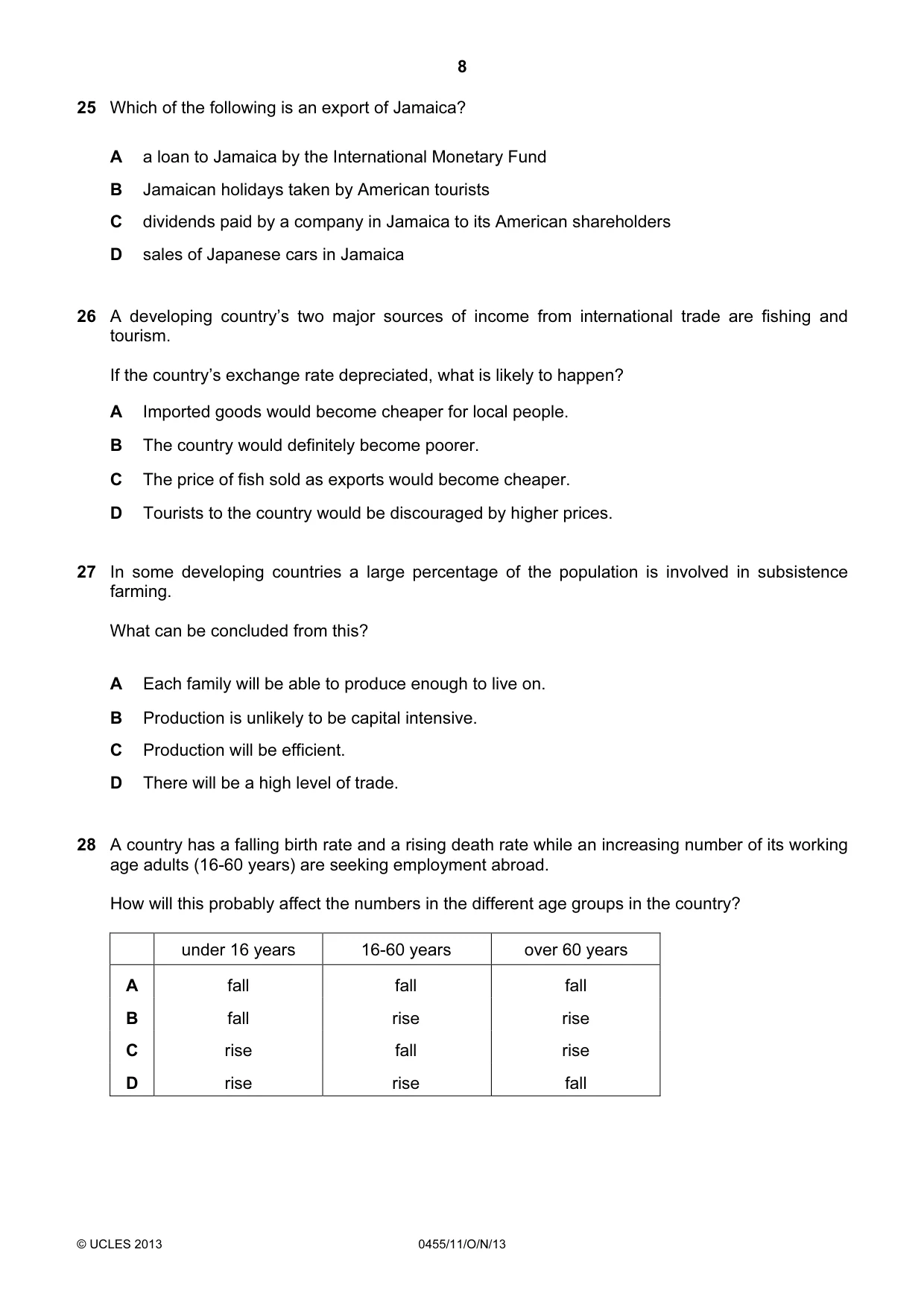
25 Which of the following is an export of Jamaica? A a loan to Jamaica by the International Monetary Fund B Jamaican holidays taken by American tourists C dividends paid by a company in Jamaica to its American shareholders D sales of Japanese cars in Jamaica
Mark scheme: B
Q26 · A developing country’s two major sources of income from international trade are fishing…
26 A developing country’s two major sources of income from international trade are fishing and tourism. If the country’s exchange rate depreciated, what is likely to happen? A Imported goods would become cheaper for local people. B The country would definitely become poorer. C The price of fish sold as exports would become cheaper. D Tourists to the country would be discouraged by higher prices.
Mark scheme: C
Q27 · In some developing countries a large percentage of the population is involved in…
27 In some developing countries a large percentage of the population is involved in subsistence farming. What can be concluded from this? A Each family will be able to produce enough to live on. B Production is unlikely to be capital intensive. C Production will be efficient. D There will be a high level of trade.
Mark scheme: B
More questions on Differences in economic development between countries
Q28 · A country has a falling birth rate and a rising death rate while an increasing number of…
28 A country has a falling birth rate and a rising death rate while an increasing number of its working age adults (16-60 years) are seeking employment abroad. How will this probably affect the numbers in the different age groups in the country? under 16 years 16-60 years over 60 years A fall fall fall B fall rise rise C rise fall rise D rise rise fall
Mark scheme: A
Q29 · Which would best indicate the start of an economic recession?
29 Which would best indicate the start of an economic recession? A falling interest rates B fluctuating levels of employment C negative growth of GDP D steadily increasing price levels
Mark scheme: C
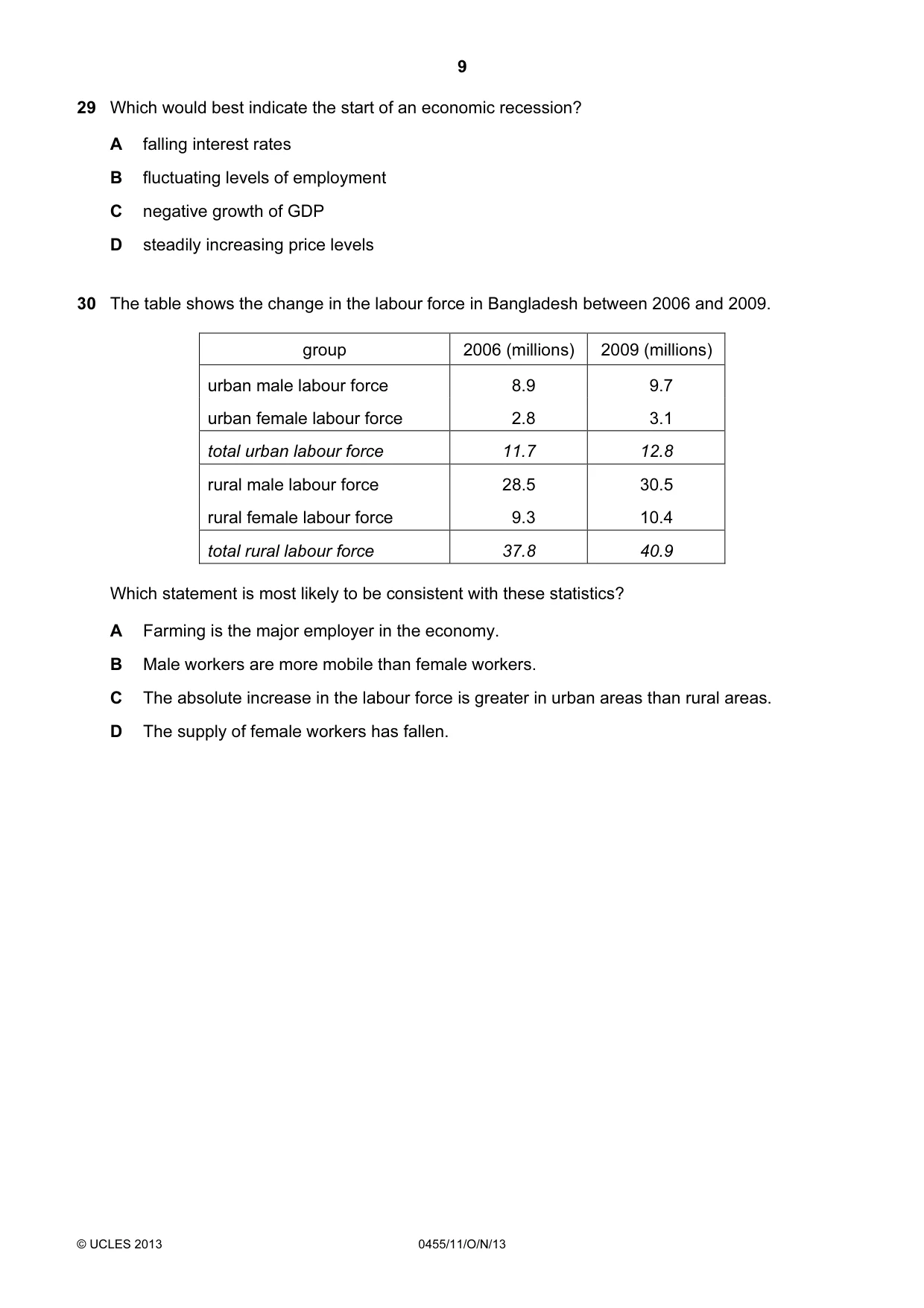
Q30 · The table shows the change in the labour force in Bangladesh between 2006 and 2009
30 The table shows the change in the labour force in Bangladesh between 2006 and 2009. group 2006 (millions) 2009 (millions) urban male labour force 8.9 9.7 urban female labour force 2.8 3.1 total urban labour force 11.7 12.8 rural male labour force 28.5 30.5 rural female labour force 9.3 10.4 total rural labour force 37.8 40.9 Which statement is most likely to be consistent with these statistics? A Farming is the major employer in the economy. B Male workers are more mobile than female workers. C The absolute increase in the labour force is greater in urban areas than rural areas. D The supply of female workers has fallen.
Mark scheme: A
What was in this paper
The subtopics covered by these 30 questions, and how many questions each got. Open one in a new tab to see every Cambridge question on it.
3Firms’ costs, revenue and objectives2Living standards2Market structure2Monetary policy2Current account of balance of payments1Differences in economic development between countries1Economic growth1Firms1Firms and production1Fiscal policy1Foreign exchange rates1Globalisation, free trade and protection1International specialisation1Market failure1Money and banking1Opportunity cost1Population1Price determination1Price elasticity of supply (PES)1Production possibility curve (PPC) diagrams1The factors of production1Trade unions1Workers1What you needed in this session
Cambridge’s own grade thresholds for 2013 Oct/Nov, Paper 1 · Variant 1. A higher threshold means an easier paper — the bar moves with how the cohort did.