Cambridge IGCSE Economics 0455 — 2016 Oct/Nov Paper 1 · Variant 3
0455/13/O/N/16 · 30 questions · 30 marks · ≈34 min
The question paper and its mark scheme, free to read here and free to download. This is Cambridge’s own paper, exactly as it was sat.
Question paper12 pages

Mark scheme2 pages
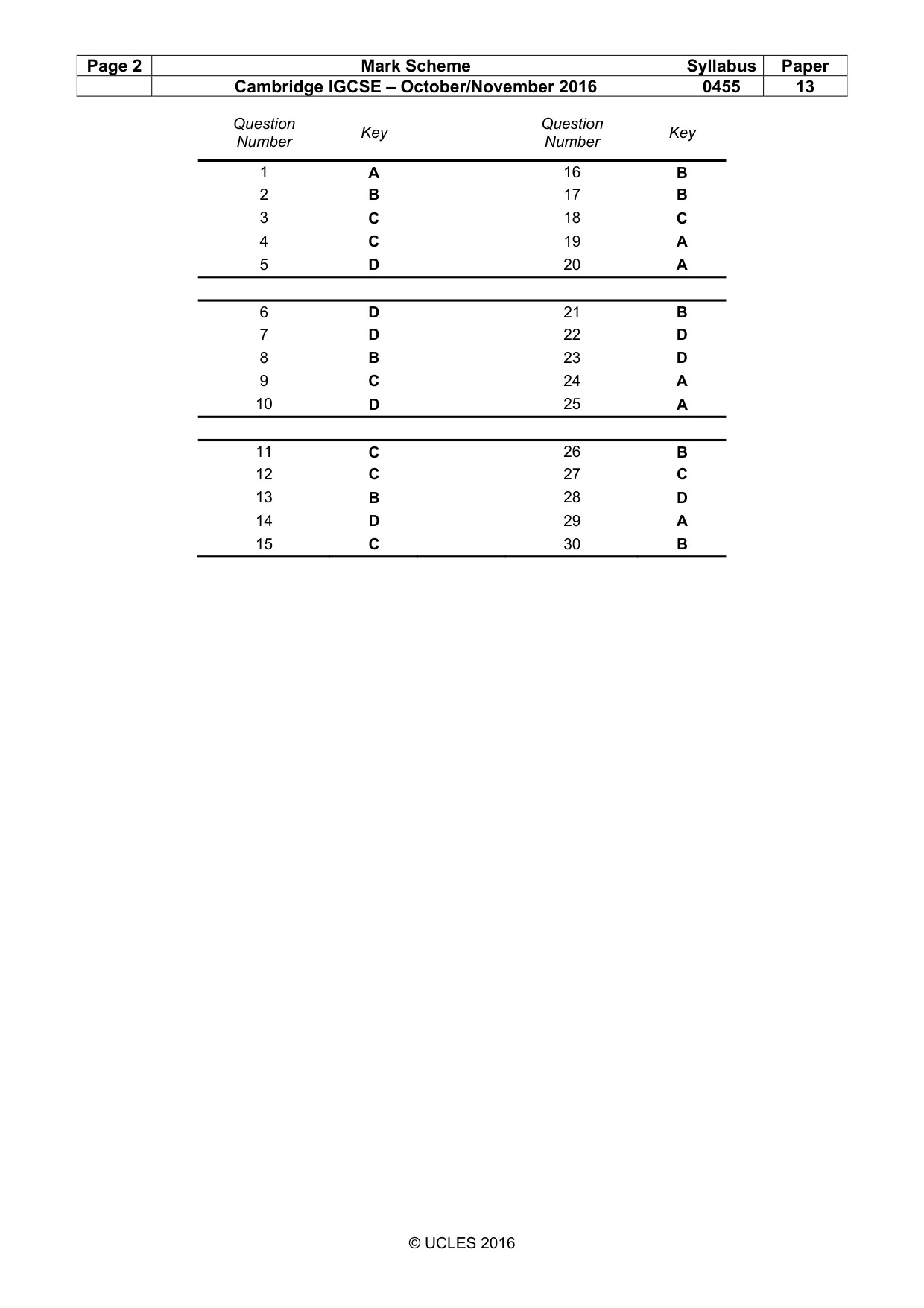
Answers below. Sit the paper first if you are practising.
Questions as text
Q1 · What is not a factor of production?
1 What is not a factor of production? A a $20 banknote B an office C a photocopier D a secretary
Mark scheme: A
Q2 · What could be the opportunity cost of a nuclear power station?
2 What could be the opportunity cost of a nuclear power station? A the running costs of the power station B a coal-fired power station C the current value of the power station D the cost of building the power station
Mark scheme: B
Q3 · In 2014 private companies began to drill in areas of the country to exploit natural gas…
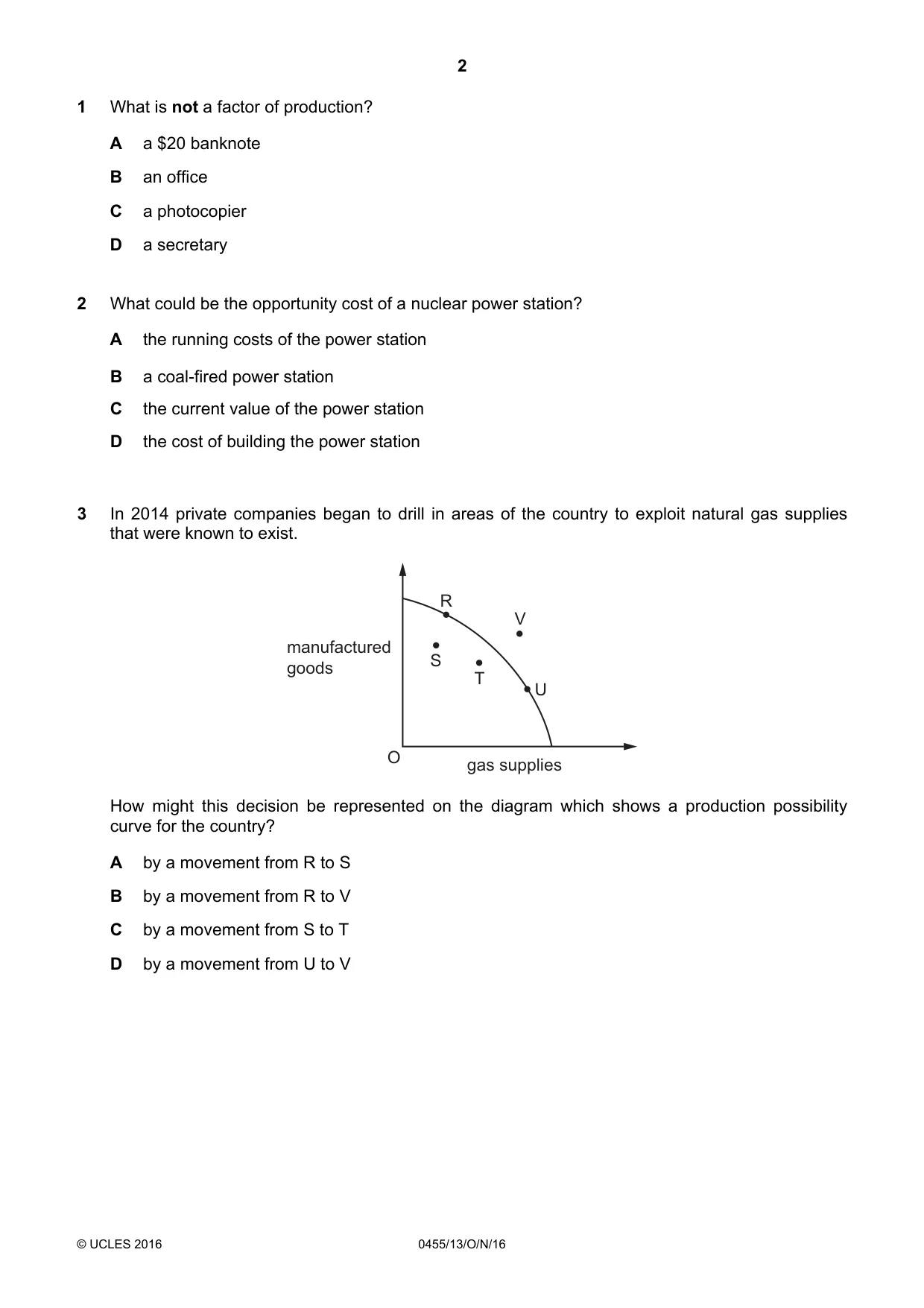
3 In 2014 private companies began to drill in areas of the country to exploit natural gas supplies that were known to exist. R V manufactured goods S T U O gas supplies How might this decision be represented on the diagram which shows a production possibility curve for the country? A by a movement from R to S B by a movement from R to V C by a movement from S to T D by a movement from U to V
Mark scheme: C
More questions on Production possibility curve (PPC) diagrams
Q4 · The market for a good was in equilibrium
4 The market for a good was in equilibrium. A change occurred which resulted in a new equilibrium with a higher price for the good and a lower quantity traded. What change would have caused this? A the demand curve moved to the left B the demand curve moved to the right C the supply curve moved to the left D the supply curve moved to the right
Mark scheme: C
Q5 · The demand for cocoa beans is price-inelastic
5 The demand for cocoa beans is price-inelastic. What is most likely to decrease as a result of an increase in demand for cocoa beans? A price of cocoa bean products B production of cocoa beans C profits of cocoa bean producers D unemployment among cocoa bean farmers
Mark scheme: D
Q6 · A government subsidises the production of pineapples
6 A government subsidises the production of pineapples. This is likely to A increase the price of pineapples. B raise the costs of supplying pineapples. C raise revenue for the government. D cause the supply of pineapples to increase at every price.
Mark scheme: D
Q7 · The use of cars in many cities creates negative externalities
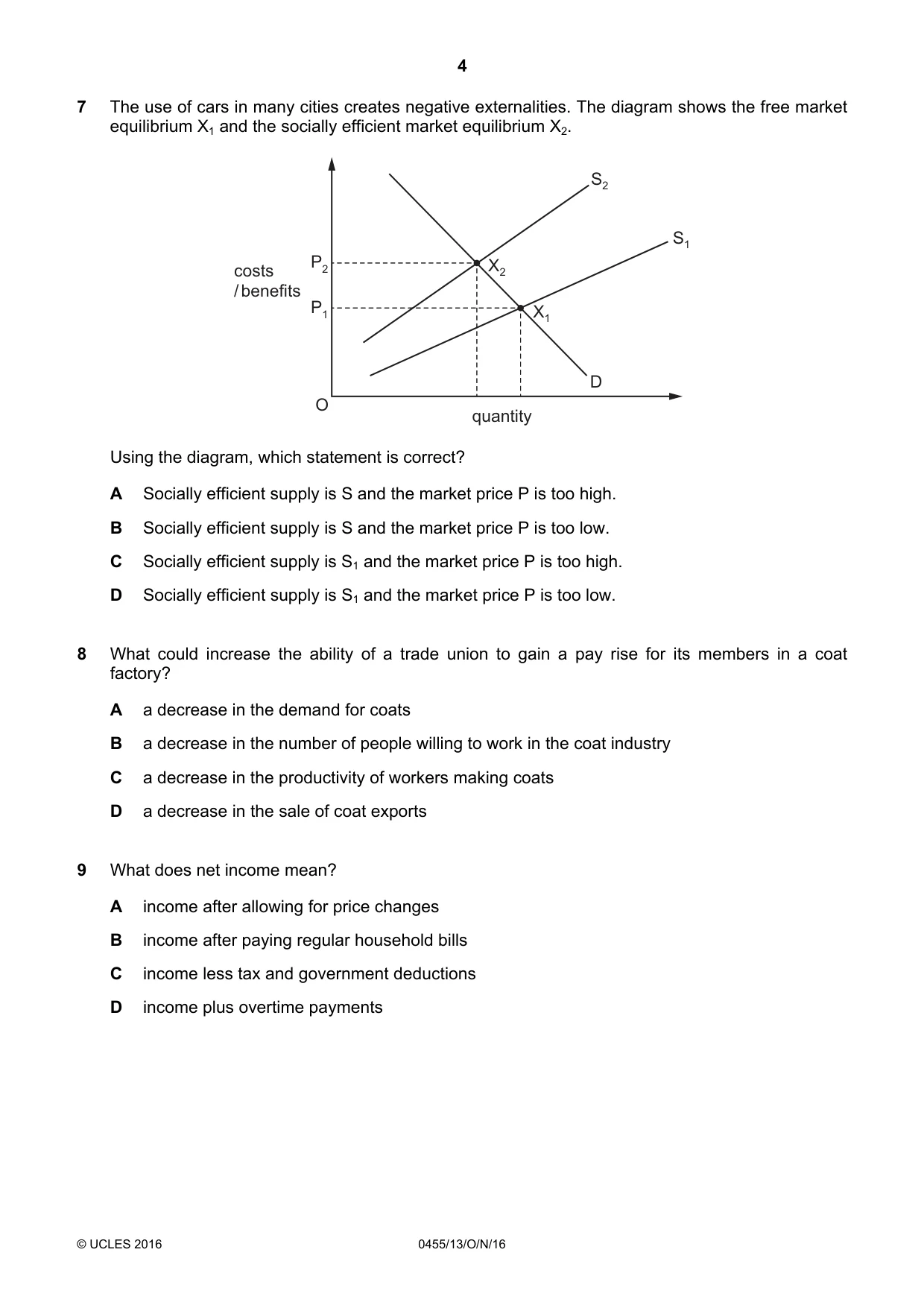
7 The use of cars in many cities creates negative externalities. The diagram shows the free market equilibrium X1 and the socially efficient market equilibrium X2. S2 S1 P2 X2 costs / benefits P1 X1 D O quantity Using the diagram, which statement is correct? A Socially efficient supply is S and the market price P is too high. B Socially efficient supply is S and the market price P is too low. C Socially efficient supply is S1 and the market price P is too high. D Socially efficient supply is S1 and the market price P is too low.
Mark scheme: D
Q8 · What could increase the ability of a trade union to gain a pay rise for its members in a…
8 What could increase the ability of a trade union to gain a pay rise for its members in a coat factory? A a decrease in the demand for coats B a decrease in the number of people willing to work in the coat industry C a decrease in the productivity of workers making coats D a decrease in the sale of coat exports
Mark scheme: B
Q9 · What does net income mean?
9 What does net income mean? A income after allowing for price changes B income after paying regular household bills C income less tax and government deductions D income plus overtime payments
Mark scheme: C
Q10 · Nazmin Uddin works in a local office as a secretary three days a week
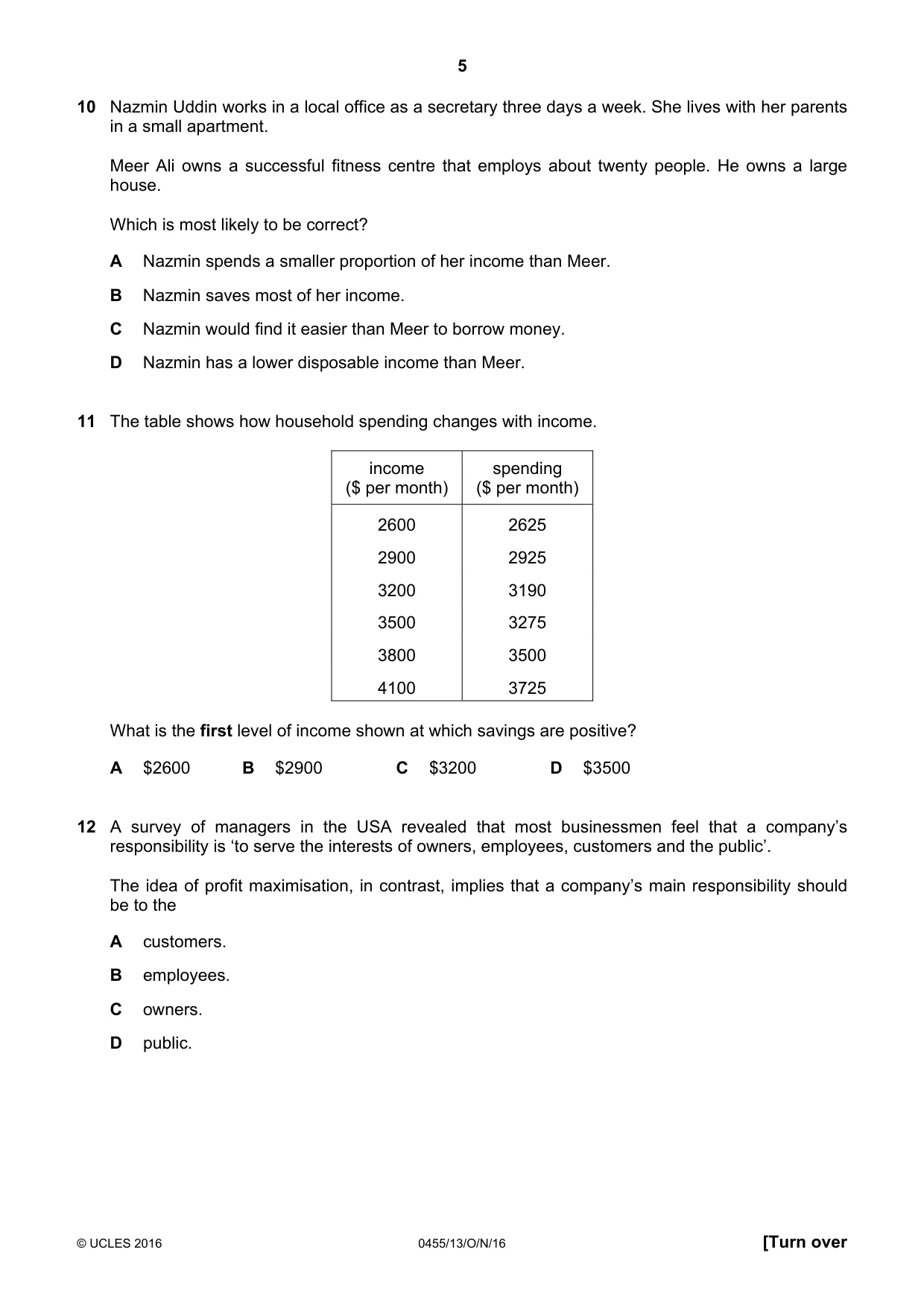
10 Nazmin Uddin works in a local office as a secretary three days a week. She lives with her parents in a small apartment. Meer Ali owns a successful fitness centre that employs about twenty people. He owns a large house. Which is most likely to be correct? A Nazmin spends a smaller proportion of her income than Meer. B Nazmin saves most of her income. C Nazmin would find it easier than Meer to borrow money. D Nazmin has a lower disposable income than Meer.
Mark scheme: D
Q11 · The table shows how household spending changes with income
11 The table shows how household spending changes with income. income spending ($ per month) ($ per month) 2600 2625 2900 2925 3200 3190 3500 3275 3800 3500 4100 3725 What is the first level of income shown at which savings are positive? A $2600 B $2900 C $3200 D $3500
Mark scheme: C
Q12 · A survey of managers in the USA revealed that most businessmen feel that a company’s…
12 A survey of managers in the USA revealed that most businessmen feel that a company’s responsibility is ‘to serve the interests of owners, employees, customers and the public’. The idea of profit maximisation, in contrast, implies that a company’s main responsibility should be to the A customers. B employees. C owners. D public.
Mark scheme: C
Q13 · Why is a firm in perfect competition a price taker?
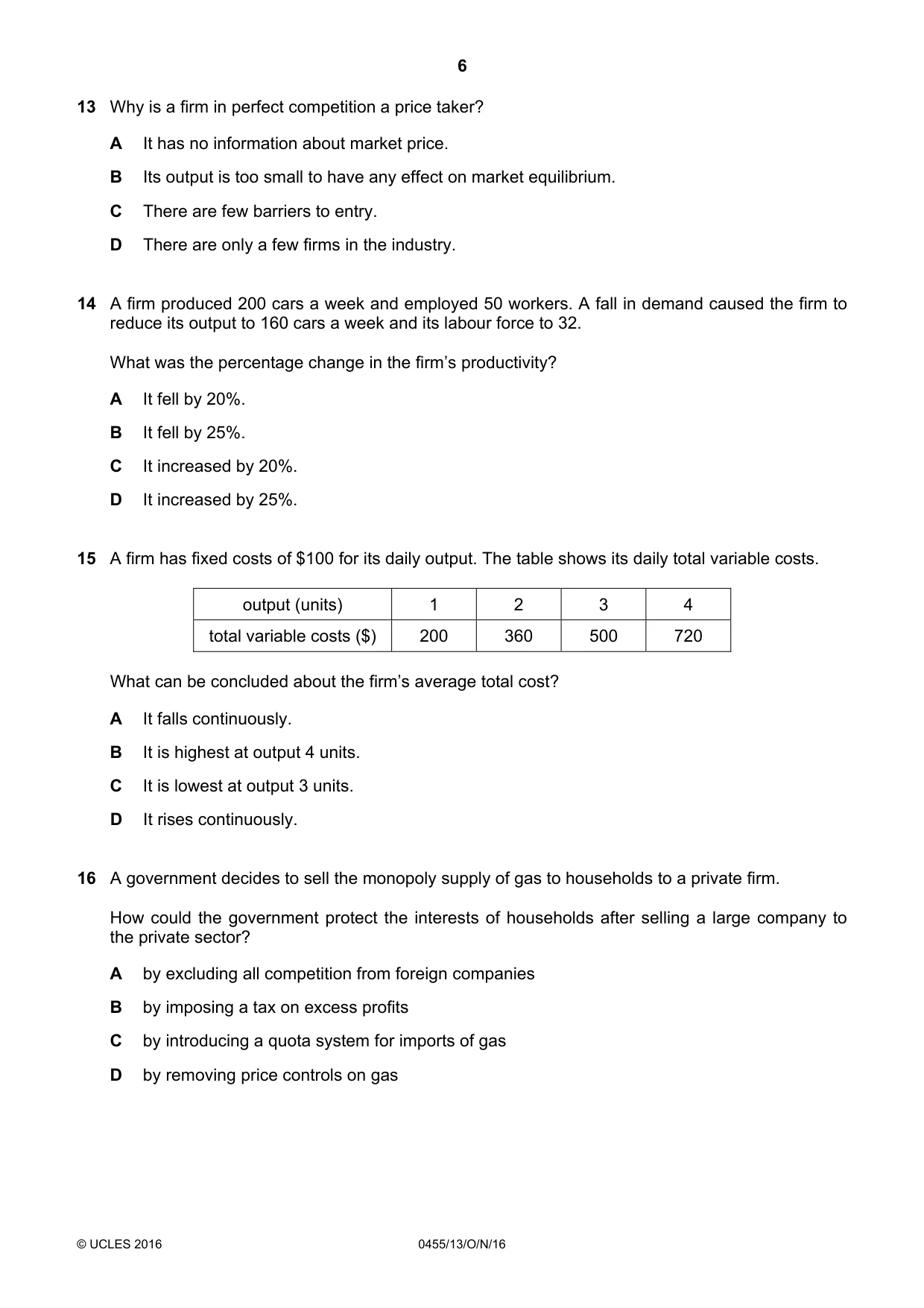
13 Why is a firm in perfect competition a price taker? A It has no information about market price. B Its output is too small to have any effect on market equilibrium. C There are few barriers to entry. D There are only a few firms in the industry.
Mark scheme: B
Q14 · A firm produced 200 cars a week and employed 50 workers
14 A firm produced 200 cars a week and employed 50 workers. A fall in demand caused the firm to reduce its output to 160 cars a week and its labour force to 32. What was the percentage change in the firm’s productivity? A It fell by 20%. B It fell by 25%. C It increased by 20%. D It increased by 25%.
Mark scheme: D
Q15 · A firm has fixed costs of $100 for its daily output
15 A firm has fixed costs of $100 for its daily output. The table shows its daily total variable costs. output (units) 1 2 3 4 total variable costs ($) 200 360 500 720 What can be concluded about the firm’s average total cost? A It falls continuously. B It is highest at output 4 units. C It is lowest at output 3 units. D It rises continuously.
Mark scheme: C
Q16 · A government decides to sell the monopoly supply of gas to households to a private firm
16 A government decides to sell the monopoly supply of gas to households to a private firm. How could the government protect the interests of households after selling a large company to the private sector? A by excluding all competition from foreign companies B by imposing a tax on excess profits C by introducing a quota system for imports of gas D by removing price controls on gas
Mark scheme: B
Q17 · A government decides to increase the rate of income tax and spend the extra revenue on…
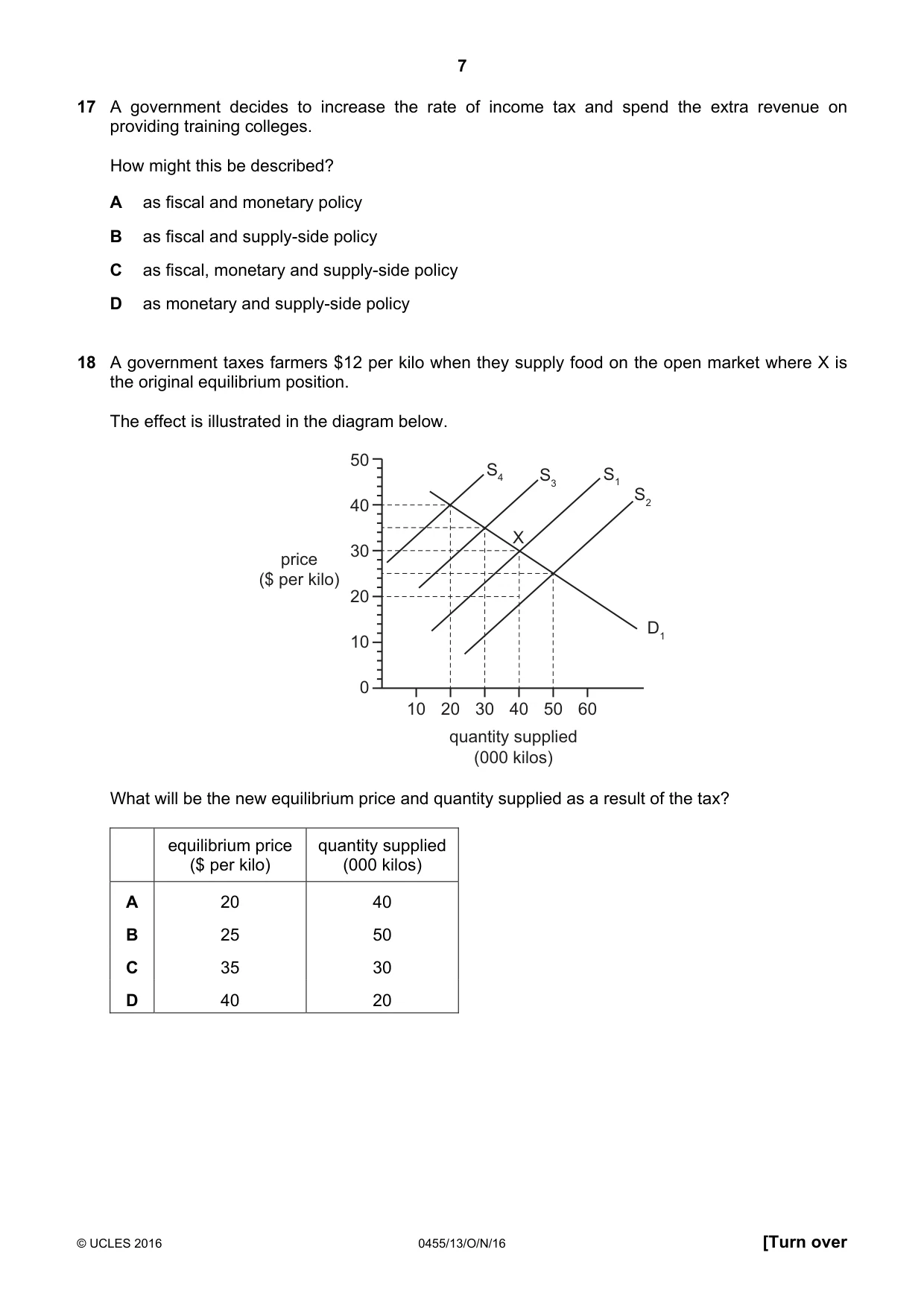
17 A government decides to increase the rate of income tax and spend the extra revenue on providing training colleges. How might this be described? A as fiscal and monetary policy B as fiscal and supply-side policy C as fiscal, monetary and supply-side policy D as monetary and supply-side policy
Mark scheme: B
Q18 · A government taxes farmers $12 per kilo when they supply food on the open market where X…
18 A government taxes farmers $12 per kilo when they supply food on the open market where X is the original equilibrium position. The effect is illustrated in the diagram below. 50 S4 S3 S1 S2 40 X 30 price ($ per kilo) 20 D1 10 0 10 20 30 40 50 60 quantity supplied (000 kilos) What will be the new equilibrium price and quantity supplied as a result of the tax? equilibrium price quantity supplied ($ per kilo) (000 kilos) A 20 40 B 25 50 C 35 30 D 40 20
Mark scheme: C
Q19 · The table shows taxes as percentages of Gross Domestic Product (GDP) for four countries
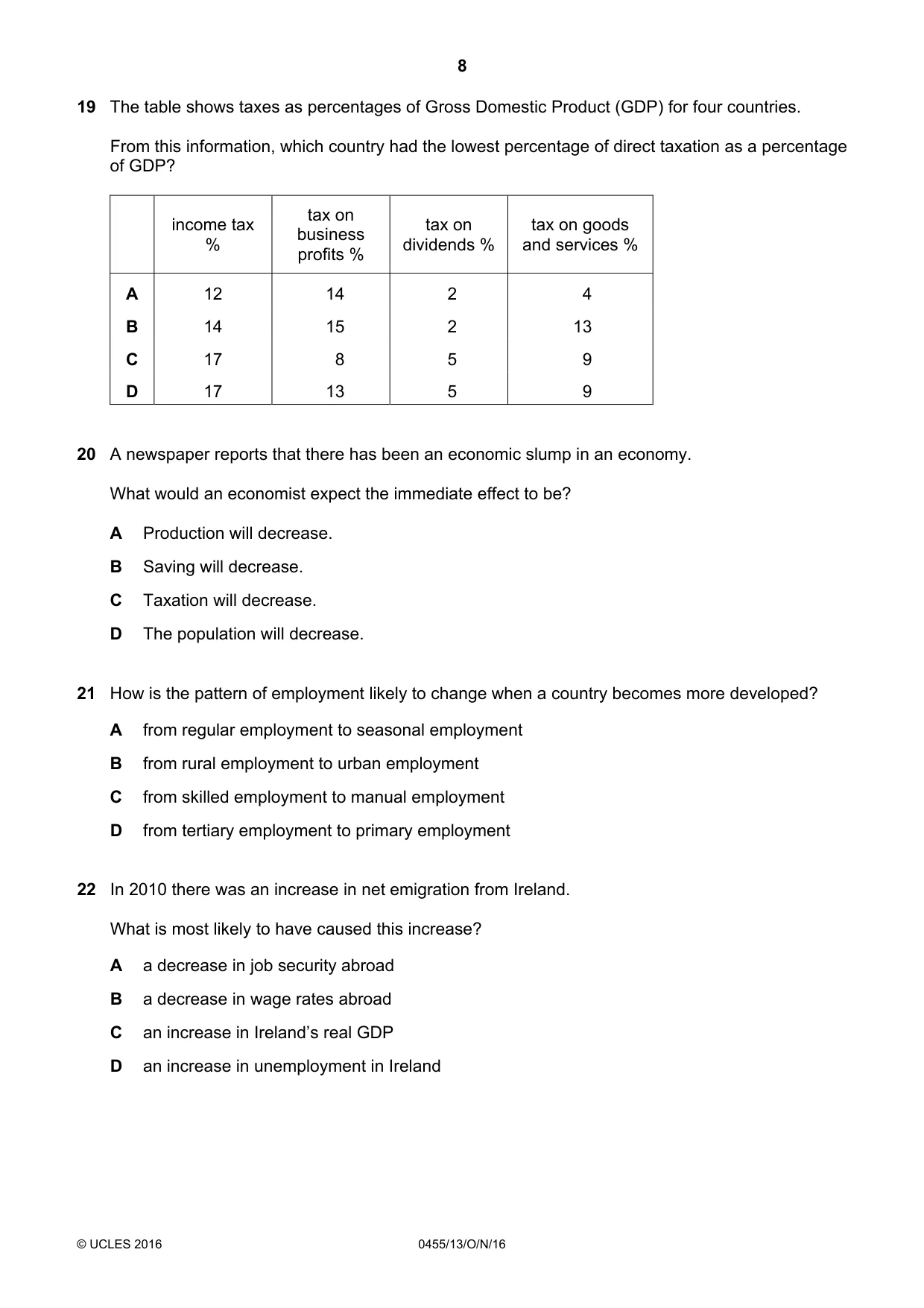
19 The table shows taxes as percentages of Gross Domestic Product (GDP) for four countries. From this information, which country had the lowest percentage of direct taxation as a percentage of GDP? tax on income tax tax on tax on goods business % dividends % and services % profits % A 12 14 2 4 B 14 15 2 13 C 17 8 5 9 D 17 13 5 9
Mark scheme: A
Q20 · A newspaper reports that there has been an economic slump in an economy
20 A newspaper reports that there has been an economic slump in an economy. What would an economist expect the immediate effect to be? A Production will decrease. B Saving will decrease. C Taxation will decrease. D The population will decrease.
Mark scheme: A
Q21 · How is the pattern of employment likely to change when a country becomes more developed?
21 How is the pattern of employment likely to change when a country becomes more developed? A from regular employment to seasonal employment B from rural employment to urban employment C from skilled employment to manual employment D from tertiary employment to primary employment
Mark scheme: B
More questions on Differences in economic development between countries
Q22 · In 2010 there was an increase in net emigration from Ireland
22 In 2010 there was an increase in net emigration from Ireland. What is most likely to have caused this increase? A a decrease in job security abroad B a decrease in wage rates abroad C an increase in Ireland’s real GDP D an increase in unemployment in Ireland
Mark scheme: D
Q23 · The table shows some economic indicators
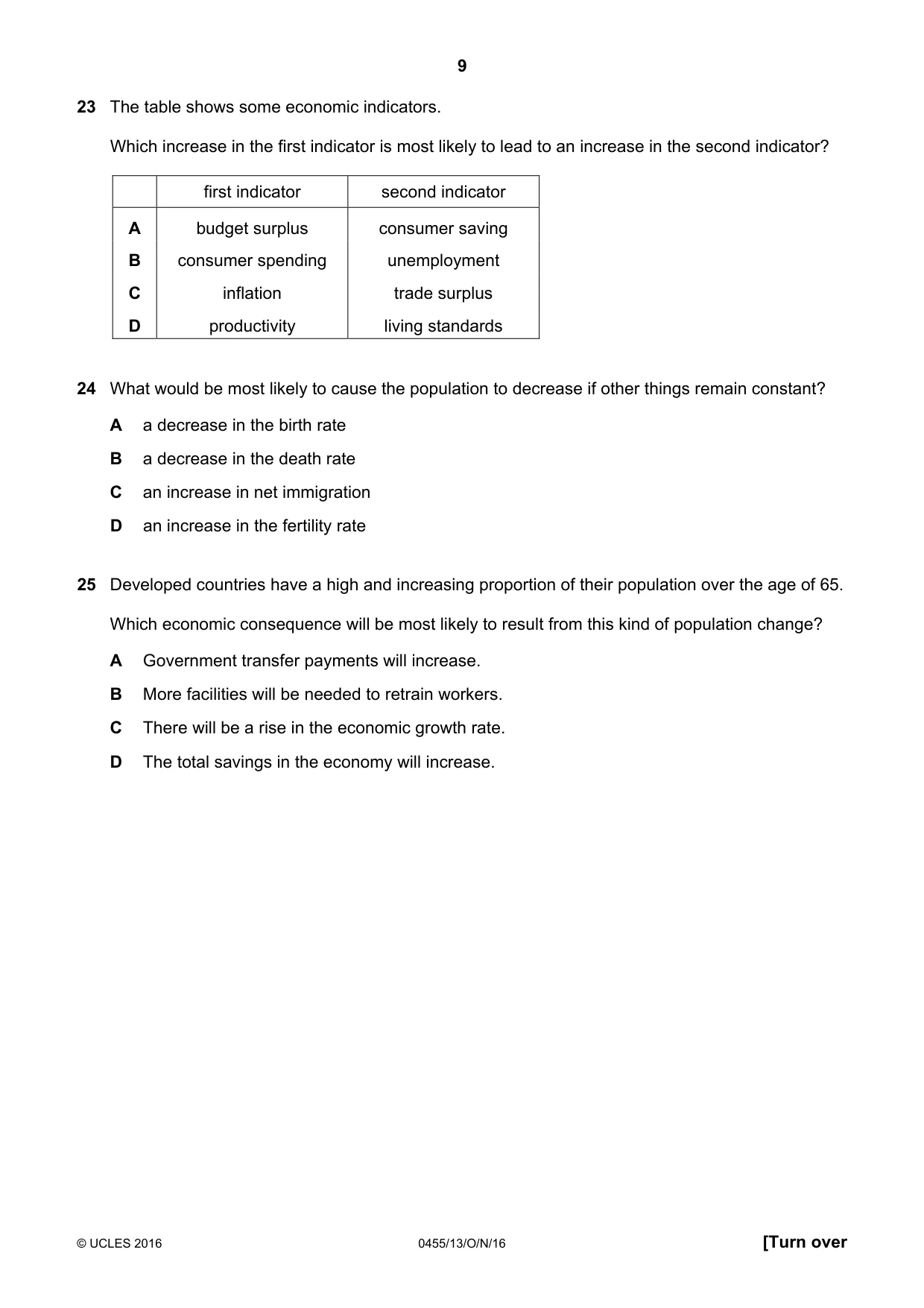
23 The table shows some economic indicators. Which increase in the first indicator is most likely to lead to an increase in the second indicator? first indicator second indicator A budget surplus consumer saving B consumer spending unemployment C inflation trade surplus D productivity living standards
Mark scheme: D
Q24 · What would be most likely to cause the population to decrease if other things remain…
24 What would be most likely to cause the population to decrease if other things remain constant? A a decrease in the birth rate B a decrease in the death rate C an increase in net immigration D an increase in the fertility rate
Mark scheme: A
Q25 · Developed countries have a high and increasing proportion of their population over the…
25 Developed countries have a high and increasing proportion of their population over the age of 65. Which economic consequence will be most likely to result from this kind of population change? A Government transfer payments will increase. B More facilities will be needed to retrain workers. C There will be a rise in the economic growth rate. D The total savings in the economy will increase.
Mark scheme: A
Q26 · The chart shows total world carbon emissions in 1995 and predicted emissions by 2035
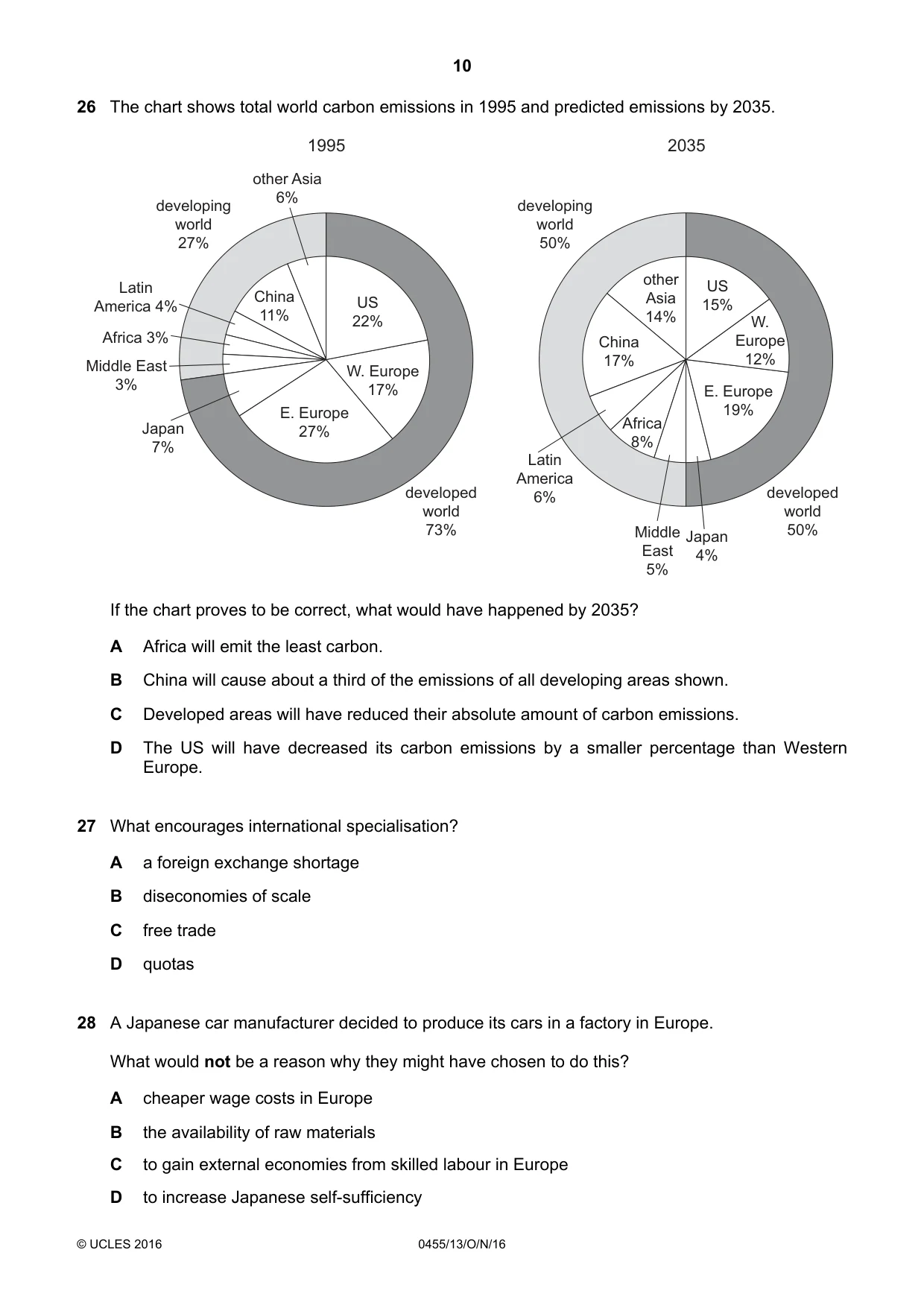
26 The chart shows total world carbon emissions in 1995 and predicted emissions by 2035. 1995 2035 other Asia 6% developing developing world world 27% 50% other US Latin China US Asia America 4% 15% 11% 22% 14% W. Africa 3% China Europe Middle East 17% 12% W. Europe 3% 17% E. Europe E. Europe 19% Japan Africa 27% 7% 8% Latin America developed 6% developed world world 73% Middle Japan 50% East 4% 5% If the chart proves to be correct, what would have happened by 2035? A Africa will emit the least carbon. B China will cause about a third of the emissions of all developing areas shown. C Developed areas will have reduced their absolute amount of carbon emissions. D The US will have decreased its carbon emissions by a smaller percentage than Western Europe.
Mark scheme: B
More questions on Differences in economic development between countries
Q27 · What encourages international specialisation?
27 What encourages international specialisation? A a foreign exchange shortage B diseconomies of scale C free trade D quotas
Mark scheme: C
Q28 · A Japanese car manufacturer decided to produce its cars in a factory in Europe
28 A Japanese car manufacturer decided to produce its cars in a factory in Europe. What would not be a reason why they might have chosen to do this? A cheaper wage costs in Europe B the availability of raw materials C to gain external economies from skilled labour in Europe D to increase Japanese self-sufficiency
Mark scheme: D
Q29 · A government removed the quota on goods imported into the country
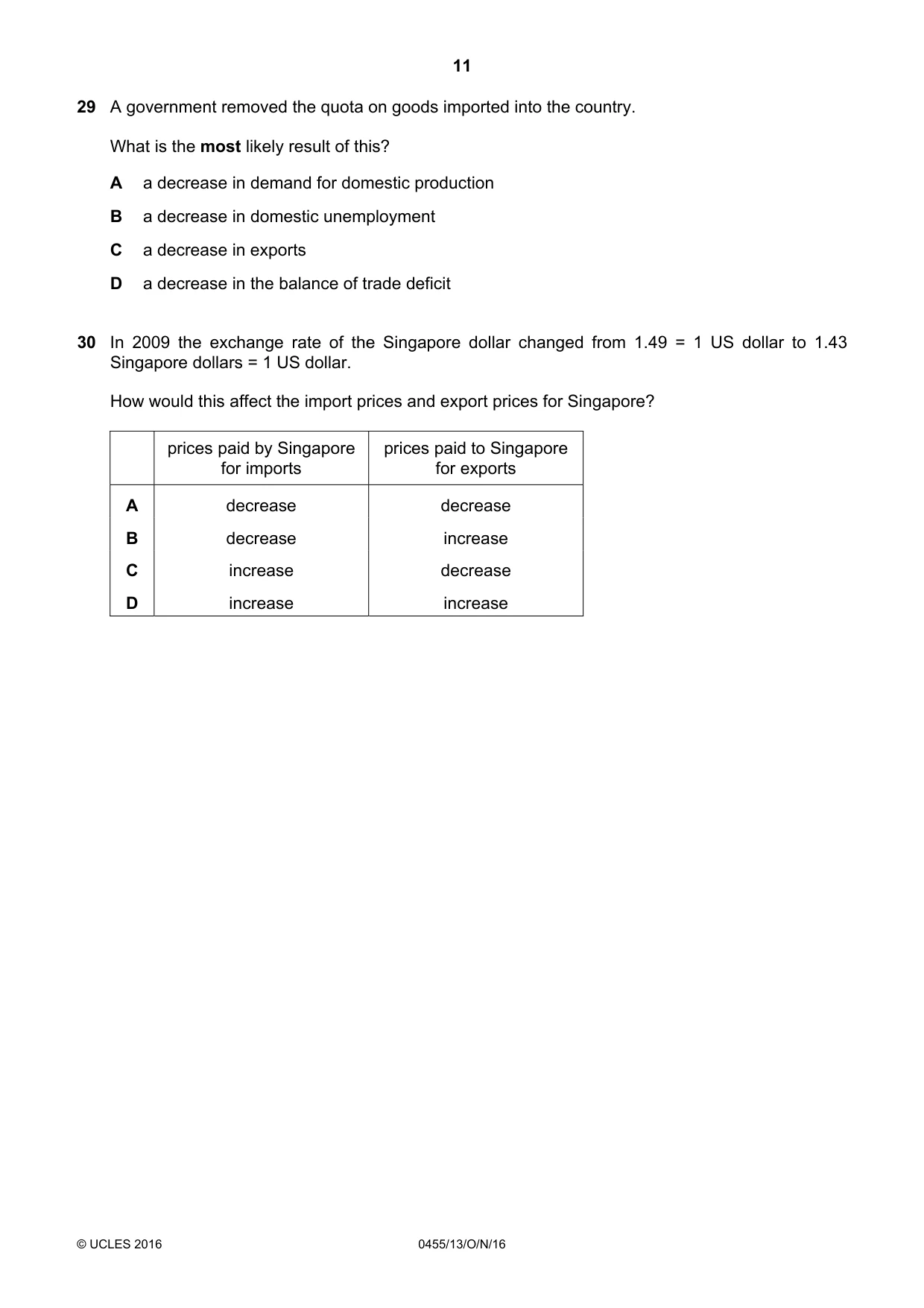
29 A government removed the quota on goods imported into the country. What is the most likely result of this? A a decrease in demand for domestic production B a decrease in domestic unemployment C a decrease in exports D a decrease in the balance of trade deficit
Mark scheme: A
Q30 · In 2009 the exchange rate of the Singapore dollar changed from 1.49 = 1 US dollar to 1.43…
30 In 2009 the exchange rate of the Singapore dollar changed from 1.49 = 1 US dollar to 1.43 Singapore dollars = 1 US dollar. How would this affect the import prices and export prices for Singapore? prices paid by Singapore prices paid to Singapore for imports for exports A decrease decrease B decrease increase C increase decrease D increase increase
Mark scheme: B
What was in this paper
The subtopics covered by these 30 questions, and how many questions each got. Open one in a new tab to see every Cambridge question on it.
3Differences in economic development between countries2Fiscal policy2Globalisation, free trade and protection2Market failure2Population2Price determination2Economic growth1Employment and unemployment1Firms1Firms and production1Firms’ costs, revenue and objectives1Foreign exchange rates1International specialisation1Living standards1Market structure1Opportunity cost1Price elasticity of demand (PED)1Production possibility curve (PPC) diagrams1Supply1The factors of production1Trade unions1What you needed in this session
Cambridge’s own grade thresholds for 2016 Oct/Nov, Paper 1 · Variant 3. A higher threshold means an easier paper — the bar moves with how the cohort did.