Cambridge IGCSE Economics 0455 — 2016 May/June Paper 1 · Variant 1
0455/11/M/J/16 · 30 questions · 30 marks · ≈34 min
The question paper and its mark scheme, free to read here and free to download. This is Cambridge’s own paper, exactly as it was sat.
Question paper12 pages

Mark scheme2 pages
Answers below. Sit the paper first if you are practising.
Questions as text
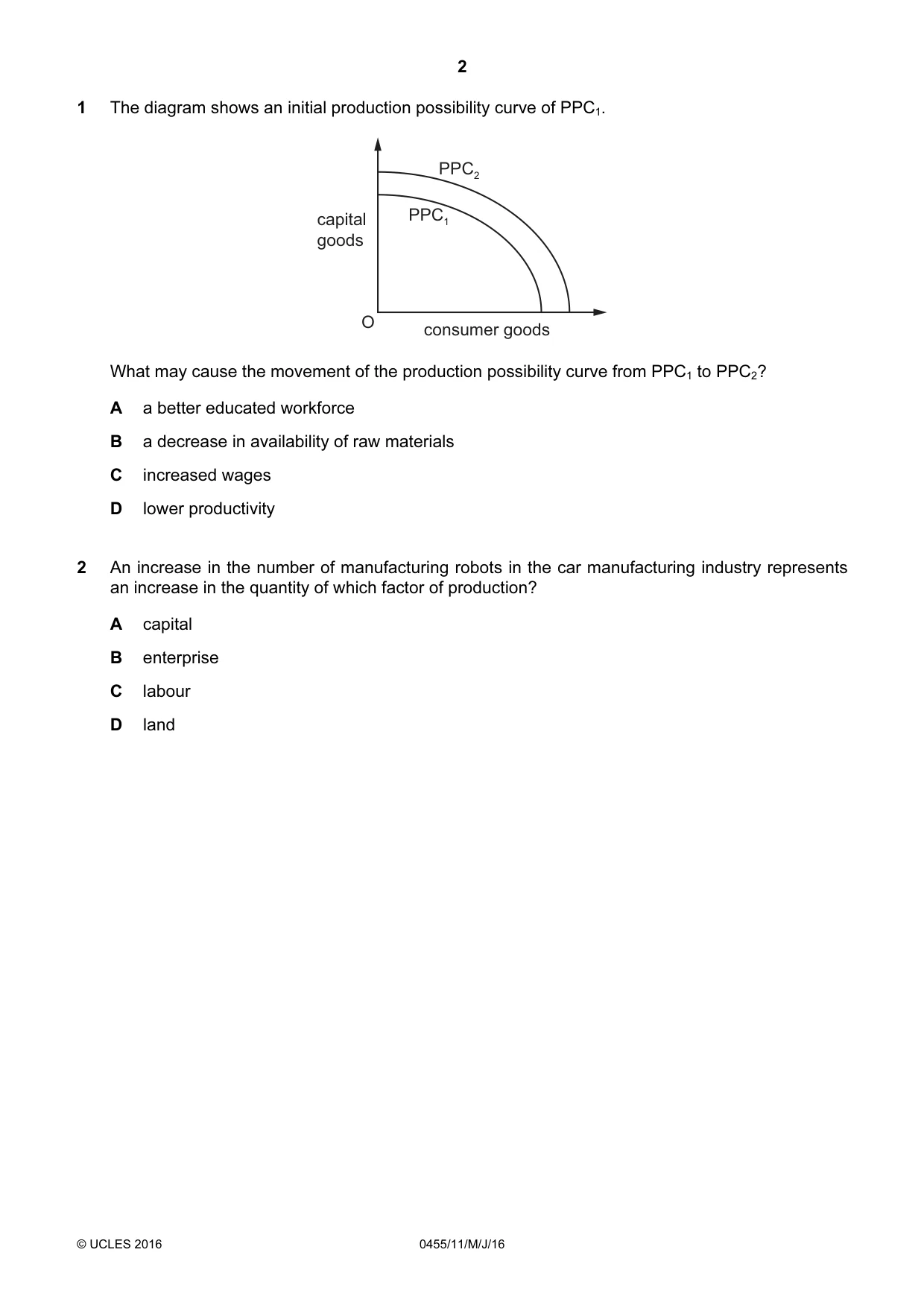
Q1 · The diagram shows an initial production possibility curve of PPC1
1 The diagram shows an initial production possibility curve of PPC1. PPC2 capital PPC1 goods O consumer goods What may cause the movement of the production possibility curve from PPC1 to PPC2? A a better educated workforce B a decrease in availability of raw materials C increased wages D lower productivity
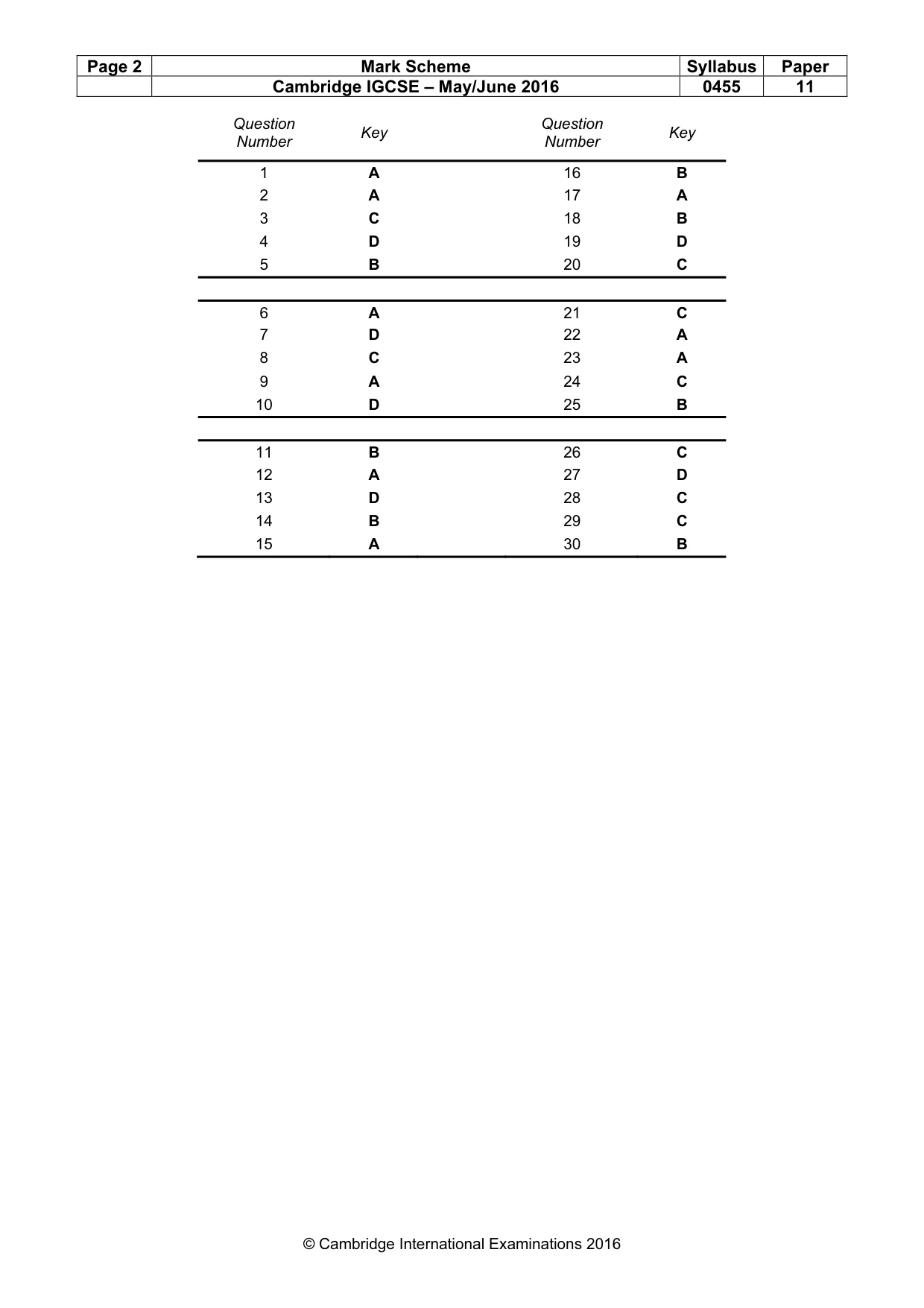
Mark scheme: A
More questions on Production possibility curve (PPC) diagrams
Q2 · An increase in the number of manufacturing robots in the car manufacturing industry…
2 An increase in the number of manufacturing robots in the car manufacturing industry represents an increase in the quantity of which factor of production? A capital B enterprise C labour D land
Mark scheme: A
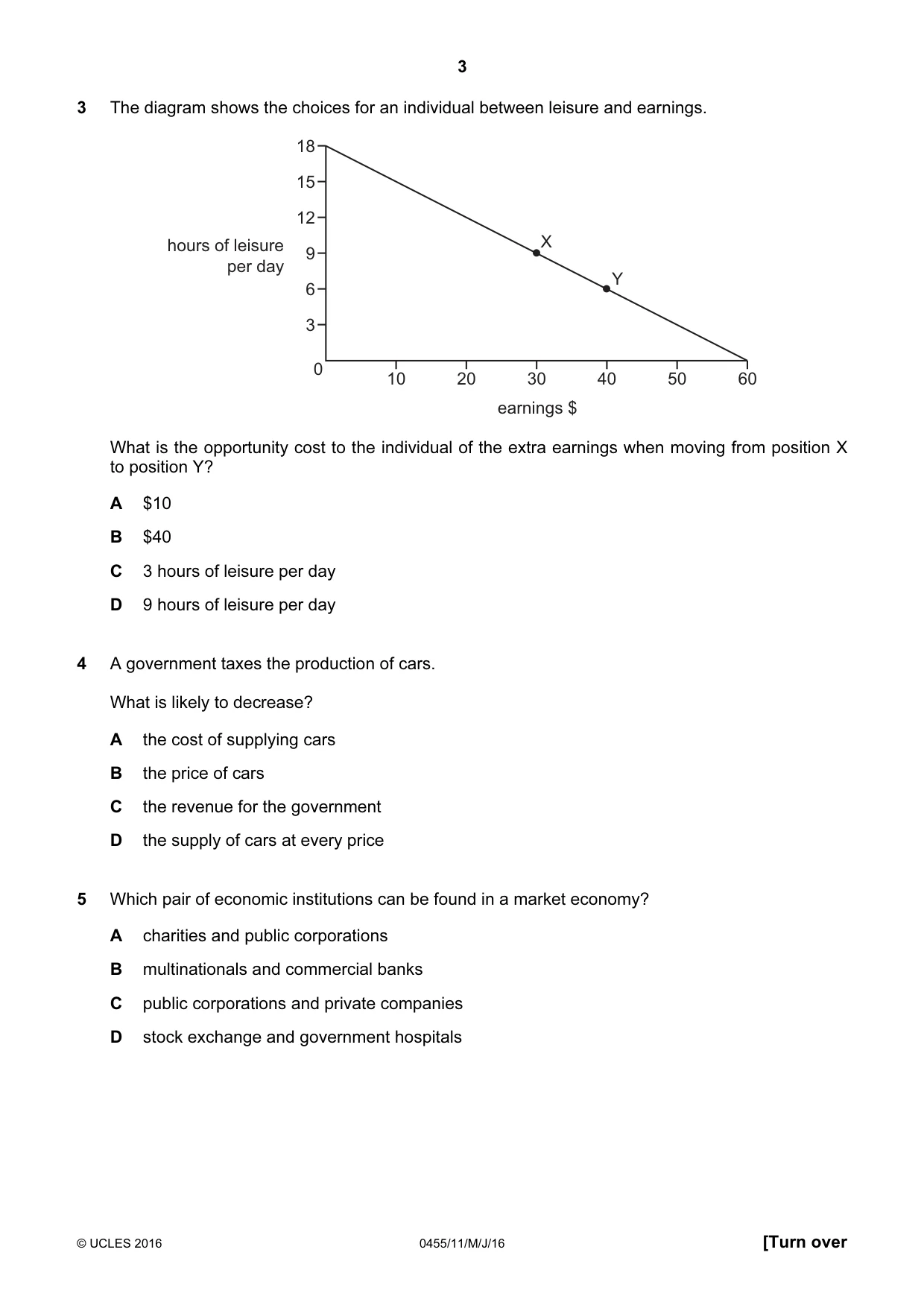
Q3 · The diagram shows the choices for an individual between leisure and earnings
3 The diagram shows the choices for an individual between leisure and earnings. 18 15 12 hours of leisure X 9 per day Y 6 3 0 10 20 30 40 50 60 earnings $ What is the opportunity cost to the individual of the extra earnings when moving from position X to position Y? A $10 B $40 C 3 hours of leisure per day D 9 hours of leisure per day
Mark scheme: C
Q4 · A government taxes the production of cars
4 A government taxes the production of cars. What is likely to decrease? A the cost of supplying cars B the price of cars C the revenue for the government D the supply of cars at every price
Mark scheme: D
Q5 · Which pair of economic institutions can be found in a market economy?
5 Which pair of economic institutions can be found in a market economy? A charities and public corporations B multinationals and commercial banks C public corporations and private companies D stock exchange and government hospitals
Mark scheme: B
Q6 · Developers want to increase the size of a major retail shopping area in a city
6 Developers want to increase the size of a major retail shopping area in a city. It is thought that the proposal would create hundreds of jobs, be profitable for the shops but cause major traffic congestion. What economic concepts are directly involved in this statement? A external cost and private benefit B income distribution and inelastic demand C private investment and a decrease in supply D social benefit and perfect competition
Mark scheme: A
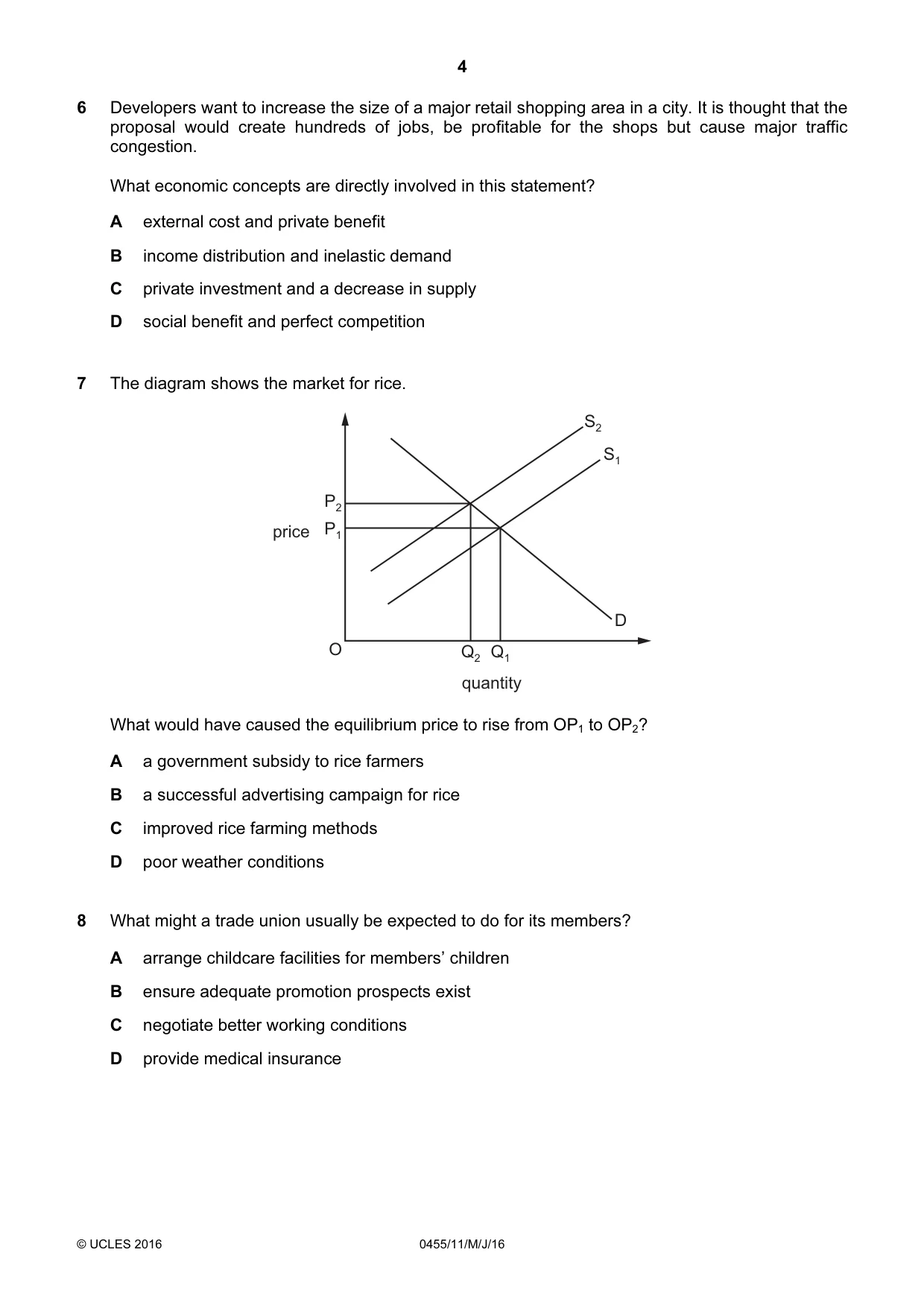
Q7 · The diagram shows the market for rice
7 The diagram shows the market for rice. S2 S1 P2 price P1 D O Q2 Q1 quantity What would have caused the equilibrium price to rise from OP1 to OP2? A a government subsidy to rice farmers B a successful advertising campaign for rice C improved rice farming methods D poor weather conditions
Mark scheme: D
Q8 · What might a trade union usually be expected to do for its members?
8 What might a trade union usually be expected to do for its members? A arrange childcare facilities for members’ children B ensure adequate promotion prospects exist C negotiate better working conditions D provide medical insurance
Mark scheme: C
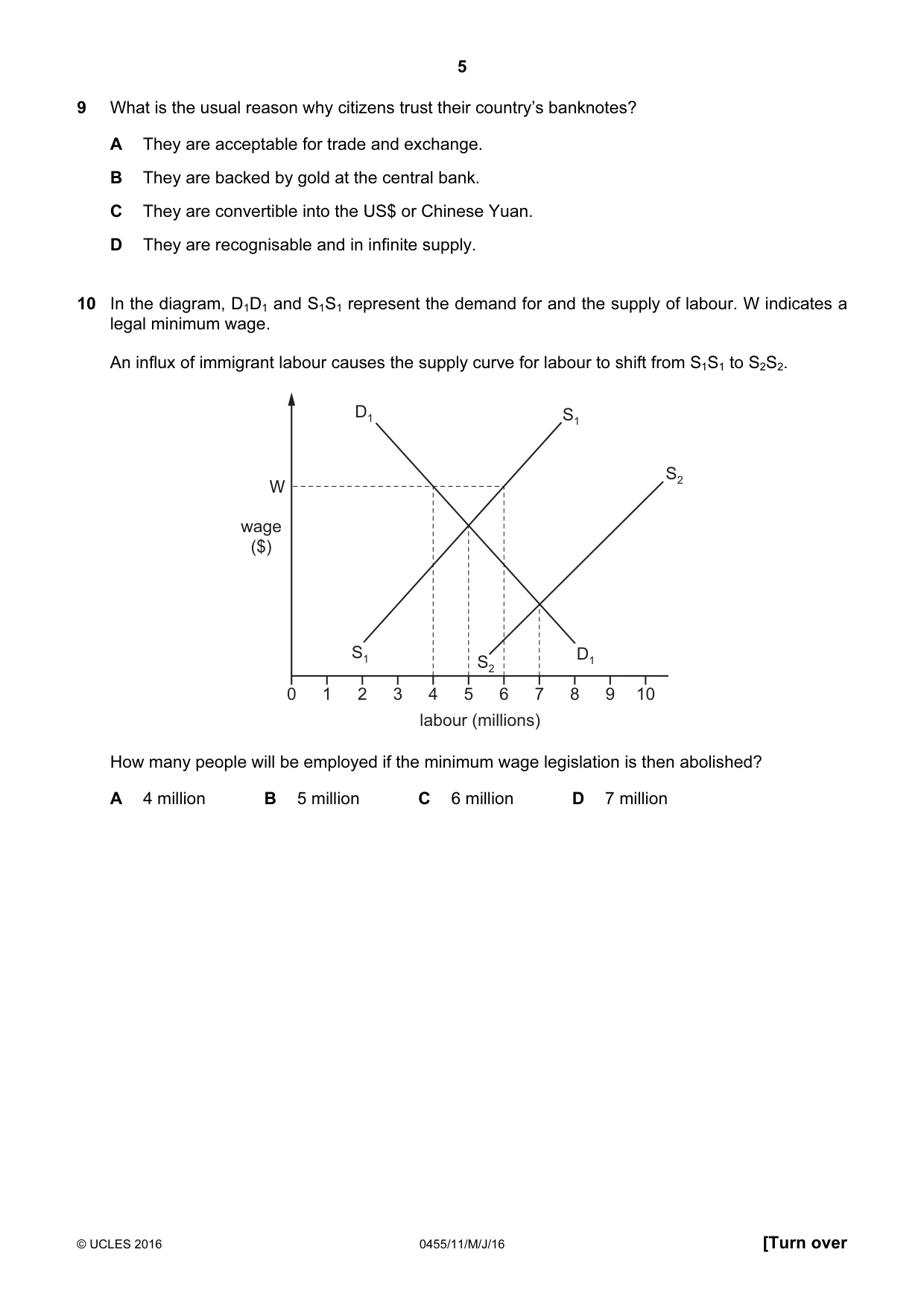
Q9 · What is the usual reason why citizens trust their country’s banknotes?
9 What is the usual reason why citizens trust their country’s banknotes? A They are acceptable for trade and exchange. B They are backed by gold at the central bank. C They are convertible into the US$ or Chinese Yuan. D They are recognisable and in infinite supply.
Mark scheme: A
Q10 · In the diagram, D1D1 and S1S1 represent the demand for and the supply of labour
10 In the diagram, D1D1 and S1S1 represent the demand for and the supply of labour. W indicates a legal minimum wage. An influx of immigrant labour causes the supply curve for labour to shift from S1S1 to S2S2. D1 S1 S2 W wage ($) S1 D1 S2 0 1 2 3 4 5 6 7 8 9 10 labour (millions) How many people will be employed if the minimum wage legislation is then abolished? A 4 million B 5 million C 6 million D 7 million
Mark scheme: D
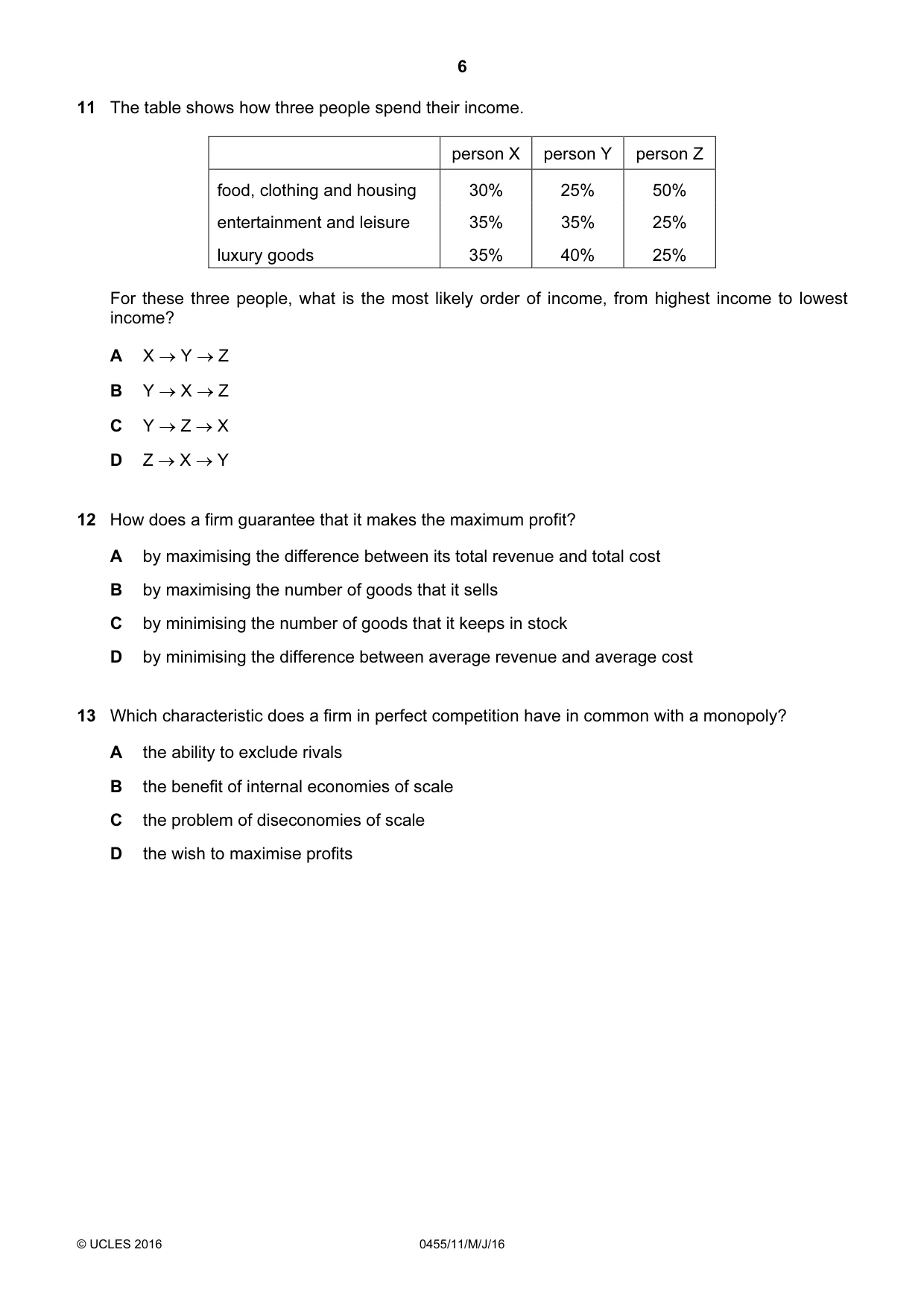
Q11 · The table shows how three people spend their income
11 The table shows how three people spend their income. person X person Y person Z food, clothing and housing 30% 25% 50% entertainment and leisure 35% 35% 25% luxury goods 35% 40% 25% For these three people, what is the most likely order of income, from highest income to lowest income? A X → Y → Z B Y → X → Z C Y → Z → X D Z → X → Y
Mark scheme: B
Q12 · How does a firm guarantee that it makes the maximum profit?
12 How does a firm guarantee that it makes the maximum profit? A by maximising the difference between its total revenue and total cost B by maximising the number of goods that it sells C by minimising the number of goods that it keeps in stock D by minimising the difference between average revenue and average cost
Mark scheme: A
Q13 · Which characteristic does a firm in perfect competition have in common with a monopoly?
13 Which characteristic does a firm in perfect competition have in common with a monopoly? A the ability to exclude rivals B the benefit of internal economies of scale C the problem of diseconomies of scale D the wish to maximise profits
Mark scheme: D
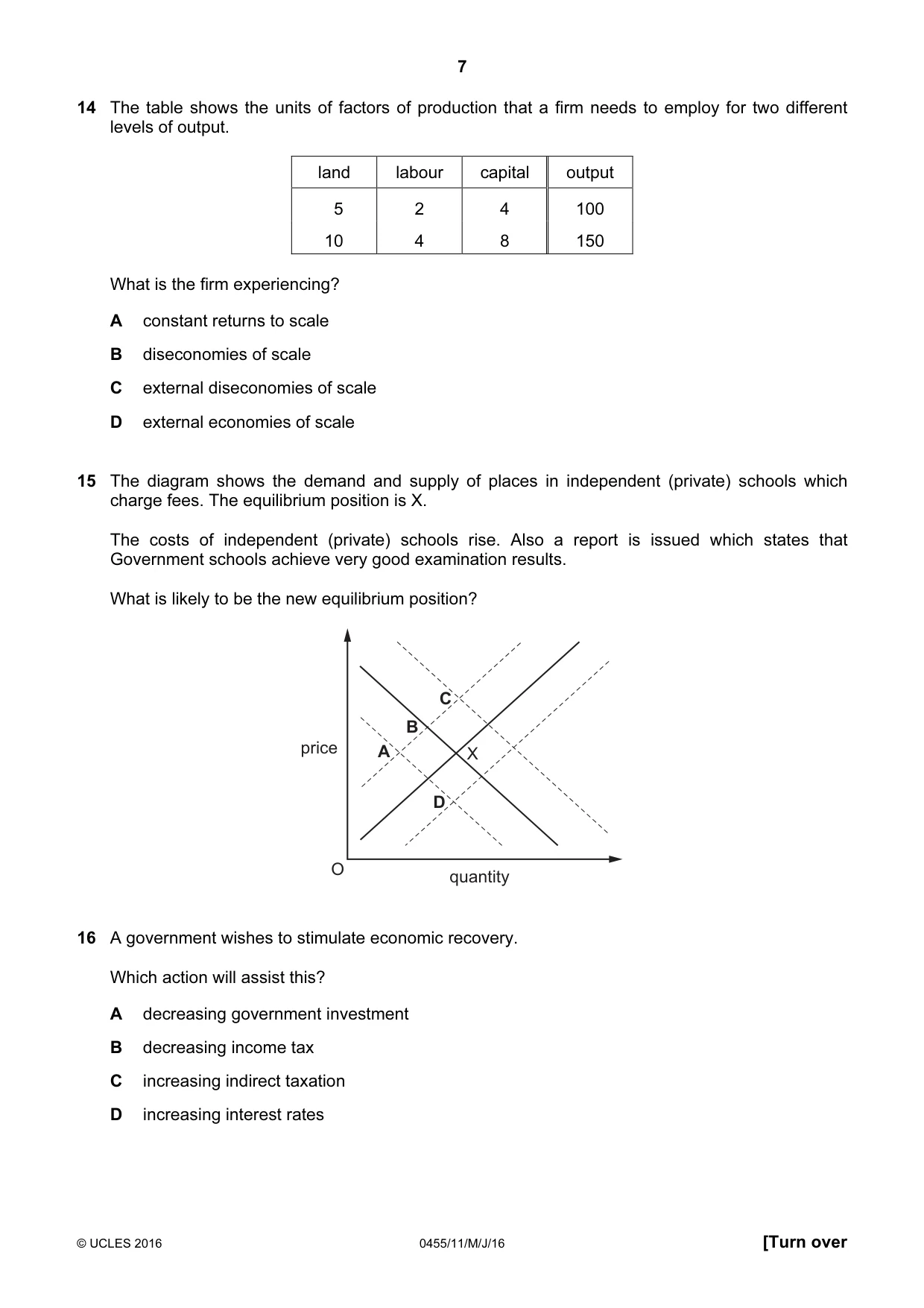
Q14 · The table shows the units of factors of production that a firm needs to employ for two…
14 The table shows the units of factors of production that a firm needs to employ for two different levels of output. land labour capital output 5 2 4 100 10 4 8 150 What is the firm experiencing? A constant returns to scale B diseconomies of scale C external diseconomies of scale D external economies of scale
Mark scheme: B
Q15 · The diagram shows the demand and supply of places in independent (private) schools which…
15 The diagram shows the demand and supply of places in independent (private) schools which charge fees. The equilibrium position is X. The costs of independent (private) schools rise. Also a report is issued which states that Government schools achieve very good examination results. What is likely to be the new equilibrium position? C B price A X D O quantity
Mark scheme: A
Q16 · A government wishes to stimulate economic recovery
16 A government wishes to stimulate economic recovery. Which action will assist this? A decreasing government investment B decreasing income tax C increasing indirect taxation D increasing interest rates
Mark scheme: B
Q17 · What is an expansionary monetary policy?
17 What is an expansionary monetary policy? A a decrease in the interest rate B a decrease in the rate of value added tax C an increase in the power of trade unions D an increase in the standard rate of income tax
Mark scheme: A
Q18 · A government decides to make two changes to its taxation policies
18 A government decides to make two changes to its taxation policies. It lowers the tax on petrol and raises the tax on food. How do these changes affect the regressive nature of the taxes? lower petrol higher food tax tax A less regressive less regressive B less regressive more regressive C more regressive less regressive D more regressive more regressive
Mark scheme: B
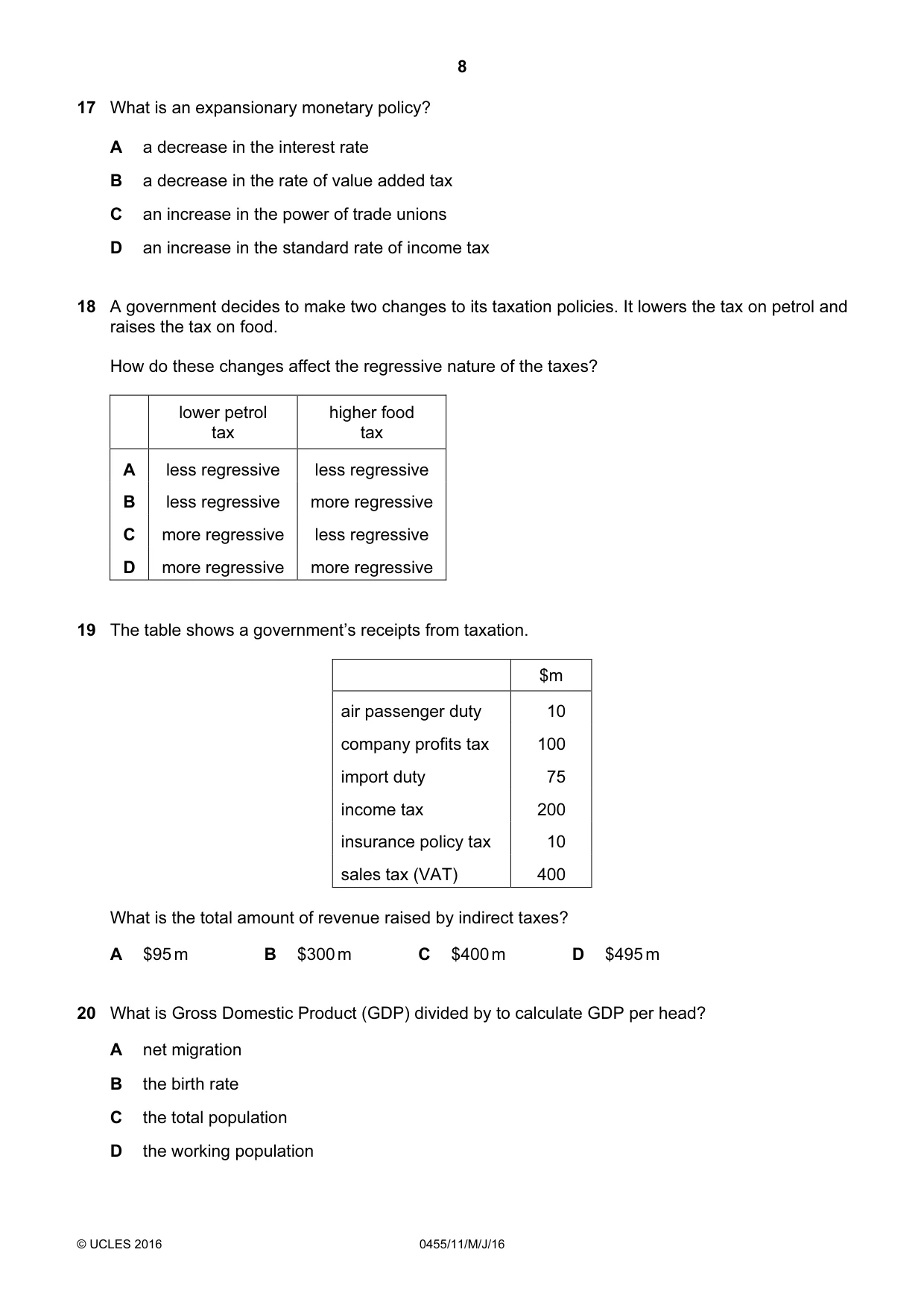
Q19 · The table shows a government’s receipts from taxation
19 The table shows a government’s receipts from taxation. $m air passenger duty 10 company profits tax 100 import duty 75 income tax 200 insurance policy tax 10 sales tax (VAT) 400 What is the total amount of revenue raised by indirect taxes? A $95 m B $300 m C $400 m D $495 m
Mark scheme: D
Q20 · What is Gross Domestic Product (GDP) divided by to calculate GDP per head?
20 What is Gross Domestic Product (GDP) divided by to calculate GDP per head? A net migration B the birth rate C the total population D the working population
Mark scheme: C
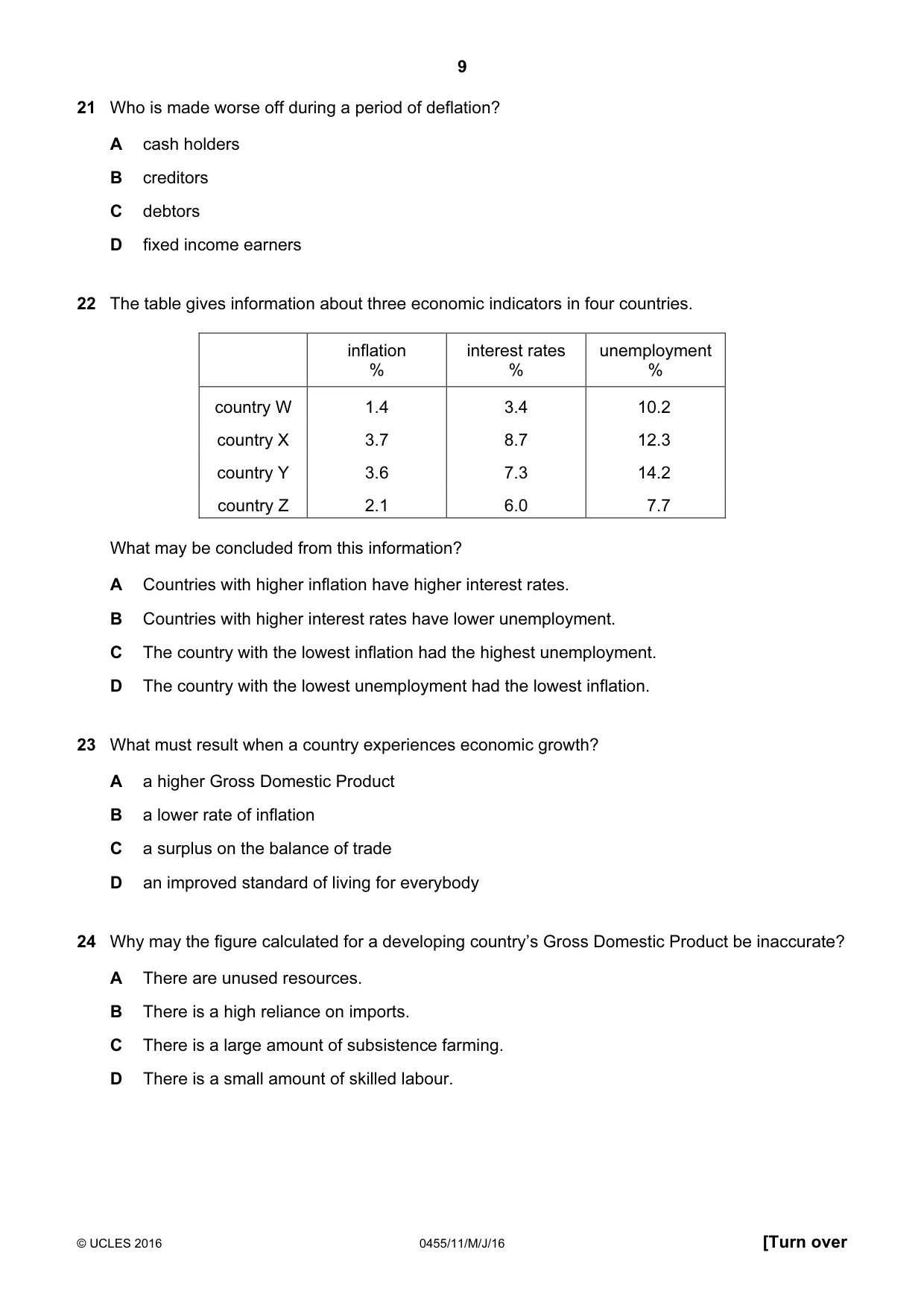
Q21 · Who is made worse off during a period of deflation?
21 Who is made worse off during a period of deflation? A cash holders B creditors C debtors D fixed income earners
Mark scheme: C
Q22 · The table gives information about three economic indicators in four countries
22 The table gives information about three economic indicators in four countries. inflation interest rates unemployment % % % country W 1.4 3.4 10.2 country X 3.7 8.7 12.3 country Y 3.6 7.3 14.2 country Z 2.1 6.0 7.7 What may be concluded from this information? A Countries with higher inflation have higher interest rates. B Countries with higher interest rates have lower unemployment. C The country with the lowest inflation had the highest unemployment. D The country with the lowest unemployment had the lowest inflation.
Mark scheme: A
Q23 · What must result when a country experiences economic growth?
23 What must result when a country experiences economic growth? A a higher Gross Domestic Product B a lower rate of inflation C a surplus on the balance of trade D an improved standard of living for everybody
Mark scheme: A
Q24 · Why may the figure calculated for a developing country’s Gross Domestic Product be…
24 Why may the figure calculated for a developing country’s Gross Domestic Product be inaccurate? A There are unused resources. B There is a high reliance on imports. C There is a large amount of subsistence farming. D There is a small amount of skilled labour.
Mark scheme: C
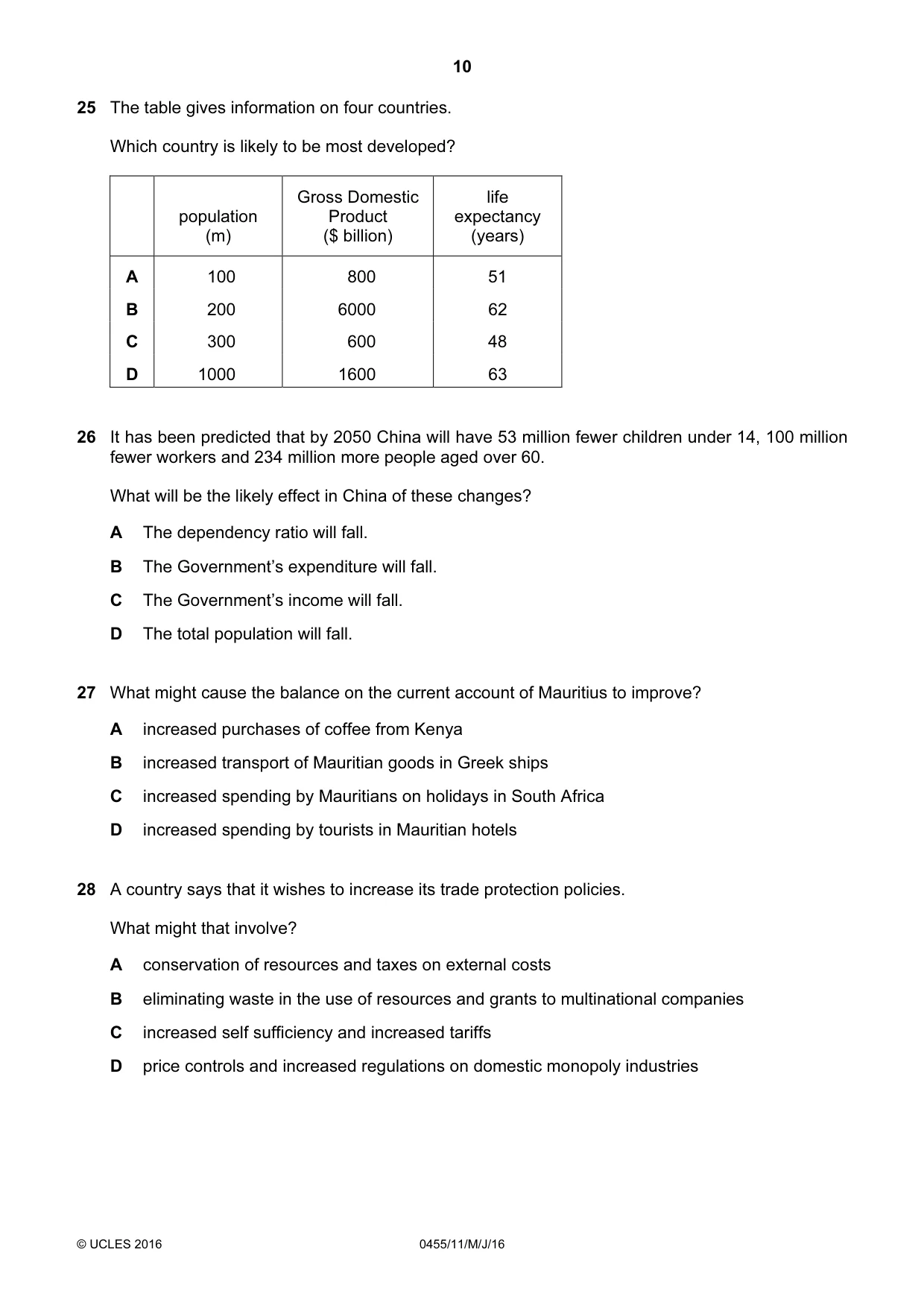
Q25 · The table gives information on four countries
25 The table gives information on four countries. Which country is likely to be most developed? Gross Domestic life population Product expectancy (m) ($ billion) (years) A 100 800 51 B 200 6000 62 C 300 600 48 D 1000 1600 63
Mark scheme: B
Q26 · It has been predicted that by 2050 China will have 53 million fewer children under 14…
26 It has been predicted that by 2050 China will have 53 million fewer children under 14, 100 million fewer workers and 234 million more people aged over 60. What will be the likely effect in China of these changes? A The dependency ratio will fall. B The Government’s expenditure will fall. C The Government’s income will fall. D The total population will fall.
Mark scheme: C
Q27 · What might cause the balance on the current account of Mauritius to improve?
27 What might cause the balance on the current account of Mauritius to improve? A increased purchases of coffee from Kenya B increased transport of Mauritian goods in Greek ships C increased spending by Mauritians on holidays in South Africa D increased spending by tourists in Mauritian hotels
Mark scheme: D
Q28 · A country says that it wishes to increase its trade protection policies
28 A country says that it wishes to increase its trade protection policies. What might that involve? A conservation of resources and taxes on external costs B eliminating waste in the use of resources and grants to multinational companies C increased self sufficiency and increased tariffs D price controls and increased regulations on domestic monopoly industries
Mark scheme: C
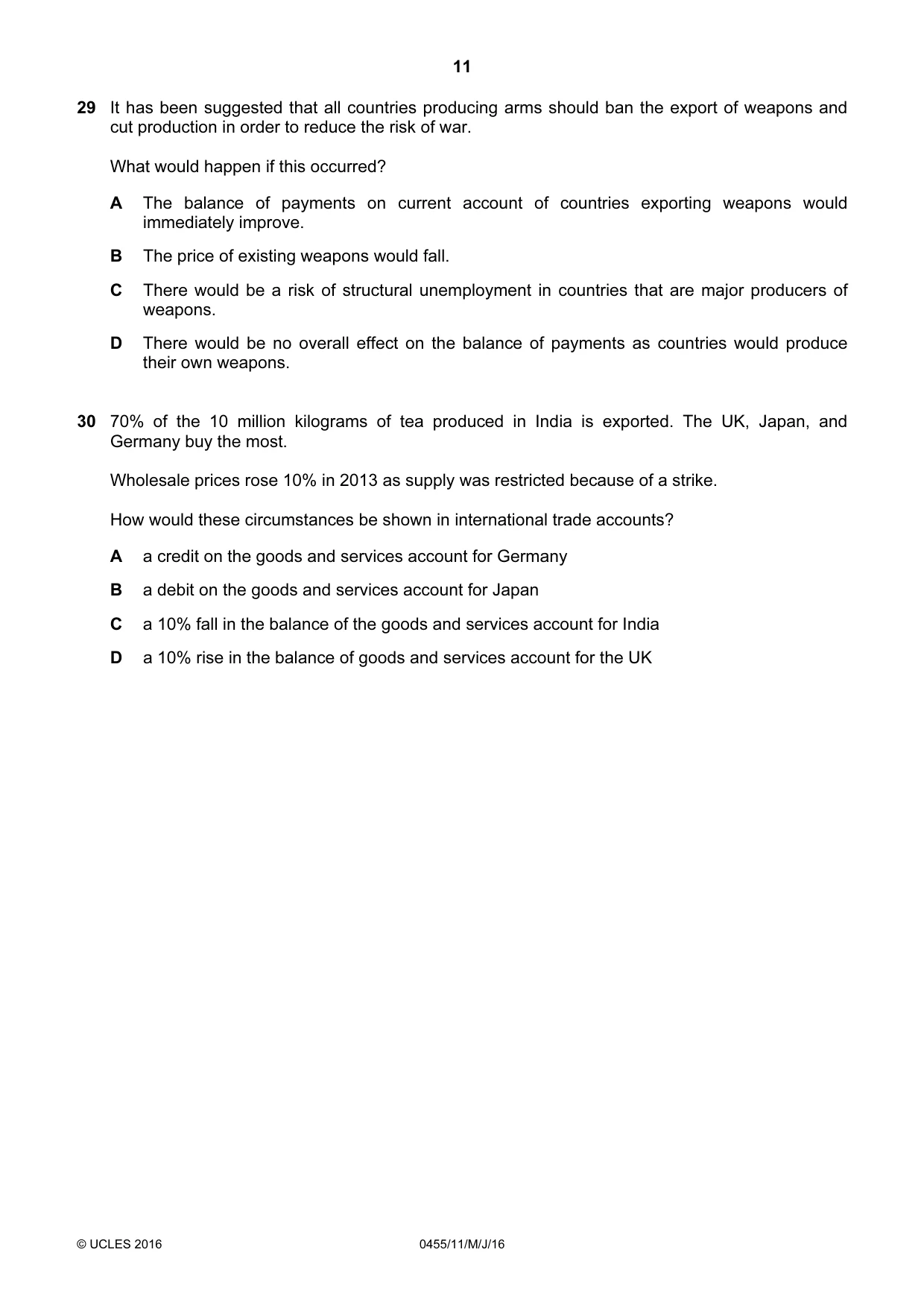
Q29 · It has been suggested that all countries producing arms should ban the export of weapons…
29 It has been suggested that all countries producing arms should ban the export of weapons and cut production in order to reduce the risk of war. What would happen if this occurred? A The balance of payments on current account of countries exporting weapons would immediately improve. B The price of existing weapons would fall. C There would be a risk of structural unemployment in countries that are major producers of weapons. D There would be no overall effect on the balance of payments as countries would produce their own weapons.
Mark scheme: C
Q30 · 70% of the 10 million kilograms of tea produced in India is exported
30 70% of the 10 million kilograms of tea produced in India is exported. The UK, Japan, and Germany buy the most. Wholesale prices rose 10% in 2013 as supply was restricted because of a strike. How would these circumstances be shown in international trade accounts? A a credit on the goods and services account for Germany B a debit on the goods and services account for Japan C a 10% fall in the balance of the goods and services account for India D a 10% rise in the balance of goods and services account for the UK
Mark scheme: B
What was in this paper
The subtopics covered by these 30 questions, and how many questions each got. Open one in a new tab to see every Cambridge question on it.
3Living standards3Current account of balance of payments2Economic growth2Employment and unemployment1Firms and production1Firms’ costs, revenue and objectives1Globalisation, free trade and protection1Inflation and deflation1Market economic system1Market failure1Market structure1Monetary policy1Money and banking1Opportunity cost1Population1Price changes1Price determination1Production possibility curve (PPC) diagrams1Supply1The factors of production1The macroeconomic aims of government1Trade unions1Workers1What you needed in this session
Cambridge’s own grade thresholds for 2016 May/June, Paper 1 · Variant 1. A higher threshold means an easier paper — the bar moves with how the cohort did.