Questions as text
Q1 · Neon and nitrogen are gaseous non-metals 0654/11 May/June 2007
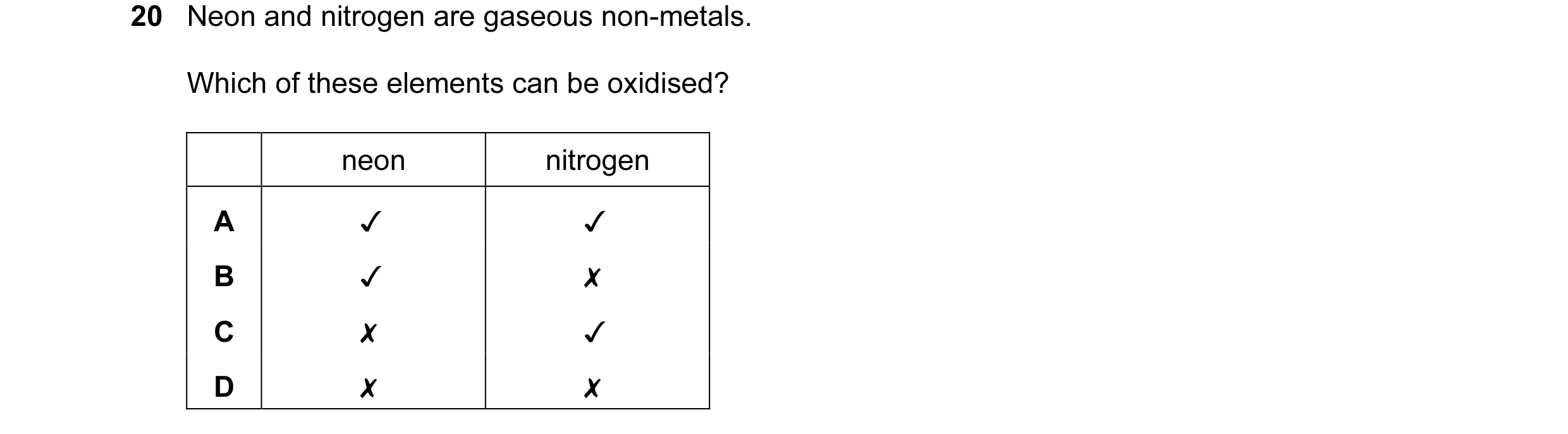
20 Neon and nitrogen are gaseous non-metals.
Which of these elements can be oxidised?
neon nitrogen
A v v
B v x
Cc x v
D x x
1 marks
Answer: C
This question in 0654/11 May/June 2007
Q2 · How is carbon (coke) used in the extraction of iron from iron oxide? 0654/11 May/June 2008
20 How is carbon (coke) used in the extraction of iron from iron oxide? A as an anode B as a cathode C as an oxidising agent D as a reducing agent
1 marks
Answer: D
This question in 0654/11 May/June 2008
Q3 · Testing for which ion in solution involves reduction of the ion? 0654/11 Oct/Nov 2008
24 Testing for which ion in solution involves reduction of the ion? A ammonium B chloride C nitrate D sulphate
1 marks
Answer: C
This question in 0654/11 Oct/Nov 2008
Q4 · The equation for the extraction of a metal from its oxide can be written as shown 0654/11 May/June 2009
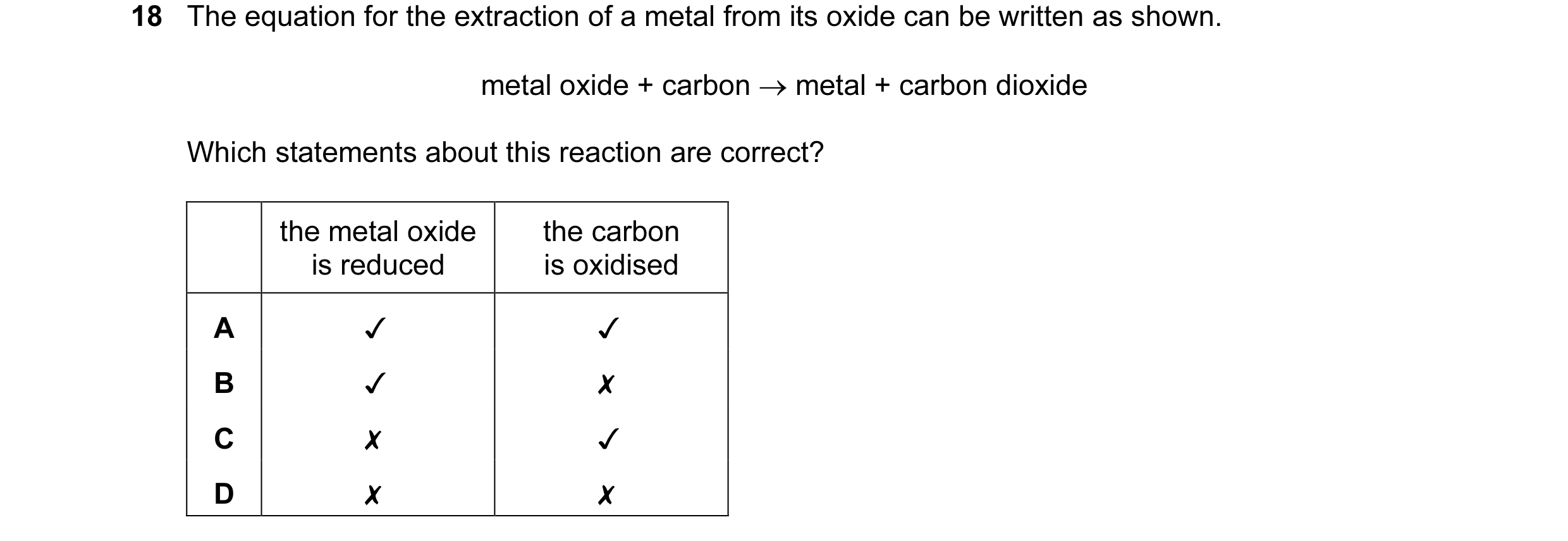
18 The equation for the extraction of a metal from its oxide can be written as shown.
metal oxide + carbon — metal + carbon dioxide
Which statements about this reaction are correct?
the metal oxide the carbon
is reduced is oxidised
A v v
B v x
Cc x v
D x x
1 marks
Answer: A
This question in 0654/11 May/June 2009
Q5 · Why is carbon used to extract some metals from their oxide ores? 0654/11 Oct/Nov 2009
18 Why is carbon used to extract some metals from their oxide ores? A It oxidises the ore by removing oxygen. B It prevents the oxygen of the air reacting with the ore. C It reacts with impurities in the ore. D It reduces the ore by removing oxygen.
1 marks
Answer: D
This question in 0654/11 Oct/Nov 2009
Q6 · How is carbon (coke) used in the extraction of iron from iron oxide? 0654/11 May/June 2011
19 How is carbon (coke) used in the extraction of iron from iron oxide? A as an anode B as a cathode C as an oxidising agent D as a reducing agent
1 marks
Answer: D
This question in 0654/11 May/June 2011
Q7 · How is carbon (coke) used in the extraction of iron from iron oxide? 0654/13 May/June 2011
20 How is carbon (coke) used in the extraction of iron from iron oxide? A as an anode B as a cathode C as an oxidising agent D as a reducing agent
1 marks
Answer: D
This question in 0654/13 May/June 2011
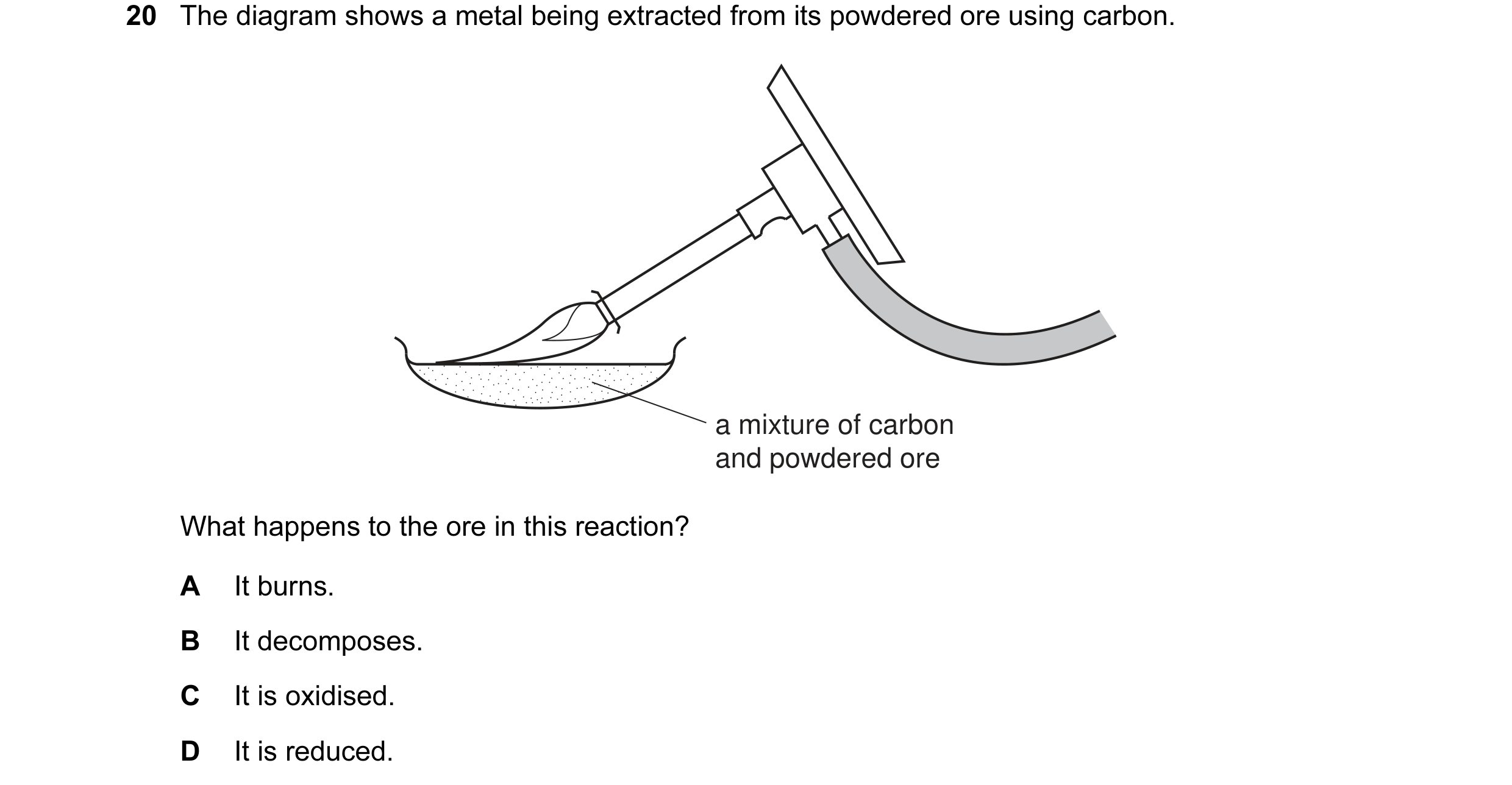
Q8 · The diagram shows a metal being extracted from its powdered ore using carbon 0654/11 Oct/Nov 2011
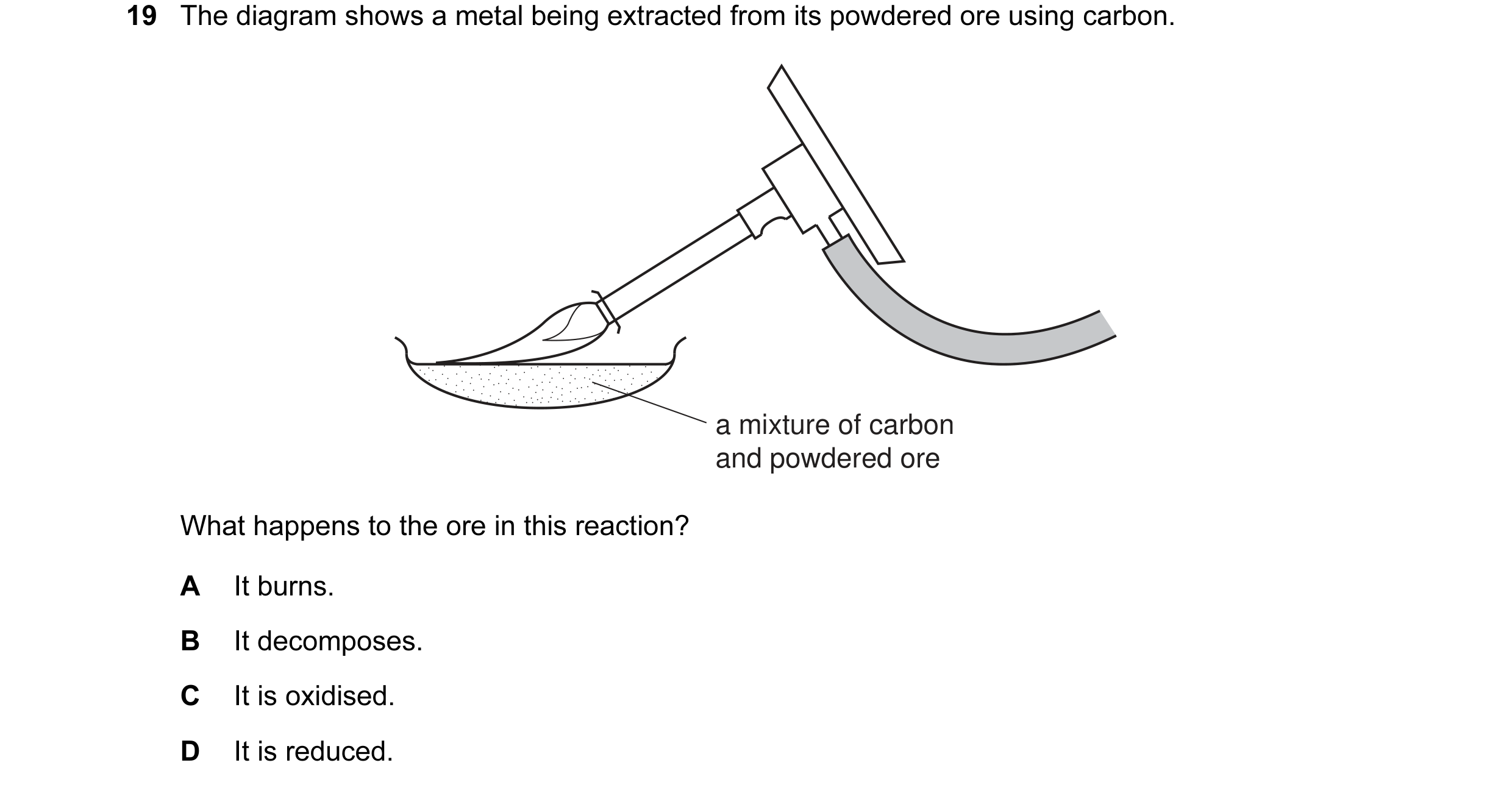
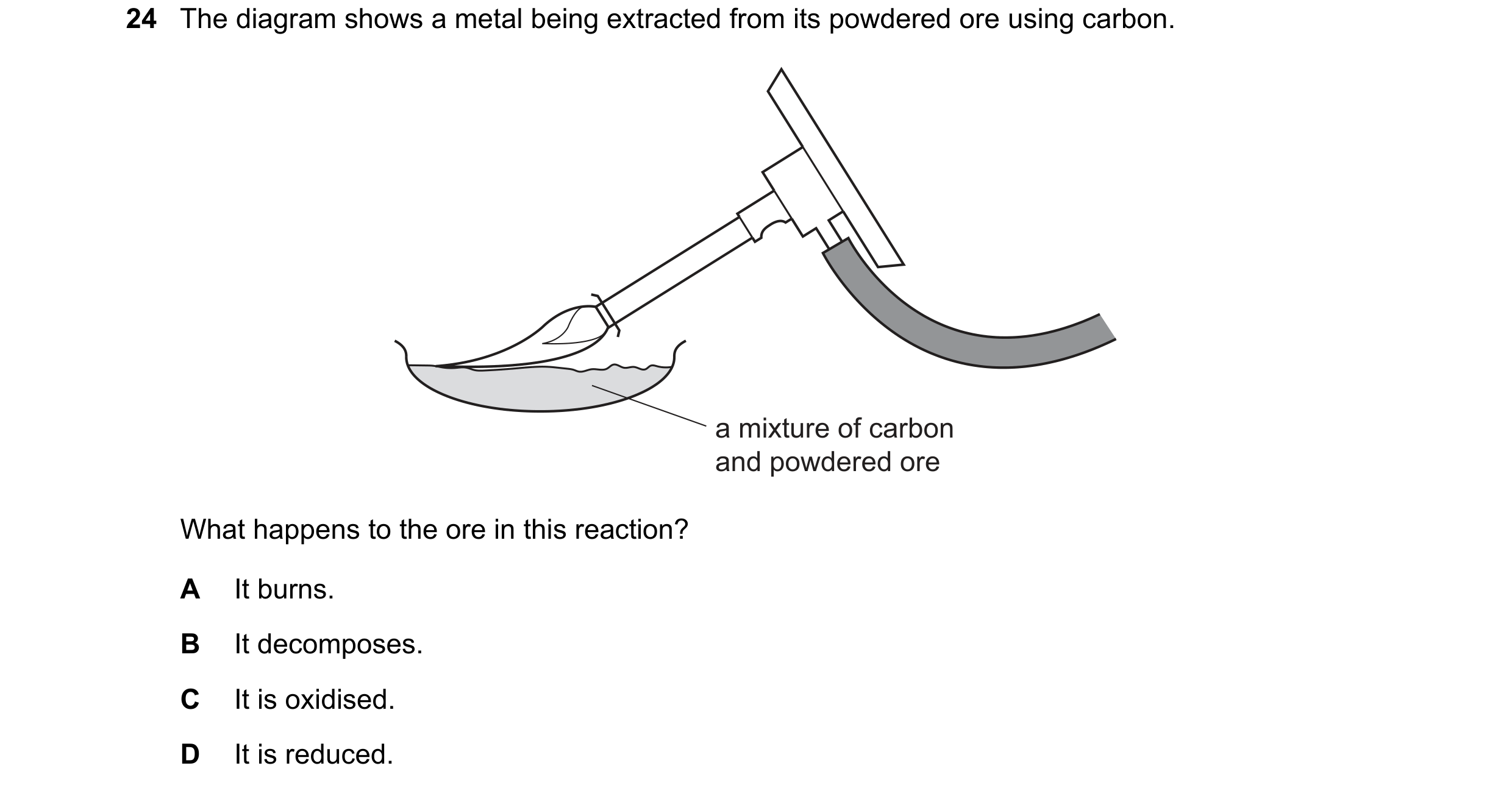
19 The diagram shows a metal being extracted from its powdered ore using carbon. a mixture of carbon and powdered ore What happens to the ore in this reaction? A It burns. B It decomposes. C It is oxidised. D It is reduced.
1 marks
Answer: D
This question in 0654/11 Oct/Nov 2011
Q9 · The diagram shows a metal being extracted from its powdered ore using carbon 0654/12 Oct/Nov 2011
18 The diagram shows a metal being extracted from its powdered ore using carbon. a mixture of carbon and powdered ore What happens to the ore in this reaction? A It burns. B It decomposes. C It is oxidised. D It is reduced.
1 marks
Answer: D
This question in 0654/12 Oct/Nov 2011
Q10 · The diagram shows a metal being extracted from its powdered ore using carbon 0654/13 Oct/Nov 2011
20 The diagram shows a metal being extracted from its powdered ore using carbon. a mixture of carbon and powdered ore What happens to the ore in this reaction? A It burns. B It decomposes. C It is oxidised. D It is reduced.
1 marks
Answer: D
This question in 0654/13 Oct/Nov 2011
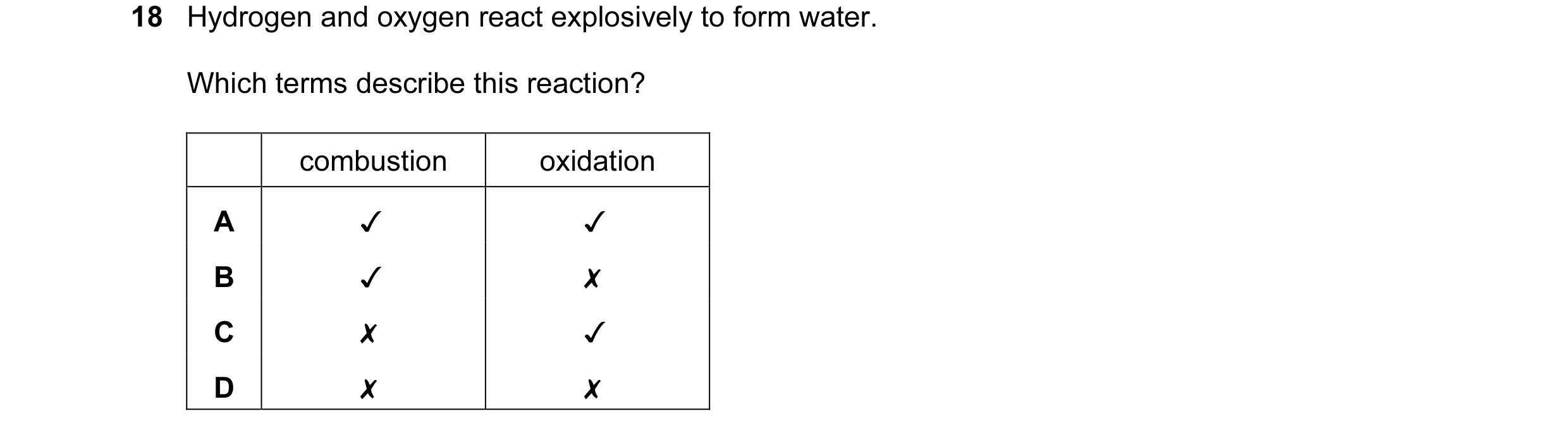
Q11 · Hydrogen and oxygen react explosively to form water 0654/11 May/June 2012
18 Hydrogen and oxygen react explosively to form water.
Which terms describe this reaction?
combustion oxidation
A v v
B v x
Cc x v
D x x
1 marks
Answer: A
This question in 0654/11 May/June 2012
Q12 · Copper is obtained from copper oxide by heating with non-metal X 0654/11 May/June 2012
23 Copper is obtained from copper oxide by heating with non-metal X. copper oxide and non-metal X crucible heat Which shows the identity of non-metal X and the type of reaction non-metal X undergoes? identity of X type of reaction A carbon oxidation B carbon reduction C oxygen oxidation D oxygen reduction
1 marks
Answer: A
This question in 0654/11 May/June 2012
Q13 · Which substance is reduced during the following reaction? 0654/12 May/June 2012
18 Which substance is reduced during the following reaction? A B C D lead(II) oxide + hydrogen → lead + water
1 marks
Answer: A
This question in 0654/12 May/June 2012
Q14 · Which substance is reduced during the following reaction? 0654/13 May/June 2012
18 Which substance is reduced during the following reaction? A B C D lead(II) oxide + hydrogen → lead + water
1 marks
Answer: A
This question in 0654/13 May/June 2012
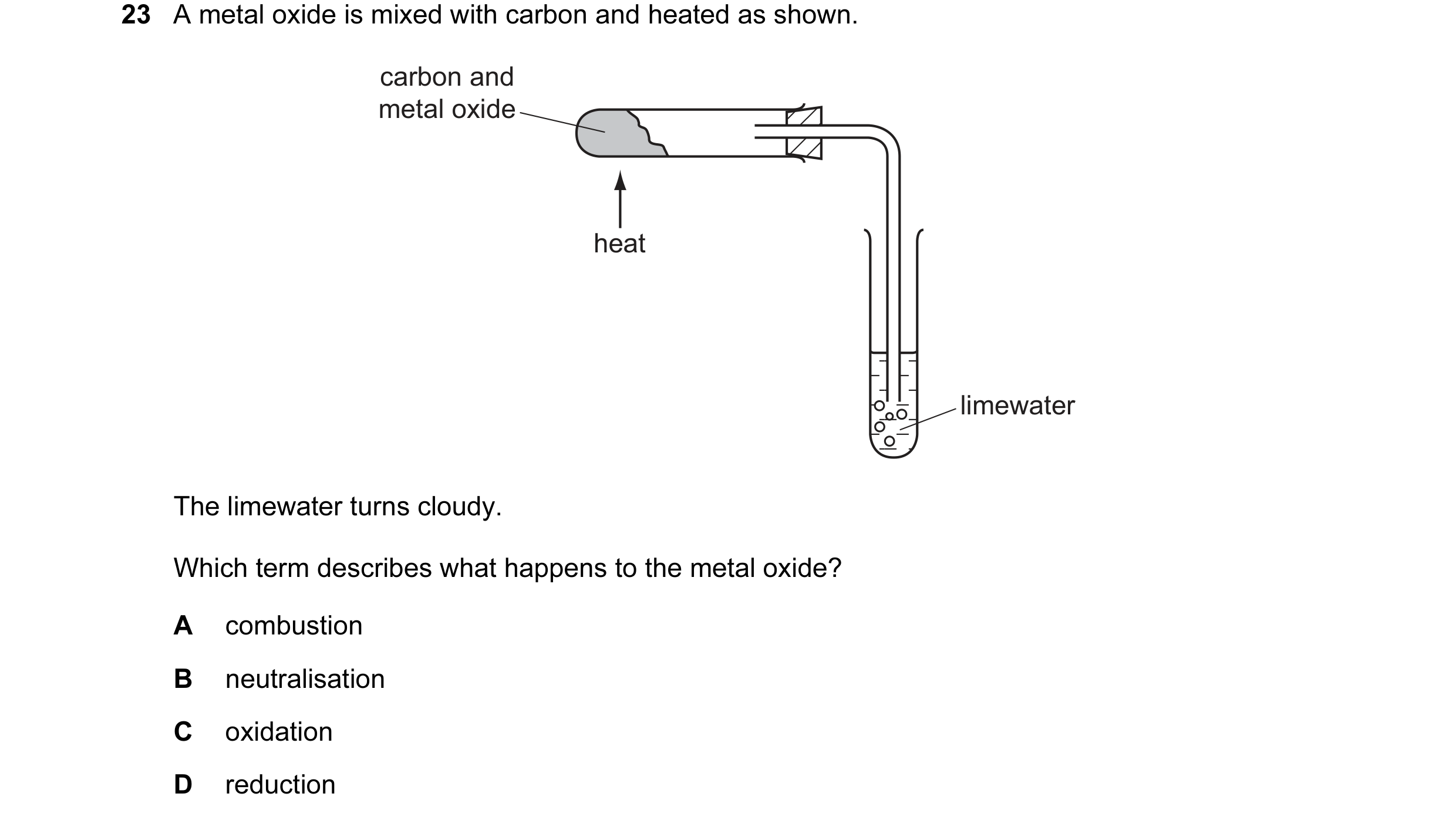
Q15 · A metal oxide is mixed with carbon and heated as shown 0654/11 May/June 2013
23 A metal oxide is mixed with carbon and heated as shown. carbon and metal oxide heat limewater The limewater turns cloudy. Which term describes what happens to the metal oxide? A combustion B neutralisation C oxidation D reduction
1 marks
Answer: D
This question in 0654/11 May/June 2013
Q16 · A metal oxide is mixed with carbon and heated as shown 0654/12 May/June 2013
23 A metal oxide is mixed with carbon and heated as shown. carbon and metal oxide heat limewater The limewater turns cloudy. Which term describes what happens to the metal oxide? A combustion B neutralisation C oxidation D reduction
1 marks
Answer: D
This question in 0654/12 May/June 2013
Q17 · A metal oxide is mixed with carbon and heated as shown 0654/13 May/June 2013
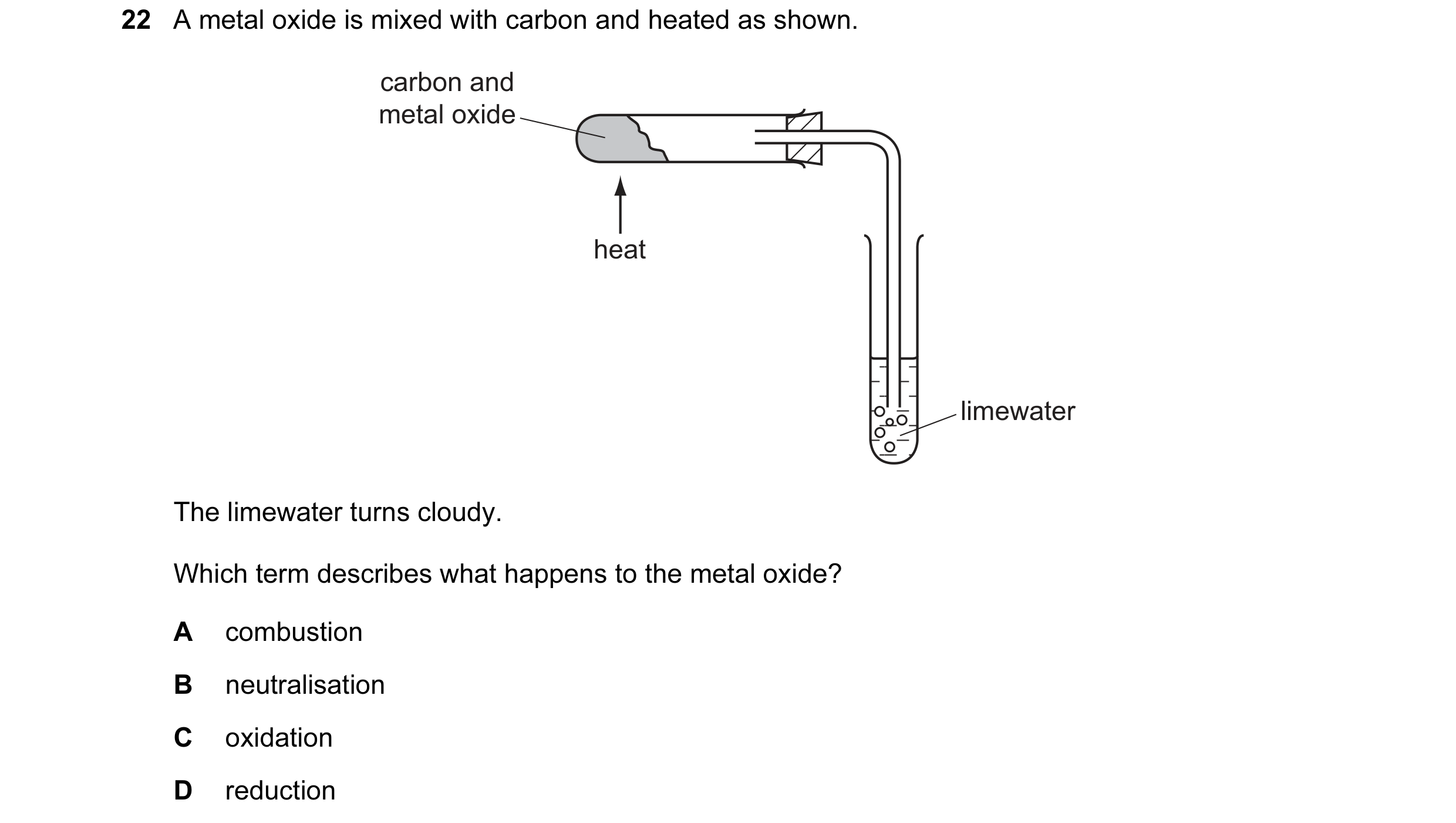
22 A metal oxide is mixed with carbon and heated as shown. carbon and metal oxide heat limewater The limewater turns cloudy. Which term describes what happens to the metal oxide? A combustion B neutralisation C oxidation D reduction
1 marks
Answer: D
This question in 0654/13 May/June 2013
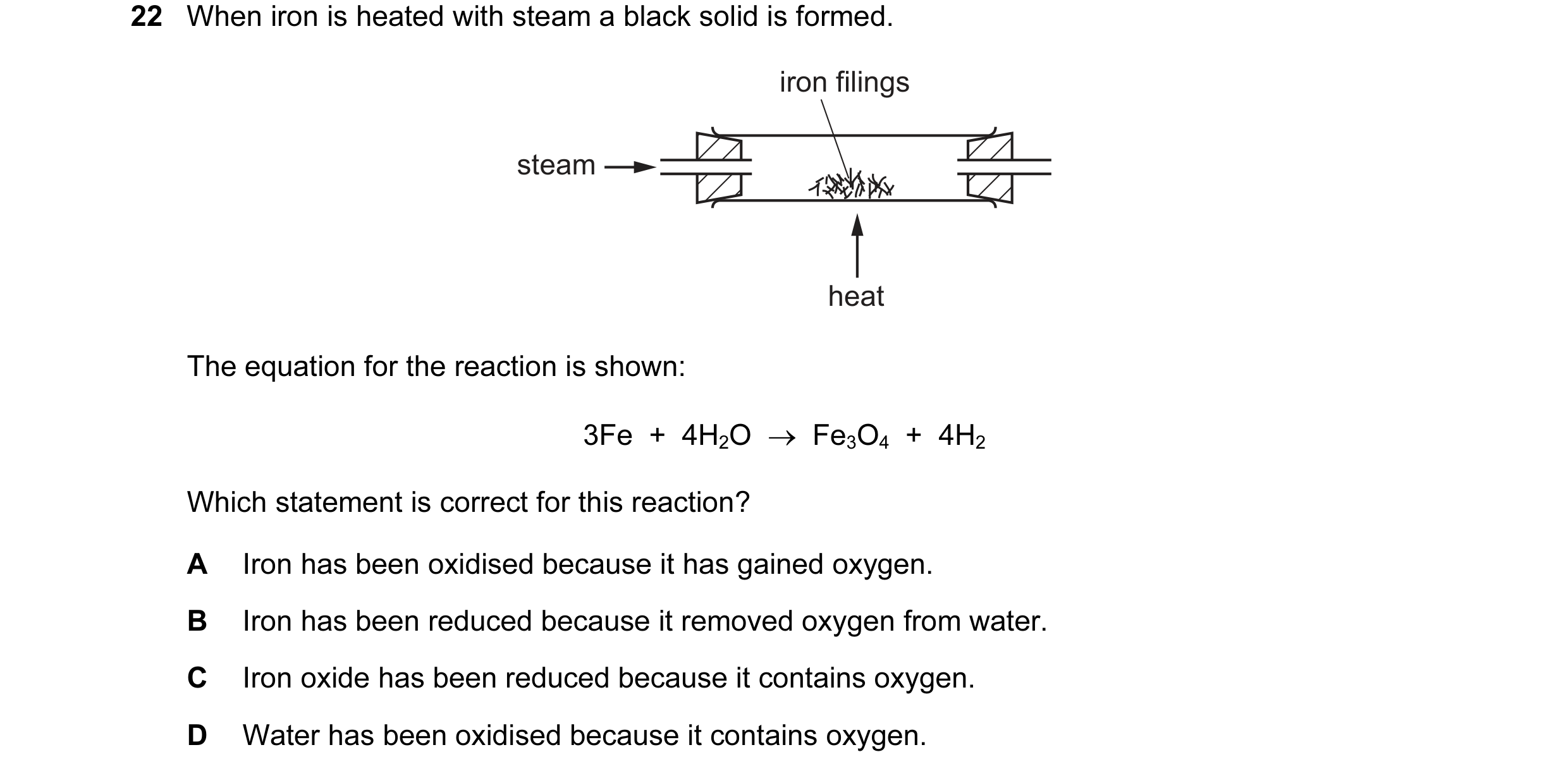
Q18 · When iron is heated with steam a black solid is formed 0654/11 May/June 2014
21 When iron is heated with steam a black solid is formed. iron filings steam heat The equation for the reaction is shown: 3Fe + 4H2O → Fe3O4 + 4H2 Which statement is correct for this reaction? A Iron has been oxidised because it has gained oxygen. B Iron has been reduced because it removed oxygen from water. C Iron oxide has been reduced because it contains oxygen. D Water has been oxidised because it contains oxygen.
1 marks
Answer: A
This question in 0654/11 May/June 2014
Q19 · Iron is produced in the blast furnace 0654/12 May/June 2014
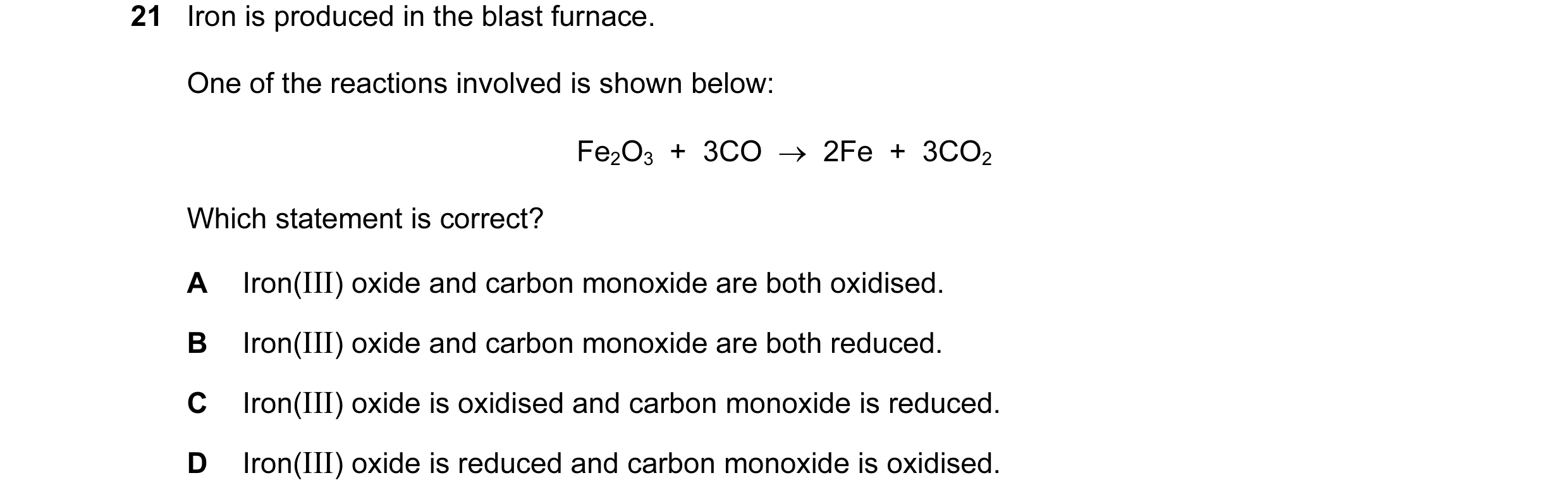
21 Iron is produced in the blast furnace. One of the reactions involved is shown below: Fe2O3 + 3CO → 2Fe + 3CO2 Which statement is correct? A Iron(III) oxide and carbon monoxide are both oxidised. B Iron(III) oxide and carbon monoxide are both reduced. C Iron(III) oxide is oxidised and carbon monoxide is reduced. D Iron(III) oxide is reduced and carbon monoxide is oxidised.
1 marks
Answer: D
This question in 0654/12 May/June 2014
Q20 · When iron is heated with steam a black solid is formed 0654/13 May/June 2014
22 When iron is heated with steam a black solid is formed. iron filings steam heat The equation for the reaction is shown: 3Fe + 4H2O → Fe3O4 + 4H2 Which statement is correct for this reaction? A Iron has been oxidised because it has gained oxygen. B Iron has been reduced because it removed oxygen from water. C Iron oxide has been reduced because it contains oxygen. D Water has been oxidised because it contains oxygen.
1 marks
Answer: A
This question in 0654/13 May/June 2014
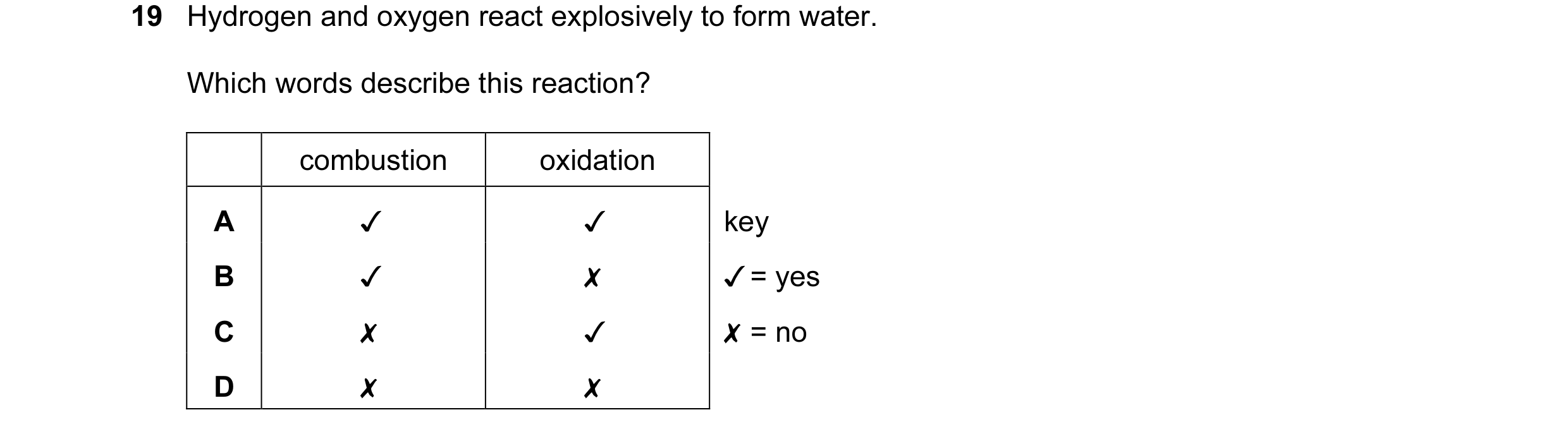
Q21 · Hydrogen and oxygen react explosively to form water 0654/11 May/June 2015
19 Hydrogen and oxygen react explosively to form water.
Which words describe this reaction?
combustion oxidation
A v v
B v x
Cc x v
D x x
key
v/=yes
X =no
1 marks
Answer: A
This question in 0654/11 May/June 2015
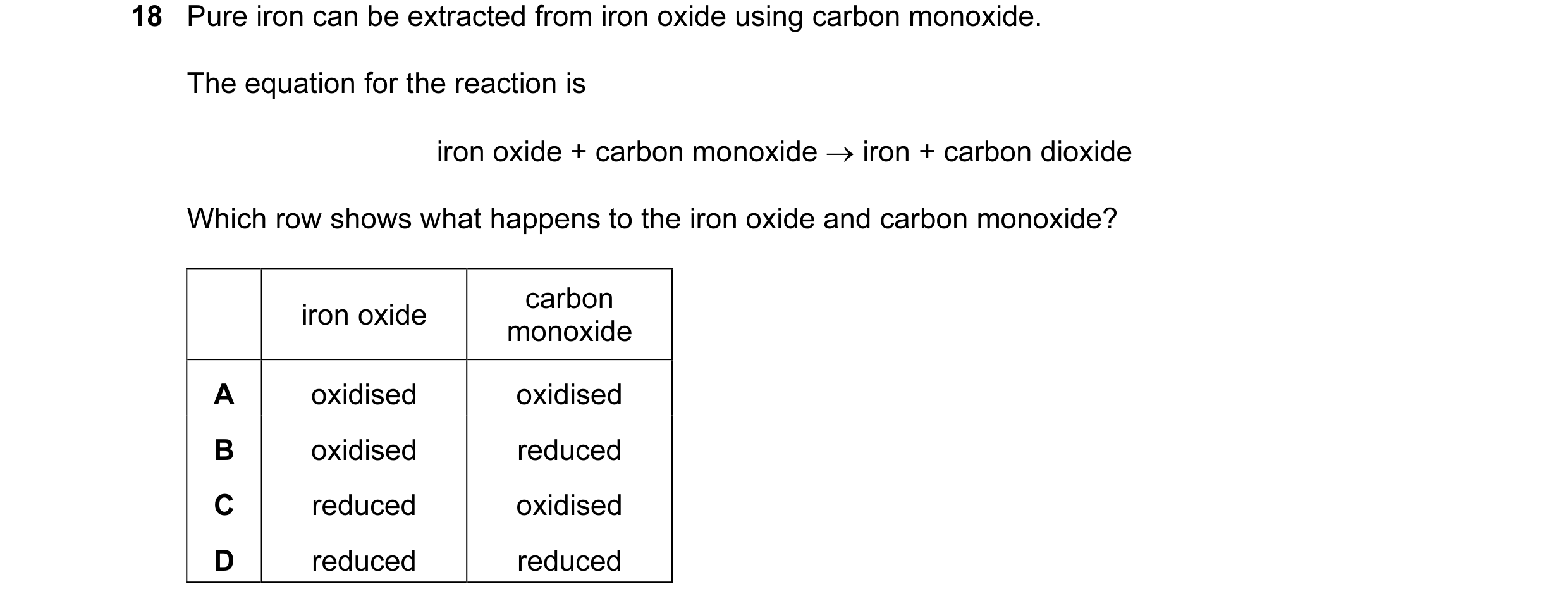
Q22 · Pure iron can be extracted from iron oxide using carbon monoxide 0654/12 May/June 2015
18 Pure iron can be extracted from iron oxide using carbon monoxide. The equation for the reaction is iron oxide + carbon monoxide → iron + carbon dioxide Which row shows what happens to the iron oxide and carbon monoxide? carbon iron oxide monoxide A oxidised oxidised B oxidised reduced C reduced oxidised D reduced reduced
1 marks
Answer: C
This question in 0654/12 May/June 2015
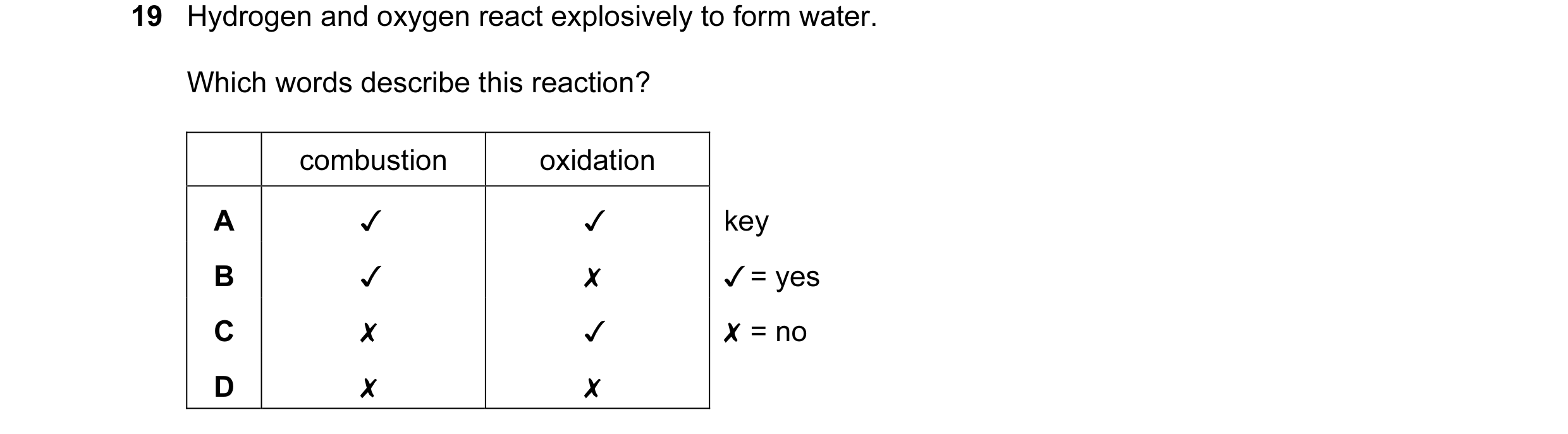
Q23 · Hydrogen and oxygen react explosively to form water 0654/12 May/June 2015
19 Hydrogen and oxygen react explosively to form water.
Which words describe this reaction?
combustion oxidation
A v v
B v x
Cc x v
D x x
key
v/=yes
X =no
1 marks
Answer: A
This question in 0654/12 May/June 2015
Q24 · Hydrogen and oxygen react explosively to form water 0654/13 May/June 2015
19 Hydrogen and oxygen react explosively to form water.
Which words describe this reaction?
combustion oxidation
A v v
B v x
Cc x v
D x x
key
v/=yes
X =no
1 marks
Answer: A
This question in 0654/13 May/June 2015
Q25 · When petrol burns in a car engine carbon monoxide, CO, and nitrogen monoxide, NO, are… 0654/13 Oct/Nov 2015
21 When petrol burns in a car engine carbon monoxide, CO, and nitrogen monoxide, NO, are produced. The gases produced are passed through a catalytic converter. In the catalytic converter, the carbon monoxide reacts with nitrogen monoxide. The equation for the reaction is carbon monoxide + nitrogen monoxide → nitrogen gas + carbon dioxide Which statement is not correct? A Carbon monoxide is oxidised in the catalytic converter. B Carbon monoxide is produced by the complete combustion of petrol. C Nitrogen from the air is oxidised in the car engine. D Nitrogen monoxide is reduced in the catalytic converter.
1 marks
Answer: B
This question in 0654/13 Oct/Nov 2015
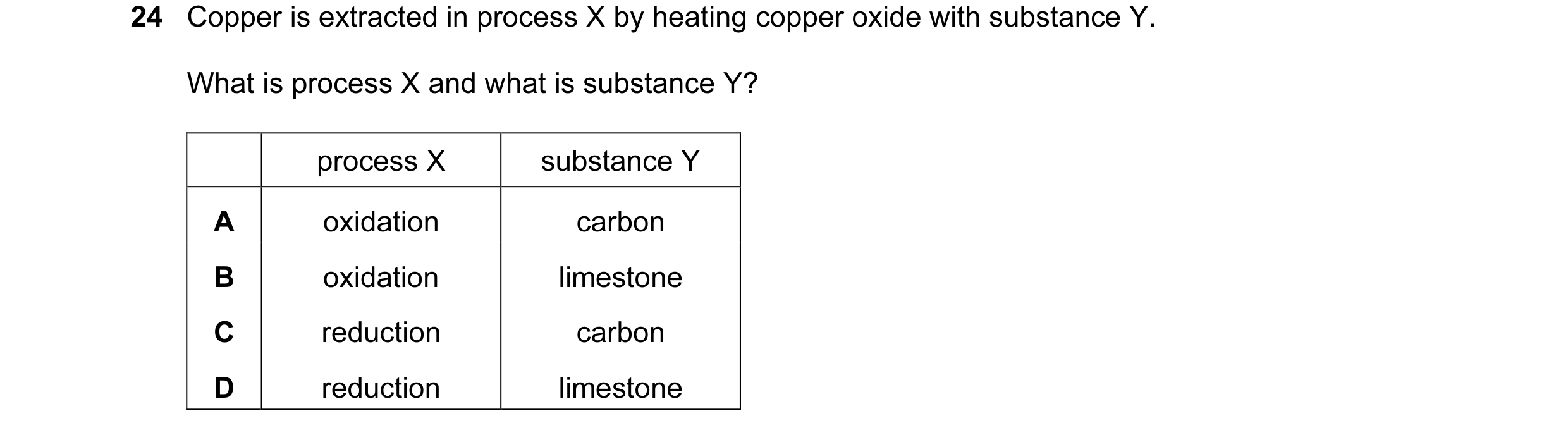
Q26 · Copper is extracted in process X by heating copper oxide with substance Y 0654/11 May/June 2016
24 Copper is extracted in process X by heating copper oxide with substance Y. What is process X and what is substance Y? process X substance Y A oxidation carbon B oxidation limestone C reduction carbon D reduction limestone
1 marks
Answer: C
This question in 0654/11 May/June 2016
Q27 · Which statement shows that methane, CH4, is oxidised when it burns? 0654/12 May/June 2016
18 Which statement shows that methane, CH4, is oxidised when it burns? A The products of the reaction are gaseous. B The products of the reaction are water and carbon dioxide. C The reaction is exothermic. D The total number of oxygen atoms has increased during the reaction.
1 marks
Answer: B
This question in 0654/12 May/June 2016
Q28 · Which word equation represents a redox reaction? 0654/13 Oct/Nov 2016
17 Which word equation represents a redox reaction? A carbon + copper oxide → copper + carbon dioxide B hydrochloric acid + potassium hydroxide → potassium chloride + water C magnesium carbonate → magnesium oxide + carbon dioxide D sodium sulfate + barium nitrate → barium sulfate + sodium nitrate
1 marks
Answer: A
This question in 0654/13 Oct/Nov 2016
Q29 · Aluminium reacts with iron(III) oxide, forming iron 0654/11 May/June 2017
19 Aluminium reacts with iron(III) oxide, forming iron. The equation for this reaction is shown. aluminium + iron(III) oxide → iron + aluminium oxide Which statement explains why this is a redox reaction? A Aluminium gains oxygen and iron loses oxygen. B Aluminium is reduced and iron(III) oxide is oxidised. C Aluminium oxide is oxidised and iron is reduced. D Iron gains oxygen and aluminium loses oxygen.
1 marks
Answer: A
This question in 0654/11 May/June 2017
Q30 · In which word equation is the underlined substance being oxidised? 0654/13 May/June 2017
19 In which word equation is the underlined substance being oxidised? A carbon dioxide + carbon → carbon monoxide B carbon monoxide + iron oxide → carbon dioxide + iron C copper oxide + magnesium → magnesium oxide + copper D magnesium oxide + hydrochloric acid → magnesium chloride + water
1 marks
Answer: B
This question in 0654/13 May/June 2017
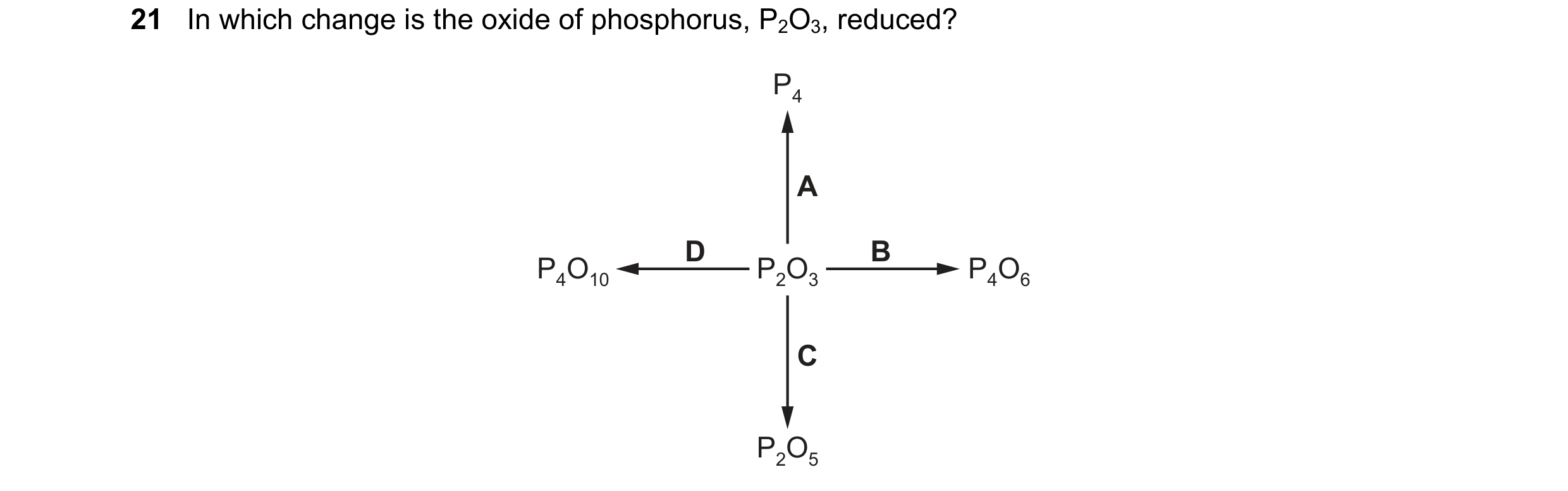
Q31 · In which change is the oxide of phosphorus, P2O3, reduced? 0654/11 Oct/Nov 2017
21 In which change is the oxide of phosphorus, P2O3, reduced? P4 A D B P4O10 P2O3 P4O6 C P2O5
1 marks
Answer: A
This question in 0654/11 Oct/Nov 2017
Q32 · In which reaction do both oxidation and reduction occur? 0654/12 Oct/Nov 2017
21 In which reaction do both oxidation and reduction occur? A copper chloride + sodium hydroxide → copper hydroxide + sodium chloride B hydrochloric acid + sodium hydroxide → sodium chloride + water C iron oxide + carbon → iron + carbon dioxide D silver nitrate + potassium chloride → silver chloride + potassium nitrate
1 marks
Answer: C
This question in 0654/12 Oct/Nov 2017
Q33 · Which reaction involves both oxidation and reduction? 0654/13 Oct/Nov 2017
21 Which reaction involves both oxidation and reduction? A calcium carbonate → calcium oxide + carbon dioxide B copper oxide + carbon → copper + carbon dioxide C silver nitrate + potassium chloride → silver chloride + potassium nitrate D sulfuric acid + sodium hydroxide → sodium sulfate + water
1 marks
Answer: B
This question in 0654/13 Oct/Nov 2017
Q34 · Which word equation represents a redox reaction? 0654/11 Oct/Nov 2018
20 Which word equation represents a redox reaction? A calcium carbonate → calcium oxide + carbon dioxide B calcium oxide + hydrochloric acid → calcium chloride + water C copper oxide + carbon → copper + carbon dioxide D sodium oxide + water → sodium hydroxide
1 marks
Answer: C
This question in 0654/11 Oct/Nov 2018
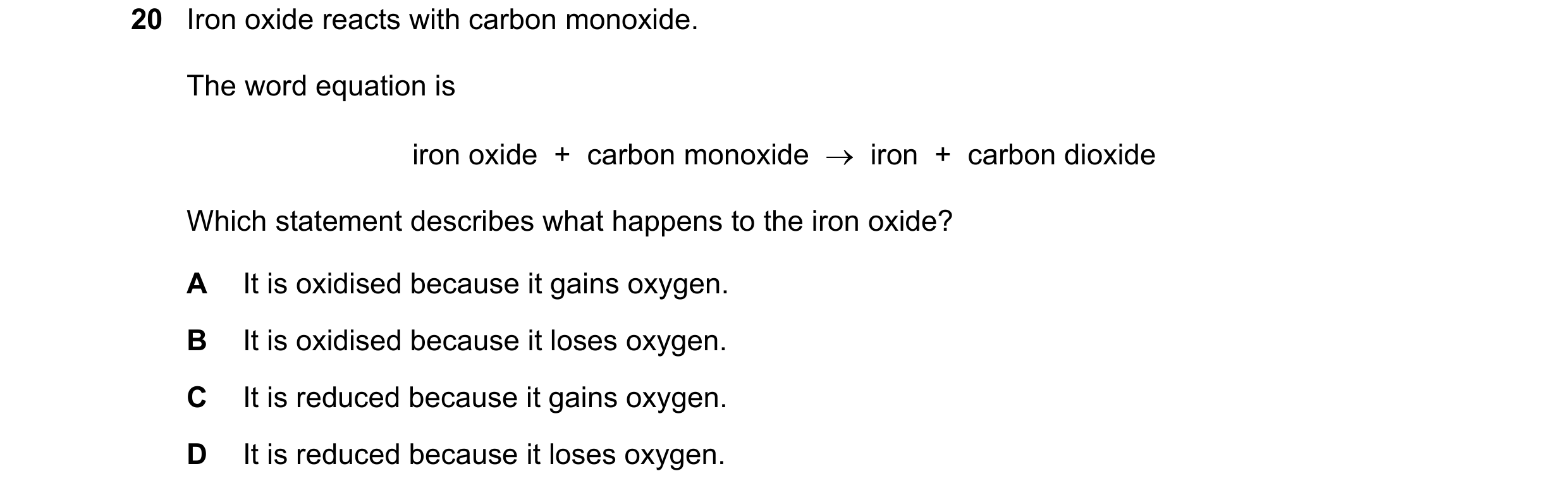
Q35 · Iron oxide reacts with carbon monoxide 0654/13 Oct/Nov 2018
20 Iron oxide reacts with carbon monoxide. The word equation is iron oxide + carbon monoxide → iron + carbon dioxide Which statement describes what happens to the iron oxide? A It is oxidised because it gains oxygen. B It is oxidised because it loses oxygen. C It is reduced because it gains oxygen. D It is reduced because it loses oxygen.
1 marks
Answer: D
This question in 0654/13 Oct/Nov 2018
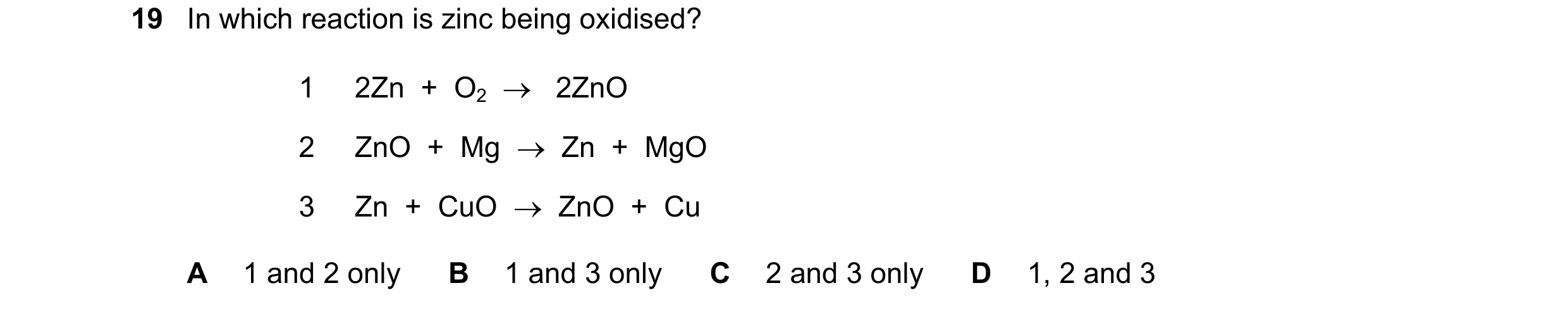
Q36 · In which reaction is zinc being oxidised? 0654/12 May/June 2019
19 In which reaction is zinc being oxidised? 1 2Zn + O2 → 2ZnO 2 ZnO + Mg → Zn + MgO 3 Zn + CuO → ZnO + Cu A 1 and 2 only B 1 and 3 only C 2 and 3 only D 1, 2 and 3
1 marks
Answer: B
This question in 0654/12 May/June 2019
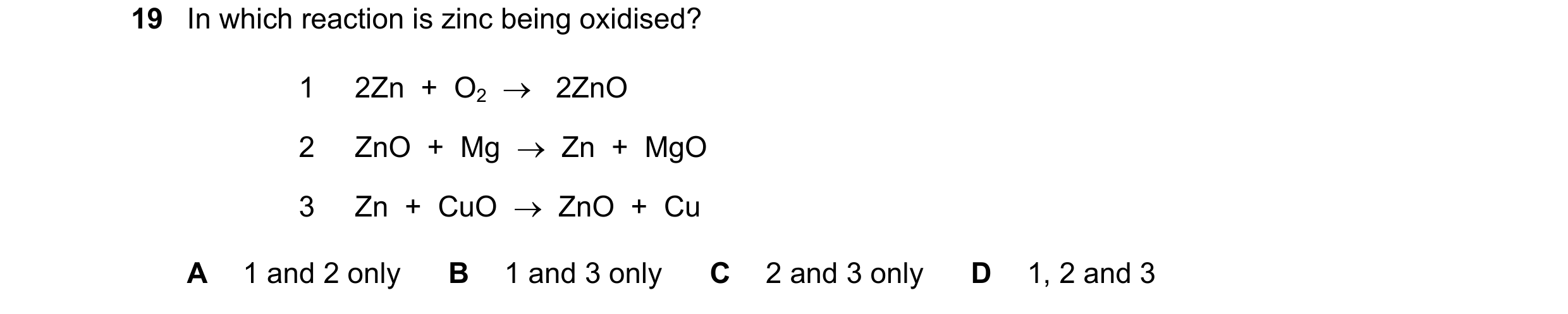
Q37 · In which reaction is zinc being oxidised? 0654/13 May/June 2019
19 In which reaction is zinc being oxidised? 1 2Zn + O2 → 2ZnO 2 ZnO + Mg → Zn + MgO 3 Zn + CuO → ZnO + Cu A 1 and 2 only B 1 and 3 only C 2 and 3 only D 1, 2 and 3
1 marks
Answer: B
This question in 0654/13 May/June 2019
Q38 · Which statement explains why the rusting of iron is an oxidation reaction? 0654/12 Oct/Nov 2019
19 Which statement explains why the rusting of iron is an oxidation reaction? A Iron gains oxygen. B Iron is a transition metal. C Iron is very reactive. D Iron loses oxygen.
1 marks
Answer: A
This question in 0654/12 Oct/Nov 2019
Q39 · Which reaction involves both oxidation and reduction? 0654/11 May/June 2020
19 Which reaction involves both oxidation and reduction? A calcium carbonate → calcium oxide + carbon dioxide B copper oxide + carbon → copper + carbon dioxide C silver nitrate + potassium chloride → silver chloride + potassium nitrate D sulfuric acid + sodium hydroxide → sodium sulfate + water
1 marks
Answer: B
This question in 0654/11 May/June 2020
Q40 · Which reaction involves both oxidation and reduction? 0654/12 May/June 2020
19 Which reaction involves both oxidation and reduction? A calcium carbonate → calcium oxide + carbon dioxide B copper oxide + carbon → copper + carbon dioxide C silver nitrate + potassium chloride → silver chloride + potassium nitrate D sulfuric acid + sodium hydroxide → sodium sulfate + water
1 marks
Answer: B
This question in 0654/12 May/June 2020
Q41 · Which reaction involves both oxidation and reduction? 0654/13 May/June 2020
18 Which reaction involves both oxidation and reduction? A calcium carbonate → calcium oxide + carbon dioxide B copper oxide + carbon → copper + carbon dioxide C silver nitrate + potassium chloride → silver chloride + potassium nitrate D sulfuric acid + sodium hydroxide → sodium sulfate + water
1 marks
Answer: B
This question in 0654/13 May/June 2020
Q42 · Which word equation represents a redox reaction? 0654/11 Oct/Nov 2020
19 Which word equation represents a redox reaction? A carbon + copper oxide copper + carbon dioxide B hydrochloric acid + potassium hydroxide potassium chloride + water C magnesium carbonate magnesium oxide + carbon dioxide D sodium sulfate + barium nitrate barium sulfate + sodium nitrate
1 marks
Answer: A
This question in 0654/11 Oct/Nov 2020
Q43 · Which word equation represents a redox reaction? 0654/12 Oct/Nov 2020
19 Which word equation represents a redox reaction? A carbon + copper oxide copper + carbon dioxide B hydrochloric acid + potassium hydroxide potassium chloride + water C magnesium carbonate magnesium oxide + carbon dioxide D sodium sulfate + barium nitrate barium sulfate + sodium nitrate
1 marks
Answer: A
This question in 0654/12 Oct/Nov 2020
Q44 · Which word equation represents a redox reaction? 0654/13 Oct/Nov 2020
20 Which word equation represents a redox reaction? A carbon + copper oxide copper + carbon dioxide B hydrochloric acid + potassium hydroxide potassium chloride + water C magnesium carbonate magnesium oxide + carbon dioxide D sodium sulfate + barium nitrate barium sulfate + sodium nitrate
1 marks
Answer: A
This question in 0654/13 Oct/Nov 2020
Q45 · In which word equation is the underlined substance being oxidised? 0654/12 Feb/March 2021
19 In which word equation is the underlined substance being oxidised? A carbon dioxide + carbon carbon monoxide B carbon monoxide + iron oxide carbon dioxide + iron C copper oxide + magnesium magnesium oxide + copper D magnesium oxide + hydrochloric acid magnesium chloride + water
1 marks
Answer: B
This question in 0654/12 Feb/March 2021
Q46 · The catalytic converter in the exhaust of a car brings about the reaction shown 0654/11 May/June 2021
18 The catalytic converter in the exhaust of a car brings about the reaction shown.
2NO + 2CO + 2CO, + No
Which row about this reaction is correct?
0 0O WwW D>
oxidation
~ «
reduction
«x \ x
key
J/ = occurs
X = does not occur
1 marks
Answer: A
This question in 0654/11 May/June 2021
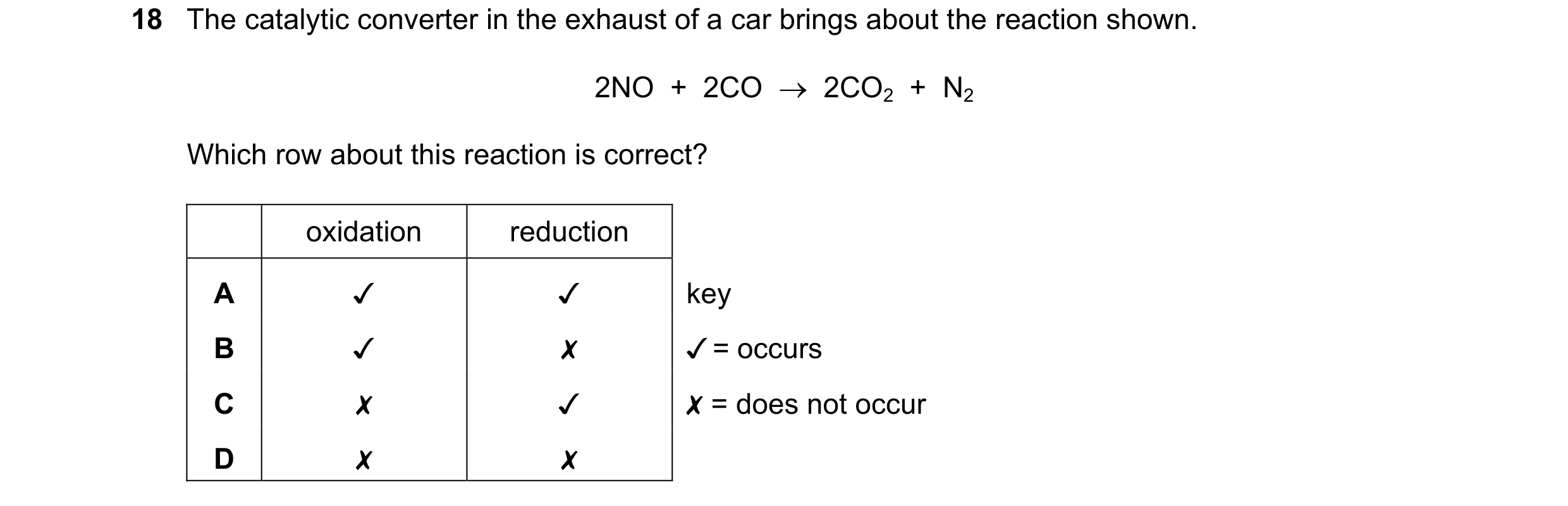
Q47 · The catalytic converter in the exhaust of a car brings about the reaction shown 0654/12 May/June 2021
18 The catalytic converter in the exhaust of a car brings about the reaction shown.
2NO + 2CO + 2CO, + No
Which row about this reaction is correct?
0 0O WwW >
oxidation
~ «4
reduction
<x \ x
key
J/ = occurs
X = does not occur
1 marks
Answer: A
This question in 0654/12 May/June 2021
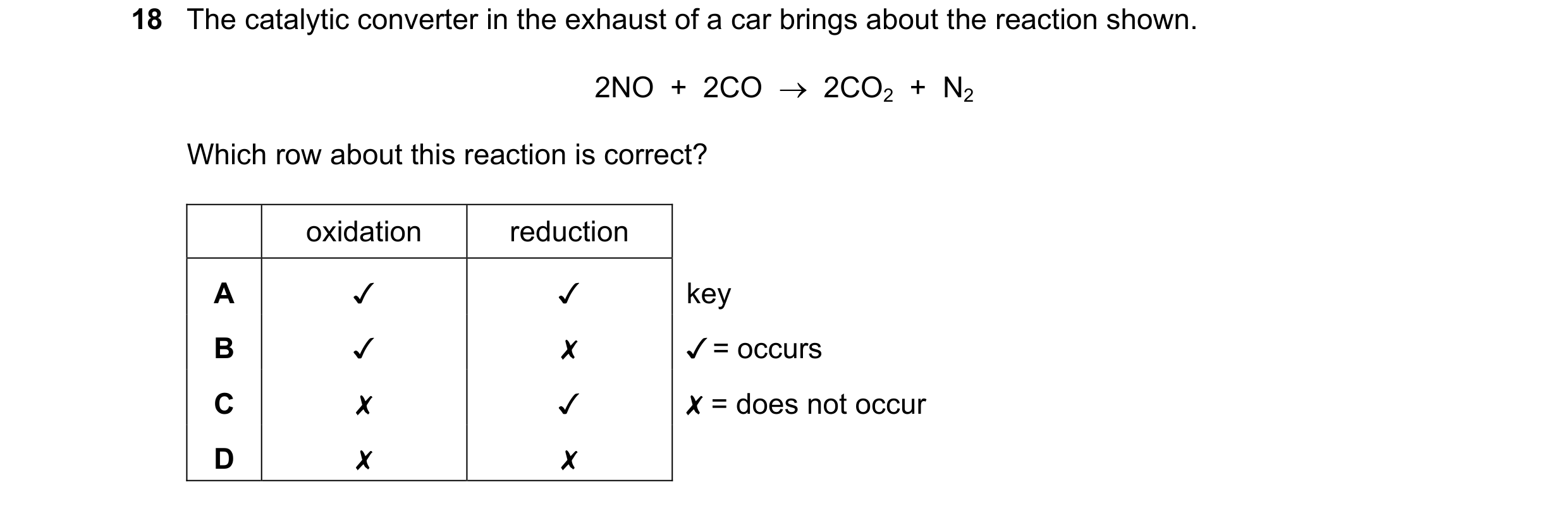
Q48 · The catalytic converter in the exhaust of a car brings about the reaction shown 0654/13 May/June 2021
18 The catalytic converter in the exhaust of a car brings about the reaction shown.
2NO + 2CO + 2CO, + No
Which row about this reaction is correct?
0 0O WwW >
oxidation
~ «4
reduction
<x \ x
key
J/ = occurs
X = does not occur
1 marks
Answer: A
This question in 0654/13 May/June 2021
Q49 · Which reaction is not a redox reaction? 0654/12 Feb/March 2022
18 Which reaction is not a redox reaction? A iron oxide + carbon iron + carbon dioxide B silver nitrate + sodium chloride silver chloride + sodium nitrate C copper oxide + hydrogen copper + water D magnesium + oxygen magnesium oxide
1 marks
Answer: B
This question in 0654/12 Feb/March 2022
Q50 · The diagram shows a metal being extracted from its powdered ore using carbon 0654/11 May/June 2022
24 The diagram shows a metal being extracted from its powdered ore using carbon. a mixture of carbon and powdered ore What happens to the ore in this reaction? A It burns. B It decomposes. C It is oxidised. D It is reduced.
1 marks
Answer: D
This question in 0654/11 May/June 2022
Q51 · The diagram shows a metal being extracted from its powdered ore using carbon 0654/12 May/June 2022
24 The diagram shows a metal being extracted from its powdered ore using carbon. a mixture of carbon and powdered ore What happens to the ore in this reaction? A It burns. B It decomposes. C It is oxidised. D It is reduced.
1 marks
Answer: D
This question in 0654/12 May/June 2022
Q52 · The diagram shows a metal being extracted from its powdered ore using carbon 0654/13 May/June 2022
24 The diagram shows a metal being extracted from its powdered ore using carbon. a mixture of carbon and powdered ore What happens to the ore in this reaction? A It burns. B It decomposes. C It is oxidised. D It is reduced.
1 marks
Answer: D
This question in 0654/13 May/June 2022
Q53 · Which word equation represents a redox reaction? 0654/12 Feb/March 2023
20 Which word equation represents a redox reaction? A calcium carbonate calcium oxide + carbon dioxide B calcium oxide + hydrochloric acid calcium chloride + water C copper oxide + carbon copper + carbon dioxide D sodium oxide + water sodium hydroxide
1 marks
Answer: C
This question in 0654/12 Feb/March 2023
Q54 · Which statement shows that methane, CH4, is oxidised when it burns? 0654/11 May/June 2023
20 Which statement shows that methane, CH4, is oxidised when it burns? A The products of the reaction are gaseous. B The products of the reaction are water and carbon dioxide. C The reaction is exothermic. D The total number of oxygen atoms has increased during the reaction.
1 marks
Answer: B
This question in 0654/11 May/June 2023
Q55 · Iron is extracted from its ore in the blast furnace 0654/12 May/June 2023
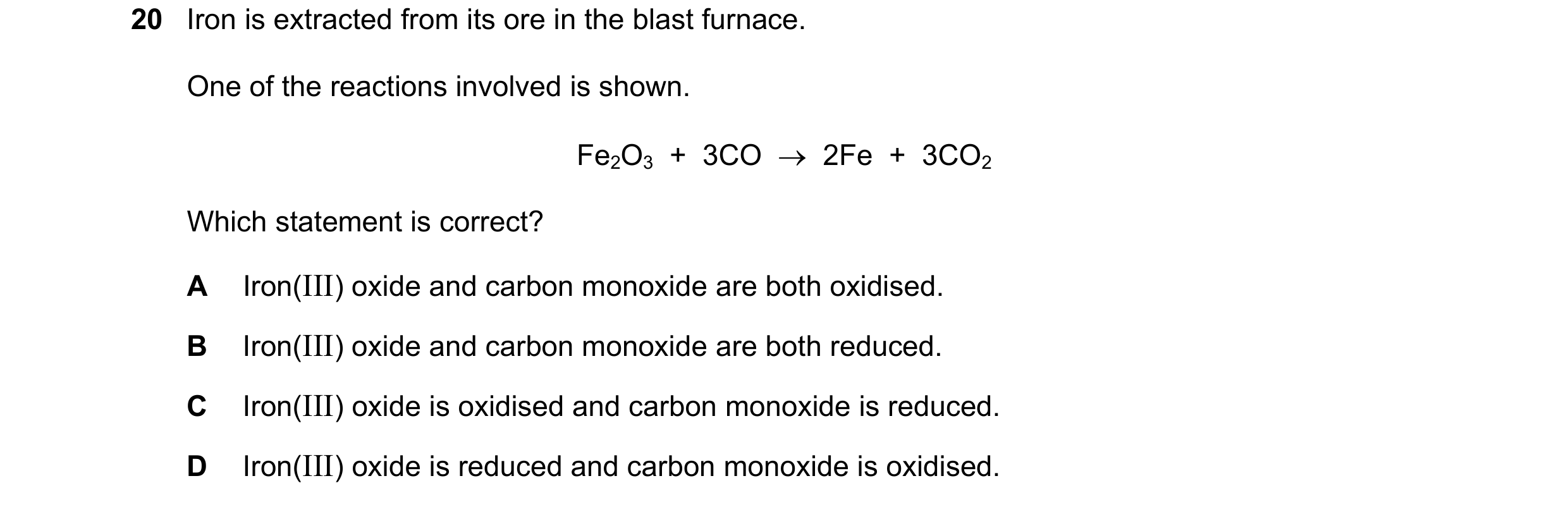
20 Iron is extracted from its ore in the blast furnace. One of the reactions involved is shown. Fe2O3 + 3CO 2Fe + 3CO2 Which statement is correct? A Iron(III) oxide and carbon monoxide are both oxidised. B Iron(III) oxide and carbon monoxide are both reduced. C Iron(III) oxide is oxidised and carbon monoxide is reduced. D Iron(III) oxide is reduced and carbon monoxide is oxidised.
1 marks
Answer: D
This question in 0654/12 May/June 2023
Q56 · Iron is extracted from its ore in the blast furnace 0654/13 May/June 2023
20 Iron is extracted from its ore in the blast furnace. One of the reactions involved is shown. Fe2O3 + 3CO → 2Fe + 3CO2 Which statement is correct? A Iron(III) oxide and carbon monoxide are both oxidised. B Iron(III) oxide and carbon monoxide are both reduced. C Iron(III) oxide is oxidised and carbon monoxide is reduced. D Iron(III) oxide is reduced and carbon monoxide is oxidised.
1 marks
Answer: D
This question in 0654/13 May/June 2023
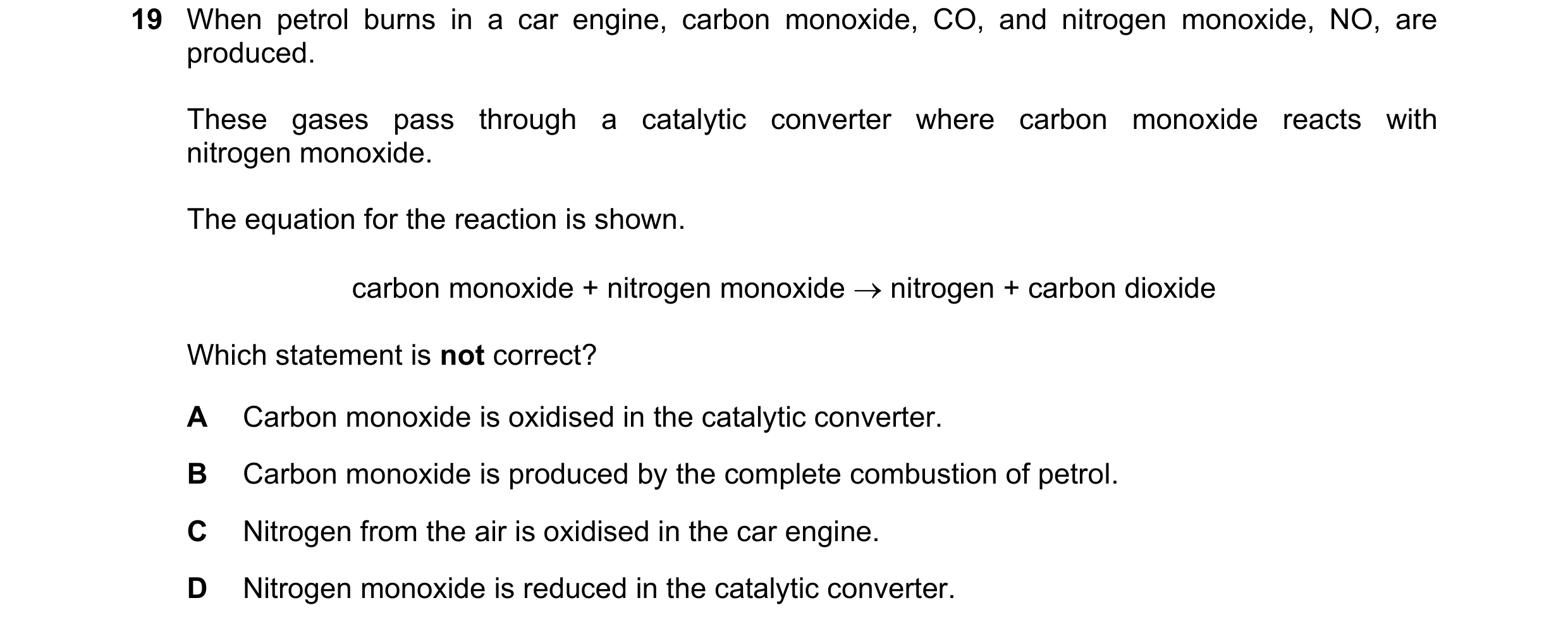
Q57 · When petrol burns in a car engine, carbon monoxide, CO, and nitrogen monoxide, NO, are… 0654/11 Oct/Nov 2023
19 When petrol burns in a car engine, carbon monoxide, CO, and nitrogen monoxide, NO, are produced. These gases pass through a catalytic converter where carbon monoxide reacts with nitrogen monoxide. The equation for the reaction is shown. carbon monoxide + nitrogen monoxide nitrogen + carbon dioxide Which statement is not correct? A Carbon monoxide is oxidised in the catalytic converter. B Carbon monoxide is produced by the complete combustion of petrol. C Nitrogen from the air is oxidised in the car engine. D Nitrogen monoxide is reduced in the catalytic converter.
1 marks
Answer: B
This question in 0654/11 Oct/Nov 2023
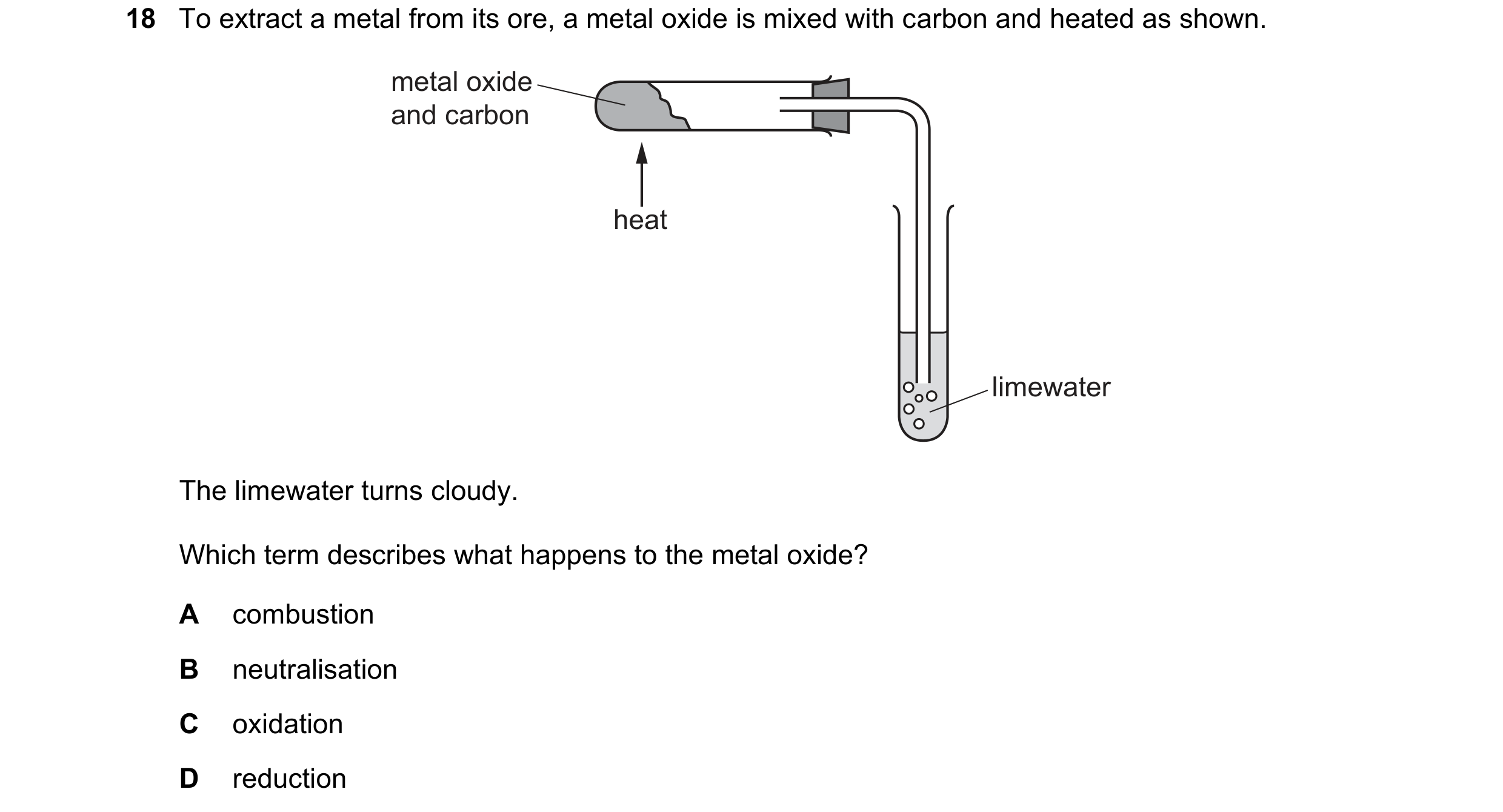
Q58 · To extract a metal from its ore, a metal oxide is mixed with carbon and heated as shown 0654/12 Oct/Nov 2023
18 To extract a metal from its ore, a metal oxide is mixed with carbon and heated as shown. metal oxide and carbon heat limewater The limewater turns cloudy. Which term describes what happens to the metal oxide? A combustion B neutralisation C oxidation D reduction
1 marks
Answer: D
This question in 0654/12 Oct/Nov 2023
Q59 · In which change is the oxide of phosphorus, P2O3, reduced? 0654/13 Oct/Nov 2023
19 In which change is the oxide of phosphorus, P2O3, reduced? P4 A D B P4O10 P2O3 P4O6 C P2O5
1 marks
Answer: A
This question in 0654/13 Oct/Nov 2023
Q60 · Which statement explains why the rusting of iron is an oxidation reaction? 0654/12 Feb/March 2024
20 Which statement explains why the rusting of iron is an oxidation reaction? A Iron gains oxygen. B Iron is a transition element. C Iron is very reactive. D Iron loses oxygen.
1 marks
Answer: A
This question in 0654/12 Feb/March 2024
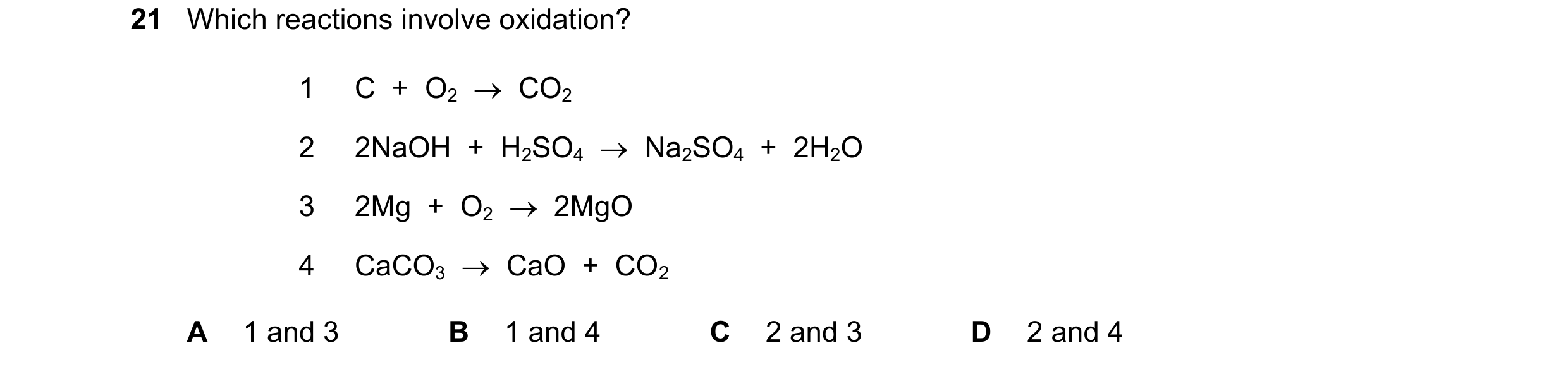
Q61 · Which reactions involve oxidation? 0654/11 May/June 2024
21 Which reactions involve oxidation? 1 C + O2 CO2 2 2NaOH + H2SO4 Na2SO4 + 2H2O 3 2Mg + O2 2MgO 4 CaCO3 CaO + CO2 A 1 and 3 B 1 and 4 C 2 and 3 D 2 and 4
1 marks
Answer: A
This question in 0654/11 May/June 2024
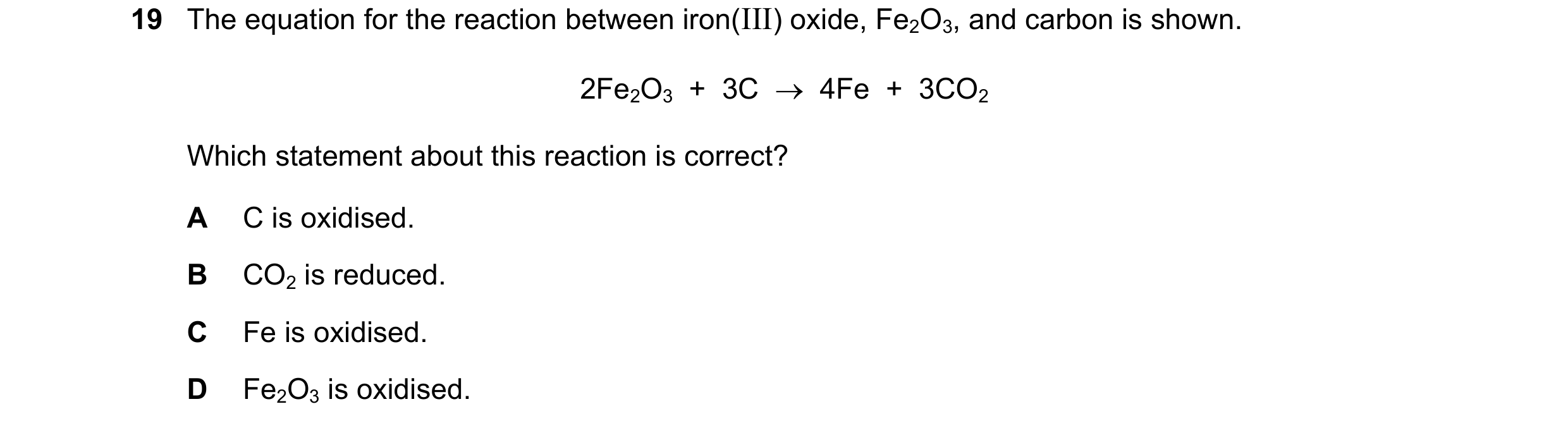
Q62 · The equation for the reaction between iron(III) oxide, Fe2O3, and carbon is shown 0654/12 May/June 2024
19 The equation for the reaction between iron(III) oxide, Fe2O3, and carbon is shown. 2Fe2O3 + 3C 4Fe + 3CO2 Which statement about this reaction is correct? A C is oxidised. B CO2 is reduced. C Fe is oxidised. D Fe2O3 is oxidised.
1 marks
Answer: A
This question in 0654/12 May/June 2024
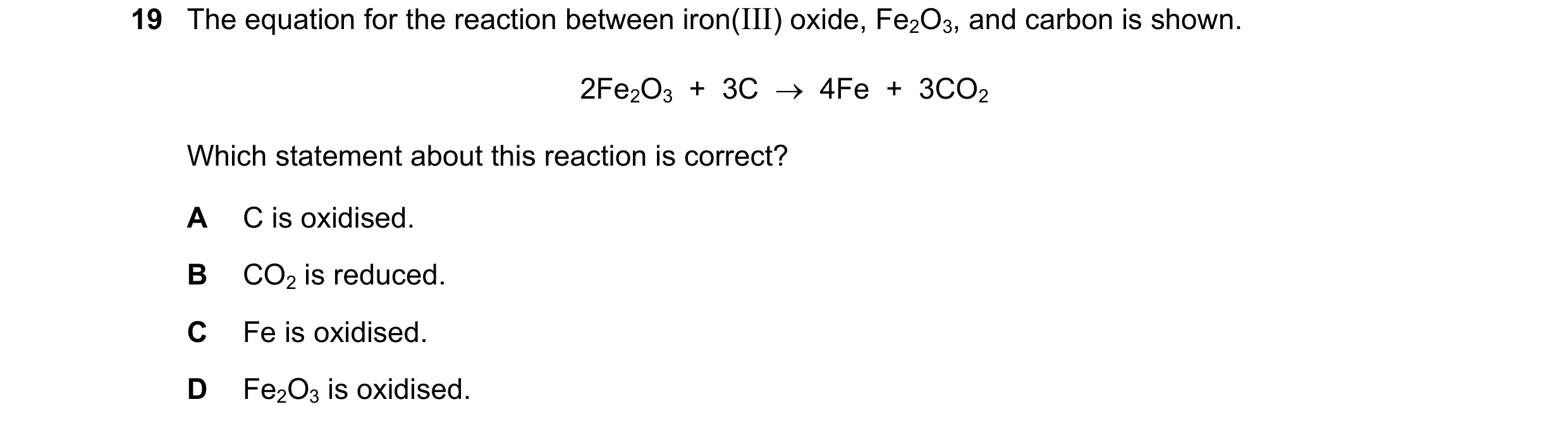
Q63 · The equation for the reaction between iron(III) oxide, Fe2O3, and carbon is shown 0654/13 May/June 2024
19 The equation for the reaction between iron(III) oxide, Fe2O3, and carbon is shown. 2Fe2O3 + 3C 4Fe + 3CO2 Which statement about this reaction is correct? A C is oxidised. B CO2 is reduced. C Fe is oxidised. D Fe2O3 is oxidised.
1 marks
Answer: A
This question in 0654/13 May/June 2024
Q64 · Which statement about oxidation is correct? 0654/11 Oct/Nov 2024
21 Which statement about oxidation is correct? A It occurs when an element or compound chemically combines with oxygen. B It occurs when an element or compound forms a mixture with oxygen. C It occurs when an element or compound is separated from a mixture with oxygen. D It occurs when a compound loses oxygen.
1 marks
Answer: A
This question in 0654/11 Oct/Nov 2024
Q65 · Which equation shows the oxidation of a metal? 0654/11 May/June 2025
22 Which equation shows the oxidation of a metal? A CuO + H2 Cu + H2O B CuO + Zn Cu + ZnO C Fe2O3 + 3CO 2Fe + 3CO2 D 2ZnO + C 2Zn + CO2
1 marks
Answer: B
This question in 0654/11 May/June 2025
Q66 · The equation for the reaction between copper(II) oxide and carbon is shown 0654/12 Oct/Nov 2025
21 The equation for the reaction between copper(II) oxide and carbon is shown. 2CuO + C 2Cu + CO2 Which substance is oxidised in this reaction? A C B CO2 C Cu D CuO
1 marks
Answer: A
This question in 0654/12 Oct/Nov 2025
Q67 · The equation for the reaction between copper(II) oxide and carbon is shown 0654/13 Oct/Nov 2025
21 The equation for the reaction between copper(II) oxide and carbon is shown. 2CuO + C 2Cu + CO2 Which substance is oxidised in this reaction? A C B CO2 C Cu D CuO
1 marks
Answer: A
This question in 0654/13 Oct/Nov 2025


 1 / 17

 2 / 17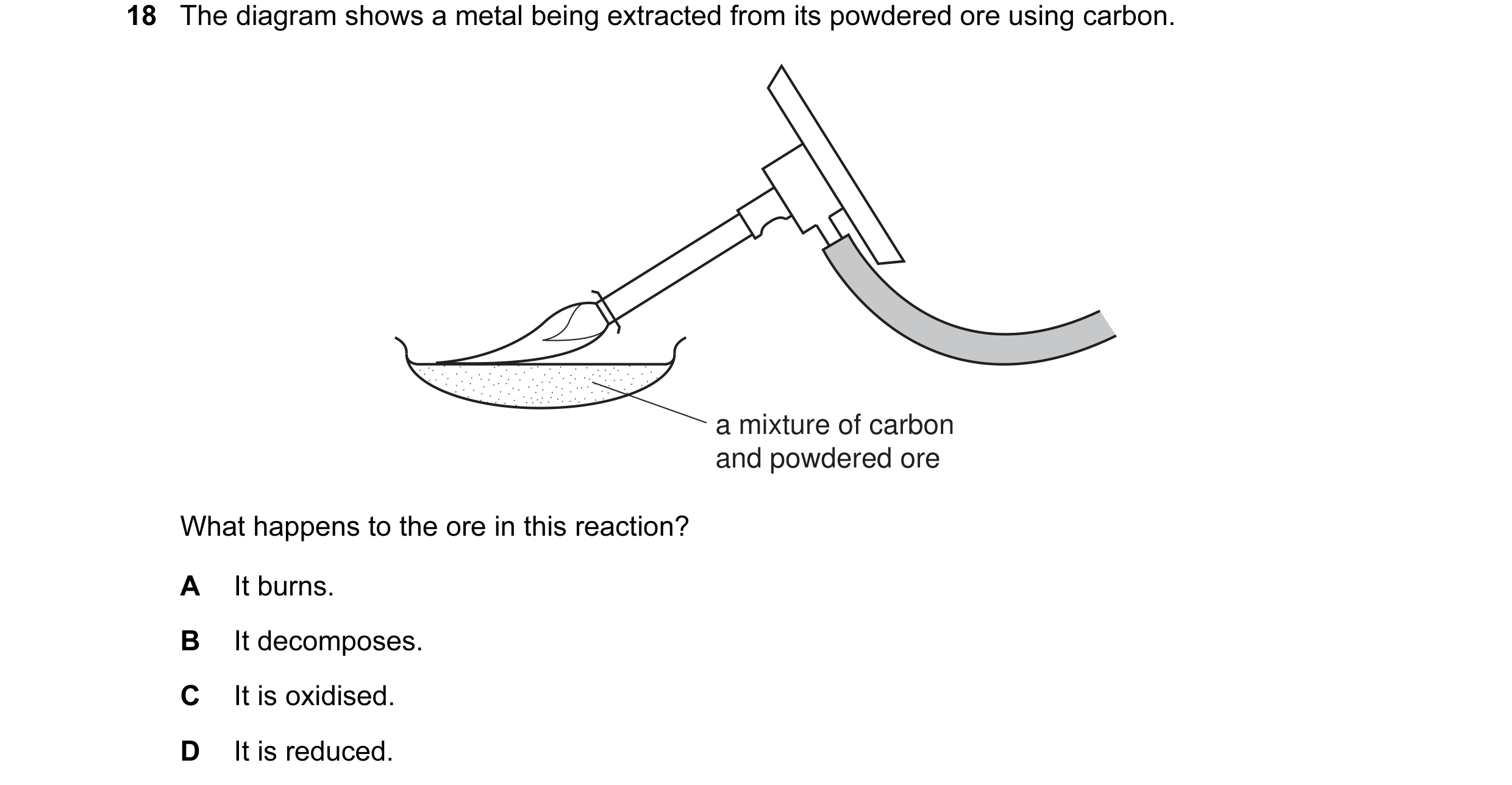
 3 / 17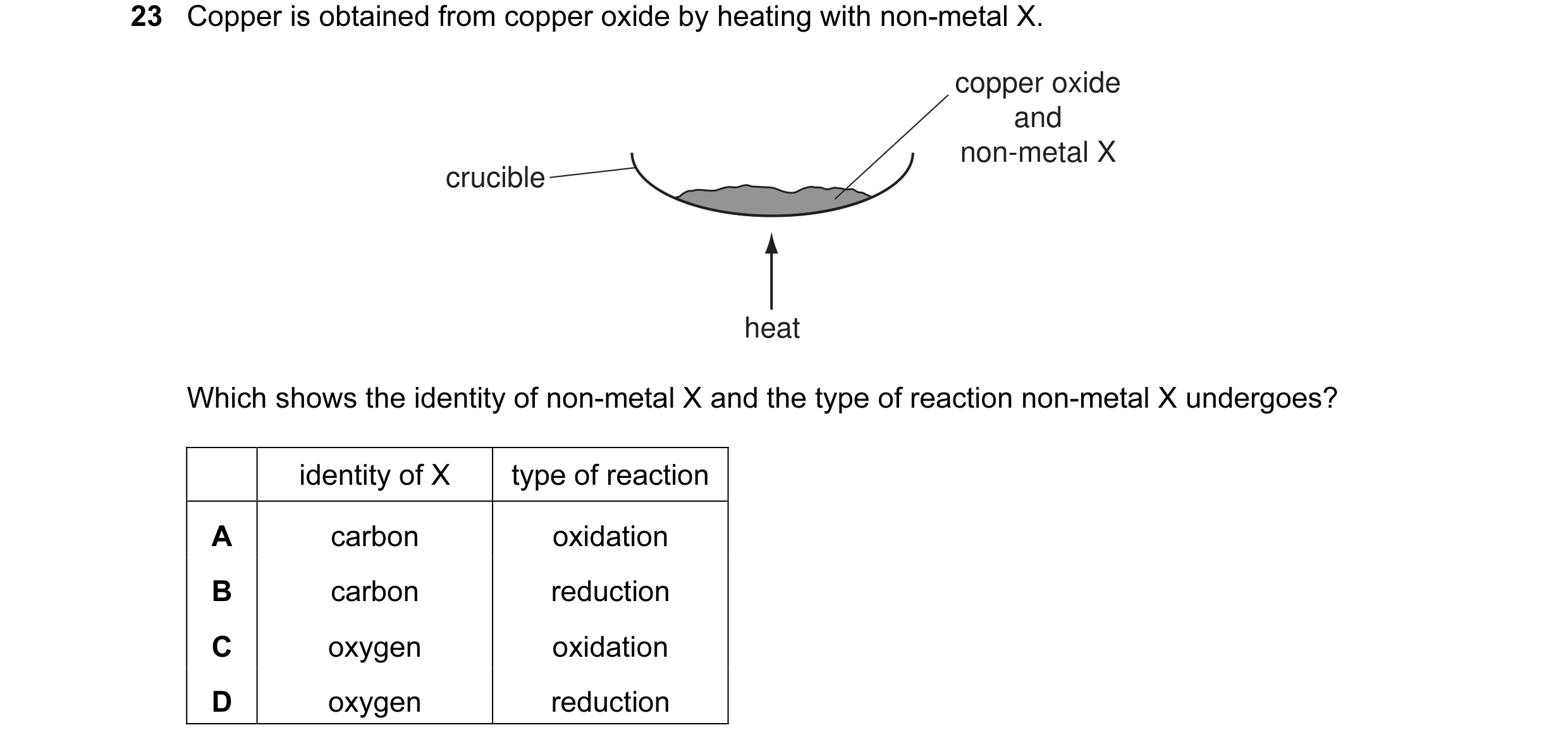


 4 / 17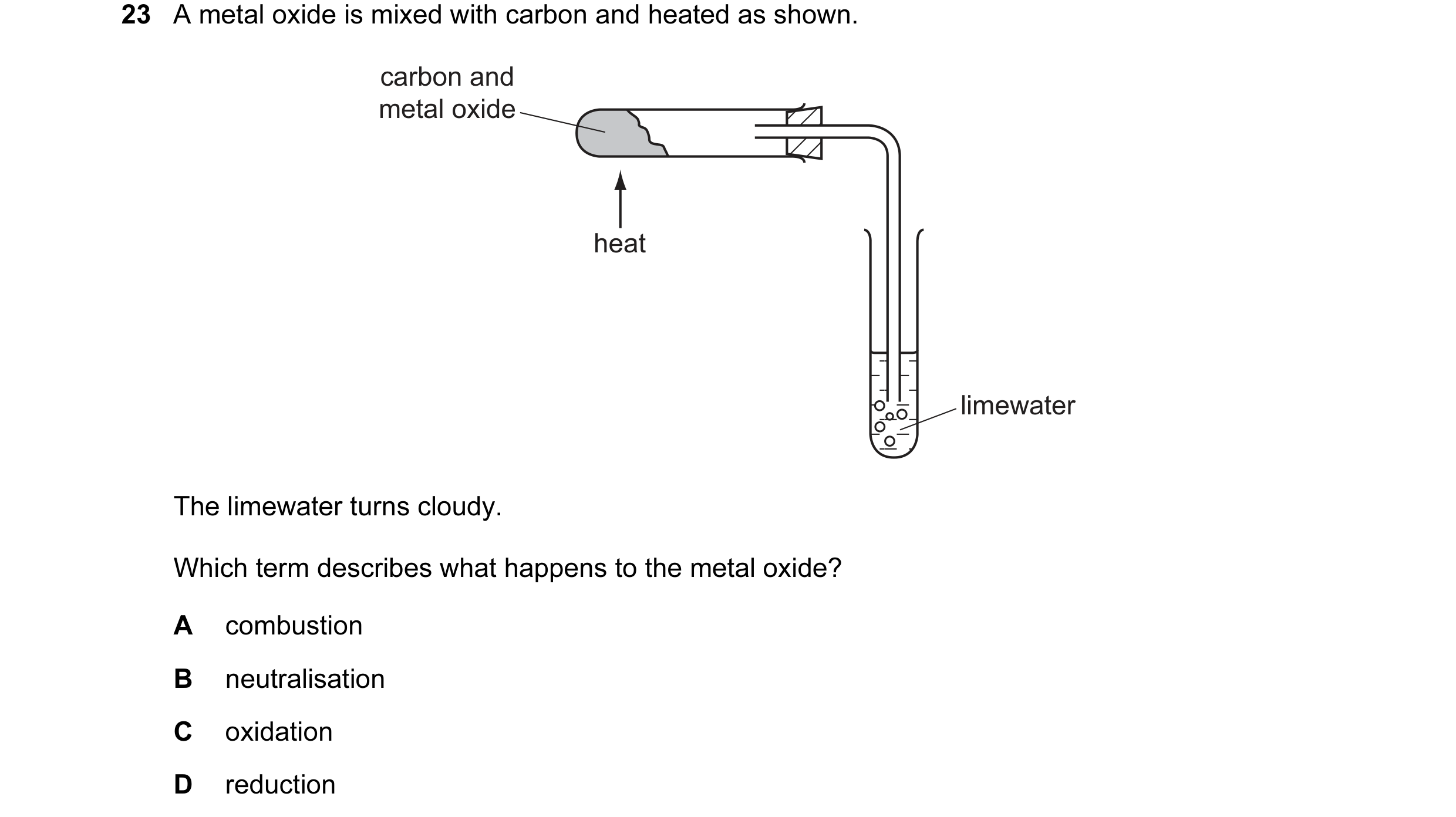
 5 / 17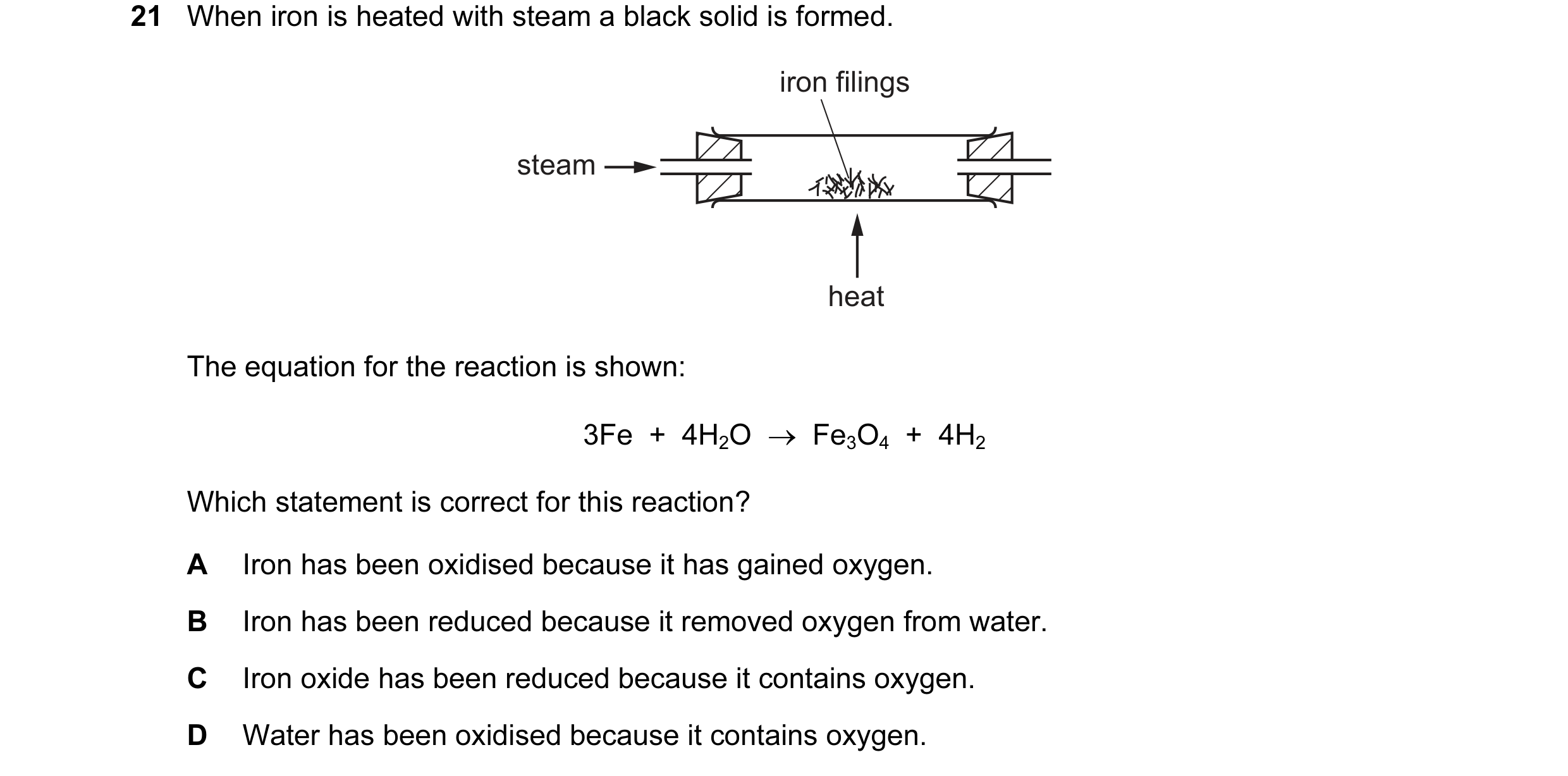
 6 / 17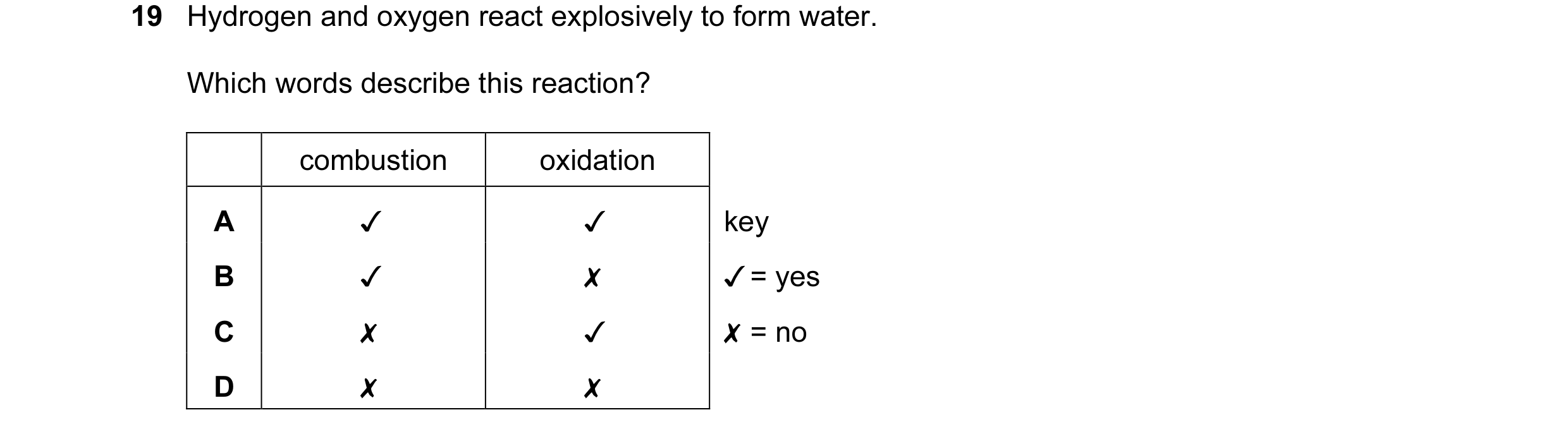
 7 / 17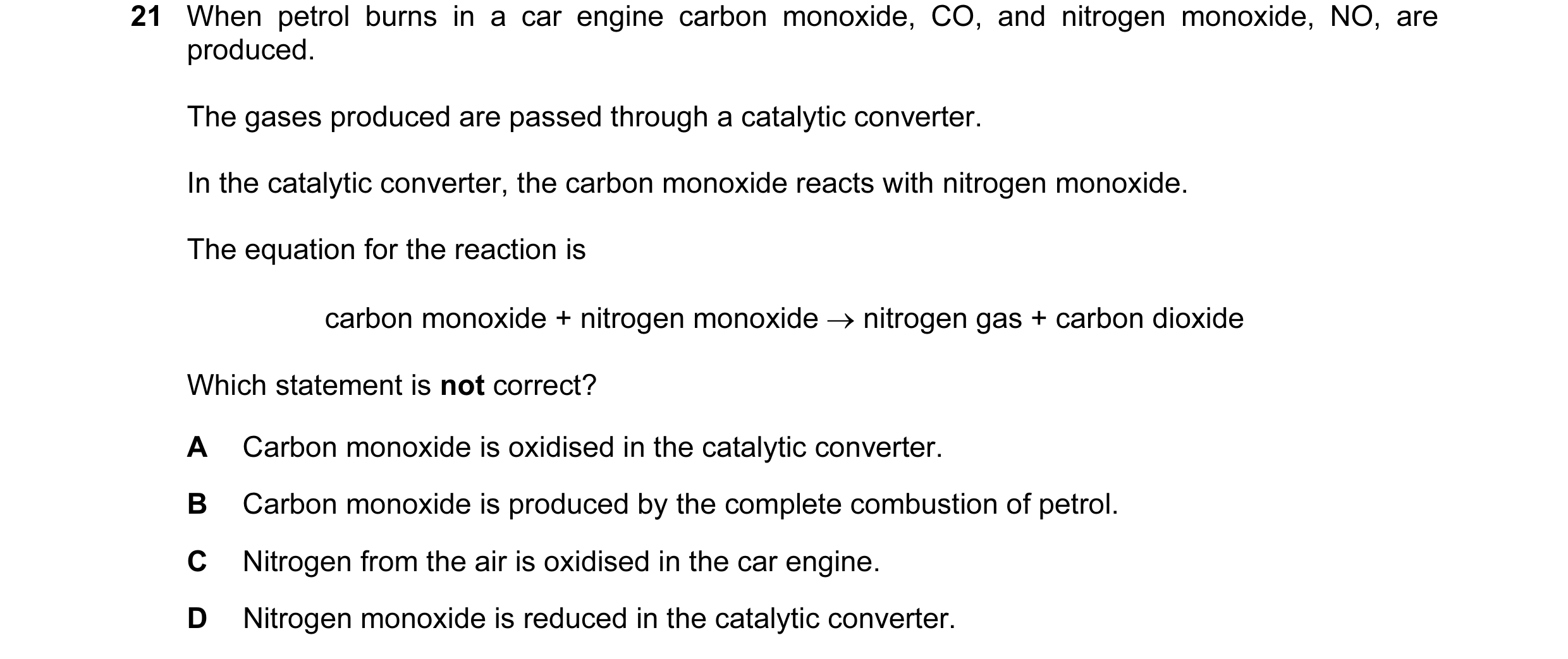

 8 / 17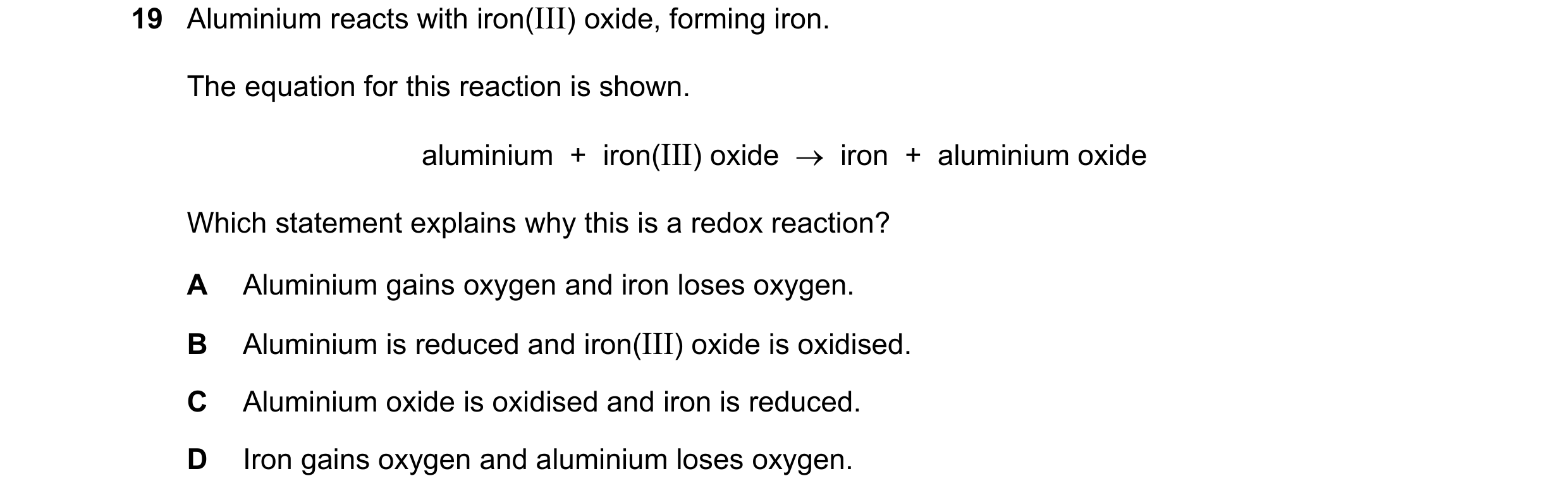


 9 / 17

 10 / 17




 11 / 17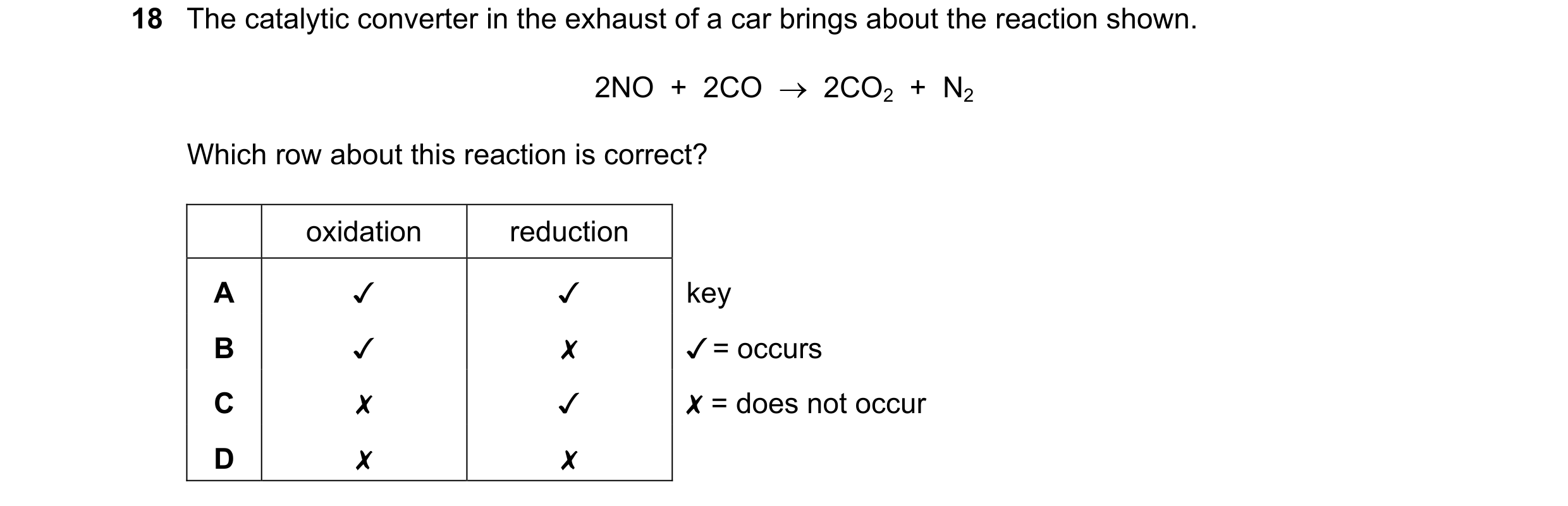
 12 / 17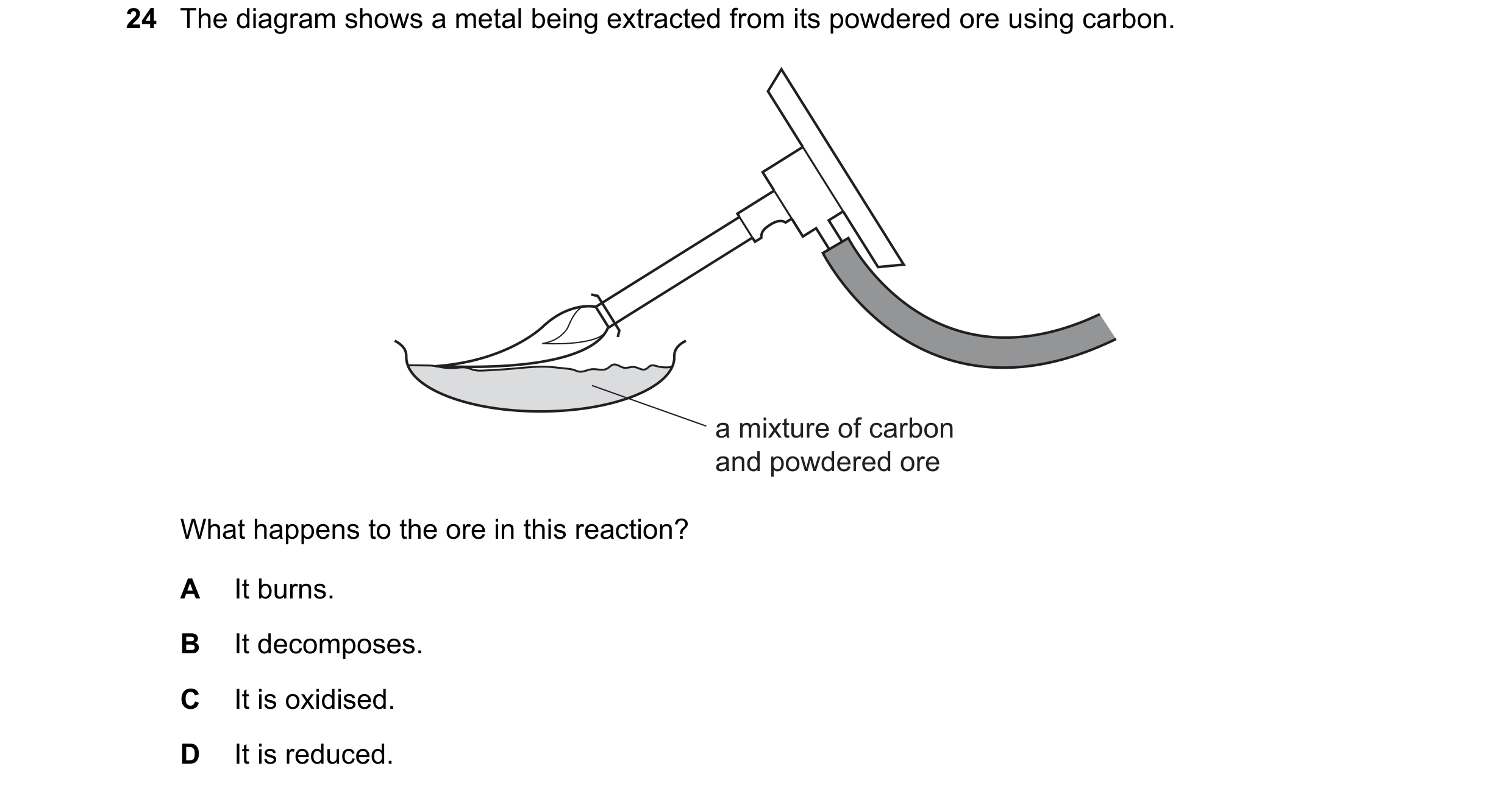
 13 / 17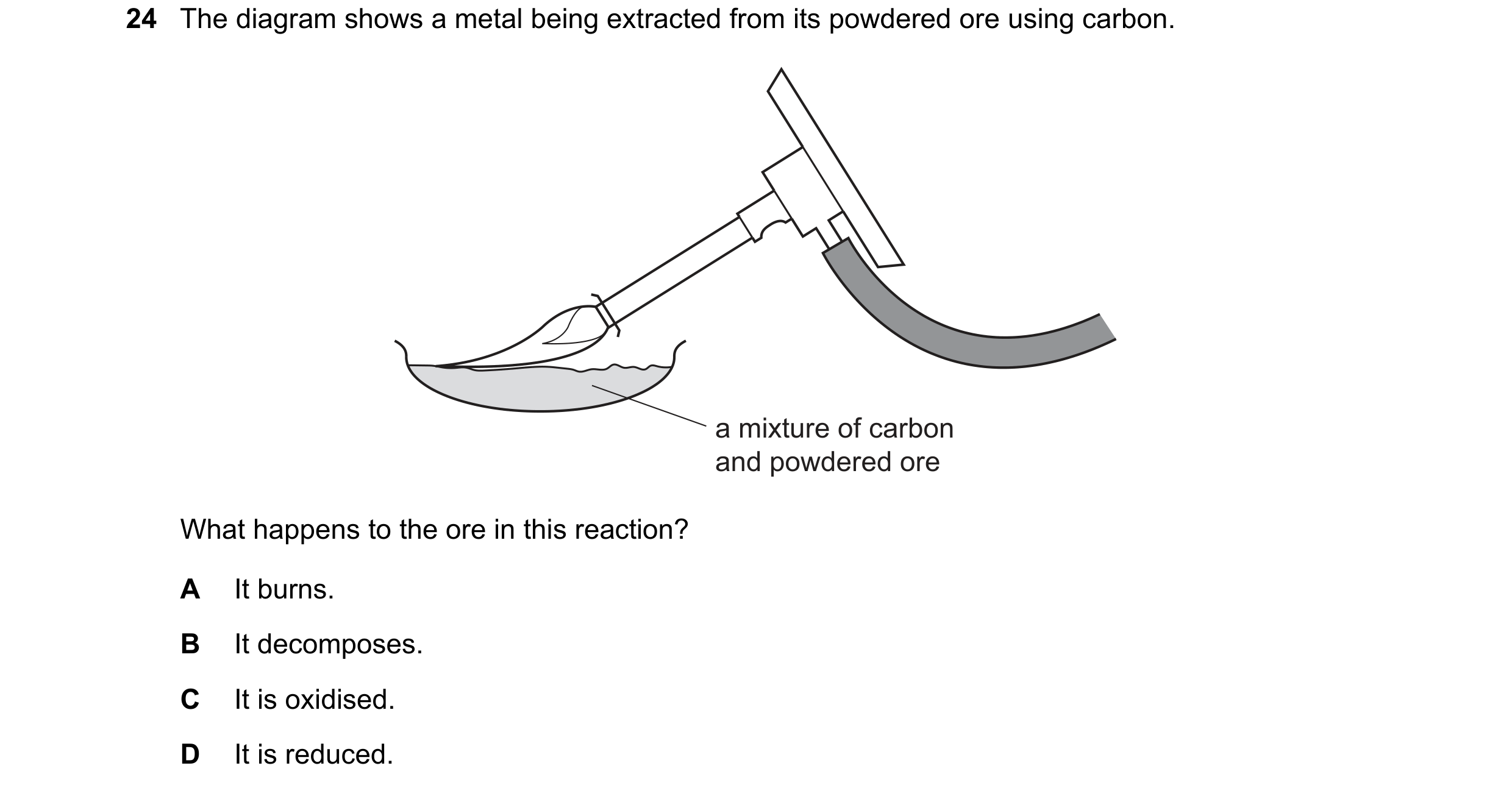


 14 / 17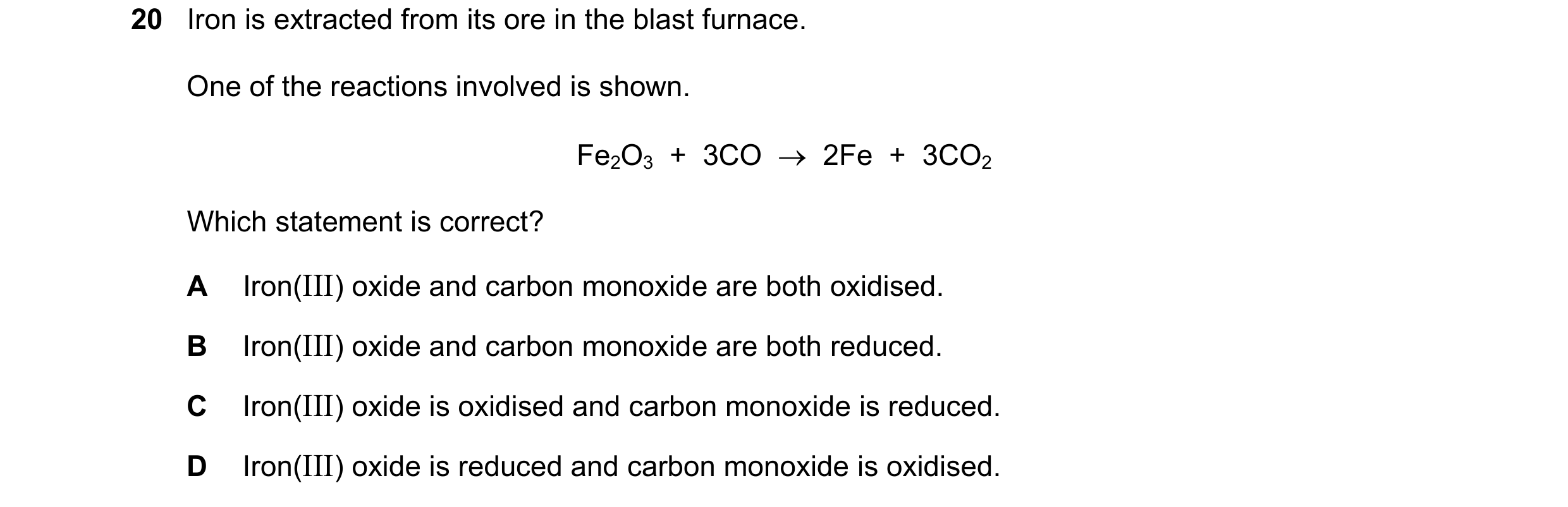
 15 / 17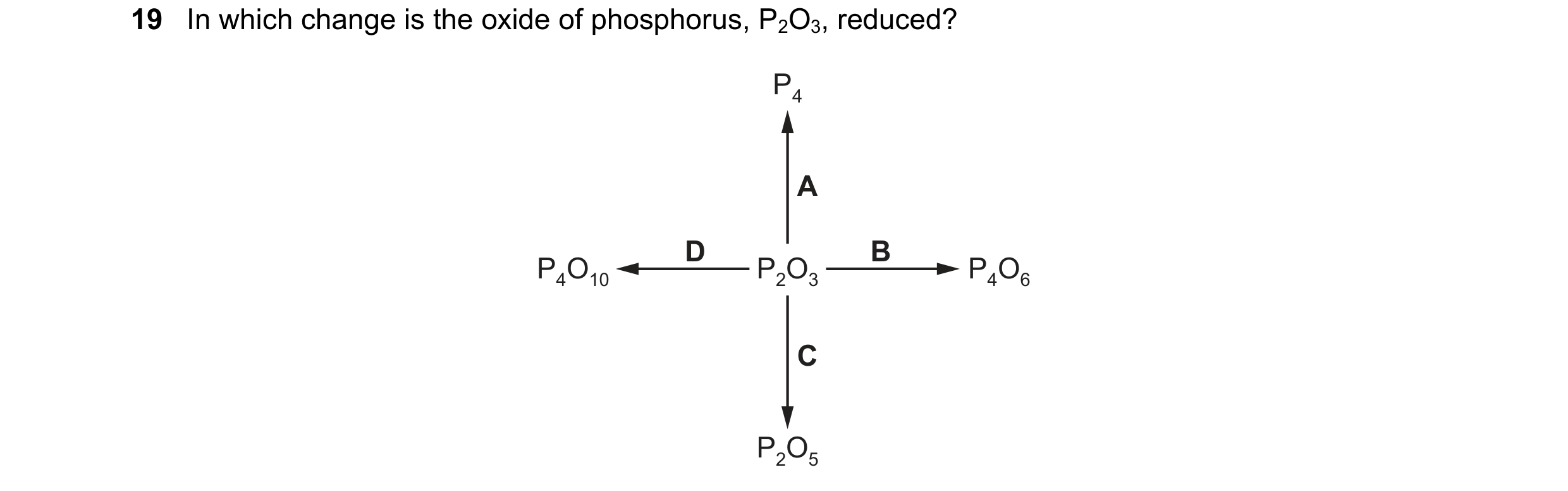

 16 / 17


 17 / 17