Questions as text
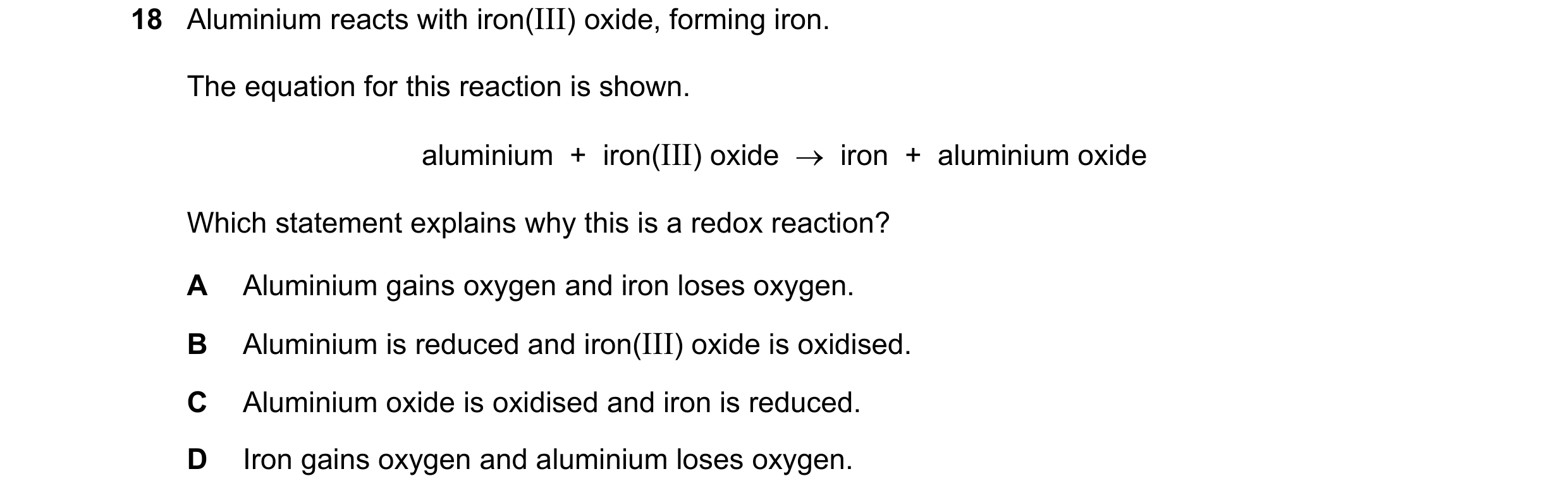
Q1 · Aluminium reacts with iron(III) oxide, forming iron 0654/21 May/June 2017
18 Aluminium reacts with iron(III) oxide, forming iron. The equation for this reaction is shown. aluminium + iron(III) oxide → iron + aluminium oxide Which statement explains why this is a redox reaction? A Aluminium gains oxygen and iron loses oxygen. B Aluminium is reduced and iron(III) oxide is oxidised. C Aluminium oxide is oxidised and iron is reduced. D Iron gains oxygen and aluminium loses oxygen.
1 marks
Answer: A
This question in 0654/21 May/June 2017
Q2 · In which word equation is the underlined substance being oxidised? 0654/23 May/June 2017
18 In which word equation is the underlined substance being oxidised? A carbon dioxide + carbon → carbon monoxide B carbon monoxide + iron oxide → carbon dioxide + iron C copper oxide + magnesium → magnesium oxide + copper D magnesium oxide + hydrochloric acid → magnesium chloride + water
1 marks
Answer: B
This question in 0654/23 May/June 2017
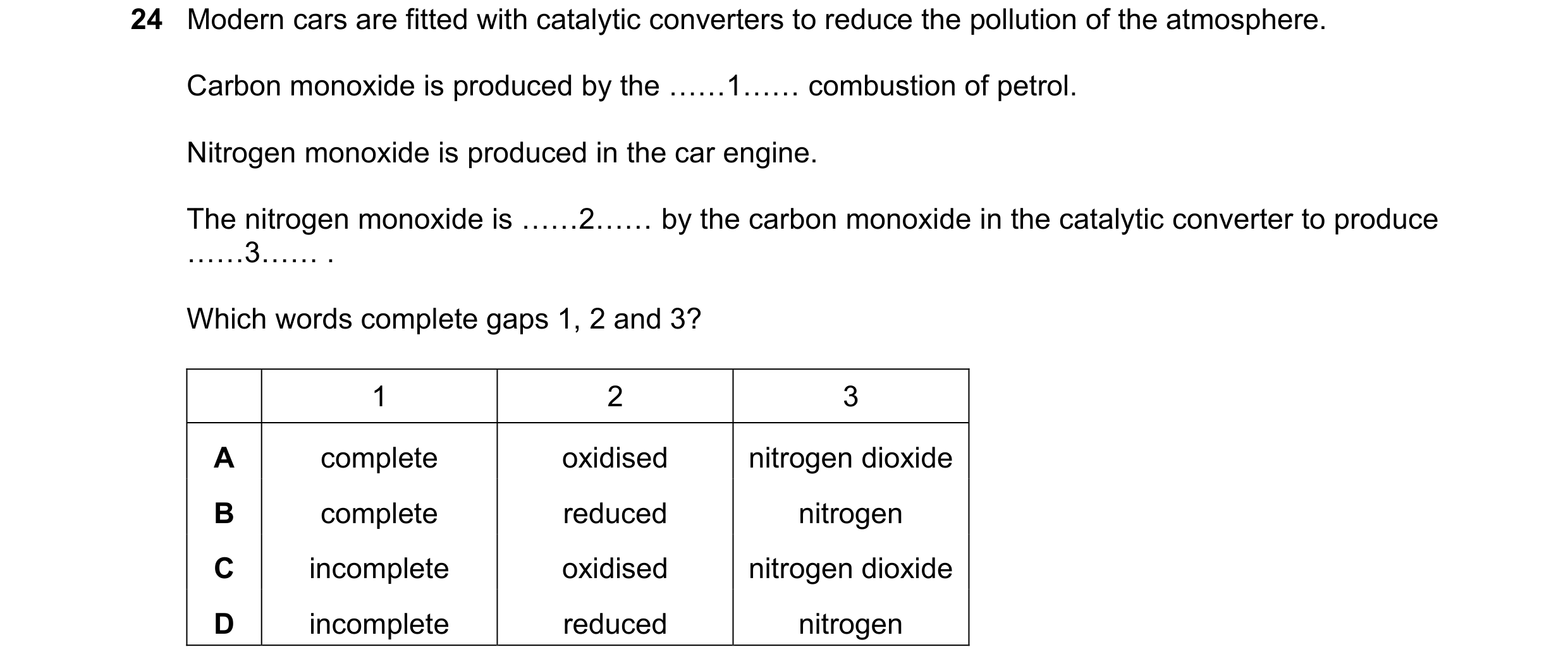
Q3 · Modern cars are fitted with catalytic converters to reduce the pollution of the atmosphere 0654/23 May/June 2017
24 Modern cars are fitted with catalytic converters to reduce the pollution of the atmosphere. Carbon monoxide is produced by the ««1«« combustion of petrol. Nitrogen monoxide is produced in the car engine. The nitrogen monoxide is ««2«« by the carbon monoxide in the catalytic converter to produce ««3«« . Which words complete gaps 1, 2 and 3? 1 2 3 A complete oxidised nitrogen dioxide B complete reduced nitrogen C incomplete oxidised nitrogen dioxide D incomplete reduced nitrogen
1 marks
Answer: D
This question in 0654/23 May/June 2017
Q4 · Which equation shows iron or one of its compounds being reduced? 0654/22 Oct/Nov 2017
18 Which equation shows iron or one of its compounds being reduced? A 2FeCl 2 + Cl 2 → 2FeCl 3 B Fe + CuSO4 → FeSO4 + Cu C Fe + H2SO4 → FeSO4 + H2O D FeSO4 + Mg → MgSO4 + Fe
1 marks
Answer: D
This question in 0654/22 Oct/Nov 2017
Q5 · The ionic equation for the formation of chromium(III) ions is shown 0654/23 Oct/Nov 2017
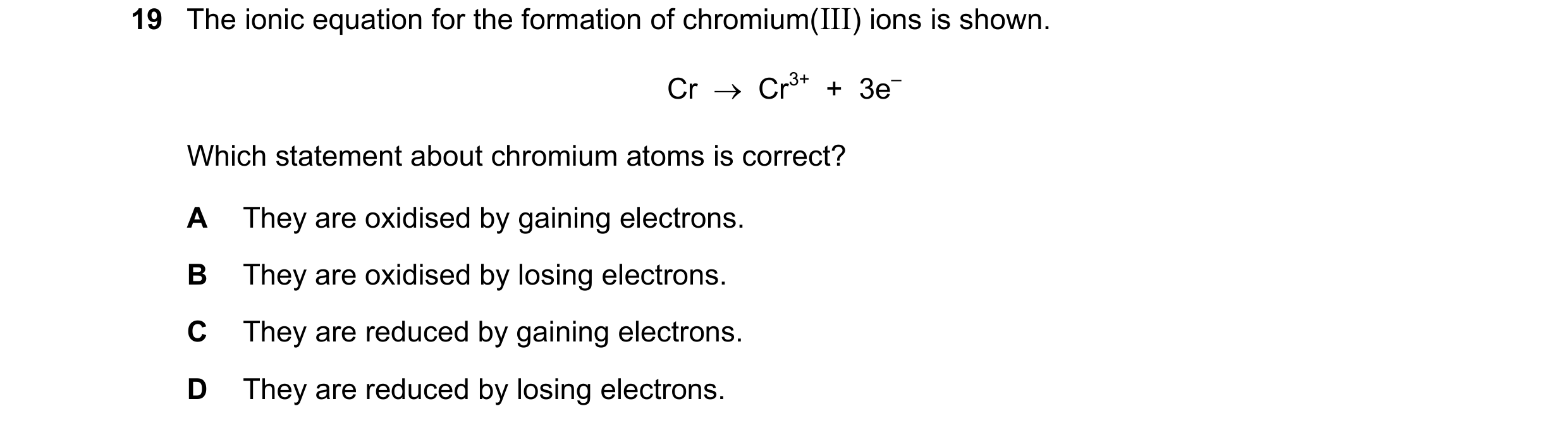
18 The ionic equation for the formation of chromium(III) ions is shown. Cr → Cr3+ + 3e– Which statement about chromium atoms is correct? A They are oxidised by gaining electrons. B They are oxidised by losing electrons. C They are reduced by gaining electrons. D They are reduced by losing electrons.
1 marks
Answer: B
This question in 0654/23 Oct/Nov 2017
Q6 · Which word equation represents a redox reaction? 0654/21 Oct/Nov 2018
20 Which word equation represents a redox reaction? A calcium carbonate → calcium oxide + carbon dioxide B calcium oxide + hydrochloric acid → calcium chloride + water C copper oxide + carbon → copper + carbon dioxide D sodium oxide + water → sodium hydroxide
1 marks
Answer: C
This question in 0654/21 Oct/Nov 2018
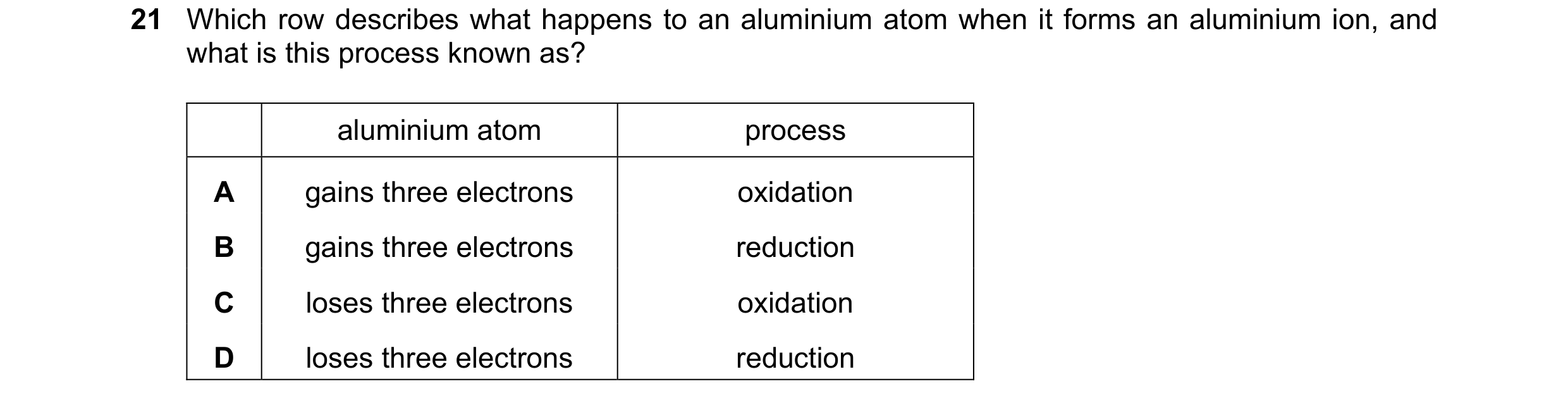
Q7 · Which row describes what happens to an aluminium atom when it forms an aluminium ion, and… 0654/22 Oct/Nov 2018
21 Which row describes what happens to an aluminium atom when it forms an aluminium ion, and what is this process known as? aluminium atom process A gains three electrons oxidation B gains three electrons reduction C loses three electrons oxidation D loses three electrons reduction
1 marks
Answer: C
This question in 0654/22 Oct/Nov 2018
Q8 · Iron oxide reacts with carbon monoxide 0654/23 Oct/Nov 2018
20 Iron oxide reacts with carbon monoxide. The word equation is iron oxide + carbon monoxide → iron + carbon dioxide Which statement describes what happens to the iron oxide? A It is oxidised because it gains oxygen. B It is oxidised because it loses oxygen. C It is reduced because it gains oxygen. D It is reduced because it loses oxygen.
1 marks
Answer: D
This question in 0654/23 Oct/Nov 2018
Q9 · Which statement about redox reactions is correct? 0654/23 May/June 2019
21 Which statement about redox reactions is correct? A Oxidising agents are oxidised. B Oxidising agents lose electrons. C Reducing agents accept electrons. D Reduction is the gain of electrons.
1 marks
Answer: D
This question in 0654/23 May/June 2019
Q10 · Three reaction equations are listed 0654/21 Oct/Nov 2019
20 Three reaction equations are listed. 1 2Na + H2O → 2NaOH + H2 2 2NaCl → 2Na + Cl 2 3 CaCO3 → CaO + CO2 Which reactions involve reduction and oxidation? A 1 and 2 only B 1 and 3 only C 2 and 3 only D 1, 2 and 3
1 marks
Answer: A
This question in 0654/21 Oct/Nov 2019
Q11 · A redox reaction is shown 0654/23 Oct/Nov 2019
19 A redox reaction is shown. Fe + Cu2+ → Fe2+ + Cu Which substance is the reducing agent? A Cu B Cu2+ C Fe D Fe2+
1 marks
Answer: C
This question in 0654/23 Oct/Nov 2019
Q12 · The ionic equation for the formation of chromium(III) ions is shown 0654/21 May/June 2020
19 The ionic equation for the formation of chromium(III) ions is shown. Cr Cr3+ + 3e– Which statement about chromium atoms is correct? A They are oxidised by gaining electrons. B They are oxidised by losing electrons. C They are reduced by gaining electrons. D They are reduced by losing electrons.
1 marks
Answer: B
This question in 0654/21 May/June 2020
Q13 · Chlorine gas is bubbled through two separate solutions 0654/21 May/June 2020
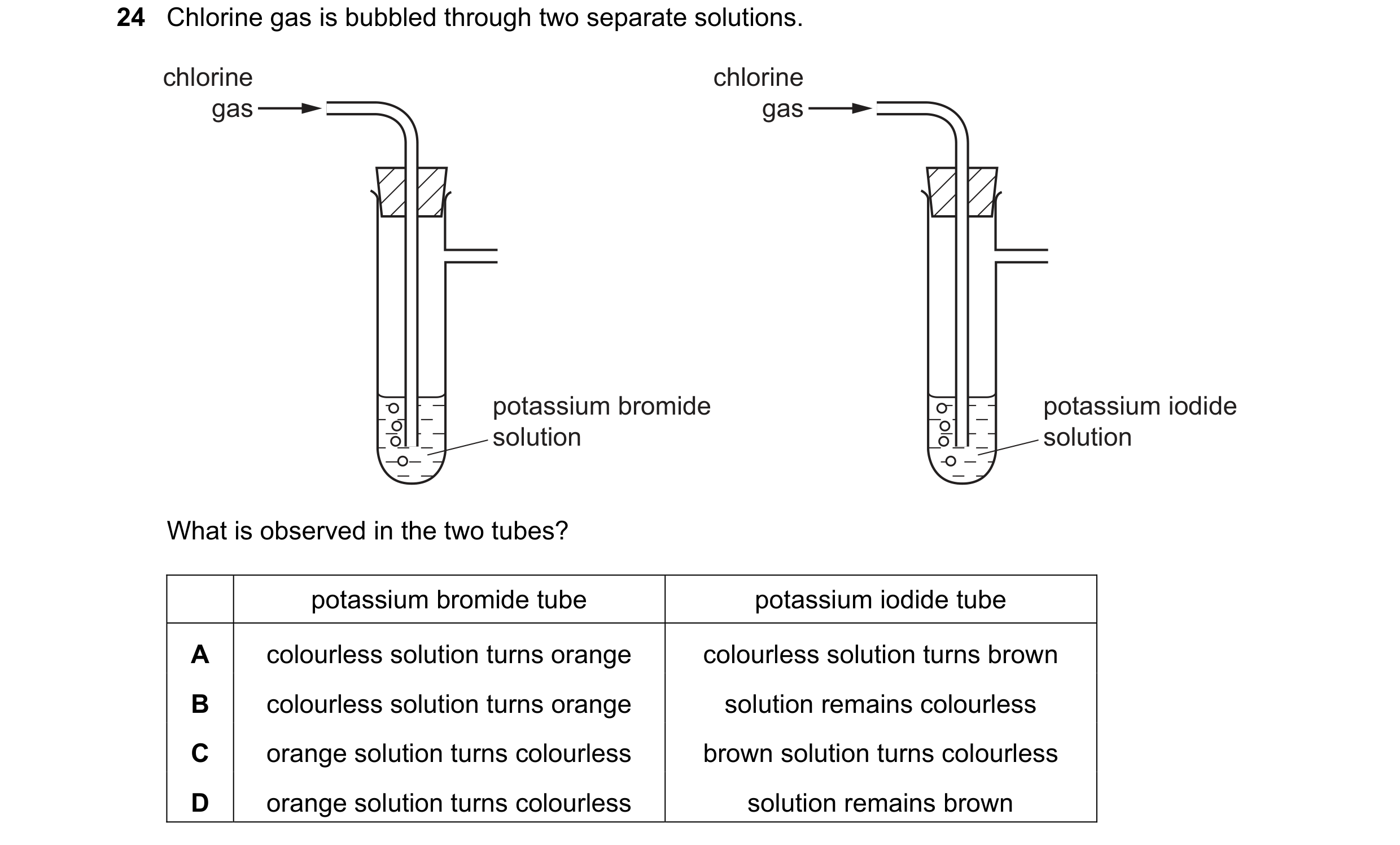
24 Chlorine gas is bubbled through two separate solutions. chlorine chlorine gas gas potassium bromide potassium iodide solution solution What is observed in the two tubes? potassium bromide tube potassium iodide tube A colourless solution turns orange colourless solution turns brown B colourless solution turns orange solution remains colourless C orange solution turns colourless brown solution turns colourless D orange solution turns colourless solution remains brown
1 marks
Answer: A
This question in 0654/21 May/June 2020
Q14 · The ionic equation for the formation of chromium(III) ions is shown 0654/22 May/June 2020
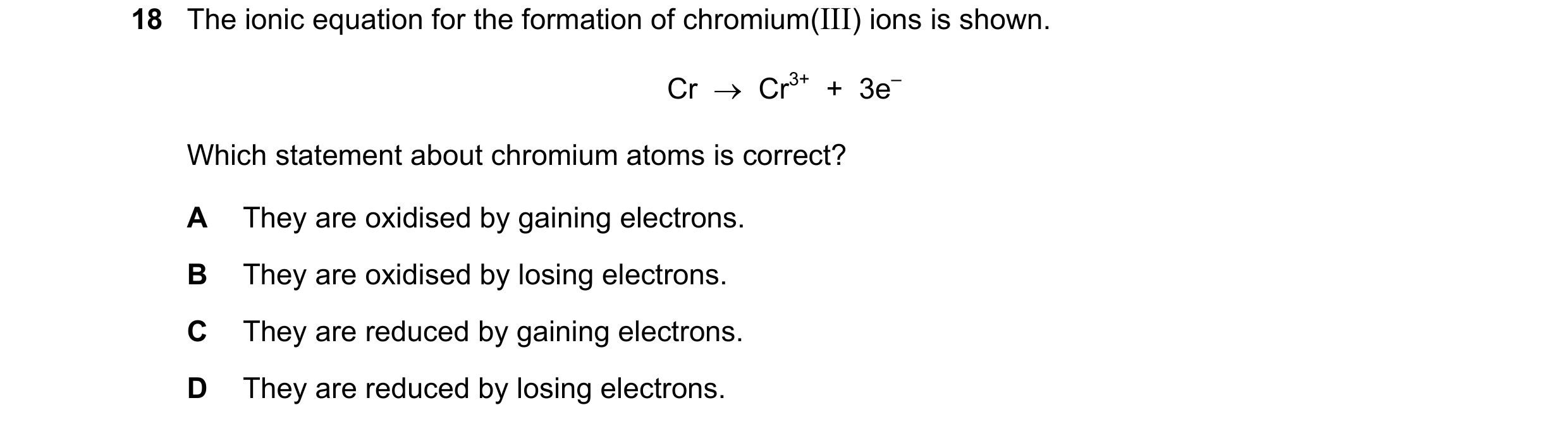
18 The ionic equation for the formation of chromium(III) ions is shown. Cr → Cr3+ + 3e– Which statement about chromium atoms is correct? A They are oxidised by gaining electrons. B They are oxidised by losing electrons. C They are reduced by gaining electrons. D They are reduced by losing electrons.
1 marks
Answer: B
This question in 0654/22 May/June 2020
Q15 · The ionic equation for the formation of chromium(III) ions is shown 0654/23 May/June 2020
18 The ionic equation for the formation of chromium(III) ions is shown. Cr → Cr3+ + 3e– Which statement about chromium atoms is correct? A They are oxidised by gaining electrons. B They are oxidised by losing electrons. C They are reduced by gaining electrons. D They are reduced by losing electrons.
1 marks
Answer: B
This question in 0654/23 May/June 2020
Q16 · Which word equation represents a redox reaction? 0654/21 Oct/Nov 2020
19 Which word equation represents a redox reaction? A carbon + copper oxide copper + carbon dioxide B hydrochloric acid + potassium hydroxide potassium chloride + water C magnesium carbonate magnesium oxide + carbon dioxide D sodium sulfate + barium nitrate barium sulfate + sodium nitrate
1 marks
Answer: A
This question in 0654/21 Oct/Nov 2020
Q17 · Which word equation represents a redox reaction? 0654/22 Oct/Nov 2020
19 Which word equation represents a redox reaction? A carbon + copper oxide copper + carbon dioxide B hydrochloric acid + potassium hydroxide potassium chloride + water C magnesium carbonate magnesium oxide + carbon dioxide D sodium sulfate + barium nitrate barium sulfate + sodium nitrate
1 marks
Answer: A
This question in 0654/22 Oct/Nov 2020
Q18 · Which word equation represents a redox reaction? 0654/23 Oct/Nov 2020
19 Which word equation represents a redox reaction? A carbon + copper oxide copper + carbon dioxide B hydrochloric acid + potassium hydroxide potassium chloride + water C magnesium carbonate magnesium oxide + carbon dioxide D sodium sulfate + barium nitrate barium sulfate + sodium nitrate
1 marks
Answer: A
This question in 0654/23 Oct/Nov 2020
Q19 · In which equation is the underlined substance acting as an oxidising agent? 0654/22 Feb/March 2021
19 In which equation is the underlined substance acting as an oxidising agent? A CuO + H2 Cu + H2O B CuSO4 + Mg MgSO4 + Cu C H2 + Cl 2 2HCl D Zn + 2HCl ZnCl 2 + H2
1 marks
Answer: C
This question in 0654/22 Feb/March 2021
Q20 · Which equation represents a redox reaction? 0654/21 May/June 2021
19 Which equation represents a redox reaction? A Ca(OH)2 + CO2 CaCO3 + H2O B CuCO3 CuO + CO2 C Mg + CuSO4 MgSO4 + Cu D Pb(NO3)2 + 2KI PbI2 + 2KNO3
1 marks
Answer: C
This question in 0654/21 May/June 2021
Q21 · Which changes show oxidation? 0654/22 May/June 2021
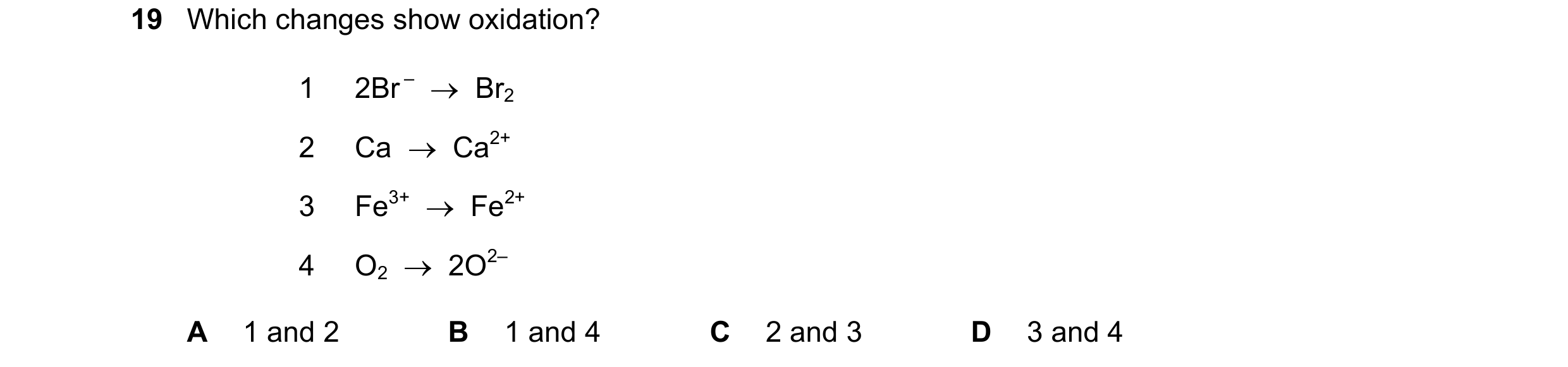
19 Which changes show oxidation? 1 2Br – Br2 2 Ca Ca2+ 3 Fe3+ Fe2+ 4 O2 2O2– A 1 and 2 B 1 and 4 C 2 and 3 D 3 and 4
1 marks
Answer: A
This question in 0654/22 May/June 2021
Q22 · Chlorine displaces iodine from a solution of sodium iodide in a redox reaction 0654/23 May/June 2021
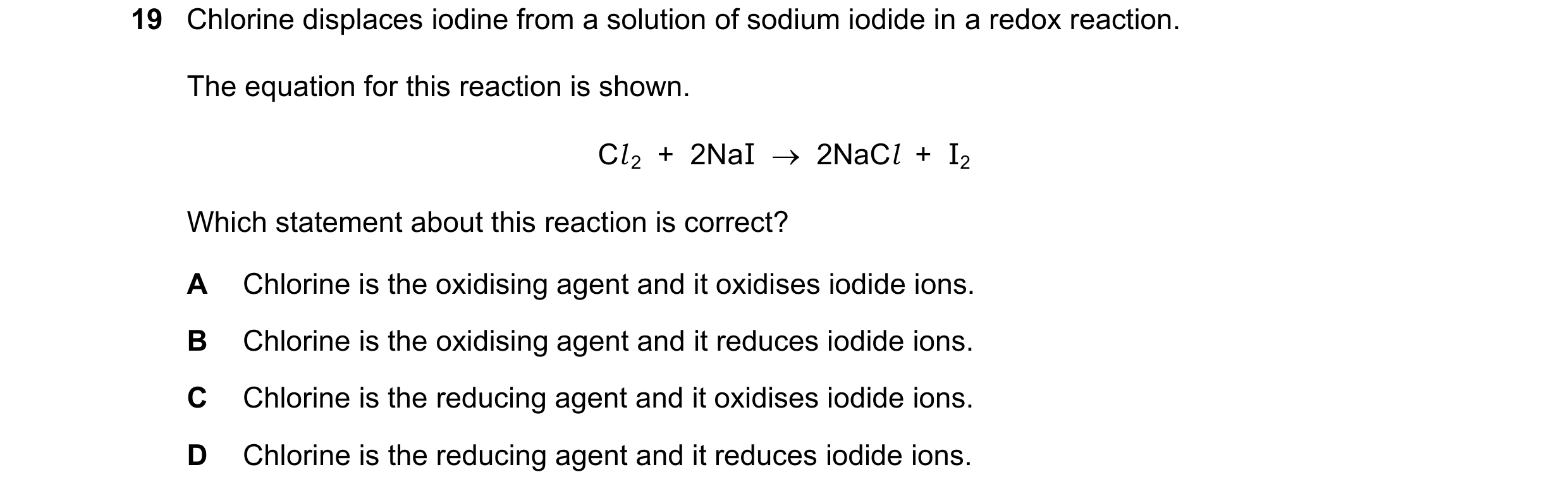
19 Chlorine displaces iodine from a solution of sodium iodide in a redox reaction. The equation for this reaction is shown. Cl 2 + 2NaI 2NaCl + I2 Which statement about this reaction is correct? A Chlorine is the oxidising agent and it oxidises iodide ions. B Chlorine is the oxidising agent and it reduces iodide ions. C Chlorine is the reducing agent and it oxidises iodide ions. D Chlorine is the reducing agent and it reduces iodide ions.
1 marks
Answer: A
This question in 0654/23 May/June 2021
Q23 · Which equation represents a redox reaction? 0654/21 Oct/Nov 2021
18 Which equation represents a redox reaction? A CaCO3 CaO + CO2 B Cu(OH)2 CuO + H2O C LiOH + HCl LiCl + H2O D 2Na + 2H2O 2NaOH + H2
1 marks
Answer: D
This question in 0654/21 Oct/Nov 2021
Q24 · When aqueous chlorine is added to aqueous potassium bromide, bromine is produced 0654/22 Oct/Nov 2021
16 When aqueous chlorine is added to aqueous potassium bromide, bromine is produced. What is the ionic equation for this reaction? A Cl 2 + Br – 2Cl – + Br B Cl 2 + 2Br – 2Cl – + Br2 C Cl 2 + 2Br – Cl – + Br2 D Cl 2 + 2KBr 2KCl + Br2
1 marks
Answer: B
This question in 0654/22 Oct/Nov 2021
Q25 · Which equation shows a reaction in which a metal is reduced? 0654/22 Oct/Nov 2021
19 Which equation shows a reaction in which a metal is reduced? A CuCO3 CuO + CO2 B 2Li + 2H2O 2LiOH + H2 C 2Fe3+ + 2I – Fe2+ + I2 D Mg + 2H+ Mg2+ + H2
1 marks
Answer: C
This question in 0654/22 Oct/Nov 2021
Q26 · The ionic equation for the reaction between chlorine and potassium bromide is shown 0654/23 Oct/Nov 2021
19 The ionic equation for the reaction between chlorine and potassium bromide is shown. Cl 2 + 2Br – 2Cl – + Br2 What is the oxidising agent? A Br2 B Br – C Cl 2 D Cl –
1 marks
Answer: C
This question in 0654/23 Oct/Nov 2021
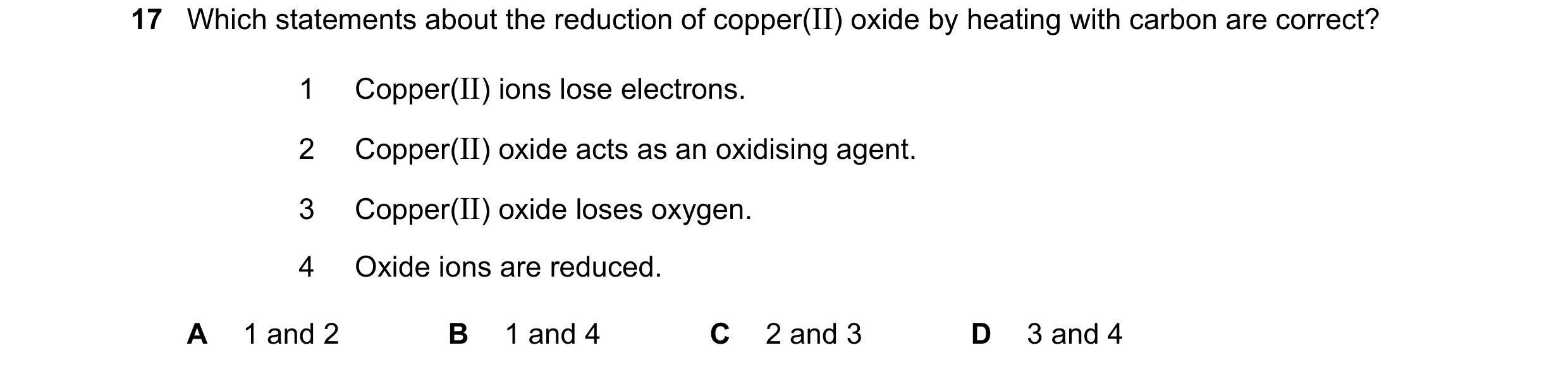
Q27 · Which statements about the reduction of copper(II) oxide by heating with carbon are… 0654/22 Feb/March 2022
17 Which statements about the reduction of copper(II) oxide by heating with carbon are correct? 1 Copper(II) ions lose electrons. 2 Copper(II) oxide acts as an oxidising agent. 3 Copper(II) oxide loses oxygen. 4 Oxide ions are reduced. A 1 and 2 B 1 and 4 C 2 and 3 D 3 and 4
1 marks
Answer: C
This question in 0654/22 Feb/March 2022
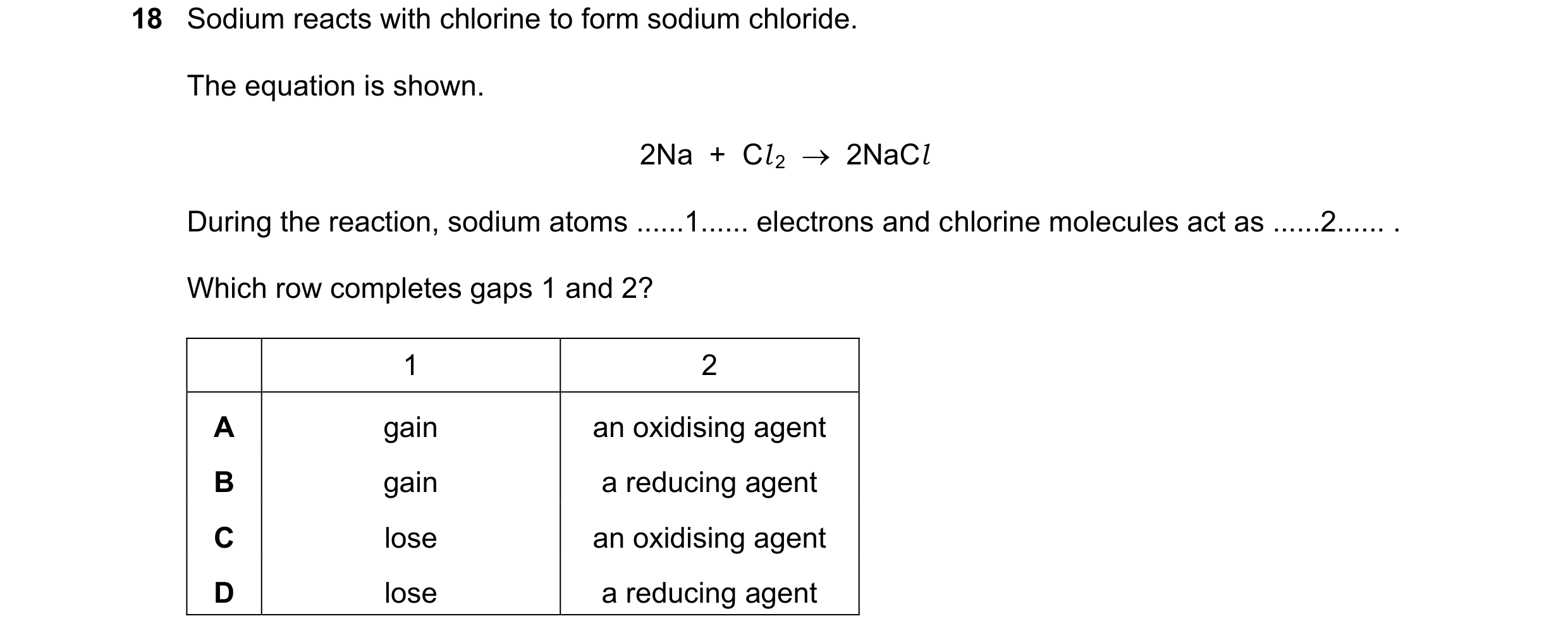
Q28 · Sodium reacts with chlorine to form sodium chloride 0654/21 May/June 2022
18 Sodium reacts with chlorine to form sodium chloride. The equation is shown. 2Na + Cl 2 2NaCl During the reaction, sodium atoms … 1 … electrons and chlorine molecules act as … 2 … . Which row completes gaps 1 and 2? 1 2 A gain an oxidising agent B gain a reducing agent C lose an oxidising agent D lose a reducing agent
1 marks
Answer: C
This question in 0654/21 May/June 2022
Q29 · In which equation is the underlined substance reduced? 0654/22 May/June 2022
18 In which equation is the underlined substance reduced? A Cl 2 + 2KBr 2KCl + Br2 B 2Mg + O2 2MgO C 2PbO + C CO2 + 2Pb D Zn + CuSO4 Cu + ZnSO4
1 marks
Answer: A
This question in 0654/22 May/June 2022
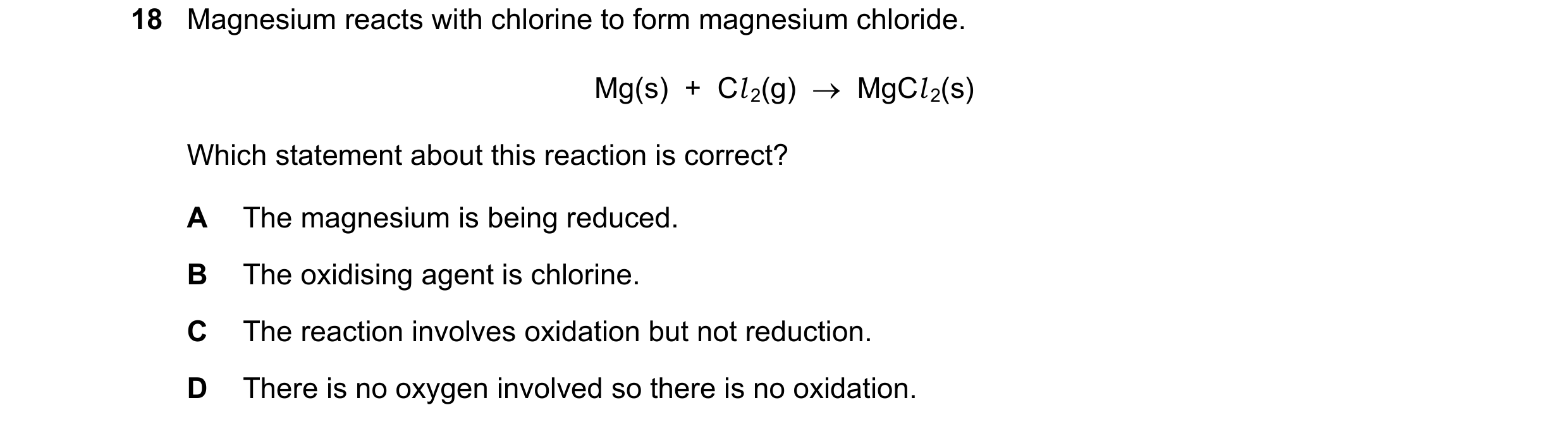
Q30 · Magnesium reacts with chlorine to form magnesium chloride 0654/23 May/June 2022
18 Magnesium reacts with chlorine to form magnesium chloride. Mg(s) + Cl 2(g) MgCl 2(s) Which statement about this reaction is correct? A The magnesium is being reduced. B The oxidising agent is chlorine. C The reaction involves oxidation but not reduction. D There is no oxygen involved so there is no oxidation.
1 marks
Answer: B
This question in 0654/23 May/June 2022
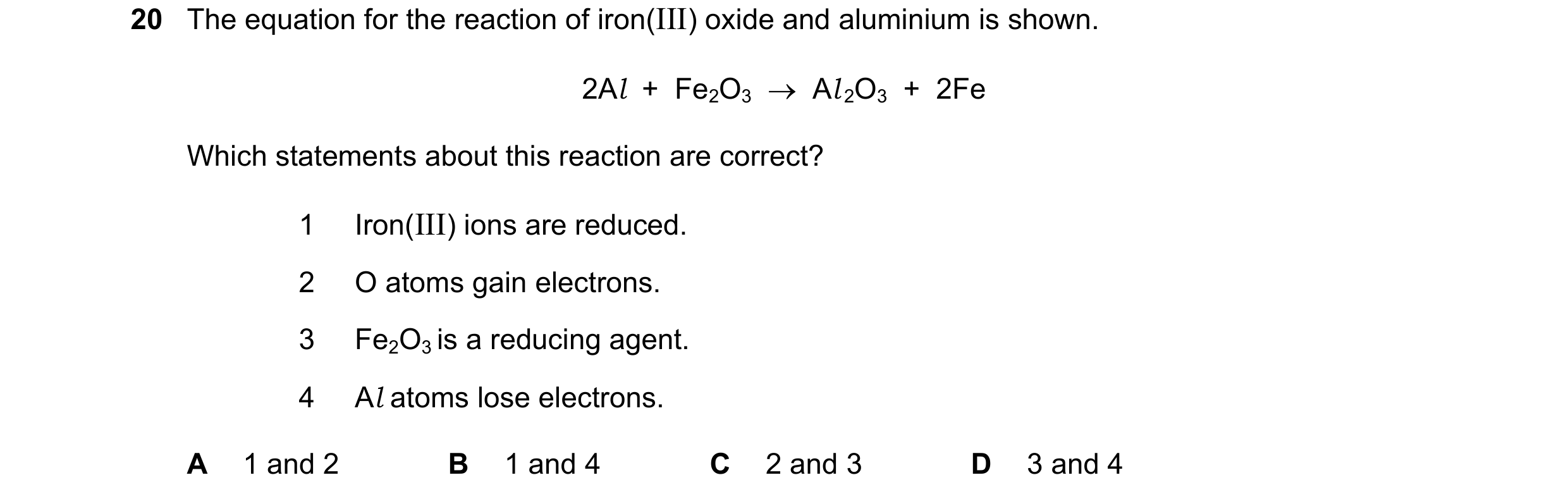
Q31 · The equation for the reaction of iron(III) oxide and aluminium is shown 0654/21 Oct/Nov 2022
20 The equation for the reaction of iron(III) oxide and aluminium is shown. 2Al + Fe2O3 Al 2O3 + 2Fe Which statements about this reaction are correct? 1 Iron(III) ions are reduced. 2 O atoms gain electrons. 3 Fe2O3 is a reducing agent. 4 Al atoms lose electrons. A 1 and 2 B 1 and 4 C 2 and 3 D 3 and 4
1 marks
Answer: B
This question in 0654/21 Oct/Nov 2022
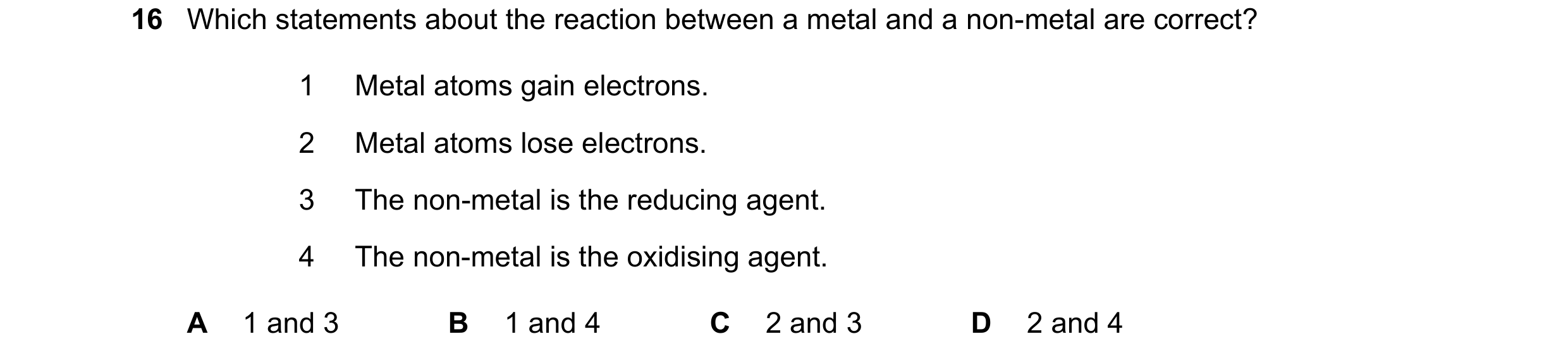
Q32 · Which statements about the reaction between a metal and a non-metal are correct? 0654/22 Oct/Nov 2022
16 Which statements about the reaction between a metal and a non-metal are correct? 1 Metal atoms gain electrons. 2 Metal atoms lose electrons. 3 The non-metal is the reducing agent. 4 The non-metal is the oxidising agent. A 1 and 3 B 1 and 4 C 2 and 3 D 2 and 4
1 marks
Answer: D
This question in 0654/22 Oct/Nov 2022
Q33 · The equations for reactions in the blast furnace are shown 0654/22 Oct/Nov 2022
20 The equations for reactions in the blast furnace are shown. 1 C + O2 CO2 2 CO2 + C 2CO 3 Fe2O3 + 3CO 2Fe + 3CO2 4 CaO + SiO2 CaSiO3 Which statement is correct? A In reaction 1, carbon is reduced. B In reaction 2, carbon dioxide is oxidised. C In reaction 3, carbon monoxide is oxidised. D In reaction 4, silicon dioxide is reduced.
1 marks
Answer: C
This question in 0654/22 Oct/Nov 2022
Q34 · Which equation represents a redox reaction? 0654/23 Oct/Nov 2022
20 Which equation represents a redox reaction? A CaCO3 → CaO + CO2 B CuSO4•5H2O → CuSO4 + 5H2O C 2Na + Cl 2 → 2NaCl D NaOH + HCl → NaCl + H2O
1 marks
Answer: C
This question in 0654/23 Oct/Nov 2022
Q35 · In which equation is the underlined zinc an oxidising agent? 0654/22 Feb/March 2023
20 In which equation is the underlined zinc an oxidising agent? A Zn + Cl 2 ZnCl 2 B Zn + 2H+ Zn2+ + H2 C Zn2+ + Mg Zn + Mg2+ D 2Zn + O2 2ZnO
1 marks
Answer: C
This question in 0654/22 Feb/March 2023
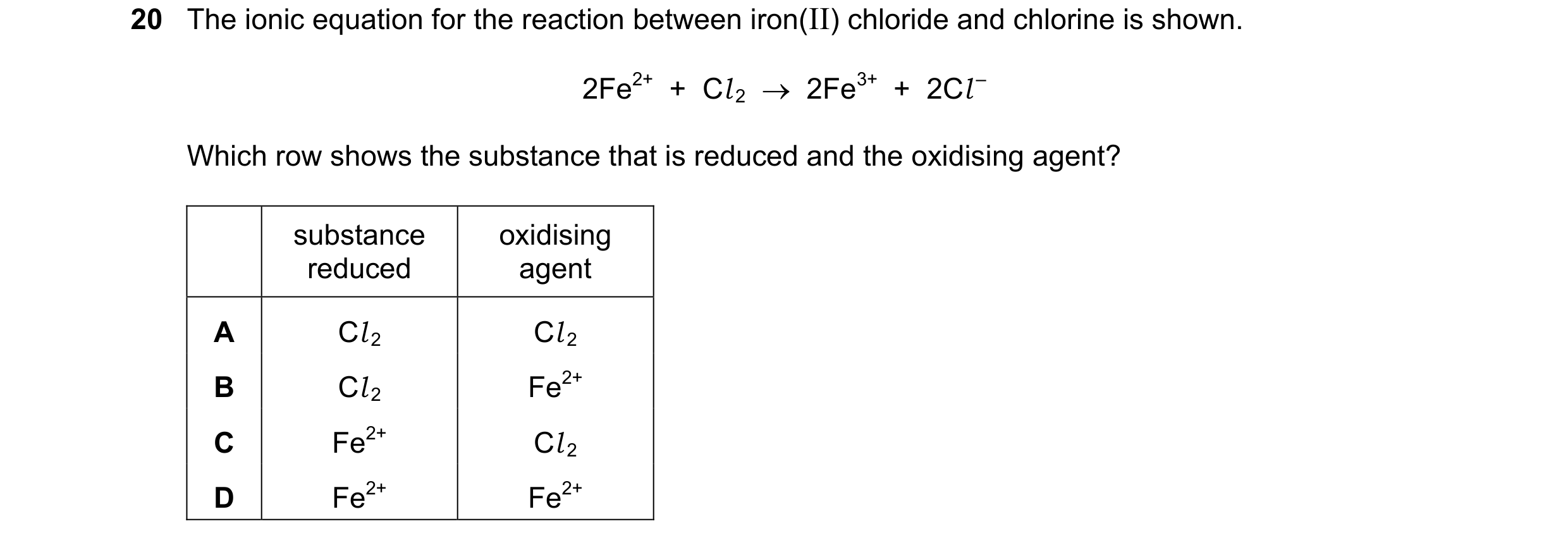
Q36 · The ionic equation for the reaction between iron(II) chloride and chlorine is shown 0654/21 Oct/Nov 2023
20 The ionic equation for the reaction between iron(II) chloride and chlorine is shown. 2Fe2+ + Cl 2 2Fe3+ + 2Cl – Which row shows the substance that is reduced and the oxidising agent? substance oxidising reduced agent A Cl 2 Cl 2 B Cl 2 Fe2+ C Fe2+ Cl 2 D Fe2+ Fe2+
1 marks
Answer: A
This question in 0654/21 Oct/Nov 2023
Q37 · Iron displaces copper ions from its aqueous salts 0654/22 Oct/Nov 2023
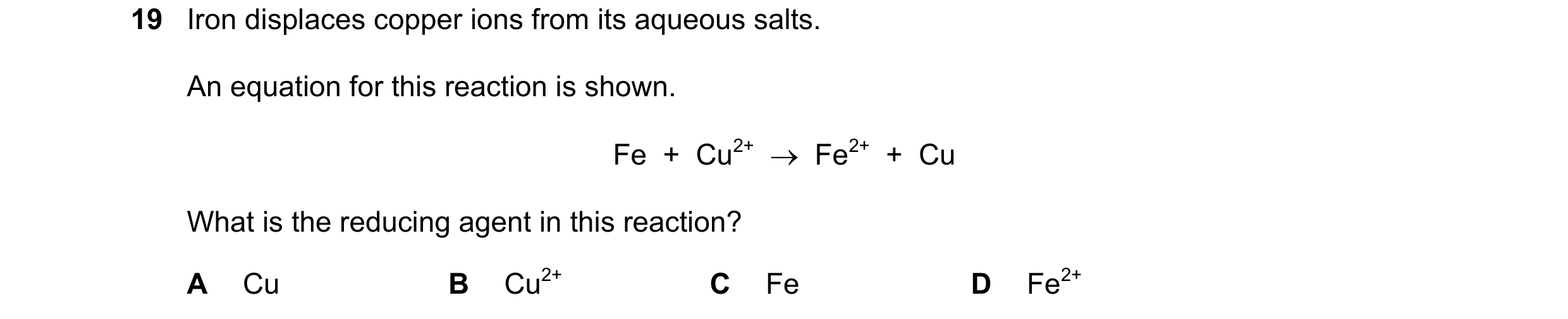
19 Iron displaces copper ions from its aqueous salts. An equation for this reaction is shown. Fe + Cu2+ Fe2+ + Cu What is the reducing agent in this reaction? A Cu B Cu2+ C Fe D Fe2+
1 marks
Answer: C
This question in 0654/22 Oct/Nov 2023
Q38 · The equation for the reaction between sodium bromide and concentrated sulfuric acid is… 0654/22 Feb/March 2024
20 The equation for the reaction between sodium bromide and concentrated sulfuric acid is shown. 2NaBr + 2H2SO4 Na2SO4 + Br2 + SO2 + 2H2O What is oxidised in this reaction? A sodium ions B bromide ions C hydrogen ions D sulfate ions
1 marks
Answer: B
This question in 0654/22 Feb/March 2024
Q39 · In which equation is the underlined substance acting as an oxidising agent? 0654/22 May/June 2024
19 In which equation is the underlined substance acting as an oxidising agent? A AgNO3 + NaCl AgCl + NaNO3 B Cl 2 + 2KBr Br2 + 2KCl C Fe2O3 + 3CO 2Fe + 3CO2 D H2 + PbO Pb + H2O
1 marks
Answer: D
This question in 0654/22 May/June 2024
Q40 · Solid zinc reacts with aqueous copper(II) sulfate 0654/23 May/June 2024
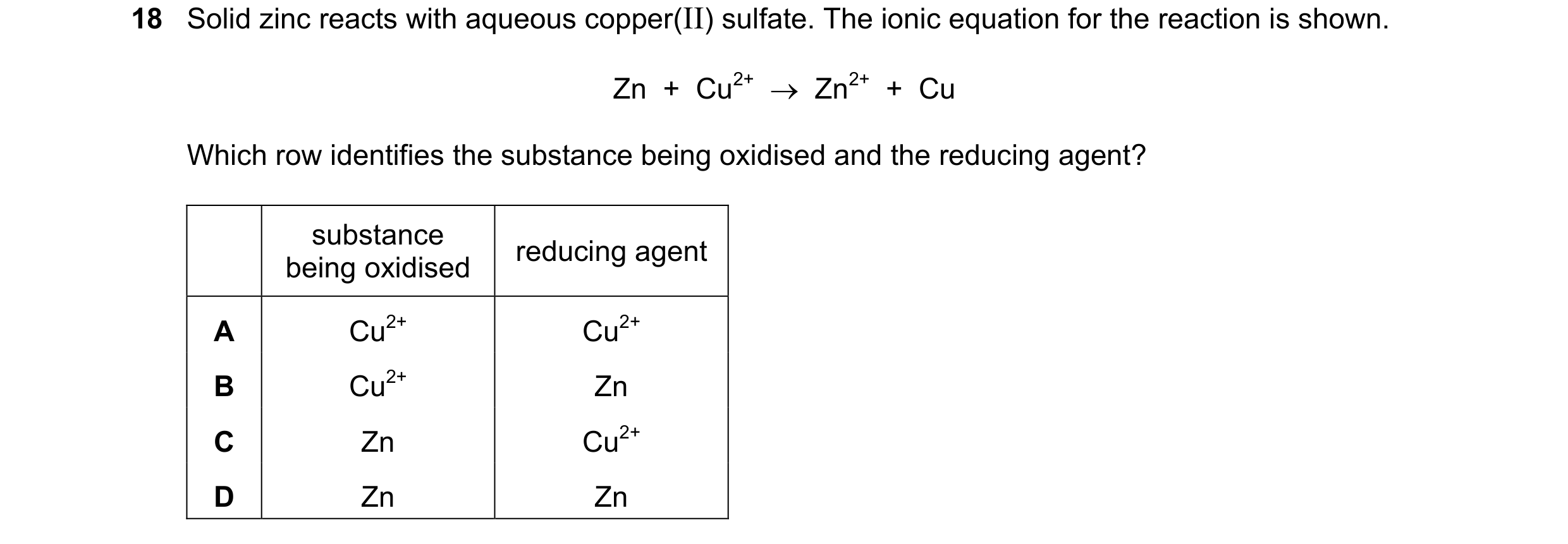
18 Solid zinc reacts with aqueous copper(II) sulfate. The ionic equation for the reaction is shown. Zn + Cu2+ Zn2+ + Cu Which row identifies the substance being oxidised and the reducing agent? substance reducing agent being oxidised A Cu2+ Cu2+ B Cu2+ Zn C Zn Cu2+ D Zn Zn
1 marks
Answer: D
This question in 0654/23 May/June 2024
Q41 · The equation for the reaction between magnesium and zinc sulfate is shown 0654/23 Oct/Nov 2024
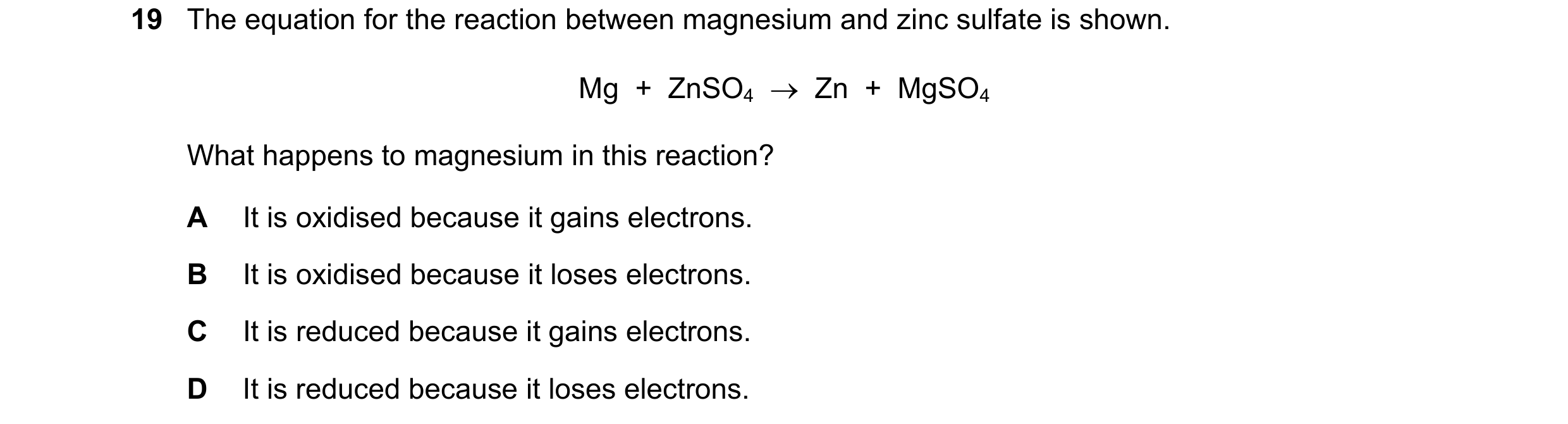
19 The equation for the reaction between magnesium and zinc sulfate is shown. Mg + ZnSO4 Zn + MgSO4 What happens to magnesium in this reaction? A It is oxidised because it gains electrons. B It is oxidised because it loses electrons. C It is reduced because it gains electrons. D It is reduced because it loses electrons.
1 marks
Answer: B
This question in 0654/23 Oct/Nov 2024
Q42 · During electrolysis, reactions occur at the cathode and anode 0654/21 Oct/Nov 2025
16 During electrolysis, reactions occur at the cathode and anode. Which statements about the electrode reactions are correct? 1 At the anode, anions gain electrons and are reduced. 2 At the anode, anions lose electrons and are oxidised. 3 At the cathode, cations gain electrons and are reduced. 4 At the cathode, cations lose electrons and are oxidised. A 1 and 2 B 1 and 4 C 2 and 3 D 3 and 4
1 marks
Answer: C
This question in 0654/21 Oct/Nov 2025
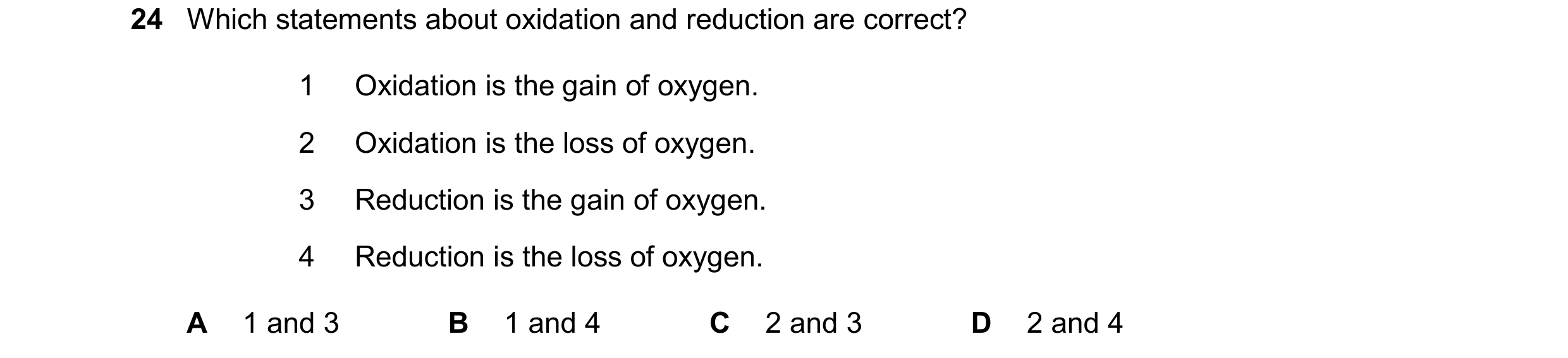
Q43 · Which statements about oxidation and reduction are correct? 0654/22 Oct/Nov 2025
24 Which statements about oxidation and reduction are correct? 1 Oxidation is the gain of oxygen. 2 Oxidation is the loss of oxygen. 3 Reduction is the gain of oxygen. 4 Reduction is the loss of oxygen. A 1 and 3 B 1 and 4 C 2 and 3 D 2 and 4
1 marks
Answer: B
This question in 0654/22 Oct/Nov 2025

 1 / 10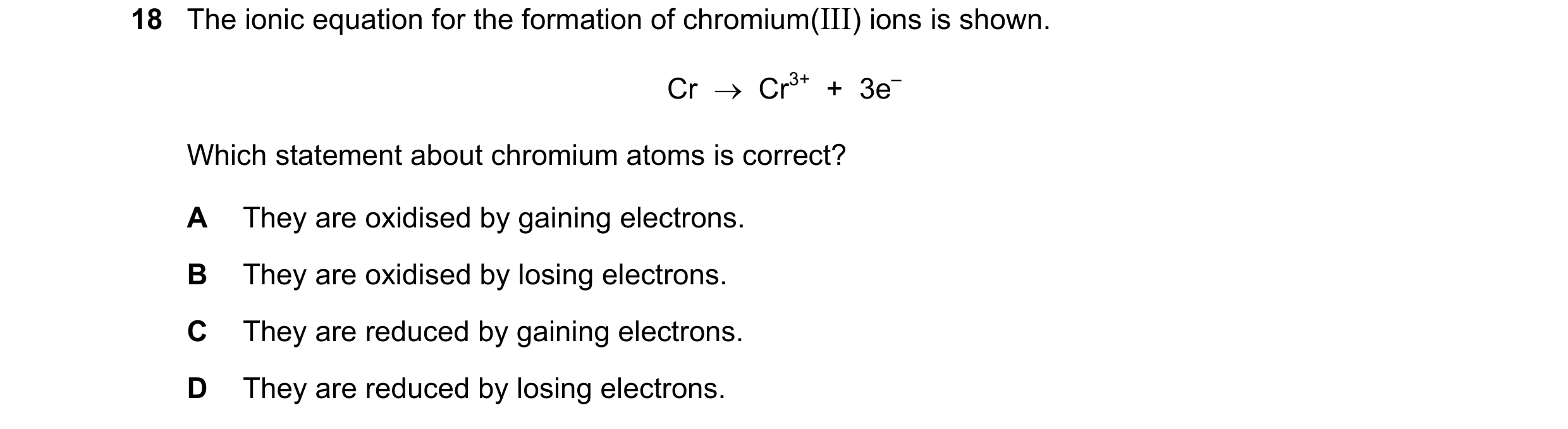

 2 / 10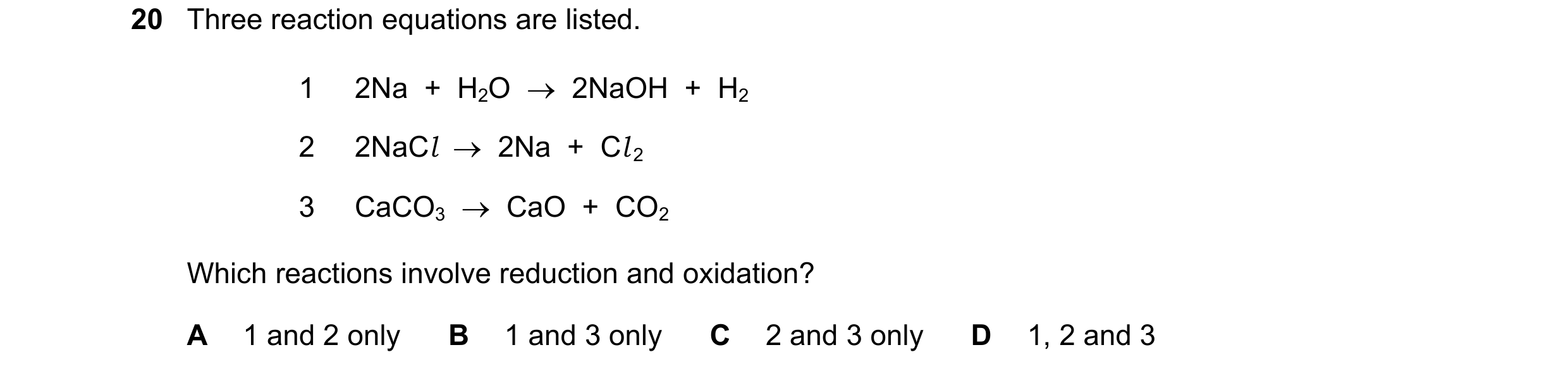

 3 / 10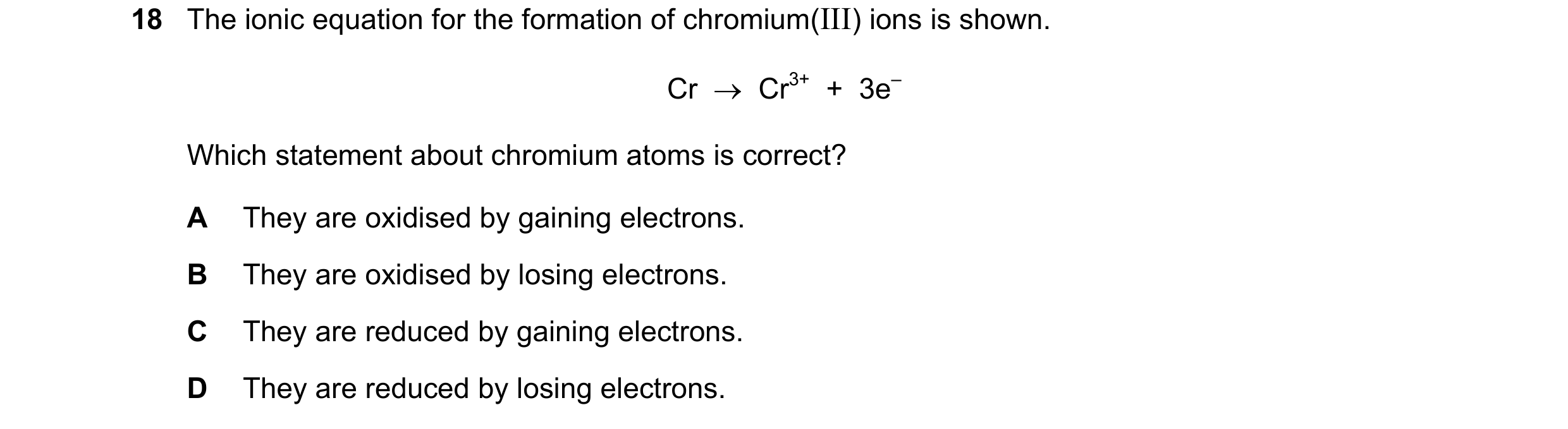


 4 / 10

 5 / 10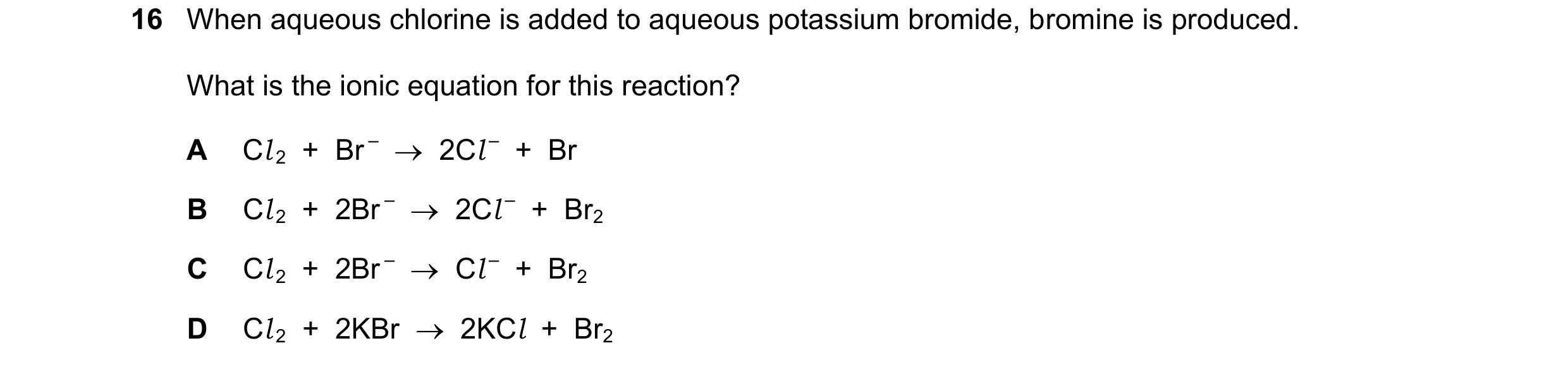


 6 / 10
 7 / 10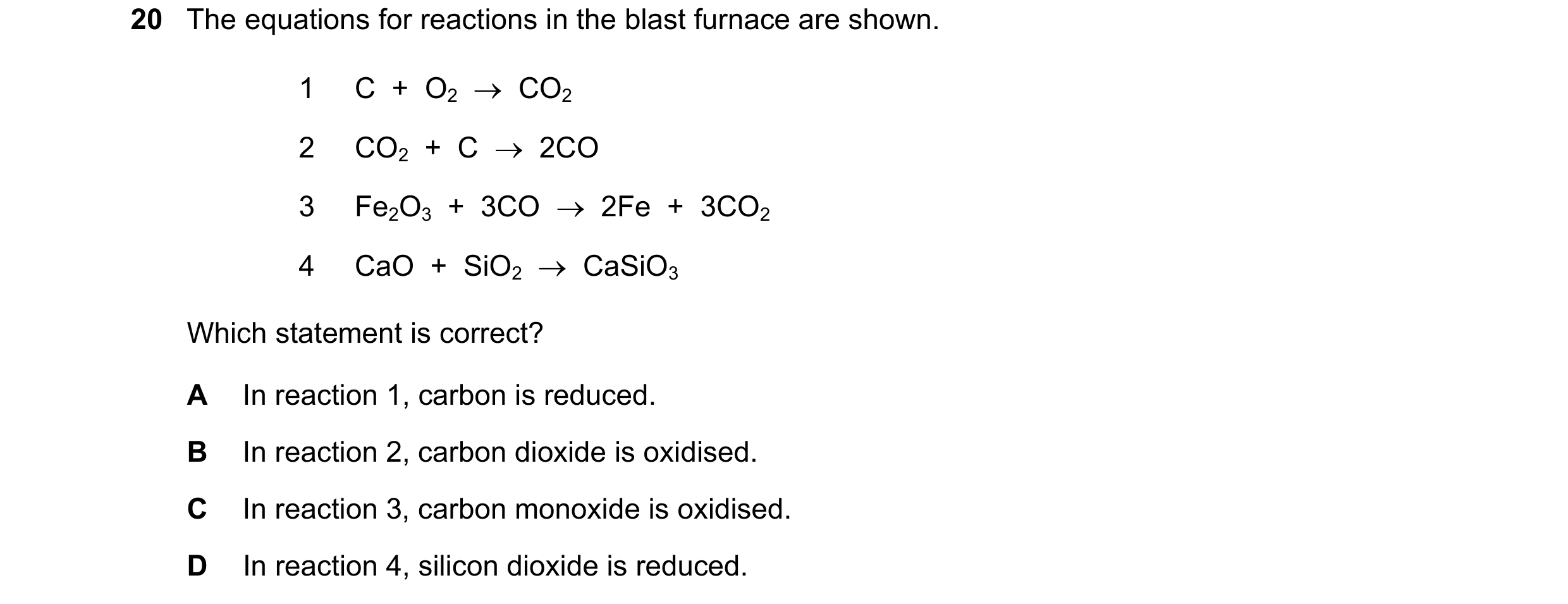


 8 / 10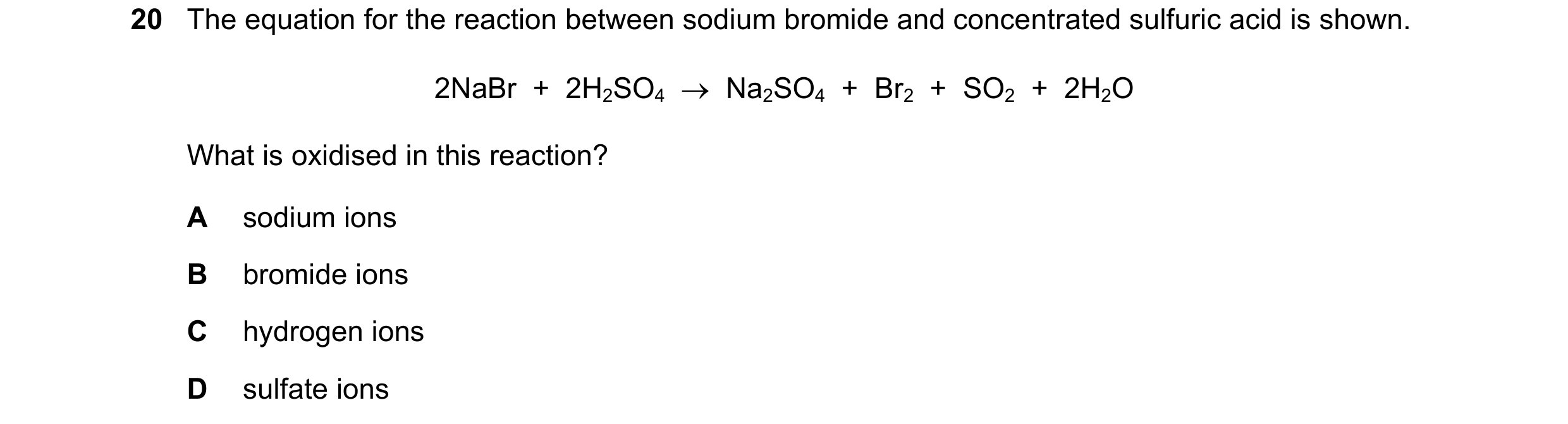

 9 / 10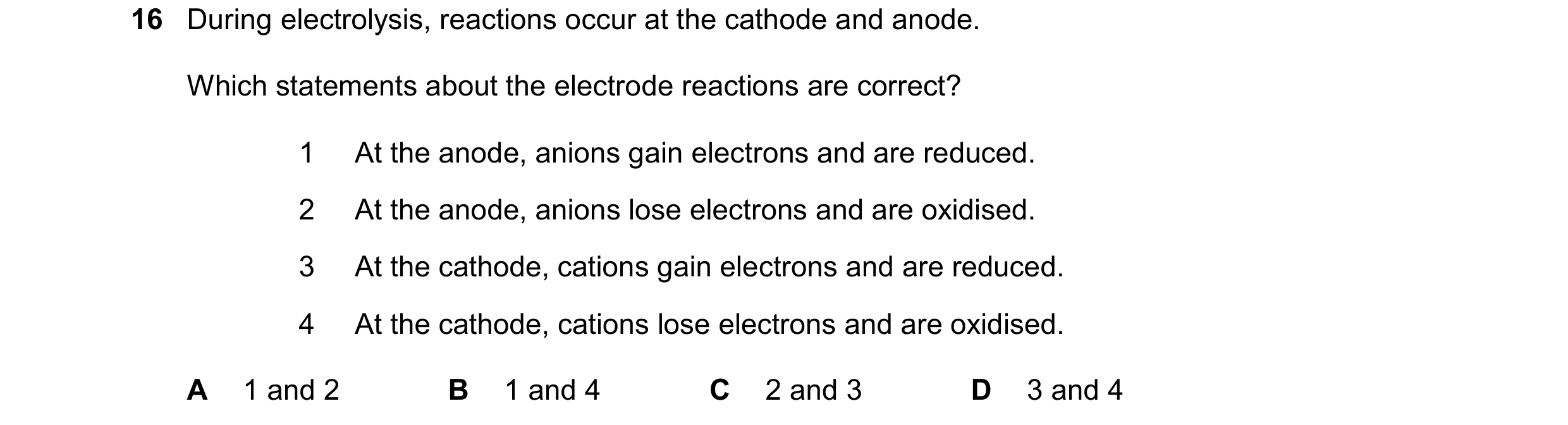
 10 / 10