Questions as text
Q1 · Five elements are listed in order of reactivity 0654/43 Oct/Nov 2018
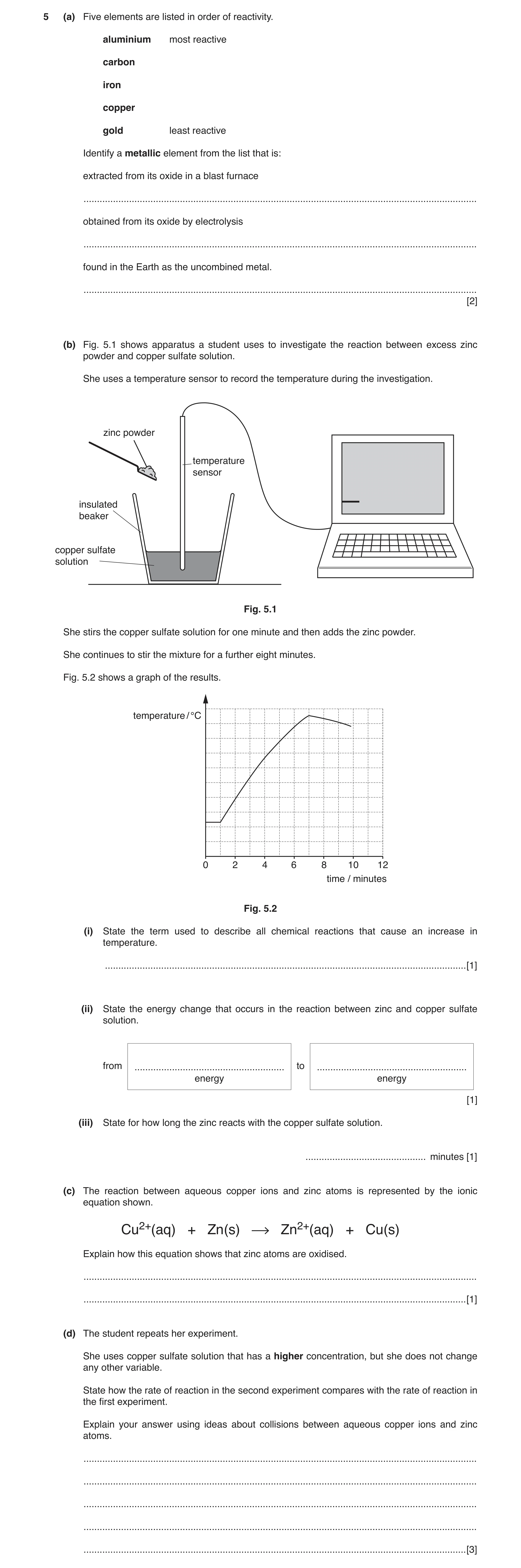
5 (a) Five elements are listed in order of reactivity. aluminium most reactive carbon iron copper gold least reactive Identify a metallic element from the list that is: extracted from its oxide in a blast furnace … obtained from its oxide by electrolysis … found in the Earth as the uncombined metal. … [2] (b) Fig. 5.1 shows apparatus a student uses to investigate the reaction between excess zinc powder and copper sulfate solution. She uses a temperature sensor to record the temperature during the investigation. zinc powder temperature sensor insulated beaker copper sulfate solution Fig. 5.1 She stirs the copper sulfate solution for one minute and then adds the zinc powder. She continues to stir the mixture for a further eight minutes. Fig. 5.2 shows a graph of the results. temperature / °C 0 2 4 6 8 10 12 time / minutes Fig. 5.2 (i) State the term used to describe all chemical reactions that cause an increase in temperature. … [1] (ii) State the energy change that occurs in the reaction between zinc and copper sulfate solution. from … to … energy energy [1] (iii) State for how long the zinc reacts with the copper sulfate solution. … minutes [1] (c) The reaction between aqueous copper ions and zinc atoms is represented by the ionic equation shown. Cu2+(aq) + Zn(s) Zn2+(aq) + Cu(s) Explain how this equation shows that zinc atoms are oxidised. … … [1] (d) The student repeats her experiment. She uses copper sulfate solution that has a higher concentration, but she does not change any other variable. State how the rate of reaction in the second experiment compares with the rate of reaction in the first experiment. Explain your answer using ideas about collisions between aqueous copper ions and zinc atoms. … … … … … [3]
9 marks
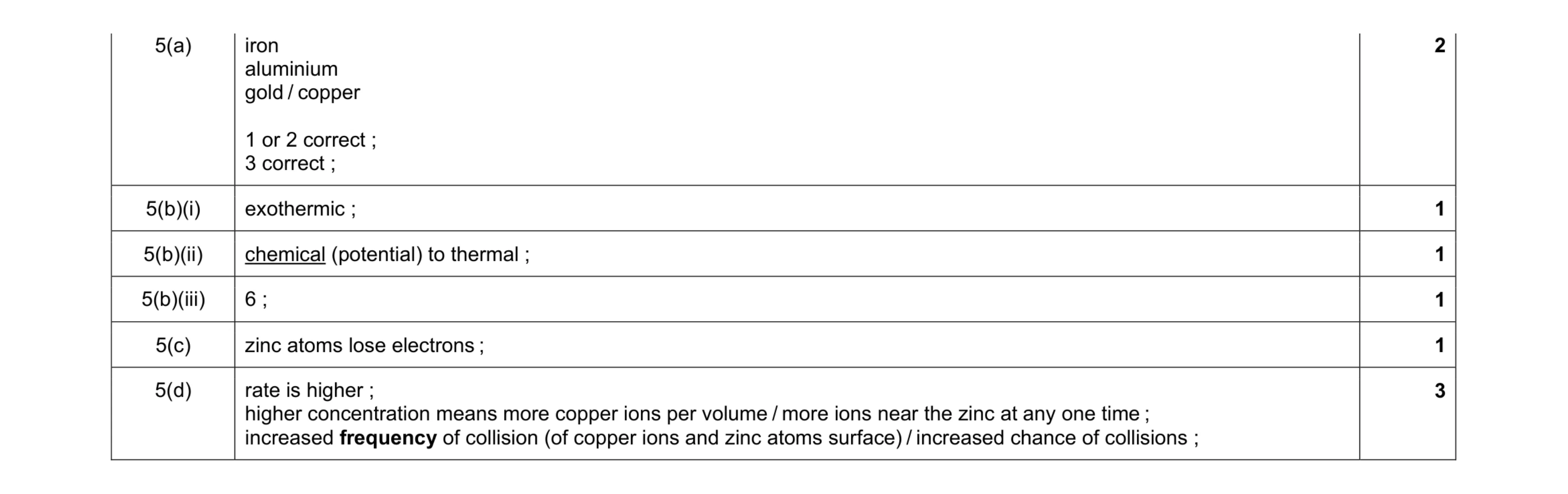
Mark scheme: 5(a) iron aluminium gold / copper 1 or 2 correct ; 3 correct ; 2 5(b)(i) exothermic ; 1 5(b)(ii) chemical (potential) to thermal ; 1 5(b)(iii) 6 ; 1 5(c) zinc atoms lose electrons ; 1 5(d) rate is higher ; higher concentration means more copper ions per volume / more ions near the zinc at any one time ; increased frequency of collision (of copper ions and zinc atoms surface) / increased chance of collisions ; 3
This question in 0654/43 Oct/Nov 2018
Q2 · The thermite reaction is a redox reaction between aluminium and iron oxide, Fe2O3 0654/42 May/June 2019
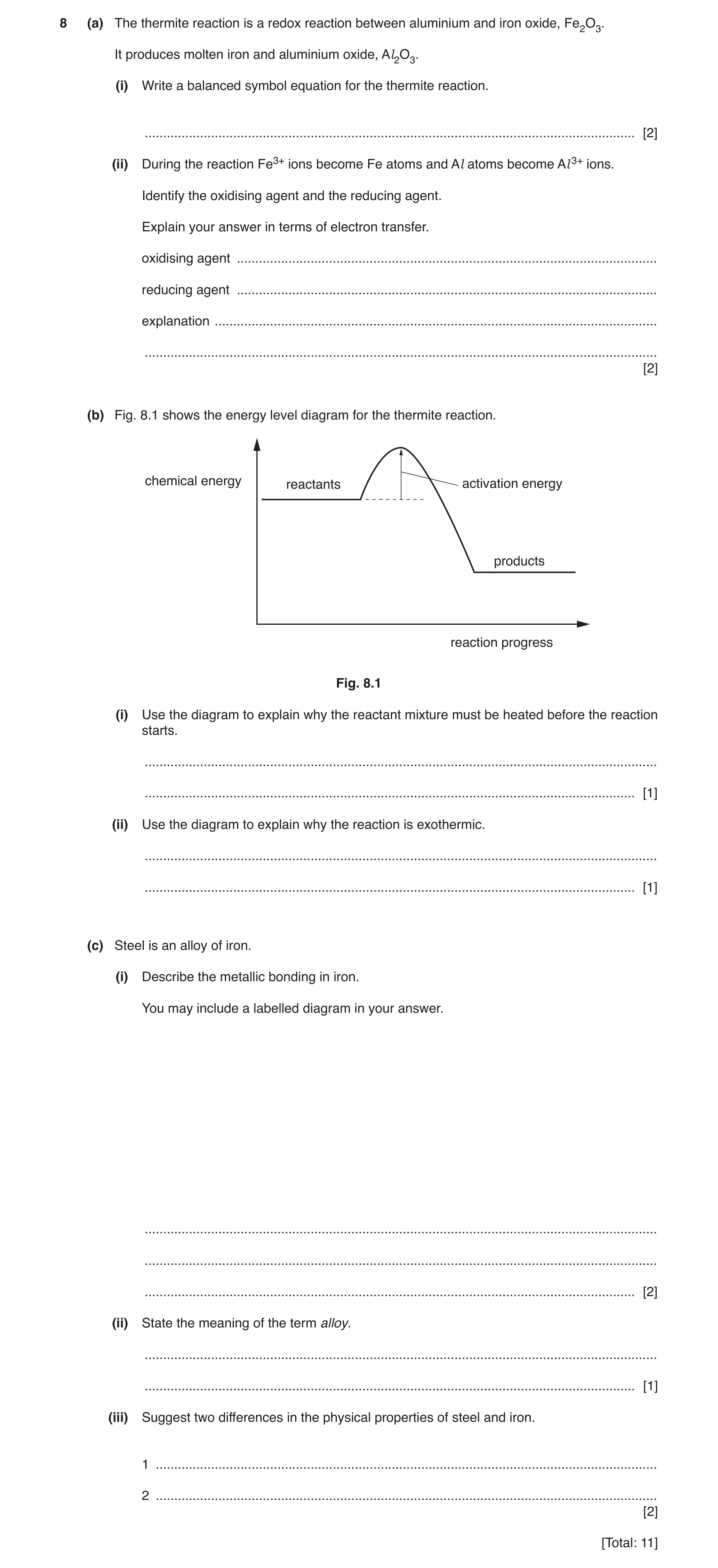
8 (a) The thermite reaction is a redox reaction between aluminium and iron oxide, Fe2O3. It produces molten iron and aluminium oxide, Al2O3. (i) Write a balanced symbol equation for the thermite reaction. … [2] (ii) During the reaction Fe3+ ions become Fe atoms and Al atoms become Al 3+ ions. Identify the oxidising agent and the reducing agent. Explain your answer in terms of electron transfer. oxidising agent … reducing agent … explanation … … [2] (b) Fig. 8.1 shows the energy level diagram for the thermite reaction. chemical energy reactants activation energy products reaction progress Fig. 8.1 (i) Use the diagram to explain why the reactant mixture must be heated before the reaction starts. … … [1] (ii) Use the diagram to explain why the reaction is exothermic. … … [1] (c) Steel is an alloy of iron. (i) Describe the metallic bonding in iron. You may include a labelled diagram in your answer. … … … [2] (ii) State the meaning of the term alloy. … … [1] (iii) Suggest two differences in the physical properties of steel and iron. 1 … 2 … [2] [Total: 11]
11 marks
Mark scheme: 8(a)(i) correct formulae ; balanced ; 2 8(a)(ii) oxidising agent: Fe3+ / Fe2O3 / iron oxide and reducing agent: Al / aluminium ; oxidising agent gains electrons and reducing agent loses electrons ; 2 8(b)(i) to supply activation energy / described ; 1 8(b)(ii) products have less (chemical) energy than reactants ; 1 8(c)(i) reference to delocalised electrons ; lattice of positive ions ; 2 8(c)(ii) mixture of a metal with other elements ; 1 8(c)(iii) hardness ; malleability ; ductility ; melting / boiling, point ; max 2
This question in 0654/42 May/June 2019
Q3 · Group VII of the Periodic Table 0654/43 Oct/Nov 2019
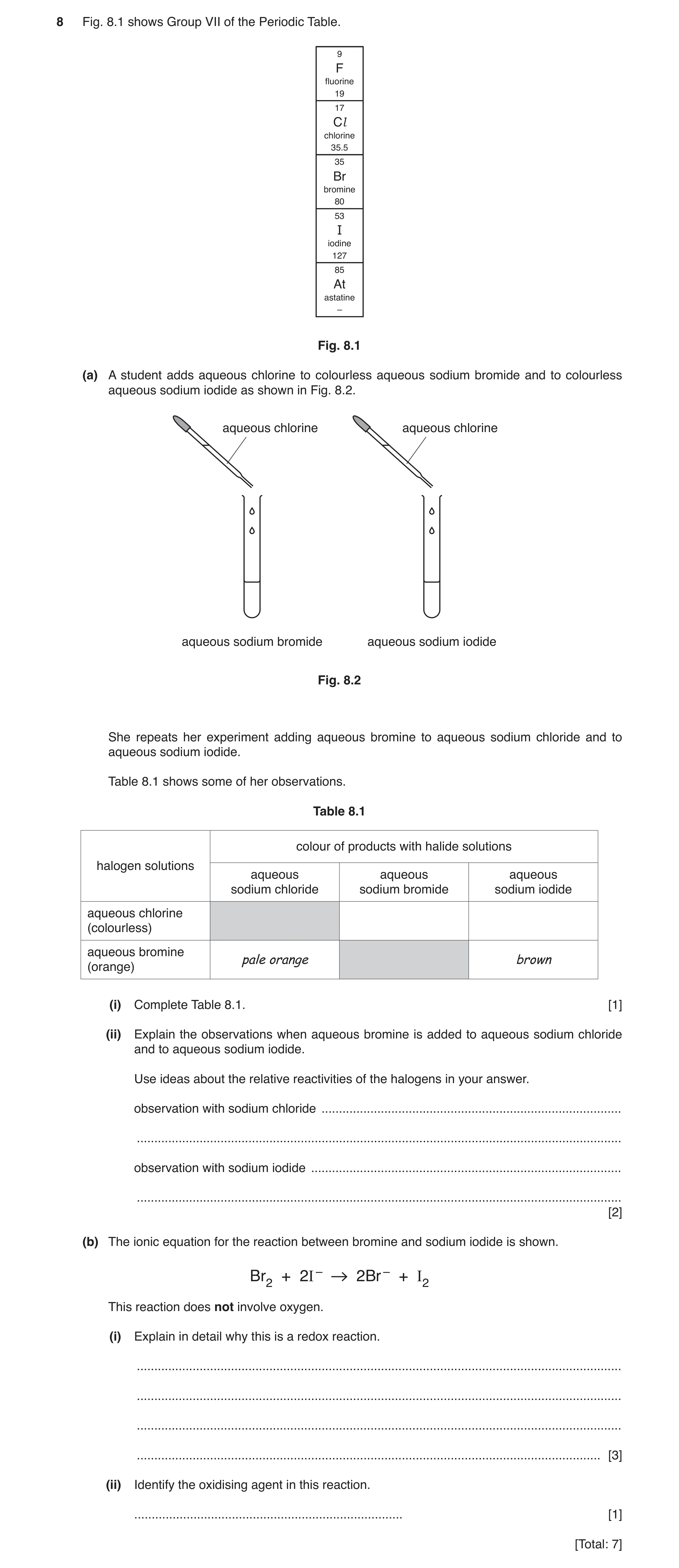
8 Fig. 8.1 shows Group VII of the Periodic Table. 9 F fluorine 19 17 Cl chlorine 35.5 35 Br bromine 80 53 I iodine 127 85 At astatine – Fig. 8.1 (a) A student adds aqueous chlorine to colourless aqueous sodium bromide and to colourless aqueous sodium iodide as shown in Fig. 8.2. aqueous chlorine aqueous chlorine aqueous sodium bromide aqueous sodium iodide Fig. 8.2 She repeats her experiment adding aqueous bromine to aqueous sodium chloride and to aqueous sodium iodide. Table 8.1 shows some of her observations. Table 8.1 colour of products with halide solutions halogen solutions aqueous aqueous aqueous sodium chloride sodium bromide sodium iodide aqueous chlorine (colourless) aqueous bromine paleorange brown (orange) (i) Complete Table 8.1. [1] (ii) Explain the observations when aqueous bromine is added to aqueous sodium chloride and to aqueous sodium iodide. Use ideas about the relative reactivities of the halogens in your answer. observation with sodium chloride … … observation with sodium iodide … … [2] (b) The ionic equation for the reaction between bromine and sodium iodide is shown. Br2 + 2I – 2Br – + I2 This reaction does not involve oxygen. (i) Explain in detail why this is a redox reaction. … … … … [3] (ii) Identify the oxidising agent in this reaction. … [1] [Total: 7]
7 marks
Mark scheme: 8(a)(i) halogen solutions colour of products with halide solutions sodium chloride sodium bromide sodium iodide chlorine orange / yellow brown bromine (pale orange) (brown) 1 8(a)(ii) bromine is less reactive than chlorine ORA ; bromine more reactive than iodine ORA ; 2 8(b)(i) reduction and oxidation are occurring ; (oxidation is) loss of electrons AND (reduction is) gain of electrons ; bromine reduced / gains electrons AND iodide ions oxidised / lose electrons ; 3 8(b)(ii) bromine ; 1
This question in 0654/43 Oct/Nov 2019
Q4 · The equations A, B, C and D represent four possible reactions 0654/43 Oct/Nov 2020
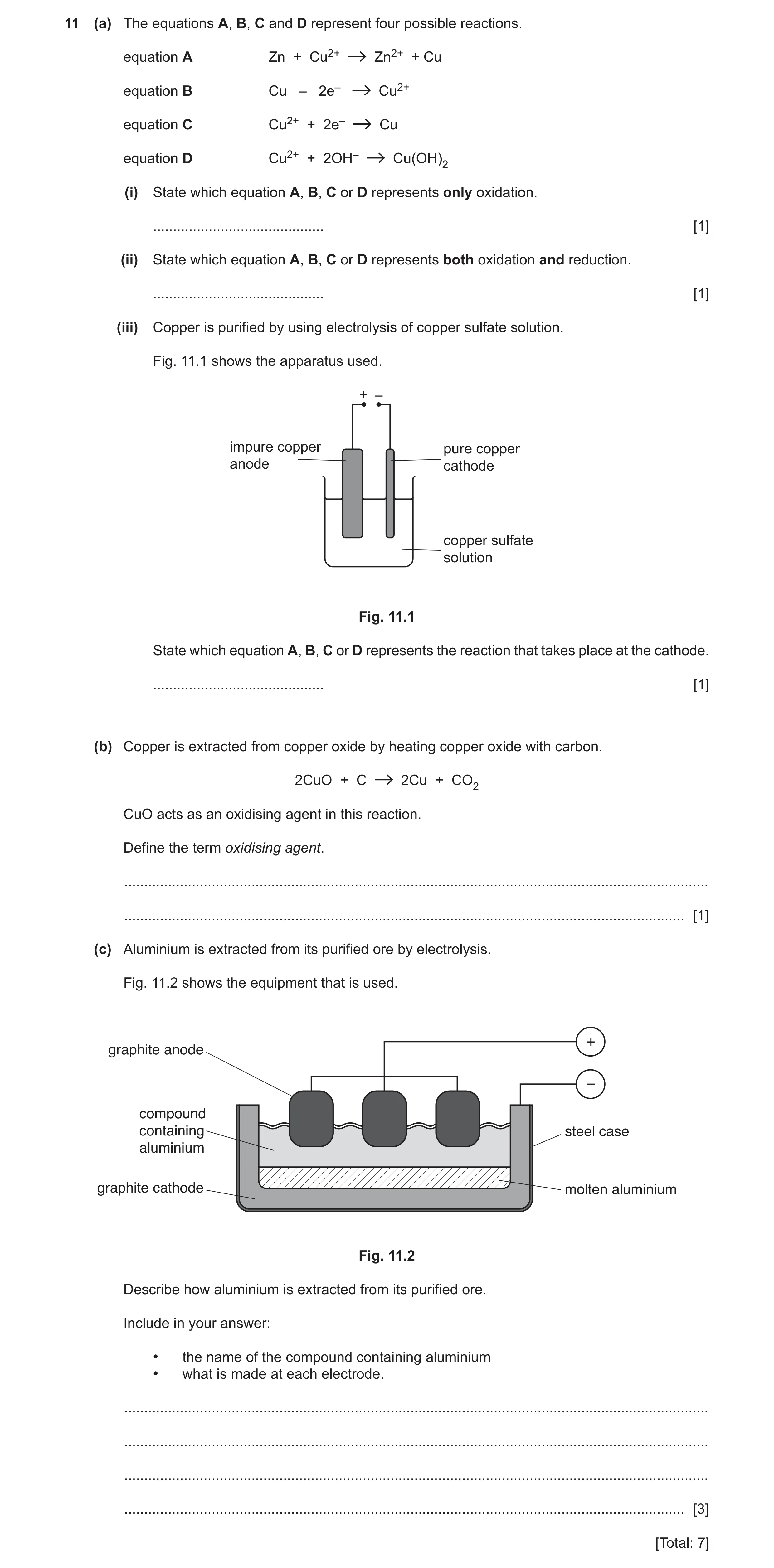
11 (a) The equations A, B, C and D represent four possible reactions. equation A Zn + Cu2+ Zn2+ + Cu equation B Cu – 2e– Cu2+ equation C Cu2+ + 2e– Cu equation D Cu2+ + 2OH– Cu(OH)2 (i) State which equation A, B, C or D represents only oxidation. … [1] (ii) State which equation A, B, C or D represents both oxidation and reduction. … [1] (iii) Copper is purified by using electrolysis of copper sulfate solution. Fig. 11.1 shows the apparatus used. + – impure copper pure copper anode cathode copper sulfate solution Fig. 11.1 State which equation A, B, C or D represents the reaction that takes place at the cathode. … [1] (b) Copper is extracted from copper oxide by heating copper oxide with carbon. 2CuO + C 2Cu + CO2 CuO acts as an oxidising agent in this reaction. Define the term oxidising agent. … … [1] (c) Aluminium is extracted from its purified ore by electrolysis. Fig. 11.2 shows the equipment that is used. + graphite anode – compound containing steel case aluminium graphite cathode molten aluminium Fig. 11.2 Describe how aluminium is extracted from its purified ore. Include in your answer: • the name of the compound containing aluminium • what is made at each electrode. … … … … [3] [Total: 7]
7 marks
Mark scheme: 11(a)(i) B ; 1 11(a)(ii) A ; 1 11(a)(iii) C ; 1 11(b) (substance which) gives oxygen to / removes / gains electrons (from another substance during a redox reaction) ; 1 11(c) (molten) aluminium oxide ; oxygen at the anode ; aluminium at the cathode ; 3
This question in 0654/43 Oct/Nov 2020
Q5 · Sodium, Na, is an element in Group I of the Periodic Table 0654/42 Feb/March 2021
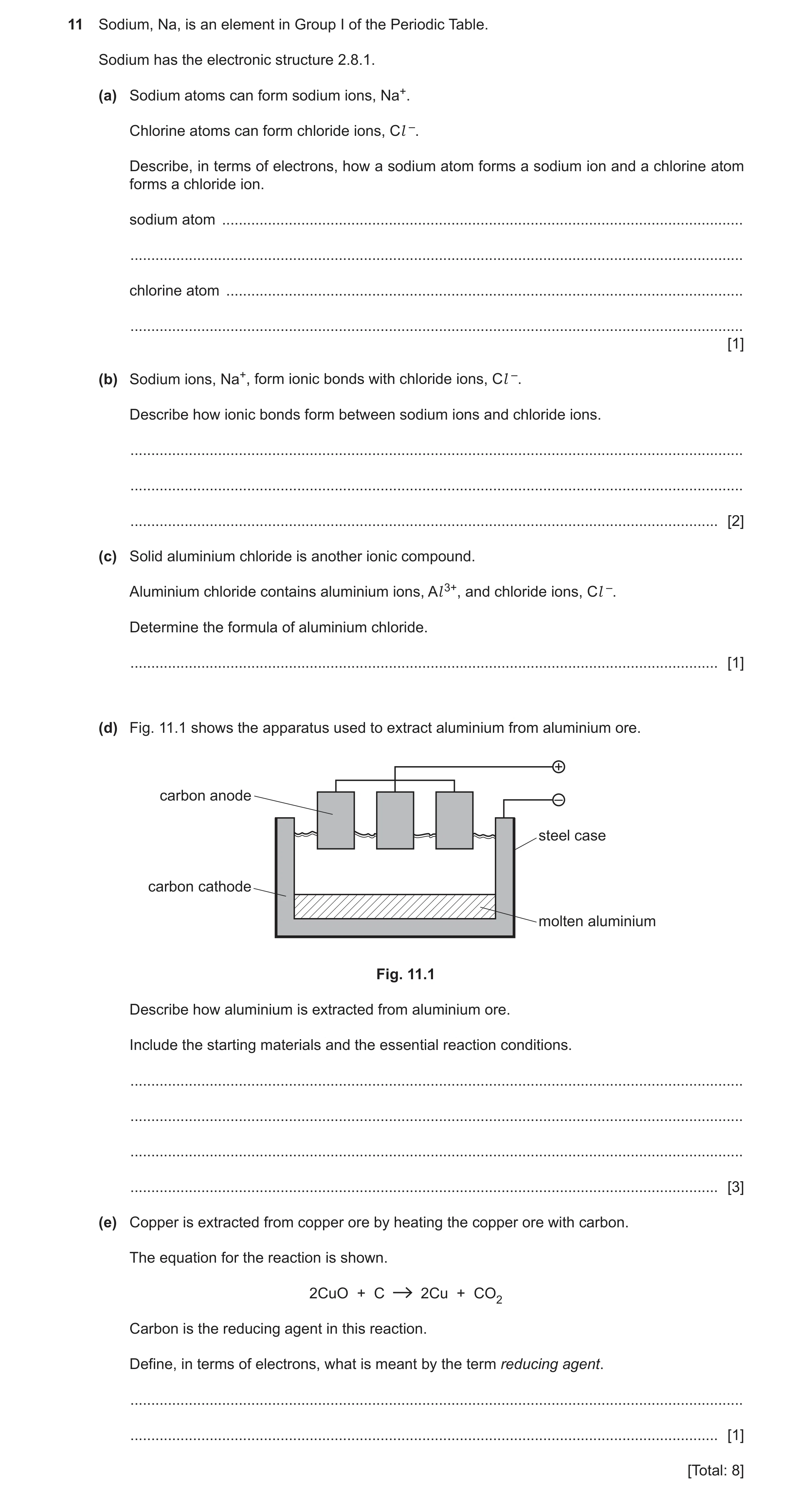
11 Sodium, Na, is an element in Group I of the Periodic Table. Sodium has the electronic structure 2.8.1. (a) Sodium atoms can form sodium ions, Na+. Chlorine atoms can form chloride ions, Cl –. Describe, in terms of electrons, how a sodium atom forms a sodium ion and a chlorine atom forms a chloride ion. sodium atom … … chlorine atom … … [1] (b) Sodium ions, Na+, form ionic bonds with chloride ions, Cl –. Describe how ionic bonds form between sodium ions and chloride ions. … … … [2] (c) Solid aluminium chloride is another ionic compound. Aluminium chloride contains aluminium ions, Al 3+, and chloride ions, Cl –. Determine the formula of aluminium chloride. … [1] (d) Fig. 11.1 shows the apparatus used to extract aluminium from aluminium ore. + carbon anode – steel case carbon cathode molten aluminium Fig. 11.1 Describe how aluminium is extracted from aluminium ore. Include the starting materials and the essential reaction conditions. … … … … [3] (e) Copper is extracted from copper ore by heating the copper ore with carbon. The equation for the reaction is shown. 2CuO + C 2Cu + CO2 Carbon is the reducing agent in this reaction. Define, in terms of electrons, what is meant by the term reducing agent. … … [1] [Total: 8]
8 marks
Mark scheme: 11(a) (sodium atom) loses one electron and (chlorine atom) gains one electron ; 1 11(b) electrostatic attraction ; between oppositely charged ions ; 2 11(c) AlCl3 ; 1 11(d) any three from: molten aluminium oxide / alumina, and cryolite ; cryolite lowers melting point of, aluminium oxide / alumina ; electrolysis / use of electricity ; high temperature to melt, aluminium oxide / alumina ; 3 11(e) (species that) loses or donates electrons ; 1
This question in 0654/42 Feb/March 2021
Q6 · Electrolysis is used to break down ionic compounds using electricity 0654/41 May/June 2021
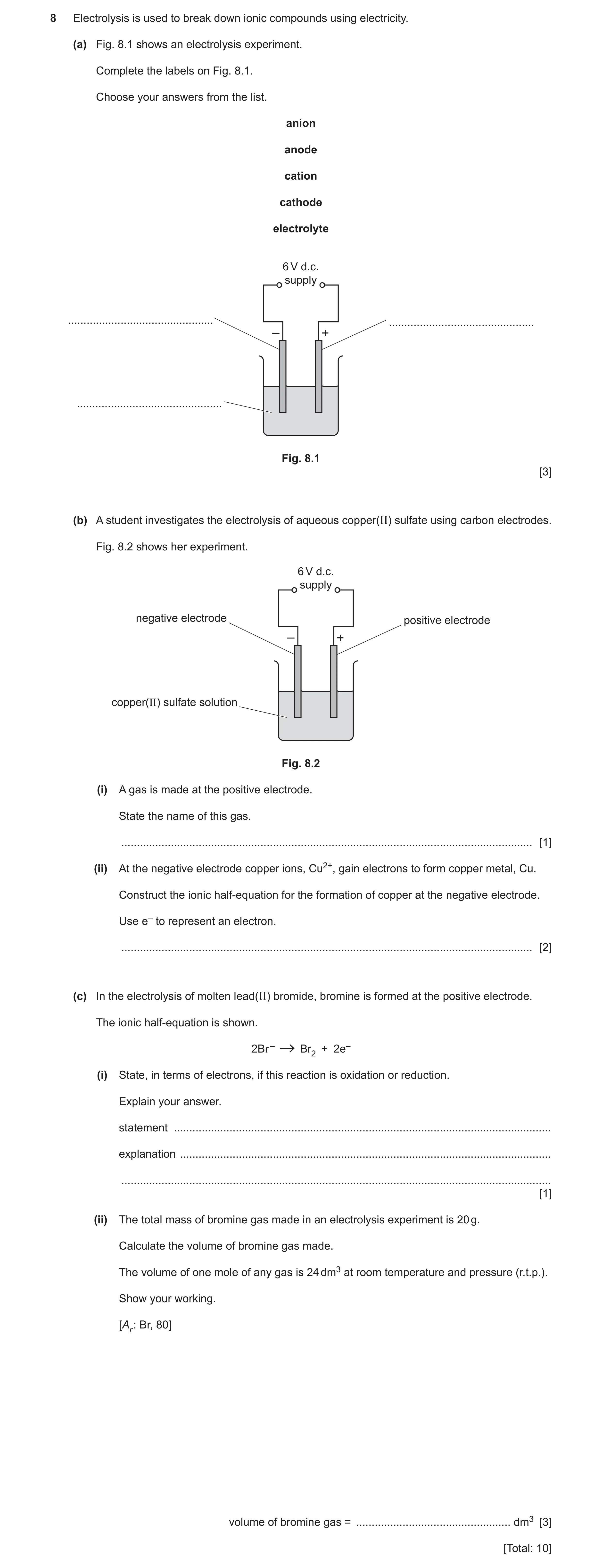
8 Electrolysis is used to break down ionic compounds using electricity. (a) Fig. 8.1 shows an electrolysis experiment. Complete the labels on Fig. 8.1. Choose your answers from the list. anion anode cation cathode electrolyte 6 V d.c. supply … … – + … Fig. 8.1 [3] (b) A student investigates the electrolysis of aqueous copper(II) sulfate using carbon electrodes. Fig. 8.2 shows her experiment. 6 V d.c. supply negative electrode positive electrode – + copper(II) sulfate solution Fig. 8.2 (i) A gas is made at the positive electrode. State the name of this gas. … [1] (ii) At the negative electrode copper ions, Cu2+, gain electrons to form copper metal, Cu. Construct the ionic half‑equation for the formation of copper at the negative electrode. Use e– to represent an electron. … [2] (c) In the electrolysis of molten lead(II) bromide, bromine is formed at the positive electrode. The ionic half‑equation is shown. 2Br – Br2 + 2e– (i) State, in terms of electrons, if this reaction is oxidation or reduction. Explain your answer. statement … explanation … … [1] (ii) The total mass of bromine gas made in an electrolysis experiment is 20 g. Calculate the volume of bromine gas made. The volume of one mole of any gas is 24 dm3 at room temperature and pressure (r.t.p.). Show your working. [Ar : Br, 80] volume of bromine gas = … dm3 [3] [Total: 10]
10 marks
Mark scheme: 8(a) 3 8(b)(i) oxygen ; 1 8(b)(ii) Cu2+ + 2e– → Cu LHS ; RHS ; 2 8(c)(i) oxidation because electrons are lost (from bromide ions) ; 1 8(c)(ii) Mr of Br2 = 160 ; (moles of Br2 =) mass ÷ molar mass or 20 ÷ 160 or 0.125 ; (volume of Br2 = 0.125 × 24 =) 3 (dm³) ; 3 cathode electrolyte anode
This question in 0654/41 May/June 2021
Q7 · The electrolysis of concentrated aqueous sodium chloride, NaCl, produces two useful gases 0654/42 May/June 2021
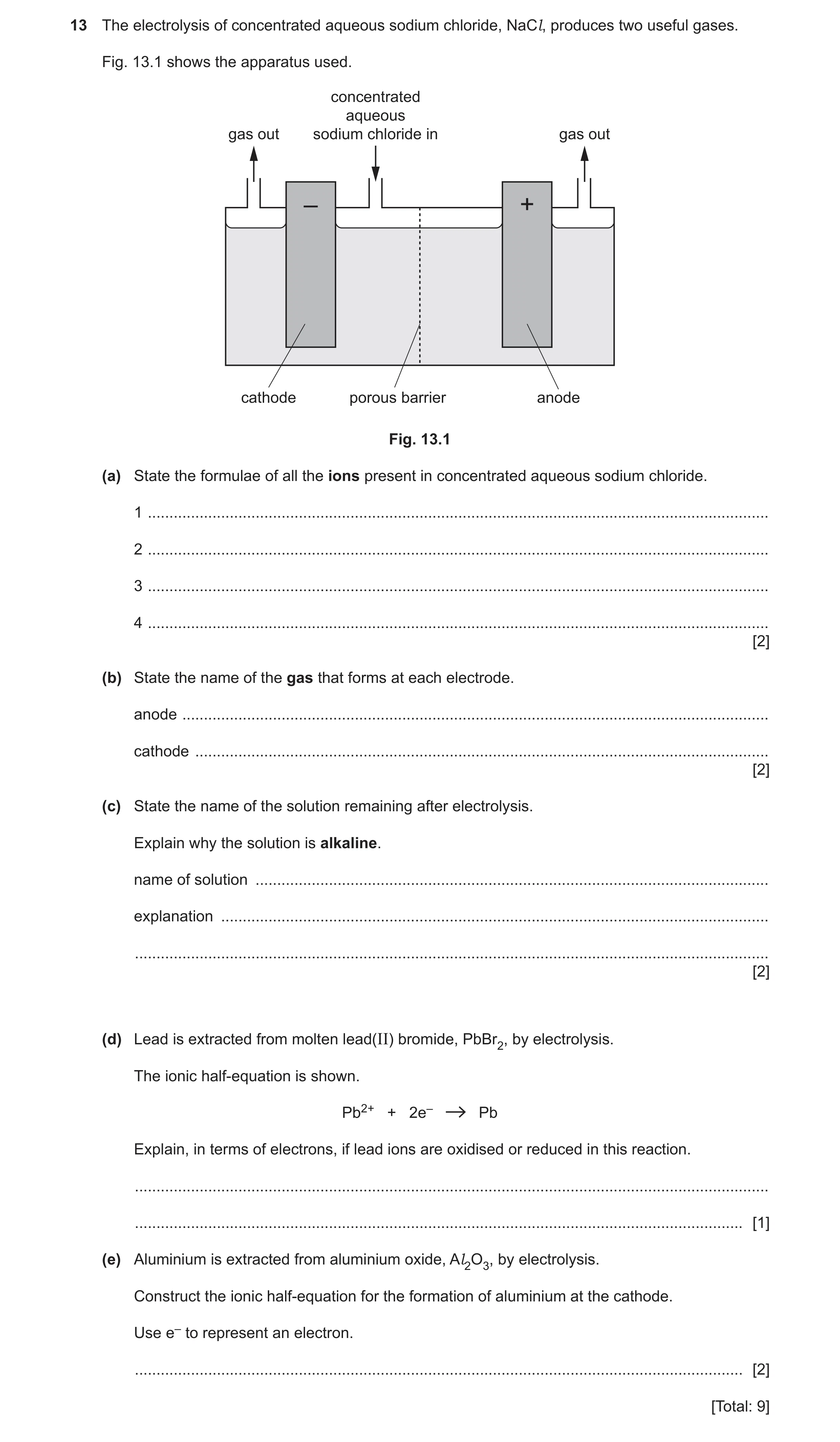
13 The electrolysis of concentrated aqueous sodium chloride, NaCl, produces two useful gases. Fig. 13.1 shows the apparatus used. concentrated aqueous gas out sodium chloride in gas out – + cathode porous barrier anode Fig. 13.1 (a) State the formulae of all the ions present in concentrated aqueous sodium chloride. 1 … 2 … 3 … 4 … [2] (b) State the name of the gas that forms at each electrode. anode … cathode … [2] (c) State the name of the solution remaining after electrolysis. Explain why the solution is alkaline. name of solution … explanation … … [2] (d) Lead is extracted from molten lead(II) bromide, PbBr2, by electrolysis. The ionic half-equation is shown. Pb2+ + 2e– Pb Explain, in terms of electrons, if lead ions are oxidised or reduced in this reaction. … … [1] (e) Aluminium is extracted from aluminium oxide, Al2O3, by electrolysis. Construct the ionic half-equation for the formation of aluminium at the cathode. Use e– to represent an electron. … [2] [Total: 9]
9 marks
Mark scheme: 13(a) 13(b) anode – chlorine ; cathode – hydrogen ; 2 13(c) sodium hydroxide ; hydroxide ions or OH- remain in solution ; 2 13(d) reduced because (two) electrons are gained ; 1 13(e) Al3+ + 3e- → Al ;; 2
This question in 0654/42 May/June 2021
Q8 · A student investigates how metals react with different solutions 0654/42 Feb/March 2022
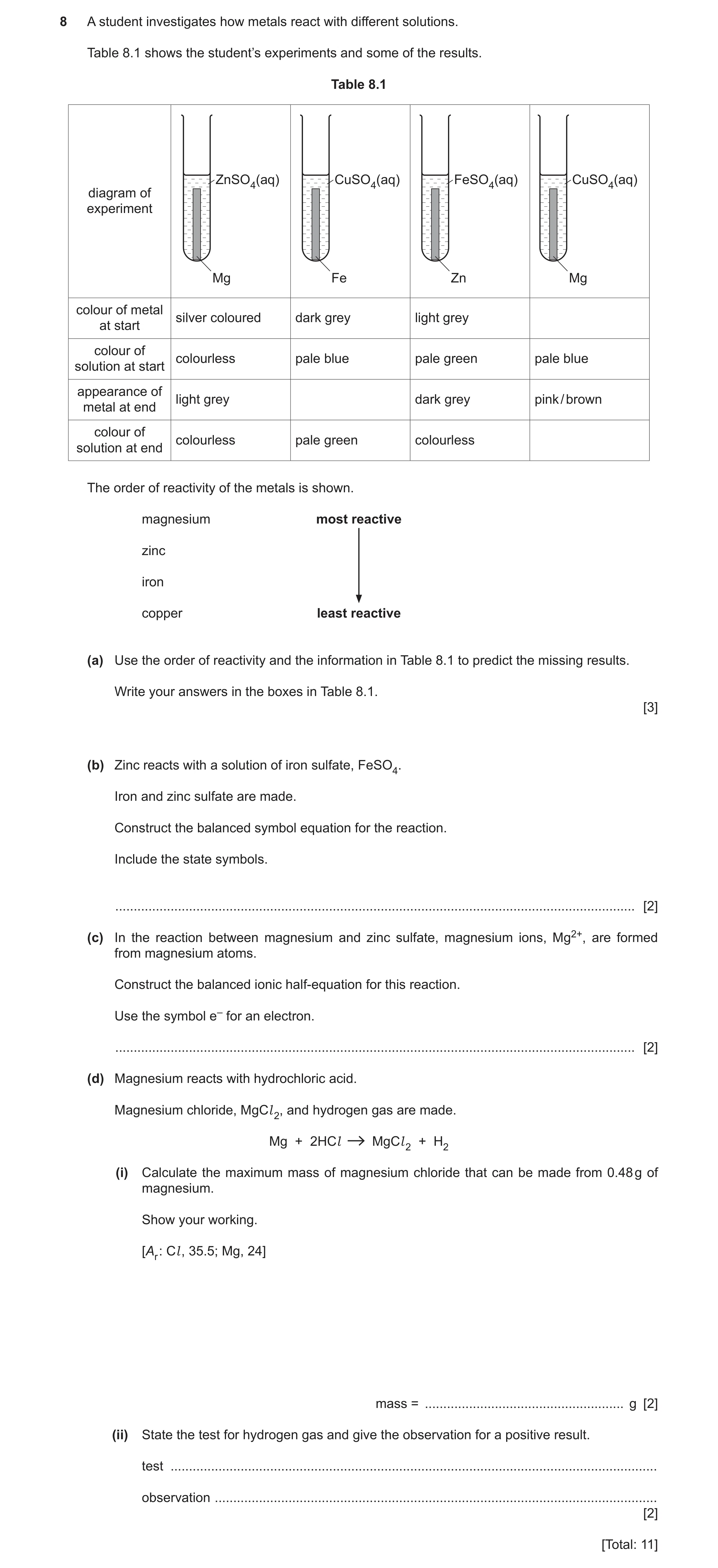
8 A student investigates how metals react with different solutions. Table 8.1 shows the student’s experiments and some of the results. Table 8.1 ZnSO4(aq) CuSO4(aq) FeSO4(aq) CuSO4(aq) diagram of experiment Mg Fe Zn Mg colour of metal silver coloured dark grey light grey at start colour of colourless pale blue pale green pale blue solution at start appearance of light grey dark grey pink / brown metal at end colour of colourless pale green colourless solution at end The order of reactivity of the metals is shown. magnesium most reactive zinc iron copper least reactive (a) Use the order of reactivity and the information in Table 8.1 to predict the missing results. Write your answers in the boxes in Table 8.1. [3] (b) Zinc reacts with a solution of iron sulfate, FeSO4. Iron and zinc sulfate are made. Construct the balanced symbol equation for the reaction. Include the state symbols. … [2] (c) In the reaction between magnesium and zinc sulfate, magnesium ions, Mg2+, are formed from magnesium atoms. Construct the balanced ionic half-equation for this reaction. Use the symbol e– for an electron. … [2] (d) Magnesium reacts with hydrochloric acid. Magnesium chloride, MgCl 2, and hydrogen gas are made. Mg + 2HCl MgCl 2 + H2 (i) Calculate the maximum mass of magnesium chloride that can be made from 0.48 g of magnesium. Show your working. [Ar : Cl , 35.5; Mg, 24] mass = … g [2] (ii) State the test for hydrogen gas and give the observation for a positive result. test … observation … [2] [Total: 11]
11 marks
Mark scheme: 8(a) Fe / CuSO4 pink/brown or pink or brown ; Mg / CuSO4 metal – silver (coloured) ; solution – colourless ; 3 8(b) Zn(s) + FeSO4(aq) → Fe(s) + ZnSO4(aq) ;; 2 8(c) Mg – 2e– → Mg2+ / Mg → Mg2+ + 2e– ;; 2 8(d)(i) relative molecular mass of MgCl2 = 95 ; ((95 × 0.48) ÷ 24) = 1.9 (g) ; 2 8(d)(ii) test - lighted splint / ignite gas ; observation - (squeaky) pop ; 2
This question in 0654/42 Feb/March 2022
Q9 · This question is about electrolysis 0654/43 May/June 2022
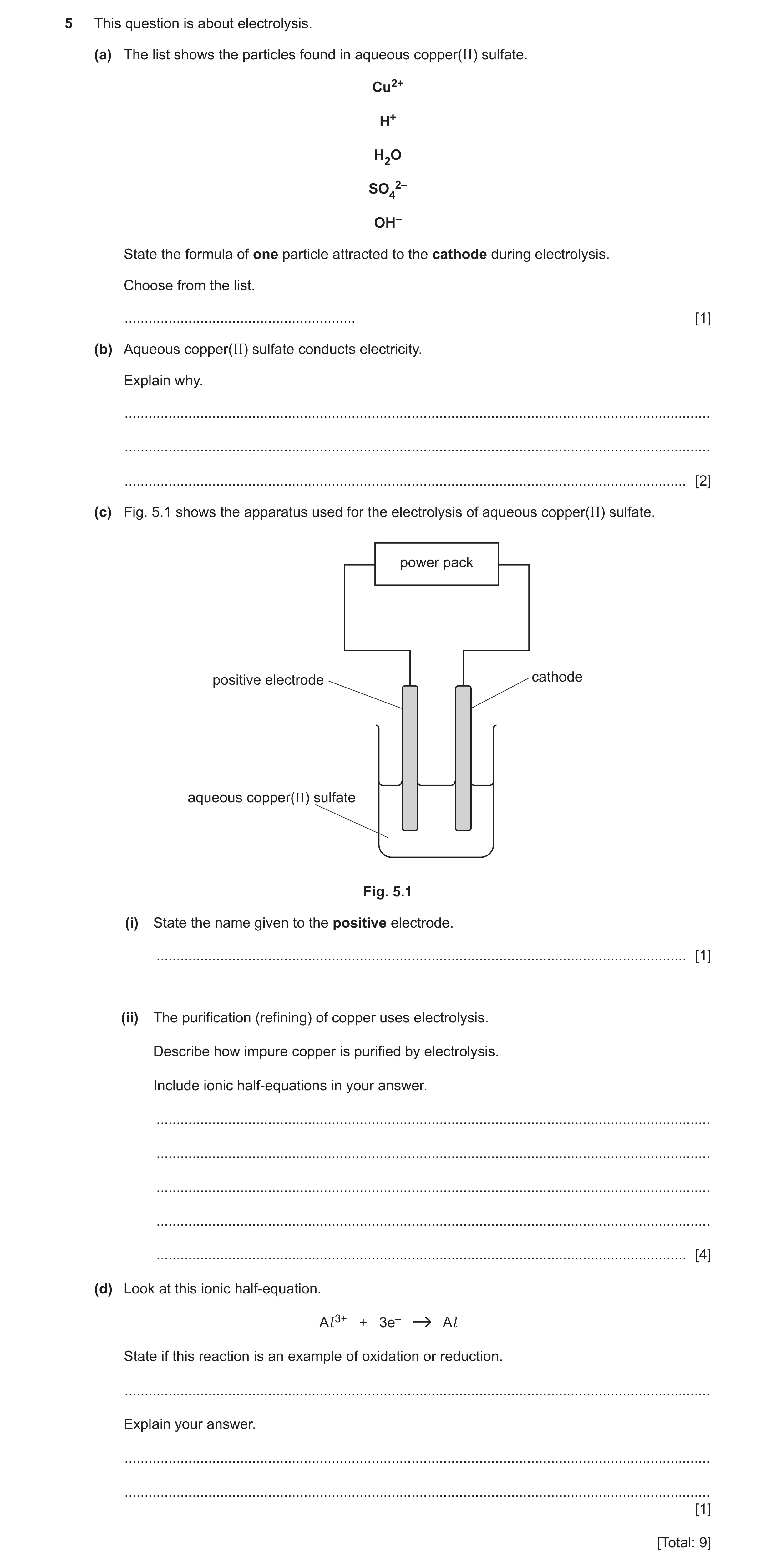
5 This question is about electrolysis. (a) The list shows the particles found in aqueous copper(II) sulfate. Cu2+ H+ H2O SO42– OH– State the formula of one particle attracted to the cathode during electrolysis. Choose from the list. … [1] (b) Aqueous copper(II) sulfate conducts electricity. Explain why. … … … [2] (c) Fig. 5.1 shows the apparatus used for the electrolysis of aqueous copper(II) sulfate. power pack positive electrode cathode aqueous copper(II) sulfate Fig. 5.1 (i) State the name given to the positive electrode. … [1] (ii) The purification (refining) of copper uses electrolysis. Describe how impure copper is purified by electrolysis. Include ionic half-equations in your answer. … … … … … [4] (d) Look at this ionic half-equation. Al 3+ + 3e– Al State if this reaction is an example of oxidation or reduction. … Explain your answer. … … [1] [Total: 9]
9 marks
Mark scheme: 5(a) 1 5(b) (copper(II) sulfate solution) contains ions ; (ions) that can move ; 2 5(c)(i) anode ; 1 5(c)(ii) Any three from: copper(II) sulfate or any soluble copper salt as electrolyte ; impure copper as anode ; pure copper as cathode ; copper deposited at the cathode ; copper anode dissolves ; AND Any one from: Cu2+ + 2e– Cu ; Cu Cu2+ + 2e– ; max 4 4 5(d) reduction because reduction is the gain of electrons ; 1
This question in 0654/43 May/June 2022
Q10 · Copper oxide, CuO, is heated with carbon, C 0654/41 Oct/Nov 2022
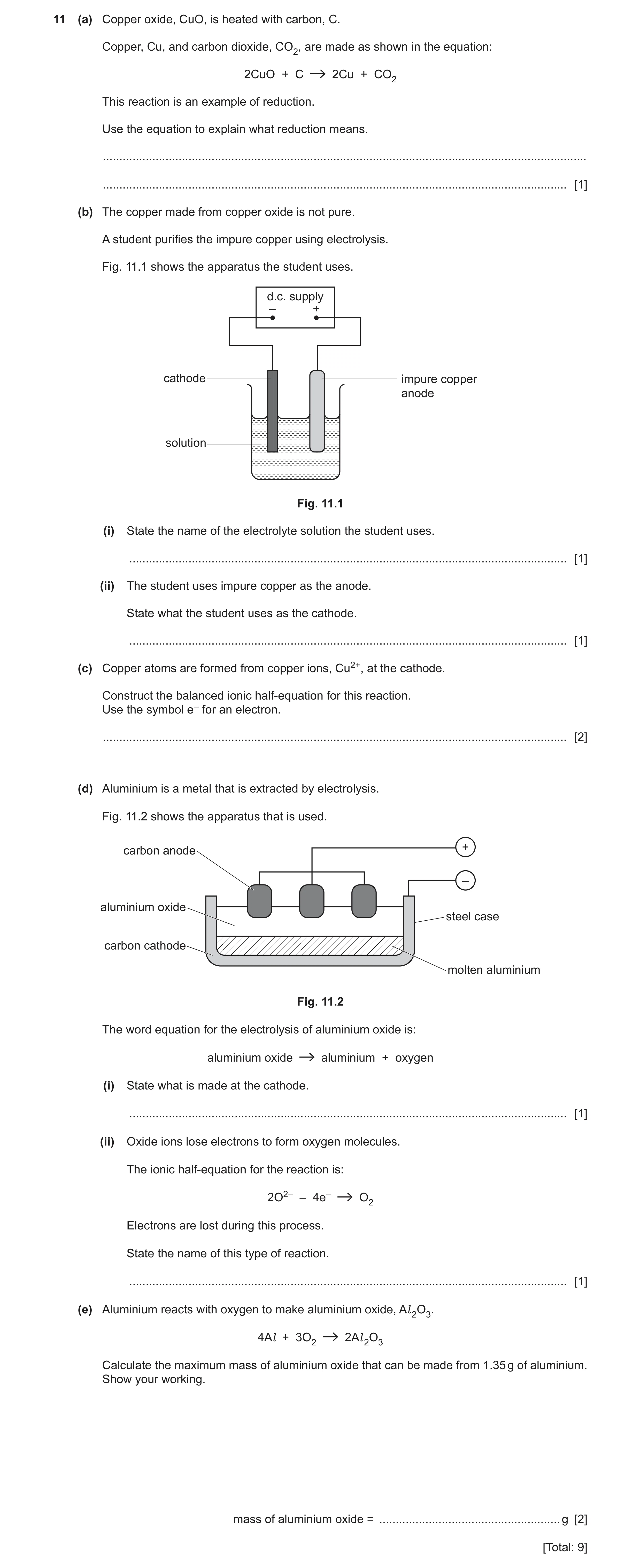
11 (a) Copper oxide, CuO, is heated with carbon, C. Copper, Cu, and carbon dioxide, CO2, are made as shown in the equation: 2CuO + C 2Cu + CO2 This reaction is an example of reduction. Use the equation to explain what reduction means. … … [1] (b) The copper made from copper oxide is not pure. A student purifies the impure copper using electrolysis. Fig. 11.1 shows the apparatus the student uses. d.c. supply – + cathode impure copper anode solution Fig. 11.1 (i) State the name of the electrolyte solution the student uses. … [1] (ii) The student uses impure copper as the anode. State what the student uses as the cathode. … [1] (c) Copper atoms are formed from copper ions, Cu2+, at the cathode. Construct the balanced ionic half-equation for this reaction. Use the symbol e– for an electron. … [2] (d) Aluminium is a metal that is extracted by electrolysis. Fig. 11.2 shows the apparatus that is used. + carbon anode – aluminium oxide steel case carbon cathode molten aluminium Fig. 11.2 The word equation for the electrolysis of aluminium oxide is: aluminium oxide aluminium + oxygen (i) State what is made at the cathode. … [1] (ii) Oxide ions lose electrons to form oxygen molecules. The ionic half-equation for the reaction is: 2O2– – 4e– O2 Electrons are lost during this process. State the name of this type of reaction. … [1] (e) Aluminium reacts with oxygen to make aluminium oxide, Al 2O3. 4Al + 3O2 2Al 2O3 Calculate the maximum mass of aluminium oxide that can be made from 1.35 g of aluminium. Show your working. mass of aluminium oxide = … g [2] [Total: 9]
9 marks
Mark scheme: 11(a) oxygen is removed/lost (from copper oxide) ; 1 11(b)(i) copper sulfate ; 1 11(b)(ii) (pure) copper ; 1 11(c) Cu2+ + 2e– → Cu 2 correct formulae ; correct balancing ; 11(d)(i) aluminium ; 1 11(d)(ii) oxidation ; 1 11(e) relative formular mass of Al2O3 =102 ; 2 (204 x 1.35 OR 102 x 1.35 = ) 2.55 (g) ; 108 54
This question in 0654/41 Oct/Nov 2022
Q11 · Lithium, sodium and potassium are metals in Group I of the Periodic Table 0654/43 May/June 2023
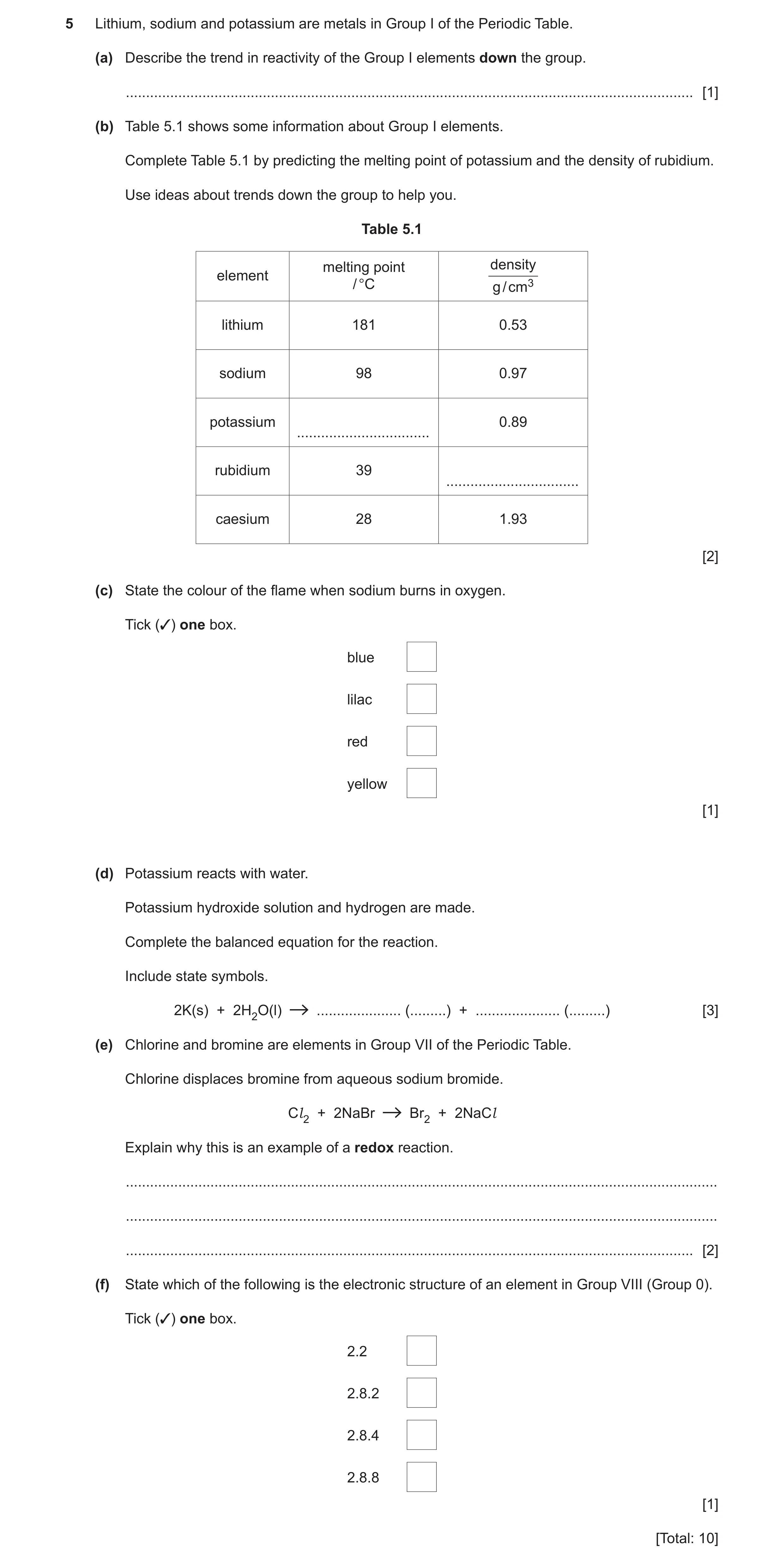
5 Lithium, sodium and potassium are metals in Group I of the Periodic Table. (a) Describe the trend in reactivity of the Group I elements down the group. … [1] (b) Table 5.1 shows some information about Group I elements. Complete Table 5.1 by predicting the melting point of potassium and the density of rubidium. Use ideas about trends down the group to help you. Table 5.1 melting point density element / °C g / cm3 lithium 181 0.53 sodium 98 0.97 potassium 0.89 … rubidium 39 … caesium 28 1.93 [2] (c) State the colour of the flame when sodium burns in oxygen. Tick (3) one box. blue lilac red yellow [1] (d) Potassium reacts with water. Potassium hydroxide solution and hydrogen are made. Complete the balanced equation for the reaction. Include state symbols. 2K(s) + 2H2O(l) … ( … ) + … ( … ) [3] (e) Chlorine and bromine are elements in Group VII of the Periodic Table. Chlorine displaces bromine from aqueous sodium bromide. Cl 2 + 2NaBr Br2 + 2NaCl Explain why this is an example of a redox reaction. … … … [2] (f) State which of the following is the electronic structure of an element in Group VIII (Group 0). Tick (3) one box. 2.2 2.8.2 2.8.4 2.8.8 [1] [Total: 10]
10 marks
Mark scheme: 5(a) increases / owtte ; 1 5(b) melting point of potassium = 64 / 38 to 97 (°C) ; density of rubidium = 1.63 / 0.90 to 1.92 (g / cm³) ; 2 5(c) yellow ; 1 5(d) 2KOH(aq) + H2(g) correct formulae ; correct balancing ; correct state symbols ; 3 5(e) transfer of electrons / loss and gain of electrons ; the Br −/ bromide / bromine ions lose electrons AND chlorine atoms / chlorine gain(s) electrons ; 2 Question Answer Marks 5(f) 2.8.8 ; 1
This question in 0654/43 May/June 2023
Q12 · A toy car that is powered by hydrogen gas 0654/43 May/June 2024
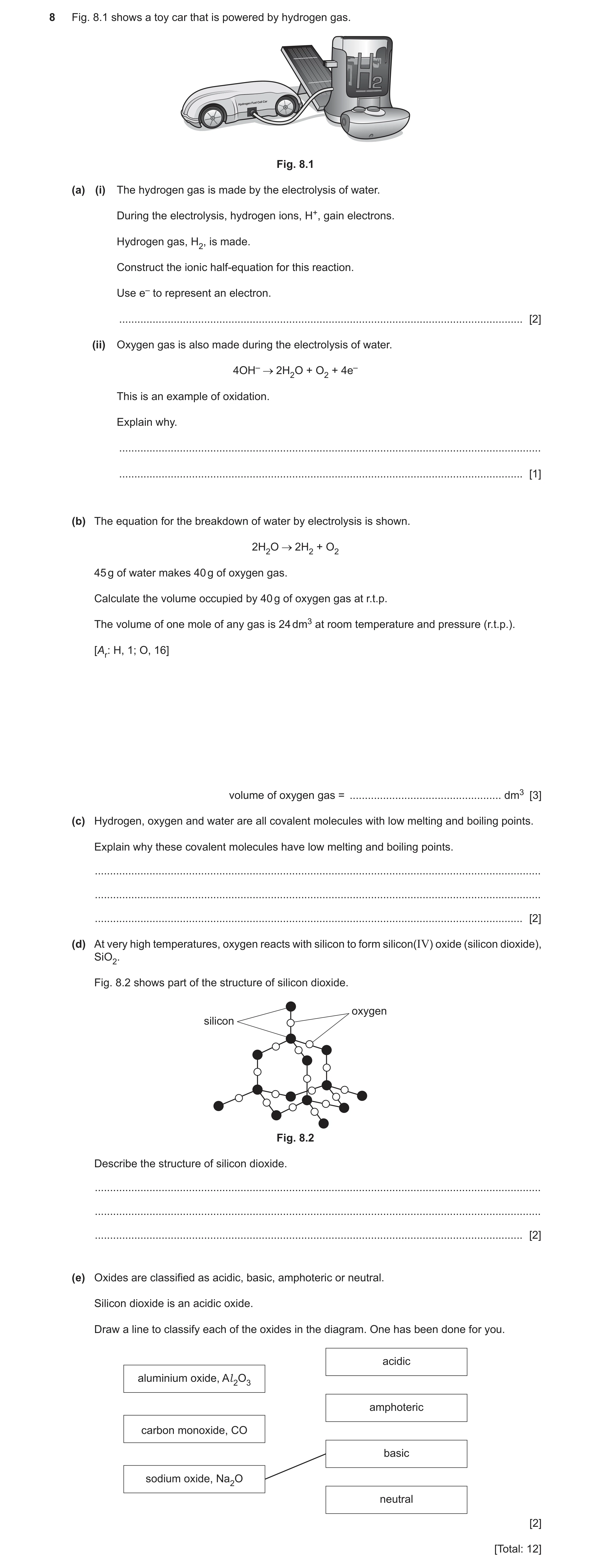
8 Fig. 8.1 shows a toy car that is powered by hydrogen gas. Fig. 8.1 (a) (i) The hydrogen gas is made by the electrolysis of water. During the electrolysis, hydrogen ions, H+, gain electrons. Hydrogen gas, H2, is made. Construct the ionic half-equation for this reaction. Use e– to represent an electron. … [2] (ii) Oxygen gas is also made during the electrolysis of water. 4OH– 2H2O + O2 + 4e– This is an example of oxidation. Explain why. … … [1] (b) The equation for the breakdown of water by electrolysis is shown. 2H2O 2H2 + O2 45 g of water makes 40 g of oxygen gas. Calculate the volume occupied by 40 g of oxygen gas at r.t.p. The volume of one mole of any gas is 24 dm3 at room temperature and pressure (r.t.p.). [Ar: H, 1; O, 16] volume of oxygen gas = … dm3 [3] (c) Hydrogen, oxygen and water are all covalent molecules with low melting and boiling points. Explain why these covalent molecules have low melting and boiling points. … … … [2] (d) At very high temperatures, oxygen reacts with silicon to form silicon(IV) oxide (silicon dioxide), SiO2. Fig. 8.2 shows part of the structure of silicon dioxide. oxygen silicon Fig. 8.2 Describe the structure of silicon dioxide. … … … [2] (e) Oxides are classified as acidic, basic, amphoteric or neutral. Silicon dioxide is an acidic oxide. Draw a line to classify each of the oxides in the diagram. One has been done for you. acidic aluminium oxide, Al 2O3 amphoteric carbon monoxide, CO basic sodium oxide, Na2O neutral [2] [Total: 12]
12 marks
Mark scheme: 8(a)(i) 2 8(a)(ii) loss of electrons / AW ; 1 8(b) Mr of O2 = 32 ; moles of O2 = 40 ÷ 32 = 1.25 ; volume of O2 = 1.25 24 = 30 dm³ ; 3 8(c) weak intermolecular forces / weak forces between molecules ; (weak forces) which require little energy to break ; 2 8(d) giant covalent OR covalent lattice ; each oxygen atom forms bonds with 2 silicon atoms / each silicon atoms forms bonds with 4 oxygen atoms ; 2 8(e) ;; 2
This question in 0654/43 May/June 2024
Q13 · Aluminium is extracted by electrolysis from the ore bauxite that contains aluminium… 0654/41 Oct/Nov 2024
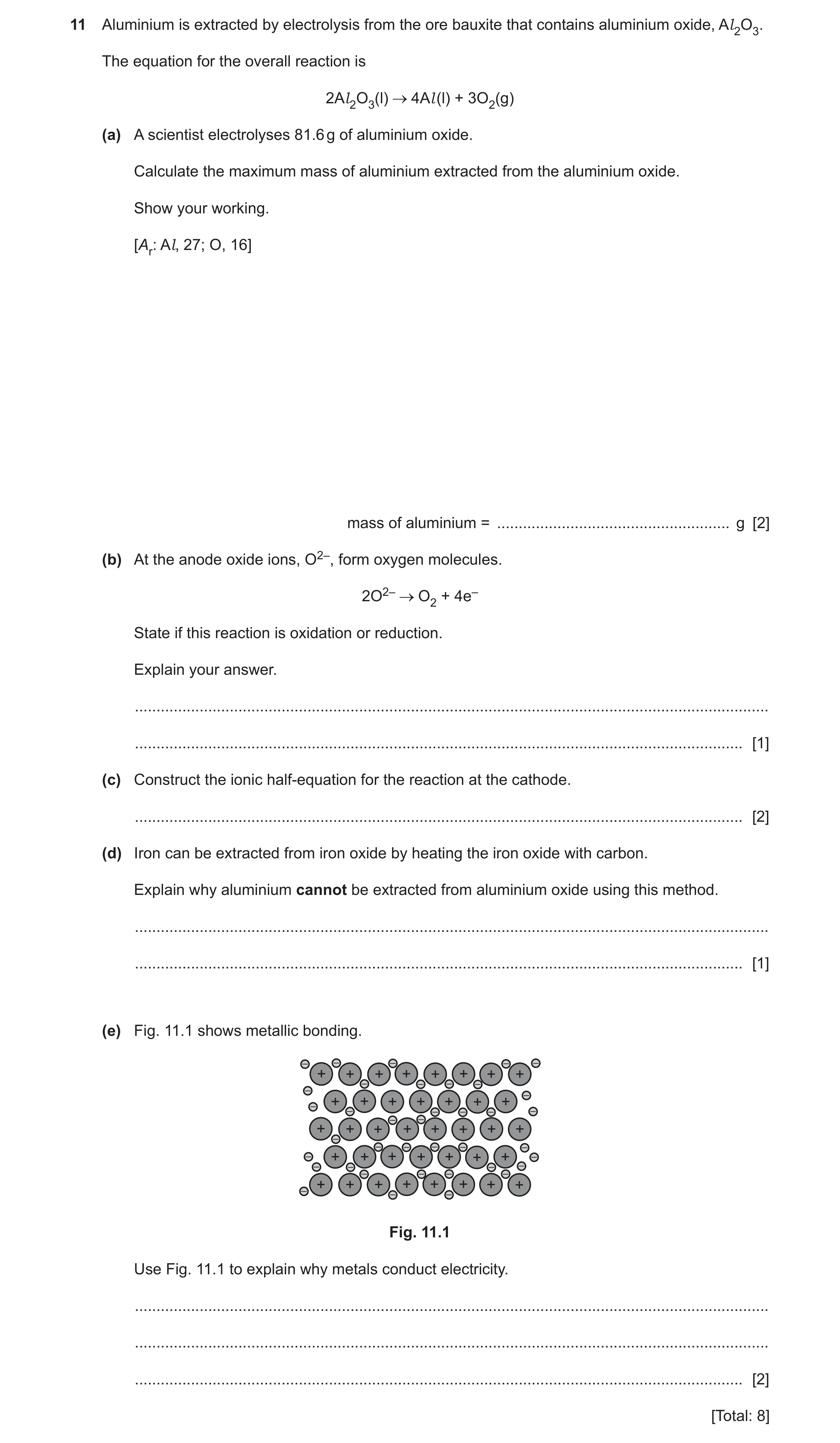
11 Aluminium is extracted by electrolysis from the ore bauxite that contains aluminium oxide, Al 2O3. The equation for the overall reaction is 2Al 2O3(l) 4Al (l) + 3O2(g) (a) A scientist electrolyses 81.6 g of aluminium oxide. Calculate the maximum mass of aluminium extracted from the aluminium oxide. Show your working. [Ar: Al, 27; O, 16] mass of aluminium = … g [2] (b) At the anode oxide ions, O2–, form oxygen molecules. 2O2– O2 + 4e– State if this reaction is oxidation or reduction. Explain your answer. … … [1] (c) Construct the ionic half‑equation for the reaction at the cathode. … [2] (d) Iron can be extracted from iron oxide by heating the iron oxide with carbon. Explain why aluminium cannot be extracted from aluminium oxide using this method. … … [1] (e) Fig. 11.1 shows metallic bonding. – – – – – + + + + + + + + – – – – – – + + + + + + + – – – – – – – – + + + + + + + + – – – – – – – – + + + + + + + – – – – – – – – – + + + – + + – + + + Fig. 11.1 Use Fig. 11.1 to explain why metals conduct electricity. … … … [2] [Total: 8]
8 marks
Mark scheme: 11(a) relative molecular mass of Al2O3 = 102 ; 2 (54 81.6 g ) ; = 43.2 ( 102 11(b) oxidation 1 and electrons are lost ; 11(c) Al3+ + 3e– → Al 2 1 mark for correct symbols ; 1 mark for correctly balanced electrons ; 11(d) idea that aluminium is more reactive than carbon / ORA ; 1 11(e) has free electrons ; 2 which can move throughout/in (the metal) ;
This question in 0654/41 Oct/Nov 2024
Q14 · Complete the sentence about electrolysis 0654/42 Oct/Nov 2024
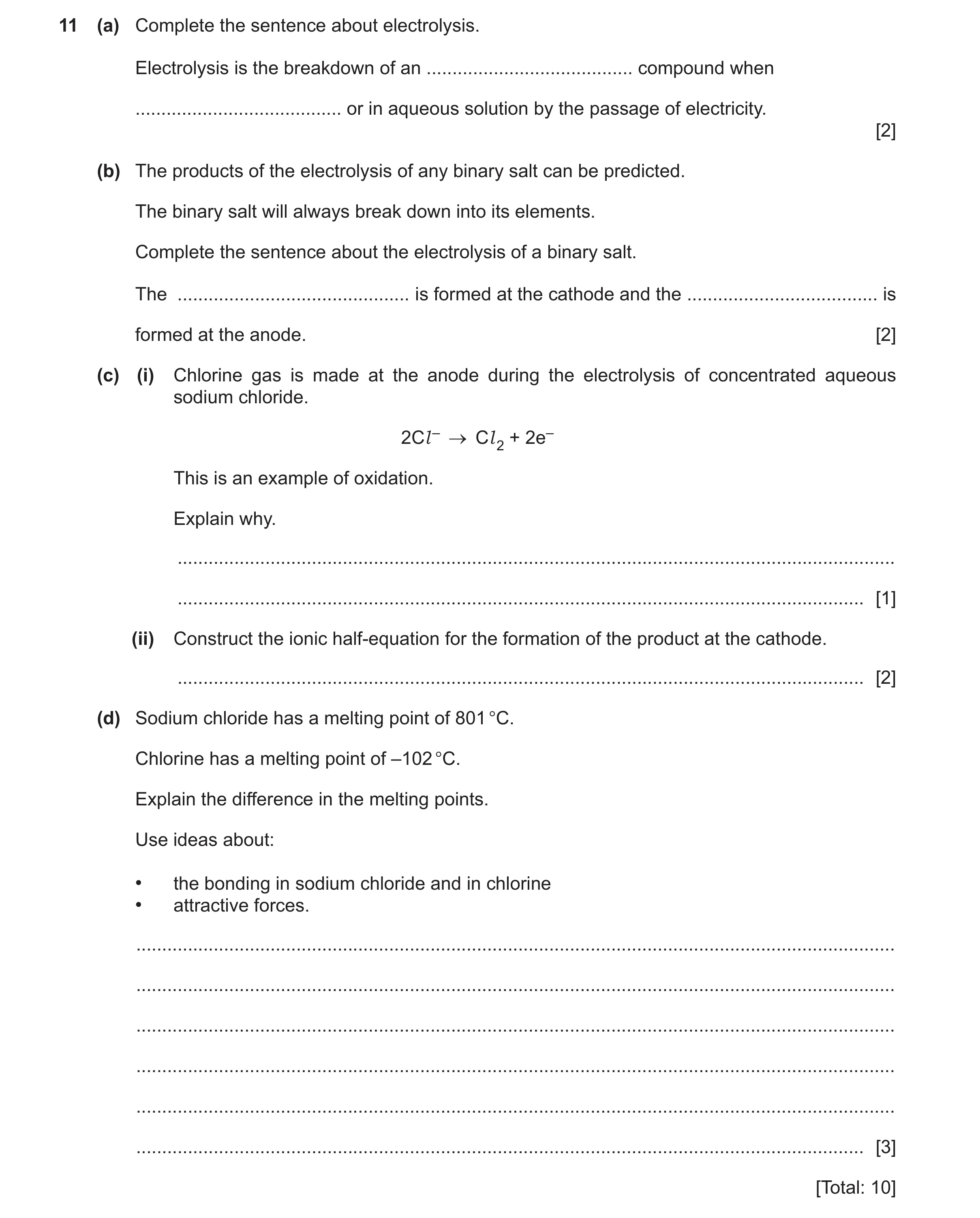
11 (a) Complete the sentence about electrolysis. Electrolysis is the breakdown of an … compound when … or in aqueous solution by the passage of electricity. [2] (b) The products of the electrolysis of any binary salt can be predicted. The binary salt will always break down into its elements. Complete the sentence about the electrolysis of a binary salt. The … is formed at the cathode and the … is formed at the anode. [2] (c) (i) Chlorine gas is made at the anode during the electrolysis of concentrated aqueous sodium chloride. 2Cl – Cl + 2e– 2 This is an example of oxidation. Explain why. … … [1] (ii) Construct the ionic half-equation for the formation of the product at the cathode. … [2] (d) Sodium chloride has a melting point of 801 °C. Chlorine has a melting point of –102 °C. Explain the difference in the melting points. Use ideas about: • the bonding in sodium chloride and in chlorine • attractive forces. … … … … … … [3] [Total: 10]
10 marks
Mark scheme: 11(a) ionic ; 2 molten ; 11(b) metal ; 2 non-metal ; 11(c)(i) loss of electrons ; 1 11(c)(ii) 2H+ + 2e– → H2 2 1 mark for correct symbols ; 1 mark for correctly balanced electrons ; 11(d) sodium chloride is ionic ; 3 chlorine is covalent ; chlorine has weak intermolecular forces / sodium chloride has strong (electrostatic) forces between oppositely charged ions ;
This question in 0654/42 Oct/Nov 2024
Q15 · The reactivity series of some metals 0654/43 Oct/Nov 2024
11 Fig. 11.1 shows the reactivity series of some metals. The element carbon is also included in the list. sodium most reactive magnesium aluminium carbon zinc iron copper least reactive Fig. 11.1 (a) (i) Iron is extracted from the ore hematite by heating with carbon. Use Fig. 11.1 to state and explain how magnesium is extracted from magnesium ore. … … … [2] (ii) Sodium is more reactive than magnesium. Explain why. … … [1] (b) Carbon is used to extract an element, X, from its oxide. The equation for the reaction is shown. XO2 + C X + CO2 The sum of the relative formula masses of the reactants (XO2 + C) is 163. Calculate the relative atomic mass of X. [Ar: C, 12; O, 16] relative atomic mass of X = … [2] (c) Iron is extracted from iron oxide by reacting the iron oxide with aluminium. The equation for the reaction is shown. 2Al + Fe2O3 2Fe + Al 2O3 A mixture contains 162 g of aluminium and 800 g of iron oxide. Show that aluminium is the limiting reactant. [Ar: Al, 27; Fe, 56; O, 16] aluminium is the limiting reactant because … … … [3] (d) Magnesium displaces copper from copper chloride solution. The ionic equation for the reaction is shown. Mg + Cu2+ Mg2+ + Cu Explain why the reaction between magnesium atoms and copper ions involves both oxidation and reduction. … … … [2] (e) Complete the following sentences about oxidising agents and reducing agents. An oxidising agent is a substance which … another substance during a redox reaction. A reducing agent is a substance which … another substance during a redox reaction. [1] [Total: 11]
11 marks
Mark scheme: 11(a)(i) electrolysis ; 2 carbon is less reactive than magnesium / ORA / carbon cannot displace the magnesium from the magnesium ore ; 11(a)(ii) (idea that sodium atoms) form positive (sodium) ions more easily (than magnesium) / 1 (idea that sodium atoms) lose electrons more easily (than magnesium) ; 11(b) Mr of CO2 = 44 / relative atomic mass of X = 163 – 44 / 163 – 32 – 12 ; 2 119 ; 11(c) (moles of Fe2O3 = 800 / 160 =) 5 ; 3 (moles of Al = 162 / 27 =) 6 ; (aluminium is limiting because) 6 mol is less than the (2 5 =) 10 mol (aluminium needed) or iron oxide is in excess because 5 mol is more than the (6 ÷ 2 =) 3 mol (iron oxide needed) ; 11(d) oxidation because magnesium atoms lose electrons ; 2 reduction because copper ions gain electrons ; 11(e) oxidises 1 and reduces ;
This question in 0654/43 Oct/Nov 2024
Q16 · The metal iron is extracted from hematite in a blast furnace 0654/41 May/June 2025
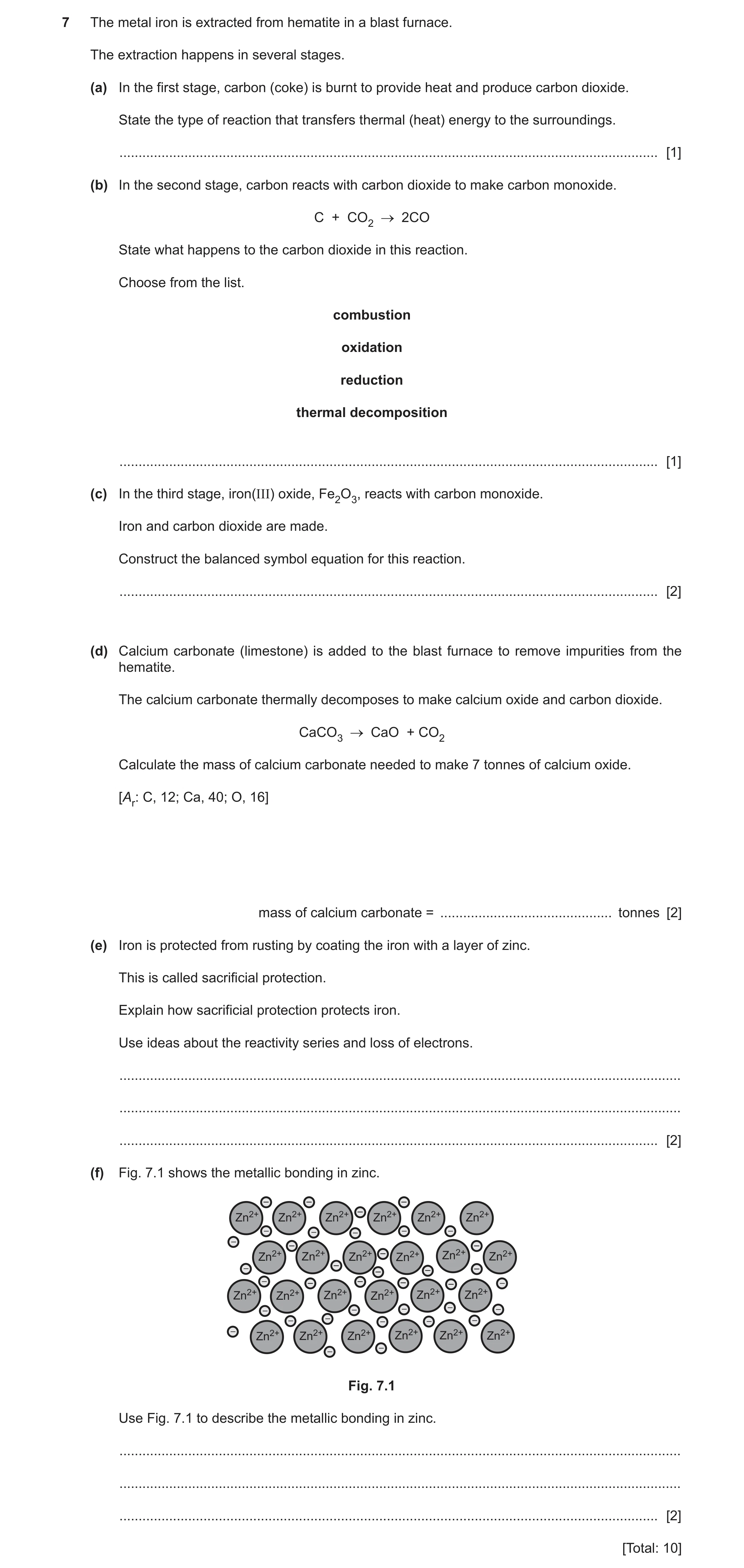
7 The metal iron is extracted from hematite in a blast furnace. The extraction happens in several stages. (a) In the first stage, carbon (coke) is burnt to provide heat and produce carbon dioxide. State the type of reaction that transfers thermal (heat) energy to the surroundings. … [1] (b) In the second stage, carbon reacts with carbon dioxide to make carbon monoxide. C + CO2 2CO State what happens to the carbon dioxide in this reaction. Choose from the list. combustion oxidation reduction thermal decomposition … [1] (c) In the third stage, iron(III) oxide, Fe2O3, reacts with carbon monoxide. Iron and carbon dioxide are made. Construct the balanced symbol equation for this reaction. … [2] (d) Calcium carbonate (limestone) is added to the blast furnace to remove impurities from the hematite. The calcium carbonate thermally decomposes to make calcium oxide and carbon dioxide. CaCO3 CaO + CO2 Calculate the mass of calcium carbonate needed to make 7 tonnes of calcium oxide. [Ar: C, 12; Ca, 40; O, 16] mass of calcium carbonate = … tonnes [2] (e) Iron is protected from rusting by coating the iron with a layer of zinc. This is called sacrificial protection. Explain how sacrificial protection protects iron. Use ideas about the reactivity series and loss of electrons. … … … [2] (f) Fig. 7.1 shows the metallic bonding in zinc. – – – Zn2+ Zn2+ Zn2+ – Zn2+ Zn2+ Zn2+ – – – – – – – – Zn2+ Zn2+ Zn2+ – Zn2+ Zn2+ Zn2+ – – – – – – – – – – – Zn2+ Zn2+ Zn2+ Zn2+ Zn2+ Zn2+ – – – – – – – – – – – Zn2+ Zn2+ Zn2+ Zn2+ Zn2+ Zn2+ – – Fig. 7.1 Use Fig. 7.1 to describe the metallic bonding in zinc. … … … [2] [Total: 10]
10 marks
Mark scheme: 7(a) exothermic ; 1 7(b) reduction ; 1 7(c) Fe2O3 + 3CO → 2Fe + 3CO2 ;; 2 7(d) Mr of CaCO3 = 100 and Mr of CaO = 56 ; 2 100 7 = 12.5 (tonnes) ; 56 7(e) zinc is more reactive than iron / ORA ; 2 zinc loses electrons more easily than iron / ORA ; 7(f) electrostatic attraction ; 2 between positive (zinc / metal) ions and (a ‘sea’ of) delocalised electrons ;
This question in 0654/41 May/June 2025
Q17 · Hydrogen-oxygen fuel cells use hydrogen and oxygen to produce electricity 0654/41 Oct/Nov 2025
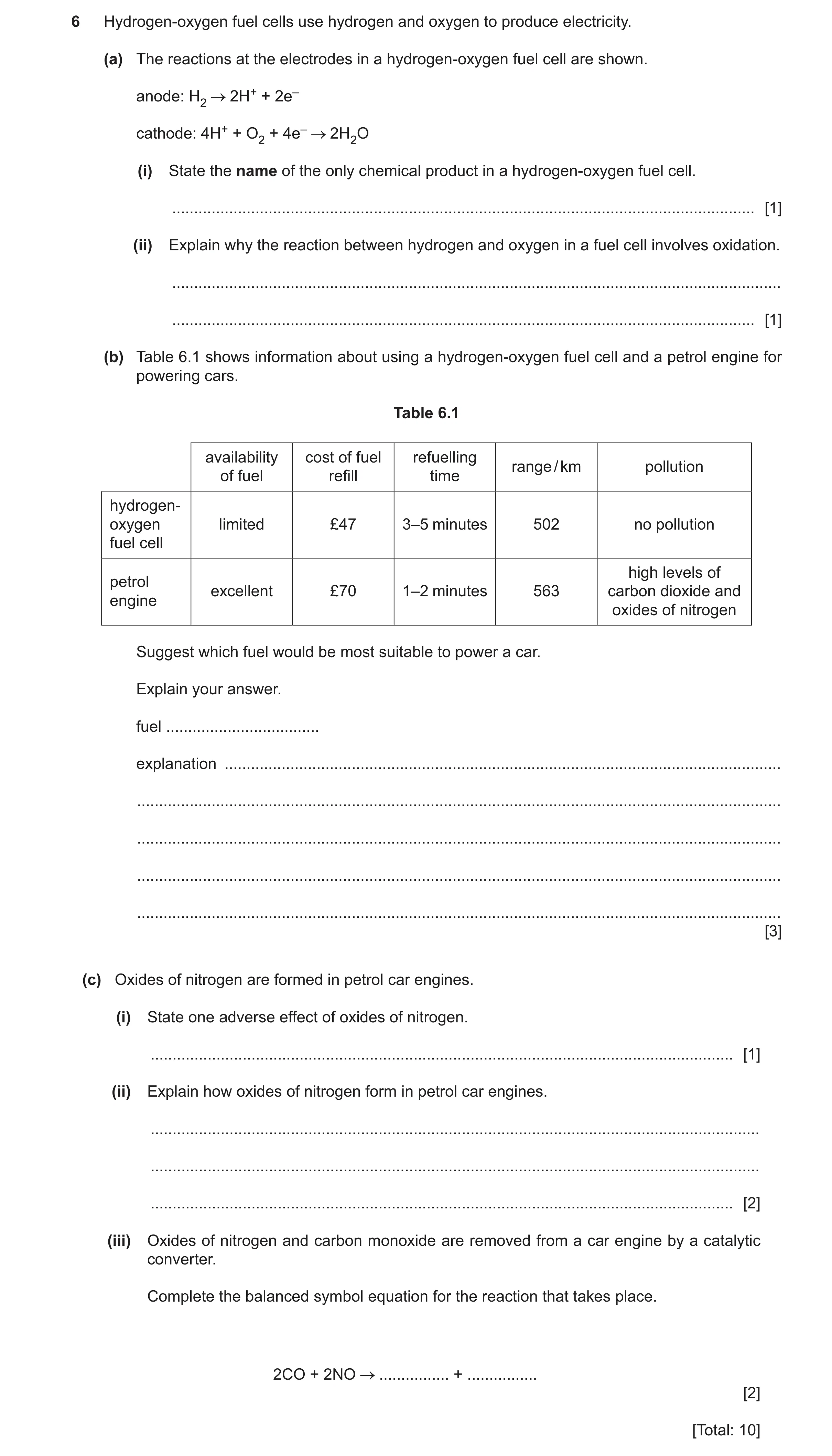
6 Hydrogen-oxygen fuel cells use hydrogen and oxygen to produce electricity. (a) The reactions at the electrodes in a hydrogen-oxygen fuel cell are shown. anode: H2 2H+ + 2e– cathode: 4H+ + O2 + 4e– 2H2O (i) State the name of the only chemical product in a hydrogen-oxygen fuel cell. … [1] (ii) Explain why the reaction between hydrogen and oxygen in a fuel cell involves oxidation. … … [1] (b) Table 6.1 shows information about using a hydrogen-oxygen fuel cell and a petrol engine for powering cars. Table 6.1 availability cost of fuel refuelling range / km pollution of fuel refill time hydrogen- oxygen limited £47 3–5 minutes 502 no pollution fuel cell high levels of petrol excellent £70 1–2 minutes 563 carbon dioxide and engine oxides of nitrogen Suggest which fuel would be most suitable to power a car. Explain your answer. fuel … explanation … … … … … [3] (c) Oxides of nitrogen are formed in petrol car engines. (i) State one adverse effect of oxides of nitrogen. … [1] (ii) Explain how oxides of nitrogen form in petrol car engines. … … … [2] (iii) Oxides of nitrogen and carbon monoxide are removed from a car engine by a catalytic converter. Complete the balanced symbol equation for the reaction that takes place. 2CO + 2NO … + … [2] [Total: 10]
10 marks
Mark scheme: 6(a)(i) water ; 1 6(a)(ii) loss of electrons (from hydrogen) ; 1 6(b) any three from: 3 hydrogen-oxygen (fuel cell) / hydrogen and oxygen • cheap(er) (than petrol) to refill ; • short refueling time ; • good range ; • no pollution ; OR petrol (engine) • high availability / excellent availability ; • quick(er) refueling ; • long(er) range (than hydrogen–oxygen) ; 6(c)(i) acid rain / respiratory problems ; 1 6(c)(ii) nitrogen reacts with oxygen ; 2 at high temperature (inside a car engine) ; 6(c)(iii) 2CO + 2NO → 2CO2 + N2 2 1 mark for products (either order) ; 1 mark for balancing ;
This question in 0654/41 Oct/Nov 2025
 23 / 28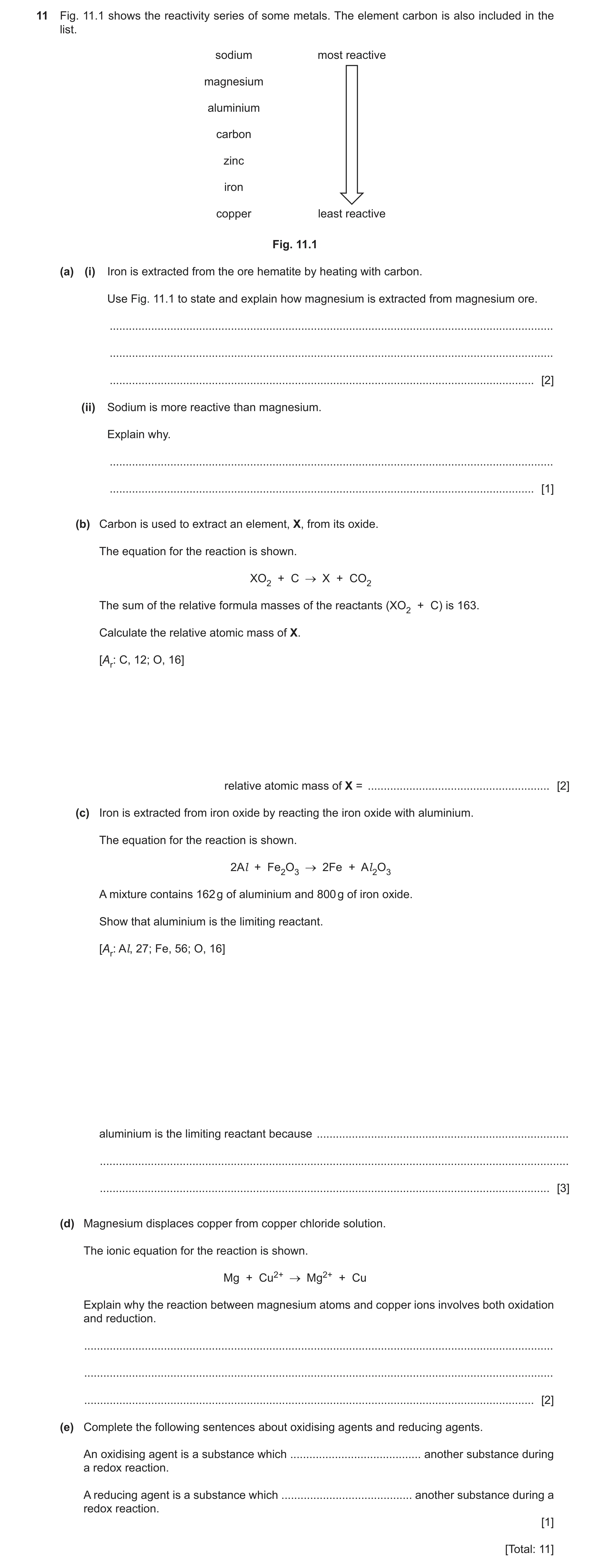
 9
9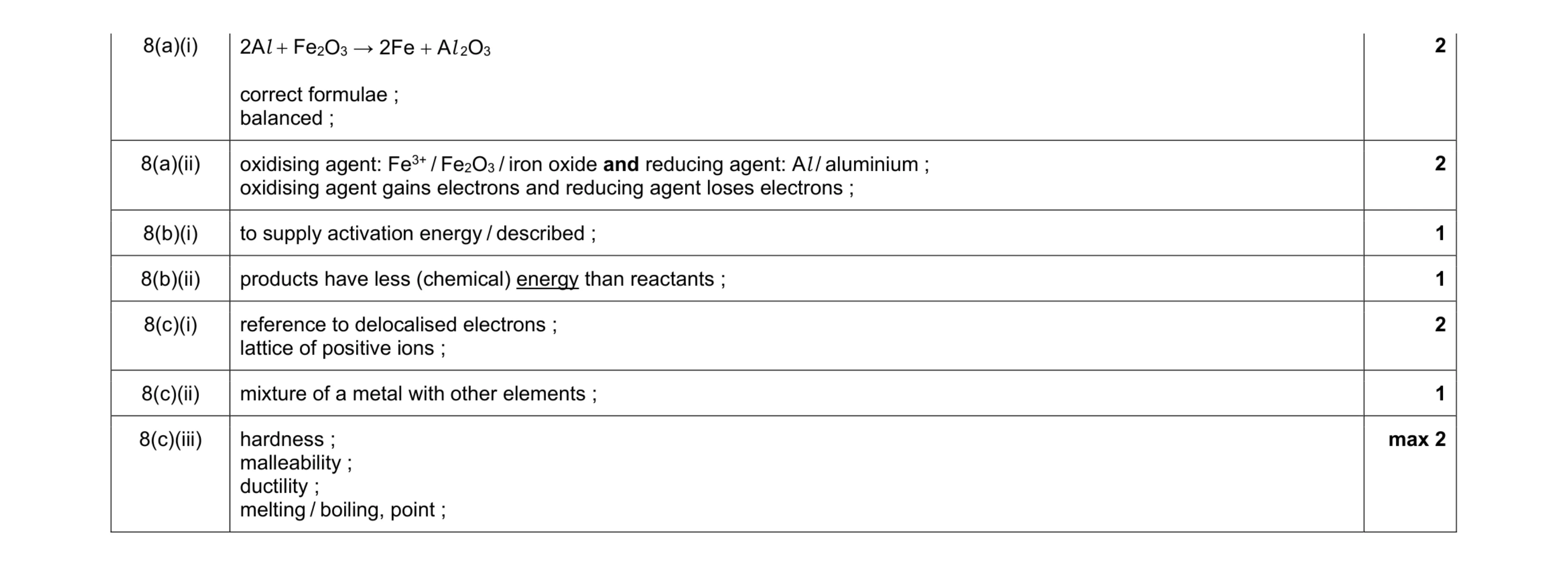 11
11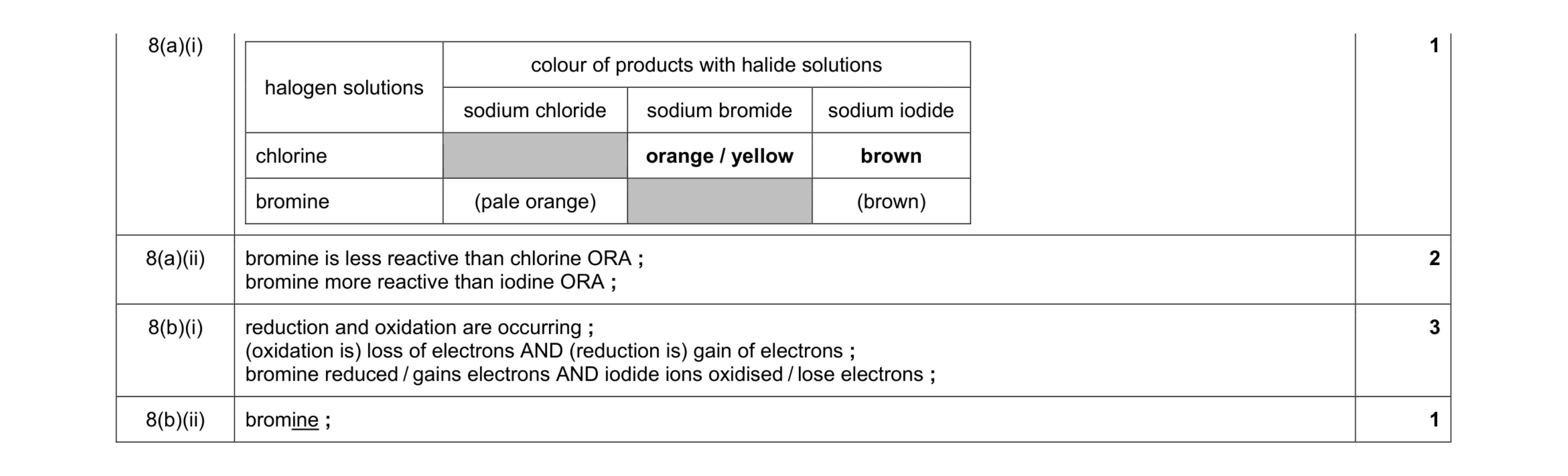 7
7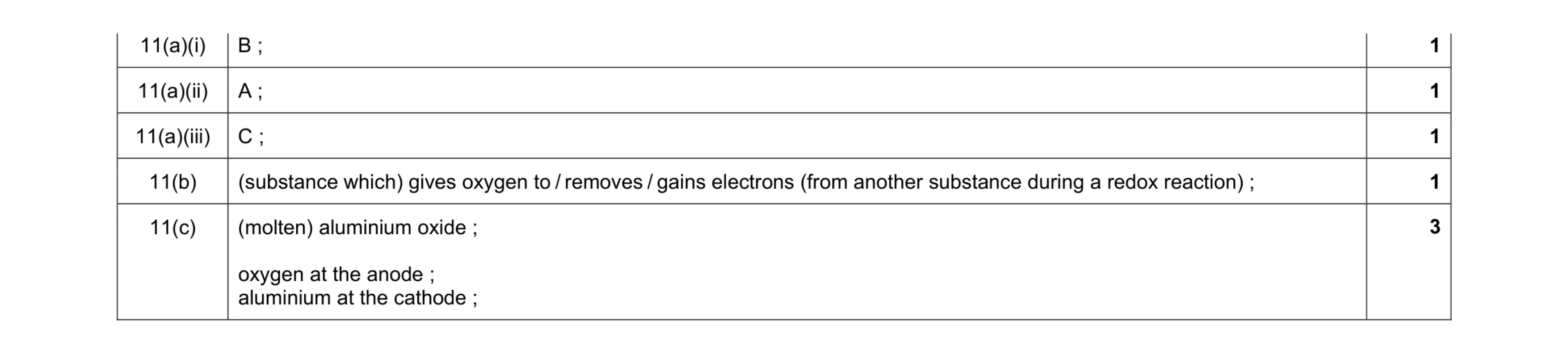 7
7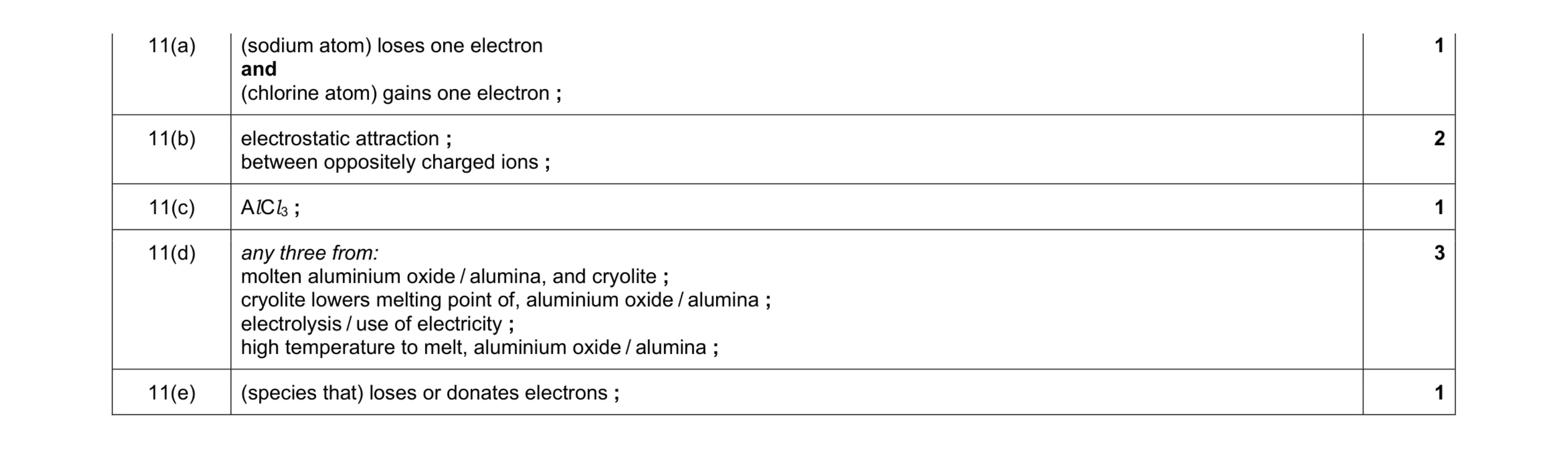 8
8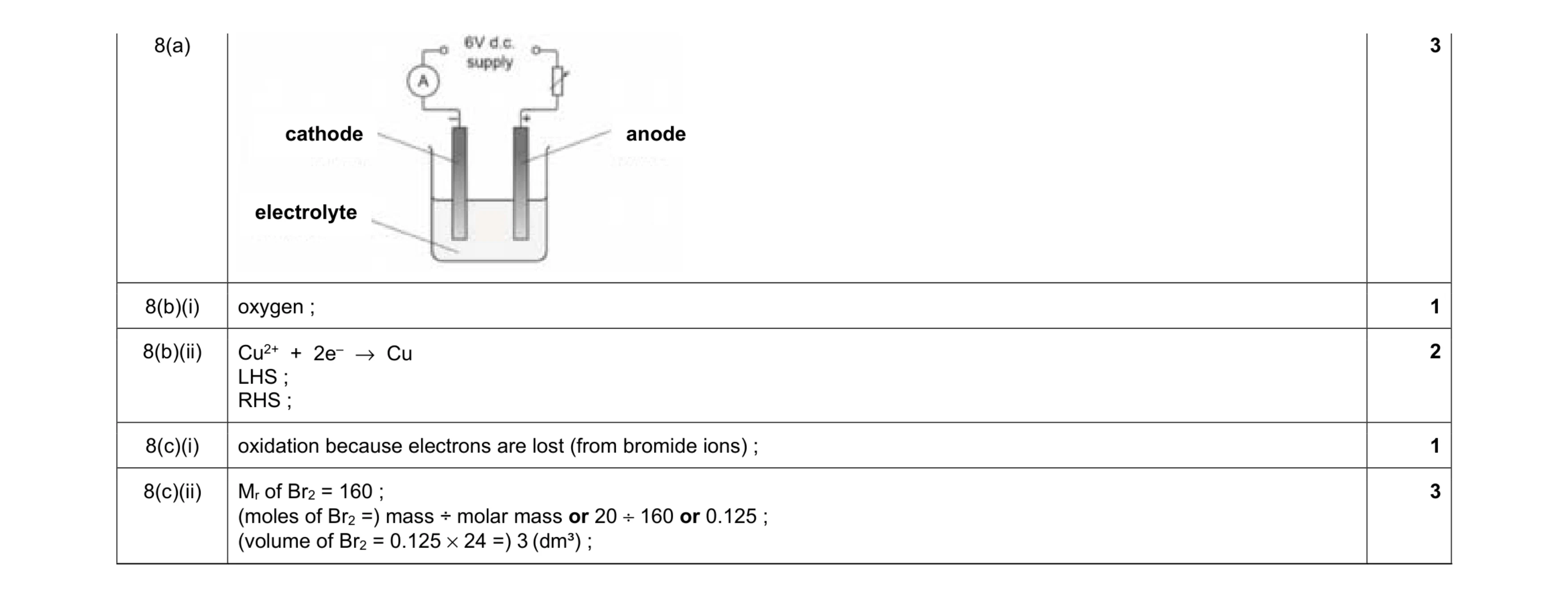 10
10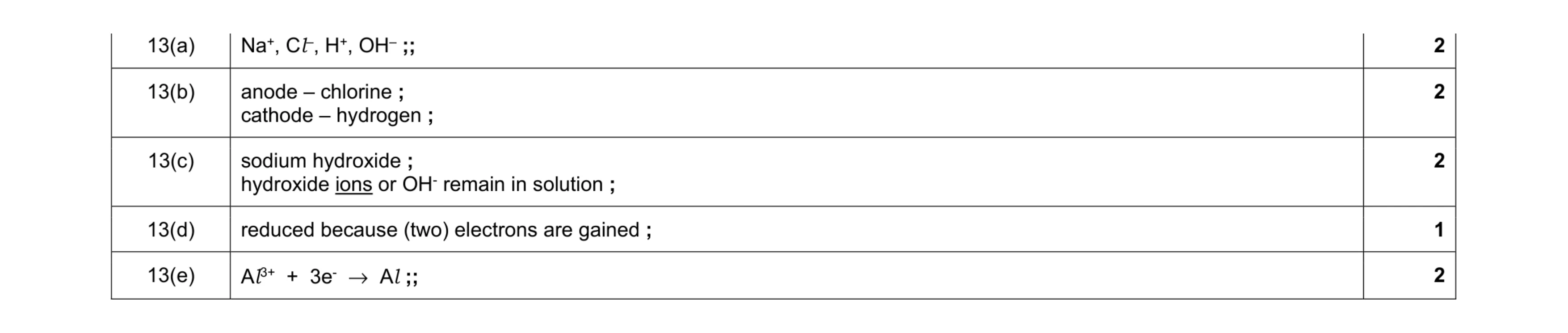 9
9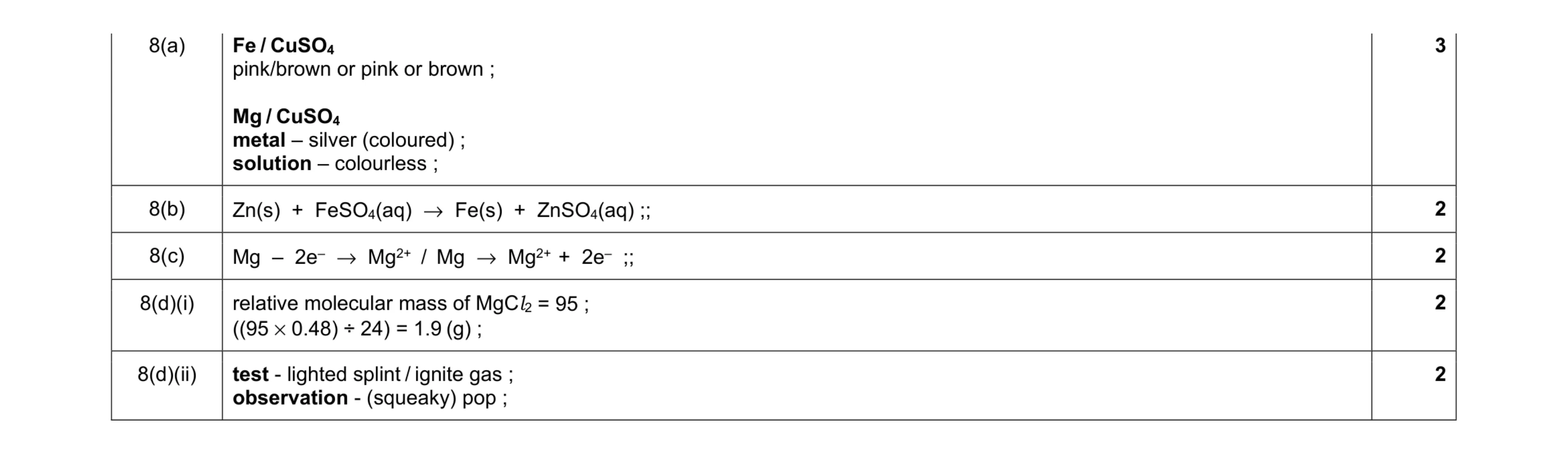 11
11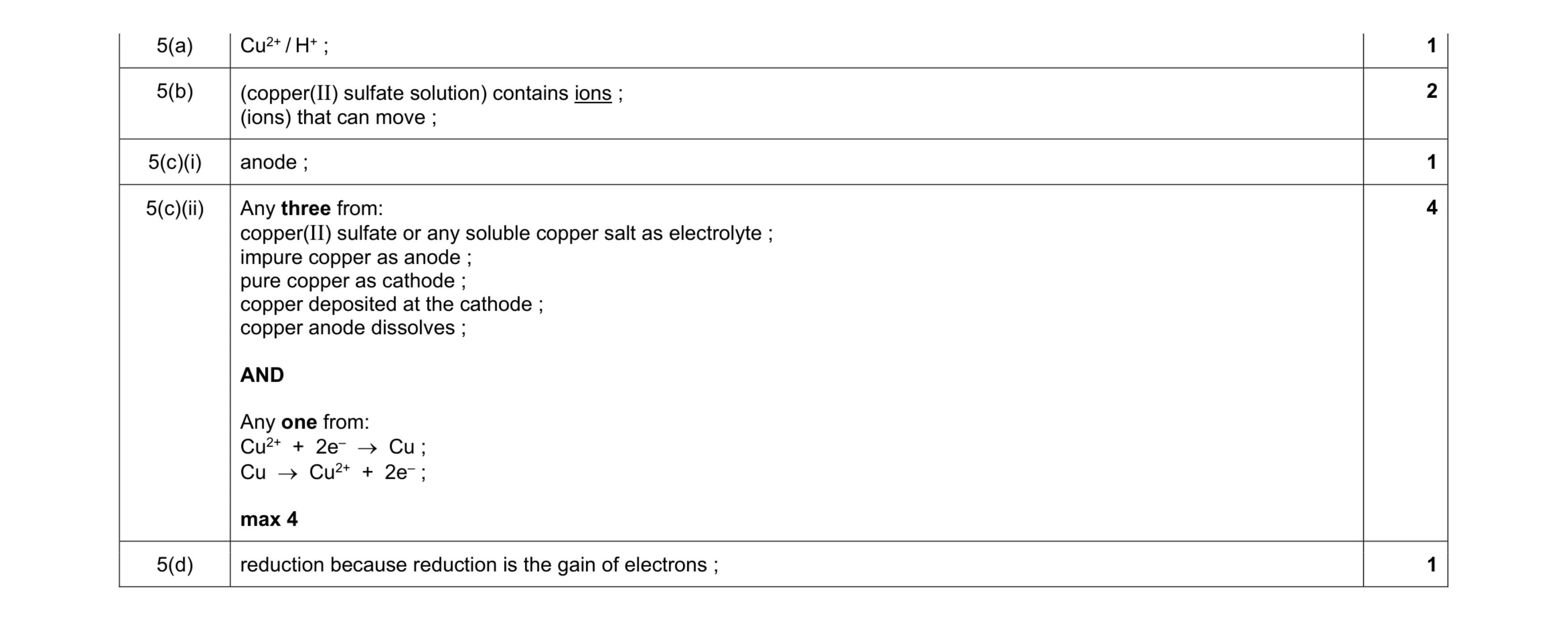 9
9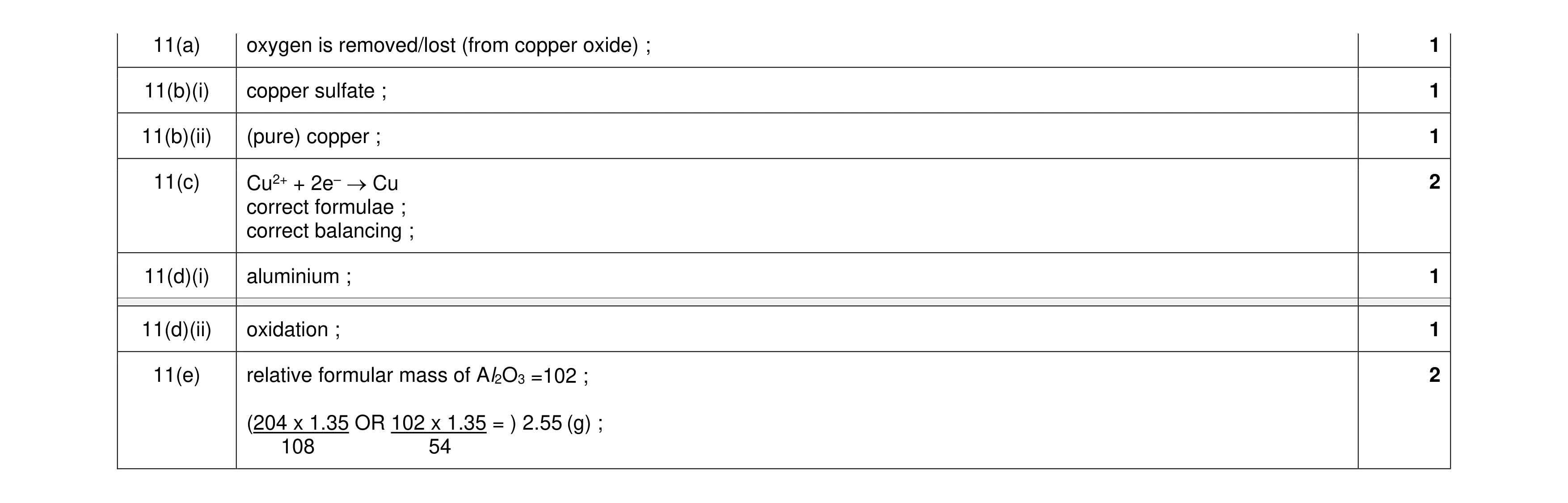 9
9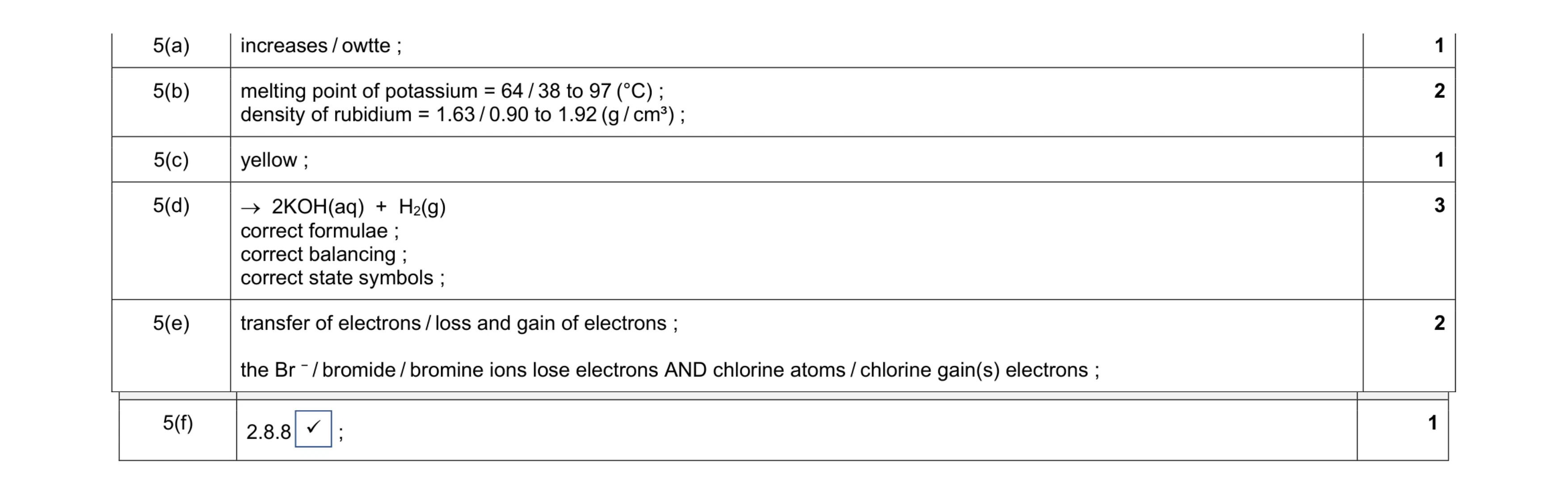 10
10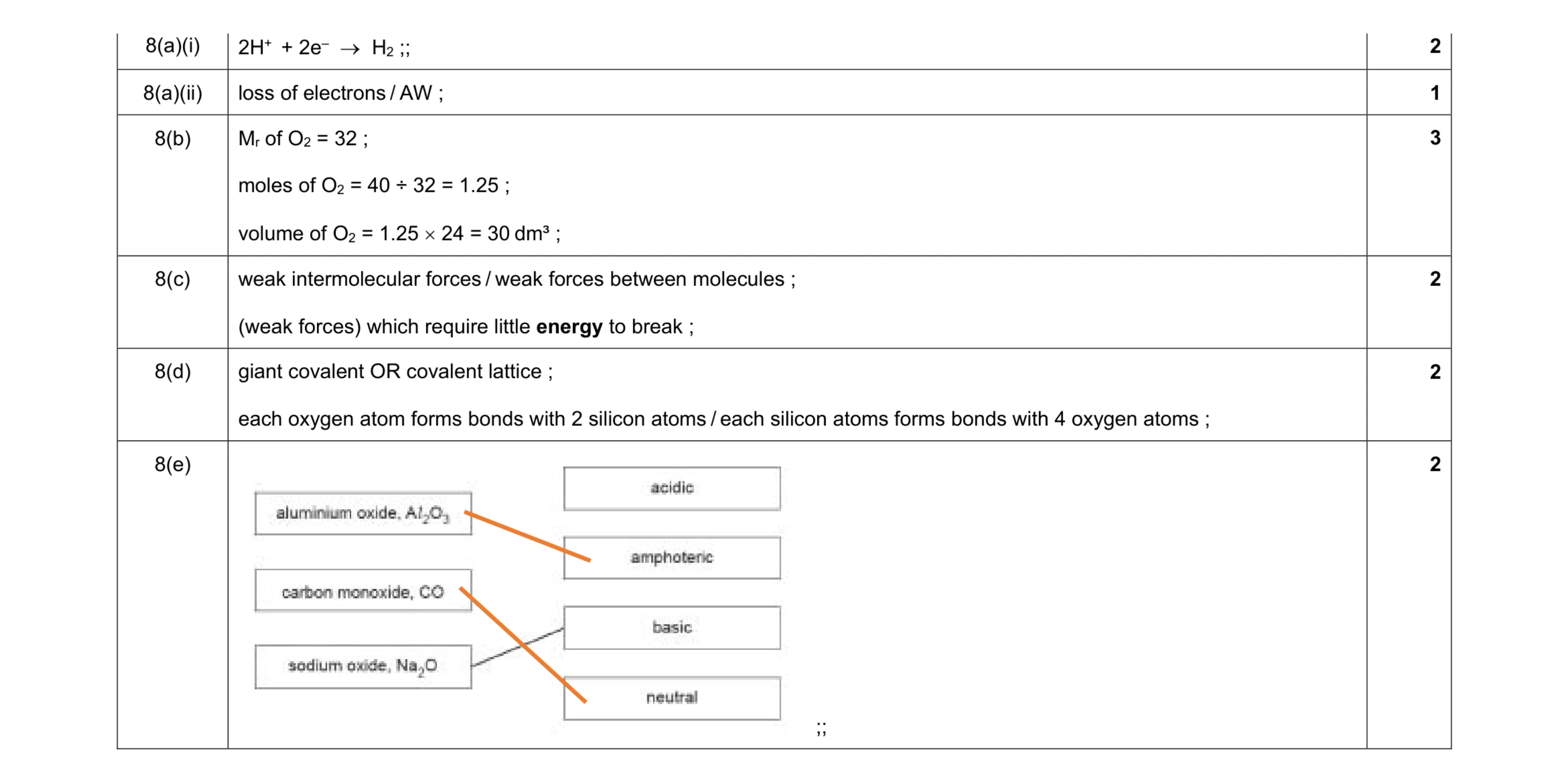 12
12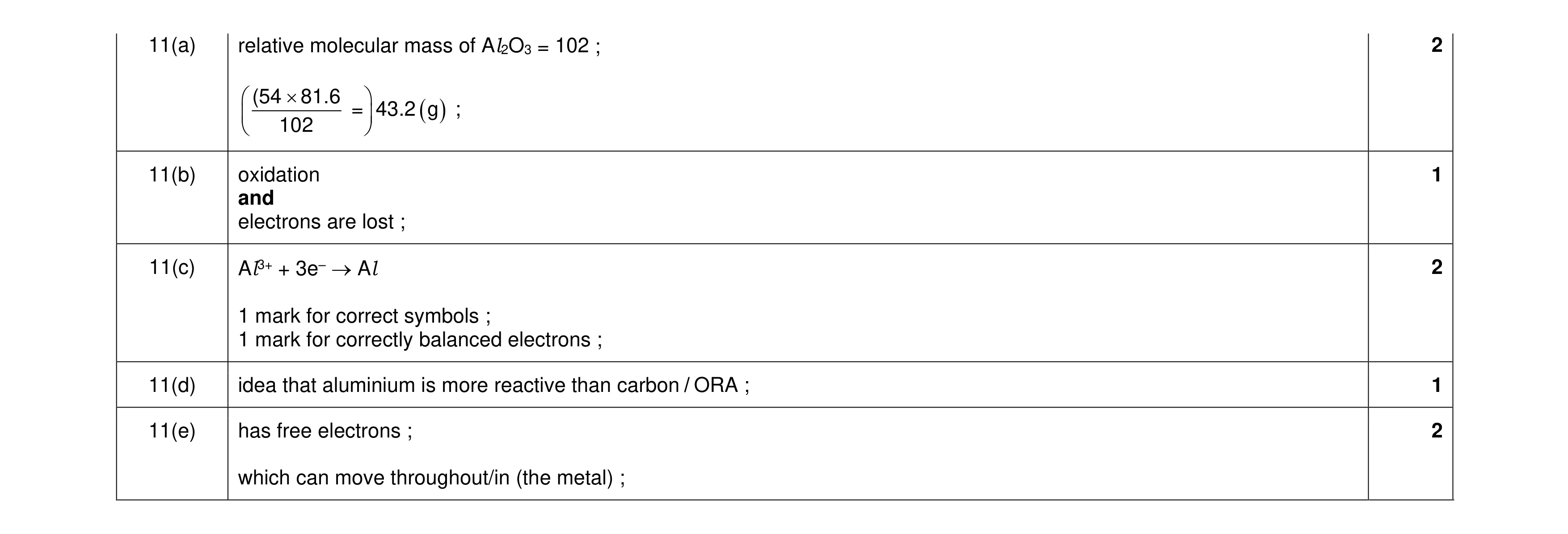 8
8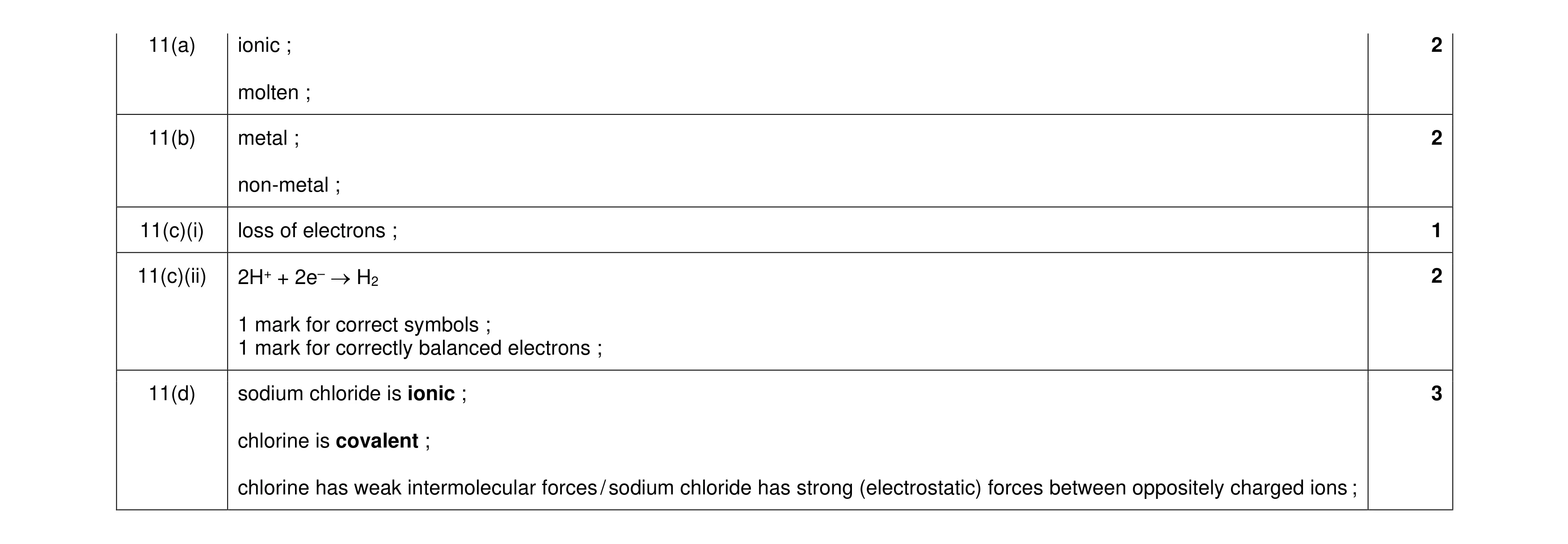 10
10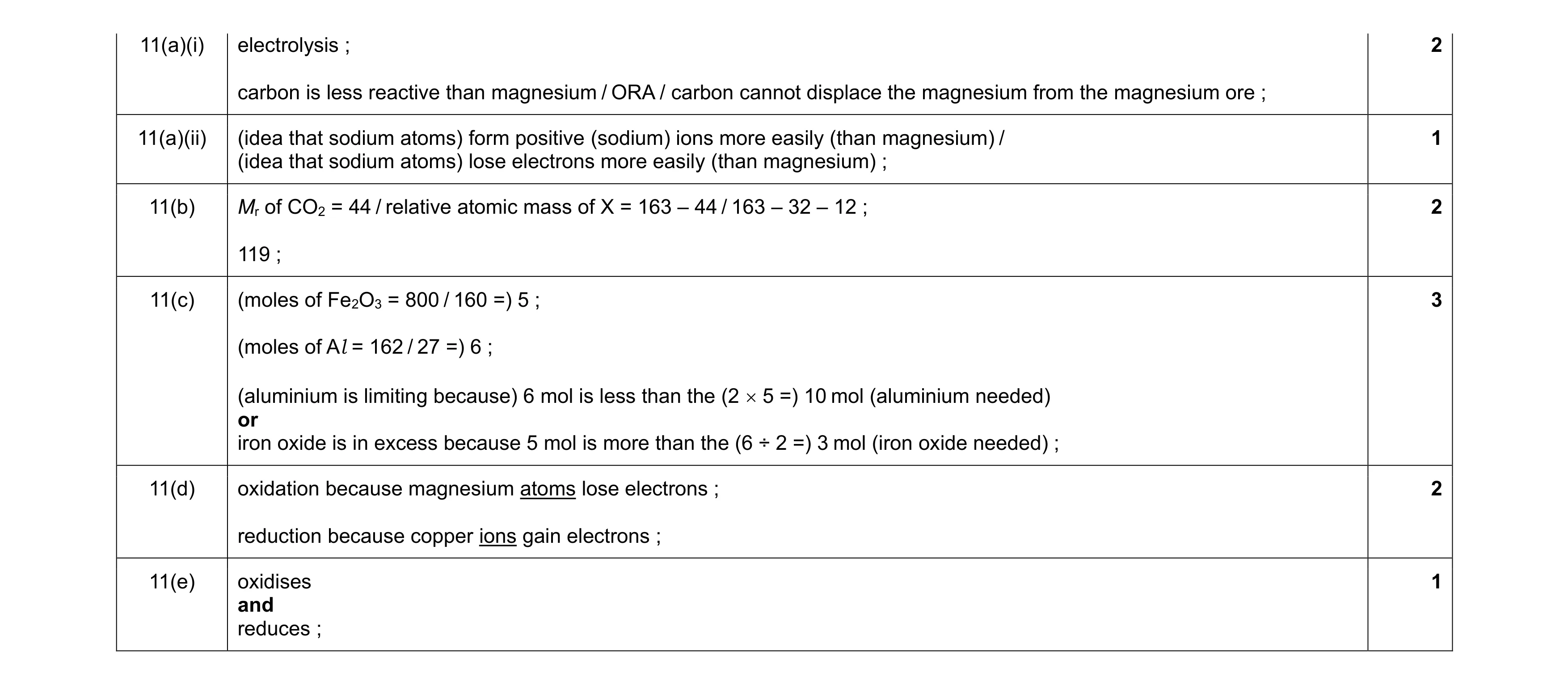 11
11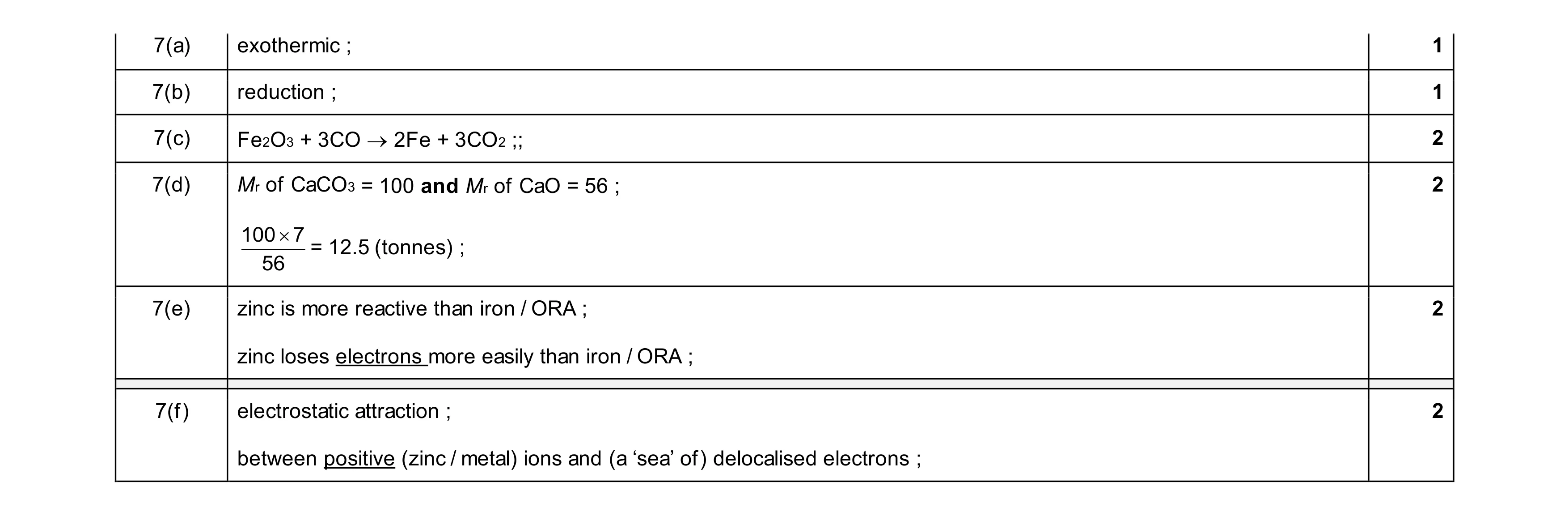 10
10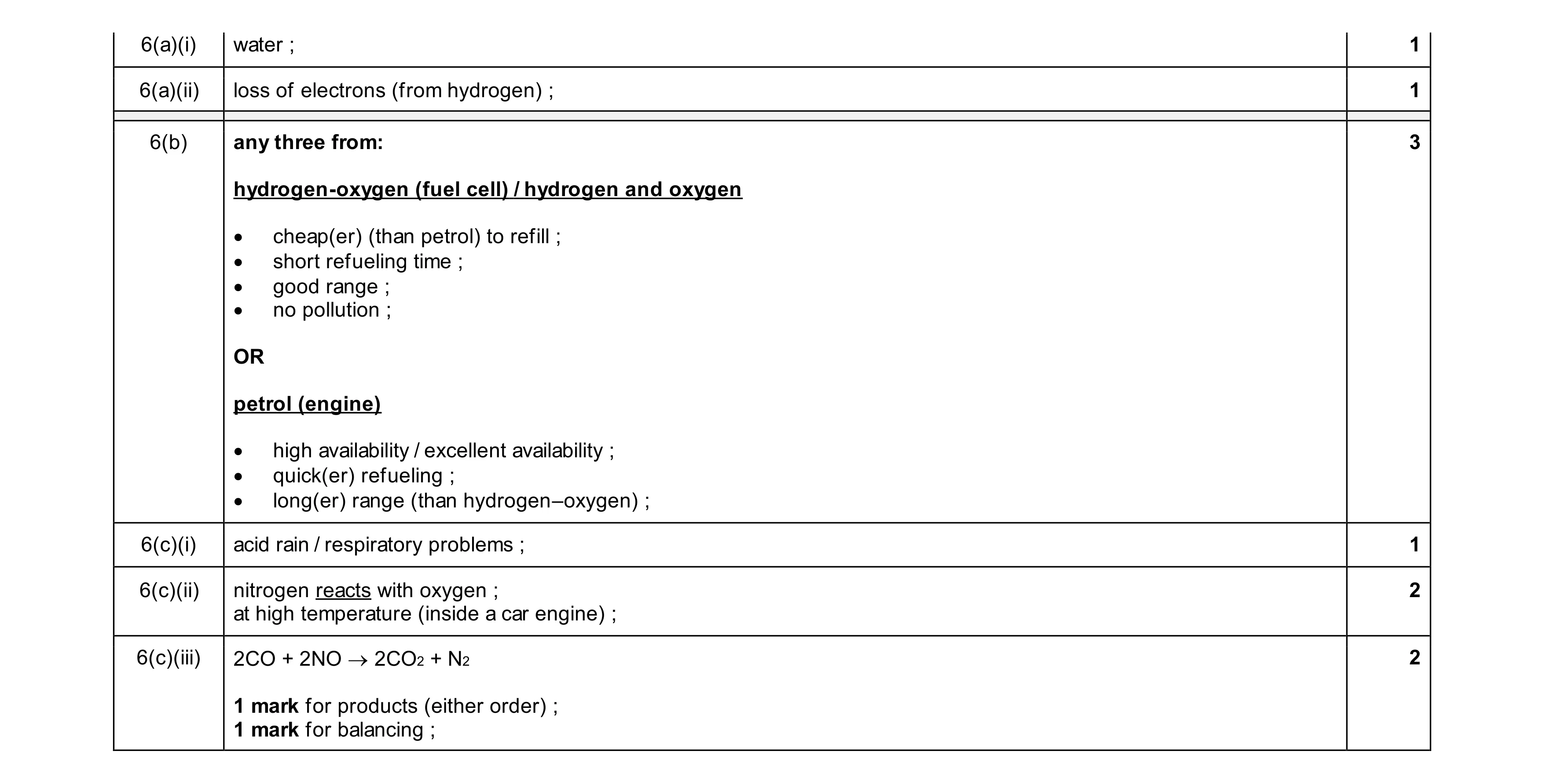 10
10