Cambridge IGCSE Science - Combined 0653 — 2021 May/June Paper 2 · Variant 3
0653/23/M/J/21 · 40 questions · 40 marks · ≈45 min
The question paper and its mark scheme, free to read here and free to download. This is Cambridge’s own paper, exactly as it was sat.
Question paper16 pages

Mark scheme3 pages
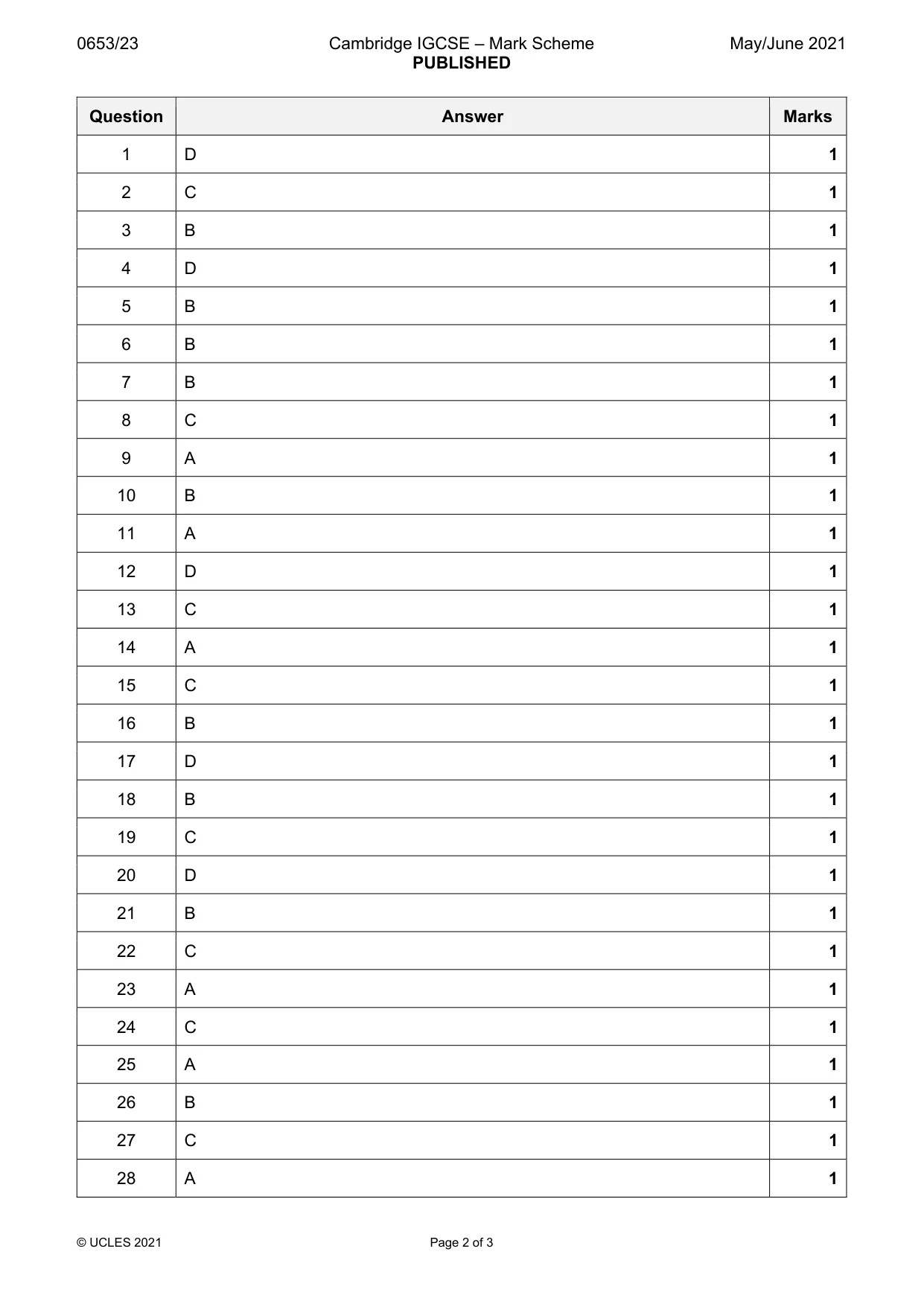
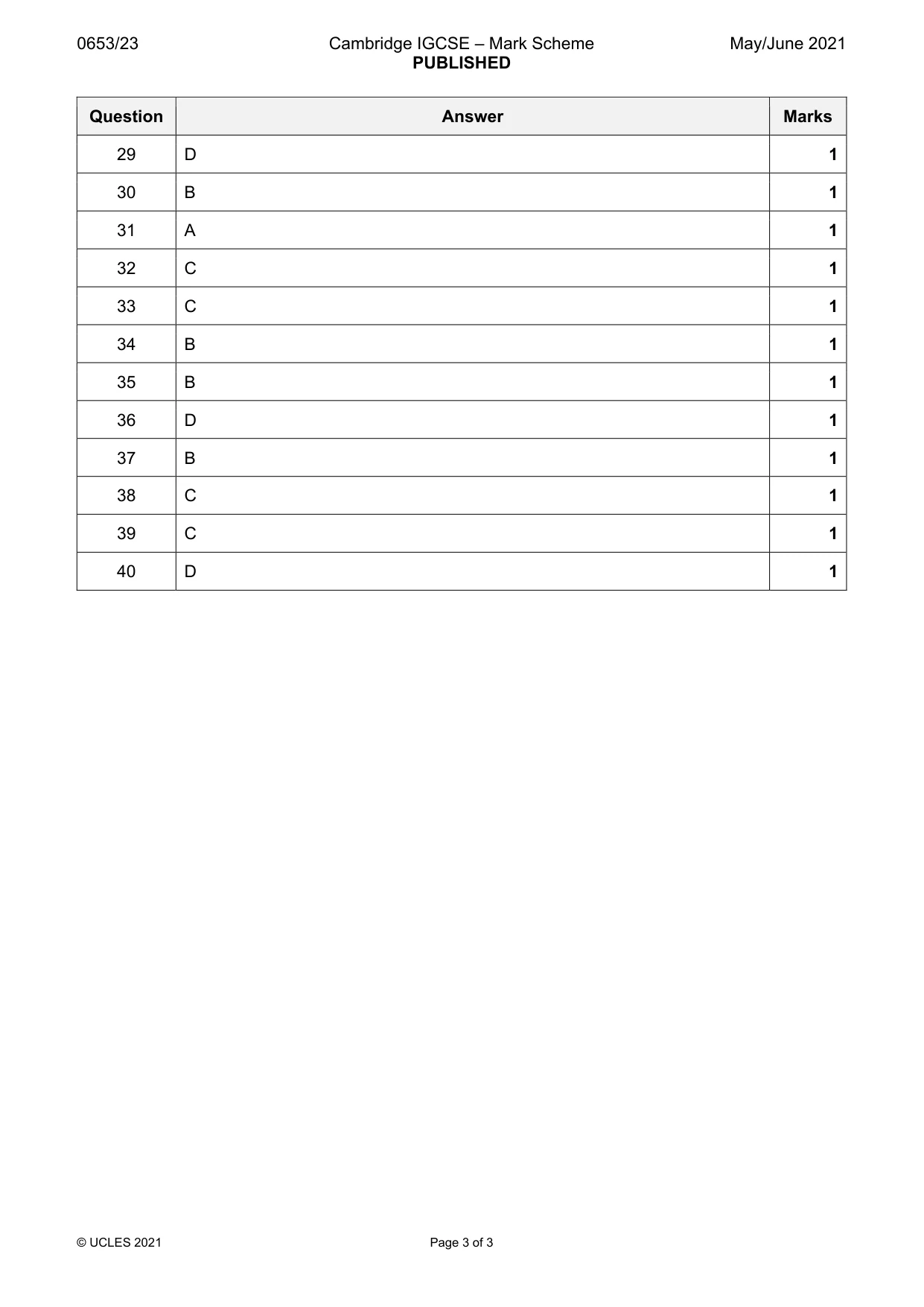
Answers below. Sit the paper first if you are practising.
Questions as text
Q1 · Which row links a specialised cell to its correct function?
1 Which row links a specialised cell to its correct function? specialised cell function A ciliated cell photosynthesis B palisade cell movement of mucus C red blood cell blood clotting D sperm cell reproduction
Mark scheme: D
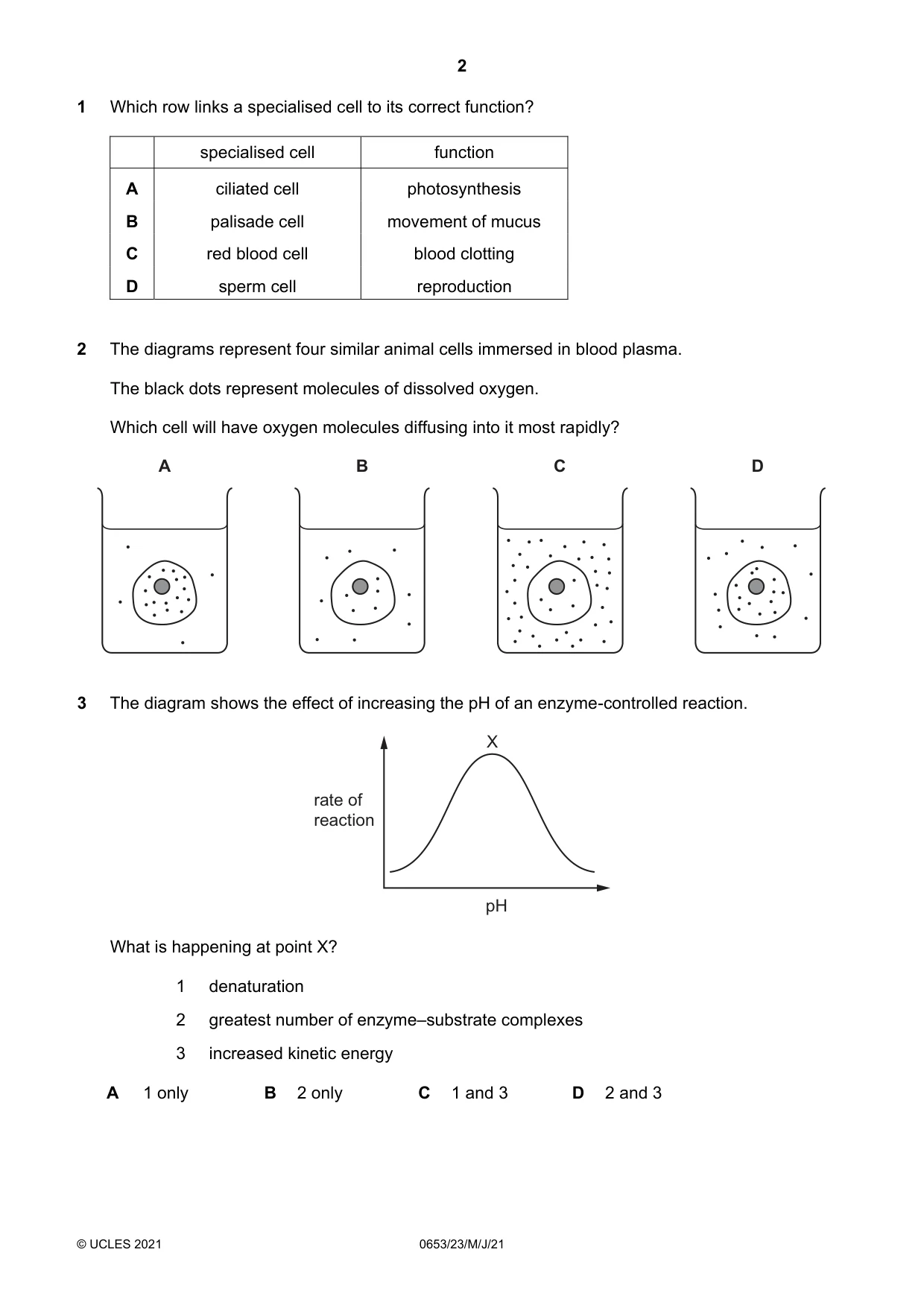
Q2 · The diagrams represent four similar animal cells immersed in blood plasma
2 The diagrams represent four similar animal cells immersed in blood plasma. The black dots represent molecules of dissolved oxygen. Which cell will have oxygen molecules diffusing into it most rapidly? A B C D
Mark scheme: C
Q3 · The diagram shows the effect of increasing the pH of an enzyme-controlled reaction
3 The diagram shows the effect of increasing the pH of an enzyme-controlled reaction. X rate of reaction pH What is happening at point X? 1 denaturation 2 greatest number of enzyme–substrate complexes 3 increased kinetic energy A 1 only B 2 only C 1 and 3 D 2 and 3
Mark scheme: B
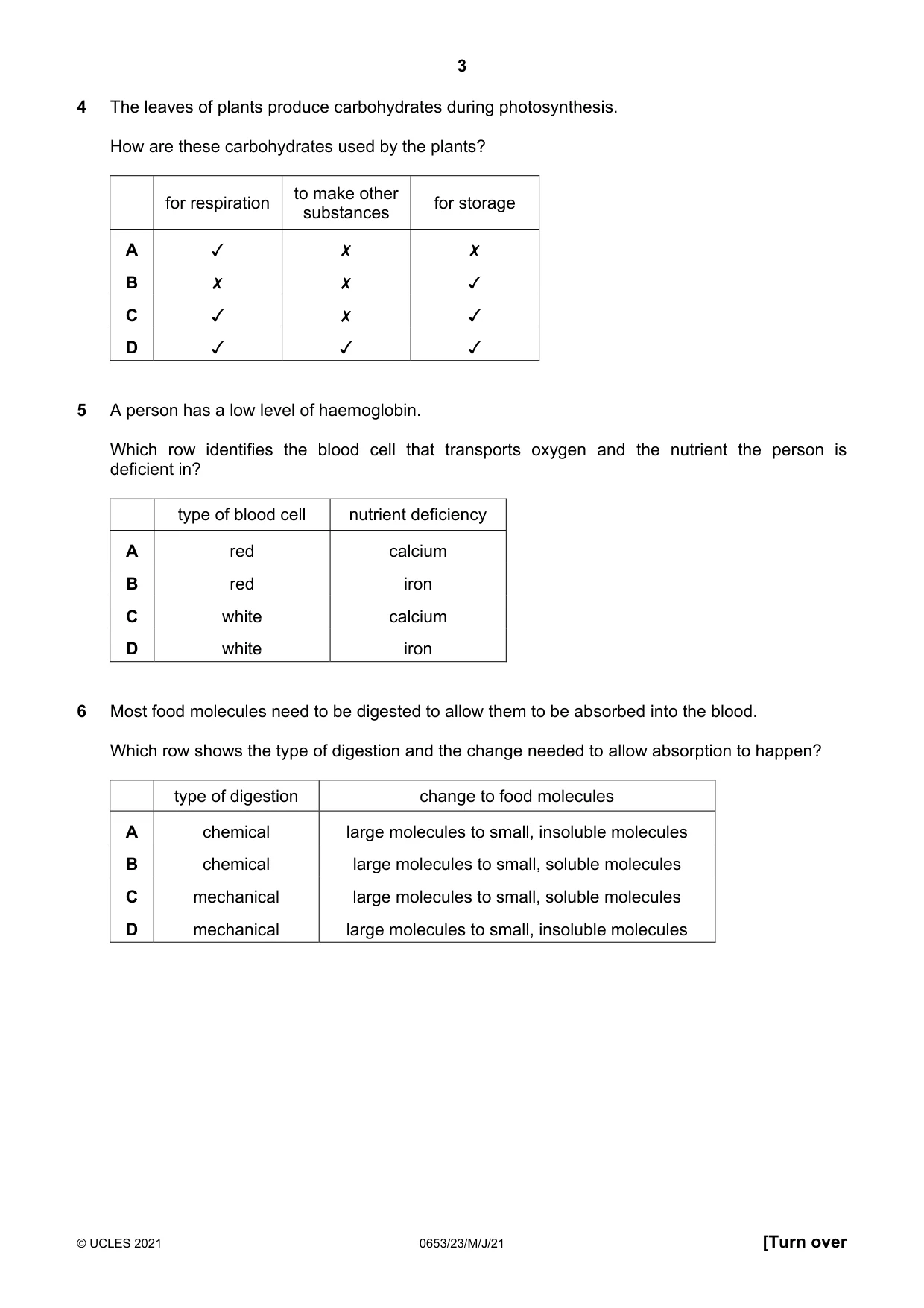
Q4 · The leaves of plants produce carbohydrates during photosynthesis
4 The leaves of plants produce carbohydrates during photosynthesis. How are these carbohydrates used by the plants? for respiration to make other for storage substances A Jv x x B x x Jv Cc v x JV D J Jv Jv
Mark scheme: D
Q5 · A person has a low level of haemoglobin
5 A person has a low level of haemoglobin. Which row identifies the blood cell that transports oxygen and the nutrient the person is deficient in? type of blood cell nutrient deficiency A red calcium B red iron C white calcium D white iron
Mark scheme: B
Q6 · Most food molecules need to be digested to allow them to be absorbed into the blood
6 Most food molecules need to be digested to allow them to be absorbed into the blood. Which row shows the type of digestion and the change needed to allow absorption to happen? type of digestion change to food molecules A chemical large molecules to small, insoluble molecules B chemical large molecules to small, soluble molecules C mechanical large molecules to small, soluble molecules D mechanical large molecules to small, insoluble molecules
Mark scheme: B
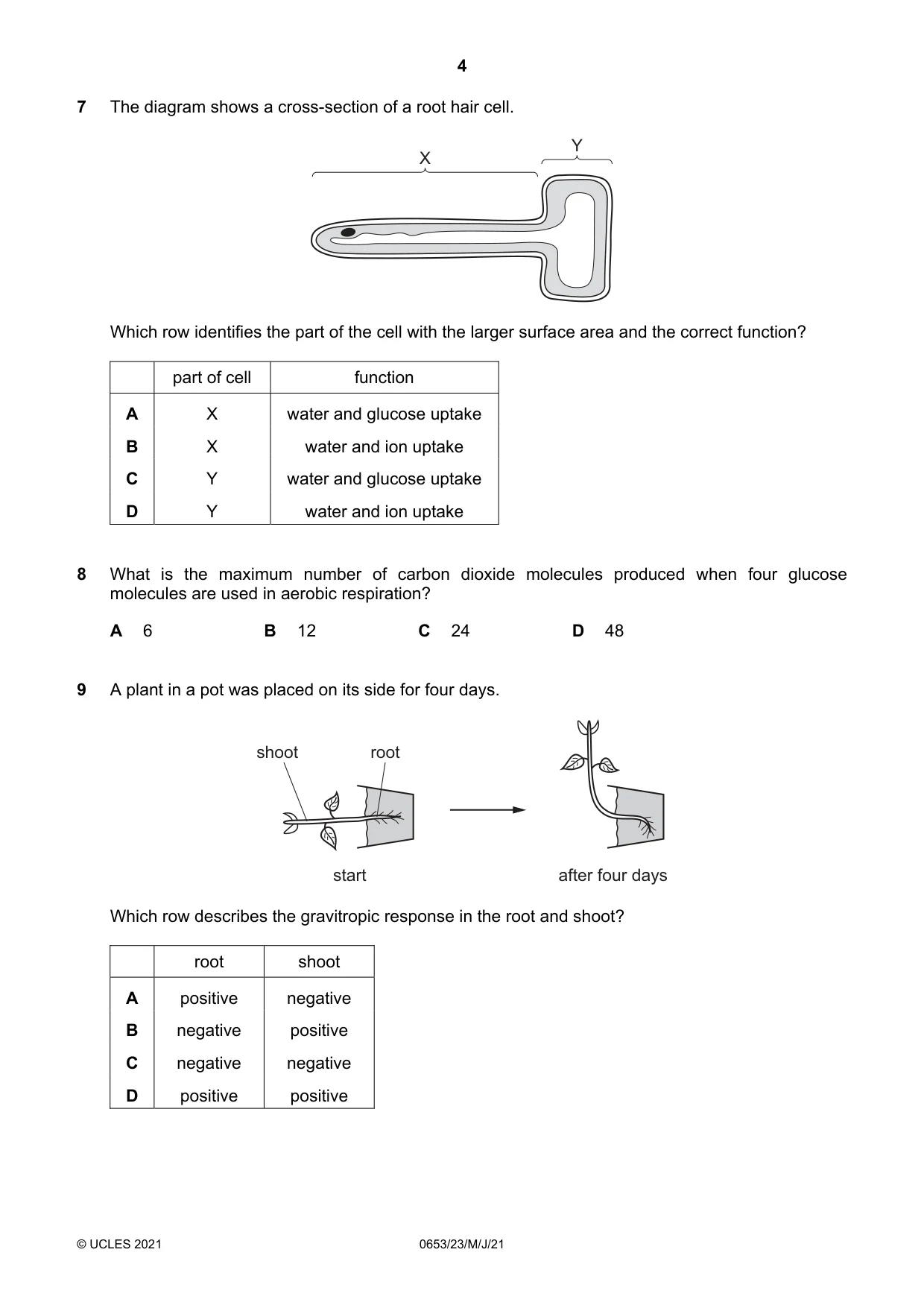
Q7 · The diagram shows a cross-section of a root hair cell
7 The diagram shows a cross-section of a root hair cell. Y X Which row identifies the part of the cell with the larger surface area and the correct function? part of cell function A X water and glucose uptake B X water and ion uptake C Y water and glucose uptake D Y water and ion uptake
Mark scheme: B
Q8 · What is the maximum number of carbon dioxide molecules produced when four glucose…
8 What is the maximum number of carbon dioxide molecules produced when four glucose molecules are used in aerobic respiration? A 6 B 12 C 24 D 48
Mark scheme: C
Q9 · A plant in a pot was placed on its side for four days
9 A plant in a pot was placed on its side for four days. shoot root start after four days Which row describes the gravitropic response in the root and shoot? root shoot A positive negative B negative positive C negative negative D positive positive
Mark scheme: A
Q10 · During human reproduction an egg fuses with a sperm
10 During human reproduction an egg fuses with a sperm. Sometimes the zygote splits into two and produces twins. Which row describes the formation of these twins? original zygote produced by twins A asexual reproduction genetically identical B sexual reproduction genetically identical C asexual reproduction genetically different D sexual reproduction genetically different
Mark scheme: B
Q11 · The diagram shows a wind-pollinated flower
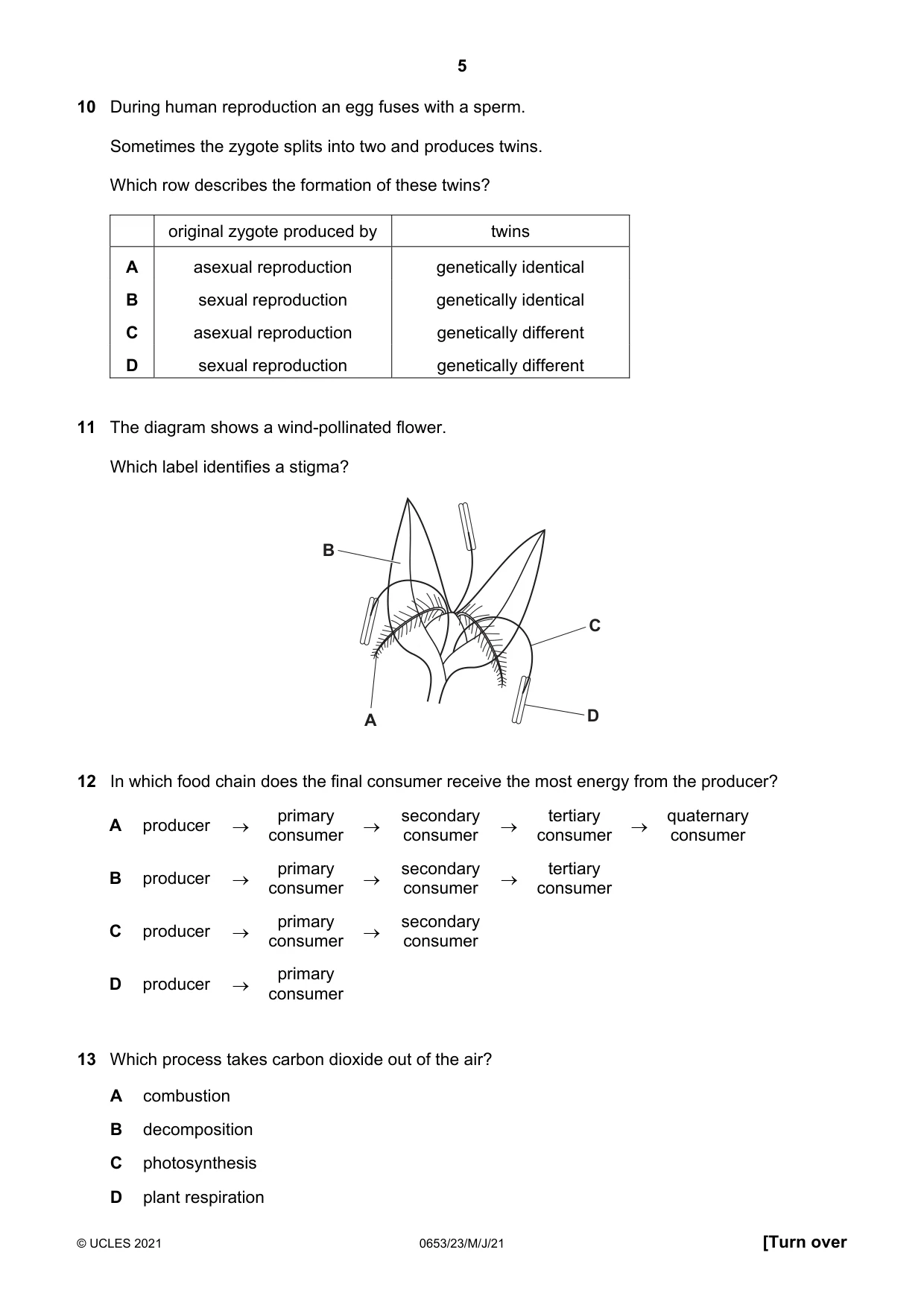
11 The diagram shows a wind-pollinated flower. Which label identifies a stigma? B C A D
Mark scheme: A
Q12 · In which food chain does the final consumer receive the most energy from the producer?
12 In which food chain does the final consumer receive the most energy from the producer? primary secondary tertiary quaternary A producer consumer consumer consumer consumer primary secondary tertiary B producer consumer consumer consumer primary secondary C producer consumer consumer primary D producer consumer
Mark scheme: D
Q13 · Which process takes carbon dioxide out of the air?
13 Which process takes carbon dioxide out of the air? A combustion B decomposition C photosynthesis D plant respiration
Mark scheme: C
Q14 · The melting point and boiling point of oxygen and nitrogen are shown
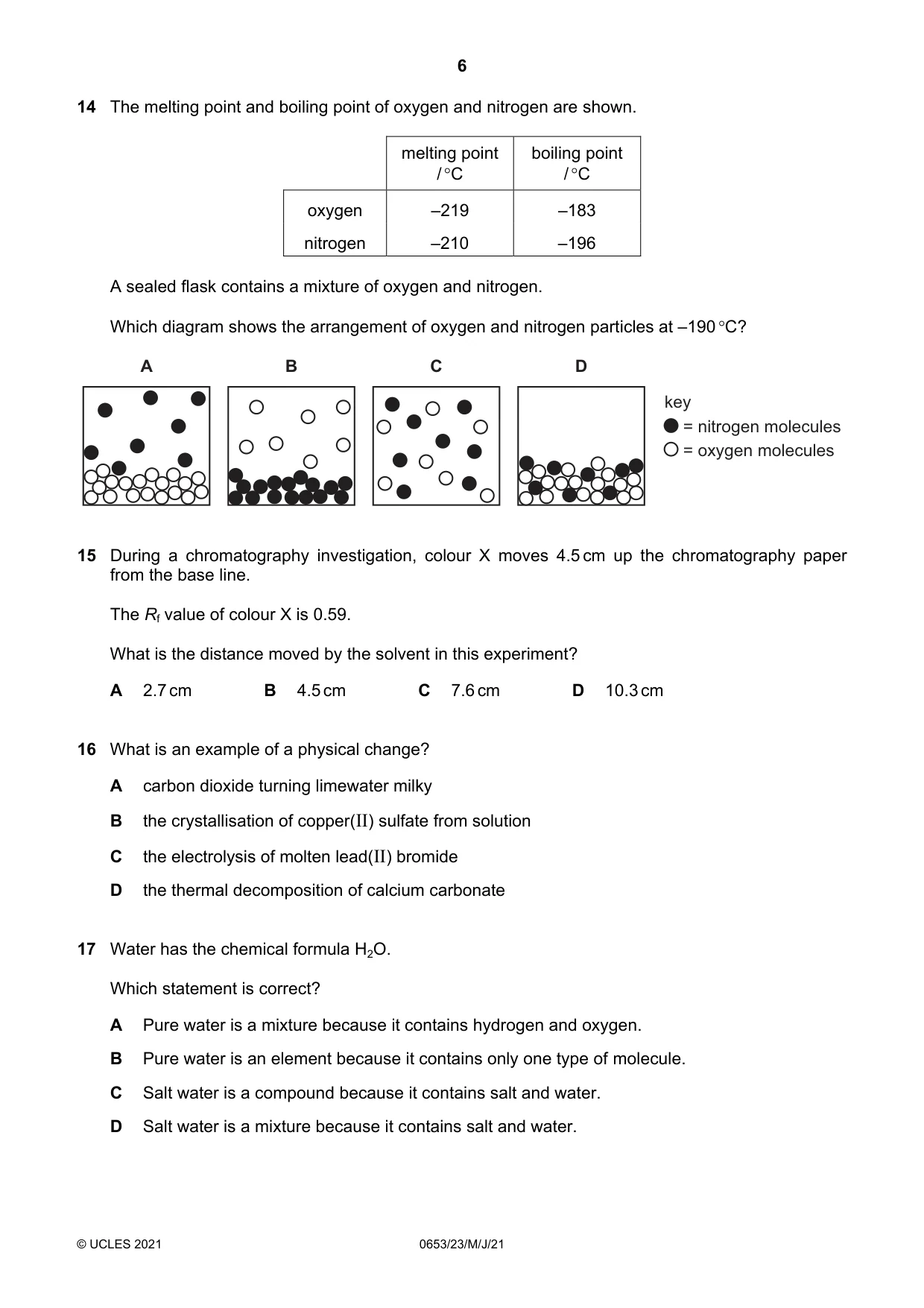
14 The melting point and boiling point of oxygen and nitrogen are shown. melting point boiling point / C / C oxygen –219 –183 nitrogen –210 –196 A sealed flask contains a mixture of oxygen and nitrogen. Which diagram shows the arrangement of oxygen and nitrogen particles at –190 C? A B C D key = nitrogen molecules = oxygen molecules
Mark scheme: A
Q15 · During a chromatography investigation, colour X moves 4.5 cm up the chromatography paper…
15 During a chromatography investigation, colour X moves 4.5 cm up the chromatography paper from the base line. The Rf value of colour X is 0.59. What is the distance moved by the solvent in this experiment? A 2.7 cm B 4.5 cm C 7.6 cm D 10.3 cm
Mark scheme: C
Q16 · What is an example of a physical change?
16 What is an example of a physical change? A carbon dioxide turning limewater milky B the crystallisation of copper(II) sulfate from solution C the electrolysis of molten lead(II) bromide D the thermal decomposition of calcium carbonate
Mark scheme: B
Q17 · Water has the chemical formula H2O
17 Water has the chemical formula H2O. Which statement is correct? A Pure water is a mixture because it contains hydrogen and oxygen. B Pure water is an element because it contains only one type of molecule. C Salt water is a compound because it contains salt and water. D Salt water is a mixture because it contains salt and water.
Mark scheme: D
Q18 · When water boils it changes from a liquid to a gas
18 When water boils it changes from a liquid to a gas. Which statement about this process is correct? A It is endothermic because it requires energy to break covalent bonds. B It is endothermic because energy is needed to break attractive forces between molecules. C It is exothermic because it requires energy to break attractive forces between atoms. D It is exothermic because energy is given out when bonds form.
Mark scheme: B
Q19 · In the reaction between an acid and a metal, the rate of reaction decreases as the…
19 In the reaction between an acid and a metal, the rate of reaction decreases as the reaction proceeds. A student suggests three reasons why the rate of this reaction decreases. 1 The concentration of the acid decreases as it gets used up. 2 The energy needed to break bonds is used up as the products form. 3 The surface area of the metal decreases as it gets smaller. Which reasons are correct? A 1, 2 and 3 B 1 and 2 only C 1 and 3 only D 2 and 3 only
Mark scheme: C
Q20 · Iron is extracted from its oxide using carbon monoxide
20 Iron is extracted from its oxide using carbon monoxide. The equation is shown. Fe2O3 + 3CO 2Fe + 3CO2 Which row identifies the reducing agent and explains how it acts as a reducing agent? reducing agent explanation A Fe2O3 it loses mass to become Fe B Fe2O3 it loses oxygen to become Fe C CO it gains mass to become CO2 D CO it removes oxygen from Fe2O3
Mark scheme: D
Q21 · Substances that react together to make zinc salts are listed
21 Substances that react together to make zinc salts are listed. 1 zinc carbonate and hydrochloric acid 2 zinc oxide and sulfuric acid 3 zinc and nitric acid 4 zinc hydroxide and hydrochloric acid Which substances produce water when they react? A 1, 2 and 3 B 1, 2 and 4 C 1 and 2 only D 3 and 4
Mark scheme: B
More questions on The characteristic properties of acids and bases
Q22 · Which two substances form a white precipitate when they are mixed?
22 Which two substances form a white precipitate when they are mixed? A barium chloride and hydrochloric acid B barium chloride and nitric acid C silver nitrate and hydrochloric acid D silver nitrate and nitric acid
Mark scheme: C
Q23 · Aqueous chlorine is added to aqueous sodium bromide
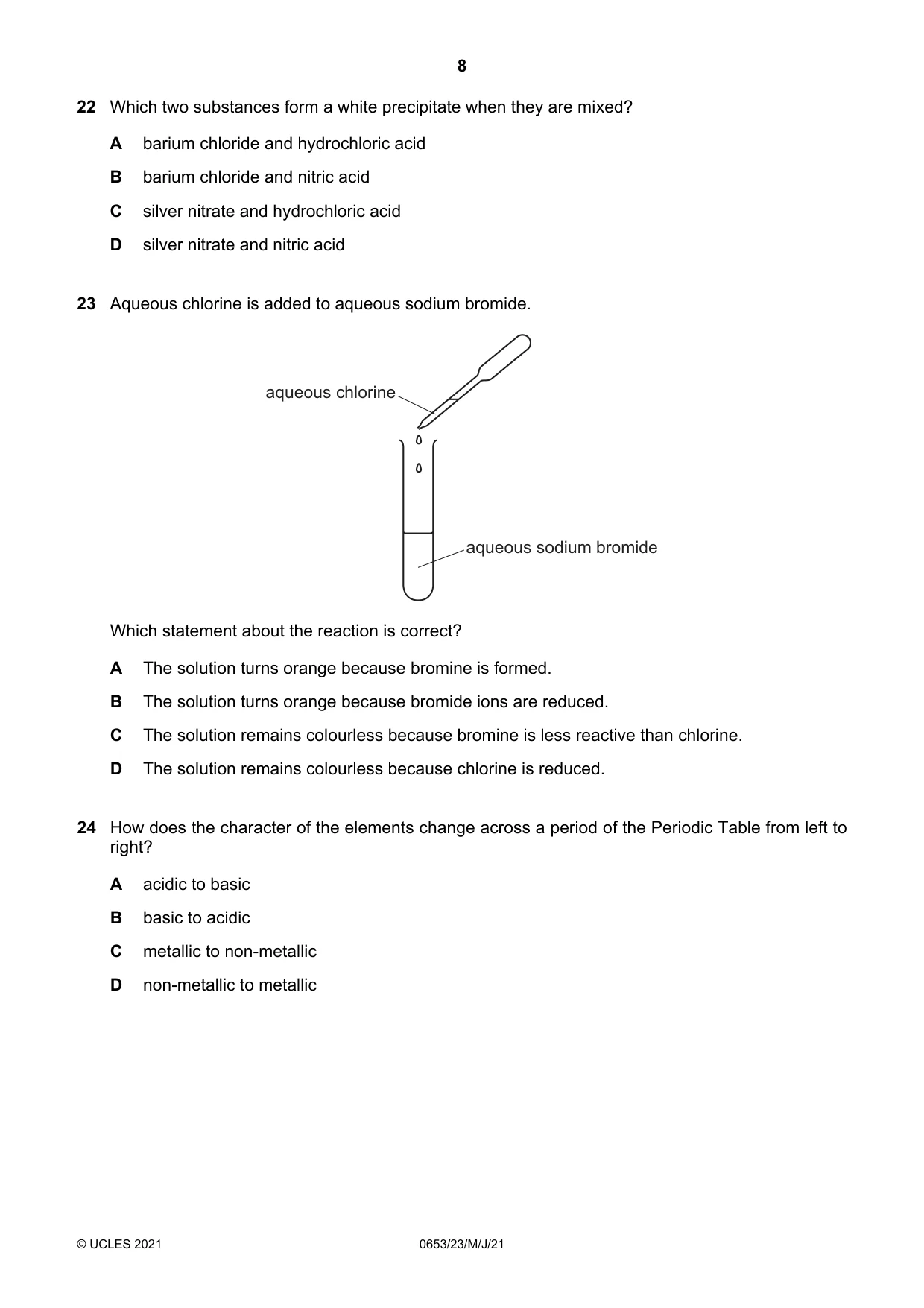
23 Aqueous chlorine is added to aqueous sodium bromide. aqueous chlorine aqueous sodium bromide Which statement about the reaction is correct? A The solution turns orange because bromine is formed. B The solution turns orange because bromide ions are reduced. C The solution remains colourless because bromine is less reactive than chlorine. D The solution remains colourless because chlorine is reduced.
Mark scheme: A
Q24 · How does the character of the elements change across a period of the Periodic Table from…
24 How does the character of the elements change across a period of the Periodic Table from left to right? A acidic to basic B basic to acidic C metallic to non-metallic D non-metallic to metallic
Mark scheme: C
Q25 · Four metals, W, X, Y and Z, are added to aqueous solutions of their salts
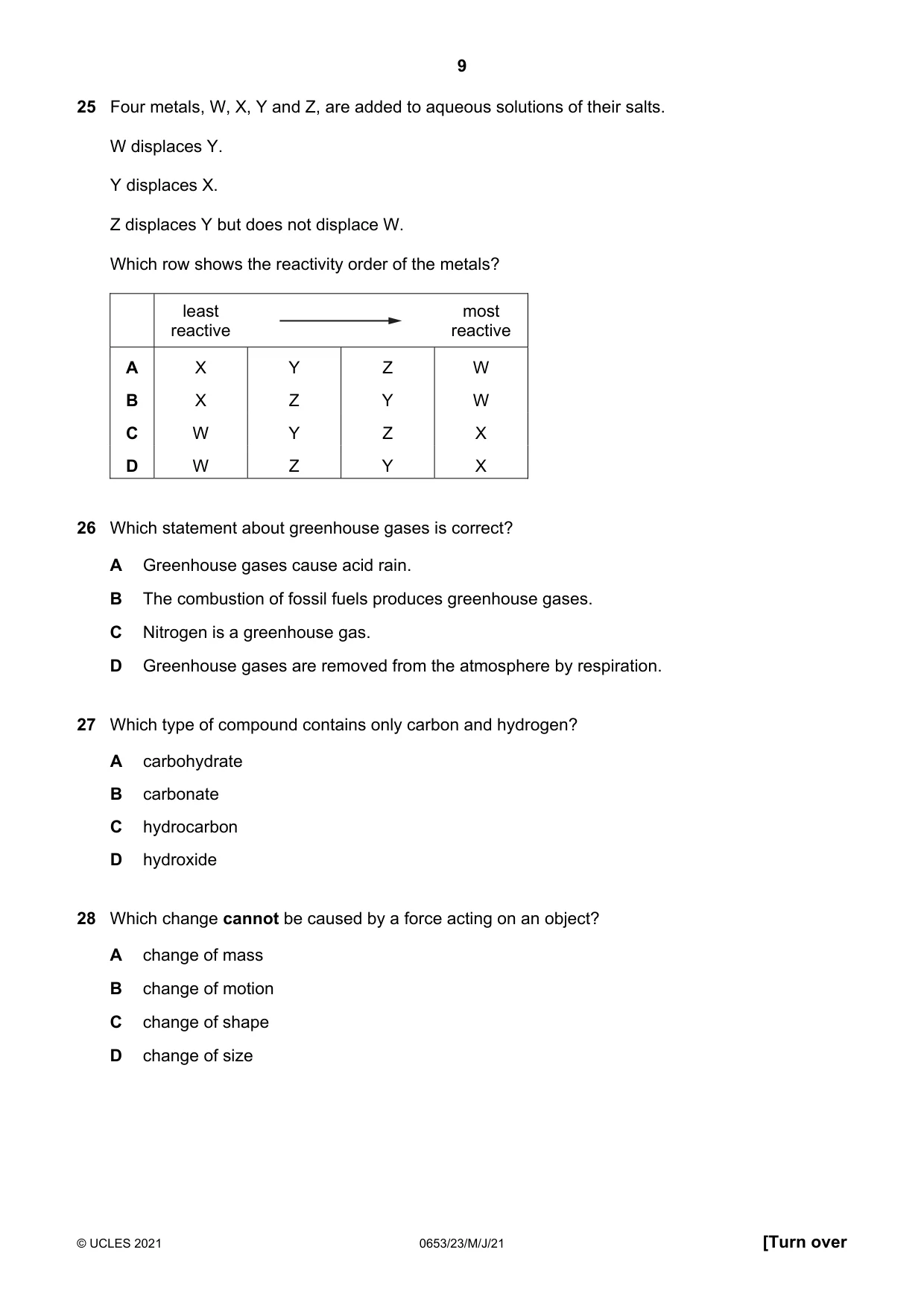
25 Four metals, W, X, Y and Z, are added to aqueous solutions of their salts. W displaces Y. Y displaces X. Z displaces Y but does not displace W. Which row shows the reactivity order of the metals? least most reactive reactive A X Y Z W B X Z Y W C W Y Z X D W Z Y X
Mark scheme: A
Q26 · Which statement about greenhouse gases is correct?
26 Which statement about greenhouse gases is correct? A Greenhouse gases cause acid rain. B The combustion of fossil fuels produces greenhouse gases. C Nitrogen is a greenhouse gas. D Greenhouse gases are removed from the atmosphere by respiration.
Mark scheme: B
Q27 · Which type of compound contains only carbon and hydrogen?
27 Which type of compound contains only carbon and hydrogen? A carbohydrate B carbonate C hydrocarbon D hydroxide
Mark scheme: C
Q28 · Which change cannot be caused by a force acting on an object?
28 Which change cannot be caused by a force acting on an object? A change of mass B change of motion C change of shape D change of size
Mark scheme: A
Question 29
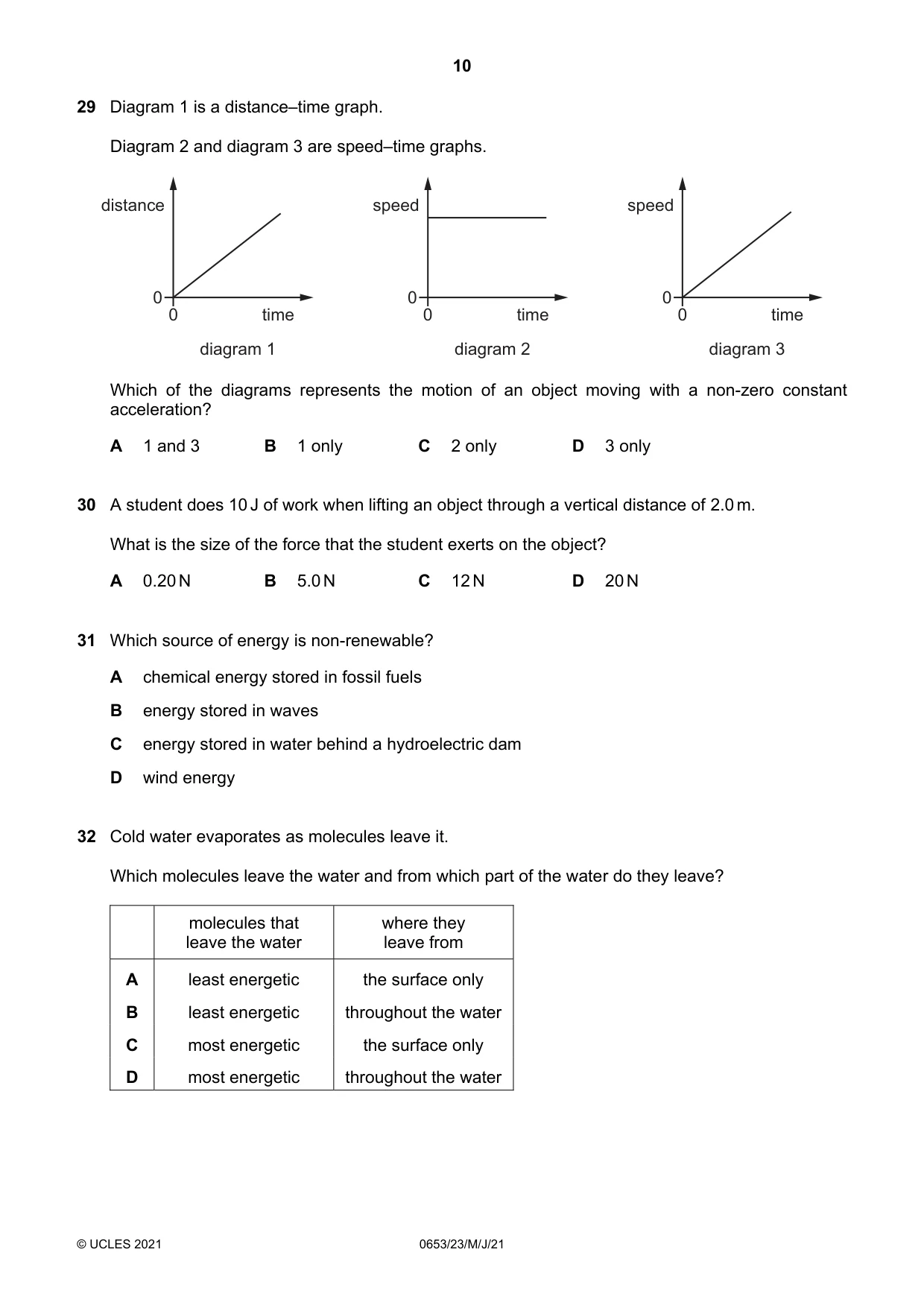
29 Diagram 1 is a distance–time graph. Diagram 2 and diagram 3 are speed–time graphs. distance speed speed 0 0 0 0 time 0 time 0 time diagram 1 diagram 2 diagram 3 Which of the diagrams represents the motion of an object moving with a non-zero constant acceleration? A 1 and 3 B 1 only C 2 only D 3 only
Mark scheme: D
Q30 · A student does 10 J of work when lifting an object through a vertical distance of 2.0 m
30 A student does 10 J of work when lifting an object through a vertical distance of 2.0 m. What is the size of the force that the student exerts on the object? A 0.20 N B 5.0 N C 12 N D 20 N
Mark scheme: B
Q31 · Which source of energy is non-renewable?
31 Which source of energy is non-renewable? A chemical energy stored in fossil fuels B energy stored in waves C energy stored in water behind a hydroelectric dam D wind energy
Mark scheme: A
Q32 · Cold water evaporates as molecules leave it
32 Cold water evaporates as molecules leave it. Which molecules leave the water and from which part of the water do they leave? molecules that where they leave the water leave from A least energetic the surface only B least energetic throughout the water C most energetic the surface only D most energetic throughout the water
Mark scheme: C
Q33 · A heater creates a convection current in a room
33 A heater creates a convection current in a room. What happens to air as it is heated? A It contracts and its density decreases. B It contracts and its density increases. C It expands and its density decreases. D It expands and its density increases.
Mark scheme: C
Q34 · Which row gives an example of a transverse wave and a longitudinal wave?
34 Which row gives an example of a transverse wave and a longitudinal wave? transverse longitudinal A light wave radio wave B radio wave sound wave C sound wave light wave D sound wave radio wave
Mark scheme: B
Q35 · Which diagram shows a converging lens being used to produce the largest virtual image?
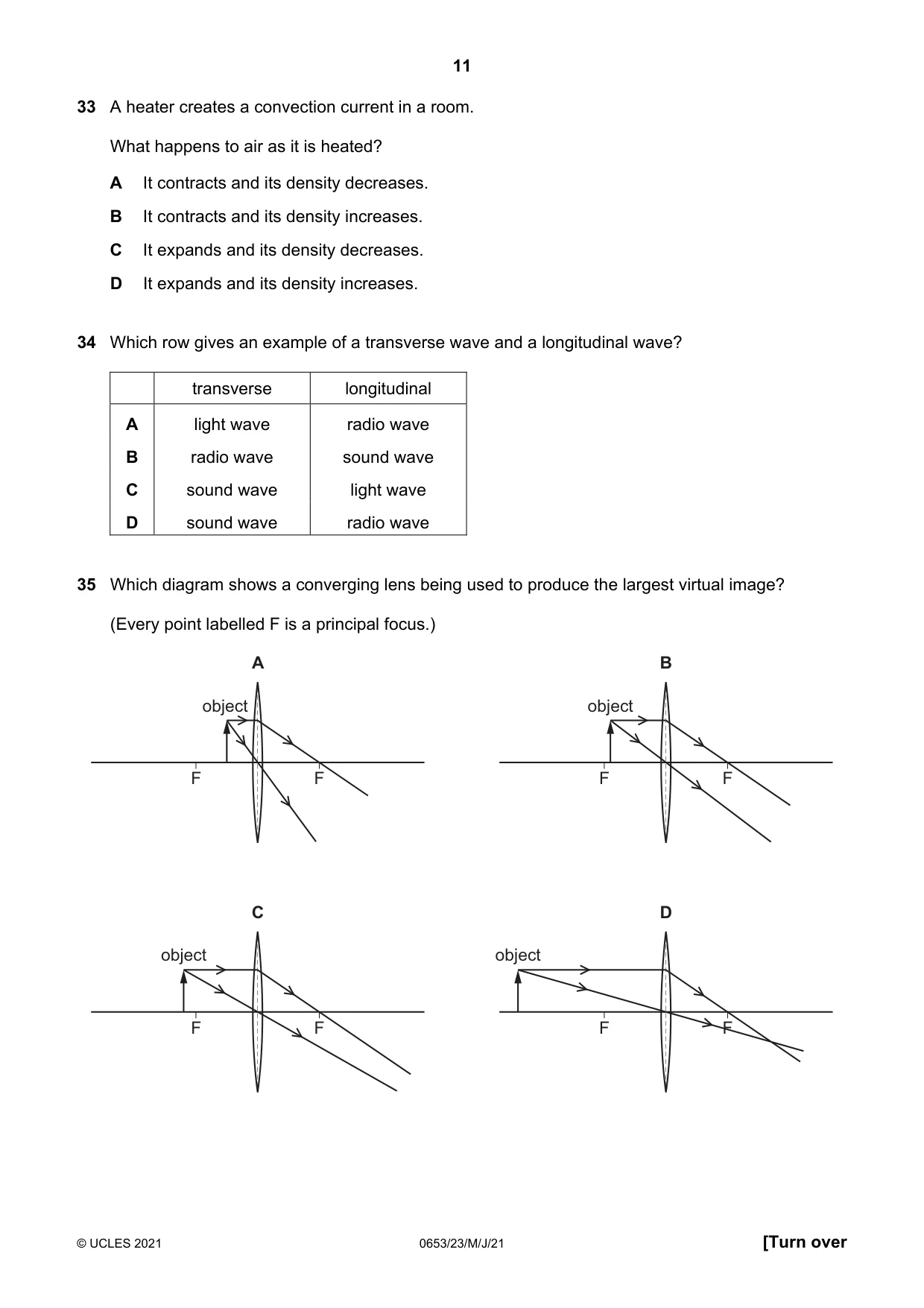
35 Which diagram shows a converging lens being used to produce the largest virtual image? (Every point labelled F is a principal focus.) A B object object F F F F C D object object F F F F
Mark scheme: B
Q36 · The speed of sound in air is approximately 330 m / s
36 The speed of sound in air is approximately 330 m / s. The speed of sound in water is approximately 1500 m / s. What is a possible speed of sound in solid iron? A 120 m / s B 330 m / s C 1200 m / s D 5100 m / s
Mark scheme: D
Q37 · The diagram represents a circuit that includes a battery, an ammeter, a voltmeter and a…
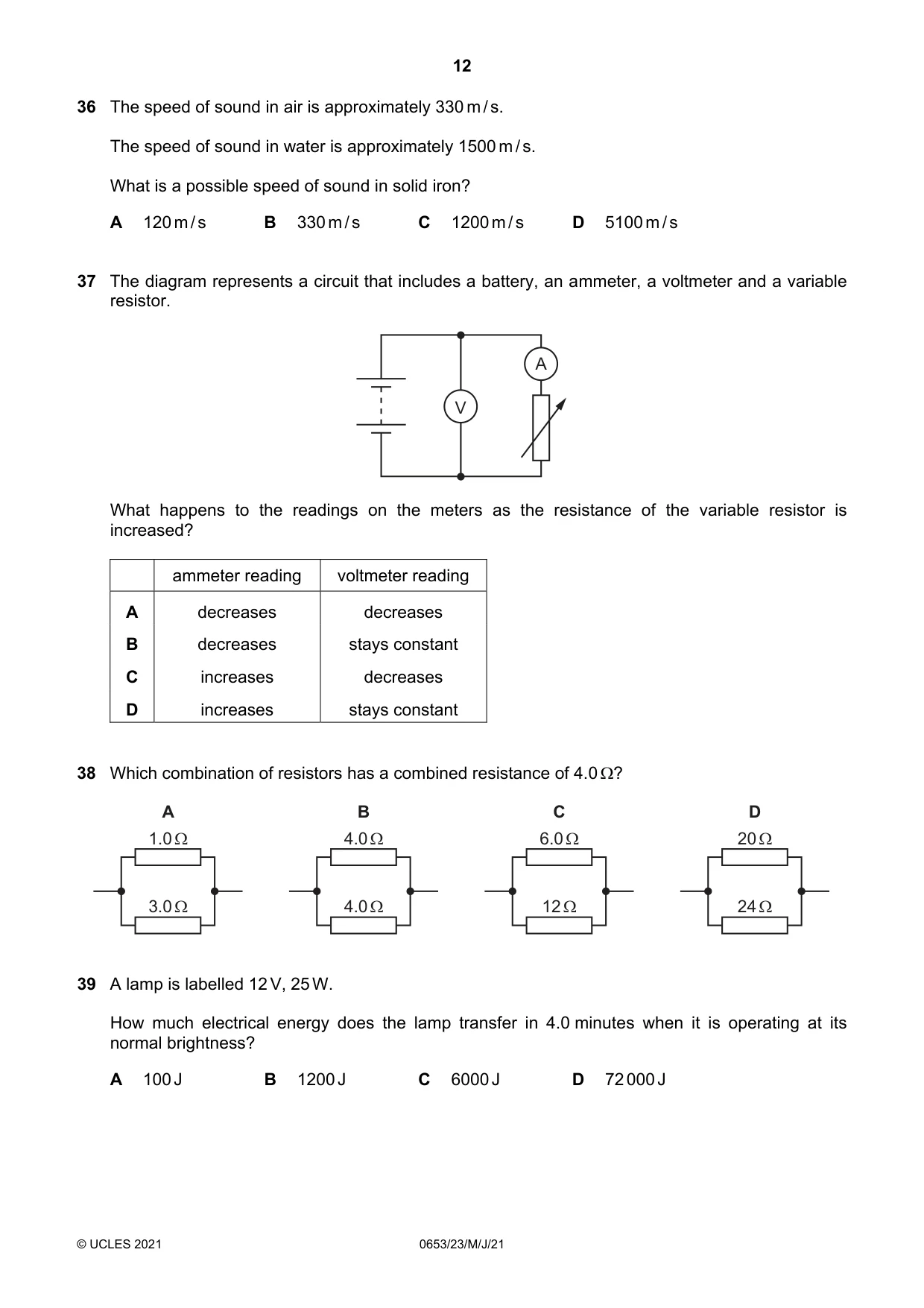
37 The diagram represents a circuit that includes a battery, an ammeter, a voltmeter and a variable resistor. A V What happens to the readings on the meters as the resistance of the variable resistor is increased? ammeter reading voltmeter reading A decreases decreases B decreases stays constant C increases decreases D increases stays constant
Mark scheme: B
Q38 · Which combination of resistors has a combined resistance of 4.00?
38 Which combination of resistors has a combined resistance of 4.00? A B Cc D 1.00 4.00 6.0Q 200 pe pe |
Mark scheme: C
Q39 · A lamp is labelled 12 V, 25 W
39 A lamp is labelled 12 V, 25 W. How much electrical energy does the lamp transfer in 4.0 minutes when it is operating at its normal brightness? A 100 J B 1200 J C 6000 J D 72 000 J
Mark scheme: C
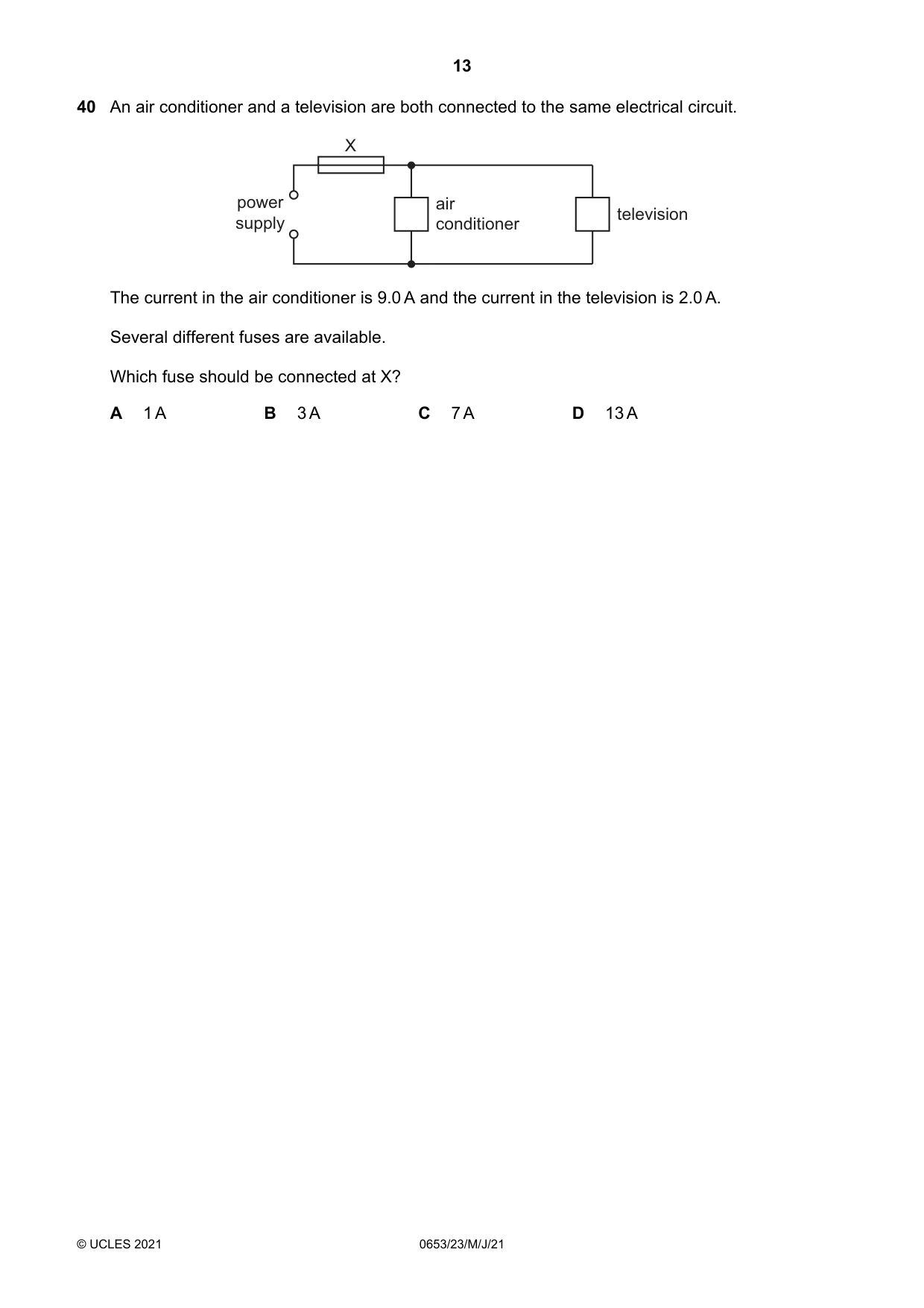
Q40 · An air conditioner and a television are both connected to the same electrical circuit
40 An air conditioner and a television are both connected to the same electrical circuit. X power air television supply conditioner The current in the air conditioner is 9.0 A and the current in the television is 2.0 A. Several different fuses are available. Which fuse should be connected at X? A 1 A B 3 A C 7 A D 13 A
Mark scheme: D
What was in this paper
The subtopics covered by these 40 questions, and how many questions each got. Open one in a new tab to see every Cambridge question on it.
2Energy, work and power2Air quality and climate1Arrangement of elements1Blood1Carbon cycle1Cell structure1Characteristics of living organisms1Chromatography1Diffusion1Digestion1Electrical quantities1Electrical safety1Elements, compounds and mixtures1Enzymes1Exothermic and endothermic reactions1Food chains and food webs1Forces1General properties of waves1Group VII properties1Identification of ions and gases1Kinetic particle model of matter1Light1Motion1Photosynthesis1Physical and chemical changes1Rate of reaction1Reactivity series1Redox1Respiration1Sexual reproduction in humans1Sexual reproduction in plants1Solids, liquids and gases1Sound1Terminology1The characteristic properties of acids and bases1Transfer of thermal energy1Water uptake1What you needed in this session
Cambridge’s own grade thresholds for 2021 May/June, Paper 2 · Variant 3. A higher threshold means an easier paper — the bar moves with how the cohort did.