Cambridge IGCSE Science - Combined 0653 — 2021 Oct/Nov Paper 2 · Variant 2
0653/22/O/N/21 · 40 questions · 40 marks · ≈45 min
The question paper and its mark scheme, free to read here and free to download. This is Cambridge’s own paper, exactly as it was sat.
Question paper16 pages
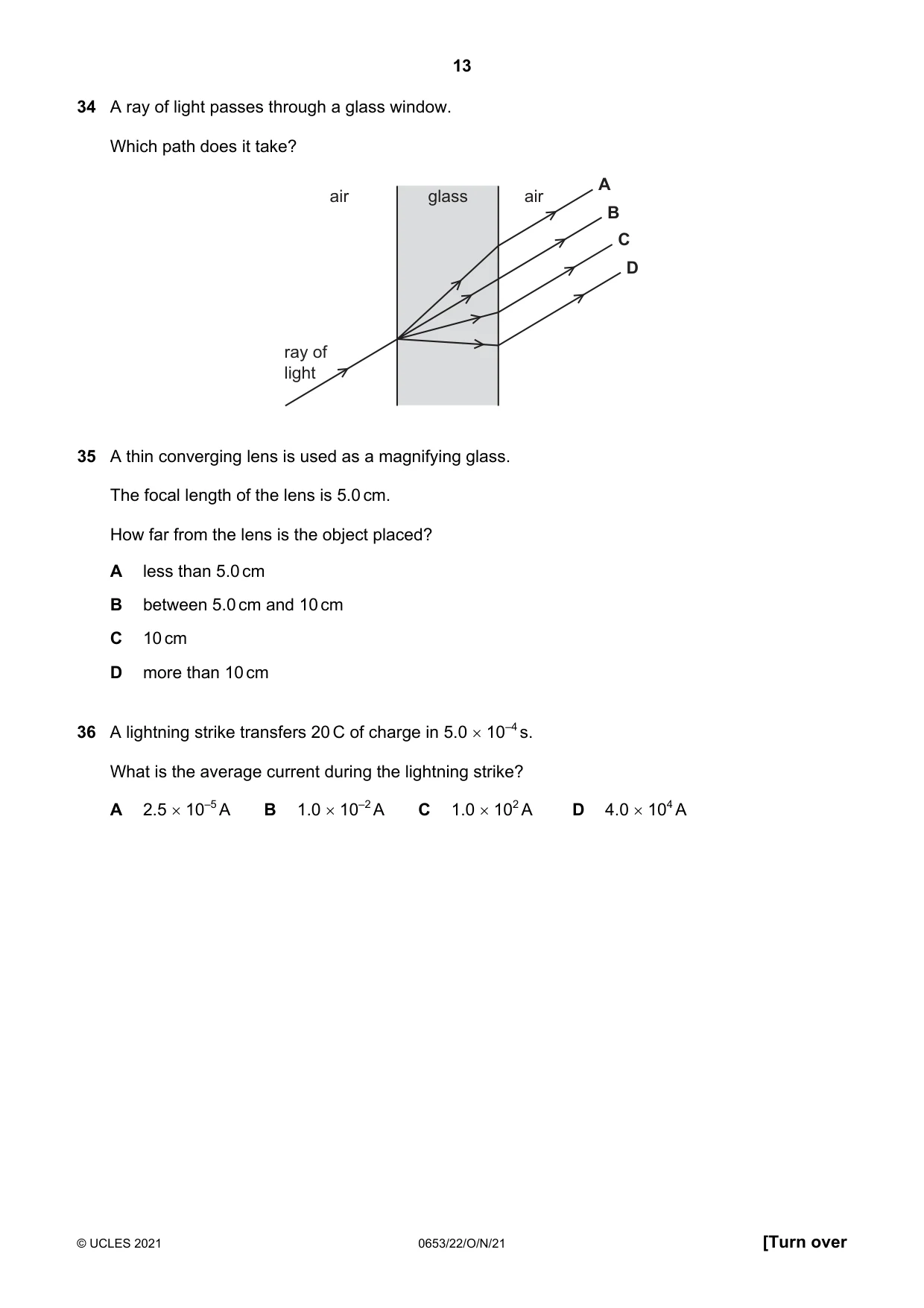
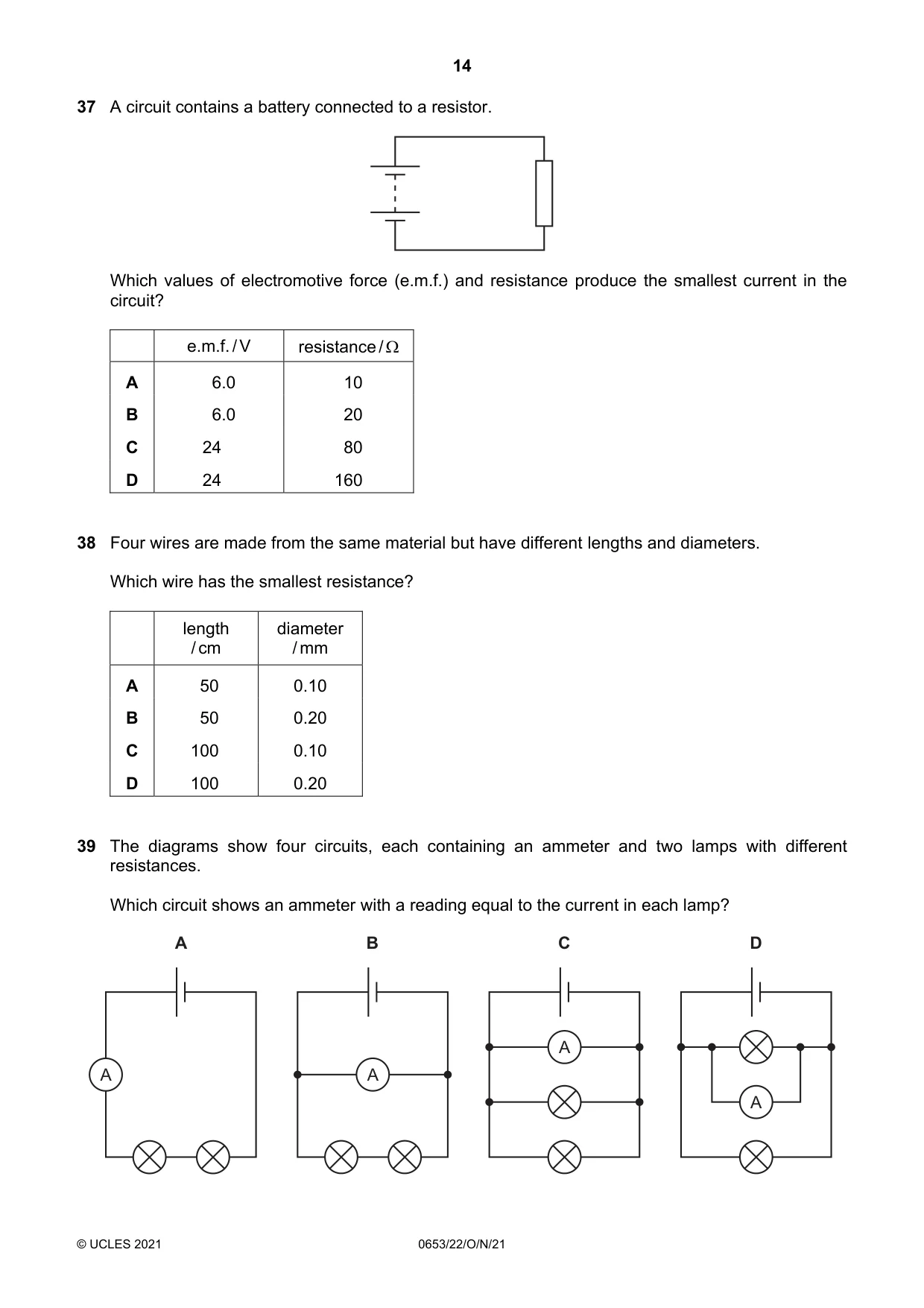
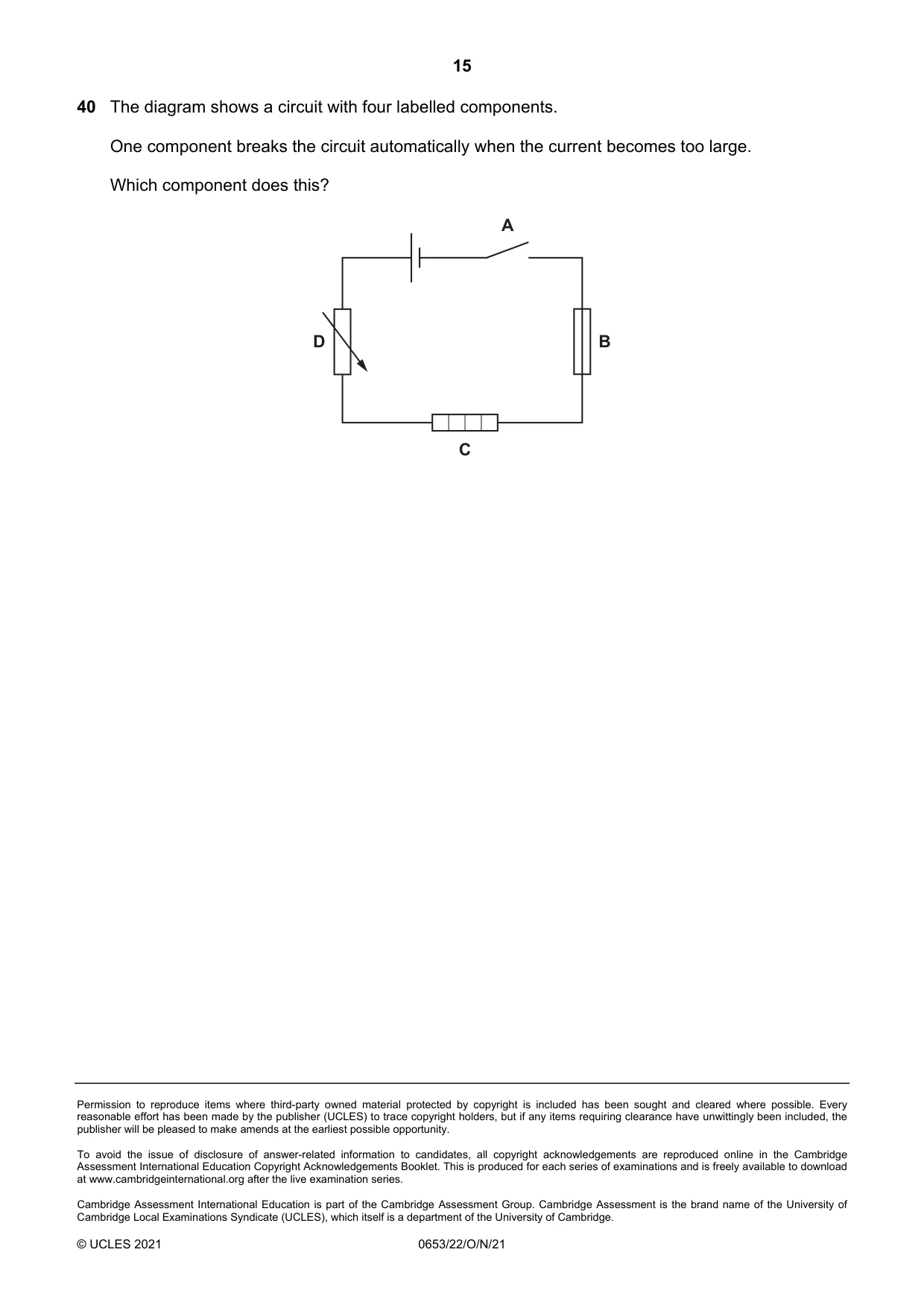
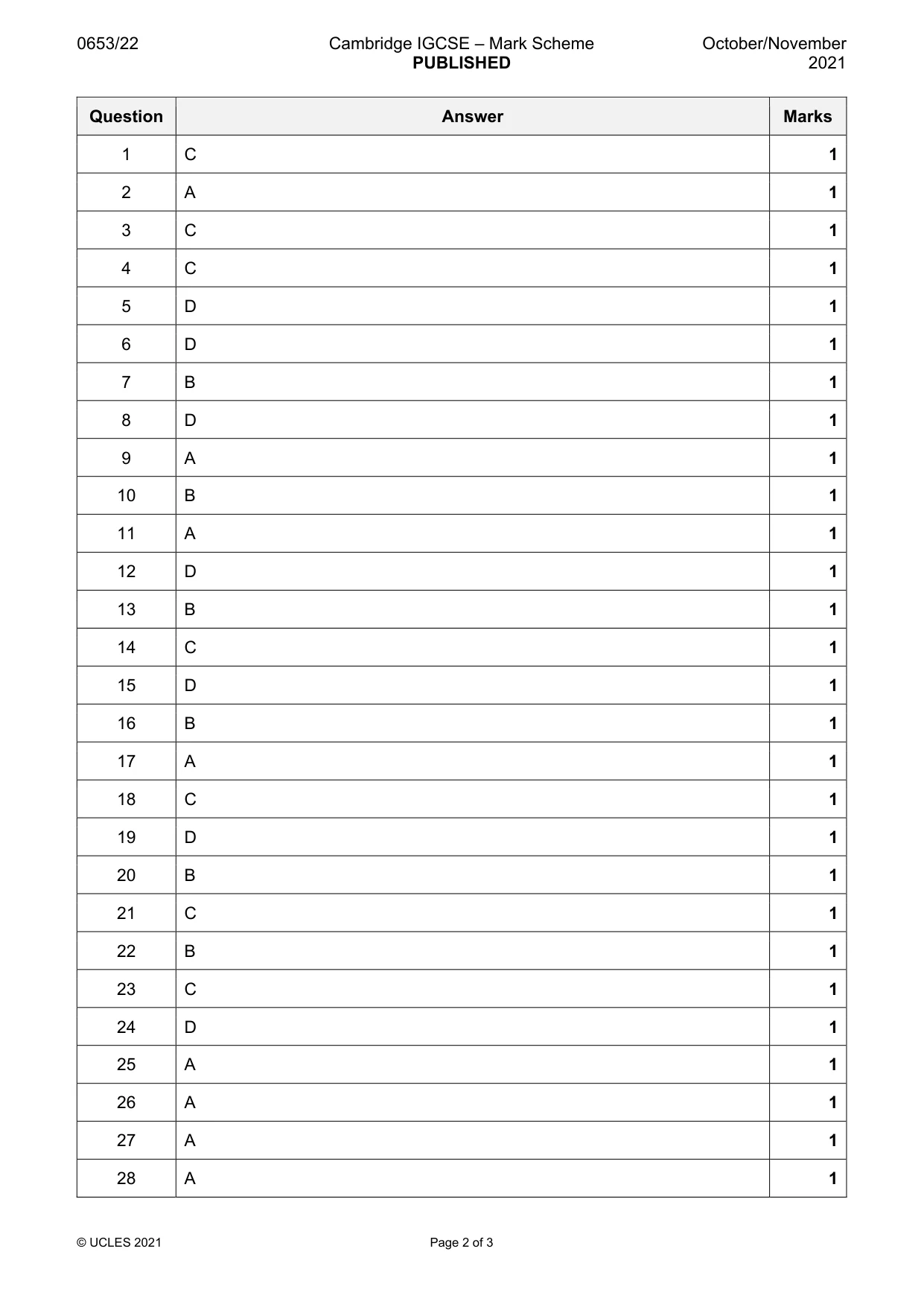
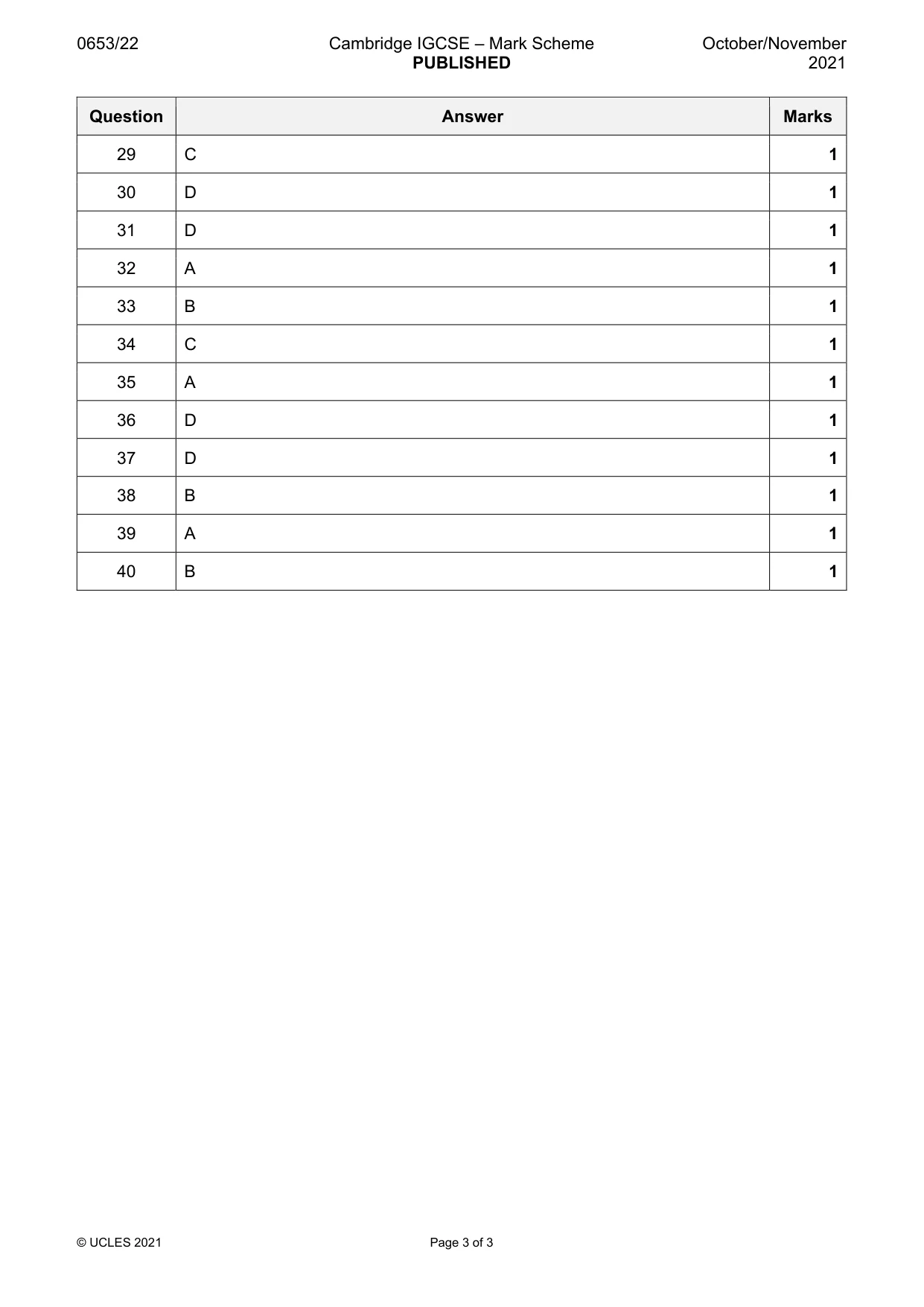
Mark scheme3 pages
Answers below. Sit the paper first if you are practising.
Questions as text
Q1 · Movement is a characteristic of all living organisms
1 Movement is a characteristic of all living organisms. Which two other characteristics of living organisms provide the energy for movement? A excretion and nutrition B growth and sensitivity C nutrition and respiration D respiration and growth
Mark scheme: C
Q2 · The diagrams show three different specialised cells
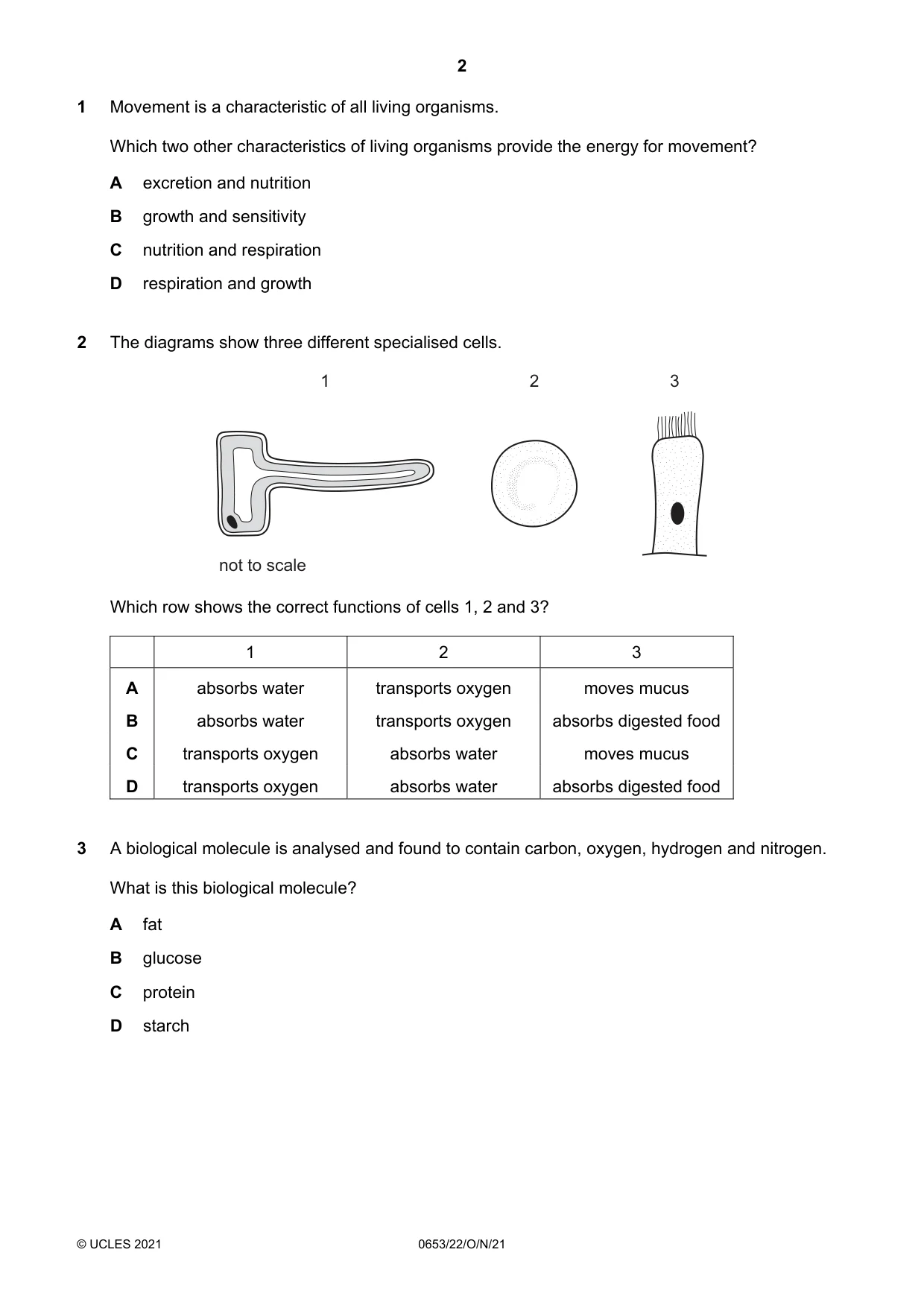
2 The diagrams show three different specialised cells. 1 2 3 not to scale Which row shows the correct functions of cells 1, 2 and 3? 1 2 3 A absorbs water transports oxygen moves mucus B absorbs water transports oxygen absorbs digested food C transports oxygen absorbs water moves mucus D transports oxygen absorbs water absorbs digested food
Mark scheme: A
Q3 · A biological molecule is analysed and found to contain carbon, oxygen, hydrogen and…
3 A biological molecule is analysed and found to contain carbon, oxygen, hydrogen and nitrogen. What is this biological molecule? A fat B glucose C protein D starch
Mark scheme: C
Q4 · The graph shows the effect of pH on the activity of an enzyme
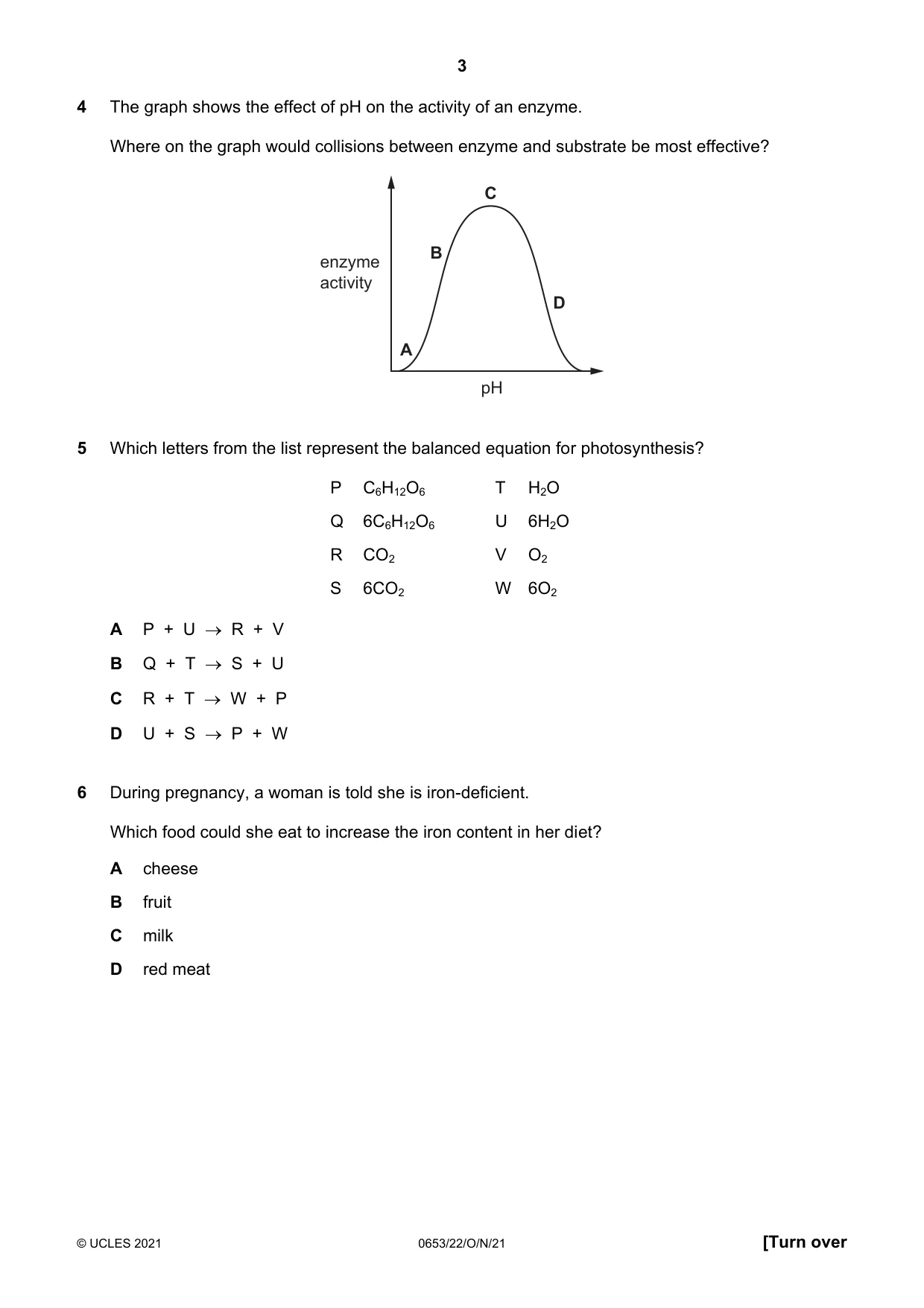
4 The graph shows the effect of pH on the activity of an enzyme. Where on the graph would collisions between enzyme and substrate be most effective? C B enzyme activity D A pH
Mark scheme: C
Q5 · Which letters from the list represent the balanced equation for photosynthesis?
5 Which letters from the list represent the balanced equation for photosynthesis? P C6H12O6 T H2O Q 6C6H12O6 U 6H2O R CO2 V O2 S 6CO2 W 6O2 A P + U R + V B Q + T S + U C R + T W + P D U + S P + W
Mark scheme: D
Q6 · During pregnancy, a woman is told she is iron-deficient
6 During pregnancy, a woman is told she is iron-deficient. Which food could she eat to increase the iron content in her diet? A cheese B fruit C milk D red meat
Mark scheme: D
Q7 · The diagram shows part of the alimentary canal and associated structures
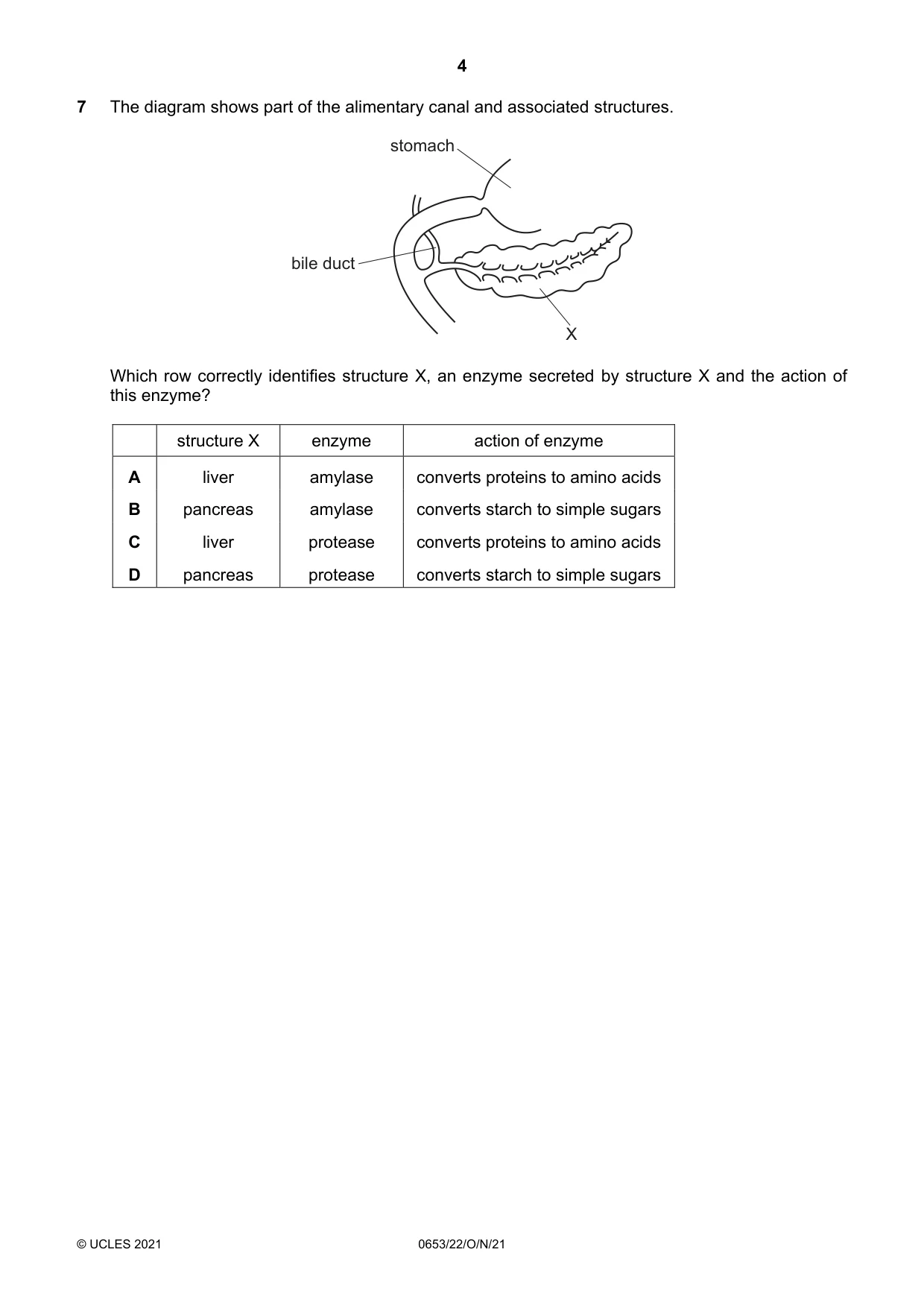
7 The diagram shows part of the alimentary canal and associated structures. stomach bile duct X Which row correctly identifies structure X, an enzyme secreted by structure X and the action of this enzyme? structure X enzyme action of enzyme A liver amylase converts proteins to amino acids B pancreas amylase converts starch to simple sugars C liver protease converts proteins to amino acids D pancreas protease converts starch to simple sugars
Mark scheme: B
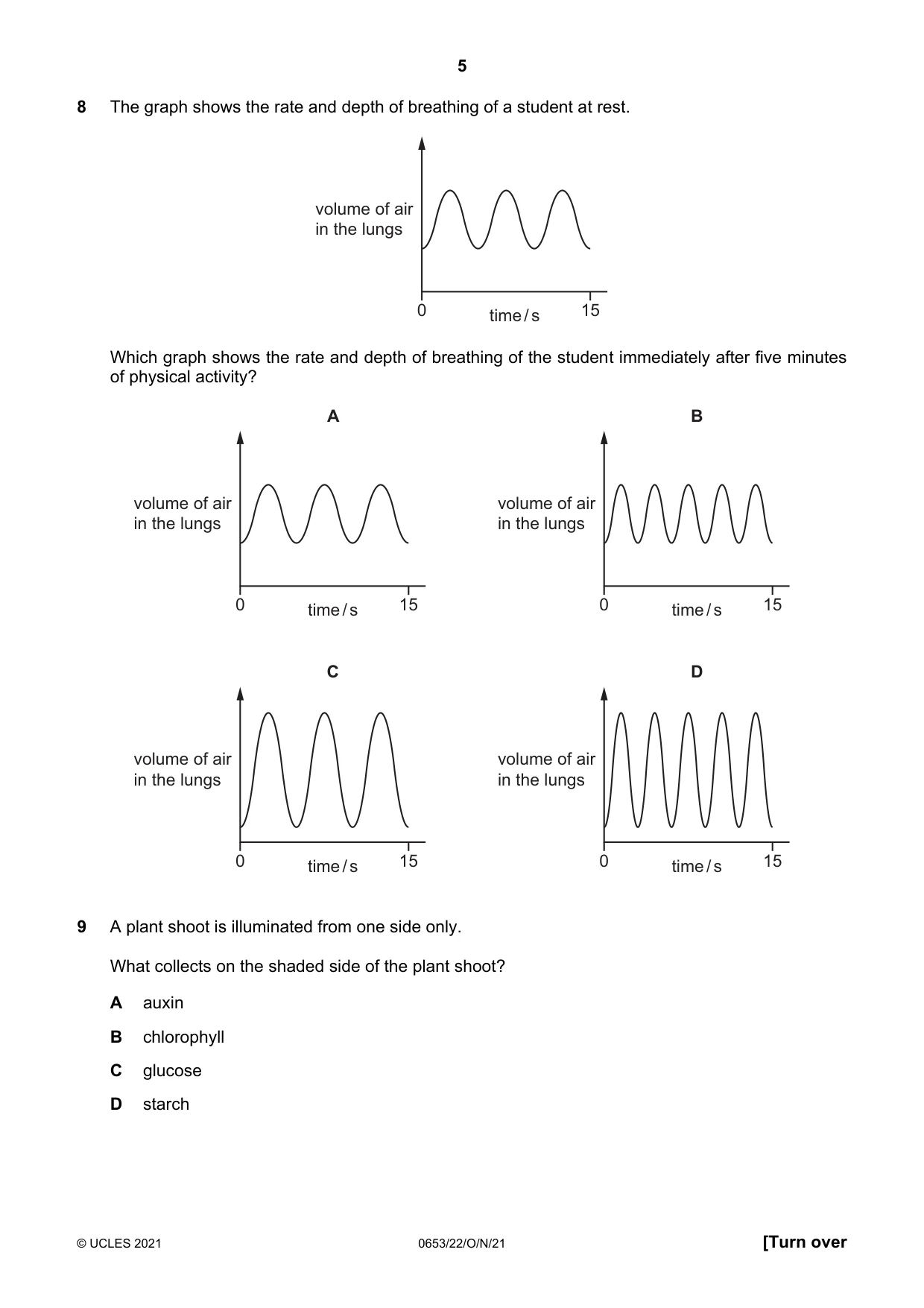
Q8 · The graph shows the rate and depth of breathing of a student at rest
8 The graph shows the rate and depth of breathing of a student at rest. volume of air in the lungs 0 time / s 15 Which graph shows the rate and depth of breathing of the student immediately after five minutes of physical activity? A B volume of air volume of air in the lungs in the lungs 0 time / s 15 0 time / s 15 C D volume of air volume of air in the lungs in the lungs 0 time / s 15 0 time / s 15
Mark scheme: D
Q9 · A plant shoot is illuminated from one side only
9 A plant shoot is illuminated from one side only. What collects on the shaded side of the plant shoot? A auxin B chlorophyll C glucose D starch
Mark scheme: A
Q10 · Which row is correct for sexual reproduction?
10 Which row is correct for sexual reproduction? gametes are offspring genetically formed identical to parents A no no B yes no C no yes D yes yes
Mark scheme: B
Q11 · Which row correctly describes features of human egg cells and sperm cells?
11 Which row correctly describes features of human egg cells and sperm cells? egg cells sperm cells A energy stores present enzymes present B enzymes present energy stores present C produced in large numbers flagellum present D flagellum present produced in large numbers
Mark scheme: A
Q12 · The diagram represents four organisms in a food chain
12 The diagram represents four organisms in a food chain. T U V W Which organisms are consumers? A T, U and V B T, U and W C T, V and W D U, V and W
Mark scheme: D
Q13 · During eutrophication, what is the main reason for the increased growth of producers?
13 During eutrophication, what is the main reason for the increased growth of producers? A increased availability of carbon dioxide B increased availability of nitrate C increased availability of oxygen D increased availability of water
Mark scheme: B
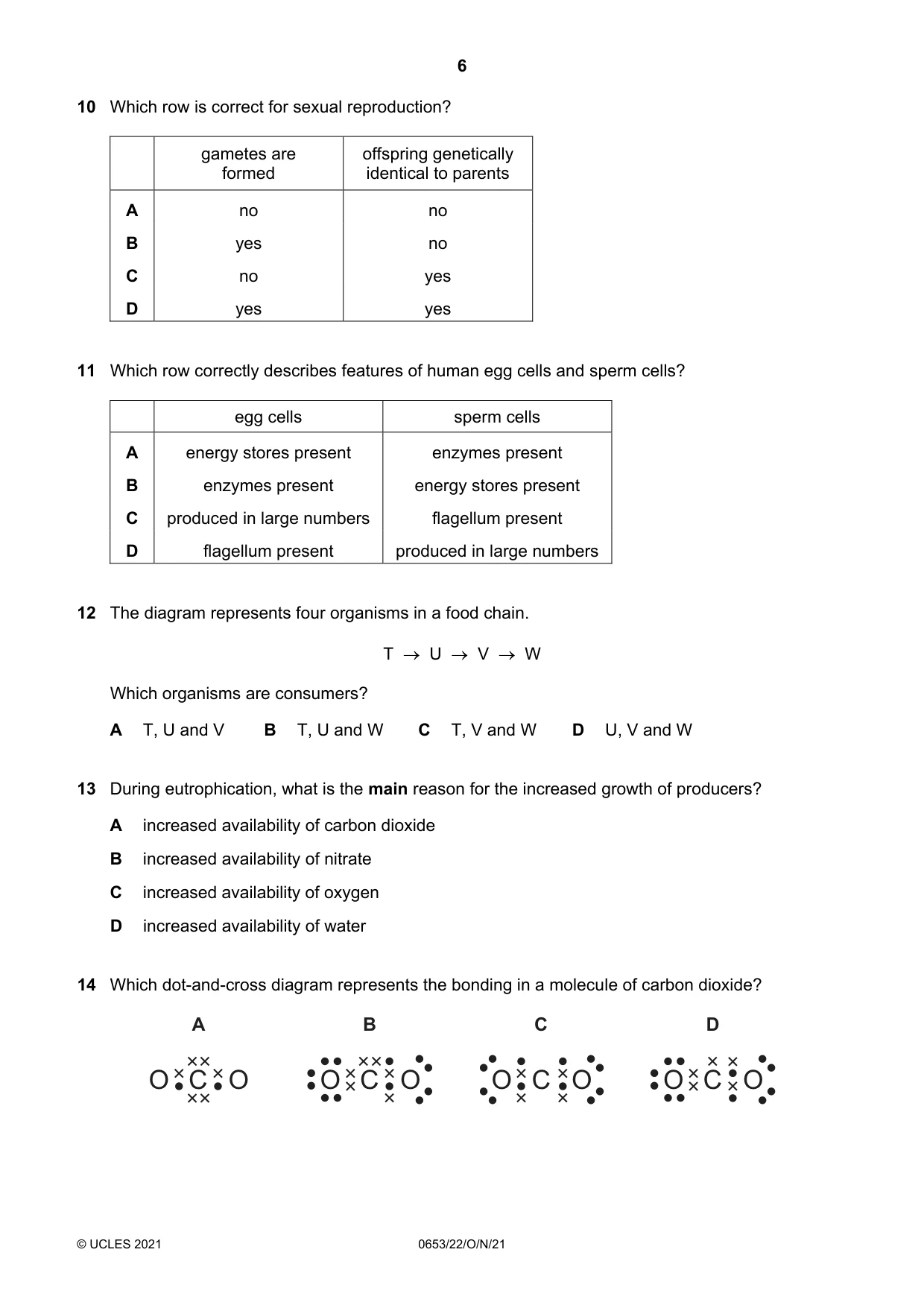
Q14 · Which dot-and-cross diagram represents the bonding in a molecule of carbon dioxide?
14 Which dot-and-cross diagram represents the bonding in a molecule of carbon dioxide? A B C D O C O O C O O C O O C O
Mark scheme: C
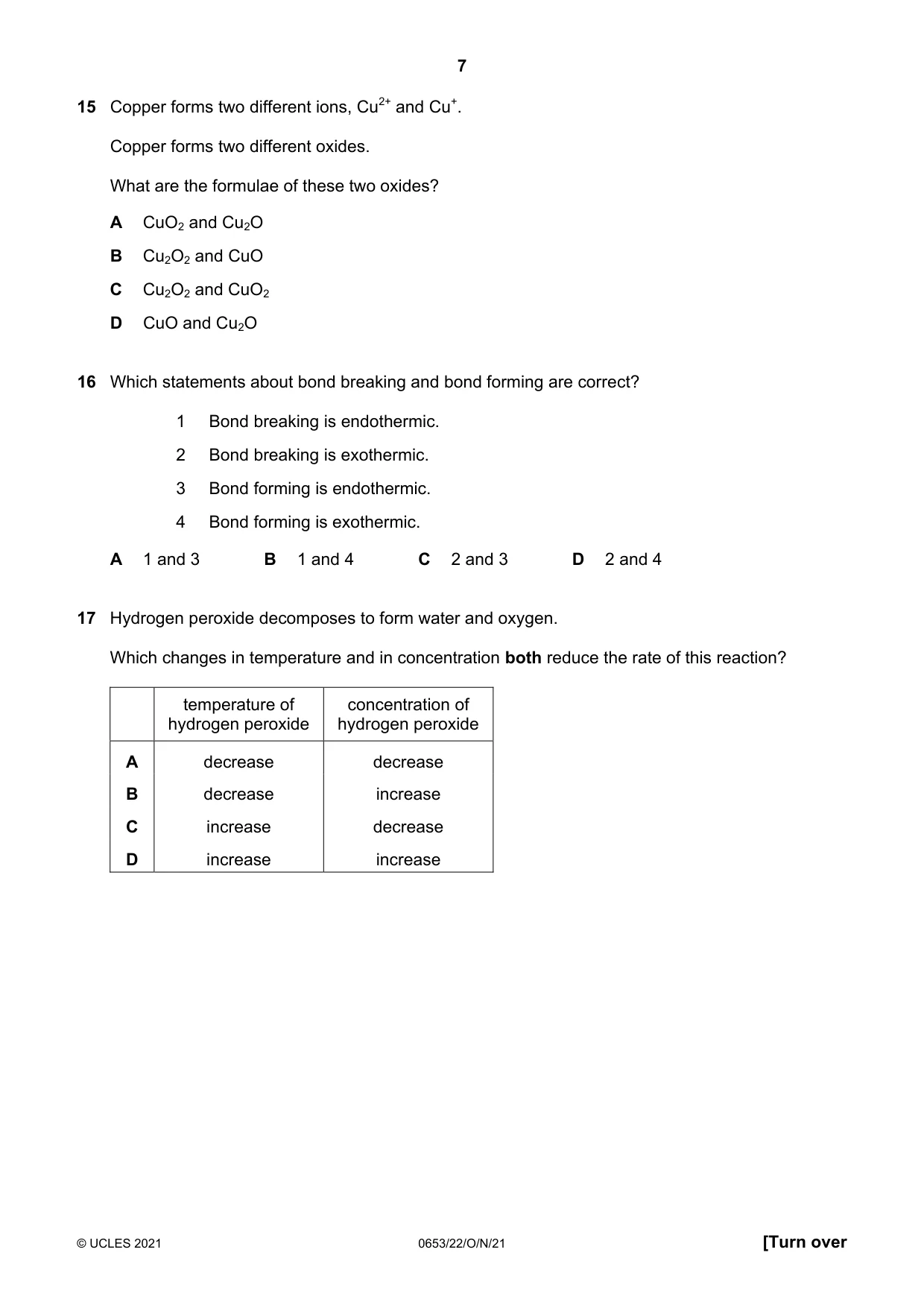
Q15 · Copper forms two different ions, Cu2+ and Cu+
15 Copper forms two different ions, Cu2+ and Cu+. Copper forms two different oxides. What are the formulae of these two oxides? A CuO2 and Cu2O B Cu2O2 and CuO C Cu2O2 and CuO2 D CuO and Cu2O
Mark scheme: D
Q16 · Which statements about bond breaking and bond forming are correct?
16 Which statements about bond breaking and bond forming are correct? 1 Bond breaking is endothermic. 2 Bond breaking is exothermic. 3 Bond forming is endothermic. 4 Bond forming is exothermic. A 1 and 3 B 1 and 4 C 2 and 3 D 2 and 4
Mark scheme: B
Q17 · Hydrogen peroxide decomposes to form water and oxygen
17 Hydrogen peroxide decomposes to form water and oxygen. Which changes in temperature and in concentration both reduce the rate of this reaction? temperature of concentration of hydrogen peroxide hydrogen peroxide A decrease decrease B decrease increase C increase decrease D increase increase
Mark scheme: A
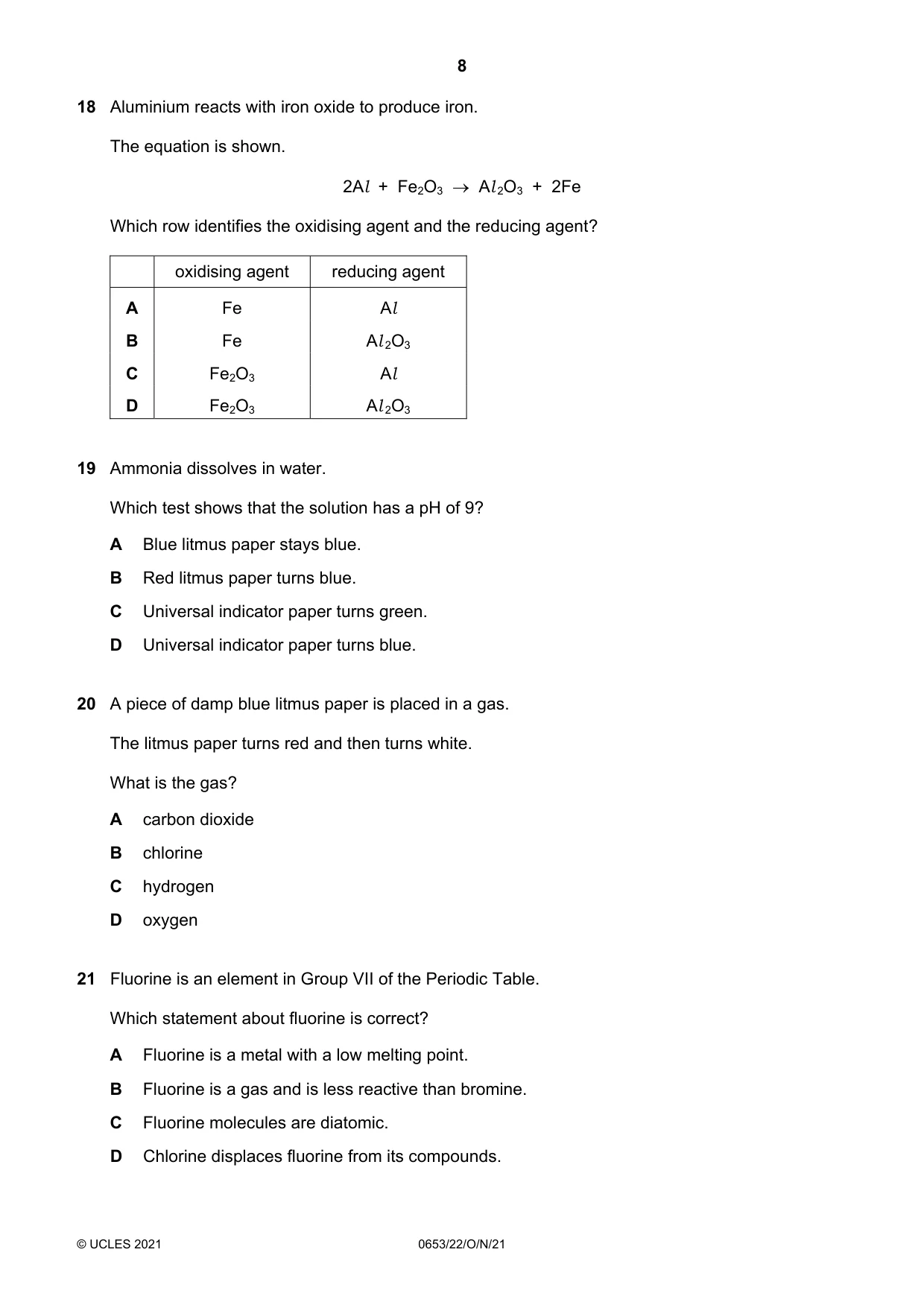
Q18 · Aluminium reacts with iron oxide to produce iron
18 Aluminium reacts with iron oxide to produce iron. The equation is shown. 2Al + Fe2O3 Al 2O3 + 2Fe Which row identifies the oxidising agent and the reducing agent? oxidising agent reducing agent A Fe Al B Fe Al 2O3 C Fe2O3 Al D Fe2O3 Al 2O3
Mark scheme: C
Q19 · Ammonia dissolves in water
19 Ammonia dissolves in water. Which test shows that the solution has a pH of 9? A Blue litmus paper stays blue. B Red litmus paper turns blue. C Universal indicator paper turns green. D Universal indicator paper turns blue.
Mark scheme: D
More questions on The characteristic properties of acids and bases
Q20 · A piece of damp blue litmus paper is placed in a gas
20 A piece of damp blue litmus paper is placed in a gas. The litmus paper turns red and then turns white. What is the gas? A carbon dioxide B chlorine C hydrogen D oxygen
Mark scheme: B
Q21 · Fluorine is an element in Group VII of the Periodic Table
21 Fluorine is an element in Group VII of the Periodic Table. Which statement about fluorine is correct? A Fluorine is a metal with a low melting point. B Fluorine is a gas and is less reactive than bromine. C Fluorine molecules are diatomic. D Chlorine displaces fluorine from its compounds.
Mark scheme: C
Q22 · Which statement about transition elements is not correct?
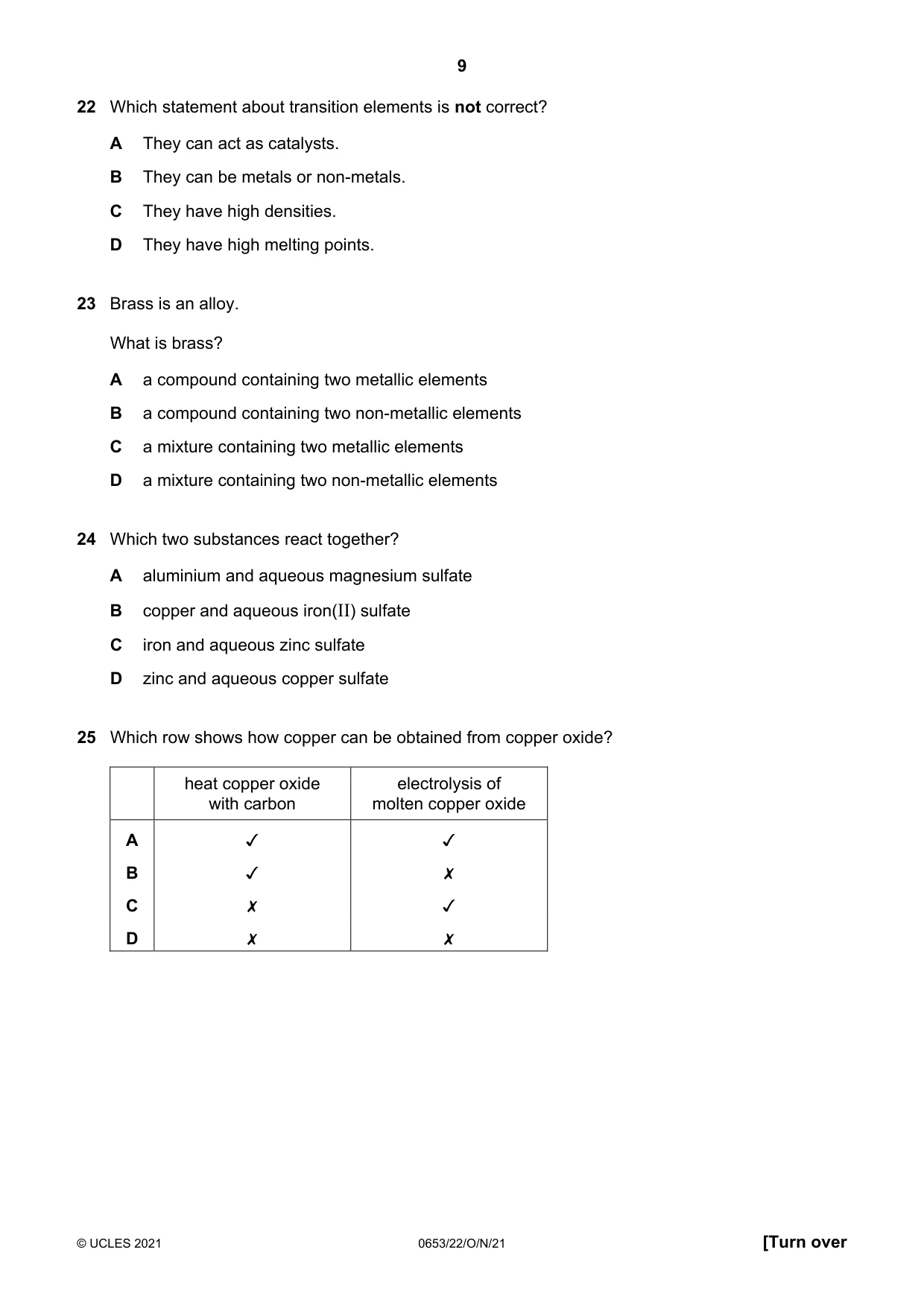
22 Which statement about transition elements is not correct? A They can act as catalysts. B They can be metals or non-metals. C They have high densities. D They have high melting points.
Mark scheme: B
Q23 · Brass is an alloy
23 Brass is an alloy. What is brass? A a compound containing two metallic elements B a compound containing two non-metallic elements C a mixture containing two metallic elements D a mixture containing two non-metallic elements
Mark scheme: C
Q24 · Which two substances react together?
24 Which two substances react together? A aluminium and aqueous magnesium sulfate B copper and aqueous iron(II) sulfate C iron and aqueous zinc sulfate D zinc and aqueous copper sulfate
Mark scheme: D
Q25 · Which row shows how copper can be obtained from copper oxide?
25 Which row shows how copper can be obtained from copper oxide? heat copper oxide electrolysis of with carbon molten copper oxide v v 0 0O WwW > v x x v x x
Mark scheme: A
Q26 · Magnesium carbonate reacts with dilute hydrochloric acid
26 Magnesium carbonate reacts with dilute hydrochloric acid. Calcium carbonate decomposes when heated. Which gas is produced in both reactions? A carbon dioxide B carbon monoxide C chlorine D hydrogen
Mark scheme: A
More questions on The characteristic properties of acids and bases
Q27 · The fractional distillation of petroleum is shown
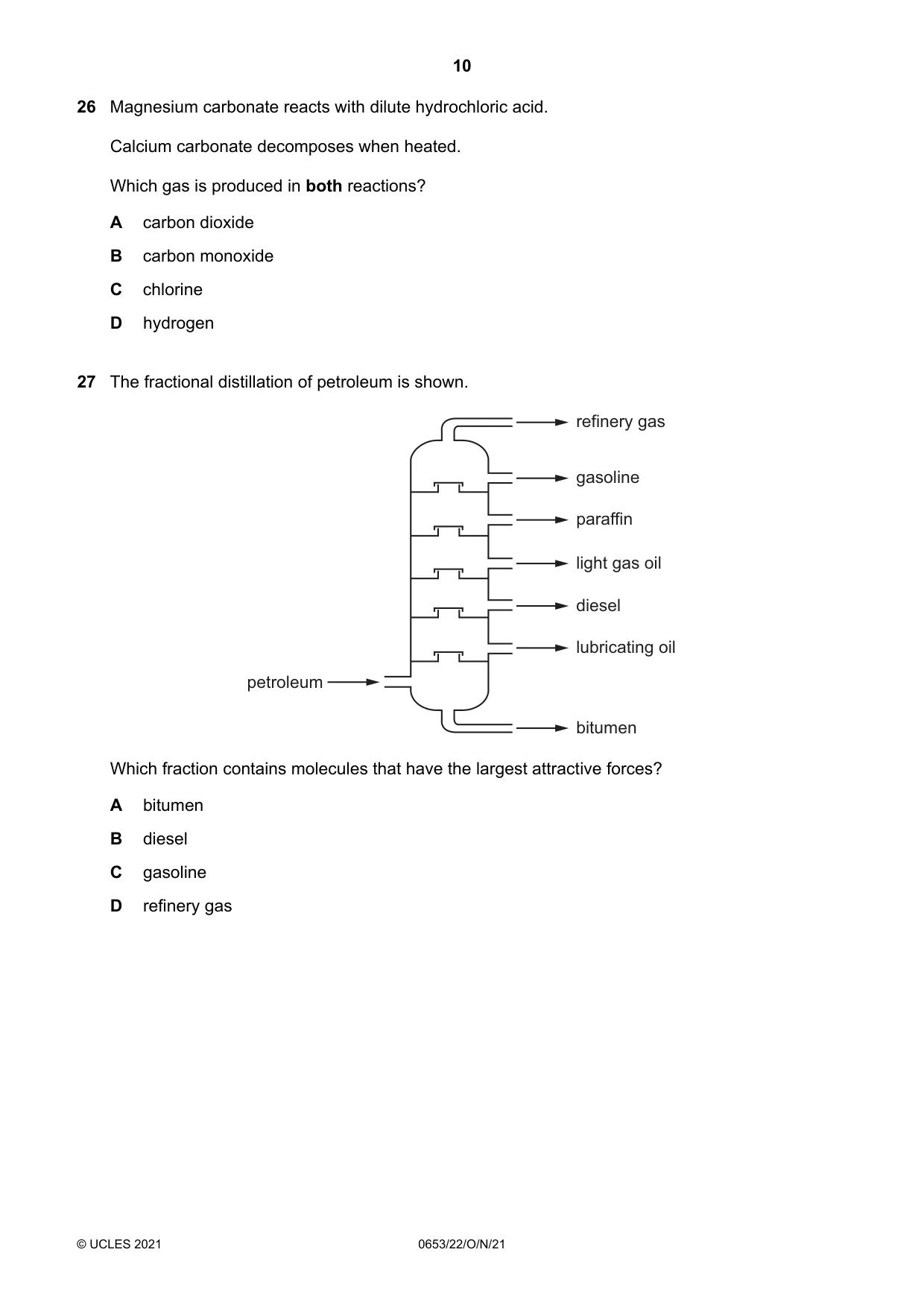
27 The fractional distillation of petroleum is shown. refinery gas gasoline paraffin light gas oil diesel lubricating oil petroleum bitumen Which fraction contains molecules that have the largest attractive forces? A bitumen B diesel C gasoline D refinery gas
Mark scheme: A
Q28 · A car accelerates from rest at a constant rate
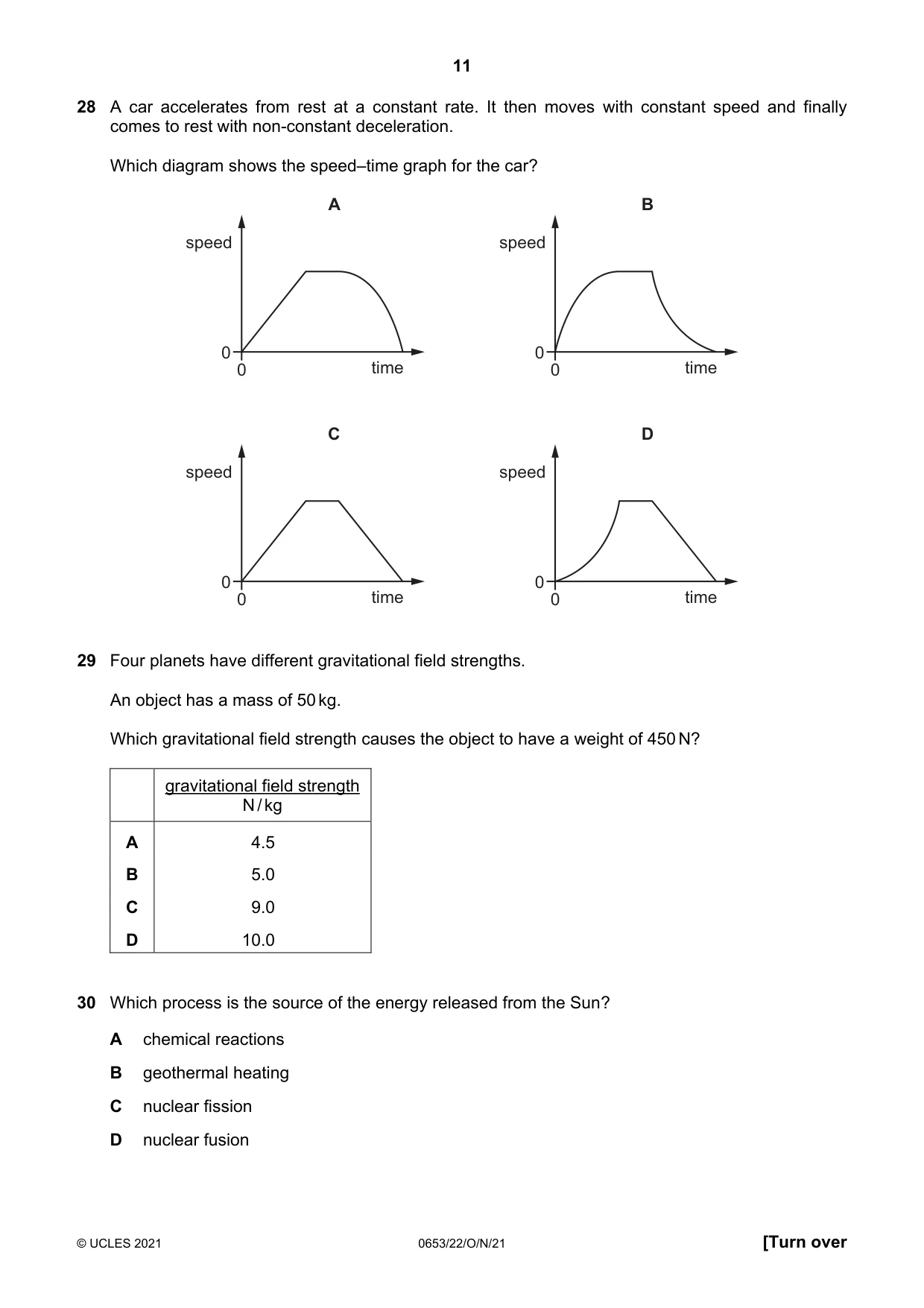
28 A car accelerates from rest at a constant rate. It then moves with constant speed and finally comes to rest with non-constant deceleration. Which diagram shows the speed–time graph for the car? A B speed speed 0 0 0 time 0 time C D speed speed 0 0 0 time 0 time
Mark scheme: A
Q29 · Four planets have different gravitational field strengths
29 Four planets have different gravitational field strengths. An object has a mass of 50 kg. Which gravitational field strength causes the object to have a weight of 450 N? gravitational field strength N / kg A 4.5 B 5.0 C 9.0 D 10.0
Mark scheme: C
Q30 · Which process is the source of the energy released from the Sun?
30 Which process is the source of the energy released from the Sun? A chemical reactions B geothermal heating C nuclear fission D nuclear fusion
Mark scheme: D
Q31 · Which statements about liquids and gases are correct?
31 Which statements about liquids and gases are correct? 1 Molecules in gases are further apart than molecules in liquids. 2 Molecules in liquids and gases are arranged randomly. 3 When a liquid evaporates, the temperature of the remaining liquid decreases. A 1 and 2 only B 1 and 3 only C 2 and 3 only D 1, 2 and 3
Mark scheme: D
Q32 · The bottom of a container of water is heated
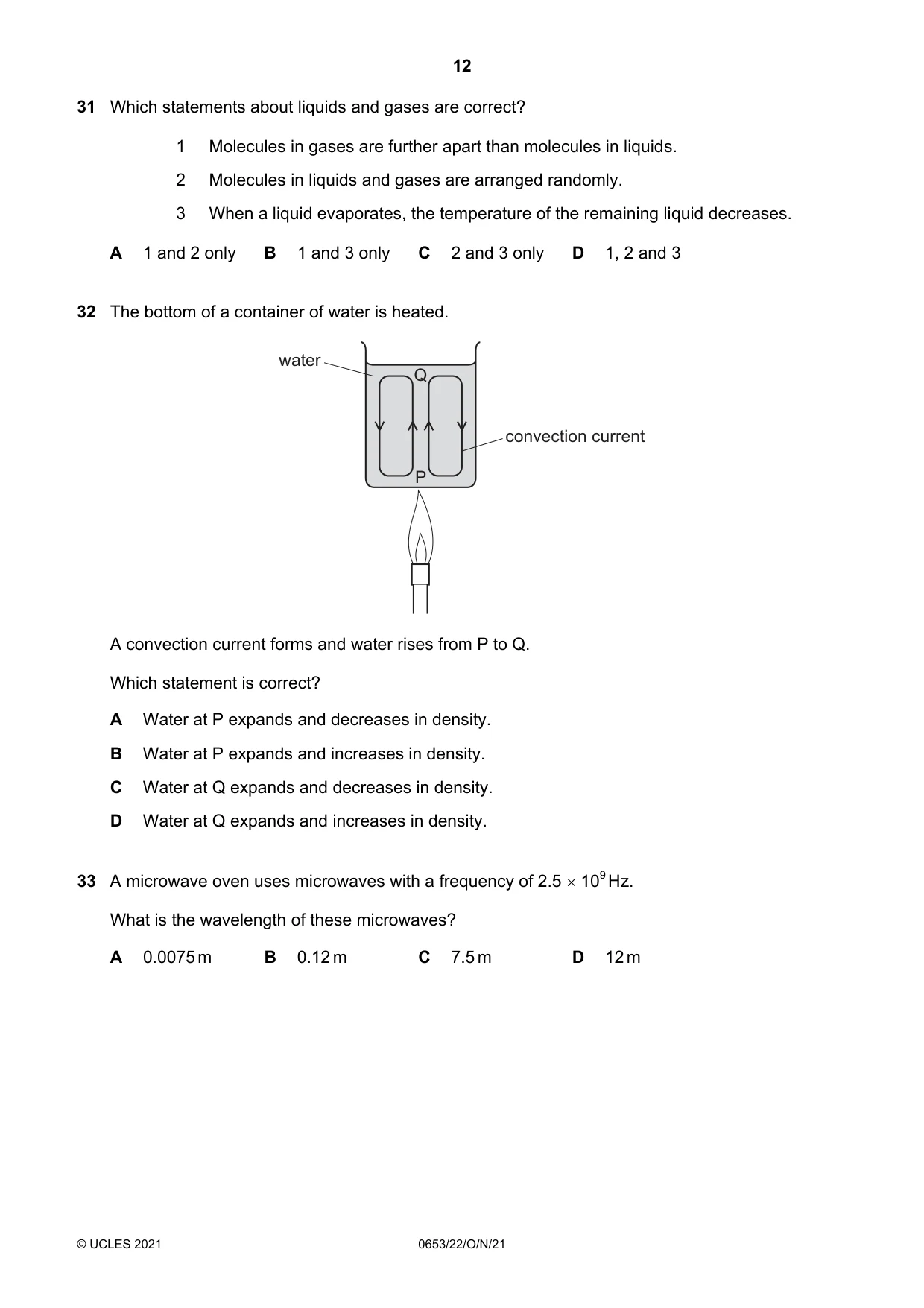
32 The bottom of a container of water is heated. water Q convection current P A convection current forms and water rises from P to Q. Which statement is correct? A Water at P expands and decreases in density. B Water at P expands and increases in density. C Water at Q expands and decreases in density. D Water at Q expands and increases in density.
Mark scheme: A
Q33 · A microwave oven uses microwaves with a frequency of 2.5 109 Hz
33 A microwave oven uses microwaves with a frequency of 2.5 109 Hz. What is the wavelength of these microwaves? A 0.0075 m B 0.12 m C 7.5 m D 12 m
Mark scheme: B
Q34 · A ray of light passes through a glass window
34 A ray of light passes through a glass window. Which path does it take? A air glass air B C D ray of light
Mark scheme: C
Q35 · A thin converging lens is used as a magnifying glass
35 A thin converging lens is used as a magnifying glass. The focal length of the lens is 5.0 cm. How far from the lens is the object placed? A less than 5.0 cm B between 5.0 cm and 10 cm C 10 cm D more than 10 cm
Mark scheme: A
Q36 · A lightning strike transfers 20 C of charge in 5.0 10–4 s
36 A lightning strike transfers 20 C of charge in 5.0 10–4 s. What is the average current during the lightning strike? A 2.5 10–5 A B 1.0 10–2 A C 1.0 102 A D 4.0 104 A
Mark scheme: D
Q37 · A circuit contains a battery connected to a resistor
37 A circuit contains a battery connected to a resistor. Which values of electromotive force (e.m.f.) and resistance produce the smallest current in the circuit? e.m.f. / V resistance / A 6.0 10 B 6.0 20 C 24 80 D 24 160
Mark scheme: D
Q38 · Four wires are made from the same material but have different lengths and diameters
38 Four wires are made from the same material but have different lengths and diameters. Which wire has the smallest resistance? length diameter / cm / mm A 50 0.10 B 50 0.20 C 100 0.10 D 100 0.20
Mark scheme: B
Q39 · The diagrams show four circuits, each containing an ammeter and two lamps with different…
39 The diagrams show four circuits, each containing an ammeter and two lamps with different resistances. Which circuit shows an ammeter with a reading equal to the current in each lamp? A B C D A A A A
Mark scheme: A
Q40 · The diagram shows a circuit with four labelled components
40 The diagram shows a circuit with four labelled components. One component breaks the circuit automatically when the current becomes too large. Which component does this? A D B C
Mark scheme: B
What was in this paper
The subtopics covered by these 40 questions, and how many questions each got. Open one in a new tab to see every Cambridge question on it.
2Electrical quantities2Light2The characteristic properties of acids and bases2Alloys and their properties1Biological molecules1Cell structure1Characteristics of living organisms1Diet1Digestion1Electrical safety1Enzymes1Exothermic and endothermic reactions1Extraction of metals1Food chains and food webs1Formulas1Fuels1Gas exchange in humans1General properties of waves1Group VII properties1Habitat destruction1Identification of ions and gases1Kinetic particle model of matter1Mass and weight1Motion1Photosynthesis1Rate of reaction1Reactivity series1Redox1Sexual reproduction in humans1Sexual reproduction in plants1Simple molecules and covalent bonds1Stars and the Universe1Transfer of thermal energy1Transition elements1Transpiration1What you needed in this session
Cambridge’s own grade thresholds for 2021 Oct/Nov, Paper 2 · Variant 2. A higher threshold means an easier paper — the bar moves with how the cohort did.