Cambridge IGCSE Science - Combined 0653 — 2024 Oct/Nov Paper 2 · Variant 1
0653/21/O/N/24 · 40 questions · 40 marks · ≈45 min
The question paper and its mark scheme, free to read here and free to download. This is Cambridge’s own paper, exactly as it was sat.
Question paper16 pages
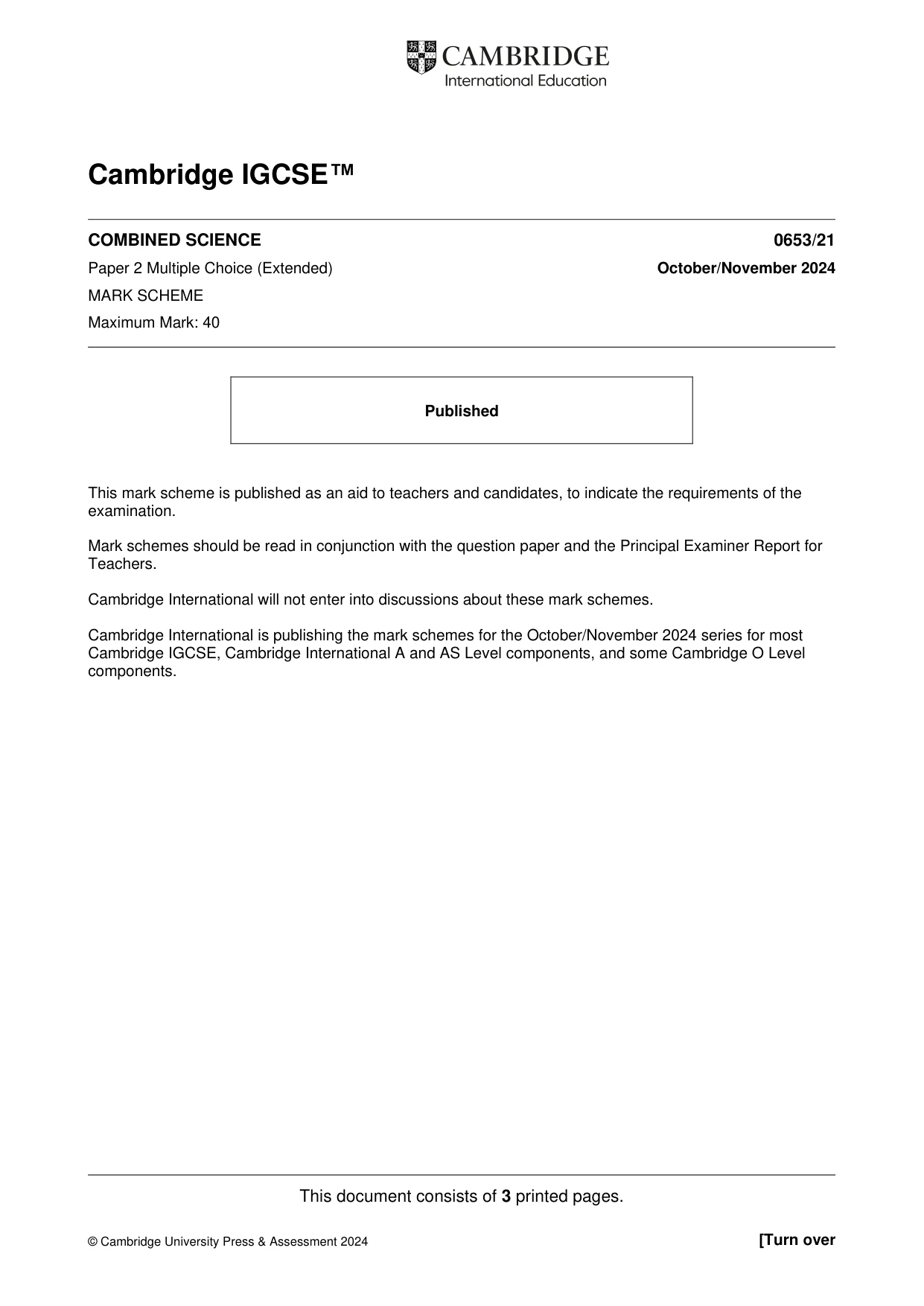
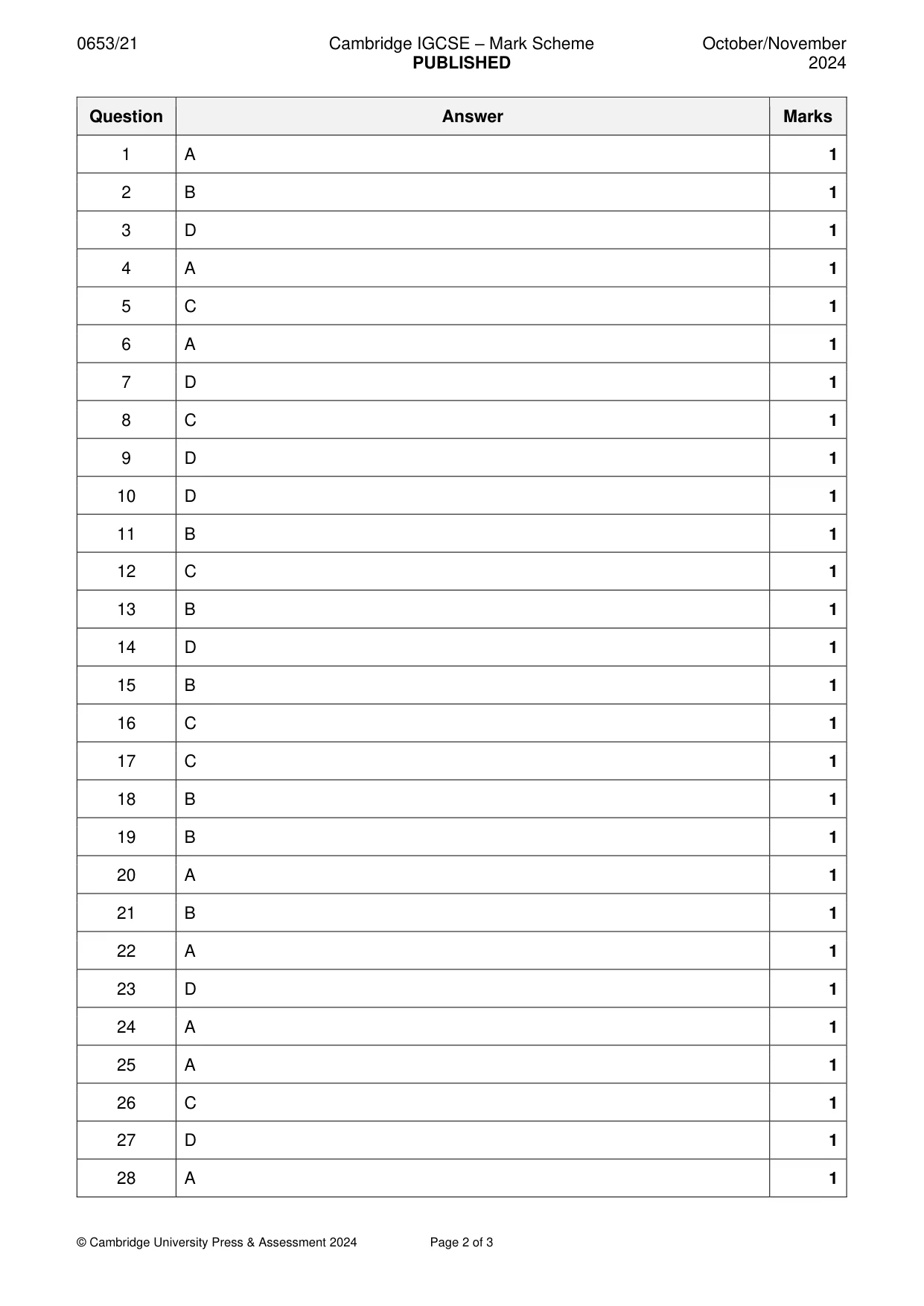
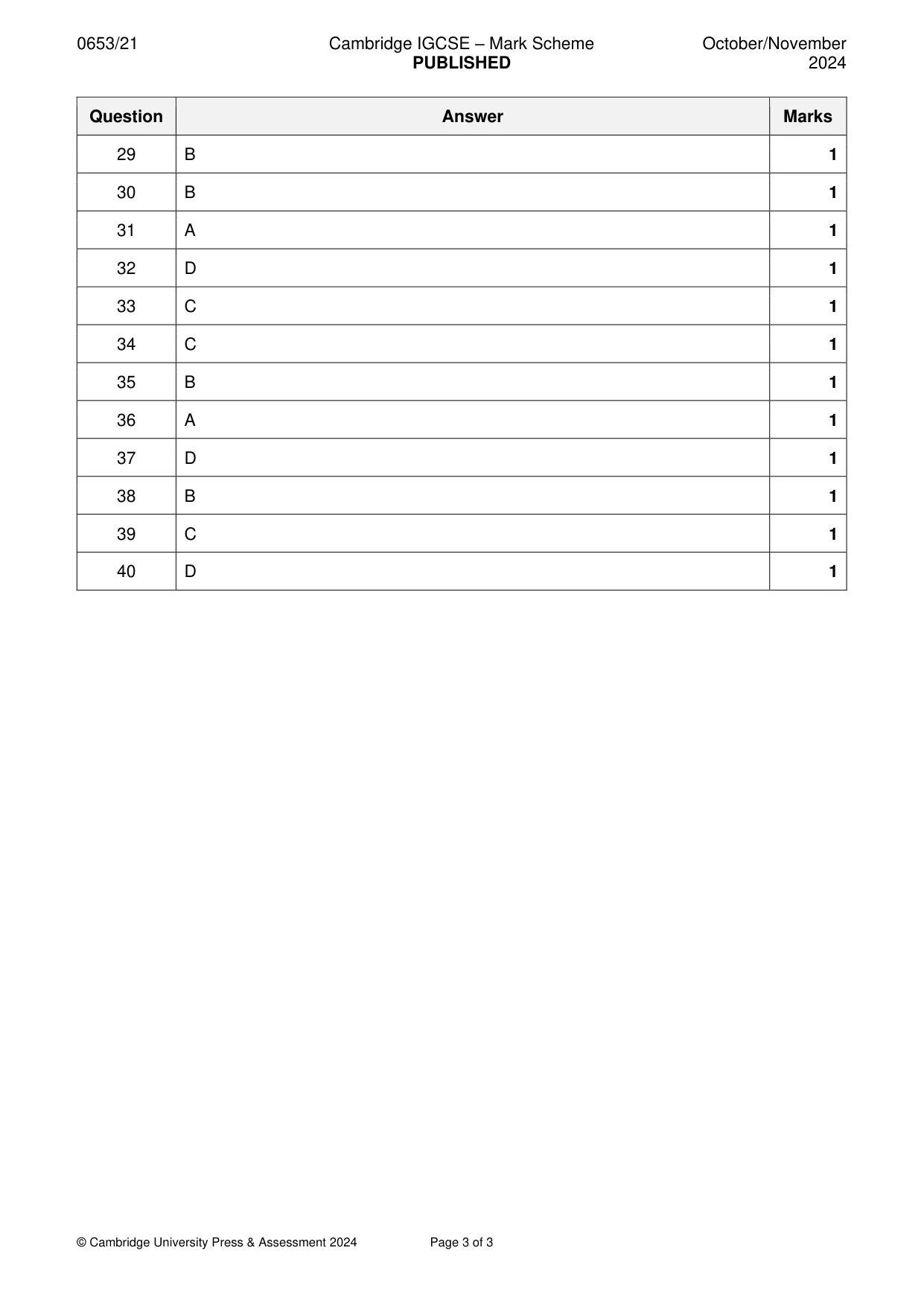
Mark scheme3 pages
Answers below. Sit the paper first if you are practising.
Questions as text
Q1 · Which characteristics are found in all living organisms?
1 Which characteristics are found in all living organisms? excretion growth photosynthesis respiration A yes yes no yes B yes yes yes no C yes no yes yes D no yes yes yes
Mark scheme: A
Q2 · What is the function of ciliated cells in the bronchi?
2 What is the function of ciliated cells in the bronchi? A absorption of oxygen B movement of mucus C production of mucus D transport of oxygen
Mark scheme: B
Q3 · A student uses a starch suspension contained in a transparent partially permeable…
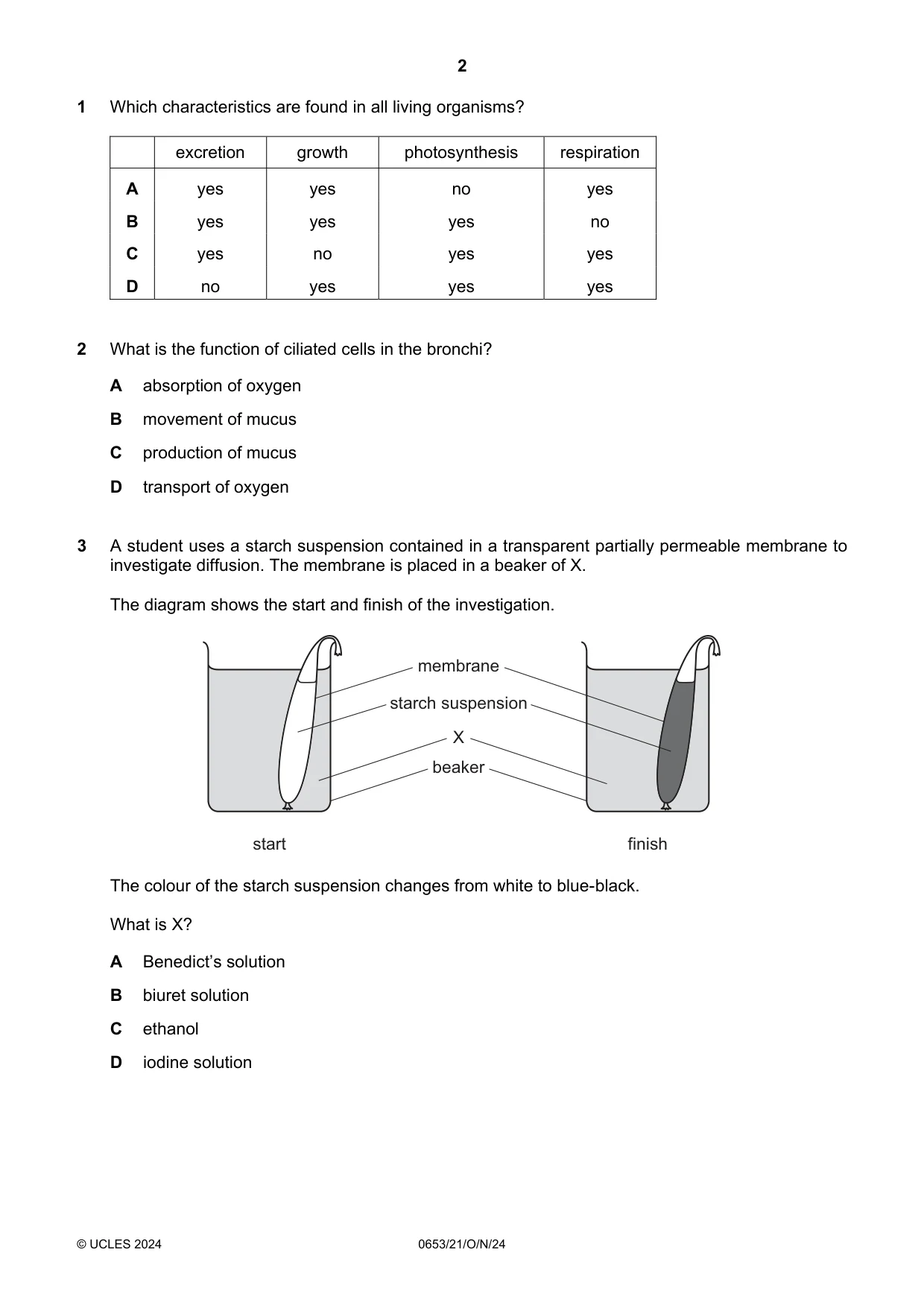
3 A student uses a starch suspension contained in a transparent partially permeable membrane to investigate diffusion. The membrane is placed in a beaker of X. The diagram shows the start and finish of the investigation. membrane starch suspension X beaker start finish The colour of the starch suspension changes from white to blue-black. What is X? A Benedict’s solution B biuret solution C ethanol D iodine solution
Mark scheme: D
Q4 · Which two components of cow’s milk are essential for strong teeth and bones?
4 Which two components of cow’s milk are essential for strong teeth and bones? A minerals and vitamins B fats and proteins C carbohydrates and vitamins D minerals and water
Mark scheme: A
Q5 · The diagram shows the human alimentary canal
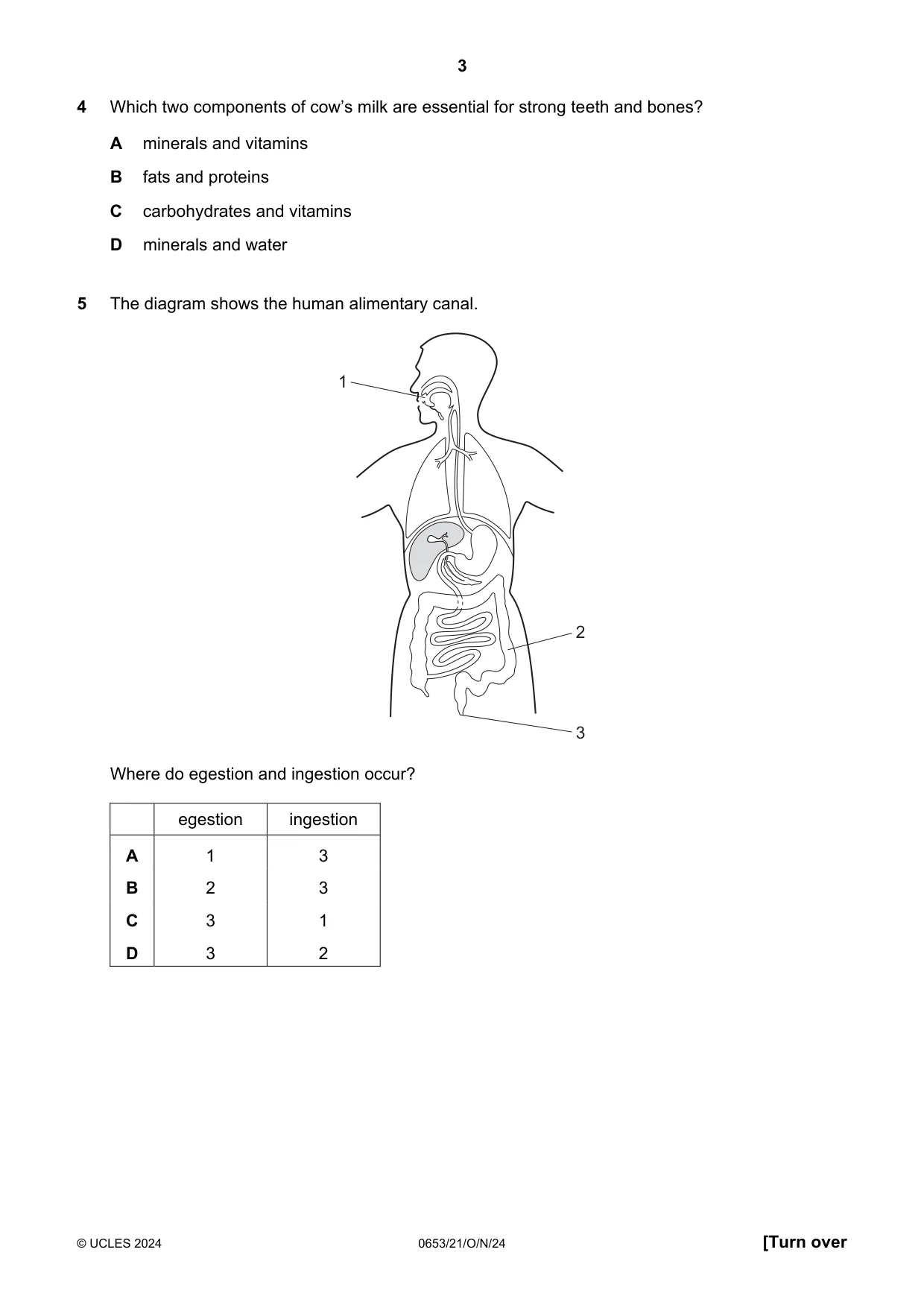
5 The diagram shows the human alimentary canal. 1 2 3 Where do egestion and ingestion occur? egestion ingestion A 1 3 B 2 3 C 3 1 D 3 2
Mark scheme: C
Q6 · A list of enzymes and a diagram of some human organs are shown
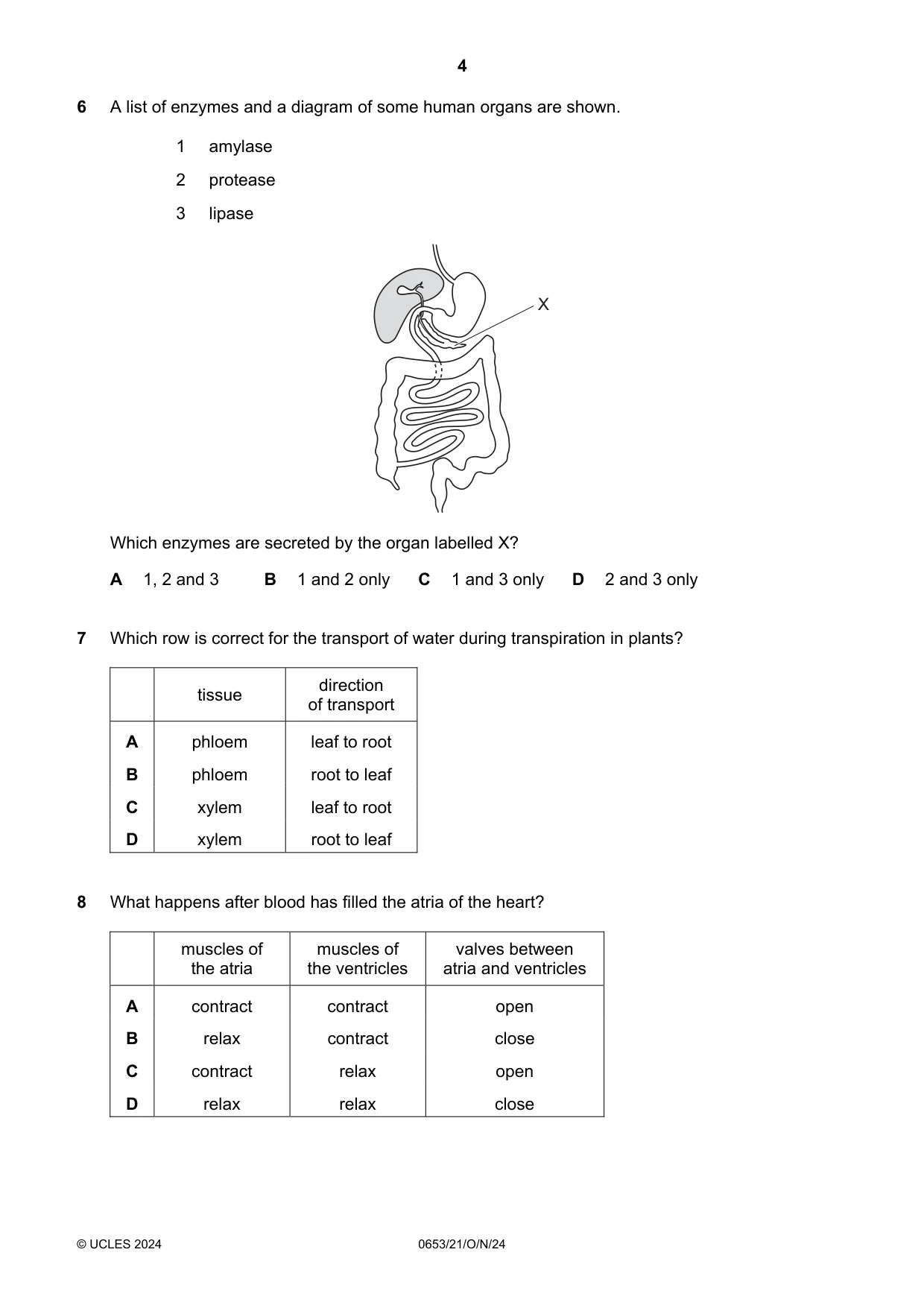
6 A list of enzymes and a diagram of some human organs are shown. 1 amylase 2 protease 3 lipase X Which enzymes are secreted by the organ labelled X? A 1, 2 and 3 B 1 and 2 only C 1 and 3 only D 2 and 3 only
Mark scheme: A
Q7 · Which row is correct for the transport of water during transpiration in plants?
7 Which row is correct for the transport of water during transpiration in plants? direction tissue of transport A phloem leaf to root B phloem root to leaf C xylem leaf to root D xylem root to leaf
Mark scheme: D
Q8 · What happens after blood has filled the atria of the heart?
8 What happens after blood has filled the atria of the heart? muscles of muscles of valves between the atria the ventricles atria and ventricles A contract contract open B relax contract close C contract relax open D relax relax close
Mark scheme: C
Q9 · Which row completes the balanced chemical equation for aerobic respiration?
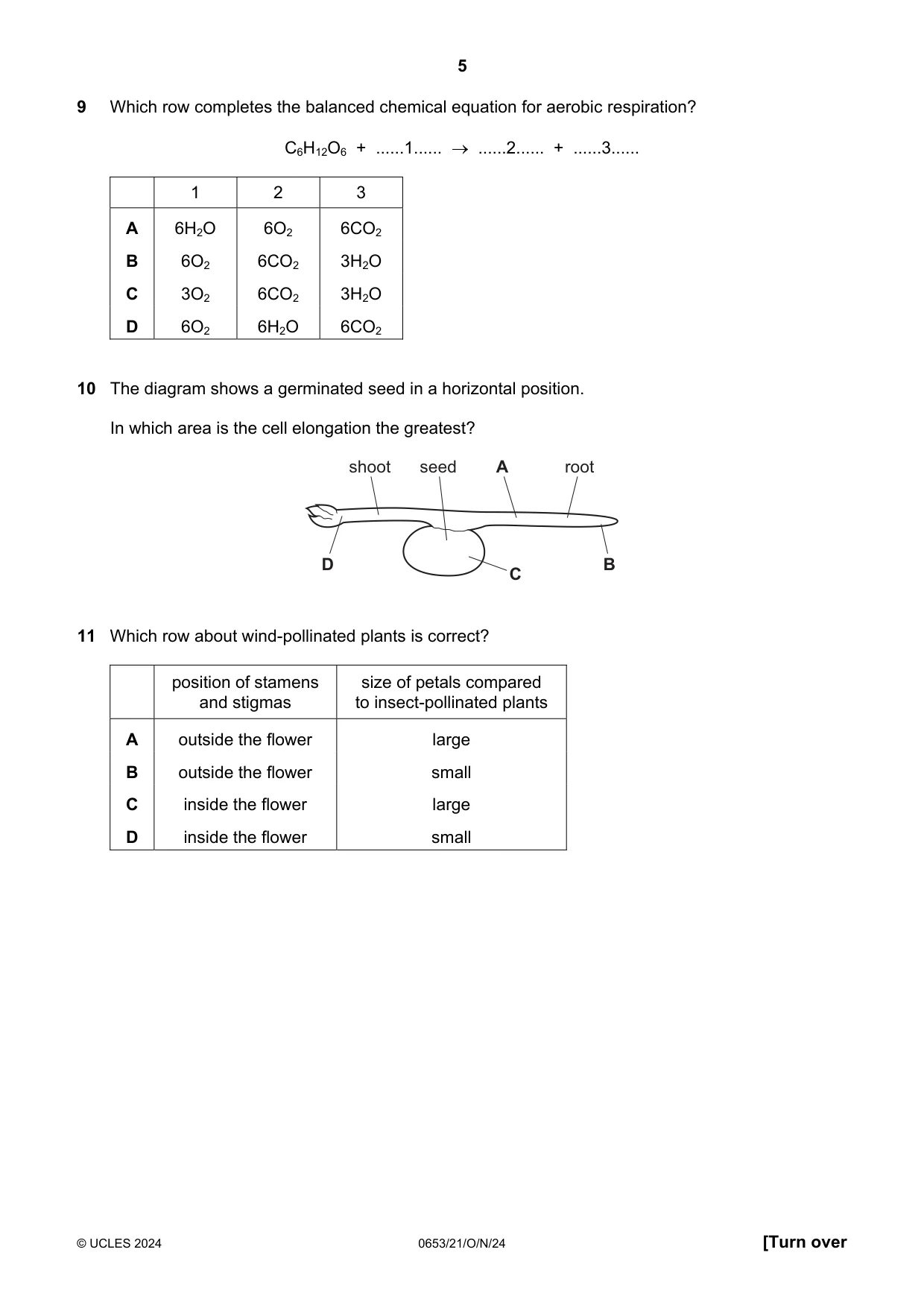
9 Which row completes the balanced chemical equation for aerobic respiration? C6H12O6 + ......1...... ......2...... + ......3...... 1 2 3 A 6H2O 6O2 6CO2 B 6O2 6CO2 3H2O C 3O2 6CO2 3H2O D 6O2 6H2O 6CO2
Mark scheme: D
Q10 · The diagram shows a germinated seed in a horizontal position
10 The diagram shows a germinated seed in a horizontal position. In which area is the cell elongation the greatest? shoot seed A root D B C
Mark scheme: D
Q11 · Which row about wind-pollinated plants is correct?
11 Which row about wind-pollinated plants is correct? position of stamens size of petals compared and stigmas to insect-pollinated plants A outside the flower large B outside the flower small C inside the flower large D inside the flower small
Mark scheme: B
Q12 · The diagram represents the human placenta
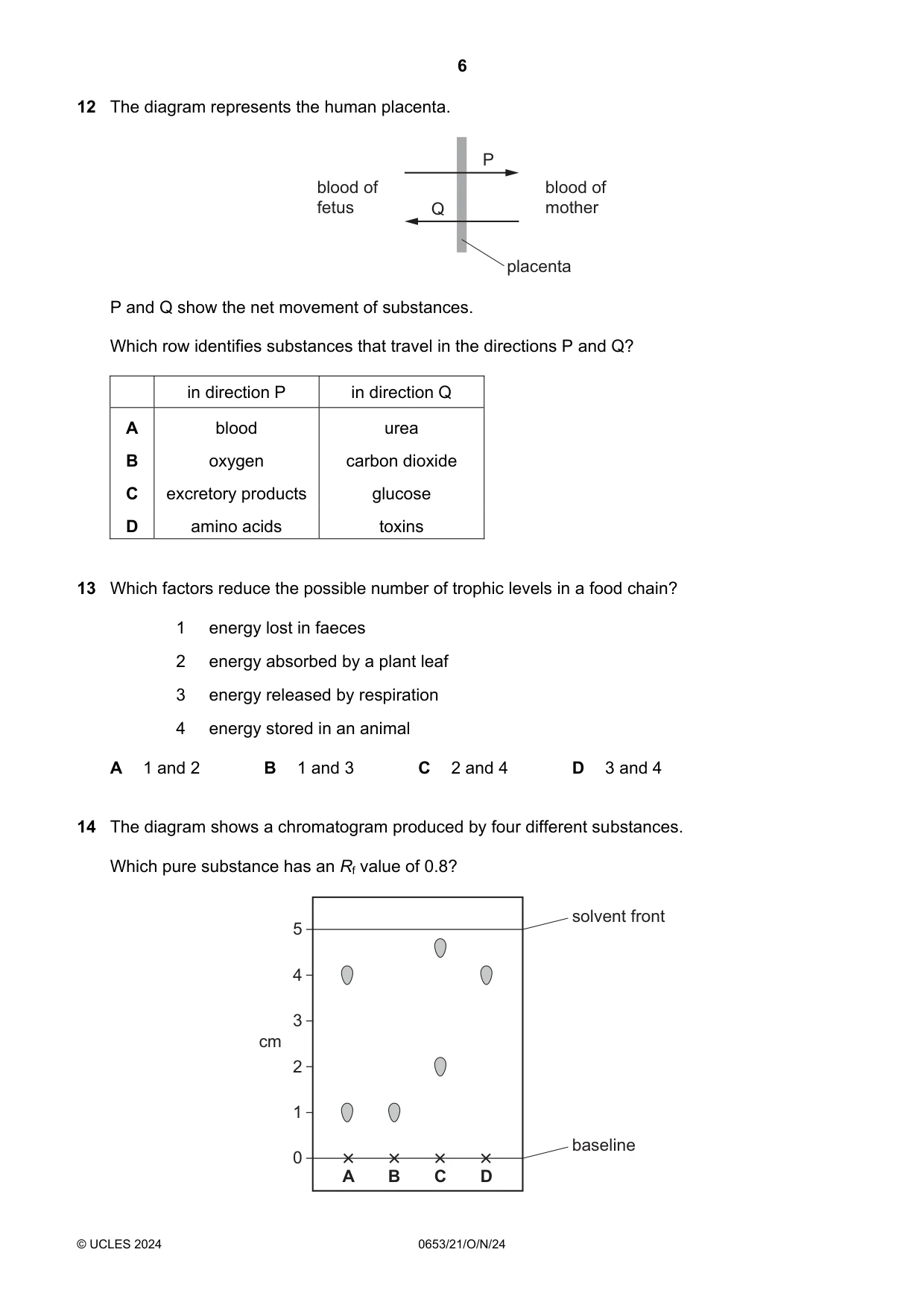
12 The diagram represents the human placenta. P blood of blood of fetus Q mother placenta P and Q show the net movement of substances. Which row identifies substances that travel in the directions P and Q? in direction P in direction Q A blood urea B oxygen carbon dioxide C excretory products glucose D amino acids toxins
Mark scheme: C
Q13 · Which factors reduce the possible number of trophic levels in a food chain?
13 Which factors reduce the possible number of trophic levels in a food chain? 1 energy lost in faeces 2 energy absorbed by a plant leaf 3 energy released by respiration 4 energy stored in an animal A 1 and 2 B 1 and 3 C 2 and 4 D 3 and 4
Mark scheme: B
Q14 · The diagram shows a chromatogram produced by four different substances
14 The diagram shows a chromatogram produced by four different substances. Which pure substance has an Rf value of 0.8? solvent front 5 4 3 cm 2 1 baseline 0 A B C D
Mark scheme: D
Q15 · Which process is not a chemical change?
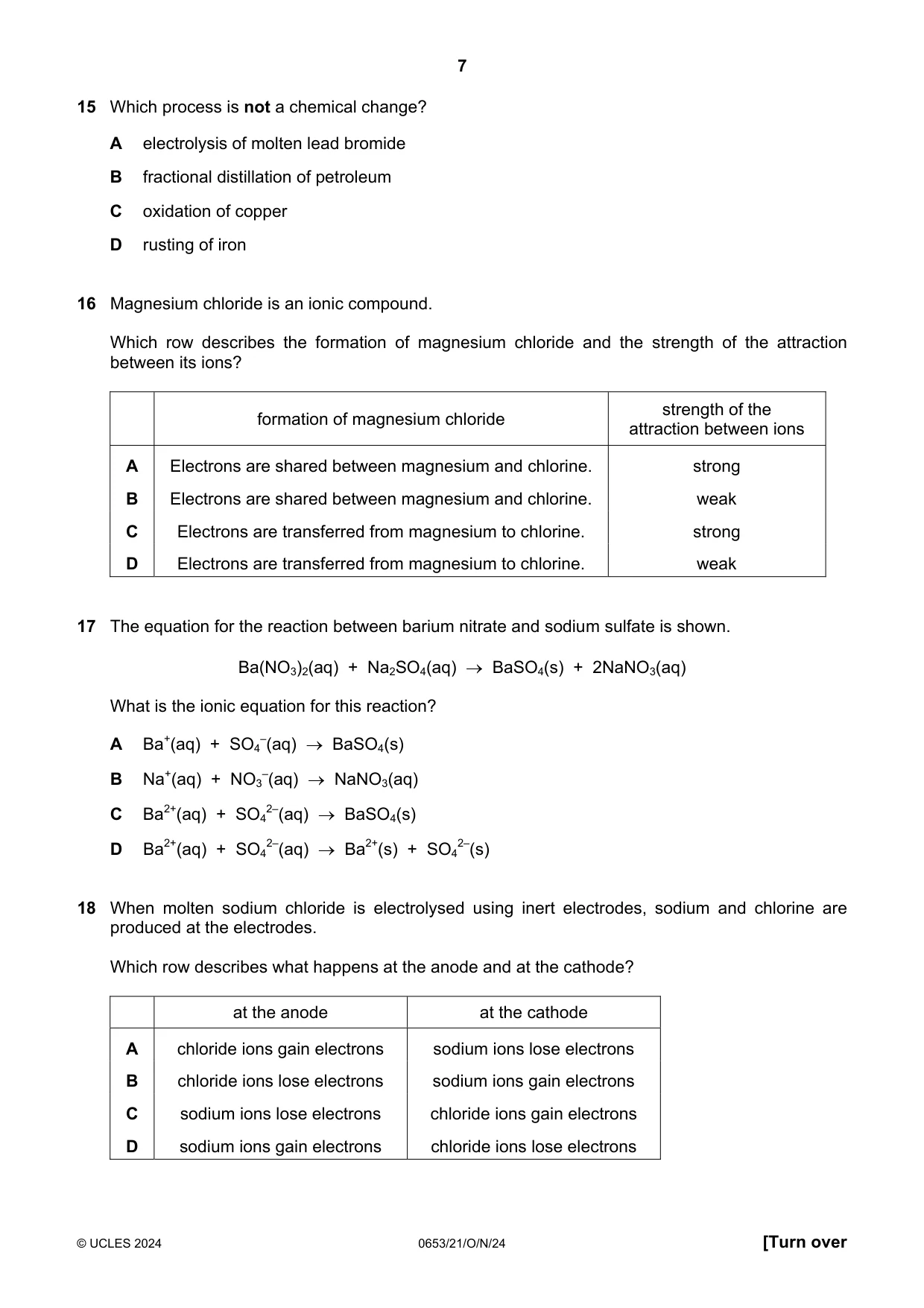
15 Which process is not a chemical change? A electrolysis of molten lead bromide B fractional distillation of petroleum C oxidation of copper D rusting of iron
Mark scheme: B
Q16 · Magnesium chloride is an ionic compound
16 Magnesium chloride is an ionic compound. Which row describes the formation of magnesium chloride and the strength of the attraction between its ions? strength of the formation of magnesium chloride attraction between ions A Electrons are shared between magnesium and chlorine. strong B Electrons are shared between magnesium and chlorine. weak C Electrons are transferred from magnesium to chlorine. strong D Electrons are transferred from magnesium to chlorine. weak
Mark scheme: C
Q17 · The equation for the reaction between barium nitrate and sodium sulfate is shown
17 The equation for the reaction between barium nitrate and sodium sulfate is shown. Ba(NO3)2(aq) + Na2SO4(aq) BaSO4(s) + 2NaNO3(aq) What is the ionic equation for this reaction? A Ba+(aq) + SO4 –(aq) BaSO4(s) B Na+(aq) + NO3 –(aq) NaNO3(aq) C Ba2+(aq) + SO4 2–(aq) BaSO4(s) D Ba2+(aq) + SO4 2–(aq) Ba2+(s) + SO4 2–(s)
Mark scheme: C
Q18 · When molten sodium chloride is electrolysed using inert electrodes, sodium and chlorine…
18 When molten sodium chloride is electrolysed using inert electrodes, sodium and chlorine are produced at the electrodes. Which row describes what happens at the anode and at the cathode? at the anode at the cathode A chloride ions gain electrons sodium ions lose electrons B chloride ions lose electrons sodium ions gain electrons C sodium ions lose electrons chloride ions gain electrons D sodium ions gain electrons chloride ions lose electrons
Mark scheme: B
Q19 · Which row about bond breaking is correct?
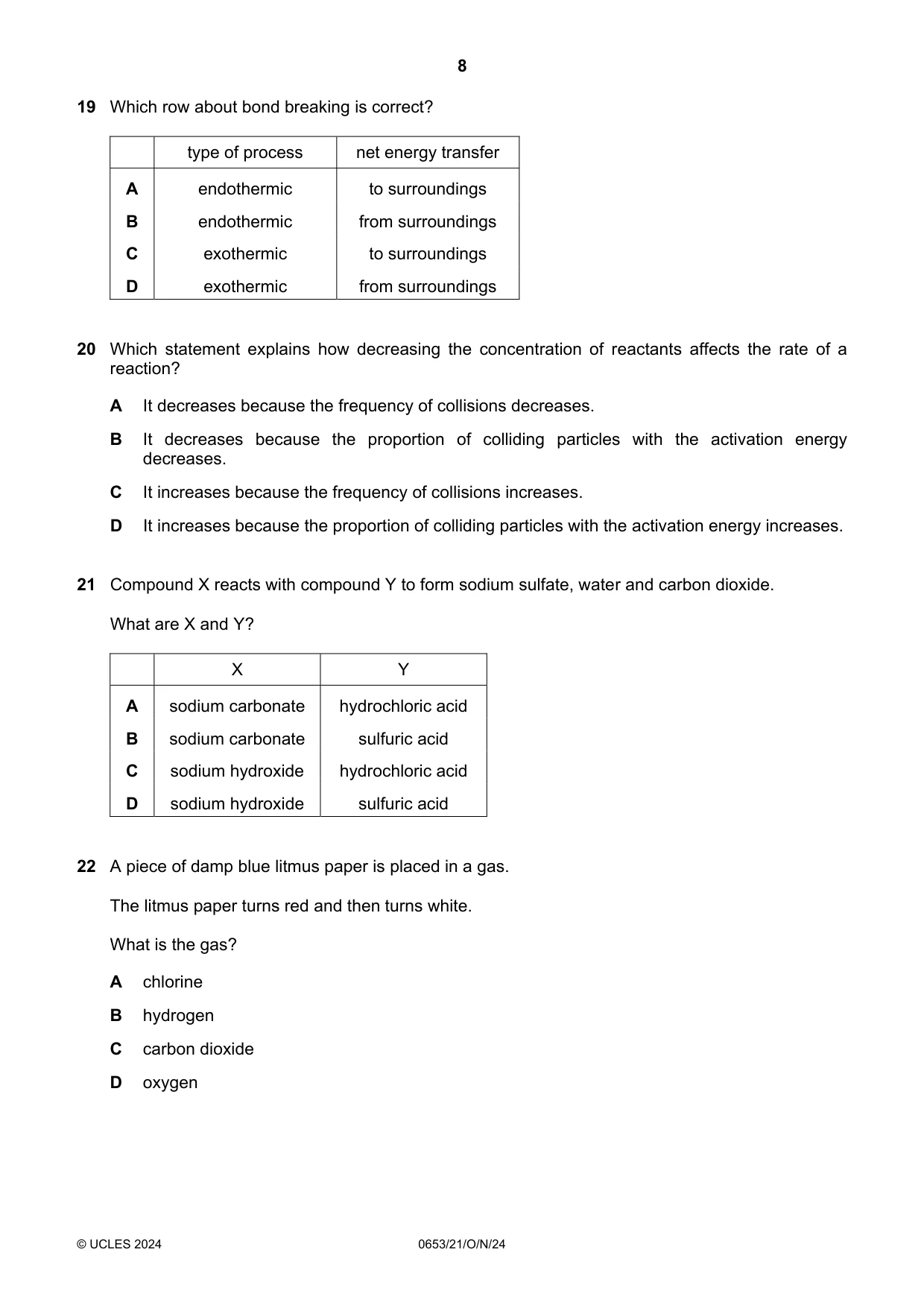
19 Which row about bond breaking is correct? type of process net energy transfer A endothermic to surroundings B endothermic from surroundings C exothermic to surroundings D exothermic from surroundings
Mark scheme: B
Q20 · Which statement explains how decreasing the concentration of reactants affects the rate…
20 Which statement explains how decreasing the concentration of reactants affects the rate of a reaction? A It decreases because the frequency of collisions decreases. B It decreases because the proportion of colliding particles with the activation energy decreases. C It increases because the frequency of collisions increases. D It increases because the proportion of colliding particles with the activation energy increases.
Mark scheme: A
Q21 · Compound X reacts with compound Y to form sodium sulfate, water and carbon dioxide
21 Compound X reacts with compound Y to form sodium sulfate, water and carbon dioxide. What are X and Y? X Y A sodium carbonate hydrochloric acid B sodium carbonate sulfuric acid C sodium hydroxide hydrochloric acid D sodium hydroxide sulfuric acid
Mark scheme: B
More questions on The characteristic properties of acids and bases
Q22 · A piece of damp blue litmus paper is placed in a gas
22 A piece of damp blue litmus paper is placed in a gas. The litmus paper turns red and then turns white. What is the gas? A chlorine B hydrogen C carbon dioxide D oxygen
Mark scheme: A
Q23 · Which statement explains why the elements in Group VIII of the Periodic Table are…
23 Which statement explains why the elements in Group VIII of the Periodic Table are unreactive? A They are gases. B They are non-metals. C They have equal numbers of protons and electrons in their atoms. D They have a full outer shell of electrons.
Mark scheme: D
Q24 · Which metal can be obtained by passing hydrogen over its heated metal oxide?
24 Which metal can be obtained by passing hydrogen over its heated metal oxide? A copper B magnesium C iron D zinc
Mark scheme: A
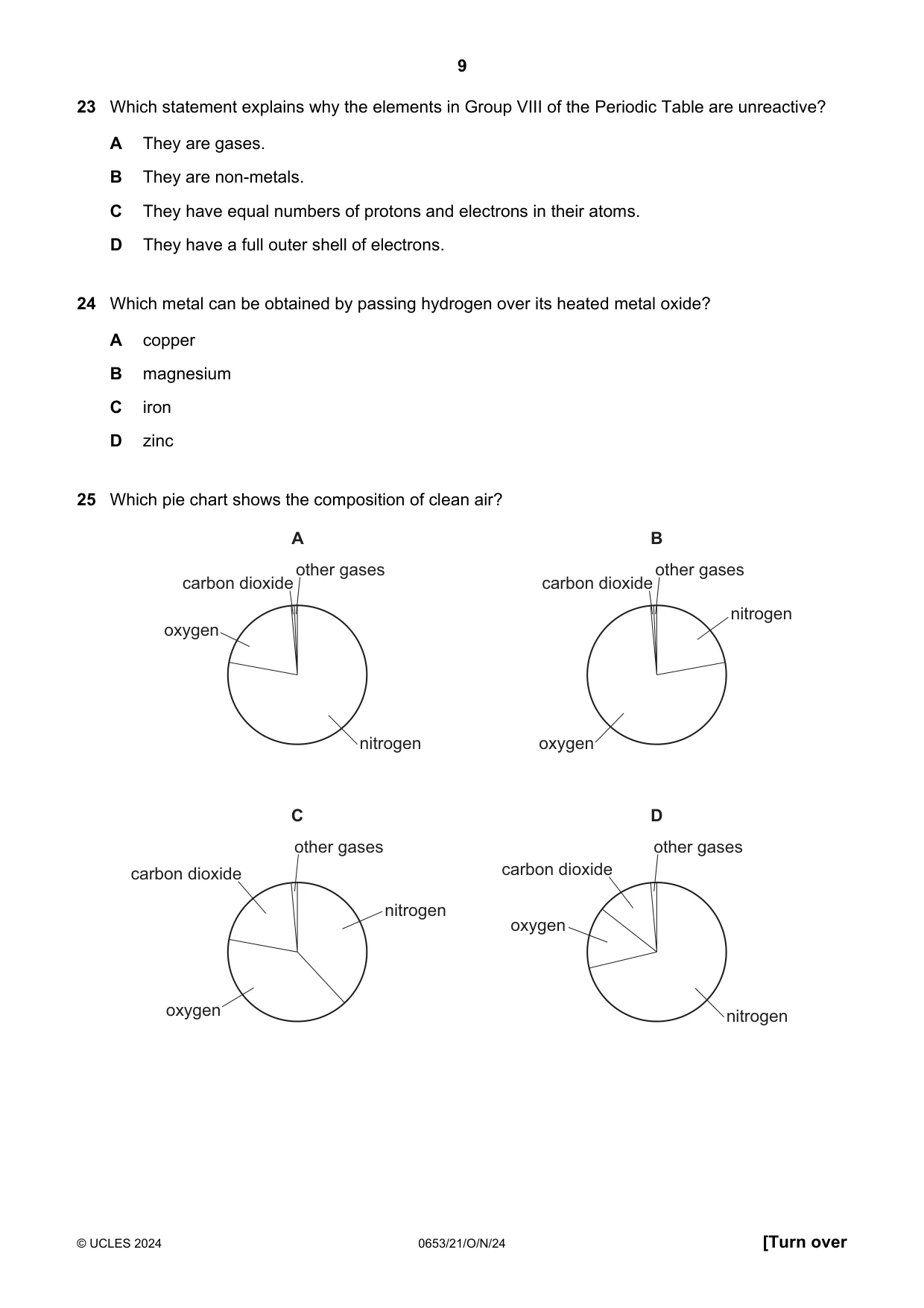
Q25 · Which pie chart shows the composition of clean air?
25 Which pie chart shows the composition of clean air? A B carbon dioxideother gases carbon dioxideother gases nitrogen oxygen nitrogen oxygen C D other gases other gases carbon dioxide carbon dioxide nitrogen oxygen oxygen nitrogen
Mark scheme: A
Q26 · Which statements about the alkanes are correct?
26 Which statements about the alkanes are correct? 1 They are saturated hydrocarbons. 2 They produce carbon monoxide and water during complete combustion. 3 They are generally unreactive, except in terms of burning. A 1, 2 and 3 B 1 and 2 only C 1 and 3 only D 2 and 3 only
Mark scheme: C
Q27 · Which statement about cracking is correct?
27 Which statement about cracking is correct? A Alkanes are produced, which are used to make polymers. B Low temperatures are used. C Alkenes are the only products. D A catalyst is used.
Mark scheme: D
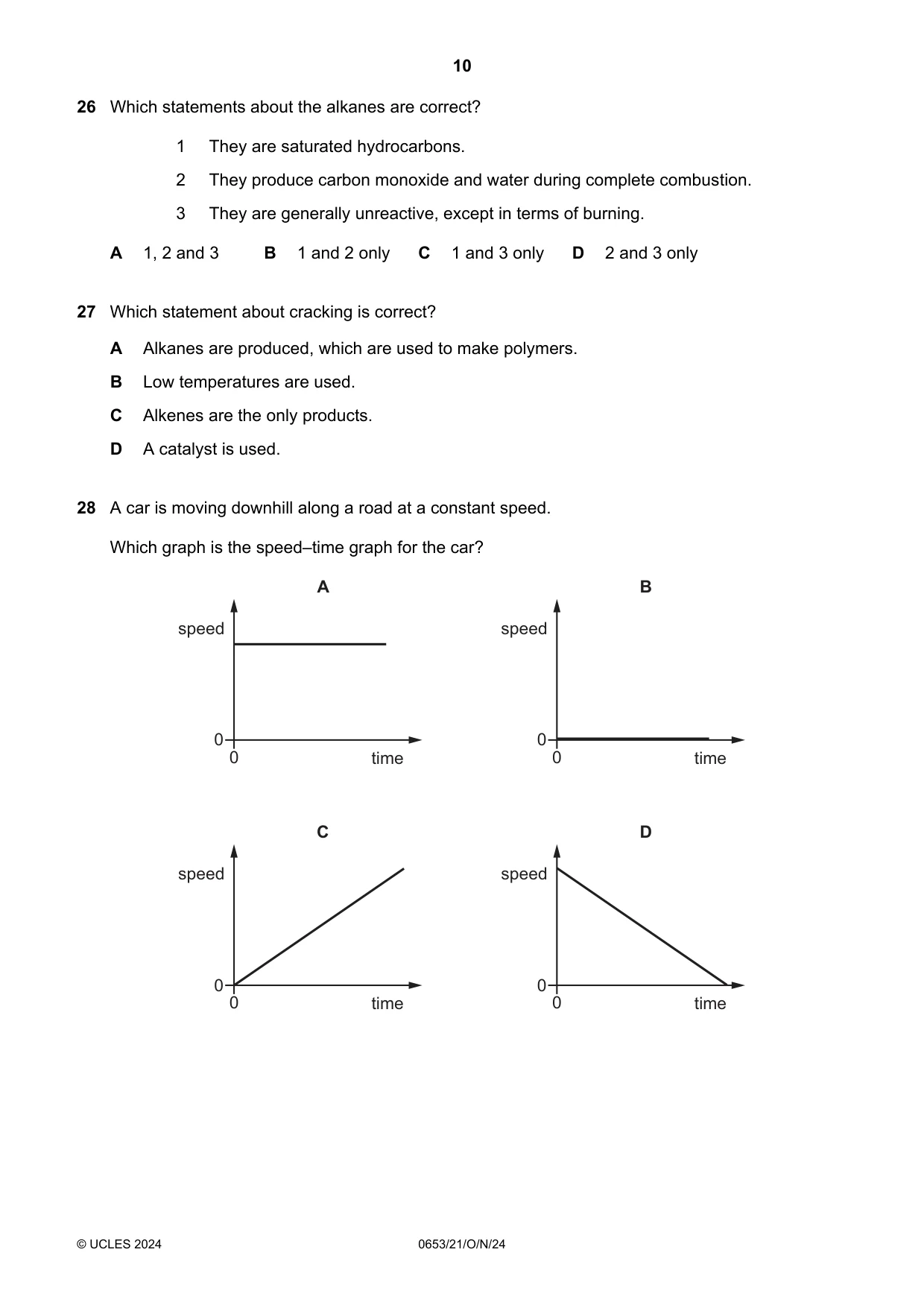
Q28 · A car is moving downhill along a road at a constant speed
28 A car is moving downhill along a road at a constant speed. Which graph is the speed–time graph for the car? A B speed speed 0 0 0 time 0 time C D speed speed 0 0 0 time 0 time
Mark scheme: A
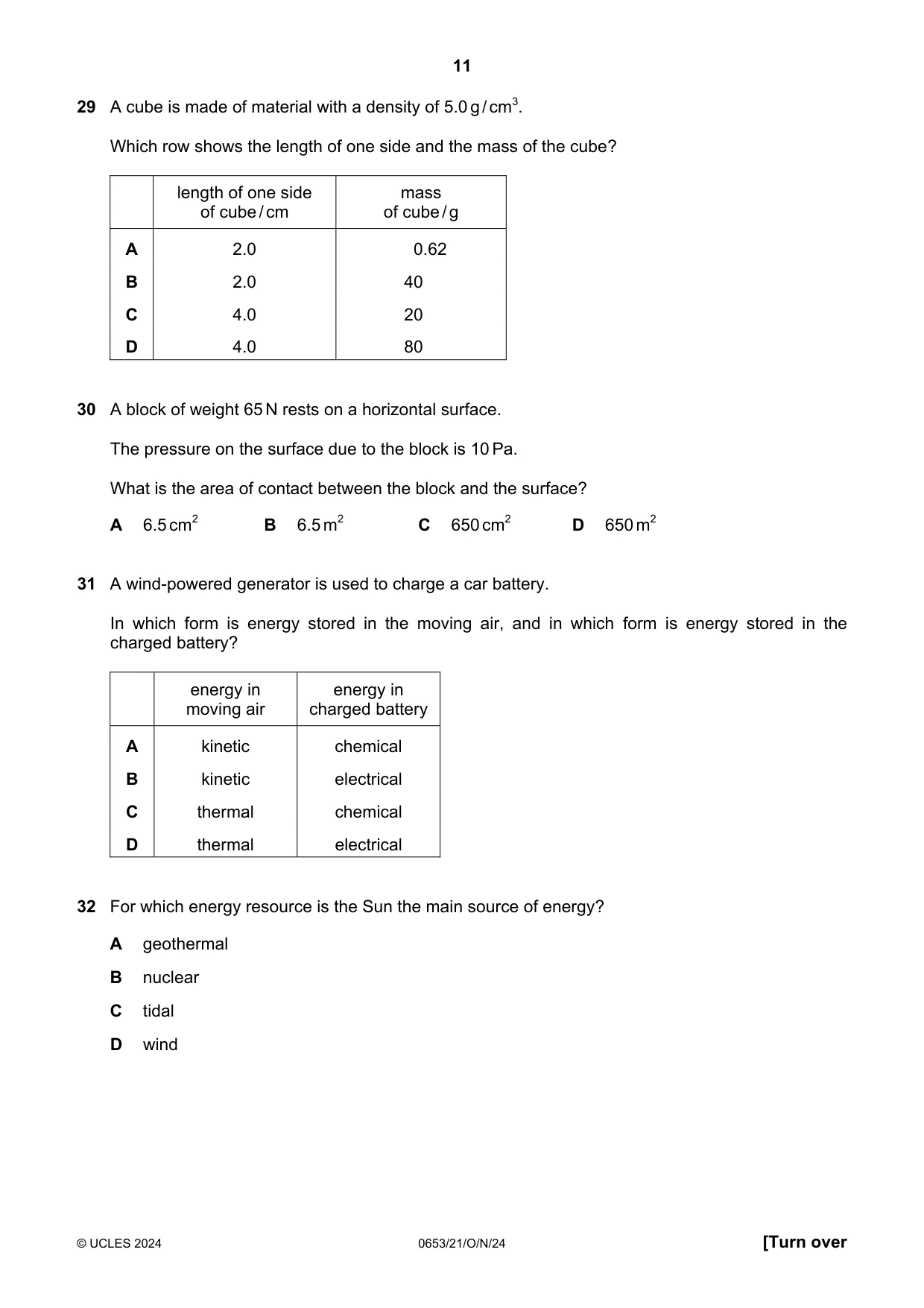
Q29 · A cube is made of material with a density of 5.0 g / cm3
29 A cube is made of material with a density of 5.0 g / cm3. Which row shows the length of one side and the mass of the cube? length of one side mass of cube / cm of cube / g A 2.0 0.62 B 2.0 40 C 4.0 20 D 4.0 80
Mark scheme: B
Q30 · A block of weight 65 N rests on a horizontal surface
30 A block of weight 65 N rests on a horizontal surface. The pressure on the surface due to the block is 10 Pa. What is the area of contact between the block and the surface? A 6.5 cm2 B 6.5 m2 C 650 cm2 D 650 m2
Mark scheme: B
Q31 · A wind-powered generator is used to charge a car battery
31 A wind-powered generator is used to charge a car battery. In which form is energy stored in the moving air, and in which form is energy stored in the charged battery? energy in energy in moving air charged battery A kinetic chemical B kinetic electrical C thermal chemical D thermal electrical
Mark scheme: A
Q32 · For which energy resource is the Sun the main source of energy?
32 For which energy resource is the Sun the main source of energy? A geothermal B nuclear C tidal D wind
Mark scheme: D
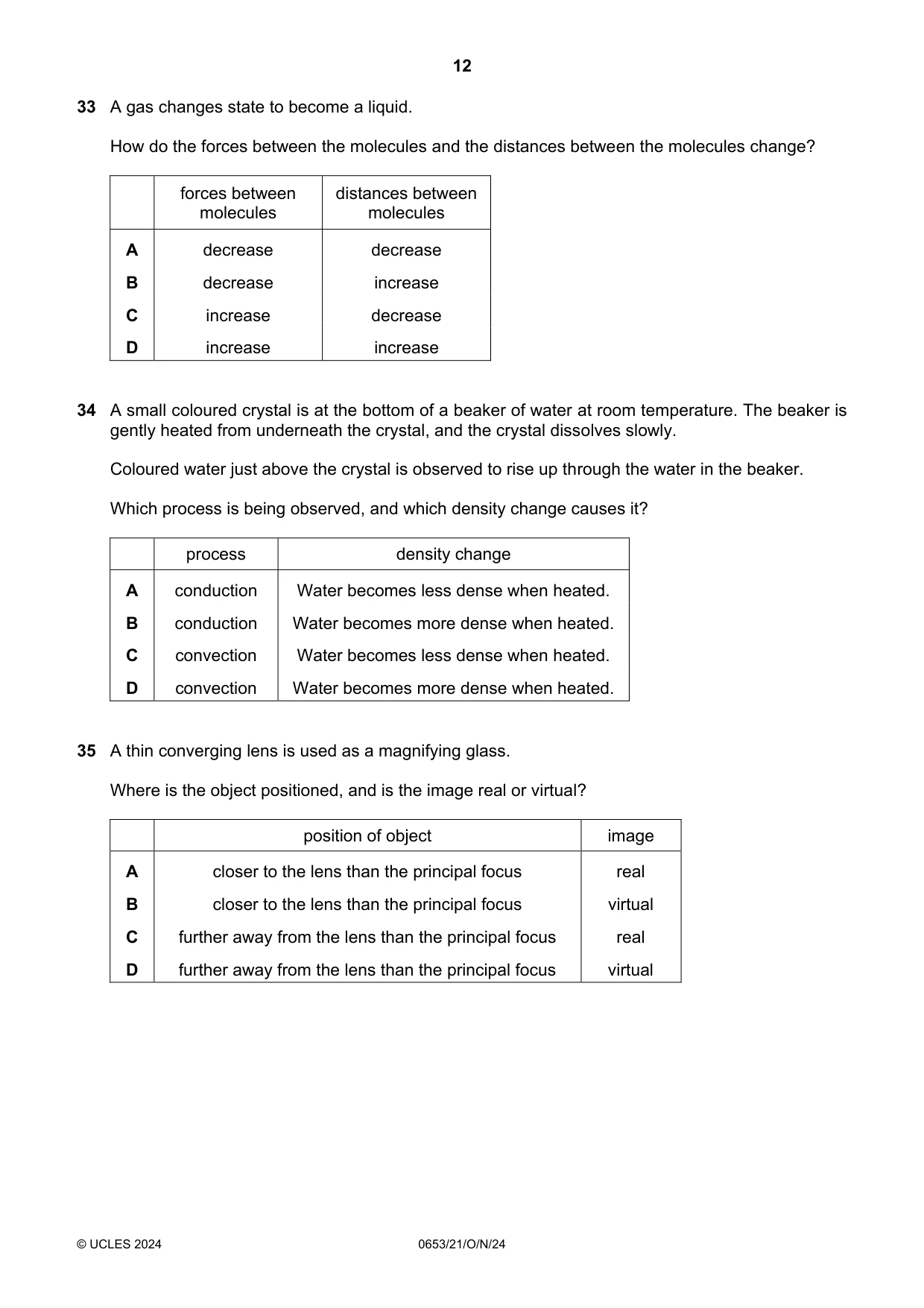
Q33 · A gas changes state to become a liquid
33 A gas changes state to become a liquid. How do the forces between the molecules and the distances between the molecules change? forces between distances between molecules molecules A decrease decrease B decrease increase C increase decrease D increase increase
Mark scheme: C
Q34 · A small coloured crystal is at the bottom of a beaker of water at room temperature
34 A small coloured crystal is at the bottom of a beaker of water at room temperature. The beaker is gently heated from underneath the crystal, and the crystal dissolves slowly. Coloured water just above the crystal is observed to rise up through the water in the beaker. Which process is being observed, and which density change causes it? process density change A conduction Water becomes less dense when heated. B conduction Water becomes more dense when heated. C convection Water becomes less dense when heated. D convection Water becomes more dense when heated.
Mark scheme: C
Q35 · A thin converging lens is used as a magnifying glass
35 A thin converging lens is used as a magnifying glass. Where is the object positioned, and is the image real or virtual? position of object image A closer to the lens than the principal focus real B closer to the lens than the principal focus virtual C further away from the lens than the principal focus real D further away from the lens than the principal focus virtual
Mark scheme: B
Q36 · The diagram represents a sound wave travelling from left to right in a solid
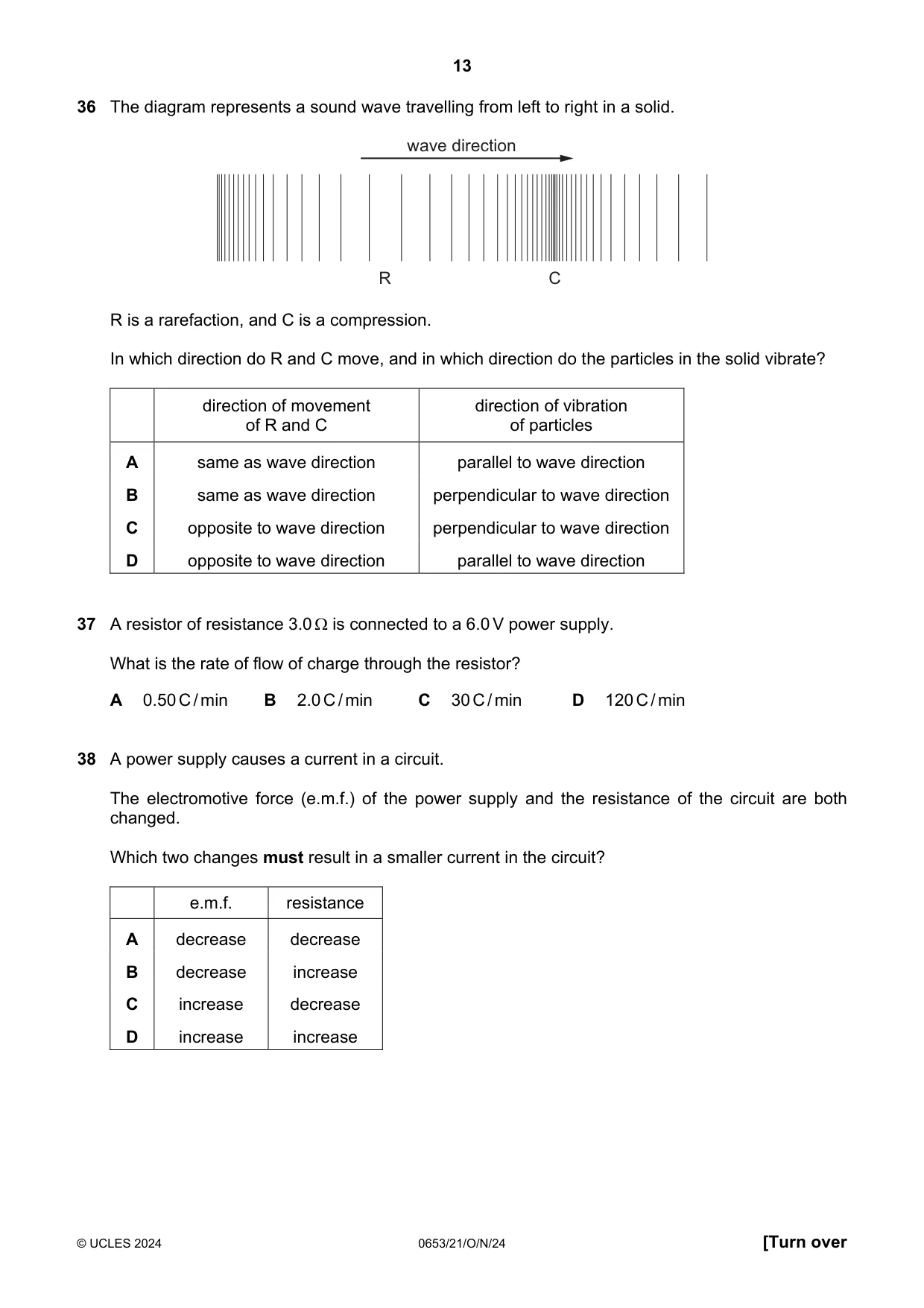
36 The diagram represents a sound wave travelling from left to right in a solid. wave direction R C R is a rarefaction, and C is a compression. In which direction do R and C move, and in which direction do the particles in the solid vibrate? direction of movement direction of vibration of R and C of particles A same as wave direction parallel to wave direction B same as wave direction perpendicular to wave direction C opposite to wave direction perpendicular to wave direction D opposite to wave direction parallel to wave direction
Mark scheme: A
Q37 · A resistor of resistance 3.0 is connected to a 6.0 V power supply
37 A resistor of resistance 3.0 is connected to a 6.0 V power supply. What is the rate of flow of charge through the resistor? A 0.50 C / min B 2.0 C / min C 30 C / min D 120 C / min
Mark scheme: D
Q38 · A power supply causes a current in a circuit
38 A power supply causes a current in a circuit. The electromotive force (e.m.f.) of the power supply and the resistance of the circuit are both changed. Which two changes must result in a smaller current in the circuit? e.m.f. resistance A decrease decrease B decrease increase C increase decrease D increase increase
Mark scheme: B
Q39 · Which circuit shows a voltmeter that measures the potential difference (p.d.) across a…
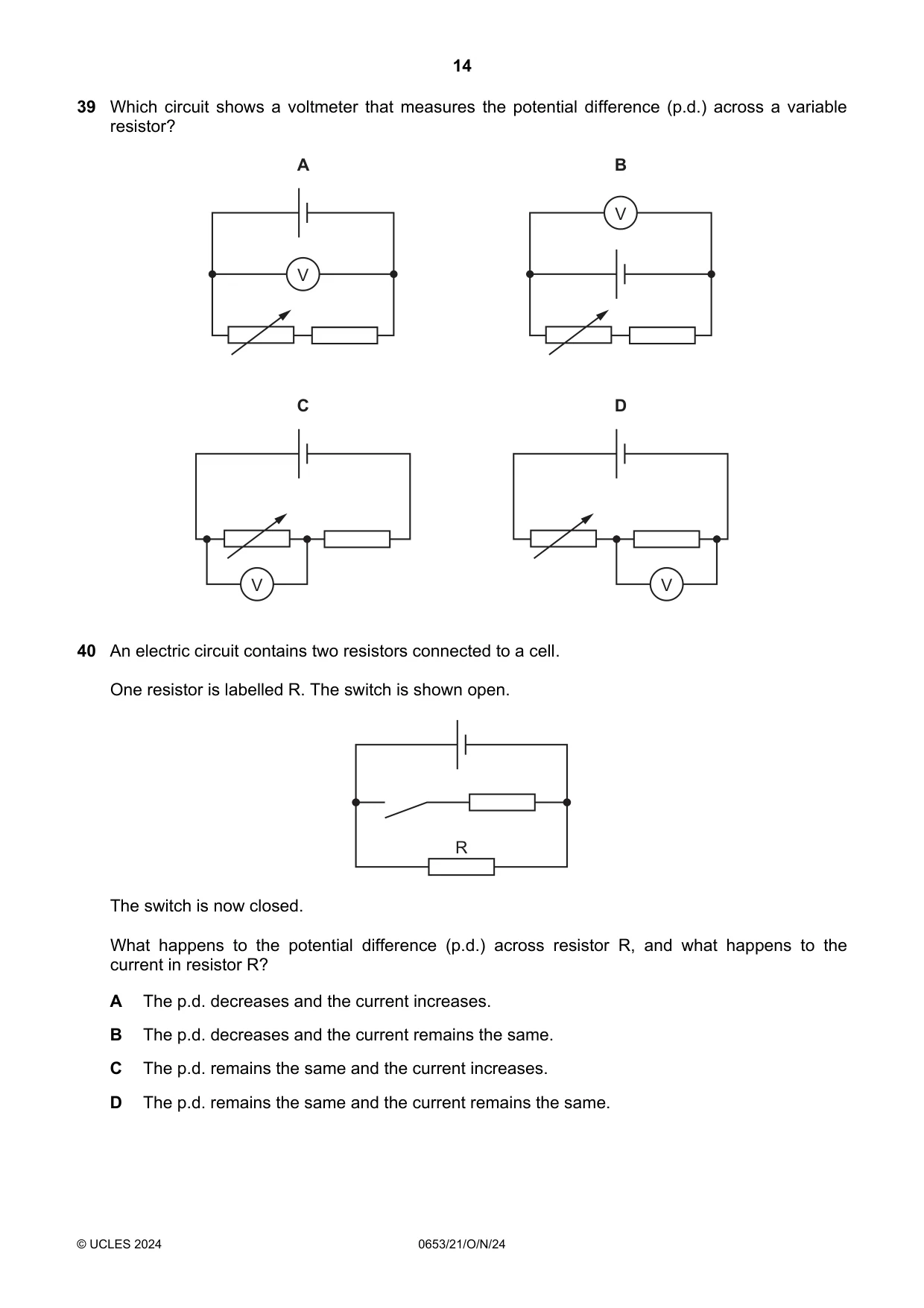
39 Which circuit shows a voltmeter that measures the potential difference (p.d.) across a variable resistor? A B V V C D V V
Mark scheme: C
Q40 · An electric circuit contains two resistors connected to a cell
40 An electric circuit contains two resistors connected to a cell. One resistor is labelled R. The switch is shown open. R The switch is now closed. What happens to the potential difference (p.d.) across resistor R, and what happens to the current in resistor R? A The p.d. decreases and the current increases. B The p.d. decreases and the current remains the same. C The p.d. remains the same and the current increases. D The p.d. remains the same and the current remains the same.
Mark scheme: D
What was in this paper
The subtopics covered by these 40 questions, and how many questions each got. Open one in a new tab to see every Cambridge question on it.
3Characteristics of living organisms2Energy, work and power2Air quality and climate1Alkanes1Alkenes1Chromatography1Density1Diet1Diffusion1Digestive system1Electrical quantities1Electrolysis1Energy flow1Enzymes1Exothermic and endothermic reactions1Formulas1Gas exchange in humans1Heart1Identification of ions and gases1Ions and ionic bonds1Kinetic particle model of matter1Light1Motion1Noble gases1Physical and chemical changes1Pressure1Rate of reaction1Reactivity series1Respiration1Sexual reproduction in humans1Sexual reproduction in plants1Sound1The characteristic properties of acids and bases1Transfer of thermal energy1Transpiration1What you needed in this session
Cambridge’s own grade thresholds for 2024 Oct/Nov, Paper 2 · Variant 1. A higher threshold means an easier paper — the bar moves with how the cohort did.