Cambridge IGCSE Science - Combined 0653 — 2023 Oct/Nov Paper 2 · Variant 1
0653/21/O/N/23 · 40 questions · 40 marks · ≈45 min
The question paper and its mark scheme, free to read here and free to download. This is Cambridge’s own paper, exactly as it was sat.
Question paper16 pages
Mark scheme3 pages
Answers below. Sit the paper first if you are practising.
Questions as text
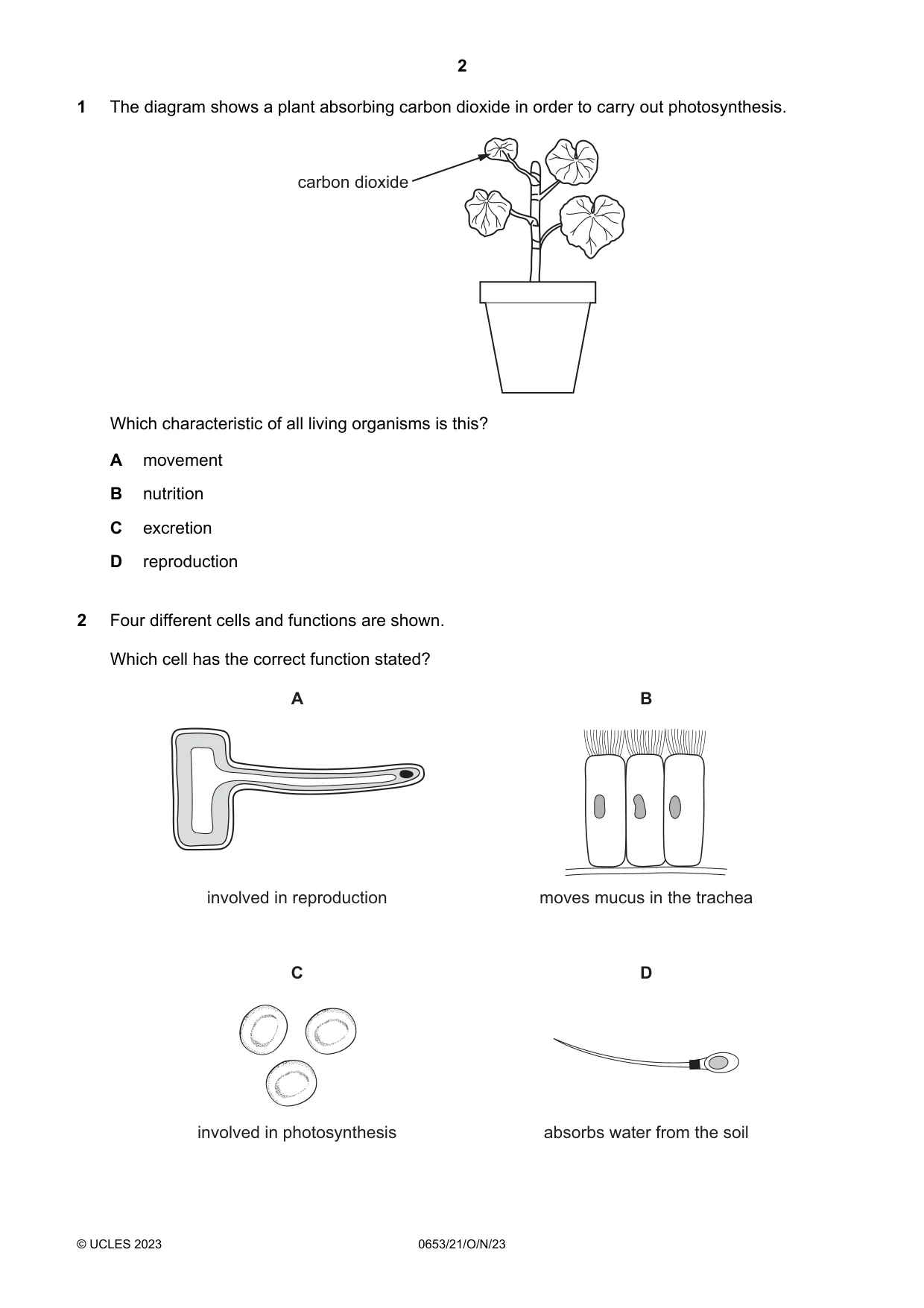
Q1 · The diagram shows a plant absorbing carbon dioxide in order to carry out photosynthesis
1 The diagram shows a plant absorbing carbon dioxide in order to carry out photosynthesis. carbon dioxide Which characteristic of all living organisms is this? A movement B nutrition C excretion D reproduction
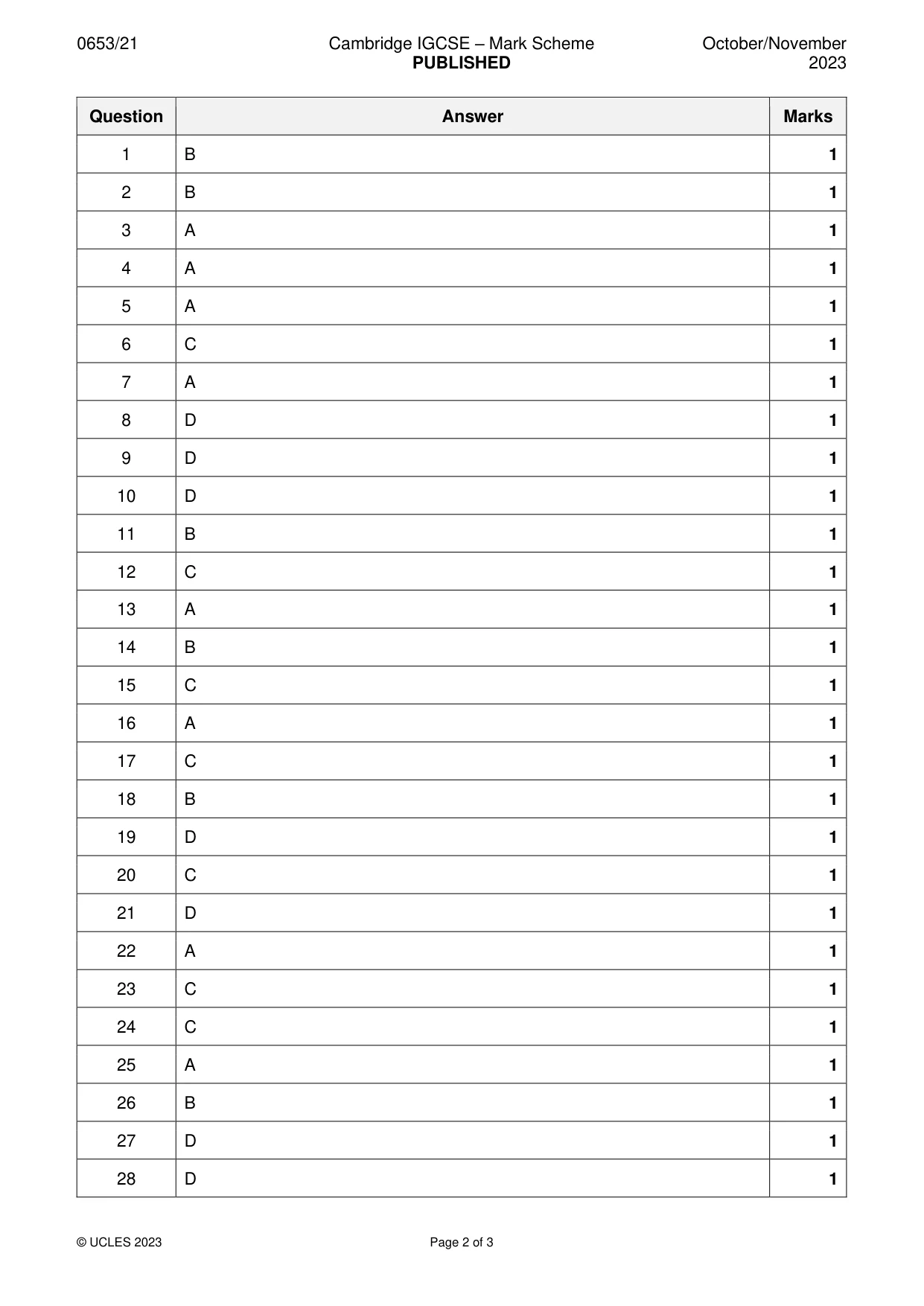
Mark scheme: B
Q2 · Four different cells and functions are shown
2 Four different cells and functions are shown. Which cell has the correct function stated? A B involved in reproduction moves mucus in the trachea C D involved in photosynthesis absorbs water from the soil
Mark scheme: B
Question 3
3 What is diffusion? A net movement of molecules down a concentration gradient B net movement of molecules up a concentration gradient C total movement of molecules down a concentration gradient D total movement of molecules up a concentration gradient
Mark scheme: A
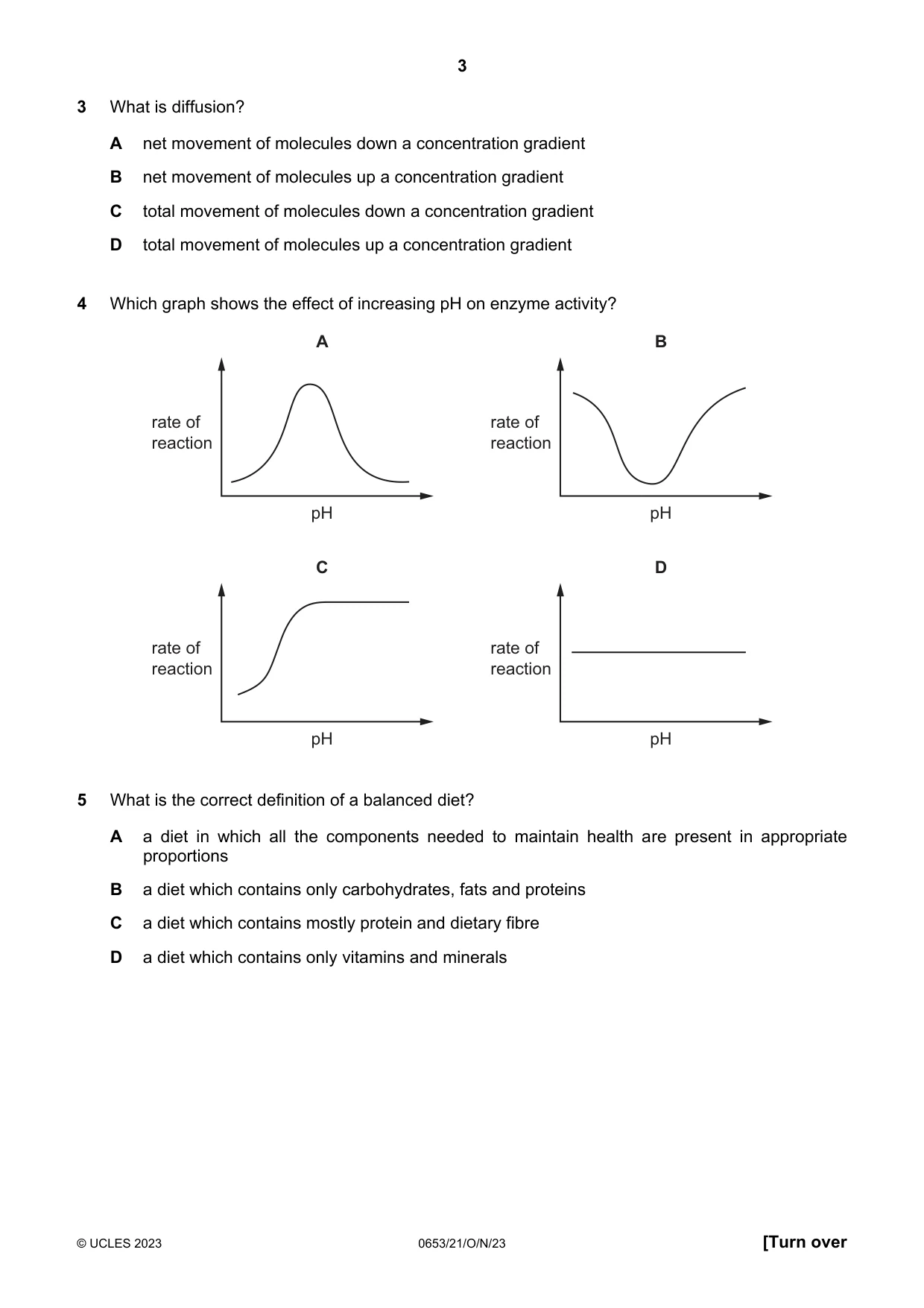
Q4 · Which graph shows the effect of increasing pH on enzyme activity?
4 Which graph shows the effect of increasing pH on enzyme activity? A B rate of rate of reaction reaction pH pH C D rate of rate of reaction reaction pH pH
Mark scheme: A
Q5 · What is the correct definition of a balanced diet?
5 What is the correct definition of a balanced diet? A a diet in which all the components needed to maintain health are present in appropriate proportions B a diet which contains only carbohydrates, fats and proteins C a diet which contains mostly protein and dietary fibre D a diet which contains only vitamins and minerals
Mark scheme: A
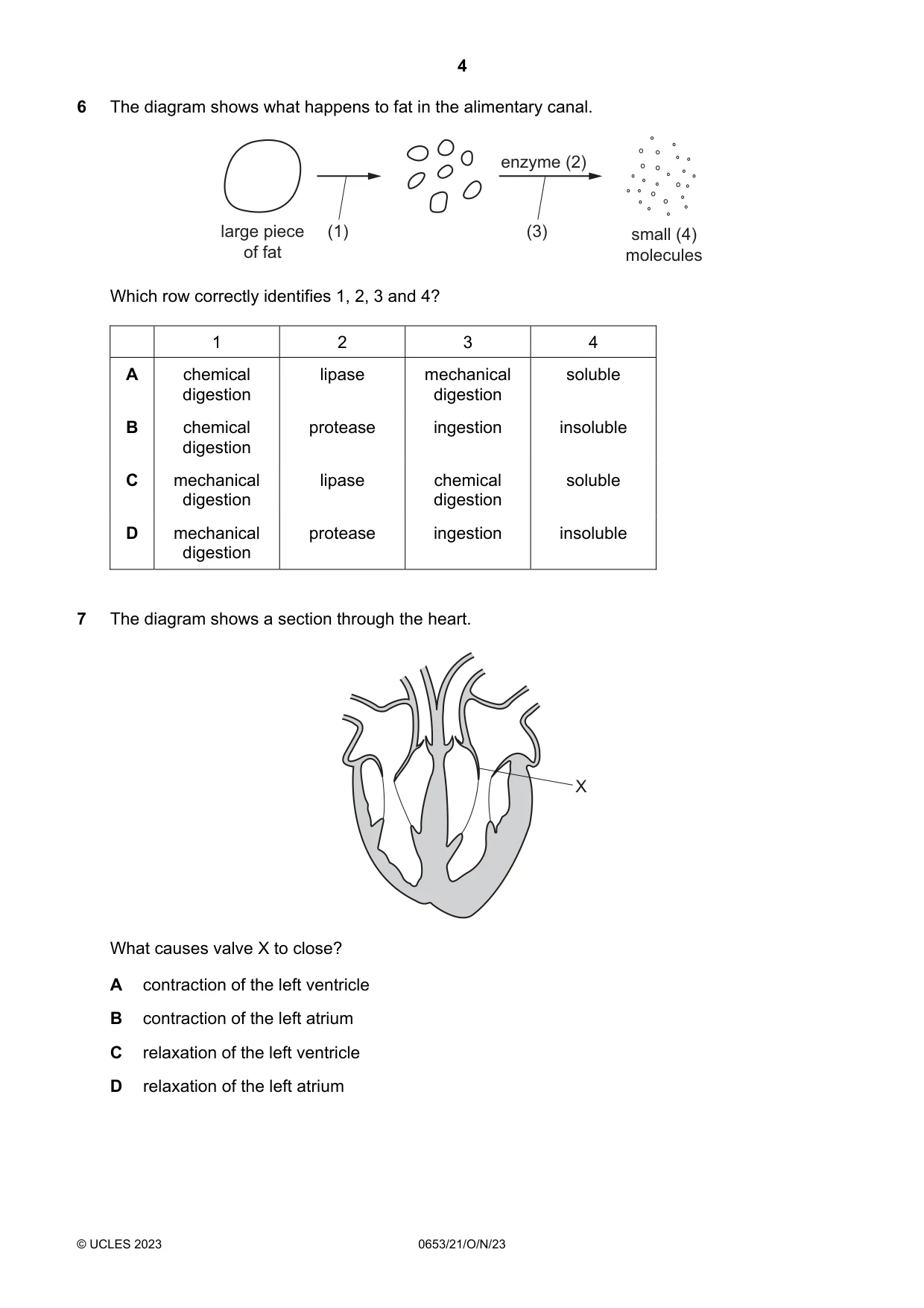
Q6 · The diagram shows what happens to fat in the alimentary canal
6 The diagram shows what happens to fat in the alimentary canal. enzyme (2) large piece (1) (3) small (4) of fat molecules Which row correctly identifies 1, 2, 3 and 4? 1 2 3 4 A chemical lipase mechanical soluble digestion digestion B chemical protease ingestion insoluble digestion C mechanical lipase chemical soluble digestion digestion D mechanical protease ingestion insoluble digestion
Mark scheme: C
Q7 · The diagram shows a section through the heart
7 The diagram shows a section through the heart. X What causes valve X to close? A contraction of the left ventricle B contraction of the left atrium C relaxation of the left ventricle D relaxation of the left atrium
Mark scheme: A
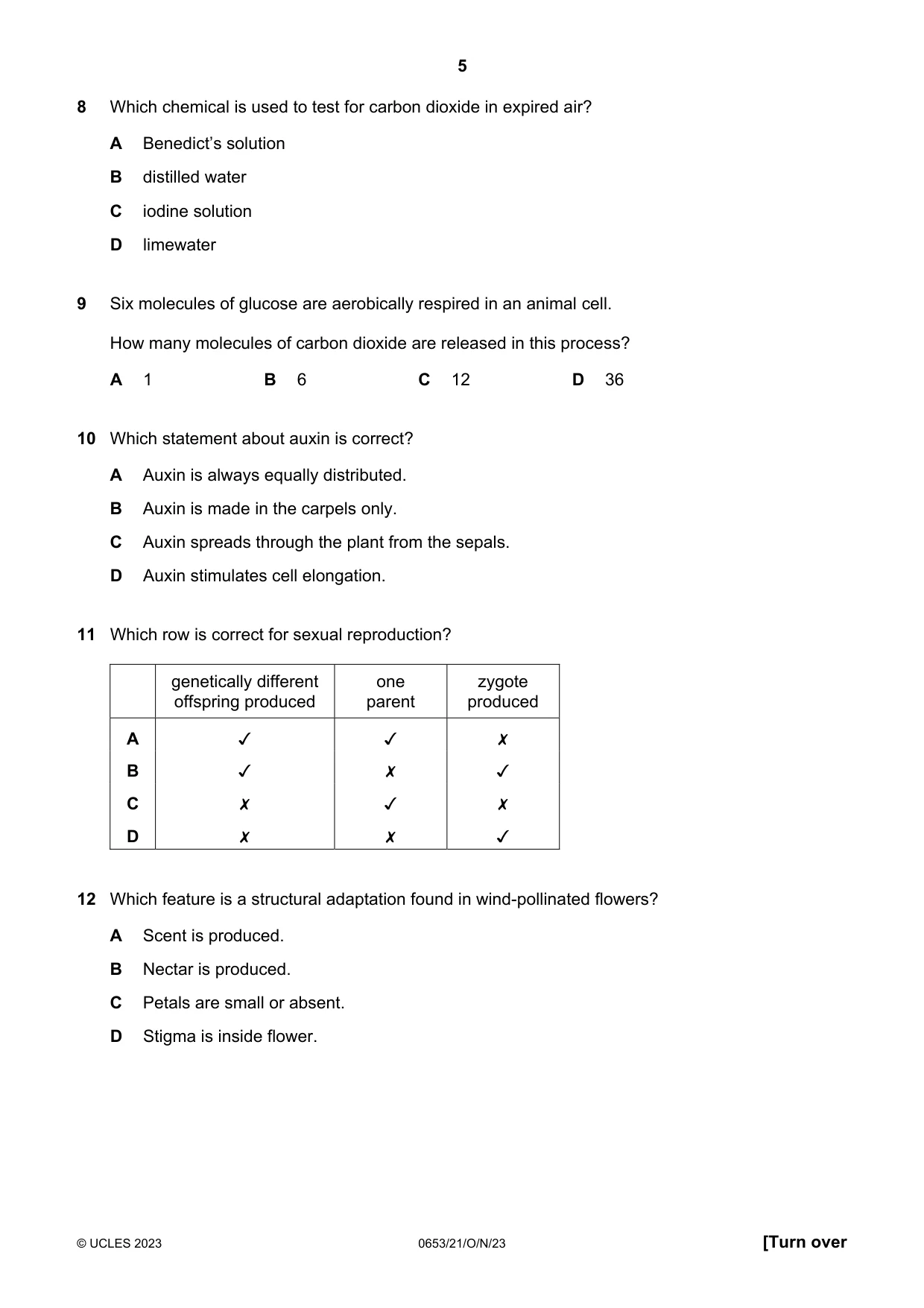
Q8 · Which chemical is used to test for carbon dioxide in expired air?
8 Which chemical is used to test for carbon dioxide in expired air? A Benedict’s solution B distilled water C iodine solution D limewater
Mark scheme: D
Q9 · Six molecules of glucose are aerobically respired in an animal cell
9 Six molecules of glucose are aerobically respired in an animal cell. How many molecules of carbon dioxide are released in this process? A 1 B 6 C 12 D 36
Mark scheme: D
Q10 · Which statement about auxin is correct?
10 Which statement about auxin is correct? A Auxin is always equally distributed. B Auxin is made in the carpels only. C Auxin spreads through the plant from the sepals. D Auxin stimulates cell elongation.
Mark scheme: D
Q11 · Which row is correct for sexual reproduction?
11 Which row is correct for sexual reproduction? genetically different one zygote offspring produced parent produced
Mark scheme: B
Q12 · Which feature is a structural adaptation found in wind-pollinated flowers?
12 Which feature is a structural adaptation found in wind-pollinated flowers? A Scent is produced. B Nectar is produced. C Petals are small or absent. D Stigma is inside flower.
Mark scheme: C
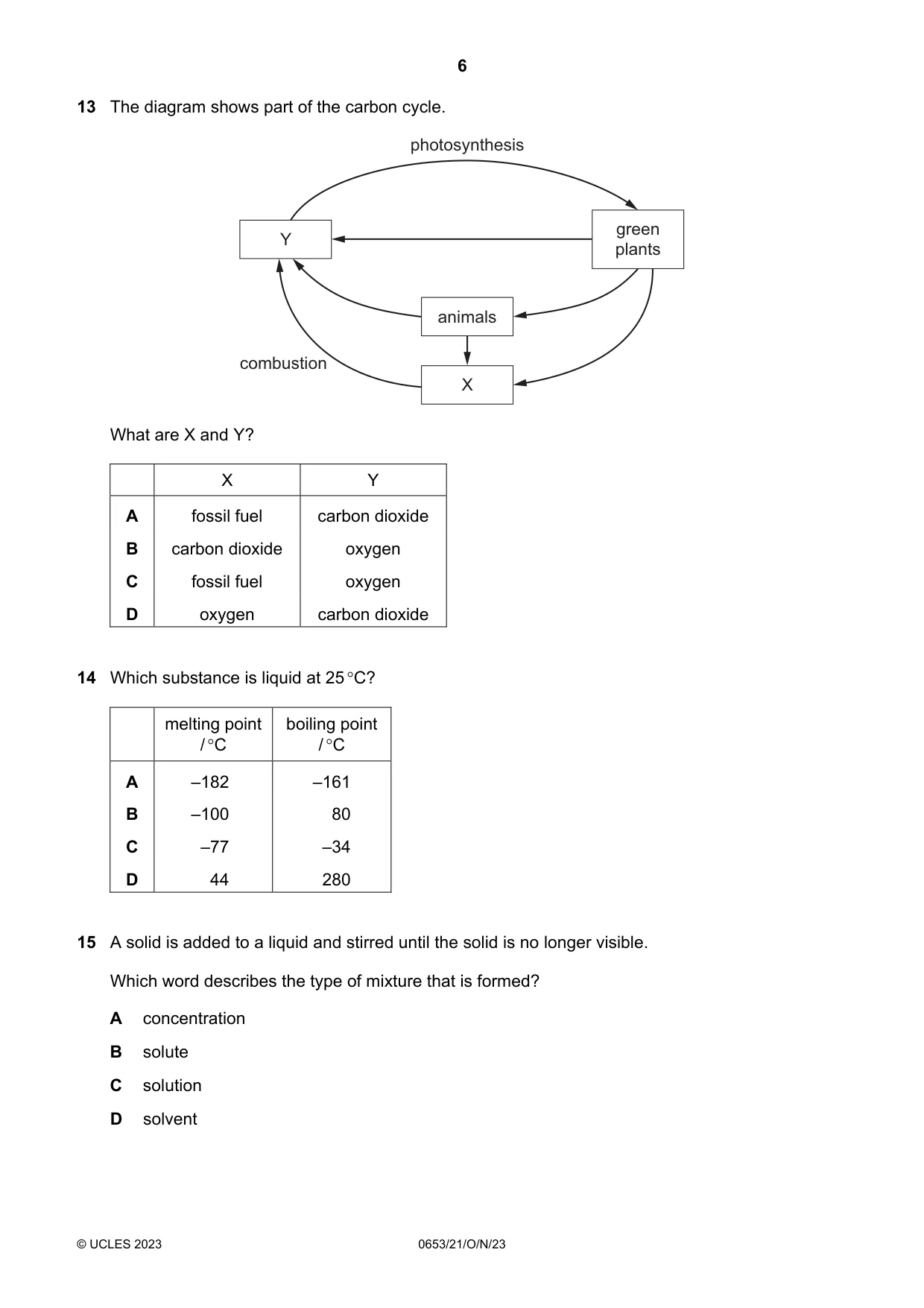
Q13 · The diagram shows part of the carbon cycle
13 The diagram shows part of the carbon cycle. photosynthesis green Y plants animals combustion X What are X and Y? X Y A fossil fuel carbon dioxide B carbon dioxide oxygen C fossil fuel oxygen D oxygen carbon dioxide
Mark scheme: A
Q14 · Which substance is liquid at 25 C?
14 Which substance is liquid at 25 C? melting point boiling point / C / C A –182 –161 B –100 80 C –77 –34 D 44 280
Mark scheme: B
Q15 · A solid is added to a liquid and stirred until the solid is no longer visible
15 A solid is added to a liquid and stirred until the solid is no longer visible. Which word describes the type of mixture that is formed? A concentration B solute C solution D solvent
Mark scheme: C
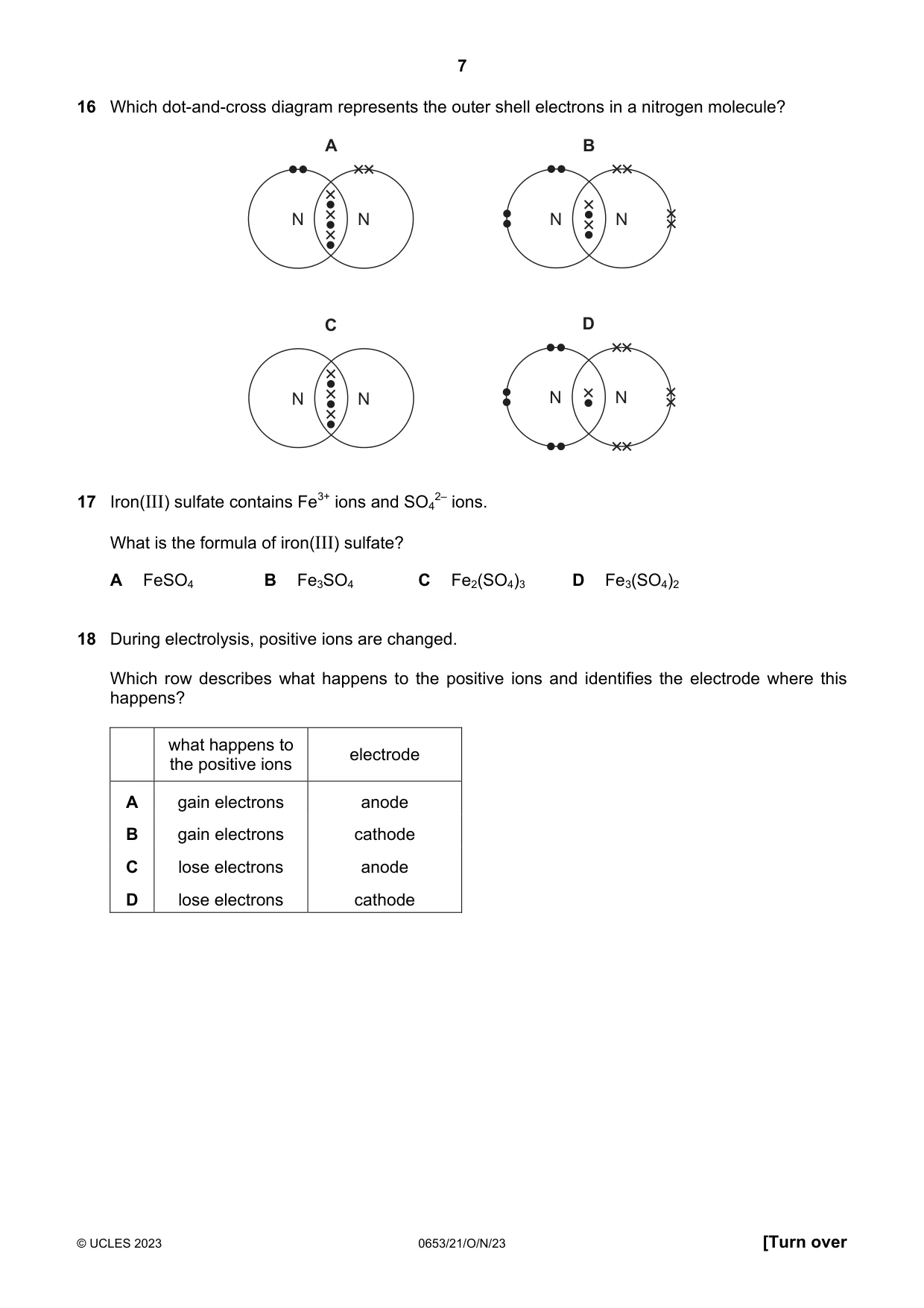
Q16 · Which dot-and-cross diagram represents the outer shell electrons in a nitrogen molecule?
16 Which dot-and-cross diagram represents the outer shell electrons in a nitrogen molecule? A B N N N N C D N N N N
Mark scheme: A
Q17 · Iron(III) sulfate contains Fe3+ ions and SO4 2– ions
17 Iron(III) sulfate contains Fe3+ ions and SO4 2– ions. What is the formula of iron(III) sulfate? A FeSO4 B Fe3SO4 C Fe2(SO4)3 D Fe3(SO4)2
Mark scheme: C
Q18 · During electrolysis, positive ions are changed
18 During electrolysis, positive ions are changed. Which row describes what happens to the positive ions and identifies the electrode where this happens? what happens to electrode the positive ions A gain electrons anode B gain electrons cathode C lose electrons anode D lose electrons cathode
Mark scheme: B
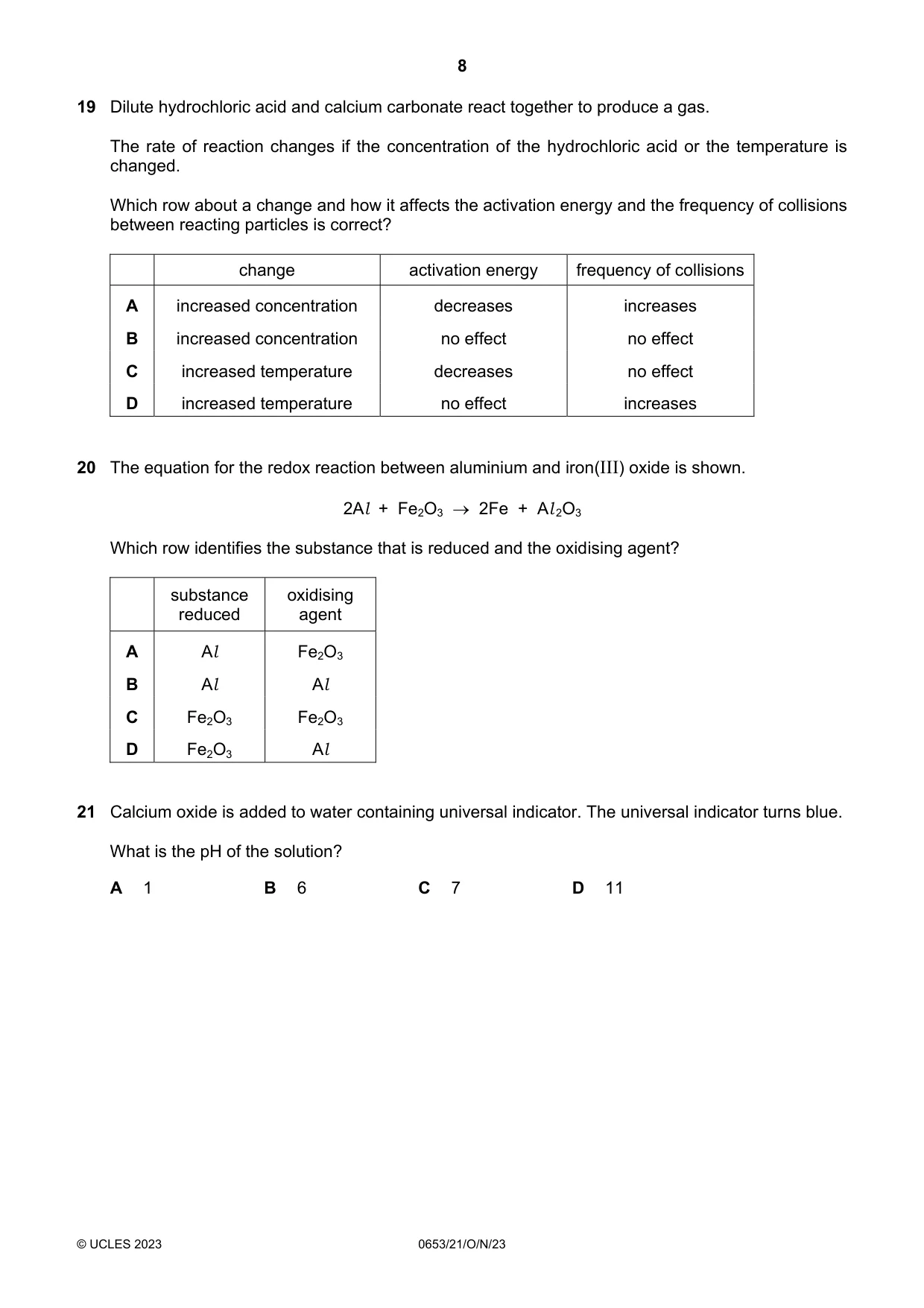
Q19 · Dilute hydrochloric acid and calcium carbonate react together to produce a gas
19 Dilute hydrochloric acid and calcium carbonate react together to produce a gas. The rate of reaction changes if the concentration of the hydrochloric acid or the temperature is changed. Which row about a change and how it affects the activation energy and the frequency of collisions between reacting particles is correct? change activation energy frequency of collisions A increased concentration decreases increases B increased concentration no effect no effect C increased temperature decreases no effect D increased temperature no effect increases
Mark scheme: D
Q20 · The equation for the redox reaction between aluminium and iron(III) oxide is shown
20 The equation for the redox reaction between aluminium and iron(III) oxide is shown. 2Al + Fe2O3 2Fe + Al 2O3 Which row identifies the substance that is reduced and the oxidising agent? substance oxidising reduced agent A Al Fe2O3 B Al Al C Fe2O3 Fe2O3 D Fe2O3 Al
Mark scheme: C
Q21 · Calcium oxide is added to water containing universal indicator
21 Calcium oxide is added to water containing universal indicator. The universal indicator turns blue. What is the pH of the solution? A 1 B 6 C 7 D 11
Mark scheme: D
More questions on The characteristic properties of acids and bases
Q22 · Acid X reacts with metal Y
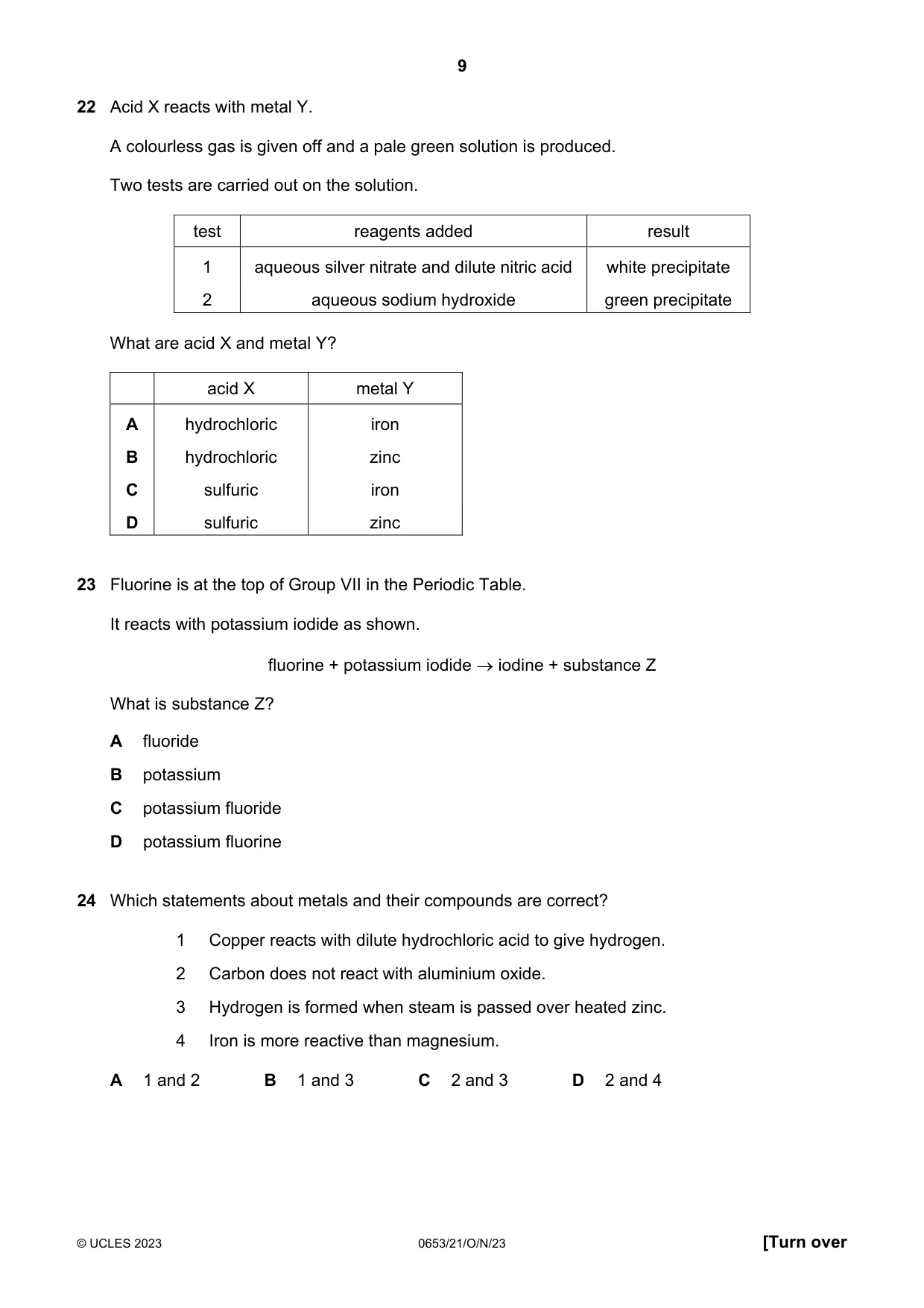
22 Acid X reacts with metal Y. A colourless gas is given off and a pale green solution is produced. Two tests are carried out on the solution. test reagents added result 1 aqueous silver nitrate and dilute nitric acid white precipitate 2 aqueous sodium hydroxide green precipitate What are acid X and metal Y? acid X metal Y A hydrochloric iron B hydrochloric zinc C sulfuric iron D sulfuric zinc
Mark scheme: A
Q23 · Fluorine is at the top of Group VII in the Periodic Table
23 Fluorine is at the top of Group VII in the Periodic Table. It reacts with potassium iodide as shown. fluorine + potassium iodide iodine + substance Z What is substance Z? A fluoride B potassium C potassium fluoride D potassium fluorine
Mark scheme: C
Q24 · Which statements about metals and their compounds are correct?
24 Which statements about metals and their compounds are correct? 1 Copper reacts with dilute hydrochloric acid to give hydrogen. 2 Carbon does not react with aluminium oxide. 3 Hydrogen is formed when steam is passed over heated zinc. 4 Iron is more reactive than magnesium. A 1 and 2 B 1 and 3 C 2 and 3 D 2 and 4
Mark scheme: C
Q25 · Different reactions occur in the blast furnace
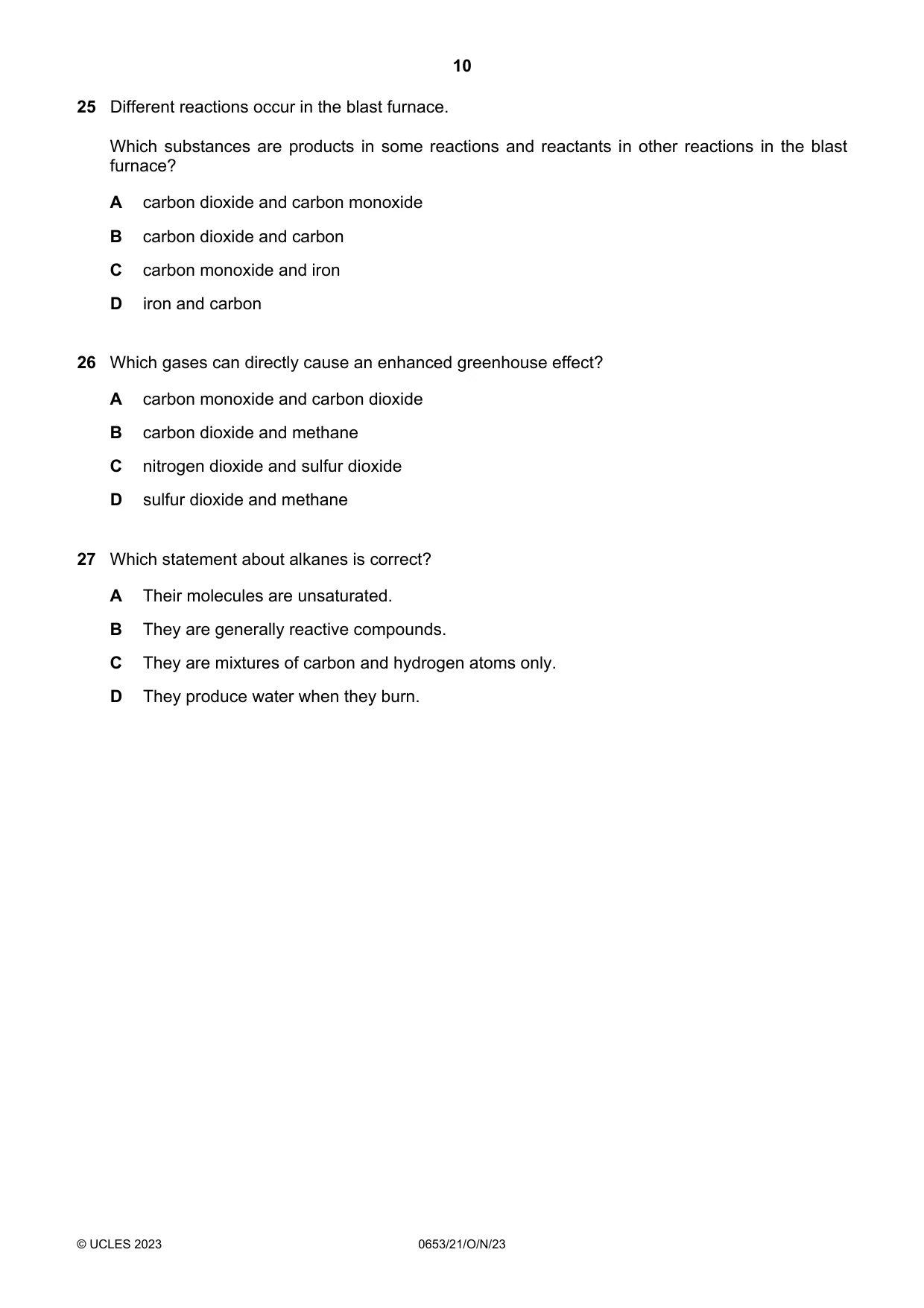
25 Different reactions occur in the blast furnace. Which substances are products in some reactions and reactants in other reactions in the blast furnace? A carbon dioxide and carbon monoxide B carbon dioxide and carbon C carbon monoxide and iron D iron and carbon
Mark scheme: A
Q26 · Which gases can directly cause an enhanced greenhouse effect?
26 Which gases can directly cause an enhanced greenhouse effect? A carbon monoxide and carbon dioxide B carbon dioxide and methane C nitrogen dioxide and sulfur dioxide D sulfur dioxide and methane
Mark scheme: B
Q27 · Which statement about alkanes is correct?
27 Which statement about alkanes is correct? A Their molecules are unsaturated. B They are generally reactive compounds. C They are mixtures of carbon and hydrogen atoms only. D They produce water when they burn.
Mark scheme: D
Q28 · Which speed–time graph represents motion for which the acceleration is constant but not…
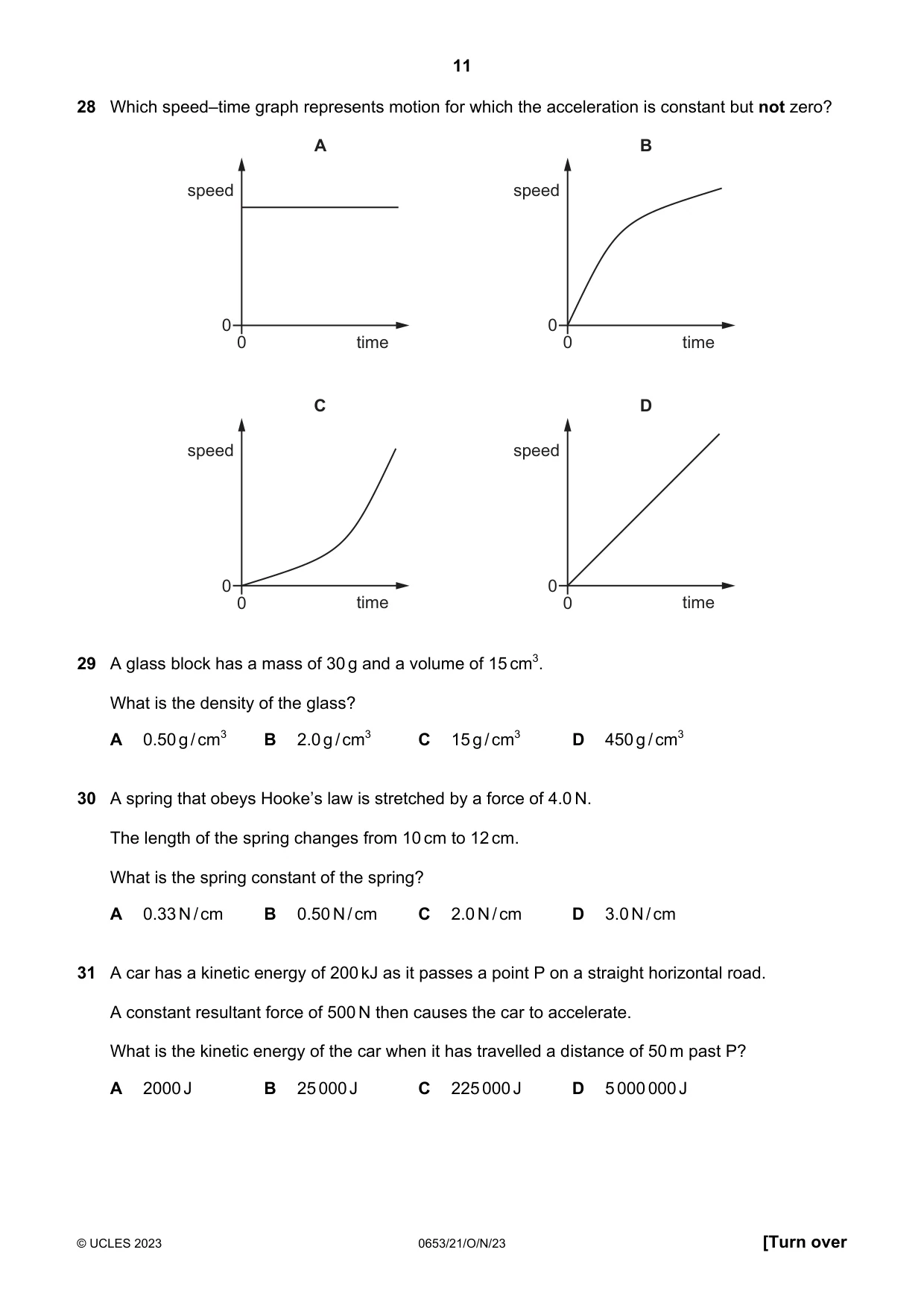
28 Which speed–time graph represents motion for which the acceleration is constant but not zero? A B speed speed 0 0 0 time 0 time C D speed speed 0 0 0 time 0 time
Mark scheme: D
Q29 · A glass block has a mass of 30 g and a volume of 15 cm3
29 A glass block has a mass of 30 g and a volume of 15 cm3. What is the density of the glass? A 0.50 g / cm3 B 2.0 g / cm3 C 15 g / cm3 D 450 g / cm3
Mark scheme: B
Q30 · A spring that obeys Hooke’s law is stretched by a force of 4.0 N
30 A spring that obeys Hooke’s law is stretched by a force of 4.0 N. The length of the spring changes from 10 cm to 12 cm. What is the spring constant of the spring? A 0.33 N / cm B 0.50 N / cm C 2.0 N / cm D 3.0 N / cm
Mark scheme: C
Q31 · A car has a kinetic energy of 200 kJ as it passes a point P on a straight horizontal road
31 A car has a kinetic energy of 200 kJ as it passes a point P on a straight horizontal road. A constant resultant force of 500 N then causes the car to accelerate. What is the kinetic energy of the car when it has travelled a distance of 50 m past P? A 2000 J B 25 000 J C 225 000 J D 5 000 000 J
Mark scheme: C
Q32 · A man lifts a heavy load vertically, from the ground to above his head
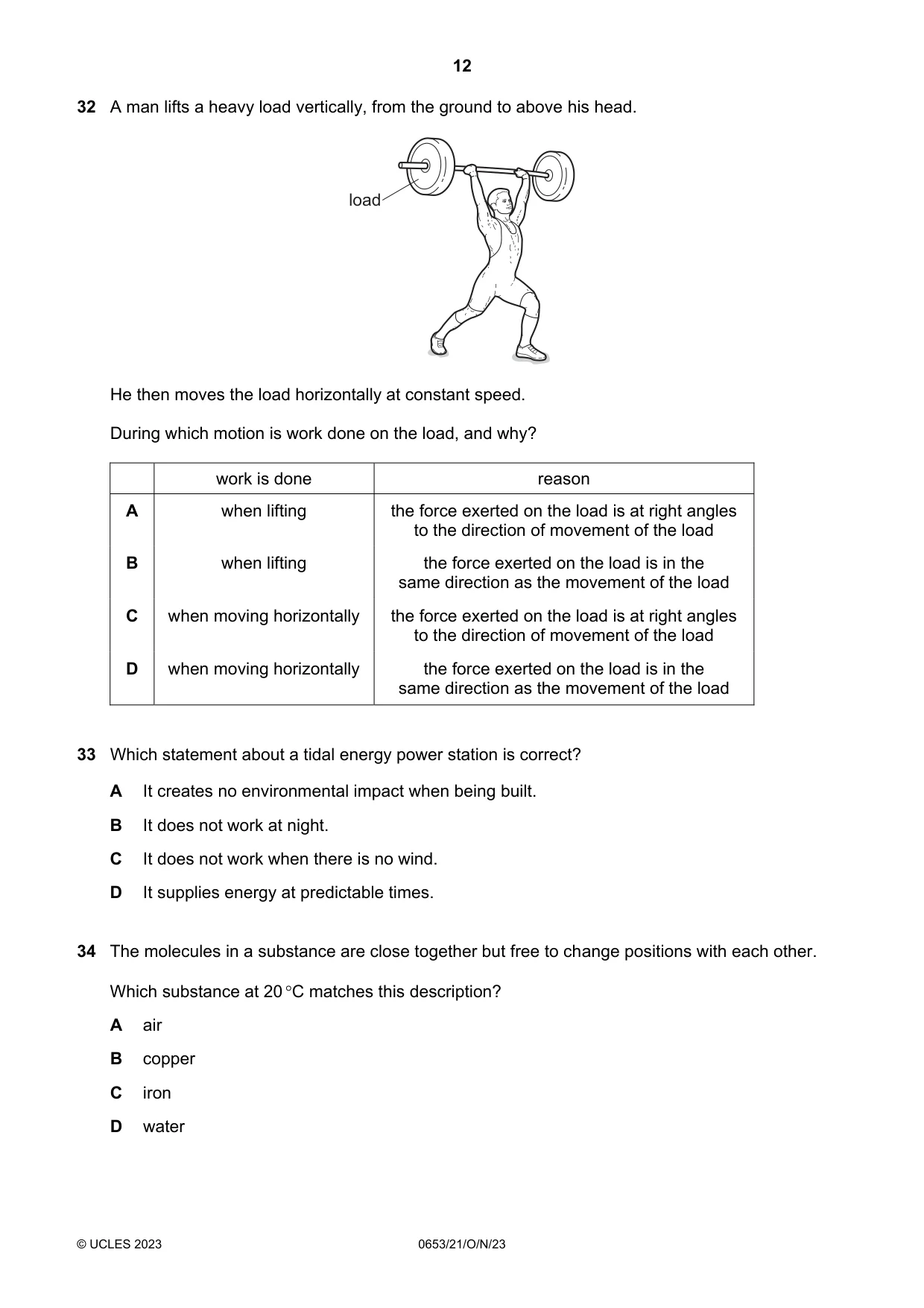
32 A man lifts a heavy load vertically, from the ground to above his head. load He then moves the load horizontally at constant speed. During which motion is work done on the load, and why? work is done reason A when lifting the force exerted on the load is at right angles to the direction of movement of the load B when lifting the force exerted on the load is in the same direction as the movement of the load C when moving horizontally the force exerted on the load is at right angles to the direction of movement of the load D when moving horizontally the force exerted on the load is in the same direction as the movement of the load
Mark scheme: B
Q33 · Which statement about a tidal energy power station is correct?
33 Which statement about a tidal energy power station is correct? A It creates no environmental impact when being built. B It does not work at night. C It does not work when there is no wind. D It supplies energy at predictable times.
Mark scheme: D
Q34 · The molecules in a substance are close together but free to change positions with each…
34 The molecules in a substance are close together but free to change positions with each other. Which substance at 20 C matches this description? A air B copper C iron D water
Mark scheme: D
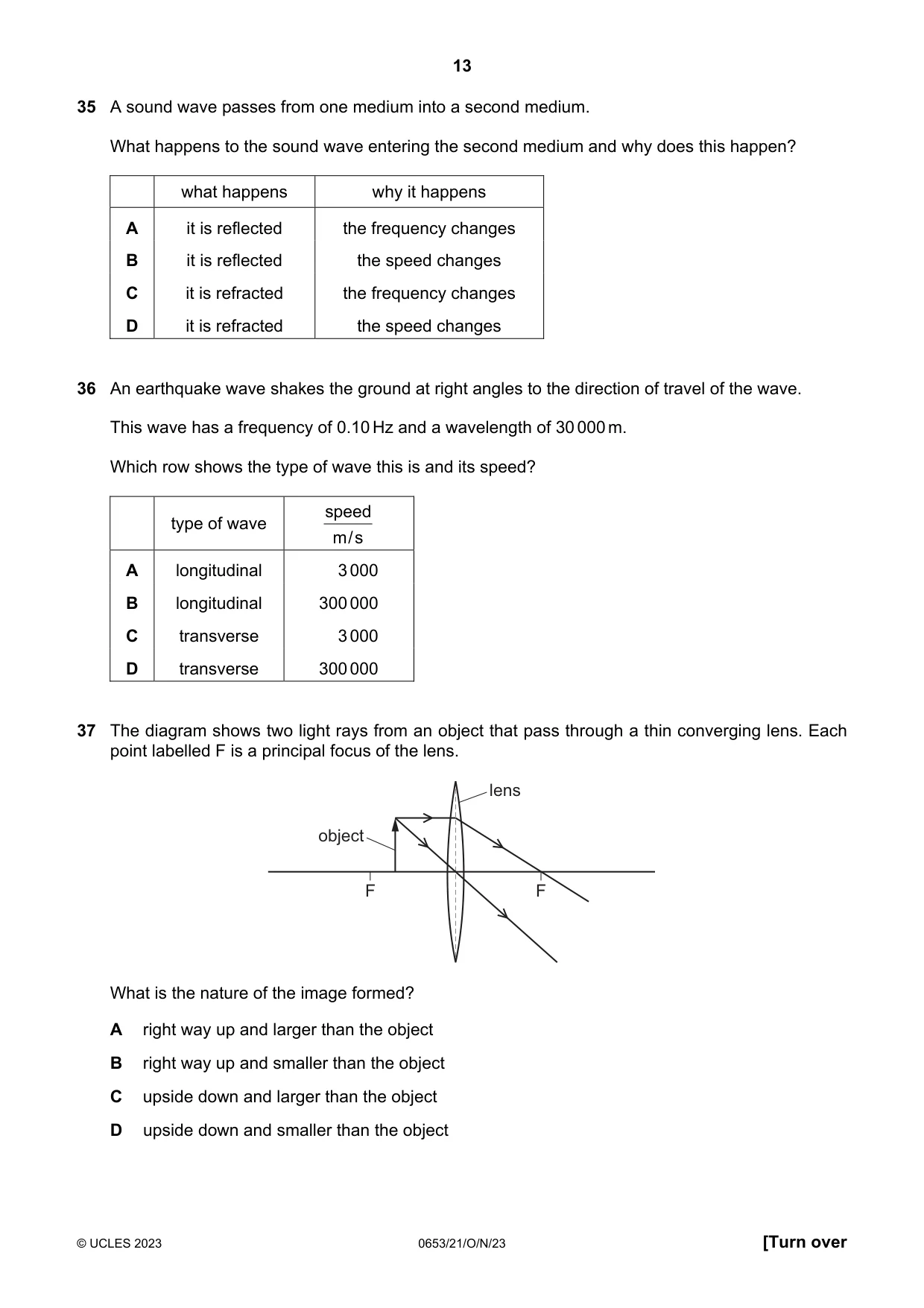
Q35 · A sound wave passes from one medium into a second medium
35 A sound wave passes from one medium into a second medium. What happens to the sound wave entering the second medium and why does this happen? what happens why it happens A it is reflected the frequency changes B it is reflected the speed changes C it is refracted the frequency changes D it is refracted the speed changes
Mark scheme: D
Q36 · An earthquake wave shakes the ground at right angles to the direction of travel of the…
36 An earthquake wave shakes the ground at right angles to the direction of travel of the wave. This wave has a frequency of 0.10 Hz and a wavelength of 30 000 m. Which row shows the type of wave this is and its speed? speed type of wave m / s A longitudinal 3 000 B longitudinal 300 000 C transverse 3 000 D transverse 300 000
Mark scheme: C
Q37 · The diagram shows two light rays from an object that pass through a thin converging lens
37 The diagram shows two light rays from an object that pass through a thin converging lens. Each point labelled F is a principal focus of the lens. lens object F F What is the nature of the image formed? A right way up and larger than the object B right way up and smaller than the object C upside down and larger than the object D upside down and smaller than the object
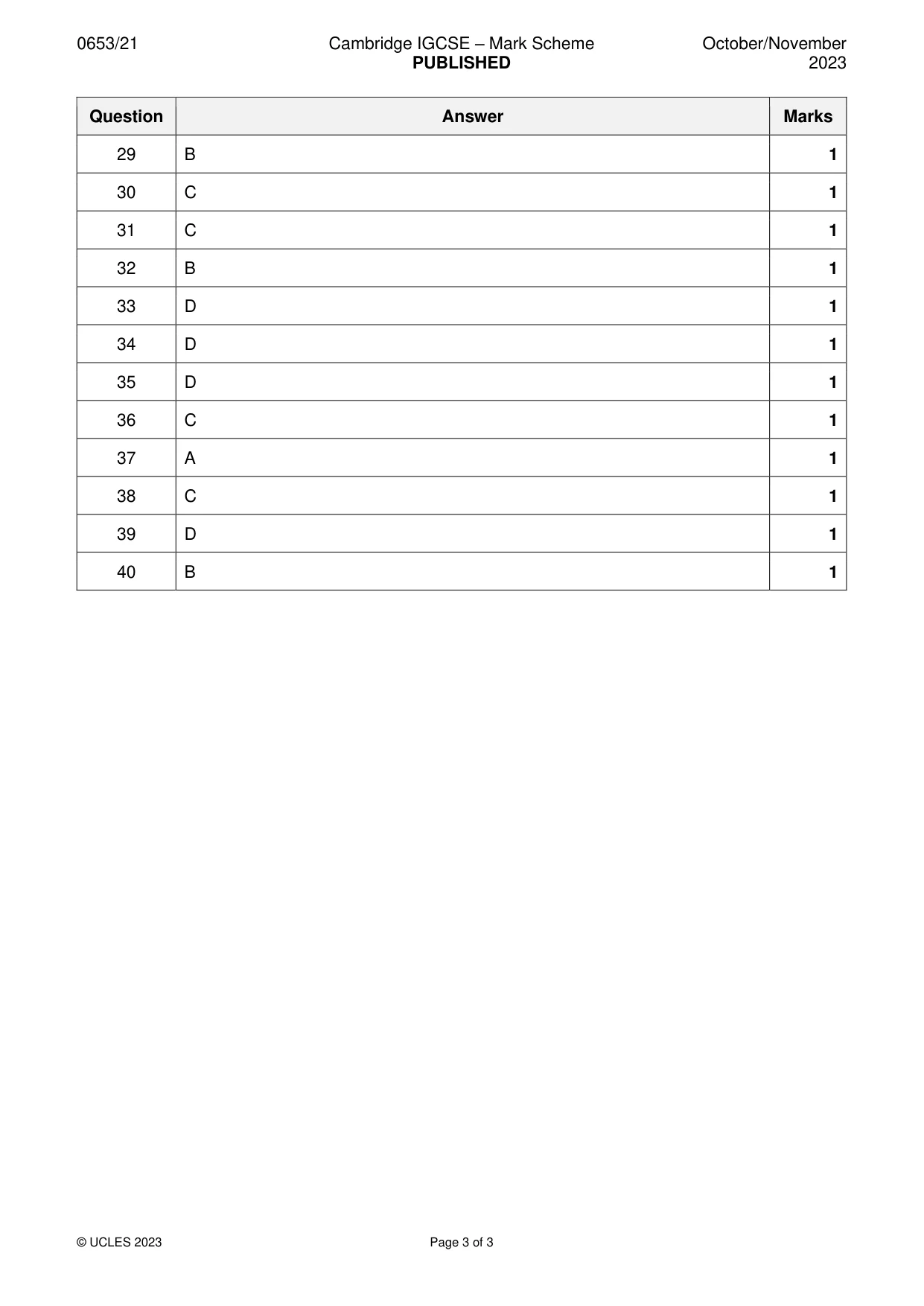
Mark scheme: A
Q38 · The amplitude of a sound wave decreases and its frequency increases
38 The amplitude of a sound wave decreases and its frequency increases. What happens to the sound heard? A It becomes louder and its pitch becomes higher. B It becomes louder and its pitch becomes lower. C It becomes quieter and its pitch becomes higher. D It becomes quieter and its pitch becomes lower.
Mark scheme: C
Q39 · There is a current of 6.0 A in a wire
39 There is a current of 6.0 A in a wire. How much charge flows through the wire in 2.0 minutes? A 0.050 C B 3.0 C C 12 C D 720 C
Mark scheme: D
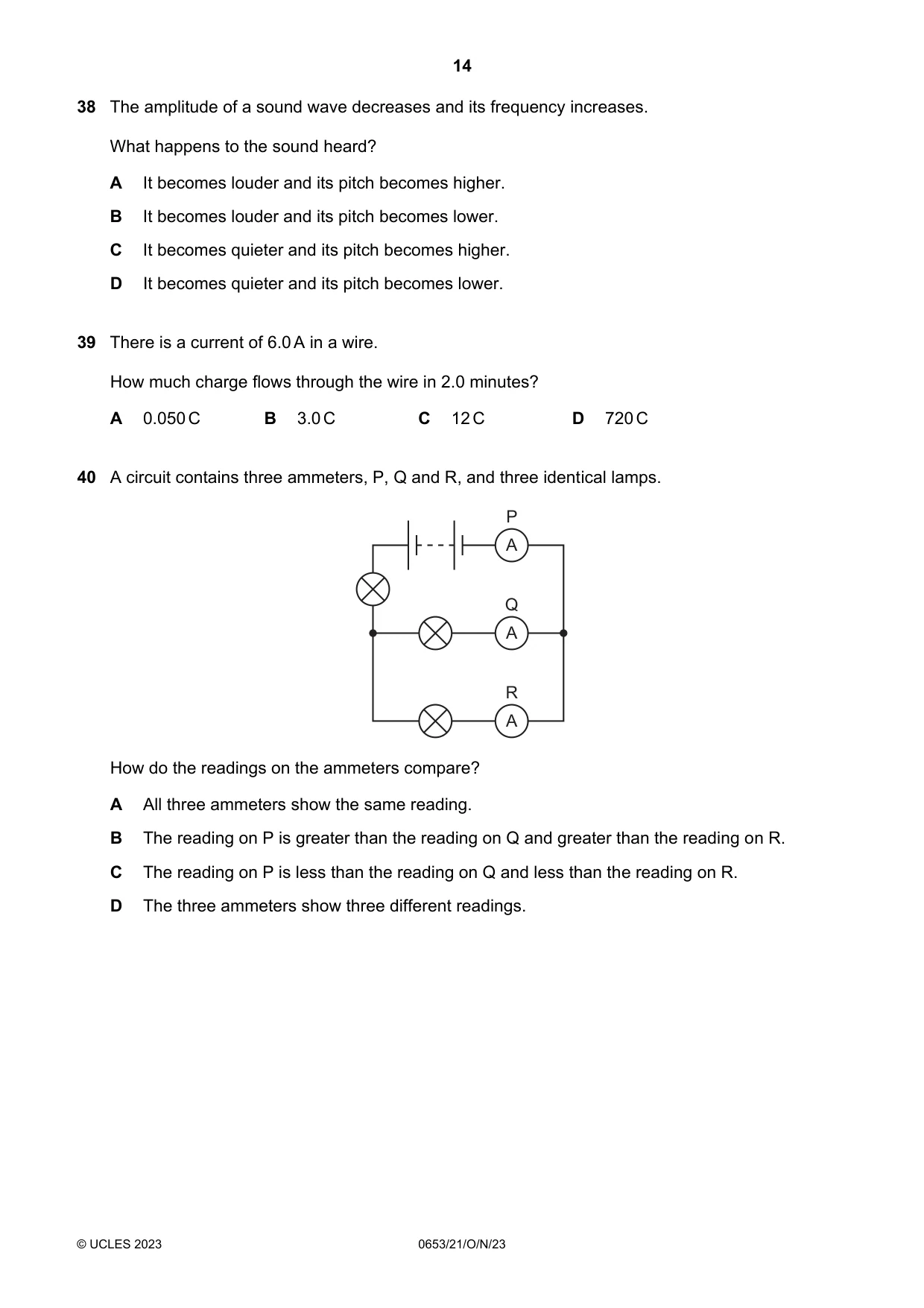
Q40 · A circuit contains three ammeters, P, Q and R, and three identical lamps
40 A circuit contains three ammeters, P, Q and R, and three identical lamps. P A Q A R A How do the readings on the ammeters compare? A All three ammeters show the same reading. B The reading on P is greater than the reading on Q and greater than the reading on R. C The reading on P is less than the reading on Q and less than the reading on R. D The three ammeters show three different readings.
Mark scheme: B
What was in this paper
The subtopics covered by these 40 questions, and how many questions each got. Open one in a new tab to see every Cambridge question on it.
3Sexual reproduction in plants3Identification of ions and gases2Light2Air quality and climate1Alkanes1Carbon cycle1Cell structure1Characteristics of living organisms1Density1Diet1Diffusion1Digestion1Electrical circuits1Electrical quantities1Electrolysis1Elements, compounds and mixtures1Enzymes1Extraction of metals1Forces1Formulas1General properties of waves1Group VII properties1Heart1Kinetic particle model of matter1Motion1Rate of reaction1Reactivity series1Redox1Respiration1Simple molecules and covalent bonds1Solids, liquids and gases1Sound1The characteristic properties of acids and bases1What you needed in this session
Cambridge’s own grade thresholds for 2023 Oct/Nov, Paper 2 · Variant 1. A higher threshold means an easier paper — the bar moves with how the cohort did.