Cambridge IGCSE Science - Combined 0653 — 2022 Feb/March Paper 2 · Variant 2
0653/22/F/M/22 · 40 questions · 40 marks · ≈45 min
The question paper and its mark scheme, free to read here and free to download. This is Cambridge’s own paper, exactly as it was sat.
Question paper16 pages
Mark scheme3 pages
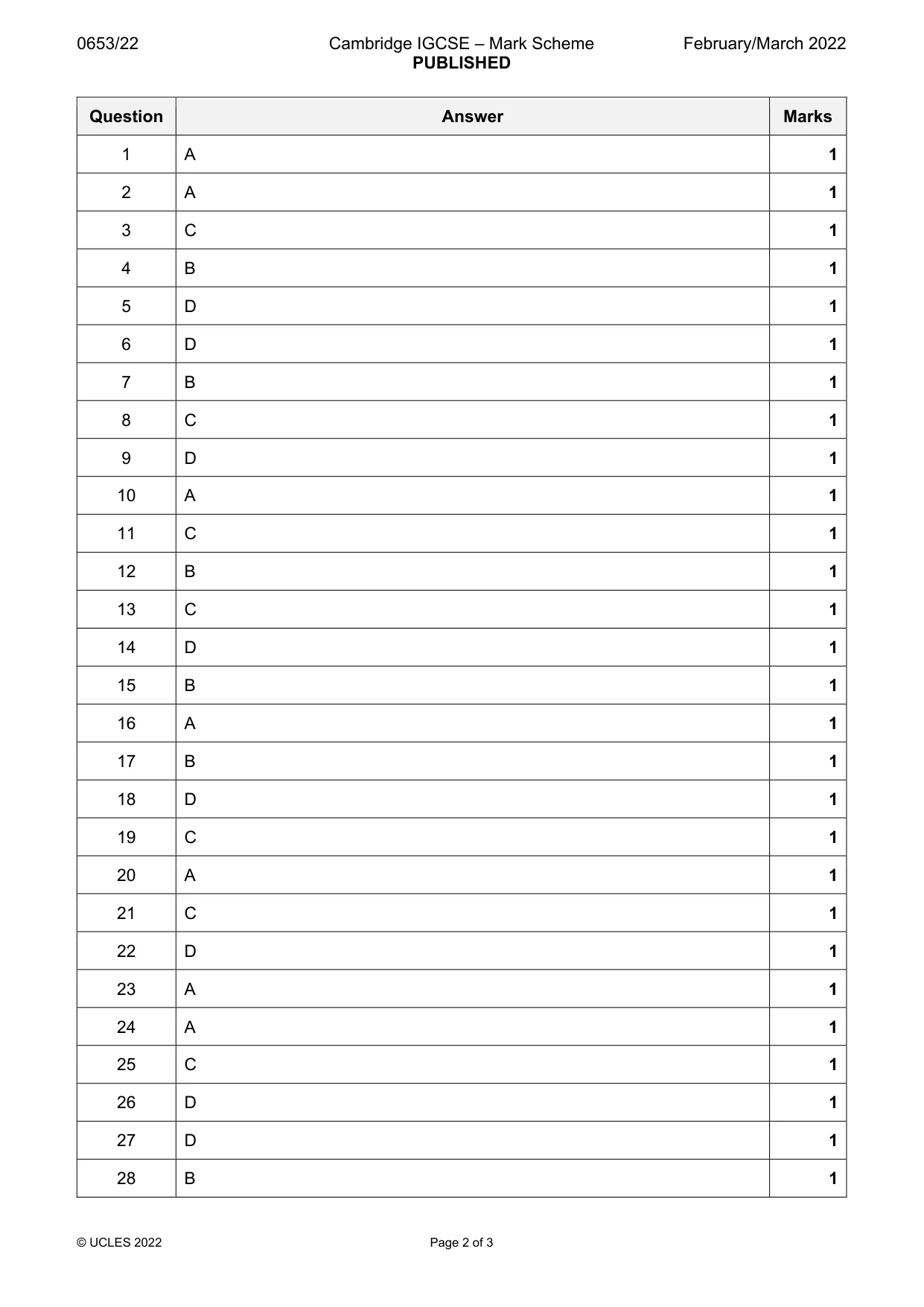
Answers below. Sit the paper first if you are practising.
Questions as text
Q1 · What is the function of the cell membrane?
1 What is the function of the cell membrane? A to control which substances move in and out of the cell B to hold the DNA of the cell C to hold the chlorophyll of the cell D to store nutrients or waste products
Mark scheme: A
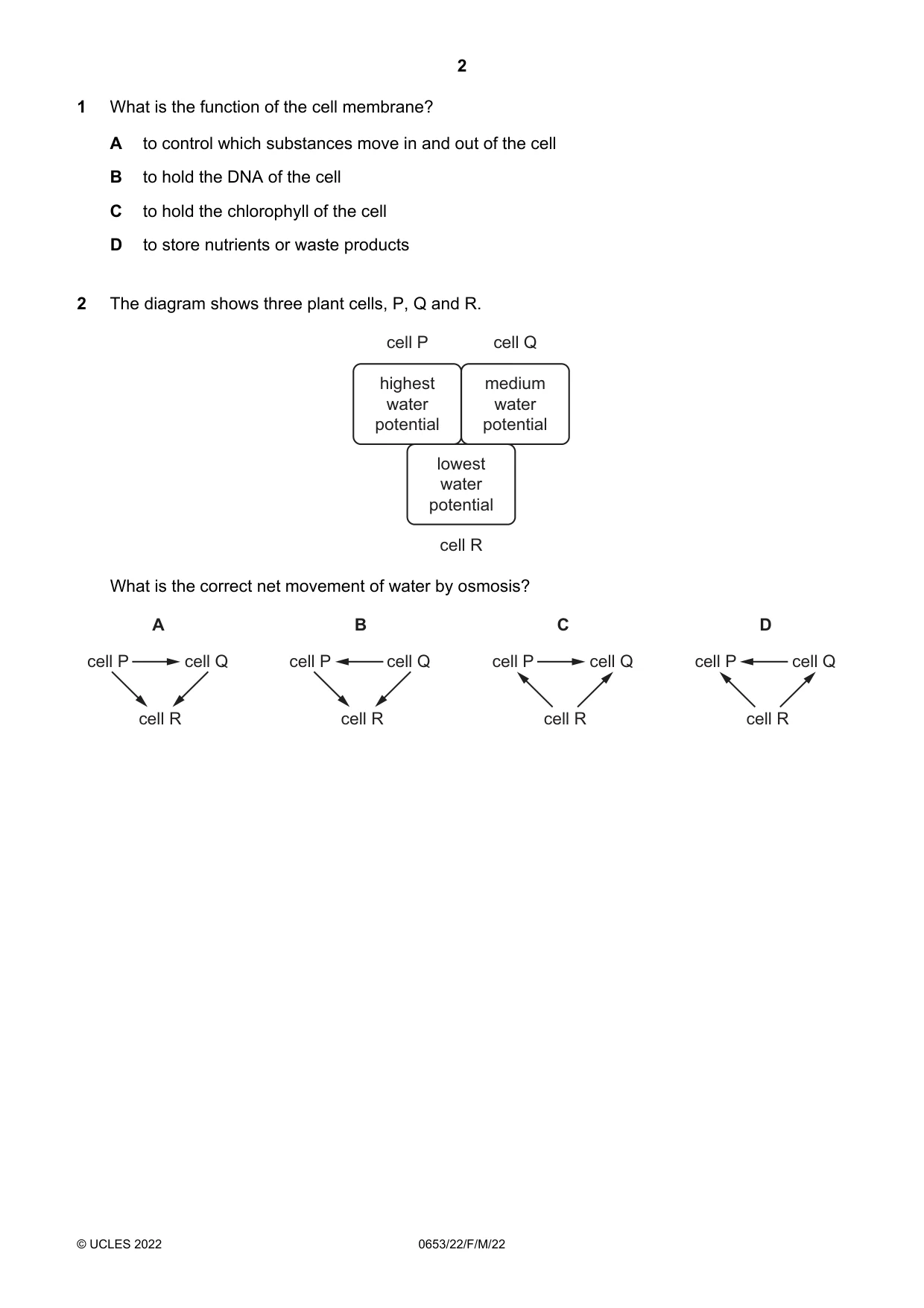
Q2 · The diagram shows three plant cells, P, Q and R
2 The diagram shows three plant cells, P, Q and R. cell P cell Q highest medium water water potential potential lowest water potential cell R What is the correct net movement of water by osmosis? A B C D cell P cell Q cell P cell Q cell P cell Q cell P cell Q cell R cell R cell R cell R
Mark scheme: A
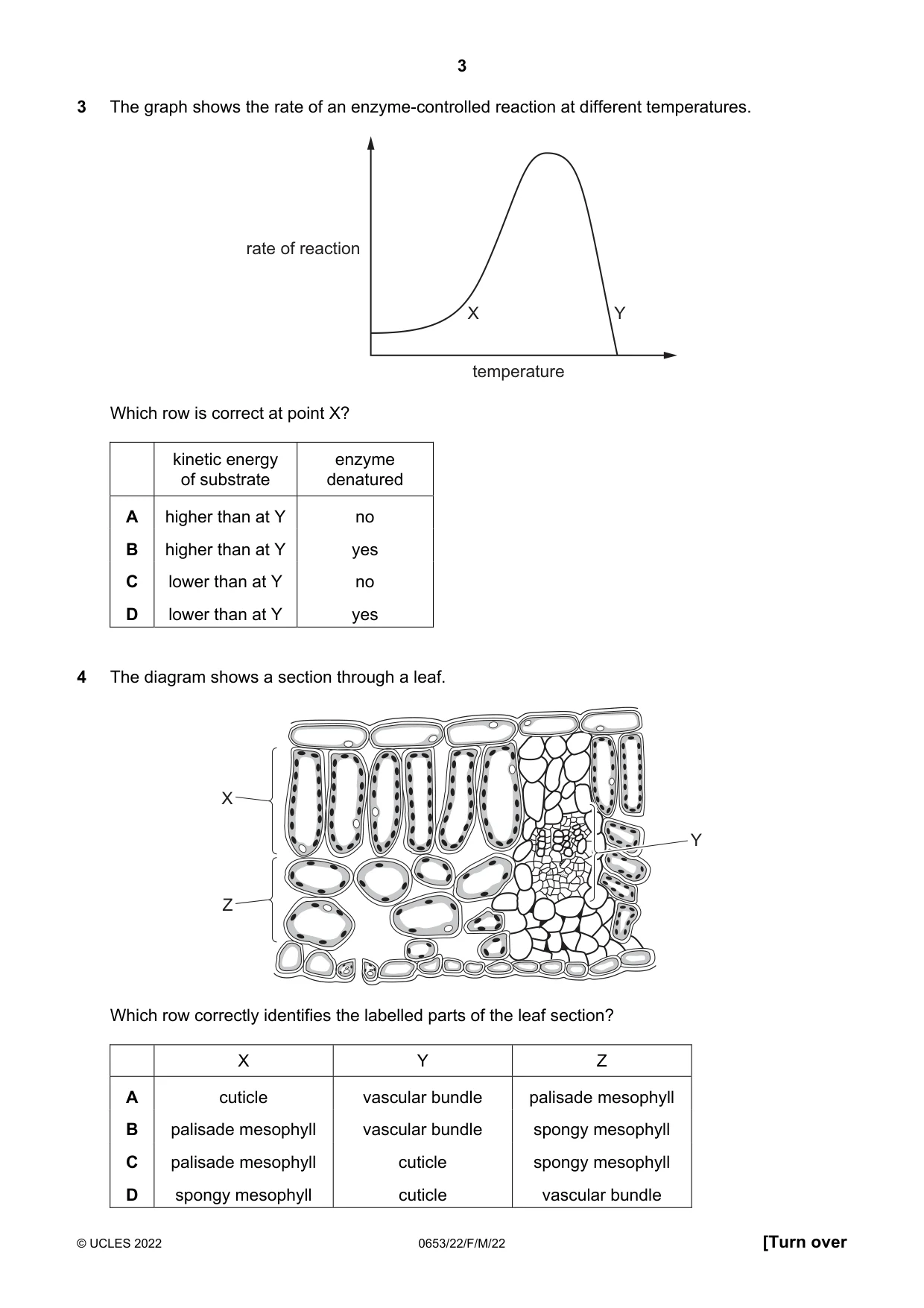
Q3 · The graph shows the rate of an enzyme-controlled reaction at different temperatures
3 The graph shows the rate of an enzyme-controlled reaction at different temperatures. rate of reaction X Y temperature Which row is correct at point X? kinetic energy enzyme of substrate denatured A higher than at Y no B higher than at Y yes C lower than at Y no D lower than at Y yes
Mark scheme: C
Q4 · The diagram shows a section through a leaf
4 The diagram shows a section through a leaf. X Y Z Which row correctly identifies the labelled parts of the leaf section? X Y Z A cuticle vascular bundle palisade mesophyll B palisade mesophyll vascular bundle spongy mesophyll C palisade mesophyll cuticle spongy mesophyll D spongy mesophyll cuticle vascular bundle
Mark scheme: B
Q5 · Which row is correct for chemical digestion?
5 Which row is correct for chemical digestion? food enzyme substances produced A fat protease fatty acids and glycerol B fat lipase amino acids C protein lipase fatty acids and glycerol D protein protease amino acids
Mark scheme: D
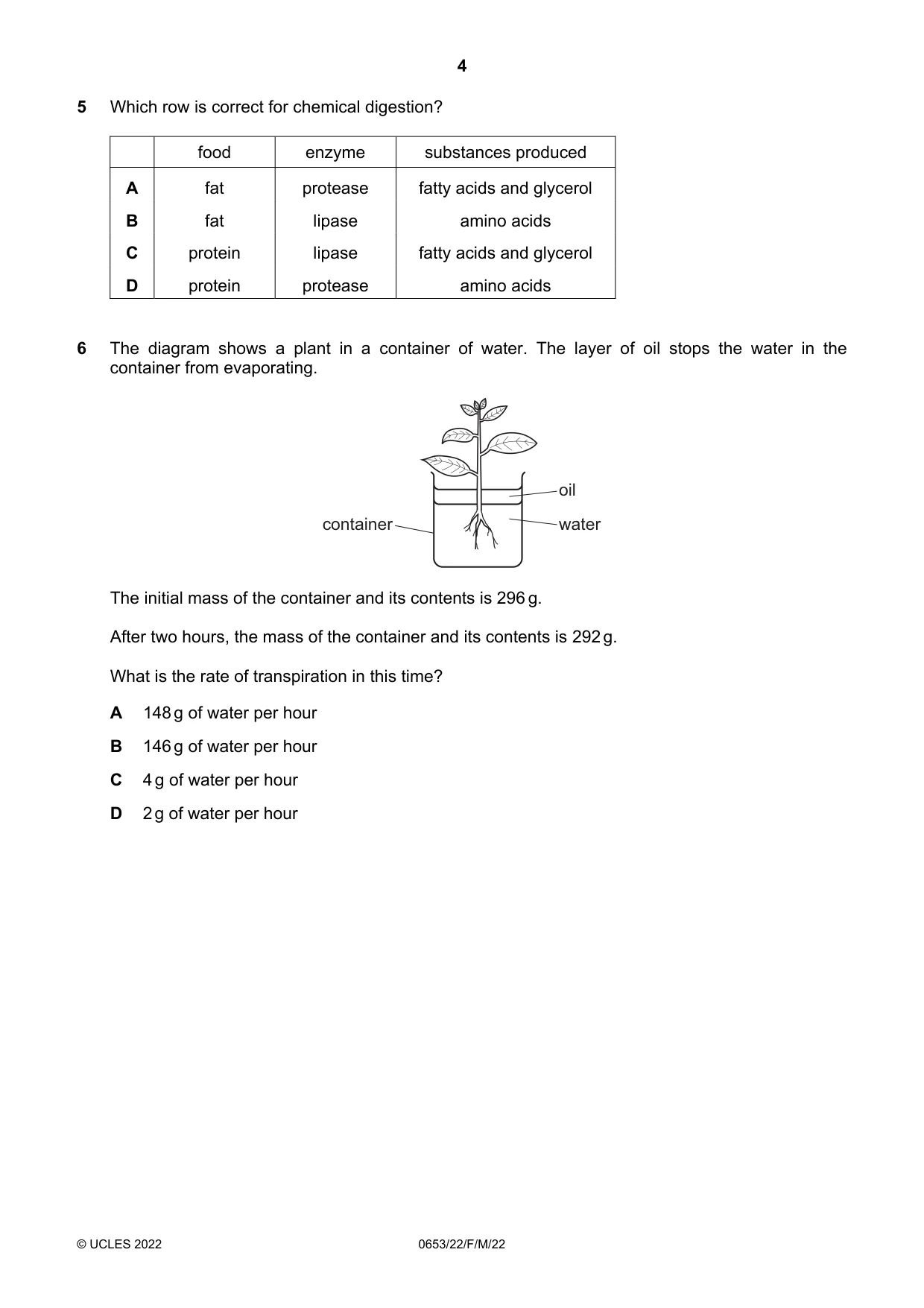
Q6 · The diagram shows a plant in a container of water
6 The diagram shows a plant in a container of water. The layer of oil stops the water in the container from evaporating. oil container water The initial mass of the container and its contents is 296 g. After two hours, the mass of the container and its contents is 292 g. What is the rate of transpiration in this time? A 148 g of water per hour B 146 g of water per hour C 4 g of water per hour D 2 g of water per hour
Mark scheme: D
Q7 · The diagram shows two different types of cell which line the trachea in the gas exchange…
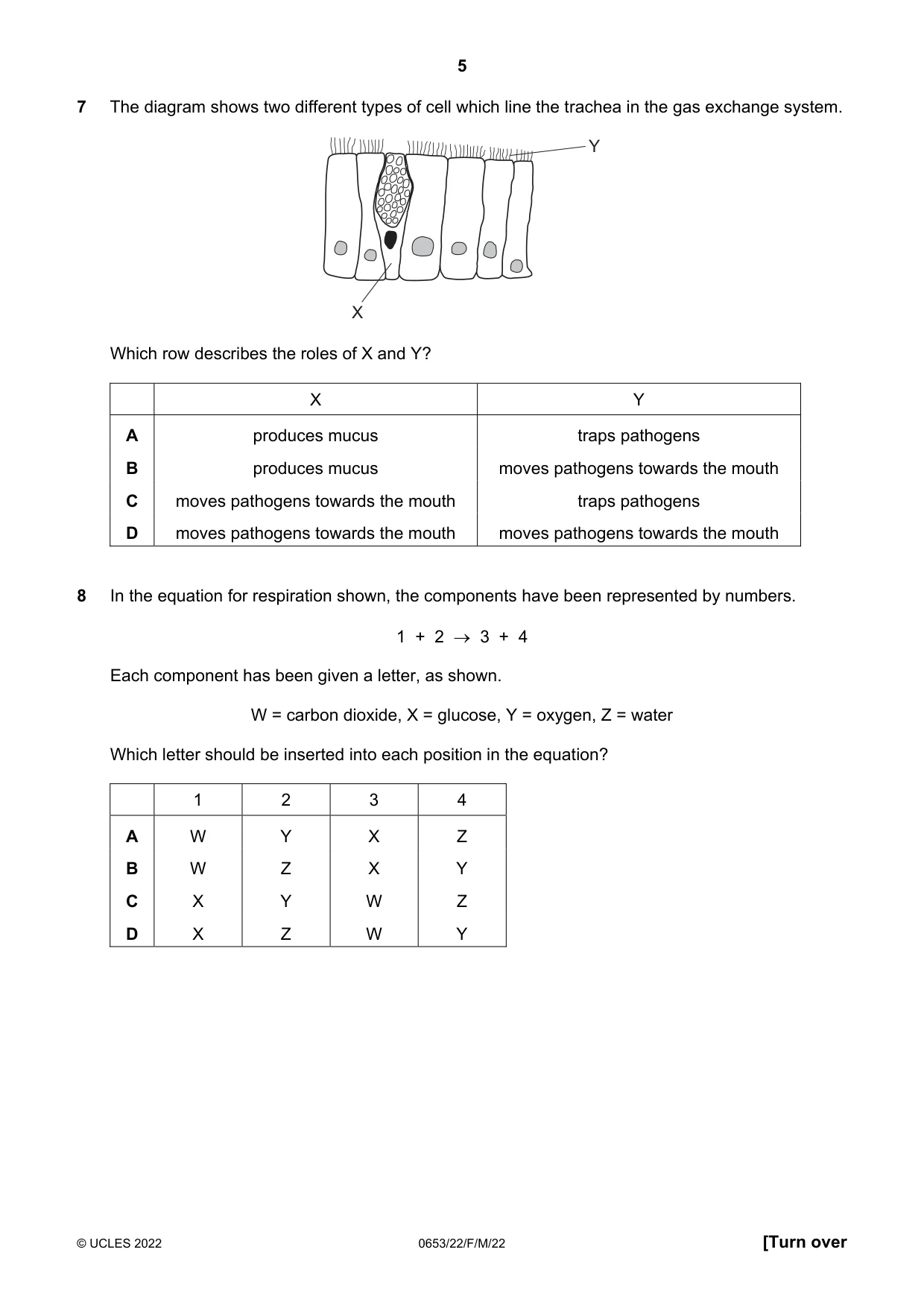
7 The diagram shows two different types of cell which line the trachea in the gas exchange system. Y X Which row describes the roles of X and Y? X Y A produces mucus traps pathogens B produces mucus moves pathogens towards the mouth C moves pathogens towards the mouth traps pathogens D moves pathogens towards the mouth moves pathogens towards the mouth
Mark scheme: B
Q8 · In the equation for respiration shown, the components have been represented by numbers
8 In the equation for respiration shown, the components have been represented by numbers. 1 + 2 3 + 4 Each component has been given a letter, as shown. W = carbon dioxide, X = glucose, Y = oxygen, Z = water Which letter should be inserted into each position in the equation? 1 2 3 4 A W Y X Z B W Z X Y C X Y W Z D X Z W Y
Mark scheme: C
Q9 · The shoot of a plant grows towards the light
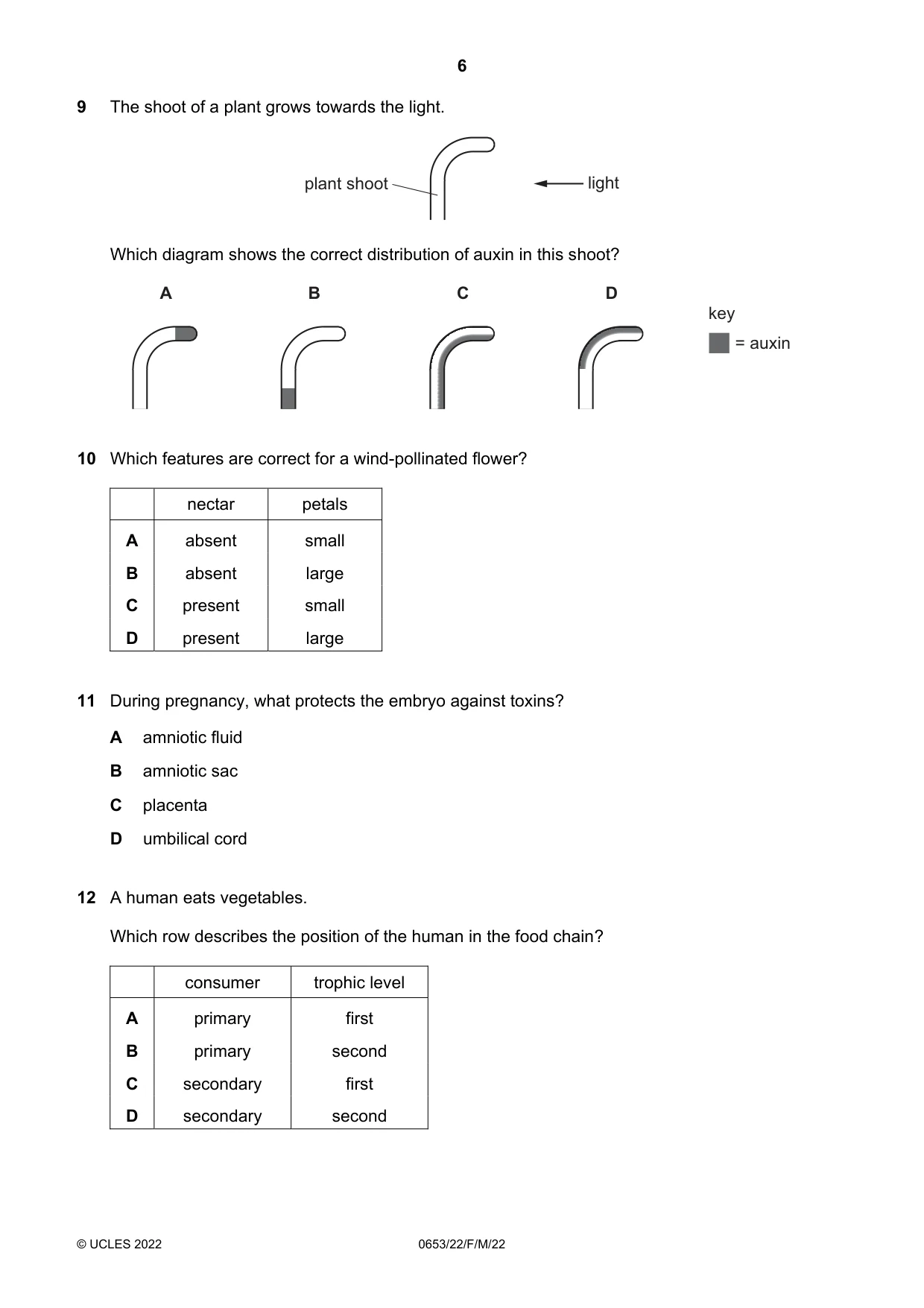
9 The shoot of a plant grows towards the light. plant shoot light Which diagram shows the correct distribution of auxin in this shoot? A B C D key = auxin
Mark scheme: D
Q10 · Which features are correct for a wind-pollinated flower?
10 Which features are correct for a wind-pollinated flower? nectar petals A absent small B absent large C present small D present large
Mark scheme: A
Q11 · During pregnancy, what protects the embryo against toxins?
11 During pregnancy, what protects the embryo against toxins? A amniotic fluid B amniotic sac C placenta D umbilical cord
Mark scheme: C
Q12 · A human eats vegetables
12 A human eats vegetables. Which row describes the position of the human in the food chain? consumer trophic level A primary first B primary second C secondary first D secondary second
Mark scheme: B
Q13 · Which labelled box represents plants in the carbon cycle?
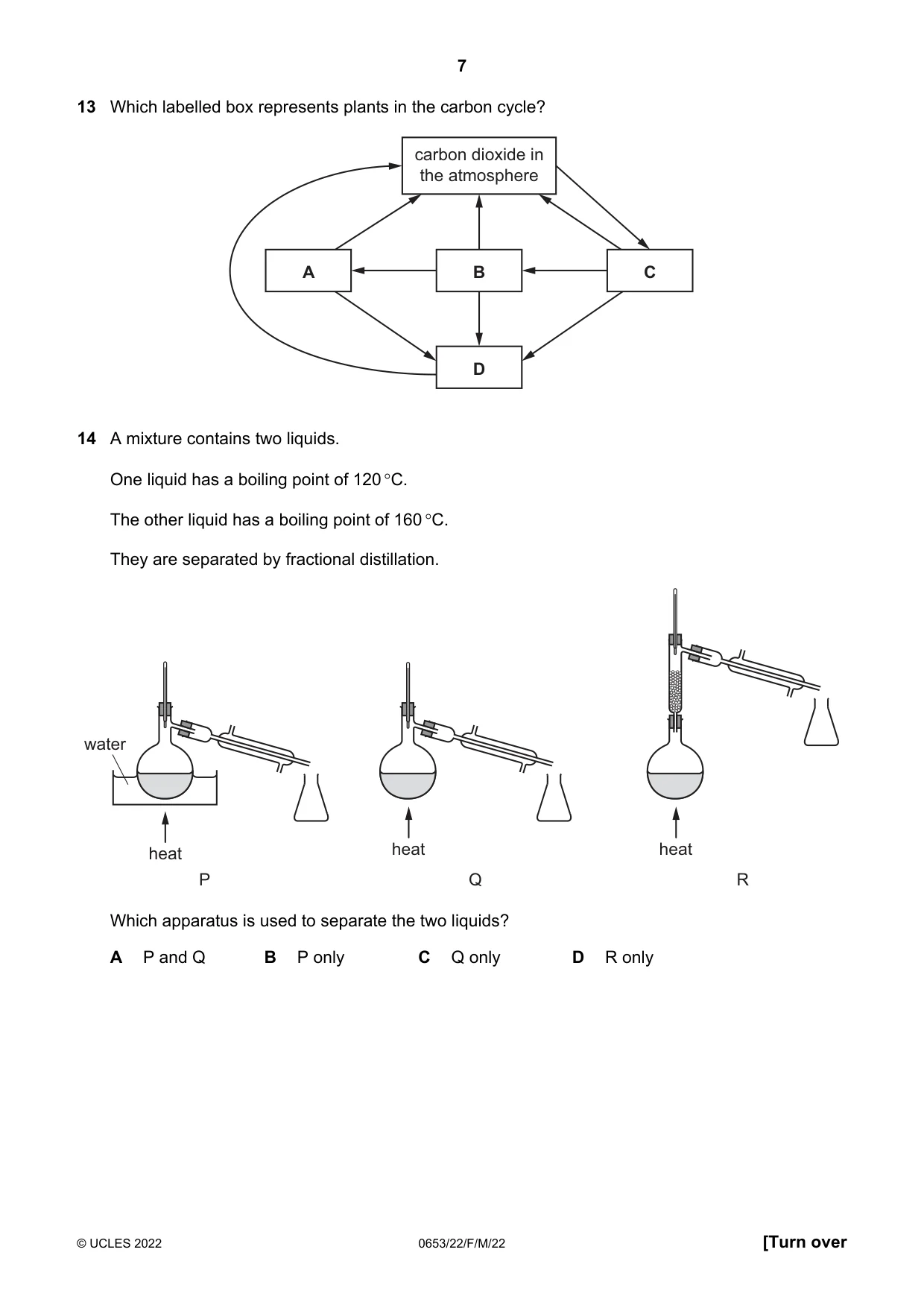
13 Which labelled box represents plants in the carbon cycle? carbon dioxide in the atmosphere A B C D
Mark scheme: C
Q14 · A mixture contains two liquids
14 A mixture contains two liquids. One liquid has a boiling point of 120 C. The other liquid has a boiling point of 160 C. They are separated by fractional distillation. water heat heat heat P Q R Which apparatus is used to separate the two liquids? A P and Q B P only C Q only D R only
Mark scheme: D
Q15 · Iodine is a non-metal
15 Iodine is a non-metal. It is a solid at room temperature. What is a property of iodine? A It can be stretched into a wire. B It is brittle. C It is a good conductor of electricity. D It is a good conductor of heat.
Mark scheme: B
Q16 · The atomic number of argon is 18
16 The atomic number of argon is 18. The mass number of argon is 40. How many protons, neutrons and electrons are in an argon atom? protons neutrons electrons A 18 22 18 B 18 22 22 C 22 18 18 D 22 18 22
Mark scheme: A
Q17 · Which dot-and-cross diagram represents the bonding in nitrogen?
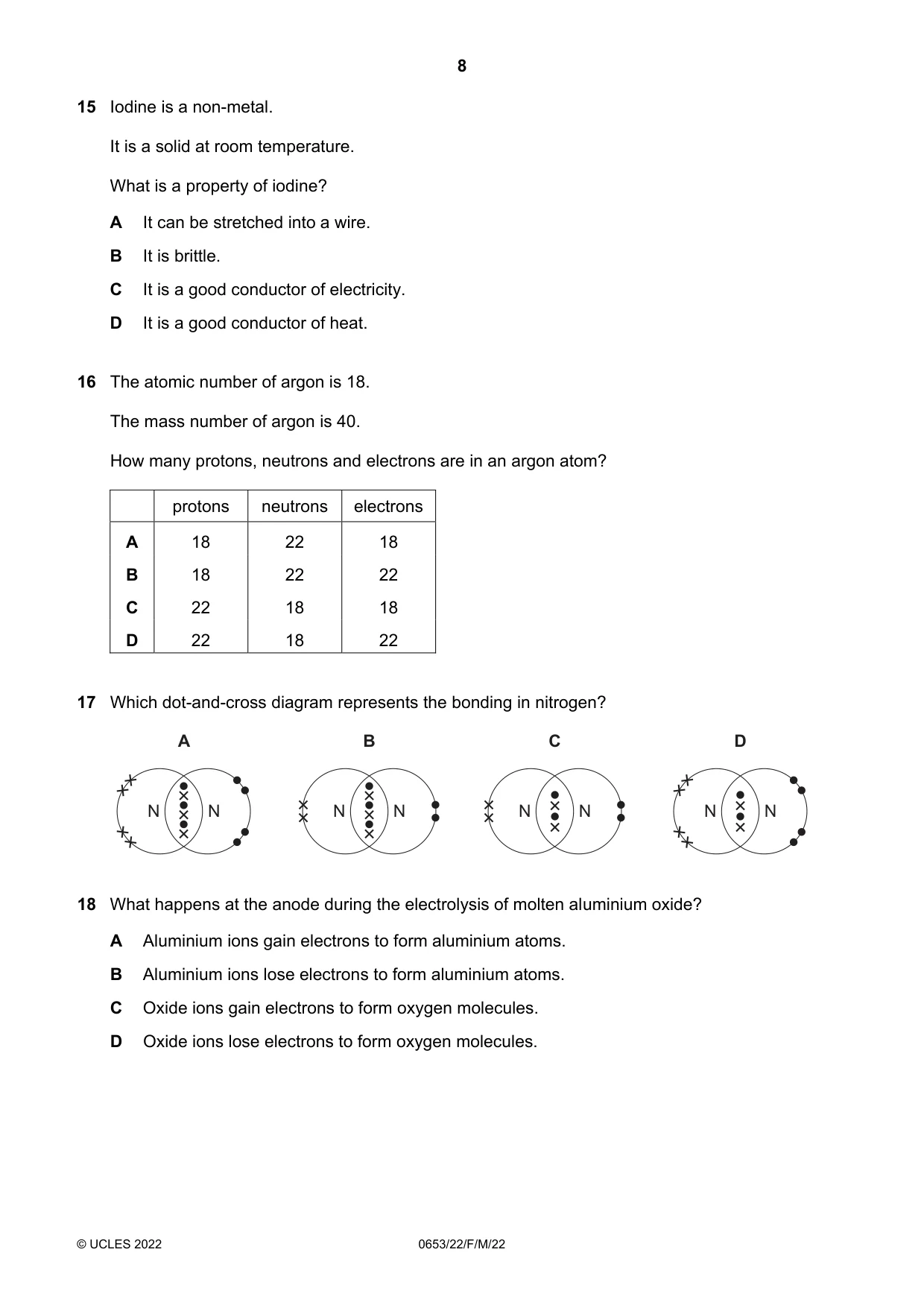
17 Which dot-and-cross diagram represents the bonding in nitrogen? A B C D N N N N N N N N
Mark scheme: B
Q18 · What happens at the anode during the electrolysis of molten aluminium oxide?
18 What happens at the anode during the electrolysis of molten aluminium oxide? A Aluminium ions gain electrons to form aluminium atoms. B Aluminium ions lose electrons to form aluminium atoms. C Oxide ions gain electrons to form oxygen molecules. D Oxide ions lose electrons to form oxygen molecules.
Mark scheme: D
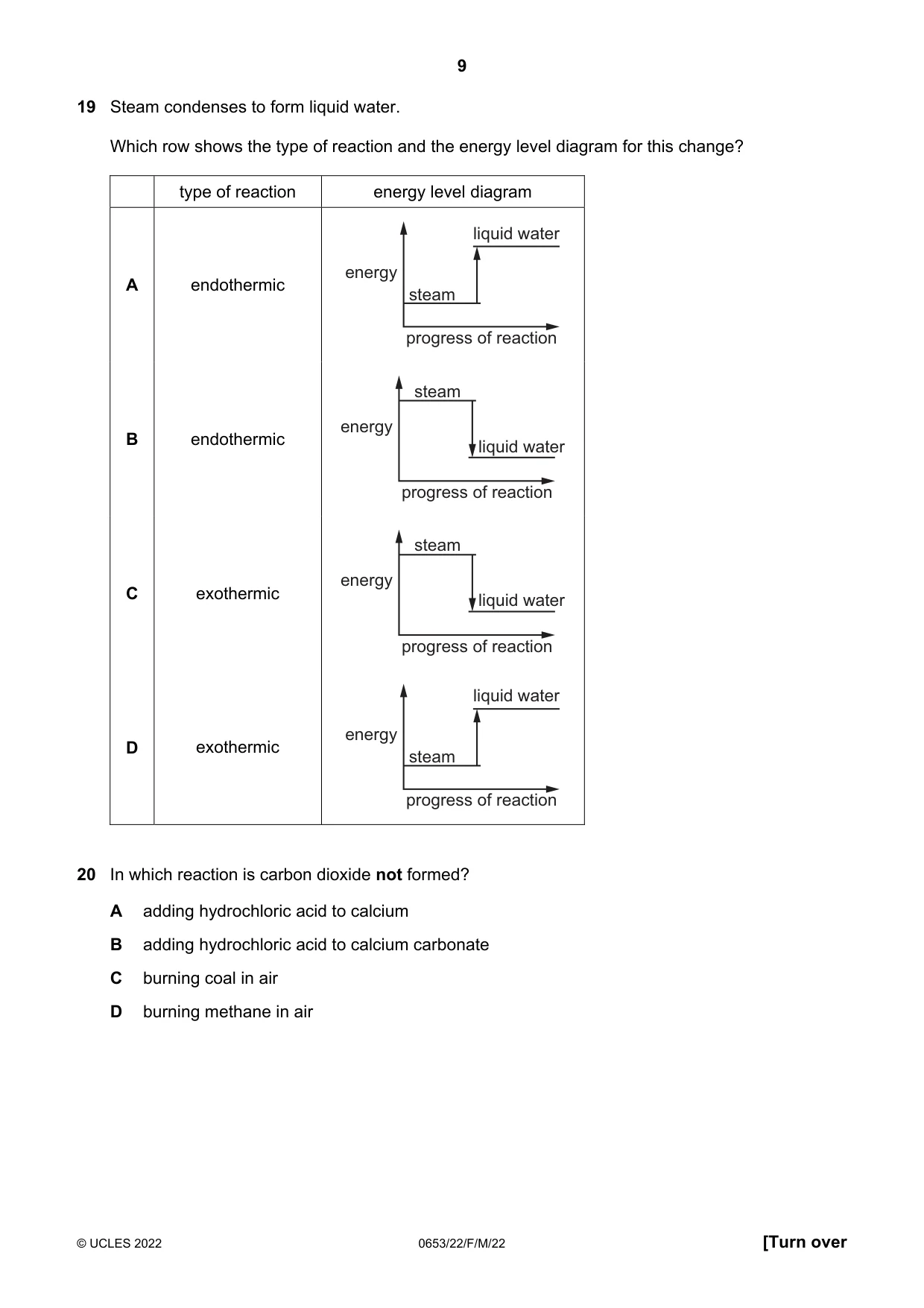
Q19 · Steam condenses to form liquid water
19 Steam condenses to form liquid water. Which row shows the type of reaction and the energy level diagram for this change? type of reaction energy level diagram liquid water energy A endothermic steam progress of reaction steam energy B endothermic liquid water progress of reaction steam energy C exothermic liquid water progress of reaction liquid water energy D exothermic steam progress of reaction
Mark scheme: C
Q20 · In which reaction is carbon dioxide not formed?
20 In which reaction is carbon dioxide not formed? A adding hydrochloric acid to calcium B adding hydrochloric acid to calcium carbonate C burning coal in air D burning methane in air
Mark scheme: A
More questions on The characteristic properties of acids and bases
Q21 · Which statements about elements in Group I of the Periodic Table are correct?
21 Which statements about elements in Group I of the Periodic Table are correct? 1 They become less reactive going down the group. 2 Sodium forms positive ions more easily than lithium. 3 Their melting points increase going down the group. 4 Rubidium is more dense than sodium. A 1 and 2 B 1 and 3 C 2 and 4 D 3 and 4
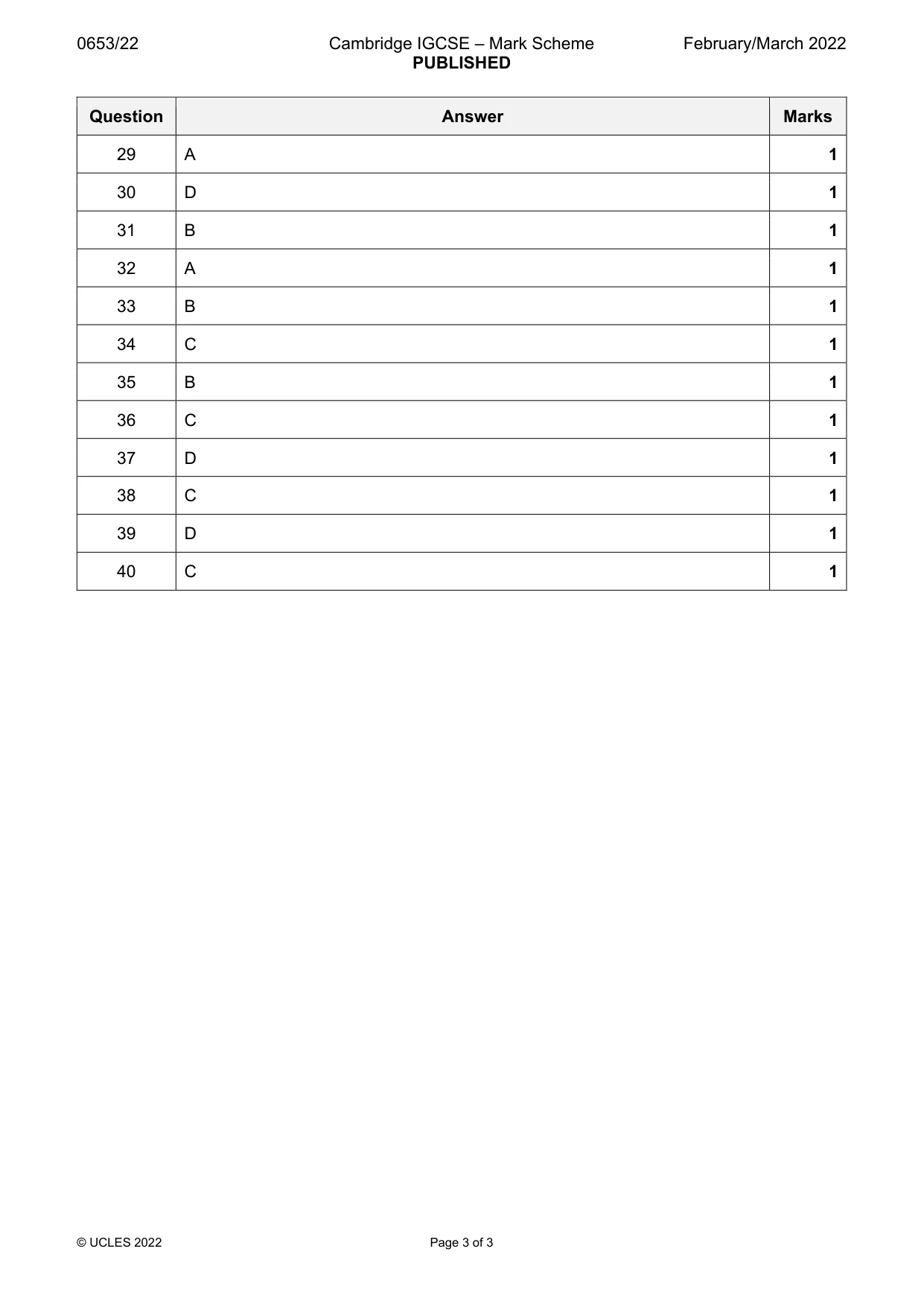
Mark scheme: C
Q22 · Which statement about noble gases is correct?
22 Which statement about noble gases is correct? A Argon is used in lamps because it gives out a bright light when it is heated. B Helium is used to fill balloons because it is more dense than air. C Krypton forms diatomic molecules because it is an unreactive gas. D Neon is unreactive because it has a full outer shell of electrons.
Mark scheme: D
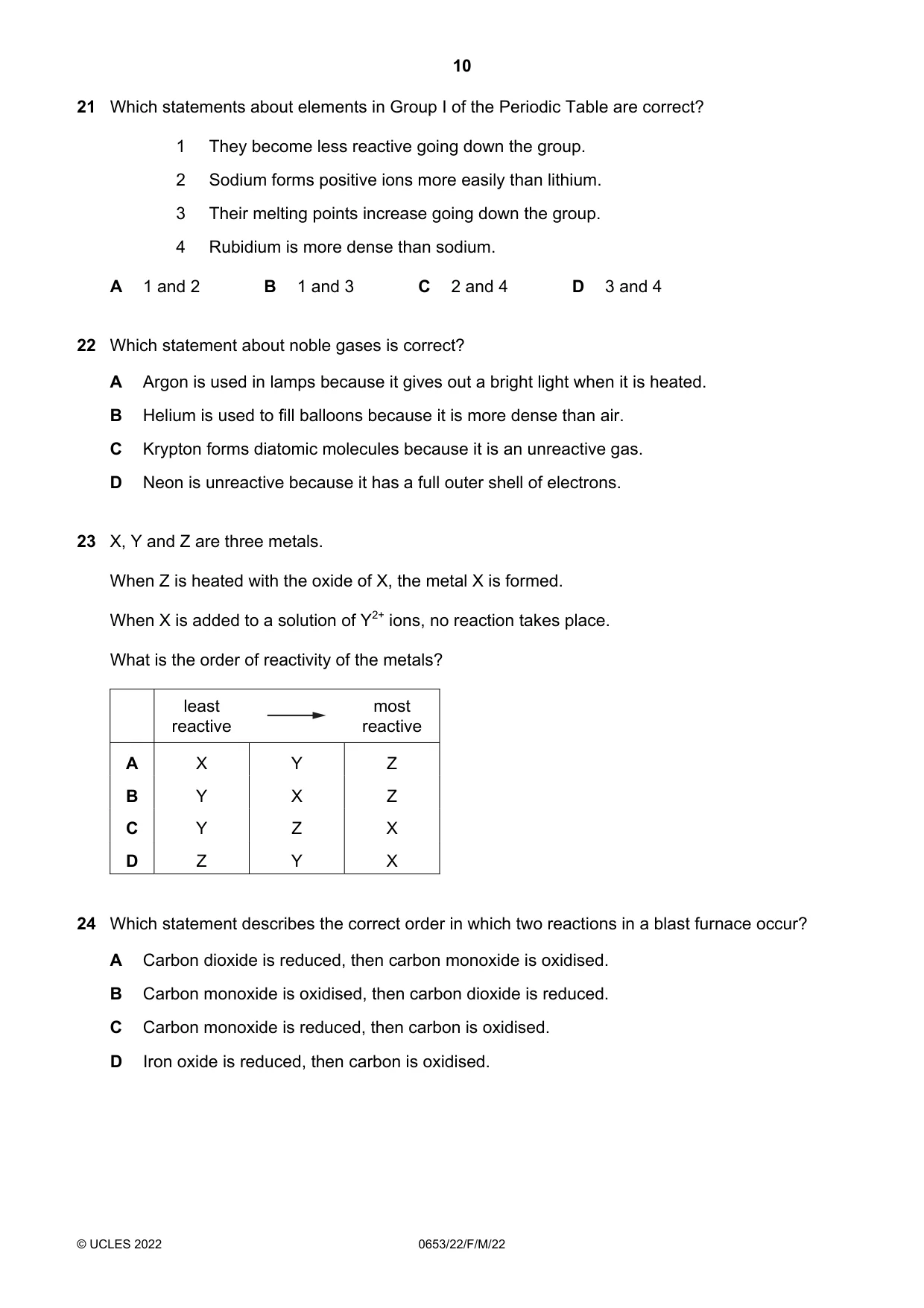
Q23 · X, Y and Z are three metals
23 X, Y and Z are three metals. When Z is heated with the oxide of X, the metal X is formed. When X is added to a solution of Y2+ ions, no reaction takes place. What is the order of reactivity of the metals? least most reactive reactive A X Y Z B Y X Z C Y Z X D Z Y X
Mark scheme: A
Q24 · Which statement describes the correct order in which two reactions in a blast furnace…
24 Which statement describes the correct order in which two reactions in a blast furnace occur? A Carbon dioxide is reduced, then carbon monoxide is oxidised. B Carbon monoxide is oxidised, then carbon dioxide is reduced. C Carbon monoxide is reduced, then carbon is oxidised. D Iron oxide is reduced, then carbon is oxidised.
Mark scheme: A
Q25 · Which statement about carbon dioxide is correct?
25 Which statement about carbon dioxide is correct? A Carbon dioxide is the only greenhouse gas. B Carbon dioxide makes up approximately 4% of clean air. C Increased concentrations of carbon dioxide enhance the greenhouse effect. D The only source of carbon dioxide in the air is from motor vehicles.
Mark scheme: C
Q26 · Refinery gas contains methane
26 Refinery gas contains methane. Which statement about methane is correct? A Its boiling point is high because it has strong forces of attraction between molecules. B Its boiling point is high because it has weak forces of attraction between molecules. C Its boiling point is low because it has strong forces of attraction between molecules. D Its boiling point is low because it has weak forces of attraction between molecules.
Mark scheme: D
Q27 · Which description identifies the monomer that is used to form poly(ethene) by addition…
27 Which description identifies the monomer that is used to form poly(ethene) by addition polymerisation? A saturated alkane B saturated alkene C unsaturated alkane D unsaturated alkene
Mark scheme: D
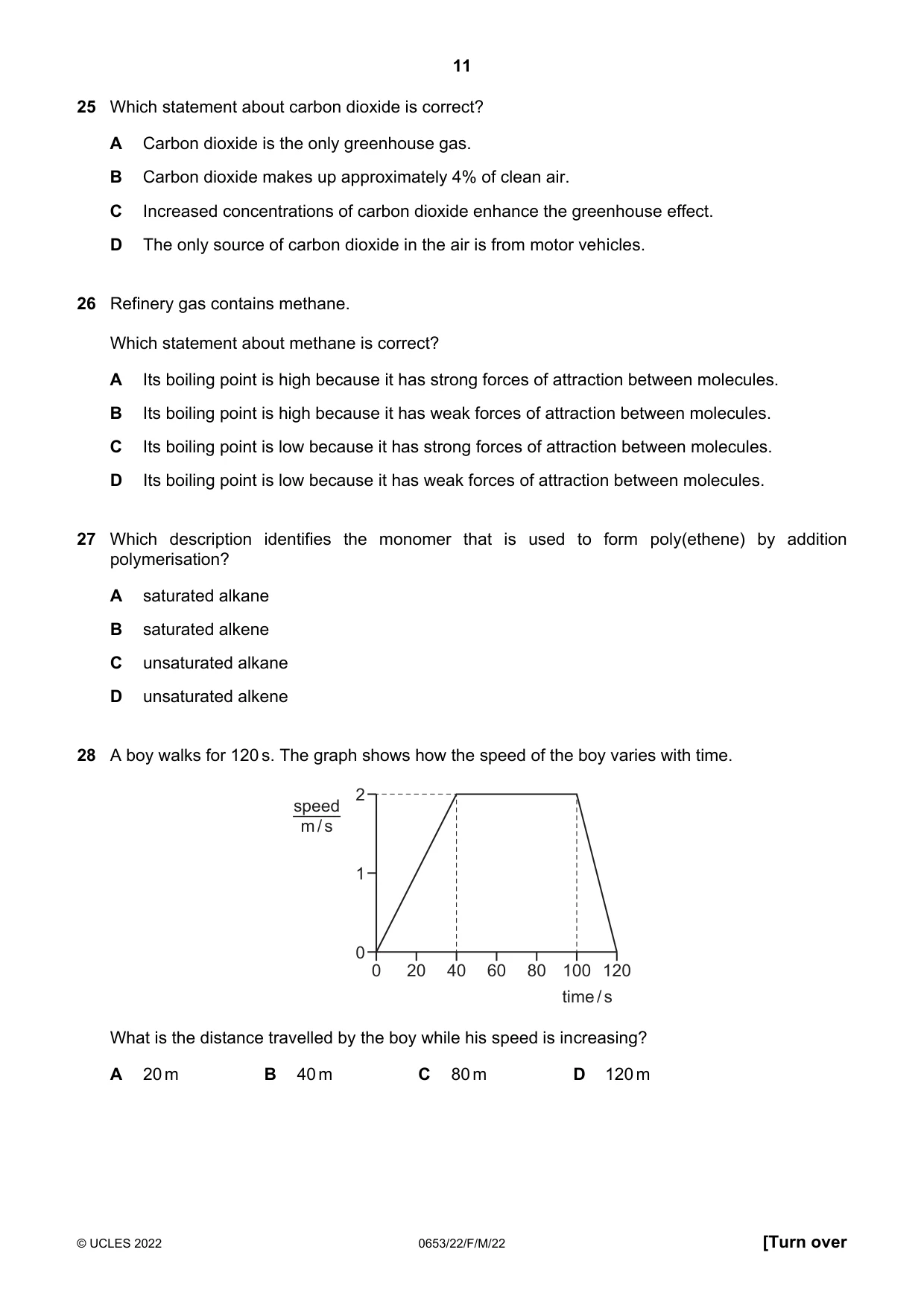
Q28 · A boy walks for 120 s
28 A boy walks for 120 s. The graph shows how the speed of the boy varies with time. 2 speed m / s 1 0 0 20 40 60 80 100 120 time / s What is the distance travelled by the boy while his speed is increasing? A 20 m B 40 m C 80 m D 120 m
Mark scheme: B
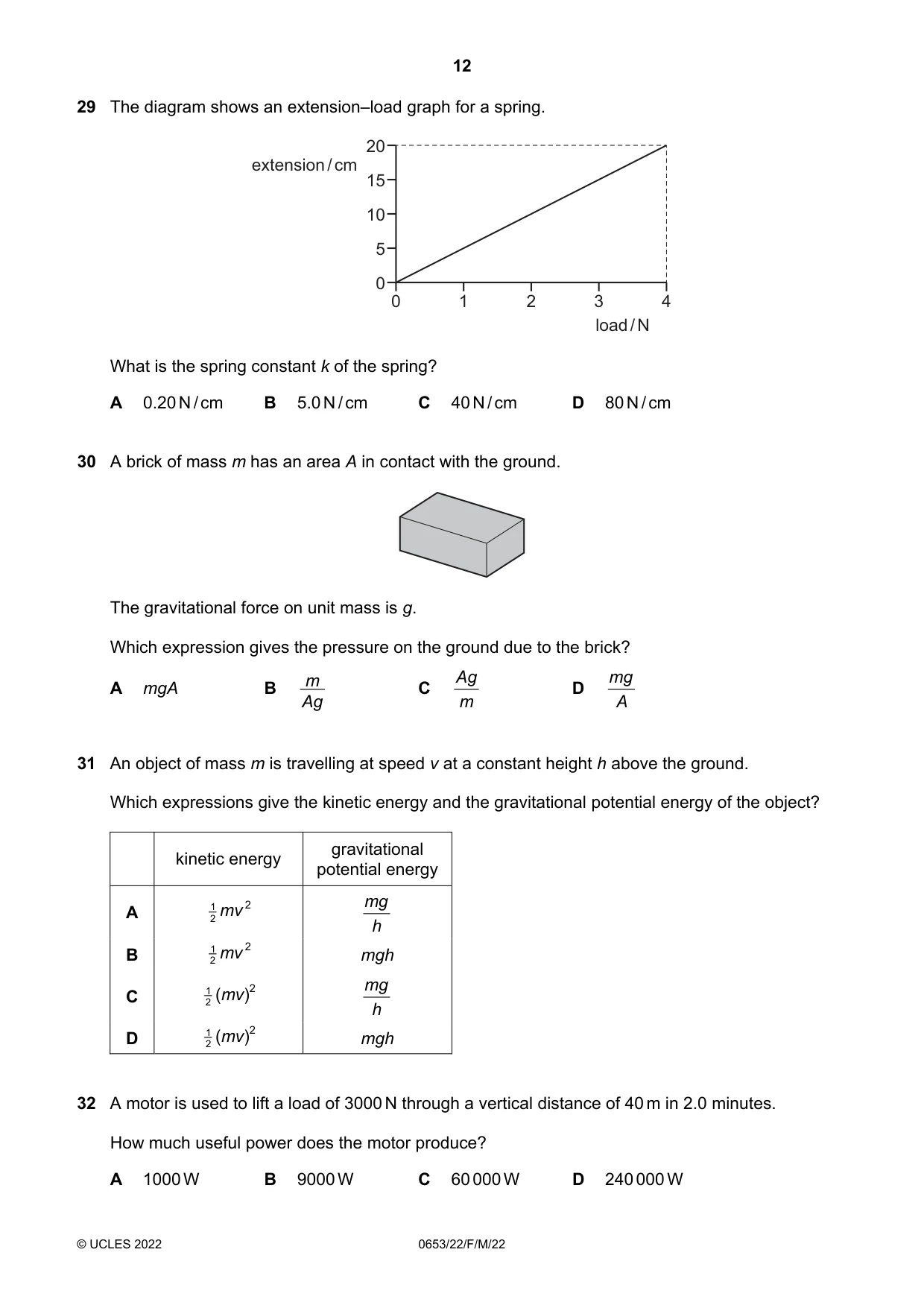
Q29 · The diagram shows an extension–load graph for a spring
29 The diagram shows an extension–load graph for a spring. 20 extension / cm 15 10 5 0 0 1 2 3 4 load / N What is the spring constant k of the spring? A 0.20 N / cm B 5.0 N / cm C 40 N / cm D 80 N / cm
Mark scheme: A
Q30 · A brick of mass m has an area A in contact with the ground
30 A brick of mass m has an area A in contact with the ground. The gravitational force on unit mass is g. Which expression gives the pressure on the ground due to the brick? m Ag mg A mgA B Ag C m D A
Mark scheme: D
Q31 · An object of mass m is travelling at speed v at a constant height h above the ground
31 An object of mass m is travelling at speed v at a constant height h above the ground. Which expressions give the kinetic energy and the gravitational potential energy of the object? gravitational kinetic energy potential energy 2 mv 2 mg A 1 h B 2 mv 2 1 mgh 2 (mv)2 mg C 1 h D 2 (mv)2 1 mgh
Mark scheme: B
Q32 · A motor is used to lift a load of 3000 N through a vertical distance of 40 m in 2.0…
32 A motor is used to lift a load of 3000 N through a vertical distance of 40 m in 2.0 minutes. How much useful power does the motor produce? A 1000 W B 9000 W C 60 000 W D 240 000 W
Mark scheme: A
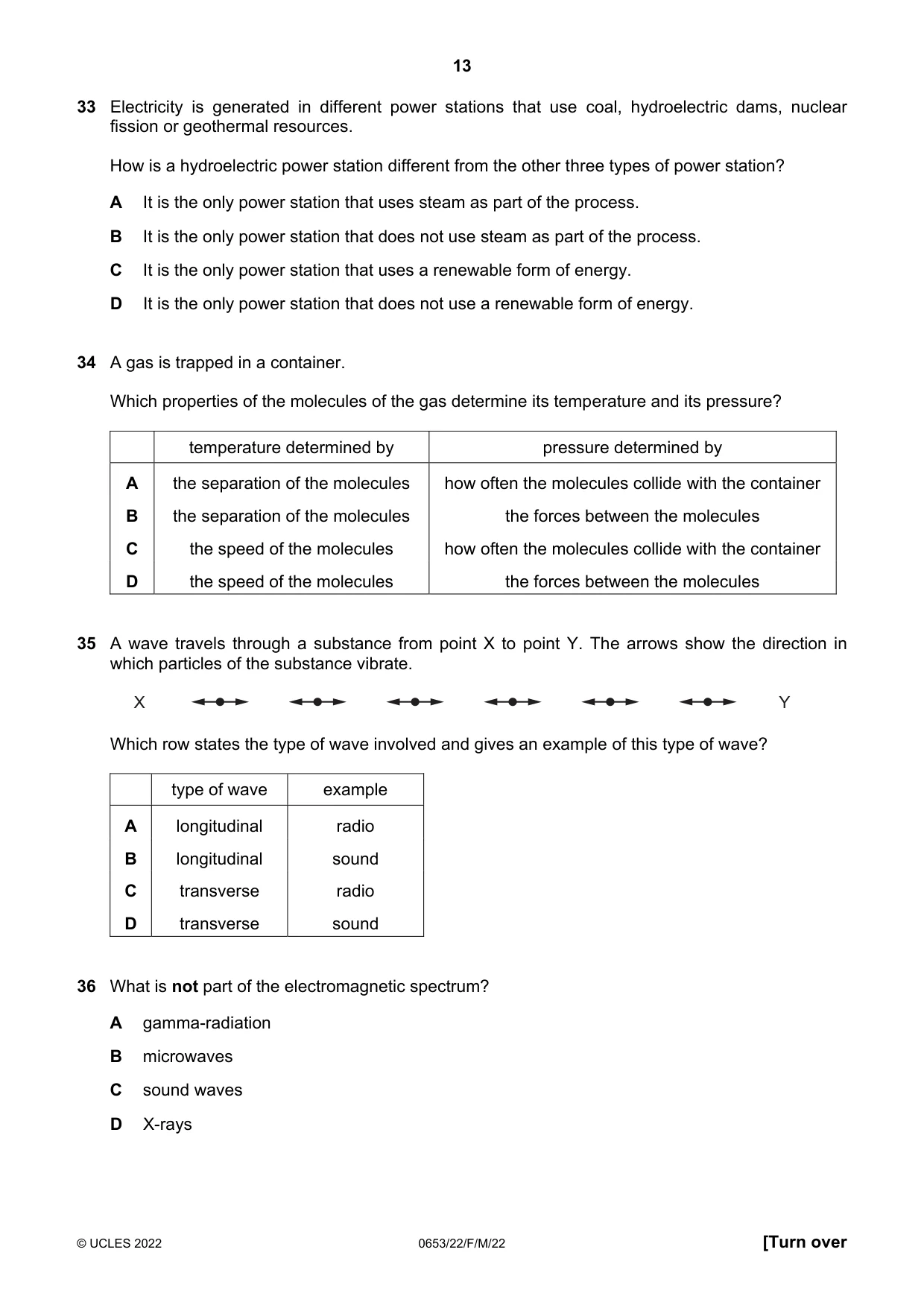
Q33 · Electricity is generated in different power stations that use coal, hydroelectric dams…
33 Electricity is generated in different power stations that use coal, hydroelectric dams, nuclear fission or geothermal resources. How is a hydroelectric power station different from the other three types of power station? A It is the only power station that uses steam as part of the process. B It is the only power station that does not use steam as part of the process. C It is the only power station that uses a renewable form of energy. D It is the only power station that does not use a renewable form of energy.
Mark scheme: B
Q34 · A gas is trapped in a container
34 A gas is trapped in a container. Which properties of the molecules of the gas determine its temperature and its pressure? temperature determined by pressure determined by A the separation of the molecules how often the molecules collide with the container B the separation of the molecules the forces between the molecules C the speed of the molecules how often the molecules collide with the container D the speed of the molecules the forces between the molecules
Mark scheme: C
Q35 · A wave travels through a substance from point X to point Y
35 A wave travels through a substance from point X to point Y. The arrows show the direction in which particles of the substance vibrate. X Y Which row states the type of wave involved and gives an example of this type of wave? type of wave example A longitudinal radio B longitudinal sound C transverse radio D transverse sound
Mark scheme: B
Q36 · What is not part of the electromagnetic spectrum?
36 What is not part of the electromagnetic spectrum? A gamma-radiation B microwaves C sound waves D X-rays
Mark scheme: C
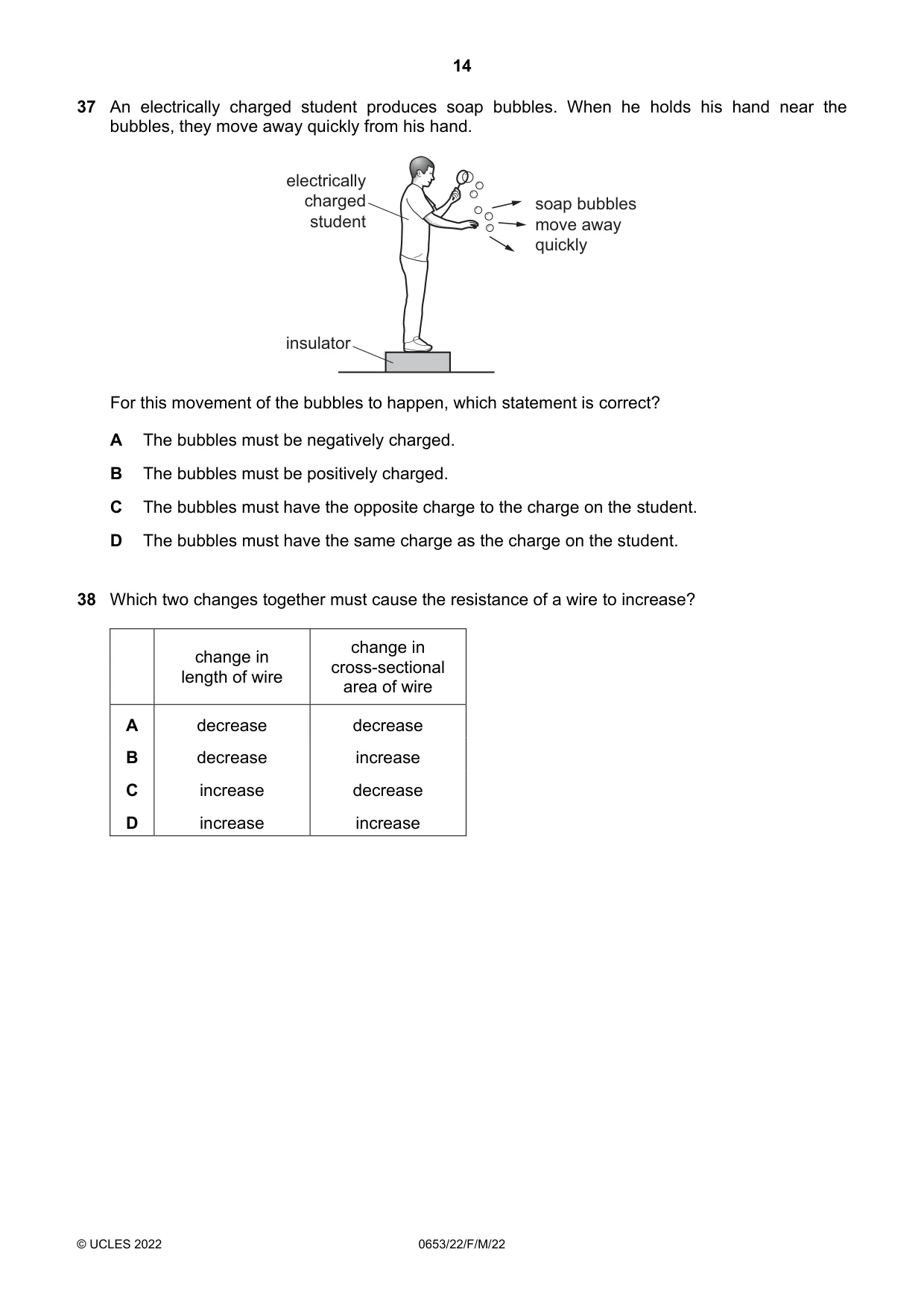
Q37 · An electrically charged student produces soap bubbles
37 An electrically charged student produces soap bubbles. When he holds his hand near the bubbles, they move away quickly from his hand. electrically charged soap bubbles student move away quickly insulator For this movement of the bubbles to happen, which statement is correct? A The bubbles must be negatively charged. B The bubbles must be positively charged. C The bubbles must have the opposite charge to the charge on the student. D The bubbles must have the same charge as the charge on the student.
Mark scheme: D
Q38 · Which two changes together must cause the resistance of a wire to increase?
38 Which two changes together must cause the resistance of a wire to increase? change in change in cross-sectional length of wire area of wire A decrease decrease B decrease increase C increase decrease D increase increase
Mark scheme: C
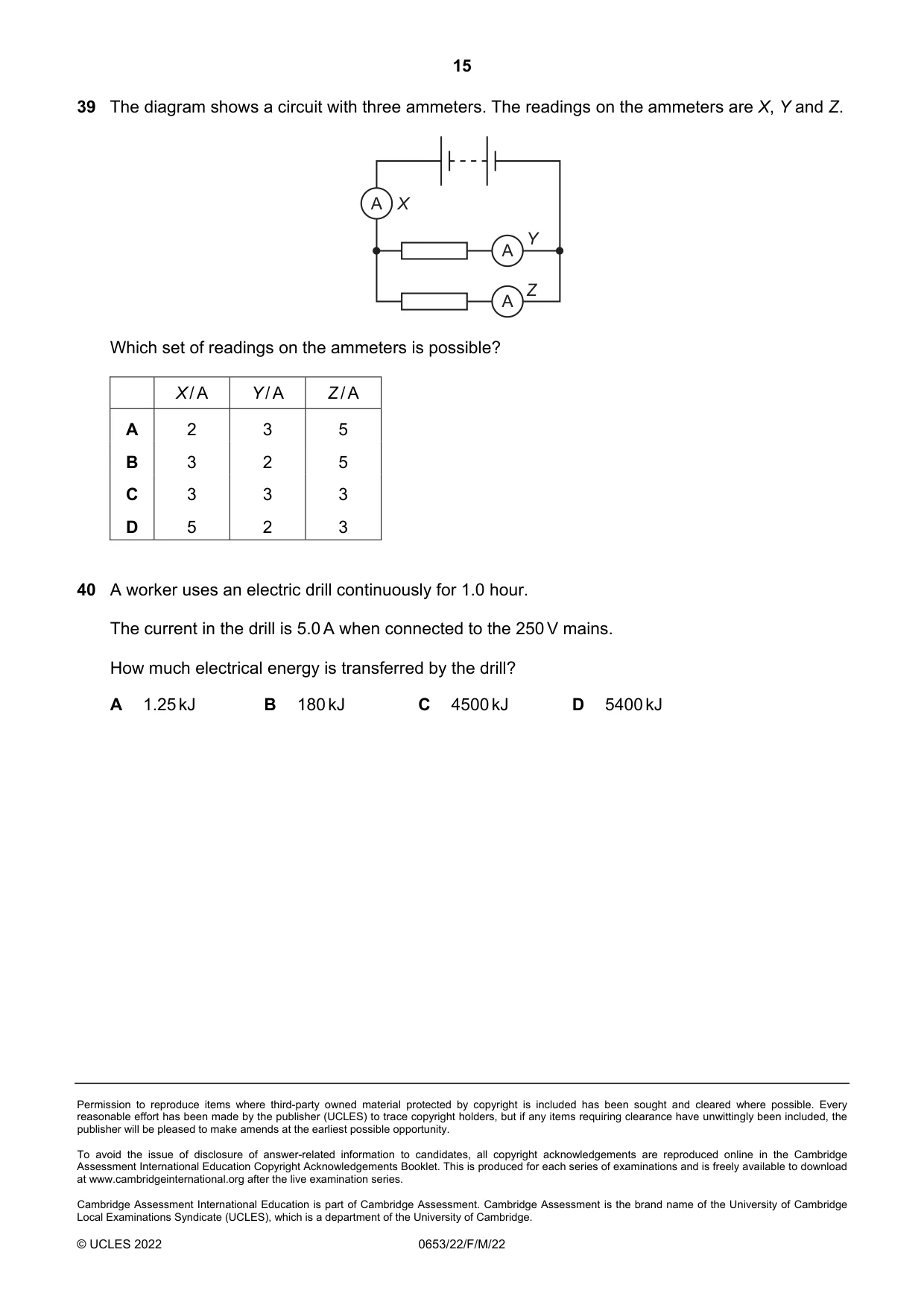
Q39 · The diagram shows a circuit with three ammeters
39 The diagram shows a circuit with three ammeters. The readings on the ammeters are X, Y and Z. A X Y A Z A Which set of readings on the ammeters is possible? X / A Y / A Z / A A 2 3 5 B 3 2 5 C 3 3 3 D 5 2 3
Mark scheme: D
Q40 · A worker uses an electric drill continuously for 1.0 hour
40 A worker uses an electric drill continuously for 1.0 hour. The current in the drill is 5.0 A when connected to the 250 V mains. How much electrical energy is transferred by the drill? A 1.25 kJ B 180 kJ C 4500 kJ D 5400 kJ
Mark scheme: C
What was in this paper
The subtopics covered by these 40 questions, and how many questions each got. Open one in a new tab to see every Cambridge question on it.
3Electrical circuits2Electrical quantities2Air quality and climate1Alkanes1Atomic structure and the Periodic Table1Carbon cycle1Cell structure1Digestion1Electrolysis1Electromagnetic spectrum1Enzymes1Exothermic and endothermic reactions1Extraction of metals1Food chains and food webs1Forces1Gas exchange in humans1General properties of waves1Group I properties1Kinetic particle model of matter1Leaf structure1Motion1Noble gases1Osmosis1Photosynthesis1Polymers1Pressure1Properties of metals1Reactivity series1Respiration1Separation and purification1Sexual reproduction in humans1Sexual reproduction in plants1Simple molecules and covalent bonds1The characteristic properties of acids and bases1Transpiration1What you needed in this session
Cambridge’s own grade thresholds for 2022 Feb/March, Paper 2 · Variant 2. A higher threshold means an easier paper — the bar moves with how the cohort did.