Cambridge IGCSE Science - Combined 0653 — 2018 May/June Paper 2 · Variant 2
0653/22/M/J/18 · 40 questions · 40 marks · ≈45 min
The question paper and its mark scheme, free to read here and free to download. This is Cambridge’s own paper, exactly as it was sat.
Question paper20 pages



Mark scheme3 pages
Answers below. Sit the paper first if you are practising.
Questions as text
Q1 · Which pair of structures is found in a typical plant cell but not in a typical animal…
1 Which pair of structures is found in a typical plant cell but not in a typical animal cell? A cell membrane and chloroplasts B cell membrane and cytoplasm C cell wall and chloroplasts D cell wall and cytoplasm
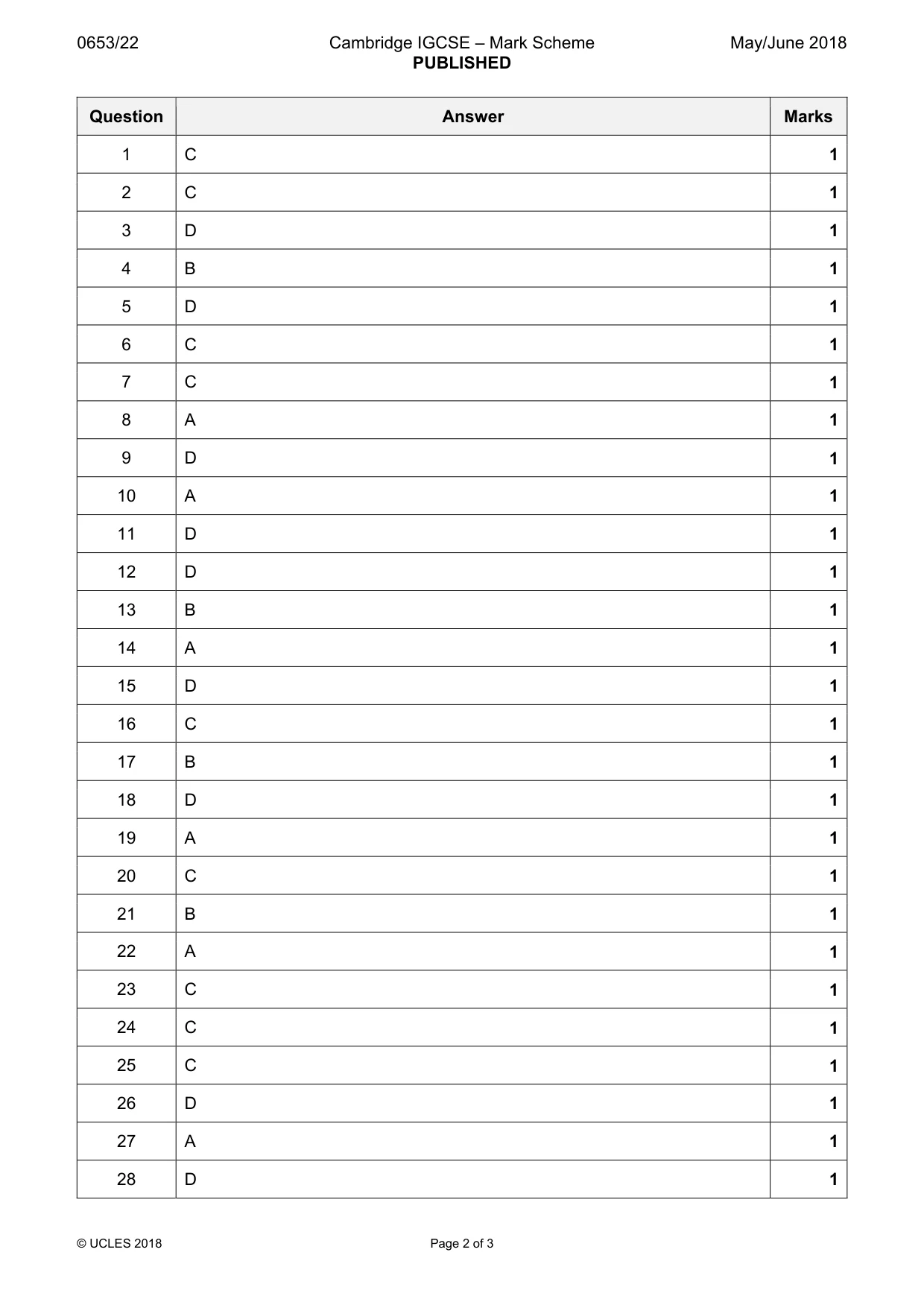
Mark scheme: C
Q2 · Amylase is an enzyme that digests starch
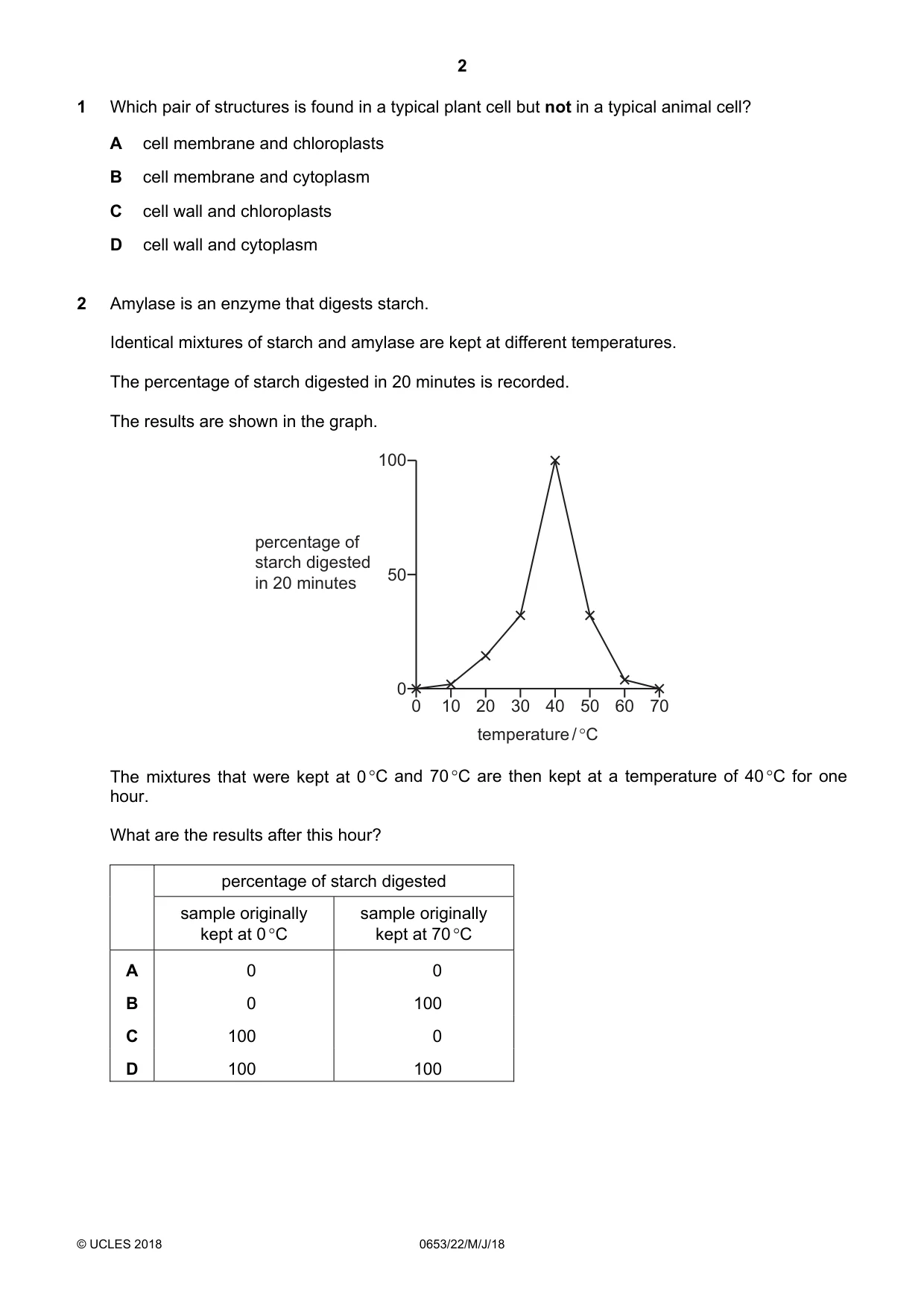
2 Amylase is an enzyme that digests starch. Identical mixtures of starch and amylase are kept at different temperatures. The percentage of starch digested in 20 minutes is recorded. The results are shown in the graph. 100 percentage of starch digested 50 in 20 minutes 0 0 10 20 30 40 50 60 70 temperature / °C The mixtures that were kept at 0 °C and 70 °C are then kept at a temperature of 40 °C for one hour. What are the results after this hour? percentage of starch digested sample originally sample originally kept at 0 °C kept at 70 °C A 0 0 B 0 100 C 100 0 D 100 100
Mark scheme: C
Q3 · Which two chemical substances are required for photosynthesis?
3 Which two chemical substances are required for photosynthesis? A carbon dioxide and glucose B glucose and oxygen C oxygen and water D water and carbon dioxide
Mark scheme: D
Q4 · The diagram shows a section through the human heart
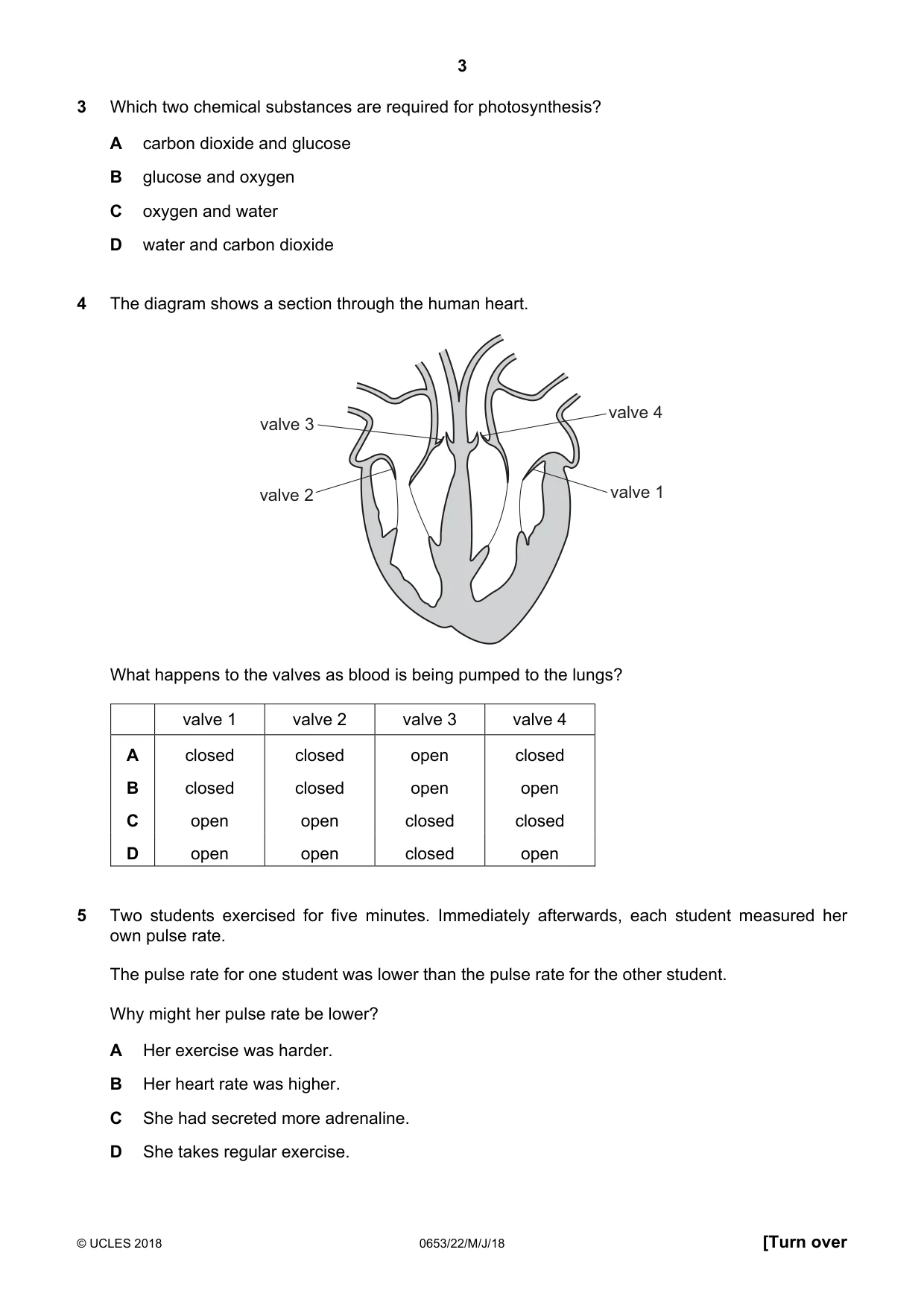
4 The diagram shows a section through the human heart. valve 4 valve 3 valve 2 valve 1 What happens to the valves as blood is being pumped to the lungs? valve 1 valve 2 valve 3 valve 4 A closed closed open closed B closed closed open open C open open closed closed D open open closed open
Mark scheme: B
Q5 · Two students exercised for five minutes
5 Two students exercised for five minutes. Immediately afterwards, each student measured her own pulse rate. The pulse rate for one student was lower than the pulse rate for the other student. Why might her pulse rate be lower? A Her exercise was harder. B Her heart rate was higher. C She had secreted more adrenaline. D She takes regular exercise.
Mark scheme: D
Q6 · What is not a feature of a gas exchange surface in animals?
6 What is not a feature of a gas exchange surface in animals? A moist B permeable C small surface area D thin
Mark scheme: C
Q7 · What is the maximum number of carbon dioxide molecules produced when four glucose…
7 What is the maximum number of carbon dioxide molecules produced when four glucose molecules are used in aerobic respiration? A 6 B 12 C 24 D 48
Mark scheme: C
Q8 · Adrenaline is sometimes called the ‘fight or flight’ hormone
8 Adrenaline is sometimes called the ‘fight or flight’ hormone. Which is an effect of adrenaline that helps prepare the body to fight or to take flight when frightened? A It increases blood glucose concentration. B It increases the rate of digestion. C It maintains a constant body temperature. D It slows down the heart rate.
Mark scheme: A
Q9 · Which row describes sexual reproduction?
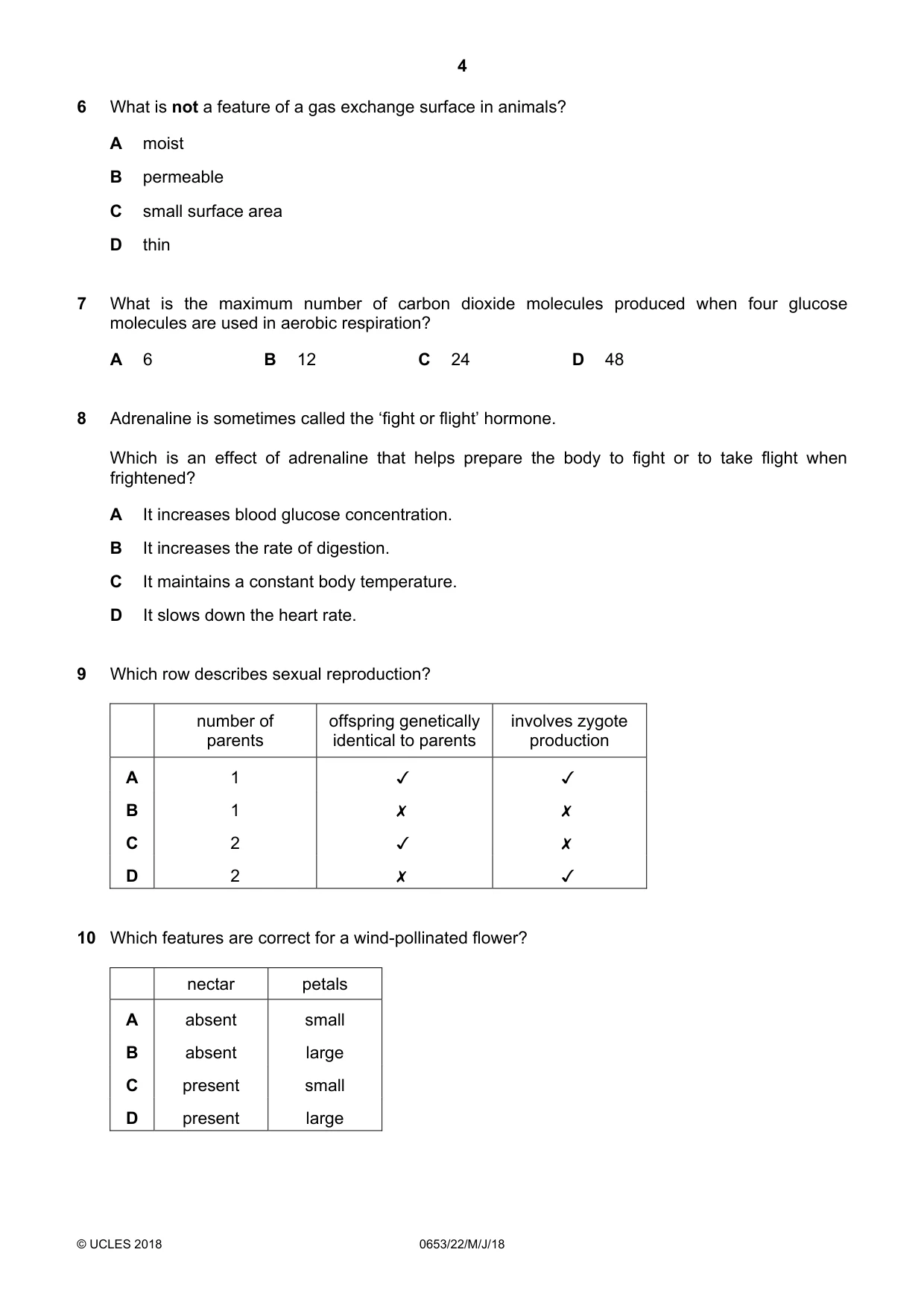
9 Which row describes sexual reproduction? number of offspring genetically involves zygote parents identical to parents production A 1 v v B 1 x x Cc 2 v x D 2 x v
Mark scheme: D
Q10 · Which features are correct for a wind-pollinated flower?
10 Which features are correct for a wind-pollinated flower? nectar petals A absent small B absent large C present small D present large
Mark scheme: A
Q11 · In a food chain, the energy transferred from the first trophic level to the second…
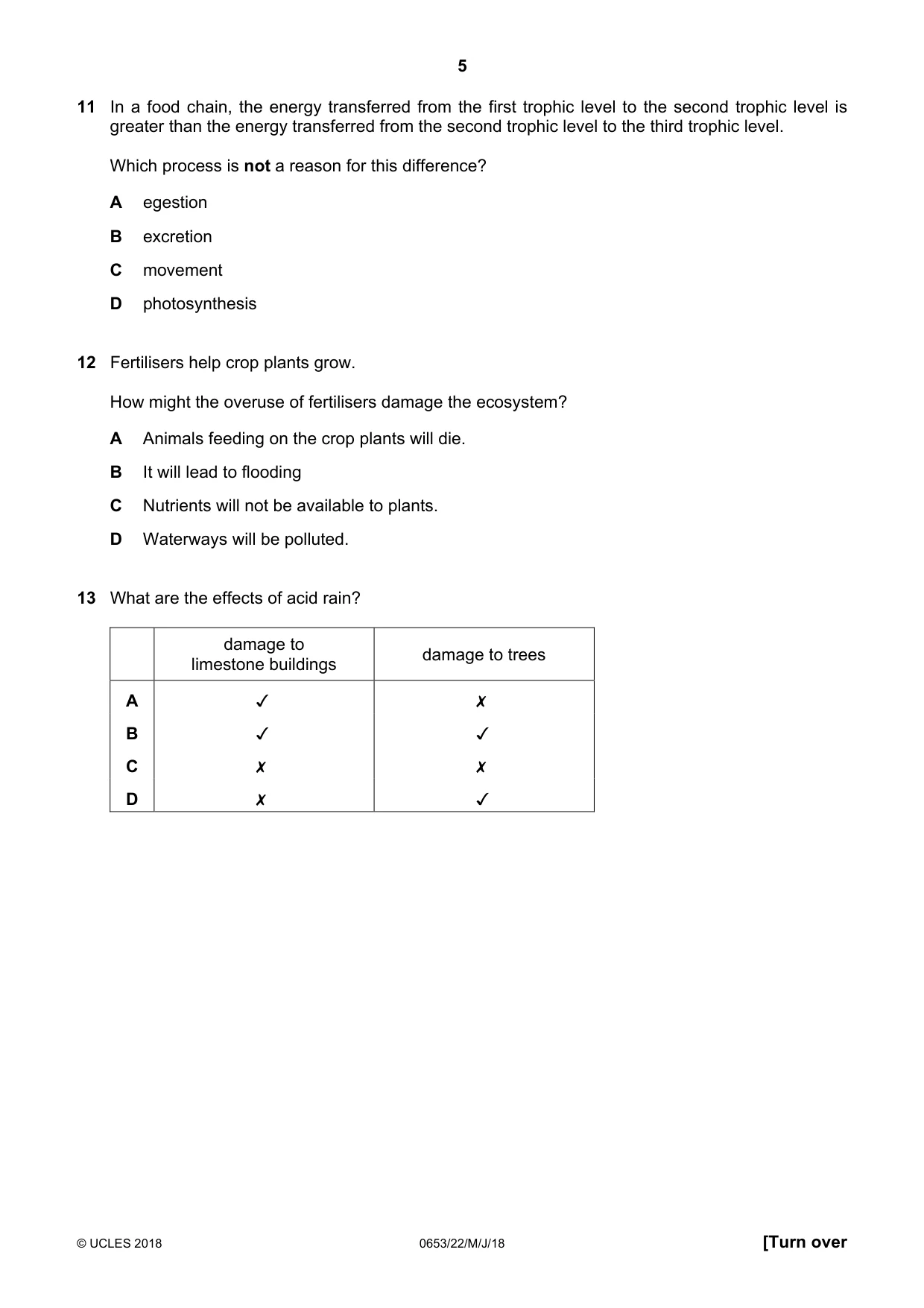
11 In a food chain, the energy transferred from the first trophic level to the second trophic level is greater than the energy transferred from the second trophic level to the third trophic level. Which process is not a reason for this difference? A egestion B excretion C movement D photosynthesis
Mark scheme: D
Q12 · Fertilisers help crop plants grow
12 Fertilisers help crop plants grow. How might the overuse of fertilisers damage the ecosystem? A Animals feeding on the crop plants will die. B It will lead to flooding C Nutrients will not be available to plants. D Waterways will be polluted.
Mark scheme: D
Q13 · What are the effects of acid rain?
13 What are the effects of acid rain? damage to limestone buildings damage to trees v 09 WD > <j & < x v x x
Mark scheme: B
Q14 · The diagrams represent different substances
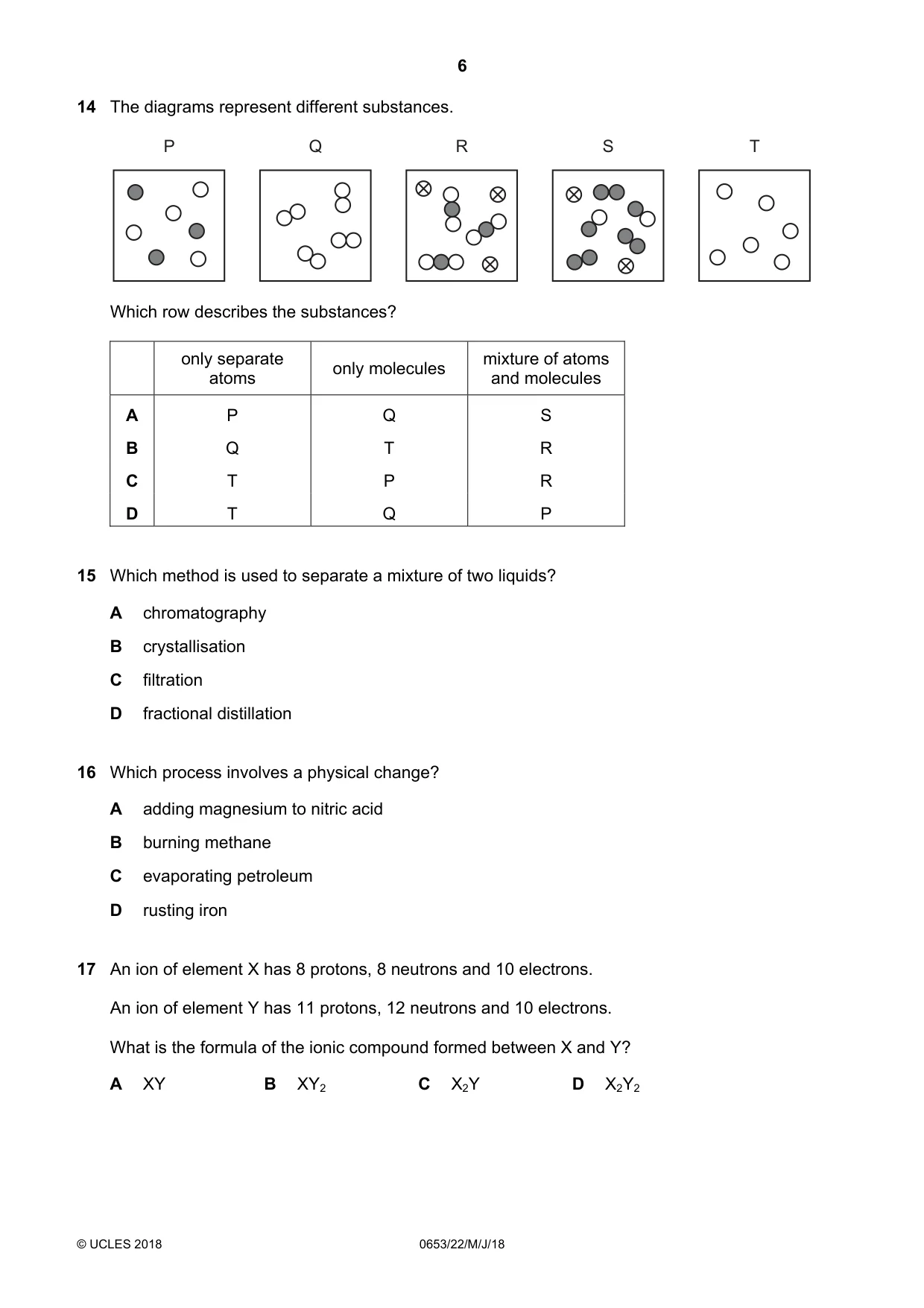
14 The diagrams represent different substances. P Q R S T Which row describes the substances? only separate mixture of atoms only molecules atoms and molecules A P Q S B Q T R C T P R D T Q P
Mark scheme: A
Q15 · Which method is used to separate a mixture of two liquids?
15 Which method is used to separate a mixture of two liquids? A chromatography B crystallisation C filtration D fractional distillation
Mark scheme: D
Q16 · Which process involves a physical change?
16 Which process involves a physical change? A adding magnesium to nitric acid B burning methane C evaporating petroleum D rusting iron
Mark scheme: C
Q17 · An ion of element X has 8 protons, 8 neutrons and 10 electrons
17 An ion of element X has 8 protons, 8 neutrons and 10 electrons. An ion of element Y has 11 protons, 12 neutrons and 10 electrons. What is the formula of the ionic compound formed between X and Y? A XY B XY2 C X2Y D X2Y2
Mark scheme: B
Q18 · The diagram shows apparatus for electrolysis
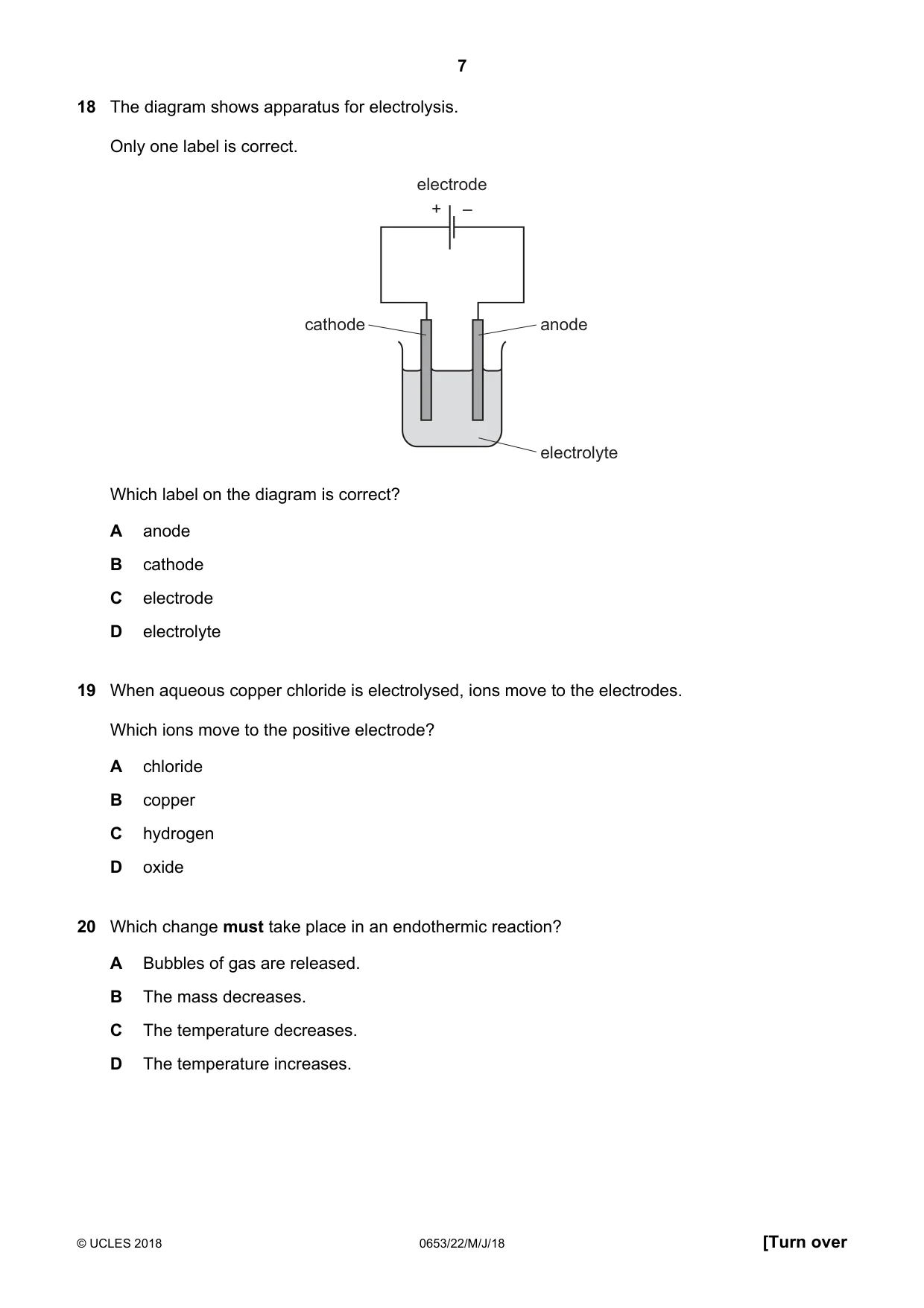
18 The diagram shows apparatus for electrolysis. Only one label is correct. electrode + – cathode anode electrolyte Which label on the diagram is correct? A anode B cathode C electrode D electrolyte
Mark scheme: D
Q19 · When aqueous copper chloride is electrolysed, ions move to the electrodes
19 When aqueous copper chloride is electrolysed, ions move to the electrodes. Which ions move to the positive electrode? A chloride B copper C hydrogen D oxide
Mark scheme: A
Q20 · Which change must take place in an endothermic reaction?
20 Which change must take place in an endothermic reaction? A Bubbles of gas are released. B The mass decreases. C The temperature decreases. D The temperature increases.
Mark scheme: C
Q21 · Magnesium reacts with dilute hydrochloric acid in four experiments
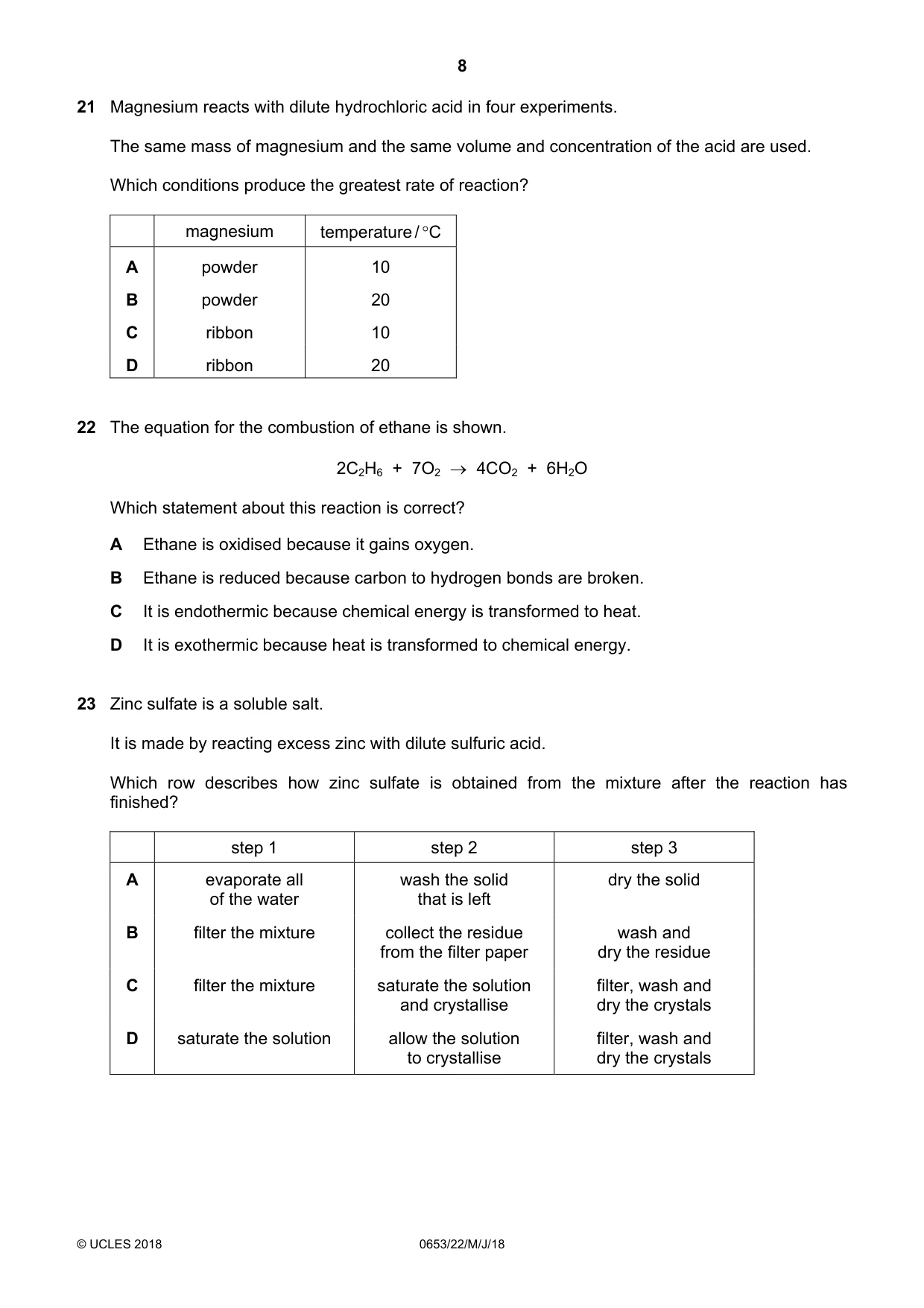
21 Magnesium reacts with dilute hydrochloric acid in four experiments. The same mass of magnesium and the same volume and concentration of the acid are used. Which conditions produce the greatest rate of reaction? magnesium temperature / °C A powder 10 B powder 20 C ribbon 10 D ribbon 20
Mark scheme: B
Q22 · The equation for the combustion of ethane is shown
22 The equation for the combustion of ethane is shown. 2C2H6 + 7O2 → 4CO2 + 6H2O Which statement about this reaction is correct? A Ethane is oxidised because it gains oxygen. B Ethane is reduced because carbon to hydrogen bonds are broken. C It is endothermic because chemical energy is transformed to heat. D It is exothermic because heat is transformed to chemical energy.
Mark scheme: A
Q23 · Zinc sulfate is a soluble salt
23 Zinc sulfate is a soluble salt. It is made by reacting excess zinc with dilute sulfuric acid. Which row describes how zinc sulfate is obtained from the mixture after the reaction has finished? step 1 step 2 step 3 A evaporate all wash the solid dry the solid of the water that is left B filter the mixture collect the residue wash and from the filter paper dry the residue C filter the mixture saturate the solution filter, wash and and crystallise dry the crystals D saturate the solution allow the solution filter, wash and to crystallise dry the crystals
Mark scheme: C
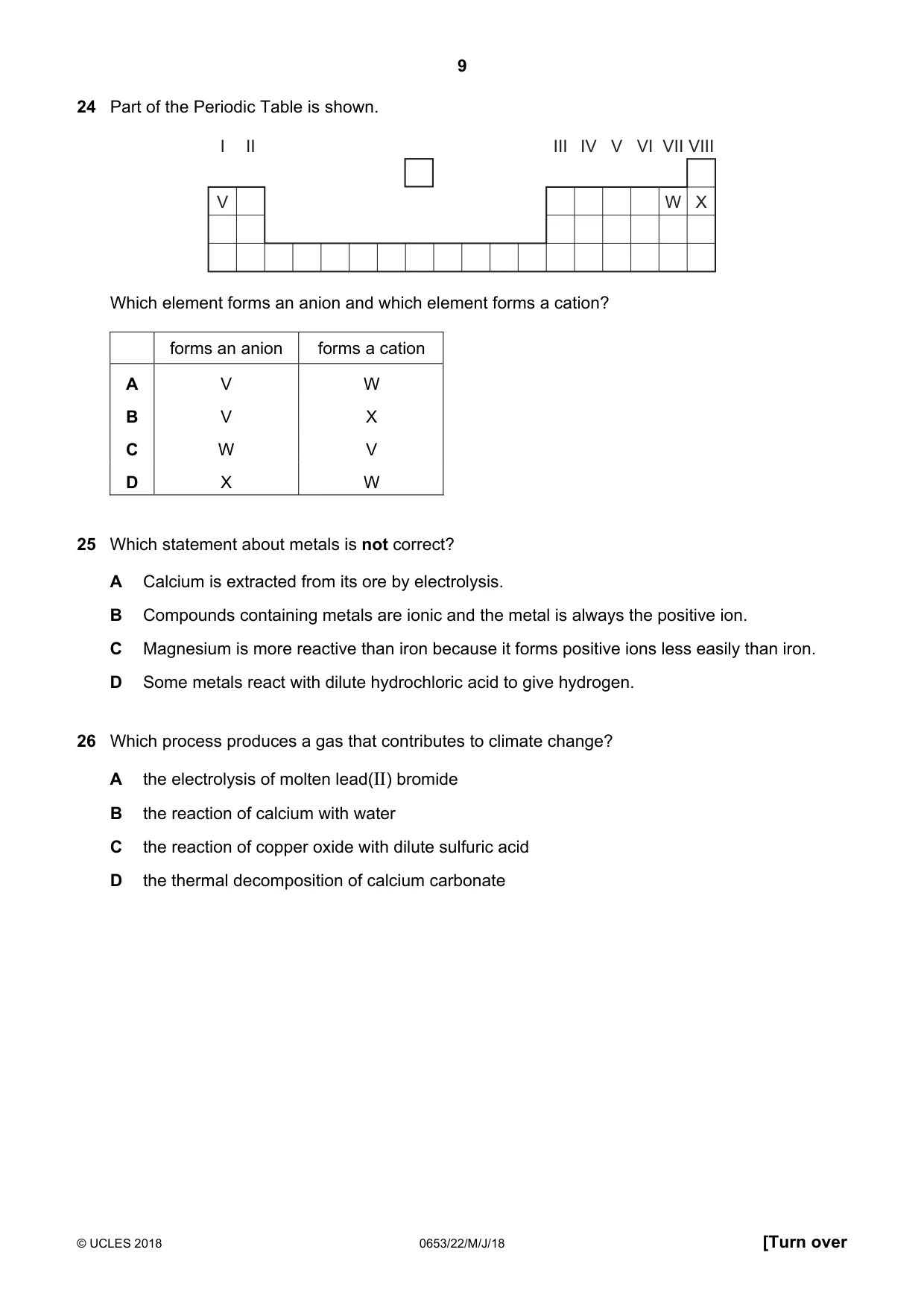
Q24 · Part of the Periodic Table is shown
24 Part of the Periodic Table is shown. I II III IV V VI VII VIII V W X Which element forms an anion and which element forms a cation? forms an anion forms a cation A V W B V X C W V D X W
Mark scheme: C
Q25 · Which statement about metals is not correct?
25 Which statement about metals is not correct? A Calcium is extracted from its ore by electrolysis. B Compounds containing metals are ionic and the metal is always the positive ion. C Magnesium is more reactive than iron because it forms positive ions less easily than iron. D Some metals react with dilute hydrochloric acid to give hydrogen.
Mark scheme: C
Q26 · Which process produces a gas that contributes to climate change?
26 Which process produces a gas that contributes to climate change? A the electrolysis of molten lead(II) bromide B the reaction of calcium with water C the reaction of copper oxide with dilute sulfuric acid D the thermal decomposition of calcium carbonate
Mark scheme: D
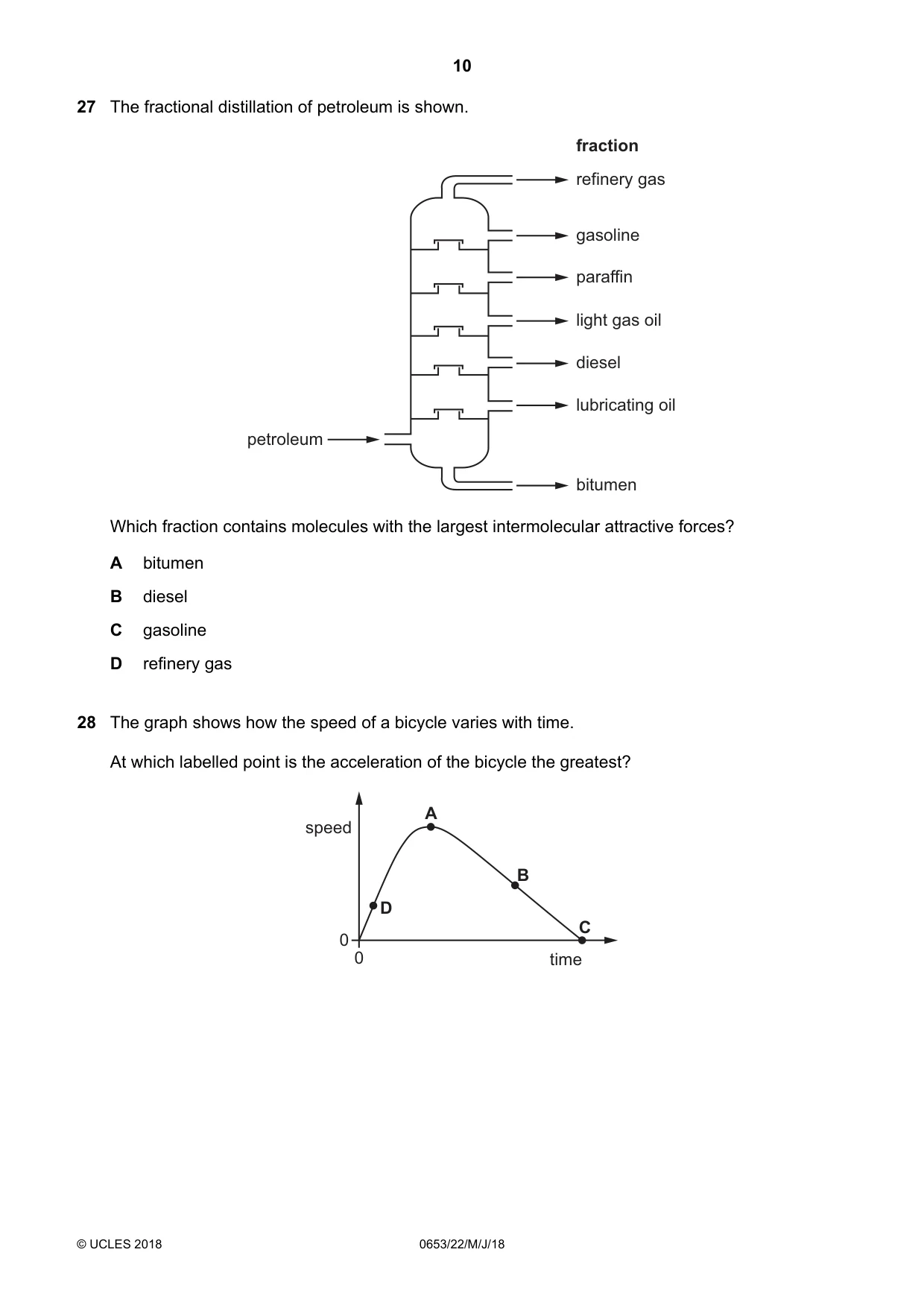
Q27 · The fractional distillation of petroleum is shown
27 The fractional distillation of petroleum is shown. fraction refinery gas gasoline paraffin light gas oil diesel lubricating oil petroleum bitumen Which fraction contains molecules with the largest intermolecular attractive forces? A bitumen B diesel C gasoline D refinery gas
Mark scheme: A
Q28 · The graph shows how the speed of a bicycle varies with time
28 The graph shows how the speed of a bicycle varies with time. At which labelled point is the acceleration of the bicycle the greatest? A speed B D C 0 0 time
Mark scheme: D
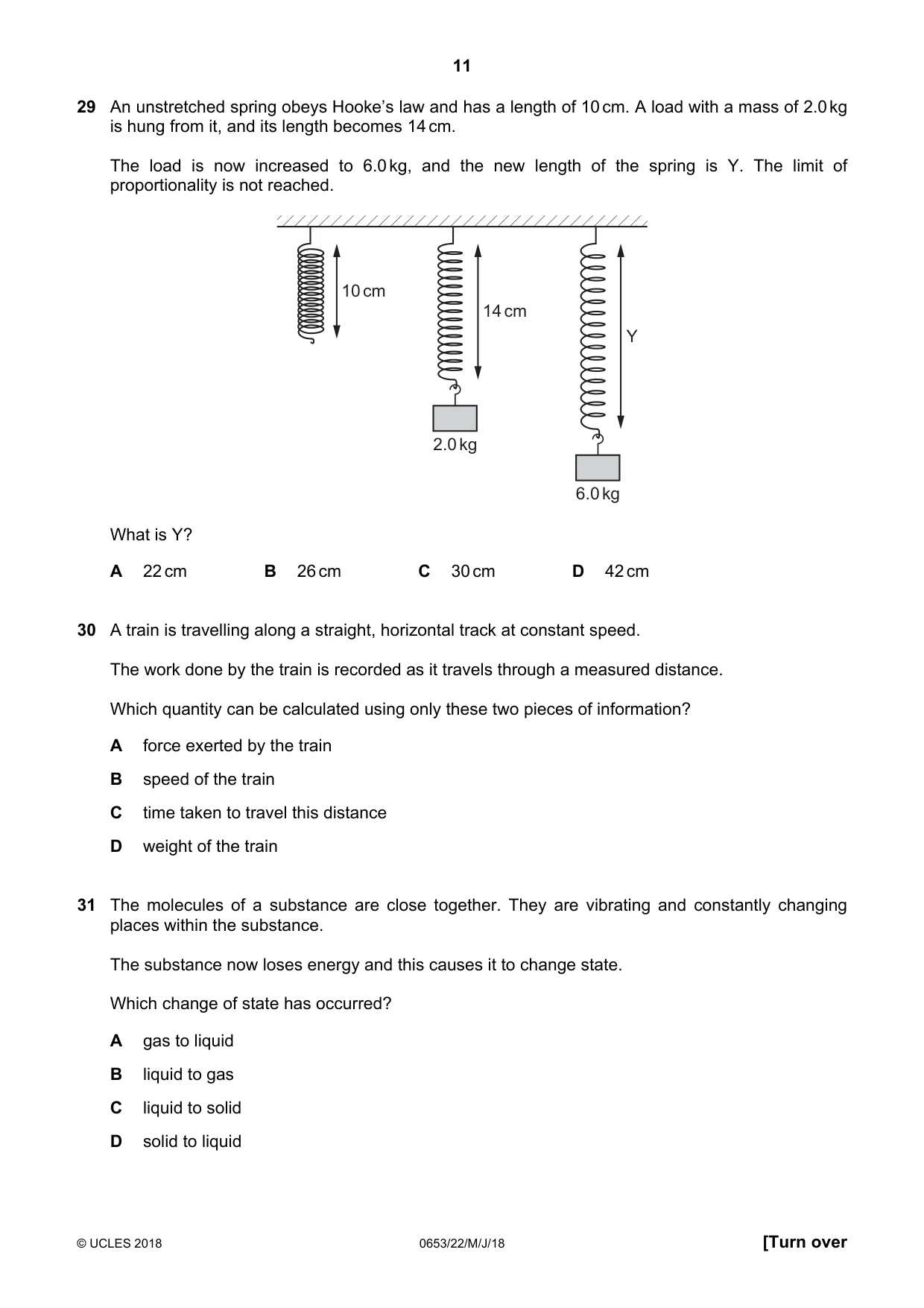
Q29 · An unstretched spring obeys Hooke’s law and has a length of 10 cm
29 An unstretched spring obeys Hooke’s law and has a length of 10 cm. A load with a mass of 2.0 kg is hung from it, and its length becomes 14 cm. The load is now increased to 6.0 kg, and the new length of the spring is Y. The limit of proportionality is not reached. 10 cm 14 cm Y 2.0 kg 6.0 kg What is Y? A 22 cm B 26 cm C 30 cm D 42 cm
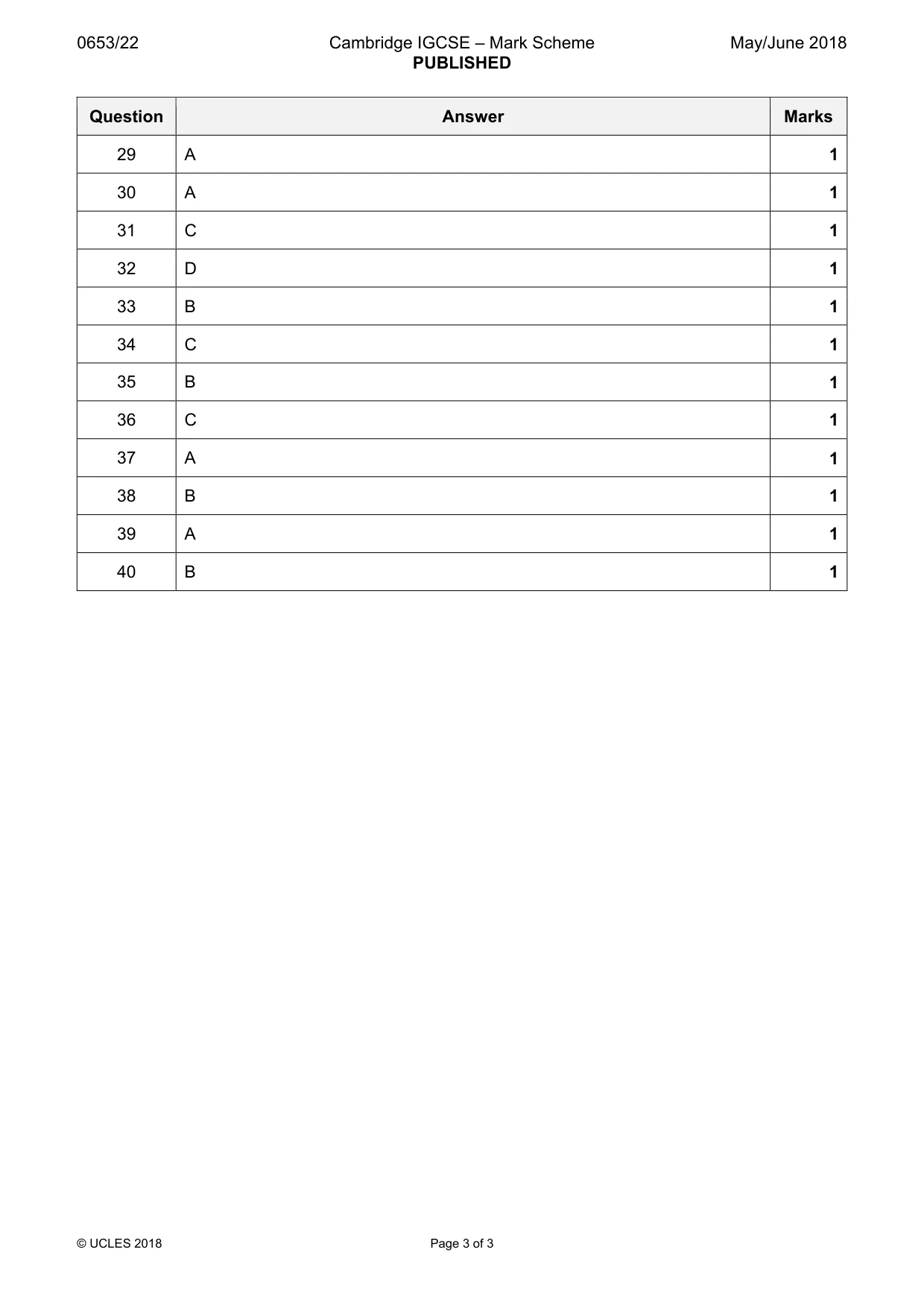
Mark scheme: A
Q30 · A train is travelling along a straight, horizontal track at constant speed
30 A train is travelling along a straight, horizontal track at constant speed. The work done by the train is recorded as it travels through a measured distance. Which quantity can be calculated using only these two pieces of information? A force exerted by the train B speed of the train C time taken to travel this distance D weight of the train
Mark scheme: A
Q31 · The molecules of a substance are close together
31 The molecules of a substance are close together. They are vibrating and constantly changing places within the substance. The substance now loses energy and this causes it to change state. Which change of state has occurred? A gas to liquid B liquid to gas C liquid to solid D solid to liquid
Mark scheme: C
Q32 · On a summer’s day, hot air rises above hot roofs
32 On a summer’s day, hot air rises above hot roofs. What is the name of this process? A concentration B condensation C conduction D convection
Mark scheme: D
Q33 · A wave has a frequency of 120 Hz and a wavelength of 50 cm
33 A wave has a frequency of 120 Hz and a wavelength of 50 cm. What is the speed of the wave? A 2.4 m / s B 60 m / s C 240 m / s D 6000 m / s
Mark scheme: B
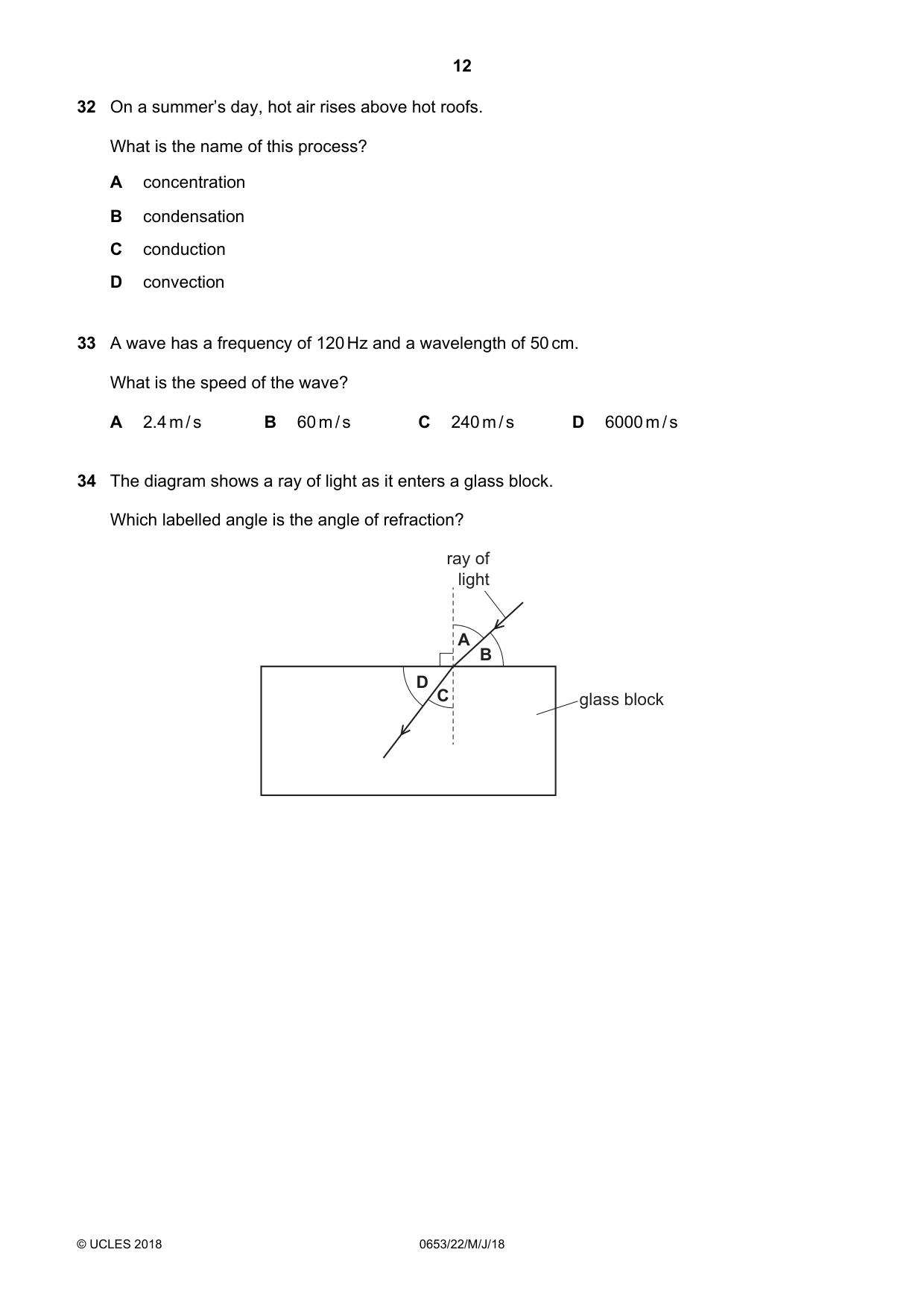
Q34 · The diagram shows a ray of light as it enters a glass block
34 The diagram shows a ray of light as it enters a glass block. Which labelled angle is the angle of refraction? ray of light A B D C glass block
Mark scheme: C
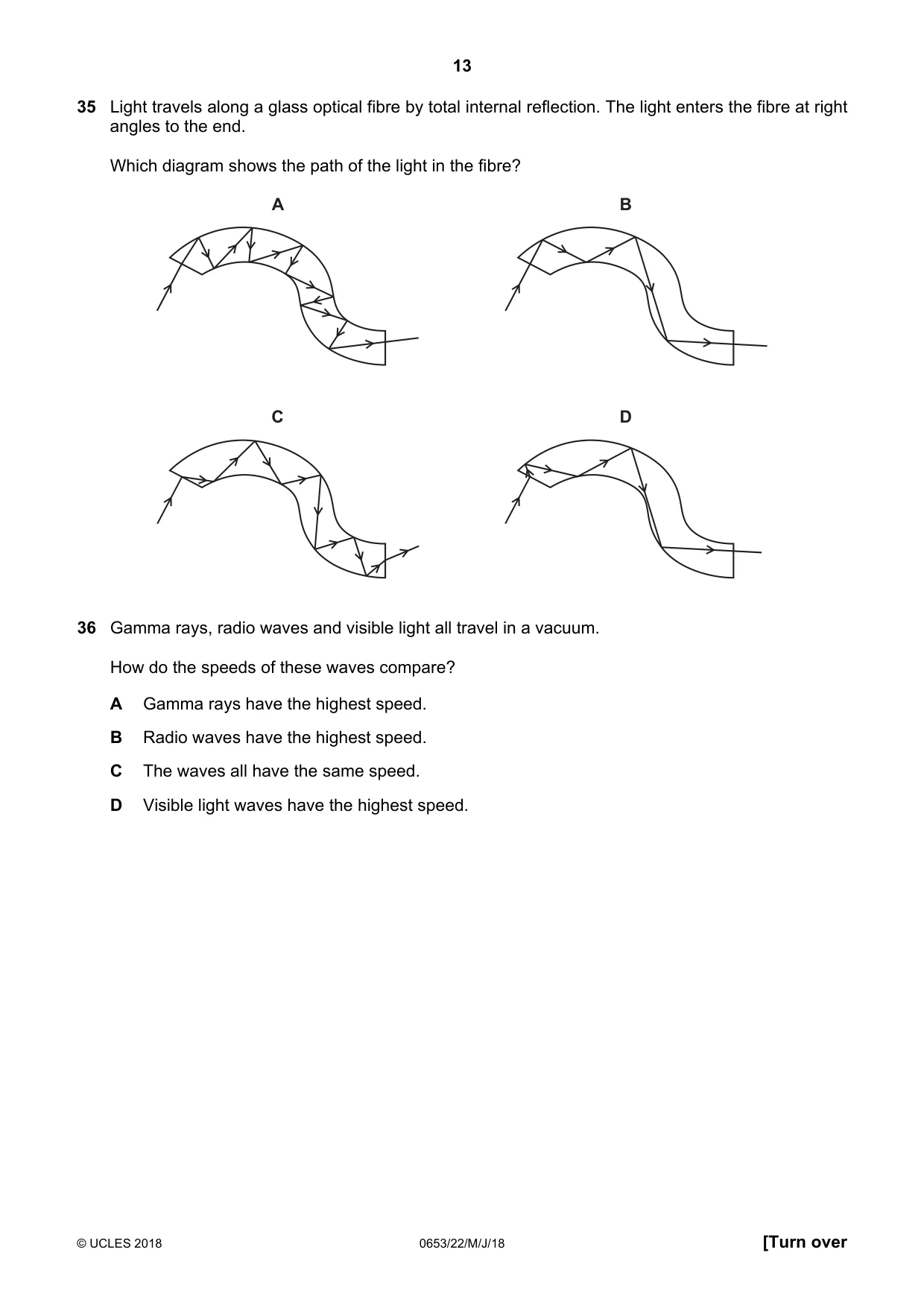
Q35 · Light travels along a glass optical fibre by total internal reflection
35 Light travels along a glass optical fibre by total internal reflection. The light enters the fibre at right angles to the end. Which diagram shows the path of the light in the fibre? A B C D
Mark scheme: B
Q36 · Gamma rays, radio waves and visible light all travel in a vacuum
36 Gamma rays, radio waves and visible light all travel in a vacuum. How do the speeds of these waves compare? A Gamma rays have the highest speed. B Radio waves have the highest speed. C The waves all have the same speed. D Visible light waves have the highest speed.
Mark scheme: C
Q37 · A student writes two sentences about sound waves
37 A student writes two sentences about sound waves. ‘A sound wave travels through the air as compressions and ......X...... .’ ‘The air at the compressions has a different ......Y...... from the air at ......X...... .’ What are the missing words, X and Y? X Y A rarefactions density B rarefactions state C refractions density D refractions state
Mark scheme: A
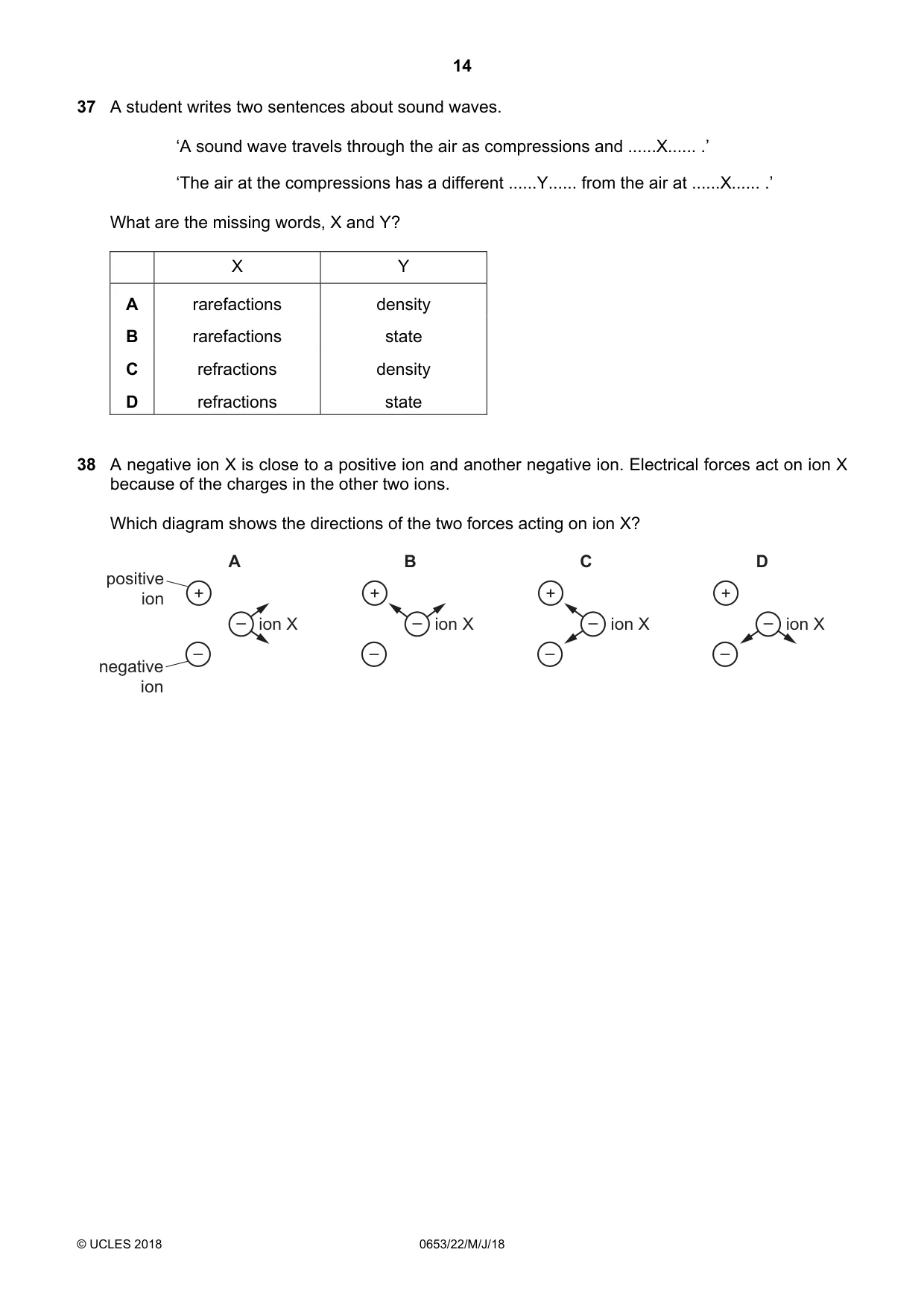
Q38 · A negative ion X is close to a positive ion and another negative ion
38 A negative ion X is close to a positive ion and another negative ion. Electrical forces act on ion X because of the charges in the other two ions. Which diagram shows the directions of the two forces acting on ion X? A B C D positive ion + + + + – ion X – ion X – ion X – ion X – – – – negative ion
Mark scheme: B
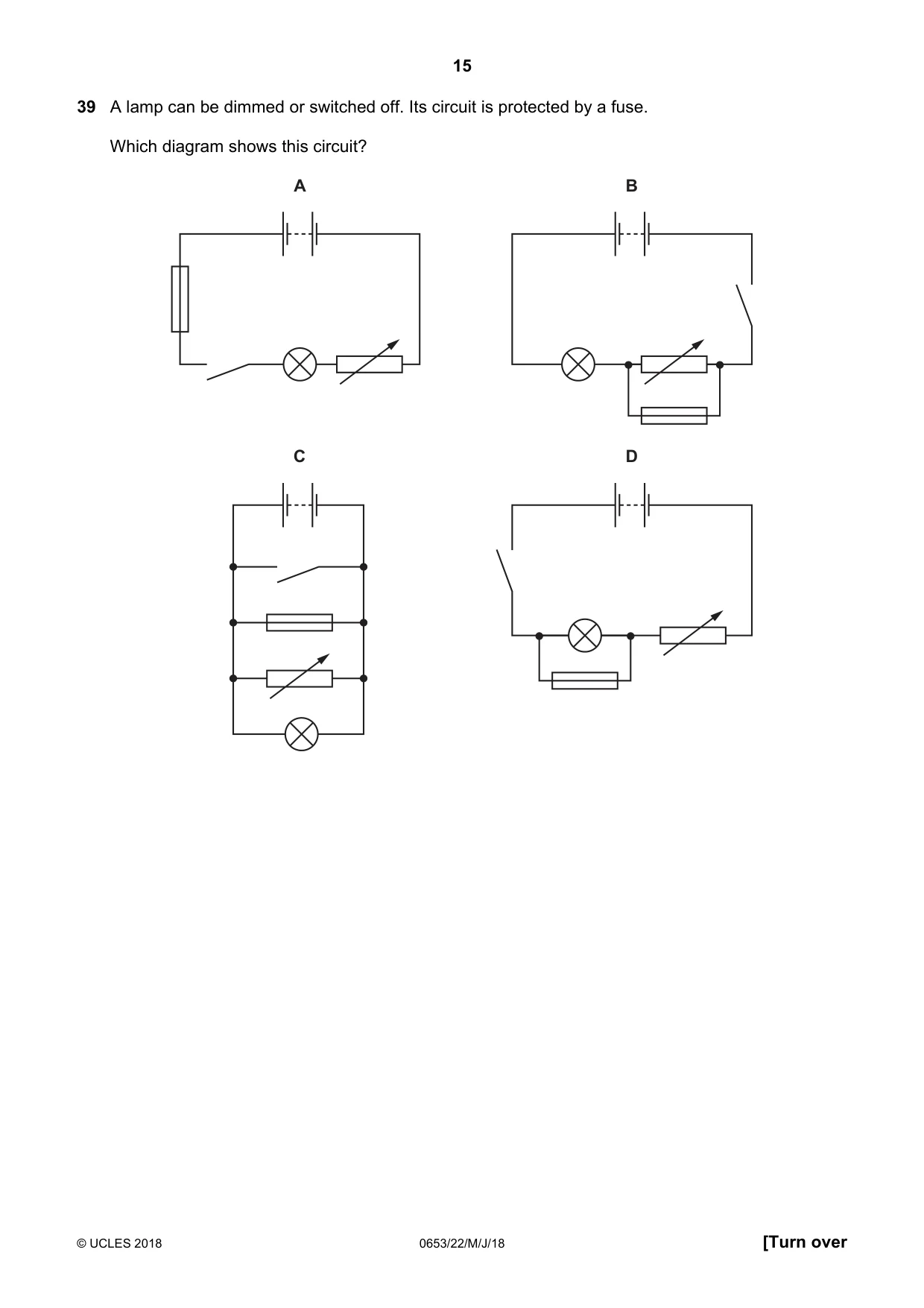
Q39 · A lamp can be dimmed or switched off
39 A lamp can be dimmed or switched off. Its circuit is protected by a fuse. Which diagram shows this circuit? A B C D
Mark scheme: A
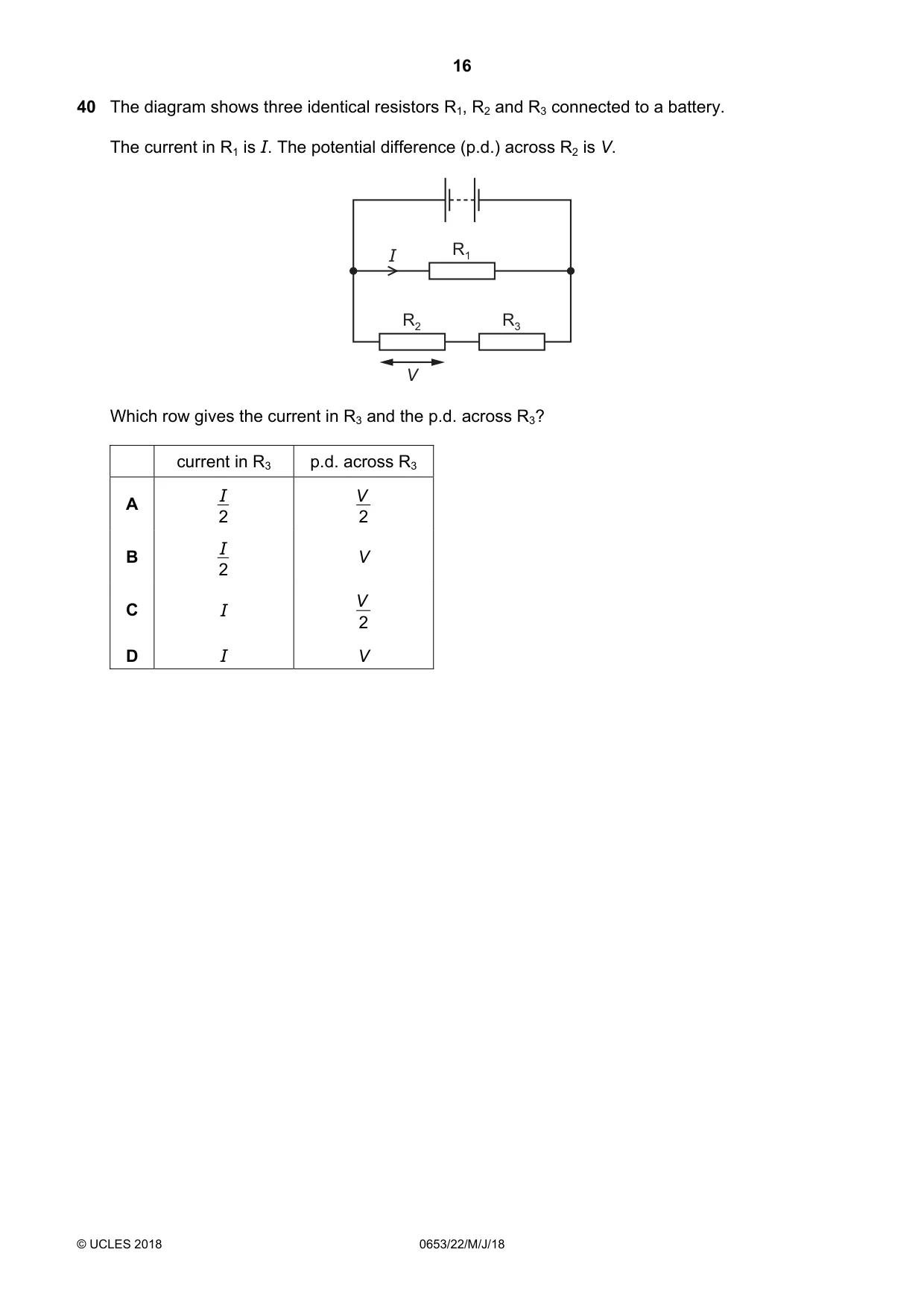
Q40 · The diagram shows three identical resistors R1, R2 and R3 connected to a battery
40 The diagram shows three identical resistors R1, R2 and R3 connected to a battery. The current in R1 is I. The potential difference (p.d.) across R2 is V. I R1 R2 R3 V Which row gives the current in R3 and the p.d. across R3? current in R3 p.d. across R3 I V A 2 2 I B V 2 I V C 2 D I V
Mark scheme: B
What was in this paper
The subtopics covered by these 40 questions, and how many questions each got. Open one in a new tab to see every Cambridge question on it.
2Electrolysis2Habitat destruction2Ions and ionic bonds2Light2Sexual reproduction in plants2Air quality and climate1Cell structure1Circulatory systems1Drugs1Electrical quantities1Electromagnetic spectrum1Elements, compounds and mixtures1Energy flow1Energy, work and power1Enzymes1Exothermic and endothermic reactions1Forces1Fuels1Gas exchange in humans1General properties of waves1Heart1Kinetic particle model of matter1Motion1Photosynthesis1Physical and chemical changes1Preparation of salts1Rate of reaction1Reactivity series1Redox1Respiration1Separation and purification1Sound1Transfer of thermal energy1What you needed in this session
Cambridge’s own grade thresholds for 2018 May/June, Paper 2 · Variant 2. A higher threshold means an easier paper — the bar moves with how the cohort did.