Cambridge IGCSE Science - Combined 0653 — 2025 Oct/Nov Paper 2 · Variant 2
0653/22/O/N/25 · 40 questions · 40 marks · 45 min
The question paper and its mark scheme, free to read here and free to download. This is Cambridge’s own paper, exactly as it was sat.
Question paper16 pages

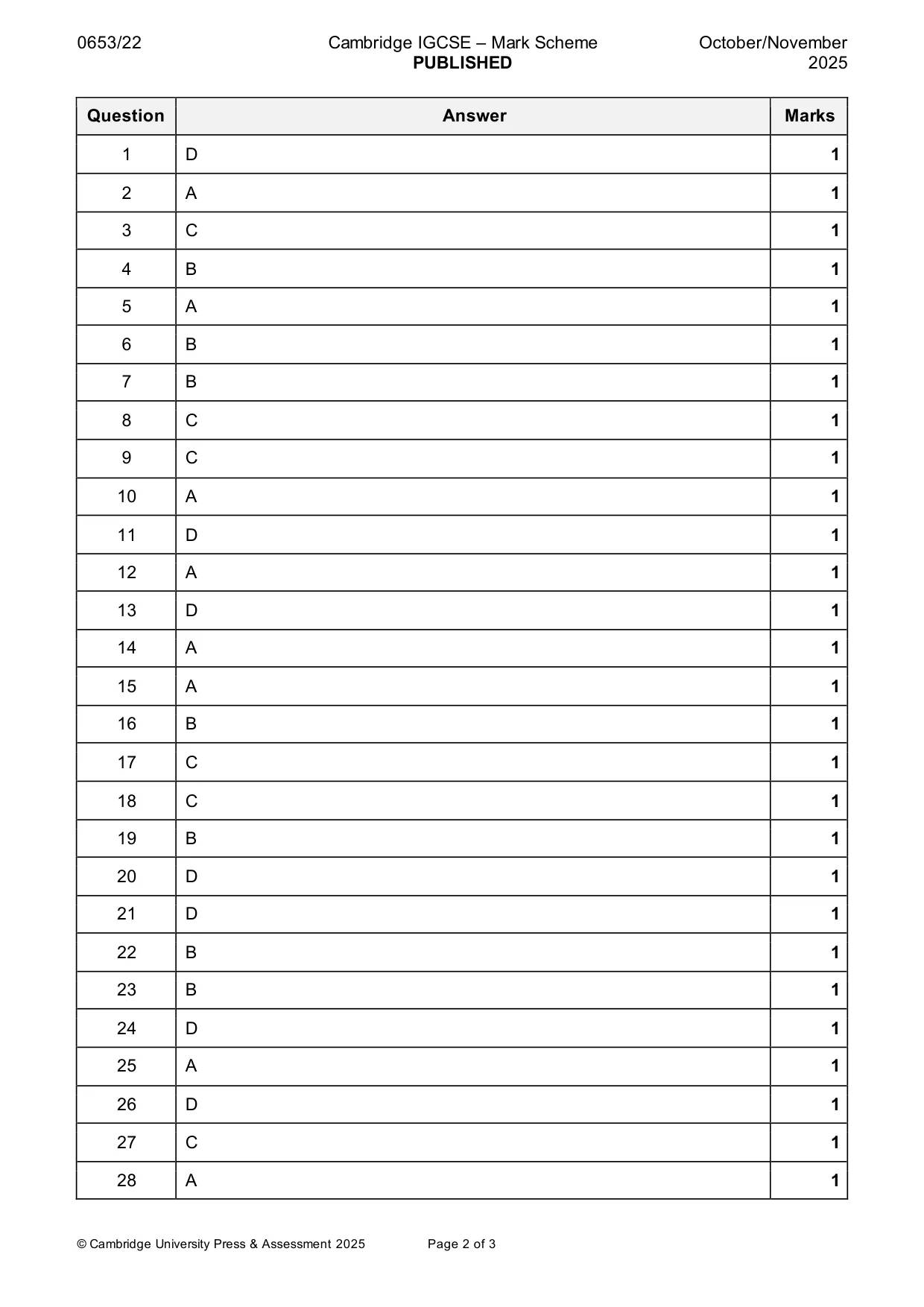
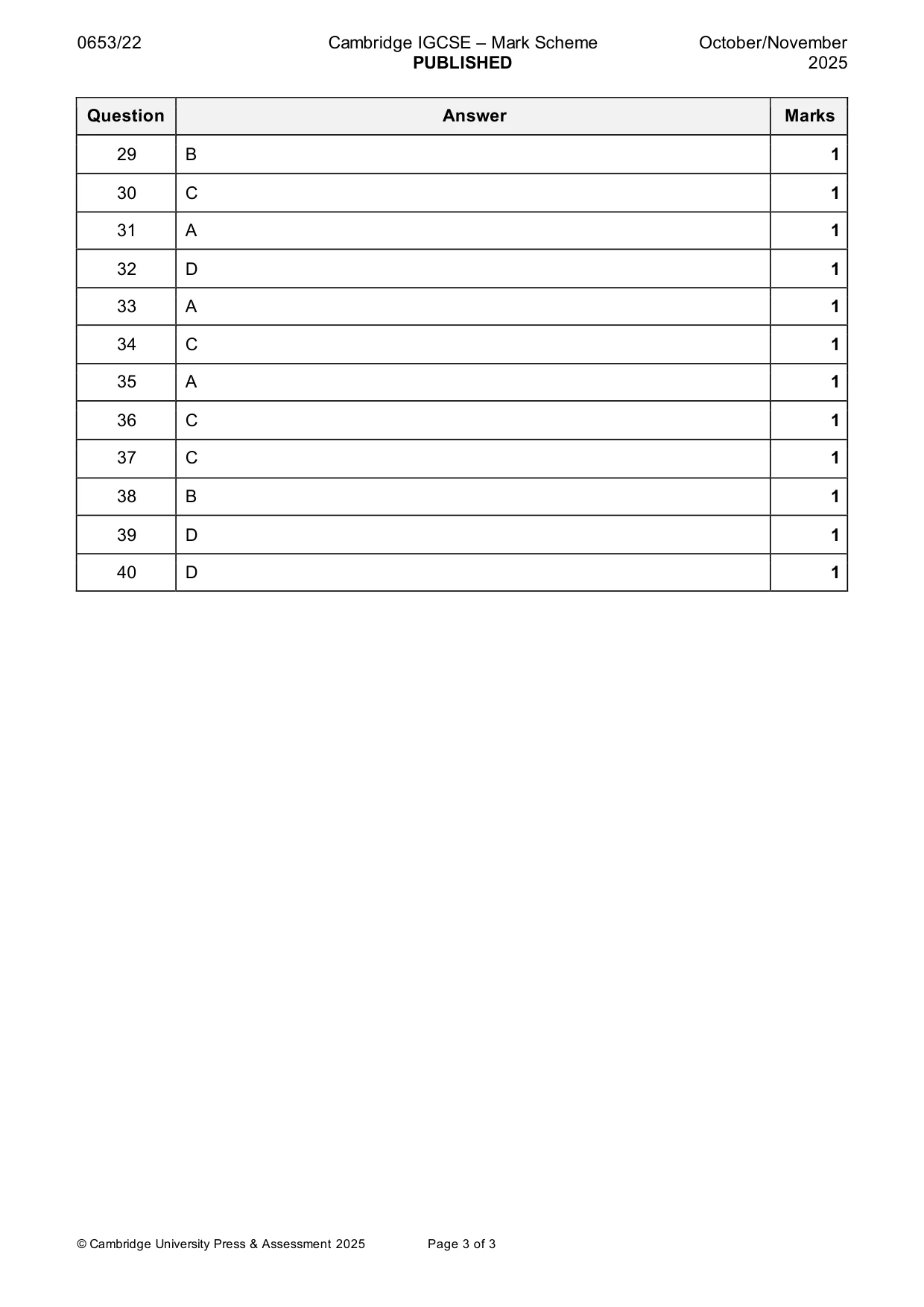
Mark scheme3 pages
Answers below. Sit the paper first if you are practising.
Questions as text
Q1 · Four biological processes are listed
1 Four biological processes are listed. 1 egestion 2 excretion 3 nutrition 4 respiration Which processes are characteristics of all living organisms? A 1, 2, 3 and 4 B 1, 2 and 3 only C 1, 2 and 4 only D 2, 3 and 4 only
Mark scheme: D
Q2 · What are features of a palisade mesophyll cell?
2 What are features of a palisade mesophyll cell? 1 a nucleus 2 a cell wall 3 chloroplasts A 1, 2 and 3 B 1 and 2 only C 1 and 3 only D 2 and 3 only
Mark scheme: A
Q3 · Which process is described as the net movement of water molecules from a dilute solution…
3 Which process is described as the net movement of water molecules from a dilute solution to a concentrated solution through a partially permeable membrane? A absorption B evaporation C osmosis D transpiration
Mark scheme: C
Q4 · The graph shows how the activity of an enzyme varies
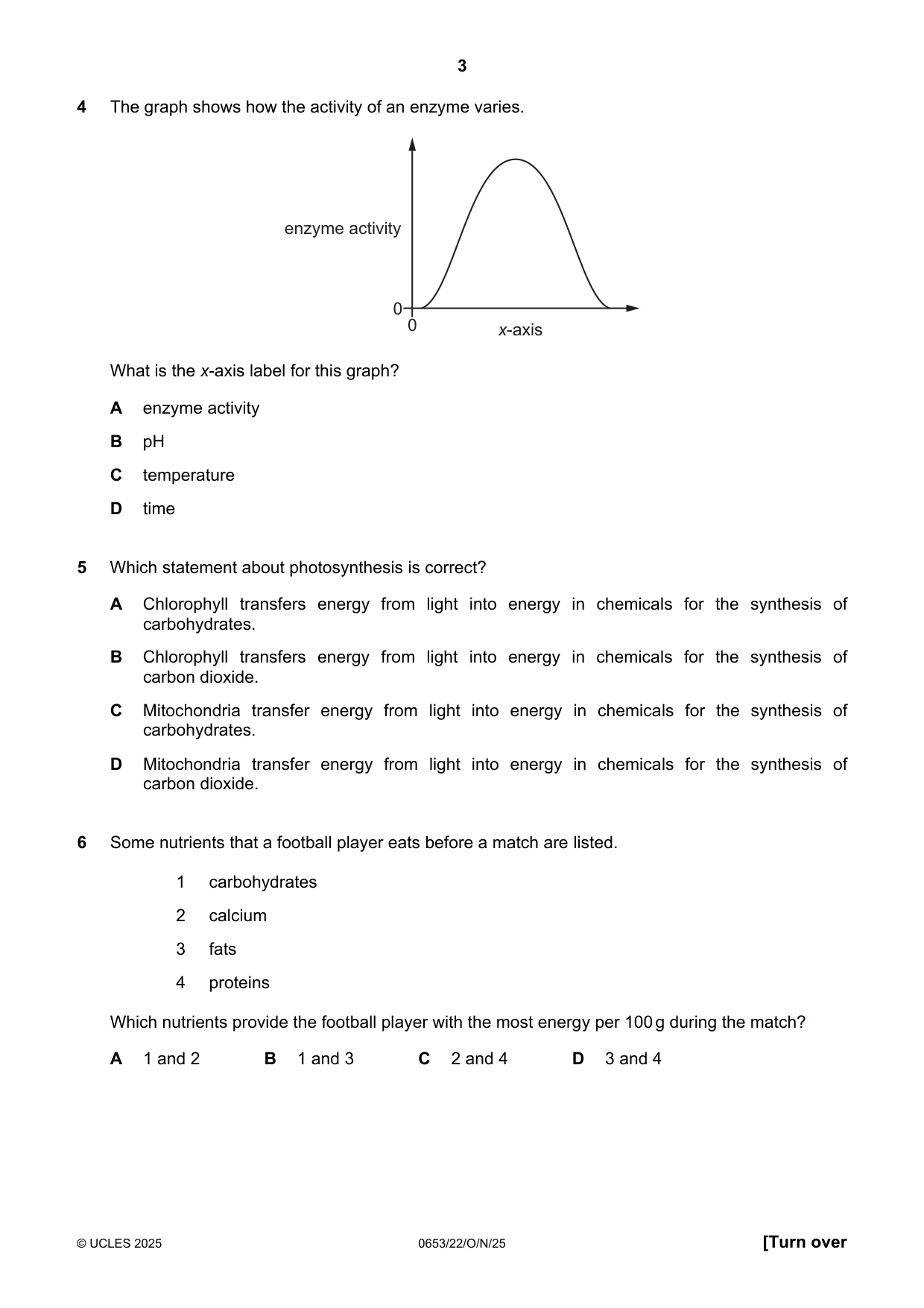
4 The graph shows how the activity of an enzyme varies. enzyme activity 0 0 x-axis What is the x-axis label for this graph? A enzyme activity B pH C temperature D time
Mark scheme: B
Q5 · Which statement about photosynthesis is correct?
5 Which statement about photosynthesis is correct? A Chlorophyll transfers energy from light into energy in chemicals for the synthesis of carbohydrates. B Chlorophyll transfers energy from light into energy in chemicals for the synthesis of carbon dioxide. C Mitochondria transfer energy from light into energy in chemicals for the synthesis of carbohydrates. D Mitochondria transfer energy from light into energy in chemicals for the synthesis of carbon dioxide.
Mark scheme: A
Q6 · Some nutrients that a football player eats before a match are listed
6 Some nutrients that a football player eats before a match are listed. 1 carbohydrates 2 calcium 3 fats 4 proteins Which nutrients provide the football player with the most energy per 100 g during the match? A 1 and 2 B 1 and 3 C 2 and 4 D 3 and 4
Mark scheme: B
Q7 · Which description of physical digestion is correct?
7 Which description of physical digestion is correct? A the breakdown of food into smaller pieces with a chemical change to the food molecules B the breakdown of food into smaller pieces without a chemical change to the food molecules C the breakdown of large insoluble food molecules into small soluble food molecules D the breakdown of large soluble food molecules into small soluble food molecules
Mark scheme: B
Q8 · The diagram shows the alimentary canal and associated organs
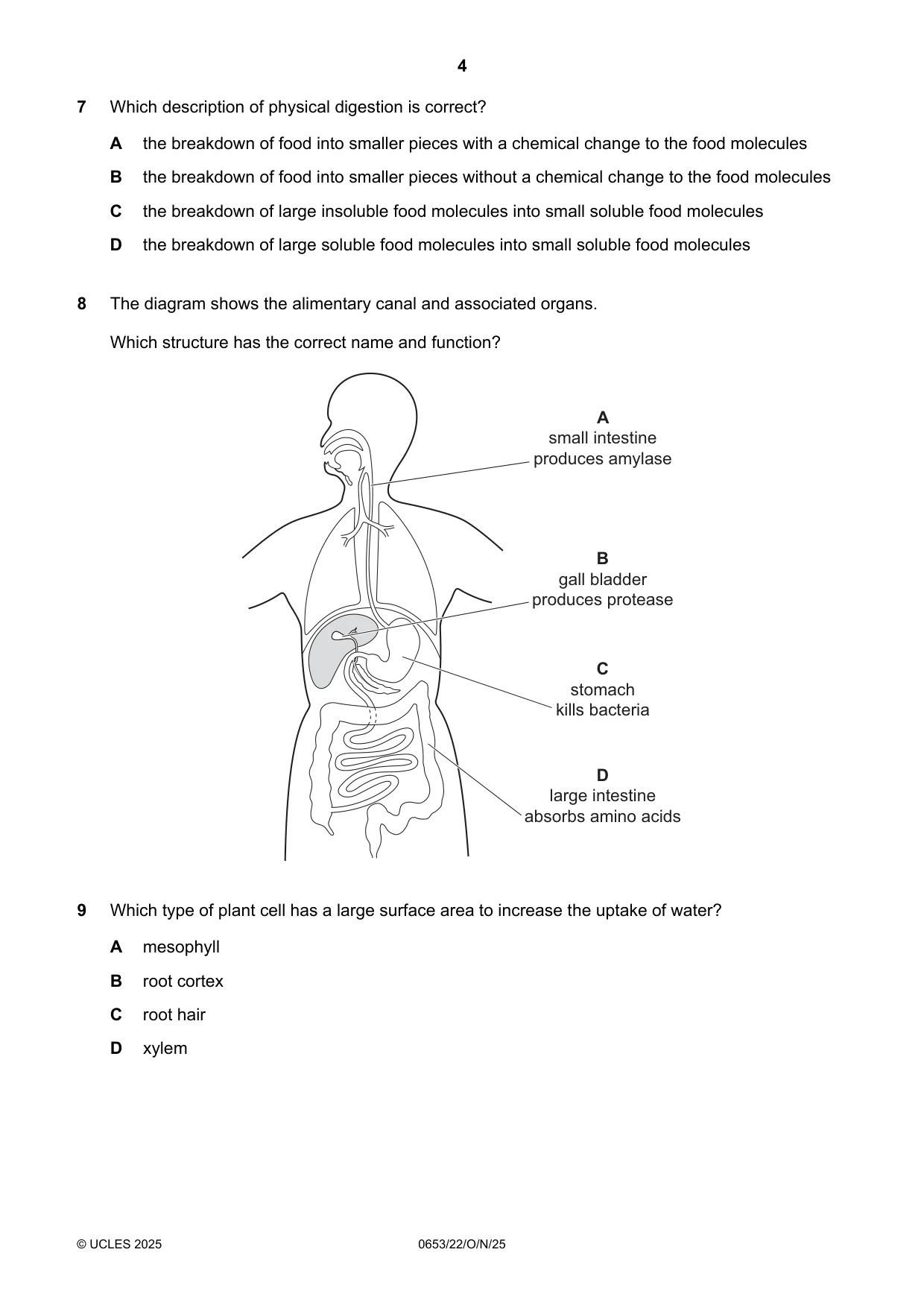
8 The diagram shows the alimentary canal and associated organs. Which structure has the correct name and function? A small intestine produces amylase B gall bladder produces protease C stomach kills bacteria D large intestine absorbs amino acids
Mark scheme: C
Q9 · Which type of plant cell has a large surface area to increase the uptake of water?
9 Which type of plant cell has a large surface area to increase the uptake of water? A mesophyll B root cortex C root hair D xylem
Mark scheme: C
Q10 · Which factors are possible risk factors for coronary heart disease?
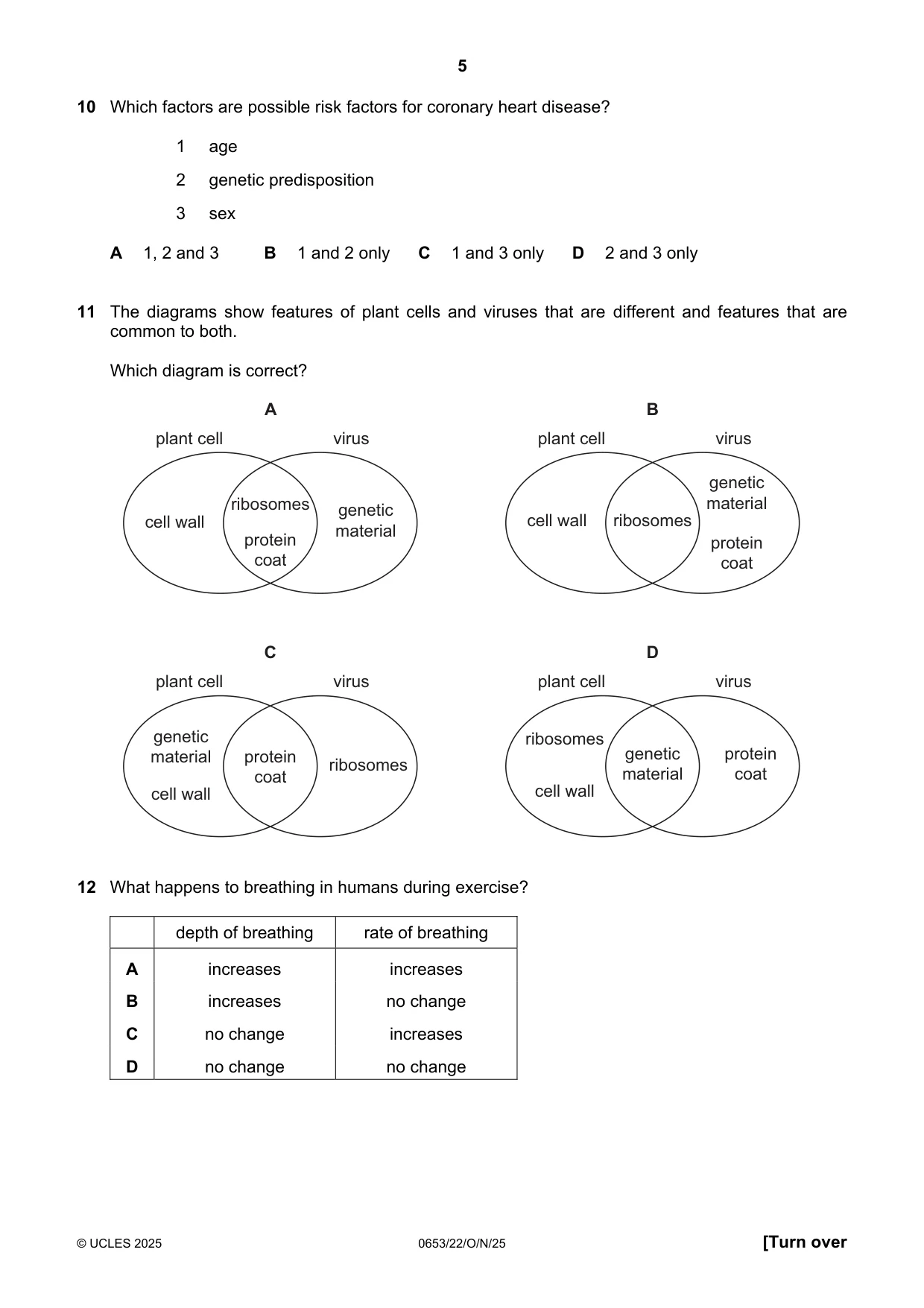
10 Which factors are possible risk factors for coronary heart disease? 1 age 2 genetic predisposition 3 sex A 1, 2 and 3 B 1 and 2 only C 1 and 3 only D 2 and 3 only
Mark scheme: A
Q11 · The diagrams show features of plant cells and viruses that are different and features…
11 The diagrams show features of plant cells and viruses that are different and features that are common to both. Which diagram is correct? A B plant cell virus plant cell virus genetic ribosomes genetic material cell wall cell wall ribosomes material protein protein coat coat C D plant cell virus plant cell virus genetic ribosomes material protein genetic protein ribosomes coat material coat cell wall cell wall
Mark scheme: D
Q12 · What happens to breathing in humans during exercise?
12 What happens to breathing in humans during exercise? depth of breathing rate of breathing A increases increases B increases no change C no change increases D no change no change
Mark scheme: A
Q13 · The diagram shows a food web
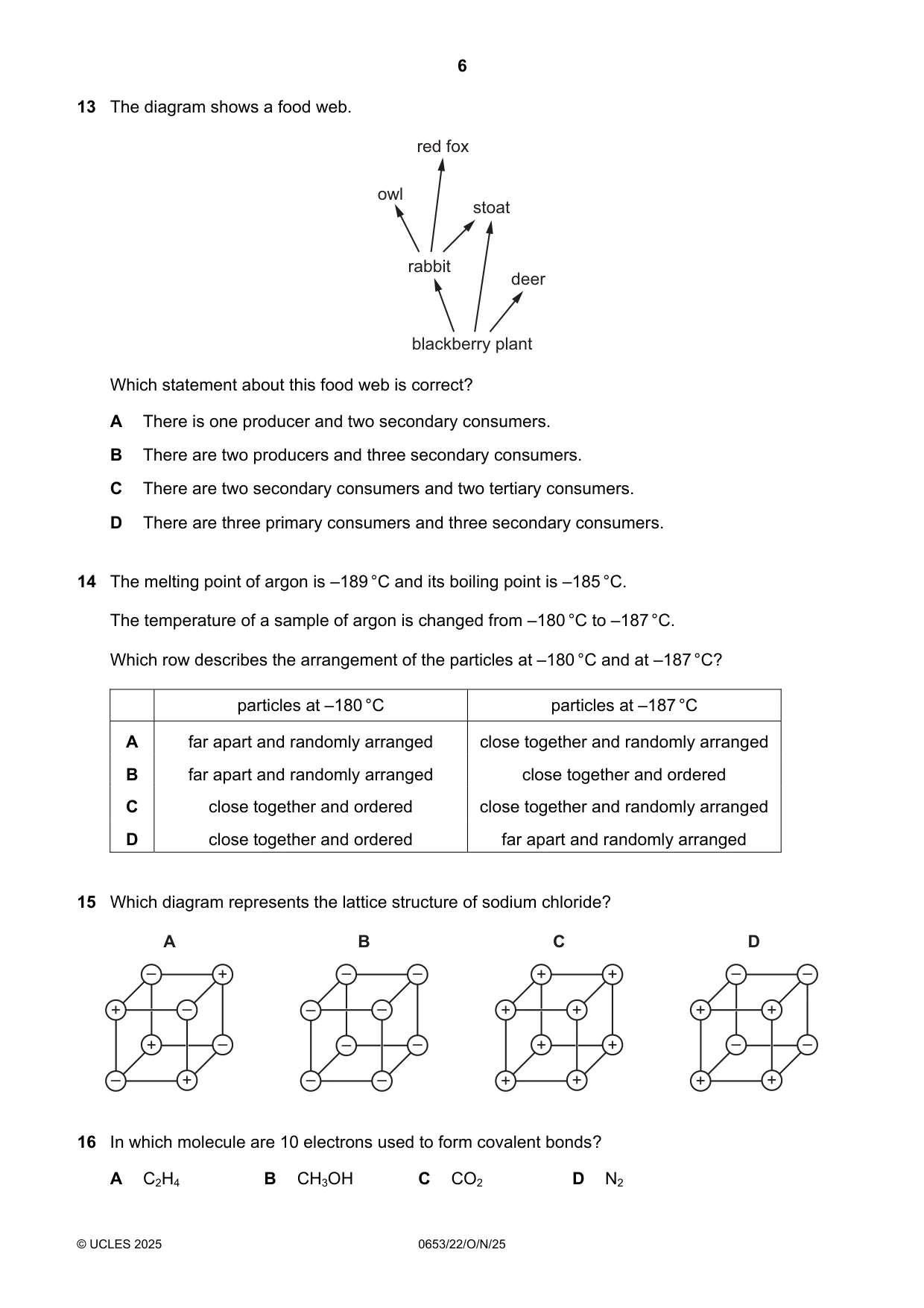
13 The diagram shows a food web. red fox owl stoat rabbit deer blackberry plant Which statement about this food web is correct? A There is one producer and two secondary consumers. B There are two producers and three secondary consumers. C There are two secondary consumers and two tertiary consumers. D There are three primary consumers and three secondary consumers.
Mark scheme: D
Q14 · The melting point of argon is –189 °C and its boiling point is –185 °C
14 The melting point of argon is –189 °C and its boiling point is –185 °C. The temperature of a sample of argon is changed from –180 °C to –187 °C. Which row describes the arrangement of the particles at –180 °C and at –187 °C? particles at –180 °C particles at –187 °C A far apart and randomly arranged close together and randomly arranged B far apart and randomly arranged close together and ordered C close together and ordered close together and randomly arranged D close together and ordered far apart and randomly arranged
Mark scheme: A
Q15 · Which diagram represents the lattice structure of sodium chloride?
15 Which diagram represents the lattice structure of sodium chloride? A B C D – + – – + + – – + – – – + + + + + – – – + + – – – + – – + + + +
Mark scheme: A
Q16 · In which molecule are 10 electrons used to form covalent bonds?
16 In which molecule are 10 electrons used to form covalent bonds? A C2H4 B CH3OH C CO2 D N2
Mark scheme: B
Q17 · The formula of an iron(III) ion is Fe3+
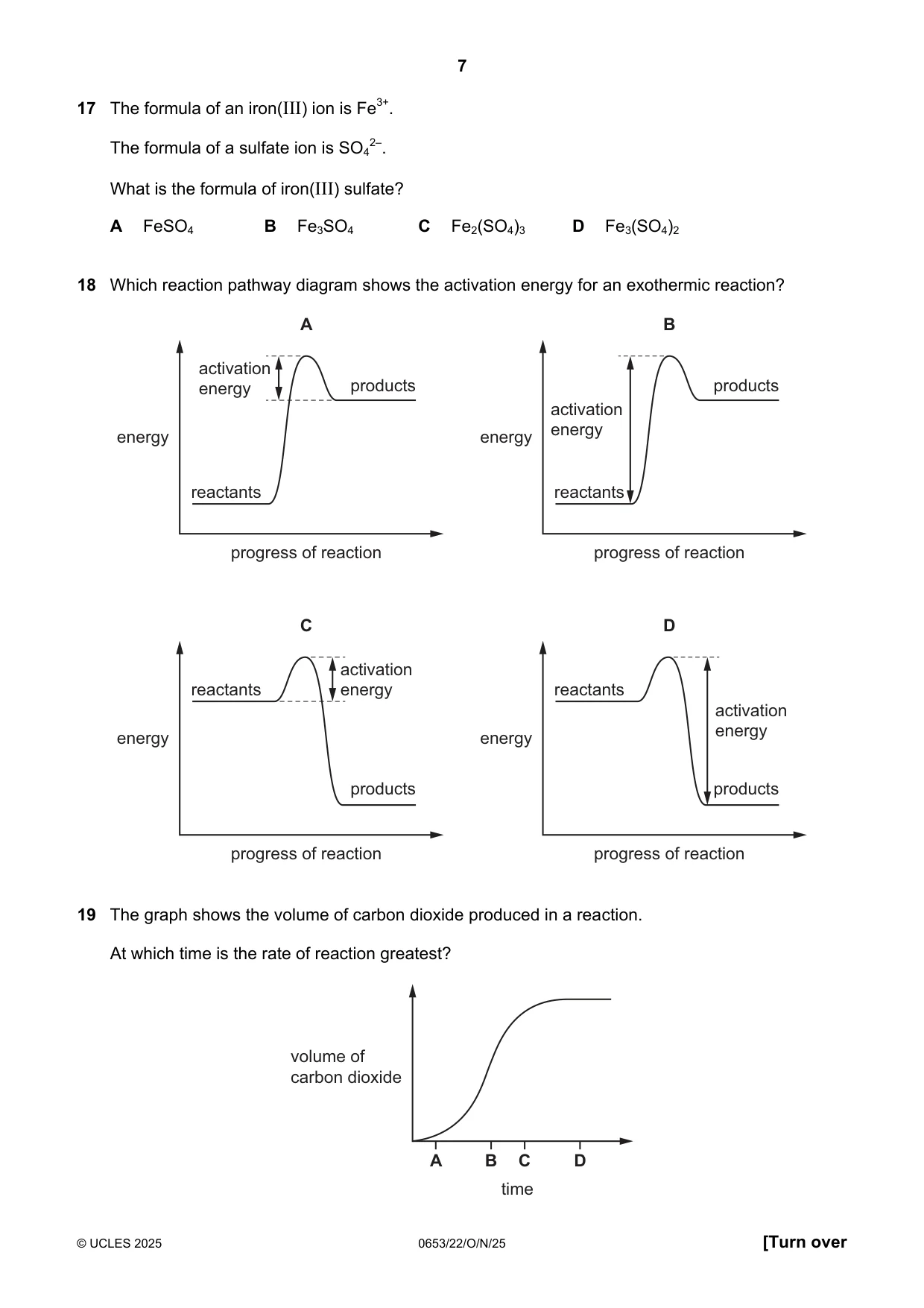
17 The formula of an iron(III) ion is Fe3+. The formula of a sulfate ion is SO4 2–. What is the formula of iron(III) sulfate? A FeSO4 B Fe3SO4 C Fe2(SO4)3 D Fe3(SO4)2
Mark scheme: C
Q18 · Which reaction pathway diagram shows the activation energy for an exothermic reaction?
18 Which reaction pathway diagram shows the activation energy for an exothermic reaction? A B activation energy products products activation energy energy energy reactants reactants progress of reaction progress of reaction C D activation reactants energy reactants activation energy energy energy products products progress of reaction progress of reaction
Mark scheme: C
Q19 · The graph shows the volume of carbon dioxide produced in a reaction
19 The graph shows the volume of carbon dioxide produced in a reaction. At which time is the rate of reaction greatest? volume of carbon dioxide A B C D time
Mark scheme: B
Q20 · Ammonia dissolves in water
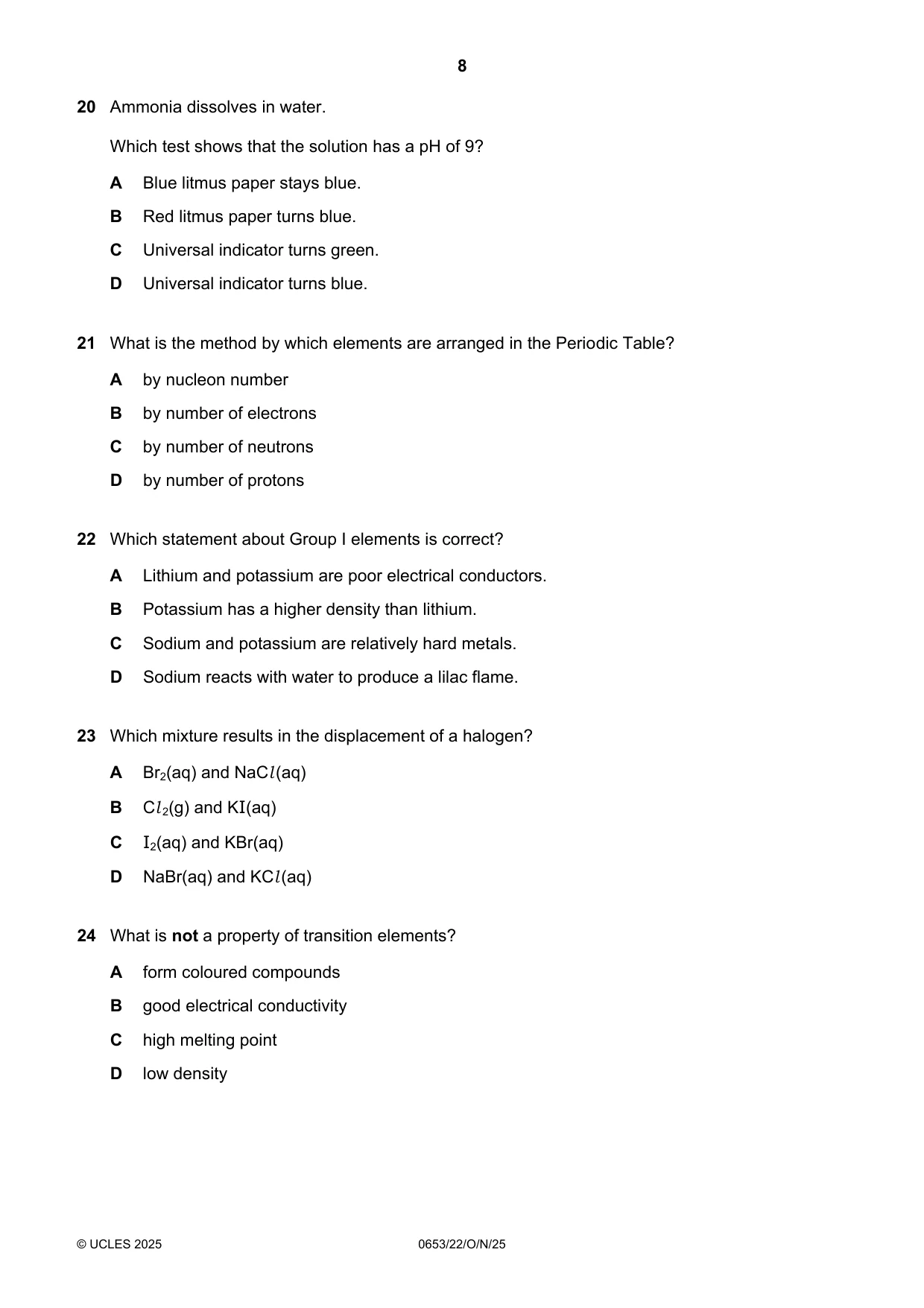
20 Ammonia dissolves in water. Which test shows that the solution has a pH of 9? A Blue litmus paper stays blue. B Red litmus paper turns blue. C Universal indicator turns green. D Universal indicator turns blue.
Mark scheme: D
More questions on The characteristic properties of acids and bases
Q21 · What is the method by which elements are arranged in the Periodic Table?
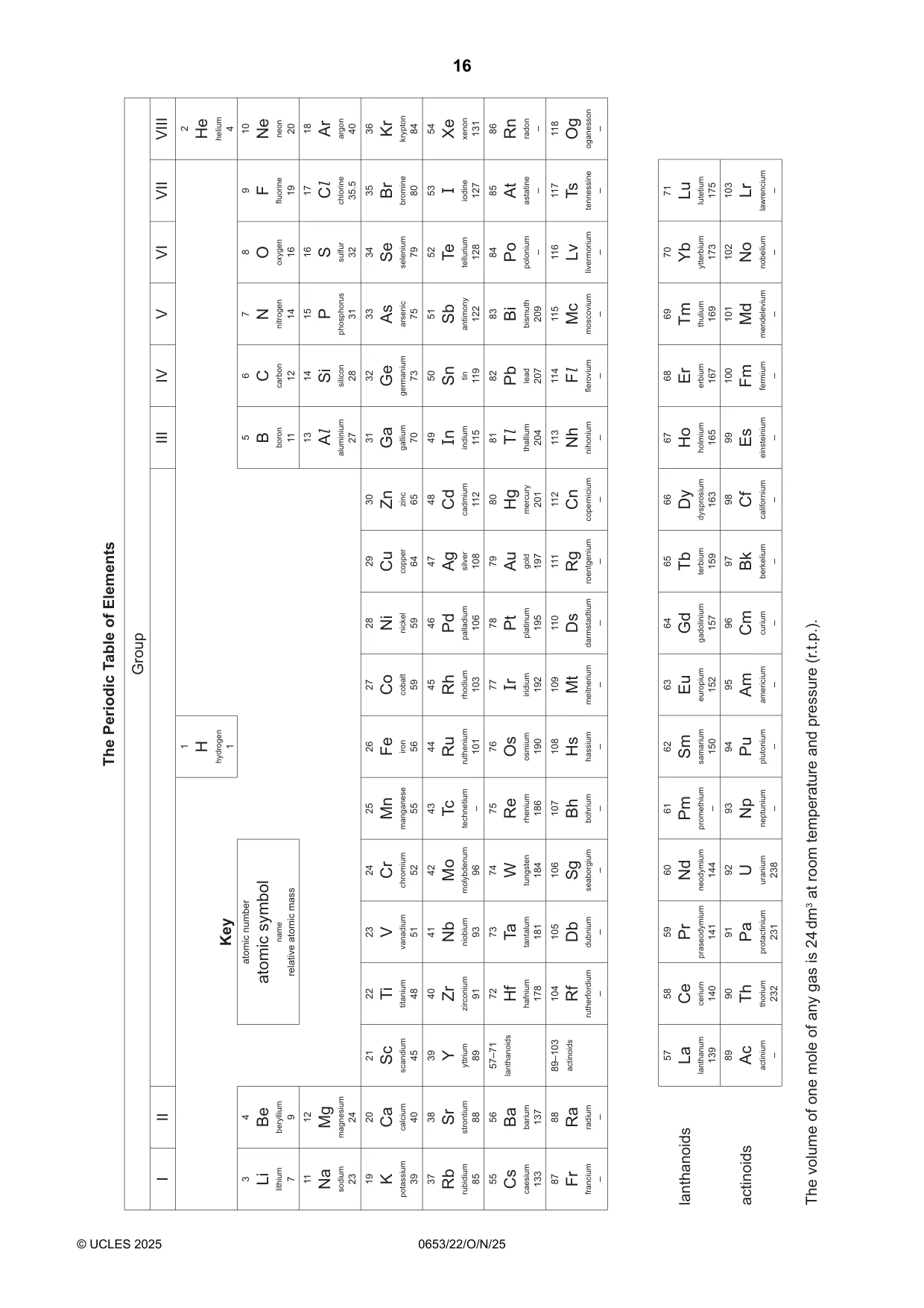
21 What is the method by which elements are arranged in the Periodic Table? A by nucleon number B by number of electrons C by number of neutrons D by number of protons
Mark scheme: D
Q22 · Which statement about Group I elements is correct?
22 Which statement about Group I elements is correct? A Lithium and potassium are poor electrical conductors. B Potassium has a higher density than lithium. C Sodium and potassium are relatively hard metals. D Sodium reacts with water to produce a lilac flame.
Mark scheme: B
Q23 · Which mixture results in the displacement of a halogen?
23 Which mixture results in the displacement of a halogen? A Br2(aq) and NaCl (aq) B Cl 2(g) and KI(aq) C I2(aq) and KBr(aq) D NaBr(aq) and KCl (aq)
Mark scheme: B
Q24 · What is not a property of transition elements?
24 What is not a property of transition elements? A form coloured compounds B good electrical conductivity C high melting point D low density
Mark scheme: D
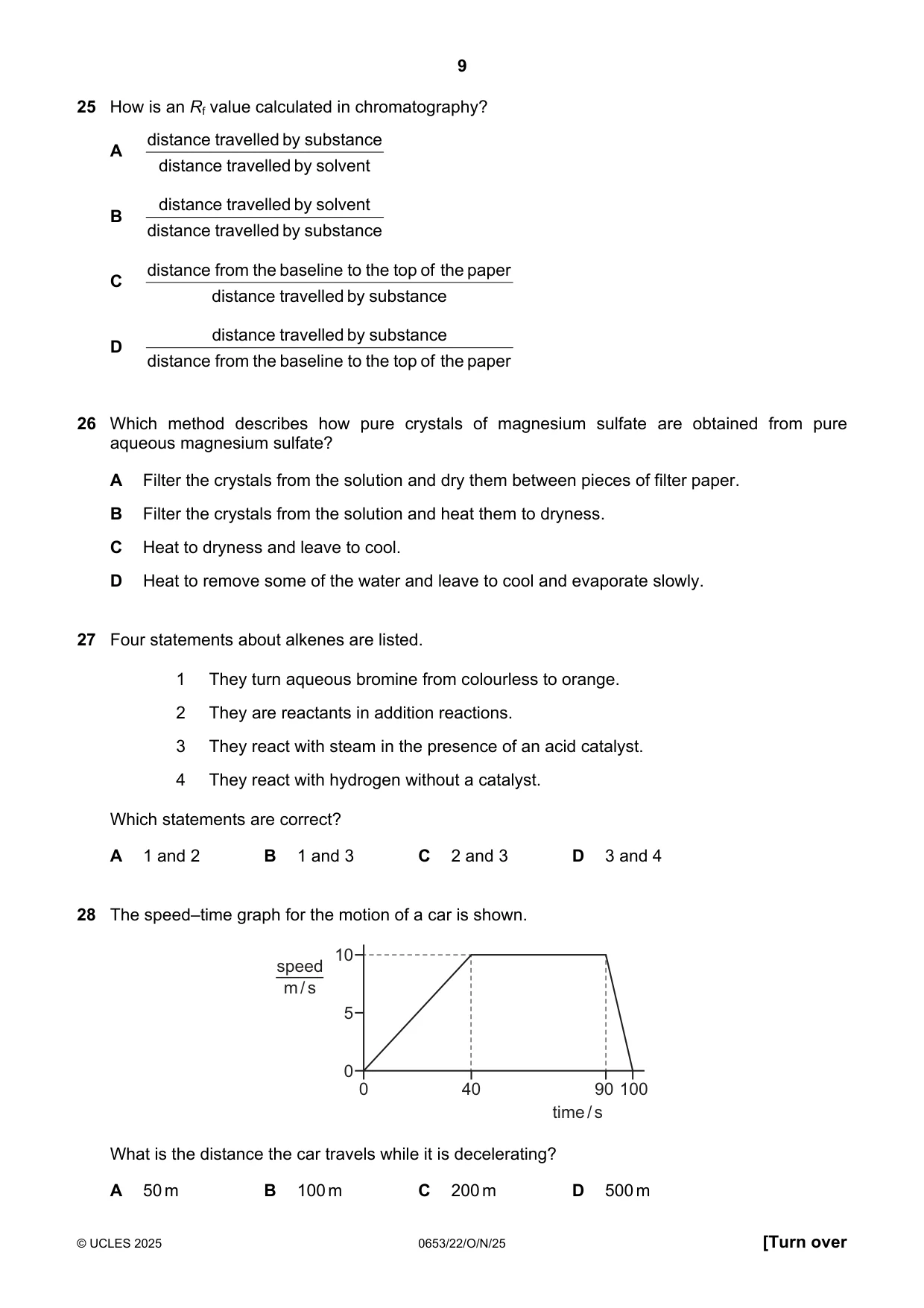
Q25 · How is an Rf value calculated in chromatography?
25 How is an Rf value calculated in chromatography? distance travelled by substance A distance travelled by solvent distance travelled by solvent B distance travelled by substance distance from the baseline to the top of the paper C distance travelled by substance distance travelled by substance D distance from the baseline to the top of the paper
Mark scheme: A
Q26 · Which method describes how pure crystals of magnesium sulfate are obtained from pure…
26 Which method describes how pure crystals of magnesium sulfate are obtained from pure aqueous magnesium sulfate? A Filter the crystals from the solution and dry them between pieces of filter paper. B Filter the crystals from the solution and heat them to dryness. C Heat to dryness and leave to cool. D Heat to remove some of the water and leave to cool and evaporate slowly.
Mark scheme: D
Q27 · Four statements about alkenes are listed
27 Four statements about alkenes are listed. 1 They turn aqueous bromine from colourless to orange. 2 They are reactants in addition reactions. 3 They react with steam in the presence of an acid catalyst. 4 They react with hydrogen without a catalyst. Which statements are correct? A 1 and 2 B 1 and 3 C 2 and 3 D 3 and 4
Mark scheme: C
Q28 · The speed–time graph for the motion of a car is shown
28 The speed–time graph for the motion of a car is shown. 10 speed m / s 5 0 0 40 90 100 time / s What is the distance the car travels while it is decelerating? A 50 m B 100 m C 200 m D 500 m
Mark scheme: A
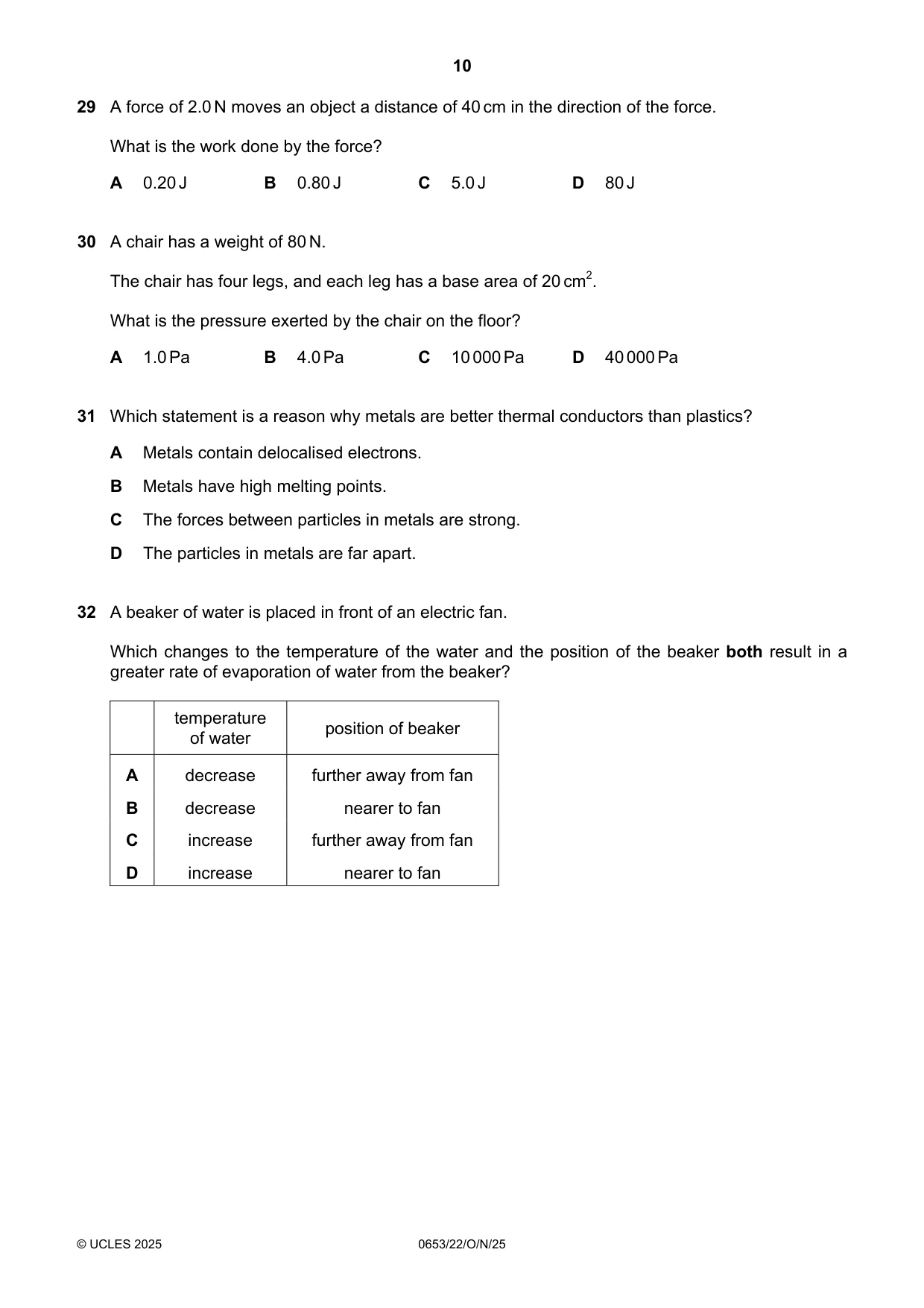
Q29 · A force of 2.0 N moves an object a distance of 40 cm in the direction of the force
29 A force of 2.0 N moves an object a distance of 40 cm in the direction of the force. What is the work done by the force? A 0.20 J B 0.80 J C 5.0 J D 80 J
Mark scheme: B
Q30 · A chair has a weight of 80 N
30 A chair has a weight of 80 N. The chair has four legs, and each leg has a base area of 20 cm2. What is the pressure exerted by the chair on the floor? A 1.0 Pa B 4.0 Pa C 10 000 Pa D 40 000 Pa
Mark scheme: C
Q31 · Which statement is a reason why metals are better thermal conductors than plastics?
31 Which statement is a reason why metals are better thermal conductors than plastics? A Metals contain delocalised electrons. B Metals have high melting points. C The forces between particles in metals are strong. D The particles in metals are far apart.
Mark scheme: A
Q32 · A beaker of water is placed in front of an electric fan
32 A beaker of water is placed in front of an electric fan. Which changes to the temperature of the water and the position of the beaker both result in a greater rate of evaporation of water from the beaker? temperature position of beaker of water A decrease further away from fan B decrease nearer to fan C increase further away from fan D increase nearer to fan
Mark scheme: D
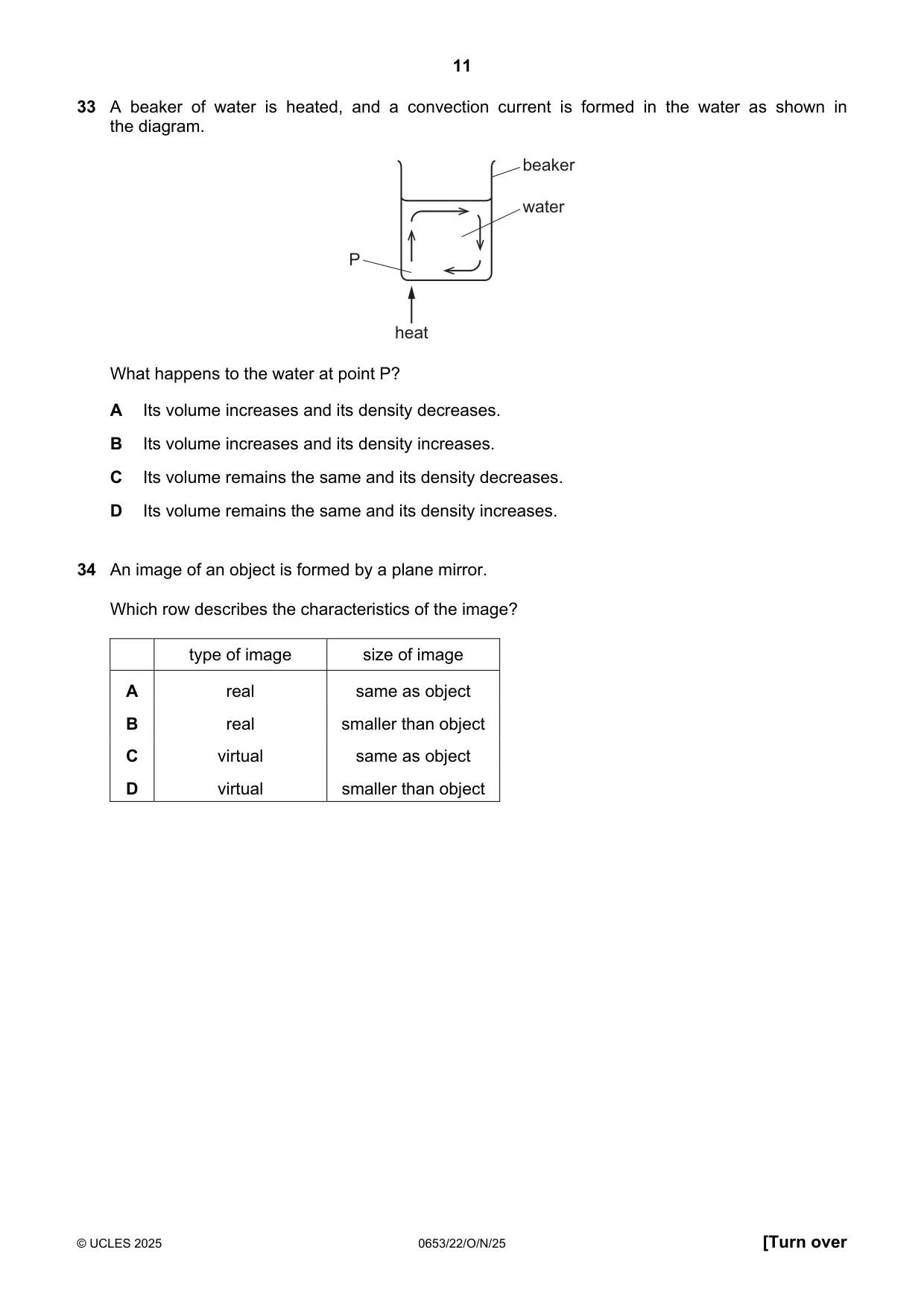
Q33 · A beaker of water is heated, and a convection current is formed in the water as shown in…
33 A beaker of water is heated, and a convection current is formed in the water as shown in the diagram. beaker water P heat What happens to the water at point P? A Its volume increases and its density decreases. B Its volume increases and its density increases. C Its volume remains the same and its density decreases. D Its volume remains the same and its density increases.
Mark scheme: A
Q34 · An image of an object is formed by a plane mirror
34 An image of an object is formed by a plane mirror. Which row describes the characteristics of the image? type of image size of image A real same as object B real smaller than object C virtual same as object D virtual smaller than object
Mark scheme: C
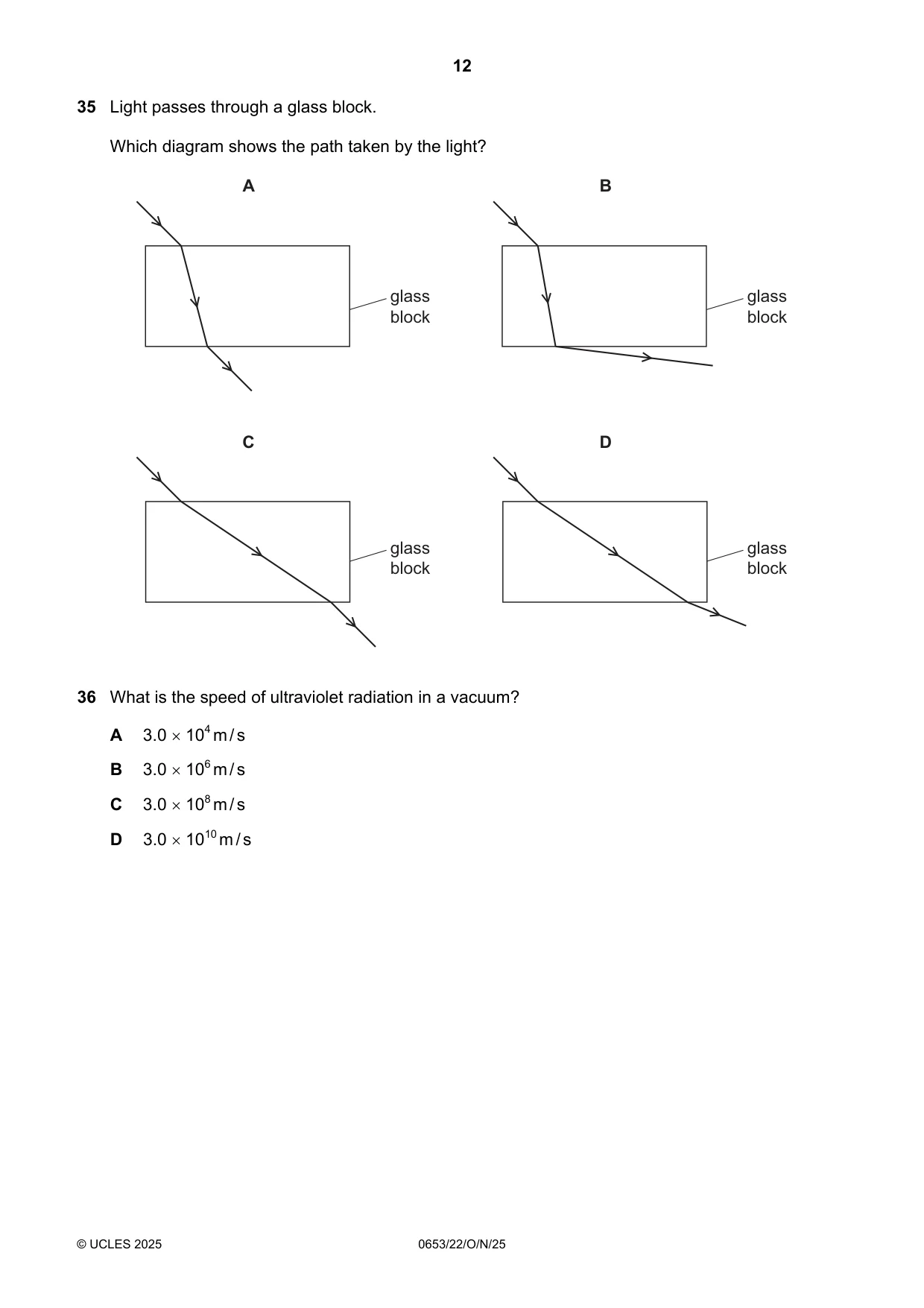
Q35 · Light passes through a glass block
35 Light passes through a glass block. Which diagram shows the path taken by the light? A B glass glass block block C D glass glass block block
Mark scheme: A
Q36 · What is the speed of ultraviolet radiation in a vacuum?
36 What is the speed of ultraviolet radiation in a vacuum? A 3.0 104 m / s B 3.0 106 m / s C 3.0 108 m / s D 3.0 1010 m / s
Mark scheme: C
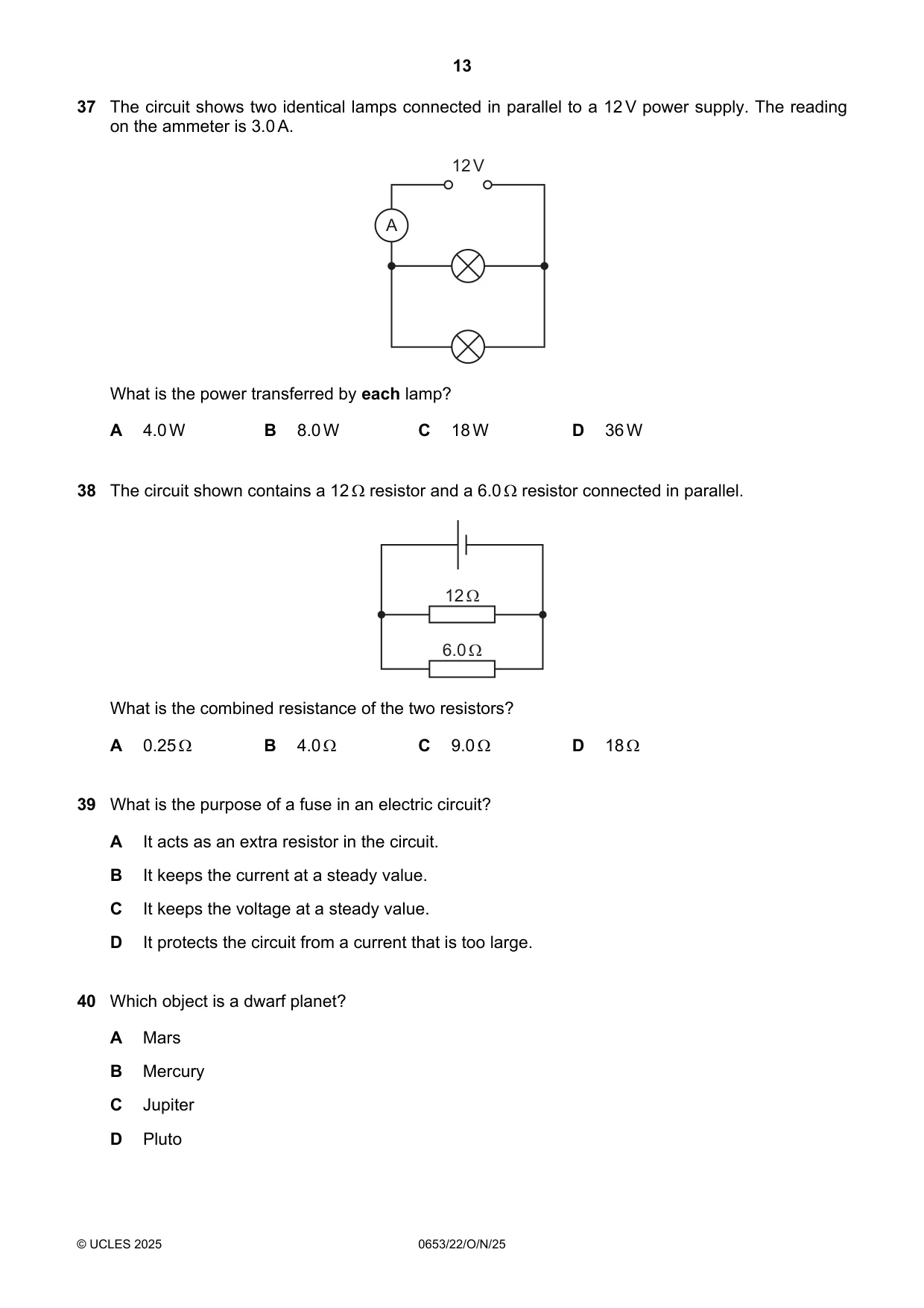
Q37 · The circuit shows two identical lamps connected in parallel to a 12 V power supply
37 The circuit shows two identical lamps connected in parallel to a 12 V power supply. The reading on the ammeter is 3.0 A. 12 V A What is the power transferred by each lamp? A 4.0 W B 8.0 W C 18 W D 36 W
Mark scheme: C
Q38 · The circuit shown contains a 12 resistor and a 6.0 resistor connected in parallel
38 The circuit shown contains a 12 resistor and a 6.0 resistor connected in parallel. 120 | eon | What is the combined resistance of the two resistors? A 0.250 B 4.0Q C 9.02 D 18Q
Mark scheme: B
Q39 · What is the purpose of a fuse in an electric circuit?
39 What is the purpose of a fuse in an electric circuit? A It acts as an extra resistor in the circuit. B It keeps the current at a steady value. C It keeps the voltage at a steady value. D It protects the circuit from a current that is too large.
Mark scheme: D
Q40 · Which object is a dwarf planet?
40 Which object is a dwarf planet? A Mars B Mercury C Jupiter D Pluto
Mark scheme: D
What was in this paper
The subtopics covered by these 40 questions, and how many questions each got. Open one in a new tab to see every Cambridge question on it.
2Electrical circuits2Light2Transfer of thermal energy2Alkenes1Arrangement of elements1Characteristics of living organisms1Chromatography1Diet1Digestion1Digestive system1Electrical safety1Electromagnetic spectrum1Energy, work and power1Enzymes1Exothermic and endothermic reactions1Food chains and food webs1Formulas1Gas exchange in humans1Group I properties1Group VII properties1Heart1Ions and ionic bonds1Kinetic particle model of matter1Motion1Osmosis1Photosynthesis1Pressure1Rate of reaction1Separation and purification1Simple molecules and covalent bonds1Solids, liquids and gases1The characteristic properties of acids and bases1The Solar System1Transition elements1Water uptake1What you needed in this session
Cambridge’s own grade thresholds for 2025 Oct/Nov, Paper 2 · Variant 2. A higher threshold means an easier paper — the bar moves with how the cohort did.