Cambridge IGCSE Science - Combined 0653 — 2021 Feb/March Paper 2 · Variant 2
0653/22/F/M/21 · 40 questions · 40 marks · ≈45 min
The question paper and its mark scheme, free to read here and free to download. This is Cambridge’s own paper, exactly as it was sat.
Question paper20 pages


Mark scheme3 pages
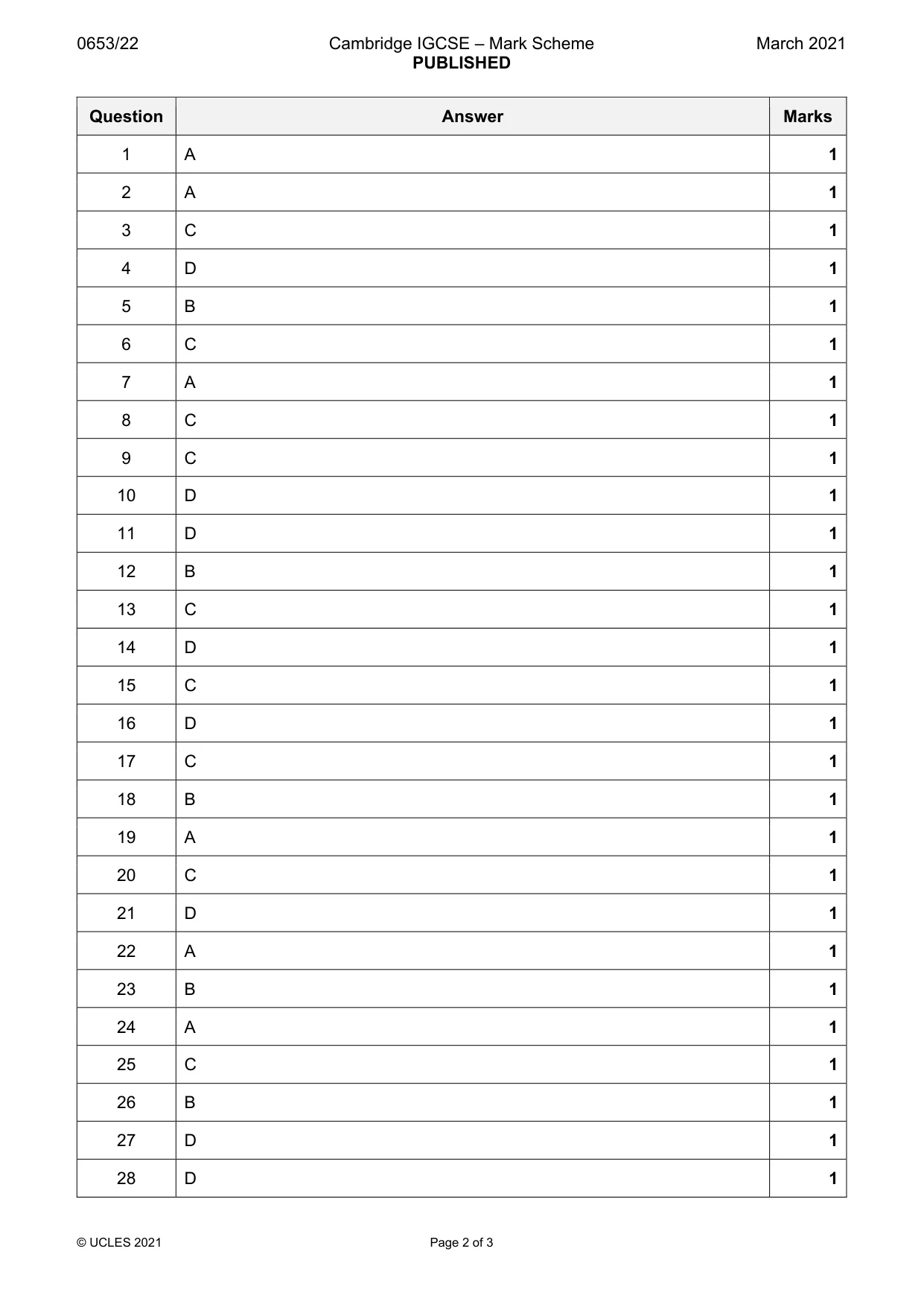
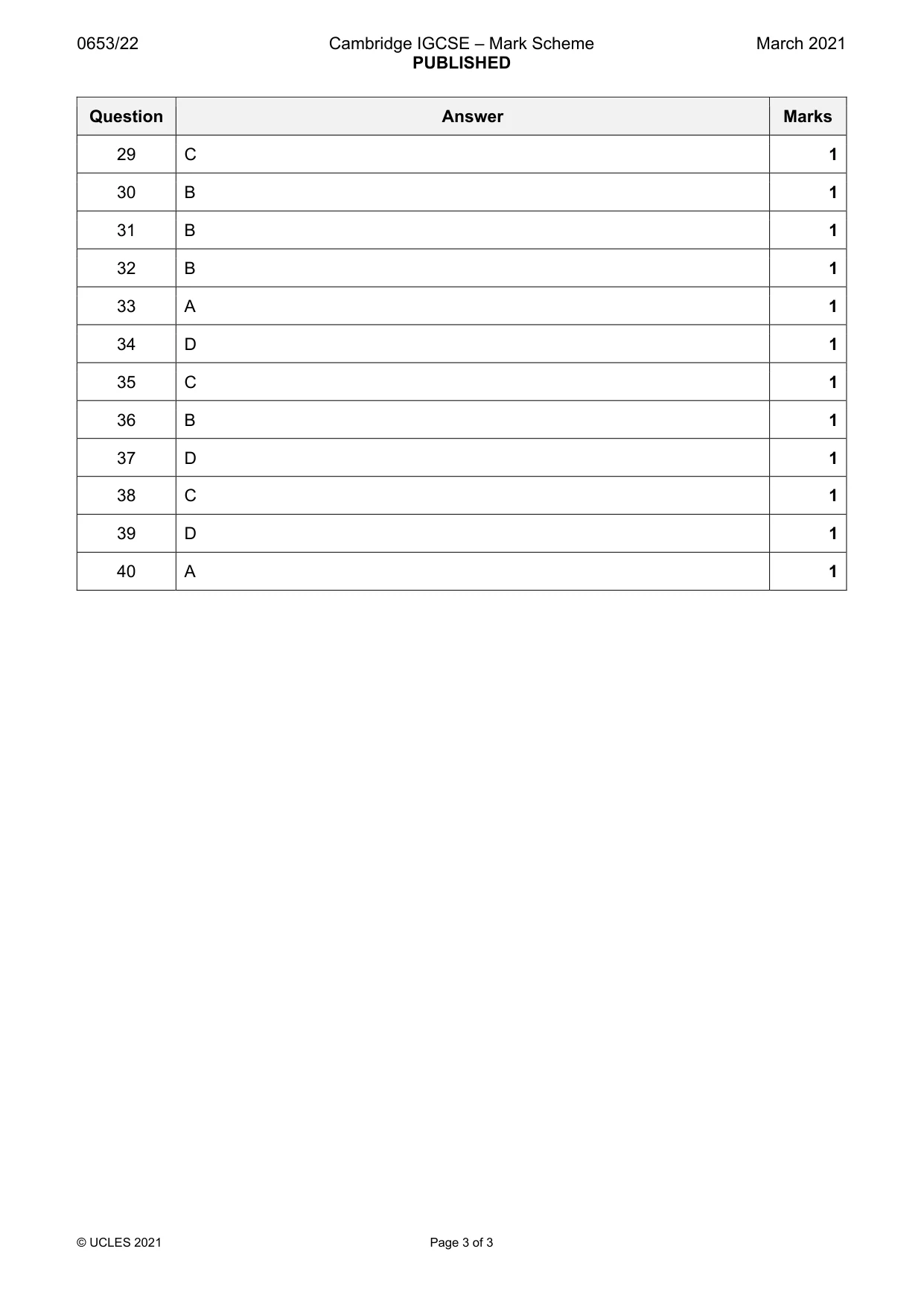
Answers below. Sit the paper first if you are practising.
Questions as text
Q1 · What are the characteristics of living organisms?
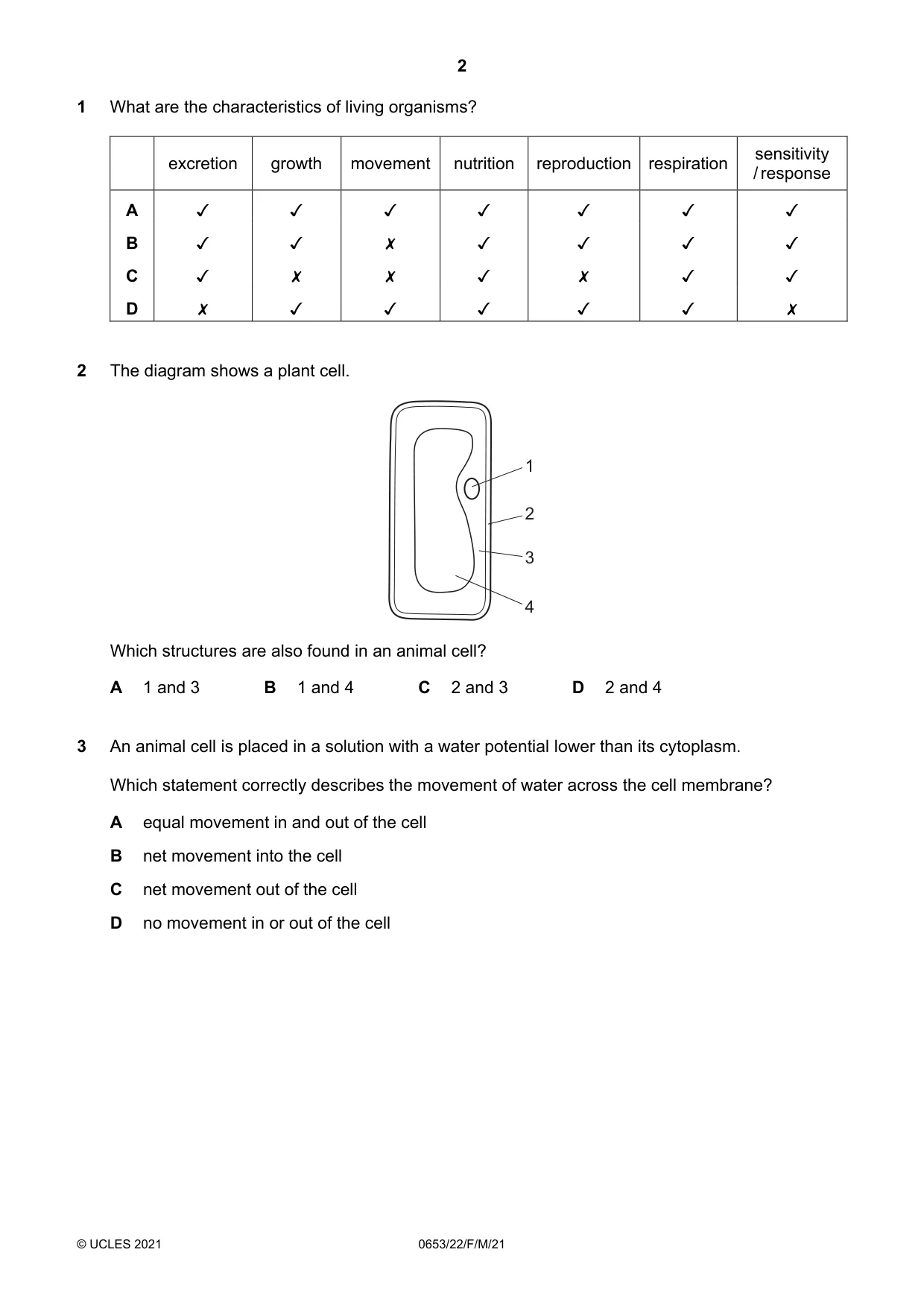
1 What are the characteristics of living organisms? excretion growth | movement | nutrition | reproduction | respiration jresponee A Jv Jv Jv JV JV JV J B J J 4 V JV V V Cc v x x v x Jv Jv D x Jv Jv Jv JV JV x
Mark scheme: A
Q2 · The diagram shows a plant cell
2 The diagram shows a plant cell. 1 2 3 4 Which structures are also found in an animal cell? A 1 and 3 B 1 and 4 C 2 and 3 D 2 and 4
Mark scheme: A
Q3 · An animal cell is placed in a solution with a water potential lower than its cytoplasm
3 An animal cell is placed in a solution with a water potential lower than its cytoplasm. Which statement correctly describes the movement of water across the cell membrane? A equal movement in and out of the cell B net movement into the cell C net movement out of the cell D no movement in or out of the cell
Mark scheme: C
Q4 · Which graph shows the effects of pH on the activity of an enzyme?
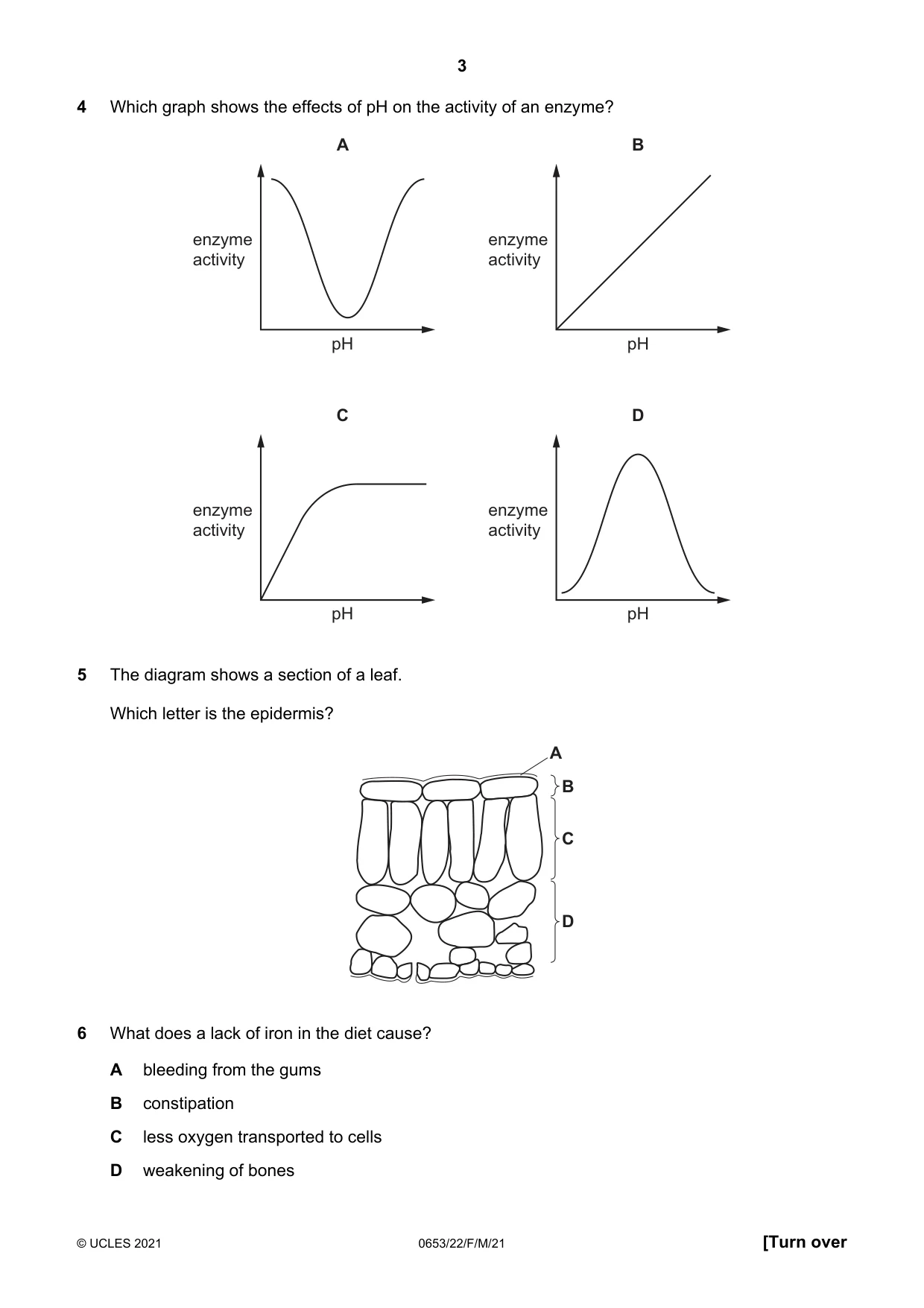
4 Which graph shows the effects of pH on the activity of an enzyme? A B enzyme enzyme activity activity pH pH C D enzyme enzyme activity activity pH pH
Mark scheme: D
Q5 · The diagram shows a section of a leaf
5 The diagram shows a section of a leaf. Which letter is the epidermis? A B C D
Mark scheme: B
Q6 · What does a lack of iron in the diet cause?
6 What does a lack of iron in the diet cause? A bleeding from the gums B constipation C less oxygen transported to cells D weakening of bones
Mark scheme: C
Q7 · Which diagram represents the digestion of food molecules in the alimentary canal?
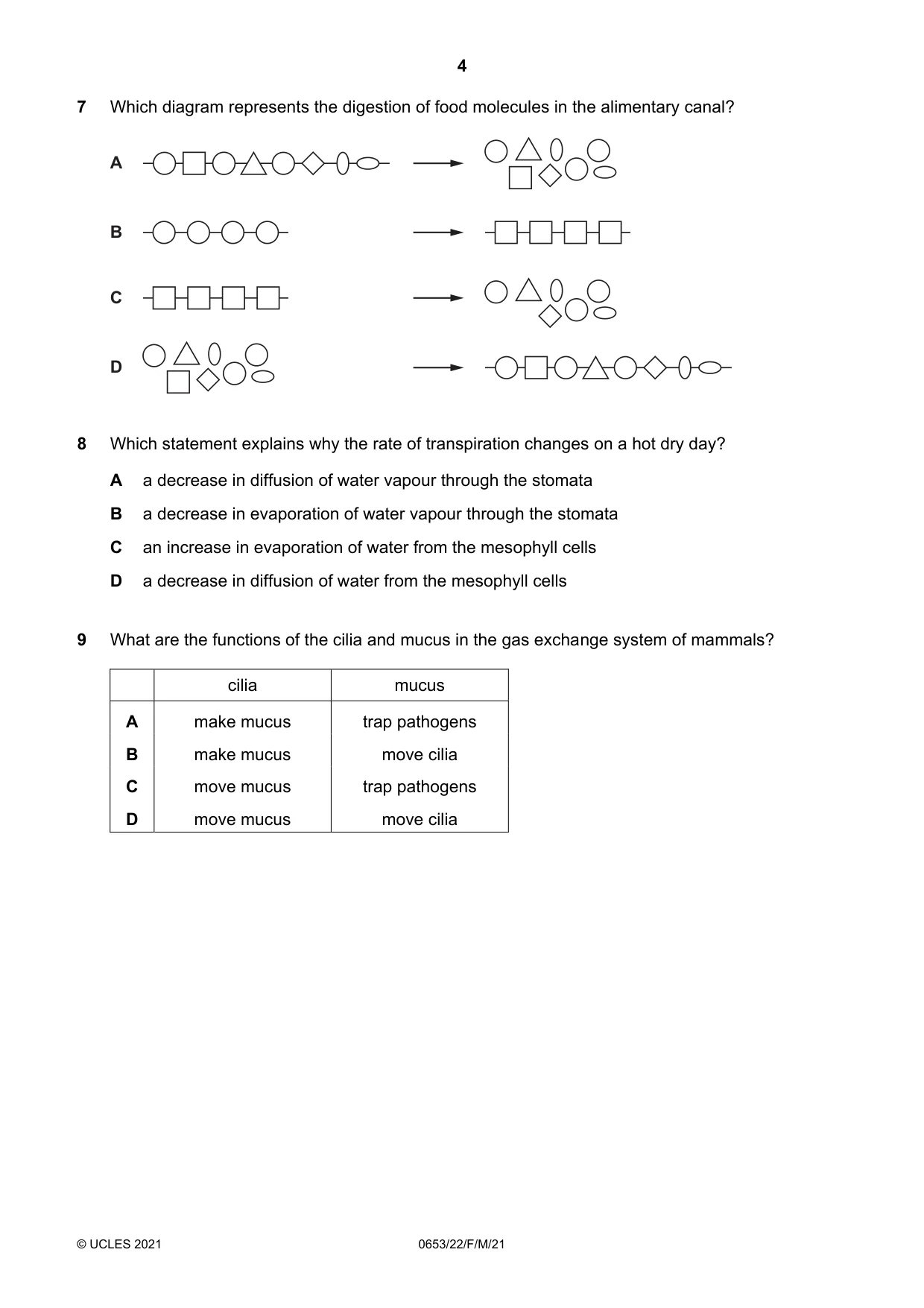
7 Which diagram represents the digestion of food molecules in the alimentary canal? A B C D
Mark scheme: A
Q8 · Which statement explains why the rate of transpiration changes on a hot dry day?
8 Which statement explains why the rate of transpiration changes on a hot dry day? A a decrease in diffusion of water vapour through the stomata B a decrease in evaporation of water vapour through the stomata C an increase in evaporation of water from the mesophyll cells D a decrease in diffusion of water from the mesophyll cells
Mark scheme: C
Q9 · What are the functions of the cilia and mucus in the gas exchange system of mammals?
9 What are the functions of the cilia and mucus in the gas exchange system of mammals? cilia mucus A make mucus trap pathogens B make mucus move cilia C move mucus trap pathogens D move mucus move cilia
Mark scheme: C
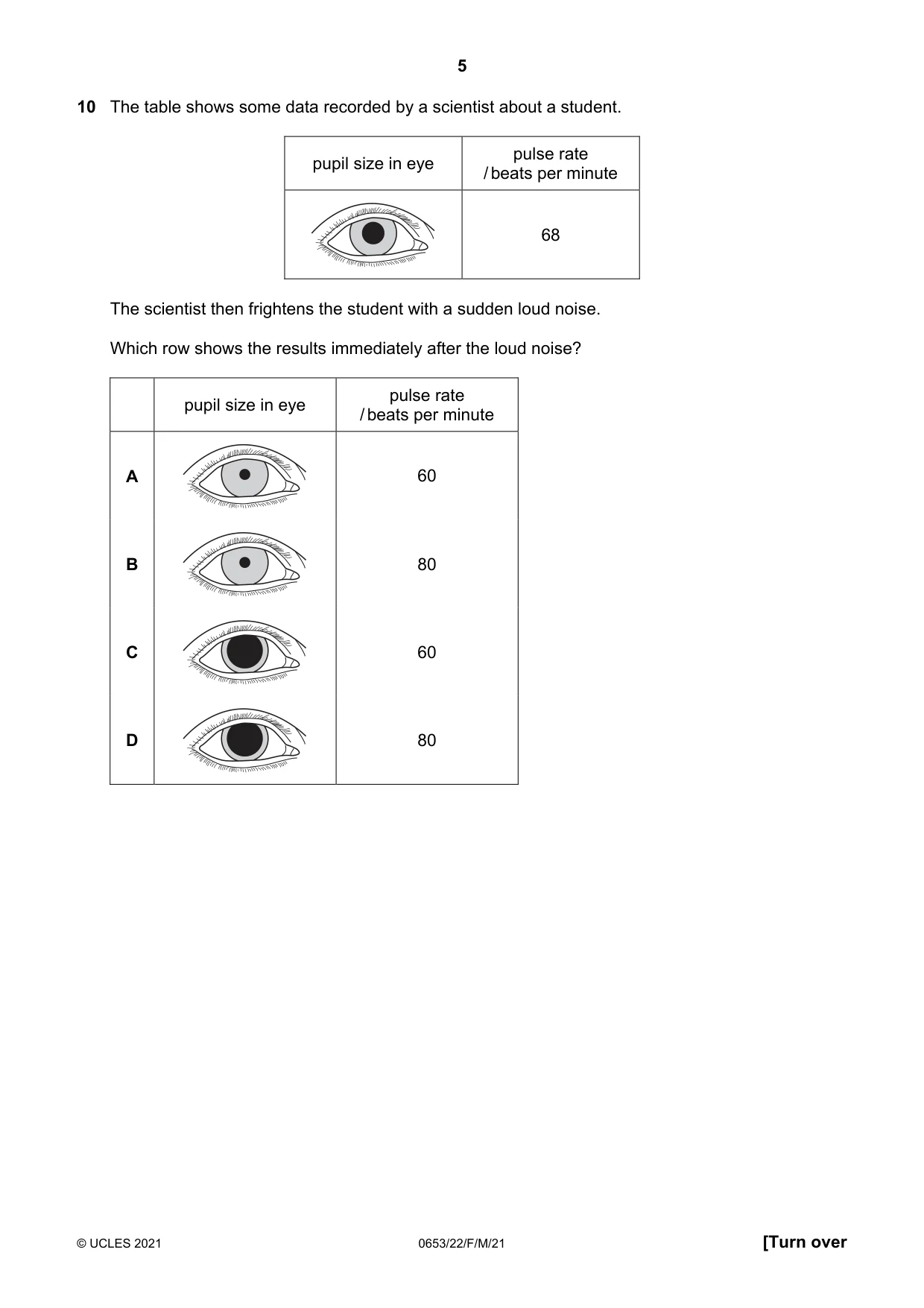
Q10 · The table shows some data recorded by a scientist about a student
10 The table shows some data recorded by a scientist about a student. pulse rate pupil size in eye / beats per minute 68 The scientist then frightens the student with a sudden loud noise. Which row shows the results immediately after the loud noise? pulse rate pupil size in eye / beats per minute A 60 B 80 C 60 D 80
Mark scheme: D
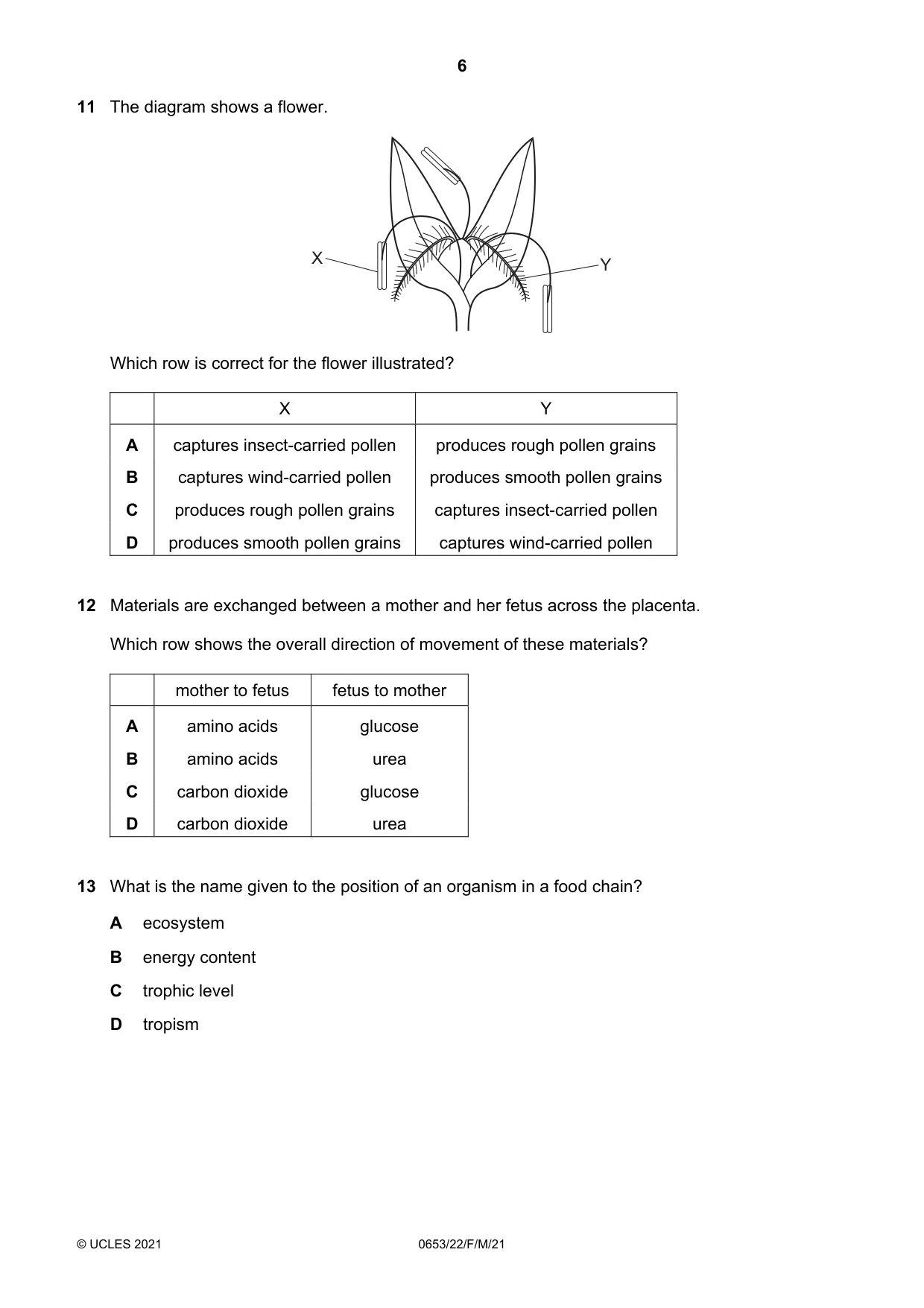
Q11 · The diagram shows a flower
11 The diagram shows a flower. X Y Which row is correct for the flower illustrated? X Y A captures insect-carried pollen produces rough pollen grains B captures wind-carried pollen produces smooth pollen grains C produces rough pollen grains captures insect-carried pollen D produces smooth pollen grains captures wind-carried pollen
Mark scheme: D
Q12 · Materials are exchanged between a mother and her fetus across the placenta
12 Materials are exchanged between a mother and her fetus across the placenta. Which row shows the overall direction of movement of these materials? mother to fetus fetus to mother A amino acids glucose B amino acids urea C carbon dioxide glucose D carbon dioxide urea
Mark scheme: B
Q13 · What is the name given to the position of an organism in a food chain?
13 What is the name given to the position of an organism in a food chain? A ecosystem B energy content C trophic level D tropism
Mark scheme: C
Q14 · Which methods of separation depend on the substances in a mixture having different…
14 Which methods of separation depend on the substances in a mixture having different boiling points? A crystallisation and distillation B evaporation and filtration C fractional distillation and chromatography D fractional distillation and distillation
Mark scheme: D
Q15 · Which row describes an element and a compound?
15 Which row describes an element and a compound? element compound A contains more than contains elements one type of atom chemically combined B contains more than contains elements one type of atom mixed together C contains only one contains elements type of atom chemically combined D contains only one contains elements type of atom mixed together
Mark scheme: C
Q16 · Potassium chloride is a solid
16 Potassium chloride is a solid. Hydrogen chloride is a gas. Which statement explains why potassium chloride has a much higher boiling point than hydrogen chloride? A Covalent bonding is stronger than ionic bonding. B Covalent bonds are stronger than the attractive forces between molecules. C Ionic bonding is stronger than covalent bonding. D Ionic bonds are stronger than the attractive forces between molecules.
Mark scheme: D
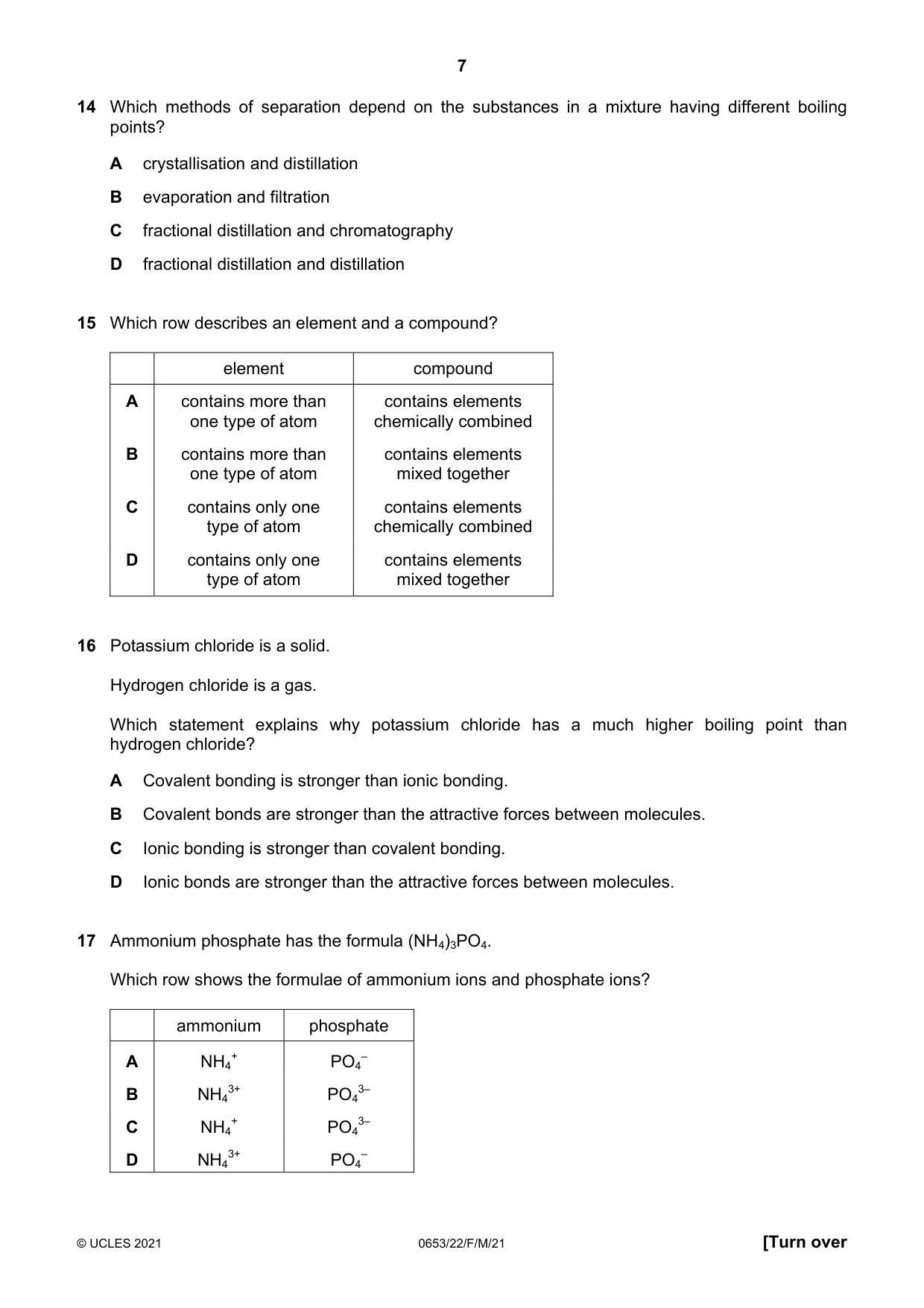
Q17 · Ammonium phosphate has the formula (NH4)3PO4
17 Ammonium phosphate has the formula (NH4)3PO4. Which row shows the formulae of ammonium ions and phosphate ions? ammonium phosphate A NH4 + PO4 – B NH4 3+ PO4 3– C NH4 + PO4 3– D NH4 3+ PO4 –
Mark scheme: C
Q18 · Which process occurs during electrolysis?
18 Which process occurs during electrolysis? A Anions gain electrons at the anode. B Anions lose electrons at the anode. C Cations gain electrons at the anode. D Cations lose electrons at the cathode.
Mark scheme: B
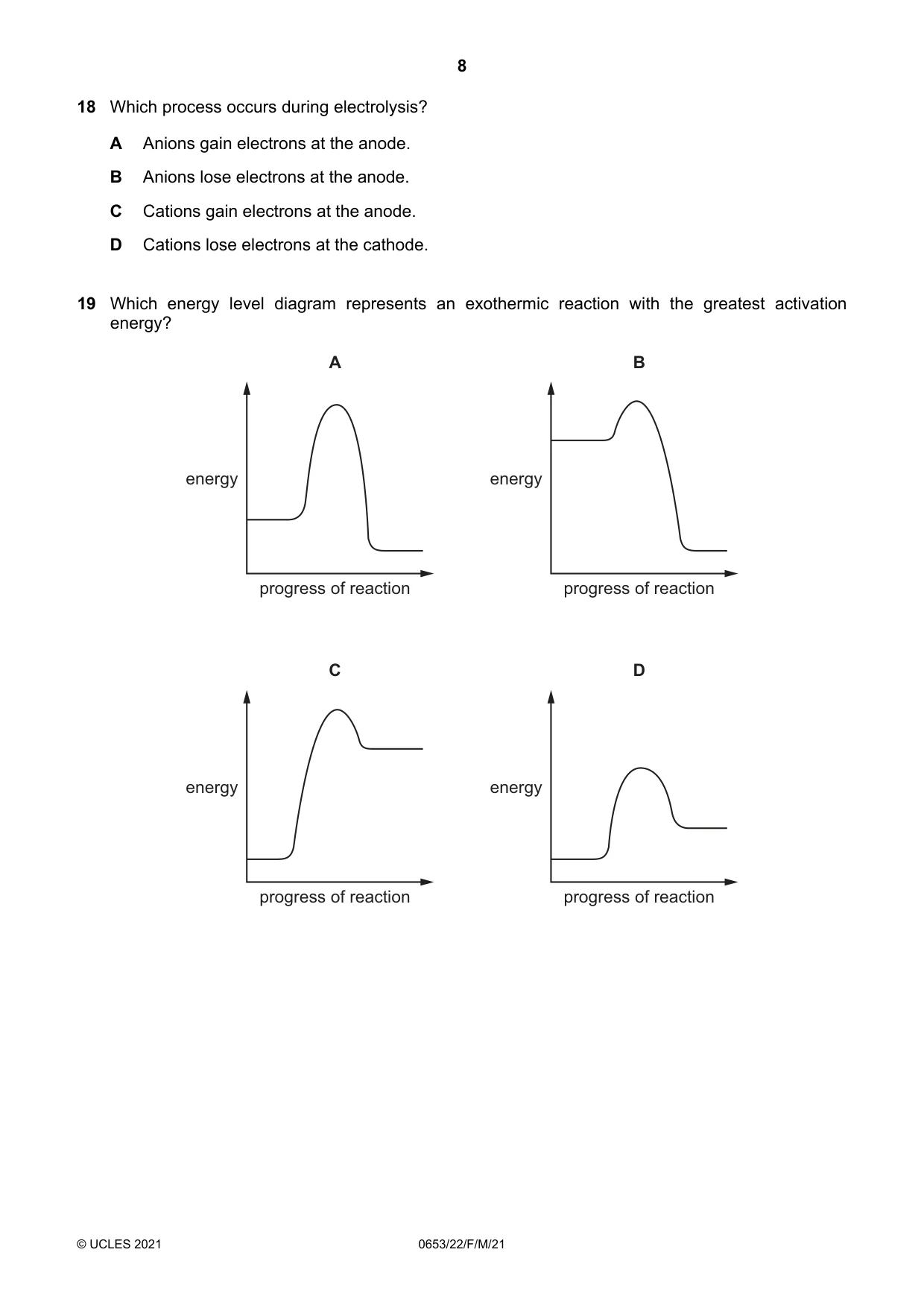
Q19 · Which energy level diagram represents an exothermic reaction with the greatest activation…
19 Which energy level diagram represents an exothermic reaction with the greatest activation energy? A B energy energy progress of reaction progress of reaction C D energy energy progress of reaction progress of reaction
Mark scheme: A
Q20 · Zinc reacts with dilute hydrochloric acid
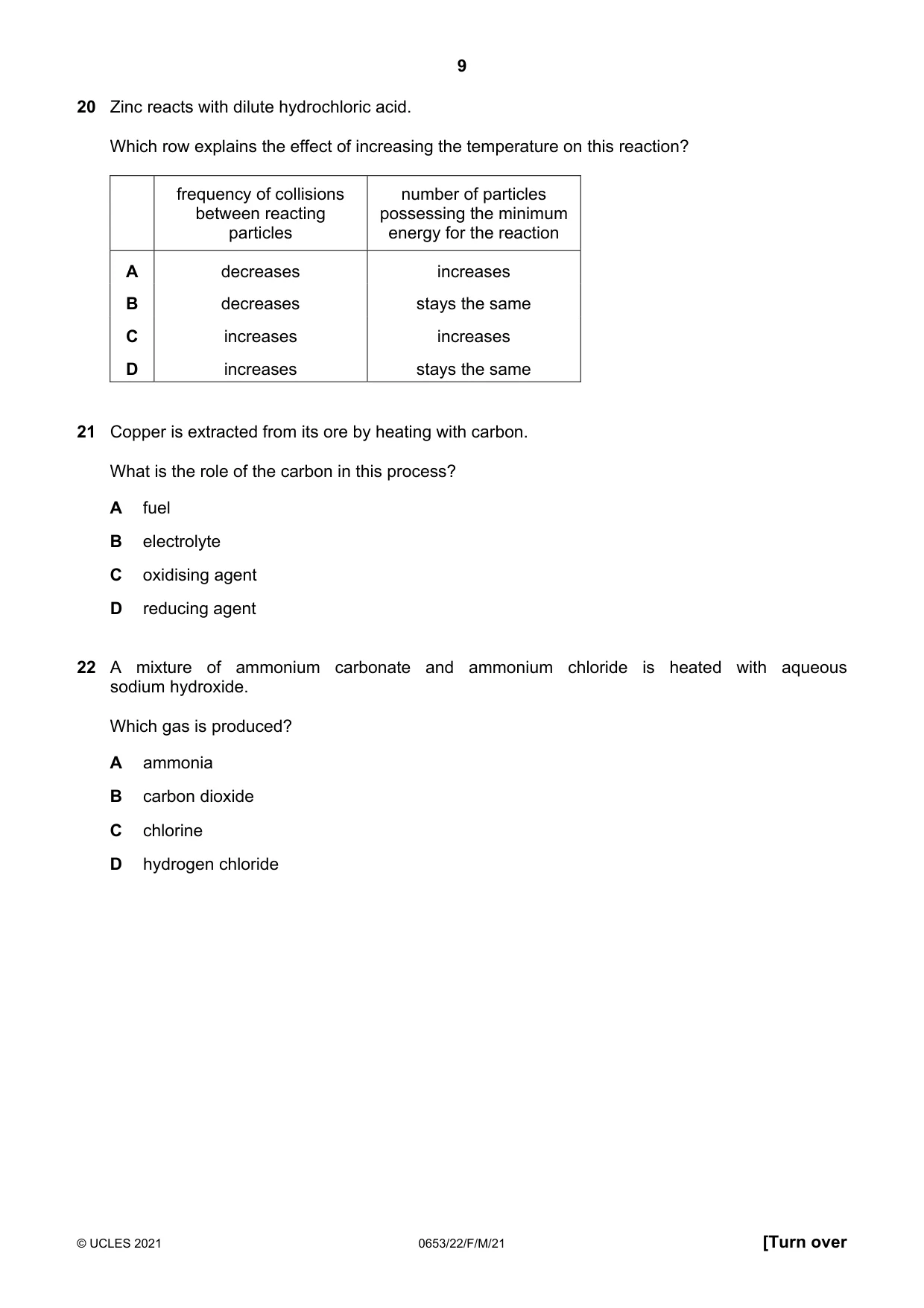
20 Zinc reacts with dilute hydrochloric acid. Which row explains the effect of increasing the temperature on this reaction? frequency of collisions number of particles between reacting possessing the minimum particles energy for the reaction A decreases increases B decreases stays the same C increases increases D increases stays the same
Mark scheme: C
Q21 · Copper is extracted from its ore by heating with carbon
21 Copper is extracted from its ore by heating with carbon. What is the role of the carbon in this process? A fuel B electrolyte C oxidising agent D reducing agent
Mark scheme: D
Q22 · A mixture of ammonium carbonate and ammonium chloride is heated with aqueous sodium…
22 A mixture of ammonium carbonate and ammonium chloride is heated with aqueous sodium hydroxide. Which gas is produced? A ammonia B carbon dioxide C chlorine D hydrogen chloride
Mark scheme: A
Q23 · The diagram shows what happens when damp red litmus paper is placed into two different…
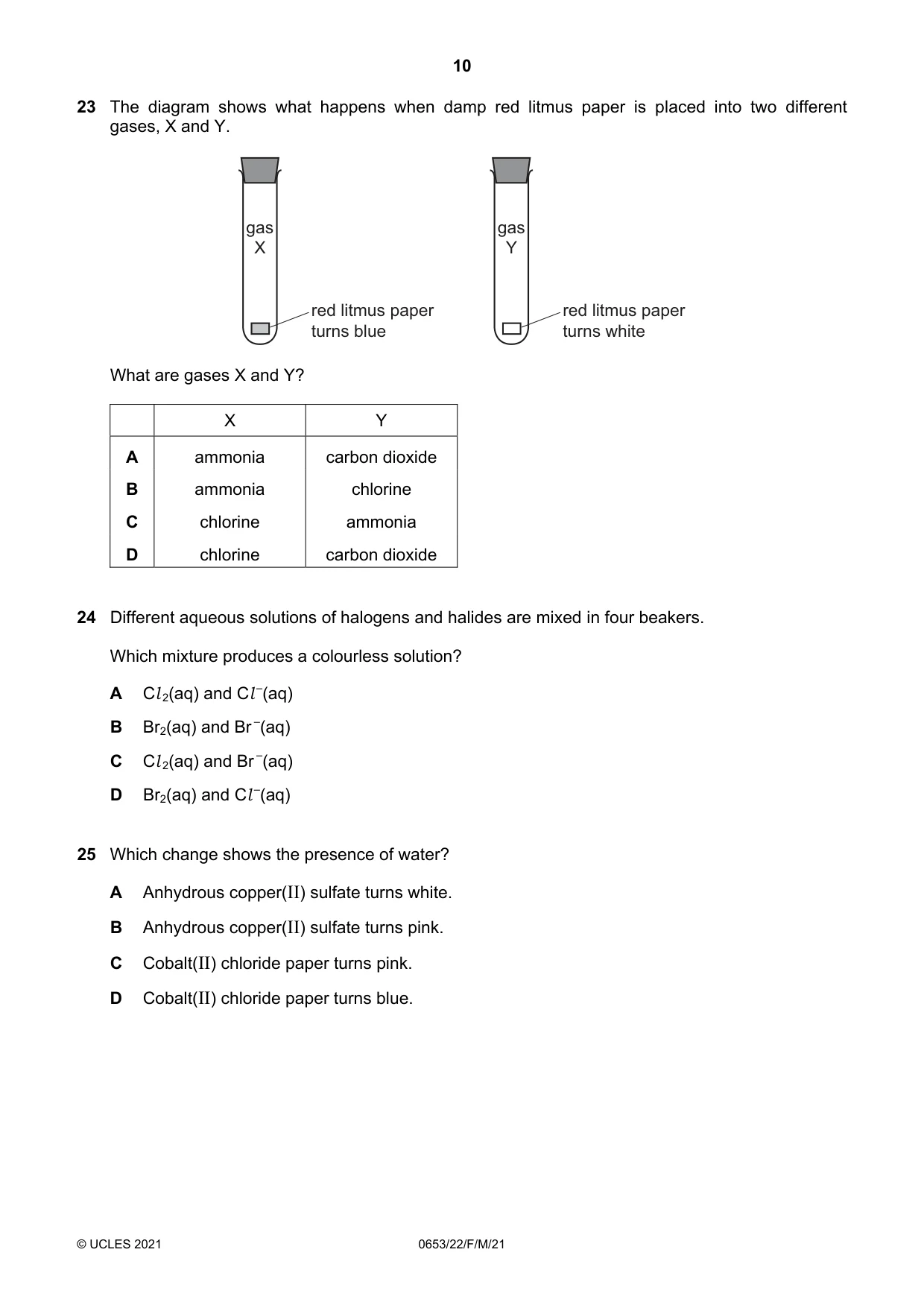
23 The diagram shows what happens when damp red litmus paper is placed into two different gases, X and Y. gas gas X Y red litmus paper red litmus paper turns blue turns white What are gases X and Y? X Y A ammonia carbon dioxide B ammonia chlorine C chlorine ammonia D chlorine carbon dioxide
Mark scheme: B
Q24 · Different aqueous solutions of halogens and halides are mixed in four beakers
24 Different aqueous solutions of halogens and halides are mixed in four beakers. Which mixture produces a colourless solution? A Cl 2(aq) and Cl –(aq) B Br2(aq) and Br –(aq) C Cl 2(aq) and Br –(aq) D Br2(aq) and Cl –(aq)
Mark scheme: A
Q25 · Which change shows the presence of water?
25 Which change shows the presence of water? A Anhydrous copper(II) sulfate turns white. B Anhydrous copper(II) sulfate turns pink. C Cobalt(II) chloride paper turns pink. D Cobalt(II) chloride paper turns blue.
Mark scheme: C
Q26 · A petrol car engine takes in clean air and lets out exhaust gases
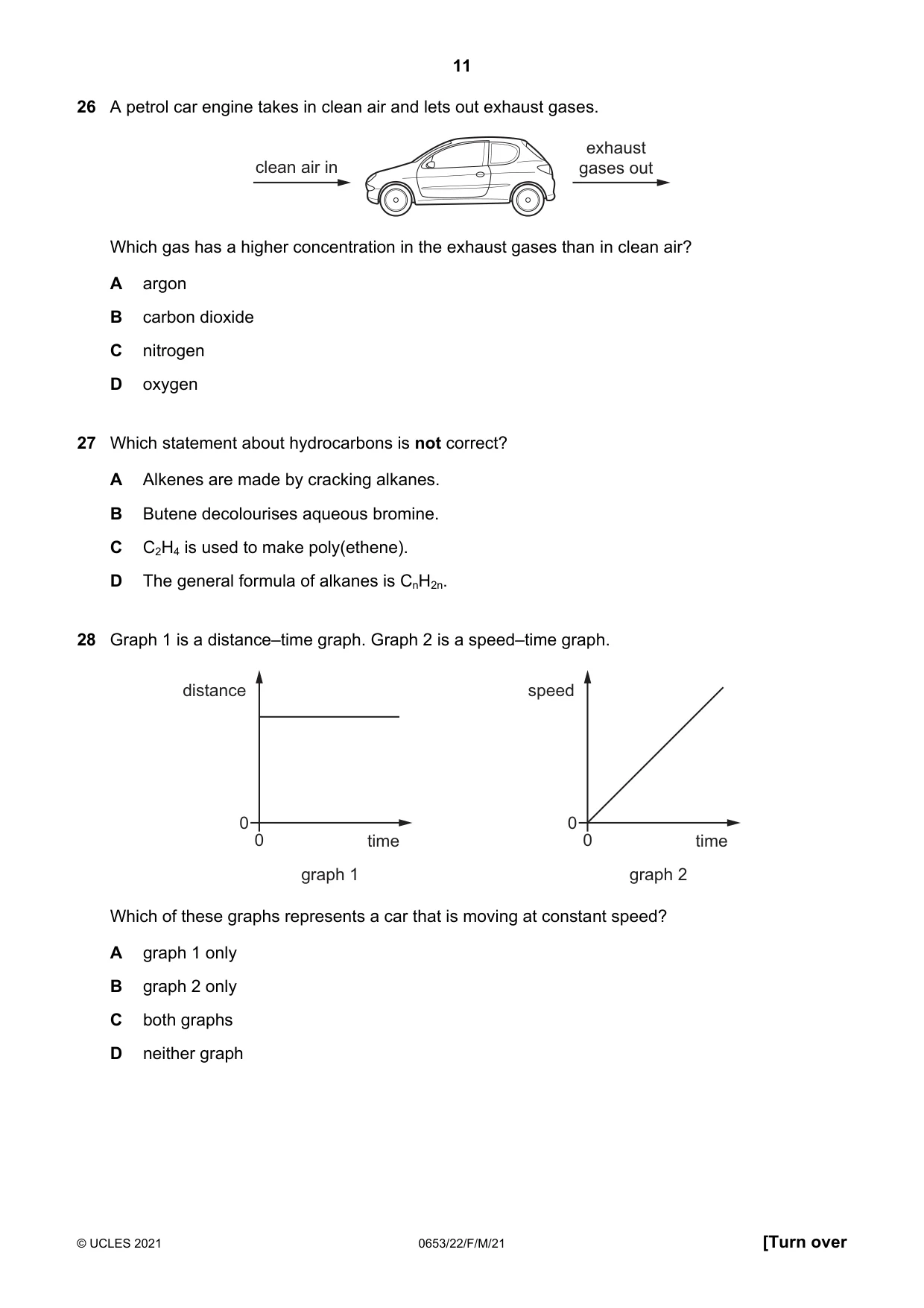
26 A petrol car engine takes in clean air and lets out exhaust gases. exhaust clean air in gases out Which gas has a higher concentration in the exhaust gases than in clean air? A argon B carbon dioxide C nitrogen D oxygen
Mark scheme: B
Q27 · Which statement about hydrocarbons is not correct?
27 Which statement about hydrocarbons is not correct? A Alkenes are made by cracking alkanes. B Butene decolourises aqueous bromine. C C2H4 is used to make poly(ethene). D The general formula of alkanes is CnH2n.
Mark scheme: D
Question 28
28 Graph 1 is a distance–time graph. Graph 2 is a speed–time graph. distance speed 0 0 0 time 0 time graph 1 graph 2 Which of these graphs represents a car that is moving at constant speed? A graph 1 only B graph 2 only C both graphs D neither graph
Mark scheme: D
Q29 · An object has mass 1.0 kg and weight 10 N on the Earth
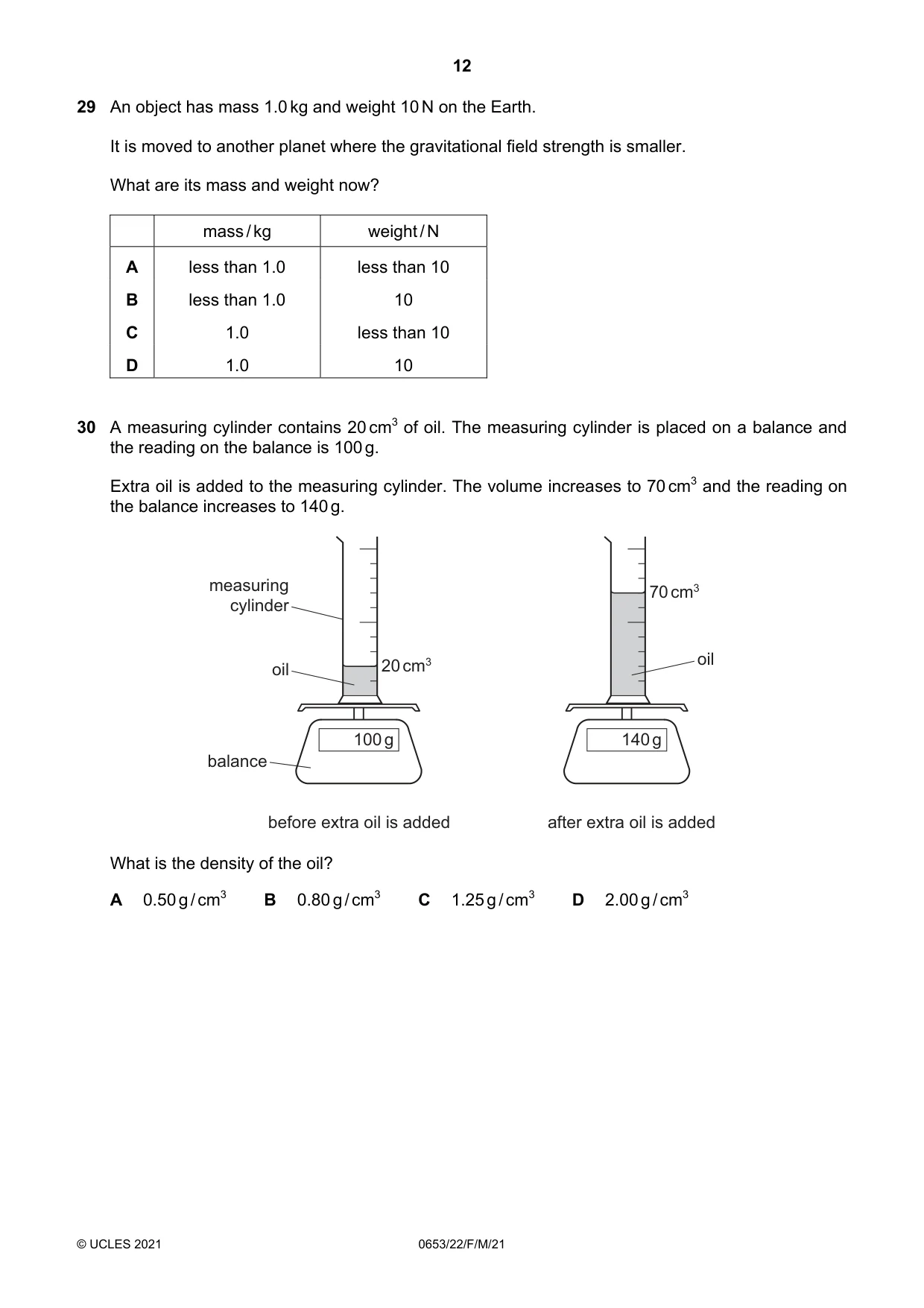
29 An object has mass 1.0 kg and weight 10 N on the Earth. It is moved to another planet where the gravitational field strength is smaller. What are its mass and weight now? mass / kg weight / N A less than 1.0 less than 10 B less than 1.0 10 C 1.0 less than 10 D 1.0 10
Mark scheme: C
Q30 · A measuring cylinder contains 20 cm3 of oil
30 A measuring cylinder contains 20 cm3 of oil. The measuring cylinder is placed on a balance and the reading on the balance is 100 g. Extra oil is added to the measuring cylinder. The volume increases to 70 cm3 and the reading on the balance increases to 140 g. measuring 70 cm3 cylinder 20 cm3 oil oil 100 g 140 g balance before extra oil is added after extra oil is added What is the density of the oil? A 0.50 g / cm3 B 0.80 g / cm3 C 1.25 g / cm3 D 2.00 g / cm3
Mark scheme: B
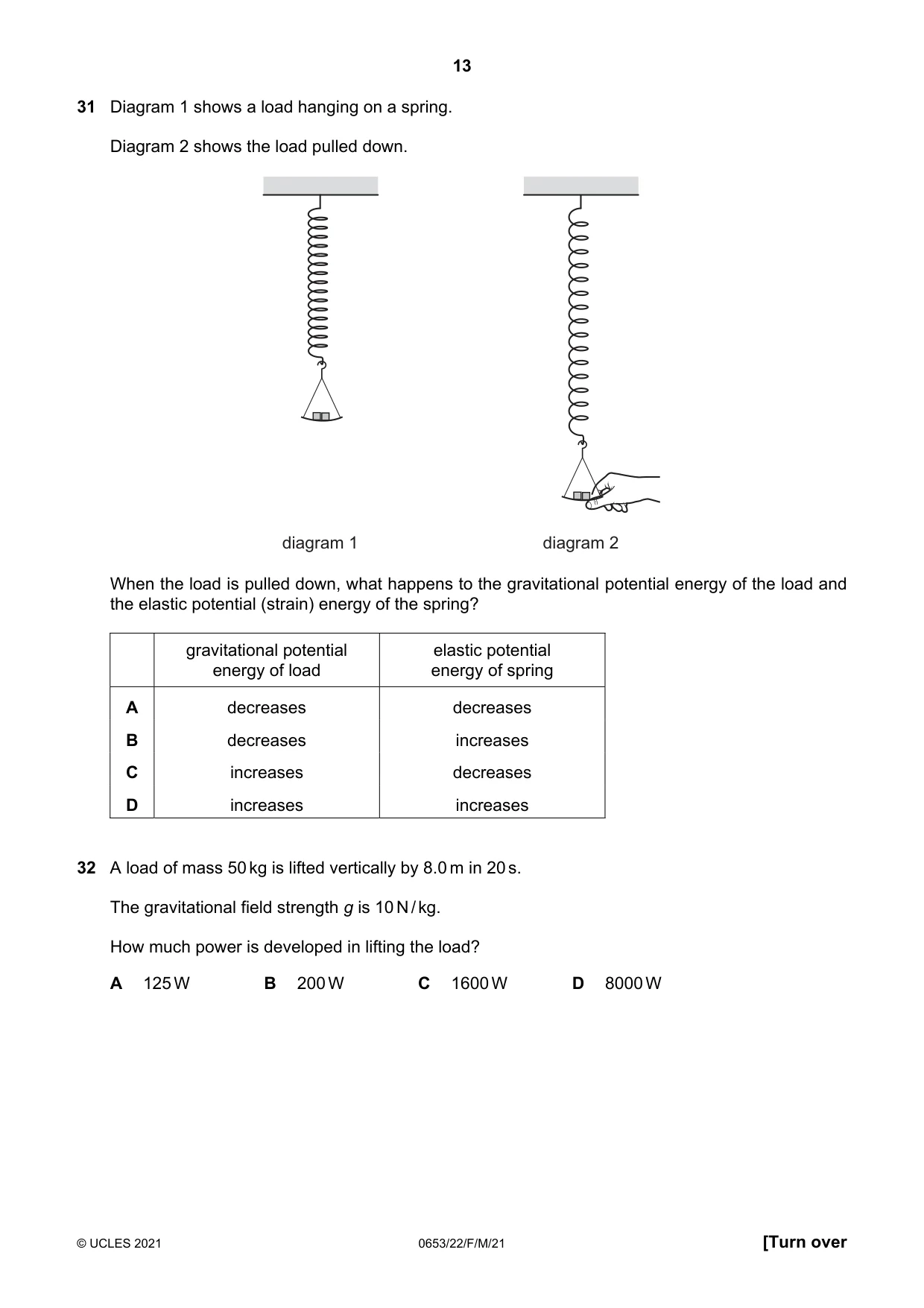
Q31 · A load hanging on a spring
31 Diagram 1 shows a load hanging on a spring. Diagram 2 shows the load pulled down. diagram 1 diagram 2 When the load is pulled down, what happens to the gravitational potential energy of the load and the elastic potential (strain) energy of the spring? gravitational potential elastic potential energy of load energy of spring A decreases decreases B decreases increases C increases decreases D increases increases
Mark scheme: B
Q32 · A load of mass 50 kg is lifted vertically by 8.0 m in 20 s
32 A load of mass 50 kg is lifted vertically by 8.0 m in 20 s. The gravitational field strength g is 10 N / kg. How much power is developed in lifting the load? A 125 W B 200 W C 1600 W D 8000 W
Mark scheme: B
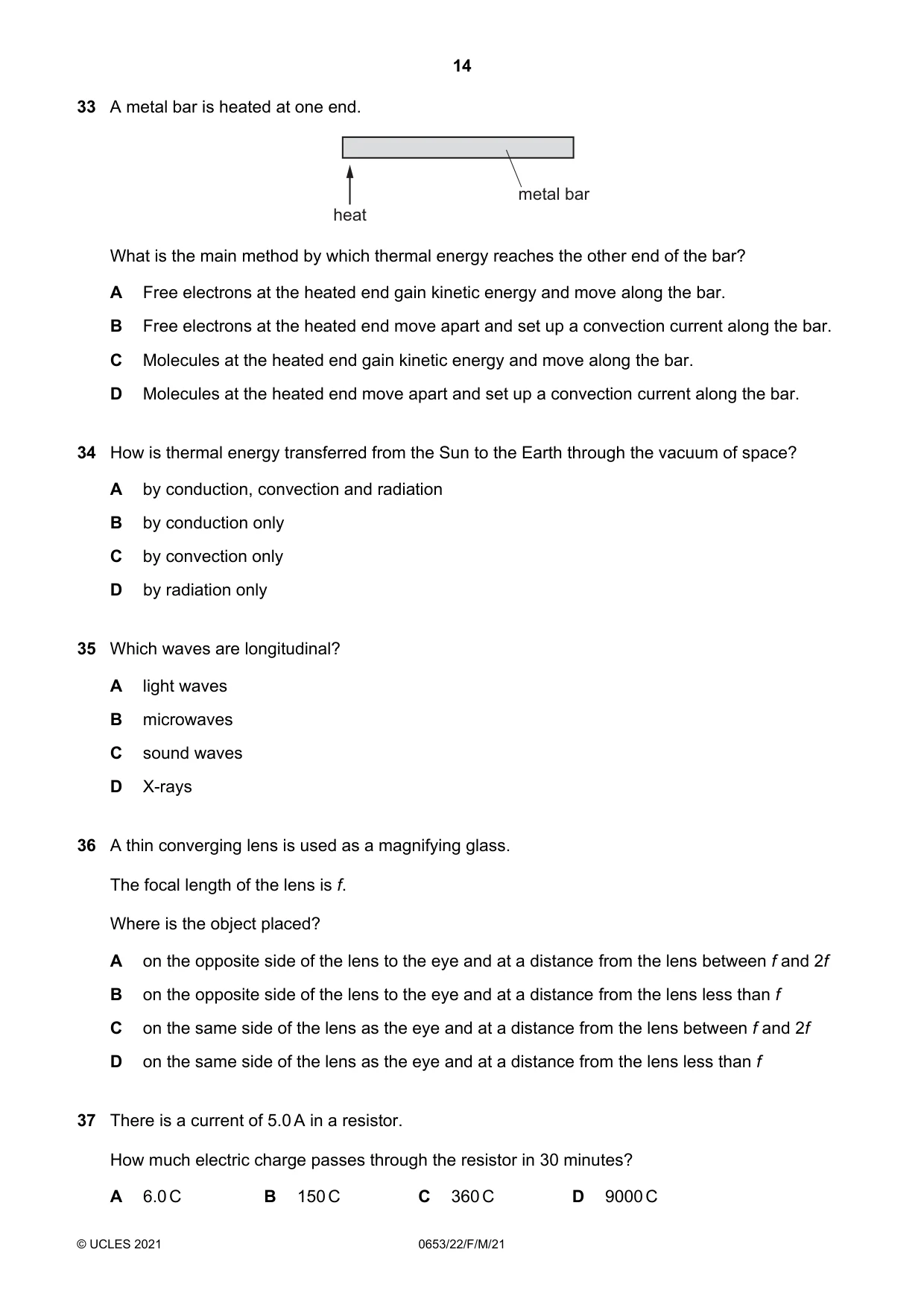
Q33 · A metal bar is heated at one end
33 A metal bar is heated at one end. metal bar heat What is the main method by which thermal energy reaches the other end of the bar? A Free electrons at the heated end gain kinetic energy and move along the bar. B Free electrons at the heated end move apart and set up a convection current along the bar. C Molecules at the heated end gain kinetic energy and move along the bar. D Molecules at the heated end move apart and set up a convection current along the bar.
Mark scheme: A
Q34 · How is thermal energy transferred from the Sun to the Earth through the vacuum of space?
34 How is thermal energy transferred from the Sun to the Earth through the vacuum of space? A by conduction, convection and radiation B by conduction only C by convection only D by radiation only
Mark scheme: D
Q35 · Which waves are longitudinal?
35 Which waves are longitudinal? A light waves B microwaves C sound waves D X-rays
Mark scheme: C
Q36 · A thin converging lens is used as a magnifying glass
36 A thin converging lens is used as a magnifying glass. The focal length of the lens is f. Where is the object placed? A on the opposite side of the lens to the eye and at a distance from the lens between f and 2f B on the opposite side of the lens to the eye and at a distance from the lens less than f C on the same side of the lens as the eye and at a distance from the lens between f and 2f D on the same side of the lens as the eye and at a distance from the lens less than f
Mark scheme: B
Q37 · There is a current of 5.0 A in a resistor
37 There is a current of 5.0 A in a resistor. How much electric charge passes through the resistor in 30 minutes? A 6.0 C B 150 C C 360 C D 9000 C
Mark scheme: D
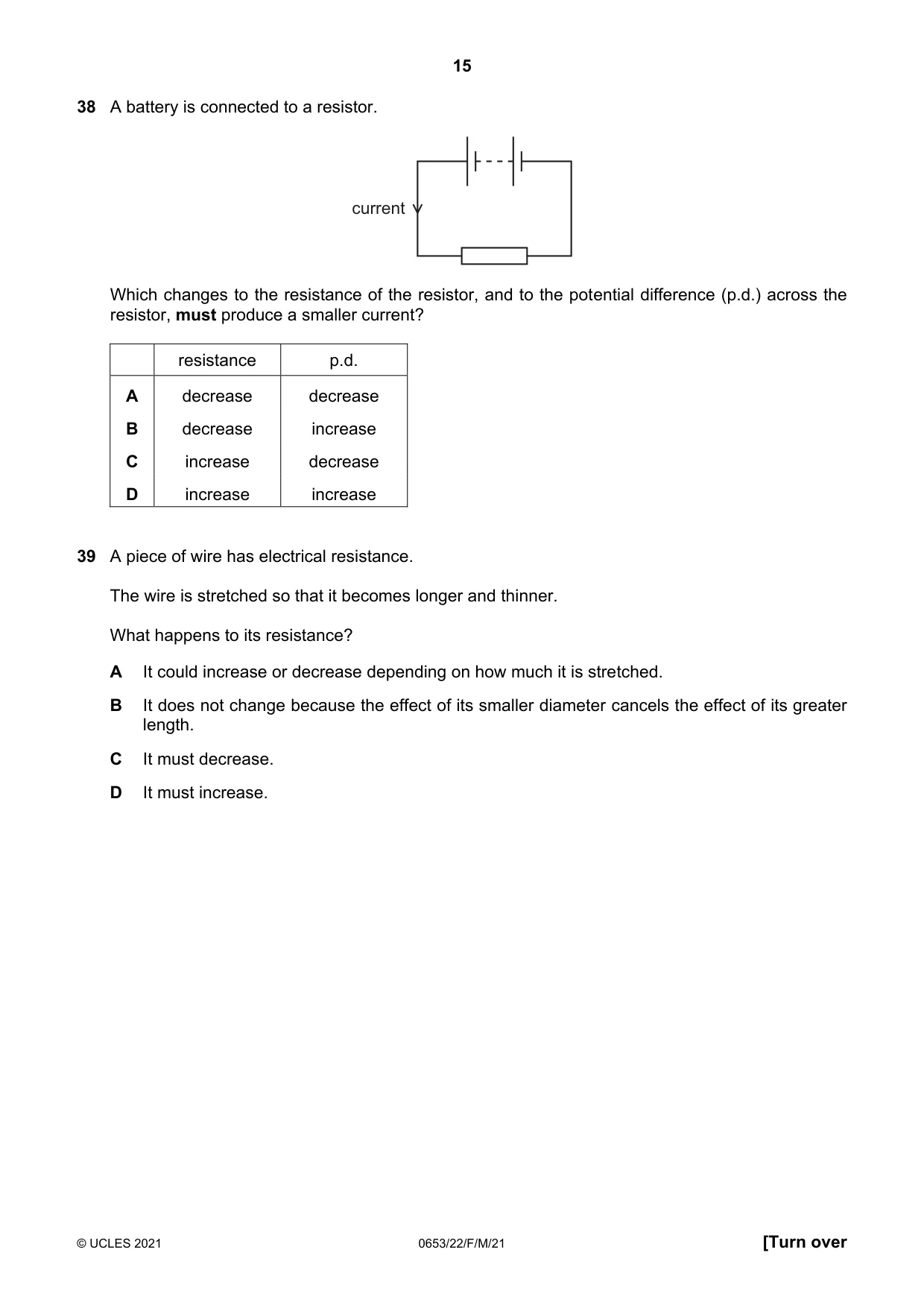
Q38 · A battery is connected to a resistor
38 A battery is connected to a resistor. current Which changes to the resistance of the resistor, and to the potential difference (p.d.) across the resistor, must produce a smaller current? resistance p.d. A decrease decrease B decrease increase C increase decrease D increase increase
Mark scheme: C
Q39 · A piece of wire has electrical resistance
39 A piece of wire has electrical resistance. The wire is stretched so that it becomes longer and thinner. What happens to its resistance? A It could increase or decrease depending on how much it is stretched. B It does not change because the effect of its smaller diameter cancels the effect of its greater length. C It must decrease. D It must increase.
Mark scheme: D
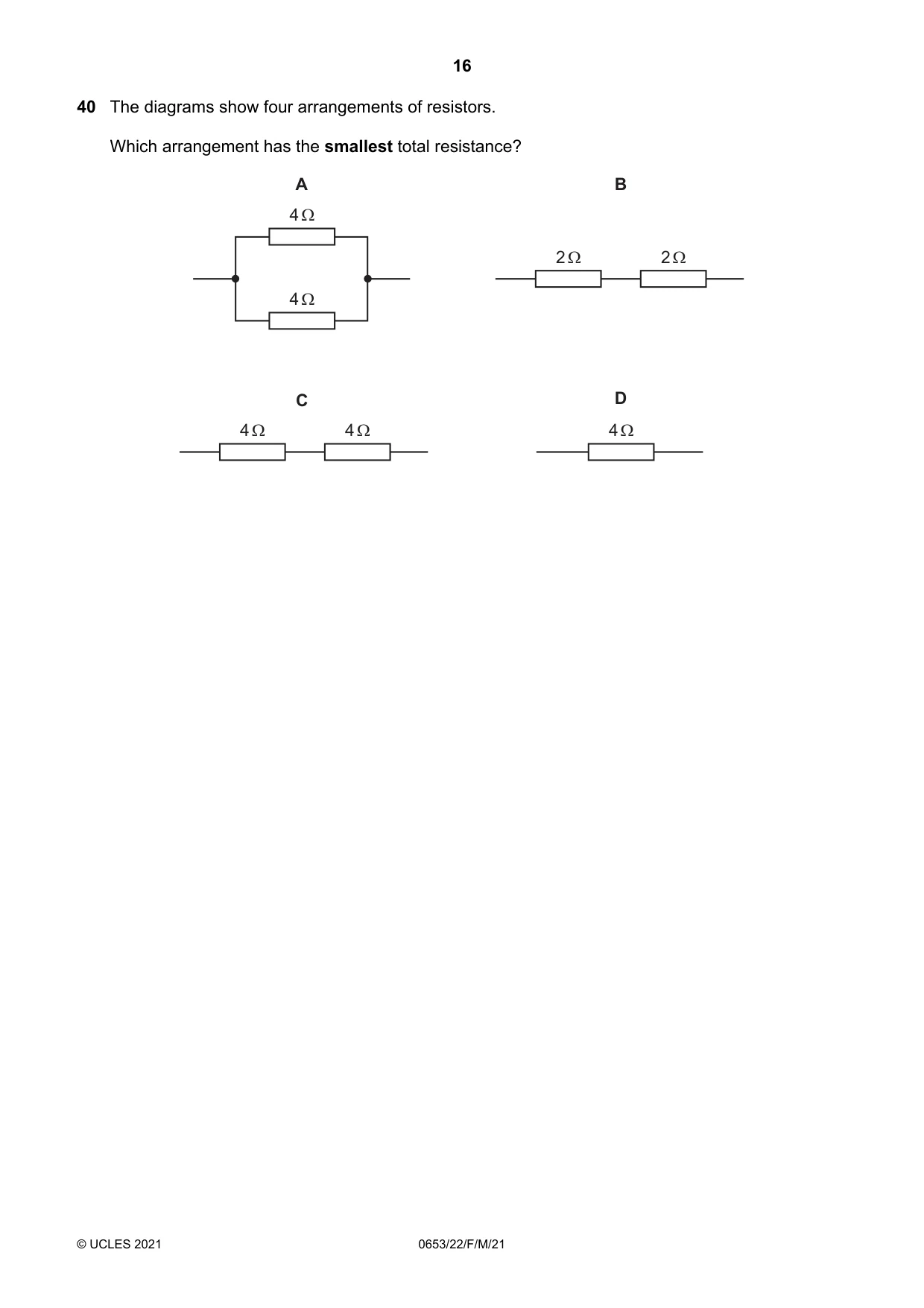
Q40 · The diagrams show four arrangements of resistors
40 The diagrams show four arrangements of resistors. Which arrangement has the smallest total resistance? A B 4 Ω 2 Ω 2 Ω 4 Ω C D 4 Ω 4 Ω 4 Ω
Mark scheme: A
What was in this paper
The subtopics covered by these 40 questions, and how many questions each got. Open one in a new tab to see every Cambridge question on it.
3Electrical circuits2Electrical quantities2Energy, work and power2Transfer of thermal energy2Air quality and climate1Alkanes1Cell structure1Characteristics of living organisms1Density1Diet1Digestion1Electrolysis1Elements, compounds and mixtures1Enzymes1Exothermic and endothermic reactions1Extraction of metals1Food chains and food webs1Formulas1Gas exchange in humans1General properties of waves1Group VII properties1Heart1Leaf structure1Light1Mass and weight1Motion1Osmosis1Rate of reaction1Separation and purification1Sexual reproduction in humans1Sexual reproduction in plants1Simple molecules and covalent bonds1Transpiration1What you needed in this session
Cambridge’s own grade thresholds for 2021 Feb/March, Paper 2 · Variant 2. A higher threshold means an easier paper — the bar moves with how the cohort did.