Cambridge IGCSE Science - Combined 0653 — 2024 May/June Paper 2 · Variant 1
0653/21/M/J/24 · 40 questions · 40 marks · ≈45 min
The question paper and its mark scheme, free to read here and free to download. This is Cambridge’s own paper, exactly as it was sat.
Question paper16 pages


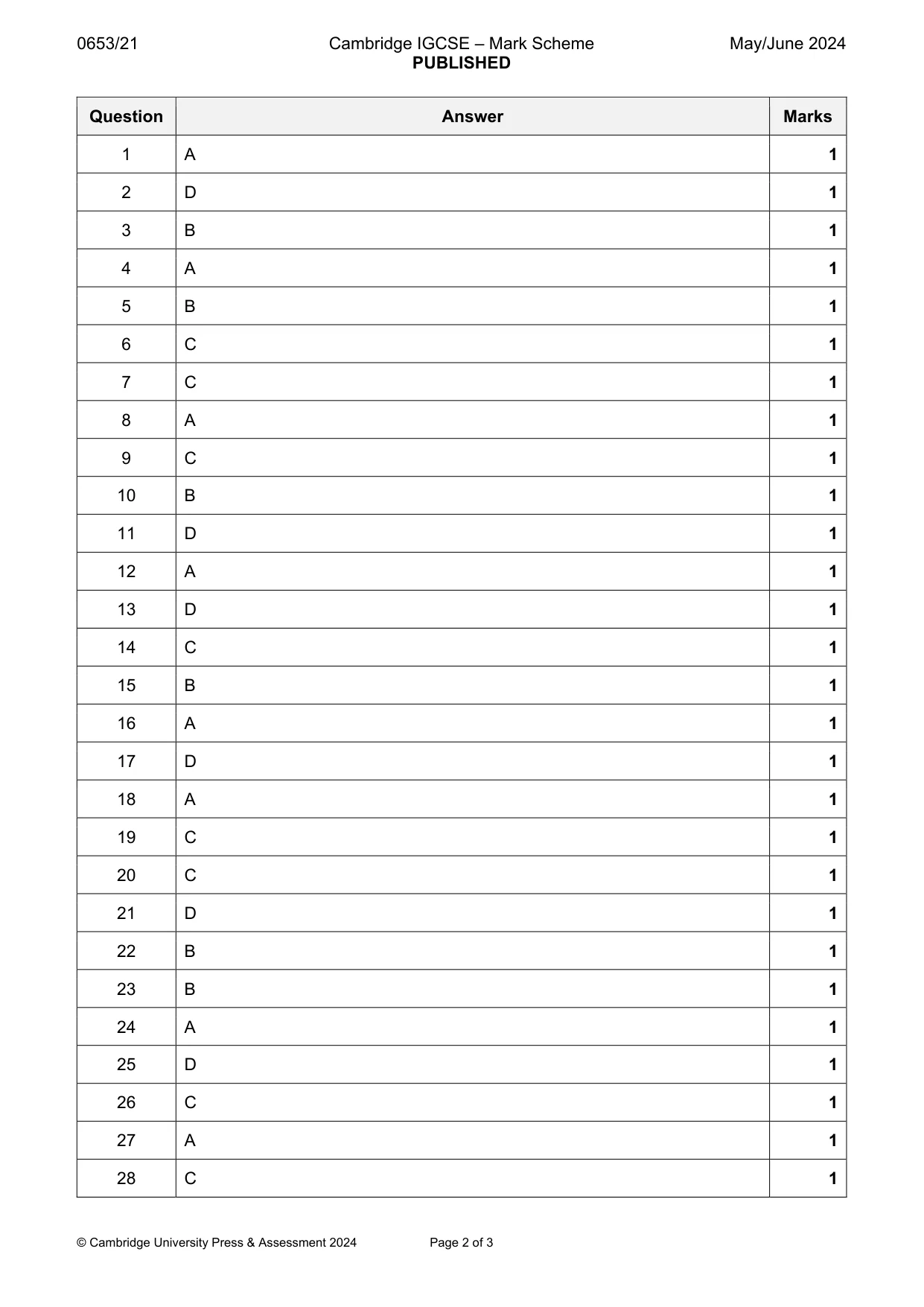
Mark scheme3 pages
Answers below. Sit the paper first if you are practising.
Questions as text
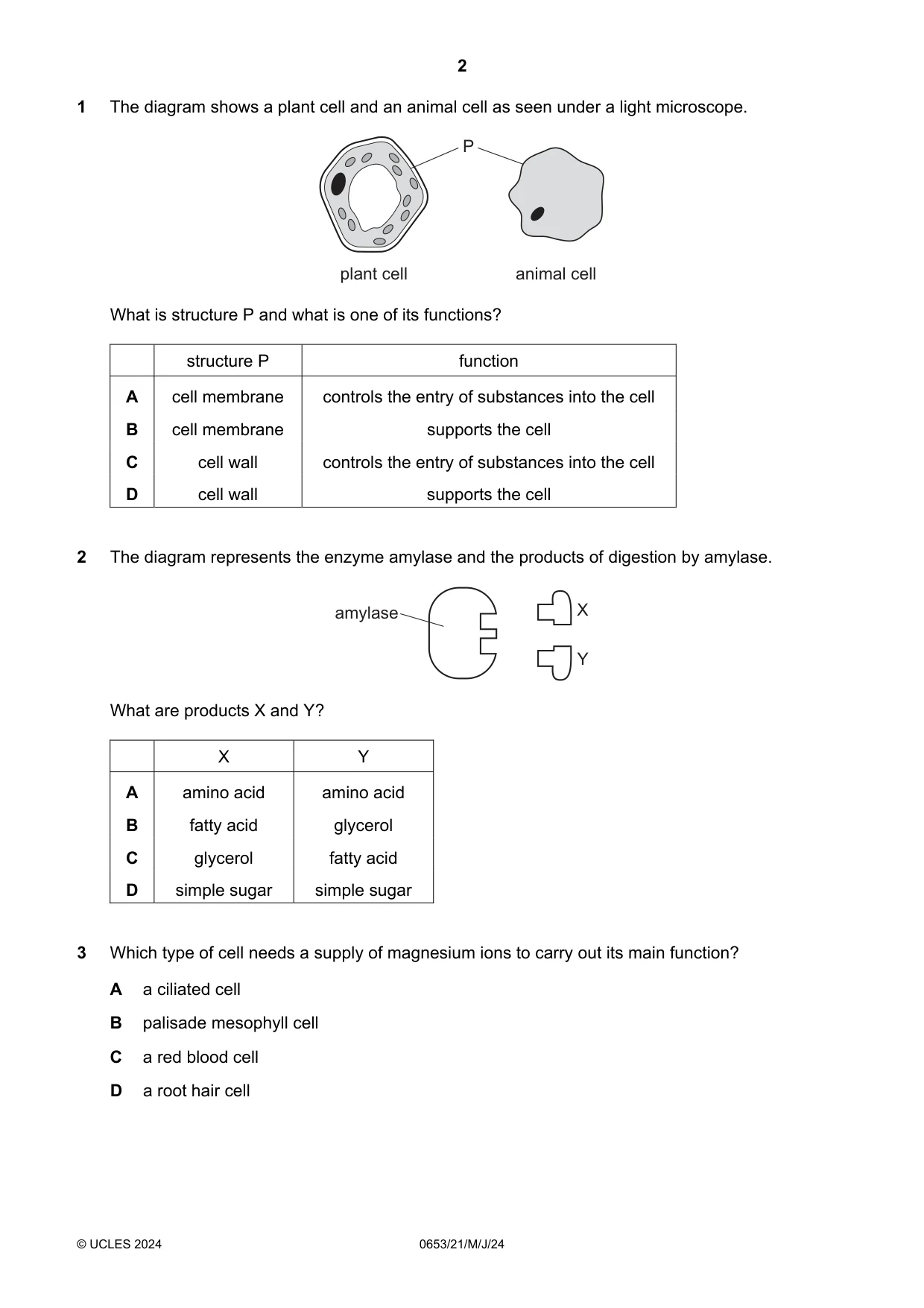
Q1 · The diagram shows a plant cell and an animal cell as seen under a light microscope
1 The diagram shows a plant cell and an animal cell as seen under a light microscope. P plant cell animal cell What is structure P and what is one of its functions? structure P function A cell membrane controls the entry of substances into the cell B cell membrane supports the cell C cell wall controls the entry of substances into the cell D cell wall supports the cell
Mark scheme: A
Q2 · The diagram represents the enzyme amylase and the products of digestion by amylase
2 The diagram represents the enzyme amylase and the products of digestion by amylase. amylase X Y What are products X and Y? X Y A amino acid amino acid B fatty acid glycerol C glycerol fatty acid D simple sugar simple sugar
Mark scheme: D
Q3 · Which type of cell needs a supply of magnesium ions to carry out its main function?
3 Which type of cell needs a supply of magnesium ions to carry out its main function? A a ciliated cell B palisade mesophyll cell C a red blood cell D a root hair cell
Mark scheme: B
Q4 · Which process produces food molecules that are small enough to be absorbed?
4 Which process produces food molecules that are small enough to be absorbed? A chemical digestion B egestion C ingestion D mechanical digestion
Mark scheme: A
Q5 · Which statement about the structure and function of blood vessels is correct?
5 Which statement about the structure and function of blood vessels is correct? A Arteries have valves and always carry oxygenated blood. B Arteries have a thick muscular wall to maintain a high blood pressure. C Veins have a narrow lumen to allow the blood to flow quickly. D Veins have a thin wall so that they can exchange molecules with tissue cells.
Mark scheme: B
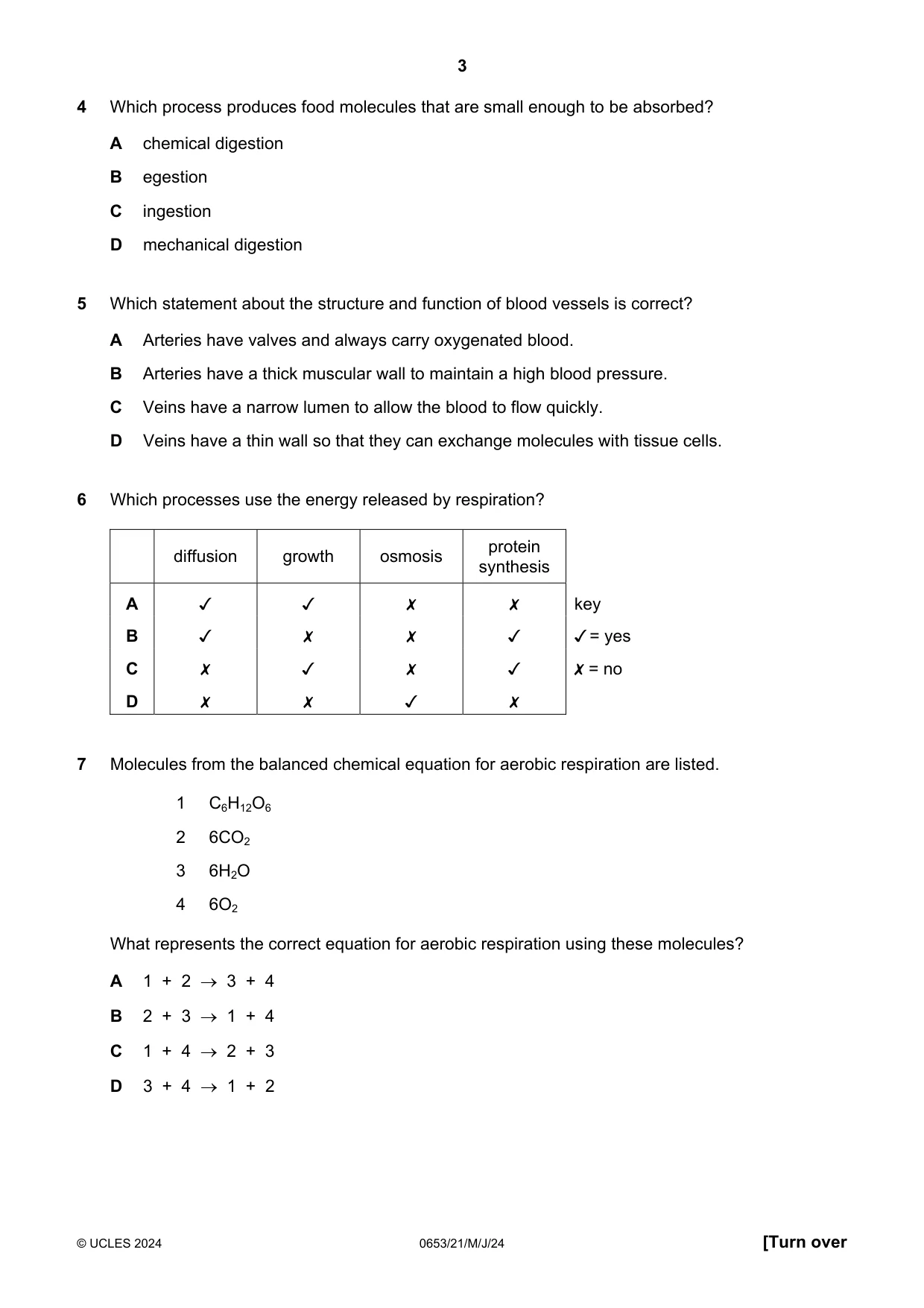
Q6 · Which processes use the energy released by respiration?
6 Which processes use the energy released by respiration? 0 ONO WwW > diffusion «x «KM KK growth «~x QM OSs osmosis \ « & x protein synthesis x \ \ x key /=yes X =no
Mark scheme: C
Q7 · Molecules from the balanced chemical equation for aerobic respiration are listed
7 Molecules from the balanced chemical equation for aerobic respiration are listed. 1 C6H12O6 2 6CO2 3 6H2O 4 6O2 What represents the correct equation for aerobic respiration using these molecules? A 1 + 2 3 + 4 B 2 + 3 1 + 4 C 1 + 4 2 + 3 D 3 + 4 1 + 2
Mark scheme: C
Q8 · Which statement about adrenaline is correct?
8 Which statement about adrenaline is correct? A It is produced by a gland. B It is transported in the red blood cells. C It only has one target organ. D It reduces the size of the pupils.
Mark scheme: A
Q9 · Auxin stimulates cell elongation
9 Auxin stimulates cell elongation. If a light shines onto a shoot, why does it grow towards the direction of the light? A Auxin spreads evenly through the shoot. B Auxin stays in the shoot tip. C More auxin collects on the side of the shoot furthest from the light. D More auxin collects on the side of the shoot nearest the light.
Mark scheme: C
Q10 · Which statement about sexual reproduction is always correct?
10 Which statement about sexual reproduction is always correct? A It involves only one parent. B It involves the fusion of nuclei. C It produces genetically identical offspring. D It takes place only in animals.
Mark scheme: B
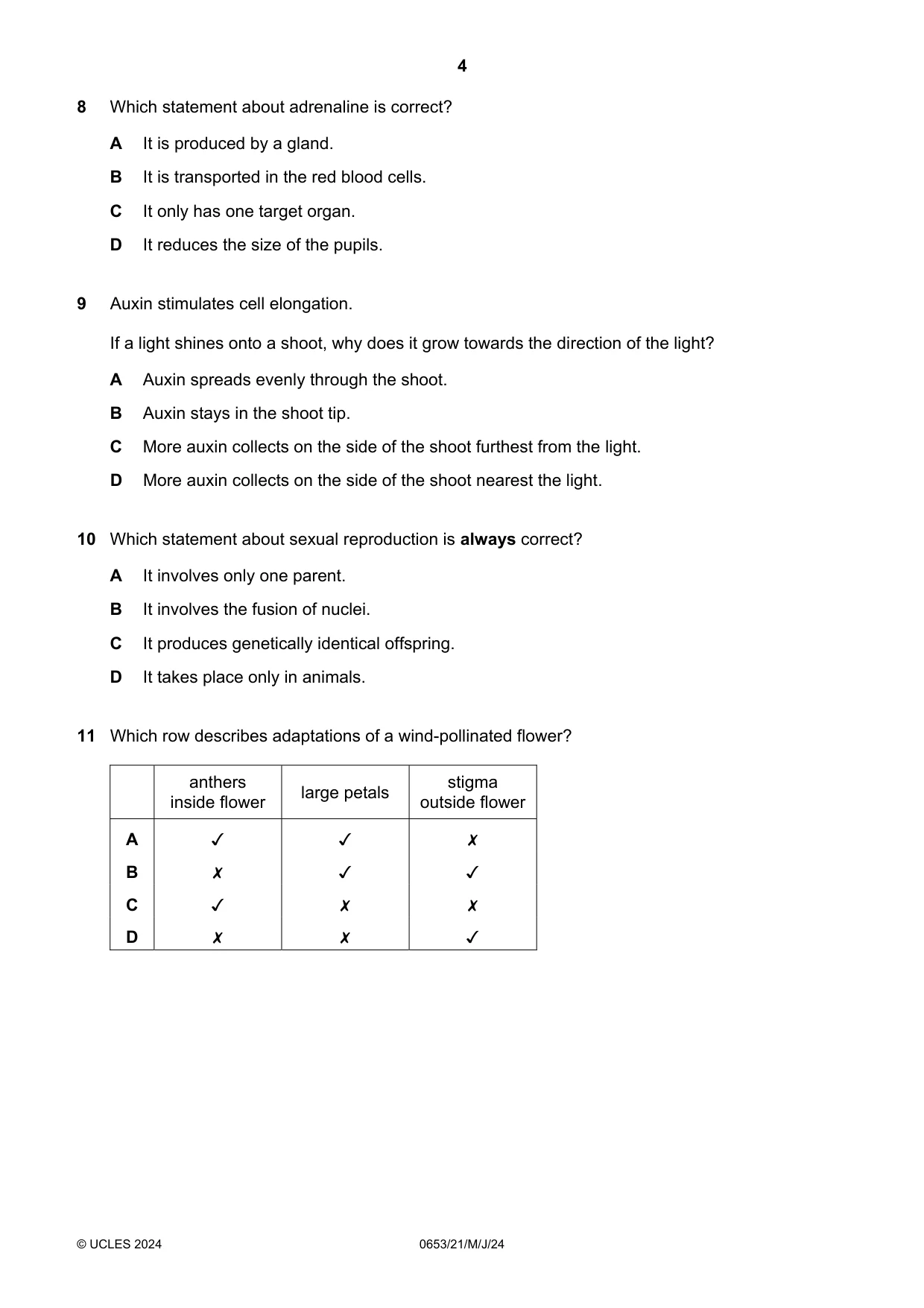
Q11 · Which row describes adaptations of a wind-pollinated flower?
11 Which row describes adaptations of a wind-pollinated flower? ; anthers large petals stigma inside flower outside flower A v v x B x v v Cc v x x D x x v
Mark scheme: D
Q12 · The list shows the adaptive features of some gametes
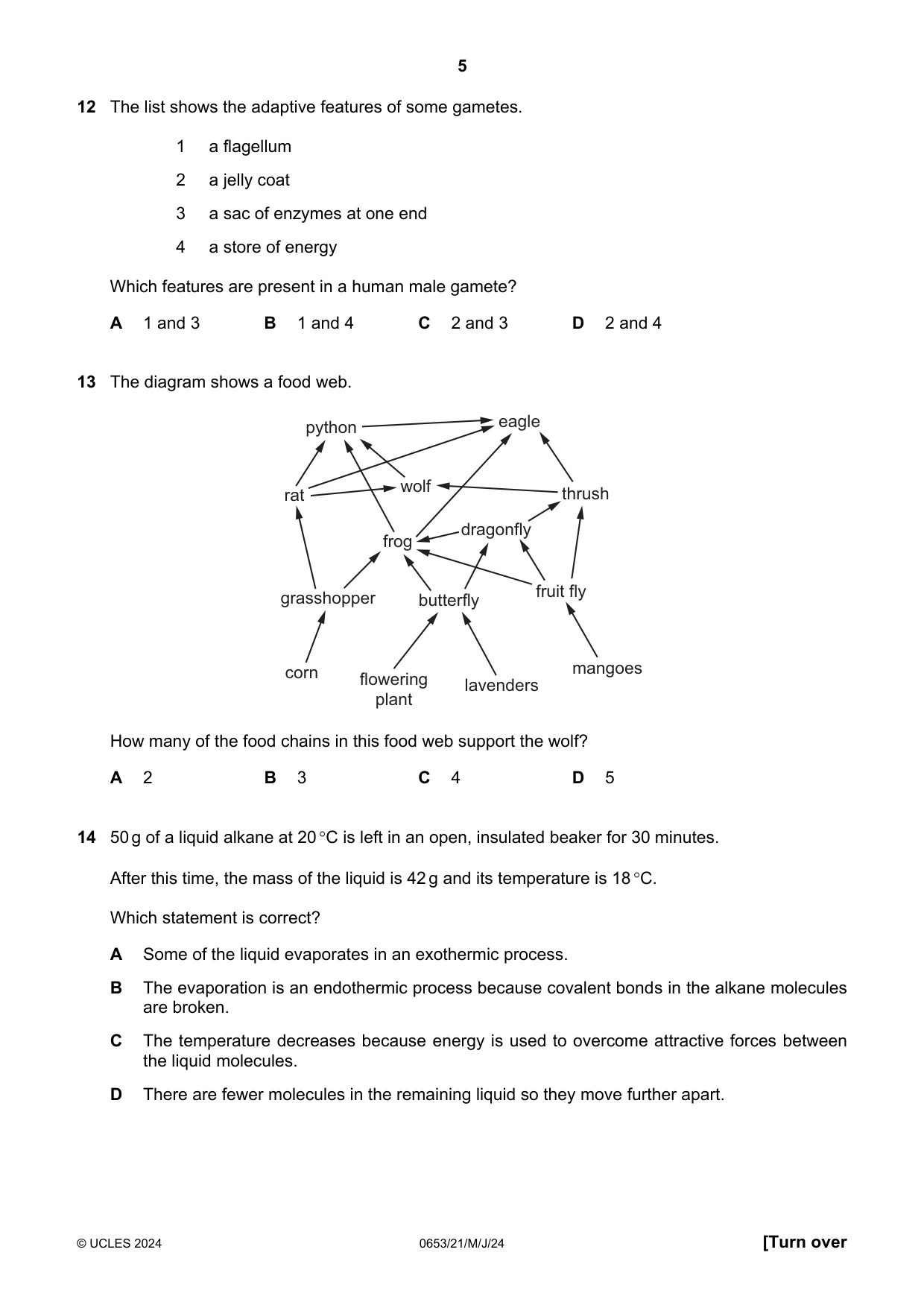
12 The list shows the adaptive features of some gametes. 1 a flagellum 2 a jelly coat 3 a sac of enzymes at one end 4 a store of energy Which features are present in a human male gamete? A 1 and 3 B 1 and 4 C 2 and 3 D 2 and 4
Mark scheme: A
Q13 · The diagram shows a food web
13 The diagram shows a food web. python eagle wolf thrush rat dragonfly frog grasshopper fruit fly butterfly corn mangoes flowering lavenders plant How many of the food chains in this food web support the wolf? A 2 B 3 C 4 D 5
Mark scheme: D
Q14 · 50 g of a liquid alkane at 20 C is left in an open, insulated beaker for 30 minutes
14 50 g of a liquid alkane at 20 C is left in an open, insulated beaker for 30 minutes. After this time, the mass of the liquid is 42 g and its temperature is 18 C. Which statement is correct? A Some of the liquid evaporates in an exothermic process. B The evaporation is an endothermic process because covalent bonds in the alkane molecules are broken. C The temperature decreases because energy is used to overcome attractive forces between the liquid molecules. D There are fewer molecules in the remaining liquid so they move further apart.
Mark scheme: C
Q15 · What is an example of a physical change?
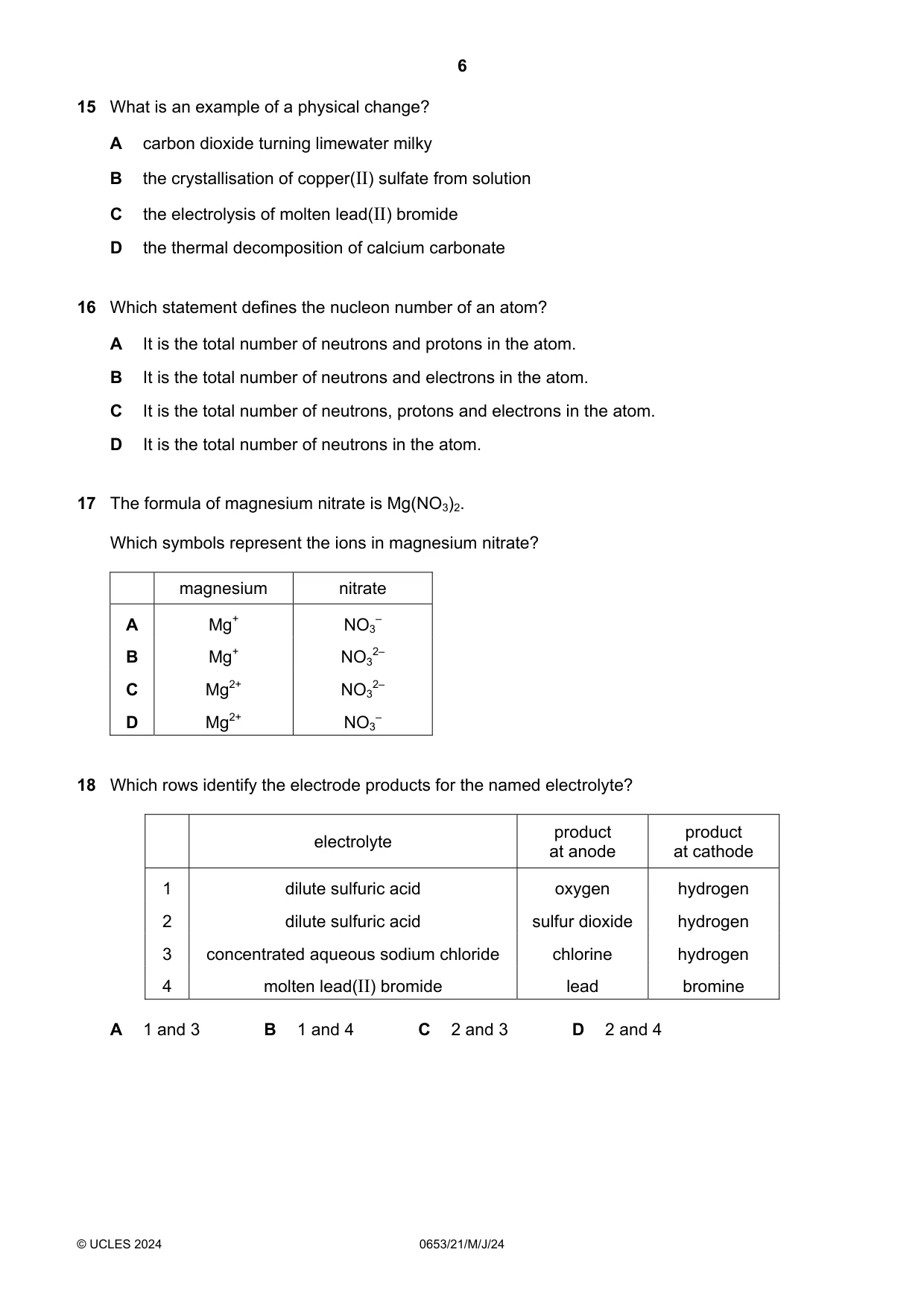
15 What is an example of a physical change? A carbon dioxide turning limewater milky B the crystallisation of copper(II) sulfate from solution C the electrolysis of molten lead(II) bromide D the thermal decomposition of calcium carbonate
Mark scheme: B
Q16 · Which statement defines the nucleon number of an atom?
16 Which statement defines the nucleon number of an atom? A It is the total number of neutrons and protons in the atom. B It is the total number of neutrons and electrons in the atom. C It is the total number of neutrons, protons and electrons in the atom. D It is the total number of neutrons in the atom.
Mark scheme: A
Q17 · The formula of magnesium nitrate is Mg(NO3)2
17 The formula of magnesium nitrate is Mg(NO3)2. Which symbols represent the ions in magnesium nitrate? magnesium nitrate A Mg+ NO3 – B Mg+ NO3 2– C Mg2+ NO3 2– D Mg2+ NO3 –
Mark scheme: D
Q18 · Which rows identify the electrode products for the named electrolyte?
18 Which rows identify the electrode products for the named electrolyte? product product electrolyte at anode at cathode 1 dilute sulfuric acid oxygen hydrogen 2 dilute sulfuric acid sulfur dioxide hydrogen 3 concentrated aqueous sodium chloride chlorine hydrogen 4 molten lead(II) bromide lead bromine A 1 and 3 B 1 and 4 C 2 and 3 D 2 and 4
Mark scheme: A
Q19 · Hydrogen reacts with oxygen to produce water as shown
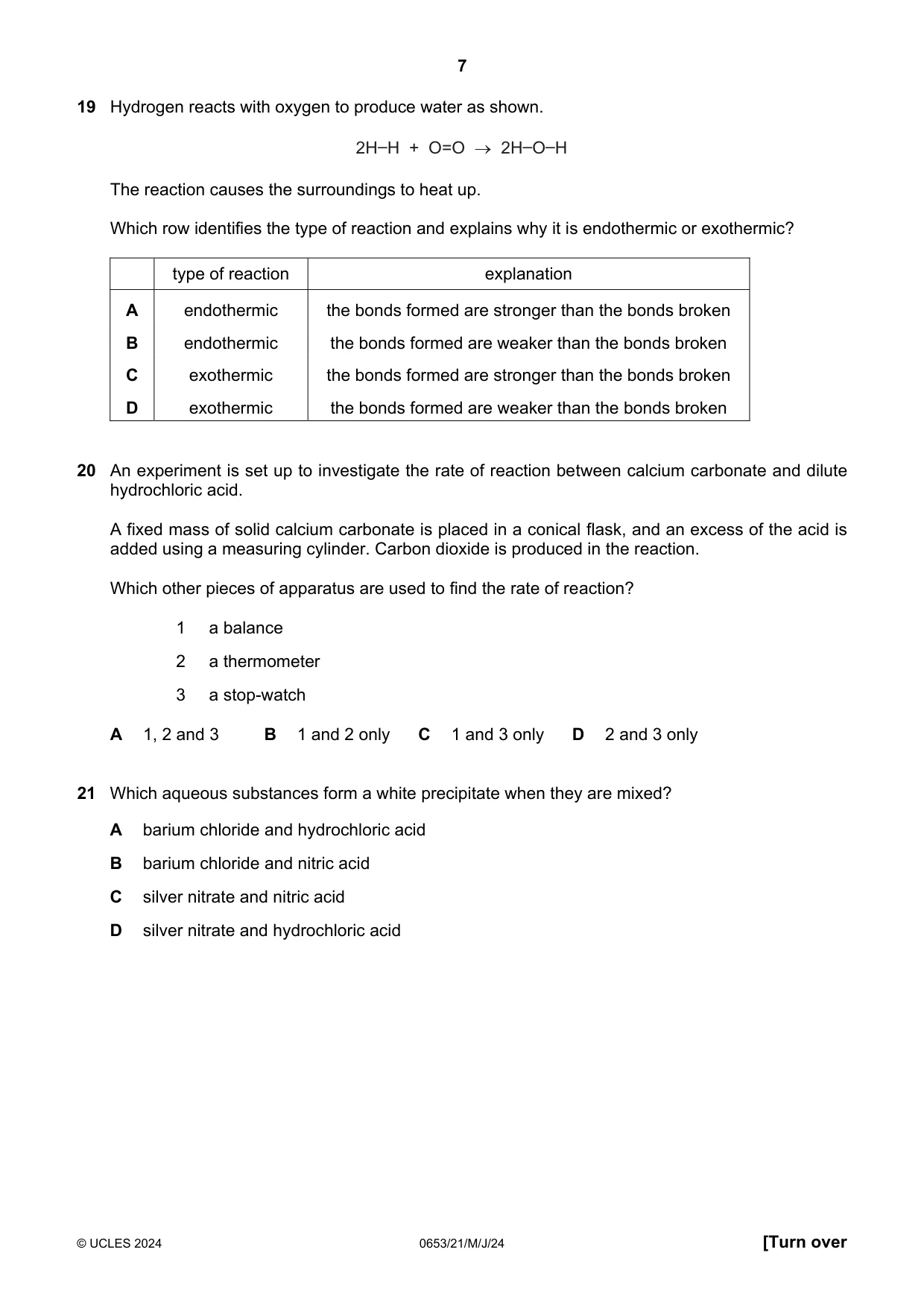
19 Hydrogen reacts with oxygen to produce water as shown. 2H-H + O=O — 2H-O-H The reaction causes the surroundings to heat up. Which row identifies the type of reaction and explains why it is endothermic or exothermic? type of reaction explanation A endothermic the bonds formed are stronger than the bonds broken B endothermic the bonds formed are weaker than the bonds broken Cc exothermic the bonds formed are stronger than the bonds broken D exothermic the bonds formed are weaker than the bonds broken
Mark scheme: C
Q20 · An experiment is set up to investigate the rate of reaction between calcium carbonate and…
20 An experiment is set up to investigate the rate of reaction between calcium carbonate and dilute hydrochloric acid. A fixed mass of solid calcium carbonate is placed in a conical flask, and an excess of the acid is added using a measuring cylinder. Carbon dioxide is produced in the reaction. Which other pieces of apparatus are used to find the rate of reaction? 1 a balance 2 a thermometer 3 a stop-watch A 1, 2 and 3 B 1 and 2 only C 1 and 3 only D 2 and 3 only
Mark scheme: C
Q21 · Which aqueous substances form a white precipitate when they are mixed?
21 Which aqueous substances form a white precipitate when they are mixed? A barium chloride and hydrochloric acid B barium chloride and nitric acid C silver nitrate and nitric acid D silver nitrate and hydrochloric acid
Mark scheme: D
Q22 · All sodium compounds are soluble
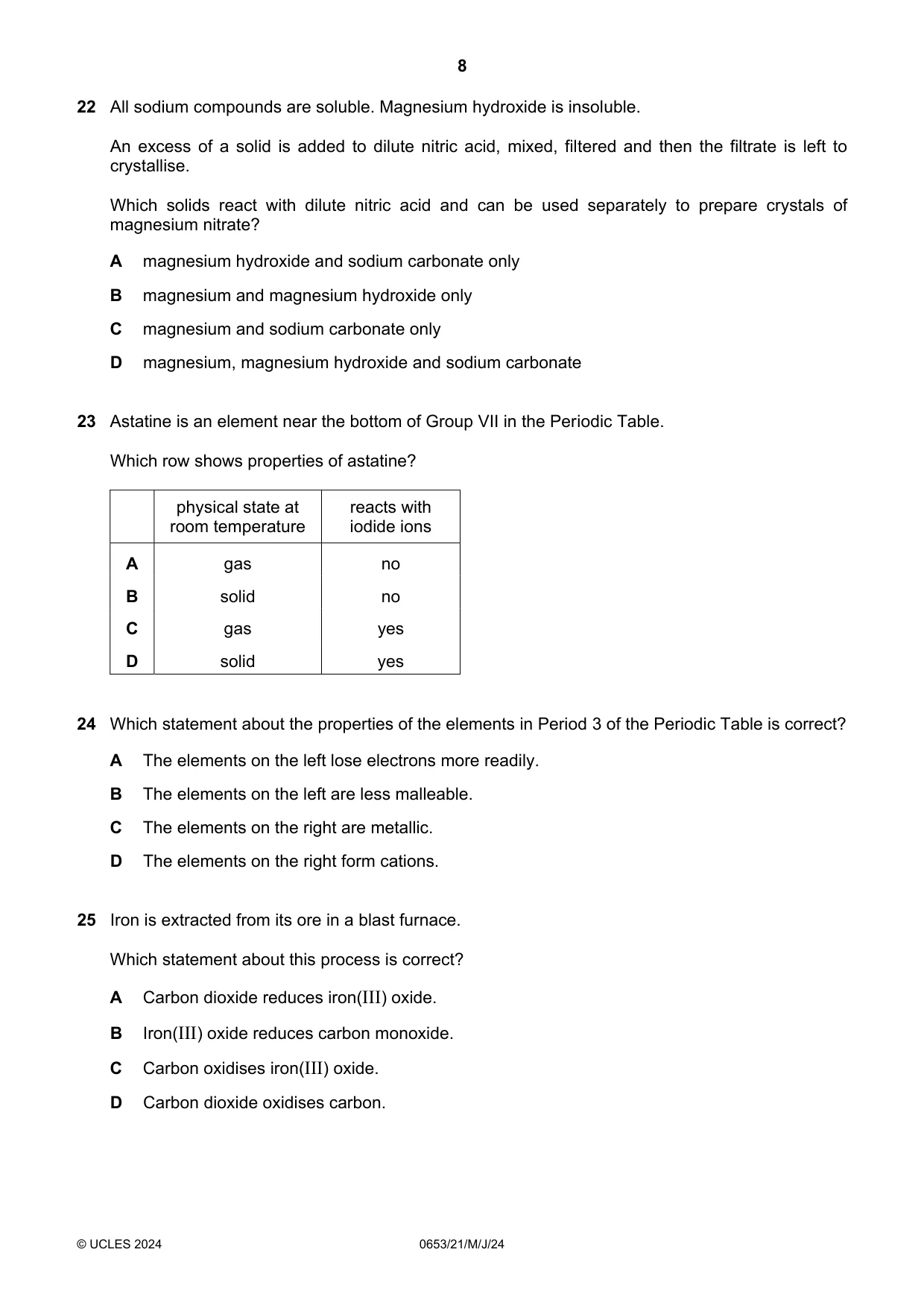
22 All sodium compounds are soluble. Magnesium hydroxide is insoluble. An excess of a solid is added to dilute nitric acid, mixed, filtered and then the filtrate is left to crystallise. Which solids react with dilute nitric acid and can be used separately to prepare crystals of magnesium nitrate? A magnesium hydroxide and sodium carbonate only B magnesium and magnesium hydroxide only C magnesium and sodium carbonate only D magnesium, magnesium hydroxide and sodium carbonate
Mark scheme: B
Q23 · Astatine is an element near the bottom of Group VII in the Periodic Table
23 Astatine is an element near the bottom of Group VII in the Periodic Table. Which row shows properties of astatine? physical state at reacts with room temperature iodide ions A gas no B solid no C gas yes D solid yes
Mark scheme: B
Q24 · Which statement about the properties of the elements in Period 3 of the Periodic Table is…
24 Which statement about the properties of the elements in Period 3 of the Periodic Table is correct? A The elements on the left lose electrons more readily. B The elements on the left are less malleable. C The elements on the right are metallic. D The elements on the right form cations.
Mark scheme: A
Q25 · Iron is extracted from its ore in a blast furnace
25 Iron is extracted from its ore in a blast furnace. Which statement about this process is correct? A Carbon dioxide reduces iron(III) oxide. B Iron(III) oxide reduces carbon monoxide. C Carbon oxidises iron(III) oxide. D Carbon dioxide oxidises carbon.
Mark scheme: D
Q26 · A water supply contains small insoluble impurities
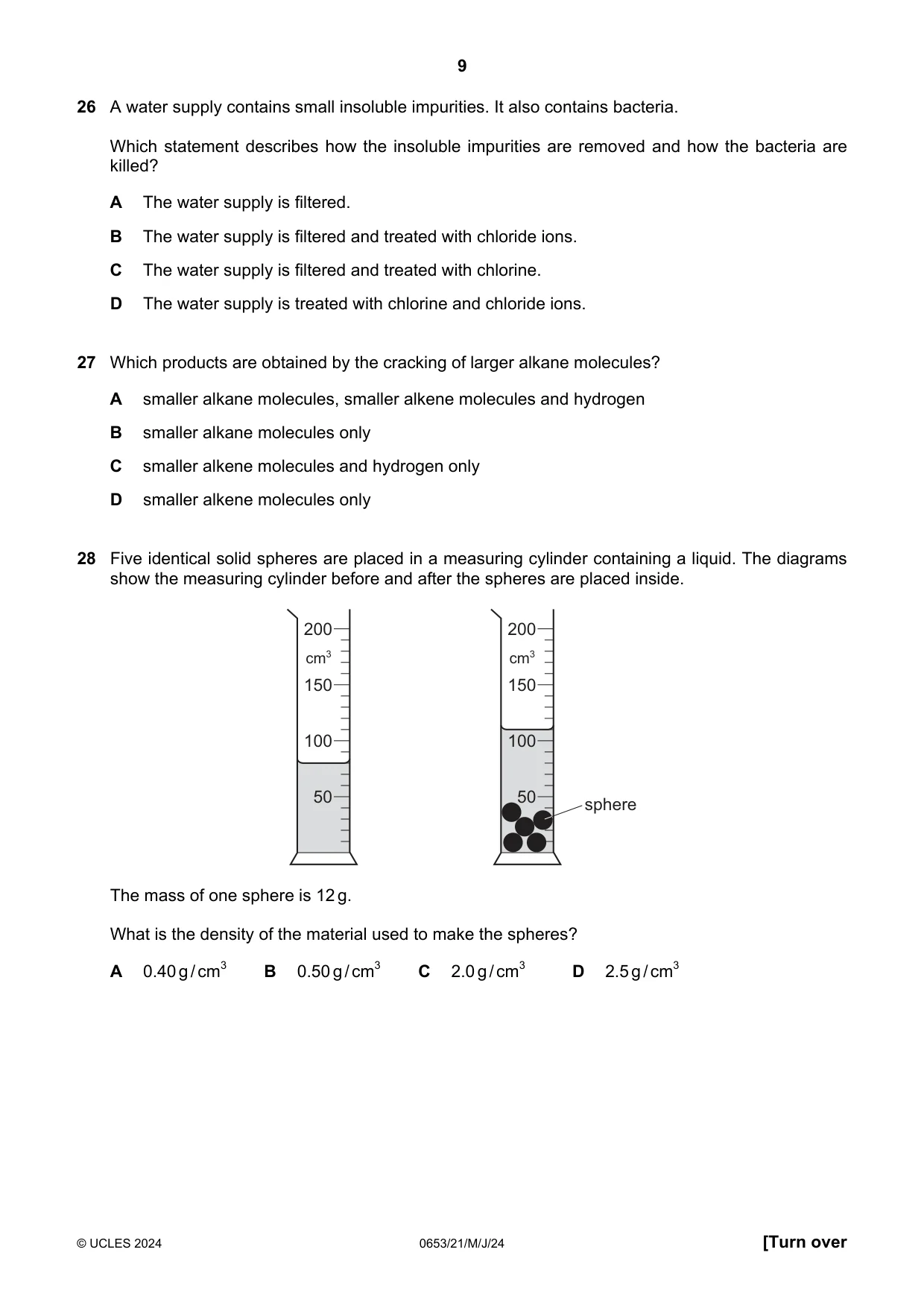
26 A water supply contains small insoluble impurities. It also contains bacteria. Which statement describes how the insoluble impurities are removed and how the bacteria are killed? A The water supply is filtered. B The water supply is filtered and treated with chloride ions. C The water supply is filtered and treated with chlorine. D The water supply is treated with chlorine and chloride ions.
Mark scheme: C
Q27 · Which products are obtained by the cracking of larger alkane molecules?
27 Which products are obtained by the cracking of larger alkane molecules? A smaller alkane molecules, smaller alkene molecules and hydrogen B smaller alkane molecules only C smaller alkene molecules and hydrogen only D smaller alkene molecules only
Mark scheme: A
Q28 · Five identical solid spheres are placed in a measuring cylinder containing a liquid
28 Five identical solid spheres are placed in a measuring cylinder containing a liquid. The diagrams show the measuring cylinder before and after the spheres are placed inside. 200 200 cm3 cm3 150 150 100 100 50 50 sphere The mass of one sphere is 12 g. What is the density of the material used to make the spheres? A 0.40 g / cm3 B 0.50 g / cm3 C 2.0 g / cm3 D 2.5 g / cm3
Mark scheme: C
Q29 · A book rests on a table
29 A book rests on a table. Which two quantities are needed to calculate the pressure exerted by the book on the table? A the density of the book and the volume of the book B the density of the book and the area of contact between the book and the table C the weight of the book and the volume of the book D the weight of the book and the area of contact between the book and the table
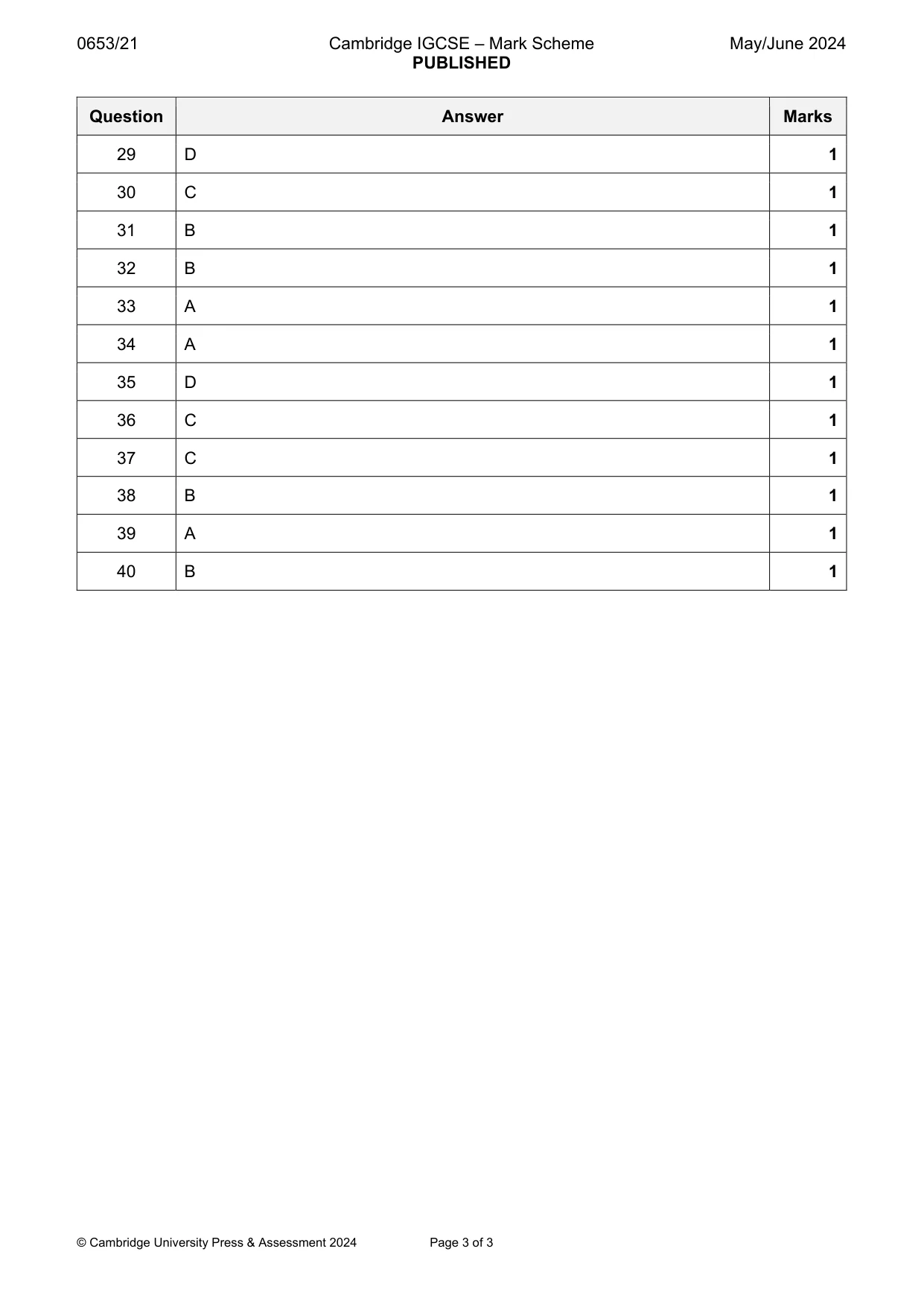
Mark scheme: D
Q30 · Which row shows the expressions for the gravitational potential energy (GPE) and the…
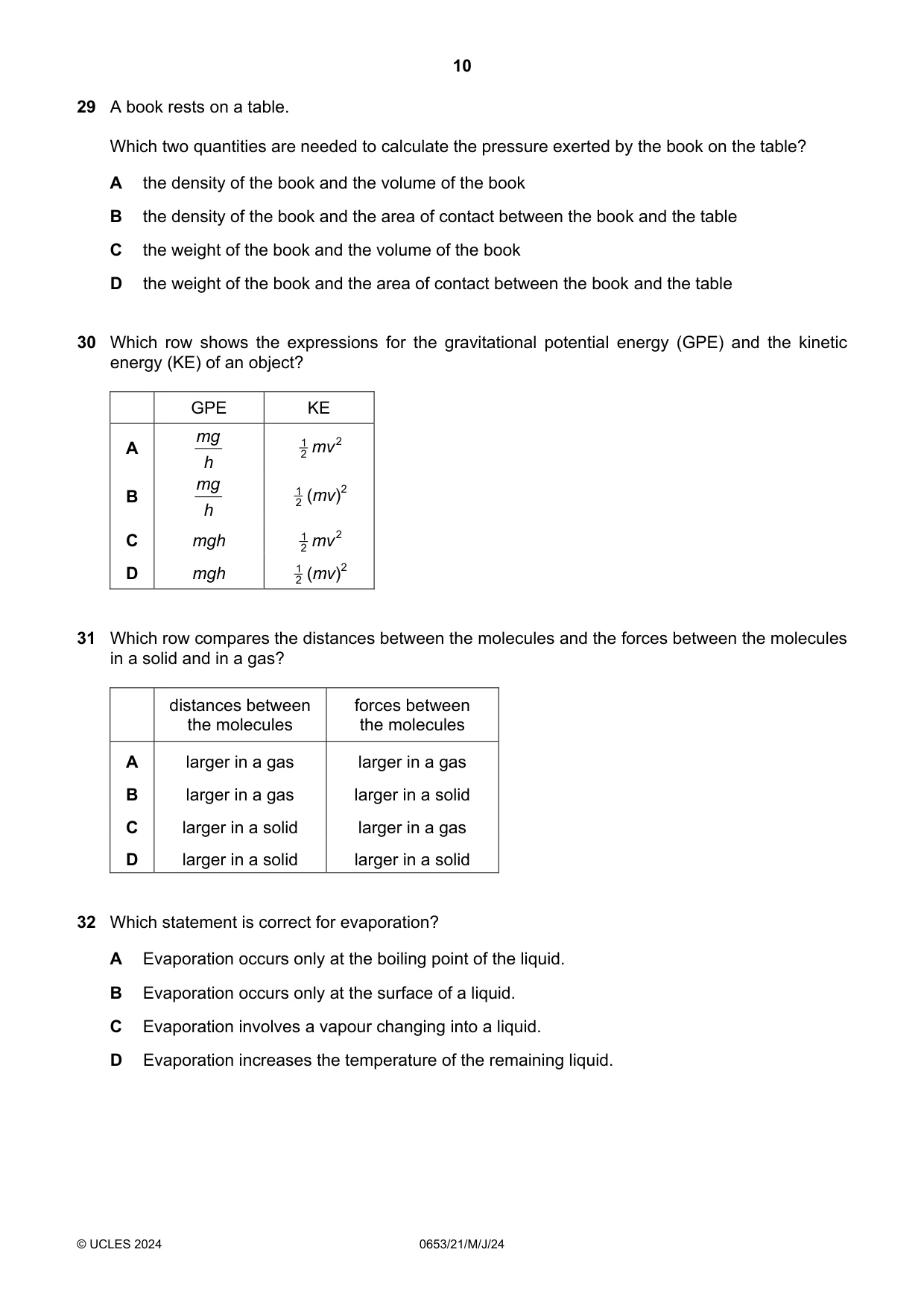
30 Which row shows the expressions for the gravitational potential energy (GPE) and the kinetic energy (KE) of an object? GPE KE mg 1 mv 2 A h 2 mg 1 (mv)2 B h 2 C mgh 1 mv 2 2 D mgh 1 (mv)2 2
Mark scheme: C
Q31 · Which row compares the distances between the molecules and the forces between the…
31 Which row compares the distances between the molecules and the forces between the molecules in a solid and in a gas? distances between forces between the molecules the molecules A larger in a gas larger in a gas B larger in a gas larger in a solid C larger in a solid larger in a gas D larger in a solid larger in a solid
Mark scheme: B
Q32 · Which statement is correct for evaporation?
32 Which statement is correct for evaporation? A Evaporation occurs only at the boiling point of the liquid. B Evaporation occurs only at the surface of a liquid. C Evaporation involves a vapour changing into a liquid. D Evaporation increases the temperature of the remaining liquid.
Mark scheme: B
Q33 · A sea wave reaches the shore at a rate of three wavelengths every 60 s
33 A sea wave reaches the shore at a rate of three wavelengths every 60 s. What is the frequency of the wave? A 0.050 Hz B 1.0 Hz C 3.0 Hz D 20 Hz
Mark scheme: A
Q34 · A sound wave moves from a solid into a liquid
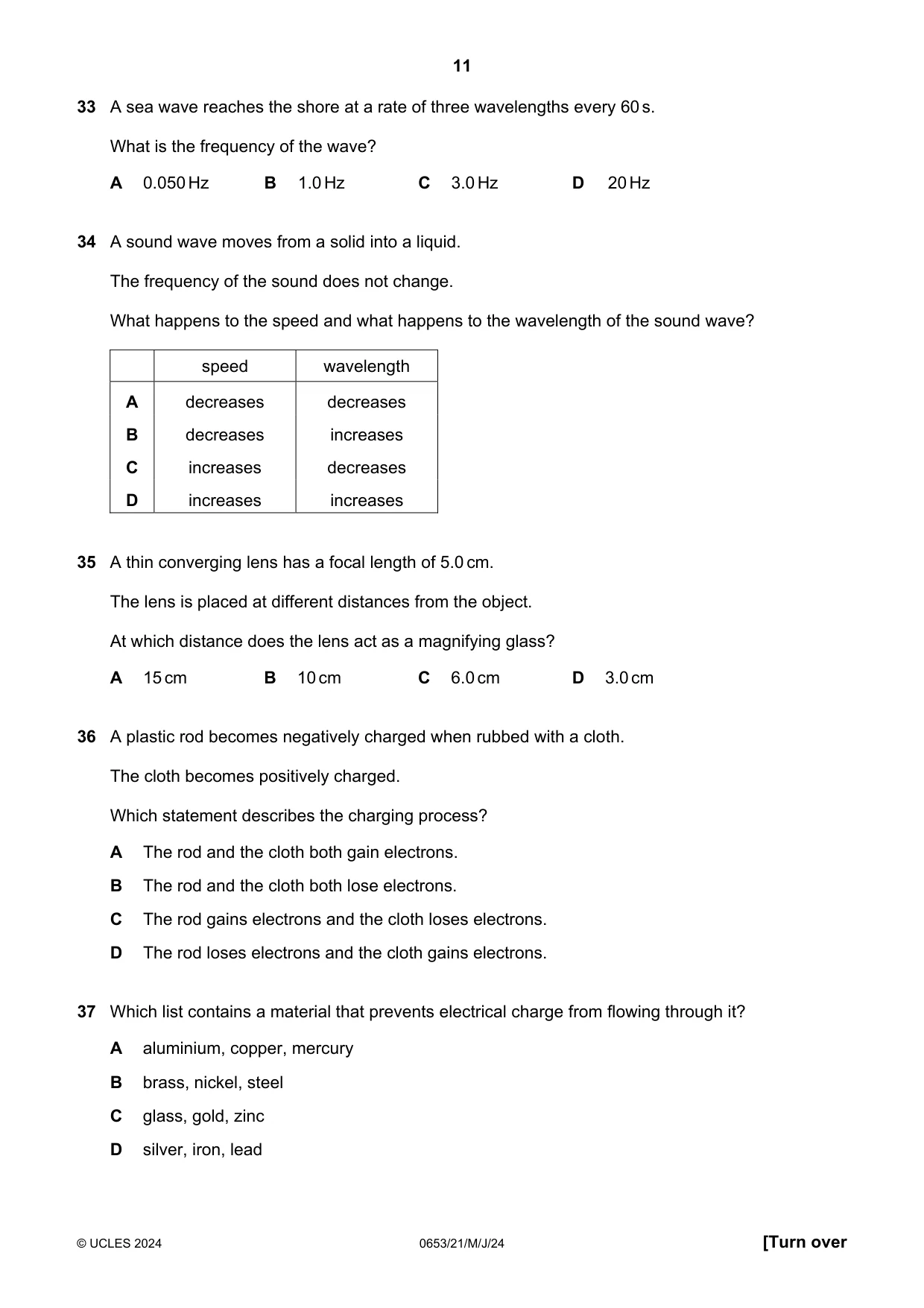
34 A sound wave moves from a solid into a liquid. The frequency of the sound does not change. What happens to the speed and what happens to the wavelength of the sound wave? speed wavelength A decreases decreases B decreases increases C increases decreases D increases increases
Mark scheme: A
Q35 · A thin converging lens has a focal length of 5.0 cm
35 A thin converging lens has a focal length of 5.0 cm. The lens is placed at different distances from the object. At which distance does the lens act as a magnifying glass? A 15 cm B 10 cm C 6.0 cm D 3.0 cm
Mark scheme: D
Q36 · A plastic rod becomes negatively charged when rubbed with a cloth
36 A plastic rod becomes negatively charged when rubbed with a cloth. The cloth becomes positively charged. Which statement describes the charging process? A The rod and the cloth both gain electrons. B The rod and the cloth both lose electrons. C The rod gains electrons and the cloth loses electrons. D The rod loses electrons and the cloth gains electrons.
Mark scheme: C
Q37 · Which list contains a material that prevents electrical charge from flowing through it?
37 Which list contains a material that prevents electrical charge from flowing through it? A aluminium, copper, mercury B brass, nickel, steel C glass, gold, zinc D silver, iron, lead
Mark scheme: C
Q38 · Which expression is equal to current?
38 Which expression is equal to current? A charge time charge B time C resistance potential difference (p.d.) resistance D potential difference (p.d.)
Mark scheme: B
Q39 · The diagrams show four circuits, each containing an ammeter and two lamps of different…
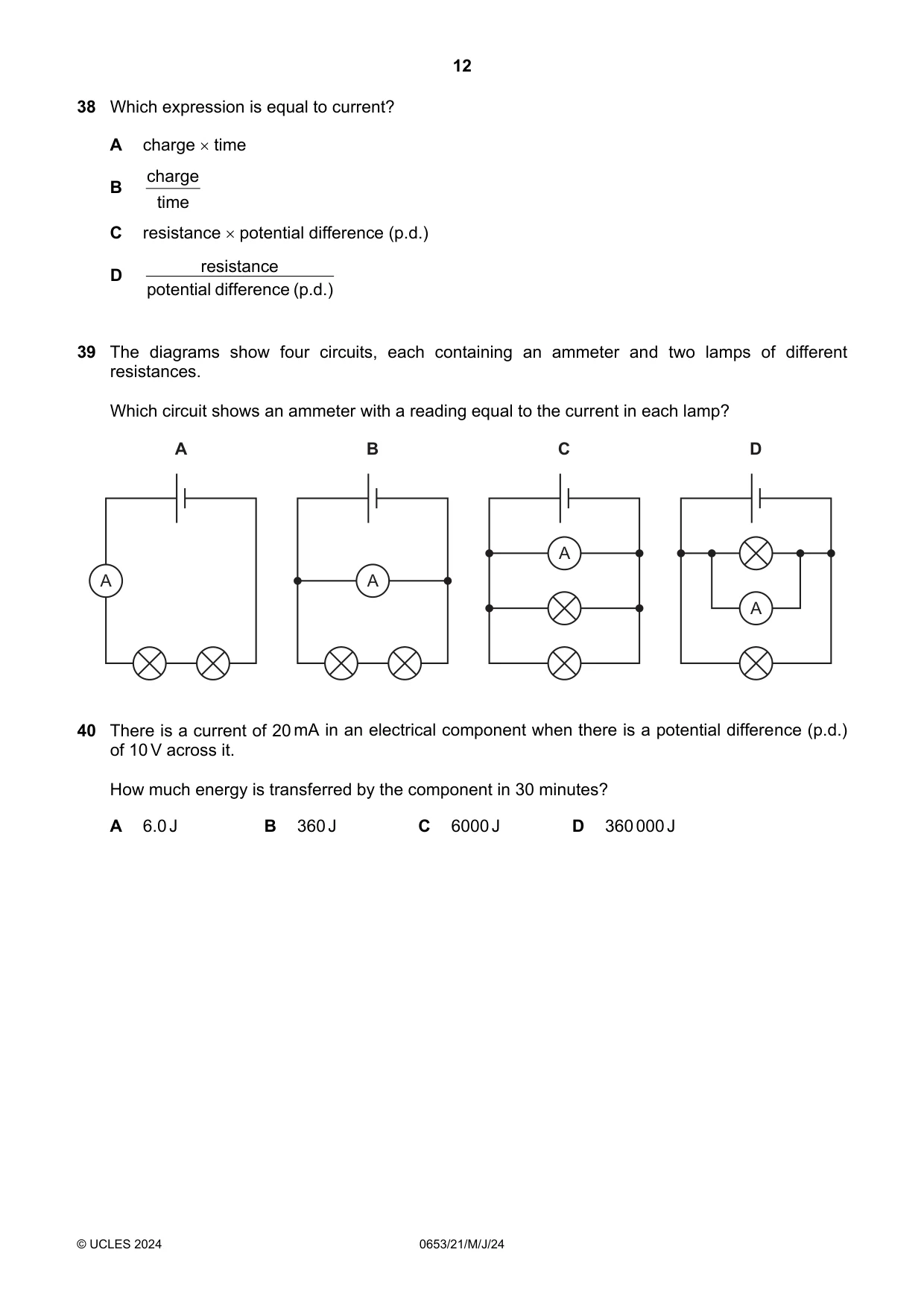
39 The diagrams show four circuits, each containing an ammeter and two lamps of different resistances. Which circuit shows an ammeter with a reading equal to the current in each lamp? A B C D A A A A
Mark scheme: A
Q40 · There is a current of 20 mA in an electrical component when there is a potential…
40 There is a current of 20 mA in an electrical component when there is a potential difference (p.d.) of 10 V across it. How much energy is transferred by the component in 30 minutes? A 6.0 J B 360 J C 6000 J D 360 000 J
Mark scheme: B
What was in this paper
The subtopics covered by these 40 questions, and how many questions each got. Open one in a new tab to see every Cambridge question on it.
3Digestion2Electrical quantities2Energy, work and power2Respiration2Sexual reproduction in plants2Alkenes1Arrangement of elements1Atomic structure and the Periodic Table1Blood vessels1Cell structure1Characteristics of living organisms1Density1Drugs1Electrical circuits1Electrical safety1Electrolysis1Exothermic and endothermic reactions1Extraction of metals1Food chains and food webs1General properties of waves1Group VII properties1Identification of ions and gases1Ions and ionic bonds1Leaf structure1Light1Physical and chemical changes1Preparation of salts1Pressure1Rate of reaction1Sexual reproduction in humans1Sound1Water1What you needed in this session
Cambridge’s own grade thresholds for 2024 May/June, Paper 2 · Variant 1. A higher threshold means an easier paper — the bar moves with how the cohort did.