Cambridge IGCSE Science - Combined 0653 — 2023 May/June Paper 2 · Variant 1
0653/21/M/J/23 · 40 questions · 40 marks · ≈45 min
The question paper and its mark scheme, free to read here and free to download. This is Cambridge’s own paper, exactly as it was sat.
Question paper16 pages

Mark scheme3 pages
Answers below. Sit the paper first if you are practising.
Questions as text
Q1 · Which characteristic of living organisms involves chemical reactions in cells that break…
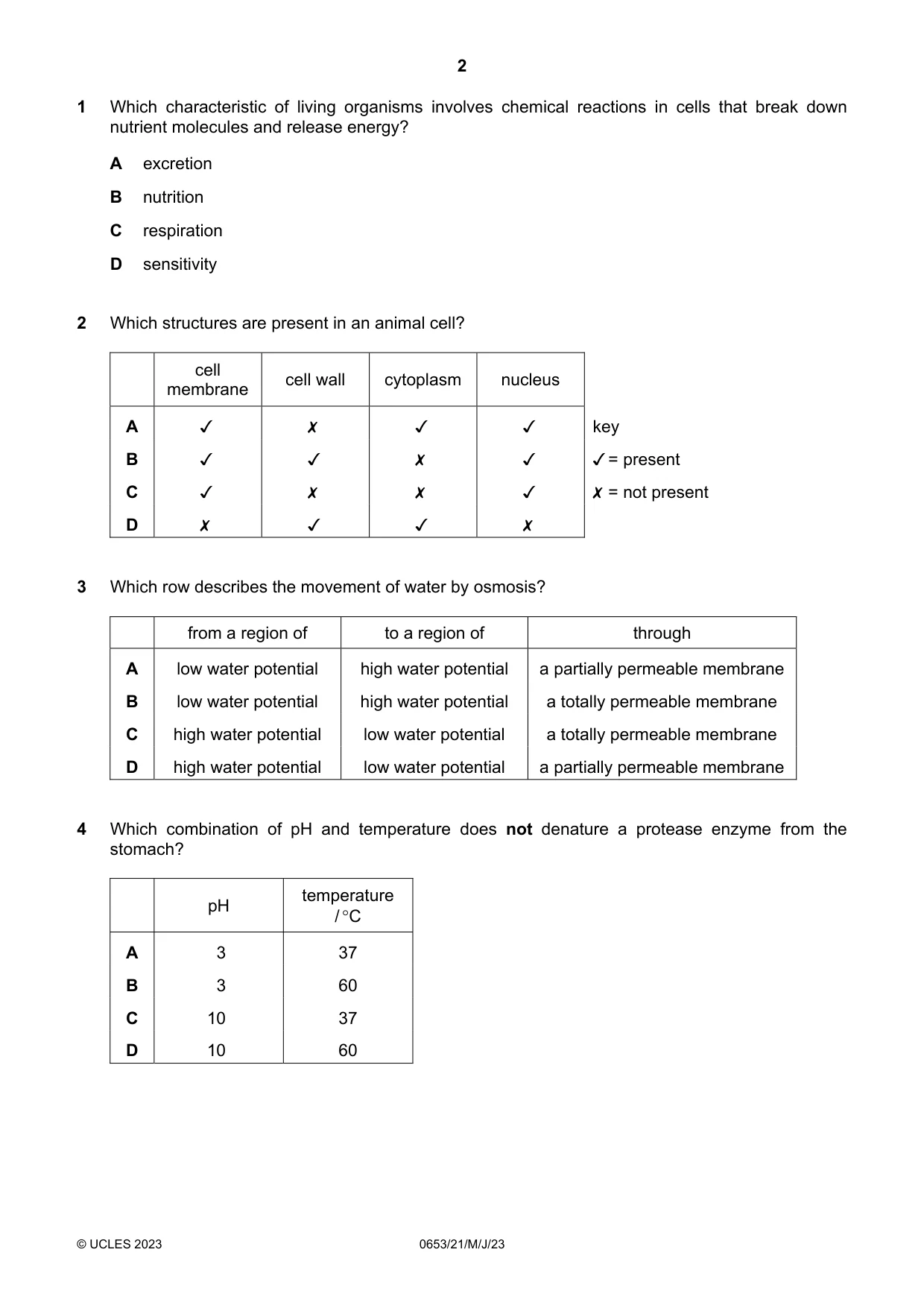
1 Which characteristic of living organisms involves chemical reactions in cells that break down nutrient molecules and release energy? A excretion B nutrition C respiration D sensitivity
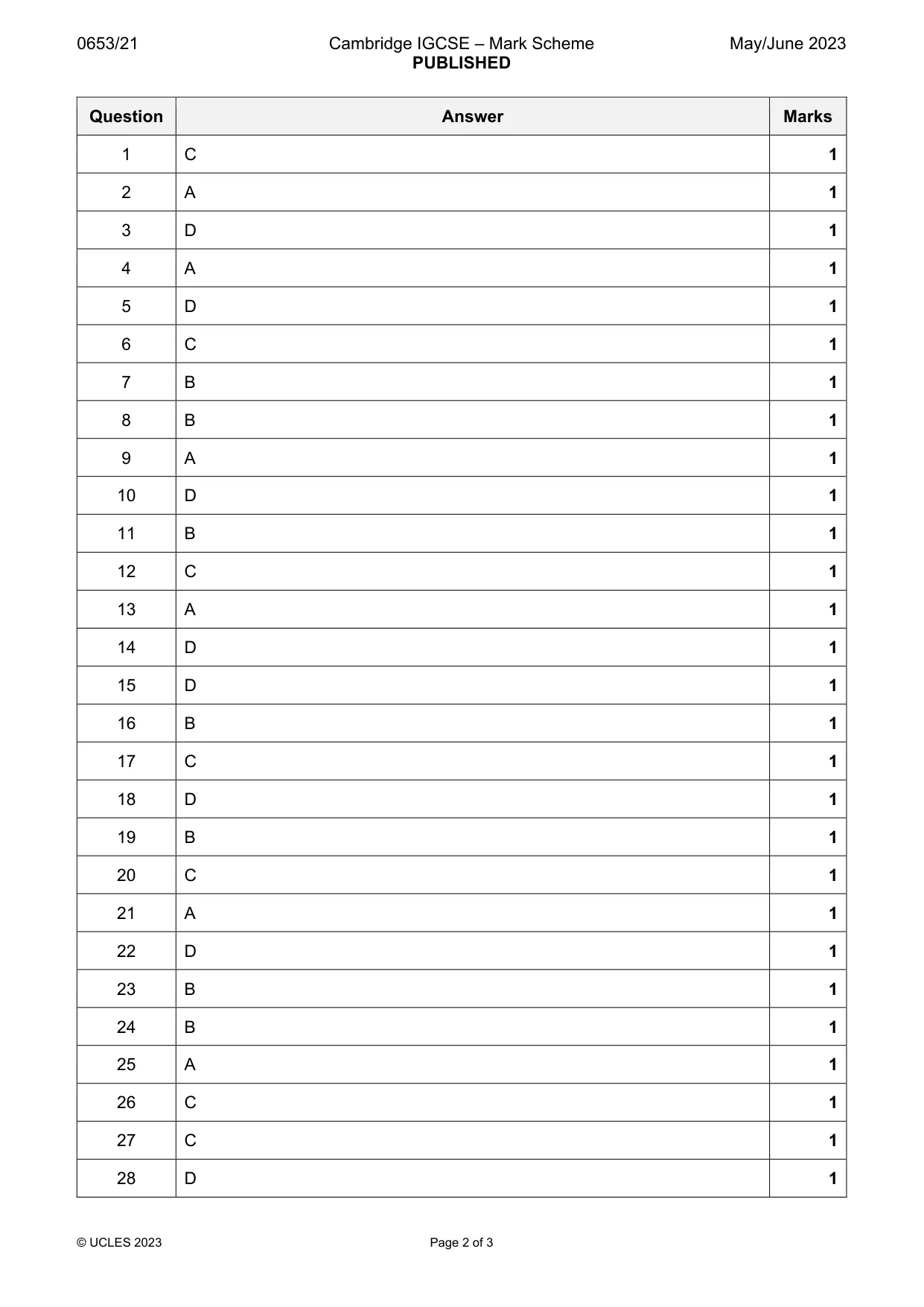
Mark scheme: C
Q2 · Which structures are present in an animal cell?
2 Which structures are present in an animal cell? cell membrane cell wall cytoplasm nucleus A WA x W, y B WA V4 x y Cc J x x y D x V4 W, x key / = present X = not present
Mark scheme: A
Q3 · Which row describes the movement of water by osmosis?
3 Which row describes the movement of water by osmosis? from a region of to a region of through A low water potential high water potential a partially permeable membrane B low water potential high water potential a totally permeable membrane C high water potential low water potential a totally permeable membrane D high water potential low water potential a partially permeable membrane
Mark scheme: D
Q4 · Which combination of pH and temperature does not denature a protease enzyme from the…
4 Which combination of pH and temperature does not denature a protease enzyme from the stomach? temperature pH / °C A 3 37 B 3 60 C 10 37 D 10 60
Mark scheme: A
Q5 · Four test-tubes are set up as shown
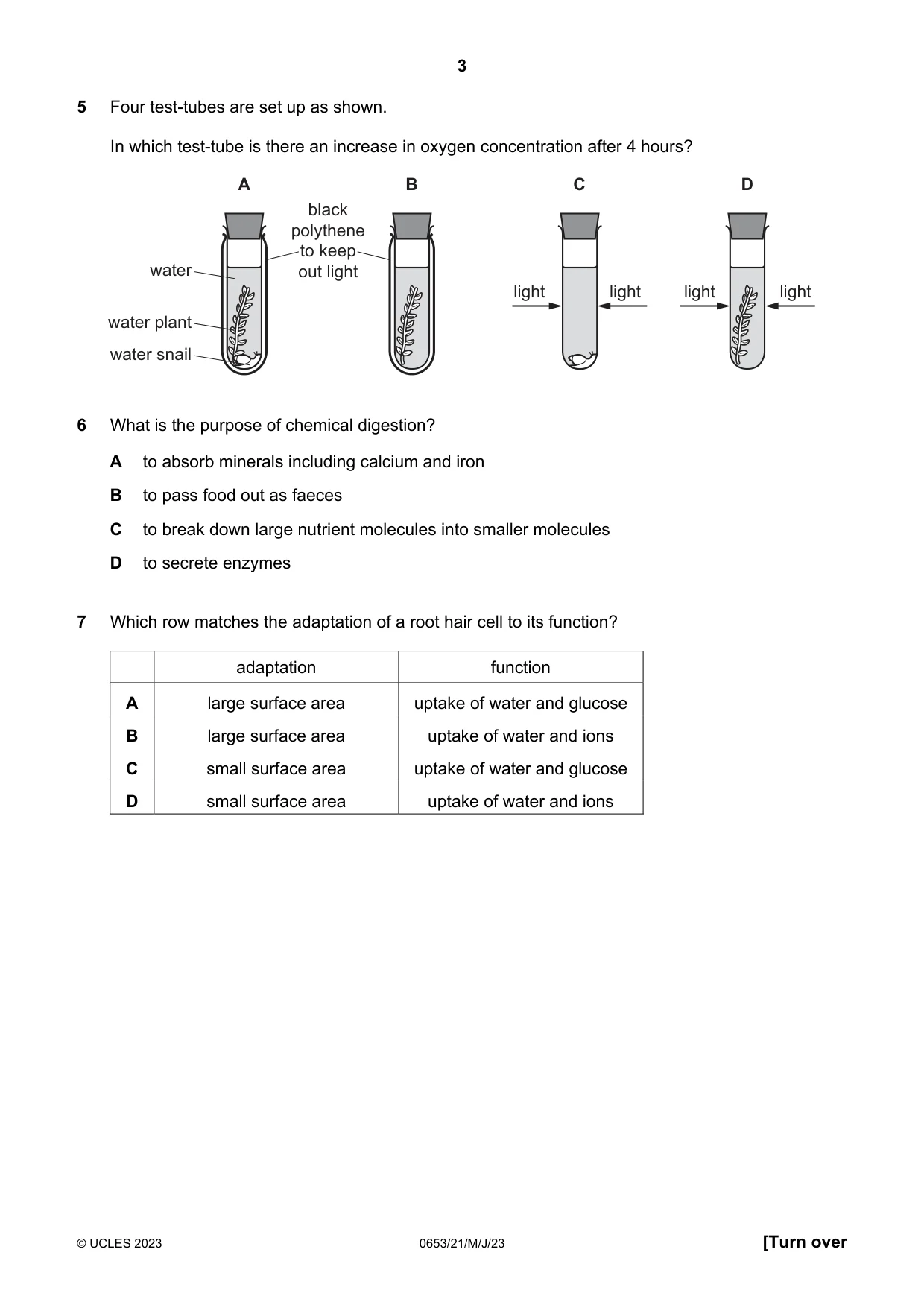
5 Four test-tubes are set up as shown. In which test-tube is there an increase in oxygen concentration after 4 hours? A B C D black polythene to keep water out light light light light light water plant water snail
Mark scheme: D
Q6 · What is the purpose of chemical digestion?
6 What is the purpose of chemical digestion? A to absorb minerals including calcium and iron B to pass food out as faeces C to break down large nutrient molecules into smaller molecules D to secrete enzymes
Mark scheme: C
Q7 · Which row matches the adaptation of a root hair cell to its function?
7 Which row matches the adaptation of a root hair cell to its function? adaptation function A large surface area uptake of water and glucose B large surface area uptake of water and ions C small surface area uptake of water and glucose D small surface area uptake of water and ions
Mark scheme: B
Q8 · The diagram shows a section through the heart
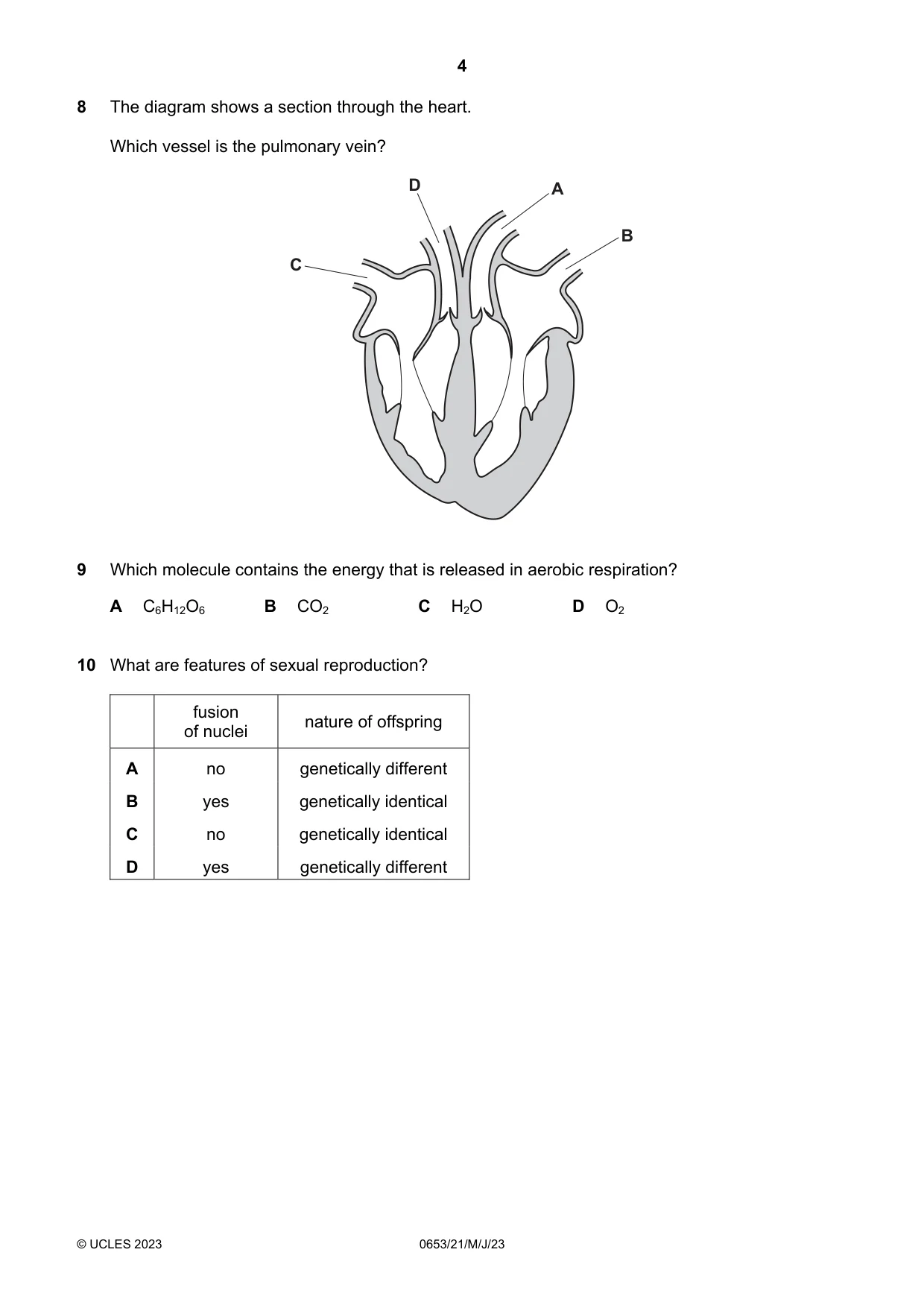
8 The diagram shows a section through the heart. Which vessel is the pulmonary vein? D A B C
Mark scheme: B
Q9 · Which molecule contains the energy that is released in aerobic respiration?
9 Which molecule contains the energy that is released in aerobic respiration? A C6H12O6 B CO2 C H2O D O2
Mark scheme: A
Q10 · What are features of sexual reproduction?
10 What are features of sexual reproduction? fusion nature of offspring of nuclei A no genetically different B yes genetically identical C no genetically identical D yes genetically different
Mark scheme: D
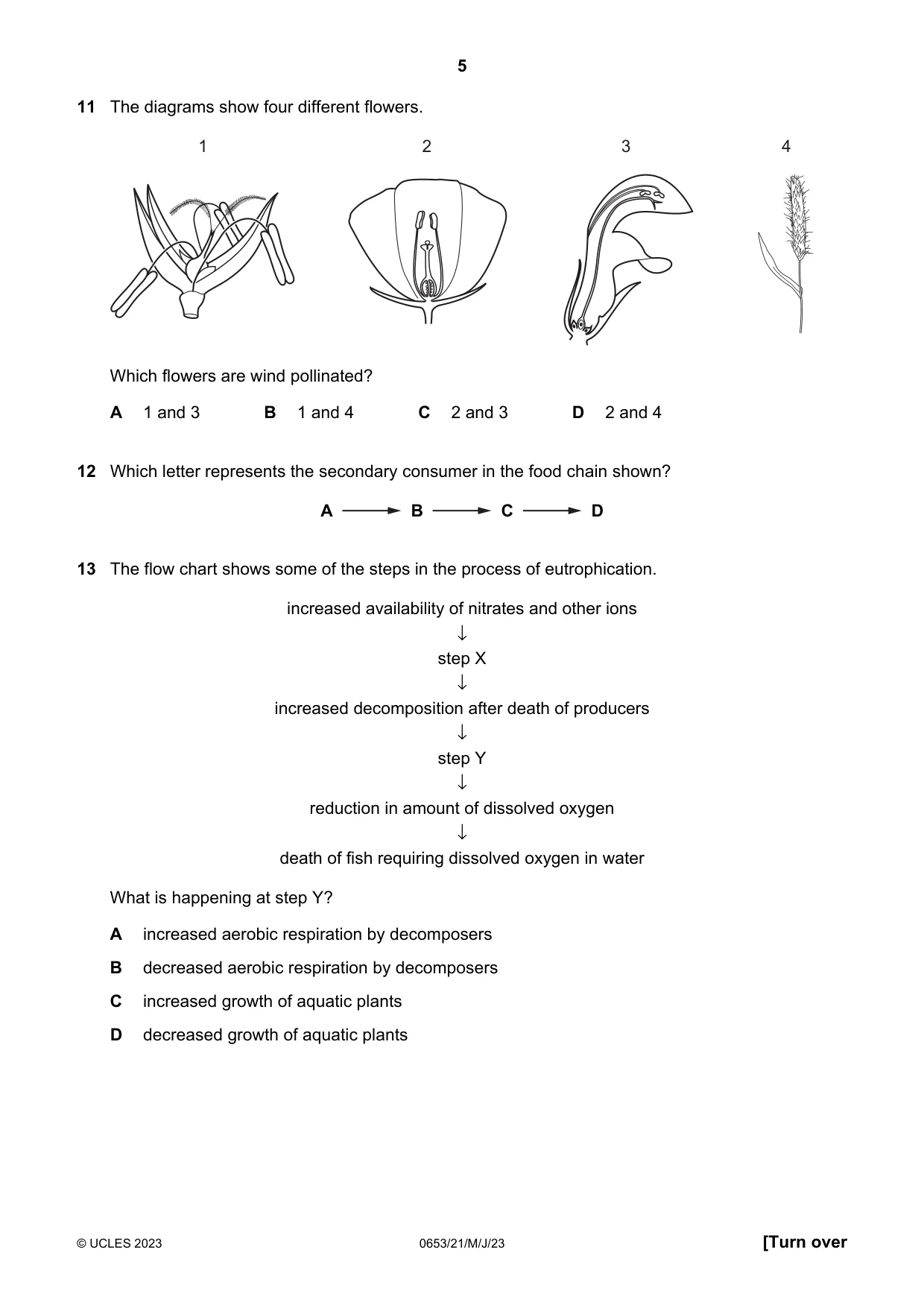
Q11 · The diagrams show four different flowers
11 The diagrams show four different flowers. 1 2 3 4 Which flowers are wind pollinated? A 1 and 3 B 1 and 4 C 2 and 3 D 2 and 4
Mark scheme: B
Q12 · Which letter represents the secondary consumer in the food chain shown?
12 Which letter represents the secondary consumer in the food chain shown? A B C D
Mark scheme: C
Q13 · The flow chart shows some of the steps in the process of eutrophication
13 The flow chart shows some of the steps in the process of eutrophication. increased availability of nitrates and other ions ↓ step X ↓ increased decomposition after death of producers ↓ step Y ↓ reduction in amount of dissolved oxygen ↓ death of fish requiring dissolved oxygen in water What is happening at step Y? A increased aerobic respiration by decomposers B decreased aerobic respiration by decomposers C increased growth of aquatic plants D decreased growth of aquatic plants
Mark scheme: A
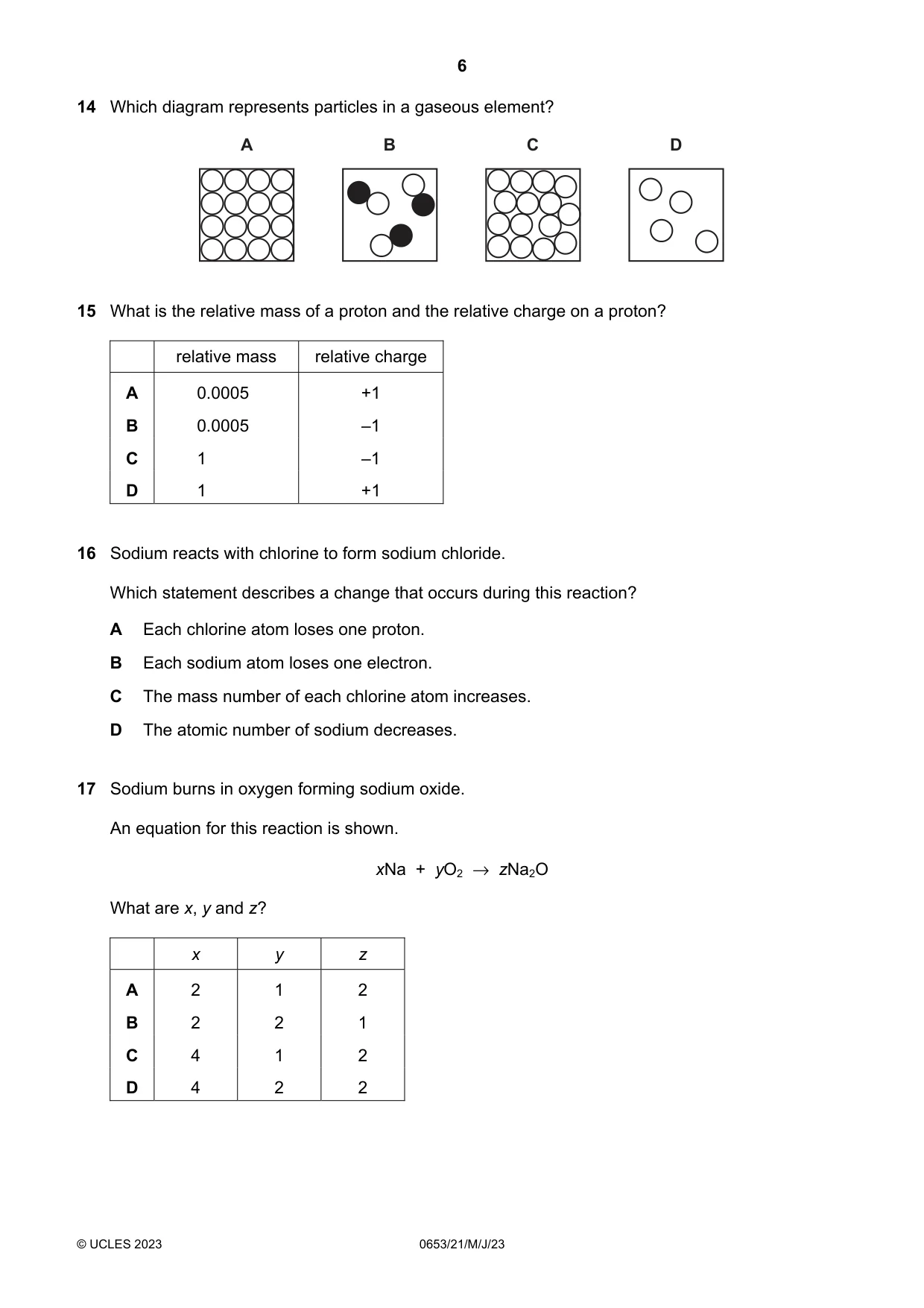
Q14 · Which diagram represents particles in a gaseous element?
14 Which diagram represents particles in a gaseous element? A B C D
Mark scheme: D
Q15 · What is the relative mass of a proton and the relative charge on a proton?
15 What is the relative mass of a proton and the relative charge on a proton? relative mass relative charge A 0.0005 +1 B 0.0005 –1 C 1 –1 D 1 +1
Mark scheme: D
Q16 · Sodium reacts with chlorine to form sodium chloride
16 Sodium reacts with chlorine to form sodium chloride. Which statement describes a change that occurs during this reaction? A Each chlorine atom loses one proton. B Each sodium atom loses one electron. C The mass number of each chlorine atom increases. D The atomic number of sodium decreases.
Mark scheme: B
Q17 · Sodium burns in oxygen forming sodium oxide
17 Sodium burns in oxygen forming sodium oxide. An equation for this reaction is shown. xNa + yO2 → zNa2O What are x, y and z? x y z A 2 1 2 B 2 2 1 C 4 1 2 D 4 2 2
Mark scheme: C
Q18 · Which statement about the electrolysis of molten lead(II) bromide is correct?
18 Which statement about the electrolysis of molten lead(II) bromide is correct? A Lead anions move to the anode where they gain electrons. B Lead anions move to the cathode where they lose electrons. C Lead cations move to the anode where they lose electrons. D Lead cations move to the cathode where they gain electrons.
Mark scheme: D
Q19 · Which process is endothermic?
19 Which process is endothermic? A the reaction of petrol with air in a car engine B Cl –Cl → Cl + Cl C the reaction of potassium with water D C + O2 → CO2
Mark scheme: B
Q20 · The equation for the reaction of zinc oxide with carbon monoxide is shown
20 The equation for the reaction of zinc oxide with carbon monoxide is shown. ZnO + CO → Zn + CO2 Which statement explains the role of carbon monoxide in this reaction? A It is the oxidising agent and it is oxidised. B It is the oxidising agent and it is reduced. C It is the reducing agent and it is oxidised. D It is the reducing agent and it is reduced.
Mark scheme: C
Q21 · Dilute hydrochloric acid is tested with universal indicator and with calcium carbonate
21 Dilute hydrochloric acid is tested with universal indicator and with calcium carbonate. Which row shows the pH and describes the reaction with calcium carbonate? pH reaction with calcium carbonate A 2 a colourless gas is given off B 2 no reaction C 10 a colourless gas is given off D 10 no reaction
Mark scheme: A
More questions on The characteristic properties of acids and bases
Q22 · The results of two tests on a solution of substance R are shown
22 The results of two tests on a solution of substance R are shown. test result aqueous sodium red-brown precipitate formed, hydroxide added insoluble in excess dilute nitric acid added followed by aqueous white precipitate formed silver nitrate added What is R? A iron(II) carbonate B iron(III) carbonate C iron(II) chloride D iron(III) chloride
Mark scheme: D
Q23 · The character of the elements changes from metallic to non-metallic across a period of…
23 The character of the elements changes from metallic to non-metallic across a period of the Periodic Table. Which statement explains this change? A Metal atoms need to gain electrons to form metal ions. B It becomes more difficult for elements to lose electrons across a period. C Non-metal atoms lose electrons more easily than metal atoms. D Atoms get bigger across a period.
Mark scheme: B
Q24 · Copper oxide and excess carbon are mixed together
24 Copper oxide and excess carbon are mixed together. The mass before heating is 12.2 g. The mixture is heated strongly and allowed to cool. The mass after heating is 10.4 g. Why does the mass change? A Carbon forms carbon dioxide which then combines with the copper oxide. B Carbon reduces the copper oxide and leaves the test-tube as carbon dioxide. C Copper oxide loses oxygen, turns into copper and the carbon remains unchanged. D Carbon oxidises the copper oxide and leaves the test-tube as carbon dioxide.
Mark scheme: B
Q25 · Which statement about both carbon dioxide and methane is correct?
25 Which statement about both carbon dioxide and methane is correct? A Increased concentrations of carbon dioxide and methane in the air cause an enhanced greenhouse effect. B Methane and carbon dioxide are hydrocarbons. C Respiration increases the concentration of carbon dioxide and methane in the air. D The combustion of fossil fuels increases the concentration of carbon dioxide and methane in the air.
Mark scheme: A
Q26 · Why are alkanes members of the same homologous series?
26 Why are alkanes members of the same homologous series? A They are all hydrocarbons. B They have similar physical properties. C They have the same general formula. D They all undergo combustion to give carbon dioxide and water.
Mark scheme: C
Q27 · What are the products of cracking large alkane molecules?
27 What are the products of cracking large alkane molecules? A smaller alkanes only B smaller alkenes only C smaller alkanes, alkenes and hydrogen D smaller alkanes and hydrogen only
Mark scheme: C
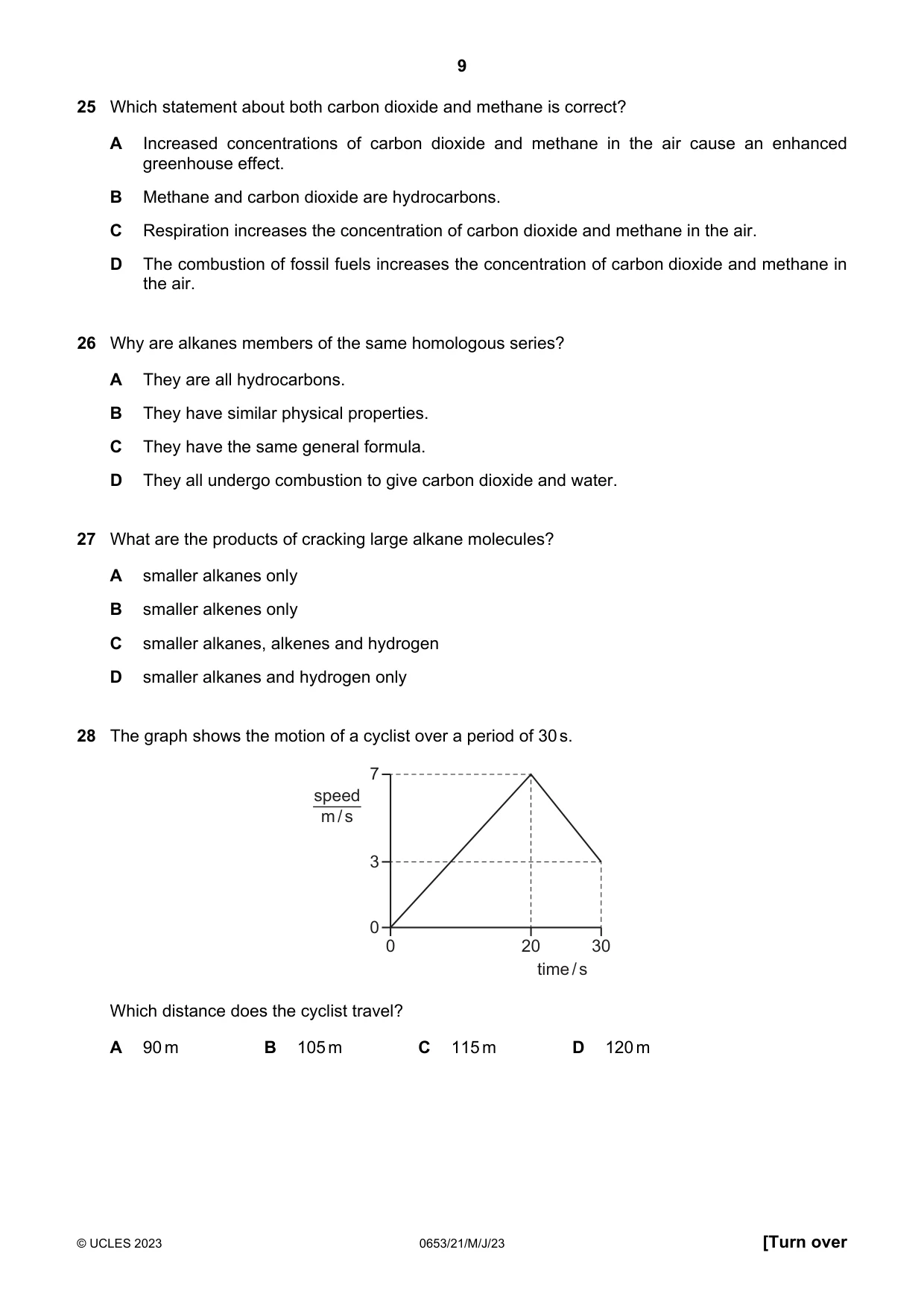
Q28 · The graph shows the motion of a cyclist over a period of 30 s
28 The graph shows the motion of a cyclist over a period of 30 s. 7 speed m / s 3 0 0 20 30 time / s Which distance does the cyclist travel? A 90 m B 105 m C 115 m D 120 m
Mark scheme: D
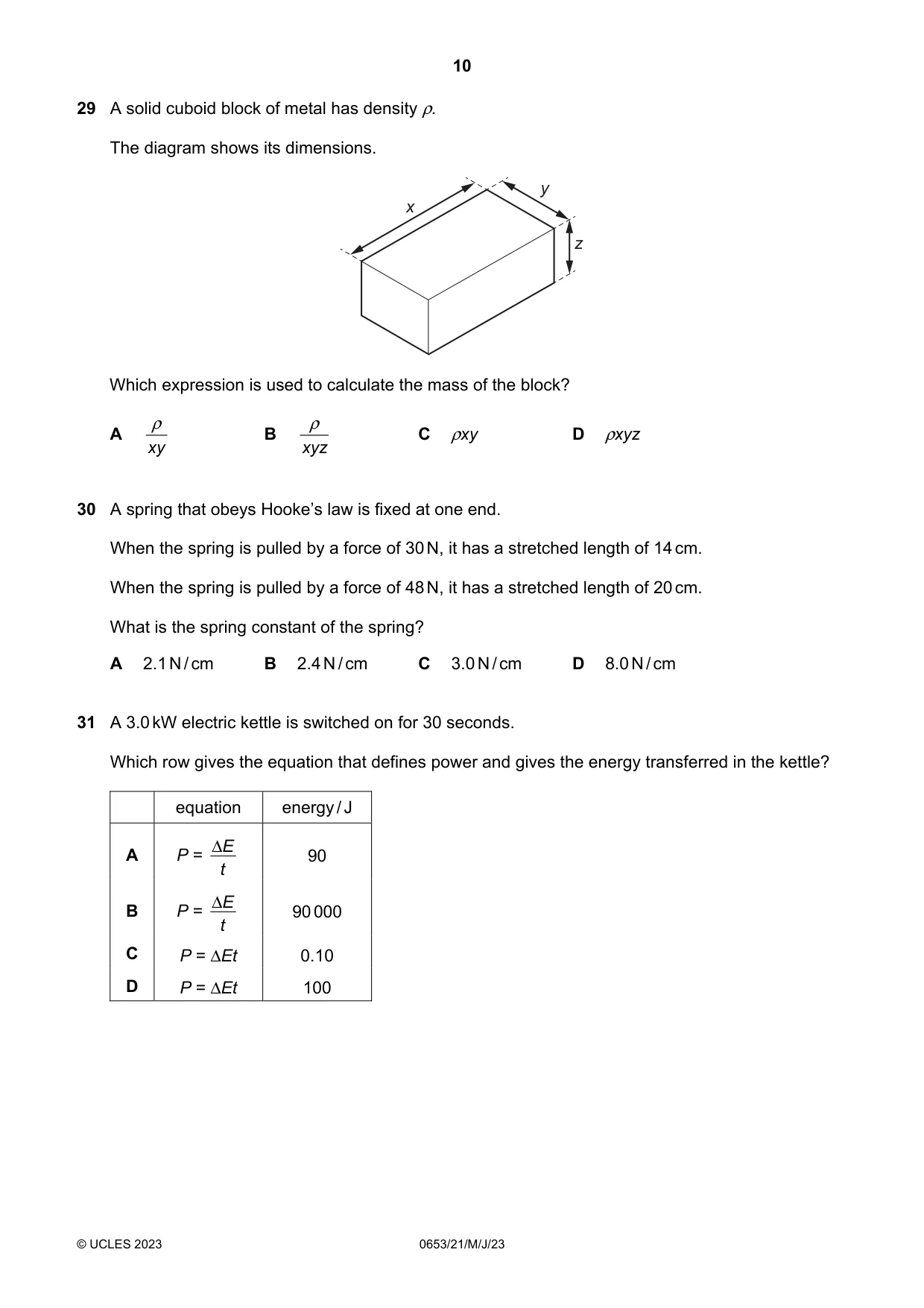
Q29 · A solid cuboid block of metal has density ρ
29 A solid cuboid block of metal has density ρ. The diagram shows its dimensions. y x z Which expression is used to calculate the mass of the block? ρ ρ A B C ρxy D ρxyz xy xyz
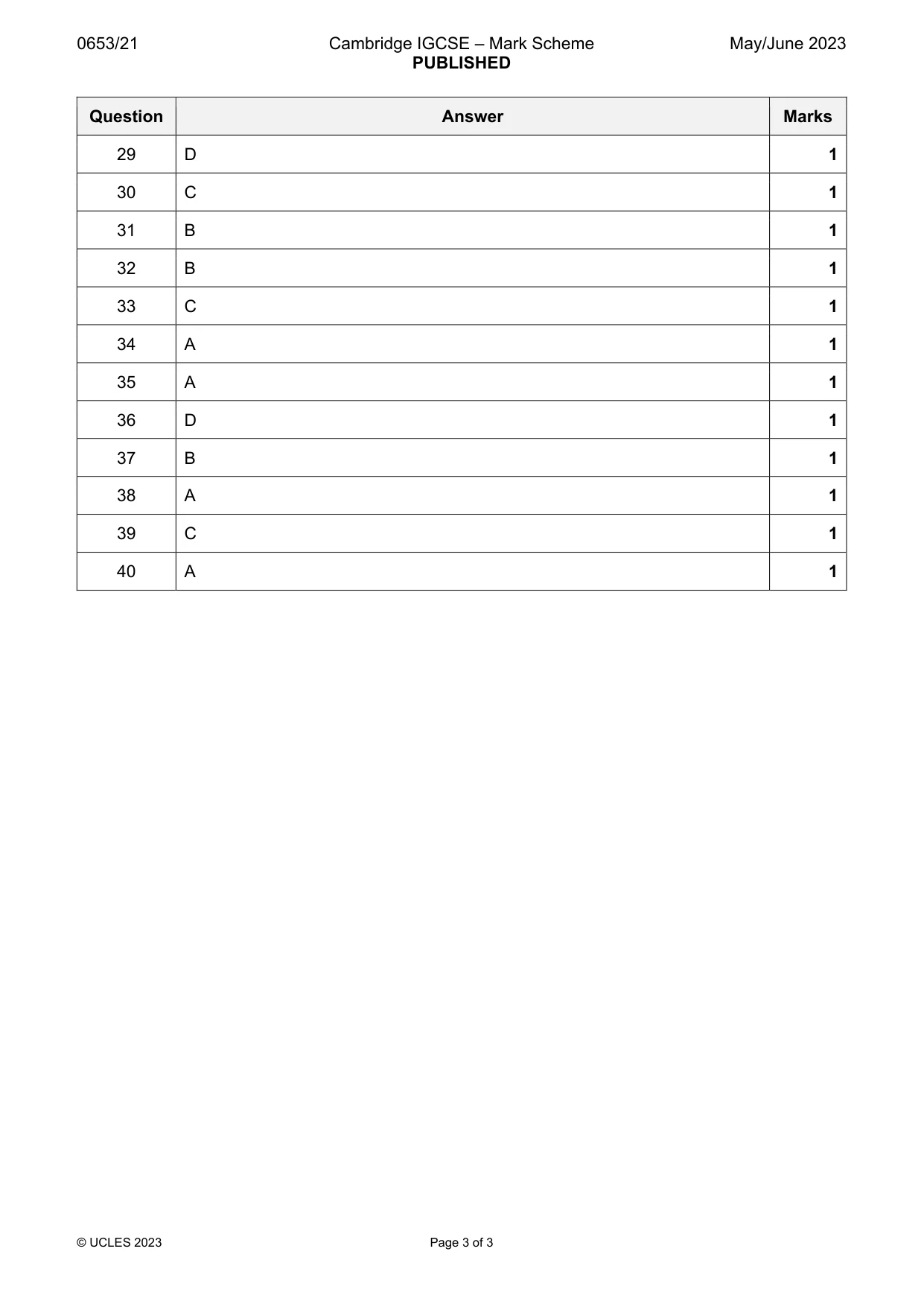
Mark scheme: D
Q30 · A spring that obeys Hooke’s law is fixed at one end
30 A spring that obeys Hooke’s law is fixed at one end. When the spring is pulled by a force of 30 N, it has a stretched length of 14 cm. When the spring is pulled by a force of 48 N, it has a stretched length of 20 cm. What is the spring constant of the spring? A 2.1 N / cm B 2.4 N / cm C 3.0 N / cm D 8.0 N / cm
Mark scheme: C
Q31 · A 3.0 kW electric kettle is switched on for 30 seconds
31 A 3.0 kW electric kettle is switched on for 30 seconds. Which row gives the equation that defines power and gives the energy transferred in the kettle? equation energy / J ∆ E A P = 90 t ∆ E B P = 90 000 t C P = ∆Et 0.10 D P = ∆Et 100
Mark scheme: B
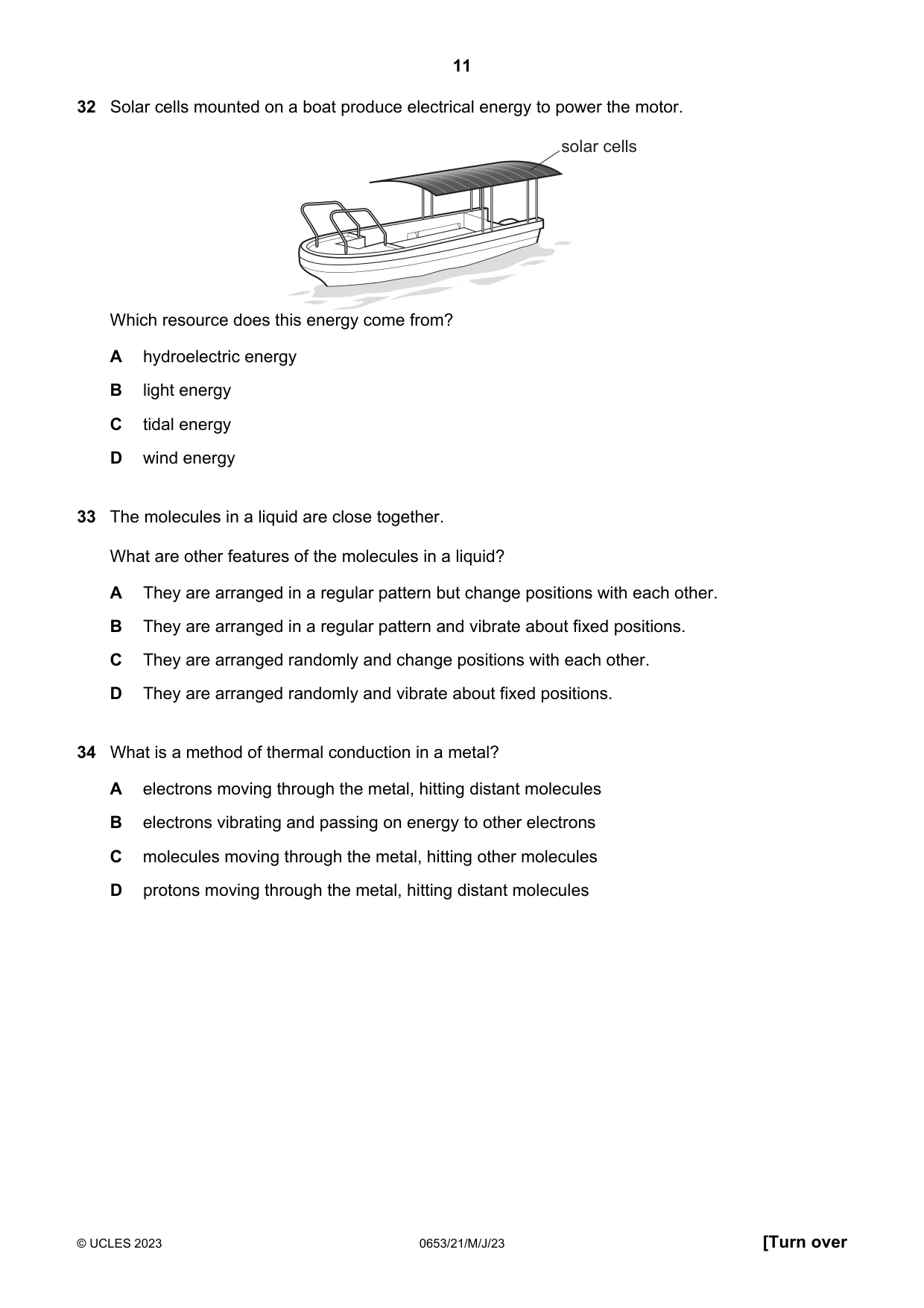
Q32 · Solar cells mounted on a boat produce electrical energy to power the motor
32 Solar cells mounted on a boat produce electrical energy to power the motor. solar cells Which resource does this energy come from? A hydroelectric energy B light energy C tidal energy D wind energy
Mark scheme: B
Q33 · The molecules in a liquid are close together
33 The molecules in a liquid are close together. What are other features of the molecules in a liquid? A They are arranged in a regular pattern but change positions with each other. B They are arranged in a regular pattern and vibrate about fixed positions. C They are arranged randomly and change positions with each other. D They are arranged randomly and vibrate about fixed positions.
Mark scheme: C
Q34 · What is a method of thermal conduction in a metal?
34 What is a method of thermal conduction in a metal? A electrons moving through the metal, hitting distant molecules B electrons vibrating and passing on energy to other electrons C molecules moving through the metal, hitting other molecules D protons moving through the metal, hitting distant molecules
Mark scheme: A
Q35 · The diagram represents a wave in air
35 The diagram represents a wave in air. Molecules are closer together in region P than they are in region Q. region P region Q What are the names of regions P and Q, and which type of wave is represented? region P region Q type of wave A compression rarefaction longitudinal B compression rarefaction transverse C rarefaction compression longitudinal D rarefaction compression transverse
Mark scheme: A
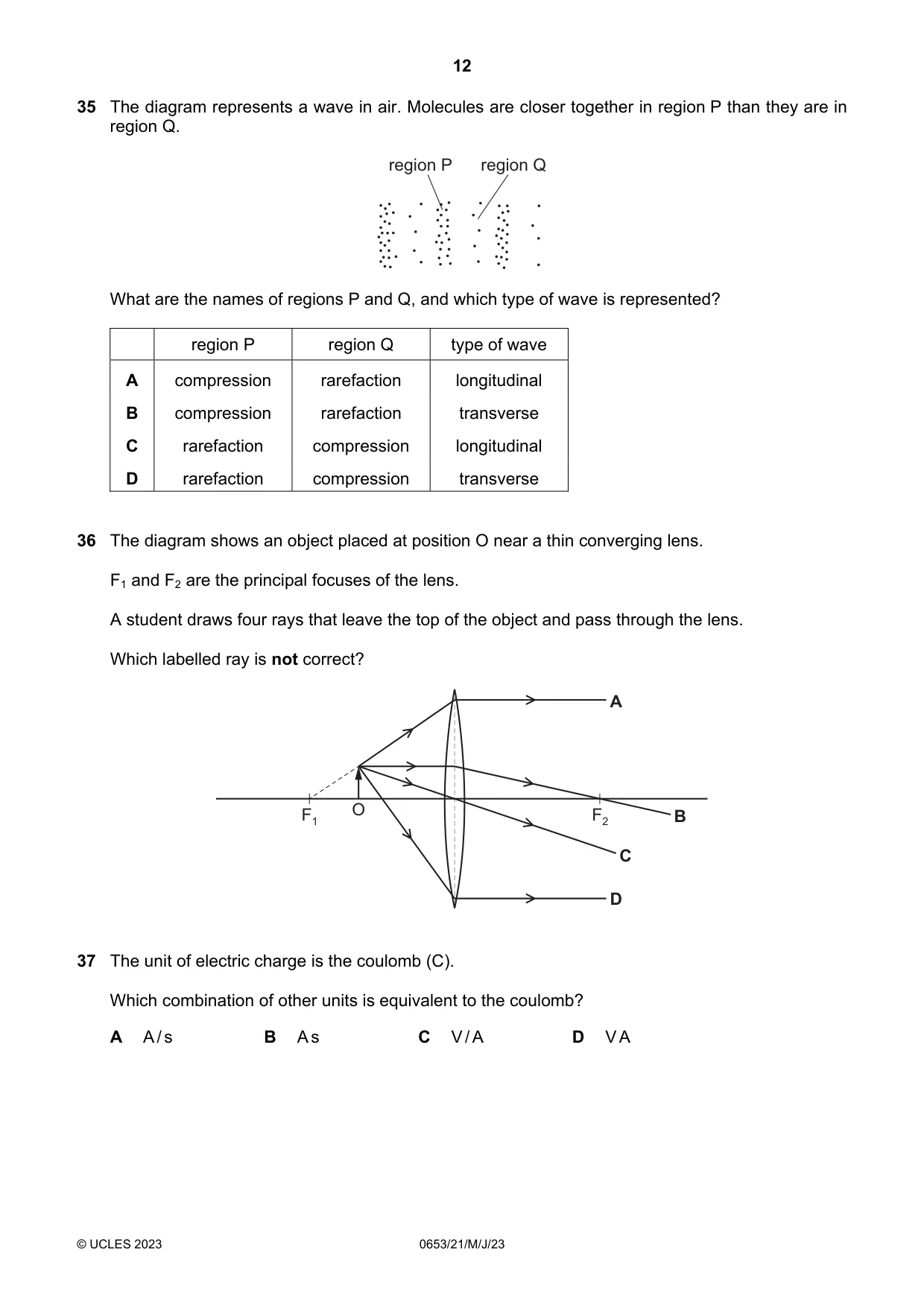
Q36 · The diagram shows an object placed at position O near a thin converging lens
36 The diagram shows an object placed at position O near a thin converging lens. F1 and F2 are the principal focuses of the lens. A student draws four rays that leave the top of the object and pass through the lens. Which labelled ray is not correct? A F1 O F2 B C D
Mark scheme: D
Q37 · The unit of electric charge is the coulomb (C)
37 The unit of electric charge is the coulomb (C). Which combination of other units is equivalent to the coulomb? A A / s B A s C V / A D V A
Mark scheme: B
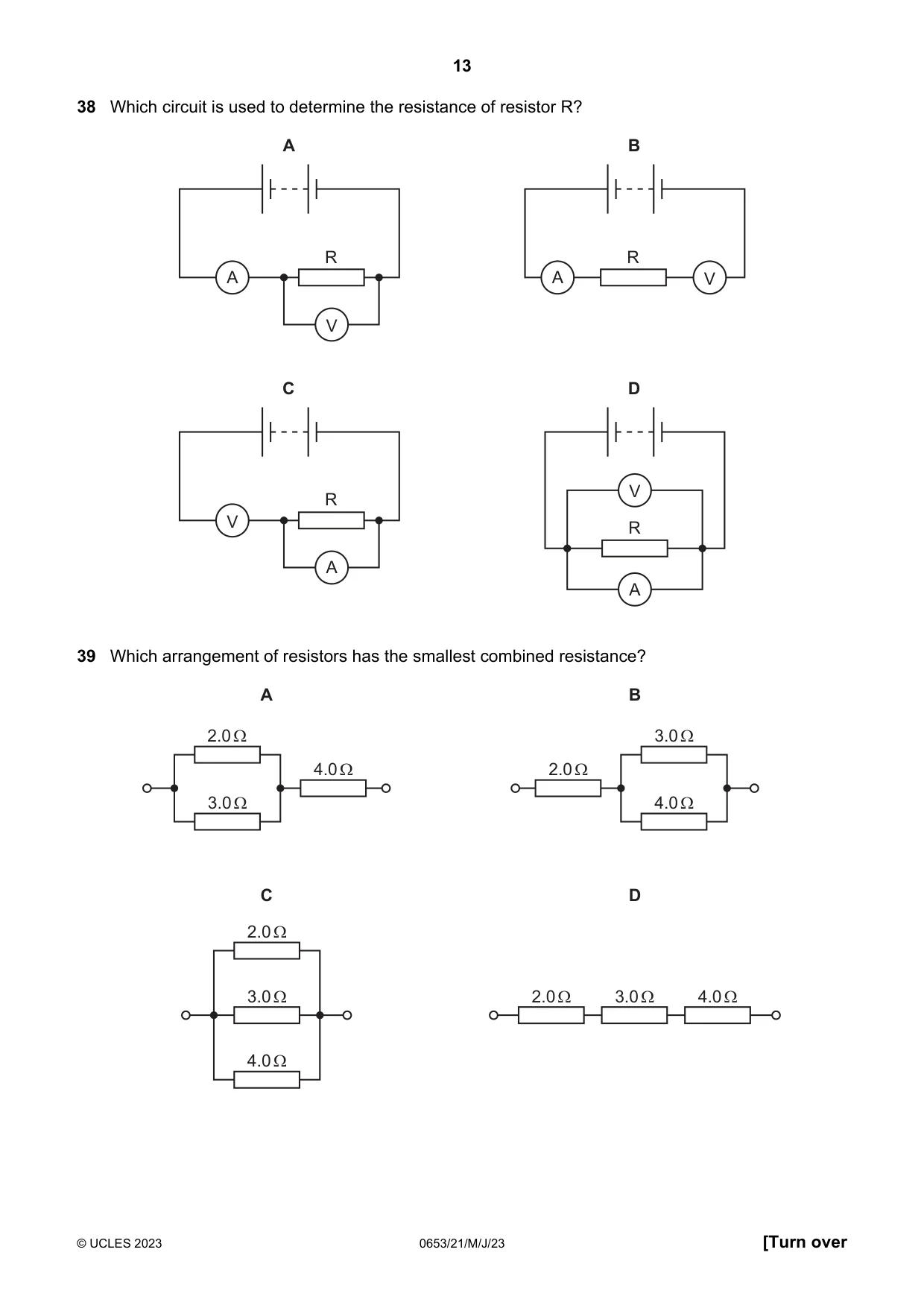
Q38 · Which circuit is used to determine the resistance of resistor R?
38 Which circuit is used to determine the resistance of resistor R? A B R R A A V V C D V R V R A A
Mark scheme: A
Q39 · Which arrangement of resistors has the smallest combined resistance?
39 Which arrangement of resistors has the smallest combined resistance? 2.02 3.0Q 4.00
Mark scheme: C
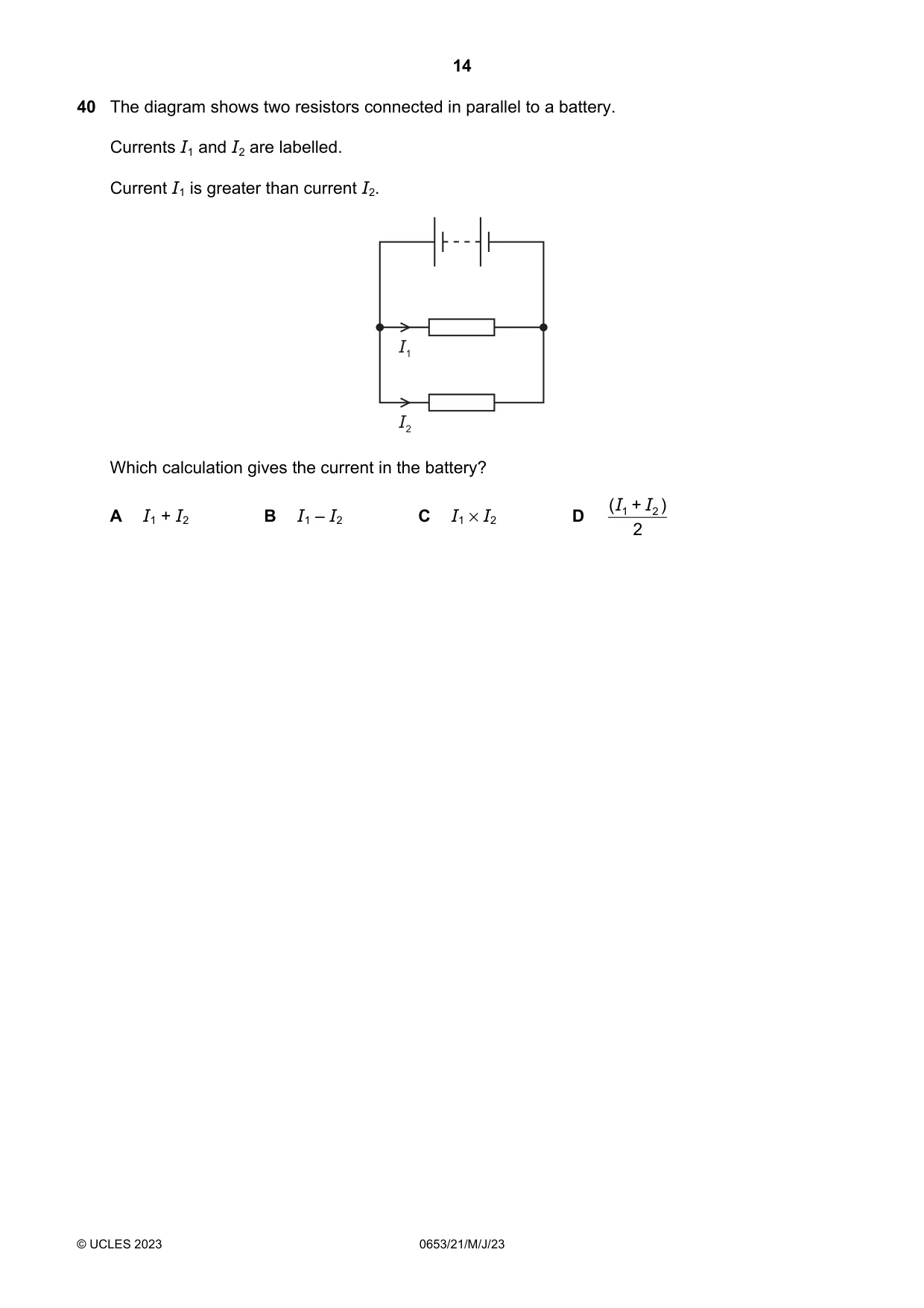
Q40 · The diagram shows two resistors connected in parallel to a battery
40 The diagram shows two resistors connected in parallel to a battery. Currents I1 and I2 are labelled. Current I1 is greater than current I2. I1 I2 Which calculation gives the current in the battery? ( I + I ) A I1 + I2 B I1 – I2 C I1 × I2 D 1 2 2
Mark scheme: A
What was in this paper
The subtopics covered by these 40 questions, and how many questions each got. Open one in a new tab to see every Cambridge question on it.
3Energy, work and power2Redox2Air quality and climate1Alkenes1Arrangement of elements1Atomic structure and the Periodic Table1Cell structure1Characteristics of living organisms1Density1Digestion1Electrical quantities1Electrolysis1Enzymes1Exothermic and endothermic reactions1Food chains and food webs1Forces1Formulas1General properties of waves1Habitat destruction1Heart1Identification of ions and gases1Ions and ionic bonds1Kinetic particle model of matter1Light1Motion1Osmosis1Photosynthesis1Respiration1Sexual reproduction in humans1Sexual reproduction in plants1Solids, liquids and gases1Terminology1The characteristic properties of acids and bases1Transfer of thermal energy1Water uptake1What you needed in this session
Cambridge’s own grade thresholds for 2023 May/June, Paper 2 · Variant 1. A higher threshold means an easier paper — the bar moves with how the cohort did.