Cambridge IGCSE Science - Combined 0653 — 2017 May/June Paper 2 · Variant 1
0653/21/M/J/17 · 40 questions · 40 marks · ≈45 min
The question paper and its mark scheme, free to read here and free to download. This is Cambridge’s own paper, exactly as it was sat.
Question paper20 pages


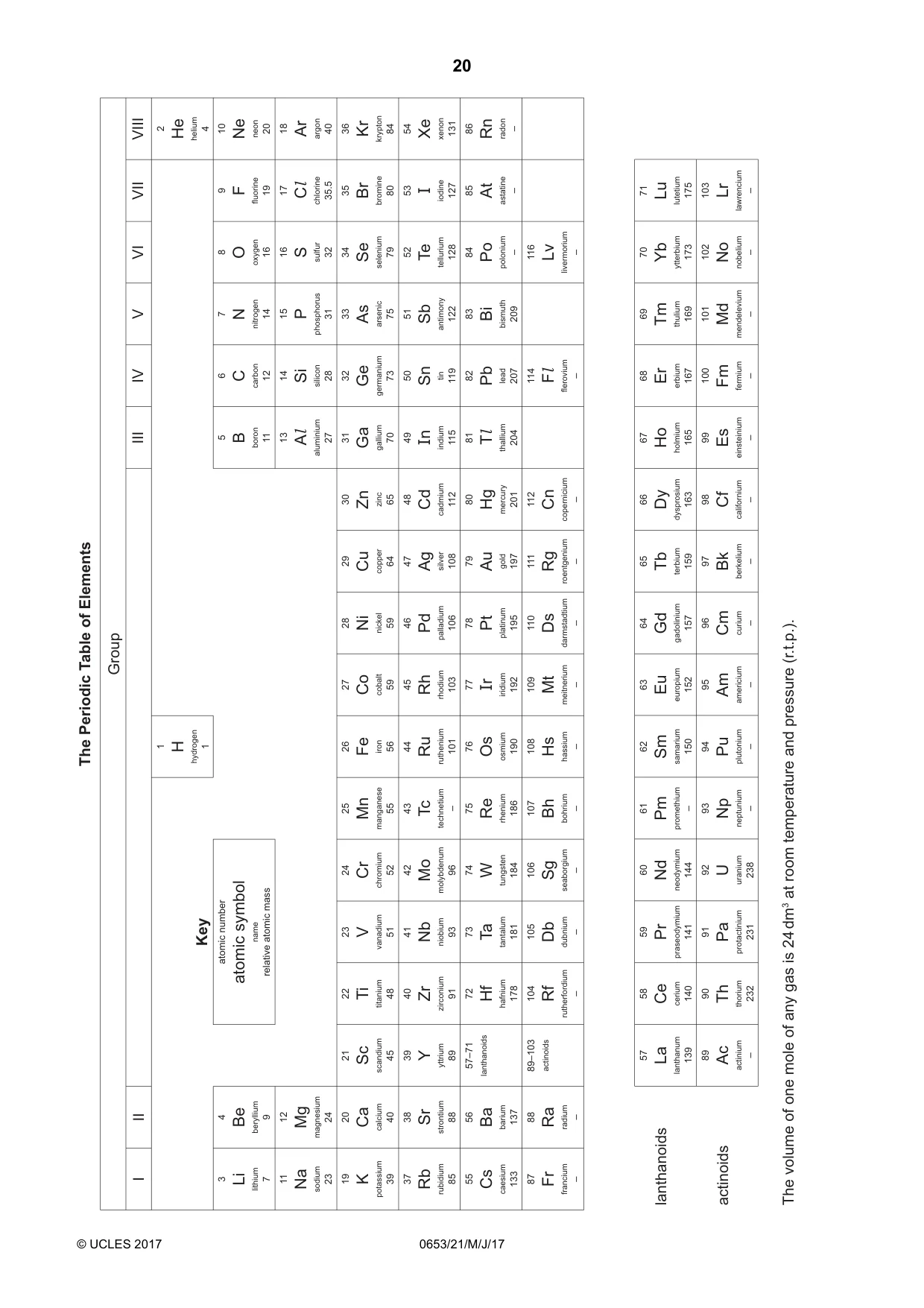
Mark scheme3 pages
Answers below. Sit the paper first if you are practising.
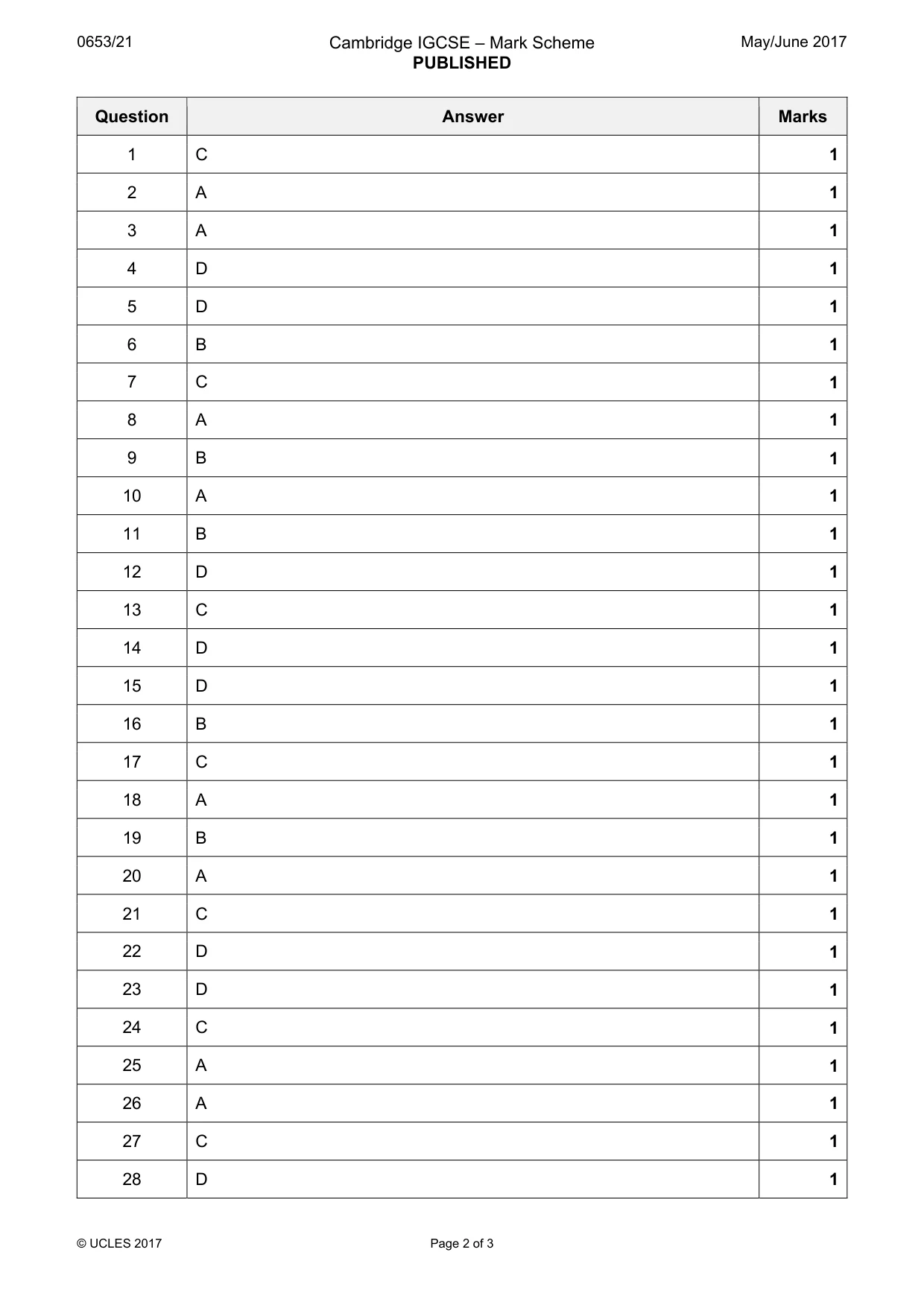
Questions as text
Q1 · Process Q happens in cells
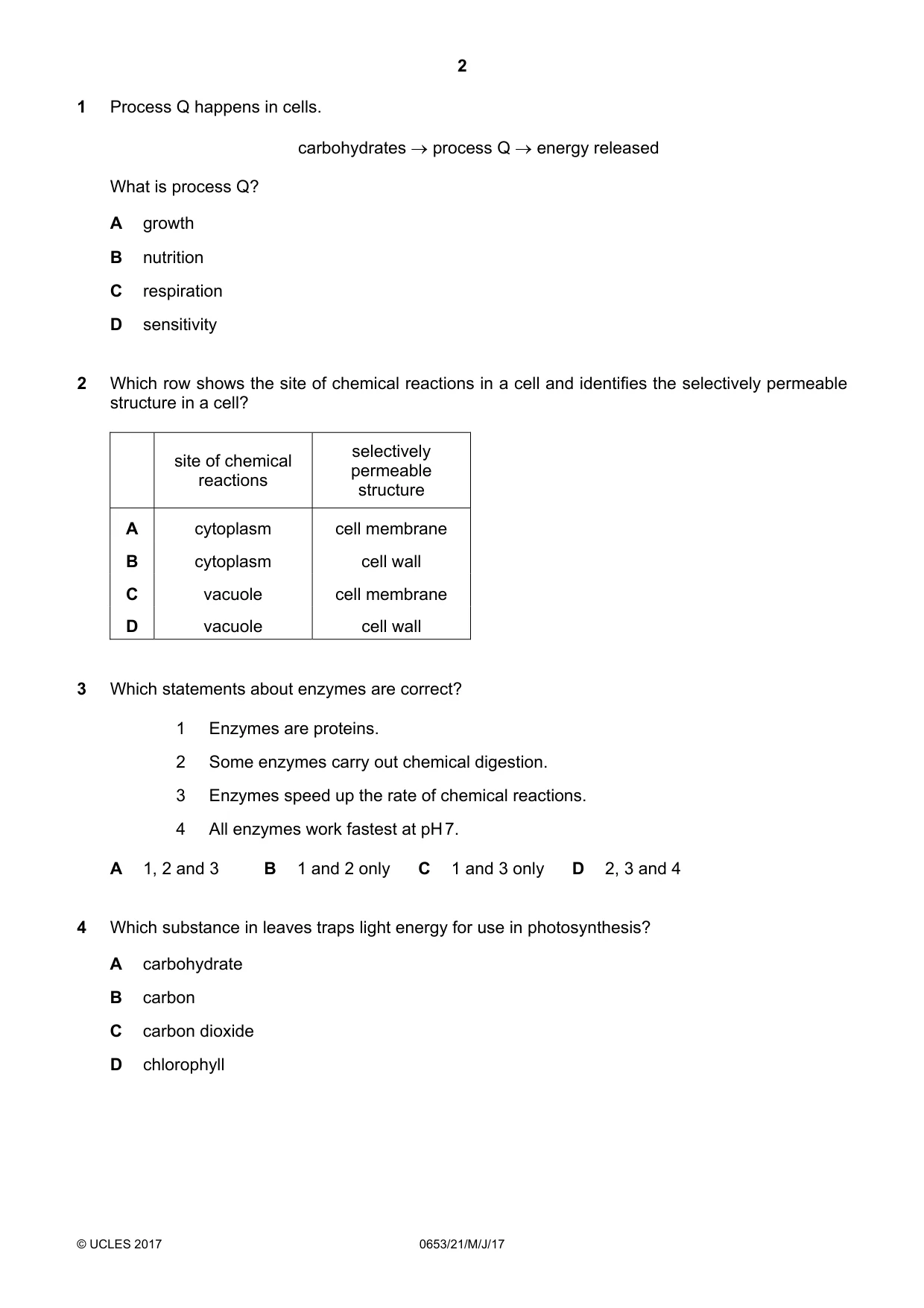
1 Process Q happens in cells. carbohydrates → process Q → energy released What is process Q? A growth B nutrition C respiration D sensitivity
Mark scheme: C
Q2 · Which row shows the site of chemical reactions in a cell and identifies the selectively…
2 Which row shows the site of chemical reactions in a cell and identifies the selectively permeable structure in a cell? selectively site of chemical permeable reactions structure A cytoplasm cell membrane B cytoplasm cell wall C vacuole cell membrane D vacuole cell wall
Mark scheme: A
Q3 · Which statements about enzymes are correct?
3 Which statements about enzymes are correct? 1 Enzymes are proteins. 2 Some enzymes carry out chemical digestion. 3 Enzymes speed up the rate of chemical reactions. 4 All enzymes work fastest at pH 7. A 1, 2 and 3 B 1 and 2 only C 1 and 3 only D 2, 3 and 4
Mark scheme: A
Q4 · Which substance in leaves traps light energy for use in photosynthesis?
4 Which substance in leaves traps light energy for use in photosynthesis? A carbohydrate B carbon C carbon dioxide D chlorophyll
Mark scheme: D
Q5 · The statements show how a person’s diet can be unbalanced
5 The statements show how a person’s diet can be unbalanced. 1 eating too much fibre 2 eating too much saturated fat 3 eating too much salt Which of these increase the risk of coronary heart disease? A 1, 2 and 3 B 1 and 2 only C 1 and 3 only D 2 and 3 only
Mark scheme: D
Q6 · Which row matches the adaptation of a root hair cell to its function?
6 Which row matches the adaptation of a root hair cell to its function? adaptation function A large surface area uptake of water and glucose B large surface area uptake of water and ions C small surface area uptake of water and glucose D small surface area uptake of water and ions
Mark scheme: B
Q7 · The diagram shows a section through the heart
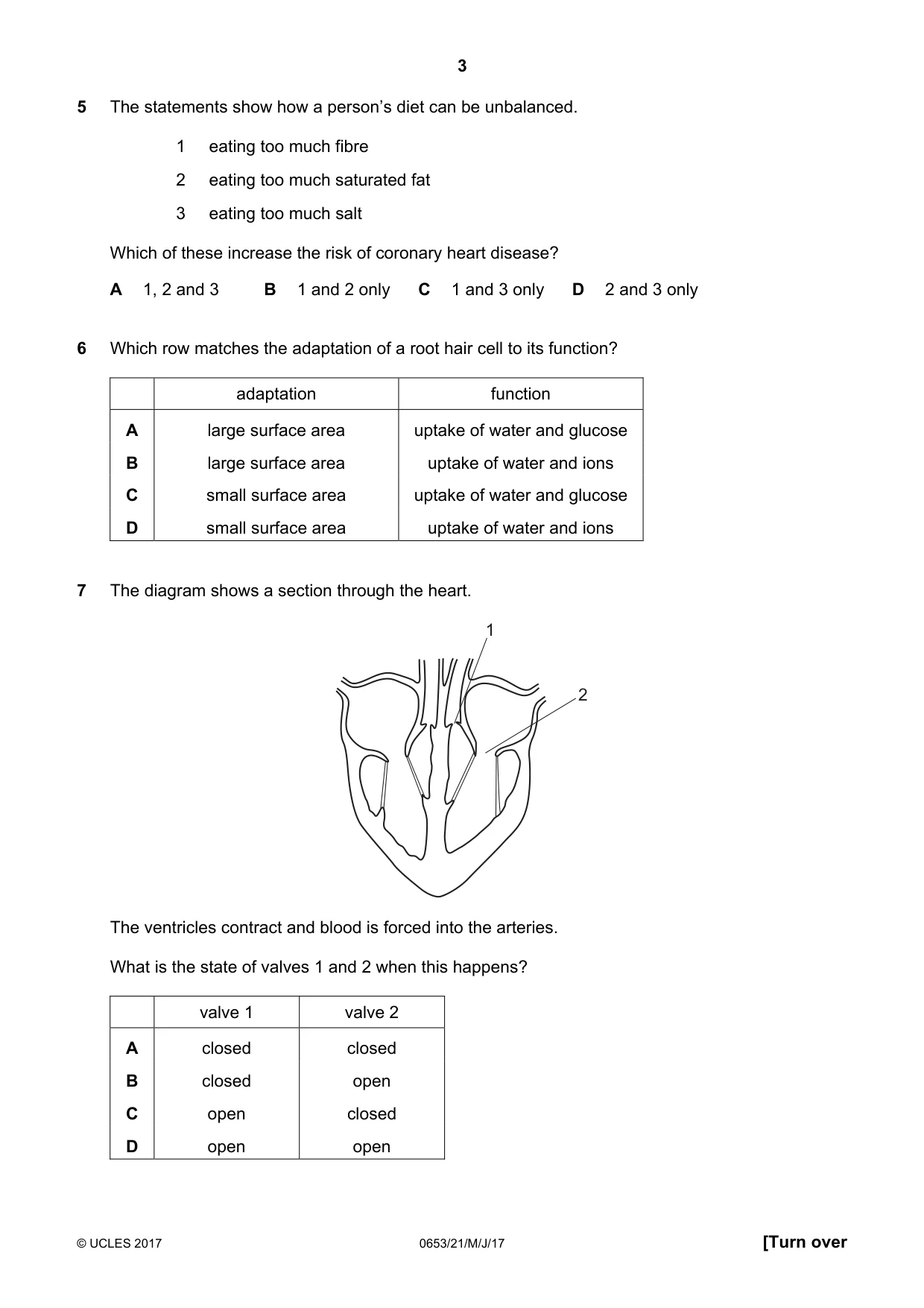
7 The diagram shows a section through the heart. 1 2 The ventricles contract and blood is forced into the arteries. What is the state of valves 1 and 2 when this happens? valve 1 valve 2 A closed closed B closed open C open closed D open open
Mark scheme: C
Q8 · Which molecule contains the energy that is released in aerobic respiration?
8 Which molecule contains the energy that is released in aerobic respiration? A C6H12O6 B CO2 C H2O D O2
Mark scheme: A
Q9 · The diagram shows apparatus at the start of a breathing experiment
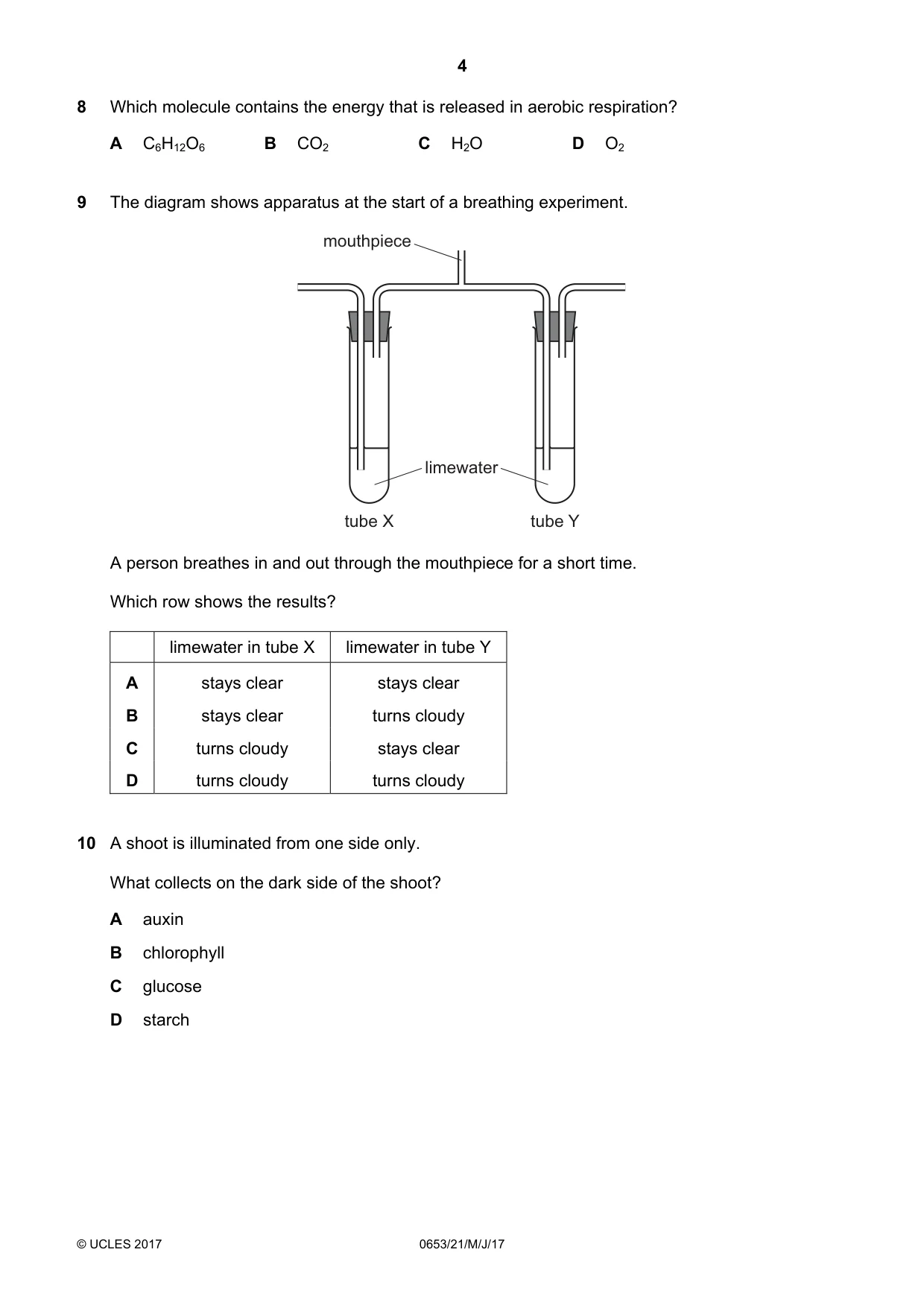
9 The diagram shows apparatus at the start of a breathing experiment. mouthpiece limewater tube X tube Y A person breathes in and out through the mouthpiece for a short time. Which row shows the results? limewater in tube X limewater in tube Y A stays clear stays clear B stays clear turns cloudy C turns cloudy stays clear D turns cloudy turns cloudy
Mark scheme: B
Q10 · A shoot is illuminated from one side only
10 A shoot is illuminated from one side only. What collects on the dark side of the shoot? A auxin B chlorophyll C glucose D starch
Mark scheme: A
Q11 · Materials are exchanged between a mother and her fetus across the placenta
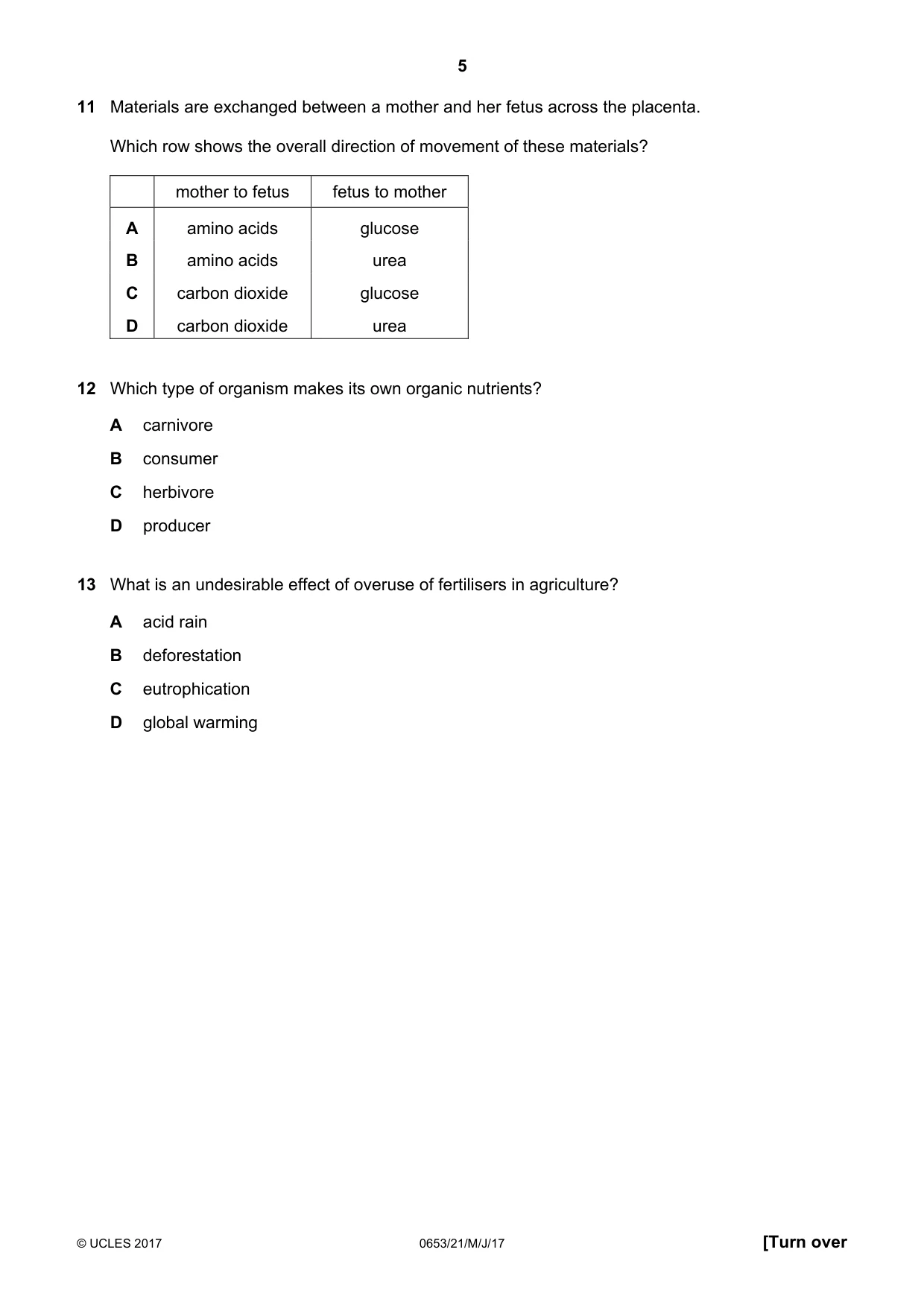
11 Materials are exchanged between a mother and her fetus across the placenta. Which row shows the overall direction of movement of these materials? mother to fetus fetus to mother A amino acids glucose B amino acids urea C carbon dioxide glucose D carbon dioxide urea
Mark scheme: B
Q12 · Which type of organism makes its own organic nutrients?
12 Which type of organism makes its own organic nutrients? A carnivore B consumer C herbivore D producer
Mark scheme: D
Q13 · What is an undesirable effect of overuse of fertilisers in agriculture?
13 What is an undesirable effect of overuse of fertilisers in agriculture? A acid rain B deforestation C eutrophication D global warming
Mark scheme: C
Q14 · Which diagram shows how a mixture of dyes in a food colouring are separated?
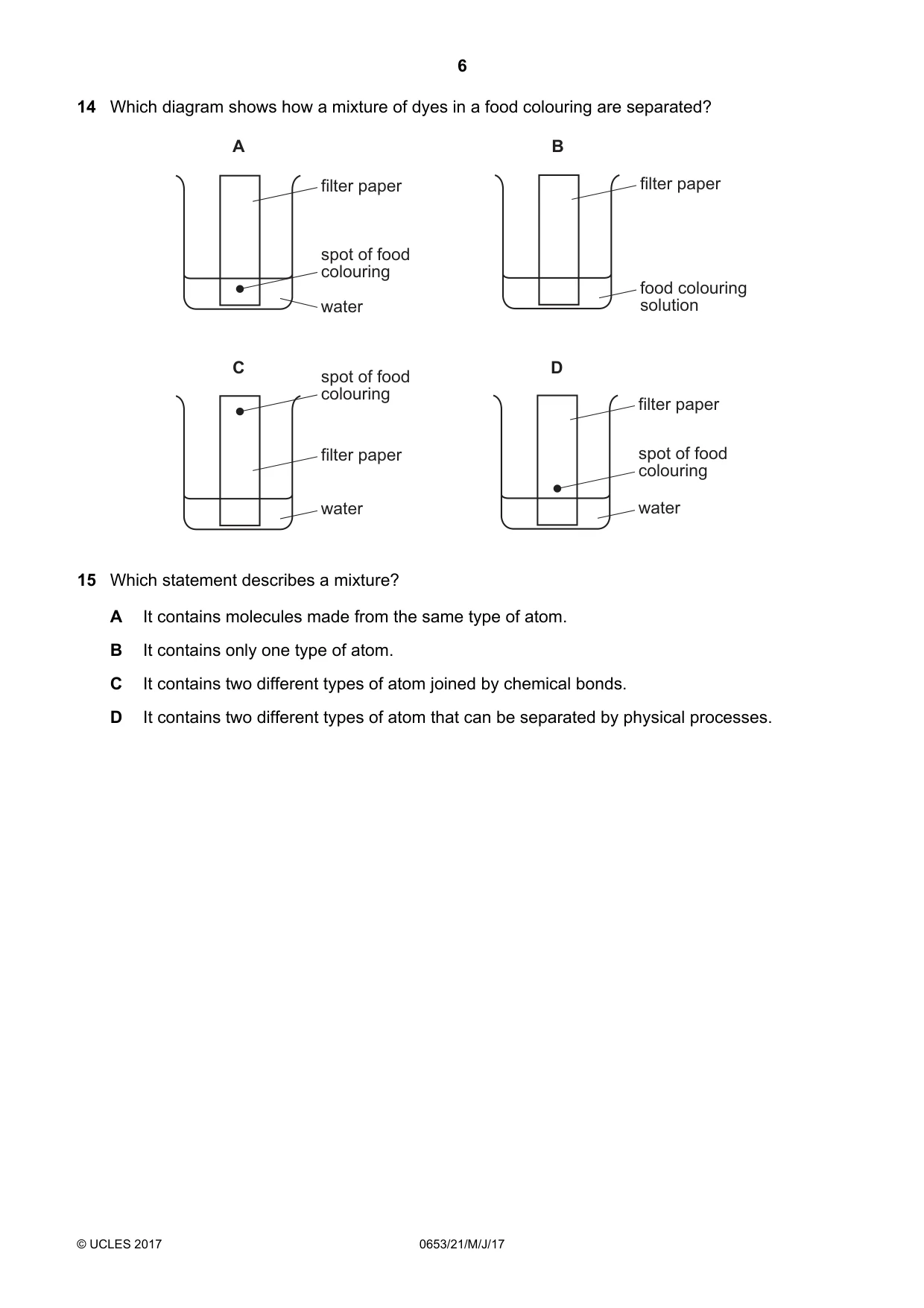
14 Which diagram shows how a mixture of dyes in a food colouring are separated? A B filter paper filter paper spot of food colouring food colouring water solution C D spot of food colouring filter paper filter paper spot of food colouring water water
Mark scheme: D
Q15 · Which statement describes a mixture?
15 Which statement describes a mixture? A It contains molecules made from the same type of atom. B It contains only one type of atom. C It contains two different types of atom joined by chemical bonds. D It contains two different types of atom that can be separated by physical processes.
Mark scheme: D
Q16 · The atomic (proton) number of magnesium is 12
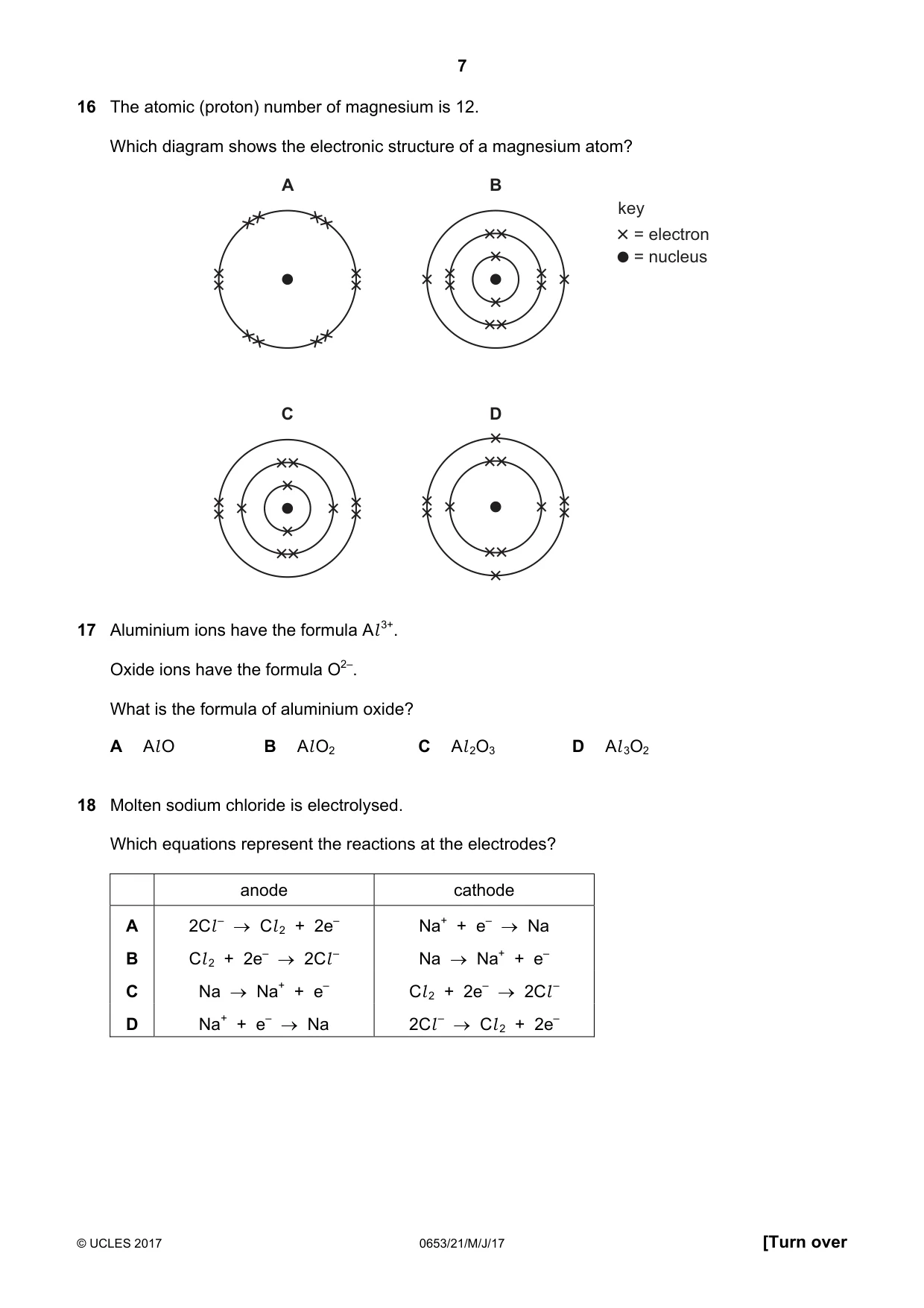
16 The atomic (proton) number of magnesium is 12. Which diagram shows the electronic structure of a magnesium atom? A B key = electron = nucleus C D
Mark scheme: B
Q17 · Aluminium ions have the formula Al 3+
17 Aluminium ions have the formula Al 3+. Oxide ions have the formula O2–. What is the formula of aluminium oxide? A Al O B Al O2 C Al 2O3 D Al 3O2
Mark scheme: C
Q18 · Molten sodium chloride is electrolysed
18 Molten sodium chloride is electrolysed. Which equations represent the reactions at the electrodes? anode cathode A 2Cl – → Cl 2 + 2e– Na+ + e– → Na B Cl 2 + 2e– → 2Cl – Na → Na+ + e– C Na → Na+ + e– Cl 2 + 2e– → 2Cl – D Na+ + e– → Na 2Cl – → Cl 2 + 2e–
Mark scheme: A
Q19 · Which statement about chemical reactions is not correct?
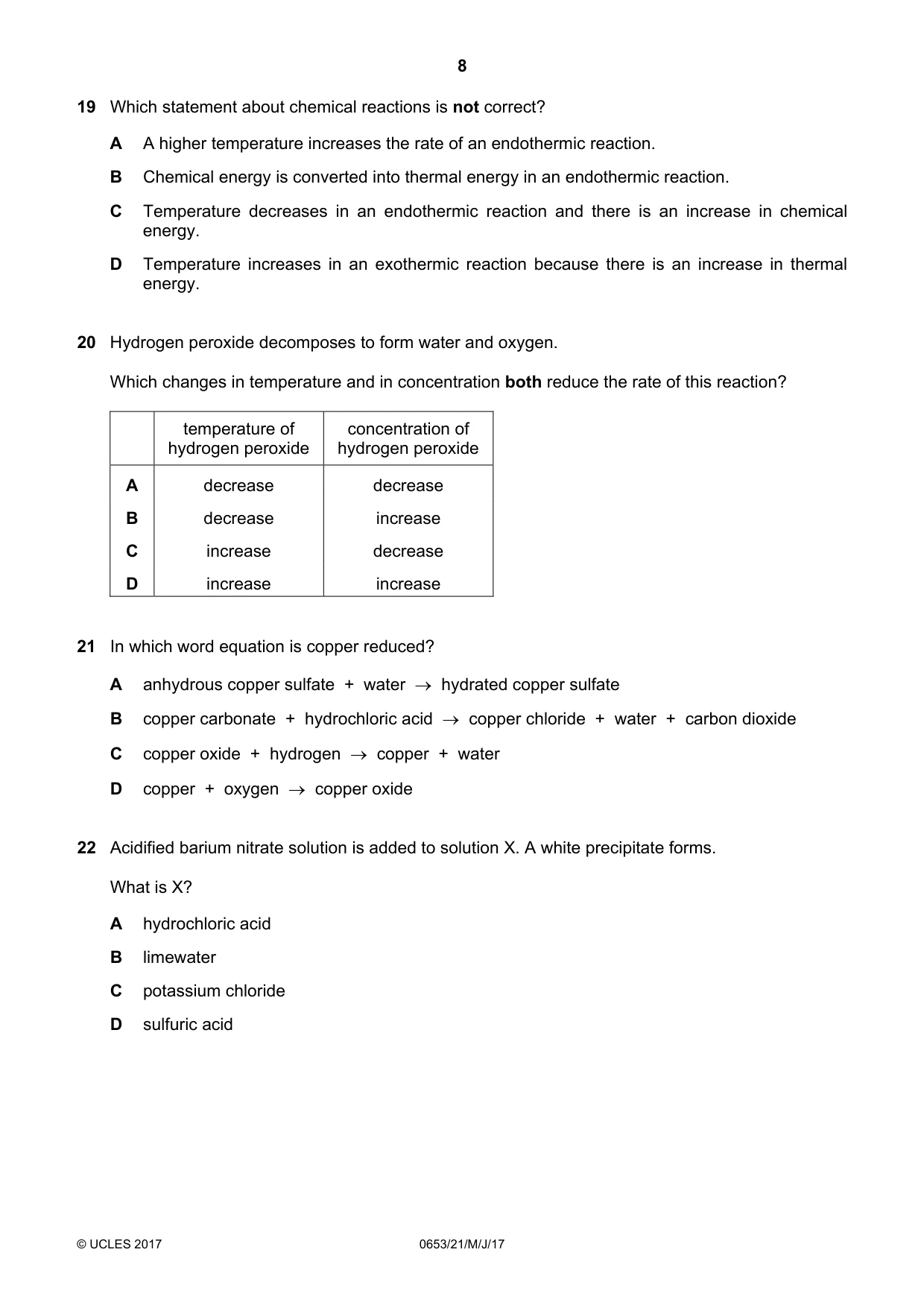
19 Which statement about chemical reactions is not correct? A A higher temperature increases the rate of an endothermic reaction. B Chemical energy is converted into thermal energy in an endothermic reaction. C Temperature decreases in an endothermic reaction and there is an increase in chemical energy. D Temperature increases in an exothermic reaction because there is an increase in thermal energy.
Mark scheme: B
Q20 · Hydrogen peroxide decomposes to form water and oxygen
20 Hydrogen peroxide decomposes to form water and oxygen. Which changes in temperature and in concentration both reduce the rate of this reaction? temperature of concentration of hydrogen peroxide hydrogen peroxide A decrease decrease B decrease increase C increase decrease D increase increase
Mark scheme: A
Q21 · In which word equation is copper reduced?
21 In which word equation is copper reduced? A anhydrous copper sulfate + water → hydrated copper sulfate B copper carbonate + hydrochloric acid → copper chloride + water + carbon dioxide C copper oxide + hydrogen → copper + water D copper + oxygen → copper oxide
Mark scheme: C
Q22 · Acidified barium nitrate solution is added to solution X
22 Acidified barium nitrate solution is added to solution X. A white precipitate forms. What is X? A hydrochloric acid B limewater C potassium chloride D sulfuric acid
Mark scheme: D
Q23 · Which element is a non-metallic solid at room temperature?
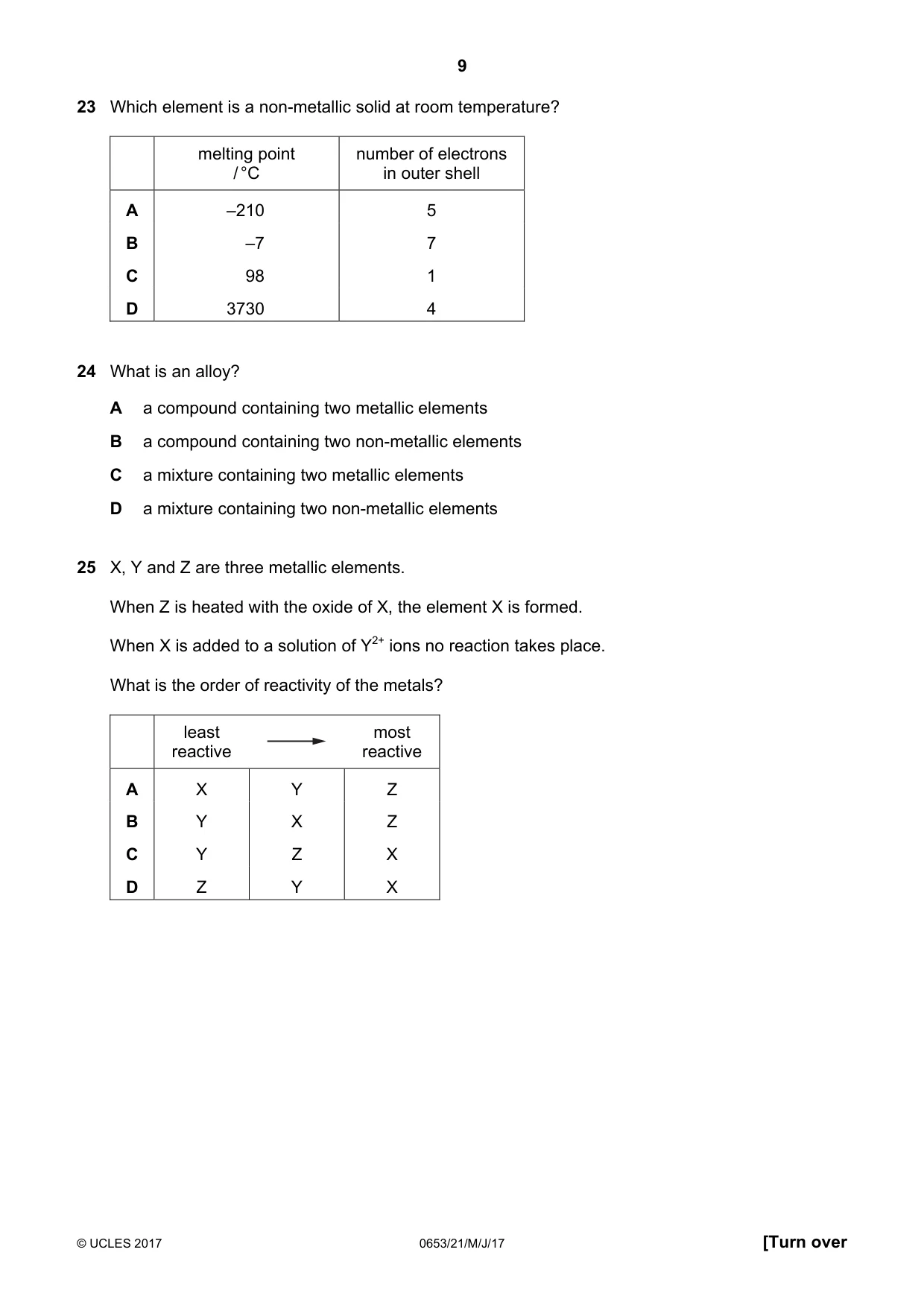
23 Which element is a non-metallic solid at room temperature? melting point number of electrons / °C in outer shell A –210 5 B –7 7 C 98 1 D 3730 4
Mark scheme: D
Q24 · What is an alloy?
24 What is an alloy? A a compound containing two metallic elements B a compound containing two non-metallic elements C a mixture containing two metallic elements D a mixture containing two non-metallic elements
Mark scheme: C
Q25 · X, Y and Z are three metallic elements
25 X, Y and Z are three metallic elements. When Z is heated with the oxide of X, the element X is formed. When X is added to a solution of Y2+ ions no reaction takes place. What is the order of reactivity of the metals? least most reactive reactive A X Y Z B Y X Z C Y Z X D Z Y X
Mark scheme: A
Q26 · Which pie chart shows the proportions of gases in clean air?
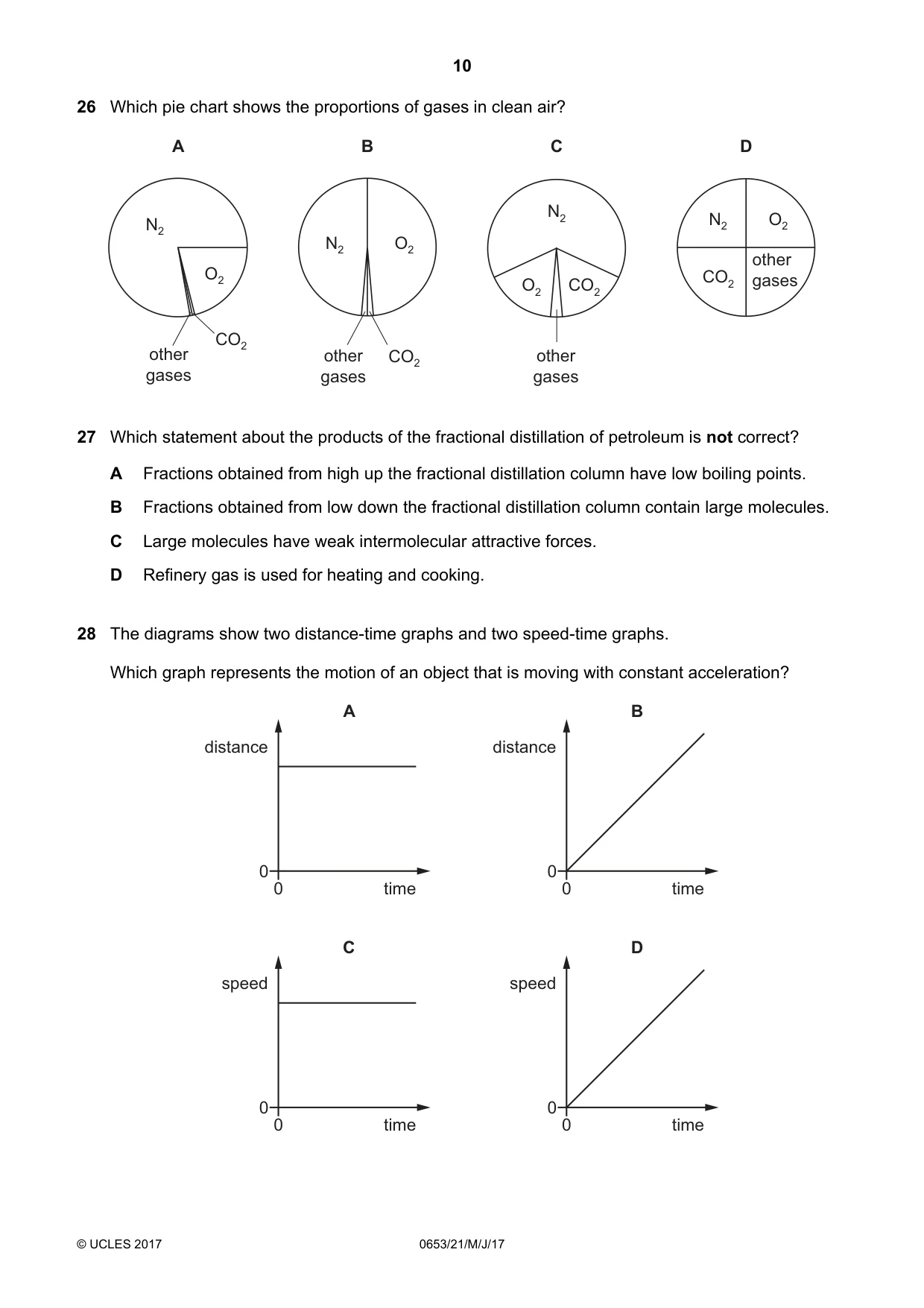
26 Which pie chart shows the proportions of gases in clean air? A B C D N2 N2 O2 N2 N2 O2 other O2 CO2 gases O2 CO2 CO2 other other CO2 other gases gases gases
Mark scheme: A
Q27 · Which statement about the products of the fractional distillation of petroleum is not…
27 Which statement about the products of the fractional distillation of petroleum is not correct? A Fractions obtained from high up the fractional distillation column have low boiling points. B Fractions obtained from low down the fractional distillation column contain large molecules. C Large molecules have weak intermolecular attractive forces. D Refinery gas is used for heating and cooking.
Mark scheme: C
Q28 · The diagrams show two distance-time graphs and two speed-time graphs
28 The diagrams show two distance-time graphs and two speed-time graphs. Which graph represents the motion of an object that is moving with constant acceleration? A B distance distance 0 0 0 time 0 time C D speed speed 0 0 0 time 0 time
Mark scheme: D
Q29 · Which row shows the unit for force, the unit for mass and the unit for weight?
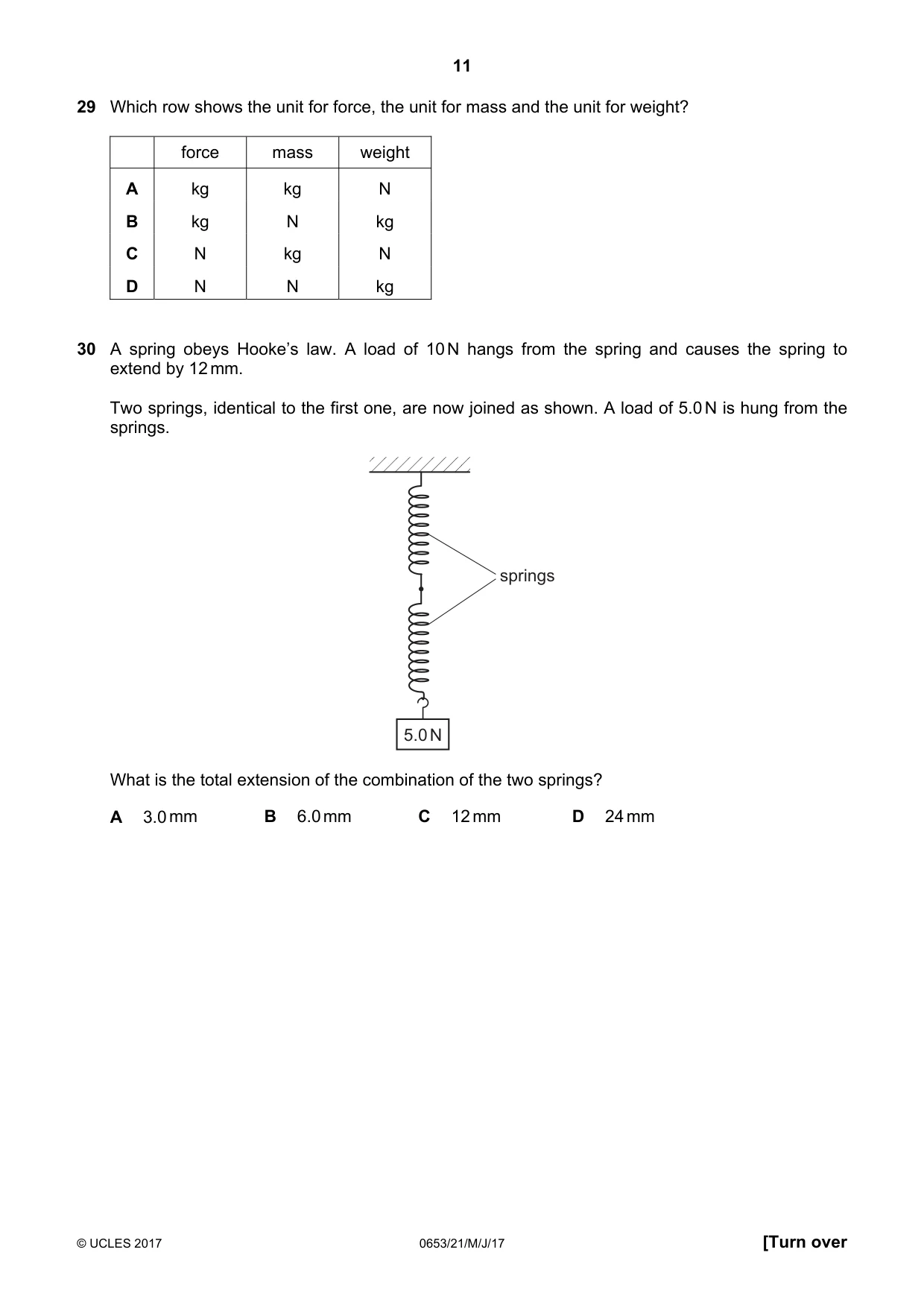
29 Which row shows the unit for force, the unit for mass and the unit for weight? force mass weight A kg kg N B kg N kg C N kg N D N N kg
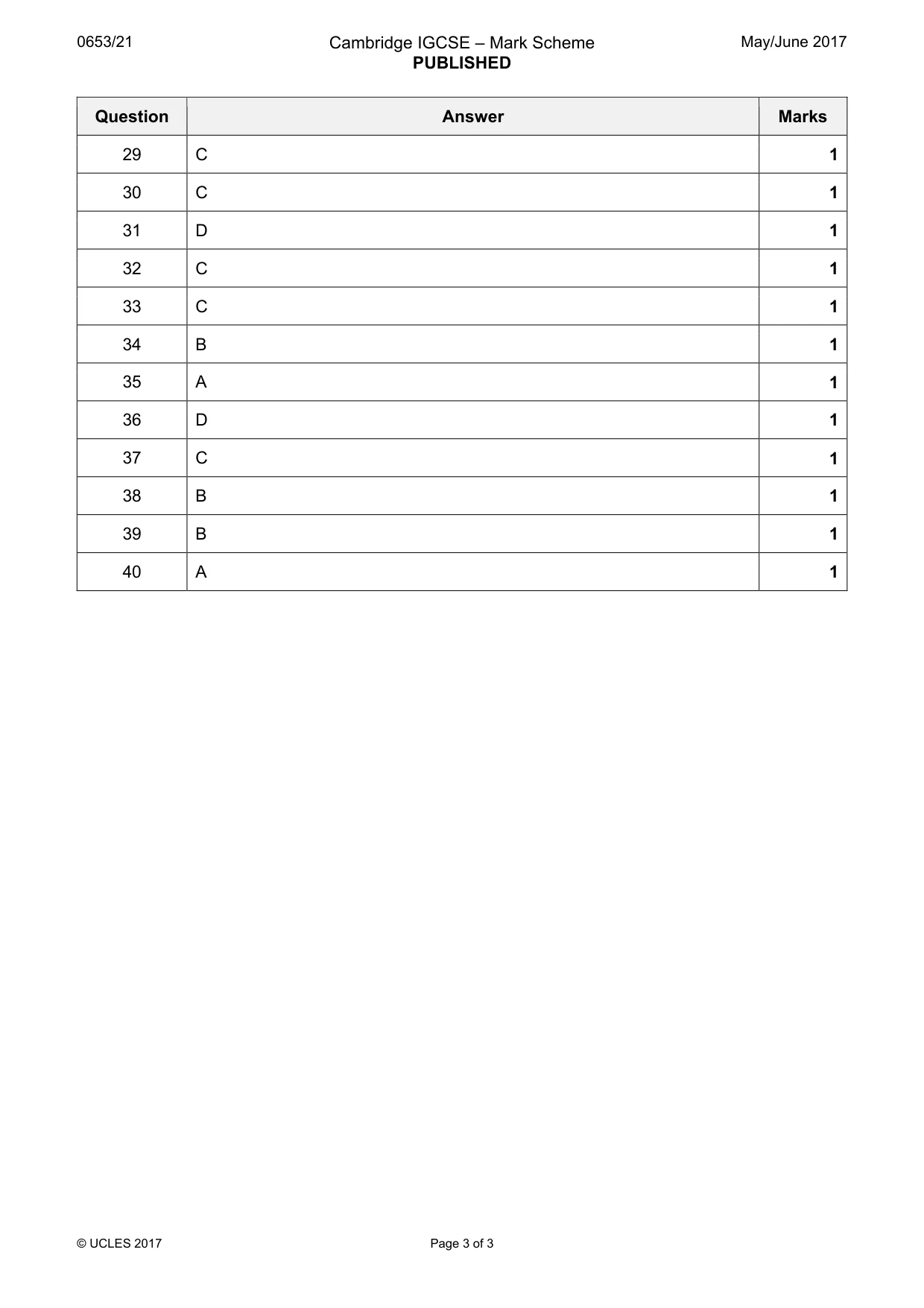
Mark scheme: C
Q30 · A spring obeys Hooke’s law
30 A spring obeys Hooke’s law. A load of 10 N hangs from the spring and causes the spring to extend by 12 mm. Two springs, identical to the first one, are now joined as shown. A load of 5.0 N is hung from the springs. springs 5.0 N What is the total extension of the combination of the two springs? A 3.0 mm B 6.0 mm C 12 mm D 24 mm
Mark scheme: C
Q31 · A brick of mass of 3.0 kg rests on a shelf
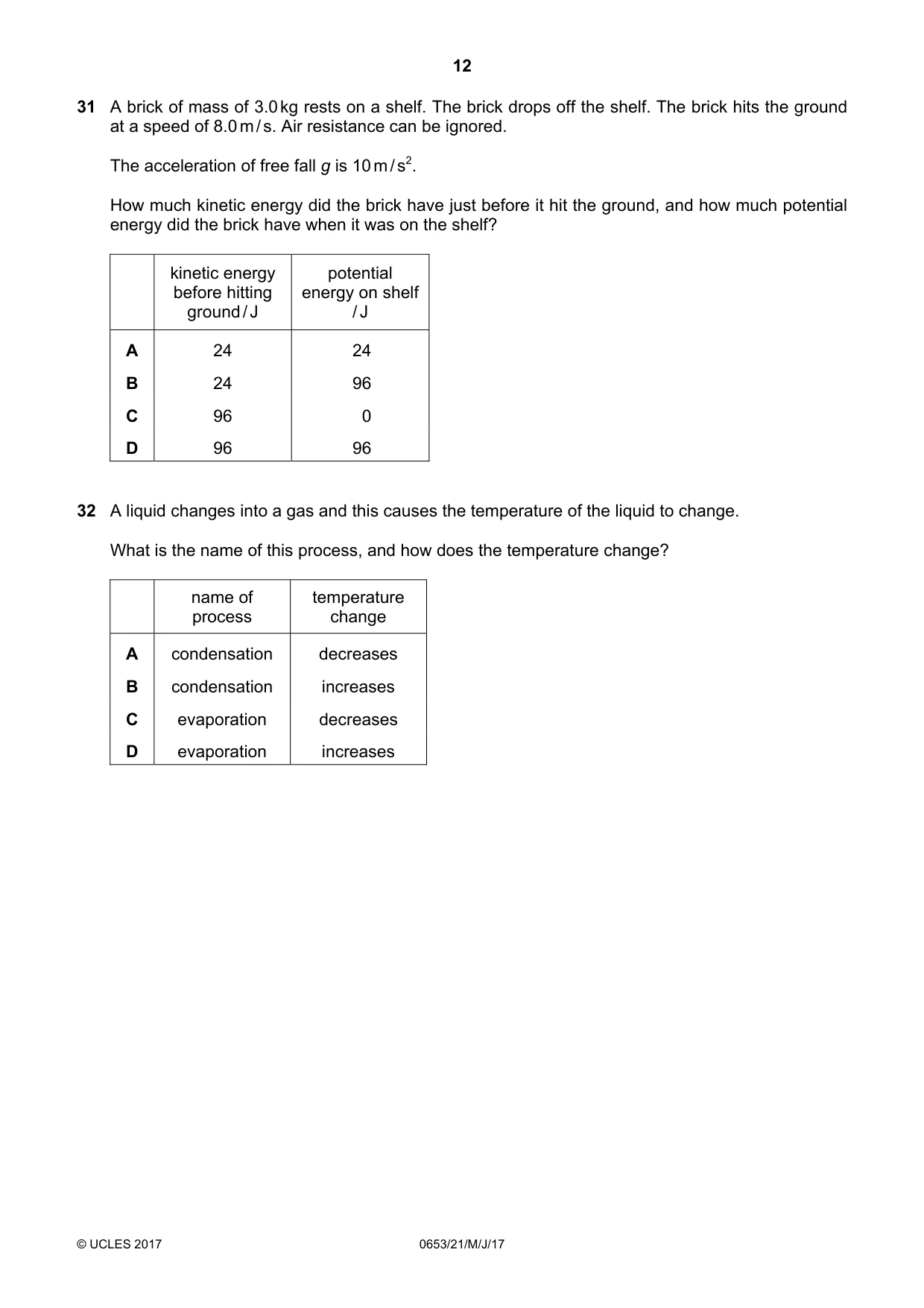
31 A brick of mass of 3.0 kg rests on a shelf. The brick drops off the shelf. The brick hits the ground at a speed of 8.0 m / s. Air resistance can be ignored. The acceleration of free fall g is 10 m / s2. How much kinetic energy did the brick have just before it hit the ground, and how much potential energy did the brick have when it was on the shelf? kinetic energy potential before hitting energy on shelf ground / J / J A 24 24 B 24 96 C 96 0 D 96 96
Mark scheme: D
Q32 · A liquid changes into a gas and this causes the temperature of the liquid to change
32 A liquid changes into a gas and this causes the temperature of the liquid to change. What is the name of this process, and how does the temperature change? name of temperature process change A condensation decreases B condensation increases C evaporation decreases D evaporation increases
Mark scheme: C
Q33 · Four identical metal tanks in a room each contain the same amount of water
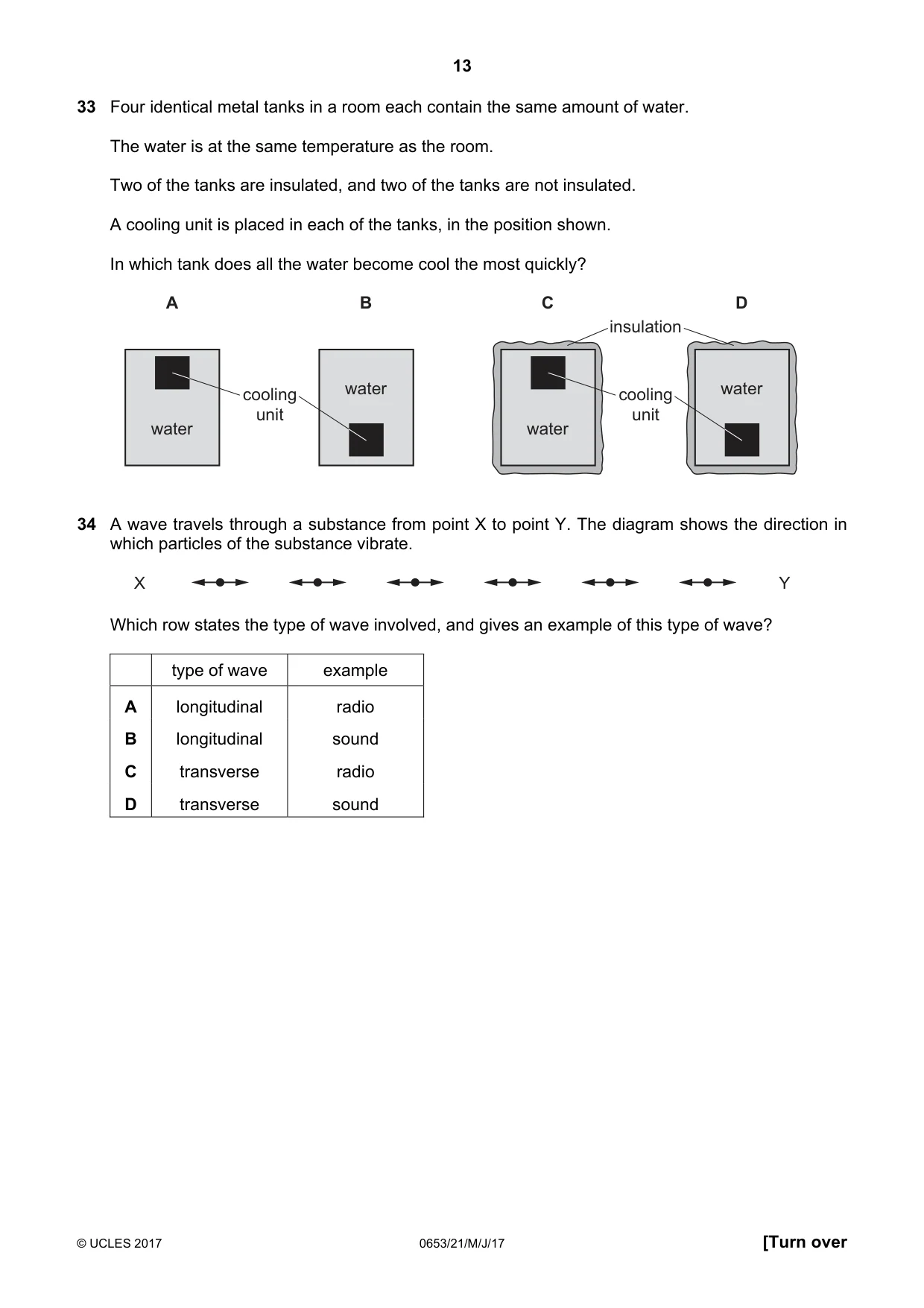
33 Four identical metal tanks in a room each contain the same amount of water. The water is at the same temperature as the room. Two of the tanks are insulated, and two of the tanks are not insulated. A cooling unit is placed in each of the tanks, in the position shown. In which tank does all the water become cool the most quickly? A B C D insulation cooling water cooling water unit unit water water
Mark scheme: C
Q34 · A wave travels through a substance from point X to point Y
34 A wave travels through a substance from point X to point Y. The diagram shows the direction in which particles of the substance vibrate. X Y Which row states the type of wave involved, and gives an example of this type of wave? type of wave example A longitudinal radio B longitudinal sound C transverse radio D transverse sound
Mark scheme: B
Q35 · A ray of light is travelling in glass
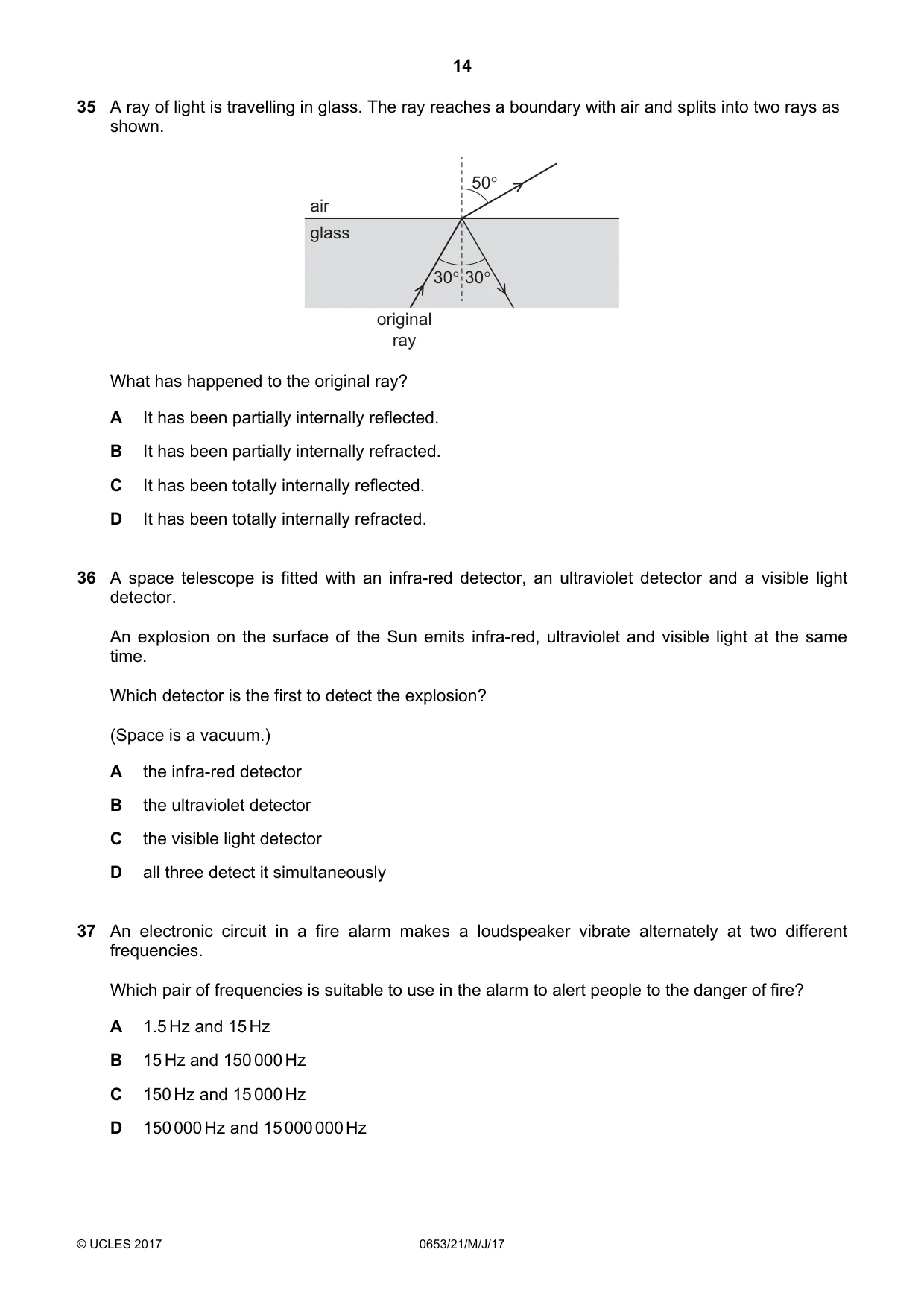
35 A ray of light is travelling in glass. The ray reaches a boundary with air and splits into two rays as shown. 50° air glass 30° 30° original ray What has happened to the original ray? A It has been partially internally reflected. B It has been partially internally refracted. C It has been totally internally reflected. D It has been totally internally refracted.
Mark scheme: A
Q36 · A space telescope is fitted with an infra-red detector, an ultraviolet detector and a…
36 A space telescope is fitted with an infra-red detector, an ultraviolet detector and a visible light detector. An explosion on the surface of the Sun emits infra-red, ultraviolet and visible light at the same time. Which detector is the first to detect the explosion? (Space is a vacuum.) A the infra-red detector B the ultraviolet detector C the visible light detector D all three detect it simultaneously
Mark scheme: D
Q37 · An electronic circuit in a fire alarm makes a loudspeaker vibrate alternately at two…
37 An electronic circuit in a fire alarm makes a loudspeaker vibrate alternately at two different frequencies. Which pair of frequencies is suitable to use in the alarm to alert people to the danger of fire? A 1.5 Hz and 15 Hz B 15 Hz and 150 000 Hz C 150 Hz and 15 000 Hz D 150 000 Hz and 15 000 000 Hz
Mark scheme: C
Q38 · The diagram shows a wire of length l and cross-sectional area X
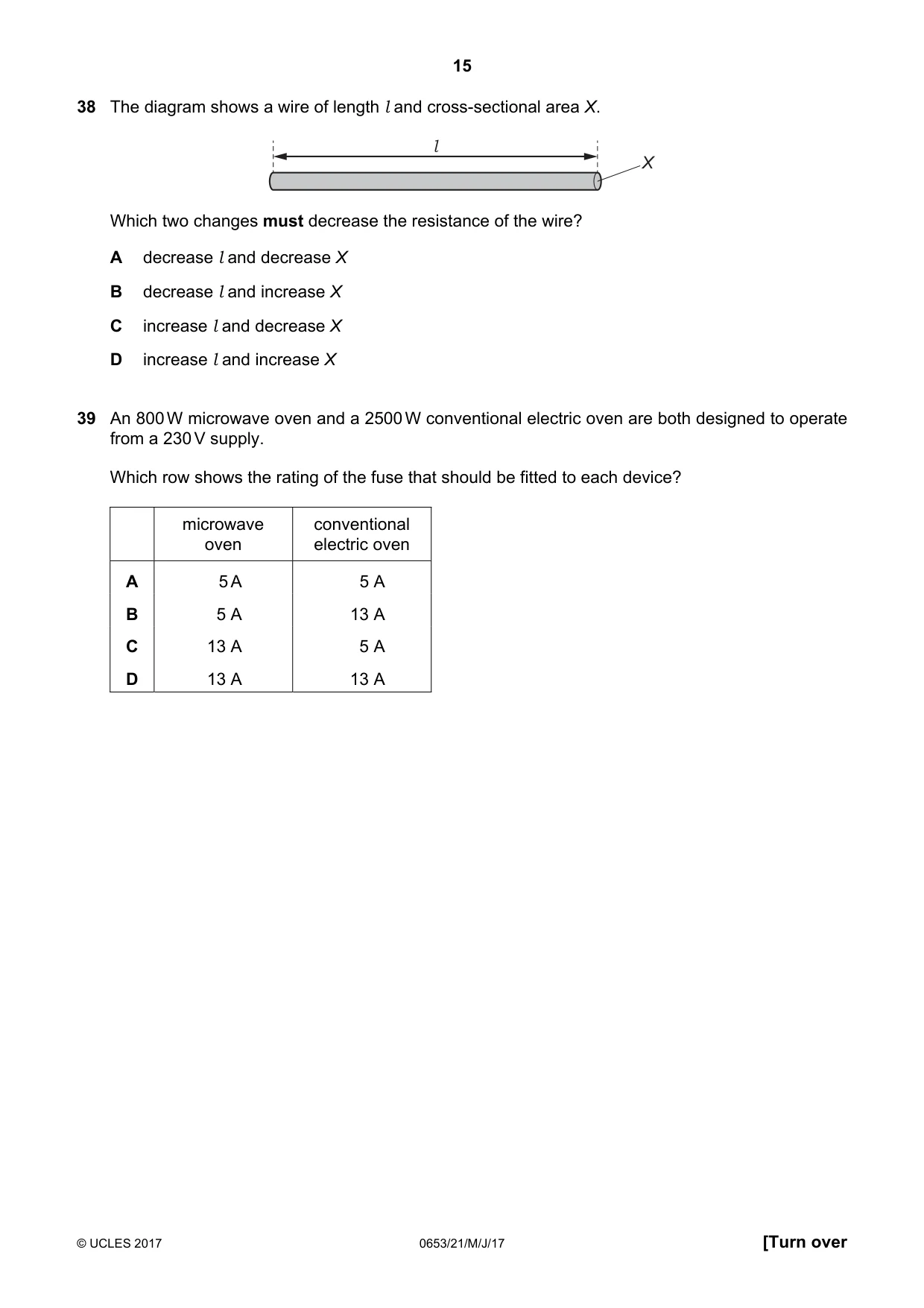
38 The diagram shows a wire of length l and cross-sectional area X. l X Which two changes must decrease the resistance of the wire? A decrease l and decrease X B decrease l and increase X C increase l and decrease X D increase l and increase X
Mark scheme: B
Q39 · An 800 W microwave oven and a 2500 W conventional electric oven are both designed to…
39 An 800 W microwave oven and a 2500 W conventional electric oven are both designed to operate from a 230 V supply. Which row shows the rating of the fuse that should be fitted to each device? microwave conventional oven electric oven A 5 A 5 A B 5 A 13 A C 13 A 5 A D 13 A 13 A
Mark scheme: B
Q40 · The diagram shows a circuit containing a battery and four resistors
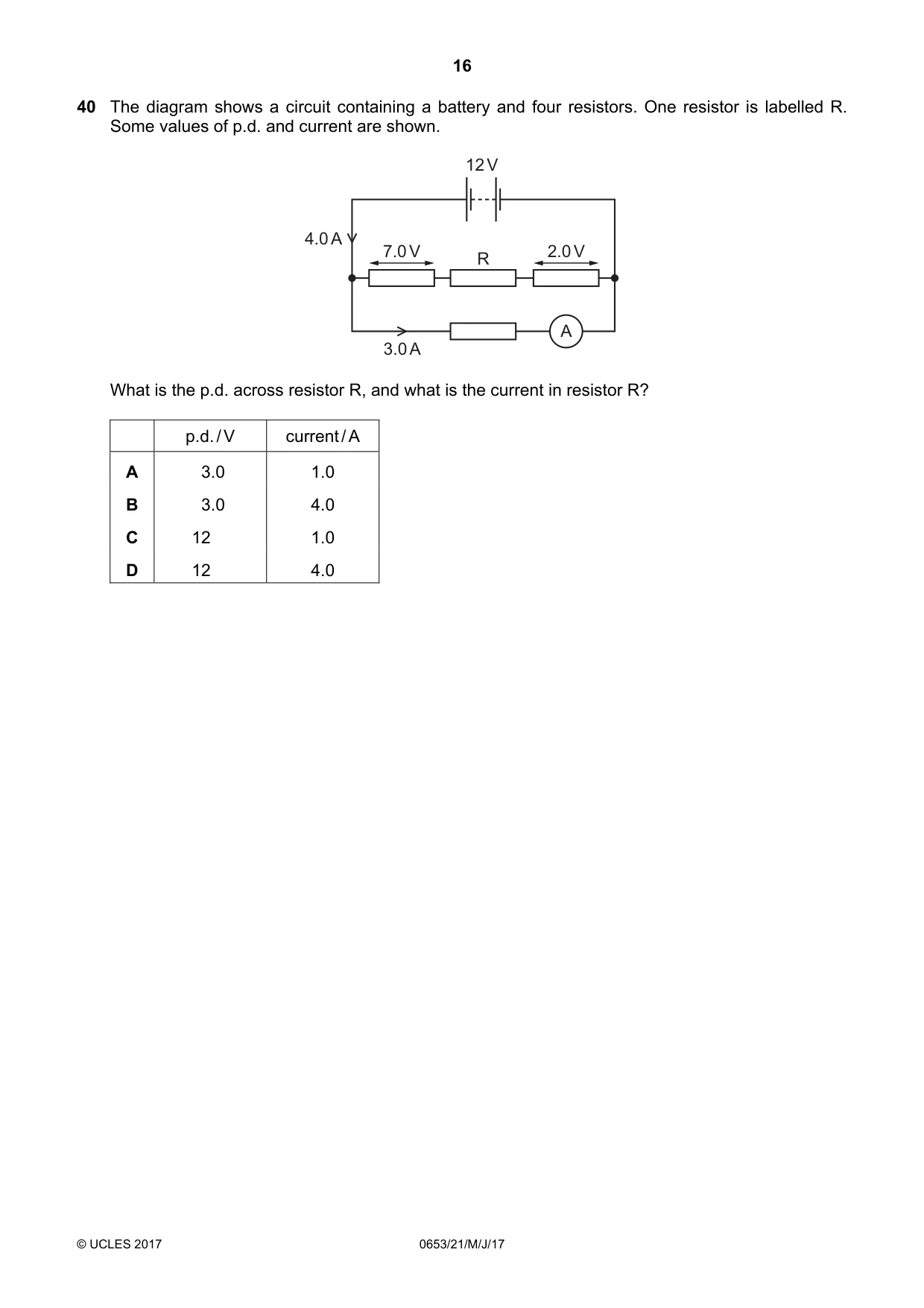
40 The diagram shows a circuit containing a battery and four resistors. One resistor is labelled R. Some values of p.d. and current are shown. 12 V 4.0 A 7.0 V R 2.0 V A 3.0 A What is the p.d. across resistor R, and what is the current in resistor R? p.d. / V current / A A 3.0 1.0 B 3.0 4.0 C 12 1.0 D 12 4.0
Mark scheme: A
What was in this paper
The subtopics covered by these 40 questions, and how many questions each got. Open one in a new tab to see every Cambridge question on it.
2Air quality and climate1Alloys and their properties1Atomic structure and the Periodic Table1Cell structure1Chromatography1Diet1Electrical circuits1Electrical quantities1Electrical safety1Electrolysis1Electromagnetic spectrum1Elements, compounds and mixtures1Energy, work and power1Enzymes1Exothermic and endothermic reactions1Food chains and food webs1Forces1Formulas1Fuels1Gas exchange in humans1General properties of waves1Group VII properties1Habitat destruction1Heart1Identification of ions and gases1Kinetic particle model of matter1Light1Mass and weight1Motion1Photosynthesis1Rate of reaction1Reactivity series1Redox1Sexual reproduction in humans1Sexual reproduction in plants1Sound1Transfer of thermal energy1Water uptake1What you needed in this session
Cambridge’s own grade thresholds for 2017 May/June, Paper 2 · Variant 1. A higher threshold means an easier paper — the bar moves with how the cohort did.