Cambridge IGCSE Science - Combined 0653 — 2025 Feb/March Paper 2 · Variant 2
0653/22/F/M/25 · 40 questions · 40 marks · 45 min
The question paper and its mark scheme, free to read here and free to download. This is Cambridge’s own paper, exactly as it was sat.
Question paper16 pages
Mark scheme3 pages
Answers below. Sit the paper first if you are practising.
Questions as text
Q1 · Which characteristic of living organisms describes the taking in of materials for energy…
1 Which characteristic of living organisms describes the taking in of materials for energy, growth and development? A excretion B nutrition C photosynthesis D respiration
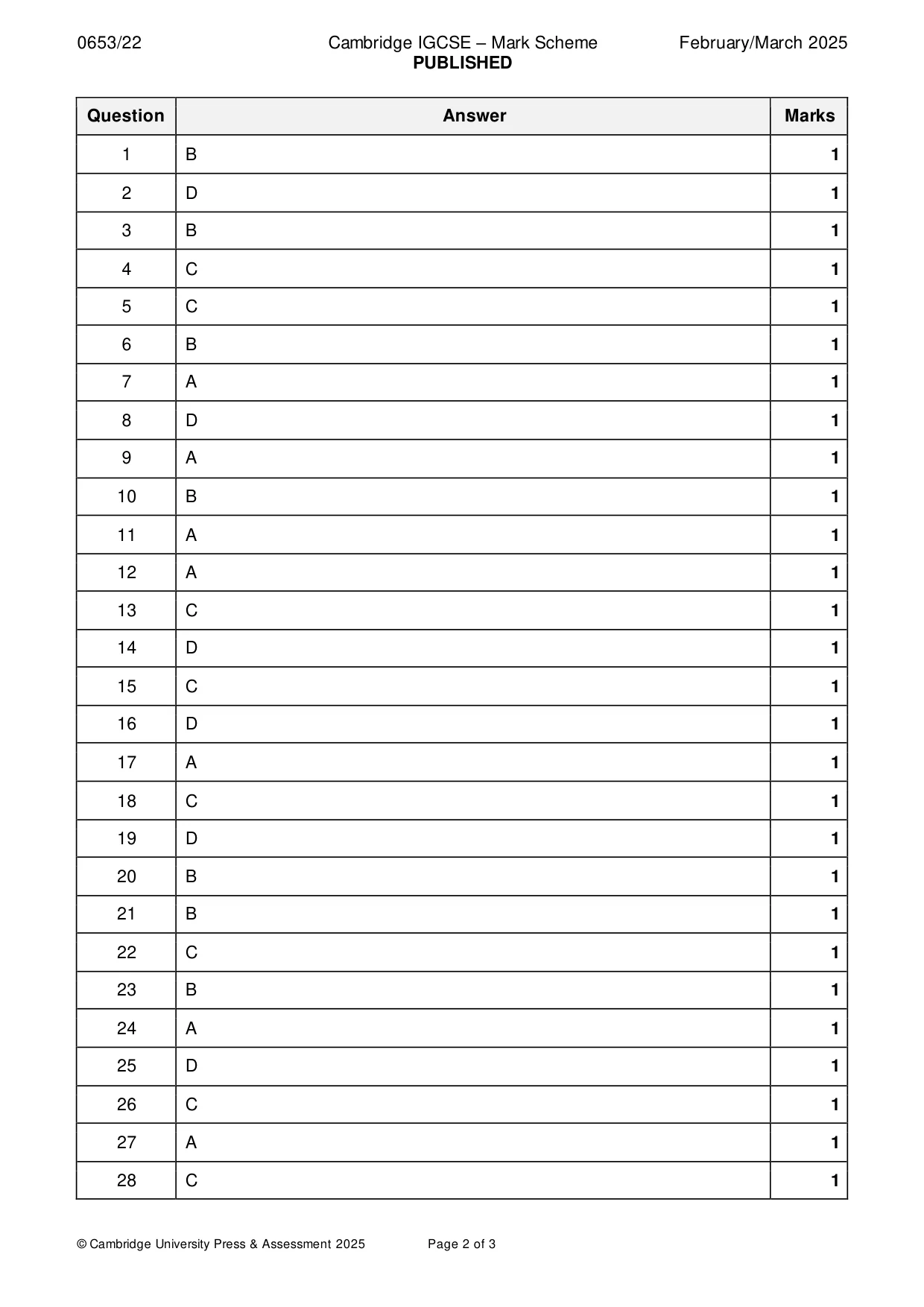
Mark scheme: B
Q2 · Which structures are found in bacterial cells but not in animal cells?
2 Which structures are found in bacterial cells but not in animal cells? A cell membrane and plasmids B nucleus and cytoplasm C nucleus and ribosomes D plasmids and cell wall
Mark scheme: D
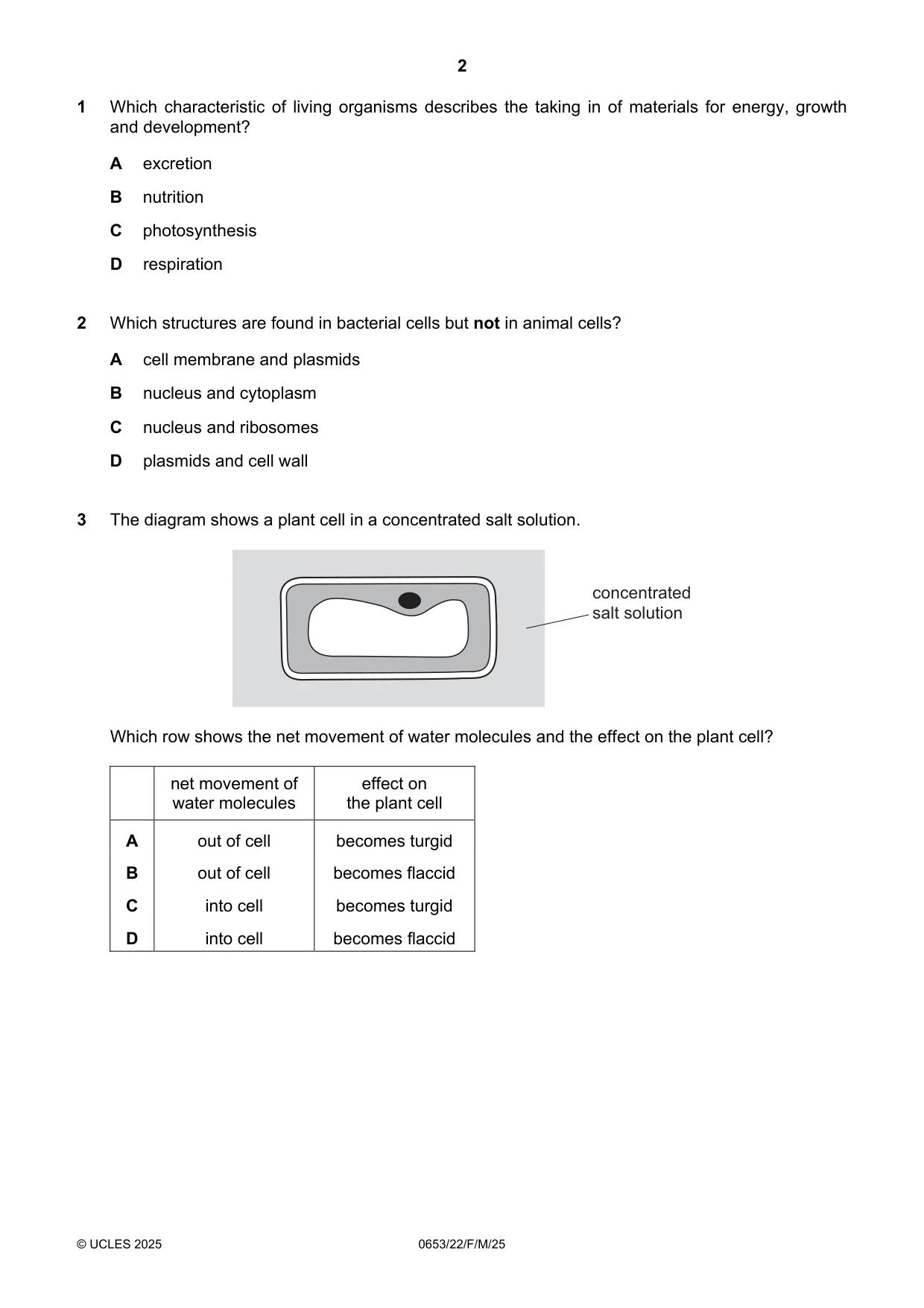
Q3 · The diagram shows a plant cell in a concentrated salt solution
3 The diagram shows a plant cell in a concentrated salt solution. concentrated salt solution Which row shows the net movement of water molecules and the effect on the plant cell? net movement of effect on water molecules the plant cell A out of cell becomes turgid B out of cell becomes flaccid C into cell becomes turgid D into cell becomes flaccid
Mark scheme: B
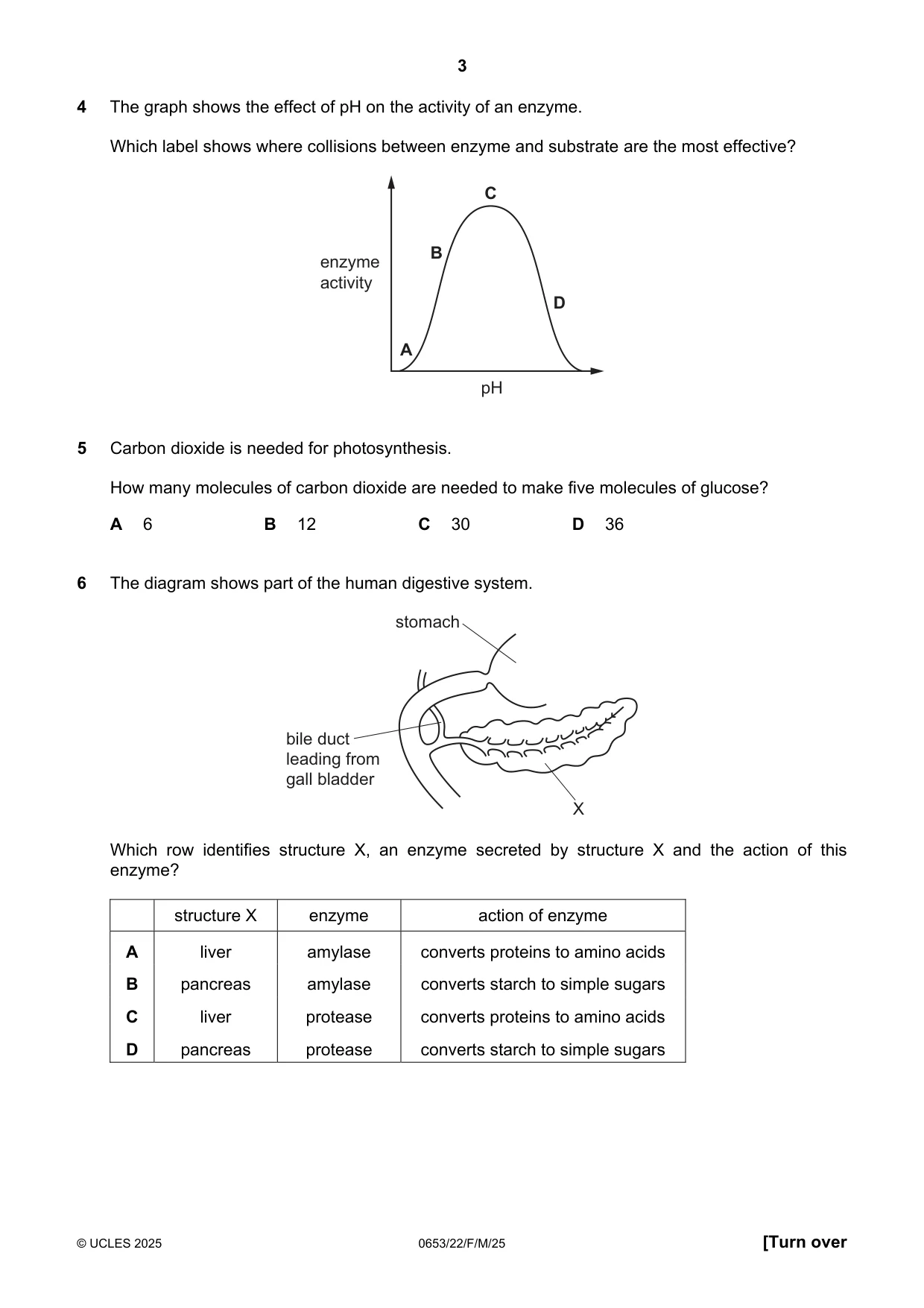
Q4 · The graph shows the effect of pH on the activity of an enzyme
4 The graph shows the effect of pH on the activity of an enzyme. Which label shows where collisions between enzyme and substrate are the most effective? C B enzyme activity D A pH
Mark scheme: C
Q5 · Carbon dioxide is needed for photosynthesis
5 Carbon dioxide is needed for photosynthesis. How many molecules of carbon dioxide are needed to make five molecules of glucose? A 6 B 12 C 30 D 36
Mark scheme: C
Q6 · The diagram shows part of the human digestive system
6 The diagram shows part of the human digestive system. stomach bile duct leading from gall bladder X Which row identifies structure X, an enzyme secreted by structure X and the action of this enzyme? structure X enzyme action of enzyme A liver amylase converts proteins to amino acids B pancreas amylase converts starch to simple sugars C liver protease converts proteins to amino acids D pancreas protease converts starch to simple sugars
Mark scheme: B
Q7 · What is a function of the large surface area of root hair cells?
7 What is a function of the large surface area of root hair cells? A to increase the uptake of mineral ions by active transport B to increase the uptake of water by active transport C to decrease the rate of transpiration by diffusion D to decrease the uptake of oxygen by diffusion
Mark scheme: A
Q8 · Which row shows how blood is pumped out of the heart to the lungs?
8 Which row shows how blood is pumped out of the heart to the lungs? atria ventricles A left atrium contracts left ventricle relaxes B left atrium relaxes left ventricle contracts C right atrium contracts right ventricle relaxes D right atrium relaxes right ventricle contracts
Mark scheme: D
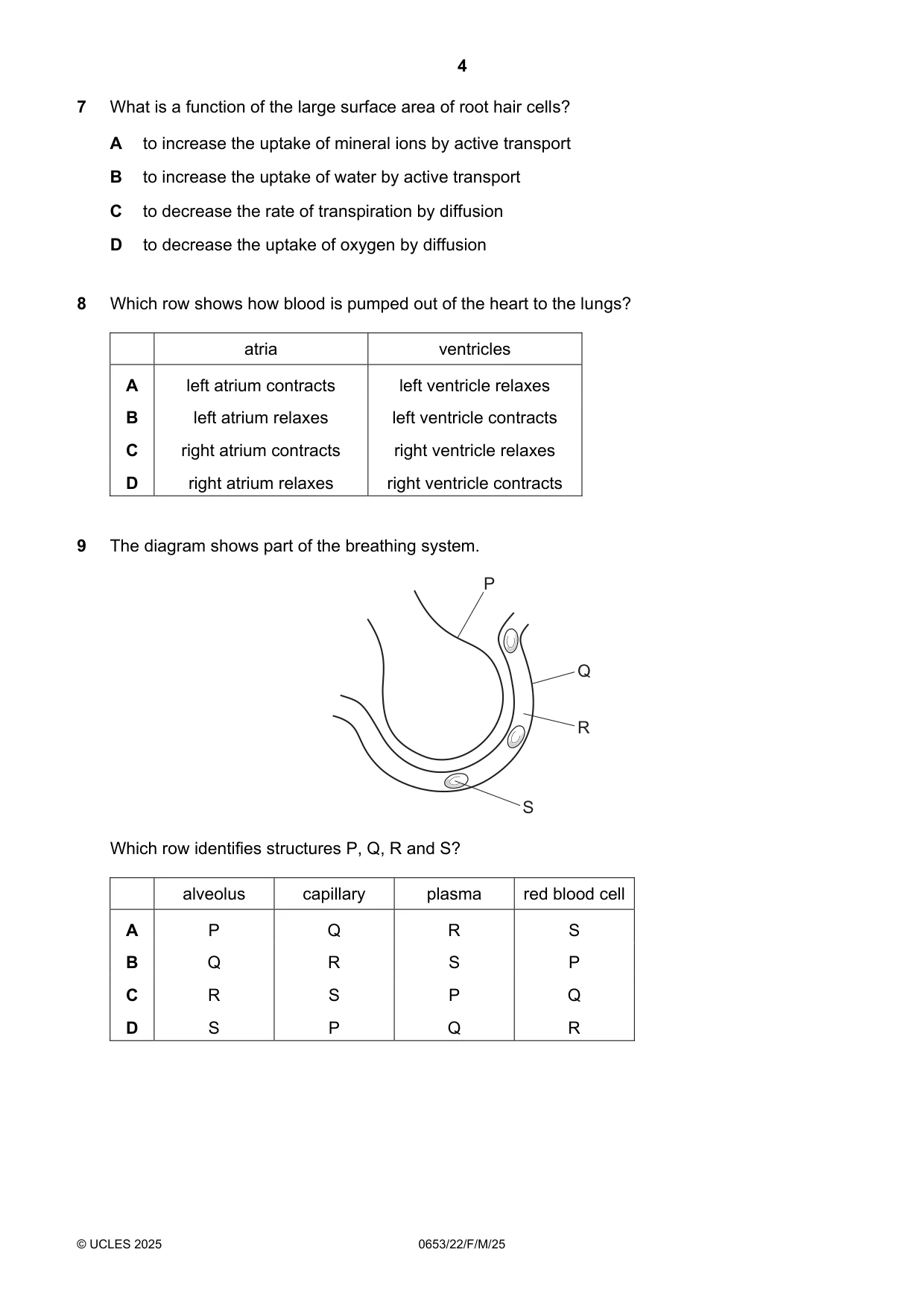
Q9 · The diagram shows part of the breathing system
9 The diagram shows part of the breathing system. P Q R S Which row identifies structures P, Q, R and S? alveolus capillary plasma red blood cell A P Q R S B Q R S P C R S P Q D S P Q R
Mark scheme: A
Q10 · Which molecule is broken down in aerobic respiration?
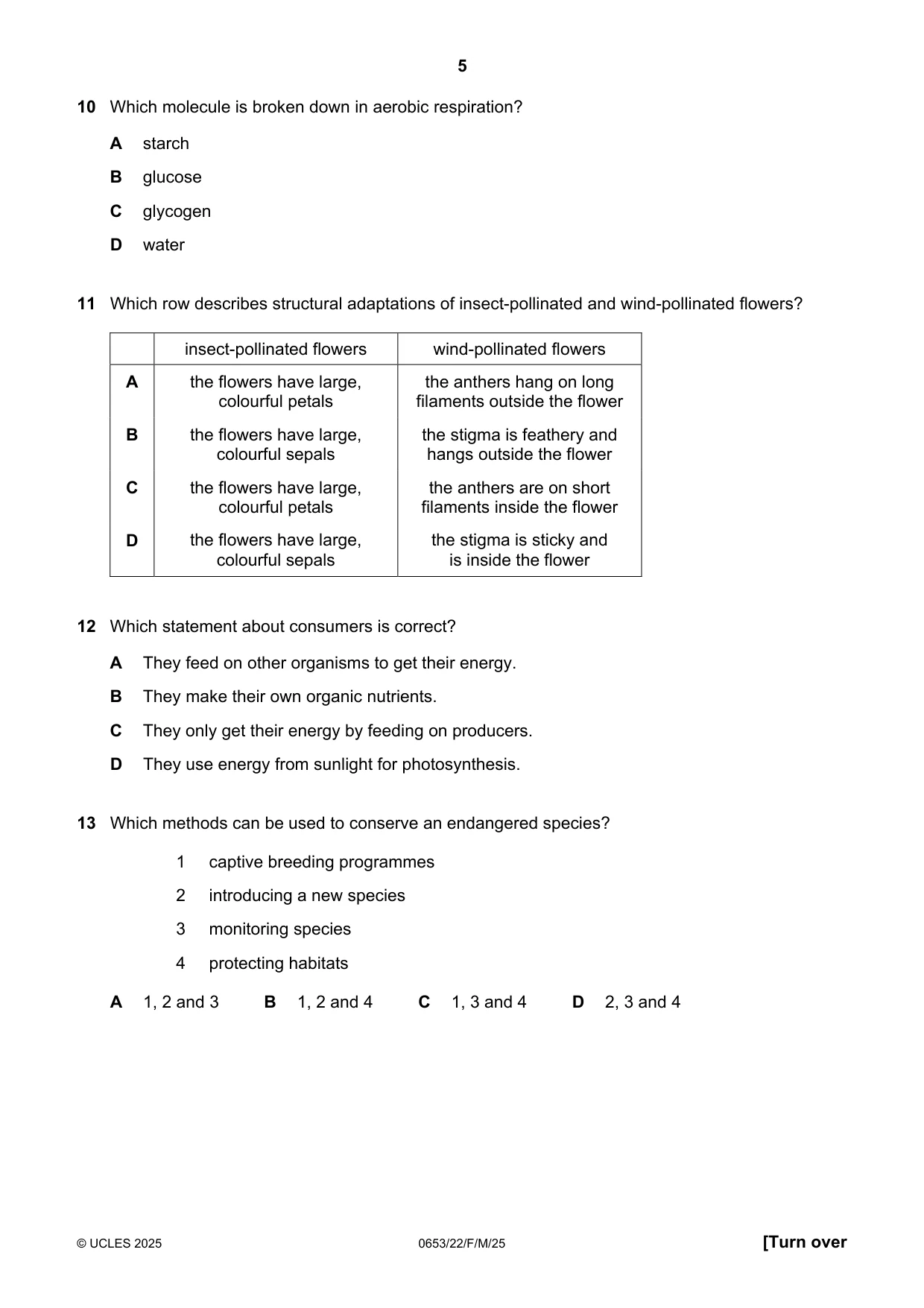
10 Which molecule is broken down in aerobic respiration? A starch B glucose C glycogen D water
Mark scheme: B
Q11 · Which row describes structural adaptations of insect-pollinated and wind-pollinated…
11 Which row describes structural adaptations of insect-pollinated and wind-pollinated flowers? insect-pollinated flowers wind-pollinated flowers A the flowers have large, the anthers hang on long colourful petals filaments outside the flower B the flowers have large, the stigma is feathery and colourful sepals hangs outside the flower C the flowers have large, the anthers are on short colourful petals filaments inside the flower D the flowers have large, the stigma is sticky and colourful sepals is inside the flower
Mark scheme: A
Q12 · Which statement about consumers is correct?
12 Which statement about consumers is correct? A They feed on other organisms to get their energy. B They make their own organic nutrients. C They only get their energy by feeding on producers. D They use energy from sunlight for photosynthesis.
Mark scheme: A
Q13 · Which methods can be used to conserve an endangered species?
13 Which methods can be used to conserve an endangered species? 1 captive breeding programmes 2 introducing a new species 3 monitoring species 4 protecting habitats A 1, 2 and 3 B 1, 2 and 4 C 1, 3 and 4 D 2, 3 and 4
Mark scheme: C
Q14 · When a substance is heated, it absorbs energy and changes from a solid to a liquid
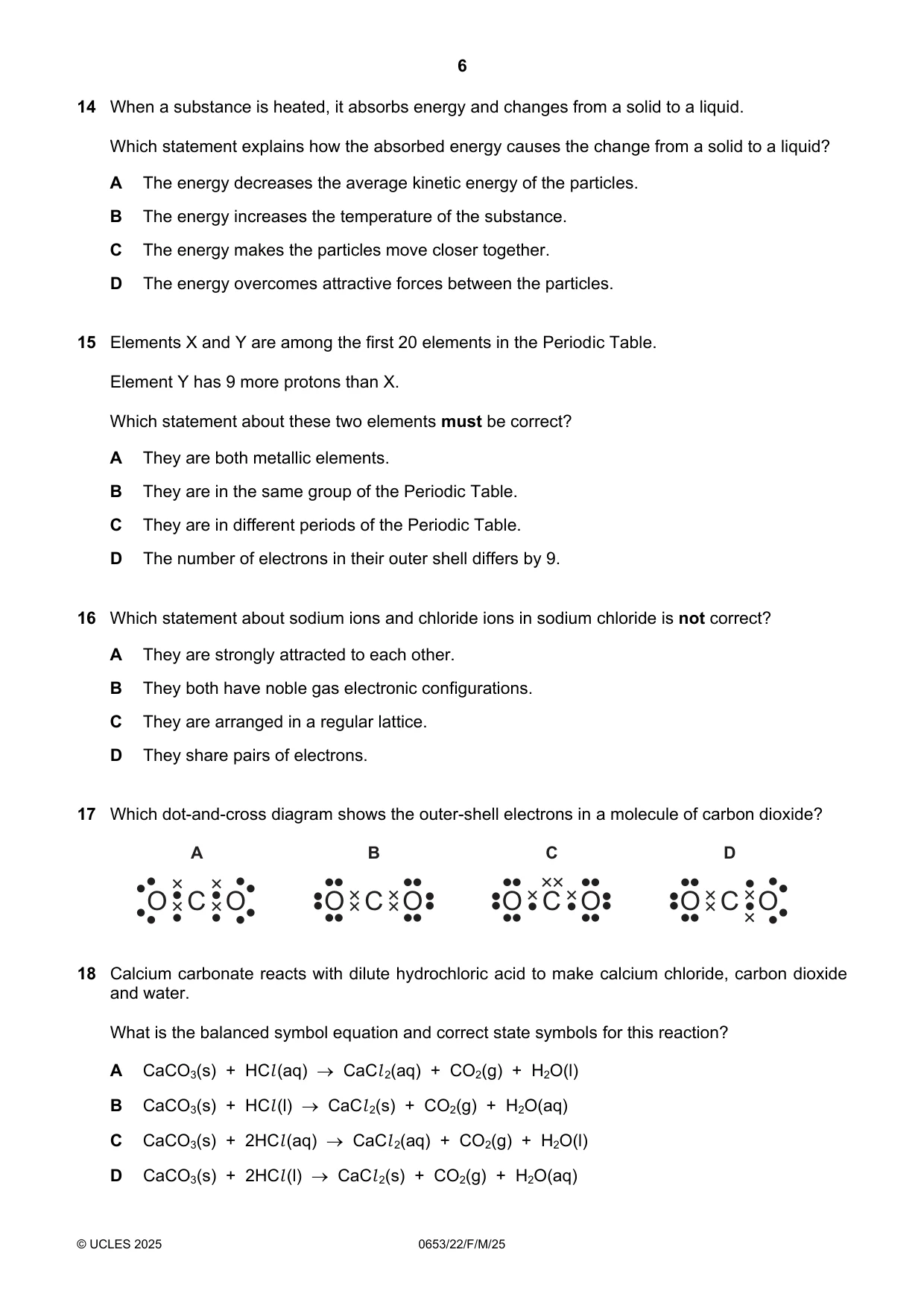
14 When a substance is heated, it absorbs energy and changes from a solid to a liquid. Which statement explains how the absorbed energy causes the change from a solid to a liquid? A The energy decreases the average kinetic energy of the particles. B The energy increases the temperature of the substance. C The energy makes the particles move closer together. D The energy overcomes attractive forces between the particles.
Mark scheme: D
Q15 · Elements X and Y are among the first 20 elements in the Periodic Table
15 Elements X and Y are among the first 20 elements in the Periodic Table. Element Y has 9 more protons than X. Which statement about these two elements must be correct? A They are both metallic elements. B They are in the same group of the Periodic Table. C They are in different periods of the Periodic Table. D The number of electrons in their outer shell differs by 9.
Mark scheme: C
Q16 · Which statement about sodium ions and chloride ions in sodium chloride is not correct?
16 Which statement about sodium ions and chloride ions in sodium chloride is not correct? A They are strongly attracted to each other. B They both have noble gas electronic configurations. C They are arranged in a regular lattice. D They share pairs of electrons.
Mark scheme: D
Q17 · Which dot-and-cross diagram shows the outer-shell electrons in a molecule of carbon…
17 Which dot-and-cross diagram shows the outer-shell electrons in a molecule of carbon dioxide? A B C D O C O O C O O C O O C O
Mark scheme: A
Q18 · Calcium carbonate reacts with dilute hydrochloric acid to make calcium chloride, carbon…
18 Calcium carbonate reacts with dilute hydrochloric acid to make calcium chloride, carbon dioxide and water. What is the balanced symbol equation and correct state symbols for this reaction? A CaCO3(s) + HCl (aq) CaCl 2(aq) + CO2(g) + H2O(l) B CaCO3(s) + HCl (l) CaCl 2(s) + CO2(g) + H2O(aq) C CaCO3(s) + 2HCl (aq) CaCl 2(aq) + CO2(g) + H2O(l) D CaCO3(s) + 2HCl (l) CaCl 2(s) + CO2(g) + H2O(aq)
Mark scheme: C
Q19 · The apparatus shown is used to test a property of compound R
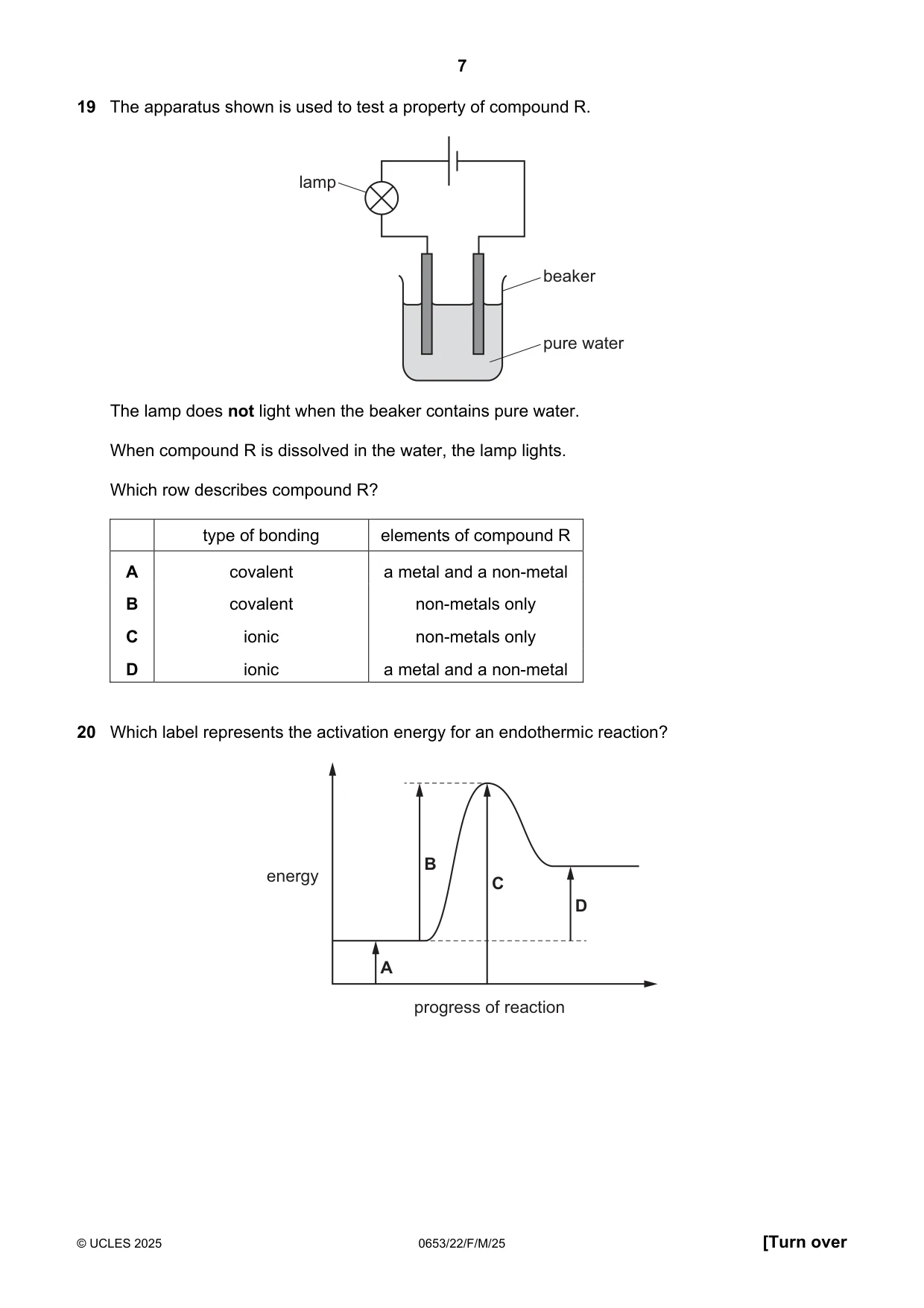
19 The apparatus shown is used to test a property of compound R. lamp beaker pure water The lamp does not light when the beaker contains pure water. When compound R is dissolved in the water, the lamp lights. Which row describes compound R? type of bonding elements of compound R A covalent a metal and a non-metal B covalent non-metals only C ionic non-metals only D ionic a metal and a non-metal
Mark scheme: D
Q20 · Which label represents the activation energy for an endothermic reaction?
20 Which label represents the activation energy for an endothermic reaction? B energy C D A progress of reaction
Mark scheme: B
Q21 · Which diagram shows apparatus correctly assembled to determine the rate of reaction…
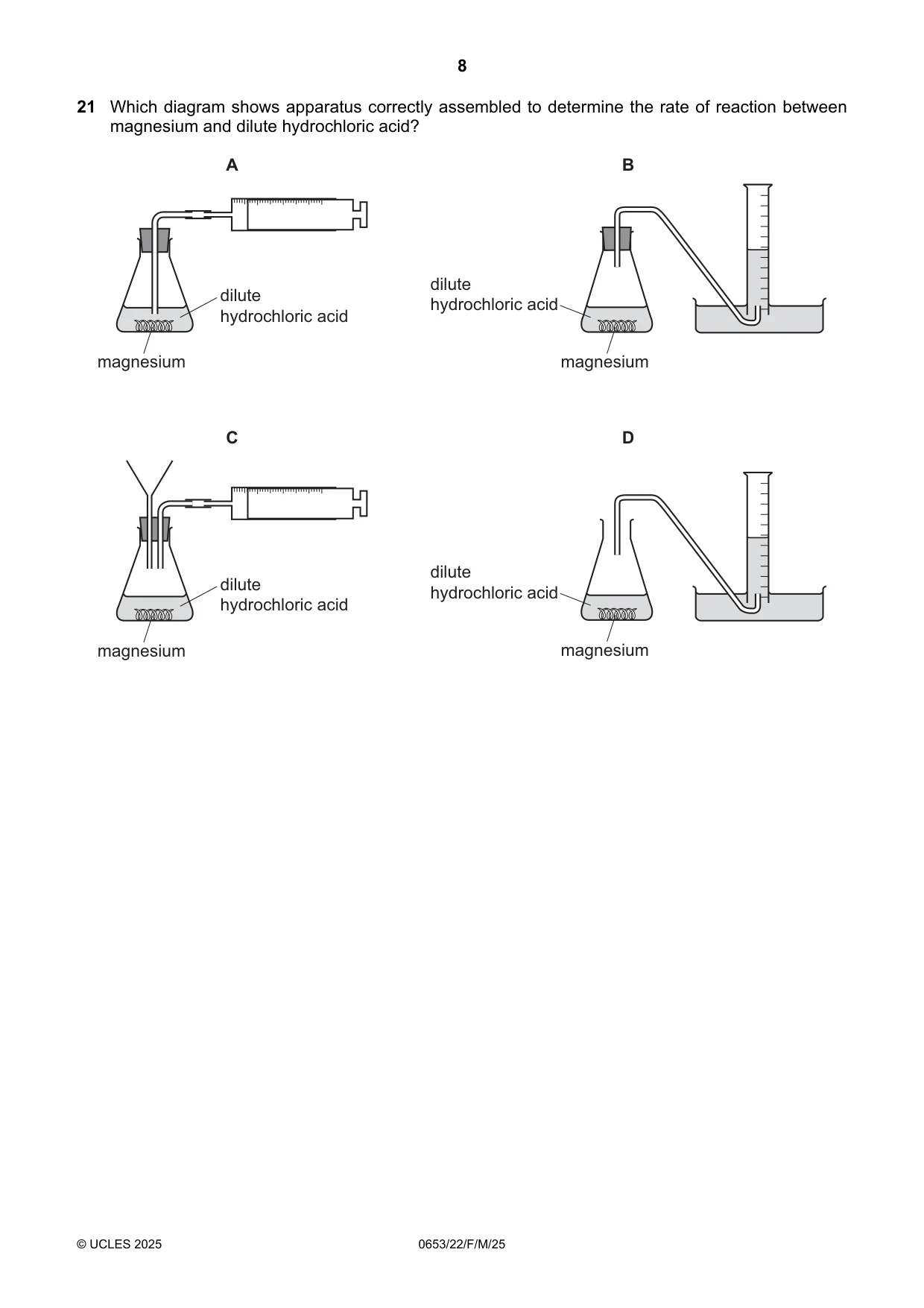
21 Which diagram shows apparatus correctly assembled to determine the rate of reaction between magnesium and dilute hydrochloric acid? A B dilute dilute hydrochloric acid hydrochloric acid magnesium magnesium C D dilute dilute hydrochloric acid hydrochloric acid magnesium magnesium
Mark scheme: B
Q22 · Information about some elements in Group I, Group II and Group VII of the Periodic Table…
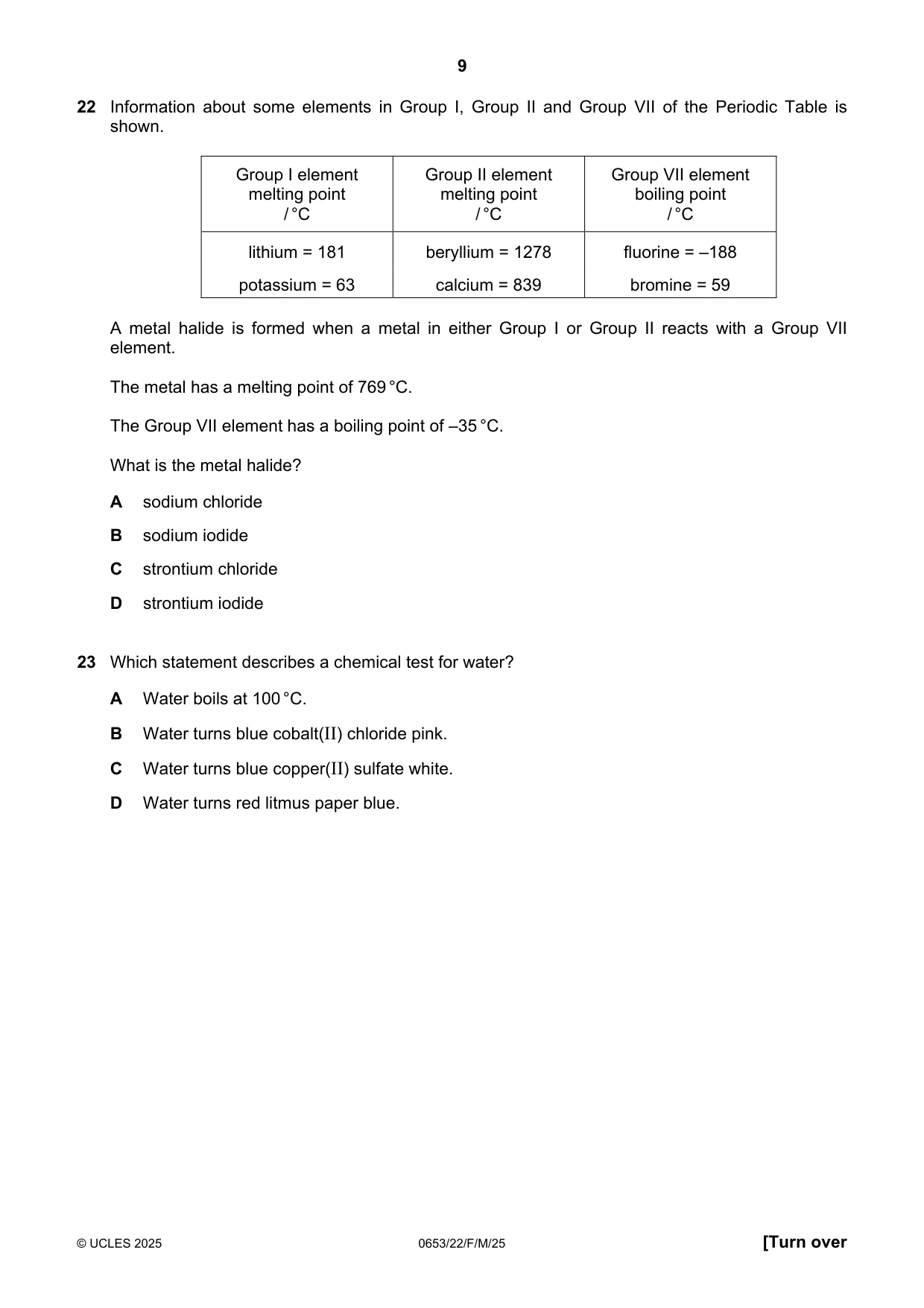
22 Information about some elements in Group I, Group II and Group VII of the Periodic Table is shown. Group I element Group II element Group VII element melting point melting point boiling point / °C / °C / °C lithium = 181 beryllium = 1278 fluorine = –188 potassium = 63 calcium = 839 bromine = 59 A metal halide is formed when a metal in either Group I or Group II reacts with a Group VII element. The metal has a melting point of 769 °C. The Group VII element has a boiling point of –35 °C. What is the metal halide? A sodium chloride B sodium iodide C strontium chloride D strontium iodide
Mark scheme: C
Q23 · Which statement describes a chemical test for water?
23 Which statement describes a chemical test for water? A Water boils at 100 °C. B Water turns blue cobalt(II) chloride pink. C Water turns blue copper(II) sulfate white. D Water turns red litmus paper blue.
Mark scheme: B
Q24 · Dyes J and K are analysed using chromatography
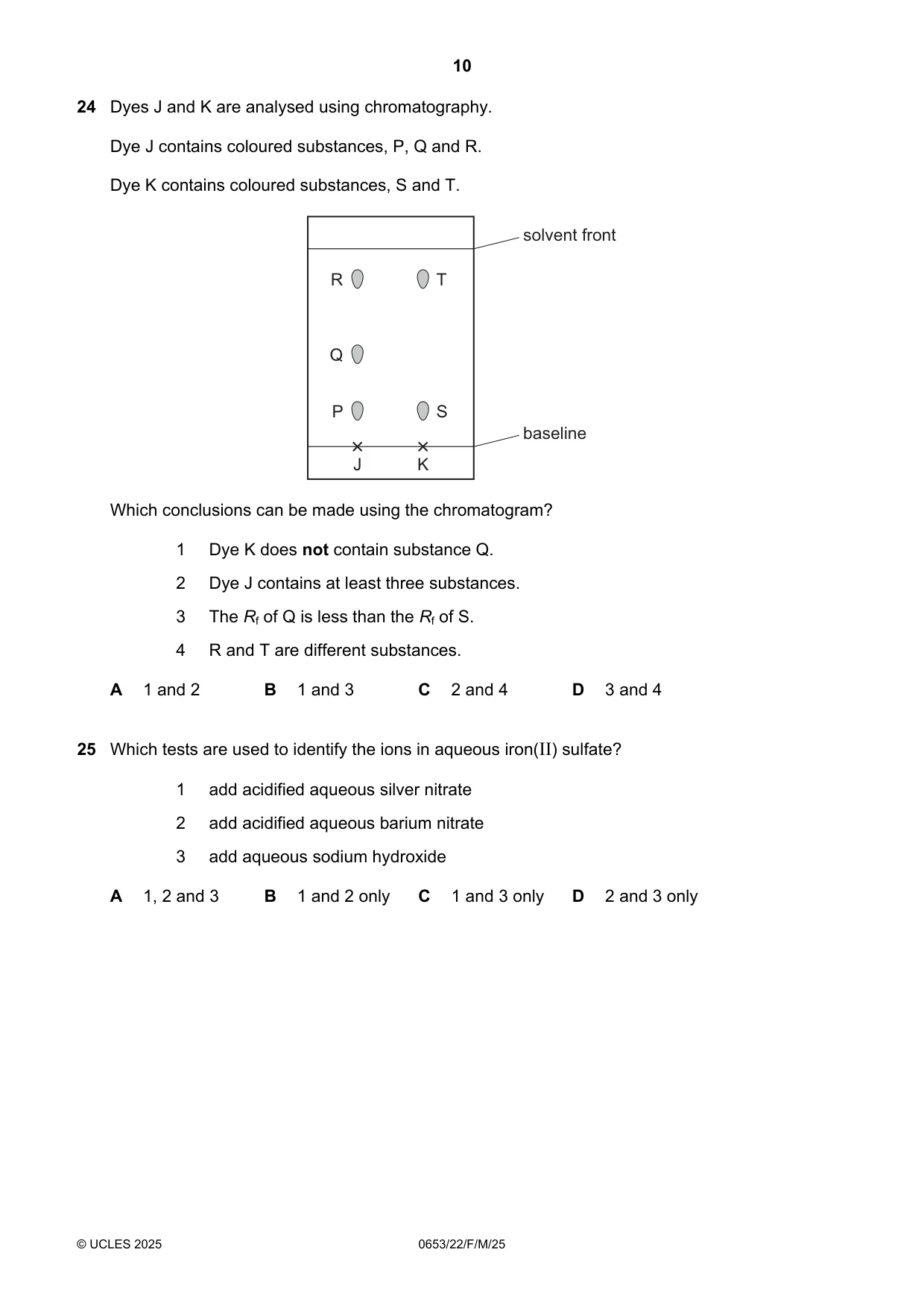
24 Dyes J and K are analysed using chromatography. Dye J contains coloured substances, P, Q and R. Dye K contains coloured substances, S and T. solvent front R T Q P S baseline J K Which conclusions can be made using the chromatogram? 1 Dye K does not contain substance Q. 2 Dye J contains at least three substances. 3 The Rf of Q is less than the Rf of S. 4 R and T are different substances. A 1 and 2 B 1 and 3 C 2 and 4 D 3 and 4
Mark scheme: A
Q25 · Which tests are used to identify the ions in aqueous iron(II) sulfate?
25 Which tests are used to identify the ions in aqueous iron(II) sulfate? 1 add acidified aqueous silver nitrate 2 add acidified aqueous barium nitrate 3 add aqueous sodium hydroxide A 1, 2 and 3 B 1 and 2 only C 1 and 3 only D 2 and 3 only
Mark scheme: D
Q26 · The diagram shows a solid element dropped into a dish of water
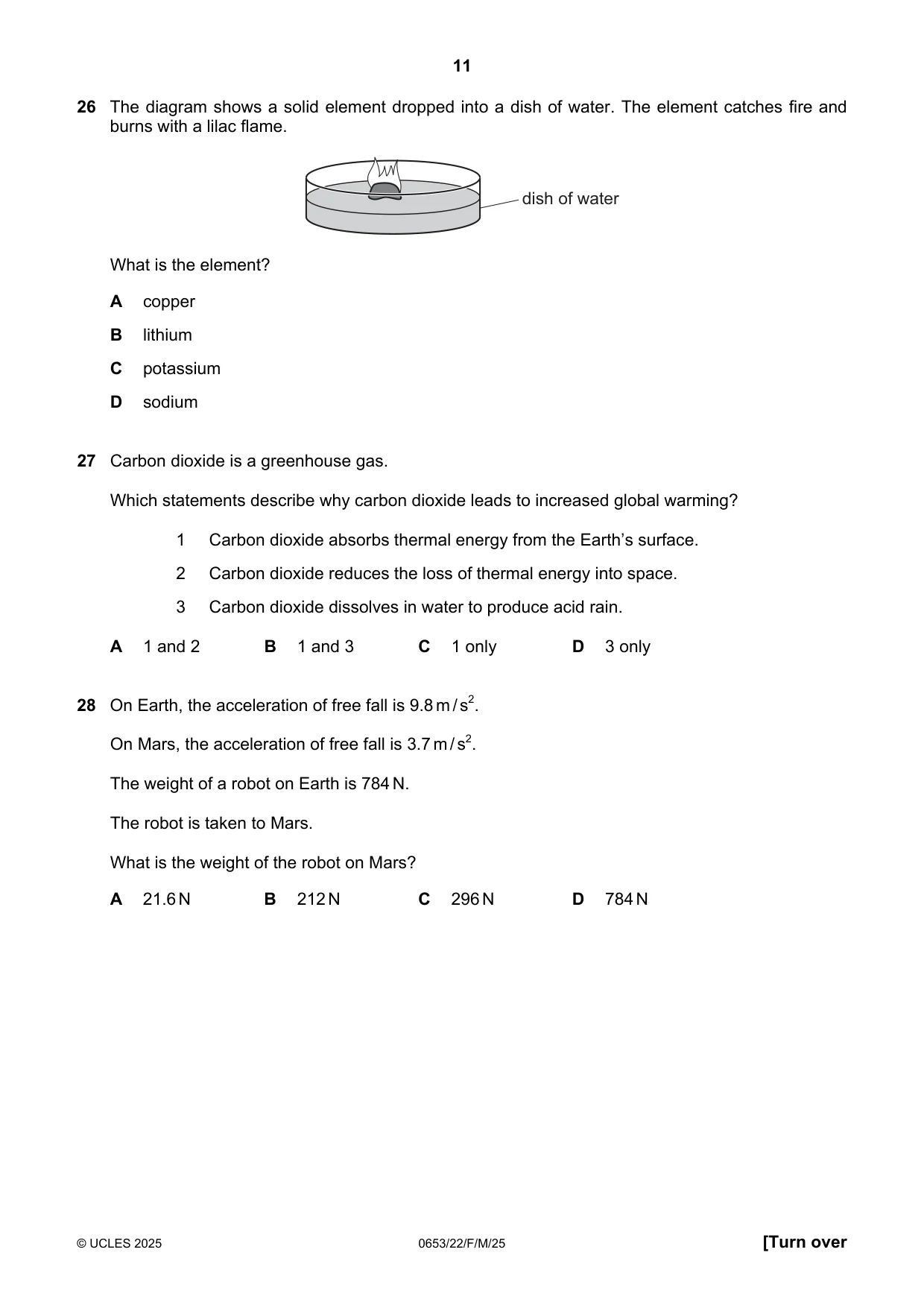
26 The diagram shows a solid element dropped into a dish of water. The element catches fire and burns with a lilac flame. dish of water What is the element? A copper B lithium C potassium D sodium
Mark scheme: C
Q27 · Carbon dioxide is a greenhouse gas
27 Carbon dioxide is a greenhouse gas. Which statements describe why carbon dioxide leads to increased global warming? 1 Carbon dioxide absorbs thermal energy from the Earth’s surface. 2 Carbon dioxide reduces the loss of thermal energy into space. 3 Carbon dioxide dissolves in water to produce acid rain. A 1 and 2 B 1 and 3 C 1 only D 3 only
Mark scheme: A
Q28 · On Earth, the acceleration of free fall is 9.8 m / s2
28 On Earth, the acceleration of free fall is 9.8 m / s2. On Mars, the acceleration of free fall is 3.7 m / s2. The weight of a robot on Earth is 784 N. The robot is taken to Mars. What is the weight of the robot on Mars? A 21.6 N B 212 N C 296 N D 784 N
Mark scheme: C
Q29 · Four objects, P, Q, R and S, are moving
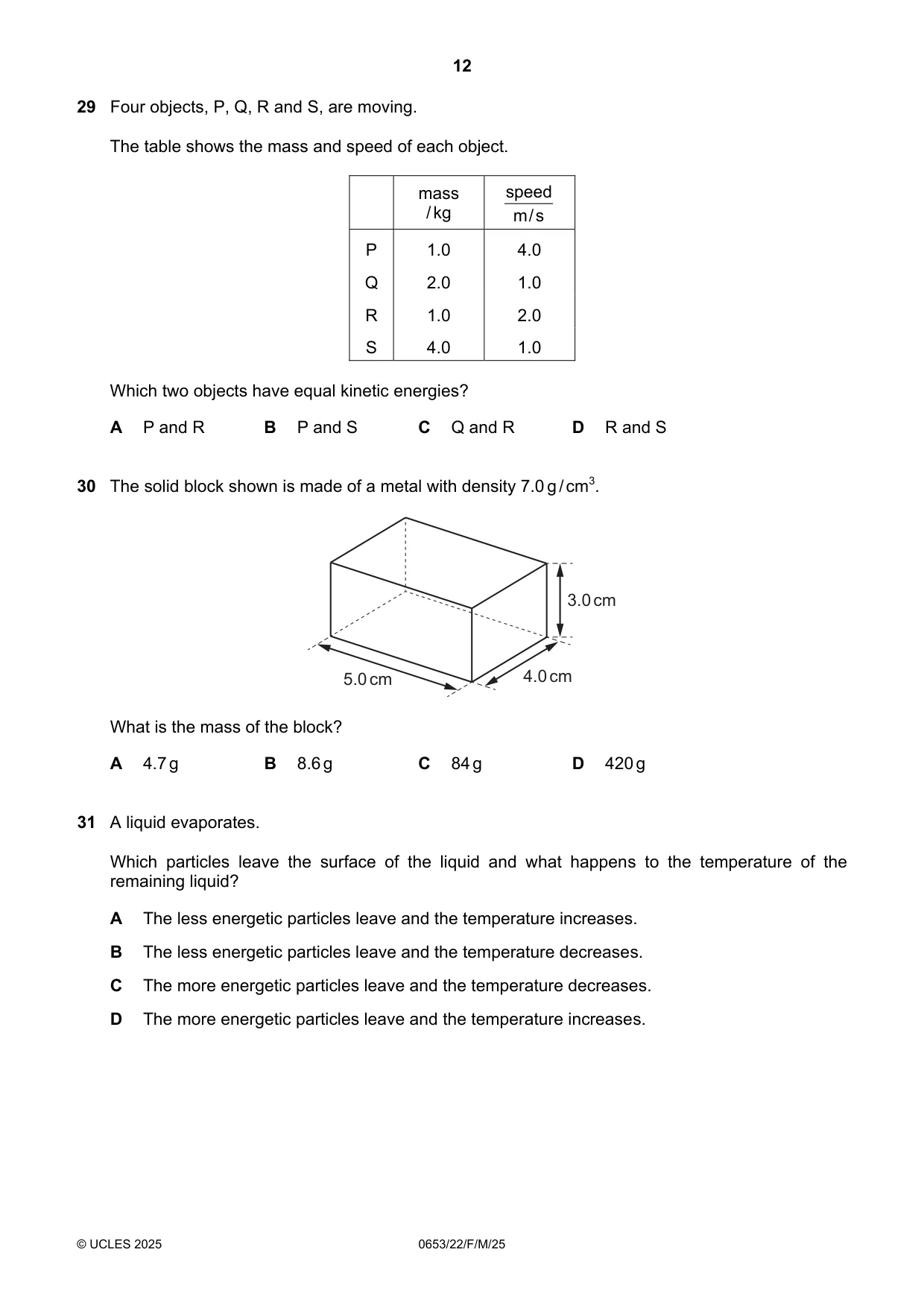
29 Four objects, P, Q, R and S, are moving. The table shows the mass and speed of each object. mass speed / kg m / s P 1.0 4.0 Q 2.0 1.0 R 1.0 2.0 S 4.0 1.0 Which two objects have equal kinetic energies? A P and R B P and S C Q and R D R and S
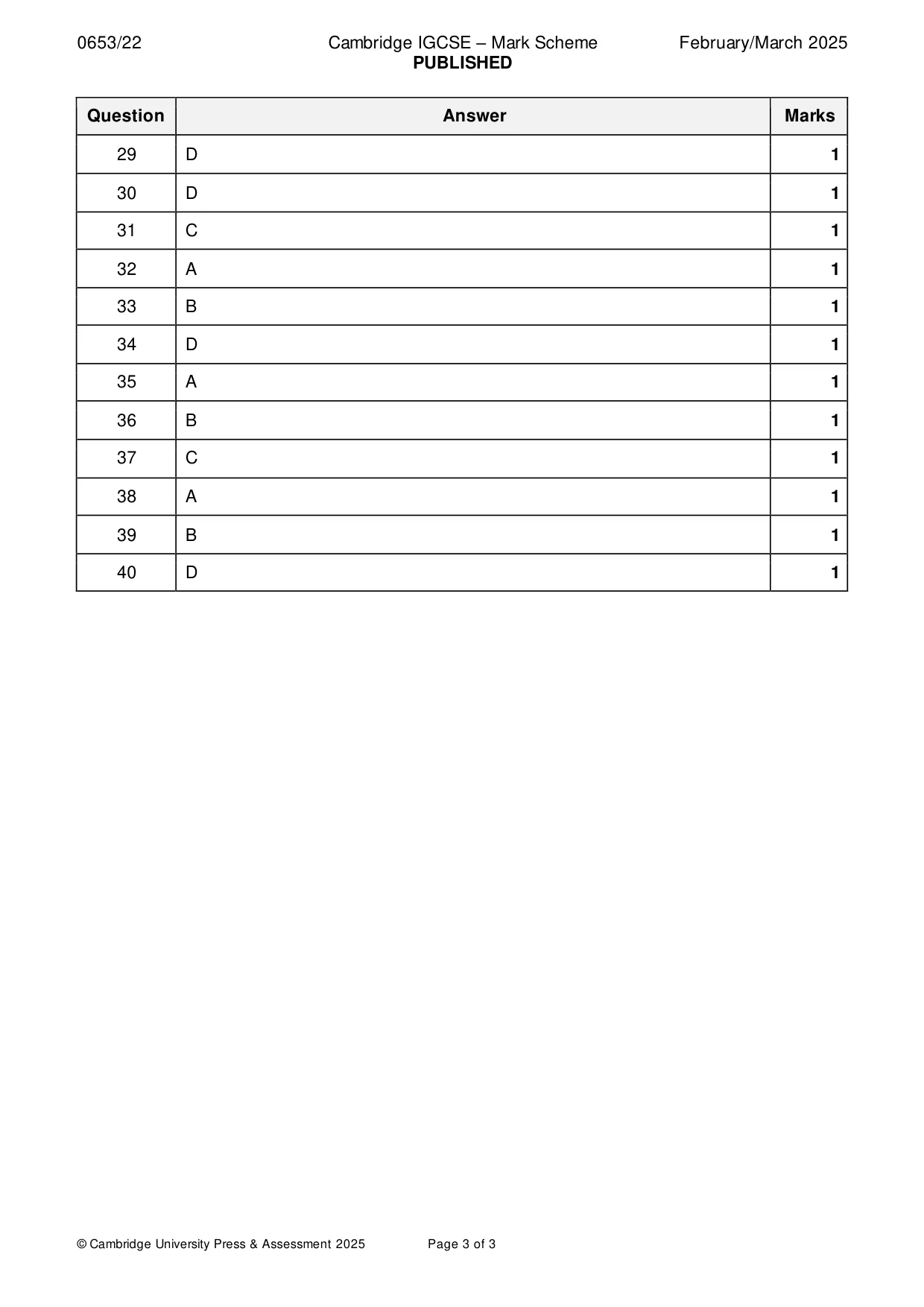
Mark scheme: D
Q30 · The solid block shown is made of a metal with density 7.0 g / cm3
30 The solid block shown is made of a metal with density 7.0 g / cm3. 3.0 cm 5.0 cm 4.0 cm What is the mass of the block? A 4.7 g B 8.6 g C 84 g D 420 g
Mark scheme: D
Question 31
31 A liquid evaporates. Which particles leave the surface of the liquid and what happens to the temperature of the remaining liquid? A The less energetic particles leave and the temperature increases. B The less energetic particles leave and the temperature decreases. C The more energetic particles leave and the temperature decreases. D The more energetic particles leave and the temperature increases.
Mark scheme: C
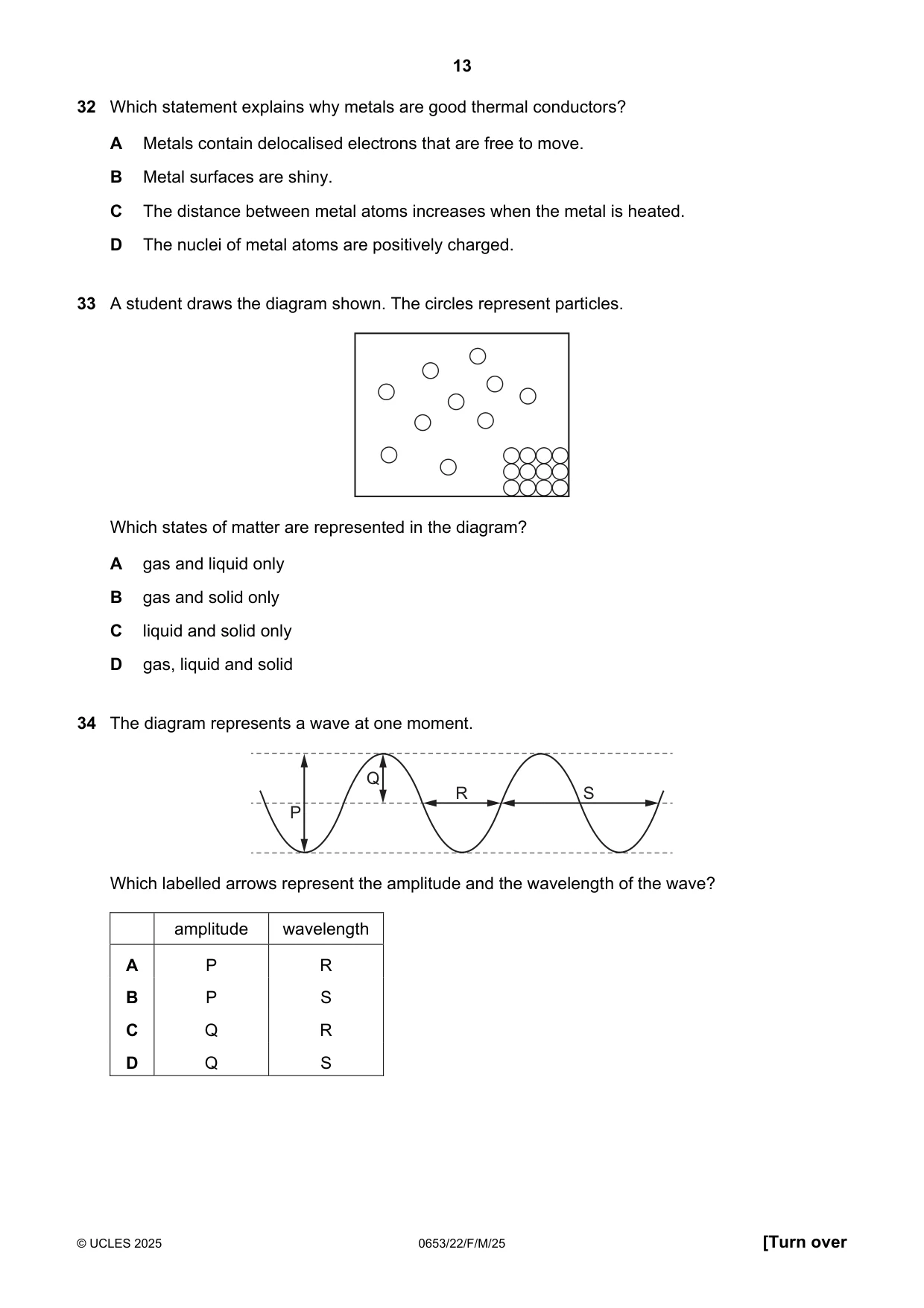
Q32 · Which statement explains why metals are good thermal conductors?
32 Which statement explains why metals are good thermal conductors? A Metals contain delocalised electrons that are free to move. B Metal surfaces are shiny. C The distance between metal atoms increases when the metal is heated. D The nuclei of metal atoms are positively charged.
Mark scheme: A
Q33 · A student draws the diagram shown
33 A student draws the diagram shown. The circles represent particles. Which states of matter are represented in the diagram? A gas and liquid only B gas and solid only C liquid and solid only D gas, liquid and solid
Mark scheme: B
Q34 · The diagram represents a wave at one moment
34 The diagram represents a wave at one moment. Q R S P Which labelled arrows represent the amplitude and the wavelength of the wave? amplitude wavelength A P R B P S C Q R D Q S
Mark scheme: D
Q35 · Which statement about longitudinal waves and transverse waves is correct?
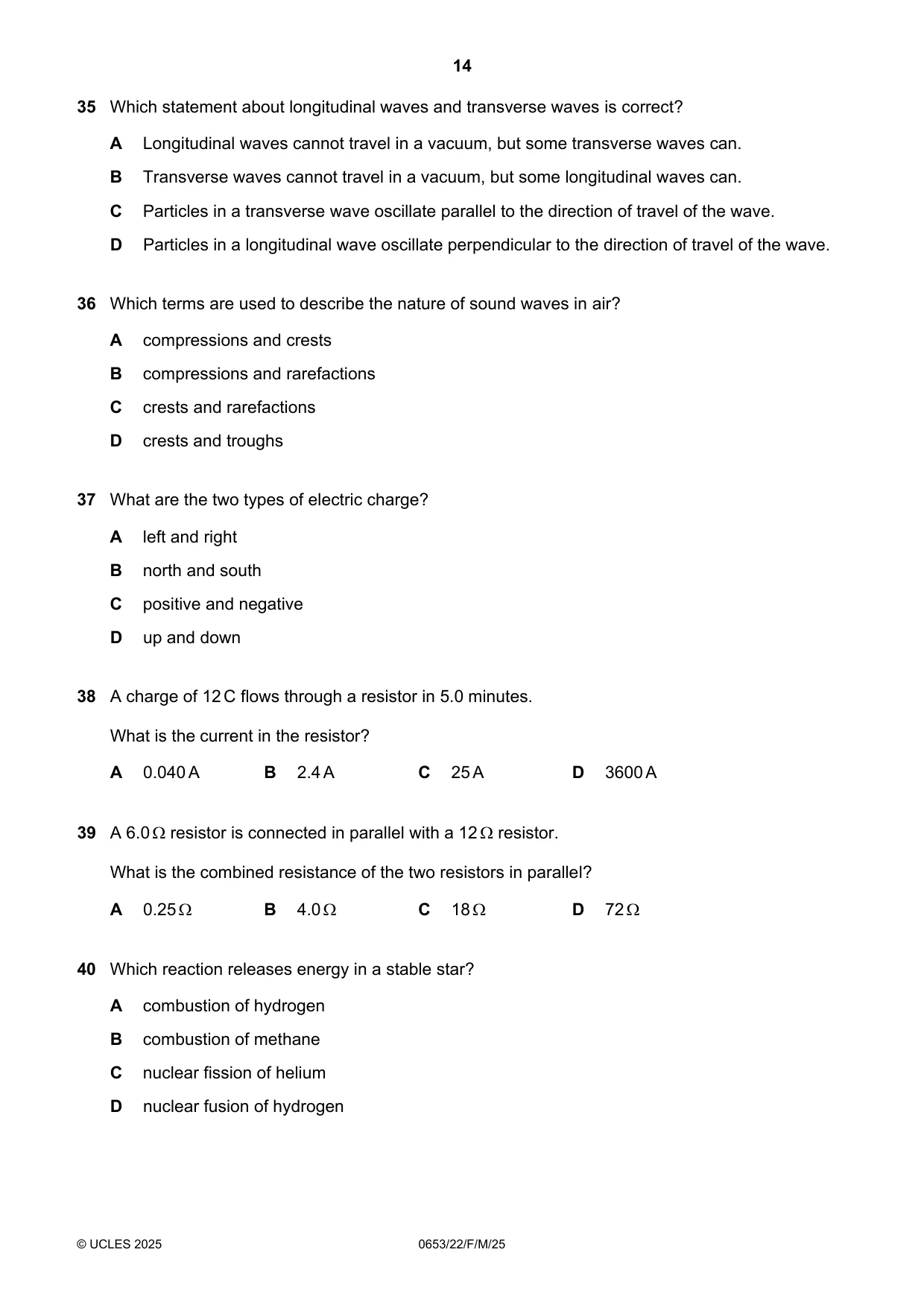
35 Which statement about longitudinal waves and transverse waves is correct? A Longitudinal waves cannot travel in a vacuum, but some transverse waves can. B Transverse waves cannot travel in a vacuum, but some longitudinal waves can. C Particles in a transverse wave oscillate parallel to the direction of travel of the wave. D Particles in a longitudinal wave oscillate perpendicular to the direction of travel of the wave.
Mark scheme: A
Q36 · Which terms are used to describe the nature of sound waves in air?
36 Which terms are used to describe the nature of sound waves in air? A compressions and crests B compressions and rarefactions C crests and rarefactions D crests and troughs
Mark scheme: B
Q37 · What are the two types of electric charge?
37 What are the two types of electric charge? A left and right B north and south C positive and negative D up and down
Mark scheme: C
Q38 · A charge of 12 C flows through a resistor in 5.0 minutes
38 A charge of 12 C flows through a resistor in 5.0 minutes. What is the current in the resistor? A 0.040 A B 2.4 A C 25 A D 3600 A
Mark scheme: A
Q39 · A 6.0 resistor is connected in parallel with a 12 resistor
39 A 6.0 resistor is connected in parallel with a 12 resistor. What is the combined resistance of the two resistors in parallel? A 0.25 B 4.0 C 18 D 72
Mark scheme: B
Q40 · Which reaction releases energy in a stable star?
40 Which reaction releases energy in a stable star? A combustion of hydrogen B combustion of methane C nuclear fission of helium D nuclear fusion of hydrogen
Mark scheme: D
What was in this paper
The subtopics covered by these 40 questions, and how many questions each got. Open one in a new tab to see every Cambridge question on it.
3Electrical quantities2General properties of waves2Identification of ions and gases2Ions and ionic bonds2Air quality and climate1Atomic structure and the Periodic Table1Cell structure1Characteristics of living organisms1Chromatography1Conservation1Density1Digestion1Electrical circuits1Energy, work and power1Enzymes1Exothermic and endothermic reactions1Food chains and food webs1Formulas1Gas exchange in humans1Group I properties1Group VII properties1Heart1Mass and weight1Osmosis1Photosynthesis1Rate of reaction1Respiration1Sexual reproduction in plants1Simple molecules and covalent bonds1Sound1Stars and the Universe1Transfer of thermal energy1Water uptake1What you needed in this session
Cambridge’s own grade thresholds for 2025 Feb/March, Paper 2 · Variant 2. A higher threshold means an easier paper — the bar moves with how the cohort did.