Cambridge IGCSE Science - Combined 0653 — 2025 Oct/Nov Paper 2 · Variant 3
0653/23/O/N/25 · 40 questions · 40 marks · 45 min
The question paper and its mark scheme, free to read here and free to download. This is Cambridge’s own paper, exactly as it was sat.
Question paper16 pages
Mark scheme3 pages
Answers below. Sit the paper first if you are practising.
Questions as text
Q1 · Nutrition is the taking in of materials
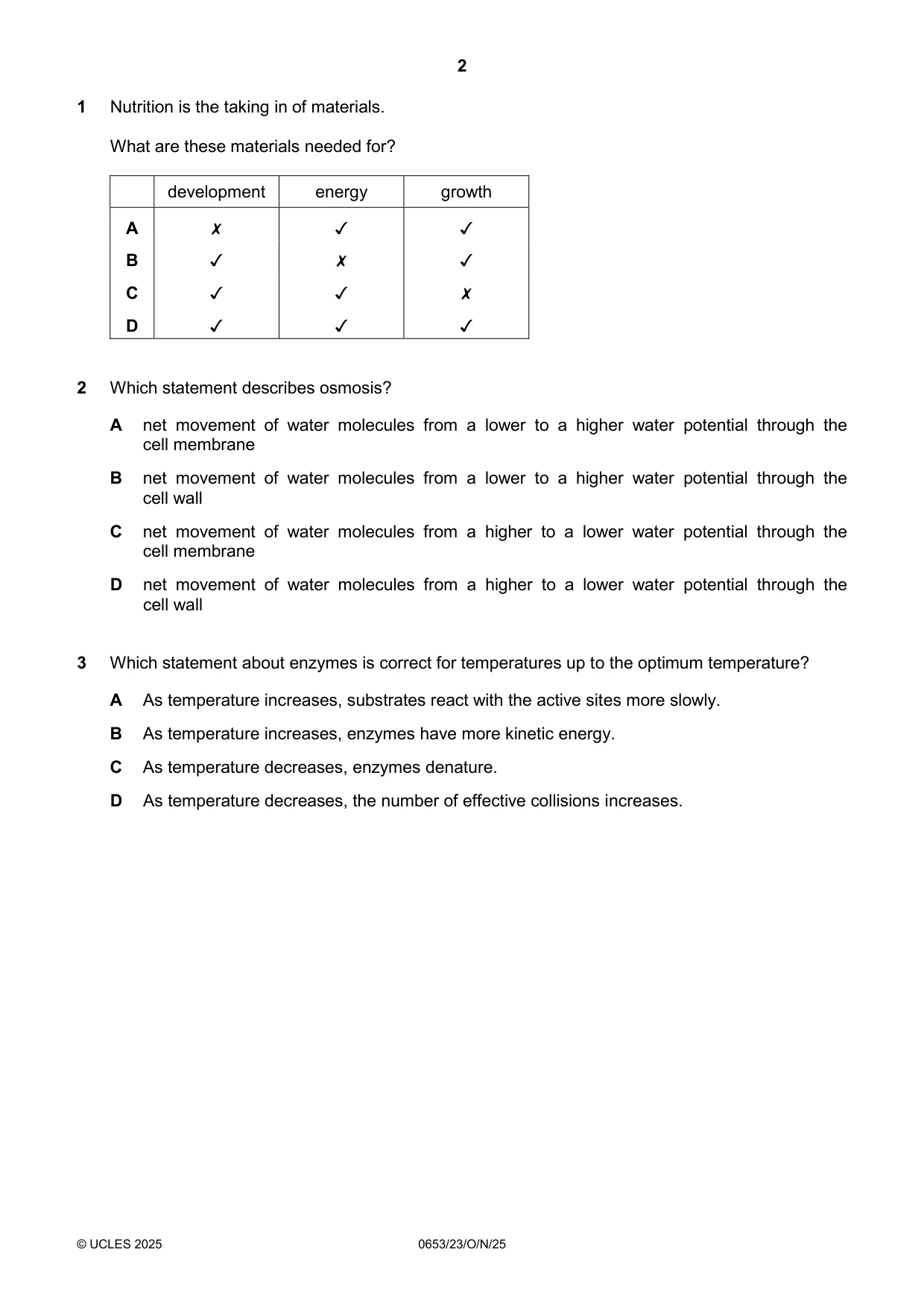
1 Nutrition is the taking in of materials. What are these materials needed for? | development energy growth A x v v v x v v v x v v v
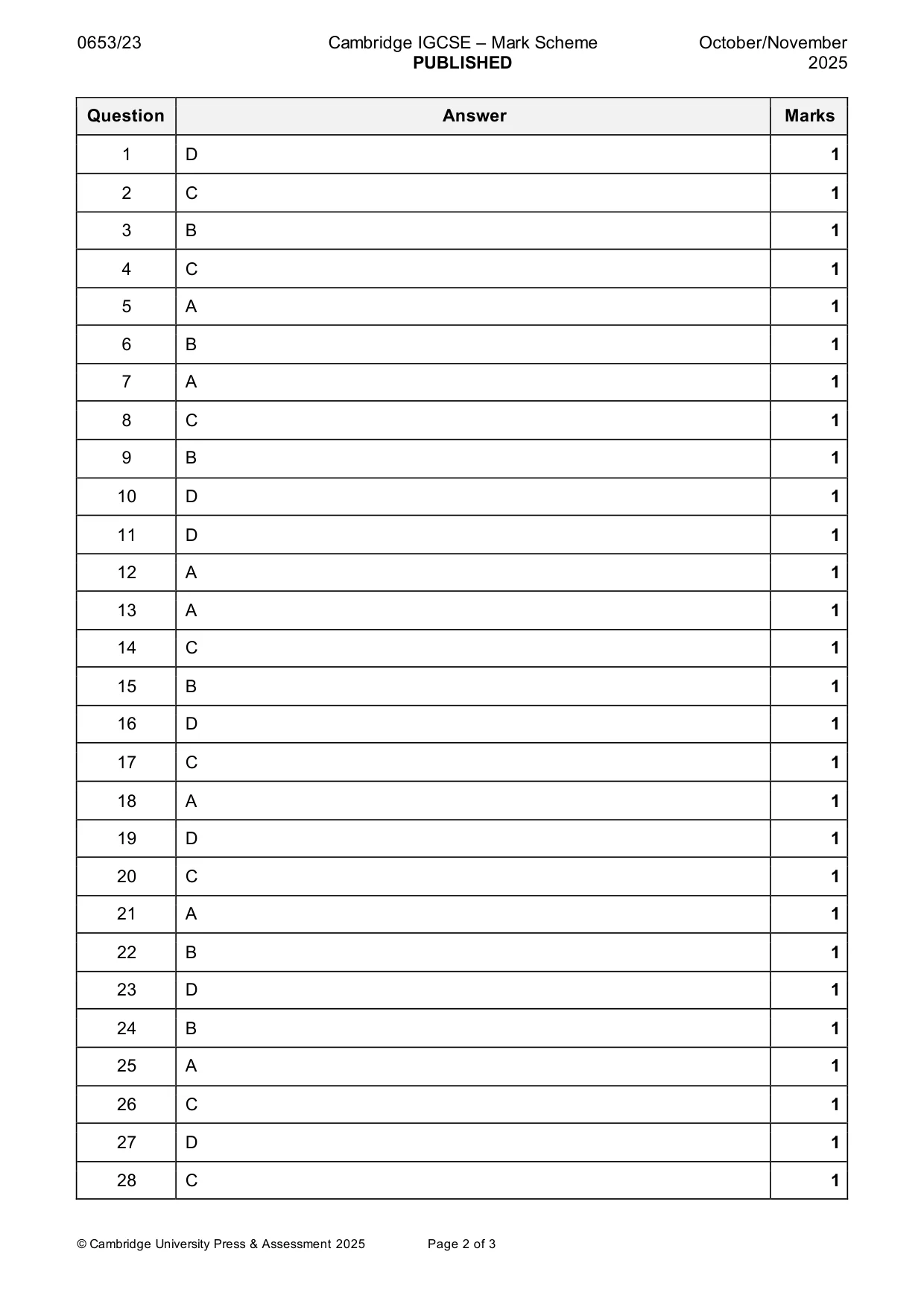
Mark scheme: D
Q2 · Which statement describes osmosis?
2 Which statement describes osmosis? A net movement of water molecules from a lower to a higher water potential through the cell membrane B net movement of water molecules from a lower to a higher water potential through the cell wall C net movement of water molecules from a higher to a lower water potential through the cell membrane D net movement of water molecules from a higher to a lower water potential through the cell wall
Mark scheme: C
Q3 · Which statement about enzymes is correct for temperatures up to the optimum temperature?
3 Which statement about enzymes is correct for temperatures up to the optimum temperature? A As temperature increases, substrates react with the active sites more slowly. B As temperature increases, enzymes have more kinetic energy. C As temperature decreases, enzymes denature. D As temperature decreases, the number of effective collisions increases.
Mark scheme: B
Q4 · The graph shows the effect of temperature and carbon dioxide concentration on the rate of…
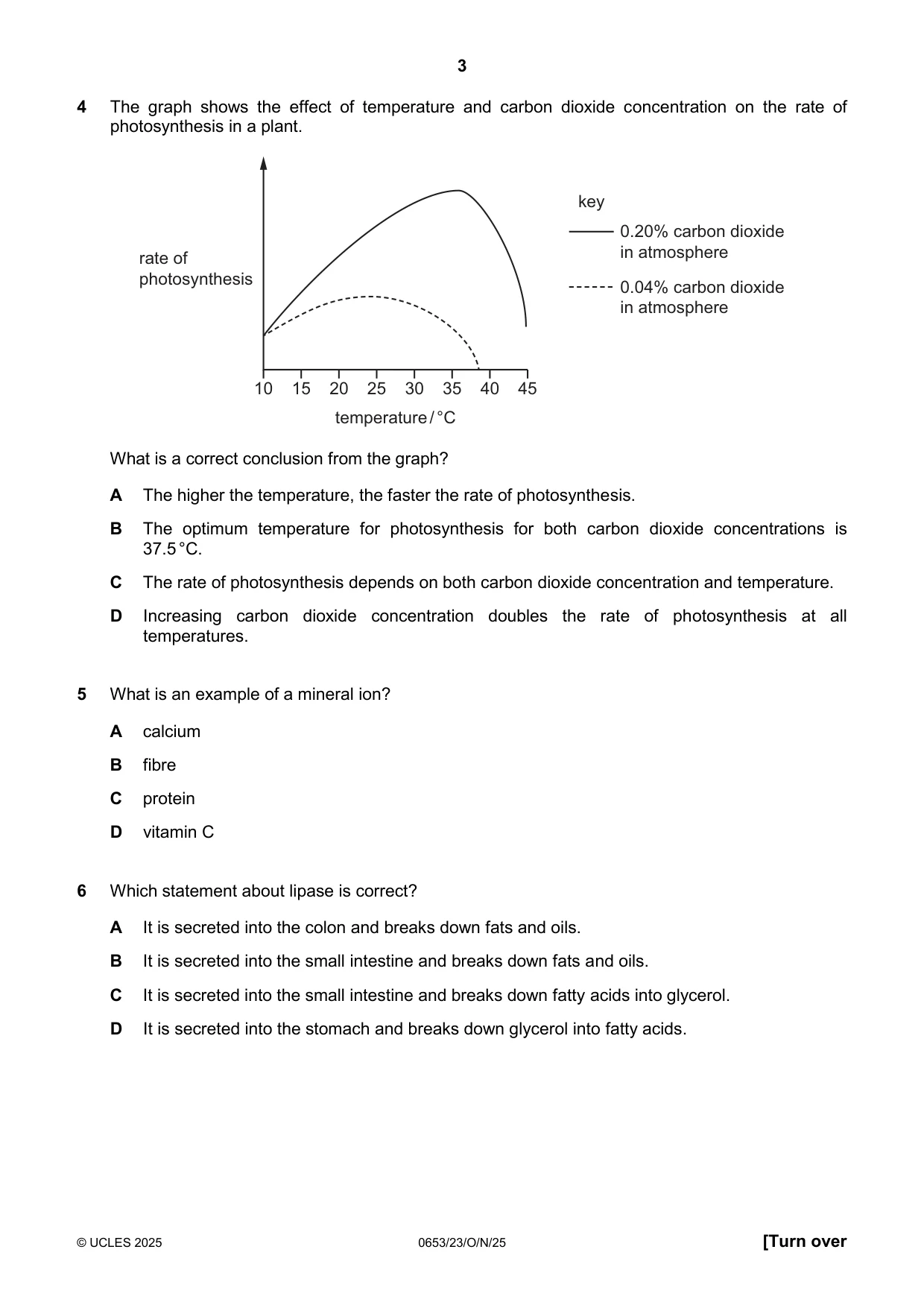
4 The graph shows the effect of temperature and carbon dioxide concentration on the rate of photosynthesis in a plant. key 0.20% carbon dioxide rate of in atmosphere photosynthesis 0.04% carbon dioxide in atmosphere 10 15 20 25 30 35 40 45 temperature / °C What is a correct conclusion from the graph? A The higher the temperature, the faster the rate of photosynthesis. B The optimum temperature for photosynthesis for both carbon dioxide concentrations is 37.5 °C. C The rate of photosynthesis depends on both carbon dioxide concentration and temperature. D Increasing carbon dioxide concentration doubles the rate of photosynthesis at all temperatures.
Mark scheme: C
Q5 · What is an example of a mineral ion?
5 What is an example of a mineral ion? A calcium B fibre C protein D vitamin C
Mark scheme: A
Q6 · Which statement about lipase is correct?
6 Which statement about lipase is correct? A It is secreted into the colon and breaks down fats and oils. B It is secreted into the small intestine and breaks down fats and oils. C It is secreted into the small intestine and breaks down fatty acids into glycerol. D It is secreted into the stomach and breaks down glycerol into fatty acids.
Mark scheme: B
Q7 · A student investigates transpiration in four small plants of the same species
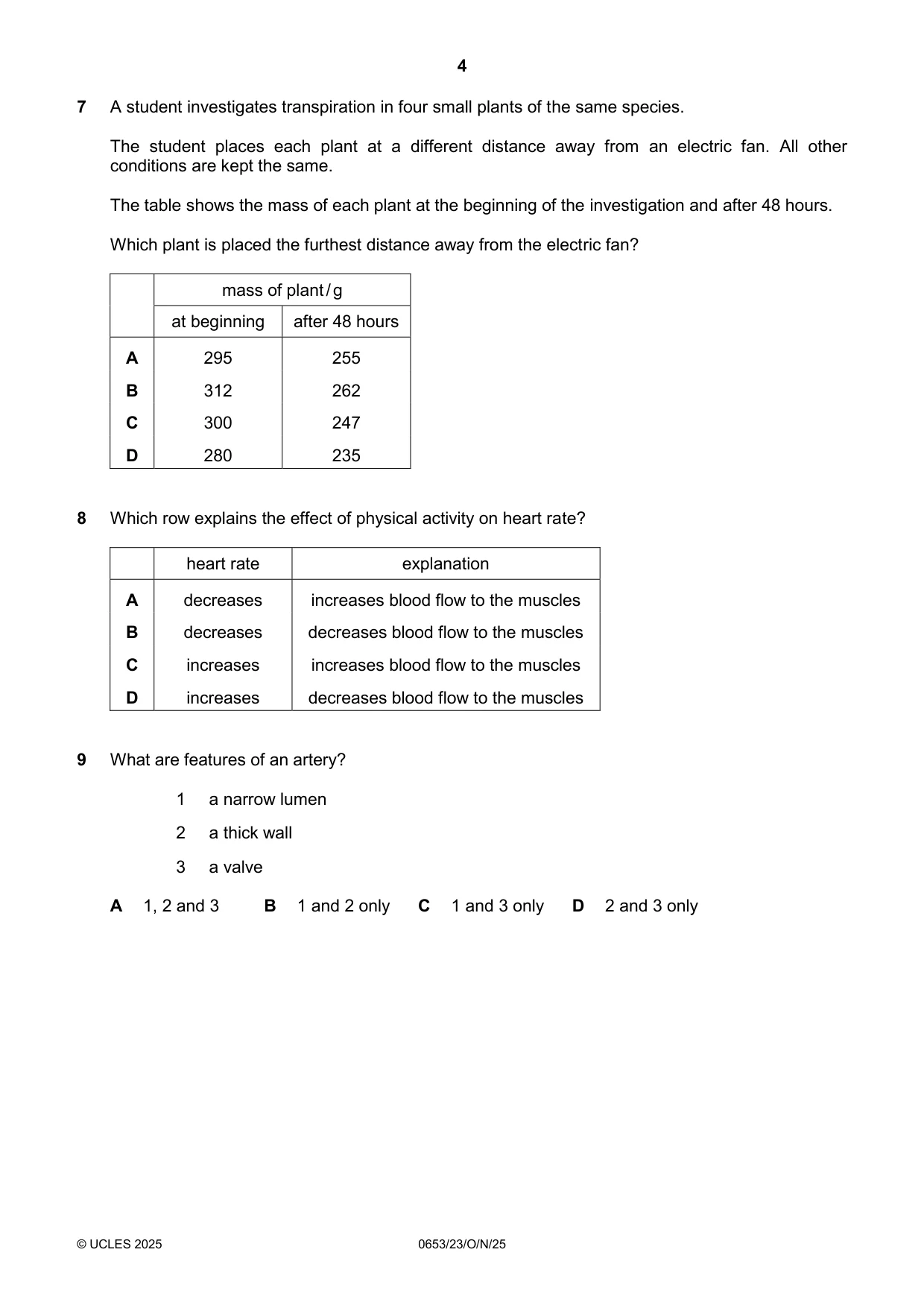
7 A student investigates transpiration in four small plants of the same species. The student places each plant at a different distance away from an electric fan. All other conditions are kept the same. The table shows the mass of each plant at the beginning of the investigation and after 48 hours. Which plant is placed the furthest distance away from the electric fan? mass of plant / g at beginning after 48 hours A 295 255 B 312 262 C 300 247 D 280 235
Mark scheme: A
Q8 · Which row explains the effect of physical activity on heart rate?
8 Which row explains the effect of physical activity on heart rate? heart rate explanation A decreases increases blood flow to the muscles B decreases decreases blood flow to the muscles C increases increases blood flow to the muscles D increases decreases blood flow to the muscles
Mark scheme: C
Q9 · What are features of an artery?
9 What are features of an artery? 1 a narrow lumen 2 a thick wall 3 a valve A 1, 2 and 3 B 1 and 2 only C 1 and 3 only D 2 and 3 only
Mark scheme: B
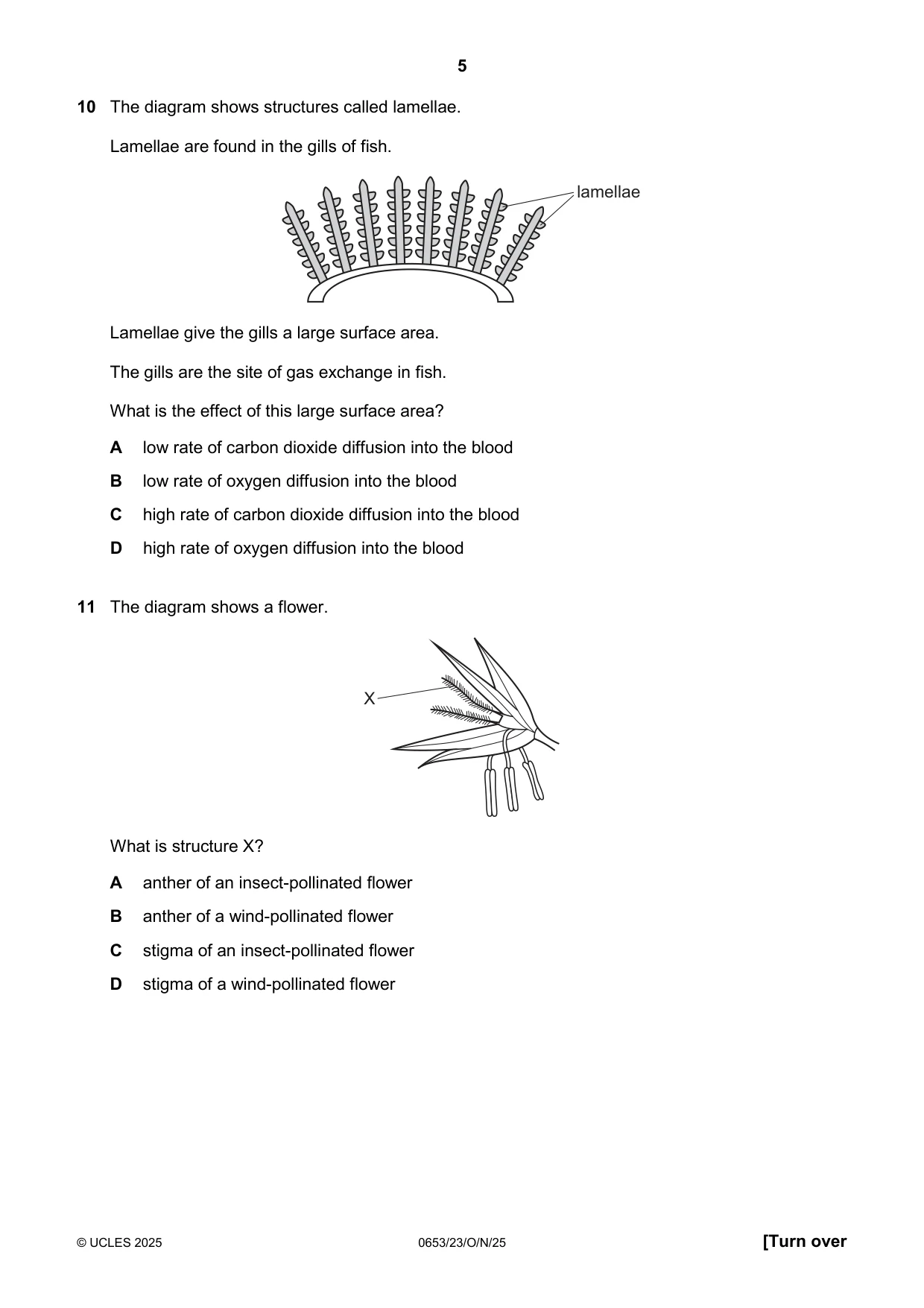
Q10 · The diagram shows structures called lamellae
10 The diagram shows structures called lamellae. Lamellae are found in the gills of fish. lamellae Lamellae give the gills a large surface area. The gills are the site of gas exchange in fish. What is the effect of this large surface area? A low rate of carbon dioxide diffusion into the blood B low rate of oxygen diffusion into the blood C high rate of carbon dioxide diffusion into the blood D high rate of oxygen diffusion into the blood
Mark scheme: D
Q11 · The diagram shows a flower
11 The diagram shows a flower. X What is structure X? A anther of an insect-pollinated flower B anther of a wind-pollinated flower C stigma of an insect-pollinated flower D stigma of a wind-pollinated flower
Mark scheme: D
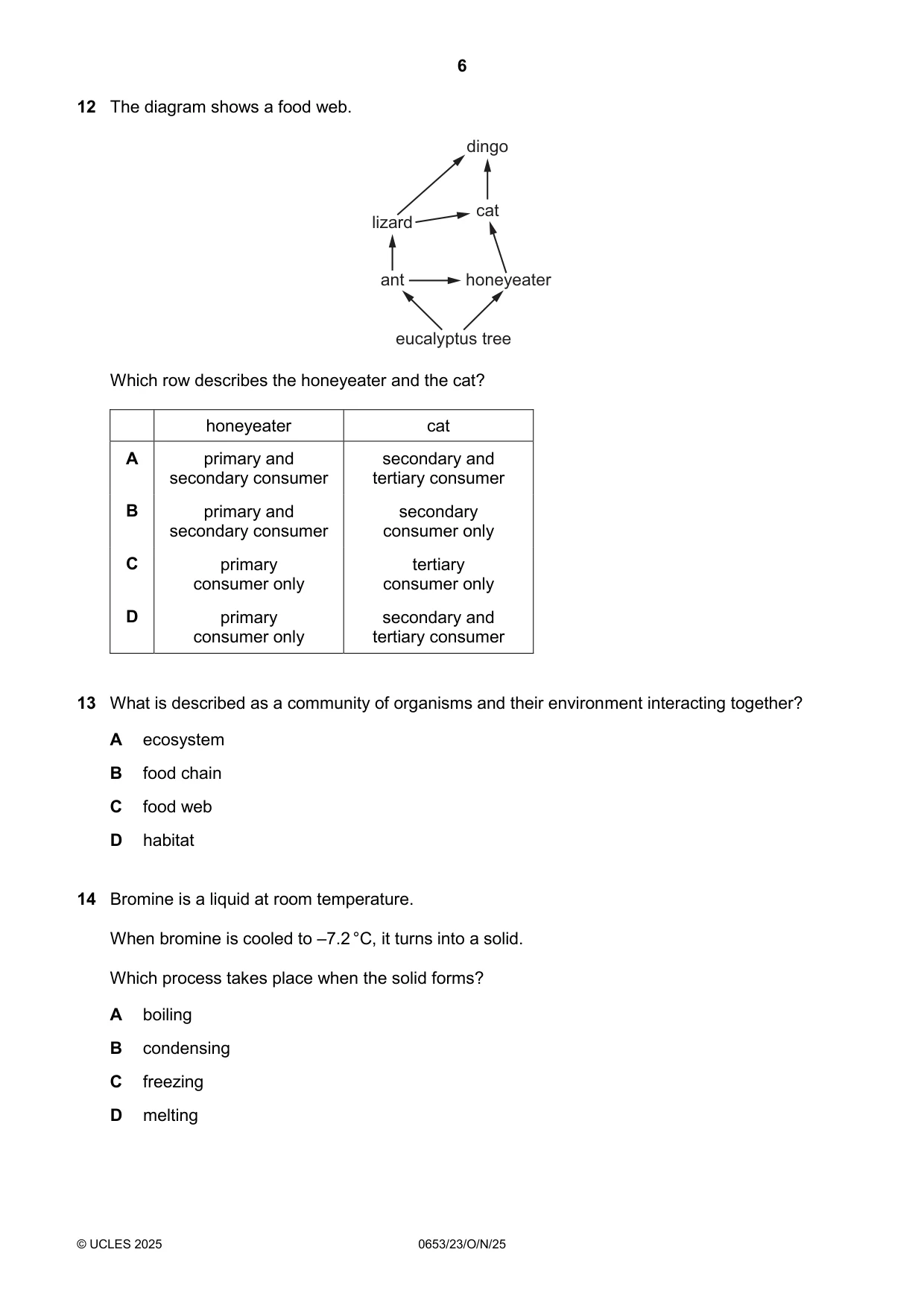
Q12 · The diagram shows a food web
12 The diagram shows a food web. dingo cat lizard ant honeyeater eucalyptus tree Which row describes the honeyeater and the cat? honeyeater cat A primary and secondary and secondary consumer tertiary consumer B primary and secondary secondary consumer consumer only C primary tertiary consumer only consumer only D primary secondary and consumer only tertiary consumer
Mark scheme: A
Q13 · What is described as a community of organisms and their environment interacting together?
13 What is described as a community of organisms and their environment interacting together? A ecosystem B food chain C food web D habitat
Mark scheme: A
Q14 · Bromine is a liquid at room temperature
14 Bromine is a liquid at room temperature. When bromine is cooled to –7.2 °C, it turns into a solid. Which process takes place when the solid forms? A boiling B condensing C freezing D melting
Mark scheme: C
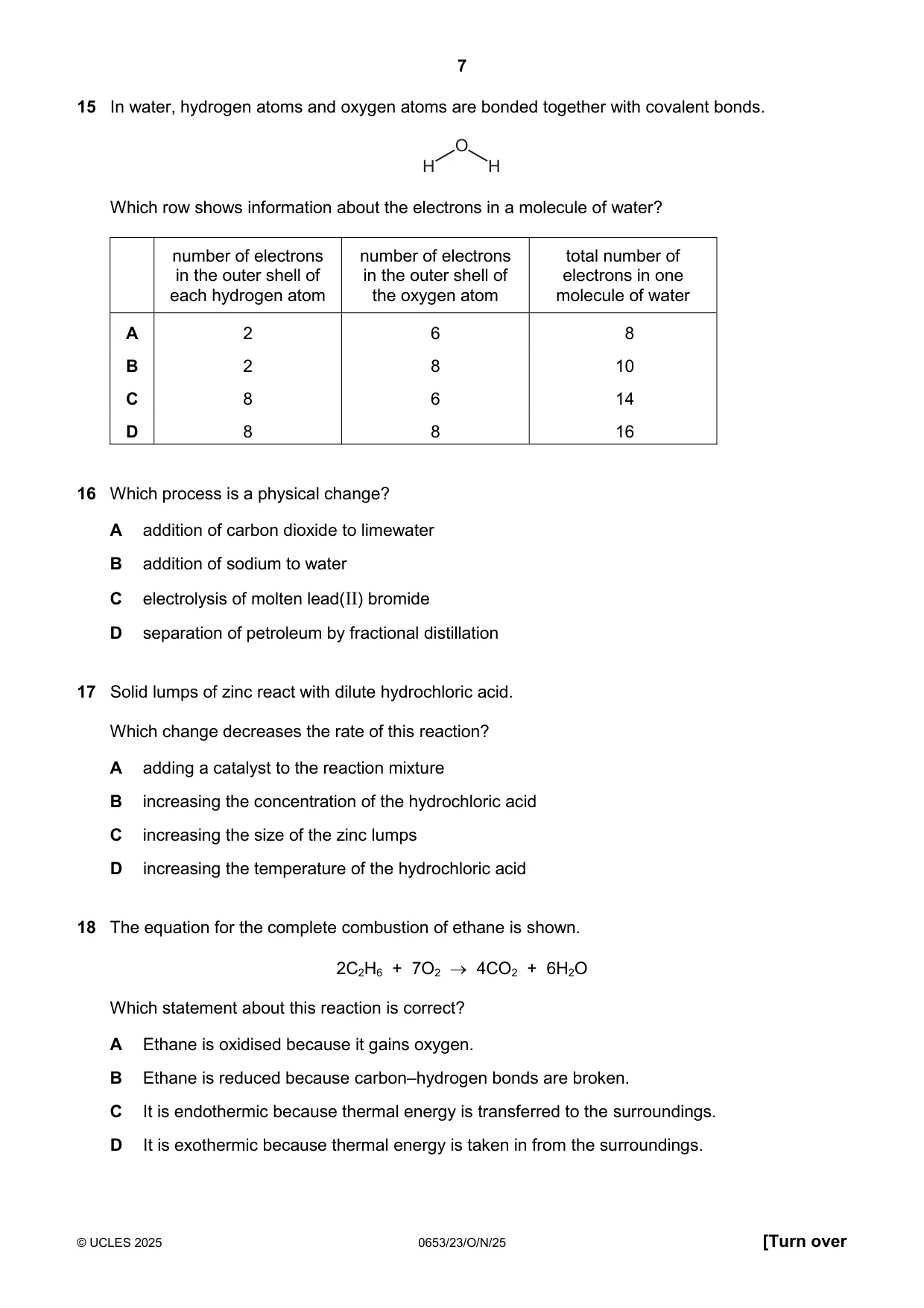
Q15 · In water, hydrogen atoms and oxygen atoms are bonded together with covalent bonds
15 In water, hydrogen atoms and oxygen atoms are bonded together with covalent bonds. O H H Which row shows information about the electrons in a molecule of water? number of electrons number of electrons total number of in the outer shell of in the outer shell of electrons in one each hydrogen atom the oxygen atom molecule of water A 2 6 8 B 2 8 10 C 8 6 14 D 8 8 16
Mark scheme: B
Q16 · Which process is a physical change?
16 Which process is a physical change? A addition of carbon dioxide to limewater B addition of sodium to water C electrolysis of molten lead(II) bromide D separation of petroleum by fractional distillation
Mark scheme: D
Q17 · Solid lumps of zinc react with dilute hydrochloric acid
17 Solid lumps of zinc react with dilute hydrochloric acid. Which change decreases the rate of this reaction? A adding a catalyst to the reaction mixture B increasing the concentration of the hydrochloric acid C increasing the size of the zinc lumps D increasing the temperature of the hydrochloric acid
Mark scheme: C
Q18 · The equation for the complete combustion of ethane is shown
18 The equation for the complete combustion of ethane is shown. 2C2H6 + 7O2 4CO2 + 6H2O Which statement about this reaction is correct? A Ethane is oxidised because it gains oxygen. B Ethane is reduced because carbon–hydrogen bonds are broken. C It is endothermic because thermal energy is transferred to the surroundings. D It is exothermic because thermal energy is taken in from the surroundings.
Mark scheme: A
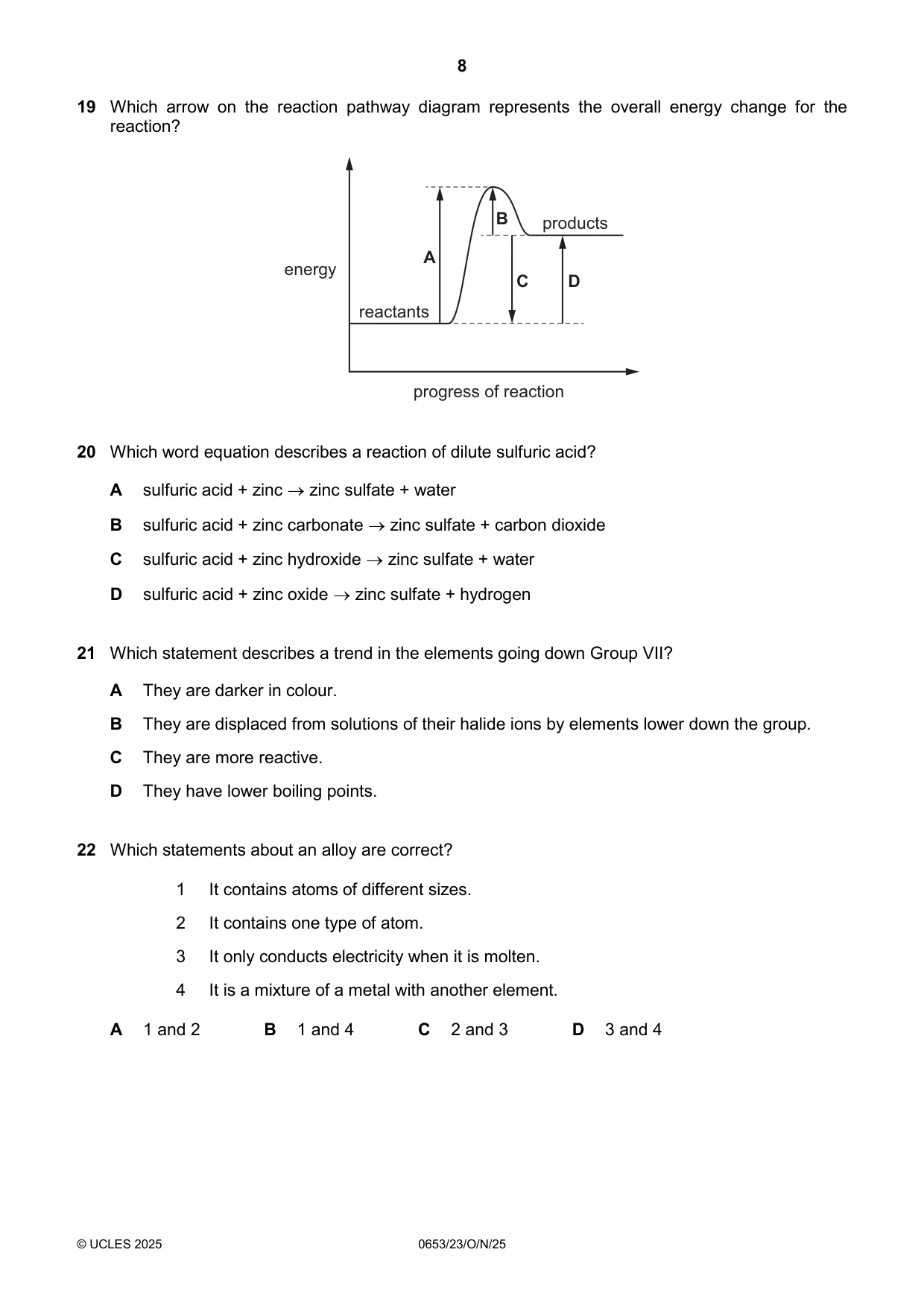
Q19 · Which arrow on the reaction pathway diagram represents the overall energy change for the…
19 Which arrow on the reaction pathway diagram represents the overall energy change for the reaction? B products A energy C D reactants progress of reaction
Mark scheme: D
Q20 · Which word equation describes a reaction of dilute sulfuric acid?
20 Which word equation describes a reaction of dilute sulfuric acid? A sulfuric acid + zinc zinc sulfate + water B sulfuric acid + zinc carbonate zinc sulfate + carbon dioxide C sulfuric acid + zinc hydroxide zinc sulfate + water D sulfuric acid + zinc oxide zinc sulfate + hydrogen
Mark scheme: C
More questions on The characteristic properties of acids and bases
Q21 · Which statement describes a trend in the elements going down Group VII?
21 Which statement describes a trend in the elements going down Group VII? A They are darker in colour. B They are displaced from solutions of their halide ions by elements lower down the group. C They are more reactive. D They have lower boiling points.
Mark scheme: A
Q22 · Which statements about an alloy are correct?
22 Which statements about an alloy are correct? 1 It contains atoms of different sizes. 2 It contains one type of atom. 3 It only conducts electricity when it is molten. 4 It is a mixture of a metal with another element. A 1 and 2 B 1 and 4 C 2 and 3 D 3 and 4
Mark scheme: B
Q23 · The equations describe the reactions that happen when iron is extracted in the blast…
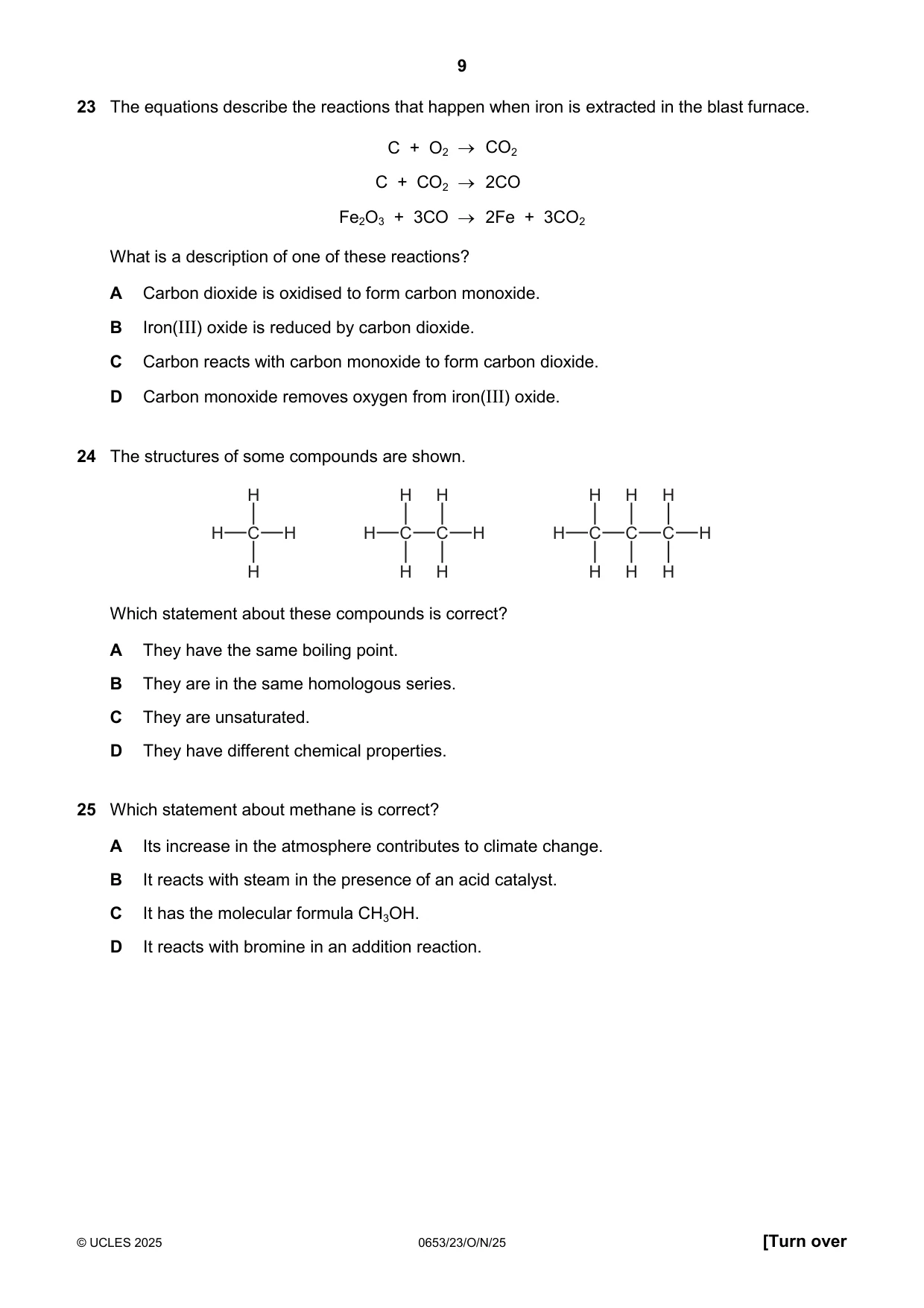
23 The equations describe the reactions that happen when iron is extracted in the blast furnace. C + O2 CO2 C + CO2 2CO Fe2O3 + 3CO 2Fe + 3CO2 What is a description of one of these reactions? A Carbon dioxide is oxidised to form carbon monoxide. B Iron(III) oxide is reduced by carbon dioxide. C Carbon reacts with carbon monoxide to form carbon dioxide. D Carbon monoxide removes oxygen from iron(III) oxide.
Mark scheme: D
Q24 · The structures of some compounds are shown
24 The structures of some compounds are shown. H H H H H H H C H H C C H H C C C H H H H H H H Which statement about these compounds is correct? A They have the same boiling point. B They are in the same homologous series. C They are unsaturated. D They have different chemical properties.
Mark scheme: B
Q25 · Which statement about methane is correct?
25 Which statement about methane is correct? A Its increase in the atmosphere contributes to climate change. B It reacts with steam in the presence of an acid catalyst. C It has the molecular formula CH3OH. D It reacts with bromine in an addition reaction.
Mark scheme: A
Q26 · A chromatography experiment is carried out on a compound
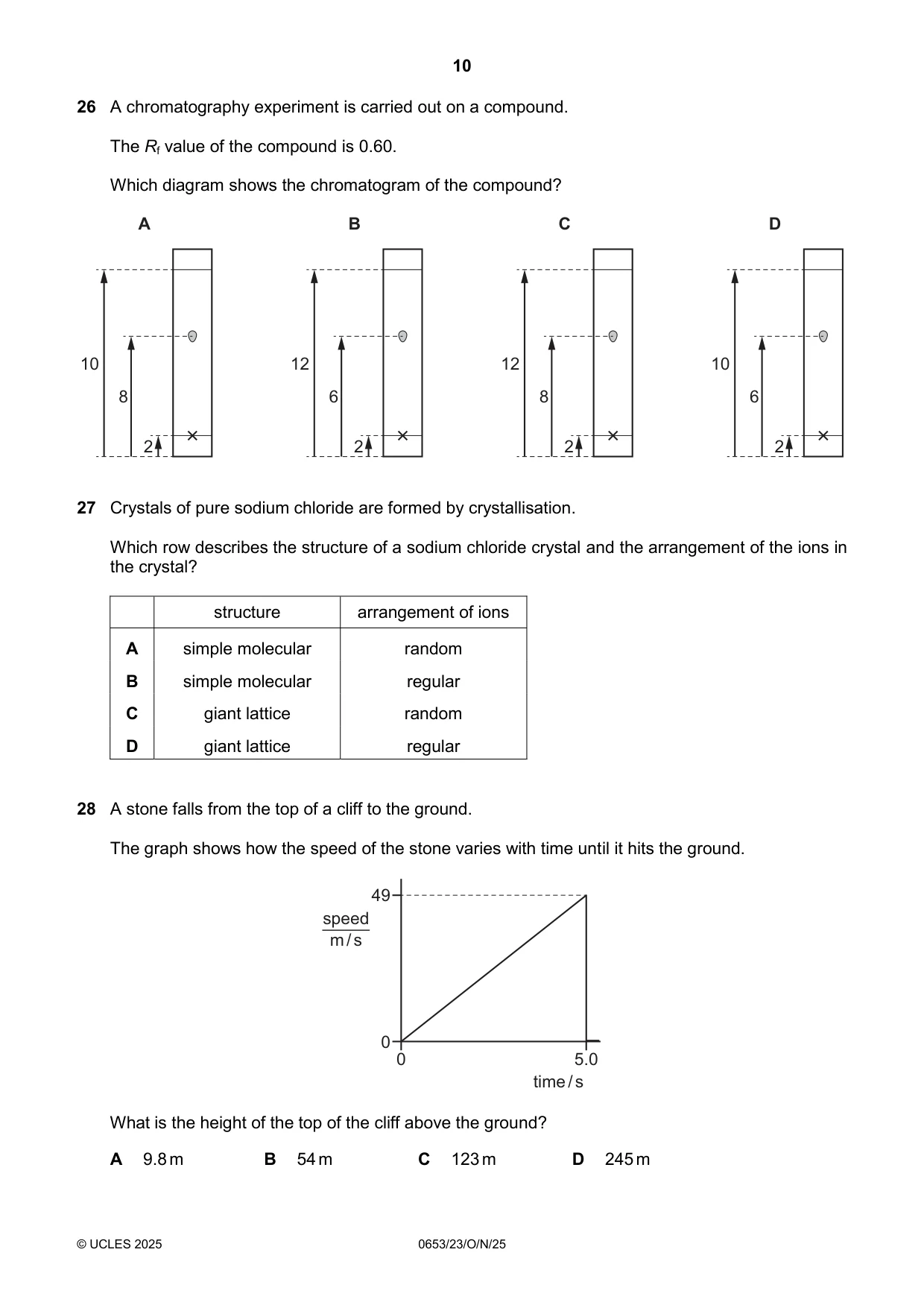
26 A chromatography experiment is carried out on a compound. The Rf value of the compound is 0.60. Which diagram shows the chromatogram of the compound? A B C D 10 12 12 10 8 6 8 6 2 2 2 2
Mark scheme: C
Q27 · Crystals of pure sodium chloride are formed by crystallisation
27 Crystals of pure sodium chloride are formed by crystallisation. Which row describes the structure of a sodium chloride crystal and the arrangement of the ions in the crystal? structure arrangement of ions A simple molecular random B simple molecular regular C giant lattice random D giant lattice regular
Mark scheme: D
Q28 · A stone falls from the top of a cliff to the ground
28 A stone falls from the top of a cliff to the ground. The graph shows how the speed of the stone varies with time until it hits the ground. 49 speed m / s 0 0 5.0 time / s What is the height of the top of the cliff above the ground? A 9.8 m B 54 m C 123 m D 245 m
Mark scheme: C
Q29 · The diagram shows a box of mass m and weight W at the bottom of a set of steps
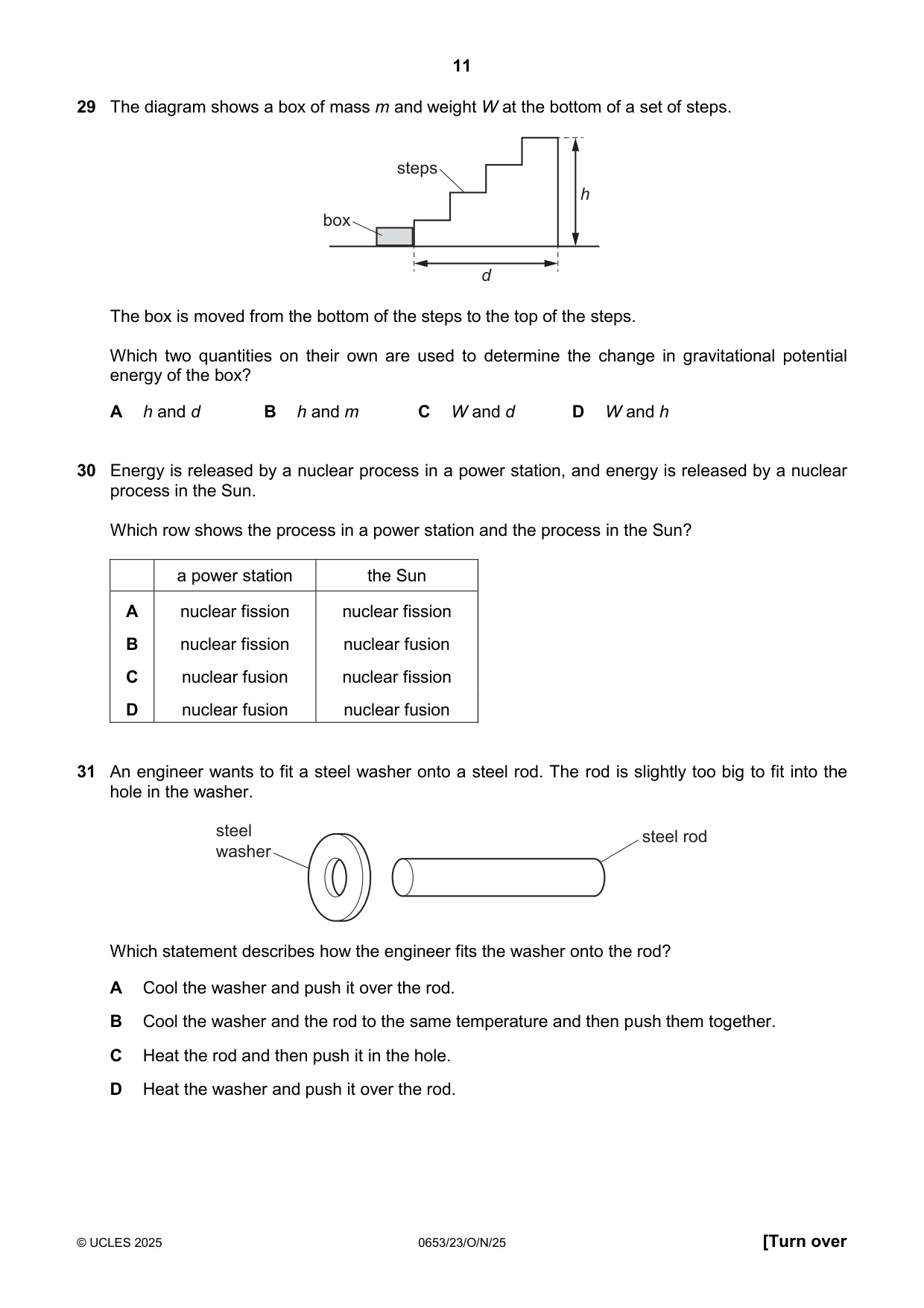
29 The diagram shows a box of mass m and weight W at the bottom of a set of steps. steps h box d The box is moved from the bottom of the steps to the top of the steps. Which two quantities on their own are used to determine the change in gravitational potential energy of the box? A h and d B h and m C W and d D W and h
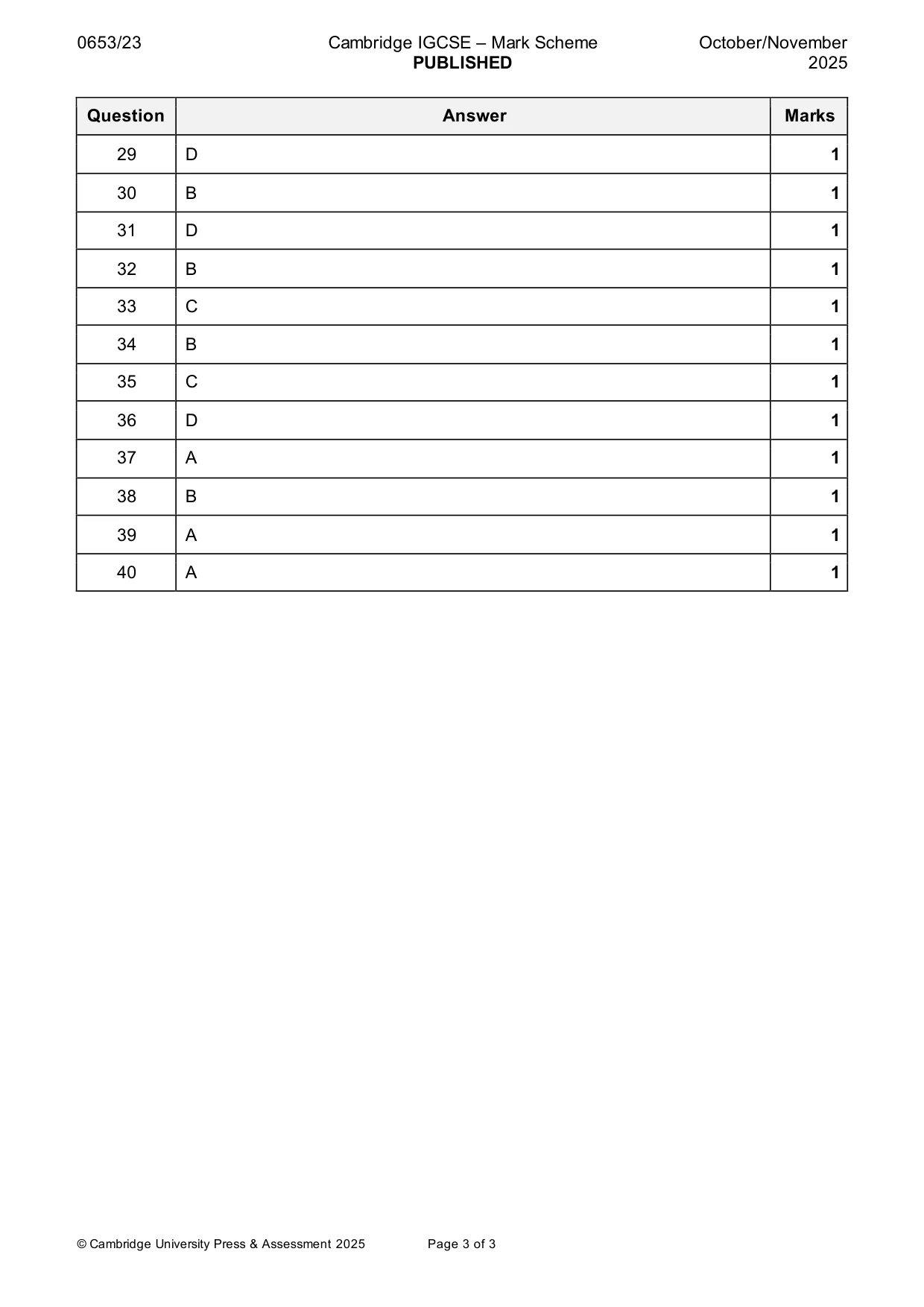
Mark scheme: D
Q30 · Energy is released by a nuclear process in a power station, and energy is released by a…
30 Energy is released by a nuclear process in a power station, and energy is released by a nuclear process in the Sun. Which row shows the process in a power station and the process in the Sun? a power station the Sun A nuclear fission nuclear fission B nuclear fission nuclear fusion C nuclear fusion nuclear fission D nuclear fusion nuclear fusion
Mark scheme: B
Q31 · An engineer wants to fit a steel washer onto a steel rod
31 An engineer wants to fit a steel washer onto a steel rod. The rod is slightly too big to fit into the hole in the washer. steel steel rod washer Which statement describes how the engineer fits the washer onto the rod? A Cool the washer and push it over the rod. B Cool the washer and the rod to the same temperature and then push them together. C Heat the rod and then push it in the hole. D Heat the washer and push it over the rod.
Mark scheme: D
Q32 · Which row correctly lists two good thermal conductors and two bad thermal conductors?
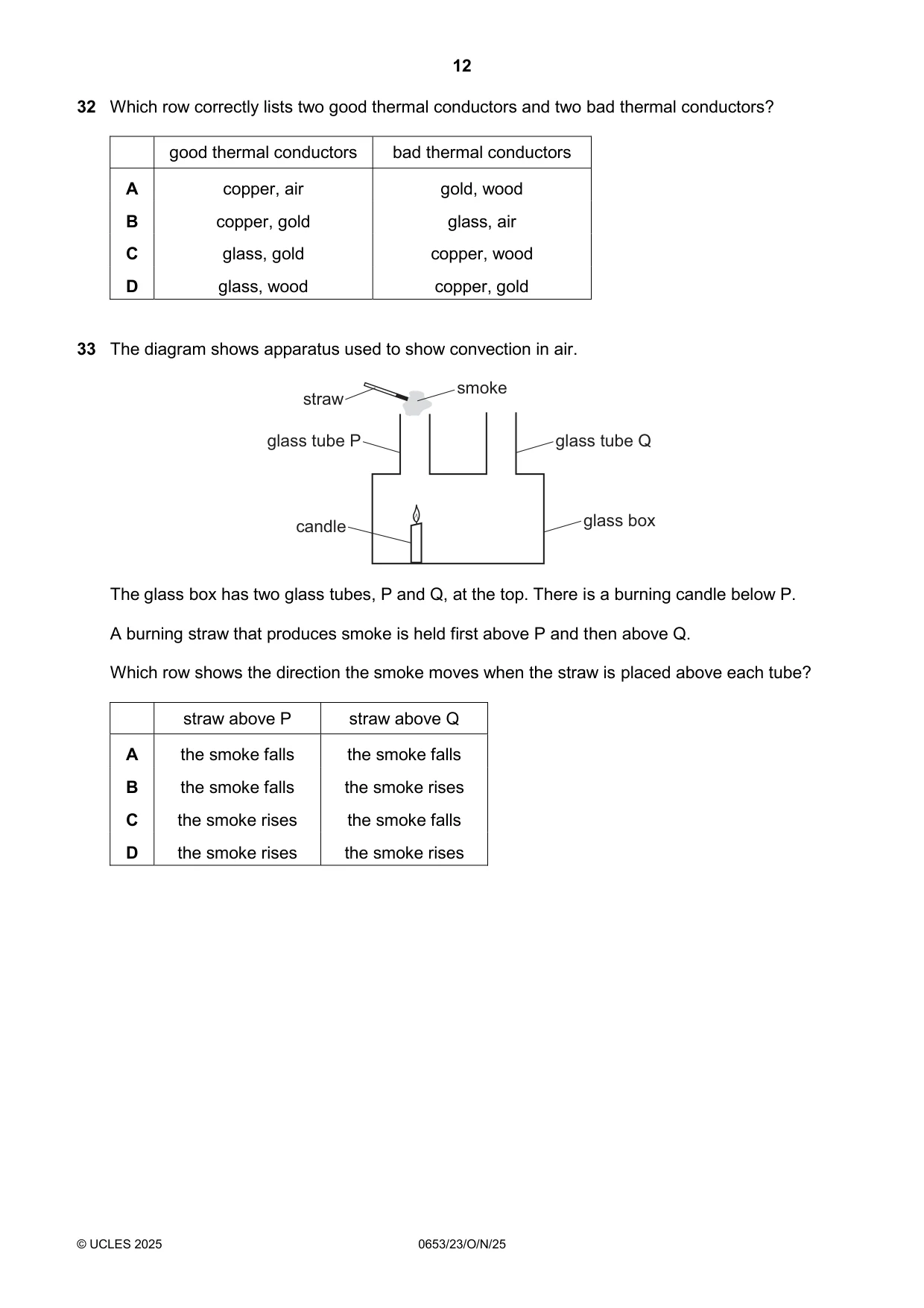
32 Which row correctly lists two good thermal conductors and two bad thermal conductors? good thermal conductors bad thermal conductors A copper, air gold, wood B copper, gold glass, air C glass, gold copper, wood D glass, wood copper, gold
Mark scheme: B
Q33 · The diagram shows apparatus used to show convection in air
33 The diagram shows apparatus used to show convection in air. smoke straw glass tube P glass tube Q candle glass box The glass box has two glass tubes, P and Q, at the top. There is a burning candle below P. A burning straw that produces smoke is held first above P and then above Q. Which row shows the direction the smoke moves when the straw is placed above each tube? straw above P straw above Q A the smoke falls the smoke falls B the smoke falls the smoke rises C the smoke rises the smoke falls D the smoke rises the smoke rises
Mark scheme: C
Q34 · The diagram represents a wave on the surface of water
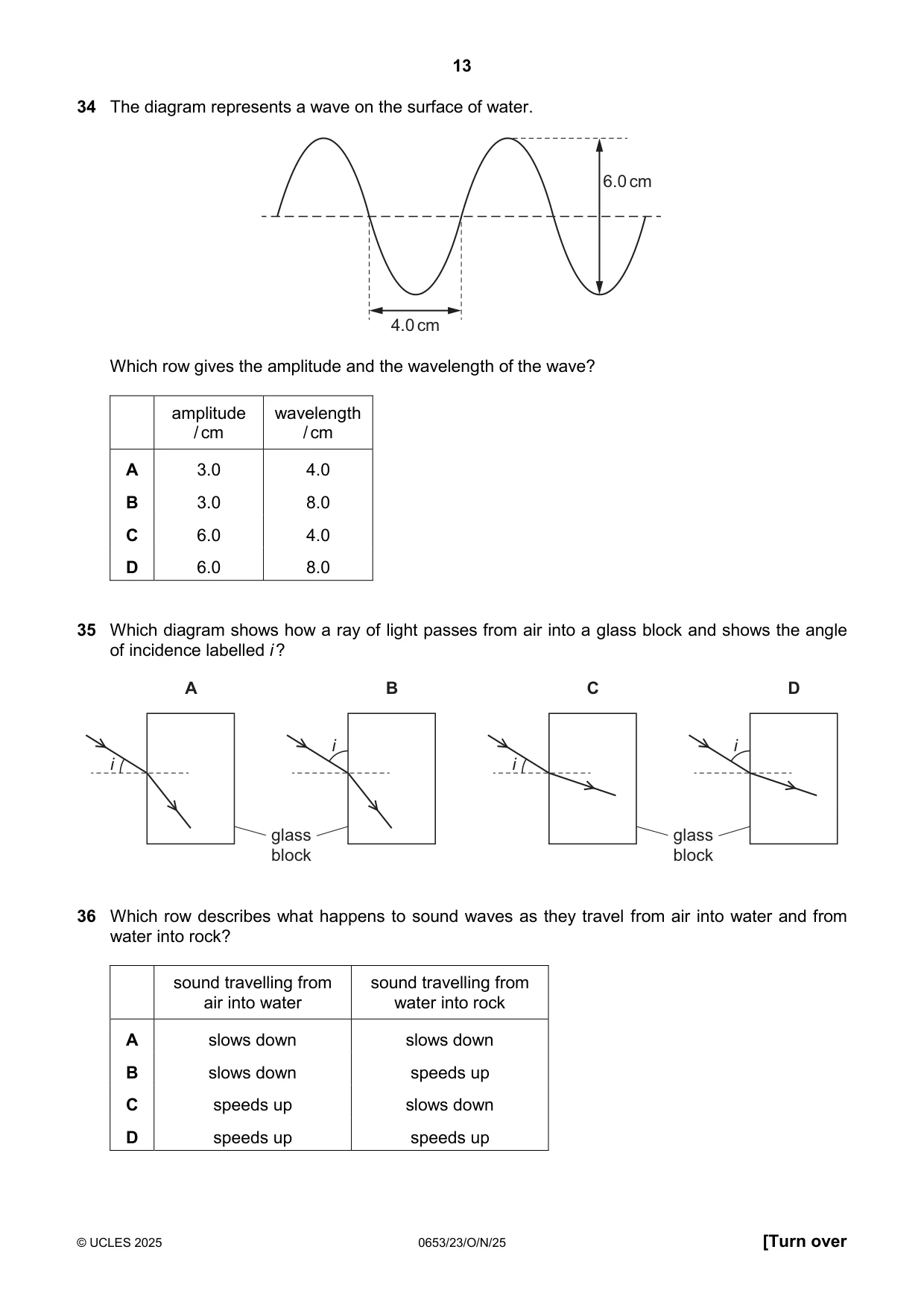
34 The diagram represents a wave on the surface of water. 6.0 cm 4.0 cm Which row gives the amplitude and the wavelength of the wave? amplitude wavelength / cm / cm A 3.0 4.0 B 3.0 8.0 C 6.0 4.0 D 6.0 8.0
Mark scheme: B
Q35 · Which diagram shows how a ray of light passes from air into a glass block and shows the…
35 Which diagram shows how a ray of light passes from air into a glass block and shows the angle of incidence labelled i ? A B C D i i i i glass glass block block
Mark scheme: C
Q36 · Which row describes what happens to sound waves as they travel from air into water and…
36 Which row describes what happens to sound waves as they travel from air into water and from water into rock? sound travelling from sound travelling from air into water water into rock A slows down slows down B slows down speeds up C speeds up slows down D speeds up speeds up
Mark scheme: D
Q37 · The diagrams show four solid cylinders, all made of the same metal
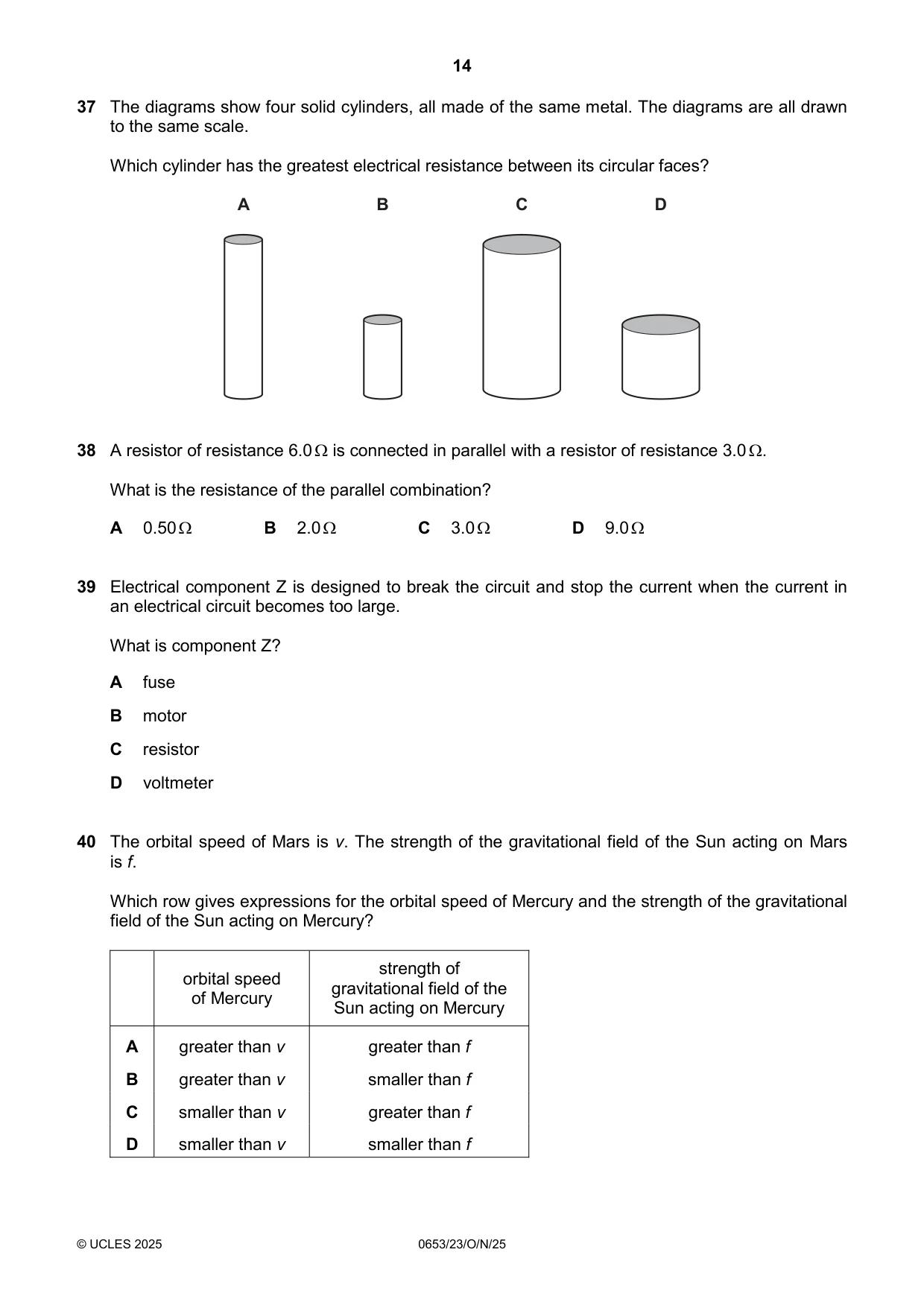
37 The diagrams show four solid cylinders, all made of the same metal. The diagrams are all drawn to the same scale. Which cylinder has the greatest electrical resistance between its circular faces? A B C D
Mark scheme: A
Q38 · A resistor of resistance 6.0 is connected in parallel with a resistor of resistance 3.0…
38 A resistor of resistance 6.0 is connected in parallel with a resistor of resistance 3.0 . What is the resistance of the parallel combination? A 0.50 B 2.0 C 3.0 D 9.0
Mark scheme: B
Q39 · Electrical component Z is designed to break the circuit and stop the current when the…
39 Electrical component Z is designed to break the circuit and stop the current when the current in an electrical circuit becomes too large. What is component Z? A fuse B motor C resistor D voltmeter
Mark scheme: A
Q40 · The orbital speed of Mars is v
40 The orbital speed of Mars is v. The strength of the gravitational field of the Sun acting on Mars is f. Which row gives expressions for the orbital speed of Mercury and the strength of the gravitational field of the Sun acting on Mercury? strength of orbital speed gravitational field of the of Mercury Sun acting on Mercury A greater than v greater than f B greater than v smaller than f C smaller than v greater than f D smaller than v smaller than f
Mark scheme: A
What was in this paper
The subtopics covered by these 40 questions, and how many questions each got. Open one in a new tab to see every Cambridge question on it.
2Transfer of thermal energy2Air quality and climate1Alloys and their properties1Blood vessels1Characteristics of living organisms1Chromatography1Diet1Digestion1Electrical circuits1Electrical quantities1Electrical safety1Energy flow1Enzymes1Exothermic and endothermic reactions1Extraction of metals1Food chains and food webs1Gas exchange in humans1General properties of waves1Group VII properties1Heart1Ions and ionic bonds1Light1Motion1Osmosis1Photosynthesis1Physical and chemical changes1Rate of reaction1Redox1Sexual reproduction in plants1Simple molecules and covalent bonds1Solids, liquids and gases1Sound1Terminology1The characteristic properties of acids and bases1The Solar System1Thermal properties and temperature1Transpiration1What you needed in this session
Cambridge’s own grade thresholds for 2025 Oct/Nov, Paper 2 · Variant 3. A higher threshold means an easier paper — the bar moves with how the cohort did.