Cambridge IGCSE Science - Combined 0653 — 2017 May/June Paper 2 · Variant 2
0653/22/M/J/17 · 40 questions · 40 marks · ≈45 min
The question paper and its mark scheme, free to read here and free to download. This is Cambridge’s own paper, exactly as it was sat.
Question paper16 pages
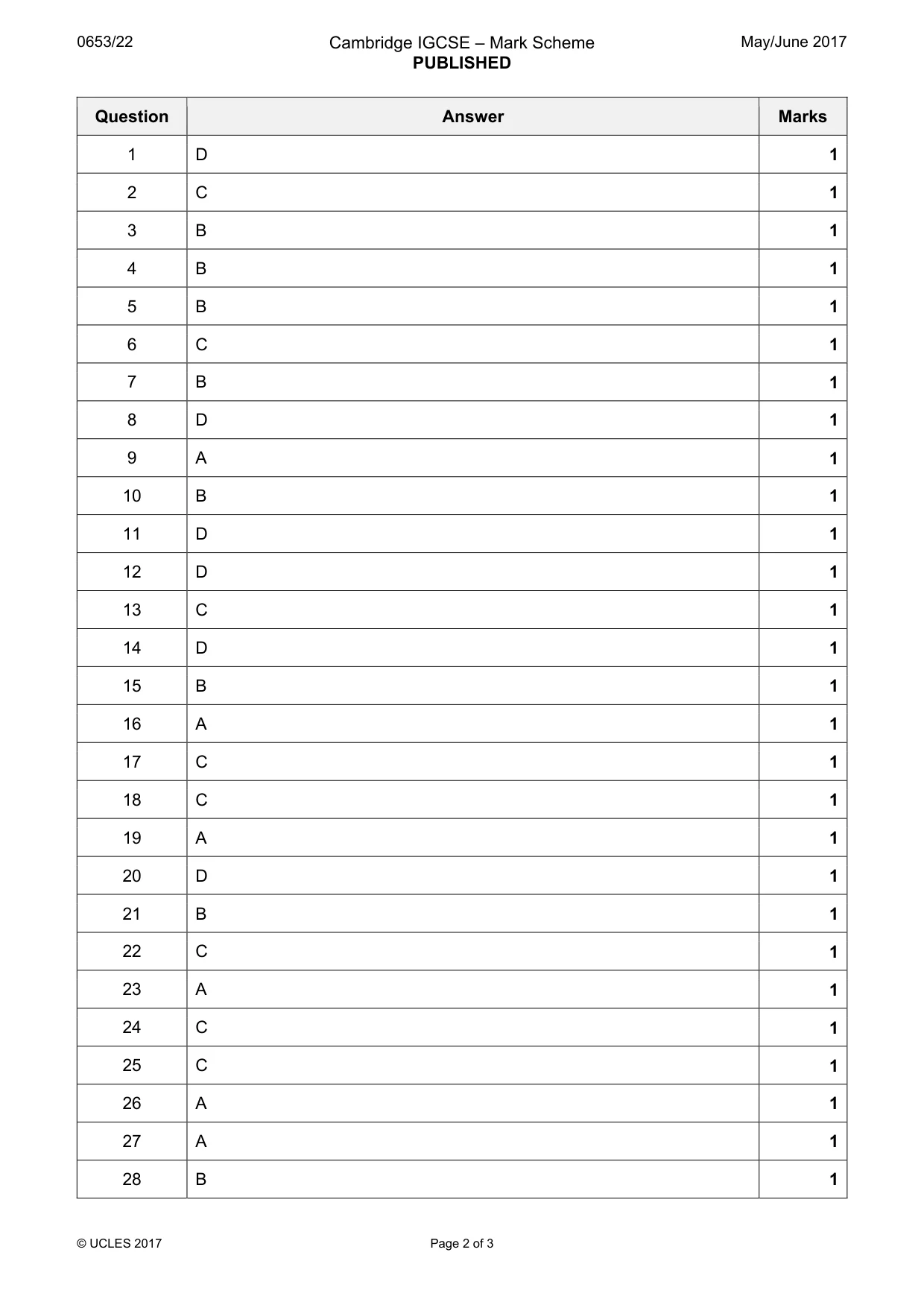
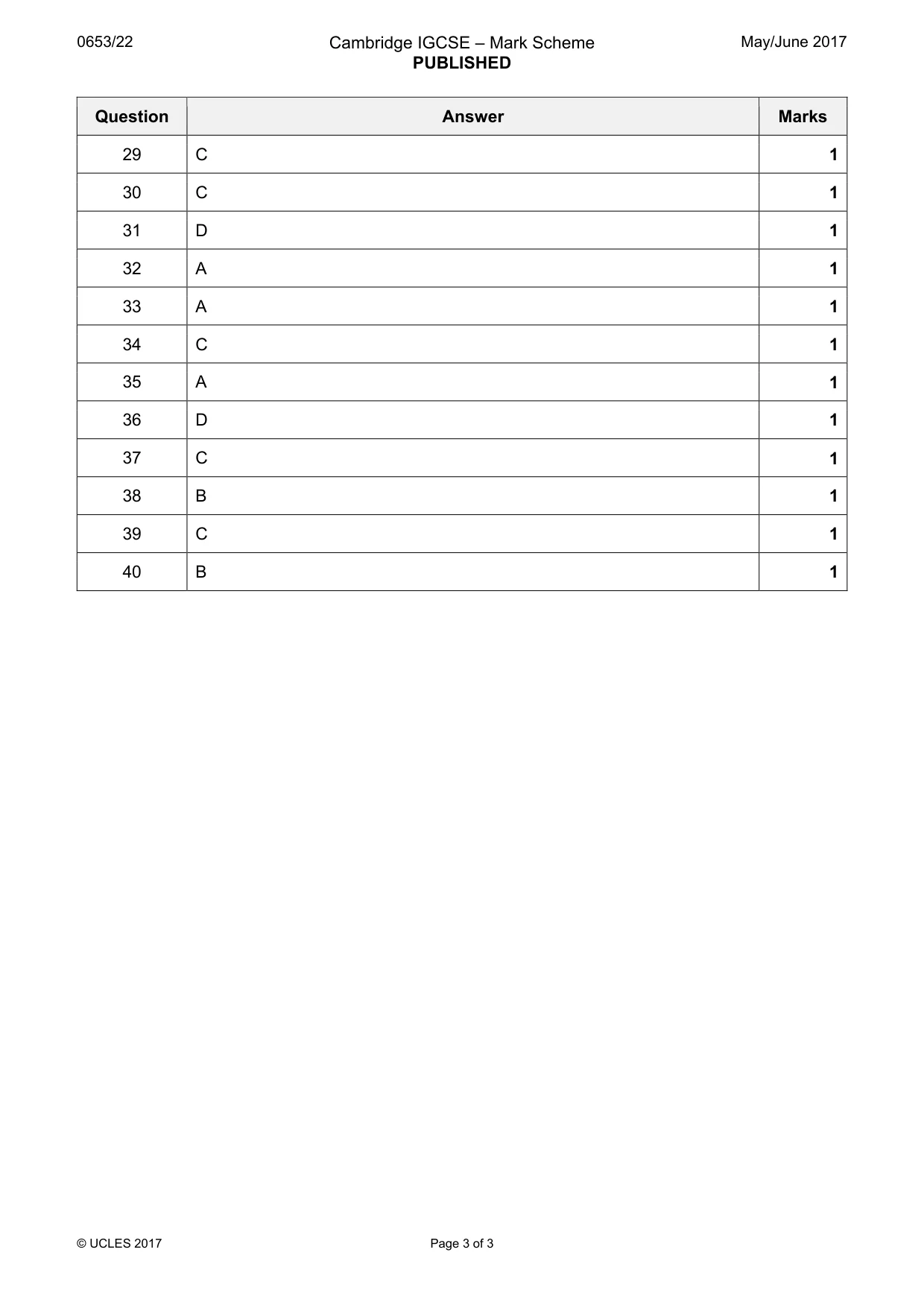
Mark scheme3 pages
Answers below. Sit the paper first if you are practising.
Questions as text
Q1 · A person moves their hand away from a hot object
1 A person moves their hand away from a hot object. Which characteristic of living organisms is this? A growth B nutrition C reproduction D sensitivity
Mark scheme: D
Q2 · The diagram shows an animal cell under a light microscope
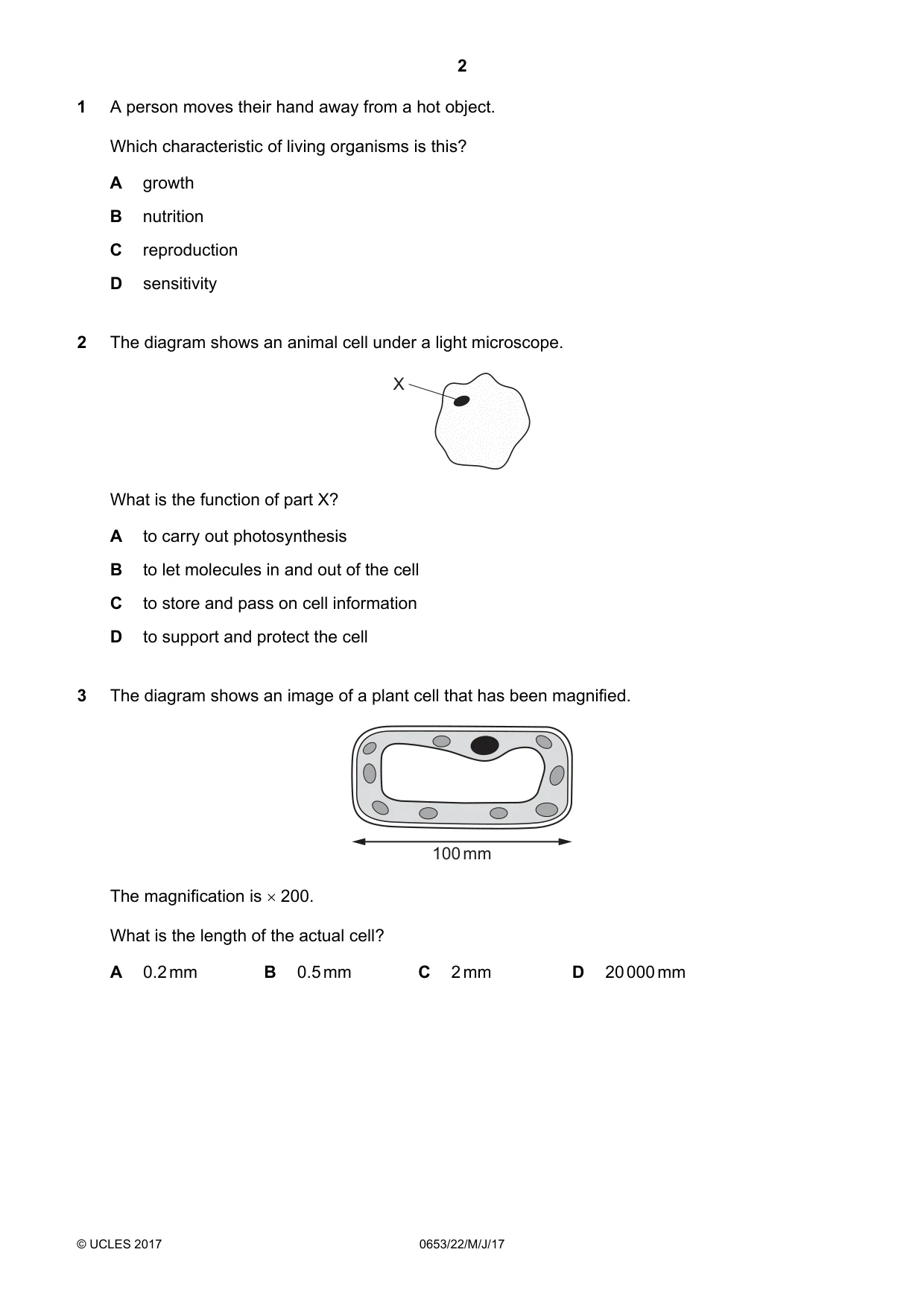
2 The diagram shows an animal cell under a light microscope. X What is the function of part X? A to carry out photosynthesis B to let molecules in and out of the cell C to store and pass on cell information D to support and protect the cell
Mark scheme: C
Q3 · The diagram shows an image of a plant cell that has been magnified
3 The diagram shows an image of a plant cell that has been magnified. 100 mm The magnification is × 200. What is the length of the actual cell? A 0.2 mm B 0.5 mm C 2 mm D 20 000 mm
Mark scheme: B
Q4 · Which statement about enzymes is correct?
4 Which statement about enzymes is correct? A They are killed by high temperatures. B They are made from amino acids. C They are unaffected by pH. D They are used up in biological reactions.
Mark scheme: B
Q5 · Which row matches the adaptation of a root hair cell to its function?
5 Which row matches the adaptation of a root hair cell to its function? adaptation function A large surface area uptake of water and glucose B large surface area uptake of water and ions C small surface area uptake of water and glucose D small surface area uptake of water and ions
Mark scheme: B
Q6 · The diagram shows a section through the heart
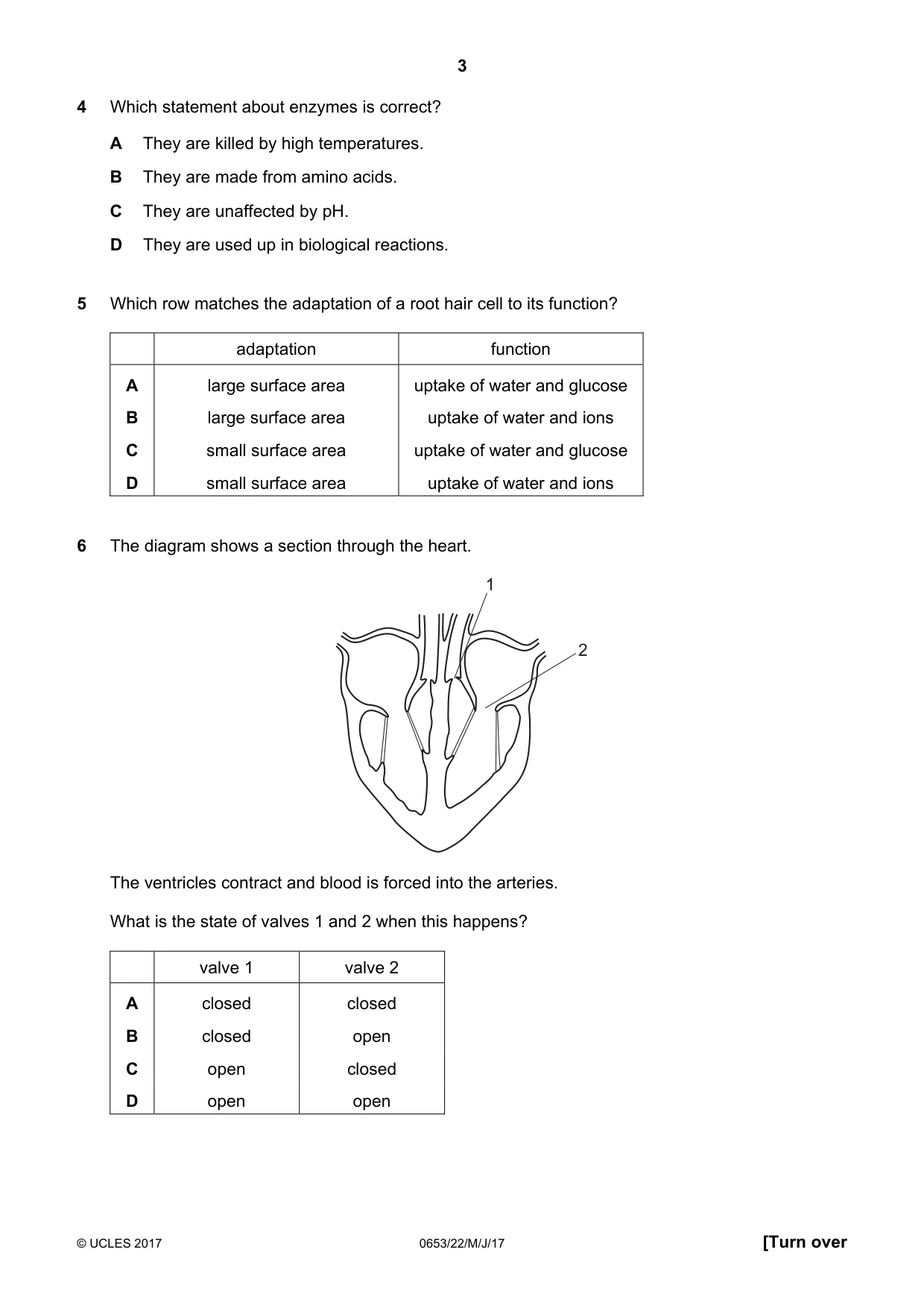
6 The diagram shows a section through the heart. 1 2 The ventricles contract and blood is forced into the arteries. What is the state of valves 1 and 2 when this happens? valve 1 valve 2 A closed closed B closed open C open closed D open open
Mark scheme: C
Q7 · The diagram shows apparatus at the start of a breathing experiment
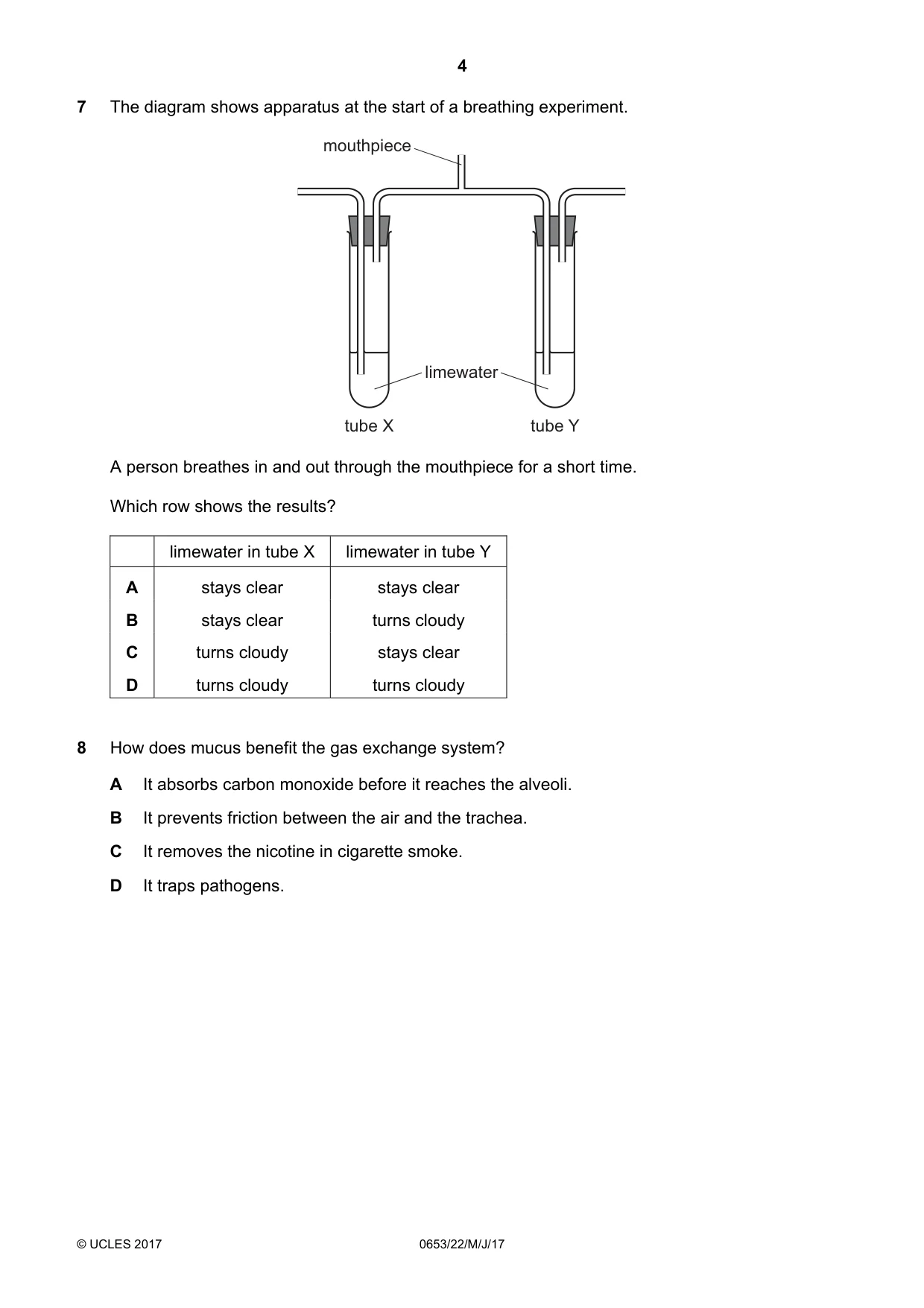
7 The diagram shows apparatus at the start of a breathing experiment. mouthpiece limewater tube X tube Y A person breathes in and out through the mouthpiece for a short time. Which row shows the results? limewater in tube X limewater in tube Y A stays clear stays clear B stays clear turns cloudy C turns cloudy stays clear D turns cloudy turns cloudy
Mark scheme: B
Q8 · How does mucus benefit the gas exchange system?
8 How does mucus benefit the gas exchange system? A It absorbs carbon monoxide before it reaches the alveoli. B It prevents friction between the air and the trachea. C It removes the nicotine in cigarette smoke. D It traps pathogens.
Mark scheme: D
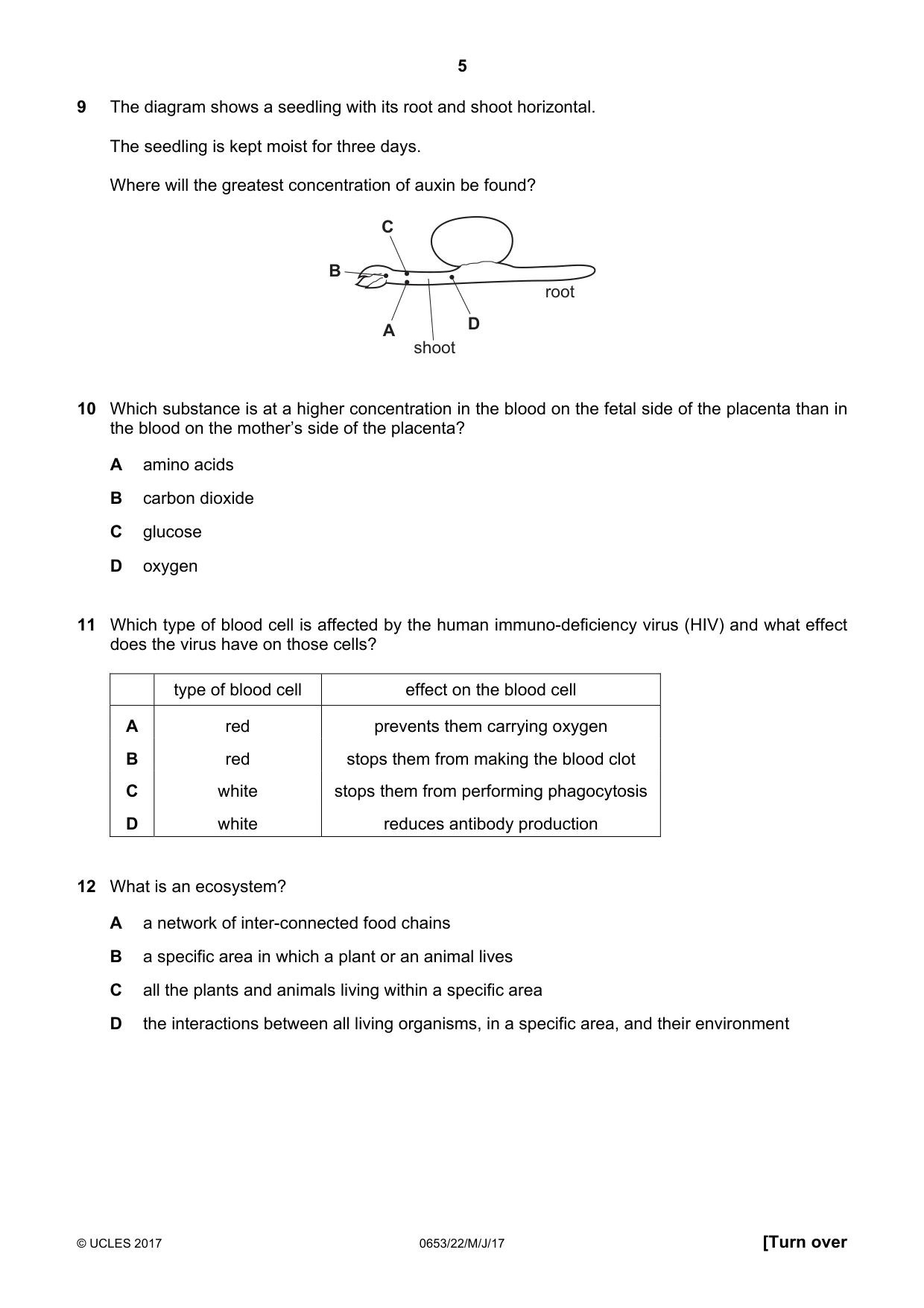
Q9 · The diagram shows a seedling with its root and shoot horizontal
9 The diagram shows a seedling with its root and shoot horizontal. The seedling is kept moist for three days. Where will the greatest concentration of auxin be found? C B root A D shoot
Mark scheme: A
Q10 · Which substance is at a higher concentration in the blood on the fetal side of the…
10 Which substance is at a higher concentration in the blood on the fetal side of the placenta than in the blood on the mother’s side of the placenta? A amino acids B carbon dioxide C glucose D oxygen
Mark scheme: B
Q11 · Which type of blood cell is affected by the human immuno-deficiency virus (HIV) and what…
11 Which type of blood cell is affected by the human immuno-deficiency virus (HIV) and what effect does the virus have on those cells? type of blood cell effect on the blood cell A red prevents them carrying oxygen B red stops them from making the blood clot C white stops them from performing phagocytosis D white reduces antibody production
Mark scheme: D
Q12 · What is an ecosystem?
12 What is an ecosystem? A a network of inter-connected food chains B a specific area in which a plant or an animal lives C all the plants and animals living within a specific area D the interactions between all living organisms, in a specific area, and their environment
Mark scheme: D
Q13 · What is an undesirable effect of overuse of fertilisers in agriculture?
13 What is an undesirable effect of overuse of fertilisers in agriculture? A acid rain B deforestation C eutrophication D global warming
Mark scheme: C
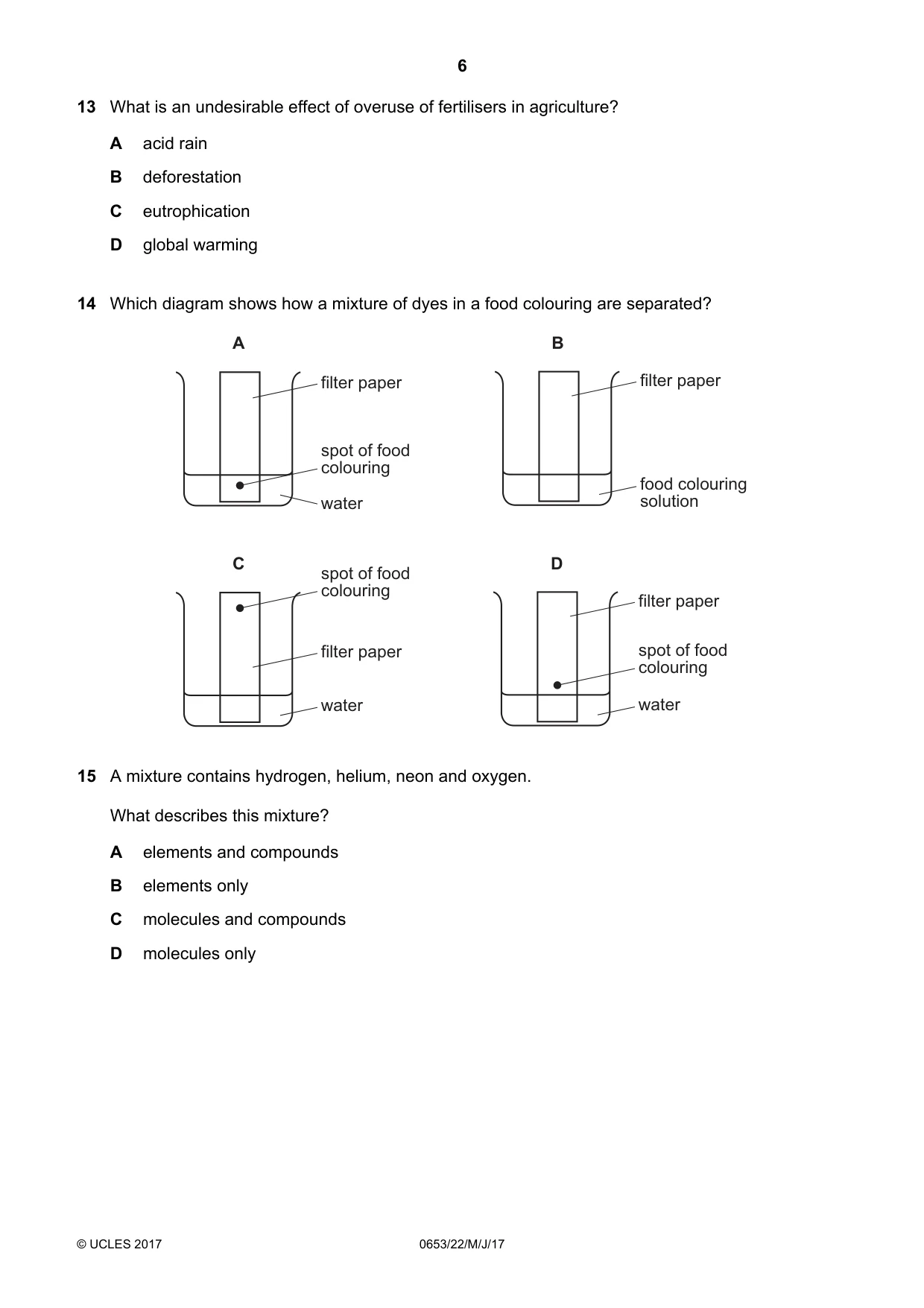
Q14 · Which diagram shows how a mixture of dyes in a food colouring are separated?
14 Which diagram shows how a mixture of dyes in a food colouring are separated? A B filter paper filter paper spot of food colouring food colouring water solution C D spot of food colouring filter paper filter paper spot of food colouring water water
Mark scheme: D
Q15 · A mixture contains hydrogen, helium, neon and oxygen
15 A mixture contains hydrogen, helium, neon and oxygen. What describes this mixture? A elements and compounds B elements only C molecules and compounds D molecules only
Mark scheme: B
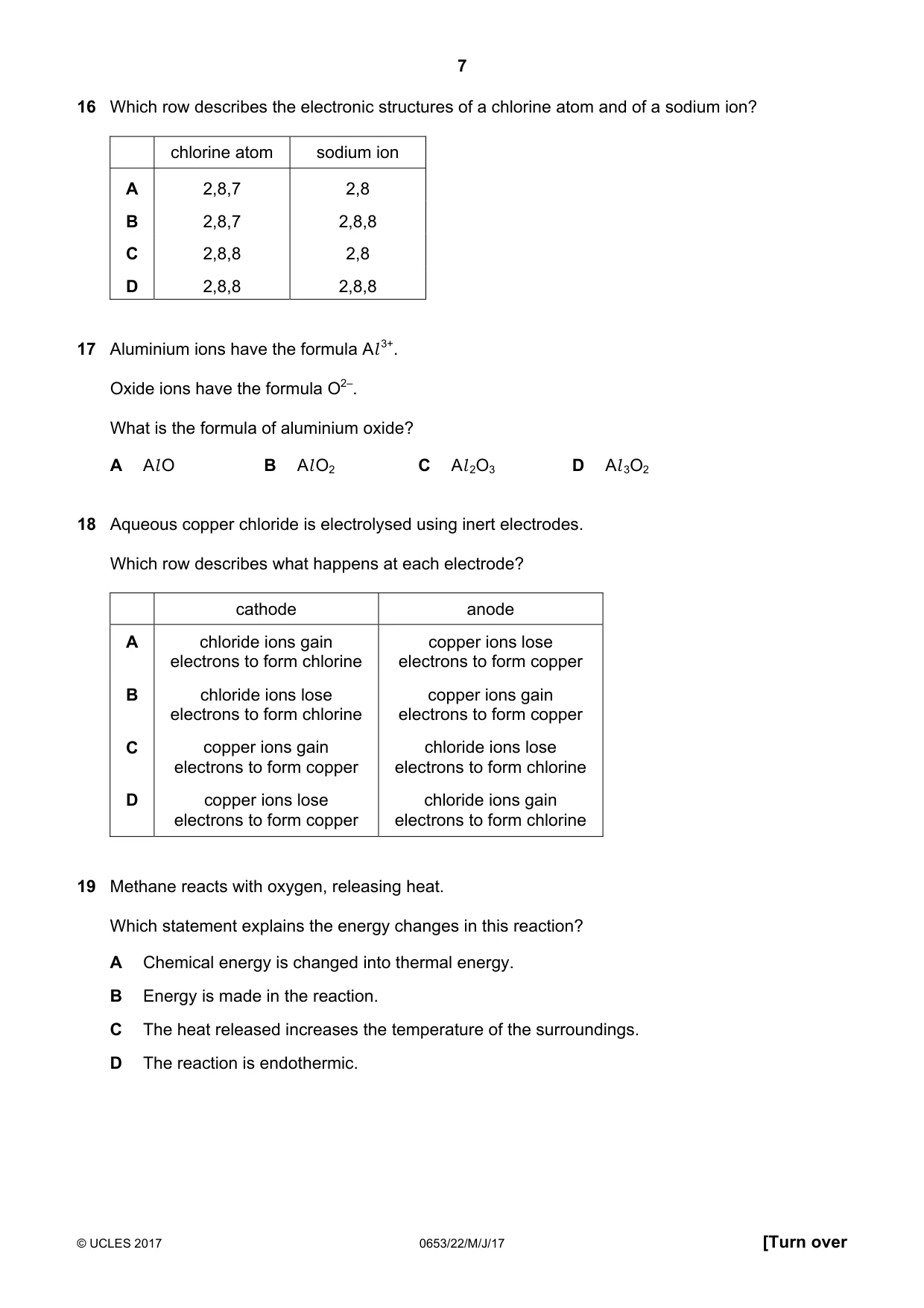
Q16 · Which row describes the electronic structures of a chlorine atom and of a sodium ion?
16 Which row describes the electronic structures of a chlorine atom and of a sodium ion? chlorine atom sodium ion A 2,8,7 2,8 B 2,8,7 2,8,8 C 2,8,8 2,8 D 2,8,8 2,8,8
Mark scheme: A
Q17 · Aluminium ions have the formula Al 3+
17 Aluminium ions have the formula Al 3+. Oxide ions have the formula O2–. What is the formula of aluminium oxide? A Al O B Al O2 C Al 2O3 D Al 3O2
Mark scheme: C
Q18 · Aqueous copper chloride is electrolysed using inert electrodes
18 Aqueous copper chloride is electrolysed using inert electrodes. Which row describes what happens at each electrode? cathode anode A chloride ions gain copper ions lose electrons to form chlorine electrons to form copper B chloride ions lose copper ions gain electrons to form chlorine electrons to form copper C copper ions gain chloride ions lose electrons to form copper electrons to form chlorine D copper ions lose chloride ions gain electrons to form copper electrons to form chlorine
Mark scheme: C
Q19 · Methane reacts with oxygen, releasing heat
19 Methane reacts with oxygen, releasing heat. Which statement explains the energy changes in this reaction? A Chemical energy is changed into thermal energy. B Energy is made in the reaction. C The heat released increases the temperature of the surroundings. D The reaction is endothermic.
Mark scheme: A
Q20 · Magnesium ribbon reacts with dilute hydrochloric acid to form hydrogen gas
20 Magnesium ribbon reacts with dilute hydrochloric acid to form hydrogen gas. Which change increases the rate of the reaction? A adding water to the mixture B trapping the hydrogen gas C using a lower temperature D using powdered magnesium
Mark scheme: D
Q21 · In which reactions is the underlined substance oxidised?
21 In which reactions is the underlined substance oxidised? 1 iron when it rusts 2 methane when it burns in air 3 copper oxide when it reacts with carbon A 1, 2 and 3 B 1 and 2 only C 1 and 3 only D 2 and 3 only
Mark scheme: B
Q22 · Substance X is warmed with aqueous sodium hydroxide and aluminium
22 Substance X is warmed with aqueous sodium hydroxide and aluminium. A gas is produced which turns damp red litmus paper blue. Which anion is present in X? A carbonate B hydroxide C nitrate D sulfate
Mark scheme: C
Q23 · The elements in Group VII of the Periodic Table are shown
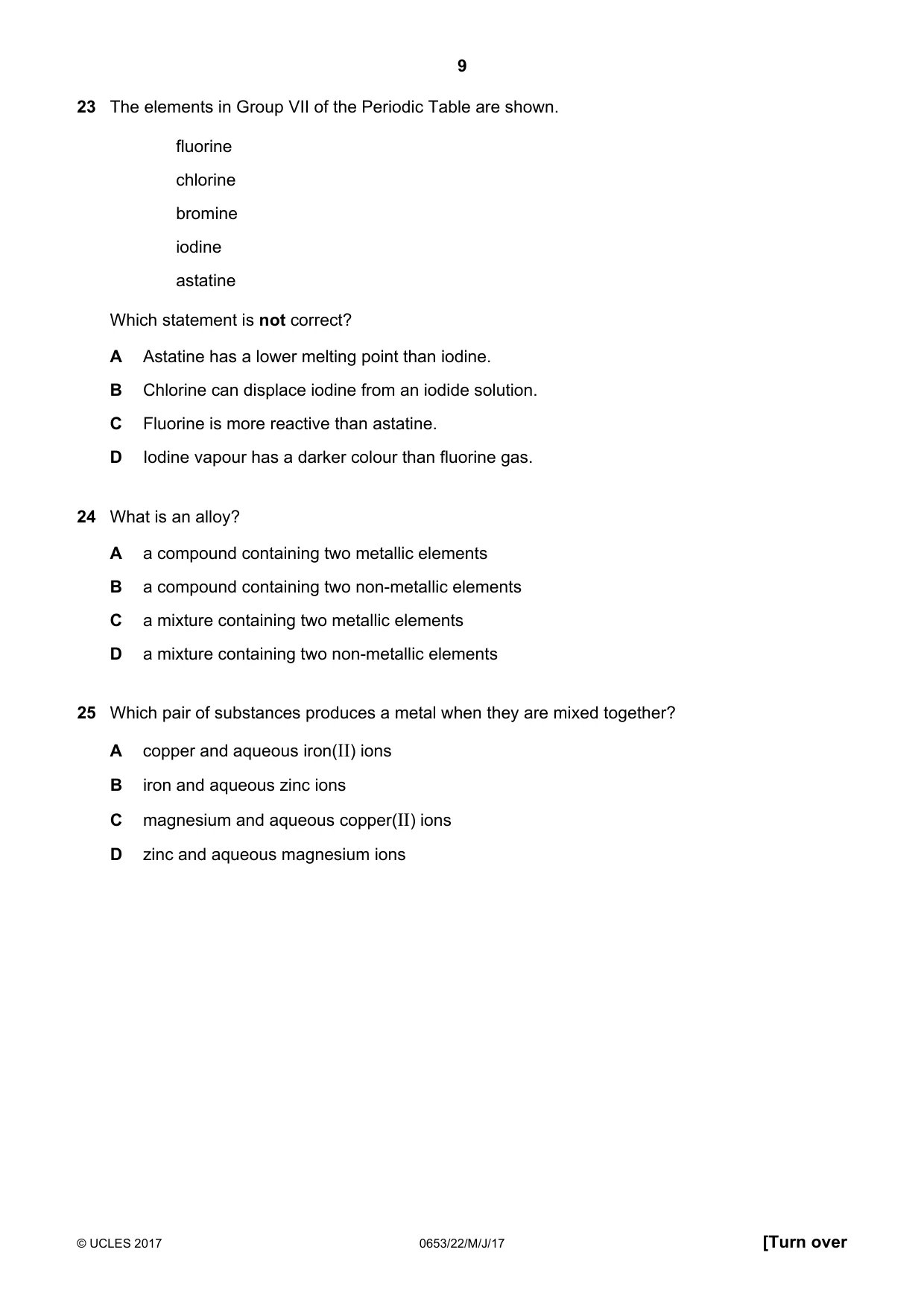
23 The elements in Group VII of the Periodic Table are shown. fluorine chlorine bromine iodine astatine Which statement is not correct? A Astatine has a lower melting point than iodine. B Chlorine can displace iodine from an iodide solution. C Fluorine is more reactive than astatine. D Iodine vapour has a darker colour than fluorine gas.
Mark scheme: A
Q24 · What is an alloy?
24 What is an alloy? A a compound containing two metallic elements B a compound containing two non-metallic elements C a mixture containing two metallic elements D a mixture containing two non-metallic elements
Mark scheme: C
Q25 · Which pair of substances produces a metal when they are mixed together?
25 Which pair of substances produces a metal when they are mixed together? A copper and aqueous iron(II) ions B iron and aqueous zinc ions C magnesium and aqueous copper(II) ions D zinc and aqueous magnesium ions
Mark scheme: C
Q26 · Which pie chart shows the proportions of gases in clean air?
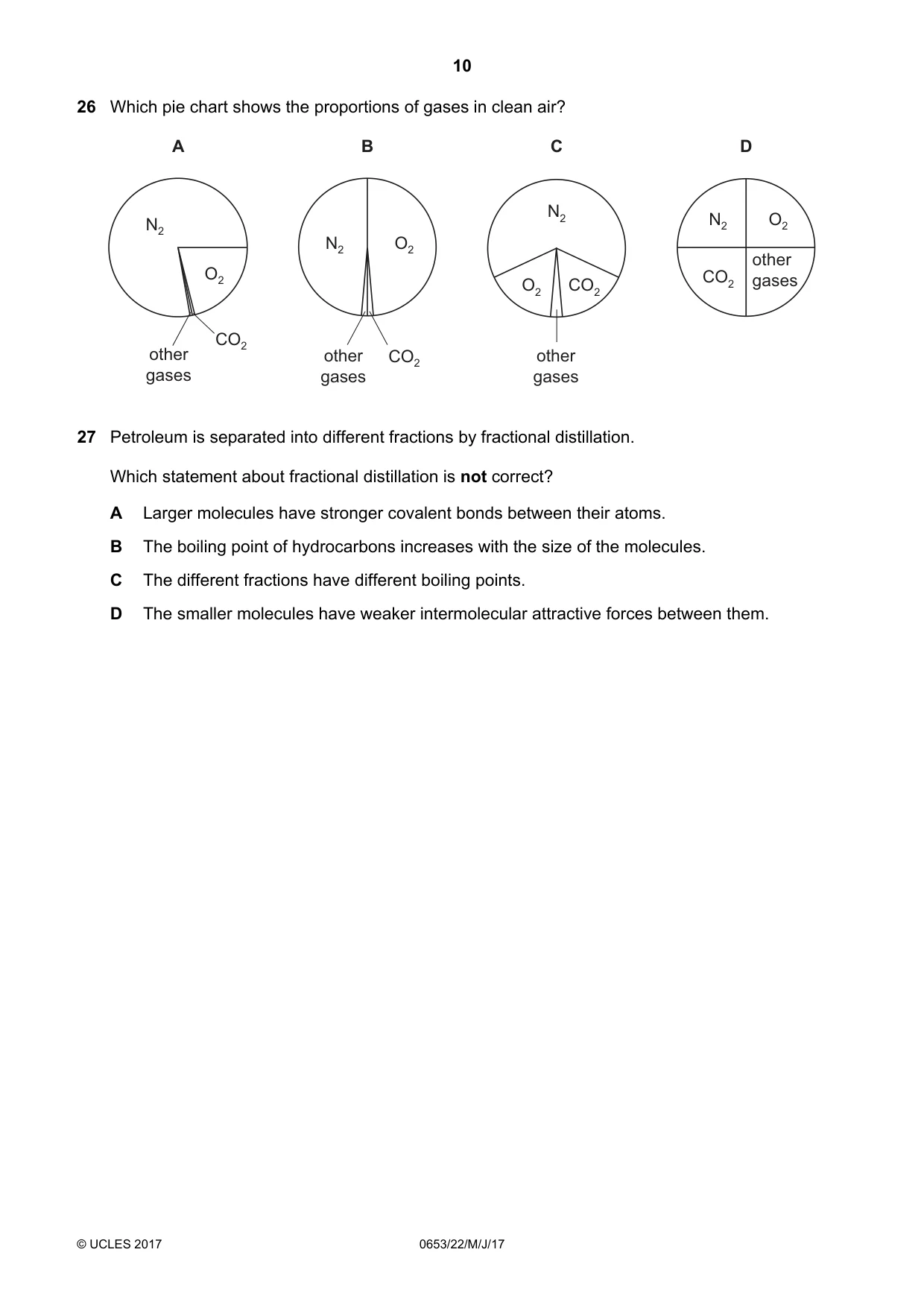
26 Which pie chart shows the proportions of gases in clean air? A B C D N2 N2 O2 N2 N2 O2 other O2 CO2 gases O2 CO2 CO2 other other CO2 other gases gases gases
Mark scheme: A
Q27 · Petroleum is separated into different fractions by fractional distillation
27 Petroleum is separated into different fractions by fractional distillation. Which statement about fractional distillation is not correct? A Larger molecules have stronger covalent bonds between their atoms. B The boiling point of hydrocarbons increases with the size of the molecules. C The different fractions have different boiling points. D The smaller molecules have weaker intermolecular attractive forces between them.
Mark scheme: A
Q28 · The diagram shows the speed-time graph for a vehicle
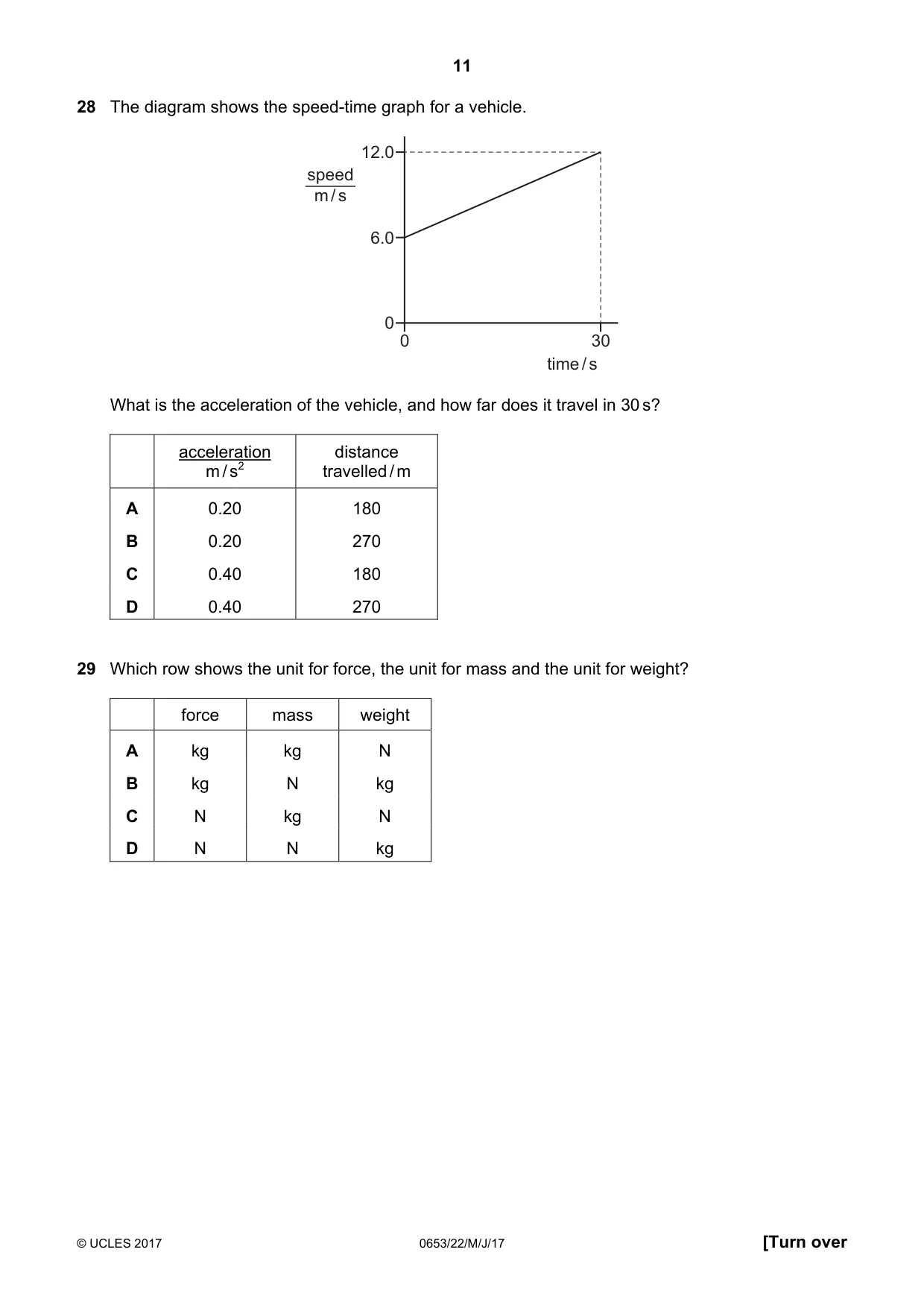
28 The diagram shows the speed-time graph for a vehicle. 12.0 speed m / s 6.0 0 0 30 time / s What is the acceleration of the vehicle, and how far does it travel in 30 s? acceleration distance m / s2 travelled / m A 0.20 180 B 0.20 270 C 0.40 180 D 0.40 270
Mark scheme: B
Q29 · Which row shows the unit for force, the unit for mass and the unit for weight?
29 Which row shows the unit for force, the unit for mass and the unit for weight? force mass weight A kg kg N B kg N kg C N kg N D N N kg
Mark scheme: C
Q30 · A spring obeys Hooke’s law
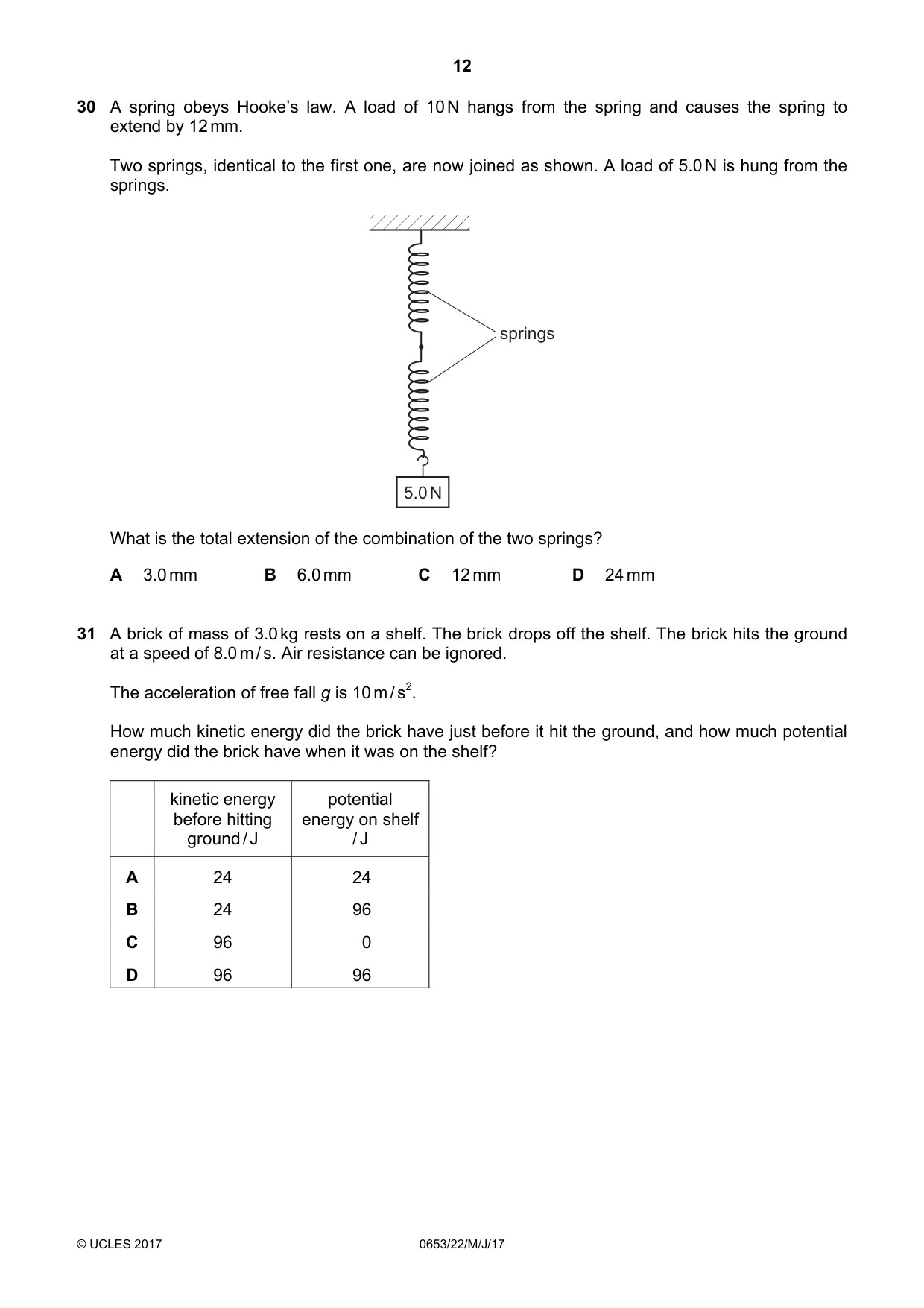
30 A spring obeys Hooke’s law. A load of 10 N hangs from the spring and causes the spring to extend by 12 mm. Two springs, identical to the first one, are now joined as shown. A load of 5.0 N is hung from the springs. springs 5.0 N What is the total extension of the combination of the two springs? A 3.0 mm B 6.0 mm C 12 mm D 24 mm
Mark scheme: C
Q31 · A brick of mass of 3.0 kg rests on a shelf
31 A brick of mass of 3.0 kg rests on a shelf. The brick drops off the shelf. The brick hits the ground at a speed of 8.0 m / s. Air resistance can be ignored. The acceleration of free fall g is 10 m / s2. How much kinetic energy did the brick have just before it hit the ground, and how much potential energy did the brick have when it was on the shelf? kinetic energy potential before hitting energy on shelf ground / J / J A 24 24 B 24 96 C 96 0 D 96 96
Mark scheme: D
Q32 · Two cylinders contain the same type of gas
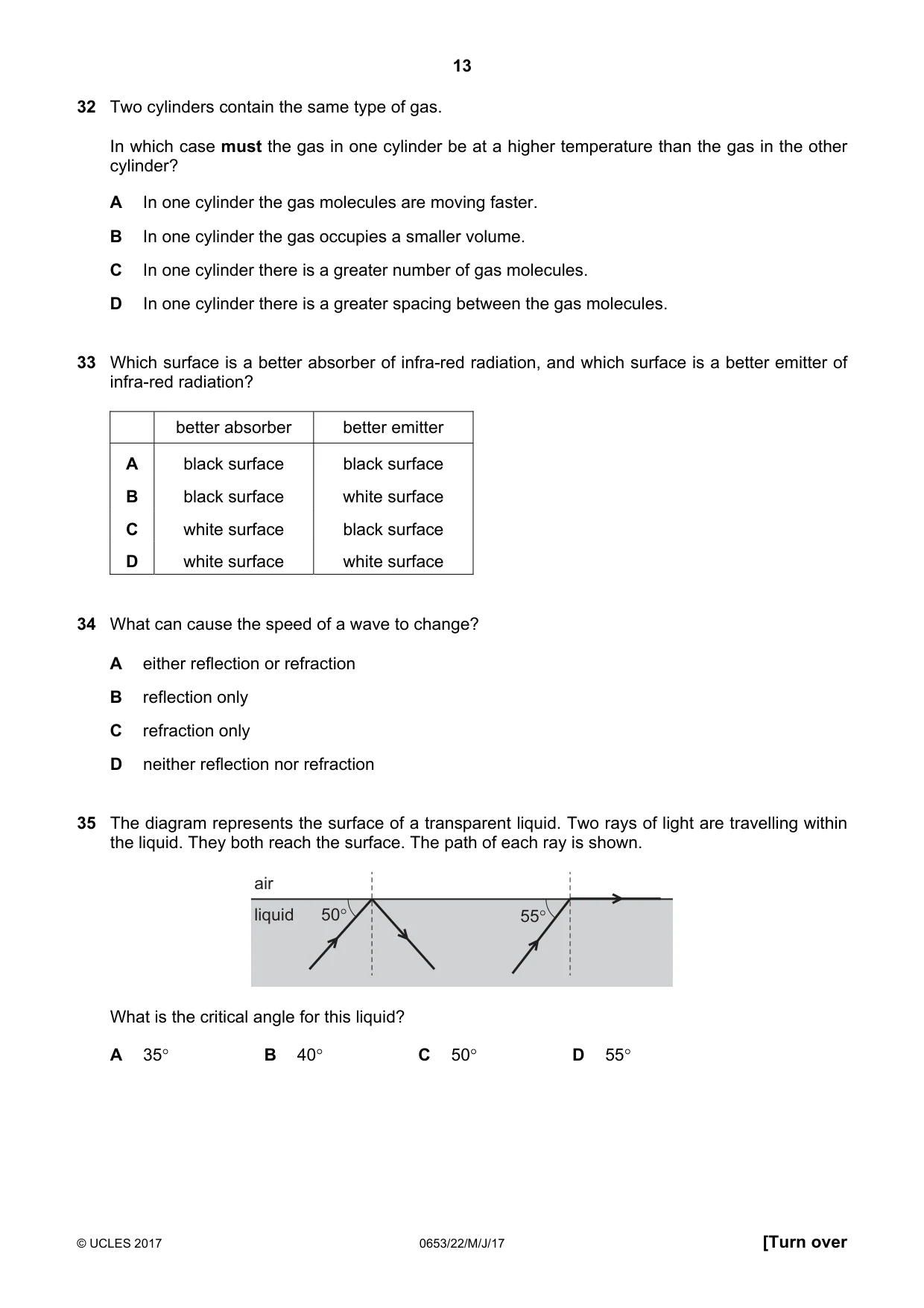
32 Two cylinders contain the same type of gas. In which case must the gas in one cylinder be at a higher temperature than the gas in the other cylinder? A In one cylinder the gas molecules are moving faster. B In one cylinder the gas occupies a smaller volume. C In one cylinder there is a greater number of gas molecules. D In one cylinder there is a greater spacing between the gas molecules.
Mark scheme: A
Q33 · Which surface is a better absorber of infra-red radiation, and which surface is a better…
33 Which surface is a better absorber of infra-red radiation, and which surface is a better emitter of infra-red radiation? better absorber better emitter A black surface black surface B black surface white surface C white surface black surface D white surface white surface
Mark scheme: A
Q34 · What can cause the speed of a wave to change?
34 What can cause the speed of a wave to change? A either reflection or refraction B reflection only C refraction only D neither reflection nor refraction
Mark scheme: C
Q35 · The diagram represents the surface of a transparent liquid
35 The diagram represents the surface of a transparent liquid. Two rays of light are travelling within the liquid. They both reach the surface. The path of each ray is shown. air liquid 50° 55° What is the critical angle for this liquid? A 35° B 40° C 50° D 55°
Mark scheme: A
Q36 · Which type of electromagnetic wave is used in airport security scanners?
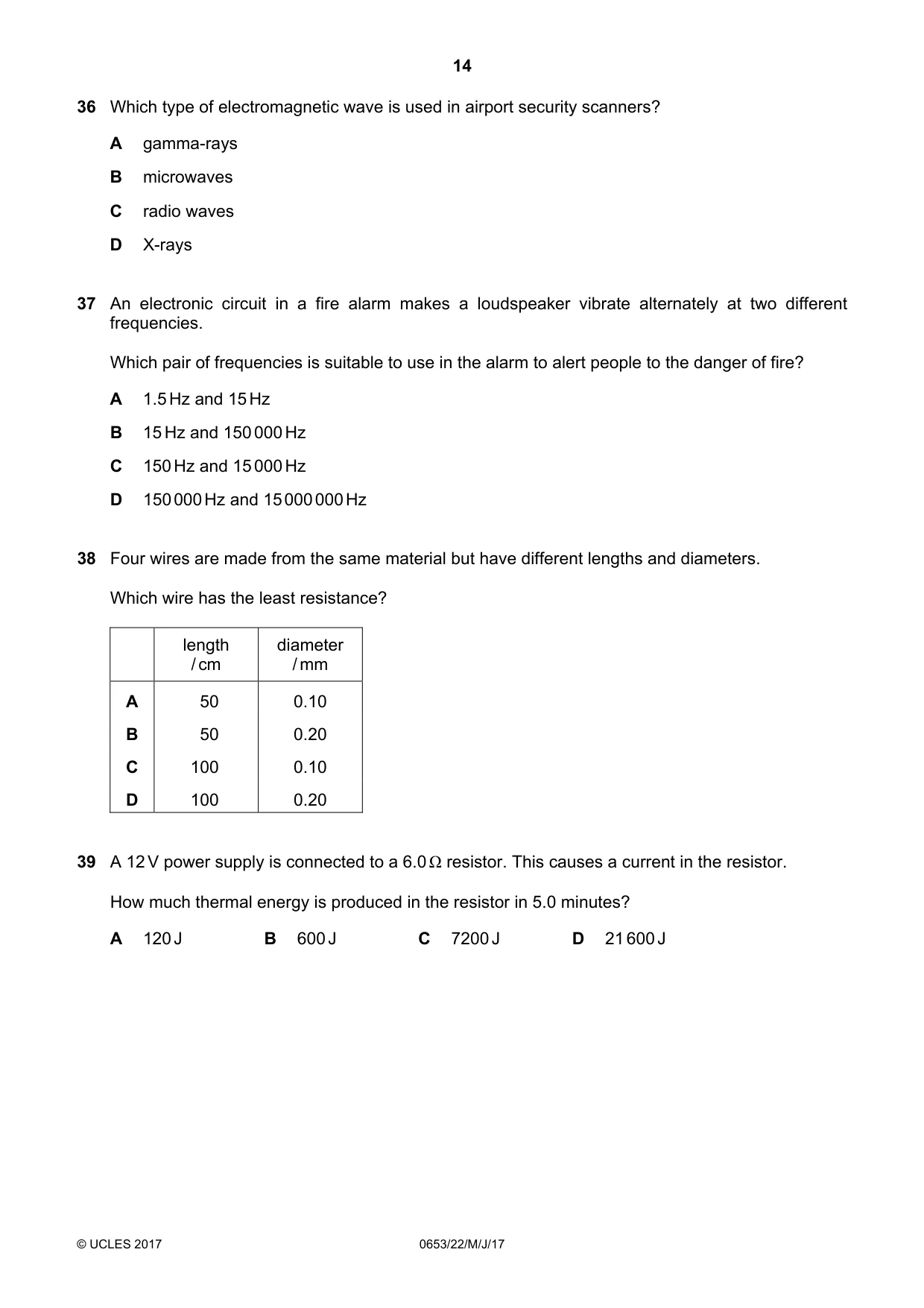
36 Which type of electromagnetic wave is used in airport security scanners? A gamma-rays B microwaves C radio waves D X-rays
Mark scheme: D
Q37 · An electronic circuit in a fire alarm makes a loudspeaker vibrate alternately at two…
37 An electronic circuit in a fire alarm makes a loudspeaker vibrate alternately at two different frequencies. Which pair of frequencies is suitable to use in the alarm to alert people to the danger of fire? A 1.5 Hz and 15 Hz B 15 Hz and 150 000 Hz C 150 Hz and 15 000 Hz D 150 000 Hz and 15 000 000 Hz
Mark scheme: C
Q38 · Four wires are made from the same material but have different lengths and diameters
38 Four wires are made from the same material but have different lengths and diameters. Which wire has the least resistance? length diameter / cm / mm A 50 0.10 B 50 0.20 C 100 0.10 D 100 0.20
Mark scheme: B
Q39 · A 12 V power supply is connected to a 6.0 Ω resistor
39 A 12 V power supply is connected to a 6.0 Ω resistor. This causes a current in the resistor. How much thermal energy is produced in the resistor in 5.0 minutes? A 120 J B 600 J C 7200 J D 21 600 J
Mark scheme: C
Q40 · The diagram shows a circuit containing four resistors and four ammeters
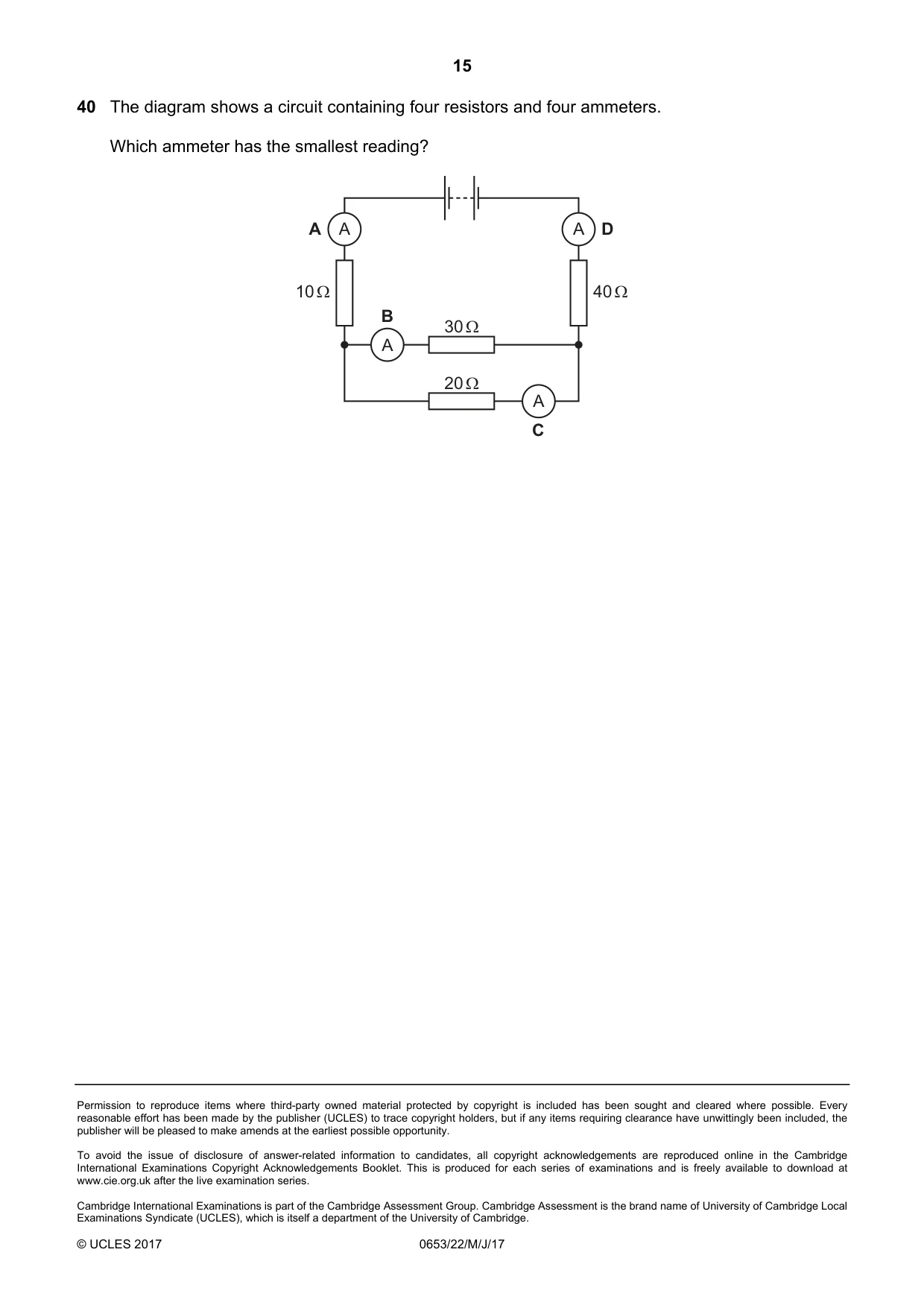
40 The diagram shows a circuit containing four resistors and four ammeters. Which ammeter has the smallest reading? A A A D 10 Ω 40 Ω B 30 Ω A 20 Ω A C
Mark scheme: B
What was in this paper
The subtopics covered by these 40 questions, and how many questions each got. Open one in a new tab to see every Cambridge question on it.
2Gas exchange in humans2Air quality and climate1Alloys and their properties1Atomic structure and the Periodic Table1Cell structure1Characteristics of living organisms1Chromatography1Diseases and immunity1Electrical circuits1Electrolysis1Electromagnetic spectrum1Elements, compounds and mixtures1Energy flow1Energy, work and power1Enzymes1Exothermic and endothermic reactions1Forces1Formulas1Fuels1General properties of waves1Group VII properties1Habitat destruction1Heart1Identification of ions and gases1Kinetic particle model of matter1Light1Mass and weight1Motion1Rate of reaction1Reactivity series1Redox1Sexual reproduction in humans1Size of specimens1Sound1Transfer of thermal energy1Transpiration1Water uptake1What you needed in this session
Cambridge’s own grade thresholds for 2017 May/June, Paper 2 · Variant 2. A higher threshold means an easier paper — the bar moves with how the cohort did.