Cambridge IGCSE Science - Combined 0653 — 2020 Feb/March Paper 2 · Variant 2
0653/22/F/M/20 · 40 questions · 40 marks · ≈45 min
The question paper and its mark scheme, free to read here and free to download. This is Cambridge’s own paper, exactly as it was sat.
Question paper16 pages
Mark scheme3 pages
Answers below. Sit the paper first if you are practising.
Questions as text
Q1 · Which row shows the features of a plant cell?
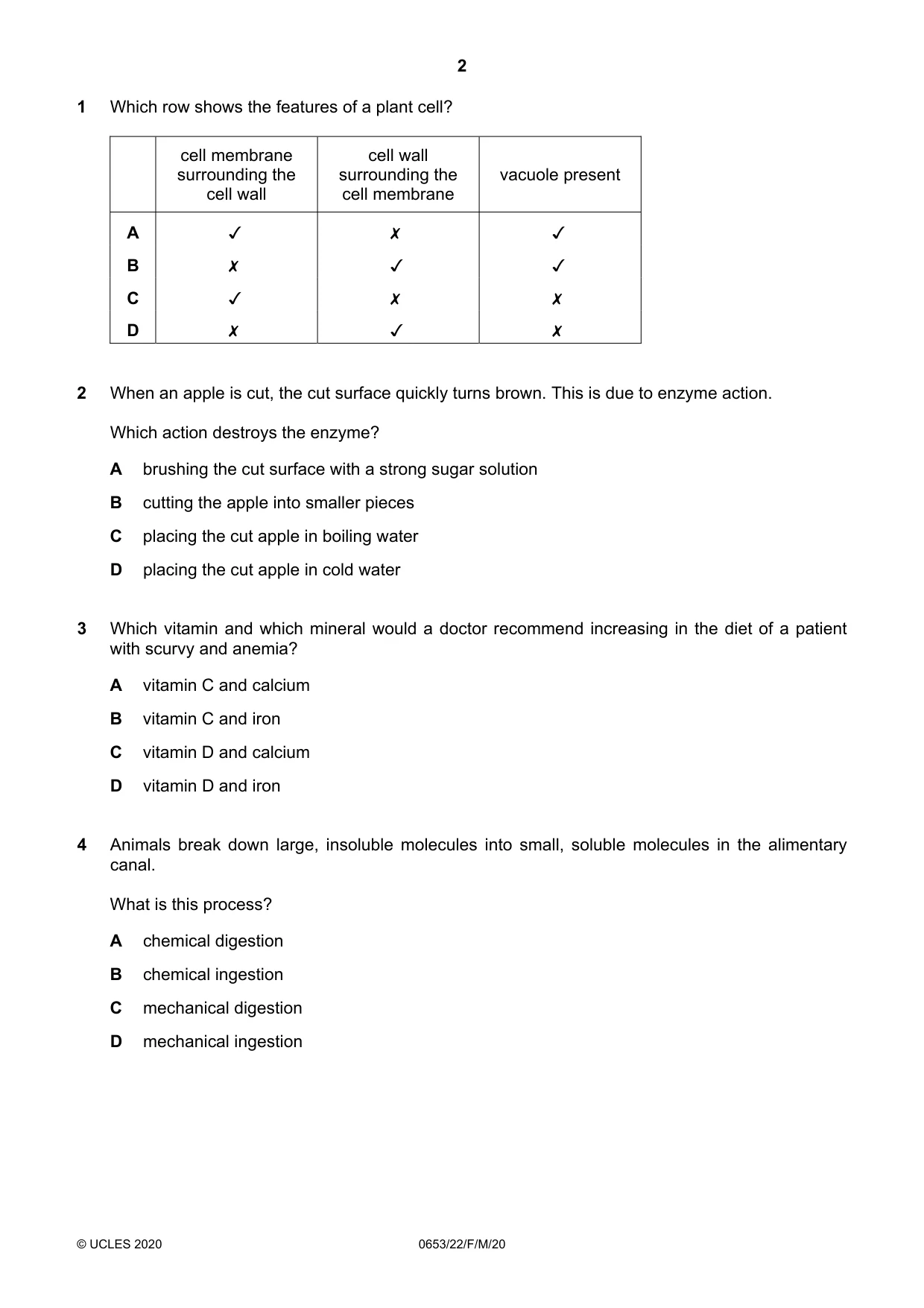
1 Which row shows the features of a plant cell? cell membrane surrounding the cell wall cell wall surrounding the cell membrane vacuole present 00 WwW > v x v x \ & < x ~ KOK
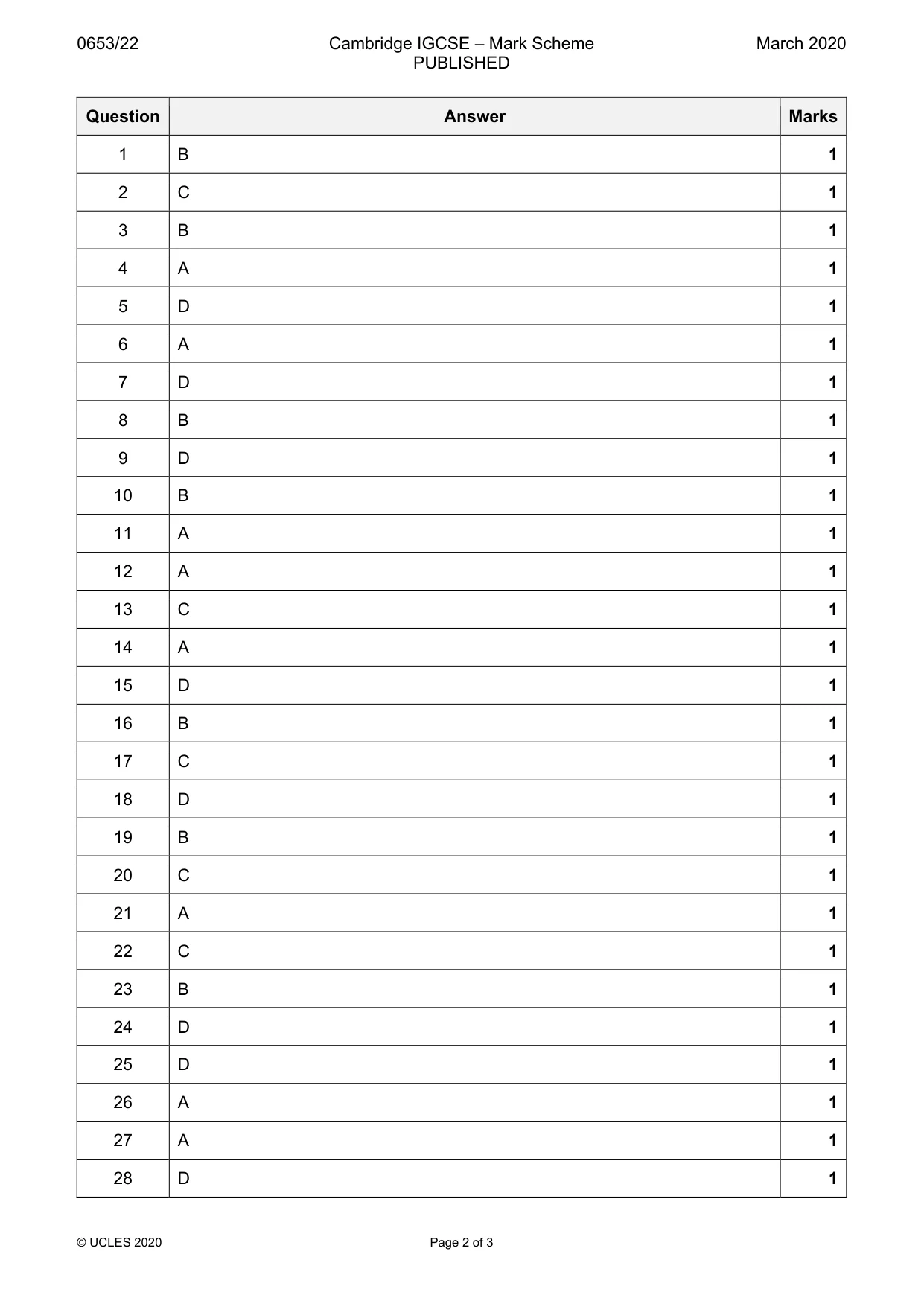
Mark scheme: B
Q2 · When an apple is cut, the cut surface quickly turns brown
2 When an apple is cut, the cut surface quickly turns brown. This is due to enzyme action. Which action destroys the enzyme? A brushing the cut surface with a strong sugar solution B cutting the apple into smaller pieces C placing the cut apple in boiling water D placing the cut apple in cold water
Mark scheme: C
Q3 · Which vitamin and which mineral would a doctor recommend increasing in the diet of a…
3 Which vitamin and which mineral would a doctor recommend increasing in the diet of a patient with scurvy and anemia? A vitamin C and calcium B vitamin C and iron C vitamin D and calcium D vitamin D and iron
Mark scheme: B
Q4 · Animals break down large, insoluble molecules into small, soluble molecules in the…
4 Animals break down large, insoluble molecules into small, soluble molecules in the alimentary canal. What is this process? A chemical digestion B chemical ingestion C mechanical digestion D mechanical ingestion
Mark scheme: A
Q5 · The table shows how humidity may affect the rate of diffusion of water vapour from a…
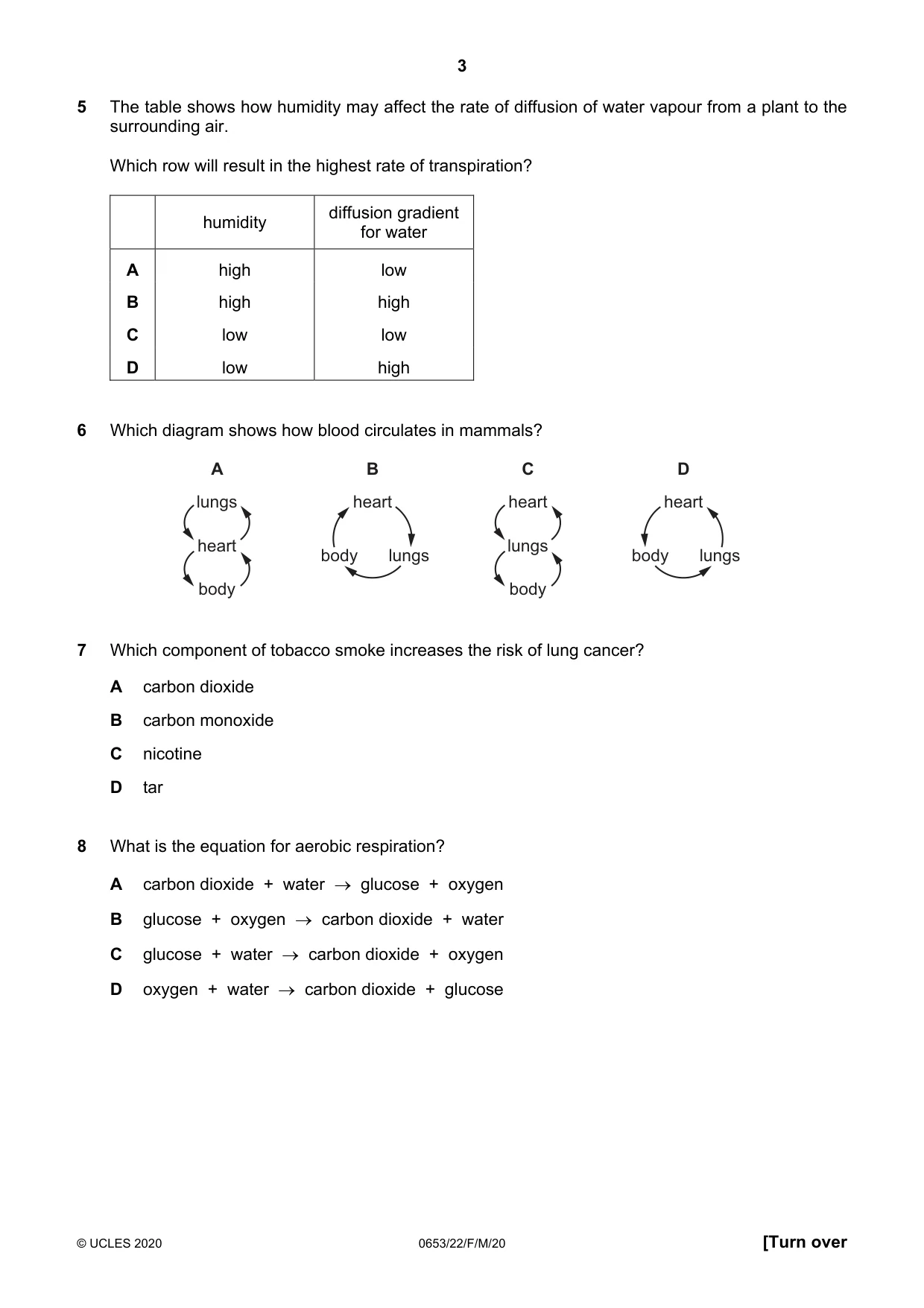
5 The table shows how humidity may affect the rate of diffusion of water vapour from a plant to the surrounding air. Which row will result in the highest rate of transpiration? diffusion gradient humidity for water A high low B high high C low low D low high
Mark scheme: D
Q6 · Which diagram shows how blood circulates in mammals?
6 Which diagram shows how blood circulates in mammals? A B C D lungs heart heart heart heart lungs body lungs body lungs body body
Mark scheme: A
Q7 · Which component of tobacco smoke increases the risk of lung cancer?
7 Which component of tobacco smoke increases the risk of lung cancer? A carbon dioxide B carbon monoxide C nicotine D tar
Mark scheme: D
Q8 · What is the equation for aerobic respiration?
8 What is the equation for aerobic respiration? A carbon dioxide + water → glucose + oxygen B glucose + oxygen → carbon dioxide + water C glucose + water → carbon dioxide + oxygen D oxygen + water → carbon dioxide + glucose
Mark scheme: B
Q9 · When an athlete prepares for the start of a sprint race, excitement causes the…
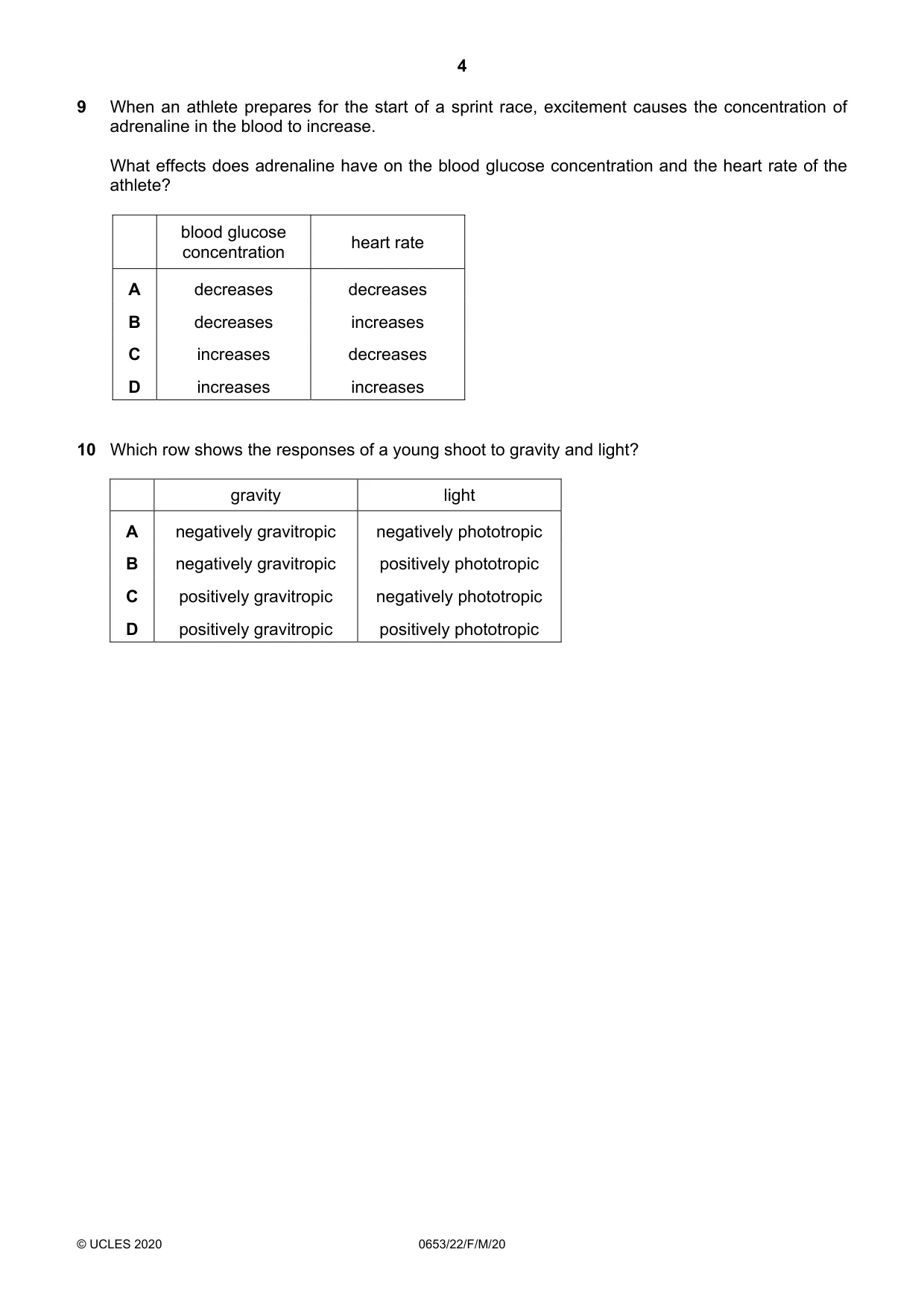
9 When an athlete prepares for the start of a sprint race, excitement causes the concentration of adrenaline in the blood to increase. What effects does adrenaline have on the blood glucose concentration and the heart rate of the athlete? blood glucose heart rate concentration A decreases decreases B decreases increases C increases decreases D increases increases
Mark scheme: D
Q10 · Which row shows the responses of a young shoot to gravity and light?
10 Which row shows the responses of a young shoot to gravity and light? gravity light A negatively gravitropic negatively phototropic B negatively gravitropic positively phototropic C positively gravitropic negatively phototropic D positively gravitropic positively phototropic
Mark scheme: B
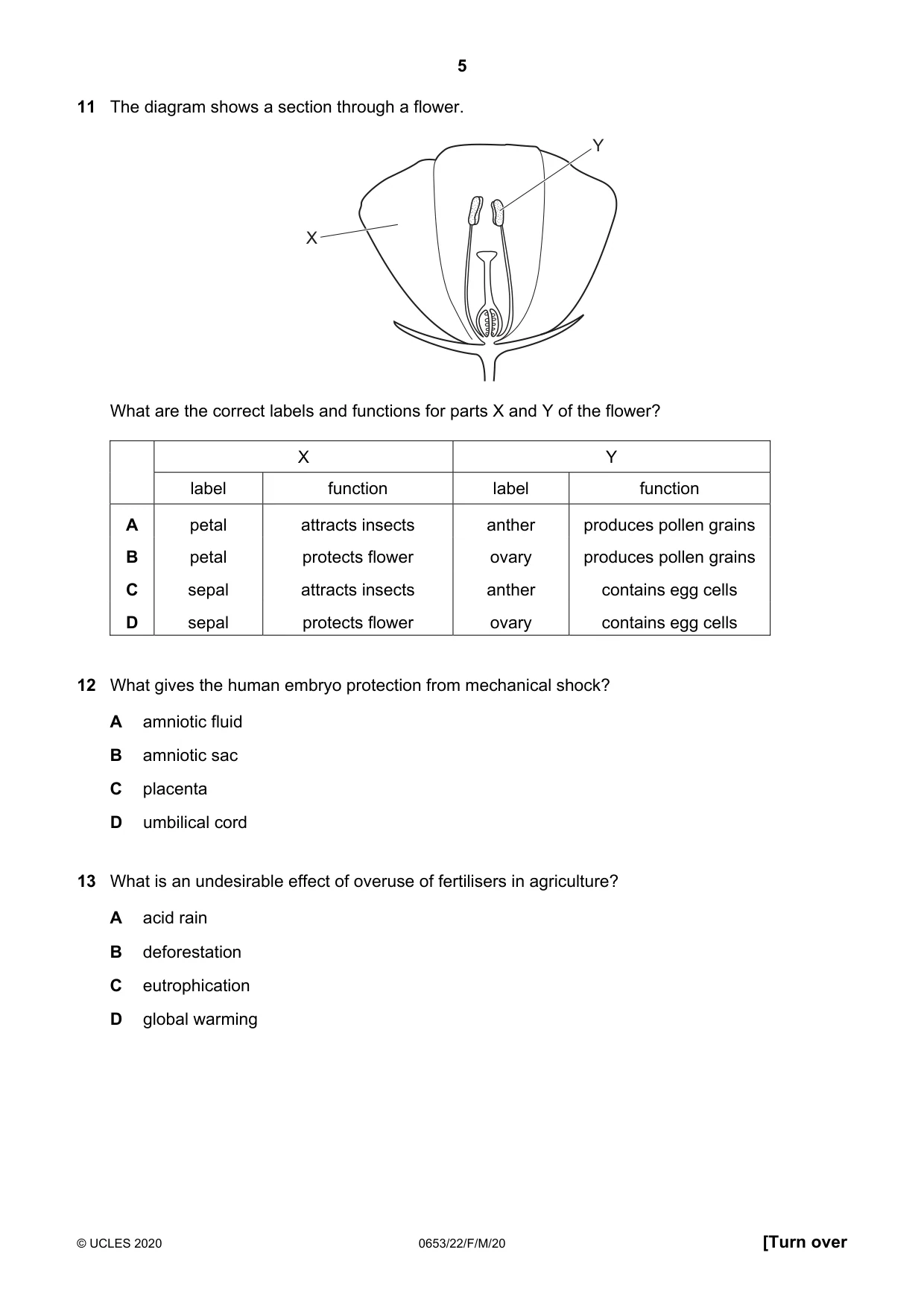
Q11 · The diagram shows a section through a flower
11 The diagram shows a section through a flower. Y X What are the correct labels and functions for parts X and Y of the flower? X Y label function label function A petal attracts insects anther produces pollen grains B petal protects flower ovary produces pollen grains C sepal attracts insects anther contains egg cells D sepal protects flower ovary contains egg cells
Mark scheme: A
Q12 · What gives the human embryo protection from mechanical shock?
12 What gives the human embryo protection from mechanical shock? A amniotic fluid B amniotic sac C placenta D umbilical cord
Mark scheme: A
Q13 · What is an undesirable effect of overuse of fertilisers in agriculture?
13 What is an undesirable effect of overuse of fertilisers in agriculture? A acid rain B deforestation C eutrophication D global warming
Mark scheme: C
Q14 · What happens to water molecules when water is heated to 100 °C in a beaker?
14 What happens to water molecules when water is heated to 100 °C in a beaker? A They gain energy and escape from the beaker. B They gain energy and move more slowly. C They lose energy and escape from the beaker. D They lose energy and move more slowly.
Mark scheme: A
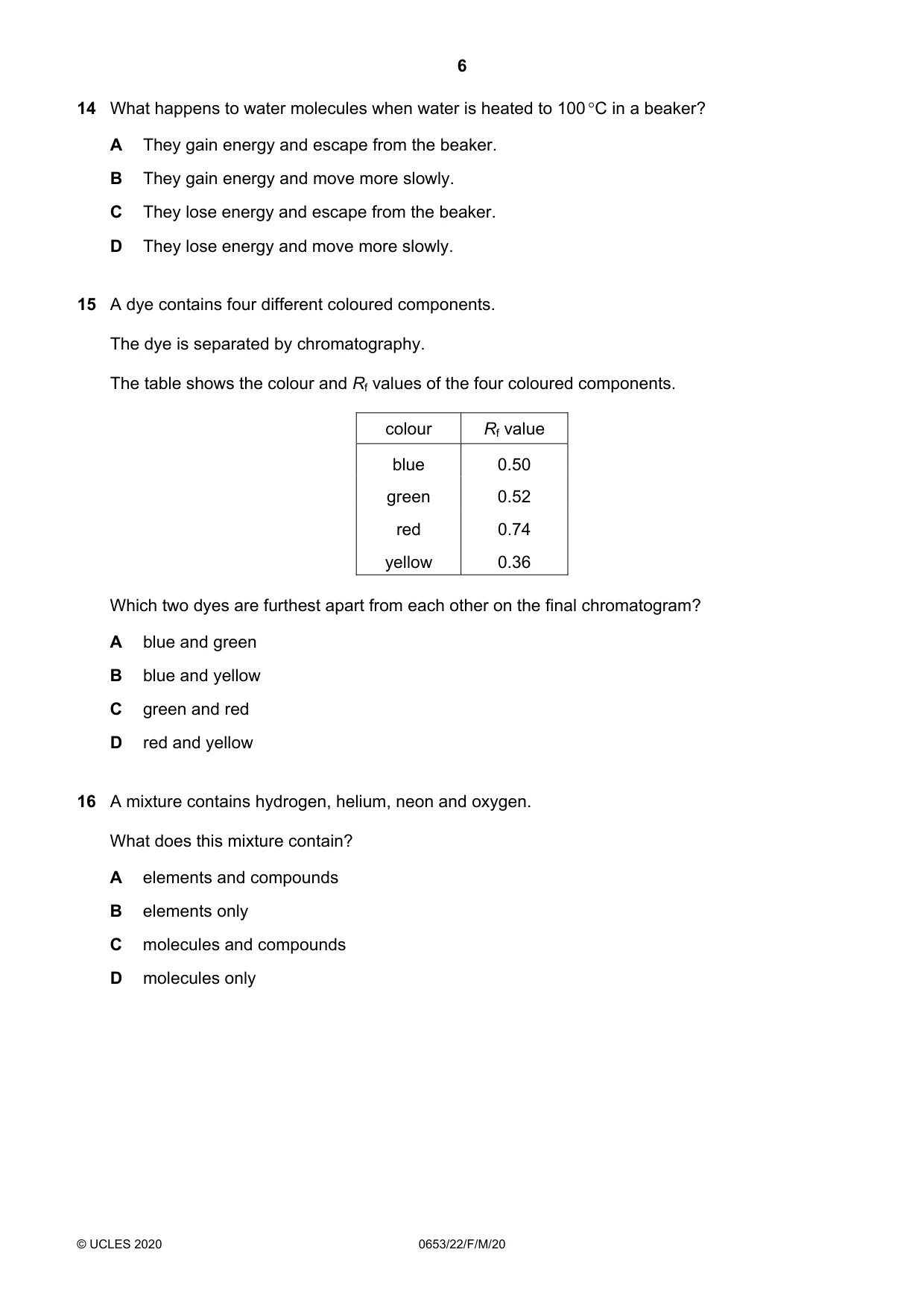
Q15 · A dye contains four different coloured components
15 A dye contains four different coloured components. The dye is separated by chromatography. The table shows the colour and Rf values of the four coloured components. colour Rf value blue 0.50 green 0.52 red 0.74 yellow 0.36 Which two dyes are furthest apart from each other on the final chromatogram? A blue and green B blue and yellow C green and red D red and yellow
Mark scheme: D
Q16 · A mixture contains hydrogen, helium, neon and oxygen
16 A mixture contains hydrogen, helium, neon and oxygen. What does this mixture contain? A elements and compounds B elements only C molecules and compounds D molecules only
Mark scheme: B
Q17 · Some information about a sodium ion is shown
17 Some information about a sodium ion is shown. proton nucleon number of number of number of particle number number protons neutrons electrons Na+ 11 23 11 X Y What are the values of X and Y? X Y A 11 10 B 11 11 C 12 10 D 12 11
Mark scheme: C
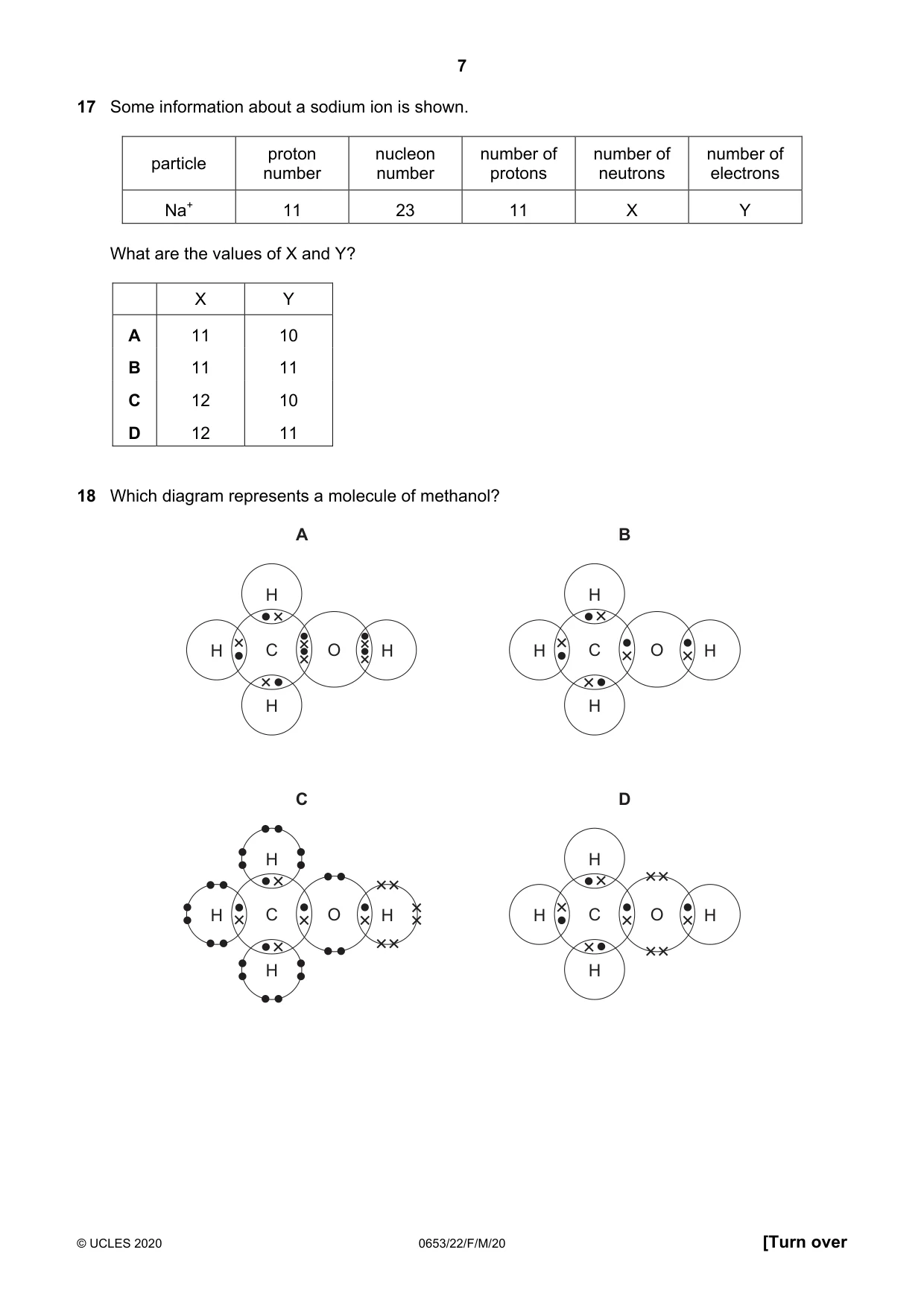
Q18 · Which diagram represents a molecule of methanol?
18 Which diagram represents a molecule of methanol? A B H H H C O H H C O H H H C D H H H C O H H C O H H H
Mark scheme: D
Q19 · Aqueous sodium sulfate reacts with aqueous barium chloride to make barium sulfate and…
19 Aqueous sodium sulfate reacts with aqueous barium chloride to make barium sulfate and sodium chloride. What is the ionic equation for this reaction? A Ba2+(aq) + SO4 2–(aq) → BaSO4(aq) B Ba2+(aq) + SO4 2–(aq) → BaSO4(s) C Na+(aq) + Cl –(aq) → NaCl (s) D Na+(aq) + Cl –(aq) → NaCl (aq)
Mark scheme: B
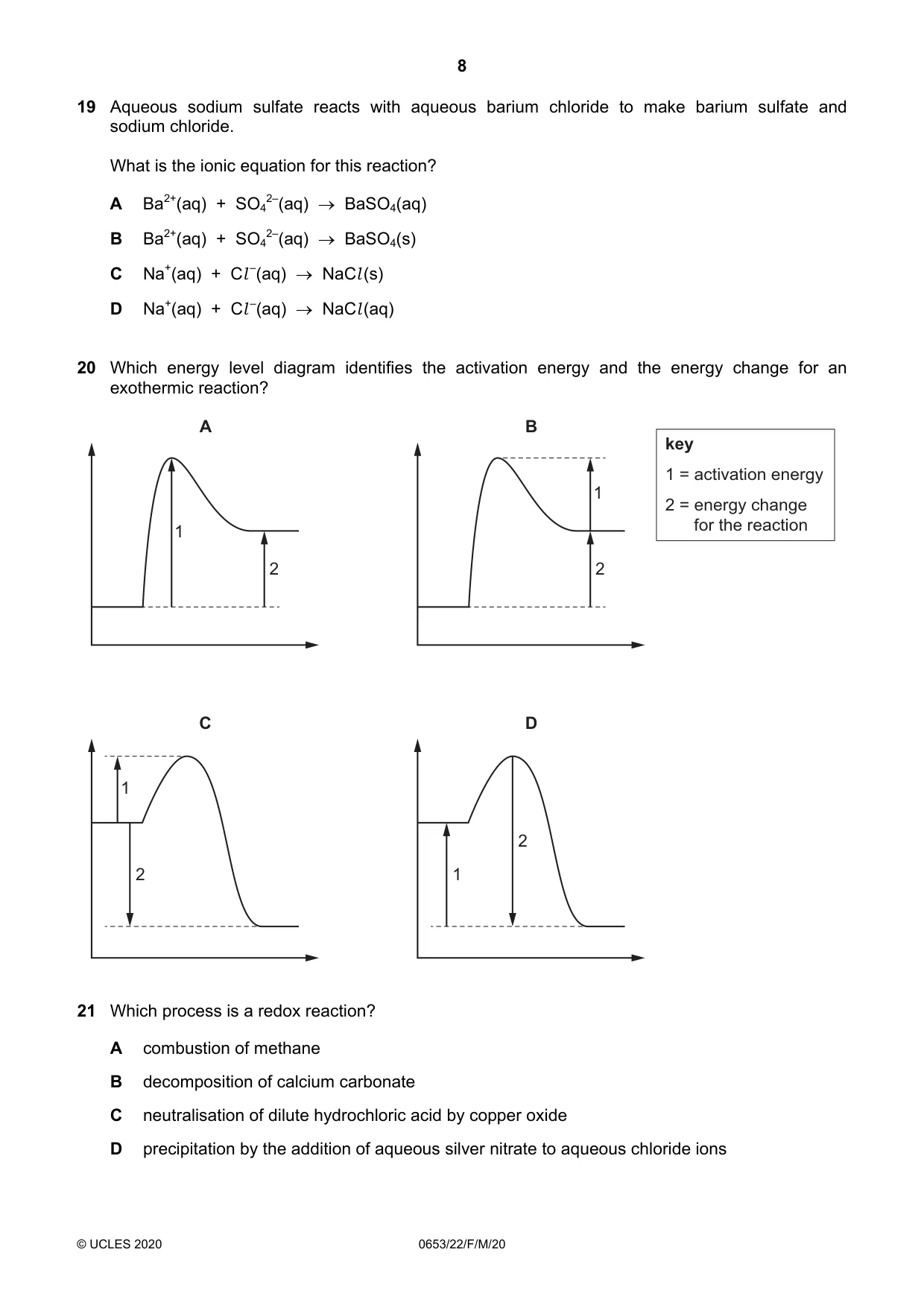
Q20 · Which energy level diagram identifies the activation energy and the energy change for an…
20 Which energy level diagram identifies the activation energy and the energy change for an exothermic reaction? A B key 1 = activation energy 1 2 = energy change 1 for the reaction 2 2 C D 1 2 2 1
Mark scheme: C
Q21 · Which process is a redox reaction?
21 Which process is a redox reaction? A combustion of methane B decomposition of calcium carbonate C neutralisation of dilute hydrochloric acid by copper oxide D precipitation by the addition of aqueous silver nitrate to aqueous chloride ions
Mark scheme: A
Q22 · A solution of compound X produces a dark green precipitate when aqueous sodium hydroxide…
22 A solution of compound X produces a dark green precipitate when aqueous sodium hydroxide is added. What is X? A copper(II) chloride B copper(II) sulfate C iron(II) sulfate D iron(III) chloride
Mark scheme: C
Q23 · Rubidium is a very reactive Group I metal
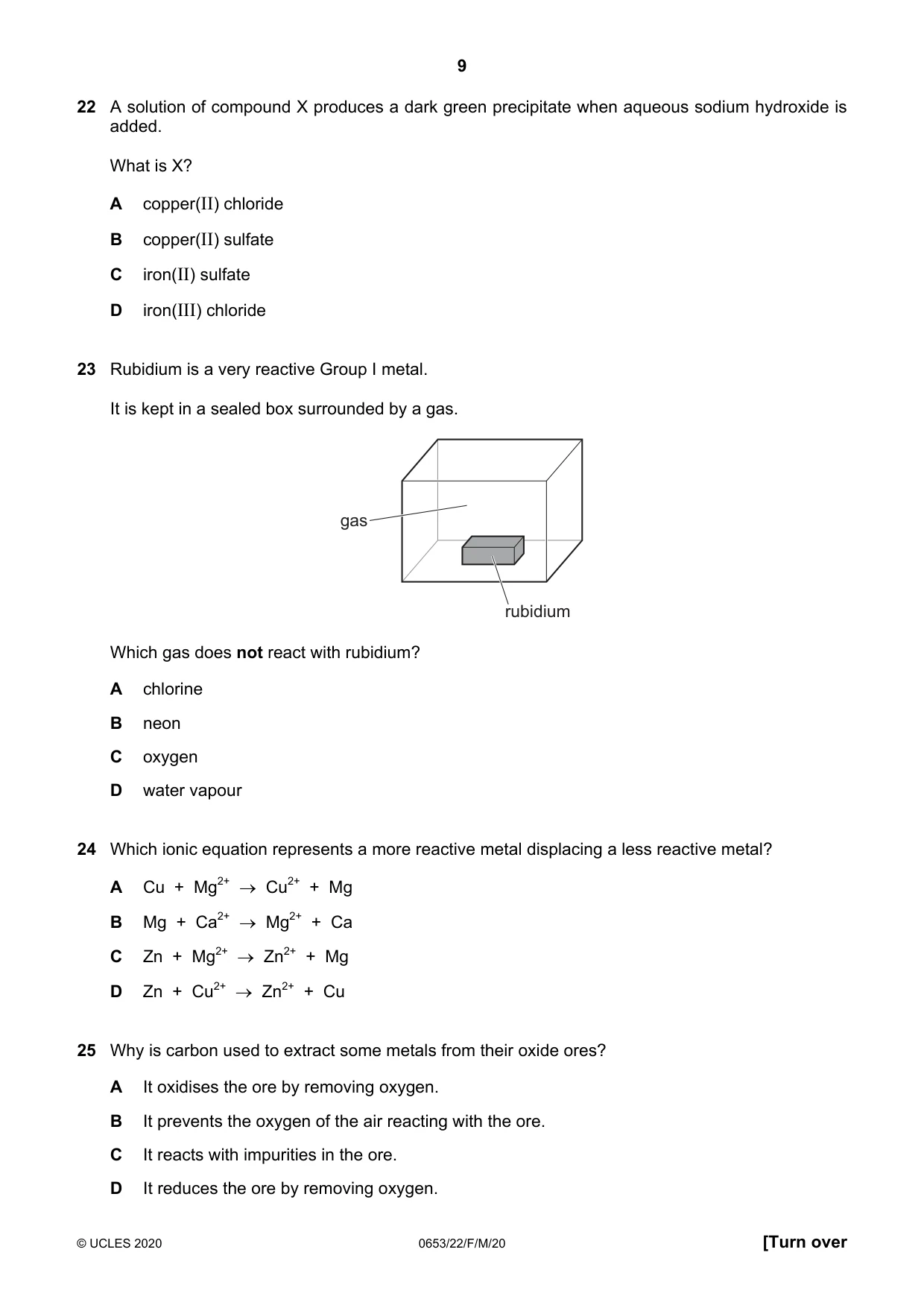
23 Rubidium is a very reactive Group I metal. It is kept in a sealed box surrounded by a gas. gas rubidium Which gas does not react with rubidium? A chlorine B neon C oxygen D water vapour
Mark scheme: B
Q24 · Which ionic equation represents a more reactive metal displacing a less reactive metal?
24 Which ionic equation represents a more reactive metal displacing a less reactive metal? A Cu + Mg2+ → Cu2+ + Mg B Mg + Ca2+ → Mg2+ + Ca C Zn + Mg2+ → Zn2+ + Mg D Zn + Cu2+ → Zn2+ + Cu
Mark scheme: D
Q25 · Why is carbon used to extract some metals from their oxide ores?
25 Why is carbon used to extract some metals from their oxide ores? A It oxidises the ore by removing oxygen. B It prevents the oxygen of the air reacting with the ore. C It reacts with impurities in the ore. D It reduces the ore by removing oxygen.
Mark scheme: D
Q26 · Which statement describes the structure of sodium chloride?
26 Which statement describes the structure of sodium chloride? A It is composed of a regular arrangement of alternating positive and negative ions. B It is composed of negatively charged sodium ions joined to positively charged chloride ions. C It is composed of oppositely charged ions held together by strong covalent bonds. D It is composed of sodium atoms joined to chlorine atoms by shared pairs of electrons.
Mark scheme: A
Q27 · What is formed during the complete combustion of a hydrocarbon?
27 What is formed during the complete combustion of a hydrocarbon? A carbon dioxide and water B carbon dioxide and hydrogen C carbon monoxide and carbon dioxide D carbon monoxide and water
Mark scheme: A
Q28 · The diagrams show two distance–time graphs and two speed–time graphs
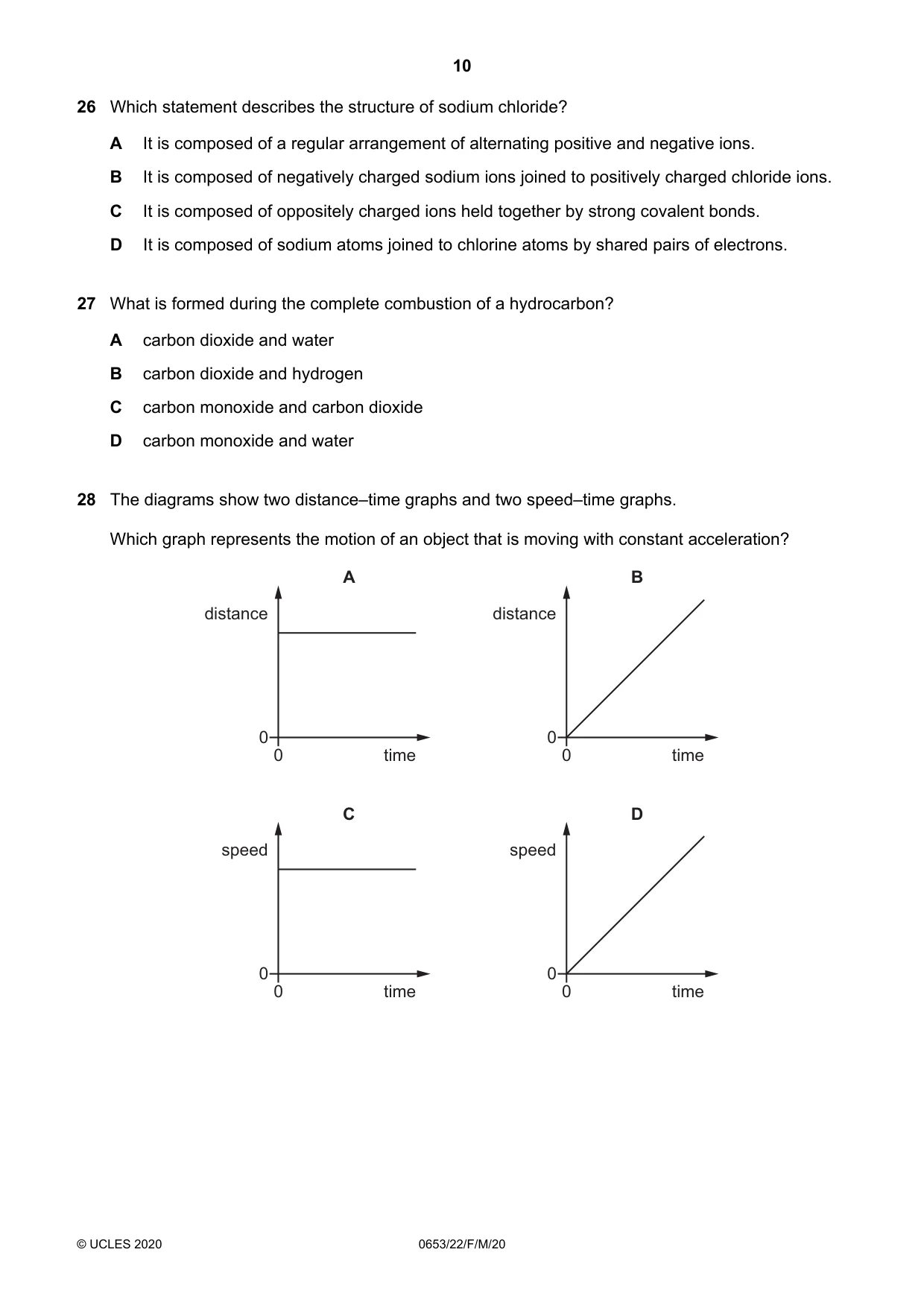
28 The diagrams show two distance–time graphs and two speed–time graphs. Which graph represents the motion of an object that is moving with constant acceleration? A B distance distance 0 0 0 time 0 time C D speed speed 0 0 0 time 0 time
Mark scheme: D
Q29 · A measuring cylinder contains 60 cm3 of water
29 A measuring cylinder contains 60 cm3 of water. A solid object of mass 120 g is lowered into the water until it is completely submerged. The new reading on the measuring cylinder is 80 cm3. What is the density of the object? A 0.50 g / cm3 B 1.5 g / cm3 C 2.0 g / cm3 D 6.0 g / cm3
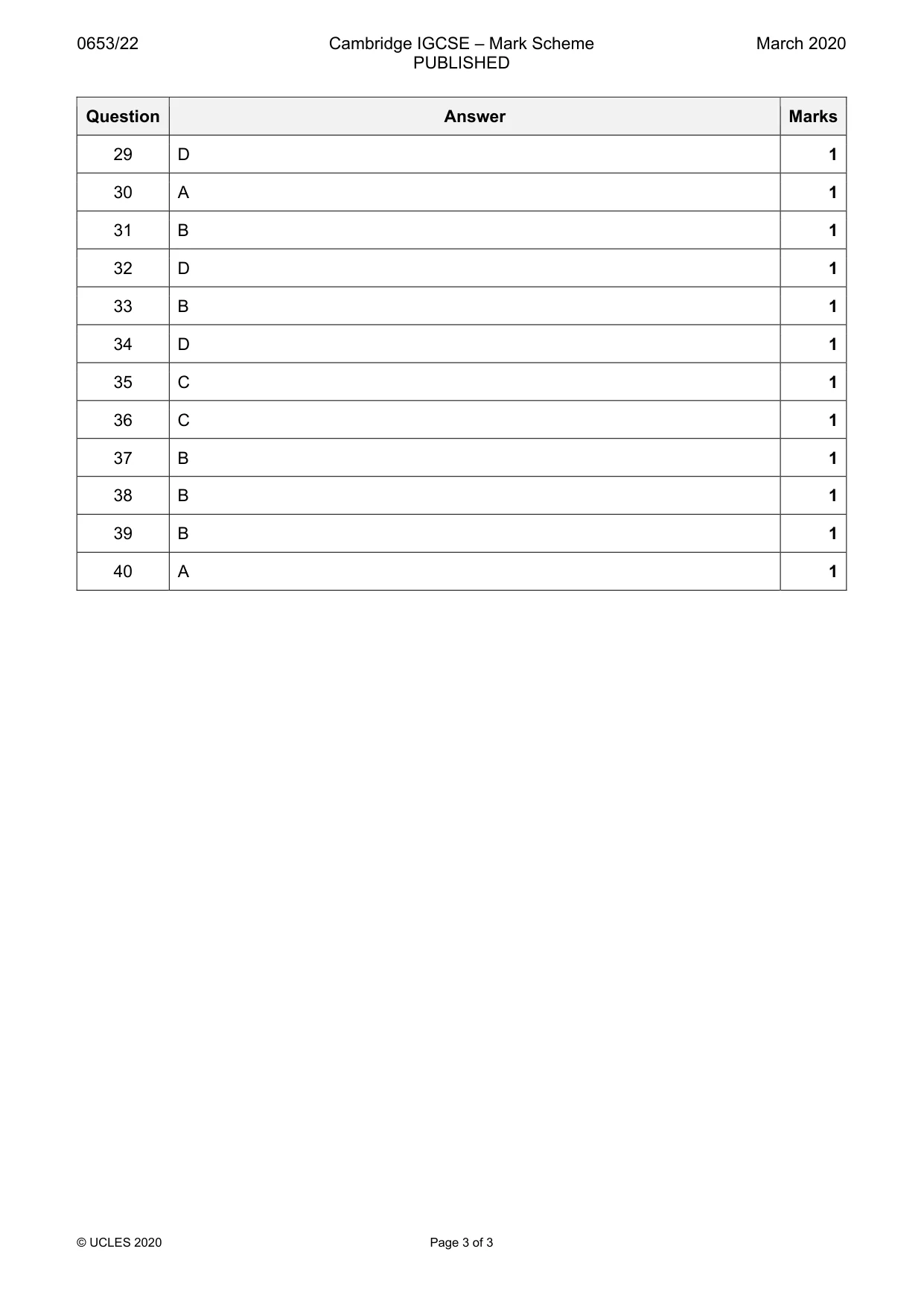
Mark scheme: D
Q30 · A heavy bag of flour is dragged against friction along a horizontal floor at a constant…
30 A heavy bag of flour is dragged against friction along a horizontal floor at a constant speed of 12 m / s for 2.0 s. The energy input required is 3000 J. What is the force due to friction? A 125 N B 500 N C 18 000 N D 72 000 N
Mark scheme: A
Q31 · A toy car rolls from rest down a slope and on to a horizontal bench
31 A toy car rolls from rest down a slope and on to a horizontal bench. The car stops before it reaches the end of the bench. What energy changes take place during this journey? A gravitational potential → kinetic → elastic potential B gravitational potential → kinetic → thermal and sound C kinetic → gravitational potential → elastic potential D kinetic → gravitational potential → thermal and sound
Mark scheme: B
Q32 · Which statement about a tidal energy power station is correct?
32 Which statement about a tidal energy power station is correct? A It creates no environmental impact when being built. B It does not work at night. C It does not work when there is no wind. D It supplies energy at predictable times.
Mark scheme: D
Q33 · Which row describes the forces between molecules in a solid and the motion of the…
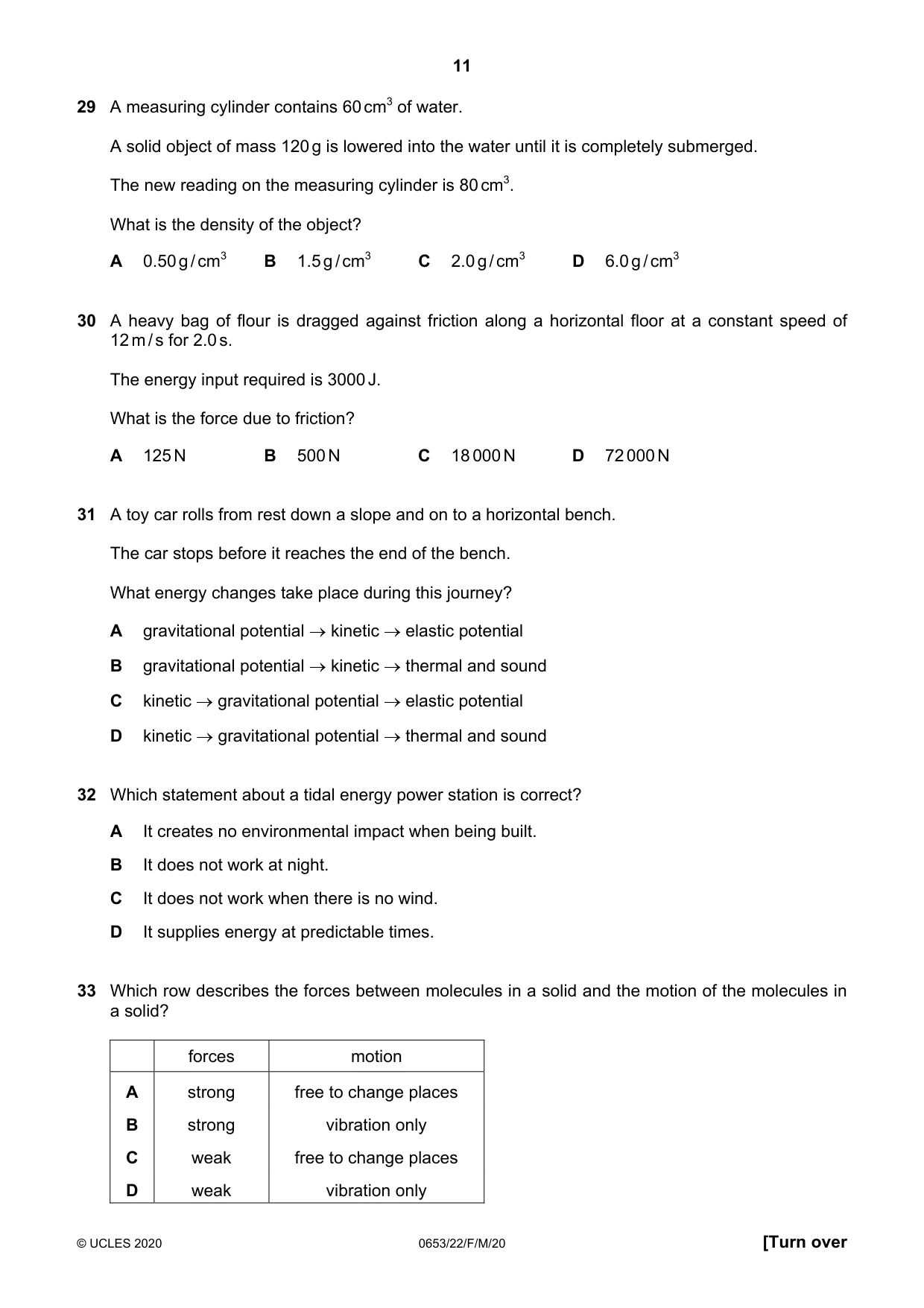
33 Which row describes the forces between molecules in a solid and the motion of the molecules in a solid? forces motion A strong free to change places B strong vibration only C weak free to change places D weak vibration only
Mark scheme: B
Q34 · A student moves one end of a long rope up and down through a short distance
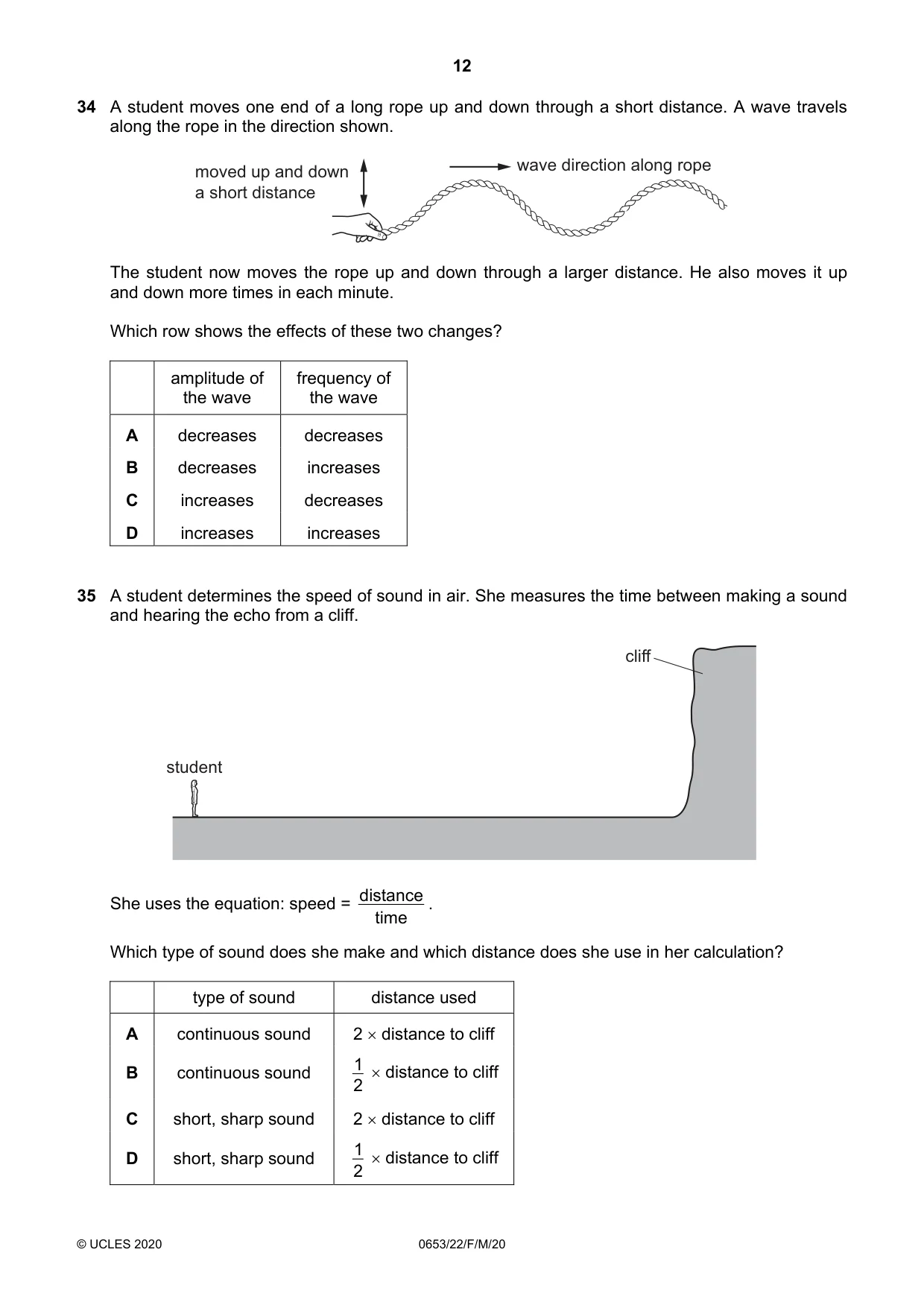
34 A student moves one end of a long rope up and down through a short distance. A wave travels along the rope in the direction shown. moved up and down wave direction along rope a short distance The student now moves the rope up and down through a larger distance. He also moves it up and down more times in each minute. Which row shows the effects of these two changes? amplitude of frequency of the wave the wave A decreases decreases B decreases increases C increases decreases D increases increases
Mark scheme: D
Q35 · A student determines the speed of sound in air
35 A student determines the speed of sound in air. She measures the time between making a sound and hearing the echo from a cliff. cliff student distance . She uses the equation: speed = time Which type of sound does she make and which distance does she use in her calculation? type of sound distance used A continuous sound 2 × distance to cliff 2 × distance to cliff 1 B continuous sound C short, sharp sound 2 × distance to cliff 2 × distance to cliff 1 D short, sharp sound
Mark scheme: C
Q36 · A polythene rod is rubbed with a cloth
36 A polythene rod is rubbed with a cloth. The rod becomes positively charged. What has happened to the rod? A It has gained electrons. B It has gained protons. C It has lost electrons. D It has lost protons.
Mark scheme: C
Q37 · In the circuit shown, the cell has an electromotive force (e.m.f.) of 1.5 V and the total…
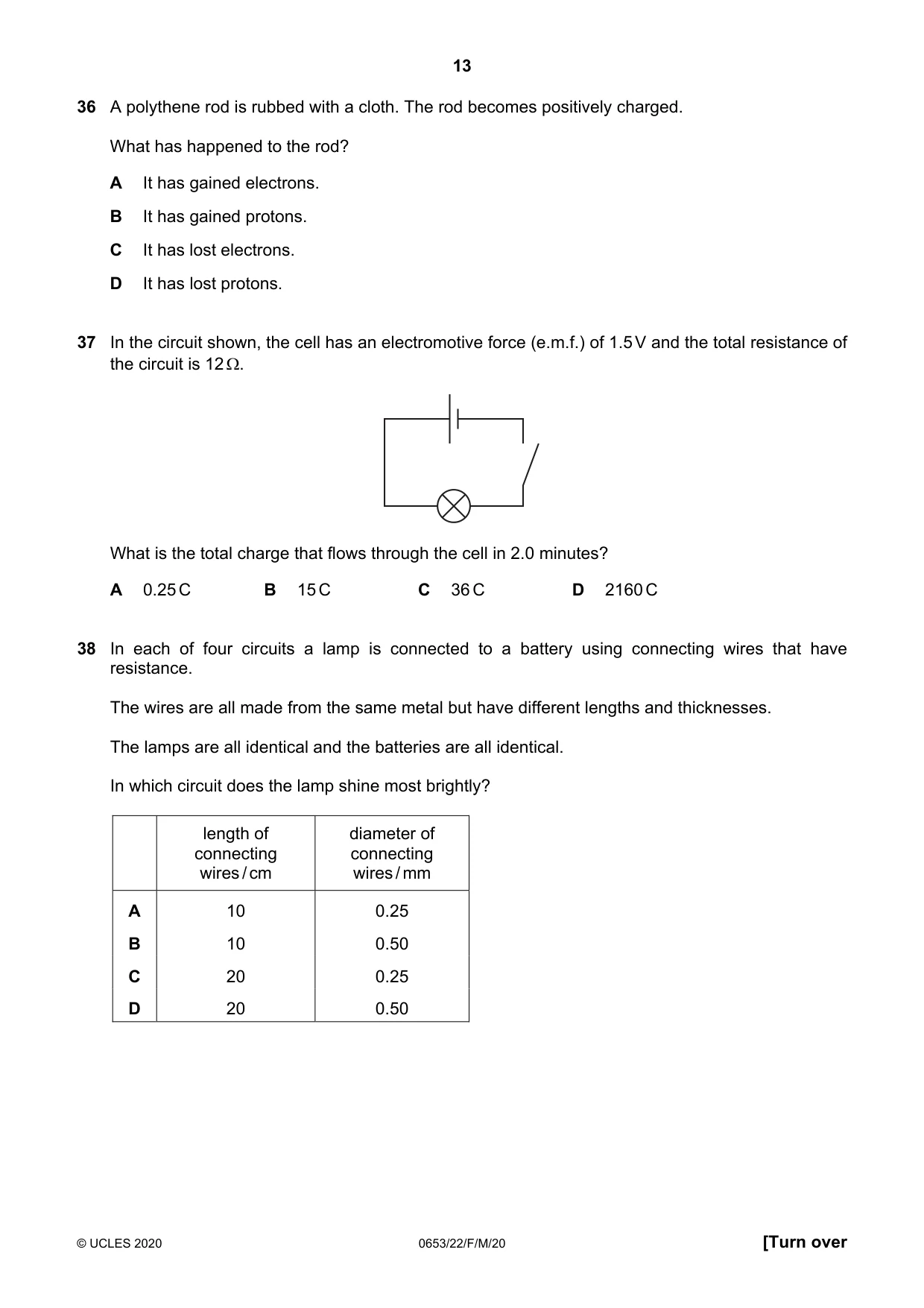
37 In the circuit shown, the cell has an electromotive force (e.m.f.) of 1.5 V and the total resistance of the circuit is 12 Ω. What is the total charge that flows through the cell in 2.0 minutes? A 0.25 C B 15 C C 36 C D 2160 C
Mark scheme: B
Q38 · In each of four circuits a lamp is connected to a battery using connecting wires that…
38 In each of four circuits a lamp is connected to a battery using connecting wires that have resistance. The wires are all made from the same metal but have different lengths and thicknesses. The lamps are all identical and the batteries are all identical. In which circuit does the lamp shine most brightly? length of diameter of connecting connecting wires / cm wires / mm A 10 0.25 B 10 0.50 C 20 0.25 D 20 0.50
Mark scheme: B
Q39 · The diagram shows a circuit containing four resistors and four ammeters
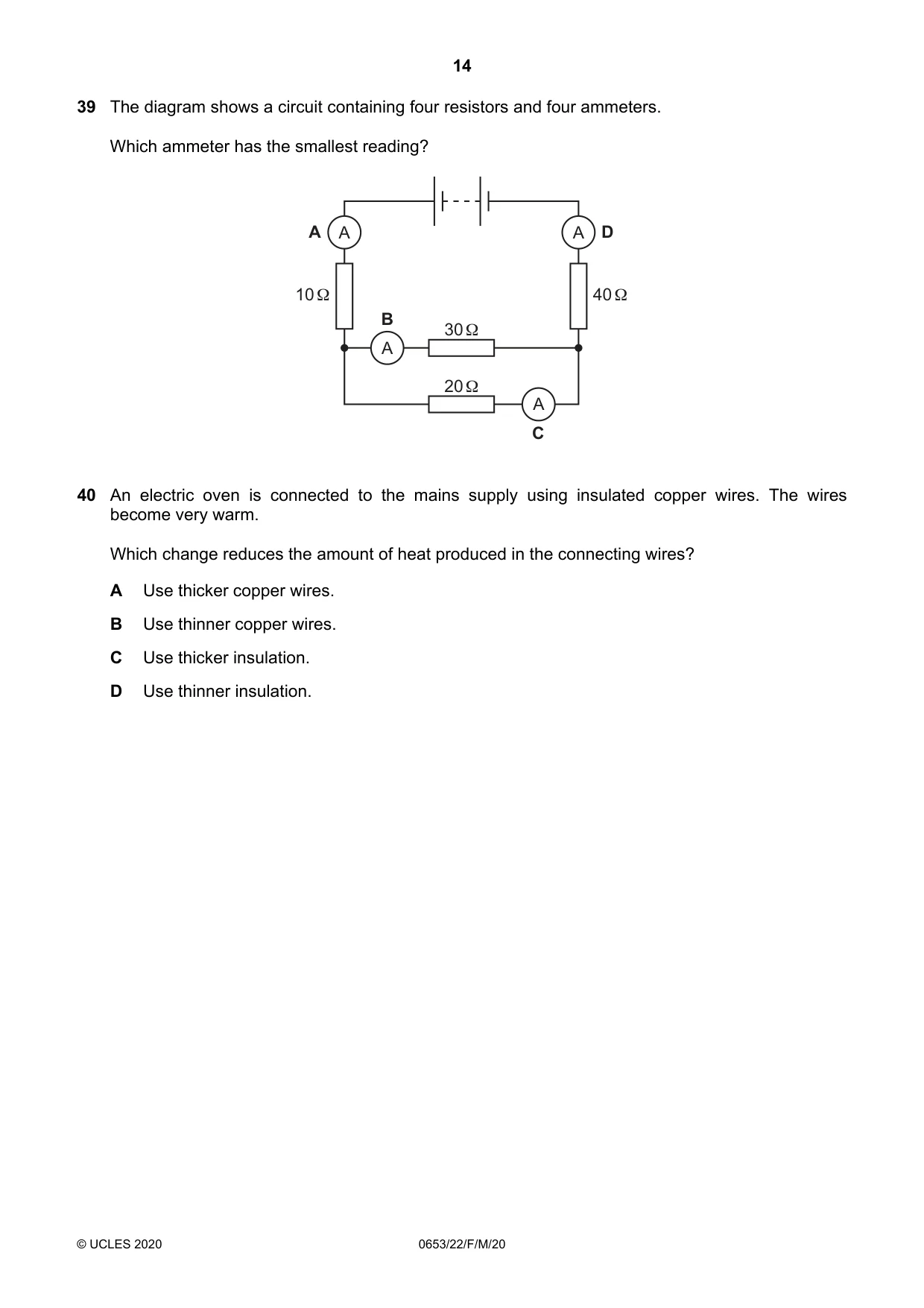
39 The diagram shows a circuit containing four resistors and four ammeters. Which ammeter has the smallest reading? A A A D 10 Ω 40 Ω B 30 Ω A 20 Ω A C
Mark scheme: B
Q40 · An electric oven is connected to the mains supply using insulated copper wires
40 An electric oven is connected to the mains supply using insulated copper wires. The wires become very warm. Which change reduces the amount of heat produced in the connecting wires? A Use thicker copper wires. B Use thinner copper wires. C Use thicker insulation. D Use thinner insulation.
Mark scheme: A
What was in this paper
The subtopics covered by these 40 questions, and how many questions each got. Open one in a new tab to see every Cambridge question on it.
3Energy, work and power3Drugs2Electrical quantities2Identification of ions and gases2Atomic structure and the Periodic Table1Cell structure1Characteristics of living organisms1Chromatography1Circulatory systems1Density1Diet1Digestion1Elements, compounds and mixtures1Enzymes1Exothermic and endothermic reactions1Extraction of metals1Fuels1General properties of waves1Group I properties1Habitat destruction1Ions and ionic bonds1Kinetic particle model of matter1Motion1Reactivity series1Redox1Respiration1Sexual reproduction in humans1Sexual reproduction in plants1Simple molecules and covalent bonds1Solids, liquids and gases1Sound1Transpiration1What you needed in this session
Cambridge’s own grade thresholds for 2020 Feb/March, Paper 2 · Variant 2. A higher threshold means an easier paper — the bar moves with how the cohort did.