Cambridge IGCSE Science - Combined 0653 — 2018 Feb/March Paper 2 · Variant 2
0653/22/F/M/18 · 40 questions · 40 marks · ≈45 min
The question paper and its mark scheme, free to read here and free to download. This is Cambridge’s own paper, exactly as it was sat.
Question paper16 pages
Mark scheme3 pages
Answers below. Sit the paper first if you are practising.
Questions as text
Q1 · Which is a characteristic of all living organisms?
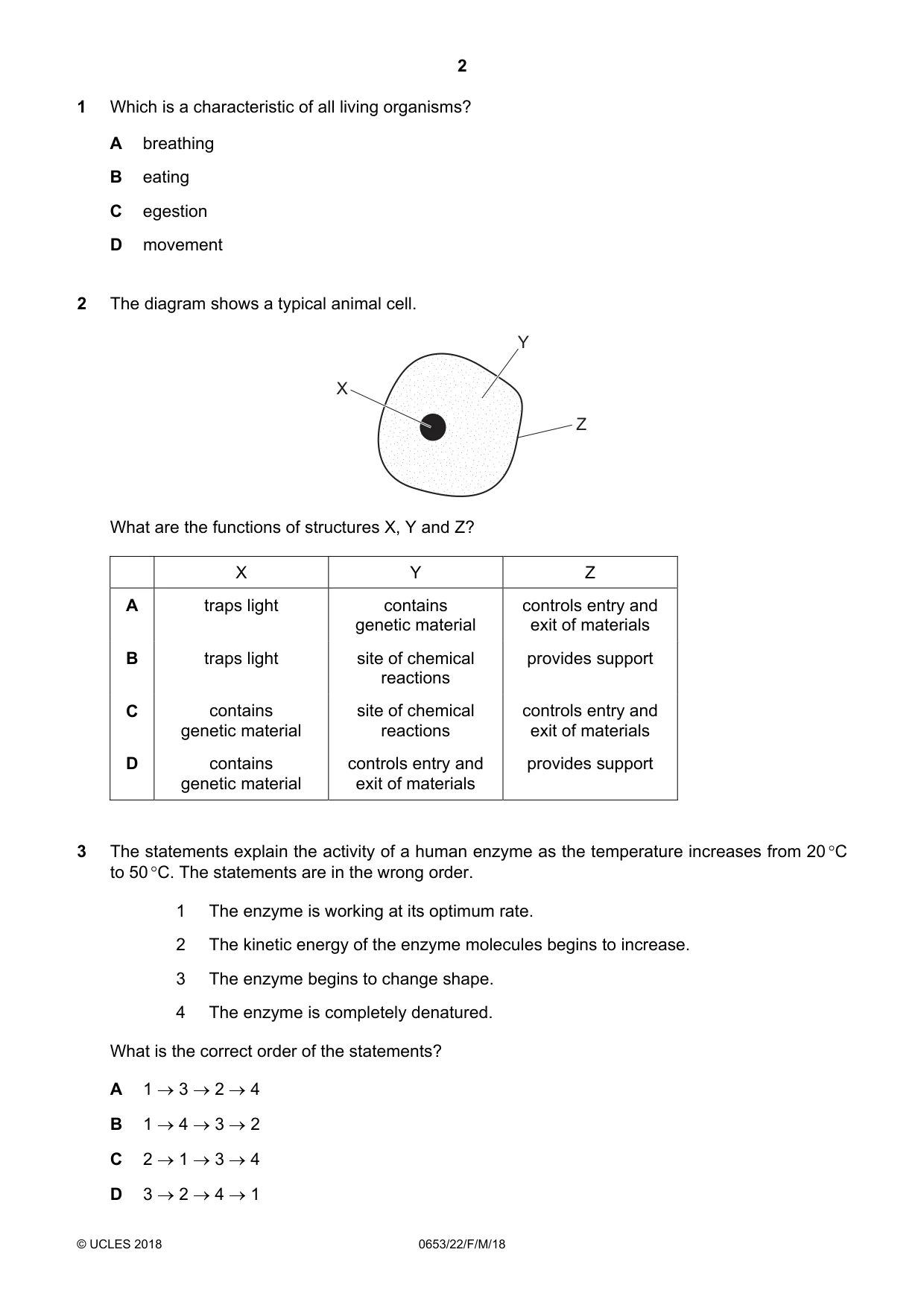
1 Which is a characteristic of all living organisms? A breathing B eating C egestion D movement
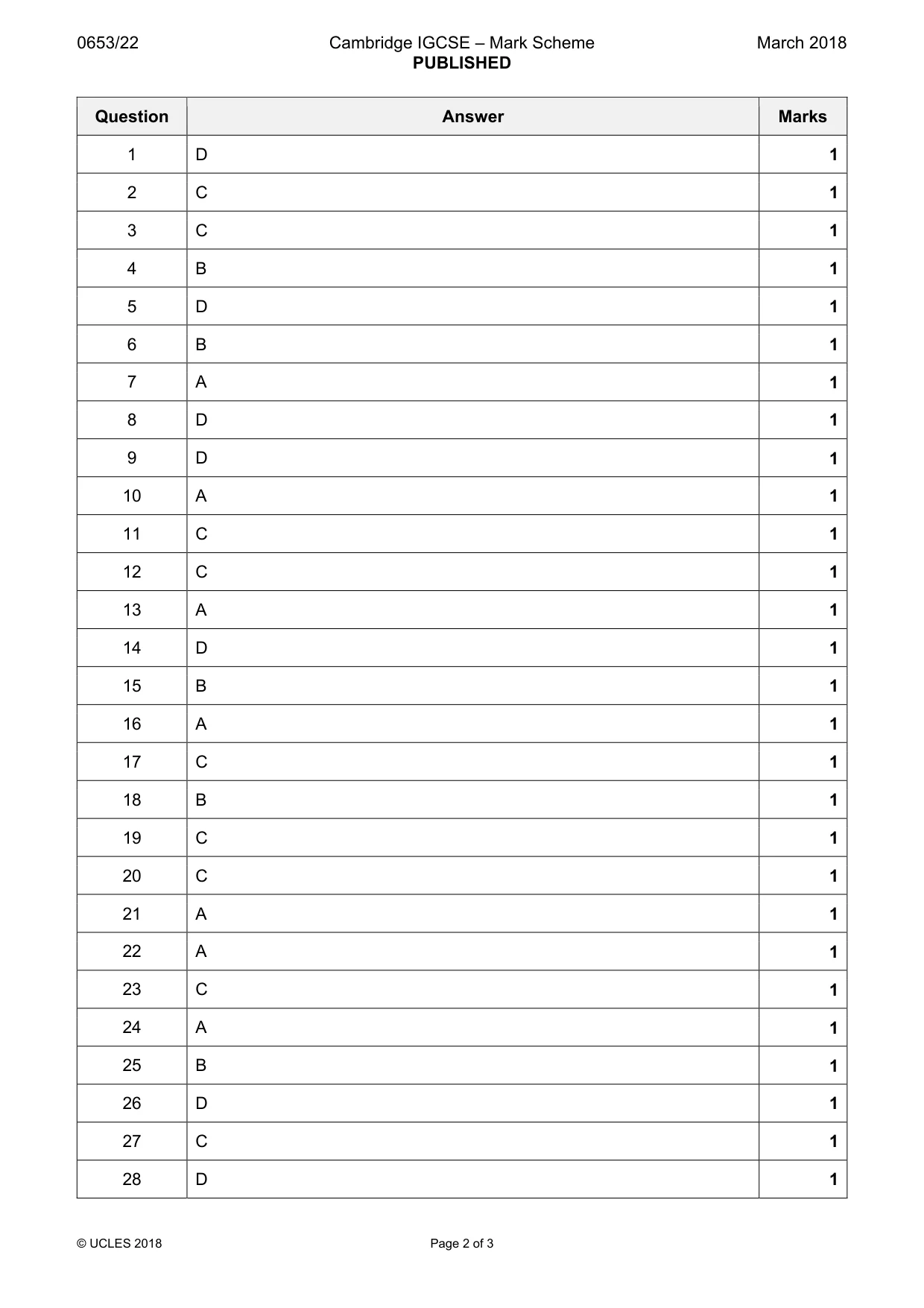
Mark scheme: D
Q2 · The diagram shows a typical animal cell
2 The diagram shows a typical animal cell. Y X Z What are the functions of structures X, Y and Z? X Y Z A traps light contains controls entry and genetic material exit of materials B traps light site of chemical provides support reactions C contains site of chemical controls entry and genetic material reactions exit of materials D contains controls entry and provides support genetic material exit of materials
Mark scheme: C
Q3 · The statements explain the activity of a human enzyme as the temperature increases from…
3 The statements explain the activity of a human enzyme as the temperature increases from 20 °C to 50 °C. The statements are in the wrong order. 1 The enzyme is working at its optimum rate. 2 The kinetic energy of the enzyme molecules begins to increase. 3 The enzyme begins to change shape. 4 The enzyme is completely denatured. What is the correct order of the statements? A 1 → 3 → 2 → 4 B 1 → 4 → 3 → 2 C 2 → 1 → 3 → 4 D 3 → 2 → 4 → 1
Mark scheme: C
Q4 · Tests were performed on four samples of food
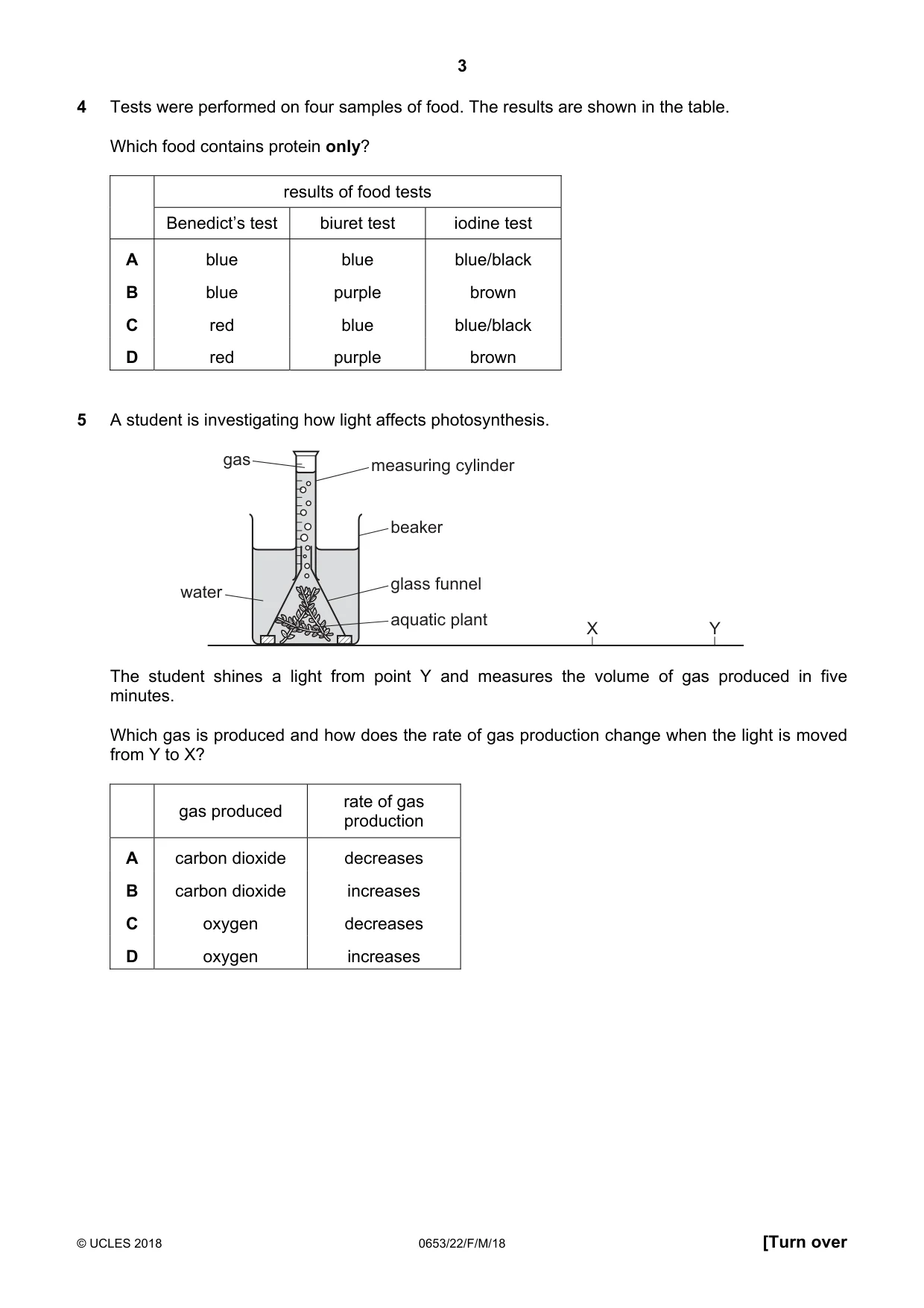
4 Tests were performed on four samples of food. The results are shown in the table. Which food contains protein only? results of food tests Benedict’s test biuret test iodine test A blue blue blue/black B blue purple brown C red blue blue/black D red purple brown
Mark scheme: B
Q5 · A student is investigating how light affects photosynthesis
5 A student is investigating how light affects photosynthesis. gas measuring cylinder beaker glass funnel water aquatic plant X Y The student shines a light from point Y and measures the volume of gas produced in five minutes. Which gas is produced and how does the rate of gas production change when the light is moved from Y to X? rate of gas gas produced production A carbon dioxide decreases B carbon dioxide increases C oxygen decreases D oxygen increases
Mark scheme: D
Q6 · The diagram shows the alimentary canal
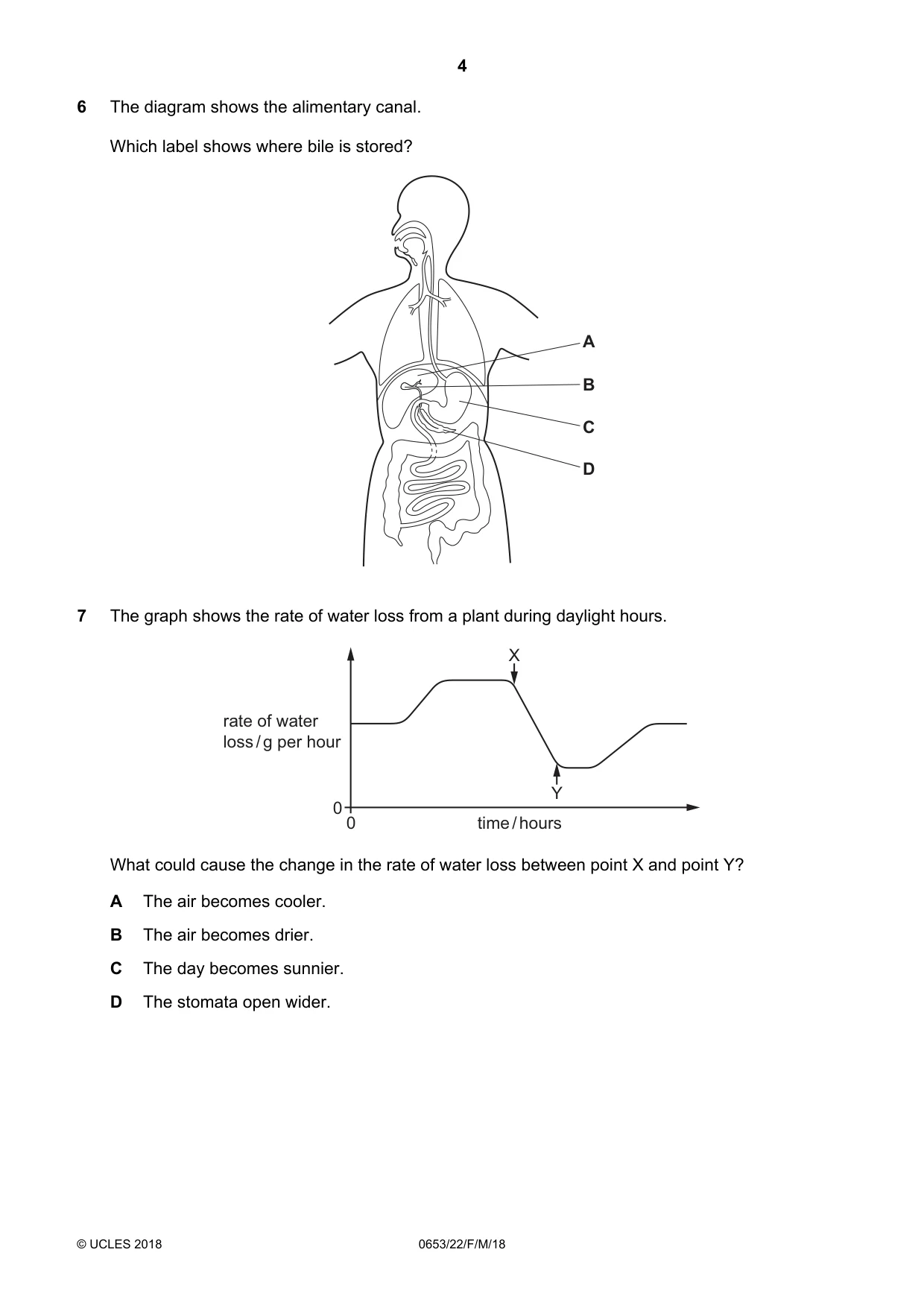
6 The diagram shows the alimentary canal. Which label shows where bile is stored? A B C D
Mark scheme: B
Q7 · The graph shows the rate of water loss from a plant during daylight hours
7 The graph shows the rate of water loss from a plant during daylight hours. X rate of water loss / g per hour Y 0 0 time / hours What could cause the change in the rate of water loss between point X and point Y? A The air becomes cooler. B The air becomes drier. C The day becomes sunnier. D The stomata open wider.
Mark scheme: A
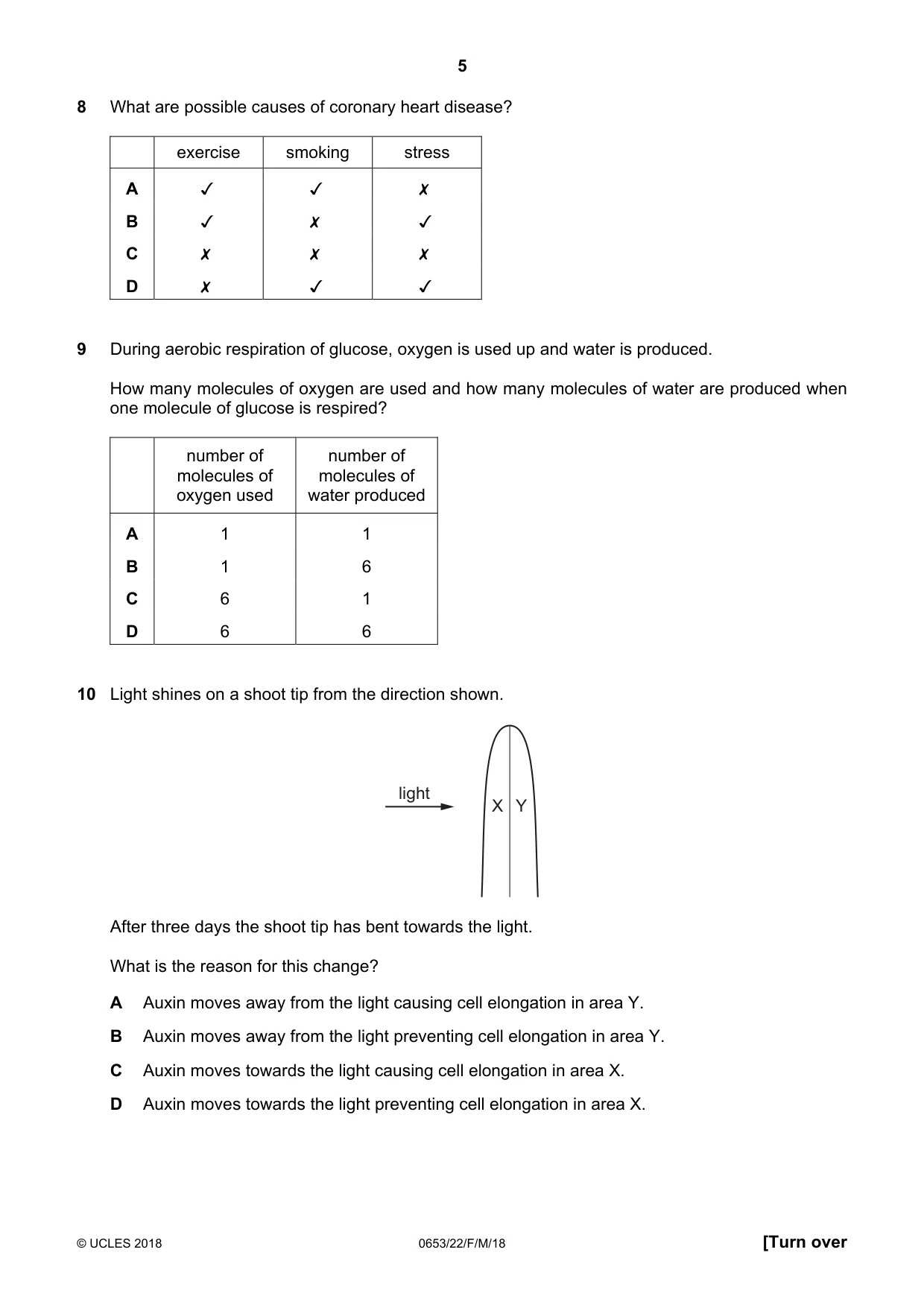
Q8 · What are possible causes of coronary heart disease?
8 What are possible causes of coronary heart disease? exercise smoking stress A Jv Jv x B Jv x Jv Cc x x x D x Jv Jv
Mark scheme: D
Q9 · During aerobic respiration of glucose, oxygen is used up and water is produced
9 During aerobic respiration of glucose, oxygen is used up and water is produced. How many molecules of oxygen are used and how many molecules of water are produced when one molecule of glucose is respired? number of number of molecules of molecules of oxygen used water produced A 1 1 B 1 6 C 6 1 D 6 6
Mark scheme: D
Q10 · Light shines on a shoot tip from the direction shown
10 Light shines on a shoot tip from the direction shown. light X Y After three days the shoot tip has bent towards the light. What is the reason for this change? A Auxin moves away from the light causing cell elongation in area Y. B Auxin moves away from the light preventing cell elongation in area Y. C Auxin moves towards the light causing cell elongation in area X. D Auxin moves towards the light preventing cell elongation in area X.
Mark scheme: A
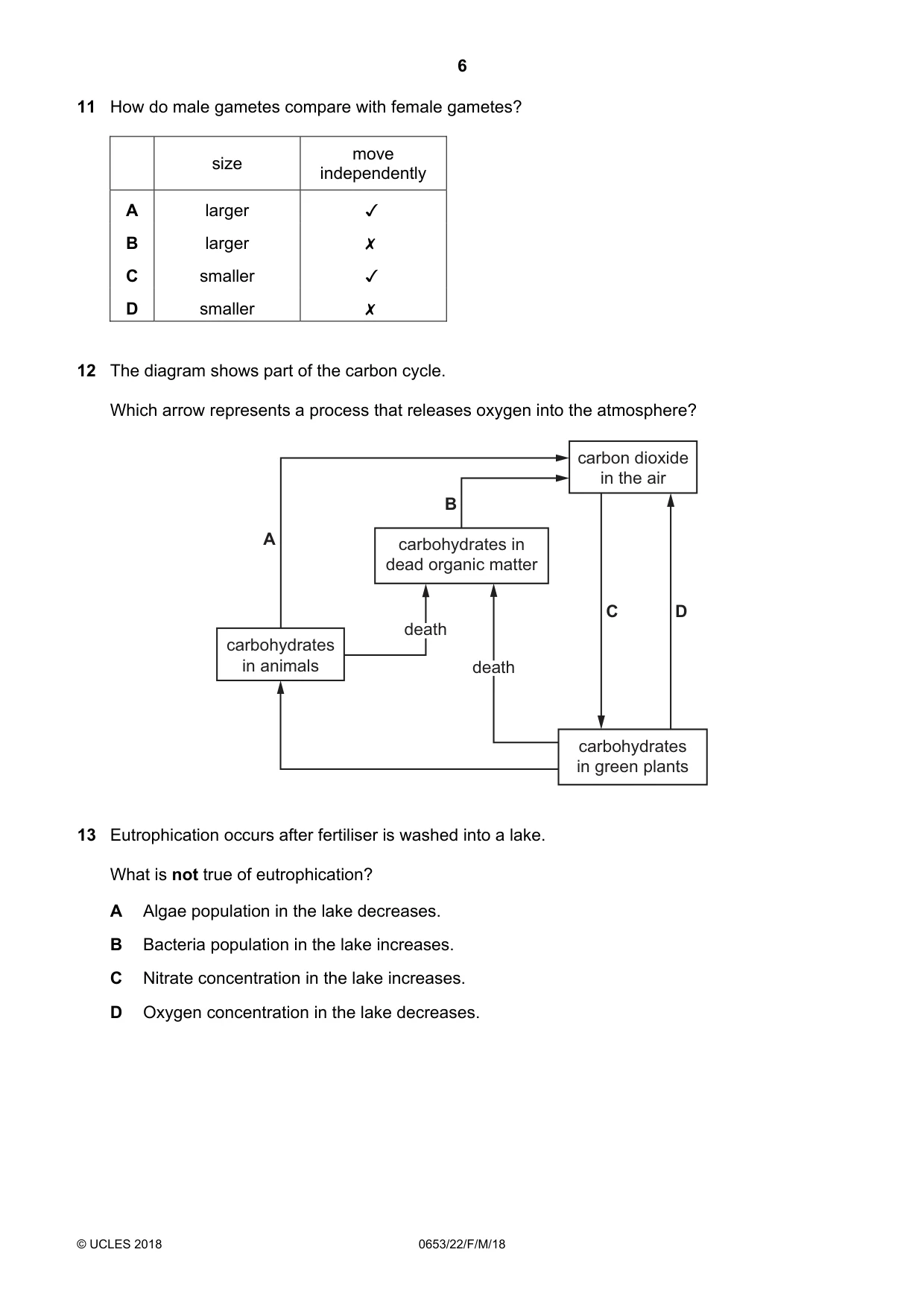
Q11 · How do male gametes compare with female gametes?
11 How do male gametes compare with female gametes? . move size independently A larger v B larger x Cc smaller v D smaller x
Mark scheme: C
Q12 · The diagram shows part of the carbon cycle
12 The diagram shows part of the carbon cycle. Which arrow represents a process that releases oxygen into the atmosphere? carbon dioxide in the air B A carbohydrates in dead organic matter C D death carbohydrates in animals death carbohydrates in green plants
Mark scheme: C
Q13 · Eutrophication occurs after fertiliser is washed into a lake
13 Eutrophication occurs after fertiliser is washed into a lake. What is not true of eutrophication? A Algae population in the lake decreases. B Bacteria population in the lake increases. C Nitrate concentration in the lake increases. D Oxygen concentration in the lake decreases.
Mark scheme: A
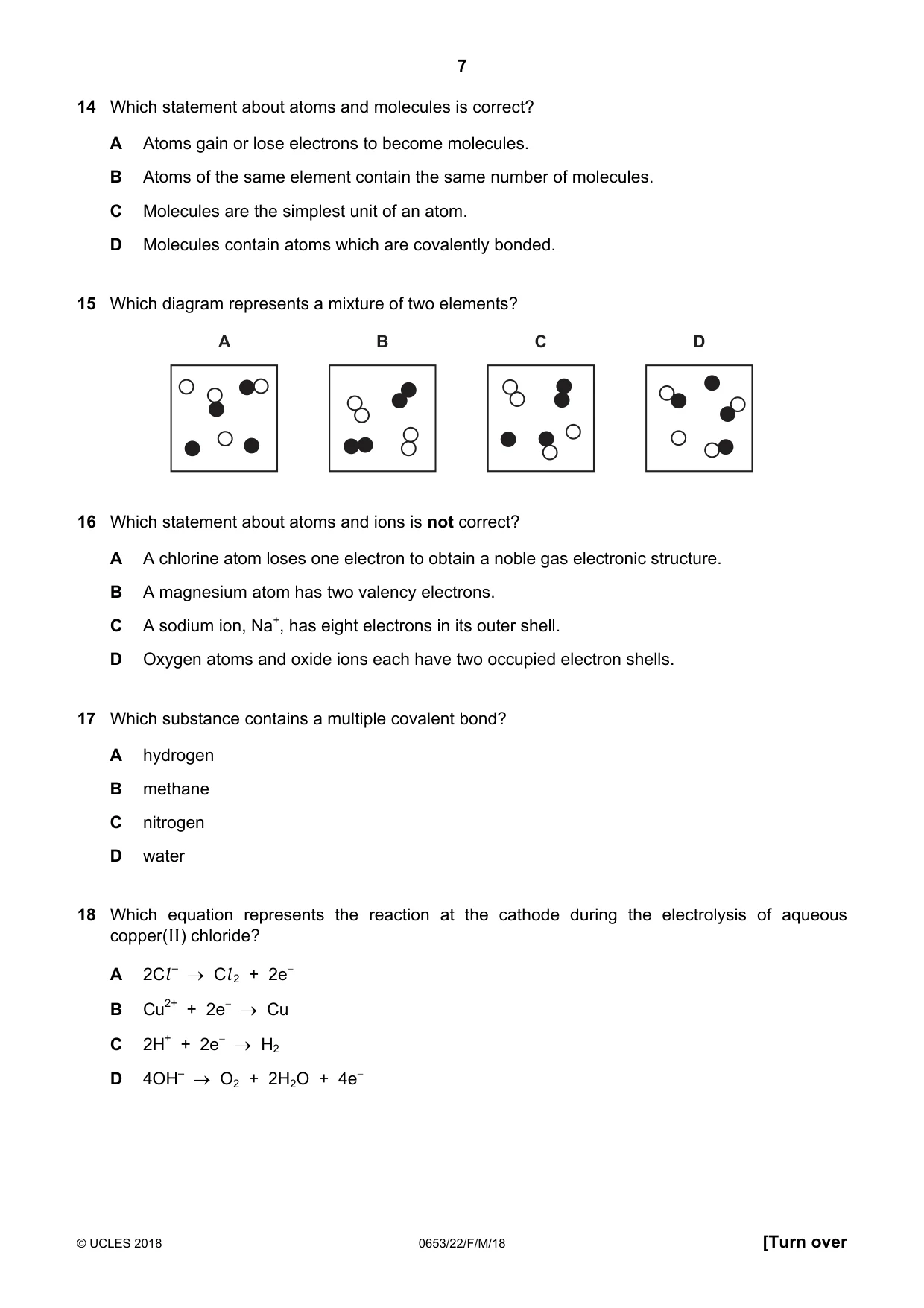
Q14 · Which statement about atoms and molecules is correct?
14 Which statement about atoms and molecules is correct? A Atoms gain or lose electrons to become molecules. B Atoms of the same element contain the same number of molecules. C Molecules are the simplest unit of an atom. D Molecules contain atoms which are covalently bonded.
Mark scheme: D
Q15 · Which diagram represents a mixture of two elements?
15 Which diagram represents a mixture of two elements? A B C D
Mark scheme: B
Q16 · Which statement about atoms and ions is not correct?
16 Which statement about atoms and ions is not correct? A A chlorine atom loses one electron to obtain a noble gas electronic structure. B A magnesium atom has two valency electrons. C A sodium ion, Na+, has eight electrons in its outer shell. D Oxygen atoms and oxide ions each have two occupied electron shells.
Mark scheme: A
Q17 · Which substance contains a multiple covalent bond?
17 Which substance contains a multiple covalent bond? A hydrogen B methane C nitrogen D water
Mark scheme: C
Q18 · Which equation represents the reaction at the cathode during the electrolysis of aqueous…
18 Which equation represents the reaction at the cathode during the electrolysis of aqueous copper(II) chloride? A 2Cl – → Cl 2 + 2e− B Cu2+ + 2e− → Cu C 2H+ + 2e− → H2 D 4OH– → O2 + 2H2O + 4e−
Mark scheme: B
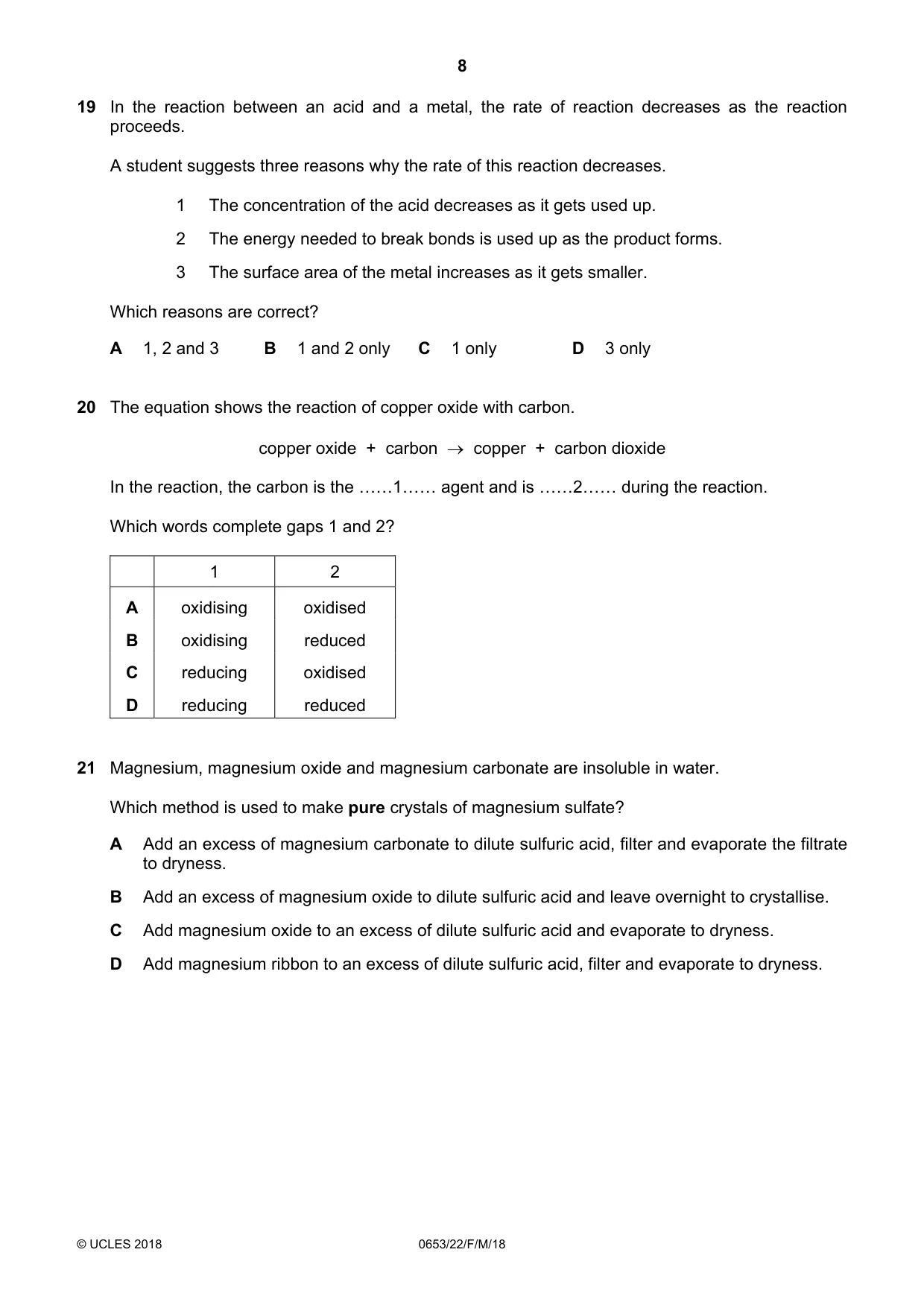
Q19 · In the reaction between an acid and a metal, the rate of reaction decreases as the…
19 In the reaction between an acid and a metal, the rate of reaction decreases as the reaction proceeds. A student suggests three reasons why the rate of this reaction decreases. 1 The concentration of the acid decreases as it gets used up. 2 The energy needed to break bonds is used up as the product forms. 3 The surface area of the metal increases as it gets smaller. Which reasons are correct? A 1, 2 and 3 B 1 and 2 only C 1 only D 3 only
Mark scheme: C
Q20 · The equation shows the reaction of copper oxide with carbon
20 The equation shows the reaction of copper oxide with carbon. copper oxide + carbon → copper + carbon dioxide In the reaction, the carbon is the ««1«« agent and is ««2«« during the reaction. Which words complete gaps 1 and 2? 1 2 A oxidising oxidised B oxidising reduced C reducing oxidised D reducing reduced
Mark scheme: C
Q21 · Magnesium, magnesium oxide and magnesium carbonate are insoluble in water
21 Magnesium, magnesium oxide and magnesium carbonate are insoluble in water. Which method is used to make pure crystals of magnesium sulfate? A Add an excess of magnesium carbonate to dilute sulfuric acid, filter and evaporate the filtrate to dryness. B Add an excess of magnesium oxide to dilute sulfuric acid and leave overnight to crystallise. C Add magnesium oxide to an excess of dilute sulfuric acid and evaporate to dryness. D Add magnesium ribbon to an excess of dilute sulfuric acid, filter and evaporate to dryness.
Mark scheme: A
Q22 · Solid X is warmed with dilute sodium hydroxide
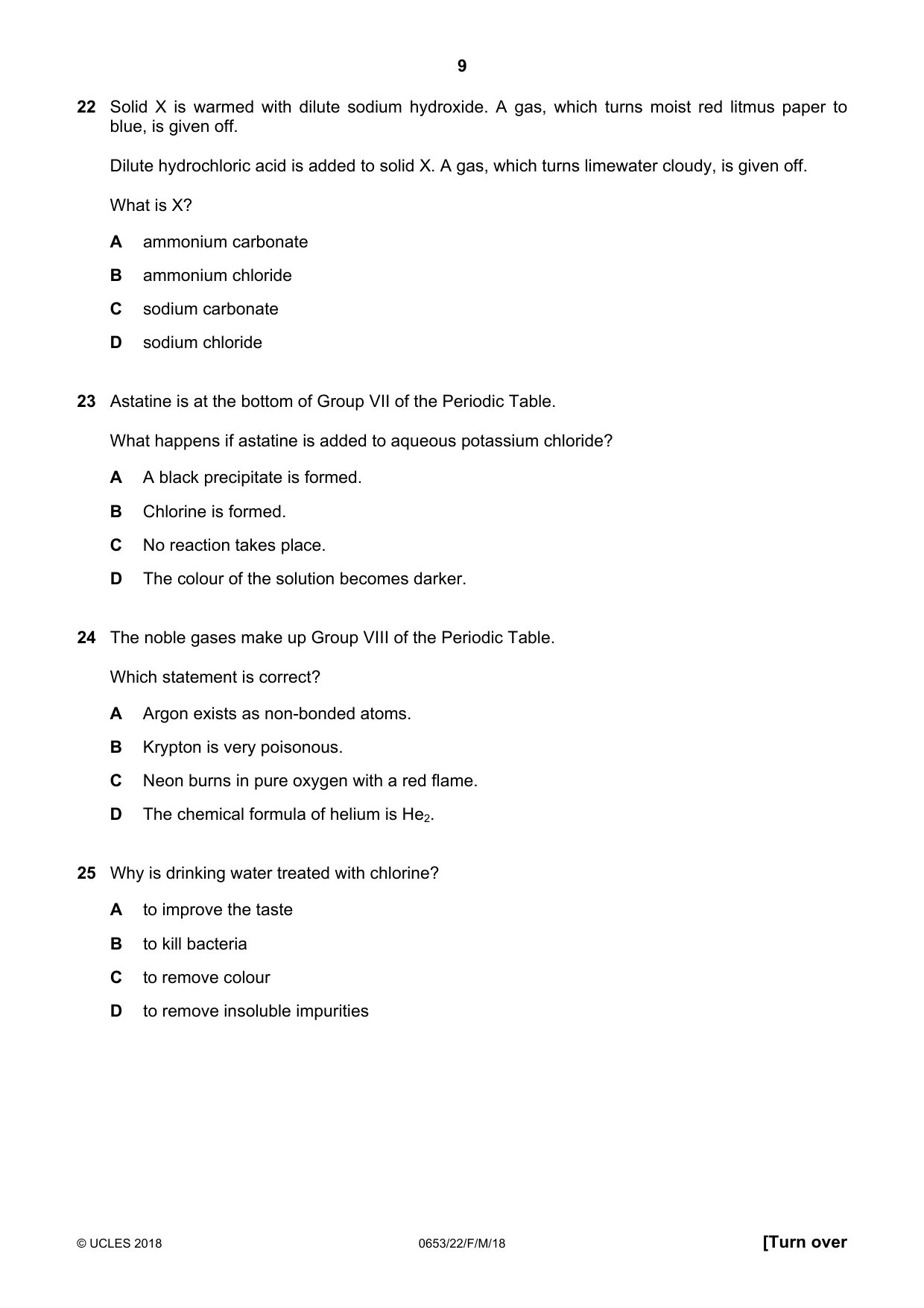
22 Solid X is warmed with dilute sodium hydroxide. A gas, which turns moist red litmus paper to blue, is given off. Dilute hydrochloric acid is added to solid X. A gas, which turns limewater cloudy, is given off. What is X? A ammonium carbonate B ammonium chloride C sodium carbonate D sodium chloride
Mark scheme: A
Q23 · Astatine is at the bottom of Group VII of the Periodic Table
23 Astatine is at the bottom of Group VII of the Periodic Table. What happens if astatine is added to aqueous potassium chloride? A A black precipitate is formed. B Chlorine is formed. C No reaction takes place. D The colour of the solution becomes darker.
Mark scheme: C
Q24 · The noble gases make up Group VIII of the Periodic Table
24 The noble gases make up Group VIII of the Periodic Table. Which statement is correct? A Argon exists as non-bonded atoms. B Krypton is very poisonous. C Neon burns in pure oxygen with a red flame. D The chemical formula of helium is He2.
Mark scheme: A
Q25 · Why is drinking water treated with chlorine?
25 Why is drinking water treated with chlorine? A to improve the taste B to kill bacteria C to remove colour D to remove insoluble impurities
Mark scheme: B
Q26 · A gas that causes climate change is formed during the extraction of iron from iron ore
26 A gas that causes climate change is formed during the extraction of iron from iron ore. Which solution reacts with this gas? A aqueous sodium chloride B hydrochloric acid C dilute sulfuric acid D limewater
Mark scheme: D
Q27 · Which statement about the rusting of iron is correct?
27 Which statement about the rusting of iron is correct? A Iron becomes lighter when it rusts. B Iron is reduced when it rusts. C Rusting is a reaction involving iron, oxygen and water. D Rusting is a reaction involving iron and water only.
Mark scheme: C
Q28 · Diagrams 1, 2 and 3 each show either a distance-time graph or a speed-time graph
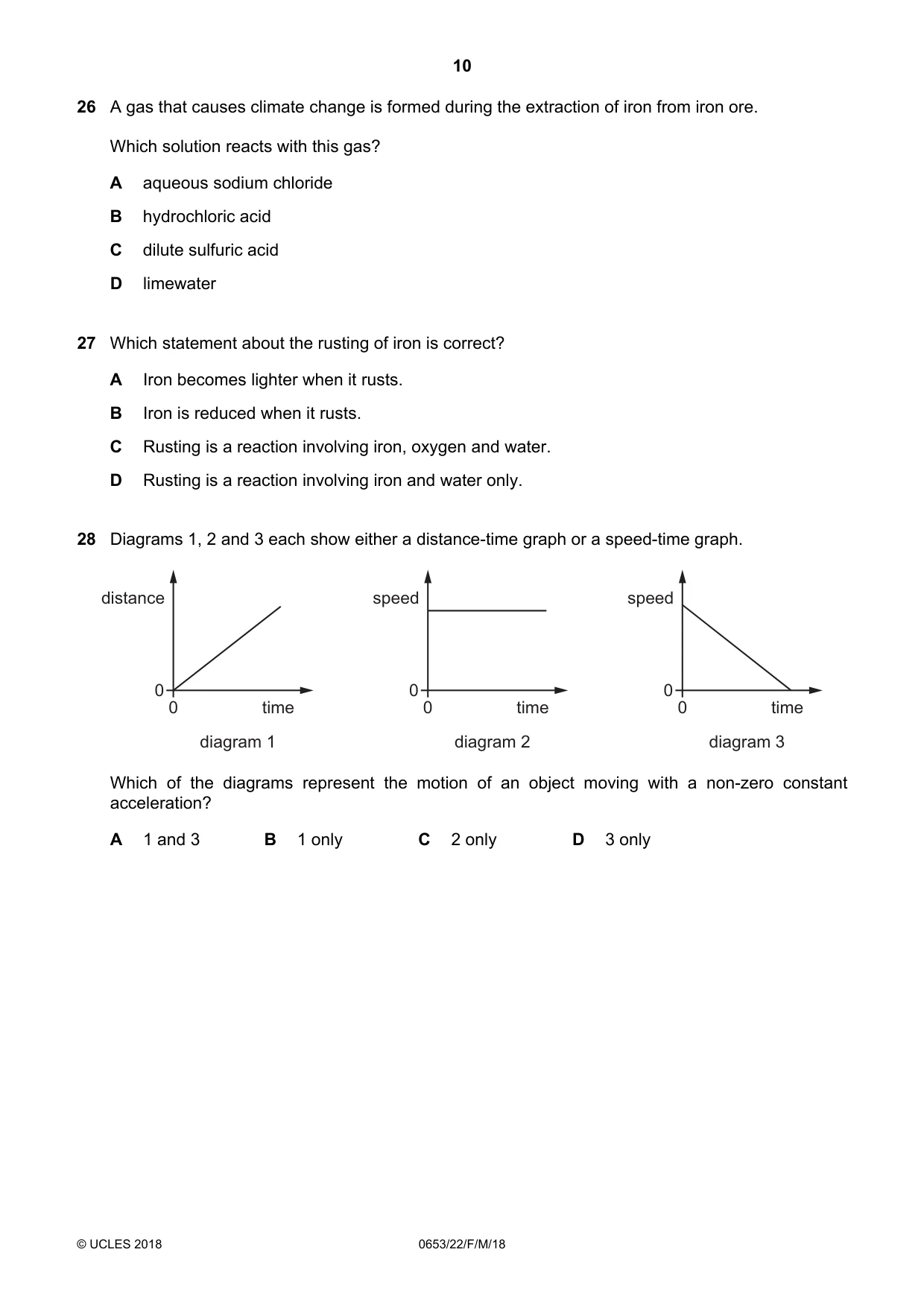
28 Diagrams 1, 2 and 3 each show either a distance-time graph or a speed-time graph. distance speed speed 0 0 0 0 time 0 time 0 time diagram 1 diagram 2 diagram 3 Which of the diagrams represent the motion of an object moving with a non-zero constant acceleration? A 1 and 3 B 1 only C 2 only D 3 only
Mark scheme: D
Q29 · Two objects on Earth each have a mass of 20 kg
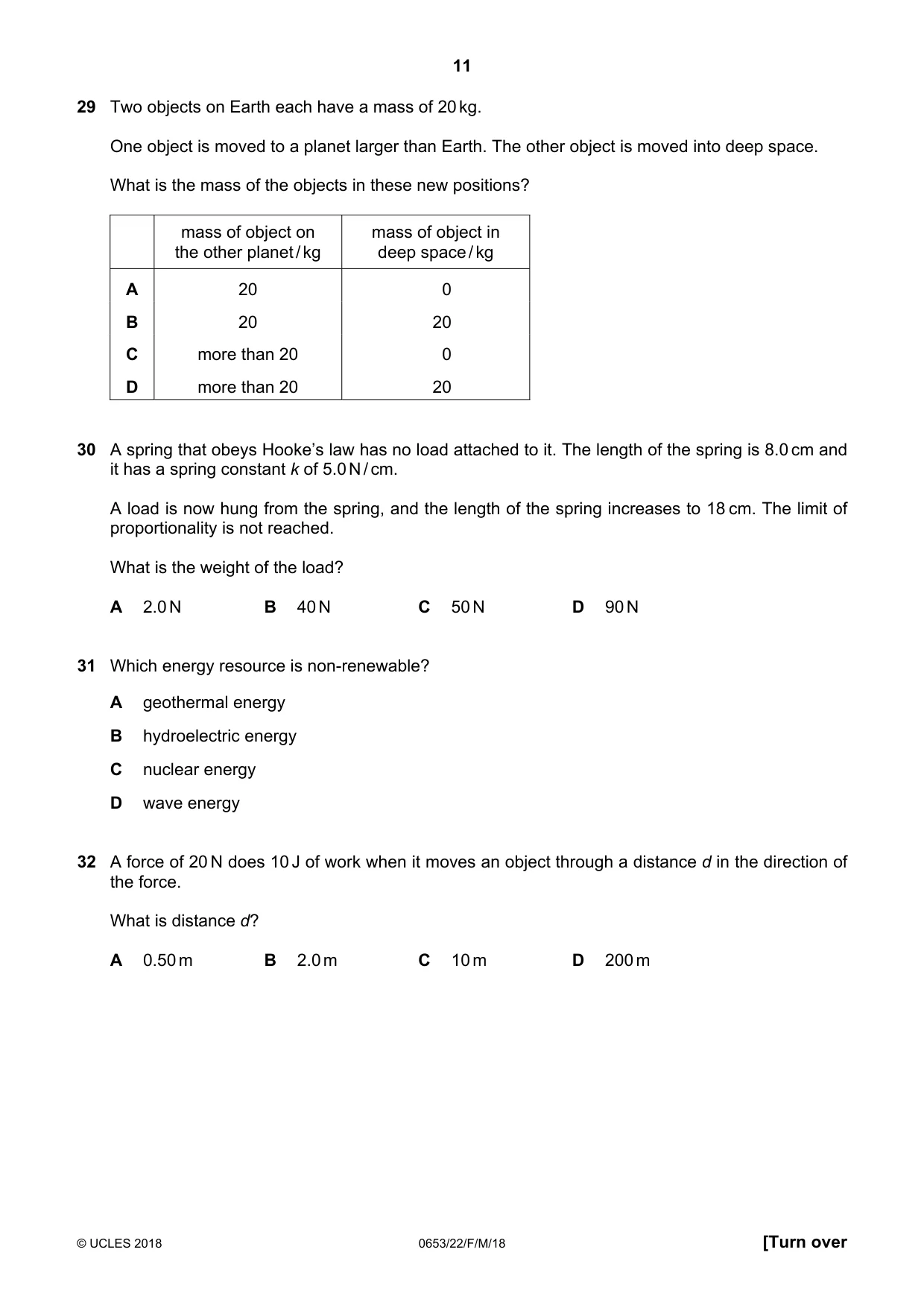
29 Two objects on Earth each have a mass of 20 kg. One object is moved to a planet larger than Earth. The other object is moved into deep space. What is the mass of the objects in these new positions? mass of object on mass of object in the other planet / kg deep space / kg A 20 0 B 20 20 C more than 20 0 D more than 20 20
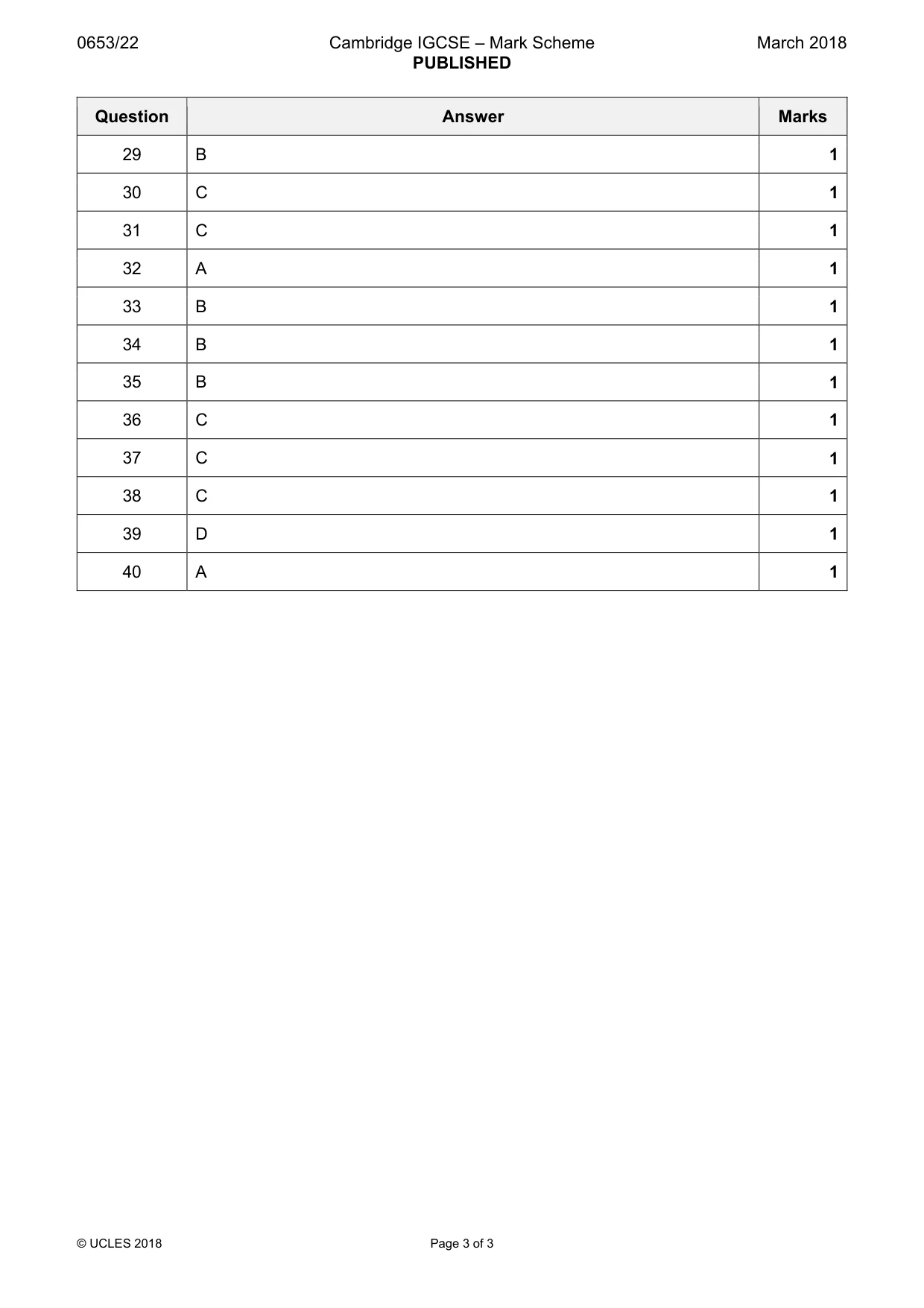
Mark scheme: B
Q30 · A spring that obeys Hooke’s law has no load attached to it
30 A spring that obeys Hooke’s law has no load attached to it. The length of the spring is 8.0 cm and it has a spring constant k of 5.0 N / cm. A load is now hung from the spring, and the length of the spring increases to 18 cm. The limit of proportionality is not reached. What is the weight of the load? A 2.0 N B 40 N C 50 N D 90 N
Mark scheme: C
Q31 · Which energy resource is non-renewable?
31 Which energy resource is non-renewable? A geothermal energy B hydroelectric energy C nuclear energy D wave energy
Mark scheme: C
Q32 · A force of 20 N does 10 J of work when it moves an object through a distance d in the…
32 A force of 20 N does 10 J of work when it moves an object through a distance d in the direction of the force. What is distance d? A 0.50 m B 2.0 m C 10 m D 200 m
Mark scheme: A
Q33 · The molecules of a substance are far apart and move at high speed in straight lines until…
33 The molecules of a substance are far apart and move at high speed in straight lines until they hit something. The temperature of the substance is changed and this causes the molecules to move more quickly. What is the state of the substance, and how has its temperature changed? state of how temperature substance has changed A gas decreased B gas increased C liquid decreased D liquid increased
Mark scheme: B
Q34 · The diagram shows a cold gas in a tank
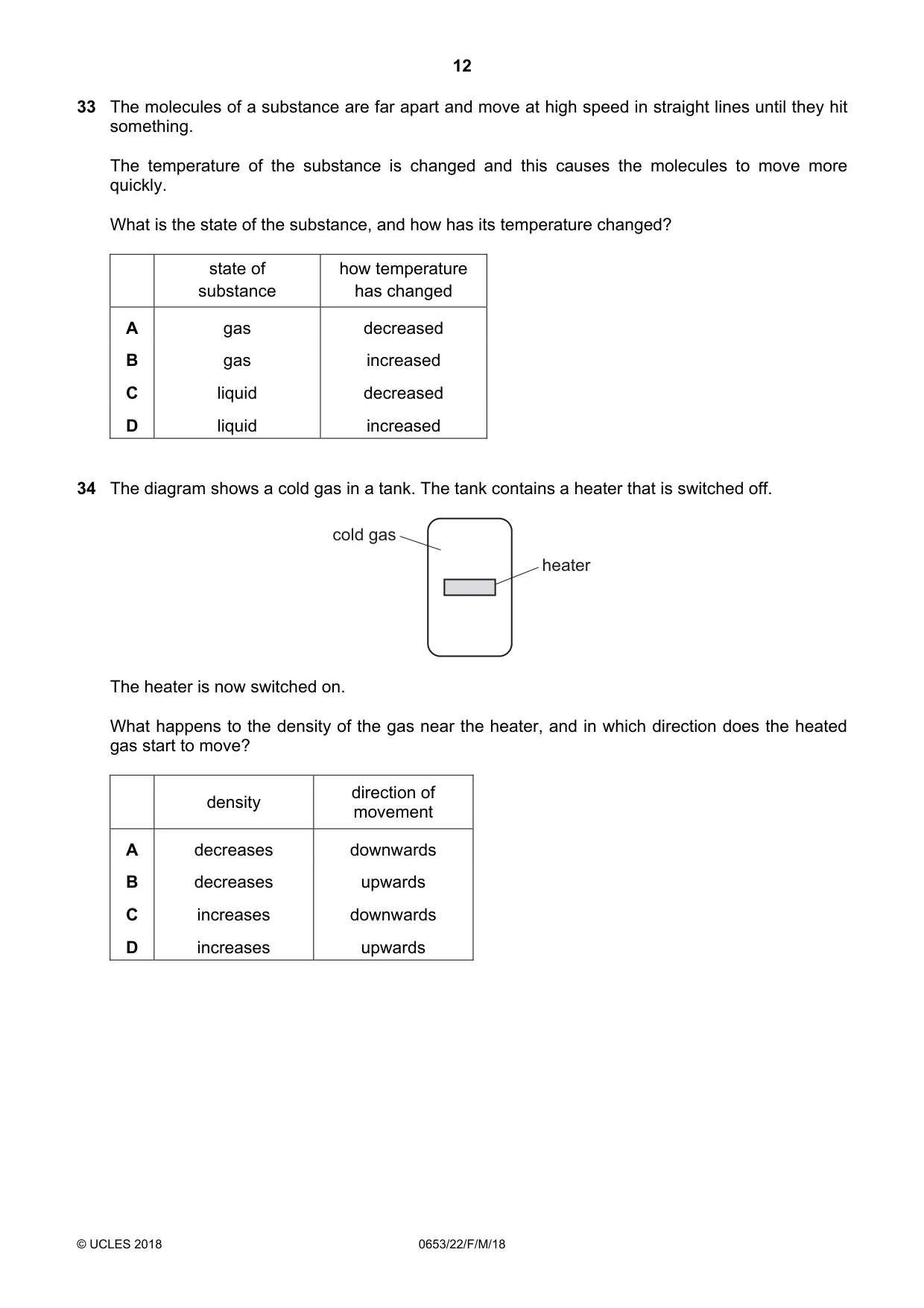
34 The diagram shows a cold gas in a tank. The tank contains a heater that is switched off. cold gas heater The heater is now switched on. What happens to the density of the gas near the heater, and in which direction does the heated gas start to move? direction of density movement A decreases downwards B decreases upwards C increases downwards D increases upwards
Mark scheme: B
Q35 · The diagram represents a wave
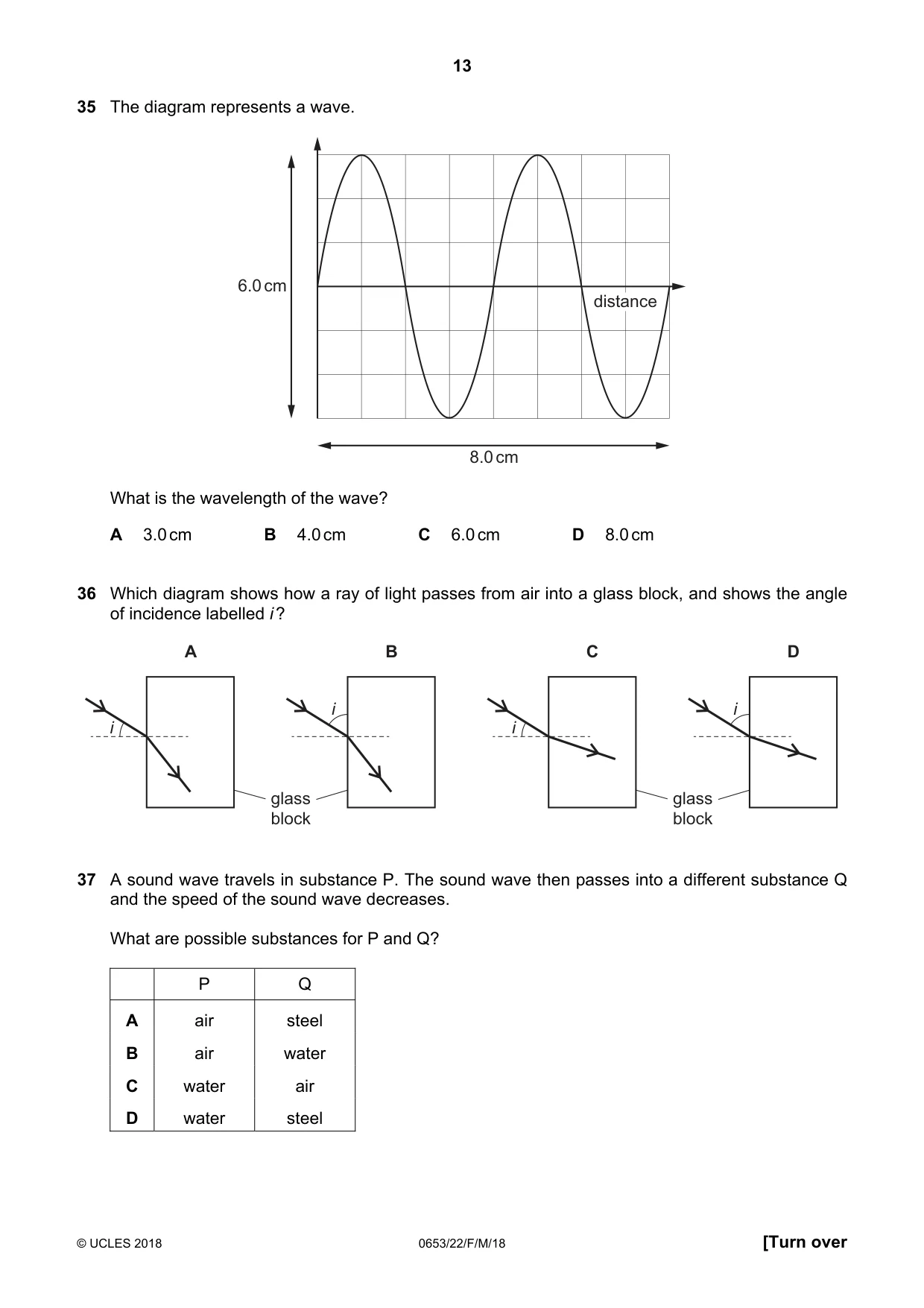
35 The diagram represents a wave. 6.0 cm distance 8.0 cm What is the wavelength of the wave? A 3.0 cm B 4.0 cm C 6.0 cm D 8.0 cm
Mark scheme: B
Q36 · Which diagram shows how a ray of light passes from air into a glass block, and shows the…
36 Which diagram shows how a ray of light passes from air into a glass block, and shows the angle of incidence labelled i ? A B C D i i i i glass glass block block
Mark scheme: C
Q37 · A sound wave travels in substance P
37 A sound wave travels in substance P. The sound wave then passes into a different substance Q and the speed of the sound wave decreases. What are possible substances for P and Q? P Q A air steel B air water C water air D water steel
Mark scheme: C
Q38 · A lamp is labelled 12 V, 25 W
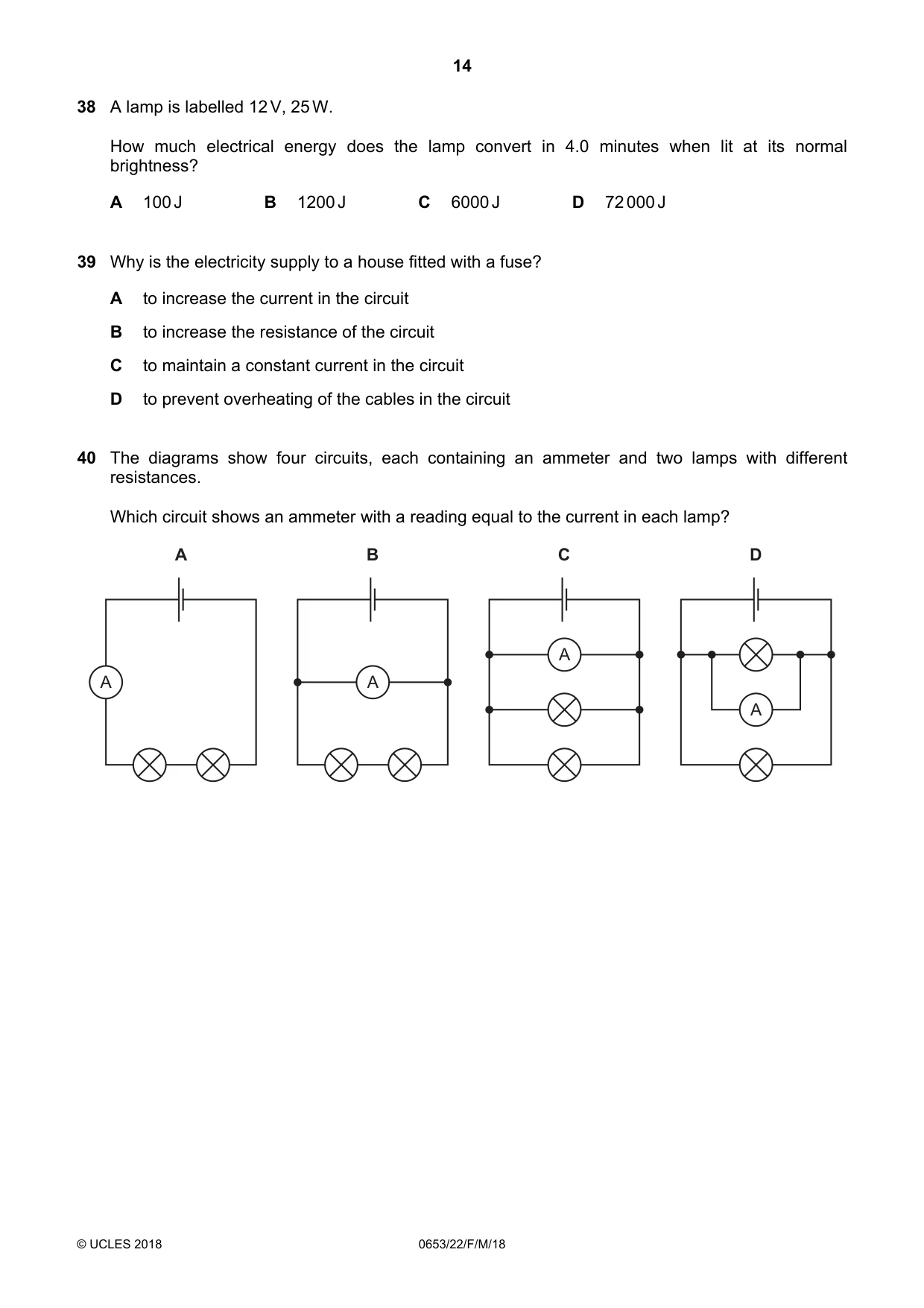
38 A lamp is labelled 12 V, 25 W. How much electrical energy does the lamp convert in 4.0 minutes when lit at its normal brightness? A 100 J B 1200 J C 6000 J D 72 000 J
Mark scheme: C
Q39 · Why is the electricity supply to a house fitted with a fuse?
39 Why is the electricity supply to a house fitted with a fuse? A to increase the current in the circuit B to increase the resistance of the circuit C to maintain a constant current in the circuit D to prevent overheating of the cables in the circuit
Mark scheme: D
Q40 · The diagrams show four circuits, each containing an ammeter and two lamps with different…
40 The diagrams show four circuits, each containing an ammeter and two lamps with different resistances. Which circuit shows an ammeter with a reading equal to the current in each lamp? A B C D A A A A
Mark scheme: A
What was in this paper
The subtopics covered by these 40 questions, and how many questions each got. Open one in a new tab to see every Cambridge question on it.
3Photosynthesis2Simple molecules and covalent bonds2Air quality and climate1Atomic structure and the Periodic Table1Biological molecules1Carbon cycle1Cell structure1Characteristics of living organisms1Corrosion of metals1Digestive system1Diseases and immunity1Electrical circuits1Electrical safety1Electrolysis1Elements, compounds and mixtures1Enzymes1Forces1General properties of waves1Group VII properties1Habitat destruction1Identification of ions and gases1Kinetic particle model of matter1Light1Mass and weight1Motion1Noble gases1Preparation of salts1Rate of reaction1Redox1Respiration1Sexual reproduction in humans1Sound1Transfer of thermal energy1Transpiration1Water1What you needed in this session
Cambridge’s own grade thresholds for 2018 Feb/March, Paper 2 · Variant 2. A higher threshold means an easier paper — the bar moves with how the cohort did.