Cambridge IGCSE Science - Combined 0653 — 2025 May/June Paper 2 · Variant 1
0653/21/M/J/25 · 40 questions · 40 marks · 45 min
The question paper and its mark scheme, free to read here and free to download. This is Cambridge’s own paper, exactly as it was sat.
Question paper16 pages
Mark scheme3 pages
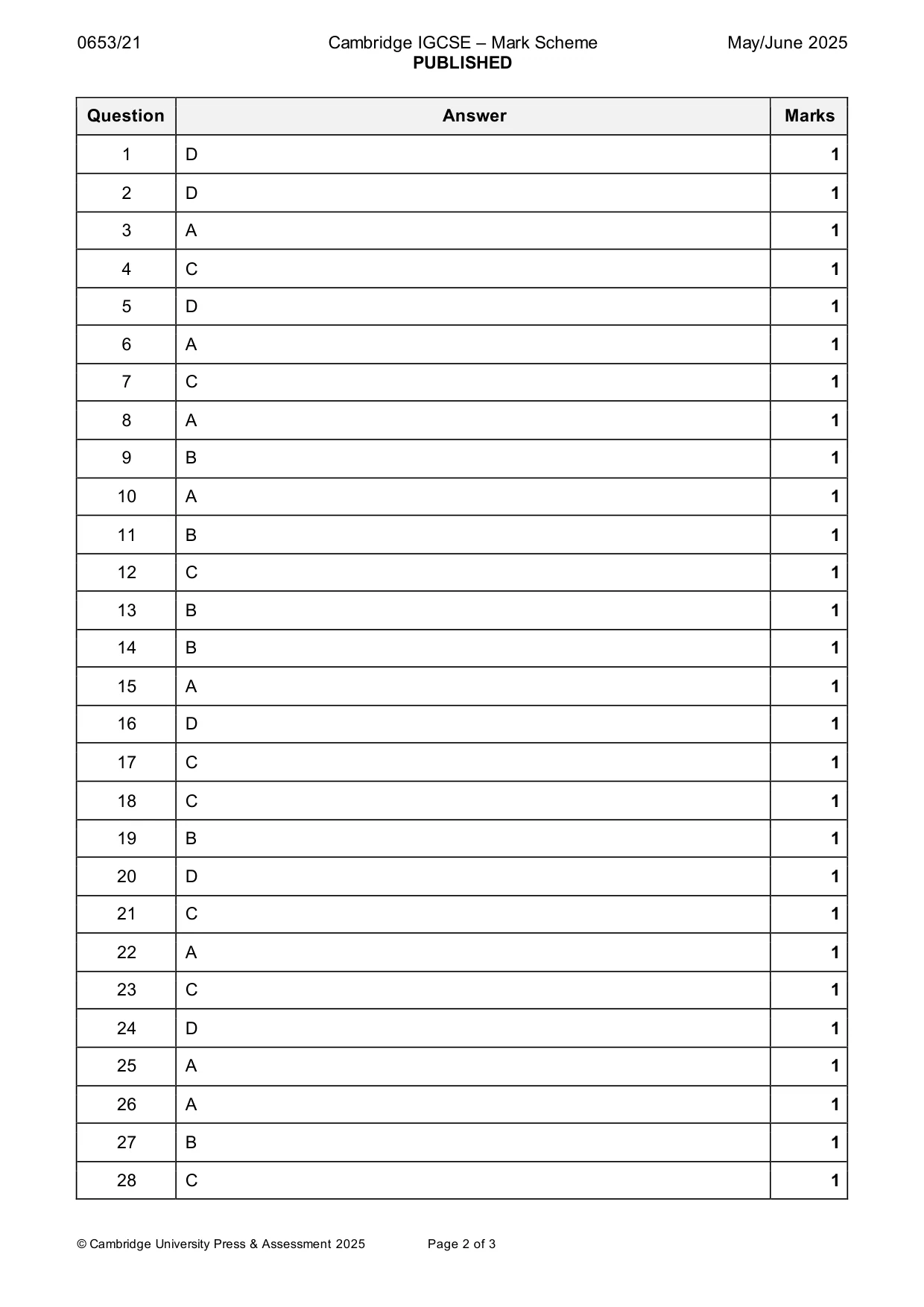
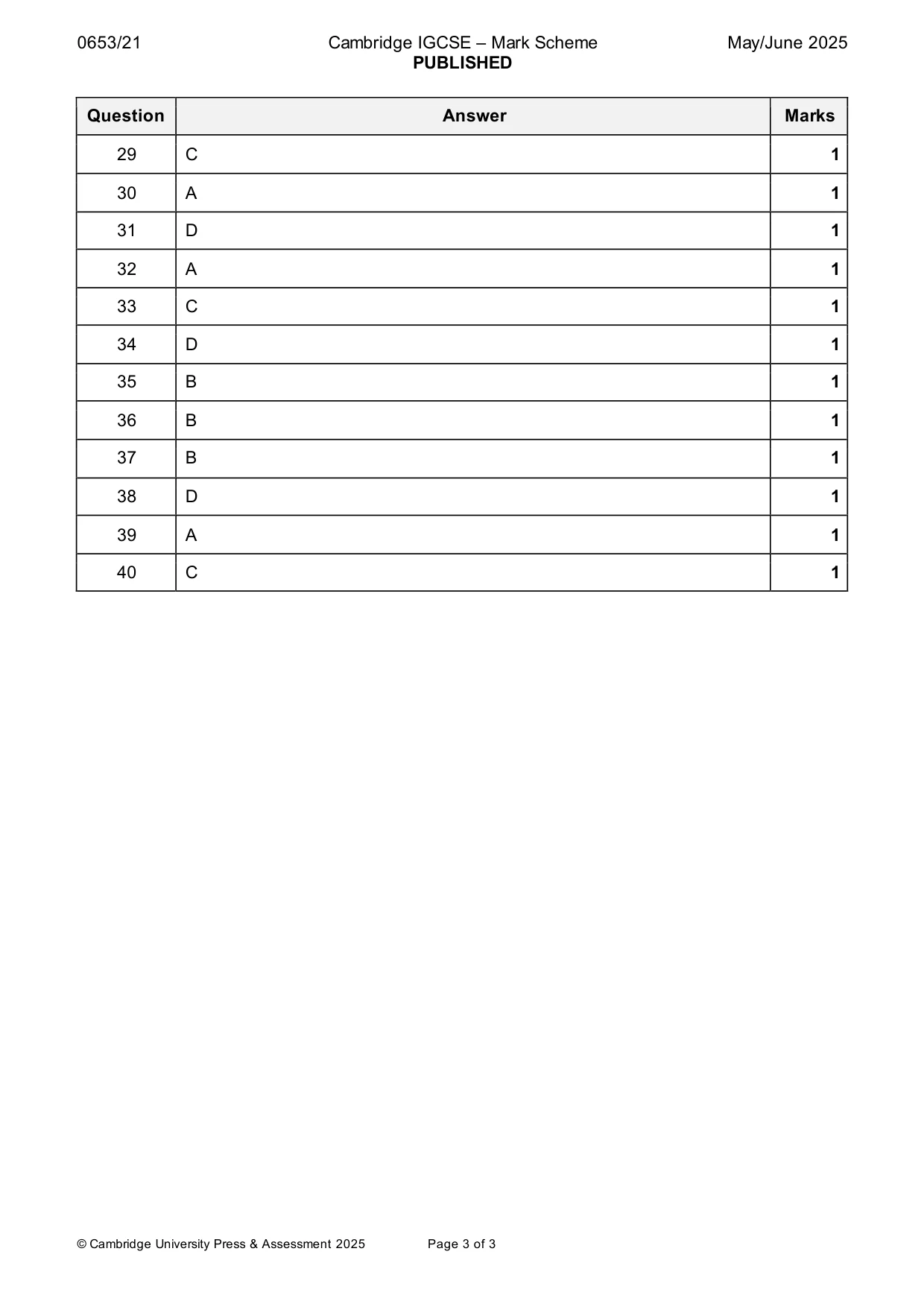
Answers below. Sit the paper first if you are practising.
Questions as text
Q1 · Osmosis can be defined as the net movement of ......1.....
1 Osmosis can be defined as the net movement of ......1...... molecules from a region of ......2...... water potential to a region of ......3...... water potential, through a partially permeable membrane. Which words complete gaps 1, 2 and 3? 1 2 3 A sugar higher lower B sugar lower higher C water lower higher D water higher lower
Mark scheme: D
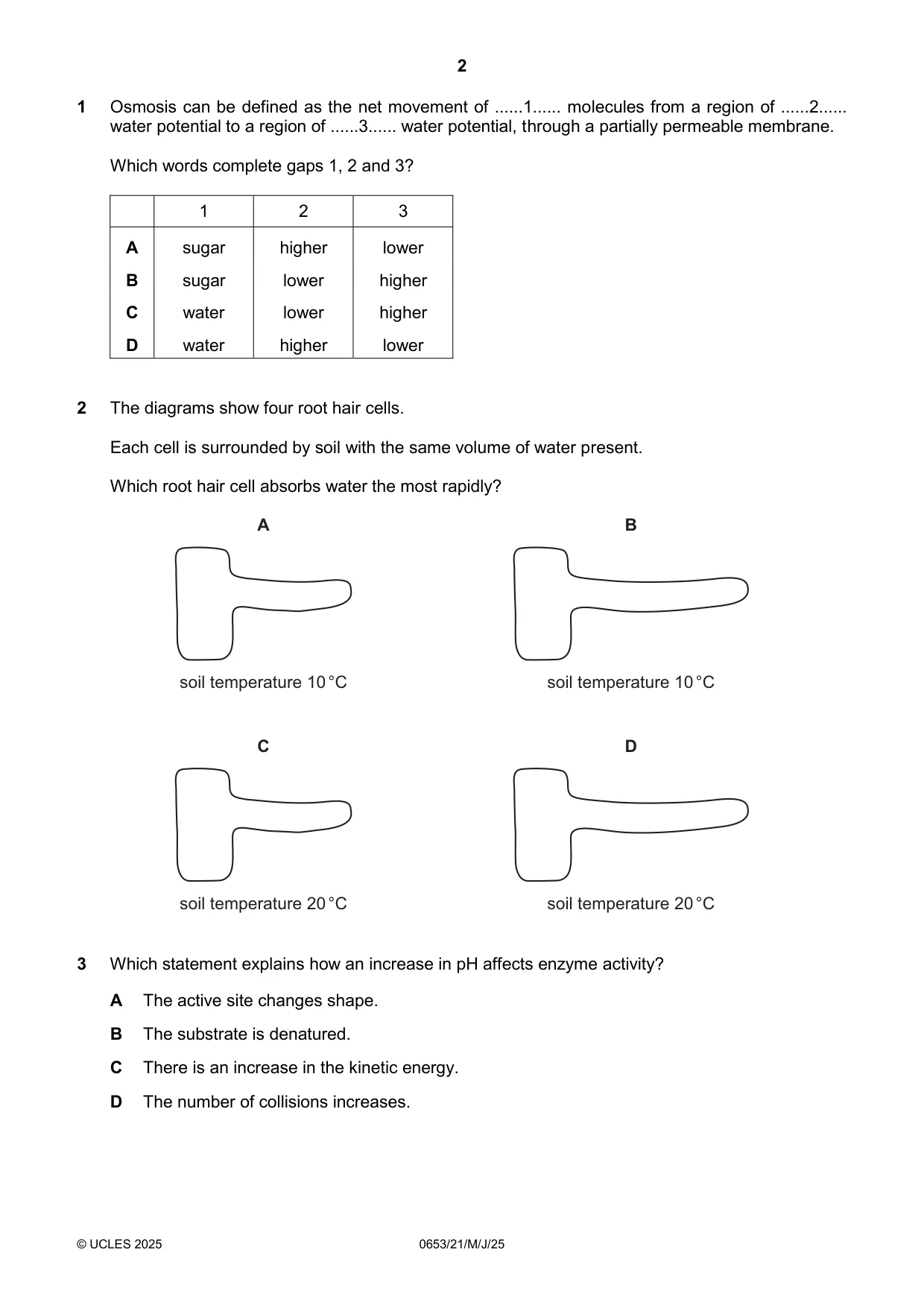
Q2 · The diagrams show four root hair cells
2 The diagrams show four root hair cells. Each cell is surrounded by soil with the same volume of water present. Which root hair cell absorbs water the most rapidly? A B soil temperature 10 °C soil temperature 10 °C C D soil temperature 20 °C soil temperature 20 °C
Mark scheme: D
Q3 · Which statement explains how an increase in pH affects enzyme activity?
3 Which statement explains how an increase in pH affects enzyme activity? A The active site changes shape. B The substrate is denatured. C There is an increase in the kinetic energy. D The number of collisions increases.
Mark scheme: A
Q4 · What is the balanced equation for photosynthesis?
4 What is the balanced equation for photosynthesis? A CO2 + H2O C6H12O6 + O2 B CO2 + 6H2O 6C6H12O6 + O2 C 6CO2 + 6H2O C6H12O6 + 6O2 D 6CO2 + 12H2O 6C6H12O6 + 6O2
Mark scheme: C
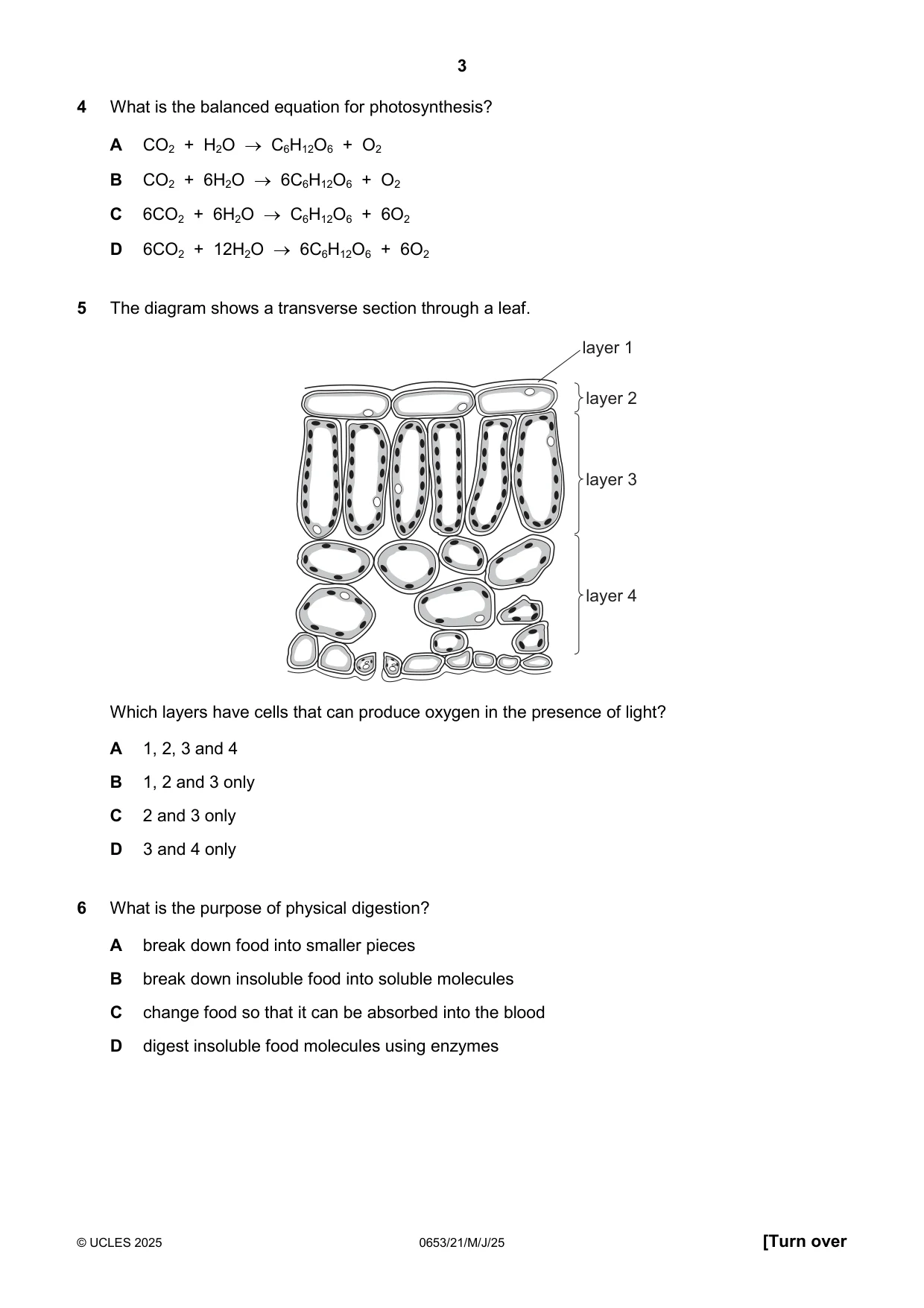
Q5 · The diagram shows a transverse section through a leaf
5 The diagram shows a transverse section through a leaf. layer 1 layer 2 layer 3 layer 4 Which layers have cells that can produce oxygen in the presence of light? A 1, 2, 3 and 4 B 1, 2 and 3 only C 2 and 3 only D 3 and 4 only
Mark scheme: D
Q6 · What is the purpose of physical digestion?
6 What is the purpose of physical digestion? A break down food into smaller pieces B break down insoluble food into soluble molecules C change food so that it can be absorbed into the blood D digest insoluble food molecules using enzymes
Mark scheme: A
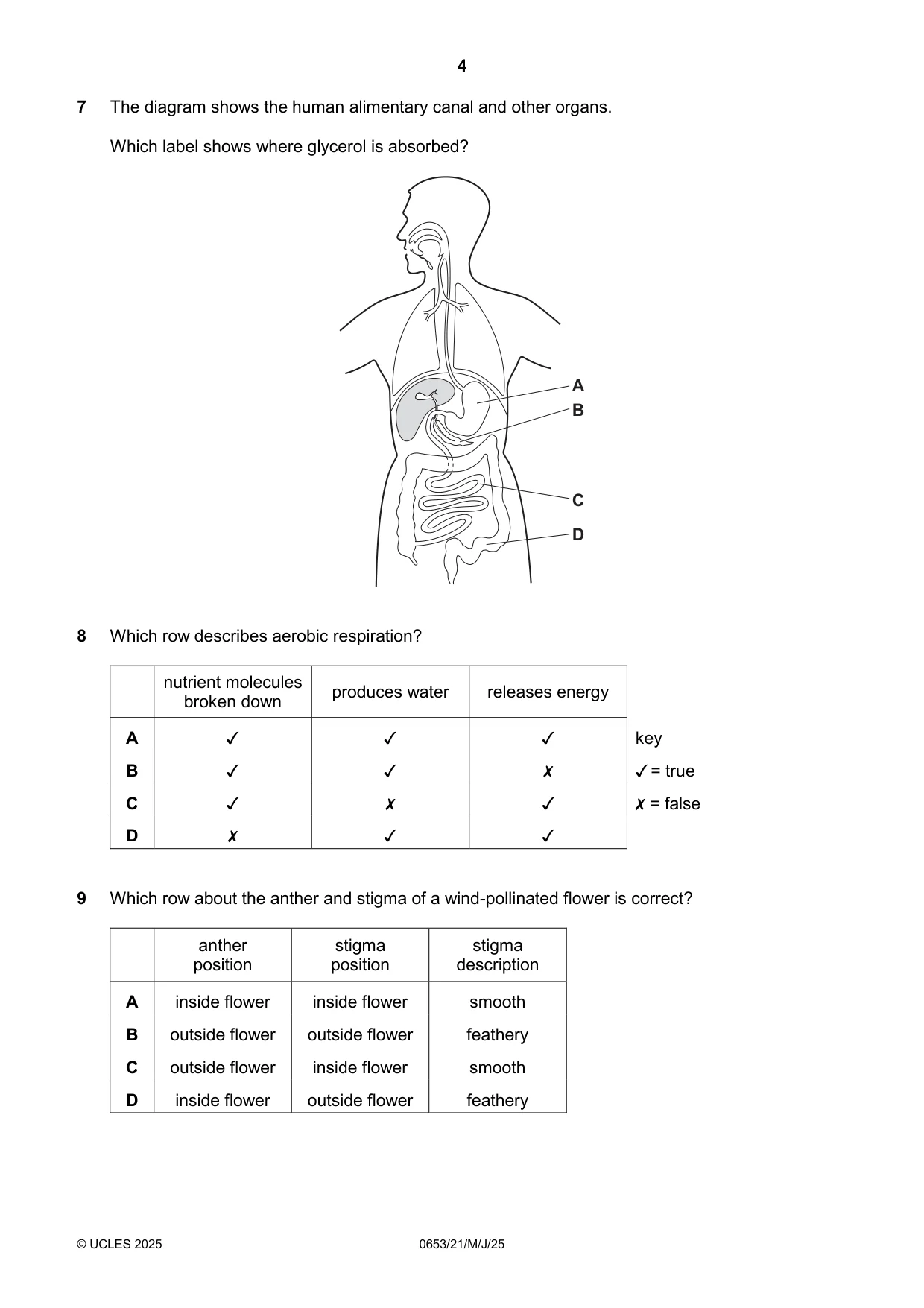
Q7 · The diagram shows the human alimentary canal and other organs
7 The diagram shows the human alimentary canal and other organs. Which label shows where glycerol is absorbed? A B C D
Mark scheme: C
Q8 · Which row describes aerobic respiration?
8 Which row describes aerobic respiration? nutrient molecules roduces water releases ener broken down p gy Jv key x v = true v X = false v
Mark scheme: A
Q9 · Which row about the anther and stigma of a wind-pollinated flower is correct?
9 Which row about the anther and stigma of a wind-pollinated flower is correct? anther stigma stigma position position description A inside flower inside flower smooth B outside flower outside flower feathery C outside flower inside flower smooth D inside flower outside flower feathery
Mark scheme: B
Q10 · Which row shows the effect of deforestation on oxygen and carbon dioxide concentrations…
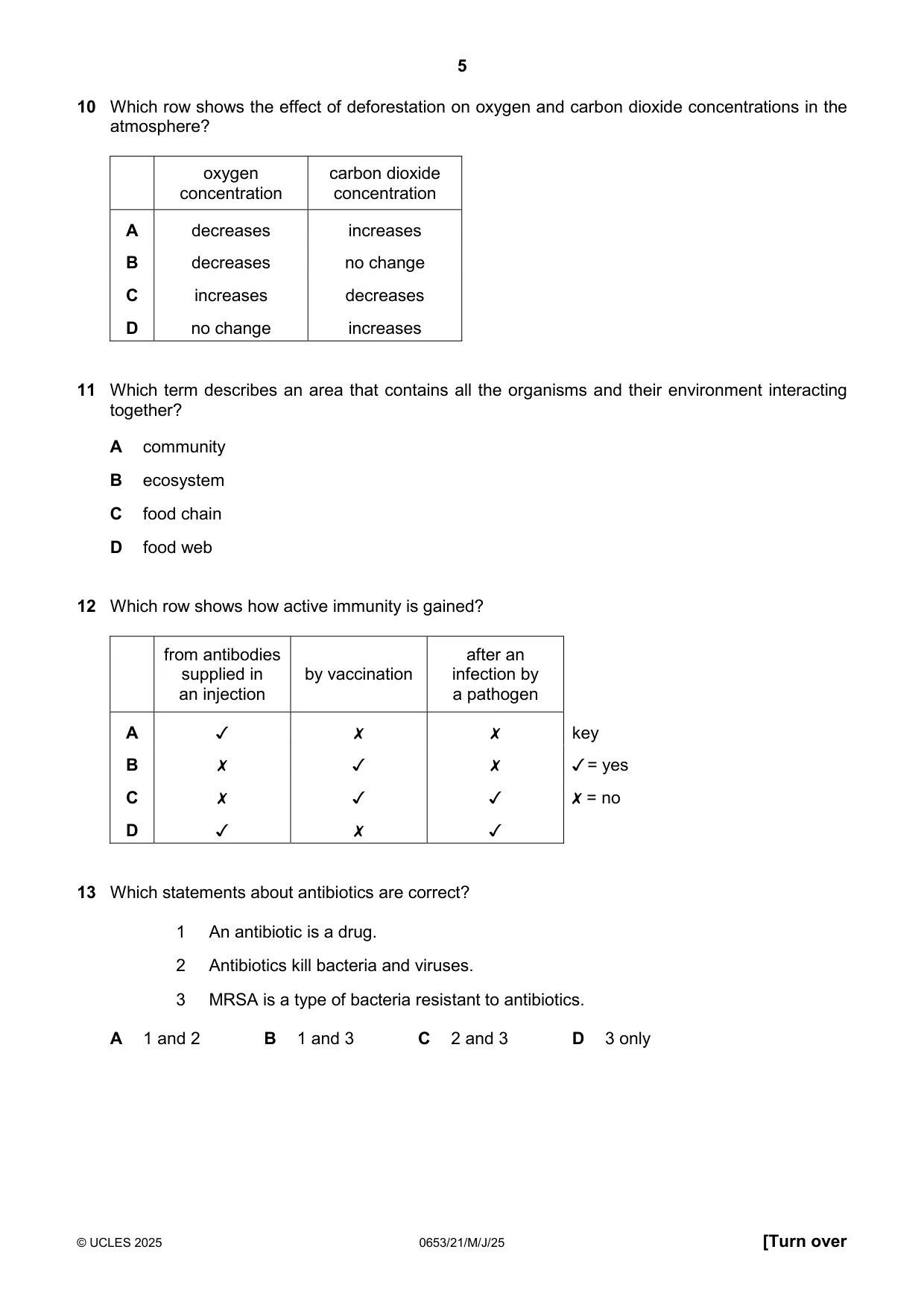
10 Which row shows the effect of deforestation on oxygen and carbon dioxide concentrations in the atmosphere? oxygen carbon dioxide concentration concentration A decreases increases B decreases no change C increases decreases D no change increases
Mark scheme: A
Q11 · Which term describes an area that contains all the organisms and their environment…
11 Which term describes an area that contains all the organisms and their environment interacting together? A community B ecosystem C food chain D food web
Mark scheme: B
Q12 · Which row shows how active immunity is gained?
12 Which row shows how active immunity is gained? from antibodies supplied in an injection by vaccination after an infection by a pathogen \ \ & & key /=yes X =no
Mark scheme: C
Q13 · Which statements about antibiotics are correct?
13 Which statements about antibiotics are correct? 1 An antibiotic is a drug. 2 Antibiotics kill bacteria and viruses. 3 MRSA is a type of bacteria resistant to antibiotics. A 1 and 2 B 1 and 3 C 2 and 3 D 3 only
Mark scheme: B
Q14 · Which diagram represents a mixture of elements?
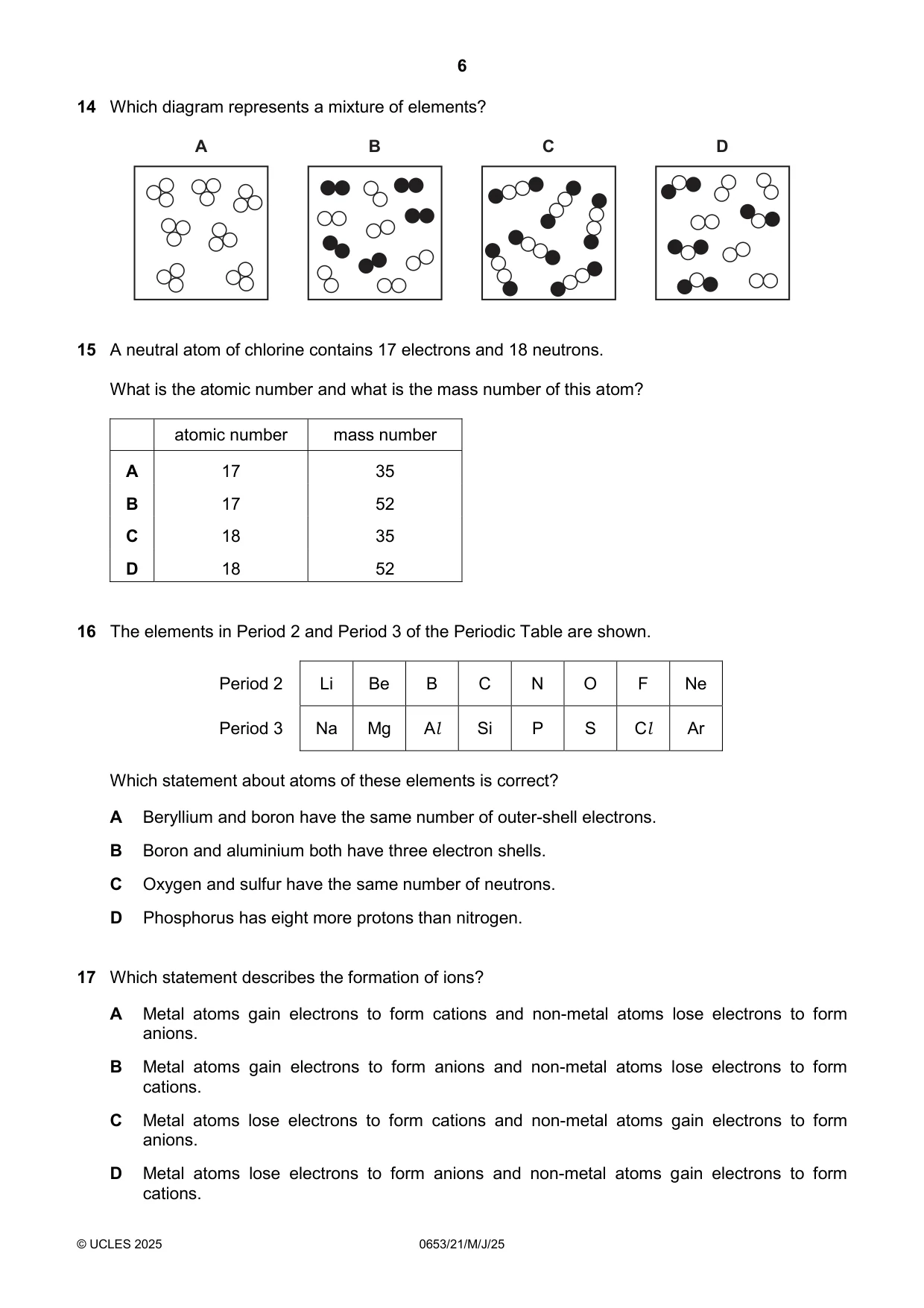
14 Which diagram represents a mixture of elements? A B C D
Mark scheme: B
Q15 · A neutral atom of chlorine contains 17 electrons and 18 neutrons
15 A neutral atom of chlorine contains 17 electrons and 18 neutrons. What is the atomic number and what is the mass number of this atom? atomic number mass number A 17 35 B 17 52 C 18 35 D 18 52
Mark scheme: A
Q16 · The elements in Period 2 and Period 3 of the Periodic Table are shown
16 The elements in Period 2 and Period 3 of the Periodic Table are shown. Period 2 Li Be B C N O F Ne Period 3 Na Mg Al Si P S Cl Ar Which statement about atoms of these elements is correct? A Beryllium and boron have the same number of outer-shell electrons. B Boron and aluminium both have three electron shells. C Oxygen and sulfur have the same number of neutrons. D Phosphorus has eight more protons than nitrogen.
Mark scheme: D
Q17 · Which statement describes the formation of ions?
17 Which statement describes the formation of ions? A Metal atoms gain electrons to form cations and non-metal atoms lose electrons to form anions. B Metal atoms gain electrons to form anions and non-metal atoms lose electrons to form cations. C Metal atoms lose electrons to form cations and non-metal atoms gain electrons to form anions. D Metal atoms lose electrons to form anions and non-metal atoms gain electrons to form cations.
Mark scheme: C
Q18 · The formula of sodium phosphate is Na3PO4
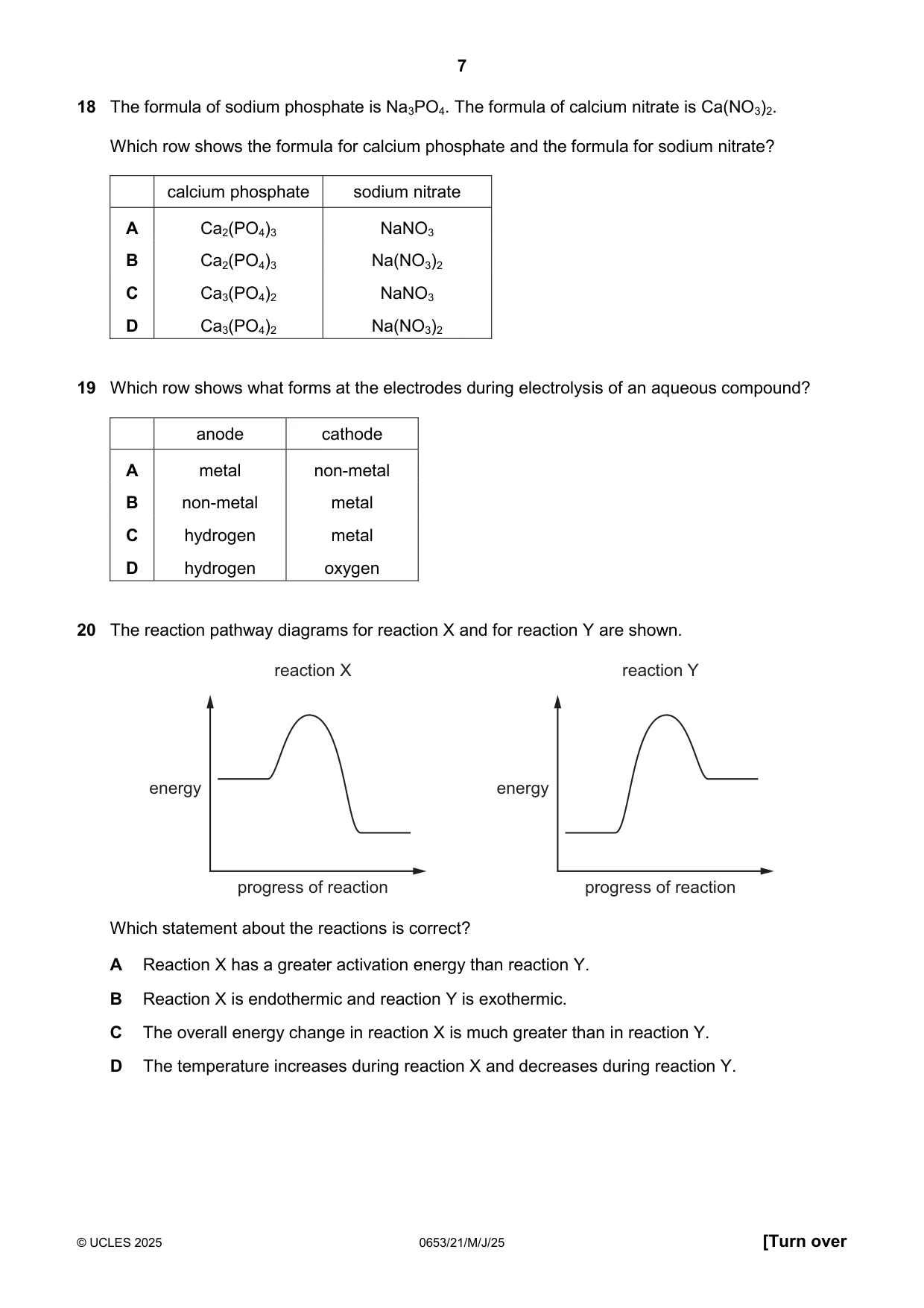
18 The formula of sodium phosphate is Na3PO4. The formula of calcium nitrate is Ca(NO3)2. Which row shows the formula for calcium phosphate and the formula for sodium nitrate? calcium phosphate sodium nitrate A Ca2(PO4)3 NaNO3 B Ca2(PO4)3 Na(NO3)2 C Ca3(PO4)2 NaNO3 D Ca3(PO4)2 Na(NO3)2
Mark scheme: C
Q19 · Which row shows what forms at the electrodes during electrolysis of an aqueous compound?
19 Which row shows what forms at the electrodes during electrolysis of an aqueous compound? anode cathode A metal non-metal B non-metal metal C hydrogen metal D hydrogen oxygen
Mark scheme: B
Q20 · The reaction pathway diagrams for reaction X and for reaction Y are shown
20 The reaction pathway diagrams for reaction X and for reaction Y are shown. reaction X reaction Y energy energy progress of reaction progress of reaction Which statement about the reactions is correct? A Reaction X has a greater activation energy than reaction Y. B Reaction X is endothermic and reaction Y is exothermic. C The overall energy change in reaction X is much greater than in reaction Y. D The temperature increases during reaction X and decreases during reaction Y.
Mark scheme: D
Q21 · Which statement about catalysts is correct?
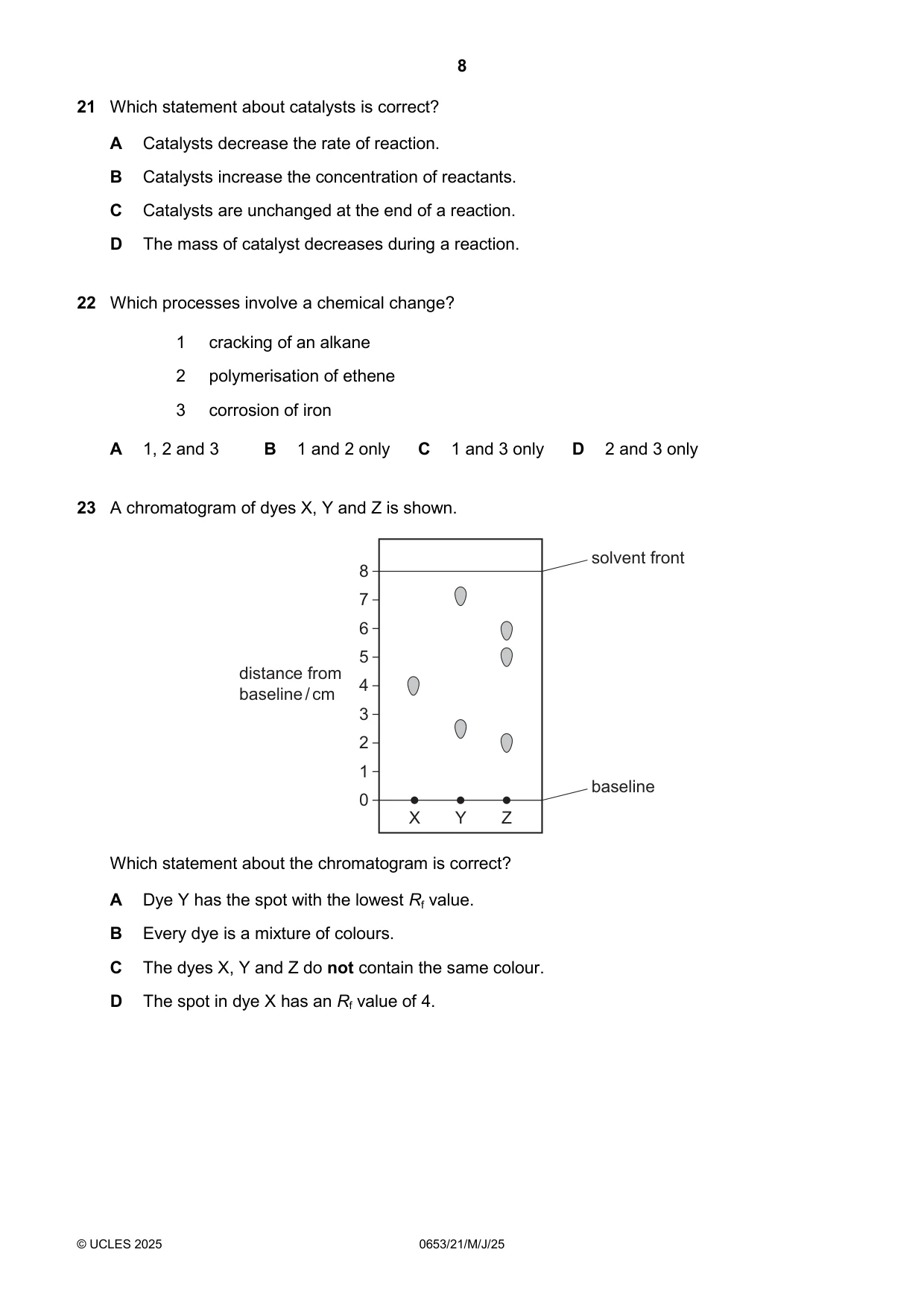
21 Which statement about catalysts is correct? A Catalysts decrease the rate of reaction. B Catalysts increase the concentration of reactants. C Catalysts are unchanged at the end of a reaction. D The mass of catalyst decreases during a reaction.
Mark scheme: C
Q22 · Which processes involve a chemical change?
22 Which processes involve a chemical change? 1 cracking of an alkane 2 polymerisation of ethene 3 corrosion of iron A 1, 2 and 3 B 1 and 2 only C 1 and 3 only D 2 and 3 only
Mark scheme: A
Q23 · A chromatogram of dyes X, Y and Z is shown
23 A chromatogram of dyes X, Y and Z is shown. solvent front 8 7 6 5 distance from 4 baseline / cm 3 2 1 baseline 0 X Y Z Which statement about the chromatogram is correct? A Dye Y has the spot with the lowest Rf value. B Every dye is a mixture of colours. C The dyes X, Y and Z do not contain the same colour. D The spot in dye X has an Rf value of 4.
Mark scheme: C
Q24 · An excess of an insoluble metal carbonate is mixed with an acid
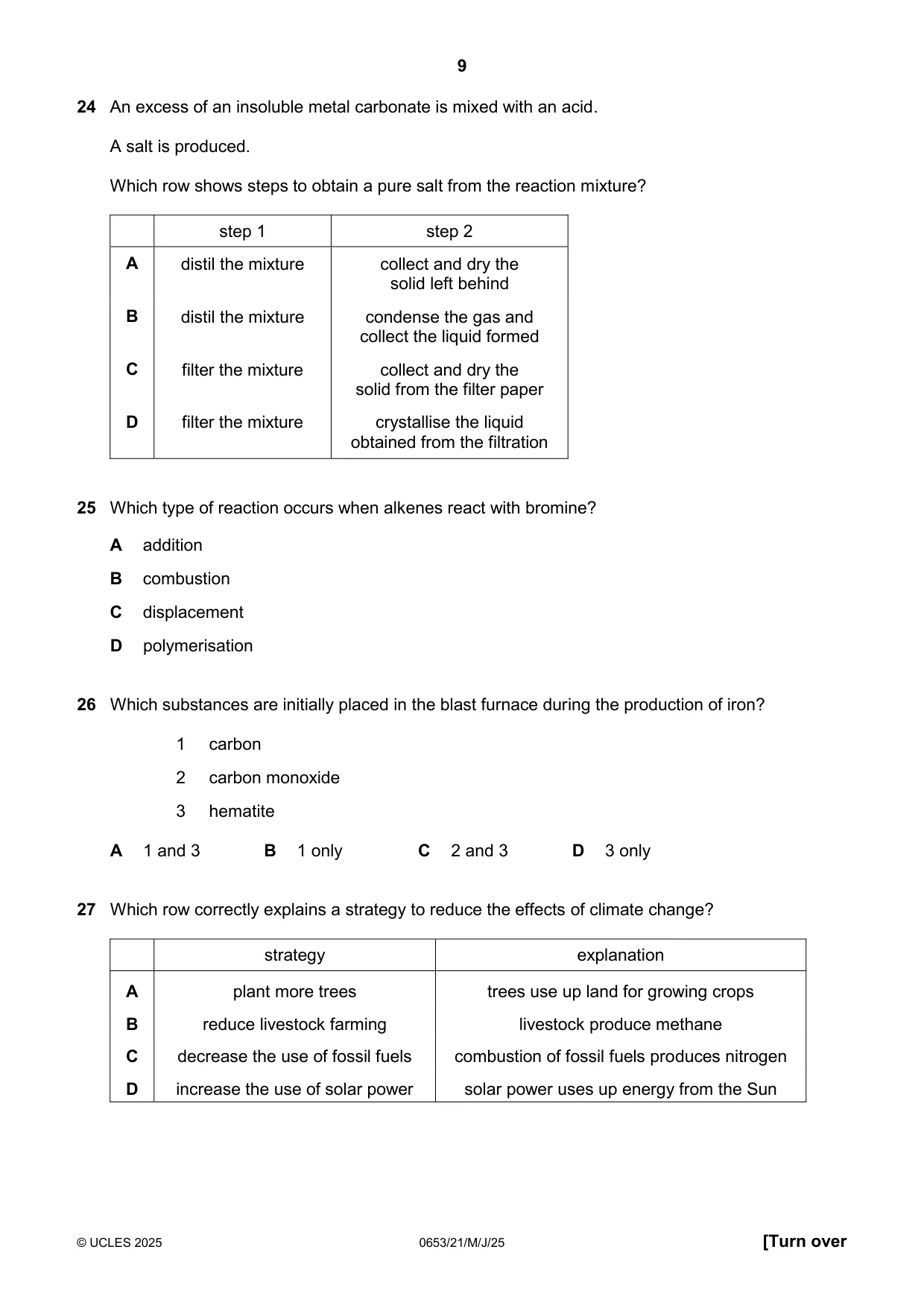
24 An excess of an insoluble metal carbonate is mixed with an acid. A salt is produced. Which row shows steps to obtain a pure salt from the reaction mixture? step 1 step 2 A distil the mixture collect and dry the solid left behind B distil the mixture condense the gas and collect the liquid formed C filter the mixture collect and dry the solid from the filter paper D filter the mixture crystallise the liquid obtained from the filtration
Mark scheme: D
Q25 · Which type of reaction occurs when alkenes react with bromine?
25 Which type of reaction occurs when alkenes react with bromine? A addition B combustion C displacement D polymerisation
Mark scheme: A
Q26 · Which substances are initially placed in the blast furnace during the production of iron?
26 Which substances are initially placed in the blast furnace during the production of iron? 1 carbon 2 carbon monoxide 3 hematite A 1 and 3 B 1 only C 2 and 3 D 3 only
Mark scheme: A
Q27 · Which row correctly explains a strategy to reduce the effects of climate change?
27 Which row correctly explains a strategy to reduce the effects of climate change? strategy explanation A plant more trees trees use up land for growing crops B reduce livestock farming livestock produce methane C decrease the use of fossil fuels combustion of fossil fuels produces nitrogen D increase the use of solar power solar power uses up energy from the Sun
Mark scheme: B
Q28 · The graph shows how the speed of a car changes with time
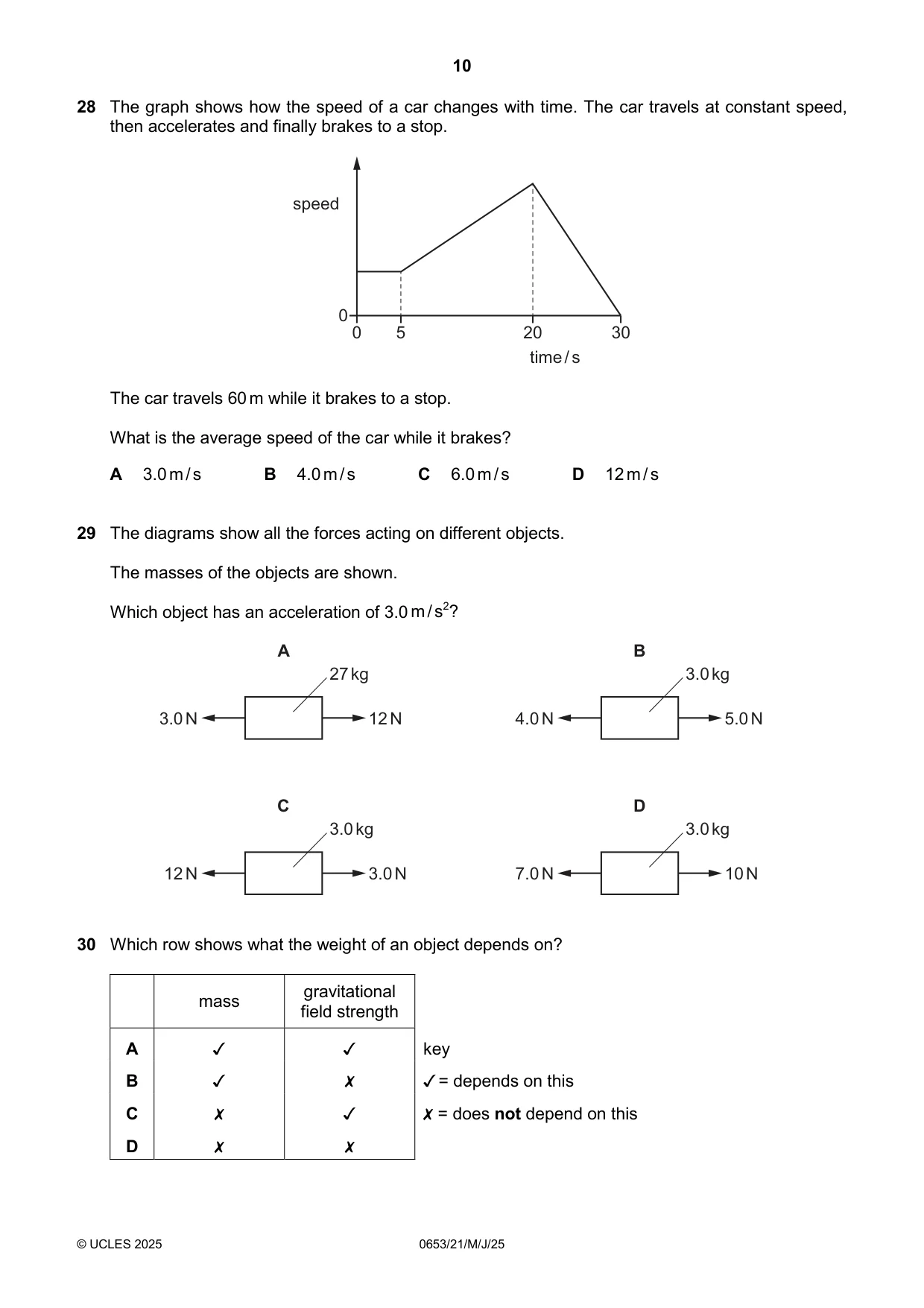
28 The graph shows how the speed of a car changes with time. The car travels at constant speed, then accelerates and finally brakes to a stop. speed 0 0 5 20 30 time / s The car travels 60 m while it brakes to a stop. What is the average speed of the car while it brakes? A 3.0 m / s B 4.0 m / s C 6.0 m / s D 12 m / s
Mark scheme: C
Q29 · The diagrams show all the forces acting on different objects
29 The diagrams show all the forces acting on different objects. The masses of the objects are shown. Which object has an acceleration of 3.0 m / s2? A B 27 kg 3.0 kg 3.0 N 12 N 4.0 N 5.0 N C D 3.0 kg 3.0 kg 12 N 3.0 N 7.0 N 10 N
Mark scheme: C
Q30 · Which row shows what the weight of an object depends on?
30 Which row shows what the weight of an object depends on? gravitational field strength key / = depends on this X = does not depend on this
Mark scheme: A
Q31 · The temperature of a gas increases
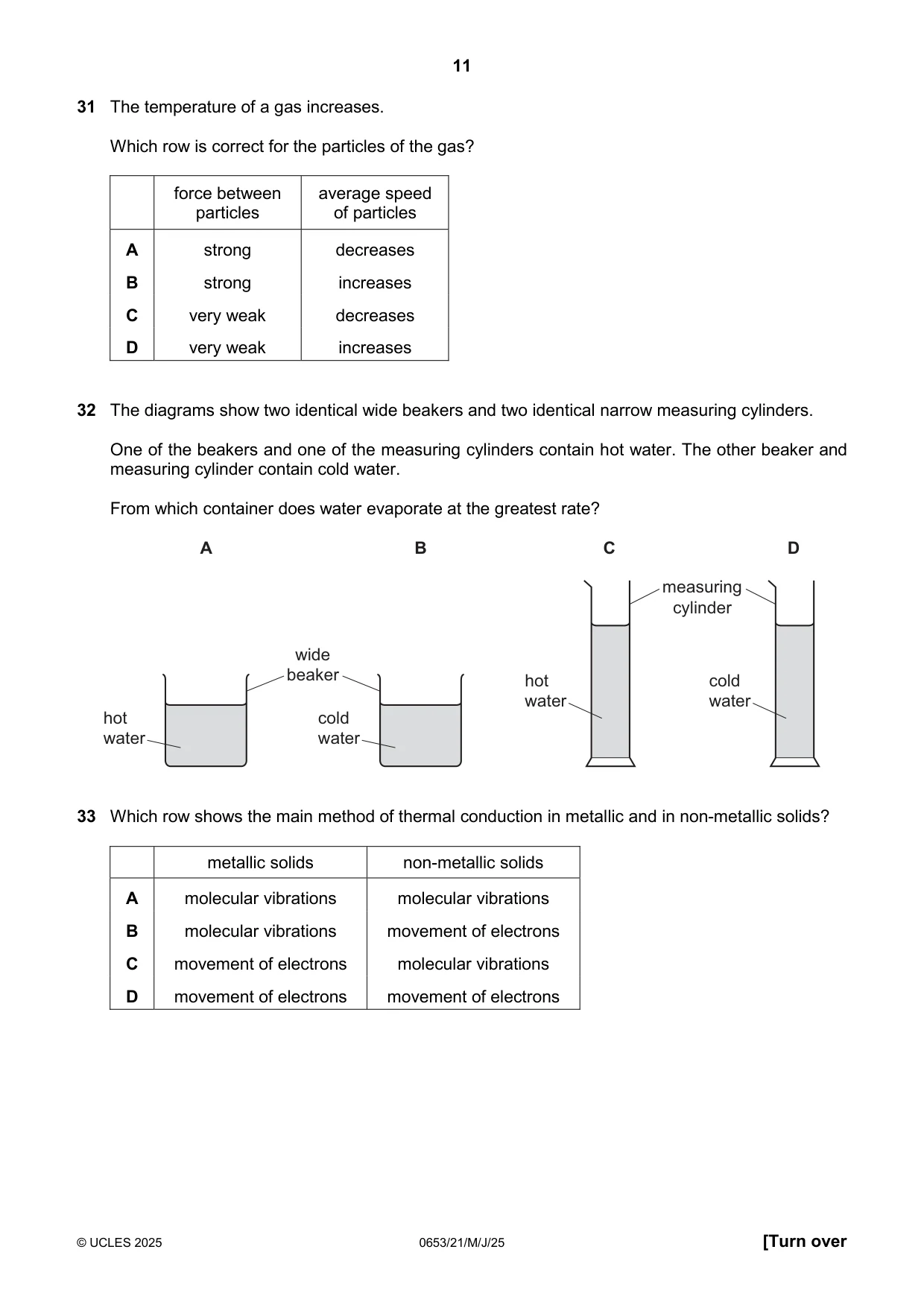
31 The temperature of a gas increases. Which row is correct for the particles of the gas? force between average speed particles of particles A strong decreases B strong increases C very weak decreases D very weak increases
Mark scheme: D
Q32 · The diagrams show two identical wide beakers and two identical narrow measuring cylinders
32 The diagrams show two identical wide beakers and two identical narrow measuring cylinders. One of the beakers and one of the measuring cylinders contain hot water. The other beaker and measuring cylinder contain cold water. From which container does water evaporate at the greatest rate? A B C D measuring cylinder wide beaker hot cold water water hot cold water water
Mark scheme: A
Q33 · Which row shows the main method of thermal conduction in metallic and in non-metallic…
33 Which row shows the main method of thermal conduction in metallic and in non-metallic solids? metallic solids non-metallic solids A molecular vibrations molecular vibrations B molecular vibrations movement of electrons C movement of electrons molecular vibrations D movement of electrons movement of electrons
Mark scheme: C
Q34 · A student moves one end of a long rope up and down through a short distance
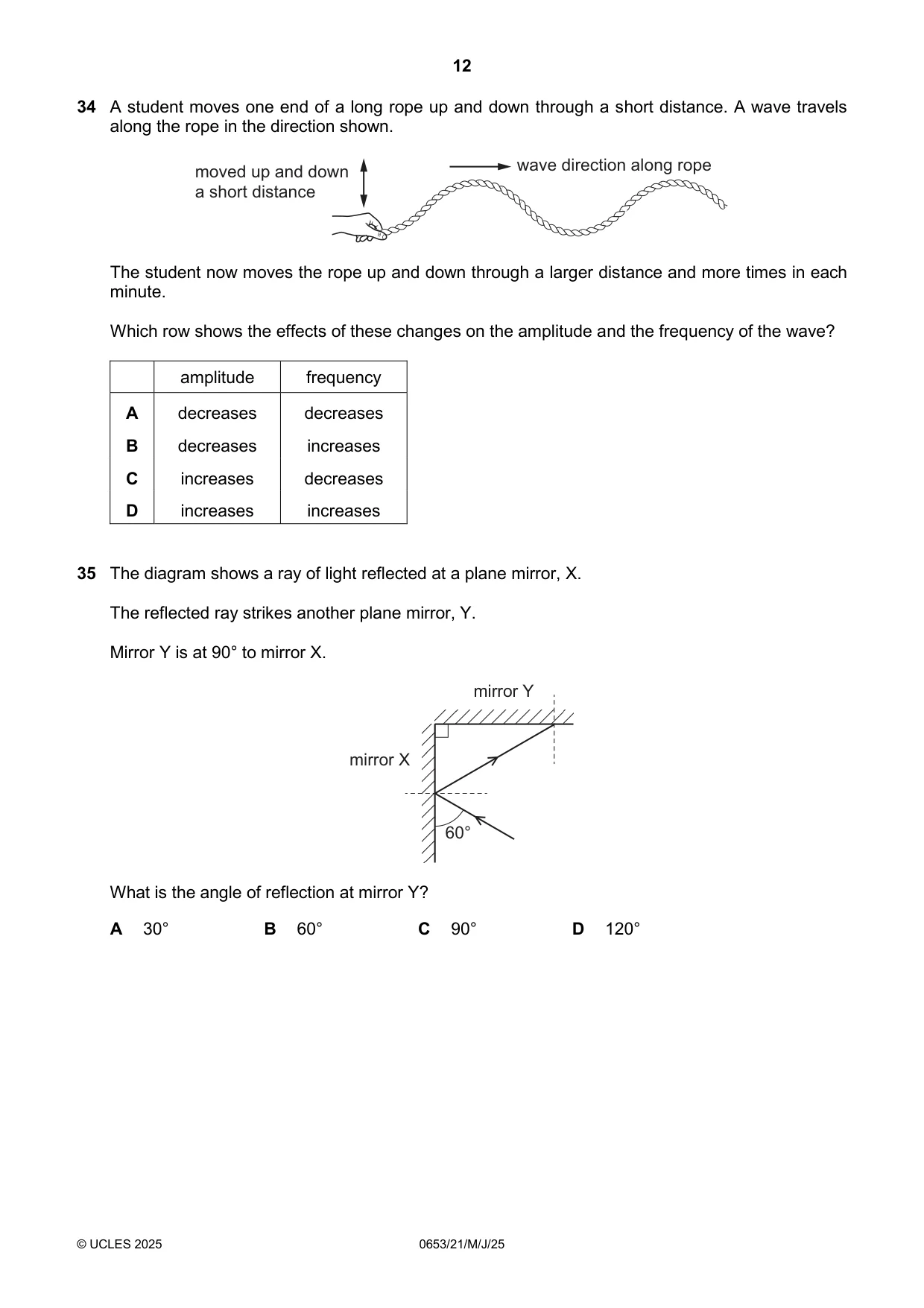
34 A student moves one end of a long rope up and down through a short distance. A wave travels along the rope in the direction shown. moved up and down wave direction along rope a short distance The student now moves the rope up and down through a larger distance and more times in each minute. Which row shows the effects of these changes on the amplitude and the frequency of the wave? amplitude frequency A decreases decreases B decreases increases C increases decreases D increases increases
Mark scheme: D
Q35 · The diagram shows a ray of light reflected at a plane mirror, X
35 The diagram shows a ray of light reflected at a plane mirror, X. The reflected ray strikes another plane mirror, Y. Mirror Y is at 90° to mirror X. mirror Y mirror X 60° What is the angle of reflection at mirror Y? A 30° B 60° C 90° D 120°
Mark scheme: B
Q36 · Sound travels in solids, liquids and gases
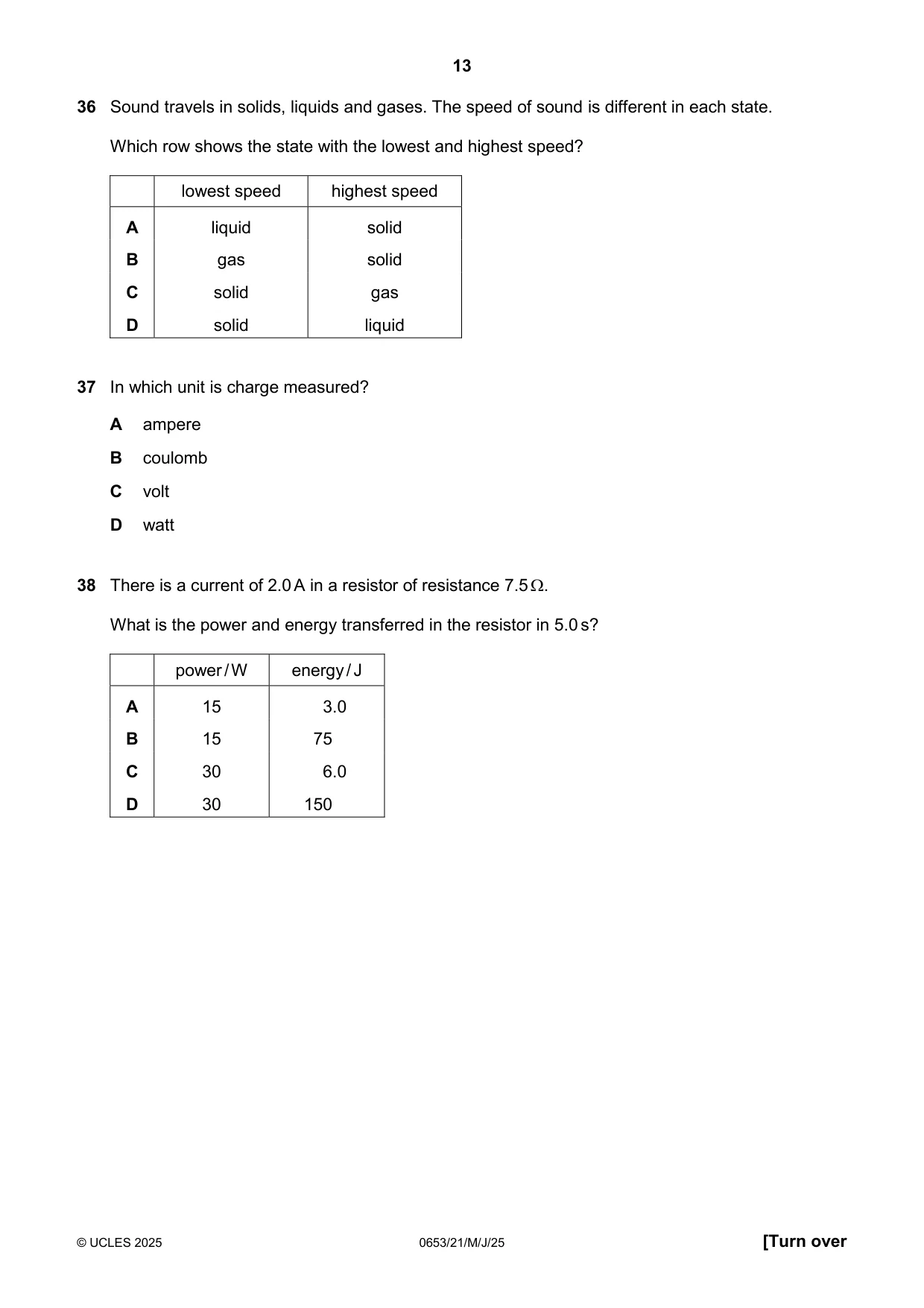
36 Sound travels in solids, liquids and gases. The speed of sound is different in each state. Which row shows the state with the lowest and highest speed? lowest speed highest speed A liquid solid B gas solid C solid gas D solid liquid
Mark scheme: B
Q37 · In which unit is charge measured?
37 In which unit is charge measured? A ampere B coulomb C volt D watt
Mark scheme: B
Q38 · There is a current of 2.0 A in a resistor of resistance 7.5
38 There is a current of 2.0 A in a resistor of resistance 7.5 . What is the power and energy transferred in the resistor in 5.0 s? power / W energy / J A 15 3.0 B 15 75 C 30 6.0 D 30 150
Mark scheme: D
Q39 · A student determines the resistance of resistor R
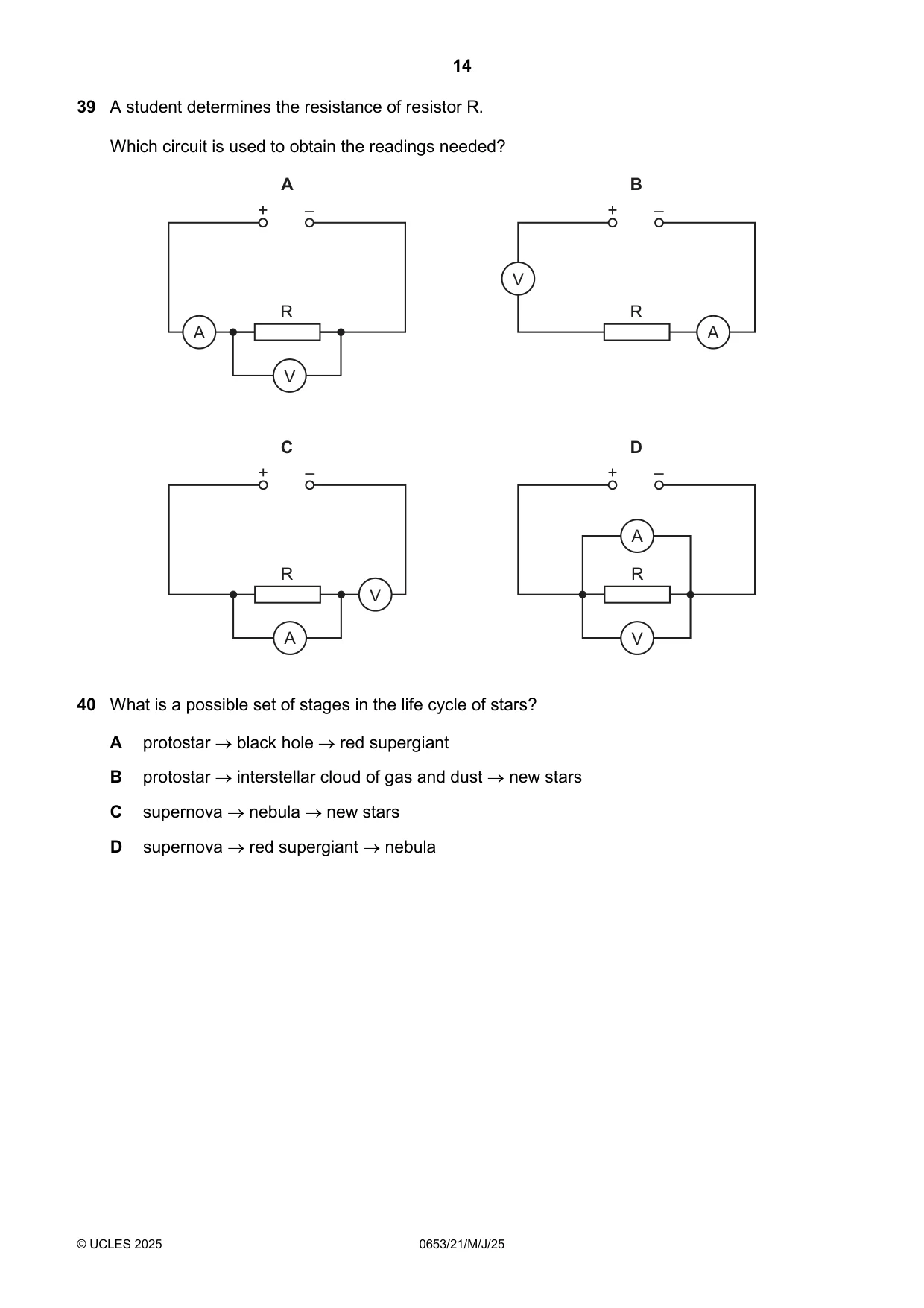
39 A student determines the resistance of resistor R. Which circuit is used to obtain the readings needed? A B + – + – V R R A A V C D + – + – A R R V A V
Mark scheme: A
Q40 · What is a possible set of stages in the life cycle of stars?
40 What is a possible set of stages in the life cycle of stars? A protostar black hole red supergiant B protostar interstellar cloud of gas and dust new stars C supernova nebula new stars D supernova red supergiant nebula
Mark scheme: C
What was in this paper
The subtopics covered by these 40 questions, and how many questions each got. Open one in a new tab to see every Cambridge question on it.
2Kinetic particle model of matter2Air quality and climate1Alkenes1Arrangement of elements1Atomic structure and the Periodic Table1Carbon cycle1Chromatography1Digestion1Digestive system1Diseases and immunity1Drugs1Electrical circuits1Electrolysis1Elements, compounds and mixtures1Energy flow1Enzymes1Exothermic and endothermic reactions1Extraction of metals1Forces1Formulas1General properties of waves1Ions and ionic bonds1Leaf structure1Light1Mass and weight1Motion1Osmosis1Photosynthesis1Physical and chemical changes1Preparation of salts1Rate of reaction1Respiration1Sexual reproduction in plants1Sound1Stars and the Universe1Transfer of thermal energy1Water uptake1What you needed in this session
Cambridge’s own grade thresholds for 2025 May/June, Paper 2 · Variant 1. A higher threshold means an easier paper — the bar moves with how the cohort did.