Cambridge IGCSE Science - Combined 0653 — 2023 May/June Paper 2 · Variant 2
0653/22/M/J/23 · 40 questions · 40 marks · ≈45 min
The question paper and its mark scheme, free to read here and free to download. This is Cambridge’s own paper, exactly as it was sat.
Question paper16 pages

Mark scheme3 pages
Answers below. Sit the paper first if you are practising.
Questions as text
Q1 · Which process removes toxic materials from an organism?
1 Which process removes toxic materials from an organism? A digestion B egestion C excretion D respiration
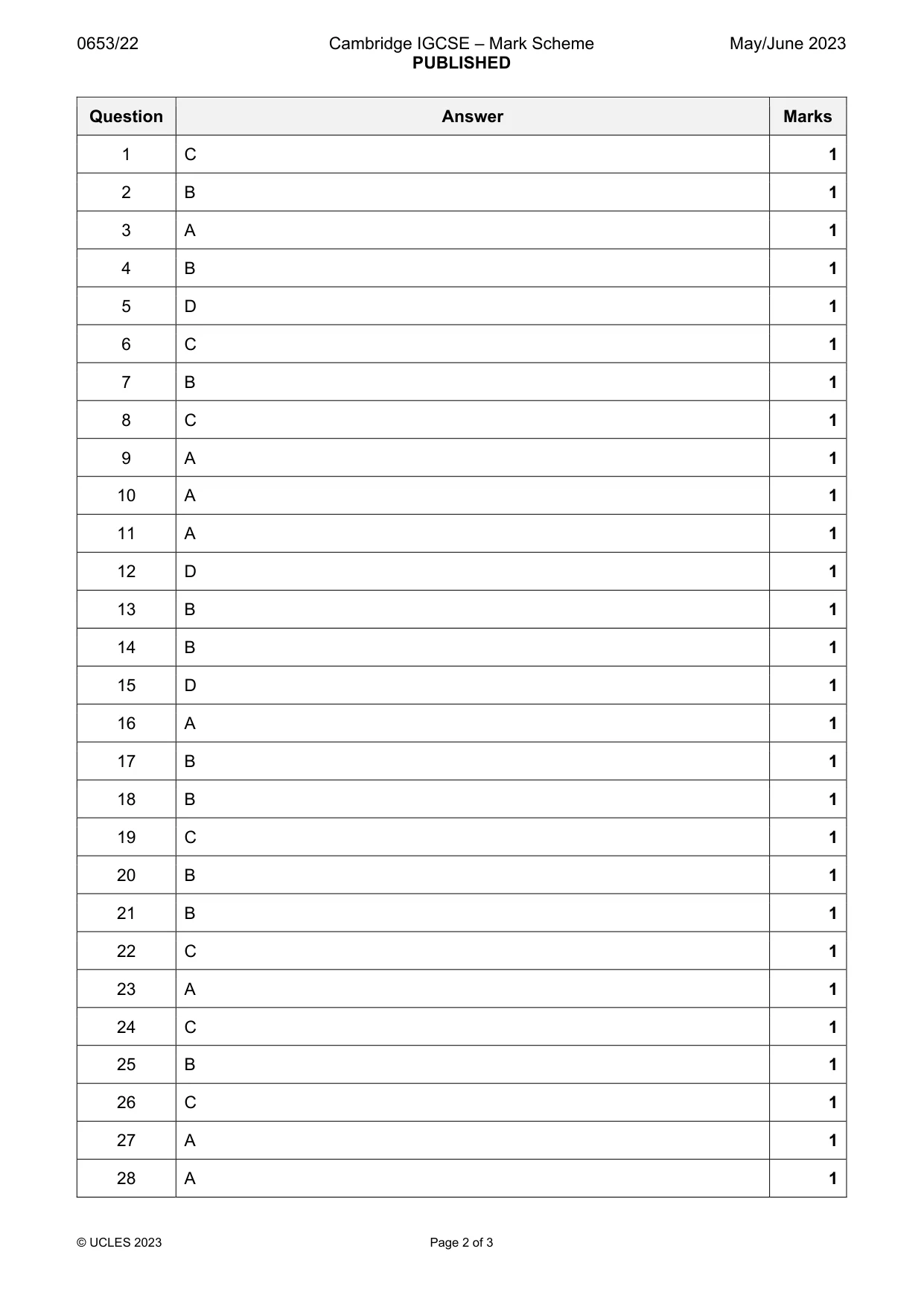
Mark scheme: C
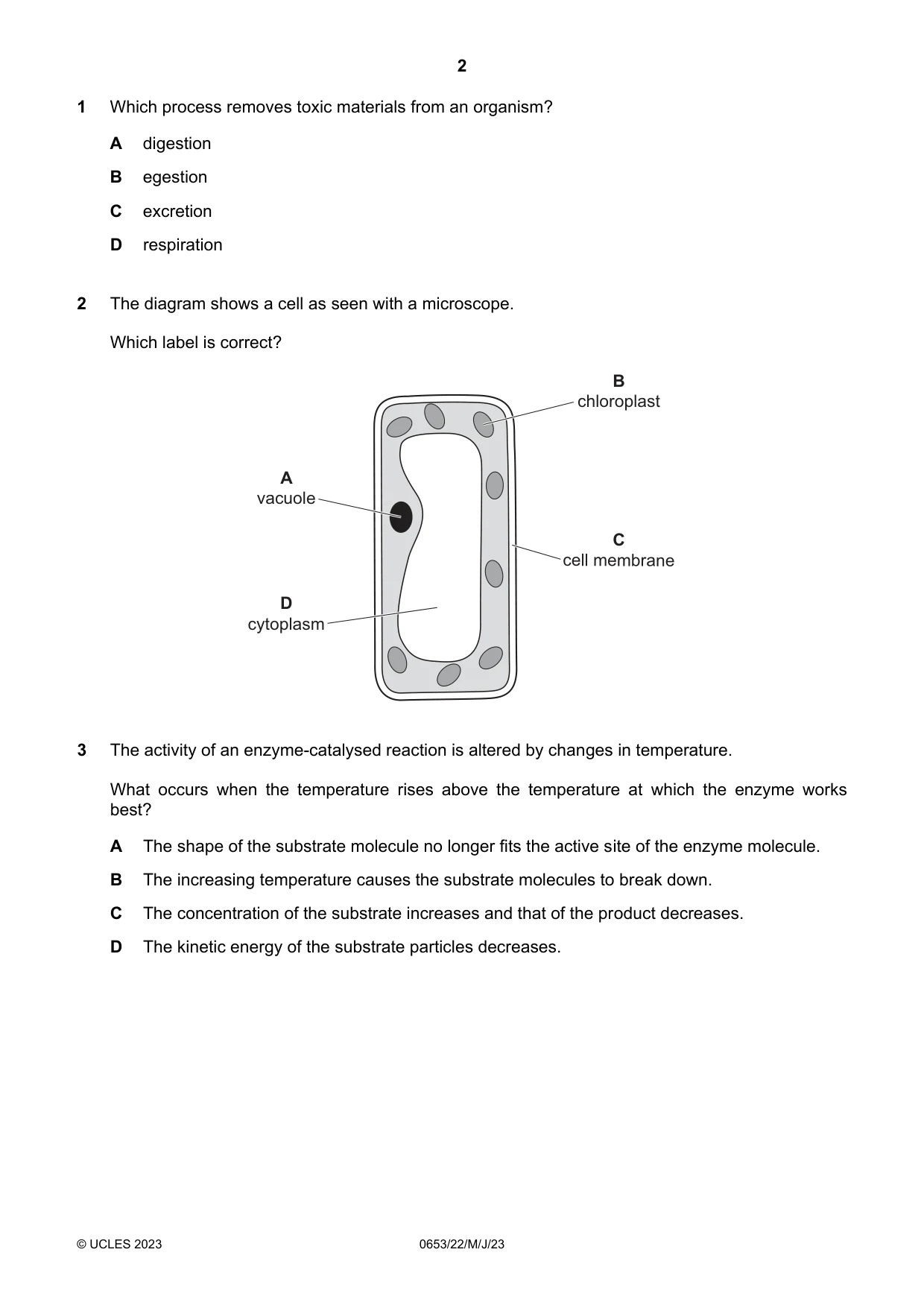
Q2 · The diagram shows a cell as seen with a microscope
2 The diagram shows a cell as seen with a microscope. Which label is correct? B chloroplast A vacuole C cell membrane D cytoplasm
Mark scheme: B
Q3 · The activity of an enzyme-catalysed reaction is altered by changes in temperature
3 The activity of an enzyme-catalysed reaction is altered by changes in temperature. What occurs when the temperature rises above the temperature at which the enzyme works best? A The shape of the substrate molecule no longer fits the active site of the enzyme molecule. B The increasing temperature causes the substrate molecules to break down. C The concentration of the substrate increases and that of the product decreases. D The kinetic energy of the substrate particles decreases.
Mark scheme: A
Q4 · In plants, photosynthesis takes place in the leaf
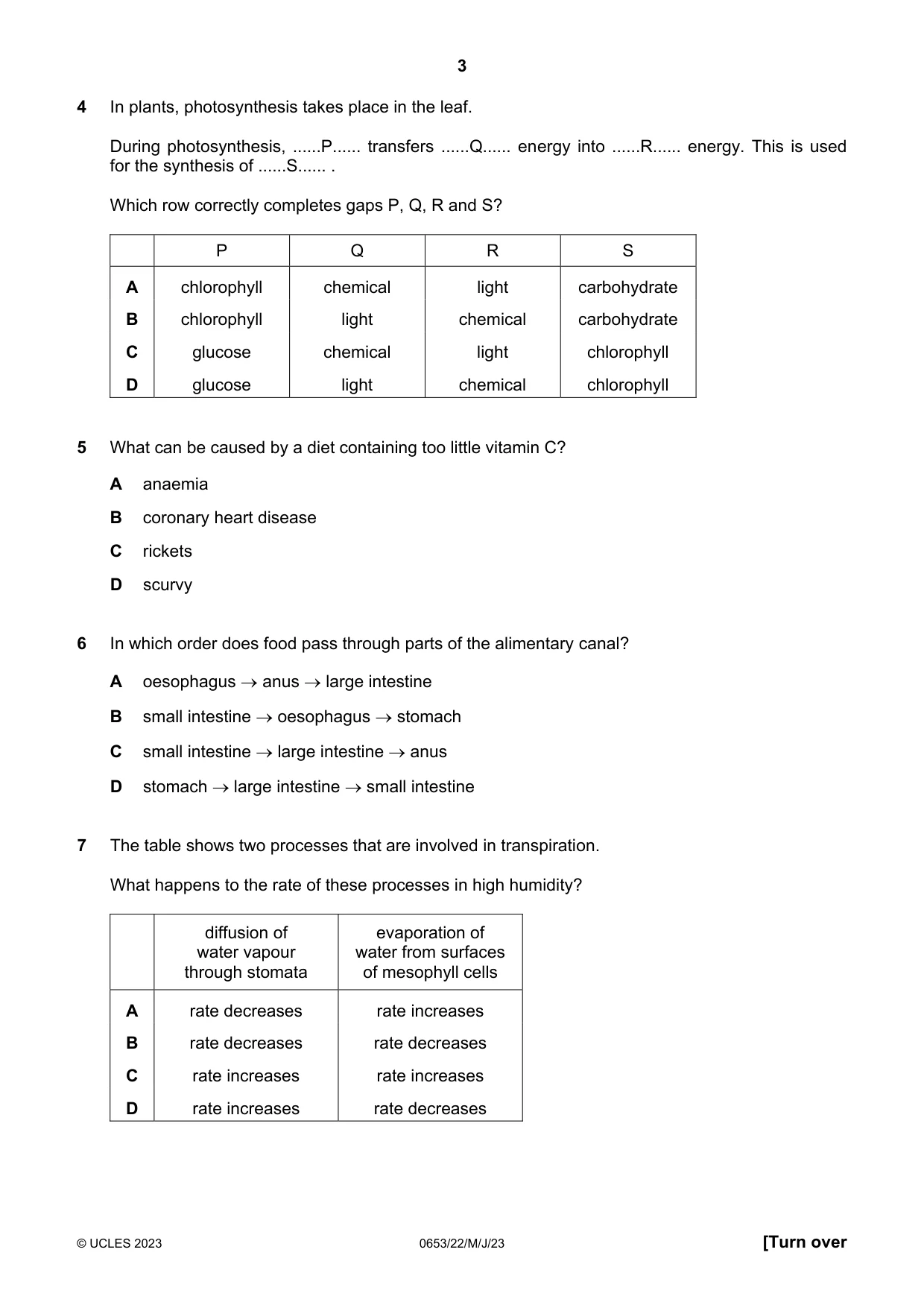
4 In plants, photosynthesis takes place in the leaf. During photosynthesis, ......P...... transfers ......Q...... energy into ......R...... energy. This is used for the synthesis of ......S...... . Which row correctly completes gaps P, Q, R and S? P Q R S A chlorophyll chemical light carbohydrate B chlorophyll light chemical carbohydrate C glucose chemical light chlorophyll D glucose light chemical chlorophyll
Mark scheme: B
Q5 · What can be caused by a diet containing too little vitamin C?
5 What can be caused by a diet containing too little vitamin C? A anaemia B coronary heart disease C rickets D scurvy
Mark scheme: D
Q6 · In which order does food pass through parts of the alimentary canal?
6 In which order does food pass through parts of the alimentary canal? A oesophagus anus large intestine B small intestine oesophagus stomach C small intestine large intestine anus D stomach large intestine small intestine
Mark scheme: C
Q7 · The table shows two processes that are involved in transpiration
7 The table shows two processes that are involved in transpiration. What happens to the rate of these processes in high humidity? diffusion of evaporation of water vapour water from surfaces through stomata of mesophyll cells A rate decreases rate increases B rate decreases rate decreases C rate increases rate increases D rate increases rate decreases
Mark scheme: B
Q8 · A sample of blood is taken from a person who often gets infections
8 A sample of blood is taken from a person who often gets infections. The blood is also slow to clot. Which blood components are likely to be at a lower level than normal? 1 platelets 2 red blood cells 3 white blood cells A 1, 2 and 3 B 1 and 2 only C 1 and 3 only D 2 and 3 only
Mark scheme: C
Q9 · In respiration, glucose is broken down to release energy
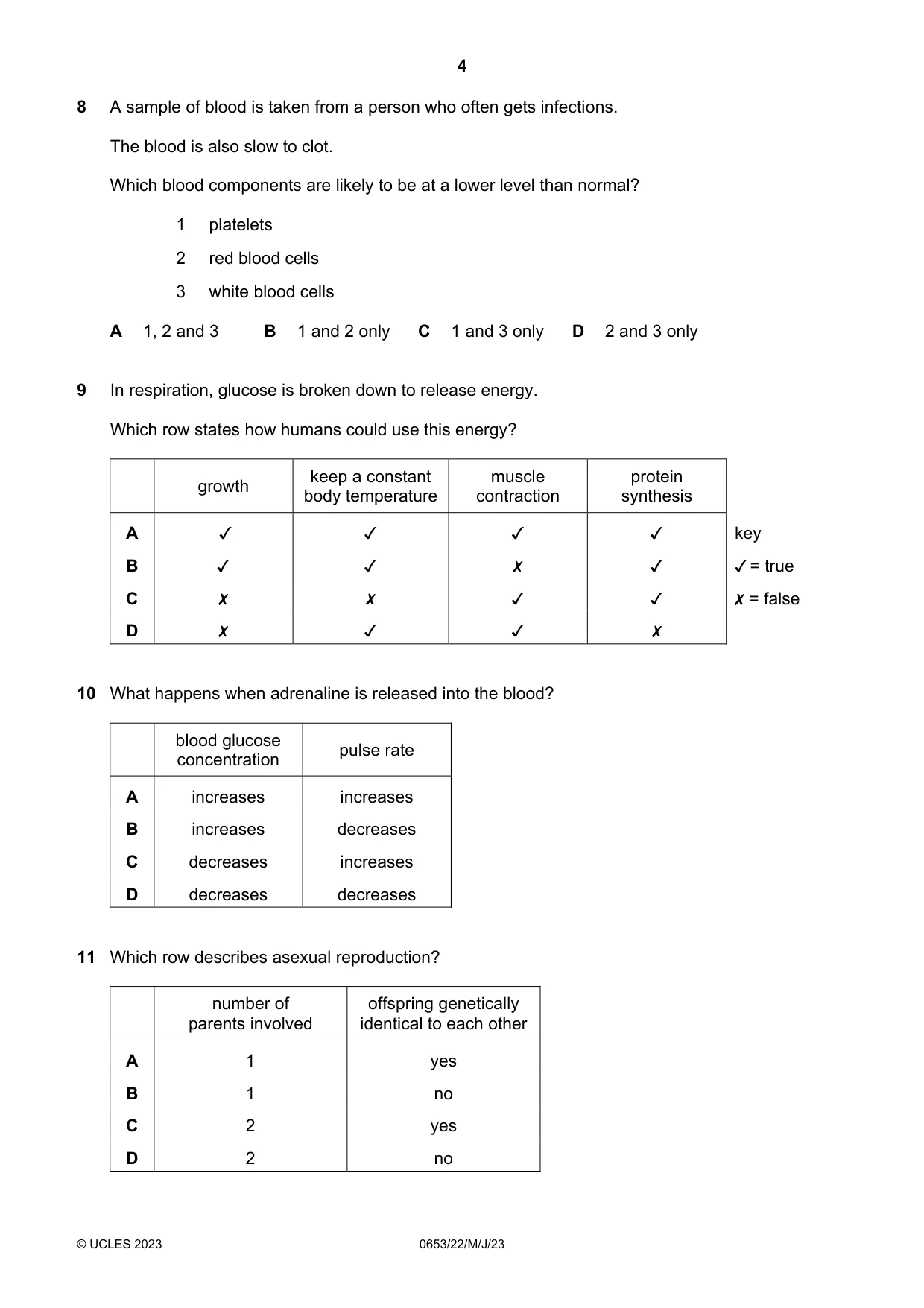
9 In respiration, glucose is broken down to release energy. Which row states how humans could use this energy? keep a constant body temperature muscle contraction protein synthesis key / = true X = false
Mark scheme: A
Q10 · What happens when adrenaline is released into the blood?
10 What happens when adrenaline is released into the blood? blood glucose pulse rate concentration A increases increases B increases decreases C decreases increases D decreases decreases
Mark scheme: A
Q11 · Which row describes asexual reproduction?
11 Which row describes asexual reproduction? number of offspring genetically parents involved identical to each other A 1 yes B 1 no C 2 yes D 2 no
Mark scheme: A
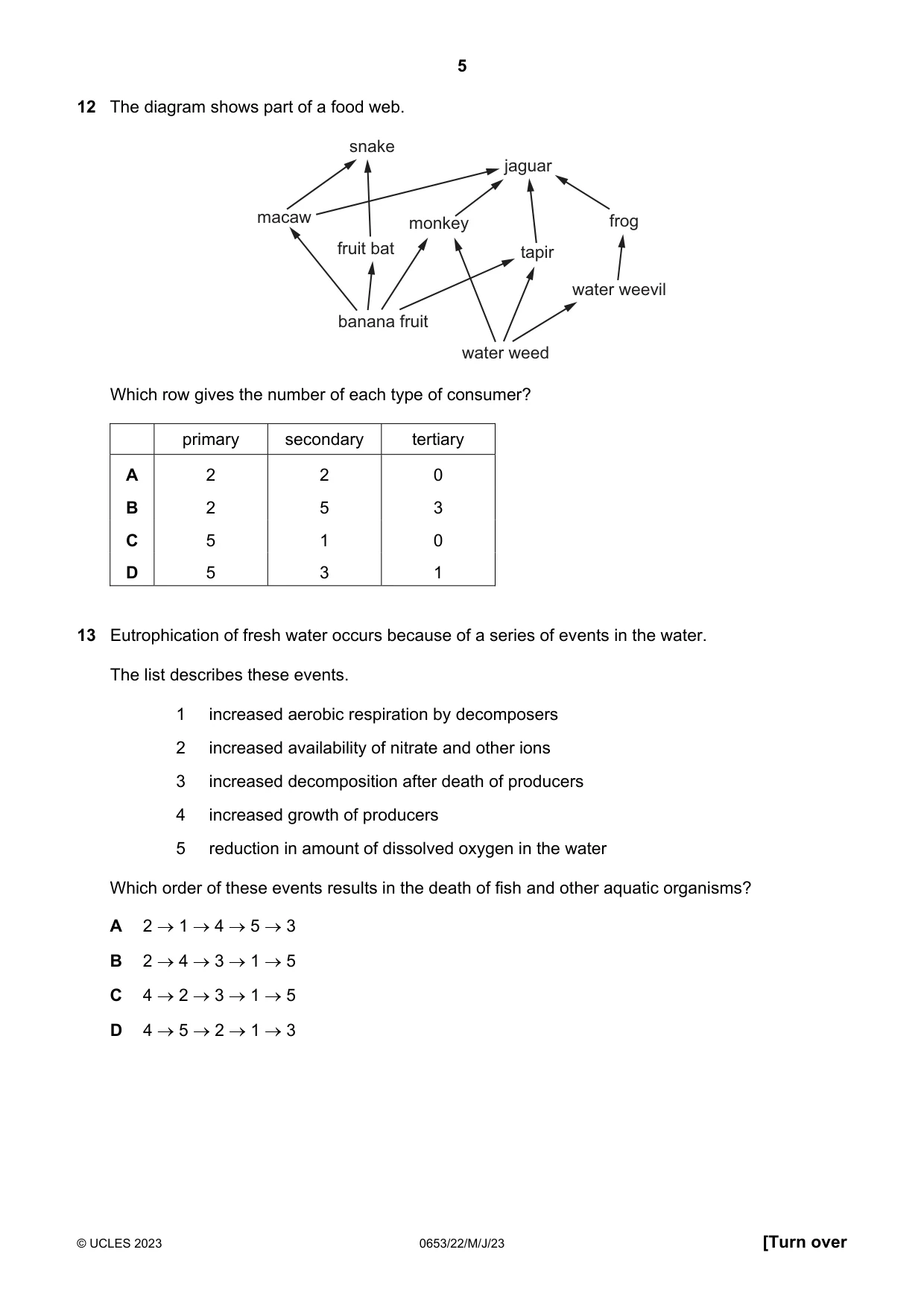
Q12 · The diagram shows part of a food web
12 The diagram shows part of a food web. snake jaguar macaw monkey frog fruit bat tapir water weevil banana fruit water weed Which row gives the number of each type of consumer? primary secondary tertiary A 2 2 0 B 2 5 3 C 5 1 0 D 5 3 1
Mark scheme: D
Q13 · Eutrophication of fresh water occurs because of a series of events in the water
13 Eutrophication of fresh water occurs because of a series of events in the water. The list describes these events. 1 increased aerobic respiration by decomposers 2 increased availability of nitrate and other ions 3 increased decomposition after death of producers 4 increased growth of producers 5 reduction in amount of dissolved oxygen in the water Which order of these events results in the death of fish and other aquatic organisms? A 2 1 4 5 3 B 2 4 3 1 5 C 4 2 3 1 5 D 4 5 2 1 3
Mark scheme: B
Q14 · The formulae of three substances are shown
14 The formulae of three substances are shown. substance formula methane CH4 water H2O oxygen O2 Which statement is correct? A Methane is made from five different types of atom. B Methane, water and oxygen are molecules. C Only methane and water are molecules. D Oxygen is made from two different types of atom.
Mark scheme: B
Q15 · What is the definition of nucleon number?
15 What is the definition of nucleon number? A the number of protons in an atom B the number of electrons in an atom C the total number of electrons and neutrons in an atom D the total number of neutrons and protons in an atom
Mark scheme: D
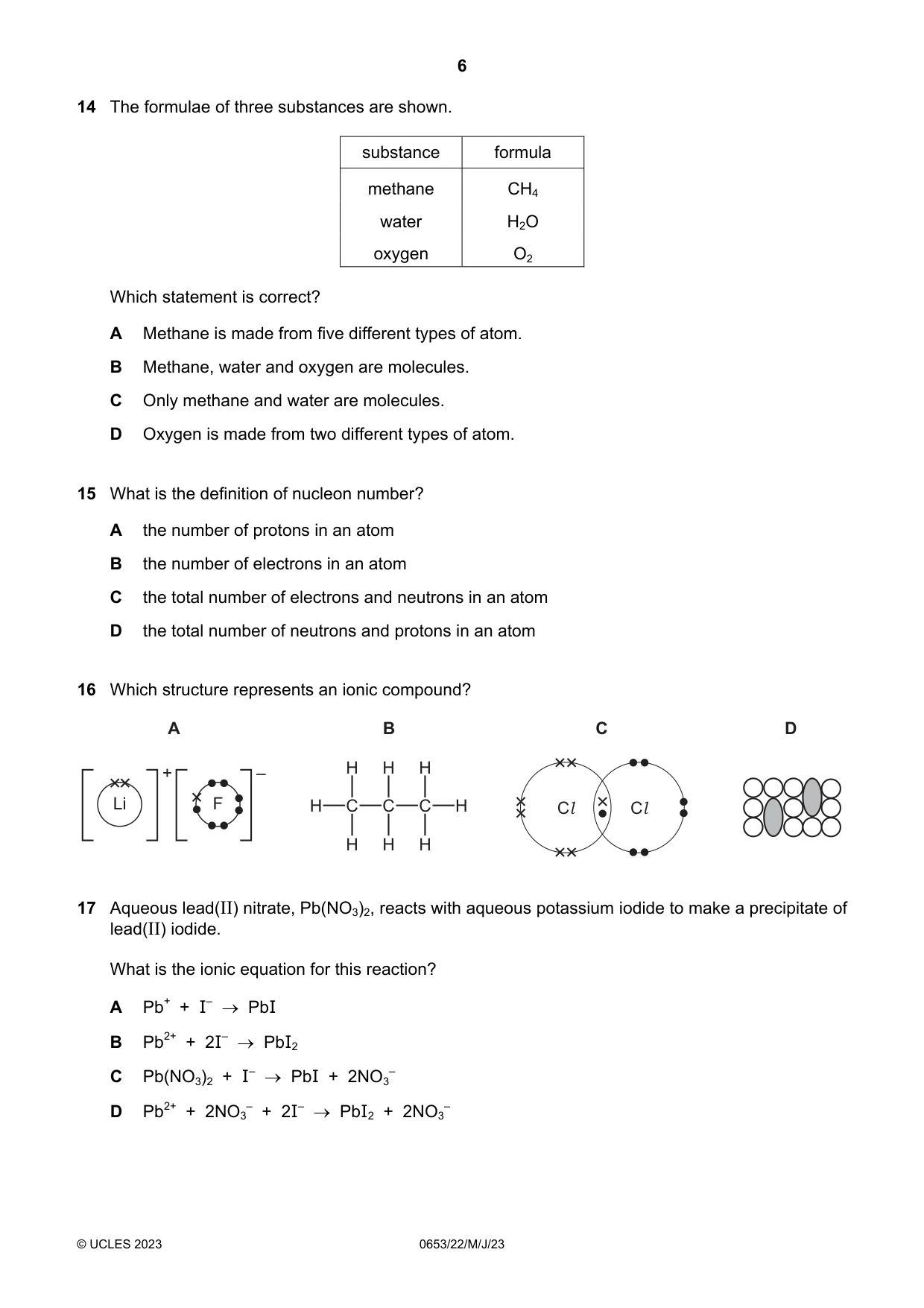
Q16 · Which structure represents an ionic compound?
16 Which structure represents an ionic compound? A B C D + – H H H Li F H C C C H Cl Cl H H H
Mark scheme: A
Q17 · Aqueous lead(II) nitrate, Pb(NO3)2, reacts with aqueous potassium iodide to make a…
17 Aqueous lead(II) nitrate, Pb(NO3)2, reacts with aqueous potassium iodide to make a precipitate of lead(II) iodide. What is the ionic equation for this reaction? A Pb+ + I– PbI B Pb2+ + 2I– PbI2 C Pb(NO3)2 + I– PbI + 2NO3 – D Pb2+ + 2NO3 – + 2I– PbI2 + 2NO3 –
Mark scheme: B
Q18 · Which statement about the electrolysis of ionic substances is correct?
18 Which statement about the electrolysis of ionic substances is correct? A Negatively charged ions move to the cathode. B At the anode, ions lose electrons. C The anions gain electrons during electrolysis. D The cations are negatively charged.
Mark scheme: B
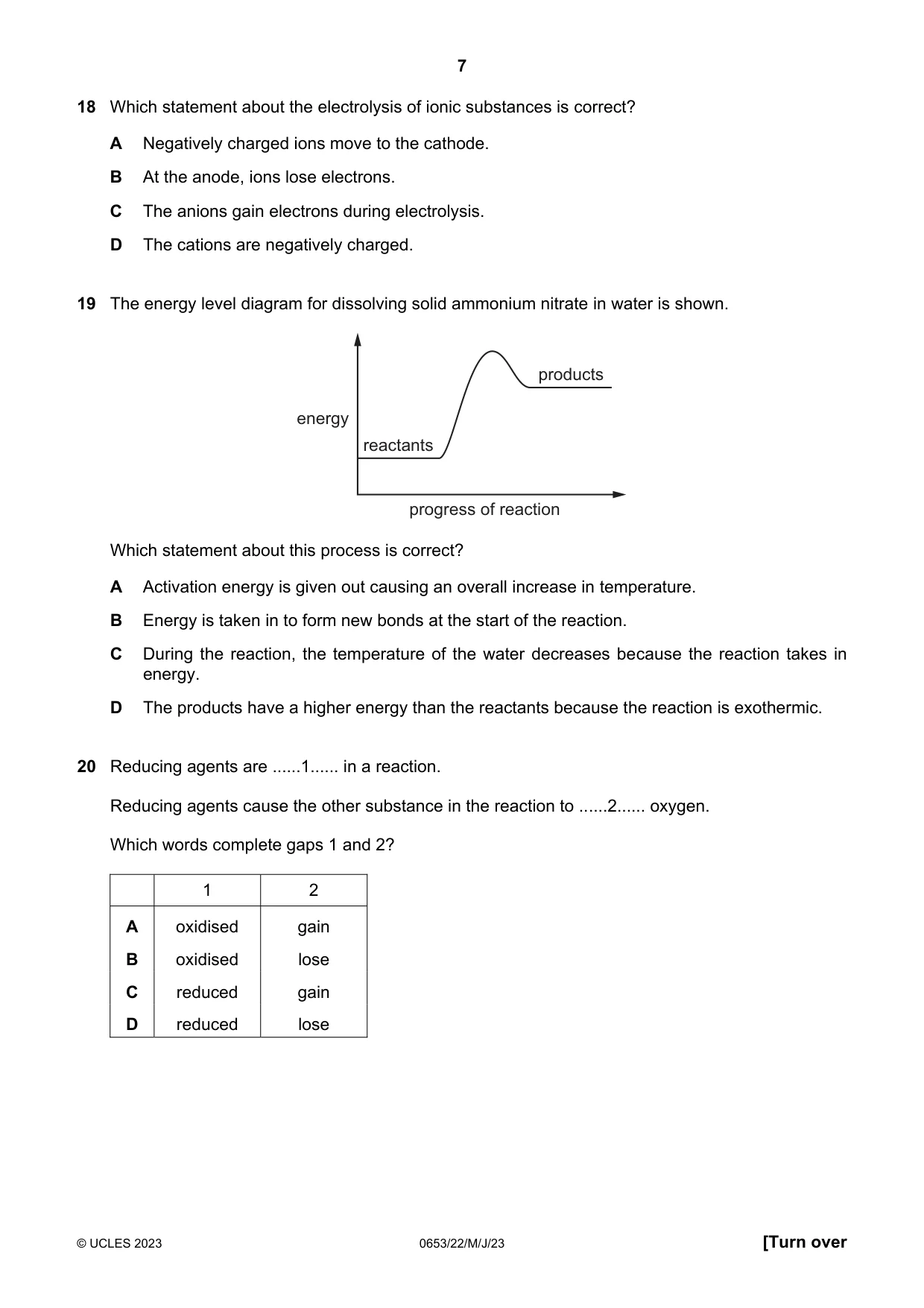
Q19 · The energy level diagram for dissolving solid ammonium nitrate in water is shown
19 The energy level diagram for dissolving solid ammonium nitrate in water is shown. products energy reactants progress of reaction Which statement about this process is correct? A Activation energy is given out causing an overall increase in temperature. B Energy is taken in to form new bonds at the start of the reaction. C During the reaction, the temperature of the water decreases because the reaction takes in energy. D The products have a higher energy than the reactants because the reaction is exothermic.
Mark scheme: C
Q20 · Reducing agents are ......1.....
20 Reducing agents are ......1...... in a reaction. Reducing agents cause the other substance in the reaction to ......2...... oxygen. Which words complete gaps 1 and 2? 1 2 A oxidised gain B oxidised lose C reduced gain D reduced lose
Mark scheme: B
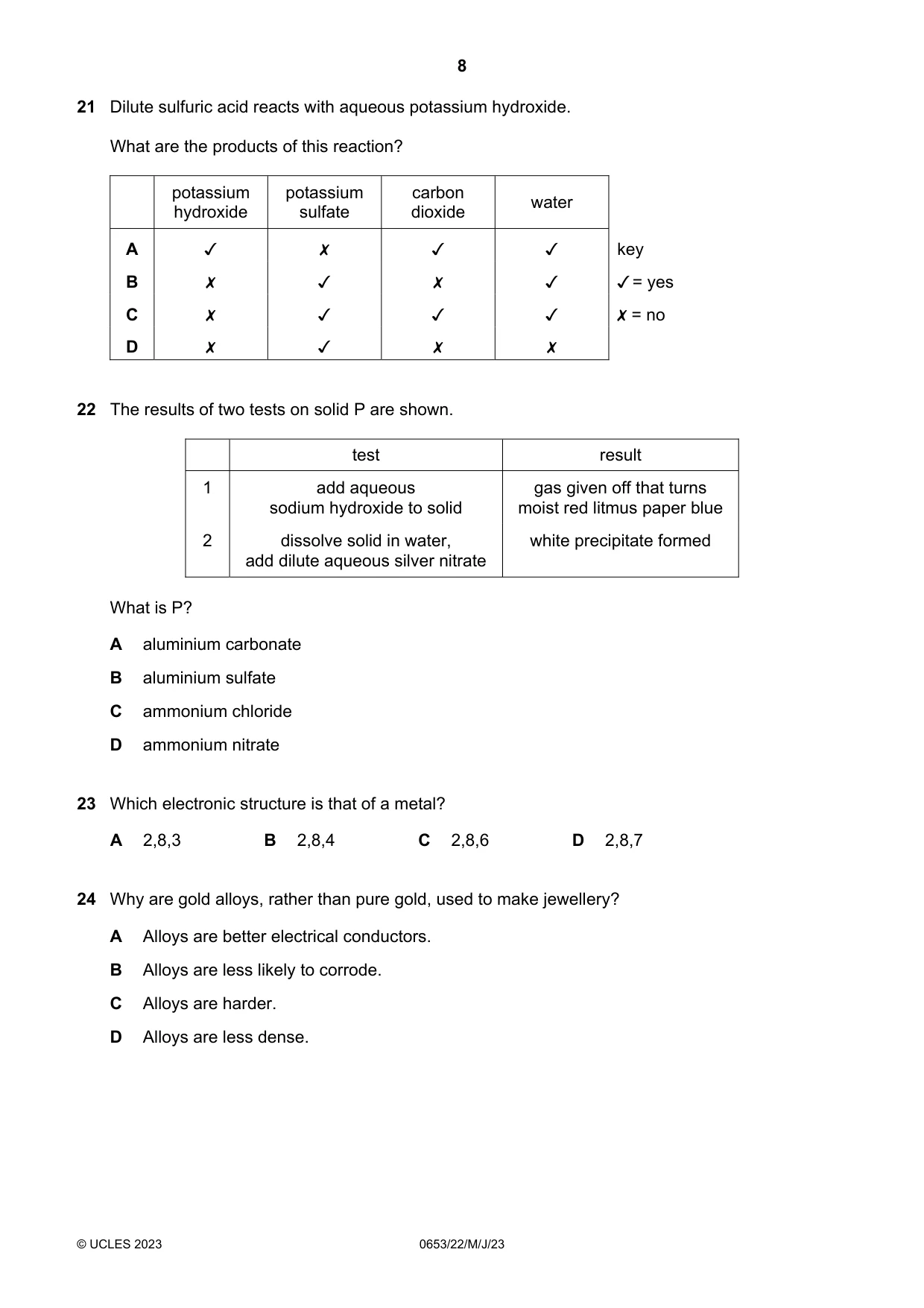
Q21 · Dilute sulfuric acid reacts with aqueous potassium hydroxide
21 Dilute sulfuric acid reacts with aqueous potassium hydroxide. What are the products of this reaction? potassium potassium carbon water hydroxide sulfate dioxide A Jv x v v B x Jv x v Cc x v v Jv D x v x x key /=yes X =no
Mark scheme: B
More questions on The characteristic properties of acids and bases
Q22 · The results of two tests on solid P are shown
22 The results of two tests on solid P are shown. test result 1 add aqueous gas given off that turns sodium hydroxide to solid moist red litmus paper blue 2 dissolve solid in water, white precipitate formed add dilute aqueous silver nitrate What is P? A aluminium carbonate B aluminium sulfate C ammonium chloride D ammonium nitrate
Mark scheme: C
Q23 · Which electronic structure is that of a metal?
23 Which electronic structure is that of a metal? A 2,8,3 B 2,8,4 C 2,8,6 D 2,8,7
Mark scheme: A
Q24 · Why are gold alloys, rather than pure gold, used to make jewellery?
24 Why are gold alloys, rather than pure gold, used to make jewellery? A Alloys are better electrical conductors. B Alloys are less likely to corrode. C Alloys are harder. D Alloys are less dense.
Mark scheme: C
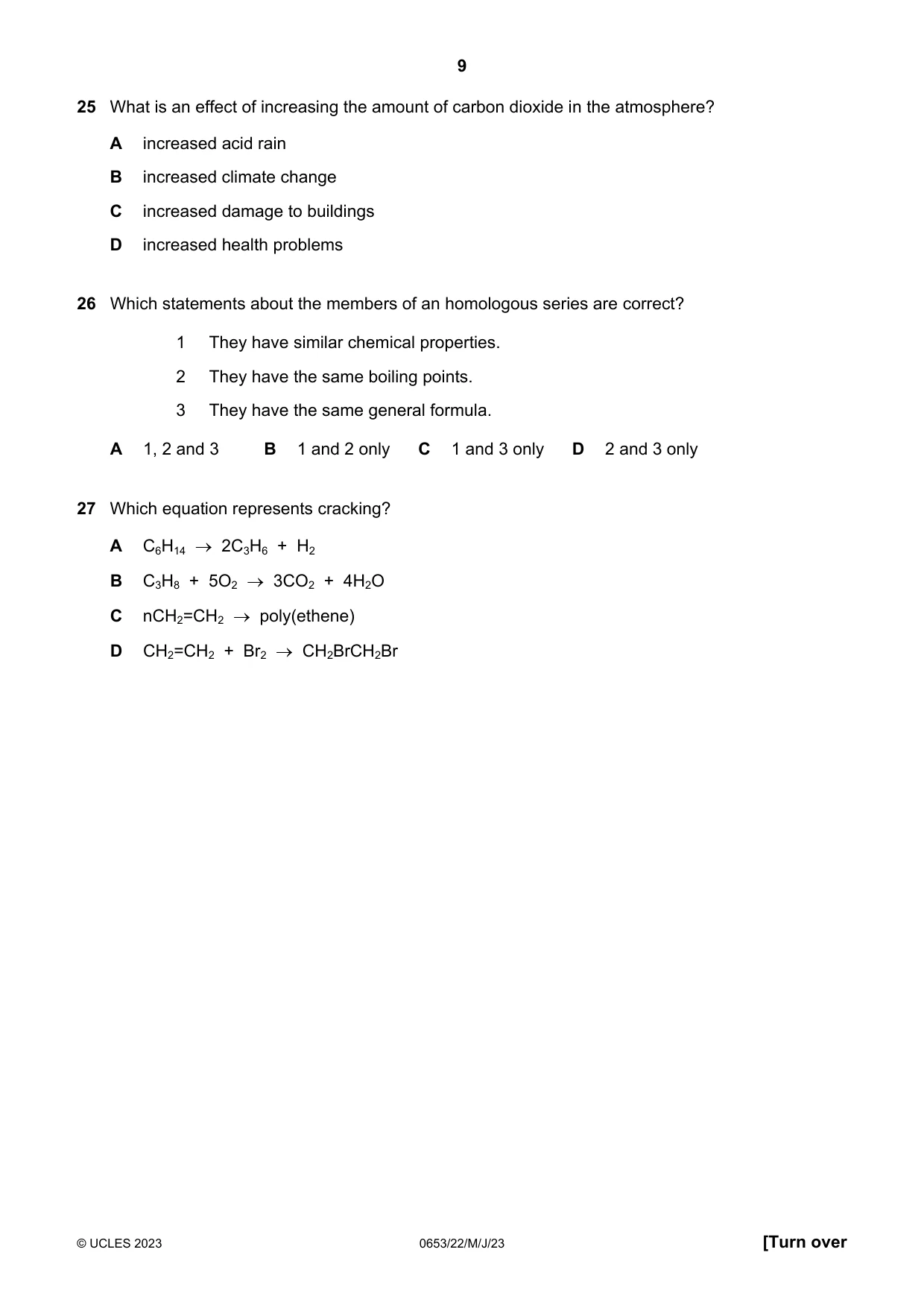
Q25 · What is an effect of increasing the amount of carbon dioxide in the atmosphere?
25 What is an effect of increasing the amount of carbon dioxide in the atmosphere? A increased acid rain B increased climate change C increased damage to buildings D increased health problems
Mark scheme: B
Q26 · Which statements about the members of an homologous series are correct?
26 Which statements about the members of an homologous series are correct? 1 They have similar chemical properties. 2 They have the same boiling points. 3 They have the same general formula. A 1, 2 and 3 B 1 and 2 only C 1 and 3 only D 2 and 3 only
Mark scheme: C
Q27 · Which equation represents cracking?
27 Which equation represents cracking? A C6H14 2C3H6 + H2 B C3H8 + 5O2 3CO2 + 4H2O C nCH2=CH2 poly(ethene) D CH2=CH2 + Br2 CH2BrCH2Br
Mark scheme: A
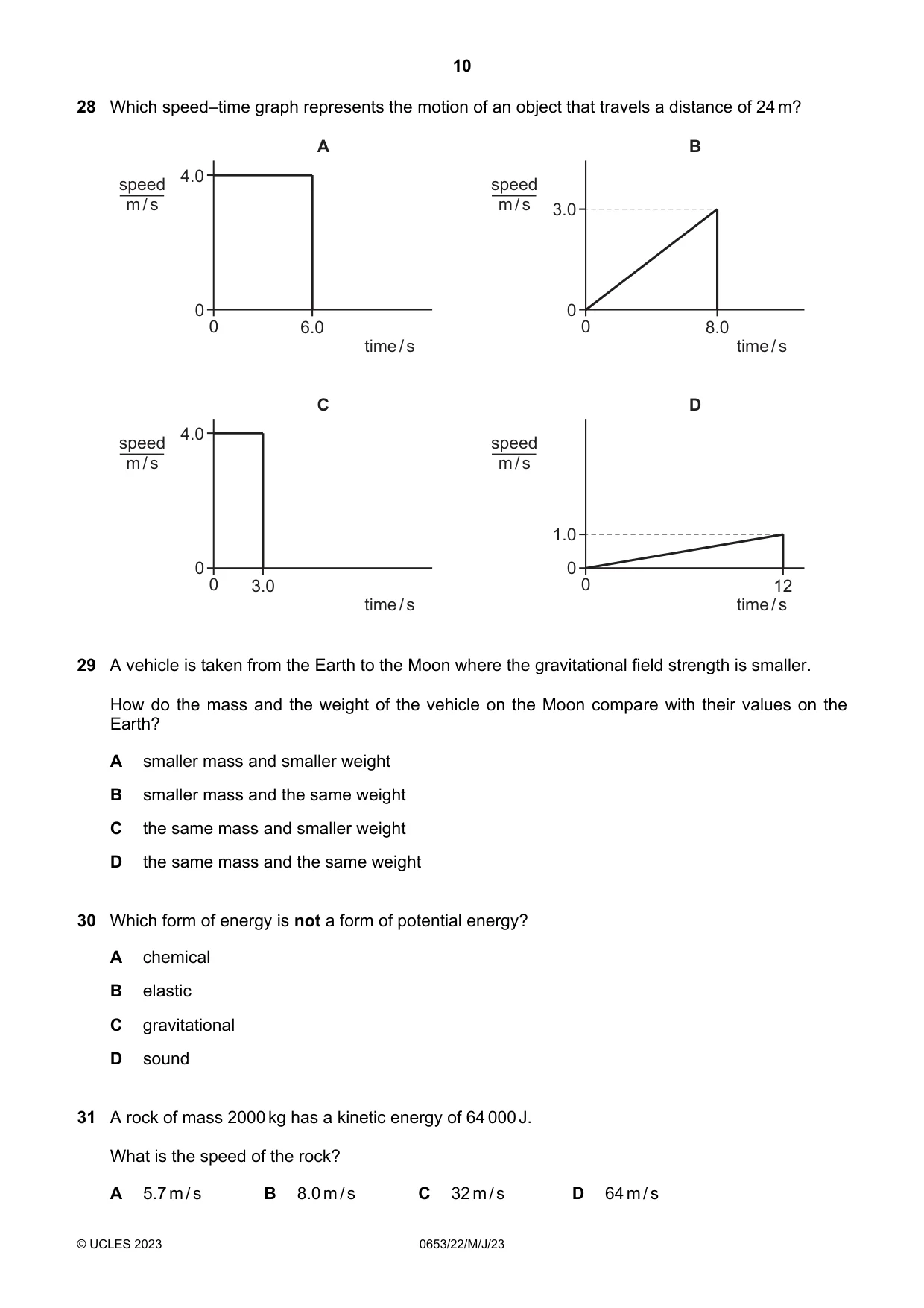
Q28 · Which speed–time graph represents the motion of an object that travels a distance of 24 m?
28 Which speed–time graph represents the motion of an object that travels a distance of 24 m? A B 4.0 speed speed m / s m / s 3.0 0 0 0 6.0 0 8.0 time / s time / s C D 4.0 speed speed m / s m / s 1.0 0 0 0 3.0 0 12 time / s time / s
Mark scheme: A
Q29 · A vehicle is taken from the Earth to the Moon where the gravitational field strength is…
29 A vehicle is taken from the Earth to the Moon where the gravitational field strength is smaller. How do the mass and the weight of the vehicle on the Moon compare with their values on the Earth? A smaller mass and smaller weight B smaller mass and the same weight C the same mass and smaller weight D the same mass and the same weight
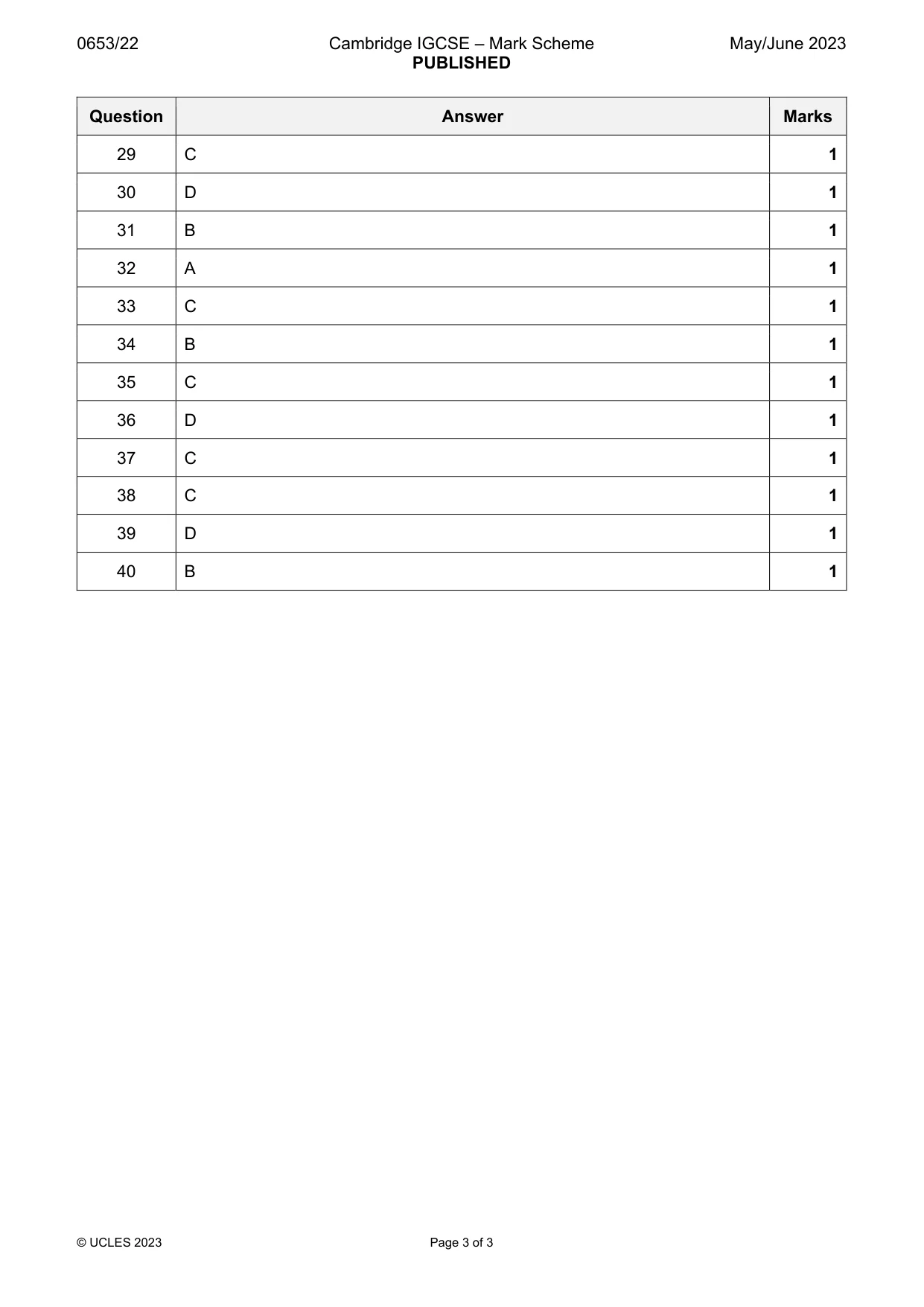
Mark scheme: C
Q30 · Which form of energy is not a form of potential energy?
30 Which form of energy is not a form of potential energy? A chemical B elastic C gravitational D sound
Mark scheme: D
Q31 · A rock of mass 2000 kg has a kinetic energy of 64 000 J
31 A rock of mass 2000 kg has a kinetic energy of 64 000 J. What is the speed of the rock? A 5.7 m / s B 8.0 m / s C 32 m / s D 64 m / s
Mark scheme: B
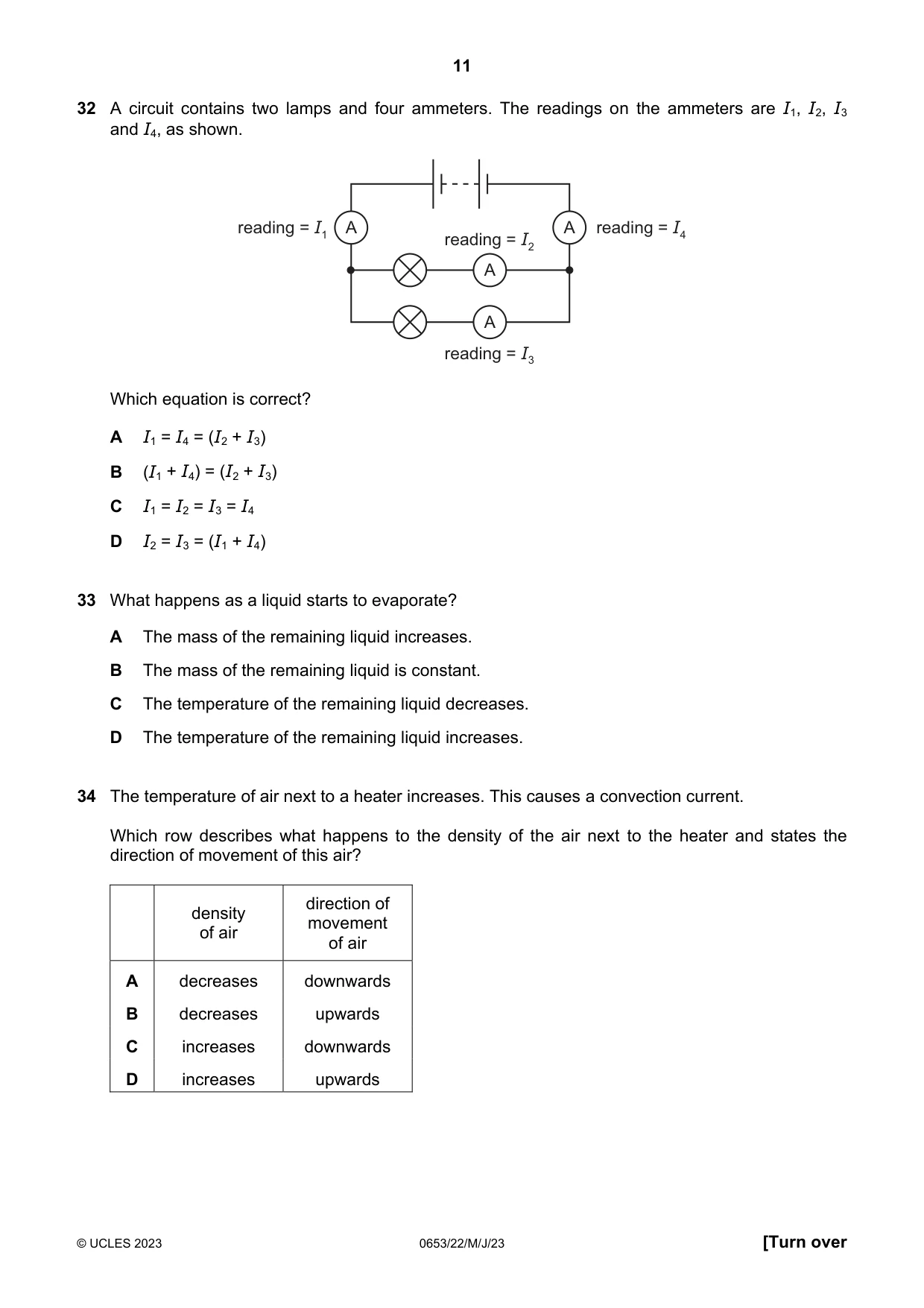
Q32 · A circuit contains two lamps and four ammeters
32 A circuit contains two lamps and four ammeters. The readings on the ammeters are I1, I2, I3 and I4, as shown. reading = I1 A A reading = I4 reading = I2 A A reading = I3 Which equation is correct? A I1 = I4 = (I2 + I3) B (I1 + I4) = (I2 + I3) C I1 = I2 = I3 = I4 D I2 = I3 = (I1 + I4)
Mark scheme: A
Q33 · What happens as a liquid starts to evaporate?
33 What happens as a liquid starts to evaporate? A The mass of the remaining liquid increases. B The mass of the remaining liquid is constant. C The temperature of the remaining liquid decreases. D The temperature of the remaining liquid increases.
Mark scheme: C
Q34 · The temperature of air next to a heater increases
34 The temperature of air next to a heater increases. This causes a convection current. Which row describes what happens to the density of the air next to the heater and states the direction of movement of this air? direction of density movement of air of air A decreases downwards B decreases upwards C increases downwards D increases upwards
Mark scheme: B
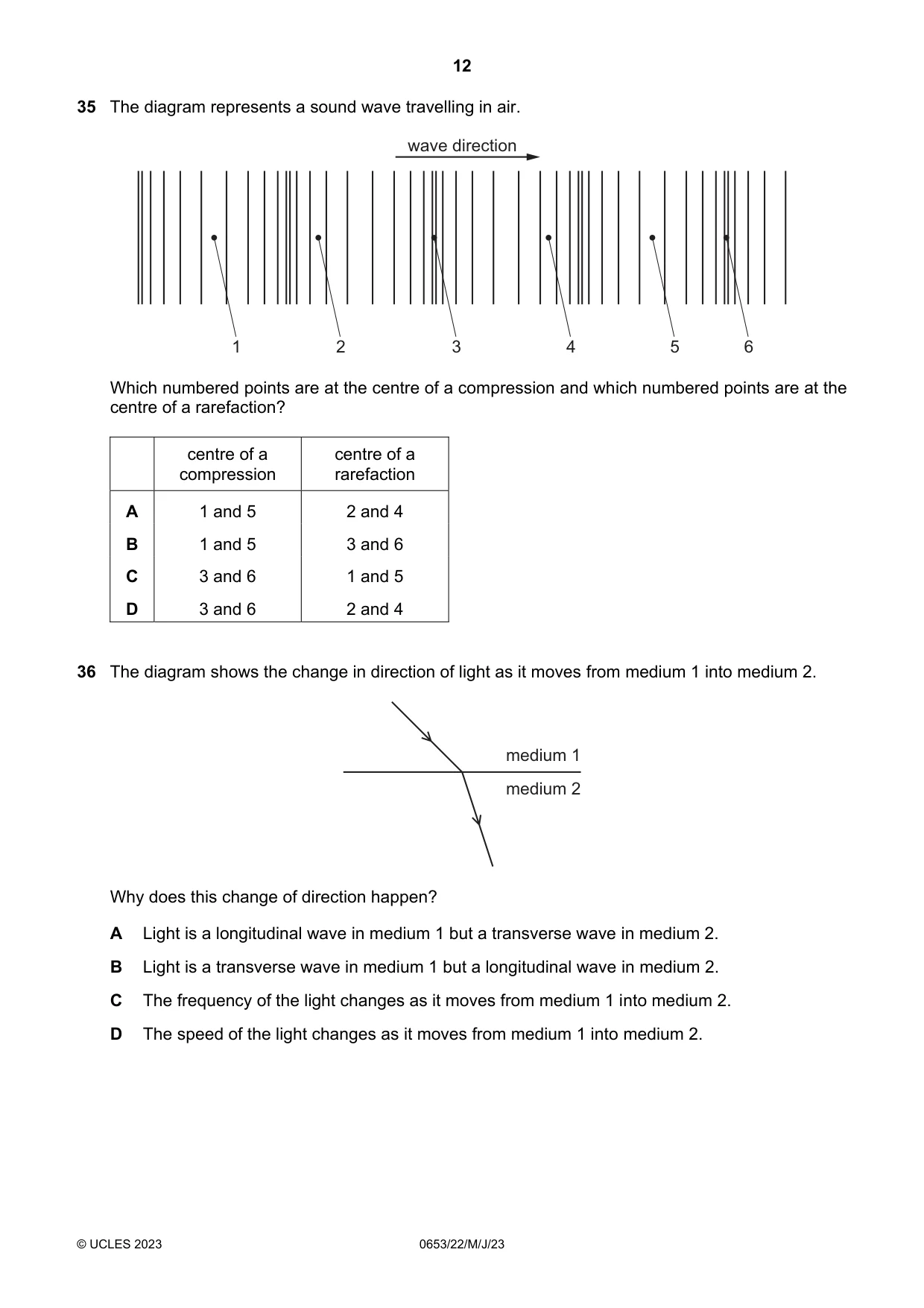
Q35 · The diagram represents a sound wave travelling in air
35 The diagram represents a sound wave travelling in air. wave direction 1 2 3 4 5 6 Which numbered points are at the centre of a compression and which numbered points are at the centre of a rarefaction? centre of a centre of a compression rarefaction A 1 and 5 2 and 4 B 1 and 5 3 and 6 C 3 and 6 1 and 5 D 3 and 6 2 and 4
Mark scheme: C
Q36 · The diagram shows the change in direction of light as it moves from medium 1 into medium 2
36 The diagram shows the change in direction of light as it moves from medium 1 into medium 2. medium 1 medium 2 Why does this change of direction happen? A Light is a longitudinal wave in medium 1 but a transverse wave in medium 2. B Light is a transverse wave in medium 1 but a longitudinal wave in medium 2. C The frequency of the light changes as it moves from medium 1 into medium 2. D The speed of the light changes as it moves from medium 1 into medium 2.
Mark scheme: D
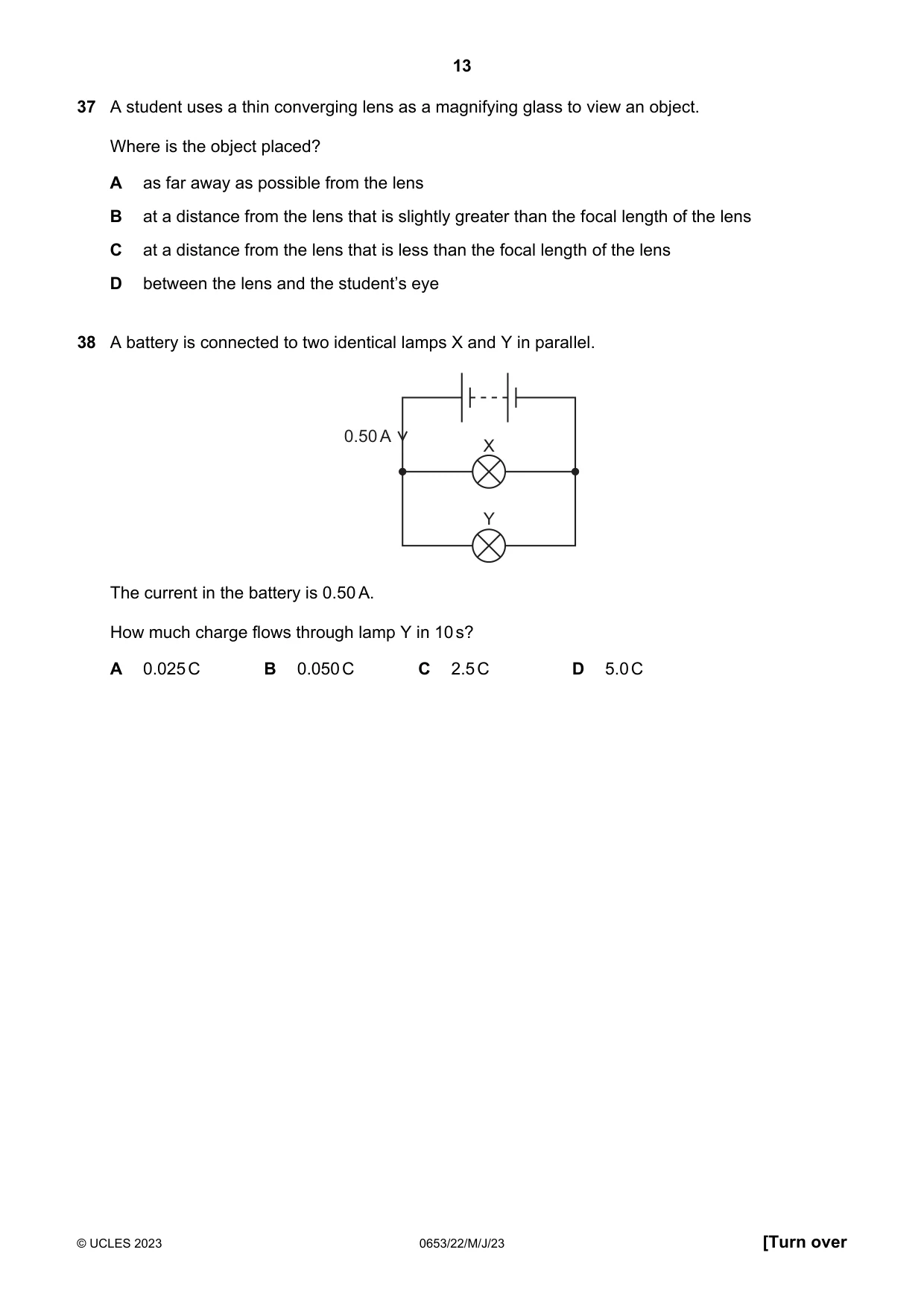
Q37 · A student uses a thin converging lens as a magnifying glass to view an object
37 A student uses a thin converging lens as a magnifying glass to view an object. Where is the object placed? A as far away as possible from the lens B at a distance from the lens that is slightly greater than the focal length of the lens C at a distance from the lens that is less than the focal length of the lens D between the lens and the student’s eye
Mark scheme: C
Q38 · A battery is connected to two identical lamps X and Y in parallel
38 A battery is connected to two identical lamps X and Y in parallel. 0.50 A X Y The current in the battery is 0.50 A. How much charge flows through lamp Y in 10 s? A 0.025 C B 0.050 C C 2.5 C D 5.0 C
Mark scheme: C
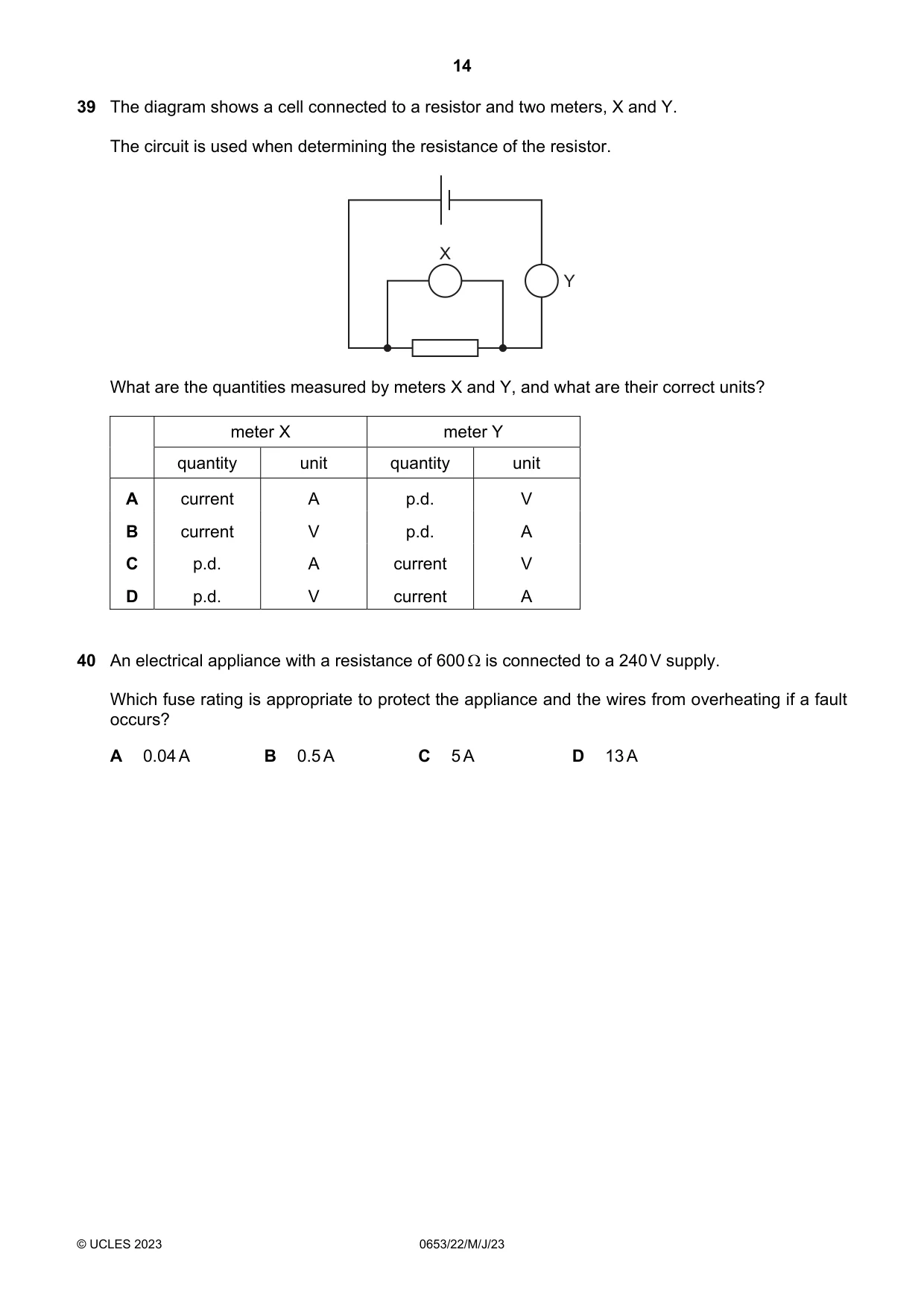
Q39 · The diagram shows a cell connected to a resistor and two meters, X and Y
39 The diagram shows a cell connected to a resistor and two meters, X and Y. The circuit is used when determining the resistance of the resistor. X Y What are the quantities measured by meters X and Y, and what are their correct units? meter X meter Y quantity unit quantity unit A current A p.d. V B current V p.d. A C p.d. A current V D p.d. V current A
Mark scheme: D
Q40 · An electrical appliance with a resistance of 600 is connected to a 240 V supply
40 An electrical appliance with a resistance of 600 is connected to a 240 V supply. Which fuse rating is appropriate to protect the appliance and the wires from overheating if a fault occurs? A 0.04 A B 0.5 A C 5 A D 13 A
Mark scheme: B
What was in this paper
The subtopics covered by these 40 questions, and how many questions each got. Open one in a new tab to see every Cambridge question on it.
2Energy, work and power2Light2Air quality and climate1Alkenes1Alloys and their properties1Arrangement of elements1Atomic structure and the Periodic Table1Blood1Cell structure1Characteristics of living organisms1Diet1Digestive system1Drugs1Electrical circuits1Electrical safety1Electrolysis1Energy flow1Enzymes1Exothermic and endothermic reactions1Food chains and food webs1Formulas1Identification of ions and gases1Ions and ionic bonds1Kinetic particle model of matter1Mass and weight1Motion1Photosynthesis1Redox1Respiration1Sexual reproduction in plants1Simple molecules and covalent bonds1Sound1Terminology1The characteristic properties of acids and bases1Transfer of thermal energy1Transpiration1What you needed in this session
Cambridge’s own grade thresholds for 2023 May/June, Paper 2 · Variant 2. A higher threshold means an easier paper — the bar moves with how the cohort did.