Cambridge IGCSE Science - Combined 0653 — 2024 Feb/March Paper 2 · Variant 2
0653/22/F/M/24 · 40 questions · 40 marks · ≈45 min
The question paper and its mark scheme, free to read here and free to download. This is Cambridge’s own paper, exactly as it was sat.
Question paper16 pages

Mark scheme3 pages
Answers below. Sit the paper first if you are practising.
Questions as text
Q1 · A person moves their hand away from a hot object
1 A person moves their hand away from a hot object. Which characteristic of living organisms is this? A growth B nutrition C reproduction D sensitivity
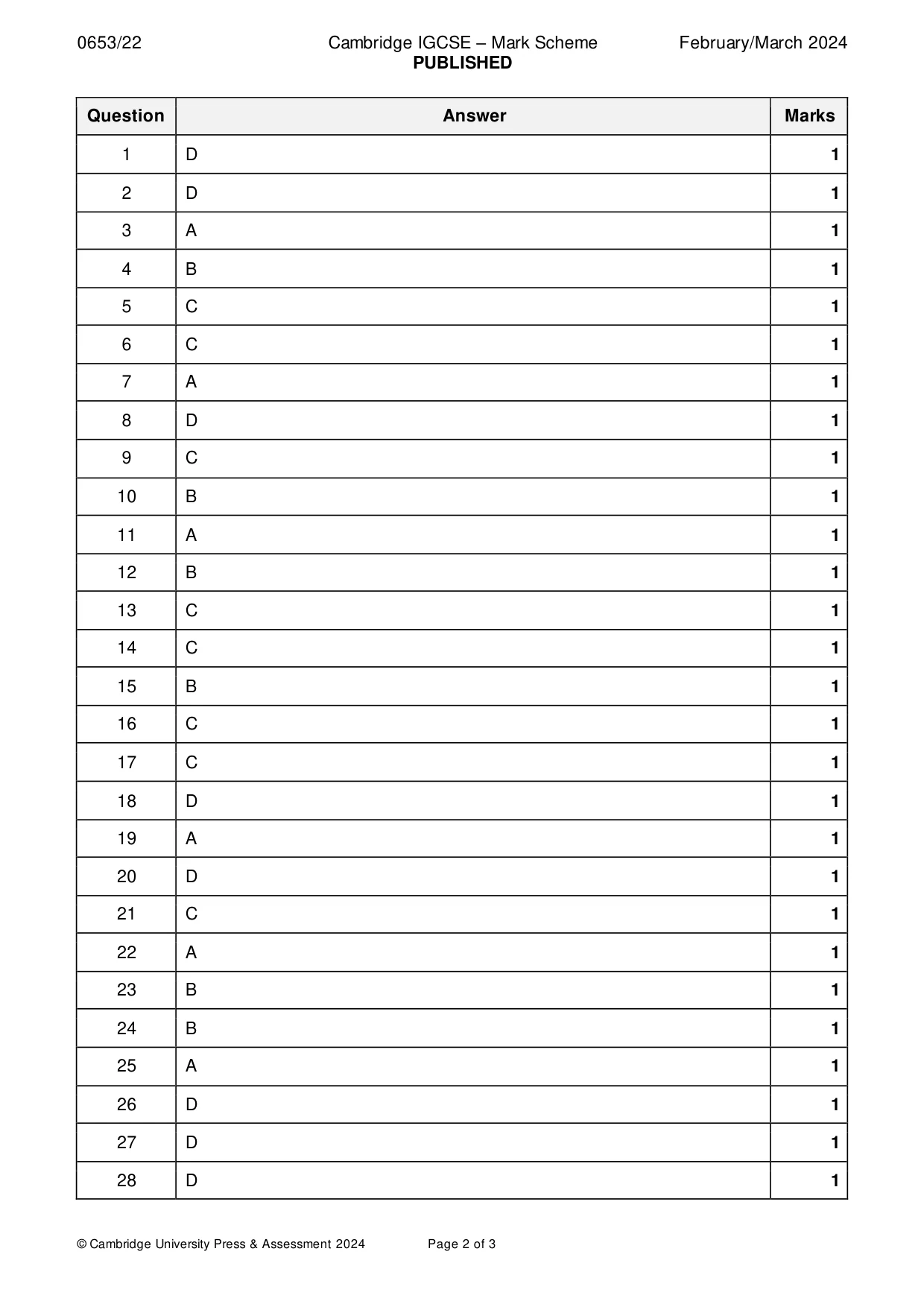
Mark scheme: D
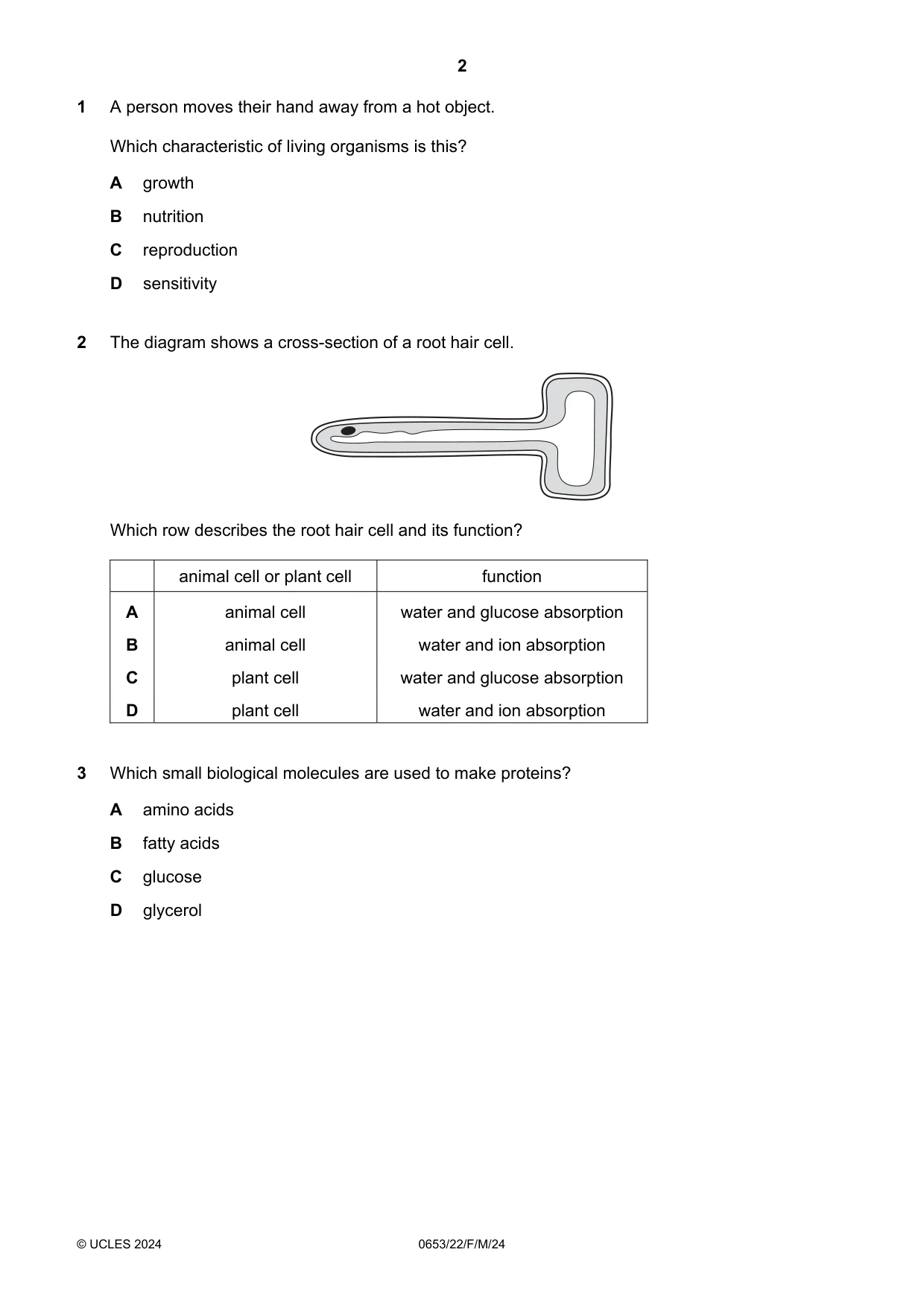
Q2 · The diagram shows a cross-section of a root hair cell
2 The diagram shows a cross-section of a root hair cell. Which row describes the root hair cell and its function? animal cell or plant cell function A animal cell water and glucose absorption B animal cell water and ion absorption C plant cell water and glucose absorption D plant cell water and ion absorption
Mark scheme: D
Q3 · Which small biological molecules are used to make proteins?
3 Which small biological molecules are used to make proteins? A amino acids B fatty acids C glucose D glycerol
Mark scheme: A
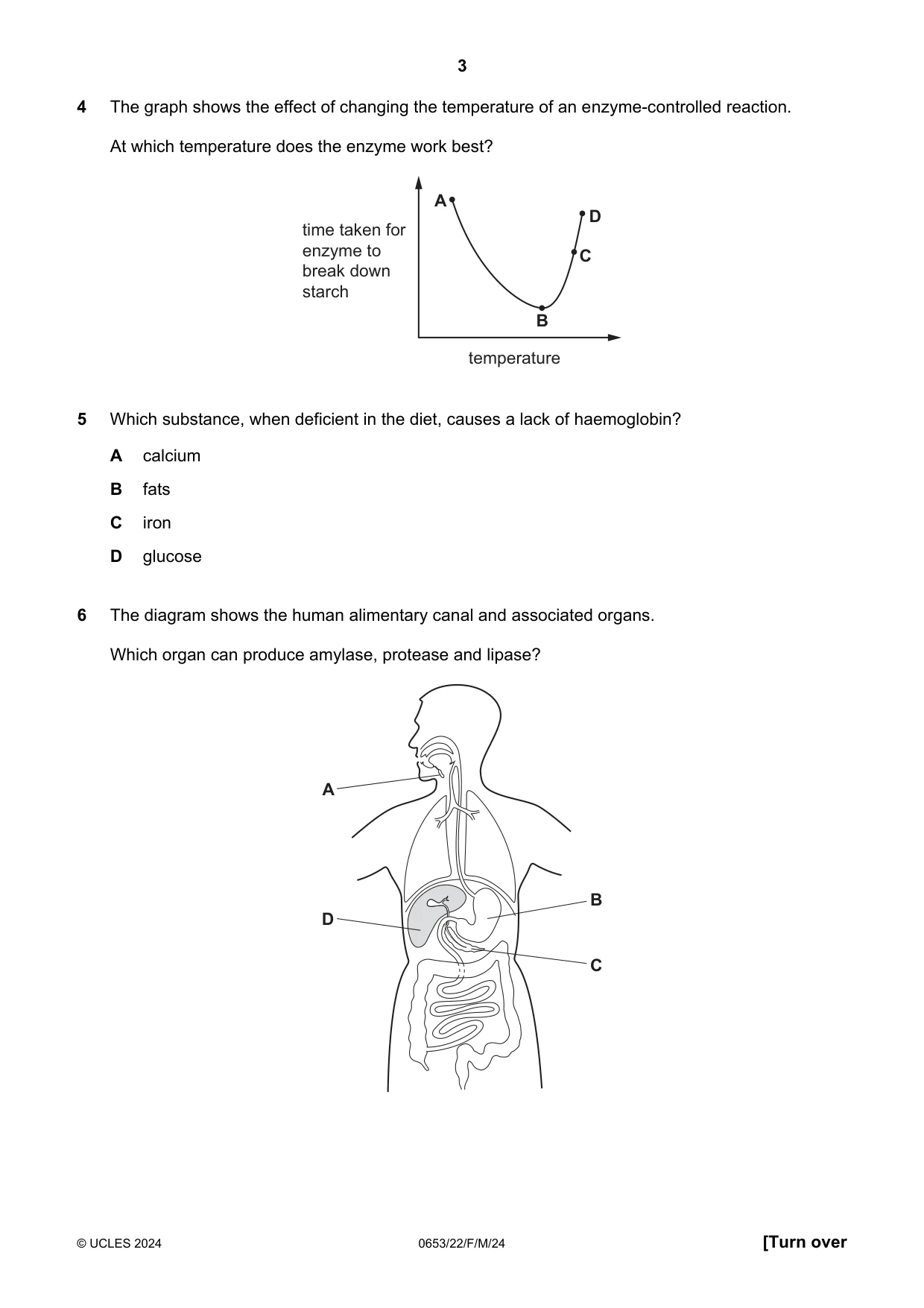
Q4 · The graph shows the effect of changing the temperature of an enzyme-controlled reaction
4 The graph shows the effect of changing the temperature of an enzyme-controlled reaction. At which temperature does the enzyme work best? A D time taken for enzyme to C break down starch B temperature
Mark scheme: B
Q5 · Which substance, when deficient in the diet, causes a lack of haemoglobin?
5 Which substance, when deficient in the diet, causes a lack of haemoglobin? A calcium B fats C iron D glucose
Mark scheme: C
Q6 · The diagram shows the human alimentary canal and associated organs
6 The diagram shows the human alimentary canal and associated organs. Which organ can produce amylase, protease and lipase? A B D C
Mark scheme: C
Q7 · Which statement is an advantage of a double circulation?
7 Which statement is an advantage of a double circulation? A It allows blood to be pumped to the body and the lungs at different pressures. B It allows blood to pass through the heart only once on each complete circuit of the body. C It ensures that the blood leaving the heart is always oxygenated. D It ensures that deoxygenated blood reaches the liver faster.
Mark scheme: A
Q8 · What is the correct balanced equation for aerobic respiration?
8 What is the correct balanced equation for aerobic respiration? A C6H12O6 + 2O2 4CO2 + 6H2O B C6H12O6 + 4O2 6CO2 + 4H2O C C6H12O6 + 6O2 6CO2 + 2H2O D C6H12O6 + 6O2 6CO2 + 6H2O
Mark scheme: D
Q9 · Which statements correctly describe tropic responses?
9 Which statements correctly describe tropic responses? 1 Gravitropism is the growth of a shoot toward the light. 2 Gravitropism is the growth of a root downwards. 3 Phototropism is the growth of a shoot toward the light. 4 Phototropism is the growth of a root downwards. A 1 and 2 B 1 and 4 C 2 and 3 D 3 and 4
Mark scheme: C
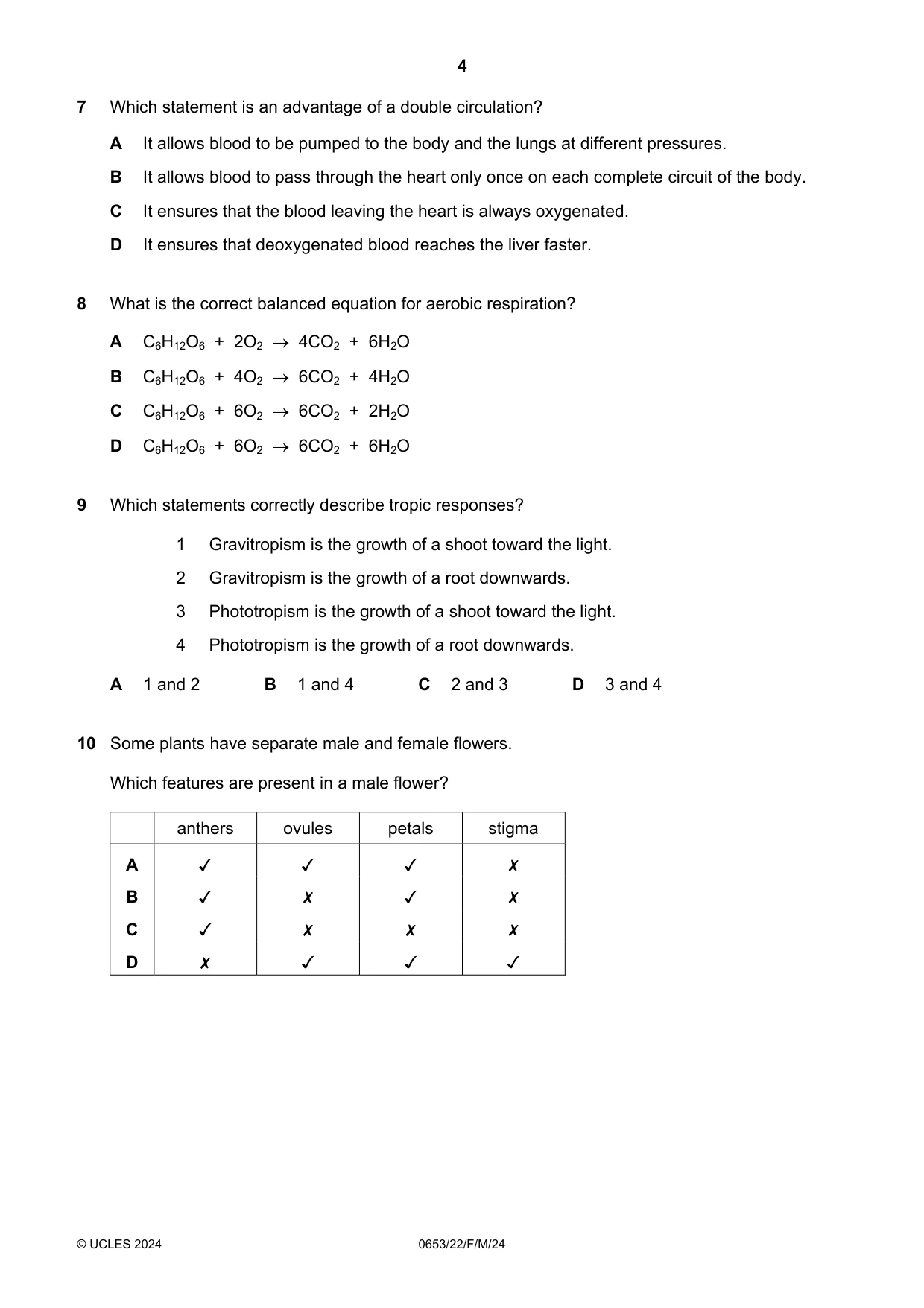
Q10 · Some plants have separate male and female flowers
10 Some plants have separate male and female flowers. Which features are present in a male flower? anthers ovules petals stigma A Jv v v x B Jv x Jv x Cc v x x x D x v v Jv
Mark scheme: B
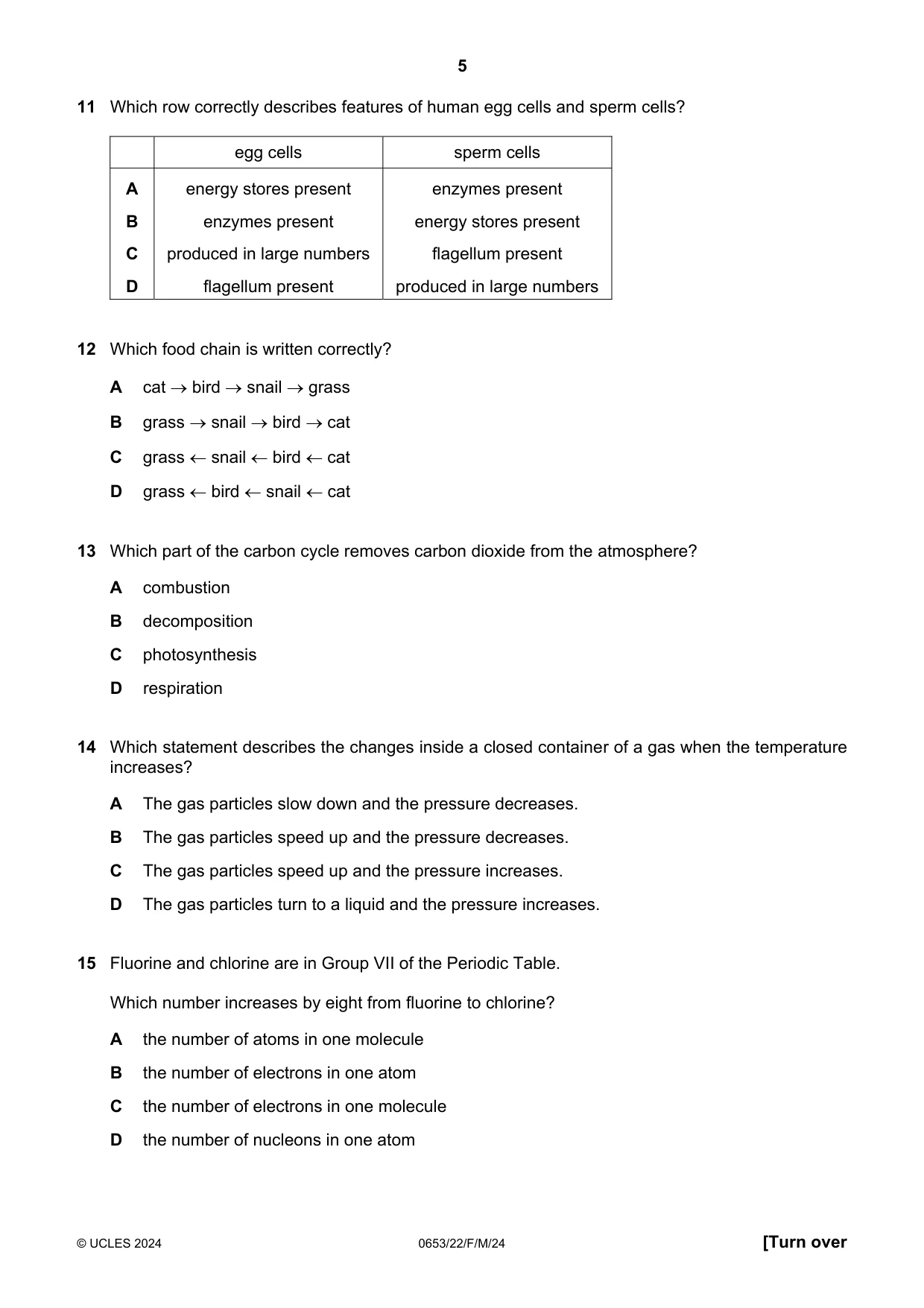
Q11 · Which row correctly describes features of human egg cells and sperm cells?
11 Which row correctly describes features of human egg cells and sperm cells? egg cells sperm cells A energy stores present enzymes present B enzymes present energy stores present C produced in large numbers flagellum present D flagellum present produced in large numbers
Mark scheme: A
Q12 · Which food chain is written correctly?
12 Which food chain is written correctly? A cat bird snail grass B grass snail bird cat C grass snail bird cat D grass bird snail cat
Mark scheme: B
Q13 · Which part of the carbon cycle removes carbon dioxide from the atmosphere?
13 Which part of the carbon cycle removes carbon dioxide from the atmosphere? A combustion B decomposition C photosynthesis D respiration
Mark scheme: C
Q14 · Which statement describes the changes inside a closed container of a gas when the…
14 Which statement describes the changes inside a closed container of a gas when the temperature increases? A The gas particles slow down and the pressure decreases. B The gas particles speed up and the pressure decreases. C The gas particles speed up and the pressure increases. D The gas particles turn to a liquid and the pressure increases.
Mark scheme: C
Q15 · Fluorine and chlorine are in Group VII of the Periodic Table
15 Fluorine and chlorine are in Group VII of the Periodic Table. Which number increases by eight from fluorine to chlorine? A the number of atoms in one molecule B the number of electrons in one atom C the number of electrons in one molecule D the number of nucleons in one atom
Mark scheme: B
Q16 · Which statement about the structure of solid sodium chloride is correct?
16 Which statement about the structure of solid sodium chloride is correct? A It contains chloride ions formed when chlorine atoms lose electrons. B It contains metallic atoms sharing electrons with non-metallic atoms. C Opposite electrical charges result in the formation of a giant ionic lattice. D There is strong electrostatic attraction between sodium atoms and chlorine atoms.
Mark scheme: C
Q17 · An ionic compound contains the ions NH4 + and S2O3 2–
17 An ionic compound contains the ions NH4 + and S2O3 2–. What is the formula of this compound? A NH4S2O3 B NH4(S2O3)2 C (NH4)2S2O3 D 2NH4S2O3
Mark scheme: C
Q18 · Which statement about the electrolysis of a molten metal halide is correct?
18 Which statement about the electrolysis of a molten metal halide is correct? A Cations move to the anode. B Electrons flow through the electrolyte. C Ions gain protons at the cathode. D Ions lose electrons at the anode.
Mark scheme: D
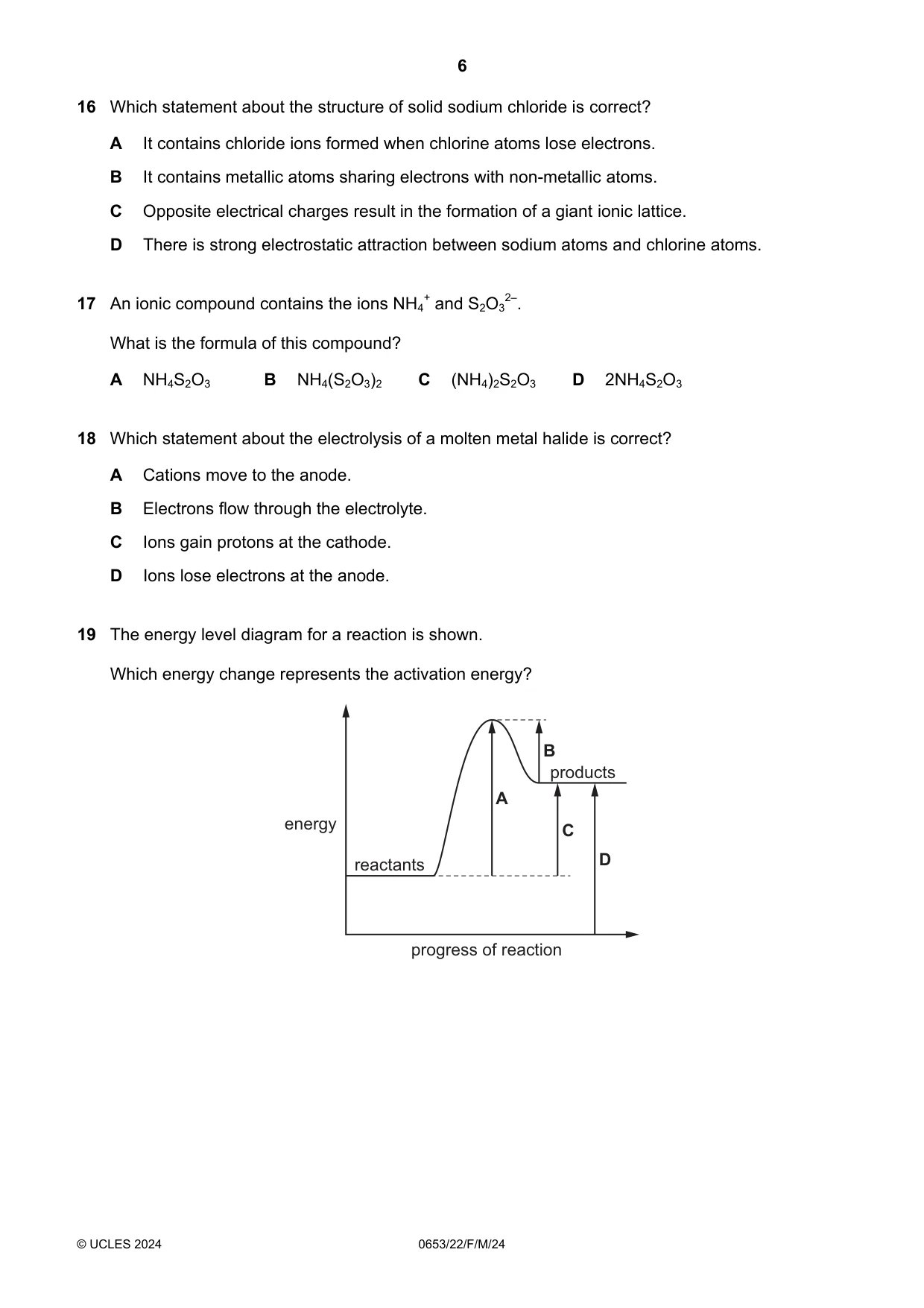
Q19 · The energy level diagram for a reaction is shown
19 The energy level diagram for a reaction is shown. Which energy change represents the activation energy? B products A energy C D reactants progress of reaction
Mark scheme: A
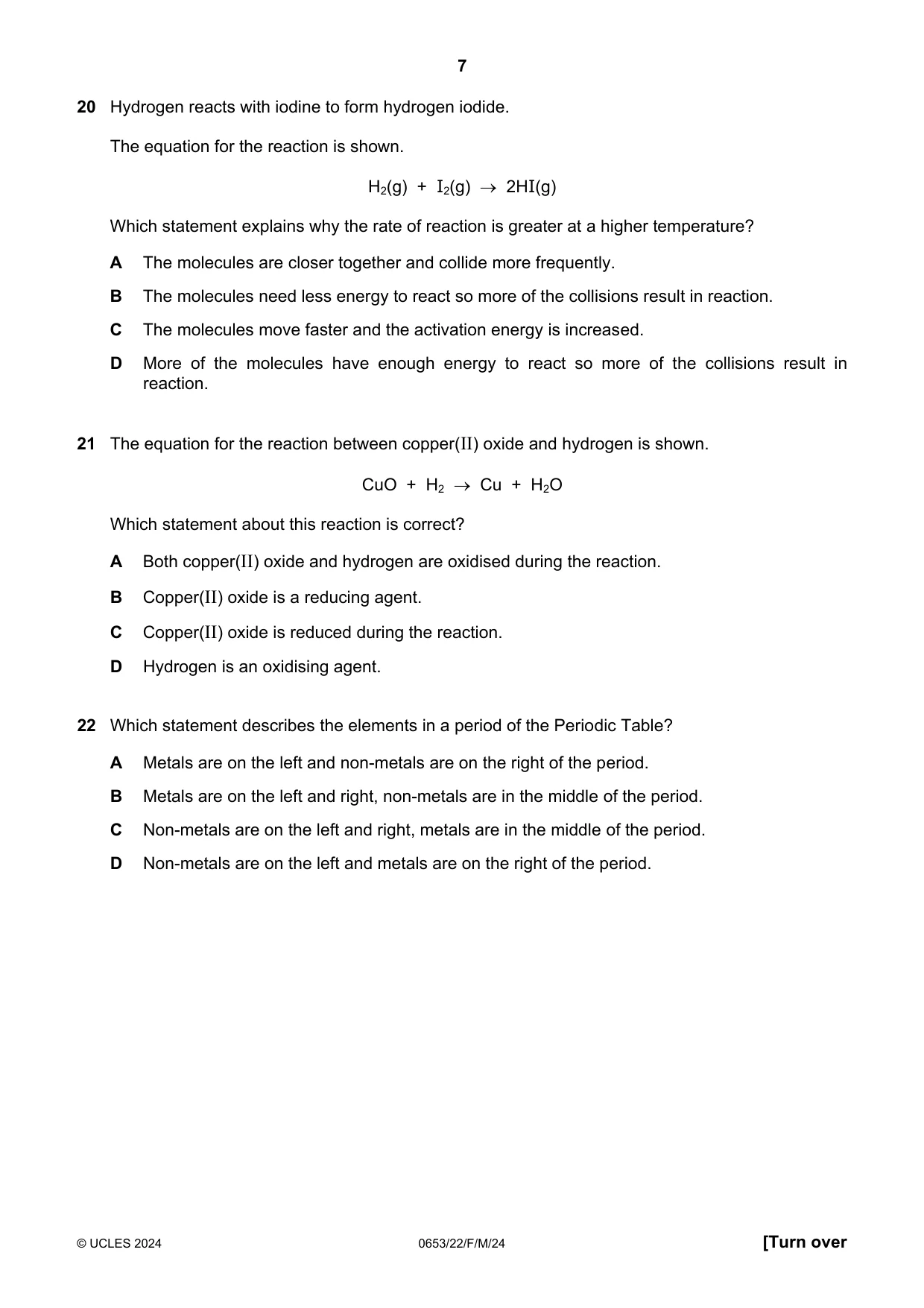
Q20 · Hydrogen reacts with iodine to form hydrogen iodide
20 Hydrogen reacts with iodine to form hydrogen iodide. The equation for the reaction is shown. H2(g) + I2(g) 2HI(g) Which statement explains why the rate of reaction is greater at a higher temperature? A The molecules are closer together and collide more frequently. B The molecules need less energy to react so more of the collisions result in reaction. C The molecules move faster and the activation energy is increased. D More of the molecules have enough energy to react so more of the collisions result in reaction.
Mark scheme: D
Q21 · The equation for the reaction between copper(II) oxide and hydrogen is shown
21 The equation for the reaction between copper(II) oxide and hydrogen is shown. CuO + H2 Cu + H2O Which statement about this reaction is correct? A Both copper(II) oxide and hydrogen are oxidised during the reaction. B Copper(II) oxide is a reducing agent. C Copper(II) oxide is reduced during the reaction. D Hydrogen is an oxidising agent.
Mark scheme: C
Q22 · Which statement describes the elements in a period of the Periodic Table?
22 Which statement describes the elements in a period of the Periodic Table? A Metals are on the left and non-metals are on the right of the period. B Metals are on the left and right, non-metals are in the middle of the period. C Non-metals are on the left and right, metals are in the middle of the period. D Non-metals are on the left and metals are on the right of the period.
Mark scheme: A
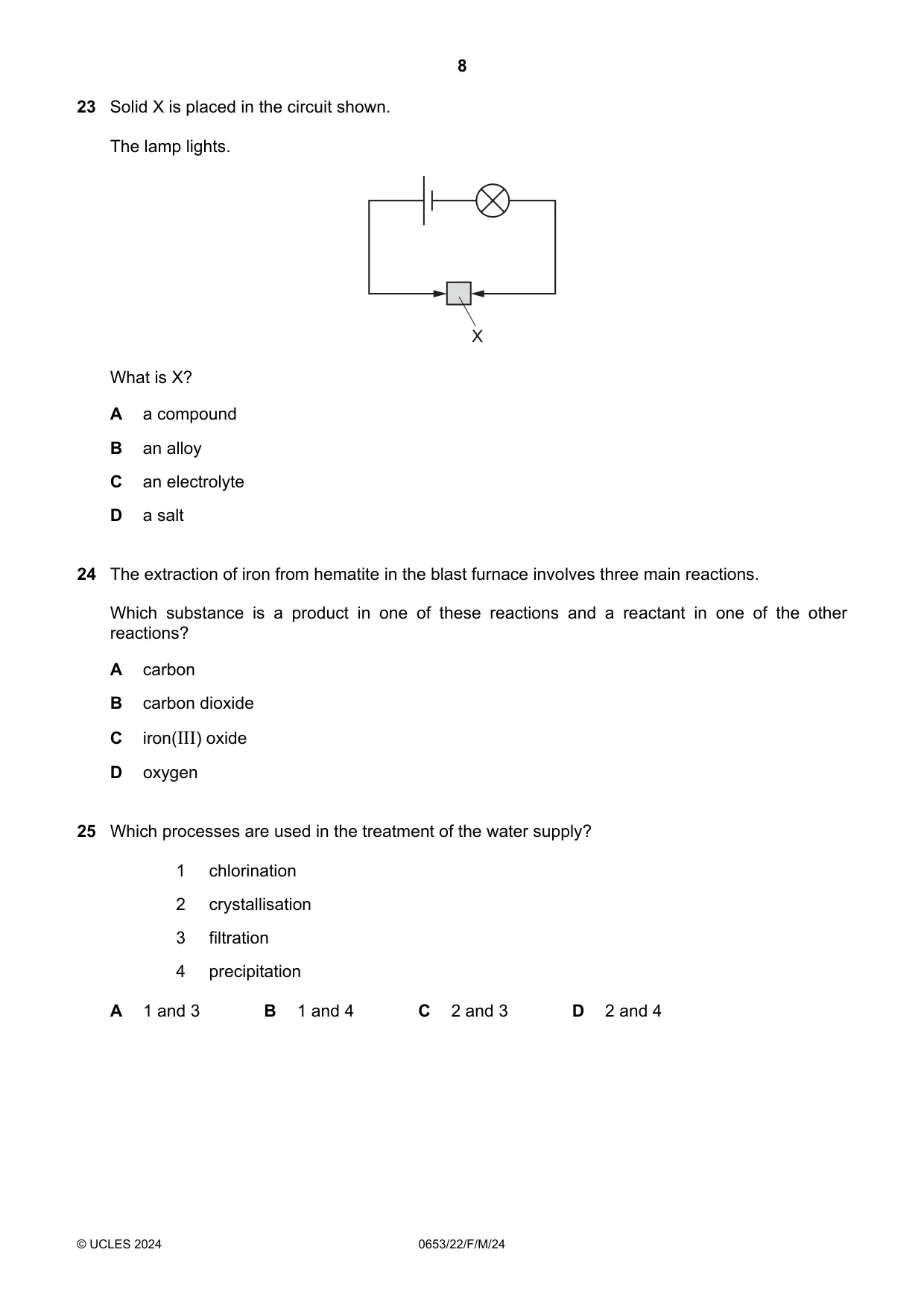
Q23 · Solid X is placed in the circuit shown
23 Solid X is placed in the circuit shown. The lamp lights. X What is X? A a compound B an alloy C an electrolyte D a salt
Mark scheme: B
Q24 · The extraction of iron from hematite in the blast furnace involves three main reactions
24 The extraction of iron from hematite in the blast furnace involves three main reactions. Which substance is a product in one of these reactions and a reactant in one of the other reactions? A carbon B carbon dioxide C iron(III) oxide D oxygen
Mark scheme: B
Q25 · Which processes are used in the treatment of the water supply?
25 Which processes are used in the treatment of the water supply? 1 chlorination 2 crystallisation 3 filtration 4 precipitation A 1 and 3 B 1 and 4 C 2 and 3 D 2 and 4
Mark scheme: A
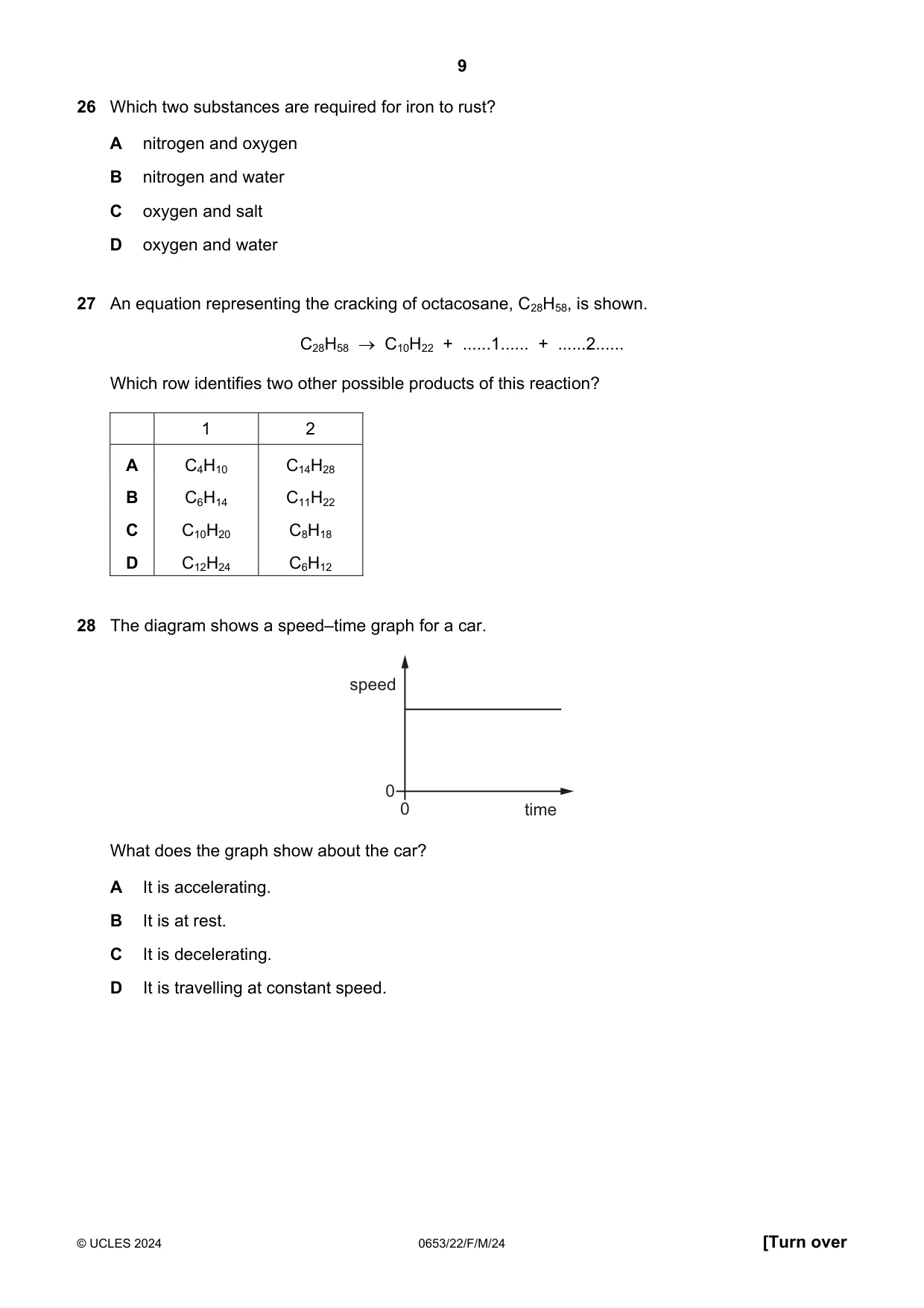
Q26 · Which two substances are required for iron to rust?
26 Which two substances are required for iron to rust? A nitrogen and oxygen B nitrogen and water C oxygen and salt D oxygen and water
Mark scheme: D
Q27 · An equation representing the cracking of octacosane, C28H58, is shown
27 An equation representing the cracking of octacosane, C28H58, is shown. C28H58 C10H22 + ......1...... + ......2...... Which row identifies two other possible products of this reaction? 1 2 A C4H10 C14H28 B C6H14 C11H22 C C10H20 C8H18 D C12H24 C6H12
Mark scheme: D
Q28 · The diagram shows a speed–time graph for a car
28 The diagram shows a speed–time graph for a car. speed 0 0 time What does the graph show about the car? A It is accelerating. B It is at rest. C It is decelerating. D It is travelling at constant speed.
Mark scheme: D
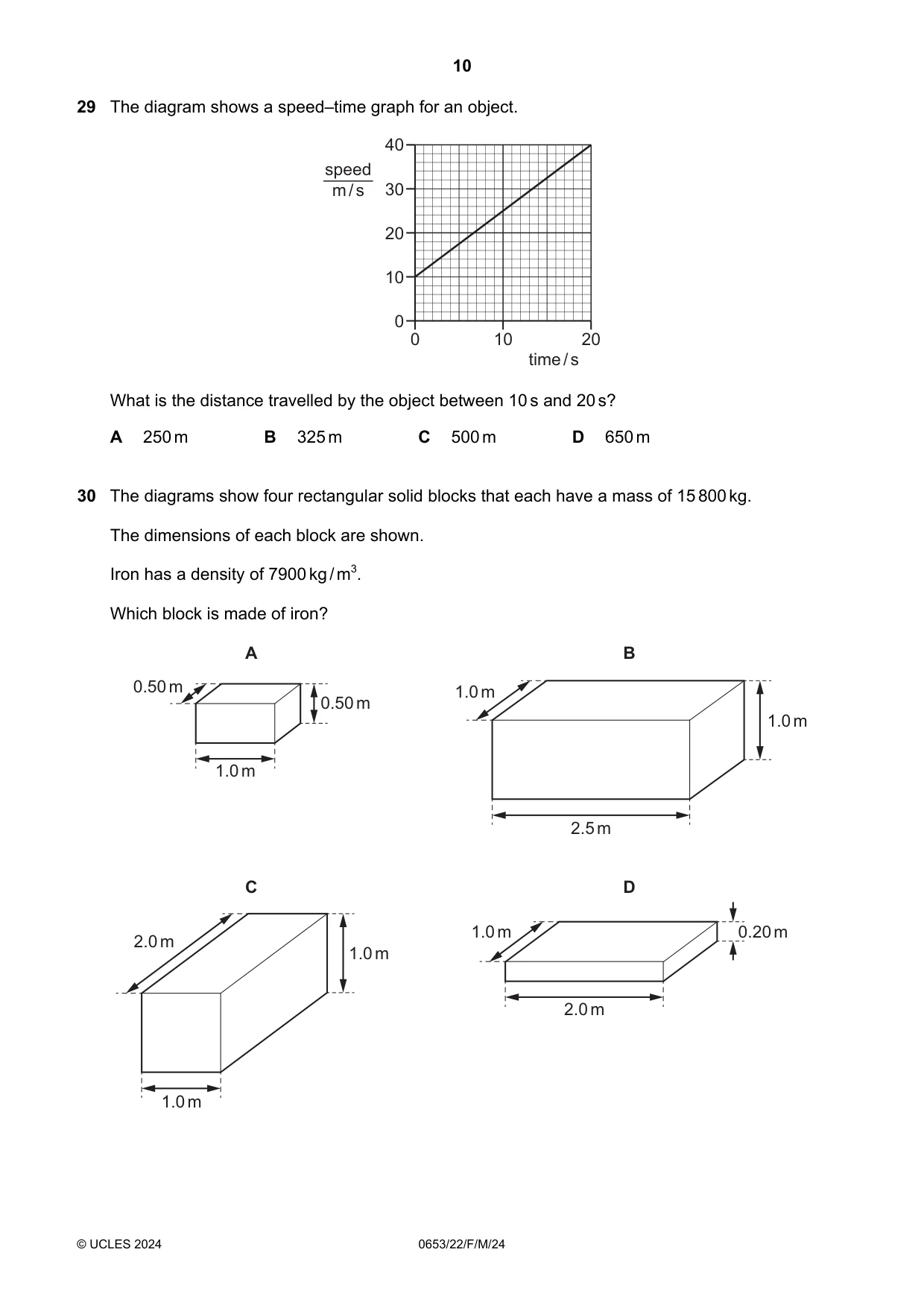
Q29 · The diagram shows a speed–time graph for an object
29 The diagram shows a speed–time graph for an object. 40 speed m / s 30 20 10 0 0 10 20 time / s What is the distance travelled by the object between 10 s and 20 s? A 250 m B 325 m C 500 m D 650 m
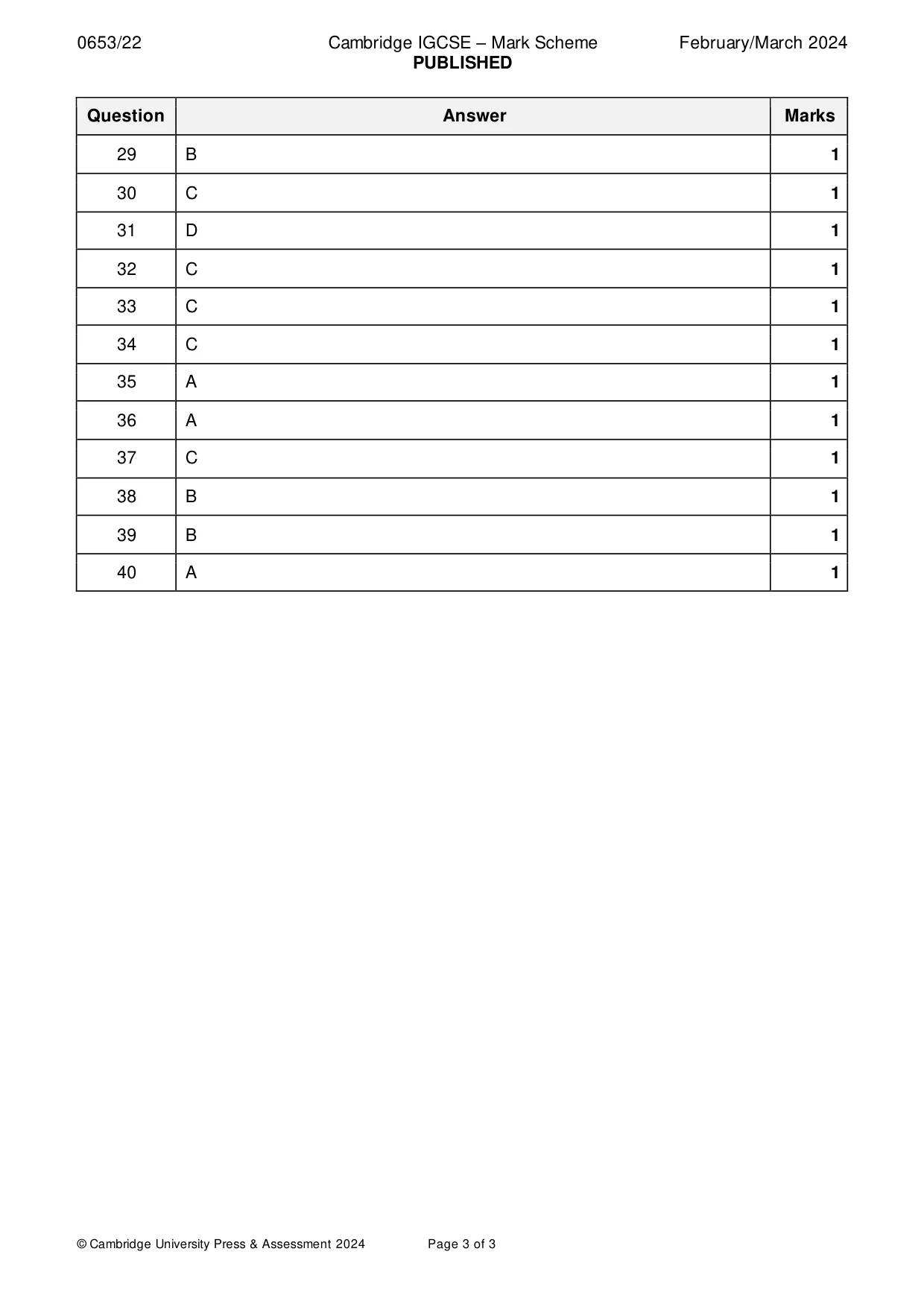
Mark scheme: B
Q30 · The diagrams show four rectangular solid blocks that each have a mass of 15 800 kg
30 The diagrams show four rectangular solid blocks that each have a mass of 15 800 kg. The dimensions of each block are shown. Iron has a density of 7900 kg / m3. Which block is made of iron? A B 0.50 m 1.0 m 0.50 m 1.0 m 1.0 m 2.5 m C D 1.0 m 0.20 m 2.0 m 1.0 m 2.0 m 1.0 m
Mark scheme: C
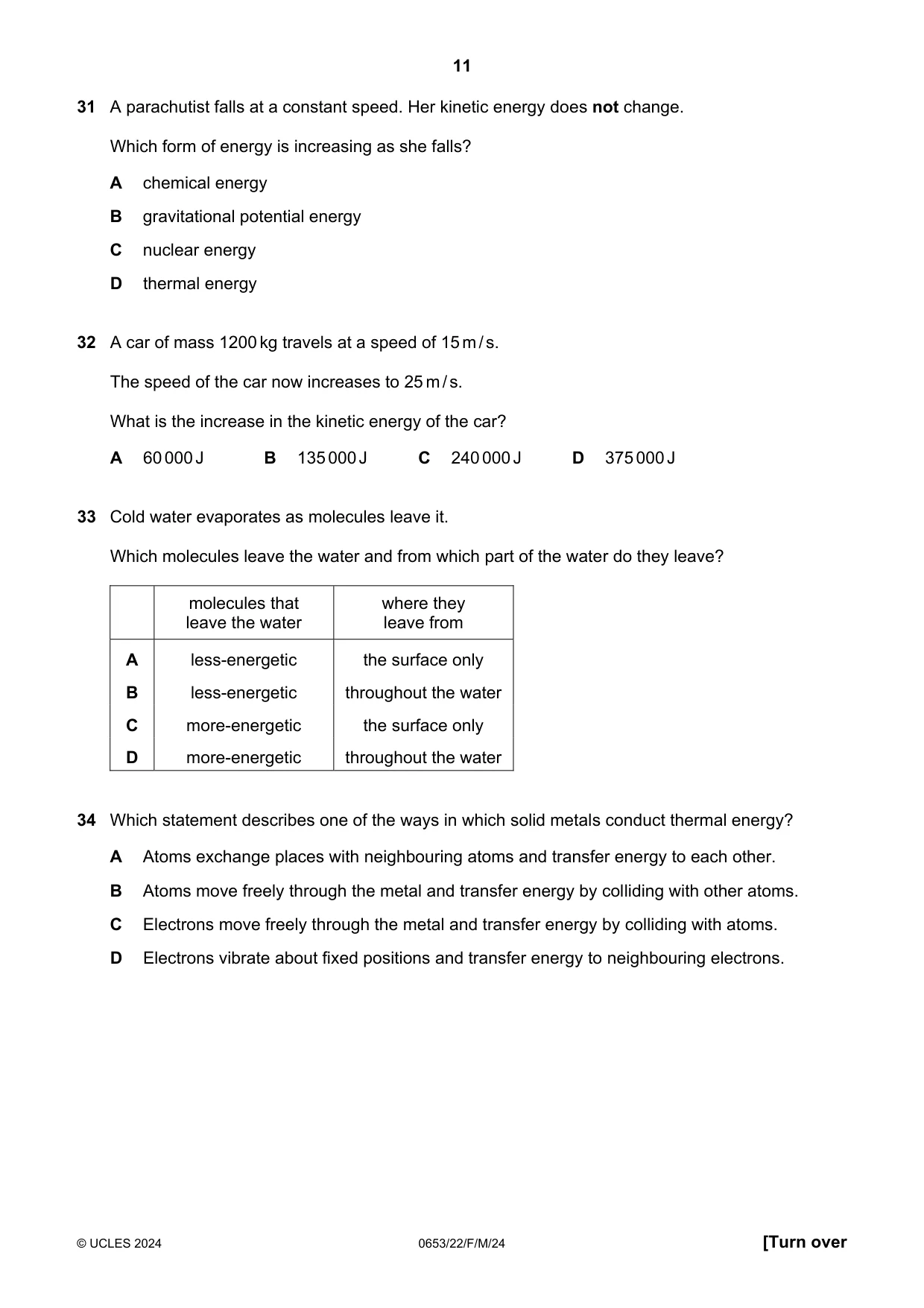
Q31 · A parachutist falls at a constant speed
31 A parachutist falls at a constant speed. Her kinetic energy does not change. Which form of energy is increasing as she falls? A chemical energy B gravitational potential energy C nuclear energy D thermal energy
Mark scheme: D
Q32 · A car of mass 1200 kg travels at a speed of 15 m / s
32 A car of mass 1200 kg travels at a speed of 15 m / s. The speed of the car now increases to 25 m / s. What is the increase in the kinetic energy of the car? A 60 000 J B 135 000 J C 240 000 J D 375 000 J
Mark scheme: C
Q33 · Cold water evaporates as molecules leave it
33 Cold water evaporates as molecules leave it. Which molecules leave the water and from which part of the water do they leave? molecules that where they leave the water leave from A less-energetic the surface only B less-energetic throughout the water C more-energetic the surface only D more-energetic throughout the water
Mark scheme: C
Q34 · Which statement describes one of the ways in which solid metals conduct thermal energy?
34 Which statement describes one of the ways in which solid metals conduct thermal energy? A Atoms exchange places with neighbouring atoms and transfer energy to each other. B Atoms move freely through the metal and transfer energy by colliding with other atoms. C Electrons move freely through the metal and transfer energy by colliding with atoms. D Electrons vibrate about fixed positions and transfer energy to neighbouring electrons.
Mark scheme: C
Q35 · Four hot objects are identical except that they have different colours and textures
35 Four hot objects are identical except that they have different colours and textures. Which object is the best emitter of thermal energy by radiation? colour texture A black dull B black shiny C white dull D white shiny
Mark scheme: A
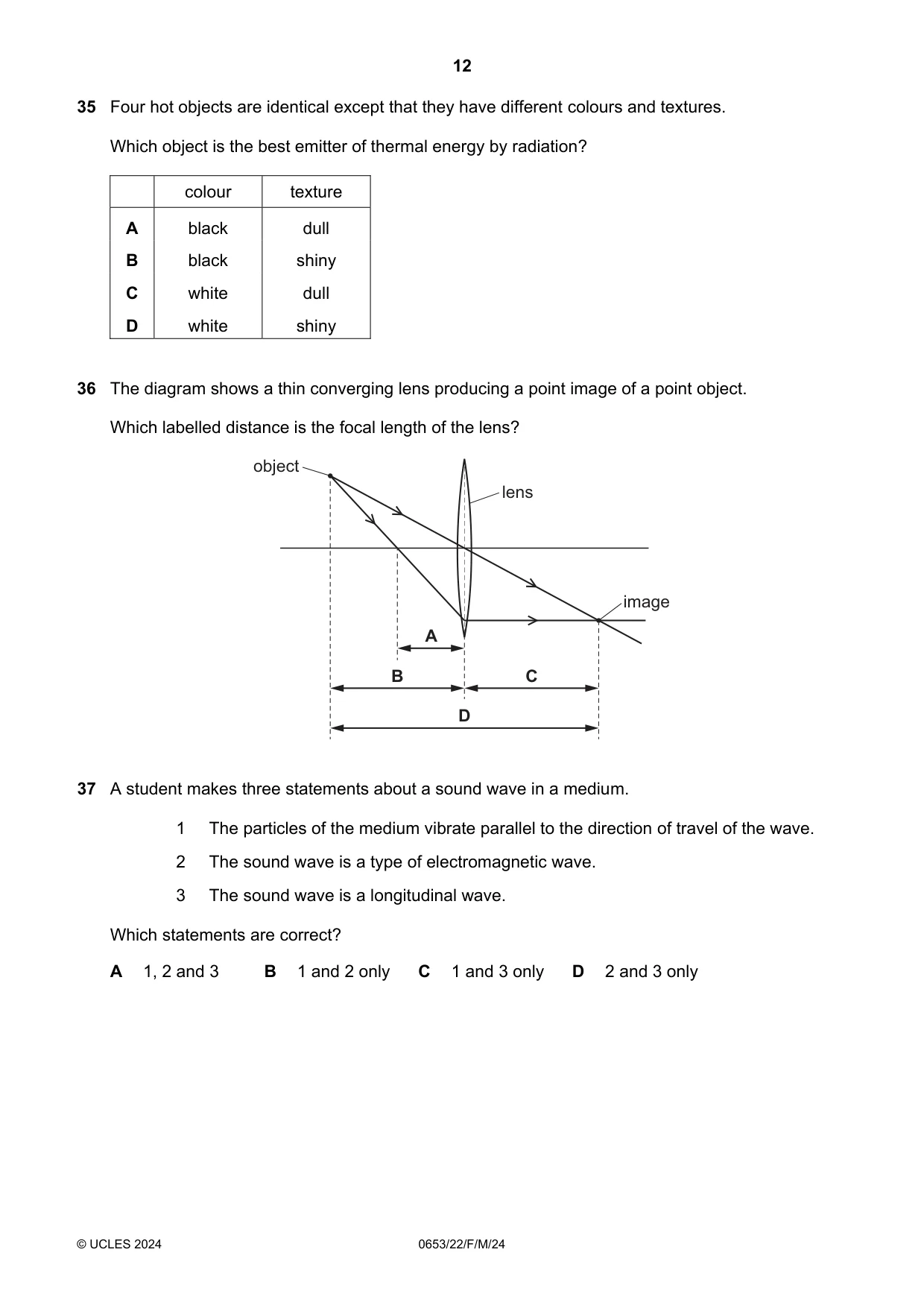
Q36 · The diagram shows a thin converging lens producing a point image of a point object
36 The diagram shows a thin converging lens producing a point image of a point object. Which labelled distance is the focal length of the lens? object lens image A B C D
Mark scheme: A
Q37 · A student makes three statements about a sound wave in a medium
37 A student makes three statements about a sound wave in a medium. 1 The particles of the medium vibrate parallel to the direction of travel of the wave. 2 The sound wave is a type of electromagnetic wave. 3 The sound wave is a longitudinal wave. Which statements are correct? A 1, 2 and 3 B 1 and 2 only C 1 and 3 only D 2 and 3 only
Mark scheme: C
Q38 · A circuit consists of two resistors and a battery
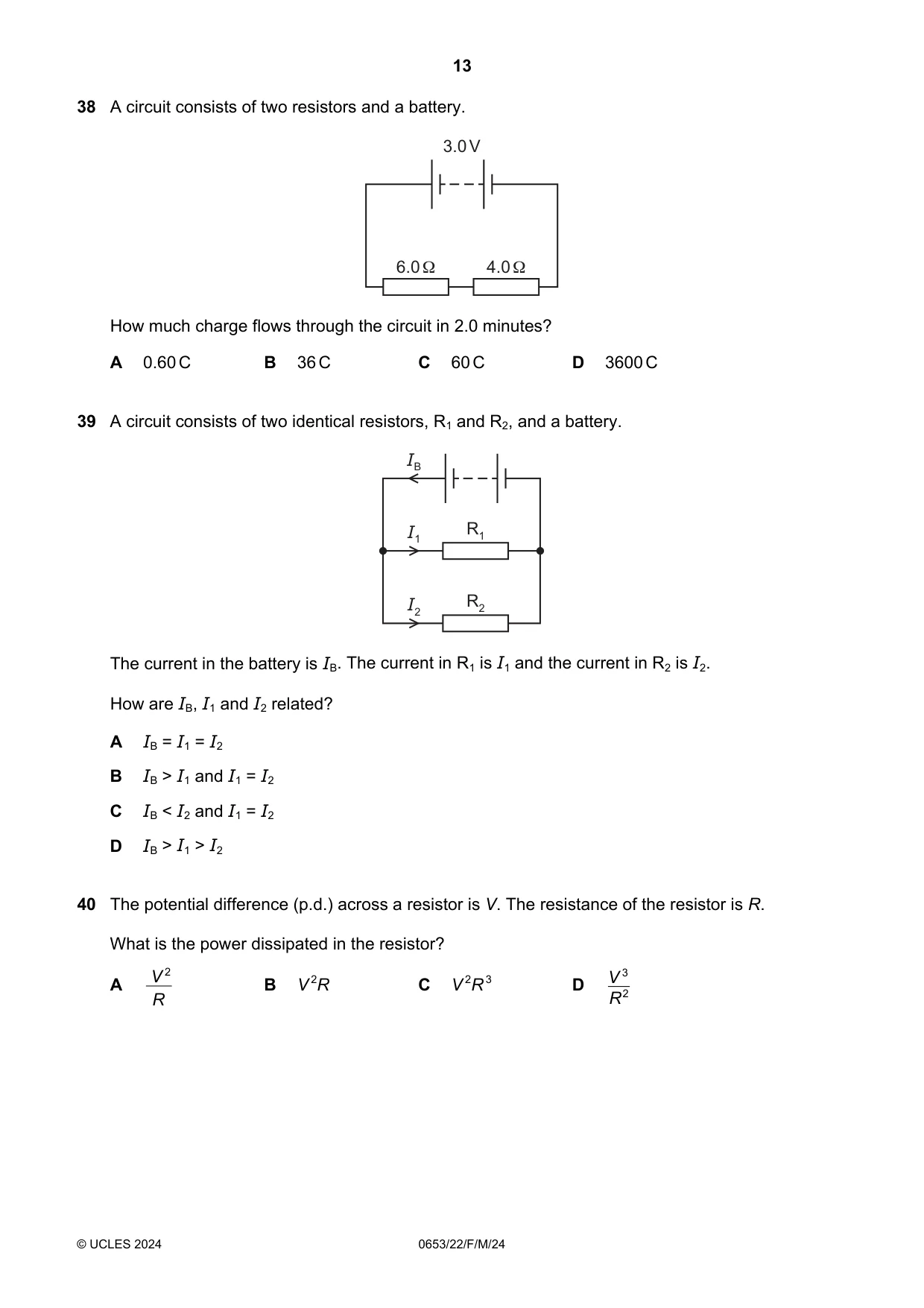
38 A circuit consists of two resistors and a battery. 3.0 V 6.0 Ω 4.0 Ω How much charge flows through the circuit in 2.0 minutes? A 0.60 C B 36 C C 60 C D 3600 C
Mark scheme: B
Q39 · A circuit consists of two identical resistors, R1 and R2, and a battery
39 A circuit consists of two identical resistors, R1 and R2, and a battery. IB I1 R1 I2 R2 The current in the battery is IB. The current in R1 is I1 and the current in R2 is I2. How are IB, I1 and I2 related? A IB = I1 = I2 B IB > I1 and I1 = I2 C IB < I2 and I1 = I2 D IB > I1 > I2
Mark scheme: B
Q40 · The potential difference (p.d.) across a resistor is V
40 The potential difference (p.d.) across a resistor is V. The resistance of the resistor is R. What is the power dissipated in the resistor? V 2 V 2R V 2R 3 V 3 A B C D R R 2
Mark scheme: A
What was in this paper
The subtopics covered by these 40 questions, and how many questions each got. Open one in a new tab to see every Cambridge question on it.
2Energy, work and power2Kinetic particle model of matter2Motion2Transfer of thermal energy2Alkenes1Arrangement of elements1Biological molecules1Carbon cycle1Cell structure1Characteristics of living organisms1Circulatory systems1Corrosion of metals1Density1Diet1Digestive system1Electrical circuits1Electrolysis1Enzymes1Exothermic and endothermic reactions1Extraction of metals1Food chains and food webs1Formulas1Group VII properties1Ions and ionic bonds1Light1Photosynthesis1Properties of metals1Rate of reaction1Redox1Respiration1Sexual reproduction in humans1Sexual reproduction in plants1Sound1Water1What you needed in this session
Cambridge’s own grade thresholds for 2024 Feb/March, Paper 2 · Variant 2. A higher threshold means an easier paper — the bar moves with how the cohort did.