Cambridge IGCSE Science - Combined 0653 — 2020 Oct/Nov Paper 2 · Variant 3
0653/23/O/N/20 · 40 questions · 40 marks · ≈45 min
The question paper and its mark scheme, free to read here and free to download. This is Cambridge’s own paper, exactly as it was sat.
Question paper16 pages
Mark scheme3 pages
Answers below. Sit the paper first if you are practising.
Questions as text
Q1 · The diagram shows two red blood cells inside a capillary and two tissue cells near this…
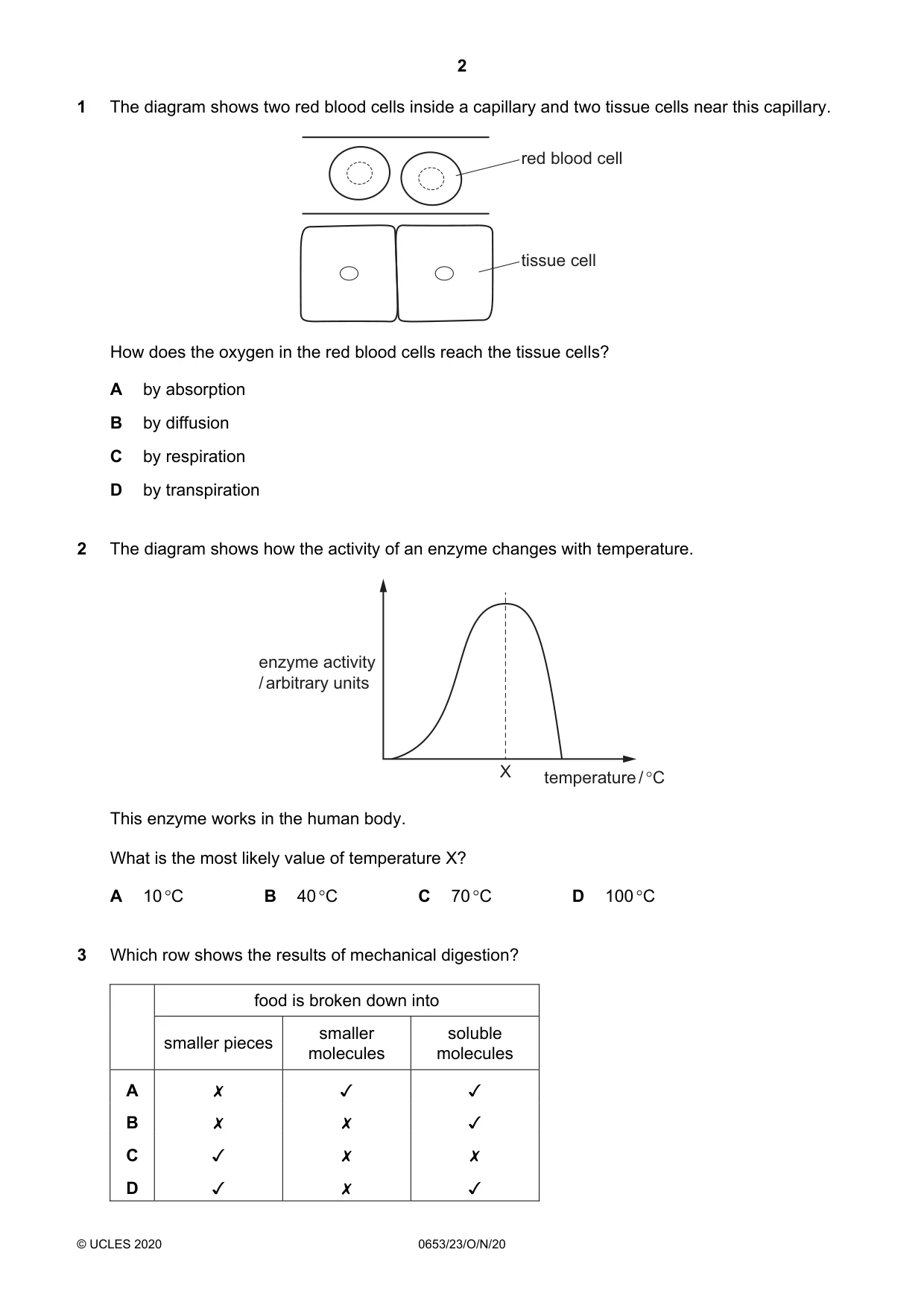
1 The diagram shows two red blood cells inside a capillary and two tissue cells near this capillary. red blood cell tissue cell How does the oxygen in the red blood cells reach the tissue cells? A by absorption B by diffusion C by respiration D by transpiration
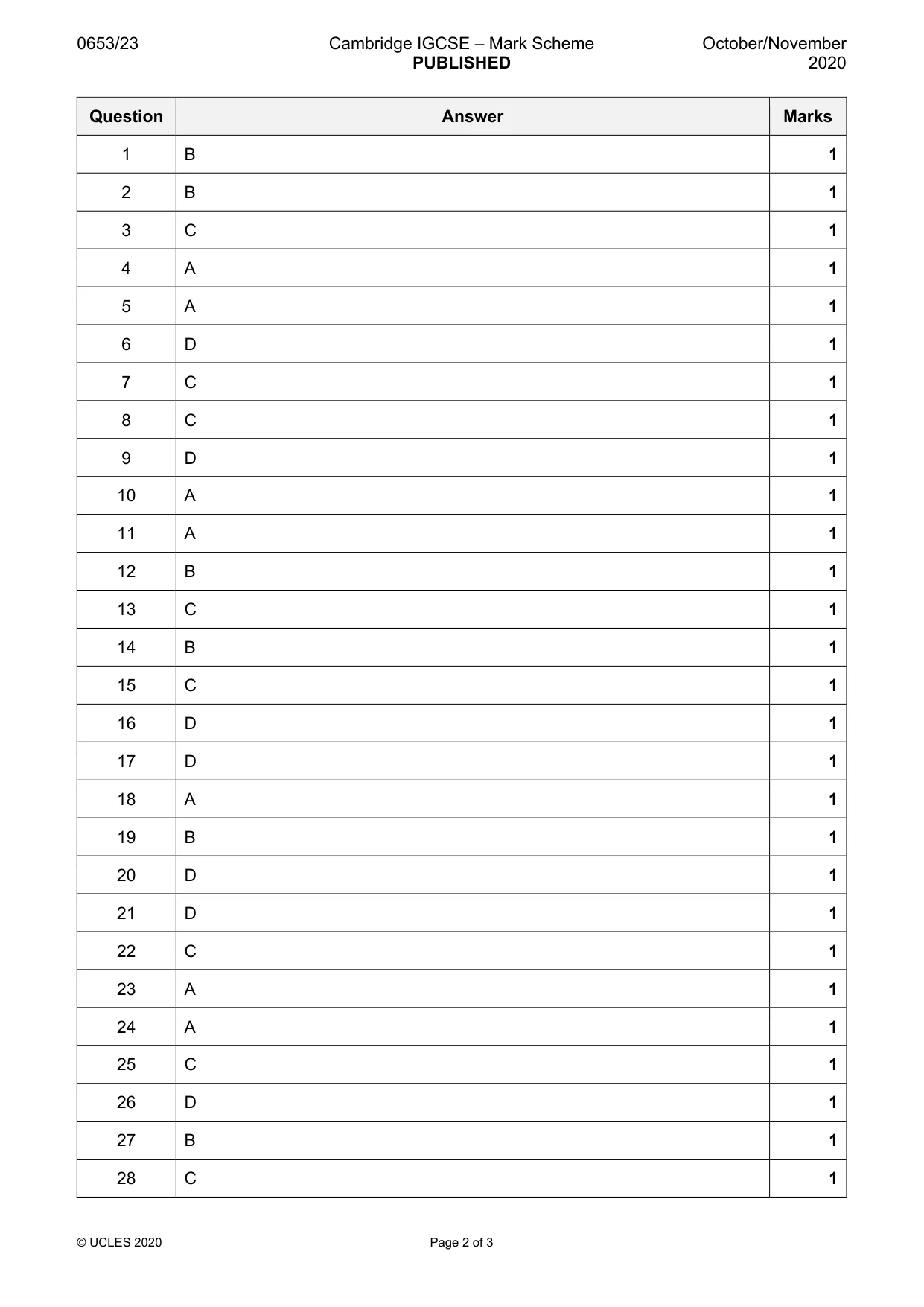
Mark scheme: B
Q2 · The diagram shows how the activity of an enzyme changes with temperature
2 The diagram shows how the activity of an enzyme changes with temperature. enzyme activity / arbitrary units X temperature / °C This enzyme works in the human body. What is the most likely value of temperature X? A 10 C B 40 C C 70 C D 100 C
Mark scheme: B
Q3 · Which row shows the results of mechanical digestion?
3 Which row shows the results of mechanical digestion? food is broken down into smaller soluble smaller pieces molecules molecules \ \ «Ox < « x ae.
Mark scheme: C
Q4 · Protease breaks down protein
4 Protease breaks down protein. What is the protein broken down into? A amino acids B fatty acids C glycerol D starch
Mark scheme: A
Q5 · The graph shows the uptake of water by root hair cells over many hours during a day
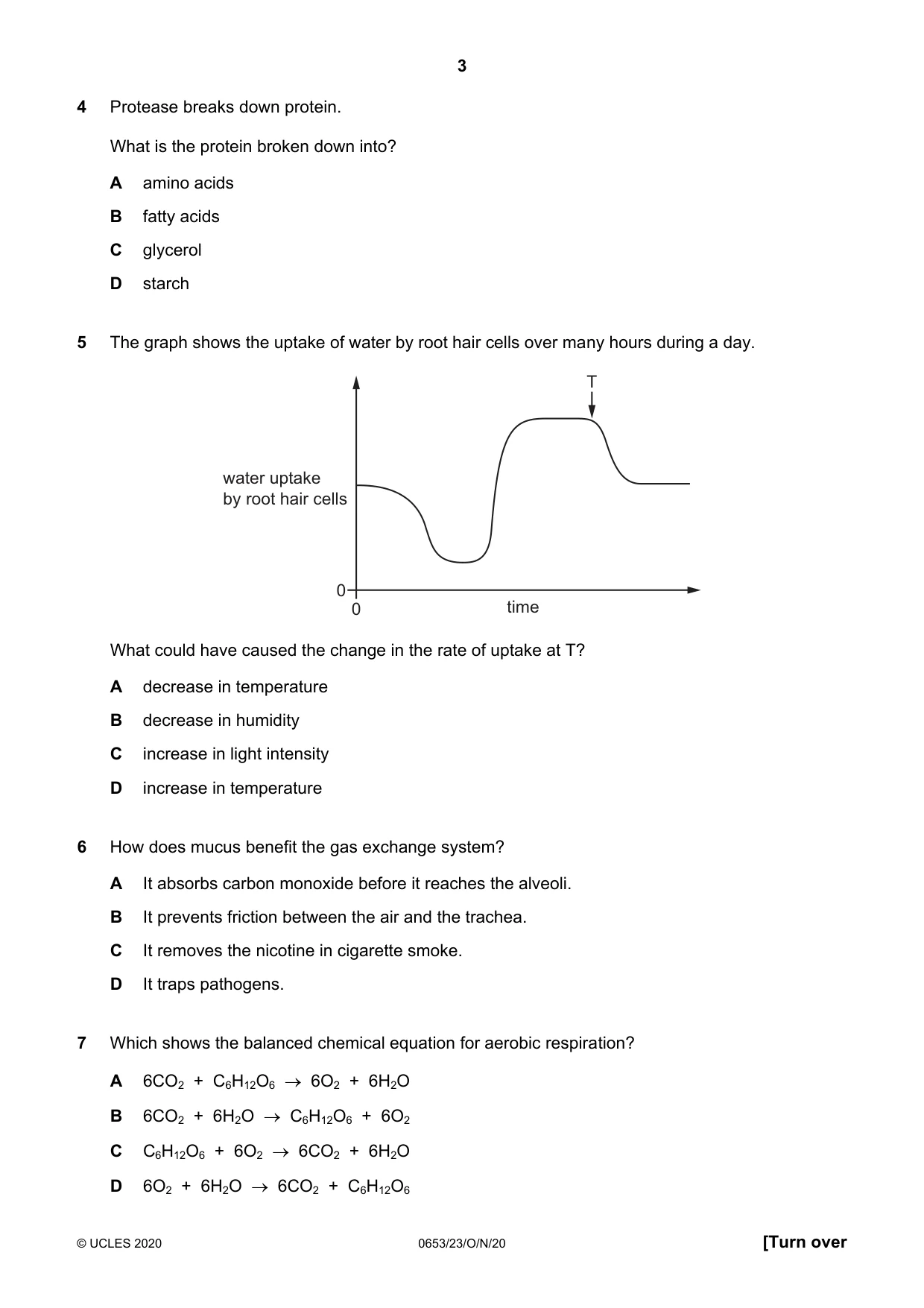
5 The graph shows the uptake of water by root hair cells over many hours during a day. T water uptake by root hair cells 0 0 time What could have caused the change in the rate of uptake at T? A decrease in temperature B decrease in humidity C increase in light intensity D increase in temperature
Mark scheme: A
Q6 · How does mucus benefit the gas exchange system?
6 How does mucus benefit the gas exchange system? A It absorbs carbon monoxide before it reaches the alveoli. B It prevents friction between the air and the trachea. C It removes the nicotine in cigarette smoke. D It traps pathogens.
Mark scheme: D
Q7 · Which shows the balanced chemical equation for aerobic respiration?
7 Which shows the balanced chemical equation for aerobic respiration? A 6CO2 + C6H12O6 6O2 + 6H2O B 6CO2 + 6H2O C6H12O6 + 6O2 C C6H12O6 + 6O2 6CO2 + 6H2O D 6O2 + 6H2O 6CO2 + C6H12O6
Mark scheme: C
Q8 · A person's body secretes adrenaline in response to a frightening experience
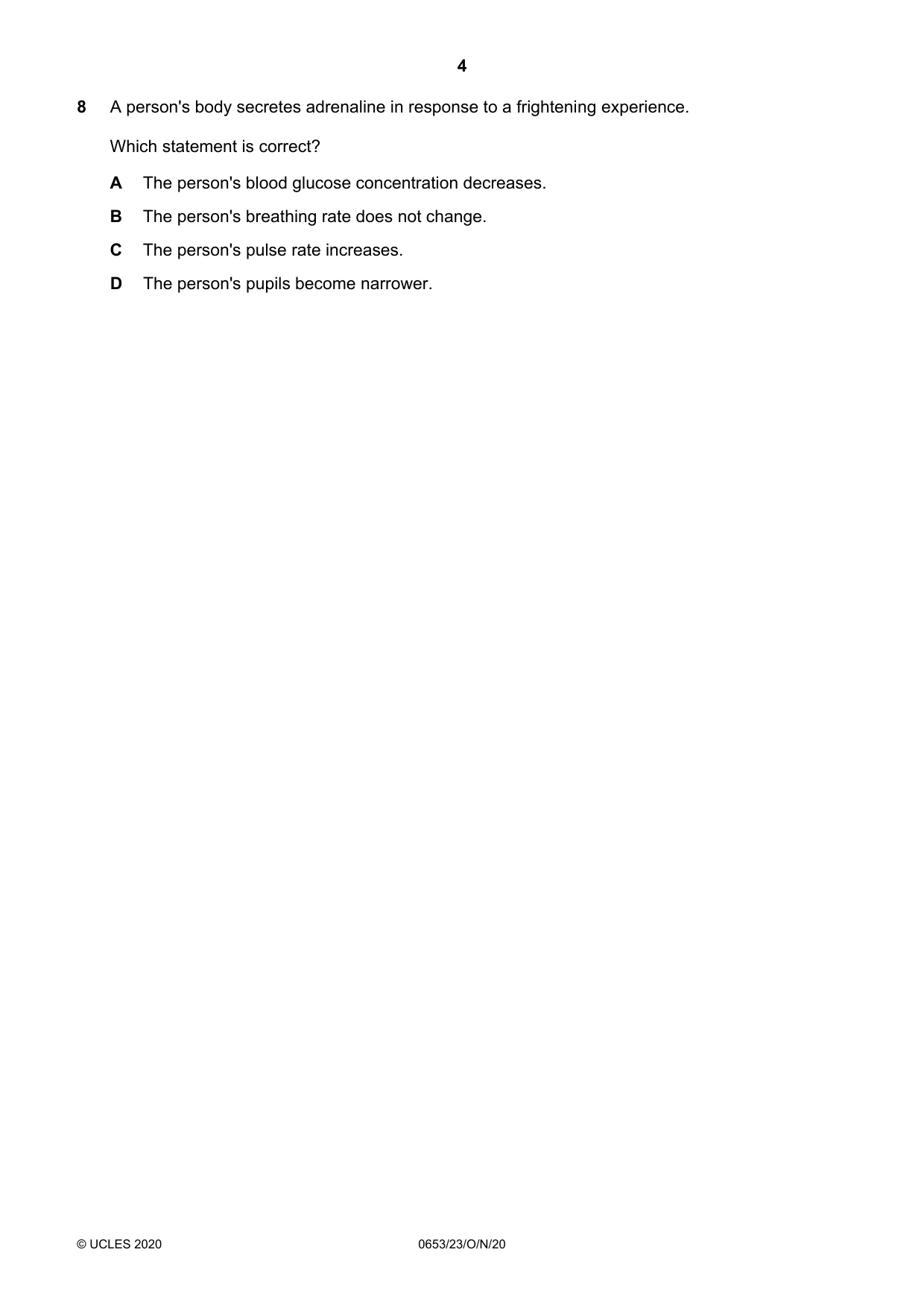
8 A person's body secretes adrenaline in response to a frightening experience. Which statement is correct? A The person's blood glucose concentration decreases. B The person's breathing rate does not change. C The person's pulse rate increases. D The person's pupils become narrower.
Mark scheme: C
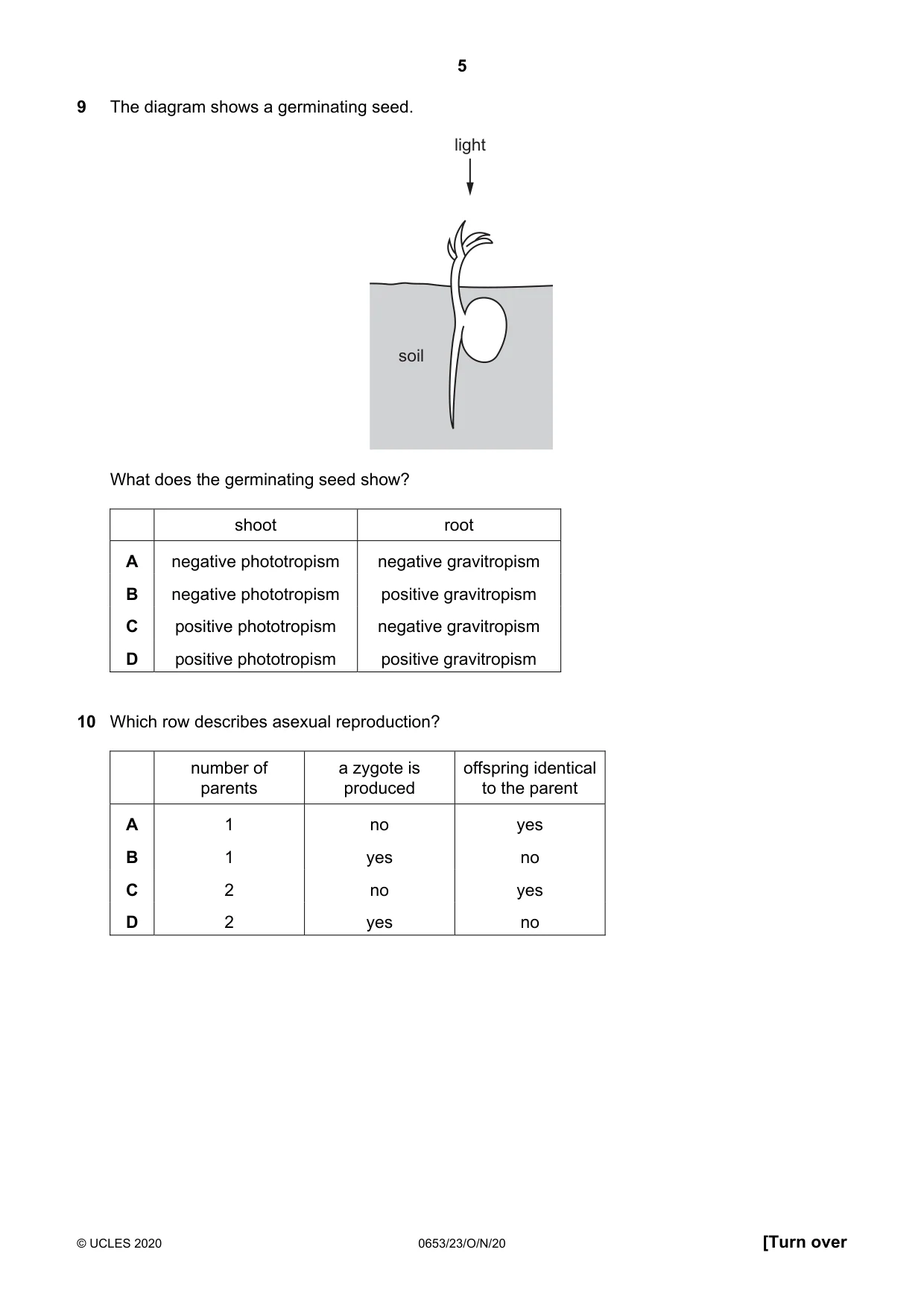
Q9 · The diagram shows a germinating seed
9 The diagram shows a germinating seed. light soil What does the germinating seed show? shoot root A negative phototropism negative gravitropism B negative phototropism positive gravitropism C positive phototropism negative gravitropism D positive phototropism positive gravitropism
Mark scheme: D
Q10 · Which row describes asexual reproduction?
10 Which row describes asexual reproduction? number of a zygote is offspring identical parents produced to the parent A 1 no yes B 1 yes no C 2 no yes D 2 yes no
Mark scheme: A
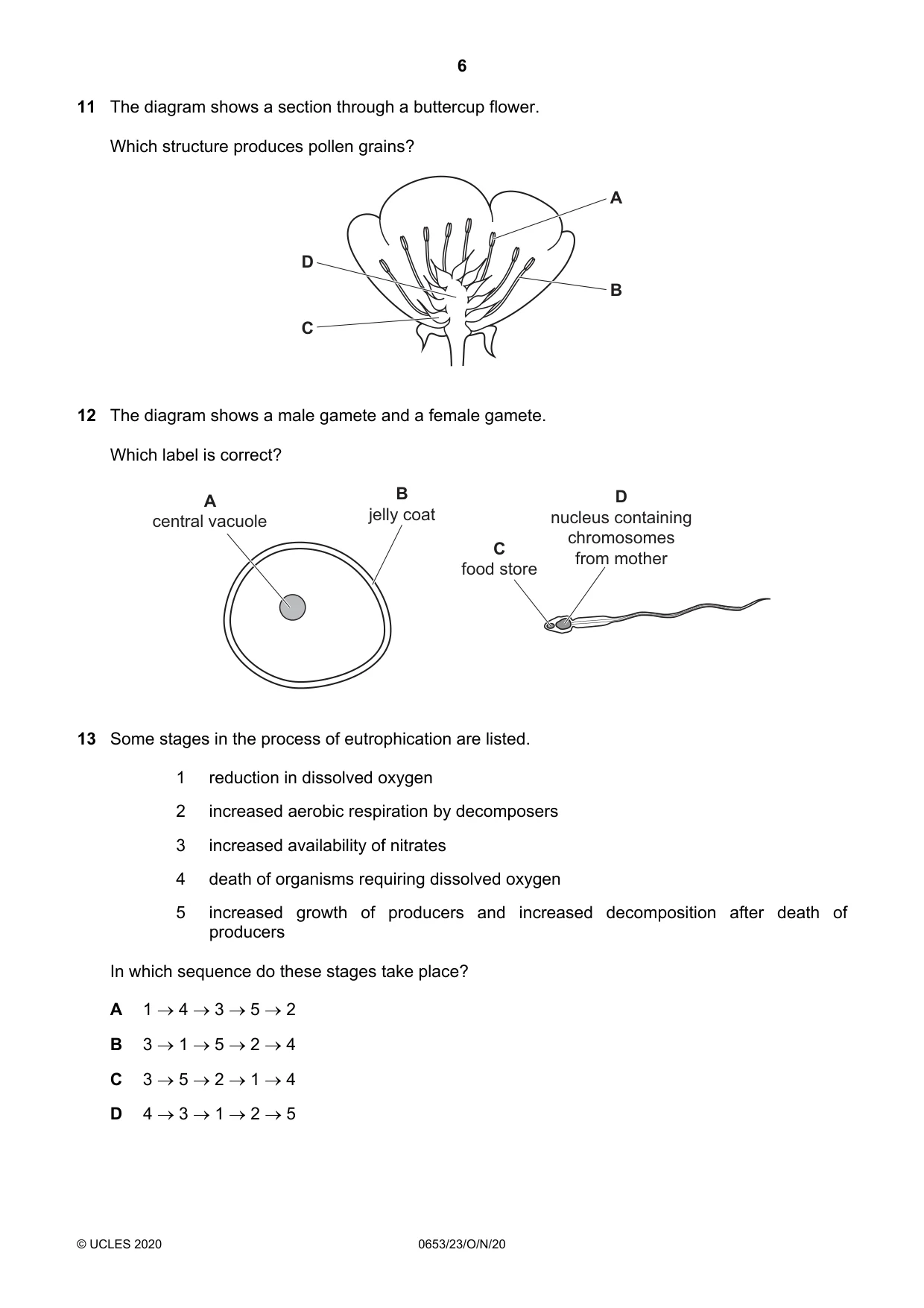
Q11 · The diagram shows a section through a buttercup flower
11 The diagram shows a section through a buttercup flower. Which structure produces pollen grains? A D B C
Mark scheme: A
Q12 · The diagram shows a male gamete and a female gamete
12 The diagram shows a male gamete and a female gamete. Which label is correct? A B D central vacuole jelly coat nucleus containing C chromosomes from mother food store
Mark scheme: B
Q13 · Some stages in the process of eutrophication are listed
13 Some stages in the process of eutrophication are listed. 1 reduction in dissolved oxygen 2 increased aerobic respiration by decomposers 3 increased availability of nitrates 4 death of organisms requiring dissolved oxygen 5 increased growth of producers and increased decomposition after death of producers In which sequence do these stages take place? A 1 4 3 5 2 B 3 1 5 2 4 C 3 5 2 1 4 D 4 3 1 2 5
Mark scheme: C
Q14 · The temperature and pressure of oxygen in two different containers are shown
14 The temperature and pressure of oxygen in two different containers are shown. temperature p r es ur s e / C kN / m 2 container 1 20 200 container 2 50 150 Which statement about the oxygen molecules in container 1 compared to container 2 is correct? A In container 1 they are closer together and moving faster. B In container 1 they are closer together and moving slower. C In container 1 they are further apart and moving faster. D In container 1 they are further apart and moving slower.
Mark scheme: B
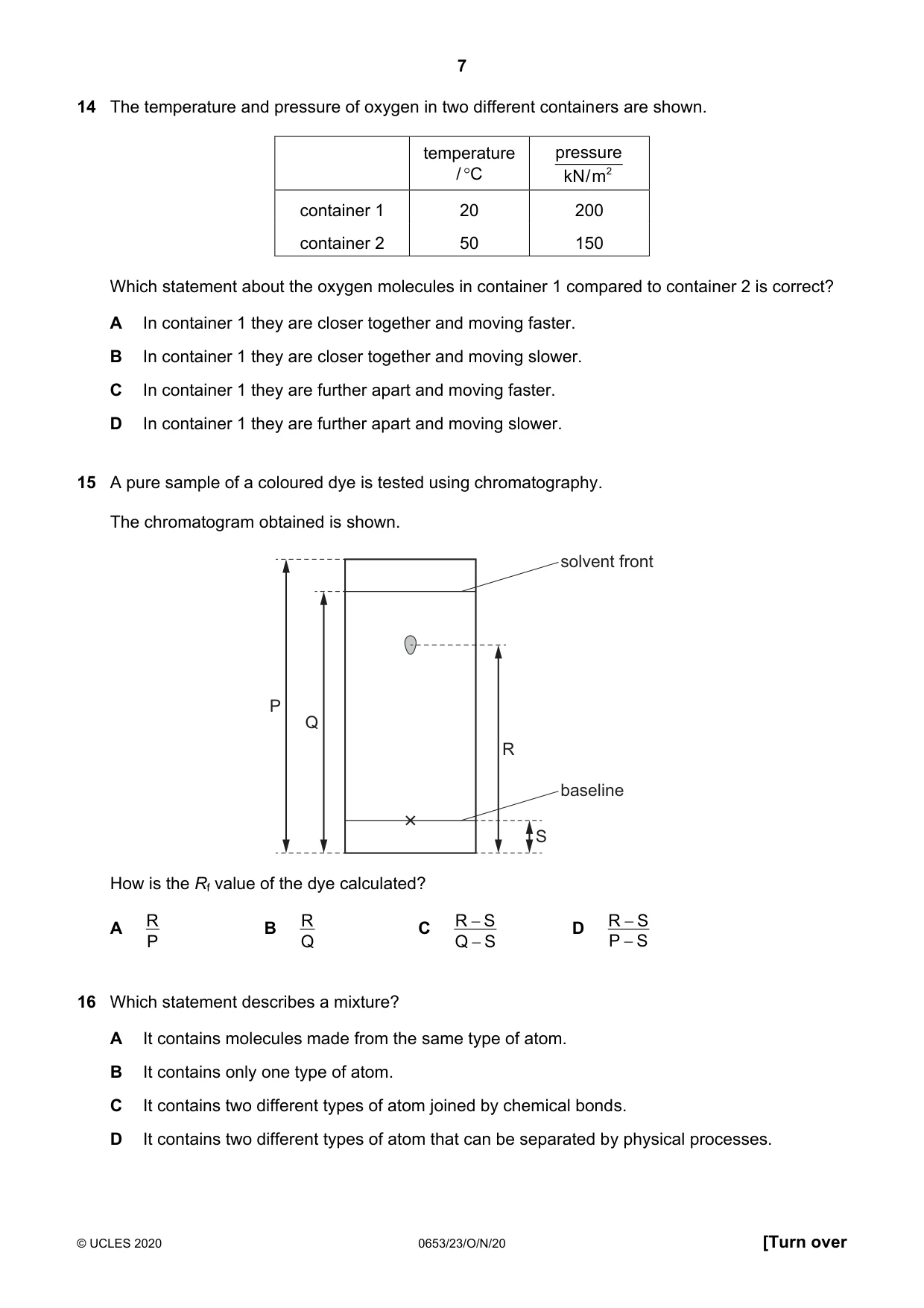
Q15 · A pure sample of a coloured dye is tested using chromatography
15 A pure sample of a coloured dye is tested using chromatography. The chromatogram obtained is shown. solvent front P Q R baseline S How is the Rf value of the dye calculated? R R R S R S A P B Q C D Q S P S
Mark scheme: C
Q16 · Which statement describes a mixture?
16 Which statement describes a mixture? A It contains molecules made from the same type of atom. B It contains only one type of atom. C It contains two different types of atom joined by chemical bonds. D It contains two different types of atom that can be separated by physical processes.
Mark scheme: D
Q17 · Which equation is not correctly balanced?
17 Which equation is not correctly balanced? A Ca + 2H2O Ca(OH)2 + H2 B CaCO3 + 2HCl CaCl 2 + H2O + CO2 C CaO + 2HCl CaCl 2 + H2O D Ca(OH)2 + 2HCl CaCl 2 + H2O
Mark scheme: D
Q18 · What happens to cations during electrolysis?
18 What happens to cations during electrolysis? A They gain electrons. B They gain oxygen. C They lose electrons. D They lose oxygen.
Mark scheme: A
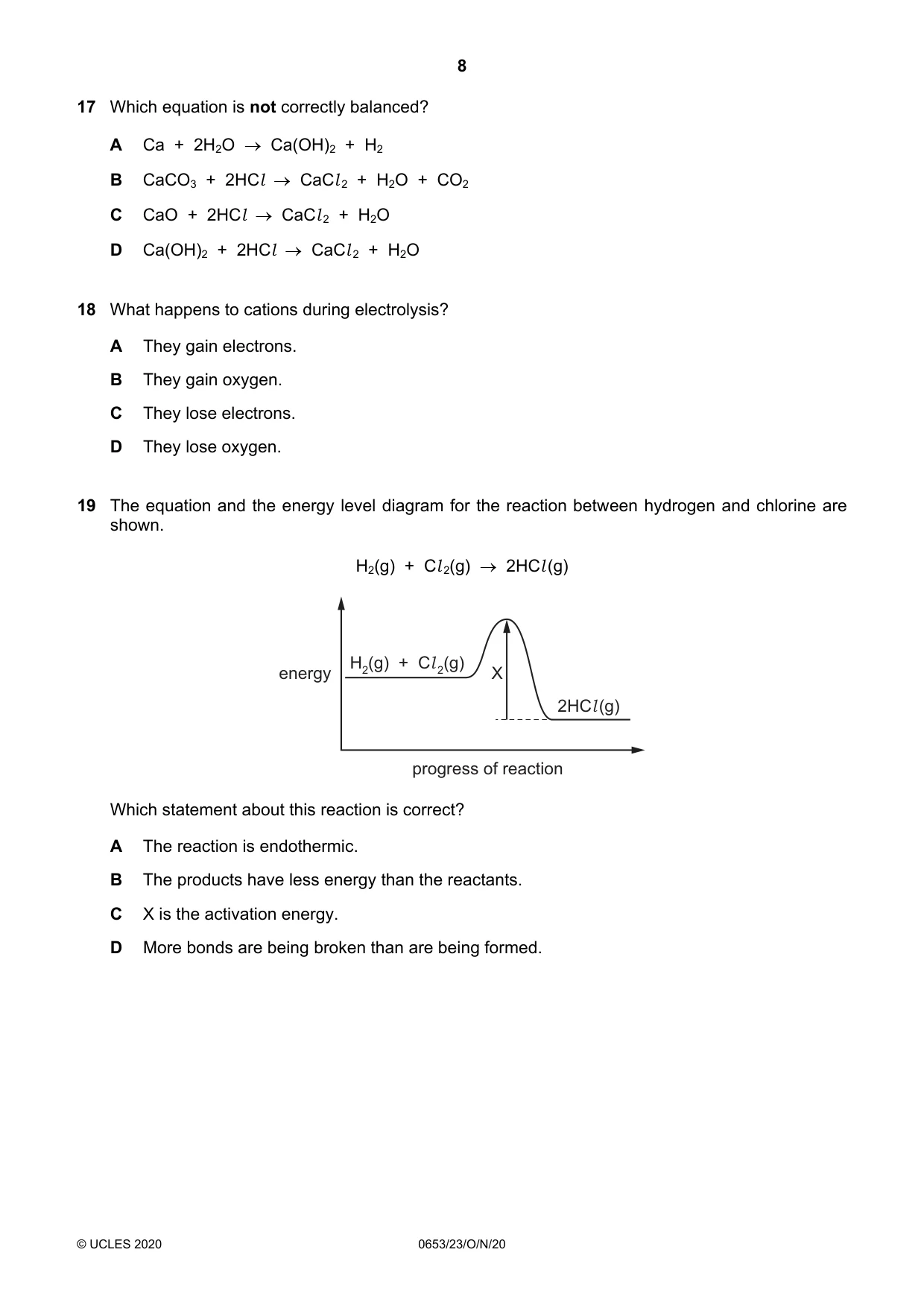
Q19 · The equation and the energy level diagram for the reaction between hydrogen and chlorine…
19 The equation and the energy level diagram for the reaction between hydrogen and chlorine are shown. H2(g) + Cl 2(g) 2HCl (g) H2(g) + Cl 2(g) energy X 2HCl (g) progress of reaction Which statement about this reaction is correct? A The reaction is endothermic. B The products have less energy than the reactants. C X is the activation energy. D More bonds are being broken than are being formed.
Mark scheme: B
Q20 · Dilute hydrochloric acid reacts with solid calcium carbonate
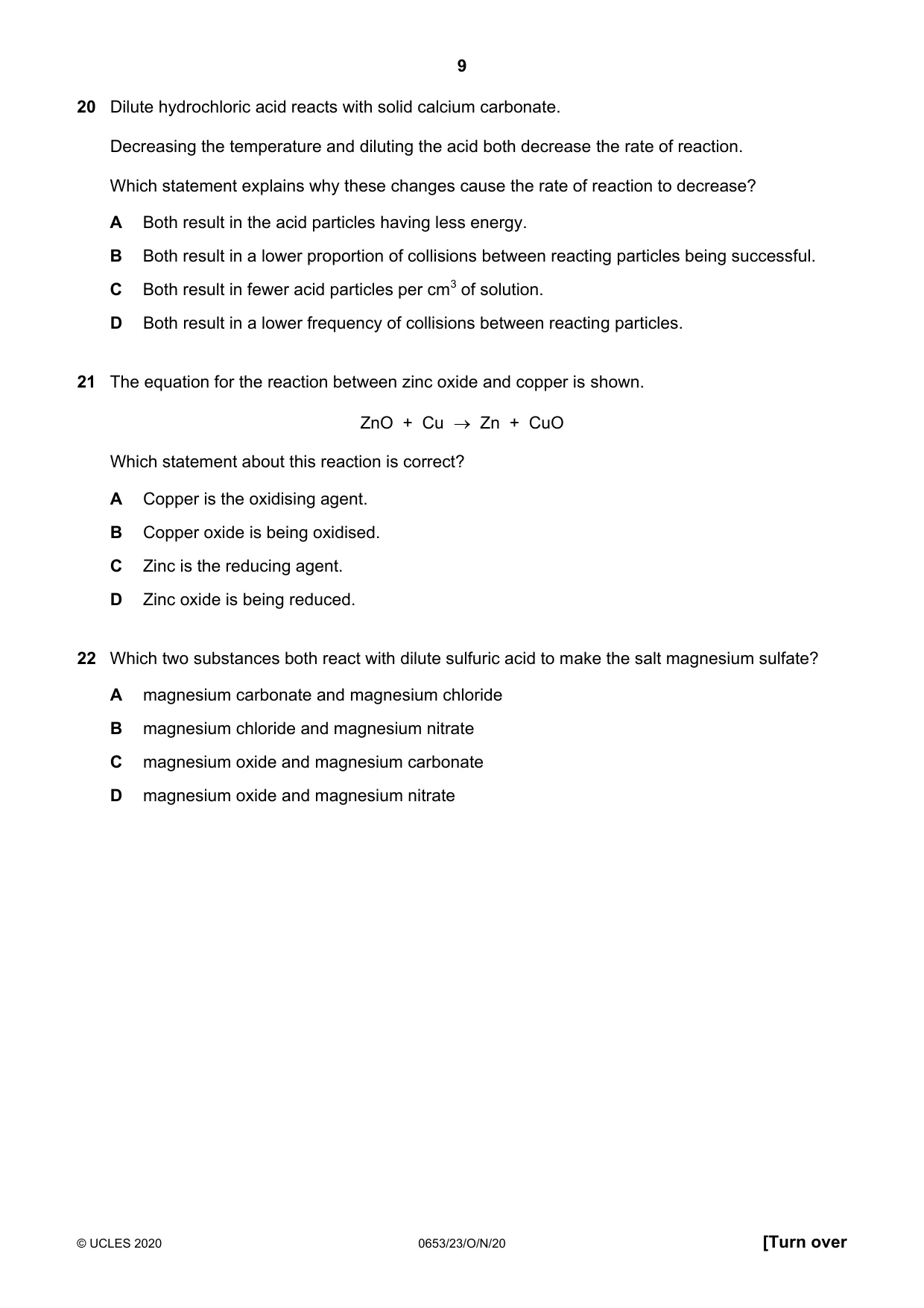
20 Dilute hydrochloric acid reacts with solid calcium carbonate. Decreasing the temperature and diluting the acid both decrease the rate of reaction. Which statement explains why these changes cause the rate of reaction to decrease? A Both result in the acid particles having less energy. B Both result in a lower proportion of collisions between reacting particles being successful. C Both result in fewer acid particles per cm3 of solution. D Both result in a lower frequency of collisions between reacting particles.
Mark scheme: D
Q21 · The equation for the reaction between zinc oxide and copper is shown
21 The equation for the reaction between zinc oxide and copper is shown. ZnO + Cu Zn + CuO Which statement about this reaction is correct? A Copper is the oxidising agent. B Copper oxide is being oxidised. C Zinc is the reducing agent. D Zinc oxide is being reduced.
Mark scheme: D
Q22 · Which two substances both react with dilute sulfuric acid to make the salt magnesium…
22 Which two substances both react with dilute sulfuric acid to make the salt magnesium sulfate? A magnesium carbonate and magnesium chloride B magnesium chloride and magnesium nitrate C magnesium oxide and magnesium carbonate D magnesium oxide and magnesium nitrate
Mark scheme: C
Q23 · Acid X reacts with metal Y
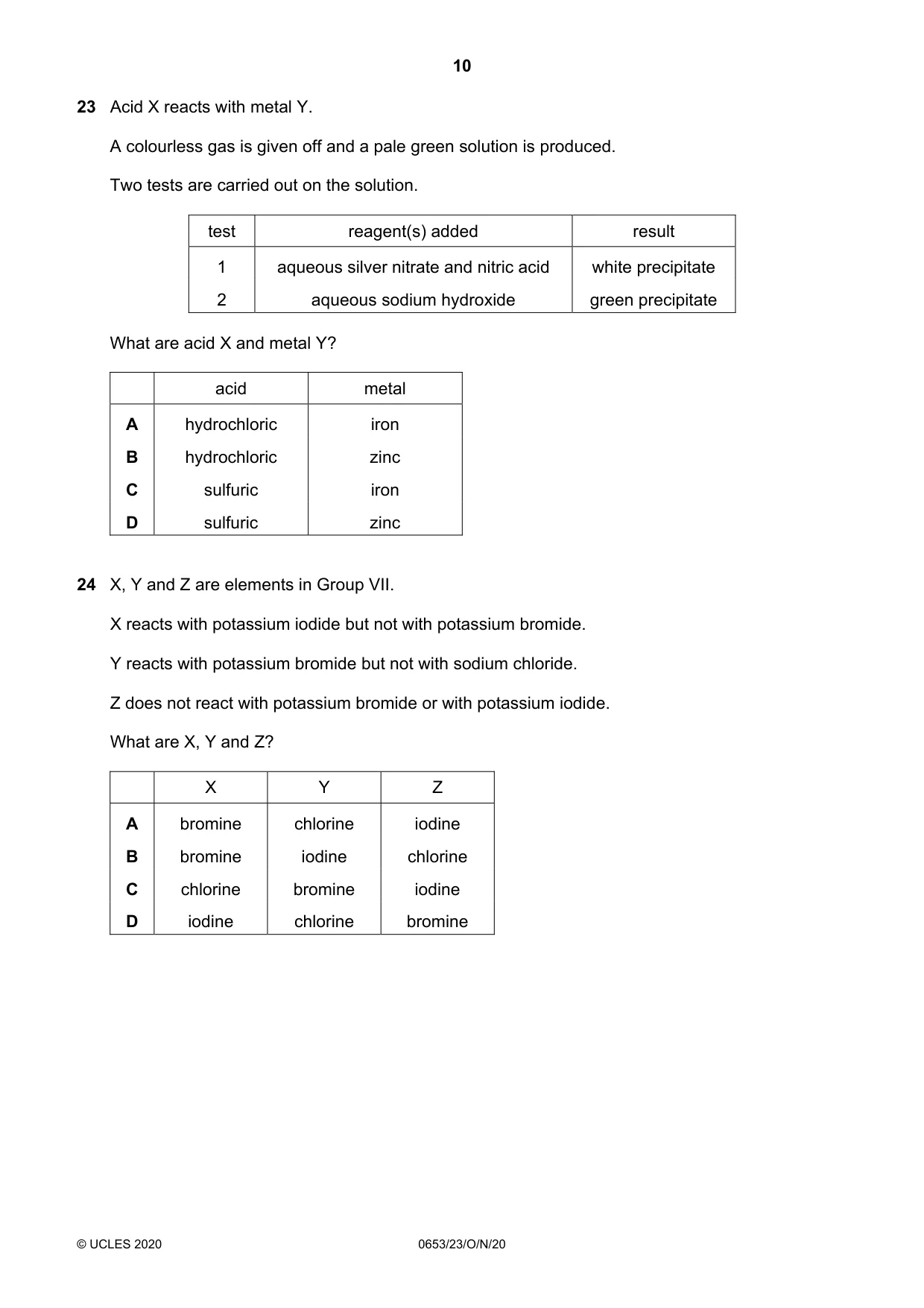
23 Acid X reacts with metal Y. A colourless gas is given off and a pale green solution is produced. Two tests are carried out on the solution. test reagent(s) added result 1 aqueous silver nitrate and nitric acid white precipitate 2 aqueous sodium hydroxide green precipitate What are acid X and metal Y? acid metal A hydrochloric iron B hydrochloric zinc C sulfuric iron D sulfuric zinc
Mark scheme: A
Q24 · X, Y and Z are elements in Group VII
24 X, Y and Z are elements in Group VII. X reacts with potassium iodide but not with potassium bromide. Y reacts with potassium bromide but not with sodium chloride. Z does not react with potassium bromide or with potassium iodide. What are X, Y and Z? X Y Z A bromine chlorine iodine B bromine iodine chlorine C chlorine bromine iodine D iodine chlorine bromine
Mark scheme: A
Q25 · Some physical properties of four elements are shown
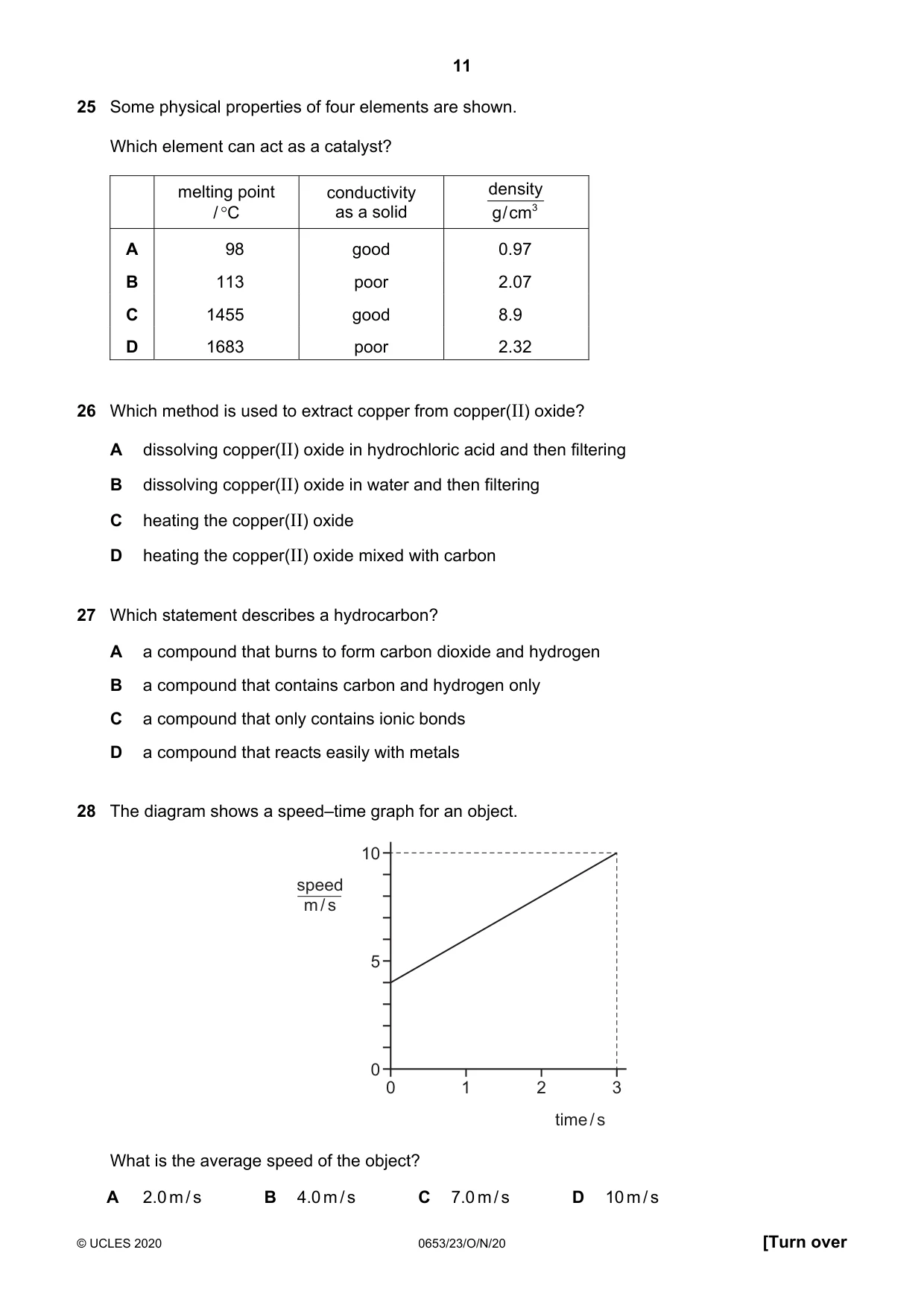
25 Some physical properties of four elements are shown. Which element can act as a catalyst? melting point conductivity d ens ty i / C as a solid g / cm 3 A 98 good 0.97 B 113 poor 2.07 C 1455 good 8.9 D 1683 poor 2.32
Mark scheme: C
Q26 · Which method is used to extract copper from copper(II) oxide?
26 Which method is used to extract copper from copper(II) oxide? A dissolving copper(II) oxide in hydrochloric acid and then filtering B dissolving copper(II) oxide in water and then filtering C heating the copper(II) oxide D heating the copper(II) oxide mixed with carbon
Mark scheme: D
Q27 · Which statement describes a hydrocarbon?
27 Which statement describes a hydrocarbon? A a compound that burns to form carbon dioxide and hydrogen B a compound that contains carbon and hydrogen only C a compound that only contains ionic bonds D a compound that reacts easily with metals
Mark scheme: B
Q28 · The diagram shows a speed–time graph for an object
28 The diagram shows a speed–time graph for an object. 10 speed m / s 5 0 0 1 2 3 time / s What is the average speed of the object? A 2.0 m / s B 4.0 m / s C 7.0 m / s D 10 m / s
Mark scheme: C
Q29 · A load is hung from a spring
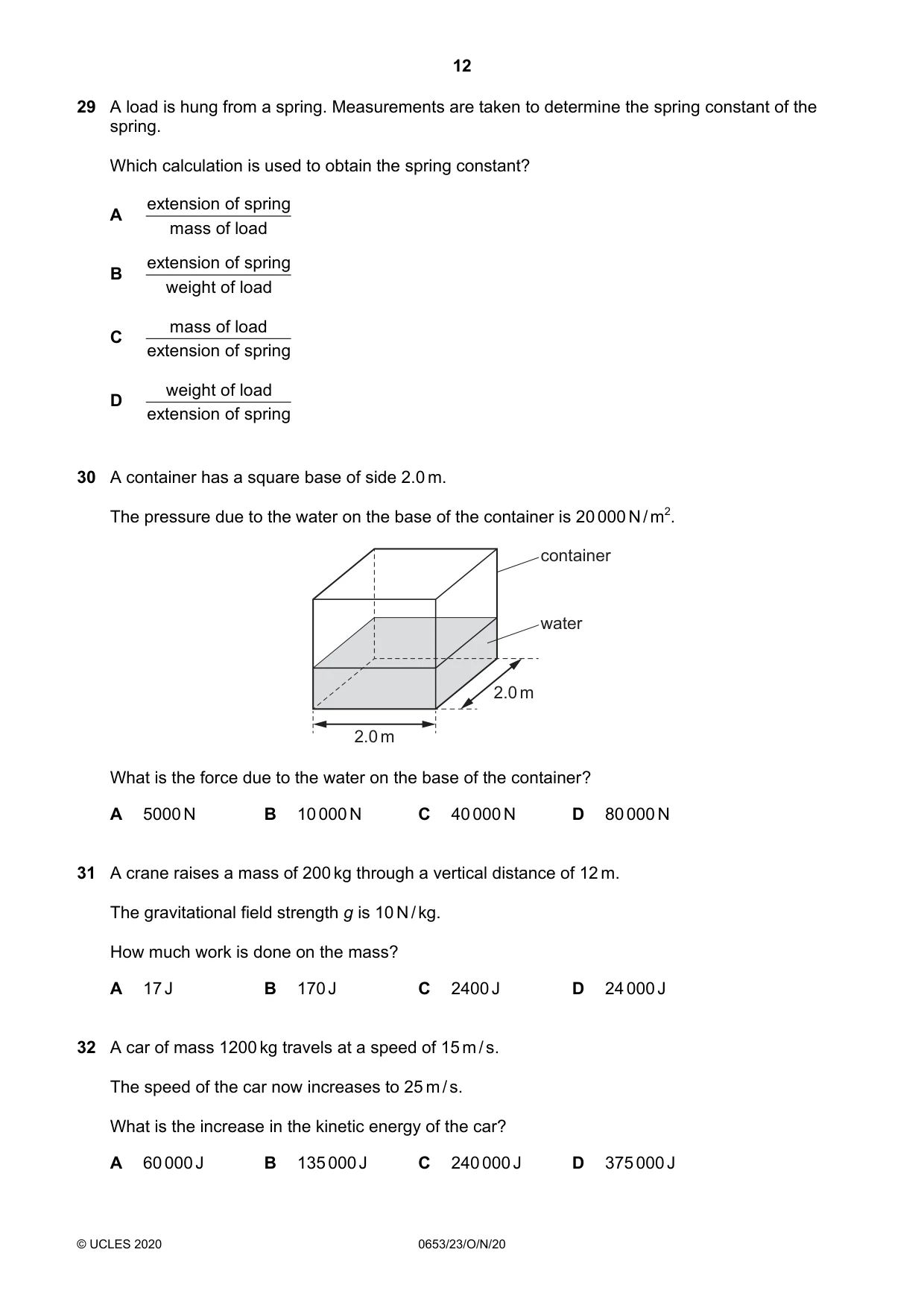
29 A load is hung from a spring. Measurements are taken to determine the spring constant of the spring. Which calculation is used to obtain the spring constant? extension of spring A mass of load extension of spring B weight of load mass of load C extension of spring weight of load D extension of spring
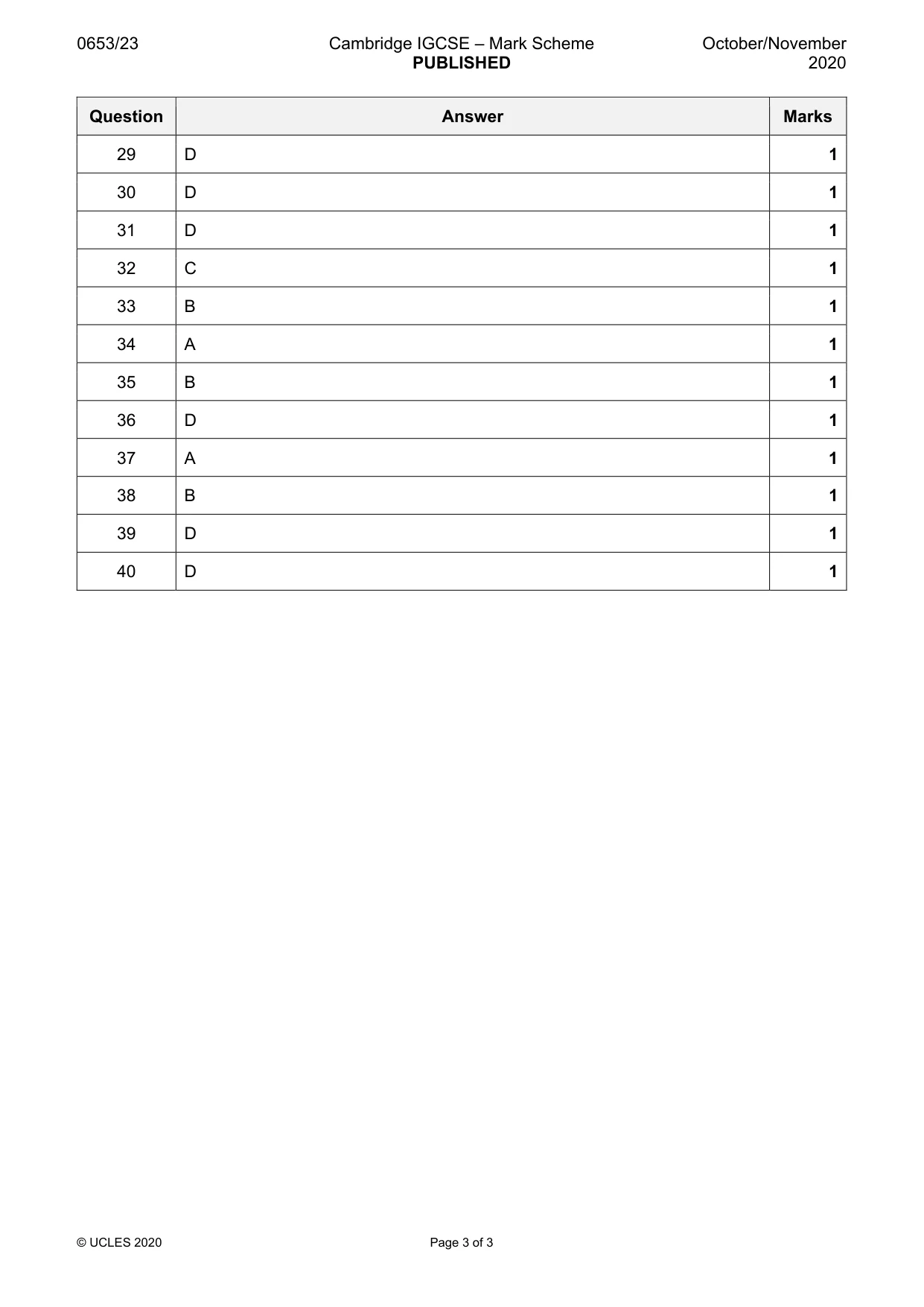
Mark scheme: D
Q30 · A container has a square base of side 2.0 m
30 A container has a square base of side 2.0 m. The pressure due to the water on the base of the container is 20 000 N / m2. container water 2.0 m 2.0 m What is the force due to the water on the base of the container? A 5000 N B 10 000 N C 40 000 N D 80 000 N
Mark scheme: D
Q31 · A crane raises a mass of 200 kg through a vertical distance of 12 m
31 A crane raises a mass of 200 kg through a vertical distance of 12 m. The gravitational field strength g is 10 N / kg. How much work is done on the mass? A 17 J B 170 J C 2400 J D 24 000 J
Mark scheme: D
Q32 · A car of mass 1200 kg travels at a speed of 15 m / s
32 A car of mass 1200 kg travels at a speed of 15 m / s. The speed of the car now increases to 25 m / s. What is the increase in the kinetic energy of the car? A 60 000 J B 135 000 J C 240 000 J D 375 000 J
Mark scheme: C
Q33 · For which energy resource is the Sun the only source?
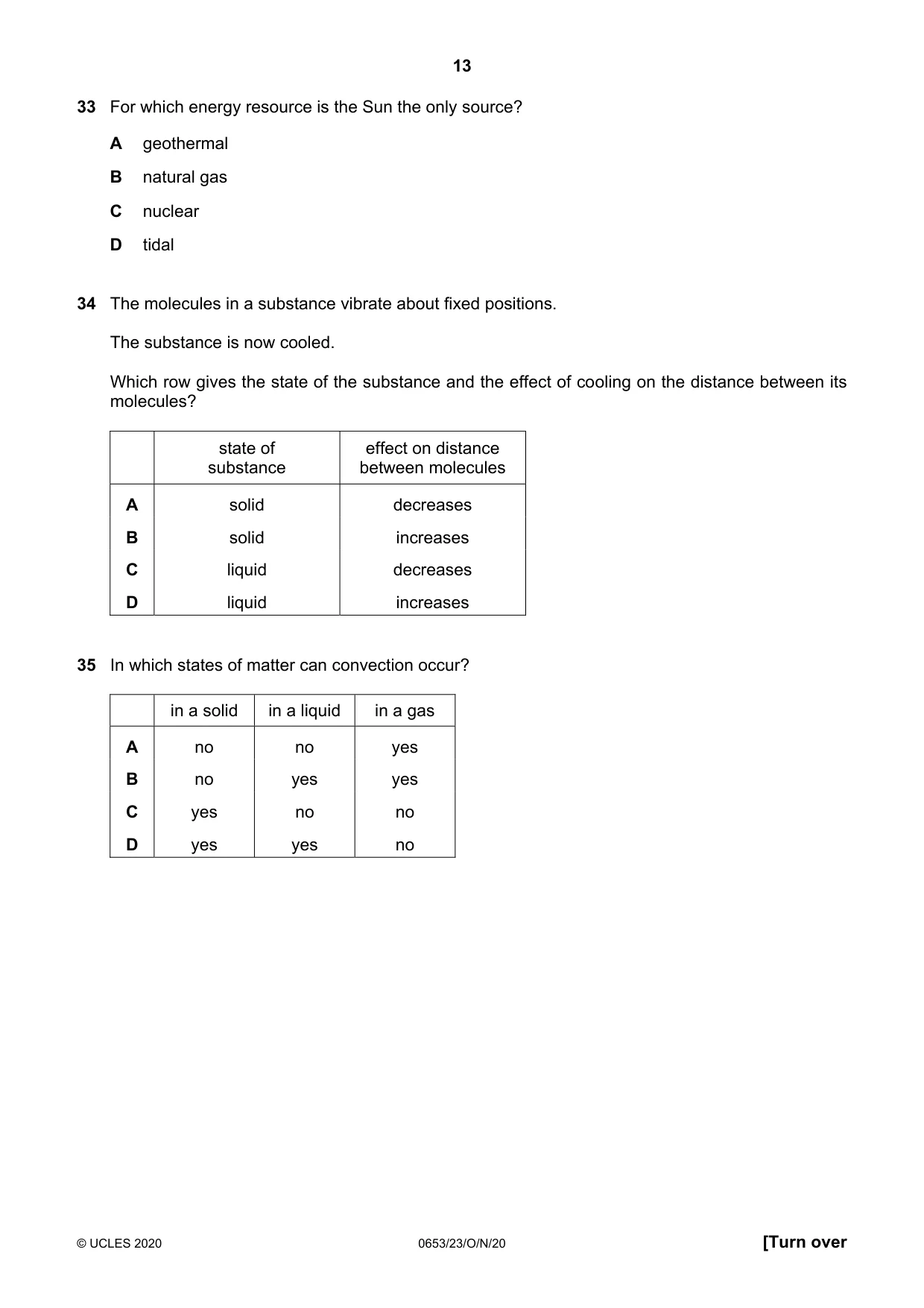
33 For which energy resource is the Sun the only source? A geothermal B natural gas C nuclear D tidal
Mark scheme: B
Q34 · The molecules in a substance vibrate about fixed positions
34 The molecules in a substance vibrate about fixed positions. The substance is now cooled. Which row gives the state of the substance and the effect of cooling on the distance between its molecules? state of effect on distance substance between molecules A solid decreases B solid increases C liquid decreases D liquid increases
Mark scheme: A
Q35 · In which states of matter can convection occur?
35 In which states of matter can convection occur? in a solid in a liquid in a gas A no no yes B no yes yes C yes no no D yes yes no
Mark scheme: B
Q36 · The diagram shows a section of a rope
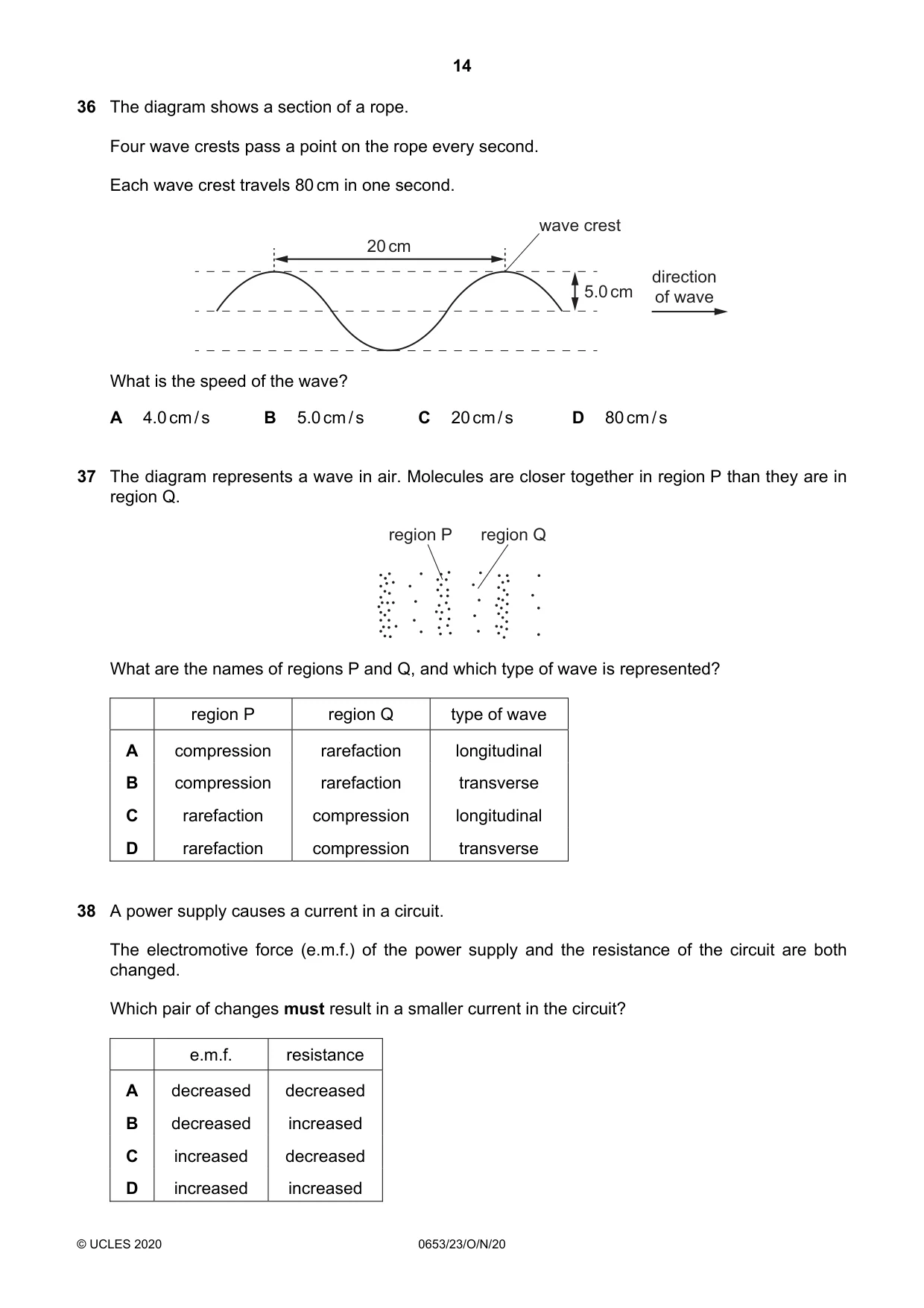
36 The diagram shows a section of a rope. Four wave crests pass a point on the rope every second. Each wave crest travels 80 cm in one second. wave crest 20 cm direction 5.0 cm of wave What is the speed of the wave? A 4.0 cm / s B 5.0 cm / s C 20 cm / s D 80 cm / s
Mark scheme: D
Q37 · The diagram represents a wave in air
37 The diagram represents a wave in air. Molecules are closer together in region P than they are in region Q. region P region Q What are the names of regions P and Q, and which type of wave is represented? region P region Q type of wave A compression rarefaction longitudinal B compression rarefaction transverse C rarefaction compression longitudinal D rarefaction compression transverse
Mark scheme: A
Q38 · A power supply causes a current in a circuit
38 A power supply causes a current in a circuit. The electromotive force (e.m.f.) of the power supply and the resistance of the circuit are both changed. Which pair of changes must result in a smaller current in the circuit? e.m.f. resistance A decreased decreased B decreased increased C increased decreased D increased increased
Mark scheme: B
Q39 · A circuit includes a lamp, a switch and an ammeter
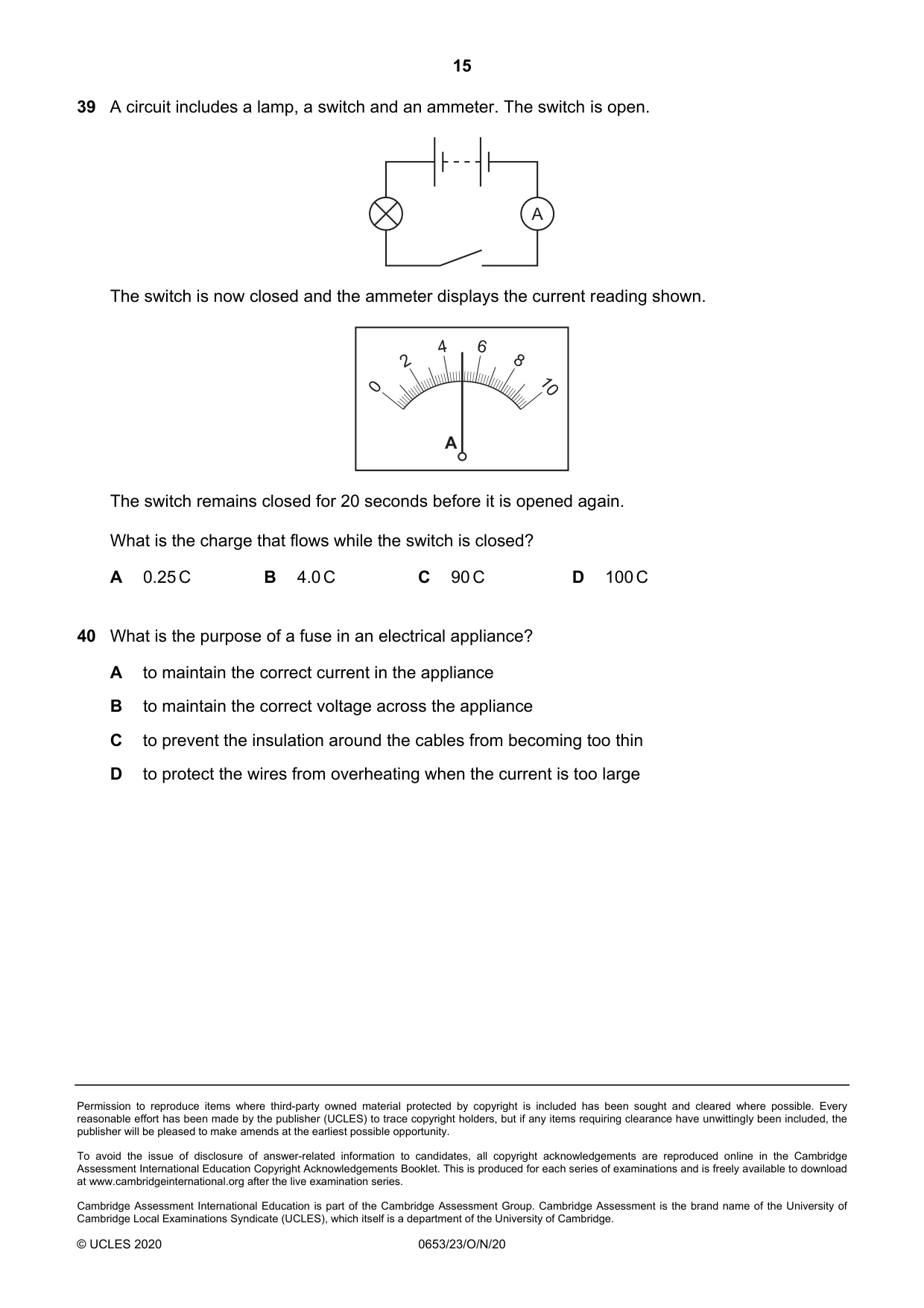
39 A circuit includes a lamp, a switch and an ammeter. The switch is open. A The switch is now closed and the ammeter displays the current reading shown. 4 6 2 8 0 10 A The switch remains closed for 20 seconds before it is opened again. What is the charge that flows while the switch is closed? A 0.25 C B 4.0 C C 90 C D 100 C
Mark scheme: D
Q40 · What is the purpose of a fuse in an electrical appliance?
40 What is the purpose of a fuse in an electrical appliance? A to maintain the correct current in the appliance B to maintain the correct voltage across the appliance C to prevent the insulation around the cables from becoming too thin D to protect the wires from overheating when the current is too large
Mark scheme: D
What was in this paper
The subtopics covered by these 40 questions, and how many questions each got. Open one in a new tab to see every Cambridge question on it.
3Digestion2Sexual reproduction in plants2Characteristics of living organisms1Chromatography1Diffusion1Drugs1Electrical circuits1Electrical quantities1Electrical safety1Electrolysis1Elements, compounds and mixtures1Enzymes1Exothermic and endothermic reactions1Extraction of metals1Forces1Formulas1Gas exchange in humans1General properties of waves1Group VII properties1Habitat destruction1Identification of ions and gases1Kinetic particle model of matter1Motion1Preparation of salts1Pressure1Rate of reaction1Redox1Respiration1Sexual reproduction in humans1Solids, liquids and gases1Sound1Terminology1Transfer of thermal energy1Transition elements1Transpiration1What you needed in this session
Cambridge’s own grade thresholds for 2020 Oct/Nov, Paper 2 · Variant 3. A higher threshold means an easier paper — the bar moves with how the cohort did.