Cambridge IGCSE Science - Combined 0653 — 2025 Oct/Nov Paper 2 · Variant 1
0653/21/O/N/25 · 40 questions · 40 marks · 45 min
The question paper and its mark scheme, free to read here and free to download. This is Cambridge’s own paper, exactly as it was sat.
Question paper16 pages

Mark scheme3 pages
Answers below. Sit the paper first if you are practising.
Questions as text
Q1 · One of the characteristics of living organisms is the ability to detect and respond to…
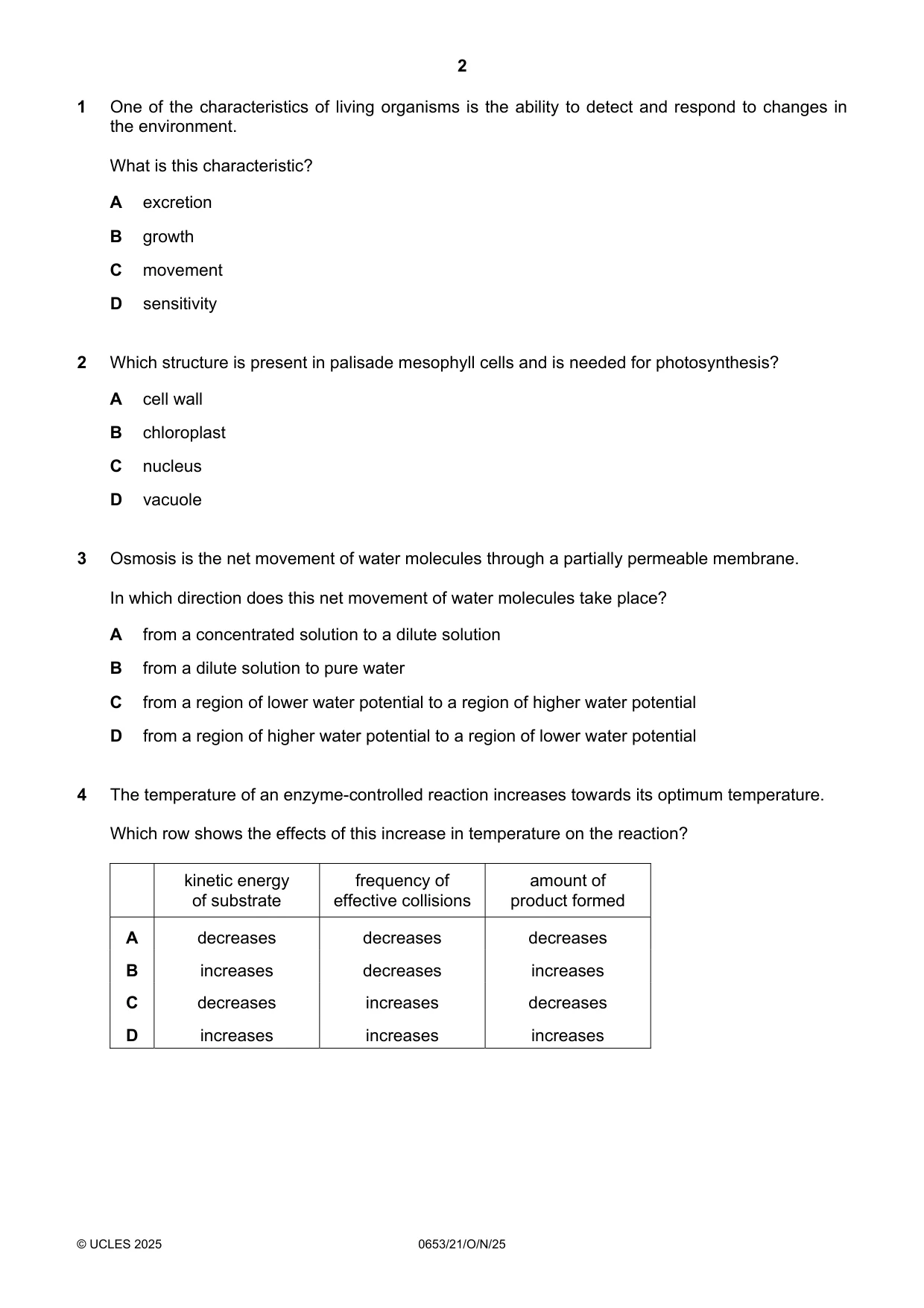
1 One of the characteristics of living organisms is the ability to detect and respond to changes in the environment. What is this characteristic? A excretion B growth C movement D sensitivity
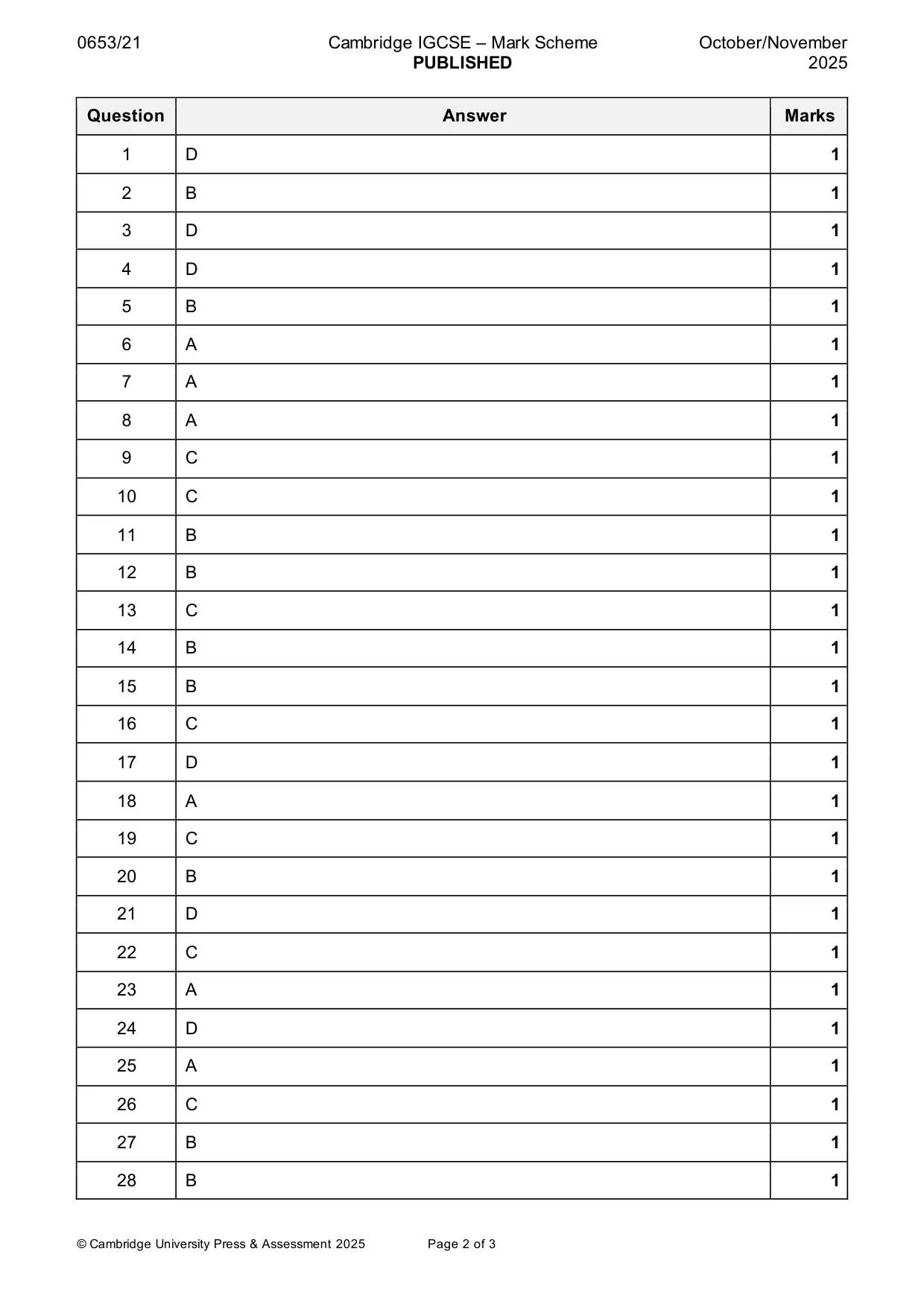
Mark scheme: D
Q2 · Which structure is present in palisade mesophyll cells and is needed for photosynthesis?
2 Which structure is present in palisade mesophyll cells and is needed for photosynthesis? A cell wall B chloroplast C nucleus D vacuole
Mark scheme: B
Q3 · Osmosis is the net movement of water molecules through a partially permeable membrane
3 Osmosis is the net movement of water molecules through a partially permeable membrane. In which direction does this net movement of water molecules take place? A from a concentrated solution to a dilute solution B from a dilute solution to pure water C from a region of lower water potential to a region of higher water potential D from a region of higher water potential to a region of lower water potential
Mark scheme: D
Q4 · The temperature of an enzyme-controlled reaction increases towards its optimum temperature
4 The temperature of an enzyme-controlled reaction increases towards its optimum temperature. Which row shows the effects of this increase in temperature on the reaction? kinetic energy frequency of amount of of substrate effective collisions product formed A decreases decreases decreases B increases decreases increases C decreases increases decreases D increases increases increases
Mark scheme: D
Q5 · Which graph shows the effect of light intensity on the rate of photosynthesis?
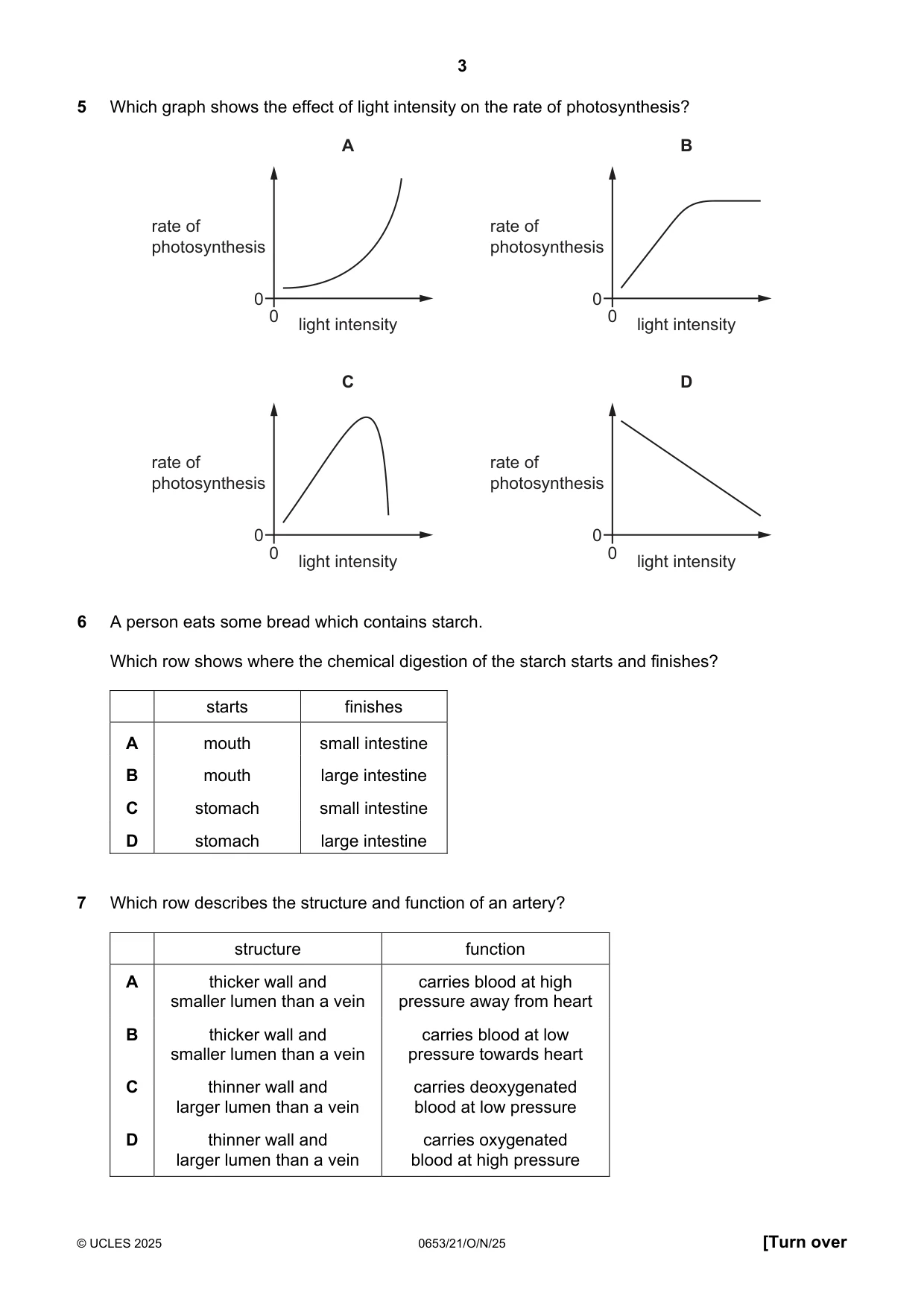
5 Which graph shows the effect of light intensity on the rate of photosynthesis? A B rate of rate of photosynthesis photosynthesis 0 0 0 0 light intensity light intensity C D rate of rate of photosynthesis photosynthesis 0 0 0 0 light intensity light intensity
Mark scheme: B
Q6 · A person eats some bread which contains starch
6 A person eats some bread which contains starch. Which row shows where the chemical digestion of the starch starts and finishes? starts finishes A mouth small intestine B mouth large intestine C stomach small intestine D stomach large intestine
Mark scheme: A
Q7 · Which row describes the structure and function of an artery?
7 Which row describes the structure and function of an artery? structure function A thicker wall and carries blood at high smaller lumen than a vein pressure away from heart B thicker wall and carries blood at low smaller lumen than a vein pressure towards heart C thinner wall and carries deoxygenated larger lumen than a vein blood at low pressure D thinner wall and carries oxygenated larger lumen than a vein blood at high pressure
Mark scheme: A
Q8 · Which row shows possible causes of coronary heart disease?
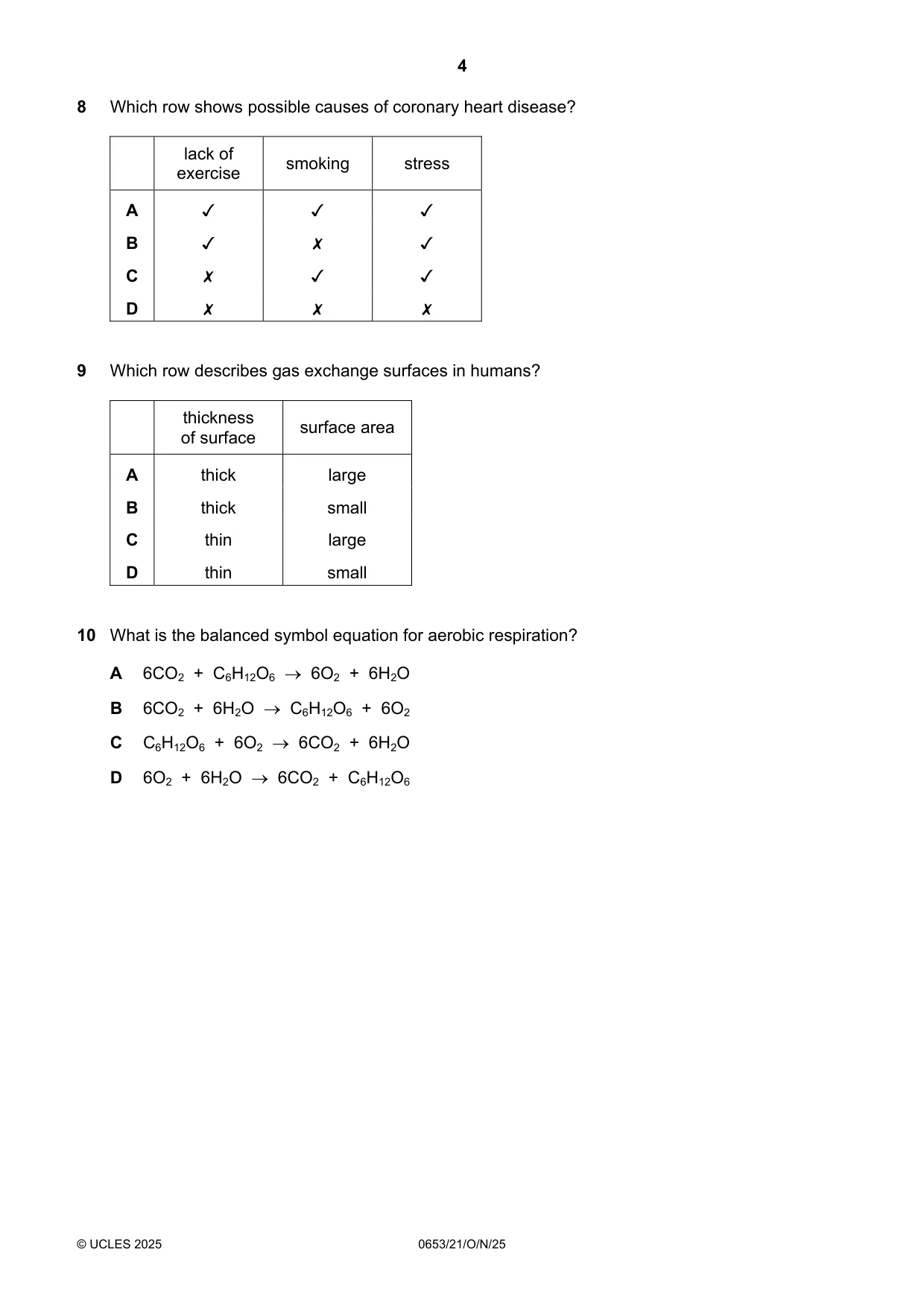
8 Which row shows possible causes of coronary heart disease? ner smoking stress A J J J B J x J Cc x J J D x x x
Mark scheme: A
Q9 · Which row describes gas exchange surfaces in humans?
9 Which row describes gas exchange surfaces in humans? thickness surface area of surface A thick large B thick small C thin large D thin small
Mark scheme: C
Q10 · What is the balanced symbol equation for aerobic respiration?
10 What is the balanced symbol equation for aerobic respiration? A 6CO2 + C6H12O6 6O2 + 6H2O B 6CO2 + 6H2O C6H12O6 + 6O2 C C6H12O6 + 6O2 6CO2 + 6H2O D 6O2 + 6H2O 6CO2 + C6H12O6
Mark scheme: C
Q11 · Which food chain shows the correct feeding levels?
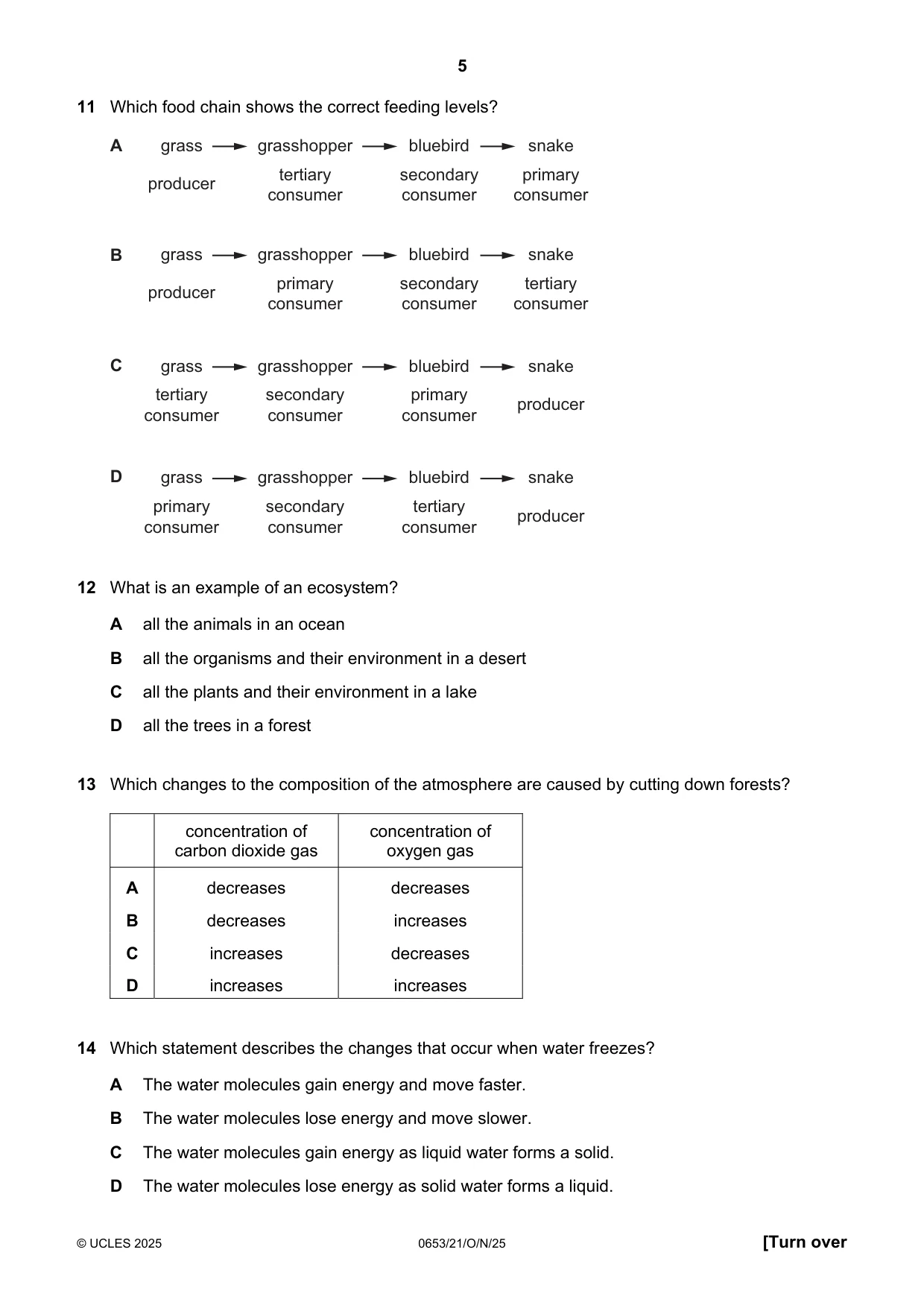
11 Which food chain shows the correct feeding levels? A grass grasshopper bluebird snake tertiary secondary primary producer consumer consumer consumer B grass grasshopper bluebird snake primary secondary tertiary producer consumer consumer consumer C grass grasshopper bluebird snake tertiary secondary primary producer consumer consumer consumer D grass grasshopper bluebird snake primary secondary tertiary producer consumer consumer consumer
Mark scheme: B
Q12 · What is an example of an ecosystem?
12 What is an example of an ecosystem? A all the animals in an ocean B all the organisms and their environment in a desert C all the plants and their environment in a lake D all the trees in a forest
Mark scheme: B
Q13 · Which changes to the composition of the atmosphere are caused by cutting down forests?
13 Which changes to the composition of the atmosphere are caused by cutting down forests? concentration of concentration of carbon dioxide gas oxygen gas A decreases decreases B decreases increases C increases decreases D increases increases
Mark scheme: C
Q14 · Which statement describes the changes that occur when water freezes?
14 Which statement describes the changes that occur when water freezes? A The water molecules gain energy and move faster. B The water molecules lose energy and move slower. C The water molecules gain energy as liquid water forms a solid. D The water molecules lose energy as solid water forms a liquid.
Mark scheme: B
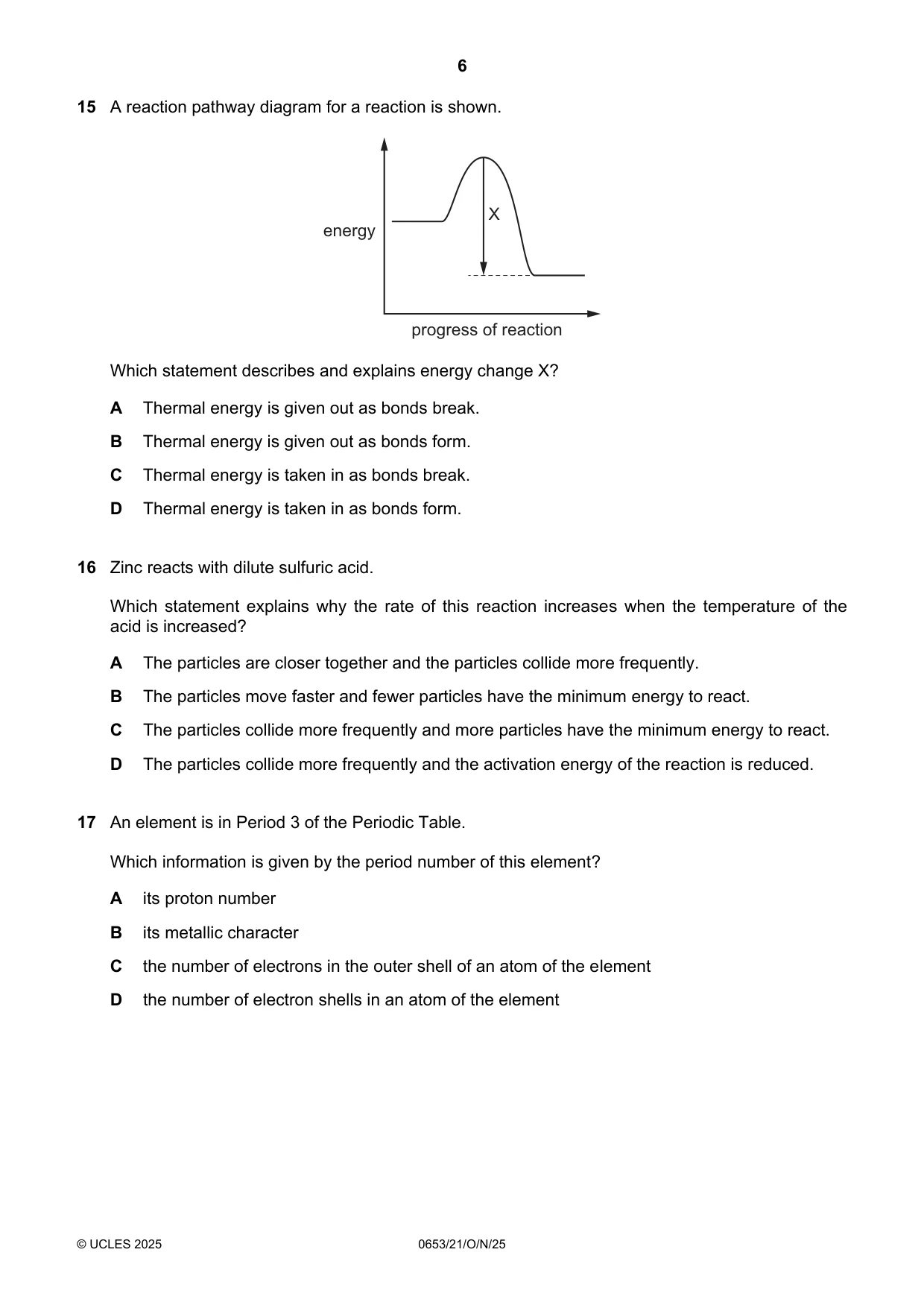
Q15 · A reaction pathway diagram for a reaction is shown
15 A reaction pathway diagram for a reaction is shown. X energy progress of reaction Which statement describes and explains energy change X? A Thermal energy is given out as bonds break. B Thermal energy is given out as bonds form. C Thermal energy is taken in as bonds break. D Thermal energy is taken in as bonds form.
Mark scheme: B
Q16 · Zinc reacts with dilute sulfuric acid
16 Zinc reacts with dilute sulfuric acid. Which statement explains why the rate of this reaction increases when the temperature of the acid is increased? A The particles are closer together and the particles collide more frequently. B The particles move faster and fewer particles have the minimum energy to react. C The particles collide more frequently and more particles have the minimum energy to react. D The particles collide more frequently and the activation energy of the reaction is reduced.
Mark scheme: C
Q17 · An element is in Period 3 of the Periodic Table
17 An element is in Period 3 of the Periodic Table. Which information is given by the period number of this element? A its proton number B its metallic character C the number of electrons in the outer shell of an atom of the element D the number of electron shells in an atom of the element
Mark scheme: D
Q18 · Which diagram represents the atoms in an alloy?
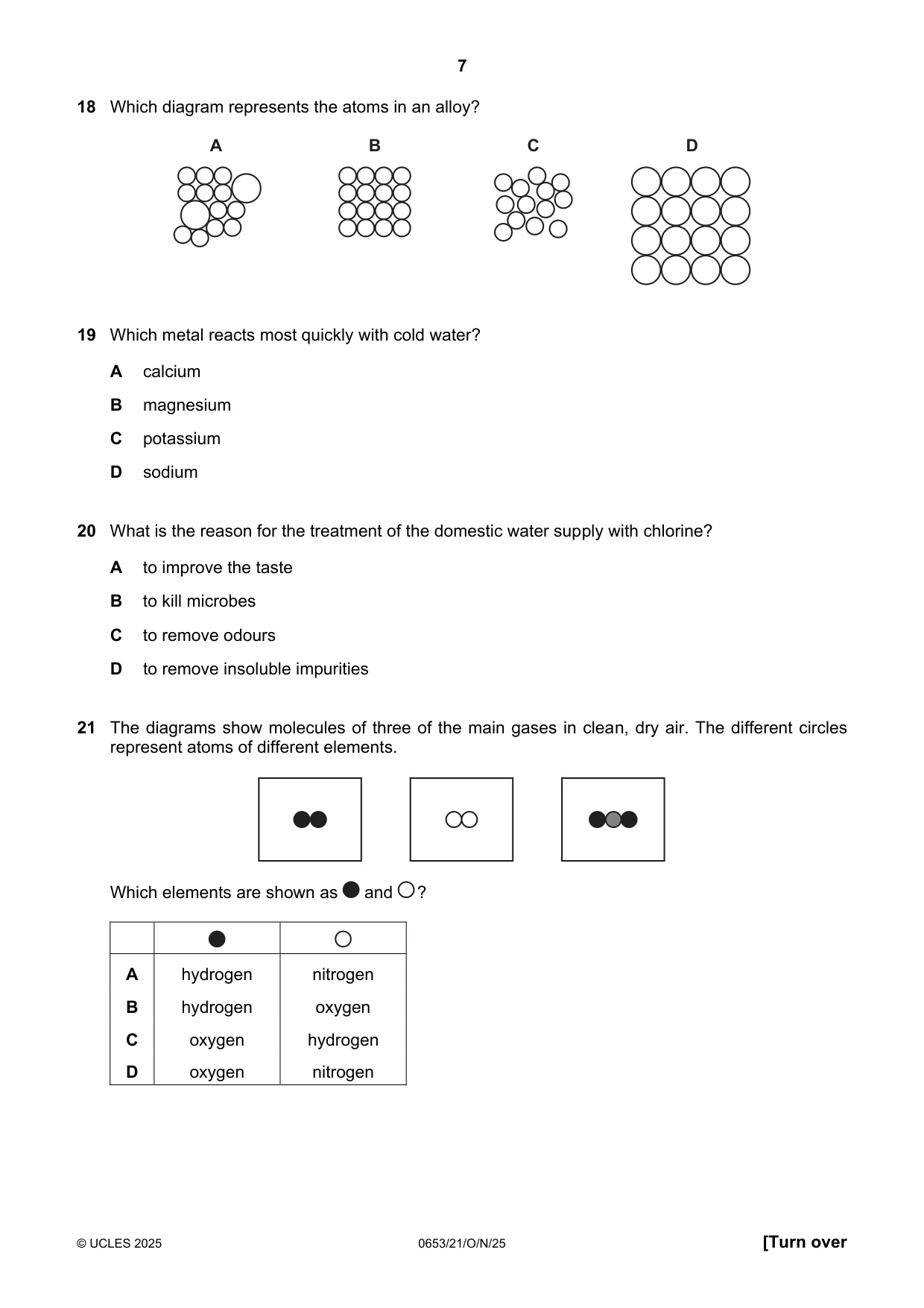
18 Which diagram represents the atoms in an alloy? A B C D
Mark scheme: A
Q19 · Which metal reacts most quickly with cold water?
19 Which metal reacts most quickly with cold water? A calcium B magnesium C potassium D sodium
Mark scheme: C
Q20 · What is the reason for the treatment of the domestic water supply with chlorine?
20 What is the reason for the treatment of the domestic water supply with chlorine? A to improve the taste B to kill microbes C to remove odours D to remove insoluble impurities
Mark scheme: B
Q21 · The diagrams show molecules of three of the main gases in clean, dry air
21 The diagrams show molecules of three of the main gases in clean, dry air. The different circles represent atoms of different elements. Which elements are shown as and ? A hydrogen nitrogen B hydrogen oxygen C oxygen hydrogen D oxygen nitrogen
Mark scheme: D
Q22 · Petroleum is a mixture of hydrocarbons
22 Petroleum is a mixture of hydrocarbons. Which method is used to separate these hydrocarbons? A crystallisation B filtration C fractional distillation D simple distillation
Mark scheme: C
Q23 · Which equation represents cracking?
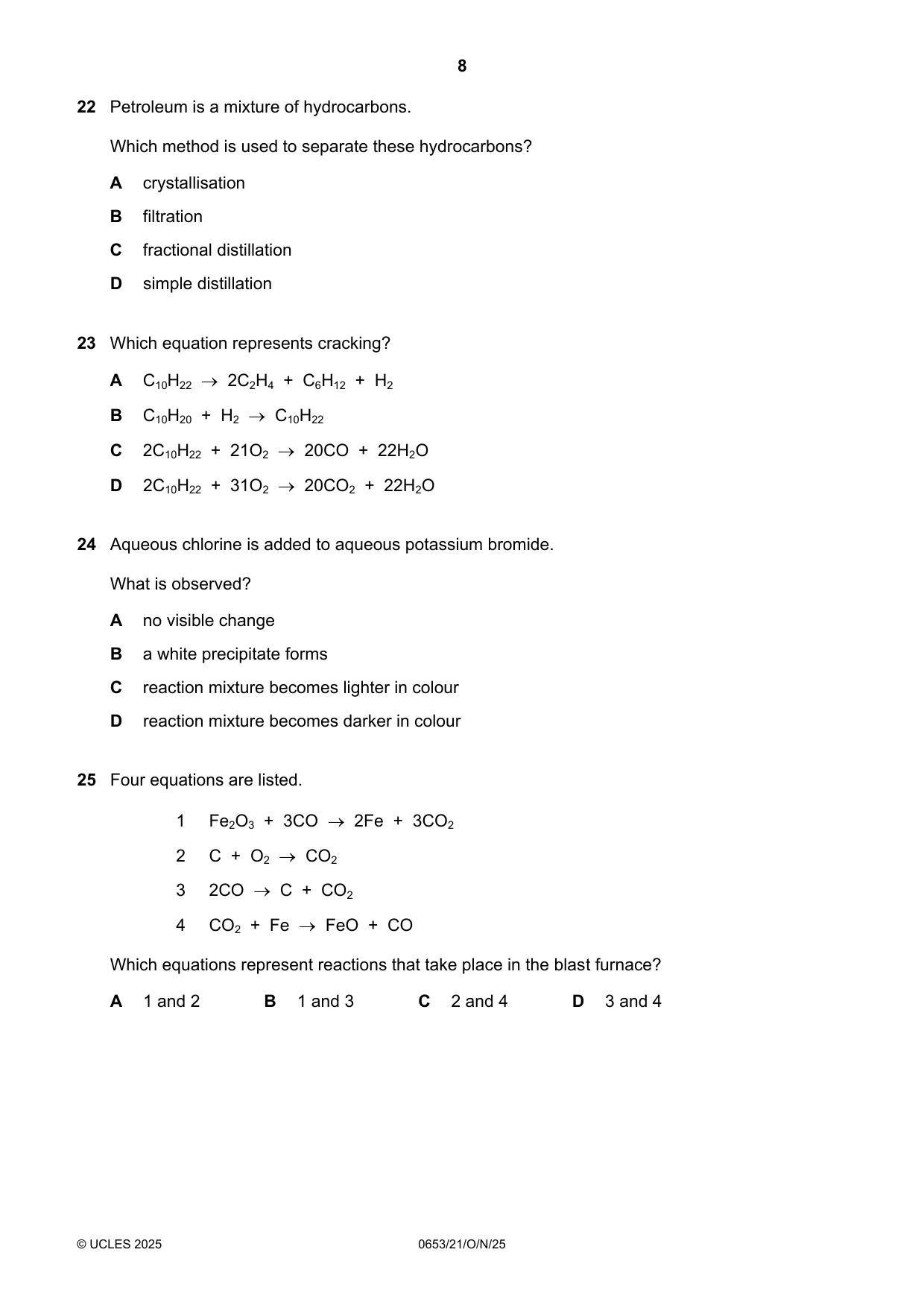
23 Which equation represents cracking? A C10H22 2C2H4 + C6H12 + H2 B C10H20 + H2 C10H22 C 2C10H22 + 21O2 20CO + 22H2O D 2C10H22 + 31O2 20CO2 + 22H2O
Mark scheme: A
Q24 · Aqueous chlorine is added to aqueous potassium bromide
24 Aqueous chlorine is added to aqueous potassium bromide. What is observed? A no visible change B a white precipitate forms C reaction mixture becomes lighter in colour D reaction mixture becomes darker in colour
Mark scheme: D
Q25 · Four equations are listed
25 Four equations are listed. 1 Fe2O3 + 3CO 2Fe + 3CO2 2 C + O2 CO2 3 2CO C + CO2 4 CO2 + Fe FeO + CO Which equations represent reactions that take place in the blast furnace? A 1 and 2 B 1 and 3 C 2 and 4 D 3 and 4
Mark scheme: A
Q26 · Which statement describes how greenhouse gases in the Earth’s atmosphere cause global…
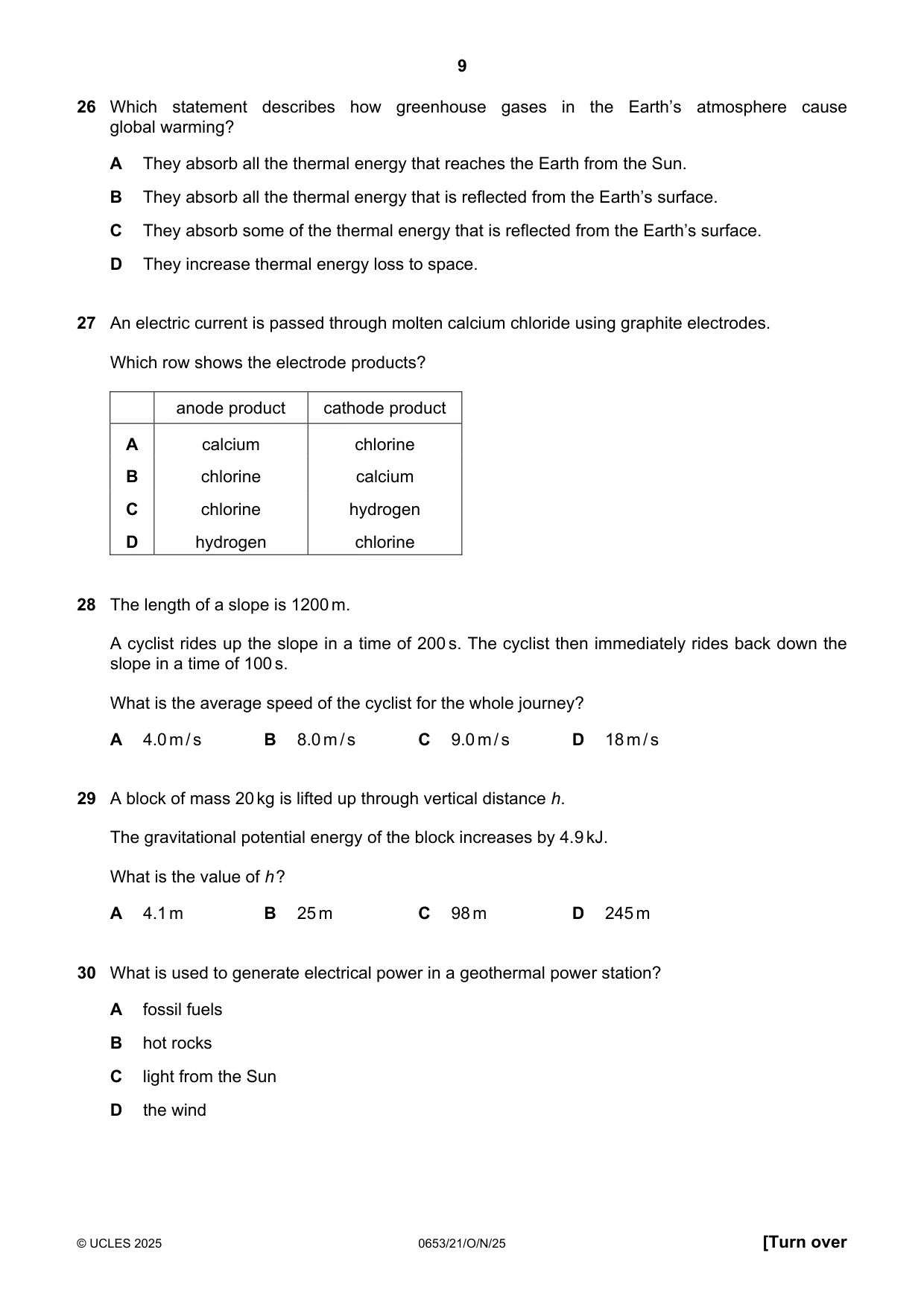
26 Which statement describes how greenhouse gases in the Earth’s atmosphere cause global warming? A They absorb all the thermal energy that reaches the Earth from the Sun. B They absorb all the thermal energy that is reflected from the Earth’s surface. C They absorb some of the thermal energy that is reflected from the Earth’s surface. D They increase thermal energy loss to space.
Mark scheme: C
Q27 · An electric current is passed through molten calcium chloride using graphite electrodes
27 An electric current is passed through molten calcium chloride using graphite electrodes. Which row shows the electrode products? anode product cathode product A calcium chlorine B chlorine calcium C chlorine hydrogen D hydrogen chlorine
Mark scheme: B
Q28 · The length of a slope is 1200 m
28 The length of a slope is 1200 m. A cyclist rides up the slope in a time of 200 s. The cyclist then immediately rides back down the slope in a time of 100 s. What is the average speed of the cyclist for the whole journey? A 4.0 m / s B 8.0 m / s C 9.0 m / s D 18 m / s
Mark scheme: B
Q29 · A block of mass 20 kg is lifted up through vertical distance h
29 A block of mass 20 kg is lifted up through vertical distance h. The gravitational potential energy of the block increases by 4.9 kJ. What is the value of h ? A 4.1 m B 25 m C 98 m D 245 m
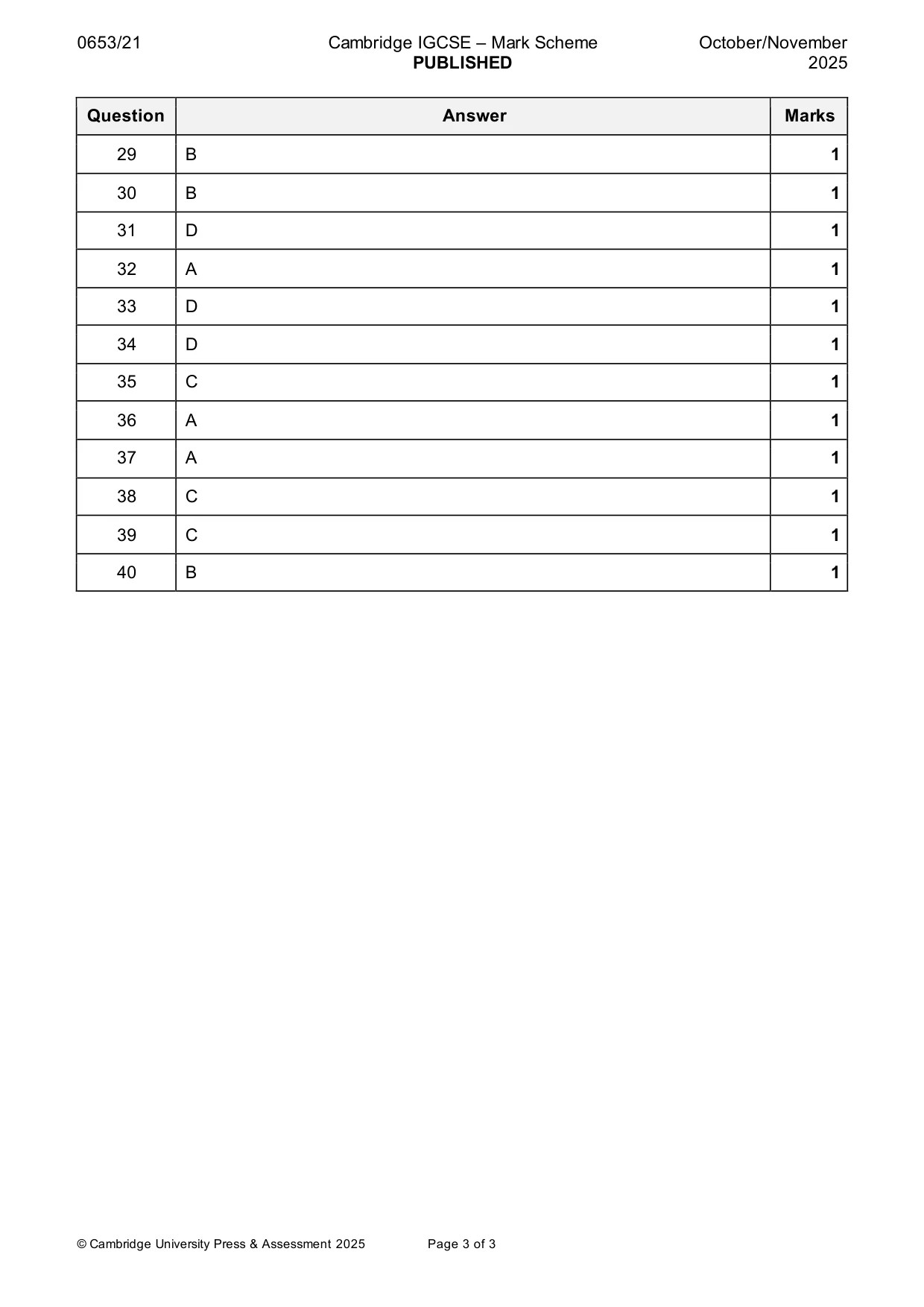
Mark scheme: B
Q30 · What is used to generate electrical power in a geothermal power station?
30 What is used to generate electrical power in a geothermal power station? A fossil fuels B hot rocks C light from the Sun D the wind
Mark scheme: B
Q31 · Which statement explains why iron is a better thermal conductor than plastic?
31 Which statement explains why iron is a better thermal conductor than plastic? A Atoms in iron vibrate more. B Electrons in iron vibrate more. C There are delocalised atoms in iron. D There are delocalised electrons in iron.
Mark scheme: D
Q32 · The diagram shows a convection current in water in a beaker
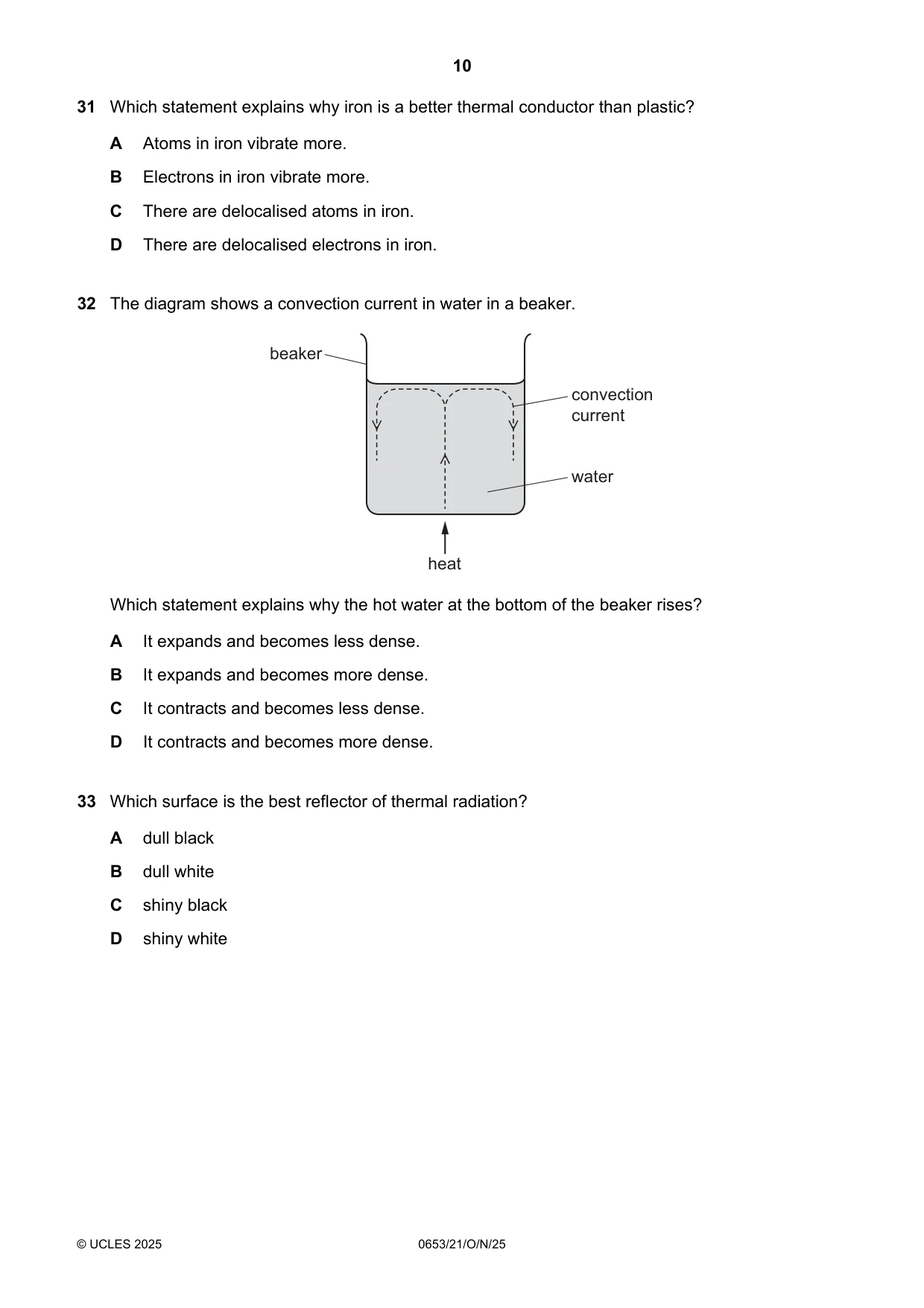
32 The diagram shows a convection current in water in a beaker. beaker convection current water heat Which statement explains why the hot water at the bottom of the beaker rises? A It expands and becomes less dense. B It expands and becomes more dense. C It contracts and becomes less dense. D It contracts and becomes more dense.
Mark scheme: A
Q33 · Which surface is the best reflector of thermal radiation?
33 Which surface is the best reflector of thermal radiation? A dull black B dull white C shiny black D shiny white
Mark scheme: D
Q34 · The diagram shows a ray of light passing from air into glass
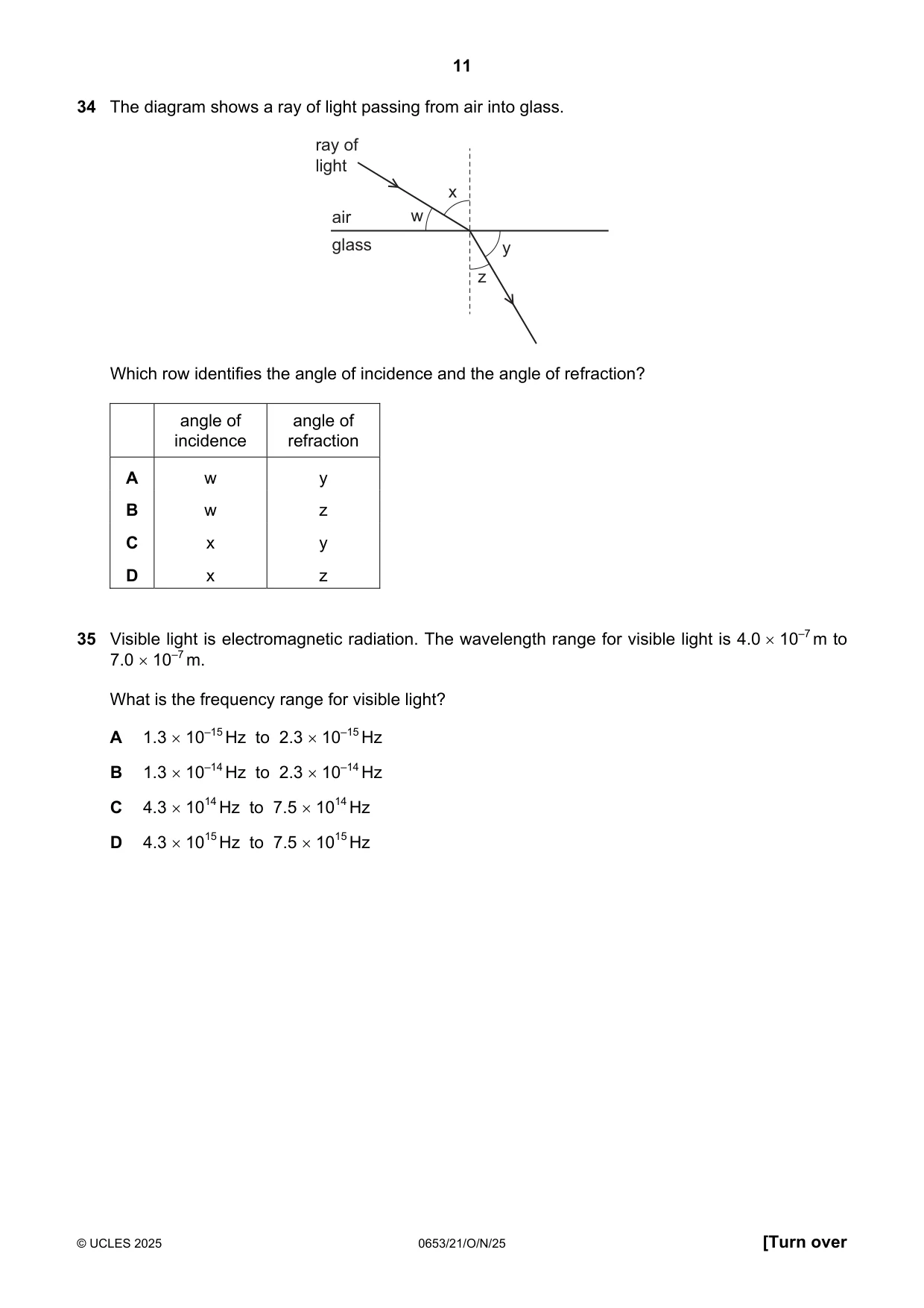
34 The diagram shows a ray of light passing from air into glass. ray of light x air w glass y z Which row identifies the angle of incidence and the angle of refraction? angle of angle of incidence refraction A w y B w z C x y D x z
Mark scheme: D
Q35 · Visible light is electromagnetic radiation
35 Visible light is electromagnetic radiation. The wavelength range for visible light is 4.0 10–7 m to 7.0 10–7 m. What is the frequency range for visible light? A 1.3 10–15 Hz to 2.3 10–15 Hz B 1.3 10–14 Hz to 2.3 10–14 Hz C 4.3 1014 Hz to 7.5 1014 Hz D 4.3 1015 Hz to 7.5 1015 Hz
Mark scheme: C
Q36 · The table shows the speed of sound in three different substances, X, Y and Z
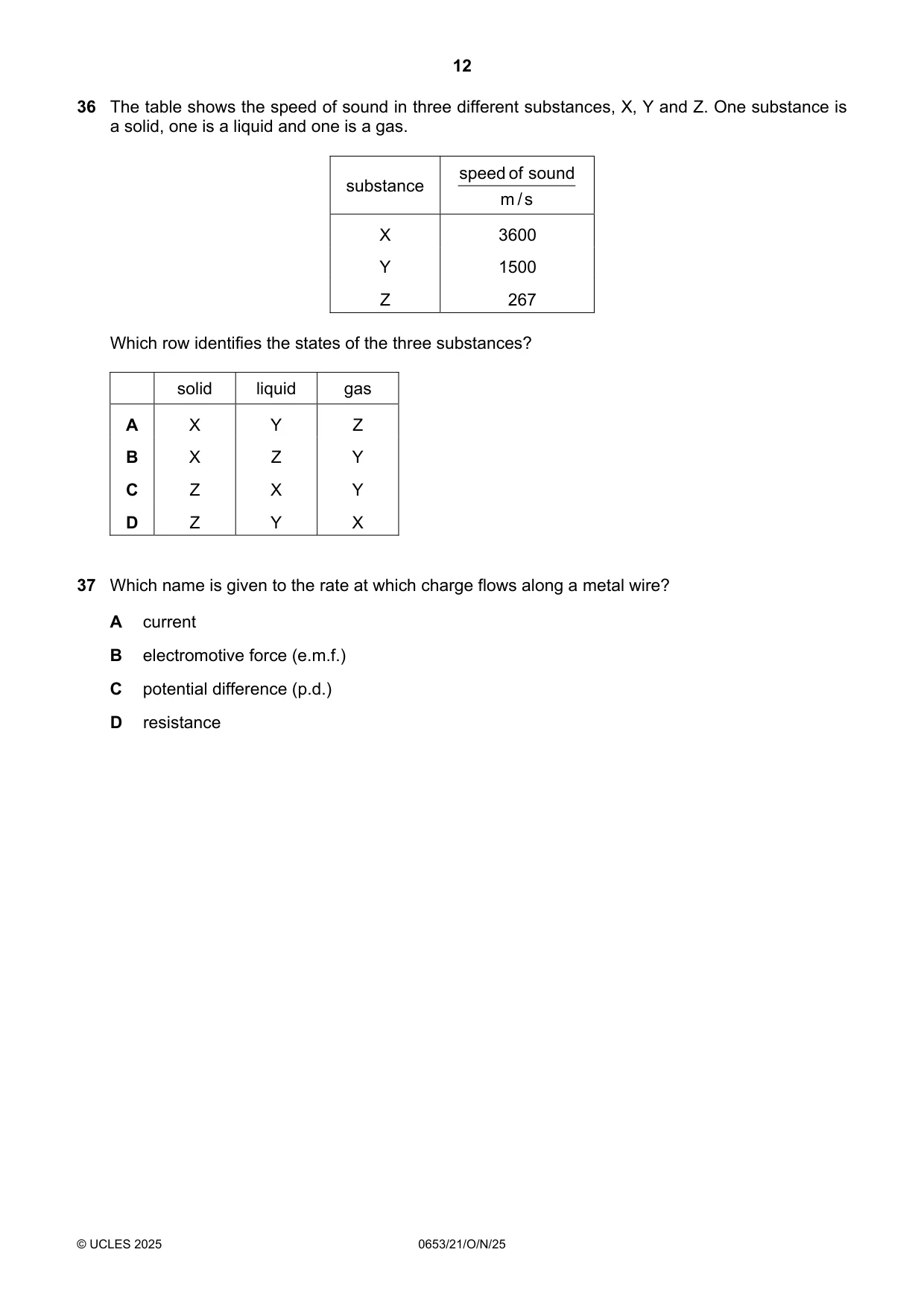
36 The table shows the speed of sound in three different substances, X, Y and Z. One substance is a solid, one is a liquid and one is a gas. speed of sound substance m / s X 3600 Y 1500 Z 267 Which row identifies the states of the three substances? solid liquid gas A X Y Z B X Z Y C Z X Y D Z Y X
Mark scheme: A
Q37 · Which name is given to the rate at which charge flows along a metal wire?
37 Which name is given to the rate at which charge flows along a metal wire? A current B electromotive force (e.m.f.) C potential difference (p.d.) D resistance
Mark scheme: A
Q38 · In the circuit shown, the switch is open
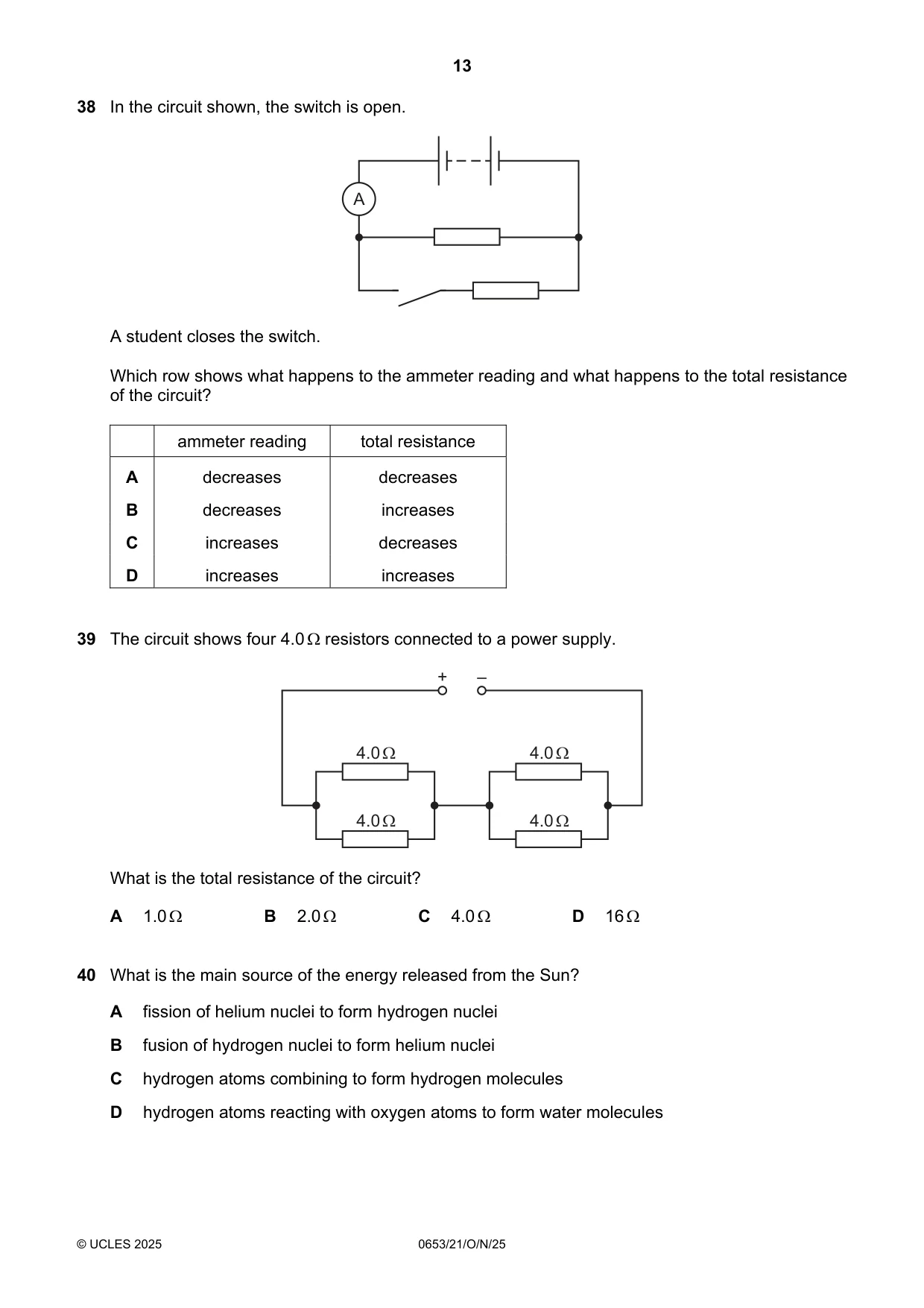
38 In the circuit shown, the switch is open. A A student closes the switch. Which row shows what happens to the ammeter reading and what happens to the total resistance of the circuit? ammeter reading total resistance A decreases decreases B decreases increases C increases decreases D increases increases
Mark scheme: C
Q39 · The circuit shows four 4.0 Q resistors connected to a power supply
39 The circuit shows four 4.0 Q resistors connected to a power supply. What is the total resistance of the circuit? A 1.00 B 2.0Q C 4.00 D 16
Mark scheme: C
Q40 · What is the main source of the energy released from the Sun?
40 What is the main source of the energy released from the Sun? A fission of helium nuclei to form hydrogen nuclei B fusion of hydrogen nuclei to form helium nuclei C hydrogen atoms combining to form hydrogen molecules D hydrogen atoms reacting with oxygen atoms to form water molecules
Mark scheme: B
What was in this paper
The subtopics covered by these 40 questions, and how many questions each got. Open one in a new tab to see every Cambridge question on it.
3Air quality and climate2Electrical circuits2Energy, work and power2Alkenes1Alloys and their properties1Atomic structure and the Periodic Table1Blood vessels1Cell structure1Characteristics of living organisms1Digestion1Electrical quantities1Electrolysis1Electromagnetic spectrum1Energy flow1Enzymes1Exothermic and endothermic reactions1Extraction of metals1Food chains and food webs1Fuels1Gas exchange in humans1Group VII properties1Habitat destruction1Heart1Light1Motion1Osmosis1Photosynthesis1Rate of reaction1Reactivity series1Respiration1Solids, liquids and gases1Sound1Stars and the Universe1Water1What you needed in this session
Cambridge’s own grade thresholds for 2025 Oct/Nov, Paper 2 · Variant 1. A higher threshold means an easier paper — the bar moves with how the cohort did.