Cambridge IGCSE Science - Combined 0653 — 2020 May/June Paper 2 · Variant 2
0653/22/M/J/20 · 40 questions · 40 marks · ≈45 min
The question paper and its mark scheme, free to read here and free to download. This is Cambridge’s own paper, exactly as it was sat.
Question paper16 pages
Mark scheme3 pages
Answers below. Sit the paper first if you are practising.
Questions as text
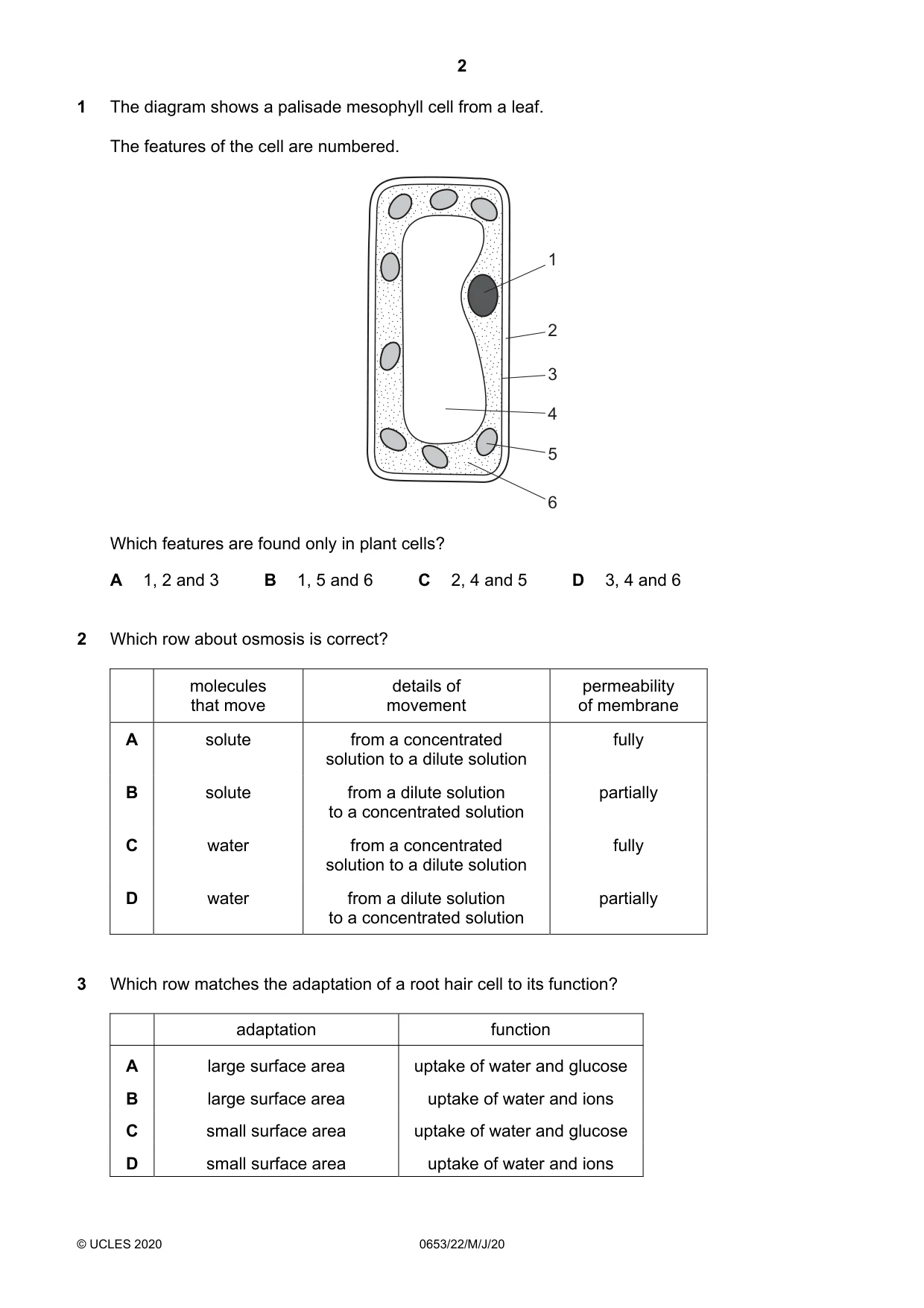
Q1 · The diagram shows a palisade mesophyll cell from a leaf
1 The diagram shows a palisade mesophyll cell from a leaf. The features of the cell are numbered. 1 2 3 4 5 6 Which features are found only in plant cells? A 1, 2 and 3 B 1, 5 and 6 C 2, 4 and 5 D 3, 4 and 6
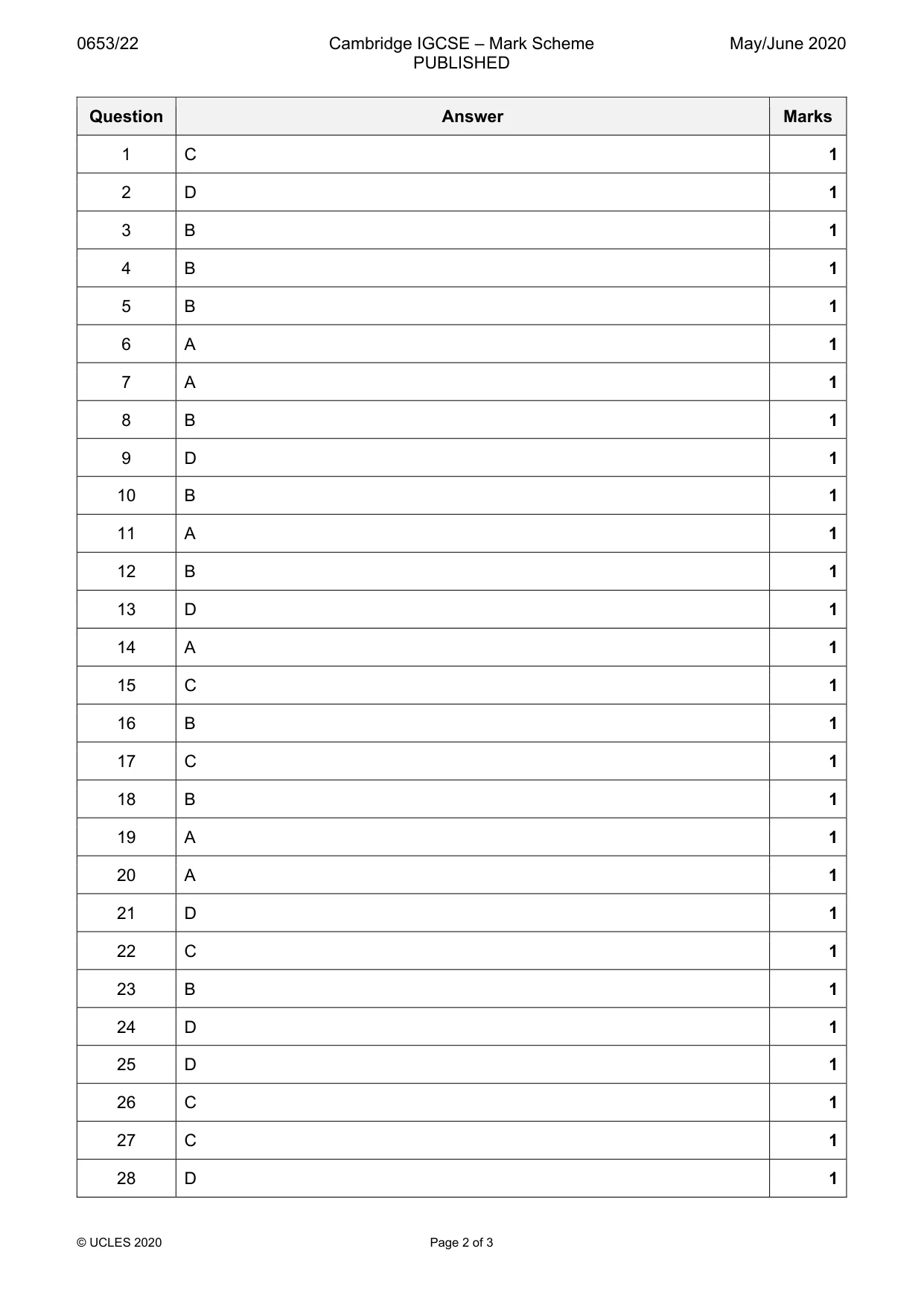
Mark scheme: C
Q2 · Which row about osmosis is correct?
2 Which row about osmosis is correct? molecules details of permeability that move movement of membrane A solute from a concentrated fully solution to a dilute solution B solute from a dilute solution partially to a concentrated solution C water from a concentrated fully solution to a dilute solution D water from a dilute solution partially to a concentrated solution
Mark scheme: D
Q3 · Which row matches the adaptation of a root hair cell to its function?
3 Which row matches the adaptation of a root hair cell to its function? adaptation function A large surface area uptake of water and glucose B large surface area uptake of water and ions C small surface area uptake of water and glucose D small surface area uptake of water and ions
Mark scheme: B
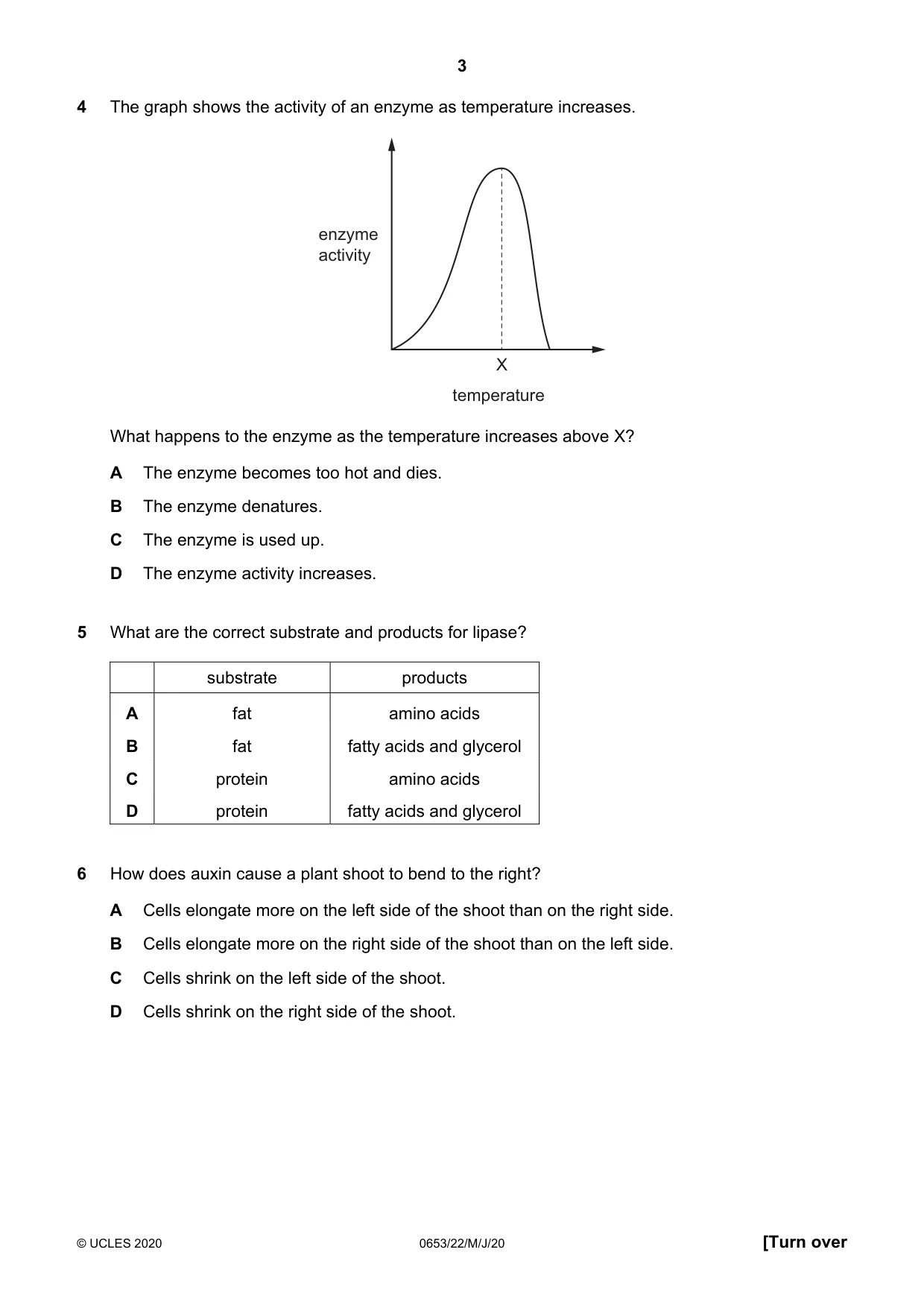
Q4 · The graph shows the activity of an enzyme as temperature increases
4 The graph shows the activity of an enzyme as temperature increases. enzyme activity X temperature What happens to the enzyme as the temperature increases above X? A The enzyme becomes too hot and dies. B The enzyme denatures. C The enzyme is used up. D The enzyme activity increases.
Mark scheme: B
Q5 · What are the correct substrate and products for lipase?
5 What are the correct substrate and products for lipase? substrate products A fat amino acids B fat fatty acids and glycerol C protein amino acids D protein fatty acids and glycerol
Mark scheme: B
Q6 · How does auxin cause a plant shoot to bend to the right?
6 How does auxin cause a plant shoot to bend to the right? A Cells elongate more on the left side of the shoot than on the right side. B Cells elongate more on the right side of the shoot than on the left side. C Cells shrink on the left side of the shoot. D Cells shrink on the right side of the shoot.
Mark scheme: A
Q7 · Which component of tobacco smoke reduces the ability of haemoglobin to carry oxygen?
7 Which component of tobacco smoke reduces the ability of haemoglobin to carry oxygen? A carbon monoxide B nicotine C smoke particles D tar
Mark scheme: A
Q8 · Which substances are the products of photosynthesis?
8 Which substances are the products of photosynthesis? A carbon dioxide and glucose B glucose and oxygen C oxygen and water D water and carbon dioxide
Mark scheme: B
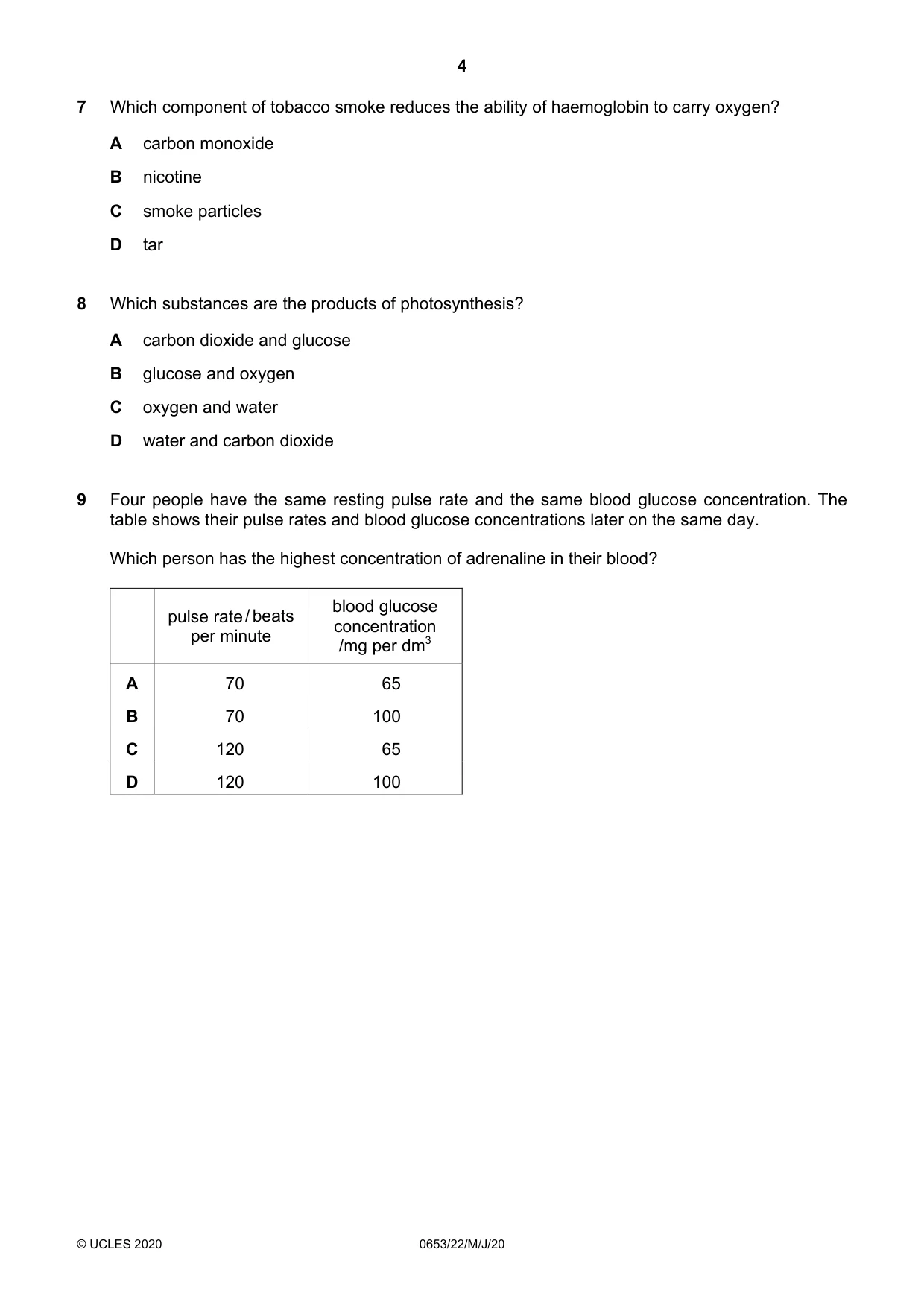
Q9 · Four people have the same resting pulse rate and the same blood glucose concentration
9 Four people have the same resting pulse rate and the same blood glucose concentration. The table shows their pulse rates and blood glucose concentrations later on the same day. Which person has the highest concentration of adrenaline in their blood? blood glucose pulse rate / beats concentration per minute /mg per dm3 A 70 65 B 70 100 C 120 65 D 120 100
Mark scheme: D
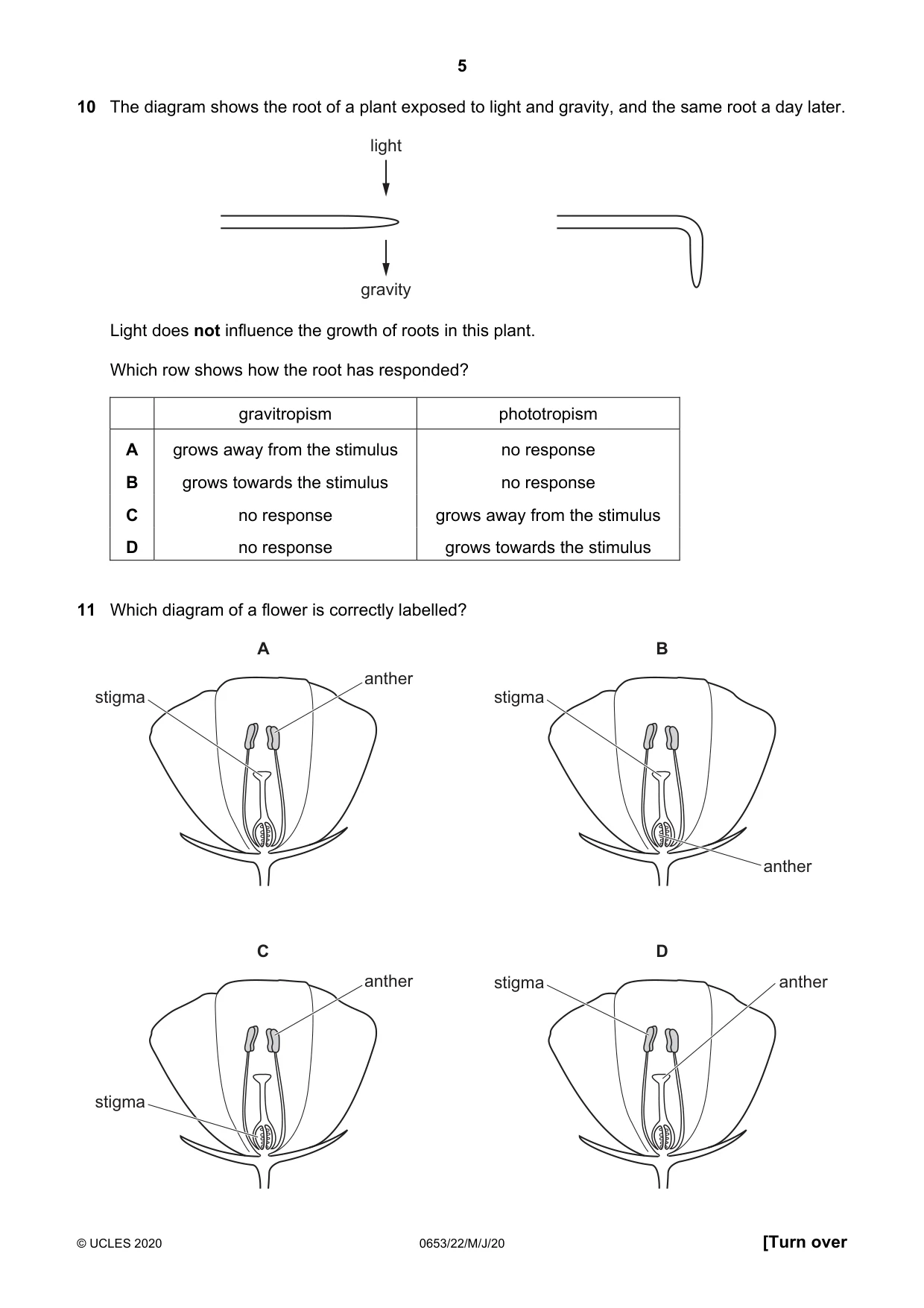
Q10 · The diagram shows the root of a plant exposed to light and gravity, and the same root a…
10 The diagram shows the root of a plant exposed to light and gravity, and the same root a day later. light gravity Light does not influence the growth of roots in this plant. Which row shows how the root has responded? gravitropism phototropism A grows away from the stimulus no response B grows towards the stimulus no response C no response grows away from the stimulus D no response grows towards the stimulus
Mark scheme: B
Q11 · Which diagram of a flower is correctly labelled?
11 Which diagram of a flower is correctly labelled? A B anther stigma stigma anther C D anther stigma anther stigma
Mark scheme: A
Q12 · Which row contains correct adaptive features for both sperm and egg cells?
12 Which row contains correct adaptive features for both sperm and egg cells? sperm egg A energy store presence of enzymes B flagellum jelly coat C jelly coat energy store D presence of enzymes flagellum
Mark scheme: B
Q13 · Which stage of eutrophication must be reached to cause fish to die?
13 Which stage of eutrophication must be reached to cause fish to die? A increased growth of decomposers B increased levels of nitrates C increased growth of plants D reduction of dissolved oxygen
Mark scheme: D
Q14 · Which process uses Rf values to identify the components of a mixture?
14 Which process uses Rf values to identify the components of a mixture? A chromatography B crystallisation C distillation D filtration
Mark scheme: A
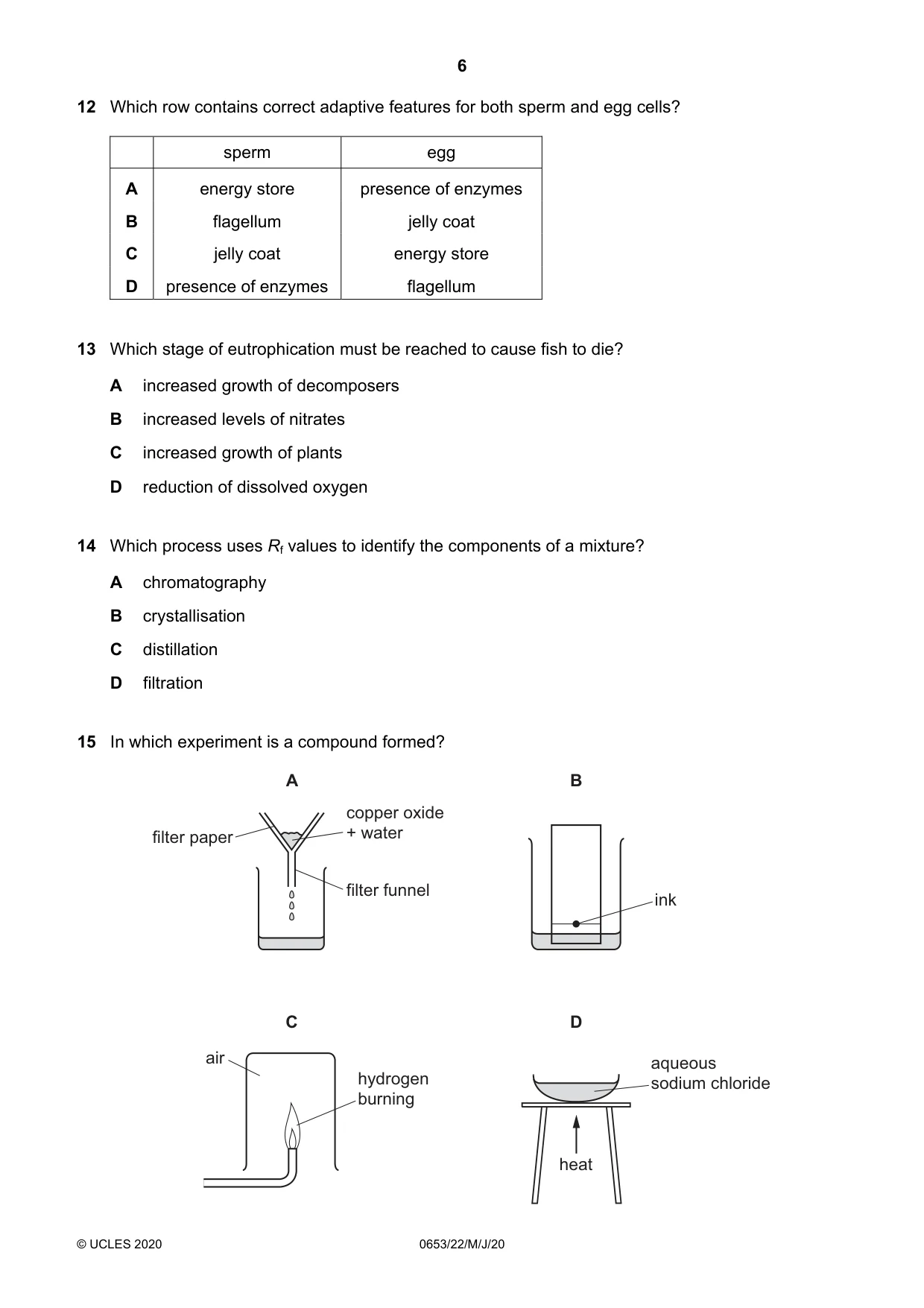
Q15 · In which experiment is a compound formed?
15 In which experiment is a compound formed? A B copper oxide filter paper + water filter funnel ink C D air aqueous hydrogen sodium chloride burning heat
Mark scheme: C
Q16 · A magnesium ion, Mg2+, is formed from a magnesium atom, Mg
16 A magnesium ion, Mg2+, is formed from a magnesium atom, Mg. Which row about the numbers of protons and neutrons in the magnesium ion and in the magnesium atom is correct? number of protons number of neutrons A larger in Mg2+ than in Mg same in Mg and Mg2+ B same in Mg and Mg2+ same in Mg and Mg2+ C same in Mg and Mg2+ smaller in Mg2+ than in Mg D smaller in Mg2+ than in Mg larger in Mg2+ than in Mg
Mark scheme: B
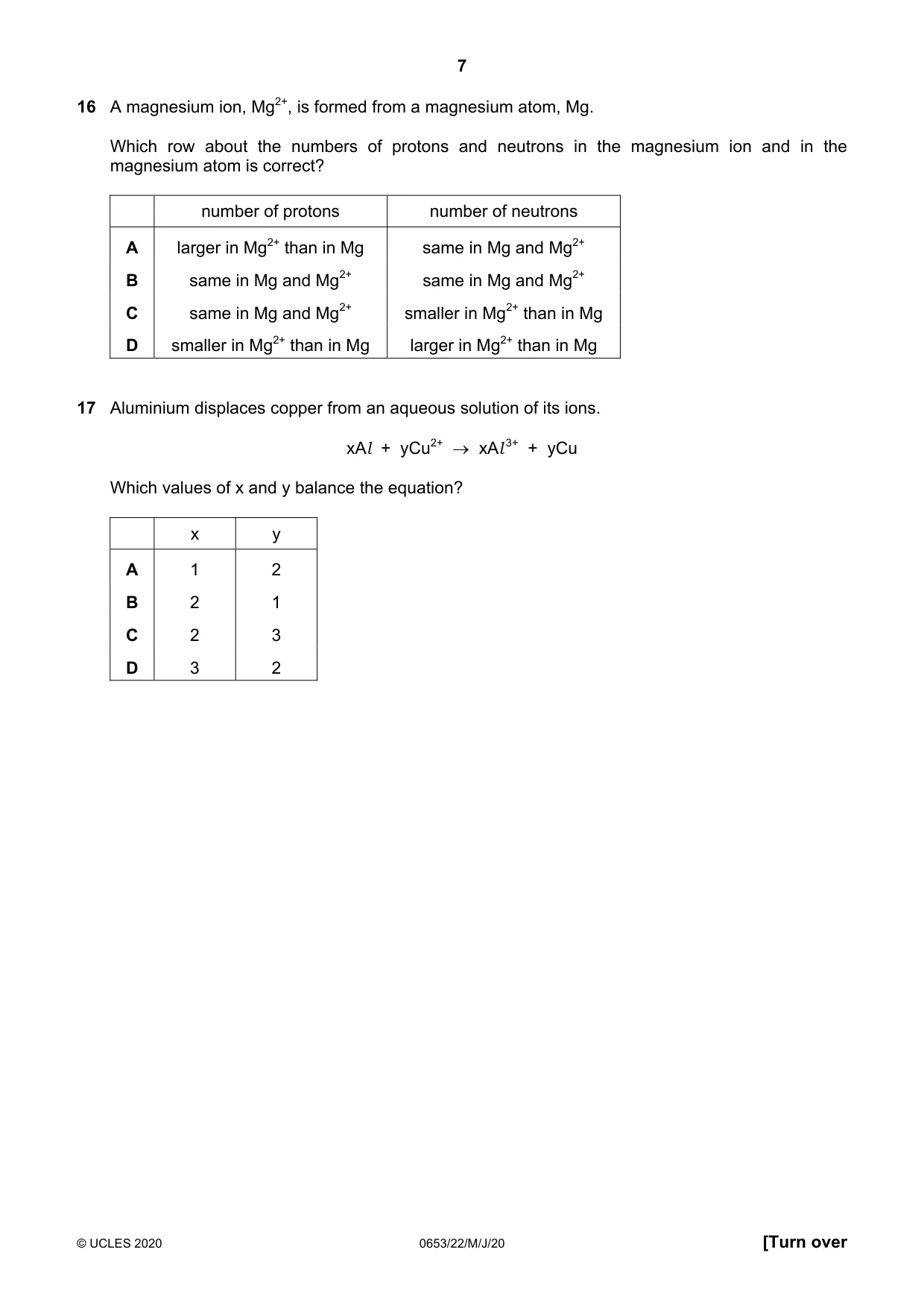
Q17 · Aluminium displaces copper from an aqueous solution of its ions
17 Aluminium displaces copper from an aqueous solution of its ions. xAl + yCu2+ → xAl 3+ + yCu Which values of x and y balance the equation? x y A 1 2 B 2 1 C 2 3 D 3 2
Mark scheme: C
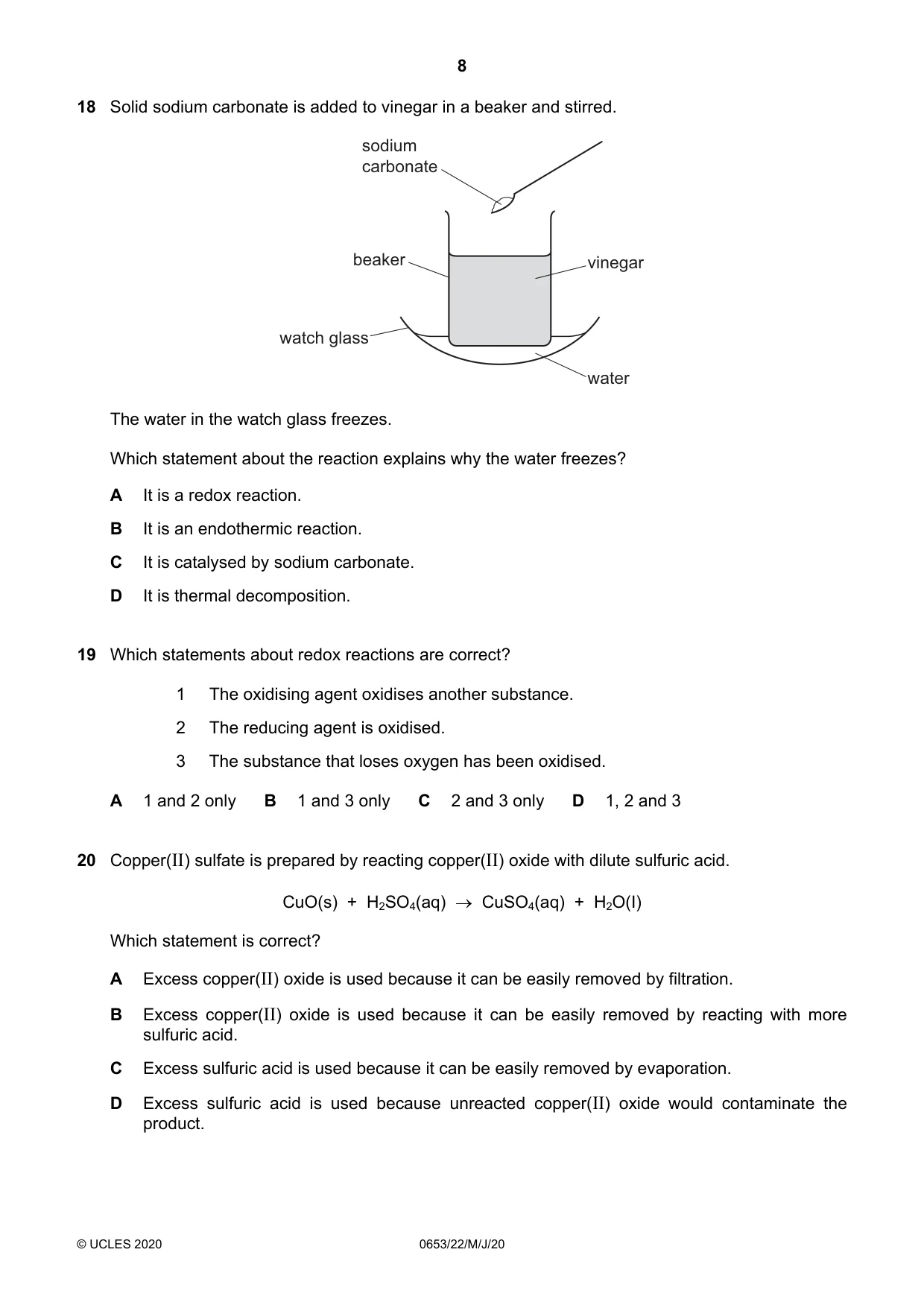
Q18 · Solid sodium carbonate is added to vinegar in a beaker and stirred
18 Solid sodium carbonate is added to vinegar in a beaker and stirred. sodium carbonate beaker vinegar watch glass water The water in the watch glass freezes. Which statement about the reaction explains why the water freezes? A It is a redox reaction. B It is an endothermic reaction. C It is catalysed by sodium carbonate. D It is thermal decomposition.
Mark scheme: B
Q19 · Which statements about redox reactions are correct?
19 Which statements about redox reactions are correct? 1 The oxidising agent oxidises another substance. 2 The reducing agent is oxidised. 3 The substance that loses oxygen has been oxidised. A 1 and 2 only B 1 and 3 only C 2 and 3 only D 1, 2 and 3
Mark scheme: A
Q20 · Copper(II) sulfate is prepared by reacting copper(II) oxide with dilute sulfuric acid
20 Copper(II) sulfate is prepared by reacting copper(II) oxide with dilute sulfuric acid. CuO(s) + H2SO4(aq) → CuSO4(aq) + H2O(I) Which statement is correct? A Excess copper(II) oxide is used because it can be easily removed by filtration. B Excess copper(II) oxide is used because it can be easily removed by reacting with more sulfuric acid. C Excess sulfuric acid is used because it can be easily removed by evaporation. D Excess sulfuric acid is used because unreacted copper(II) oxide would contaminate the product.
Mark scheme: A
Q21 · Solution X is mixed with nitric acid and aqueous barium nitrate
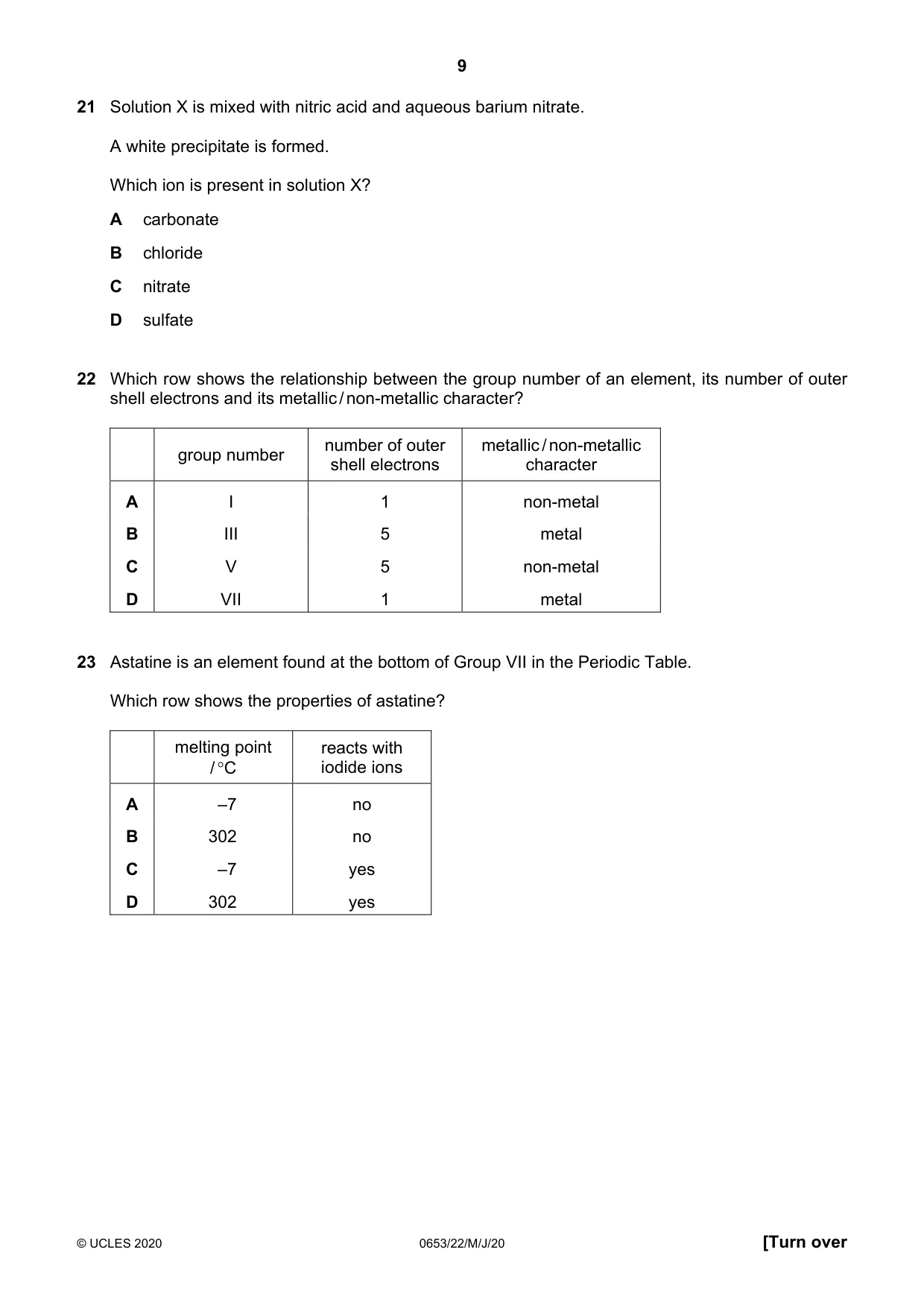
21 Solution X is mixed with nitric acid and aqueous barium nitrate. A white precipitate is formed. Which ion is present in solution X? A carbonate B chloride C nitrate D sulfate
Mark scheme: D
Q22 · Which row shows the relationship between the group number of an element, its number of…
22 Which row shows the relationship between the group number of an element, its number of outer shell electrons and its metallic / non-metallic character? number of outer metallic / non-metallic group number shell electrons character A I 1 non-metal B III 5 metal C V 5 non-metal D VII 1 metal
Mark scheme: C
Q23 · Astatine is an element found at the bottom of Group VII in the Periodic Table
23 Astatine is an element found at the bottom of Group VII in the Periodic Table. Which row shows the properties of astatine? melting point reacts with / °C iodide ions A –7 no B 302 no C –7 yes D 302 yes
Mark scheme: B
Q24 · Atoms and ions of metals P, Q and R take part in two reactions
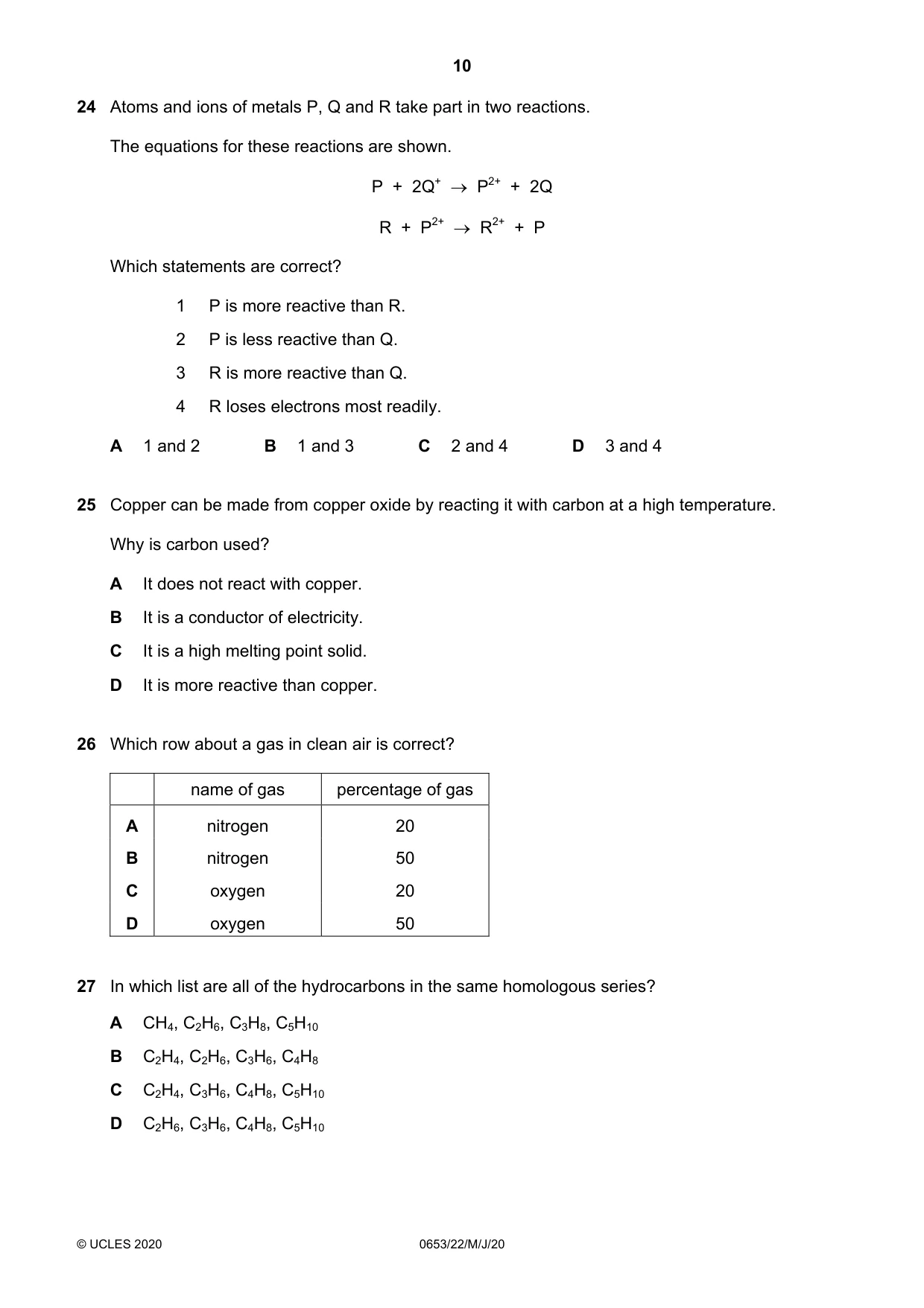
24 Atoms and ions of metals P, Q and R take part in two reactions. The equations for these reactions are shown. P + 2Q+ → P2+ + 2Q R + P2+ → R2+ + P Which statements are correct? 1 P is more reactive than R. 2 P is less reactive than Q. 3 R is more reactive than Q. 4 R loses electrons most readily. A 1 and 2 B 1 and 3 C 2 and 4 D 3 and 4
Mark scheme: D
Q25 · Copper can be made from copper oxide by reacting it with carbon at a high temperature
25 Copper can be made from copper oxide by reacting it with carbon at a high temperature. Why is carbon used? A It does not react with copper. B It is a conductor of electricity. C It is a high melting point solid. D It is more reactive than copper.
Mark scheme: D
Q26 · Which row about a gas in clean air is correct?
26 Which row about a gas in clean air is correct? name of gas percentage of gas A nitrogen 20 B nitrogen 50 C oxygen 20 D oxygen 50
Mark scheme: C
Q27 · In which list are all of the hydrocarbons in the same homologous series?
27 In which list are all of the hydrocarbons in the same homologous series? A CH4, C2H6, C3H8, C5H10 B C2H4, C2H6, C3H6, C4H8 C C2H4, C3H6, C4H8, C5H10 D C2H6, C3H6, C4H8, C5H10
Mark scheme: C
Q28 · Which distance–time graph represents a body that is moving with changing speed?
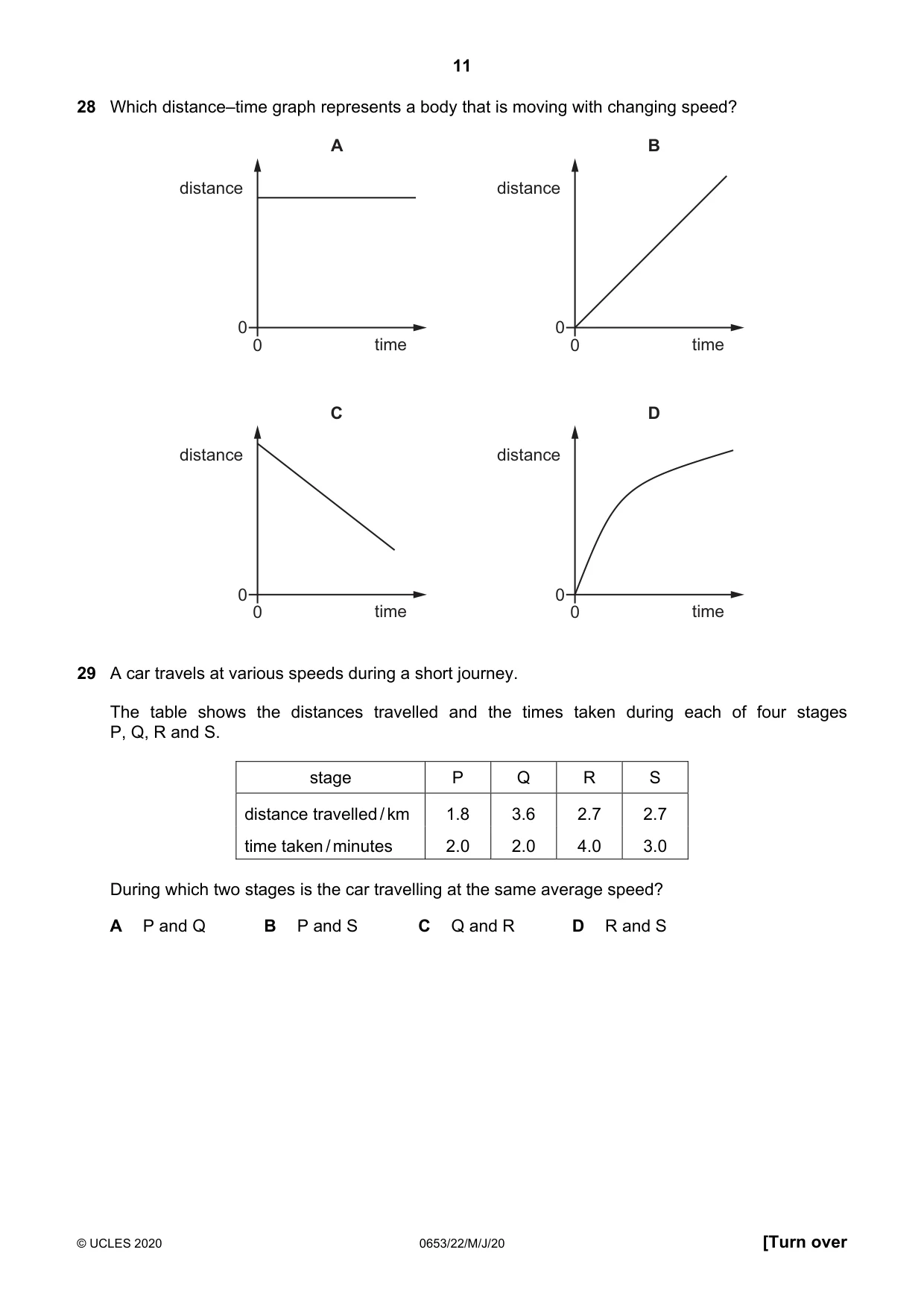
28 Which distance–time graph represents a body that is moving with changing speed? A B distance distance 0 0 0 time 0 time C D distance distance 0 0 0 time 0 time
Mark scheme: D
Q29 · A car travels at various speeds during a short journey
29 A car travels at various speeds during a short journey. The table shows the distances travelled and the times taken during each of four stages P, Q, R and S. stage P Q R S distance travelled / km 1.8 3.6 2.7 2.7 time taken / minutes 2.0 2.0 4.0 3.0 During which two stages is the car travelling at the same average speed? A P and Q B P and S C Q and R D R and S
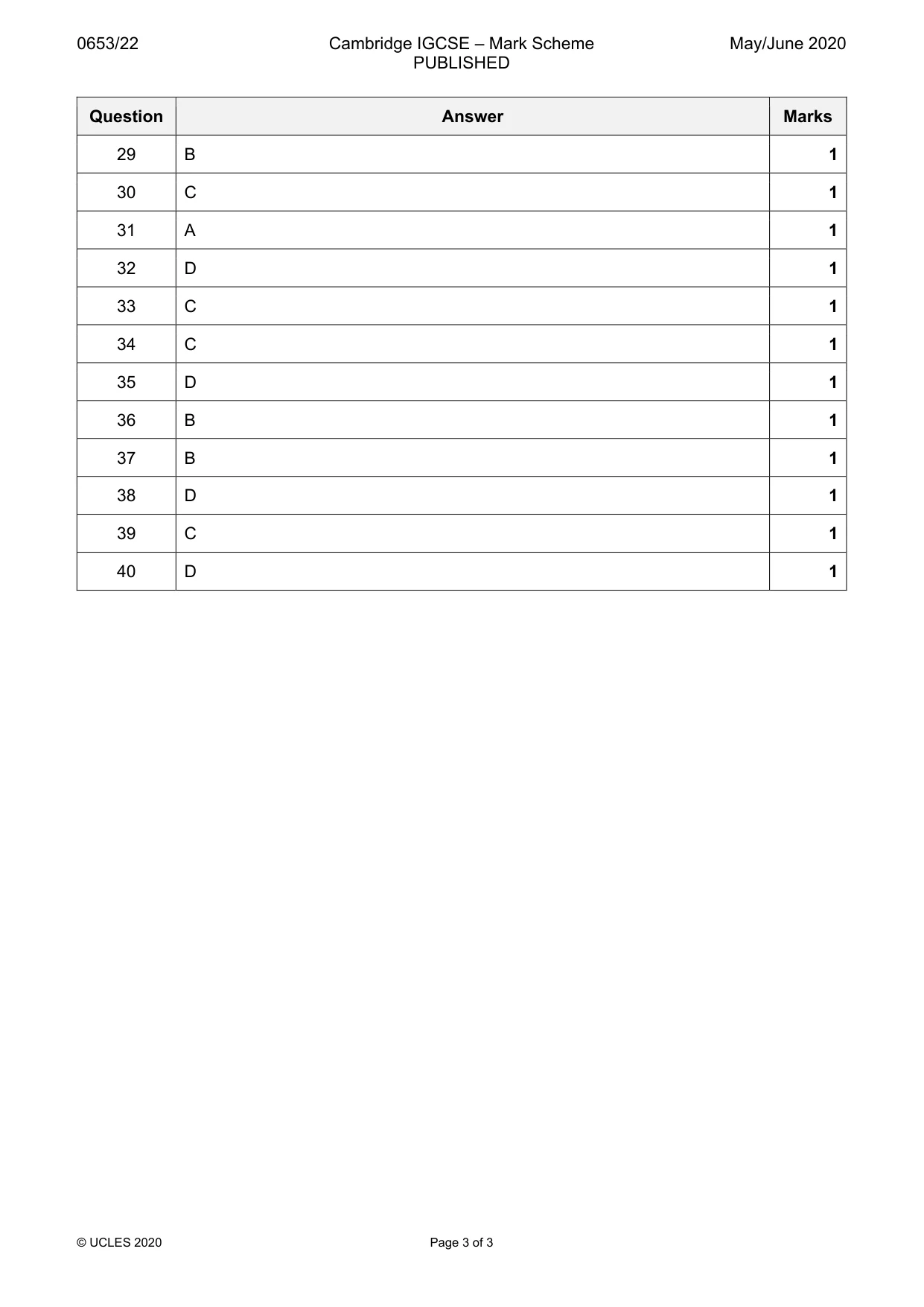
Mark scheme: B
Q30 · A spring obeys Hooke’s law
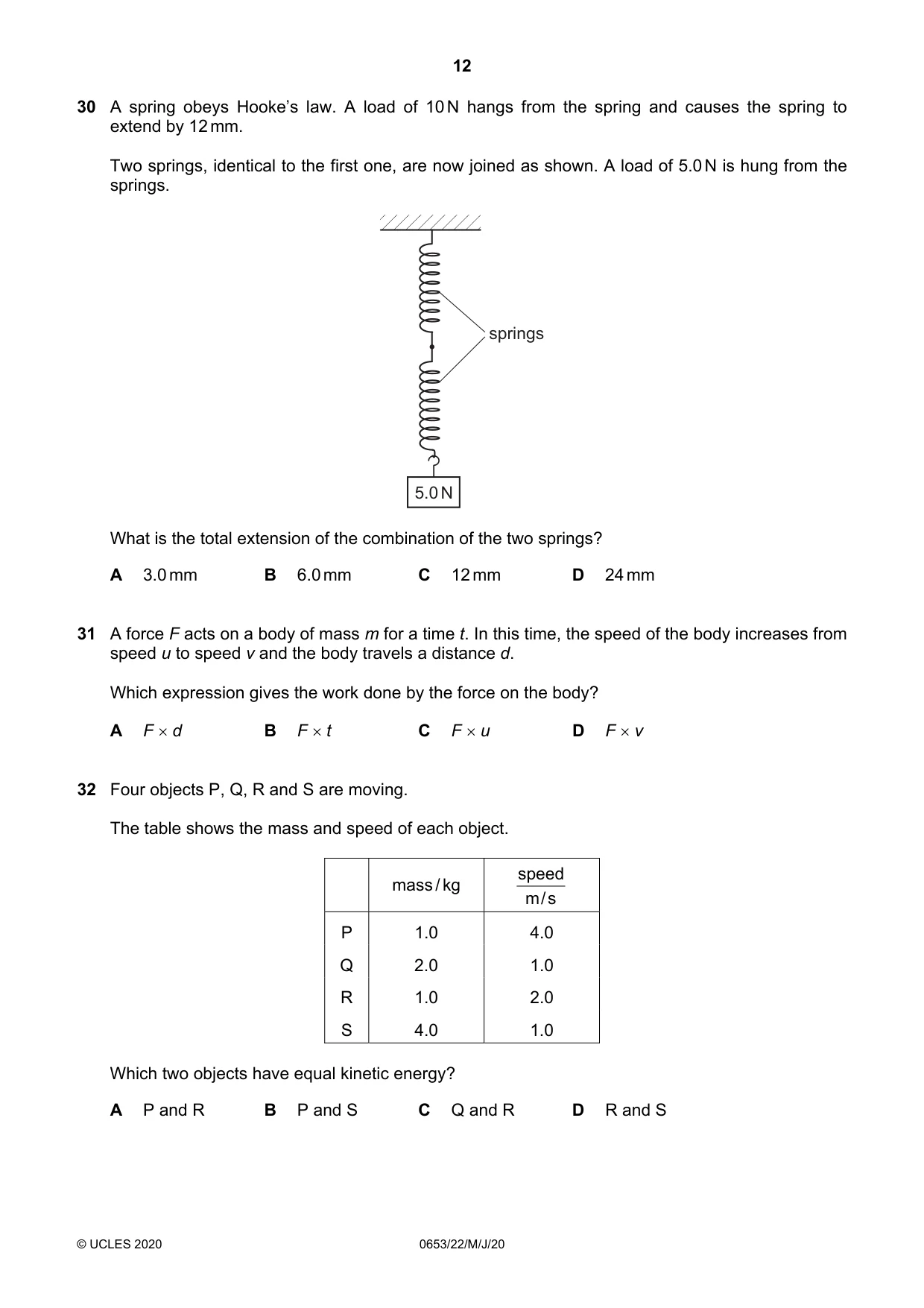
30 A spring obeys Hooke’s law. A load of 10 N hangs from the spring and causes the spring to extend by 12 mm. Two springs, identical to the first one, are now joined as shown. A load of 5.0 N is hung from the springs. springs 5.0 N What is the total extension of the combination of the two springs? A 3.0 mm B 6.0 mm C 12 mm D 24 mm
Mark scheme: C
Q31 · A force F acts on a body of mass m for a time t
31 A force F acts on a body of mass m for a time t. In this time, the speed of the body increases from speed u to speed v and the body travels a distance d. Which expression gives the work done by the force on the body? A F × d B F × t C F × u D F × v
Mark scheme: A
Q32 · Four objects P, Q, R and S are moving
32 Four objects P, Q, R and S are moving. The table shows the mass and speed of each object. speed mass / kg m / s P 1.0 4.0 Q 2.0 1.0 R 1.0 2.0 S 4.0 1.0 Which two objects have equal kinetic energy? A P and R B P and S C Q and R D R and S
Mark scheme: D
Q33 · Which action increases the rate of evaporation of a liquid?
33 Which action increases the rate of evaporation of a liquid? A cooling the liquid B covering the liquid C increasing the surface area of the liquid D reducing any draught over the liquid
Mark scheme: C
Q34 · Conduction of heat in metals involves the movement of atoms and electrons
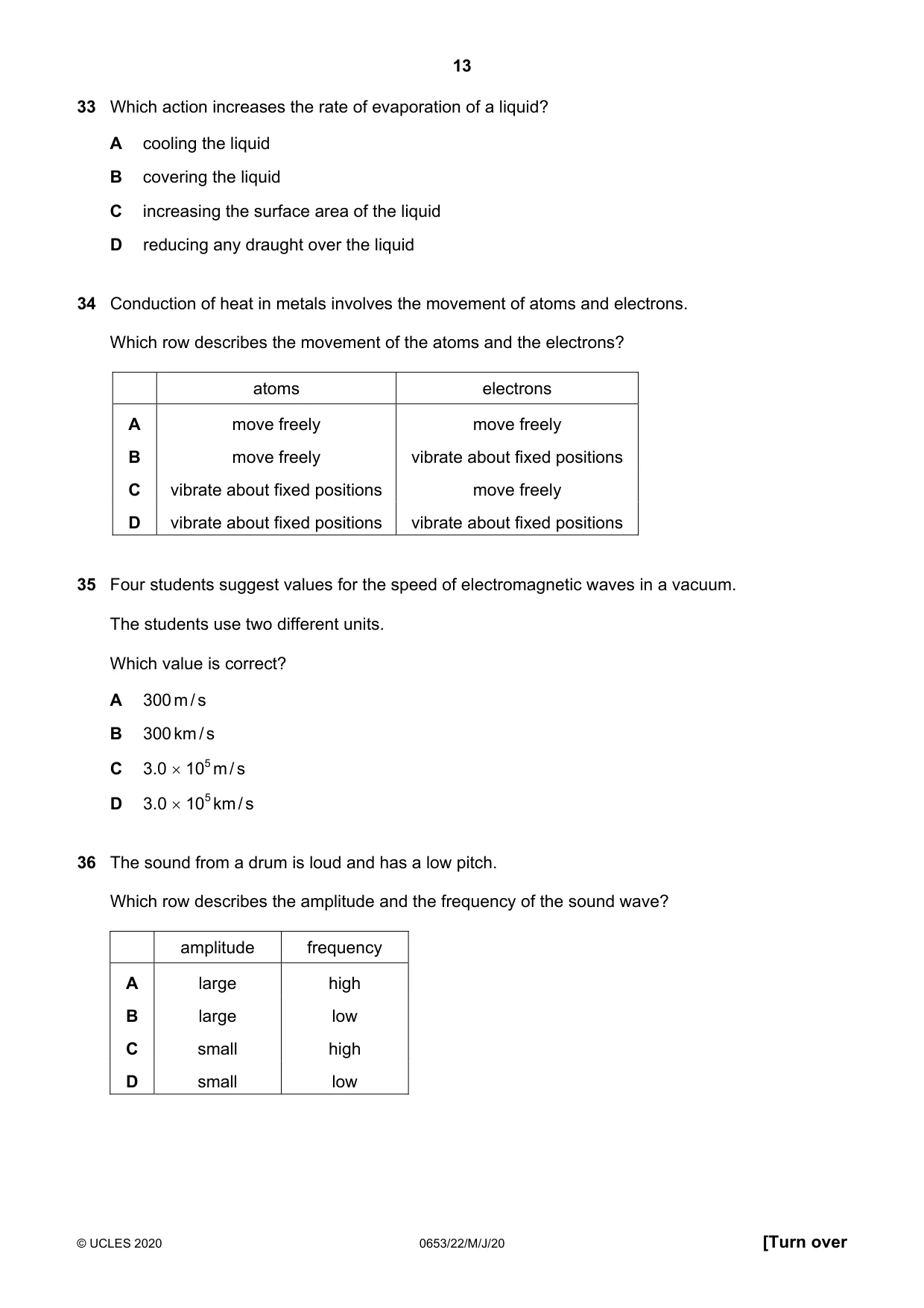
34 Conduction of heat in metals involves the movement of atoms and electrons. Which row describes the movement of the atoms and the electrons? atoms electrons A move freely move freely B move freely vibrate about fixed positions C vibrate about fixed positions move freely D vibrate about fixed positions vibrate about fixed positions
Mark scheme: C
Q35 · Four students suggest values for the speed of electromagnetic waves in a vacuum
35 Four students suggest values for the speed of electromagnetic waves in a vacuum. The students use two different units. Which value is correct? A 300 m / s B 300 km / s C 3.0 × 10⁵ m / s D 3.0 × 10⁵ km / s
Mark scheme: D
Q36 · The sound from a drum is loud and has a low pitch
36 The sound from a drum is loud and has a low pitch. Which row describes the amplitude and the frequency of the sound wave? amplitude frequency A large high B large low C small high D small low
Mark scheme: B
Q37 · What is the unit of charge?
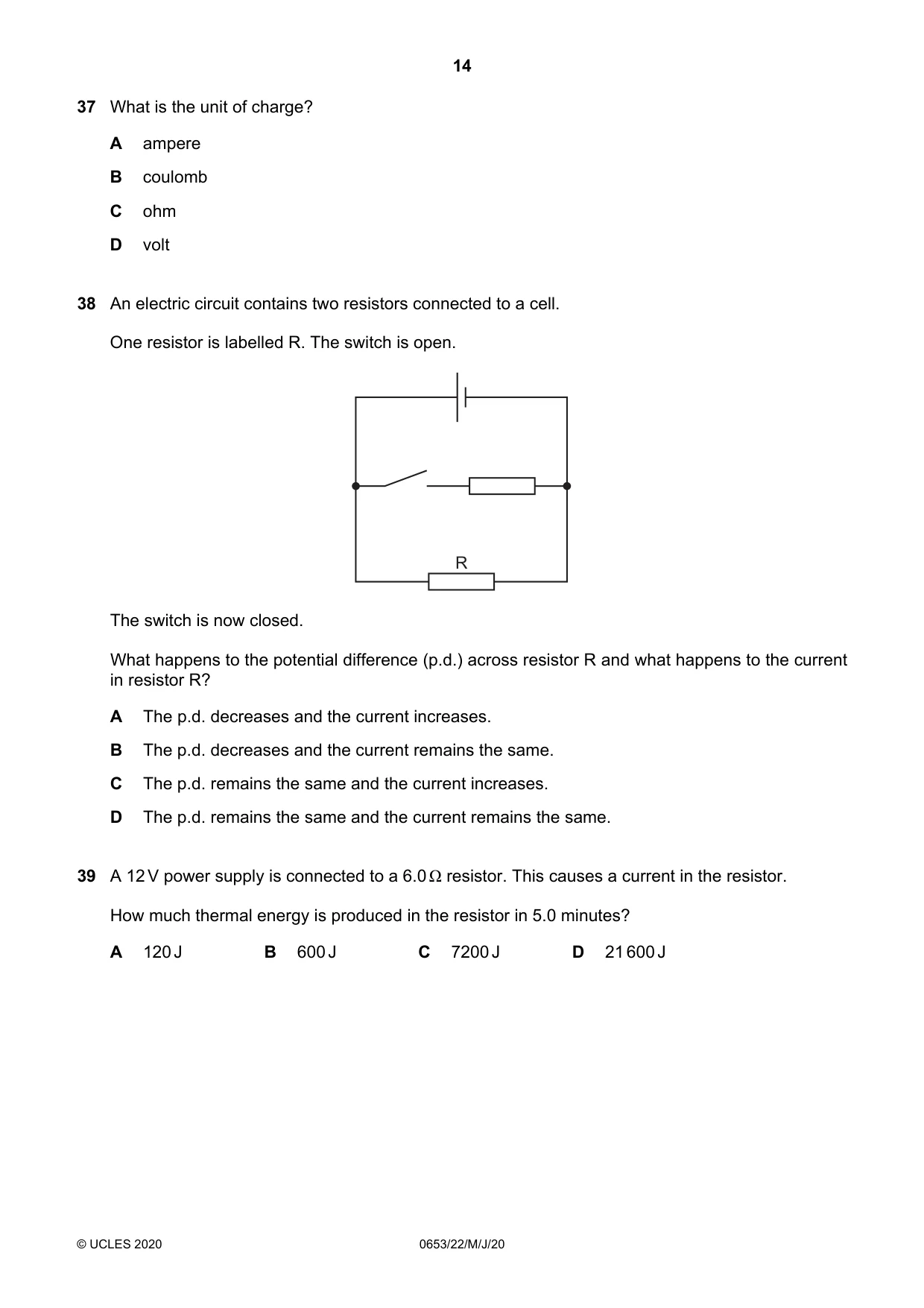
37 What is the unit of charge? A ampere B coulomb C ohm D volt
Mark scheme: B
Q38 · An electric circuit contains two resistors connected to a cell
38 An electric circuit contains two resistors connected to a cell. One resistor is labelled R. The switch is open. R The switch is now closed. What happens to the potential difference (p.d.) across resistor R and what happens to the current in resistor R? A The p.d. decreases and the current increases. B The p.d. decreases and the current remains the same. C The p.d. remains the same and the current increases. D The p.d. remains the same and the current remains the same.
Mark scheme: D
Q39 · A 12 V power supply is connected to a 6.0 Ω resistor
39 A 12 V power supply is connected to a 6.0 Ω resistor. This causes a current in the resistor. How much thermal energy is produced in the resistor in 5.0 minutes? A 120 J B 600 J C 7200 J D 21 600 J
Mark scheme: C
Q40 · The charger for a laptop computer is connected by a cable to the mains supply through a…
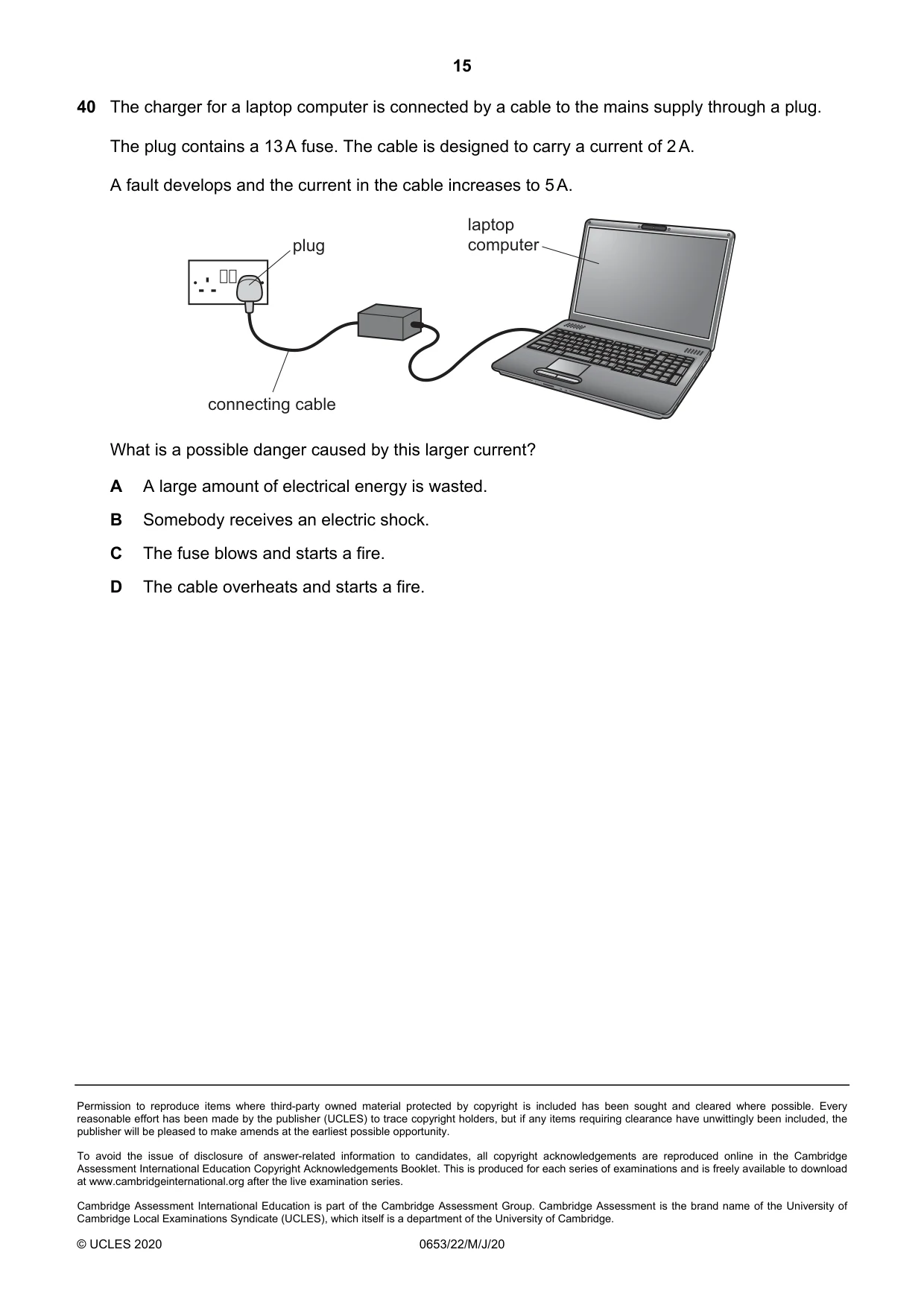
40 The charger for a laptop computer is connected by a cable to the mains supply through a plug. The plug contains a 13 A fuse. The cable is designed to carry a current of 2 A. A fault develops and the current in the cable increases to 5 A. laptop plug computer connecting cable What is a possible danger caused by this larger current? A A large amount of electrical energy is wasted. B Somebody receives an electric shock. C The fuse blows and starts a fire. D The cable overheats and starts a fire.
Mark scheme: D
What was in this paper
The subtopics covered by these 40 questions, and how many questions each got. Open one in a new tab to see every Cambridge question on it.
2Electrical quantities2Energy, work and power2Motion2Air quality and climate1Arrangement of elements1Cell structure1Chromatography1Digestion1Electrical circuits1Electrical safety1Electromagnetic spectrum1Enzymes1Exothermic and endothermic reactions1Extraction of metals1Forces1Formulas1Gas exchange in humans1Group VII properties1Habitat destruction1Heart1Identification of ions and gases1Ions and ionic bonds1Kinetic particle model of matter1Osmosis1Photosynthesis1Physical and chemical changes1Preparation of salts1Reactivity series1Redox1Sexual reproduction in humans1Sexual reproduction in plants1Sound1Terminology1Transfer of thermal energy1Water uptake1