Cambridge IGCSE Science - Combined 0653 — 2022 May/June Paper 2 · Variant 3
0653/23/M/J/22 · 40 questions · 40 marks · ≈45 min
The question paper and its mark scheme, free to read here and free to download. This is Cambridge’s own paper, exactly as it was sat.
Question paper16 pages
Mark scheme3 pages
Answers below. Sit the paper first if you are practising.
Questions as text
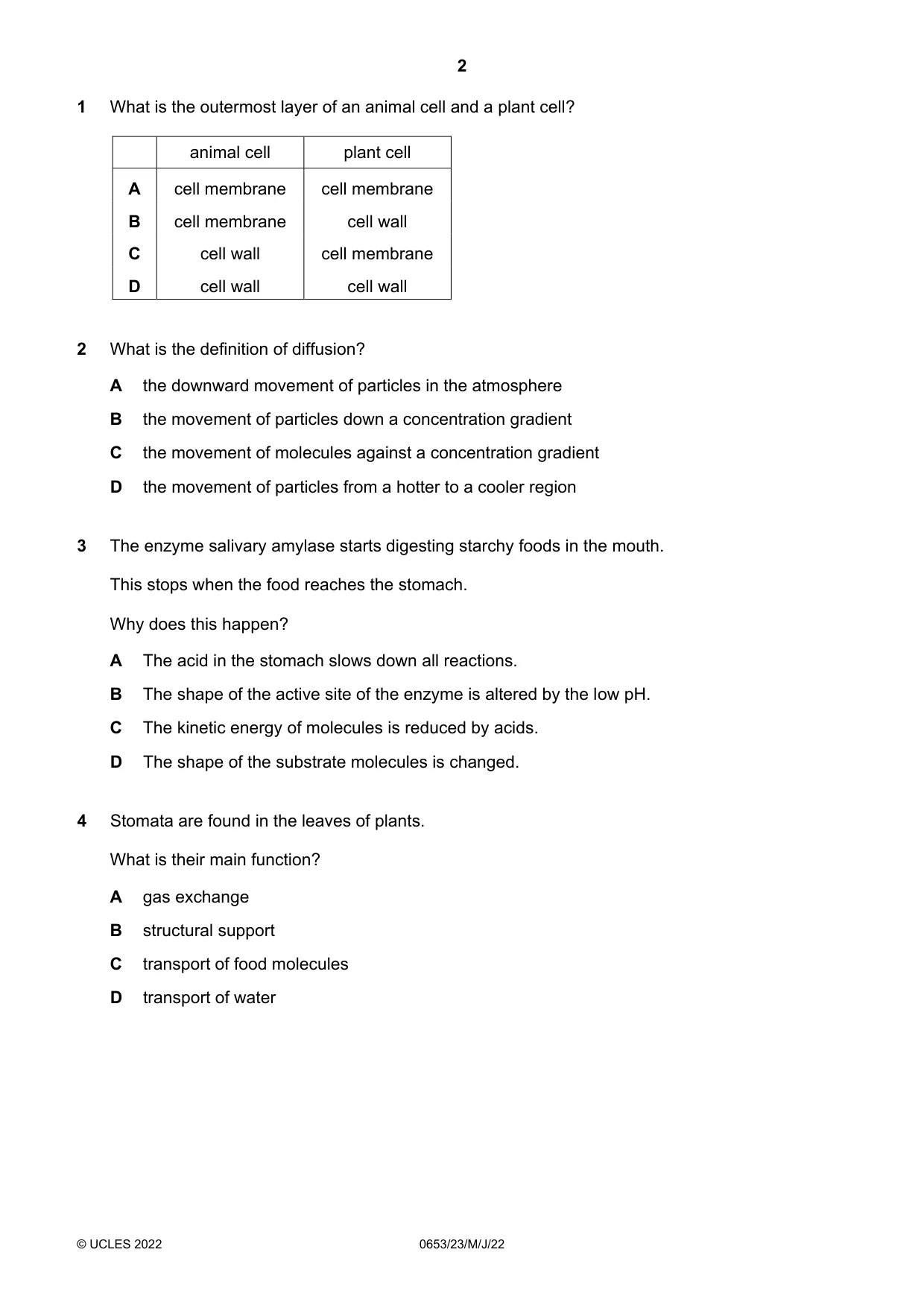
Q1 · What is the outermost layer of an animal cell and a plant cell?
1 What is the outermost layer of an animal cell and a plant cell? animal cell plant cell A cell membrane cell membrane B cell membrane cell wall C cell wall cell membrane D cell wall cell wall
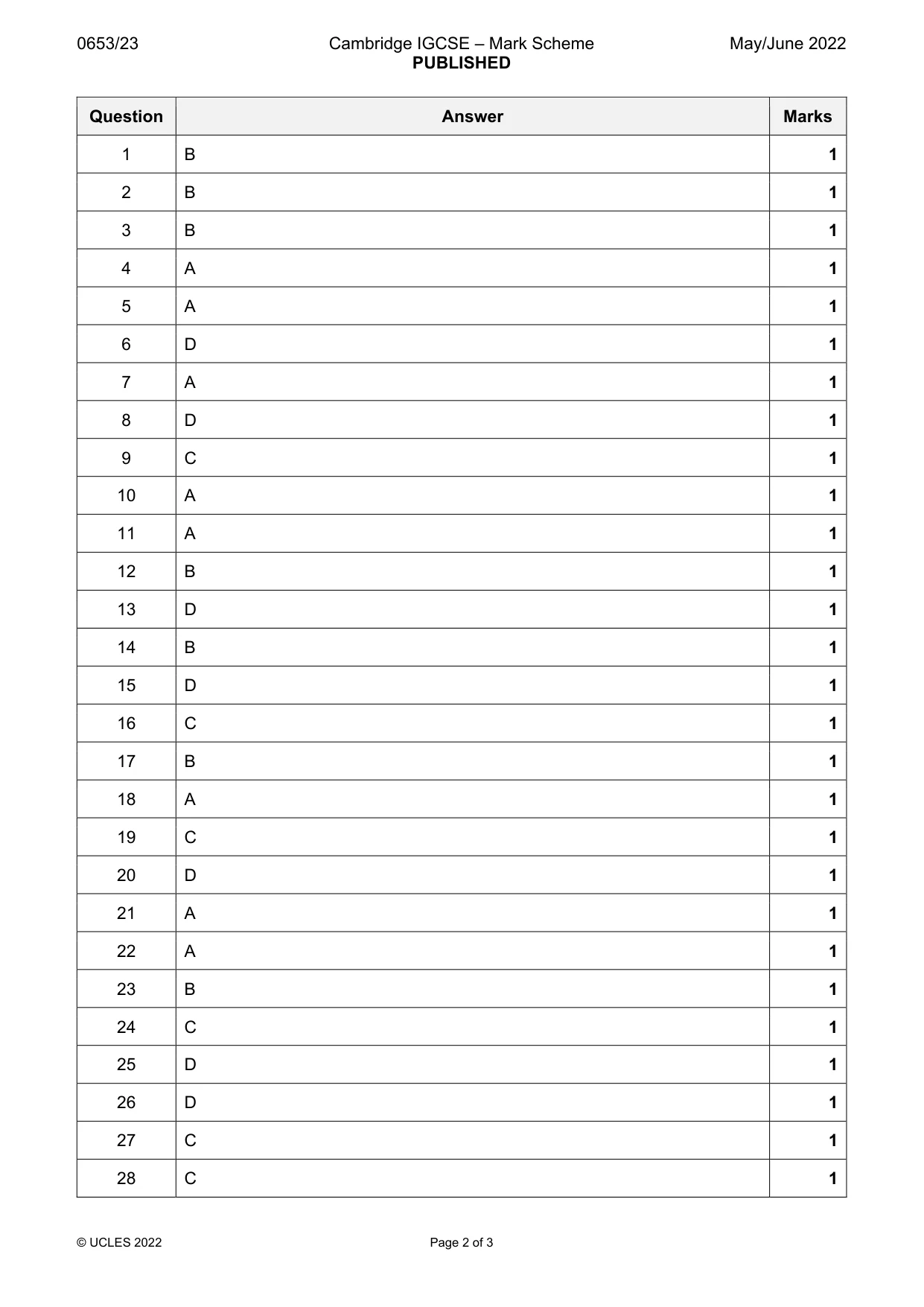
Mark scheme: B
Q2 · What is the definition of diffusion?
2 What is the definition of diffusion? A the downward movement of particles in the atmosphere B the movement of particles down a concentration gradient C the movement of molecules against a concentration gradient D the movement of particles from a hotter to a cooler region
Mark scheme: B
Q3 · The enzyme salivary amylase starts digesting starchy foods in the mouth
3 The enzyme salivary amylase starts digesting starchy foods in the mouth. This stops when the food reaches the stomach. Why does this happen? A The acid in the stomach slows down all reactions. B The shape of the active site of the enzyme is altered by the low pH. C The kinetic energy of molecules is reduced by acids. D The shape of the substrate molecules is changed.
Mark scheme: B
Q4 · Stomata are found in the leaves of plants
4 Stomata are found in the leaves of plants. What is their main function? A gas exchange B structural support C transport of food molecules D transport of water
Mark scheme: A
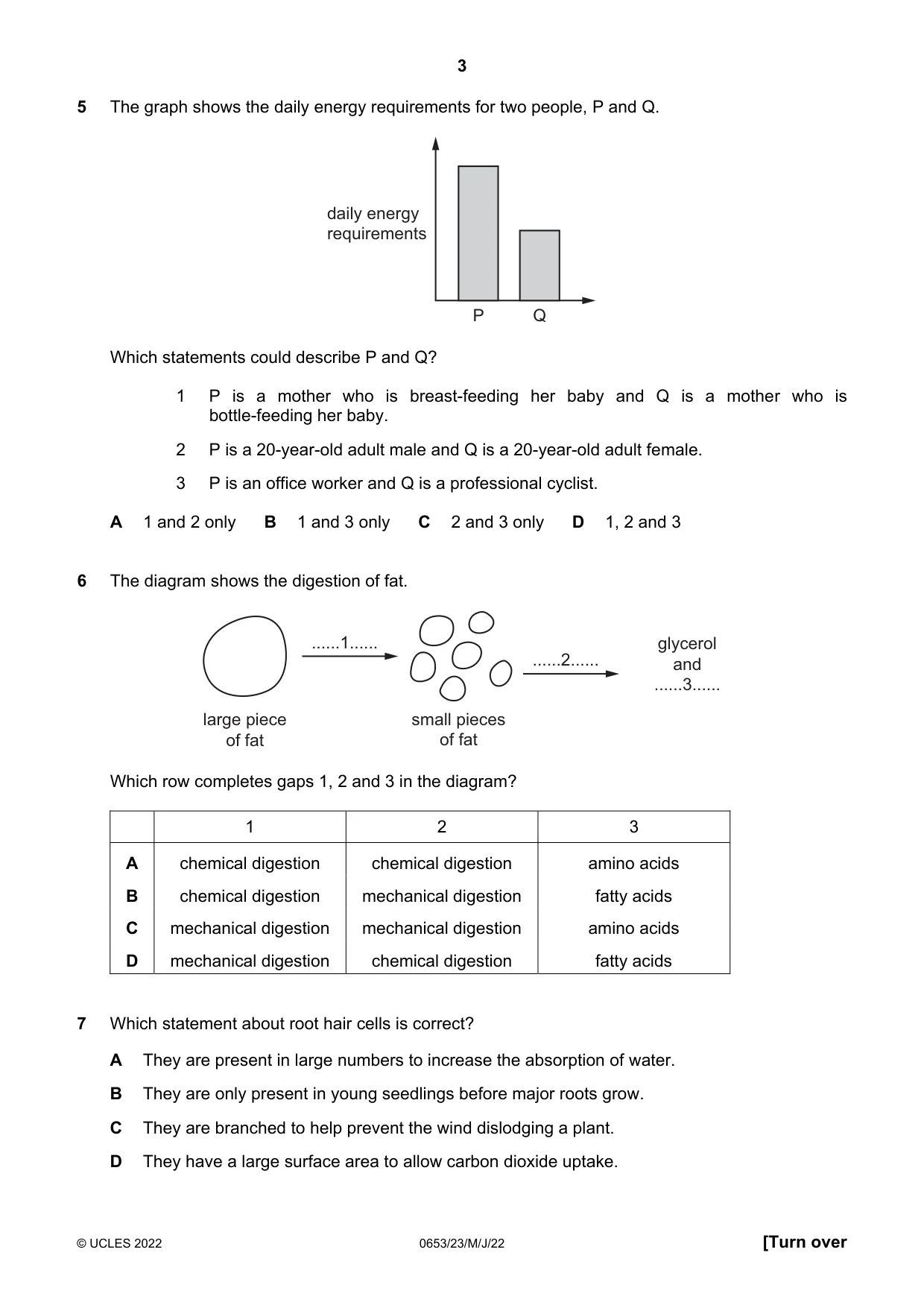
Q5 · The graph shows the daily energy requirements for two people, P and Q
5 The graph shows the daily energy requirements for two people, P and Q. daily energy requirements P Q Which statements could describe P and Q? 1 P is a mother who is breast-feeding her baby and Q is a mother who is bottle-feeding her baby. 2 P is a 20-year-old adult male and Q is a 20-year-old adult female. 3 P is an office worker and Q is a professional cyclist. A 1 and 2 only B 1 and 3 only C 2 and 3 only D 1, 2 and 3
Mark scheme: A
Q6 · The diagram shows the digestion of fat
6 The diagram shows the digestion of fat. ......1...... glycerol ......2...... and ......3...... large piece small pieces of fat of fat Which row completes gaps 1, 2 and 3 in the diagram? 1 2 3 A chemical digestion chemical digestion amino acids B chemical digestion mechanical digestion fatty acids C mechanical digestion mechanical digestion amino acids D mechanical digestion chemical digestion fatty acids
Mark scheme: D
Q7 · Which statement about root hair cells is correct?
7 Which statement about root hair cells is correct? A They are present in large numbers to increase the absorption of water. B They are only present in young seedlings before major roots grow. C They are branched to help prevent the wind dislodging a plant. D They have a large surface area to allow carbon dioxide uptake.
Mark scheme: A
Q8 · Physical activity affects our rate and depth of breathing
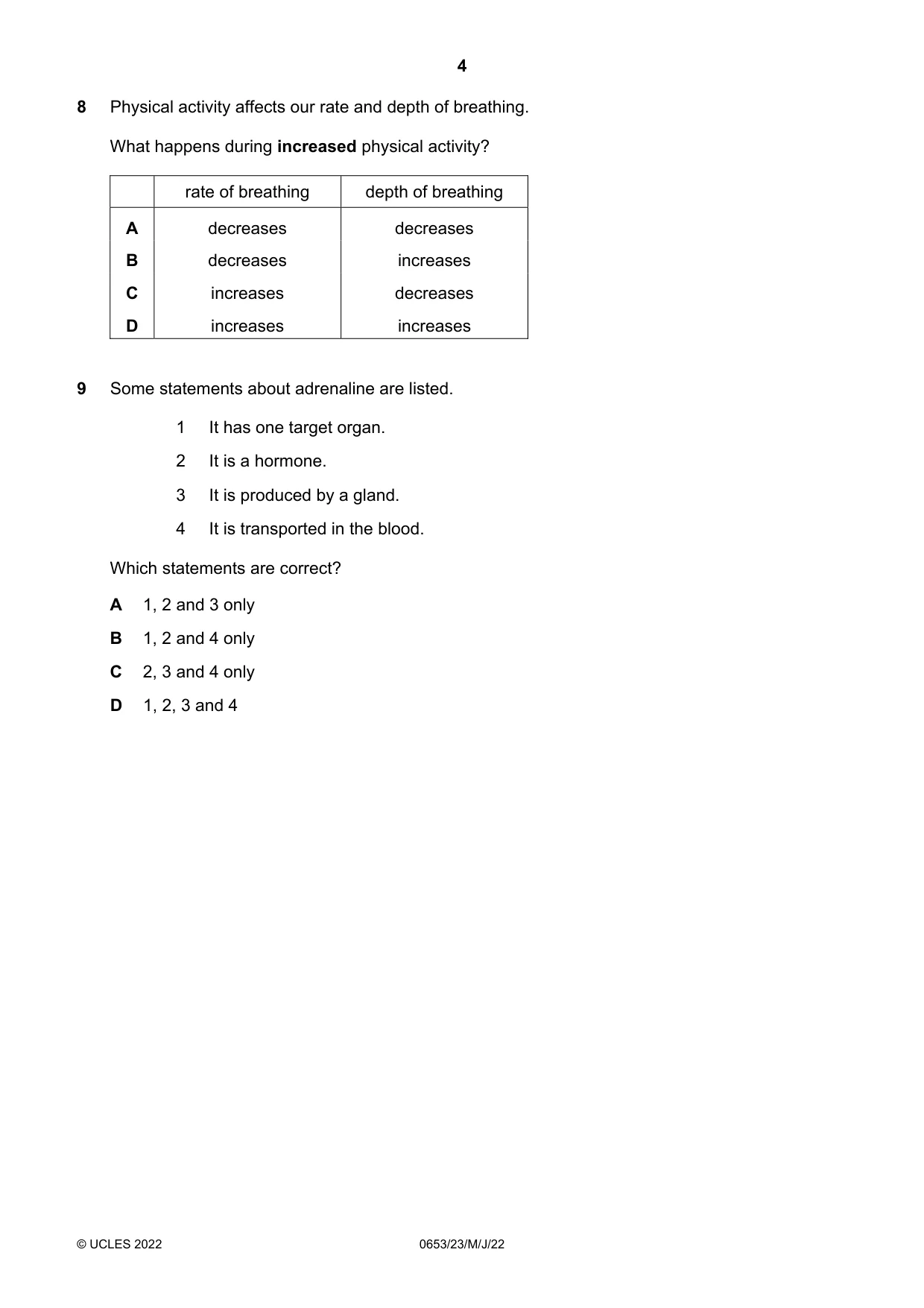
8 Physical activity affects our rate and depth of breathing. What happens during increased physical activity? rate of breathing depth of breathing A decreases decreases B decreases increases C increases decreases D increases increases
Mark scheme: D
Q9 · Some statements about adrenaline are listed
9 Some statements about adrenaline are listed. 1 It has one target organ. 2 It is a hormone. 3 It is produced by a gland. 4 It is transported in the blood. Which statements are correct? A 1, 2 and 3 only B 1, 2 and 4 only C 2, 3 and 4 only D 1, 2, 3 and 4
Mark scheme: C
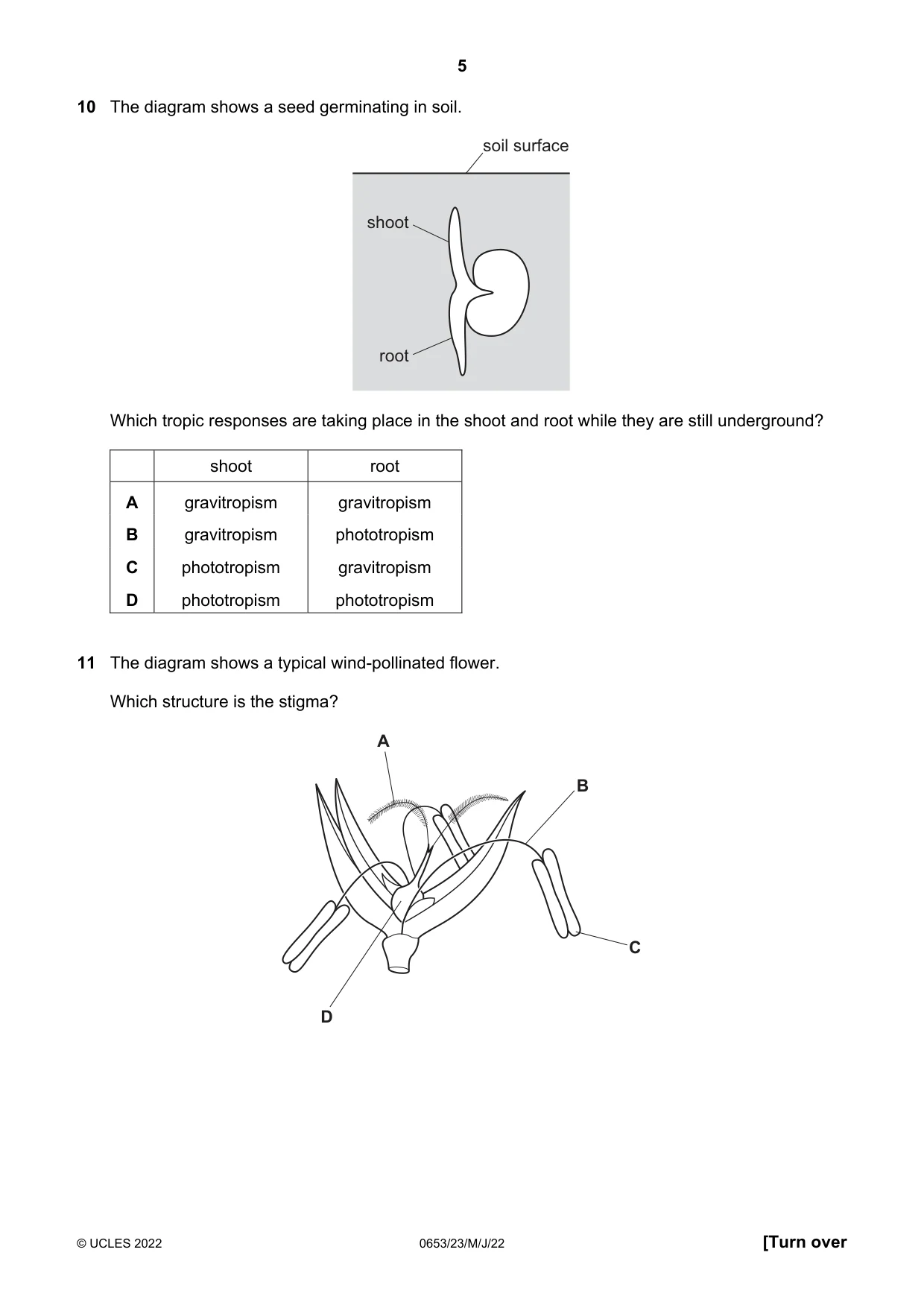
Q10 · The diagram shows a seed germinating in soil
10 The diagram shows a seed germinating in soil. soil surface shoot root Which tropic responses are taking place in the shoot and root while they are still underground? shoot root A gravitropism gravitropism B gravitropism phototropism C phototropism gravitropism D phototropism phototropism
Mark scheme: A
Q11 · The diagram shows a typical wind-pollinated flower
11 The diagram shows a typical wind-pollinated flower. Which structure is the stigma? A B C D
Mark scheme: A
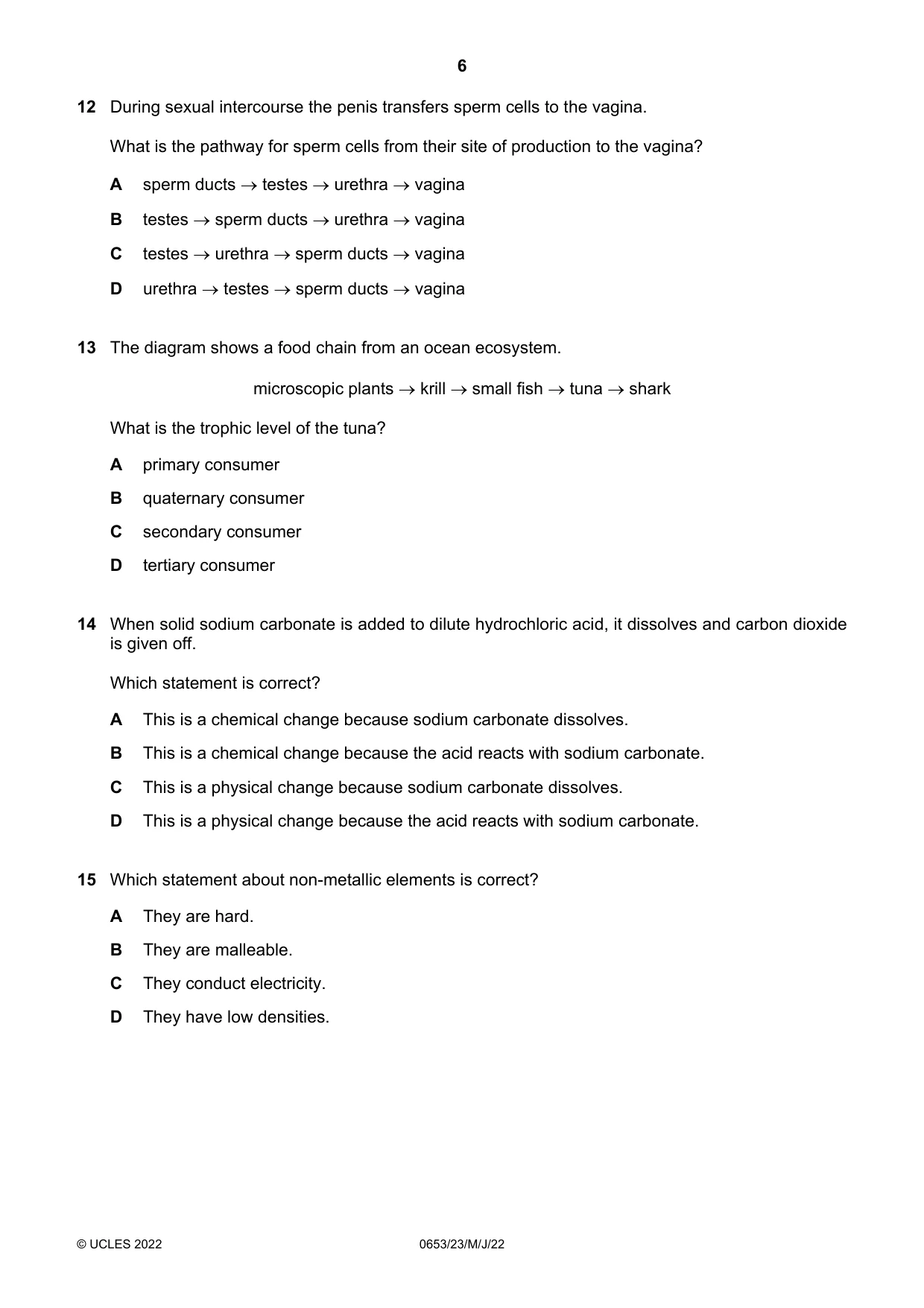
Q12 · During sexual intercourse the penis transfers sperm cells to the vagina
12 During sexual intercourse the penis transfers sperm cells to the vagina. What is the pathway for sperm cells from their site of production to the vagina? A sperm ducts testes urethra vagina B testes sperm ducts urethra vagina C testes urethra sperm ducts vagina D urethra testes sperm ducts vagina
Mark scheme: B
Q13 · The diagram shows a food chain from an ocean ecosystem
13 The diagram shows a food chain from an ocean ecosystem. microscopic plants krill small fish tuna shark What is the trophic level of the tuna? A primary consumer B quaternary consumer C secondary consumer D tertiary consumer
Mark scheme: D
Q14 · When solid sodium carbonate is added to dilute hydrochloric acid, it dissolves and carbon…
14 When solid sodium carbonate is added to dilute hydrochloric acid, it dissolves and carbon dioxide is given off. Which statement is correct? A This is a chemical change because sodium carbonate dissolves. B This is a chemical change because the acid reacts with sodium carbonate. C This is a physical change because sodium carbonate dissolves. D This is a physical change because the acid reacts with sodium carbonate.
Mark scheme: B
Q15 · Which statement about non-metallic elements is correct?
15 Which statement about non-metallic elements is correct? A They are hard. B They are malleable. C They conduct electricity. D They have low densities.
Mark scheme: D
Q16 · Which statement about the movement of particles during the electrolysis of dilute…
16 Which statement about the movement of particles during the electrolysis of dilute sulfuric acid is correct? A Anions move to the negative electrode and lose electrons. B Electrons travel through the electrolyte from the cathode to the anode. C Electrons travel through the external circuit from the anode to the cathode. D Positive ions move to the anode and gain electrons.
Mark scheme: C
Q17 · Which row describes what happens to the frequency of collisions between reacting…
17 Which row describes what happens to the frequency of collisions between reacting particles and the energy of these collisions when the concentration of the reactants is decreased? frequency of energy of collisions collisions A decreases decreases B decreases no change C increases decreases D increases no change
Mark scheme: B
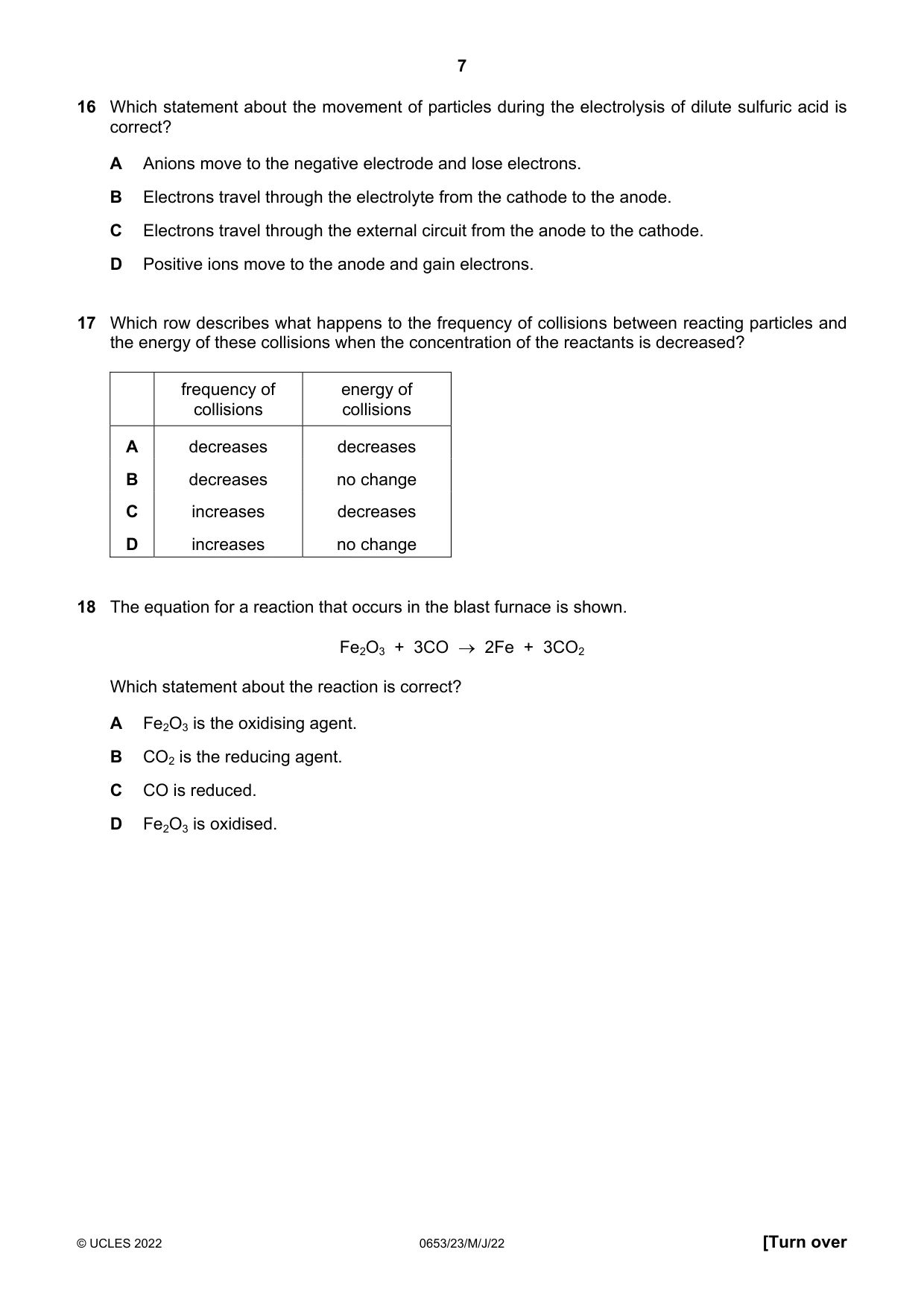
Q18 · The equation for a reaction that occurs in the blast furnace is shown
18 The equation for a reaction that occurs in the blast furnace is shown. Fe2O3 + 3CO 2Fe + 3CO2 Which statement about the reaction is correct? A Fe2O3 is the oxidising agent. B CO2 is the reducing agent. C CO is reduced. D Fe2O3 is oxidised.
Mark scheme: A
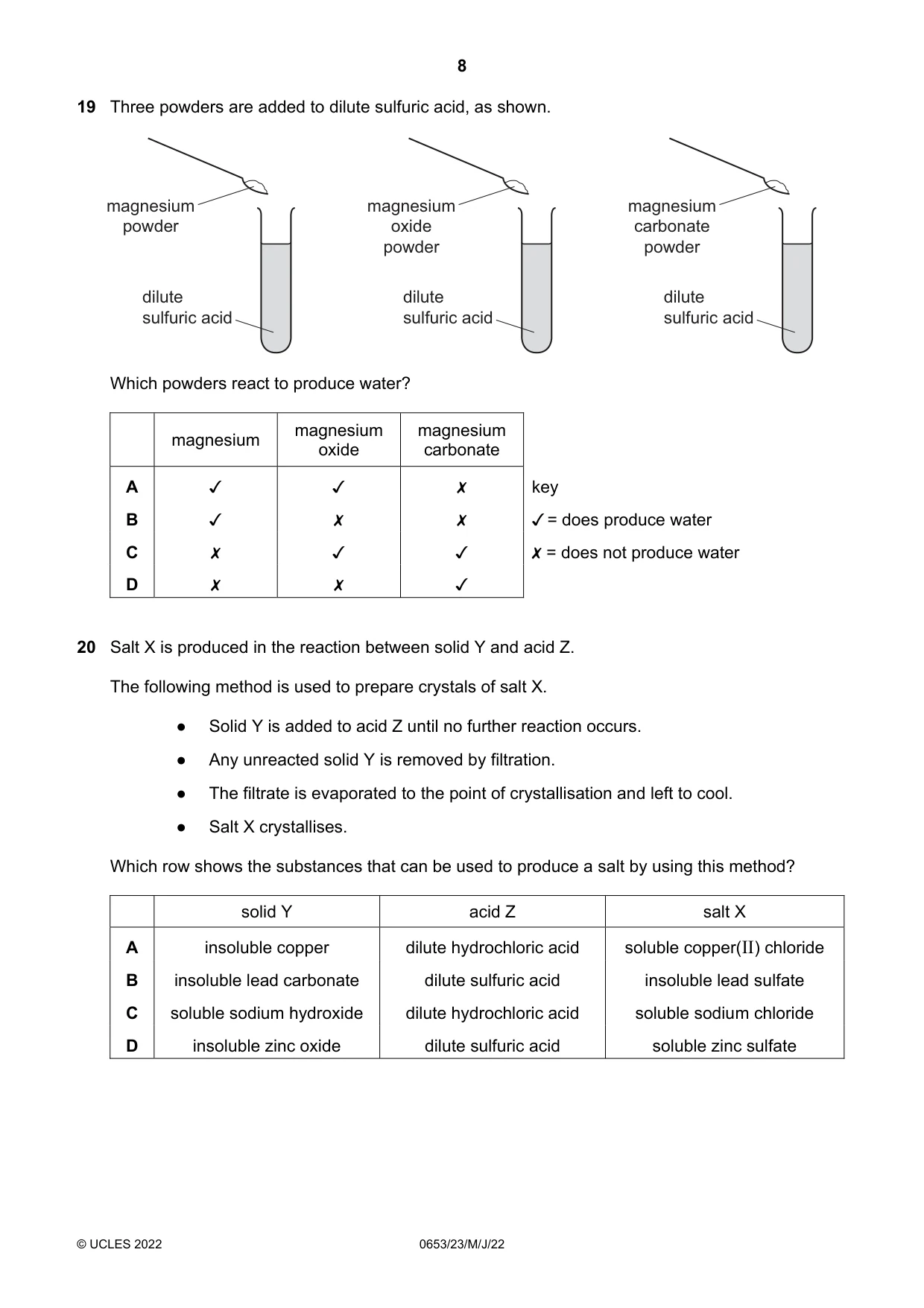
Q19 · Three powders are added to dilute sulfuric acid, as shown
19 Three powders are added to dilute sulfuric acid, as shown. magnesium powder dilute sulfuric acid Which powders react to produce water? magnesium oxide powder dilute sulfuric acid magnesium magnesium oxide x \ x magnesium carbonate \ \ x magnesium carbonate powder dilute sulfuric acid key ¥ = does produce water X = does not produce water
Mark scheme: C
More questions on The characteristic properties of acids and bases
Q20 · Salt X is produced in the reaction between solid Y and acid Z
20 Salt X is produced in the reaction between solid Y and acid Z. The following method is used to prepare crystals of salt X. ● Solid Y is added to acid Z until no further reaction occurs. ● Any unreacted solid Y is removed by filtration. ● The filtrate is evaporated to the point of crystallisation and left to cool. ● Salt X crystallises. Which row shows the substances that can be used to produce a salt by using this method? solid Y acid Z salt X A insoluble copper dilute hydrochloric acid soluble copper(II) chloride B insoluble lead carbonate dilute sulfuric acid insoluble lead sulfate C soluble sodium hydroxide dilute hydrochloric acid soluble sodium chloride D insoluble zinc oxide dilute sulfuric acid soluble zinc sulfate
Mark scheme: D
Q21 · The results of two tests on substance Q are shown
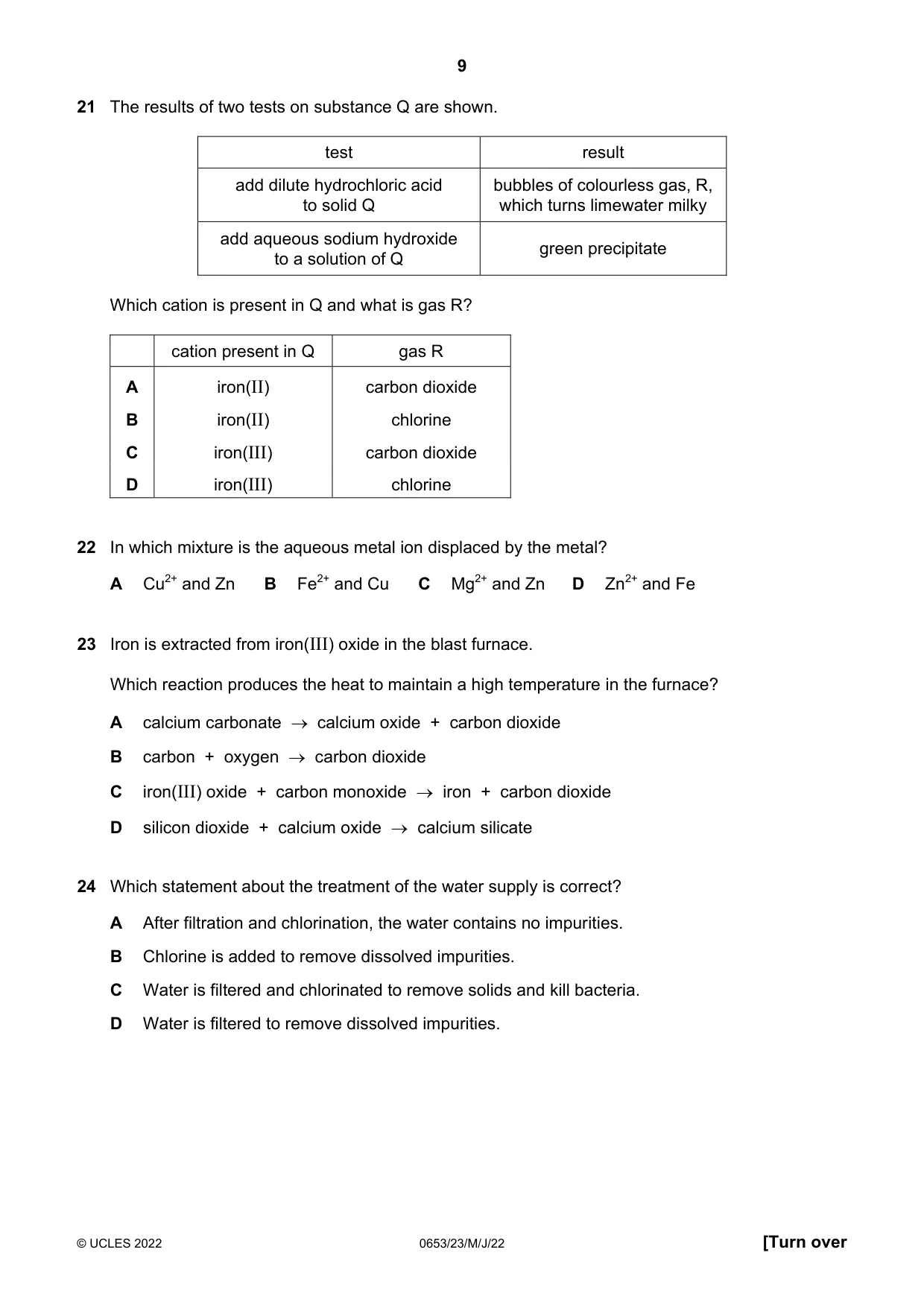
21 The results of two tests on substance Q are shown. test result add dilute hydrochloric acid bubbles of colourless gas, R, to solid Q which turns limewater milky add aqueous sodium hydroxide green precipitate to a solution of Q Which cation is present in Q and what is gas R? cation present in Q gas R A iron(II) carbon dioxide B iron(II) chlorine C iron(III) carbon dioxide D iron(III) chlorine
Mark scheme: A
Q22 · In which mixture is the aqueous metal ion displaced by the metal?
22 In which mixture is the aqueous metal ion displaced by the metal? A Cu2+ and Zn B Fe2+ and Cu C Mg2+ and Zn D Zn2+ and Fe
Mark scheme: A
Q23 · Iron is extracted from iron(III) oxide in the blast furnace
23 Iron is extracted from iron(III) oxide in the blast furnace. Which reaction produces the heat to maintain a high temperature in the furnace? A calcium carbonate calcium oxide + carbon dioxide B carbon + oxygen carbon dioxide C iron(III) oxide + carbon monoxide iron + carbon dioxide D silicon dioxide + calcium oxide calcium silicate
Mark scheme: B
Q24 · Which statement about the treatment of the water supply is correct?
24 Which statement about the treatment of the water supply is correct? A After filtration and chlorination, the water contains no impurities. B Chlorine is added to remove dissolved impurities. C Water is filtered and chlorinated to remove solids and kill bacteria. D Water is filtered to remove dissolved impurities.
Mark scheme: C
Q25 · Which statement best describes the members of a homologous series?
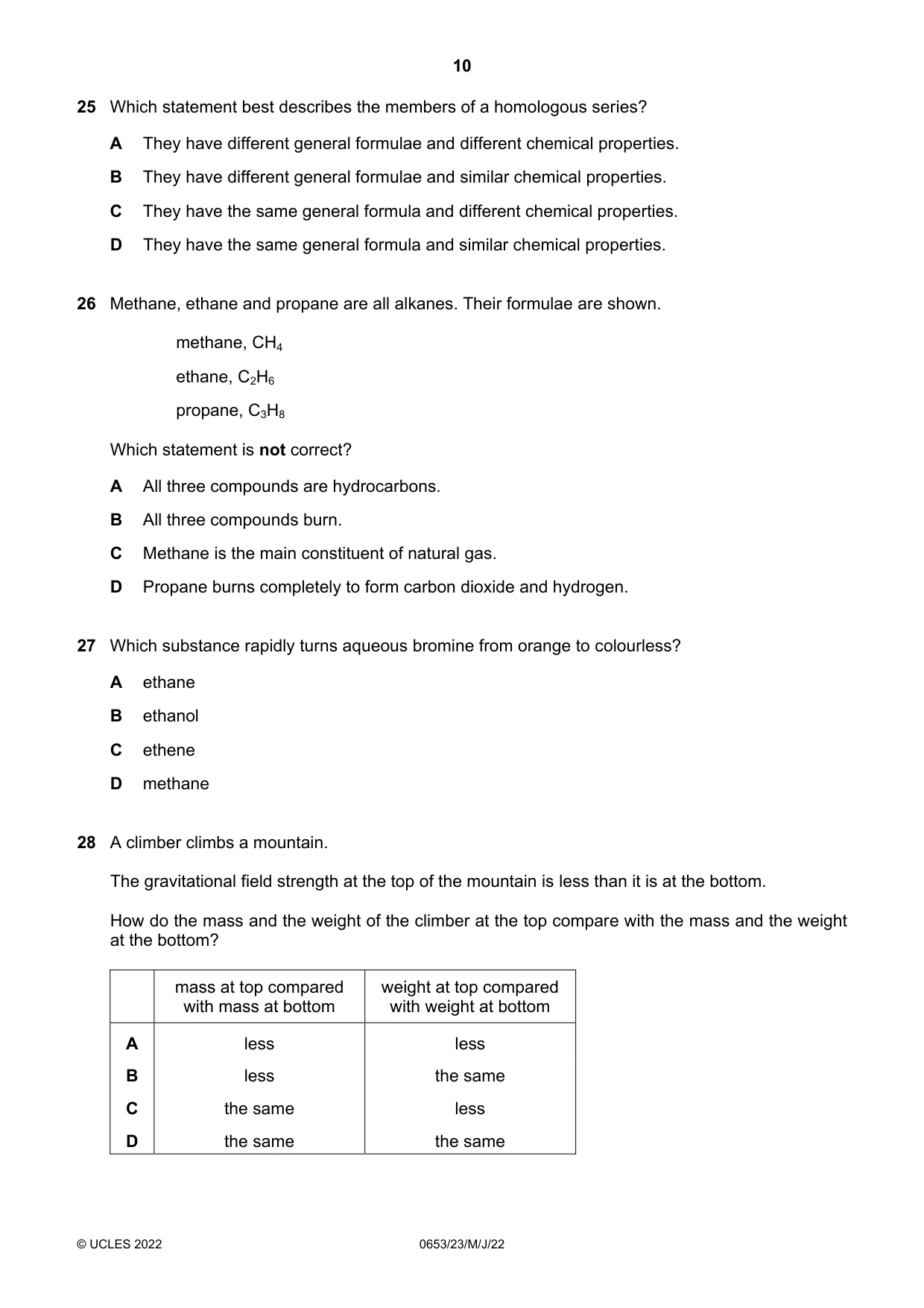
25 Which statement best describes the members of a homologous series? A They have different general formulae and different chemical properties. B They have different general formulae and similar chemical properties. C They have the same general formula and different chemical properties. D They have the same general formula and similar chemical properties.
Mark scheme: D
Q26 · Methane, ethane and propane are all alkanes
26 Methane, ethane and propane are all alkanes. Their formulae are shown. methane, CH4 ethane, C2H6 propane, C3H8 Which statement is not correct? A All three compounds are hydrocarbons. B All three compounds burn. C Methane is the main constituent of natural gas. D Propane burns completely to form carbon dioxide and hydrogen.
Mark scheme: D
Q27 · Which substance rapidly turns aqueous bromine from orange to colourless?
27 Which substance rapidly turns aqueous bromine from orange to colourless? A ethane B ethanol C ethene D methane
Mark scheme: C
Q28 · A climber climbs a mountain
28 A climber climbs a mountain. The gravitational field strength at the top of the mountain is less than it is at the bottom. How do the mass and the weight of the climber at the top compare with the mass and the weight at the bottom? mass at top compared weight at top compared with mass at bottom with weight at bottom A less less B less the same C the same less D the same the same
Mark scheme: C
Q29 · A stone is placed on a balance
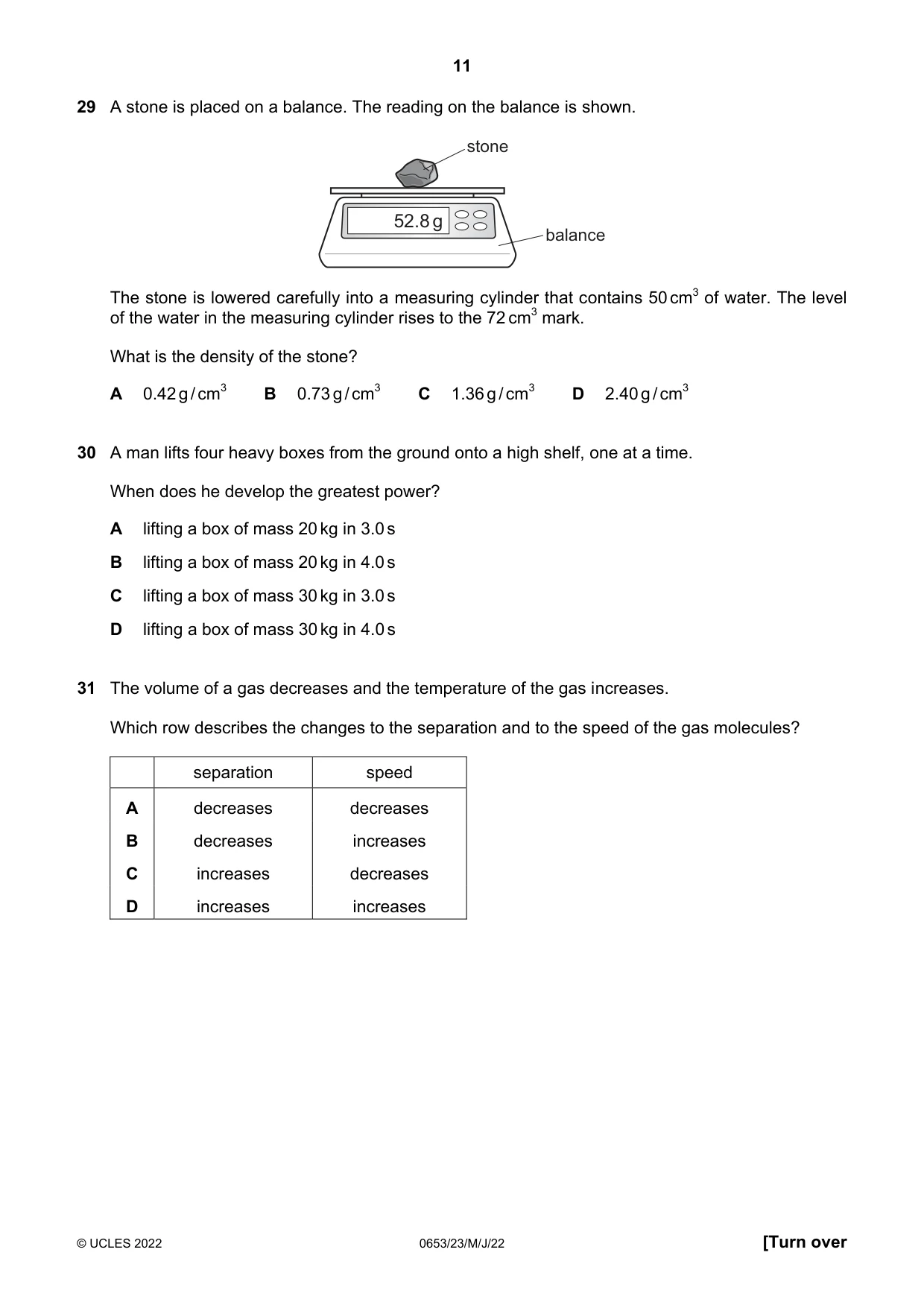
29 A stone is placed on a balance. The reading on the balance is shown. stone 52.8 g balance The stone is lowered carefully into a measuring cylinder that contains 50 cm3 of water. The level of the water in the measuring cylinder rises to the 72 cm3 mark. What is the density of the stone? A 0.42 g / cm3 B 0.73 g / cm3 C 1.36 g / cm3 D 2.40 g / cm3
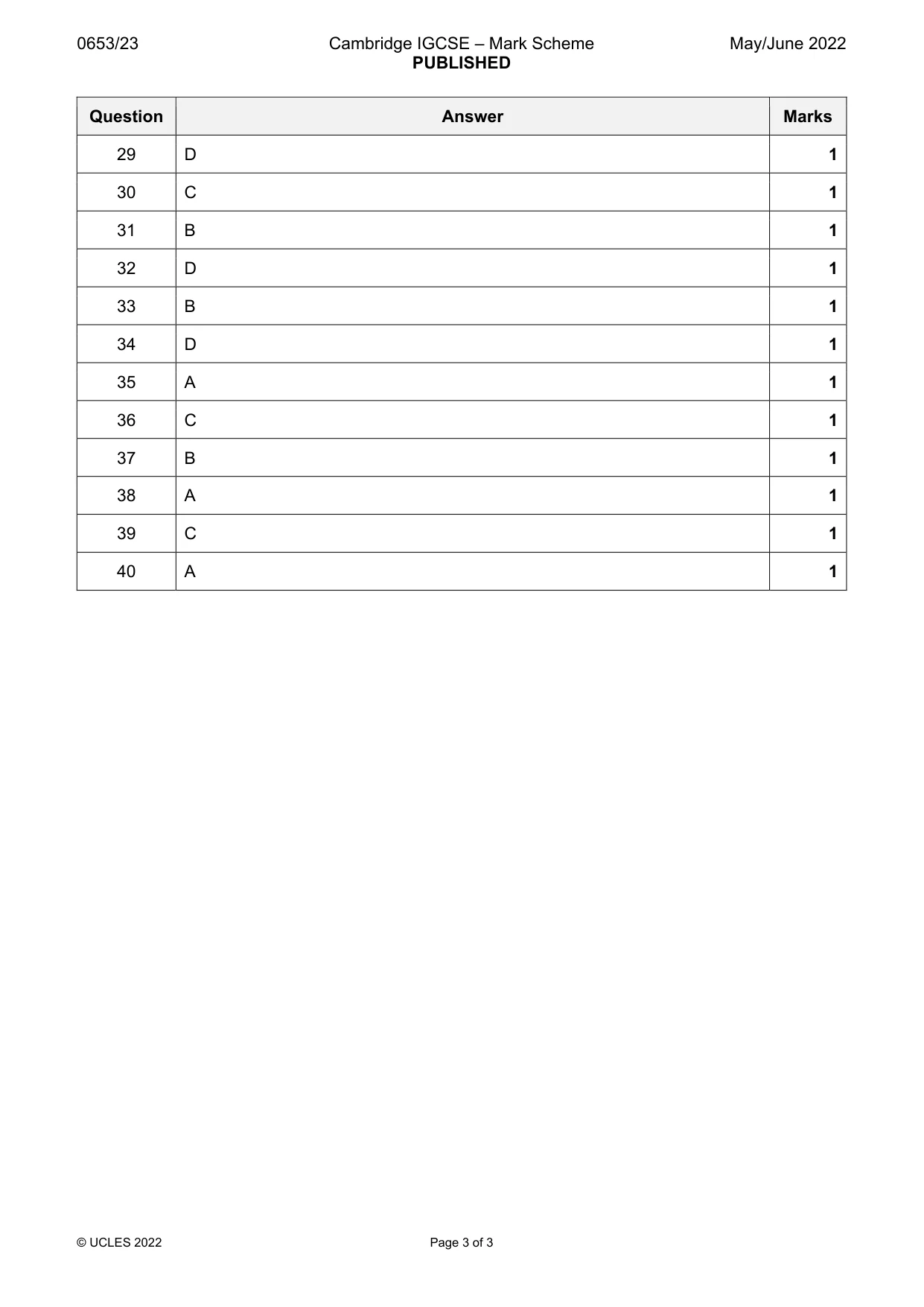
Mark scheme: D
Q30 · A man lifts four heavy boxes from the ground onto a high shelf, one at a time
30 A man lifts four heavy boxes from the ground onto a high shelf, one at a time. When does he develop the greatest power? A lifting a box of mass 20 kg in 3.0 s B lifting a box of mass 20 kg in 4.0 s C lifting a box of mass 30 kg in 3.0 s D lifting a box of mass 30 kg in 4.0 s
Mark scheme: C
Q31 · The volume of a gas decreases and the temperature of the gas increases
31 The volume of a gas decreases and the temperature of the gas increases. Which row describes the changes to the separation and to the speed of the gas molecules? separation speed A decreases decreases B decreases increases C increases decreases D increases increases
Mark scheme: B
Q32 · A mechanic cannot remove a large steel nut from a steel bolt because it is too tight
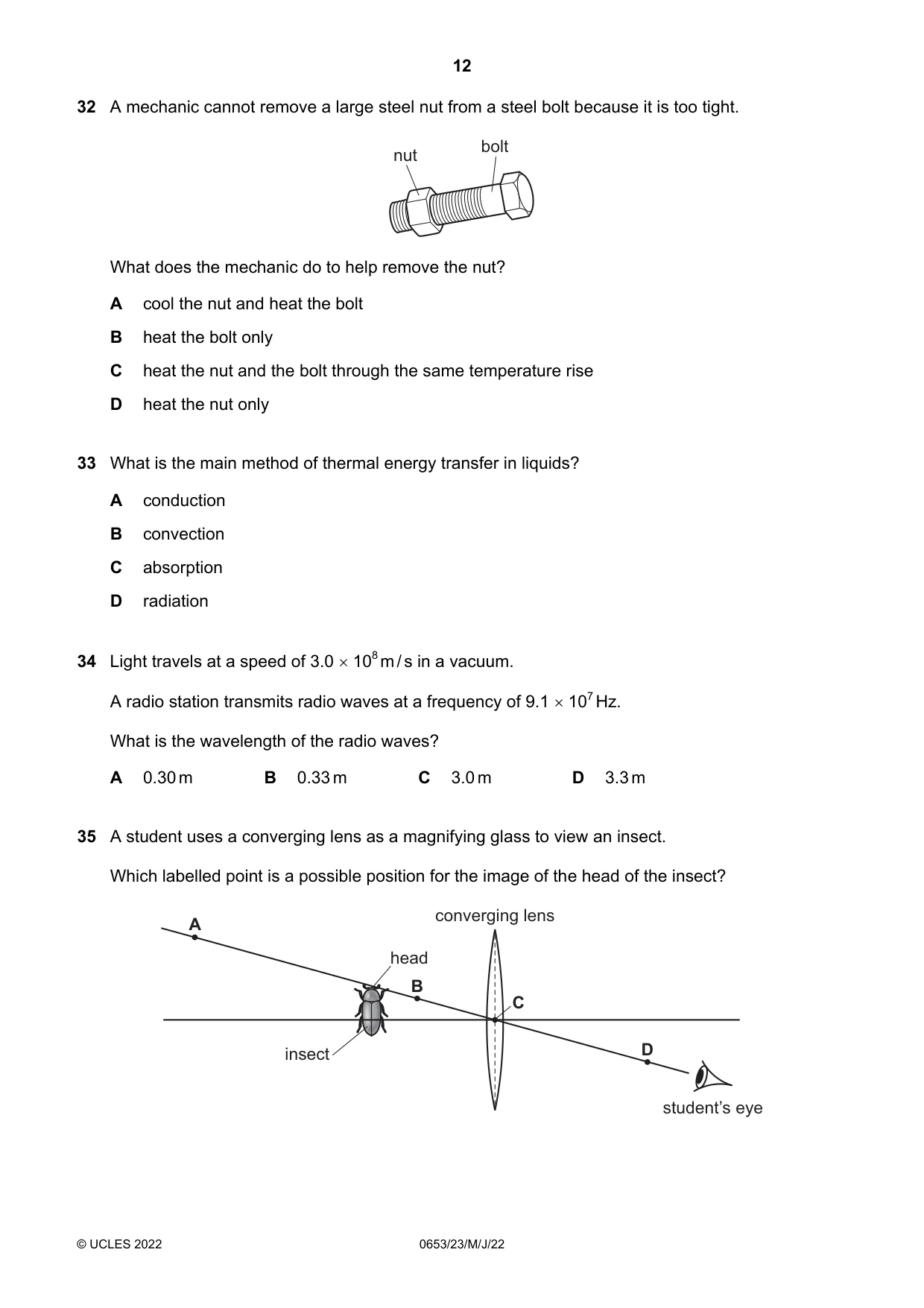
32 A mechanic cannot remove a large steel nut from a steel bolt because it is too tight. bolt nut What does the mechanic do to help remove the nut? A cool the nut and heat the bolt B heat the bolt only C heat the nut and the bolt through the same temperature rise D heat the nut only
Mark scheme: D
Q33 · What is the main method of thermal energy transfer in liquids?
33 What is the main method of thermal energy transfer in liquids? A conduction B convection C absorption D radiation
Mark scheme: B
Q34 · Light travels at a speed of 3.0 108 m / s in a vacuum
34 Light travels at a speed of 3.0 108 m / s in a vacuum. A radio station transmits radio waves at a frequency of 9.1 107 Hz. What is the wavelength of the radio waves? A 0.30 m B 0.33 m C 3.0 m D 3.3 m
Mark scheme: D
Q35 · A student uses a converging lens as a magnifying glass to view an insect
35 A student uses a converging lens as a magnifying glass to view an insect. Which labelled point is a possible position for the image of the head of the insect? A converging lens head B C D insect student’s eye
Mark scheme: A
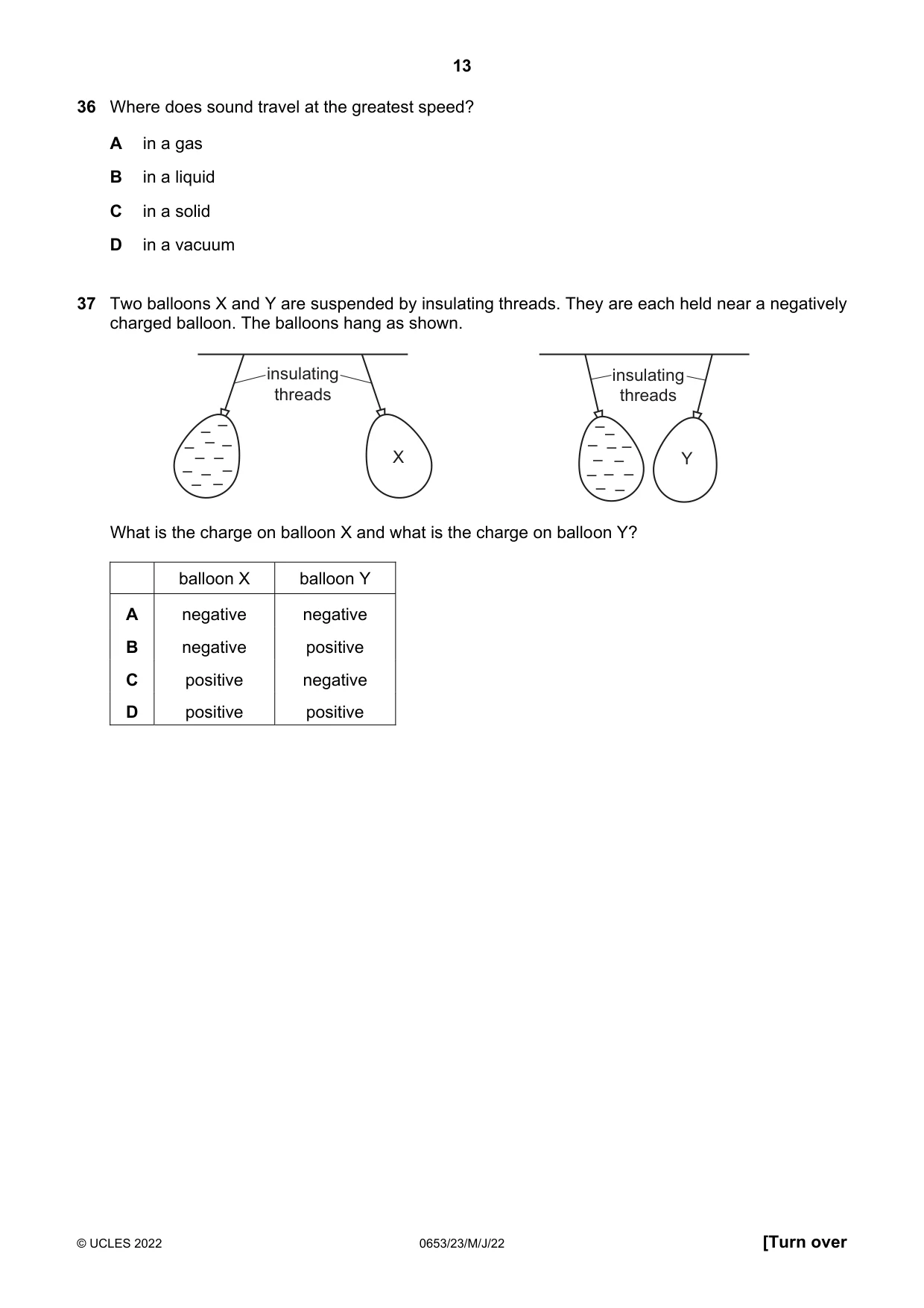
Q36 · Where does sound travel at the greatest speed?
36 Where does sound travel at the greatest speed? A in a gas B in a liquid C in a solid D in a vacuum
Mark scheme: C
Q37 · Two balloons X and Y are suspended by insulating threads
37 Two balloons X and Y are suspended by insulating threads. They are each held near a negatively charged balloon. The balloons hang as shown. insulating insulating threads threads – – – – – – – – – – – – – X – – Y ––– – – – – – – What is the charge on balloon X and what is the charge on balloon Y? balloon X balloon Y A negative negative B negative positive C positive negative D positive positive
Mark scheme: B
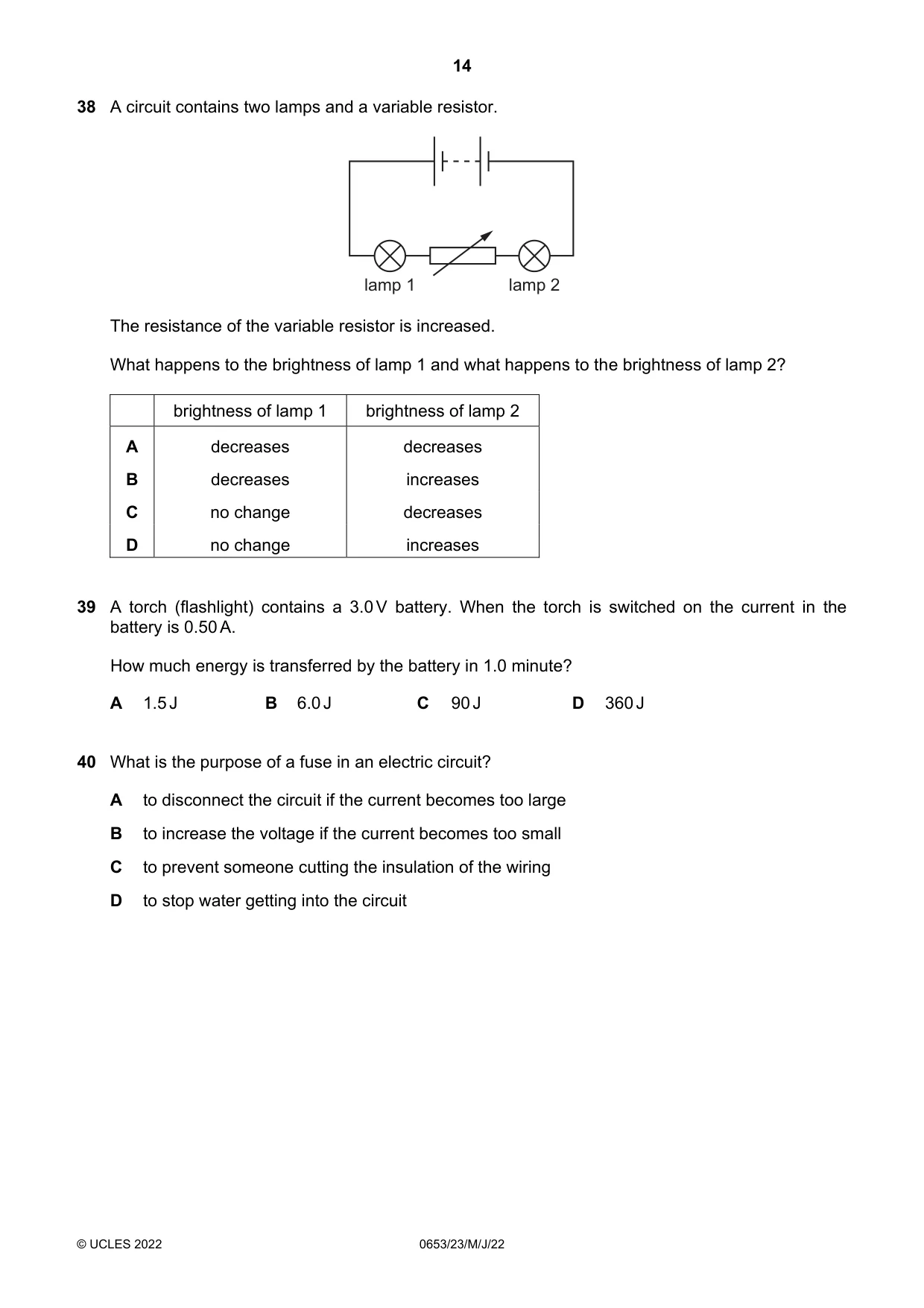
Q38 · A circuit contains two lamps and a variable resistor
38 A circuit contains two lamps and a variable resistor. lamp 1 lamp 2 The resistance of the variable resistor is increased. What happens to the brightness of lamp 1 and what happens to the brightness of lamp 2? brightness of lamp 1 brightness of lamp 2 A decreases decreases B decreases increases C no change decreases D no change increases
Mark scheme: A
Q39 · A torch (flashlight) contains a 3.0 V battery
39 A torch (flashlight) contains a 3.0 V battery. When the torch is switched on the current in the battery is 0.50 A. How much energy is transferred by the battery in 1.0 minute? A 1.5 J B 6.0 J C 90 J D 360 J
Mark scheme: C
Q40 · What is the purpose of a fuse in an electric circuit?
40 What is the purpose of a fuse in an electric circuit? A to disconnect the circuit if the current becomes too large B to increase the voltage if the current becomes too small C to prevent someone cutting the insulation of the wiring D to stop water getting into the circuit
Mark scheme: A
What was in this paper
The subtopics covered by these 40 questions, and how many questions each got. Open one in a new tab to see every Cambridge question on it.
2Sexual reproduction in plants2Alkanes1Alkenes1Arrangement of elements1Blood1Cell structure1Density1Diet1Diffusion1Digestion1Electrical circuits1Electrical safety1Electrolysis1Energy, work and power1Enzymes1Extraction of metals1Food chains and food webs1Gas exchange in humans1General properties of waves1Identification of ions and gases1Kinetic particle model of matter1Leaf structure1Light1Mass and weight1Physical and chemical changes1Preparation of salts1Rate of reaction1Reactivity series1Redox1Sexual reproduction in humans1Sound1Terminology1The characteristic properties of acids and bases1Thermal properties and temperature1Transfer of thermal energy1Water1Water uptake1What you needed in this session
Cambridge’s own grade thresholds for 2022 May/June, Paper 2 · Variant 3. A higher threshold means an easier paper — the bar moves with how the cohort did.