Cambridge IGCSE Science - Combined 0653 — 2019 Feb/March Paper 2 · Variant 2
0653/22/F/M/19 · 40 questions · 40 marks · ≈45 min
The question paper and its mark scheme, free to read here and free to download. This is Cambridge’s own paper, exactly as it was sat.
Question paper16 pages

Mark scheme3 pages
Answers below. Sit the paper first if you are practising.
Questions as text
Q1 · The following are features of palisade mesophyll cells: 1 column shaped 2 have a nucleus…
1 The following are features of palisade mesophyll cells: 1 column shaped 2 have a nucleus 3 have large vacuoles 4 have many chloroplasts Which features of these cells help them to absorb maximum light and carry out photosynthesis? A 1, 2, 3 and 4 B 1 and 4 only C 2 and 4 only D 4 only
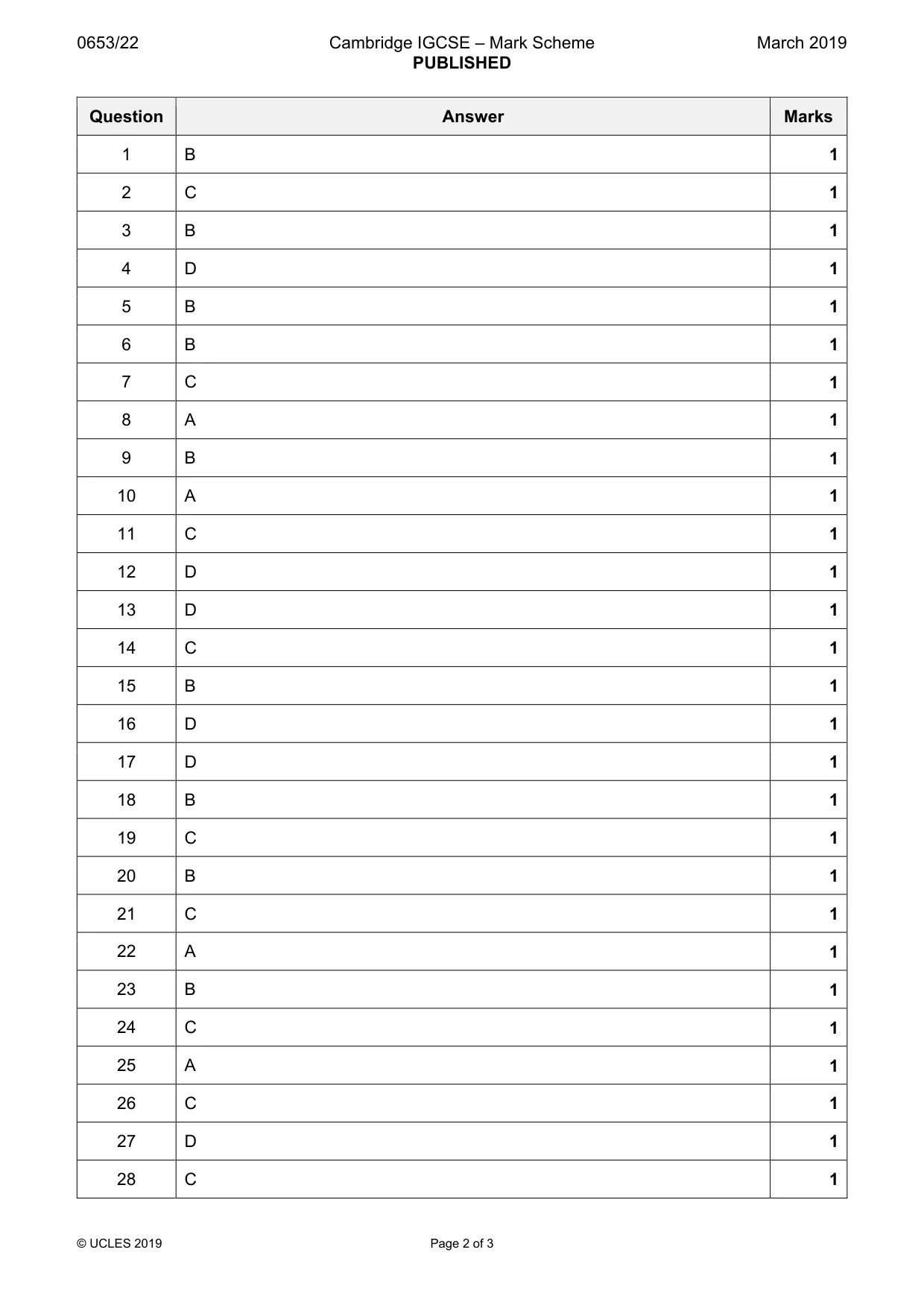
Mark scheme: B
Q2 · In an experiment, an enzyme from the human alimentary canal is found to work slowly at 20…
2 In an experiment, an enzyme from the human alimentary canal is found to work slowly at 20 °C. What is the optimum temperature for enzymes working in the human alimentary canal? A 17 °C B 27 °C C 37 °C D 77 °C
Mark scheme: C
Q3 · Which graph shows the effect of light intensity on the rate of photosynthesis?
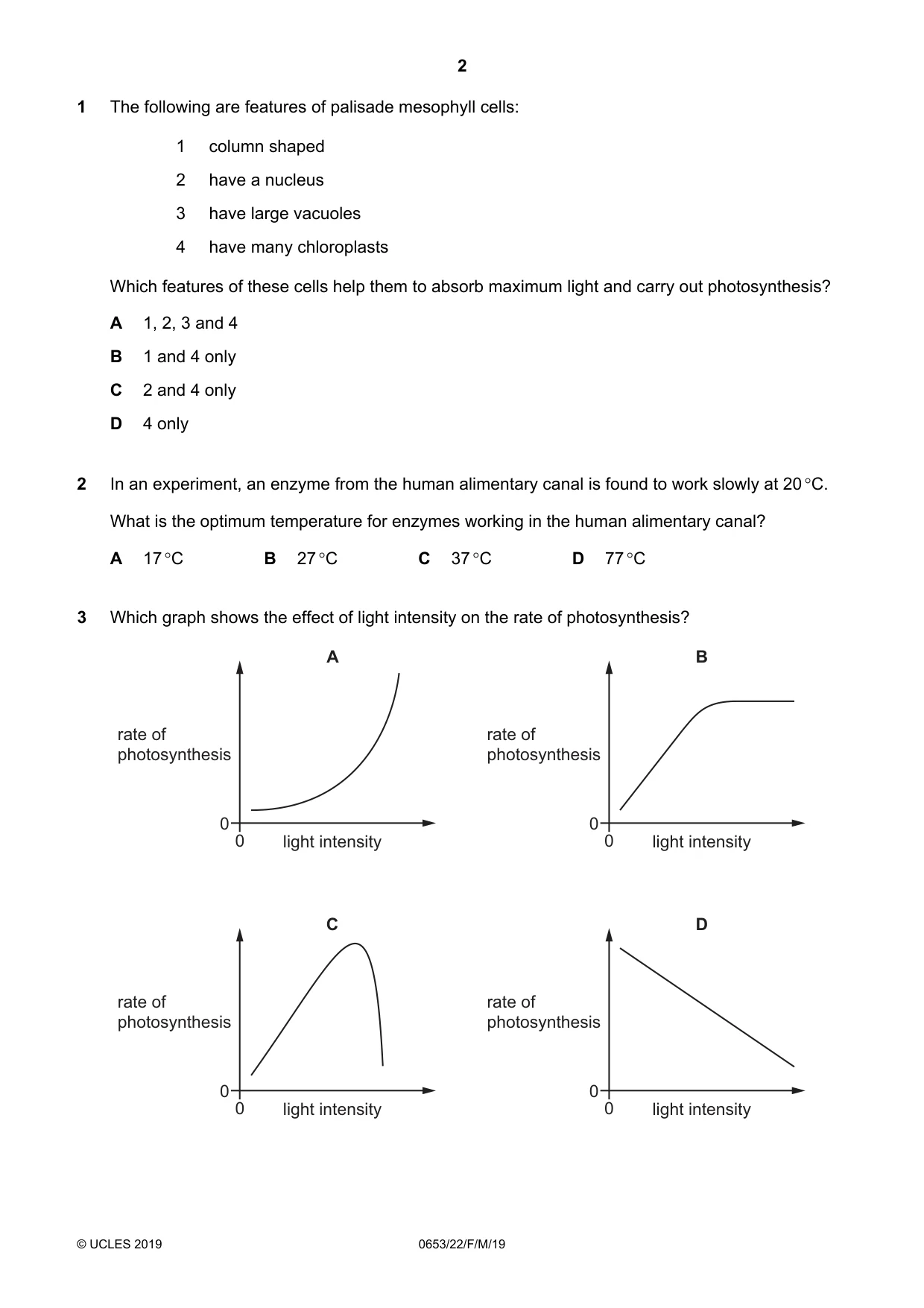
3 Which graph shows the effect of light intensity on the rate of photosynthesis? A B rate of rate of photosynthesis photosynthesis 0 0 0 light intensity 0 light intensity C D rate of rate of photosynthesis photosynthesis 0 0 0 light intensity 0 light intensity
Mark scheme: B
Q4 · What is caused by an iron deficiency in the diet of a human?
4 What is caused by an iron deficiency in the diet of a human? A bleeding gums B rickets C cannot form white blood cells D anaemia
Mark scheme: D
Q5 · The diagram shows a transverse section through a plant root
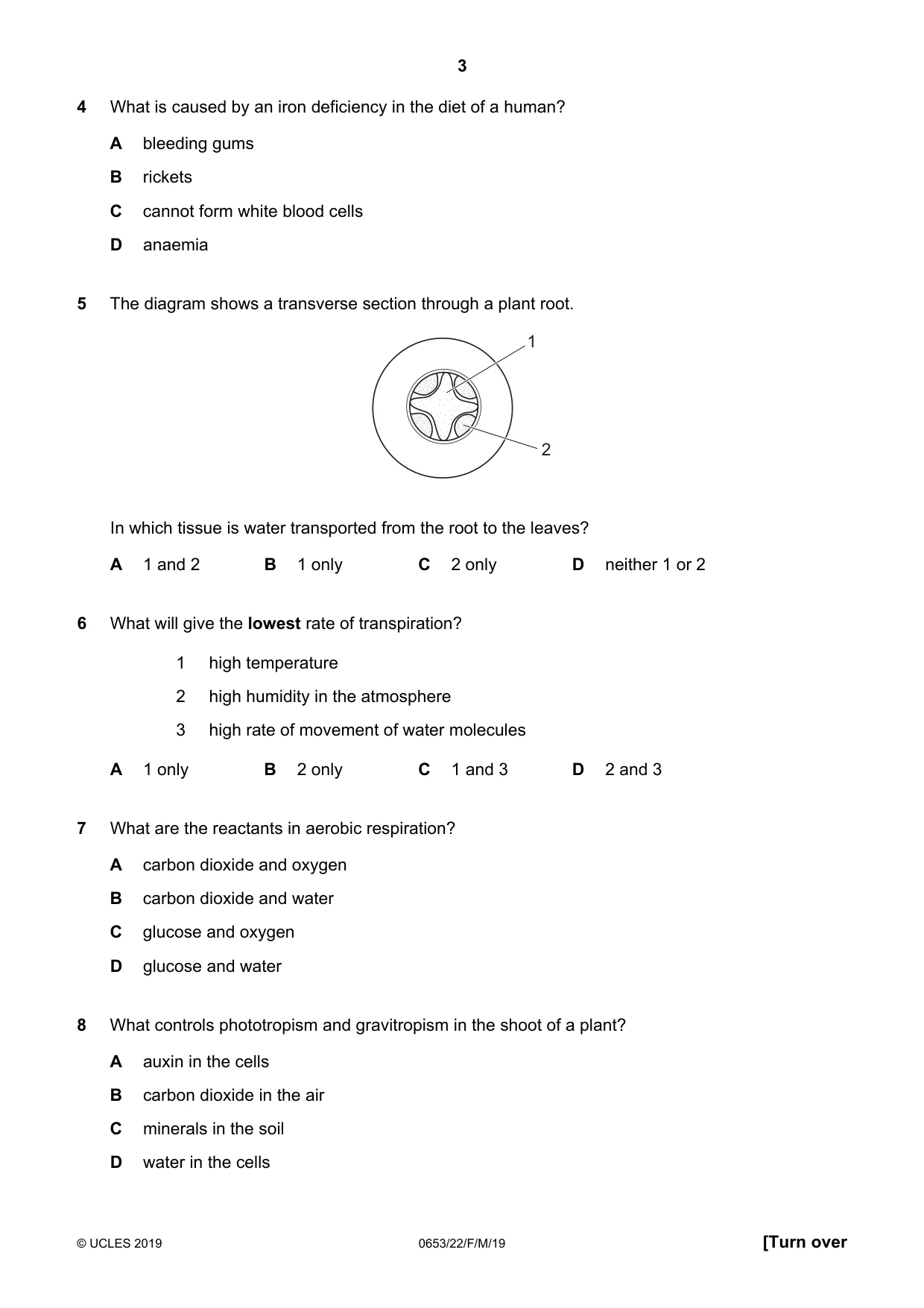
5 The diagram shows a transverse section through a plant root. 1 2 In which tissue is water transported from the root to the leaves? A 1 and 2 B 1 only C 2 only D neither 1 or 2
Mark scheme: B
Q6 · What will give the lowest rate of transpiration?
6 What will give the lowest rate of transpiration? 1 high temperature 2 high humidity in the atmosphere 3 high rate of movement of water molecules A 1 only B 2 only C 1 and 3 D 2 and 3
Mark scheme: B
Q7 · What are the reactants in aerobic respiration?
7 What are the reactants in aerobic respiration? A carbon dioxide and oxygen B carbon dioxide and water C glucose and oxygen D glucose and water
Mark scheme: C
Q8 · What controls phototropism and gravitropism in the shoot of a plant?
8 What controls phototropism and gravitropism in the shoot of a plant? A auxin in the cells B carbon dioxide in the air C minerals in the soil D water in the cells
Mark scheme: A
Q9 · Which row is correct for sexual reproduction?
9 Which row is correct for sexual reproduction? genetically different one zygote offspring produced parent produced A v Jv x B J x J Cc x v x D x x J
Mark scheme: B
Q10 · Four students are comparing the human male and female gametes
10 Four students are comparing the human male and female gametes. Which student has the correct comparison? size movement number A egg bigger sperm mobile usually one egg B sperm bigger sperm not mobile many eggs C egg bigger sperm not mobile one sperm D sperm bigger sperm mobile many sperm
Mark scheme: A
Q11 · The graph shows the energy content of organisms at each trophic level in a food chain
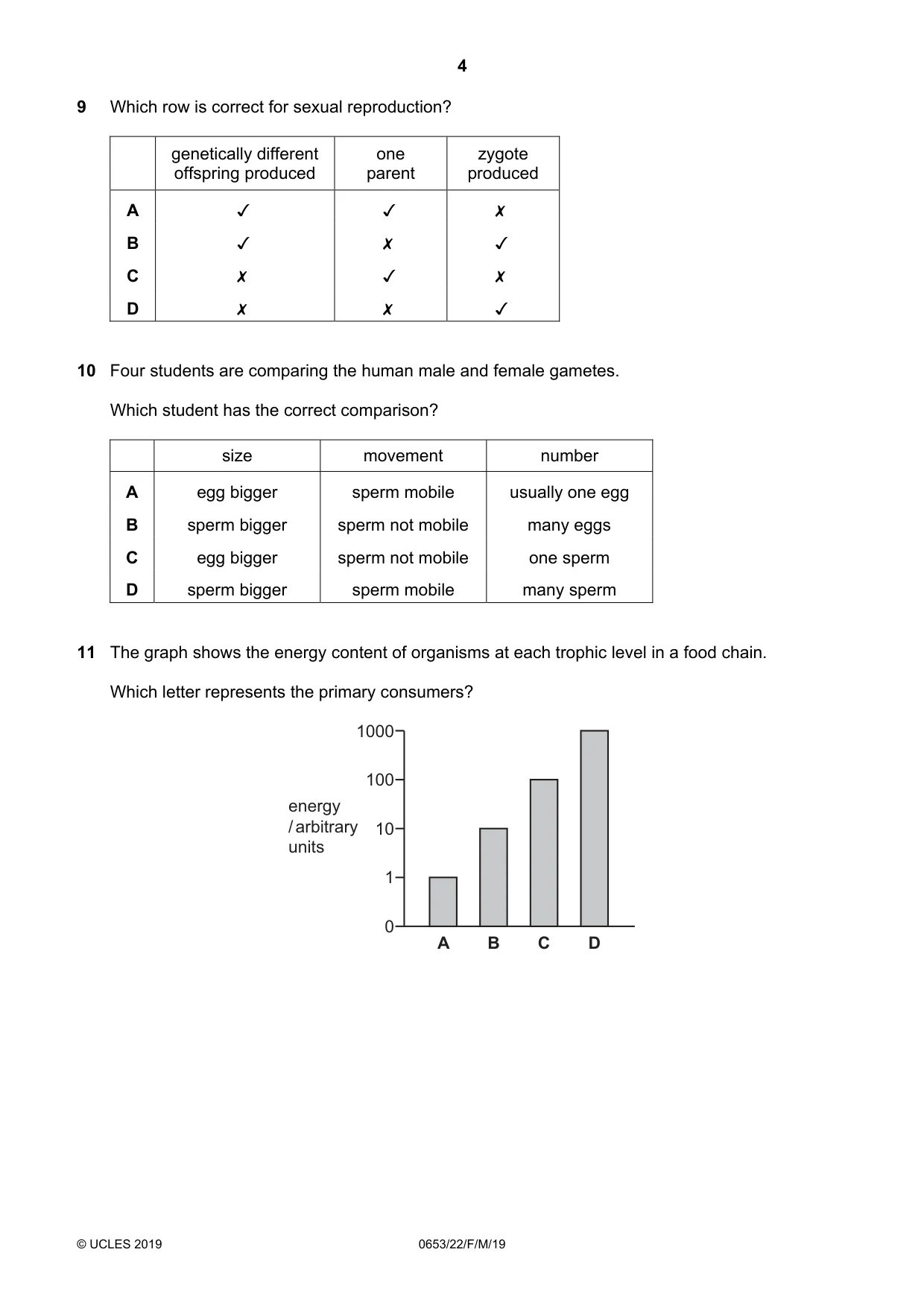
11 The graph shows the energy content of organisms at each trophic level in a food chain. Which letter represents the primary consumers? 1000 100 energy / arbitrary 10 units 1 0 A B C D
Mark scheme: C
Q12 · A farmer chops down a tree to provide firewood
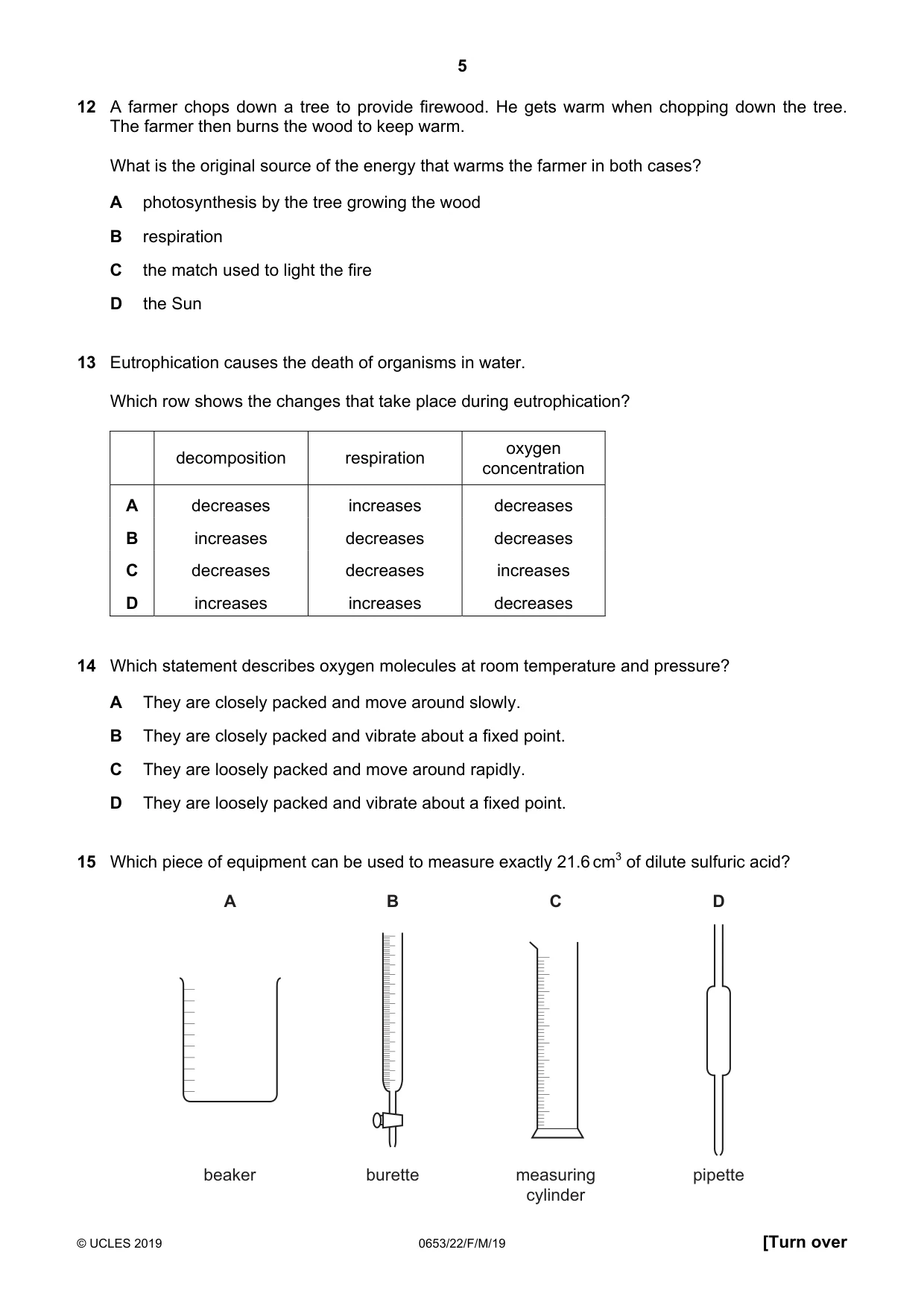
12 A farmer chops down a tree to provide firewood. He gets warm when chopping down the tree. The farmer then burns the wood to keep warm. What is the original source of the energy that warms the farmer in both cases? A photosynthesis by the tree growing the wood B respiration C the match used to light the fire D the Sun
Mark scheme: D
Q13 · Eutrophication causes the death of organisms in water
13 Eutrophication causes the death of organisms in water. Which row shows the changes that take place during eutrophication? oxygen decomposition respiration concentration A decreases increases decreases B increases decreases decreases C decreases decreases increases D increases increases decreases
Mark scheme: D
Q14 · Which statement describes oxygen molecules at room temperature and pressure?
14 Which statement describes oxygen molecules at room temperature and pressure? A They are closely packed and move around slowly. B They are closely packed and vibrate about a fixed point. C They are loosely packed and move around rapidly. D They are loosely packed and vibrate about a fixed point.
Mark scheme: C
Q15 · Which piece of equipment can be used to measure exactly 21.6 cm3 of dilute sulfuric acid?
15 Which piece of equipment can be used to measure exactly 21.6 cm3 of dilute sulfuric acid? A B C D beaker burette measuring pipette cylinder
Mark scheme: B
Q16 · Which statement about the compound formed between a metal and a non-metal is correct?
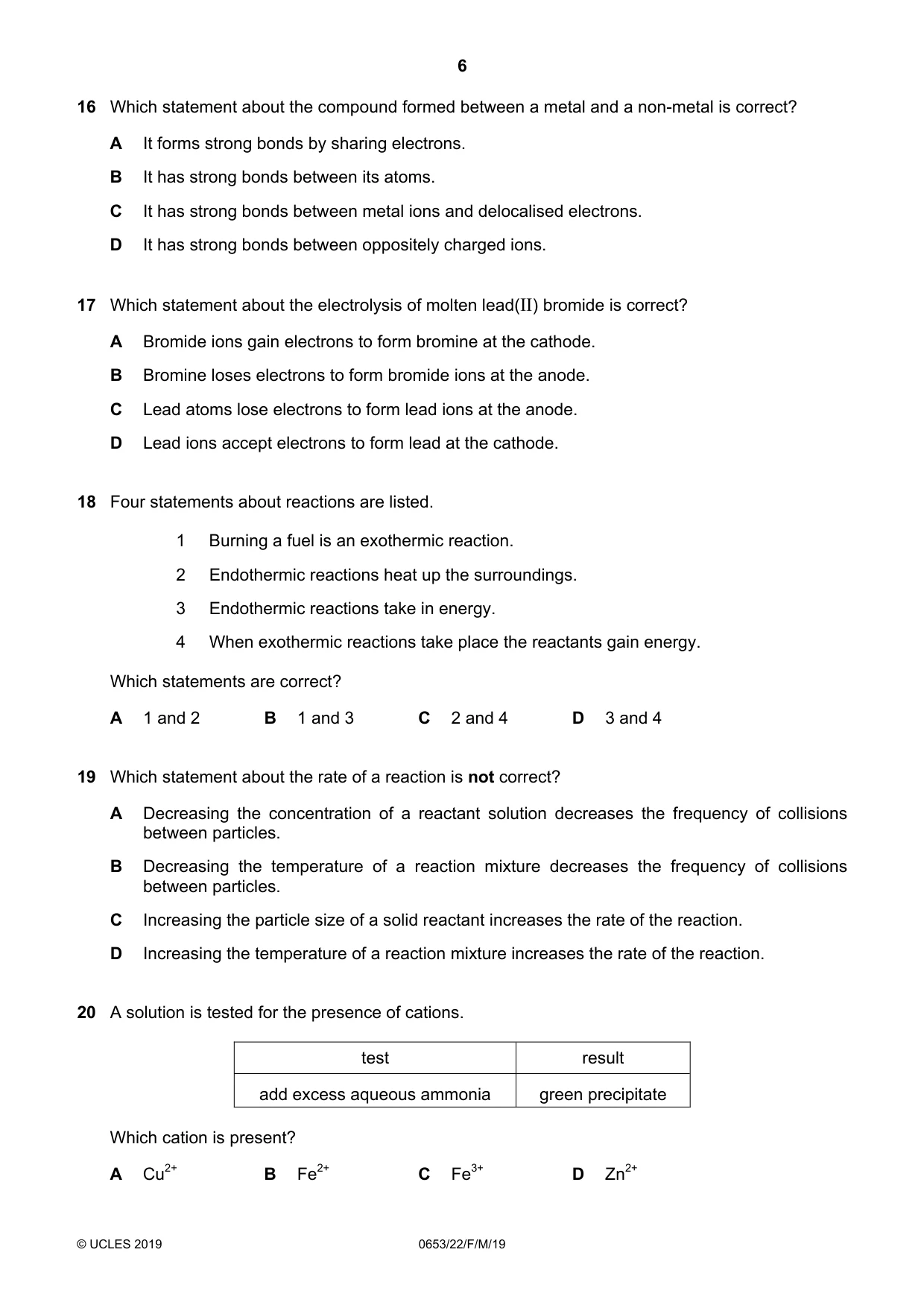
16 Which statement about the compound formed between a metal and a non-metal is correct? A It forms strong bonds by sharing electrons. B It has strong bonds between its atoms. C It has strong bonds between metal ions and delocalised electrons. D It has strong bonds between oppositely charged ions.
Mark scheme: D
Q17 · Which statement about the electrolysis of molten lead(II) bromide is correct?
17 Which statement about the electrolysis of molten lead(II) bromide is correct? A Bromide ions gain electrons to form bromine at the cathode. B Bromine loses electrons to form bromide ions at the anode. C Lead atoms lose electrons to form lead ions at the anode. D Lead ions accept electrons to form lead at the cathode.
Mark scheme: D
Q18 · Four statements about reactions are listed
18 Four statements about reactions are listed. 1 Burning a fuel is an exothermic reaction. 2 Endothermic reactions heat up the surroundings. 3 Endothermic reactions take in energy. 4 When exothermic reactions take place the reactants gain energy. Which statements are correct? A 1 and 2 B 1 and 3 C 2 and 4 D 3 and 4
Mark scheme: B
Q19 · Which statement about the rate of a reaction is not correct?
19 Which statement about the rate of a reaction is not correct? A Decreasing the concentration of a reactant solution decreases the frequency of collisions between particles. B Decreasing the temperature of a reaction mixture decreases the frequency of collisions between particles. C Increasing the particle size of a solid reactant increases the rate of the reaction. D Increasing the temperature of a reaction mixture increases the rate of the reaction.
Mark scheme: C
Q20 · A solution is tested for the presence of cations
20 A solution is tested for the presence of cations. test result add excess aqueous ammonia green precipitate Which cation is present? A Cu2+ B Fe2+ C Fe3+ D Zn2+
Mark scheme: B
Q21 · Chlorine, bromine and iodine are elements in Group VII of the Periodic Table
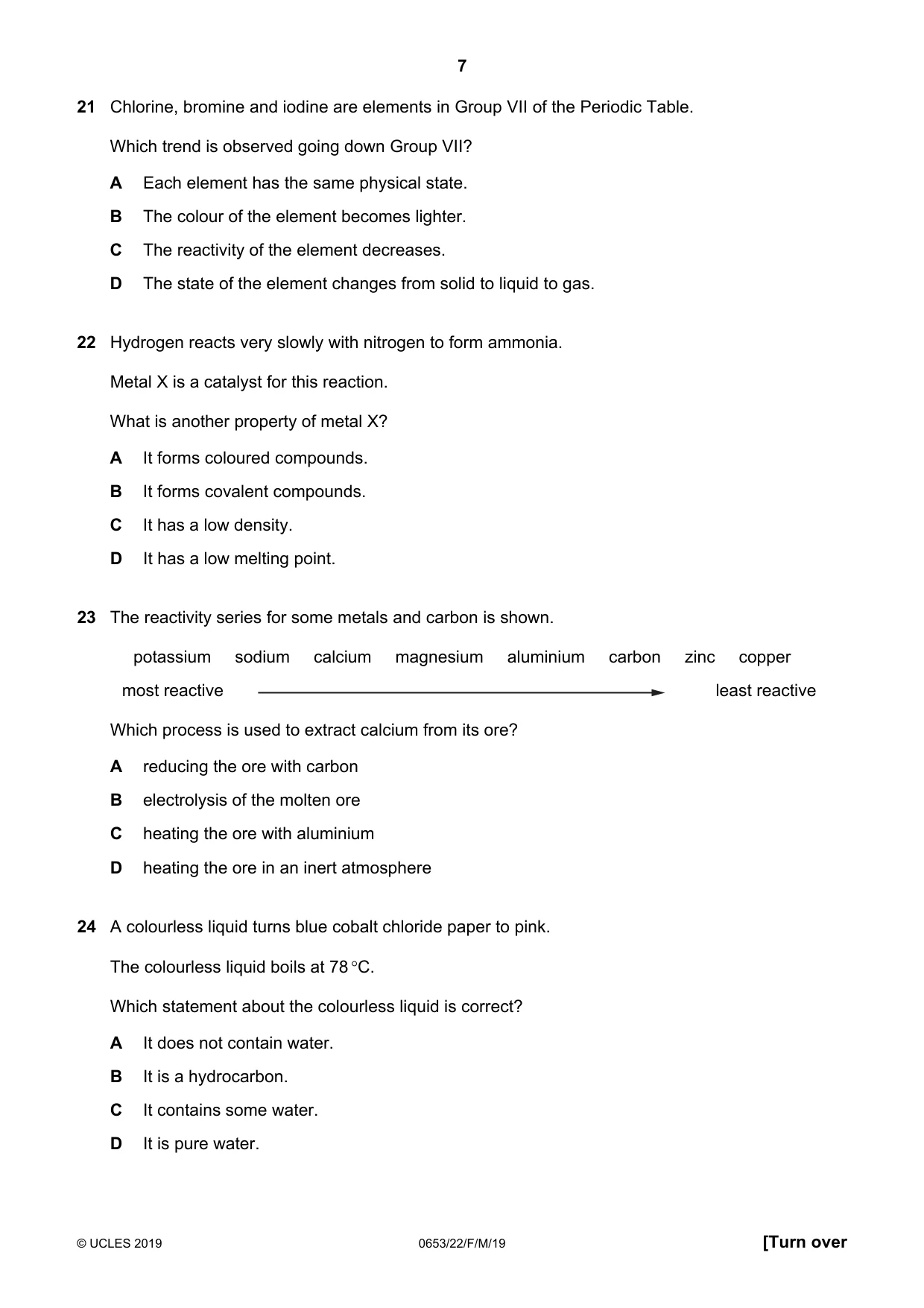
21 Chlorine, bromine and iodine are elements in Group VII of the Periodic Table. Which trend is observed going down Group VII? A Each element has the same physical state. B The colour of the element becomes lighter. C The reactivity of the element decreases. D The state of the element changes from solid to liquid to gas.
Mark scheme: C
Q22 · Hydrogen reacts very slowly with nitrogen to form ammonia
22 Hydrogen reacts very slowly with nitrogen to form ammonia. Metal X is a catalyst for this reaction. What is another property of metal X? A It forms coloured compounds. B It forms covalent compounds. C It has a low density. D It has a low melting point.
Mark scheme: A
Q23 · The reactivity series for some metals and carbon is shown
23 The reactivity series for some metals and carbon is shown. potassium sodium calcium magnesium aluminium carbon zinc copper most reactive least reactive Which process is used to extract calcium from its ore? A reducing the ore with carbon B electrolysis of the molten ore C heating the ore with aluminium D heating the ore in an inert atmosphere
Mark scheme: B
Q24 · A colourless liquid turns blue cobalt chloride paper to pink
24 A colourless liquid turns blue cobalt chloride paper to pink. The colourless liquid boils at 78 °C. Which statement about the colourless liquid is correct? A It does not contain water. B It is a hydrocarbon. C It contains some water. D It is pure water.
Mark scheme: C
Q25 · Some statements about gases in the air are listed
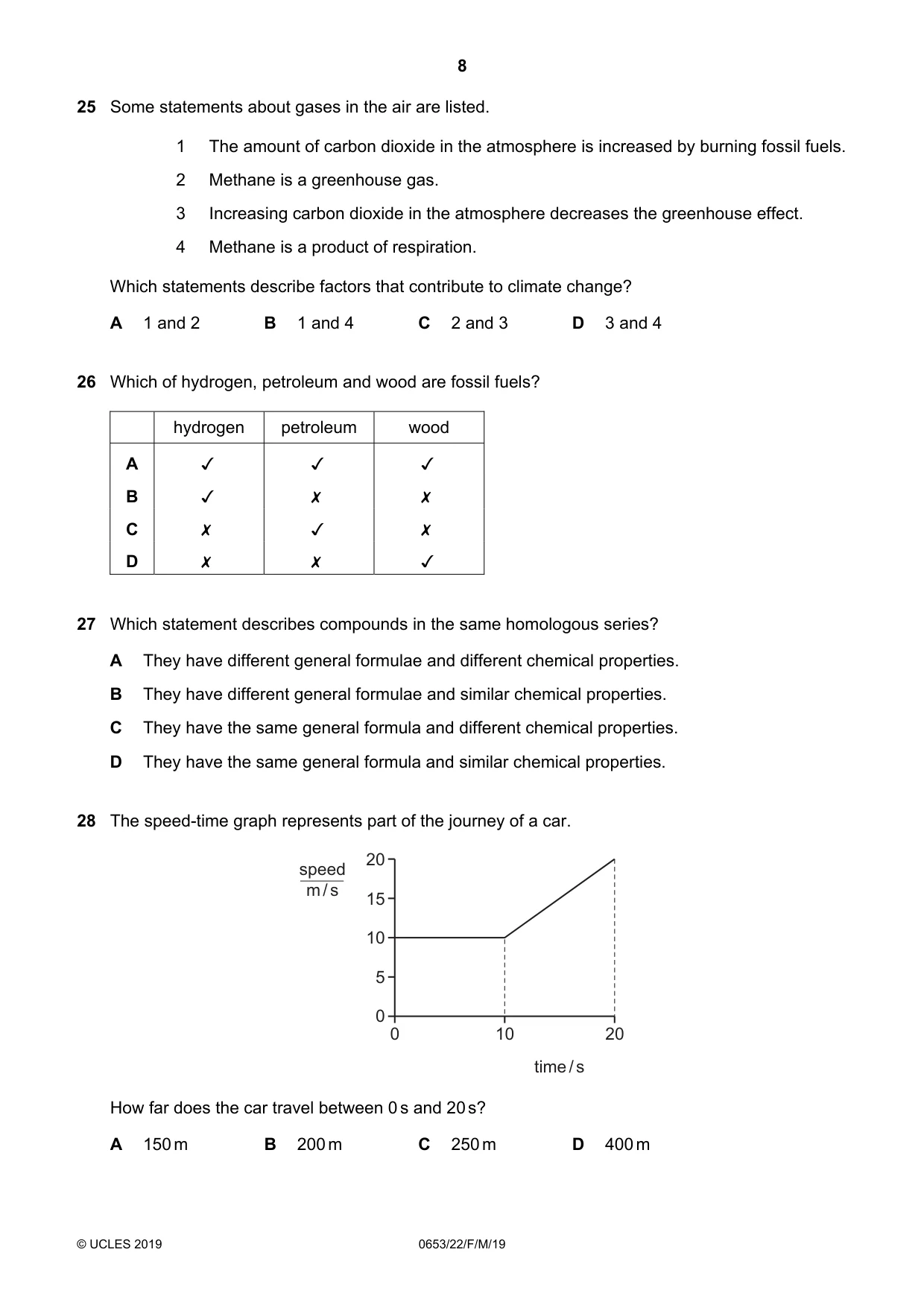
25 Some statements about gases in the air are listed. 1 The amount of carbon dioxide in the atmosphere is increased by burning fossil fuels. 2 Methane is a greenhouse gas. 3 Increasing carbon dioxide in the atmosphere decreases the greenhouse effect. 4 Methane is a product of respiration. Which statements describe factors that contribute to climate change? A 1 and 2 B 1 and 4 C 2 and 3 D 3 and 4
Mark scheme: A
Q26 · Which of hydrogen, petroleum and wood are fossil fuels?
26 Which of hydrogen, petroleum and wood are fossil fuels? hydrogen petroleum wood A J J J B v x x Cc x Jv x D x x J
Mark scheme: C
Q27 · Which statement describes compounds in the same homologous series?
27 Which statement describes compounds in the same homologous series? A They have different general formulae and different chemical properties. B They have different general formulae and similar chemical properties. C They have the same general formula and different chemical properties. D They have the same general formula and similar chemical properties.
Mark scheme: D
Q28 · The speed-time graph represents part of the journey of a car
28 The speed-time graph represents part of the journey of a car. 20 speed m / s 15 10 5 0 0 10 20 time / s How far does the car travel between 0 s and 20 s? A 150 m B 200 m C 250 m D 400 m
Mark scheme: C
Q29 · A vehicle moves in a straight line
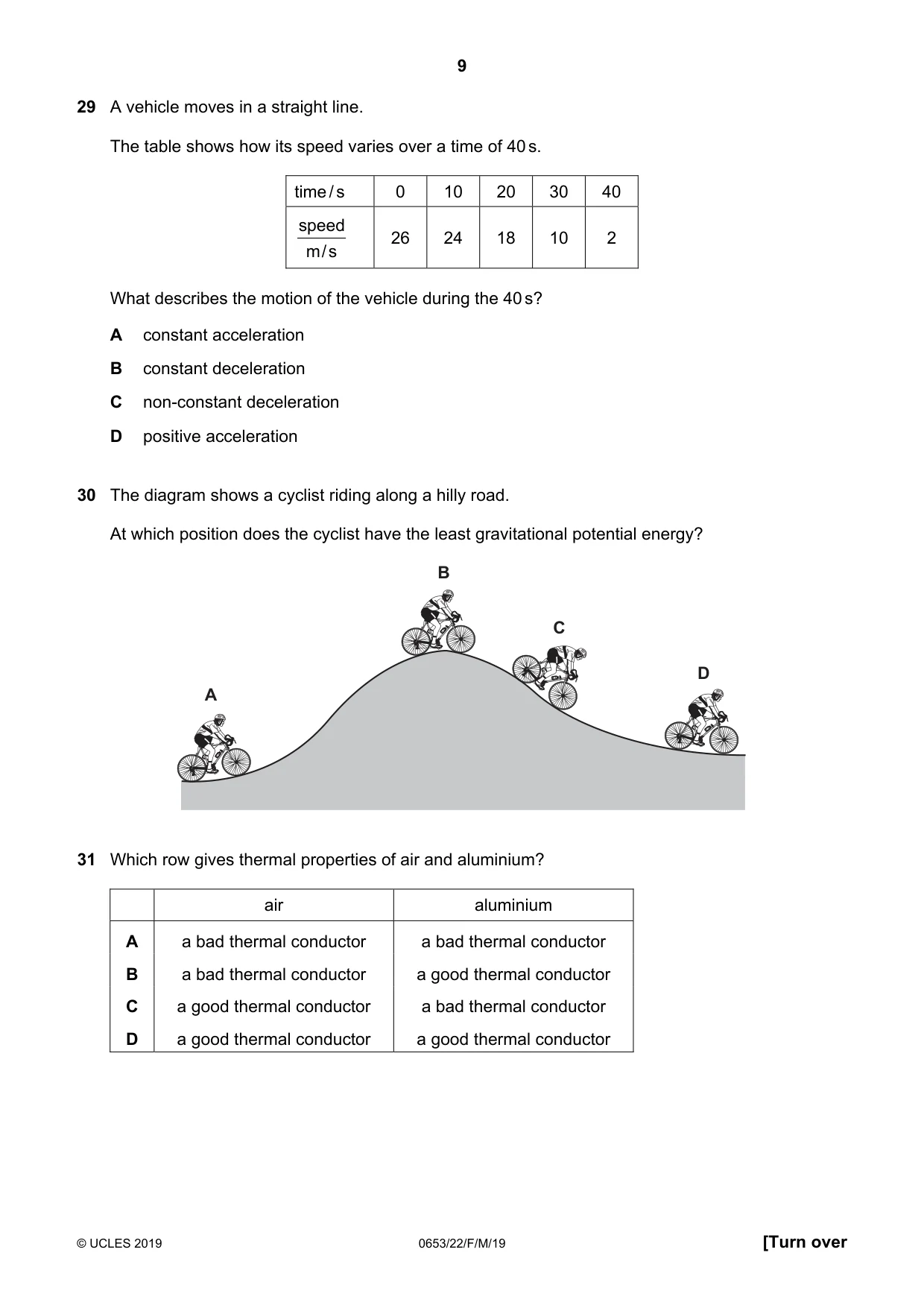
29 A vehicle moves in a straight line. The table shows how its speed varies over a time of 40 s. time / s 0 10 20 30 40 speed 26 24 18 10 2 m / s What describes the motion of the vehicle during the 40 s? A constant acceleration B constant deceleration C non-constant deceleration D positive acceleration
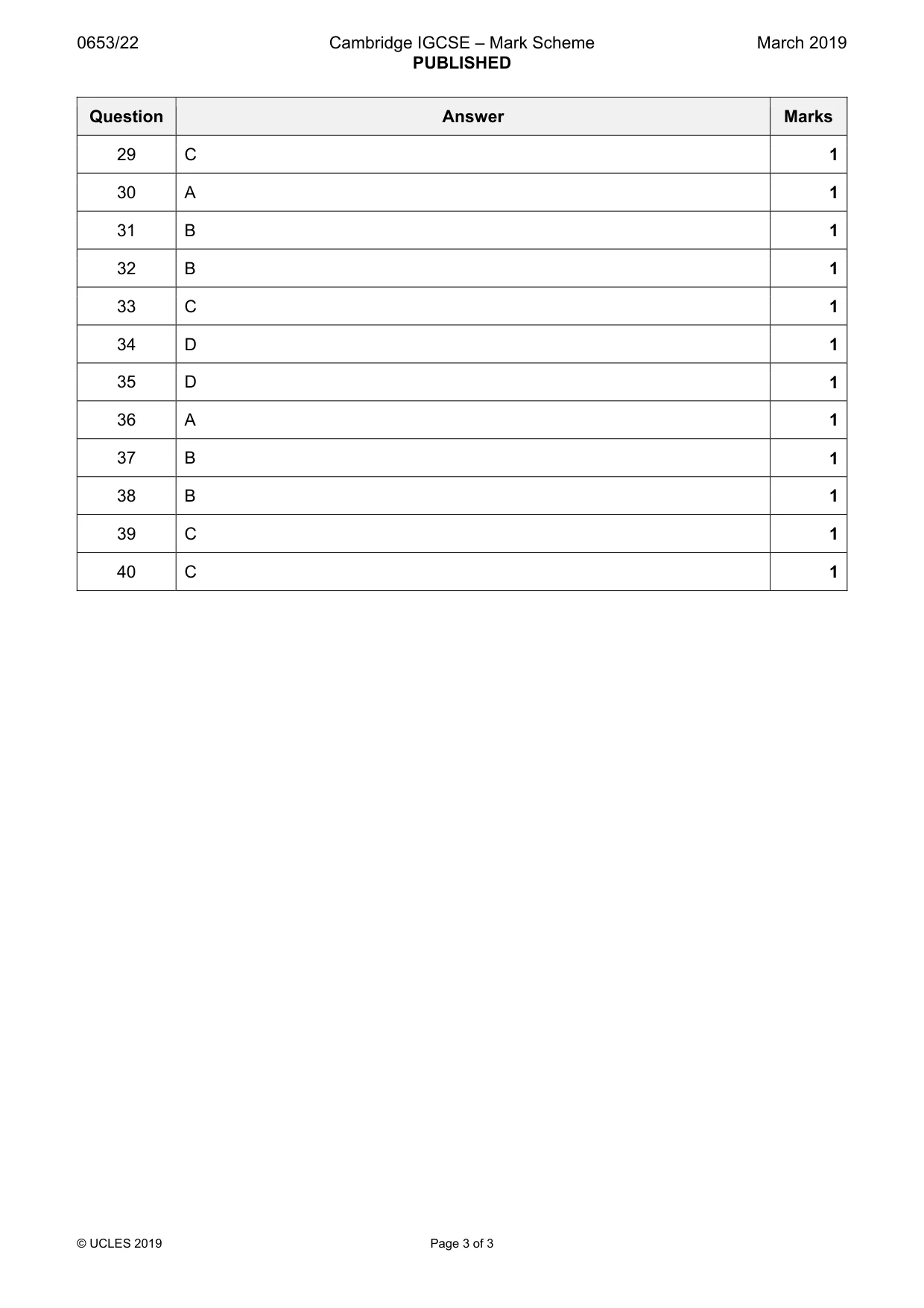
Mark scheme: C
Q30 · The diagram shows a cyclist riding along a hilly road
30 The diagram shows a cyclist riding along a hilly road. At which position does the cyclist have the least gravitational potential energy? B C D A
Mark scheme: A
Q31 · Which row gives thermal properties of air and aluminium?
31 Which row gives thermal properties of air and aluminium? air aluminium A a bad thermal conductor a bad thermal conductor B a bad thermal conductor a good thermal conductor C a good thermal conductor a bad thermal conductor D a good thermal conductor a good thermal conductor
Mark scheme: B
Q32 · The diagram shows the direction of a wave passing from medium 1 into medium 2
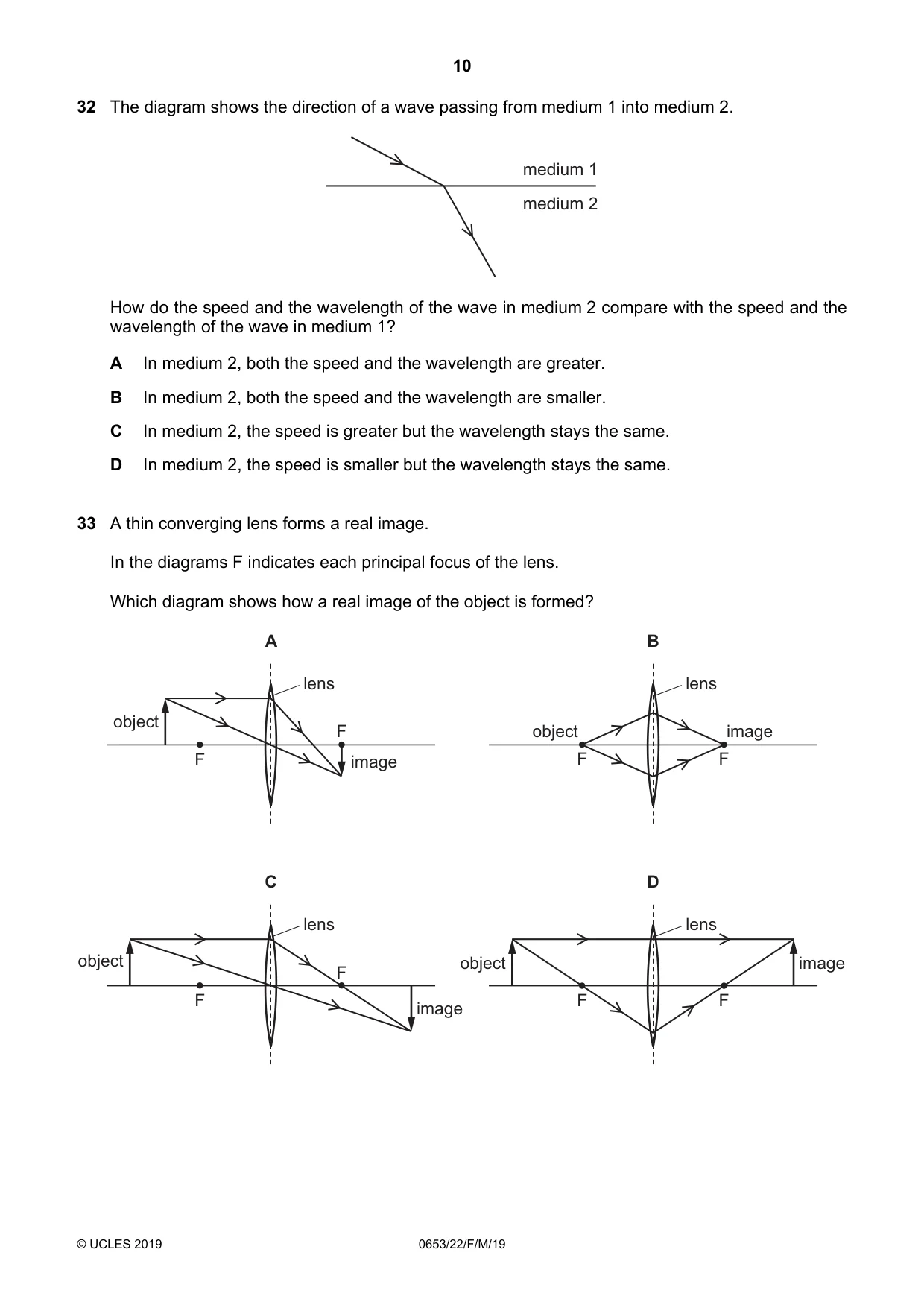
32 The diagram shows the direction of a wave passing from medium 1 into medium 2. medium 1 medium 2 How do the speed and the wavelength of the wave in medium 2 compare with the speed and the wavelength of the wave in medium 1? A In medium 2, both the speed and the wavelength are greater. B In medium 2, both the speed and the wavelength are smaller. C In medium 2, the speed is greater but the wavelength stays the same. D In medium 2, the speed is smaller but the wavelength stays the same.
Mark scheme: B
Q33 · A thin converging lens forms a real image
33 A thin converging lens forms a real image. In the diagrams F indicates each principal focus of the lens. Which diagram shows how a real image of the object is formed? A B lens lens object F object image F image F F C D lens lens object object image F F F F image
Mark scheme: C
Q34 · Which statement about light and infra-red radiation is correct?
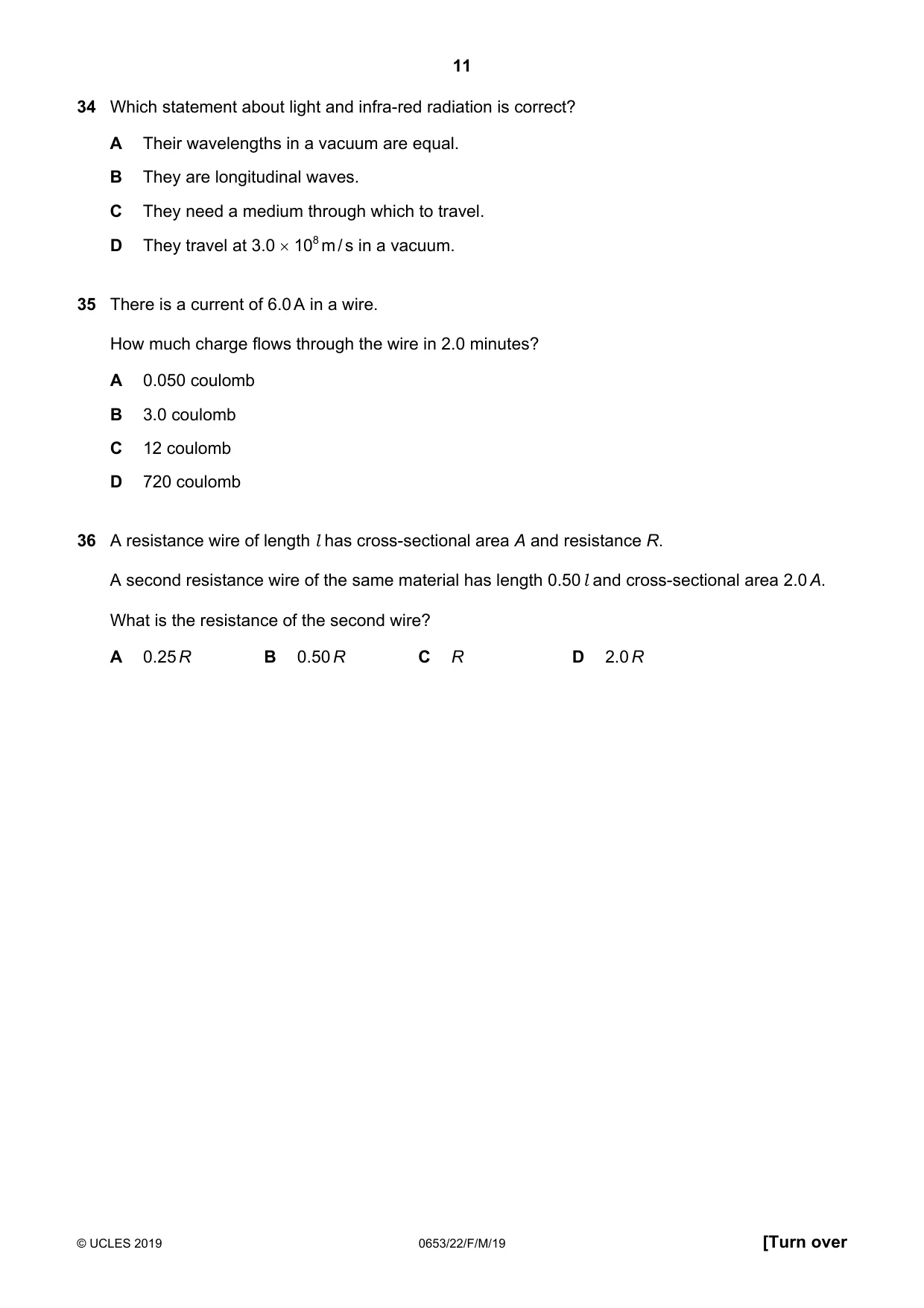
34 Which statement about light and infra-red radiation is correct? A Their wavelengths in a vacuum are equal. B They are longitudinal waves. C They need a medium through which to travel. D They travel at 3.0 × 10⁸ m / s in a vacuum.
Mark scheme: D
Q35 · There is a current of 6.0 A in a wire
35 There is a current of 6.0 A in a wire. How much charge flows through the wire in 2.0 minutes? A 0.050 coulomb B 3.0 coulomb C 12 coulomb D 720 coulomb
Mark scheme: D
Q36 · A resistance wire of length l has cross-sectional area A and resistance R
36 A resistance wire of length l has cross-sectional area A and resistance R. A second resistance wire of the same material has length 0.50 l and cross-sectional area 2.0 A. What is the resistance of the second wire? A 0.25 R B 0.50 R C R D 2.0 R
Mark scheme: A
Q37 · A variable power supply is connected to a resistor and there is a current in the resistor
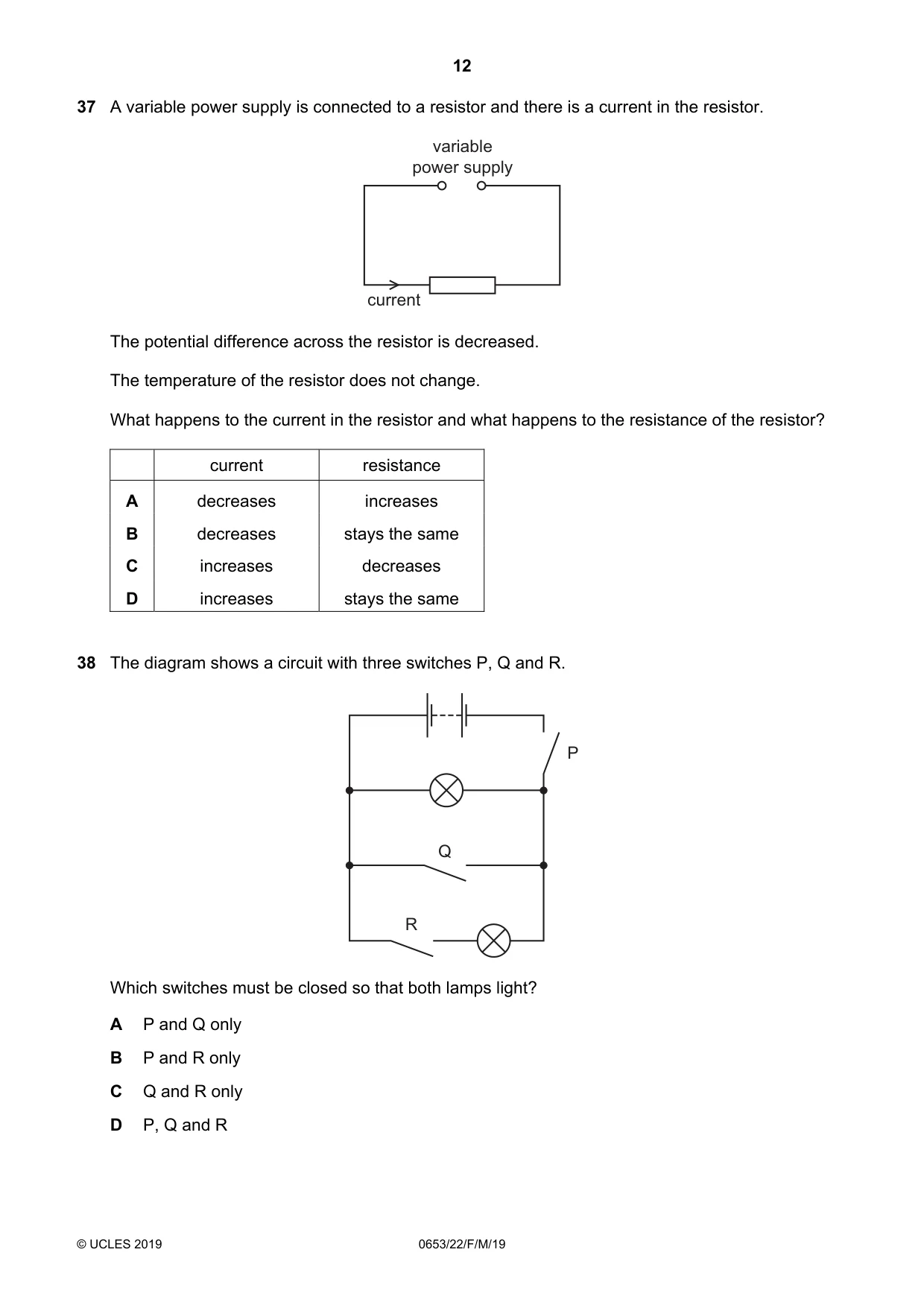
37 A variable power supply is connected to a resistor and there is a current in the resistor. variable power supply current The potential difference across the resistor is decreased. The temperature of the resistor does not change. What happens to the current in the resistor and what happens to the resistance of the resistor? current resistance A decreases increases B decreases stays the same C increases decreases D increases stays the same
Mark scheme: B
Q38 · The diagram shows a circuit with three switches P, Q and R
38 The diagram shows a circuit with three switches P, Q and R. P Q R Which switches must be closed so that both lamps light? A P and Q only B P and R only C Q and R only D P, Q and R
Mark scheme: B
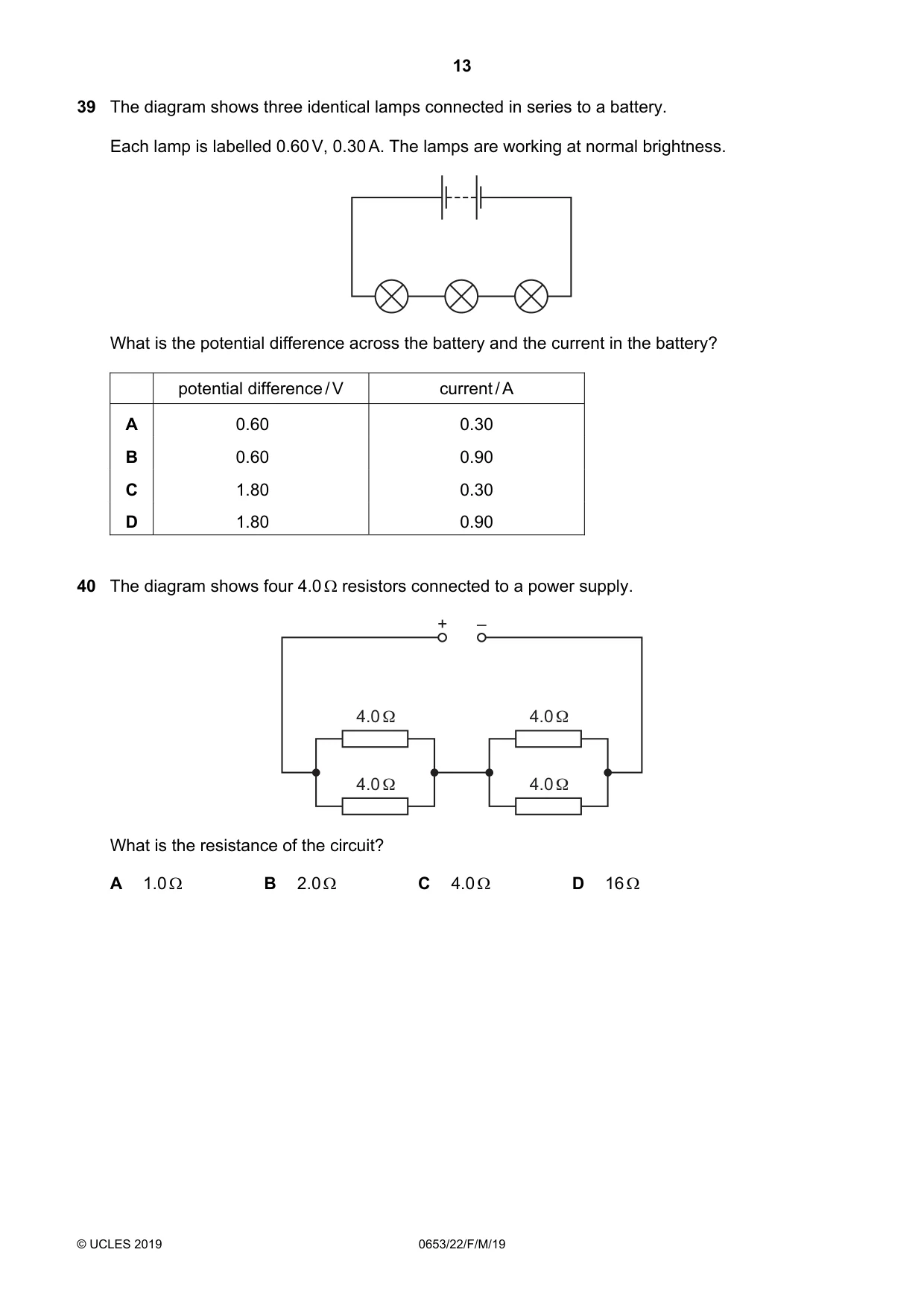
Q39 · The diagram shows three identical lamps connected in series to a battery
39 The diagram shows three identical lamps connected in series to a battery. Each lamp is labelled 0.60 V, 0.30 A. The lamps are working at normal brightness. What is the potential difference across the battery and the current in the battery? potential difference / V current / A A 0.60 0.30 B 0.60 0.90 C 1.80 0.30 D 1.80 0.90
Mark scheme: C
Q40 · The diagram shows four 4.0 Ω resistors connected to a power supply
40 The diagram shows four 4.0 Ω resistors connected to a power supply. + – 4.0 Ω 4.0 Ω 4.0 Ω 4.0 Ω What is the resistance of the circuit? A 1.0 Ω B 2.0 Ω C 4.0 Ω D 16 Ω
Mark scheme: C
What was in this paper
The subtopics covered by these 40 questions, and how many questions each got. Open one in a new tab to see every Cambridge question on it.
3Electrical quantities3Energy flow2Light2Motion2Sexual reproduction in plants2Air quality and climate1Diet1Electrolysis1Electromagnetic spectrum1Energy, work and power1Enzymes1Exothermic and endothermic reactions1Experimental design1Extraction of metals1Fuels1Group VII properties1Habitat destruction1Identification of ions and gases1Leaf structure1Photosynthesis1Rate of reaction1Respiration1Sexual reproduction in humans1Simple molecules and covalent bonds1Solids, liquids and gases1Terminology1Transfer of thermal energy1Transition elements1Transpiration1Water1Xylem and phloem1What you needed in this session
Cambridge’s own grade thresholds for 2019 Feb/March, Paper 2 · Variant 2. A higher threshold means an easier paper — the bar moves with how the cohort did.