Cambridge IGCSE Science - Combined 0653 — 2022 May/June Paper 2 · Variant 2
0653/22/M/J/22 · 40 questions · 40 marks · ≈45 min
The question paper and its mark scheme, free to read here and free to download. This is Cambridge’s own paper, exactly as it was sat.
Question paper16 pages
Mark scheme3 pages
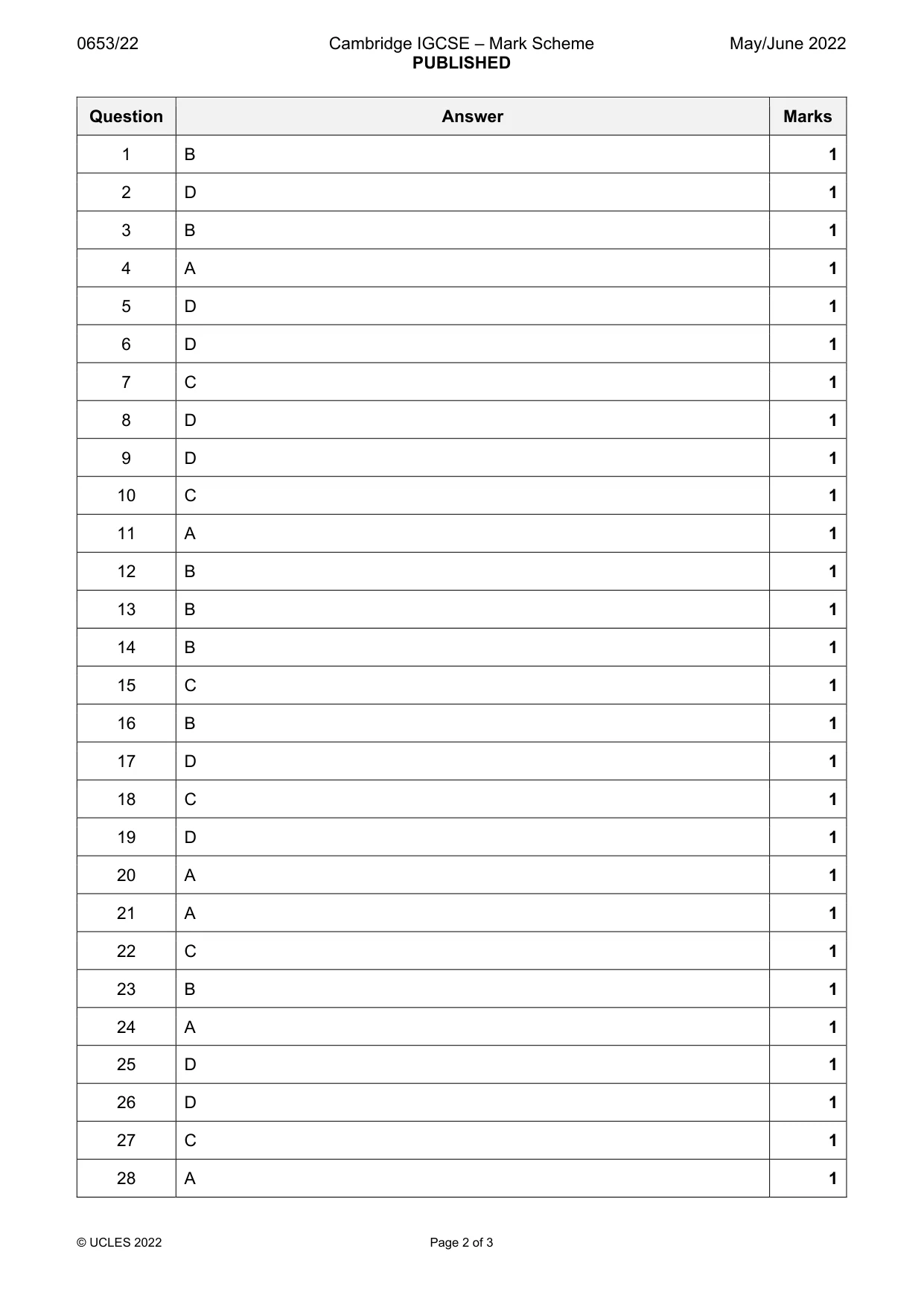
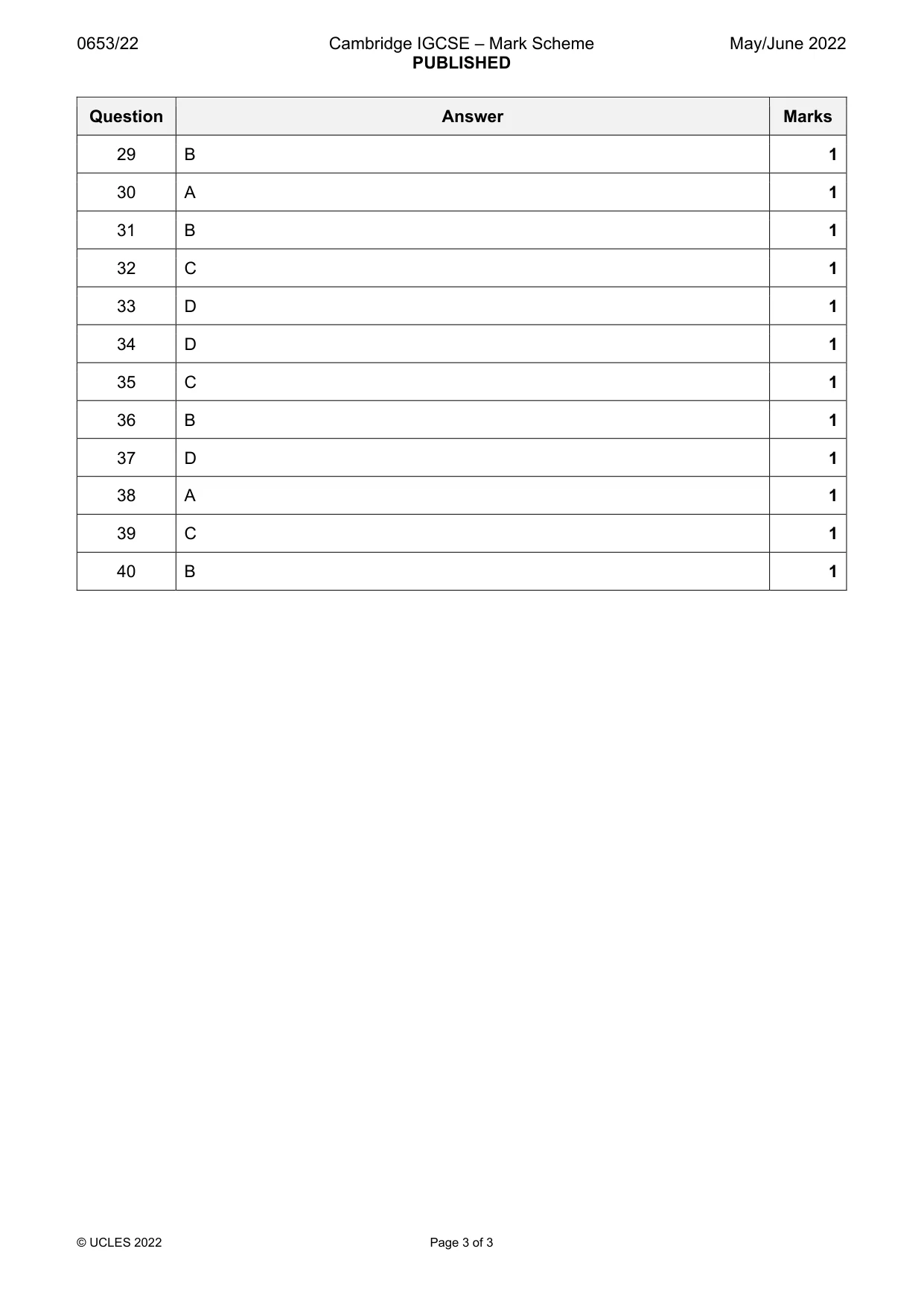
Answers below. Sit the paper first if you are practising.
Questions as text
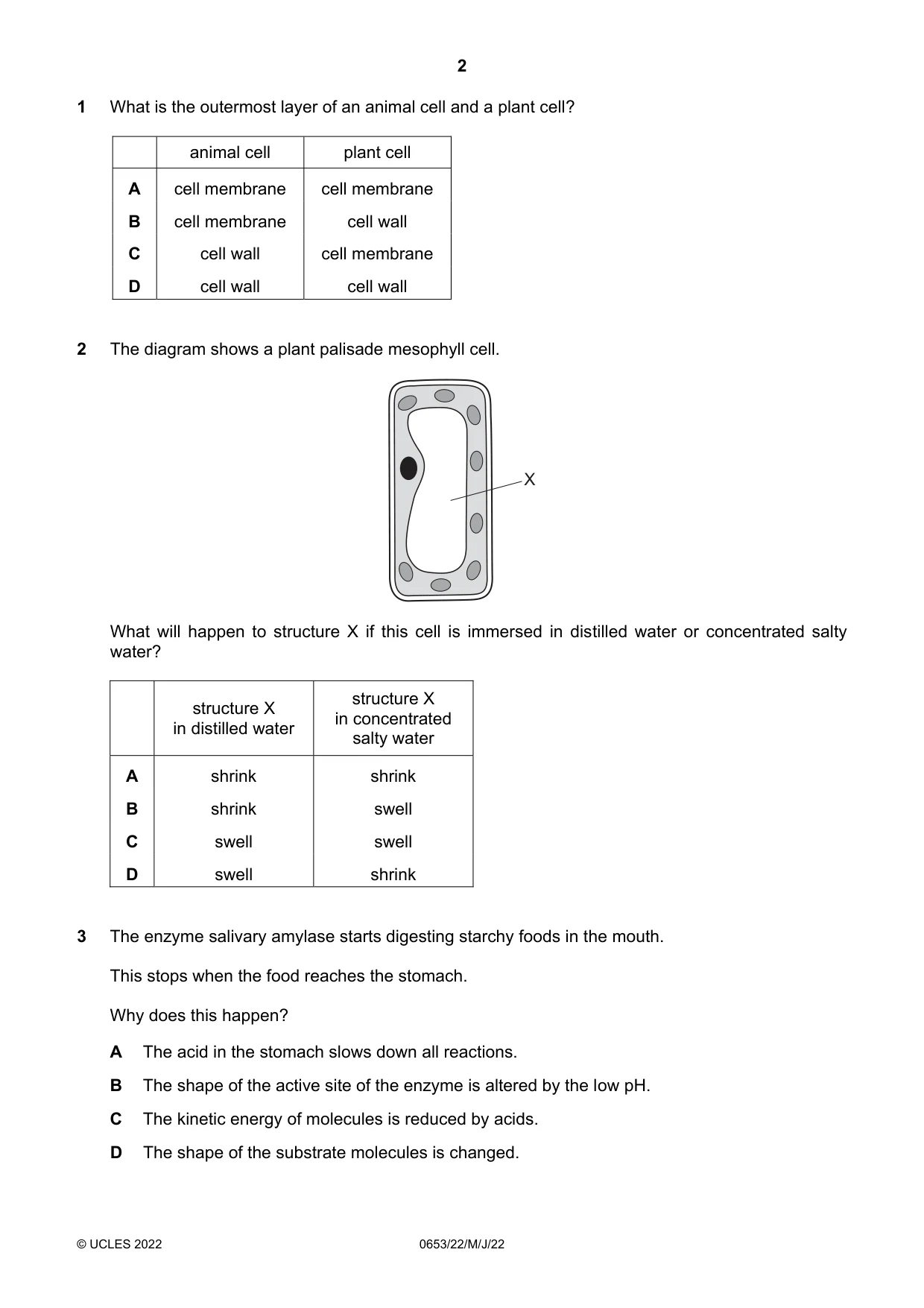
Q1 · What is the outermost layer of an animal cell and a plant cell?
1 What is the outermost layer of an animal cell and a plant cell? animal cell plant cell A cell membrane cell membrane B cell membrane cell wall C cell wall cell membrane D cell wall cell wall
Mark scheme: B
Q2 · The diagram shows a plant palisade mesophyll cell
2 The diagram shows a plant palisade mesophyll cell. X What will happen to structure X if this cell is immersed in distilled water or concentrated salty water? structure X structure X in concentrated in distilled water salty water A shrink shrink B shrink swell C swell swell D swell shrink
Mark scheme: D
Q3 · The enzyme salivary amylase starts digesting starchy foods in the mouth
3 The enzyme salivary amylase starts digesting starchy foods in the mouth. This stops when the food reaches the stomach. Why does this happen? A The acid in the stomach slows down all reactions. B The shape of the active site of the enzyme is altered by the low pH. C The kinetic energy of molecules is reduced by acids. D The shape of the substrate molecules is changed.
Mark scheme: B
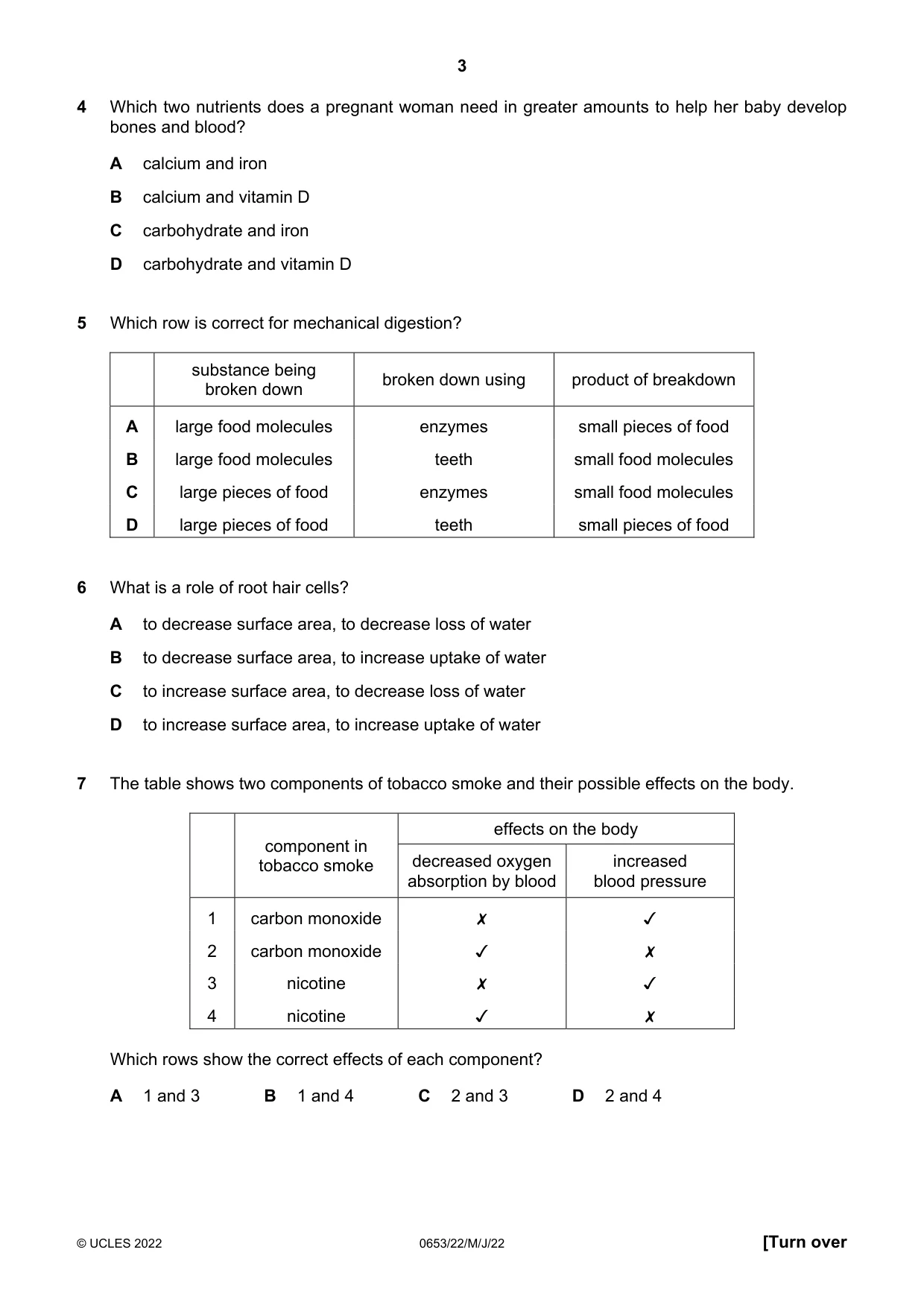
Q4 · Which two nutrients does a pregnant woman need in greater amounts to help her baby…
4 Which two nutrients does a pregnant woman need in greater amounts to help her baby develop bones and blood? A calcium and iron B calcium and vitamin D C carbohydrate and iron D carbohydrate and vitamin D
Mark scheme: A
Q5 · Which row is correct for mechanical digestion?
5 Which row is correct for mechanical digestion? substance being broken down using product of breakdown broken down A large food molecules enzymes small pieces of food B large food molecules teeth small food molecules C large pieces of food enzymes small food molecules D large pieces of food teeth small pieces of food
Mark scheme: D
Q6 · What is a role of root hair cells?
6 What is a role of root hair cells? A to decrease surface area, to decrease loss of water B to decrease surface area, to increase uptake of water C to increase surface area, to decrease loss of water D to increase surface area, to increase uptake of water
Mark scheme: D
Q7 · The table shows two components of tobacco smoke and their possible effects on the body
7 The table shows two components of tobacco smoke and their possible effects on the body. effects on the body component in tobacco smoke decreased oxygen increased absorption by blood blood pressure 1 carbon monoxide x v 2 carbon monoxide v x 3 nicotine x v 4 nicotine v x Which rows show the correct effects of each component? A 1and3 B 1and4 C 2and3 D 2and4
Mark scheme: C
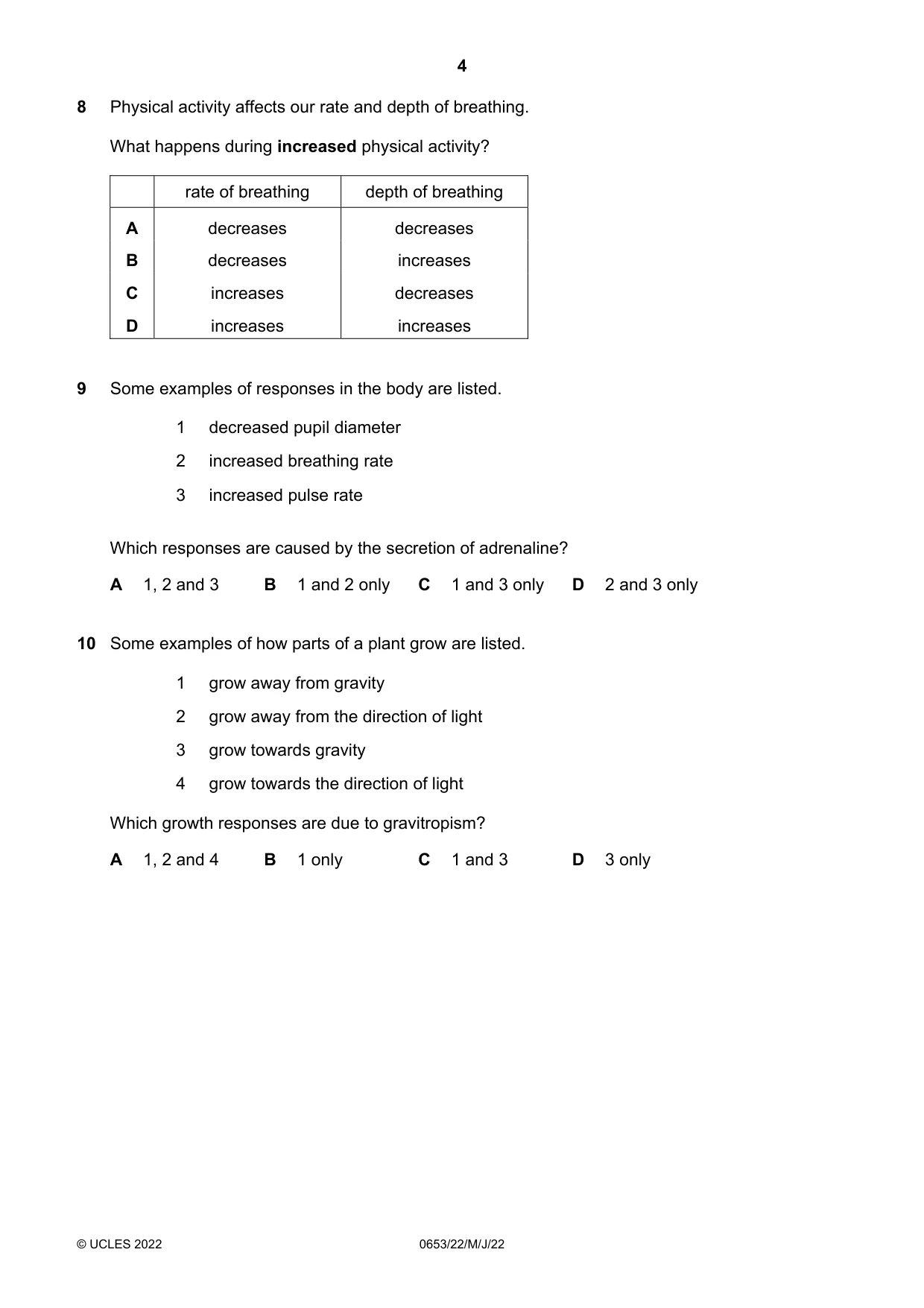
Q8 · Physical activity affects our rate and depth of breathing
8 Physical activity affects our rate and depth of breathing. What happens during increased physical activity? rate of breathing depth of breathing A decreases decreases B decreases increases C increases decreases D increases increases
Mark scheme: D
Q9 · Some examples of responses in the body are listed
9 Some examples of responses in the body are listed. 1 decreased pupil diameter 2 increased breathing rate 3 increased pulse rate Which responses are caused by the secretion of adrenaline? A 1, 2 and 3 B 1 and 2 only C 1 and 3 only D 2 and 3 only
Mark scheme: D
Q10 · Some examples of how parts of a plant grow are listed
10 Some examples of how parts of a plant grow are listed. 1 grow away from gravity 2 grow away from the direction of light 3 grow towards gravity 4 grow towards the direction of light Which growth responses are due to gravitropism? A 1, 2 and 4 B 1 only C 1 and 3 D 3 only
Mark scheme: C
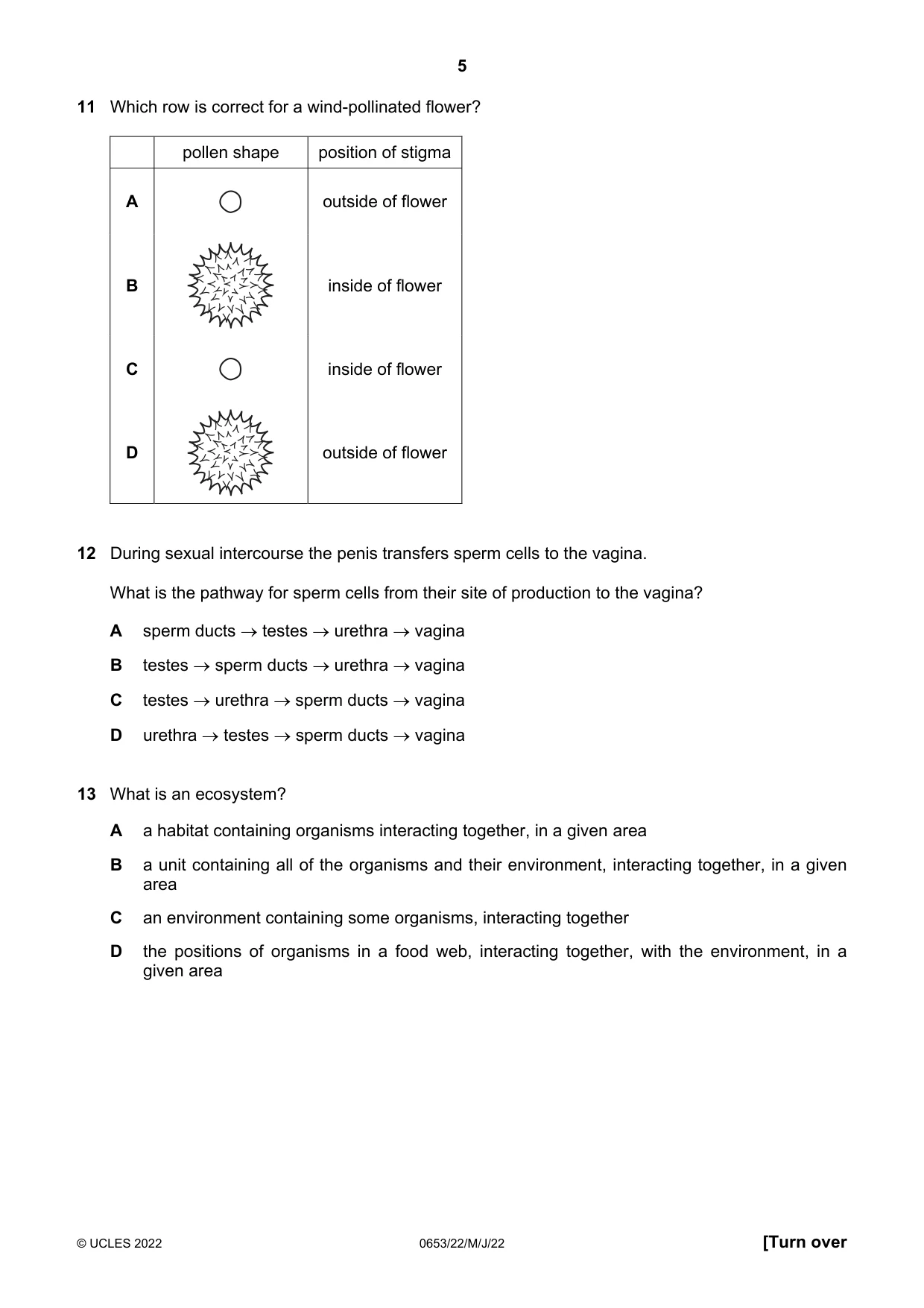
Q11 · Which row is correct for a wind-pollinated flower?
11 Which row is correct for a wind-pollinated flower? pollen shape position of stigma A outside of flower B inside of flower C inside of flower D outside of flower
Mark scheme: A
Q12 · During sexual intercourse the penis transfers sperm cells to the vagina
12 During sexual intercourse the penis transfers sperm cells to the vagina. What is the pathway for sperm cells from their site of production to the vagina? A sperm ducts testes urethra vagina B testes sperm ducts urethra vagina C testes urethra sperm ducts vagina D urethra testes sperm ducts vagina
Mark scheme: B
Q13 · What is an ecosystem?
13 What is an ecosystem? A a habitat containing organisms interacting together, in a given area B a unit containing all of the organisms and their environment, interacting together, in a given area C an environment containing some organisms, interacting together D the positions of organisms in a food web, interacting together, with the environment, in a given area
Mark scheme: B
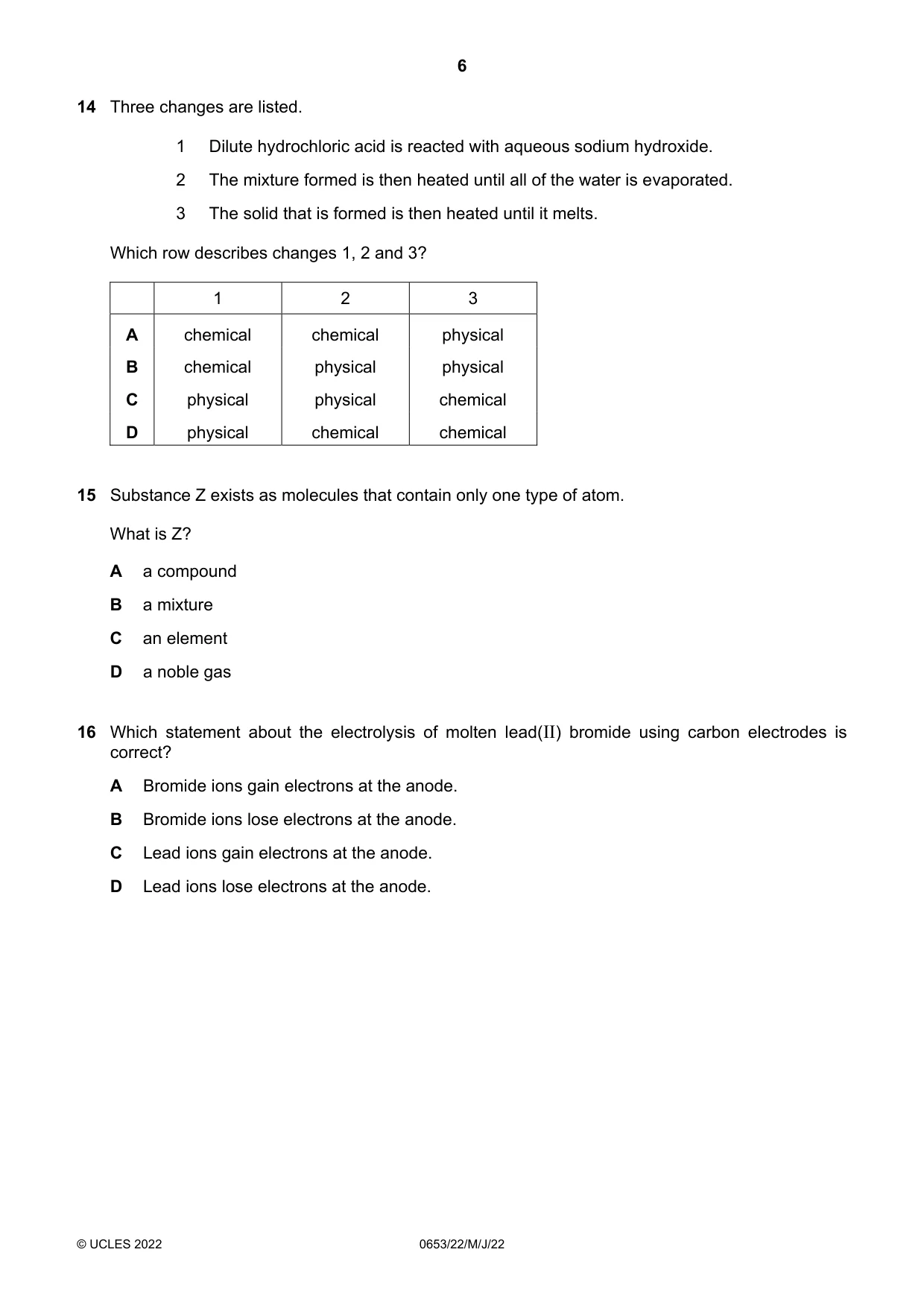
Q14 · Three changes are listed
14 Three changes are listed. 1 Dilute hydrochloric acid is reacted with aqueous sodium hydroxide. 2 The mixture formed is then heated until all of the water is evaporated. 3 The solid that is formed is then heated until it melts. Which row describes changes 1, 2 and 3? 1 2 3 A chemical chemical physical B chemical physical physical C physical physical chemical D physical chemical chemical
Mark scheme: B
Q15 · Substance Z exists as molecules that contain only one type of atom
15 Substance Z exists as molecules that contain only one type of atom. What is Z? A a compound B a mixture C an element D a noble gas
Mark scheme: C
Q16 · Which statement about the electrolysis of molten lead(II) bromide using carbon electrodes…
16 Which statement about the electrolysis of molten lead(II) bromide using carbon electrodes is correct? A Bromide ions gain electrons at the anode. B Bromide ions lose electrons at the anode. C Lead ions gain electrons at the anode. D Lead ions lose electrons at the anode.
Mark scheme: B
Q17 · Zinc reacts with dilute hydrochloric acid to form hydrogen which is collected in a gas…
17 Zinc reacts with dilute hydrochloric acid to form hydrogen which is collected in a gas syringe. Zn(s) + 2HCl (aq) ZnCl 2(aq) + H2(g) Which statement is correct? A Larger pieces of zinc react faster than the same mass of smaller pieces because they have a larger total surface area. B When a catalyst is added, the time taken to collect 20 cm3 of hydrogen is reduced because fewer particles have the activation energy. C Hydrogen is produced faster when the acid is more concentrated because a larger proportion of the particles have the activation energy. D Raising the temperature reduces the time taken to collect 20 cm3 of hydrogen because more particles have the activation energy.
Mark scheme: D
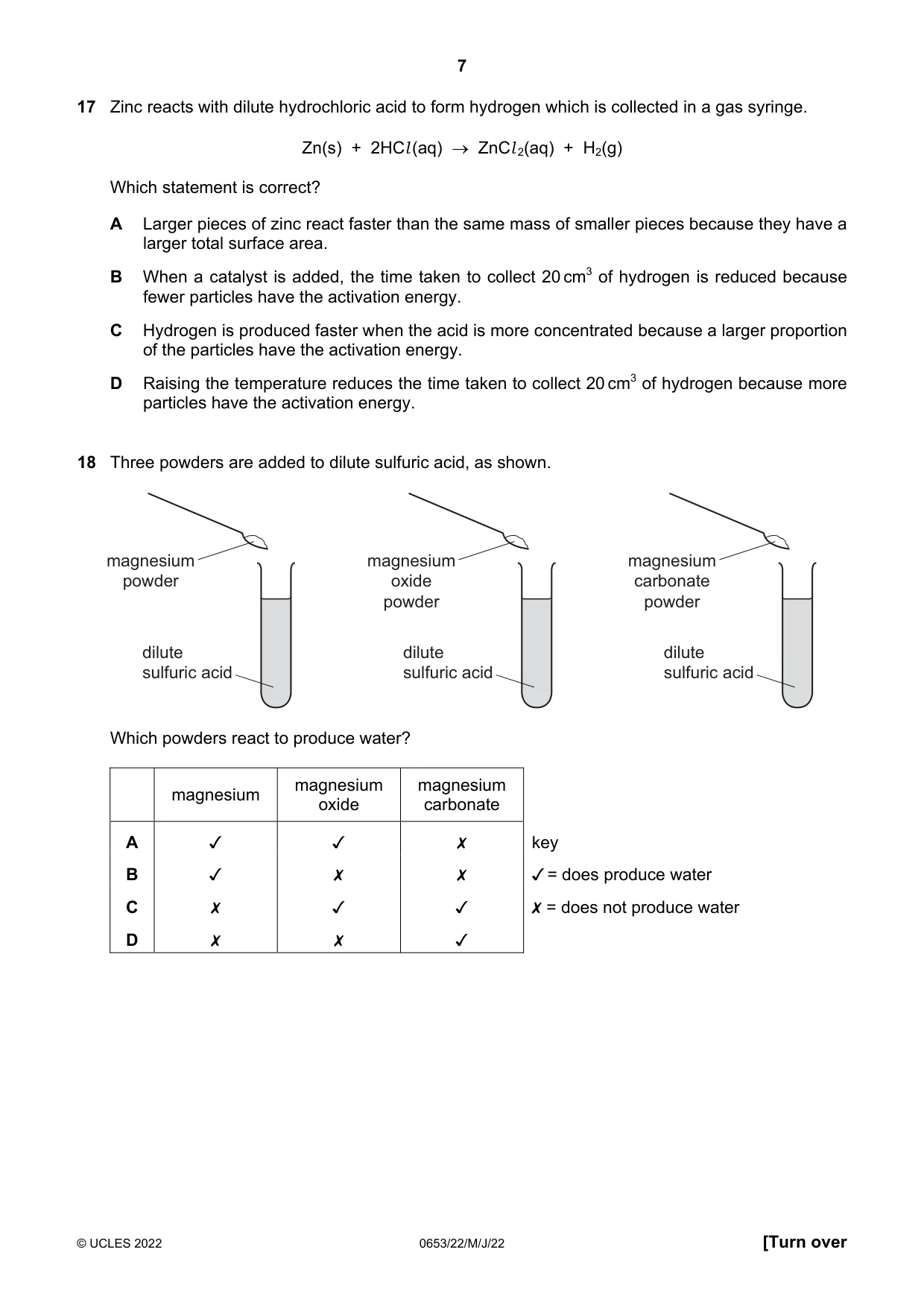
Q18 · Three powders are added to dilute sulfuric acid, as shown
18 Three powders are added to dilute sulfuric acid, as shown. magnesium powder dilute sulfuric acid Which powders react to produce water? magnesium oxide powder dilute sulfuric acid . magnesium magnesium magnesium . oxide carbonate Jv x x x Jv Jv x Jv magnesium carbonate powder dilute sulfuric acid key ¥ = does produce water X = does not produce water
Mark scheme: C
More questions on The characteristic properties of acids and bases
Q19 · Magnesium nitrate is produced by reacting magnesium oxide with dilute nitric acid
19 Magnesium nitrate is produced by reacting magnesium oxide with dilute nitric acid. Which process is used to produce a pure sample of magnesium nitrate crystals? A Add excess dilute nitric acid to magnesium oxide, filter and boil the filtrate to dryness. B Add excess dilute nitric acid to magnesium oxide, filter and evaporate the filtrate to the point of crystallisation. C Add excess magnesium oxide to dilute nitric acid, filter and boil the filtrate to dryness. D Add excess magnesium oxide to dilute nitric acid, filter and evaporate the filtrate to the point of crystallisation.
Mark scheme: D
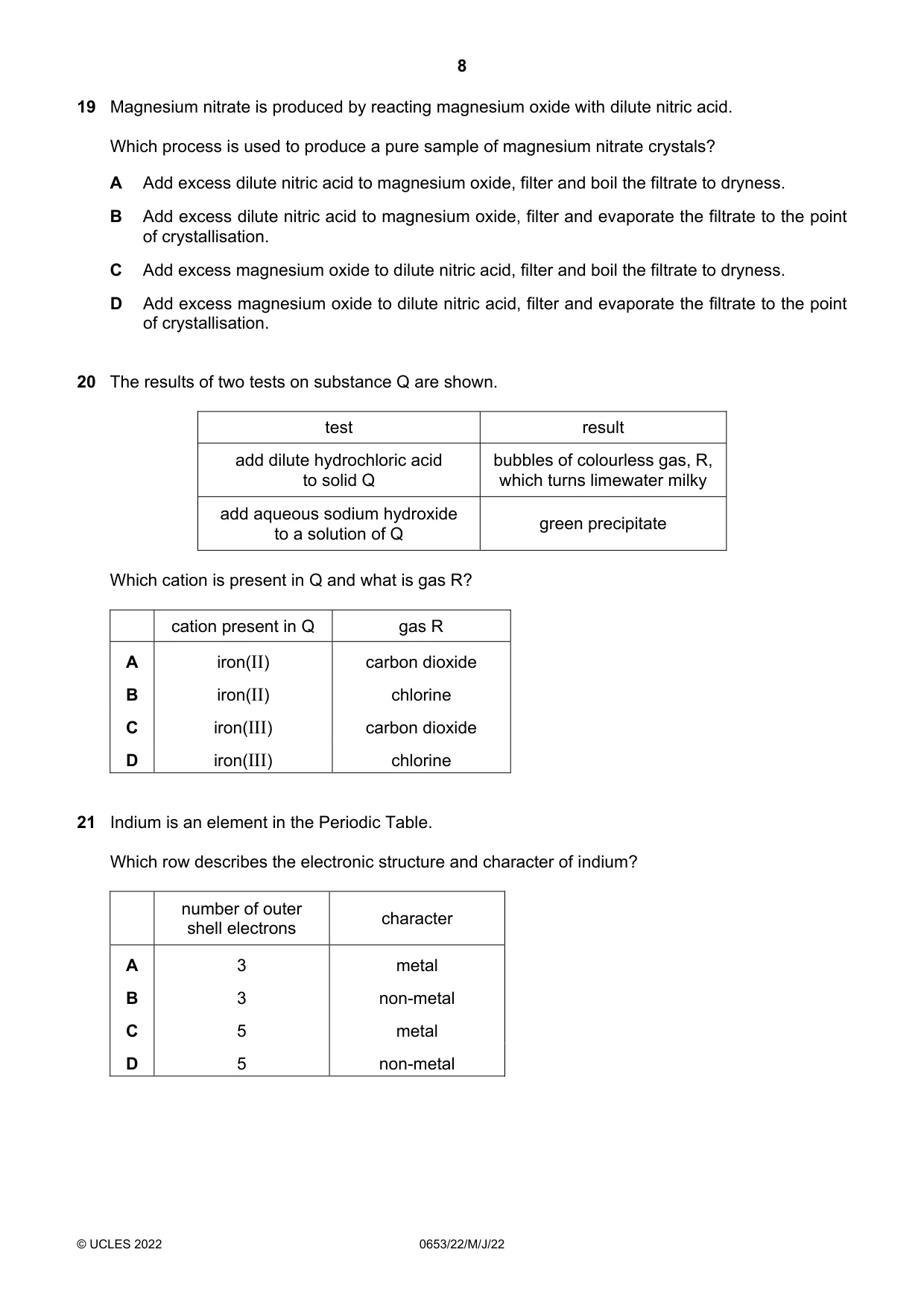
Q20 · The results of two tests on substance Q are shown
20 The results of two tests on substance Q are shown. test result add dilute hydrochloric acid bubbles of colourless gas, R, to solid Q which turns limewater milky add aqueous sodium hydroxide green precipitate to a solution of Q Which cation is present in Q and what is gas R? cation present in Q gas R A iron(II) carbon dioxide B iron(II) chlorine C iron(III) carbon dioxide D iron(III) chlorine
Mark scheme: A
Q21 · Indium is an element in the Periodic Table
21 Indium is an element in the Periodic Table. Which row describes the electronic structure and character of indium? number of outer character shell electrons A 3 metal B 3 non-metal C 5 metal D 5 non-metal
Mark scheme: A
Q22 · Which statements about the reactivity series of metals are correct?
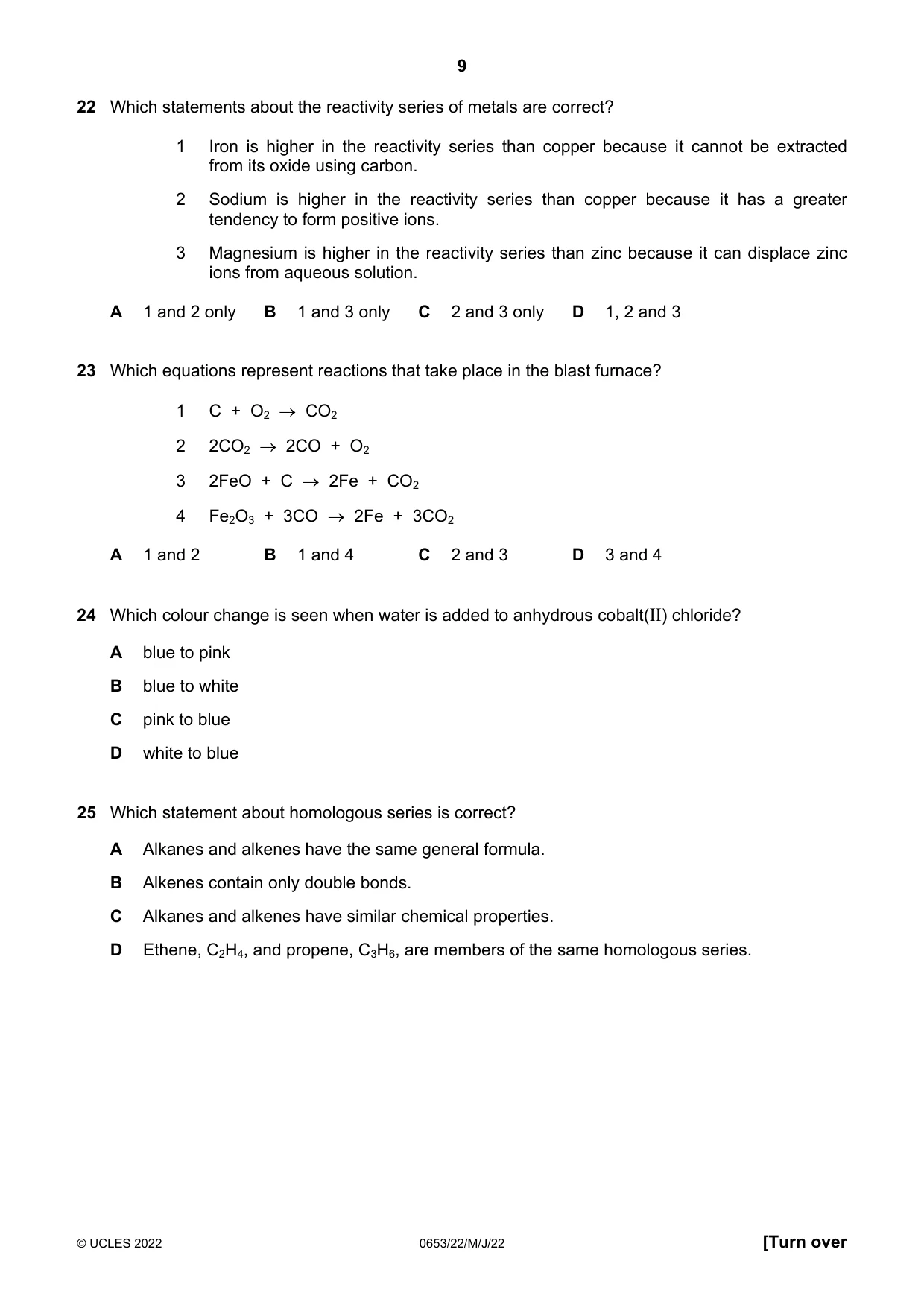
22 Which statements about the reactivity series of metals are correct? 1 Iron is higher in the reactivity series than copper because it cannot be extracted from its oxide using carbon. 2 Sodium is higher in the reactivity series than copper because it has a greater tendency to form positive ions. 3 Magnesium is higher in the reactivity series than zinc because it can displace zinc ions from aqueous solution. A 1 and 2 only B 1 and 3 only C 2 and 3 only D 1, 2 and 3
Mark scheme: C
Q23 · Which equations represent reactions that take place in the blast furnace?
23 Which equations represent reactions that take place in the blast furnace? 1 C + O2 CO2 2 2CO2 2CO + O2 3 2FeO + C 2Fe + CO2 4 Fe2O3 + 3CO 2Fe + 3CO2 A 1 and 2 B 1 and 4 C 2 and 3 D 3 and 4
Mark scheme: B
Q24 · Which colour change is seen when water is added to anhydrous cobalt(II) chloride?
24 Which colour change is seen when water is added to anhydrous cobalt(II) chloride? A blue to pink B blue to white C pink to blue D white to blue
Mark scheme: A
Q25 · Which statement about homologous series is correct?
25 Which statement about homologous series is correct? A Alkanes and alkenes have the same general formula. B Alkenes contain only double bonds. C Alkanes and alkenes have similar chemical properties. D Ethene, C2H4, and propene, C3H6, are members of the same homologous series.
Mark scheme: D
Q26 · Methane, ethane and propane are all alkanes
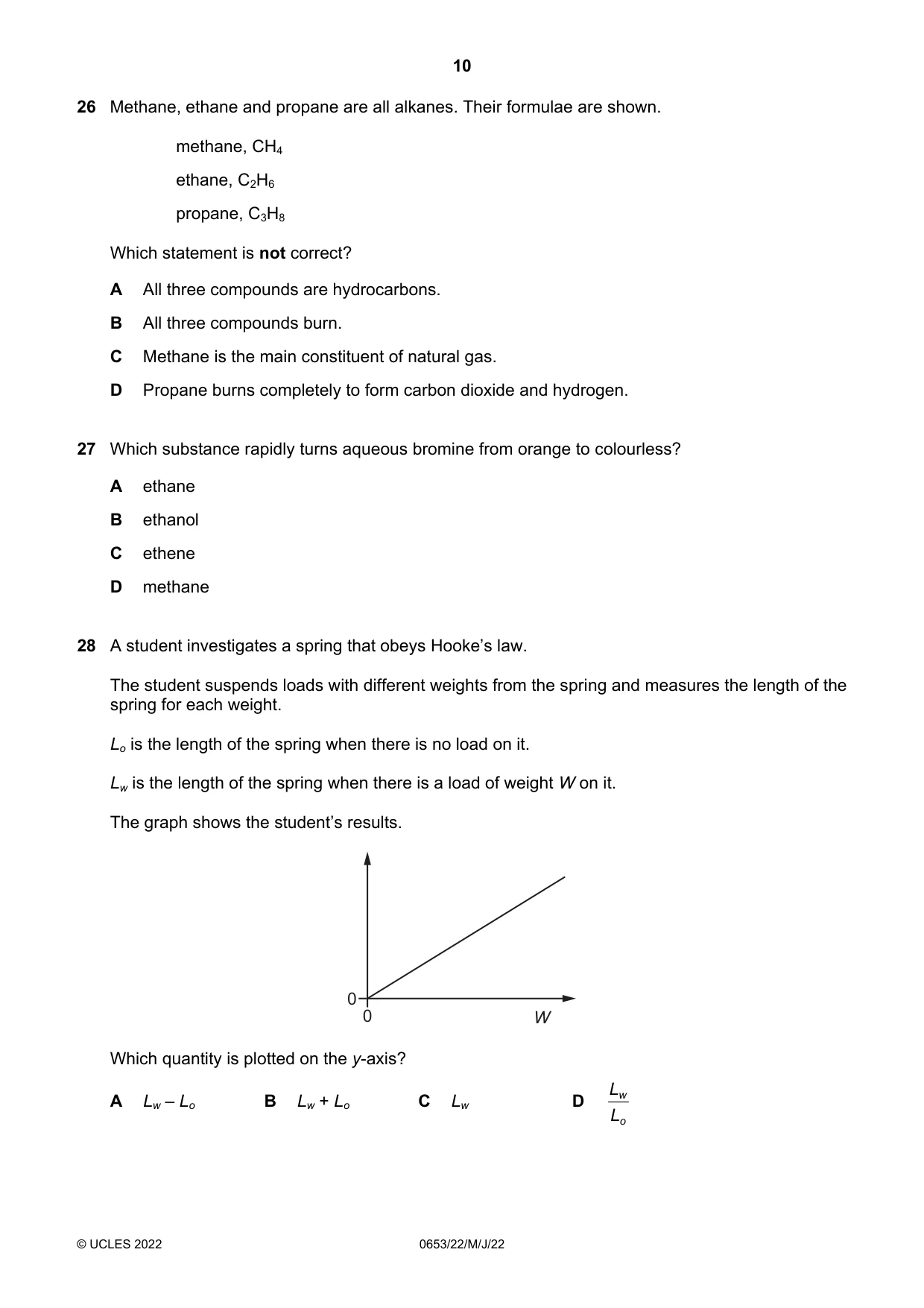
26 Methane, ethane and propane are all alkanes. Their formulae are shown. methane, CH4 ethane, C2H6 propane, C3H8 Which statement is not correct? A All three compounds are hydrocarbons. B All three compounds burn. C Methane is the main constituent of natural gas. D Propane burns completely to form carbon dioxide and hydrogen.
Mark scheme: D
Q27 · Which substance rapidly turns aqueous bromine from orange to colourless?
27 Which substance rapidly turns aqueous bromine from orange to colourless? A ethane B ethanol C ethene D methane
Mark scheme: C
Q28 · A student investigates a spring that obeys Hooke’s law
28 A student investigates a spring that obeys Hooke’s law. The student suspends loads with different weights from the spring and measures the length of the spring for each weight. Lo is the length of the spring when there is no load on it. Lw is the length of the spring when there is a load of weight W on it. The graph shows the student’s results. 0 0 W Which quantity is plotted on the y-axis? L A Lw – Lo B Lw + Lo C Lw D w L o
Mark scheme: A
Q29 · A load of mass m is moved to the top of a slope of length p and vertical height q
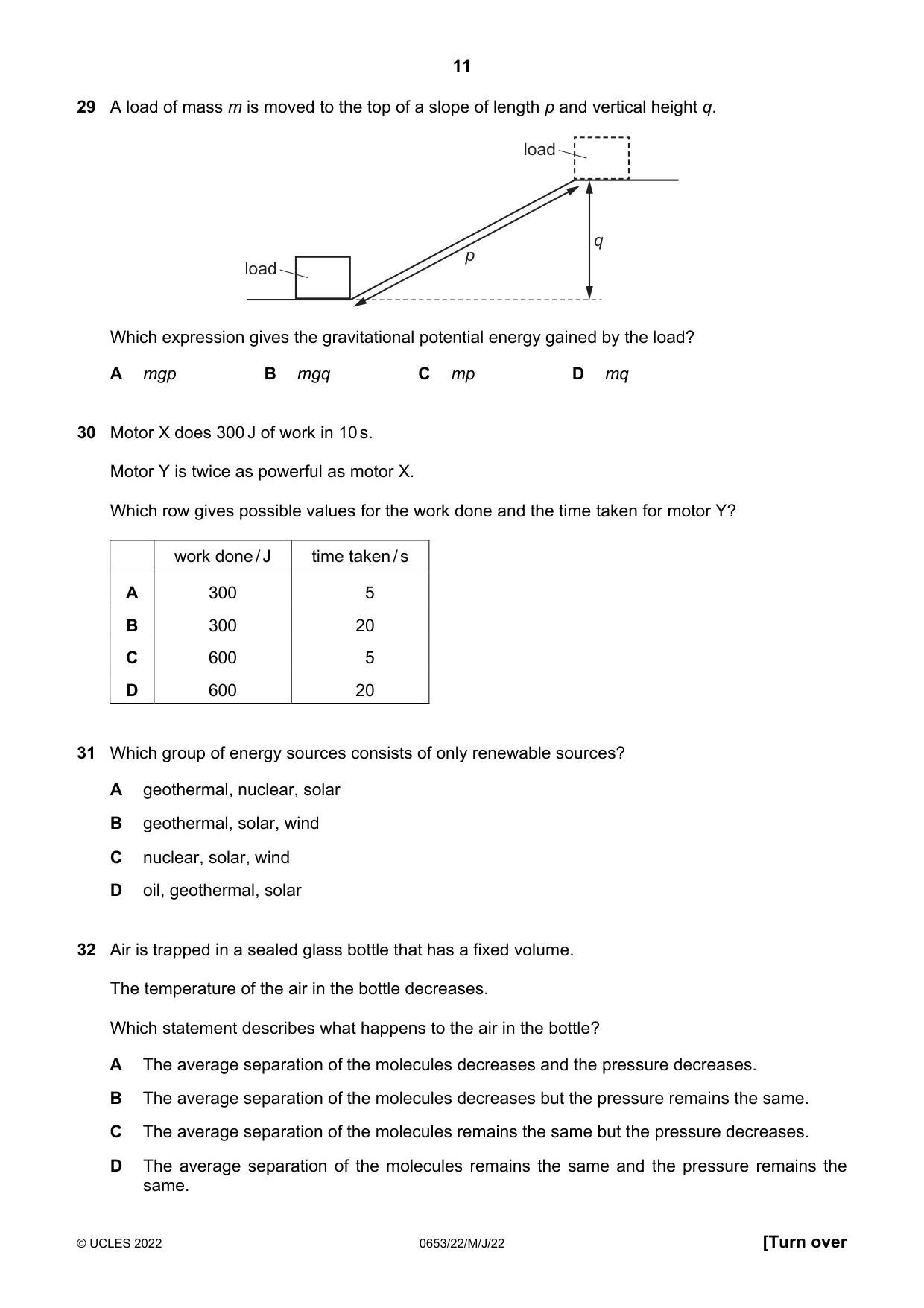
29 A load of mass m is moved to the top of a slope of length p and vertical height q. load q p load Which expression gives the gravitational potential energy gained by the load? A mgp B mgq C mp D mq
Mark scheme: B
Q30 · Motor X does 300 J of work in 10 s
30 Motor X does 300 J of work in 10 s. Motor Y is twice as powerful as motor X. Which row gives possible values for the work done and the time taken for motor Y? work done / J time taken / s A 300 5 B 300 20 C 600 5 D 600 20
Mark scheme: A
Q31 · Which group of energy sources consists of only renewable sources?
31 Which group of energy sources consists of only renewable sources? A geothermal, nuclear, solar B geothermal, solar, wind C nuclear, solar, wind D oil, geothermal, solar
Mark scheme: B
Q32 · Air is trapped in a sealed glass bottle that has a fixed volume
32 Air is trapped in a sealed glass bottle that has a fixed volume. The temperature of the air in the bottle decreases. Which statement describes what happens to the air in the bottle? A The average separation of the molecules decreases and the pressure decreases. B The average separation of the molecules decreases but the pressure remains the same. C The average separation of the molecules remains the same but the pressure decreases. D The average separation of the molecules remains the same and the pressure remains the same.
Mark scheme: C
Q33 · A mechanic cannot remove a large steel nut from a steel bolt because it is too tight
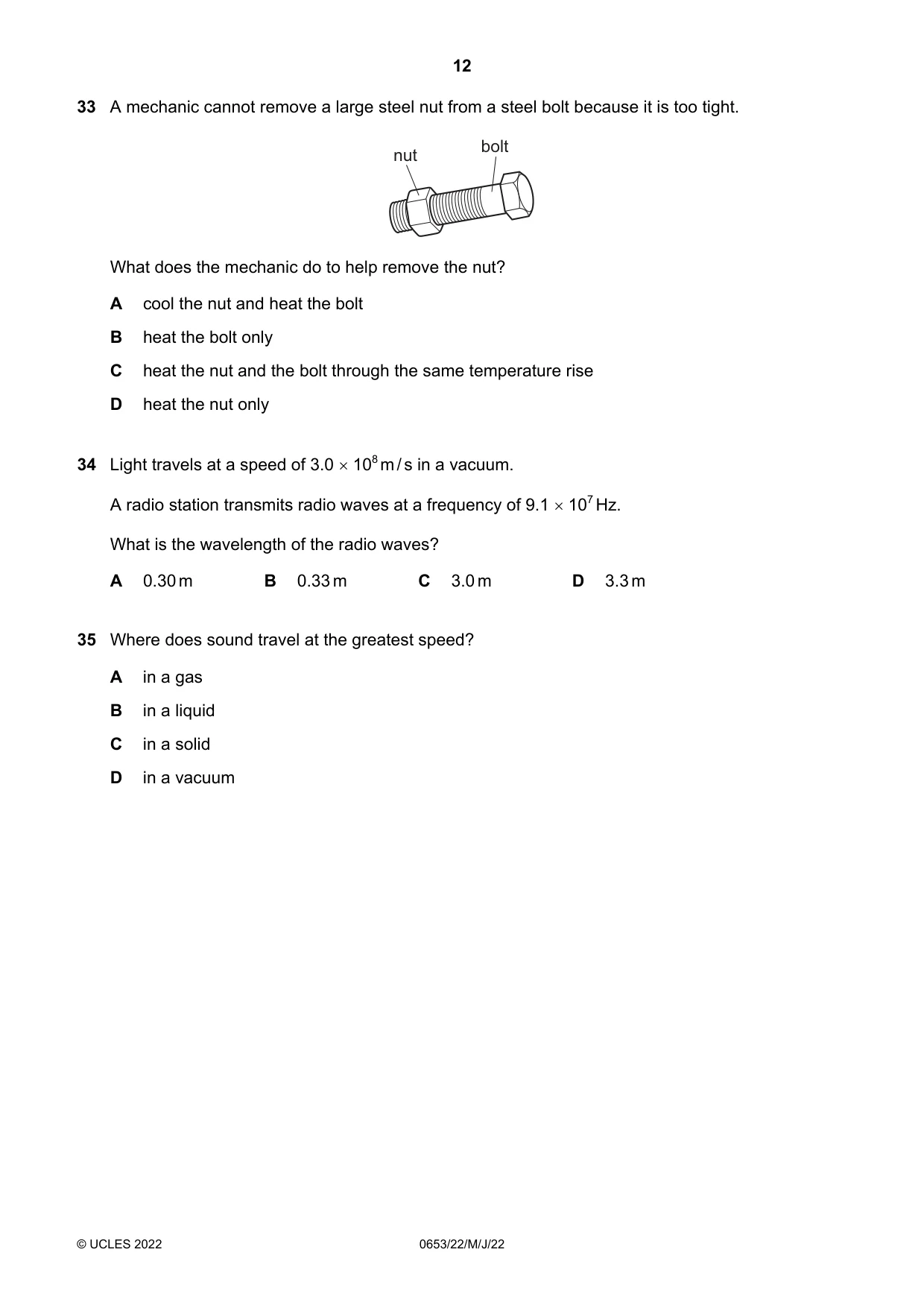
33 A mechanic cannot remove a large steel nut from a steel bolt because it is too tight. bolt nut What does the mechanic do to help remove the nut? A cool the nut and heat the bolt B heat the bolt only C heat the nut and the bolt through the same temperature rise D heat the nut only
Mark scheme: D
Q34 · Light travels at a speed of 3.0 108 m / s in a vacuum
34 Light travels at a speed of 3.0 108 m / s in a vacuum. A radio station transmits radio waves at a frequency of 9.1 107 Hz. What is the wavelength of the radio waves? A 0.30 m B 0.33 m C 3.0 m D 3.3 m
Mark scheme: D
Q35 · Where does sound travel at the greatest speed?
35 Where does sound travel at the greatest speed? A in a gas B in a liquid C in a solid D in a vacuum
Mark scheme: C
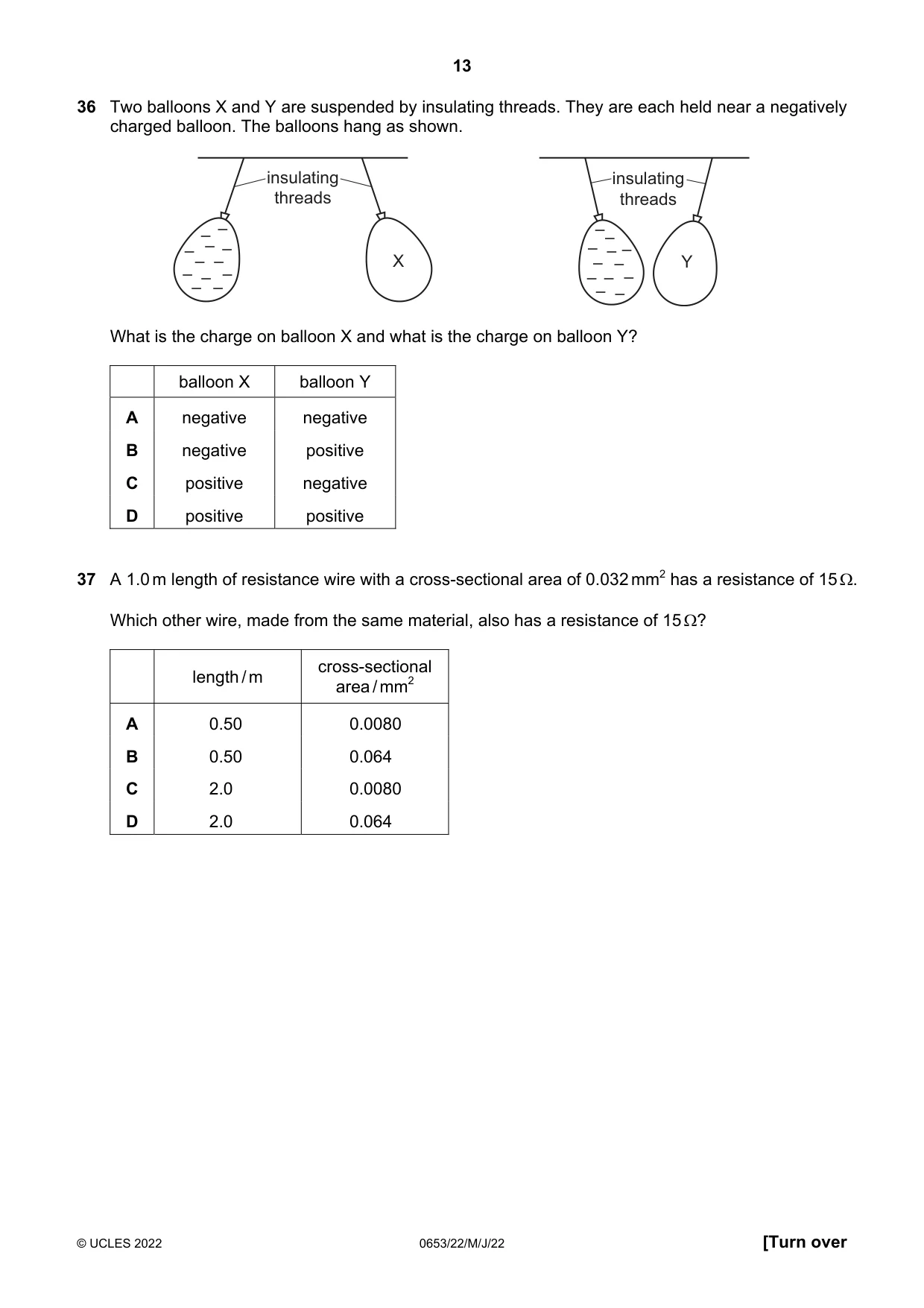
Q36 · Two balloons X and Y are suspended by insulating threads
36 Two balloons X and Y are suspended by insulating threads. They are each held near a negatively charged balloon. The balloons hang as shown. insulating insulating threads threads – – – – – – – – – – – – – X – – Y ––– – – – – – – What is the charge on balloon X and what is the charge on balloon Y? balloon X balloon Y A negative negative B negative positive C positive negative D positive positive
Mark scheme: B
Q37 · A 1.0 m length of resistance wire with a cross-sectional area of 0.032 mm2 has a…
37 A 1.0 m length of resistance wire with a cross-sectional area of 0.032 mm2 has a resistance of 15 . Which other wire, made from the same material, also has a resistance of 15 ? cross-sectional length / m area / mm2 A 0.50 0.0080 B 0.50 0.064 C 2.0 0.0080 D 2.0 0.064
Mark scheme: D
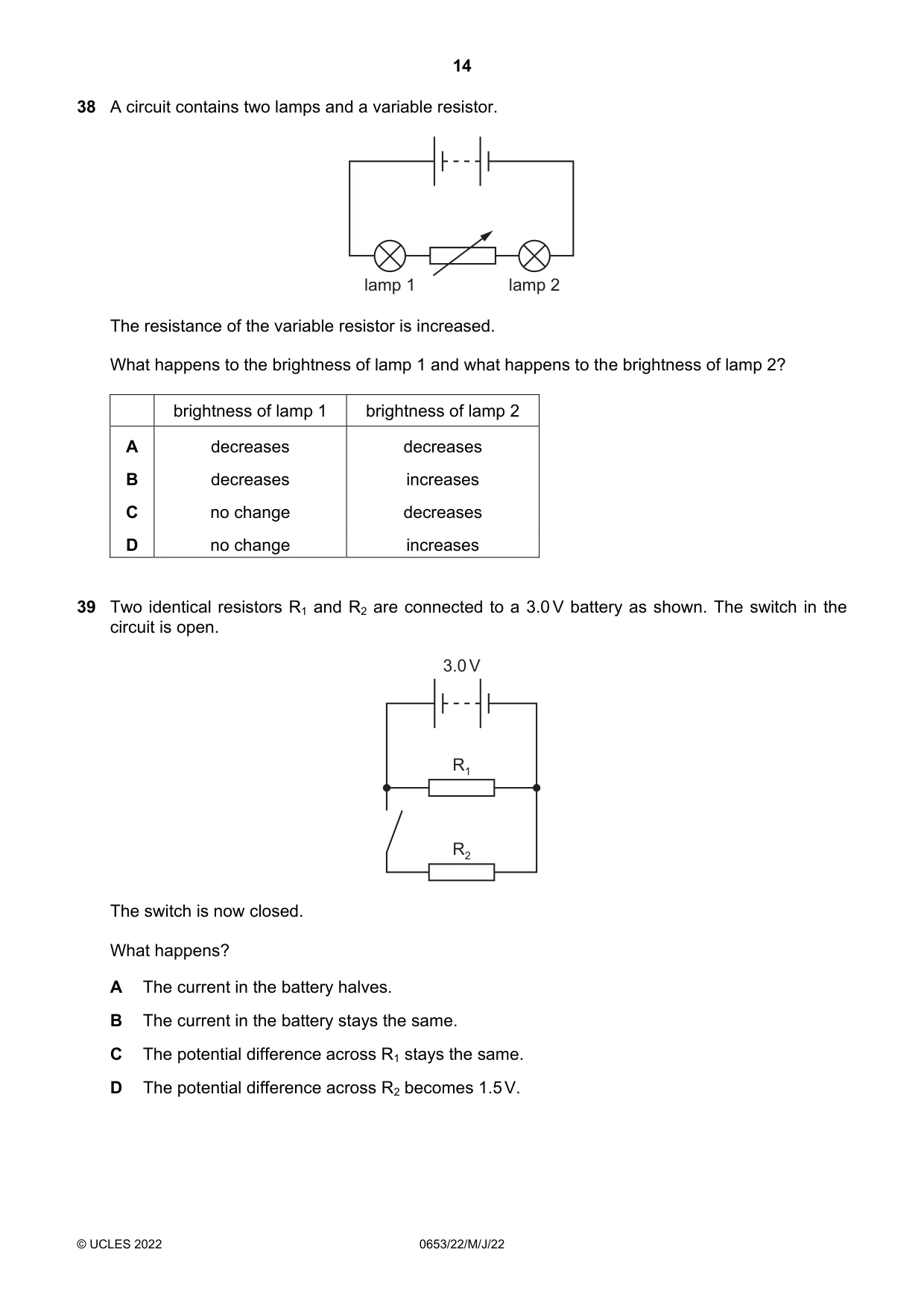
Q38 · A circuit contains two lamps and a variable resistor
38 A circuit contains two lamps and a variable resistor. lamp 1 lamp 2 The resistance of the variable resistor is increased. What happens to the brightness of lamp 1 and what happens to the brightness of lamp 2? brightness of lamp 1 brightness of lamp 2 A decreases decreases B decreases increases C no change decreases D no change increases
Mark scheme: A
Q39 · Two identical resistors R1 and R2 are connected to a 3.0 V battery as shown
39 Two identical resistors R1 and R2 are connected to a 3.0 V battery as shown. The switch in the circuit is open. 3.0 V R1 R2 The switch is now closed. What happens? A The current in the battery halves. B The current in the battery stays the same. C The potential difference across R1 stays the same. D The potential difference across R2 becomes 1.5 V.
Mark scheme: C
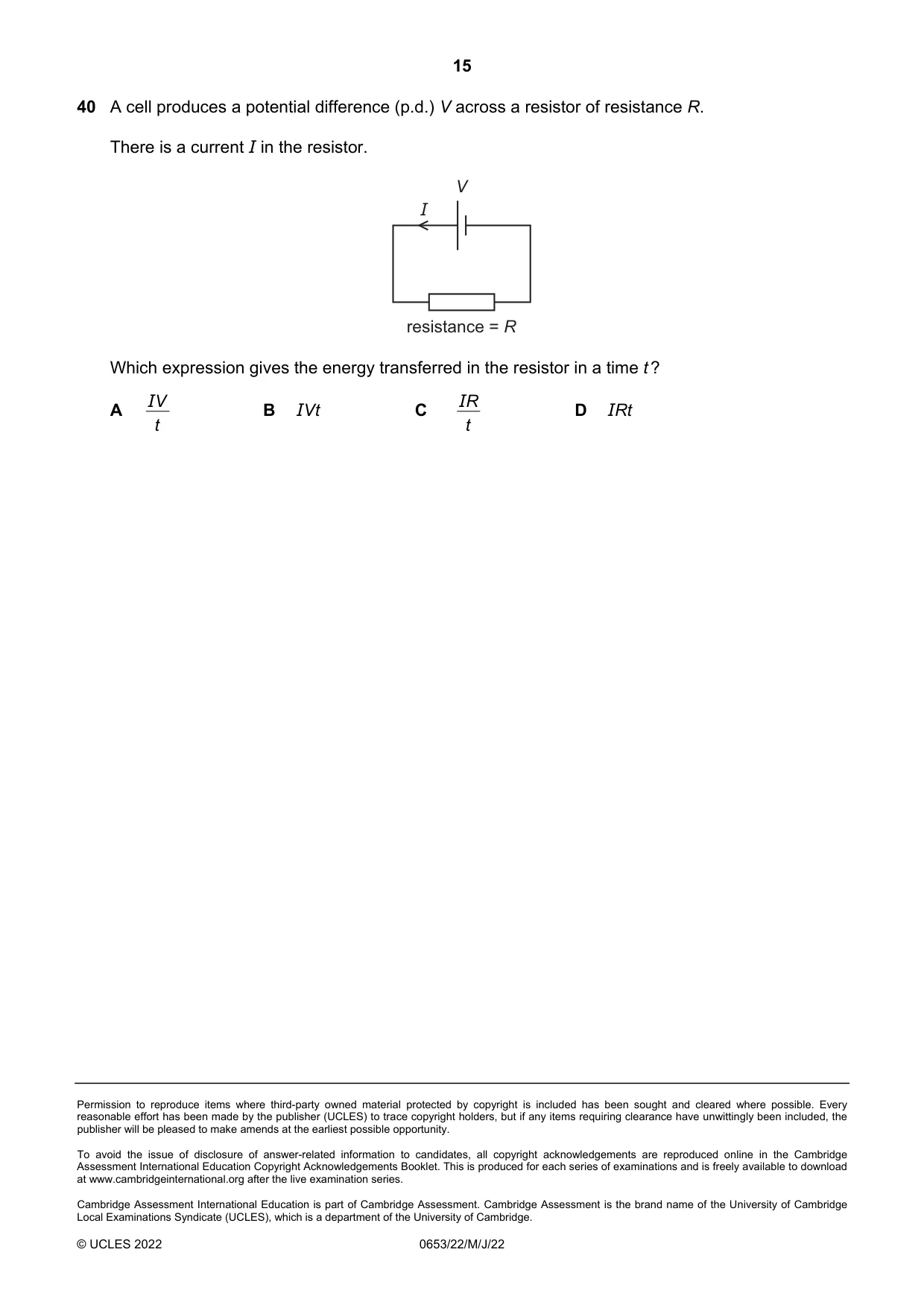
Q40 · A cell produces a potential difference (p.d.) V across a resistor of resistance R
40 A cell produces a potential difference (p.d.) V across a resistor of resistance R. There is a current I in the resistor. V I resistance = R Which expression gives the energy transferred in the resistor in a time t ? I V I R A B IVt C D IRt t t
Mark scheme: B
What was in this paper
The subtopics covered by these 40 questions, and how many questions each got. Open one in a new tab to see every Cambridge question on it.
3Energy, work and power3Drugs2Electrical circuits2Sexual reproduction in plants2Alkanes1Alkenes1Arrangement of elements1Cell structure1Diet1Digestion1Electrolysis1Electromagnetic spectrum1Elements, compounds and mixtures1Enzymes1Extraction of metals1Food chains and food webs1Forces1Gas exchange in humans1Identification of ions and gases1Kinetic particle model of matter1Osmosis1Physical and chemical changes1Preparation of salts1Rate of reaction1Reactivity series1Sexual reproduction in humans1Sound1Terminology1The characteristic properties of acids and bases1Thermal properties and temperature1Water1Water uptake1What you needed in this session
Cambridge’s own grade thresholds for 2022 May/June, Paper 2 · Variant 2. A higher threshold means an easier paper — the bar moves with how the cohort did.