Cambridge IGCSE Science - Combined 0653 — 2019 May/June Paper 2 · Variant 3
0653/23/M/J/19 · 40 questions · 40 marks · ≈45 min
The question paper and its mark scheme, free to read here and free to download. This is Cambridge’s own paper, exactly as it was sat.
Question paper16 pages

Mark scheme3 pages
Answers below. Sit the paper first if you are practising.
Questions as text
Q1 · Which row has a correct structural adaptation for red blood cells and some of the cells…
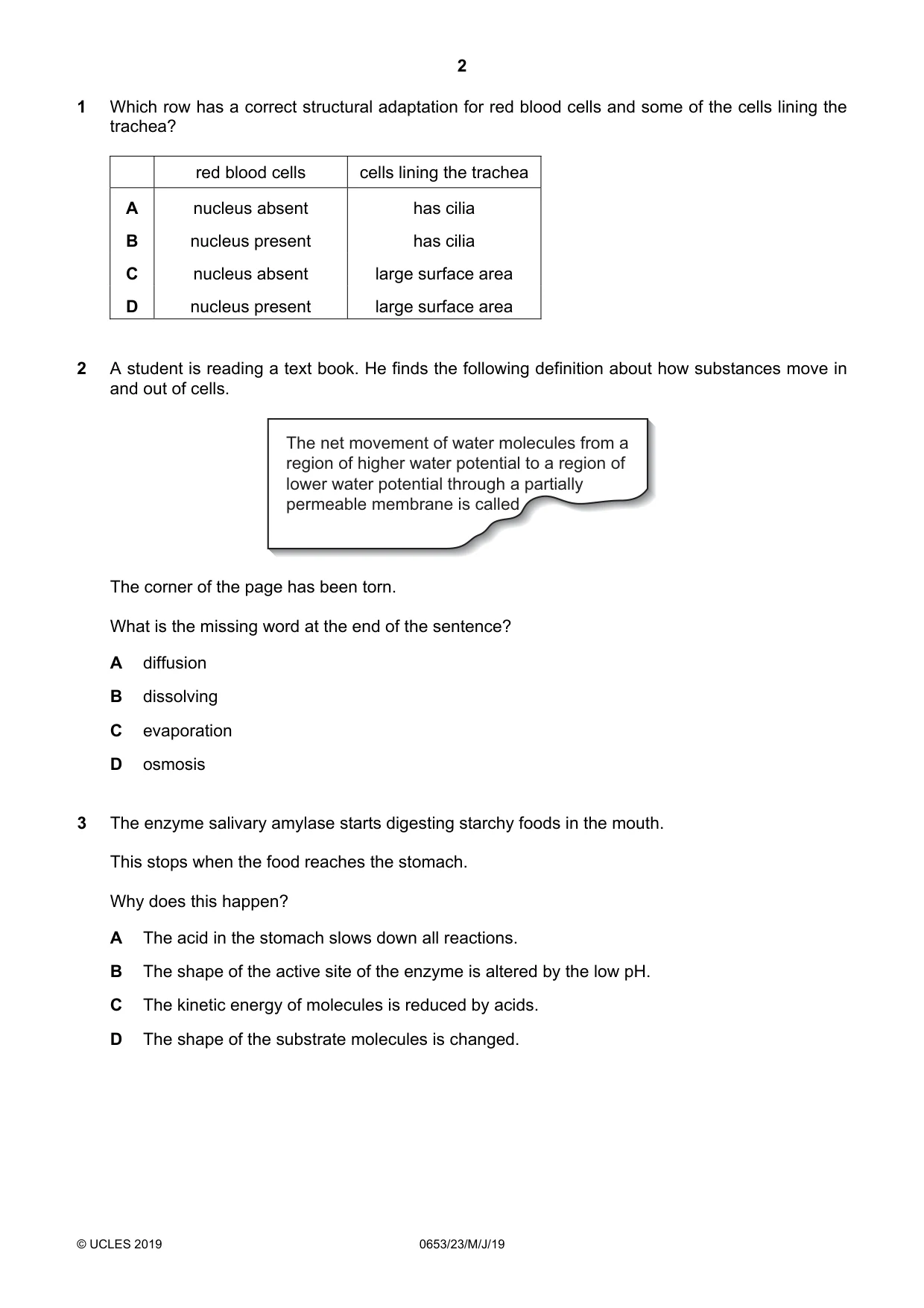
1 Which row has a correct structural adaptation for red blood cells and some of the cells lining the trachea? red blood cells cells lining the trachea A nucleus absent has cilia B nucleus present has cilia C nucleus absent large surface area D nucleus present large surface area
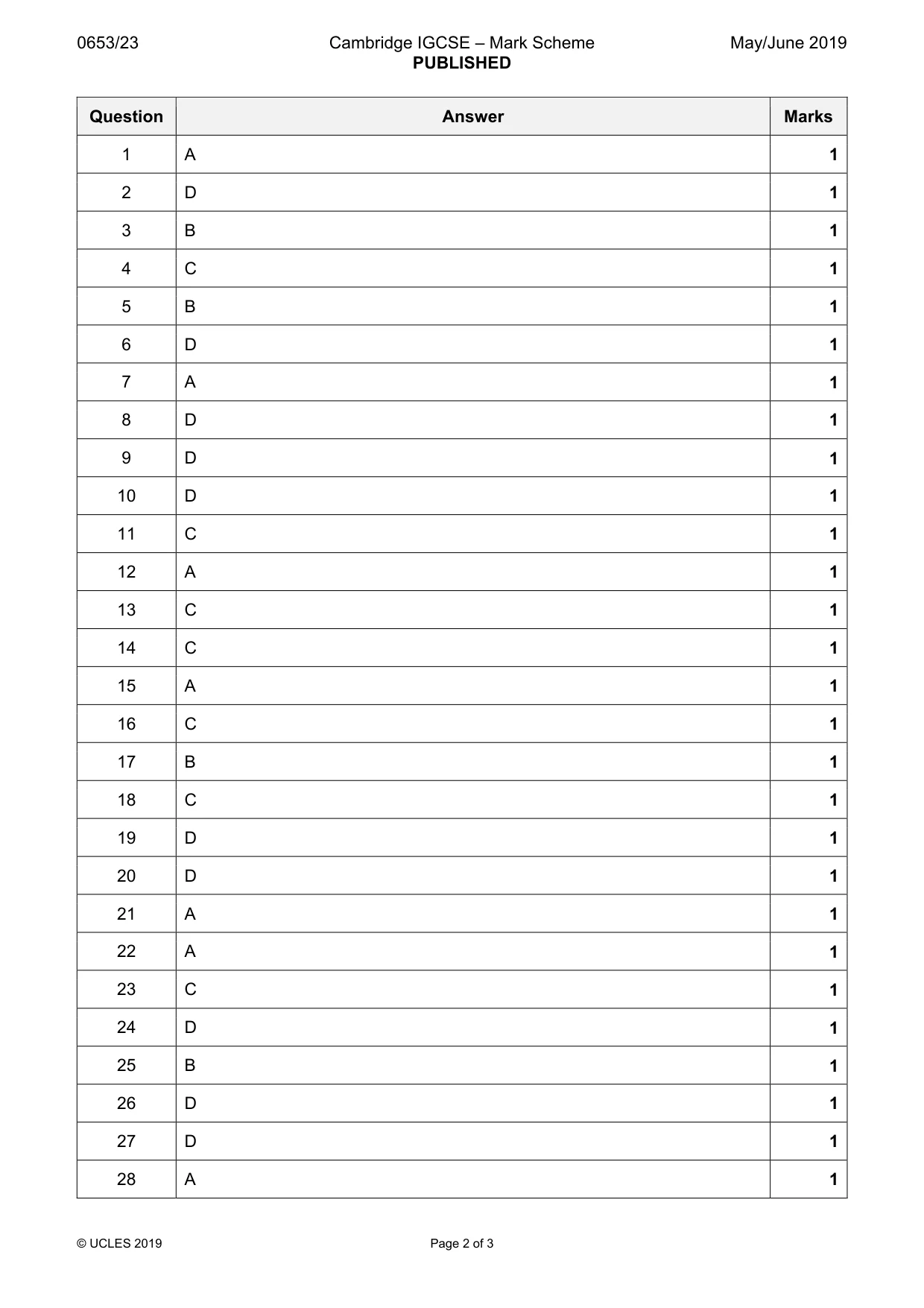
Mark scheme: A
Q2 · A student is reading a text book
2 A student is reading a text book. He finds the following definition about how substances move in and out of cells. The net movement of water molecules from a region of higher water potential to a region of lower water potential through a partially permeable membrane is called The corner of the page has been torn. What is the missing word at the end of the sentence? A diffusion B dissolving C evaporation D osmosis
Mark scheme: D
Q3 · The enzyme salivary amylase starts digesting starchy foods in the mouth
3 The enzyme salivary amylase starts digesting starchy foods in the mouth. This stops when the food reaches the stomach. Why does this happen? A The acid in the stomach slows down all reactions. B The shape of the active site of the enzyme is altered by the low pH. C The kinetic energy of molecules is reduced by acids. D The shape of the substrate molecules is changed.
Mark scheme: B
Q4 · Which condition is caused by a lack of vitamin C in the diet?
4 Which condition is caused by a lack of vitamin C in the diet? A breathlessness B rickets C scurvy D constipation
Mark scheme: C
Q5 · The diagram shows the alimentary canal and some associated organs
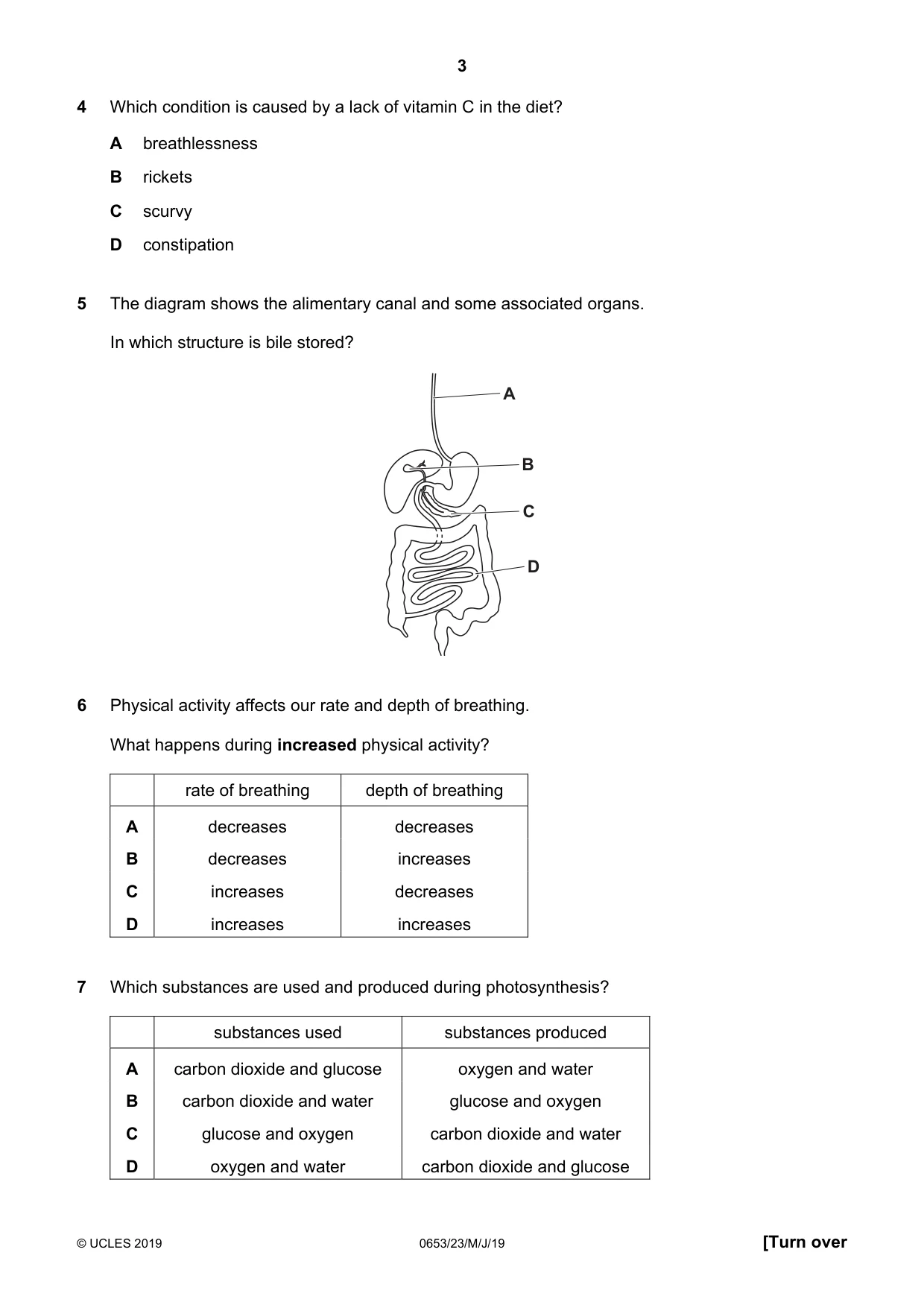
5 The diagram shows the alimentary canal and some associated organs. In which structure is bile stored? A B C D
Mark scheme: B
Q6 · Physical activity affects our rate and depth of breathing
6 Physical activity affects our rate and depth of breathing. What happens during increased physical activity? rate of breathing depth of breathing A decreases decreases B decreases increases C increases decreases D increases increases
Mark scheme: D
Q7 · Which substances are used and produced during photosynthesis?
7 Which substances are used and produced during photosynthesis? substances used substances produced A carbon dioxide and glucose oxygen and water B carbon dioxide and water glucose and oxygen C glucose and oxygen carbon dioxide and water D oxygen and water carbon dioxide and glucose
Mark scheme: A
Q8 · How does adrenaline affect blood glucose concentration and pulse rate?
8 How does adrenaline affect blood glucose concentration and pulse rate? blood glucose pulse rate concentration A decreases decreases B decreases increases C increases decreases D increases increases
Mark scheme: D
Q9 · A germinating bean seed placed horizontally
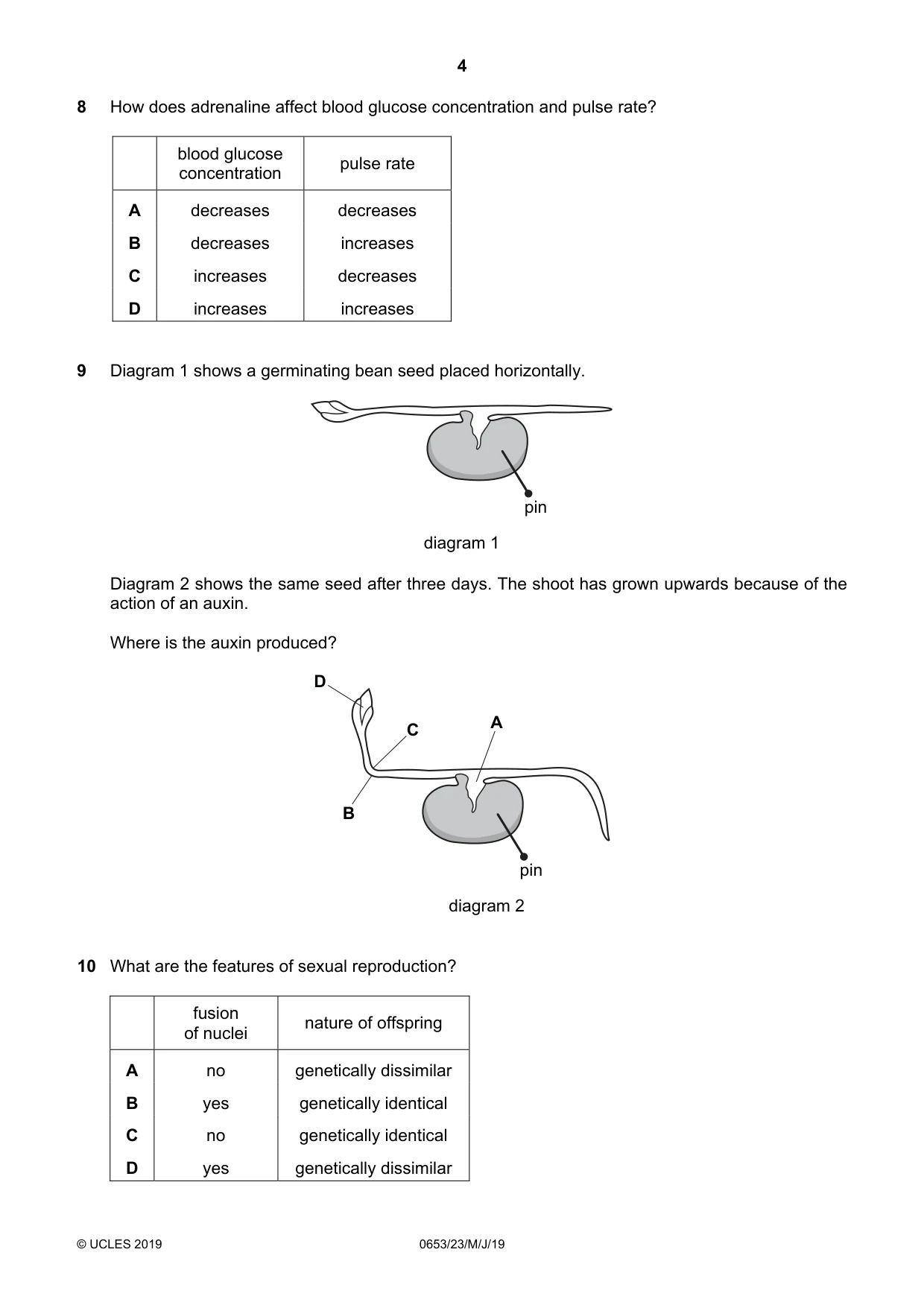
9 Diagram 1 shows a germinating bean seed placed horizontally. pin diagram 1 Diagram 2 shows the same seed after three days. The shoot has grown upwards because of the action of an auxin. Where is the auxin produced? D C A B pin diagram 2
Mark scheme: D
Q10 · What are the features of sexual reproduction?
10 What are the features of sexual reproduction? fusion nature of offspring of nuclei A no genetically dissimilar B yes genetically identical C no genetically identical D yes genetically dissimilar
Mark scheme: D
Q11 · Which process is the transfer of pollen grains from the anther to the stigma?
11 Which process is the transfer of pollen grains from the anther to the stigma? A fertilisation B germination C pollination D transpiration
Mark scheme: C
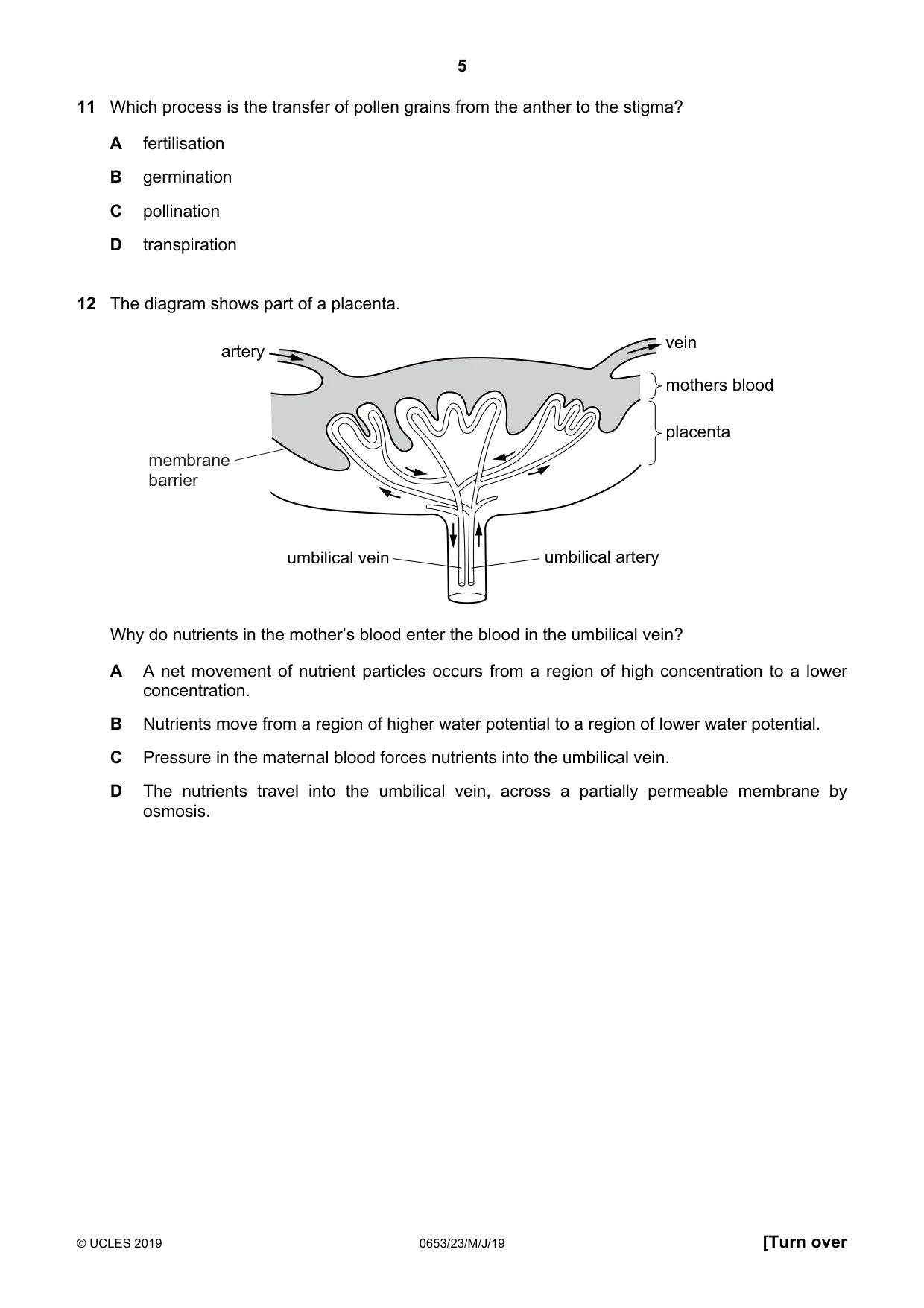
Q12 · The diagram shows part of a placenta
12 The diagram shows part of a placenta. vein artery mothers blood placenta membrane barrier umbilical vein umbilical artery Why do nutrients in the mother’s blood enter the blood in the umbilical vein? A A net movement of nutrient particles occurs from a region of high concentration to a lower concentration. B Nutrients move from a region of higher water potential to a region of lower water potential. C Pressure in the maternal blood forces nutrients into the umbilical vein. D The nutrients travel into the umbilical vein, across a partially permeable membrane by osmosis.
Mark scheme: A
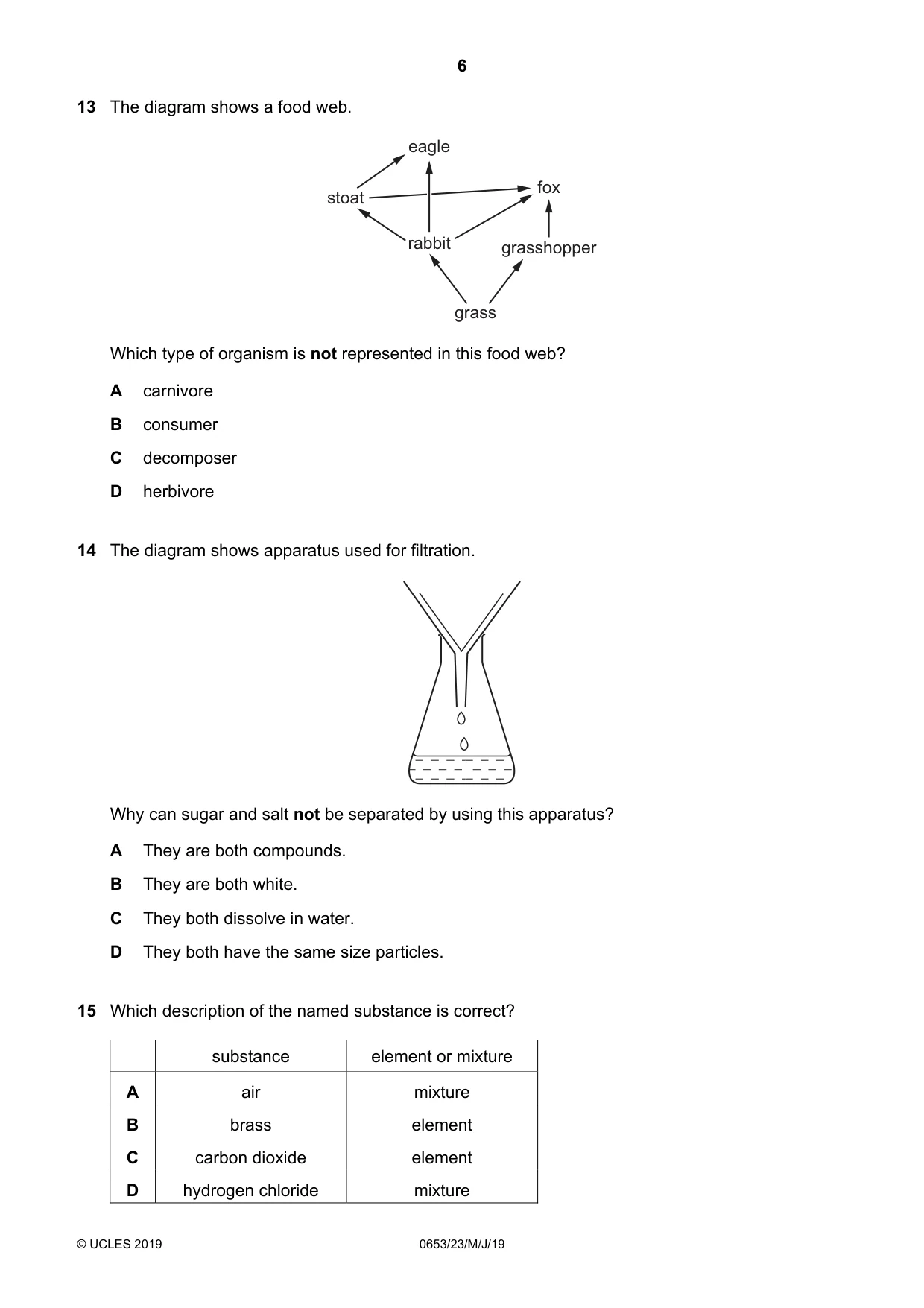
Q13 · The diagram shows a food web
13 The diagram shows a food web. eagle fox stoat rabbit grasshopper grass Which type of organism is not represented in this food web? A carnivore B consumer C decomposer D herbivore
Mark scheme: C
Q14 · The diagram shows apparatus used for filtration
14 The diagram shows apparatus used for filtration. Why can sugar and salt not be separated by using this apparatus? A They are both compounds. B They are both white. C They both dissolve in water. D They both have the same size particles.
Mark scheme: C
Q15 · Which description of the named substance is correct?
15 Which description of the named substance is correct? substance element or mixture A air mixture B brass element C carbon dioxide element D hydrogen chloride mixture
Mark scheme: A
Q16 · Which statement explains why sodium chloride has a much higher melting point than carbon…
16 Which statement explains why sodium chloride has a much higher melting point than carbon dioxide? A Ionic bonding is weaker than covalent bonding. B Ionic bonding is stronger than covalent bonding. C The attractive forces between ions are stronger than the attractive forces between molecules. D The attractive forces between ions are weaker than the attractive forces between molecules.
Mark scheme: C
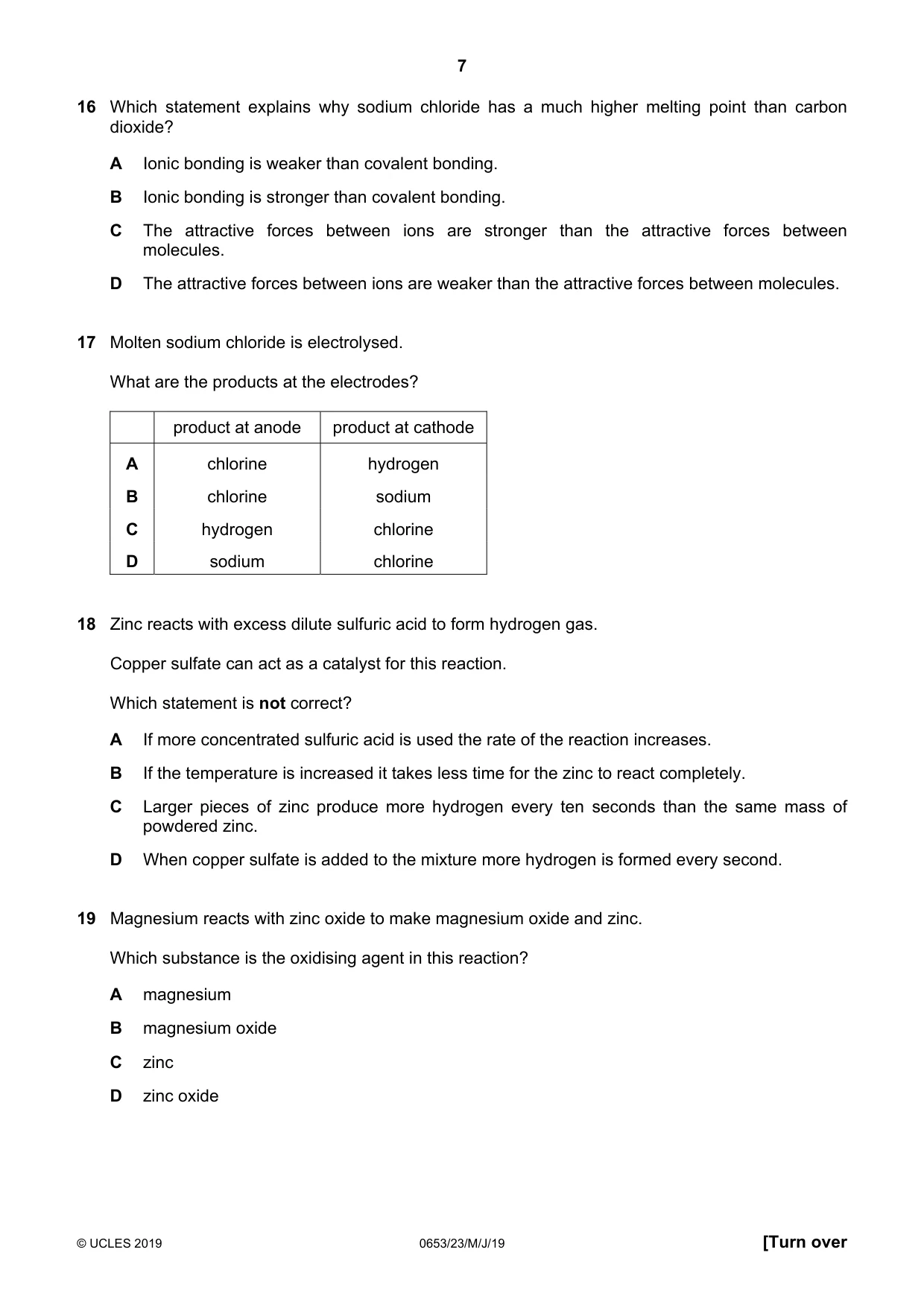
Q17 · Molten sodium chloride is electrolysed
17 Molten sodium chloride is electrolysed. What are the products at the electrodes? product at anode product at cathode A chlorine hydrogen B chlorine sodium C hydrogen chlorine D sodium chlorine
Mark scheme: B
Q18 · Zinc reacts with excess dilute sulfuric acid to form hydrogen gas
18 Zinc reacts with excess dilute sulfuric acid to form hydrogen gas. Copper sulfate can act as a catalyst for this reaction. Which statement is not correct? A If more concentrated sulfuric acid is used the rate of the reaction increases. B If the temperature is increased it takes less time for the zinc to react completely. C Larger pieces of zinc produce more hydrogen every ten seconds than the same mass of powdered zinc. D When copper sulfate is added to the mixture more hydrogen is formed every second.
Mark scheme: C
Q19 · Magnesium reacts with zinc oxide to make magnesium oxide and zinc
19 Magnesium reacts with zinc oxide to make magnesium oxide and zinc. Which substance is the oxidising agent in this reaction? A magnesium B magnesium oxide C zinc D zinc oxide
Mark scheme: D
Q20 · Which aqueous ion gives a white precipitate with aqueous sodium hydroxide and with…
20 Which aqueous ion gives a white precipitate with aqueous sodium hydroxide and with aqueous ammonia? A Cu2+ B Fe2+ C Fe3+ D Zn2+
Mark scheme: D
Q21 · An element has the electronic structure 2,8,1
21 An element has the electronic structure 2,8,1. Which row describes this element? group number in metal / non-metal the Periodic Table A I metal B I non-metal C II metal D II non-metal
Mark scheme: A
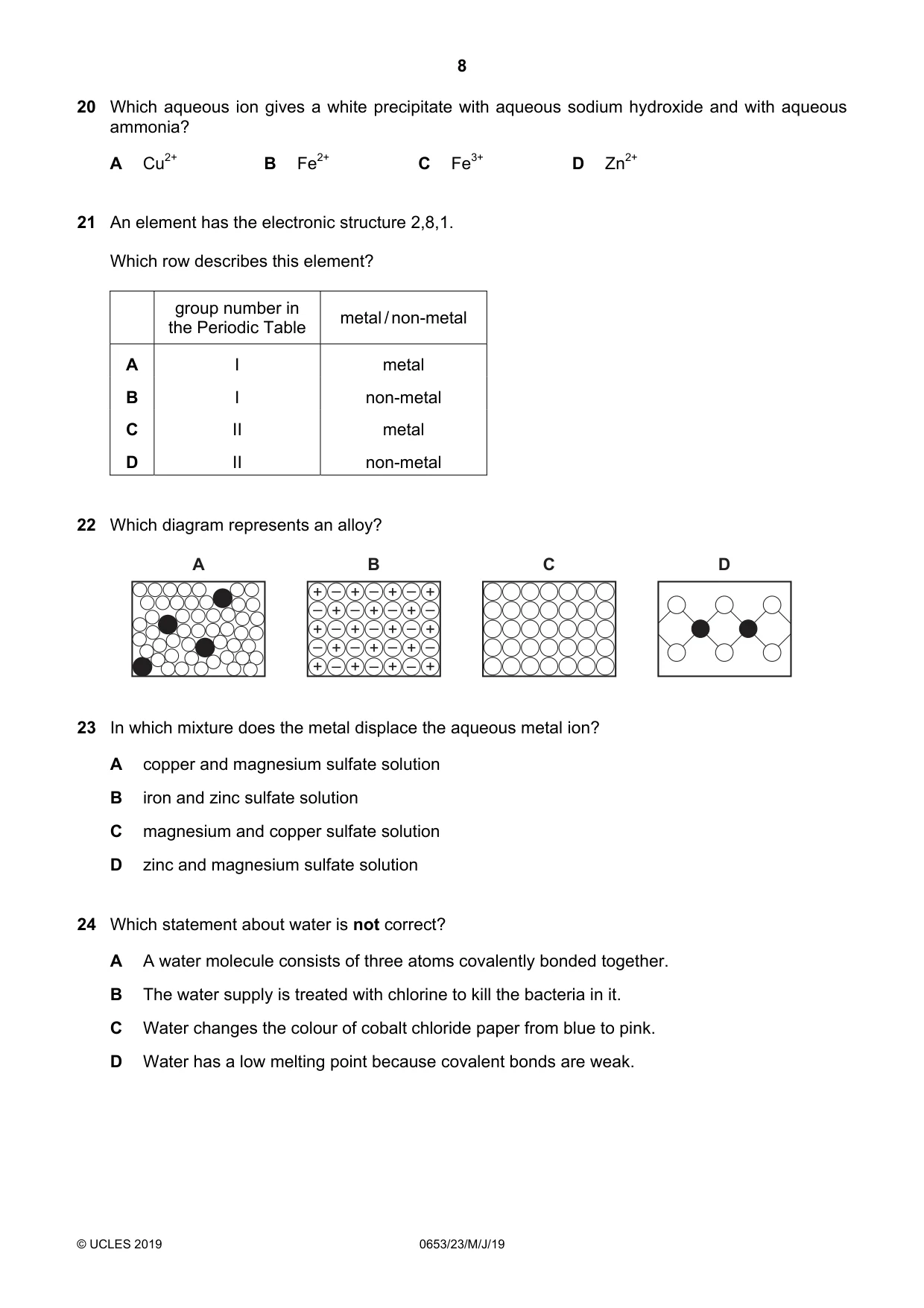
Q22 · Which diagram represents an alloy?
22 Which diagram represents an alloy? A B C D + – + – + – + – + – + – + – + – + – + – + – + – + – + – + – + – + – +
Mark scheme: A
Q23 · In which mixture does the metal displace the aqueous metal ion?
23 In which mixture does the metal displace the aqueous metal ion? A copper and magnesium sulfate solution B iron and zinc sulfate solution C magnesium and copper sulfate solution D zinc and magnesium sulfate solution
Mark scheme: C
Q24 · Which statement about water is not correct?
24 Which statement about water is not correct? A A water molecule consists of three atoms covalently bonded together. B The water supply is treated with chlorine to kill the bacteria in it. C Water changes the colour of cobalt chloride paper from blue to pink. D Water has a low melting point because covalent bonds are weak.
Mark scheme: D
Q25 · Which statement shows that petroleum is a mixture?
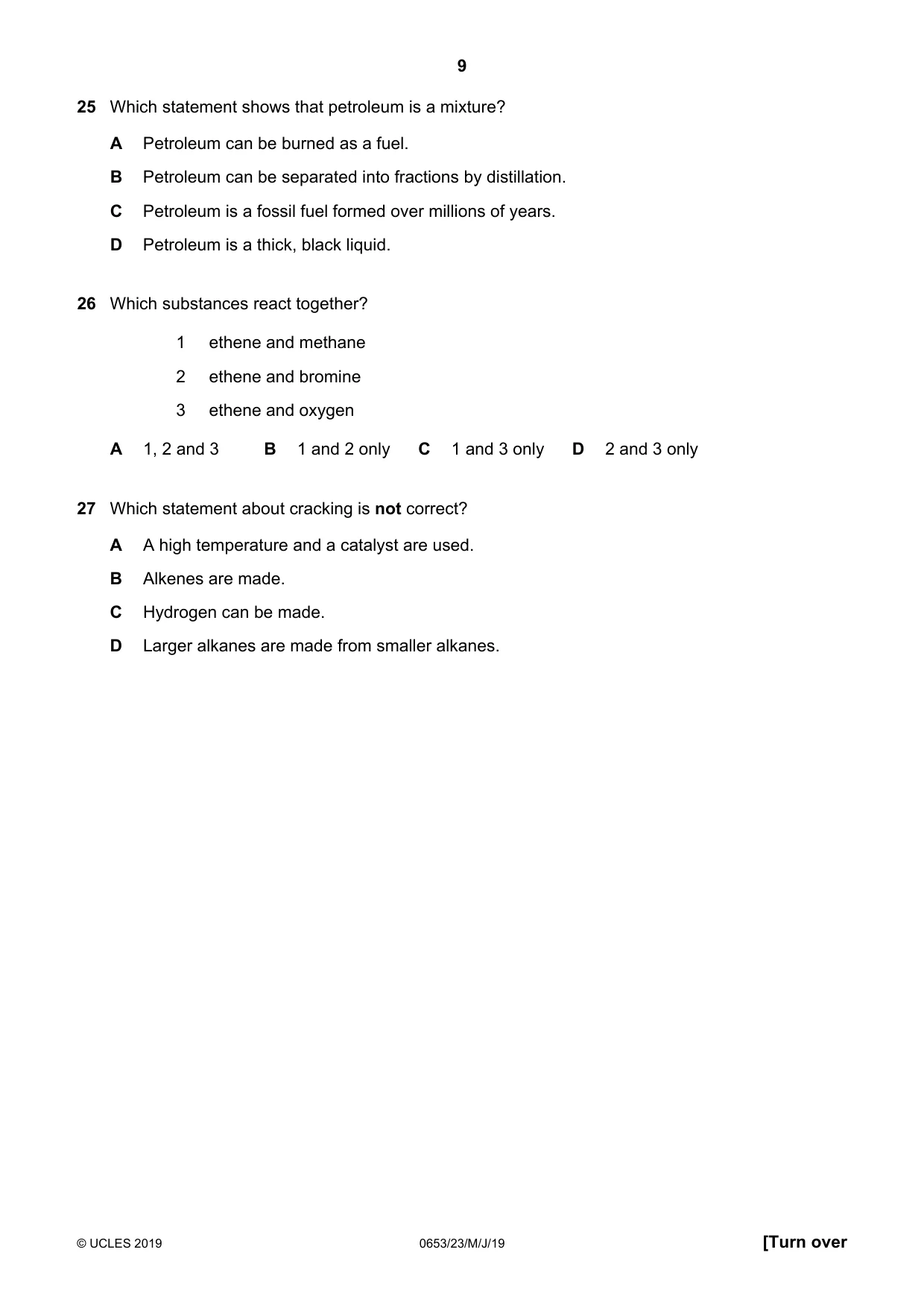
25 Which statement shows that petroleum is a mixture? A Petroleum can be burned as a fuel. B Petroleum can be separated into fractions by distillation. C Petroleum is a fossil fuel formed over millions of years. D Petroleum is a thick, black liquid.
Mark scheme: B
Q26 · Which substances react together?
26 Which substances react together? 1 ethene and methane 2 ethene and bromine 3 ethene and oxygen A 1, 2 and 3 B 1 and 2 only C 1 and 3 only D 2 and 3 only
Mark scheme: D
Q27 · Which statement about cracking is not correct?
27 Which statement about cracking is not correct? A A high temperature and a catalyst are used. B Alkenes are made. C Hydrogen can be made. D Larger alkanes are made from smaller alkanes.
Mark scheme: D
Q28 · Which speed–time graph represents the motion of an object that travels a distance of 24 m?
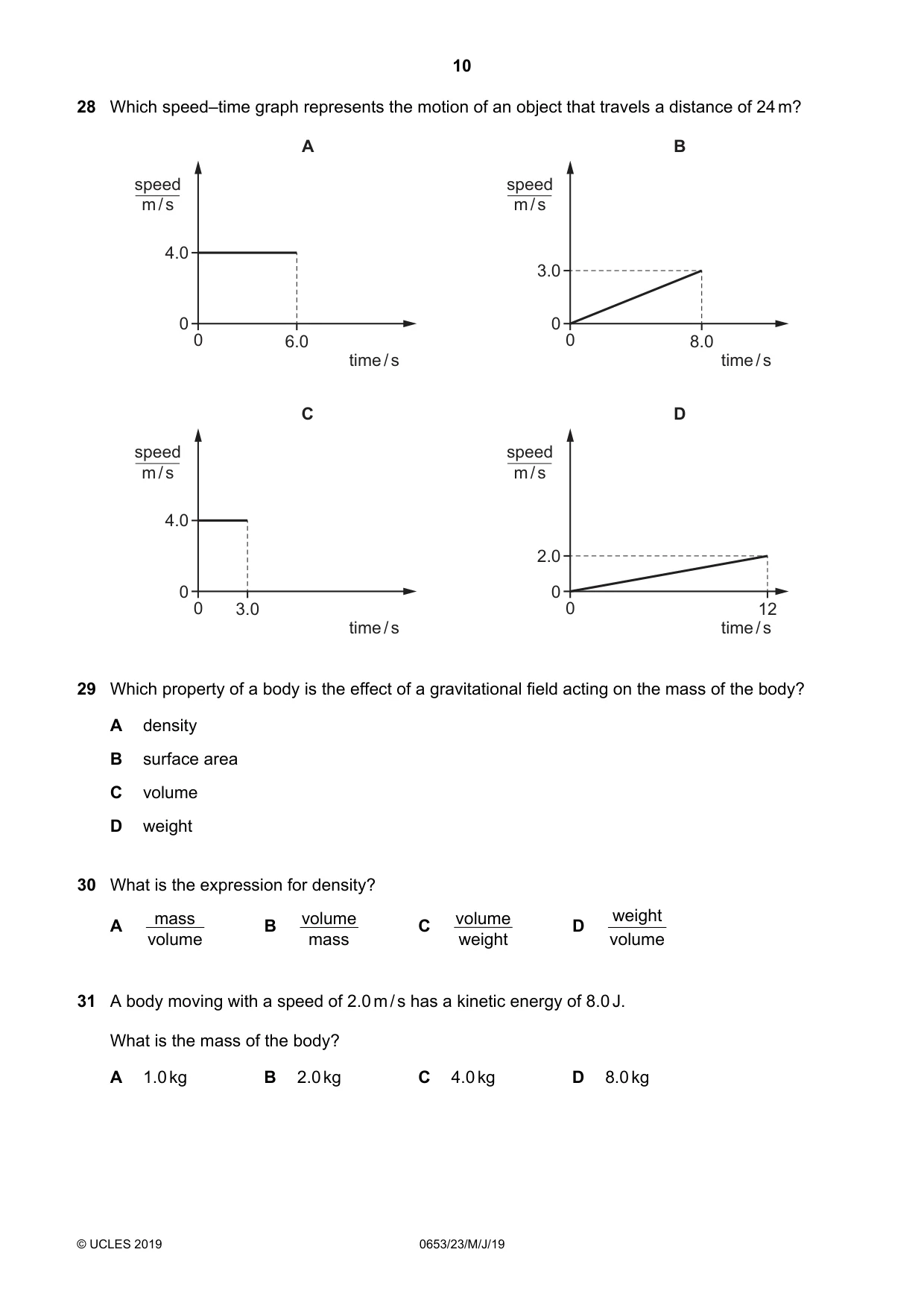
28 Which speed–time graph represents the motion of an object that travels a distance of 24 m? A B speed speed m / s m / s 4.0 3.0 0 0 0 6.0 0 8.0 time / s time / s C D speed speed m / s m / s 4.0 2.0 0 0 0 3.0 0 12 time / s time / s
Mark scheme: A
Q29 · Which property of a body is the effect of a gravitational field acting on the mass of the…
29 Which property of a body is the effect of a gravitational field acting on the mass of the body? A density B surface area C volume D weight
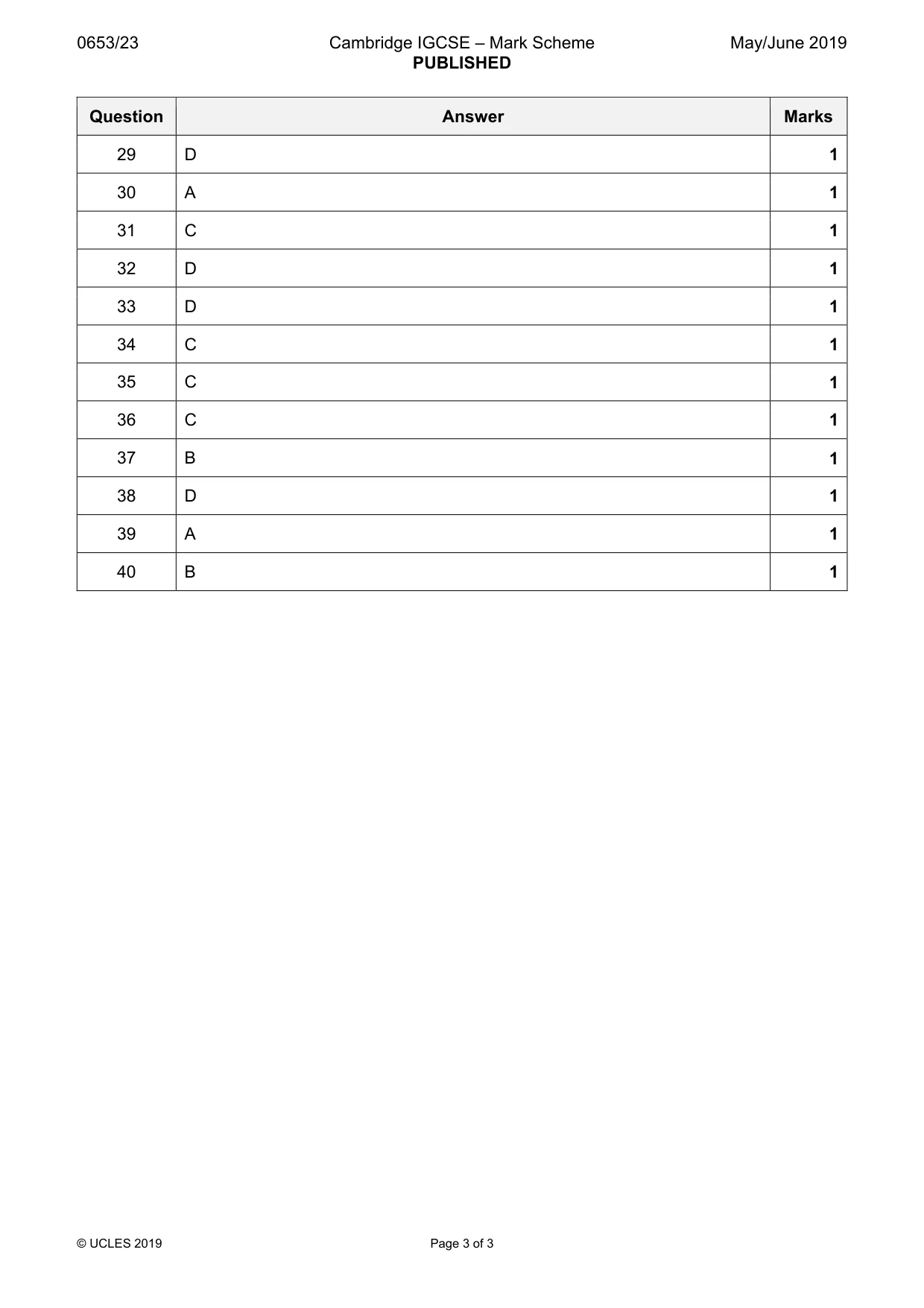
Mark scheme: D
Q30 · What is the expression for density?
30 What is the expression for density? mass volume volume weight A B C D volume mass weight volume
Mark scheme: A
Q31 · A body moving with a speed of 2.0 m / s has a kinetic energy of 8.0 J
31 A body moving with a speed of 2.0 m / s has a kinetic energy of 8.0 J. What is the mass of the body? A 1.0 kg B 2.0 kg C 4.0 kg D 8.0 kg
Mark scheme: C
Q32 · The diagram shows a vacuum flask containing a hot liquid in a cold room
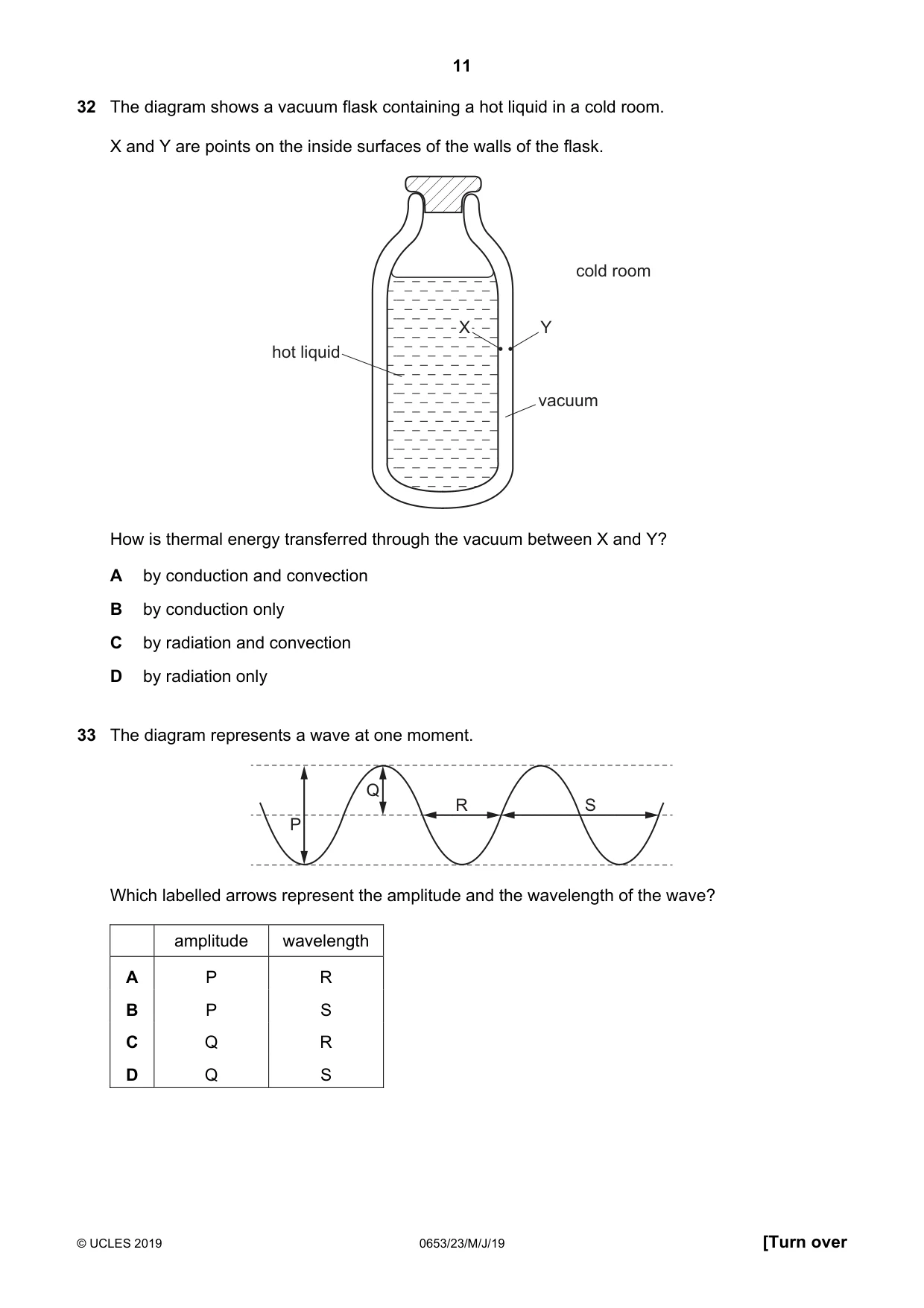
32 The diagram shows a vacuum flask containing a hot liquid in a cold room. X and Y are points on the inside surfaces of the walls of the flask. cold room X Y hot liquid vacuum How is thermal energy transferred through the vacuum between X and Y? A by conduction and convection B by conduction only C by radiation and convection D by radiation only
Mark scheme: D
Q33 · The diagram represents a wave at one moment
33 The diagram represents a wave at one moment. Q R S P Which labelled arrows represent the amplitude and the wavelength of the wave? amplitude wavelength A P R B P S C Q R D Q S
Mark scheme: D
Q34 · Which electromagnetic radiation has the lowest frequency?
34 Which electromagnetic radiation has the lowest frequency? A gamma B infrared C radio D ultraviolet
Mark scheme: C
Q35 · A converging lens is placed in the position shown in the diagram
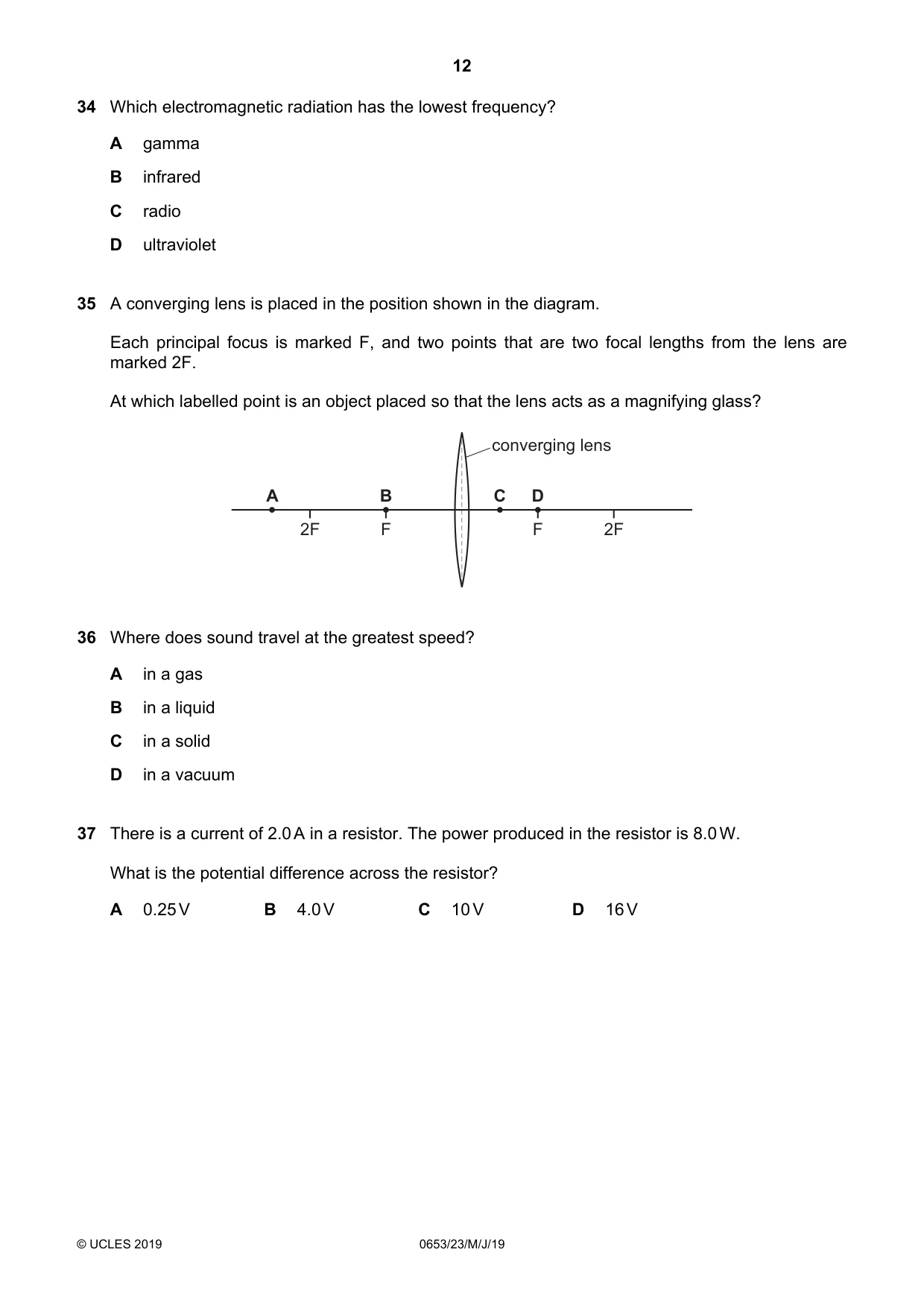
35 A converging lens is placed in the position shown in the diagram. Each principal focus is marked F, and two points that are two focal lengths from the lens are marked 2F. At which labelled point is an object placed so that the lens acts as a magnifying glass? converging lens A B C D 2F F F 2F
Mark scheme: C
Q36 · Where does sound travel at the greatest speed?
36 Where does sound travel at the greatest speed? A in a gas B in a liquid C in a solid D in a vacuum
Mark scheme: C
Q37 · There is a current of 2.0 A in a resistor
37 There is a current of 2.0 A in a resistor. The power produced in the resistor is 8.0 W. What is the potential difference across the resistor? A 0.25 V B 4.0 V C 10 V D 16 V
Mark scheme: B
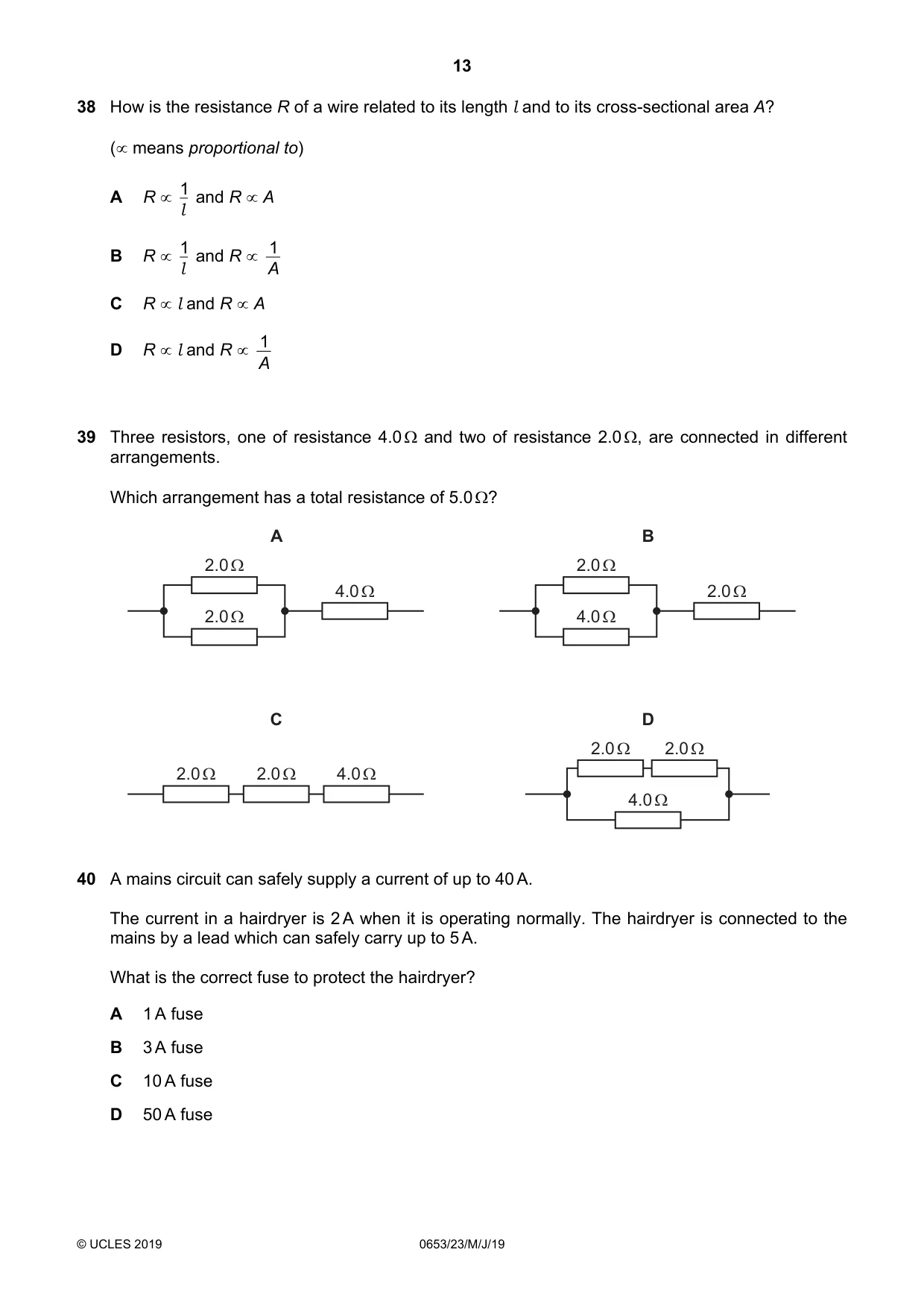
Q38 · How is the resistance R of a wire related to its length l and to its cross-sectional area…
38 How is the resistance R of a wire related to its length l and to its cross-sectional area A? (∝ means proportional to) R ∝ l 1 and R ∝ A A R ∝ l 1 and R ∝ A 1 B C R ∝ l and R ∝ A R ∝ l and R ∝ A 1 D
Mark scheme: D
Q39 · Three resistors, one of resistance 4.0 Ω and two of resistance 2.0 Ω, are connected in…
39 Three resistors, one of resistance 4.0 Ω and two of resistance 2.0 Ω, are connected in different arrangements. Which arrangement has a total resistance of 5.0 Ω? A B 2.0 Ω 2.0 Ω 4.0 Ω 2.0 Ω 2.0 Ω 4.0 Ω C D 2.0 Ω 2.0 Ω 2.0 Ω 2.0 Ω 4.0 Ω 4.0 Ω
Mark scheme: A
Q40 · A mains circuit can safely supply a current of up to 40 A
40 A mains circuit can safely supply a current of up to 40 A. The current in a hairdryer is 2 A when it is operating normally. The hairdryer is connected to the mains by a lead which can safely carry up to 5 A. What is the correct fuse to protect the hairdryer? A 1 A fuse B 3 A fuse C 10 A fuse D 50 A fuse
Mark scheme: B
What was in this paper
The subtopics covered by these 40 questions, and how many questions each got. Open one in a new tab to see every Cambridge question on it.
2Fuels2Photosynthesis2Alkenes1Alloys and their properties1Atomic structure and the Periodic Table1Blood1Density1Diet1Diffusion1Digestive system1Drugs1Electrical circuits1Electrical safety1Electrolysis1Electromagnetic spectrum1Elements, compounds and mixtures1Energy, work and power1Enzymes1Food chains and food webs1Gas exchange in humans1General properties of waves1Identification of ions and gases1Light1Mass and weight1Motion1Osmosis1Rate of reaction1Reactivity series1Redox1Separation and purification1Sexual reproduction in humans1Sexual reproduction in plants1Simple molecules and covalent bonds1Sound1Transfer of thermal energy1Water1What you needed in this session
Cambridge’s own grade thresholds for 2019 May/June, Paper 2 · Variant 3. A higher threshold means an easier paper — the bar moves with how the cohort did.