Cambridge IGCSE Science - Combined 0653 — 2025 May/June Paper 2 · Variant 2
0653/22/M/J/25 · 40 questions · 40 marks · 45 min
The question paper and its mark scheme, free to read here and free to download. This is Cambridge’s own paper, exactly as it was sat.
Question paper16 pages
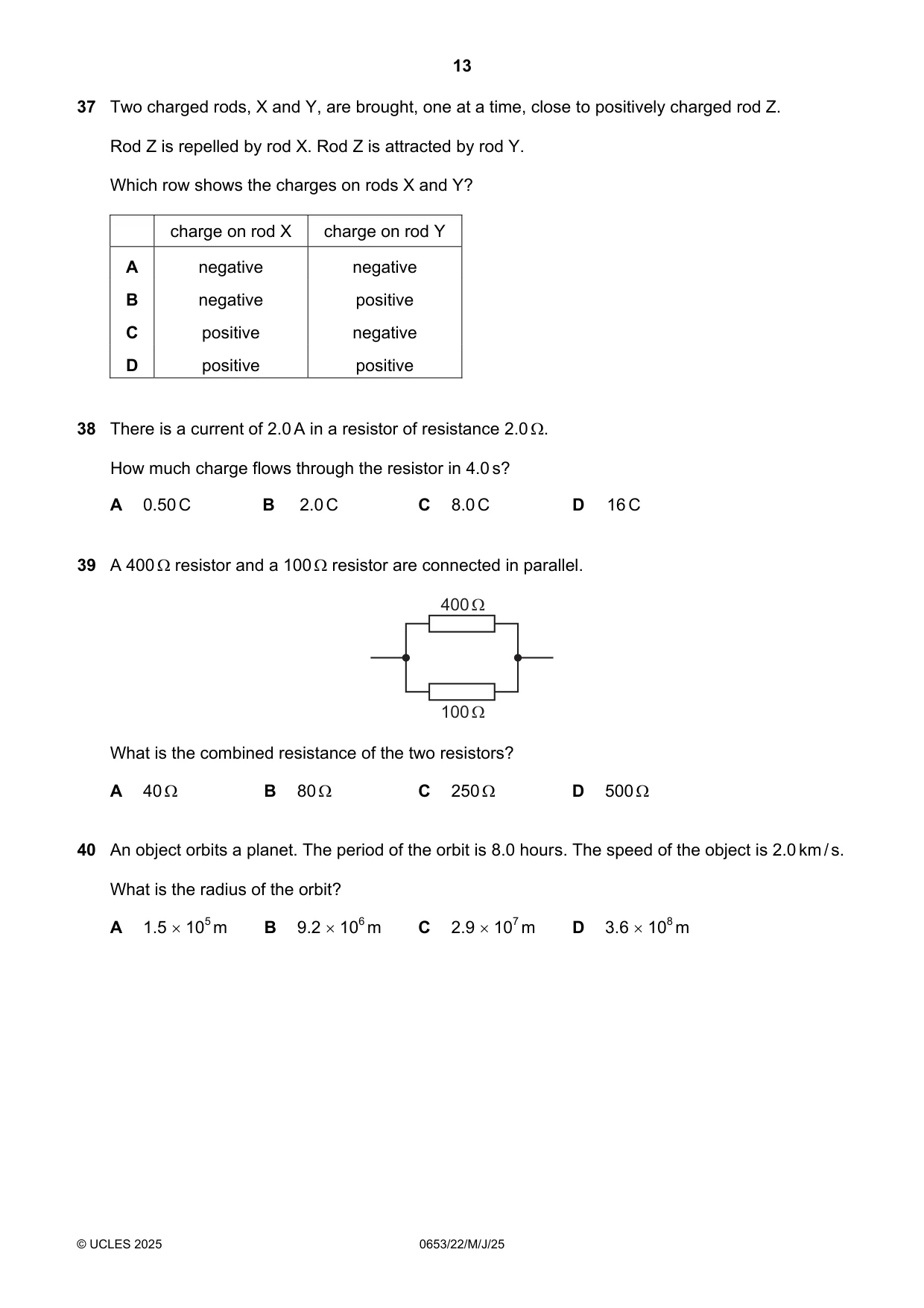


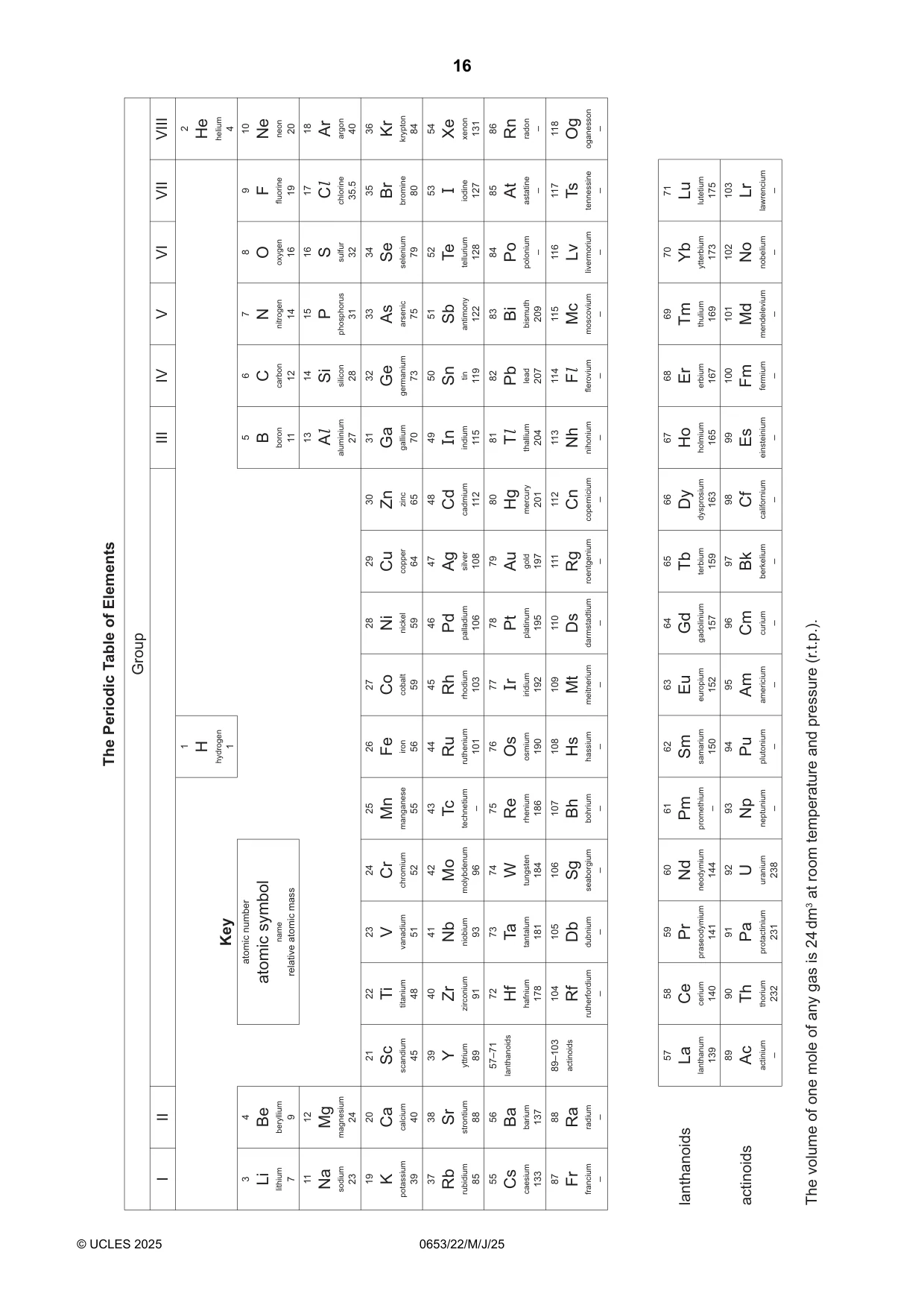
Mark scheme3 pages
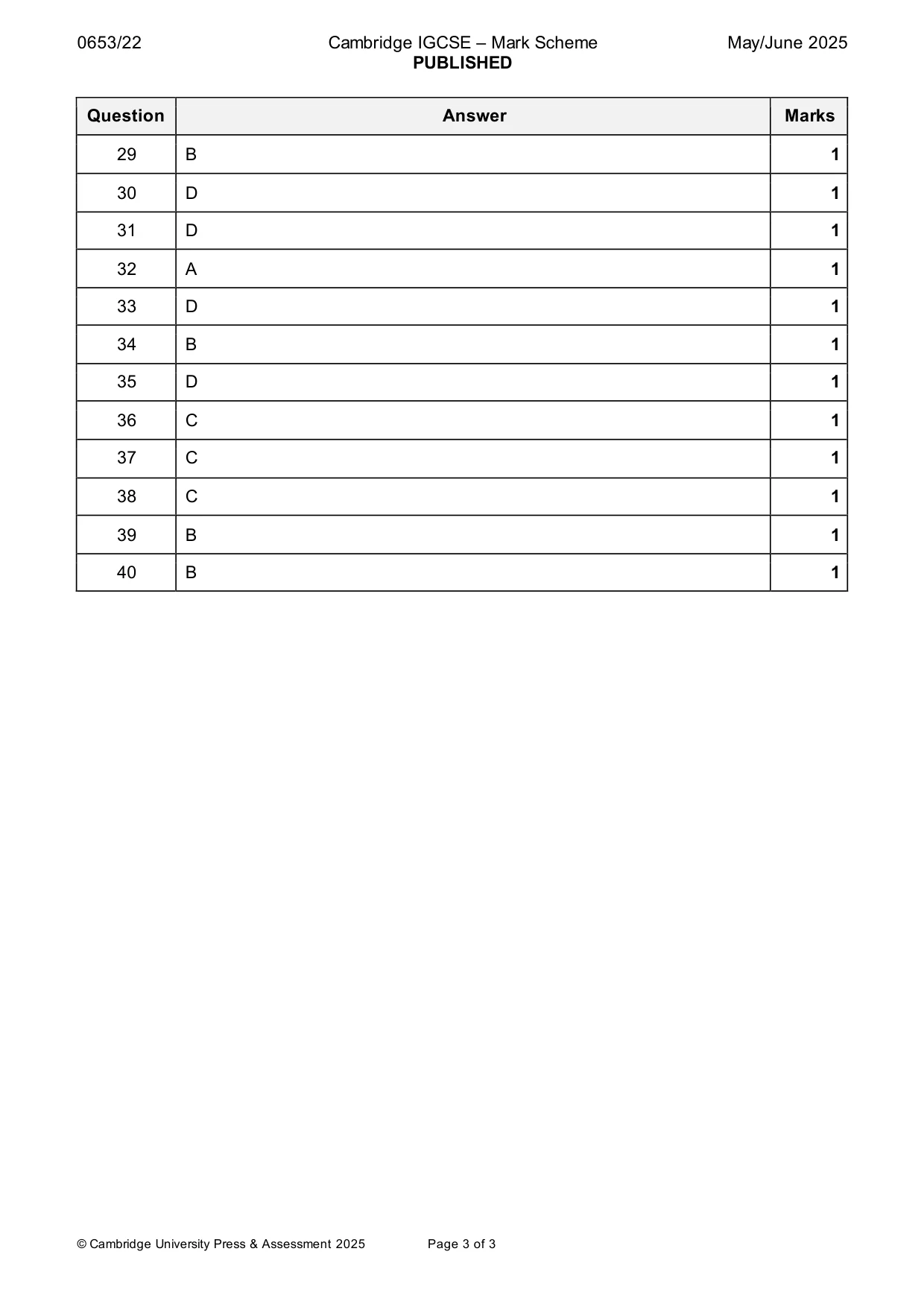
Answers below. Sit the paper first if you are practising.
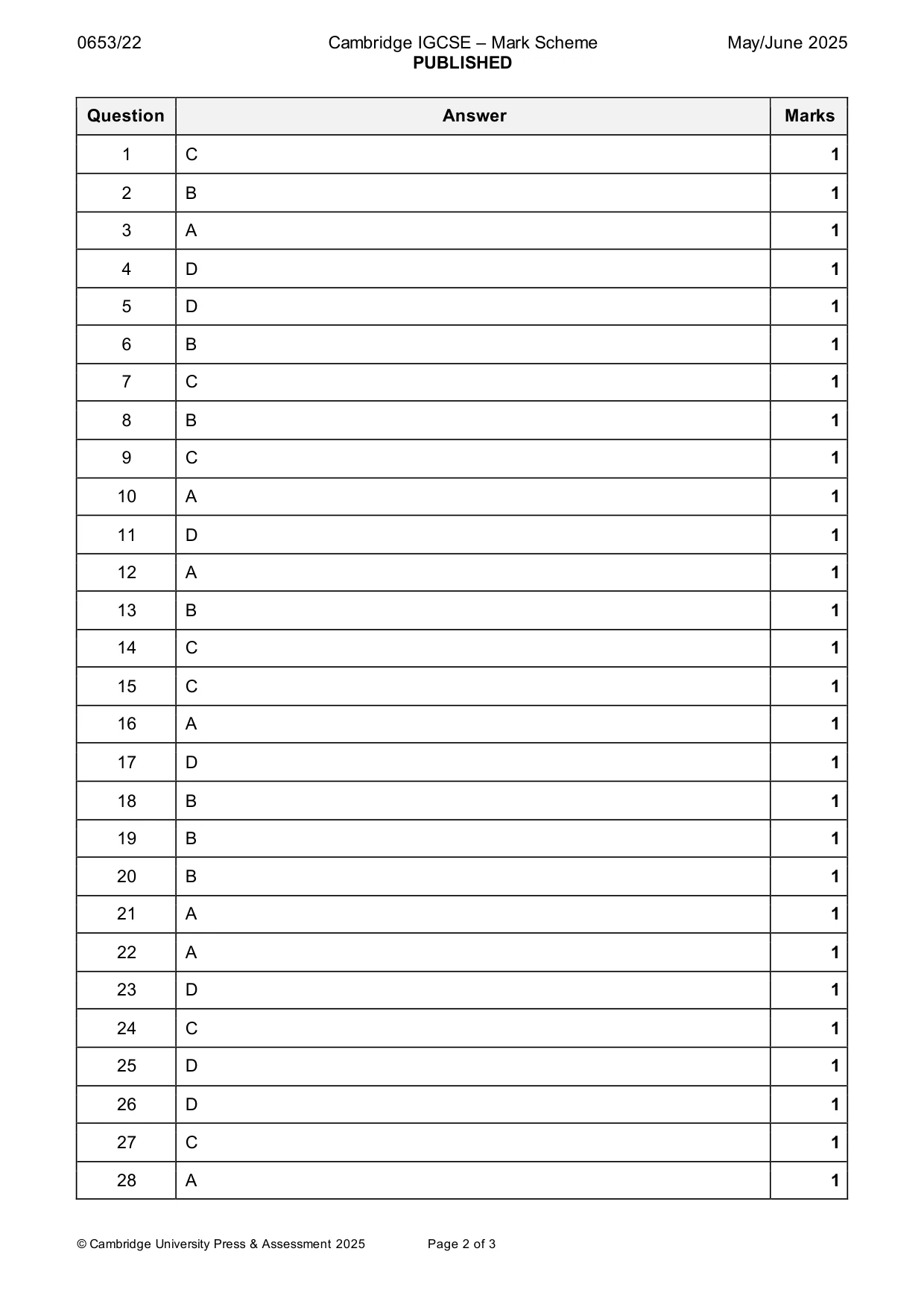
Questions as text
Q1 · Movement is a characteristic of all living organisms
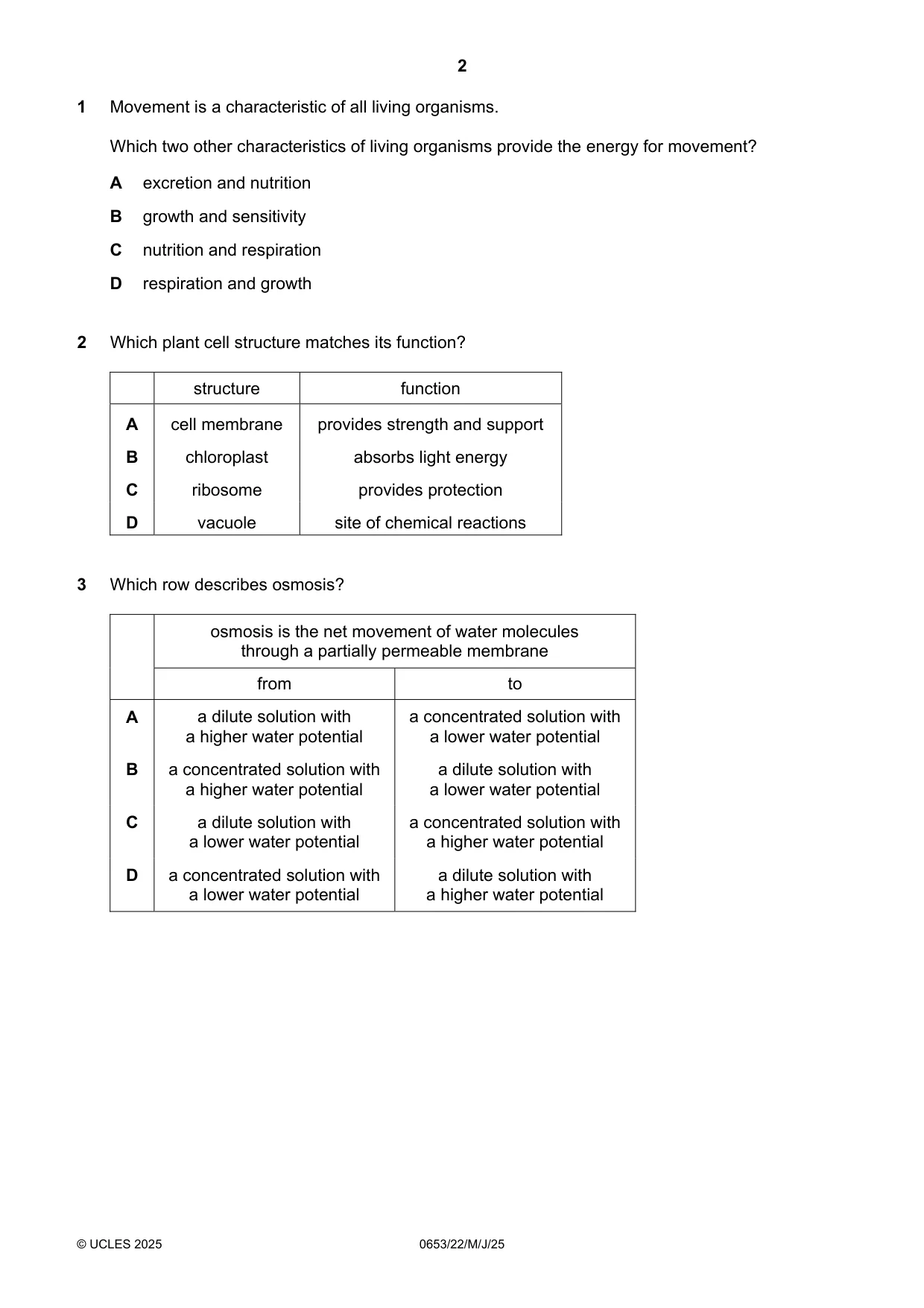
1 Movement is a characteristic of all living organisms. Which two other characteristics of living organisms provide the energy for movement? A excretion and nutrition B growth and sensitivity C nutrition and respiration D respiration and growth
Mark scheme: C
Q2 · Which plant cell structure matches its function?
2 Which plant cell structure matches its function? structure function A cell membrane provides strength and support B chloroplast absorbs light energy C ribosome provides protection D vacuole site of chemical reactions
Mark scheme: B
Q3 · Which row describes osmosis?
3 Which row describes osmosis? osmosis is the net movement of water molecules through a partially permeable membrane from to A a dilute solution with a concentrated solution with a higher water potential a lower water potential B a concentrated solution with a dilute solution with a higher water potential a lower water potential C a dilute solution with a concentrated solution with a lower water potential a higher water potential D a concentrated solution with a dilute solution with a lower water potential a higher water potential
Mark scheme: A
Q4 · The table shows the results of tests carried out on different food samples
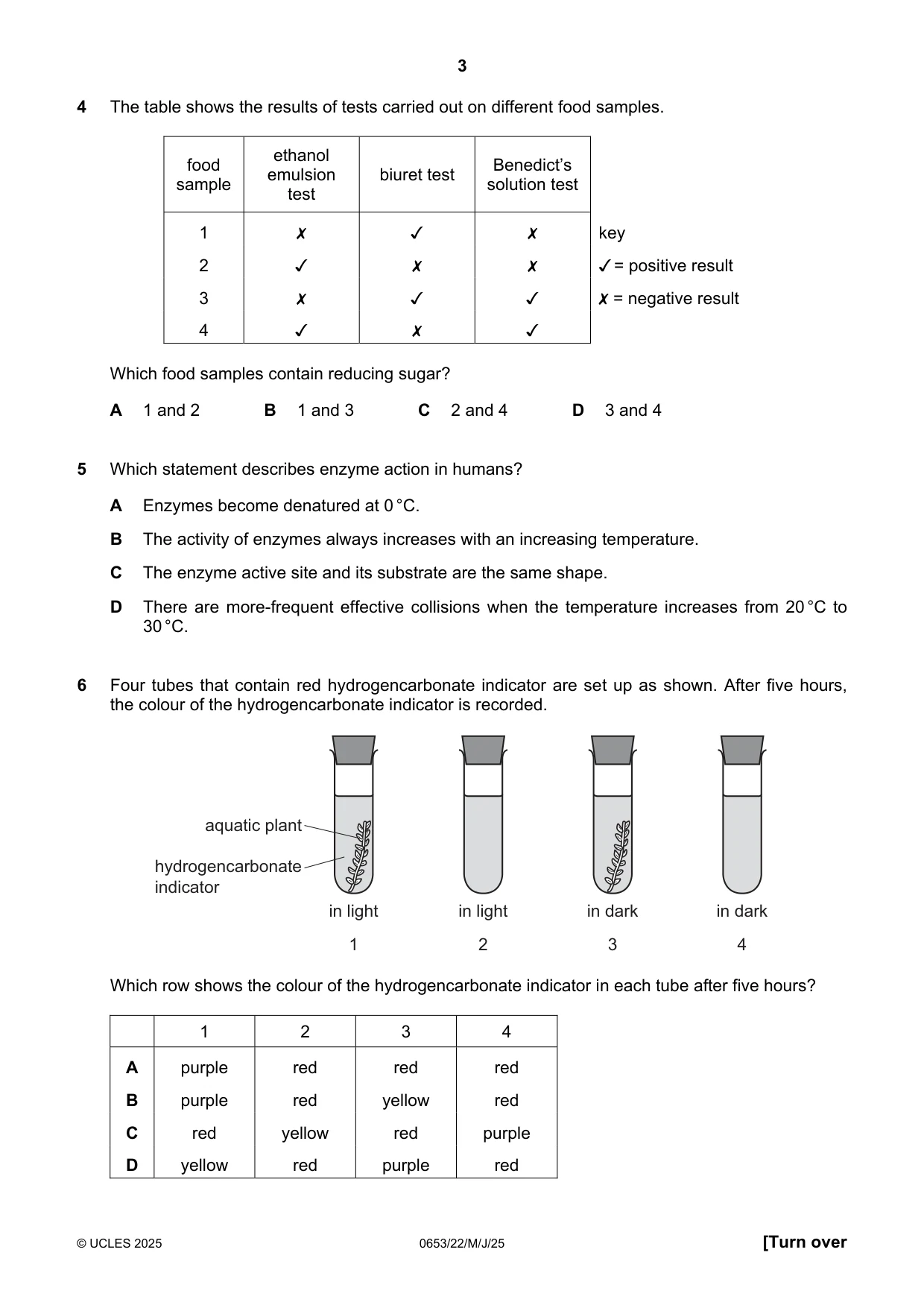
4 The table shows the results of tests carried out on different food samples. food ethanol . Benedict’s emulsion biuret test ; sample test solution test | x Jv x 2 Jv x x 3 x Jv WA 4 Jv x WA Which food samples contain reducing sugar? A i1iand2 B 1and3 key ¥ = positive result X = negative result C 2and4 D 3and4
Mark scheme: D
Q5 · Which statement describes enzyme action in humans?
5 Which statement describes enzyme action in humans? A Enzymes become denatured at 0 °C. B The activity of enzymes always increases with an increasing temperature. C The enzyme active site and its substrate are the same shape. D There are more-frequent effective collisions when the temperature increases from 20 °C to 30 °C.
Mark scheme: D
Q6 · Four tubes that contain red hydrogencarbonate indicator are set up as shown
6 Four tubes that contain red hydrogencarbonate indicator are set up as shown. After five hours, the colour of the hydrogencarbonate indicator is recorded. aquatic plant hydrogencarbonate indicator in light in light in dark in dark 1 2 3 4 Which row shows the colour of the hydrogencarbonate indicator in each tube after five hours? 1 2 3 4 A purple red red red B purple red yellow red C red yellow red purple D yellow red purple red
Mark scheme: B
Q7 · A diet provides the correct energy requirements for a person but is not balanced
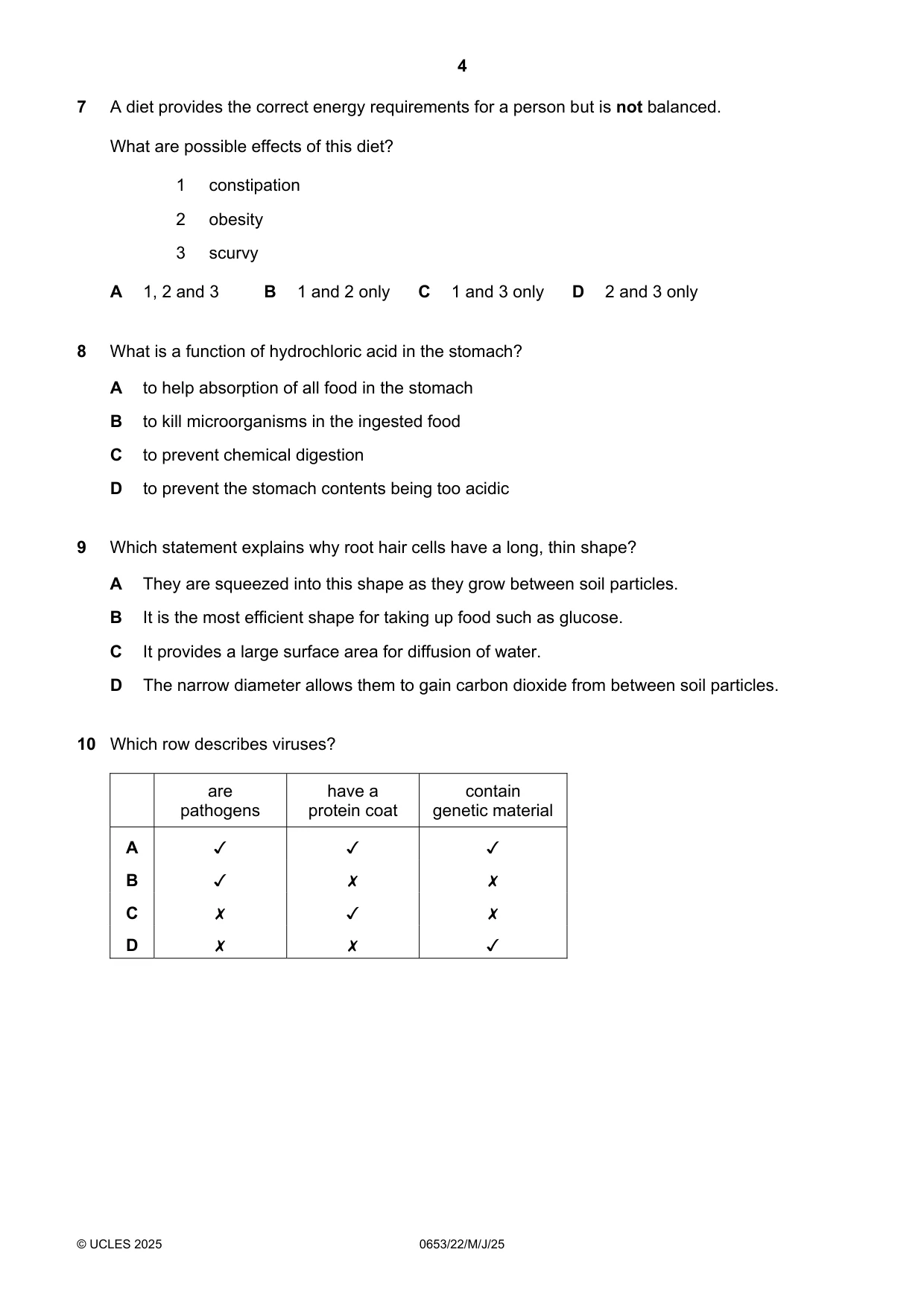
7 A diet provides the correct energy requirements for a person but is not balanced. What are possible effects of this diet? 1 constipation 2 obesity 3 scurvy A 1, 2 and 3 B 1 and 2 only C 1 and 3 only D 2 and 3 only
Mark scheme: C
Q8 · What is a function of hydrochloric acid in the stomach?
8 What is a function of hydrochloric acid in the stomach? A to help absorption of all food in the stomach B to kill microorganisms in the ingested food C to prevent chemical digestion D to prevent the stomach contents being too acidic
Mark scheme: B
Q9 · Which statement explains why root hair cells have a long, thin shape?
9 Which statement explains why root hair cells have a long, thin shape? A They are squeezed into this shape as they grow between soil particles. B It is the most efficient shape for taking up food such as glucose. C It provides a large surface area for diffusion of water. D The narrow diameter allows them to gain carbon dioxide from between soil particles.
Mark scheme: C
Q10 · Which row describes viruses?
10 Which row describes viruses? are have a pathogens protein coat contain genetic material v v x x v x v x Qe Ow® OS
Mark scheme: A
Q11 · The graphs show how the rate and depth of breathing varies when a student does four…
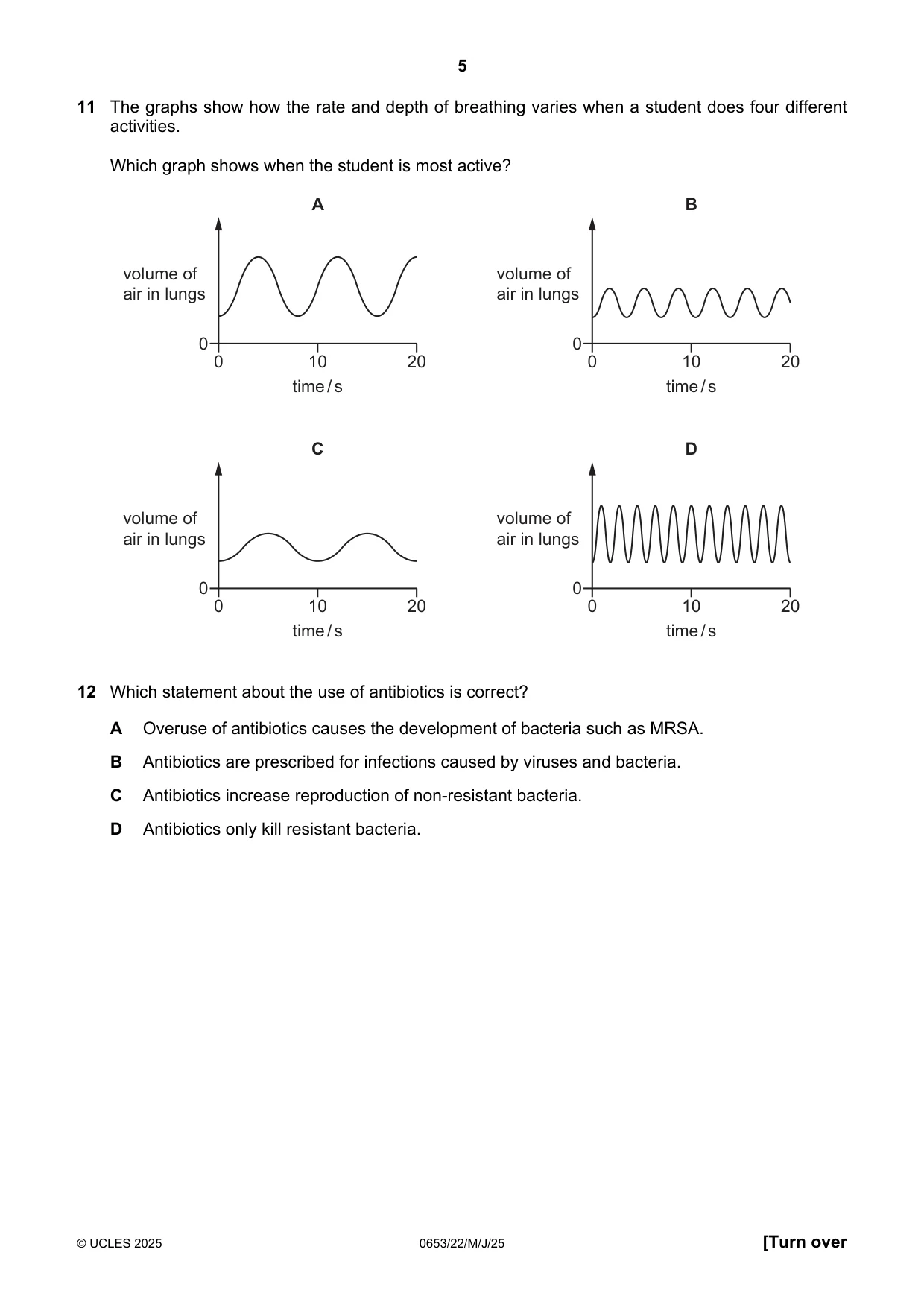
11 The graphs show how the rate and depth of breathing varies when a student does four different activities. Which graph shows when the student is most active? A B volume of volume of air in lungs air in lungs 0 0 0 10 20 0 10 20 time / s time / s C D volume of volume of air in lungs air in lungs 0 0 0 10 20 0 10 20 time / s time / s
Mark scheme: D
Q12 · Which statement about the use of antibiotics is correct?
12 Which statement about the use of antibiotics is correct? A Overuse of antibiotics causes the development of bacteria such as MRSA. B Antibiotics are prescribed for infections caused by viruses and bacteria. C Antibiotics increase reproduction of non-resistant bacteria. D Antibiotics only kill resistant bacteria.
Mark scheme: A
Q13 · The diagram shows a food web
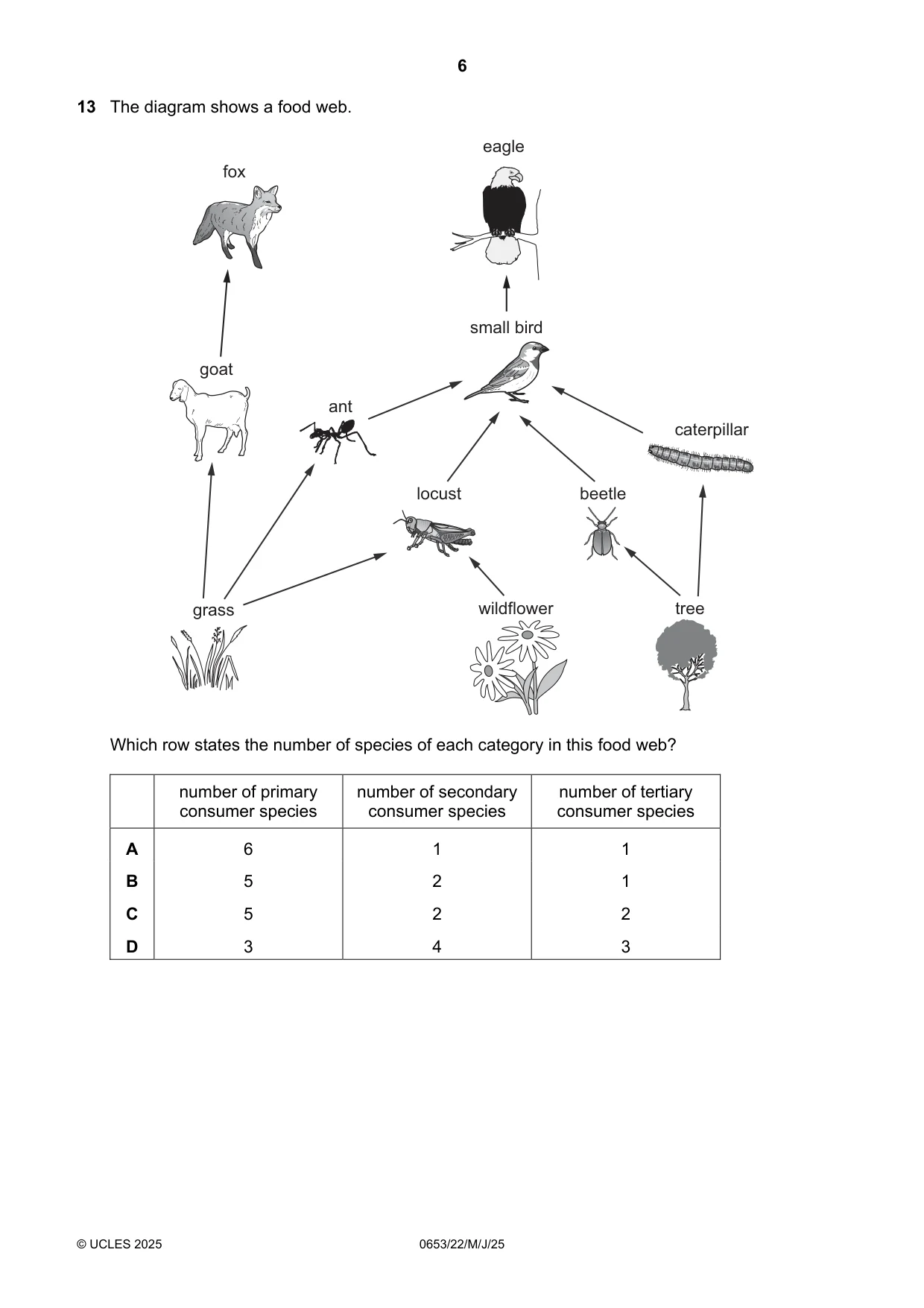
13 The diagram shows a food web. eagle fox small bird goat ant caterpillar locust beetle grass wildflower tree Which row states the number of species of each category in this food web? number of primary number of secondary number of tertiary consumer species consumer species consumer species A 6 1 1 B 5 2 1 C 5 2 2 D 3 4 3
Mark scheme: B
Q14 · The table describes three changes of state, W, X and Y
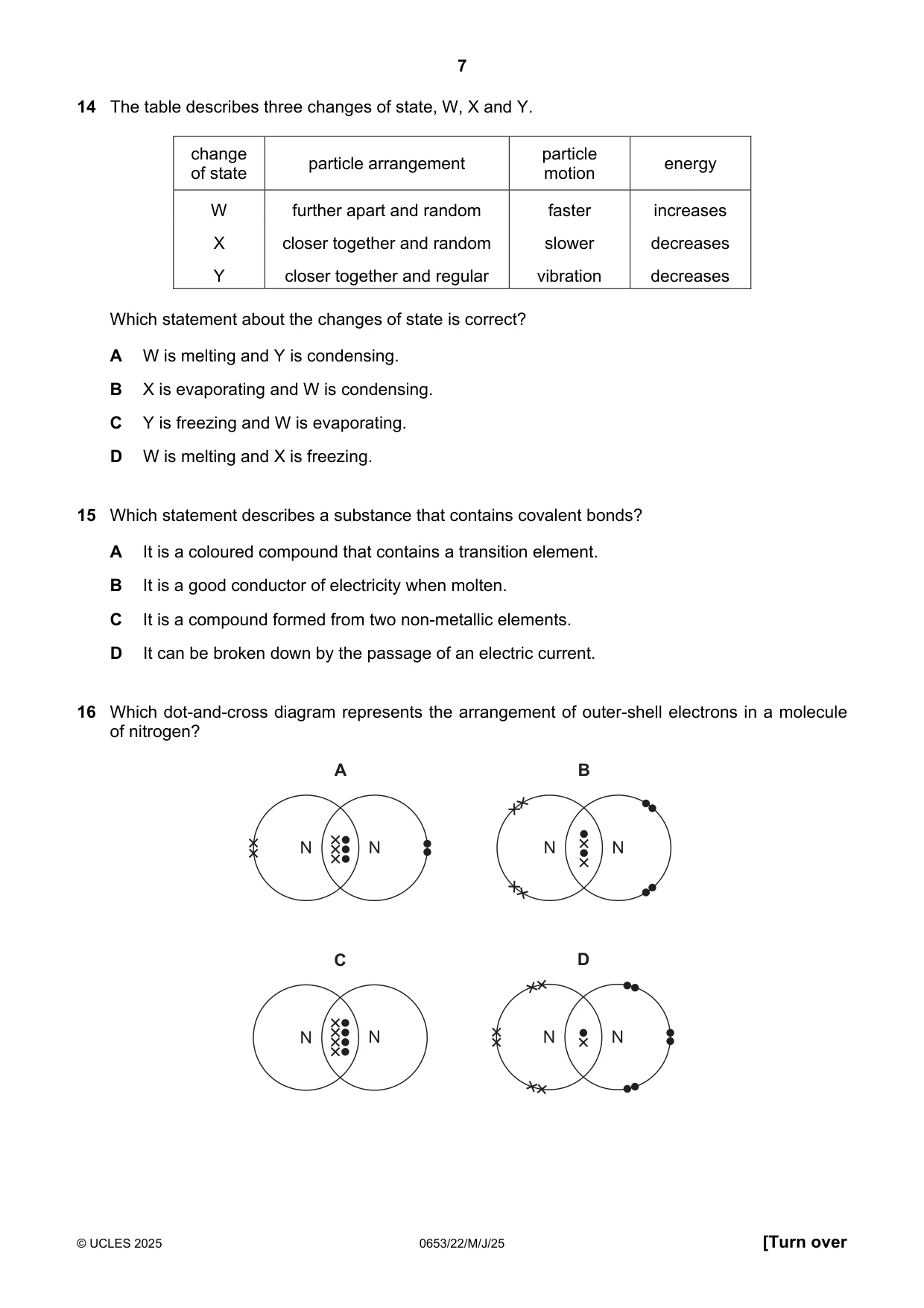
14 The table describes three changes of state, W, X and Y. change particle particle arrangement energy of state motion W further apart and random faster increases X closer together and random slower decreases Y closer together and regular vibration decreases Which statement about the changes of state is correct? A W is melting and Y is condensing. B X is evaporating and W is condensing. C Y is freezing and W is evaporating. D W is melting and X is freezing.
Mark scheme: C
Q15 · Which statement describes a substance that contains covalent bonds?
15 Which statement describes a substance that contains covalent bonds? A It is a coloured compound that contains a transition element. B It is a good conductor of electricity when molten. C It is a compound formed from two non-metallic elements. D It can be broken down by the passage of an electric current.
Mark scheme: C
Q16 · Which dot-and-cross diagram represents the arrangement of outer-shell electrons in a…
16 Which dot-and-cross diagram represents the arrangement of outer-shell electrons in a molecule of nitrogen? A B N N N N C D N N N N
Mark scheme: A
Q17 · Which statement explains why a reaction is exothermic?
17 Which statement explains why a reaction is exothermic? A More thermal energy is absorbed by breaking bonds than is released by making bonds. B More thermal energy is absorbed by making bonds than is released by breaking bonds. C More thermal energy is released by breaking bonds than is absorbed by making bonds. D More thermal energy is released by making bonds than is absorbed by breaking bonds.
Mark scheme: D
Q18 · Which statement explains why the rate of a reaction is greater at a higher temperature?
18 Which statement explains why the rate of a reaction is greater at a higher temperature? A The activation energy is higher. B More colliding particles have the minimum energy to react. C The frequency of collisions between reacting particles decreases. D There are more reacting particles per unit volume.
Mark scheme: B
Q19 · Which word equation represents the reaction of an acid with a carbonate?
19 Which word equation represents the reaction of an acid with a carbonate? A acid + carbonate salt + carbon dioxide B acid + carbonate salt + carbon dioxide + water C acid + carbonate salt + hydrogen + water D acid + carbonate salt + water
Mark scheme: B
More questions on The characteristic properties of acids and bases
Q20 · Which row describes the physical state of the Group VII elements at room temperature?
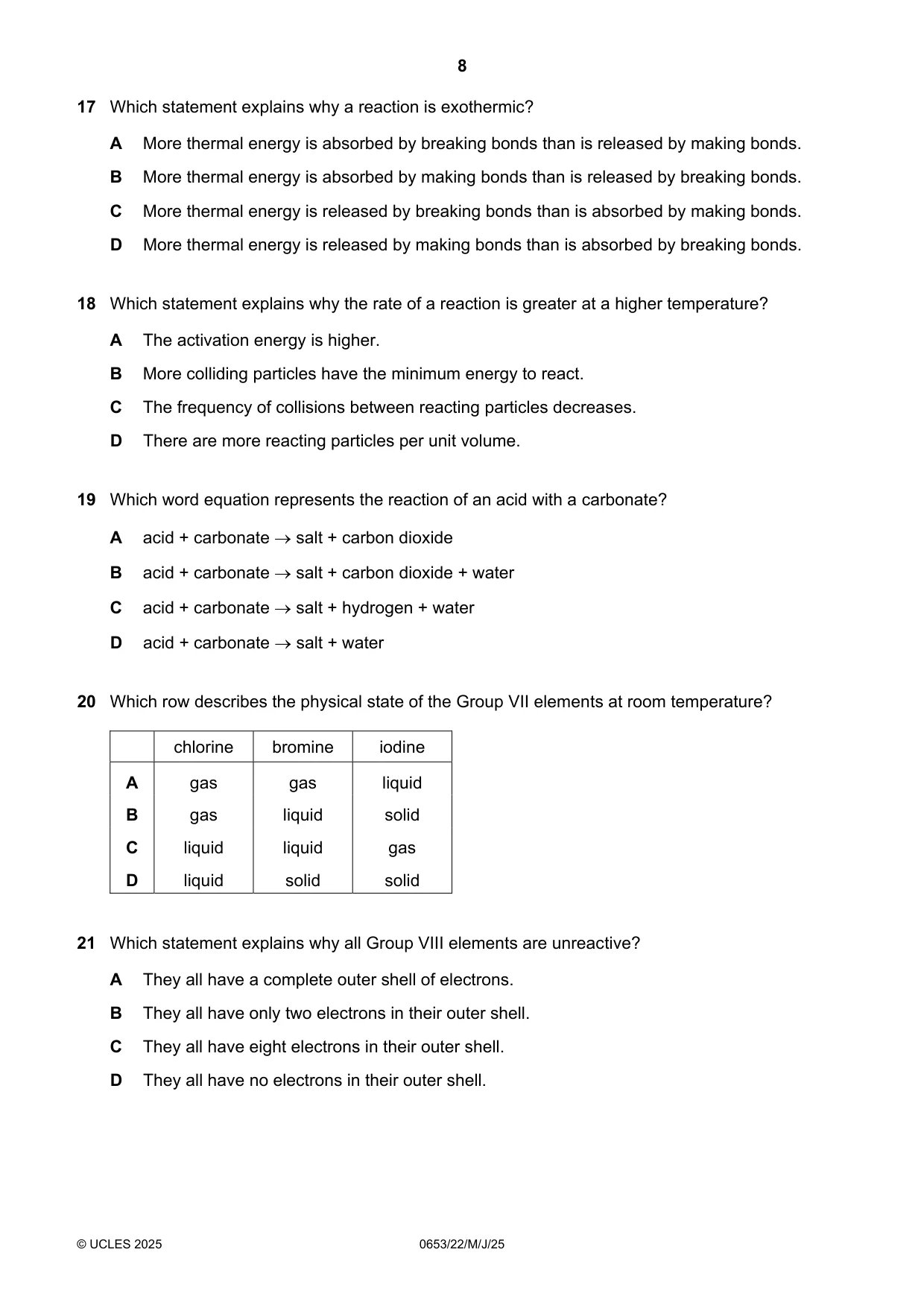
20 Which row describes the physical state of the Group VII elements at room temperature? chlorine bromine iodine A gas gas liquid B gas liquid solid C liquid liquid gas D liquid solid solid
Mark scheme: B
Q21 · Which statement explains why all Group VIII elements are unreactive?
21 Which statement explains why all Group VIII elements are unreactive? A They all have a complete outer shell of electrons. B They all have only two electrons in their outer shell. C They all have eight electrons in their outer shell. D They all have no electrons in their outer shell.
Mark scheme: A
Q22 · Which element does not produce a gas when added to dilute hydrochloric acid?
22 Which element does not produce a gas when added to dilute hydrochloric acid? A copper B iron C magnesium D zinc
Mark scheme: A
Q23 · Which row describes the extraction of iron from its ore?
23 Which row describes the extraction of iron from its ore? name of ore method of extraction A bauxite electrolysis B bauxite reduction in a blast furnace C hematite electrolysis D hematite reduction in a blast furnace
Mark scheme: D
Q24 · Which process is a physical change?
24 Which process is a physical change? A combustion of solid carbon B cracking of an alkane to give an alkene C fractional distillation of petroleum D rusting of iron
Mark scheme: C
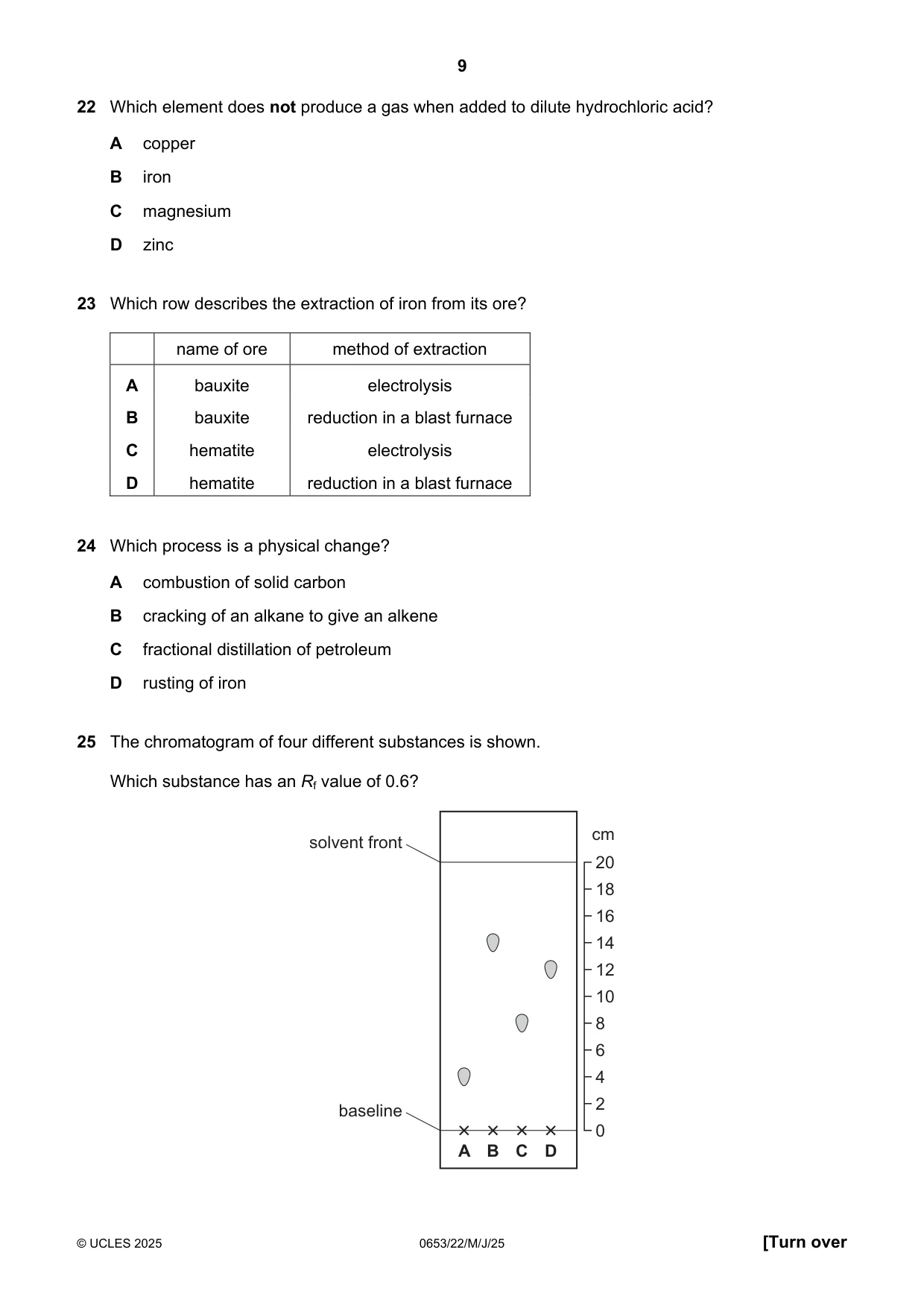
Q25 · The chromatogram of four different substances is shown
25 The chromatogram of four different substances is shown. Which substance has an Rf value of 0.6? solvent front cm 20 18 16 14 12 10 8 6 4 baseline 2 0 A B C D
Mark scheme: D
Q26 · Potassium iodide reacts with lead(II) nitrate to produce yellow lead(II) iodide and…
26 Potassium iodide reacts with lead(II) nitrate to produce yellow lead(II) iodide and potassium nitrate. 2KI(aq) + Pb(NO3)2(aq) PbI2(s) + 2KNO3(aq) Which row describes this reaction and how to separate lead(II) iodide from the reaction mixture? reaction separation A neutralisation chromatography B neutralisation filtration C precipitation chromatography D precipitation filtration
Mark scheme: D
Q27 · Which row shows an electrolyte and the products of electrolysis for this electrolyte?
27 Which row shows an electrolyte and the products of electrolysis for this electrolyte? electrolyte products A concentrated aqueous sodium chloride sodium and chlorine B molten potassium bromide hydrogen and bromine C molten sodium chloride sodium and chlorine D dilute sulfuric acid hydrogen and sulfur dioxide
Mark scheme: C
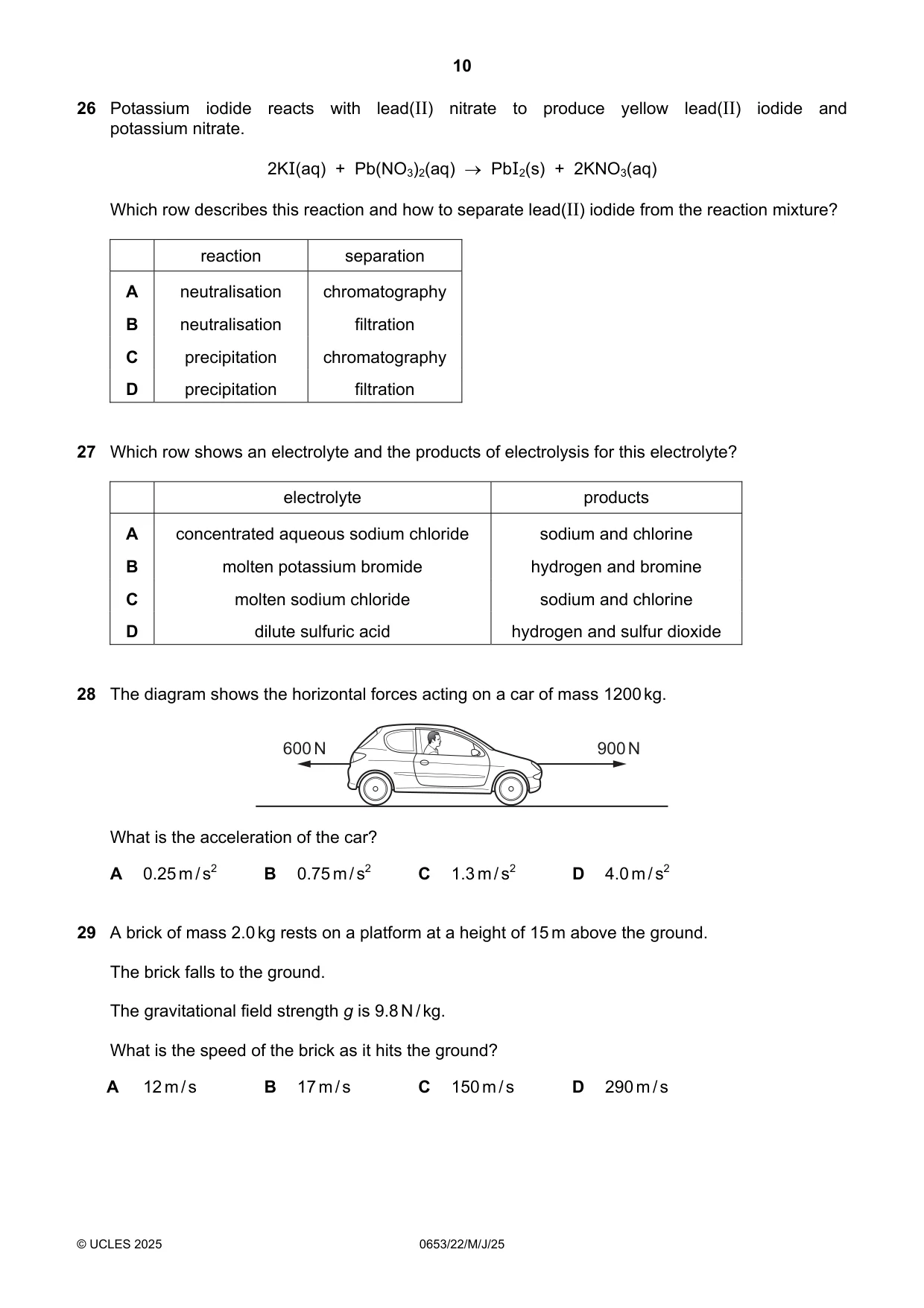
Q28 · The diagram shows the horizontal forces acting on a car of mass 1200 kg
28 The diagram shows the horizontal forces acting on a car of mass 1200 kg. 600 N 900 N What is the acceleration of the car? A 0.25 m / s2 B 0.75 m / s2 C 1.3 m / s2 D 4.0 m / s2
Mark scheme: A
Q29 · A brick of mass 2.0 kg rests on a platform at a height of 15 m above the ground
29 A brick of mass 2.0 kg rests on a platform at a height of 15 m above the ground. The brick falls to the ground. The gravitational field strength g is 9.8 N / kg. What is the speed of the brick as it hits the ground? A 12 m / s B 17 m / s C 150 m / s D 290 m / s
Mark scheme: B
Q30 · Which process is the source of the energy released from the Sun?
30 Which process is the source of the energy released from the Sun? A chemical reactions B geothermal heating C nuclear fission D nuclear fusion
Mark scheme: D
Q31 · What is a property of both solids and liquids?
31 What is a property of both solids and liquids? A They always fill a container. B They can flow. C They have a fixed shape. D They have a fixed volume.
Mark scheme: D
Q32 · Which material is a good thermal conductor?
32 Which material is a good thermal conductor? A copper B glass C plastic D wood
Mark scheme: A
Q33 · A room contains cold air
33 A room contains cold air. An electric heater is used to warm the air. Which statement explains why the warm air rises? A Air contracts as it is warmed. B Particles in warm air have less energy than particles in cold air. C The mass of the air particles decreases as the air is warmed. D Warm air is less dense than cold air.
Mark scheme: D
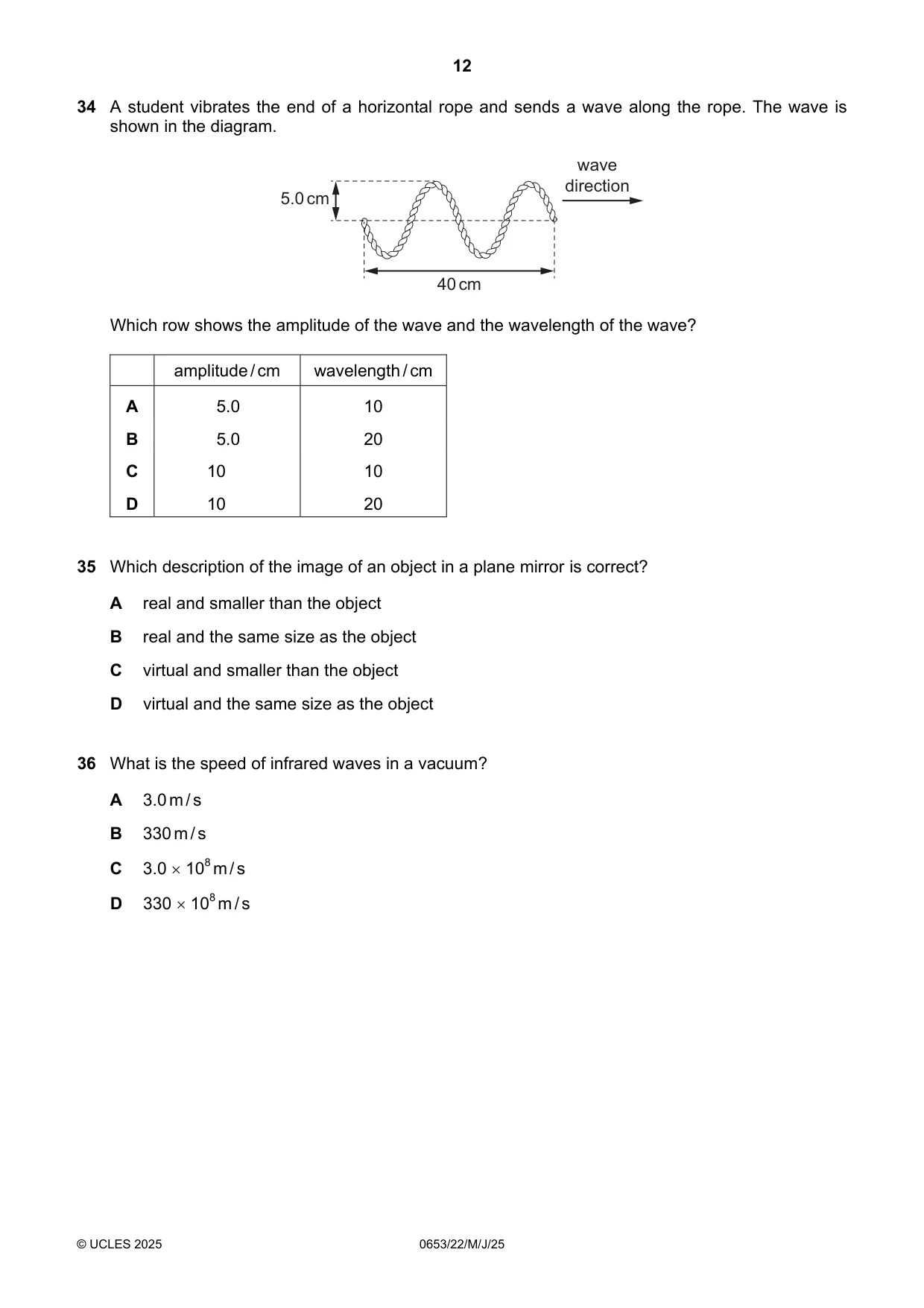
Q34 · A student vibrates the end of a horizontal rope and sends a wave along the rope
34 A student vibrates the end of a horizontal rope and sends a wave along the rope. The wave is shown in the diagram. wave direction 5.0 cm 40 cm Which row shows the amplitude of the wave and the wavelength of the wave? amplitude / cm wavelength / cm A 5.0 10 B 5.0 20 C 10 10 D 10 20
Mark scheme: B
Q35 · Which description of the image of an object in a plane mirror is correct?
35 Which description of the image of an object in a plane mirror is correct? A real and smaller than the object B real and the same size as the object C virtual and smaller than the object D virtual and the same size as the object
Mark scheme: D
Q36 · What is the speed of infrared waves in a vacuum?
36 What is the speed of infrared waves in a vacuum? A 3.0 m / s B 330 m / s C 3.0 108 m / s D 330 108 m / s
Mark scheme: C
Q37 · Two charged rods, X and Y, are brought, one at a time, close to positively charged rod Z
37 Two charged rods, X and Y, are brought, one at a time, close to positively charged rod Z. Rod Z is repelled by rod X. Rod Z is attracted by rod Y. Which row shows the charges on rods X and Y? charge on rod X charge on rod Y A negative negative B negative positive C positive negative D positive positive
Mark scheme: C
Q38 · There is a current of 2.0 A in a resistor of resistance 2.0
38 There is a current of 2.0 A in a resistor of resistance 2.0 . How much charge flows through the resistor in 4.0 s? A 0.50 C B 2.0 C C 8.0 C D 16 C
Mark scheme: C
Q39 · A 400 resistor and a 100 resistor are connected in parallel
39 A 400 resistor and a 100 resistor are connected in parallel. 400 Ω 100 Ω What is the combined resistance of the two resistors? A 40 B 80 C 250 D 500
Mark scheme: B
Q40 · An object orbits a planet
40 An object orbits a planet. The period of the orbit is 8.0 hours. The speed of the object is 2.0 km / s. What is the radius of the orbit? A 1.5 105 m B 9.2 106 m C 2.9 107 m D 3.6 108 m
Mark scheme: B
What was in this paper
The subtopics covered by these 40 questions, and how many questions each got. Open one in a new tab to see every Cambridge question on it.
2Electrical quantities2Simple molecules and covalent bonds2Transfer of thermal energy2Biological molecules1Cell structure1Characteristics of living organisms1Chromatography1Diet1Digestive system1Electrical circuits1Electrolysis1Electromagnetic spectrum1Energy, work and power1Enzymes1Exothermic and endothermic reactions1Extraction of metals1Food chains and food webs1Forces1Gas exchange in humans1General properties of waves1Group VII properties1Kinetic particle model of matter1Light1Noble gases1Osmosis1Photosynthesis1Physical and chemical changes1Rate of reaction1Reactivity series1Separation and purification1Solids, liquids and gases1Stars and the Universe1The characteristic properties of acids and bases1The Solar System1Water uptake1What you needed in this session
Cambridge’s own grade thresholds for 2025 May/June, Paper 2 · Variant 2. A higher threshold means an easier paper — the bar moves with how the cohort did.