Cambridge IGCSE Science - Combined 0653 — 2023 Oct/Nov Paper 2 · Variant 3
0653/23/O/N/23 · 40 questions · 40 marks · ≈45 min
The question paper and its mark scheme, free to read here and free to download. This is Cambridge’s own paper, exactly as it was sat.
Question paper16 pages

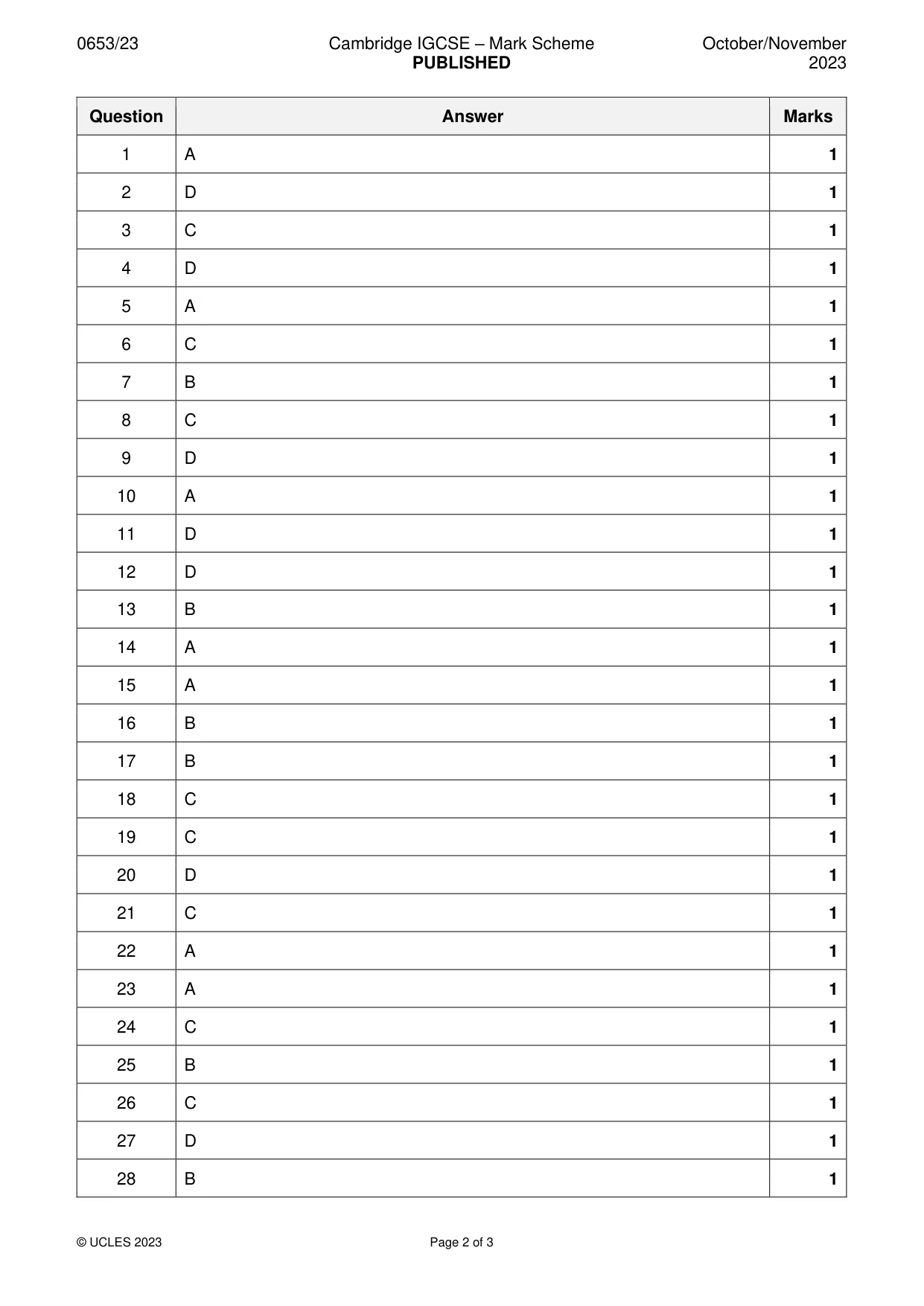
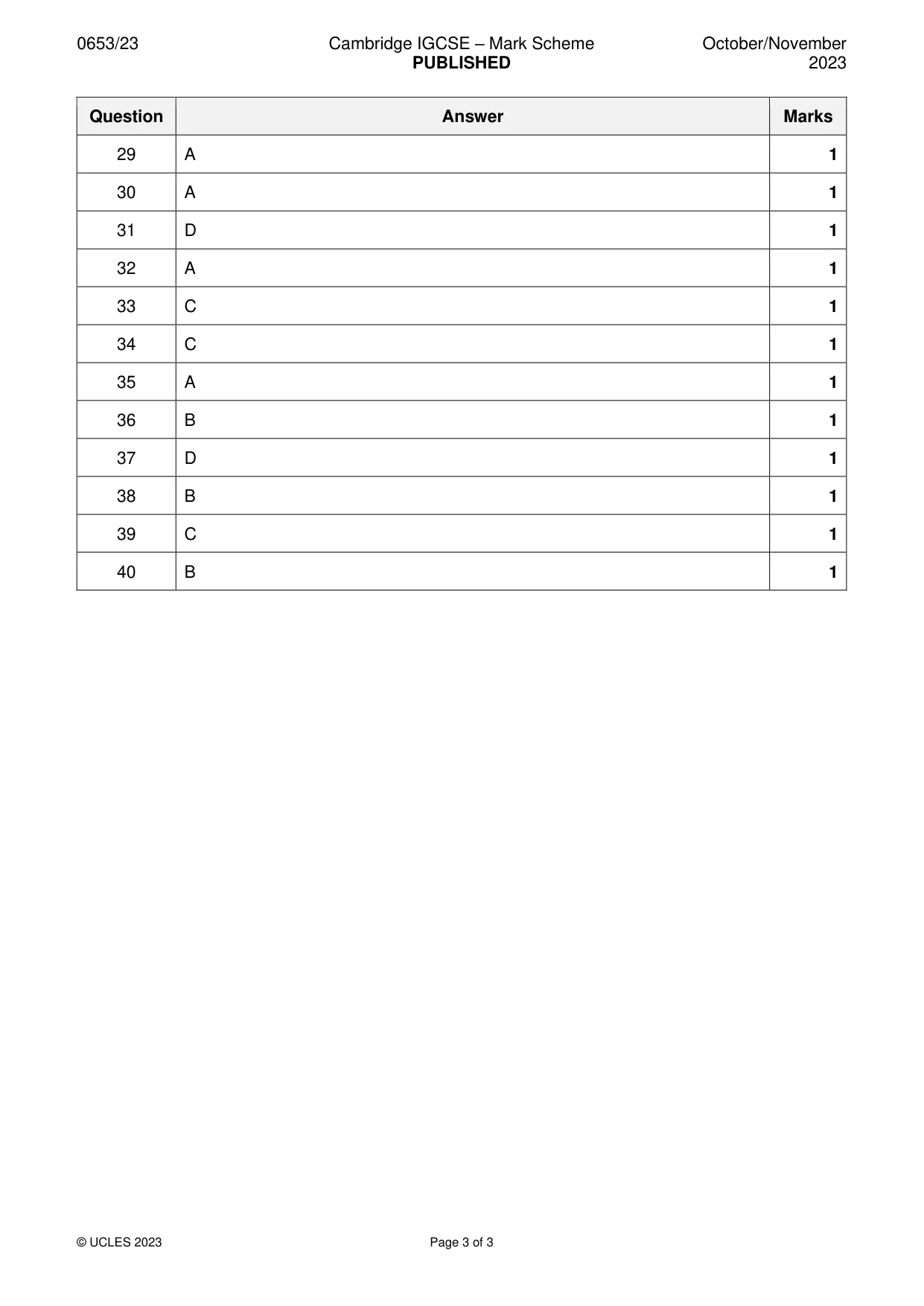
Mark scheme3 pages
Answers below. Sit the paper first if you are practising.
Questions as text
Q1 · Which adaptation of root hair cells increases their rate of absorption of water?
1 Which adaptation of root hair cells increases their rate of absorption of water? A large surface area B phloem present C small surface area D xylem present
Mark scheme: A
Q2 · Which statement about diffusion is correct?
2 Which statement about diffusion is correct? A Diffusion occurs only in living organisms. B Diffusion occurs only in solution. C Diffusion occurs only through a cell wall. D Diffusion occurs only down a concentration gradient.
Mark scheme: D
Q3 · Which row contains all of the elements in fats?
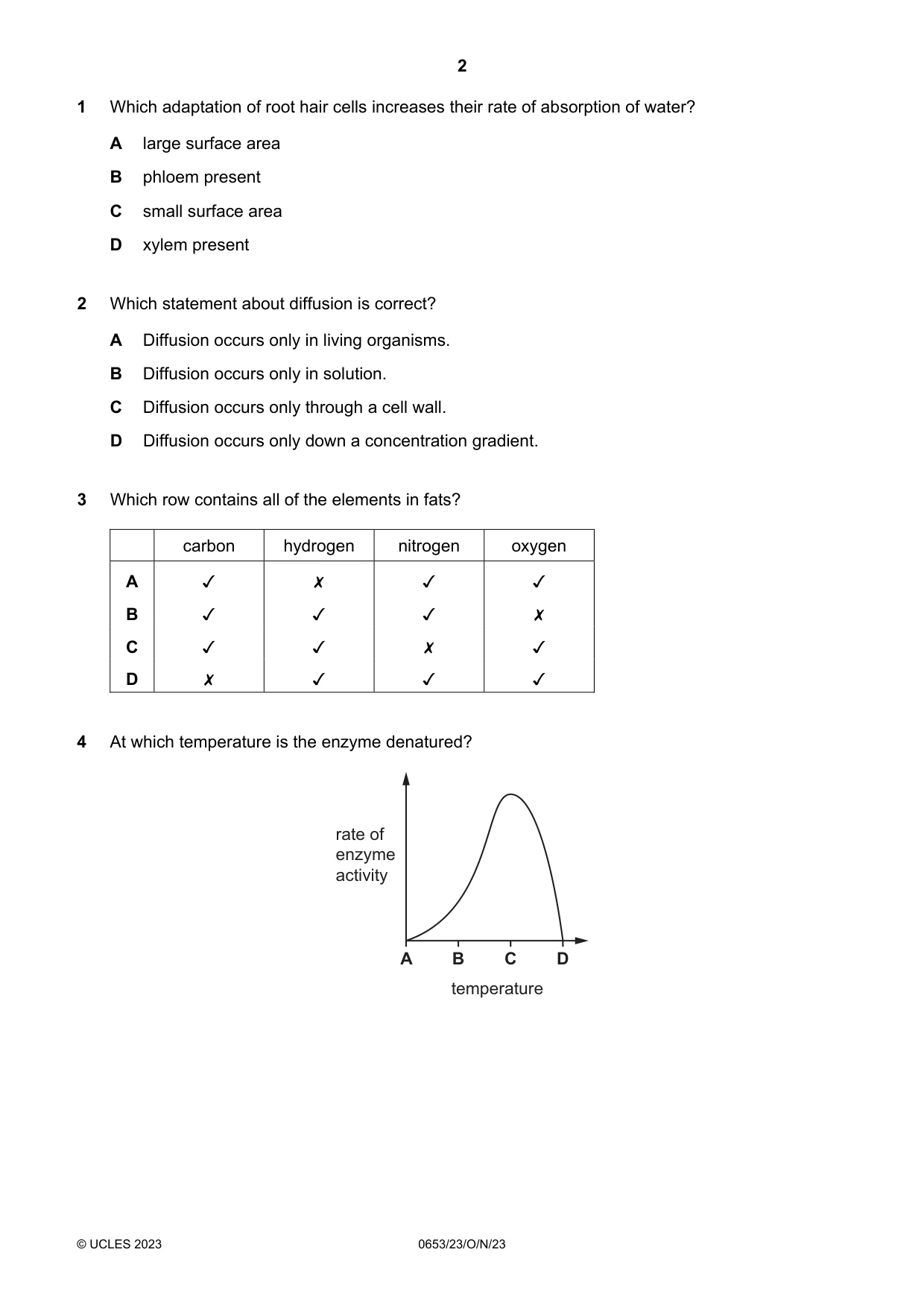
3. Which row contains all of the elements in fats? carbon hydrogen nitrogen oxygen 0 OO WwW PY x SO a LN K&N \ 4 x
Mark scheme: C
Q4 · At which temperature is the enzyme denatured?
4 At which temperature is the enzyme denatured? rate of enzyme activity A B C D temperature
Mark scheme: D
Q5 · A plant shoot is 5 cm tall and has two leaves half way up the stem
5 A plant shoot is 5 cm tall and has two leaves half way up the stem. What can happen to the simple sugars made by these leaves? 1 move down the stem from the leaves 2 move up the stem from the leaves 3 remain in the leaves A 1, 2 and 3 B 1 and 2 only C 1 and 3 only D 2 and 3 only
Mark scheme: A
Q6 · What is the role of mechanical digestion?
6 What is the role of mechanical digestion? A It breaks down large food molecules into smaller molecules. B It forms new chemical compounds for the body to utilise. C It breaks down large pieces of food into smaller pieces. D It makes the food particles soluble for better absorption.
Mark scheme: C
Q7 · From which part of a leaf does water evaporate during transpiration?
7 From which part of a leaf does water evaporate during transpiration? A the cuticle B the mesophyll cells C the upper epidermis D the stomata
Mark scheme: B
Q8 · Some features of the human gas exchange system are listed
8 Some features of the human gas exchange system are listed. 1 has large surface area 2 contains goblet cells 3 has a good blood supply 4 has ciliated cells 5 inner surfaces are lined with mucus Which features are necessary for efficient diffusion of gases? A 1, 2, 3, 4 and 5 B 1, 3 and 5 only C 1 and 3 only D 2, 4 and 5 only
Mark scheme: C
Q9 · The diagram shows the apparatus used in an investigation on gas exchange in organisms
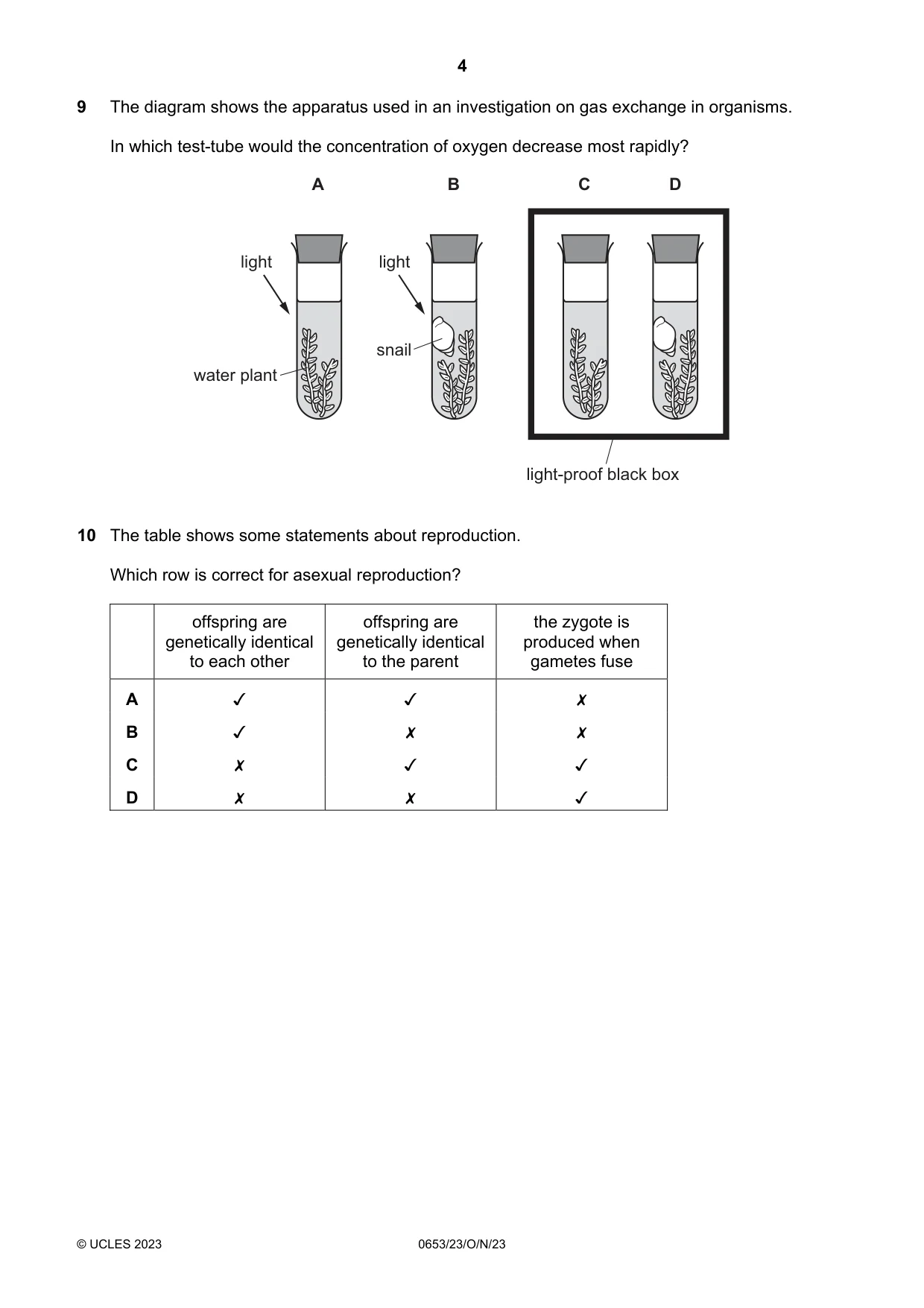
9 The diagram shows the apparatus used in an investigation on gas exchange in organisms. In which test-tube would the concentration of oxygen decrease most rapidly? A B C D light light snail water plant light-proof black box
Mark scheme: D
Q10 · The table shows some statements about reproduction
10 The table shows some statements about reproduction. Which row is correct for asexual reproduction? offspring are offspring are the zygote is genetically identical | genetically identical produced when to each other to the parent gametes fuse A v v x B v x x Cc x v v D x x v
Mark scheme: A
Q11 · The diagram shows an insect-pollinated flower
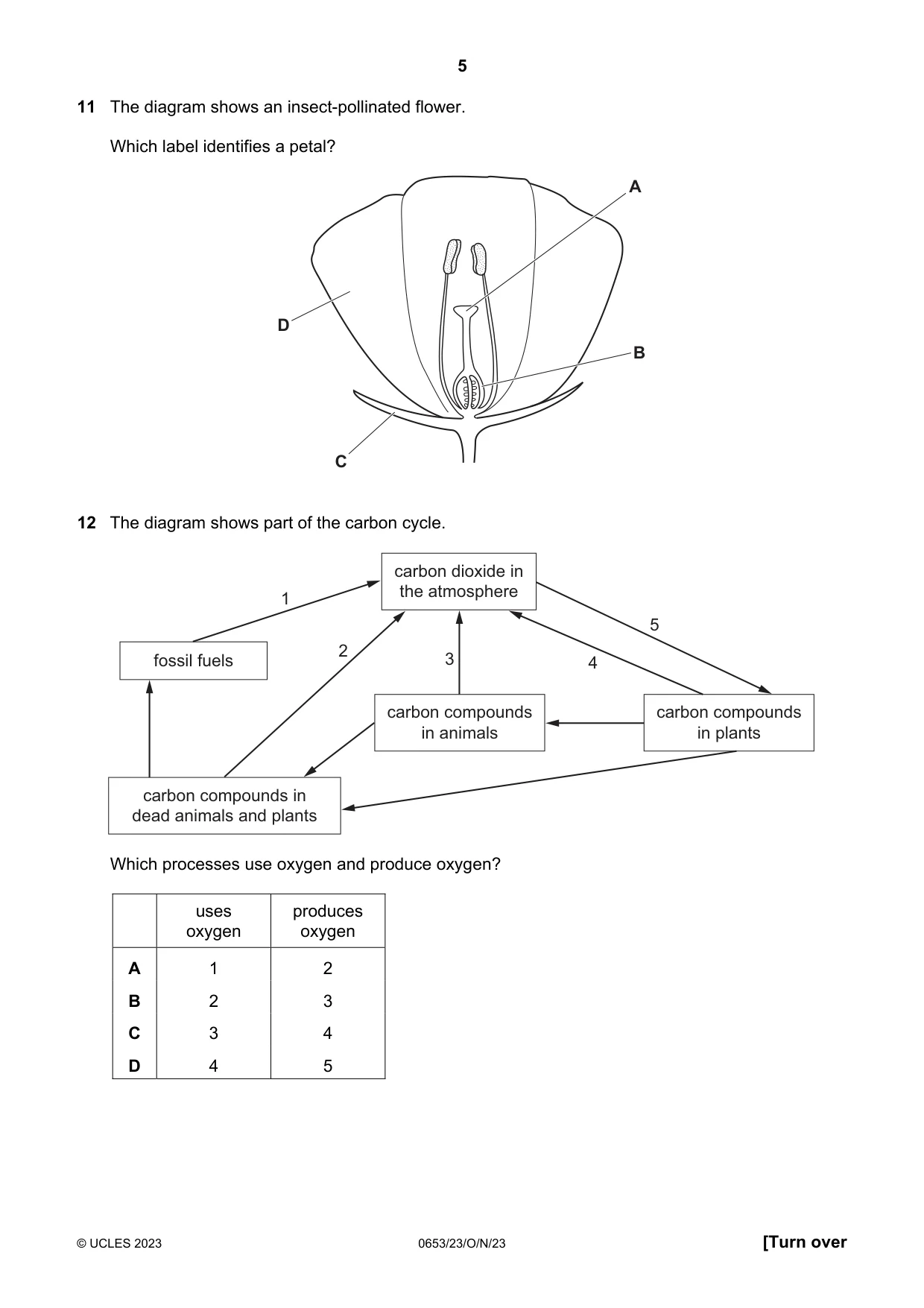
11 The diagram shows an insect-pollinated flower. Which label identifies a petal? A D B C
Mark scheme: D
Q12 · The diagram shows part of the carbon cycle
12 The diagram shows part of the carbon cycle. carbon dioxide in 1 the atmosphere 5 2 fossil fuels 3 4 carbon compounds carbon compounds in animals in plants carbon compounds in dead animals and plants Which processes use oxygen and produce oxygen? uses produces oxygen oxygen A 1 2 B 2 3 C 3 4 D 4 5
Mark scheme: D
Q13 · What occurs as a result of eutrophication?
13 What occurs as a result of eutrophication? A There is a decrease in the availability of nitrate ions. B There is a decrease in the availability of oxygen molecules. C There is a decrease in the growth rate of producers. D There is a decrease in the rate of decomposition.
Mark scheme: B
Q14 · Which diagram represents a covalent molecule containing three different types of atom?
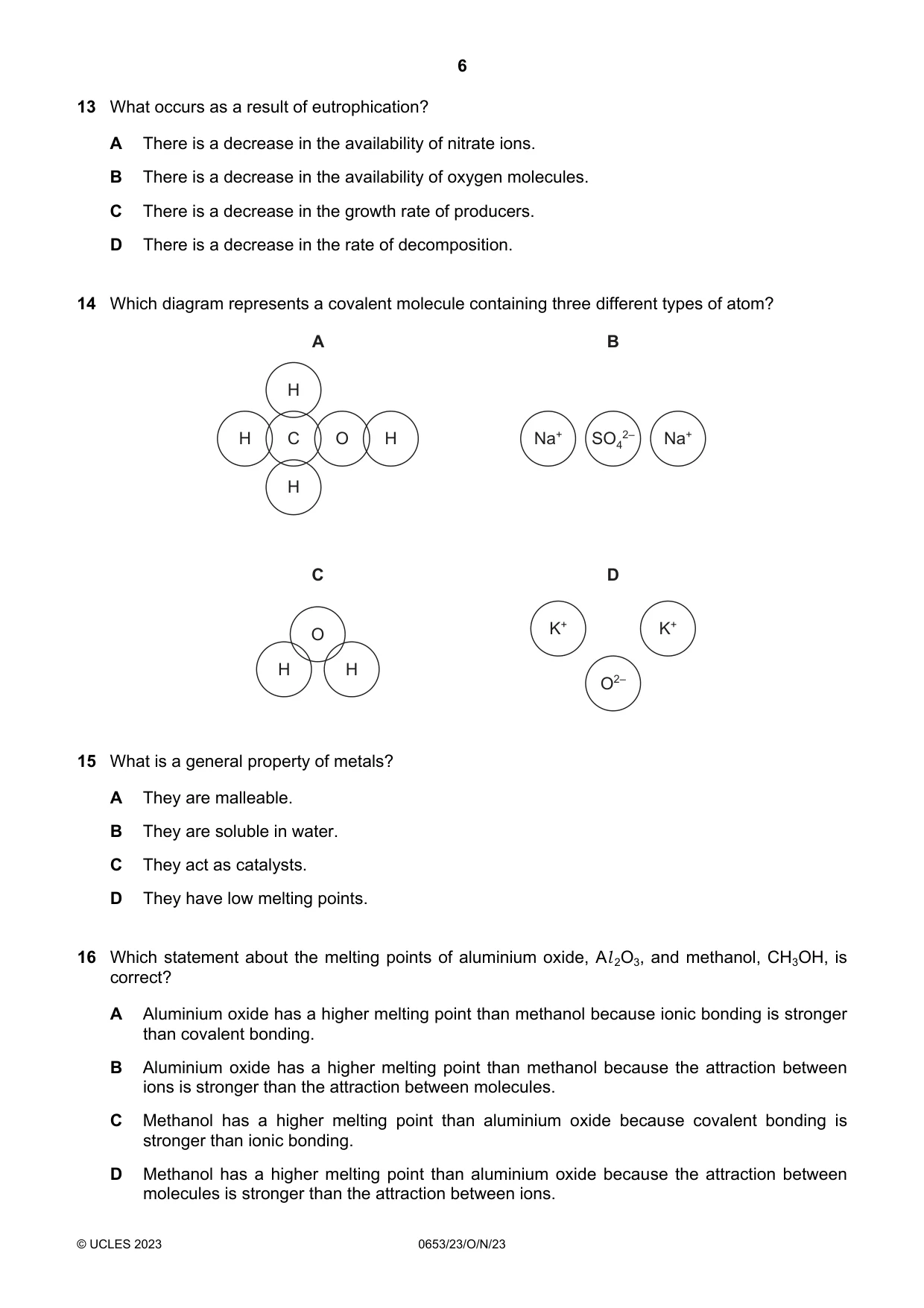
14 Which diagram represents a covalent molecule containing three different types of atom? A B H H C O H Na+ SO4 2– Na+ H C D O K+ K+ H H O2–
Mark scheme: A
Q15 · What is a general property of metals?
15 What is a general property of metals? A They are malleable. B They are soluble in water. C They act as catalysts. D They have low melting points.
Mark scheme: A
Q16 · Which statement about the melting points of aluminium oxide, Al 2O3, and methanol, CH3OH…
16 Which statement about the melting points of aluminium oxide, Al 2O3, and methanol, CH3OH, is correct? A Aluminium oxide has a higher melting point than methanol because ionic bonding is stronger than covalent bonding. B Aluminium oxide has a higher melting point than methanol because the attraction between ions is stronger than the attraction between molecules. C Methanol has a higher melting point than aluminium oxide because covalent bonding is stronger than ionic bonding. D Methanol has a higher melting point than aluminium oxide because the attraction between molecules is stronger than the attraction between ions.
Mark scheme: B
Q17 · Aqueous lead nitrate and aqueous sodium chloride react to form aqueous sodium nitrate and…
17 Aqueous lead nitrate and aqueous sodium chloride react to form aqueous sodium nitrate and solid lead chloride. What is the ionic equation for this reaction? A Pb2+(aq) + Cl 2–(aq) PbCl (s) B Pb2+(aq) + 2Cl –(aq) PbCl 2(s) C Na+(aq) + NO3 –(aq) NaNO3(aq) D Na+(aq) + 2NO3 –(aq) Na(NO3)2(aq)
Mark scheme: B
Q18 · Which energy level diagram identifies the activation energy and the energy change for an…
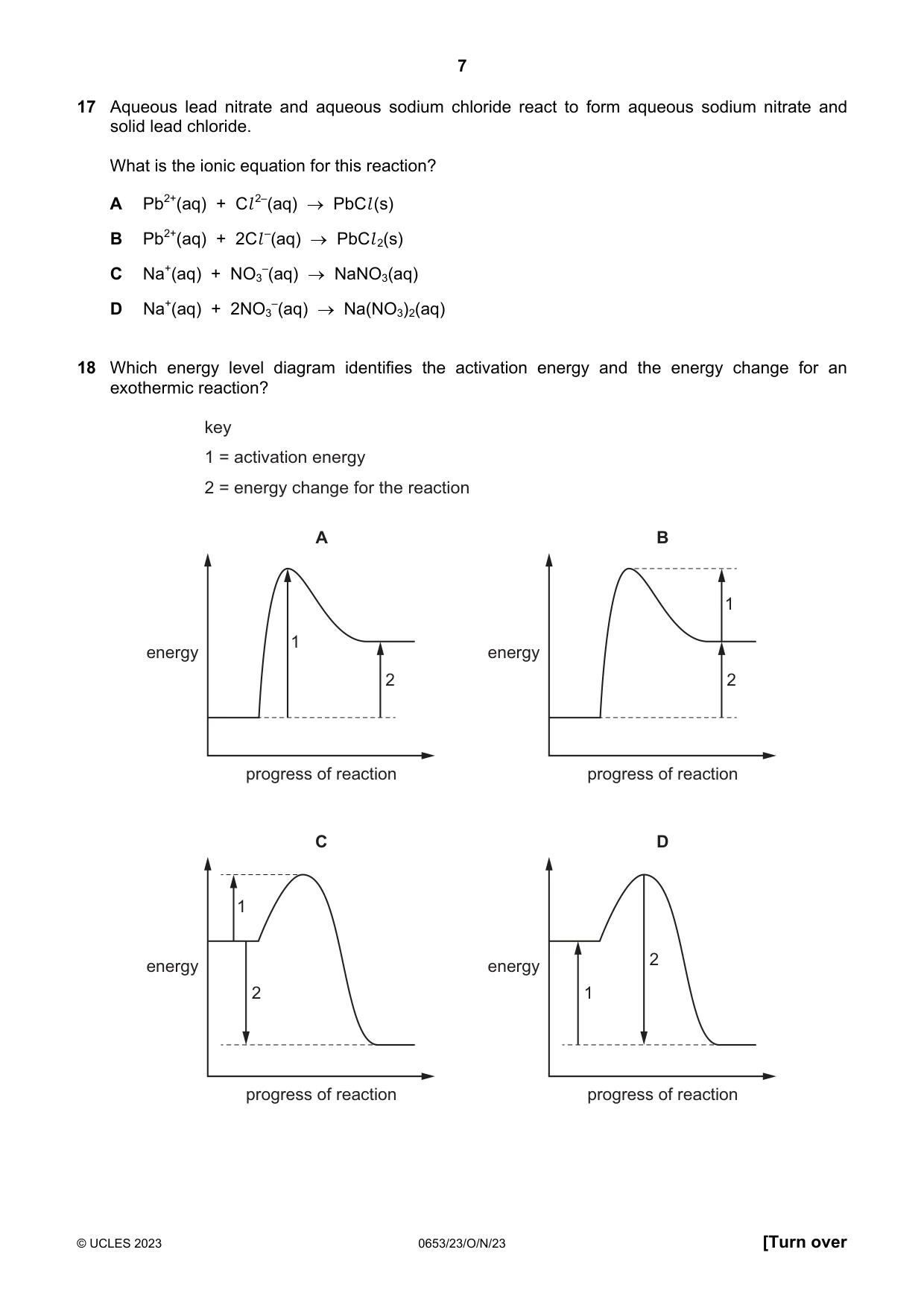
18 Which energy level diagram identifies the activation energy and the energy change for an exothermic reaction? key 1 = activation energy 2 = energy change for the reaction A B 1 1 energy energy 2 2 progress of reaction progress of reaction C D 1 energy energy 2 2 1 progress of reaction progress of reaction
Mark scheme: C
Q19 · Rutile is an ore of titanium
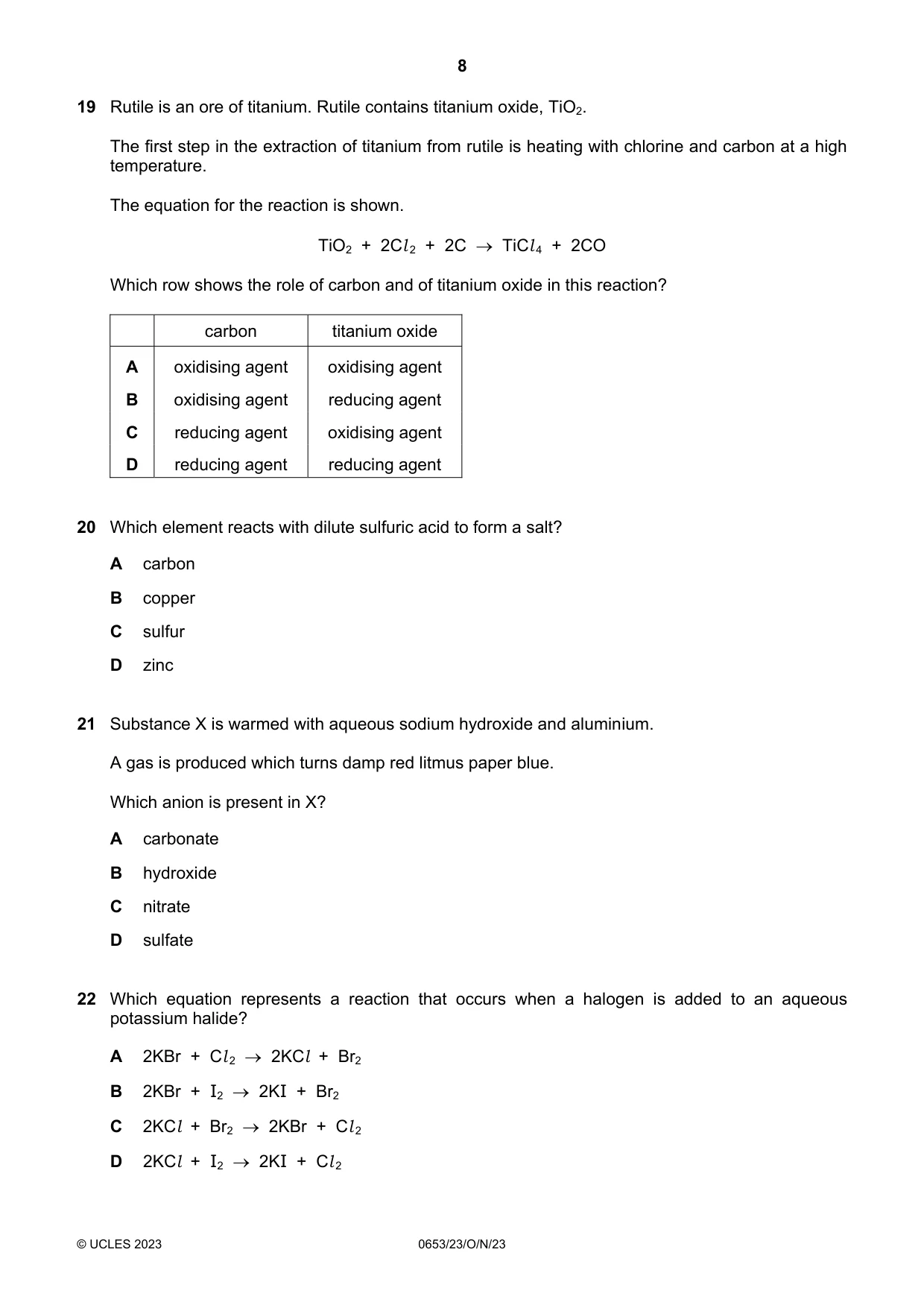
19 Rutile is an ore of titanium. Rutile contains titanium oxide, TiO2. The first step in the extraction of titanium from rutile is heating with chlorine and carbon at a high temperature. The equation for the reaction is shown. TiO2 + 2Cl 2 + 2C TiCl 4 + 2CO Which row shows the role of carbon and of titanium oxide in this reaction? carbon titanium oxide A oxidising agent oxidising agent B oxidising agent reducing agent C reducing agent oxidising agent D reducing agent reducing agent
Mark scheme: C
Q20 · Which element reacts with dilute sulfuric acid to form a salt?
20 Which element reacts with dilute sulfuric acid to form a salt? A carbon B copper C sulfur D zinc
Mark scheme: D
Q21 · Substance X is warmed with aqueous sodium hydroxide and aluminium
21 Substance X is warmed with aqueous sodium hydroxide and aluminium. A gas is produced which turns damp red litmus paper blue. Which anion is present in X? A carbonate B hydroxide C nitrate D sulfate
Mark scheme: C
Q22 · Which equation represents a reaction that occurs when a halogen is added to an aqueous…
22 Which equation represents a reaction that occurs when a halogen is added to an aqueous potassium halide? A 2KBr + Cl 2 2KCl + Br2 B 2KBr + I2 2KI + Br2 C 2KCl + Br2 2KBr + Cl 2 D 2KCl + I2 2KI + Cl 2
Mark scheme: A
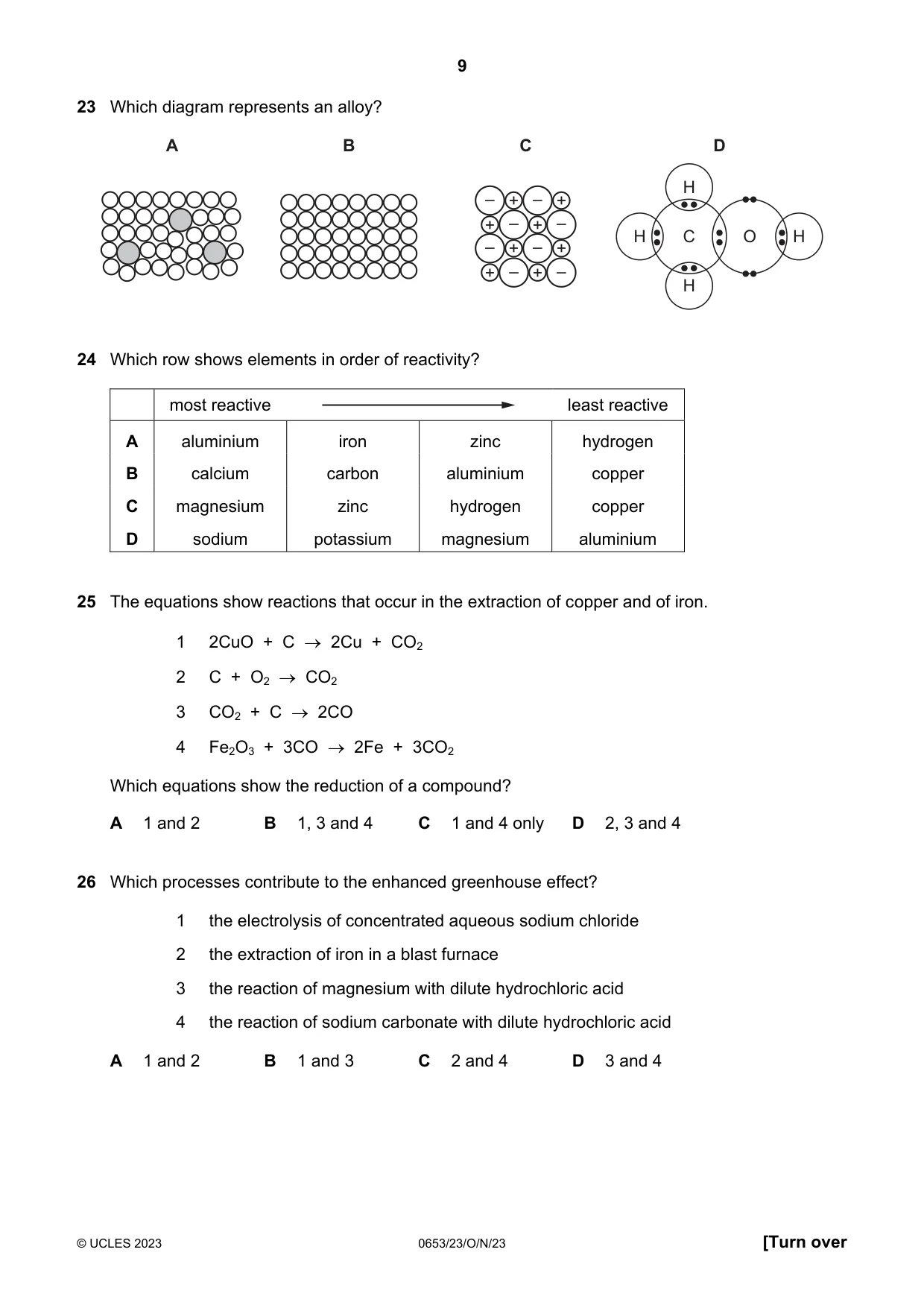
Q23 · Which diagram represents an alloy?
23 Which diagram represents an alloy? A B C D H – + – + + – + – H C O H – + – + + – + – H
Mark scheme: A
Q24 · Which row shows elements in order of reactivity?
24 Which row shows elements in order of reactivity? most reactive least reactive A aluminium iron zinc hydrogen B calcium carbon aluminium copper C magnesium zinc hydrogen copper D sodium potassium magnesium aluminium
Mark scheme: C
Q25 · The equations show reactions that occur in the extraction of copper and of iron
25 The equations show reactions that occur in the extraction of copper and of iron. 1 2CuO + C 2Cu + CO2 2 C + O2 CO2 3 CO2 + C 2CO 4 Fe2O3 + 3CO 2Fe + 3CO2 Which equations show the reduction of a compound? A 1 and 2 B 1, 3 and 4 C 1 and 4 only D 2, 3 and 4
Mark scheme: B
Q26 · Which processes contribute to the enhanced greenhouse effect?
26 Which processes contribute to the enhanced greenhouse effect? 1 the electrolysis of concentrated aqueous sodium chloride 2 the extraction of iron in a blast furnace 3 the reaction of magnesium with dilute hydrochloric acid 4 the reaction of sodium carbonate with dilute hydrochloric acid A 1 and 2 B 1 and 3 C 2 and 4 D 3 and 4
Mark scheme: C
Q27 · Which statement about alkanes is correct?
27 Which statement about alkanes is correct? A They are unsaturated hydrocarbons. B They are very reactive. C They burn to form carbon dioxide and hydrogen. D They contain only single covalent bonds.
Mark scheme: D
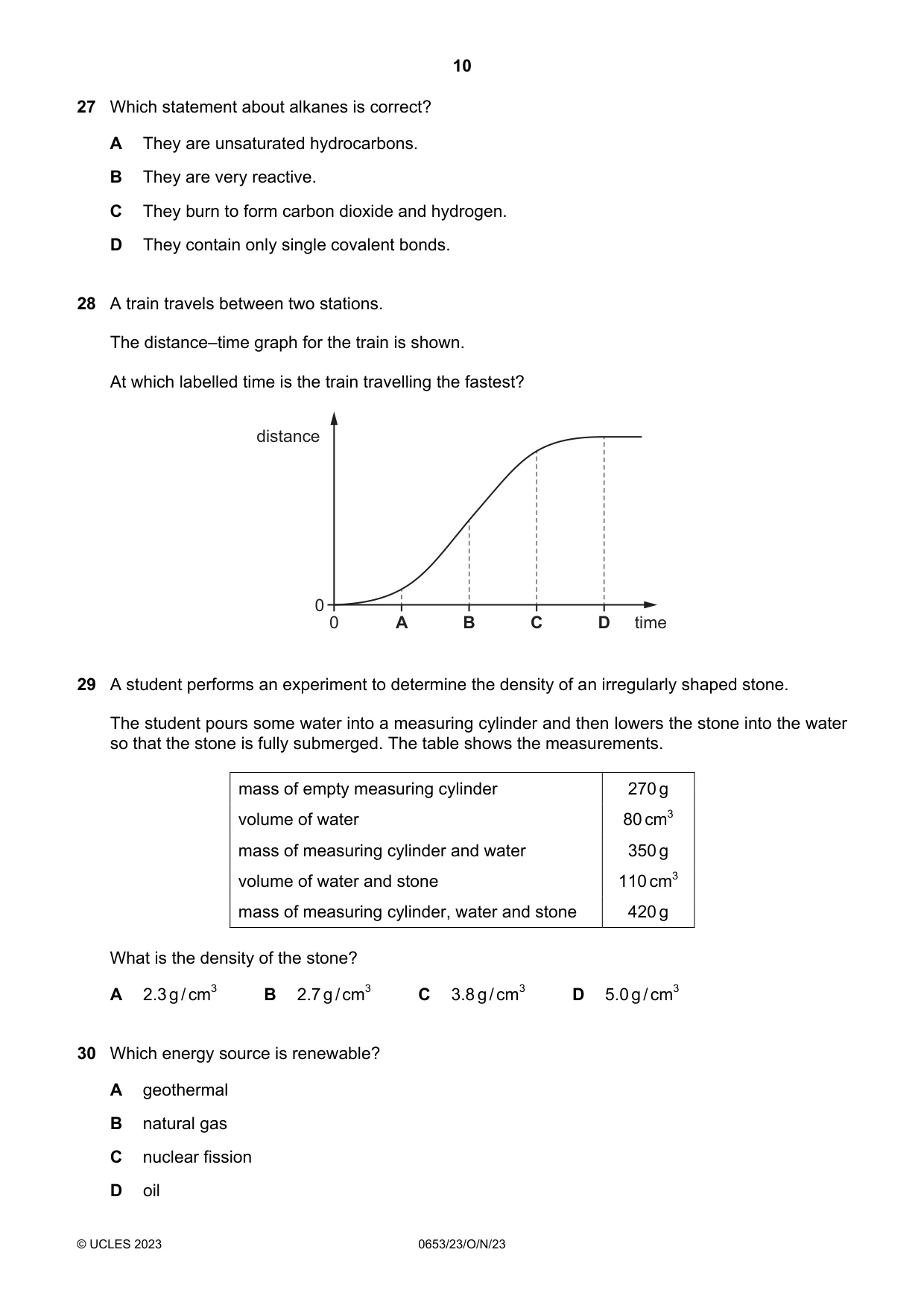
Q28 · A train travels between two stations
28 A train travels between two stations. The distance–time graph for the train is shown. At which labelled time is the train travelling the fastest? distance 0 0 A B C D time
Mark scheme: B
Q29 · A student performs an experiment to determine the density of an irregularly shaped stone
29 A student performs an experiment to determine the density of an irregularly shaped stone. The student pours some water into a measuring cylinder and then lowers the stone into the water so that the stone is fully submerged. The table shows the measurements. mass of empty measuring cylinder 270 g volume of water 80 cm3 mass of measuring cylinder and water 350 g volume of water and stone 110 cm3 mass of measuring cylinder, water and stone 420 g What is the density of the stone? A 2.3 g / cm3 B 2.7 g / cm3 C 3.8 g / cm3 D 5.0 g / cm3
Mark scheme: A
Q30 · Which energy source is renewable?
30 Which energy source is renewable? A geothermal B natural gas C nuclear fission D oil
Mark scheme: A
Q31 · What is the main energy transfer that takes place in the Sun?
31 What is the main energy transfer that takes place in the Sun? A chemical potential energy to thermal energy B thermal energy to chemical potential energy C thermal energy to nuclear energy D nuclear energy to thermal energy
Mark scheme: D
Q32 · Which row describes the arrangement and separation of the particles in a liquid?
32 Which row describes the arrangement and separation of the particles in a liquid? arrangement of particles separation of particles A random closer than in a gas B random further apart than in a gas C regular closer than in a gas D regular further apart than in a gas
Mark scheme: A
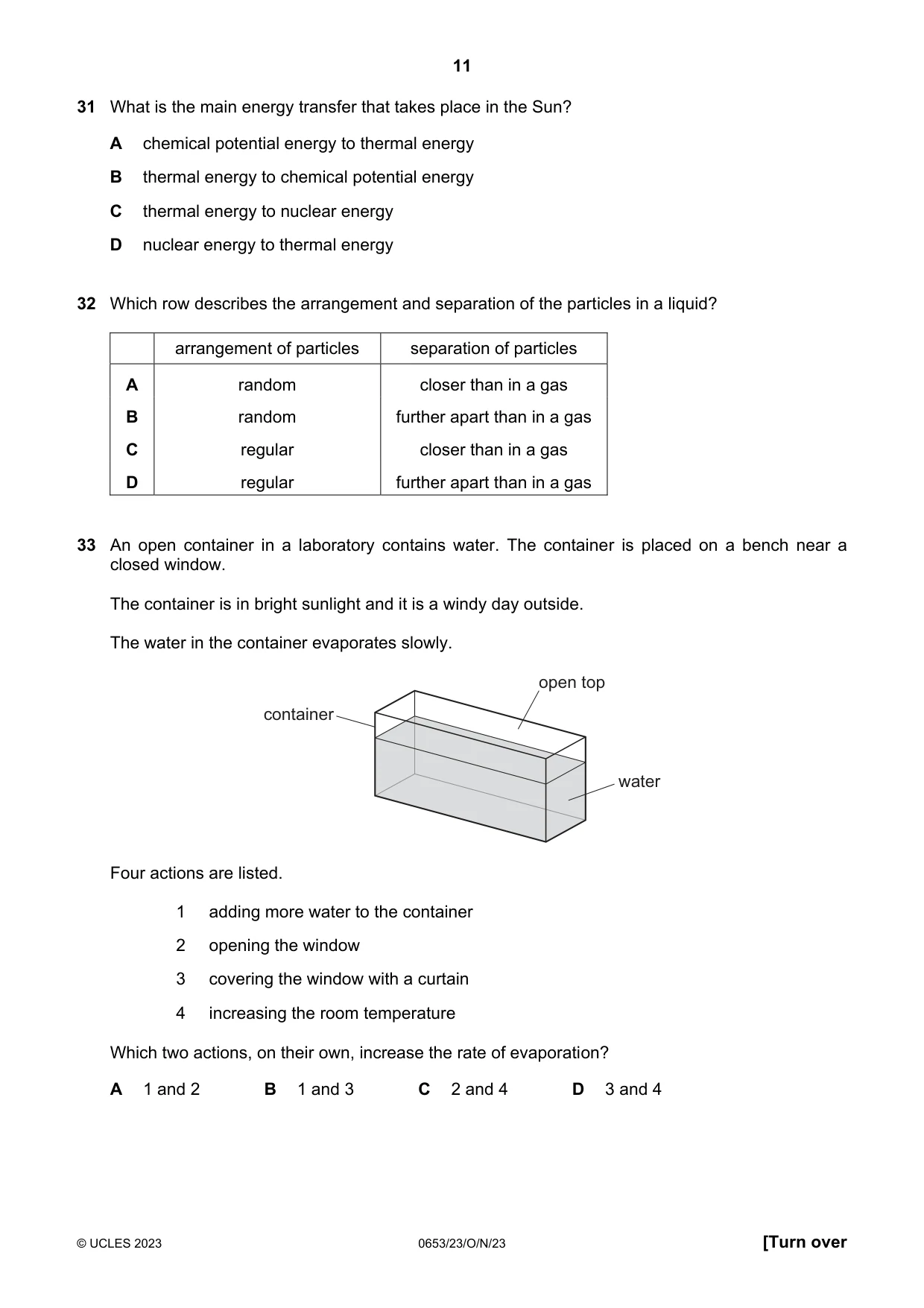
Q33 · An open container in a laboratory contains water
33 An open container in a laboratory contains water. The container is placed on a bench near a closed window. The container is in bright sunlight and it is a windy day outside. The water in the container evaporates slowly. open top container water Four actions are listed. 1 adding more water to the container 2 opening the window 3 covering the window with a curtain 4 increasing the room temperature Which two actions, on their own, increase the rate of evaporation? A 1 and 2 B 1 and 3 C 2 and 4 D 3 and 4
Mark scheme: C
Q34 · A sound wave travels in air
34 A sound wave travels in air. What is the name of the region of the wave where the separation of particles is greatest? A compression B medium C rarefaction D reflection
Mark scheme: C
Q35 · A loudspeaker vibrates with different amplitudes and at different frequencies to make a…
35 A loudspeaker vibrates with different amplitudes and at different frequencies to make a sound. Which amplitude and frequency produces the louder, higher-pitched sound? A large amplitude and high frequency B large amplitude and low frequency C small amplitude and high frequency D small amplitude and low frequency
Mark scheme: A
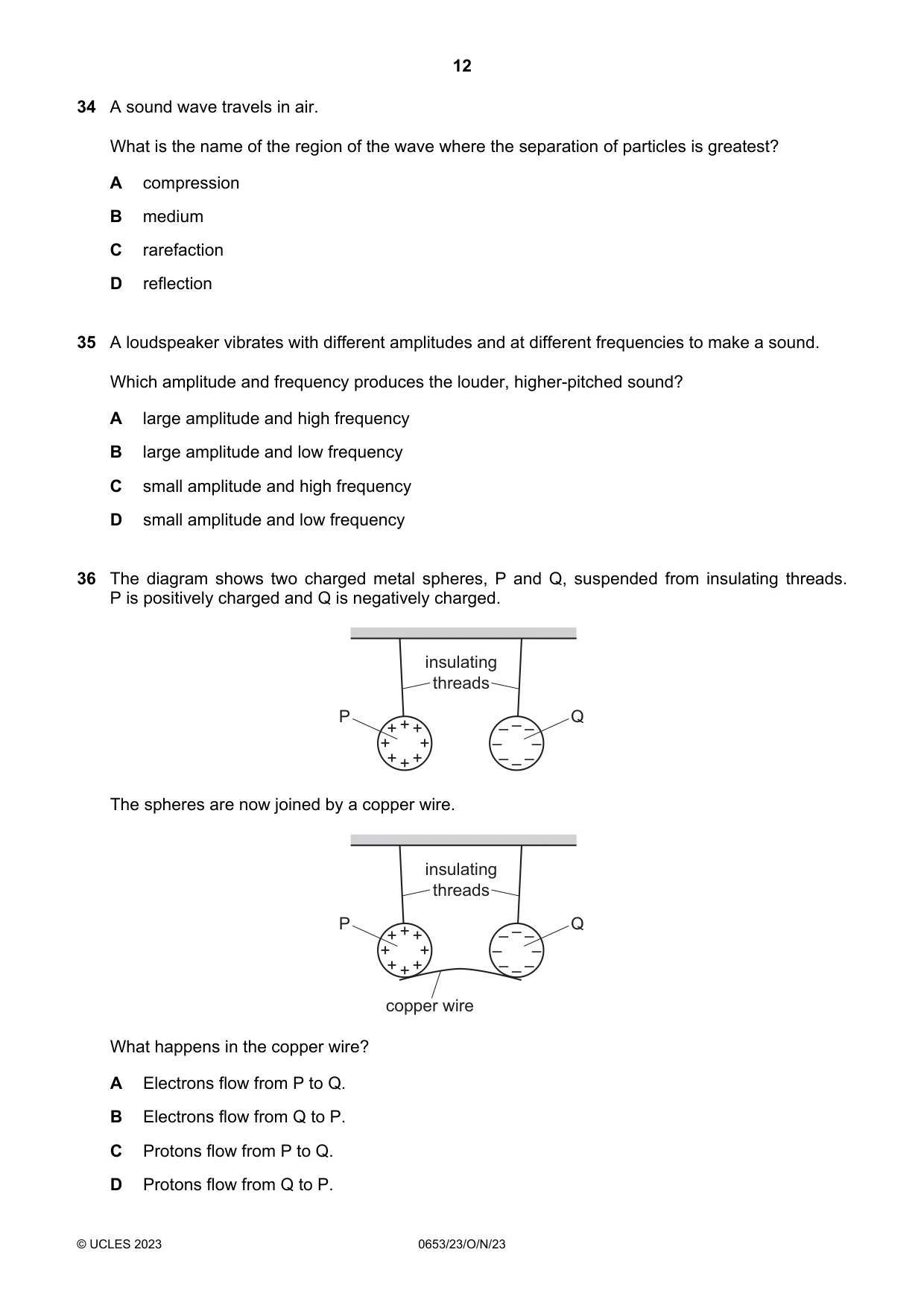
Q36 · The diagram shows two charged metal spheres, P and Q, suspended from insulating threads
36 The diagram shows two charged metal spheres, P and Q, suspended from insulating threads. P is positively charged and Q is negatively charged. insulating threads P + – Q + + – – + + – – + + + – – – The spheres are now joined by a copper wire. insulating threads P + – Q + + – – + + – – + + + – – – copper wire What happens in the copper wire? A Electrons flow from P to Q. B Electrons flow from Q to P. C Protons flow from P to Q. D Protons flow from Q to P.
Mark scheme: B
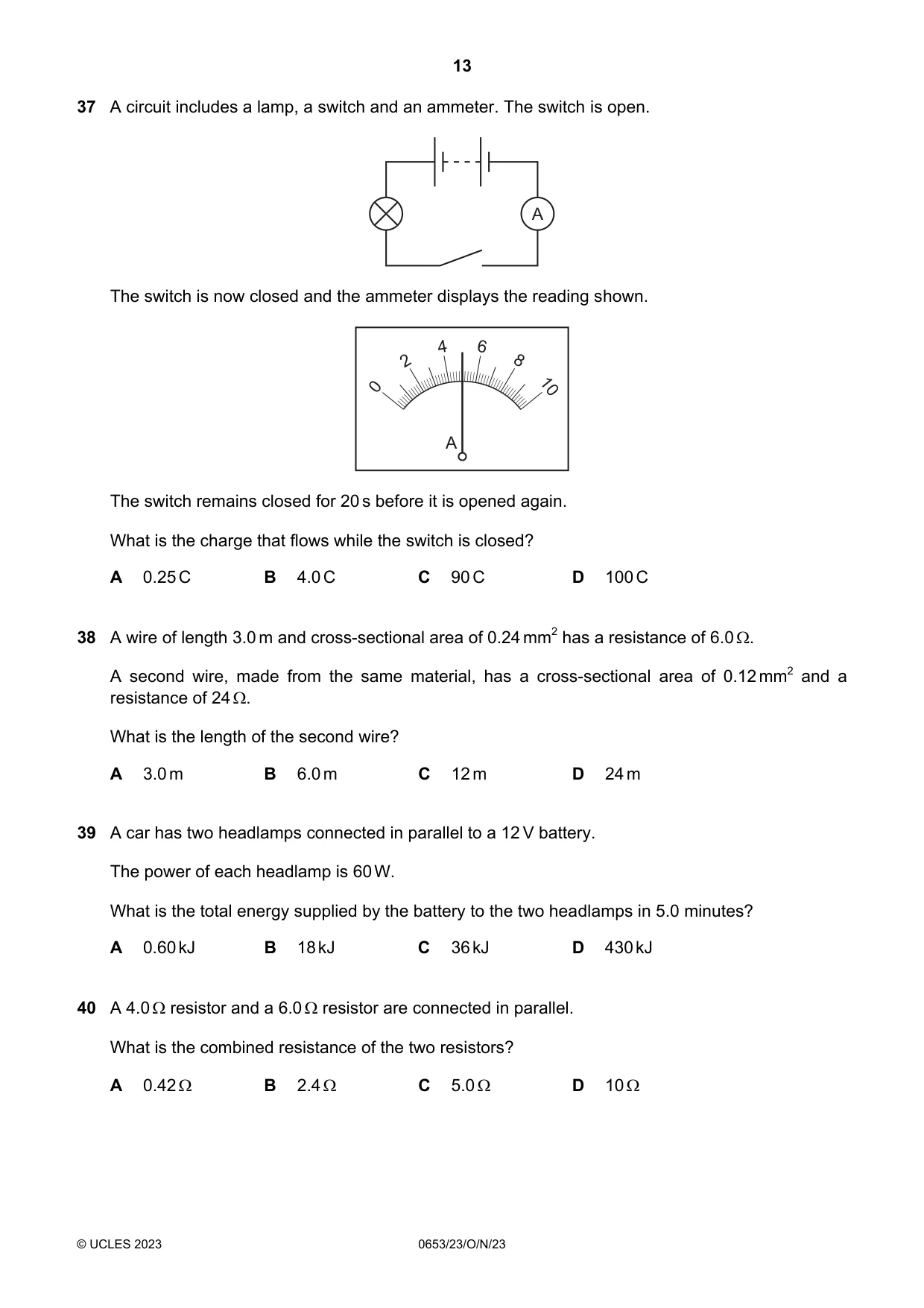
Q37 · A circuit includes a lamp, a switch and an ammeter
37 A circuit includes a lamp, a switch and an ammeter. The switch is open. A The switch is now closed and the ammeter displays the reading shown. 4 6 2 8 0 10 A The switch remains closed for 20 s before it is opened again. What is the charge that flows while the switch is closed? A 0.25 C B 4.0 C C 90 C D 100 C
Mark scheme: D
Q38 · A wire of length 3.0 m and cross-sectional area of 0.24 mm2 has a resistance of 6.0
38 A wire of length 3.0 m and cross-sectional area of 0.24 mm2 has a resistance of 6.0 . A second wire, made from the same material, has a cross-sectional area of 0.12 mm2 and a resistance of 24 . What is the length of the second wire? A 3.0 m B 6.0 m C 12 m D 24 m
Mark scheme: B
Q39 · A car has two headlamps connected in parallel to a 12 V battery
39 A car has two headlamps connected in parallel to a 12 V battery. The power of each headlamp is 60 W. What is the total energy supplied by the battery to the two headlamps in 5.0 minutes? A 0.60 kJ B 18 kJ C 36 kJ D 430 kJ
Mark scheme: C
Q40 · A 4.0 resistor and a 6.0 resistor are connected in parallel
40 A 4.0 resistor and a 6.0 resistor are connected in parallel. What is the combined resistance of the two resistors? A 0.42 B 2.4 C 5.0 D 10
Mark scheme: B
What was in this paper
The subtopics covered by these 40 questions, and how many questions each got. Open one in a new tab to see every Cambridge question on it.
4Identification of ions and gases2Kinetic particle model of matter2Reactivity series2Redox2Sexual reproduction in plants2Simple molecules and covalent bonds2Sound2Xylem and phloem2Air quality and climate1Alkanes1Alloys and their properties1Biological molecules1Carbon cycle1Density1Diffusion1Digestion1Electrical circuits1Energy, work and power1Enzymes1Exothermic and endothermic reactions1Gas exchange in humans1Group VII properties1Habitat destruction1Motion1Photosynthesis1Properties of metals1Stars and the Universe1Transpiration1What you needed in this session
Cambridge’s own grade thresholds for 2023 Oct/Nov, Paper 2 · Variant 3. A higher threshold means an easier paper — the bar moves with how the cohort did.