Cambridge IGCSE Science - Combined 0653 — 2023 May/June Paper 2 · Variant 3
0653/23/M/J/23 · 40 questions · 40 marks · ≈45 min
The question paper and its mark scheme, free to read here and free to download. This is Cambridge’s own paper, exactly as it was sat.
Question paper16 pages


Mark scheme3 pages
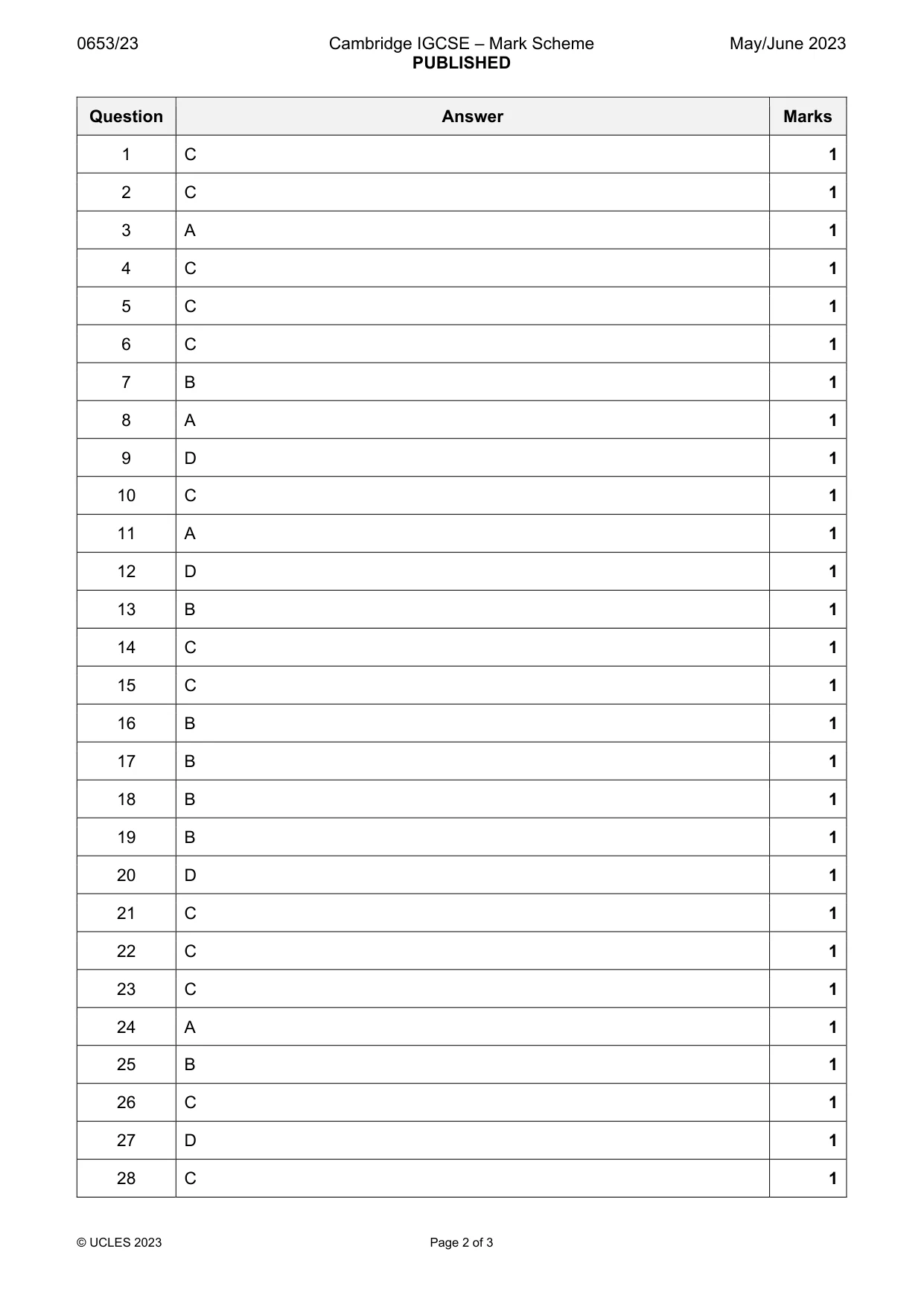
Answers below. Sit the paper first if you are practising.
Questions as text
Q1 · What is a characteristic of all living things?
1 What is a characteristic of all living things? A egestion B ingestion C nutrition D photosynthesis
Mark scheme: C
Q2 · Which structure is found only in plant cells?
2 Which structure is found only in plant cells? A cell membrane B cytoplasm C large vacuole D nucleus
Mark scheme: C
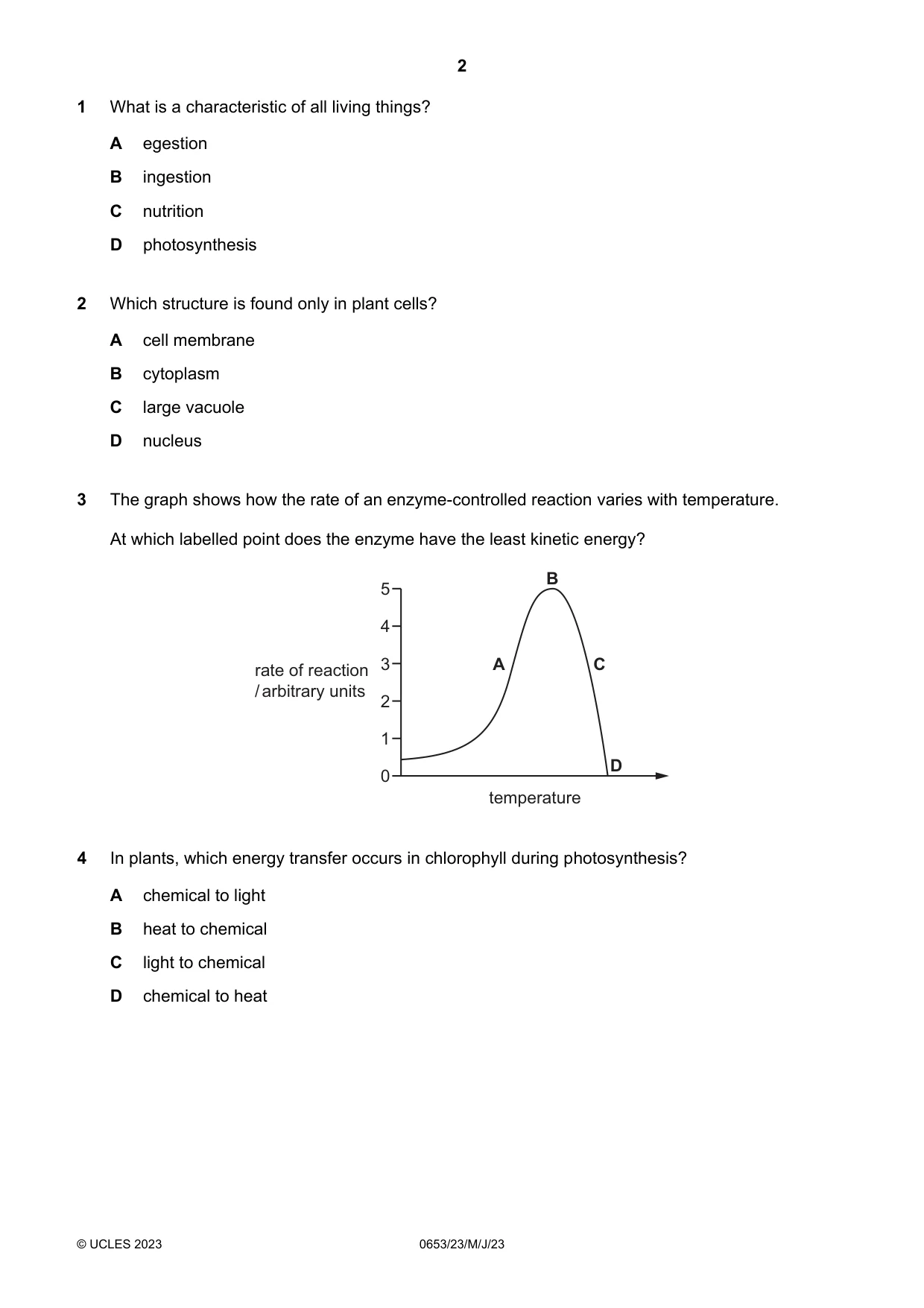
Q3 · The graph shows how the rate of an enzyme-controlled reaction varies with temperature
3 The graph shows how the rate of an enzyme-controlled reaction varies with temperature. At which labelled point does the enzyme have the least kinetic energy? B 5 4 3 A C rate of reaction / arbitrary units 2 1 D 0 temperature
Mark scheme: A
Q4 · In plants, which energy transfer occurs in chlorophyll during photosynthesis?
4 In plants, which energy transfer occurs in chlorophyll during photosynthesis? A chemical to light B heat to chemical C light to chemical D chemical to heat
Mark scheme: C
Q5 · Which row matches the part of the alimentary canal to its function?
5 Which row matches the part of the alimentary canal to its function? part of the function of part alimentary canal A anus absorption B oesophagus digestion C mouth ingestion D small intestines egestion
Mark scheme: C
Q6 · The list gives two ways in which an environment changes
6 The list gives two ways in which an environment changes. 1 humidity increases 2 temperature increases Which changes cause an increase in the rate of transpiration of plants? 1 2 A v v key B Jv x ¥ = increase in rate of transpiration Cc x v X = decrease in rate of transpiration D x x
Mark scheme: C
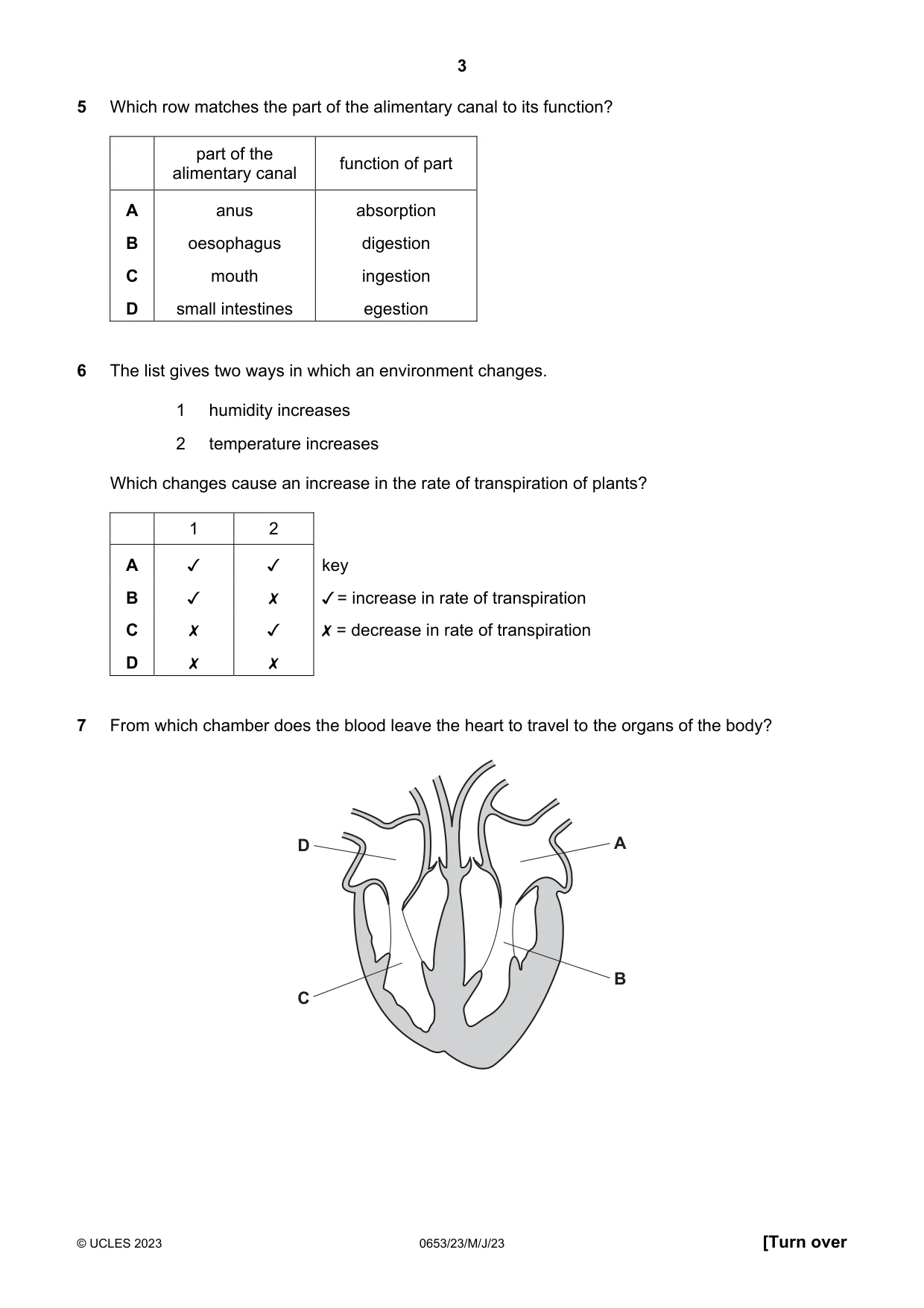
Q7 · From which chamber does the blood leave the heart to travel to the organs of the body?
7 From which chamber does the blood leave the heart to travel to the organs of the body? D A B C
Mark scheme: B
Q8 · Which processes require energy?
8 Which processes require energy? 1 growth 2 maintenance of body temperature 3 protein synthesis A 1, 2 and 3 B 1 only C 2 and 3 only D 3 only
Mark scheme: A
Q9 · What is caused by the secretion of adrenaline?
9 What is caused by the secretion of adrenaline? blood glucose pulse rate pupil size concentration A decreases decreases increases B decreases increases decreases C increases decreases decreases D increases increases increases
Mark scheme: D
Q10 · Which definition of asexual reproduction is correct?
10 Which definition of asexual reproduction is correct? A production of genetically different offspring from one parent B production of genetically different offspring from two parents C production of genetically identical offspring from one parent D production of genetically identical offspring from two parents
Mark scheme: C
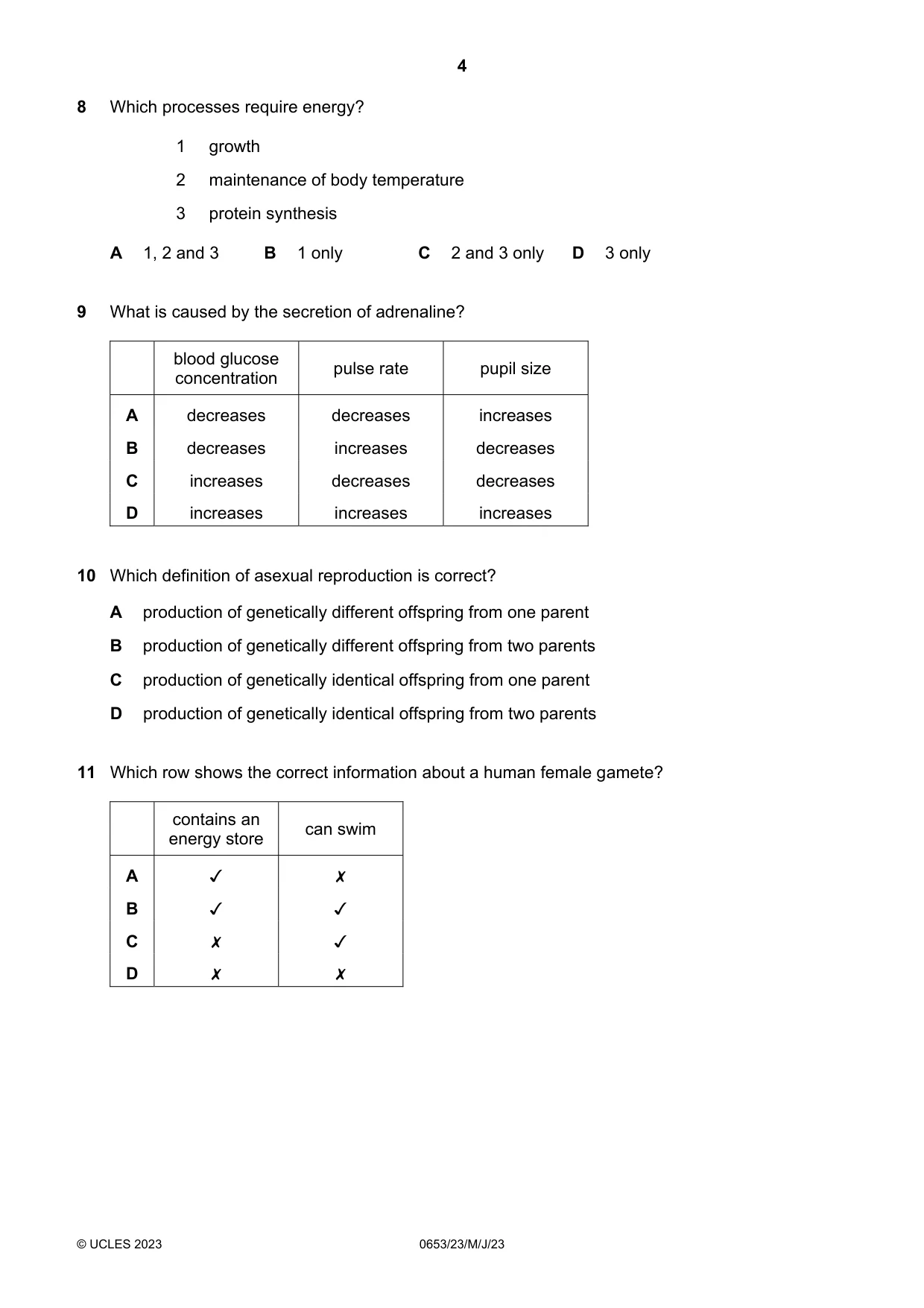
Q11 · Which row shows the correct information about a human female gamete?
11. Which row shows the correct information about a human female gamete? v x v v x v x x
Mark scheme: A
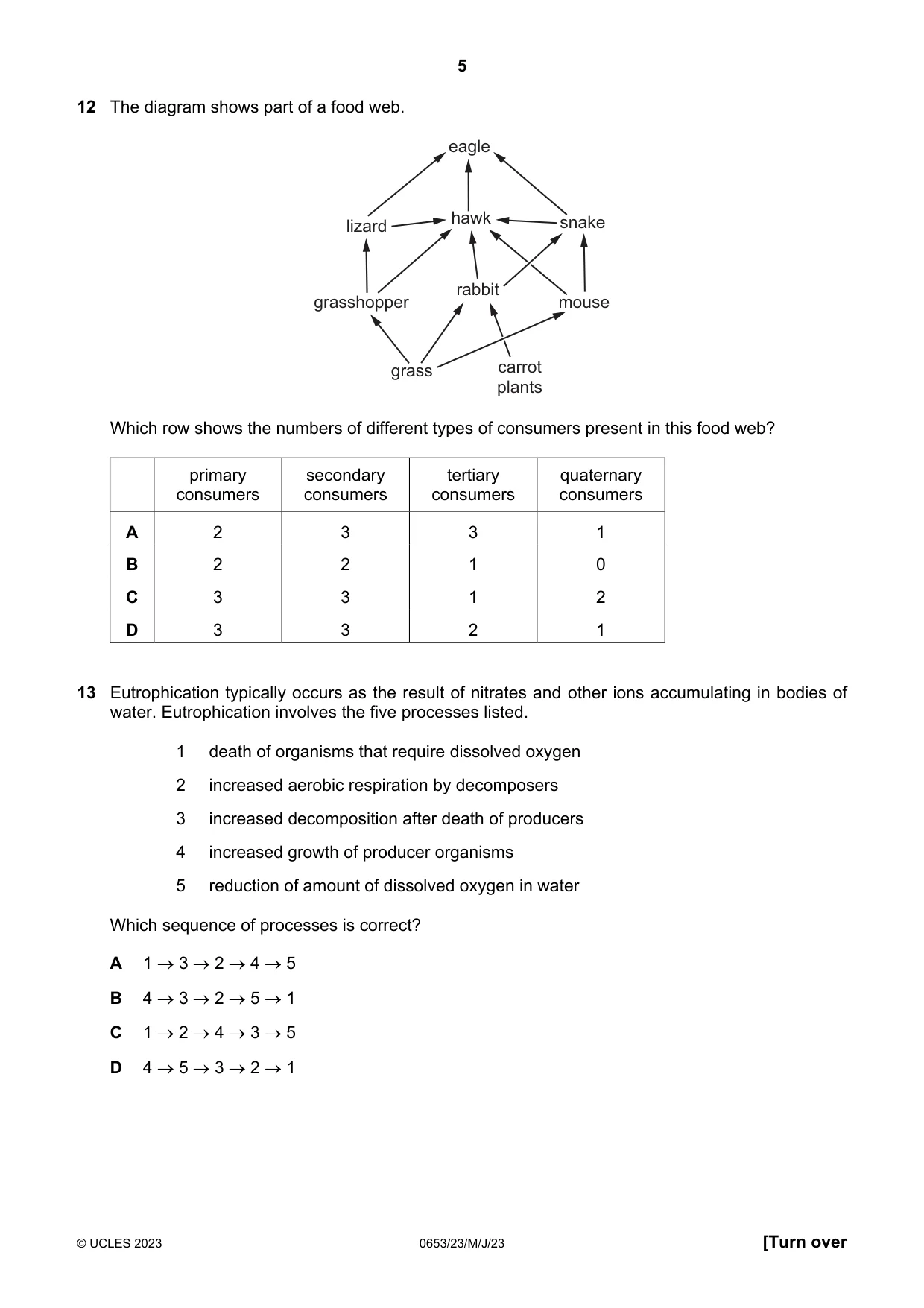
Q12 · The diagram shows part of a food web
12 The diagram shows part of a food web. eagle hawk snake lizard rabbit grasshopper mouse grass carrot plants Which row shows the numbers of different types of consumers present in this food web? primary secondary tertiary quaternary consumers consumers consumers consumers A 2 3 3 1 B 2 2 1 0 C 3 3 1 2 D 3 3 2 1
Mark scheme: D
Q13 · Eutrophication typically occurs as the result of nitrates and other ions accumulating in…
13 Eutrophication typically occurs as the result of nitrates and other ions accumulating in bodies of water. Eutrophication involves the five processes listed. 1 death of organisms that require dissolved oxygen 2 increased aerobic respiration by decomposers 3 increased decomposition after death of producers 4 increased growth of producer organisms 5 reduction of amount of dissolved oxygen in water Which sequence of processes is correct? A 1 3 2 4 5 B 4 3 2 5 1 C 1 2 4 3 5 D 4 5 3 2 1
Mark scheme: B
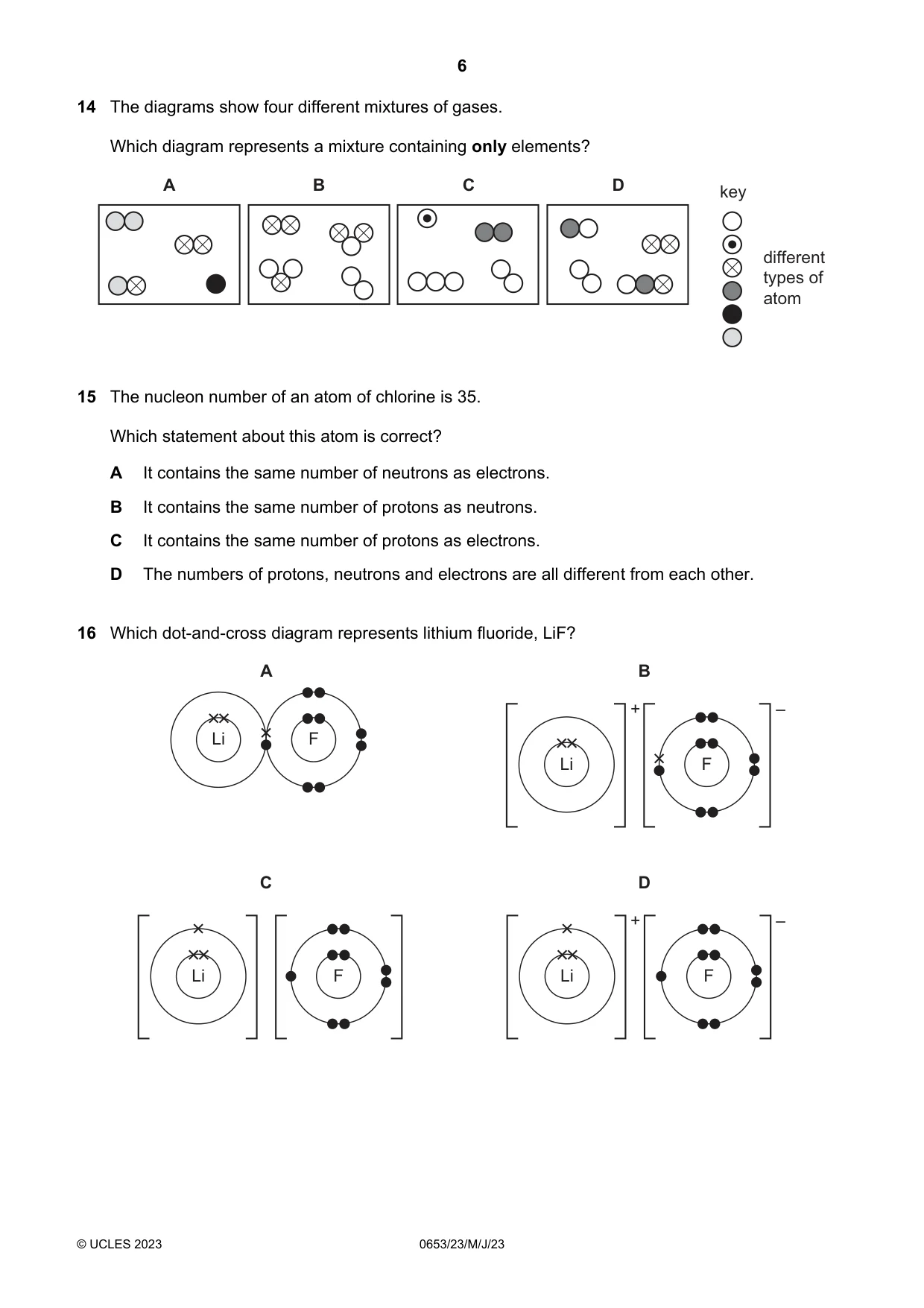
Q14 · The diagrams show four different mixtures of gases
14 The diagrams show four different mixtures of gases. Which diagram represents a mixture containing only elements? A B C D key different types of atom
Mark scheme: C
Q15 · The nucleon number of an atom of chlorine is 35
15 The nucleon number of an atom of chlorine is 35. Which statement about this atom is correct? A It contains the same number of neutrons as electrons. B It contains the same number of protons as neutrons. C It contains the same number of protons as electrons. D The numbers of protons, neutrons and electrons are all different from each other.
Mark scheme: C
Q16 · Which dot-and-cross diagram represents lithium fluoride, LiF?
16 Which dot-and-cross diagram represents lithium fluoride, LiF? A B + – Li F Li F C D + – Li F Li F
Mark scheme: B
Q17 · Aqueous sodium sulfate reacts with aqueous barium chloride to make barium sulfate and…
17 Aqueous sodium sulfate reacts with aqueous barium chloride to make barium sulfate and sodium chloride. What is the ionic equation for this reaction? A Ba2+(aq) + SO4 2–(aq) BaSO4(aq) B Ba2+(aq) + SO4 2–(aq) BaSO4(s) C Na+(aq) + Cl –(aq) NaCl (s) D Na+(aq) + Cl –(aq) NaCl (aq)
Mark scheme: B
Q18 · Dilute sulfuric acid is electrolysed using inert electrodes
18 Dilute sulfuric acid is electrolysed using inert electrodes. The concentration of two ions decreases during this process. What are these ions? A hydrogen ions and oxide ions B hydrogen ions and hydroxide ions C hydroxide ions and sulfate ions D oxide ions and sulfate ions
Mark scheme: B
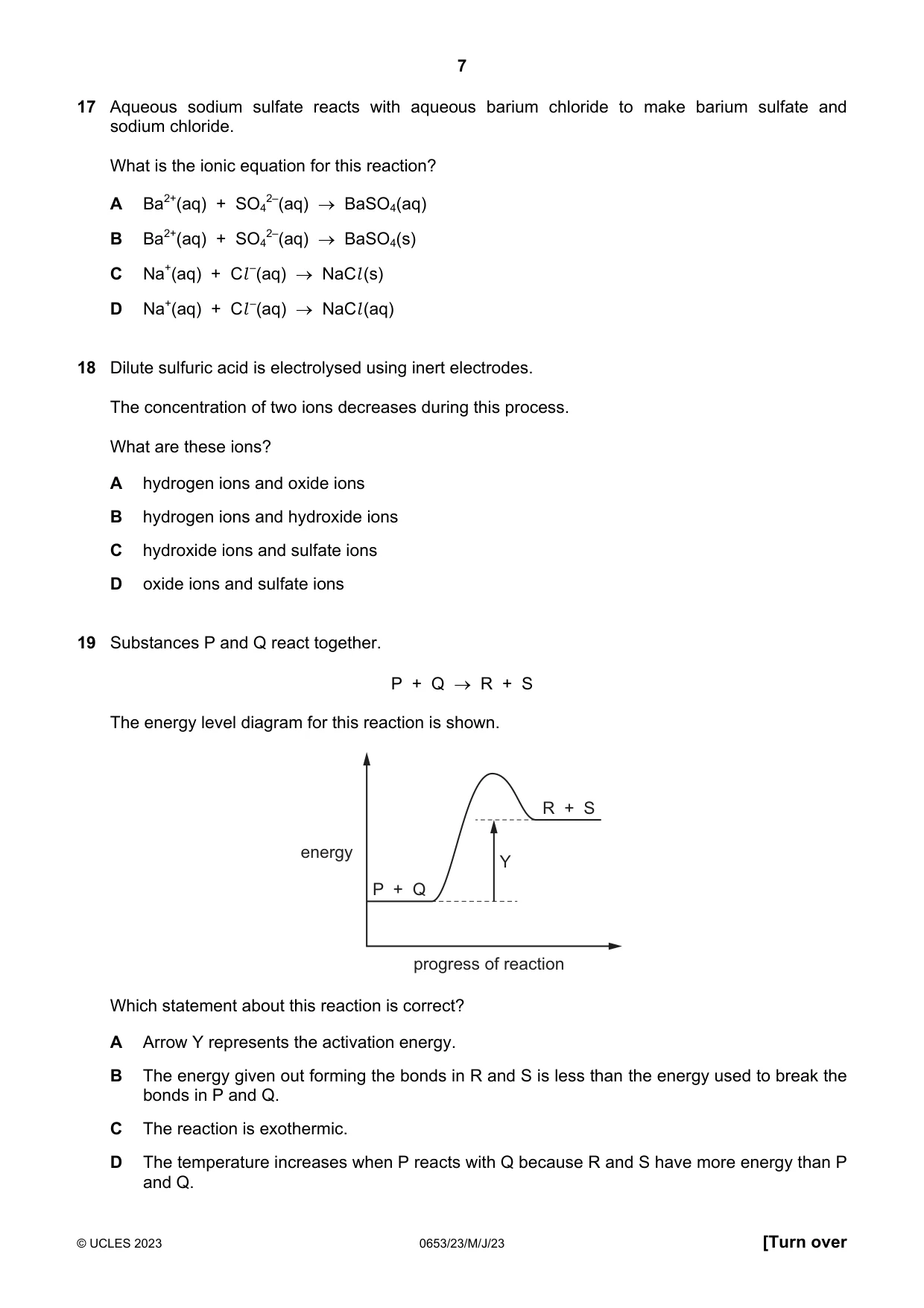
Q19 · Substances P and Q react together
19 Substances P and Q react together. P + Q R + S The energy level diagram for this reaction is shown. R + S energy Y P + Q progress of reaction Which statement about this reaction is correct? A Arrow Y represents the activation energy. B The energy given out forming the bonds in R and S is less than the energy used to break the bonds in P and Q. C The reaction is exothermic. D The temperature increases when P reacts with Q because R and S have more energy than P and Q.
Mark scheme: B
Q20 · Iron displaces copper from copper oxide
20 Iron displaces copper from copper oxide. Fe + CuO FeO + Cu Magnesium displaces iron from iron oxide. Mg + FeO Fe + MgO Which statement about these reactions is correct? A Copper oxide and iron oxide are being oxidised. B Iron is a stronger oxidising agent than copper. C Magnesium and iron are being reduced. D Magnesium is a stronger reducing agent than iron.
Mark scheme: D
Q21 · Which two substances both react with dilute sulfuric acid to make the salt magnesium…
21 Which two substances both react with dilute sulfuric acid to make the salt magnesium sulfate? A magnesium carbonate and magnesium chloride B magnesium chloride and magnesium nitrate C magnesium oxide and magnesium carbonate D magnesium oxide and magnesium nitrate
Mark scheme: C
More questions on The characteristic properties of acids and bases
Q22 · The results of two tests on a white solid are shown
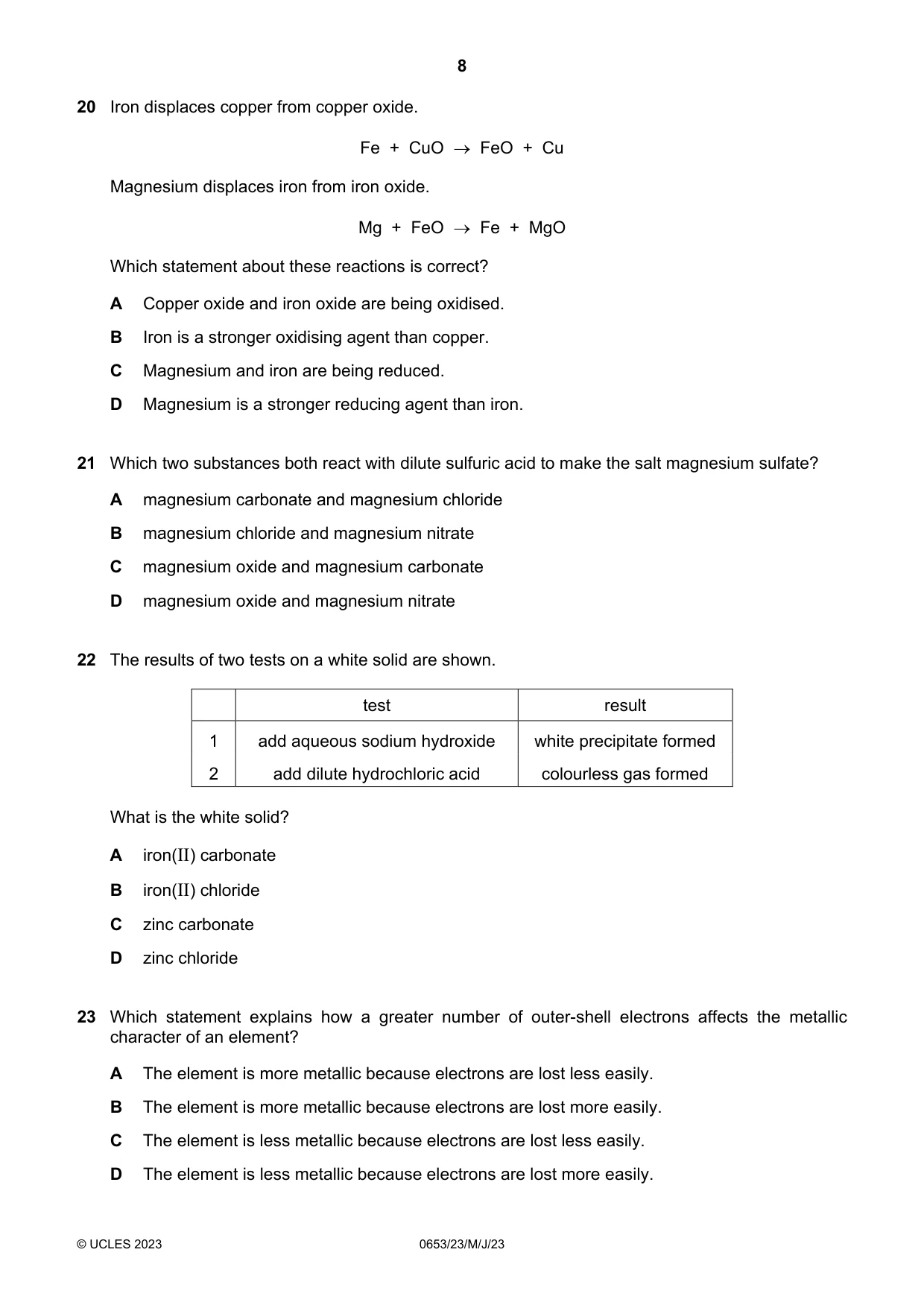
22 The results of two tests on a white solid are shown. test result 1 add aqueous sodium hydroxide white precipitate formed 2 add dilute hydrochloric acid colourless gas formed What is the white solid? A iron(II) carbonate B iron(II) chloride C zinc carbonate D zinc chloride
Mark scheme: C
Q23 · Which statement explains how a greater number of outer-shell electrons affects the…
23 Which statement explains how a greater number of outer-shell electrons affects the metallic character of an element? A The element is more metallic because electrons are lost less easily. B The element is more metallic because electrons are lost more easily. C The element is less metallic because electrons are lost less easily. D The element is less metallic because electrons are lost more easily.
Mark scheme: C
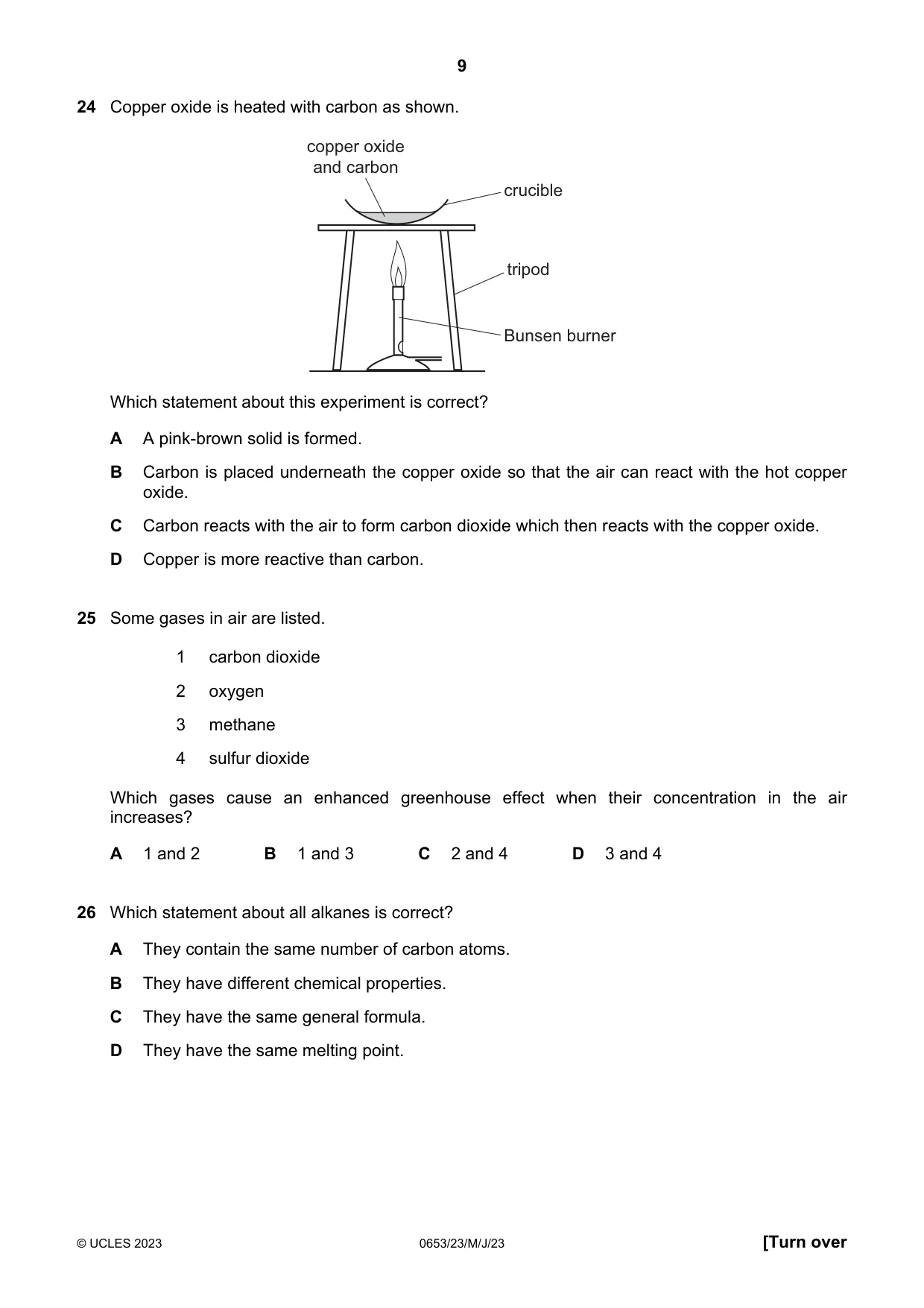
Q24 · Copper oxide is heated with carbon as shown
24 Copper oxide is heated with carbon as shown. copper oxide and carbon crucible tripod Bunsen burner Which statement about this experiment is correct? A A pink-brown solid is formed. B Carbon is placed underneath the copper oxide so that the air can react with the hot copper oxide. C Carbon reacts with the air to form carbon dioxide which then reacts with the copper oxide. D Copper is more reactive than carbon.
Mark scheme: A
Q25 · Some gases in air are listed
25 Some gases in air are listed. 1 carbon dioxide 2 oxygen 3 methane 4 sulfur dioxide Which gases cause an enhanced greenhouse effect when their concentration in the air increases? A 1 and 2 B 1 and 3 C 2 and 4 D 3 and 4
Mark scheme: B
Q26 · Which statement about all alkanes is correct?
26 Which statement about all alkanes is correct? A They contain the same number of carbon atoms. B They have different chemical properties. C They have the same general formula. D They have the same melting point.
Mark scheme: C
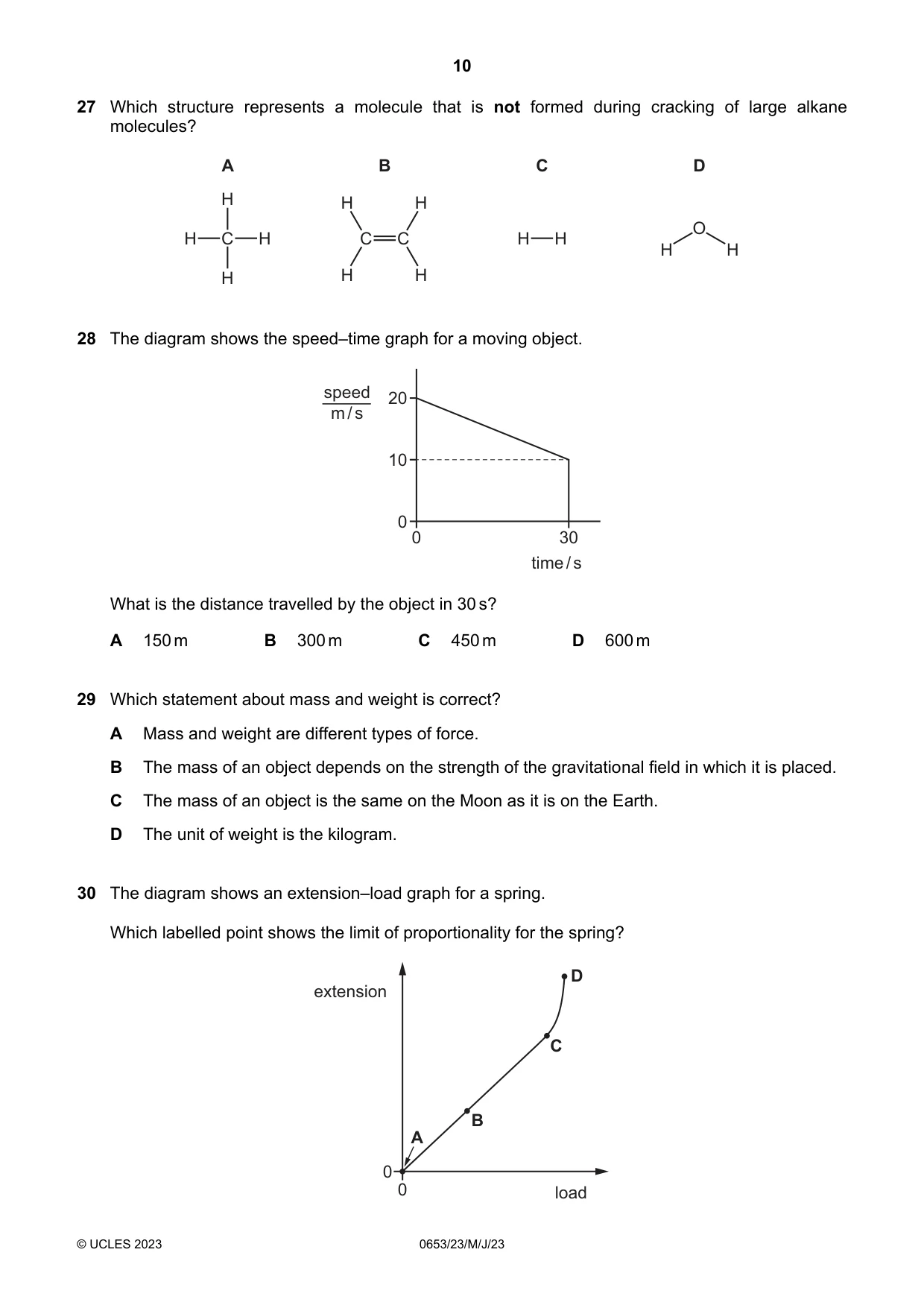
Q27 · Which structure represents a molecule that is not formed during cracking of large alkane…
27 Which structure represents a molecule that is not formed during cracking of large alkane molecules? A B C D H H H O H C H C C H H H H H H H
Mark scheme: D
Q28 · The diagram shows the speed–time graph for a moving object
28 The diagram shows the speed–time graph for a moving object. speed 20 m / s 10 0 0 30 time / s What is the distance travelled by the object in 30 s? A 150 m B 300 m C 450 m D 600 m
Mark scheme: C
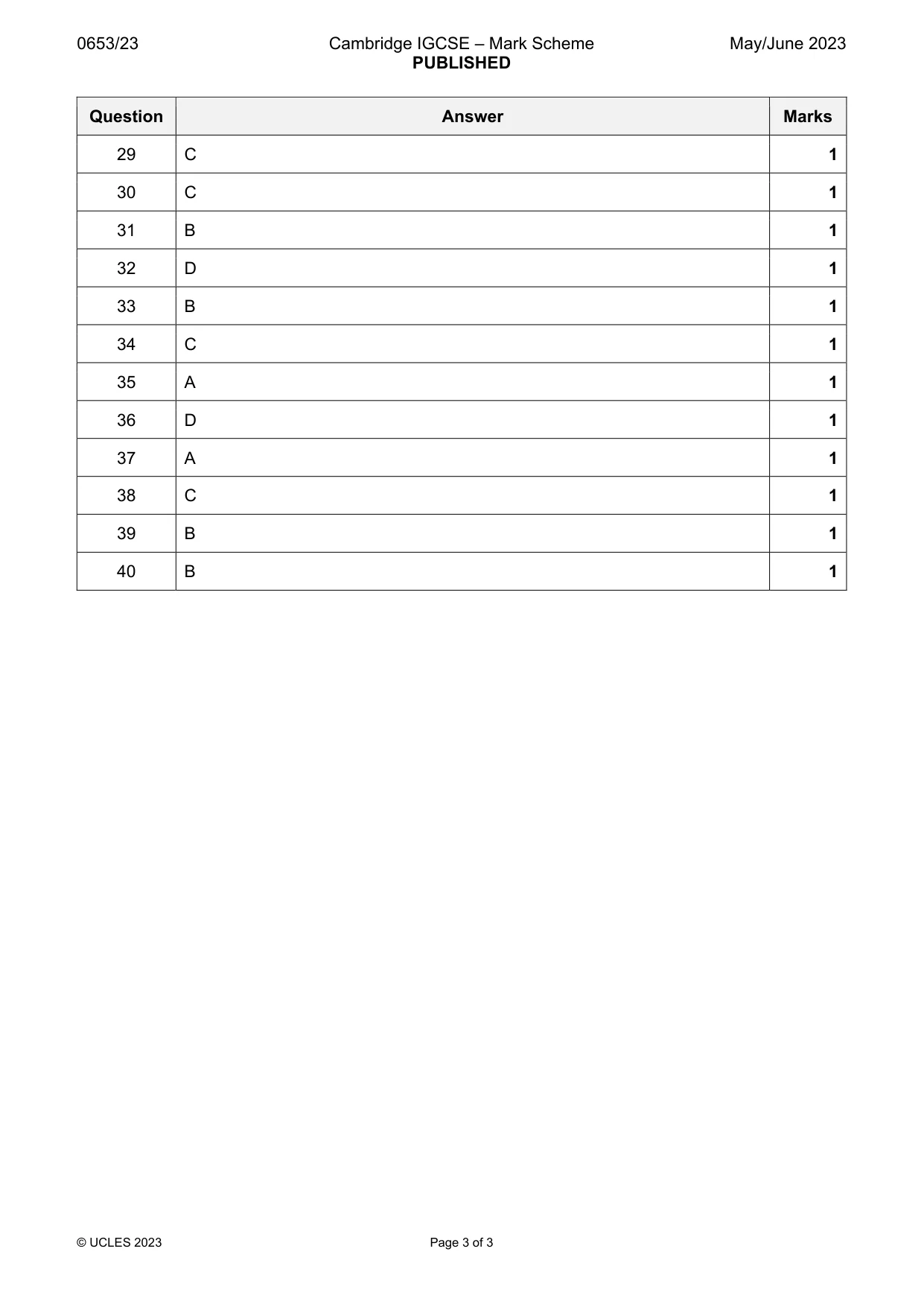
Q29 · Which statement about mass and weight is correct?
29 Which statement about mass and weight is correct? A Mass and weight are different types of force. B The mass of an object depends on the strength of the gravitational field in which it is placed. C The mass of an object is the same on the Moon as it is on the Earth. D The unit of weight is the kilogram.
Mark scheme: C
Q30 · The diagram shows an extension–load graph for a spring
30 The diagram shows an extension–load graph for a spring. Which labelled point shows the limit of proportionality for the spring? D extension C B A 0 0 load
Mark scheme: C
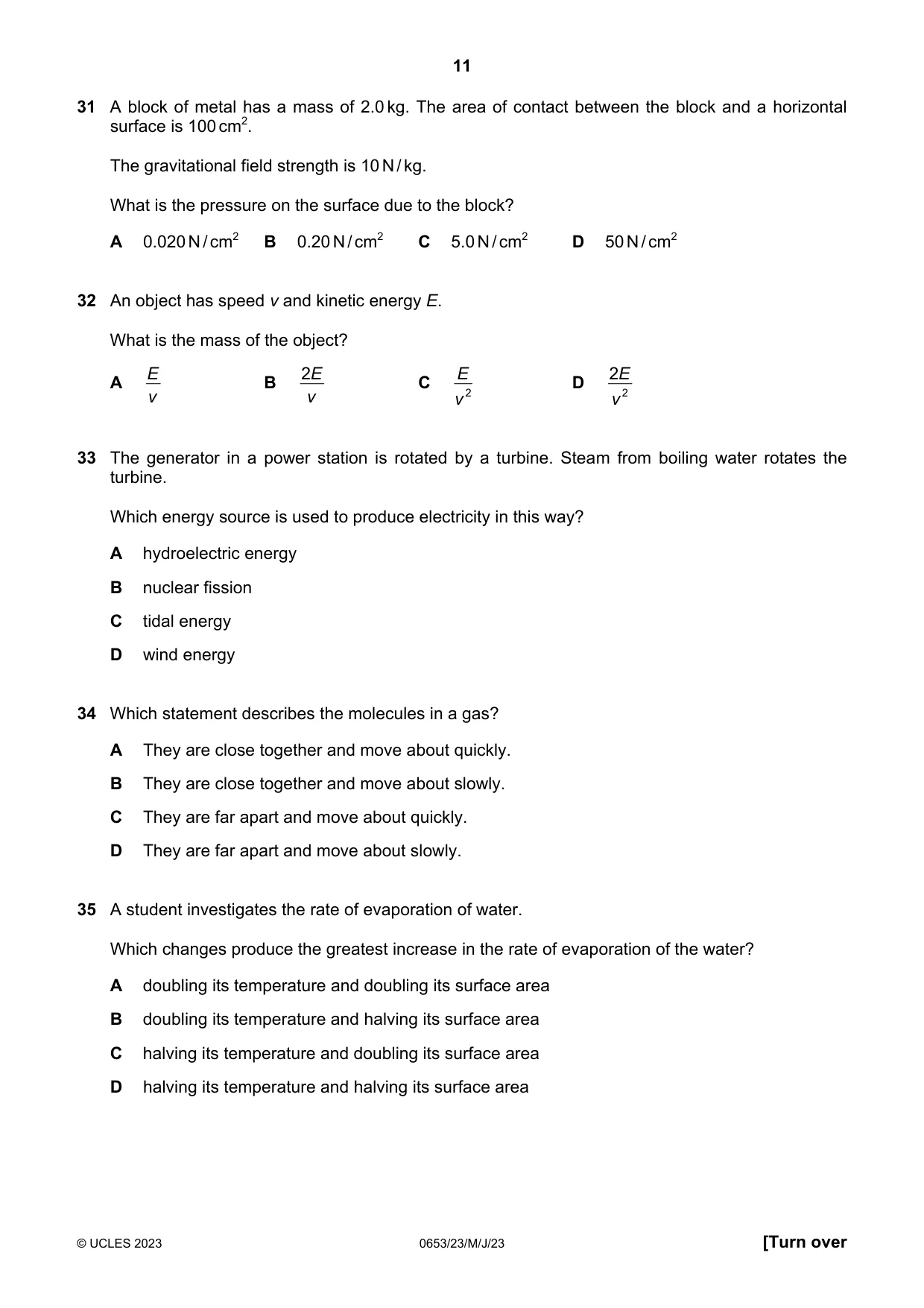
Q31 · A block of metal has a mass of 2.0 kg
31 A block of metal has a mass of 2.0 kg. The area of contact between the block and a horizontal surface is 100 cm2. The gravitational field strength is 10 N / kg. What is the pressure on the surface due to the block? A 0.020 N / cm2 B 0.20 N / cm2 C 5.0 N / cm2 D 50 N / cm2
Mark scheme: B
Q32 · An object has speed v and kinetic energy E
32 An object has speed v and kinetic energy E. What is the mass of the object? E 2 E E 2 E A B C D v v v 2 v 2
Mark scheme: D
Q33 · The generator in a power station is rotated by a turbine
33 The generator in a power station is rotated by a turbine. Steam from boiling water rotates the turbine. Which energy source is used to produce electricity in this way? A hydroelectric energy B nuclear fission C tidal energy D wind energy
Mark scheme: B
Q34 · Which statement describes the molecules in a gas?
34 Which statement describes the molecules in a gas? A They are close together and move about quickly. B They are close together and move about slowly. C They are far apart and move about quickly. D They are far apart and move about slowly.
Mark scheme: C
Q35 · A student investigates the rate of evaporation of water
35 A student investigates the rate of evaporation of water. Which changes produce the greatest increase in the rate of evaporation of the water? A doubling its temperature and doubling its surface area B doubling its temperature and halving its surface area C halving its temperature and doubling its surface area D halving its temperature and halving its surface area
Mark scheme: A
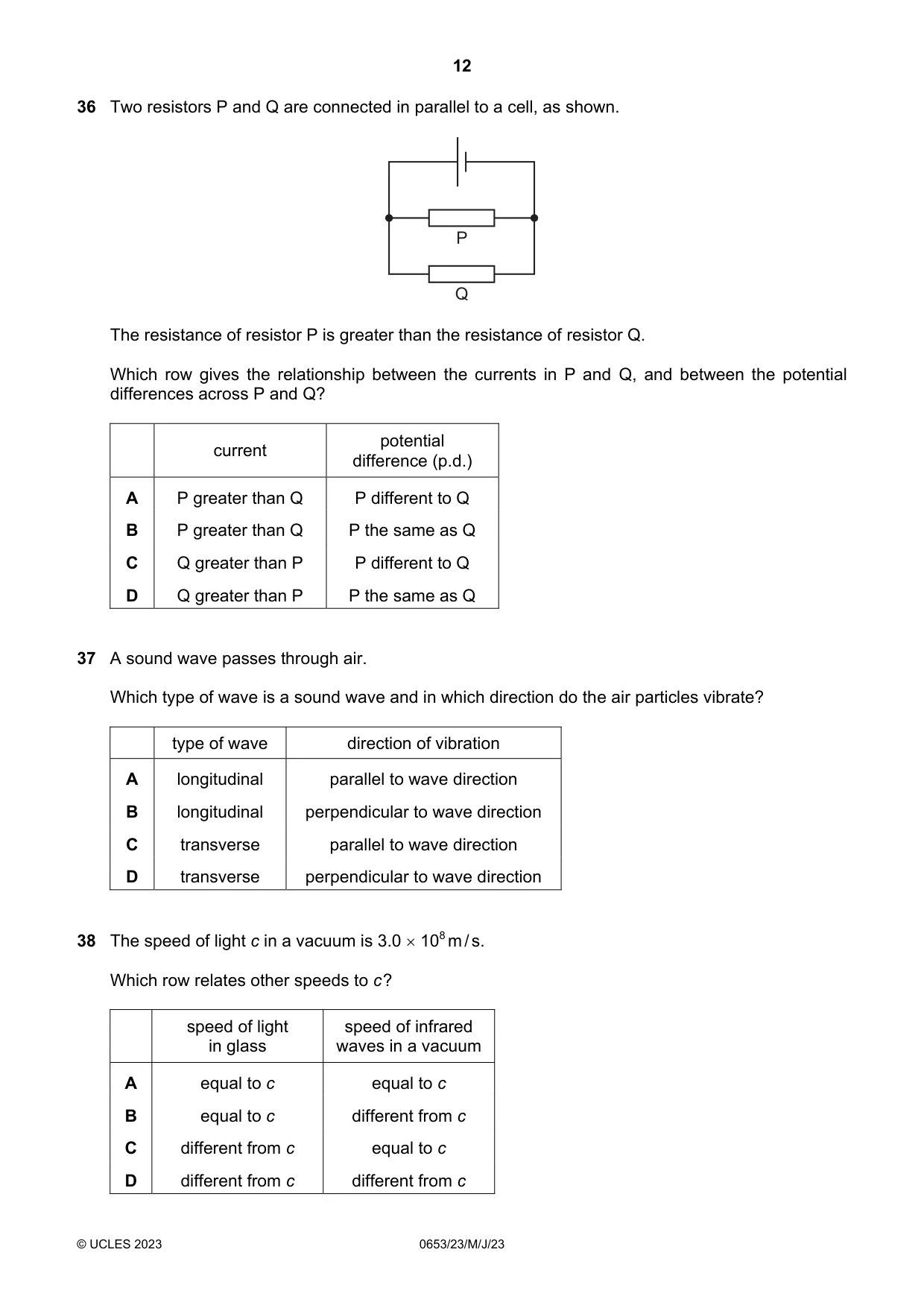
Q36 · Two resistors P and Q are connected in parallel to a cell, as shown
36 Two resistors P and Q are connected in parallel to a cell, as shown. P Q The resistance of resistor P is greater than the resistance of resistor Q. Which row gives the relationship between the currents in P and Q, and between the potential differences across P and Q? potential current difference (p.d.) A P greater than Q P different to Q B P greater than Q P the same as Q C Q greater than P P different to Q D Q greater than P P the same as Q
Mark scheme: D
Q37 · A sound wave passes through air
37 A sound wave passes through air. Which type of wave is a sound wave and in which direction do the air particles vibrate? type of wave direction of vibration A longitudinal parallel to wave direction B longitudinal perpendicular to wave direction C transverse parallel to wave direction D transverse perpendicular to wave direction
Mark scheme: A
Q38 · The speed of light c in a vacuum is 3.0 108 m / s
38 The speed of light c in a vacuum is 3.0 108 m / s. Which row relates other speeds to c ? speed of light speed of infrared in glass waves in a vacuum A equal to c equal to c B equal to c different from c C different from c equal to c D different from c different from c
Mark scheme: C
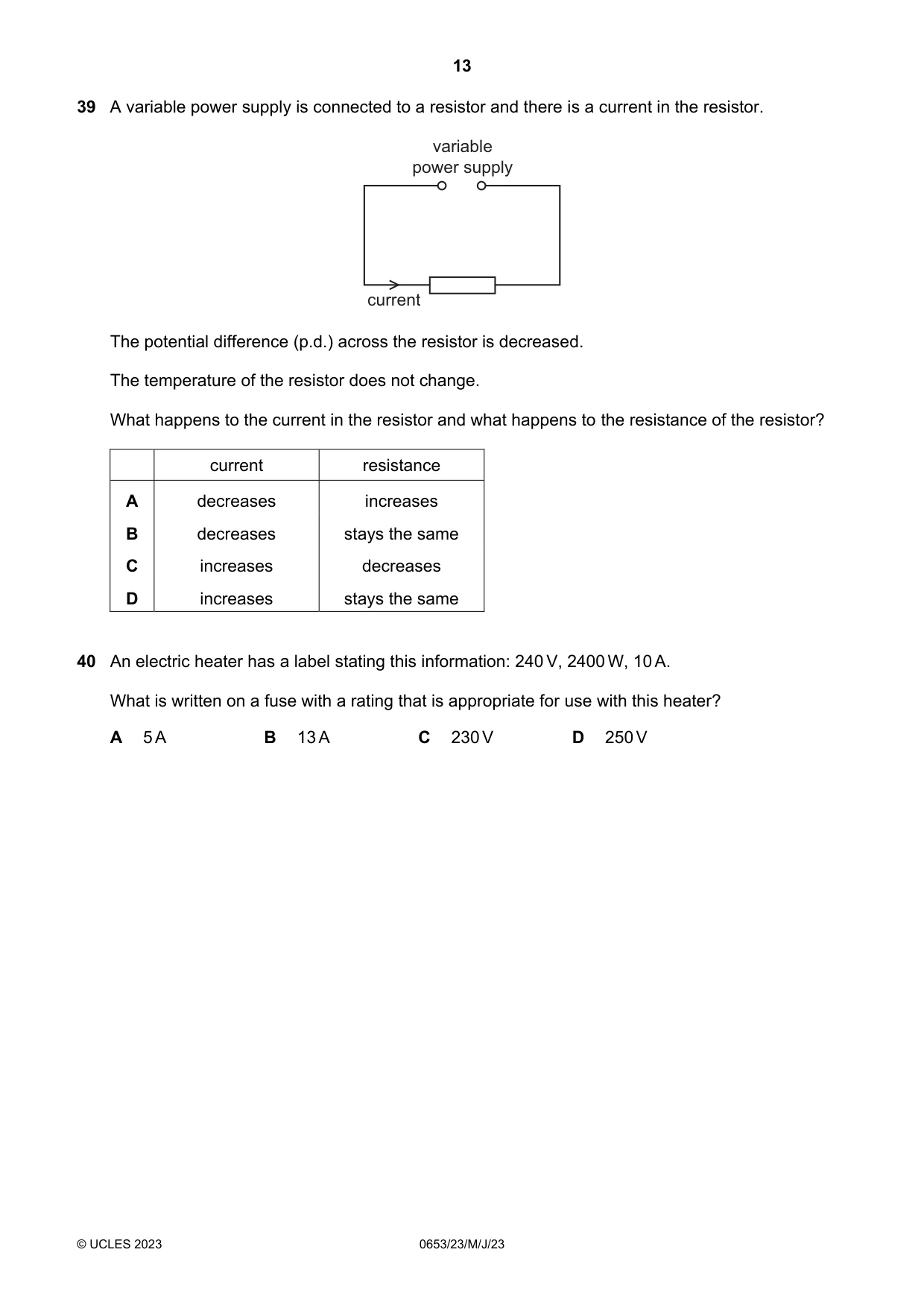
Q39 · A variable power supply is connected to a resistor and there is a current in the resistor
39 A variable power supply is connected to a resistor and there is a current in the resistor. variable power supply current The potential difference (p.d.) across the resistor is decreased. The temperature of the resistor does not change. What happens to the current in the resistor and what happens to the resistance of the resistor? current resistance A decreases increases B decreases stays the same C increases decreases D increases stays the same
Mark scheme: B
Q40 · An electric heater has a label stating this information: 240 V, 2400 W, 10 A
40 An electric heater has a label stating this information: 240 V, 2400 W, 10 A. What is written on a fuse with a rating that is appropriate for use with this heater? A 5 A B 13 A C 230 V D 250 V
Mark scheme: B
What was in this paper
The subtopics covered by these 40 questions, and how many questions each got. Open one in a new tab to see every Cambridge question on it.
2Kinetic particle model of matter2Air quality and climate1Alkanes1Alkenes1Atomic structure and the Periodic Table1Cell structure1Characteristics of living organisms1Digestive system1Drugs1Electrical circuits1Electrical quantities1Electrical safety1Electrolysis1Electromagnetic spectrum1Elements, compounds and mixtures1Enzymes1Exothermic and endothermic reactions1Extraction of metals1Food chains and food webs1Forces1Formulas1Habitat destruction1Heart1Identification of ions and gases1Ions and ionic bonds1Mass and weight1Motion1Photosynthesis1Pressure1Properties of metals1Redox1Respiration1Sexual reproduction in humans1Sexual reproduction in plants1Sound1The characteristic properties of acids and bases1Transpiration1What you needed in this session
Cambridge’s own grade thresholds for 2023 May/June, Paper 2 · Variant 3. A higher threshold means an easier paper — the bar moves with how the cohort did.