Cambridge IGCSE Science - Combined 0653 — 2024 Oct/Nov Paper 2 · Variant 3
0653/23/O/N/24 · 40 questions · 40 marks · ≈45 min
The question paper and its mark scheme, free to read here and free to download. This is Cambridge’s own paper, exactly as it was sat.
Question paper16 pages

Mark scheme3 pages
Answers below. Sit the paper first if you are practising.
Questions as text
Q1 · Which row correctly identifies the function of a ciliated cell in the bronchus of a…
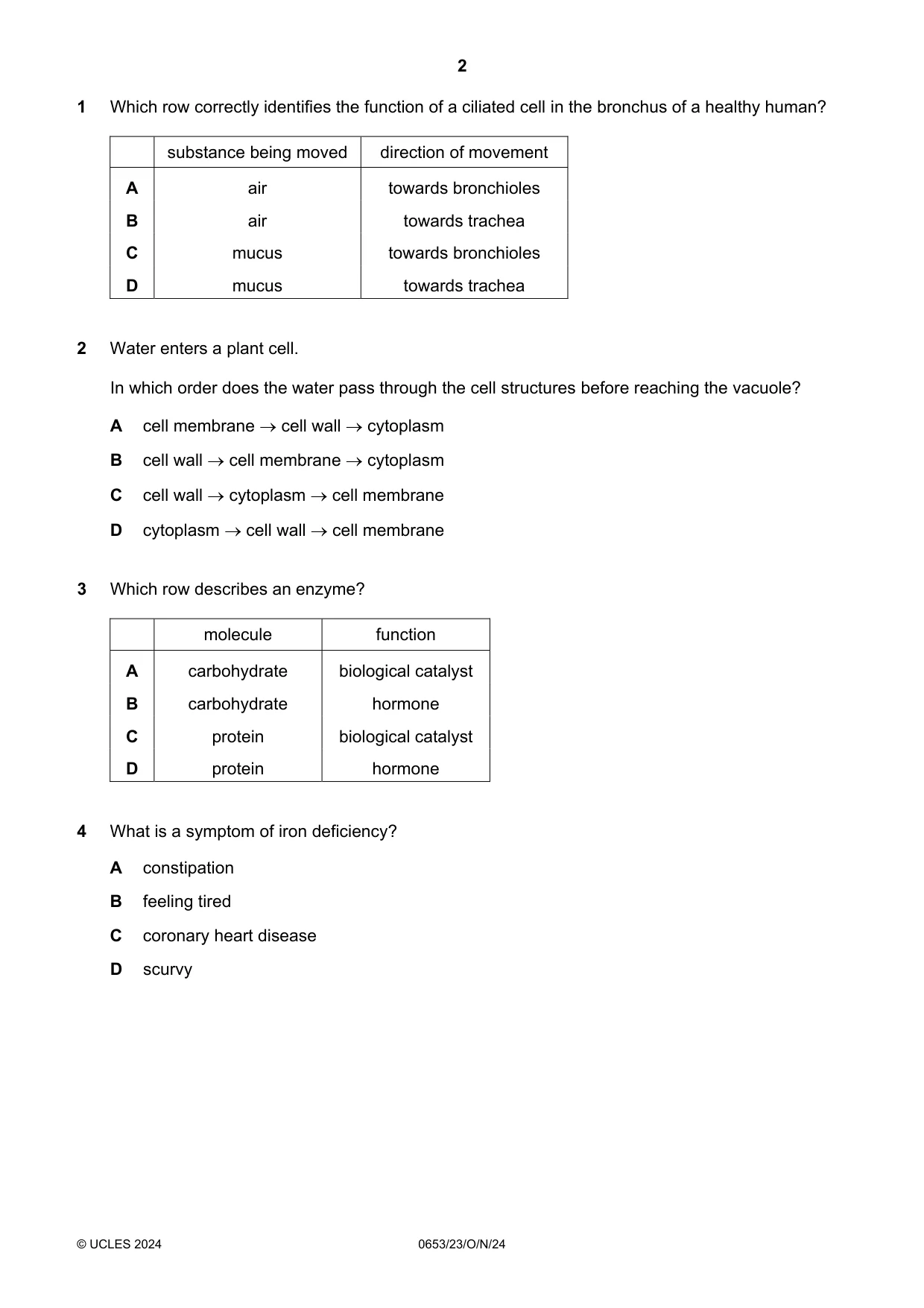
1 Which row correctly identifies the function of a ciliated cell in the bronchus of a healthy human? substance being moved direction of movement A air towards bronchioles B air towards trachea C mucus towards bronchioles D mucus towards trachea
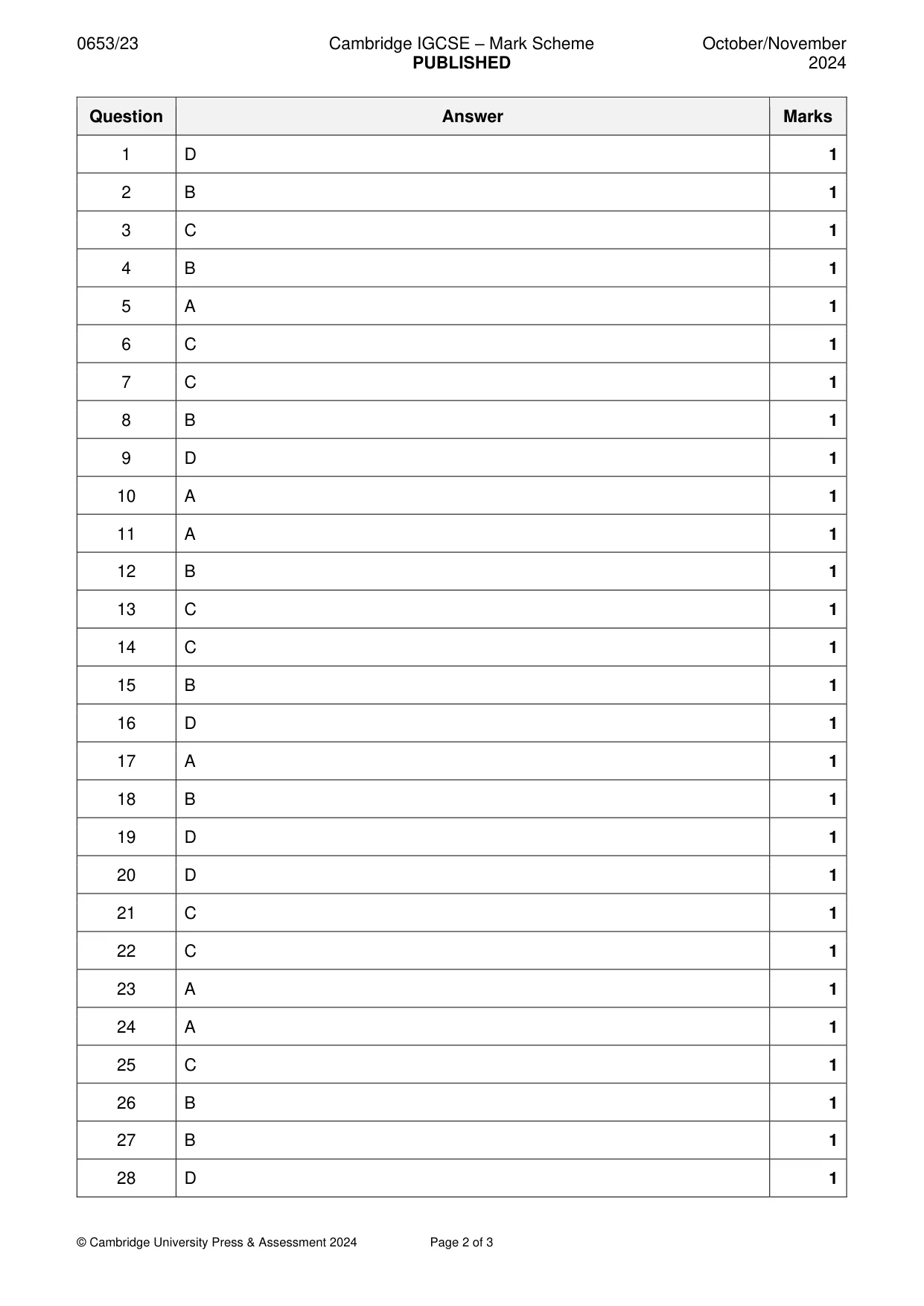
Mark scheme: D
Q2 · Water enters a plant cell
2 Water enters a plant cell. In which order does the water pass through the cell structures before reaching the vacuole? A cell membrane cell wall cytoplasm B cell wall cell membrane cytoplasm C cell wall cytoplasm cell membrane D cytoplasm cell wall cell membrane
Mark scheme: B
Q3 · Which row describes an enzyme?
3 Which row describes an enzyme? molecule function A carbohydrate biological catalyst B carbohydrate hormone C protein biological catalyst D protein hormone
Mark scheme: C
Q4 · What is a symptom of iron deficiency?
4 What is a symptom of iron deficiency? A constipation B feeling tired C coronary heart disease D scurvy
Mark scheme: B
Q5 · Chemical digestion produces small, soluble molecules
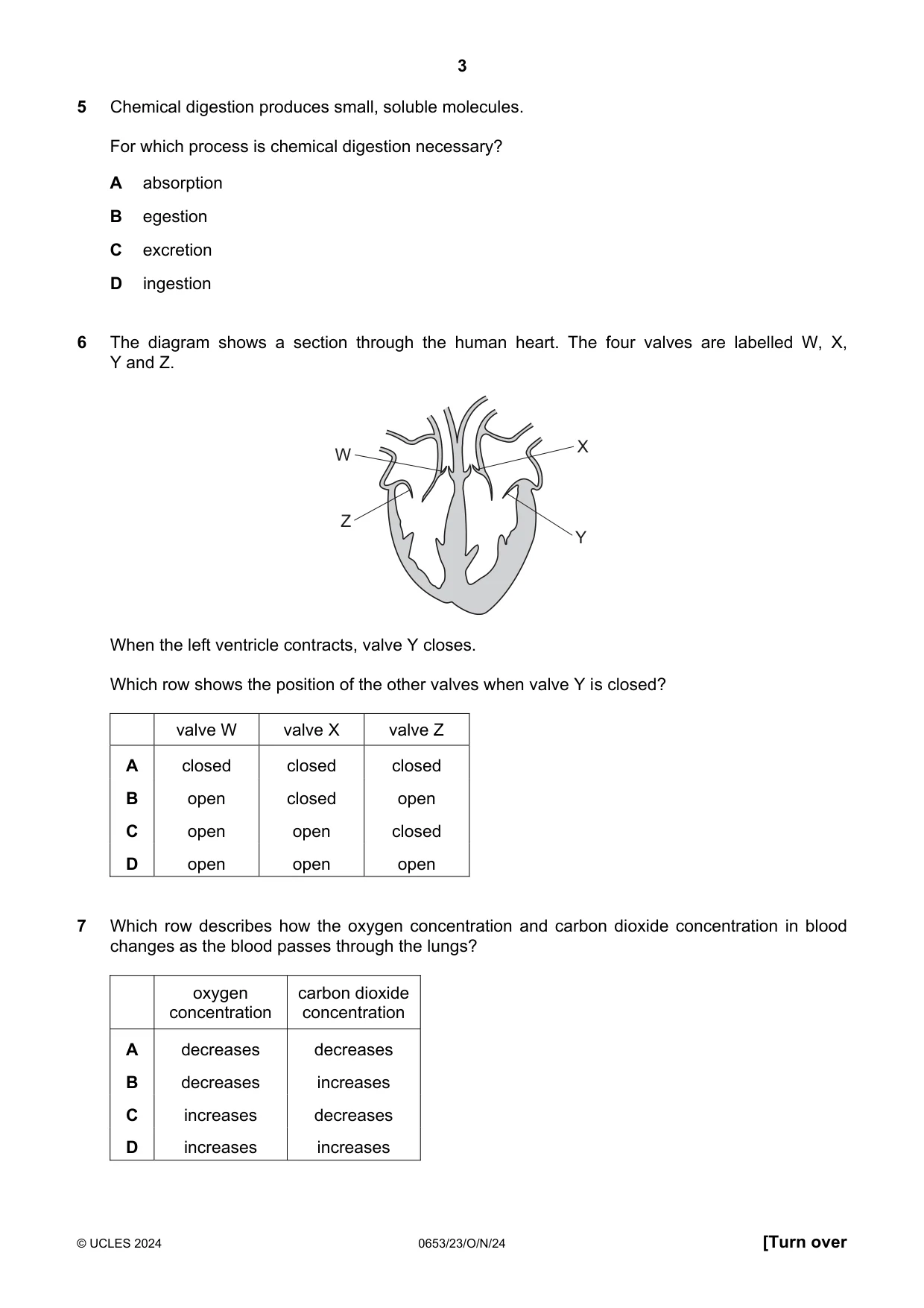
5 Chemical digestion produces small, soluble molecules. For which process is chemical digestion necessary? A absorption B egestion C excretion D ingestion
Mark scheme: A
Q6 · The diagram shows a section through the human heart
6 The diagram shows a section through the human heart. The four valves are labelled W, X, Y and Z. X W Z Y When the left ventricle contracts, valve Y closes. Which row shows the position of the other valves when valve Y is closed? valve W valve X valve Z A closed closed closed B open closed open C open open closed D open open open
Mark scheme: C
Q7 · Which row describes how the oxygen concentration and carbon dioxide concentration in…
7 Which row describes how the oxygen concentration and carbon dioxide concentration in blood changes as the blood passes through the lungs? oxygen carbon dioxide concentration concentration A decreases decreases B decreases increases C increases decreases D increases increases
Mark scheme: C
Q8 · The incomplete equation for aerobic respiration is shown
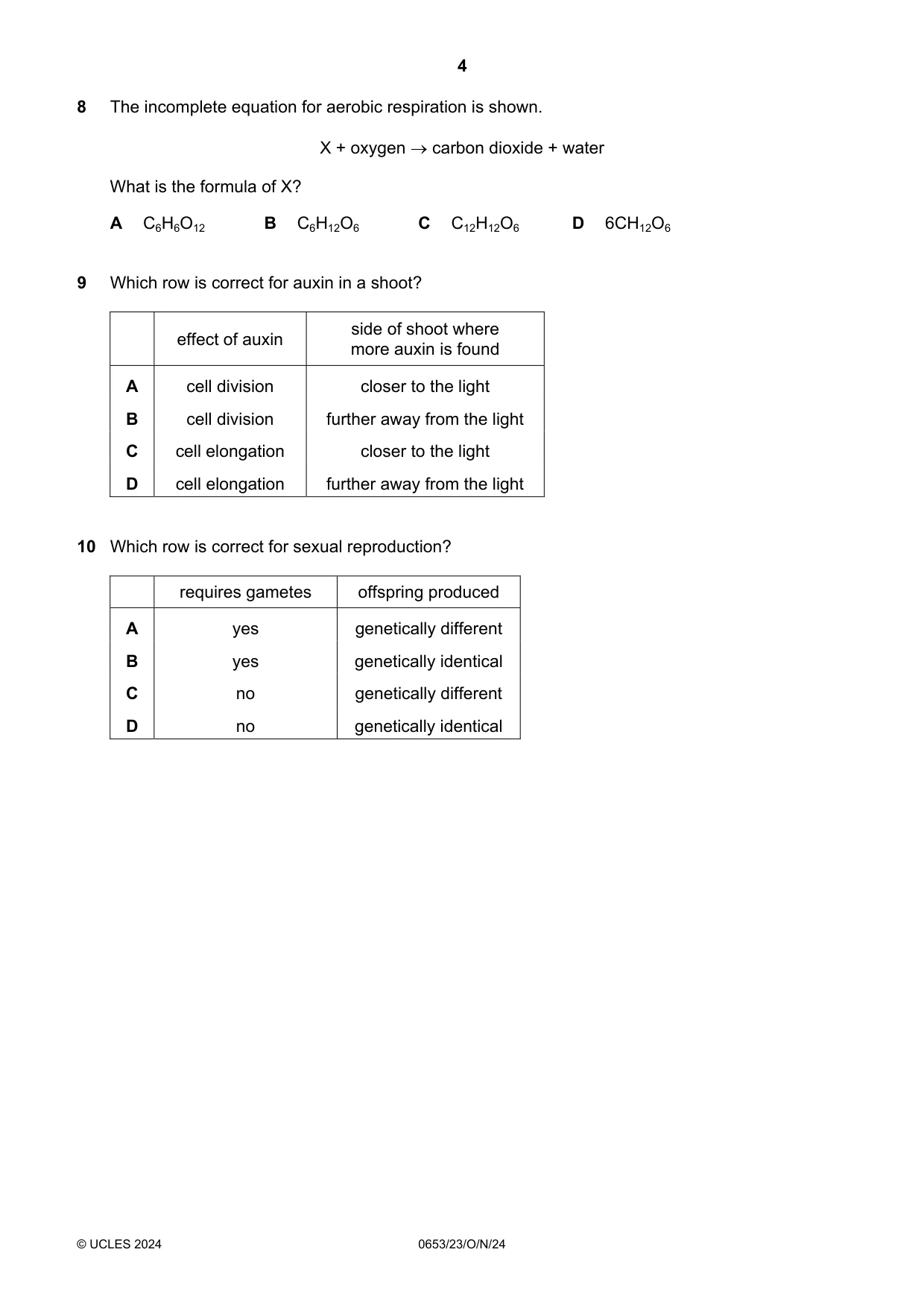
8 The incomplete equation for aerobic respiration is shown. X + oxygen carbon dioxide + water What is the formula of X? A C6H6O12 B C6H12O6 C C12H12O6 D 6CH12O6
Mark scheme: B
Q9 · Which row is correct for auxin in a shoot?
9 Which row is correct for auxin in a shoot? side of shoot where effect of auxin more auxin is found A cell division closer to the light B cell division further away from the light C cell elongation closer to the light D cell elongation further away from the light
Mark scheme: D
Q10 · Which row is correct for sexual reproduction?
10 Which row is correct for sexual reproduction? requires gametes offspring produced A yes genetically different B yes genetically identical C no genetically different D no genetically identical
Mark scheme: A
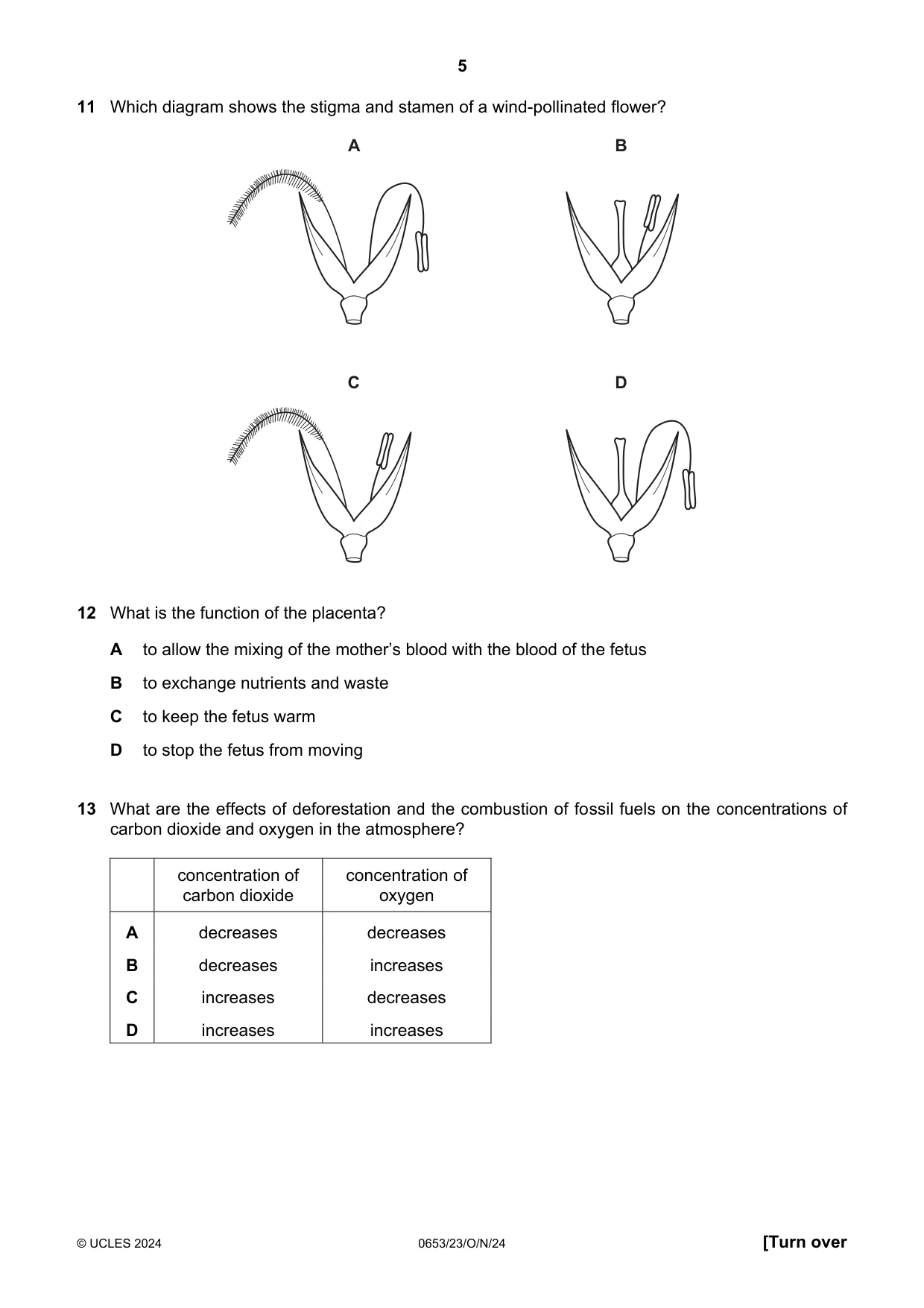
Q11 · Which diagram shows the stigma and stamen of a wind-pollinated flower?
11 Which diagram shows the stigma and stamen of a wind-pollinated flower? A B C D
Mark scheme: A
Q12 · What is the function of the placenta?
12 What is the function of the placenta? A to allow the mixing of the mother’s blood with the blood of the fetus B to exchange nutrients and waste C to keep the fetus warm D to stop the fetus from moving
Mark scheme: B
Q13 · What are the effects of deforestation and the combustion of fossil fuels on the…
13 What are the effects of deforestation and the combustion of fossil fuels on the concentrations of carbon dioxide and oxygen in the atmosphere? concentration of concentration of carbon dioxide oxygen A decreases decreases B decreases increases C increases decreases D increases increases
Mark scheme: C
Q14 · Solid mixtures X and Y are made from the salts as shown in the table
14 Solid mixtures X and Y are made from the salts as shown in the table. mixture X mixture Y barium sulfate: white, insoluble potassium chromate(VI): yellow, soluble iron(III) sulfate: brown, soluble potassium manganate(VII): purple, soluble Each mixture is shaken with water. How can the salts in each mixture be separated? mixture X mixture Y A chromatography chromatography B chromatography filtration C filtration chromatography D filtration filtration
Mark scheme: C
Q15 · Which particle has the smallest mass?
15 Which particle has the smallest mass? A atom B electron C neutron D proton
Mark scheme: B
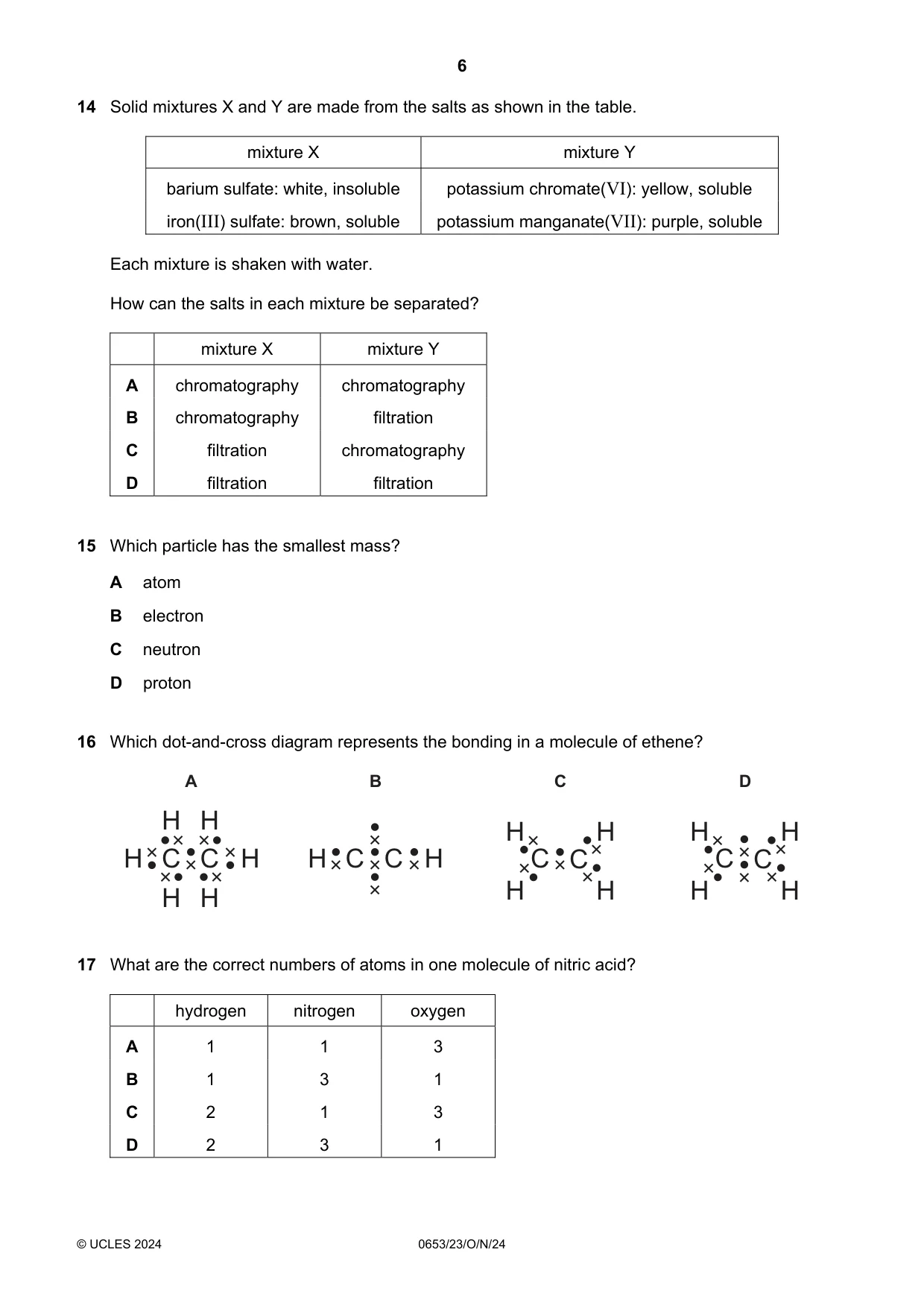
Q16 · Which dot-and-cross diagram represents the bonding in a molecule of ethene?
16 Which dot-and-cross diagram represents the bonding in a molecule of ethene? A B C D H H H H H H H C C H H C C H C C C C H H H H H H
Mark scheme: D
Q17 · What are the correct numbers of atoms in one molecule of nitric acid?
17 What are the correct numbers of atoms in one molecule of nitric acid? hydrogen nitrogen oxygen A 1 1 3 B 1 3 1 C 2 1 3 D 2 3 1
Mark scheme: A
Q18 · Molten silver chloride is electrolysed using inert electrodes
18 Molten silver chloride is electrolysed using inert electrodes. Which statement about this electrolysis is correct? A Silver ions gain electrons at the anode. B Silver ions gain electrons at the cathode. C Silver ions lose electrons at the anode. D Silver ions lose electrons at the cathode.
Mark scheme: B
Q19 · The reaction of bromine with ethene is exothermic
19 The reaction of bromine with ethene is exothermic. Which statement about this reaction is correct? A The activation energy is greater than the energy released in bond formation. B The activation energy must be less than the overall energy change. C The energy gained in bond forming causes the temperature to fall. D The energy released in bond forming is greater than the energy used in bond breaking.
Mark scheme: D
Q20 · Which row describes what happens to the rate of reaction and the frequency of collisions…
20 Which row describes what happens to the rate of reaction and the frequency of collisions between particles when the concentration of a reactant is increased? rate of frequency reaction of collisions A decreases decreases B decreases increases C increases decreases D increases increases
Mark scheme: D
Q21 · Which statements about an oxidising agent are correct?
21 Which statements about an oxidising agent are correct? 1 It is oxidised in a redox reaction. 2 It is reduced in a redox reaction. 3 It oxidises another substance in a redox reaction. 4 It reduces the reducing agent in a redox reaction. A 1 and 3 B 1 and 4 C 2 and 3 D 2 and 4
Mark scheme: C
Q22 · Magnesium chloride crystals can be made by reacting solid magnesium carbonate with dilute…
22 Magnesium chloride crystals can be made by reacting solid magnesium carbonate with dilute hydrochloric acid. What is not used in this process? A excess solid B crystallisation C distillation D filtration
Mark scheme: C
Q23 · Which statement about the halogens is correct?
23 Which statement about the halogens is correct? A Aqueous sodium bromide reacts with chlorine to produce aqueous sodium chloride. B Aqueous sodium chloride reacts with iodine to produce aqueous sodium iodide. C Bromine reacts with aqueous sodium chloride to produce chlorine. D Iodine reacts with aqueous sodium bromide to produce bromine.
Mark scheme: A
Q24 · Which metal is extracted from bauxite?
24 Which metal is extracted from bauxite? A aluminium B copper C iron D zinc
Mark scheme: A
Q25 · Two different bottles each contain a colourless liquid
25 Two different bottles each contain a colourless liquid. One bottle contains an alkene and the other contains water. Three different tests are listed. 1 addition of pink cobalt(II) chloride 2 addition of brown aqueous bromine 3 addition of white copper(II) sulfate Which tests can be used to positively identify the bottle that contains water? A 1 only B 2 only C 1 and 3 D 2 and 3
Mark scheme: C
Q26 · Which statement about greenhouse gases is correct?
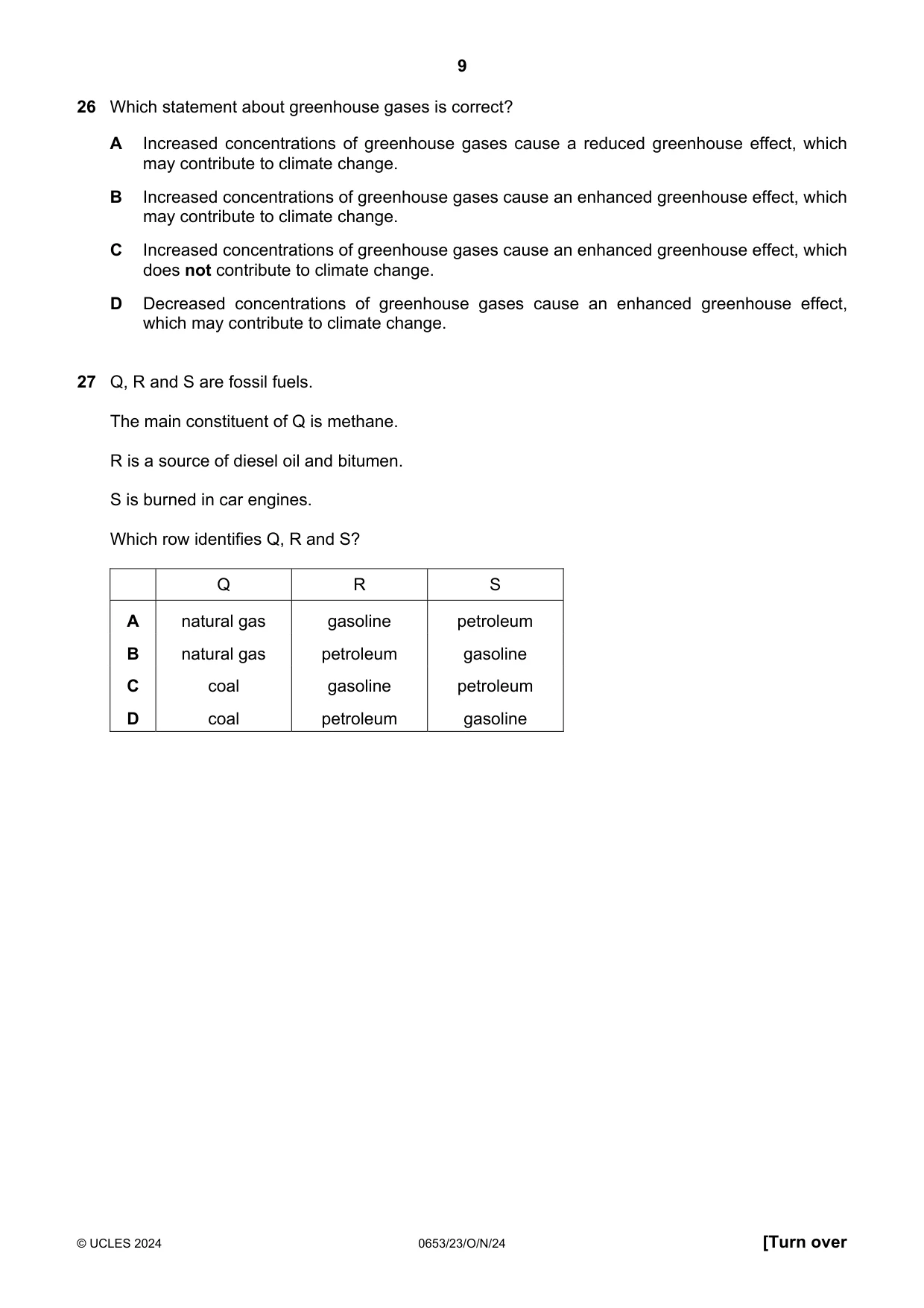
26 Which statement about greenhouse gases is correct? A Increased concentrations of greenhouse gases cause a reduced greenhouse effect, which may contribute to climate change. B Increased concentrations of greenhouse gases cause an enhanced greenhouse effect, which may contribute to climate change. C Increased concentrations of greenhouse gases cause an enhanced greenhouse effect, which does not contribute to climate change. D Decreased concentrations of greenhouse gases cause an enhanced greenhouse effect, which may contribute to climate change.
Mark scheme: B
Q27 · Q, R and S are fossil fuels
27 Q, R and S are fossil fuels. The main constituent of Q is methane. R is a source of diesel oil and bitumen. S is burned in car engines. Which row identifies Q, R and S? Q R S A natural gas gasoline petroleum B natural gas petroleum gasoline C coal gasoline petroleum D coal petroleum gasoline
Mark scheme: B
Q28 · Which distance–time graph represents an object that is moving with changing speed?
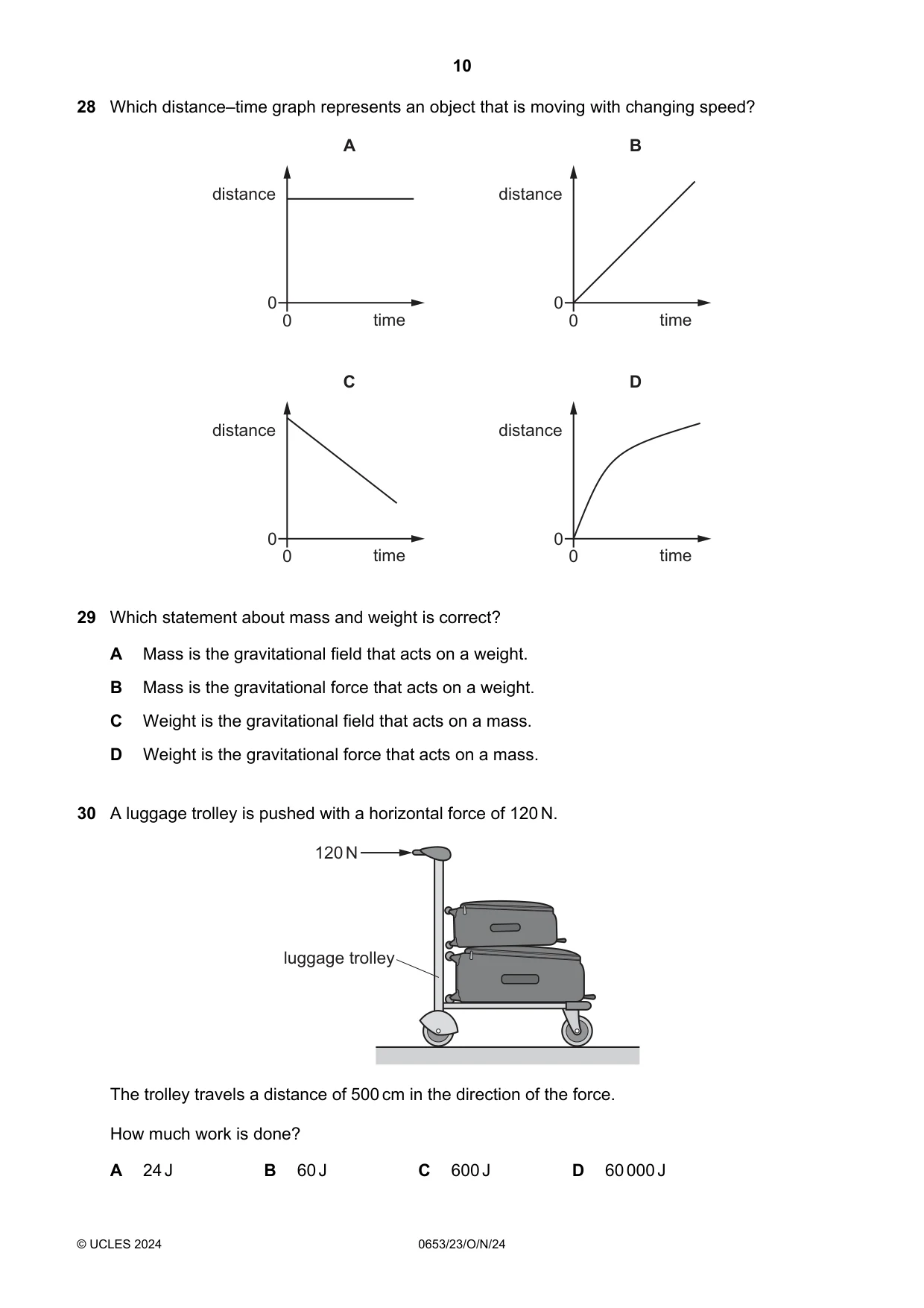
28 Which distance–time graph represents an object that is moving with changing speed? A B distance distance 0 0 0 time 0 time C D distance distance 0 0 0 time 0 time
Mark scheme: D
Q29 · Which statement about mass and weight is correct?
29 Which statement about mass and weight is correct? A Mass is the gravitational field that acts on a weight. B Mass is the gravitational force that acts on a weight. C Weight is the gravitational field that acts on a mass. D Weight is the gravitational force that acts on a mass.
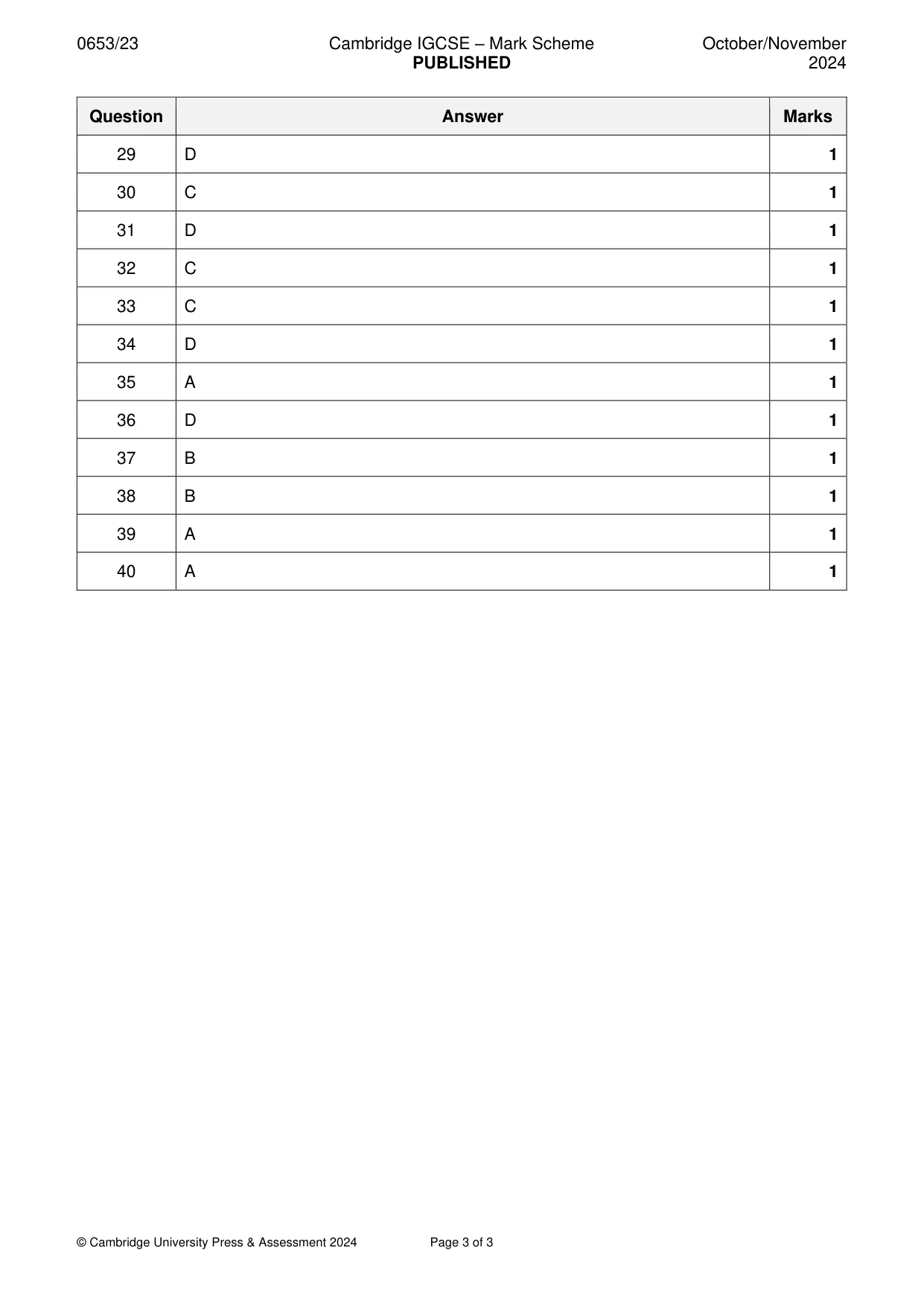
Mark scheme: D
Q30 · A luggage trolley is pushed with a horizontal force of 120 N
30 A luggage trolley is pushed with a horizontal force of 120 N. 120 N luggage trolley The trolley travels a distance of 500 cm in the direction of the force. How much work is done? A 24 J B 60 J C 600 J D 60 000 J
Mark scheme: C
Q31 · A brick of mass 3.0 kg rests on a shelf
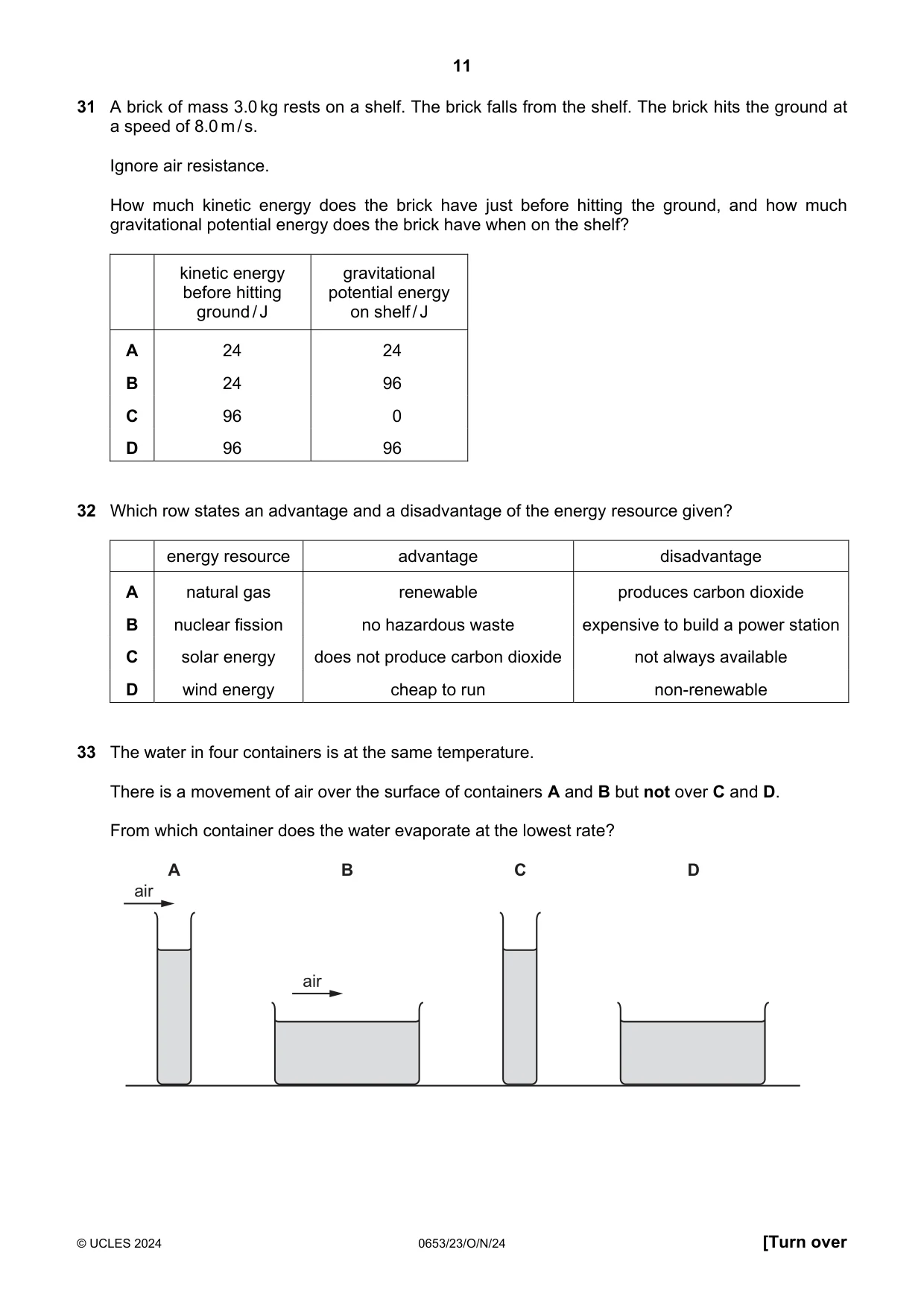
31 A brick of mass 3.0 kg rests on a shelf. The brick falls from the shelf. The brick hits the ground at a speed of 8.0 m / s. Ignore air resistance. How much kinetic energy does the brick have just before hitting the ground, and how much gravitational potential energy does the brick have when on the shelf? kinetic energy gravitational before hitting potential energy ground / J on shelf / J A 24 24 B 24 96 C 96 0 D 96 96
Mark scheme: D
Q32 · Which row states an advantage and a disadvantage of the energy resource given?
32 Which row states an advantage and a disadvantage of the energy resource given? energy resource advantage disadvantage A natural gas renewable produces carbon dioxide B nuclear fission no hazardous waste expensive to build a power station C solar energy does not produce carbon dioxide not always available D wind energy cheap to run non-renewable
Mark scheme: C
Q33 · The water in four containers is at the same temperature
33 The water in four containers is at the same temperature. There is a movement of air over the surface of containers A and B but not over C and D. From which container does the water evaporate at the lowest rate? A B C D air air
Mark scheme: C
Q34 · An aluminium cap is screwed onto the top of an aluminium bottle
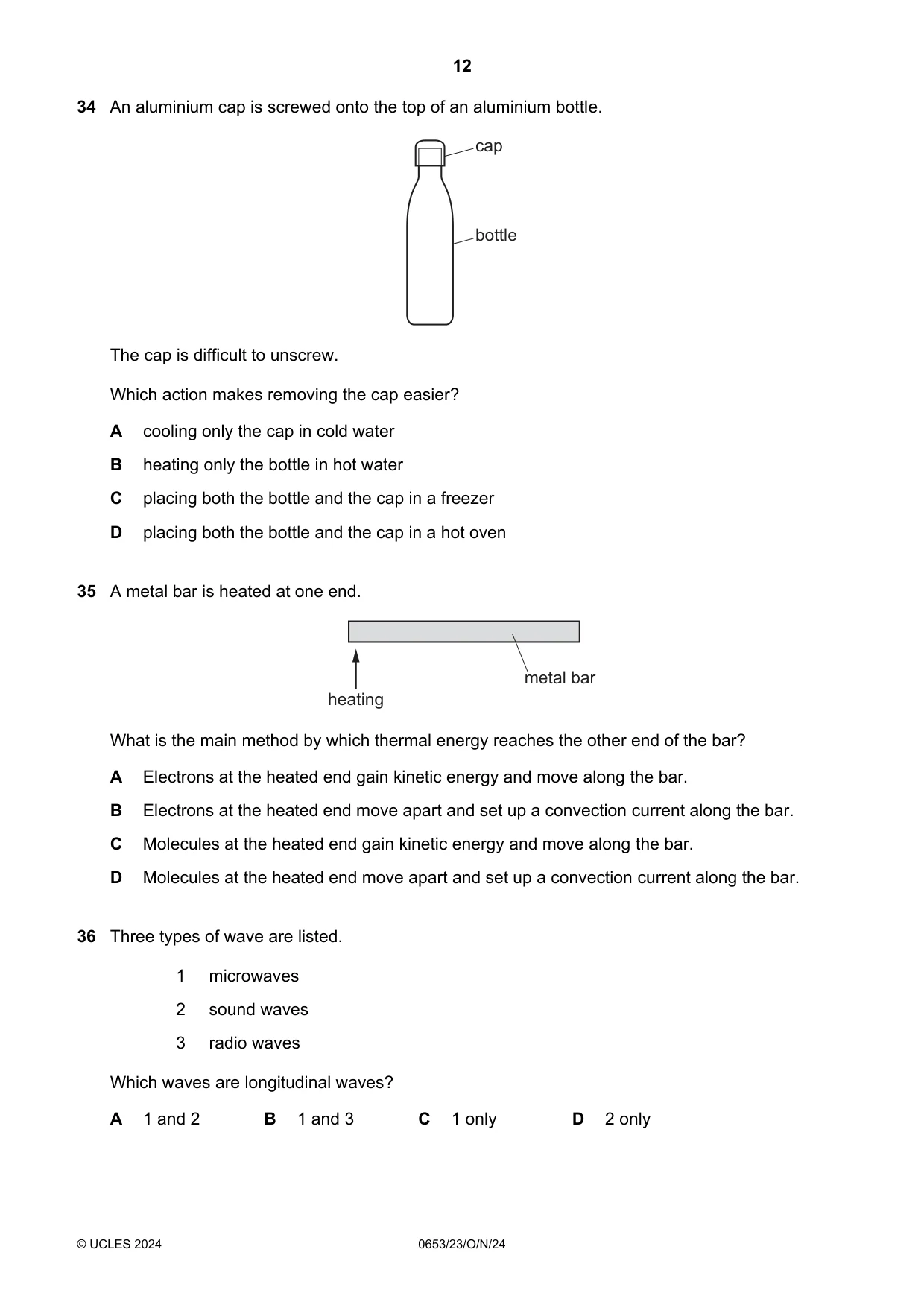
34 An aluminium cap is screwed onto the top of an aluminium bottle. cap bottle The cap is difficult to unscrew. Which action makes removing the cap easier? A cooling only the cap in cold water B heating only the bottle in hot water C placing both the bottle and the cap in a freezer D placing both the bottle and the cap in a hot oven
Mark scheme: D
Q35 · A metal bar is heated at one end
35 A metal bar is heated at one end. metal bar heating What is the main method by which thermal energy reaches the other end of the bar? A Electrons at the heated end gain kinetic energy and move along the bar. B Electrons at the heated end move apart and set up a convection current along the bar. C Molecules at the heated end gain kinetic energy and move along the bar. D Molecules at the heated end move apart and set up a convection current along the bar.
Mark scheme: A
Q36 · Three types of wave are listed
36 Three types of wave are listed. 1 microwaves 2 sound waves 3 radio waves Which waves are longitudinal waves? A 1 and 2 B 1 and 3 C 1 only D 2 only
Mark scheme: D
Q37 · A wave is refracted when it moves from one medium to another
37 A wave is refracted when it moves from one medium to another. What must remain constant? A direction of motion B frequency C speed D wavelength
Mark scheme: B
Q38 · The current in a resistor is 4.0 A
38 The current in a resistor is 4.0 A. What is the time taken for 1200 C of charge to flow through the resistor? A 0.20 min B 5.0 min C 80 min D 300 min
Mark scheme: B
Q39 · A student connects a lamp to a cell
39 A student connects a lamp to a cell. Which change to the circuit can increase the current in the circuit? A connecting a second cell in series B connecting a second lamp in series C connecting a variable resistor in series D connecting an ammeter in series
Mark scheme: A
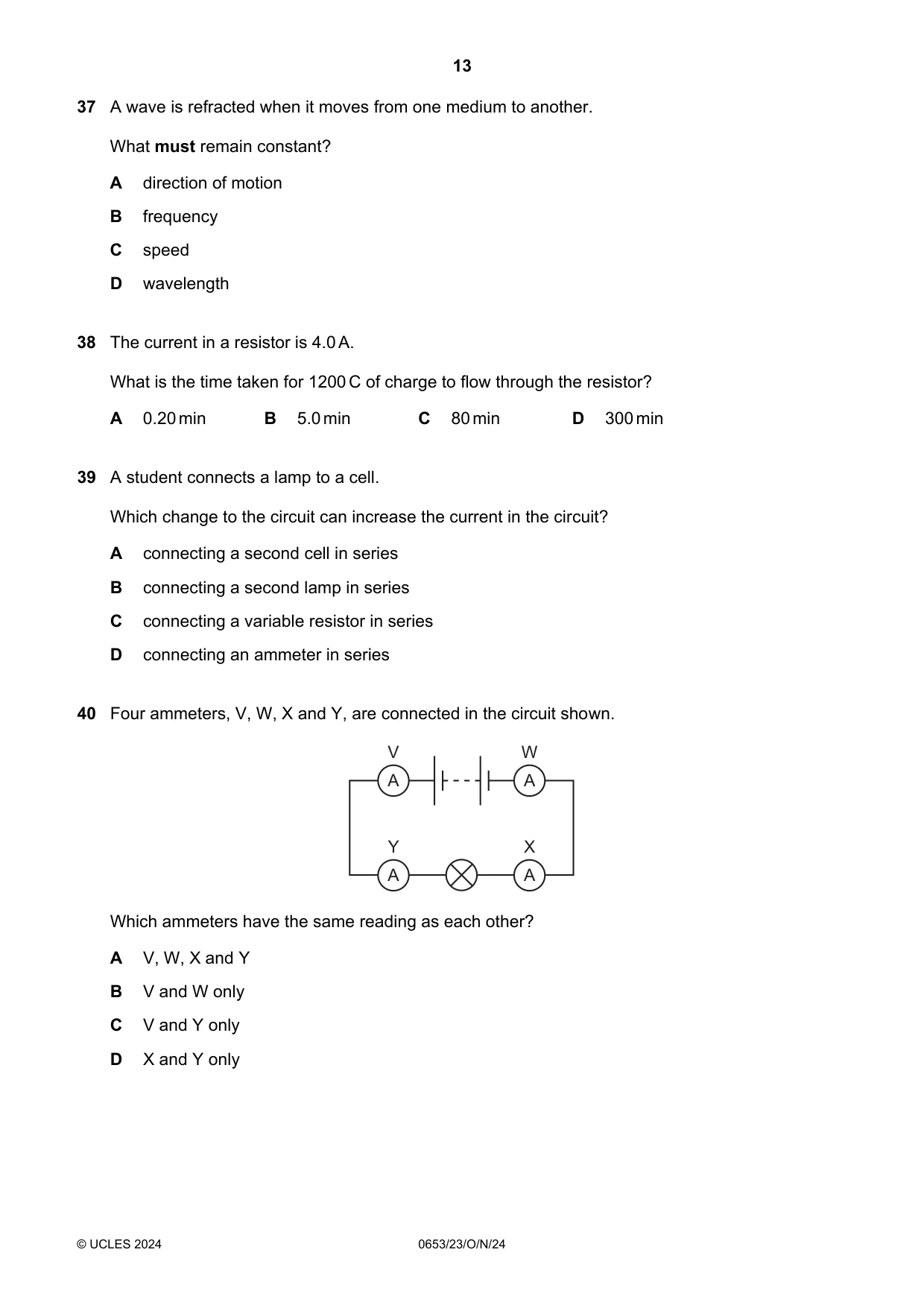
Q40 · Four ammeters, V, W, X and Y, are connected in the circuit shown
40 Four ammeters, V, W, X and Y, are connected in the circuit shown. V W A A Y X A A Which ammeters have the same reading as each other? A V, W, X and Y B V and W only C V and Y only D X and Y only
Mark scheme: A
What was in this paper
The subtopics covered by these 40 questions, and how many questions each got. Open one in a new tab to see every Cambridge question on it.
3Electrical circuits2Gas exchange in humans2General properties of waves2Sexual reproduction in plants2Air quality and climate1Atomic structure and the Periodic Table1Carbon cycle1Diet1Digestion1Electrical quantities1Electrolysis1Enzymes1Exothermic and endothermic reactions1Extraction of metals1Formulas1Fuels1Group VII properties1Heart1Identification of ions and gases1Kinetic particle model of matter1Mass and weight1Motion1Osmosis1Photosynthesis1Preparation of salts1Rate of reaction1Redox1Respiration1Separation and purification1Sexual reproduction in humans1Simple molecules and covalent bonds1Thermal properties and temperature1Transfer of thermal energy1What you needed in this session
Cambridge’s own grade thresholds for 2024 Oct/Nov, Paper 2 · Variant 3. A higher threshold means an easier paper — the bar moves with how the cohort did.