Cambridge IGCSE Science - Combined 0653 — 2019 Oct/Nov Paper 2 · Variant 3
0653/23/O/N/19 · 40 questions · 40 marks · ≈45 min
The question paper and its mark scheme, free to read here and free to download. This is Cambridge’s own paper, exactly as it was sat.
Question paper20 pages



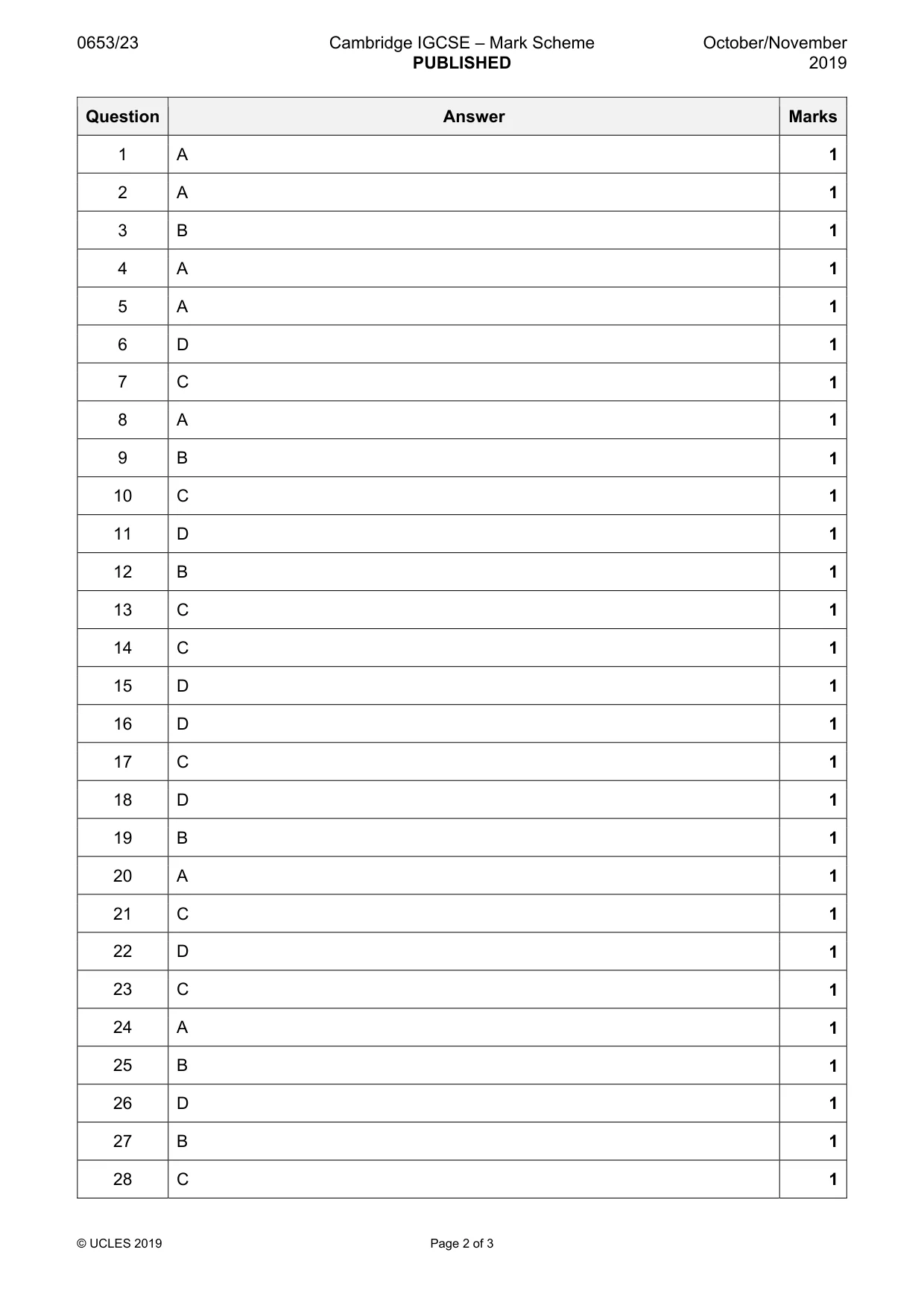
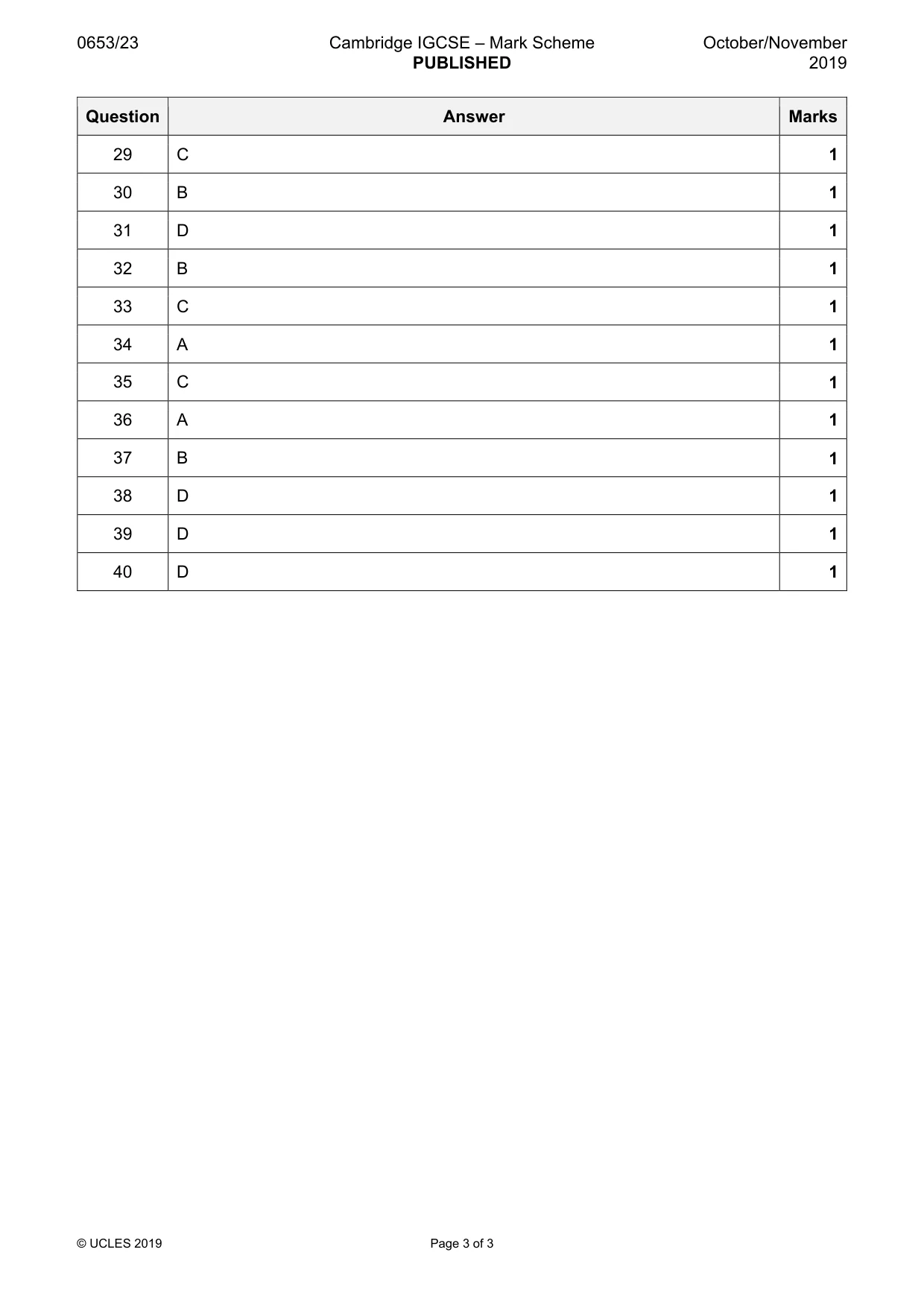
Mark scheme3 pages
Answers below. Sit the paper first if you are practising.
Questions as text
Q1 · A biologist keeps a potted plant in a laboratory
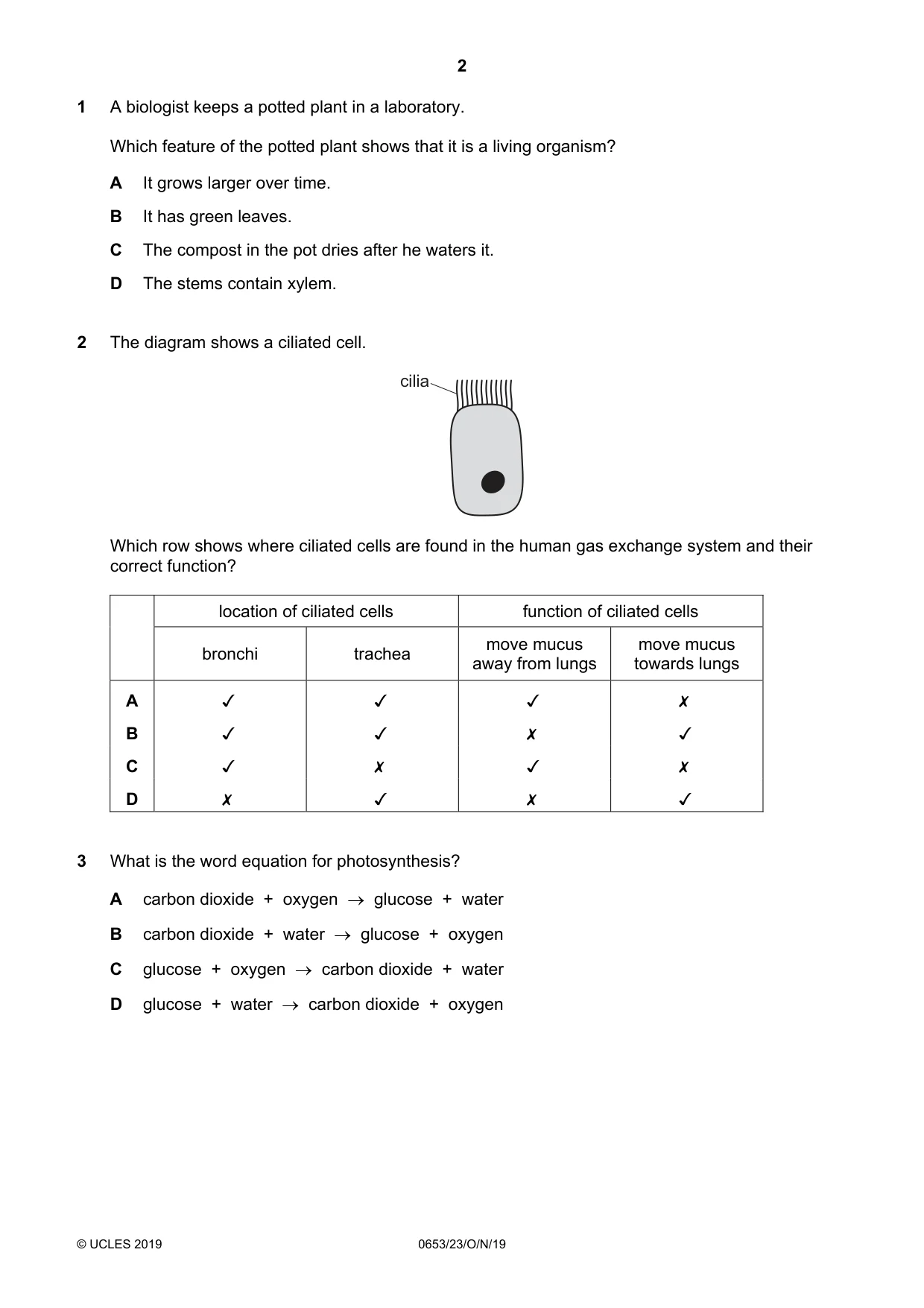
1 A biologist keeps a potted plant in a laboratory. Which feature of the potted plant shows that it is a living organism? A It grows larger over time. B It has green leaves. C The compost in the pot dries after he waters it. D The stems contain xylem.
Mark scheme: A
Q2 · The diagram shows a ciliated cell
2 The diagram shows a ciliated cell. cilia Which row shows where ciliated cells are found in the human gas exchange system and their correct function? location of ciliated cells function of ciliated cells bronchi trachea move mucus move mucus away from lungs towards lungs A Jv JV Jv x B J Jv x J Cc Jv x Jv x D x Jv x Jv
Mark scheme: A
Q3 · What is the word equation for photosynthesis?
3 What is the word equation for photosynthesis? A carbon dioxide + oxygen → glucose + water B carbon dioxide + water → glucose + oxygen C glucose + oxygen → carbon dioxide + water D glucose + water → carbon dioxide + oxygen
Mark scheme: B
Q4 · 1 cm³ of substance X is added to 10 cm³ starch suspension and mixed
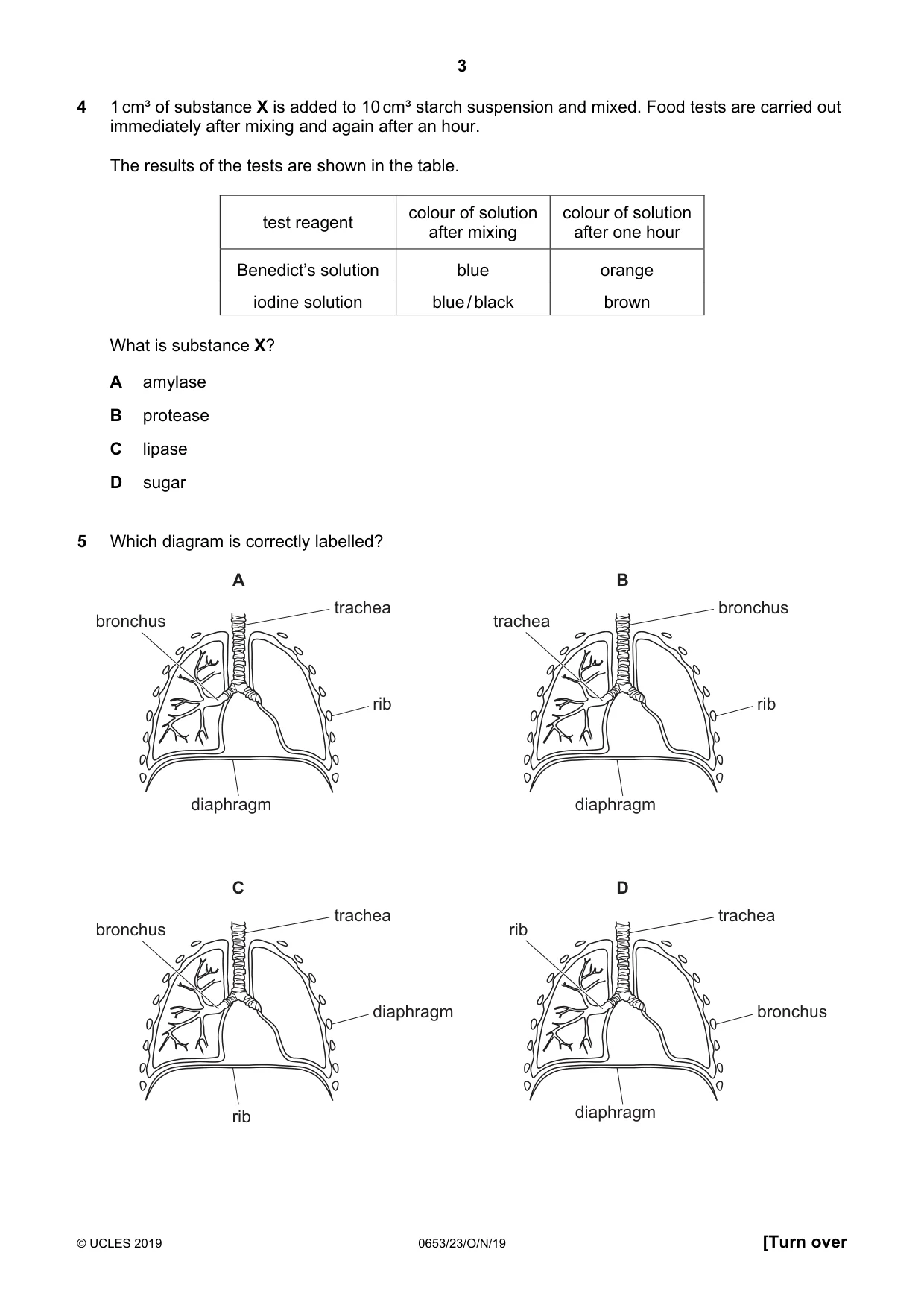
4 1 cm³ of substance X is added to 10 cm³ starch suspension and mixed. Food tests are carried out immediately after mixing and again after an hour. The results of the tests are shown in the table. colour of solution colour of solution test reagent after mixing after one hour Benedict’s solution blue orange iodine solution blue / black brown What is substance X? A amylase B protease C lipase D sugar
Mark scheme: A
Q5 · Which diagram is correctly labelled?
5 Which diagram is correctly labelled? A B trachea bronchus bronchus trachea rib rib diaphragm diaphragm C D trachea trachea bronchus rib diaphragm bronchus rib diaphragm
Mark scheme: A
Q6 · Which statement about aerobic respiration is correct?
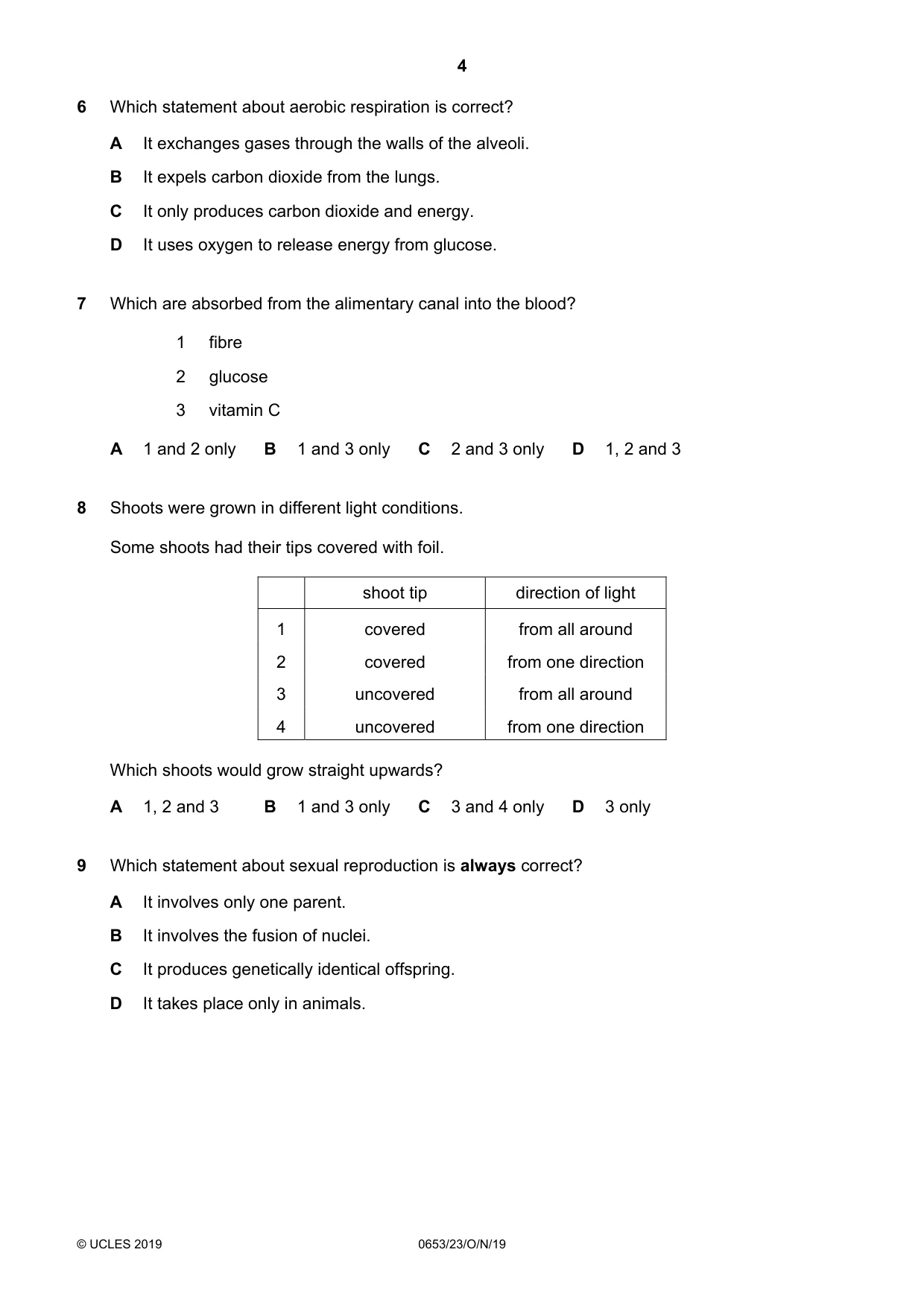
6 Which statement about aerobic respiration is correct? A It exchanges gases through the walls of the alveoli. B It expels carbon dioxide from the lungs. C It only produces carbon dioxide and energy. D It uses oxygen to release energy from glucose.
Mark scheme: D
Q7 · Which are absorbed from the alimentary canal into the blood?
7 Which are absorbed from the alimentary canal into the blood? 1 fibre 2 glucose 3 vitamin C A 1 and 2 only B 1 and 3 only C 2 and 3 only D 1, 2 and 3
Mark scheme: C
Q8 · Shoots were grown in different light conditions
8 Shoots were grown in different light conditions. Some shoots had their tips covered with foil. shoot tip direction of light 1 covered from all around 2 covered from one direction 3 uncovered from all around 4 uncovered from one direction Which shoots would grow straight upwards? A 1, 2 and 3 B 1 and 3 only C 3 and 4 only D 3 only
Mark scheme: A
Q9 · Which statement about sexual reproduction is always correct?
9 Which statement about sexual reproduction is always correct? A It involves only one parent. B It involves the fusion of nuclei. C It produces genetically identical offspring. D It takes place only in animals.
Mark scheme: B
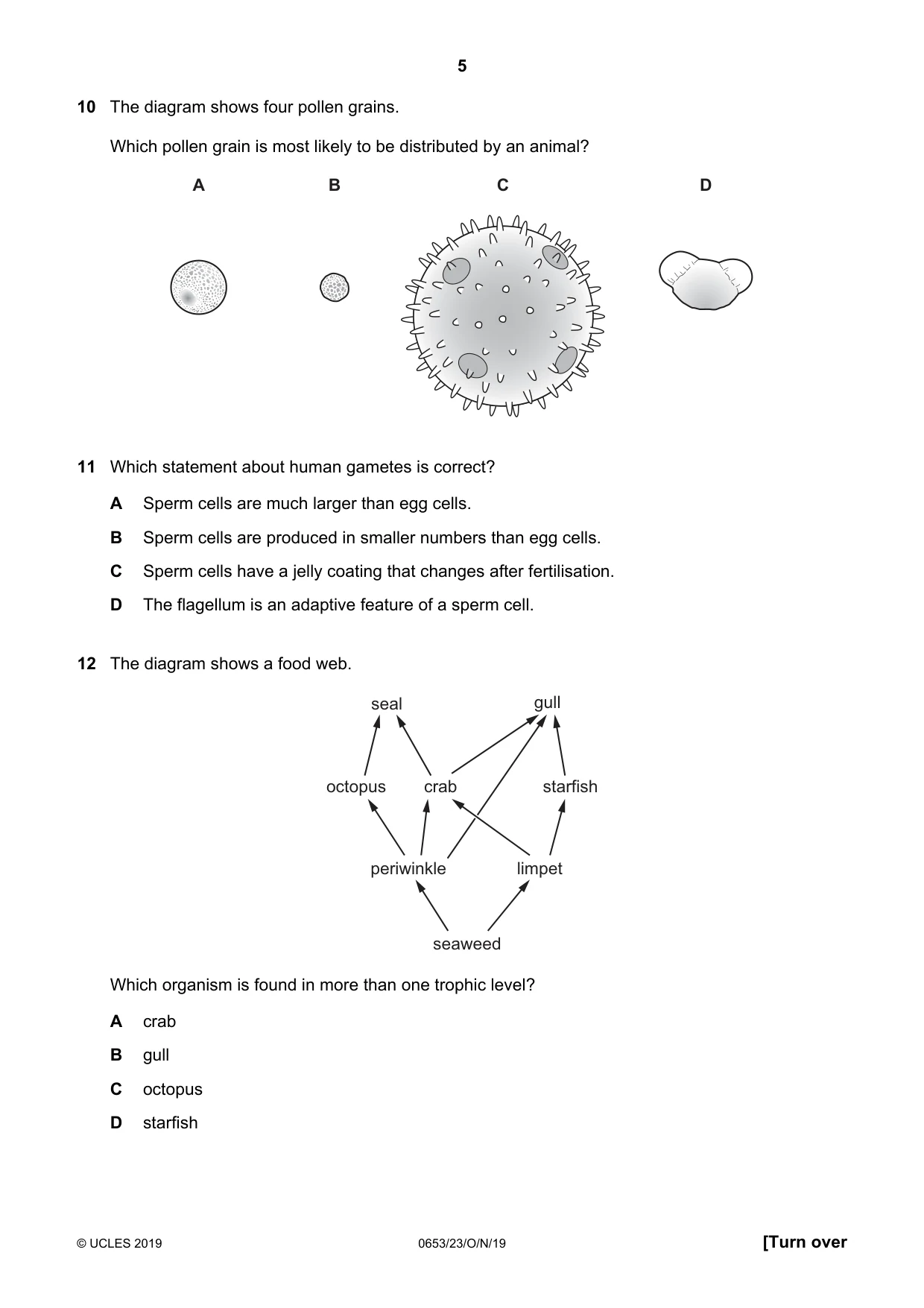
Q10 · The diagram shows four pollen grains
10 The diagram shows four pollen grains. Which pollen grain is most likely to be distributed by an animal? A B C D
Mark scheme: C
Q11 · Which statement about human gametes is correct?
11 Which statement about human gametes is correct? A Sperm cells are much larger than egg cells. B Sperm cells are produced in smaller numbers than egg cells. C Sperm cells have a jelly coating that changes after fertilisation. D The flagellum is an adaptive feature of a sperm cell.
Mark scheme: D
Q12 · The diagram shows a food web
12 The diagram shows a food web. seal gull octopus crab starfish periwinkle limpet seaweed Which organism is found in more than one trophic level? A crab B gull C octopus D starfish
Mark scheme: B
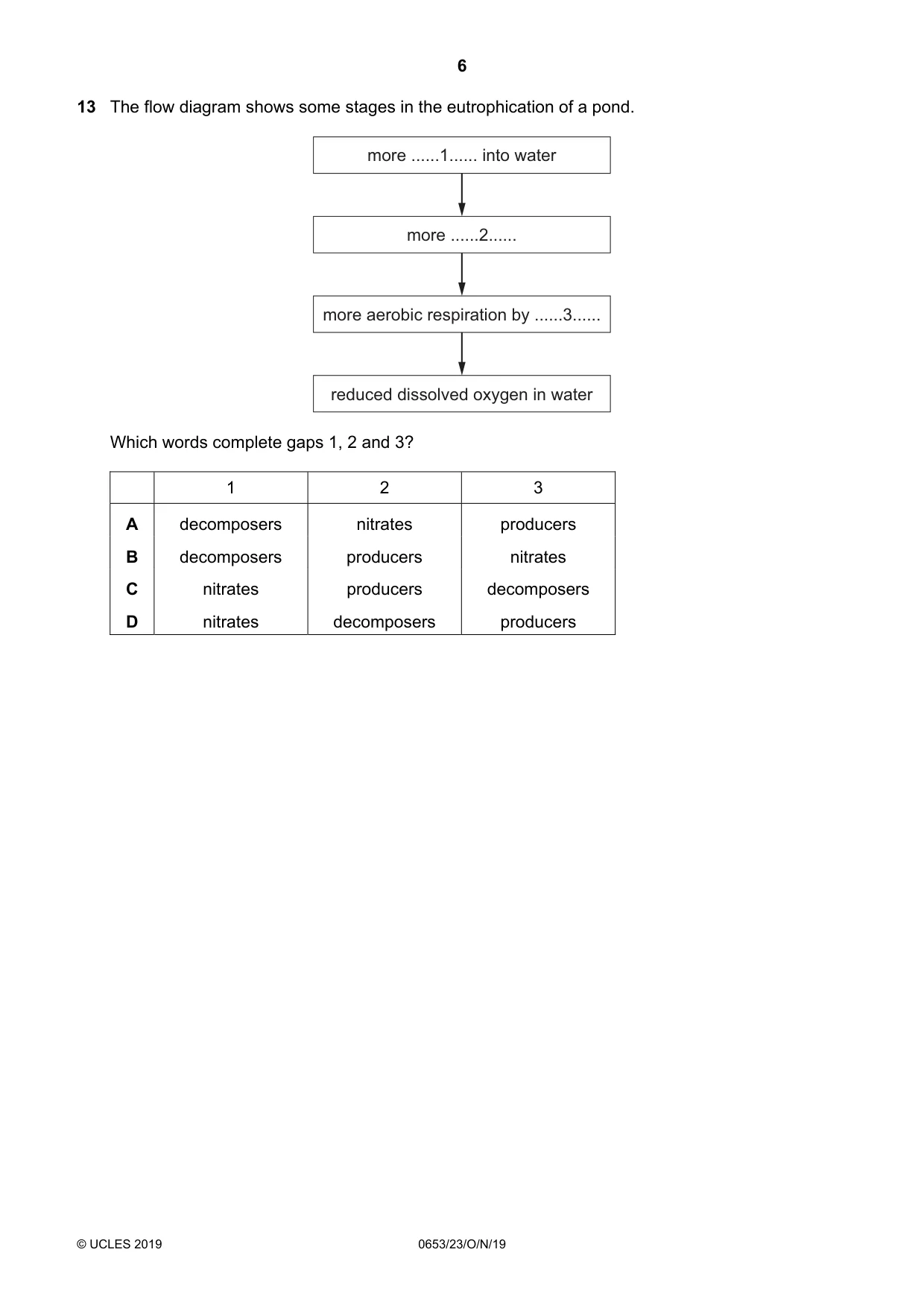
Q13 · The flow diagram shows some stages in the eutrophication of a pond
13 The flow diagram shows some stages in the eutrophication of a pond. more ......1...... into water more ......2...... more aerobic respiration by ......3...... reduced dissolved oxygen in water Which words complete gaps 1, 2 and 3? 1 2 3 A decomposers nitrates producers B decomposers producers nitrates C nitrates producers decomposers D nitrates decomposers producers
Mark scheme: C
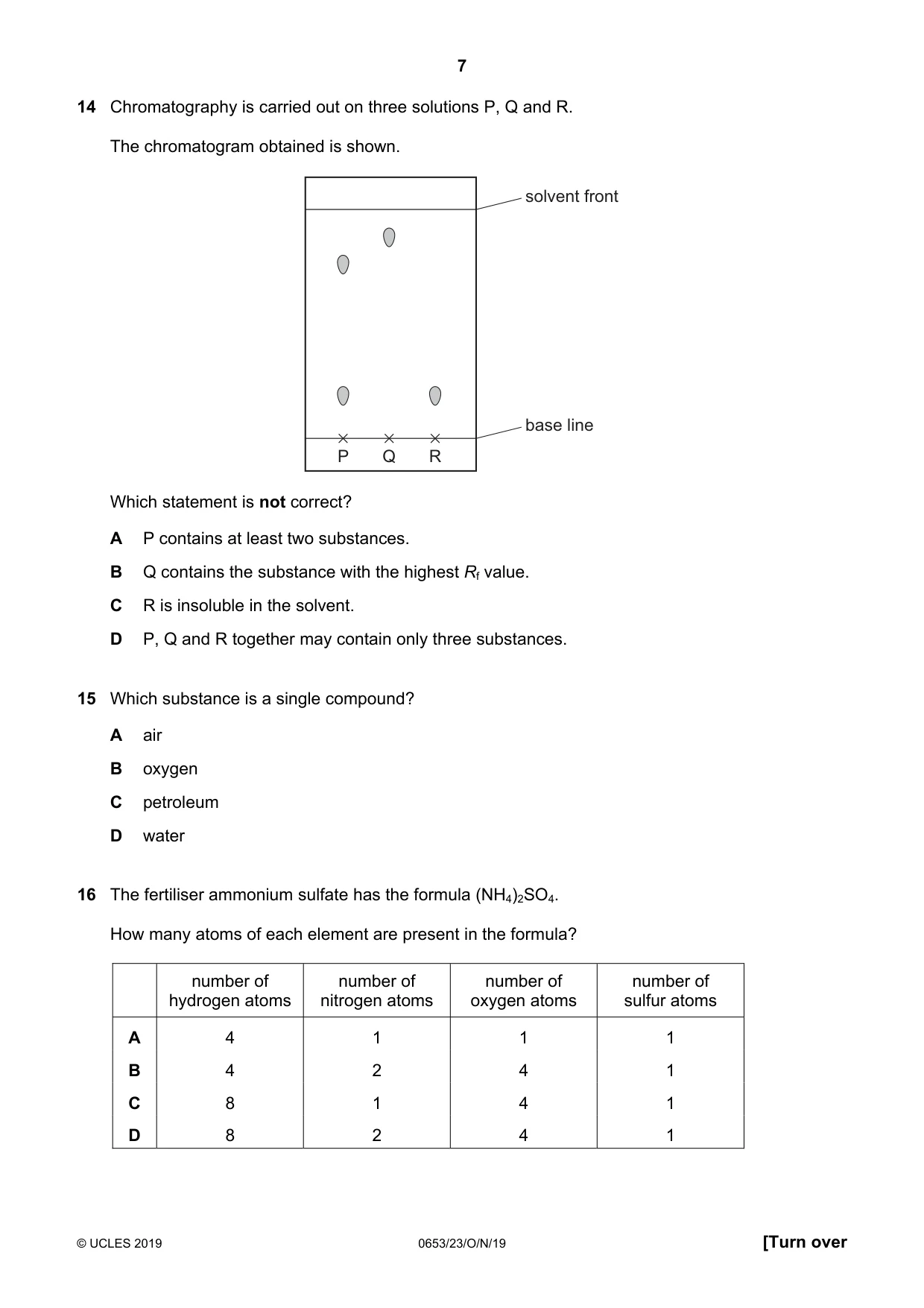
Q14 · Chromatography is carried out on three solutions P, Q and R
14 Chromatography is carried out on three solutions P, Q and R. The chromatogram obtained is shown. solvent front base line P Q R Which statement is not correct? A P contains at least two substances. B Q contains the substance with the highest Rf value. C R is insoluble in the solvent. D P, Q and R together may contain only three substances.
Mark scheme: C
Q15 · Which substance is a single compound?
15 Which substance is a single compound? A air B oxygen C petroleum D water
Mark scheme: D
Q16 · The fertiliser ammonium sulfate has the formula (NH4)2SO4
16 The fertiliser ammonium sulfate has the formula (NH4)2SO4. How many atoms of each element are present in the formula? number of number of number of number of hydrogen atoms nitrogen atoms oxygen atoms sulfur atoms A 4 1 1 1 B 4 2 4 1 C 8 1 4 1 D 8 2 4 1
Mark scheme: D
Q17 · Element X is a non-metal used in the treatment of the water supply
17 Element X is a non-metal used in the treatment of the water supply. It is made during the electrolysis of a metal salt. What is the colour of X and at which electrode is it made? colour electrode A red anode B red cathode C yellow-green anode D yellow-green cathode
Mark scheme: C
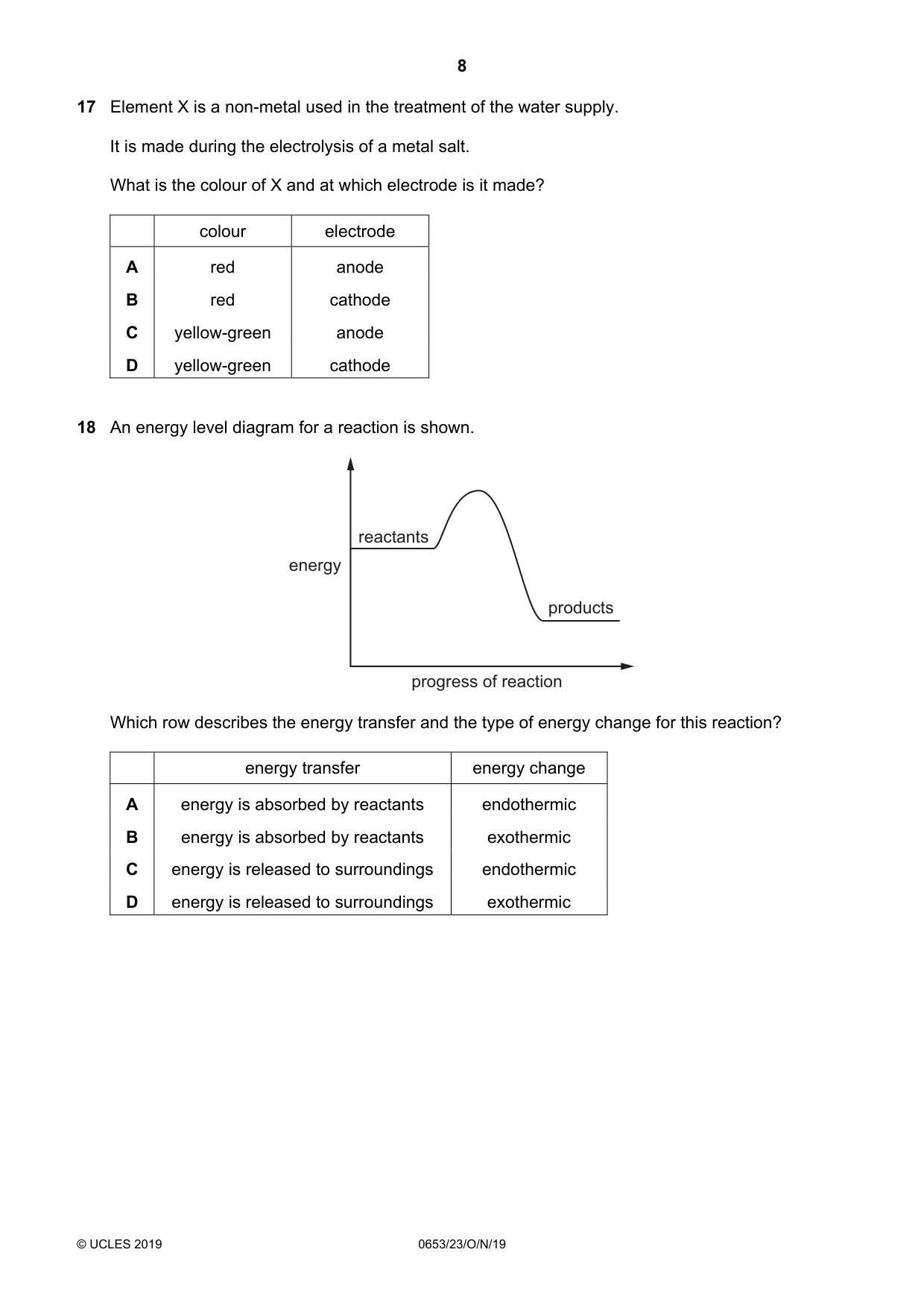
Q18 · An energy level diagram for a reaction is shown
18 An energy level diagram for a reaction is shown. reactants energy products progress of reaction Which row describes the energy transfer and the type of energy change for this reaction? energy transfer energy change A energy is absorbed by reactants endothermic B energy is absorbed by reactants exothermic C energy is released to surroundings endothermic D energy is released to surroundings exothermic
Mark scheme: D
Q19 · Calcium carbonate reacts with 50 cm3 hydrochloric acid
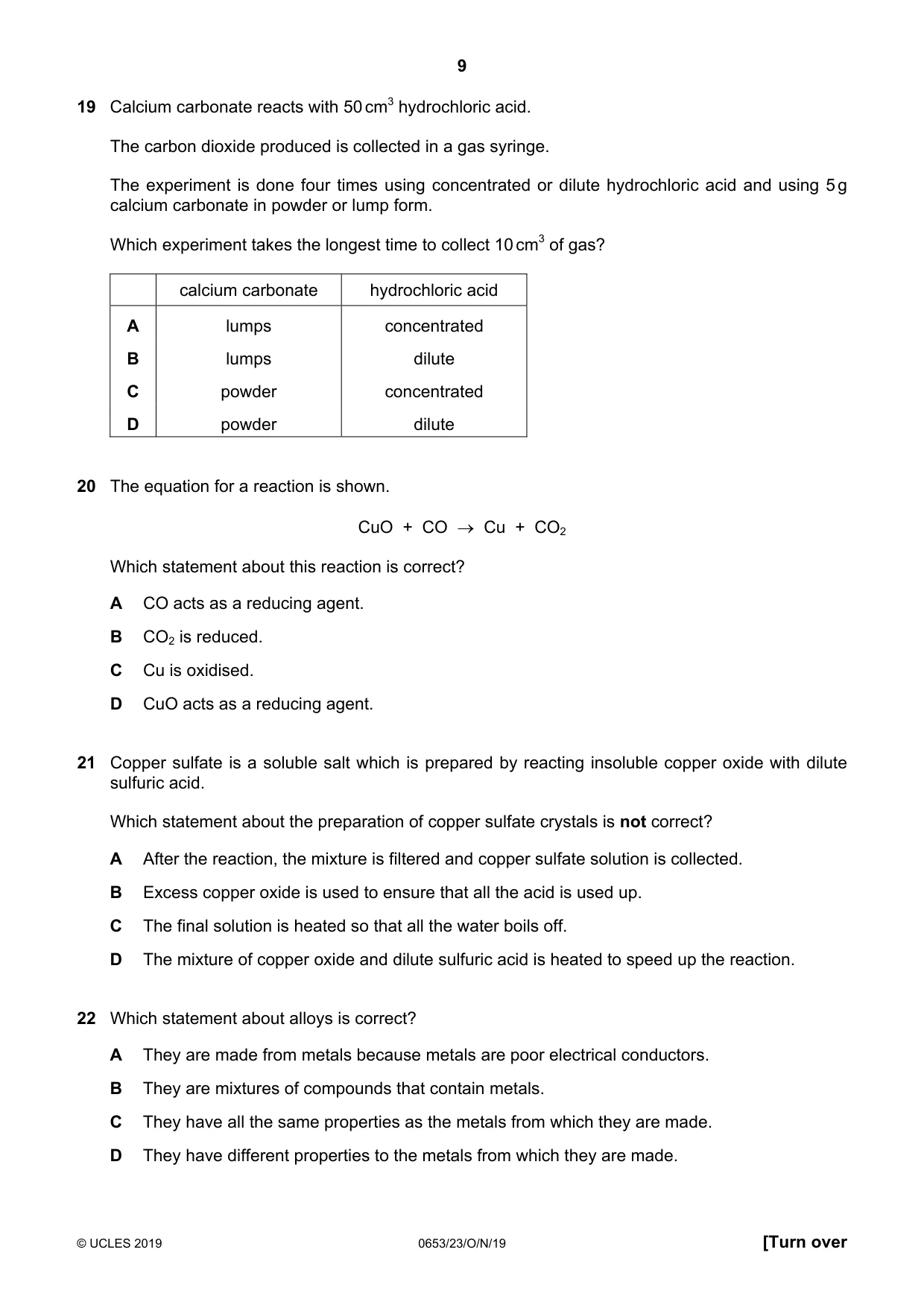
19 Calcium carbonate reacts with 50 cm3 hydrochloric acid. The carbon dioxide produced is collected in a gas syringe. The experiment is done four times using concentrated or dilute hydrochloric acid and using 5 g calcium carbonate in powder or lump form. Which experiment takes the longest time to collect 10 cm3 of gas? calcium carbonate hydrochloric acid A lumps concentrated B lumps dilute C powder concentrated D powder dilute
Mark scheme: B
Q20 · The equation for a reaction is shown
20 The equation for a reaction is shown. CuO + CO → Cu + CO2 Which statement about this reaction is correct? A CO acts as a reducing agent. B CO2 is reduced. C Cu is oxidised. D CuO acts as a reducing agent.
Mark scheme: A
Q21 · Copper sulfate is a soluble salt which is prepared by reacting insoluble copper oxide…
21 Copper sulfate is a soluble salt which is prepared by reacting insoluble copper oxide with dilute sulfuric acid. Which statement about the preparation of copper sulfate crystals is not correct? A After the reaction, the mixture is filtered and copper sulfate solution is collected. B Excess copper oxide is used to ensure that all the acid is used up. C The final solution is heated so that all the water boils off. D The mixture of copper oxide and dilute sulfuric acid is heated to speed up the reaction.
Mark scheme: C
Q22 · Which statement about alloys is correct?
22 Which statement about alloys is correct? A They are made from metals because metals are poor electrical conductors. B They are mixtures of compounds that contain metals. C They have all the same properties as the metals from which they are made. D They have different properties to the metals from which they are made.
Mark scheme: D
Q23 · Which equation does not represent a reaction that takes place in the blast furnace?
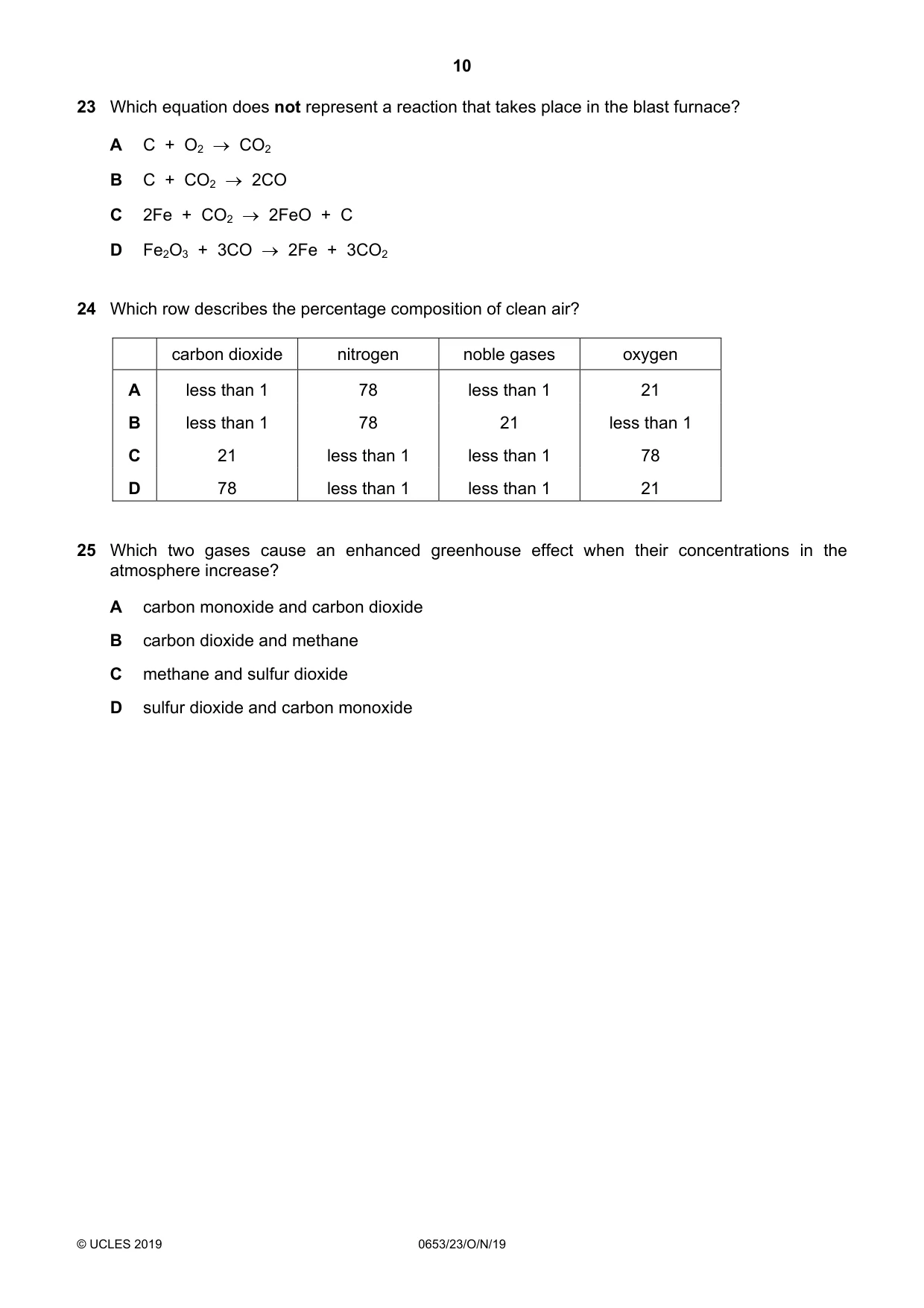
23 Which equation does not represent a reaction that takes place in the blast furnace? A C + O2 → CO2 B C + CO2 → 2CO C 2Fe + CO2 → 2FeO + C D Fe2O3 + 3CO → 2Fe + 3CO2
Mark scheme: C
Q24 · Which row describes the percentage composition of clean air?
24 Which row describes the percentage composition of clean air? carbon dioxide nitrogen noble gases oxygen A less than 1 78 less than 1 21 B less than 1 78 21 less than 1 C 21 less than 1 less than 1 78 D 78 less than 1 less than 1 21
Mark scheme: A
Q25 · Which two gases cause an enhanced greenhouse effect when their concentrations in the…
25 Which two gases cause an enhanced greenhouse effect when their concentrations in the atmosphere increase? A carbon monoxide and carbon dioxide B carbon dioxide and methane C methane and sulfur dioxide D sulfur dioxide and carbon monoxide
Mark scheme: B
Q26 · A simple fractionating column is shown
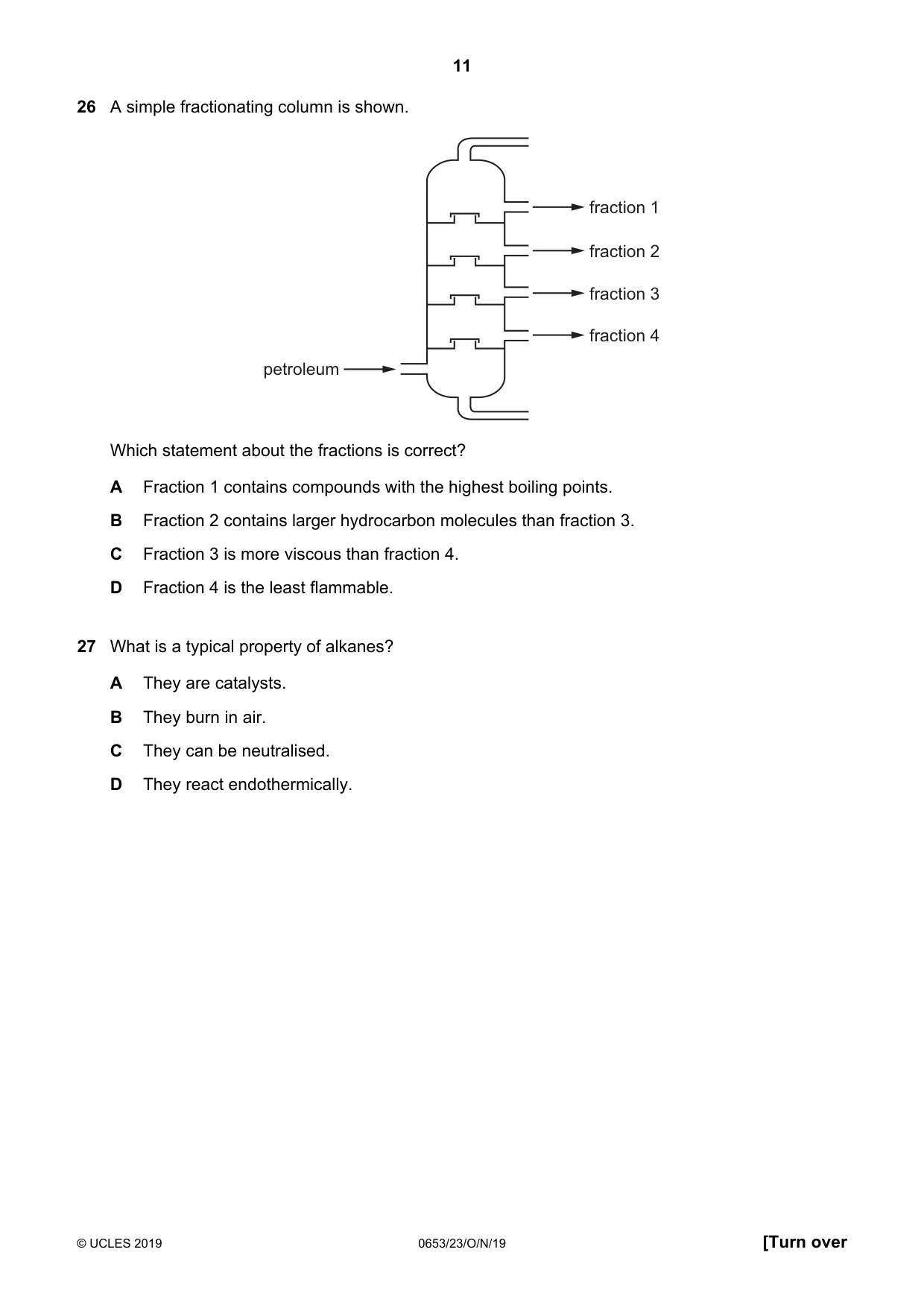
26 A simple fractionating column is shown. fraction 1 fraction 2 fraction 3 fraction 4 petroleum Which statement about the fractions is correct? A Fraction 1 contains compounds with the highest boiling points. B Fraction 2 contains larger hydrocarbon molecules than fraction 3. C Fraction 3 is more viscous than fraction 4. D Fraction 4 is the least flammable.
Mark scheme: D
Q27 · What is a typical property of alkanes?
27 What is a typical property of alkanes? A They are catalysts. B They burn in air. C They can be neutralised. D They react endothermically.
Mark scheme: B
Q28 · The graph shows how the speed of a car changes with time
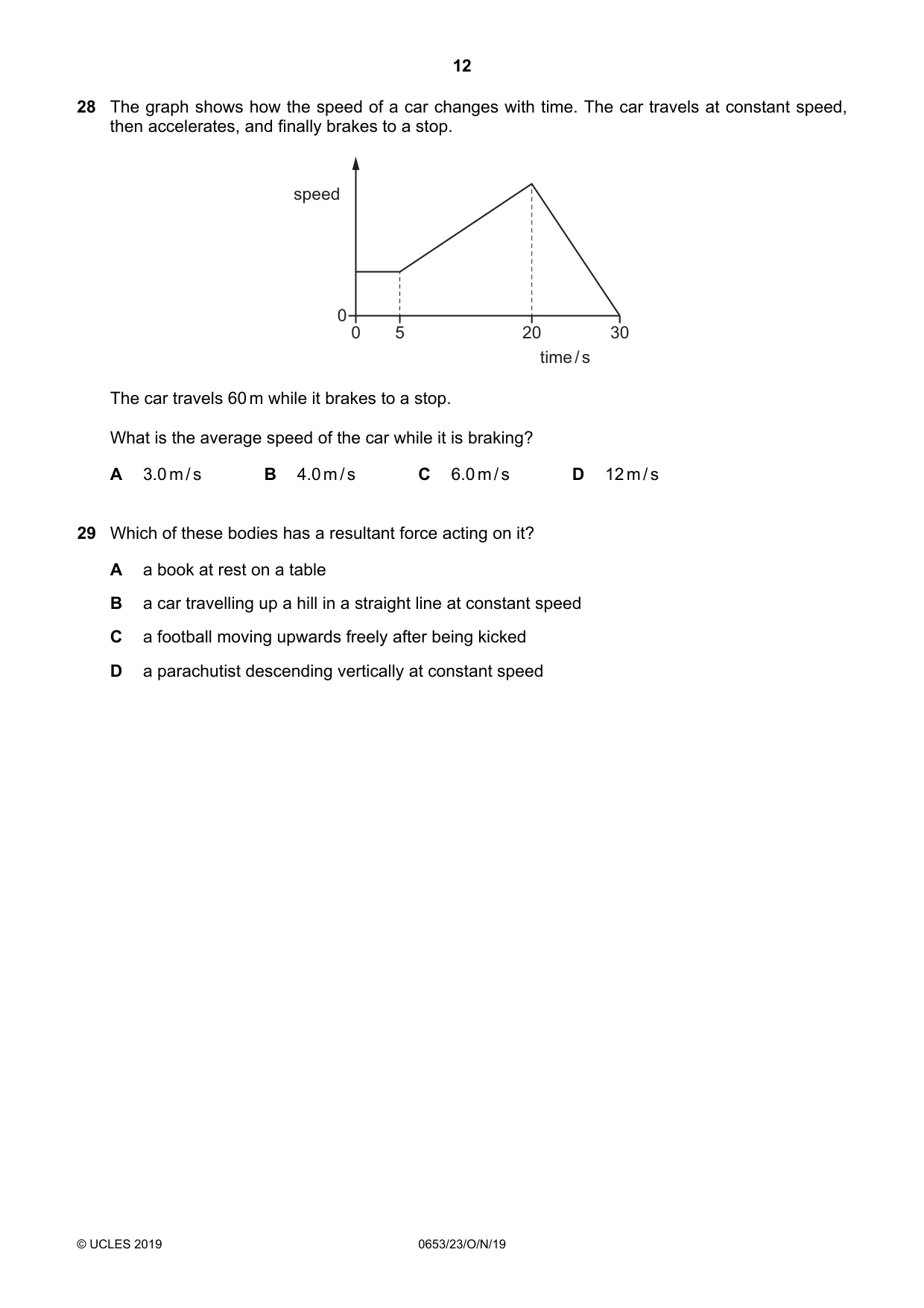
28 The graph shows how the speed of a car changes with time. The car travels at constant speed, then accelerates, and finally brakes to a stop. speed 0 0 5 20 30 time / s The car travels 60 m while it brakes to a stop. What is the average speed of the car while it is braking? A 3.0 m / s B 4.0 m / s C 6.0 m / s D 12 m / s
Mark scheme: C
Q29 · Which of these bodies has a resultant force acting on it?
29 Which of these bodies has a resultant force acting on it? A a book at rest on a table B a car travelling up a hill in a straight line at constant speed C a football moving upwards freely after being kicked D a parachutist descending vertically at constant speed
Mark scheme: C
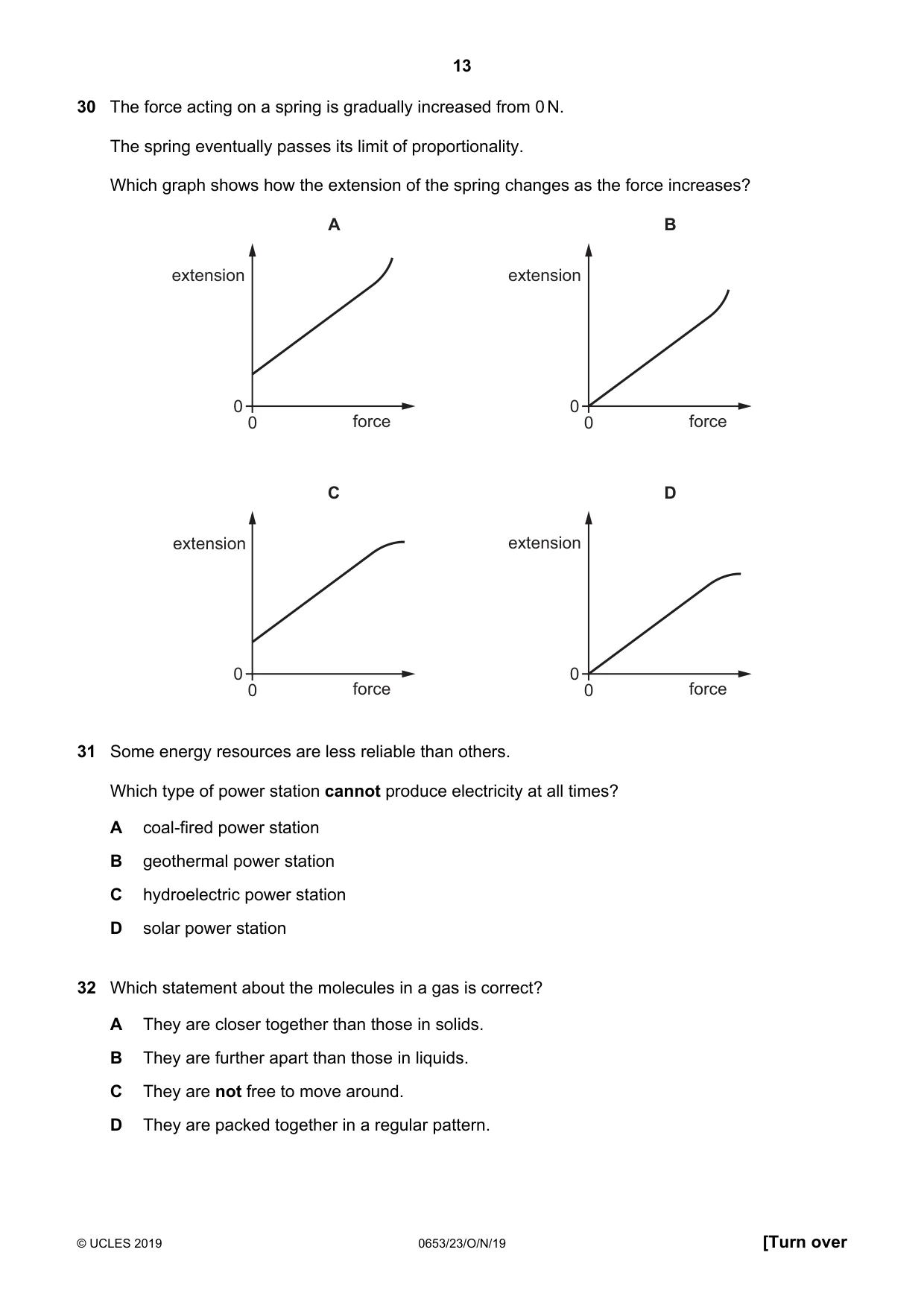
Q30 · The force acting on a spring is gradually increased from 0 N
30 The force acting on a spring is gradually increased from 0 N. The spring eventually passes its limit of proportionality. Which graph shows how the extension of the spring changes as the force increases? A B extension extension 0 0 0 force 0 force C D extension extension 0 0 0 force 0 force
Mark scheme: B
Q31 · Some energy resources are less reliable than others
31 Some energy resources are less reliable than others. Which type of power station cannot produce electricity at all times? A coal-fired power station B geothermal power station C hydroelectric power station D solar power station
Mark scheme: D
Q32 · Which statement about the molecules in a gas is correct?
32 Which statement about the molecules in a gas is correct? A They are closer together than those in solids. B They are further apart than those in liquids. C They are not free to move around. D They are packed together in a regular pattern.
Mark scheme: B
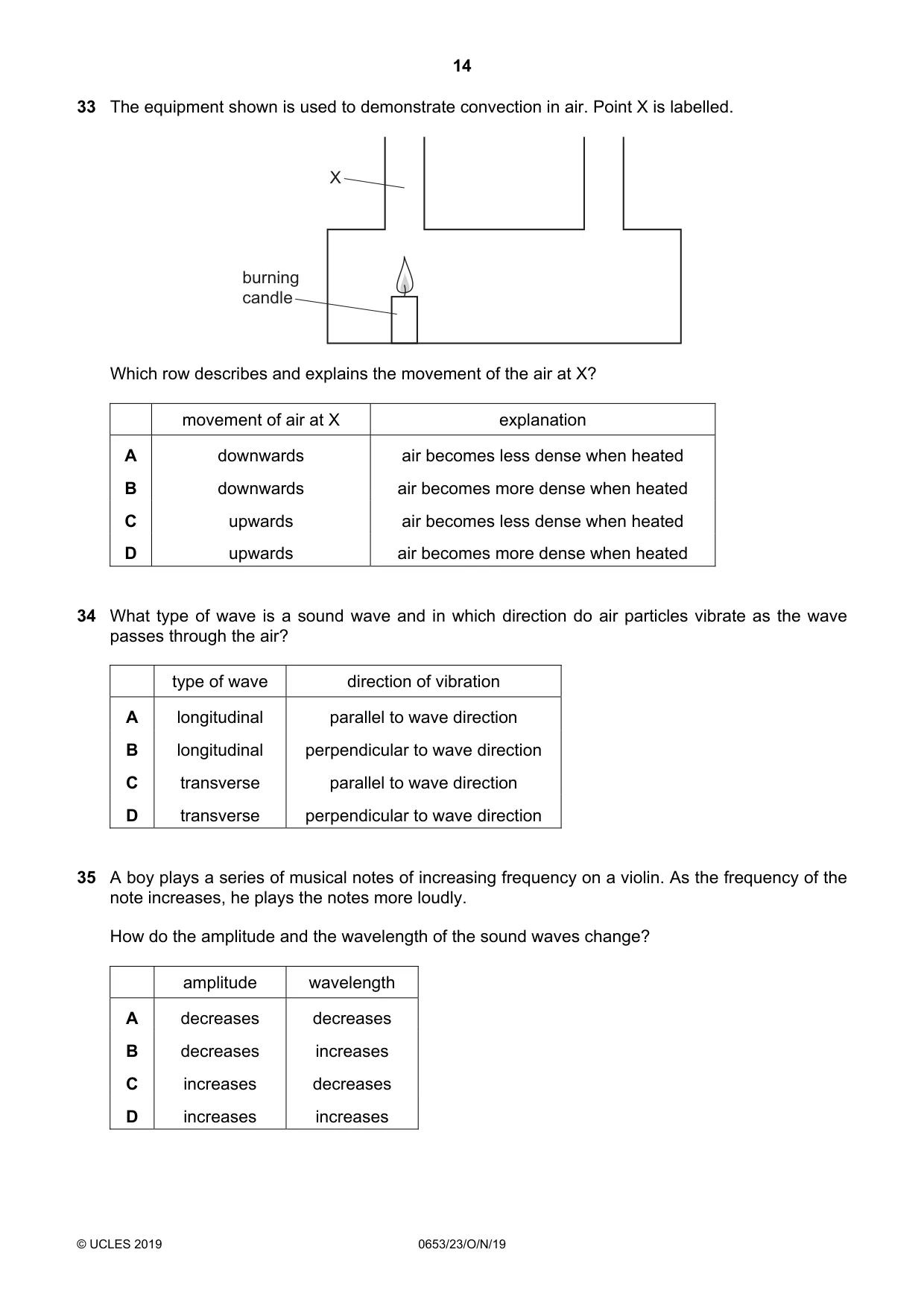
Q33 · The equipment shown is used to demonstrate convection in air
33 The equipment shown is used to demonstrate convection in air. Point X is labelled. X burning candle Which row describes and explains the movement of the air at X? movement of air at X explanation A downwards air becomes less dense when heated B downwards air becomes more dense when heated C upwards air becomes less dense when heated D upwards air becomes more dense when heated
Mark scheme: C
Q34 · What type of wave is a sound wave and in which direction do air particles vibrate as the…
34 What type of wave is a sound wave and in which direction do air particles vibrate as the wave passes through the air? type of wave direction of vibration A longitudinal parallel to wave direction B longitudinal perpendicular to wave direction C transverse parallel to wave direction D transverse perpendicular to wave direction
Mark scheme: A
Q35 · A boy plays a series of musical notes of increasing frequency on a violin
35 A boy plays a series of musical notes of increasing frequency on a violin. As the frequency of the note increases, he plays the notes more loudly. How do the amplitude and the wavelength of the sound waves change? amplitude wavelength A decreases decreases B decreases increases C increases decreases D increases increases
Mark scheme: C
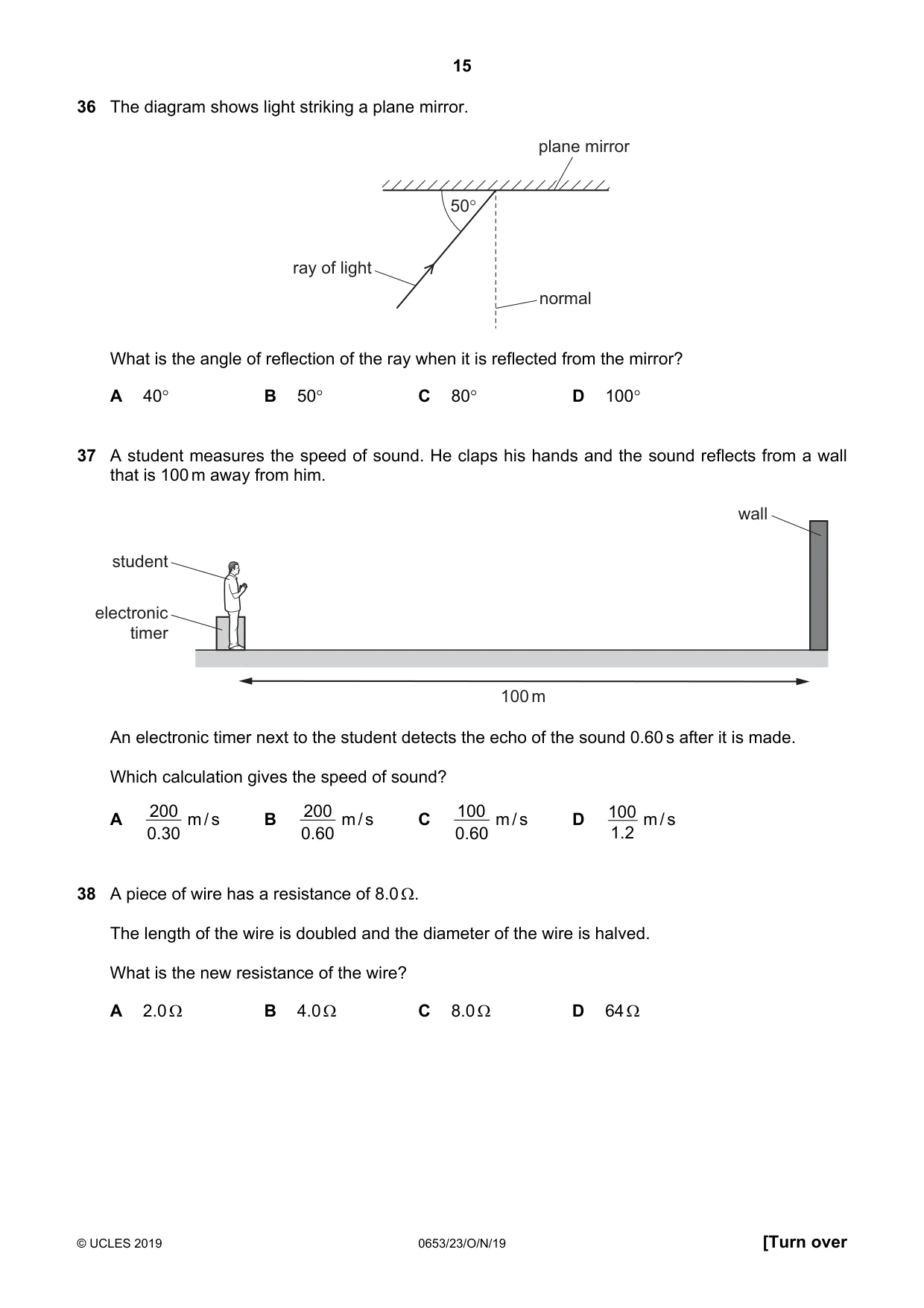
Q36 · The diagram shows light striking a plane mirror
36 The diagram shows light striking a plane mirror. plane mirror 50° ray of light normal What is the angle of reflection of the ray when it is reflected from the mirror? A 40° B 50° C 80° D 100°
Mark scheme: A
Q37 · A student measures the speed of sound
37 A student measures the speed of sound. He claps his hands and the sound reflects from a wall that is 100 m away from him. wall student electronic timer 100 m An electronic timer next to the student detects the echo of the sound 0.60 s after it is made. Which calculation gives the speed of sound? 200 200 100 100 A m / s B m / s C m / s D m / s 0.30 0.60 0.60 1 . 2
Mark scheme: B
Q38 · A piece of wire has a resistance of 8.0 Ω
38 A piece of wire has a resistance of 8.0 Ω. The length of the wire is doubled and the diameter of the wire is halved. What is the new resistance of the wire? A 2.0 Ω B 4.0 Ω C 8.0 Ω D 64 Ω
Mark scheme: D
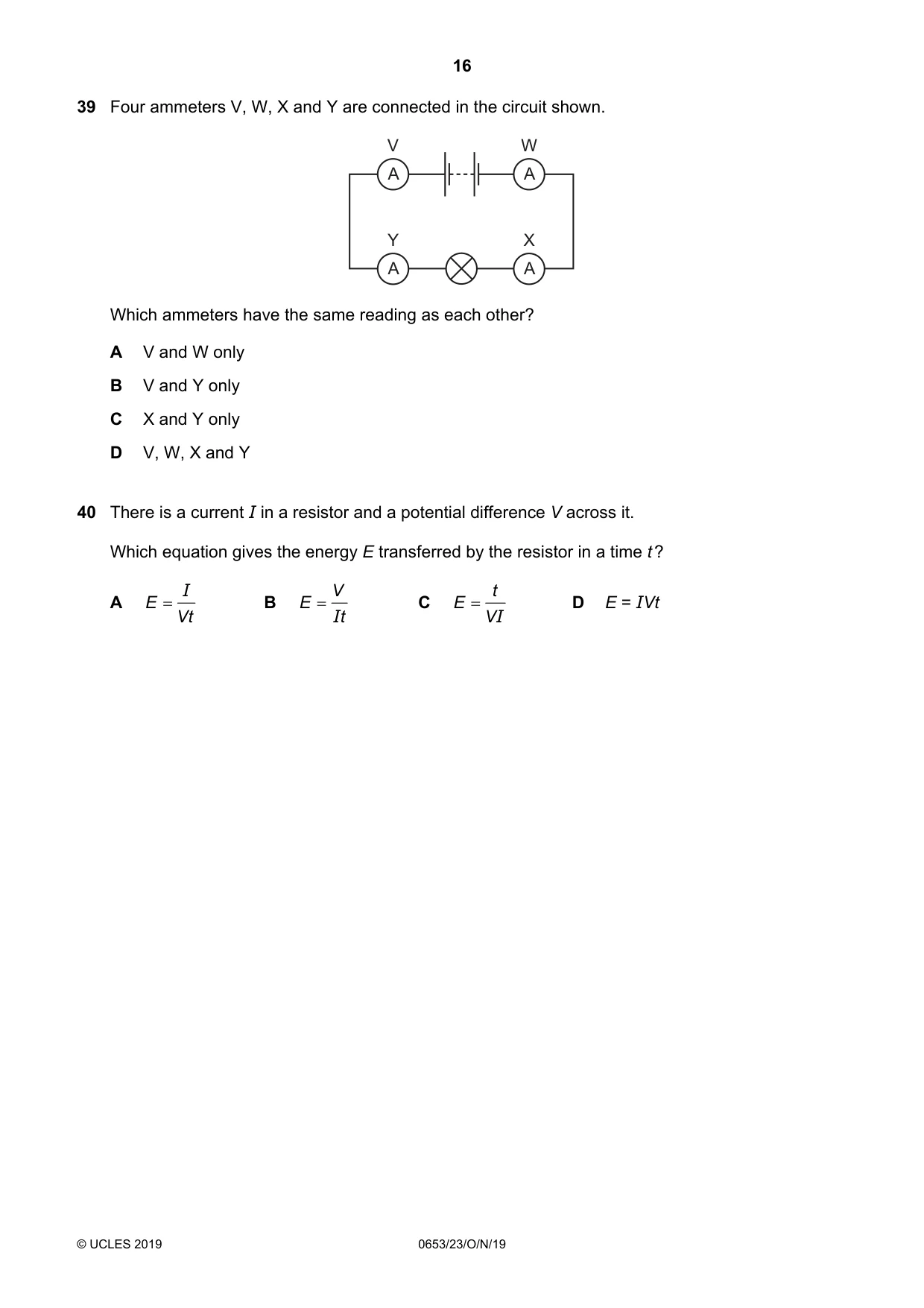
Q39 · Four ammeters V, W, X and Y are connected in the circuit shown
39 Four ammeters V, W, X and Y are connected in the circuit shown. V W A A Y X A A Which ammeters have the same reading as each other? A V and W only B V and Y only C X and Y only D V, W, X and Y
Mark scheme: D
Q40 · There is a current I in a resistor and a potential difference V across it
40 There is a current I in a resistor and a potential difference V across it. Which equation gives the energy E transferred by the resistor in a time t ? I V t A E = B E = C E = D E = IVt Vt I t V I
Mark scheme: D
What was in this paper
The subtopics covered by these 40 questions, and how many questions each got. Open one in a new tab to see every Cambridge question on it.
2Electrical quantities2Forces2Gas exchange in humans2Sexual reproduction in plants2Sound2Alkanes1Alloys and their properties1Characteristics of living organisms1Chromatography1Digestion1Electrical circuits1Electrolysis1Elements, compounds and mixtures1Energy flow1Energy, work and power1Enzymes1Exothermic and endothermic reactions1Extraction of metals1Food chains and food webs1Formulas1Fuels1General properties of waves1Kinetic particle model of matter1Light1Motion1Photosynthesis1Preparation of salts1Rate of reaction1Redox1Respiration1Sexual reproduction in humans1Transfer of thermal energy1Xylem and phloem1What you needed in this session
Cambridge’s own grade thresholds for 2019 Oct/Nov, Paper 2 · Variant 3. A higher threshold means an easier paper — the bar moves with how the cohort did.