Cambridge IGCSE Science - Combined 0653 — 2018 Oct/Nov Paper 2 · Variant 1
0653/21/O/N/18 · 40 questions · 40 marks · ≈45 min
The question paper and its mark scheme, free to read here and free to download. This is Cambridge’s own paper, exactly as it was sat.
Question paper16 pages

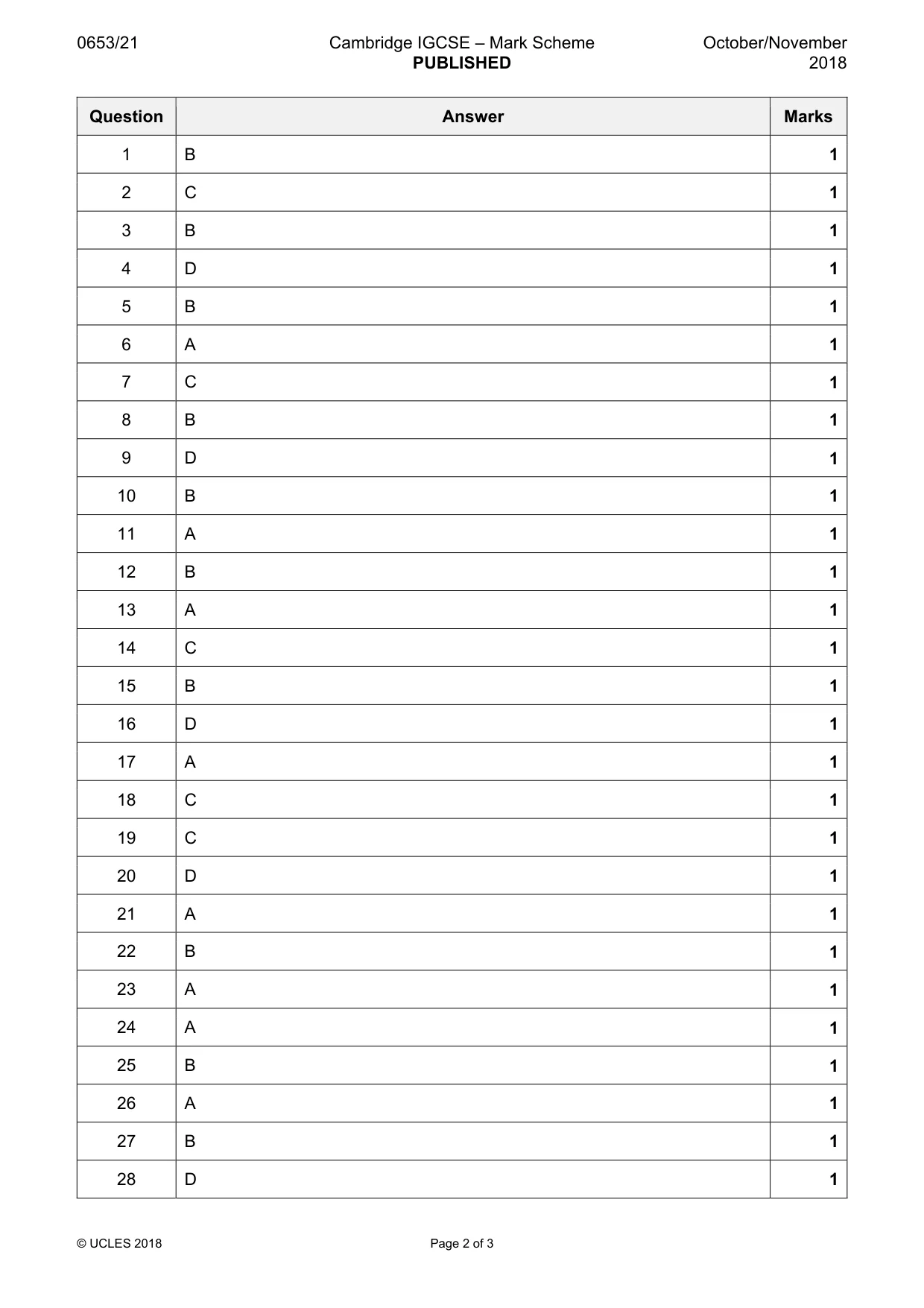
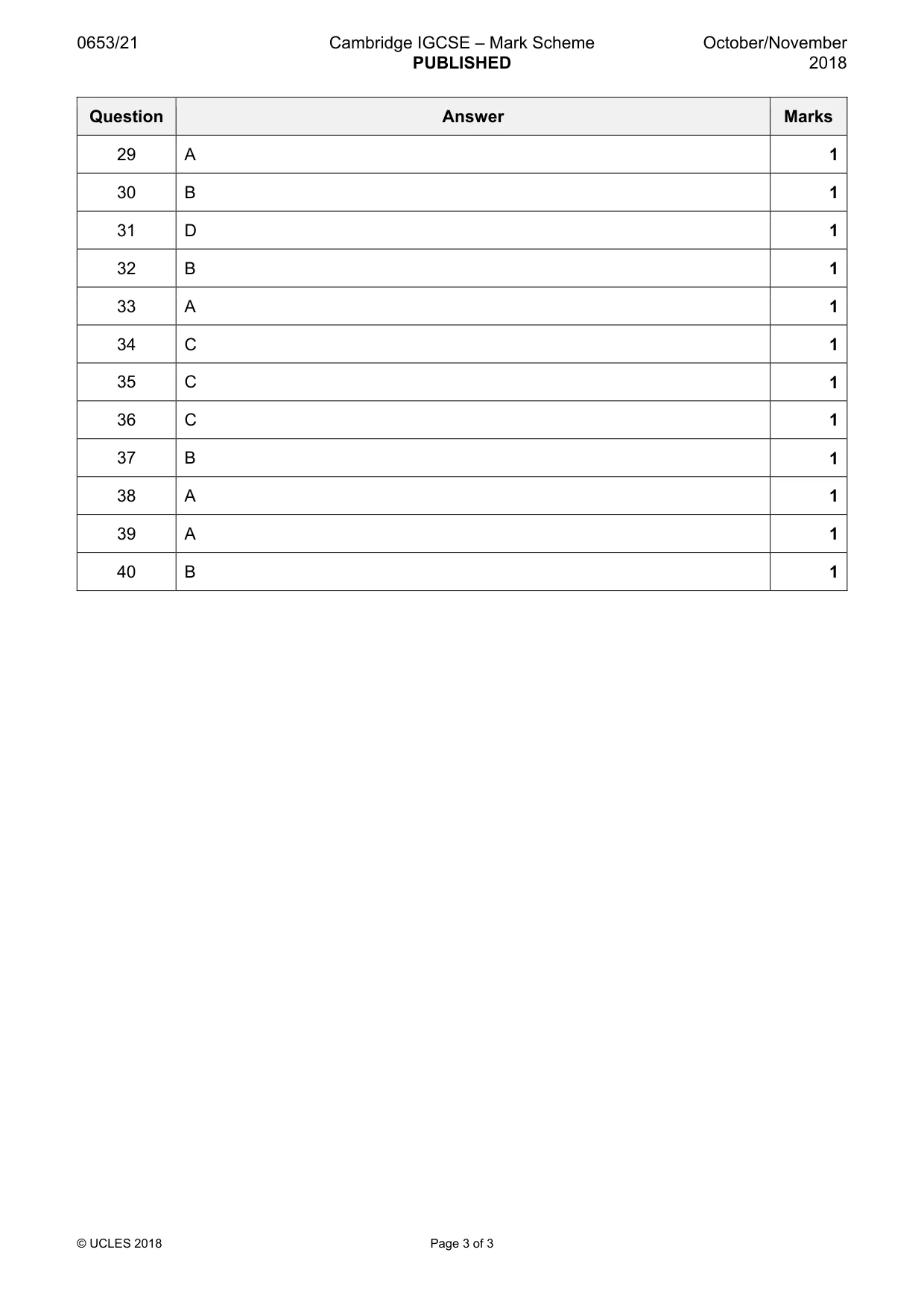
Mark scheme3 pages
Answers below. Sit the paper first if you are practising.
Questions as text
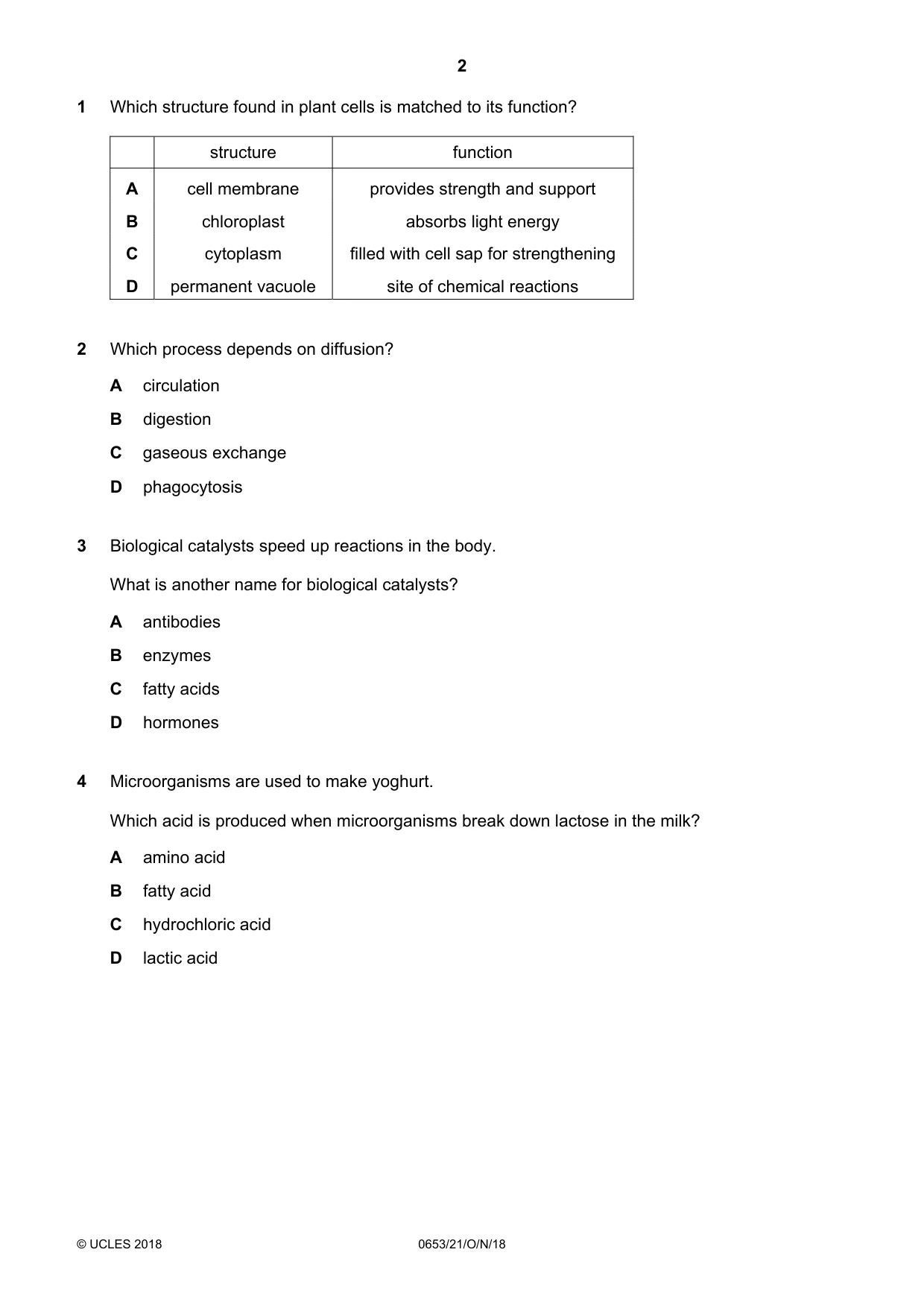
Q1 · Which structure found in plant cells is matched to its function?
1 Which structure found in plant cells is matched to its function? structure function A cell membrane provides strength and support B chloroplast absorbs light energy C cytoplasm filled with cell sap for strengthening D permanent vacuole site of chemical reactions
Mark scheme: B
Q2 · Which process depends on diffusion?
2 Which process depends on diffusion? A circulation B digestion C gaseous exchange D phagocytosis
Mark scheme: C
Q3 · Biological catalysts speed up reactions in the body
3 Biological catalysts speed up reactions in the body. What is another name for biological catalysts? A antibodies B enzymes C fatty acids D hormones
Mark scheme: B
Q4 · Microorganisms are used to make yoghurt
4 Microorganisms are used to make yoghurt. Which acid is produced when microorganisms break down lactose in the milk? A amino acid B fatty acid C hydrochloric acid D lactic acid
Mark scheme: D
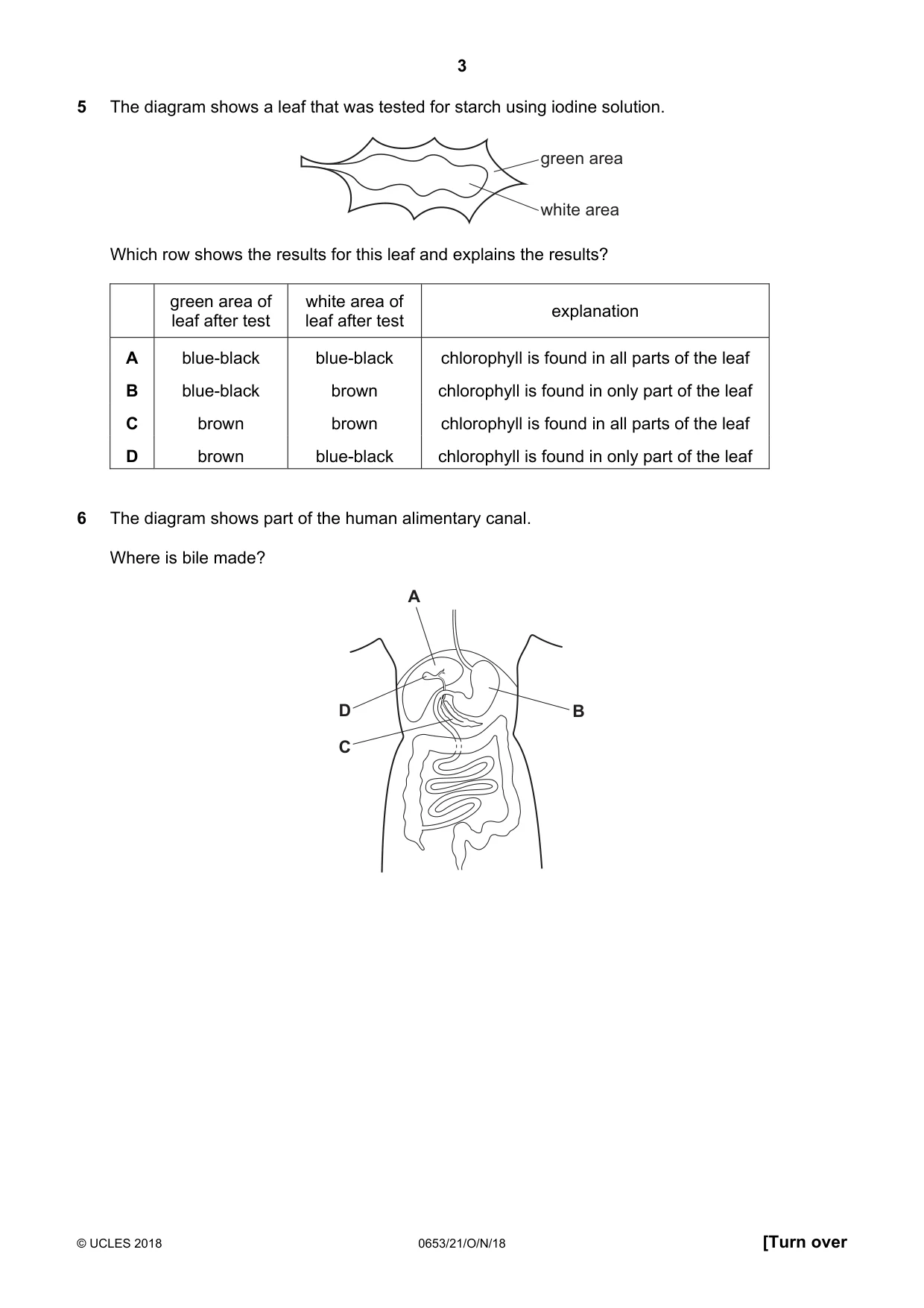
Q5 · The diagram shows a leaf that was tested for starch using iodine solution
5 The diagram shows a leaf that was tested for starch using iodine solution. green area white area Which row shows the results for this leaf and explains the results? green area of white area of explanation leaf after test leaf after test A blue-black blue-black chlorophyll is found in all parts of the leaf B blue-black brown chlorophyll is found in only part of the leaf C brown brown chlorophyll is found in all parts of the leaf D brown blue-black chlorophyll is found in only part of the leaf
Mark scheme: B
Q6 · The diagram shows part of the human alimentary canal
6 The diagram shows part of the human alimentary canal. Where is bile made? A D B C
Mark scheme: A
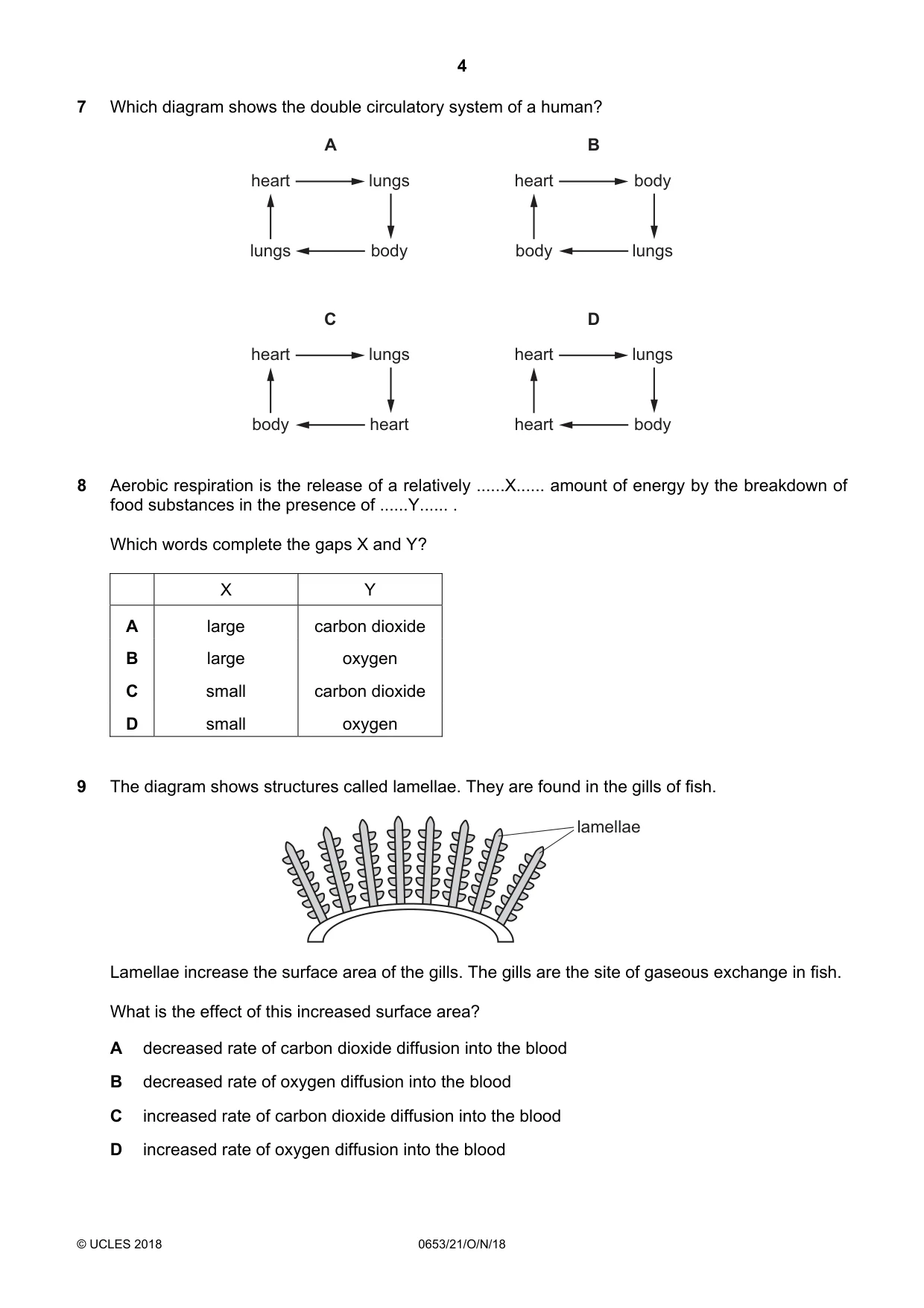
Q7 · Which diagram shows the double circulatory system of a human?
7 Which diagram shows the double circulatory system of a human? A B heart lungs heart body lungs body body lungs C D heart lungs heart lungs body heart heart body
Mark scheme: C
Q8 · Aerobic respiration is the release of a relatively ......X.....
8 Aerobic respiration is the release of a relatively ......X...... amount of energy by the breakdown of food substances in the presence of ......Y...... . Which words complete the gaps X and Y? X Y A large carbon dioxide B large oxygen C small carbon dioxide D small oxygen
Mark scheme: B
Q9 · The diagram shows structures called lamellae
9 The diagram shows structures called lamellae. They are found in the gills of fish. lamellae Lamellae increase the surface area of the gills. The gills are the site of gaseous exchange in fish. What is the effect of this increased surface area? A decreased rate of carbon dioxide diffusion into the blood B decreased rate of oxygen diffusion into the blood C increased rate of carbon dioxide diffusion into the blood D increased rate of oxygen diffusion into the blood
Mark scheme: D
Q10 · Which statement about adrenaline is not correct?
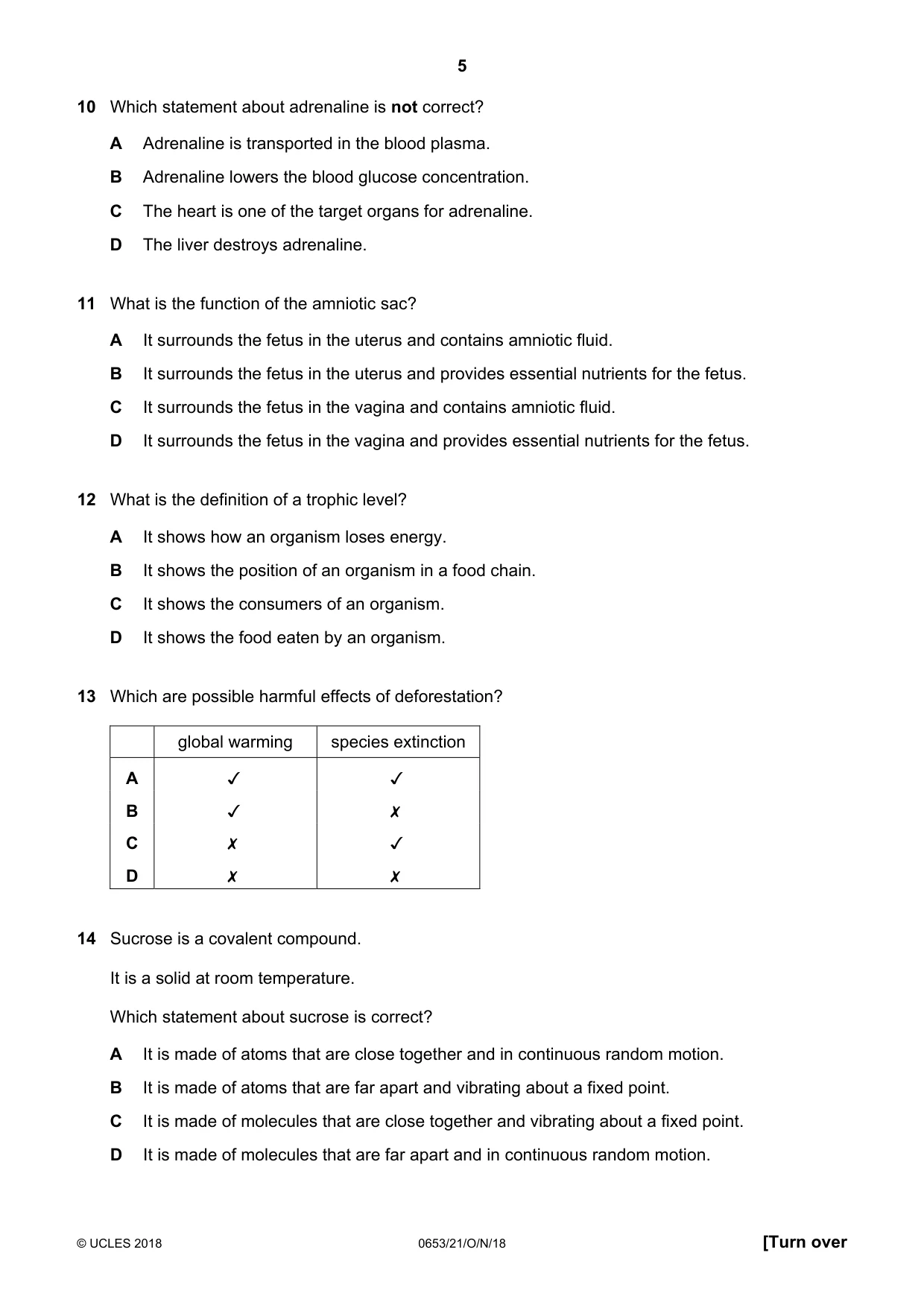
10 Which statement about adrenaline is not correct? A Adrenaline is transported in the blood plasma. B Adrenaline lowers the blood glucose concentration. C The heart is one of the target organs for adrenaline. D The liver destroys adrenaline.
Mark scheme: B
Q11 · What is the function of the amniotic sac?
11 What is the function of the amniotic sac? A It surrounds the fetus in the uterus and contains amniotic fluid. B It surrounds the fetus in the uterus and provides essential nutrients for the fetus. C It surrounds the fetus in the vagina and contains amniotic fluid. D It surrounds the fetus in the vagina and provides essential nutrients for the fetus.
Mark scheme: A
Q12 · What is the definition of a trophic level?
12 What is the definition of a trophic level? A It shows how an organism loses energy. B It shows the position of an organism in a food chain. C It shows the consumers of an organism. D It shows the food eaten by an organism.
Mark scheme: B
Q13 · Which are possible harmful effects of deforestation?
13 Which are possible harmful effects of deforestation? global warming species extinction A v v B v x Cc x v D x x
Mark scheme: A
Q14 · Sucrose is a covalent compound
14 Sucrose is a covalent compound. It is a solid at room temperature. Which statement about sucrose is correct? A It is made of atoms that are close together and in continuous random motion. B It is made of atoms that are far apart and vibrating about a fixed point. C It is made of molecules that are close together and vibrating about a fixed point. D It is made of molecules that are far apart and in continuous random motion.
Mark scheme: C
Q15 · Four dyes are separated using chromatography
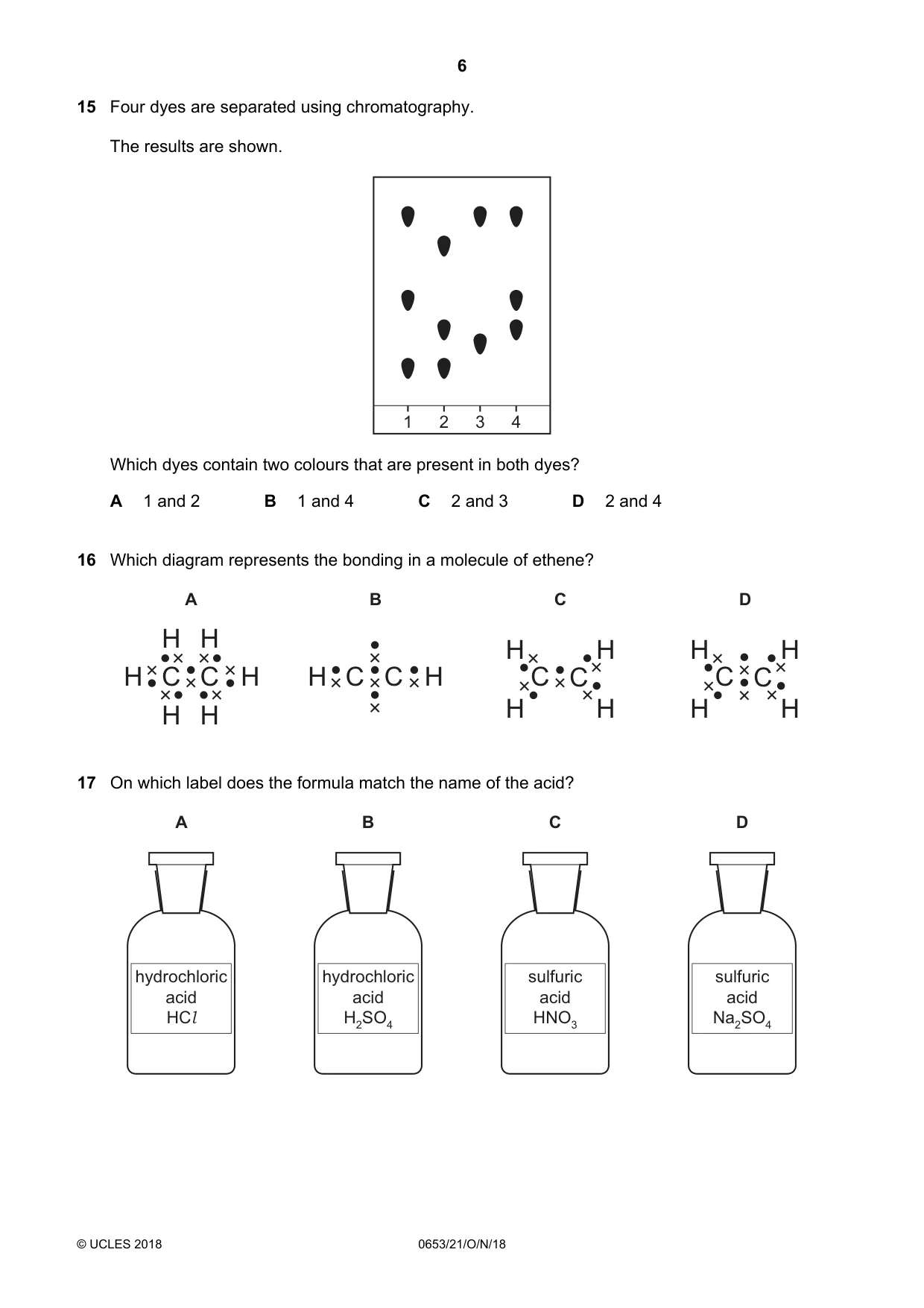
15 Four dyes are separated using chromatography. The results are shown. 1 2 3 4 Which dyes contain two colours that are present in both dyes? A 1 and 2 B 1 and 4 C 2 and 3 D 2 and 4
Mark scheme: B
Q16 · Which diagram represents the bonding in a molecule of ethene?
16 Which diagram represents the bonding in a molecule of ethene? A B C D H H H H H H H C C H H C C H C C C C H H H H H H
Mark scheme: D
Q17 · On which label does the formula match the name of the acid?
17 On which label does the formula match the name of the acid? A B C D hydrochloric hydrochloric sulfuric sulfuric acid acid acid acid HCl H2SO4 HNO3 Na2SO4
Mark scheme: A
More questions on The characteristic properties of acids and bases
Q18 · Some chemical compounds are broken down by electrolysis using inert electrodes
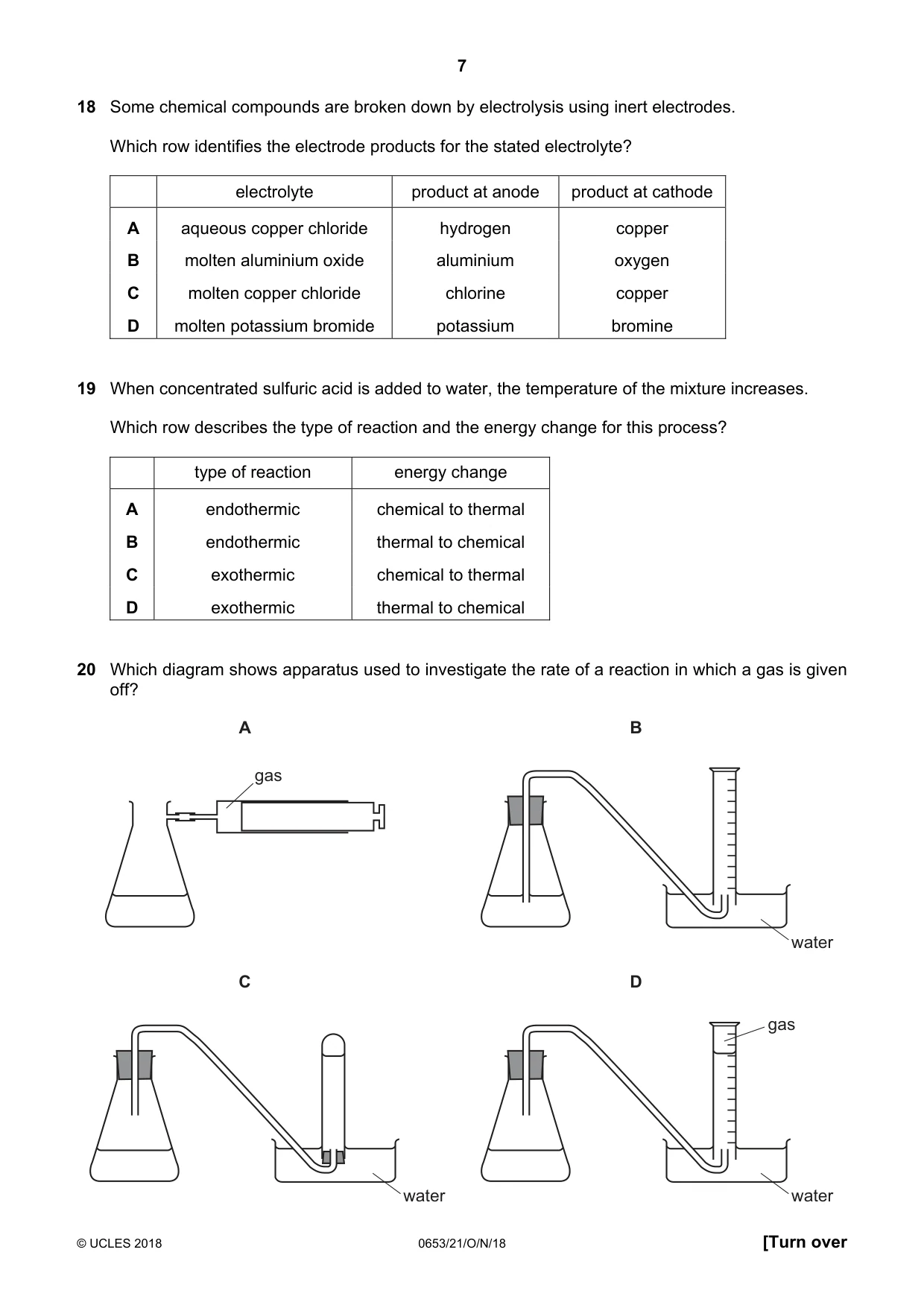
18 Some chemical compounds are broken down by electrolysis using inert electrodes. Which row identifies the electrode products for the stated electrolyte? electrolyte product at anode product at cathode A aqueous copper chloride hydrogen copper B molten aluminium oxide aluminium oxygen C molten copper chloride chlorine copper D molten potassium bromide potassium bromine
Mark scheme: C
Q19 · When concentrated sulfuric acid is added to water, the temperature of the mixture…
19 When concentrated sulfuric acid is added to water, the temperature of the mixture increases. Which row describes the type of reaction and the energy change for this process? type of reaction energy change A endothermic chemical to thermal B endothermic thermal to chemical C exothermic chemical to thermal D exothermic thermal to chemical
Mark scheme: C
Q20 · Which diagram shows apparatus used to investigate the rate of a reaction in which a gas…
20 Which diagram shows apparatus used to investigate the rate of a reaction in which a gas is given off? A B gas water C D gas water water
Mark scheme: D
Q21 · Iron oxide reacts with carbon monoxide
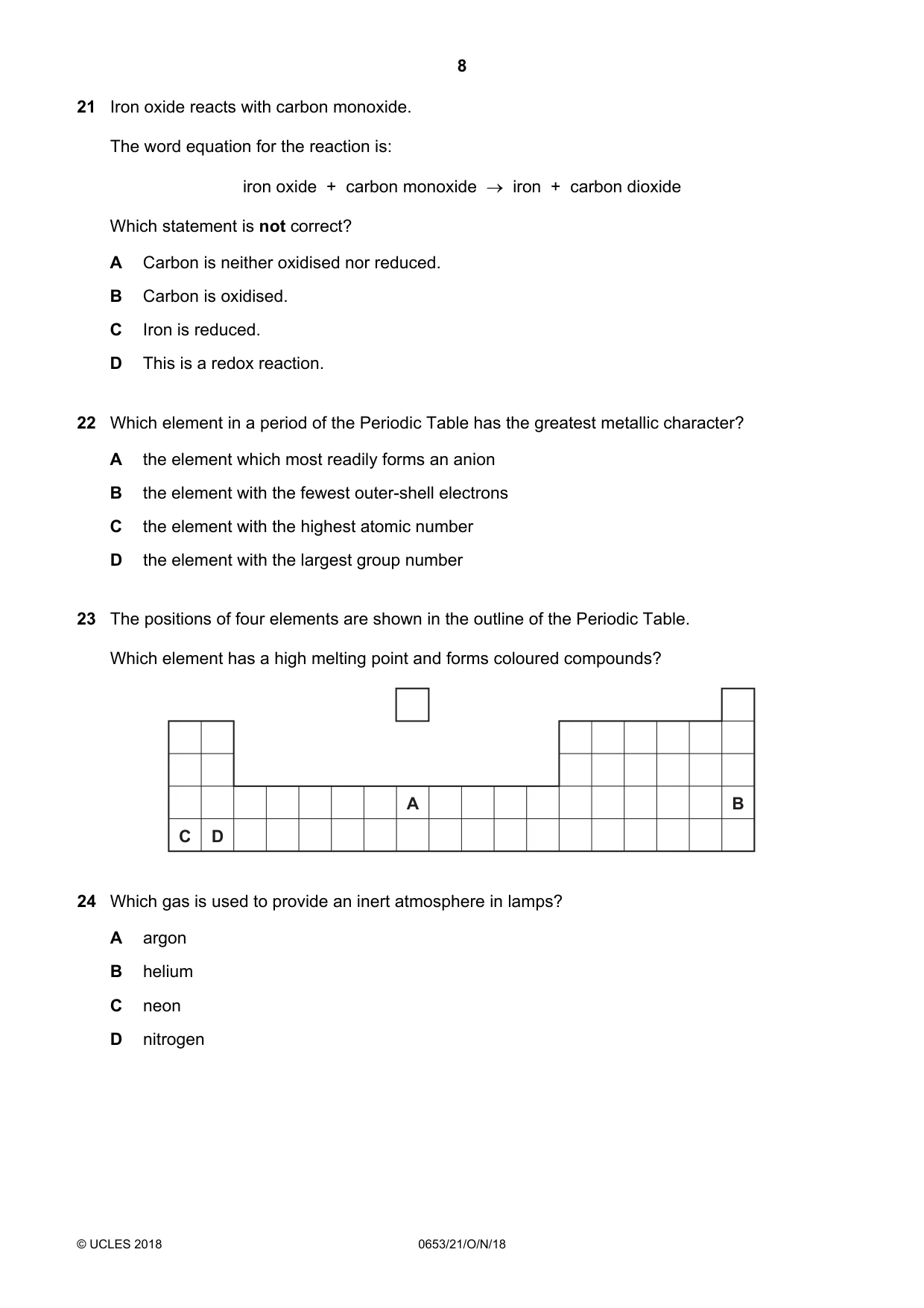
21 Iron oxide reacts with carbon monoxide. The word equation for the reaction is: iron oxide + carbon monoxide → iron + carbon dioxide Which statement is not correct? A Carbon is neither oxidised nor reduced. B Carbon is oxidised. C Iron is reduced. D This is a redox reaction.
Mark scheme: A
Q22 · Which element in a period of the Periodic Table has the greatest metallic character?
22 Which element in a period of the Periodic Table has the greatest metallic character? A the element which most readily forms an anion B the element with the fewest outer-shell electrons C the element with the highest atomic number D the element with the largest group number
Mark scheme: B
Q23 · The positions of four elements are shown in the outline of the Periodic Table
23 The positions of four elements are shown in the outline of the Periodic Table. Which element has a high melting point and forms coloured compounds? A B C D
Mark scheme: A
Q24 · Which gas is used to provide an inert atmosphere in lamps?
24 Which gas is used to provide an inert atmosphere in lamps? A argon B helium C neon D nitrogen
Mark scheme: A
Q25 · Which statement about metals is not correct?
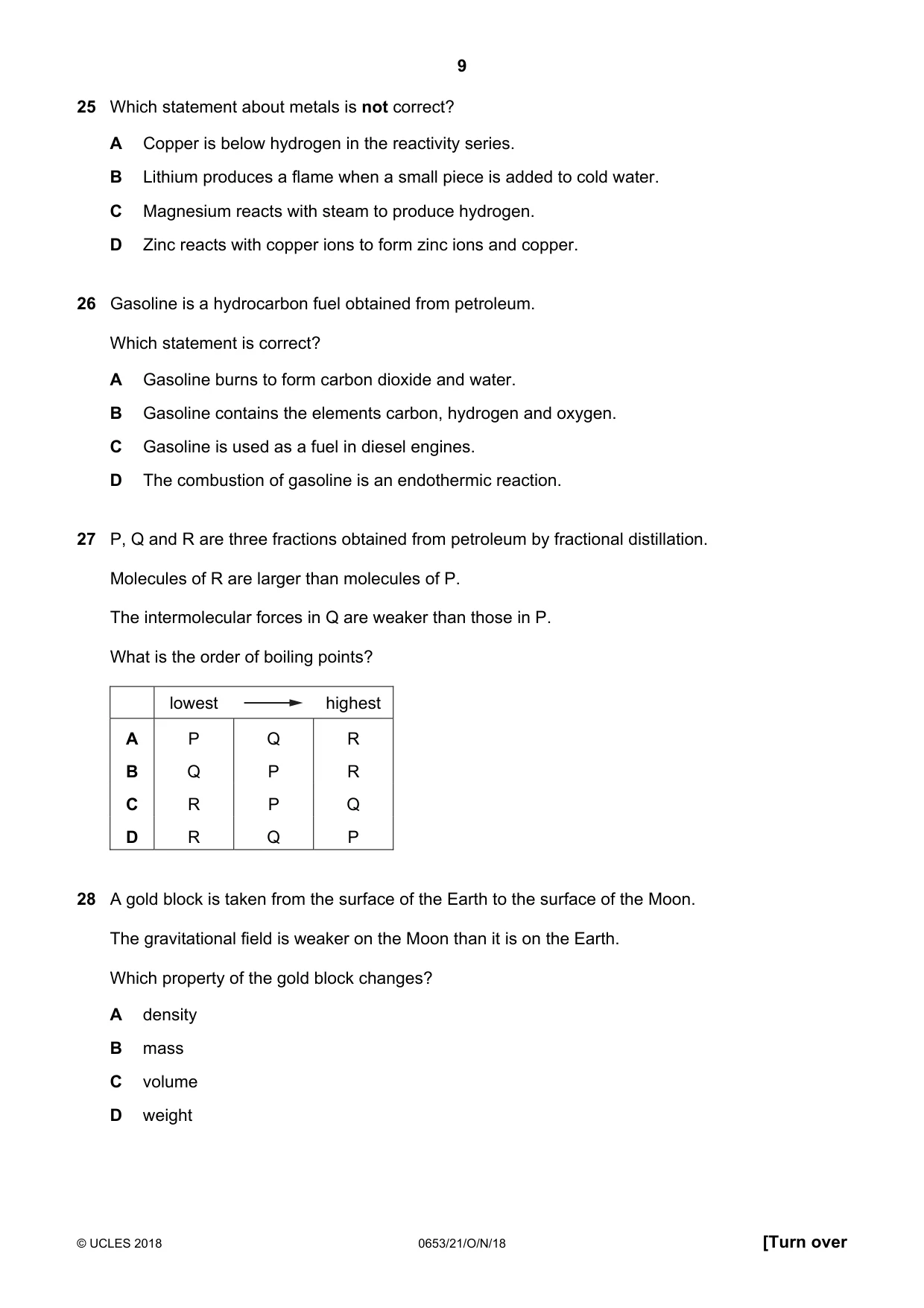
25 Which statement about metals is not correct? A Copper is below hydrogen in the reactivity series. B Lithium produces a flame when a small piece is added to cold water. C Magnesium reacts with steam to produce hydrogen. D Zinc reacts with copper ions to form zinc ions and copper.
Mark scheme: B
Q26 · Gasoline is a hydrocarbon fuel obtained from petroleum
26 Gasoline is a hydrocarbon fuel obtained from petroleum. Which statement is correct? A Gasoline burns to form carbon dioxide and water. B Gasoline contains the elements carbon, hydrogen and oxygen. C Gasoline is used as a fuel in diesel engines. D The combustion of gasoline is an endothermic reaction.
Mark scheme: A
Q27 · P, Q and R are three fractions obtained from petroleum by fractional distillation
27 P, Q and R are three fractions obtained from petroleum by fractional distillation. Molecules of R are larger than molecules of P. The intermolecular forces in Q are weaker than those in P. What is the order of boiling points? lowest highest A P Q R B Q P R C R P Q D R Q P
Mark scheme: B
Q28 · A gold block is taken from the surface of the Earth to the surface of the Moon
28 A gold block is taken from the surface of the Earth to the surface of the Moon. The gravitational field is weaker on the Moon than it is on the Earth. Which property of the gold block changes? A density B mass C volume D weight
Mark scheme: D
Q29 · A cube of aluminium has sides of length 1.0 cm
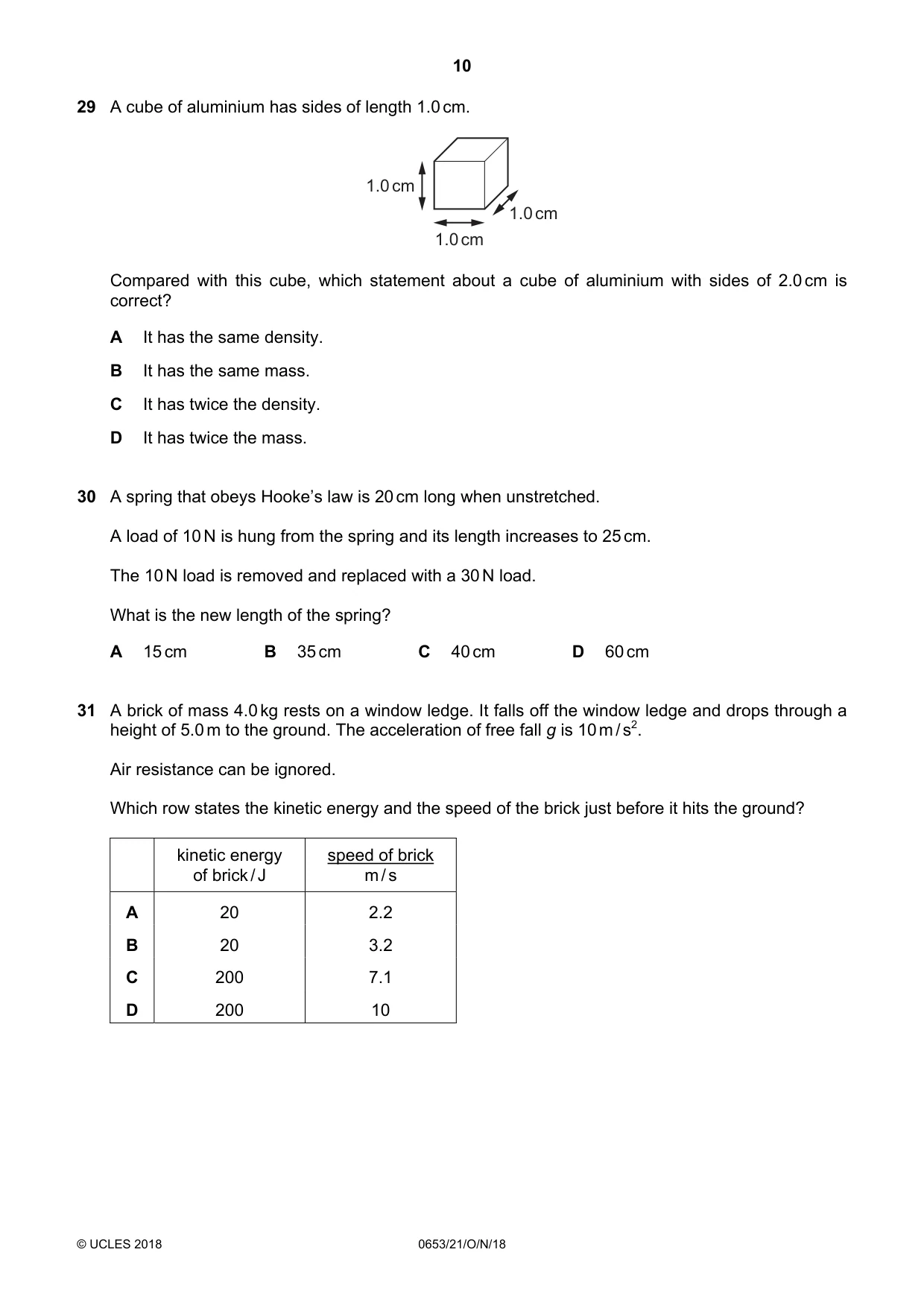
29 A cube of aluminium has sides of length 1.0 cm. 1.0 cm 1.0 cm 1.0 cm Compared with this cube, which statement about a cube of aluminium with sides of 2.0 cm is correct? A It has the same density. B It has the same mass. C It has twice the density. D It has twice the mass.
Mark scheme: A
Q30 · A spring that obeys Hooke’s law is 20 cm long when unstretched
30 A spring that obeys Hooke’s law is 20 cm long when unstretched. A load of 10 N is hung from the spring and its length increases to 25 cm. The 10 N load is removed and replaced with a 30 N load. What is the new length of the spring? A 15 cm B 35 cm C 40 cm D 60 cm
Mark scheme: B
Q31 · A brick of mass 4.0 kg rests on a window ledge
31 A brick of mass 4.0 kg rests on a window ledge. It falls off the window ledge and drops through a height of 5.0 m to the ground. The acceleration of free fall g is 10 m / s2. Air resistance can be ignored. Which row states the kinetic energy and the speed of the brick just before it hits the ground? kinetic energy speed of brick of brick / J m / s A 20 2.2 B 20 3.2 C 200 7.1 D 200 10
Mark scheme: D
Q32 · A scientist investigates two different substances, P and Q
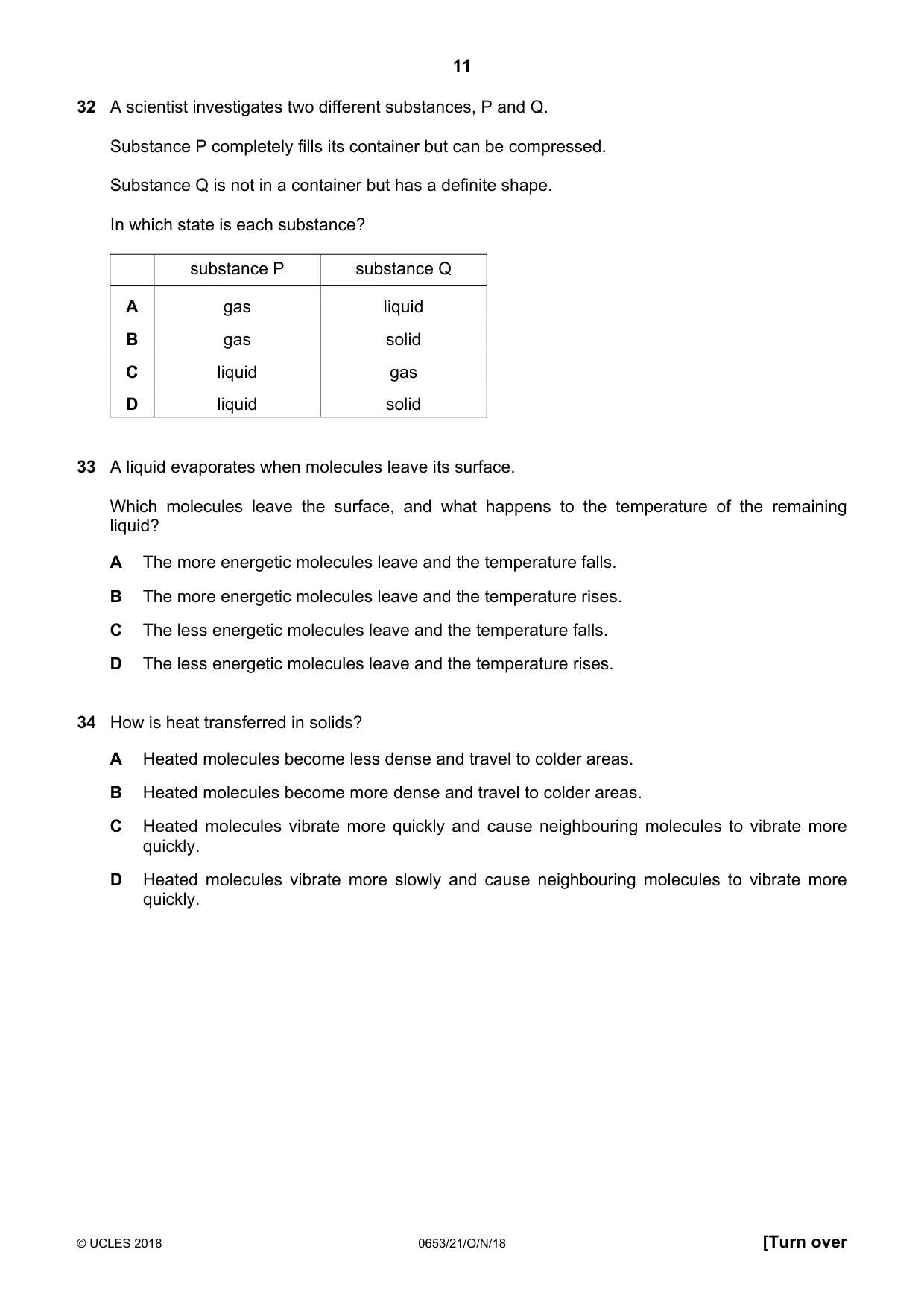
32 A scientist investigates two different substances, P and Q. Substance P completely fills its container but can be compressed. Substance Q is not in a container but has a definite shape. In which state is each substance? substance P substance Q A gas liquid B gas solid C liquid gas D liquid solid
Mark scheme: B
Q33 · A liquid evaporates when molecules leave its surface
33 A liquid evaporates when molecules leave its surface. Which molecules leave the surface, and what happens to the temperature of the remaining liquid? A The more energetic molecules leave and the temperature falls. B The more energetic molecules leave and the temperature rises. C The less energetic molecules leave and the temperature falls. D The less energetic molecules leave and the temperature rises.
Mark scheme: A
Q34 · How is heat transferred in solids?
34 How is heat transferred in solids? A Heated molecules become less dense and travel to colder areas. B Heated molecules become more dense and travel to colder areas. C Heated molecules vibrate more quickly and cause neighbouring molecules to vibrate more quickly. D Heated molecules vibrate more slowly and cause neighbouring molecules to vibrate more quickly.
Mark scheme: C
Q35 · The diagram shows a water wave travelling at 0.56 m / s
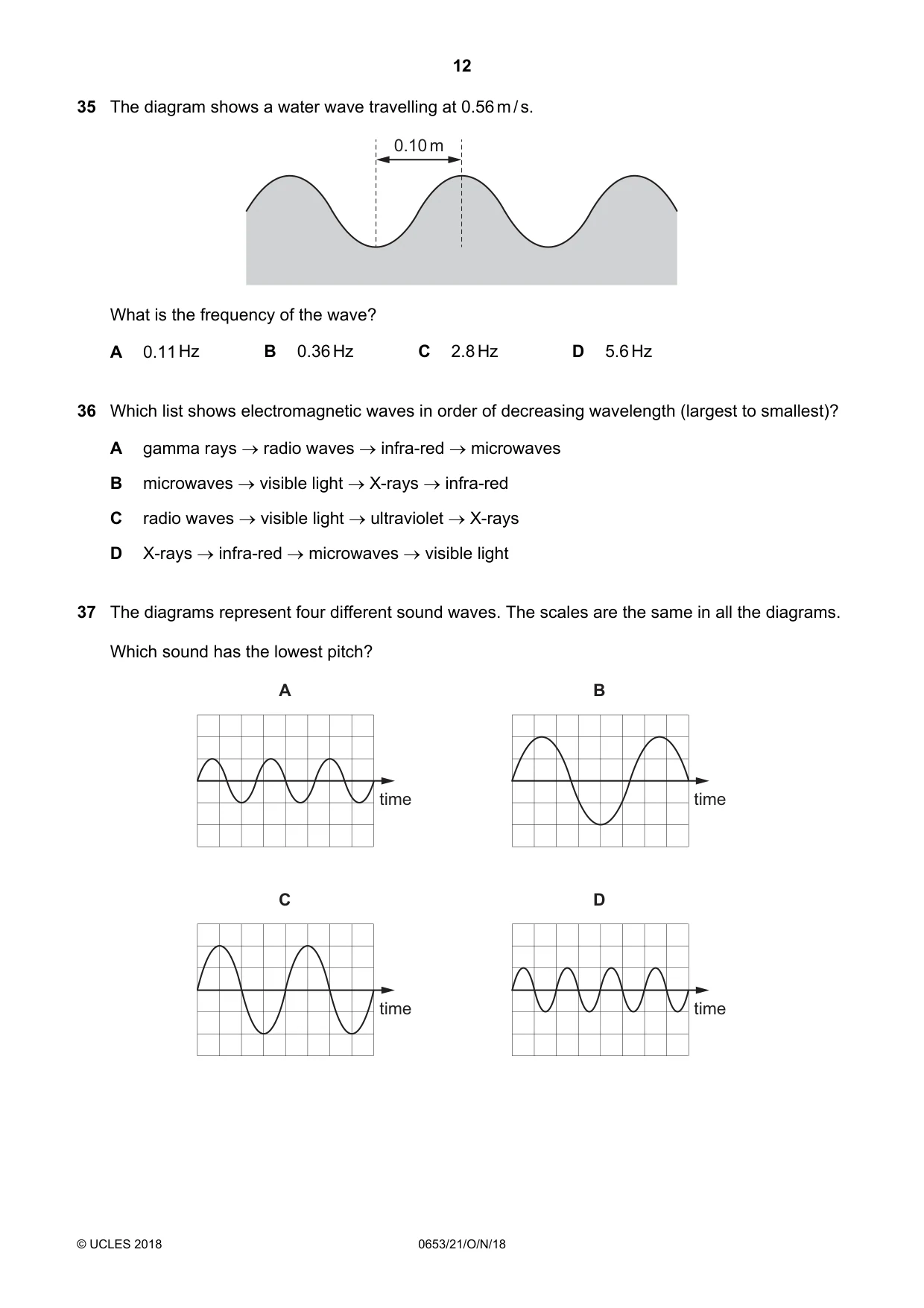
35 The diagram shows a water wave travelling at 0.56 m / s. 0.10 m What is the frequency of the wave? A 0.11 Hz B 0.36 Hz C 2.8 Hz D 5.6 Hz
Mark scheme: C
Q36 · Which list shows electromagnetic waves in order of decreasing wavelength (largest to…
36 Which list shows electromagnetic waves in order of decreasing wavelength (largest to smallest)? A gamma rays → radio waves → infra-red → microwaves B microwaves → visible light → X-rays → infra-red C radio waves → visible light → ultraviolet → X-rays D X-rays → infra-red → microwaves → visible light
Mark scheme: C
Q37 · The diagrams represent four different sound waves
37 The diagrams represent four different sound waves. The scales are the same in all the diagrams. Which sound has the lowest pitch? A B time time C D time time
Mark scheme: B
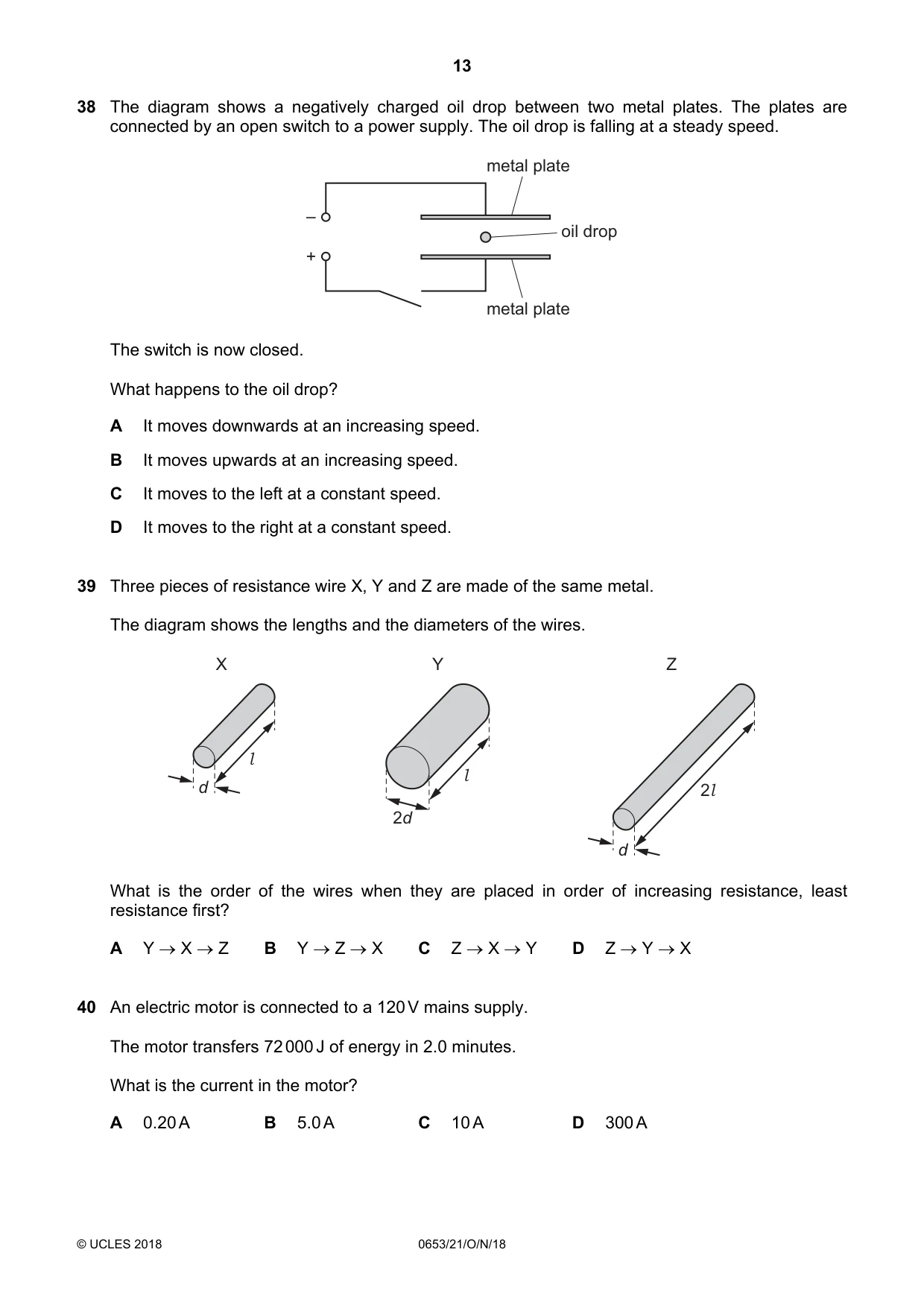
Q38 · The diagram shows a negatively charged oil drop between two metal plates
38 The diagram shows a negatively charged oil drop between two metal plates. The plates are connected by an open switch to a power supply. The oil drop is falling at a steady speed. metal plate – oil drop + metal plate The switch is now closed. What happens to the oil drop? A It moves downwards at an increasing speed. B It moves upwards at an increasing speed. C It moves to the left at a constant speed. D It moves to the right at a constant speed.
Mark scheme: A
Q39 · Three pieces of resistance wire X, Y and Z are made of the same metal
39 Three pieces of resistance wire X, Y and Z are made of the same metal. The diagram shows the lengths and the diameters of the wires. X Y Z l l d 2l 2d d What is the order of the wires when they are placed in order of increasing resistance, least resistance first? A Y → X → Z B Y → Z → X C Z → X → Y D Z → Y → X
Mark scheme: A
Q40 · An electric motor is connected to a 120 V mains supply
40 An electric motor is connected to a 120 V mains supply. The motor transfers 72 000 J of energy in 2.0 minutes. What is the current in the motor? A 0.20 A B 5.0 A C 10 A D 300 A
Mark scheme: B
What was in this paper
The subtopics covered by these 40 questions, and how many questions each got. Open one in a new tab to see every Cambridge question on it.
2Alkenes1Arrangement of elements1Cell structure1Chromatography1Circulatory systems1Density1Diffusion1Digestive system1Drugs1Electrical circuits1Electrolysis1Electromagnetic spectrum1Energy, work and power1Enzymes1Exothermic and endothermic reactions1Food chains and food webs1Forces1Fuels1Gas exchange in humans1General properties of waves1Habitat destruction1Heart1Kinetic particle model of matter1Mass and weight1Noble gases1Photosynthesis1Rate of reaction1Reactivity series1Redox1Respiration1Separation and purification1Sexual reproduction in humans1Solids, liquids and gases1Sound1The characteristic properties of acids and bases1Thermal properties and temperature1Transfer of thermal energy1Transition elements1What you needed in this session
Cambridge’s own grade thresholds for 2018 Oct/Nov, Paper 2 · Variant 1. A higher threshold means an easier paper — the bar moves with how the cohort did.