Cambridge IGCSE Science - Combined 0653 — 2017 Feb/March Paper 2 · Variant 2
0653/22/F/M/17 · 40 questions · 40 marks · ≈45 min
The question paper and its mark scheme, free to read here and free to download. This is Cambridge’s own paper, exactly as it was sat.
Question paper16 pages
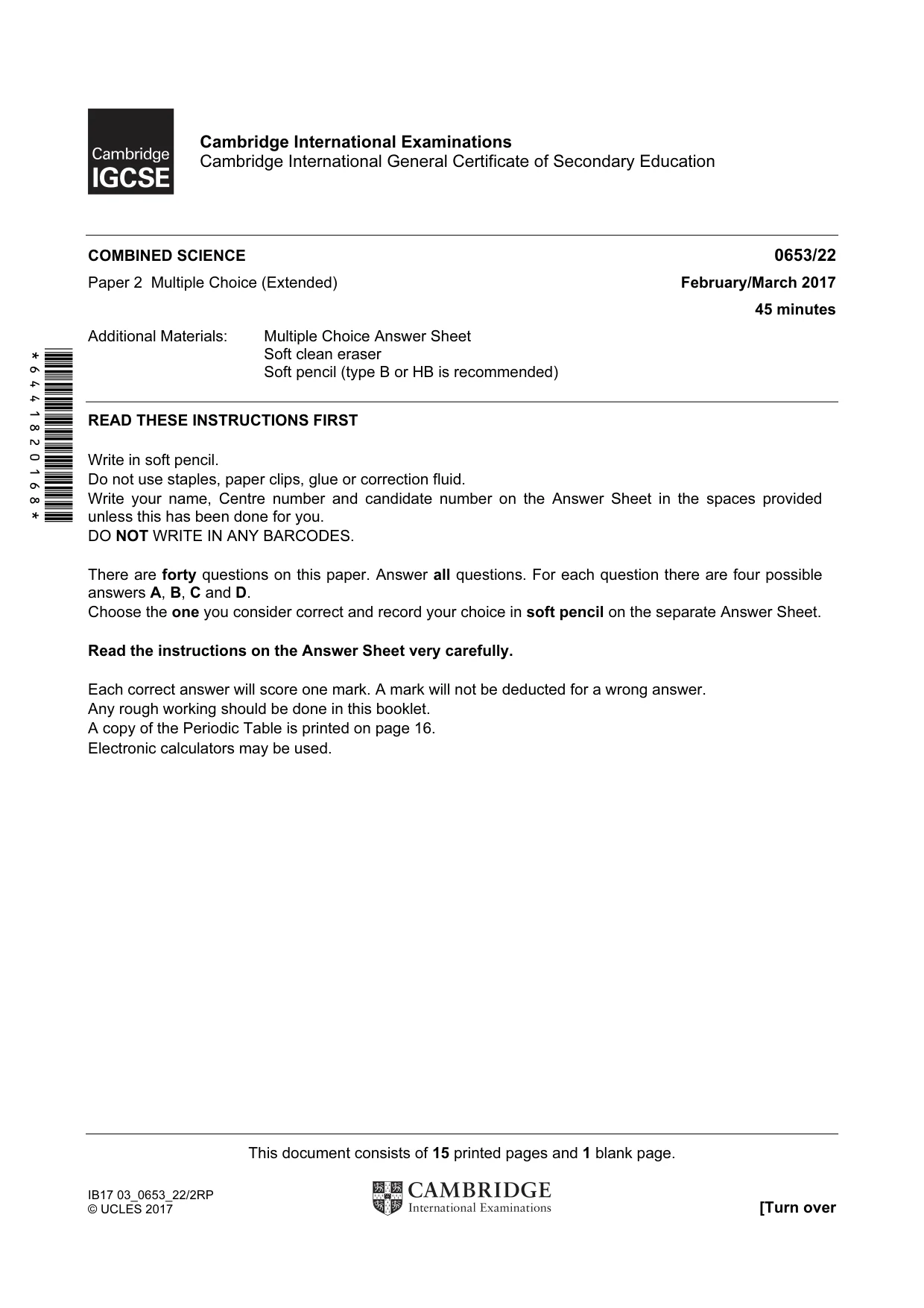
Mark scheme3 pages
Answers below. Sit the paper first if you are practising.
Questions as text
Q1 · The diagram shows a palisade cell as seen under a light microscope
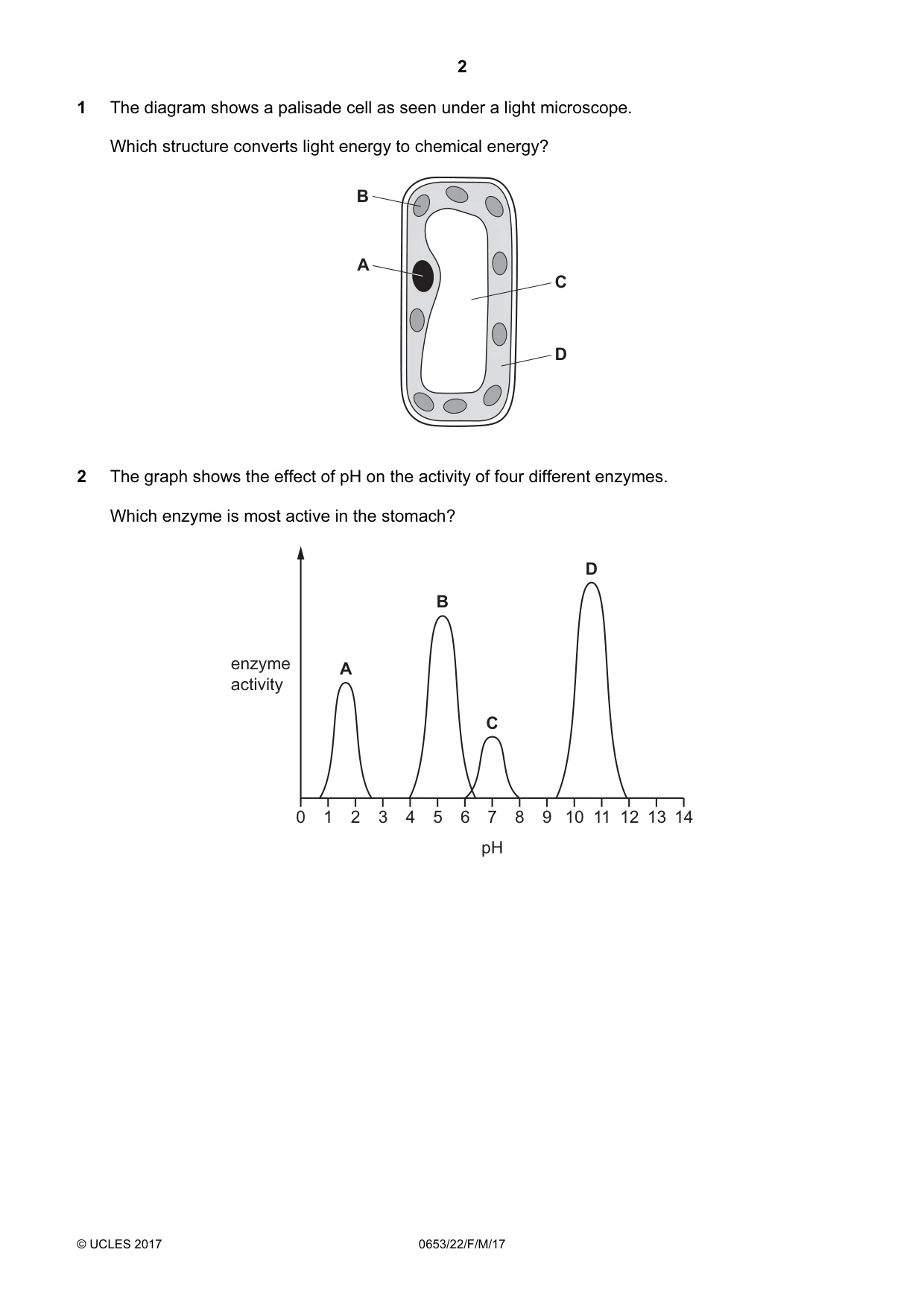
1 The diagram shows a palisade cell as seen under a light microscope. Which structure converts light energy to chemical energy? B A C D
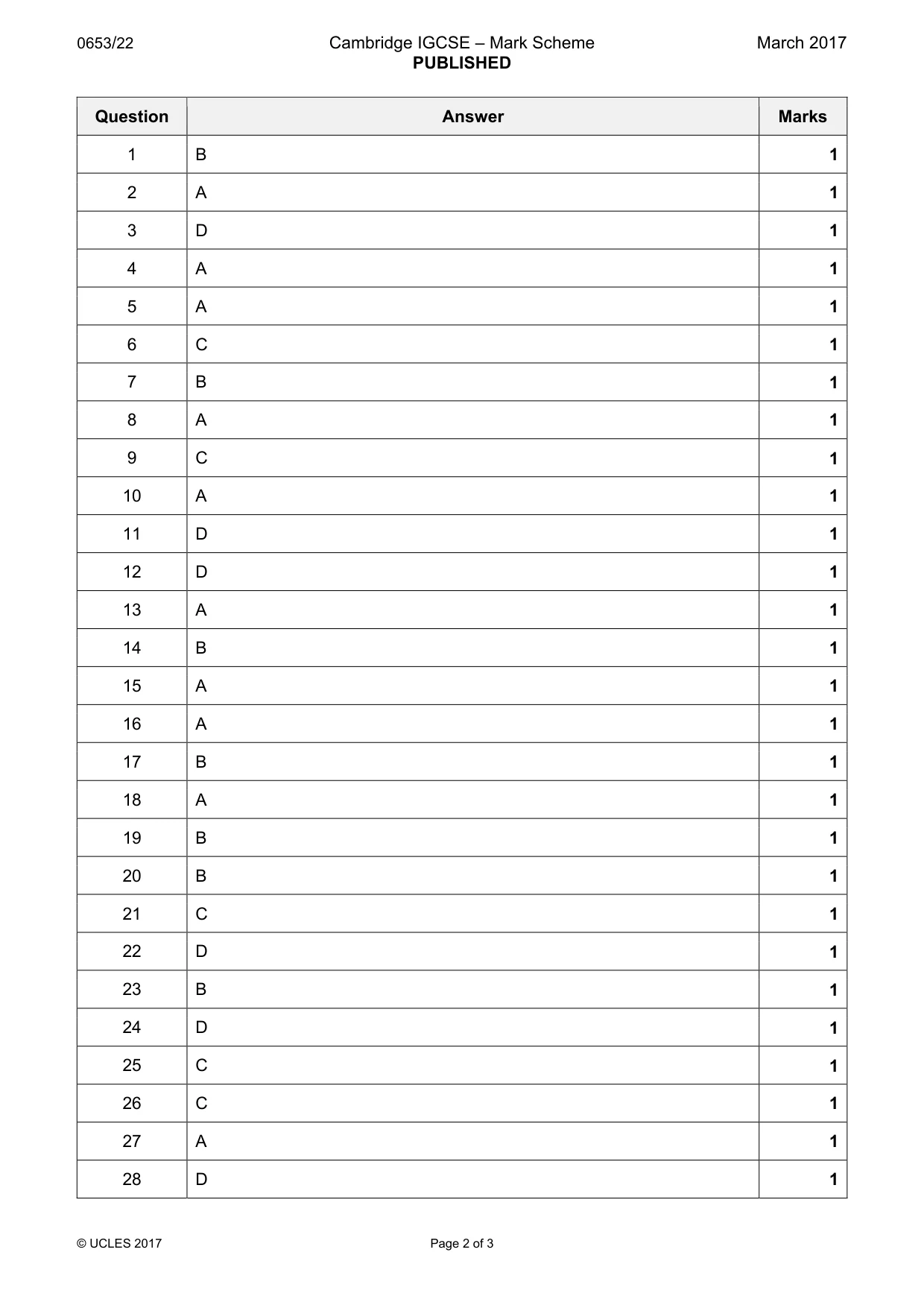
Mark scheme: B
Q2 · The graph shows the effect of pH on the activity of four different enzymes
2 The graph shows the effect of pH on the activity of four different enzymes. Which enzyme is most active in the stomach? D B enzyme A activity C 0 1 2 3 4 5 6 7 8 9 10 11 12 13 14 pH
Mark scheme: A
Q3 · Microorganisms are used to convert milk into yoghurt
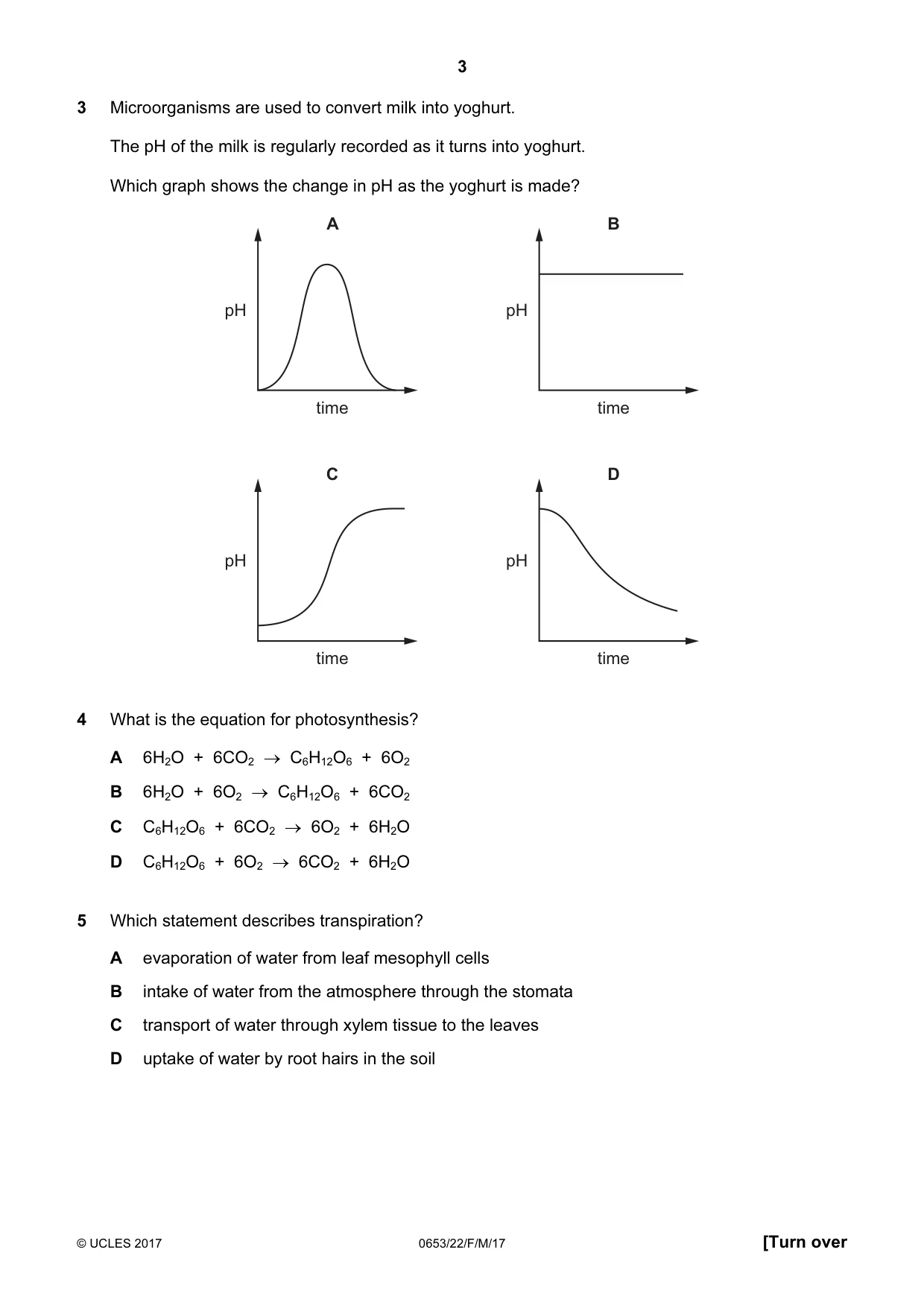
3 Microorganisms are used to convert milk into yoghurt. The pH of the milk is regularly recorded as it turns into yoghurt. Which graph shows the change in pH as the yoghurt is made? A B pH pH time time C D pH pH time time
Mark scheme: D
Q4 · What is the equation for photosynthesis?
4 What is the equation for photosynthesis? A 6H2O + 6CO2 → C6H12O6 + 6O2 B 6H2O + 6O2 → C6H12O6 + 6CO2 C C6H12O6 + 6CO2 → 6O2 + 6H2O D C6H12O6 + 6O2 → 6CO2 + 6H2O
Mark scheme: A
Q5 · Which statement describes transpiration?
5 Which statement describes transpiration? A evaporation of water from leaf mesophyll cells B intake of water from the atmosphere through the stomata C transport of water through xylem tissue to the leaves D uptake of water by root hairs in the soil
Mark scheme: A
Q6 · Oxygenated blood returns to the heart from the lungs in vessel X and leaves the heart to…
6 Oxygenated blood returns to the heart from the lungs in vessel X and leaves the heart to circulate around the body in vessel Y. What are X and Y? X Y A aorta pulmonary vein B pulmonary artery vena cava C pulmonary vein aorta D vena cava pulmonary artery
Mark scheme: C
Q7 · Which row is correct for aerobic respiration?
7 Which row is correct for aerobic respiration? relative amount of gas used energy released A large carbon dioxide B large oxygen C small carbon dioxide D small oxygen
Mark scheme: B
Q8 · Which component of cigarette smoke reduces the oxygen-carrying capacity of the blood?
8 Which component of cigarette smoke reduces the oxygen-carrying capacity of the blood? A carbon monoxide B nicotine C smoke particles D tar
Mark scheme: A
Q9 · The diagram shows a seedling with its root and shoot horizontal
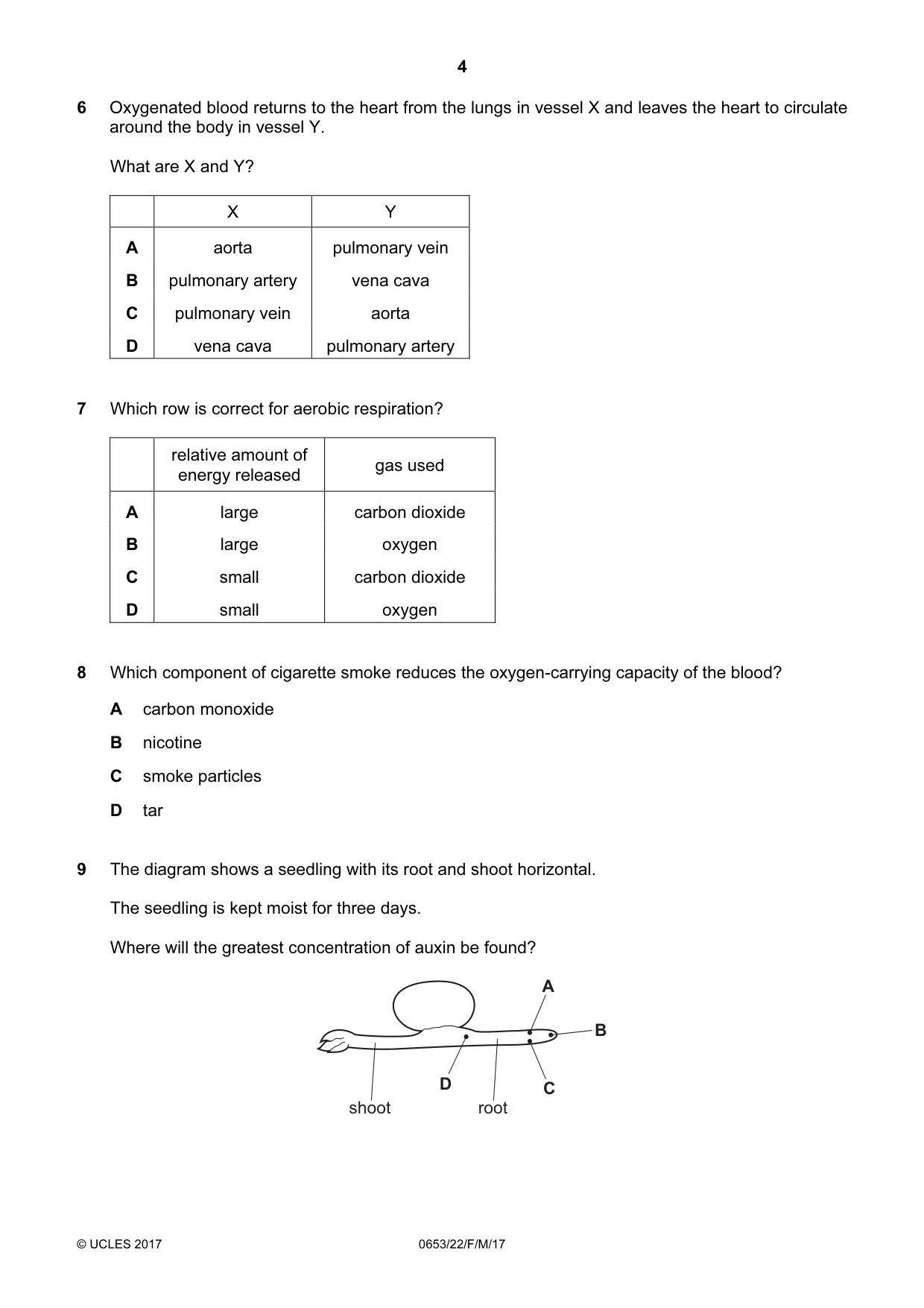
9 The diagram shows a seedling with its root and shoot horizontal. The seedling is kept moist for three days. Where will the greatest concentration of auxin be found? A B D C shoot root
Mark scheme: C
Q10 · The diagram shows a section through a flower
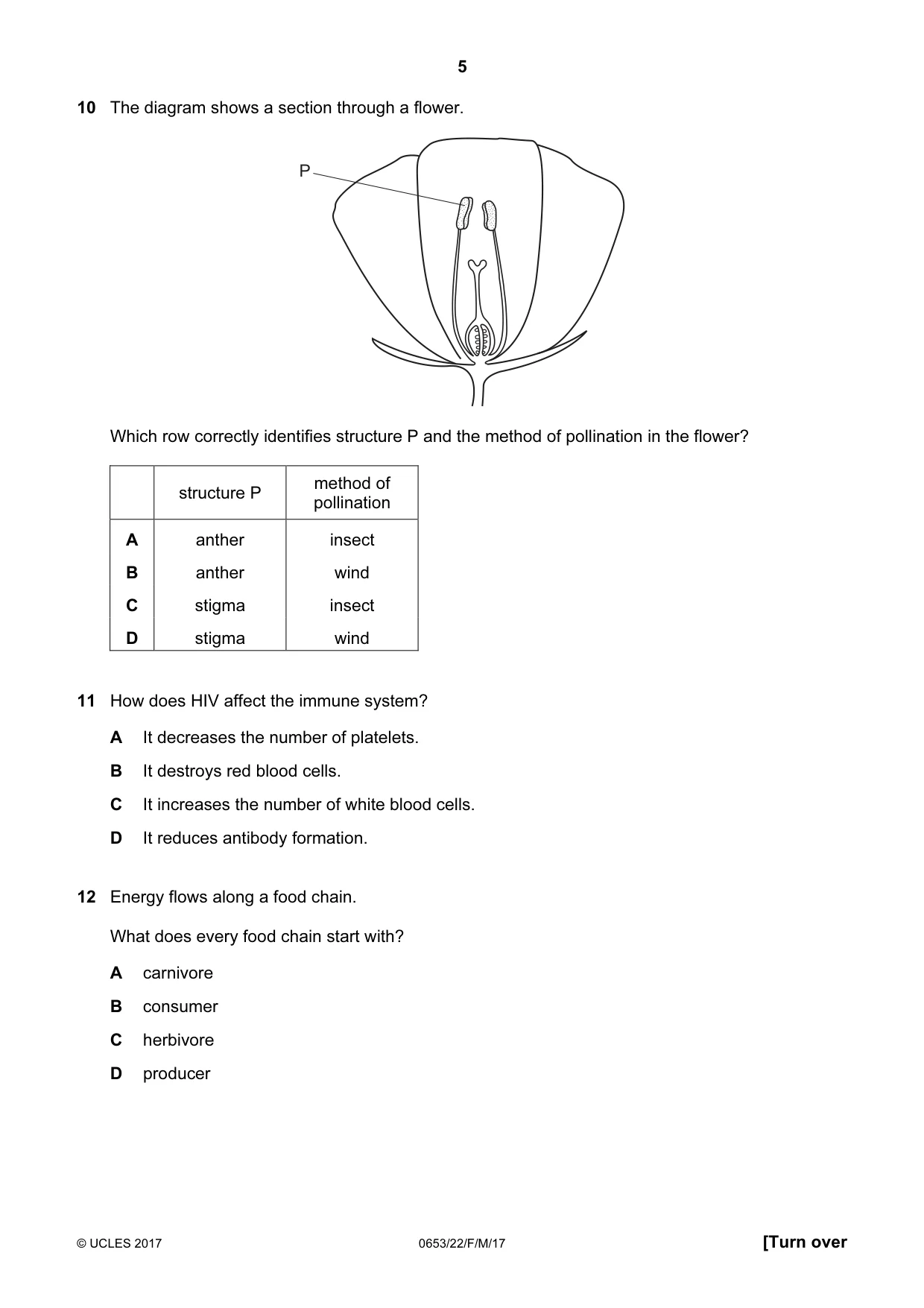
10 The diagram shows a section through a flower. P Which row correctly identifies structure P and the method of pollination in the flower? method of structure P pollination A anther insect B anther wind C stigma insect D stigma wind
Mark scheme: A
Q11 · How does HIV affect the immune system?
11 How does HIV affect the immune system? A It decreases the number of platelets. B It destroys red blood cells. C It increases the number of white blood cells. D It reduces antibody formation.
Mark scheme: D
Q12 · Energy flows along a food chain
12 Energy flows along a food chain. What does every food chain start with? A carnivore B consumer C herbivore D producer
Mark scheme: D
Q13 · Which two gases contribute most to global warming?
13 Which two gases contribute most to global warming? A carbon dioxide and methane B carbon monoxide and carbon dioxide C methane and oxygen D oxygen and carbon monoxide
Mark scheme: A
Q14 · Which diagram represents molecules of hydrogen gas?
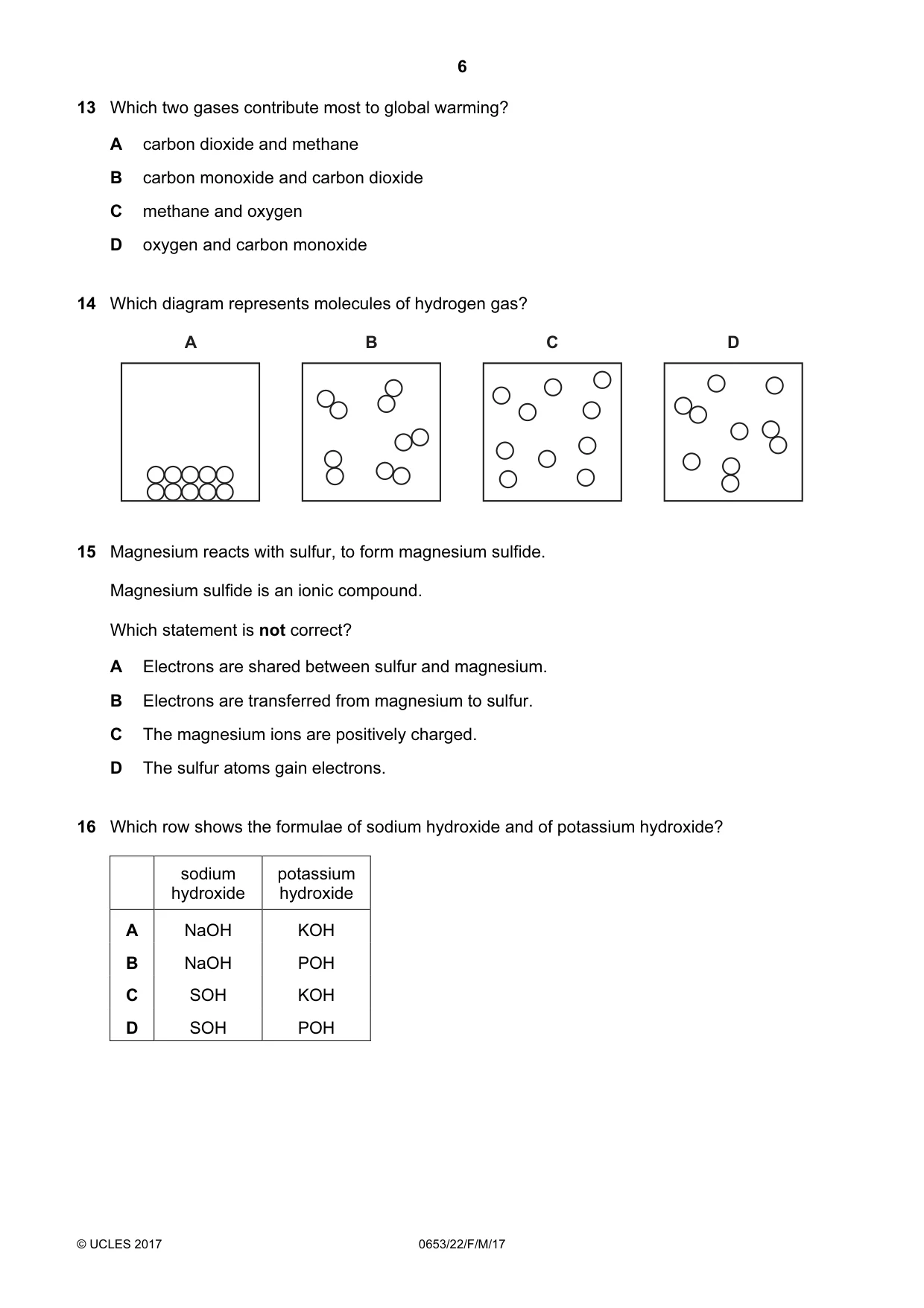
14 Which diagram represents molecules of hydrogen gas? A B C D
Mark scheme: B
Q15 · Magnesium reacts with sulfur, to form magnesium sulfide
15 Magnesium reacts with sulfur, to form magnesium sulfide. Magnesium sulfide is an ionic compound. Which statement is not correct? A Electrons are shared between sulfur and magnesium. B Electrons are transferred from magnesium to sulfur. C The magnesium ions are positively charged. D The sulfur atoms gain electrons.
Mark scheme: A
Q16 · Which row shows the formulae of sodium hydroxide and of potassium hydroxide?
16 Which row shows the formulae of sodium hydroxide and of potassium hydroxide? sodium potassium hydroxide hydroxide A NaOH KOH B NaOH POH C SOH KOH D SOH POH
Mark scheme: A
Q17 · Molten sodium chloride can be electrolysed
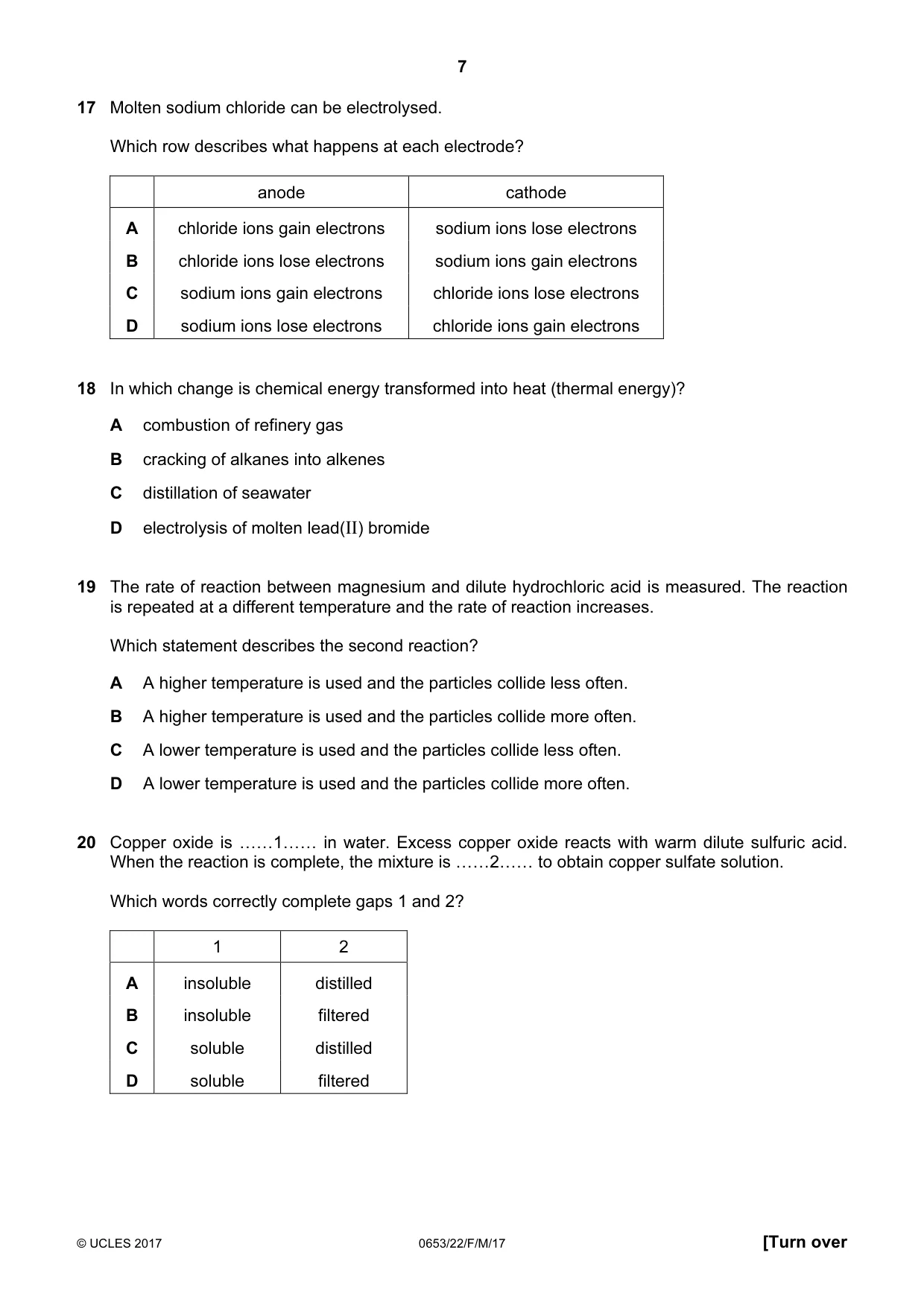
17 Molten sodium chloride can be electrolysed. Which row describes what happens at each electrode? anode cathode A chloride ions gain electrons sodium ions lose electrons B chloride ions lose electrons sodium ions gain electrons C sodium ions gain electrons chloride ions lose electrons D sodium ions lose electrons chloride ions gain electrons
Mark scheme: B
Q18 · In which change is chemical energy transformed into heat (thermal energy)?
18 In which change is chemical energy transformed into heat (thermal energy)? A combustion of refinery gas B cracking of alkanes into alkenes C distillation of seawater D electrolysis of molten lead(II) bromide
Mark scheme: A
Q19 · The rate of reaction between magnesium and dilute hydrochloric acid is measured
19 The rate of reaction between magnesium and dilute hydrochloric acid is measured. The reaction is repeated at a different temperature and the rate of reaction increases. Which statement describes the second reaction? A A higher temperature is used and the particles collide less often. B A higher temperature is used and the particles collide more often. C A lower temperature is used and the particles collide less often. D A lower temperature is used and the particles collide more often.
Mark scheme: B
Q20 · Copper oxide is ……1…… in water
20 Copper oxide is ……1…… in water. Excess copper oxide reacts with warm dilute sulfuric acid. When the reaction is complete, the mixture is ……2…… to obtain copper sulfate solution. Which words correctly complete gaps 1 and 2? 1 2 A insoluble distilled B insoluble filtered C soluble distilled D soluble filtered
Mark scheme: B
Q21 · Which aqueous reagents give a white precipitate when added to aqueous zinc chloride?
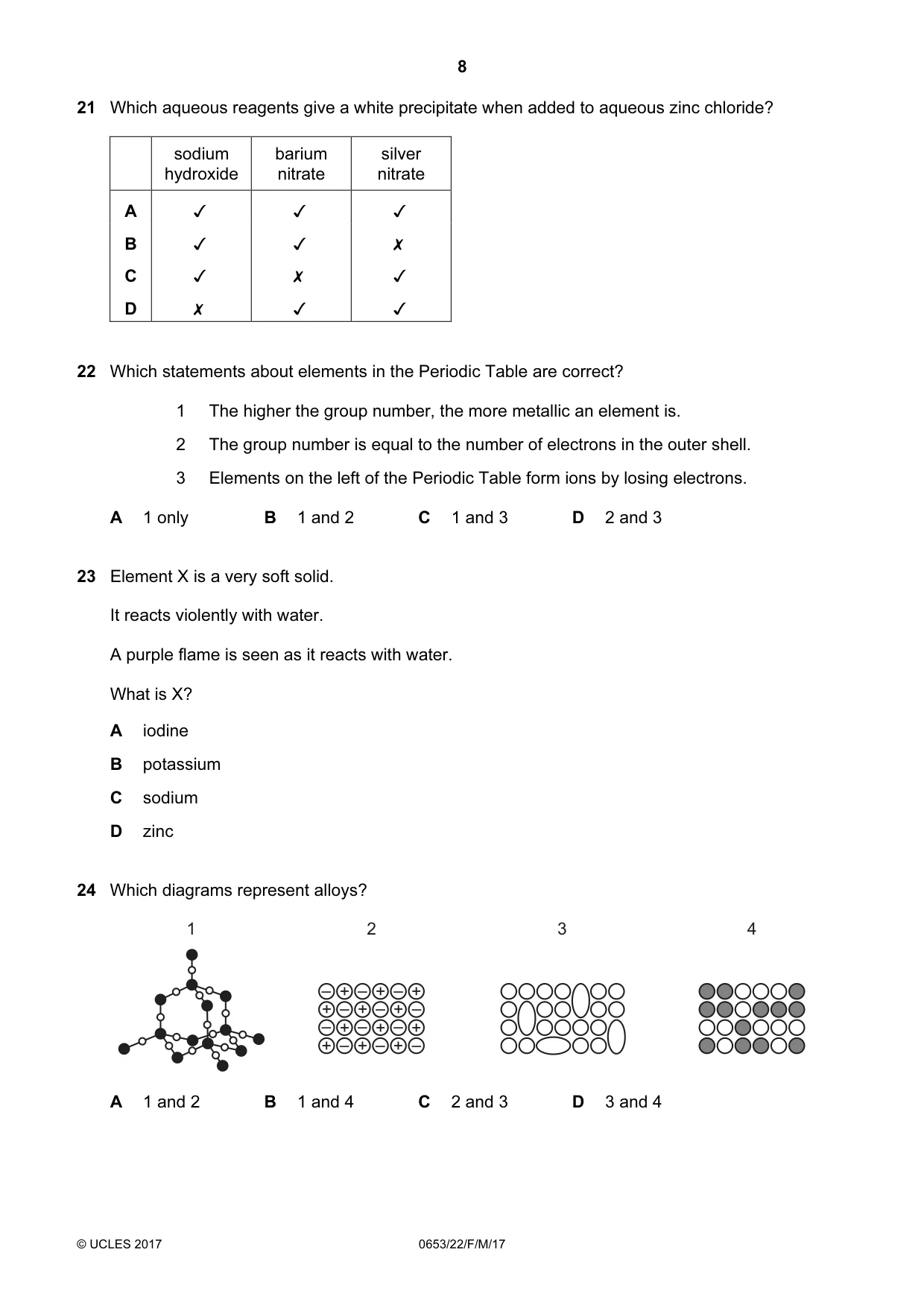
21 Which aqueous reagents give a white precipitate when added to aqueous zinc chloride? sodium barium silver hydroxide nitrate nitrate v v v 0 0O WwW > v v x v x v x v v
Mark scheme: C
Q22 · Which statements about elements in the Periodic Table are correct?
22 Which statements about elements in the Periodic Table are correct? 1 The higher the group number, the more metallic an element is. 2 The group number is equal to the number of electrons in the outer shell. 3 Elements on the left of the Periodic Table form ions by losing electrons. A 1 only B 1 and 2 C 1 and 3 D 2 and 3
Mark scheme: D
Q23 · Element X is a very soft solid
23 Element X is a very soft solid. It reacts violently with water. A purple flame is seen as it reacts with water. What is X? A iodine B potassium C sodium D zinc
Mark scheme: B
Q24 · Which diagrams represent alloys?
24 Which diagrams represent alloys? 1 2 3 4 – + – + – + + – + – + – – + – + – + + – + – + – A 1 and 2 B 1 and 4 C 2 and 3 D 3 and 4
Mark scheme: D
Q25 · Iron occurs in the ground as iron oxide
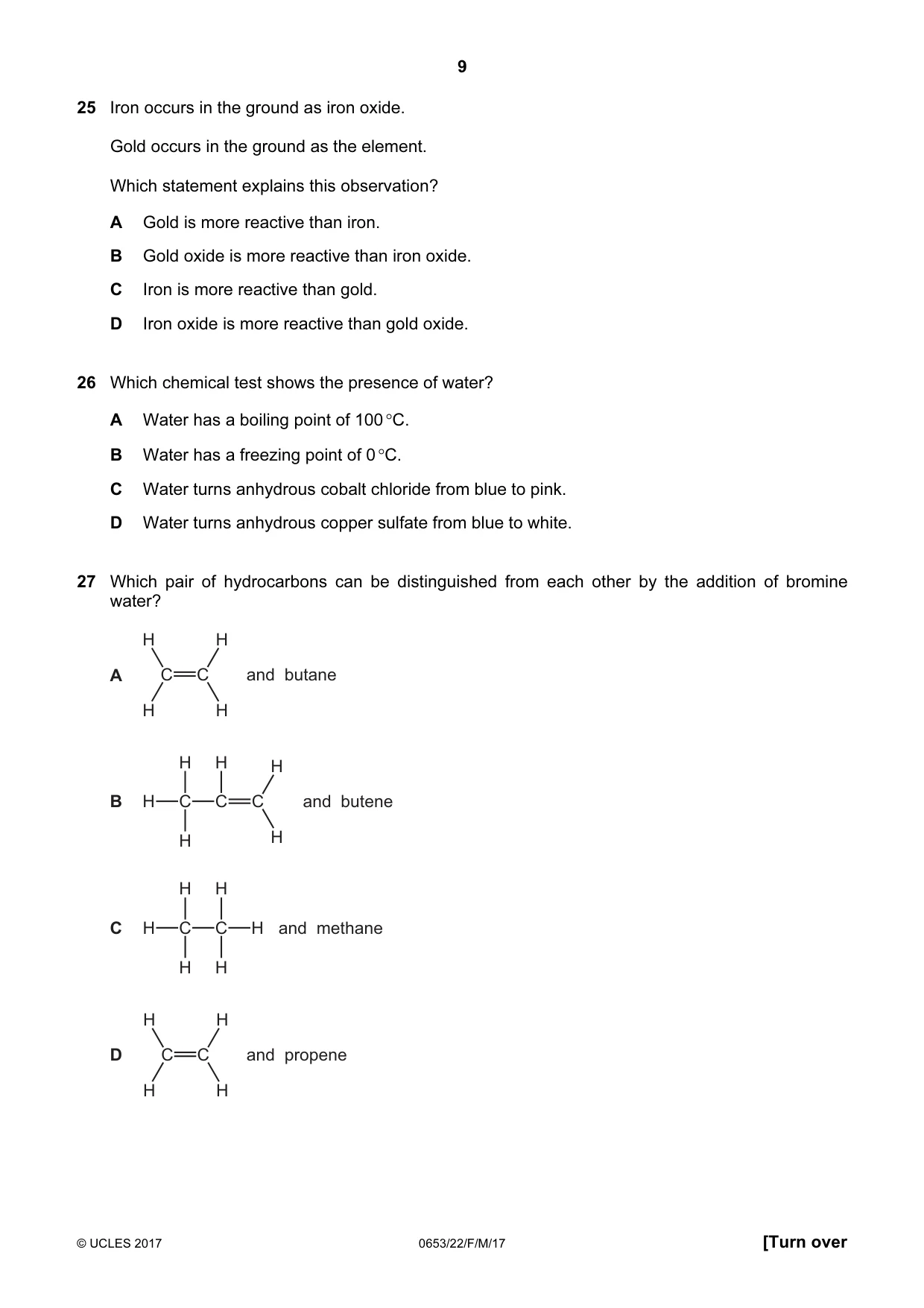
25 Iron occurs in the ground as iron oxide. Gold occurs in the ground as the element. Which statement explains this observation? A Gold is more reactive than iron. B Gold oxide is more reactive than iron oxide. C Iron is more reactive than gold. D Iron oxide is more reactive than gold oxide.
Mark scheme: C
Q26 · Which chemical test shows the presence of water?
26 Which chemical test shows the presence of water? A Water has a boiling point of 100 °C. B Water has a freezing point of 0 °C. C Water turns anhydrous cobalt chloride from blue to pink. D Water turns anhydrous copper sulfate from blue to white.
Mark scheme: C
Q27 · Which pair of hydrocarbons can be distinguished from each other by the addition of…
27 Which pair of hydrocarbons can be distinguished from each other by the addition of bromine water? H H A C C and butane H H H H H B H C C C and butene H H H H C H C C H and methane H H H H D C C and propene H H
Mark scheme: A
Q28 · Diagrams 1 and 2 show a distance-time graph and a speed-time graph
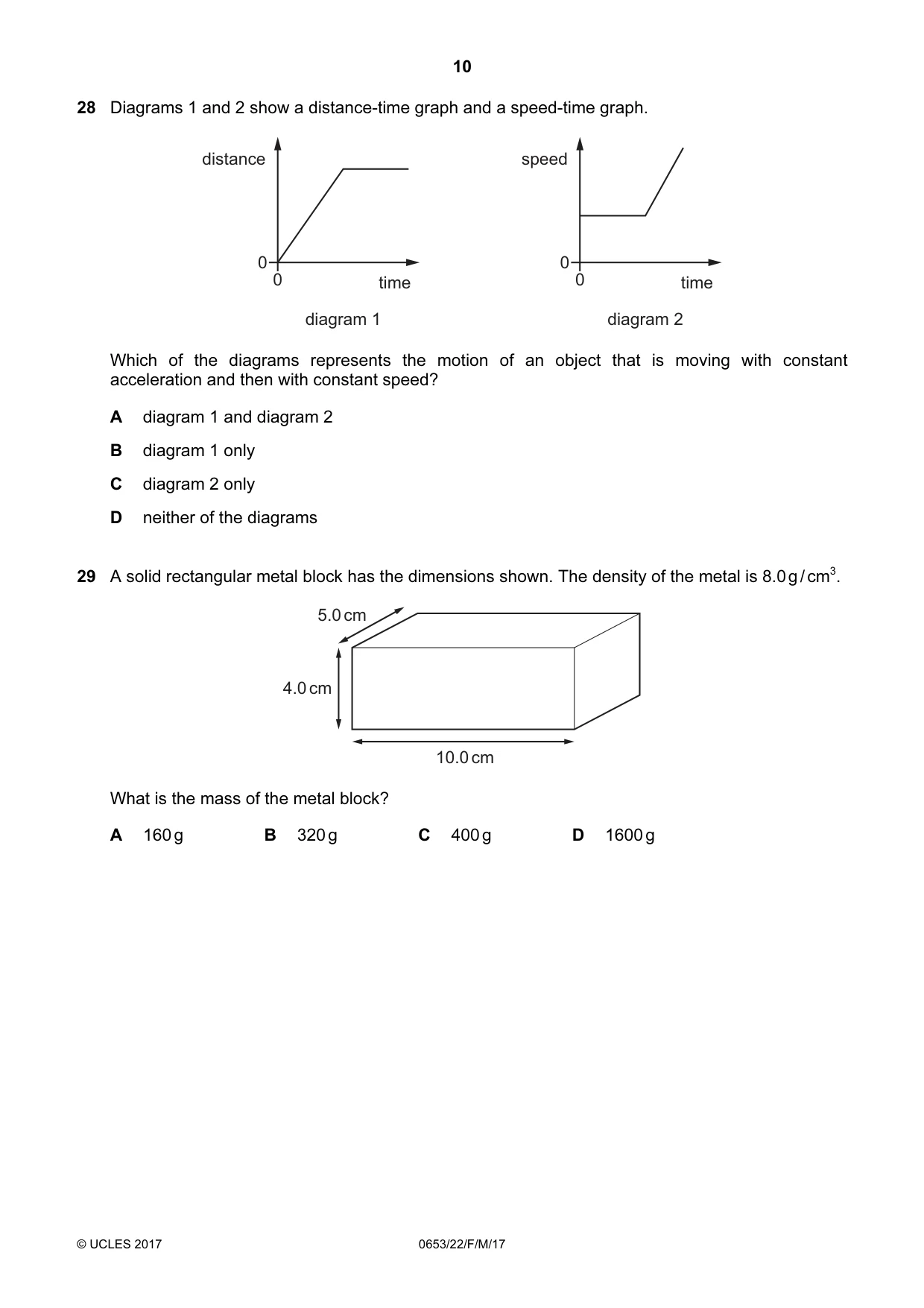
28 Diagrams 1 and 2 show a distance-time graph and a speed-time graph. distance speed 0 0 0 time 0 time diagram 1 diagram 2 Which of the diagrams represents the motion of an object that is moving with constant acceleration and then with constant speed? A diagram 1 and diagram 2 B diagram 1 only C diagram 2 only D neither of the diagrams
Mark scheme: D
Q29 · A solid rectangular metal block has the dimensions shown
29 A solid rectangular metal block has the dimensions shown. The density of the metal is 8.0 g / cm3. 5.0 cm 4.0 cm 10.0 cm What is the mass of the metal block? A 160 g B 320 g C 400 g D 1600 g
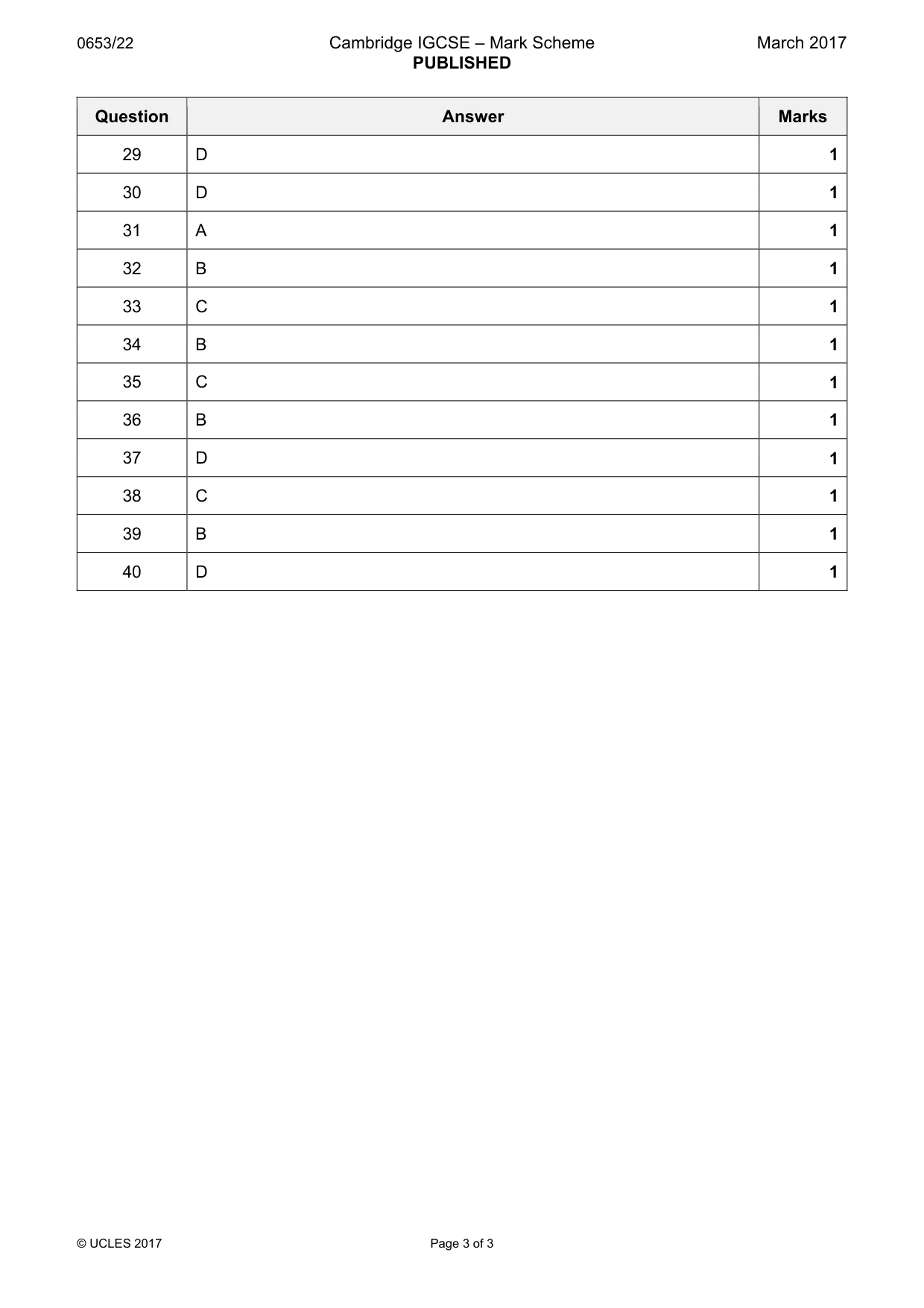
Mark scheme: D
Q30 · The extension-load graph for a rubber band is shown
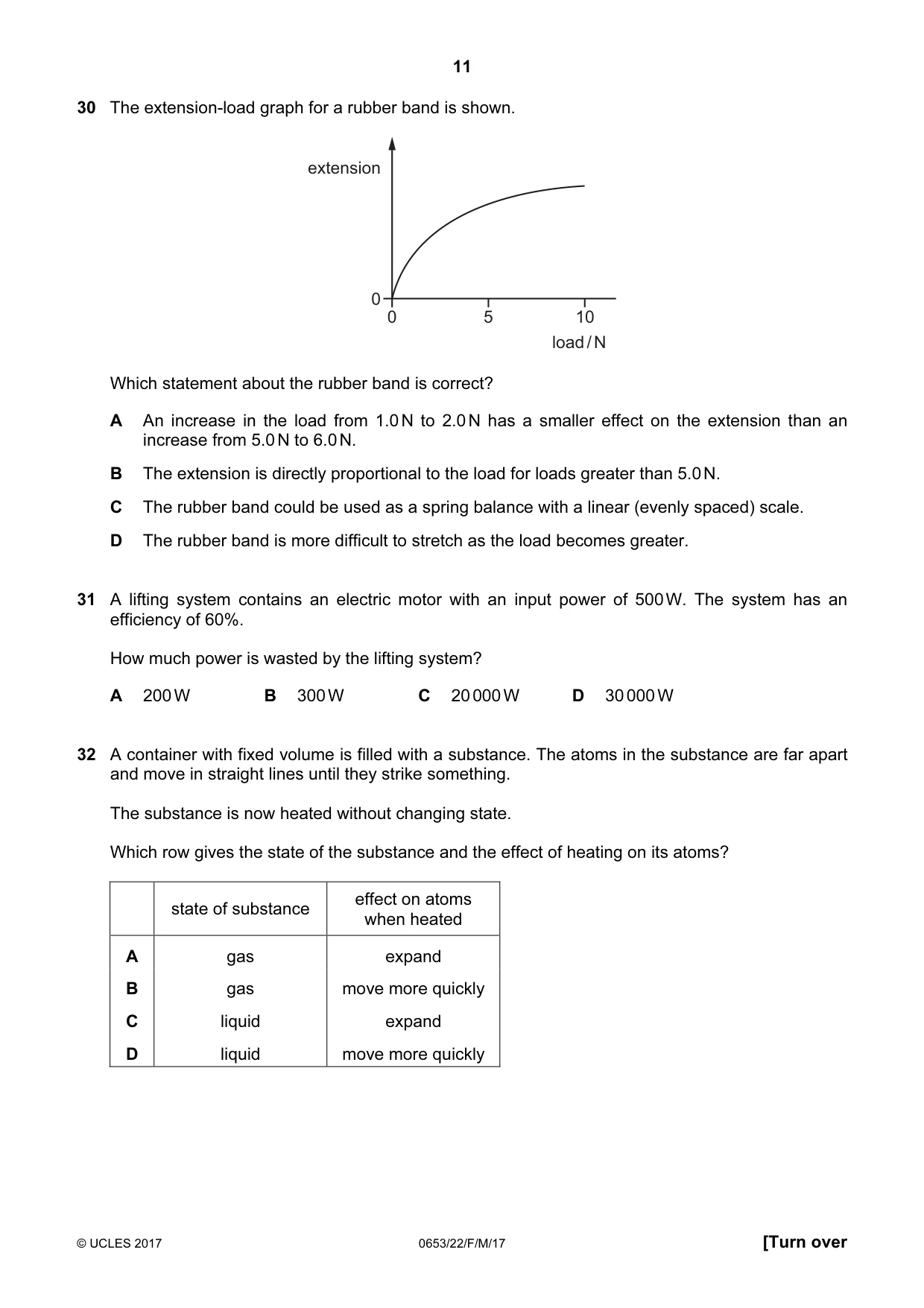
30 The extension-load graph for a rubber band is shown. extension 0 0 5 10 load / N Which statement about the rubber band is correct? A An increase in the load from 1.0 N to 2.0 N has a smaller effect on the extension than an increase from 5.0 N to 6.0 N. B The extension is directly proportional to the load for loads greater than 5.0 N. C The rubber band could be used as a spring balance with a linear (evenly spaced) scale. D The rubber band is more difficult to stretch as the load becomes greater.
Mark scheme: D
Q31 · A lifting system contains an electric motor with an input power of 500 W
31 A lifting system contains an electric motor with an input power of 500 W. The system has an efficiency of 60%. How much power is wasted by the lifting system? A 200 W B 300 W C 20 000 W D 30 000 W
Mark scheme: A
Q32 · A container with fixed volume is filled with a substance
32 A container with fixed volume is filled with a substance. The atoms in the substance are far apart and move in straight lines until they strike something. The substance is now heated without changing state. Which row gives the state of the substance and the effect of heating on its atoms? effect on atoms state of substance when heated A gas expand B gas move more quickly C liquid expand D liquid move more quickly
Mark scheme: B
Q33 · A force F lifting a weight through a height h
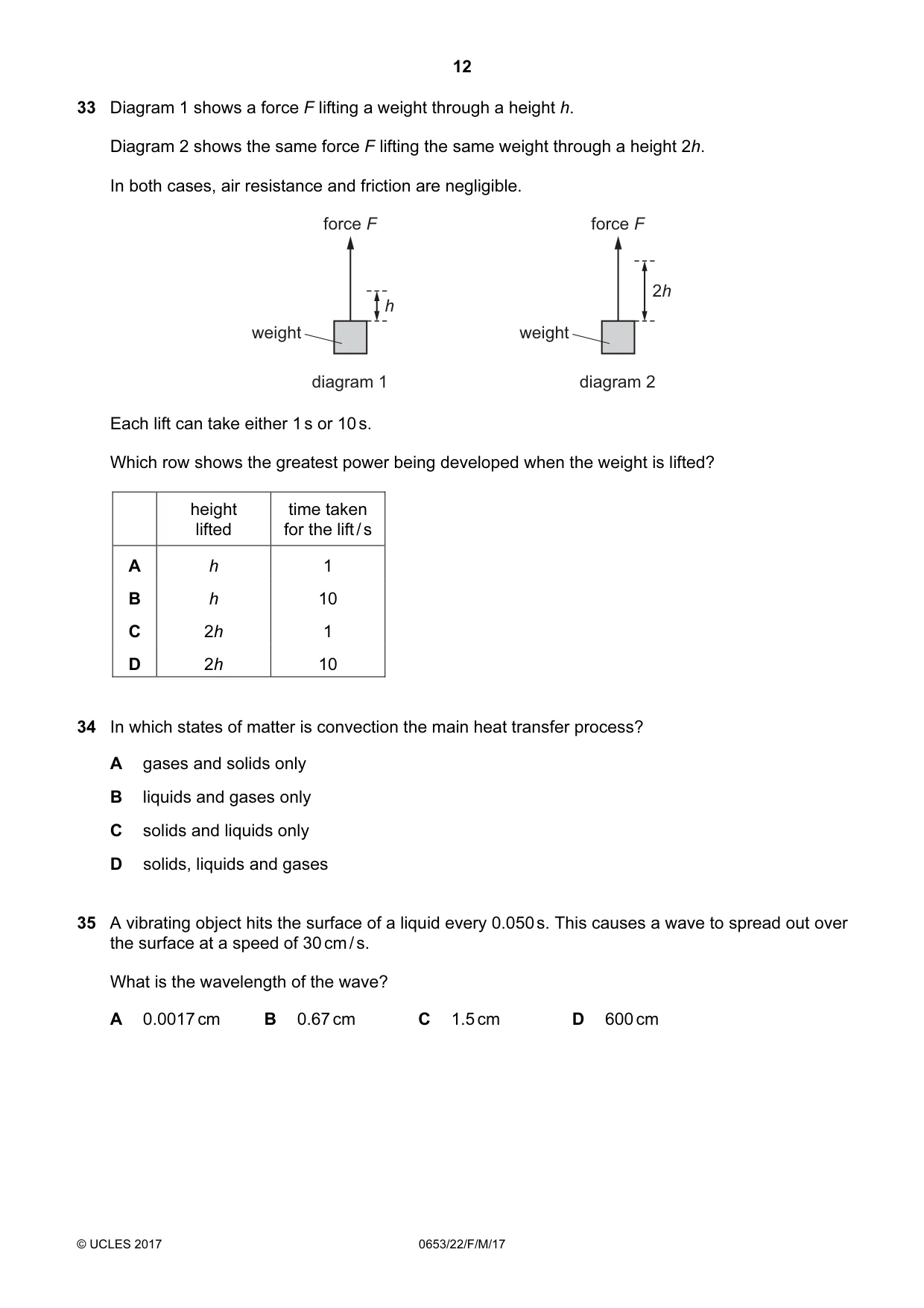
33 Diagram 1 shows a force F lifting a weight through a height h. Diagram 2 shows the same force F lifting the same weight through a height 2h. In both cases, air resistance and friction are negligible. force F force F 2h h weight weight diagram 1 diagram 2 Each lift can take either 1 s or 10 s. Which row shows the greatest power being developed when the weight is lifted? height time taken lifted for the lift / s A h 1 B h 10 C 2h 1 D 2h 10
Mark scheme: C
Q34 · In which states of matter is convection the main heat transfer process?
34 In which states of matter is convection the main heat transfer process? A gases and solids only B liquids and gases only C solids and liquids only D solids, liquids and gases
Mark scheme: B
Q35 · A vibrating object hits the surface of a liquid every 0.050 s
35 A vibrating object hits the surface of a liquid every 0.050 s. This causes a wave to spread out over the surface at a speed of 30 cm / s. What is the wavelength of the wave? A 0.0017 cm B 0.67 cm C 1.5 cm D 600 cm
Mark scheme: C
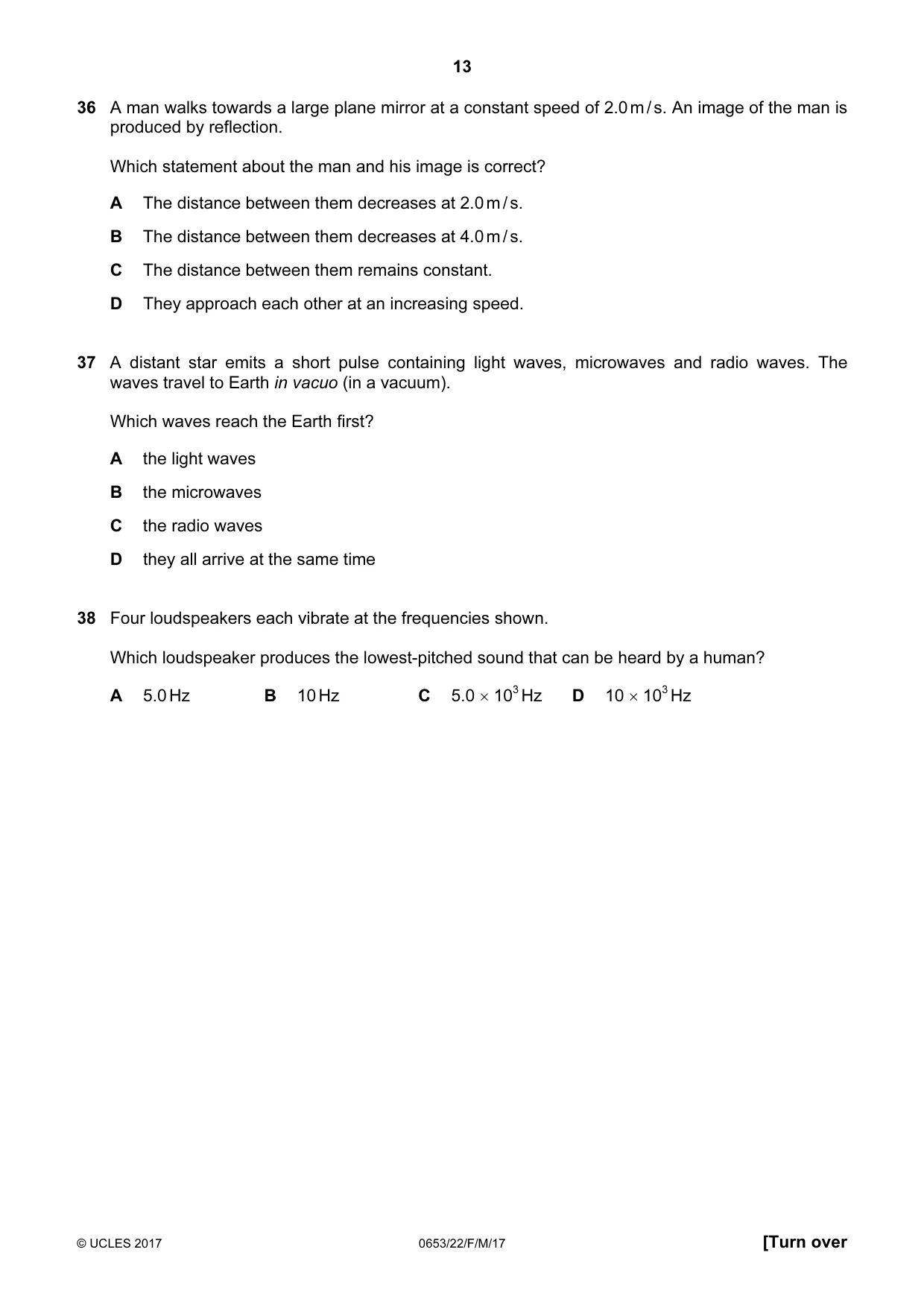
Q36 · A man walks towards a large plane mirror at a constant speed of 2.0 m / s
36 A man walks towards a large plane mirror at a constant speed of 2.0 m / s. An image of the man is produced by reflection. Which statement about the man and his image is correct? A The distance between them decreases at 2.0 m / s. B The distance between them decreases at 4.0 m / s. C The distance between them remains constant. D They approach each other at an increasing speed.
Mark scheme: B
Q37 · A distant star emits a short pulse containing light waves, microwaves and radio waves
37 A distant star emits a short pulse containing light waves, microwaves and radio waves. The waves travel to Earth in vacuo (in a vacuum). Which waves reach the Earth first? A the light waves B the microwaves C the radio waves D they all arrive at the same time
Mark scheme: D
Q38 · Four loudspeakers each vibrate at the frequencies shown
38 Four loudspeakers each vibrate at the frequencies shown. Which loudspeaker produces the lowest-pitched sound that can be heard by a human? A 5.0 Hz B 10 Hz C 5.0 × 10³ Hz D 10 × 103 Hz
Mark scheme: C
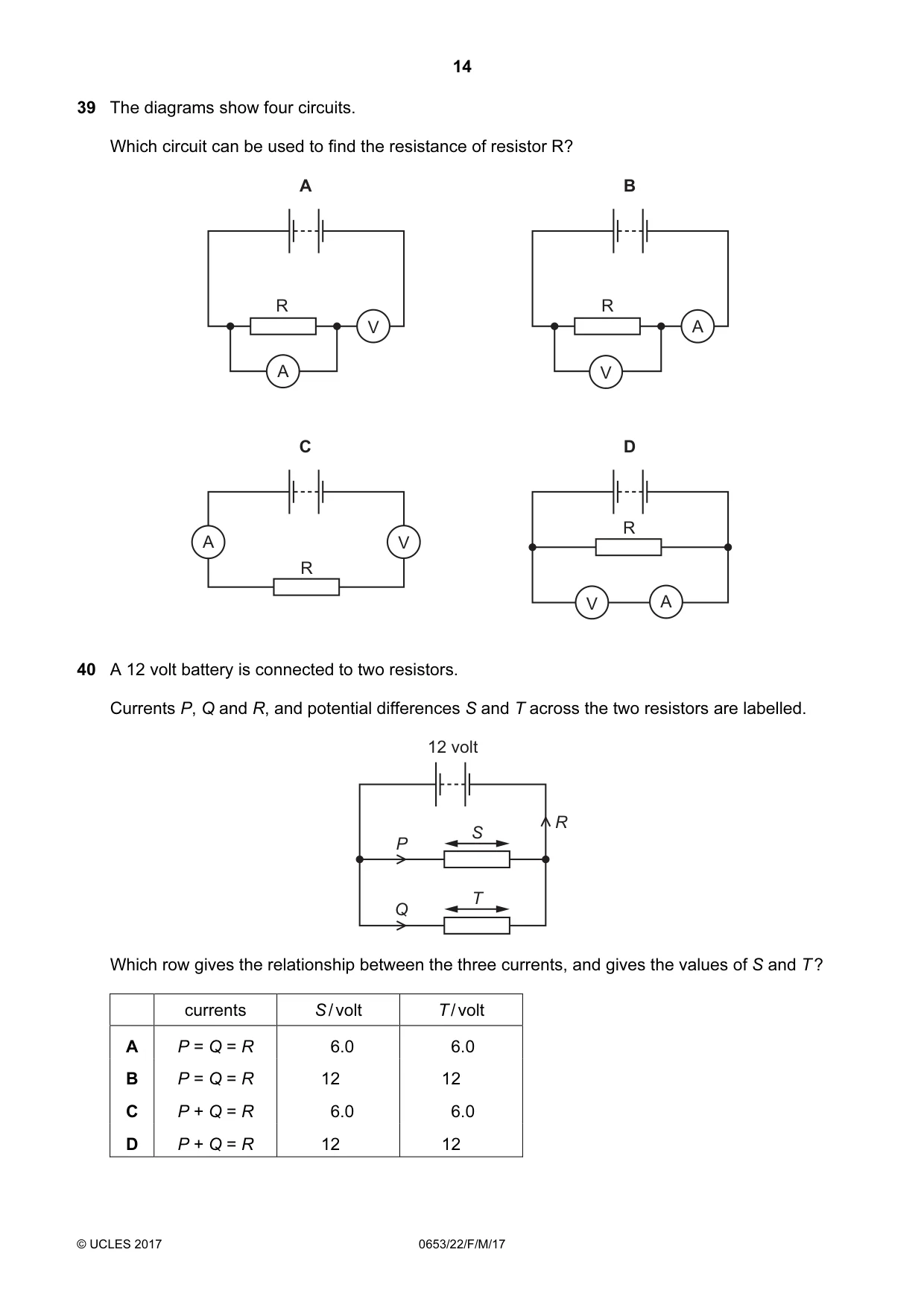
Q39 · The diagrams show four circuits
39 The diagrams show four circuits. Which circuit can be used to find the resistance of resistor R? A B R R V A A V C D R A V R V A
Mark scheme: B
Q40 · A 12 volt battery is connected to two resistors
40 A 12 volt battery is connected to two resistors. Currents P, Q and R, and potential differences S and T across the two resistors are labelled. 12 volt R S P T Q Which row gives the relationship between the three currents, and gives the values of S and T ? currents S / volt T / volt A P = Q = R 6.0 6.0 B P = Q = R 12 12 C P + Q = R 6.0 6.0 D P + Q = R 12 12
Mark scheme: D
What was in this paper
The subtopics covered by these 40 questions, and how many questions each got. Open one in a new tab to see every Cambridge question on it.
2Electrical circuits2Energy, work and power2Photosynthesis2Air quality and climate1Alkenes1Alloys and their properties1Atomic structure and the Periodic Table1Circulatory systems1Density1Diseases and immunity1Drugs1Electrolysis1Electromagnetic spectrum1Enzymes1Exothermic and endothermic reactions1Food chains and food webs1Forces1Formulas1General properties of waves1Group I properties1Identification of ions and gases1Ions and ionic bonds1Kinetic particle model of matter1Light1Motion1Preparation of salts1Rate of reaction1Reactivity series1Respiration1Sexual reproduction in plants1Simple molecules and covalent bonds1Sound1Transfer of thermal energy1Transpiration1Water1What you needed in this session
Cambridge’s own grade thresholds for 2017 Feb/March, Paper 2 · Variant 2. A higher threshold means an easier paper — the bar moves with how the cohort did.