Cambridge IGCSE Science - Combined 0653 — 2025 May/June Paper 2 · Variant 3
0653/23/M/J/25 · 40 questions · 40 marks · 45 min
The question paper and its mark scheme, free to read here and free to download. This is Cambridge’s own paper, exactly as it was sat.
Question paper16 pages
Mark scheme3 pages
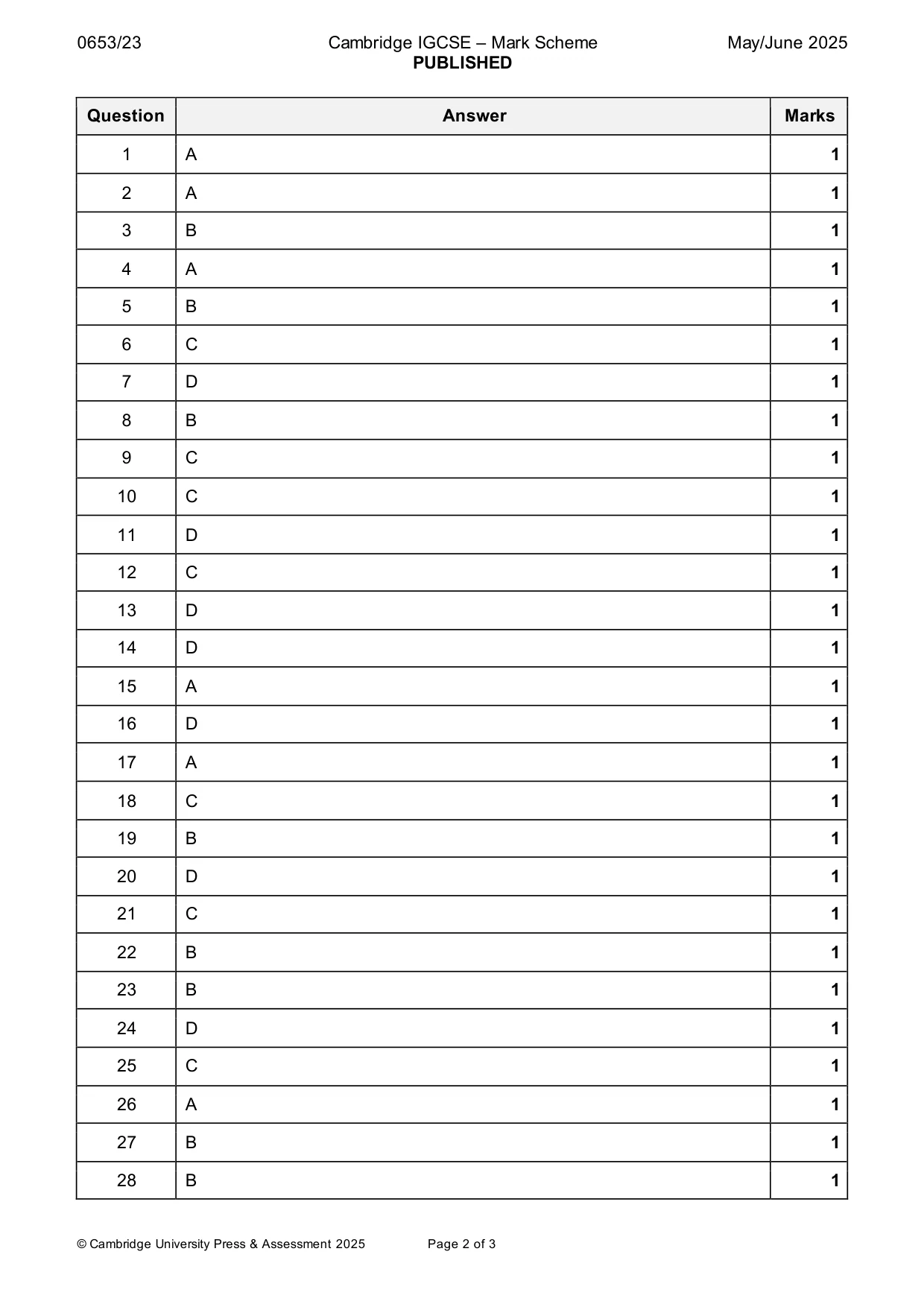
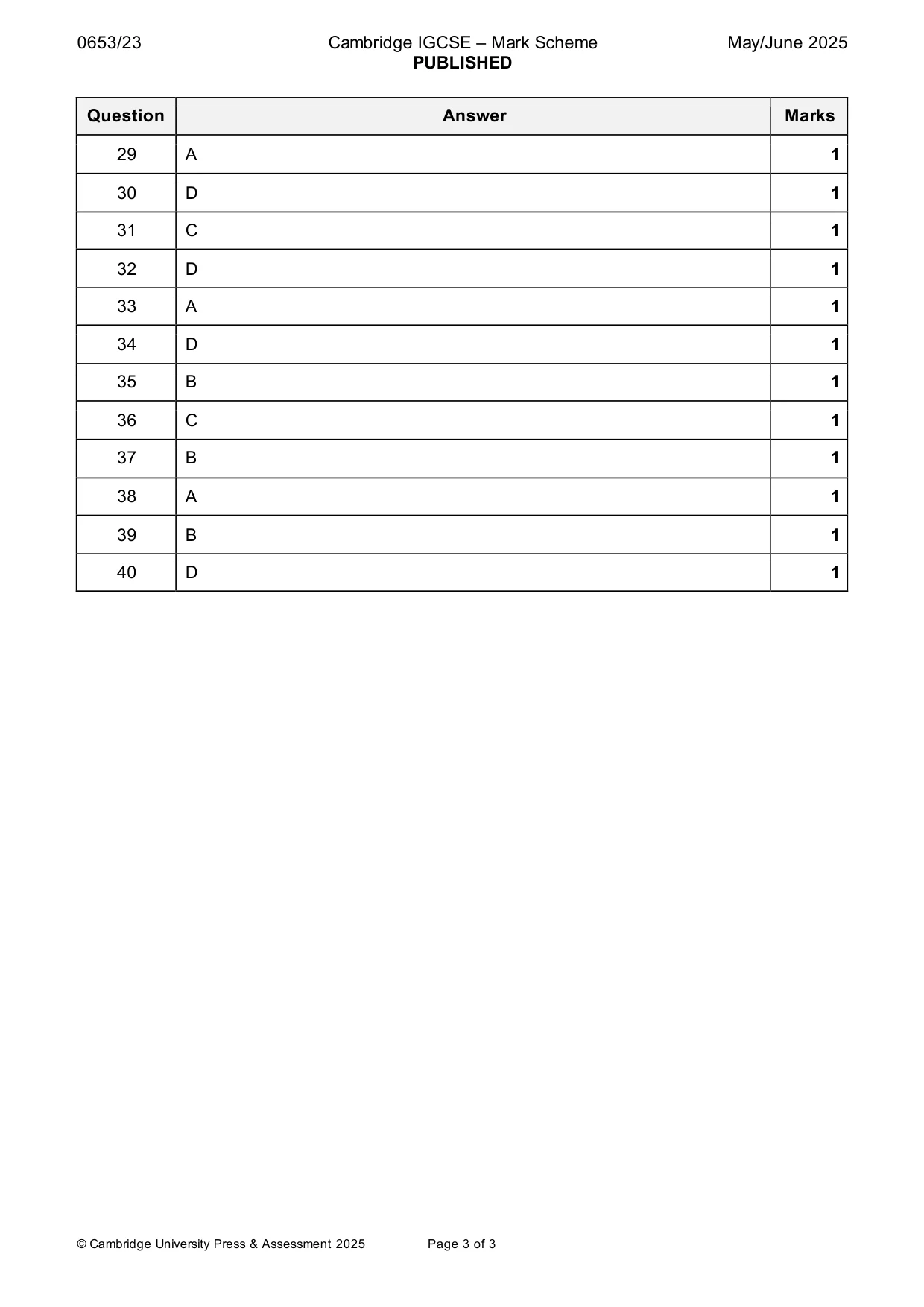
Answers below. Sit the paper first if you are practising.
Questions as text
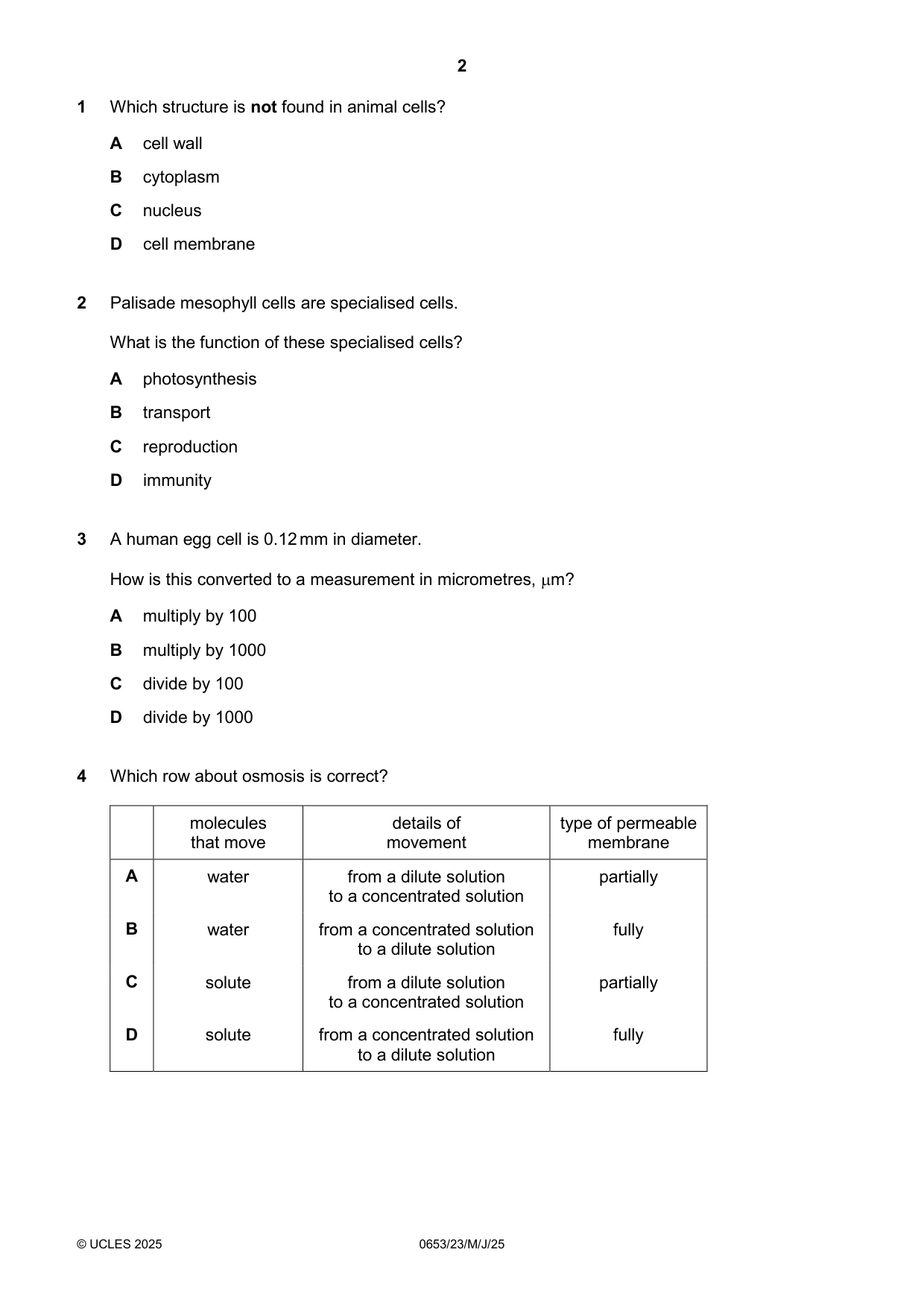
Q1 · Which structure is not found in animal cells?
1 Which structure is not found in animal cells? A cell wall B cytoplasm C nucleus D cell membrane
Mark scheme: A
Q2 · Palisade mesophyll cells are specialised cells
2 Palisade mesophyll cells are specialised cells. What is the function of these specialised cells? A photosynthesis B transport C reproduction D immunity
Mark scheme: A
Q3 · A human egg cell is 0.12 mm in diameter
3 A human egg cell is 0.12 mm in diameter. How is this converted to a measurement in micrometres, m? A multiply by 100 B multiply by 1000 C divide by 100 D divide by 1000
Mark scheme: B
Q4 · Which row about osmosis is correct?
4 Which row about osmosis is correct? molecules details of type of permeable that move movement membrane A water from a dilute solution partially to a concentrated solution B water from a concentrated solution fully to a dilute solution C solute from a dilute solution partially to a concentrated solution D solute from a concentrated solution fully to a dilute solution
Mark scheme: A
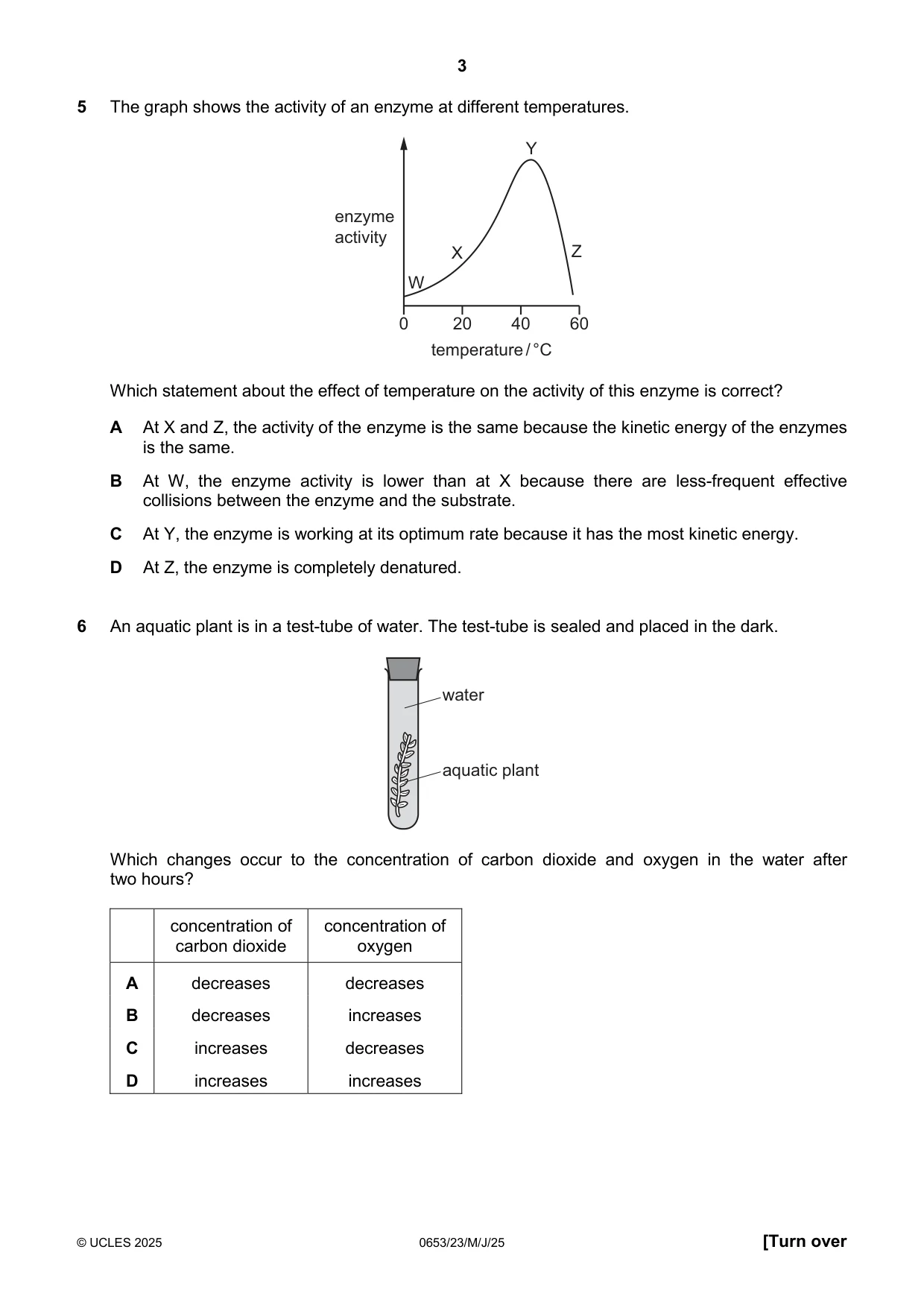
Q5 · The graph shows the activity of an enzyme at different temperatures
5 The graph shows the activity of an enzyme at different temperatures. Y enzyme activity X Z W 0 20 40 60 temperature / °C Which statement about the effect of temperature on the activity of this enzyme is correct? A At X and Z, the activity of the enzyme is the same because the kinetic energy of the enzymes is the same. B At W, the enzyme activity is lower than at X because there are less-frequent effective collisions between the enzyme and the substrate. C At Y, the enzyme is working at its optimum rate because it has the most kinetic energy. D At Z, the enzyme is completely denatured.
Mark scheme: B
Q6 · An aquatic plant is in a test-tube of water
6 An aquatic plant is in a test-tube of water. The test-tube is sealed and placed in the dark. water aquatic plant Which changes occur to the concentration of carbon dioxide and oxygen in the water after two hours? concentration of concentration of carbon dioxide oxygen A decreases decreases B decreases increases C increases decreases D increases increases
Mark scheme: C
Q7 · A pregnant woman is told she is deficient in iron
7 A pregnant woman is told she is deficient in iron. Which food increases the iron content in her diet? A cheese B rice C milk D red meat
Mark scheme: D
Q8 · Chemical digestion and physical digestion happen in various parts of the alimentary canal…
8 Chemical digestion and physical digestion happen in various parts of the alimentary canal and associated organs. In which organ do both processes happen? A liver B mouth C oesophagus D pancreas
Mark scheme: B
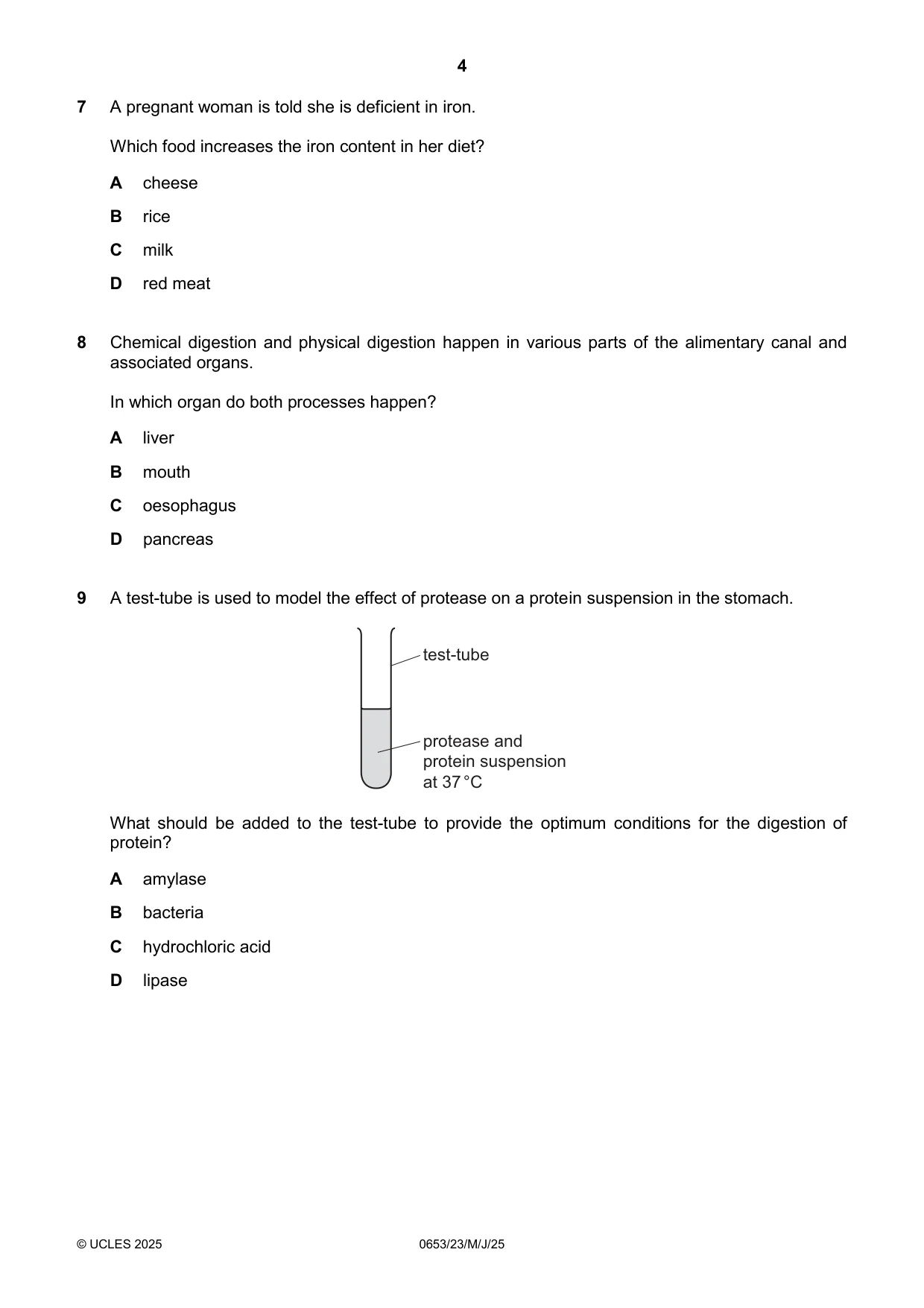
Q9 · A test-tube is used to model the effect of protease on a protein suspension in the stomach
9 A test-tube is used to model the effect of protease on a protein suspension in the stomach. test-tube protease and protein suspension at 37 °C What should be added to the test-tube to provide the optimum conditions for the digestion of protein? A amylase B bacteria C hydrochloric acid D lipase
Mark scheme: C
Q10 · Water moves through the stomata of leaves during transpiration
10 Water moves through the stomata of leaves during transpiration. Which row shows the direction of water movement and the form of the water? direction form A into the leaf liquid B into the leaf vapour C out of the leaf vapour D out of the leaf liquid
Mark scheme: C
Q11 · The diagrams show cross-sections of two different blood vessels
11 The diagrams show cross-sections of two different blood vessels. P Q Which type of blood vessel is Q and what is the relative blood pressure in Q compared with P? relative blood blood vessel Q pressure in Q A artery higher B artery lower C vein higher D vein lower
Mark scheme: D
Q12 · Which types of consumer describe the cat in this food web?
12 Which types of consumer describe the cat in this food web? 1 primary consumer 2 secondary consumer 3 tertiary consumer cat thrush robin frog sparrow slug caterpillar plant A 1, 2 and 3 B 1 only C 2 and 3 only D 3 only
Mark scheme: C
Q13 · What is an ecosystem?
13 What is an ecosystem? A a network of inter-connected food chains B a specific area in which a plant or an animal lives C all the plants and animals that live within a specific area D the interactions between all living organisms and their environment, in a specific area
Mark scheme: D
Q14 · Which diagram represents molecules of a single compound?
14 Which diagram represents molecules of a single compound? A B C D
Mark scheme: D
Q15 · Which statement about ions is correct?
15 Which statement about ions is correct? A Atoms lose or gain electrons to form ions. B Ions are held together by strong attraction between negative ions. C Ions form when atoms share electrons. D Metal ions are attracted to each other.
Mark scheme: A
Q16 · Which formula does not represent an acid?
16 Which formula does not represent an acid? A H2SO4 B HCl C HNO3 D NH3
Mark scheme: D
More questions on The characteristic properties of acids and bases
Q17 · Apparatus used to electrolyse molten lead(II) bromide is shown
17 Apparatus used to electrolyse molten lead(II) bromide is shown. d.c. power supply + – P Q Which row identifies P and Q? P Q A cathode electrolyte B anode electrode C anode electrolyte D cathode electrode
Mark scheme: A
Q18 · The reaction pathway diagram for a reaction is shown
18 The reaction pathway diagram for a reaction is shown. Z products Y energy reactants X progress of reaction Which statement about the reaction is correct? A The activation energy for this reaction is equal to the value of (Z – Y ). B The energy released by this reaction is equal to the value of (Y – X ). C The energy used to break bonds is more than the energy released in forming bonds. D The overall energy change for this reaction is equal to the value of (Z – X ).
Mark scheme: C
Q19 · Calcium carbonate pieces react with dilute hydrochloric acid
19 Calcium carbonate pieces react with dilute hydrochloric acid. Which change decreases the rate of the reaction? A Add a catalyst. B Decrease the temperature. C Increase the concentration of hydrochloric acid. D Use calcium carbonate powder.
Mark scheme: B
Q20 · Barium sulfate is an insoluble salt
20 Barium sulfate is an insoluble salt. It is made when aqueous barium chloride reacts with compound W. Which row identifies compound W and the method used to obtain barium sulfate from the reaction mixture? compound W method A dilute hydrochloric acid crystallisation B dilute hydrochloric acid filtration C dilute sulfuric acid crystallisation D dilute sulfuric acid filtration
Mark scheme: D
Q21 · Aqueous chlorine is added to colourless aqueous potassium bromide
21 Aqueous chlorine is added to colourless aqueous potassium bromide. aqueous chlorine aqueous potassium bromide Which row describes and explains the observation? observation explanation A white precipitate forms solution contains chloride ions B effervescence bromine gas forms C orange solution forms solution contains aqueous bromine D solution remains colourless there is no change
Mark scheme: C
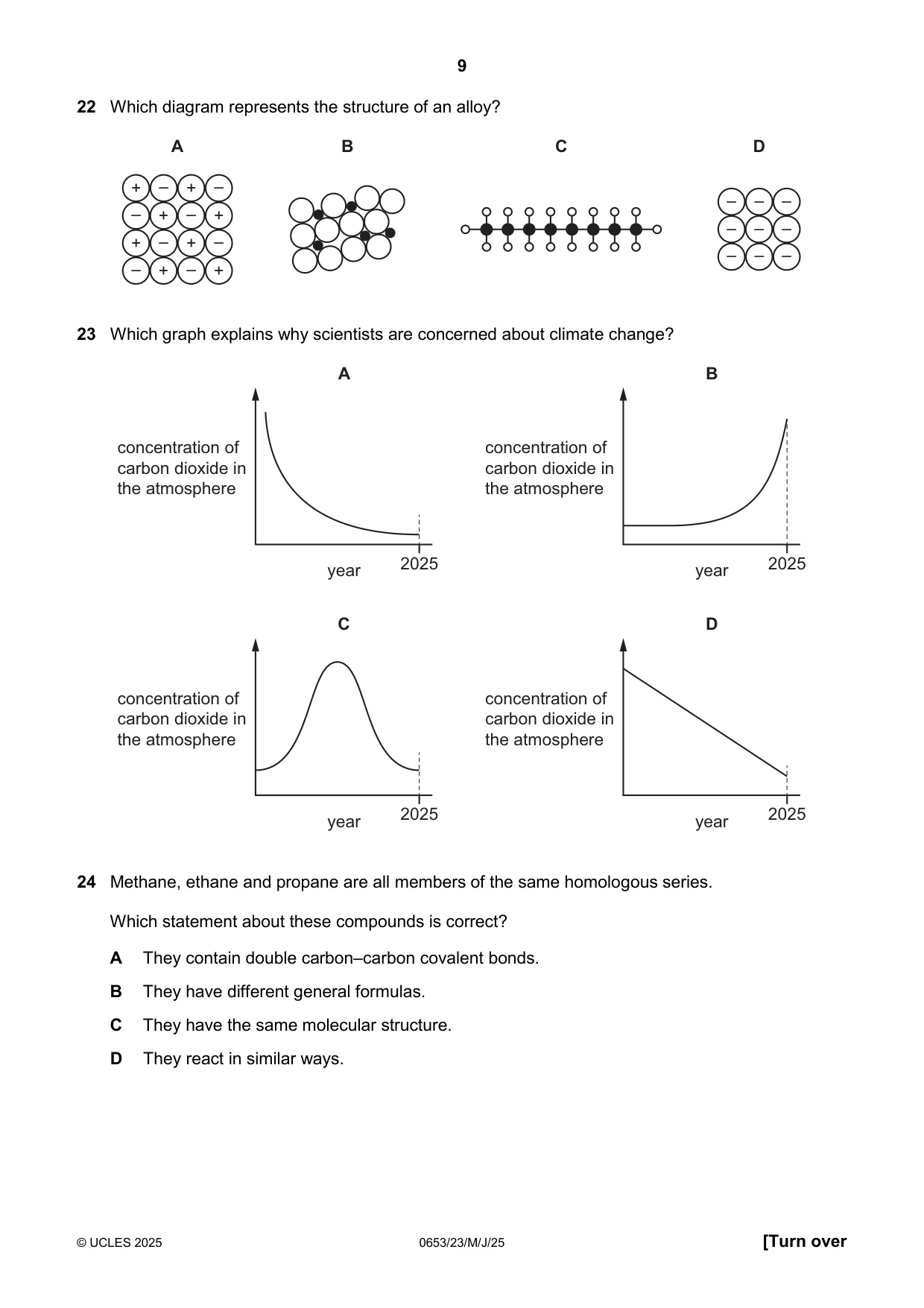
Q22 · Which diagram represents the structure of an alloy?
22 Which diagram represents the structure of an alloy? A B C D + – + – – – – – + – + – – – + – + – – – – – + – +
Mark scheme: B
Q23 · Which graph explains why scientists are concerned about climate change?
23 Which graph explains why scientists are concerned about climate change? A B concentration of concentration of carbon dioxide in carbon dioxide in the atmosphere the atmosphere year 2025 year 2025 C D concentration of concentration of carbon dioxide in carbon dioxide in the atmosphere the atmosphere year 2025 year 2025
Mark scheme: B
Q24 · Methane, ethane and propane are all members of the same homologous series
24 Methane, ethane and propane are all members of the same homologous series. Which statement about these compounds is correct? A They contain double carbon–carbon covalent bonds. B They have different general formulas. C They have the same molecular structure. D They react in similar ways.
Mark scheme: D
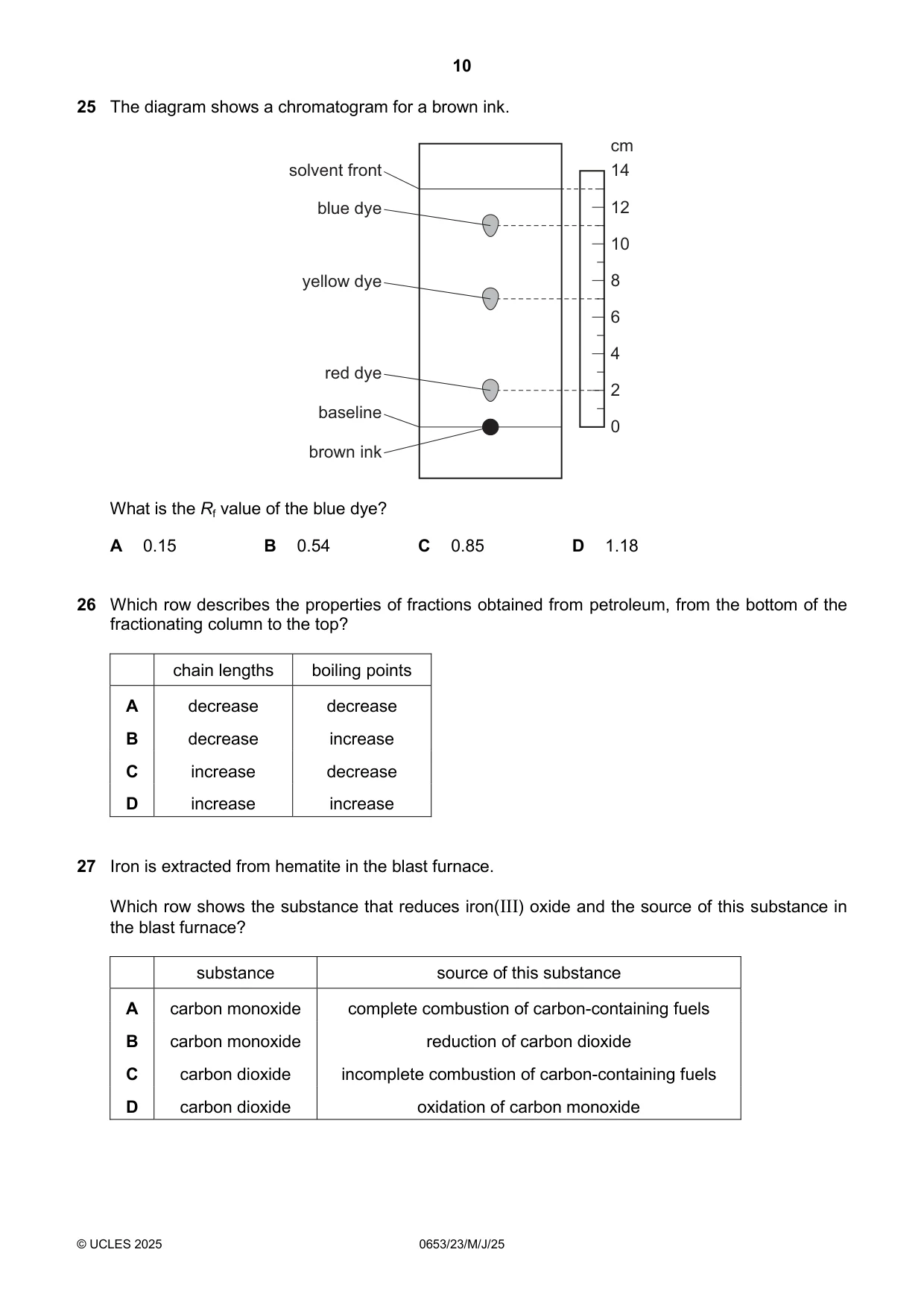
Q25 · The diagram shows a chromatogram for a brown ink
25 The diagram shows a chromatogram for a brown ink. cm solvent front 14 blue dye 12 10 yellow dye 8 6 4 red dye 2 baseline 0 brown ink What is the Rf value of the blue dye? A 0.15 B 0.54 C 0.85 D 1.18
Mark scheme: C
Q26 · Which row describes the properties of fractions obtained from petroleum, from the bottom…
26 Which row describes the properties of fractions obtained from petroleum, from the bottom of the fractionating column to the top? chain lengths boiling points A decrease decrease B decrease increase C increase decrease D increase increase
Mark scheme: A
Q27 · Iron is extracted from hematite in the blast furnace
27 Iron is extracted from hematite in the blast furnace. Which row shows the substance that reduces iron(III) oxide and the source of this substance in the blast furnace? substance source of this substance A carbon monoxide complete combustion of carbon-containing fuels B carbon monoxide reduction of carbon dioxide C carbon dioxide incomplete combustion of carbon-containing fuels D carbon dioxide oxidation of carbon monoxide
Mark scheme: B
Q28 · On planet R, there is no atmosphere and the acceleration of free fall g is 4.5 m / s2
28 On planet R, there is no atmosphere and the acceleration of free fall g is 4.5 m / s2. A rock of mass 2.0 kg falls from rest on planet R and hits the ground 4.0 m below. What is the speed of the rock as it hits the ground? A 4.5 m / s B 6.0 m / s C 18 m / s D 36 m / s
Mark scheme: B
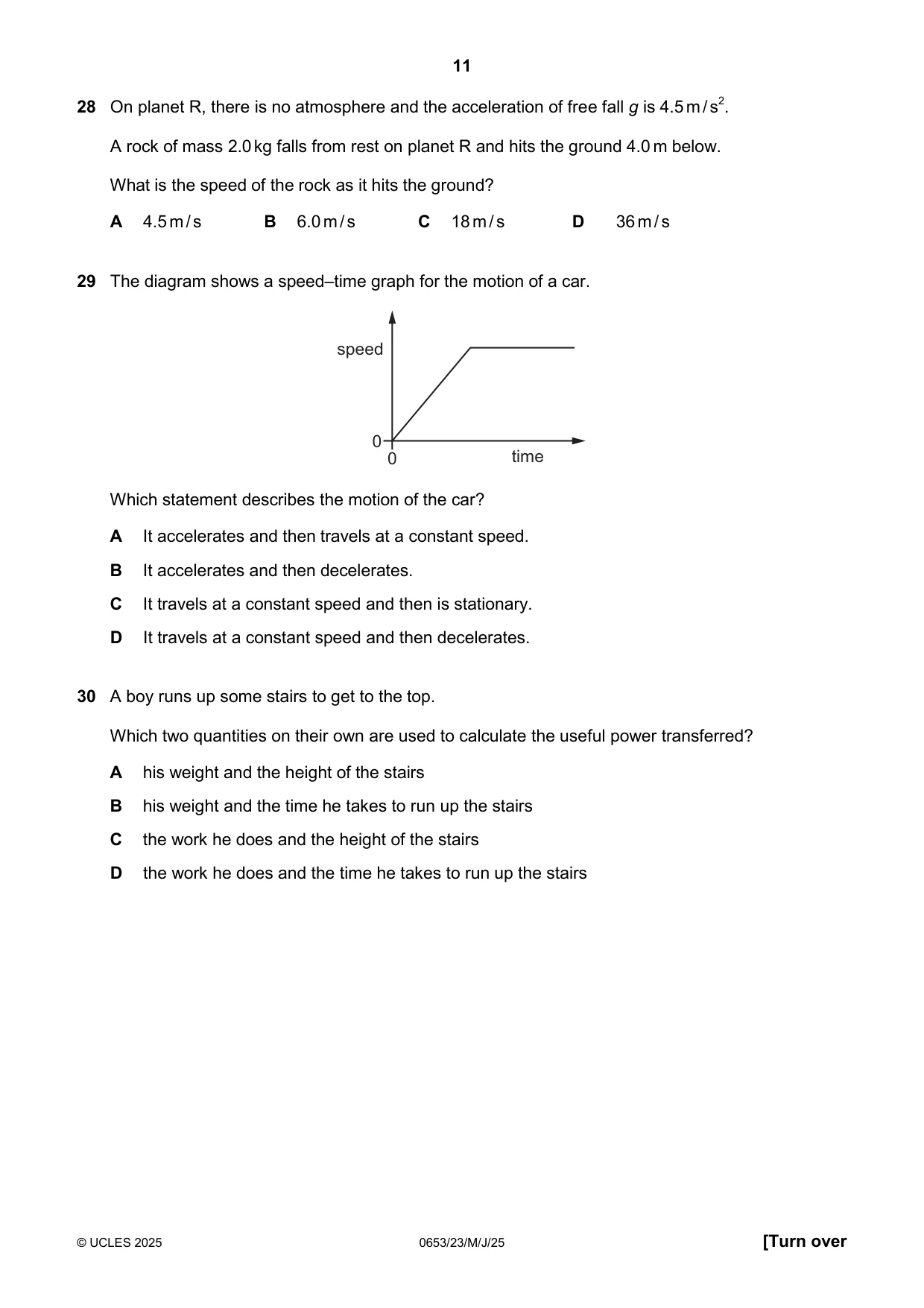
Q29 · The diagram shows a speed–time graph for the motion of a car
29 The diagram shows a speed–time graph for the motion of a car. speed 0 0 time Which statement describes the motion of the car? A It accelerates and then travels at a constant speed. B It accelerates and then decelerates. C It travels at a constant speed and then is stationary. D It travels at a constant speed and then decelerates.
Mark scheme: A
Q30 · A boy runs up some stairs to get to the top
30 A boy runs up some stairs to get to the top. Which two quantities on their own are used to calculate the useful power transferred? A his weight and the height of the stairs B his weight and the time he takes to run up the stairs C the work he does and the height of the stairs D the work he does and the time he takes to run up the stairs
Mark scheme: D
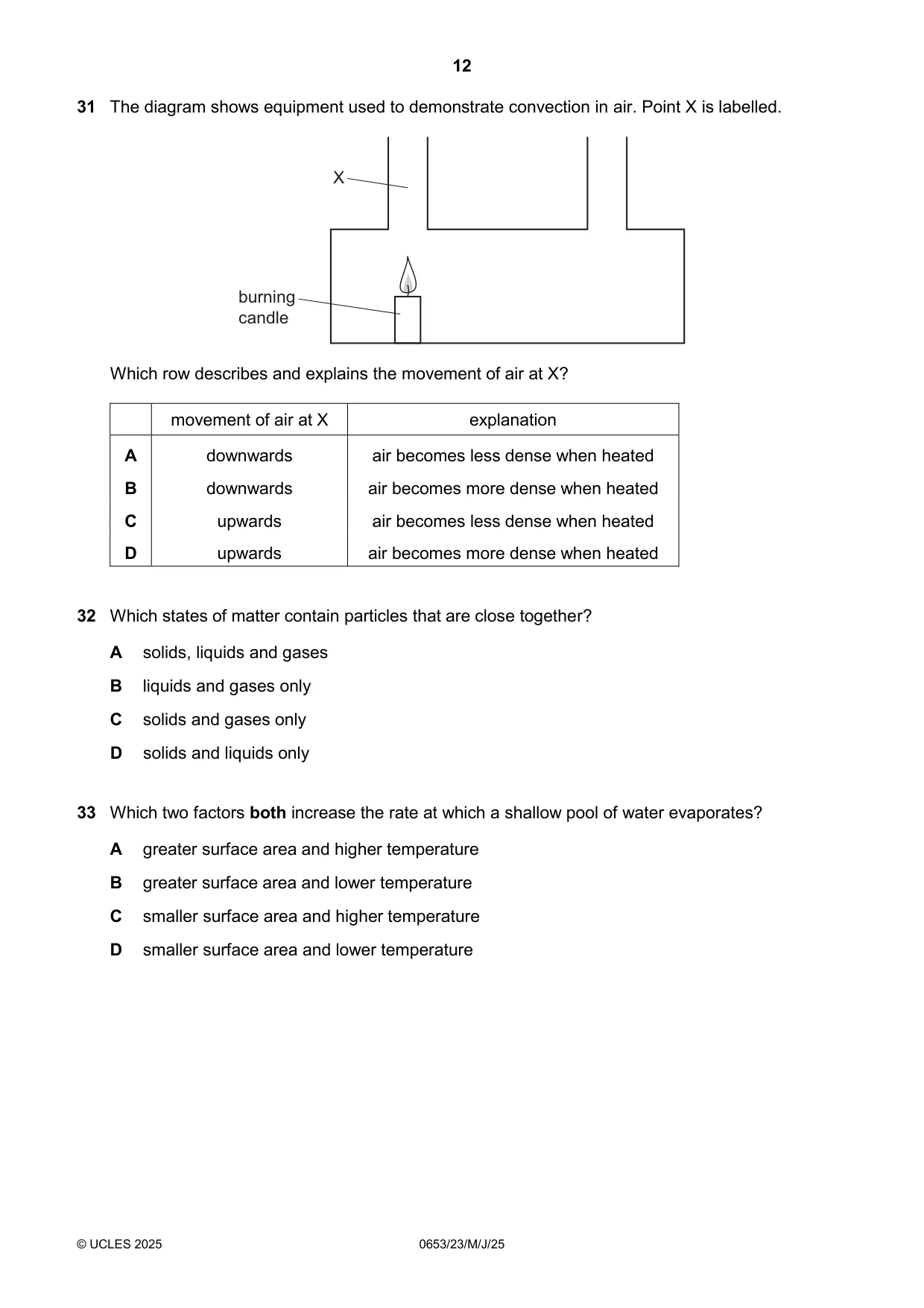
Q31 · The diagram shows equipment used to demonstrate convection in air
31 The diagram shows equipment used to demonstrate convection in air. Point X is labelled. X burning candle Which row describes and explains the movement of air at X? movement of air at X explanation A downwards air becomes less dense when heated B downwards air becomes more dense when heated C upwards air becomes less dense when heated D upwards air becomes more dense when heated
Mark scheme: C
Q32 · Which states of matter contain particles that are close together?
32 Which states of matter contain particles that are close together? A solids, liquids and gases B liquids and gases only C solids and gases only D solids and liquids only
Mark scheme: D
Q33 · Which two factors both increase the rate at which a shallow pool of water evaporates?
33 Which two factors both increase the rate at which a shallow pool of water evaporates? A greater surface area and higher temperature B greater surface area and lower temperature C smaller surface area and higher temperature D smaller surface area and lower temperature
Mark scheme: A
Q34 · The diagram shows a section of a rope
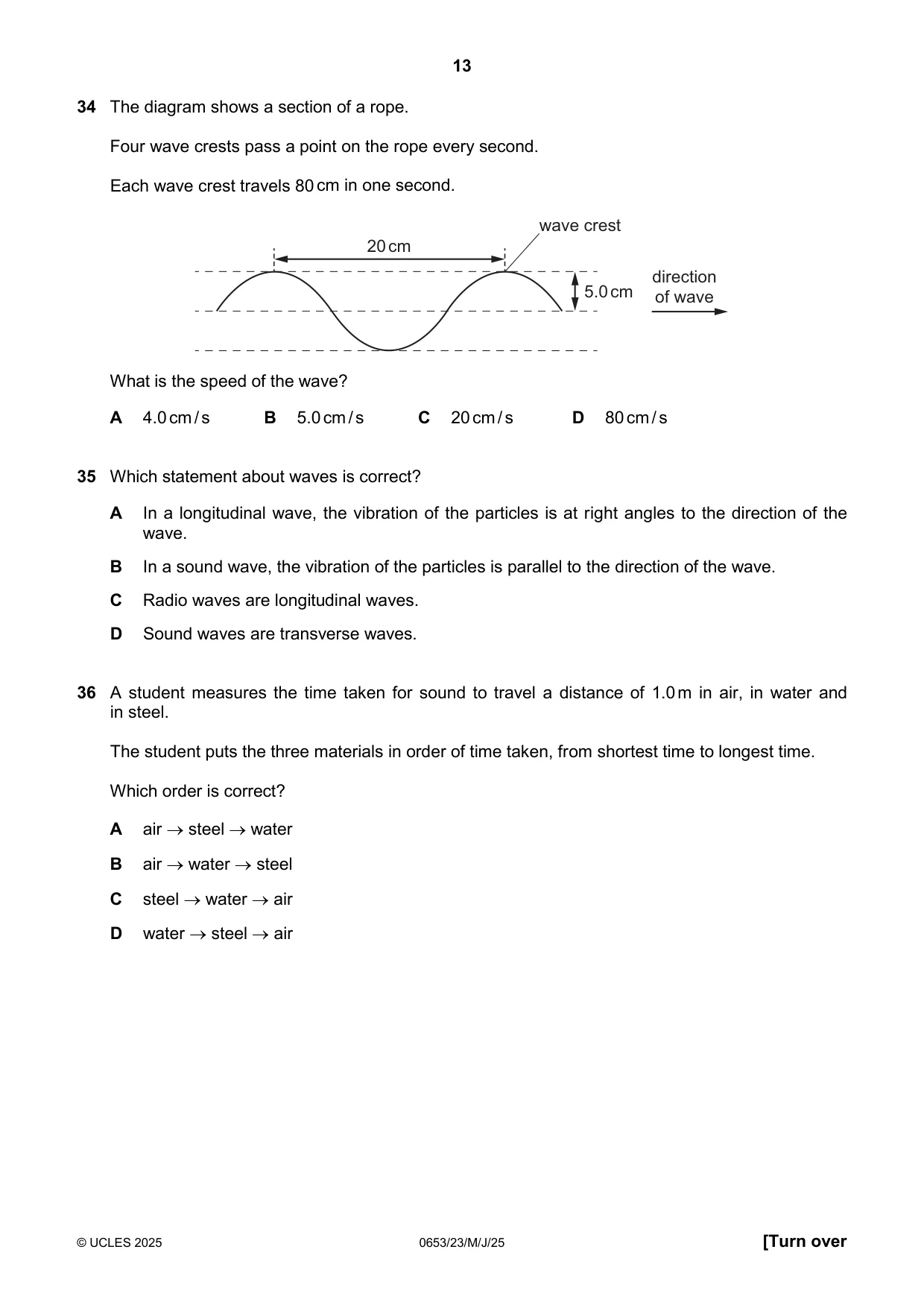
34 The diagram shows a section of a rope. Four wave crests pass a point on the rope every second. Each wave crest travels 80 cm in one second. wave crest 20 cm direction 5.0 cm of wave What is the speed of the wave? A 4.0 cm / s B 5.0 cm / s C 20 cm / s D 80 cm / s
Mark scheme: D
Q35 · Which statement about waves is correct?
35 Which statement about waves is correct? A In a longitudinal wave, the vibration of the particles is at right angles to the direction of the wave. B In a sound wave, the vibration of the particles is parallel to the direction of the wave. C Radio waves are longitudinal waves. D Sound waves are transverse waves.
Mark scheme: B
Q36 · A student measures the time taken for sound to travel a distance of 1.0 m in air, in…
36 A student measures the time taken for sound to travel a distance of 1.0 m in air, in water and in steel. The student puts the three materials in order of time taken, from shortest time to longest time. Which order is correct? A air steel water B air water steel C steel water air D water steel air
Mark scheme: C
Q37 · The diagram shows the scale of an analogue voltmeter
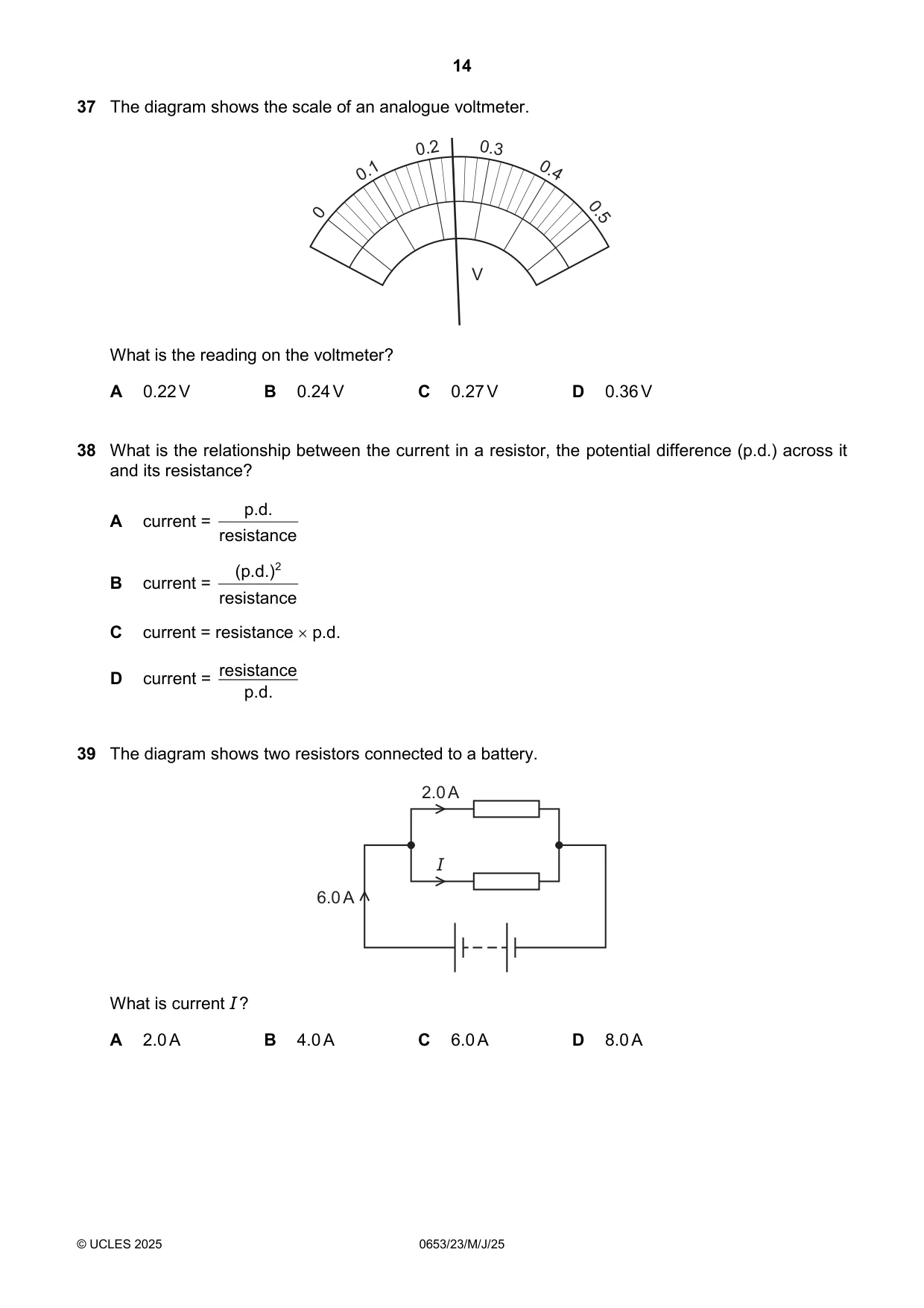
37 The diagram shows the scale of an analogue voltmeter. 0.2 0.3 0.1 0.4 0 0.5 V What is the reading on the voltmeter? A 0.22 V B 0.24 V C 0.27 V D 0.36 V
Mark scheme: B
Q38 · What is the relationship between the current in a resistor, the potential difference…
38 What is the relationship between the current in a resistor, the potential difference (p.d.) across it and its resistance? p.d. A current = resistance (p.d.)2 B current = resistance C current = resistance p.d. current = resistance D p.d.
Mark scheme: A
Q39 · The diagram shows two resistors connected to a battery
39 The diagram shows two resistors connected to a battery. 2.0 A I 6.0 A What is current I ? A 2.0 A B 4.0 A C 6.0 A D 8.0 A
Mark scheme: B
Q40 · The life cycle of a star depends on whether it has a small mass, a large mass or a very…
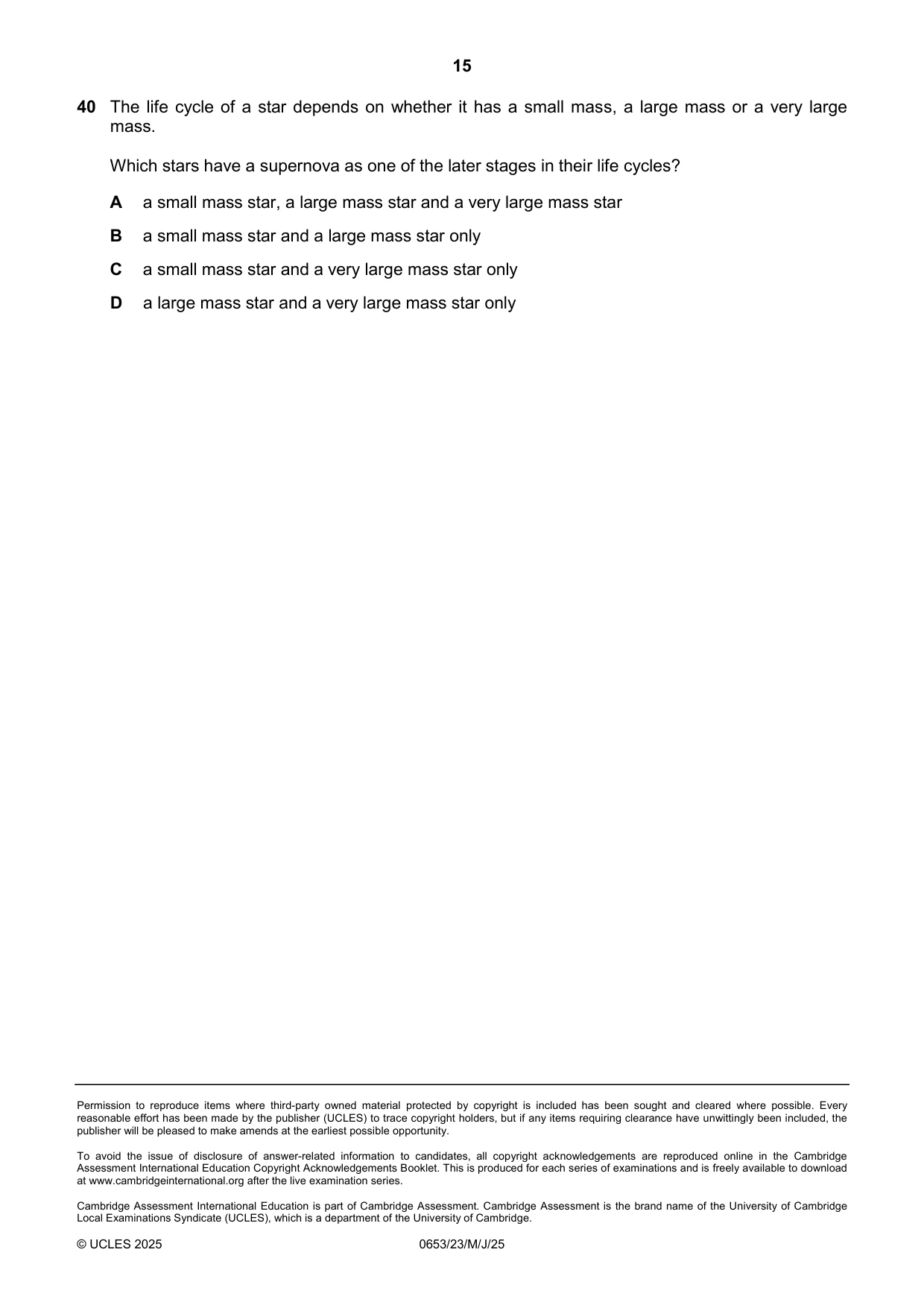
40 The life cycle of a star depends on whether it has a small mass, a large mass or a very large mass. Which stars have a supernova as one of the later stages in their life cycles? A a small mass star, a large mass star and a very large mass star B a small mass star and a large mass star only C a small mass star and a very large mass star only D a large mass star and a very large mass star only
Mark scheme: D
What was in this paper
The subtopics covered by these 40 questions, and how many questions each got. Open one in a new tab to see every Cambridge question on it.
2Electrical quantities2General properties of waves2Kinetic particle model of matter2Motion2Air quality and climate1Alkanes1Alloys and their properties1Blood vessels1Cell structure1Chromatography1Diet1Electrical circuits1Electrolysis1Elements, compounds and mixtures1Energy flow1Energy, work and power1Enzymes1Exothermic and endothermic reactions1Extraction of metals1Food chains and food webs1Fuels1Group VII properties1Ions and ionic bonds1Leaf structure1Osmosis1Preparation of salts1Rate of reaction1Respiration1Size of specimens1Sound1Stars and the Universe1The characteristic properties of acids and bases1Transfer of thermal energy1Transpiration1What you needed in this session
Cambridge’s own grade thresholds for 2025 May/June, Paper 2 · Variant 3. A higher threshold means an easier paper — the bar moves with how the cohort did.