Cambridge IGCSE Science - Combined 0653 — 2021 Oct/Nov Paper 2 · Variant 3
0653/23/O/N/21 · 40 questions · 40 marks · ≈45 min
The question paper and its mark scheme, free to read here and free to download. This is Cambridge’s own paper, exactly as it was sat.
Question paper16 pages

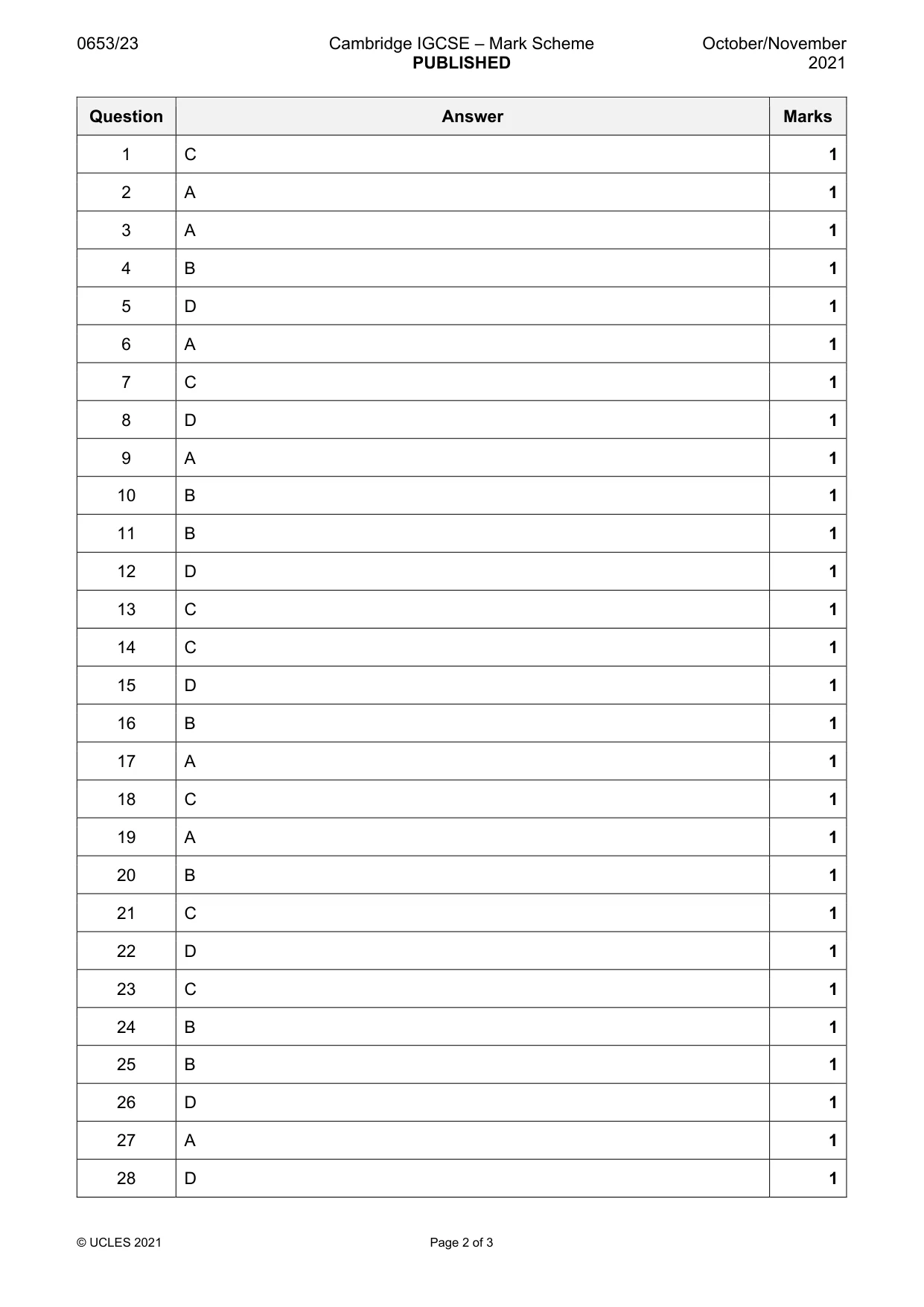
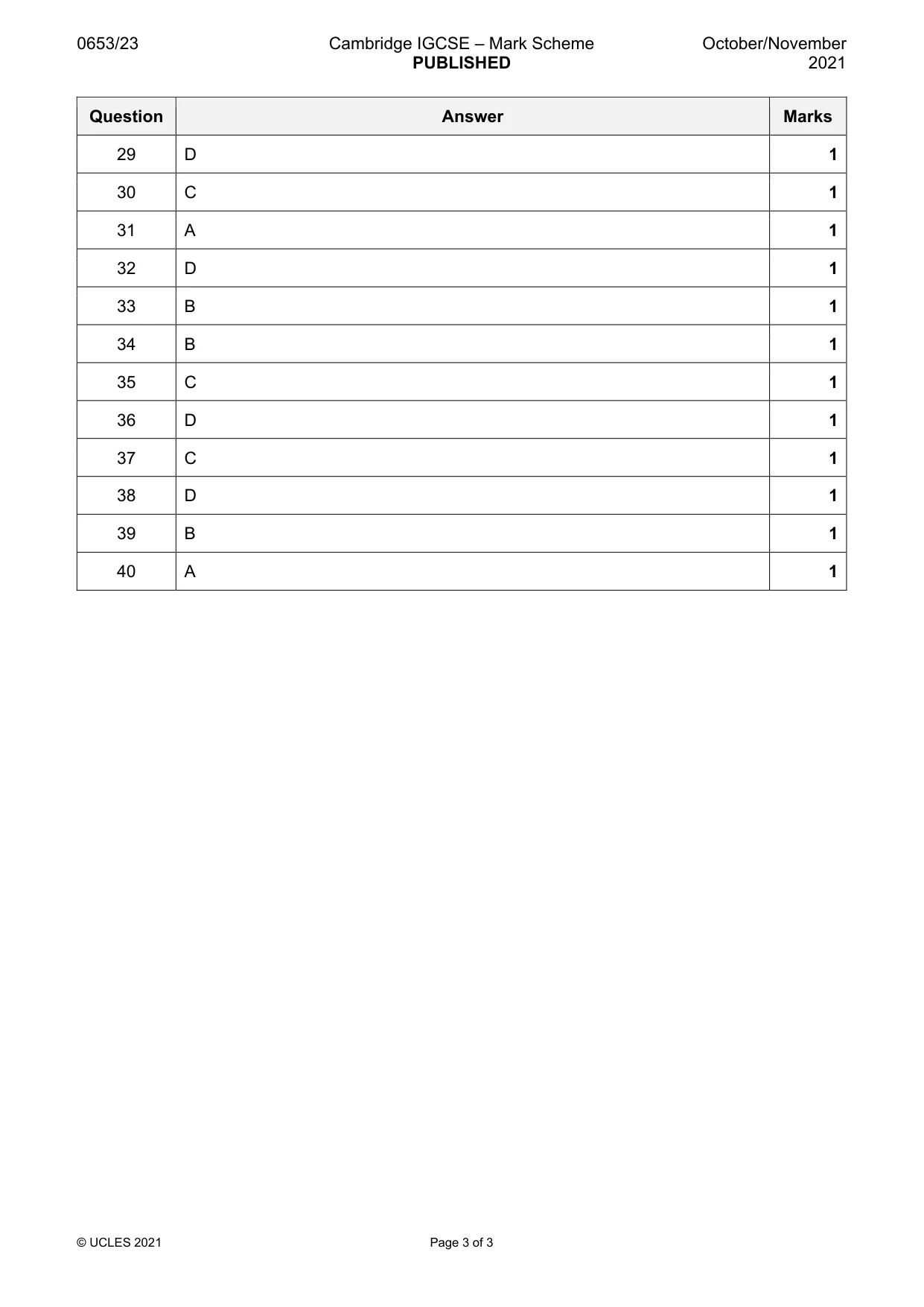
Mark scheme3 pages
Answers below. Sit the paper first if you are practising.
Questions as text
Q1 · Movement is a characteristic of all living organisms
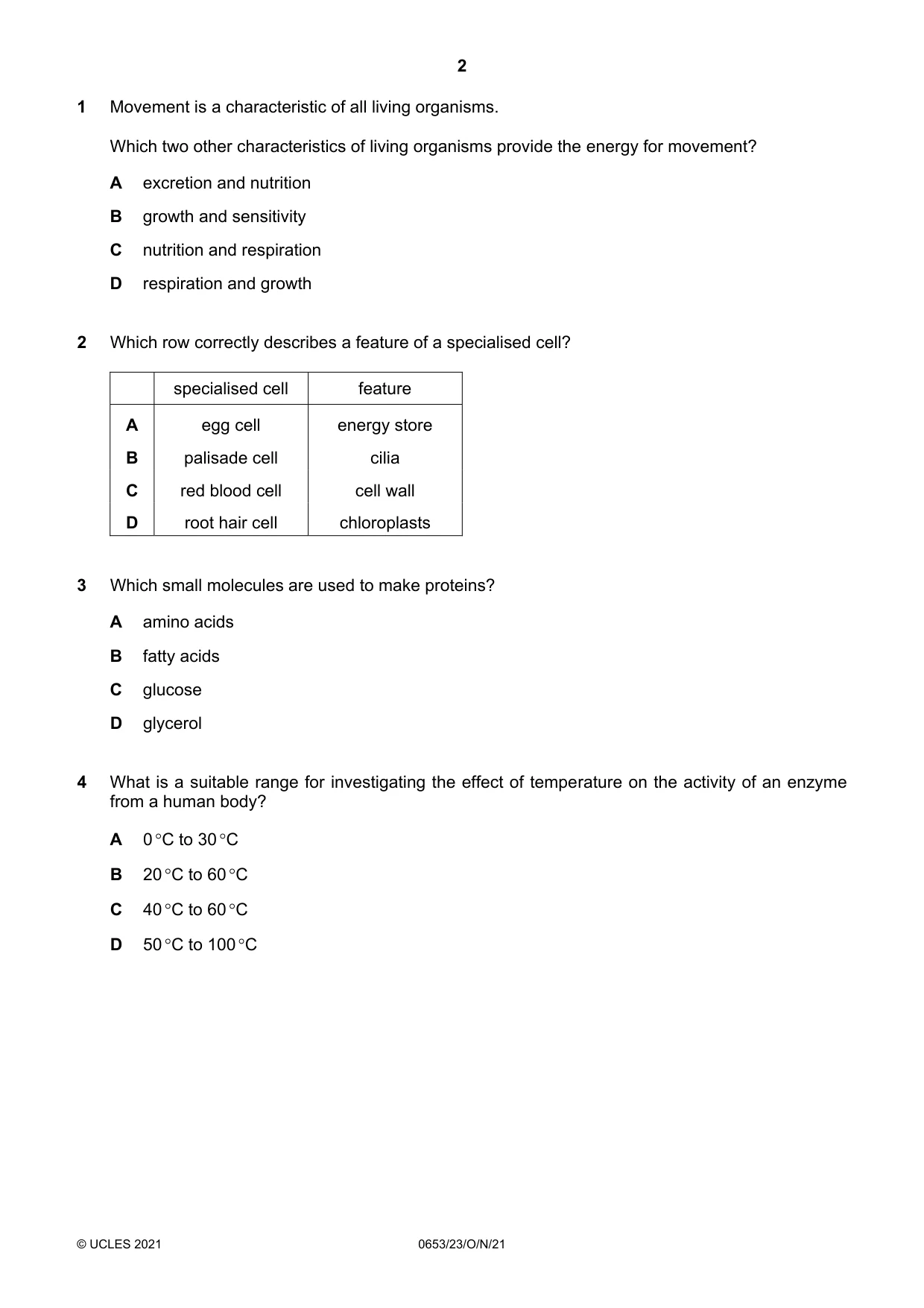
1 Movement is a characteristic of all living organisms. Which two other characteristics of living organisms provide the energy for movement? A excretion and nutrition B growth and sensitivity C nutrition and respiration D respiration and growth
Mark scheme: C
Q2 · Which row correctly describes a feature of a specialised cell?
2 Which row correctly describes a feature of a specialised cell? specialised cell feature A egg cell energy store B palisade cell cilia C red blood cell cell wall D root hair cell chloroplasts
Mark scheme: A
Q3 · Which small molecules are used to make proteins?
3 Which small molecules are used to make proteins? A amino acids B fatty acids C glucose D glycerol
Mark scheme: A
Q4 · What is a suitable range for investigating the effect of temperature on the activity of…
4 What is a suitable range for investigating the effect of temperature on the activity of an enzyme from a human body? A 0 C to 30 C B 20 C to 60 C C 40 C to 60 C D 50 C to 100 C
Mark scheme: B
Q5 · Which letters from the list represent the balanced equation for photosynthesis?
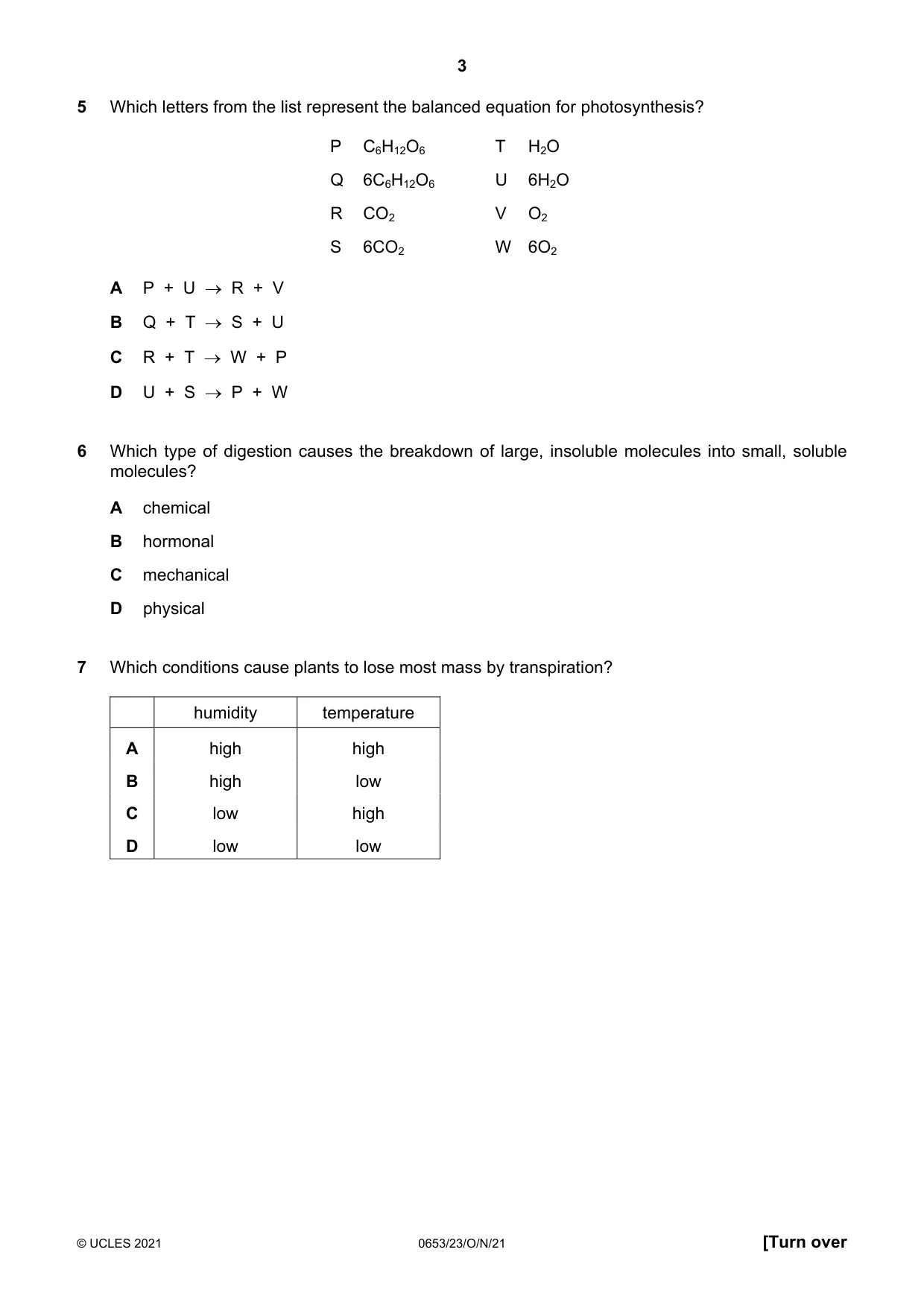
5 Which letters from the list represent the balanced equation for photosynthesis? P C6H12O6 T H2O Q 6C6H12O6 U 6H2O R CO2 V O2 S 6CO2 W 6O2 A P + U R + V B Q + T S + U C R + T W + P D U + S P + W
Mark scheme: D
Q6 · Which type of digestion causes the breakdown of large, insoluble molecules into small…
6 Which type of digestion causes the breakdown of large, insoluble molecules into small, soluble molecules? A chemical B hormonal C mechanical D physical
Mark scheme: A
Q7 · Which conditions cause plants to lose most mass by transpiration?
7 Which conditions cause plants to lose most mass by transpiration? humidity temperature A high high B high low C low high D low low
Mark scheme: C
Q8 · The diagram shows part of the gas exchange system in humans
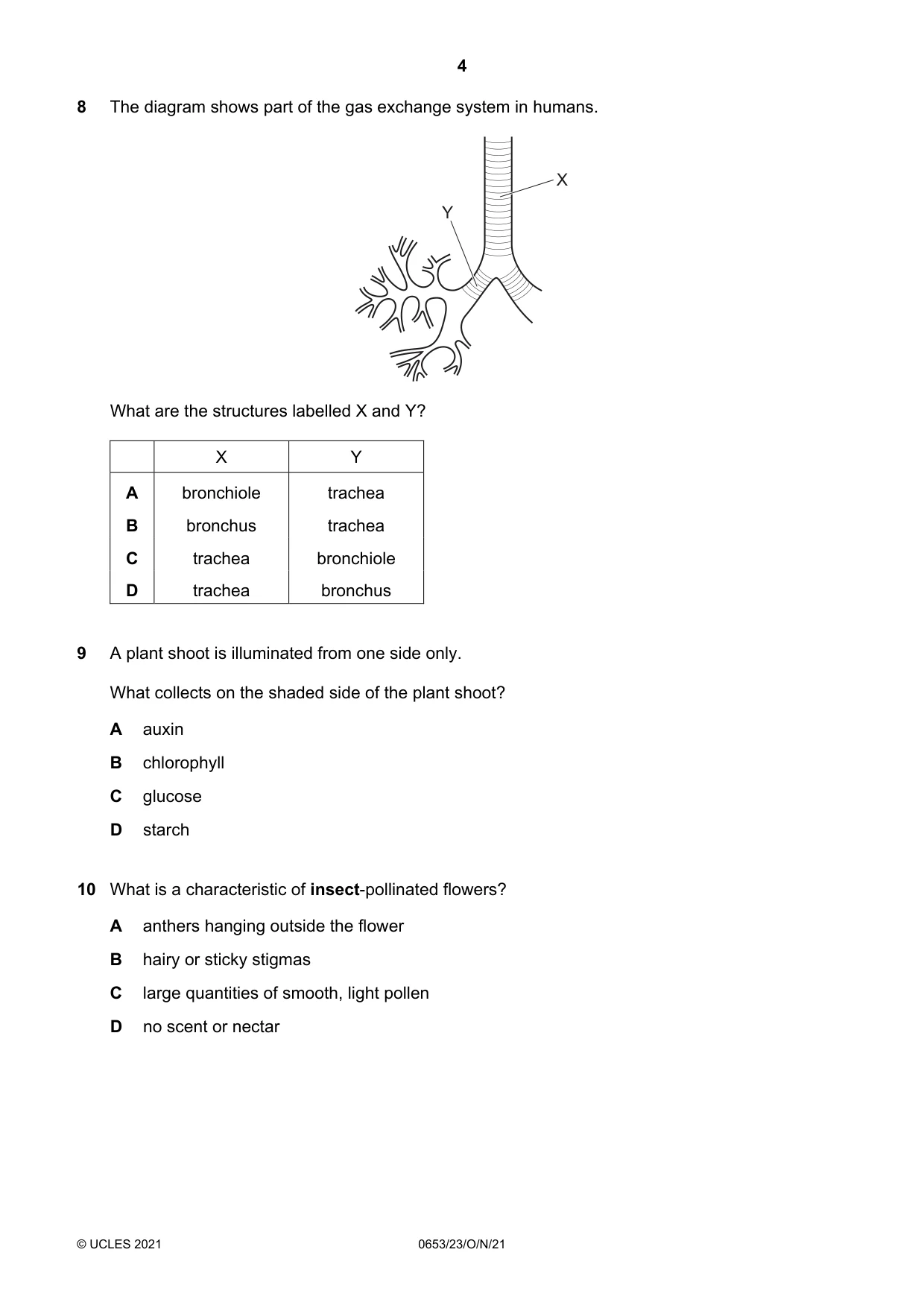
8 The diagram shows part of the gas exchange system in humans. X Y What are the structures labelled X and Y? X Y A bronchiole trachea B bronchus trachea C trachea bronchiole D trachea bronchus
Mark scheme: D
Q9 · A plant shoot is illuminated from one side only
9 A plant shoot is illuminated from one side only. What collects on the shaded side of the plant shoot? A auxin B chlorophyll C glucose D starch
Mark scheme: A
Q10 · What is a characteristic of insect-pollinated flowers?
10 What is a characteristic of insect-pollinated flowers? A anthers hanging outside the flower B hairy or sticky stigmas C large quantities of smooth, light pollen D no scent or nectar
Mark scheme: B
Q11 · Which comparison between human female and male gametes is correct?
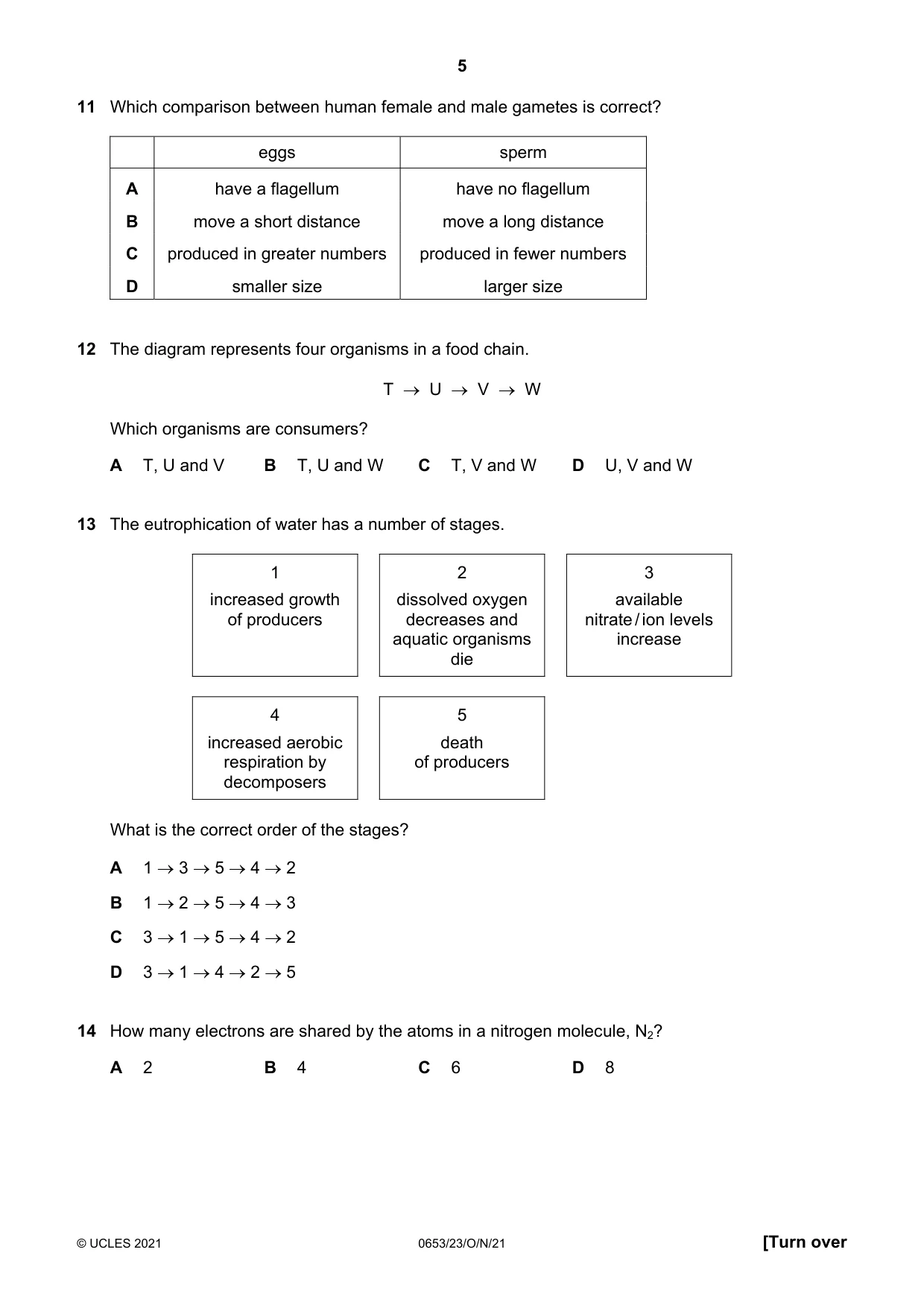
11 Which comparison between human female and male gametes is correct? eggs sperm A have a flagellum have no flagellum B move a short distance move a long distance C produced in greater numbers produced in fewer numbers D smaller size larger size
Mark scheme: B
Q12 · The diagram represents four organisms in a food chain
12 The diagram represents four organisms in a food chain. T U V W Which organisms are consumers? A T, U and V B T, U and W C T, V and W D U, V and W
Mark scheme: D
Q13 · The eutrophication of water has a number of stages
13 The eutrophication of water has a number of stages. 1 2 3 increased growth dissolved oxygen available of producers decreases and nitrate / ion levels aquatic organisms increase die 4 5 increased aerobic death respiration by of producers decomposers What is the correct order of the stages? A 1 3 5 4 2 B 1 2 5 4 3 C 3 1 5 4 2 D 3 1 4 2 5
Mark scheme: C
Q14 · How many electrons are shared by the atoms in a nitrogen molecule, N2?
14 How many electrons are shared by the atoms in a nitrogen molecule, N2? A 2 B 4 C 6 D 8
Mark scheme: C
Q15 · The formula of magnesium chloride is MgCl 2
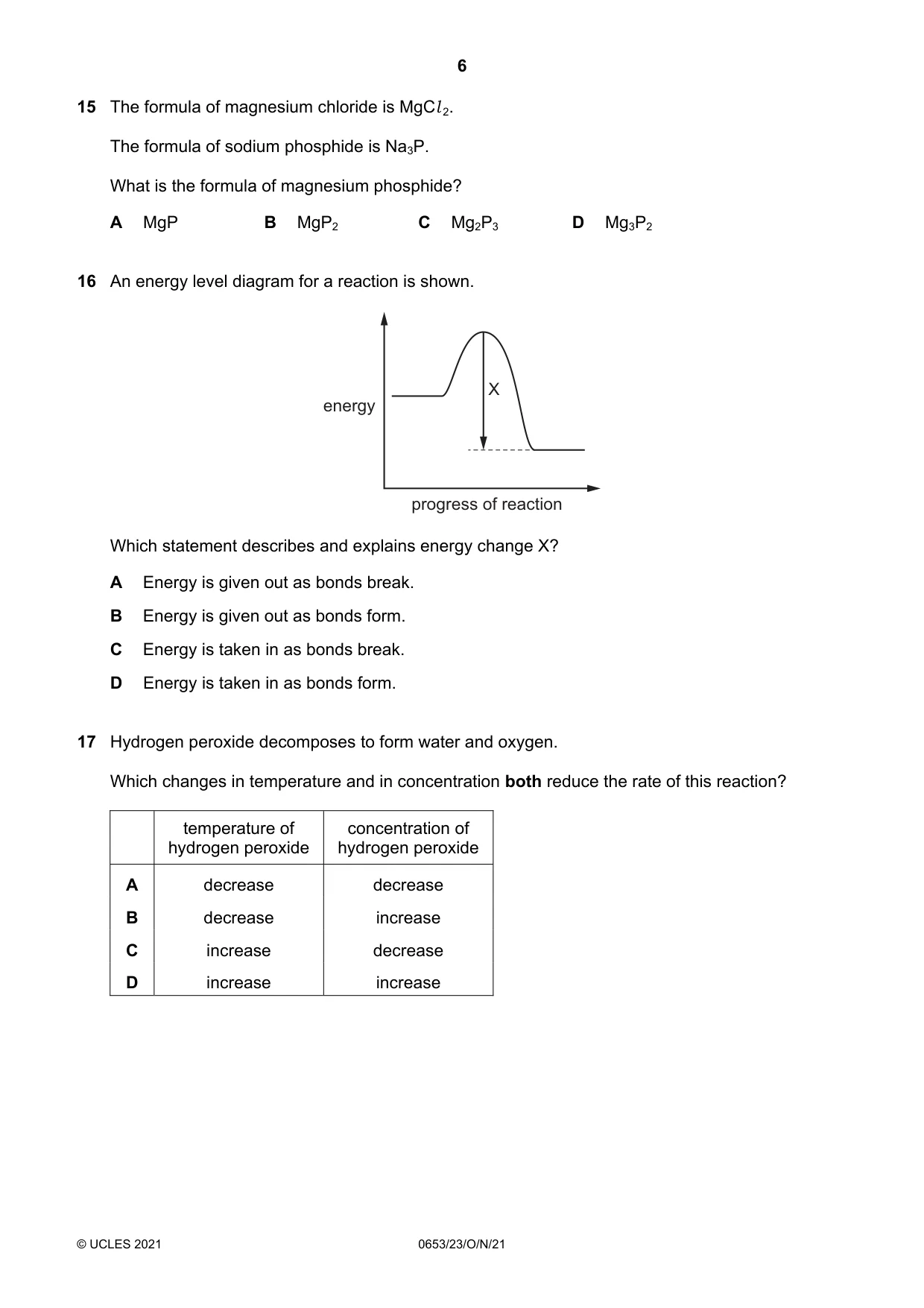
15 The formula of magnesium chloride is MgCl 2. The formula of sodium phosphide is Na3P. What is the formula of magnesium phosphide? A MgP B MgP2 C Mg2P3 D Mg3P2
Mark scheme: D
Q16 · An energy level diagram for a reaction is shown
16 An energy level diagram for a reaction is shown. X energy progress of reaction Which statement describes and explains energy change X? A Energy is given out as bonds break. B Energy is given out as bonds form. C Energy is taken in as bonds break. D Energy is taken in as bonds form.
Mark scheme: B
Q17 · Hydrogen peroxide decomposes to form water and oxygen
17 Hydrogen peroxide decomposes to form water and oxygen. Which changes in temperature and in concentration both reduce the rate of this reaction? temperature of concentration of hydrogen peroxide hydrogen peroxide A decrease decrease B decrease increase C increase decrease D increase increase
Mark scheme: A
Q18 · Iron oxide reacts with aluminium
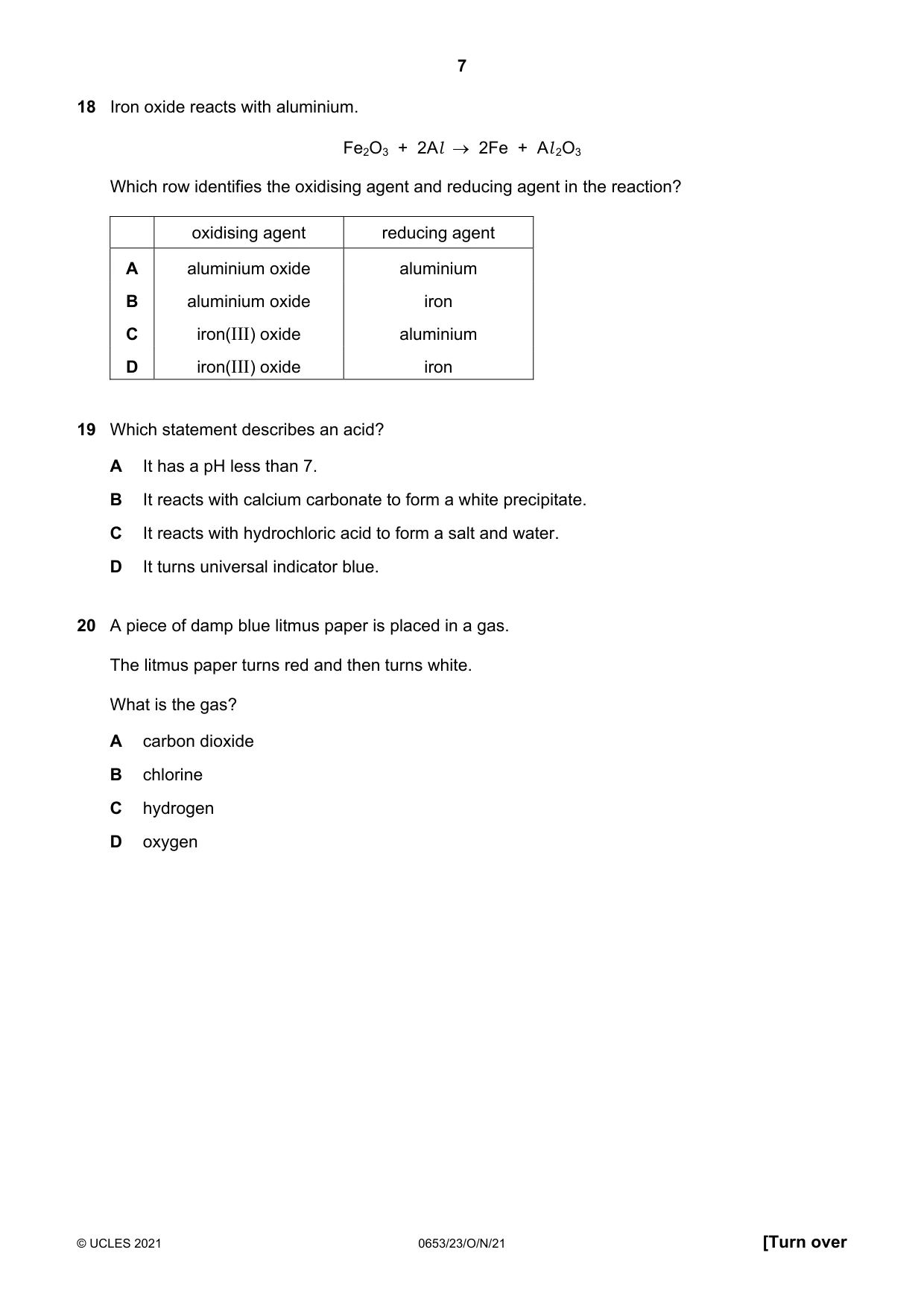
18 Iron oxide reacts with aluminium. Fe2O3 + 2Al 2Fe + Al 2O3 Which row identifies the oxidising agent and reducing agent in the reaction? oxidising agent reducing agent A aluminium oxide aluminium B aluminium oxide iron C iron(III) oxide aluminium D iron(III) oxide iron
Mark scheme: C
Q19 · Which statement describes an acid?
19 Which statement describes an acid? A It has a pH less than 7. B It reacts with calcium carbonate to form a white precipitate. C It reacts with hydrochloric acid to form a salt and water. D It turns universal indicator blue.
Mark scheme: A
More questions on The characteristic properties of acids and bases
Q20 · A piece of damp blue litmus paper is placed in a gas
20 A piece of damp blue litmus paper is placed in a gas. The litmus paper turns red and then turns white. What is the gas? A carbon dioxide B chlorine C hydrogen D oxygen
Mark scheme: B
Q21 · Some properties of noble gases are shown
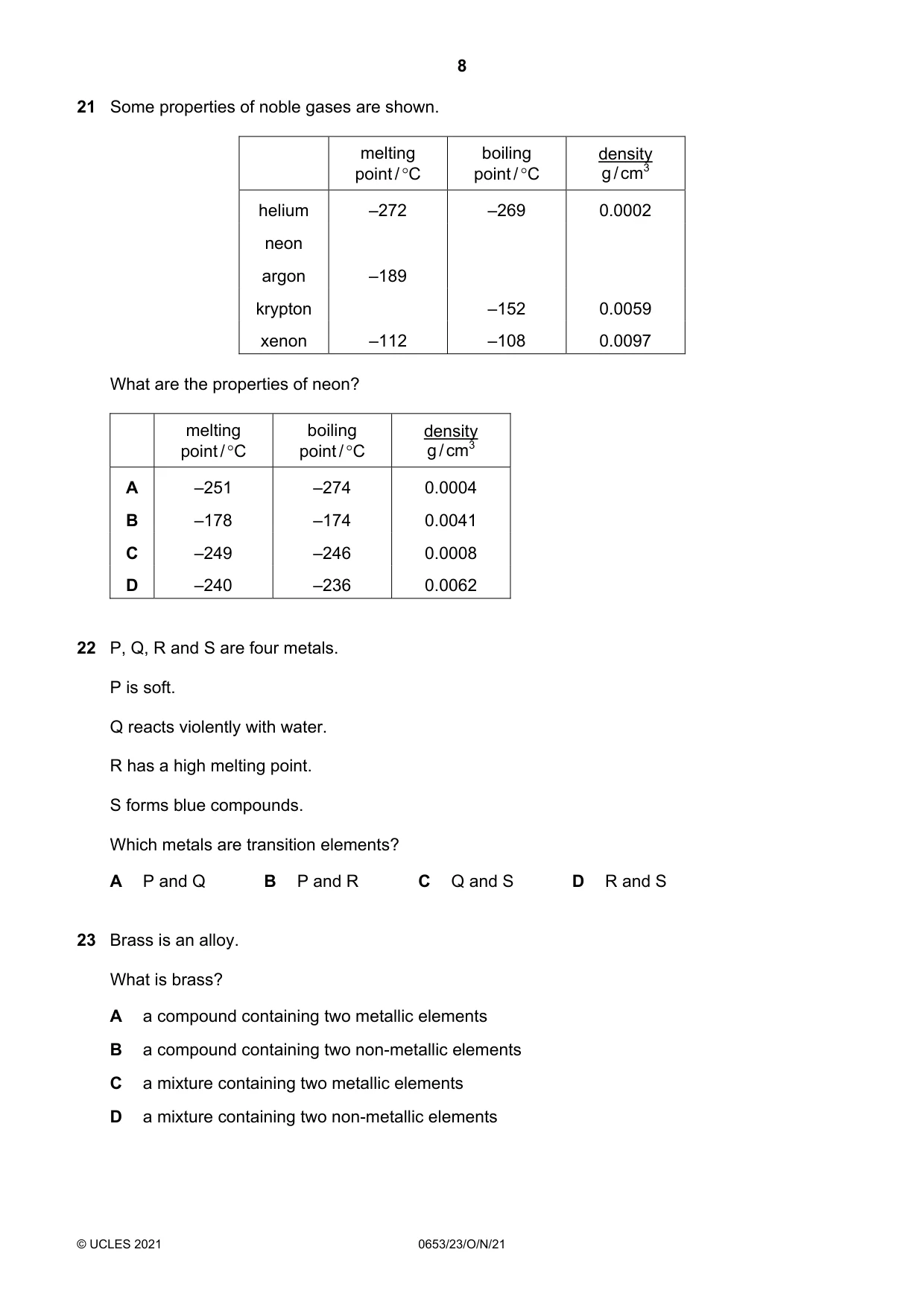
21 Some properties of noble gases are shown. melting boiling density point / C point / C g / cm3 helium –272 –269 0.0002 neon argon –189 krypton –152 0.0059 xenon –112 –108 0.0097 What are the properties of neon? melting boiling density point / C point / C g / cm3 A –251 –274 0.0004 B –178 –174 0.0041 C –249 –246 0.0008 D –240 –236 0.0062
Mark scheme: C
Q22 · P, Q, R and S are four metals
22 P, Q, R and S are four metals. P is soft. Q reacts violently with water. R has a high melting point. S forms blue compounds. Which metals are transition elements? A P and Q B P and R C Q and S D R and S
Mark scheme: D
Q23 · Brass is an alloy
23 Brass is an alloy. What is brass? A a compound containing two metallic elements B a compound containing two non-metallic elements C a mixture containing two metallic elements D a mixture containing two non-metallic elements
Mark scheme: C
Q24 · The results of mixing metal X with aqueous metal ions are shown
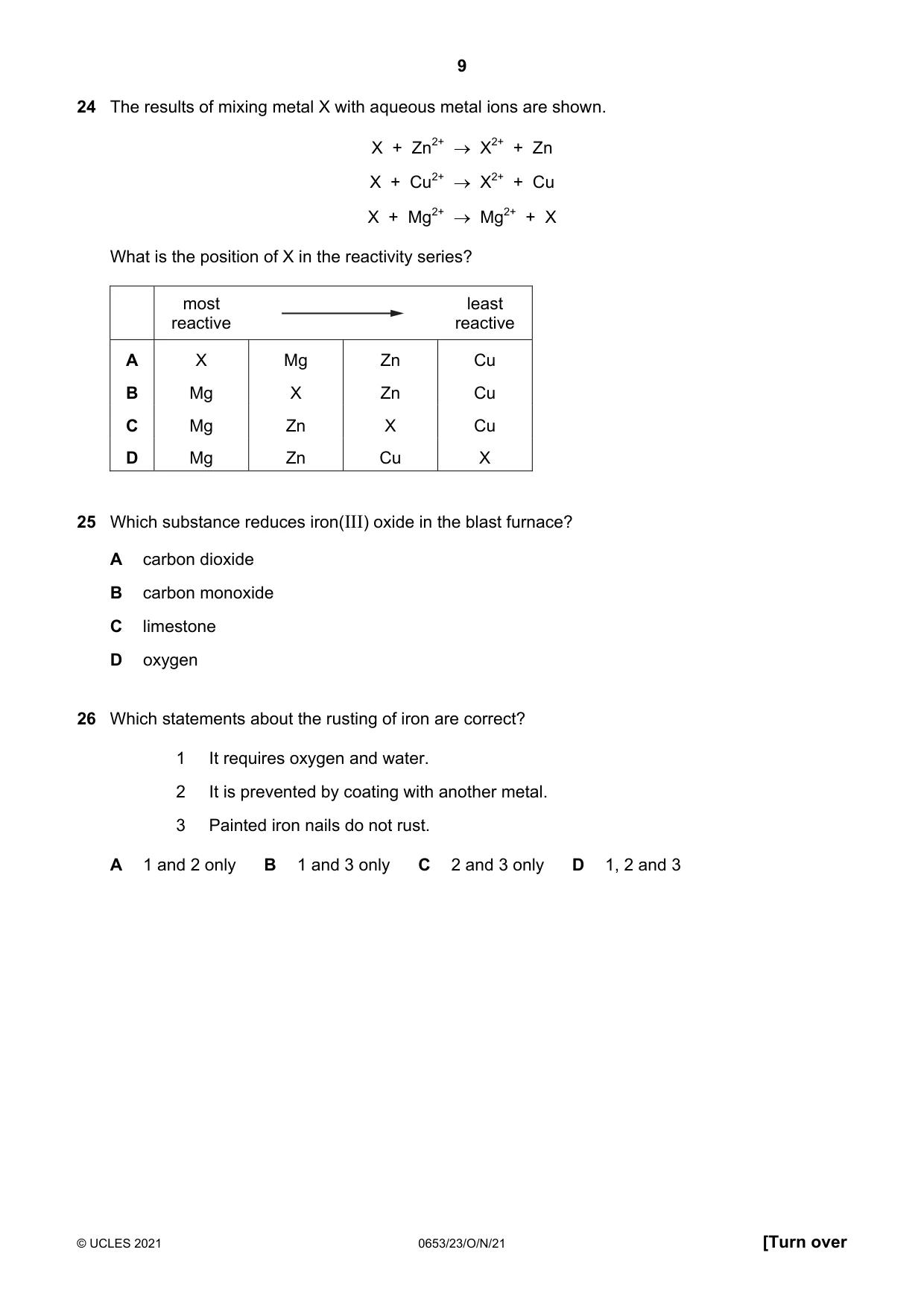
24 The results of mixing metal X with aqueous metal ions are shown. X + Zn2+ X2+ + Zn X + Cu2+ X2+ + Cu X + Mg2+ Mg2+ + X What is the position of X in the reactivity series? most least reactive reactive A X Mg Zn Cu B Mg X Zn Cu C Mg Zn X Cu D Mg Zn Cu X
Mark scheme: B
Q25 · Which substance reduces iron(III) oxide in the blast furnace?
25 Which substance reduces iron(III) oxide in the blast furnace? A carbon dioxide B carbon monoxide C limestone D oxygen
Mark scheme: B
Q26 · Which statements about the rusting of iron are correct?
26 Which statements about the rusting of iron are correct? 1 It requires oxygen and water. 2 It is prevented by coating with another metal. 3 Painted iron nails do not rust. A 1 and 2 only B 1 and 3 only C 2 and 3 only D 1, 2 and 3
Mark scheme: D
Q27 · The fractional distillation of petroleum is shown
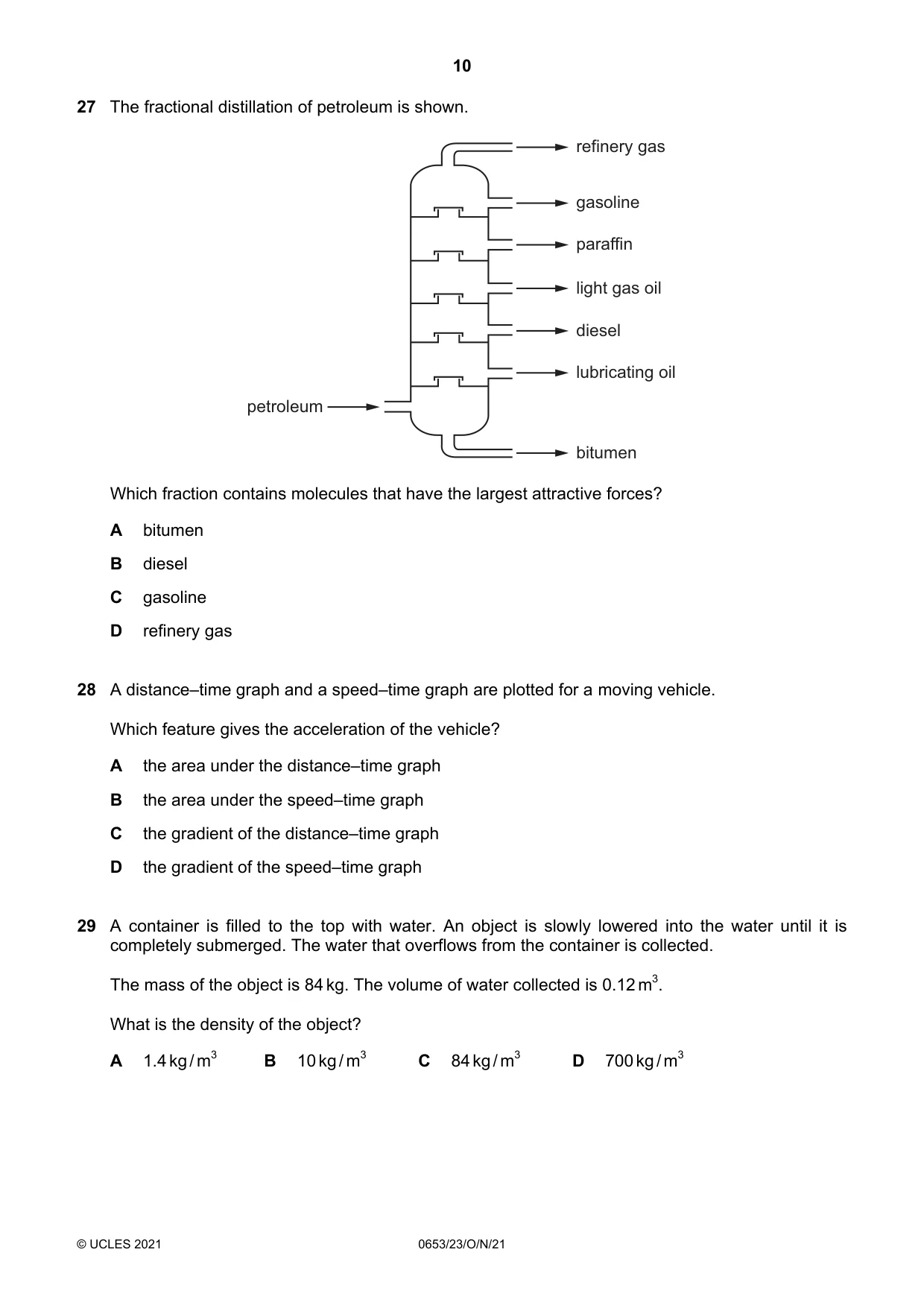
27 The fractional distillation of petroleum is shown. refinery gas gasoline paraffin light gas oil diesel lubricating oil petroleum bitumen Which fraction contains molecules that have the largest attractive forces? A bitumen B diesel C gasoline D refinery gas
Mark scheme: A
Q28 · A distance–time graph and a speed–time graph are plotted for a moving vehicle
28 A distance–time graph and a speed–time graph are plotted for a moving vehicle. Which feature gives the acceleration of the vehicle? A the area under the distance–time graph B the area under the speed–time graph C the gradient of the distance–time graph D the gradient of the speed–time graph
Mark scheme: D
Q29 · A container is filled to the top with water
29 A container is filled to the top with water. An object is slowly lowered into the water until it is completely submerged. The water that overflows from the container is collected. The mass of the object is 84 kg. The volume of water collected is 0.12 m3. What is the density of the object? A 1.4 kg / m3 B 10 kg / m3 C 84 kg / m3 D 700 kg / m3
Mark scheme: D
Q30 · A spring that obeys Hooke’s Law has unstretched length l
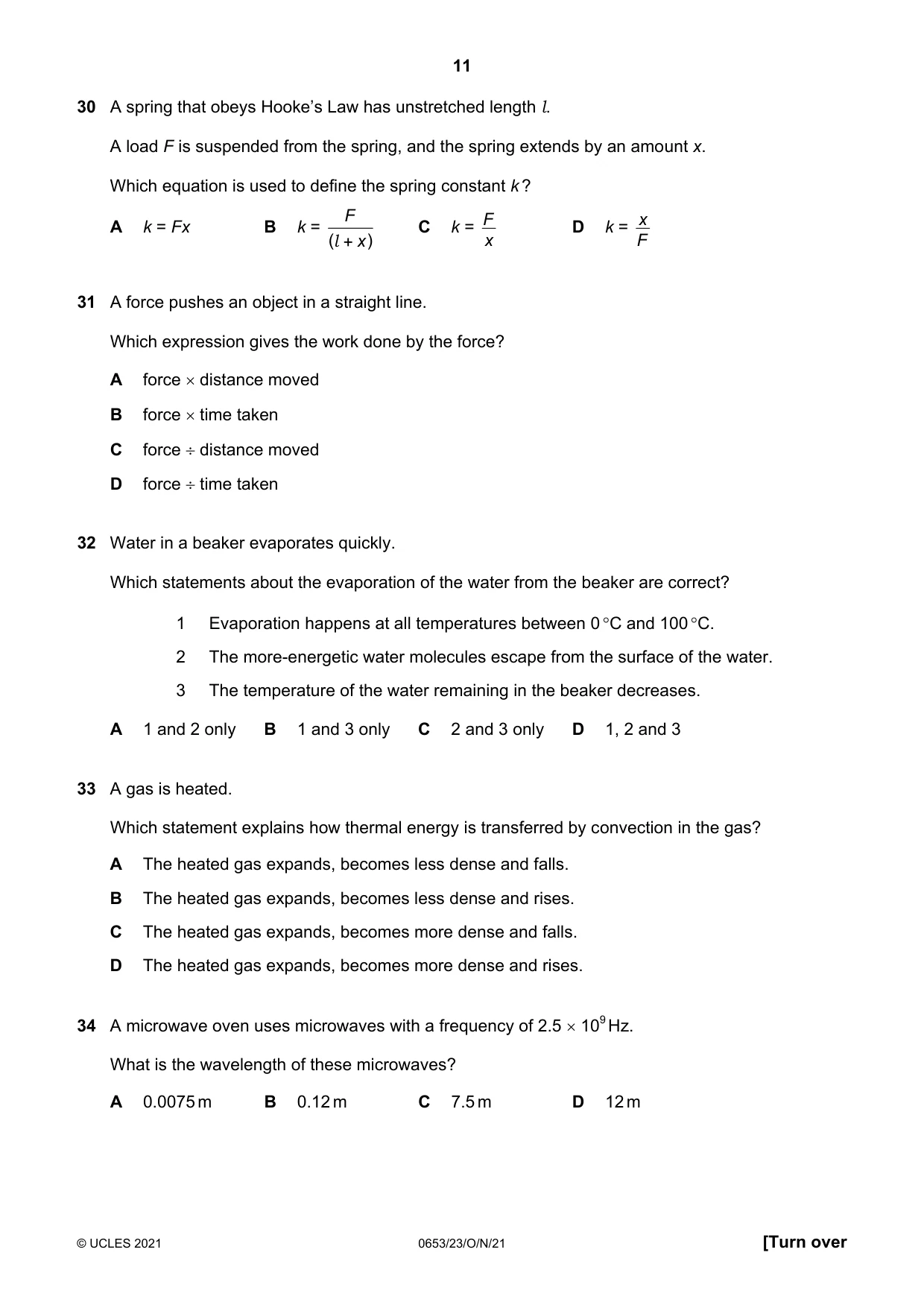
30 A spring that obeys Hooke’s Law has unstretched length l. A load F is suspended from the spring, and the spring extends by an amount x. Which equation is used to define the spring constant k ? F k = F k = x A k = Fx B k = ( C x D F l + x )
Mark scheme: C
Q31 · A force pushes an object in a straight line
31 A force pushes an object in a straight line. Which expression gives the work done by the force? A force distance moved B force time taken C force distance moved D force time taken
Mark scheme: A
Q32 · Water in a beaker evaporates quickly
32 Water in a beaker evaporates quickly. Which statements about the evaporation of the water from the beaker are correct? 1 Evaporation happens at all temperatures between 0 C and 100 C. 2 The more-energetic water molecules escape from the surface of the water. 3 The temperature of the water remaining in the beaker decreases. A 1 and 2 only B 1 and 3 only C 2 and 3 only D 1, 2 and 3
Mark scheme: D
Q33 · A gas is heated
33 A gas is heated. Which statement explains how thermal energy is transferred by convection in the gas? A The heated gas expands, becomes less dense and falls. B The heated gas expands, becomes less dense and rises. C The heated gas expands, becomes more dense and falls. D The heated gas expands, becomes more dense and rises.
Mark scheme: B
Q34 · A microwave oven uses microwaves with a frequency of 2.5 109 Hz
34 A microwave oven uses microwaves with a frequency of 2.5 109 Hz. What is the wavelength of these microwaves? A 0.0075 m B 0.12 m C 7.5 m D 12 m
Mark scheme: B
Q35 · A ray of light passes through a glass window
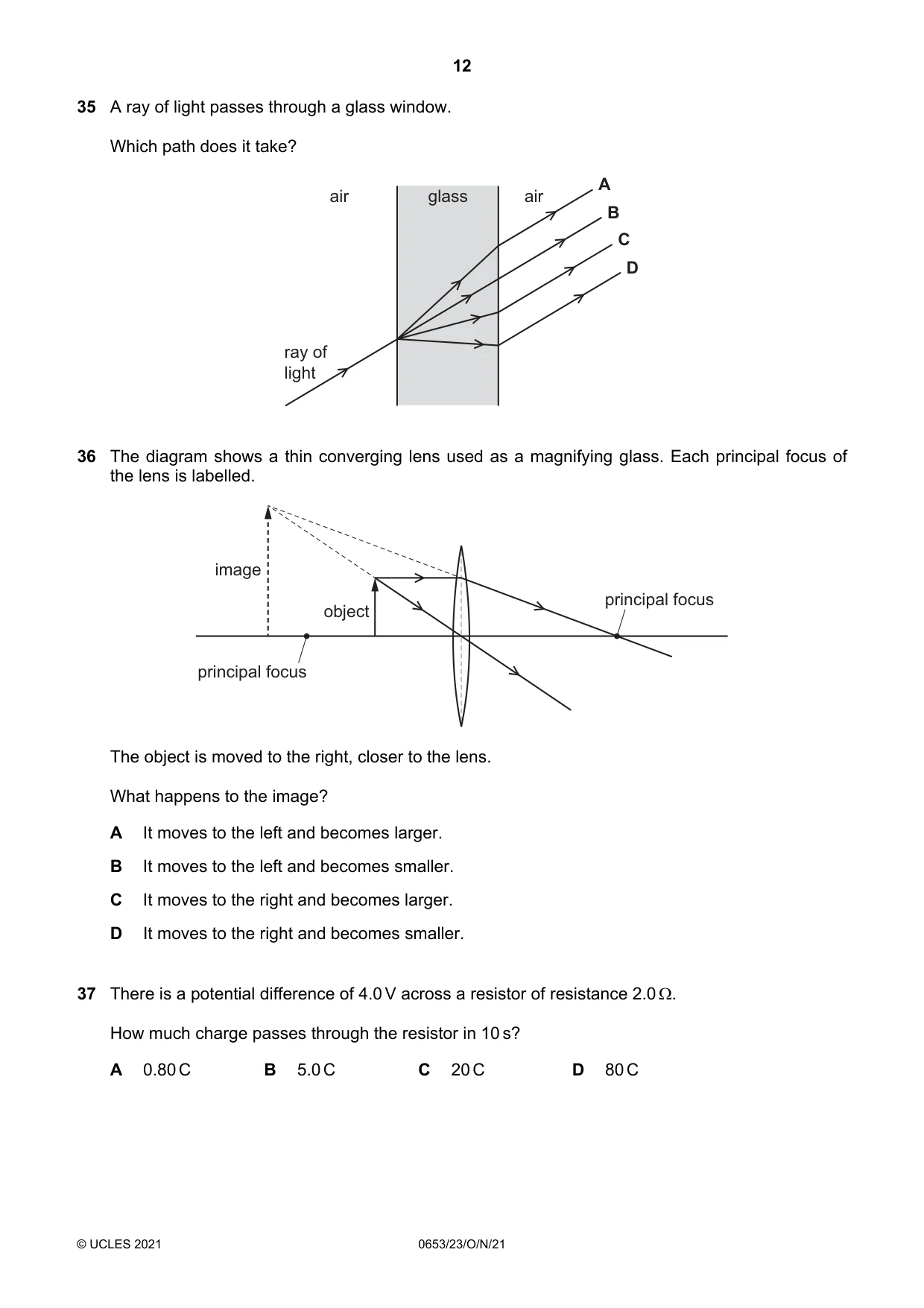
35 A ray of light passes through a glass window. Which path does it take? A air glass air B C D ray of light
Mark scheme: C
Q36 · The diagram shows a thin converging lens used as a magnifying glass
36 The diagram shows a thin converging lens used as a magnifying glass. Each principal focus of the lens is labelled. image principal focus object principal focus The object is moved to the right, closer to the lens. What happens to the image? A It moves to the left and becomes larger. B It moves to the left and becomes smaller. C It moves to the right and becomes larger. D It moves to the right and becomes smaller.
Mark scheme: D
Q37 · There is a potential difference of 4.0 V across a resistor of resistance 2.0
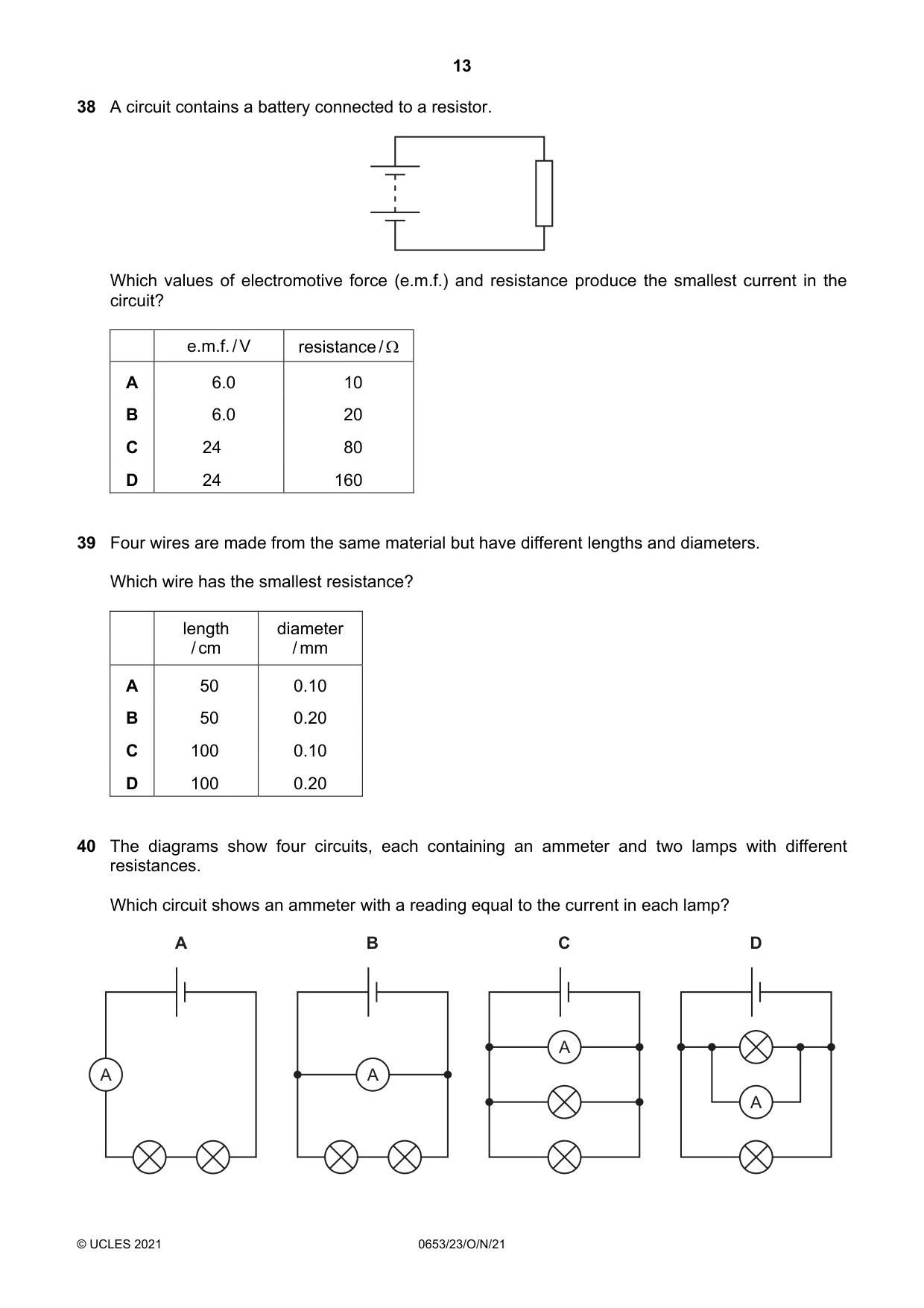
37 There is a potential difference of 4.0 V across a resistor of resistance 2.0 . How much charge passes through the resistor in 10 s? A 0.80 C B 5.0 C C 20 C D 80 C
Mark scheme: C
Q38 · A circuit contains a battery connected to a resistor
38 A circuit contains a battery connected to a resistor. Which values of electromotive force (e.m.f.) and resistance produce the smallest current in the circuit? e.m.f. / V resistance / A 6.0 10 B 6.0 20 C 24 80 D 24 160
Mark scheme: D
Q39 · Four wires are made from the same material but have different lengths and diameters
39 Four wires are made from the same material but have different lengths and diameters. Which wire has the smallest resistance? length diameter / cm / mm A 50 0.10 B 50 0.20 C 100 0.10 D 100 0.20
Mark scheme: B
Q40 · The diagrams show four circuits, each containing an ammeter and two lamps with different…
40 The diagrams show four circuits, each containing an ammeter and two lamps with different resistances. Which circuit shows an ammeter with a reading equal to the current in each lamp? A B C D A A A A
Mark scheme: A
What was in this paper
The subtopics covered by these 40 questions, and how many questions each got. Open one in a new tab to see every Cambridge question on it.
2Electrical quantities2Light2Transpiration2Alloys and their properties1Biological molecules1Cell structure1Characteristics of living organisms1Corrosion of metals1Density1Digestion1Electromagnetic spectrum1Energy, work and power1Enzymes1Exothermic and endothermic reactions1Extraction of metals1Food chains and food webs1Forces1Formulas1Fuels1Gas exchange in humans1Habitat destruction1Identification of ions and gases1Kinetic particle model of matter1Motion1Noble gases1Photosynthesis1Rate of reaction1Reactivity series1Redox1Sexual reproduction in humans1Sexual reproduction in plants1Simple molecules and covalent bonds1The characteristic properties of acids and bases1Transfer of thermal energy1Transition elements1What you needed in this session
Cambridge’s own grade thresholds for 2021 Oct/Nov, Paper 2 · Variant 3. A higher threshold means an easier paper — the bar moves with how the cohort did.