Cambridge IGCSE Science - Combined 0653 — 2020 May/June Paper 2 · Variant 1
0653/21/M/J/20 · 40 questions · 40 marks · ≈45 min
The question paper and its mark scheme, free to read here and free to download. This is Cambridge’s own paper, exactly as it was sat.
Question paper16 pages


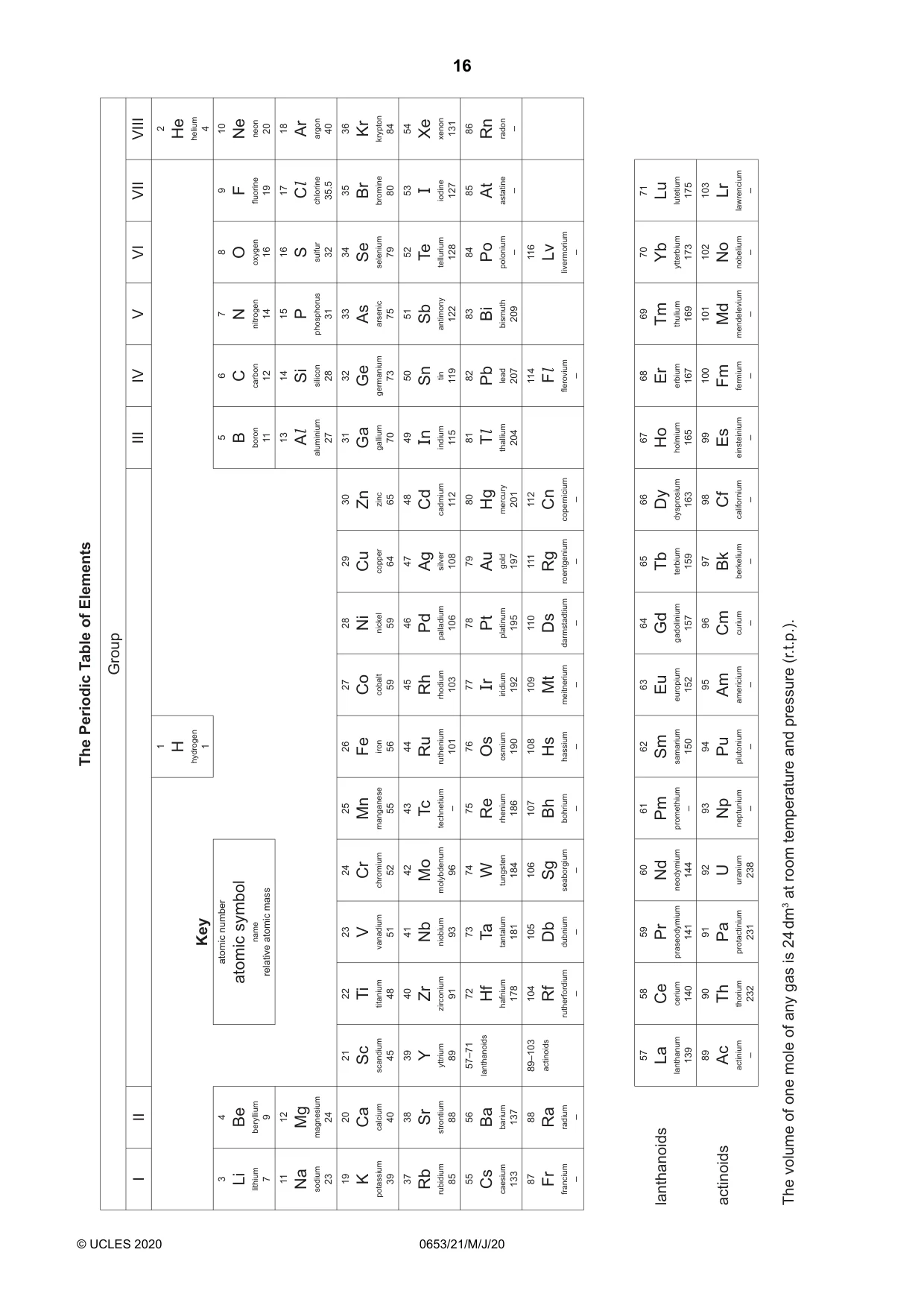
Mark scheme3 pages
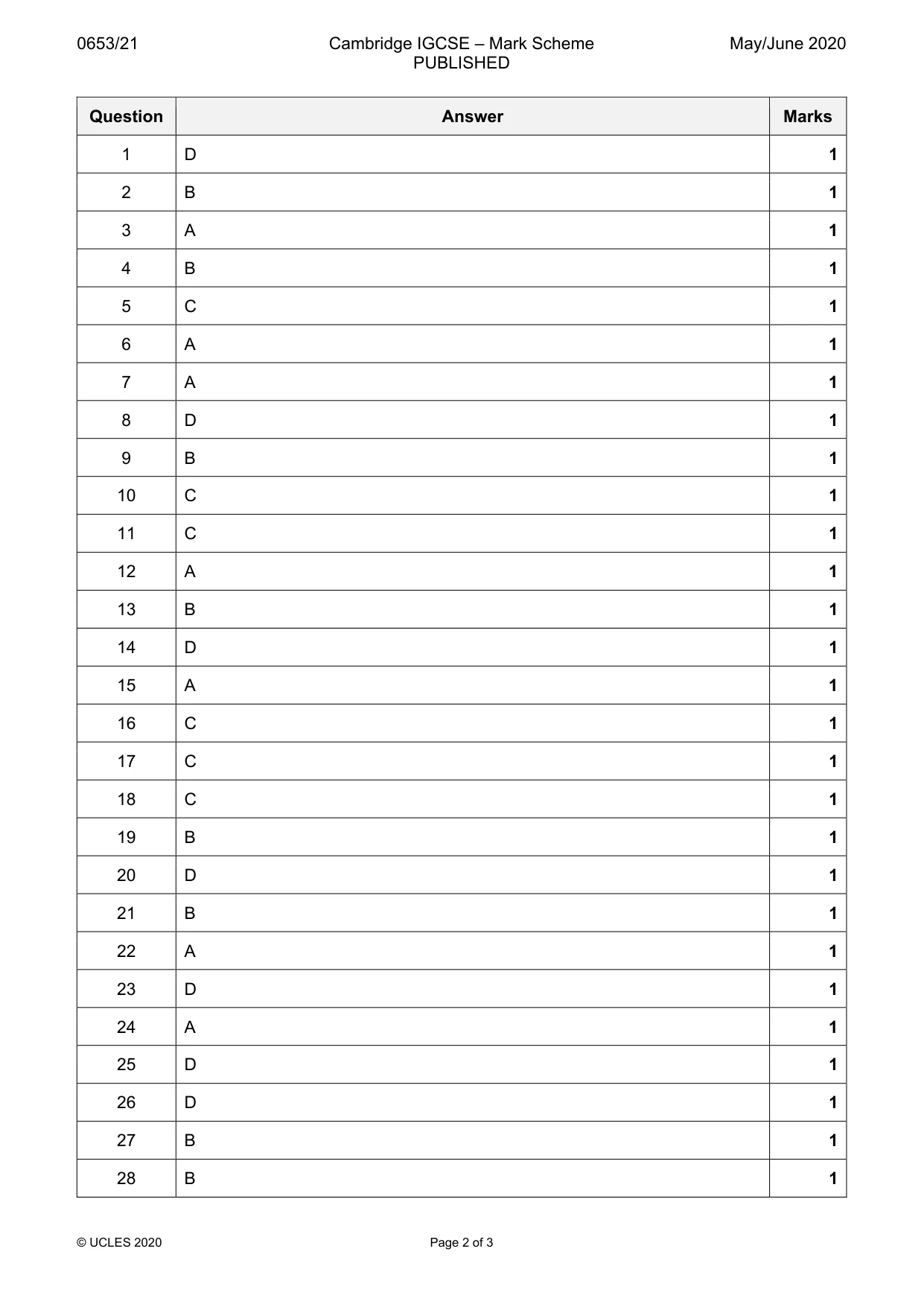
Answers below. Sit the paper first if you are practising.
Questions as text
Q1 · The cytoplasm of a plant cell contains a 15% sugar solution
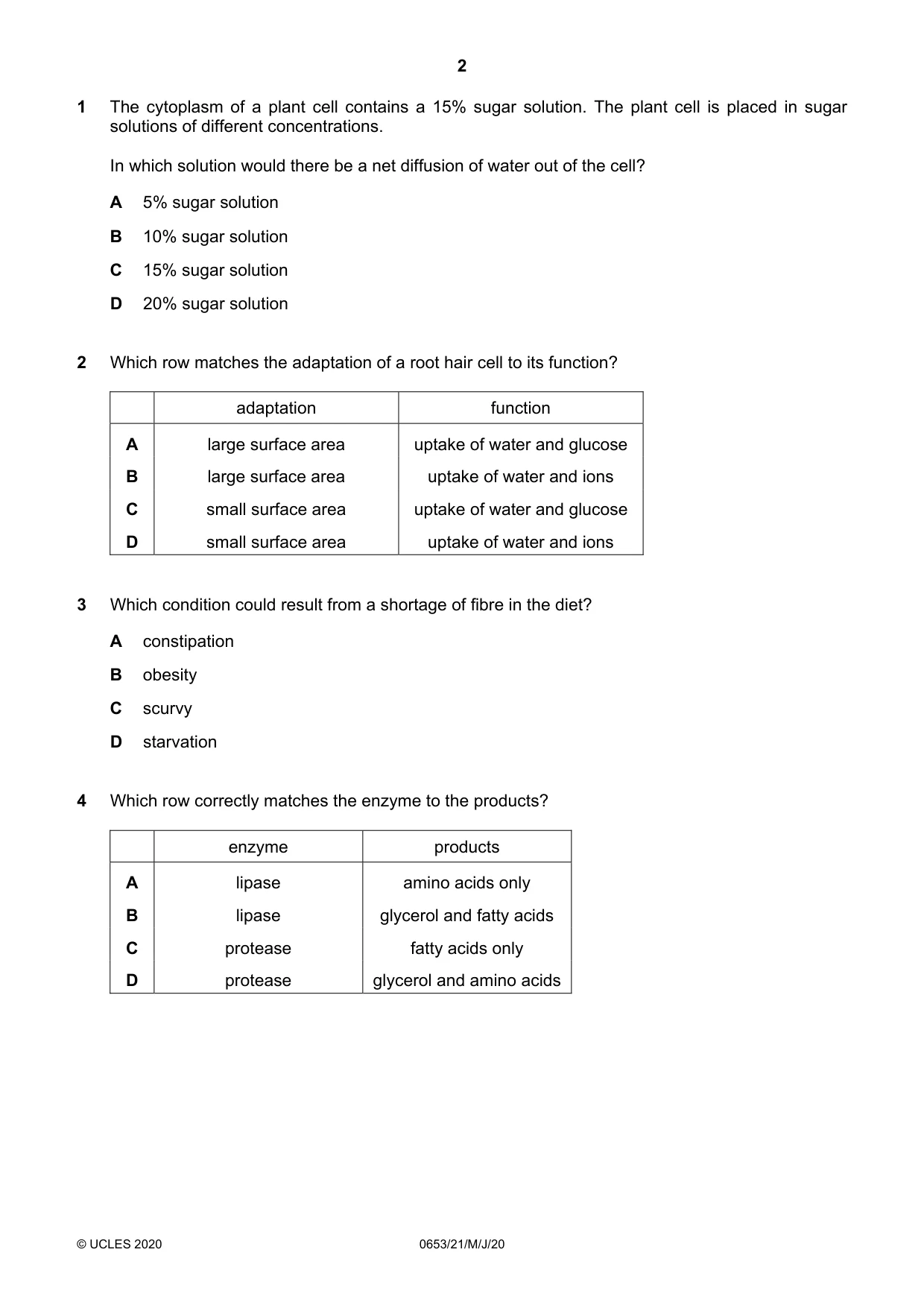
1 The cytoplasm of a plant cell contains a 15% sugar solution. The plant cell is placed in sugar solutions of different concentrations. In which solution would there be a net diffusion of water out of the cell? A 5% sugar solution B 10% sugar solution C 15% sugar solution D 20% sugar solution
Mark scheme: D
Q2 · Which row matches the adaptation of a root hair cell to its function?
2 Which row matches the adaptation of a root hair cell to its function? adaptation function A large surface area uptake of water and glucose B large surface area uptake of water and ions C small surface area uptake of water and glucose D small surface area uptake of water and ions
Mark scheme: B
Q3 · Which condition could result from a shortage of fibre in the diet?
3 Which condition could result from a shortage of fibre in the diet? A constipation B obesity C scurvy D starvation
Mark scheme: A
Q4 · Which row correctly matches the enzyme to the products?
4 Which row correctly matches the enzyme to the products? enzyme products A lipase amino acids only B lipase glycerol and fatty acids C protease fatty acids only D protease glycerol and amino acids
Mark scheme: B
Q5 · Which features are found in a typical animal cell?
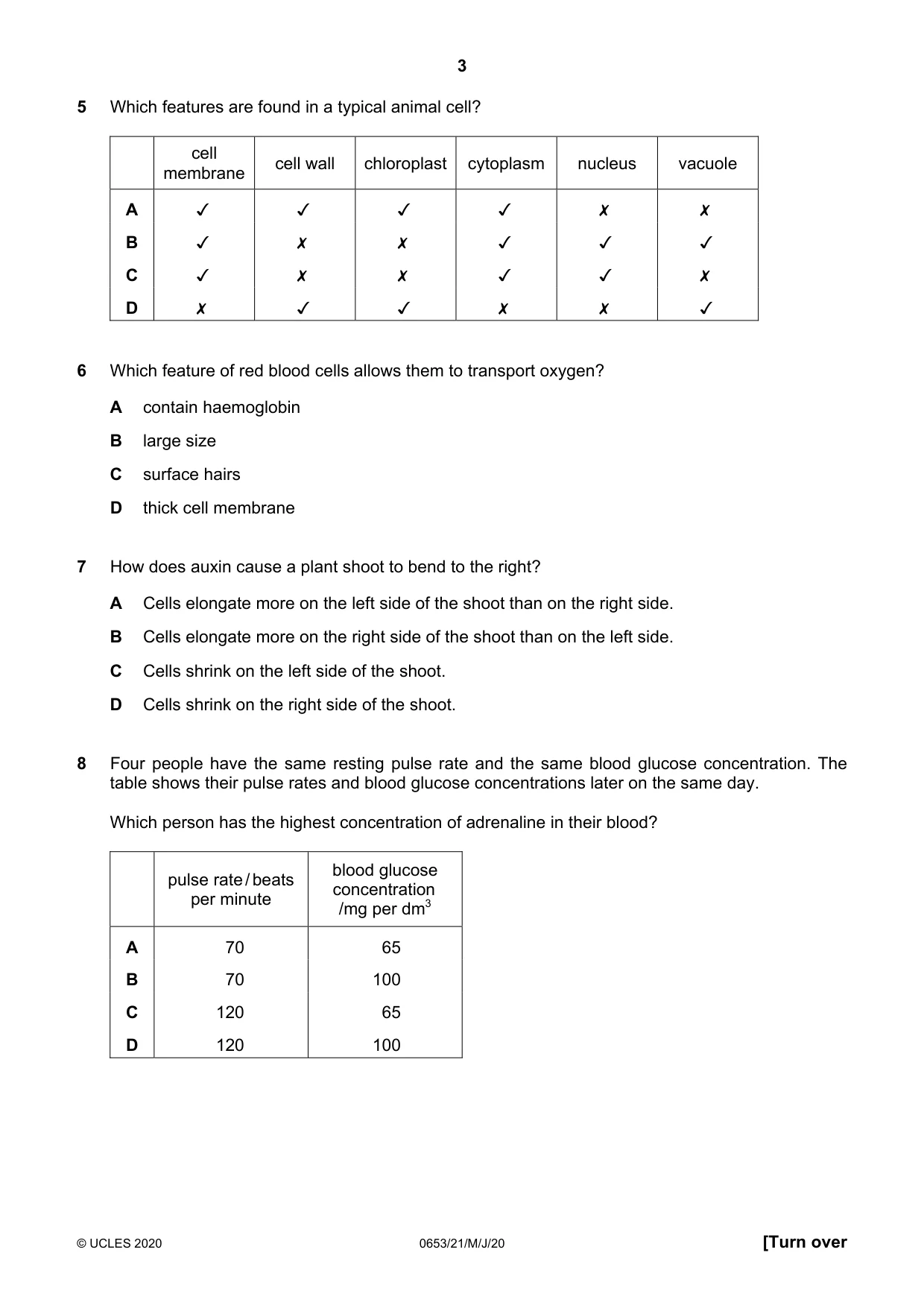
5 Which features are found in a typical animal cell? cell membrane cell wall | chloroplast | cytoplasm nucleus vacuole A Jv WA V JV x x B v x x JV W, V Cc v x x J W, x D x JV Vv x x V
Mark scheme: C
Q6 · Which feature of red blood cells allows them to transport oxygen?
6 Which feature of red blood cells allows them to transport oxygen? A contain haemoglobin B large size C surface hairs D thick cell membrane
Mark scheme: A
Q7 · How does auxin cause a plant shoot to bend to the right?
7 How does auxin cause a plant shoot to bend to the right? A Cells elongate more on the left side of the shoot than on the right side. B Cells elongate more on the right side of the shoot than on the left side. C Cells shrink on the left side of the shoot. D Cells shrink on the right side of the shoot.
Mark scheme: A
Q8 · Four people have the same resting pulse rate and the same blood glucose concentration
8 Four people have the same resting pulse rate and the same blood glucose concentration. The table shows their pulse rates and blood glucose concentrations later on the same day. Which person has the highest concentration of adrenaline in their blood? blood glucose pulse rate / beats concentration per minute /mg per dm3 A 70 65 B 70 100 C 120 65 D 120 100
Mark scheme: D
Q9 · The diagram shows the root of a plant exposed to light and gravity, and the same root a…
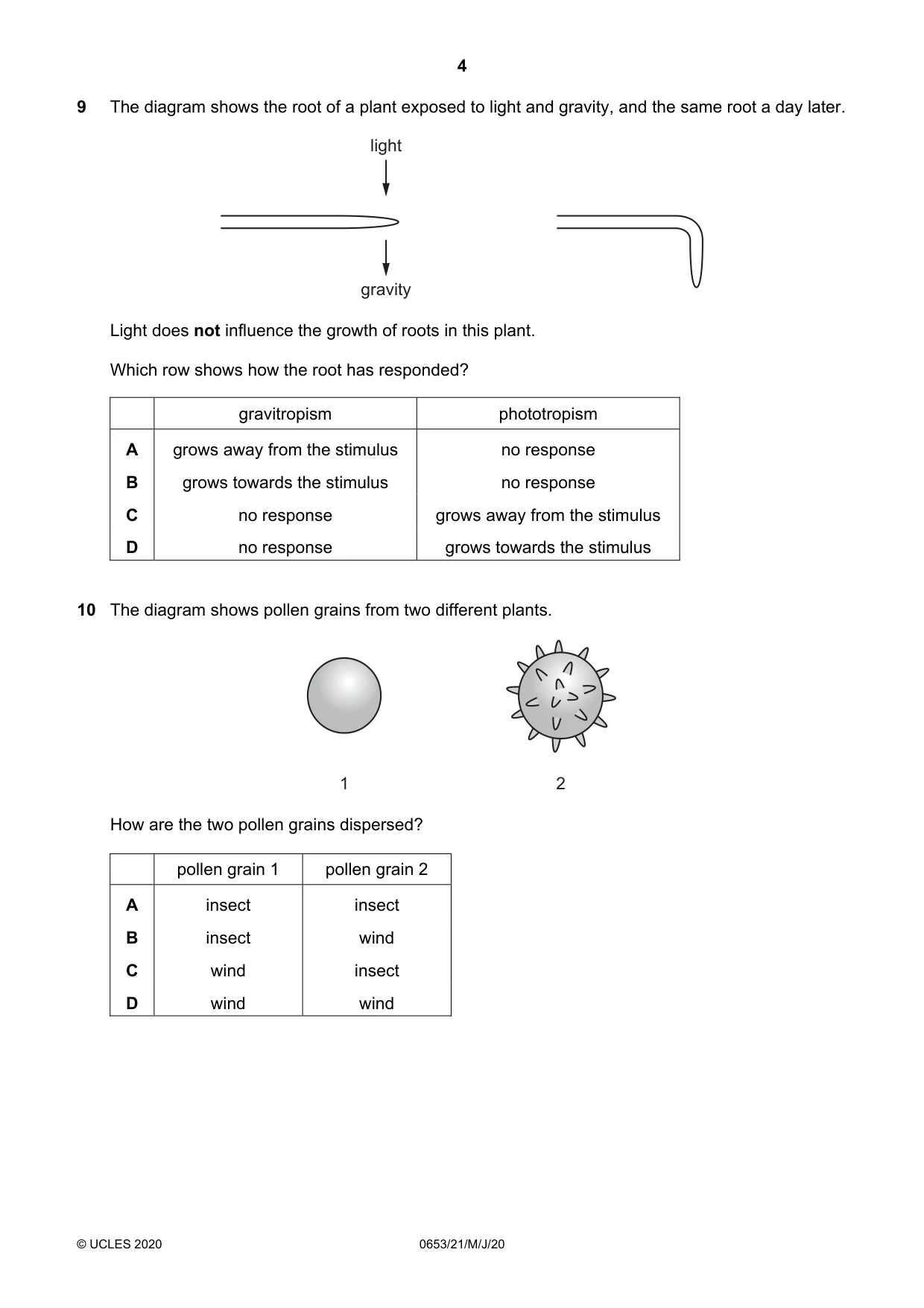
9 The diagram shows the root of a plant exposed to light and gravity, and the same root a day later. light gravity Light does not influence the growth of roots in this plant. Which row shows how the root has responded? gravitropism phototropism A grows away from the stimulus no response B grows towards the stimulus no response C no response grows away from the stimulus D no response grows towards the stimulus
Mark scheme: B
Q10 · The diagram shows pollen grains from two different plants
10 The diagram shows pollen grains from two different plants. 1 2 How are the two pollen grains dispersed? pollen grain 1 pollen grain 2 A insect insect B insect wind C wind insect D wind wind
Mark scheme: C
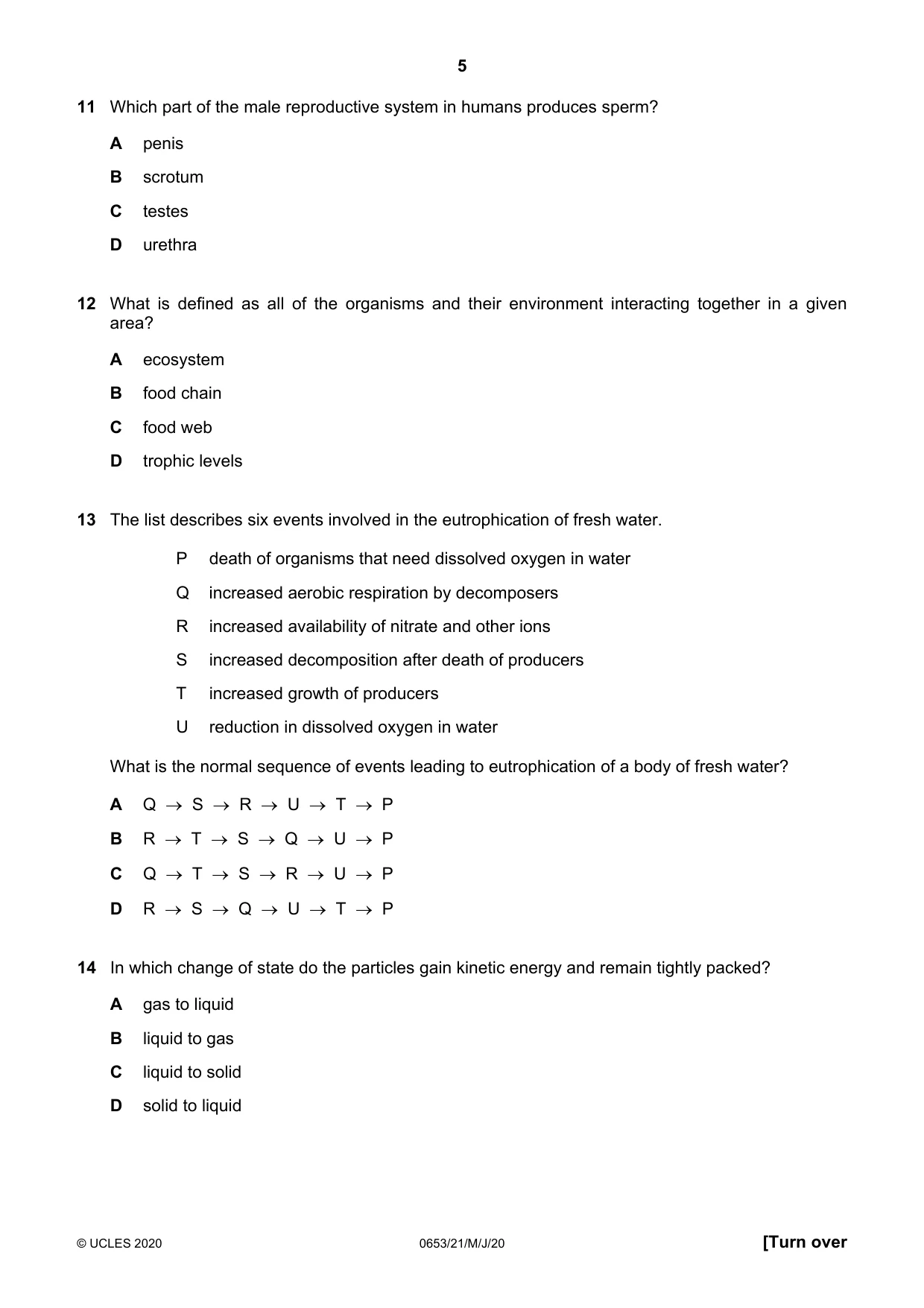
Q11 · Which part of the male reproductive system in humans produces sperm?
11 Which part of the male reproductive system in humans produces sperm? A penis B scrotum C testes D urethra
Mark scheme: C
Q12 · What is defined as all of the organisms and their environment interacting together in a…
12 What is defined as all of the organisms and their environment interacting together in a given area? A ecosystem B food chain C food web D trophic levels
Mark scheme: A
Q13 · The list describes six events involved in the eutrophication of fresh water
13 The list describes six events involved in the eutrophication of fresh water. P death of organisms that need dissolved oxygen in water Q increased aerobic respiration by decomposers R increased availability of nitrate and other ions S increased decomposition after death of producers T increased growth of producers U reduction in dissolved oxygen in water What is the normal sequence of events leading to eutrophication of a body of fresh water? A Q → S → R → U → T → P B R → T → S → Q → U → P C Q → T → S → R → U → P D R → S → Q → U → T → P
Mark scheme: B
Q14 · In which change of state do the particles gain kinetic energy and remain tightly packed?
14 In which change of state do the particles gain kinetic energy and remain tightly packed? A gas to liquid B liquid to gas C liquid to solid D solid to liquid
Mark scheme: D
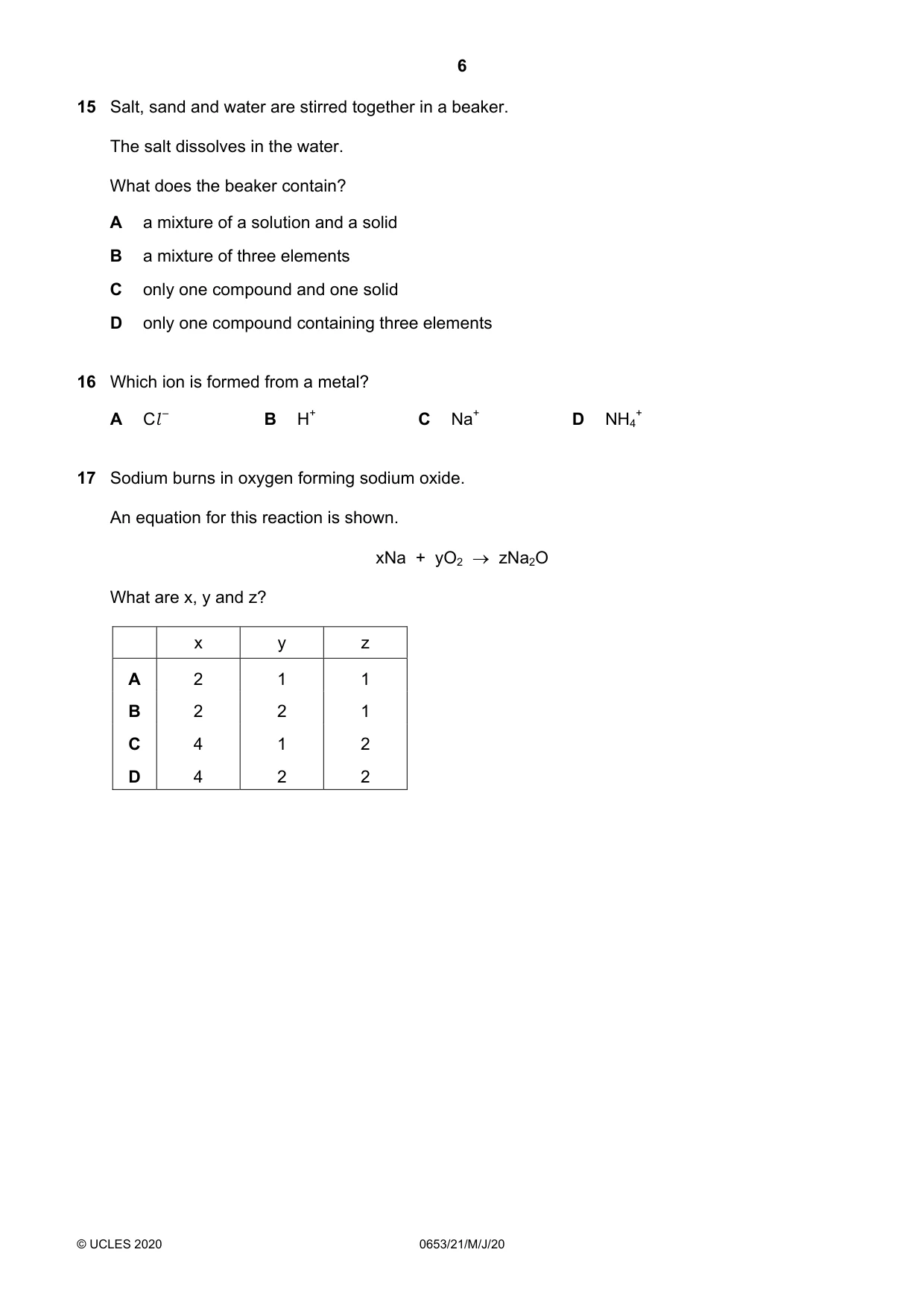
Q15 · Salt, sand and water are stirred together in a beaker
15 Salt, sand and water are stirred together in a beaker. The salt dissolves in the water. What does the beaker contain? A a mixture of a solution and a solid B a mixture of three elements C only one compound and one solid D only one compound containing three elements
Mark scheme: A
Q16 · Which ion is formed from a metal?
16 Which ion is formed from a metal? A Cl – B H+ C Na+ D NH4 +
Mark scheme: C
Q17 · Sodium burns in oxygen forming sodium oxide
17 Sodium burns in oxygen forming sodium oxide. An equation for this reaction is shown. xNa + yO2 → zNa2O What are x, y and z? x y z A 2 1 1 B 2 2 1 C 4 1 2 D 4 2 2
Mark scheme: C
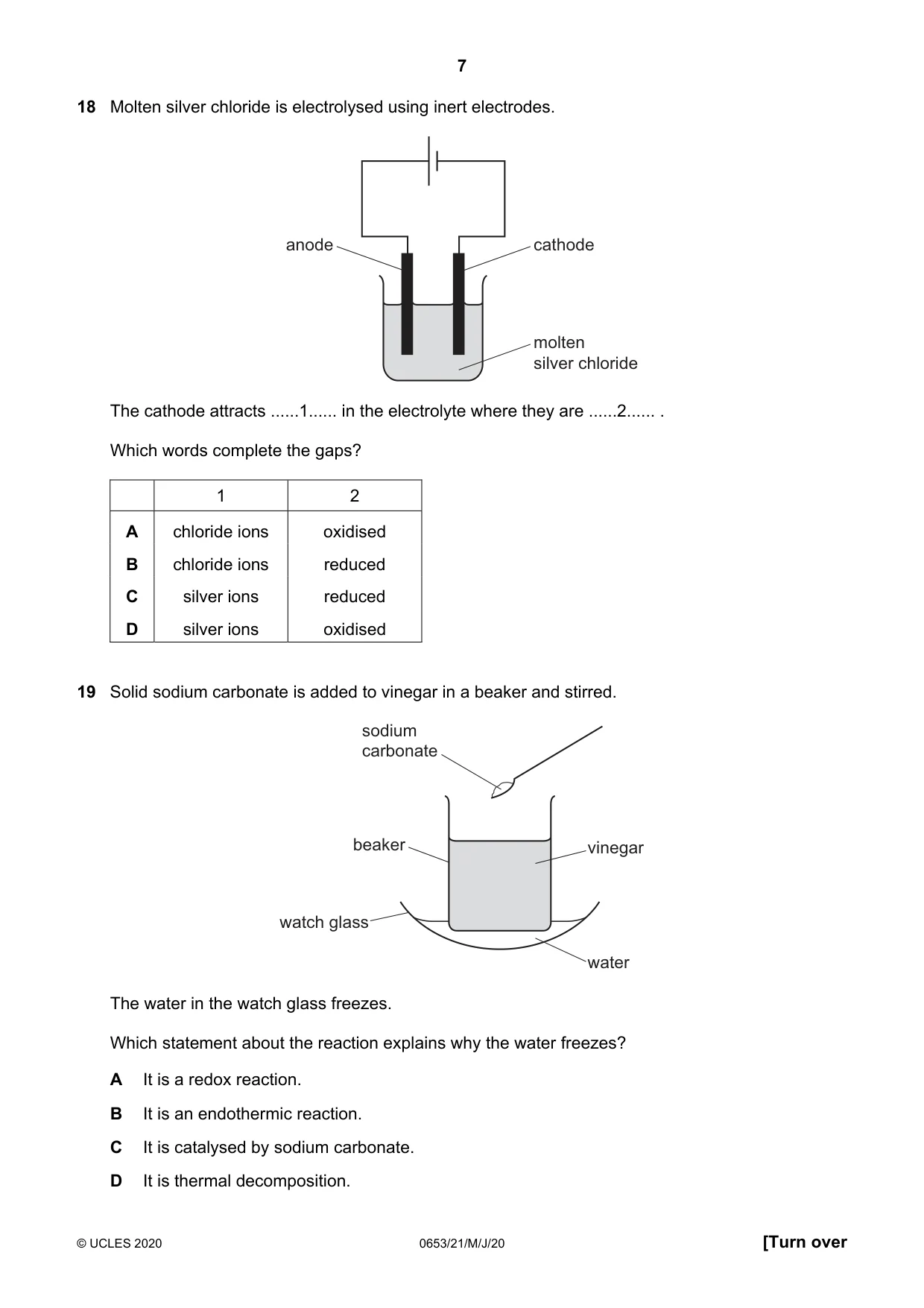
Q18 · Molten silver chloride is electrolysed using inert electrodes
18 Molten silver chloride is electrolysed using inert electrodes. anode cathode molten silver chloride The cathode attracts ......1...... in the electrolyte where they are ......2...... . Which words complete the gaps? 1 2 A chloride ions oxidised B chloride ions reduced C silver ions reduced D silver ions oxidised
Mark scheme: C
Q19 · Solid sodium carbonate is added to vinegar in a beaker and stirred
19 Solid sodium carbonate is added to vinegar in a beaker and stirred. sodium carbonate beaker vinegar watch glass water The water in the watch glass freezes. Which statement about the reaction explains why the water freezes? A It is a redox reaction. B It is an endothermic reaction. C It is catalysed by sodium carbonate. D It is thermal decomposition.
Mark scheme: B
Q20 · The rate of a reaction increases when the temperature or the concentration of the…
20 The rate of a reaction increases when the temperature or the concentration of the reactants increases. Which row explains why the rate of reaction increases? number of particles activation collisions change with energy greater than energy per second the activation energy A increase in increases increases stays the same concentration B increase in stays the same stays the same increases concentration C increase in stays the same increases stays the same temperature D increase in stays the same increases increases temperature
Mark scheme: D
Q21 · Hot carbon reacts with carbon dioxide to form carbon monoxide
21 Hot carbon reacts with carbon dioxide to form carbon monoxide. C(s) + CO2(g) → 2CO(g) Which statements are correct? 1 Carbon is being oxidised. 2 The reducing agent is carbon. 3 The oxidising agent is carbon monoxide. 4 Carbon dioxide is being reduced. A 1, 2 and 3 B 1, 2 and 4 C 2 and 4 only D 3 and 4
Mark scheme: B
Q22 · Copper(II) sulfate is prepared by reacting copper(II) oxide with dilute sulfuric acid
22 Copper(II) sulfate is prepared by reacting copper(II) oxide with dilute sulfuric acid. CuO(s) + H2SO4(aq) → CuSO4(aq) + H2O(I) Which statement is correct? A Excess copper(II) oxide is used because it can be easily removed by filtration. B Excess copper(II) oxide is used because it can be easily removed by reacting with more sulfuric acid. C Excess sulfuric acid is used because it can be easily removed by evaporation. D Excess sulfuric acid is used because unreacted copper(II) oxide would contaminate the product.
Mark scheme: A
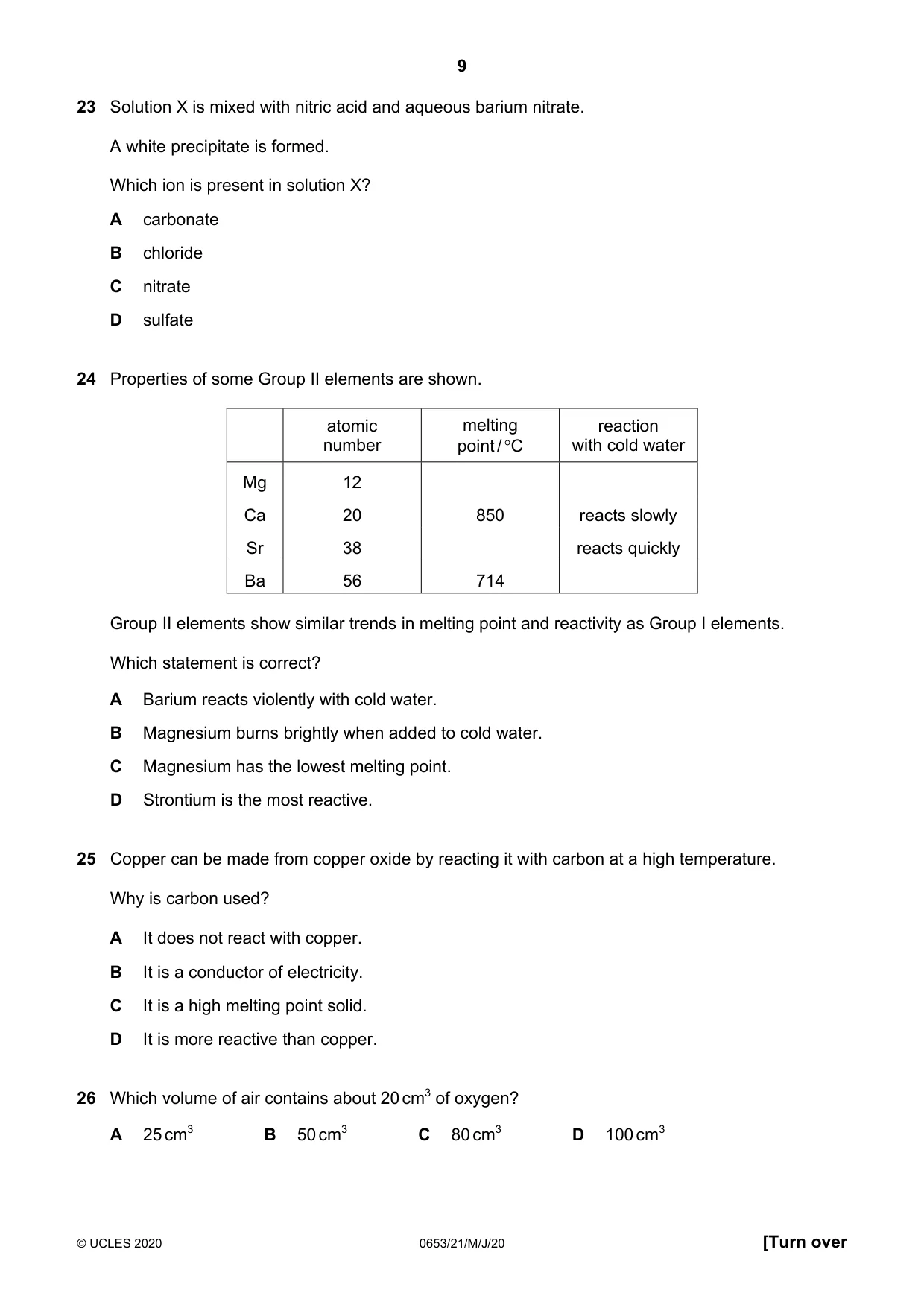
Q23 · Solution X is mixed with nitric acid and aqueous barium nitrate
23 Solution X is mixed with nitric acid and aqueous barium nitrate. A white precipitate is formed. Which ion is present in solution X? A carbonate B chloride C nitrate D sulfate
Mark scheme: D
Q24 · Properties of some Group II elements are shown
24 Properties of some Group II elements are shown. atomic melting reaction number point / °C with cold water Mg 12 Ca 20 850 reacts slowly Sr 38 reacts quickly Ba 56 714 Group II elements show similar trends in melting point and reactivity as Group I elements. Which statement is correct? A Barium reacts violently with cold water. B Magnesium burns brightly when added to cold water. C Magnesium has the lowest melting point. D Strontium is the most reactive.
Mark scheme: A
Q25 · Copper can be made from copper oxide by reacting it with carbon at a high temperature
25 Copper can be made from copper oxide by reacting it with carbon at a high temperature. Why is carbon used? A It does not react with copper. B It is a conductor of electricity. C It is a high melting point solid. D It is more reactive than copper.
Mark scheme: D
Q26 · Which volume of air contains about 20 cm3 of oxygen?
26 Which volume of air contains about 20 cm3 of oxygen? A 25 cm3 B 50 cm3 C 80 cm3 D 100 cm3
Mark scheme: D
Q27 · Petroleum is separated into useful fractions by fractional distillation
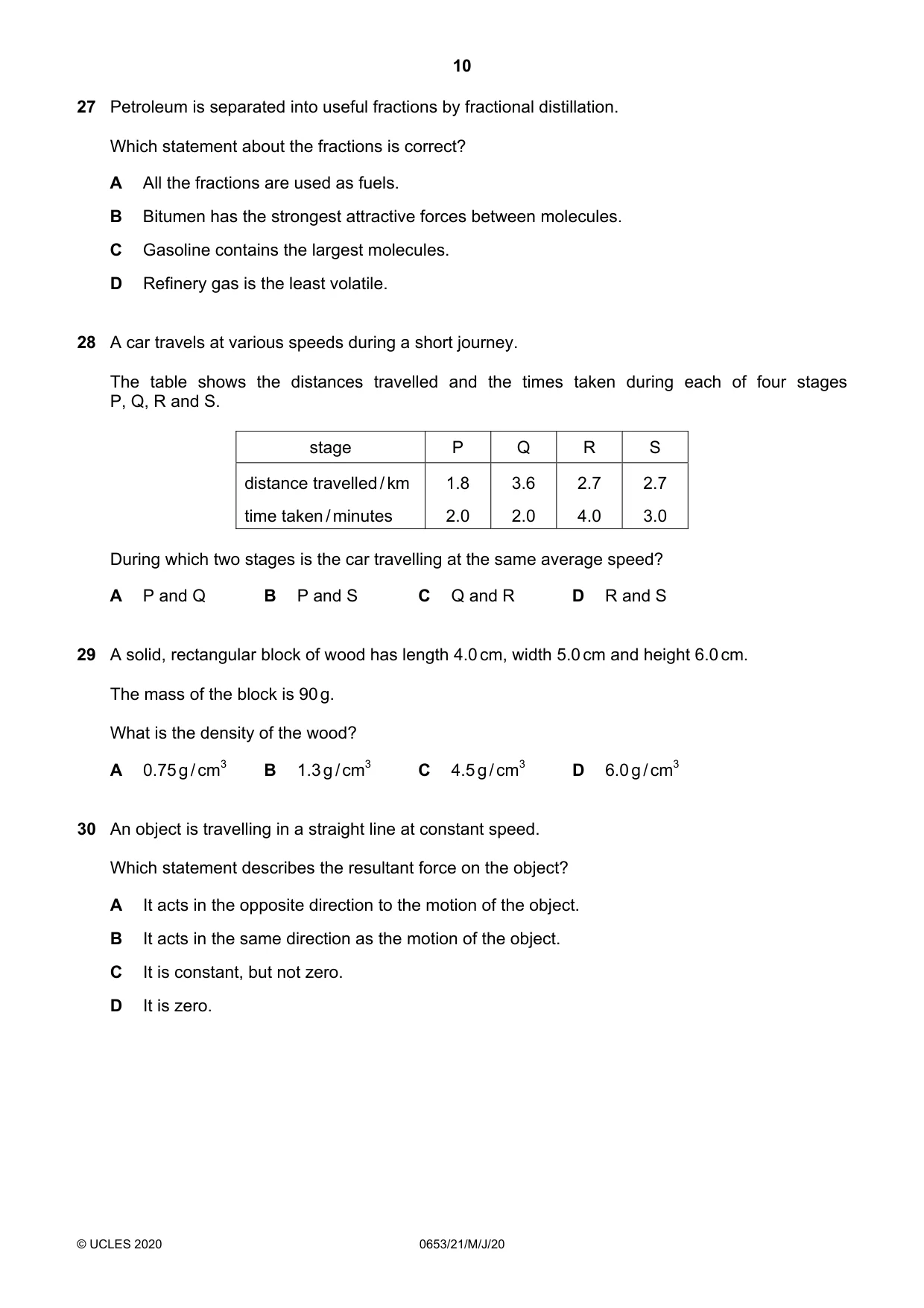
27 Petroleum is separated into useful fractions by fractional distillation. Which statement about the fractions is correct? A All the fractions are used as fuels. B Bitumen has the strongest attractive forces between molecules. C Gasoline contains the largest molecules. D Refinery gas is the least volatile.
Mark scheme: B
Q28 · A car travels at various speeds during a short journey
28 A car travels at various speeds during a short journey. The table shows the distances travelled and the times taken during each of four stages P, Q, R and S. stage P Q R S distance travelled / km 1.8 3.6 2.7 2.7 time taken / minutes 2.0 2.0 4.0 3.0 During which two stages is the car travelling at the same average speed? A P and Q B P and S C Q and R D R and S
Mark scheme: B
Q29 · A solid, rectangular block of wood has length 4.0 cm, width 5.0 cm and height 6.0 cm
29 A solid, rectangular block of wood has length 4.0 cm, width 5.0 cm and height 6.0 cm. The mass of the block is 90 g. What is the density of the wood? A 0.75 g / cm3 B 1.3 g / cm3 C 4.5 g / cm3 D 6.0 g / cm3
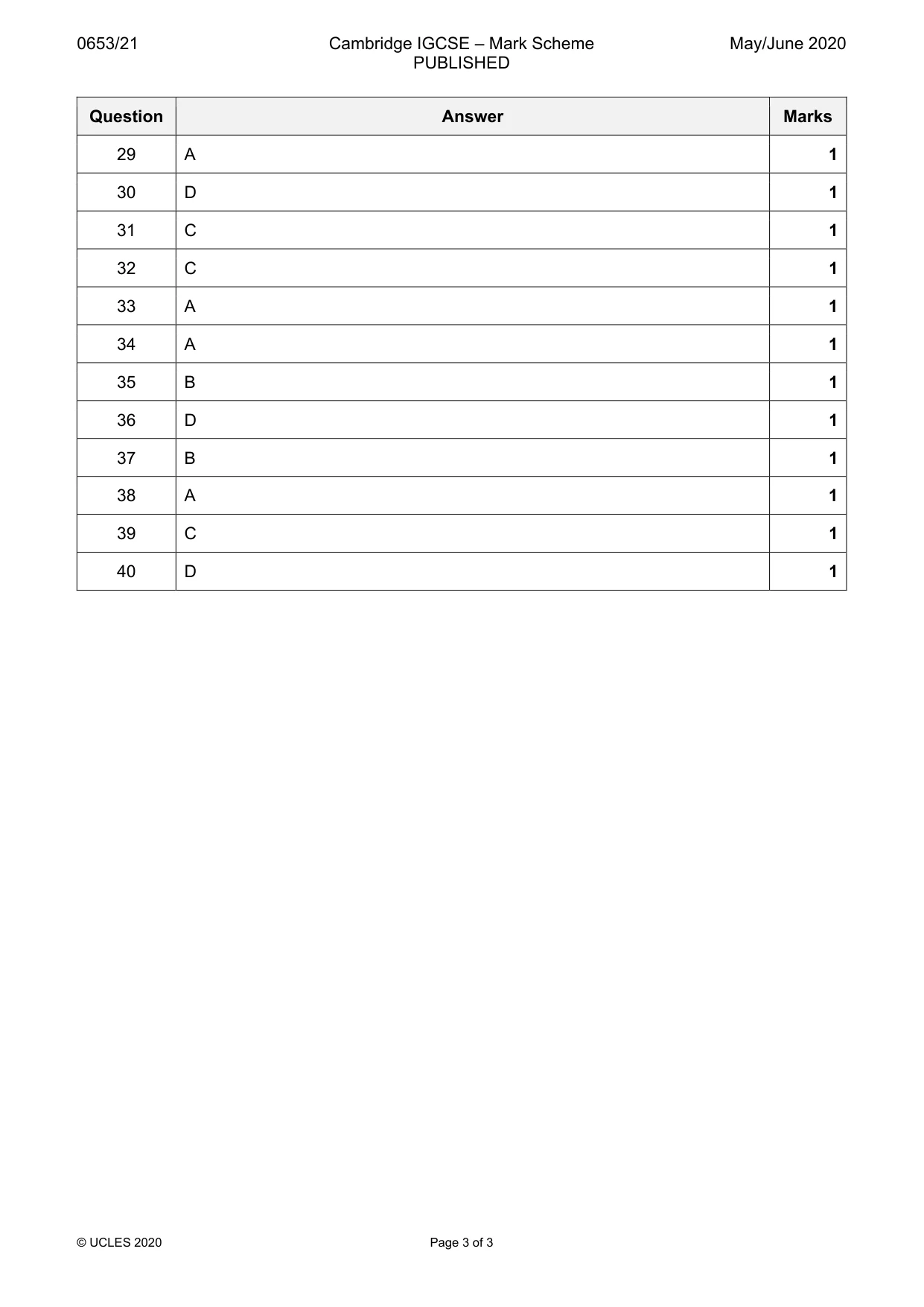
Mark scheme: A
Q30 · An object is travelling in a straight line at constant speed
30 An object is travelling in a straight line at constant speed. Which statement describes the resultant force on the object? A It acts in the opposite direction to the motion of the object. B It acts in the same direction as the motion of the object. C It is constant, but not zero. D It is zero.
Mark scheme: D
Q31 · A spring obeys Hooke’s law
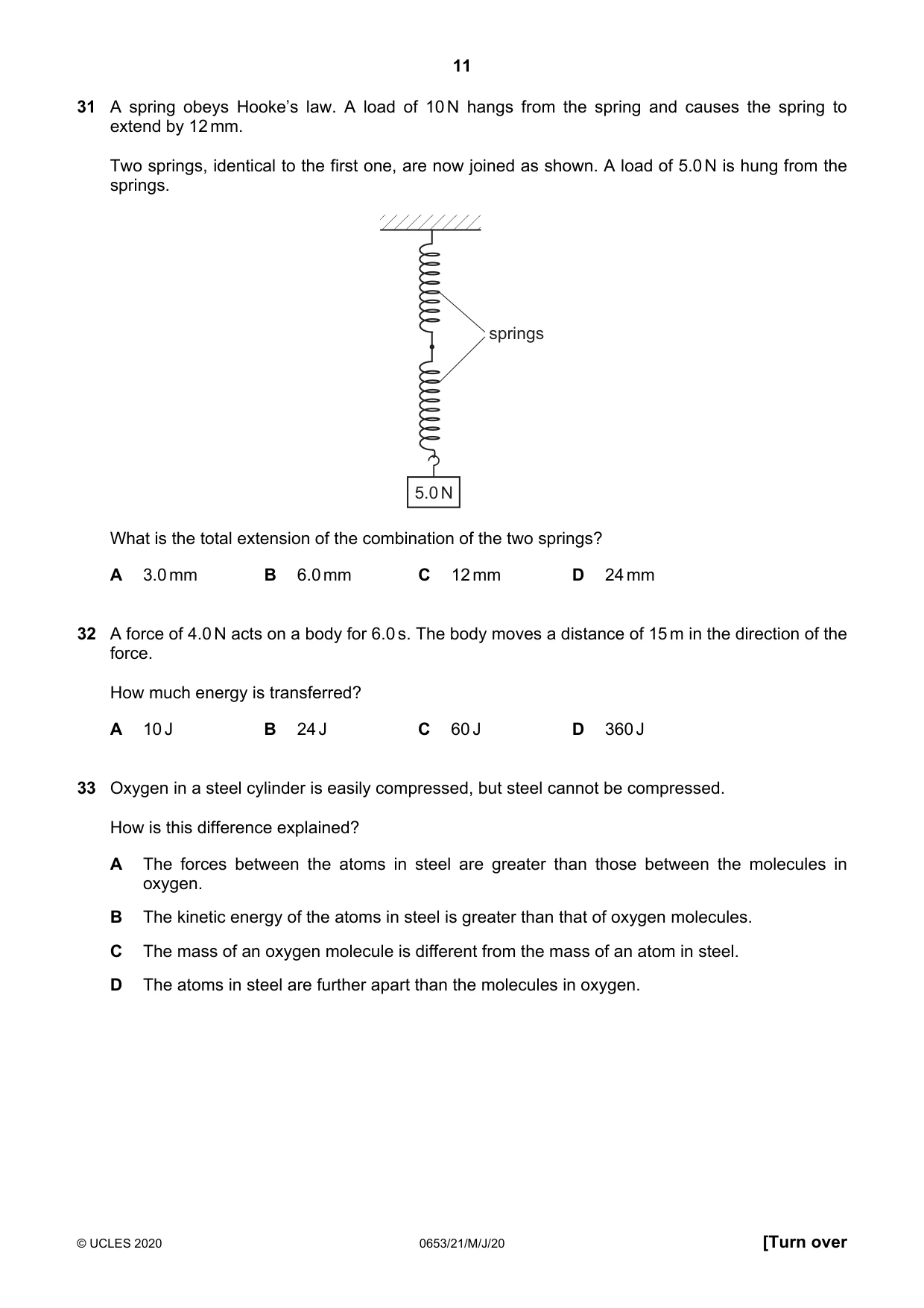
31 A spring obeys Hooke’s law. A load of 10 N hangs from the spring and causes the spring to extend by 12 mm. Two springs, identical to the first one, are now joined as shown. A load of 5.0 N is hung from the springs. springs 5.0 N What is the total extension of the combination of the two springs? A 3.0 mm B 6.0 mm C 12 mm D 24 mm
Mark scheme: C
Q32 · A force of 4.0 N acts on a body for 6.0 s
32 A force of 4.0 N acts on a body for 6.0 s. The body moves a distance of 15 m in the direction of the force. How much energy is transferred? A 10 J B 24 J C 60 J D 360 J
Mark scheme: C
Q33 · Oxygen in a steel cylinder is easily compressed, but steel cannot be compressed
33 Oxygen in a steel cylinder is easily compressed, but steel cannot be compressed. How is this difference explained? A The forces between the atoms in steel are greater than those between the molecules in oxygen. B The kinetic energy of the atoms in steel is greater than that of oxygen molecules. C The mass of an oxygen molecule is different from the mass of an atom in steel. D The atoms in steel are further apart than the molecules in oxygen.
Mark scheme: A
Q34 · End X of an iron rod is held in a fire
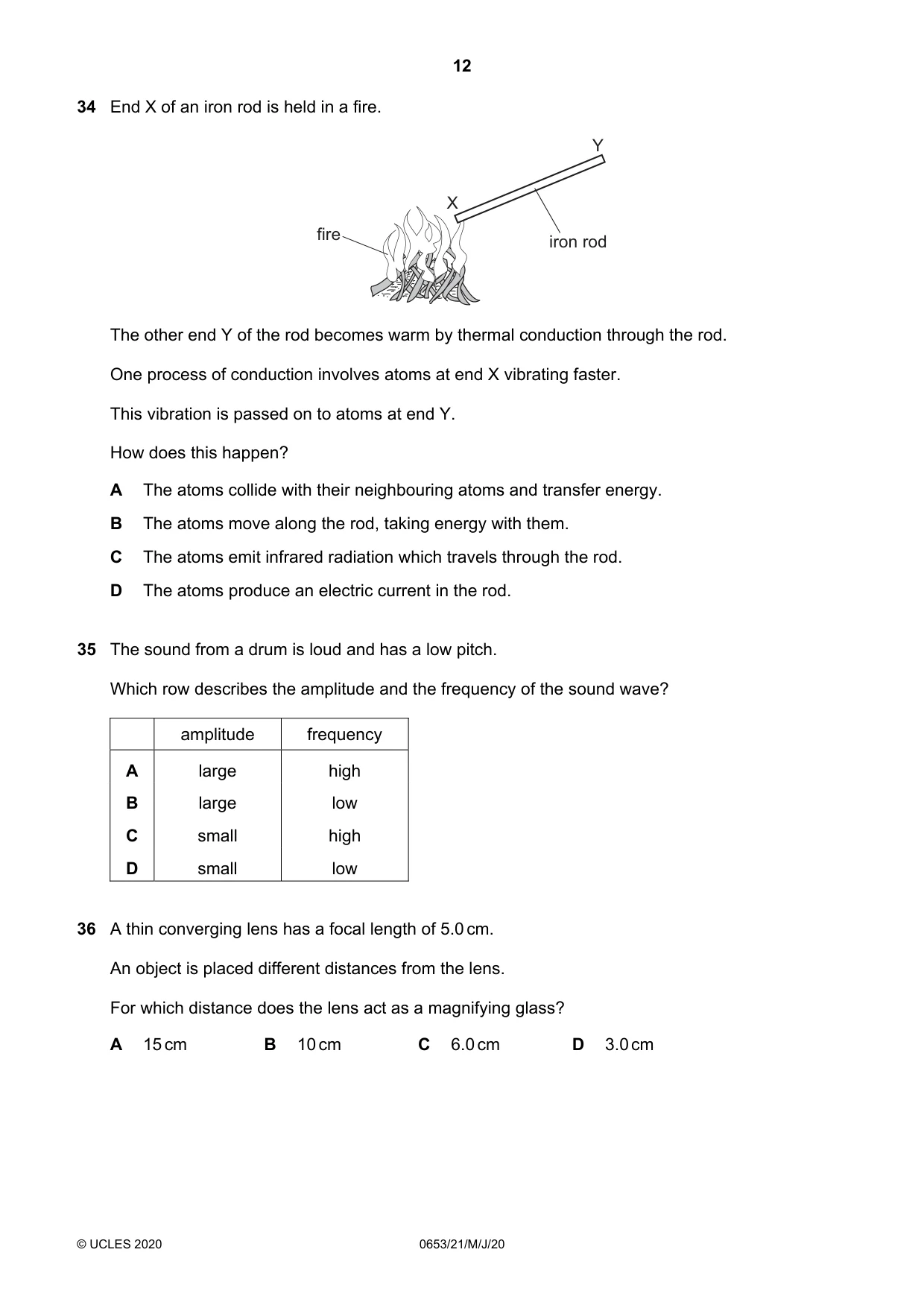
34 End X of an iron rod is held in a fire. Y X fire iron rod The other end Y of the rod becomes warm by thermal conduction through the rod. One process of conduction involves atoms at end X vibrating faster. This vibration is passed on to atoms at end Y. How does this happen? A The atoms collide with their neighbouring atoms and transfer energy. B The atoms move along the rod, taking energy with them. C The atoms emit infrared radiation which travels through the rod. D The atoms produce an electric current in the rod.
Mark scheme: A
Q35 · The sound from a drum is loud and has a low pitch
35 The sound from a drum is loud and has a low pitch. Which row describes the amplitude and the frequency of the sound wave? amplitude frequency A large high B large low C small high D small low
Mark scheme: B
Q36 · A thin converging lens has a focal length of 5.0 cm
36 A thin converging lens has a focal length of 5.0 cm. An object is placed different distances from the lens. For which distance does the lens act as a magnifying glass? A 15 cm B 10 cm C 6.0 cm D 3.0 cm
Mark scheme: D
Q37 · How are sound waves transmitted in air?
37 How are sound waves transmitted in air? A by compressions and crests B by compressions and rarefactions C by crests and rarefactions D by crests and troughs
Mark scheme: B
Q38 · What is the definition of electrical current?
38 What is the definition of electrical current? A the rate of flow of charge B the rate of flow of energy C the rate of flow of power D the rate of flow of voltage
Mark scheme: A
Q39 · A 12 V power supply is connected to a 6.0 Ω resistor
39 A 12 V power supply is connected to a 6.0 Ω resistor. This causes a current in the resistor. How much thermal energy is produced in the resistor in 5.0 minutes? A 120 J B 600 J C 7200 J D 21 600 J
Mark scheme: C
Q40 · The charger for a laptop computer is connected by a cable to the mains supply through a…
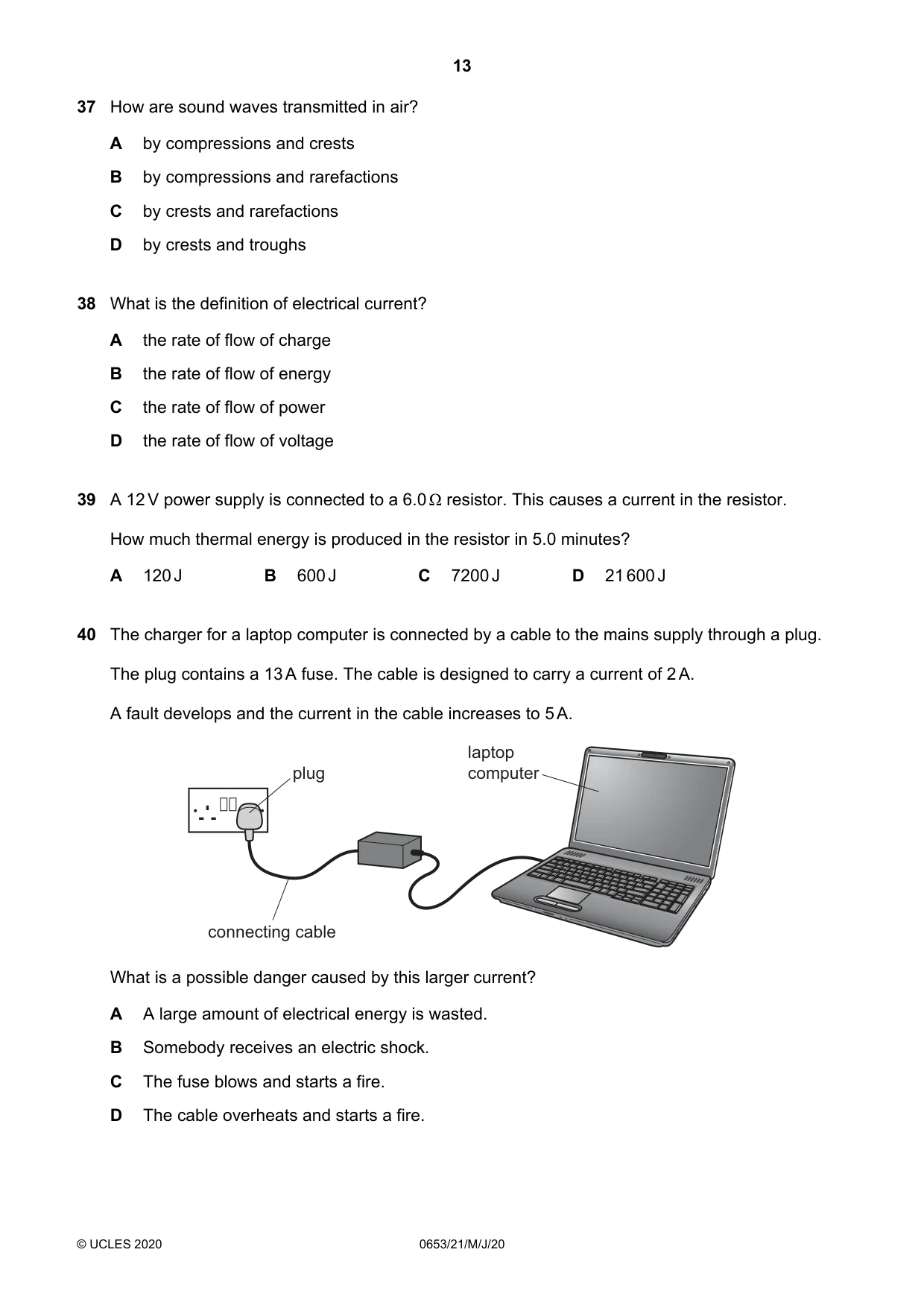
40 The charger for a laptop computer is connected by a cable to the mains supply through a plug. The plug contains a 13 A fuse. The cable is designed to carry a current of 2 A. A fault develops and the current in the cable increases to 5 A. laptop plug computer connecting cable What is a possible danger caused by this larger current? A A large amount of electrical energy is wasted. B Somebody receives an electric shock. C The fuse blows and starts a fire. D The cable overheats and starts a fire.
Mark scheme: D
What was in this paper
The subtopics covered by these 40 questions, and how many questions each got. Open one in a new tab to see every Cambridge question on it.
2Forces2Sound2Air quality and climate1Arrangement of elements1Blood1Cell structure1Density1Diet1Digestion1Electrical circuits1Electrical quantities1Electrical safety1Electrolysis1Elements, compounds and mixtures1Energy flow1Energy, work and power1Exothermic and endothermic reactions1Extraction of metals1Formulas1Fuels1Habitat destruction1Heart1Identification of ions and gases1Ions and ionic bonds1Kinetic particle model of matter1Light1Motion1Osmosis1Preparation of salts1Rate of reaction1Redox1Sexual reproduction in humans1Sexual reproduction in plants1Solids, liquids and gases1Transfer of thermal energy1Water uptake1