Cambridge IGCSE Science - Combined 0653 — 2020 Oct/Nov Paper 2 · Variant 2
0653/22/O/N/20 · 40 questions · 40 marks · ≈45 min
The question paper and its mark scheme, free to read here and free to download. This is Cambridge’s own paper, exactly as it was sat.
Question paper16 pages
Mark scheme3 pages
Answers below. Sit the paper first if you are practising.
Questions as text
Q1 · The diagram shows a cell from an animal’s liver
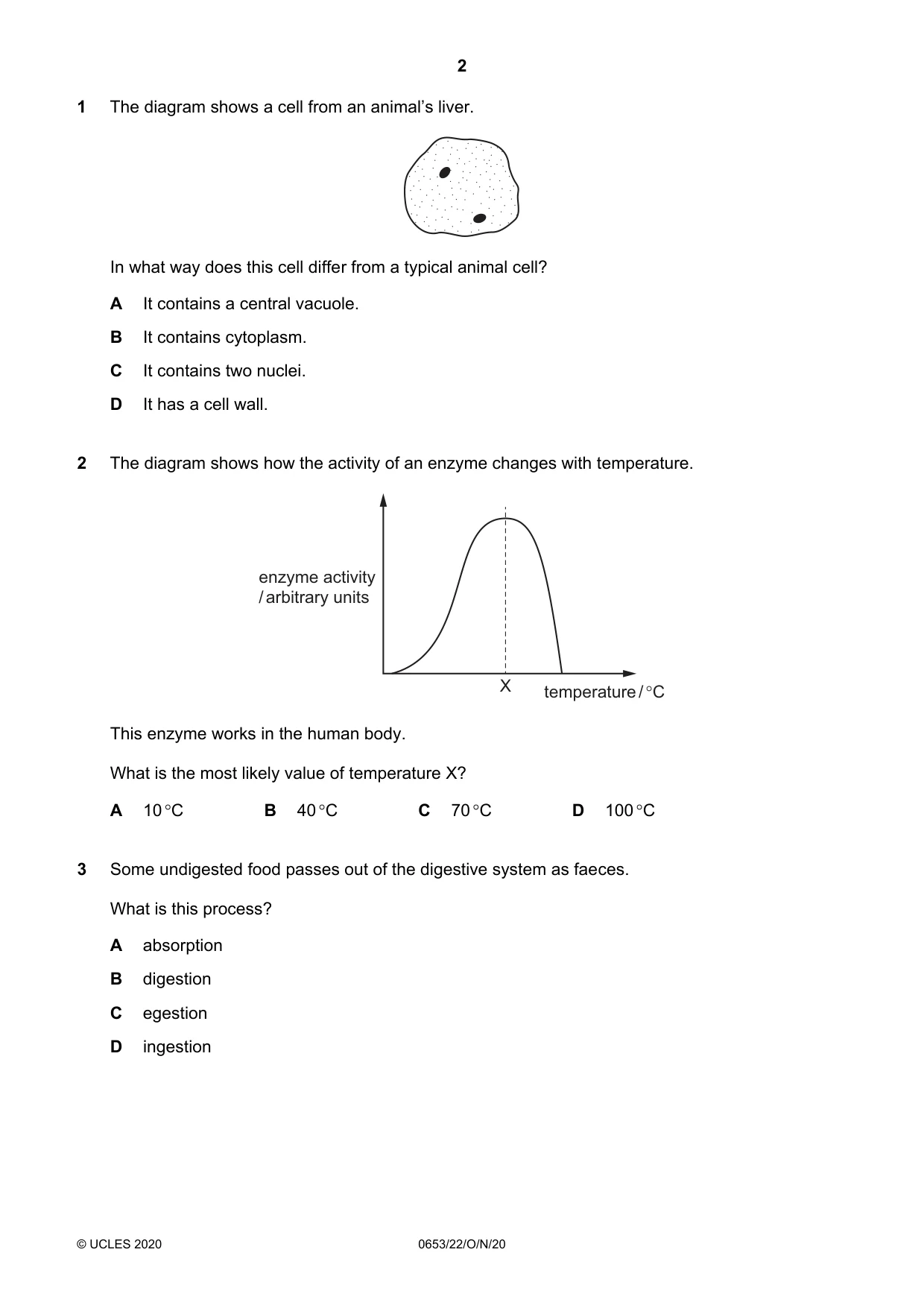
1 The diagram shows a cell from an animal’s liver. In what way does this cell differ from a typical animal cell? A It contains a central vacuole. B It contains cytoplasm. C It contains two nuclei. D It has a cell wall.
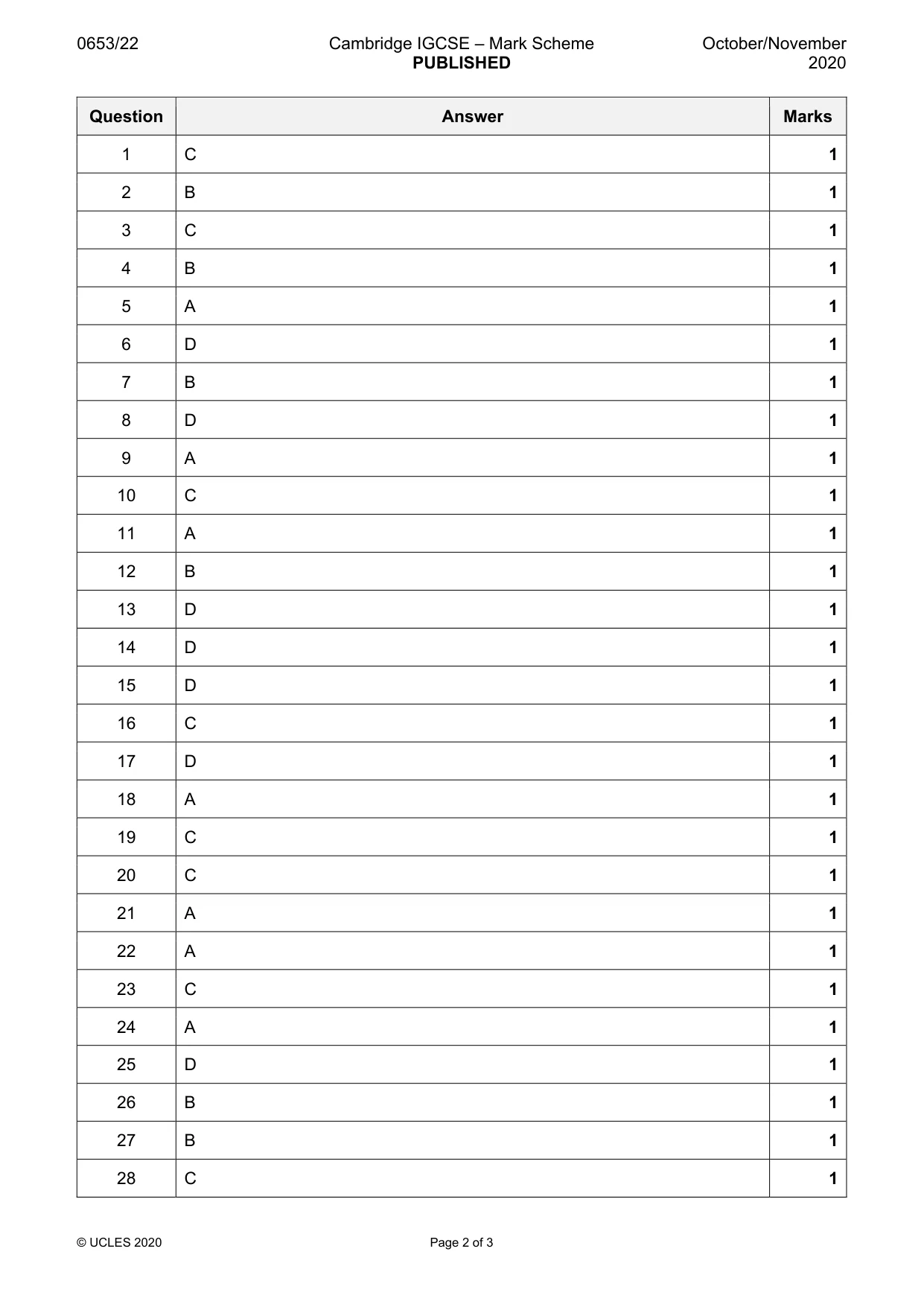
Mark scheme: C
Q2 · The diagram shows how the activity of an enzyme changes with temperature
2 The diagram shows how the activity of an enzyme changes with temperature. enzyme activity / arbitrary units X temperature / °C This enzyme works in the human body. What is the most likely value of temperature X? A 10 C B 40 C C 70 C D 100 C
Mark scheme: B
Q3 · Some undigested food passes out of the digestive system as faeces
3 Some undigested food passes out of the digestive system as faeces. What is this process? A absorption B digestion C egestion D ingestion
Mark scheme: C
Q4 · What is a function of the hydrochloric acid produced in the stomach?
4 What is a function of the hydrochloric acid produced in the stomach? A to help absorption of all food in the stomach B to kill bacteria in the ingested food C to prevent chemical digestion D to prevent the stomach contents being too acidic
Mark scheme: B
Q5 · The graph shows the uptake of water by root hair cells over many hours during a day
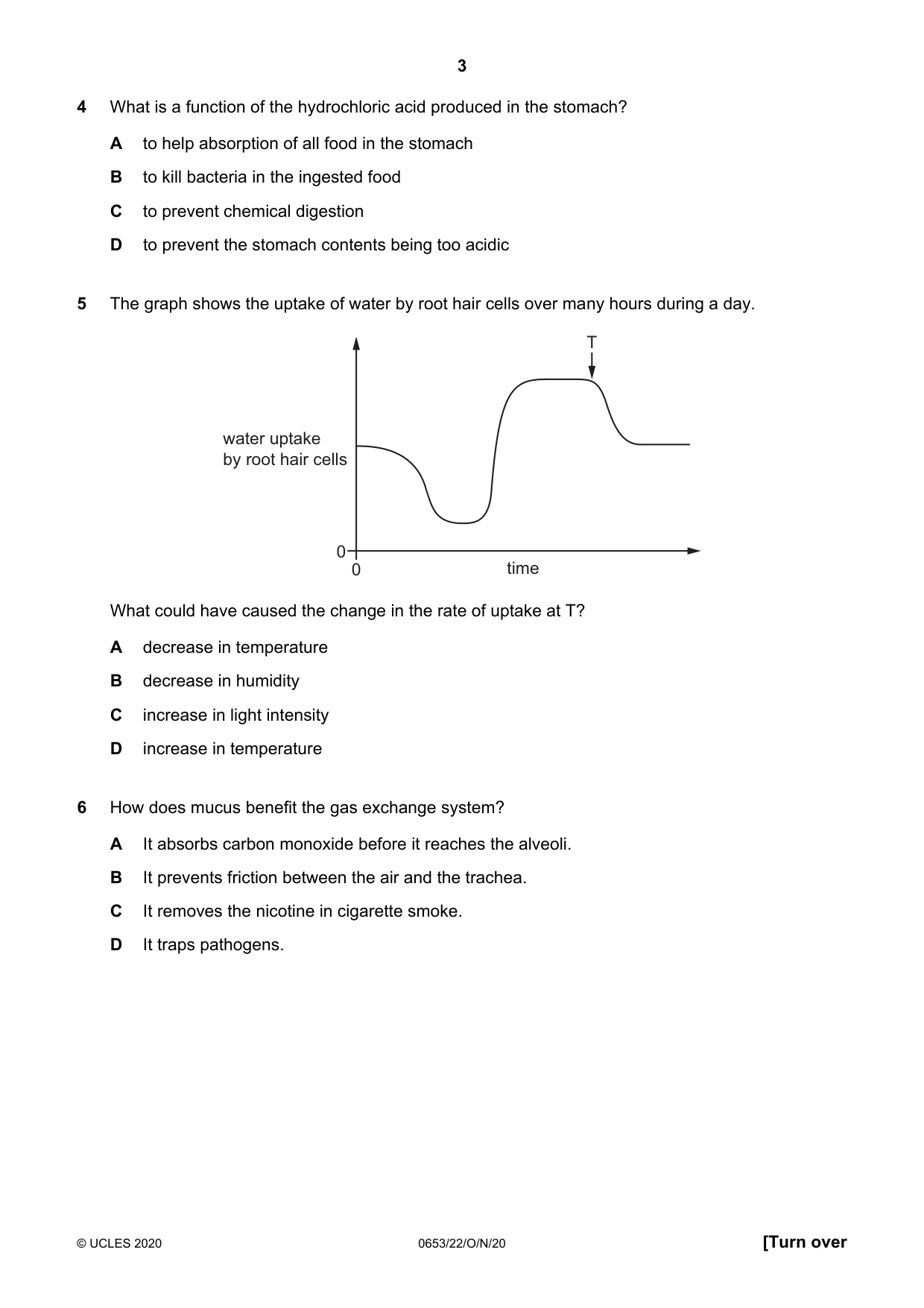
5 The graph shows the uptake of water by root hair cells over many hours during a day. T water uptake by root hair cells 0 0 time What could have caused the change in the rate of uptake at T? A decrease in temperature B decrease in humidity C increase in light intensity D increase in temperature
Mark scheme: A
Q6 · How does mucus benefit the gas exchange system?
6 How does mucus benefit the gas exchange system? A It absorbs carbon monoxide before it reaches the alveoli. B It prevents friction between the air and the trachea. C It removes the nicotine in cigarette smoke. D It traps pathogens.
Mark scheme: D
Q7 · Which row about the effects of adrenaline in humans is correct?
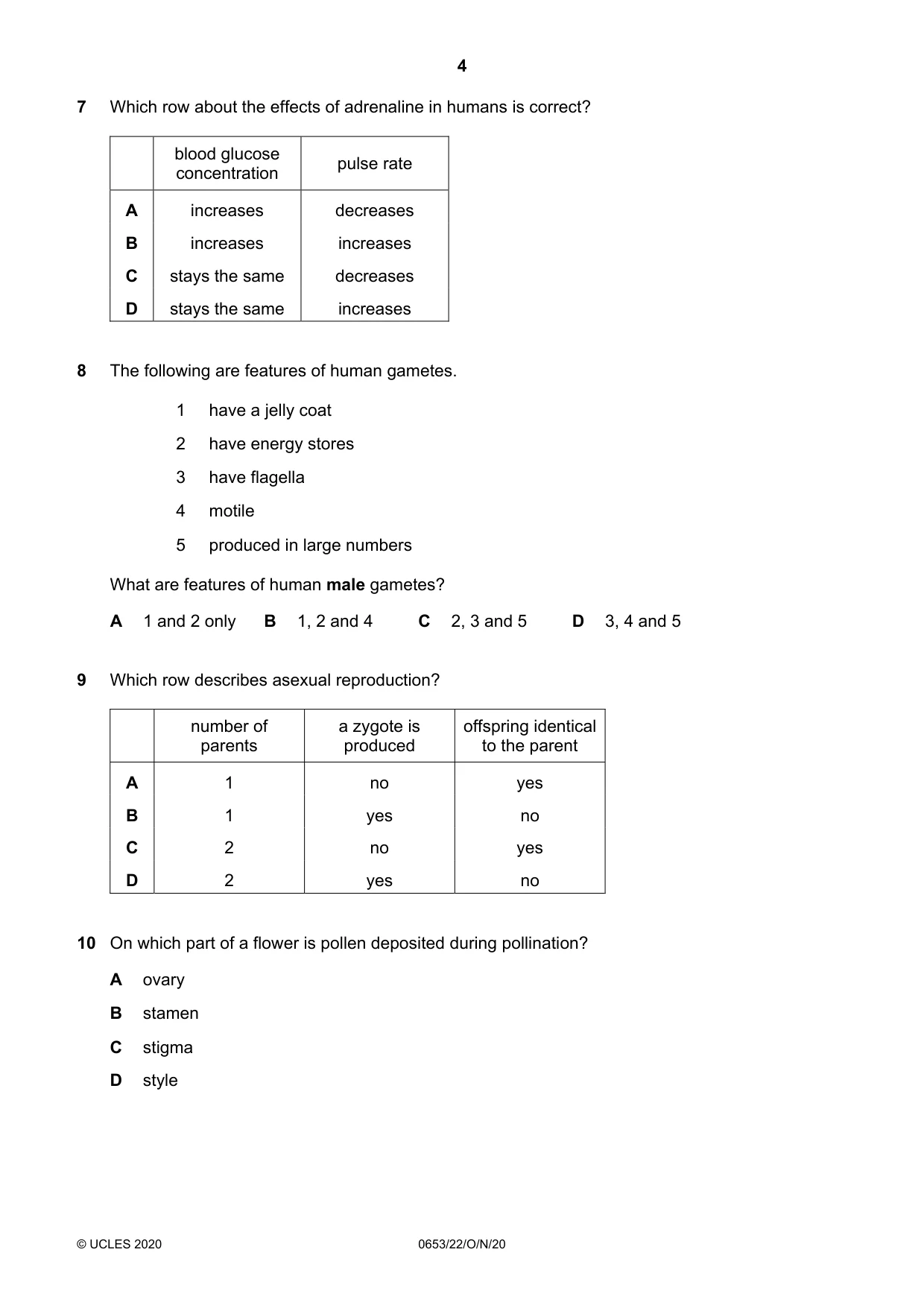
7 Which row about the effects of adrenaline in humans is correct? blood glucose pulse rate concentration A increases decreases B increases increases C stays the same decreases D stays the same increases
Mark scheme: B
Q8 · The following are features of human gametes
8 The following are features of human gametes. 1 have a jelly coat 2 have energy stores 3 have flagella 4 motile 5 produced in large numbers What are features of human male gametes? A 1 and 2 only B 1, 2 and 4 C 2, 3 and 5 D 3, 4 and 5
Mark scheme: D
Q9 · Which row describes asexual reproduction?
9 Which row describes asexual reproduction? number of a zygote is offspring identical parents produced to the parent A 1 no yes B 1 yes no C 2 no yes D 2 yes no
Mark scheme: A
Q10 · On which part of a flower is pollen deposited during pollination?
10 On which part of a flower is pollen deposited during pollination? A ovary B stamen C stigma D style
Mark scheme: C
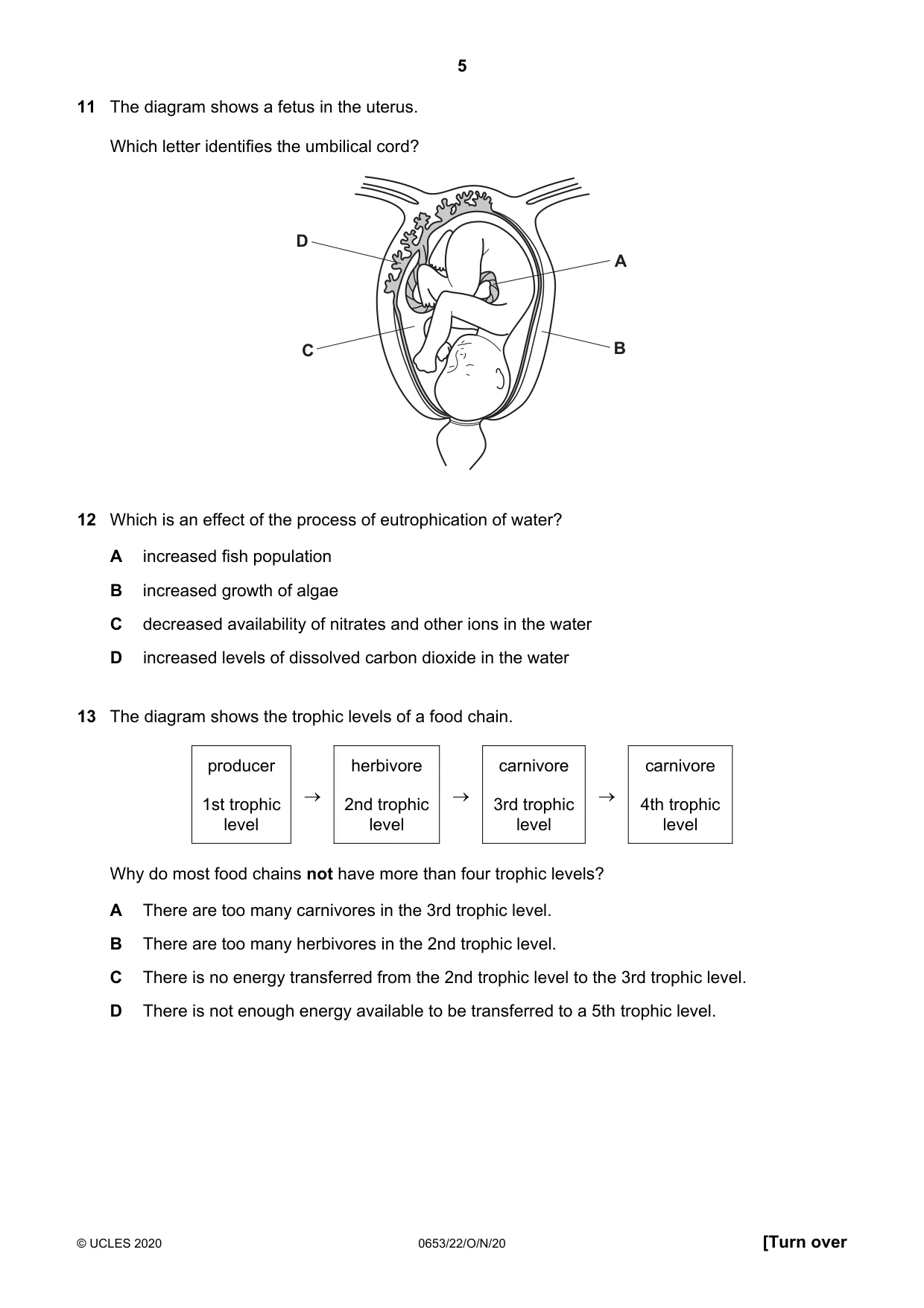
Q11 · The diagram shows a fetus in the uterus
11 The diagram shows a fetus in the uterus. Which letter identifies the umbilical cord? D A C B
Mark scheme: A
Q12 · Which is an effect of the process of eutrophication of water?
12 Which is an effect of the process of eutrophication of water? A increased fish population B increased growth of algae C decreased availability of nitrates and other ions in the water D increased levels of dissolved carbon dioxide in the water
Mark scheme: B
Q13 · The diagram shows the trophic levels of a food chain
13 The diagram shows the trophic levels of a food chain. producer herbivore carnivore carnivore 1st trophic 2nd trophic 3rd trophic 4th trophic level level level level Why do most food chains not have more than four trophic levels? A There are too many carnivores in the 3rd trophic level. B There are too many herbivores in the 2nd trophic level. C There is no energy transferred from the 2nd trophic level to the 3rd trophic level. D There is not enough energy available to be transferred to a 5th trophic level.
Mark scheme: D
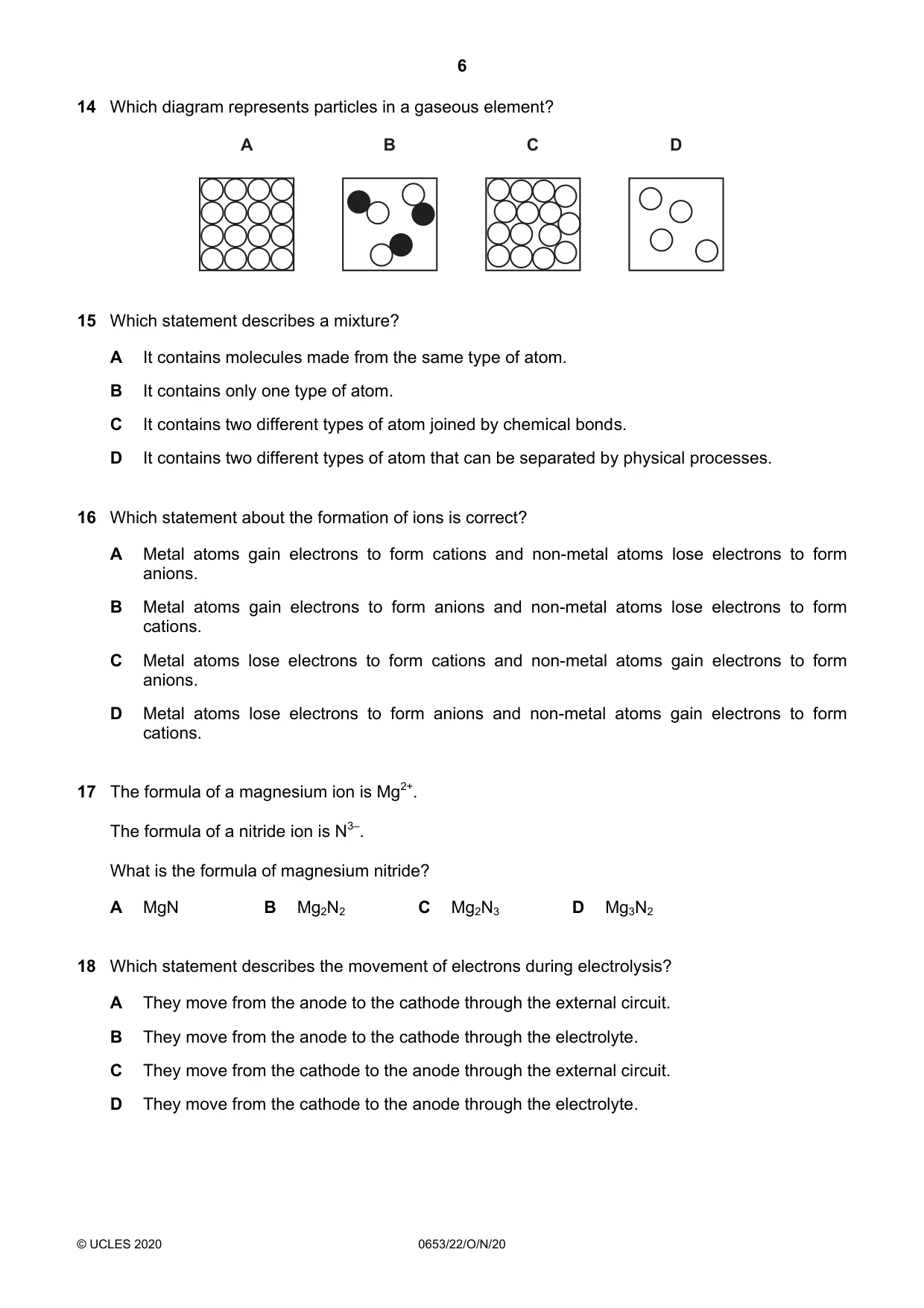
Q14 · Which diagram represents particles in a gaseous element?
14 Which diagram represents particles in a gaseous element? A B C D
Mark scheme: D
Q15 · Which statement describes a mixture?
15 Which statement describes a mixture? A It contains molecules made from the same type of atom. B It contains only one type of atom. C It contains two different types of atom joined by chemical bonds. D It contains two different types of atom that can be separated by physical processes.
Mark scheme: D
Q16 · Which statement about the formation of ions is correct?
16 Which statement about the formation of ions is correct? A Metal atoms gain electrons to form cations and non-metal atoms lose electrons to form anions. B Metal atoms gain electrons to form anions and non-metal atoms lose electrons to form cations. C Metal atoms lose electrons to form cations and non-metal atoms gain electrons to form anions. D Metal atoms lose electrons to form anions and non-metal atoms gain electrons to form cations.
Mark scheme: C
Q17 · The formula of a magnesium ion is Mg2+
17 The formula of a magnesium ion is Mg2+. The formula of a nitride ion is N3–. What is the formula of magnesium nitride? A MgN B Mg2N2 C Mg2N3 D Mg3N2
Mark scheme: D
Q18 · Which statement describes the movement of electrons during electrolysis?
18 Which statement describes the movement of electrons during electrolysis? A They move from the anode to the cathode through the external circuit. B They move from the anode to the cathode through the electrolyte. C They move from the cathode to the anode through the external circuit. D They move from the cathode to the anode through the electrolyte.
Mark scheme: A
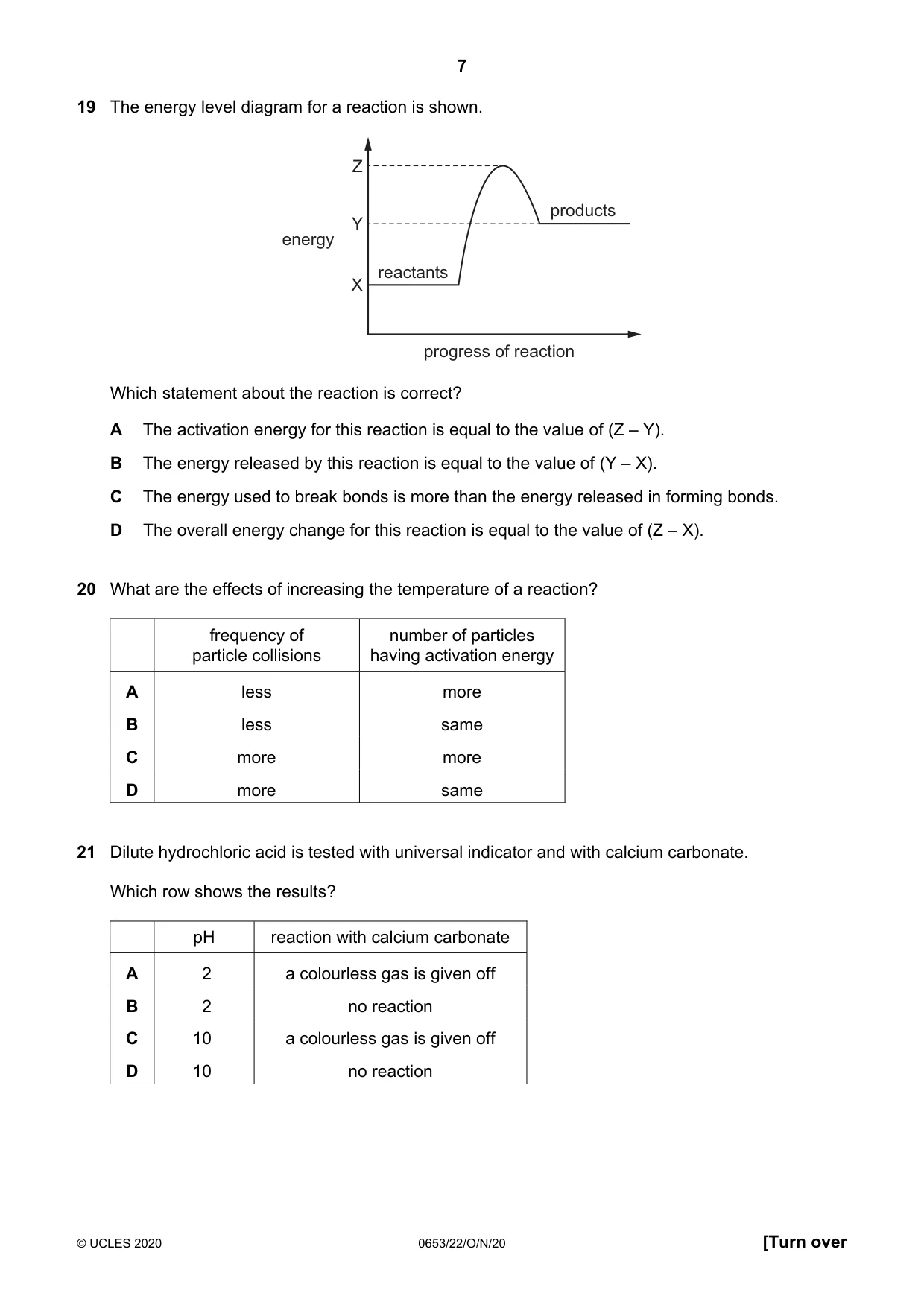
Q19 · The energy level diagram for a reaction is shown
19 The energy level diagram for a reaction is shown. Z products Y energy reactants X progress of reaction Which statement about the reaction is correct? A The activation energy for this reaction is equal to the value of (Z – Y). B The energy released by this reaction is equal to the value of (Y – X). C The energy used to break bonds is more than the energy released in forming bonds. D The overall energy change for this reaction is equal to the value of (Z – X).
Mark scheme: C
Q20 · What are the effects of increasing the temperature of a reaction?
20 What are the effects of increasing the temperature of a reaction? frequency of number of particles particle collisions having activation energy A less more B less same C more more D more same
Mark scheme: C
Q21 · Dilute hydrochloric acid is tested with universal indicator and with calcium carbonate
21 Dilute hydrochloric acid is tested with universal indicator and with calcium carbonate. Which row shows the results? pH reaction with calcium carbonate A 2 a colourless gas is given off B 2 no reaction C 10 a colourless gas is given off D 10 no reaction
Mark scheme: A
More questions on The characteristic properties of acids and bases
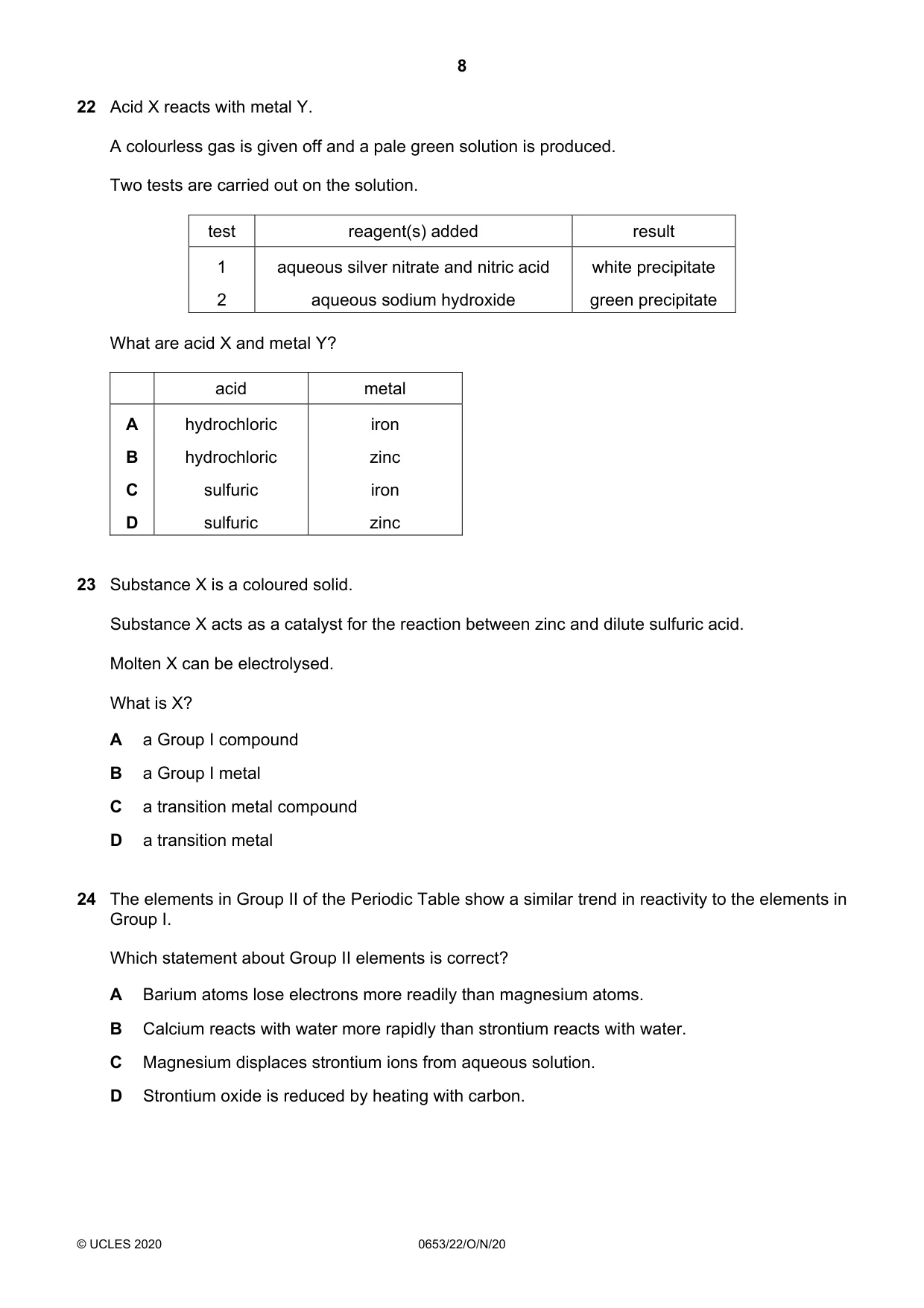
Q22 · Acid X reacts with metal Y
22 Acid X reacts with metal Y. A colourless gas is given off and a pale green solution is produced. Two tests are carried out on the solution. test reagent(s) added result 1 aqueous silver nitrate and nitric acid white precipitate 2 aqueous sodium hydroxide green precipitate What are acid X and metal Y? acid metal A hydrochloric iron B hydrochloric zinc C sulfuric iron D sulfuric zinc
Mark scheme: A
Q23 · Substance X is a coloured solid
23 Substance X is a coloured solid. Substance X acts as a catalyst for the reaction between zinc and dilute sulfuric acid. Molten X can be electrolysed. What is X? A a Group I compound B a Group I metal C a transition metal compound D a transition metal
Mark scheme: C
Q24 · The elements in Group II of the Periodic Table show a similar trend in reactivity to the…
24 The elements in Group II of the Periodic Table show a similar trend in reactivity to the elements in Group I. Which statement about Group II elements is correct? A Barium atoms lose electrons more readily than magnesium atoms. B Calcium reacts with water more rapidly than strontium reacts with water. C Magnesium displaces strontium ions from aqueous solution. D Strontium oxide is reduced by heating with carbon.
Mark scheme: A
Q25 · Which method is used to extract copper from copper(II) oxide?
25 Which method is used to extract copper from copper(II) oxide? A dissolving copper(II) oxide in hydrochloric acid and then filtering B dissolving copper(II) oxide in water and then filtering C heating the copper(II) oxide D heating the copper(II) oxide mixed with carbon
Mark scheme: D
Q26 · Which process does not produce carbon dioxide?
26 Which process does not produce carbon dioxide? A complete combustion of methane B cracking of large alkane molecules C reaction between an acid and magnesium carbonate D thermal decomposition of calcium carbonate
Mark scheme: B
Q27 · Which statement describes a hydrocarbon?
27 Which statement describes a hydrocarbon? A a compound that burns to form carbon dioxide and hydrogen B a compound that contains carbon and hydrogen only C a compound that only contains ionic bonds D a compound that reacts easily with metals
Mark scheme: B
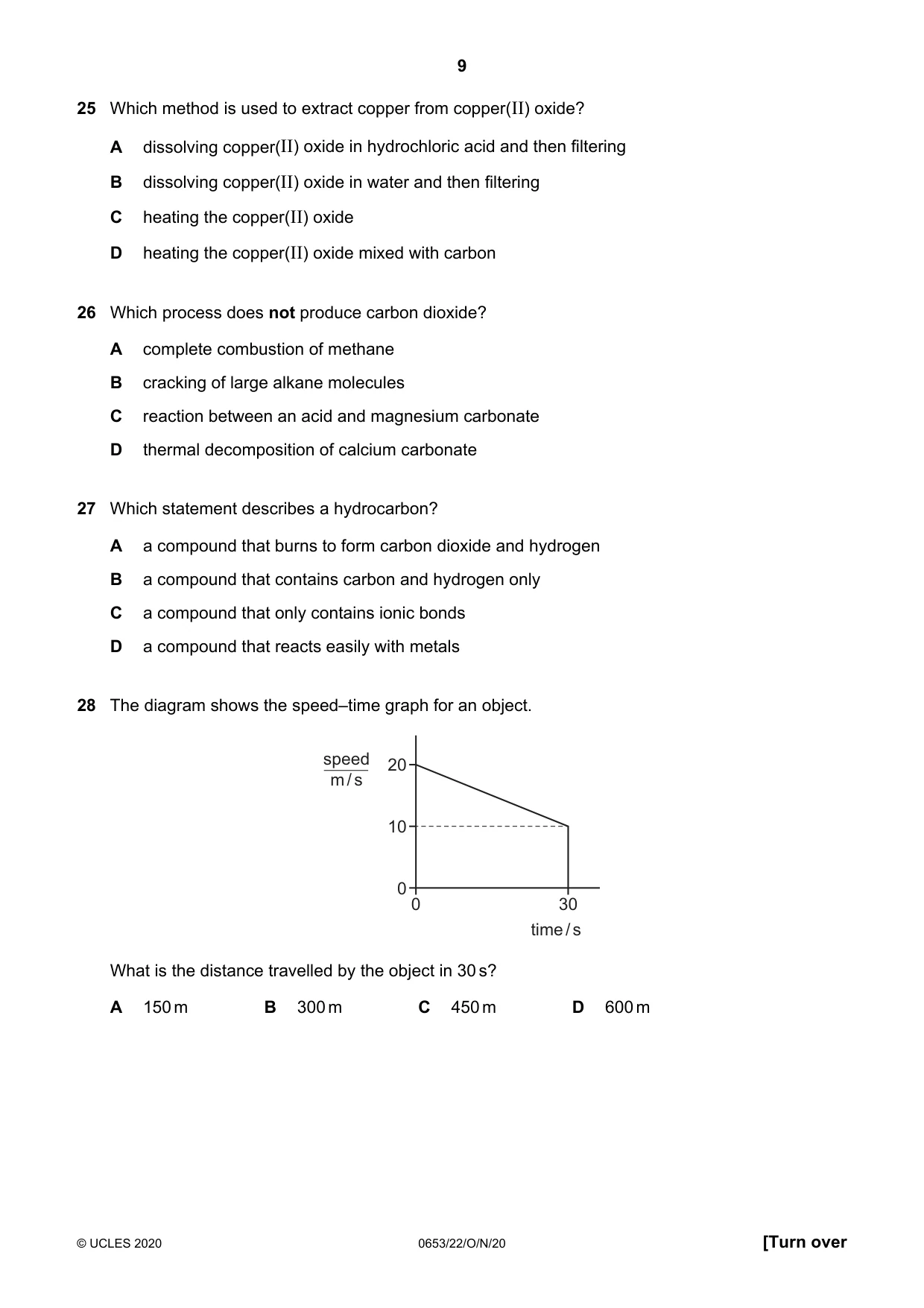
Q28 · The diagram shows the speed–time graph for an object
28 The diagram shows the speed–time graph for an object. speed 20 m / s 10 0 0 30 time / s What is the distance travelled by the object in 30 s? A 150 m B 300 m C 450 m D 600 m
Mark scheme: C
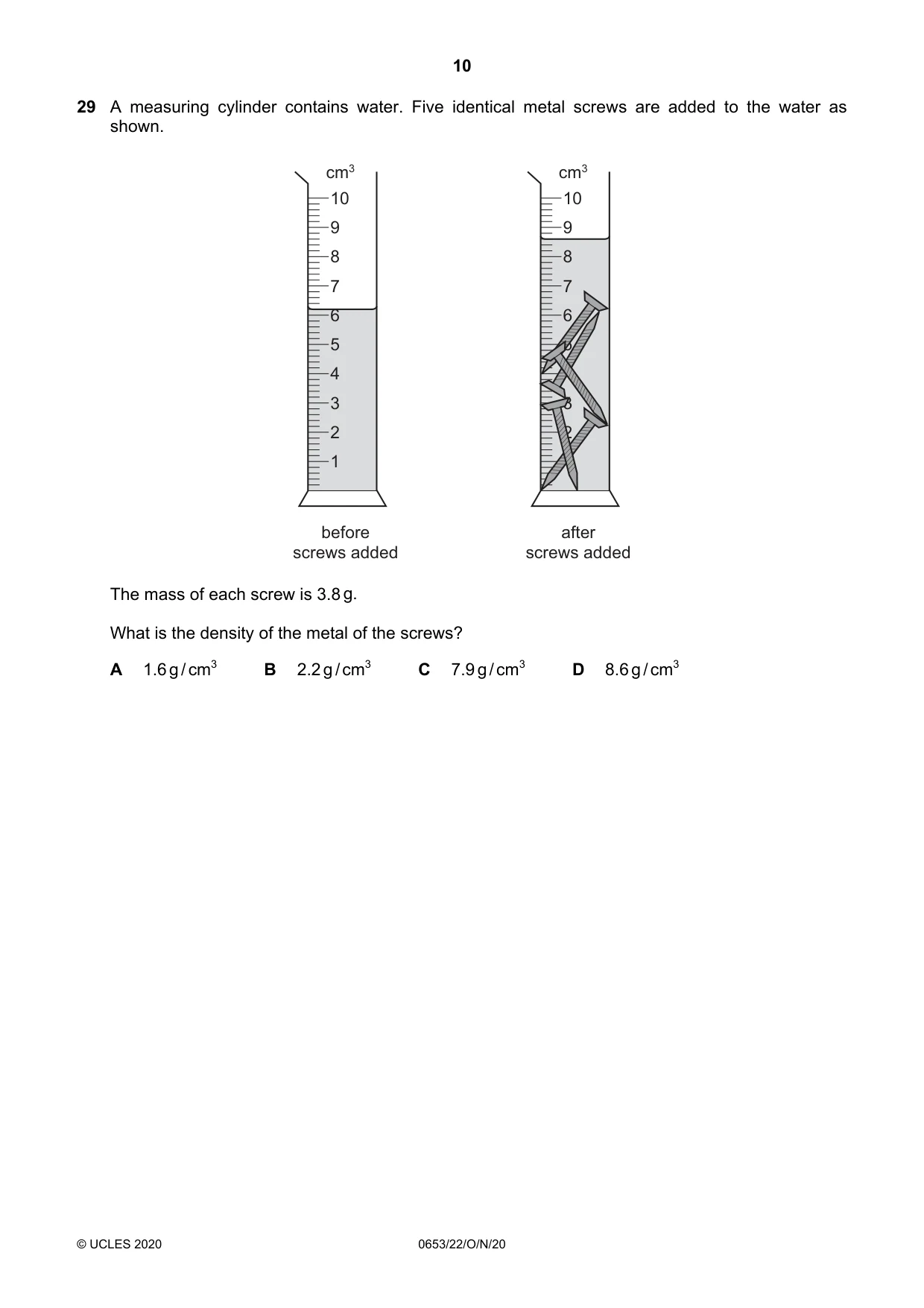
Q29 · A measuring cylinder contains water
29 A measuring cylinder contains water. Five identical metal screws are added to the water as shown. cm3 cm3 10 10 9 9 8 8 7 7 6 6 5 5 4 4 3 3 2 2 1 1 before after screws added screws added The mass of each screw is 3.8 g. What is the density of the metal of the screws? A 1.6 g / cm3 B 2.2 g / cm3 C 7.9 g / cm3 D 8.6 g / cm3
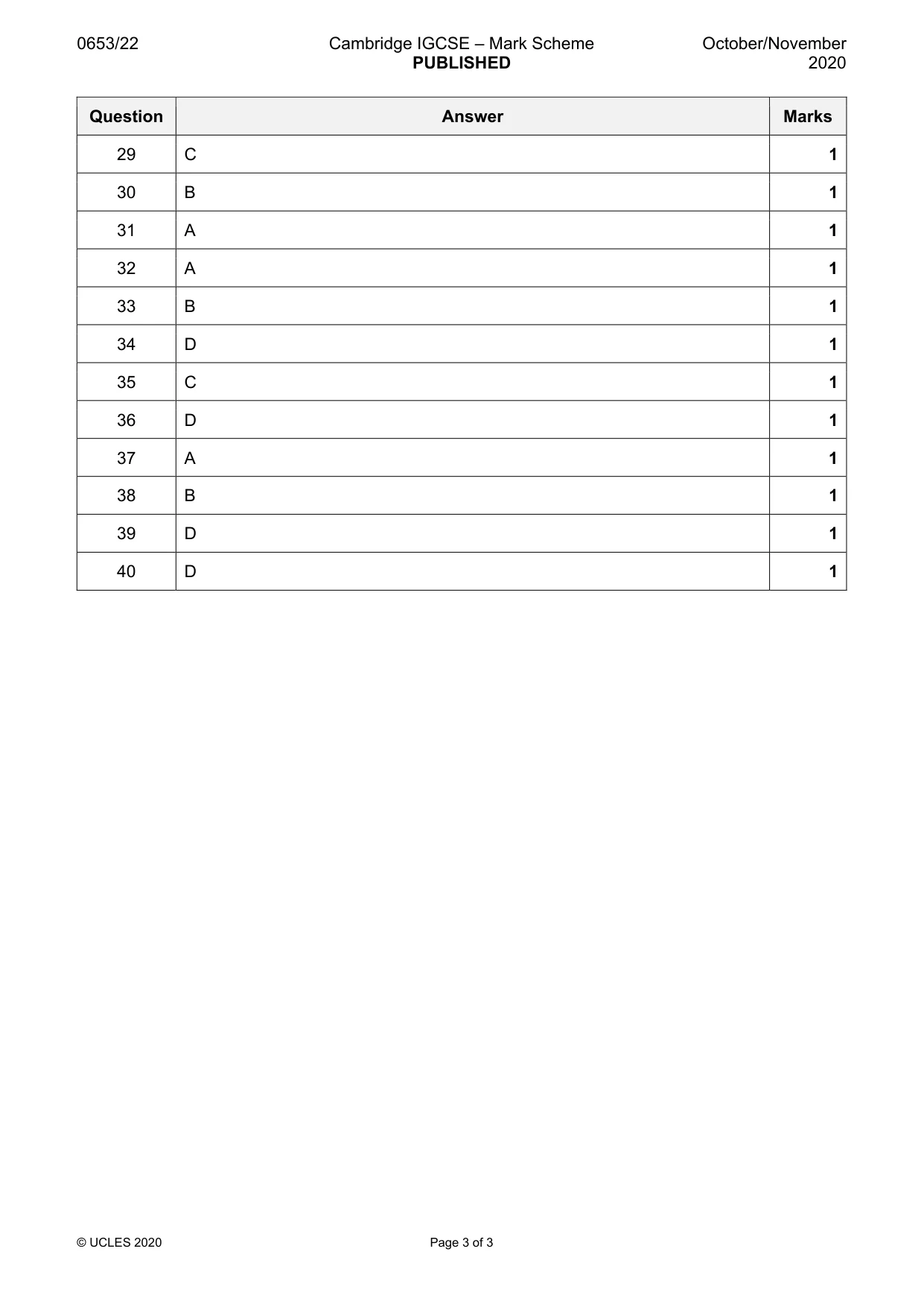
Mark scheme: C
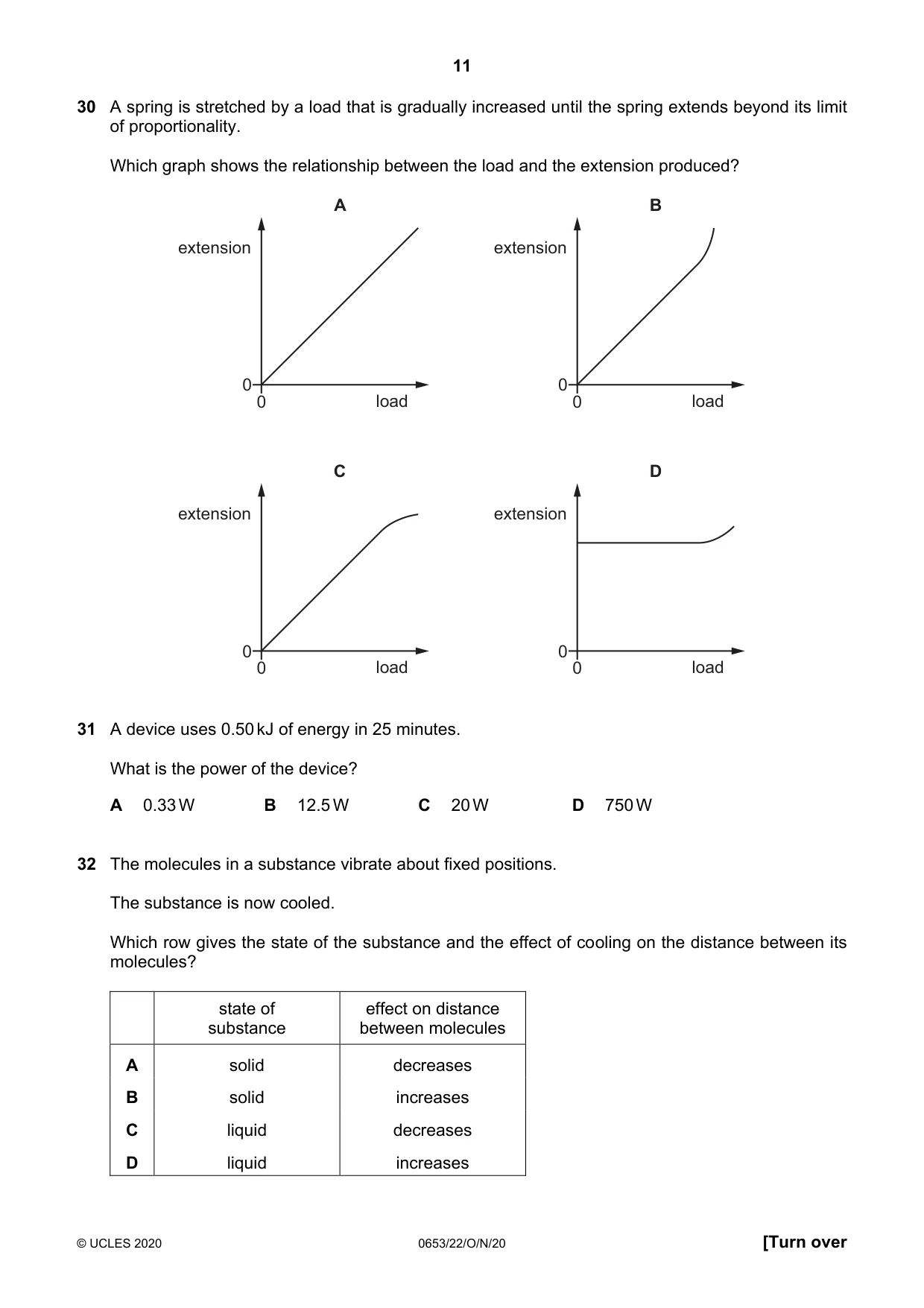
Q30 · A spring is stretched by a load that is gradually increased until the spring extends…
30 A spring is stretched by a load that is gradually increased until the spring extends beyond its limit of proportionality. Which graph shows the relationship between the load and the extension produced? A B extension extension 0 0 0 load 0 load C D extension extension 0 0 0 load 0 load
Mark scheme: B
Q31 · A device uses 0.50 kJ of energy in 25 minutes
31 A device uses 0.50 kJ of energy in 25 minutes. What is the power of the device? A 0.33 W B 12.5 W C 20 W D 750 W
Mark scheme: A
Q32 · The molecules in a substance vibrate about fixed positions
32 The molecules in a substance vibrate about fixed positions. The substance is now cooled. Which row gives the state of the substance and the effect of cooling on the distance between its molecules? state of effect on distance substance between molecules A solid decreases B solid increases C liquid decreases D liquid increases
Mark scheme: A
Q33 · In which states of matter can convection occur?
33 In which states of matter can convection occur? in a solid in a liquid in a gas A no no yes B no yes yes C yes no no D yes yes no
Mark scheme: B
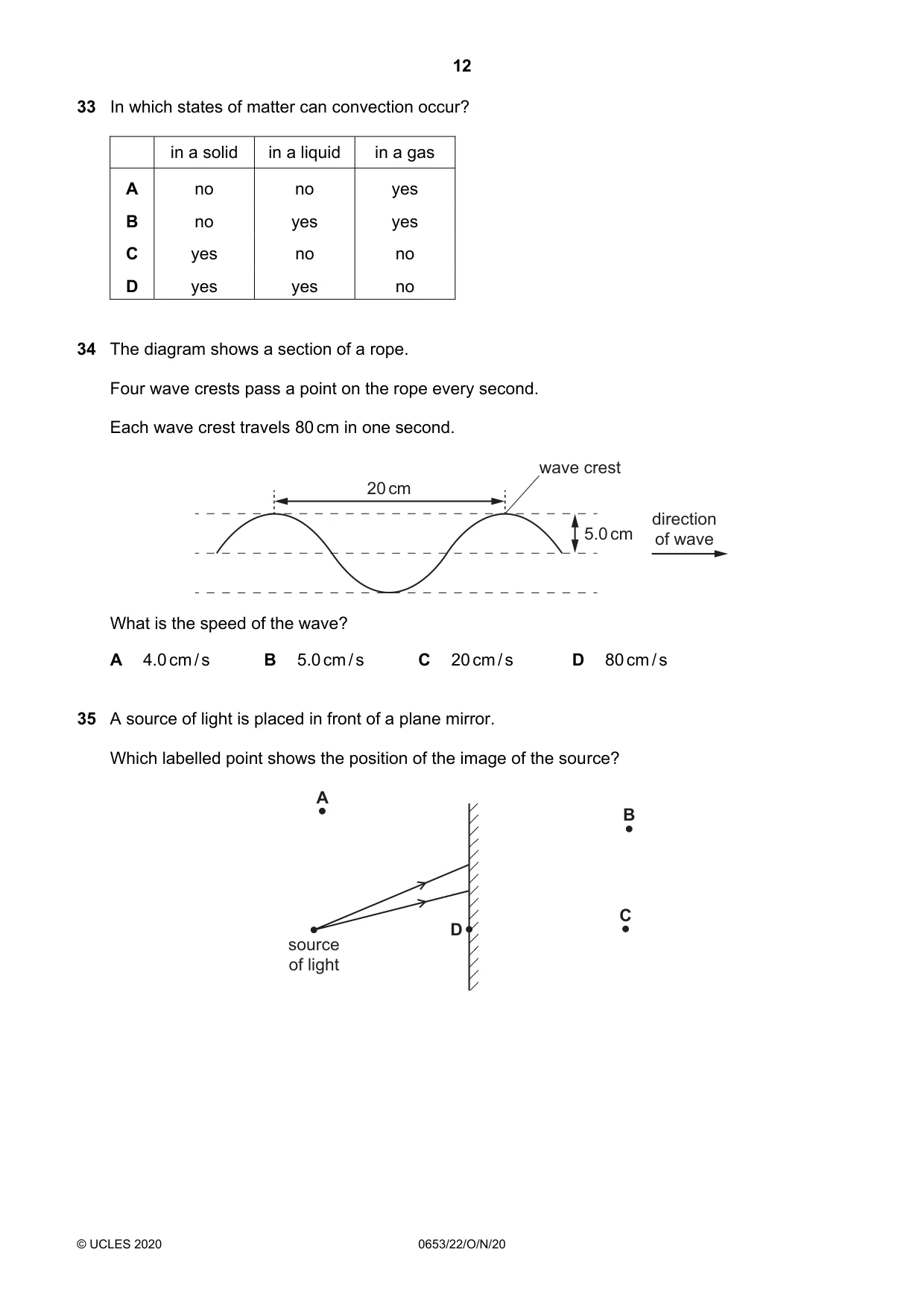
Q34 · The diagram shows a section of a rope
34 The diagram shows a section of a rope. Four wave crests pass a point on the rope every second. Each wave crest travels 80 cm in one second. wave crest 20 cm direction 5.0 cm of wave What is the speed of the wave? A 4.0 cm / s B 5.0 cm / s C 20 cm / s D 80 cm / s
Mark scheme: D
Q35 · A source of light is placed in front of a plane mirror
35 A source of light is placed in front of a plane mirror. Which labelled point shows the position of the image of the source? A B C D source of light
Mark scheme: C
Q36 · Radio waves, visible light and X-rays all travel in a vacuum
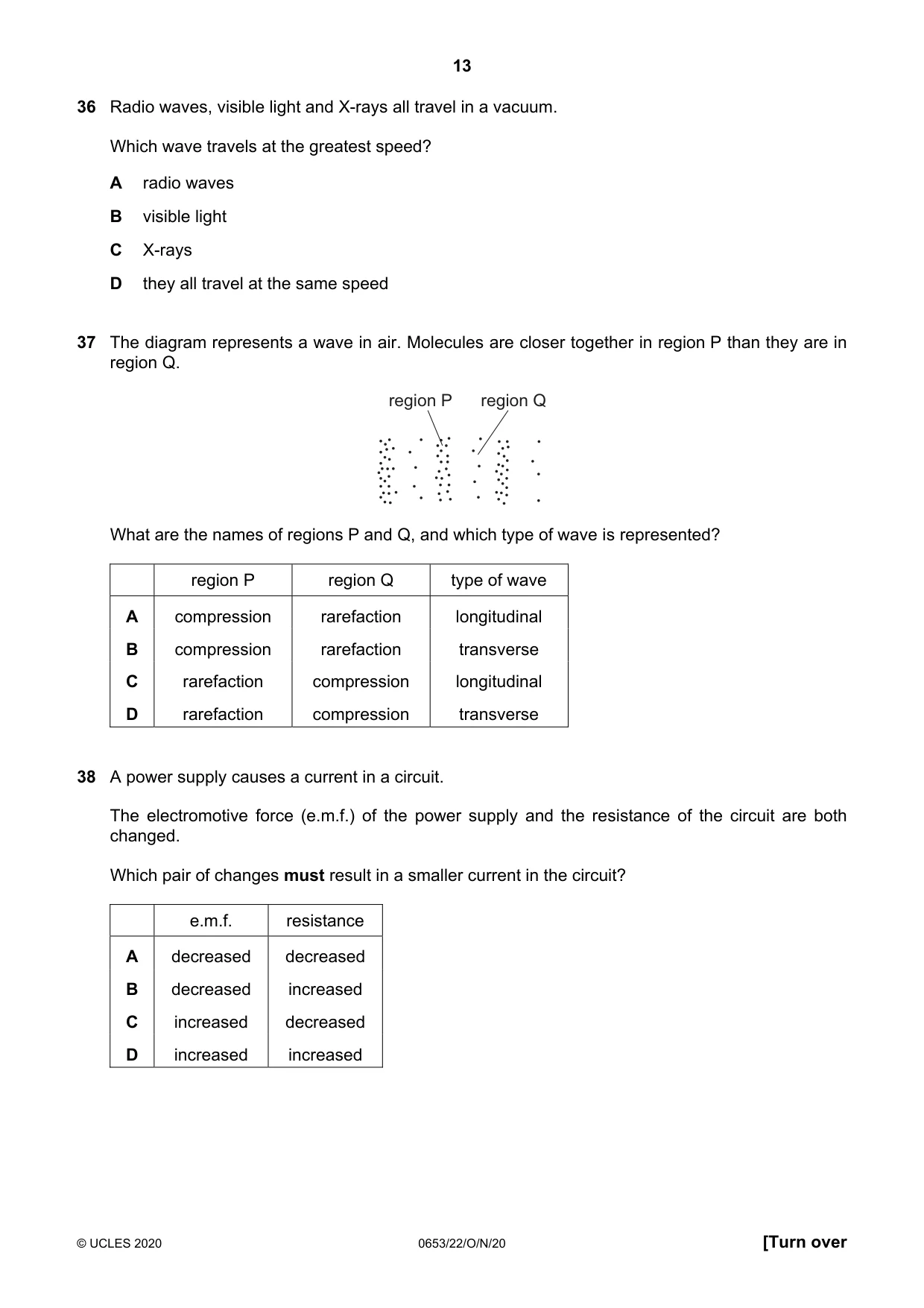
36 Radio waves, visible light and X-rays all travel in a vacuum. Which wave travels at the greatest speed? A radio waves B visible light C X-rays D they all travel at the same speed
Mark scheme: D
Q37 · The diagram represents a wave in air
37 The diagram represents a wave in air. Molecules are closer together in region P than they are in region Q. region P region Q What are the names of regions P and Q, and which type of wave is represented? region P region Q type of wave A compression rarefaction longitudinal B compression rarefaction transverse C rarefaction compression longitudinal D rarefaction compression transverse
Mark scheme: A
Q38 · A power supply causes a current in a circuit
38 A power supply causes a current in a circuit. The electromotive force (e.m.f.) of the power supply and the resistance of the circuit are both changed. Which pair of changes must result in a smaller current in the circuit? e.m.f. resistance A decreased decreased B decreased increased C increased decreased D increased increased
Mark scheme: B
Q39 · There is a current of 2.0 A in a 4.0 resistor for 20 s
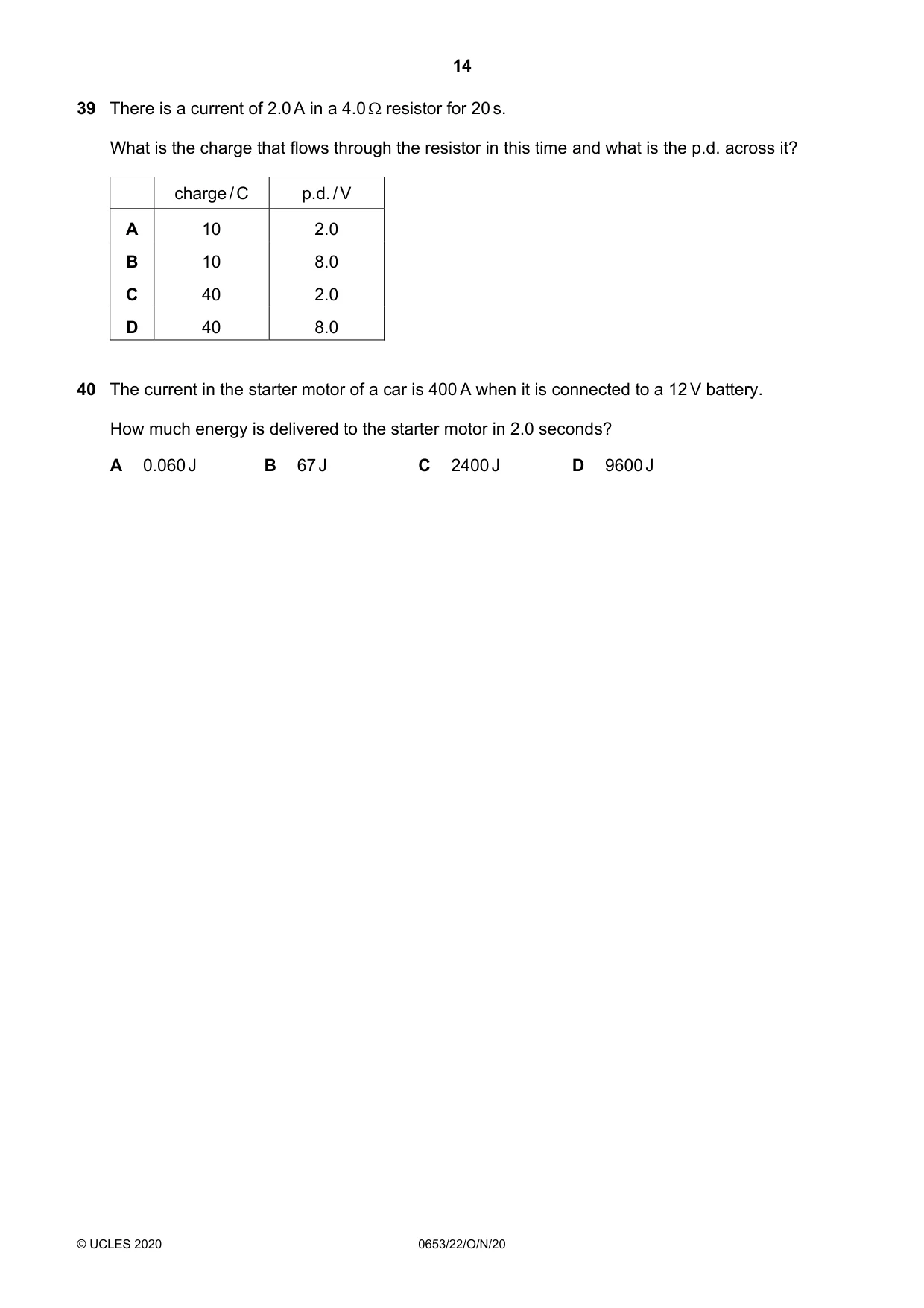
39 There is a current of 2.0 A in a 4.0 resistor for 20 s. What is the charge that flows through the resistor in this time and what is the p.d. across it? charge / C p.d. / V A 10 2.0 B 10 8.0 C 40 2.0 D 40 8.0
Mark scheme: D
Q40 · The current in the starter motor of a car is 400 A when it is connected to a 12 V battery
40 The current in the starter motor of a car is 400 A when it is connected to a 12 V battery. How much energy is delivered to the starter motor in 2.0 seconds? A 0.060 J B 67 J C 2400 J D 9600 J
Mark scheme: D
What was in this paper
The subtopics covered by these 40 questions, and how many questions each got. Open one in a new tab to see every Cambridge question on it.
2Sexual reproduction in humans2Sexual reproduction in plants2Air quality and climate1Arrangement of elements1Cell structure1Density1Digestion1Digestive system1Drugs1Electrical circuits1Electrolysis1Electromagnetic spectrum1Elements, compounds and mixtures1Energy flow1Energy, work and power1Enzymes1Exothermic and endothermic reactions1Extraction of metals1Forces1Formulas1Gas exchange in humans1General properties of waves1Habitat destruction1Identification of ions and gases1Ions and ionic bonds1Kinetic particle model of matter1Light1Motion1Rate of reaction1Solids, liquids and gases1Sound1Terminology1The characteristic properties of acids and bases1Transfer of thermal energy1Transition elements1Water uptake1What you needed in this session
Cambridge’s own grade thresholds for 2020 Oct/Nov, Paper 2 · Variant 2. A higher threshold means an easier paper — the bar moves with how the cohort did.