Cambridge IGCSE Science - Combined 0653 — 2019 Oct/Nov Paper 2 · Variant 1
0653/21/O/N/19 · 40 questions · 40 marks · ≈45 min
The question paper and its mark scheme, free to read here and free to download. This is Cambridge’s own paper, exactly as it was sat.
Question paper16 pages
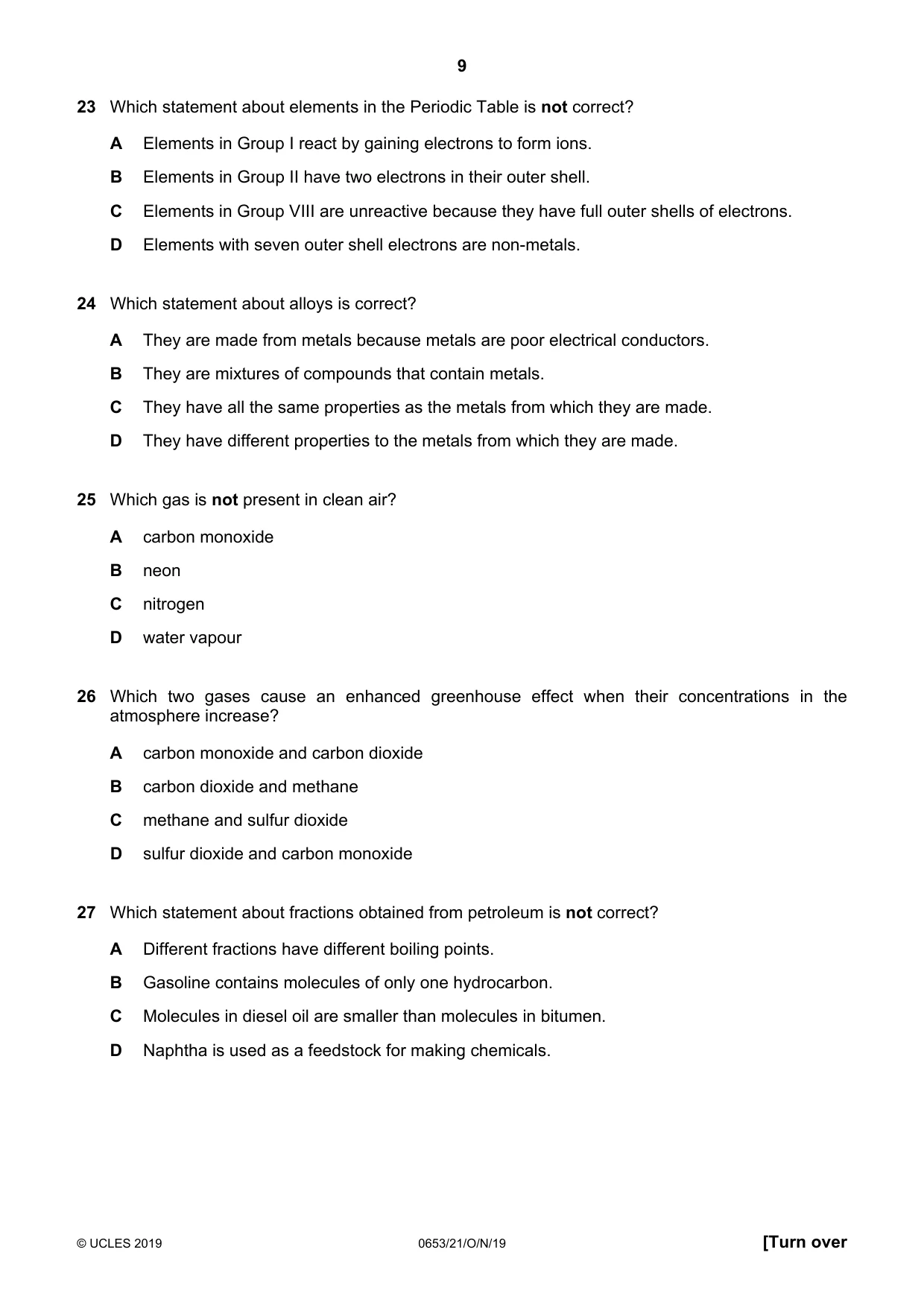
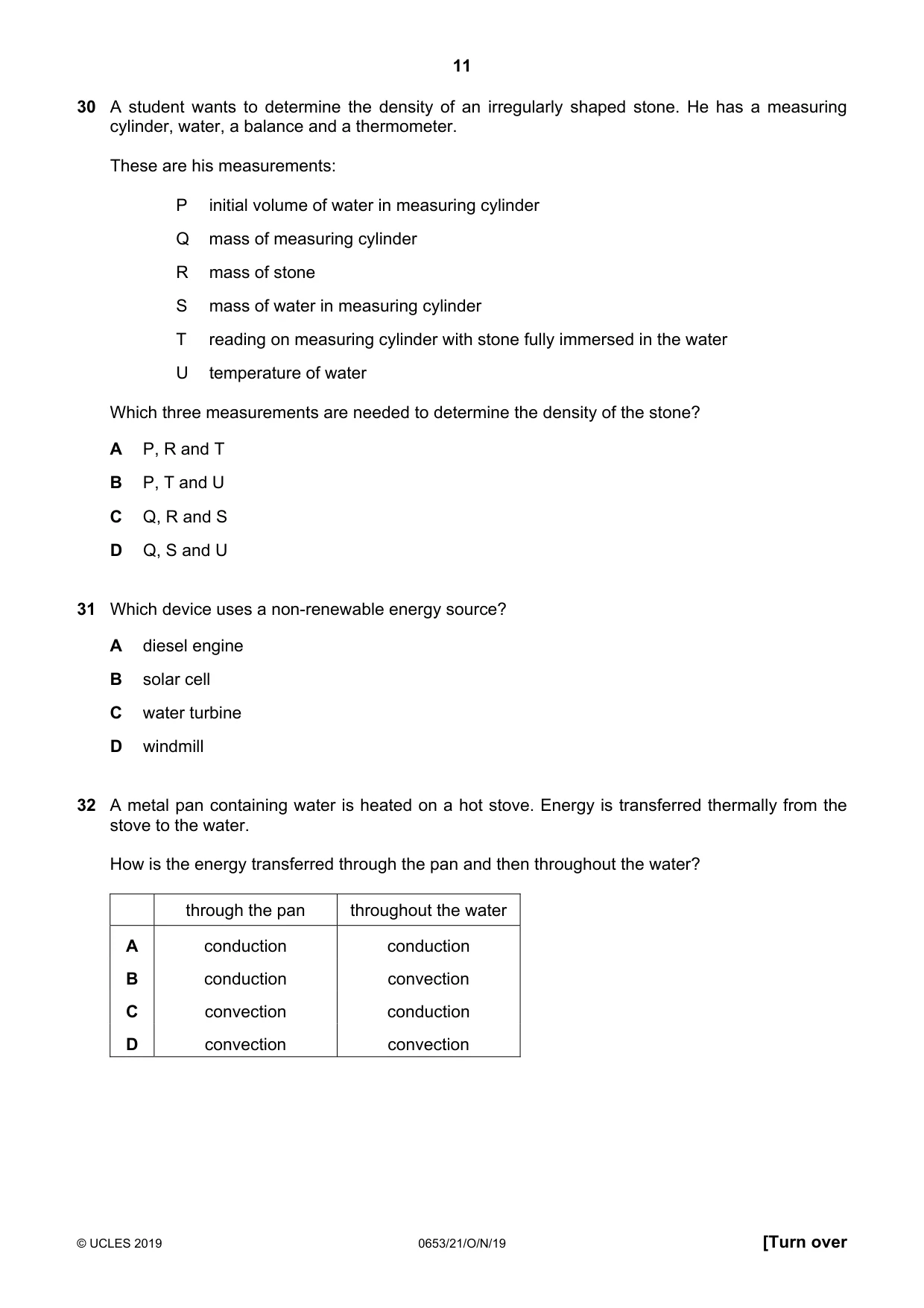
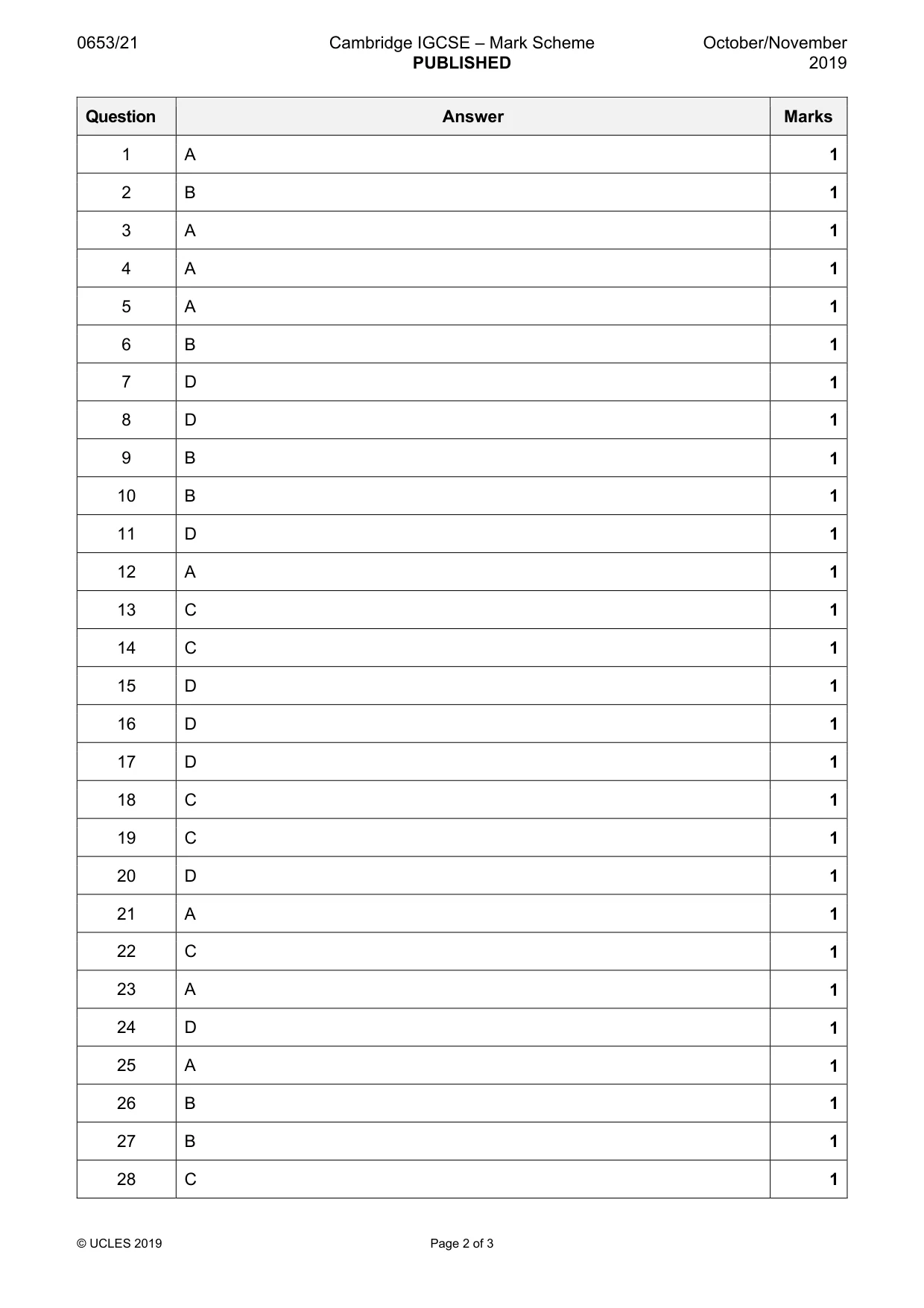
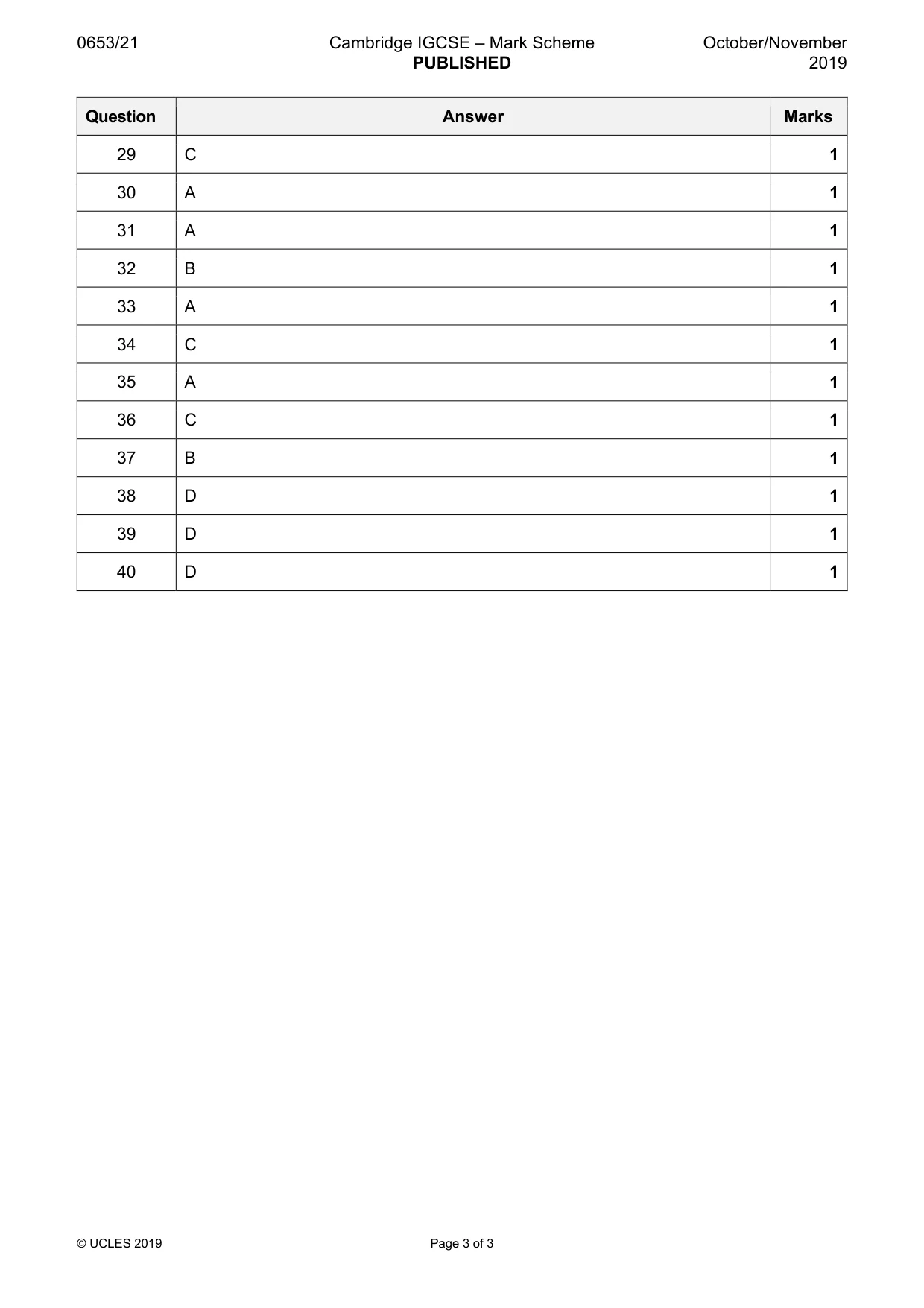
Mark scheme3 pages
Answers below. Sit the paper first if you are practising.
Questions as text
Q1 · A biologist keeps a potted plant in a laboratory
1 A biologist keeps a potted plant in a laboratory. Which feature of the potted plant shows that it is a living organism? A It grows larger over time. B It has green leaves. C The compost in the pot dries after he waters it. D The stems contain xylem.
Mark scheme: A
Q2 · The diagram shows a section through a leaf
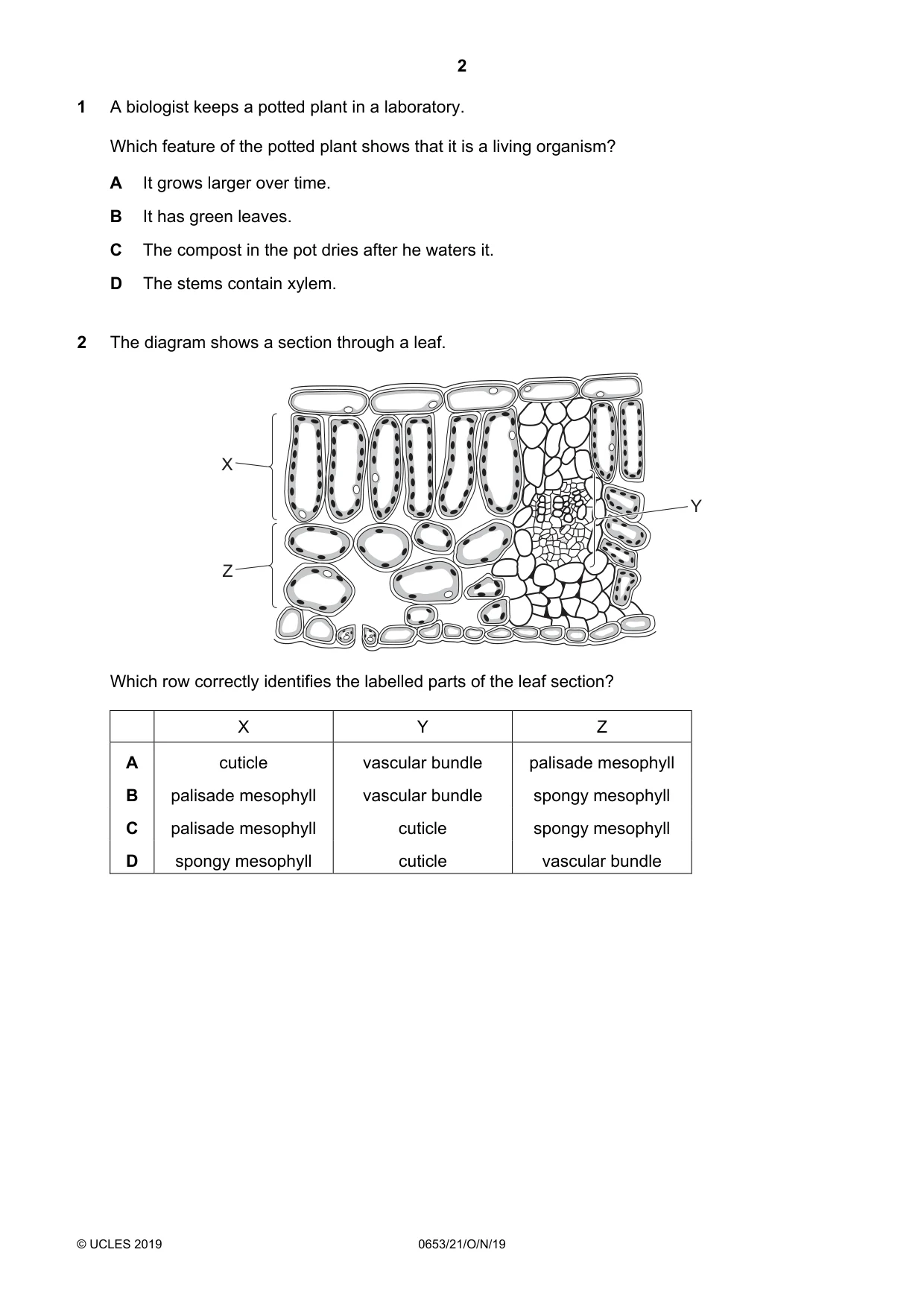
2 The diagram shows a section through a leaf. X Y Z Which row correctly identifies the labelled parts of the leaf section? X Y Z A cuticle vascular bundle palisade mesophyll B palisade mesophyll vascular bundle spongy mesophyll C palisade mesophyll cuticle spongy mesophyll D spongy mesophyll cuticle vascular bundle
Mark scheme: B
Q3 · 1 cm³ of substance X is added to 10 cm³ starch suspension and mixed
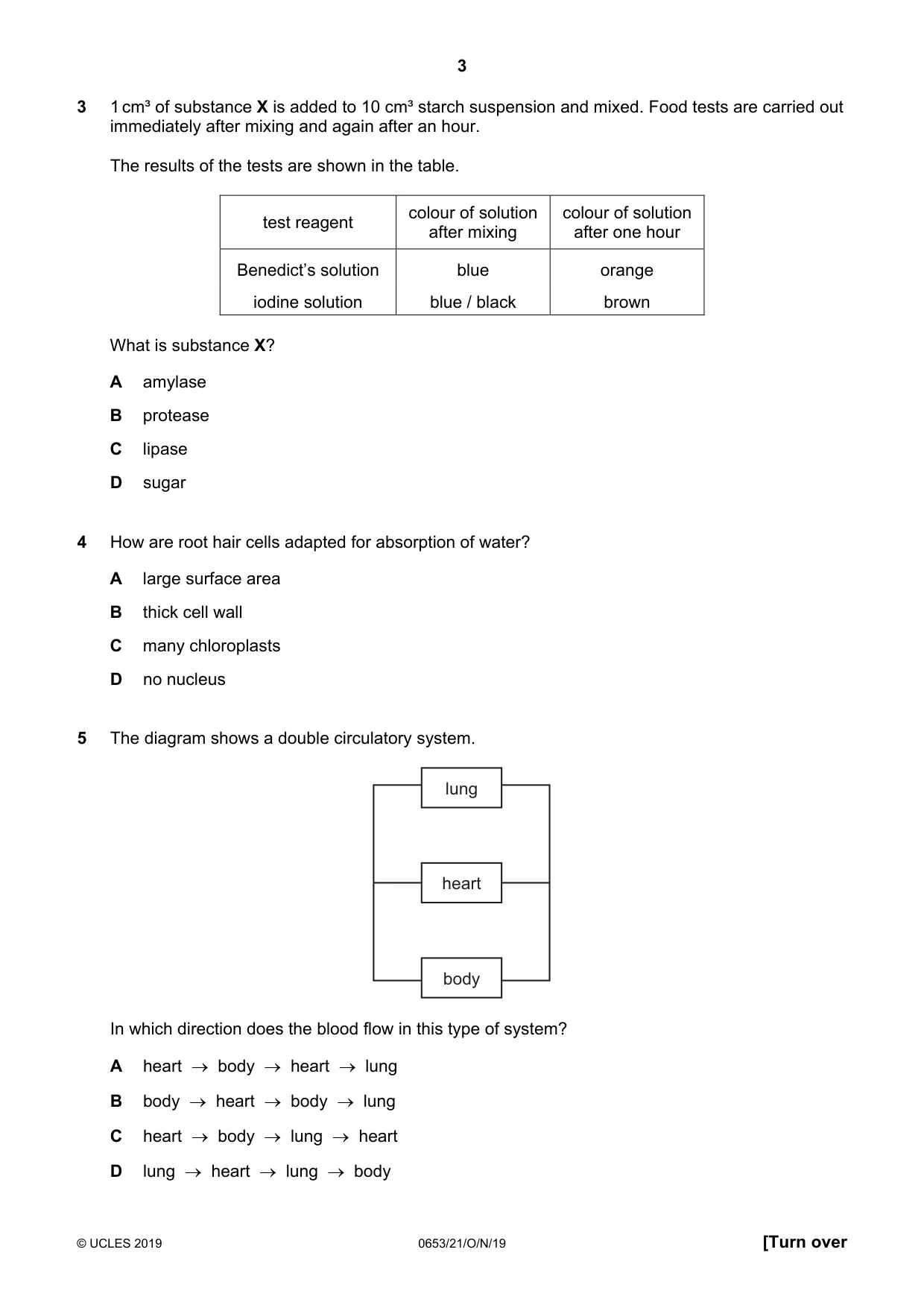
3 1 cm³ of substance X is added to 10 cm³ starch suspension and mixed. Food tests are carried out immediately after mixing and again after an hour. The results of the tests are shown in the table. colour of solution colour of solution test reagent after mixing after one hour Benedict’s solution blue orange iodine solution blue / black brown What is substance X? A amylase B protease C lipase D sugar
Mark scheme: A
Q4 · How are root hair cells adapted for absorption of water?
4 How are root hair cells adapted for absorption of water? A large surface area B thick cell wall C many chloroplasts D no nucleus
Mark scheme: A
Q5 · The diagram shows a double circulatory system
5 The diagram shows a double circulatory system. lung heart body In which direction does the blood flow in this type of system? A heart → body → heart → lung B body → heart → body → lung C heart → body → lung → heart D lung → heart → lung → body
Mark scheme: A
Q6 · The concentrations of carbon dioxide and oxygen in expired air differ from the…
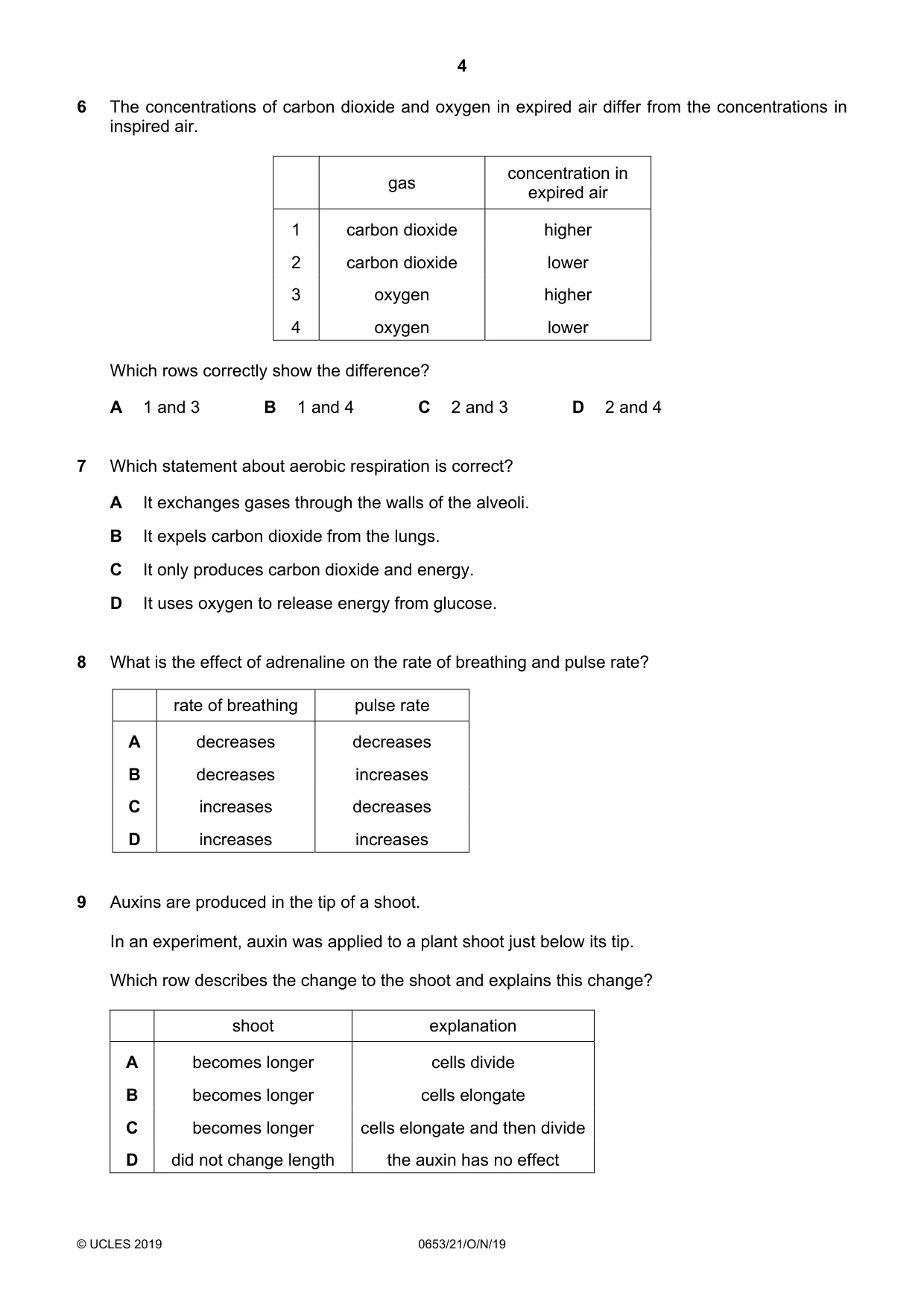
6 The concentrations of carbon dioxide and oxygen in expired air differ from the concentrations in inspired air. concentration in gas expired air 1 carbon dioxide higher 2 carbon dioxide lower 3 oxygen higher 4 oxygen lower Which rows correctly show the difference? A 1 and 3 B 1 and 4 C 2 and 3 D 2 and 4
Mark scheme: B
Q7 · Which statement about aerobic respiration is correct?
7 Which statement about aerobic respiration is correct? A It exchanges gases through the walls of the alveoli. B It expels carbon dioxide from the lungs. C It only produces carbon dioxide and energy. D It uses oxygen to release energy from glucose.
Mark scheme: D
Q8 · What is the effect of adrenaline on the rate of breathing and pulse rate?
8 What is the effect of adrenaline on the rate of breathing and pulse rate? rate of breathing pulse rate A decreases decreases B decreases increases C increases decreases D increases increases
Mark scheme: D
Q9 · Auxins are produced in the tip of a shoot
9 Auxins are produced in the tip of a shoot. In an experiment, auxin was applied to a plant shoot just below its tip. Which row describes the change to the shoot and explains this change? shoot explanation A becomes longer cells divide B becomes longer cells elongate C becomes longer cells elongate and then divide D did not change length the auxin has no effect
Mark scheme: B
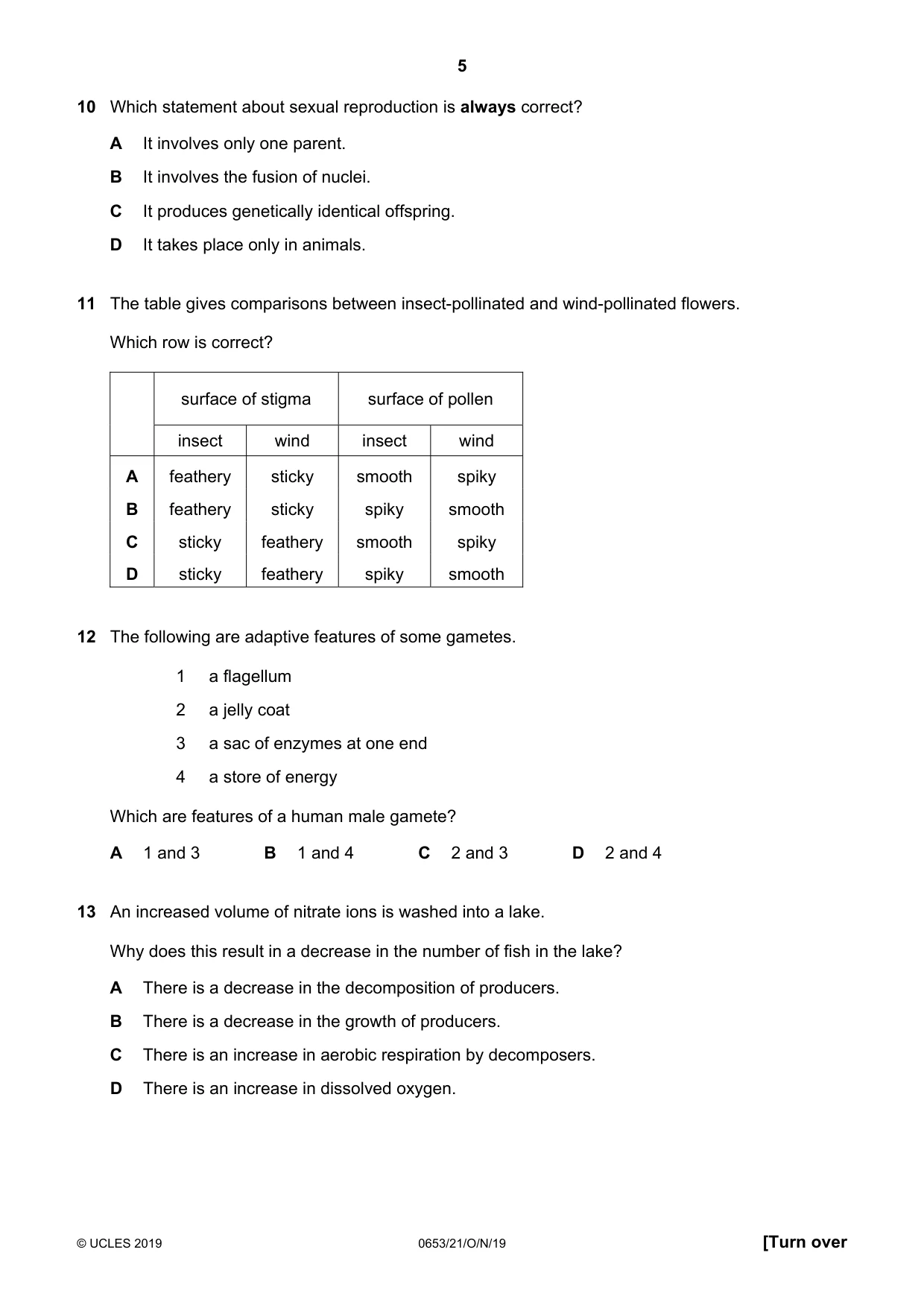
Q10 · Which statement about sexual reproduction is always correct?
10 Which statement about sexual reproduction is always correct? A It involves only one parent. B It involves the fusion of nuclei. C It produces genetically identical offspring. D It takes place only in animals.
Mark scheme: B
Q11 · The table gives comparisons between insect-pollinated and wind-pollinated flowers
11 The table gives comparisons between insect-pollinated and wind-pollinated flowers. Which row is correct? surface of stigma surface of pollen insect wind insect wind A feathery sticky smooth spiky B feathery sticky spiky smooth C sticky feathery smooth spiky D sticky feathery spiky smooth
Mark scheme: D
Q12 · The following are adaptive features of some gametes
12 The following are adaptive features of some gametes. 1 a flagellum 2 a jelly coat 3 a sac of enzymes at one end 4 a store of energy Which are features of a human male gamete? A 1 and 3 B 1 and 4 C 2 and 3 D 2 and 4
Mark scheme: A
Q13 · An increased volume of nitrate ions is washed into a lake
13 An increased volume of nitrate ions is washed into a lake. Why does this result in a decrease in the number of fish in the lake? A There is a decrease in the decomposition of producers. B There is a decrease in the growth of producers. C There is an increase in aerobic respiration by decomposers. D There is an increase in dissolved oxygen.
Mark scheme: C
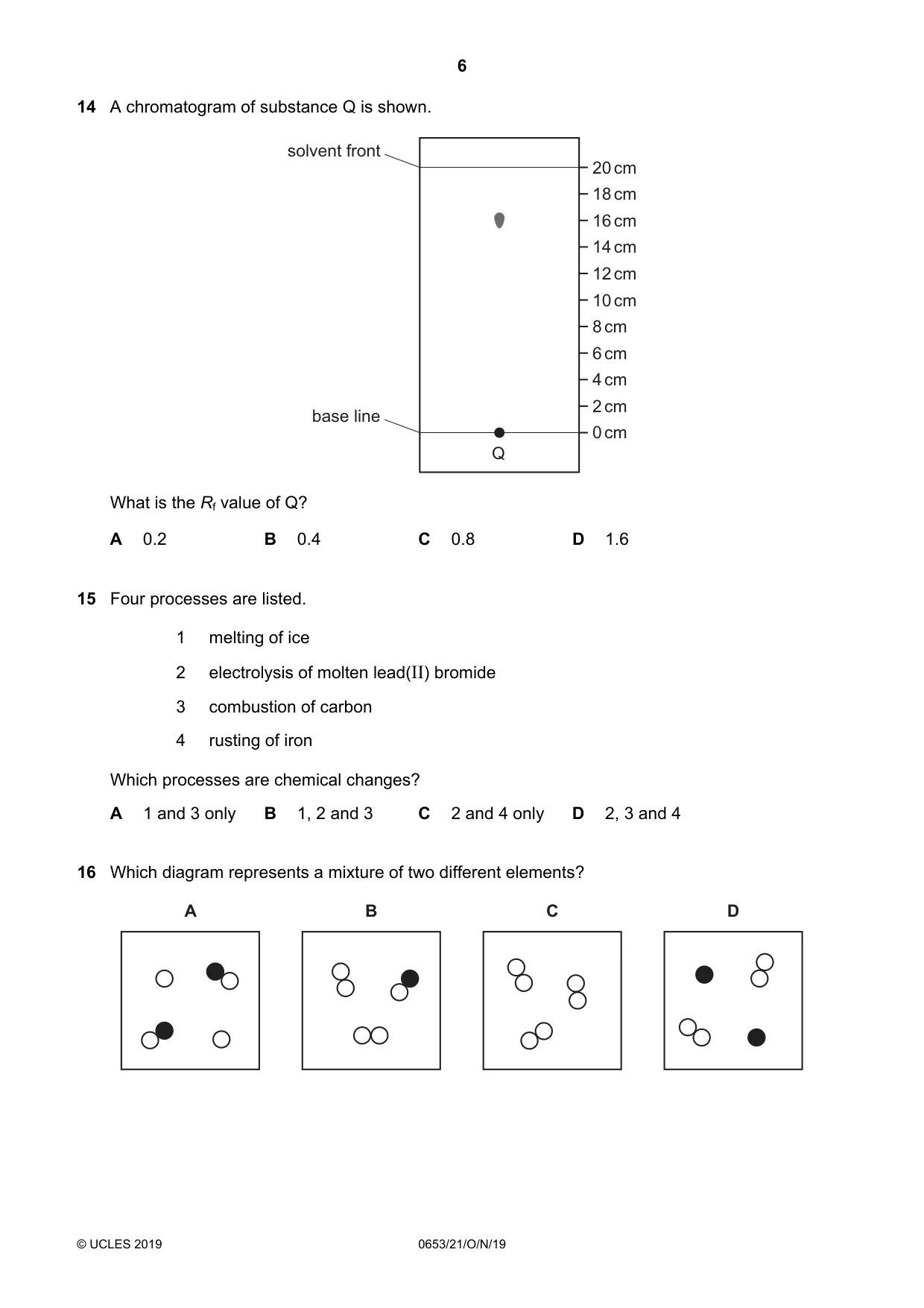
Q14 · A chromatogram of substance Q is shown
14 A chromatogram of substance Q is shown. solvent front 20 cm 18 cm 16 cm 14 cm 12 cm 10 cm 8 cm 6 cm 4 cm 2 cm base line 0 cm Q What is the Rf value of Q? A 0.2 B 0.4 C 0.8 D 1.6
Mark scheme: C
Q15 · Four processes are listed
15 Four processes are listed. 1 melting of ice 2 electrolysis of molten lead(II) bromide 3 combustion of carbon 4 rusting of iron Which processes are chemical changes? A 1 and 3 only B 1, 2 and 3 C 2 and 4 only D 2, 3 and 4
Mark scheme: D
Q16 · Which diagram represents a mixture of two different elements?
16 Which diagram represents a mixture of two different elements? A B C D
Mark scheme: D
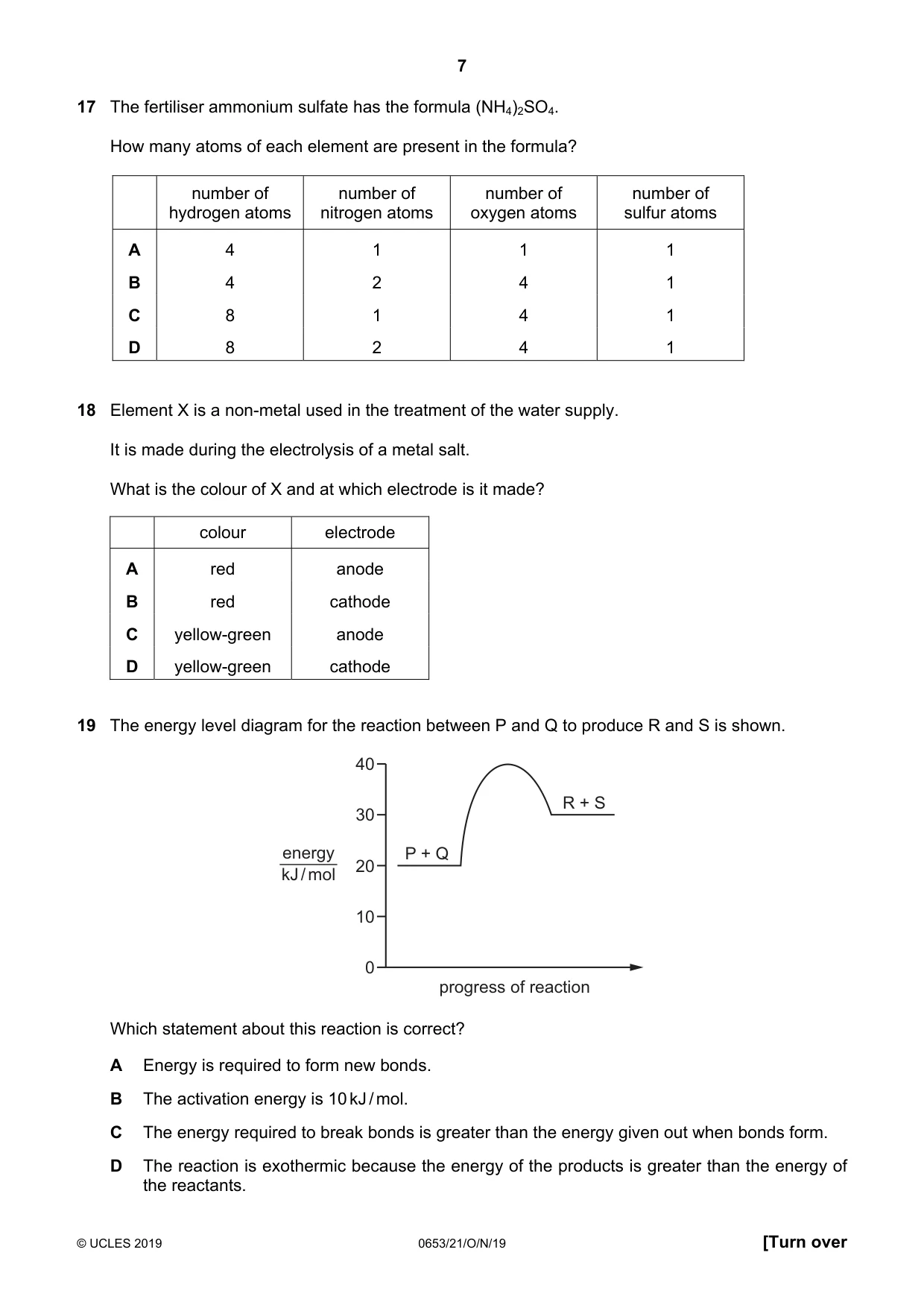
Q17 · The fertiliser ammonium sulfate has the formula (NH4)2SO4
17 The fertiliser ammonium sulfate has the formula (NH4)2SO4. How many atoms of each element are present in the formula? number of number of number of number of hydrogen atoms nitrogen atoms oxygen atoms sulfur atoms A 4 1 1 1 B 4 2 4 1 C 8 1 4 1 D 8 2 4 1
Mark scheme: D
Q18 · Element X is a non-metal used in the treatment of the water supply
18 Element X is a non-metal used in the treatment of the water supply. It is made during the electrolysis of a metal salt. What is the colour of X and at which electrode is it made? colour electrode A red anode B red cathode C yellow-green anode D yellow-green cathode
Mark scheme: C
Q19 · The energy level diagram for the reaction between P and Q to produce R and S is shown
19 The energy level diagram for the reaction between P and Q to produce R and S is shown. 40 R + S 30 energy P + Q 20 kJ / mol 10 0 progress of reaction Which statement about this reaction is correct? A Energy is required to form new bonds. B The activation energy is 10 kJ / mol. C The energy required to break bonds is greater than the energy given out when bonds form. D The reaction is exothermic because the energy of the products is greater than the energy of the reactants.
Mark scheme: C
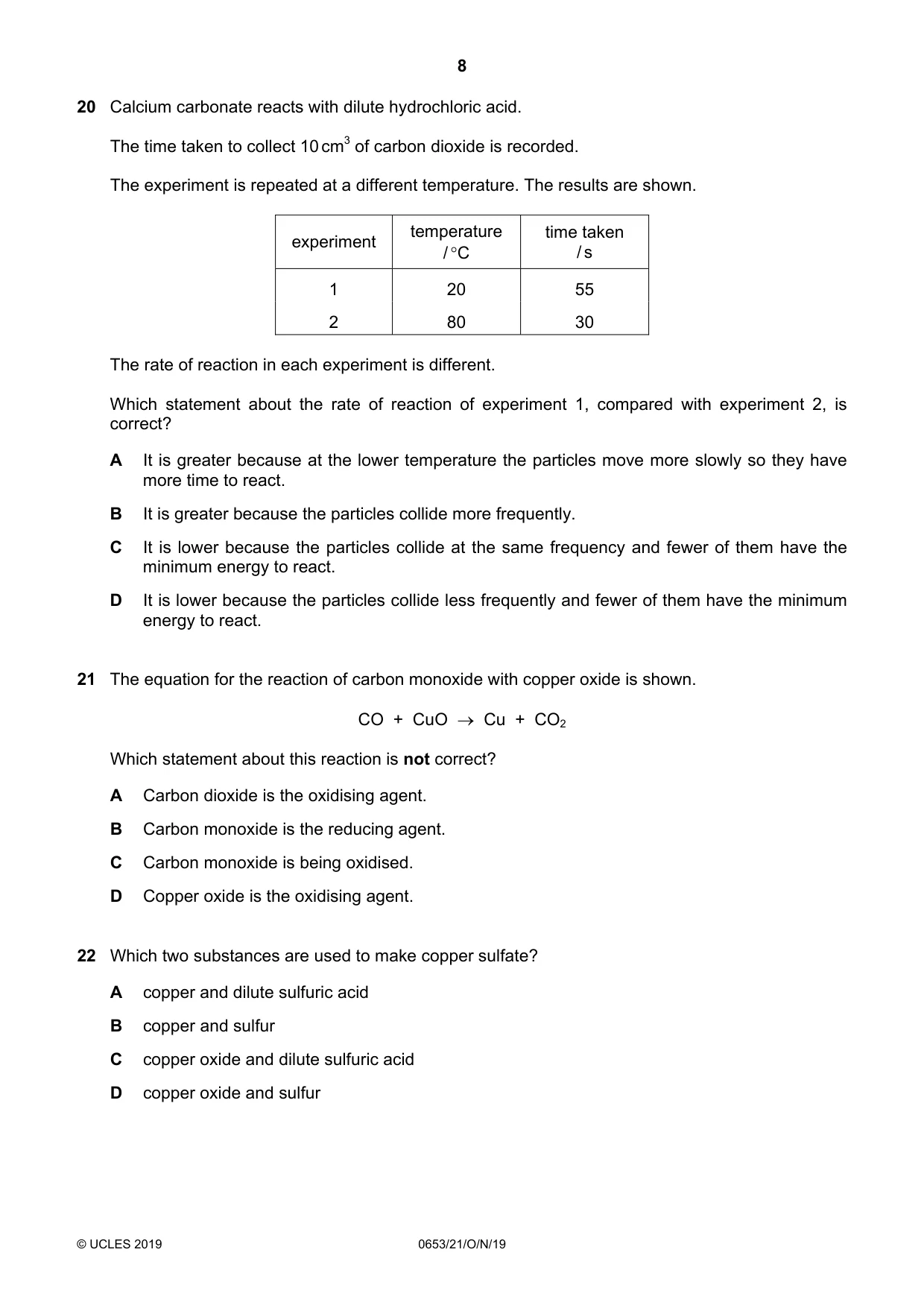
Q20 · Calcium carbonate reacts with dilute hydrochloric acid
20 Calcium carbonate reacts with dilute hydrochloric acid. The time taken to collect 10 cm3 of carbon dioxide is recorded. The experiment is repeated at a different temperature. The results are shown. temperature time taken experiment / °C / s 1 20 55 2 80 30 The rate of reaction in each experiment is different. Which statement about the rate of reaction of experiment 1, compared with experiment 2, is correct? A It is greater because at the lower temperature the particles move more slowly so they have more time to react. B It is greater because the particles collide more frequently. C It is lower because the particles collide at the same frequency and fewer of them have the minimum energy to react. D It is lower because the particles collide less frequently and fewer of them have the minimum energy to react.
Mark scheme: D
Q21 · The equation for the reaction of carbon monoxide with copper oxide is shown
21 The equation for the reaction of carbon monoxide with copper oxide is shown. CO + CuO → Cu + CO2 Which statement about this reaction is not correct? A Carbon dioxide is the oxidising agent. B Carbon monoxide is the reducing agent. C Carbon monoxide is being oxidised. D Copper oxide is the oxidising agent.
Mark scheme: A
Q22 · Which two substances are used to make copper sulfate?
22 Which two substances are used to make copper sulfate? A copper and dilute sulfuric acid B copper and sulfur C copper oxide and dilute sulfuric acid D copper oxide and sulfur
Mark scheme: C
Q23 · Which statement about elements in the Periodic Table is not correct?
23 Which statement about elements in the Periodic Table is not correct? A Elements in Group I react by gaining electrons to form ions. B Elements in Group II have two electrons in their outer shell. C Elements in Group VIII are unreactive because they have full outer shells of electrons. D Elements with seven outer shell electrons are non-metals.
Mark scheme: A
Q24 · Which statement about alloys is correct?
24 Which statement about alloys is correct? A They are made from metals because metals are poor electrical conductors. B They are mixtures of compounds that contain metals. C They have all the same properties as the metals from which they are made. D They have different properties to the metals from which they are made.
Mark scheme: D
Q25 · Which gas is not present in clean air?
25 Which gas is not present in clean air? A carbon monoxide B neon C nitrogen D water vapour
Mark scheme: A
Q26 · Which two gases cause an enhanced greenhouse effect when their concentrations in the…
26 Which two gases cause an enhanced greenhouse effect when their concentrations in the atmosphere increase? A carbon monoxide and carbon dioxide B carbon dioxide and methane C methane and sulfur dioxide D sulfur dioxide and carbon monoxide
Mark scheme: B
Q27 · Which statement about fractions obtained from petroleum is not correct?
27 Which statement about fractions obtained from petroleum is not correct? A Different fractions have different boiling points. B Gasoline contains molecules of only one hydrocarbon. C Molecules in diesel oil are smaller than molecules in bitumen. D Naphtha is used as a feedstock for making chemicals.
Mark scheme: B
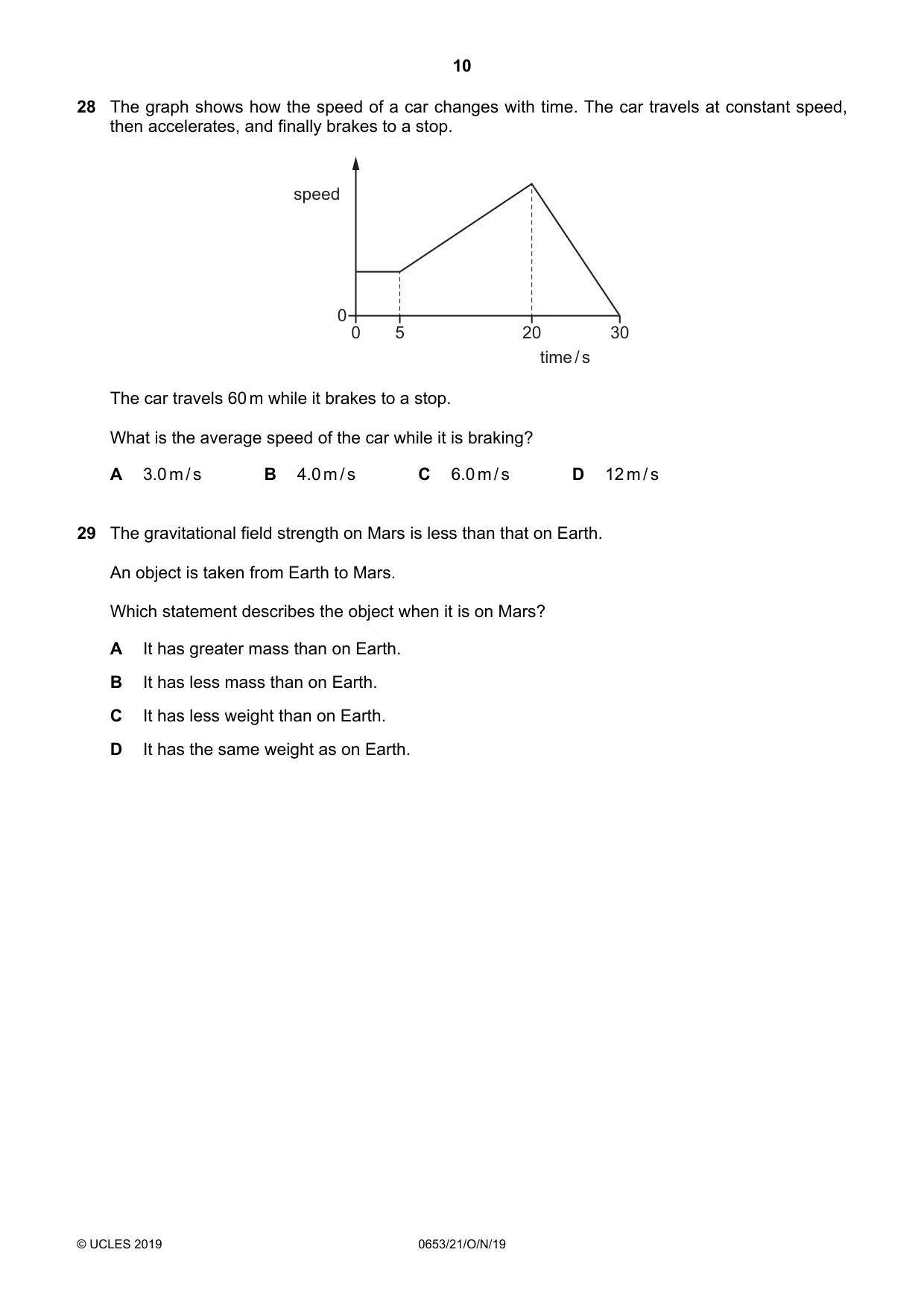
Q28 · The graph shows how the speed of a car changes with time
28 The graph shows how the speed of a car changes with time. The car travels at constant speed, then accelerates, and finally brakes to a stop. speed 0 0 5 20 30 time / s The car travels 60 m while it brakes to a stop. What is the average speed of the car while it is braking? A 3.0 m / s B 4.0 m / s C 6.0 m / s D 12 m / s
Mark scheme: C
Q29 · The gravitational field strength on Mars is less than that on Earth
29 The gravitational field strength on Mars is less than that on Earth. An object is taken from Earth to Mars. Which statement describes the object when it is on Mars? A It has greater mass than on Earth. B It has less mass than on Earth. C It has less weight than on Earth. D It has the same weight as on Earth.
Mark scheme: C
Q30 · A student wants to determine the density of an irregularly shaped stone
30 A student wants to determine the density of an irregularly shaped stone. He has a measuring cylinder, water, a balance and a thermometer. These are his measurements: P initial volume of water in measuring cylinder Q mass of measuring cylinder R mass of stone S mass of water in measuring cylinder T reading on measuring cylinder with stone fully immersed in the water U temperature of water Which three measurements are needed to determine the density of the stone? A P, R and T B P, T and U C Q, R and S D Q, S and U
Mark scheme: A
Q31 · Which device uses a non-renewable energy source?
31 Which device uses a non-renewable energy source? A diesel engine B solar cell C water turbine D windmill
Mark scheme: A
Q32 · A metal pan containing water is heated on a hot stove
32 A metal pan containing water is heated on a hot stove. Energy is transferred thermally from the stove to the water. How is the energy transferred through the pan and then throughout the water? through the pan throughout the water A conduction conduction B conduction convection C convection conduction D convection convection
Mark scheme: B
Q33 · On a hot, sunny day a boy finds that his head stays cooler when he wears a white hat than…
33 On a hot, sunny day a boy finds that his head stays cooler when he wears a white hat than when he wears an otherwise identical black hat. Why does the white hat keep his head cooler? A It absorbs less radiation from the Sun than the black hat. B It conducts less heat energy than the black hat. C It conducts more heat energy than the black hat. D It emits more radiation from his head than the black hat.
Mark scheme: A
Q34 · Which wave is longitudinal?
34 Which wave is longitudinal? A infrared B radio C sound D ultraviolet
Mark scheme: C
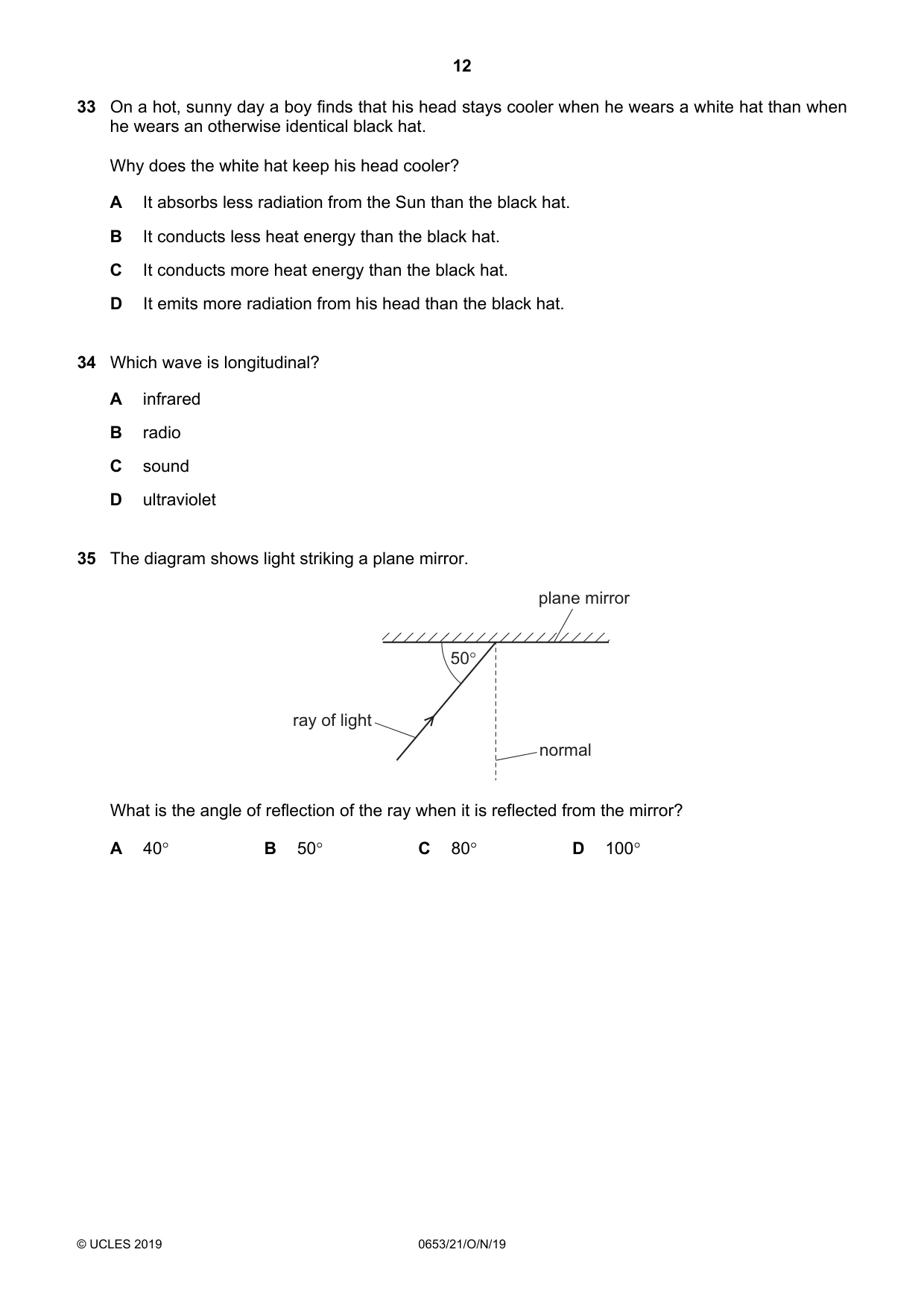
Q35 · The diagram shows light striking a plane mirror
35 The diagram shows light striking a plane mirror. plane mirror 50° ray of light normal What is the angle of reflection of the ray when it is reflected from the mirror? A 40° B 50° C 80° D 100°
Mark scheme: A
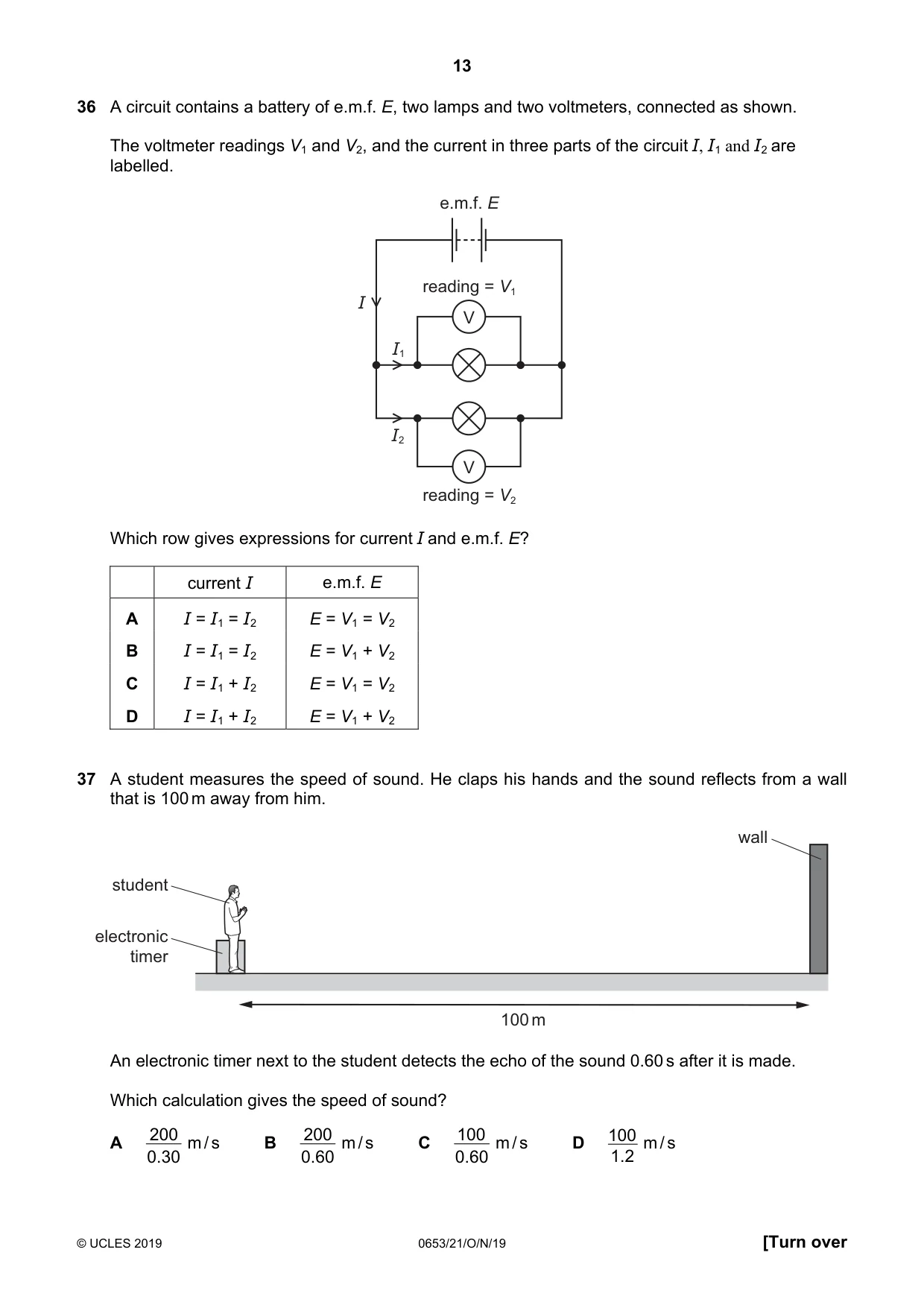
Q36 · A circuit contains a battery of e.m.f
36 A circuit contains a battery of e.m.f. E, two lamps and two voltmeters, connected as shown. The voltmeter readings V1 and V2, and the current in three parts of the circuit I, I1 and I2 are labelled. e.m.f. E reading = V1 I V I1 I2 V reading = V2 Which row gives expressions for current I and e.m.f. E? current I e.m.f. E A I = I1 = I2 E = V1 = V2 B I = I1 = I2 E = V1 + V2 C I = I1 + I2 E = V1 = V2 D I = I1 + I2 E = V1 + V2
Mark scheme: C
Q37 · A student measures the speed of sound
37 A student measures the speed of sound. He claps his hands and the sound reflects from a wall that is 100 m away from him. wall student electronic timer 100 m An electronic timer next to the student detects the echo of the sound 0.60 s after it is made. Which calculation gives the speed of sound? 200 200 100 100 A m / s B m / s C m / s D m / s 0.30 0.60 0.60 1 . 2
Mark scheme: B
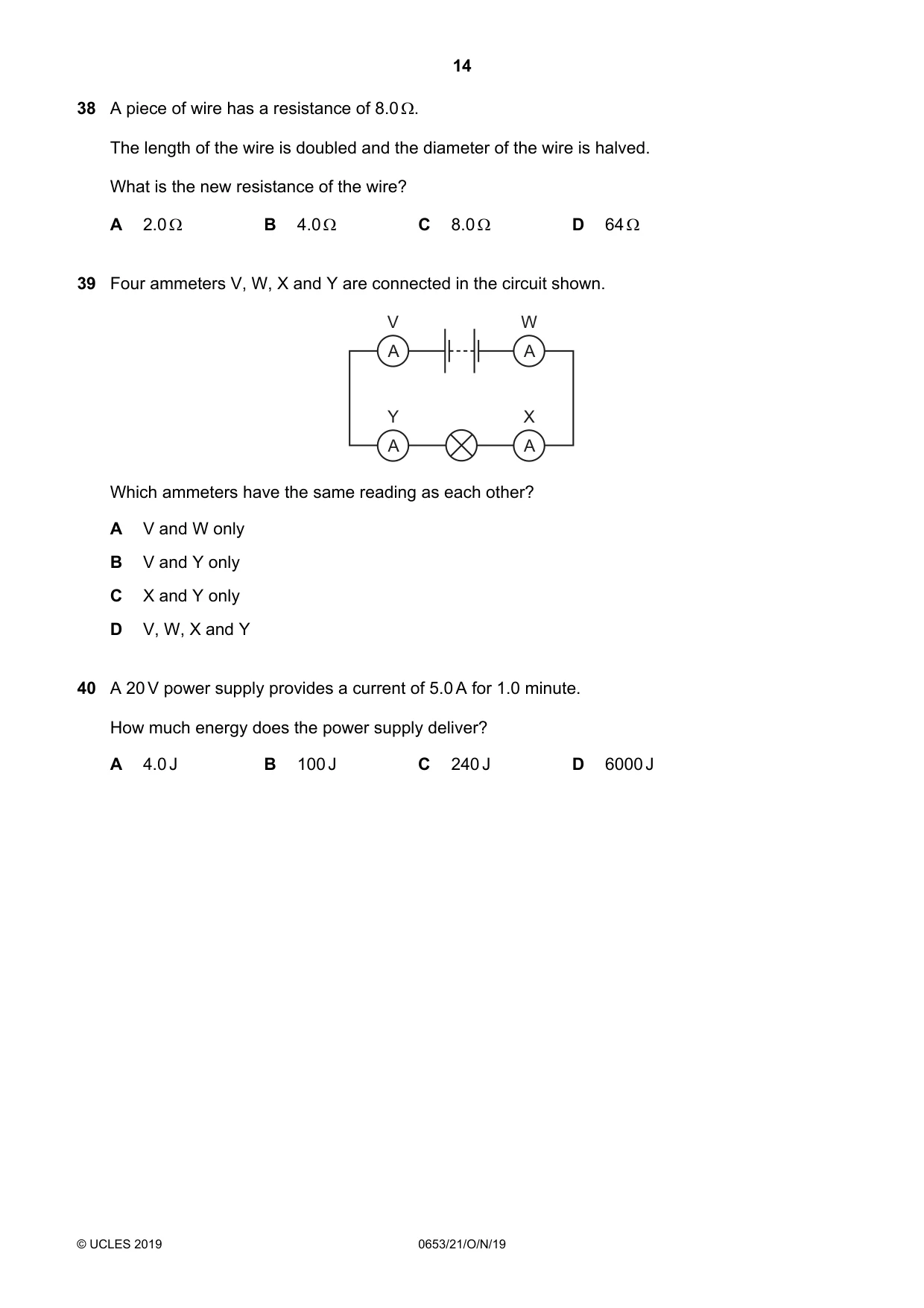
Q38 · A piece of wire has a resistance of 8.0 Ω
38 A piece of wire has a resistance of 8.0 Ω. The length of the wire is doubled and the diameter of the wire is halved. What is the new resistance of the wire? A 2.0 Ω B 4.0 Ω C 8.0 Ω D 64 Ω
Mark scheme: D
Q39 · Four ammeters V, W, X and Y are connected in the circuit shown
39 Four ammeters V, W, X and Y are connected in the circuit shown. V W A A Y X A A Which ammeters have the same reading as each other? A V and W only B V and Y only C X and Y only D V, W, X and Y
Mark scheme: D
Q40 · A 20 V power supply provides a current of 5.0 A for 1.0 minute
40 A 20 V power supply provides a current of 5.0 A for 1.0 minute. How much energy does the power supply deliver? A 4.0 J B 100 J C 240 J D 6000 J
Mark scheme: D
What was in this paper
The subtopics covered by these 40 questions, and how many questions each got. Open one in a new tab to see every Cambridge question on it.
2Electrical circuits2Electrical quantities2Sexual reproduction in humans2Transfer of thermal energy2Alloys and their properties1Characteristics of living organisms1Chromatography1Circulatory systems1Density1Electrolysis1Elements, compounds and mixtures1Energy, work and power1Enzymes1Exothermic and endothermic reactions1Formulas1Fuels1Gas exchange in humans1General properties of waves1Group I properties1Habitat destruction1Heart1Leaf structure1Light1Mass and weight1Motion1Photosynthesis1Physical and chemical changes1Preparation of salts1Rate of reaction1Redox1Respiration1Sexual reproduction in plants1Sound1Water uptake1What you needed in this session
Cambridge’s own grade thresholds for 2019 Oct/Nov, Paper 2 · Variant 1. A higher threshold means an easier paper — the bar moves with how the cohort did.