Cambridge IGCSE Science - Combined 0653 — 2023 Feb/March Paper 2 · Variant 2
0653/22/F/M/23 · 40 questions · 40 marks · ≈45 min
The question paper and its mark scheme, free to read here and free to download. This is Cambridge’s own paper, exactly as it was sat.
Question paper16 pages
Mark scheme3 pages
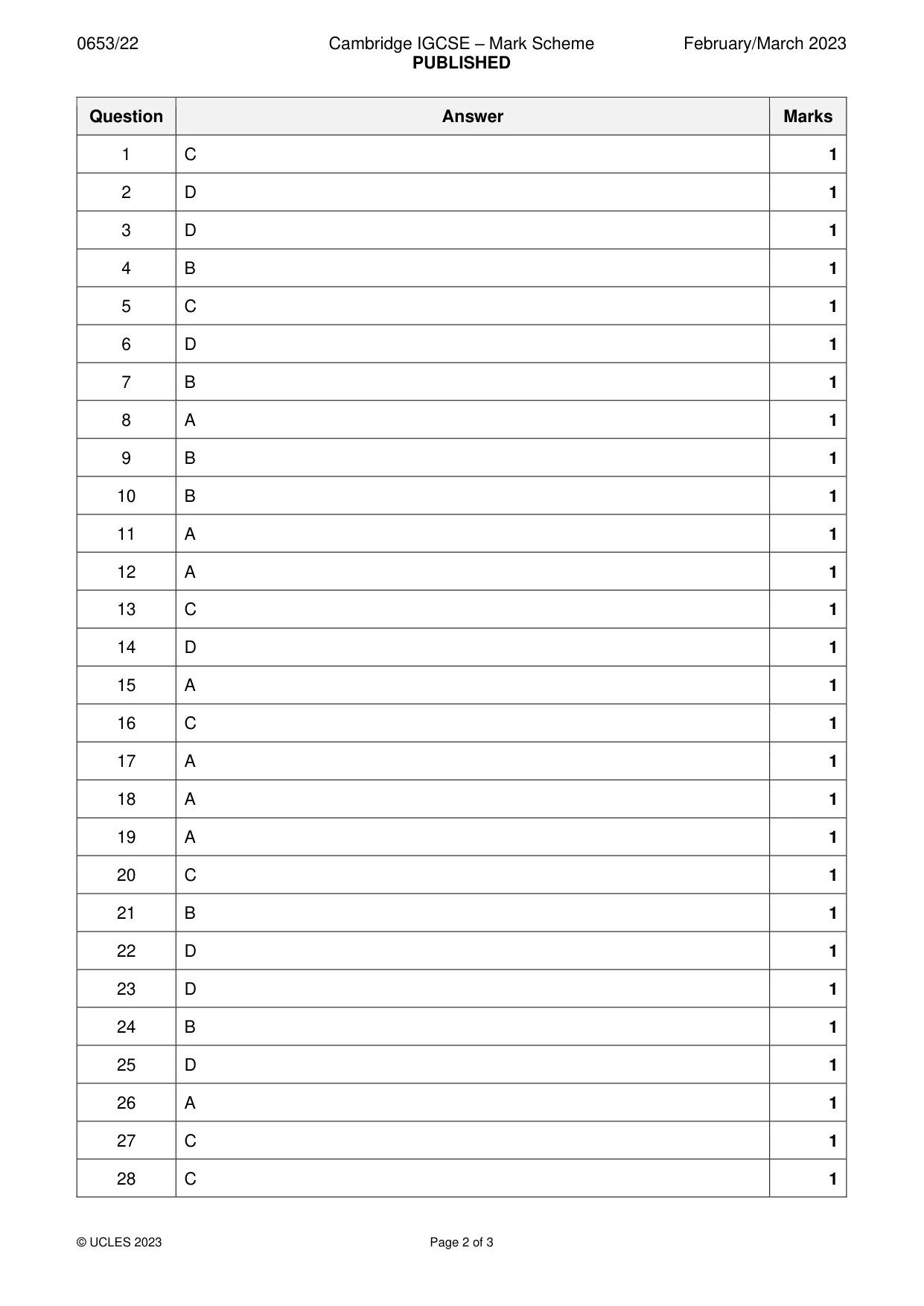
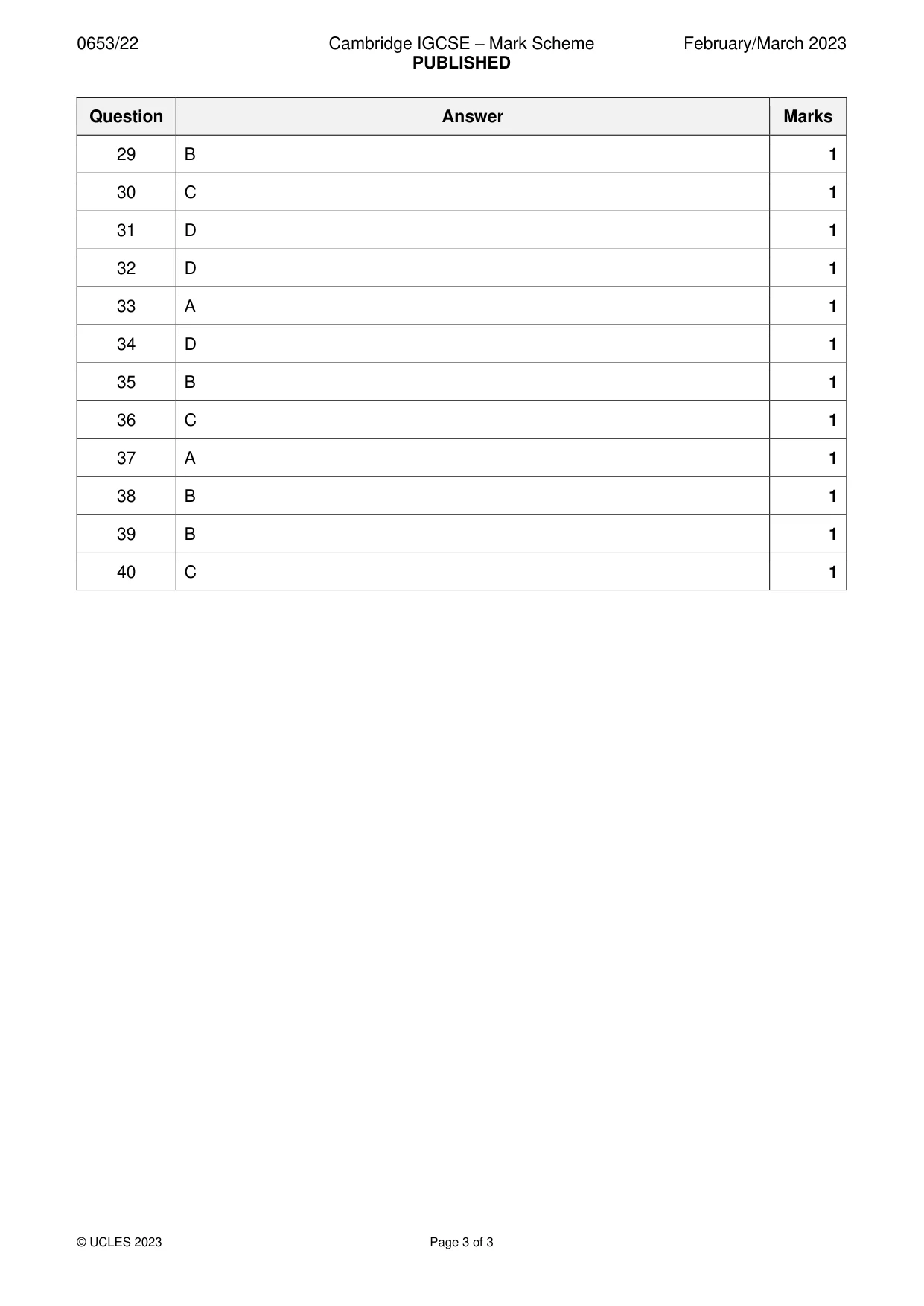
Answers below. Sit the paper first if you are practising.
Questions as text
Q1 · Two pieces of potato are cut to have exactly the same mass and shape
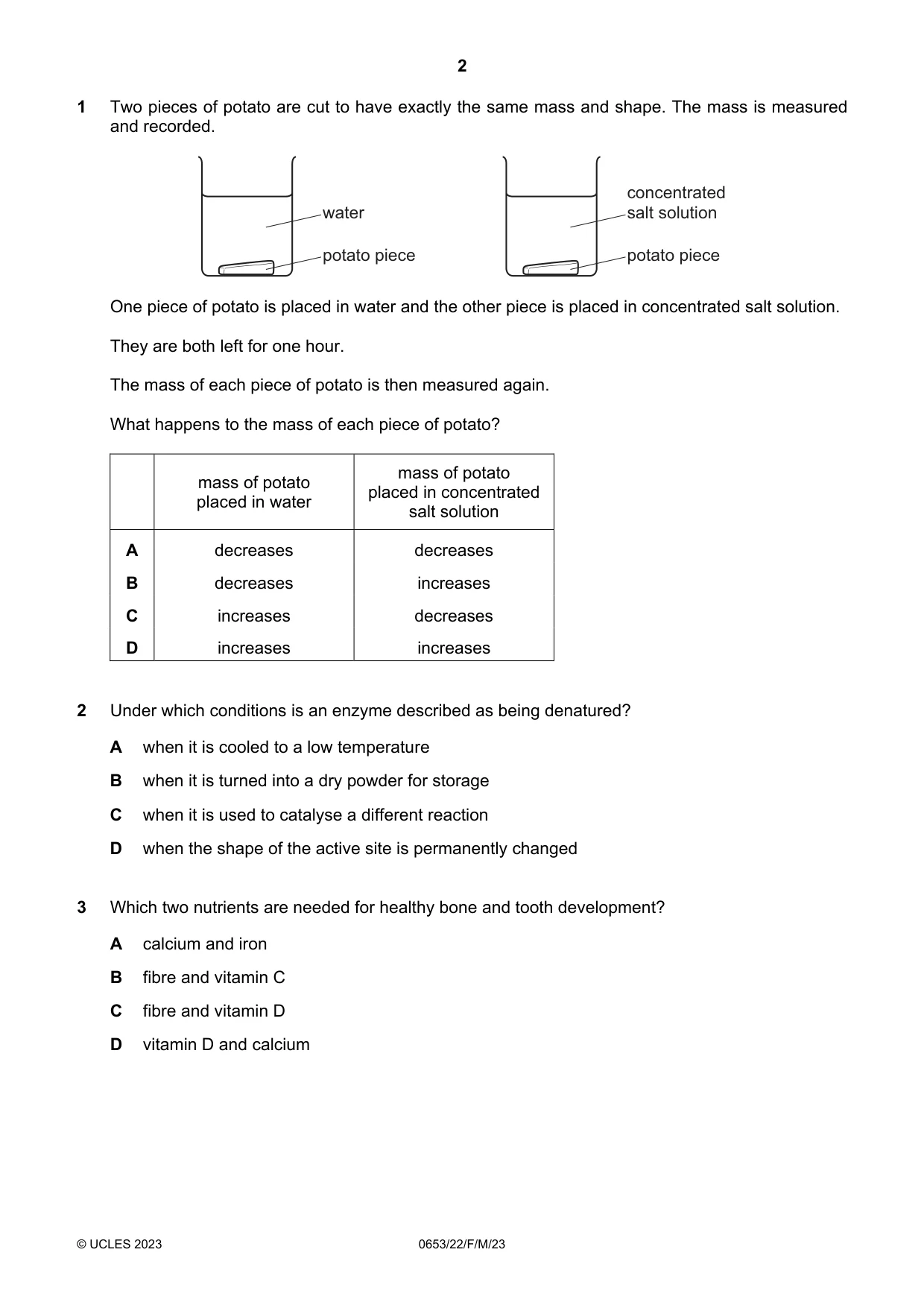
1 Two pieces of potato are cut to have exactly the same mass and shape. The mass is measured and recorded. concentrated water salt solution potato piece potato piece One piece of potato is placed in water and the other piece is placed in concentrated salt solution. They are both left for one hour. The mass of each piece of potato is then measured again. What happens to the mass of each piece of potato? mass of potato mass of potato placed in concentrated placed in water salt solution A decreases decreases B decreases increases C increases decreases D increases increases
Mark scheme: C
Q2 · Under which conditions is an enzyme described as being denatured?
2 Under which conditions is an enzyme described as being denatured? A when it is cooled to a low temperature B when it is turned into a dry powder for storage C when it is used to catalyse a different reaction D when the shape of the active site is permanently changed
Mark scheme: D
Q3 · Which two nutrients are needed for healthy bone and tooth development?
3 Which two nutrients are needed for healthy bone and tooth development? A calcium and iron B fibre and vitamin C C fibre and vitamin D D vitamin D and calcium
Mark scheme: D
Q4 · The diagram shows some organs of the human body
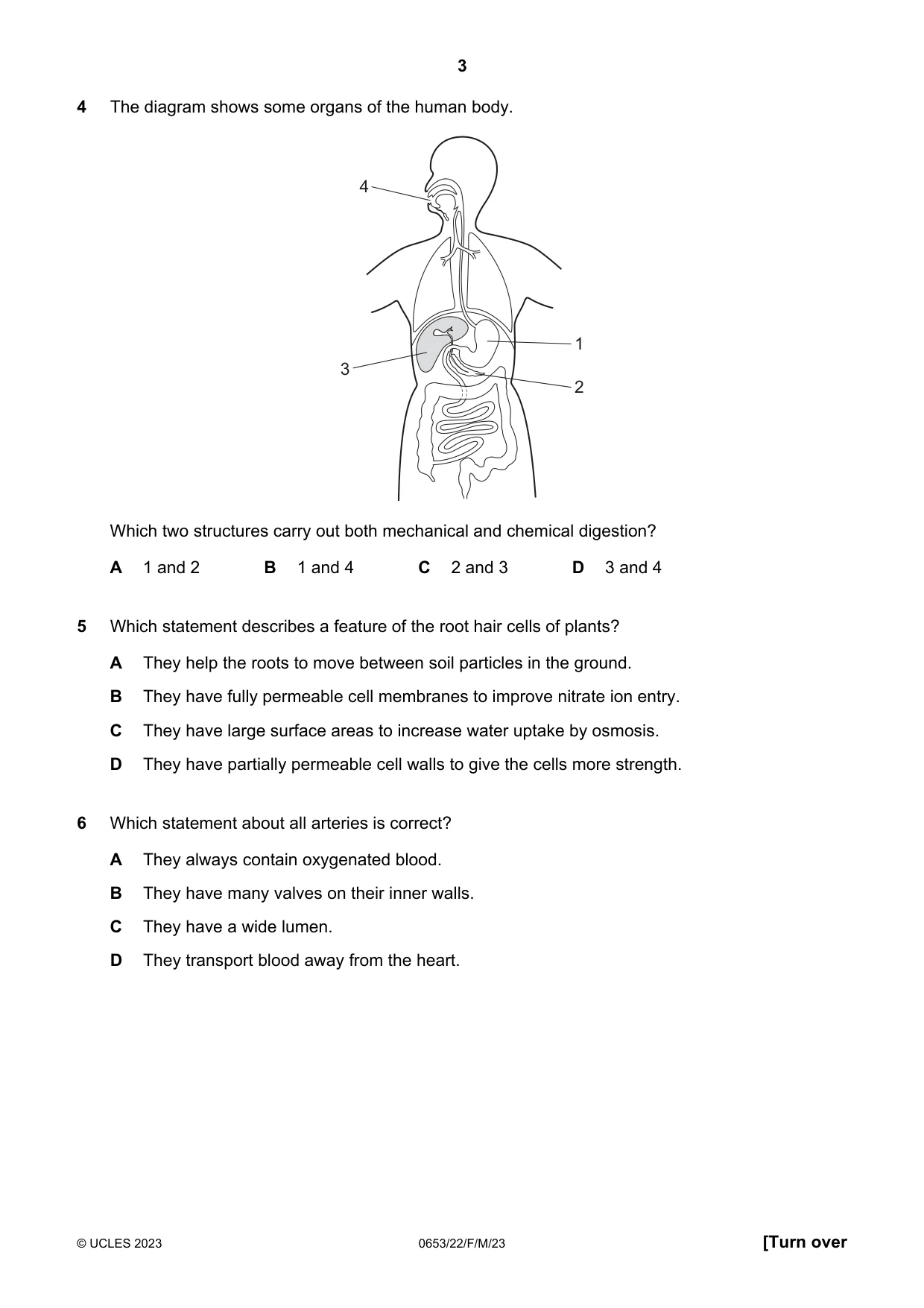
4 The diagram shows some organs of the human body. 4 1 3 2 Which two structures carry out both mechanical and chemical digestion? A 1 and 2 B 1 and 4 C 2 and 3 D 3 and 4
Mark scheme: B
Q5 · Which statement describes a feature of the root hair cells of plants?
5 Which statement describes a feature of the root hair cells of plants? A They help the roots to move between soil particles in the ground. B They have fully permeable cell membranes to improve nitrate ion entry. C They have large surface areas to increase water uptake by osmosis. D They have partially permeable cell walls to give the cells more strength.
Mark scheme: C
Q6 · Which statement about all arteries is correct?
6 Which statement about all arteries is correct? A They always contain oxygenated blood. B They have many valves on their inner walls. C They have a wide lumen. D They transport blood away from the heart.
Mark scheme: D
Q7 · The table shows the differences in the composition of carbon dioxide, oxygen and water…
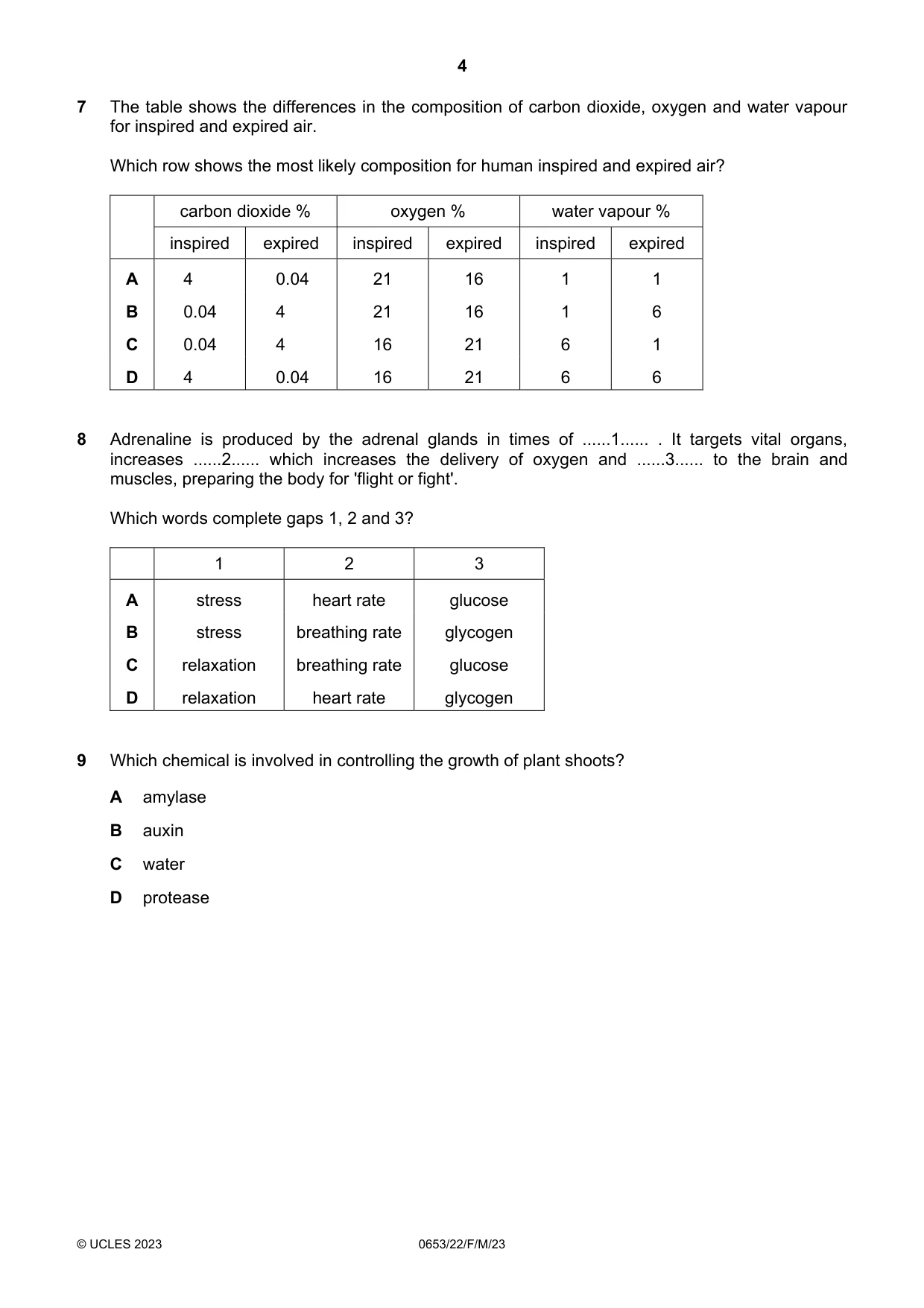
7 The table shows the differences in the composition of carbon dioxide, oxygen and water vapour for inspired and expired air. Which row shows the most likely composition for human inspired and expired air? carbon dioxide % oxygen % water vapour % inspired expired inspired expired inspired expired A 4 0.04 21 16 1 1 B 0.04 4 21 16 1 6 C 0.04 4 16 21 6 1 D 4 0.04 16 21 6 6
Mark scheme: B
Q8 · Adrenaline is produced by the adrenal glands in times of ......1.....
8 Adrenaline is produced by the adrenal glands in times of ......1...... . It targets vital organs, increases ......2...... which increases the delivery of oxygen and ......3...... to the brain and muscles, preparing the body for 'flight or fight'. Which words complete gaps 1, 2 and 3? 1 2 3 A stress heart rate glucose B stress breathing rate glycogen C relaxation breathing rate glucose D relaxation heart rate glycogen
Mark scheme: A
Q9 · Which chemical is involved in controlling the growth of plant shoots?
9 Which chemical is involved in controlling the growth of plant shoots? A amylase B auxin C water D protease
Mark scheme: B
Q10 · The diagram shows a section through a flower
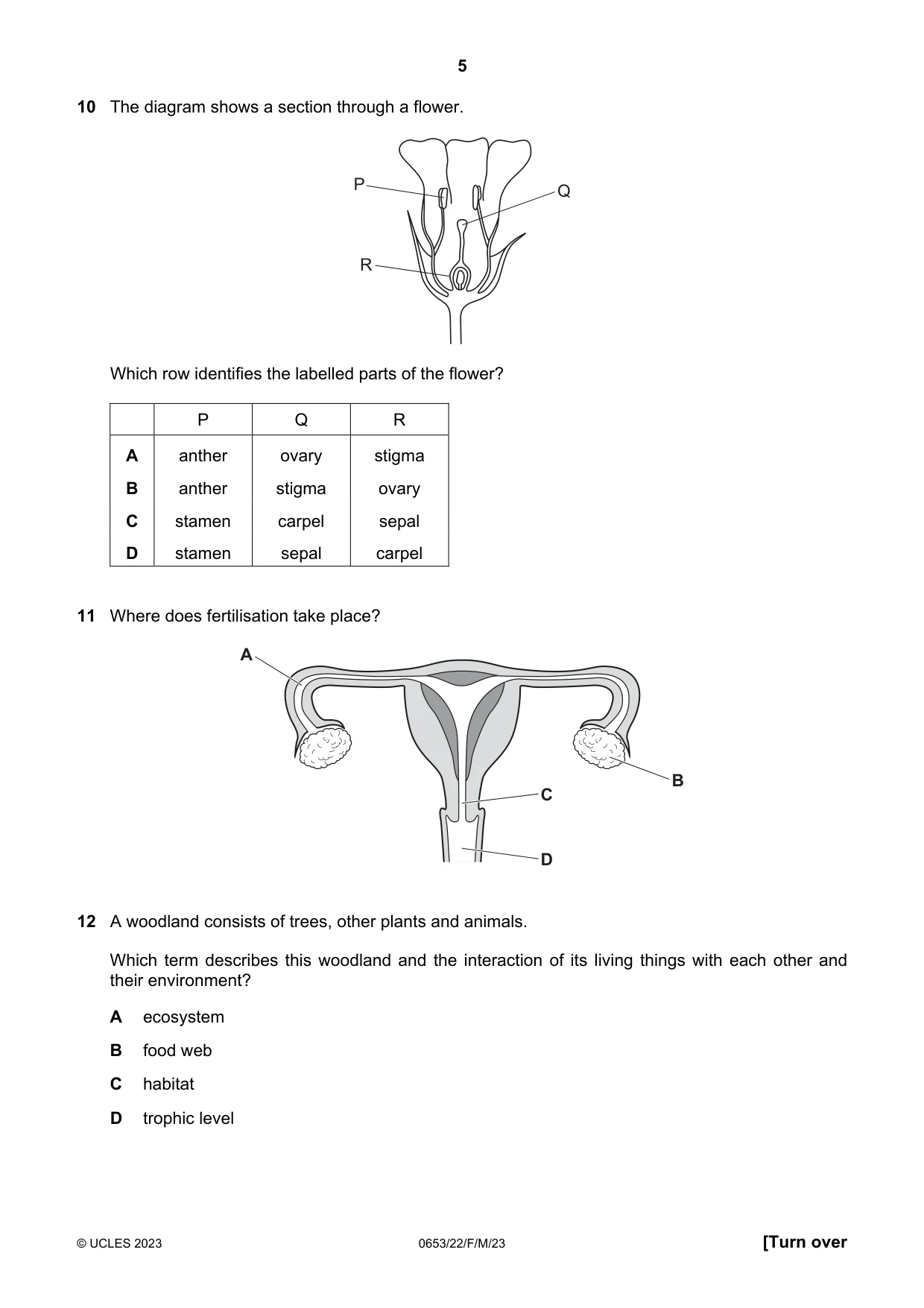
10 The diagram shows a section through a flower. P Q R Which row identifies the labelled parts of the flower? P Q R A anther ovary stigma B anther stigma ovary C stamen carpel sepal D stamen sepal carpel
Mark scheme: B
Q11 · Where does fertilisation take place?
11 Where does fertilisation take place? A B C D
Mark scheme: A
Q12 · A woodland consists of trees, other plants and animals
12 A woodland consists of trees, other plants and animals. Which term describes this woodland and the interaction of its living things with each other and their environment? A ecosystem B food web C habitat D trophic level
Mark scheme: A
Q13 · The concentration of nitrate ions in a lake increases
13 The concentration of nitrate ions in a lake increases. Why does this result in a decrease in the number of fish in the lake? A There is a decrease in the decomposition of producers. B There is a decrease in the growth of producers. C There is an increase in aerobic respiration by decomposers. D There is an increase in dissolved oxygen.
Mark scheme: C
Q14 · The structures of three molecules are shown
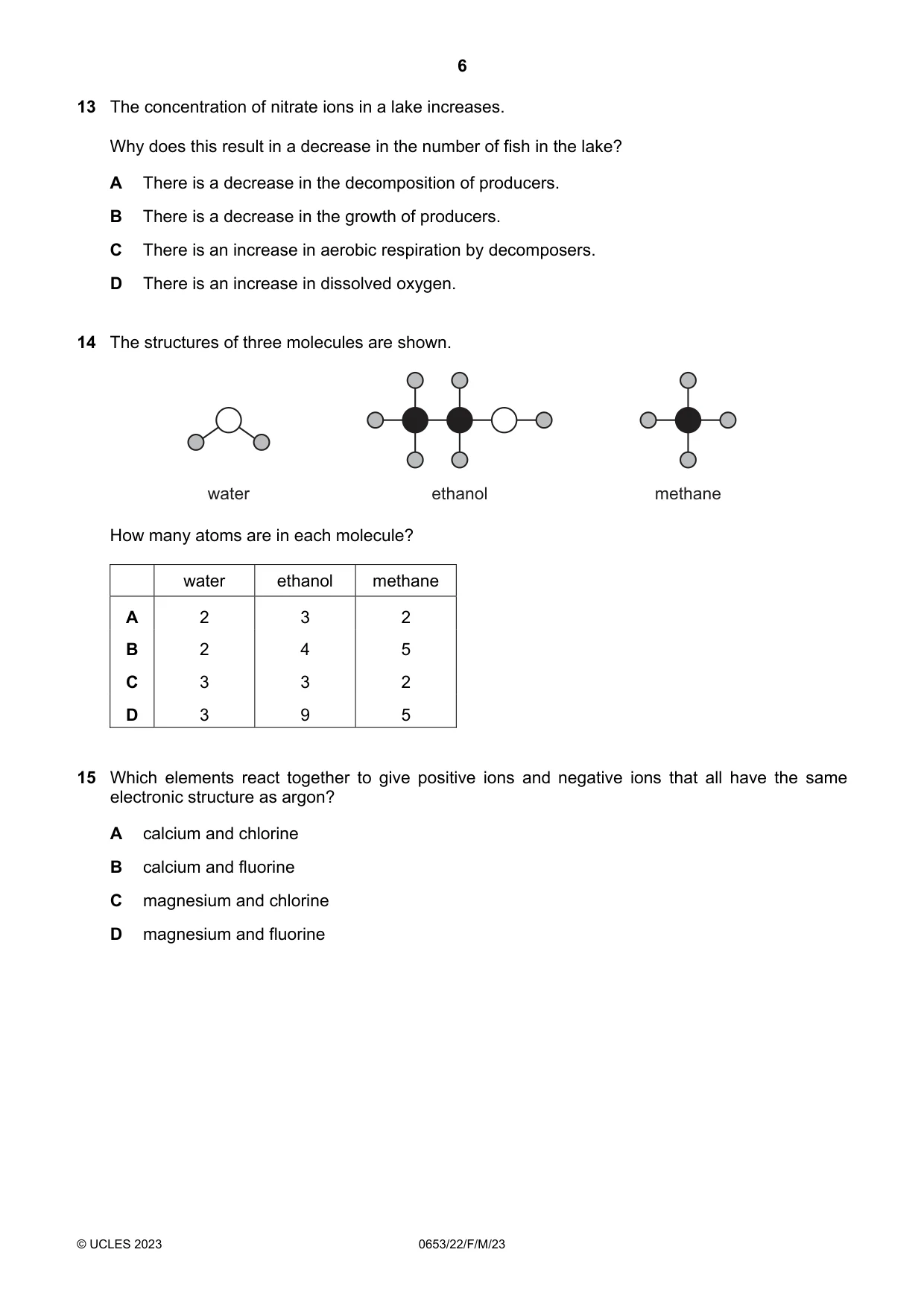
14 The structures of three molecules are shown. water ethanol methane How many atoms are in each molecule? water ethanol methane A 2 3 2 B 2 4 5 C 3 3 2 D 3 9 5
Mark scheme: D
Q15 · Which elements react together to give positive ions and negative ions that all have the…
15 Which elements react together to give positive ions and negative ions that all have the same electronic structure as argon? A calcium and chlorine B calcium and fluorine C magnesium and chlorine D magnesium and fluorine
Mark scheme: A
Q16 · The diagram shows an experiment to electrolyse dilute sulfuric acid
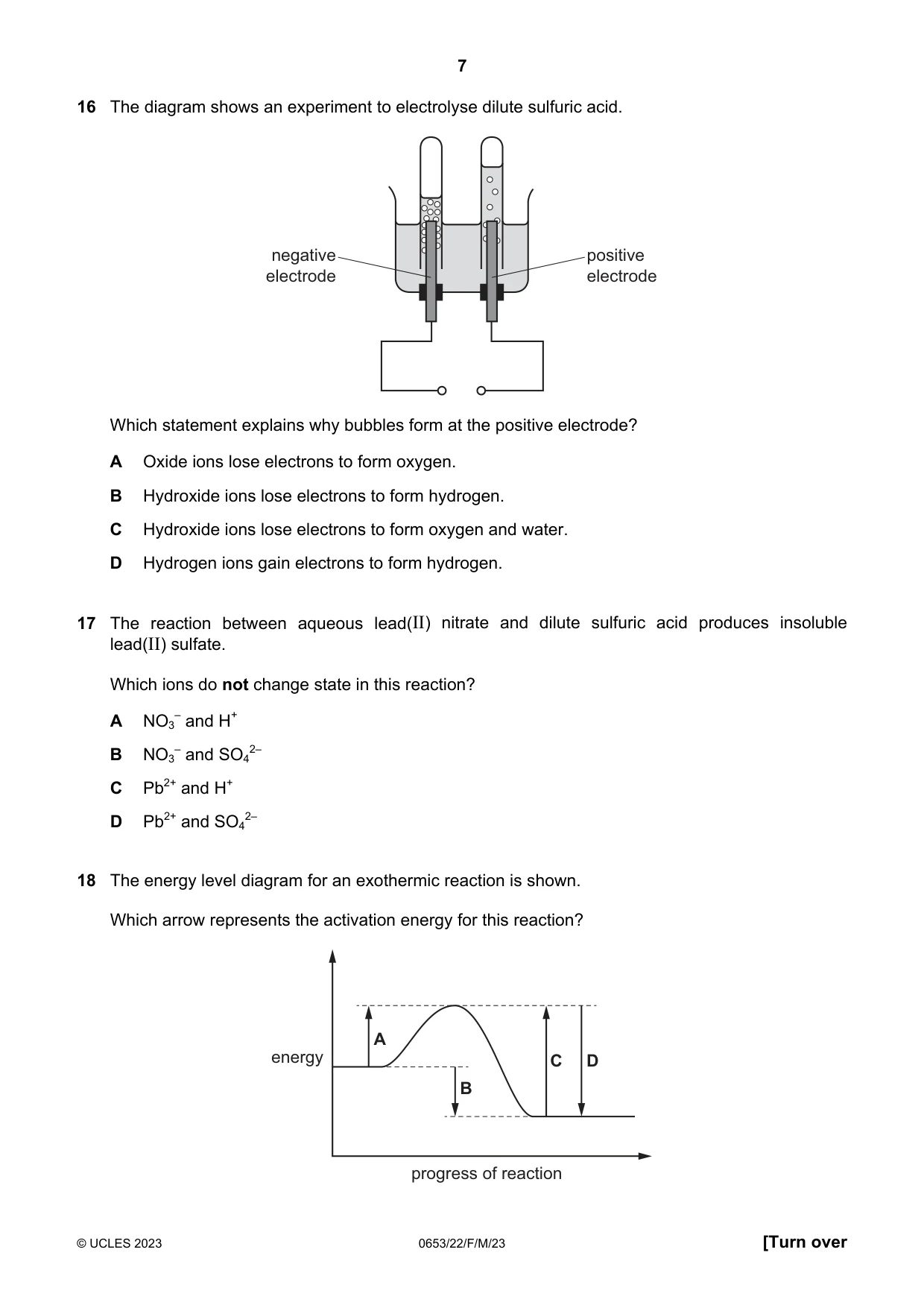
16 The diagram shows an experiment to electrolyse dilute sulfuric acid. negative positive electrode electrode Which statement explains why bubbles form at the positive electrode? A Oxide ions lose electrons to form oxygen. B Hydroxide ions lose electrons to form hydrogen. C Hydroxide ions lose electrons to form oxygen and water. D Hydrogen ions gain electrons to form hydrogen.
Mark scheme: C
Q17 · The reaction between aqueous lead(II) nitrate and dilute sulfuric acid produces insoluble…
17 The reaction between aqueous lead(II) nitrate and dilute sulfuric acid produces insoluble lead(II) sulfate. Which ions do not change state in this reaction? A NO3 – and H+ B NO3 – and SO4 2– C Pb2+ and H+ D Pb2+ and SO4 2–
Mark scheme: A
Q18 · The energy level diagram for an exothermic reaction is shown
18 The energy level diagram for an exothermic reaction is shown. Which arrow represents the activation energy for this reaction? A energy C D B progress of reaction
Mark scheme: A
Q19 · Which statement explains the effect of temperature on the rate of a reaction?
19 Which statement explains the effect of temperature on the rate of a reaction? A At a higher temperature, more particles have sufficient energy to overcome the activation energy. B At a higher temperature, the particles collide less frequently. C At a lower temperature, the particles collide with more energy and so more bonds are broken. D At a lower temperature, the particles have a lower concentration.
Mark scheme: A
Q20 · The equation for one of the reactions that occurs in a blast furnace is shown
20 The equation for one of the reactions that occurs in a blast furnace is shown. Fe2O3 + 3CO → 2Fe + 3CO2 Which row identifies the oxidising agent in this reaction and explains its role as an oxidising agent? oxidising agent explanation A carbon monoxide causes iron(III) oxide to gain oxygen B carbon monoxide causes iron(III) oxide to lose oxygen C iron(III) oxide causes carbon monoxide to gain oxygen D iron(III) oxide causes carbon monoxide to lose oxygen
Mark scheme: C
Q21 · Which solid reacts with sulfuric acid to produce a gas?
21 Which solid reacts with sulfuric acid to produce a gas? A copper B copper carbonate C copper oxide D copper sulfate
Mark scheme: B
More questions on The characteristic properties of acids and bases
Q22 · Some water is added to a coloured, powdered mixture
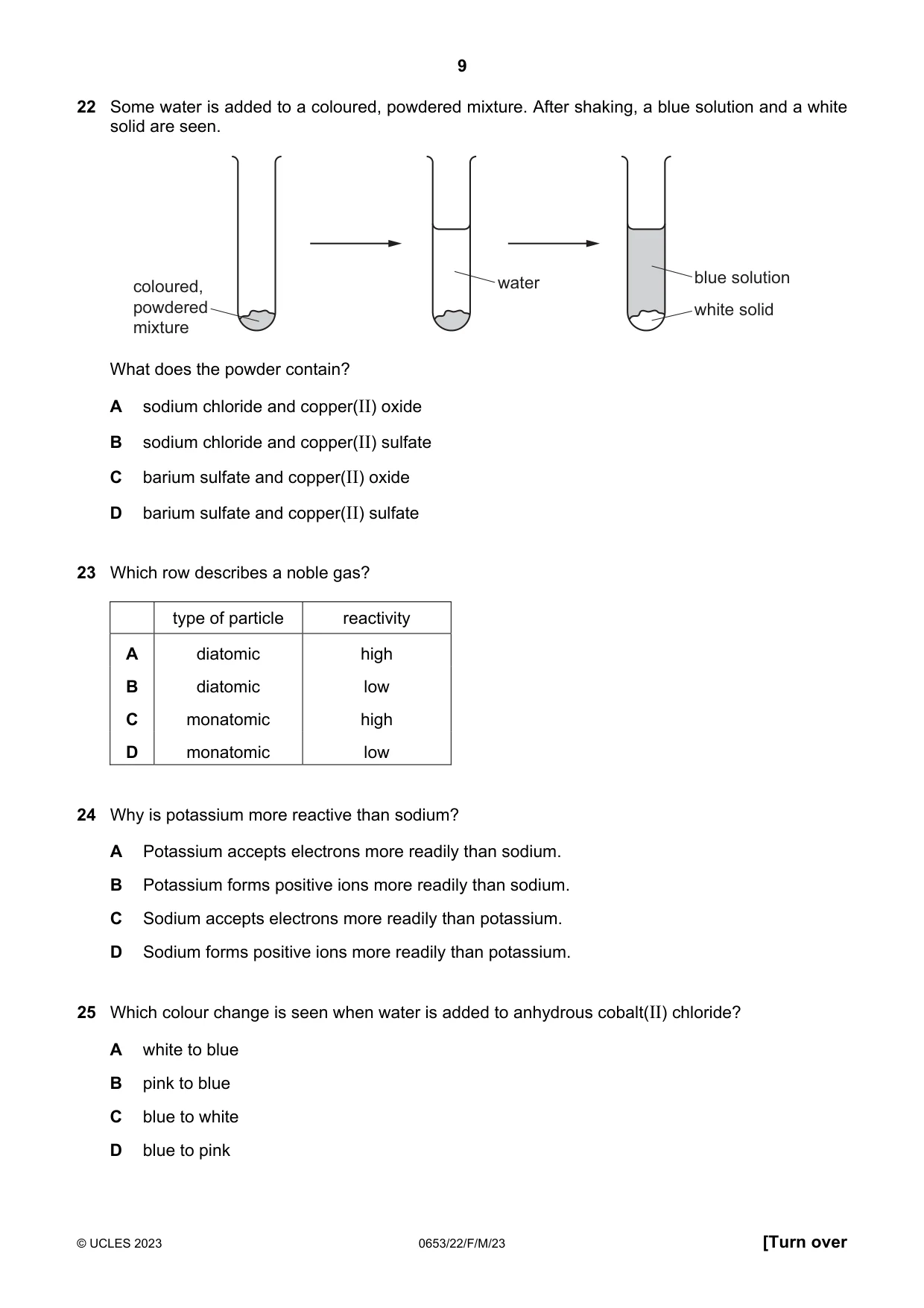
22 Some water is added to a coloured, powdered mixture. After shaking, a blue solution and a white solid are seen. water blue solution coloured, powdered white solid mixture What does the powder contain? A sodium chloride and copper(II) oxide B sodium chloride and copper(II) sulfate C barium sulfate and copper(II) oxide D barium sulfate and copper(II) sulfate
Mark scheme: D
Q23 · Which row describes a noble gas?
23 Which row describes a noble gas? type of particle reactivity A diatomic high B diatomic low C monatomic high D monatomic low
Mark scheme: D
Q24 · Why is potassium more reactive than sodium?
24 Why is potassium more reactive than sodium? A Potassium accepts electrons more readily than sodium. B Potassium forms positive ions more readily than sodium. C Sodium accepts electrons more readily than potassium. D Sodium forms positive ions more readily than potassium.
Mark scheme: B
Q25 · Which colour change is seen when water is added to anhydrous cobalt(II) chloride?
25 Which colour change is seen when water is added to anhydrous cobalt(II) chloride? A white to blue B pink to blue C blue to white D blue to pink
Mark scheme: D
Q26 · Which statements about air pollutants are correct?
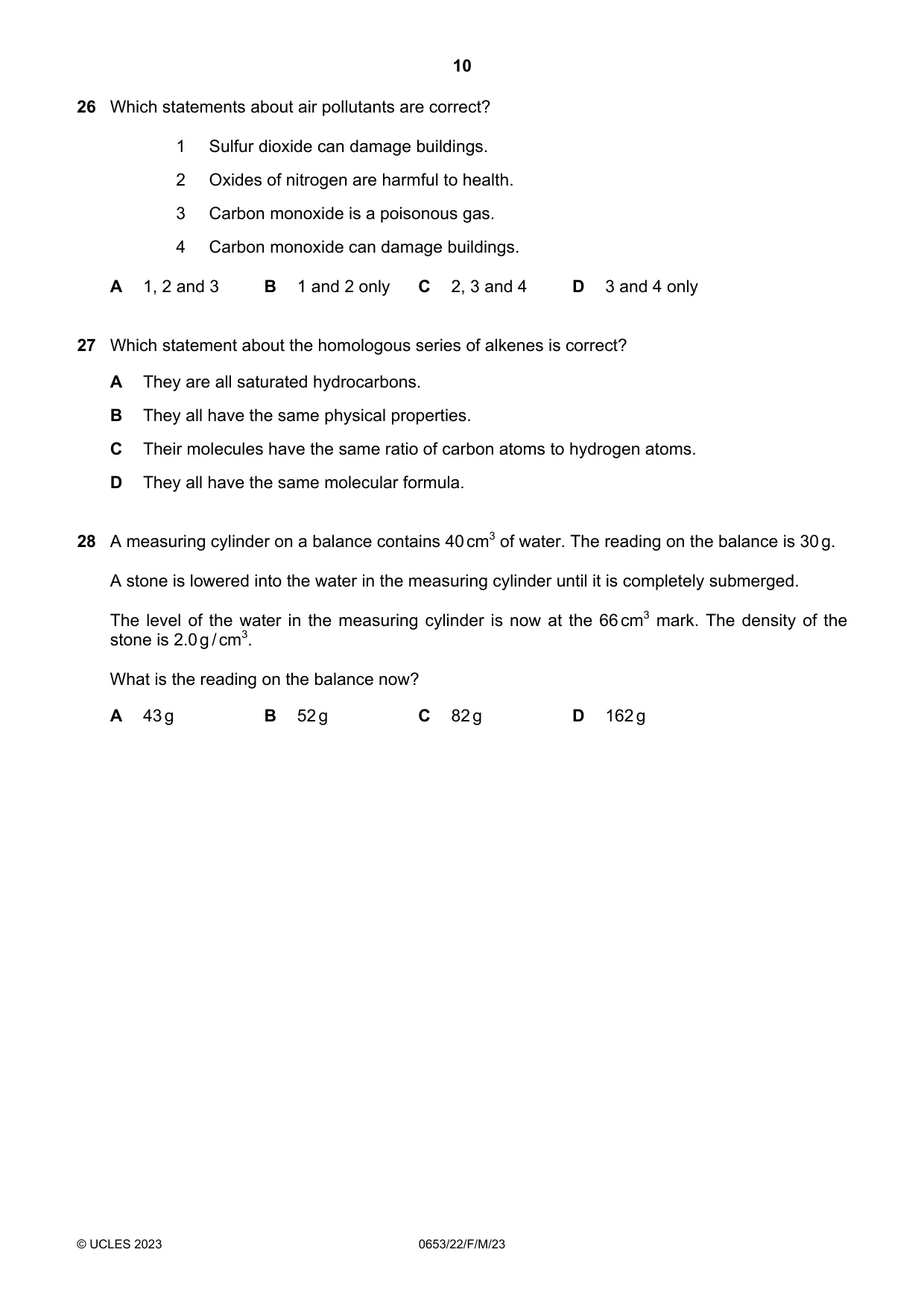
26 Which statements about air pollutants are correct? 1 Sulfur dioxide can damage buildings. 2 Oxides of nitrogen are harmful to health. 3 Carbon monoxide is a poisonous gas. 4 Carbon monoxide can damage buildings. A 1, 2 and 3 B 1 and 2 only C 2, 3 and 4 D 3 and 4 only
Mark scheme: A
Q27 · Which statement about the homologous series of alkenes is correct?
27 Which statement about the homologous series of alkenes is correct? A They are all saturated hydrocarbons. B They all have the same physical properties. C Their molecules have the same ratio of carbon atoms to hydrogen atoms. D They all have the same molecular formula.
Mark scheme: C
Q28 · A measuring cylinder on a balance contains 40 cm3 of water
28 A measuring cylinder on a balance contains 40 cm3 of water. The reading on the balance is 30 g. A stone is lowered into the water in the measuring cylinder until it is completely submerged. The level of the water in the measuring cylinder is now at the 66 cm3 mark. The density of the stone is 2.0 g / cm3. What is the reading on the balance now? A 43 g B 52 g C 82 g D 162 g
Mark scheme: C
Q29 · The force acting on a spring is gradually increased from 0 N
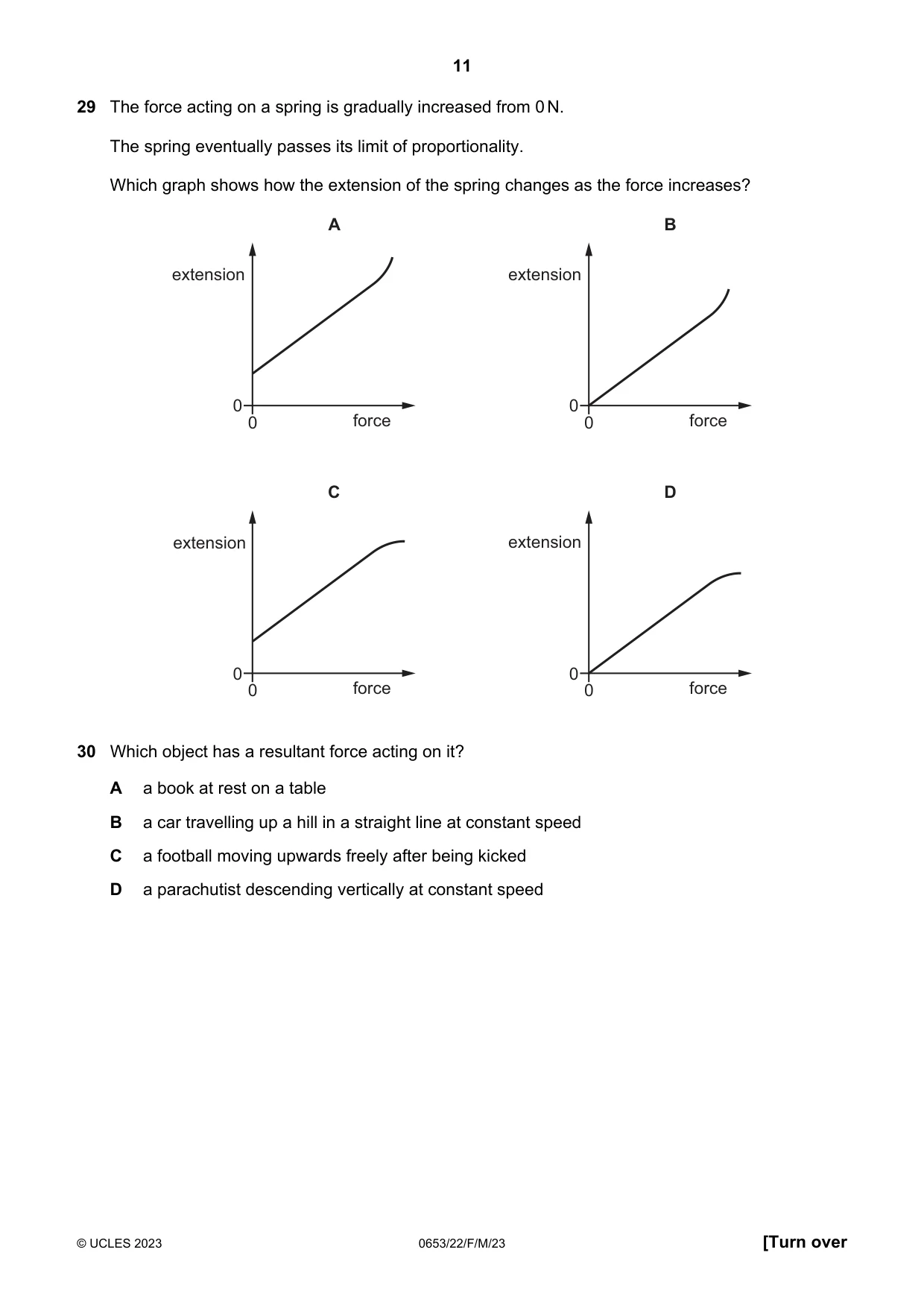
29 The force acting on a spring is gradually increased from 0 N. The spring eventually passes its limit of proportionality. Which graph shows how the extension of the spring changes as the force increases? A B extension extension 0 0 0 force 0 force C D extension extension 0 0 0 force 0 force
Mark scheme: B
Q30 · Which object has a resultant force acting on it?
30 Which object has a resultant force acting on it? A a book at rest on a table B a car travelling up a hill in a straight line at constant speed C a football moving upwards freely after being kicked D a parachutist descending vertically at constant speed
Mark scheme: C
Q31 · An object is falling in a vacuum
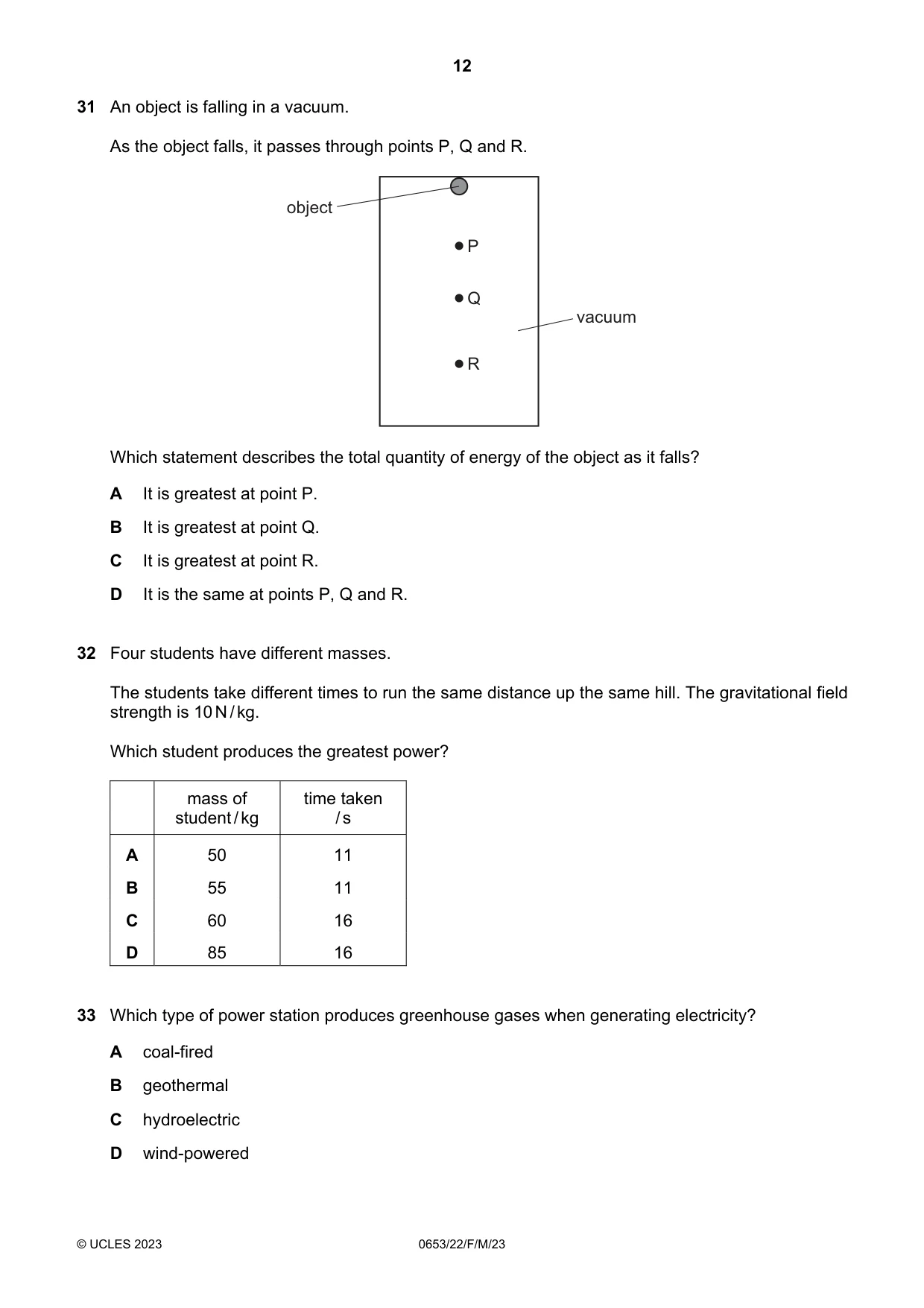
31 An object is falling in a vacuum. As the object falls, it passes through points P, Q and R. object P Q vacuum R Which statement describes the total quantity of energy of the object as it falls? A It is greatest at point P. B It is greatest at point Q. C It is greatest at point R. D It is the same at points P, Q and R.
Mark scheme: D
Q32 · Four students have different masses
32 Four students have different masses. The students take different times to run the same distance up the same hill. The gravitational field strength is 10 N / kg. Which student produces the greatest power? mass of time taken student / kg / s A 50 11 B 55 11 C 60 16 D 85 16
Mark scheme: D
Q33 · Which type of power station produces greenhouse gases when generating electricity?
33 Which type of power station produces greenhouse gases when generating electricity? A coal-fired B geothermal C hydroelectric D wind-powered
Mark scheme: A
Q34 · A glass test-tube contains cold water
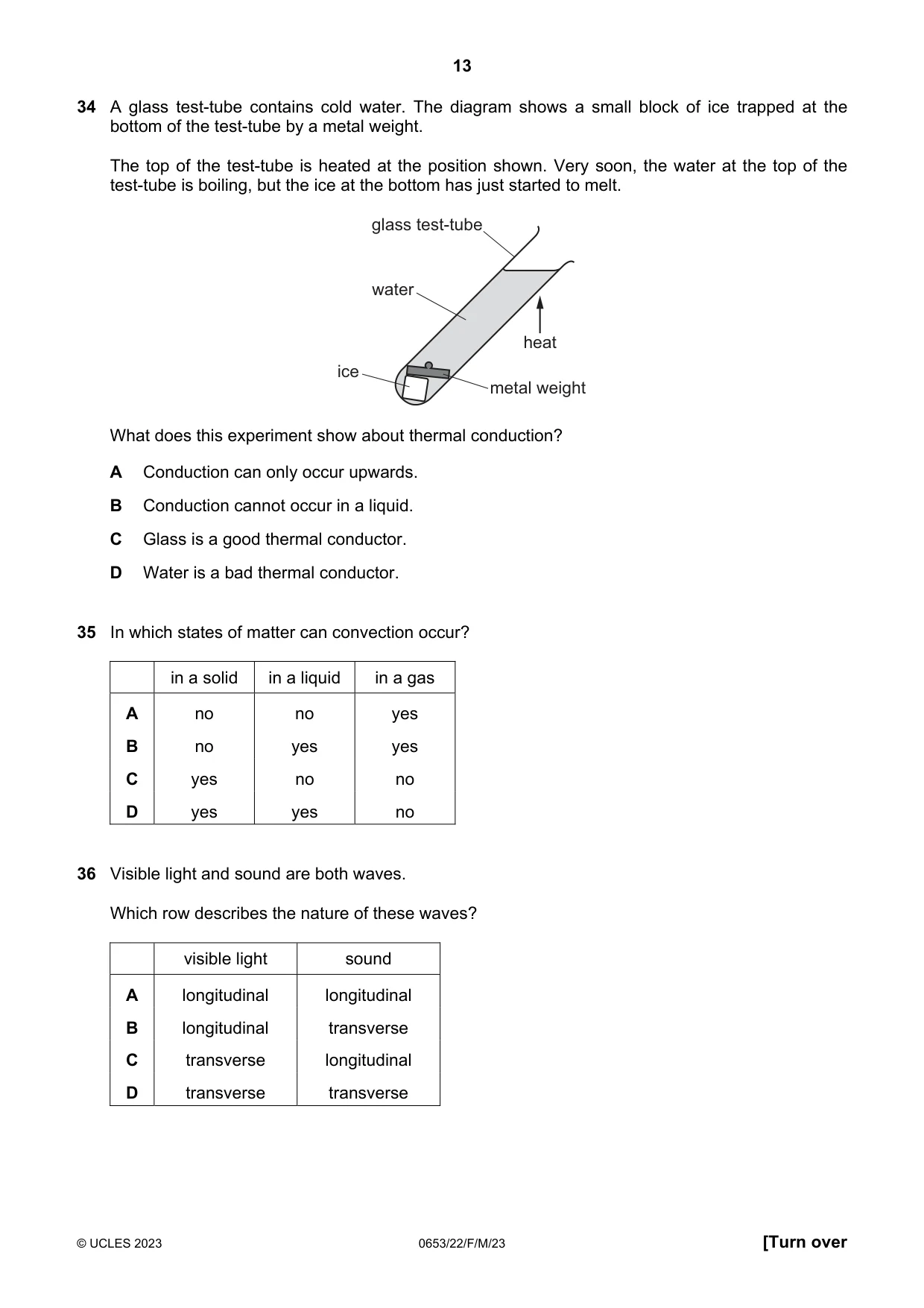
34 A glass test-tube contains cold water. The diagram shows a small block of ice trapped at the bottom of the test-tube by a metal weight. The top of the test-tube is heated at the position shown. Very soon, the water at the top of the test-tube is boiling, but the ice at the bottom has just started to melt. glass test-tube water heat ice metal weight What does this experiment show about thermal conduction? A Conduction can only occur upwards. B Conduction cannot occur in a liquid. C Glass is a good thermal conductor. D Water is a bad thermal conductor.
Mark scheme: D
Q35 · In which states of matter can convection occur?
35 In which states of matter can convection occur? in a solid in a liquid in a gas A no no yes B no yes yes C yes no no D yes yes no
Mark scheme: B
Q36 · Visible light and sound are both waves
36 Visible light and sound are both waves. Which row describes the nature of these waves? visible light sound A longitudinal longitudinal B longitudinal transverse C transverse longitudinal D transverse transverse
Mark scheme: C
Q37 · A beam that consists of red and blue light strikes a glass prism
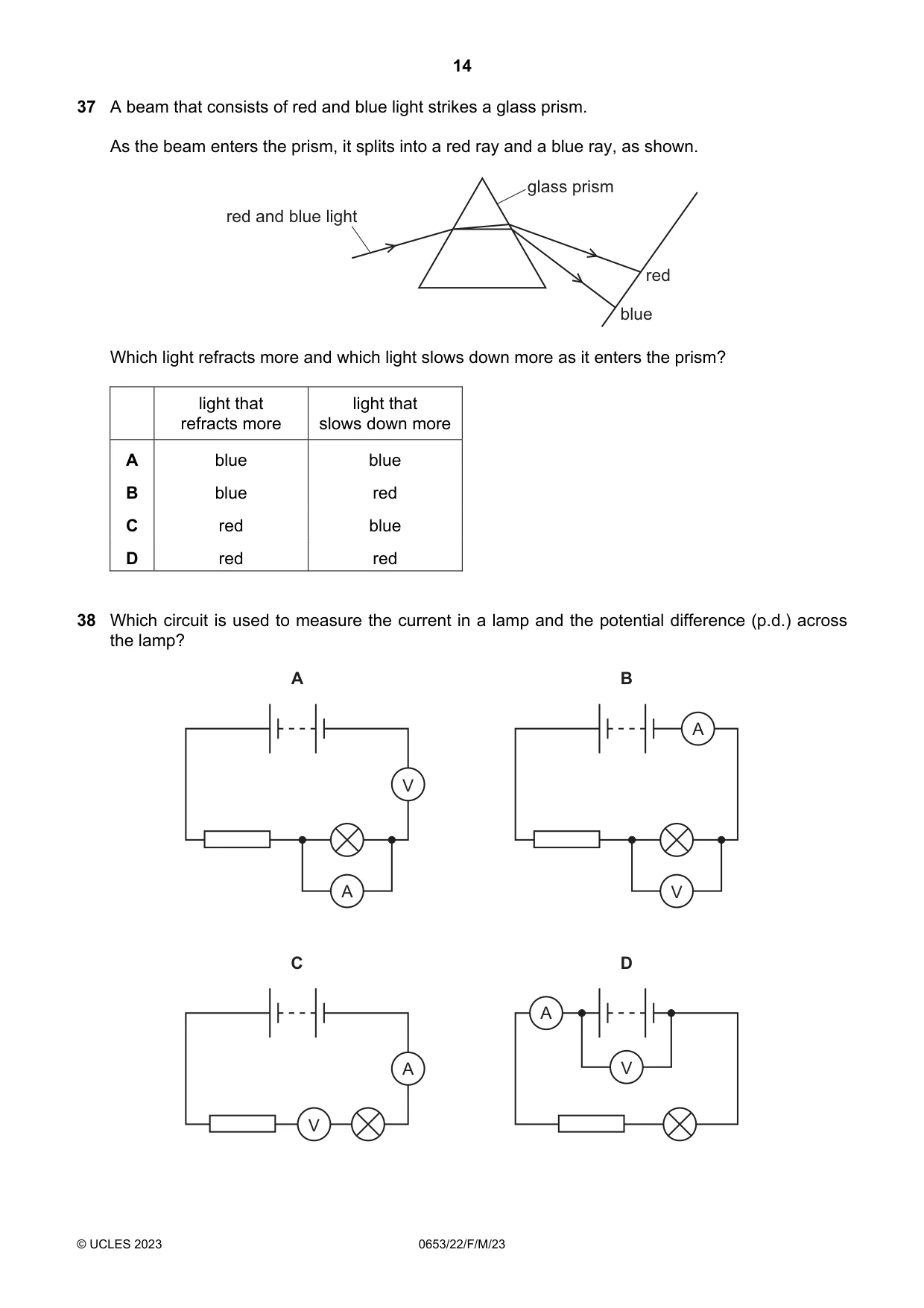
37 A beam that consists of red and blue light strikes a glass prism. As the beam enters the prism, it splits into a red ray and a blue ray, as shown. glass prism red and blue light red blue Which light refracts more and which light slows down more as it enters the prism? light that light that refracts more slows down more A blue blue B blue red C red blue D red red
Mark scheme: A
Q38 · Which circuit is used to measure the current in a lamp and the potential difference…
38 Which circuit is used to measure the current in a lamp and the potential difference (p.d.) across the lamp? A B A V A V C D A A V V
Mark scheme: B
Q39 · The diagram shows a circuit containing four resistors and four ammeters
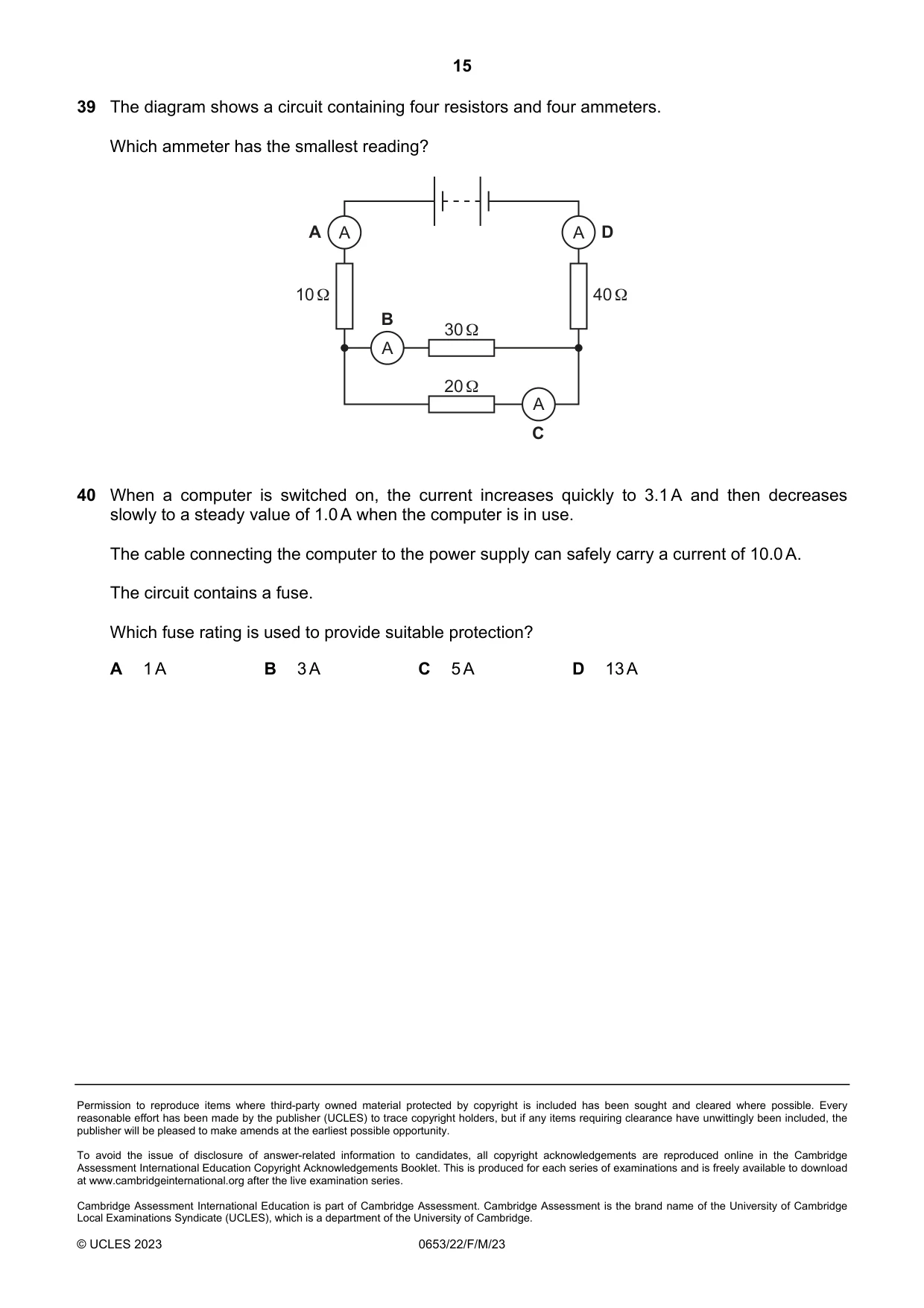
39 The diagram shows a circuit containing four resistors and four ammeters. Which ammeter has the smallest reading? A A A D 10 Ω 40 Ω B 30 Ω A 20 Ω A C
Mark scheme: B
Q40 · When a computer is switched on, the current increases quickly to 3.1 A and then decreases…
40 When a computer is switched on, the current increases quickly to 3.1 A and then decreases slowly to a steady value of 1.0 A when the computer is in use. The cable connecting the computer to the power supply can safely carry a current of 10.0 A. The circuit contains a fuse. Which fuse rating is used to provide suitable protection? A 1 A B 3 A C 5 A D 13 A
Mark scheme: C
What was in this paper
The subtopics covered by these 40 questions, and how many questions each got. Open one in a new tab to see every Cambridge question on it.
3Electrical circuits2Forces2Transfer of thermal energy2Air quality and climate1Alkenes1Blood vessels1Characteristics of living organisms1Density1Diet1Digestive system1Drugs1Electrical safety1Electrolysis1Energy flow1Enzymes1Exothermic and endothermic reactions1Food chains and food webs1Gas exchange in humans1General properties of waves1Group I properties1Identification of ions and gases1Ions and ionic bonds1Light1Noble gases1Osmosis1Preparation of salts1Rate of reaction1Redox1Separation and purification1Sexual reproduction in humans1Sexual reproduction in plants1Simple molecules and covalent bonds1The characteristic properties of acids and bases1Water uptake1What you needed in this session
Cambridge’s own grade thresholds for 2023 Feb/March, Paper 2 · Variant 2. A higher threshold means an easier paper — the bar moves with how the cohort did.