Cambridge IGCSE Science - Combined 0653 — 2024 May/June Paper 2 · Variant 2
0653/22/M/J/24 · 40 questions · 40 marks · ≈45 min
The question paper and its mark scheme, free to read here and free to download. This is Cambridge’s own paper, exactly as it was sat.
Question paper16 pages
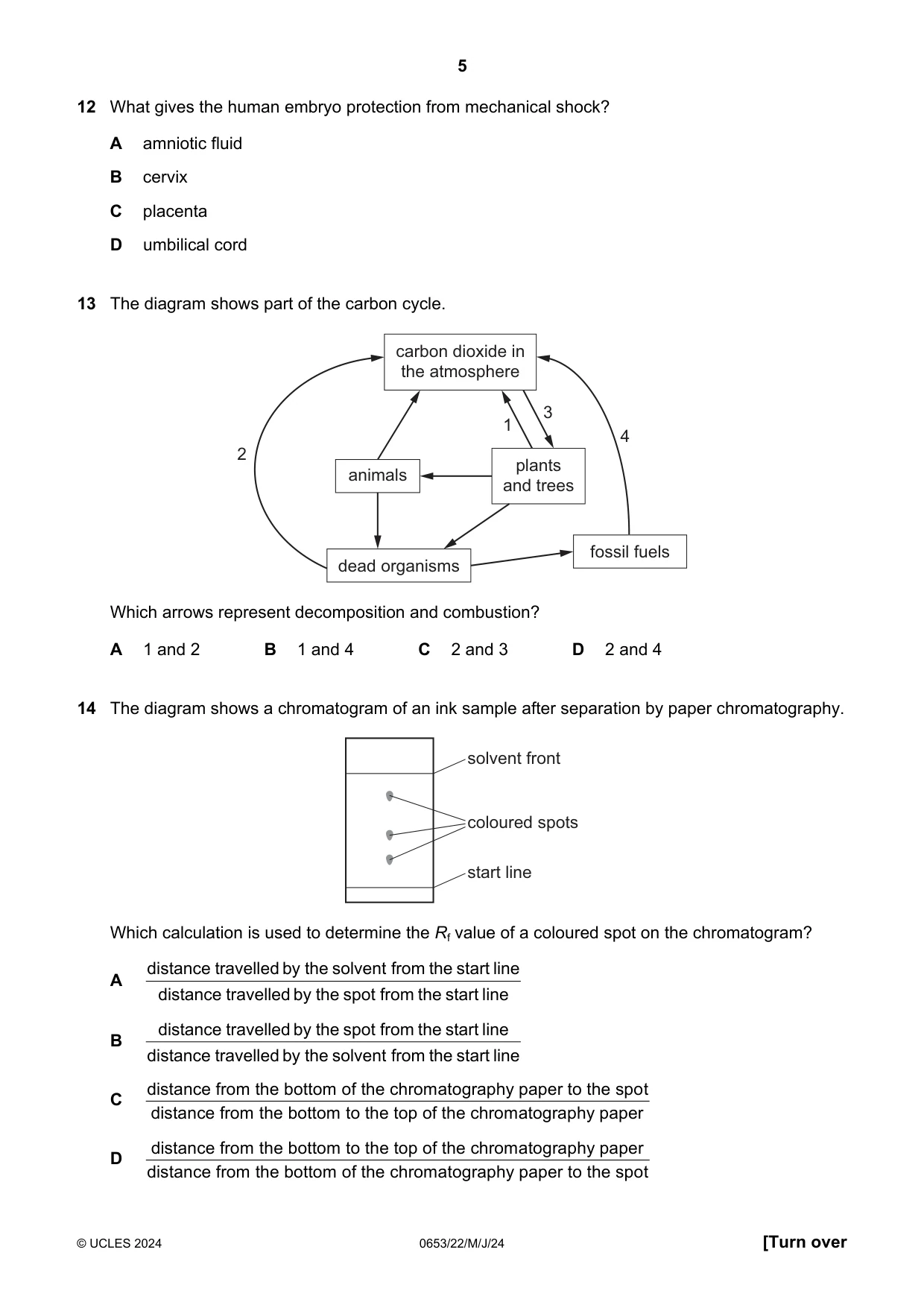
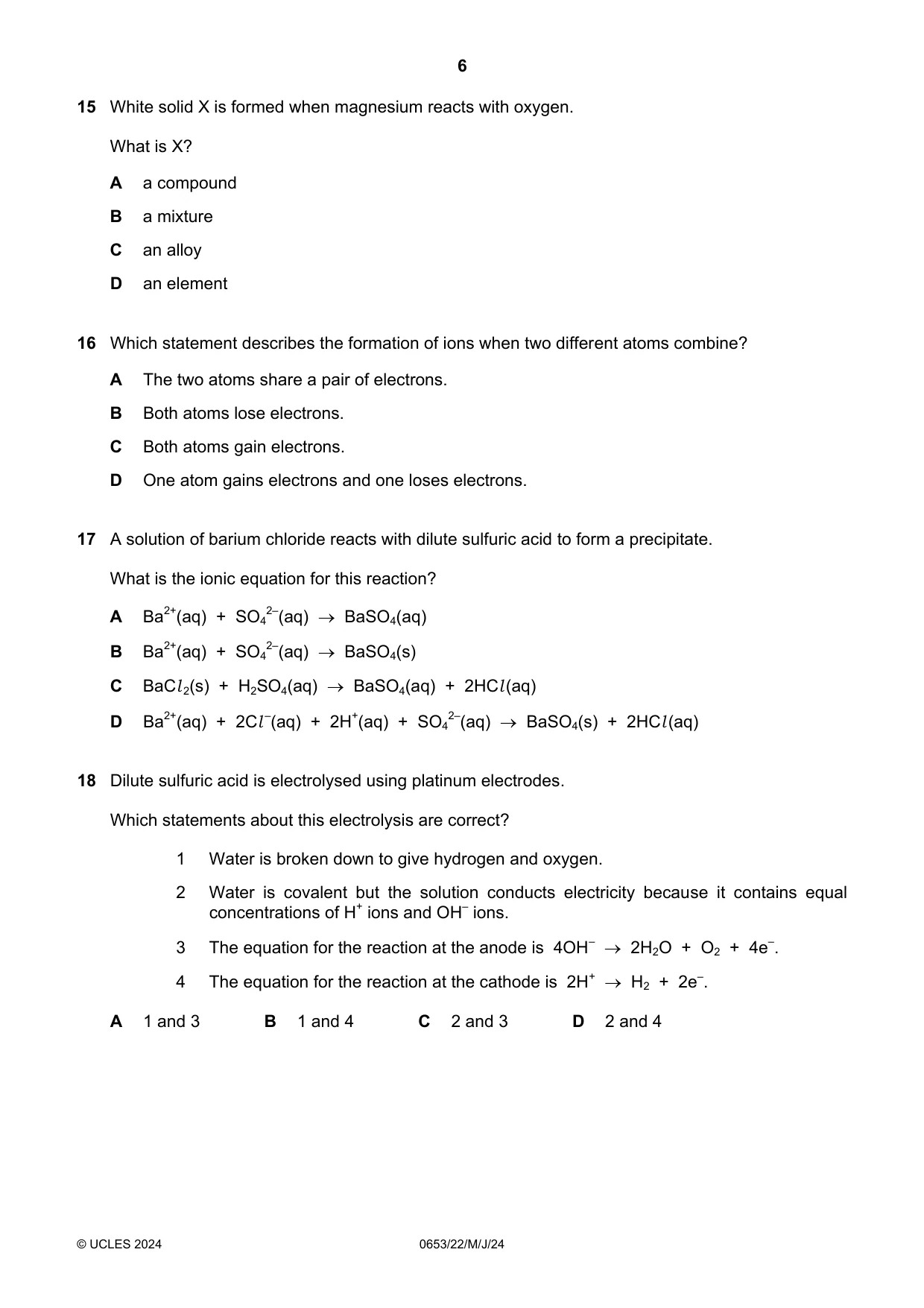
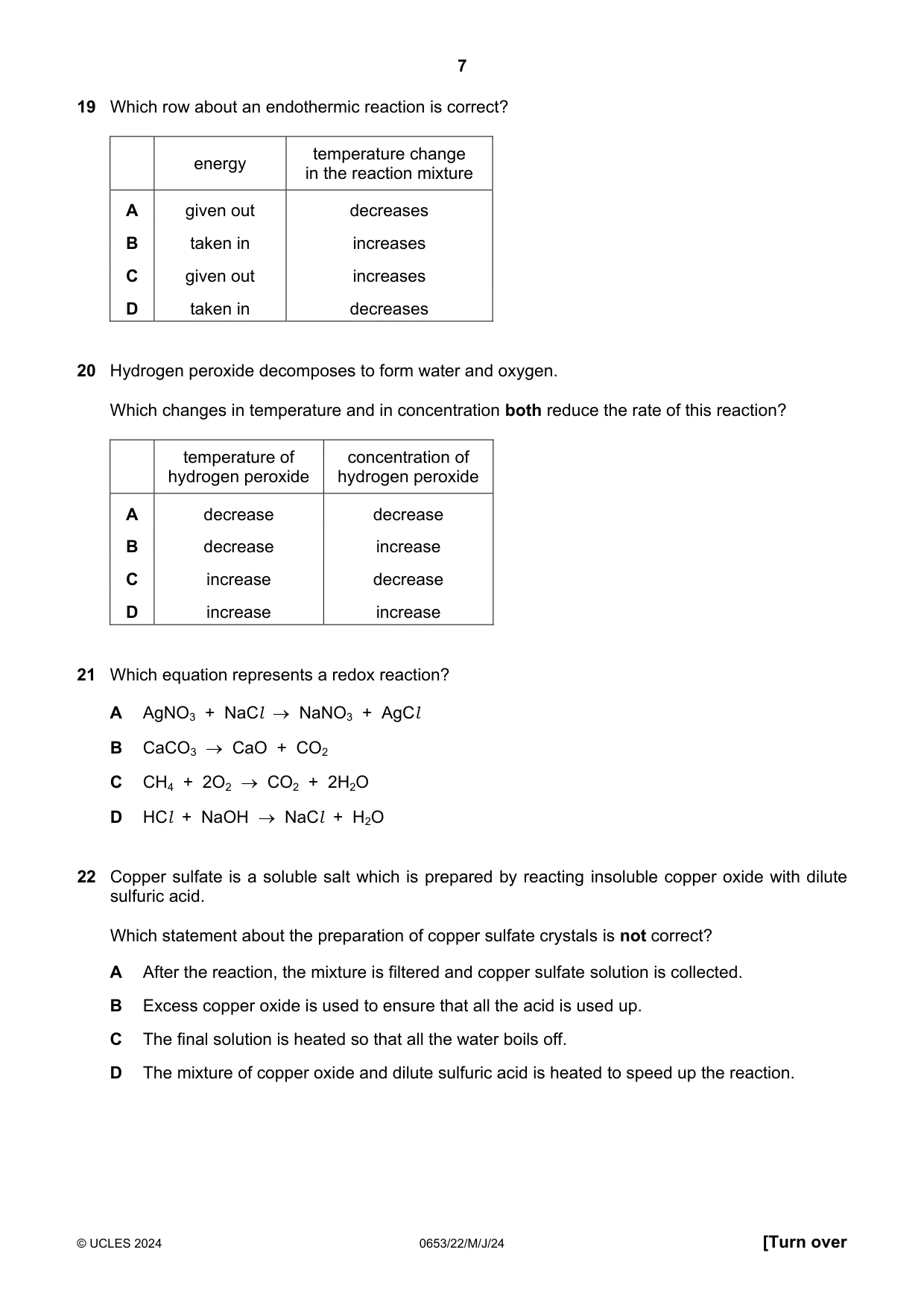
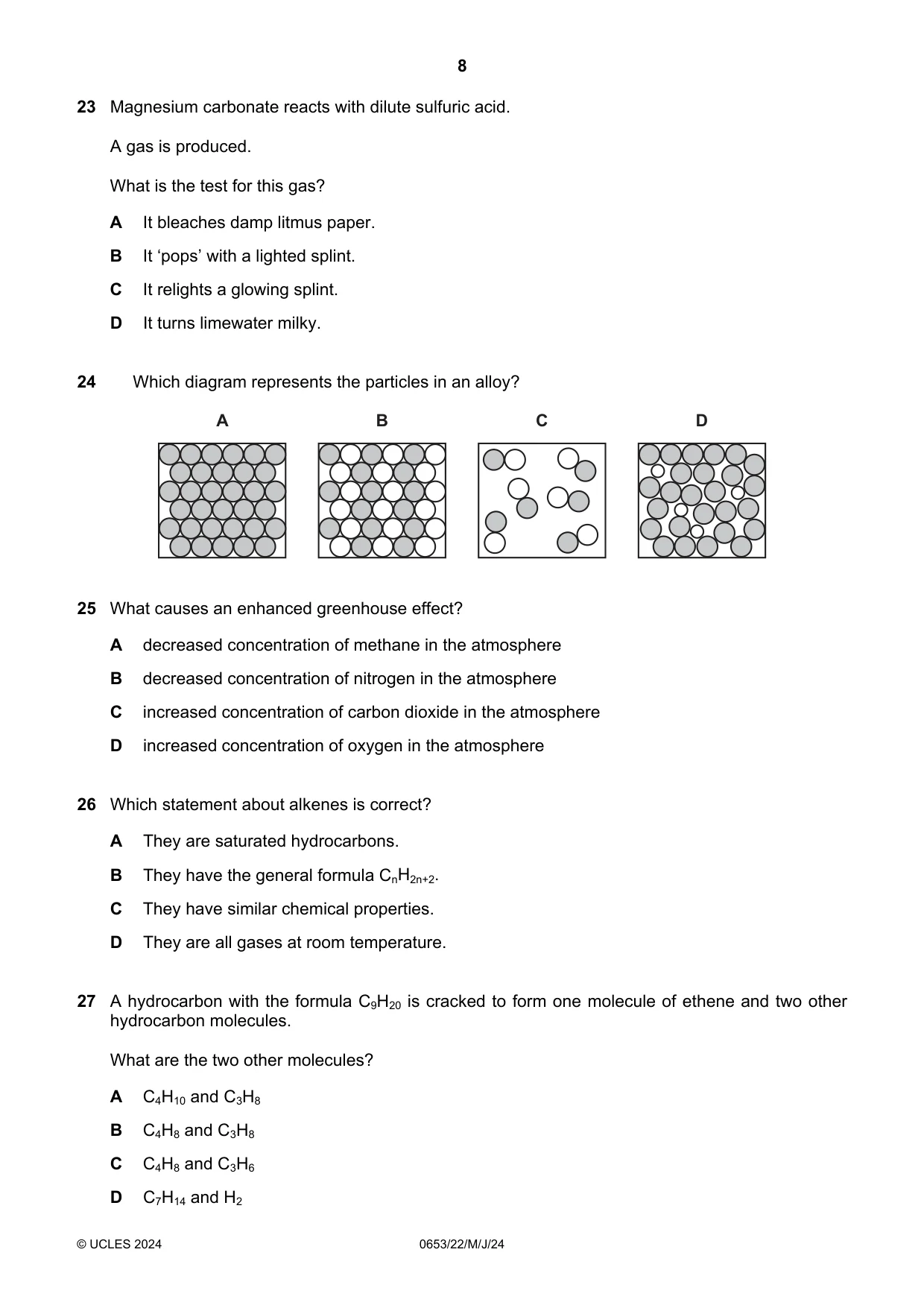


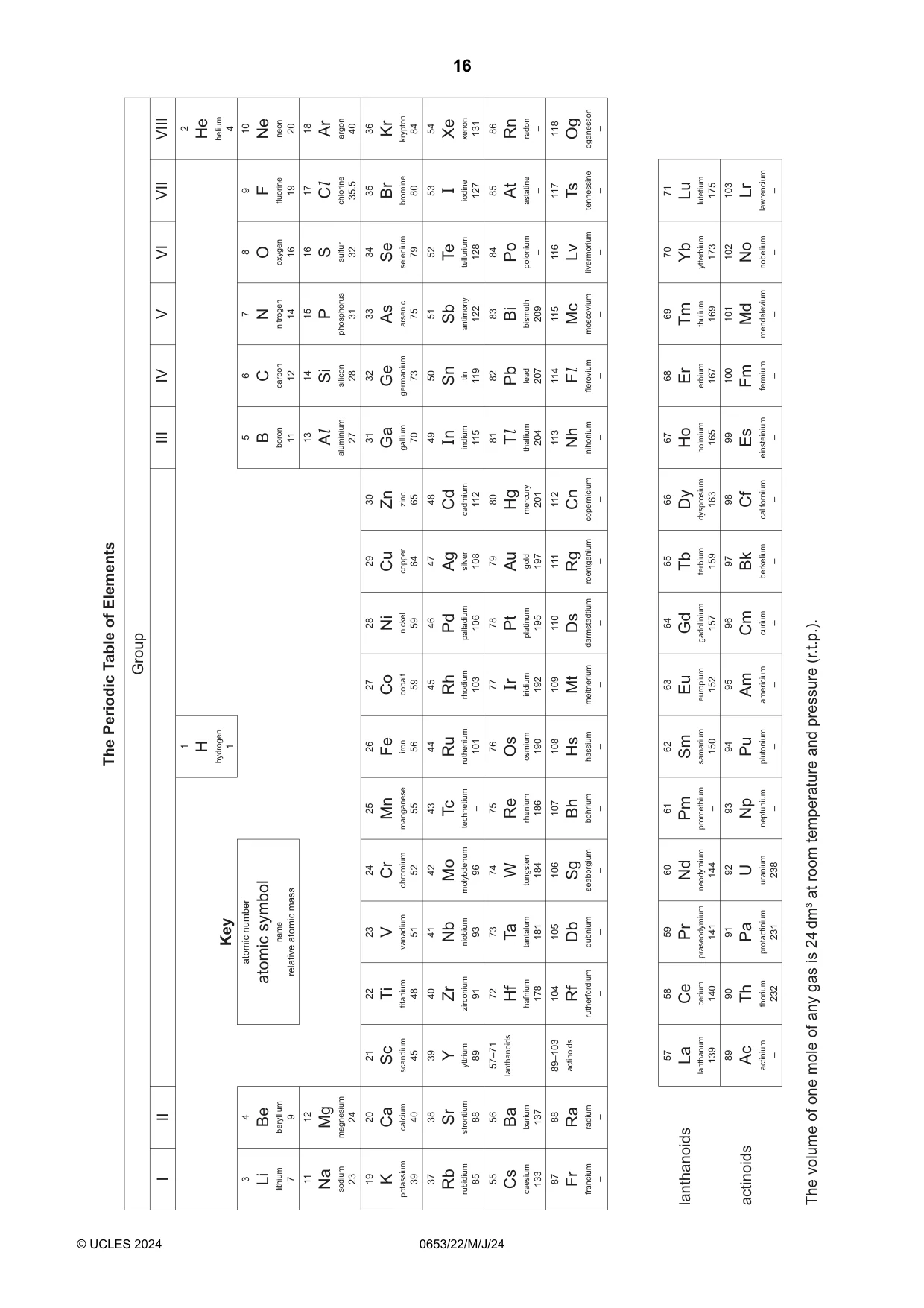
Mark scheme3 pages
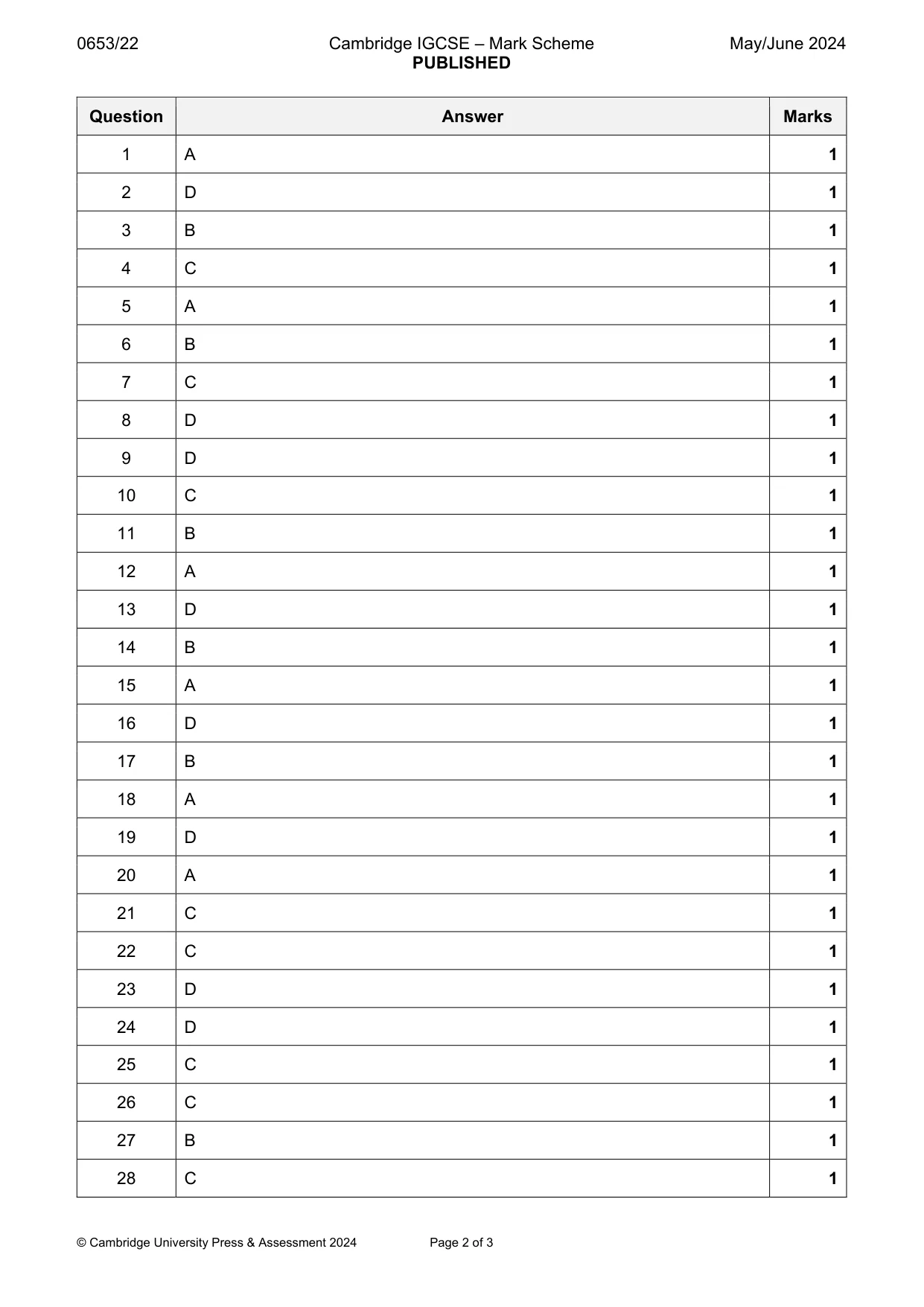
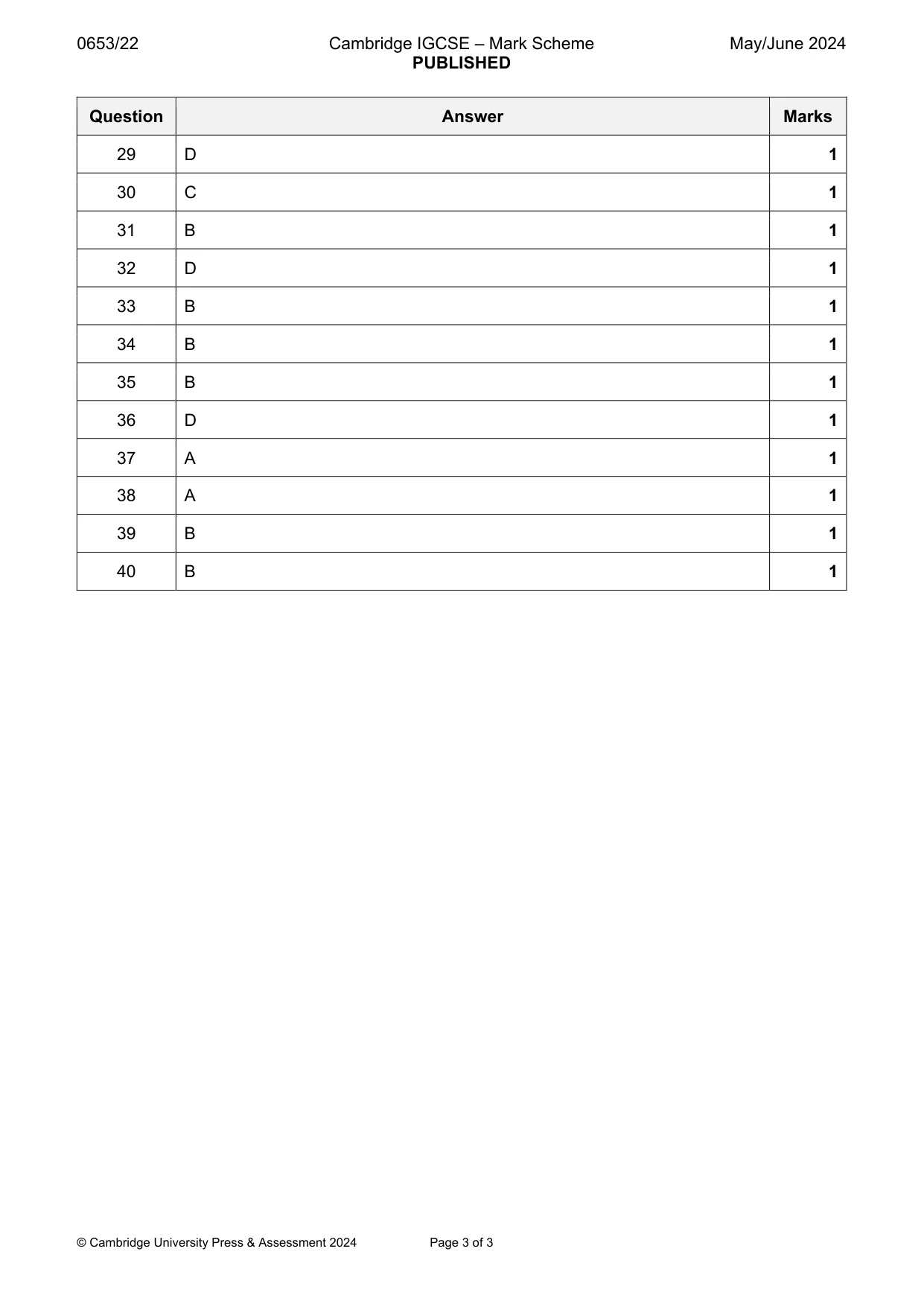
Answers below. Sit the paper first if you are practising.
Questions as text
Q1 · The diagram shows a typical plant cell
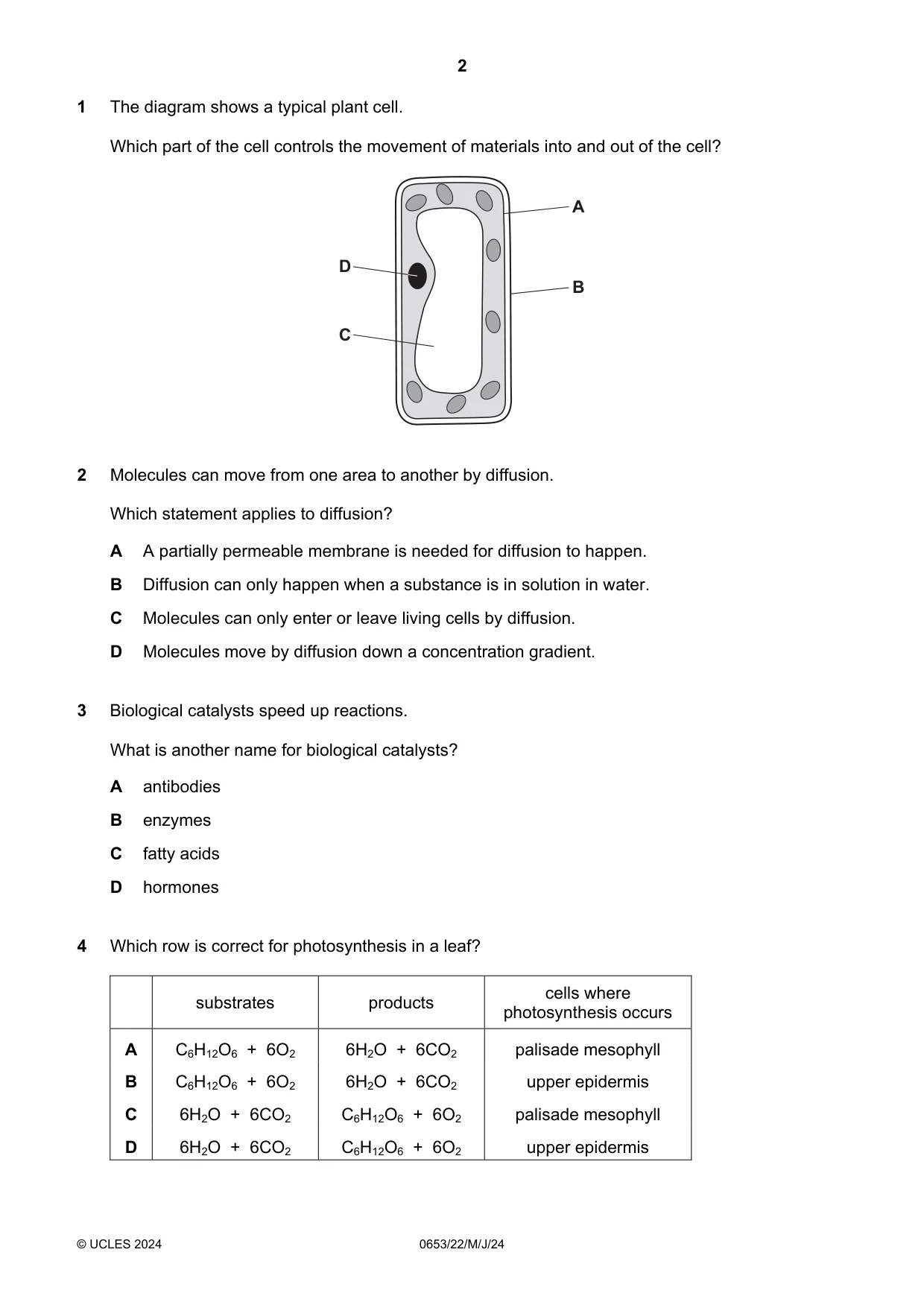
1 The diagram shows a typical plant cell. Which part of the cell controls the movement of materials into and out of the cell? A D B C
Mark scheme: A
Q2 · Molecules can move from one area to another by diffusion
2 Molecules can move from one area to another by diffusion. Which statement applies to diffusion? A A partially permeable membrane is needed for diffusion to happen. B Diffusion can only happen when a substance is in solution in water. C Molecules can only enter or leave living cells by diffusion. D Molecules move by diffusion down a concentration gradient.
Mark scheme: D
Q3 · Biological catalysts speed up reactions
3 Biological catalysts speed up reactions. What is another name for biological catalysts? A antibodies B enzymes C fatty acids D hormones
Mark scheme: B
Q4 · Which row is correct for photosynthesis in a leaf?
4 Which row is correct for photosynthesis in a leaf? cells where substrates products photosynthesis occurs A C6H12O6 + 6O2 6H2O + 6CO2 palisade mesophyll B C6H12O6 + 6O2 6H2O + 6CO2 upper epidermis C 6H2O + 6CO2 C6H12O6 + 6O2 palisade mesophyll D 6H2O + 6CO2 C6H12O6 + 6O2 upper epidermis
Mark scheme: C
Q5 · Which type of molecule is starch?
5 Which type of molecule is starch? A carbohydrate B fat C protein D vitamin
Mark scheme: A
Q6 · Chemical digestion starts in the mouth and continues throughout the length of the…
6 Chemical digestion starts in the mouth and continues throughout the length of the alimentary canal. What is a sequence of three organs in the alimentary canal where chemical digestion occurs? A oesophagus gall bladder liver B oesophagus stomach small intestine C small intestine gall bladder large intestine D small intestine stomach oesophagus
Mark scheme: B
Q7 · How are mineral ions transported around the human body?
7 How are mineral ions transported around the human body? A attached to antibodies B attached to haemoglobin C dissolved in blood plasma D inside blood platelets
Mark scheme: C
Q8 · Which row correctly lists the features of a gas exchange surface in animals?
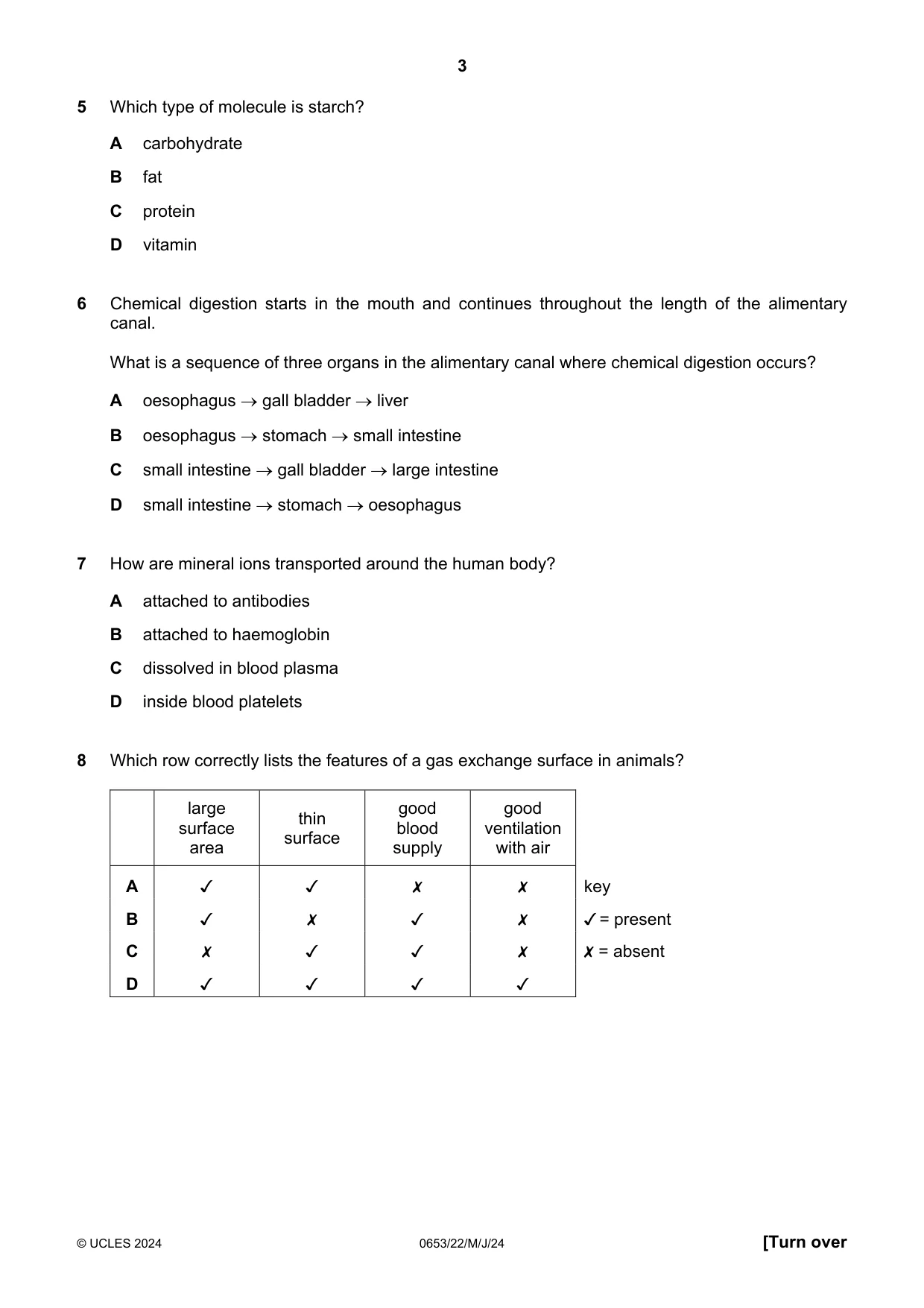
8 Which row correctly lists the features of a gas exchange surface in animals? large thin good good surface blood ventilation surface tps area supply with air A v Jv x x key B Jv x Jv x / = present Cc x Jv Jv x X = absent D v v v v
Mark scheme: D
Q9 · When the hormone adrenaline is released in humans it causes changes in breathing rate and…
9 When the hormone adrenaline is released in humans it causes changes in breathing rate and pupil size. What are the correct changes? breathing rate pupil size A decreases decreases B decreases increases C increases decreases D increases increases
Mark scheme: D
Q10 · The table shows some possible tropic responses in a plant
10 The table shows some possible tropic responses in a plant. direction of growth response to part of plant light (from gravity one direction) 1 root away towards 2 root towards away 3 shoot away towards 4 shoot towards away What are the correct tropic responses for gravitropism and phototropism? A 1 and 3 B 1 and 4 C 2 and 3 D 2 and 4
Mark scheme: C
Q11 · Which row shows the anther and stigma of an insect-pollinated flower?
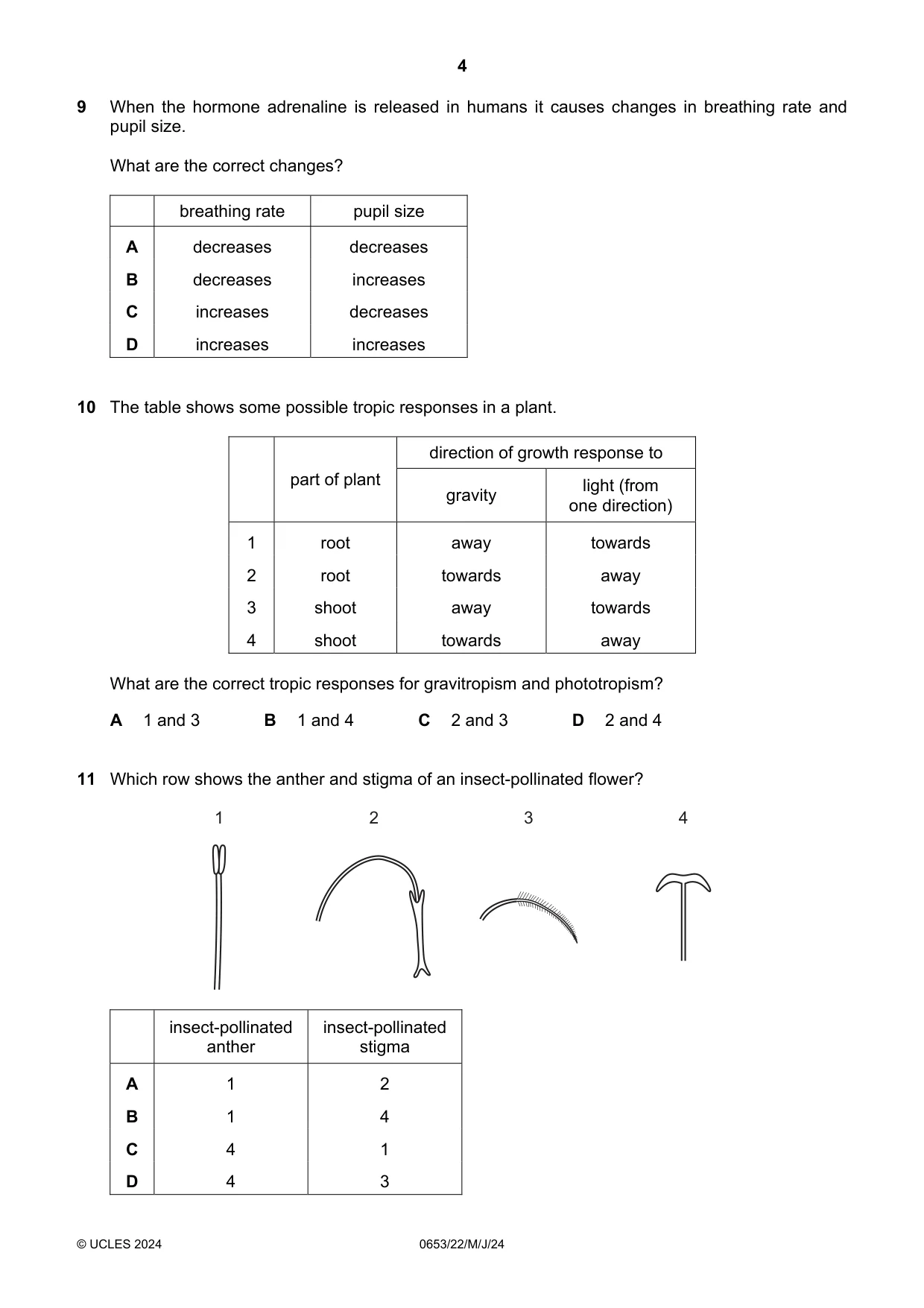
11 Which row shows the anther and stigma of an insect-pollinated flower? 1 2 3 4 insect-pollinated insect-pollinated anther stigma A 1 2 B 1 4 C 4 1 D 4 3
Mark scheme: B
Q12 · What gives the human embryo protection from mechanical shock?
12 What gives the human embryo protection from mechanical shock? A amniotic fluid B cervix C placenta D umbilical cord
Mark scheme: A
Q13 · The diagram shows part of the carbon cycle
13 The diagram shows part of the carbon cycle. carbon dioxide in the atmosphere 3 1 4 2 plants animals and trees fossil fuels dead organisms Which arrows represent decomposition and combustion? A 1 and 2 B 1 and 4 C 2 and 3 D 2 and 4
Mark scheme: D
Q14 · The diagram shows a chromatogram of an ink sample after separation by paper chromatography
14 The diagram shows a chromatogram of an ink sample after separation by paper chromatography. solvent front coloured spots start line Which calculation is used to determine the Rf value of a coloured spot on the chromatogram? distance travelled by the solvent from the start line A distance travelled by the spot from the start line distance travelled by the spot from the start line B distance travelled by the solvent from the start line distance from the bottom of the chromatography paper to the spot C distance from the bottom to the top of the chromatography paper distance from the bottom to the top of the chromatography paper D distance from the bottom of the chromatography paper to the spot
Mark scheme: B
Q15 · White solid X is formed when magnesium reacts with oxygen
15 White solid X is formed when magnesium reacts with oxygen. What is X? A a compound B a mixture C an alloy D an element
Mark scheme: A
Q16 · Which statement describes the formation of ions when two different atoms combine?
16 Which statement describes the formation of ions when two different atoms combine? A The two atoms share a pair of electrons. B Both atoms lose electrons. C Both atoms gain electrons. D One atom gains electrons and one loses electrons.
Mark scheme: D
Q17 · A solution of barium chloride reacts with dilute sulfuric acid to form a precipitate
17 A solution of barium chloride reacts with dilute sulfuric acid to form a precipitate. What is the ionic equation for this reaction? A Ba2+(aq) + SO4 2–(aq) BaSO4(aq) B Ba2+(aq) + SO4 2–(aq) BaSO4(s) C BaCl 2(s) + H2SO4(aq) BaSO4(aq) + 2HCl (aq) D Ba2+(aq) + 2Cl –(aq) + 2H+(aq) + SO4 2–(aq) BaSO4(s) + 2HCl (aq)
Mark scheme: B
Q18 · Dilute sulfuric acid is electrolysed using platinum electrodes
18 Dilute sulfuric acid is electrolysed using platinum electrodes. Which statements about this electrolysis are correct? 1 Water is broken down to give hydrogen and oxygen. 2 Water is covalent but the solution conducts electricity because it contains equal concentrations of H+ ions and OH– ions. 3 The equation for the reaction at the anode is 4OH– 2H2O + O2 + 4e–. 4 The equation for the reaction at the cathode is 2H+ H2 + 2e–. A 1 and 3 B 1 and 4 C 2 and 3 D 2 and 4
Mark scheme: A
Q19 · Which row about an endothermic reaction is correct?
19 Which row about an endothermic reaction is correct? temperature change energy in the reaction mixture A given out decreases B taken in increases C given out increases D taken in decreases
Mark scheme: D
Q20 · Hydrogen peroxide decomposes to form water and oxygen
20 Hydrogen peroxide decomposes to form water and oxygen. Which changes in temperature and in concentration both reduce the rate of this reaction? temperature of concentration of hydrogen peroxide hydrogen peroxide A decrease decrease B decrease increase C increase decrease D increase increase
Mark scheme: A
Q21 · Which equation represents a redox reaction?
21 Which equation represents a redox reaction? A AgNO3 + NaCl NaNO3 + AgCl B CaCO3 CaO + CO2 C CH4 + 2O2 CO2 + 2H2O D HCl + NaOH NaCl + H2O
Mark scheme: C
Q22 · Copper sulfate is a soluble salt which is prepared by reacting insoluble copper oxide…
22 Copper sulfate is a soluble salt which is prepared by reacting insoluble copper oxide with dilute sulfuric acid. Which statement about the preparation of copper sulfate crystals is not correct? A After the reaction, the mixture is filtered and copper sulfate solution is collected. B Excess copper oxide is used to ensure that all the acid is used up. C The final solution is heated so that all the water boils off. D The mixture of copper oxide and dilute sulfuric acid is heated to speed up the reaction.
Mark scheme: C
Q23 · Magnesium carbonate reacts with dilute sulfuric acid
23 Magnesium carbonate reacts with dilute sulfuric acid. A gas is produced. What is the test for this gas? A It bleaches damp litmus paper. B It ‘pops’ with a lighted splint. C It relights a glowing splint. D It turns limewater milky.
Mark scheme: D
Q24 · Which diagram represents the particles in an alloy?
24 Which diagram represents the particles in an alloy? A B C D
Mark scheme: D
Q25 · What causes an enhanced greenhouse effect?
25 What causes an enhanced greenhouse effect? A decreased concentration of methane in the atmosphere B decreased concentration of nitrogen in the atmosphere C increased concentration of carbon dioxide in the atmosphere D increased concentration of oxygen in the atmosphere
Mark scheme: C
Q26 · Which statement about alkenes is correct?
26 Which statement about alkenes is correct? A They are saturated hydrocarbons. B They have the general formula CnH2n+2. C They have similar chemical properties. D They are all gases at room temperature.
Mark scheme: C
Q27 · A hydrocarbon with the formula C9H20 is cracked to form one molecule of ethene and two…
27 A hydrocarbon with the formula C9H20 is cracked to form one molecule of ethene and two other hydrocarbon molecules. What are the two other molecules? A C4H10 and C3H8 B C4H8 and C3H8 C C4H8 and C3H6 D C7H14 and H2
Mark scheme: B
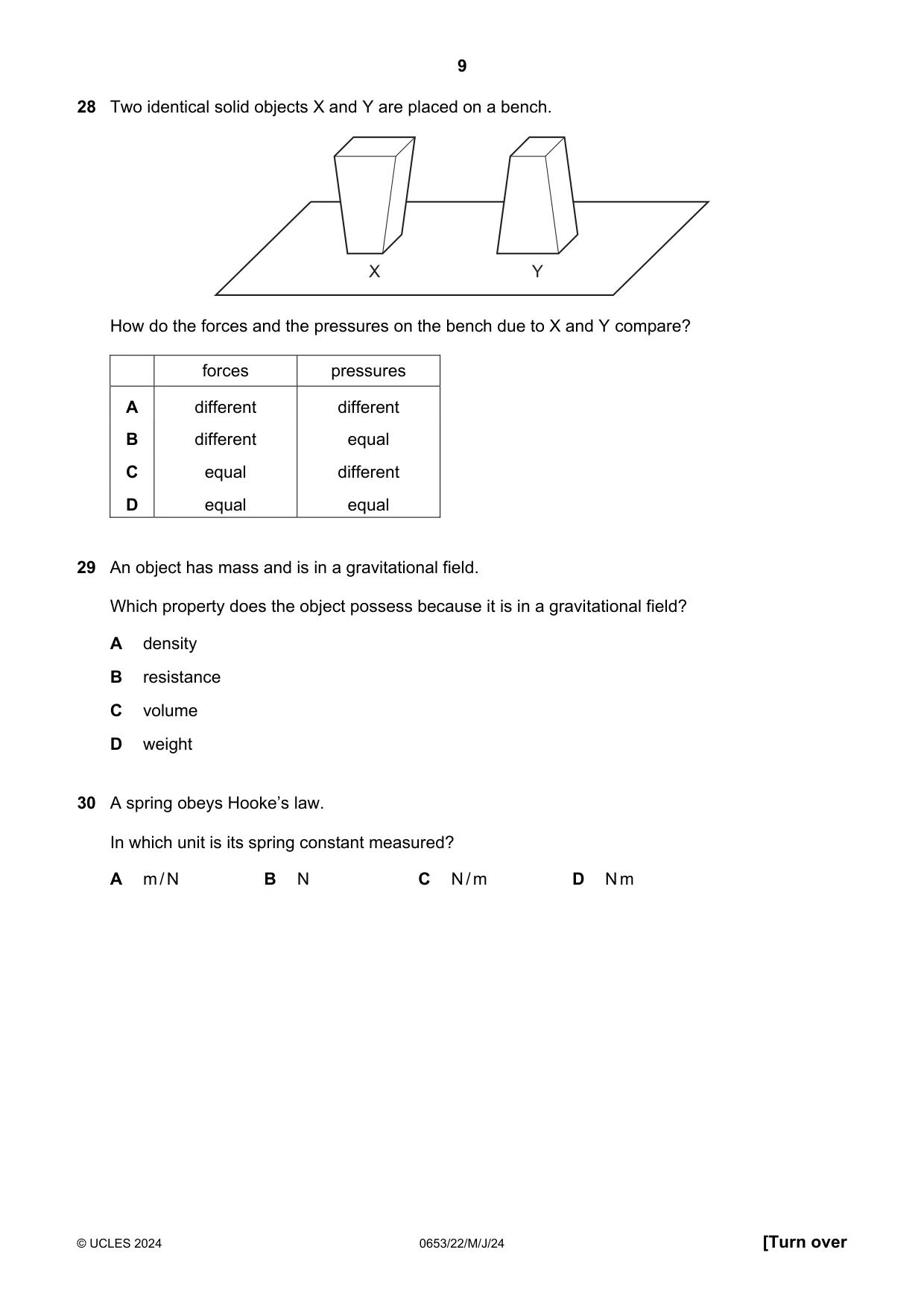
Q28 · Two identical solid objects X and Y are placed on a bench
28 Two identical solid objects X and Y are placed on a bench. X Y How do the forces and the pressures on the bench due to X and Y compare? forces pressures A different different B different equal C equal different D equal equal
Mark scheme: C
Q29 · An object has mass and is in a gravitational field
29 An object has mass and is in a gravitational field. Which property does the object possess because it is in a gravitational field? A density B resistance C volume D weight
Mark scheme: D
Q30 · A spring obeys Hooke’s law
30 A spring obeys Hooke’s law. In which unit is its spring constant measured? A m / N B N C N / m D N m
Mark scheme: C
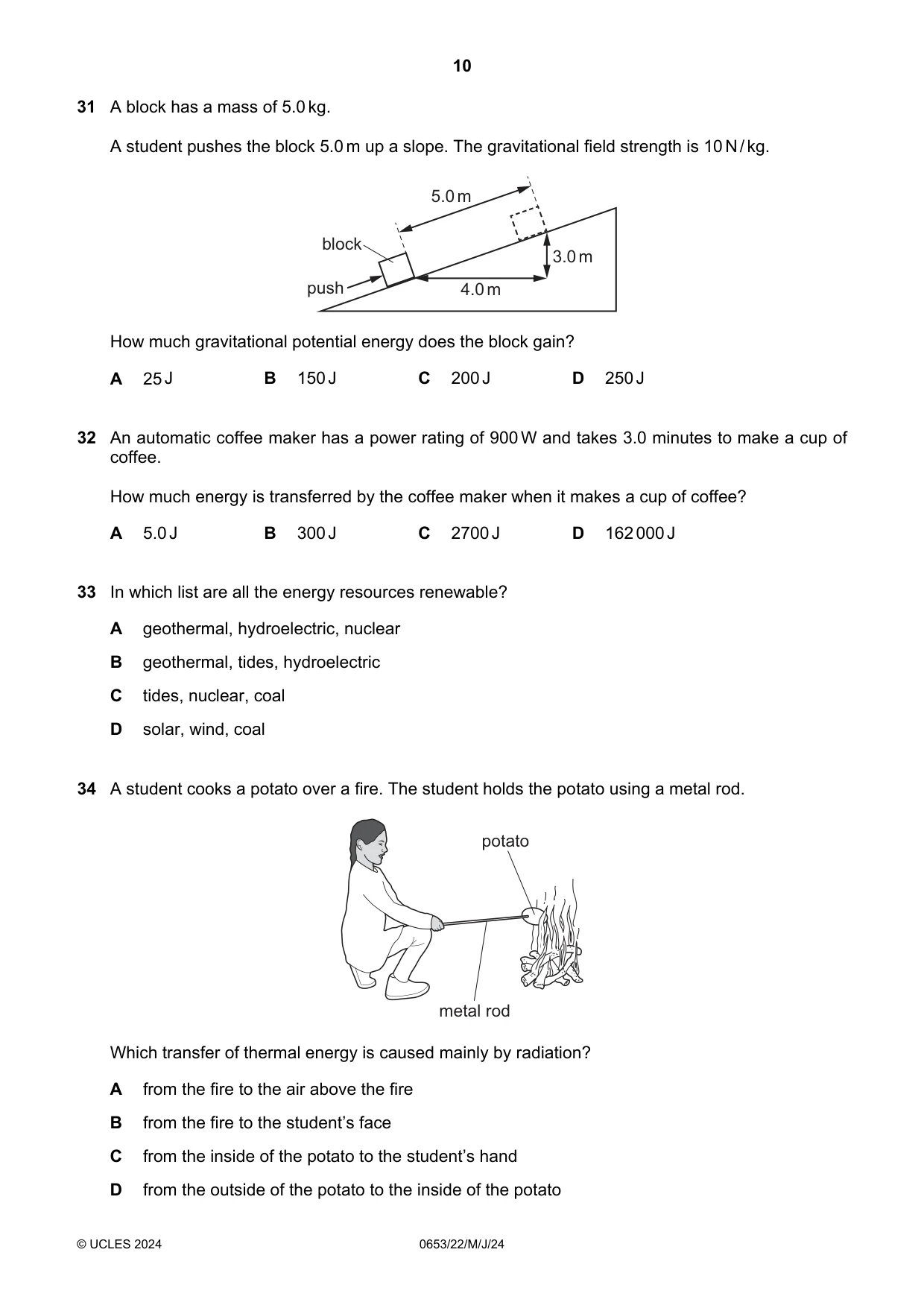
Q31 · A block has a mass of 5.0 kg
31 A block has a mass of 5.0 kg. A student pushes the block 5.0 m up a slope. The gravitational field strength is 10 N / kg. 5.0 m block 3.0 m push 4.0 m How much gravitational potential energy does the block gain? A 25 J B 150 J C 200 J D 250 J
Mark scheme: B
Q32 · An automatic coffee maker has a power rating of 900 W and takes 3.0 minutes to make a cup…
32 An automatic coffee maker has a power rating of 900 W and takes 3.0 minutes to make a cup of coffee. How much energy is transferred by the coffee maker when it makes a cup of coffee? A 5.0 J B 300 J C 2700 J D 162 000 J
Mark scheme: D
Q33 · In which list are all the energy resources renewable?
33 In which list are all the energy resources renewable? A geothermal, hydroelectric, nuclear B geothermal, tides, hydroelectric C tides, nuclear, coal D solar, wind, coal
Mark scheme: B
Q34 · A student cooks a potato over a fire
34 A student cooks a potato over a fire. The student holds the potato using a metal rod. potato metal rod Which transfer of thermal energy is caused mainly by radiation? A from the fire to the air above the fire B from the fire to the student’s face C from the inside of the potato to the student’s hand D from the outside of the potato to the inside of the potato
Mark scheme: B
Q35 · A student uses a thin converging lens of focal length 5.0 cm as a magnifying glass
35 A student uses a thin converging lens of focal length 5.0 cm as a magnifying glass. What is a possible position of the object? A 4.0 cm from the lens, on the same side of the lens as the student B 4.0 cm from the lens, on the side of the lens away from the student C 6.0 cm from the lens, on the same side of the lens as the student D 6.0 cm from the lens, on the side of the lens away from the student
Mark scheme: B
Q36 · What is not able to transmit sound waves?
36 What is not able to transmit sound waves? A a gas B a liquid C a solid D a vacuum
Mark scheme: D
Q37 · There is a potential difference (p.d.) of 6.0 V across a resistor of resistance 1.5 k
37 There is a potential difference (p.d.) of 6.0 V across a resistor of resistance 1.5 k. How much charge passes through the resistor in 5.0 minutes? A 1.2 C B 20 C C 30 C D 1200 C
Mark scheme: A
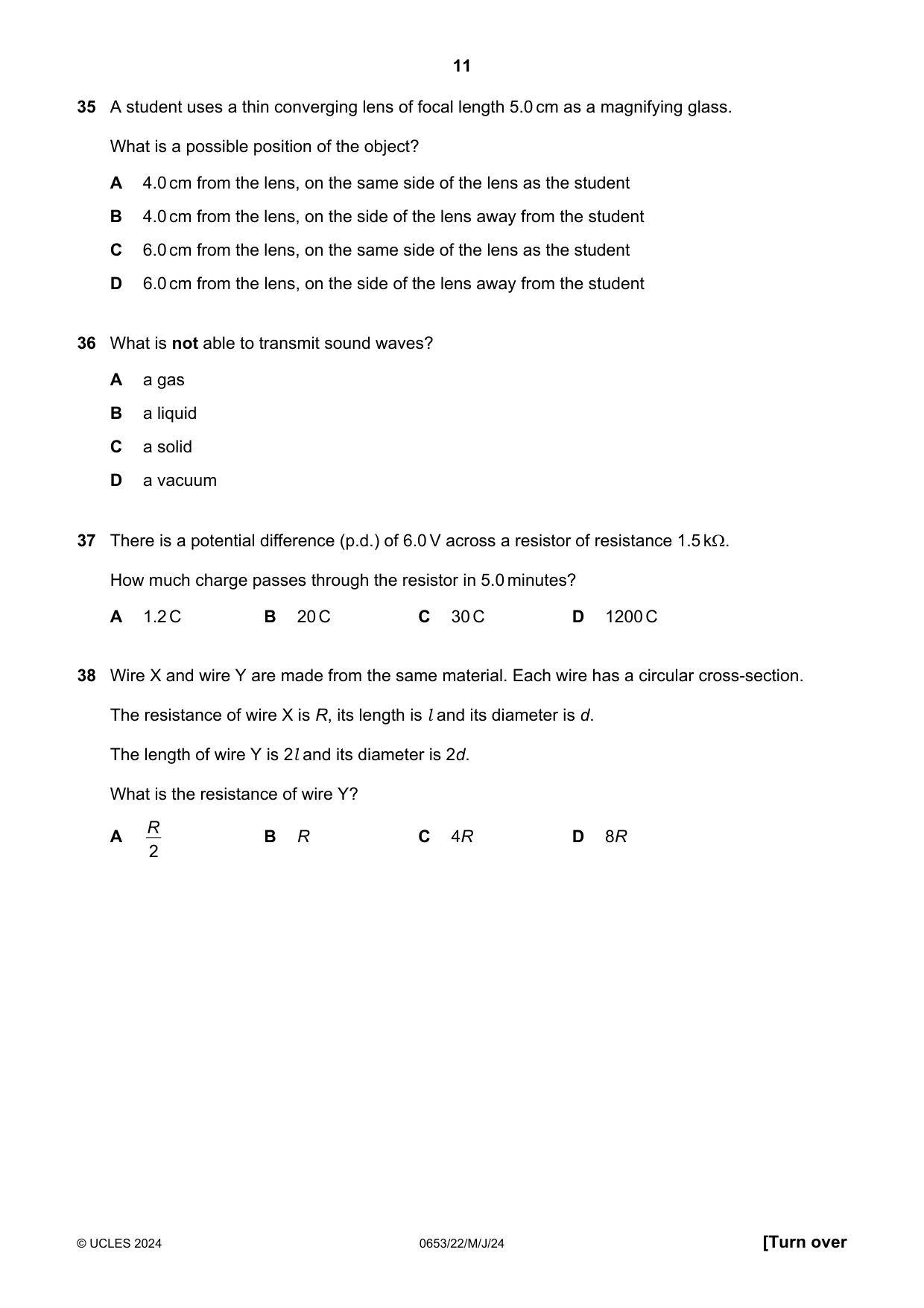
Q38 · Wire X and wire Y are made from the same material
38 Wire X and wire Y are made from the same material. Each wire has a circular cross-section. The resistance of wire X is R, its length is l and its diameter is d. The length of wire Y is 2l and its diameter is 2d. What is the resistance of wire Y? R A B R C 4R D 8R 2
Mark scheme: A
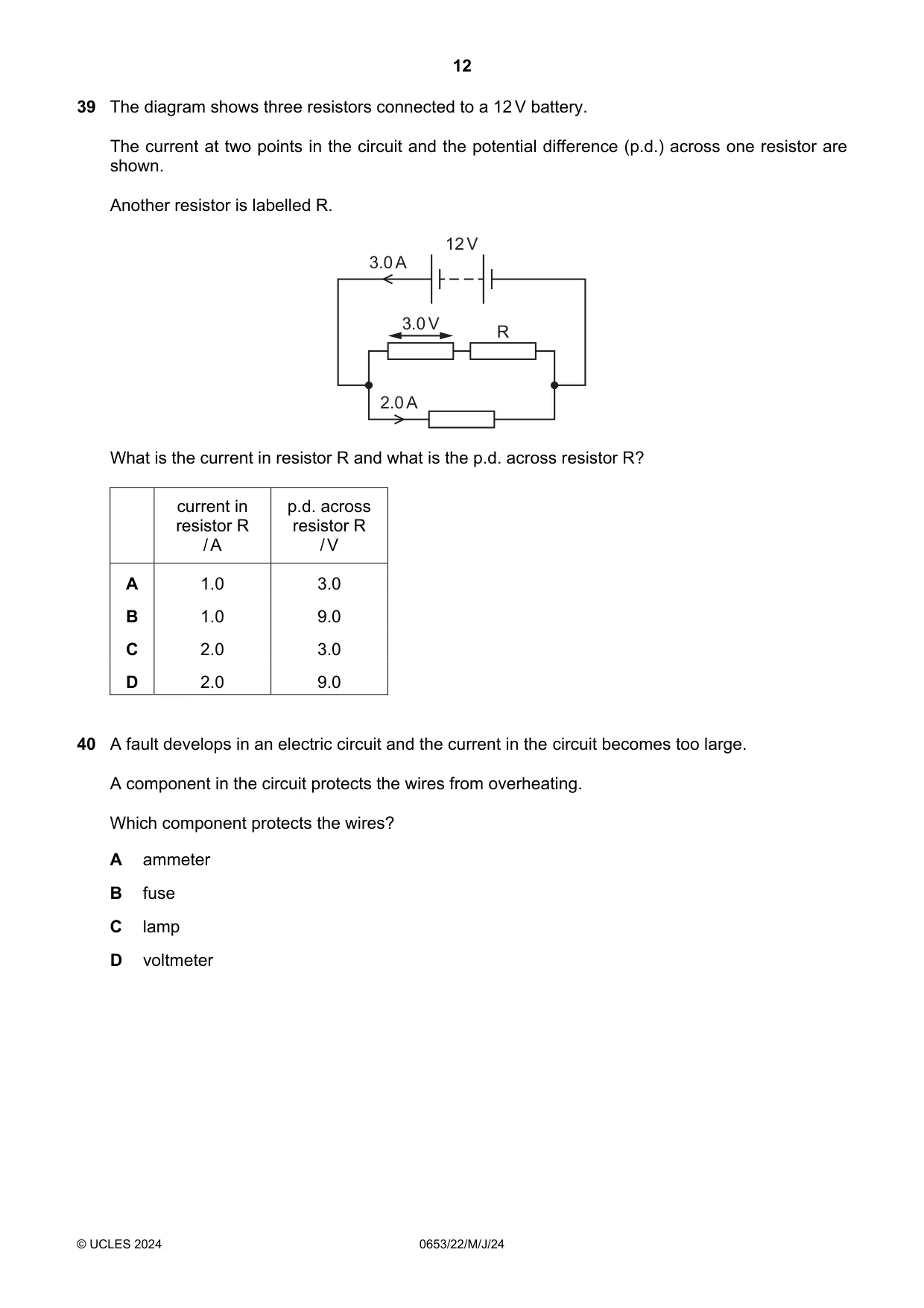
Q39 · The diagram shows three resistors connected to a 12 V battery
39 The diagram shows three resistors connected to a 12 V battery. The current at two points in the circuit and the potential difference (p.d.) across one resistor are shown. Another resistor is labelled R. 12 V 3.0 A 3.0 V R 2.0 A What is the current in resistor R and what is the p.d. across resistor R? current in p.d. across resistor R resistor R / A / V A 1.0 3.0 B 1.0 9.0 C 2.0 3.0 D 2.0 9.0
Mark scheme: B
Q40 · A fault develops in an electric circuit and the current in the circuit becomes too large
40 A fault develops in an electric circuit and the current in the circuit becomes too large. A component in the circuit protects the wires from overheating. Which component protects the wires? A ammeter B fuse C lamp D voltmeter
Mark scheme: B
What was in this paper
The subtopics covered by these 40 questions, and how many questions each got. Open one in a new tab to see every Cambridge question on it.
3Alkenes2Electrical quantities2Photosynthesis2Air quality and climate1Alloys and their properties1Biological molecules1Blood1Carbon cycle1Cell structure1Chromatography1Diffusion1Digestion1Drugs1Electrical circuits1Electrical safety1Electrolysis1Elements, compounds and mixtures1Enzymes1Exothermic and endothermic reactions1Forces1Formulas1Gas exchange in humans1Identification of ions and gases1Ions and ionic bonds1Light1Mass and weight1Preparation of salts1Pressure1Rate of reaction1Redox1Sexual reproduction in humans1Sexual reproduction in plants1Sound1Transfer of thermal energy1What you needed in this session
Cambridge’s own grade thresholds for 2024 May/June, Paper 2 · Variant 2. A higher threshold means an easier paper — the bar moves with how the cohort did.