Questions as text
Q1 · The US trades with Uruguay 0455/11 Oct/Nov 2004
26 The US trades with Uruguay. In 2002 the US approved a loan of US$ 1.5 billion to Uruguay to help boost Uruguay's economy. What would be the most likely effect of this loan? A It would encourage Uruguay to import from the US. B It would make Uruguay less competitive. C It would result in imported inflation. D It would stop US citizens investing in Uruguay.
1 marks
Answer: A
This question in 0455/11 Oct/Nov 2004
Q2 · The Egyptian government reduced tariffs on imported Japanese trucks 0455/11 Oct/Nov 2004
39 The Egyptian government reduced tariffs on imported Japanese trucks. What is most likely to benefit in Egypt from this reduction? A government revenue B the balance of payments C truck operators D truck producers
1 marks
Answer: C
This question in 0455/11 Oct/Nov 2004
Q3 · What best describes a multi-national company? 0455/11 May/June 2006
6 What best describes a multi-national company? A a company that is owned by the government B a company that has many shareholders C a company that trades internationally D a company that produces in more than one country
1 marks
Answer: D
This question in 0455/11 May/June 2006
Q4 · Kimberly-Clark Corporation manufactures many products, including Kleenex paper… 0455/11 May/June 2006
7 Kimberly-Clark Corporation manufactures many products, including Kleenex paper handkerchiefs. It has operations in 43 countries. What is not a reason why a company might decide to have operations in more than one country? A availability of raw materials B local markets can be served C transport is a high proportion of costs D trade union pressure
1 marks
Answer: D
This question in 0455/11 May/June 2006
Q5 · Nigeria decides to introduce a policy that limits imports of Japanese cars to 15 % of the… 0455/11 May/June 2006
37 Nigeria decides to introduce a policy that limits imports of Japanese cars to 15 % of the total market. What is this policy called? A an embargo B a quota C a subsidy D a tariff
1 marks
Answer: B
This question in 0455/11 May/June 2006
Q6 · What might encourage international specialisation between countries? 0455/11 May/June 2006
39 What might encourage international specialisation between countries? A free trade B inefficiencies in production C labour immobility D tariffs
1 marks
Answer: A
This question in 0455/11 May/June 2006
Q7 · The following is a headline from a newspaper 0455/11 May/June 2006
40 The following is a headline from a newspaper. USA to impose tariffs of 40 % on imported steel What is the most likely result of these tariffs? A a fall in the cost of producing cars in the USA B a fall in the exports of steel from the USA C a rise in employment in the USA’s steel industry D a trade deficit for the USA
1 marks
Answer: C
This question in 0455/11 May/June 2006
Q8 · The following report appeared in a newspaper 0455/11 Oct/Nov 2006
5 The following report appeared in a newspaper. ‘The Chinese government is to allow the cigarette producer, BAT, to set up new factories in China.’ What type of organisation is BAT likely to be? A a multi-national company B a partnership C a private company D a public corporation
1 marks
Answer: A
This question in 0455/11 Oct/Nov 2006
Q9 · What is a benefit of tariffs? 0455/11 Oct/Nov 2006
37 What is a benefit of tariffs? A increased choice B increased government revenue C more competition D more trade
1 marks
Answer: B
This question in 0455/11 Oct/Nov 2006
Q10 · Many people in Zimbabwe want to buy foreign cars, which would be shipped by foreign… 0455/11 Oct/Nov 2006
38 Many people in Zimbabwe want to buy foreign cars, which would be shipped by foreign companies. What happens if the Zimbabwe government removes the quota on the import of motor cars? balance on trade in balance on trade in goods services A improves no change B improves worsens C worsens no change D worsens worsens
1 marks
Answer: D
This question in 0455/11 Oct/Nov 2006
Q11 · A government decides to reduce the size of the quota on a good 0455/11 May/June 2007
36 A government decides to reduce the size of the quota on a good. What is likely to happen? A The balance of trade will worsen. B The good will become cheaper. C The government’s revenue will decline. D There will be less of the good imported.
1 marks
Answer: D
This question in 0455/11 May/June 2007
Q12 · Which combination would offer increased trade protection for an economy? 0455/11 May/June 2007
37 Which combination would offer increased trade protection for an economy? domestic subsidies tariffs A bigger higher B bigger lower C smaller higher D smaller lower
1 marks
Answer: A
This question in 0455/11 May/June 2007
Q13 · What will result if Europe reduces trade barriers to increase imports of clothing and… 0455/11 May/June 2007
40 What will result if Europe reduces trade barriers to increase imports of clothing and food from Asia and Africa? A greater choice for European consumers B increased income for European producers C lower unemployment in the European clothing industry D slower economic growth in Asia and Africa
1 marks
Answer: A
This question in 0455/11 May/June 2007
Q14 · In 2001 some countries, including India and Pakistan, criticised the European Union for… 0455/11 Oct/Nov 2007
7 In 2001 some countries, including India and Pakistan, criticised the European Union for continuing to protect European farmers with a subsidy while expecting poorer African countries not to restrict trade. What are not involved in this situation? A developing and developed economies B free trade and protection C market prices and official intervention D multi-nationals and public corporations
1 marks
Answer: D
This question in 0455/11 Oct/Nov 2007
Q15 · What directly sets a fixed limit on the quantity of goods which can be imported? 0455/11 Oct/Nov 2007
37 What directly sets a fixed limit on the quantity of goods which can be imported? A administrative regulations B foreign exchange controls C quotas D tariffs
1 marks
Answer: C
This question in 0455/11 Oct/Nov 2007
Q16 · The introduction of a tariff on imported goods is likely to A ensure that the domestic… 0455/11 Oct/Nov 2007
40 The introduction of a tariff on imported goods is likely to A ensure that the domestic industry becomes more efficient. B increase the demand for domestically produced goods. C reduce the price of domestically produced goods. D reduce the price of imported goods into a country.
1 marks
Answer: B
This question in 0455/11 Oct/Nov 2007
Q17 · A company is described as a multinational if it A employs workers of several nationalities 0455/11 May/June 2008
9 A company is described as a multinational if it A employs workers of several nationalities. B exports goods to several countries. C has production units in several countries. D has shareholders from several countries.
1 marks
Answer: C
This question in 0455/11 May/June 2008
Q18 · Some countries protect their economies through barriers to free trade 0455/11 May/June 2008
37 Some countries protect their economies through barriers to free trade. What would be the result in such countries of this protection? A Competition will be reduced. B Consumer choice will increase. C Prices will fall. D Unemployment will rise.
1 marks
Answer: A
This question in 0455/11 May/June 2008
Q19 · A company producing coffee in Europe has operations in Brazil and Kenya 0455/11 Oct/Nov 2008
6 A company producing coffee in Europe has operations in Brazil and Kenya. What is a reason why a company might decide to have operations in more than one country? A availability of cheaper raw materials B easier central control of operations C greater risk of supply disruption D increased transport costs
1 marks
Answer: A
This question in 0455/11 Oct/Nov 2008
Q20 · What lowers the cost of producing goods for export? 0455/11 Oct/Nov 2008
37 What lowers the cost of producing goods for export? A a quota B a subsidy C a tariff D foreign exchange control
1 marks
Answer: B
This question in 0455/11 Oct/Nov 2008
Q21 · A major market for bananas from Latin America is the European Union (EU) 0455/11 Oct/Nov 2008
39 A major market for bananas from Latin America is the European Union (EU). In 2006, the EU imposed a 35 % tariff on banana imports from Latin America but not on substitutes from other regions. What impact is the tax likely to have had on the price of Latin American bananas in the EU and the revenue of Latin American producers? EU price of Latin revenue of Latin American bananas American producers A decrease decrease B decrease increase C increase increase D increase decrease
1 marks
Answer: D
This question in 0455/11 Oct/Nov 2008
Q22 · A government decreased the tax on all goods imported into the country 0455/11 May/June 2009
19 A government decreased the tax on all goods imported into the country. What is the most likely result of this? A a decrease in domestic production B an increase in economic growth C an increase in exports D an improvement in the balance of trade in goods
1 marks
Answer: A
This question in 0455/11 May/June 2009
Q23 · What would be least likely to limit international trade? 0455/11 May/June 2009
30 What would be least likely to limit international trade? A border restrictions on movement B common regulations in different countries C complicated customs procedures D poor information on international markets
1 marks
Answer: B
This question in 0455/11 May/June 2009
Q24 · What distinguishes a multi-national company from other companies? 0455/11 Oct/Nov 2009
13 What distinguishes a multi-national company from other companies? A It has agents in other countries. B It produces in other countries. C It takes part in international trade. D It uses raw materials and components from more than one country.
1 marks
Answer: B
This question in 0455/11 Oct/Nov 2009
Q25 · Drinks producers in India are resisting plans to remove tariffs on imported drinks 0455/11 Oct/Nov 2009
30 Drinks producers in India are resisting plans to remove tariffs on imported drinks. They claim that a reduction in tariffs would destroy the emerging drinks industry with large-scale imports of cheap drinks. Which argument for protectionism are they putting forward? A the declining industry argument B the infant industry argument C the strategic industry argument D the sunset industry argument
1 marks
Answer: B
This question in 0455/11 Oct/Nov 2009
Q26 · Which policy would best enable a government to encourage greater specialisation in the… 0455/12 May/June 2010
28 Which policy would best enable a government to encourage greater specialisation in the use of its country’s resources? A encouraging diversification in industry B protecting small businesses C reducing tariffs on imports into its country D subsidising job creation in rural areas
1 marks
Answer: C
This question in 0455/12 May/June 2010
Q27 · In September 2008, the Chinese government increased the sales tax on cars with large… 0455/11 Oct/Nov 2010
22 In September 2008, the Chinese government increased the sales tax on cars with large engines whilst it reduced the sales tax on cars with small engines. Most cars in China with large engines are imported whilst most cars with small engines are home produced. Which effects would the changes in sales tax be expected to have on China’s trade surplus and the demand for home produced cars? demand for home trade surplus produced cars A increase increase B increase reduce C reduce increase D reduce reduce
1 marks
Answer: A
This question in 0455/11 Oct/Nov 2010
Q28 · One argument for protectionism is to prevent dumping 0455/11 Oct/Nov 2010
29 One argument for protectionism is to prevent dumping. What is meant by dumping? A countries paying low wages to their workers to gain price advantage B countries providing poor working conditions for their employees to keep costs low C countries selling products abroad at less than the cost of production D countries selling products abroad that do not meet health and safety standards
1 marks
Answer: C
This question in 0455/11 Oct/Nov 2010
Q29 · One argument for protectionism is to prevent dumping 0455/12 Oct/Nov 2010
30 One argument for protectionism is to prevent dumping. What is meant by dumping? A countries paying low wages to their workers to gain price advantage B countries providing poor working conditions for their employees to keep costs low C countries selling products abroad at less than the cost of production D countries selling products abroad that do not meet health and safety standards
1 marks
Answer: C
This question in 0455/12 Oct/Nov 2010
Q30 · In September 2008, the Chinese government increased the sales tax on cars with large… 0455/13 Oct/Nov 2010
20 In September 2008, the Chinese government increased the sales tax on cars with large engines whilst it reduced the sales tax on cars with small engines. Most cars in China with large engines are imported whilst most cars with small engines are home produced. Which effects would the changes in sales tax be expected to have on China’s trade surplus and the demand for home produced cars? demand for home trade surplus produced cars A increase increase B increase reduce C reduce increase D reduce reduce
1 marks
Answer: A
This question in 0455/13 Oct/Nov 2010
Q31 · One argument for protectionism is to prevent dumping 0455/13 Oct/Nov 2010
29 One argument for protectionism is to prevent dumping. What is meant by dumping? A countries paying low wages to their workers to gain price advantage B countries providing poor working conditions for their employees to keep costs low C countries selling products abroad at less than the cost of production D countries selling products abroad that do not meet health and safety standards
1 marks
Answer: C
This question in 0455/13 Oct/Nov 2010
Q32 · In 2008, the government of Argentina imposed a tax on exports of wheat and soya beans 0455/11 May/June 2011
22 In 2008, the government of Argentina imposed a tax on exports of wheat and soya beans. What was the most likely aim of this tax? A to increase agricultural output B to increase exports C to reduce a budget surplus D to reduce the rise in domestic food prices
1 marks
Answer: D
This question in 0455/11 May/June 2011
Q33 · A government may use customs barriers to restrict free trade 0455/11 May/June 2011
30 A government may use customs barriers to restrict free trade. What is an economic reason for doing this? A to discourage the production of strategic goods B to improve the balance of trade C to increase a balance of payments deficit D to make imports cheaper
1 marks
Answer: B
This question in 0455/11 May/June 2011
Q34 · In 2008, the government of Argentina imposed a tax on exports of wheat and soya beans 0455/12 May/June 2011
21 In 2008, the government of Argentina imposed a tax on exports of wheat and soya beans. What was the most likely aim of this tax? A to increase agricultural output B to increase exports C to reduce a budget surplus D to reduce the rise in domestic food prices
1 marks
Answer: D
This question in 0455/12 May/June 2011
Q35 · A government may use customs barriers to restrict free trade 0455/12 May/June 2011
29 A government may use customs barriers to restrict free trade. What is an economic reason for doing this? A to discourage the production of strategic goods B to improve the balance of trade C to increase a balance of payments deficit D to make imports cheaper
1 marks
Answer: B
This question in 0455/12 May/June 2011
Q36 · In 2008, the government of Argentina imposed a tax on exports of wheat and soya beans 0455/13 May/June 2011
21 In 2008, the government of Argentina imposed a tax on exports of wheat and soya beans. What was the most likely aim of this tax? A to increase agricultural output B to increase exports C to reduce a budget surplus D to reduce the rise in domestic food prices
1 marks
Answer: D
This question in 0455/13 May/June 2011
Q37 · A government may use customs barriers to restrict free trade 0455/13 May/June 2011
29 A government may use customs barriers to restrict free trade. What is an economic reason for doing this? A to discourage the production of strategic goods B to improve the balance of trade C to increase a balance of payments deficit D to make imports cheaper
1 marks
Answer: B
This question in 0455/13 May/June 2011
Q38 · After more than 70 years of production, a German car manufacturer, Volkswagen, has… 0455/11 May/June 2012
26 After more than 70 years of production, a German car manufacturer, Volkswagen, has decided to locate the production of its biggest selling car in developing countries, rather than Germany. What is the main advantage of this policy? A to access new management techniques B to make use of better infrastructure C to sell the car only to customers in developing countries D to train and employ labour at a lower cost
1 marks
Answer: D
This question in 0455/11 May/June 2012
Q39 · What is an advantage to a country of free trade? 0455/11 May/June 2012
29 What is an advantage to a country of free trade? A greater international diversification of production B greater range of domestically produced goods C greater reliance on other countries D greater specialisation in the use of resources
1 marks
Answer: D
This question in 0455/11 May/June 2012
Q40 · A government removed the quota on goods imported into the country 0455/12 May/June 2012
29 A government removed the quota on goods imported into the country. What is the most likely result of this? A a decrease in demand for domestic production B a decrease in domestic unemployment C a decrease in exports D a decrease in the balance of trade deficit
1 marks
Answer: A
This question in 0455/12 May/June 2012
Q41 · A government removed the quota on goods imported into the country 0455/13 May/June 2012
29 A government removed the quota on goods imported into the country. What is the most likely result of this? A a decrease in demand for domestic production B a decrease in domestic unemployment C a decrease in exports D a decrease in the balance of trade deficit
1 marks
Answer: A
This question in 0455/13 May/June 2012
Q42 · In some Asian countries the cost of labour is lower than in developed countries 0455/11 Oct/Nov 2012
24 In some Asian countries the cost of labour is lower than in developed countries. As a result they manufacture and export clothes to Europe, where the demand for clothes is high. The quality of these clothes, however, is not as good as some of the clothes produced in Europe. What is likely to happen in the Asian countries and to the total expenditure on clothes in Europe? change in impact in Asian countries expenditure in Europe A capital account will improve increase B current account will improve uncertain C exchange rate will fall uncertain D terms of trade will fall decrease
1 marks
Answer: B
This question in 0455/11 Oct/Nov 2012
Q43 · In some Asian countries the cost of labour is lower than in developed countries 0455/12 Oct/Nov 2012
30 In some Asian countries the cost of labour is lower than in developed countries. As a result they manufacture and export clothes to Europe, where the demand for clothes is high. The quality of these clothes, however, is not as good as some of the clothes produced in Europe. What is likely to happen in the Asian countries and to the total expenditure on clothes in Europe? change in impact in Asian countries expenditure in Europe A capital account will improve increase B current account will improve uncertain C exchange rate will fall uncertain D terms of trade will fall decrease
1 marks
Answer: B
This question in 0455/12 Oct/Nov 2012
Question 44 0455/13 Oct/Nov 2012
21 Russia exports wheat. In 2010, because of a bad harvest, the Russian Government prevented the export of wheat to keep enough supplies for domestic use. What happened as a result of the government’s action? A Prices were fixed by the wheat producers. B The amount produced was determined by the government. C The price of wheat abroad fell. D There was a redistribution of domestic production.
1 marks
Answer: D
This question in 0455/13 Oct/Nov 2012
Q45 · China has become South Africa’s largest trading partner 0455/13 Oct/Nov 2012
25 China has become South Africa’s largest trading partner. In 2009, 16 % of South Africa’s imports came from China while 11 % of its exports went to China. China is also investing in infrastructure designed to help increase production in South Africa. What can be concluded from this information? A China is investing more in South Africa than in other countries. B China’s GDP will grow more slowly than South Africa’s GDP. C GDP in South Africa is likely to rise. D South Africa imported a greater number of goods and services from China than it exported to China.
1 marks
Answer: C
This question in 0455/13 Oct/Nov 2012
Q46 · A Japanese car manufacturer decided to produce its cars in a factory in Europe 0455/13 Oct/Nov 2012
29 A Japanese car manufacturer decided to produce its cars in a factory in Europe. What would not be a reason why they might have chosen to do this? A cheaper wage costs in Europe B the availability of raw materials C to gain external economies from skilled labour in Europe D to increase Japanese self-sufficiency
1 marks
Answer: D
This question in 0455/13 Oct/Nov 2012
Q47 · In the first six months of 2011 a construction company, Morgan Sindall, saw its profits… 0455/11 May/June 2013
22 In the first six months of 2011 a construction company, Morgan Sindall, saw its profits fall. Part of the reason was the increased competition from foreign competitors. Which government policy is most likely to help such a company? A increasing benefits to the unemployed B increasing tax-free allowances on new building projects C putting a quota on imported raw materials used by the company D raising interest rates
1 marks
Answer: B
This question in 0455/11 May/June 2013
Q48 · What is thought to be a benefit of global free trade? 0455/11 May/June 2013
29 What is thought to be a benefit of global free trade? A It increases the opportunity for domestic producers to specialise. B It increases the protection for domestic producers. C It reduces a country’s reliance on other countries. D It reduces the transport costs involved in trading.
1 marks
Answer: A
This question in 0455/11 May/June 2013
Q49 · A country says that it wishes to increase its trade protection policies 0455/12 May/June 2013
29 A country says that it wishes to increase its trade protection policies. What might that involve? A conservation of resources and taxes on external costs B eliminating waste in the use of resources and the encouragement of multinational companies C increased self sufficiency and barriers to trade D price controls and increased regulations on domestic monopoly industries
1 marks
Answer: C
This question in 0455/12 May/June 2013
Q50 · The multinational Indian Tata Group, which has companies in chemicals, consumer goods… 0455/13 May/June 2013
4 The multinational Indian Tata Group, which has companies in chemicals, consumer goods, engineering and communications, has been buying foreign companies. What does this action most likely suggest about the company? A It intends to achieve a domestic monopoly position. B It intends to increase its level of specialisation. C It intends to reduce fixed costs. D It intends to spread risks by diversification.
1 marks
Answer: D
This question in 0455/13 May/June 2013
Q51 · In the first six months of 2011 a construction company, Morgan Sindall, saw its profits… 0455/13 May/June 2013
8 In the first six months of 2011 a construction company, Morgan Sindall, saw its profits fall. Part of the reason was the increased competition from foreign competitors. Which government policy is most likely to help such a company? A increasing benefits to the unemployed B increasing tax-free allowances on new building projects C putting a quota on imported raw materials used by the company D raising interest rates
1 marks
Answer: B
This question in 0455/13 May/June 2013
Q52 · What is thought to be a benefit of global free trade? 0455/13 May/June 2013
24 What is thought to be a benefit of global free trade? A It increases the opportunity for domestic producers to specialise. B It increases the protection for domestic producers. C It reduces a country’s reliance on other countries. D It reduces the transport costs involved in trading.
1 marks
Answer: A
This question in 0455/13 May/June 2013
Q53 · Which of the following could not be a reason for imposing tariffs on imported goods? 0455/11 Oct/Nov 2013
24 Which of the following could not be a reason for imposing tariffs on imported goods? A to encourage self sufficiency B to lower the general price level within the economy C to protect a growing domestic industry D to reduce a balance of trade deficit
1 marks
Answer: B
This question in 0455/11 Oct/Nov 2013
Q54 · A developing country’s two major sources of income from international trade are fishing… 0455/12 Oct/Nov 2013
26 A developing country’s two major sources of income from international trade are fishing and tourism. If the country’s exchange rate depreciated, what is likely to happen? A Imported goods would become cheaper for local people. B The country would definitely become poorer. C The price of fish sold as exports would become cheaper. D Tourists to the country would be discouraged by higher prices.
1 marks
Answer: C
This question in 0455/12 Oct/Nov 2013
Q55 · Which of the following could not be a reason for imposing tariffs on imported goods? 0455/12 Oct/Nov 2013
29 Which of the following could not be a reason for imposing tariffs on imported goods? A to encourage self sufficiency B to lower the general price level within the economy C to protect a growing domestic industry D to reduce a balance of trade deficit
1 marks
Answer: B
This question in 0455/12 Oct/Nov 2013
Q56 · How does a tariff differ from a quota? 0455/13 Oct/Nov 2013
29 How does a tariff differ from a quota? A A tariff is on exports, a quota is on imports. B A tariff is on the quantity of an import, a quota is on the price of an import. C A tariff raises government revenue, a quota raises no government revenue. D A tariff raises the price at which imports sell, a quota does not.
1 marks
Answer: C
This question in 0455/13 Oct/Nov 2013
Q57 · The Sri Lankan government decides to offer financial support to local firms 0455/11 May/June 2014
28 The Sri Lankan government decides to offer financial support to local firms. Of what is this an example? A a quota B a subsidy C a tariff D exchange control
1 marks
Answer: B
This question in 0455/11 May/June 2014
Q58 · The Sri Lankan government decides to offer financial support to local firms 0455/13 May/June 2014
26 The Sri Lankan government decides to offer financial support to local firms. Of what is this an example? A a quota B a subsidy C a tariff D exchange control
1 marks
Answer: B
This question in 0455/13 May/June 2014
Q59 · Which change will increase the demand for imports? 0455/11 Oct/Nov 2014
28 Which change will increase the demand for imports? A Consumer credit becomes more expensive. B Income tax rates increase. C The exchange rate appreciates. D The government increases tariffs.
1 marks
Answer: C
This question in 0455/11 Oct/Nov 2014
Q60 · Which change will increase the demand for imports? 0455/12 Oct/Nov 2014
29 Which change will increase the demand for imports? A Consumer credit becomes more expensive. B Income tax rates increase. C The exchange rate appreciates. D The government increases tariffs.
1 marks
Answer: C
This question in 0455/12 Oct/Nov 2014
Q61 · Which change will increase the quantity of a country’s exports? 0455/13 Oct/Nov 2014
29 Which change will increase the quantity of a country’s exports? A Foreign governments raise tariff rates. B The country’s exchange rate depreciates. C The level of world income falls. D Transport costs become more expensive.
1 marks
Answer: B
This question in 0455/13 Oct/Nov 2014
Q62 · In September 2011 the Brazilian Government increased its tariff on imported Chinese cars 0455/13 Oct/Nov 2014
30 In September 2011 the Brazilian Government increased its tariff on imported Chinese cars. Which change might have increased the number of cars Brazil imported from China in October 2011? A a decrease in the quality of cars produced in Brazil B a decrease in the sales tax on cars produced in Brazil C an increase in the costs of producing cars in China D an increase in the value of China’s currency
1 marks
Answer: A
This question in 0455/13 Oct/Nov 2014
Question 63 0455/11 May/June 2015
18 Russia exports wheat. In 2010, a bad harvest led the Russian government to prevent the export of wheat, to ensure enough supplies were kept for domestic use. What was the most likely outcome of the government’s action? A prices were fixed by the wheat producers B the amount produced was determined by the government C the price of wheat abroad fell D there was a redistribution of domestic production
1 marks
Answer: D
This question in 0455/11 May/June 2015
Q64 · Skin creams preventing sunburn made in the European Union (EU) are more effective than… 0455/11 May/June 2015
29 Skin creams preventing sunburn made in the European Union (EU) are more effective than those made in the United States (US). US tourists stock up on the creams when visiting Europe. Such creams are banned from production in the US because of the chemicals in them. In 2013, negotiations began to remove this ban in order to allow production in the US. How is this freer trade likely to affect manufacturers of skin creams in the US and the EU? manufacturers manufacturers in the US in the EU A gain gain B gain lose C lose gain D lose lose
1 marks
Answer: B
This question in 0455/11 May/June 2015
Question 65 0455/12 May/June 2015
18 Russia exports wheat. In 2010, a bad harvest led the Russian government to prevent the export of wheat, to ensure enough supplies were kept for domestic use. What was the most likely outcome of the government’s action? A prices were fixed by the wheat producers B the amount produced was determined by the government C the price of wheat abroad fell D there was a redistribution of domestic production
1 marks
Answer: D
This question in 0455/12 May/June 2015
Question 66 0455/13 May/June 2015
18 Russia exports wheat. In 2010, a bad harvest led the Russian government to prevent the export of wheat, to ensure enough supplies were kept for domestic use. What was the most likely outcome of the government’s action? A prices were fixed by the wheat producers B the amount produced was determined by the government C the price of wheat abroad fell D there was a redistribution of domestic production
1 marks
Answer: D
This question in 0455/13 May/June 2015
Q67 · The diagram shows the market for imported cars 0455/11 Oct/Nov 2015
28 The diagram shows the market for imported cars. S2 S1 price D O quantity of cars Which government action could be shown by the change in the diagram? A an embargo B an exchange rate revaluation (appreciation) C an import tax D a quota
1 marks
Answer: D
This question in 0455/11 Oct/Nov 2015
Q68 · A country imposes tariffs and quotas on imported goods 0455/12 Oct/Nov 2015
28 A country imposes tariffs and quotas on imported goods. What will citizens of that country experience? A higher prices B higher welfare C higher unemployment D wider consumer choice
1 marks
Answer: A
This question in 0455/12 Oct/Nov 2015
Q69 · Drinks producers in India are resisting plans to remove tariffs on imported drinks 0455/12 Feb/March 2016
28 Drinks producers in India are resisting plans to remove tariffs on imported drinks. They claim that a reduction in tariffs would destroy the emerging drinks industry with large-scale imports of cheap drinks. Which argument for protectionism are they putting forward? A the declining industry argument B the infant industry argument C the strategic industry argument D the sunset industry argument
1 marks
Answer: B
This question in 0455/12 Feb/March 2016
Q70 · Who is most likely to benefit if India bans all steel imports? 0455/12 Feb/March 2016
29 Who is most likely to benefit if India bans all steel imports? A buyers of steel in India B foreign steel producers C Indian firms buying steel D Indian firms selling steel at home
1 marks
Answer: D
This question in 0455/12 Feb/March 2016
Q71 · What is certain to encourage a higher level of international trade? 0455/12 Feb/March 2016
30 What is certain to encourage a higher level of international trade? A conservation of resources and unstable exchange rates B exploitation of resources and wider use of quotas C increased support for home industries and increased tariffs D more specialisation and falling transport costs
1 marks
Answer: D
This question in 0455/12 Feb/March 2016
Q72 · A country says that it wishes to increase its trade protection policies 0455/11 May/June 2016
28 A country says that it wishes to increase its trade protection policies. What might that involve? A conservation of resources and taxes on external costs B eliminating waste in the use of resources and grants to multinational companies C increased self sufficiency and increased tariffs D price controls and increased regulations on domestic monopoly industries
1 marks
Answer: C
This question in 0455/11 May/June 2016
Q73 · A country says that it wishes to increase its trade protection policies 0455/12 May/June 2016
28 A country says that it wishes to increase its trade protection policies. What might that involve? A conservation of resources and taxes on external costs B eliminating waste in the use of resources and grants to multinational companies C increased self sufficiency and increased tariffs D price controls and increased regulations on domestic monopoly industries
1 marks
Answer: C
This question in 0455/12 May/June 2016
Q74 · A country says that it wishes to increase its trade protection policies 0455/13 May/June 2016
28 A country says that it wishes to increase its trade protection policies. What might that involve? A conservation of resources and taxes on external costs B eliminating waste in the use of resources and grants to multinational companies C increased self sufficiency and increased tariffs D price controls and increased regulations on domestic monopoly industries
1 marks
Answer: C
This question in 0455/13 May/June 2016
Q75 · What encourages international specialisation? 0455/12 Oct/Nov 2016
27 What encourages international specialisation? A a foreign exchange shortage B diseconomies of scale C free trade D quotas
1 marks
This question in 0455/12 Oct/Nov 2016
Q76 · A government removed the quota on goods imported into the country 0455/12 Oct/Nov 2016
29 A government removed the quota on goods imported into the country. What is the most likely result of this? A a decrease in demand for domestic production B a decrease in domestic unemployment C a decrease in exports D a decrease in the balance of trade deficit
1 marks
This question in 0455/12 Oct/Nov 2016
Q77 · What encourages international specialisation? 0455/13 Oct/Nov 2016
27 What encourages international specialisation? A a foreign exchange shortage B diseconomies of scale C free trade D quotas
1 marks
Answer: C
This question in 0455/13 Oct/Nov 2016
Q78 · A Japanese car manufacturer decided to produce its cars in a factory in Europe 0455/13 Oct/Nov 2016
28 A Japanese car manufacturer decided to produce its cars in a factory in Europe. What would not be a reason why they might have chosen to do this? A cheaper wage costs in Europe B the availability of raw materials C to gain external economies from skilled labour in Europe D to increase Japanese self-sufficiency
1 marks
Answer: D
This question in 0455/13 Oct/Nov 2016
Q79 · A government removed the quota on goods imported into the country 0455/13 Oct/Nov 2016
29 A government removed the quota on goods imported into the country. What is the most likely result of this? A a decrease in demand for domestic production B a decrease in domestic unemployment C a decrease in exports D a decrease in the balance of trade deficit
1 marks
Answer: A
This question in 0455/13 Oct/Nov 2016
Q80 · Which policy is a form of protectionism? 0455/12 Feb/March 2017
28 Which policy is a form of protectionism? A a tax on emissions B a tax on imports C a tax on income D a tax on property
1 marks
Answer: B
This question in 0455/12 Feb/March 2017
Q81 · When does free trade occur? 0455/12 Feb/March 2017
29 When does free trade occur? A when goods are exported with government subsidies B when goods are given as part of an aid programme C when goods are traded using barter D when goods face no import barriers
1 marks
Answer: D
This question in 0455/12 Feb/March 2017
Q82 · Which characteristic do developed and developing economies have in common? 0455/11 May/June 2017
24 Which characteristic do developed and developing economies have in common? A participation in international trade B high birth rates and high death rates C rapid economic growth D stable financial conditions and institutions
1 marks
Answer: A
This question in 0455/11 May/June 2017
Q83 · What is necessarily involved in international free trade? 0455/11 May/June 2017
28 What is necessarily involved in international free trade? A the absence of transport costs B the gift of foreign aid from charities C the supply of zero interest rate government loans D the unrestricted exchange of goods and services
1 marks
Answer: D
This question in 0455/11 May/June 2017
Q84 · Which government policy is most likely to increase the volume of exports? 0455/12 May/June 2017
27 Which government policy is most likely to increase the volume of exports? A devaluation B embargoes C quotas D tariffs
1 marks
Answer: A
This question in 0455/12 May/June 2017
Q85 · What might encourage international specialisation between countries? 0455/12 May/June 2017
28 What might encourage international specialisation between countries? A free trade B inefficiencies in production C labour immobility D tariffs
1 marks
Answer: A
This question in 0455/12 May/June 2017
Q86 · In 2015, Russia banned the imports of food, such as milk, from the European Union (EU) 0455/12 May/June 2017
29 In 2015, Russia banned the imports of food, such as milk, from the European Union (EU). Which outcomes are most likely to happen as a result? milk market price of milk profits of in Europe in Russia EU farmers A excess demand fall rise B excess demand rise rise C excess supply fall fall D excess supply rise fall
1 marks
Answer: D
This question in 0455/12 May/June 2017
Q87 · Which government policy is most likely to increase the volume of exports? 0455/13 May/June 2017
27 Which government policy is most likely to increase the volume of exports? A devaluation B embargoes C quotas D tariffs
1 marks
Answer: A
This question in 0455/13 May/June 2017
Q88 · Which method would both reduce imports and encourage exports? 0455/13 May/June 2017
28 Which method would both reduce imports and encourage exports? A embargoes on dangerous products B quotas on agricultural produce C subsidies on locally-produced electronics D tariffs on iron and steel products
1 marks
Answer: C
This question in 0455/13 May/June 2017
Q89 · In 2015, China was the world’s biggest importer of oil 0455/13 May/June 2017
30 In 2015, China was the world’s biggest importer of oil. In August 2015, China devalued its currency. What is likely to have happened? A The price of China’s exports fell and world oil prices rose as China’s demand decreased. B The price of China’s exports rose and world oil prices fell as China’s demand increased. C The price of China’s imports fell and world oil prices rose as China’s demand increased. D The price of China’s imports rose and world oil prices fell as China’s demand decreased.
1 marks
Answer: D
This question in 0455/13 May/June 2017
Q90 · An economy has a deficit on its balance of trade in manufactured goods 0455/11 Oct/Nov 2017
17 An economy has a deficit on its balance of trade in manufactured goods. Which government policy will reduce this deficit? A a decrease in subsidies paid to local manufacturers B an increase in interest rates C an increase in sales tax on locally manufactured goods D an introduction of import duties on manufactured goods
1 marks
Answer: D
This question in 0455/11 Oct/Nov 2017
Q91 · What is a benefit of tariffs? 0455/11 Oct/Nov 2017
27 What is a benefit of tariffs? A increased choice B increased government revenue C more competition D more trade
1 marks
Answer: B
This question in 0455/11 Oct/Nov 2017
Q92 · What distinguishes a multinational company from other types of company? 0455/12 Oct/Nov 2017
13 What distinguishes a multinational company from other types of company? A It exports its products. B It imports its raw materials. C It produces outside its country of origin. D It promotes its products in trade fairs abroad.
1 marks
Answer: C
This question in 0455/12 Oct/Nov 2017
Q93 · What is a benefit of tariffs? 0455/12 Oct/Nov 2017
27 What is a benefit of tariffs? A increased choice B increased government revenue C more competition D more trade
1 marks
Answer: B
This question in 0455/12 Oct/Nov 2017
Q94 · It was reported in 2011 that the United States (US) needed to achieve a lower current… 0455/12 Oct/Nov 2017
29 It was reported in 2011 that the United States (US) needed to achieve a lower current account deficit. What would help this in the short run? A a protectionist policy B a strong exchange rate C increased private sector spending D investment in the US by multinational firms
1 marks
Answer: A
This question in 0455/12 Oct/Nov 2017
Q95 · What is a benefit of tariffs? 0455/13 Oct/Nov 2017
27 What is a benefit of tariffs? A increased choice B increased government revenue C more competition D more trade
1 marks
Answer: B
This question in 0455/13 Oct/Nov 2017
Q96 · What policy would encourage greater international specialisation? 0455/13 Oct/Nov 2017
30 What policy would encourage greater international specialisation? A the promotion of industrial diversification B the protection of new businesses C the reduction of tariffs D the subsidising of service industries
1 marks
Answer: C
This question in 0455/13 Oct/Nov 2017
Q97 · A country has decided that it wants to increase free trade with its trading partners 0455/11 May/June 2018
27 A country has decided that it wants to increase free trade with its trading partners. Which measure would help it achieve this objective? A a higher quota on imported cars B a subsidy to domestic car producers C an embargo on cars produced in other countries D higher tariffs on imported goods
1 marks
Answer: A
This question in 0455/11 May/June 2018
Q98 · A country wishes to follow a policy of trade protection 0455/12 May/June 2018
27 A country wishes to follow a policy of trade protection. Which action would it take? A increase the level of import quotas B reduce import tariffs C remove exchange controls D subsidise export producers
1 marks
Answer: D
This question in 0455/12 May/June 2018
Q99 · What would have the most severe restriction on the volume of international trade in steel? 0455/13 May/June 2018
27 What would have the most severe restriction on the volume of international trade in steel? A an embargo B a licence system C a quota D a tariff
1 marks
Answer: A
This question in 0455/13 May/June 2018
Q100 · What is a valid economic argument in favour of trade protection? 0455/11 Oct/Nov 2018
27 What is a valid economic argument in favour of trade protection? A It allows greater consumer choice. B It encourages trade liberalisation. C It helps support infant industries. D It keeps prices lower.
1 marks
Answer: C
This question in 0455/11 Oct/Nov 2018
Q101 · Which government policy is most likely to improve a country’s balance of trade? 0455/11 Oct/Nov 2018
29 Which government policy is most likely to improve a country’s balance of trade? A a decrease in direct taxation B a decrease in the exchange rate C a decrease in the level of tariffs D an increase in government expenditure
1 marks
Answer: B
This question in 0455/11 Oct/Nov 2018
Q102 · The table shows the tariffs imposed on imported tropical fruit in the European Union (EU)… 0455/11 Oct/Nov 2018
30 The table shows the tariffs imposed on imported tropical fruit in the European Union (EU) according to the degree of processing. EU tariffs (% rate) fresh tropical fruit 8.0 canned tropical fruit 11.3 bottled tropical fruit drinks 23.6 What might be the reason for this pattern of tariffs? A to encourage imports of processed products into the EU B to encourage tropical countries’ exports C to help manufacturing industries in the EU D to help tropical countries develop manufacturing industries
1 marks
Answer: C
This question in 0455/11 Oct/Nov 2018
Q103 · The table shows the tariffs imposed on imported tropical fruit in the European Union (EU)… 0455/12 Oct/Nov 2018
30 The table shows the tariffs imposed on imported tropical fruit in the European Union (EU) according to the degree of processing. EU tariffs (% rate) fresh tropical fruit 8.0 canned tropical fruit 11.3 bottled tropical fruit drinks 23.6 What might be the reason for this pattern of tariffs? A to encourage imports of processed products into the EU B to encourage tropical countries’ exports C to help manufacturing industries in the EU D to help tropical countries develop manufacturing industries
1 marks
Answer: C
This question in 0455/12 Oct/Nov 2018
Q104 · A government imposes a limit of 2 million on the number of smartphones imported into the… 0455/13 Oct/Nov 2018
27 A government imposes a limit of 2 million on the number of smartphones imported into the country. Which term is given to this limitation? A ban B embargo C quota D tariff
1 marks
Answer: C
This question in 0455/13 Oct/Nov 2018
Q105 · The table shows the tariffs imposed on imported tropical fruit in the European Union (EU)… 0455/13 Oct/Nov 2018
30 The table shows the tariffs imposed on imported tropical fruit in the European Union (EU) according to the degree of processing. EU tariffs (% rate) fresh tropical fruit 8.0 canned tropical fruit 11.3 bottled tropical fruit drinks 23.6 What might be the reason for this pattern of tariffs? A to encourage imports of processed products into the EU B to encourage tropical countries’ exports C to help manufacturing industries in the EU D to help tropical countries develop manufacturing industries
1 marks
Answer: C
This question in 0455/13 Oct/Nov 2018
Q106 · Which measure would a government take to reduce a current account deficit? 0455/12 Feb/March 2019
16 Which measure would a government take to reduce a current account deficit? A increase tariffs B increase value added tax C reduce income tax D reduce domestic subsidies
1 marks
Answer: A
This question in 0455/12 Feb/March 2019
Q107 · A country imposes tariffs and quotas on imported goods 0455/12 Feb/March 2019
28 A country imposes tariffs and quotas on imported goods. What will citizens of that country experience? A higher prices B higher unemployment C higher welfare D wider consumer choice
1 marks
Answer: A
This question in 0455/12 Feb/March 2019
Q108 · Skin creams preventing sunburn made in the European Union (EU) are more effective than… 0455/12 Feb/March 2019
30 Skin creams preventing sunburn made in the European Union (EU) are more effective than those made in the United States (US). US tourists stock up on the creams when visiting Europe. Such creams are banned from production in the US because of the chemicals in them. In 2013, negotiations began to remove this ban in order to allow production in the US. How is this freer trade likely to affect manufacturers of skin creams in the US and the EU? manufacturers manufacturers in the US in the EU A gain gain B gain lose C lose gain D lose lose
1 marks
Answer: B
This question in 0455/12 Feb/March 2019
Q109 · The US government decides to reduce the size of the quota on a good it buys from China 0455/11 May/June 2019
27 The US government decides to reduce the size of the quota on a good it buys from China. What is likely to happen? A The good will become cheaper in the US. B The US balance of trade will worsen. C The US government’s revenue will decline. D There will be less of the good imported into the US.
1 marks
Answer: D
This question in 0455/11 May/June 2019
Q110 · In 2013, the European Union (EU) levied a 48% tariff on low-priced Chinese solar panels… 0455/11 May/June 2019
29 In 2013, the European Union (EU) levied a 48% tariff on low-priced Chinese solar panels because the low price was the result of subsidies from the Chinese government. Which argument for protectionism was the EU using? A the anti-dumping argument B the infant industry argument C the strategic industry argument D the sunset industry argument
1 marks
Answer: A
This question in 0455/11 May/June 2019
Q111 · Why might a government decide to subsidise a high-cost steel industry? 0455/12 May/June 2019
19 Why might a government decide to subsidise a high-cost steel industry? A if cheaper imports of steel are improving the balance of payments B if economic growth is increasing due to the success of other industries C if redundant steel workers can easily be retrained D if unemployment in steel producing areas is increasing
1 marks
Answer: D
This question in 0455/12 May/June 2019
Q112 · The US government decides to reduce the size of the quota on a good it buys from China 0455/12 May/June 2019
27 The US government decides to reduce the size of the quota on a good it buys from China. What is likely to happen? A The good will become cheaper in the US. B The US balance of trade will worsen. C The US government’s revenue will decline. D There will be less of the good imported into the US.
1 marks
Answer: D
This question in 0455/12 May/June 2019
Q113 · A large amount of the agricultural products in a country were damaged by floods 0455/12 May/June 2019
30 A large amount of the agricultural products in a country were damaged by floods. What is likely to have happened to the price of agricultural products and the volume of imports of agricultural products? price of products volume of imports A fall fall B fall rise C rise fall D rise rise
1 marks
Answer: D
This question in 0455/12 May/June 2019
Q114 · The US government decides to reduce the size of the quota on a good it buys from China 0455/13 May/June 2019
27 The US government decides to reduce the size of the quota on a good it buys from China. What is likely to happen? A The good will become cheaper in the US. B The US balance of trade will worsen. C The US government’s revenue will decline. D There will be less of the good imported into the US.
1 marks
Answer: D
This question in 0455/13 May/June 2019
Q115 · A large amount of the agricultural products in a country were damaged by floods 0455/13 May/June 2019
30 A large amount of the agricultural products in a country were damaged by floods. What is likely to have happened to the price of agricultural products and the volume of imports of agricultural products? price of products volume of imports A fall fall B fall rise C rise fall D rise rise
1 marks
Answer: D
This question in 0455/13 May/June 2019
Q116 · Protectionist policies reduce the level of global economic growth 0455/11 Oct/Nov 2019
28 Protectionist policies reduce the level of global economic growth. What is a possible reason for this? A Incomes earned from trading decline. B Tariffs encourage trade. C The average cost of production decreases. D The production possibility of an economy expands.
1 marks
Answer: A
This question in 0455/11 Oct/Nov 2019
Q117 · What would reduce the volume of international trade in the world economy? 0455/11 Oct/Nov 2019
30 What would reduce the volume of international trade in the world economy? A a German bank making a loan to a Nigerian company B a Japanese car manufacturer establishing a factory in the Czech Republic C the Canadian government introducing quotas on Malaysian electronics products D the Swedish government granting aid to Somalia
1 marks
Answer: C
This question in 0455/11 Oct/Nov 2019
Q118 · What is a disadvantage of trade protection of manufactured goods? 0455/12 Oct/Nov 2019
28 What is a disadvantage of trade protection of manufactured goods? A It can lead to retaliation from trading partners. B It encourages infant industries to grow. C It increases demand for domestic manufactured goods. D It reduces outflows of currencies to pay for imports.
1 marks
Answer: A
This question in 0455/12 Oct/Nov 2019
Q119 · What would reduce the volume of international trade in the world economy? 0455/12 Oct/Nov 2019
30 What would reduce the volume of international trade in the world economy? A a German bank making a loan to a Nigerian company B a Japanese car manufacturer establishing a factory in the Czech Republic C the Canadian government introducing quotas on Malaysian electronics products D the Swedish government granting aid to Somalia
1 marks
Answer: C
This question in 0455/12 Oct/Nov 2019
Q120 · A newspaper headline stated ‘Free trade helps the world’s poorest’ 0455/13 Oct/Nov 2019
28 A newspaper headline stated ‘Free trade helps the world’s poorest’. Why might this be correct? A Employment will be focused in hi-tech industries. B Environmental disasters will be avoided. C Free trade reduces competitiveness for domestic firms. D The cost of living is likely to go down with free trade.
1 marks
Answer: D
This question in 0455/13 Oct/Nov 2019
Q121 · What would reduce the volume of international trade in the world economy? 0455/13 Oct/Nov 2019
30 What would reduce the volume of international trade in the world economy? A a German bank making a loan to a Nigerian company B a Japanese car manufacturer establishing a factory in the Czech Republic C the Canadian government introducing quotas on Malaysian electronics products D the Swedish government granting aid to Somalia
1 marks
Answer: C
This question in 0455/13 Oct/Nov 2019
Q122 · What is the most likely effect of a decrease in tariffs? 0455/12 Feb/March 2020
27 What is the most likely effect of a decrease in tariffs? A increased inflation rates B increased consumer choices C increased government revenue from tariffs D increased revenues of domestic firms
1 marks
This question in 0455/12 Feb/March 2020
Q123 · What is a quota in international trade? 0455/11 May/June 2020
27 What is a quota in international trade? A a government grant to encourage production B an administrative and technical barrier C a limit on the quantity of imports D a tax on imports
1 marks
Answer: C
This question in 0455/11 May/June 2020
Q124 · Many low-income countries rely on exports of raw materials such as coffee or iron ore to… 0455/11 May/June 2020
28 Many low-income countries rely on exports of raw materials such as coffee or iron ore to earn them foreign currency. What is a disadvantage of this? A Countries have a constant demand for raw materials. B International trade only benefits the importing countries. C It is necessary for low-income countries to belong to a free trade area. D Raw materials have fluctuating prices.
1 marks
Answer: D
This question in 0455/11 May/June 2020
Q125 · Which protectionist measure would be most suitable for a government to use to support the… 0455/12 May/June 2020
27 Which protectionist measure would be most suitable for a government to use to support the growth in exports of an industry? A embargo B quota C subsidy D tariff
1 marks
Answer: C
This question in 0455/12 May/June 2020
Q126 · What are the effects on price and equilibrium quantity of the imposition of an import… 0455/13 May/June 2020
27 What are the effects on price and equilibrium quantity of the imposition of an import tariff on a good? price equilibrium quantity A decreases decreases B decreases increases C increases decreases D increases increases
1 marks
Answer: C
This question in 0455/13 May/June 2020
Q127 · A low-income country experiences extreme poverty in its rural areas 0455/11 Oct/Nov 2020
24 A low-income country experiences extreme poverty in its rural areas. What is a possible cause of this? A development of better irrigation techniques B distribution of international food aid C high trade barriers imposed by high-income countries D higher prices for agricultural produce
1 marks
Answer: C
This question in 0455/11 Oct/Nov 2020
Q128 · A government is faced with an unwanted deficit on the current account of its balance of… 0455/11 Oct/Nov 2020
27 A government is faced with an unwanted deficit on the current account of its balance of payments. Which action is most likely to reduce the deficit? A raising government spending on welfare benefits B reducing income tax C restricting imports by raising tariffs D revaluing its currency
1 marks
Answer: C
This question in 0455/11 Oct/Nov 2020
Q129 · A country wishes to increase a current account surplus on the balance of payments 0455/12 Oct/Nov 2020
28 A country wishes to increase a current account surplus on the balance of payments. Which action would it take? A abolish an import quota B increase import tariffs C remove export subsidies D tax export producers
1 marks
Answer: B
This question in 0455/12 Oct/Nov 2020
Q130 · What is most likely to discourage international specialisation and trade for an economy? 0455/13 Oct/Nov 2020
28 What is most likely to discourage international specialisation and trade for an economy? A decreasing labour supply B decreasing transport costs C increasing oil prices D increasing trade barriers
1 marks
Answer: D
This question in 0455/13 Oct/Nov 2020
Q131 · Many low-income countries rely on multinational companies (MNCs) to provide economic… 0455/13 Oct/Nov 2020
29 Many low-income countries rely on multinational companies (MNCs) to provide economic development. What is a disadvantage of this for the low-income country? A Local firms close because MNCs are more efficient. B New production techniques are introduced. C The balance of payments may improve. D The MNCs have to pay taxes on their profits.
1 marks
Answer: A
This question in 0455/13 Oct/Nov 2020
Q132 · Which method of trade protection would enable domestic firms to lower their prices and… 0455/12 Feb/March 2021
27 Which method of trade protection would enable domestic firms to lower their prices and undercut the price of imported goods? A a subsidy B a tariff C an embargo D an import quota
1 marks
Answer: A
This question in 0455/12 Feb/March 2021
Q133 · How might a multinational company (MNC) directly benefit a host country? 0455/12 Feb/March 2021
28 How might a multinational company (MNC) directly benefit a host country? A It creates local employment. B It depletes local natural resources. C It imports raw materials. D It receives tax concessions.
1 marks
Answer: A
This question in 0455/12 Feb/March 2021
Q134 · Which method of protection always reduces the supply of an imported good to zero? 0455/11 May/June 2021
28 Which method of protection always reduces the supply of an imported good to zero? A embargo B quota C subsidy D tariff
1 marks
Answer: A
This question in 0455/11 May/June 2021
Q135 · What is the most likely benefit for a low-income economy if it removes tariffs on… 0455/12 May/June 2021
27 What is the most likely benefit for a low-income economy if it removes tariffs on imported goods and services? A more choice for domestic consumers B more employment in declining industries C more exports by domestic firms D more tax revenue from imports
1 marks
Answer: A
This question in 0455/12 May/June 2021
Q136 · Economies have become increasingly linked through globalisation 0455/12 May/June 2021
28 Economies have become increasingly linked through globalisation. What would discourage this? A creation of a single world market B direct foreign investment by multinational companies C expansion of trade in financial services D protectionist policies by trading groups
1 marks
Answer: D
This question in 0455/12 May/June 2021
Q137 · What is a benefit of a multinational company (MNC) to the host country? 0455/13 May/June 2021
27 What is a benefit of a multinational company (MNC) to the host country? A A MNC may improve the reputation of its home country as a high-quality producer. B Exports by a MNC may result in an improved trade balance for the host country. C Production by a MNC may lead to higher levels of pollution in the host country. D Profits made by a MNC are sent back to its home country.
1 marks
Answer: B
This question in 0455/13 May/June 2021
Q138 · Globalisation is the process by which domestic firms become involved in international… 0455/13 May/June 2021
28 Globalisation is the process by which domestic firms become involved in international markets. What encourages globalisation? A controls on foreign exchange B immigration restrictions C increasing tariffs D widespread use of the internet
1 marks
Answer: D
This question in 0455/13 May/June 2021
Q139 · Why do some governments limit the operations of multinational companies (MNCs) within… 0455/11 Oct/Nov 2021
29 Why do some governments limit the operations of multinational companies (MNCs) within their domestic economy? A MNCs contribute to technological advances. B MNCs decrease a country’s unemployment rate. C MNCs gain profits which are transferred out of the country. D MNCs increase a country’s current account surplus.
1 marks
Answer: C
This question in 0455/11 Oct/Nov 2021
Q140 · The US imposed tariffs on cars and motorcycles from Germany 0455/12 Oct/Nov 2021
29 The US imposed tariffs on cars and motorcycles from Germany. What is the effect of these tariffs? A decrease in inflation in the US B decrease in trade between the US and Germany C increase in profits of car and motorcycle producers from Germany D increase in standards of living in the US and in Germany
1 marks
Answer: B
This question in 0455/12 Oct/Nov 2021
Q141 · What is a reason for trade protection? 0455/13 Oct/Nov 2021
29 What is a reason for trade protection? A to reduce a deficit on the current account of the balance of payments B to reduce a surplus on the current account of the balance of payments C to reduce economic growth D to reduce inflation
1 marks
Answer: A
This question in 0455/13 Oct/Nov 2021
Q142 · The US government introduces tariffs on steel imported from China 0455/11 May/June 2022
4 The US government introduces tariffs on steel imported from China. This increases the price of imported Chinese steel. Whose income would be likely to increase as a direct result? Chinese steel US government producers A yes yes B yes no C no yes D no no
1 marks
Answer: C
This question in 0455/11 May/June 2022
Q143 · A government removed the quota on goods imported into the country 0455/11 May/June 2022
15 A government removed the quota on goods imported into the country. What is the most likely result of this? A a decrease in demand for domestic production B a decrease in domestic unemployment C a decrease in exports D a decrease in the balance of trade deficit
1 marks
Answer: A
This question in 0455/11 May/June 2022
Q144 · A government removed the quota on goods imported into the country 0455/12 May/June 2022
28 A government removed the quota on goods imported into the country. What is the most likely result of this? A a decrease in demand for domestic production B a decrease in domestic unemployment C a decrease in exports D a decrease in the balance of trade deficit
1 marks
Answer: A
This question in 0455/12 May/June 2022
Q145 · The governments of low-income countries often allow foreign multinational companies… 0455/12 May/June 2022
30 The governments of low-income countries often allow foreign multinational companies (MNCs) to mine minerals in their country. Which conflict between benefit and cost might this cause the low-income countries? benefit cost A improved balance of trade training by the MNCs B higher employment loss of a finite resource C increased profits for the MNCs efficient production D more sustainable development economic growth
1 marks
Answer: B
This question in 0455/12 May/June 2022
Q146 · Which action is not performed by a government as part of its international role? 0455/13 May/June 2022
23 Which action is not performed by a government as part of its international role? A building offshore wind farms B imposing tariffs on imports C issuing visas to foreign tourists D providing humanitarian aid to refugees
1 marks
Answer: A
This question in 0455/13 May/June 2022
Q147 · A government removed the quota on goods imported into the country 0455/13 May/June 2022
28 A government removed the quota on goods imported into the country. What is the most likely result of this? A a decrease in demand for domestic production B a decrease in domestic unemployment C a decrease in exports D a decrease in the balance of trade deficit
1 marks
Answer: A
This question in 0455/13 May/June 2022
Q148 · The governments of low-income countries often allow foreign multinational companies… 0455/13 May/June 2022
30 The governments of low-income countries often allow foreign multinational companies (MNCs) to mine minerals in their country. Which conflict between benefit and cost might this cause the low-income countries? benefit cost A improved balance of trade training by the MNCs B higher employment loss of a finite resource C increased profits for the MNCs efficient production D more sustainable development economic growth
1 marks
Answer: B
This question in 0455/13 May/June 2022
Q149 · Which row shows the potential benefits of free trade to consumers, producers and the… 0455/11 Oct/Nov 2022
29 Which row shows the potential benefits of free trade to consumers, producers and the economy? consumers producers economy A higher income lower costs deflation B lower quality higher prices greater equality C lower prices increased competition higher current account deficit D more choices larger market lower unemployment
1 marks
Answer: D
This question in 0455/11 Oct/Nov 2022
Q150 · What is a restriction on the quantity of imports called? 0455/12 Oct/Nov 2022
29 What is a restriction on the quantity of imports called? A dumping B quota C subsidy D tariff
1 marks
Answer: B
This question in 0455/12 Oct/Nov 2022
Q151 · Which combination of factors would attract a multinational company (MNC) producing… 0455/12 Oct/Nov 2022
30 Which combination of factors would attract a multinational company (MNC) producing smartphones to operate in a low-income country? A high economic growth rate and supply of cheap labour B low corporation tax and competitive local market C limited supply of skilled workers and cheap land D strict employment laws and high import duties
1 marks
Answer: A
This question in 0455/12 Oct/Nov 2022
Q152 · Country X produces cars and also imports cars 0455/13 Oct/Nov 2022
29 Country X produces cars and also imports cars. Which group is least likely to benefit from the introduction of an import tariff on cars? A consumers of cars in country X B producers of cars in country X C the government of country X D workers making cars in country X
1 marks
Answer: A
This question in 0455/13 Oct/Nov 2022
Q153 · What is a quota in international trade? 0455/12 Feb/March 2023
28 What is a quota in international trade? A a government grant to encourage production B a limit on the quantity of imports C a tax on imports D an administrative and technical barrier
1 marks
Answer: B
This question in 0455/12 Feb/March 2023
Q154 · It is cheaper for developed economies to buy some cereals from developing economies than… 0455/11 May/June 2023
27 It is cheaper for developed economies to buy some cereals from developing economies than to produce them domestically. What might reduce international trade in cereals? A Cereals become less popular with the population of developing economies. B Developed economies place an embargo on cereal imports to prevent disease. C Governments tax cereal production in developed economies. D Producers of cereals in developing economies are subsidised.
1 marks
Answer: B
This question in 0455/11 May/June 2023
Q155 · A country imposes a quota on imported cars 0455/11 May/June 2023
28 A country imposes a quota on imported cars. What is the most likely outcome of this action? A a decrease in the domestic output of cars B a decrease in the domestic price of cars C an increase in the tax revenue from car imports D an increase in the total revenue of domestic car producers
1 marks
Answer: D
This question in 0455/11 May/June 2023
Q156 · Which policy measure is most likely to reduce the current account deficit of the balance… 0455/11 May/June 2023
30 Which policy measure is most likely to reduce the current account deficit of the balance of payments of an economy? A decrease the level of subsidies to domestic producers B increase infrastructure spending to increase domestic productivity C increase interest rates D remove import tariffs
1 marks
Answer: B
This question in 0455/11 May/June 2023
Q157 · Country X exports steel to country Y at a price below its cost of production 0455/12 May/June 2023
28 Country X exports steel to country Y at a price below its cost of production. This has led to a fall in demand for steel produced in country Y. What is a method of trade protection that country Y could use to reduce the imports of steel from country X? A apply anti-dumping tariffs B increase interest rates C revalue the currency D subsidise the export of steel
1 marks
Answer: A
This question in 0455/12 May/June 2023
Q158 · Country X has a persistent deficit on the current account of the balance payments 0455/12 May/June 2023
30 Country X has a persistent deficit on the current account of the balance payments. Which policy measure is most likely to improve this situation? A lowering import quotas B lowering income tax C lowering import tariffs D lowering export subsidies
1 marks
Answer: A
This question in 0455/12 May/June 2023
Q159 · What is certain to encourage a higher level of international trade? 0455/13 May/June 2023
27 What is certain to encourage a higher level of international trade? A conservation of resources and unstable exchange rates B exploitation of resources and wider use of quotas C increased support for home industries and increased tariffs D more specialisation and falling transport costs
1 marks
Answer: D
This question in 0455/13 May/June 2023
Q160 · The import of a product from another country has been banned 0455/13 May/June 2023
28 The import of a product from another country has been banned. Which term describes this method of protection? A embargo B exchange control C quota D tariff
1 marks
Answer: A
This question in 0455/13 May/June 2023
Q161 · A country imposes a tariff on an imported product 0455/11 Oct/Nov 2023
28 A country imposes a tariff on an imported product. What is the effect of this change? the quantity of the the price of the product imported product increases is fixed A no no B no yes C yes no D yes yes
1 marks
Answer: C
This question in 0455/11 Oct/Nov 2023
Q162 · Which benefit do multinational companies (MNCs) bring to their home country? 0455/11 Oct/Nov 2023
30 Which benefit do multinational companies (MNCs) bring to their home country? A flow of profits B higher wages C increased employment D more investment
1 marks
Answer: A
This question in 0455/11 Oct/Nov 2023
Q163 · Country X believes that country Y is selling steel at prices below the average cost of… 0455/12 Oct/Nov 2023
28 Country X believes that country Y is selling steel at prices below the average cost of production. So, country X imposes a higher tariff on steel imports from country Y. What does country X hope to achieve by imposing this higher tariff? A avoid country X dumping steel in country Y B avoid country Y dumping steel in country X C reduce inflation in country X D reduce inflation in country Y
1 marks
Answer: B
This question in 0455/12 Oct/Nov 2023
Q164 · Country X established free trade agreements with other nations 0455/13 Oct/Nov 2023
28 Country X established free trade agreements with other nations. What would be the intended benefit of such agreements to country X? A increased labour shortages B increased tariff revenue C more efficient allocation of resources D protection from low wage competition
1 marks
Answer: C
This question in 0455/13 Oct/Nov 2023
Q165 · What is a likely effect of imposing a tariff? 0455/12 Feb/March 2024
28 What is a likely effect of imposing a tariff? A It encourages home industries to be more efficient. B It increases the demand for home-produced goods. C It reduces the price of home-produced goods. D It reduces the price of imports.
1 marks
Answer: B
This question in 0455/12 Feb/March 2024
Q166 · The diagram shows the market for an imported good with equilibrium at point X 0455/12 May/June 2024
27 The diagram shows the market for an imported good with equilibrium at point X. The country imposes a tariff on this good. Is the new equilibrium at point A, B, C or D? price S1 B A S X S2 C D D D1 O quantity
1 marks
Answer: B
This question in 0455/12 May/June 2024
Q167 · What are the effects on price and equilibrium quantity of the imposition of an import… 0455/13 May/June 2024
28 What are the effects on price and equilibrium quantity of the imposition of an import tariff on a good? equilibrium price quantity A decreases decreases B decreases increases C increases decreases D increases increases
1 marks
Answer: C
This question in 0455/13 May/June 2024
Q168 · A multinational company (MNC) opens up a new factory in a host country 0455/11 Oct/Nov 2024
28 A multinational company (MNC) opens up a new factory in a host country. What is a possible cost of this new factory to the host country? A increased access to modern technology B increased competition for host-country industries C increased employment for workers D increased tax revenue for the government
1 marks
Answer: B
This question in 0455/11 Oct/Nov 2024
Q169 · A government wishes to stop the dumping of a specific imported good at a very low price 0455/12 Oct/Nov 2024
28 A government wishes to stop the dumping of a specific imported good at a very low price. Which method of protection would be most effective? A apply an embargo to this good B devalue the currency C increase interest rates D provide subsidies to home producers of this good The price of the US dollar in terms of other currencies is set by the forces of demand and supply.
1 marks
Answer: A
This question in 0455/12 Oct/Nov 2024
Q170 · What encourages international specialisation? 0455/13 Oct/Nov 2024
27 What encourages international specialisation? A a foreign exchange shortage B diseconomies of scale C free trade D quotas
1 marks
Answer: C
This question in 0455/13 Oct/Nov 2024
Q171 · A country wants to limit the number of imported cars to a maximum of 100 000 in a year 0455/13 Oct/Nov 2024
28 A country wants to limit the number of imported cars to a maximum of 100 000 in a year. Which measure is most likely to achieve this objective? A an embargo B an import quota C an import tariff D a subsidy
1 marks
Answer: B
This question in 0455/13 Oct/Nov 2024
Q172 · The US puts a 25% tariff on Chinese steel to protect jobs in the US steel industry 0455/12 Feb/March 2025
28 The US puts a 25% tariff on Chinese steel to protect jobs in the US steel industry. Under which condition would this policy be most effective? A The price elasticity of demand for Chinese steel is –2.5. B The price elasticity of demand for Chinese steel is –0.5. C The price elasticity of supply for Chinese steel is 2.5. D The price elasticity of supply for Chinese steel is zero.
1 marks
Answer: A
This question in 0455/12 Feb/March 2025
Q173 · What might an economist consider to be meant by the term dumping? 0455/11 May/June 2025
28 What might an economist consider to be meant by the term dumping? A foreign firms exporting waste products B foreign firms producing goods at a lower cost than domestic firms C foreign firms selling goods that are out of fashion D foreign firms exporting products at a price below the cost of production
1 marks
Answer: D
This question in 0455/11 May/June 2025
Q174 · Mining by multinational companies (MNCs) has both costs and benefits for the host nation 0455/12 May/June 2025
28 Mining by multinational companies (MNCs) has both costs and benefits for the host nation. Which activity is least likely to offer a benefit to the host nation? A developing courses for training in mining B investing in infrastructure to export minerals C repatriating profits and dividends D using new technology
1 marks
Answer: C
This question in 0455/12 May/June 2025
Q175 · Country Y decides to specialise in the domestic mining of rare metals required in the… 0455/13 May/June 2025
27 Country Y decides to specialise in the domestic mining of rare metals required in the production of electric-car batteries. What is a likely benefit of this for country Y? A increased emigration B increased exports C increased imports D increased tariff revenue
1 marks
Answer: B
This question in 0455/13 May/June 2025
Q176 · The UK government increases the price of steel imported from Germany by increasing an… 0455/13 May/June 2025
28 The UK government increases the price of steel imported from Germany by increasing an existing tariff. Assuming steel has price-inelastic demand, what would be the effect on the revenues of German steel producers and the UK government? German steel UK producers’ government revenue revenue A decrease decrease B decrease increase C increase decrease D increase increase
1 marks
Answer: B
This question in 0455/13 May/June 2025
Q177 · Which government action would not be included as part of a supply-side policy? 0455/11 Oct/Nov 2025
20 Which government action would not be included as part of a supply-side policy? A increasing the privatisation of industries B lowering national minimum wage rates C raising tariffs on international trade D reducing state benefits
1 marks
Answer: C
This question in 0455/11 Oct/Nov 2025
Q178 · Which government policy would encourage greater international trade? 0455/11 Oct/Nov 2025
28 Which government policy would encourage greater international trade? A an increase in the level of domestic regulation B an increase in the level of tariffs on imports C the abolition of domestic subsidies for declining industries D the abolition of free trade agreements
1 marks
Answer: C
This question in 0455/11 Oct/Nov 2025
Q179 · A government imposes tariffs on imported goods 0455/12 Oct/Nov 2025
17 A government imposes tariffs on imported goods. What is not a likely reason for this? A to boost domestic output B to influence the country’s balance of payments C to protect domestic employment D to reduce the exports from the country
1 marks
Answer: D
This question in 0455/12 Oct/Nov 2025
Q180 · An economy raises its tariffs on imported goods 0455/12 Oct/Nov 2025
28 An economy raises its tariffs on imported goods. What is the most likely result? A a fall in the rate of inflation B an increase in consumer choice C an increase in domestic production D the current account of the balance of payments moves into a deficit
1 marks
Answer: C
This question in 0455/12 Oct/Nov 2025
Q181 · A government wishes to reduce the deficit on the current account of its balance of… 0455/12 Oct/Nov 2025
30 A government wishes to reduce the deficit on the current account of its balance of payments. Which policy should it adopt? A increase subsidies on exports B increase taxes on its exports C remove an embargo on imports D remove tariffs on its imports
1 marks
Answer: A
This question in 0455/12 Oct/Nov 2025
Q182 · What is not a likely benefit of free trade? 0455/13 Oct/Nov 2025
28 What is not a likely benefit of free trade? A consumers should experience lower prices B consumers should have a greater choice of goods C firms could be protected from foreign competition D firms could take advantage of economies of scale
1 marks
Answer: C
This question in 0455/13 Oct/Nov 2025
Q183 · What is a likely government policy to reduce a deficit on the current account of the… 0455/13 Oct/Nov 2025
30 What is a likely government policy to reduce a deficit on the current account of the balance of payments? A increasing the value of the foreign exchange rate B increasing training for workers in export industries C reducing subsidies to domestic export industries D reducing tariffs on imported goods and services
1 marks
Answer: B
This question in 0455/13 Oct/Nov 2025

 1 / 37
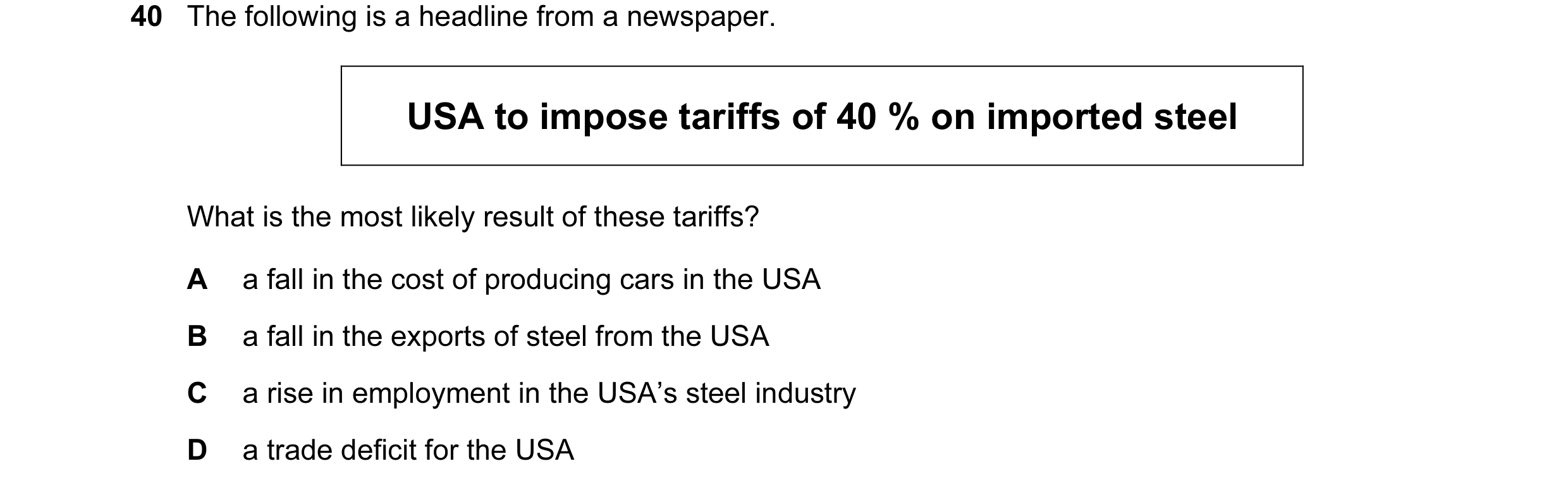
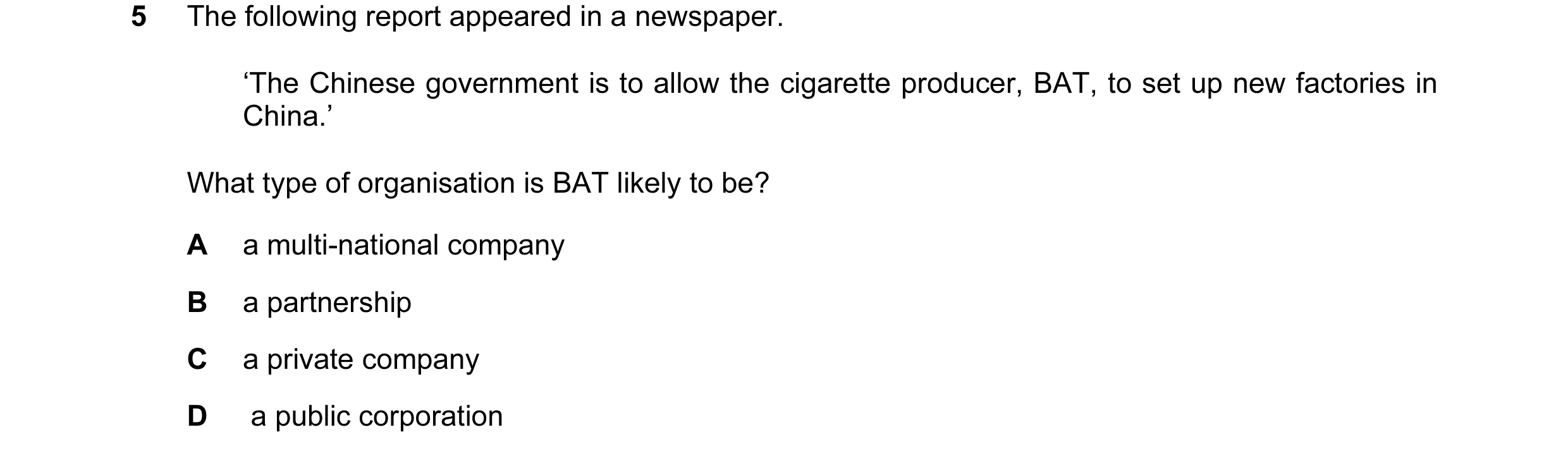

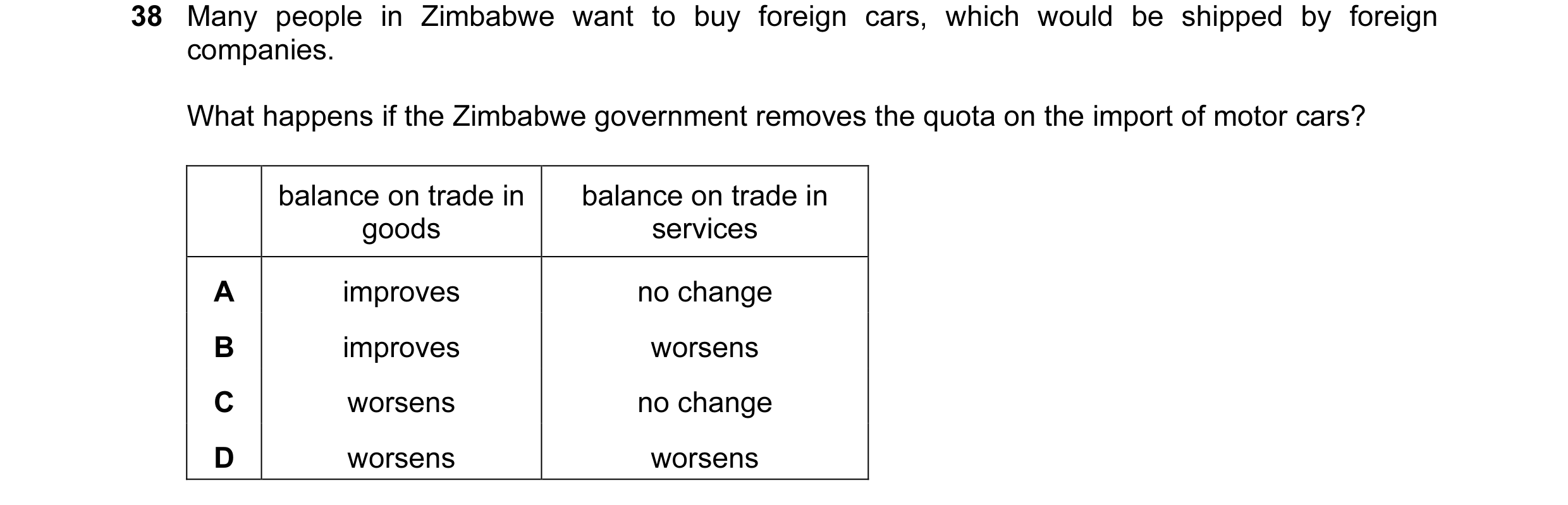 2 / 37
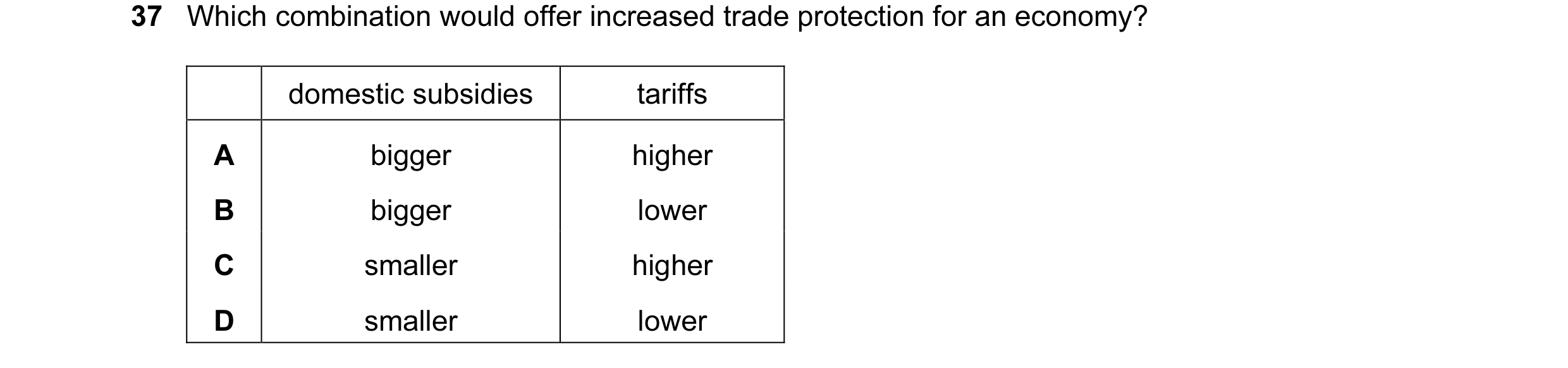
 3 / 37

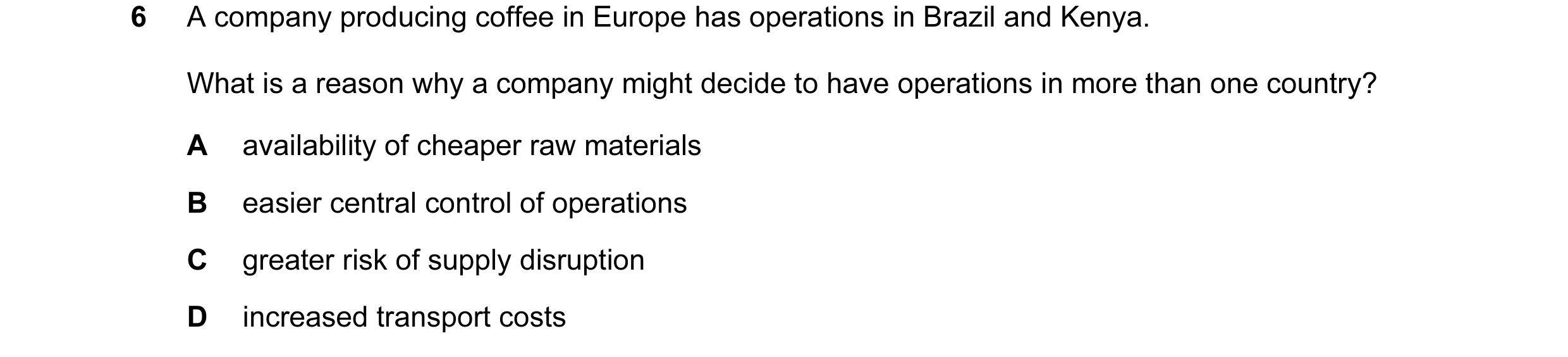
 4 / 37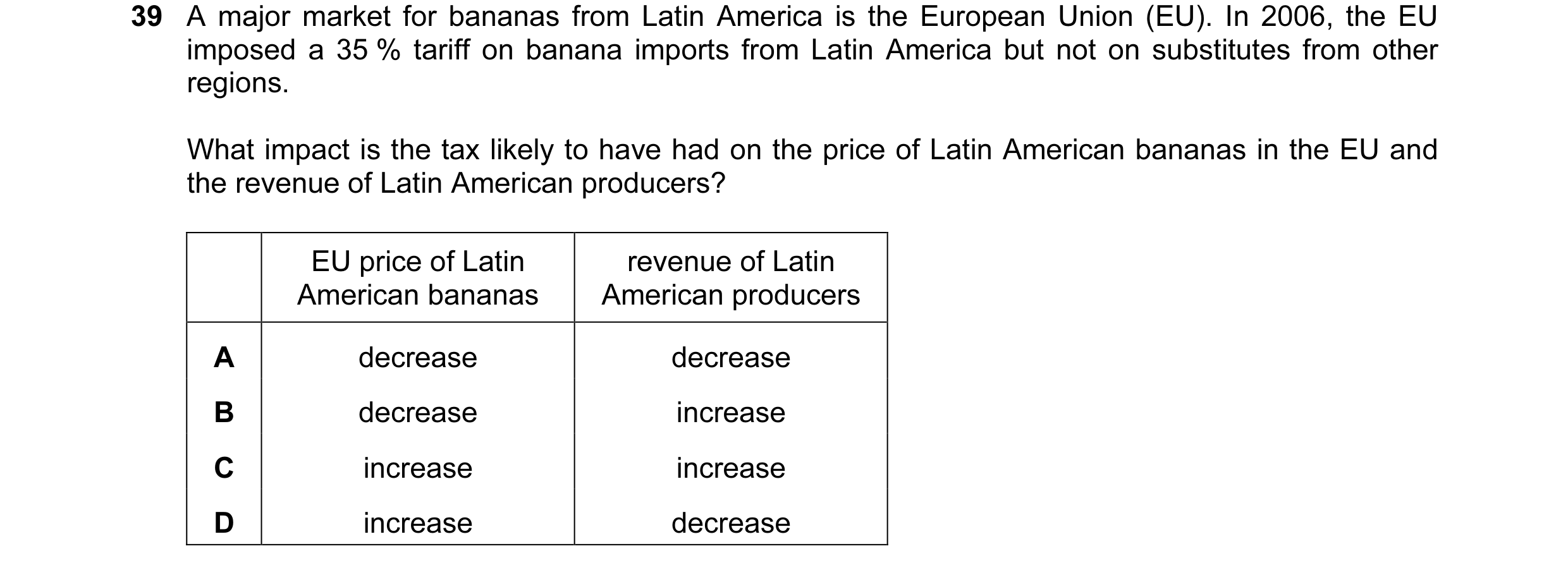
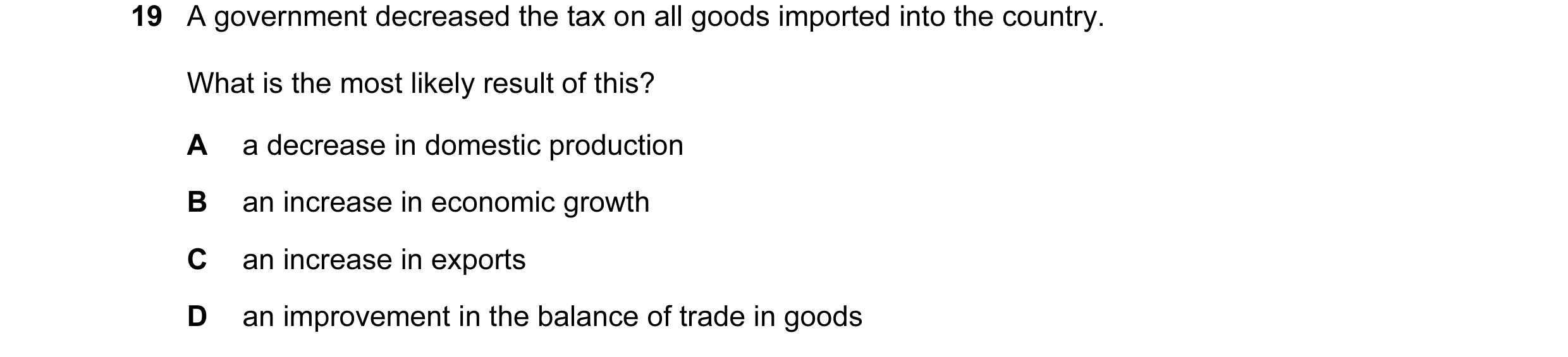


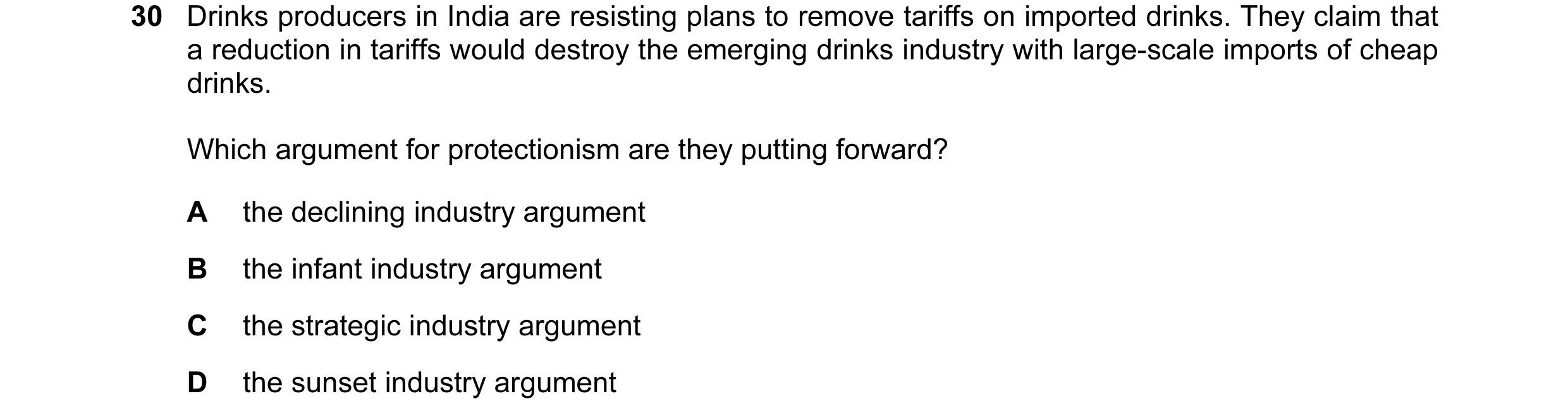 5 / 37
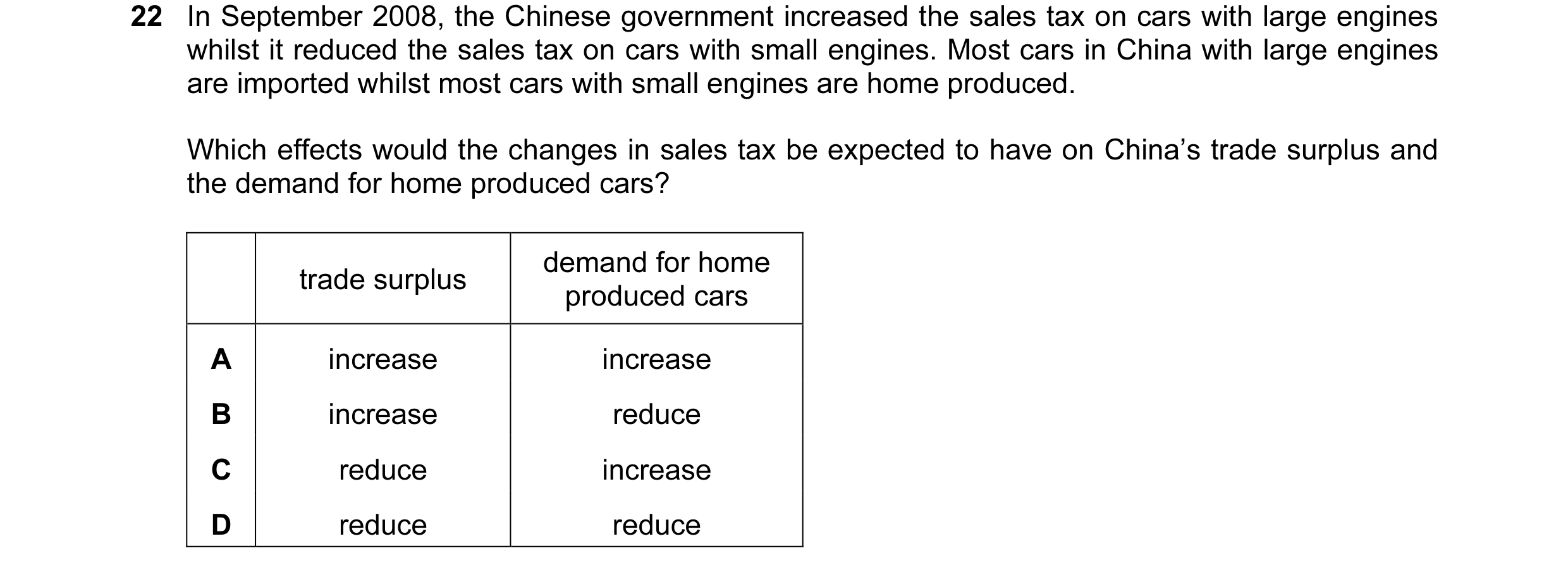
 6 / 37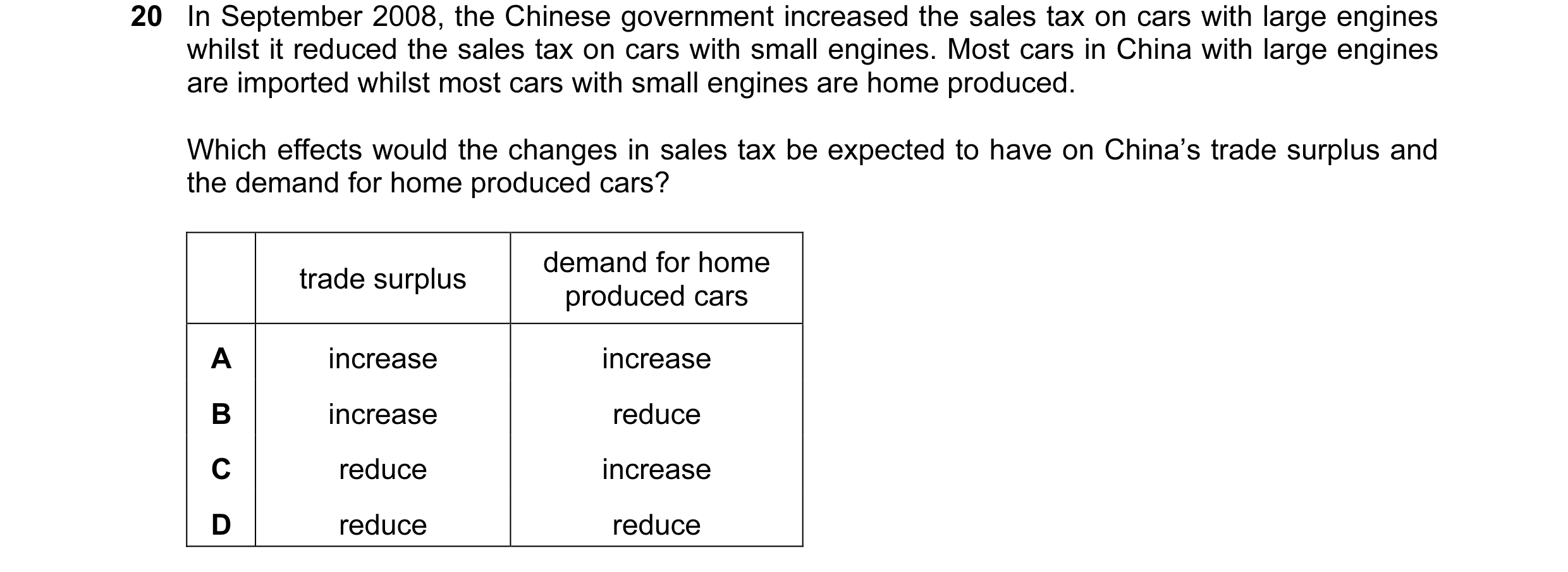
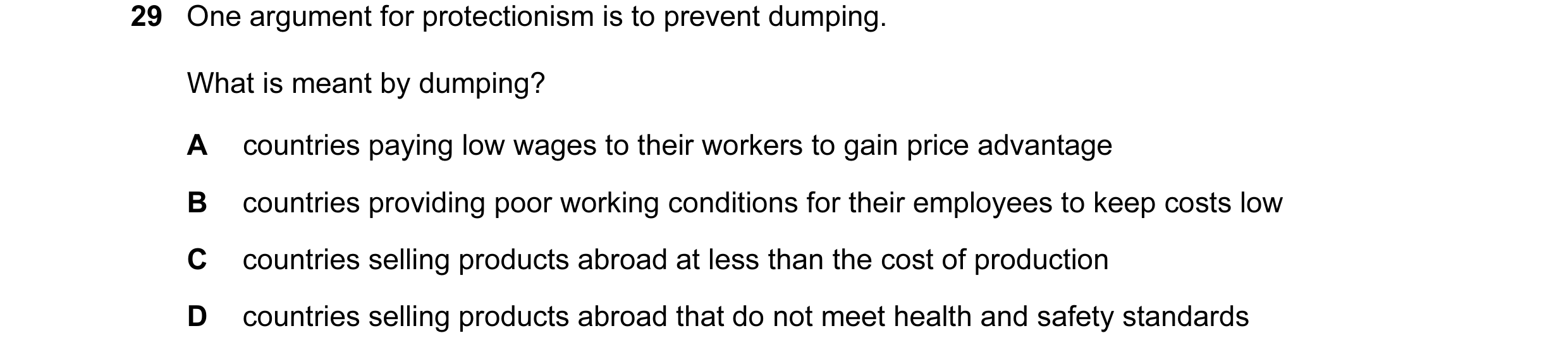
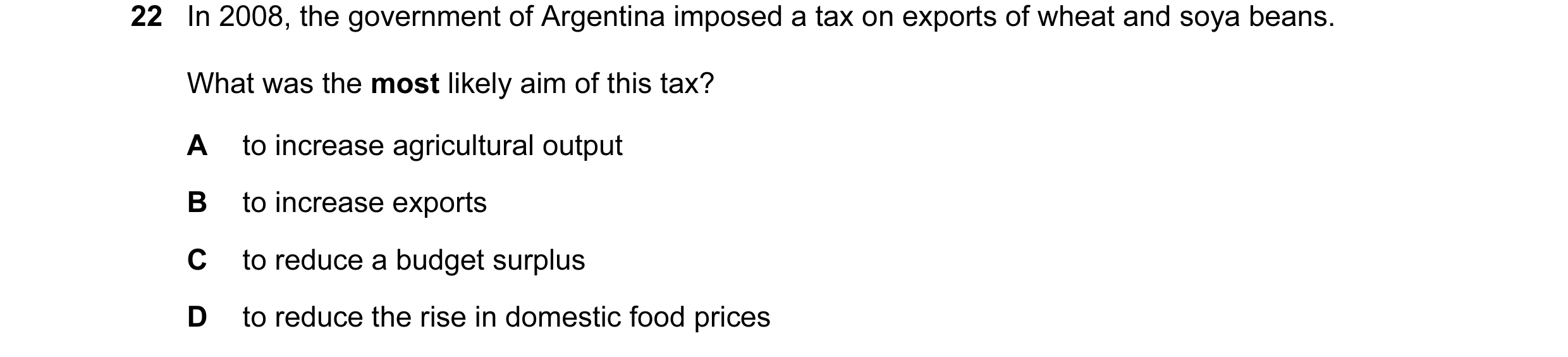
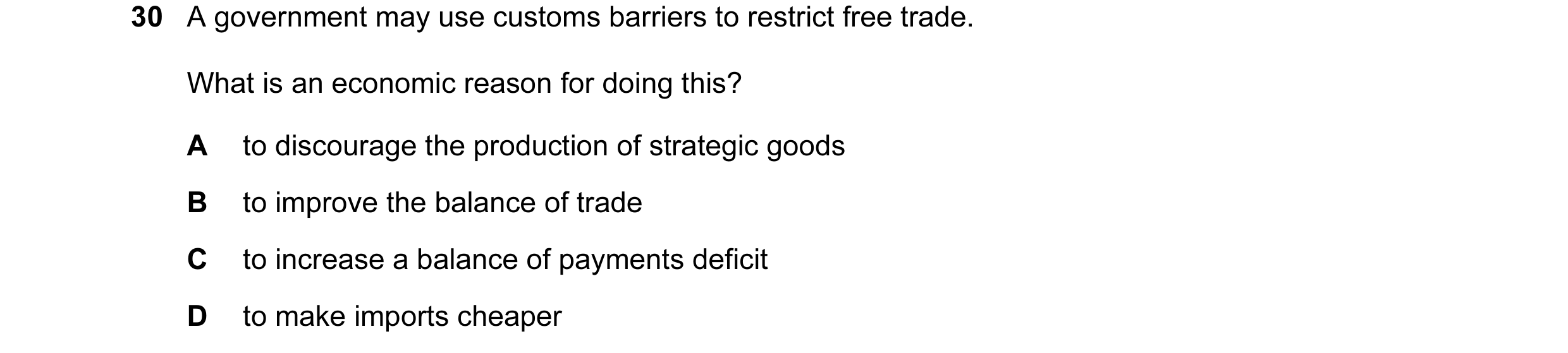
 7 / 37
 8 / 37
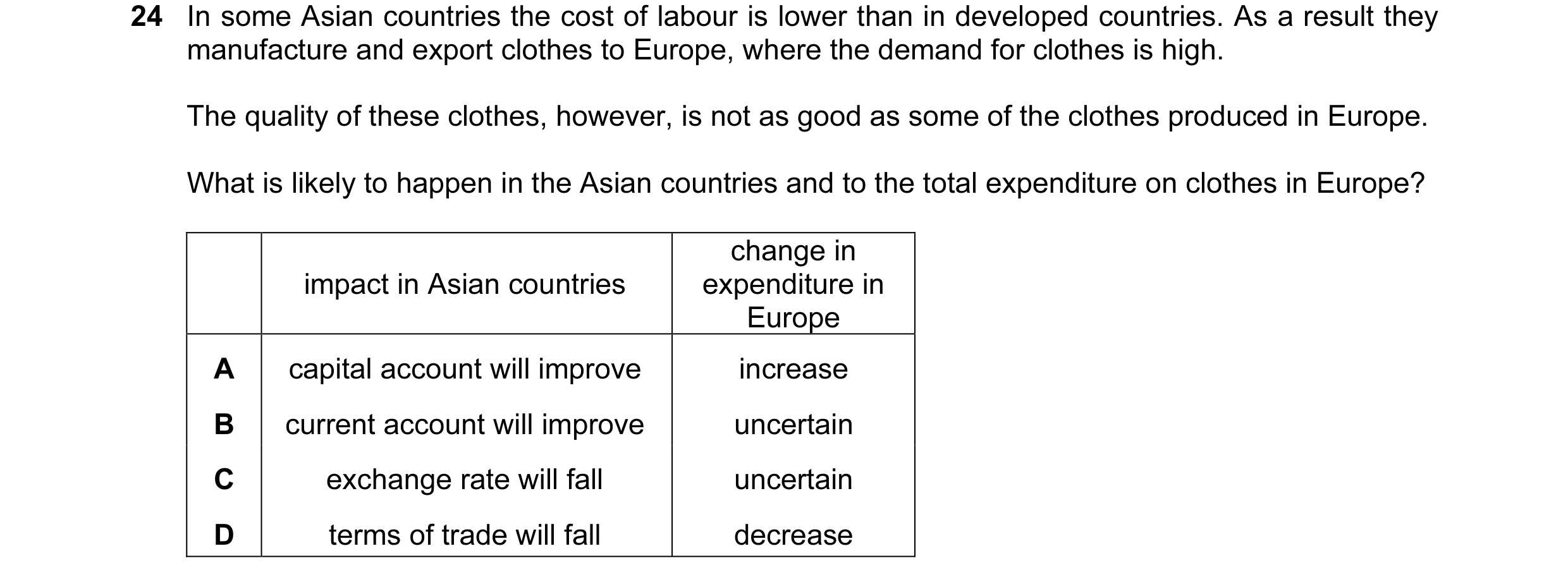
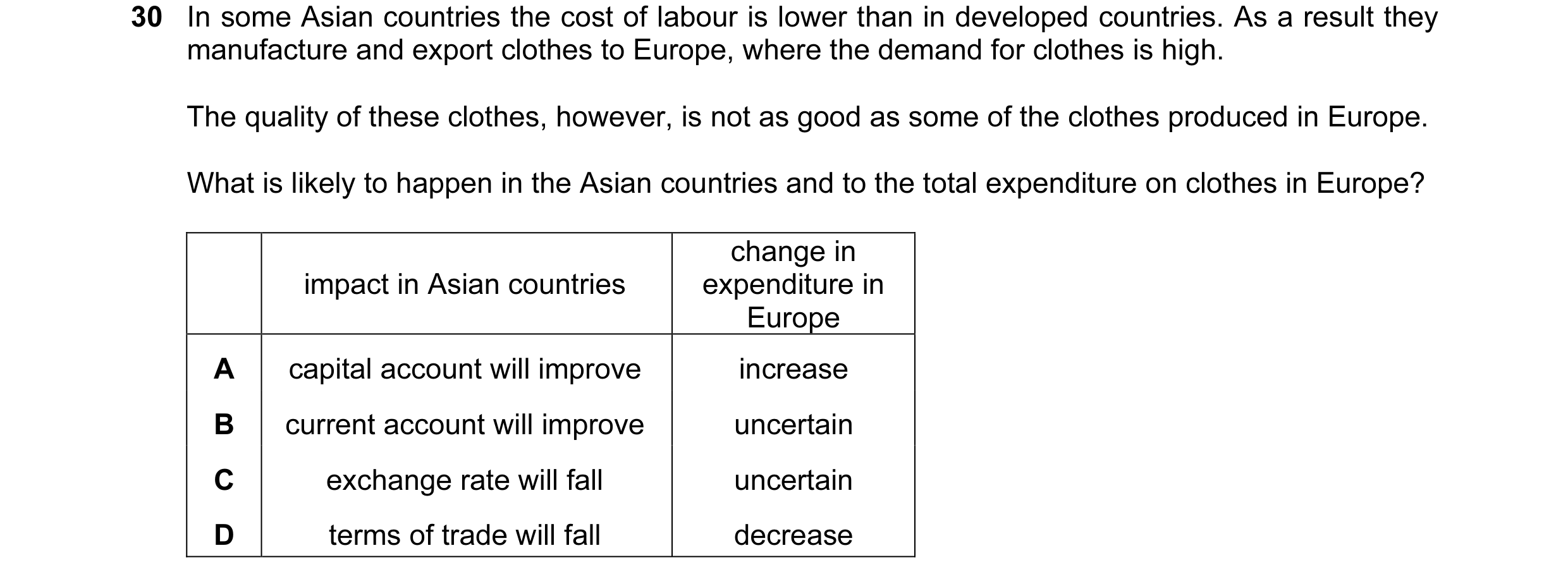 9 / 37
 10 / 37

 11 / 37


 12 / 37

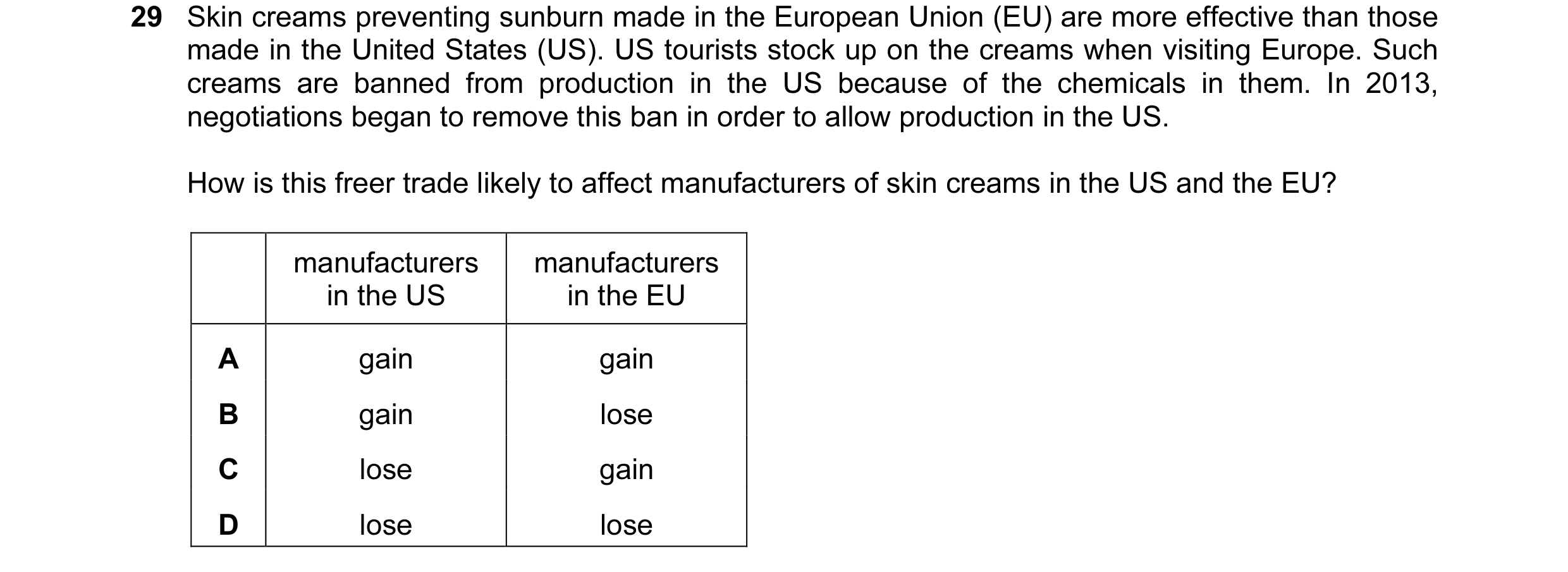 13 / 37
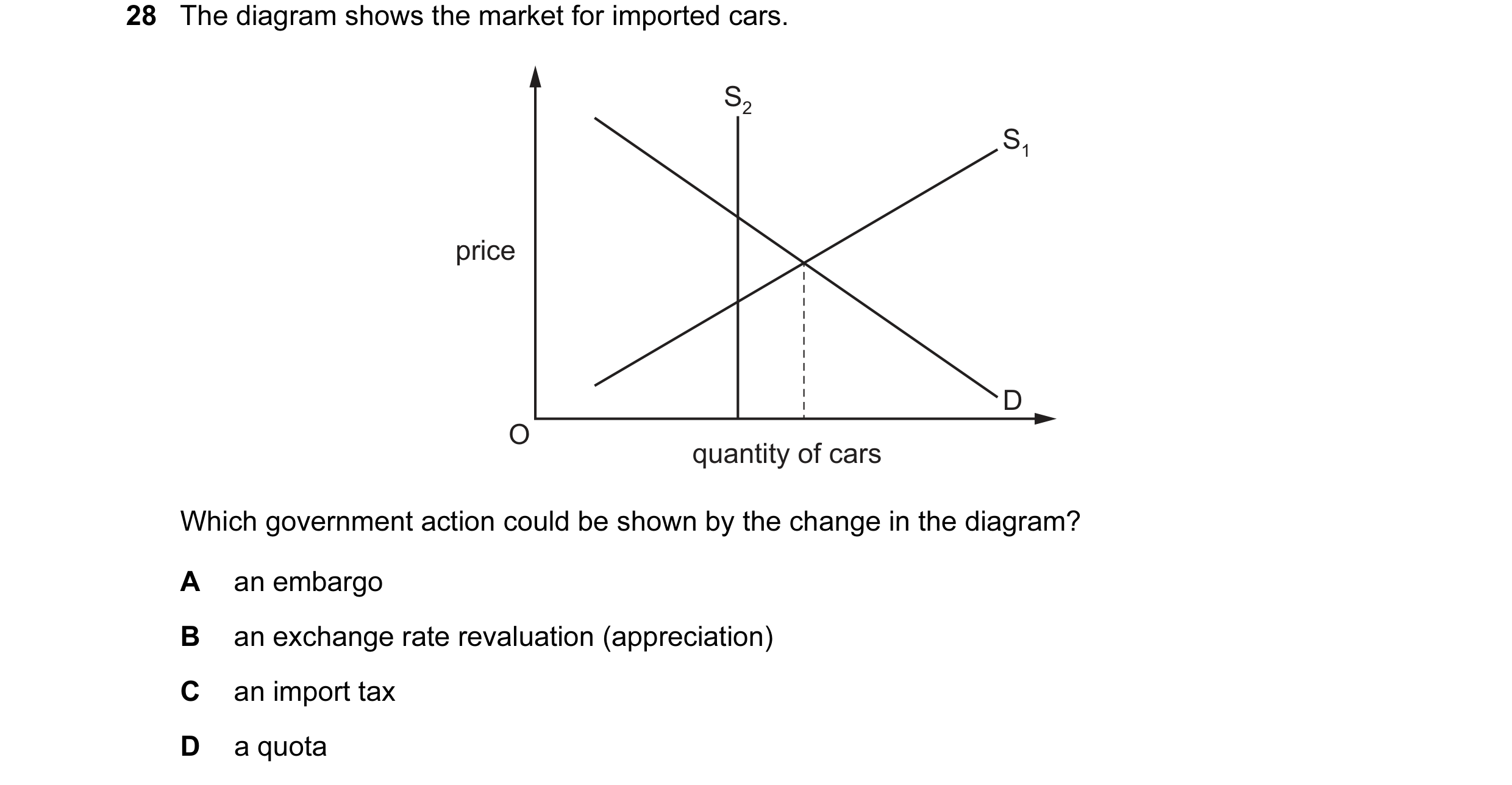
 14 / 37


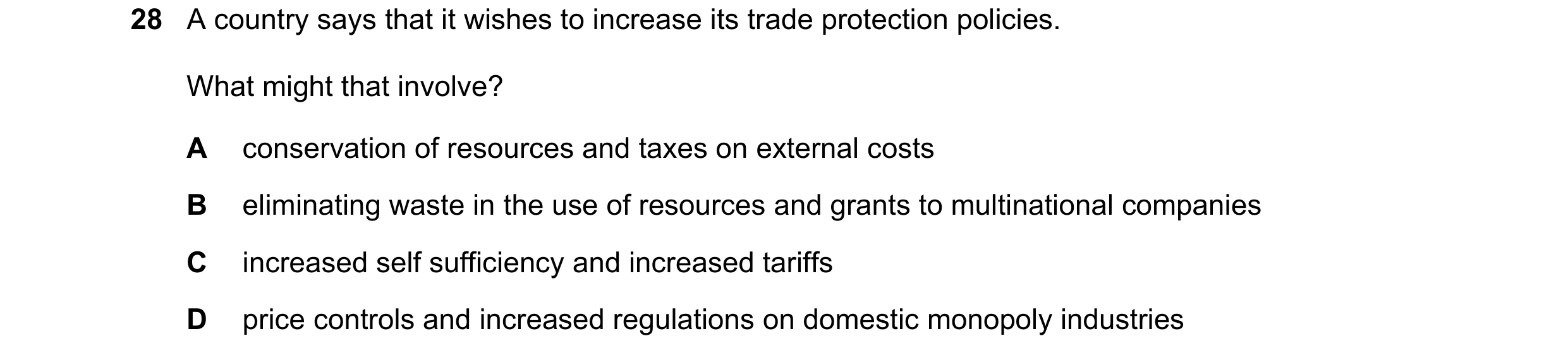 15 / 37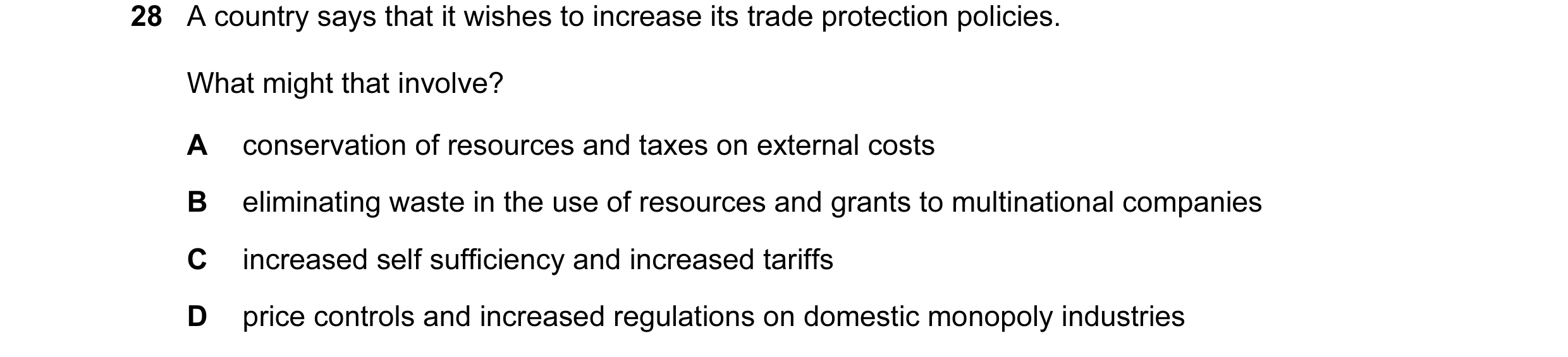

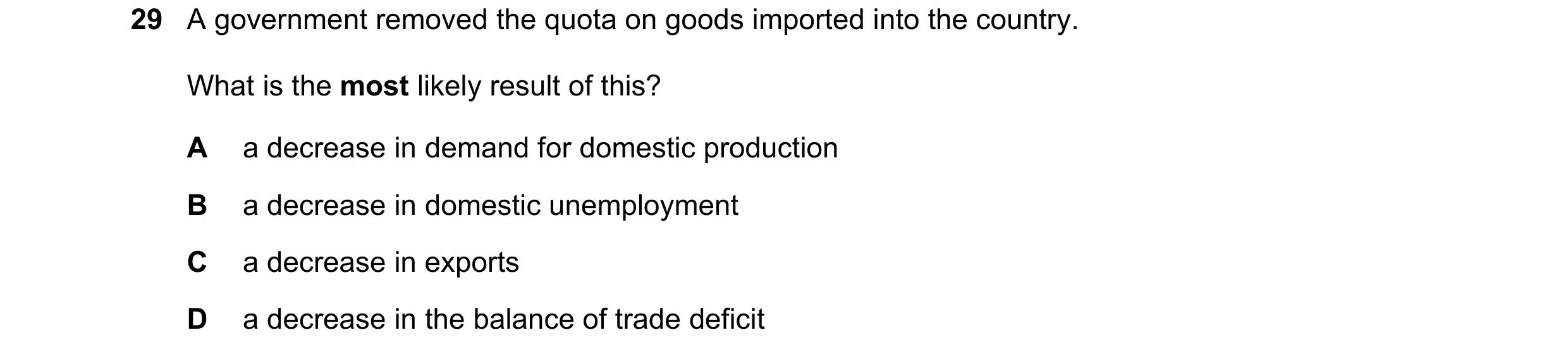

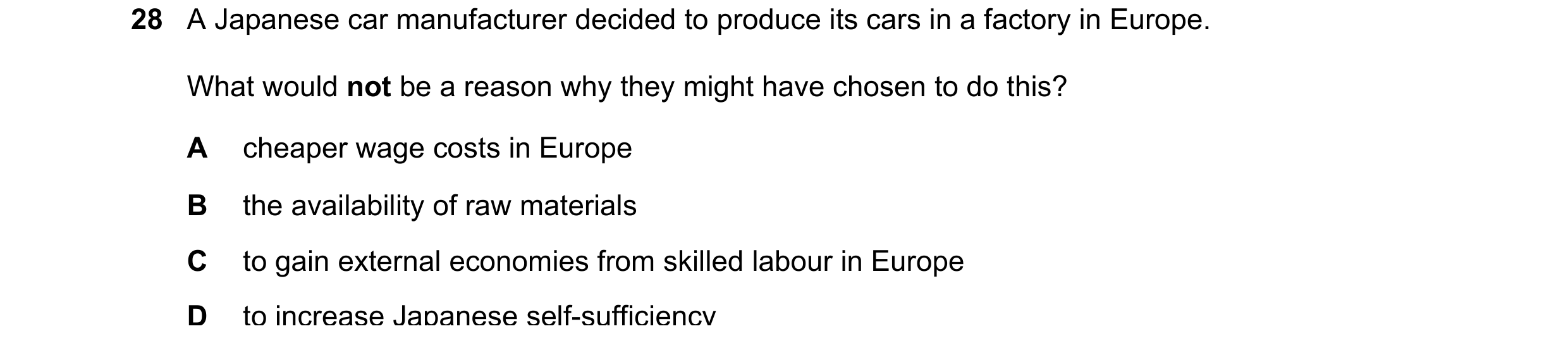
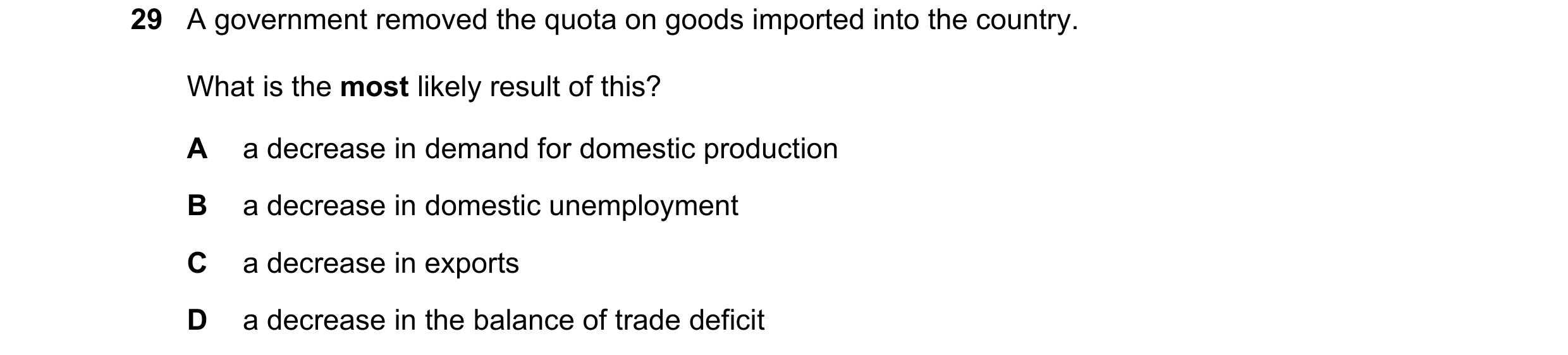 16 / 37




 17 / 37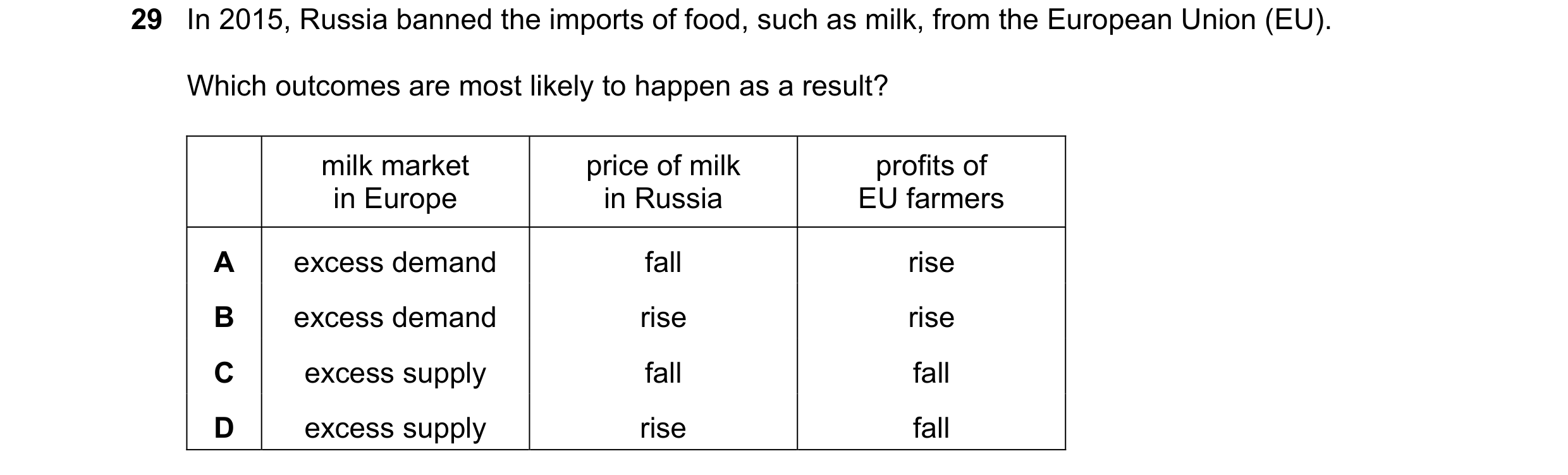


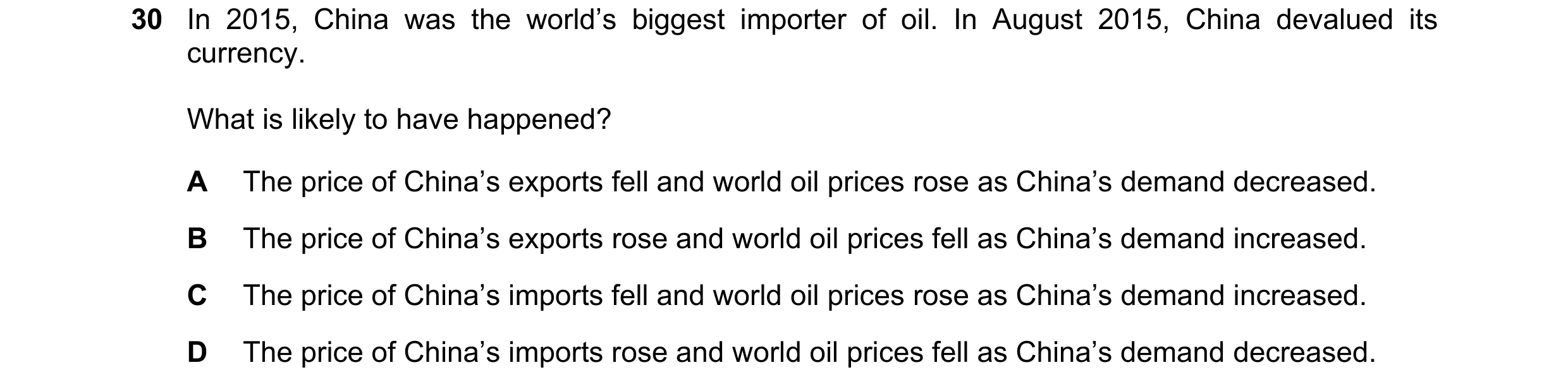
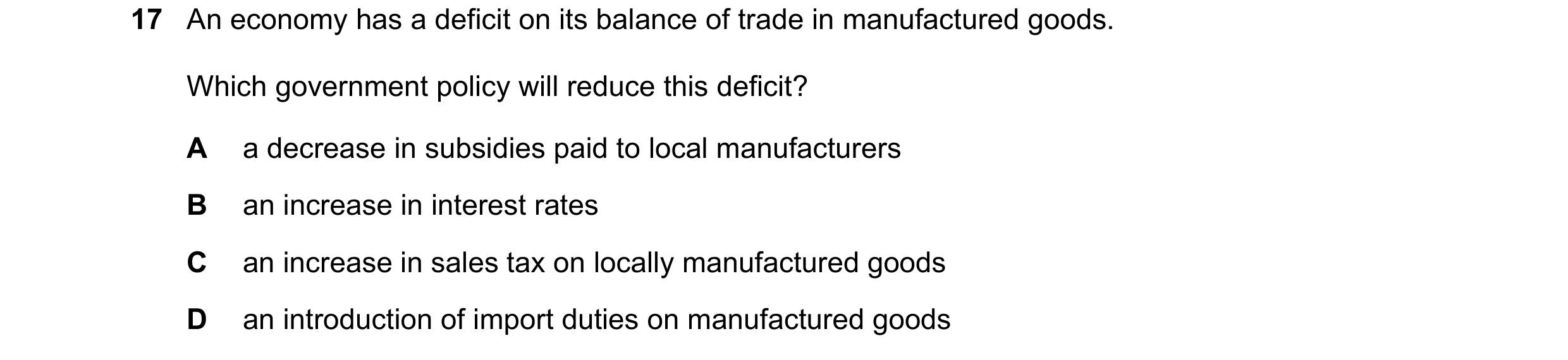 18 / 37



 19 / 37


 20 / 37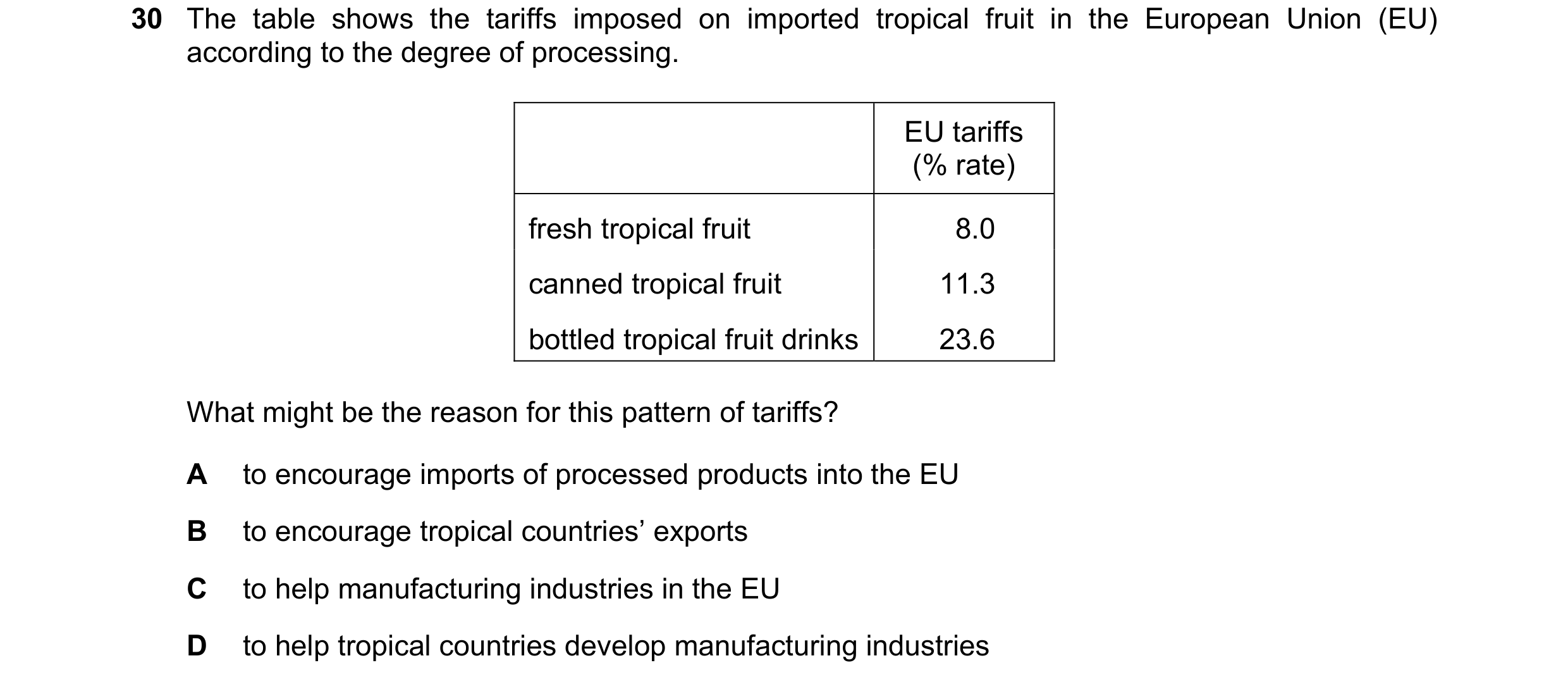
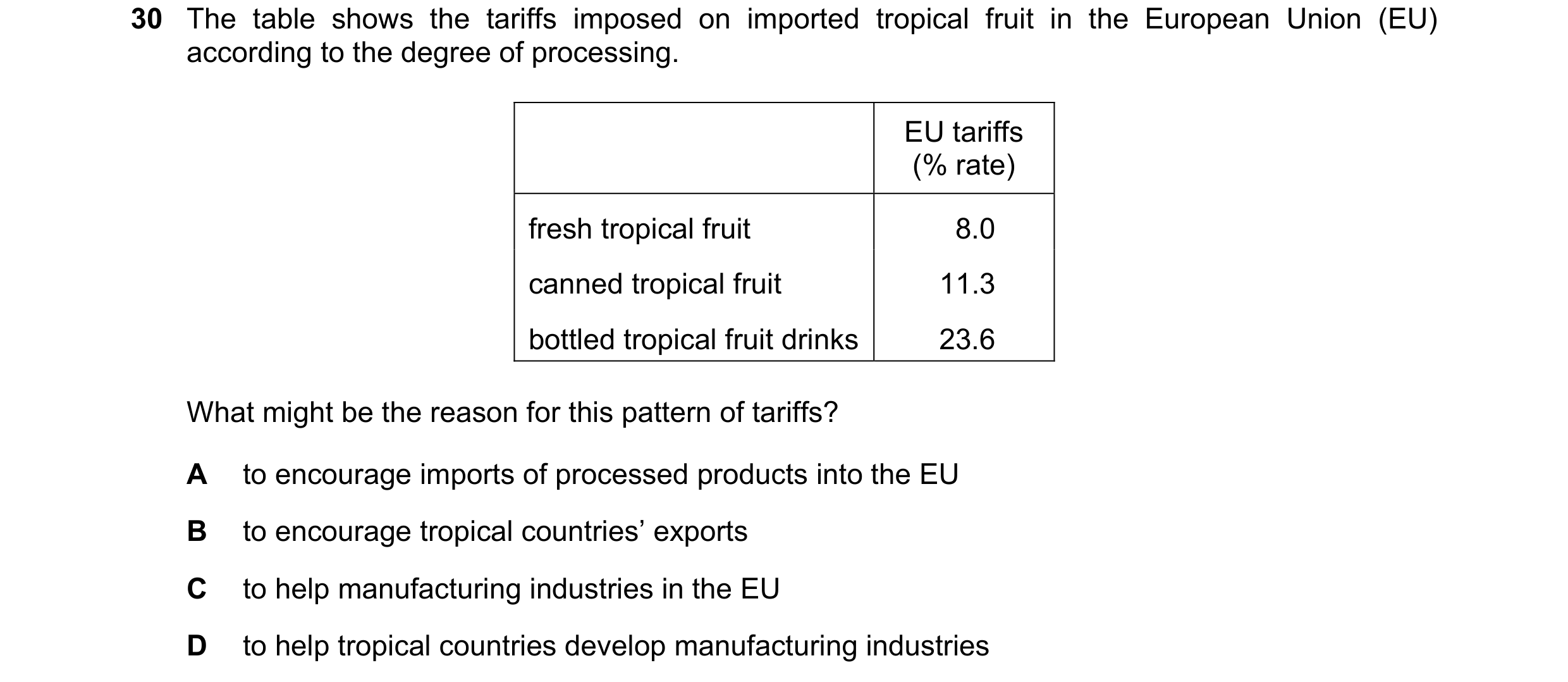
 21 / 37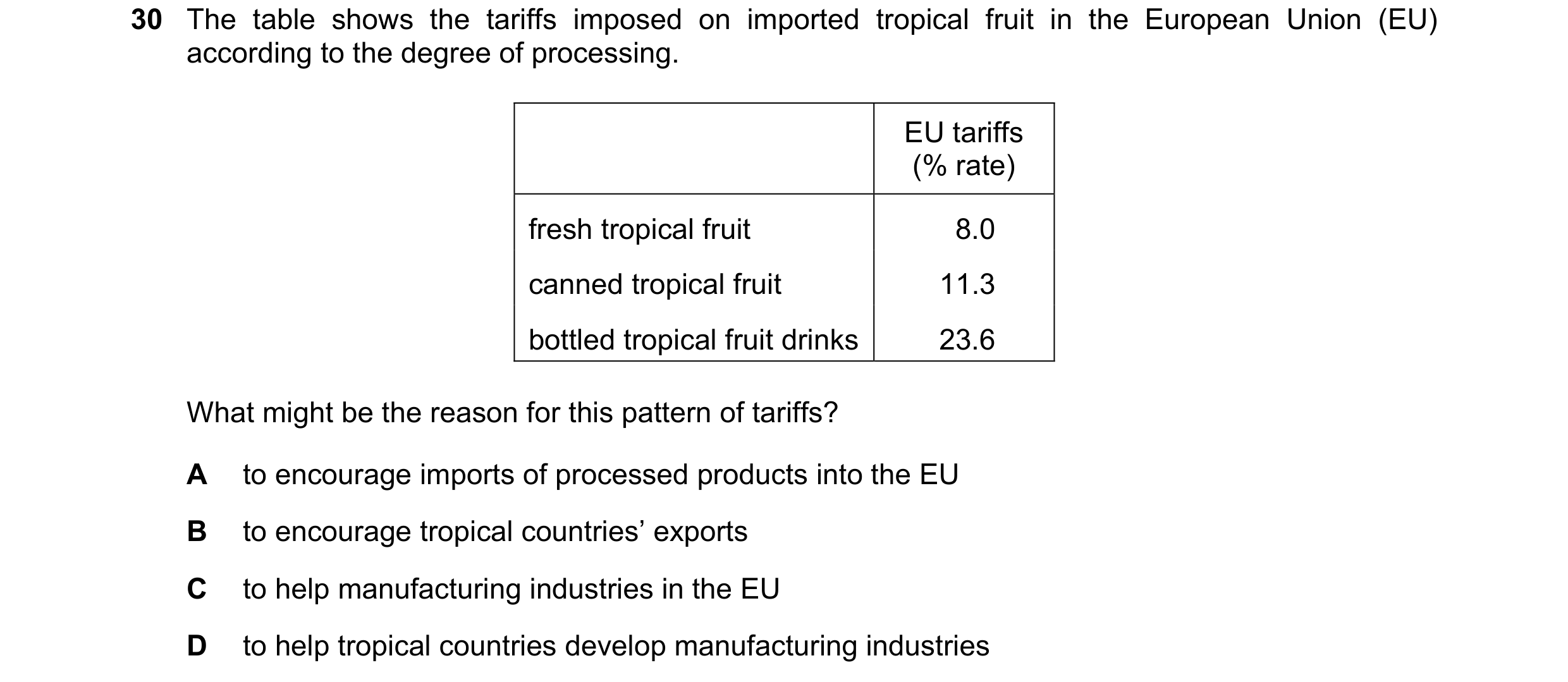

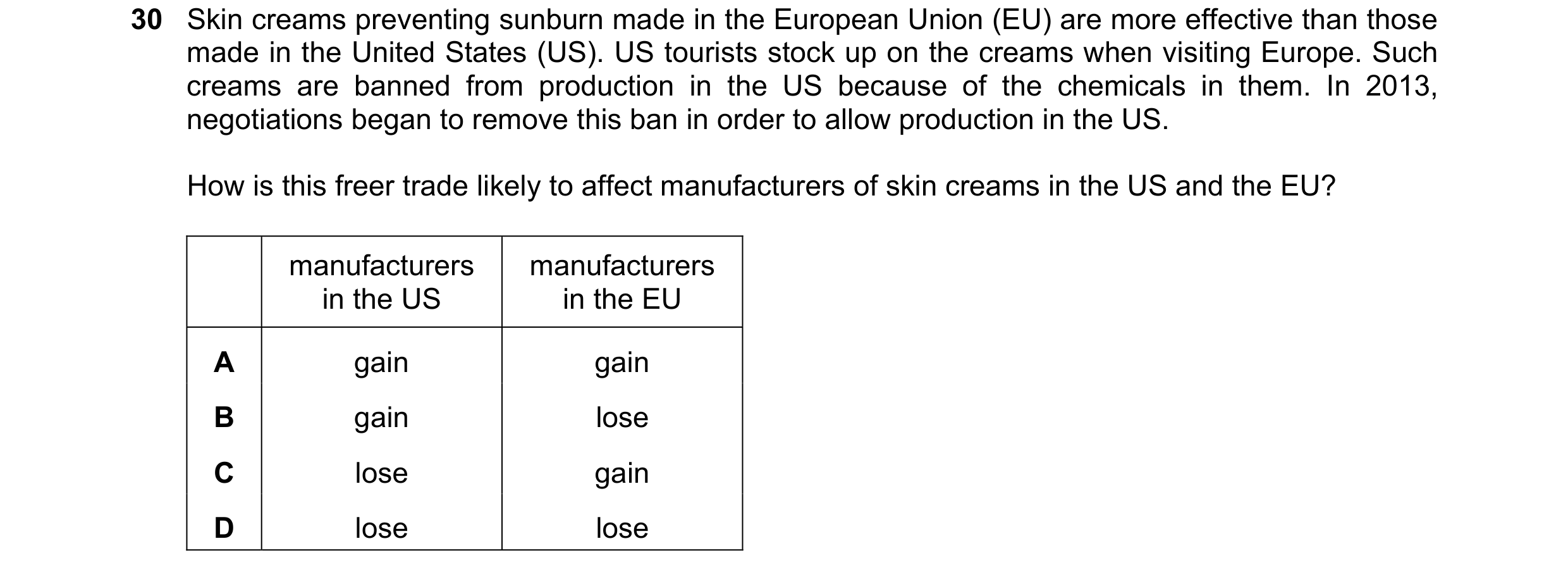 22 / 37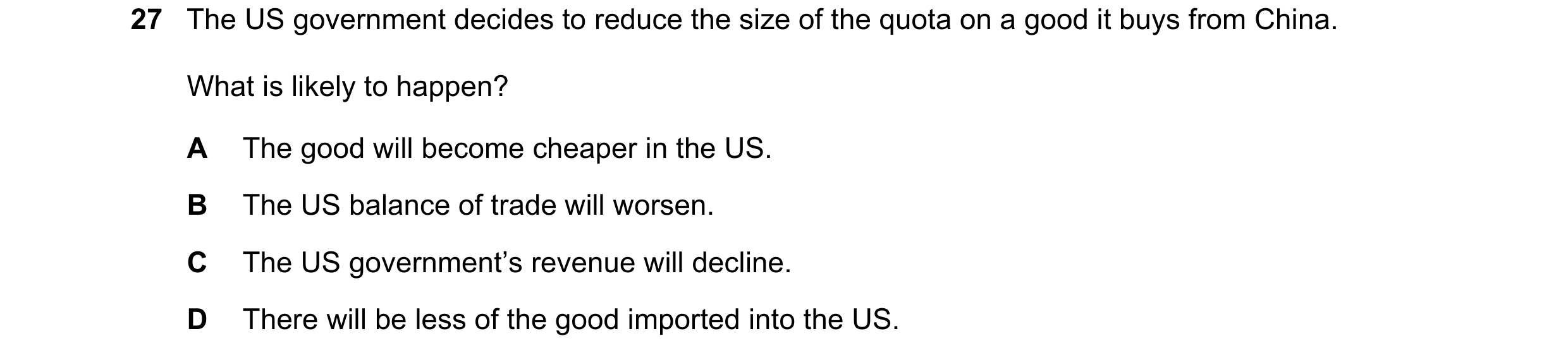
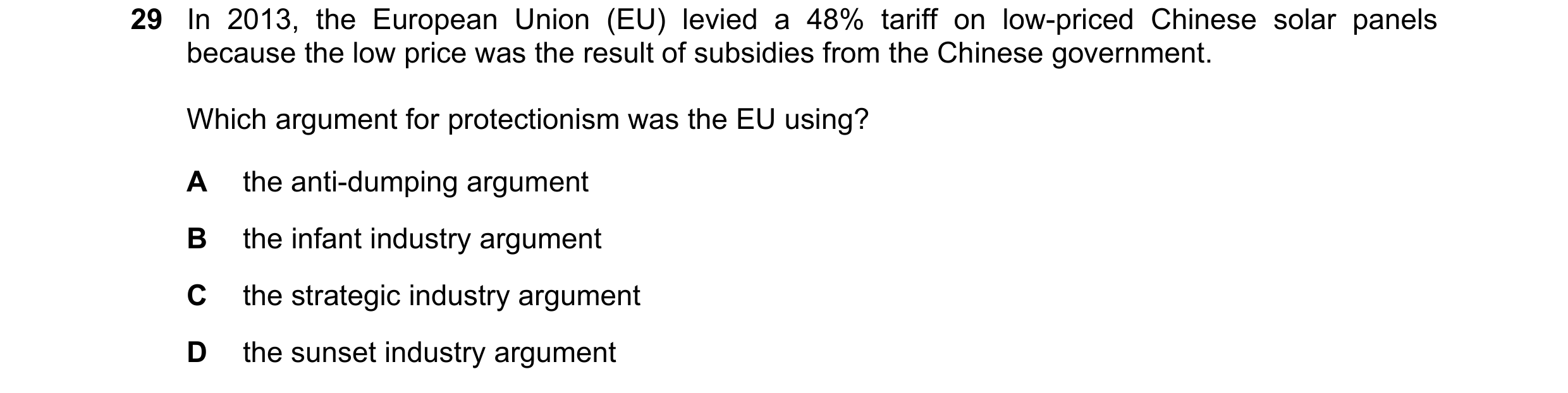

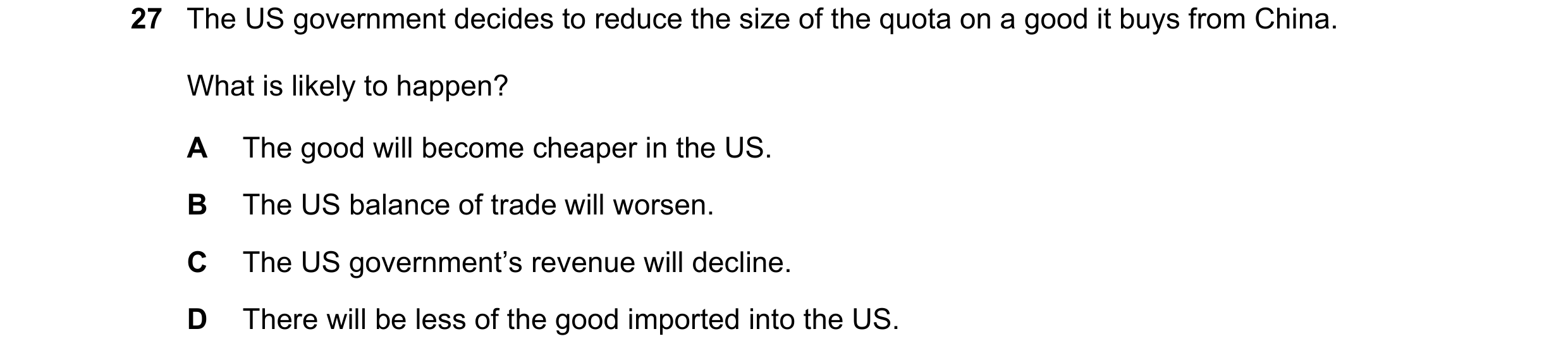
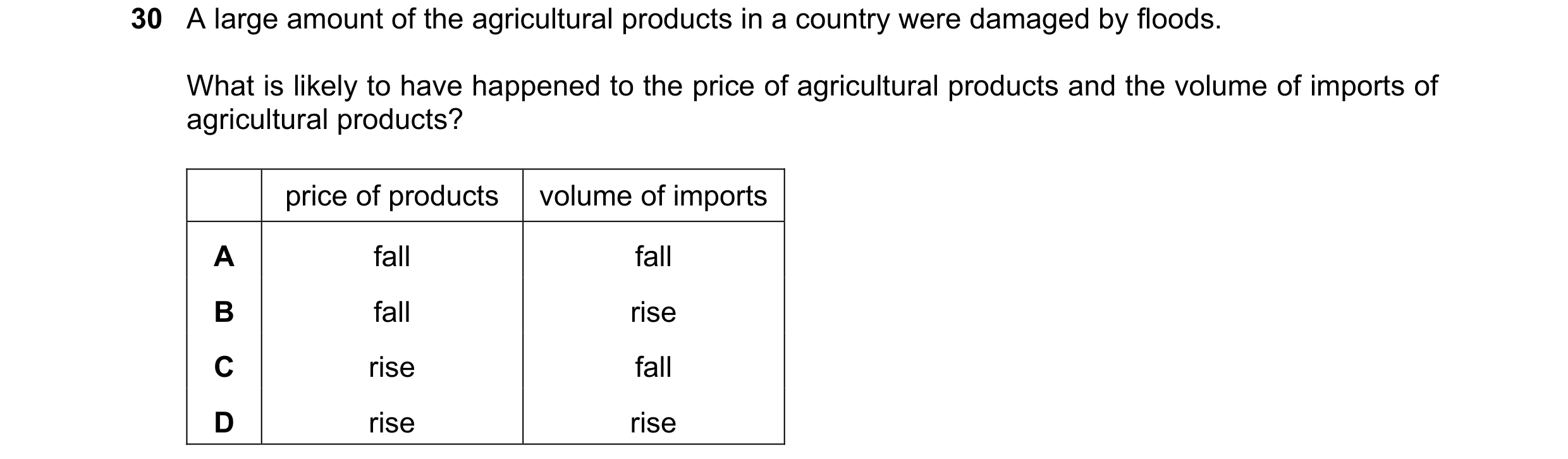 23 / 37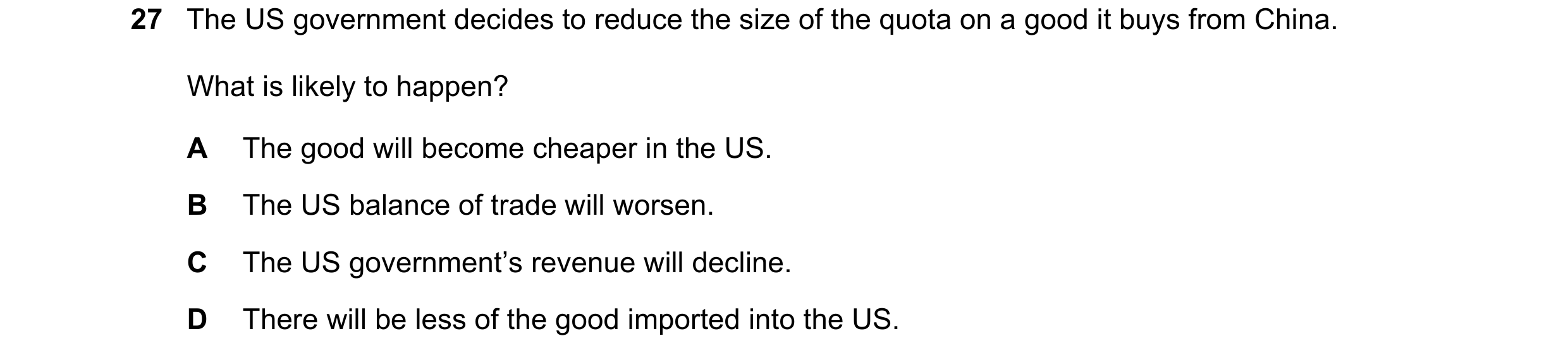
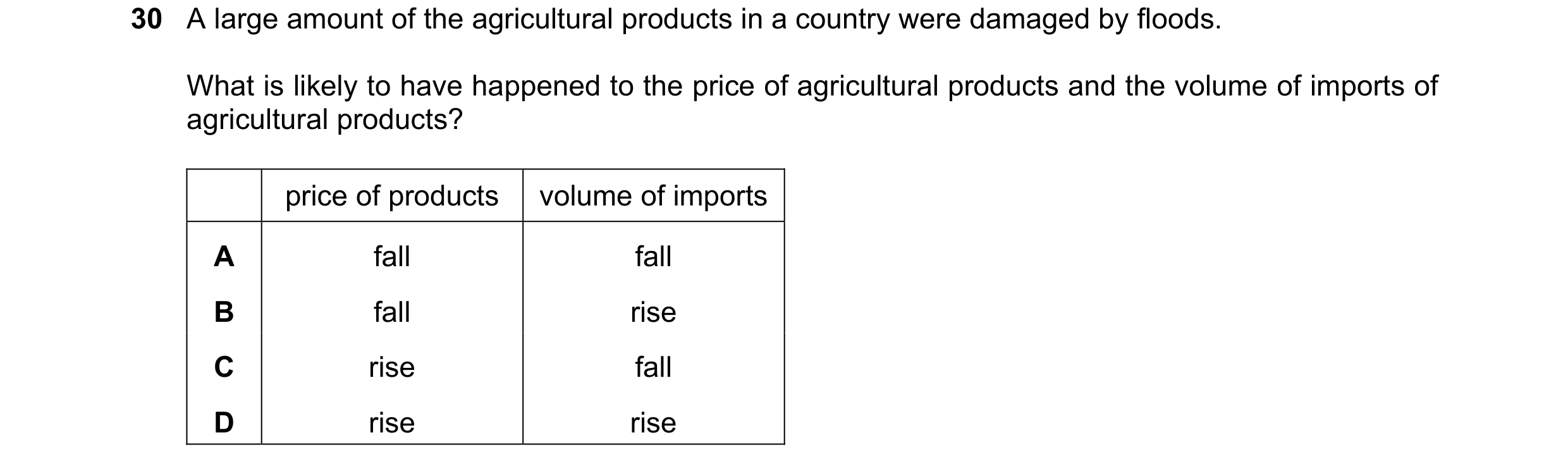
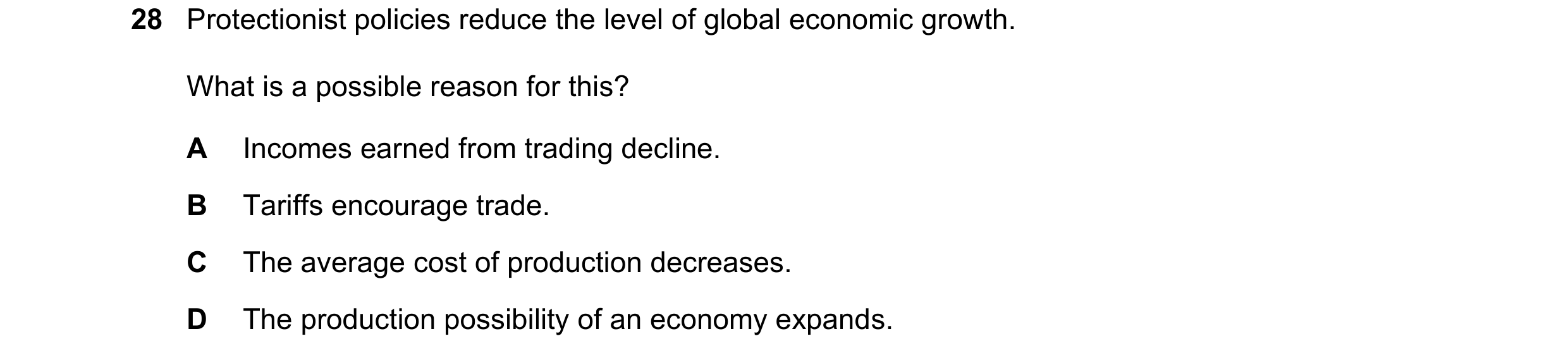

 24 / 37



 25 / 37
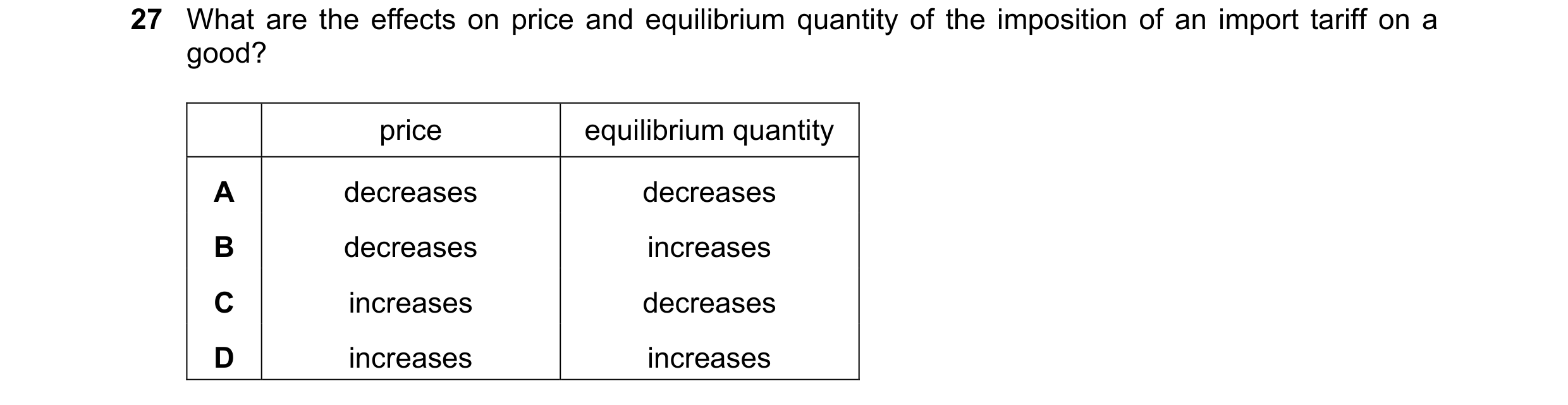
 26 / 37
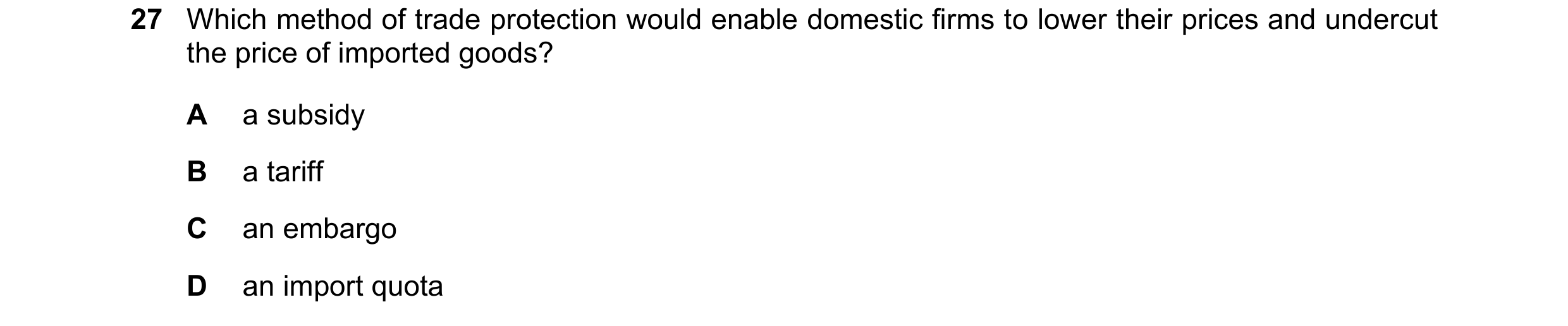


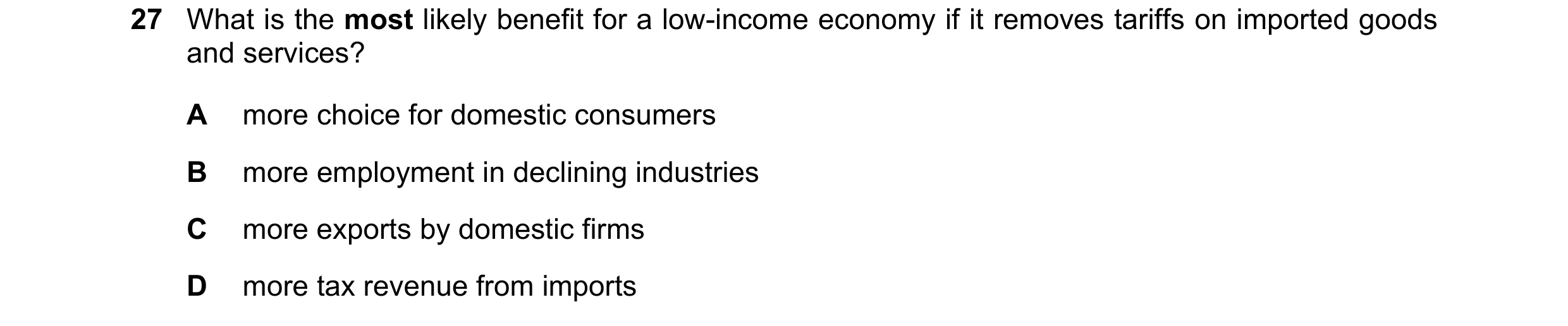 27 / 37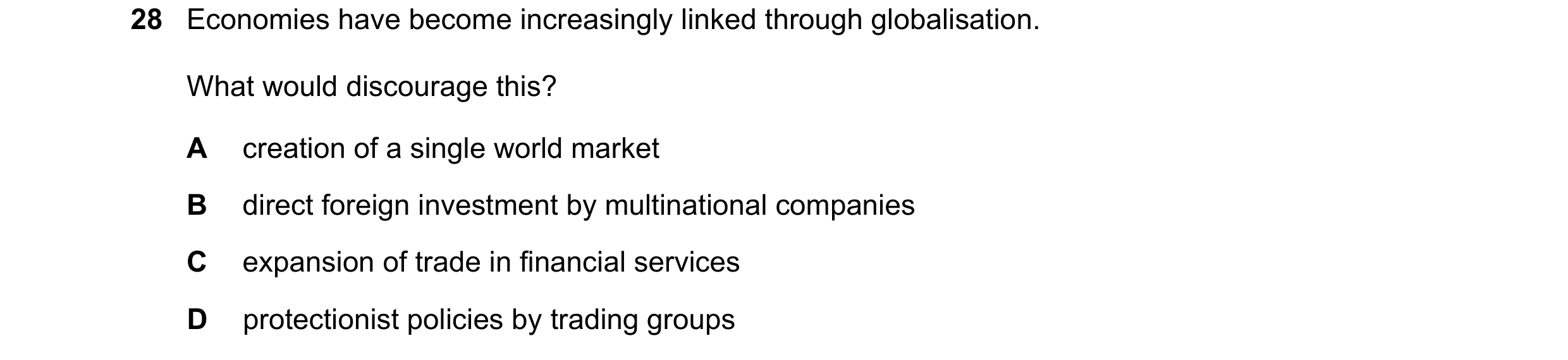

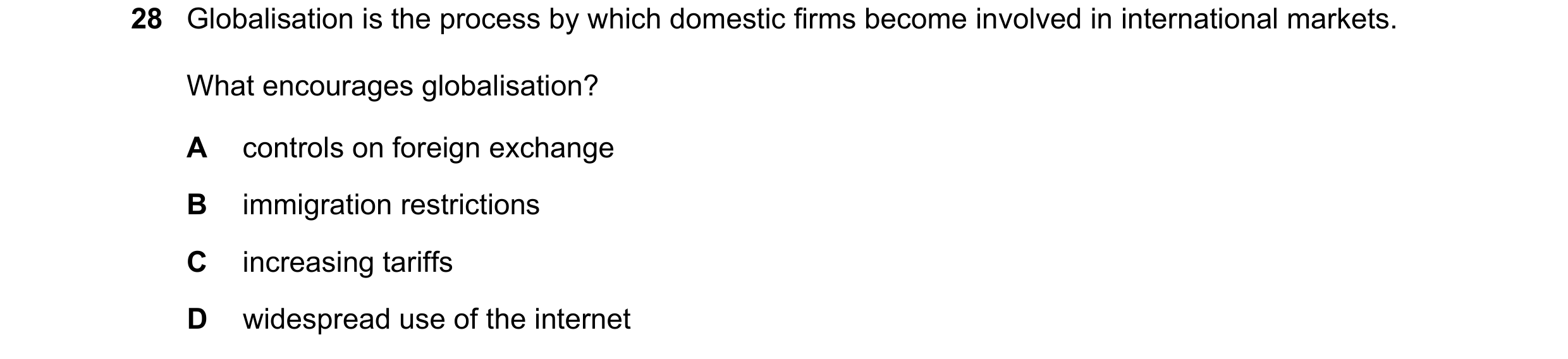
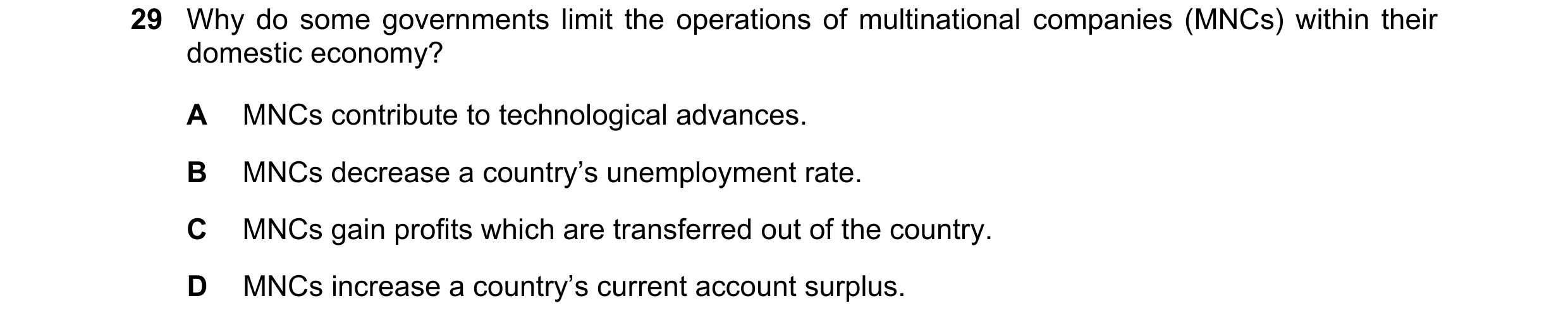
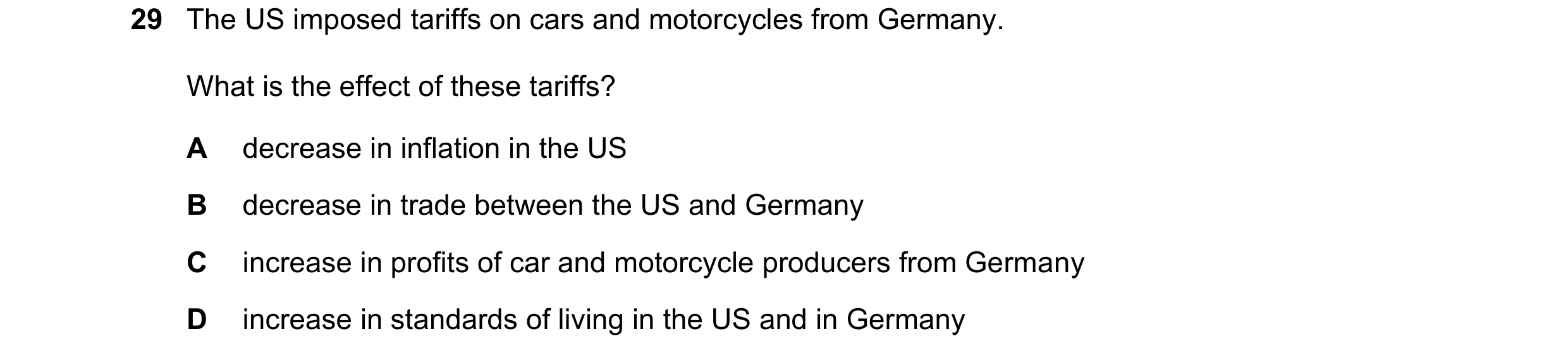
 28 / 37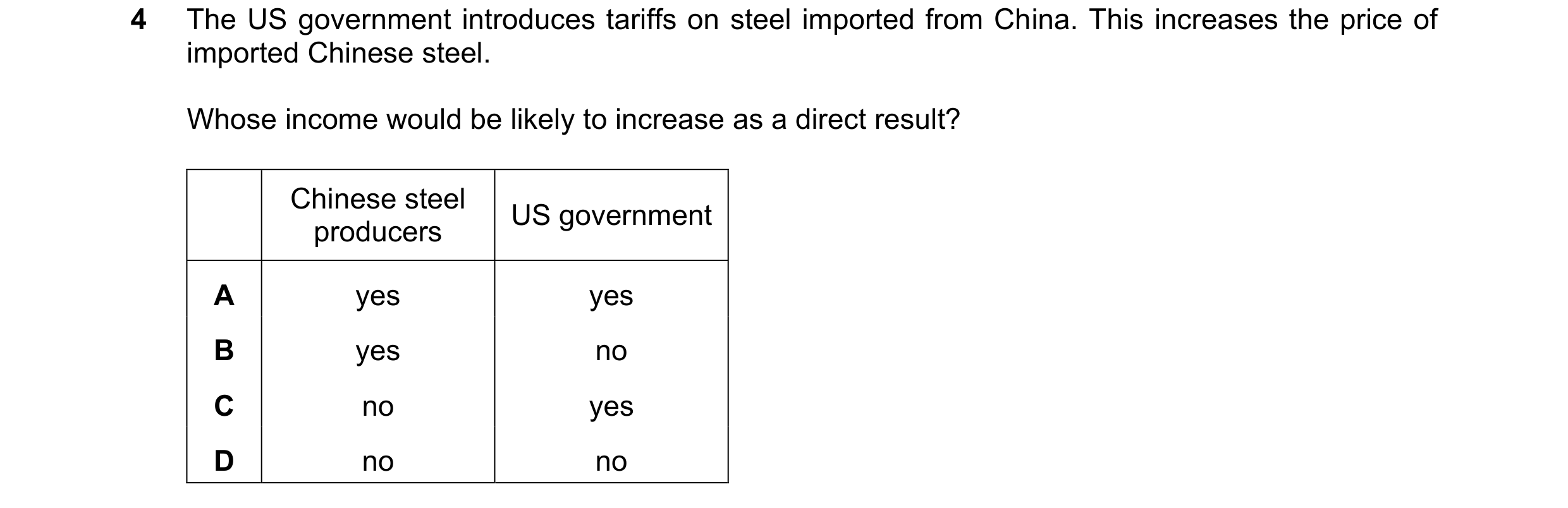
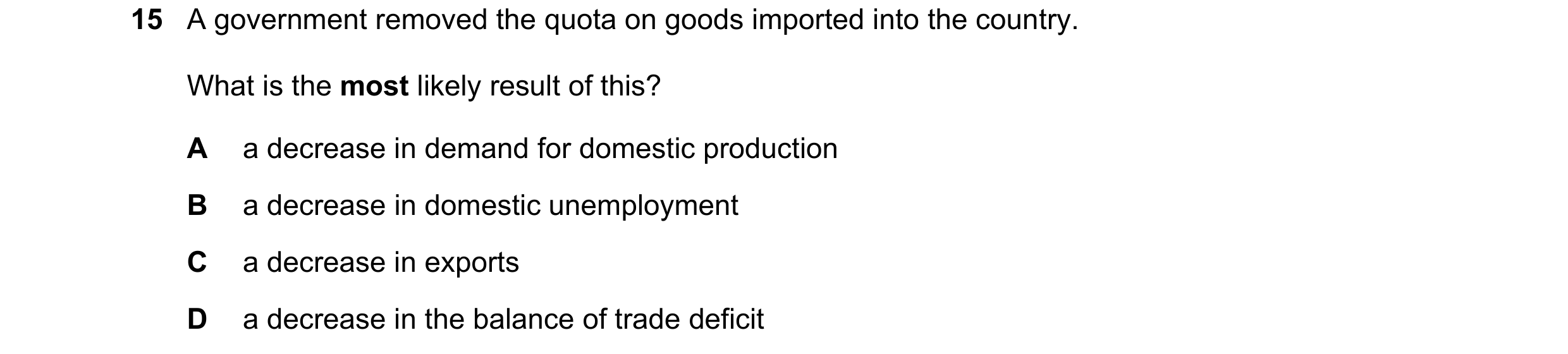
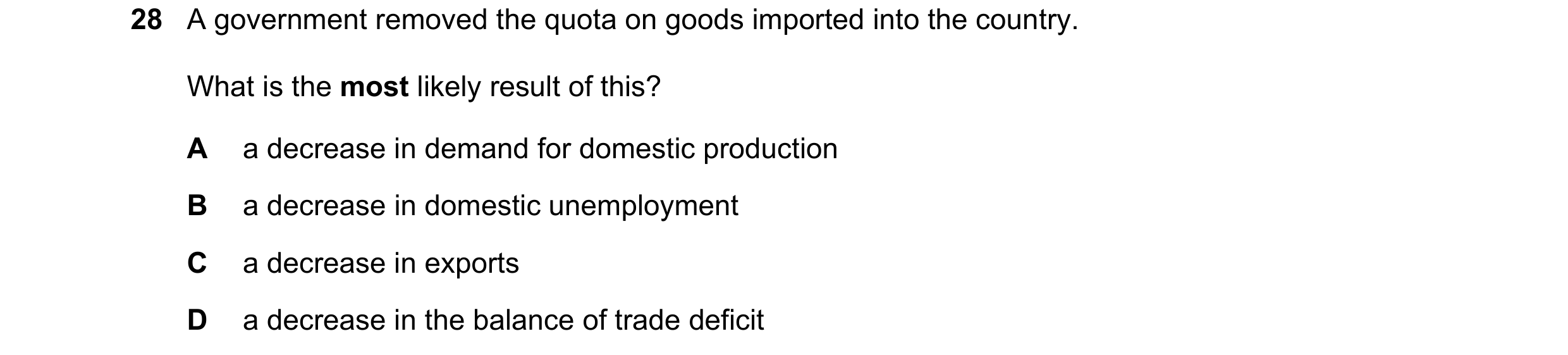
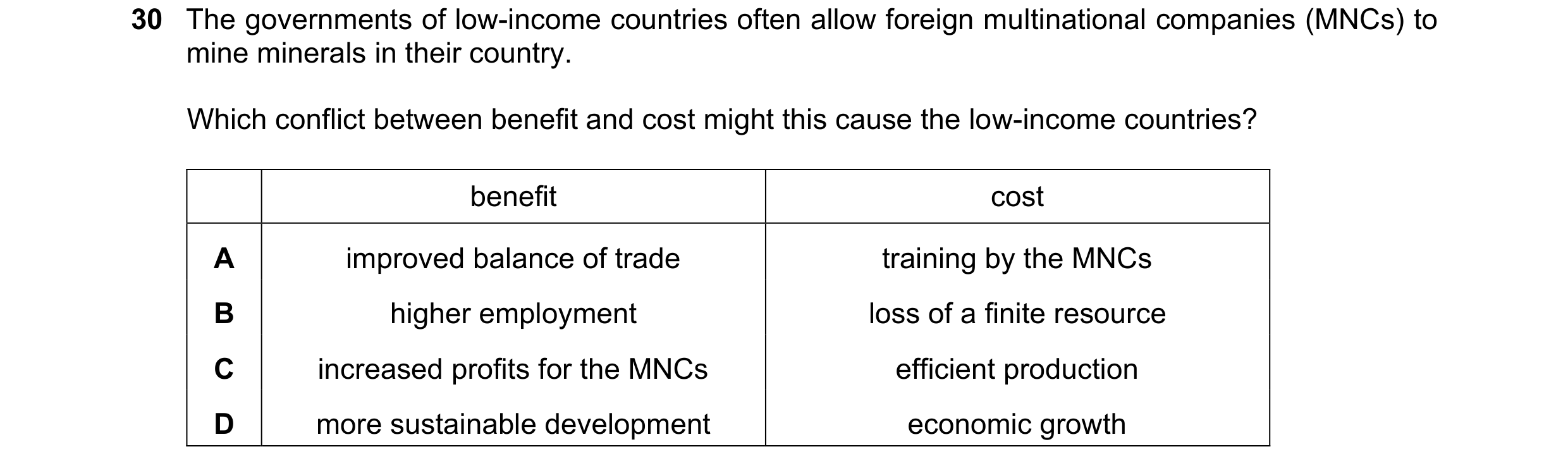
 29 / 37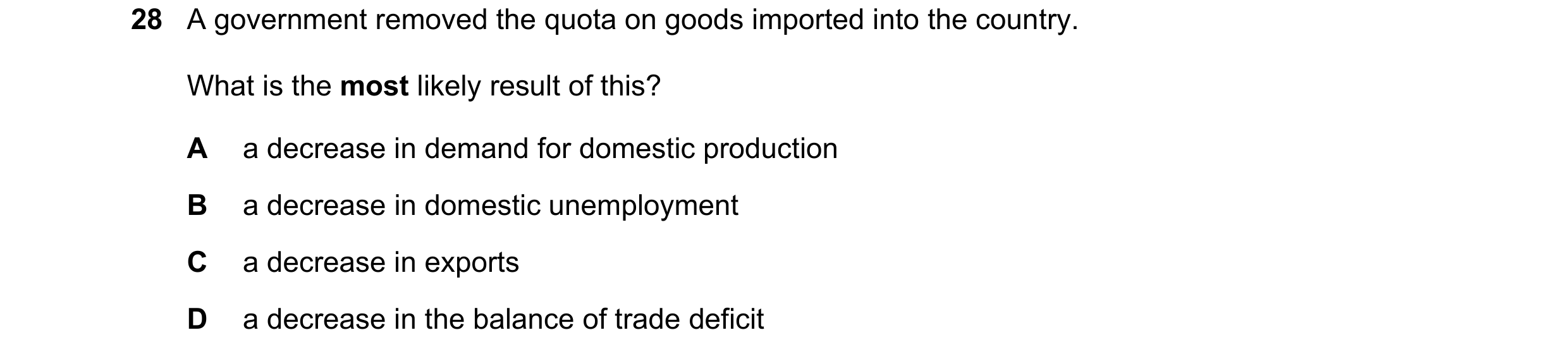
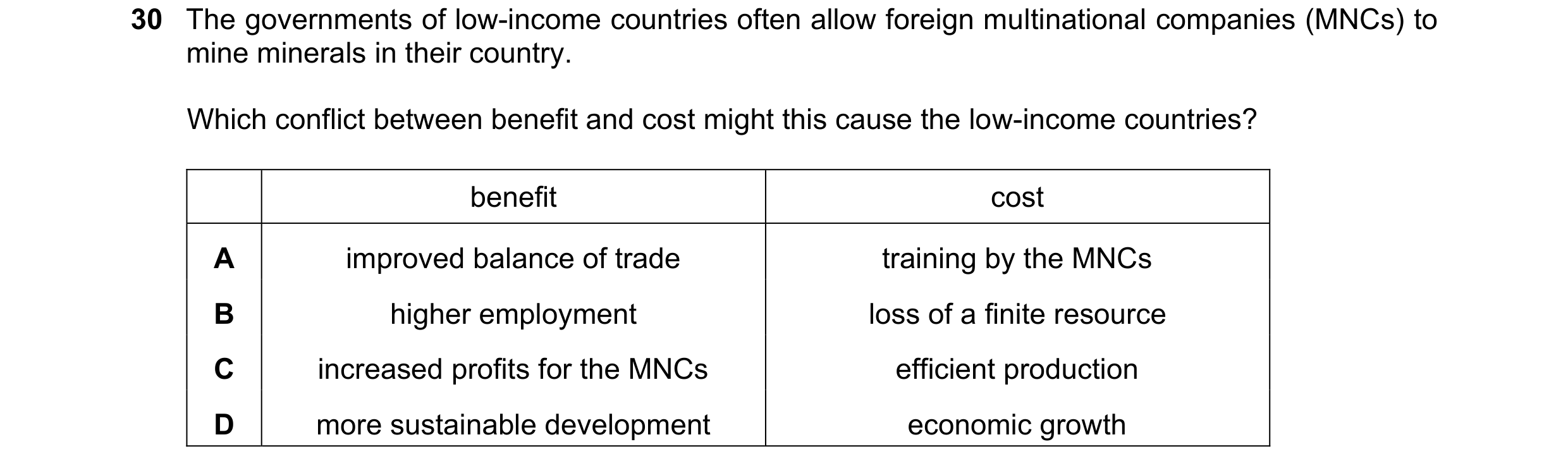
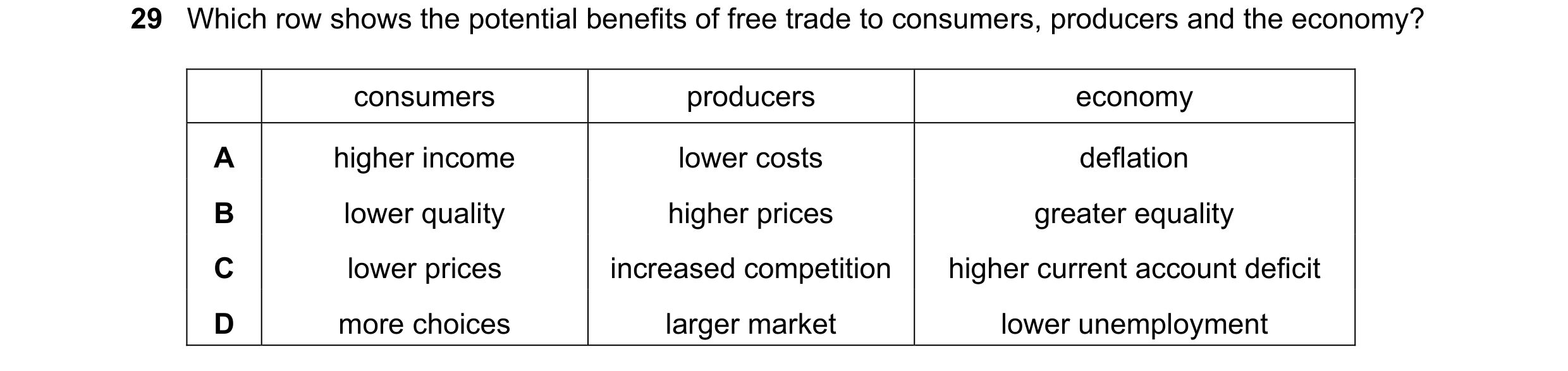

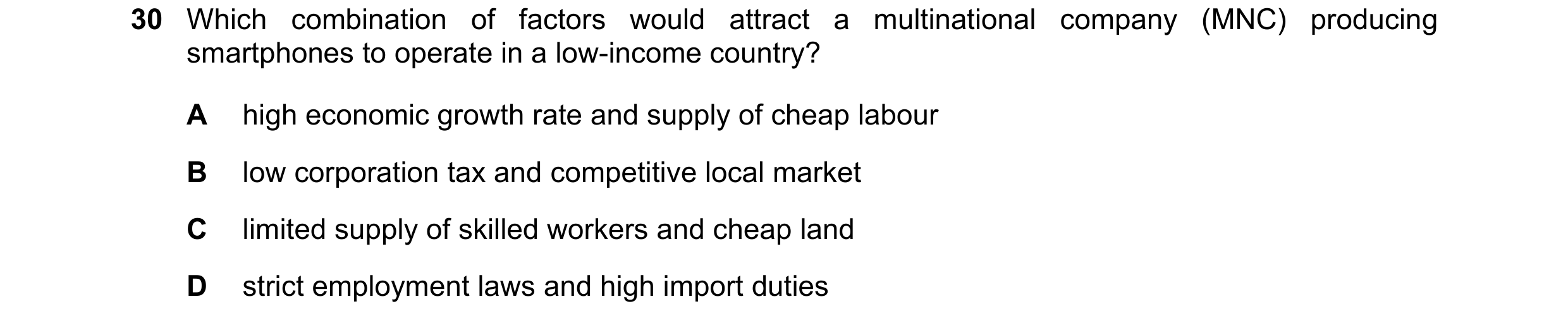 30 / 37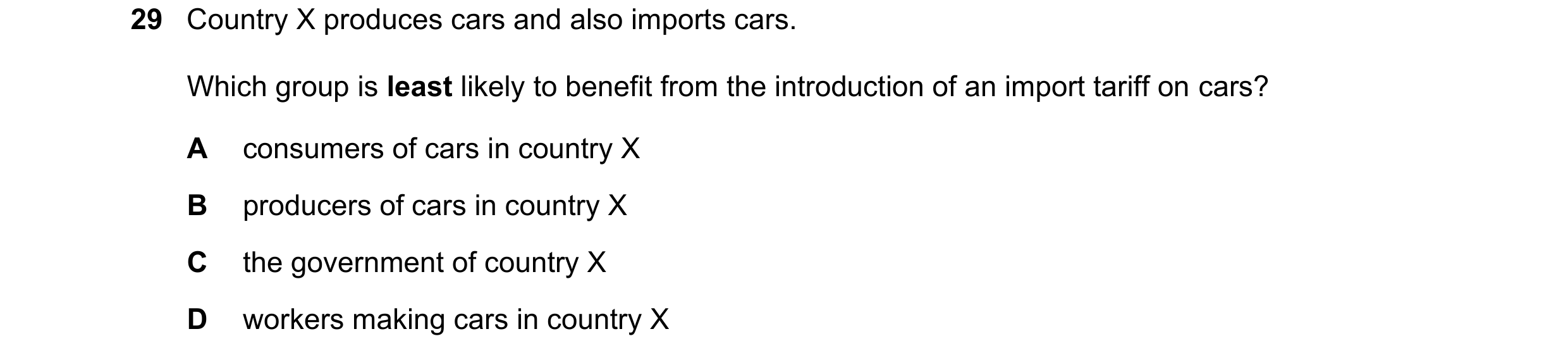

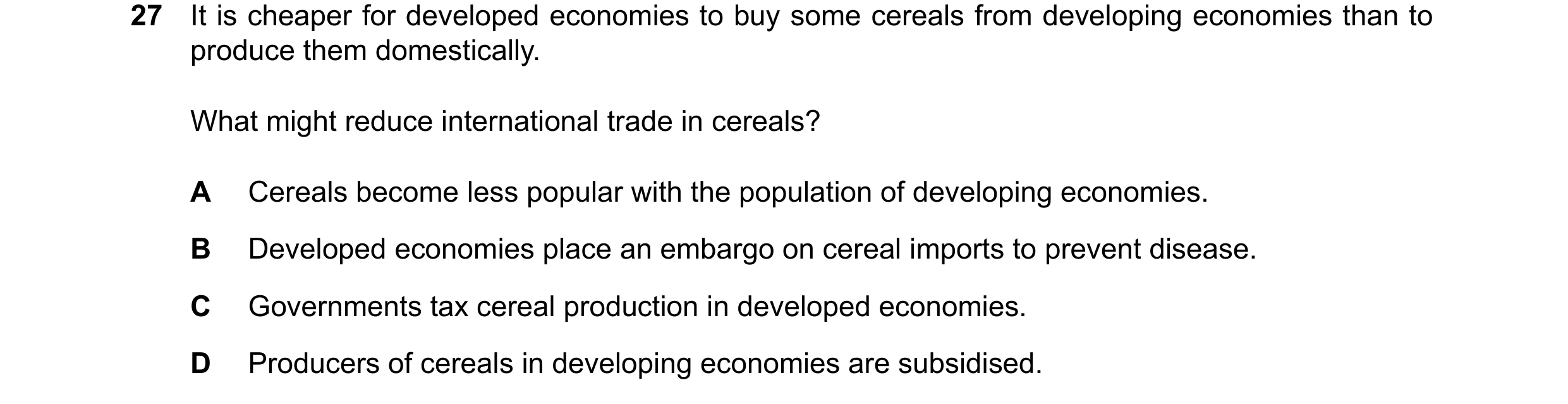
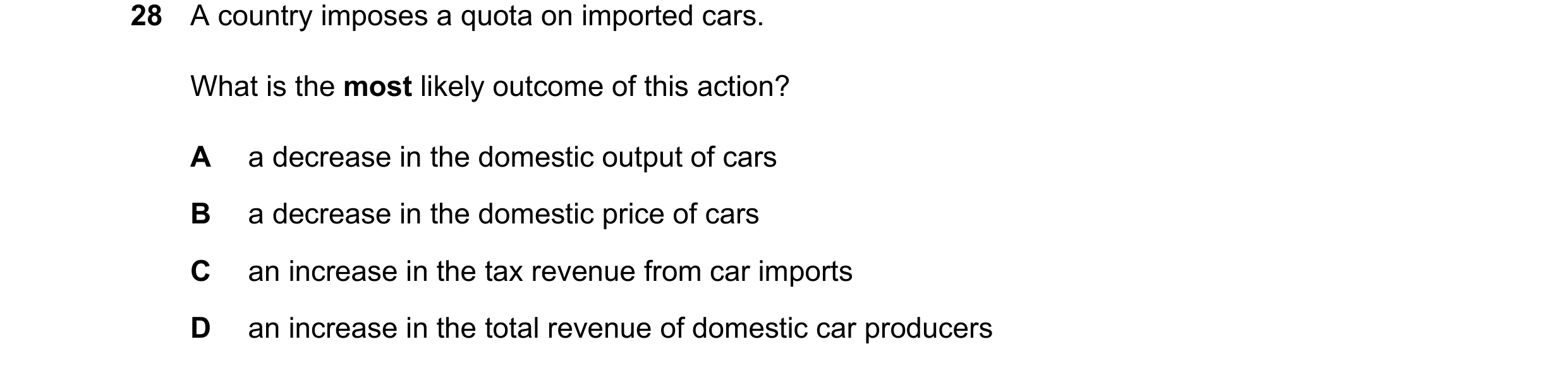
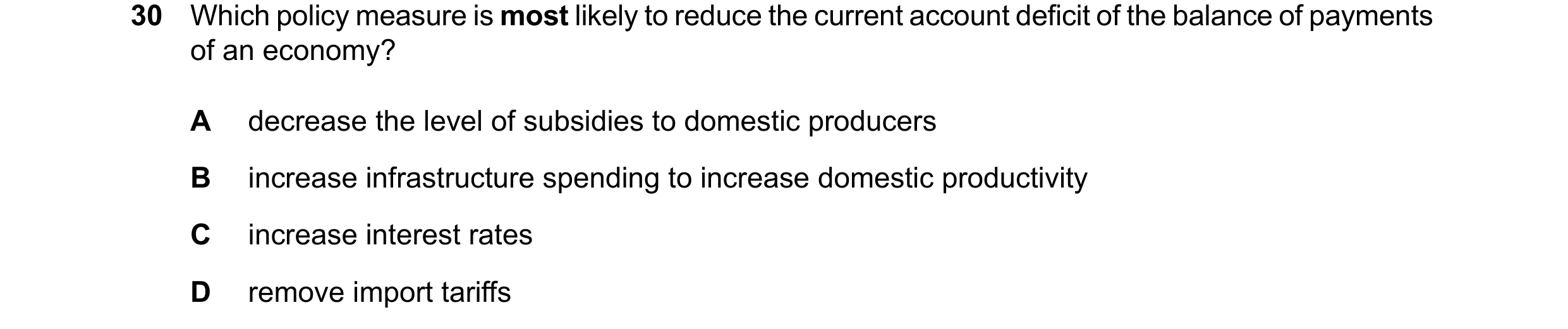 31 / 37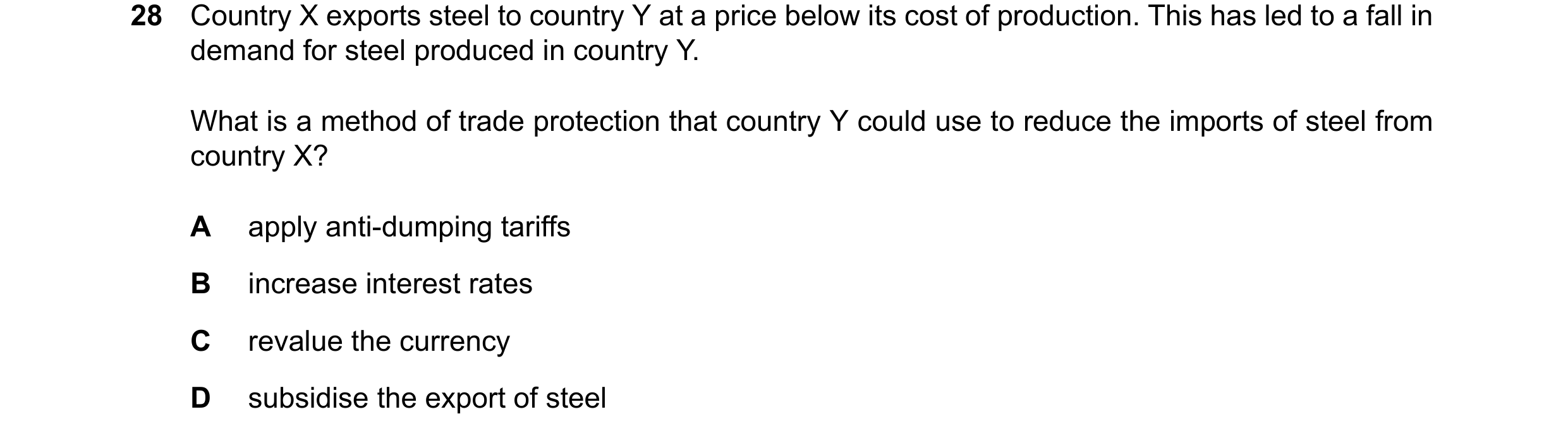
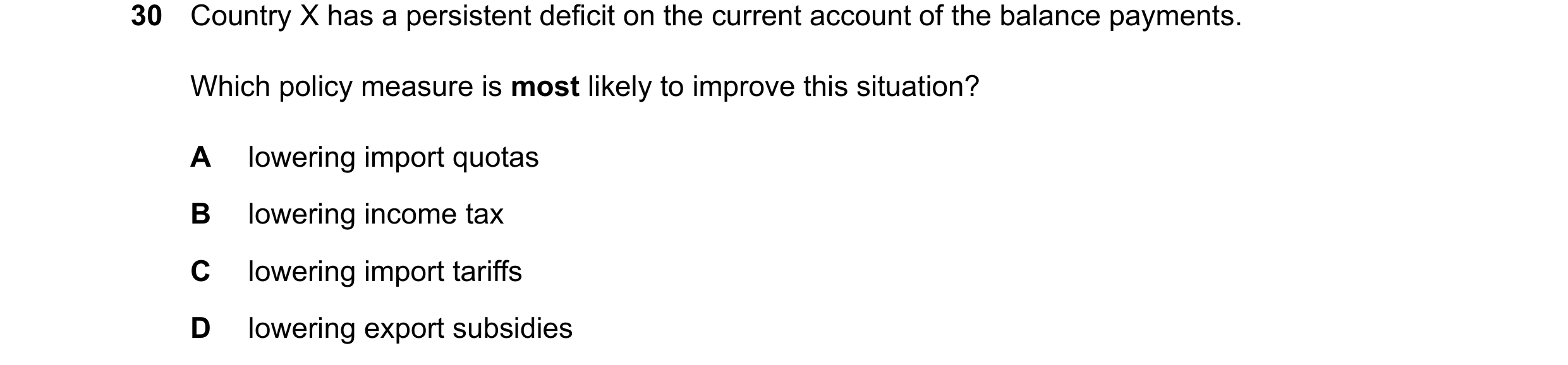

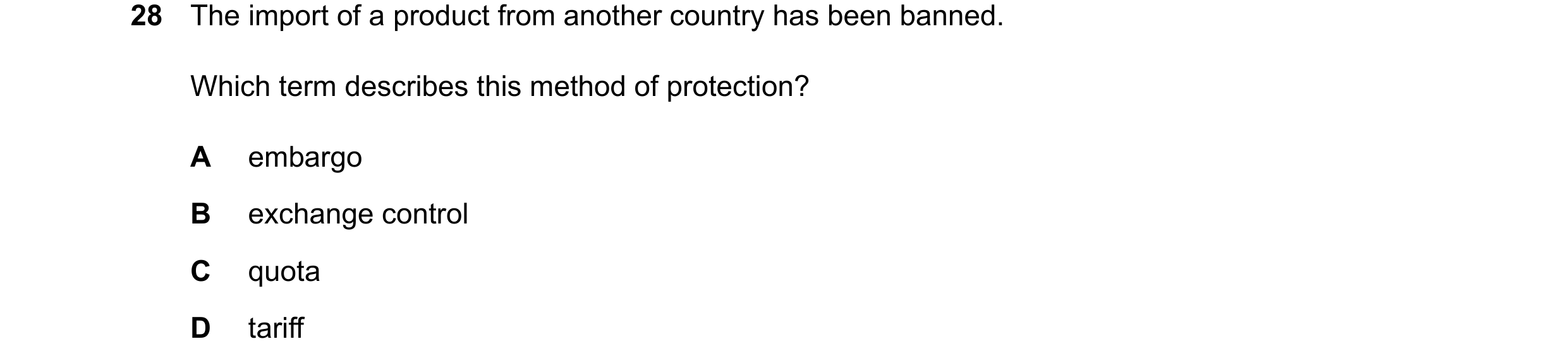
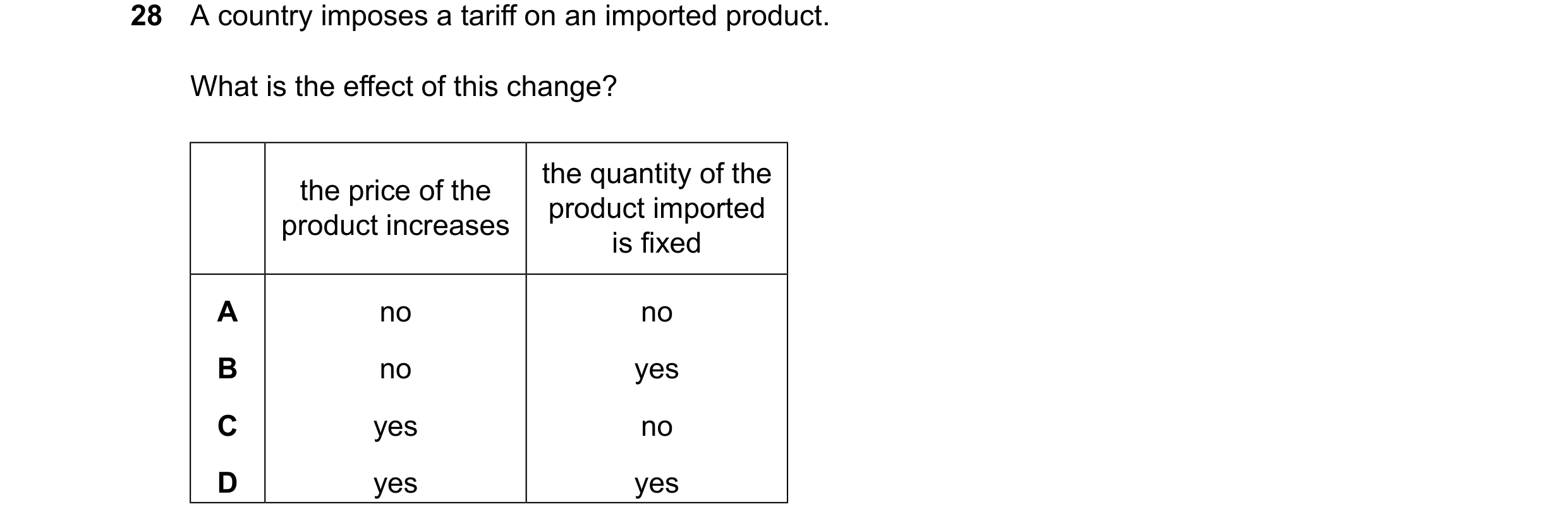 32 / 37
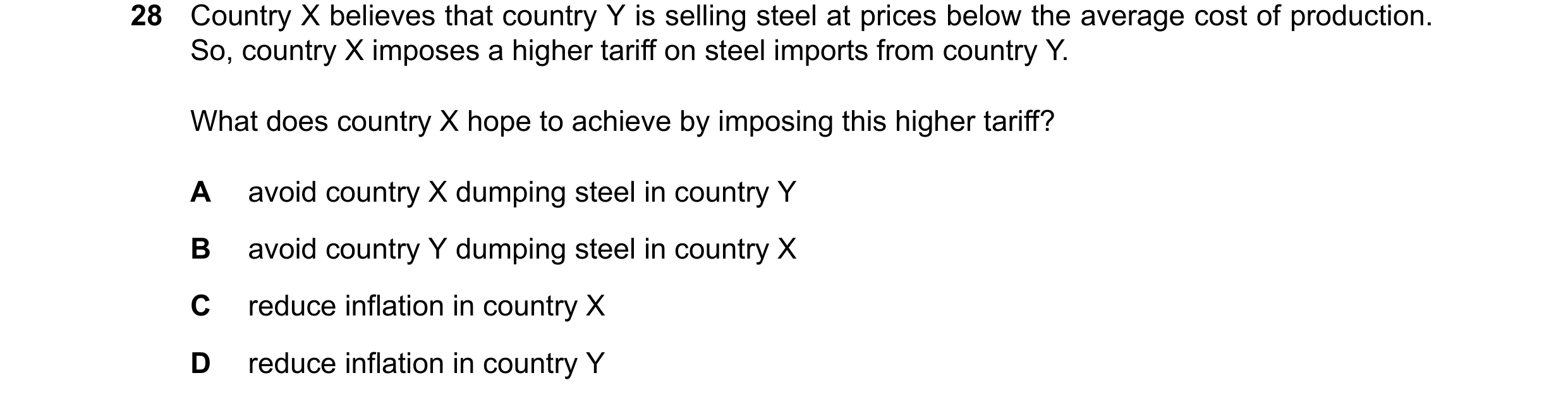
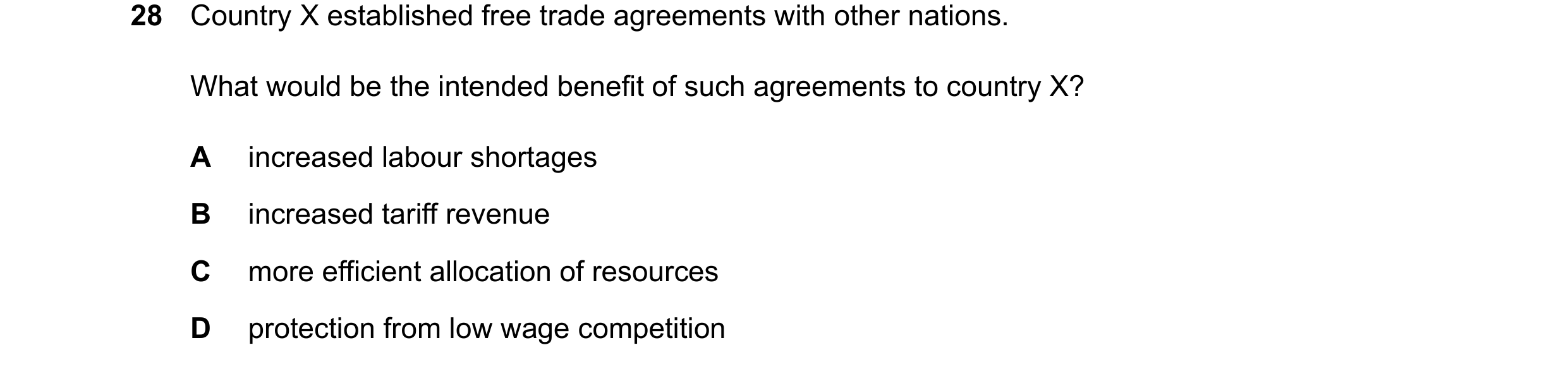
 33 / 37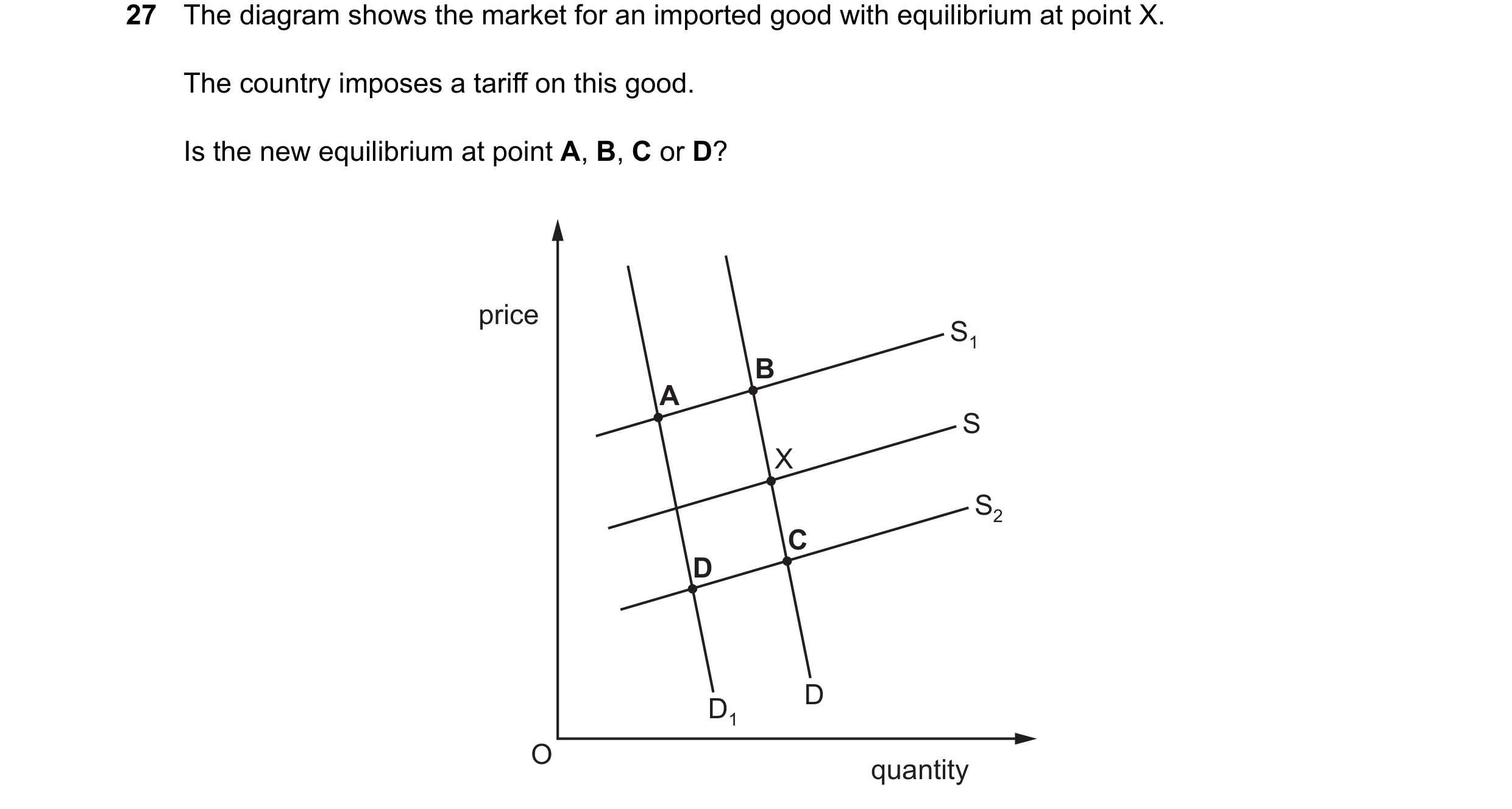
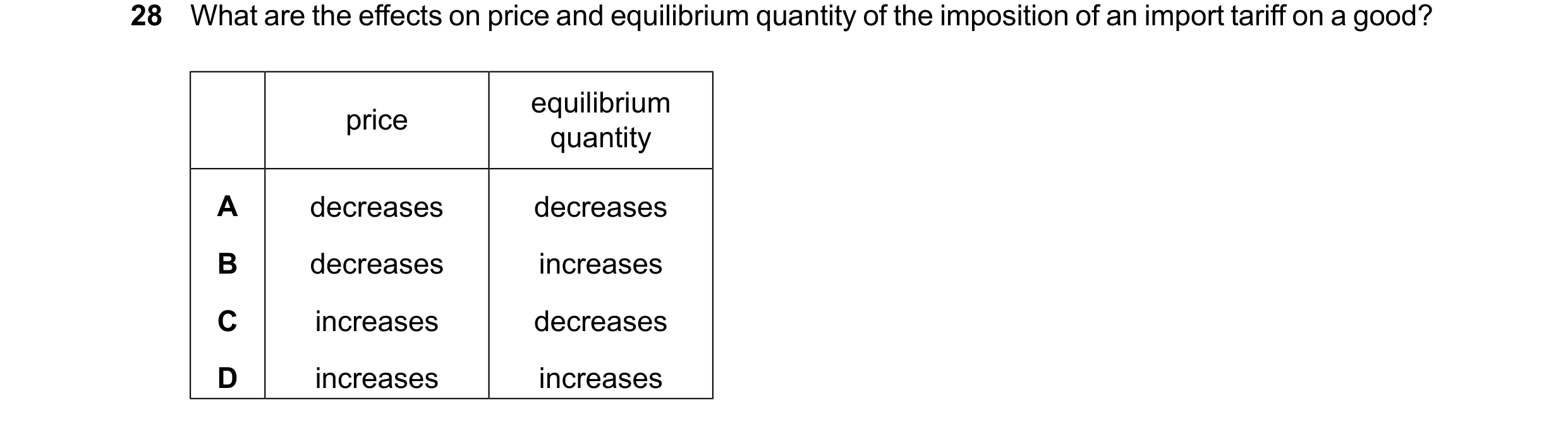
 34 / 37

 35 / 37
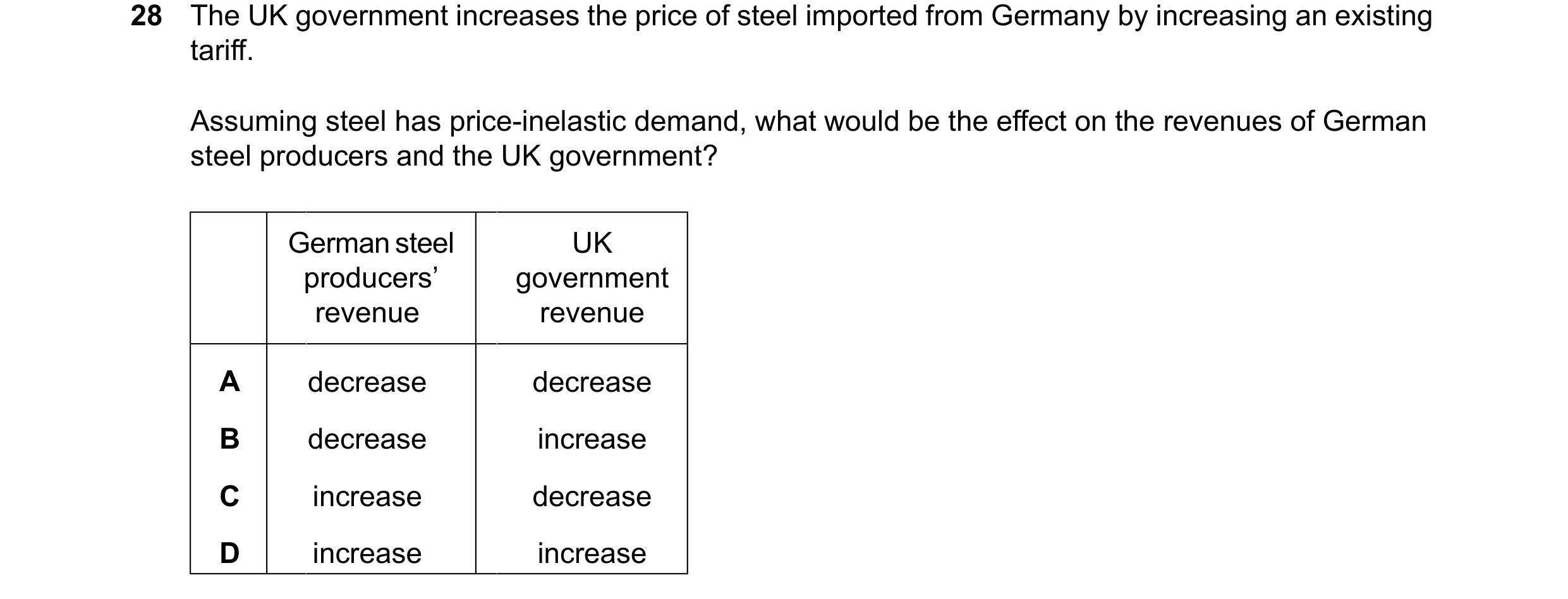


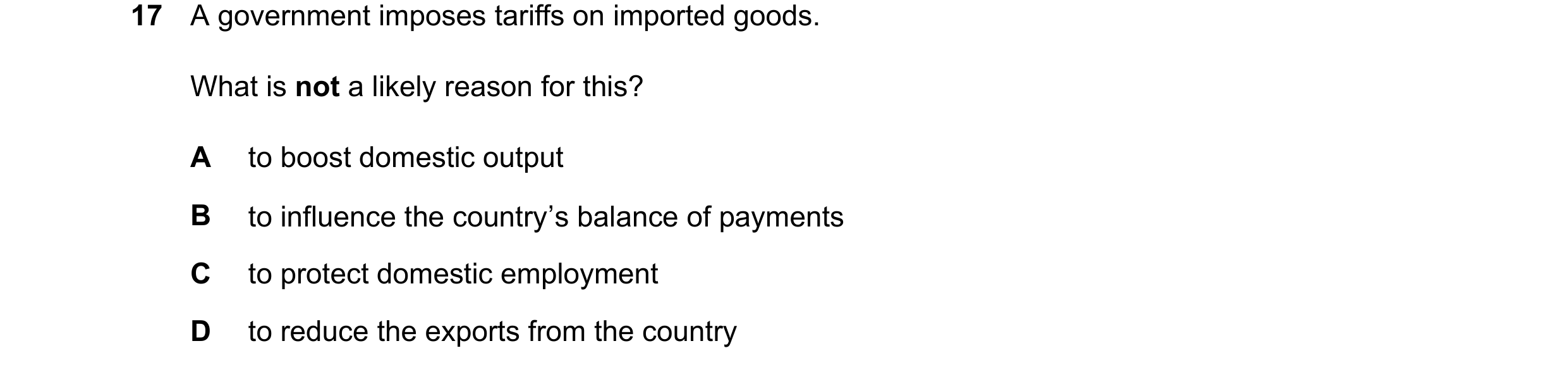 36 / 37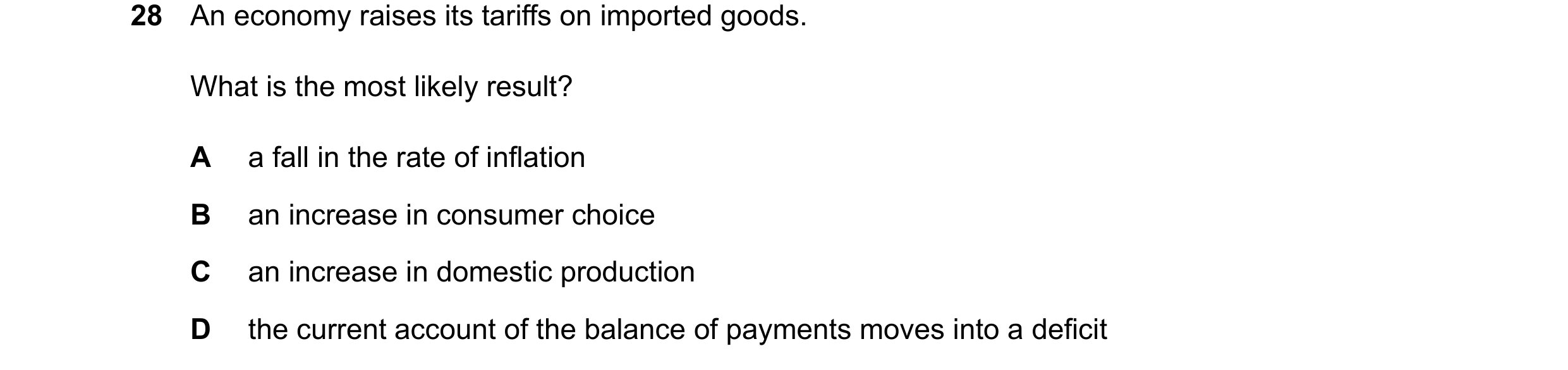
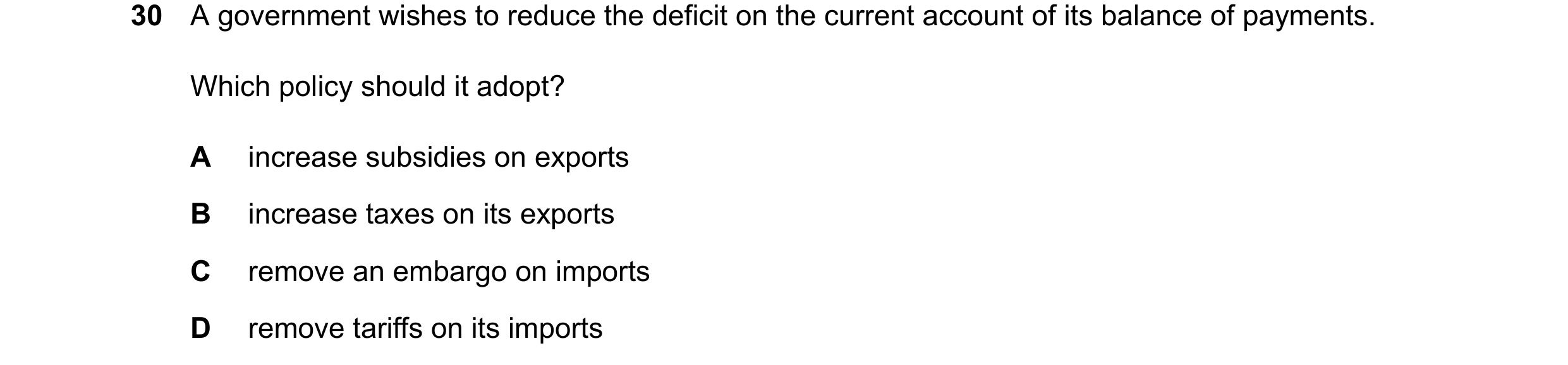

 37 / 37