Questions as text
Q1 · Hydroxyapatite, Ca5(PO4)3OH, is the main constituent of tooth enamel 9701/11 Oct/Nov 2005
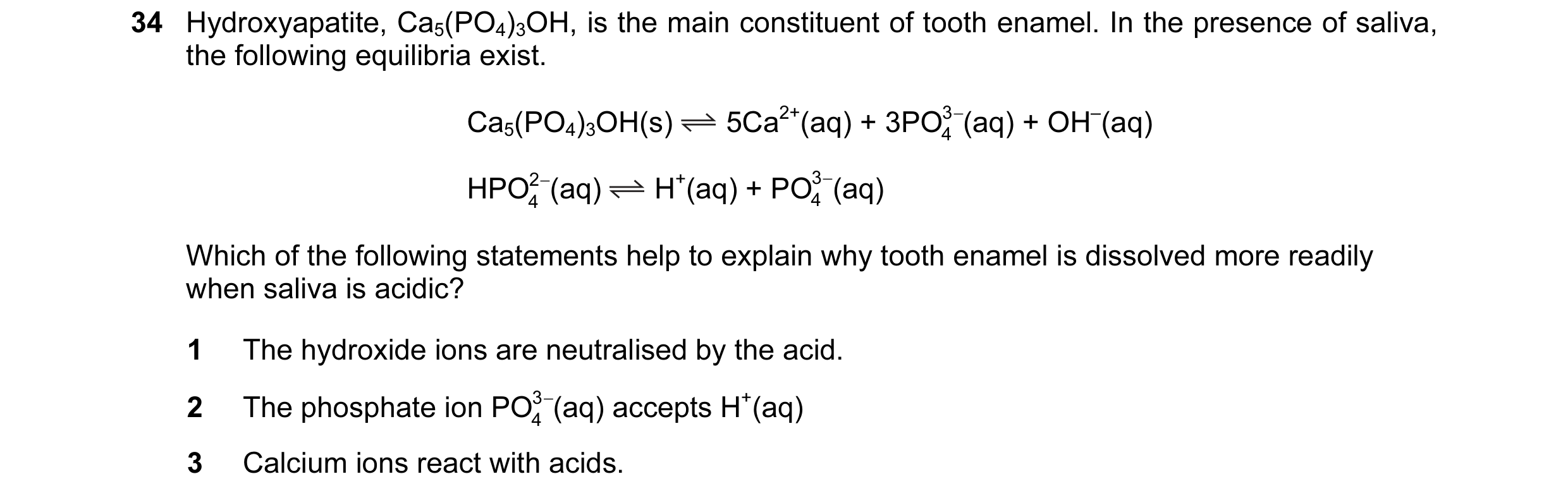
34 Hydroxyapatite, Ca5(PO4)3OH, is the main constituent of tooth enamel. In the presence of saliva, the following equilibria exist. Ca5(PO4)3OH(s) 5Ca2+(aq) + 3PO (aq) + OH–(aq) 3 − 4 HPO (aq) 2 − H+(aq) + PO (aq) 3 − 4 4 Which of the following statements help to explain why tooth enamel is dissolved more readily when saliva is acidic? 1 The hydroxide ions are neutralised by the acid. 2 The phosphate ion PO (aq) accepts H+(aq) 3 − 4 3 Calcium ions react with acids.
1 marks
Answer: B
This question in 9701/11 Oct/Nov 2005
Q2 · The oxide and chloride of an element X are separately mixed with water 9701/11 May/June 2006
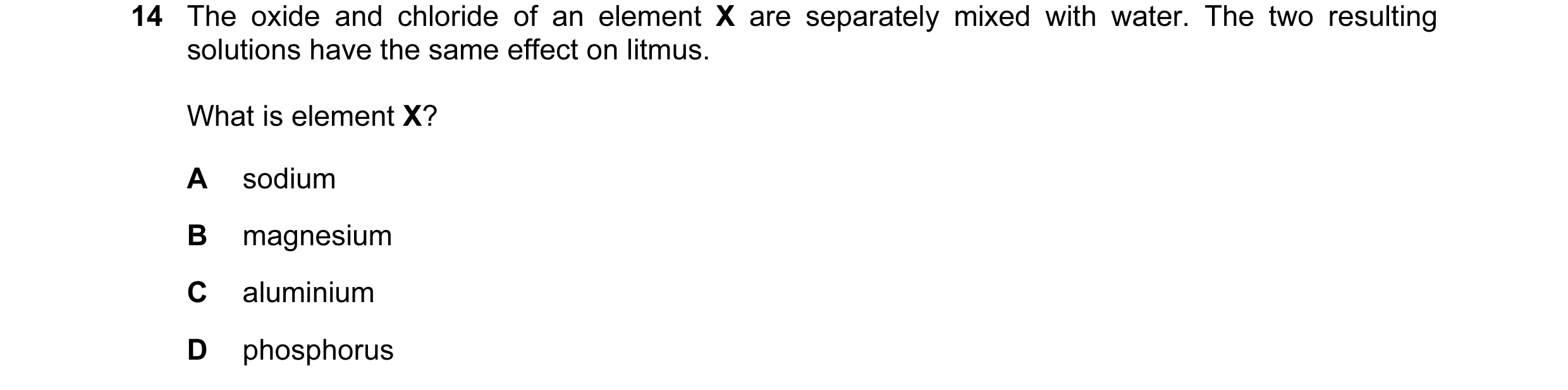
14 The oxide and chloride of an element X are separately mixed with water. The two resulting solutions have the same effect on litmus. What is element X? A sodium B magnesium C aluminium D phosphorus
1 marks
Answer: D
This question in 9701/11 May/June 2006
Q3 · The emissions from a power station contain about 14 tonnes of SO2 per hour from the… 9701/11 May/June 2006
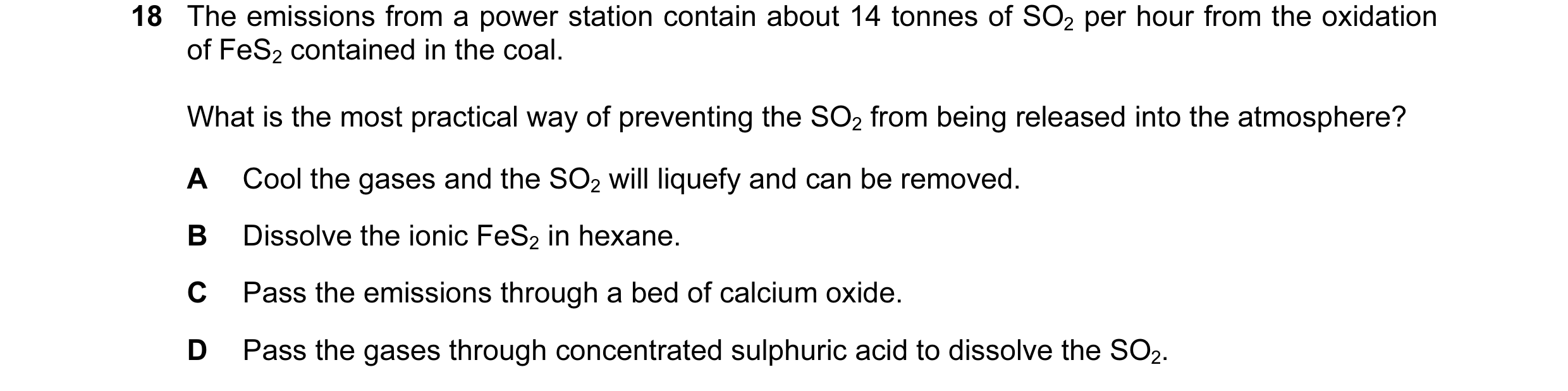
18 The emissions from a power station contain about 14 tonnes of SO2 per hour from the oxidation of FeS2 contained in the coal. What is the most practical way of preventing the SO2 from being released into the atmosphere? A Cool the gases and the SO2 will liquefy and can be removed. B Dissolve the ionic FeS2 in hexane. C Pass the emissions through a bed of calcium oxide. D Pass the gases through concentrated sulphuric acid to dissolve the SO2.
1 marks
Answer: C
This question in 9701/11 May/June 2006
Q4 · Ammonia and chlorine react in the gas phase 9701/11 May/June 2006
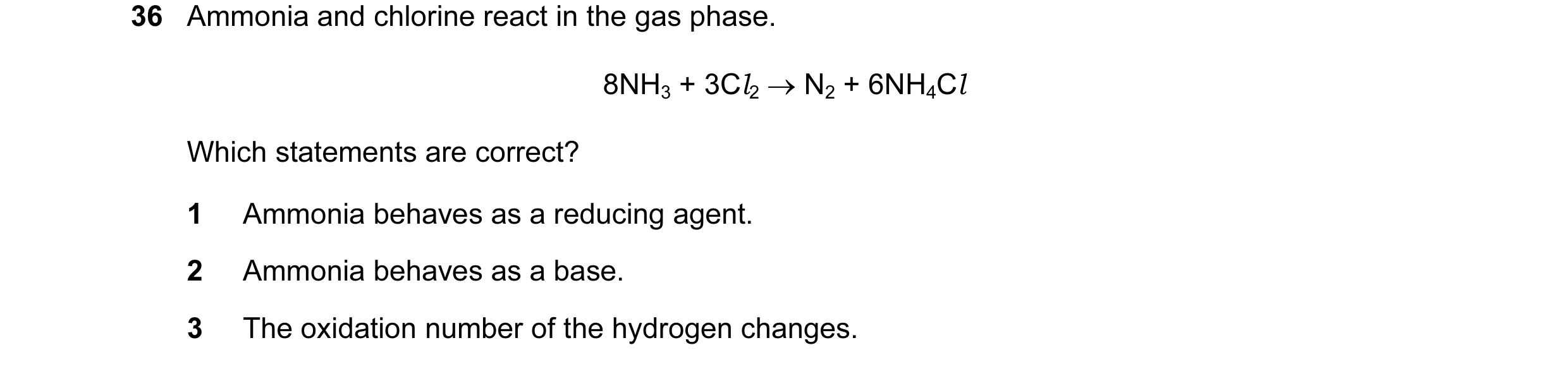
36 Ammonia and chlorine react in the gas phase. 8NH3 + 3Cl2 → N2 + 6NH4Cl Which statements are correct? 1 Ammonia behaves as a reducing agent. 2 Ammonia behaves as a base. 3 The oxidation number of the hydrogen changes.
1 marks
Answer: B
This question in 9701/11 May/June 2006
Q5 · Concentrated sulphuric acid behaves as a strong acid when it reacts with water 9701/11 Oct/Nov 2006
32 Concentrated sulphuric acid behaves as a strong acid when it reacts with water. H2SO4(l) + aq → H+(aq) + HSO (aq) − 4 The HSO ion formed behaves as a weak acid. − 4 HSO (aq) − H+(aq) + SO 2 − (aq) 4 4 Which statements are true for 1.0 mol dm–3 sulphuric acid? 1 [H+(aq)] is high 2 [ SO 2 − (aq)] is high 4 3 [ HSO (aq)] = [ − SO 2 − (aq)] 4 4
1 marks
Answer: D
This question in 9701/11 Oct/Nov 2006
Q6 · Which reagent, when mixed and heated with ammonium sulphate, liberates ammonia? 9701/11 May/June 2008
17 Which reagent, when mixed and heated with ammonium sulphate, liberates ammonia? A aqueous bromine B dilute hydrochloric acid C limewater D acidified potassium dichromate(VI)
1 marks
Answer: C
This question in 9701/11 May/June 2008
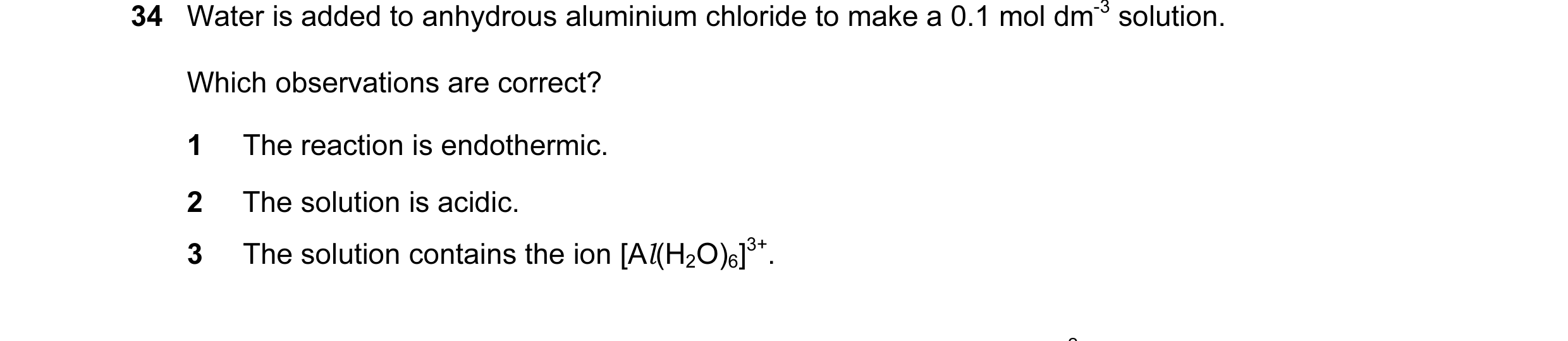
Q7 · Water is added to anhydrous aluminium chloride to make a 0.1 mol dm-3 solution 9701/11 May/June 2008
34 Water is added to anhydrous aluminium chloride to make a 0.1 mol dm-3 solution. Which observations are correct? 1 The reaction is endothermic. 2 The solution is acidic. 3 The solution contains the ion [Al(H2O)6]3+.
1 marks
Answer: C
This question in 9701/11 May/June 2008
Q8 · Which salt is produced by adding aqueous ammonia to aqueous sulphur dioxide until just… 9701/11 Oct/Nov 2008
14 Which salt is produced by adding aqueous ammonia to aqueous sulphur dioxide until just alkaline? A NH4SO3 B NH4SO4 C (NH4)2SO3 D (NH4)2SO4
1 marks
Answer: C
This question in 9701/11 Oct/Nov 2008
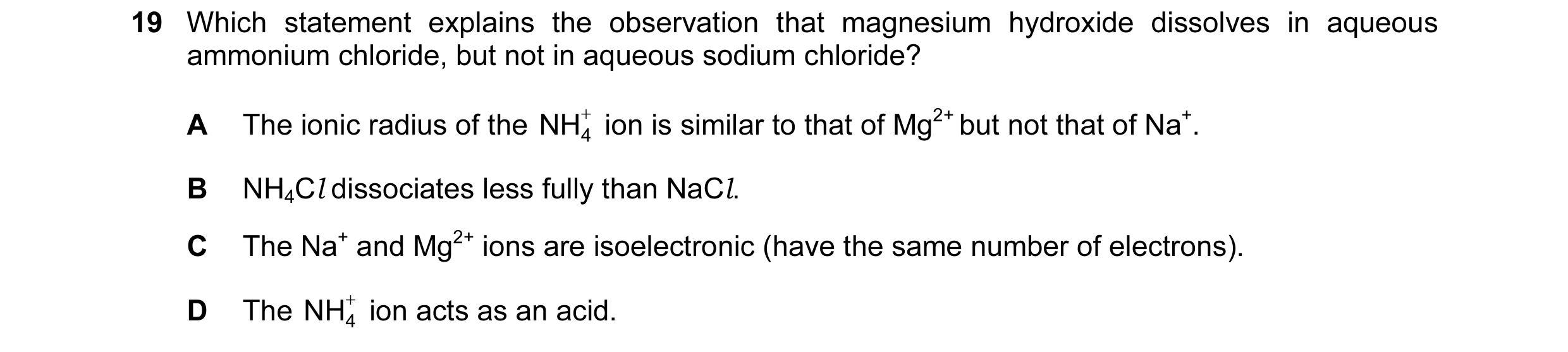
Q9 · Which statement explains the observation that magnesium hydroxide dissolves in aqueous… 9701/11 Oct/Nov 2008
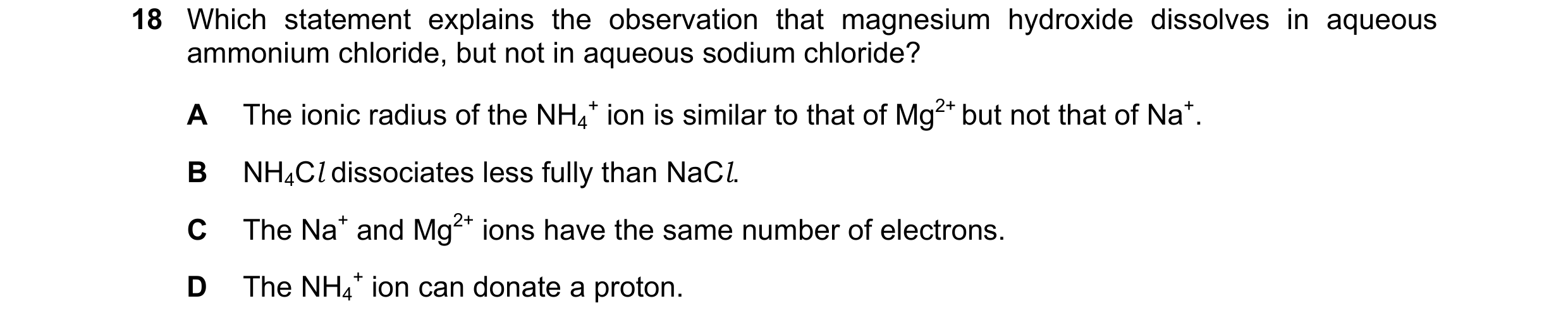
19 Which statement explains the observation that magnesium hydroxide dissolves in aqueous ammonium chloride, but not in aqueous sodium chloride? A The ionic radius of the NH ion is similar to that of Mg2+ but not that of Na+. + 4 B NH4Cl dissociates less fully than NaCl. C The Na+ and Mg2+ ions are isoelectronic (have the same number of electrons). D The NH ion acts as an acid. + 4
1 marks
Answer: D
This question in 9701/11 Oct/Nov 2008
Q10 · The stomach wall can become sensitive to acidic compounds 9701/11 Oct/Nov 2008
27 The stomach wall can become sensitive to acidic compounds. Which is the most acidic compound? A B C D CO2H CO2H CO2H CH3CH(OH)CO2H OCOCH3 CH(OH) CH(OH) lactic acid CH(OH) CH2 aspirin CO2H CH(OH) CH(OH) malic acid CH2OH gluconic acid
1 marks
Answer: C
This question in 9701/11 Oct/Nov 2008
Q11 · River water in a chalky agricultural area may contain Ca2+, Mg2+, CO 2 − , HCO , Cl − and… 9701/11 May/June 2009
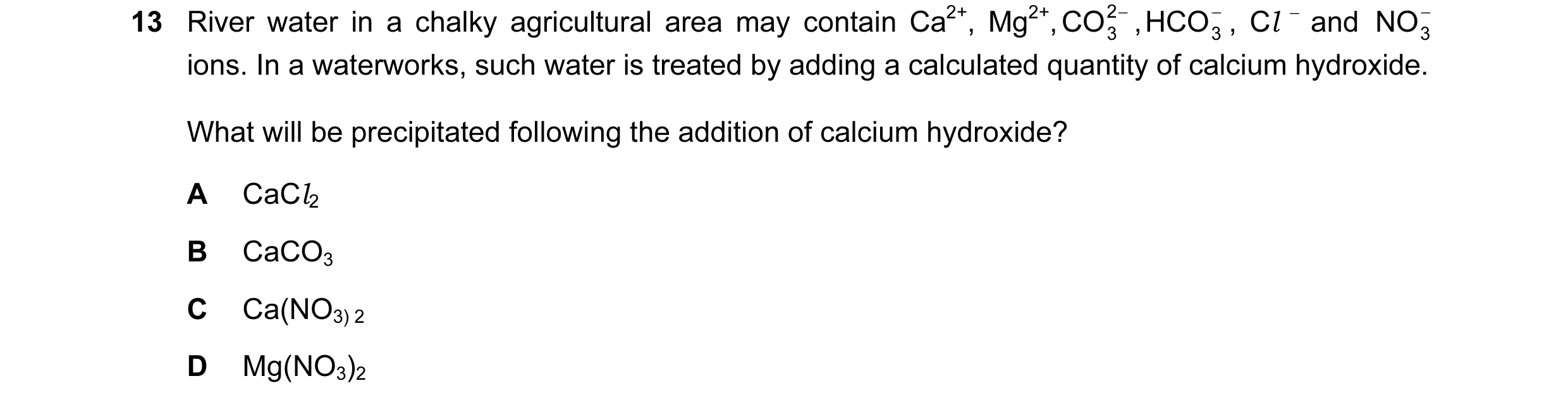
13 River water in a chalky agricultural area may contain Ca2+, Mg2+, CO 2 − , HCO , Cl − and − NO − 3 3 3 ions. In a waterworks, such water is treated by adding a calculated quantity of calcium hydroxide. What will be precipitated following the addition of calcium hydroxide? A CaCl2 B CaCO3 C Ca(NO3) 2 D Mg(NO3)2
1 marks
Answer: B
This question in 9701/11 May/June 2009
Q12 · The table gives the concentrations and pH values of the aqueous solutions of two… 9701/11 May/June 2010
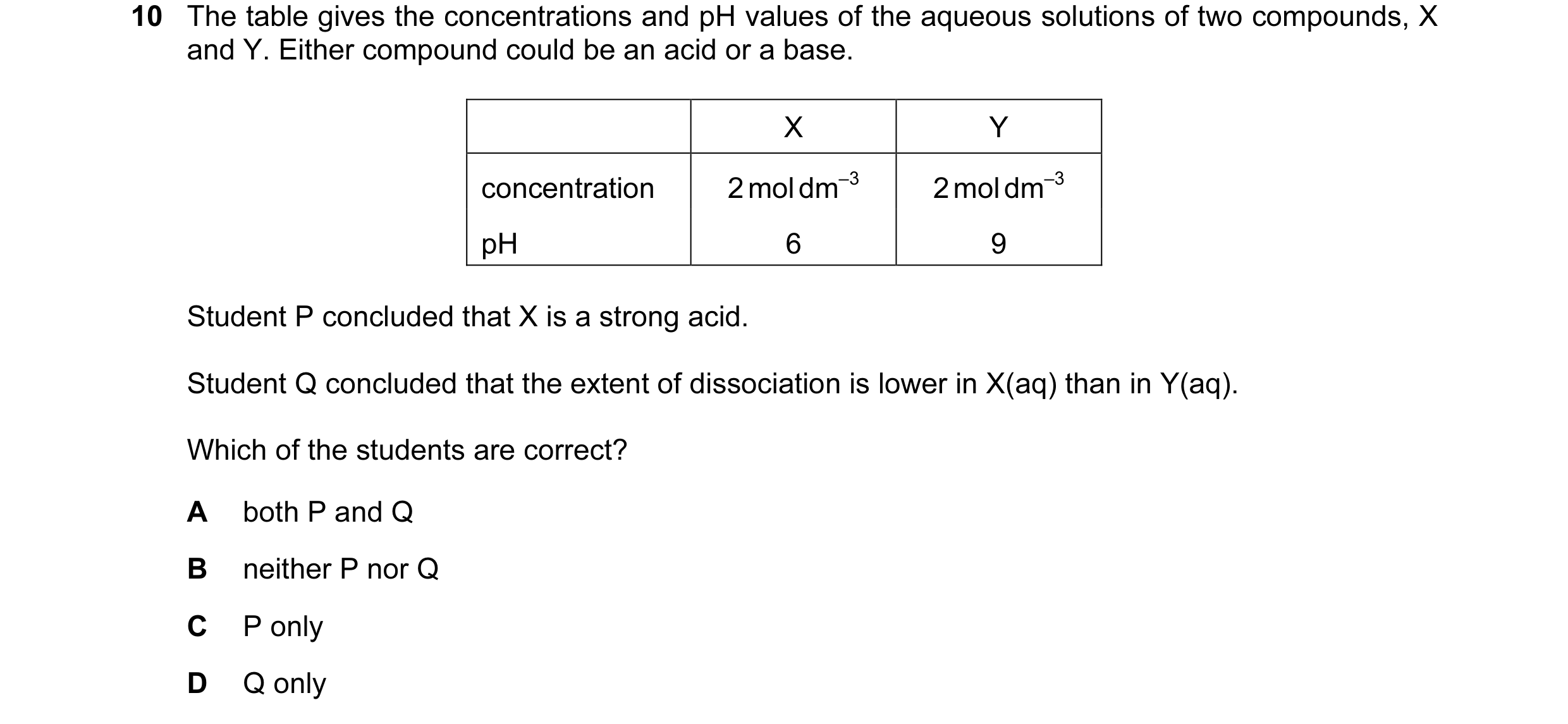
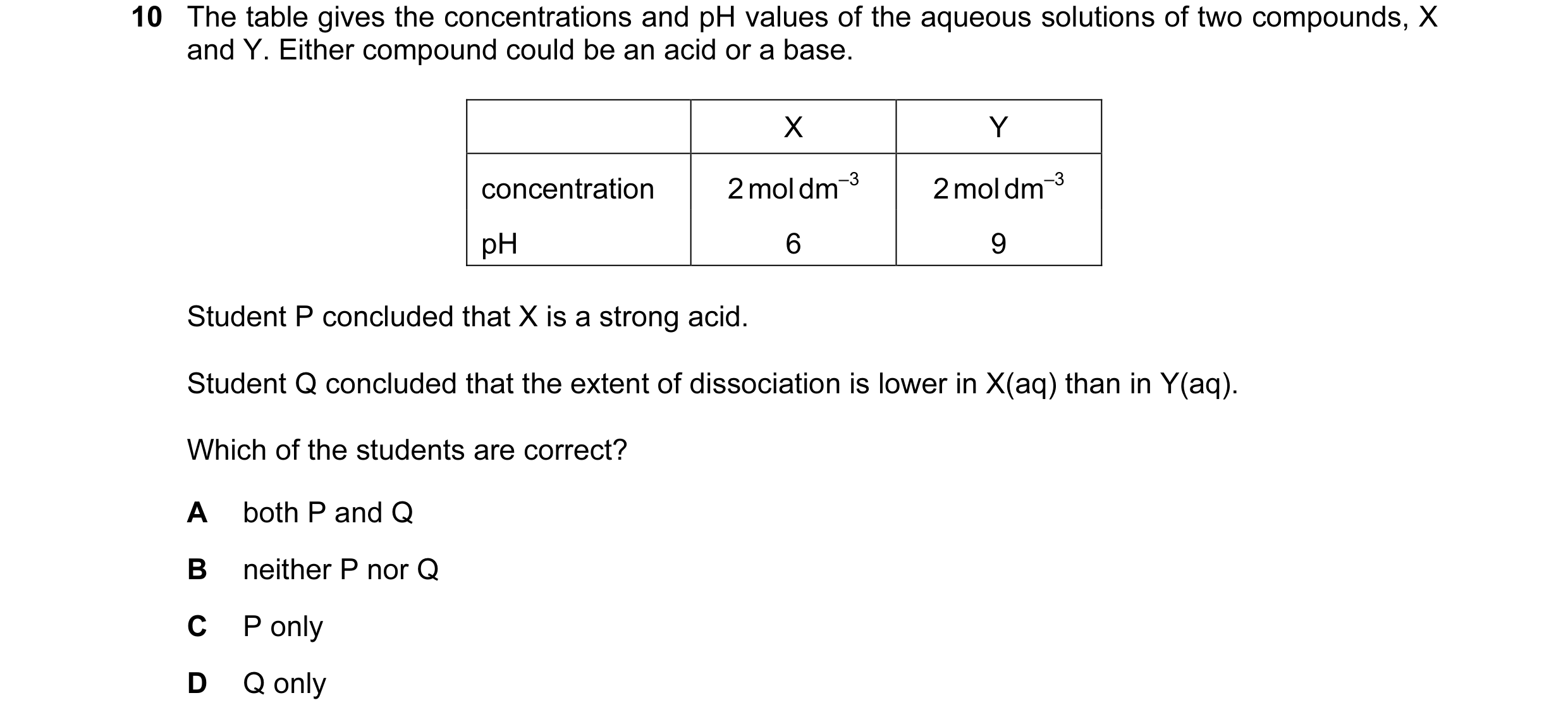
10 The table gives the concentrations and pH values of the aqueous solutions of two compounds, X and Y. Either compound could be an acid or a base. X Y concentration 2 mol dm–3 2 mol dm–3 pH 6 9 Student P concluded that X is a strong acid. Student Q concluded that the extent of dissociation is lower in X(aq) than in Y(aq). Which of the students are correct? A both P and Q B neither P nor Q C P only D Q only
1 marks
Answer: D
This question in 9701/11 May/June 2010
Q13 · When organic refuse decomposes in water carboxylic acids are formed 9701/11 May/June 2010
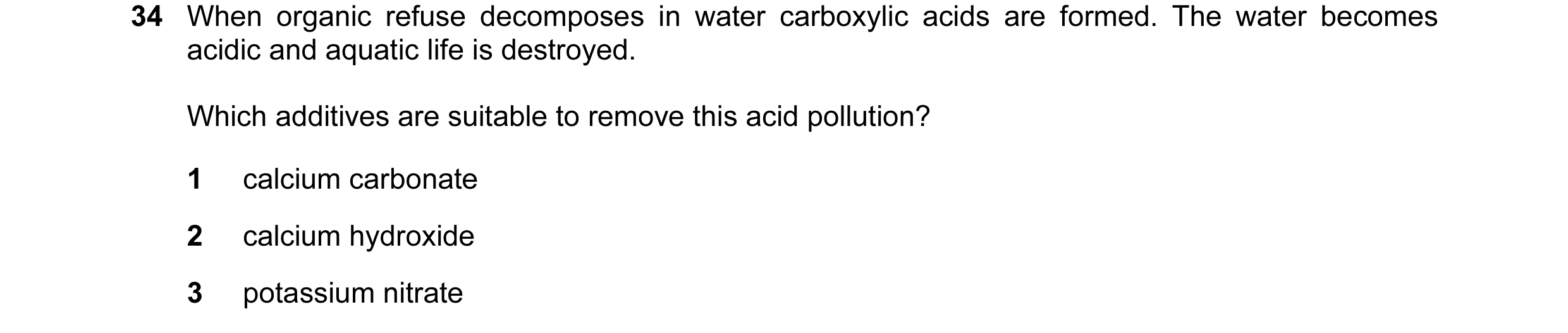
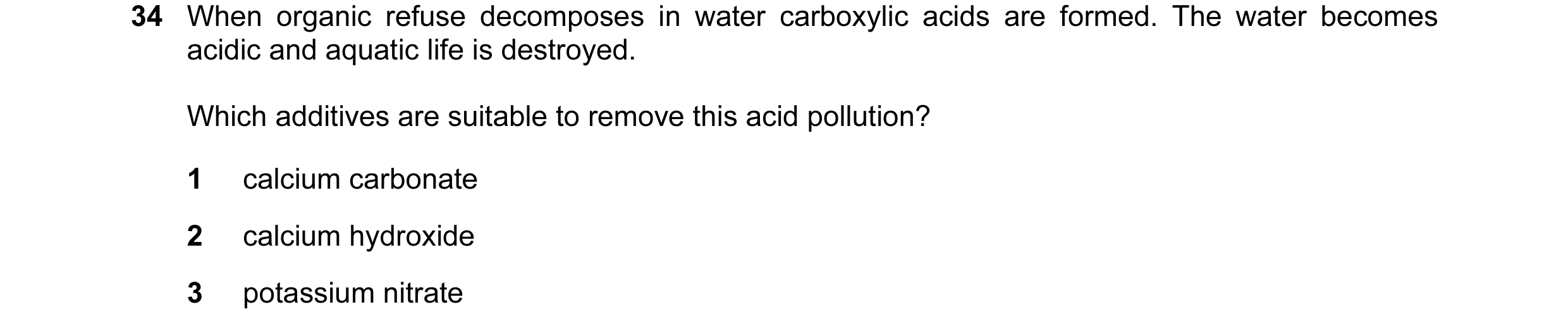
34 When organic refuse decomposes in water carboxylic acids are formed. The water becomes acidic and aquatic life is destroyed. Which additives are suitable to remove this acid pollution? 1 calcium carbonate 2 calcium hydroxide 3 potassium nitrate
1 marks
Answer: B
This question in 9701/11 May/June 2010
Q14 · The table gives the concentrations and pH values of the aqueous solutions of two… 9701/12 May/June 2010
9 The table gives the concentrations and pH values of the aqueous solutions of two compounds, X and Y. Either compound could be an acid or a base. X Y concentration 2 mol dm–3 2 mol dm–3 pH 6 9 Student P concluded that X is a strong acid. Student Q concluded that the extent of dissociation is lower in X(aq) than in Y(aq). Which of the students are correct? A both P and Q B neither P nor Q C P only D Q only
1 marks
Answer: D
This question in 9701/12 May/June 2010
Q15 · When organic refuse decomposes in water carboxylic acids are formed 9701/12 May/June 2010
34 When organic refuse decomposes in water carboxylic acids are formed. The water becomes acidic and aquatic life is destroyed. Which additives are suitable to remove this acid pollution? 1 calcium carbonate 2 calcium hydroxide 3 potassium nitrate
1 marks
Answer: B
This question in 9701/12 May/June 2010
Q16 · The table gives the concentrations and pH values of the aqueous solutions of two… 9701/13 May/June 2010
10 The table gives the concentrations and pH values of the aqueous solutions of two compounds, X and Y. Either compound could be an acid or a base. X Y concentration 2 mol dm–3 2 mol dm–3 pH 6 9 Student P concluded that X is a strong acid. Student Q concluded that the extent of dissociation is lower in X(aq) than in Y(aq). Which of the students are correct? A both P and Q B neither P nor Q C P only D Q only
1 marks
Answer: D
This question in 9701/13 May/June 2010
Q17 · When organic refuse decomposes in water carboxylic acids are formed 9701/13 May/June 2010
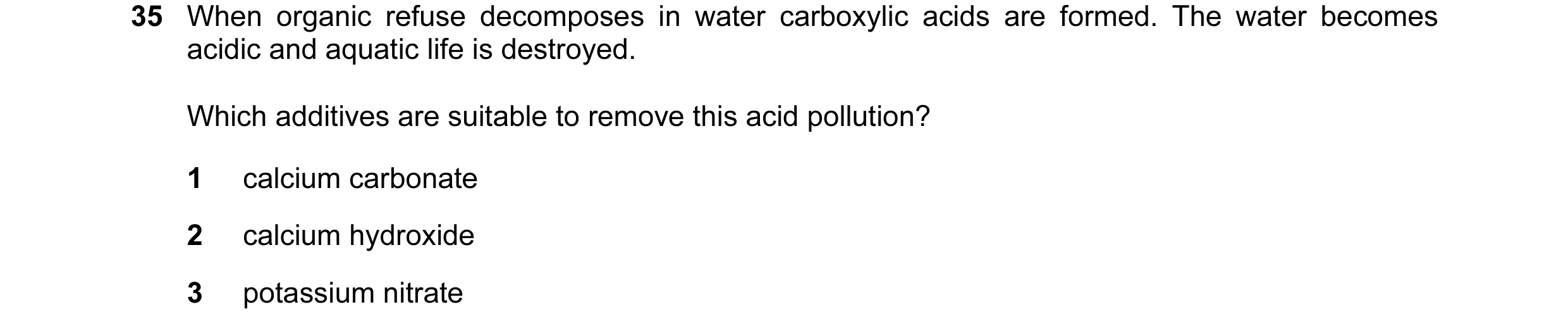
35 When organic refuse decomposes in water carboxylic acids are formed. The water becomes acidic and aquatic life is destroyed. Which additives are suitable to remove this acid pollution? 1 calcium carbonate 2 calcium hydroxide 3 potassium nitrate
1 marks
Answer: B
This question in 9701/13 May/June 2010
Q18 · Samples of calcium and barium are separately added to beakers of cold water containing a… 9701/11 Oct/Nov 2010
34 Samples of calcium and barium are separately added to beakers of cold water containing a few drops of litmus solution. Which observations will be made with only the calcium and not with the barium? 1 A white suspension appears in the water. 2 The solution turns blue. 3 A gas is evolved.
1 marks
Answer: D
This question in 9701/11 Oct/Nov 2010
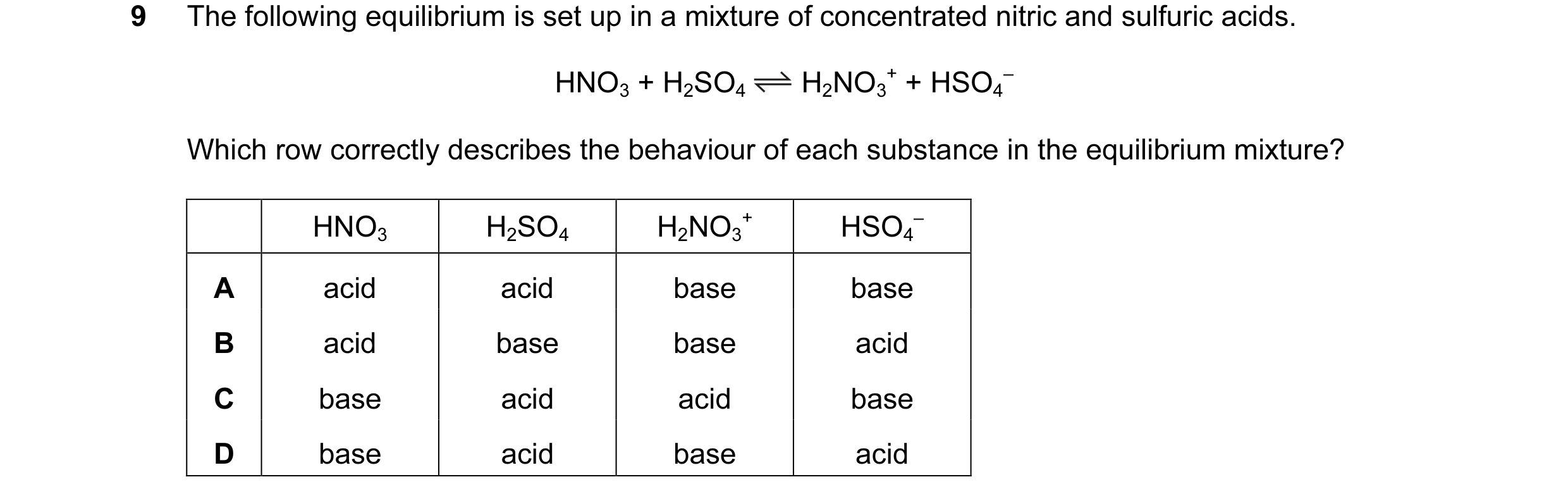
Q19 · The following equilibrium is set up in a mixture of concentrated nitric and sulfuric acids 9701/12 Oct/Nov 2010
9 The following equilibrium is set up in a mixture of concentrated nitric and sulfuric acids. HNO3 + H2SO4 H2NO3 + + HSO4 – Which row correctly describes the behaviour of each substance in the equilibrium mixture? HNO3 H2SO4 H2NO3 + HSO4 – A acid acid base base B acid base base acid C base acid acid base D base acid base acid
1 marks
Answer: C
This question in 9701/12 Oct/Nov 2010
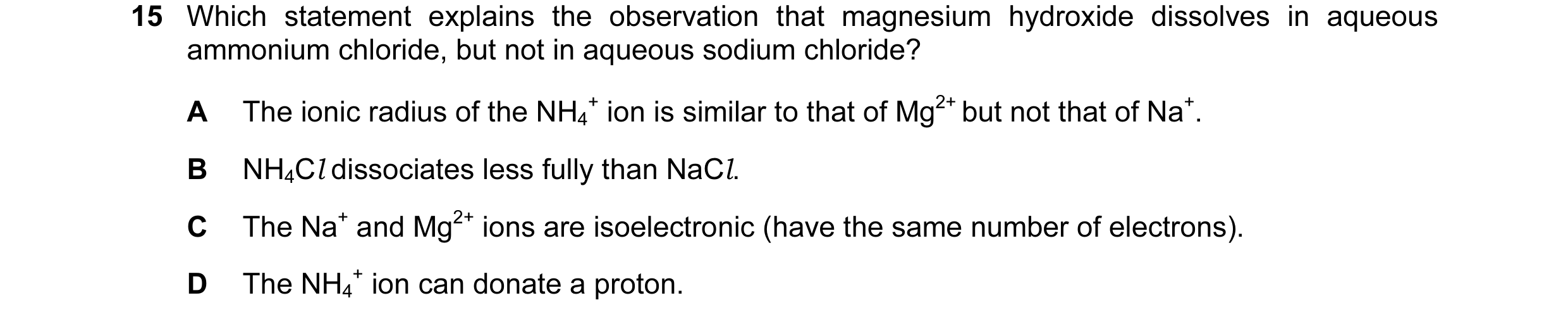
Q20 · Which statement explains the observation that magnesium hydroxide dissolves in aqueous… 9701/12 Oct/Nov 2010
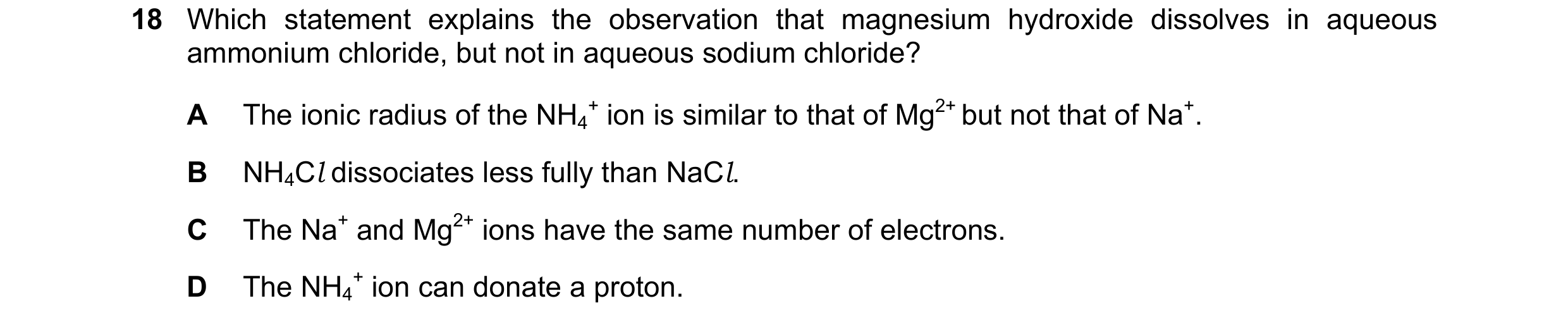
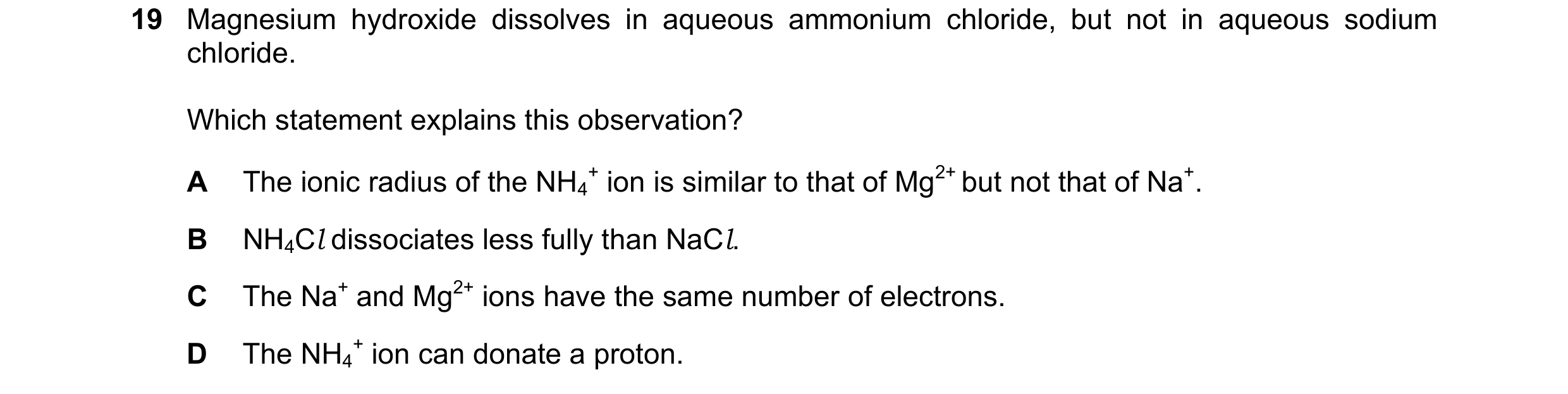
15 Which statement explains the observation that magnesium hydroxide dissolves in aqueous ammonium chloride, but not in aqueous sodium chloride? A The ionic radius of the NH4 + ion is similar to that of Mg2+ but not that of Na+. B NH4Cl dissociates less fully than NaCl. C The Na+ and Mg2+ ions are isoelectronic (have the same number of electrons). D The NH4 + ion can donate a proton.
1 marks
Answer: D
This question in 9701/12 Oct/Nov 2010
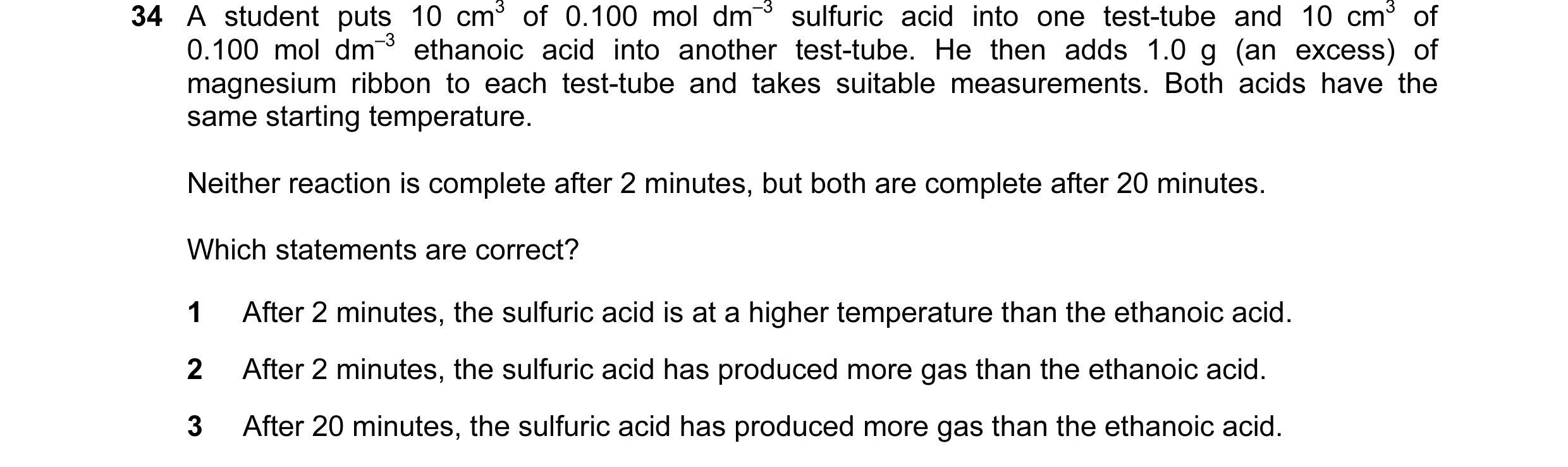
Q21 · A student puts 10 cm3 of 0.100 mol dm–3 sulfuric acid into one test-tube and 10 cm3 of… 9701/12 Oct/Nov 2010
34 A student puts 10 cm3 of 0.100 mol dm–3 sulfuric acid into one test-tube and 10 cm3 of 0.100 mol dm–3 ethanoic acid into another test-tube. He then adds 1.0 g (an excess) of magnesium ribbon to each test-tube and takes suitable measurements. Both acids have the same starting temperature. Neither reaction is complete after 2 minutes, but both are complete after 20 minutes. Which statements are correct? 1 After 2 minutes, the sulfuric acid is at a higher temperature than the ethanoic acid. 2 After 2 minutes, the sulfuric acid has produced more gas than the ethanoic acid. 3 After 20 minutes, the sulfuric acid has produced more gas than the ethanoic acid.
1 marks
Answer: A
This question in 9701/12 Oct/Nov 2010
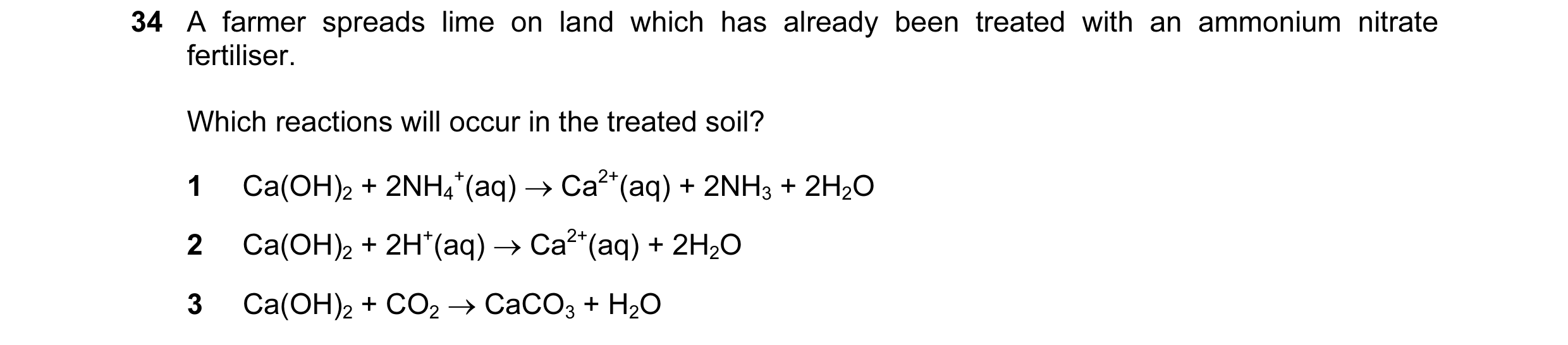
Q22 · A farmer spreads lime on land which has already been treated with an ammonium nitrate… 9701/11 Oct/Nov 2011
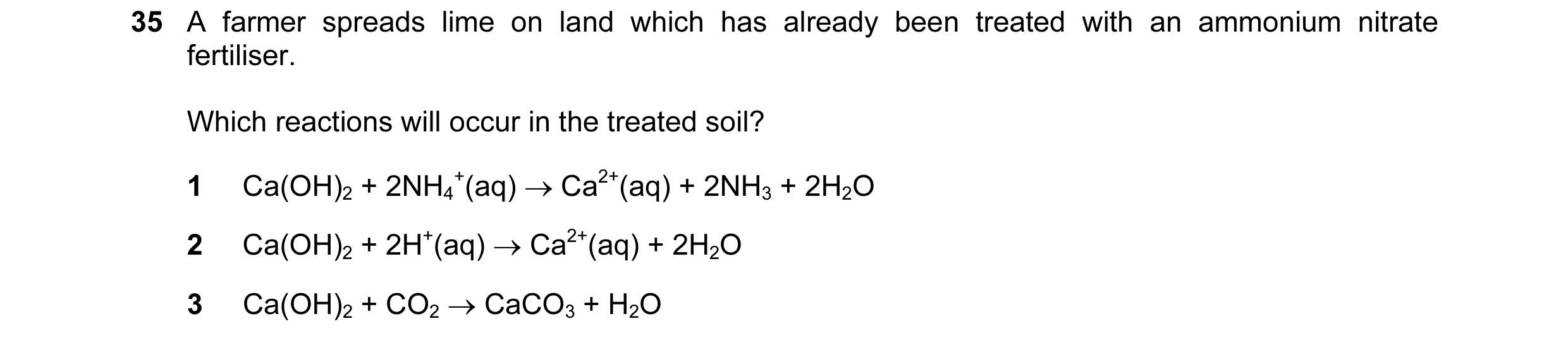
34 A farmer spreads lime on land which has already been treated with an ammonium nitrate fertiliser. Which reactions will occur in the treated soil? 1 Ca(OH)2 + 2NH4 +(aq) → Ca2+(aq) + 2NH3 + 2H2O 2 Ca(OH)2 + 2H+(aq) → Ca2+(aq) + 2H2O 3 Ca(OH)2 + CO2 → CaCO3 + H2O
1 marks
Answer: A
This question in 9701/11 Oct/Nov 2011
Q23 · Sulfur dioxide is used as a preservative in wine making 9701/13 Oct/Nov 2011
10 Sulfur dioxide is used as a preservative in wine making. The following equations describe how sulfur dioxide dissolves. H2O + SO2 HSO3 – + H+ HSO3 – + H+ SO3 2– + 2H+ Which statement about these two reactions is correct? A HSO3 – acts as a base. B SO2 acts as an oxidising agent. C SO3 2– acts as an acid. D SO3 2– acts as a reducing agent.
1 marks
Answer: A
This question in 9701/13 Oct/Nov 2011
Q24 · A farmer spreads lime on land which has already been treated with an ammonium nitrate… 9701/13 Oct/Nov 2011
35 A farmer spreads lime on land which has already been treated with an ammonium nitrate fertiliser. Which reactions will occur in the treated soil? 1 Ca(OH)2 + 2NH4 +(aq) → Ca2+(aq) + 2NH3 + 2H2O 2 Ca(OH)2 + 2H+(aq) → Ca2+(aq) + 2H2O 3 Ca(OH)2 + CO2 → CaCO3 + H2O
1 marks
Answer: A
This question in 9701/13 Oct/Nov 2011
Q25 · The oxides BaO, CaO, MgO and SrO all produce alkaline solutions when added to water 9701/11 May/June 2012
15 The oxides BaO, CaO, MgO and SrO all produce alkaline solutions when added to water. Which oxide produces the saturated solution with the highest pH? A BaO(aq) B CaO(aq) C MgO(aq) D SrO(aq)
1 marks
Answer: A
This question in 9701/11 May/June 2012
Q26 · Ammonia and chlorine react in the gas phase 9701/11 May/June 2012
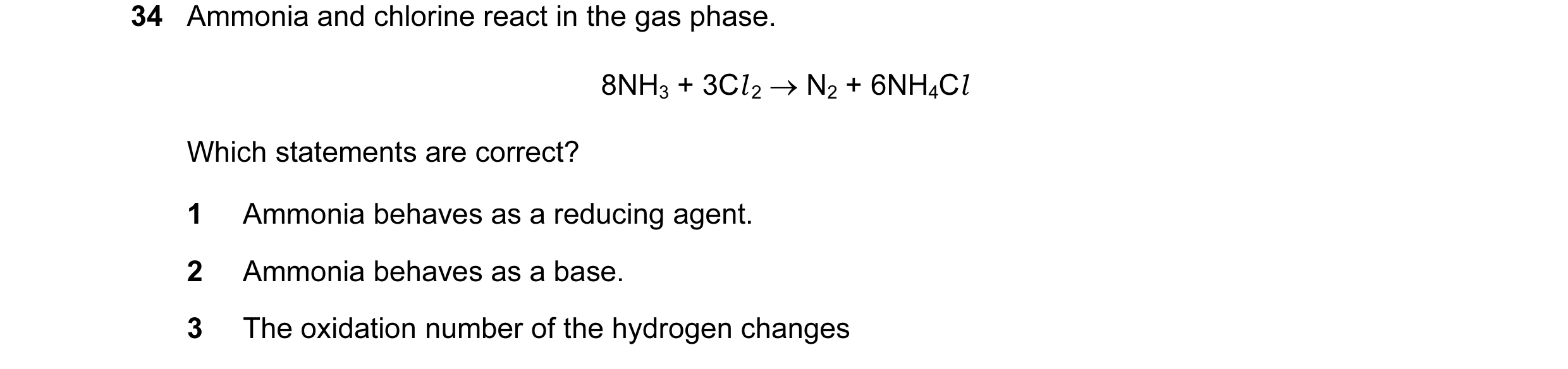
34 Ammonia and chlorine react in the gas phase. 8NH3 + 3Cl 2 → N2 + 6NH4Cl Which statements are correct? 1 Ammonia behaves as a reducing agent. 2 Ammonia behaves as a base. 3 The oxidation number of the hydrogen changes
1 marks
Answer: B
This question in 9701/11 May/June 2012
Q27 · Ammonia and chlorine react in the gas phase 9701/12 May/June 2012
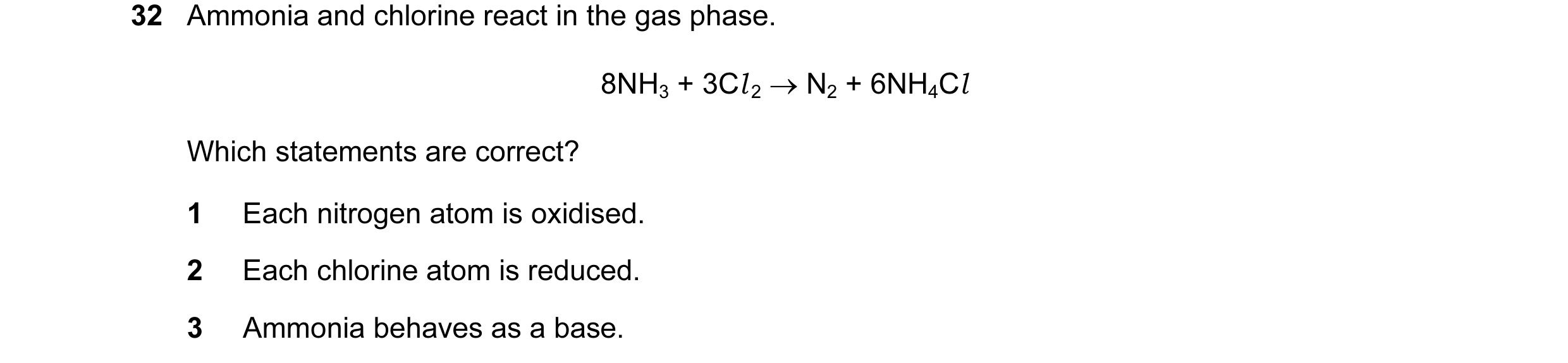
32 Ammonia and chlorine react in the gas phase. 8NH3 + 3Cl 2 → N2 + 6NH4Cl Which statements are correct? 1 Each nitrogen atom is oxidised. 2 Each chlorine atom is reduced. 3 Ammonia behaves as a base.
1 marks
Answer: C
This question in 9701/12 May/June 2012
Q28 · Concentrated sulfuric acid behaves as a strong acid when it reacts with water 9701/12 May/June 2012
33 Concentrated sulfuric acid behaves as a strong acid when it reacts with water. H2SO4(l) + aq → H+(aq) + HSO4 –(aq) The HSO4 – ion formed behaves as a weak acid. HSO4 –(aq) H+(aq) + SO4 2–(aq) Which statements are true for 1.0 mol dm–3 sulfuric acid? 1 [H+(aq)] is high 2 [SO4 2–(aq)] is high 3 [HSO4 –(aq)] = [SO4 2–(aq)]
1 marks
Answer: D
This question in 9701/12 May/June 2012
Q29 · Silver chloride dissolves in aqueous ammonia 9701/12 May/June 2012
34 Silver chloride dissolves in aqueous ammonia. What happens in this process? 1 A co-ordinate bond is formed. 2 The oxidation number of nitrogen is unchanged. 3 Ammonia acts as a Brønsted-Lowry base.
1 marks
Answer: B
This question in 9701/12 May/June 2012
Q30 · Elements X and Y are both in period three 9701/11 Oct/Nov 2012
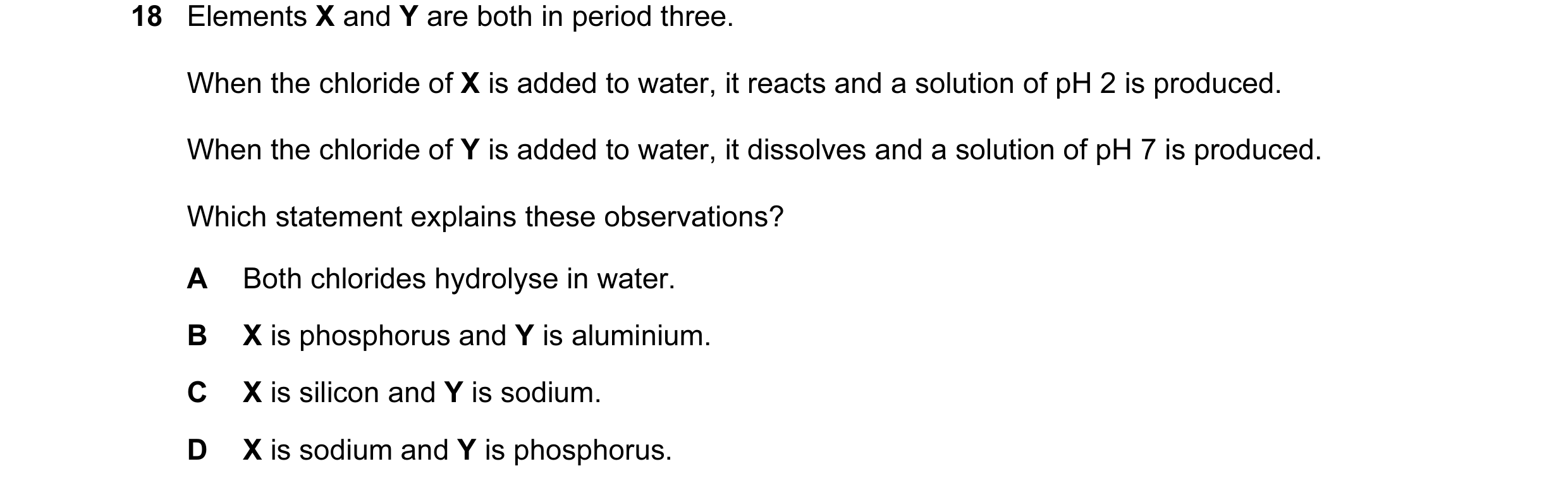
18 Elements X and Y are both in period three. When the chloride of X is added to water, it reacts and a solution of pH 2 is produced. When the chloride of Y is added to water, it dissolves and a solution of pH 7 is produced. Which statement explains these observations? A Both chlorides hydrolyse in water. B X is phosphorus and Y is aluminium. C X is silicon and Y is sodium. D X is sodium and Y is phosphorus.
1 marks
Answer: C
This question in 9701/11 Oct/Nov 2012
Q31 · Elements X and Y are both in period three 9701/12 Oct/Nov 2012
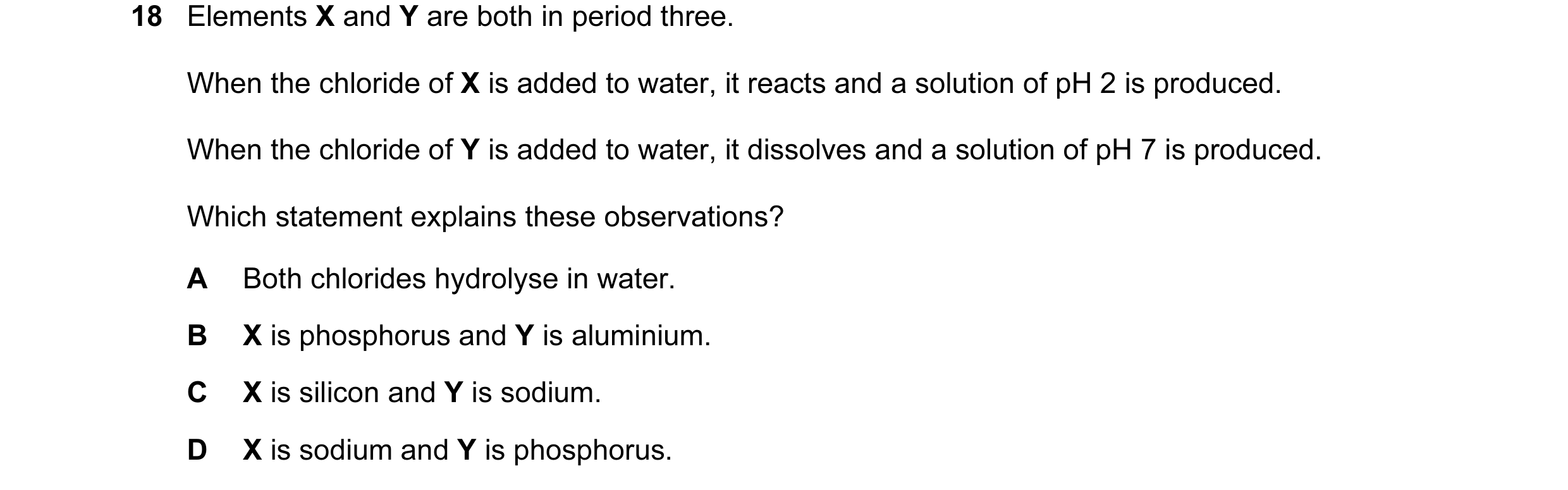
18 Elements X and Y are both in period three. When the chloride of X is added to water, it reacts and a solution of pH 2 is produced. When the chloride of Y is added to water, it dissolves and a solution of pH 7 is produced. Which statement explains these observations? A Both chlorides hydrolyse in water. B X is phosphorus and Y is aluminium. C X is silicon and Y is sodium. D X is sodium and Y is phosphorus.
1 marks
Answer: C
This question in 9701/12 Oct/Nov 2012
Q32 · The enthalpy change of the neutralisation given below is –114 kJ mol–1 9701/13 Oct/Nov 2012
10 The enthalpy change of the neutralisation given below is –114 kJ mol–1. 2NaOH(aq) + H2SO4(aq) → Na2SO4(aq) + 2H2O(l) By using this information, what is the most likely value for the enthalpy change of the following neutralisation? Ba(OH)2(aq) + 2HCl(aq) → BaCl2(aq) + 2H2O(l) A –57 kJ mol–1 B –76 kJ mol–1 C –114 kJ mol–1 D –228 kJ mol–1
1 marks
Answer: C
This question in 9701/13 Oct/Nov 2012
Q33 · Which oxide, when mixed with water, will produce the solution with the lowest pH? 9701/13 Oct/Nov 2012
18 Which oxide, when mixed with water, will produce the solution with the lowest pH? A CO2 B Na2O C P4O10 D SiO2
1 marks
Answer: C
This question in 9701/13 Oct/Nov 2012
Q34 · Which reagent, when mixed and heated with ammonium sulfate, liberates ammonia? 9701/11 May/June 2013
19 Which reagent, when mixed and heated with ammonium sulfate, liberates ammonia? A aqueous bromine B dilute hydrochloric acid C limewater D potassium dichromate(VI) in acidic solution
1 marks
Answer: C
This question in 9701/11 May/June 2013
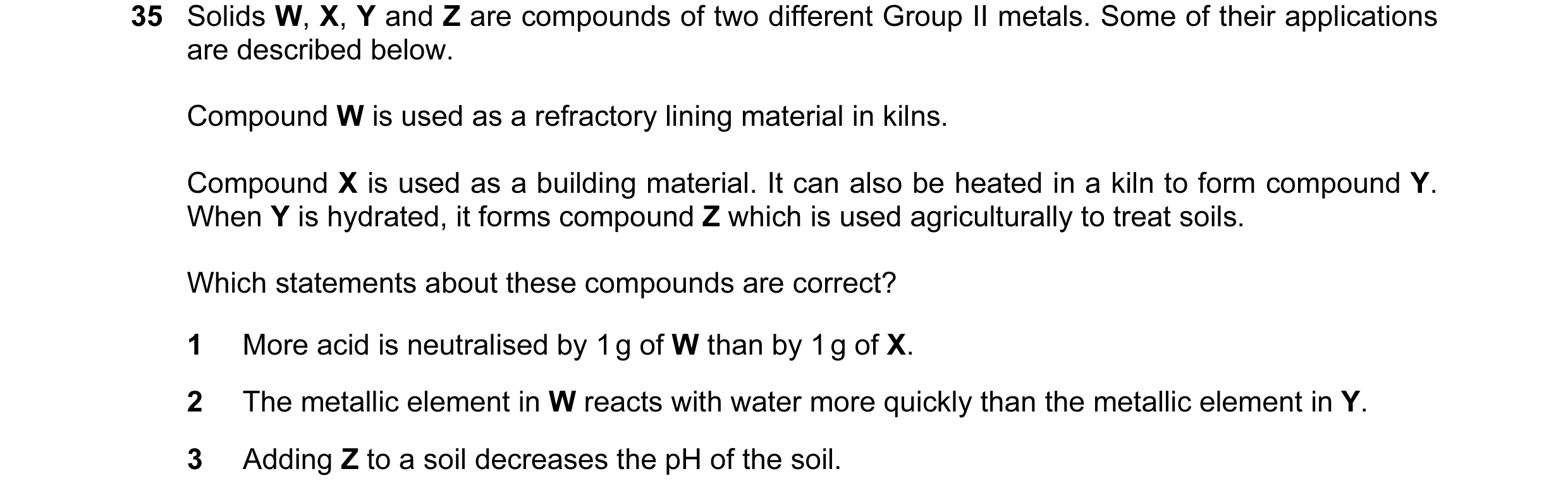
Q35 · Solids W, X, Y and Z are compounds of two different Group II metals 9701/11 May/June 2013
35 Solids W, X, Y and Z are compounds of two different Group II metals. Some of their applications are described below. Compound W is used as a refractory lining material in kilns. Compound X is used as a building material. It can also be heated in a kiln to form compound Y. When Y is hydrated, it forms compound Z which is used agriculturally to treat soils. Which statements about these compounds are correct? 1 More acid is neutralised by 1 g of W than by 1 g of X. 2 The metallic element in W reacts with water more quickly than the metallic element in Y. 3 Adding Z to a soil decreases the pH of the soil.
1 marks
Answer: D
This question in 9701/11 May/June 2013
Q36 · Which reagents, when used in an excess, can be used to make sodium lactate… 9701/11 May/June 2013
40 Which reagents, when used in an excess, can be used to make sodium lactate, CH3CH(OH)CO2Na, from lactic acid, CH3CH(OH)CO2H? 1 Na 2 NaHCO3 3 NaOH
1 marks
Answer: C
This question in 9701/11 May/June 2013
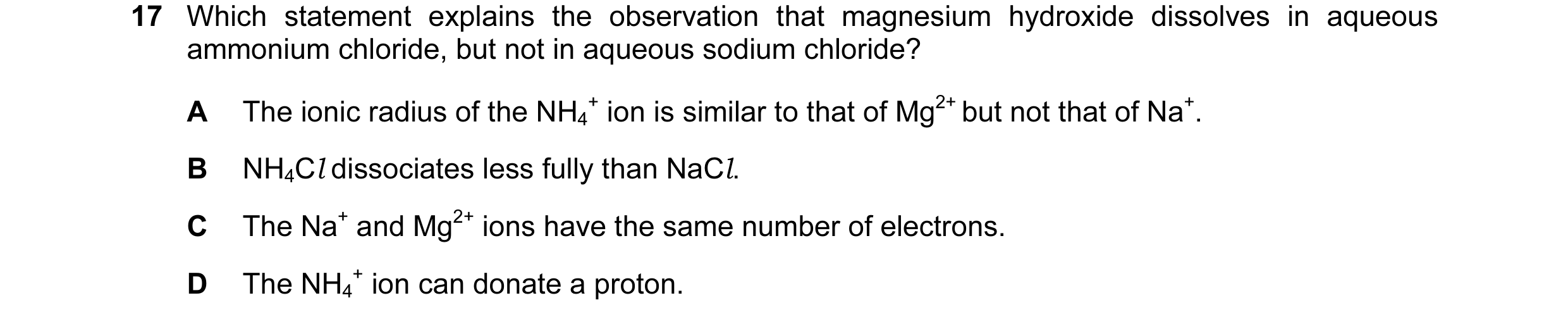
Q37 · Which statement explains the observation that magnesium hydroxide dissolves in aqueous… 9701/11 Oct/Nov 2013
17 Which statement explains the observation that magnesium hydroxide dissolves in aqueous ammonium chloride, but not in aqueous sodium chloride? A The ionic radius of the NH4 + ion is similar to that of Mg2+ but not that of Na+. B NH4Cl dissociates less fully than NaCl. C The Na+ and Mg2+ ions have the same number of electrons. D The NH4 + ion can donate a proton.
1 marks
Answer: D
This question in 9701/11 Oct/Nov 2013
Q38 · Which statement explains the observation that magnesium hydroxide dissolves in aqueous… 9701/12 Oct/Nov 2013
17 Which statement explains the observation that magnesium hydroxide dissolves in aqueous ammonium chloride, but not in aqueous sodium chloride? A The ionic radius of the NH4 + ion is similar to that of Mg2+ but not that of Na+. B NH4Cl dissociates less fully than NaCl. C The Na+ and Mg2+ ions have the same number of electrons. D The NH4 + ion can donate a proton.
1 marks
Answer: D
This question in 9701/12 Oct/Nov 2013
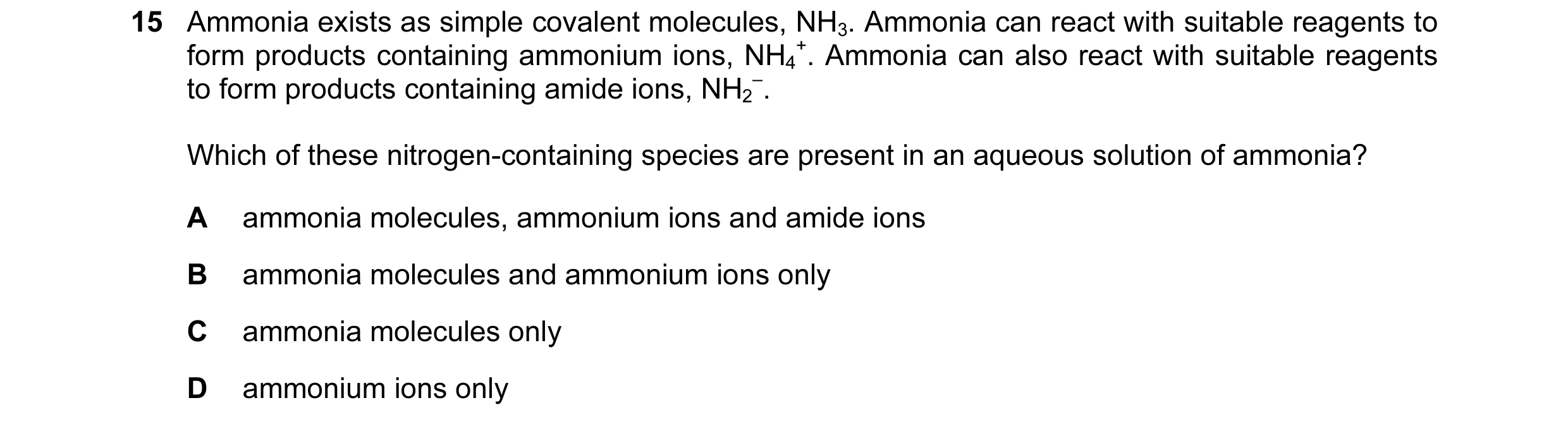
Q39 · Ammonia exists as simple covalent molecules, NH3 9701/13 Oct/Nov 2013
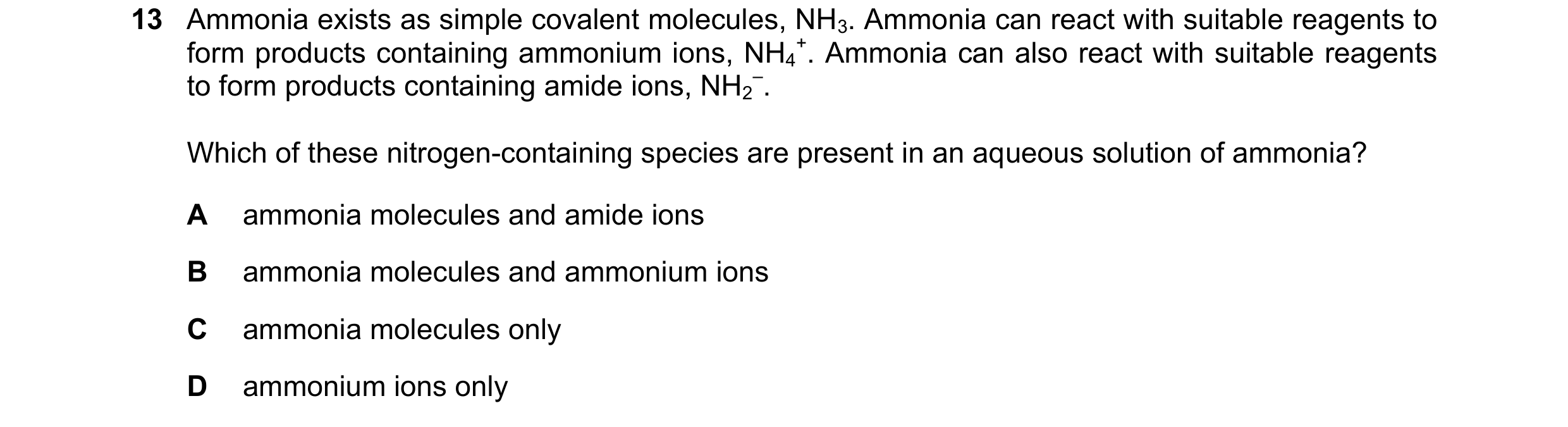
15 Ammonia exists as simple covalent molecules, NH3. Ammonia can react with suitable reagents to form products containing ammonium ions, NH4 +. Ammonia can also react with suitable reagents to form products containing amide ions, NH2 –. Which of these nitrogen-containing species are present in an aqueous solution of ammonia? A ammonia molecules, ammonium ions and amide ions B ammonia molecules and ammonium ions only C ammonia molecules only D ammonium ions only
1 marks
Answer: B
This question in 9701/13 Oct/Nov 2013
Q40 · Methanoic acid molecules, HCO2H, and hydrogen carbonate ions, HCO3 –, can both behave as… 9701/13 Oct/Nov 2013
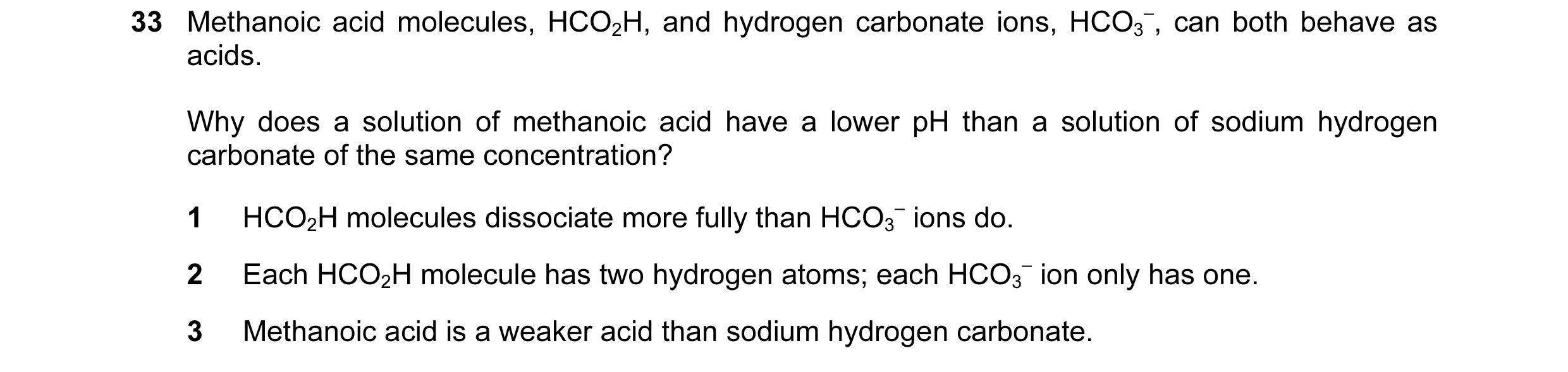
33 Methanoic acid molecules, HCO2H, and hydrogen carbonate ions, HCO3 –, can both behave as acids. Why does a solution of methanoic acid have a lower pH than a solution of sodium hydrogen carbonate of the same concentration? 1 HCO2H molecules dissociate more fully than HCO3 – ions do. 2 Each HCO2H molecule has two hydrogen atoms; each HCO3 – ion only has one. 3 Methanoic acid is a weaker acid than sodium hydrogen carbonate.
1 marks
Answer: D
This question in 9701/13 Oct/Nov 2013
Q41 · In which reaction is the underlined substance acting as a base? 9701/11 May/June 2015
8 In which reaction is the underlined substance acting as a base? A HNO3 + H2SO4 → H2NO3 + + HSO4 – B HSiO3 – + HCN → CN– + H2O + SiO2 C HNO2 + HCO3 – → H2O + CO2 + NO2 – D C6H5O– + CH2Cl CO2H → C6H5OH + CH2Cl CO2 –
1 marks
Answer: C
This question in 9701/11 May/June 2015
Q42 · When added to water, which oxides will cause a change in the pH of the water? 9701/12 May/June 2015
35 When added to water, which oxides will cause a change in the pH of the water? 1 SiO2 2 CaO 3 SO2
1 marks
Answer: C
This question in 9701/12 May/June 2015
Q43 · Ammonia and chlorine react in the gas phase 9701/12 Oct/Nov 2015
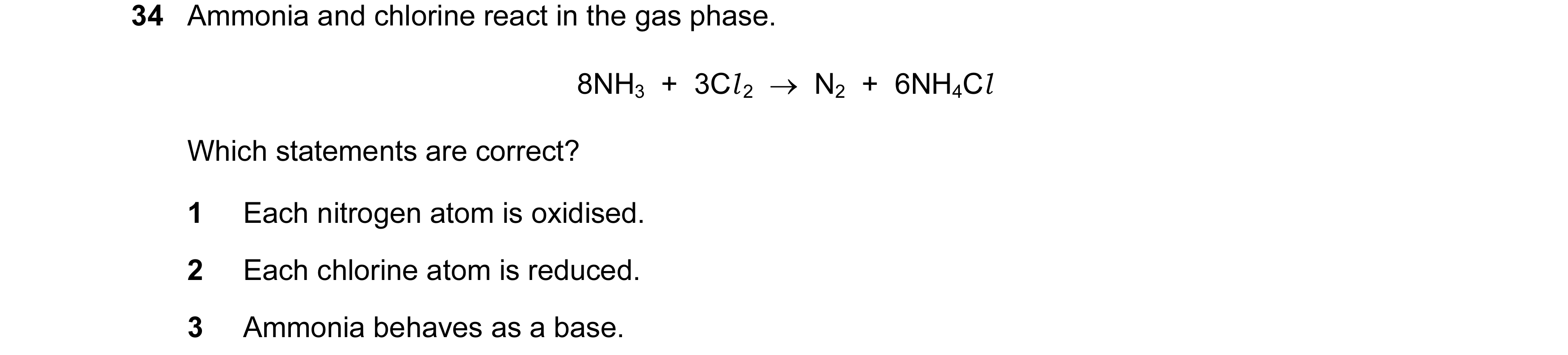
34 Ammonia and chlorine react in the gas phase. 8NH3 + 3Cl 2 → N2 + 6NH4Cl Which statements are correct? 1 Each nitrogen atom is oxidised. 2 Each chlorine atom is reduced. 3 Ammonia behaves as a base.
1 marks
This question in 9701/12 Oct/Nov 2015
Q44 · Ammonium sulfate, (NH4)2SO4, and ammonium nitrate, NH4NO3, are used as fertilisers 9701/12 Feb/March 2016
17 Ammonium sulfate, (NH4)2SO4, and ammonium nitrate, NH4NO3, are used as fertilisers. These salts have different percentages by mass of nitrogen. They have the same effect as each other on the pH of neutral soil. Which row is correct? higher percentage effect on pH of soil of nitrogen by mass A ammonium nitrate decrease B ammonium nitrate increase C ammonium sulfate decrease D ammonium sulfate increase
1 marks
Answer: A
This question in 9701/12 Feb/March 2016
Q45 · Ammonia gas, NH3, and hydrogen sulfide gas, H2S, react together to form the salt ammonium… 9701/12 May/June 2016
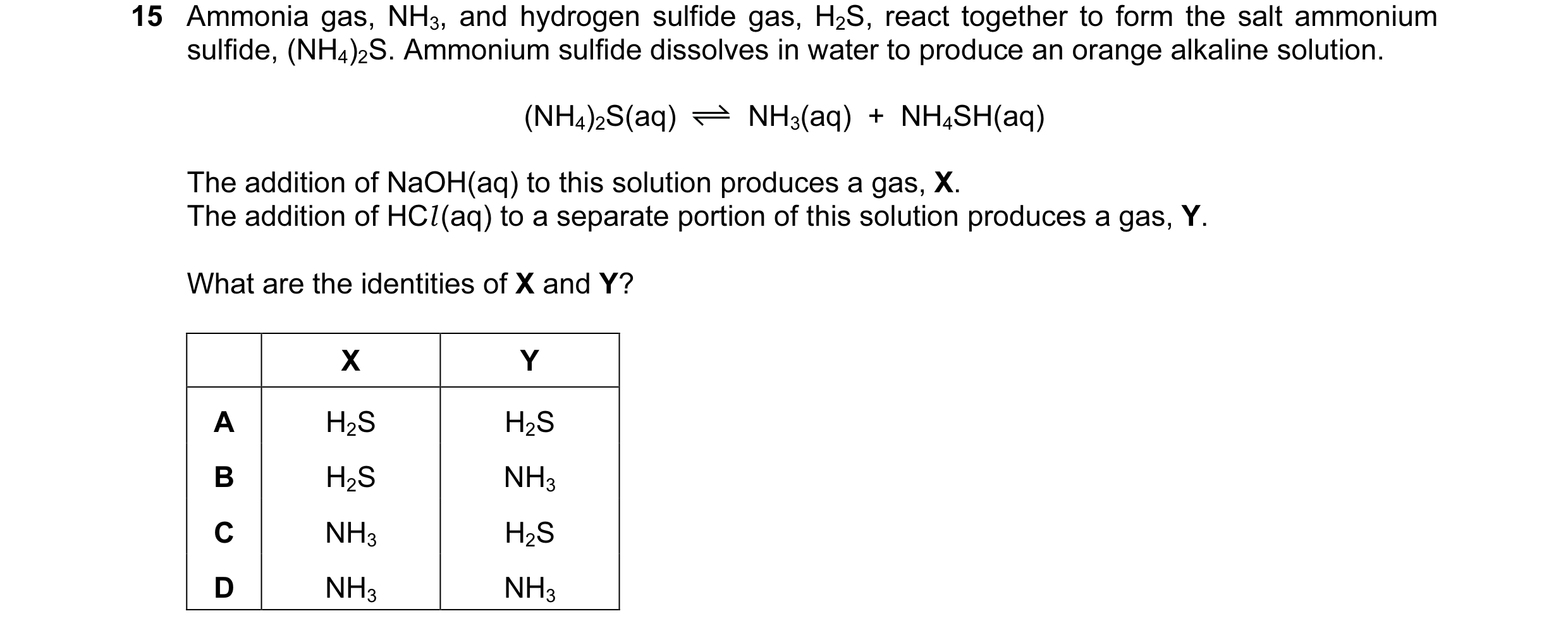
15 Ammonia gas, NH3, and hydrogen sulfide gas, H2S, react together to form the salt ammonium sulfide, (NH4)2S. Ammonium sulfide dissolves in water to produce an orange alkaline solution. (NH4)2S(aq) NH3(aq) + NH4SH(aq) The addition of NaOH(aq) to this solution produces a gas, X. The addition of HCl (aq) to a separate portion of this solution produces a gas, Y. What are the identities of X and Y? X Y A H2S H2S B H2S NH3 C NH3 H2S D NH3 NH3
1 marks
Answer: C
This question in 9701/12 May/June 2016
Q46 · Which chlorides, when added to water, can produce a solution with a pH of less than 5? 9701/12 May/June 2017
35 Which chlorides, when added to water, can produce a solution with a pH of less than 5? 1 SiCl 4 2 Al Cl 3 3 MgCl 2
1 marks
Answer: B
This question in 9701/12 May/June 2017
Q47 · Chlorogenic acid is found in green coffee beans and is used in treatments for weight loss 9701/13 May/June 2017
28 Chlorogenic acid is found in green coffee beans and is used in treatments for weight loss. HO CO2H O R = C6H5O2 and takes no part in the reaction with sodium carbonate. HO O R OH chlorogenic acid What is produced in good yield when chlorogenic acid is treated with an excess of sodium carbonate solution at room temperature? A B HO CO2Na NaO CO2Na O O HO O R NaO O R OH ONa C D NaO CO2H HO CO2Na O O + NaO O R HO OH HO R ONa OH
1 marks
Answer: A
This question in 9701/13 May/June 2017
Q48 · Methanoic acid, HCO2H, and hydrocyanic acid, HCN, can both behave as acids 9701/12 Oct/Nov 2017
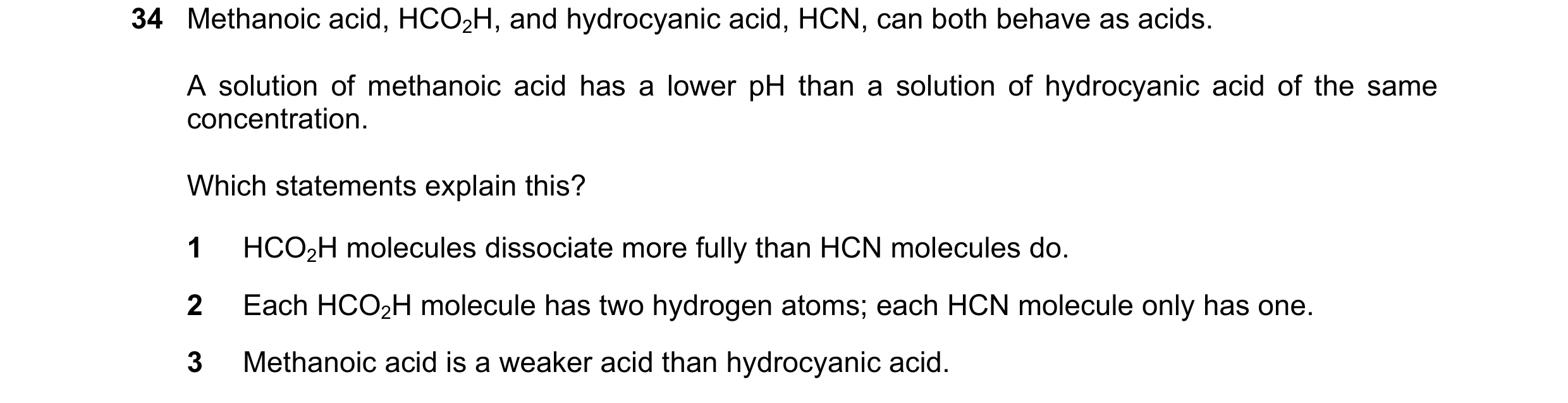
34 Methanoic acid, HCO2H, and hydrocyanic acid, HCN, can both behave as acids. A solution of methanoic acid has a lower pH than a solution of hydrocyanic acid of the same concentration. Which statements explain this? 1 HCO2H molecules dissociate more fully than HCN molecules do. 2 Each HCO2H molecule has two hydrogen atoms; each HCN molecule only has one. 3 Methanoic acid is a weaker acid than hydrocyanic acid.
1 marks
Answer: D
This question in 9701/12 Oct/Nov 2017
Q49 · Which compound would most usually be added to soil to reduce its acidity? 9701/13 Oct/Nov 2017
14 Which compound would most usually be added to soil to reduce its acidity? A aluminium hydroxide B calcium hydroxide C magnesium hydroxide D sodium hydroxide
1 marks
Answer: B
This question in 9701/13 Oct/Nov 2017
Q50 · Silver chloride and silver iodide form equilibria when added to water 9701/13 May/June 2018
17 Silver chloride and silver iodide form equilibria when added to water. AgCl(s) Ag+(aq) + Cl –(aq) Kc = K1 AgI(s) Ag+(aq) + I–(aq) Kc = K2 Each equilibrium position lies well to the left. Silver iodide will not dissolve in aqueous ammonia. Silver chloride will dissolve in aqueous ammonia. Another equilibrium is formed. Ag+(aq) + 2NH3(aq) Ag(NH3)2 +(aq) Kc = K3 The position of this equilibrium lies to the right. What is the order of magnitude for these three equilibrium constants? A K1 > K2 > K3 B K2 > K1 > K3 C K3 > K1 > K2 D K3 > K2 > K1
1 marks
Answer: C
This question in 9701/13 May/June 2018
Q51 · Ammonia and chlorine react as shown 9701/13 May/June 2018
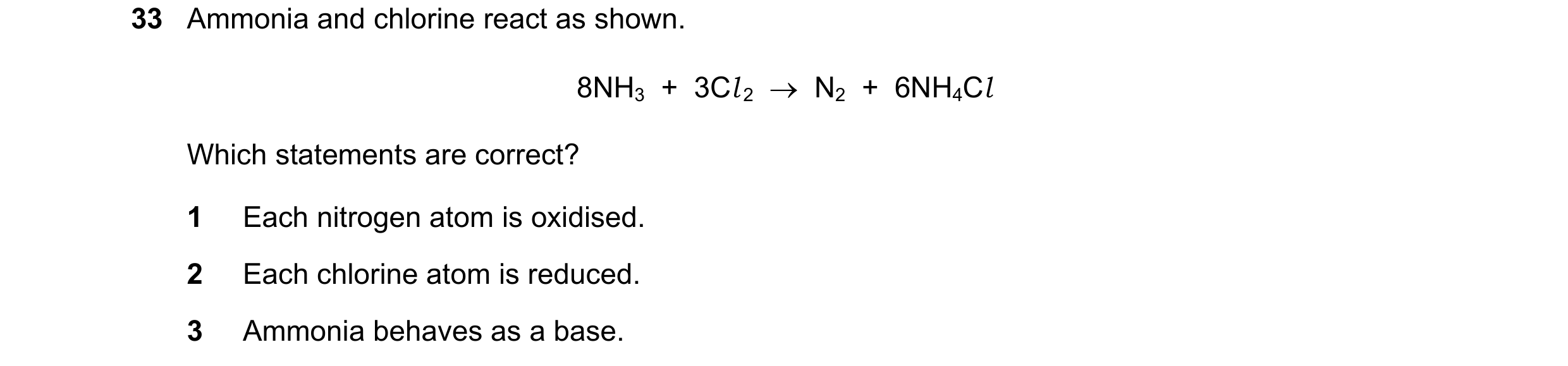
33 Ammonia and chlorine react as shown. 8NH3 + 3Cl 2 → N2 + 6NH4Cl Which statements are correct? 1 Each nitrogen atom is oxidised. 2 Each chlorine atom is reduced. 3 Ammonia behaves as a base.
1 marks
Answer: C
This question in 9701/13 May/June 2018
Q52 · Which statement explains the observation that magnesium hydroxide dissolves in aqueous… 9701/11 Oct/Nov 2018
18 Which statement explains the observation that magnesium hydroxide dissolves in aqueous ammonium chloride, but not in aqueous sodium chloride? A The ionic radius of the NH4 + ion is similar to that of Mg2+ but not that of Na+. B NH4Cl dissociates less fully than NaCl. C The Na+ and Mg2+ ions have the same number of electrons. D The NH4 + ion can donate a proton.
1 marks
Answer: D
This question in 9701/11 Oct/Nov 2018
Q53 · Which statement explains the observation that magnesium hydroxide dissolves in aqueous… 9701/13 Oct/Nov 2018
18 Which statement explains the observation that magnesium hydroxide dissolves in aqueous ammonium chloride, but not in aqueous sodium chloride? A The ionic radius of the NH4 + ion is similar to that of Mg2+ but not that of Na+. B NH4Cl dissociates less fully than NaCl. C The Na+ and Mg2+ ions have the same number of electrons. D The NH4 + ion can donate a proton.
1 marks
Answer: D
This question in 9701/13 Oct/Nov 2018
Q54 · Element Q readily oxidises in air 9701/12 May/June 2019
12 Element Q readily oxidises in air. The oxide produced reacts with water to form a solution of very low pH. Where could element Q be found in the Periodic Table? period group A 2 1 B 2 14 C 3 14 D 3 15
1 marks
Answer: D
This question in 9701/12 May/June 2019
Q55 · Ammonium sulfate, (NH4)2SO4, and ammonium nitrate, NH4NO3, are used as fertilisers 9701/12 May/June 2019
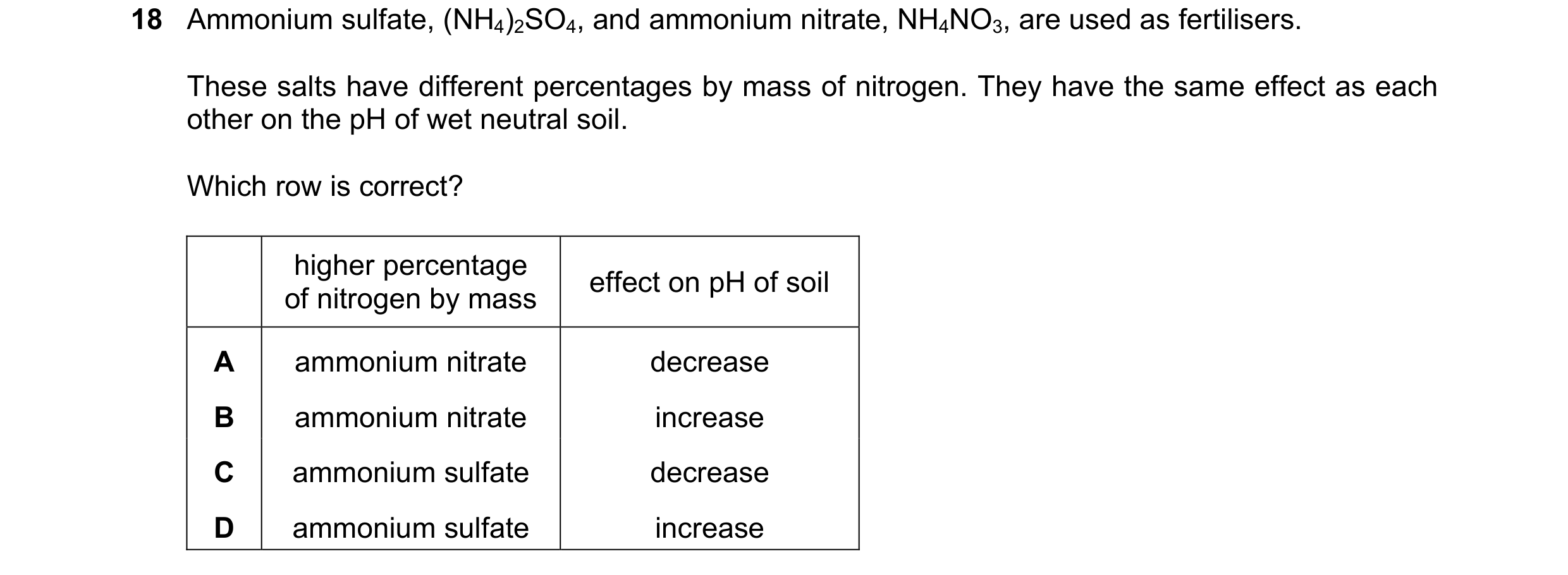
18 Ammonium sulfate, (NH4)2SO4, and ammonium nitrate, NH4NO3, are used as fertilisers. These salts have different percentages by mass of nitrogen. They have the same effect as each other on the pH of wet neutral soil. Which row is correct? higher percentage effect on pH of soil of nitrogen by mass A ammonium nitrate decrease B ammonium nitrate increase C ammonium sulfate decrease D ammonium sulfate increase
1 marks
Answer: A
This question in 9701/12 May/June 2019
Q56 · Which gases will dissolve in water causing a lowering of the pH? 9701/13 May/June 2019
36 Which gases will dissolve in water causing a lowering of the pH? 1 ammonia 2 sulfur dioxide 3 nitrogen dioxide
1 marks
Answer: C
This question in 9701/13 May/June 2019
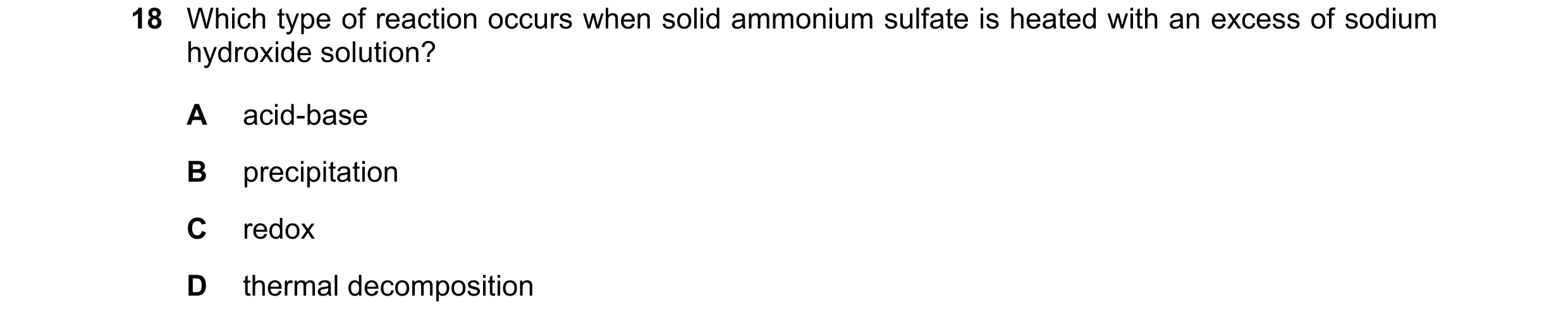
Q57 · Which type of reaction occurs when solid ammonium sulfate is heated with an excess of… 9701/11 Oct/Nov 2019
18 Which type of reaction occurs when solid ammonium sulfate is heated with an excess of sodium hydroxide solution? A acid-base B precipitation C redox D thermal decomposition
1 marks
Answer: A
This question in 9701/11 Oct/Nov 2019
Q58 · Hydrogen cyanide reacts with propanone in the presence of potassium cyanide 9701/11 Oct/Nov 2019
39 Hydrogen cyanide reacts with propanone in the presence of potassium cyanide. Which statements about this reaction are correct? 1 The cyanide ion is a catalyst for the reaction. 2 This is an addition reaction. 3 The intermediate behaves as a base.
1 marks
Answer: A
This question in 9701/11 Oct/Nov 2019
Q59 · Hydrated aluminium ions undergo the following reaction 9701/12 Oct/Nov 2019
11 Hydrated aluminium ions undergo the following reaction. [Al (H2O)6]3+(aq) + H2O(l) [Al (H2O)5OH]2+(aq) + H3O+(aq) Which statement about this reaction is correct? A H2O(l) and [Al (H2O)5OH]2+(aq) are a conjugate acid-base pair. B H2O(l) is acting as an acid as it is donating H+ ions. C If OH–(aq) is added, the equilibrium will move to the right. D Kc varies as the pH is varied.
1 marks
Answer: C
This question in 9701/12 Oct/Nov 2019
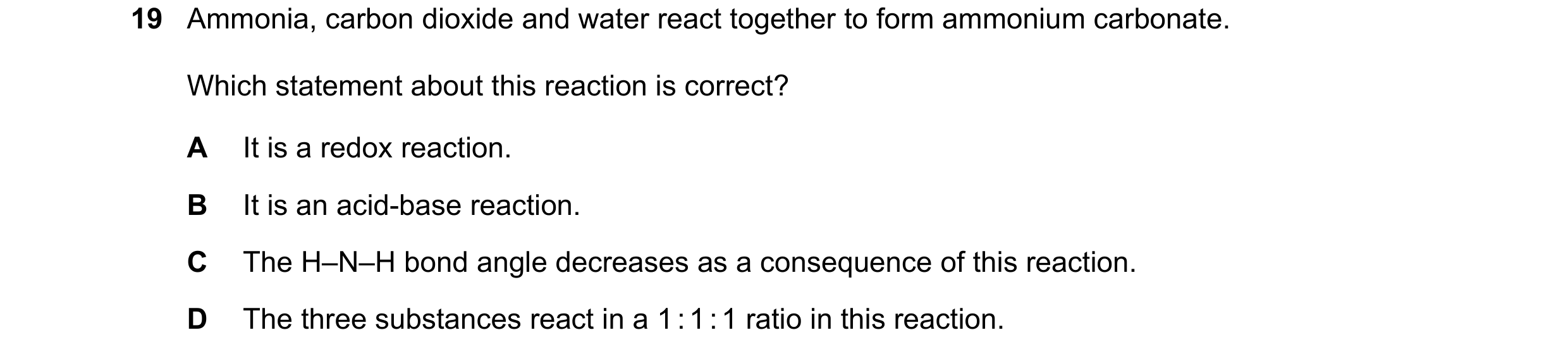
Q60 · Ammonia, carbon dioxide and water react together to form ammonium carbonate 9701/12 Oct/Nov 2019
19 Ammonia, carbon dioxide and water react together to form ammonium carbonate. Which statement about this reaction is correct? A It is a redox reaction. B It is an acid-base reaction. C The H–N–H bond angle decreases as a consequence of this reaction. D The three substances react in a 1 : 1 : 1 ratio in this reaction.
1 marks
Answer: B
This question in 9701/12 Oct/Nov 2019
Q61 · Which statements about ammonia are correct? 9701/12 Oct/Nov 2019
36 Which statements about ammonia are correct? 1 An ammonia molecule has three bond pairs and one lone pair of electrons. 2 When ammonia is bubbled into water the pH of the solution increases. 3 Ammonia gas can be made by warming ammonium sulfate with aqueous hydrochloric acid.
1 marks
Answer: B
This question in 9701/12 Oct/Nov 2019
Q62 · Which oxide will cause an increase in pH when added to water? 9701/13 Oct/Nov 2019
12 Which oxide will cause an increase in pH when added to water? A MgO B Al 2O3 C SiO2 D SO2
1 marks
Answer: A
This question in 9701/13 Oct/Nov 2019
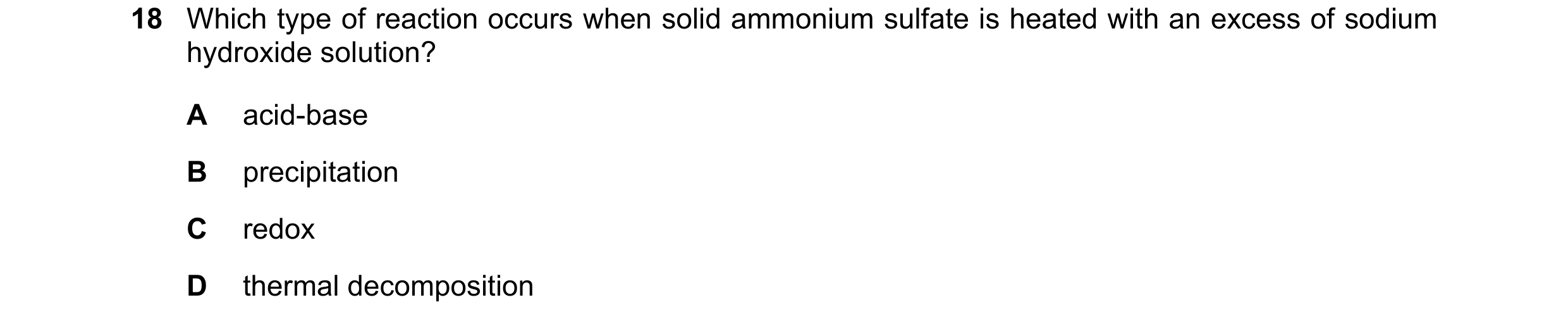
Q63 · Which type of reaction occurs when solid ammonium sulfate is heated with an excess of… 9701/13 Oct/Nov 2019
18 Which type of reaction occurs when solid ammonium sulfate is heated with an excess of sodium hydroxide solution? A acid-base B precipitation C redox D thermal decomposition
1 marks
Answer: A
This question in 9701/13 Oct/Nov 2019
Q64 · Which solution has the lowest pH value? 9701/13 May/June 2020
6 Which solution has the lowest pH value? A 0.01 mol dm–3 butanoic acid B 0.01 mol dm–3 ethanoic acid C 0.01 mol dm–3 hydrochloric acid D 0.01 mol dm–3 sulfuric acid
1 marks
Answer: D
This question in 9701/13 May/June 2020
Q65 · Three test-tubes, X, Y and Z, each contain water 9701/11 Oct/Nov 2020
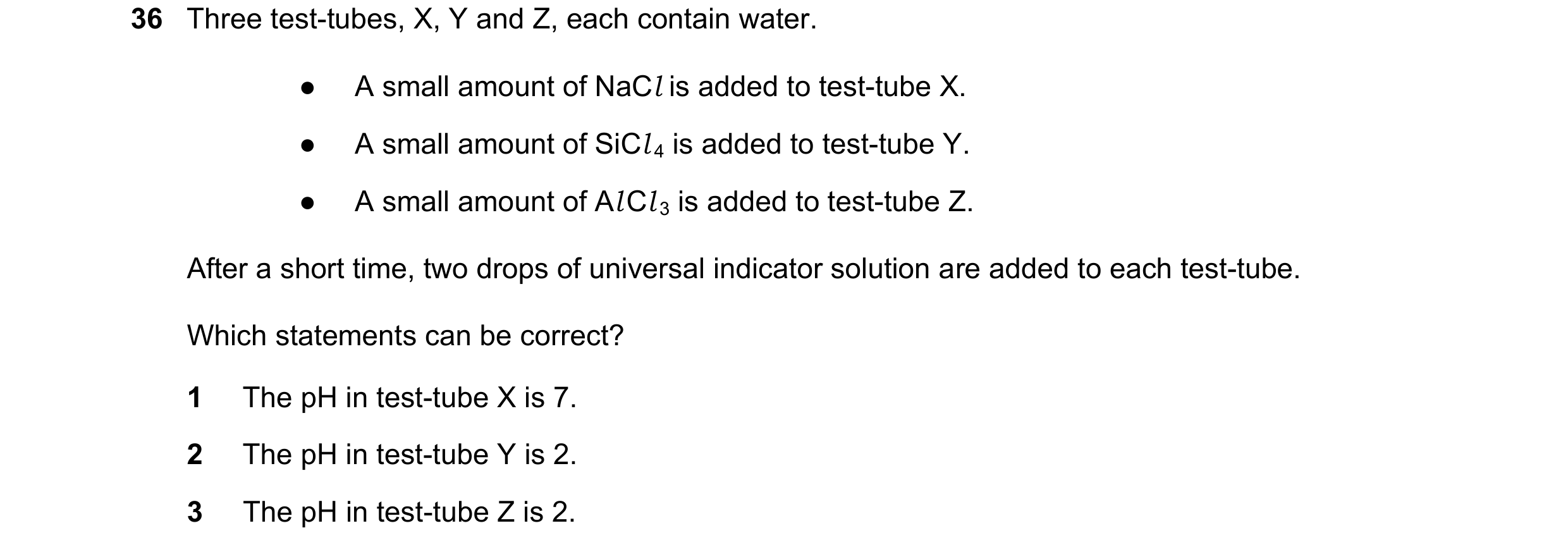
36 Three test-tubes, X, Y and Z, each contain water. ● A small amount of NaCl is added to test-tube X. ● A small amount of SiCl 4 is added to test-tube Y. ● A small amount of Al Cl 3 is added to test-tube Z. After a short time, two drops of universal indicator solution are added to each test-tube. Which statements can be correct? 1 The pH in test-tube X is 7. 2 The pH in test-tube Y is 2. 3 The pH in test-tube Z is 2.
1 marks
Answer: A
This question in 9701/11 Oct/Nov 2020
Q66 · Which substance, when warmed with aqueous ammonium chloride, would produce an alkaline… 9701/12 Oct/Nov 2020
18 Which substance, when warmed with aqueous ammonium chloride, would produce an alkaline gas? A CH3CO2H B CH3CH2OH C CH3CO2CH3 D CH3CH2ONa
1 marks
Answer: D
This question in 9701/12 Oct/Nov 2020
Q67 · In aqueous solution, sulfuric acid dissociates as shown 9701/13 Oct/Nov 2020
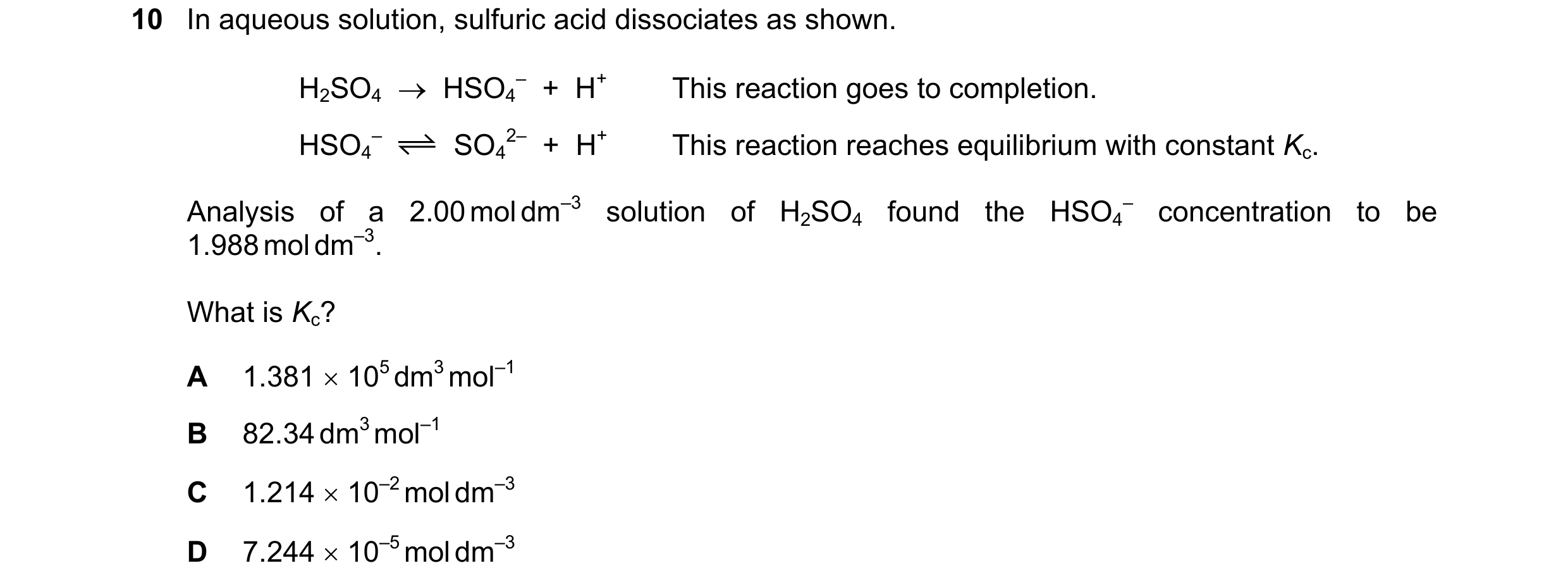
10 In aqueous solution, sulfuric acid dissociates as shown. H2SO4 HSO4 – + H+ This reaction goes to completion. HSO4 – SO4 2– + H+ This reaction reaches equilibrium with constant Kc. Analysis of a 2.00 mol dm–3 solution of H2SO4 found the HSO4 – concentration to be 1.988 mol dm–3. What is Kc? A 1.381 105 dm3 mol–1 B 82.34 dm3 mol–1 C 1.214 10–2 mol dm–3 D 7.244 10–5 mol dm–3
1 marks
Answer: C
This question in 9701/13 Oct/Nov 2020
Q68 · Three test-tubes, X, Y and Z, each contain water 9701/13 Oct/Nov 2020
36 Three test-tubes, X, Y and Z, each contain water. ● A small amount of NaCl is added to test-tube X. ● A small amount of SiCl 4 is added to test-tube Y. ● A small amount of Al Cl 3 is added to test-tube Z. After a short time, two drops of universal indicator solution are added to each test-tube. Which statements can be correct? 1 The pH in test-tube X is 7. 2 The pH in test-tube Y is 2. 3 The pH in test-tube Z is 2.
1 marks
Answer: A
This question in 9701/13 Oct/Nov 2020
Q69 · A sample containing x mol of Al 2Cl 6 is dissolved in water to give solution W 9701/12 Feb/March 2021
35 A sample containing x mol of Al 2Cl 6 is dissolved in water to give solution W. In order to precipitate all of the aluminium as its hydroxide, y mol of sodium hydroxide are required. More of the alkali is added to re-dissolve the precipitate, giving solution Z. Which statements are correct? 1 the initial pH of solution W is below 7 2 y = 3x 3 Z contains x mol of aluminium
1 marks
Answer: D
This question in 9701/12 Feb/March 2021
Q70 · A farmer requires a solid compound to raise the pH of the soil in a field from 5.5 to… 9701/12 May/June 2021
14 A farmer requires a solid compound to raise the pH of the soil in a field from 5.5 to above 6.0. Which compound could the farmer use? A (NH4)2SO4 B NH4NO3 C Ca(OH)2 D Ca(NO3)2
1 marks
Answer: C
This question in 9701/12 May/June 2021
Q71 · Ammonia gas, NH3, and hydrogen sulfide gas, H2S, react together to form the salt ammonium… 9701/12 May/June 2021
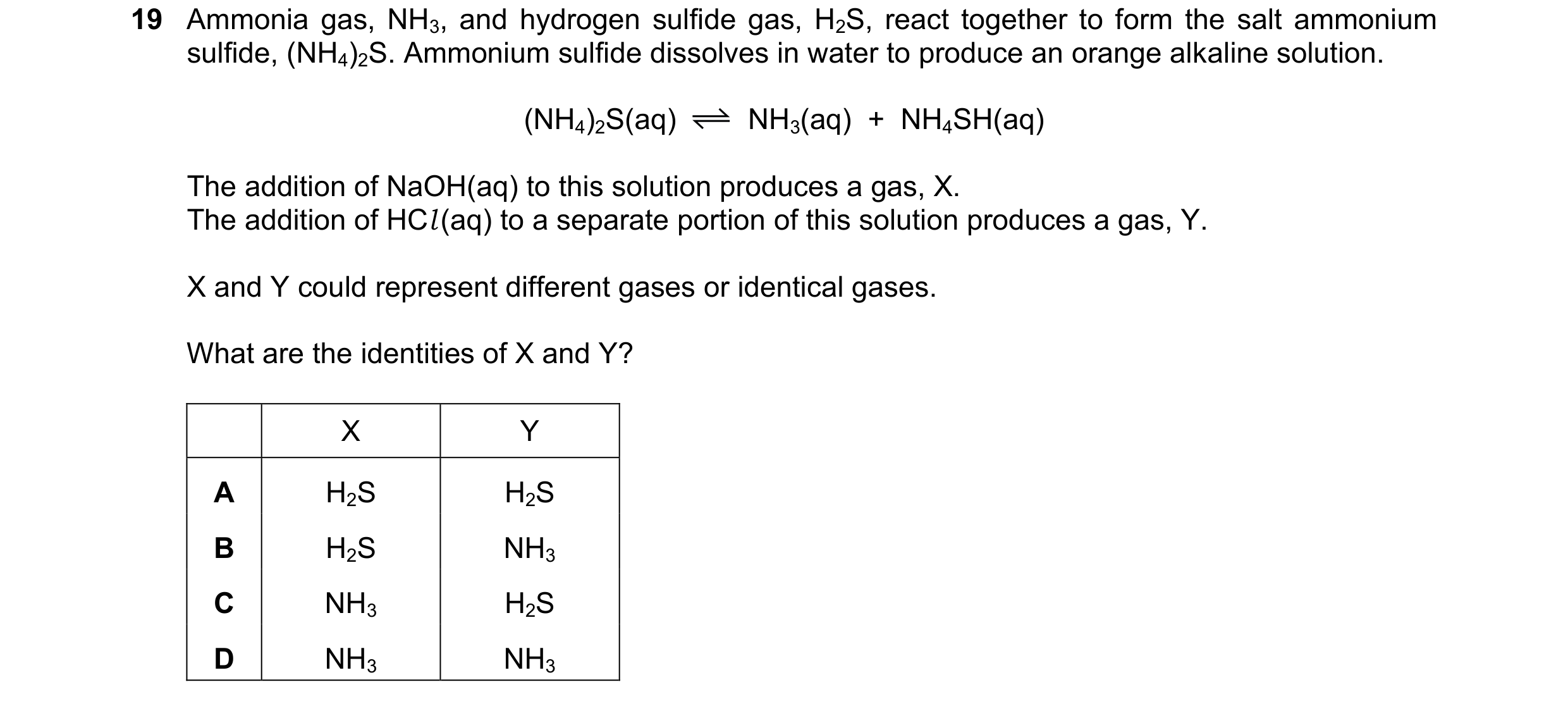
19 Ammonia gas, NH3, and hydrogen sulfide gas, H2S, react together to form the salt ammonium sulfide, (NH4)2S. Ammonium sulfide dissolves in water to produce an orange alkaline solution. (NH4)2S(aq) NH3(aq) + NH4SH(aq) The addition of NaOH(aq) to this solution produces a gas, X. The addition of HCl (aq) to a separate portion of this solution produces a gas, Y. X and Y could represent different gases or identical gases. What are the identities of X and Y? X Y A H2S H2S B H2S NH3 C NH3 H2S D NH3 NH3
1 marks
Answer: C
This question in 9701/12 May/June 2021
Q72 · Ammonia exists as simple covalent molecules, NH3 9701/13 May/June 2021
13 Ammonia exists as simple covalent molecules, NH3. Ammonia can react with suitable reagents to form products containing ammonium ions, NH4 +. Ammonia can also react with suitable reagents to form products containing amide ions, NH2 –. Which of these nitrogen-containing species are present in an aqueous solution of ammonia? A ammonia molecules and amide ions B ammonia molecules and ammonium ions C ammonia molecules only D ammonium ions only
1 marks
Answer: B
This question in 9701/13 May/June 2021
Q73 · Which problem can result if too much NH4NO3 is applied to crops by farmers? 9701/13 May/June 2021
14 Which problem can result if too much NH4NO3 is applied to crops by farmers? A Not all the NH4NO3 is used by plants and the excess makes the soil alkaline. B Rain washes some of the NH4NO3 into rivers where it forms a precipitate. C Some of the NH4NO3 dissolves in groundwater which may eventually be used for drinking. D Ammonia is produced; this lowers the pH of the soil.
1 marks
Answer: C
This question in 9701/13 May/June 2021
Q74 · Magnesium hydroxide dissolves in aqueous ammonium chloride, but not in aqueous sodium… 9701/12 Oct/Nov 2021
19 Magnesium hydroxide dissolves in aqueous ammonium chloride, but not in aqueous sodium chloride. Which statement explains this observation? A The ionic radius of the NH4 + ion is similar to that of Mg2+ but not that of Na+. B NH4Cl dissociates less fully than NaCl. C The Na+ and Mg2+ ions have the same number of electrons. D The NH4 + ion can donate a proton.
1 marks
Answer: D
This question in 9701/12 Oct/Nov 2021
Q75 · Four solutions, each of concentration 0.1 mol dm–3, were tested with a pH meter 9701/12 Oct/Nov 2021
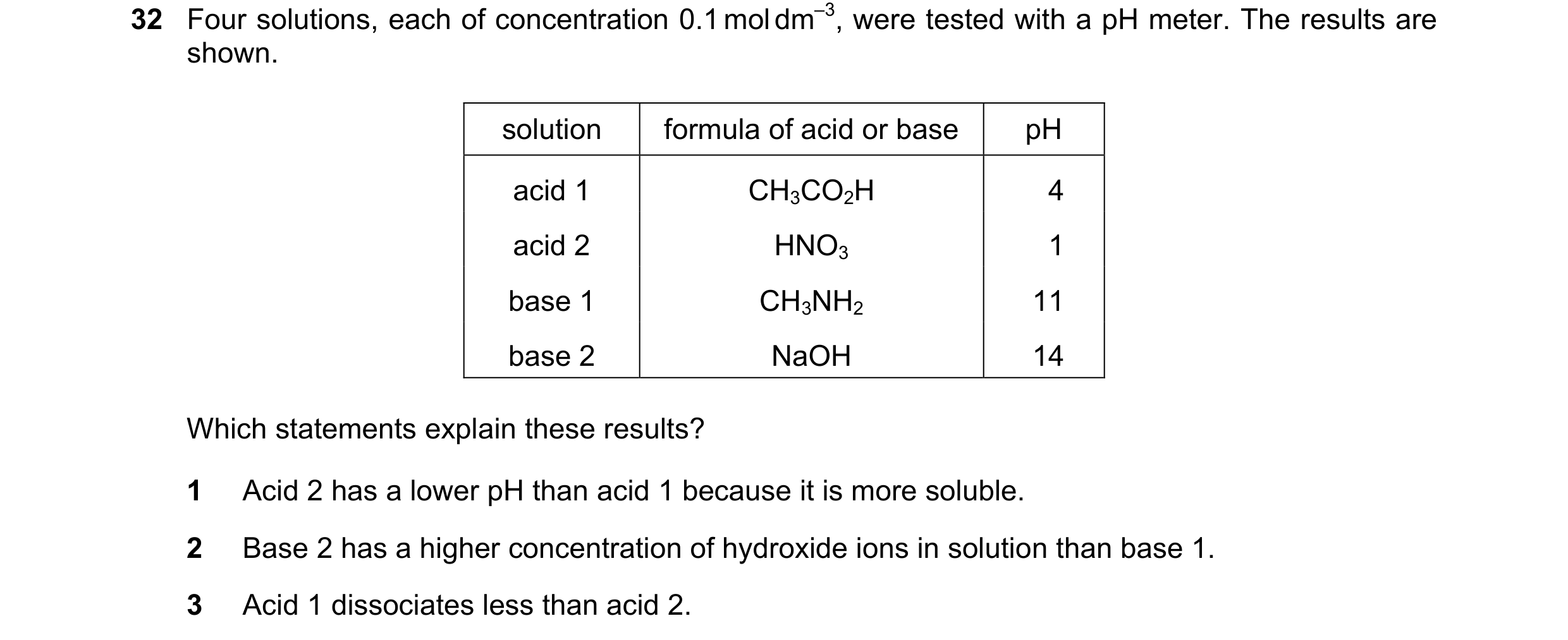
32 Four solutions, each of concentration 0.1 mol dm–3, were tested with a pH meter. The results are shown. solution formula of acid or base pH acid 1 CH3CO2H 4 acid 2 HNO3 1 base 1 CH3NH2 11 base 2 NaOH 14 Which statements explain these results? 1 Acid 2 has a lower pH than acid 1 because it is more soluble. 2 Base 2 has a higher concentration of hydroxide ions in solution than base 1. 3 Acid 1 dissociates less than acid 2.
1 marks
Answer: C
This question in 9701/12 Oct/Nov 2021
Q76 · Which reaction mixture produces an acidic gas? 9701/11 May/June 2022
25 Which reaction mixture produces an acidic gas? A aqueous ammonium nitrate and solid calcium oxide B calcium and aqueous hydrochloric acid C potassium chloride and concentrated sulfuric acid D sodium oxide and water
1 marks
Answer: C
This question in 9701/11 May/June 2022
Q77 · Separate samples of 25.0 cm3 of 0.1 mol dm–3 NaOH(aq) are added to each of three… 9701/12 May/June 2022
10 Separate samples of 25.0 cm3 of 0.1 mol dm–3 NaOH(aq) are added to each of three different acid solutions, as described. The temperature of each of the solutions was 298 K before mixing. concentration volume sample acid type of acid / mol dm–3 / cm3 1 H2SO4 strong 0.05 25.0 2 HCl strong 0.05 25.0 3 CH3CO2H weak 0.05 25.0 Which statement describes the temperature rises that occur on mixing each of these three acids separately with NaOH? A The temperature rise in all three mixtures is the same. B The temperature rise using H2SO4 and HCl is the same. C The temperature rise using CH3CO2H is greater than using HCl. D The greatest temperature rise occurs using H2SO4.
1 marks
Answer: D
This question in 9701/12 May/June 2022
Q78 · Which statement about acids and bases is always correct? 9701/13 May/June 2022
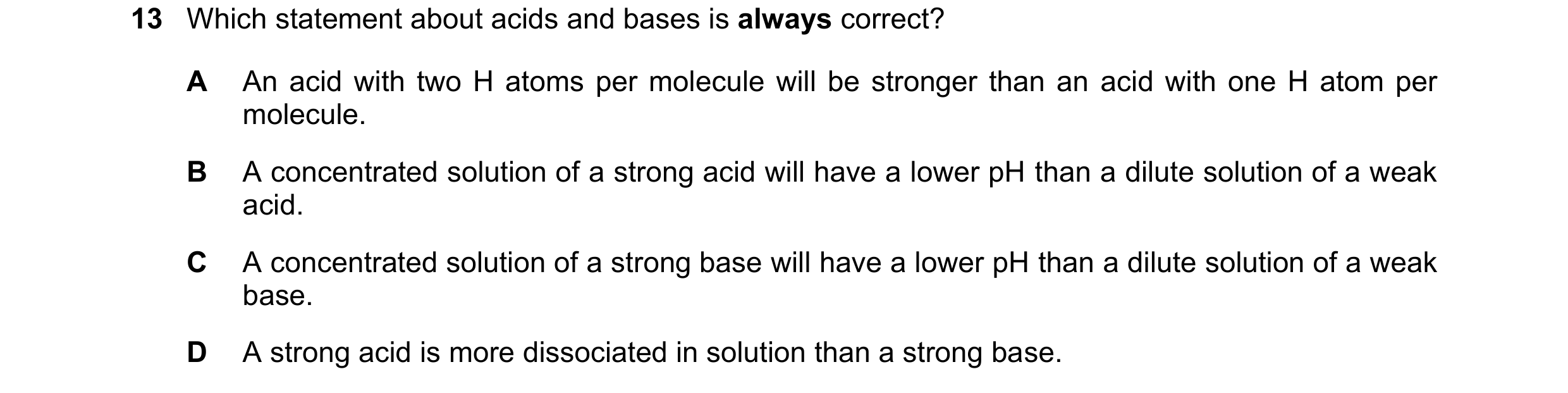
13 Which statement about acids and bases is always correct? A An acid with two H atoms per molecule will be stronger than an acid with one H atom per molecule. B A concentrated solution of a strong acid will have a lower pH than a dilute solution of a weak acid. C A concentrated solution of a strong base will have a lower pH than a dilute solution of a weak base. D A strong acid is more dissociated in solution than a strong base.
1 marks
Answer: B
This question in 9701/13 May/June 2022
Q79 · In the diagram, each test-tube W, X, Y and Z contains 25 cm3 of a 0.1 mol dm–3 solution… 9701/12 Oct/Nov 2022
20 In the diagram, each test-tube W, X, Y and Z contains 25 cm3 of a 0.1 mol dm–3 solution of a salt. W X Y Z 25 cm3 25 cm3 25 cm3 25 cm3 BaCl 2(aq) MgCl 2(aq) BaCl 2(aq) MgCl 2(aq) To test-tubes W and X, 25 cm3 of 0.1 mol dm–3 NaOH(aq) is added. To test-tubes Y and Z, 25 cm3 of 0.1 mol dm–3 H2SO4(aq) is added. In which of test-tubes W and X does the liquid have the higher pH and which of test-tubes Y and Z has the greater mass of precipitate? greater mass higher pH of precipitate A W Y B W Z C X Y D X Z
1 marks
Answer: A
This question in 9701/12 Oct/Nov 2022
Q80 · Solutions X and Y both have a concentration of 0.10moldm–3 9701/13 May/June 2023
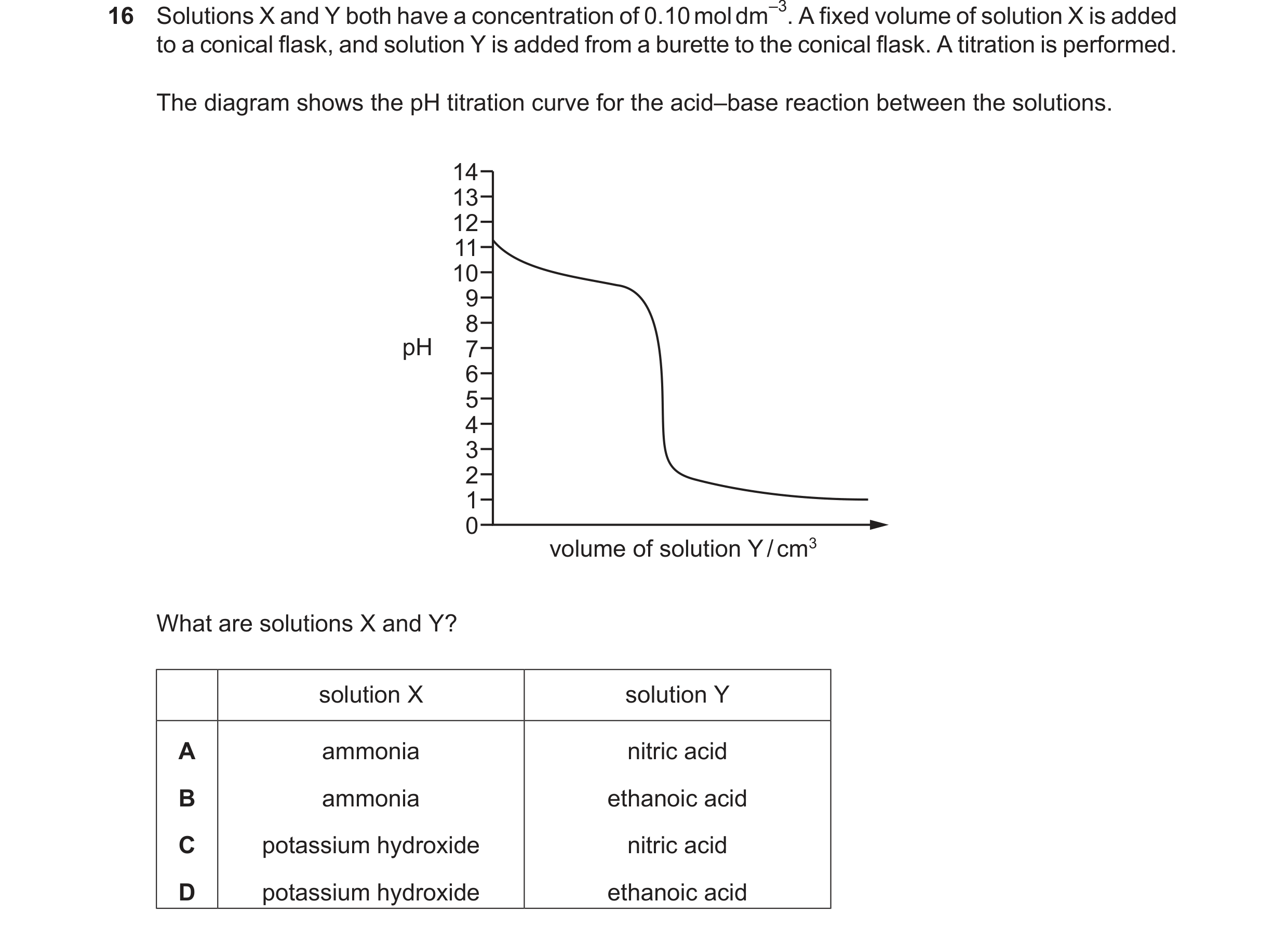
16 Solutions X and Y both have a concentration of 0.10moldm–3. A fixed volume of solution X is added to a conical flask, and solution Y is added from a burette to the conical flask. A titration is performed. The diagram shows the pH titration curve for the acid–base reaction between the solutions. 14 13 12 11 10 9 8 pH 7 6 5 4 3 2 1 0 volume of solution Y / cm3 What are solutions X and Y? solution X solution Y A ammonia nitric acid B ammonia ethanoic acid C potassium hydroxide nitric acid D potassium hydroxide ethanoic acid
1 marks
Answer: A
This question in 9701/13 May/June 2023
Q81 · What is the definition of standard enthalpy change of neutralisation, ? 9701/11 Oct/Nov 2023
10 What is the definition of standard enthalpy change of neutralisation, ? A when one mole of an aqueous acid is neutralised by an aqueous alkali B when one mole of an aqueous alkali is neutralised by an aqueous acid C when one mole of an aqueous acid is neutralised by one mole of an aqueous alkali D when an aqueous acid and an aqueous alkali react together to produce one mole of water
1 marks
Answer: D
This question in 9701/11 Oct/Nov 2023
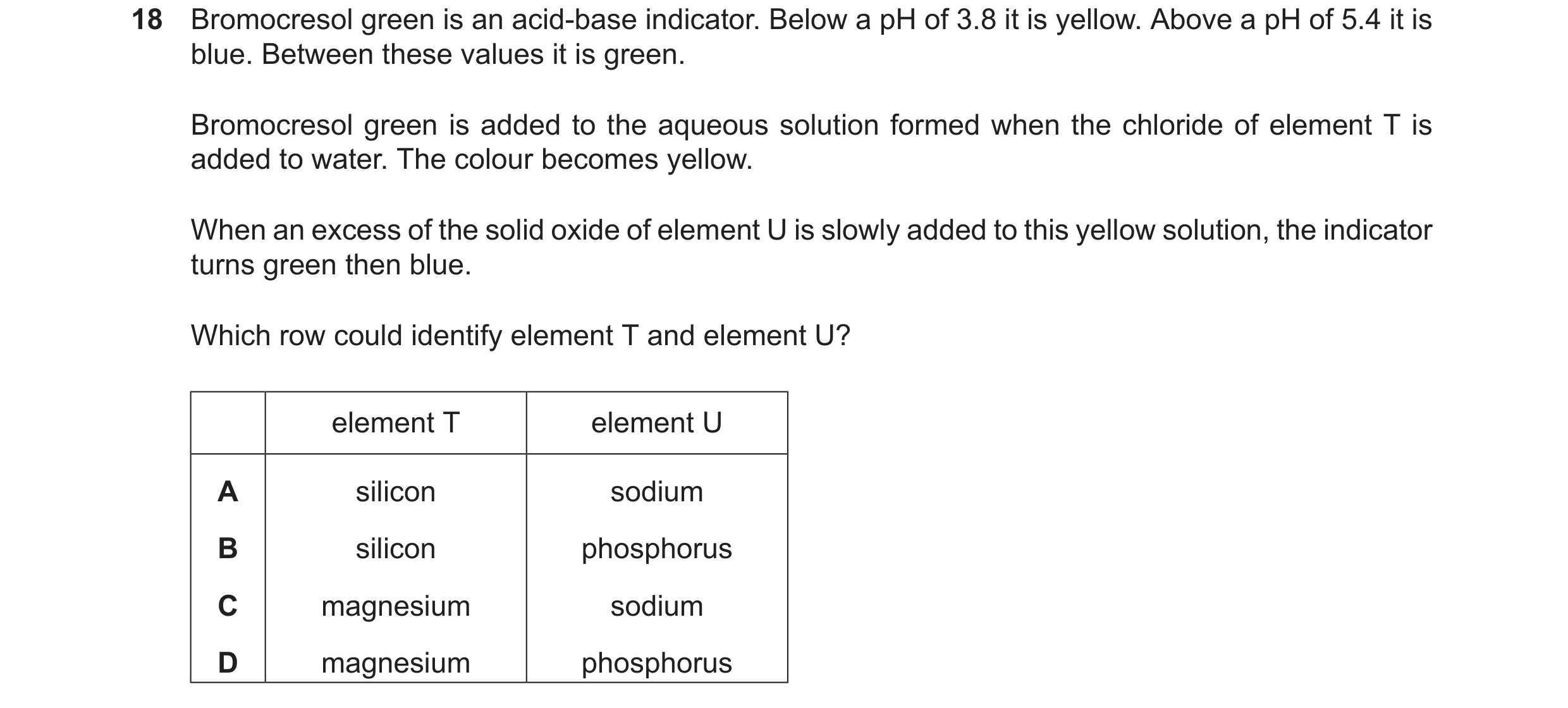
Q82 · Bromocresol green is an acid-base indicator 9701/11 Oct/Nov 2023
18 Bromocresol green is an acid-base indicator. Below a pH of 3.8 it is yellow. Above a pH of 5.4 it is blue. Between these values it is green. Bromocresol green is added to the aqueous solution formed when the chloride of element T is added to water. The colour becomes yellow. When an excess of the solid oxide of element U is slowly added to this yellow solution, the indicator turns green then blue. Which row could identify element T and element U? element T element U A silicon sodium B silicon phosphorus C magnesium sodium D magnesium phosphorus
1 marks
Answer: A
This question in 9701/11 Oct/Nov 2023
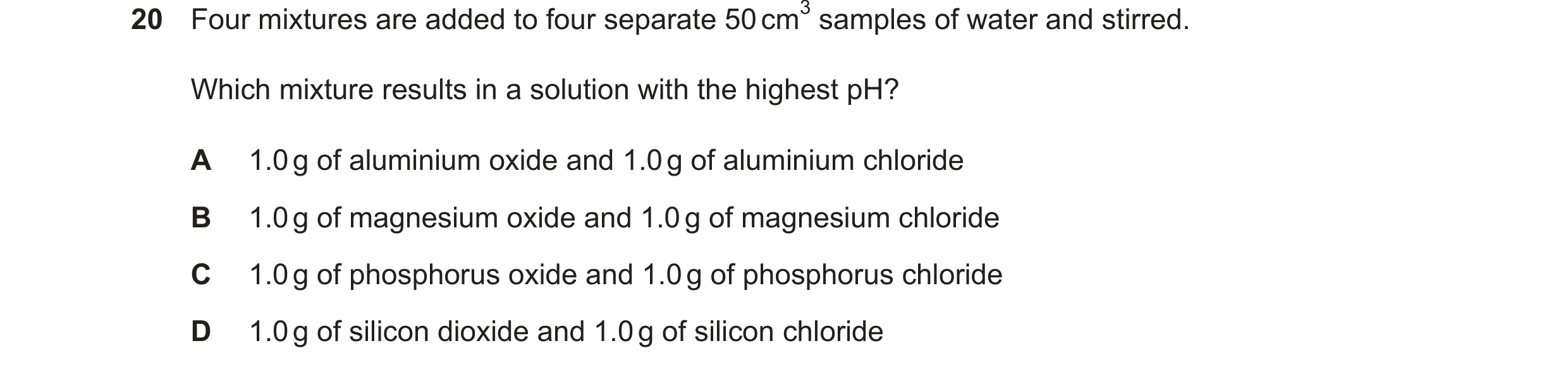
Q83 · Which mixture results in a solution with the highest pH? 9701/12 Oct/Nov 2023
20 Which mixture results in a solution with the highest pH? A 1.0g of aluminium oxide and 1.0g of aluminium chloride B 1.0g of magnesium oxide and 1.0g of magnesium chloride C 1.0g of phosphorus oxide and 1.0g of phosphorus chloride D 1.0g of silicon dioxide and 1.0g of silicon chloride
1 marks
Answer: B
This question in 9701/12 Oct/Nov 2023
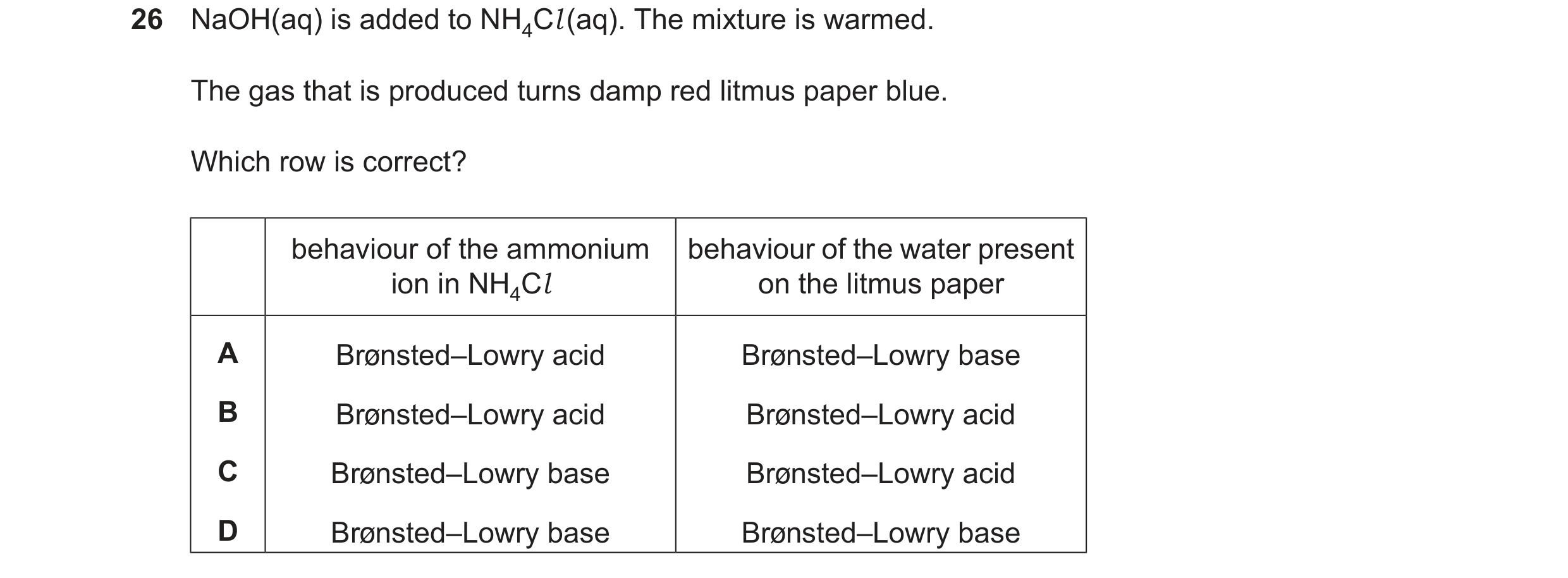
Q84 · NaOH(aq) is added to NH4Cl(aq) 9701/12 Oct/Nov 2023
26 NaOH(aq) is added to NH4Cl(aq). The mixture is warmed. The gas that is produced turns damp red litmus paper blue. Which row is correct? behaviour of the ammonium behaviour of the water present ion in NH4Cl on the litmus paper A Brønsted–Lowry acid Brønsted–Lowry base B Brønsted–Lowry acid Brønsted–Lowry acid C Brønsted–Lowry base Brønsted–Lowry acid D Brønsted–Lowry base Brønsted–Lowry base
1 marks
Answer: B
This question in 9701/12 Oct/Nov 2023
Q85 · Sodium is added to water to form solution Y 9701/12 May/June 2024
20 Sodium is added to water to form solution Y. The pH of solution Y is measured. When powdered substance X is added to solution Y, the pH falls. Which two compounds could each be substance X? A MgCl 2 and Al (OH)3 B MgCl 2 and K2O C NaCl and Al (OH)3 D NaCl and K2O
1 marks
Answer: A
This question in 9701/12 May/June 2024
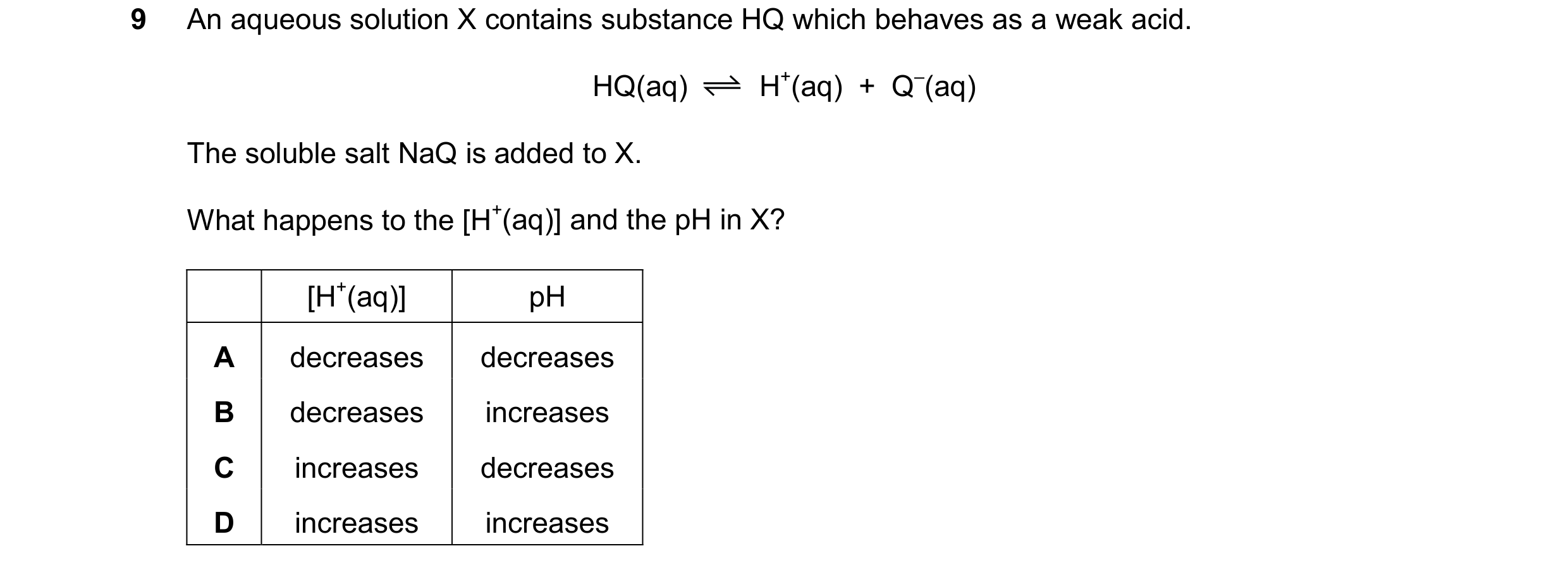
Q86 · An aqueous solution X contains substance HQ which behaves as a weak acid 9701/11 May/June 2025
9 An aqueous solution X contains substance HQ which behaves as a weak acid. HQ(aq) H+(aq) + Q–(aq) The soluble salt NaQ is added to X. What happens to the [H+(aq)] and the pH in X? [H+(aq)] pH A decreases decreases B decreases increases C increases decreases D increases increases
1 marks
Answer: B
This question in 9701/11 May/June 2025
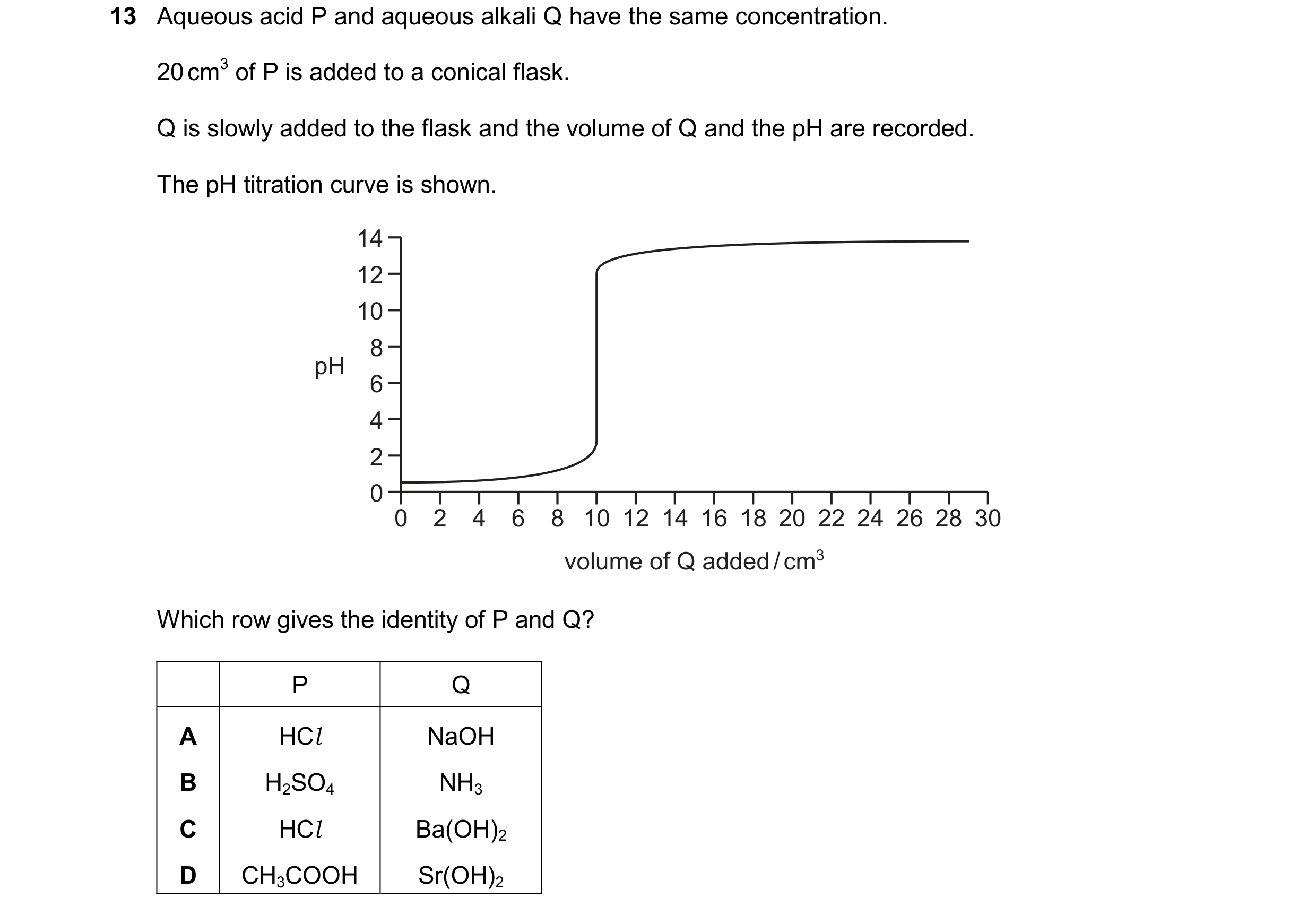
Q87 · Aqueous acid P and aqueous alkali Q have the same concentration 9701/11 Oct/Nov 2025
13 Aqueous acid P and aqueous alkali Q have the same concentration. 20cm3 of P is added to a conical flask. Q is slowly added to the flask and the volume of Q and the pH are recorded. The pH titration curve is shown. 0 14 12 10 8 6 4 2 0 2 4 6 8101214 volume of Q added/cm3 1618202224262830 pH Which row gives the identity of P and Q? P Q A HCl NaOH B H2SO4 NH3 C HCl Ba(OH)2 D CH3COOH Sr(OH)2
1 marks
Answer: C
This question in 9701/11 Oct/Nov 2025
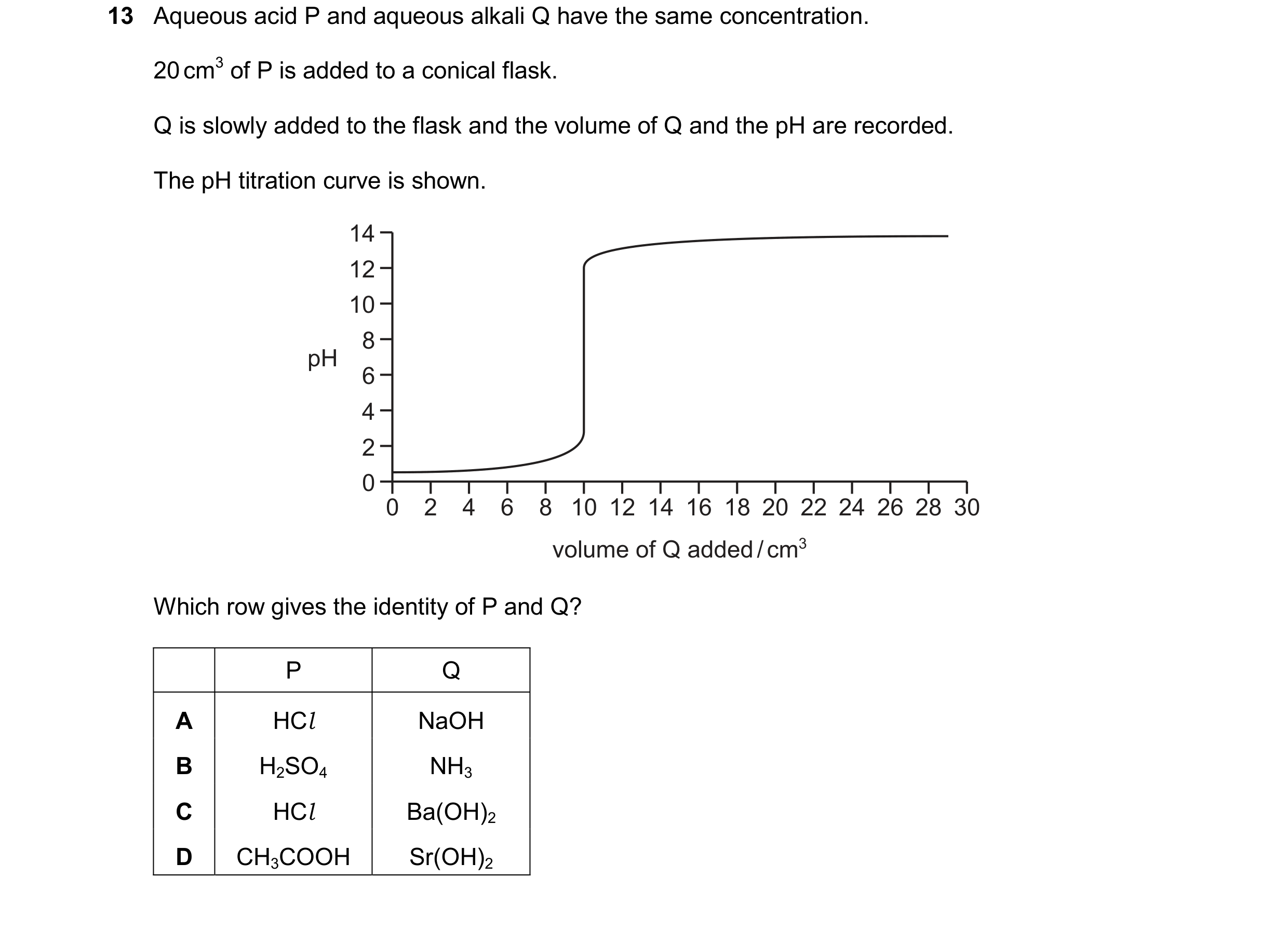
Q88 · Aqueous acid P and aqueous alkali Q have the same concentration 9701/13 Oct/Nov 2025
13 Aqueous acid P and aqueous alkali Q have the same concentration. 20cm3 of P is added to a conical flask. Q is slowly added to the flask and the volume of Q and the pH are recorded. The pH titration curve is shown. 0 14 12 10 8 6 4 2 0 2 4 6 8101214 volume of Q added/cm3 1618202224262830 pH Which row gives the identity of P and Q? P Q A HCl NaOH B H2SO4 NH3 C HCl Ba(OH)2 D CH3COOH Sr(OH)2
1 marks
Answer: C
This question in 9701/13 Oct/Nov 2025
 1 / 22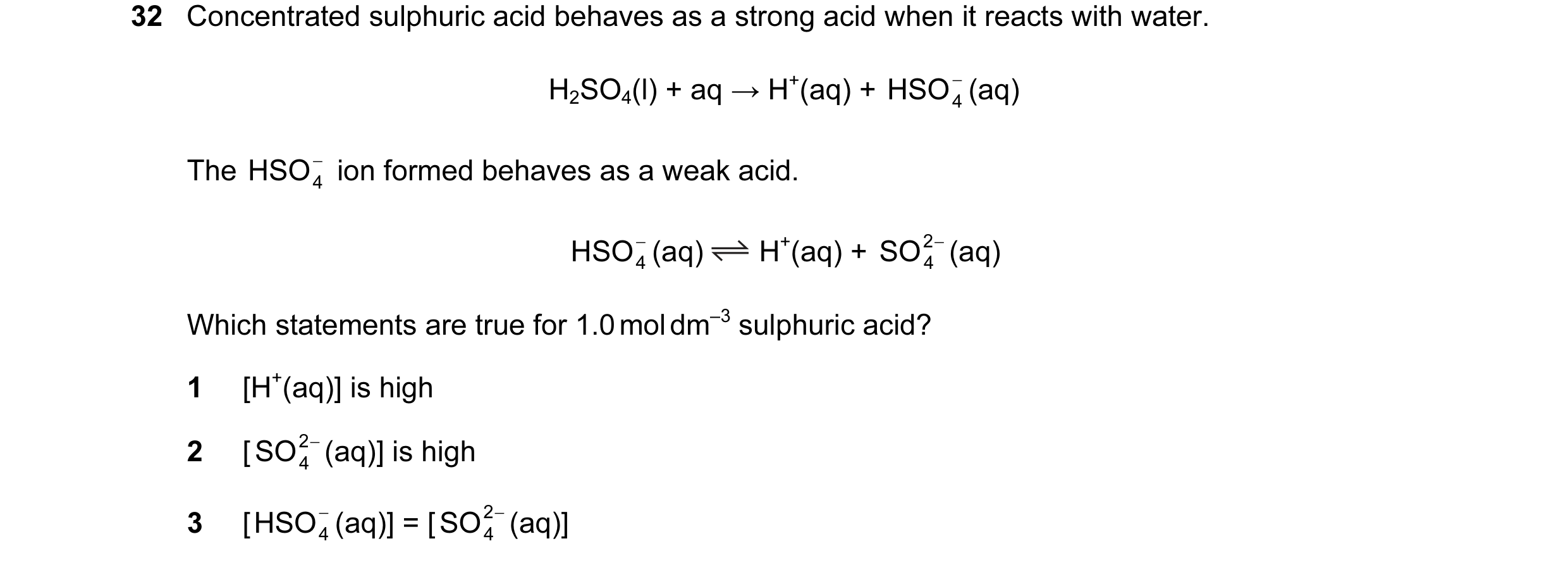


 2 / 22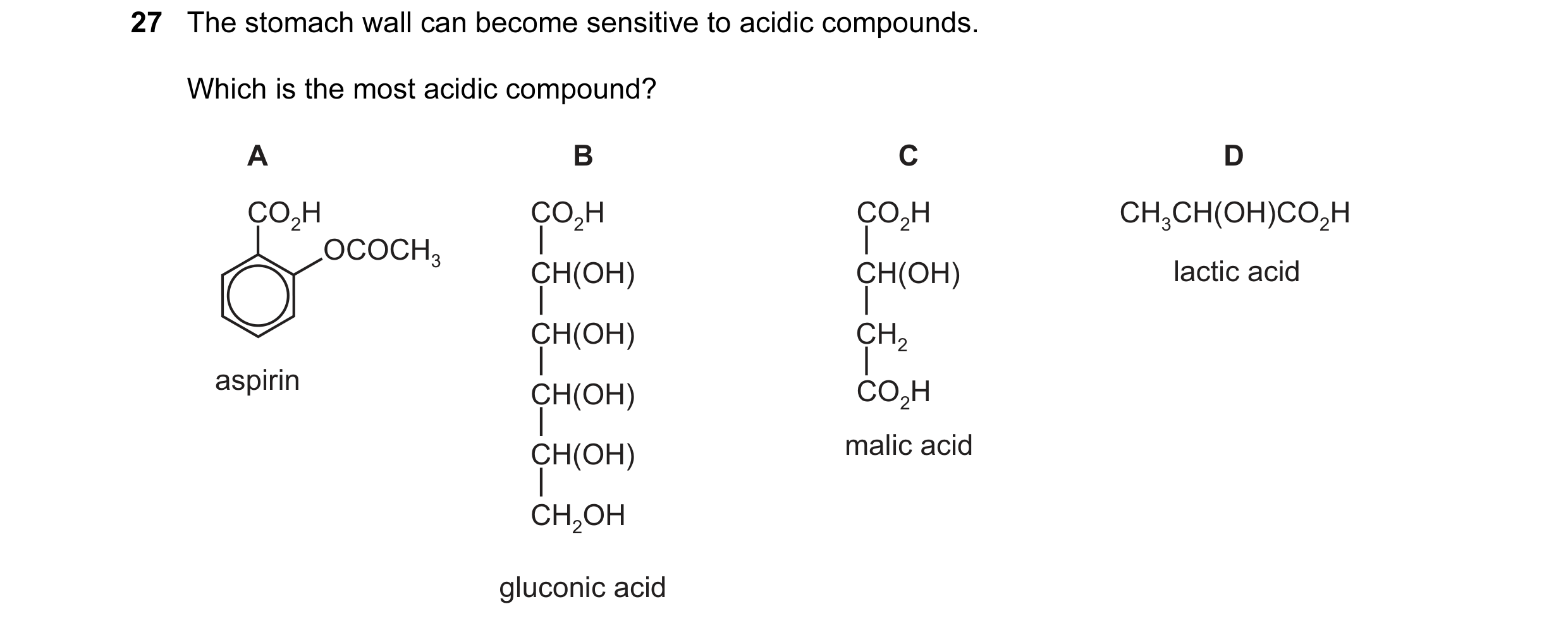
 3 / 22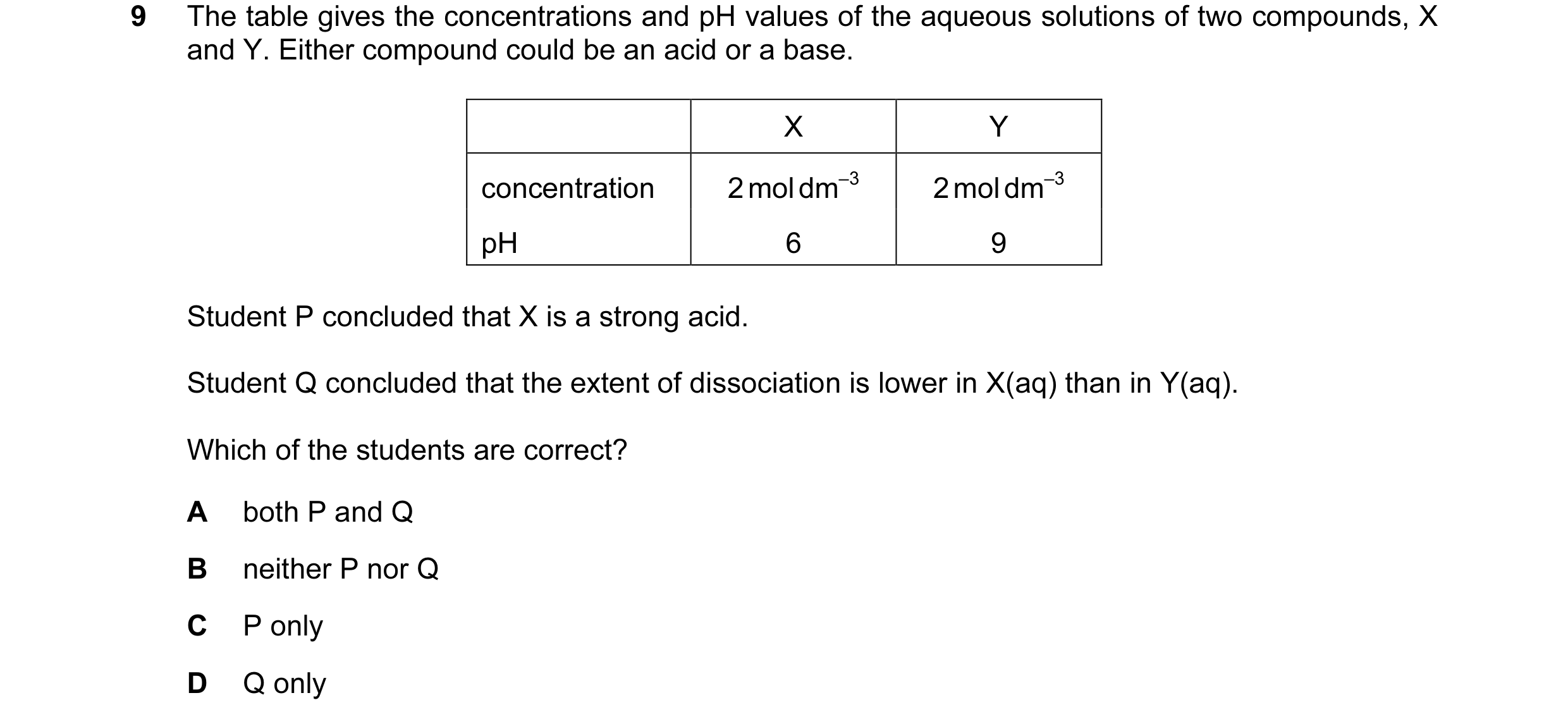
 4 / 22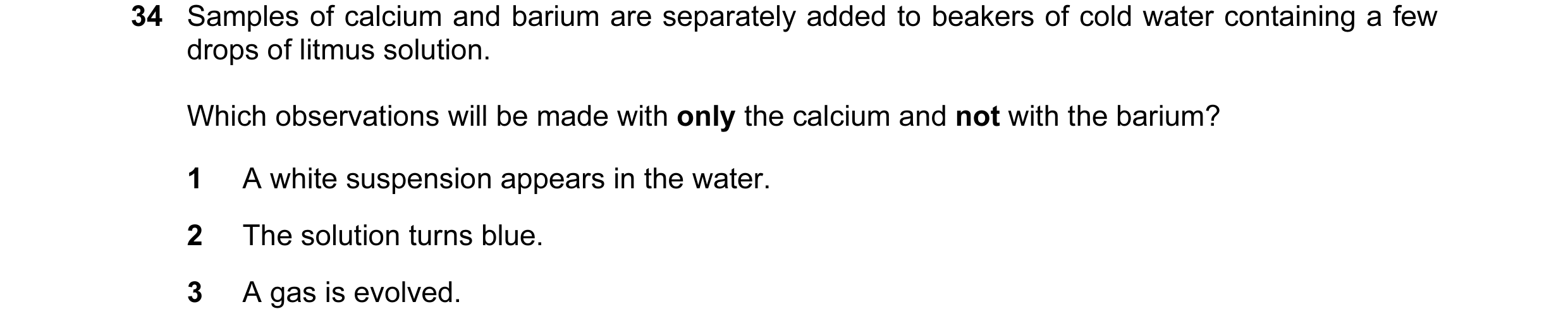
 5 / 22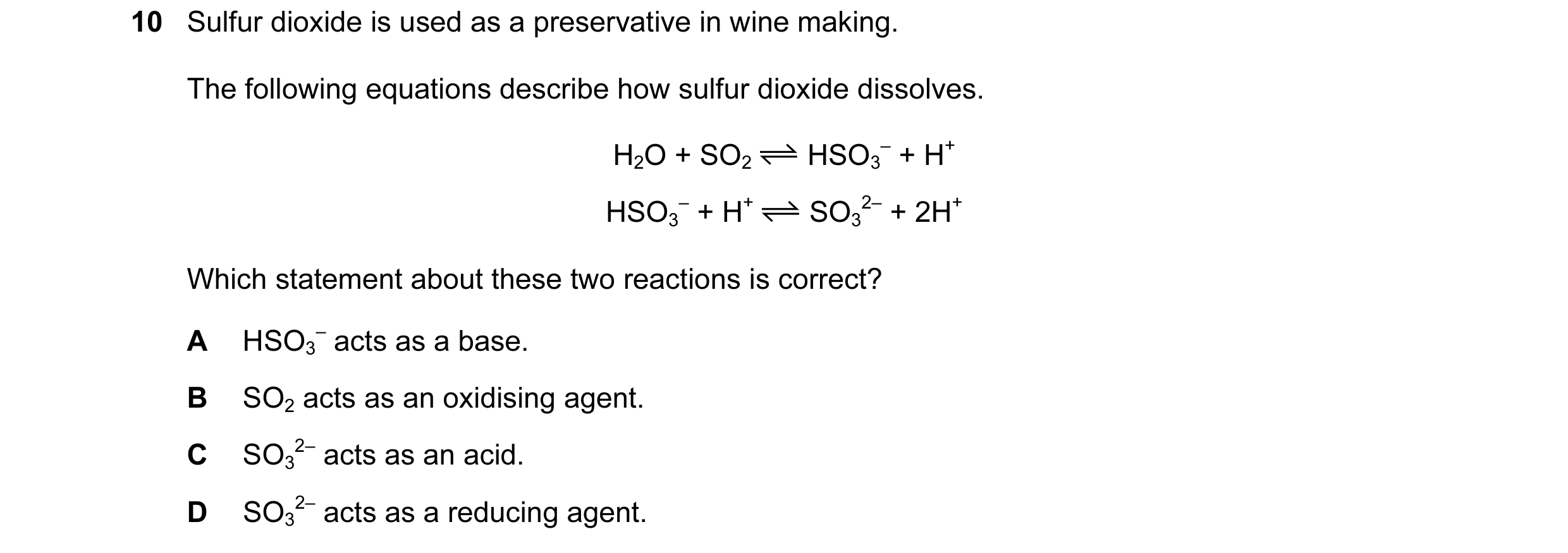

 6 / 22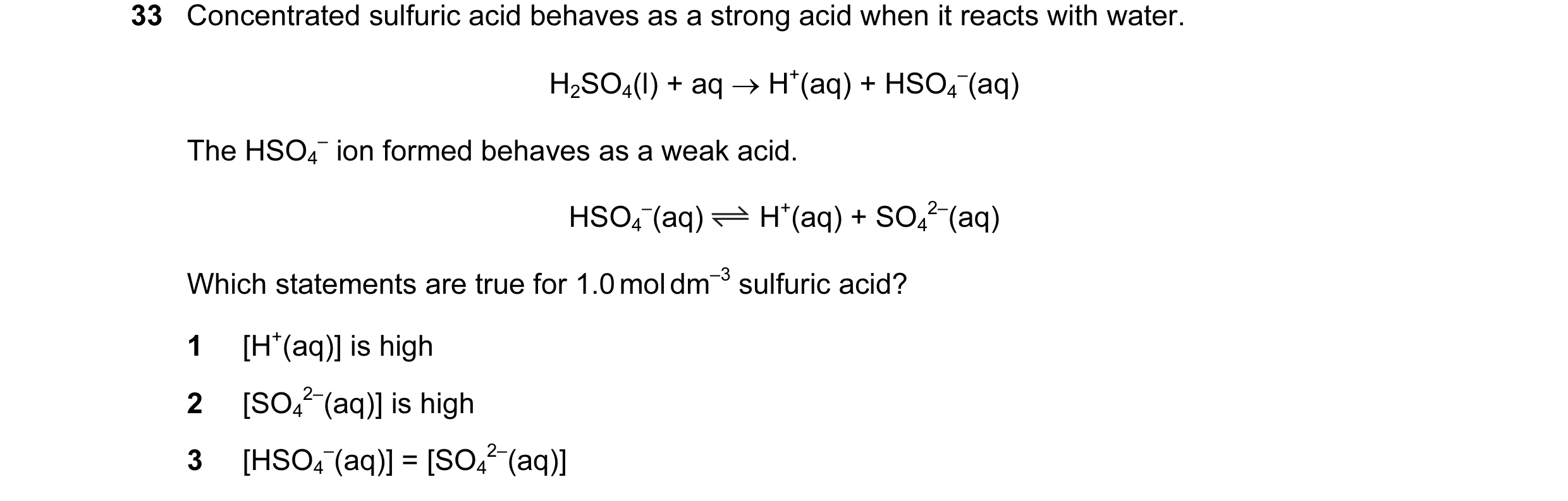

 7 / 22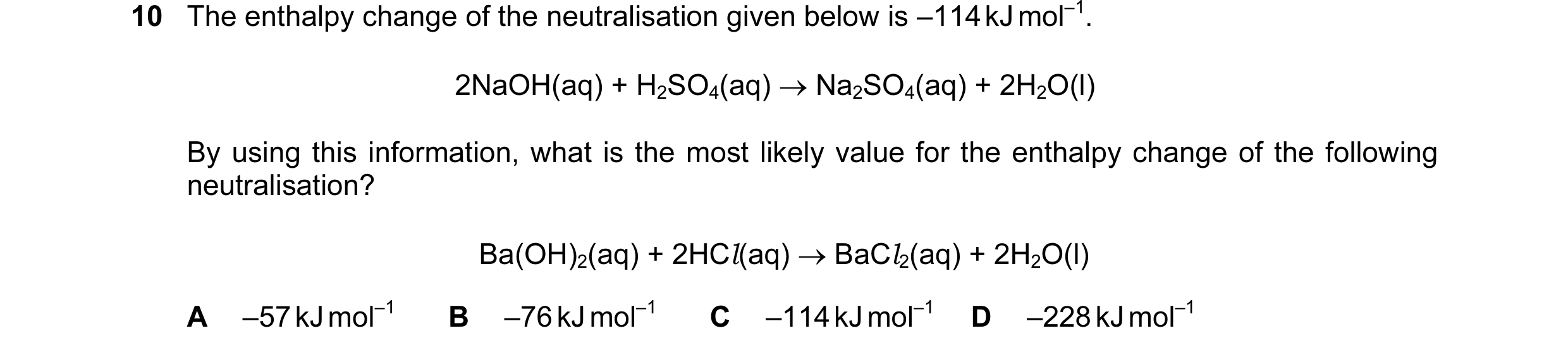



 8 / 22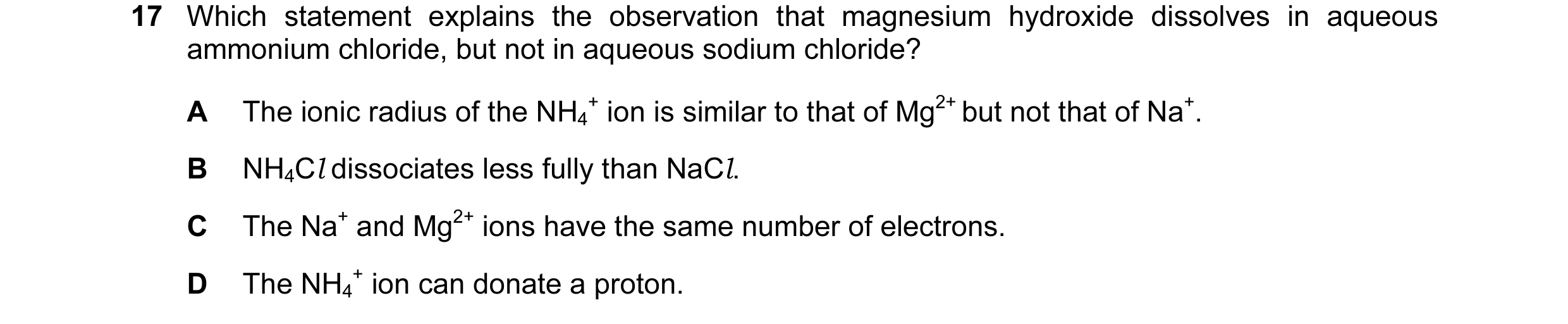


 9 / 22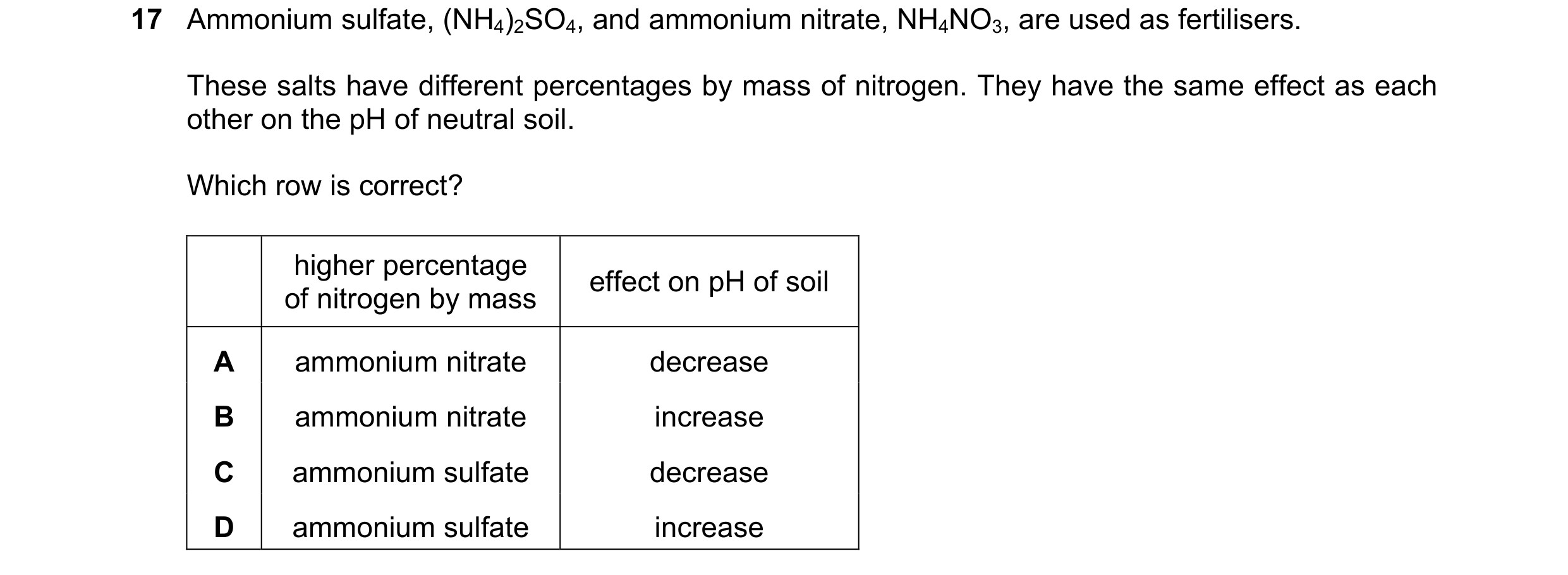
 10 / 22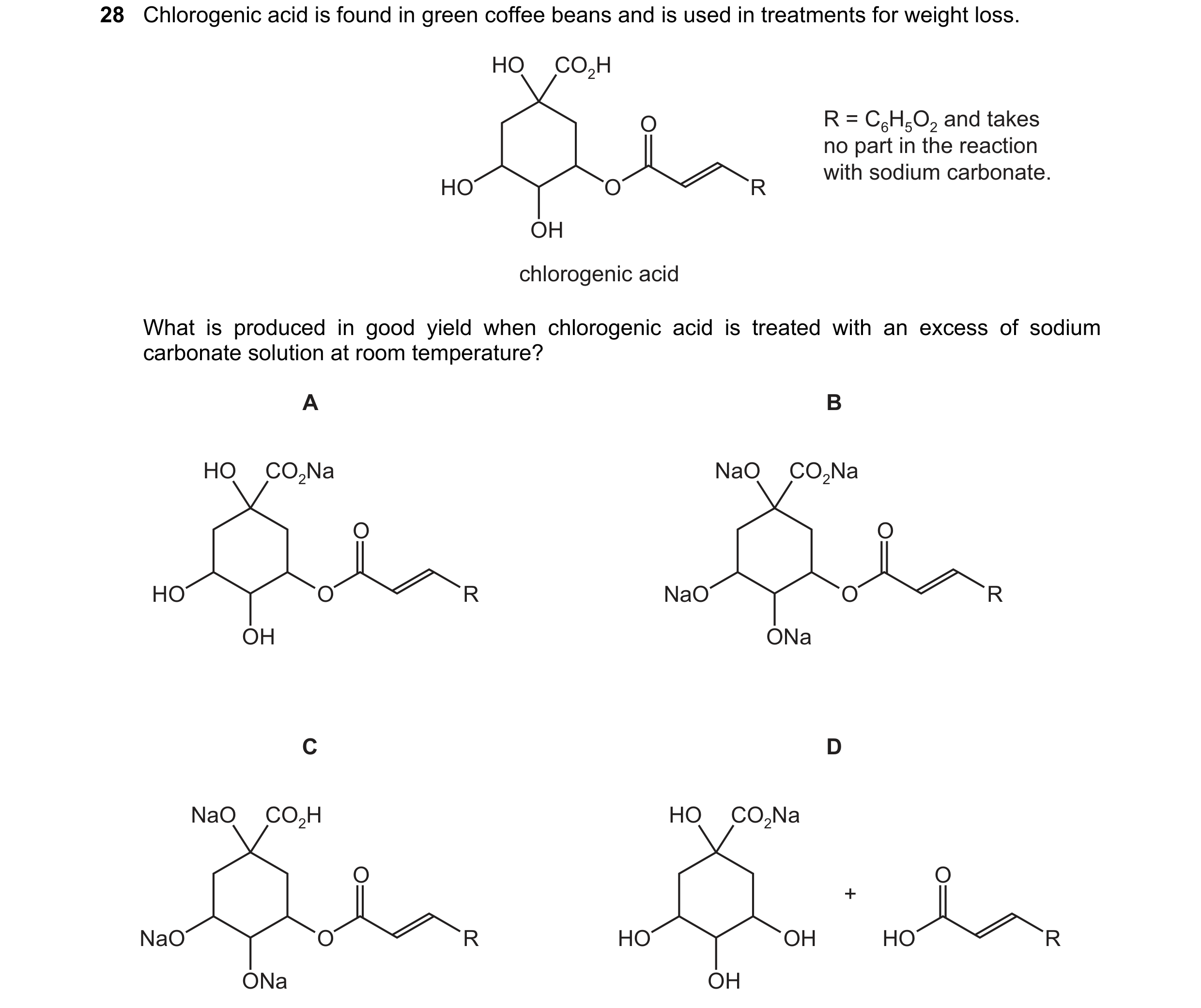
 11 / 22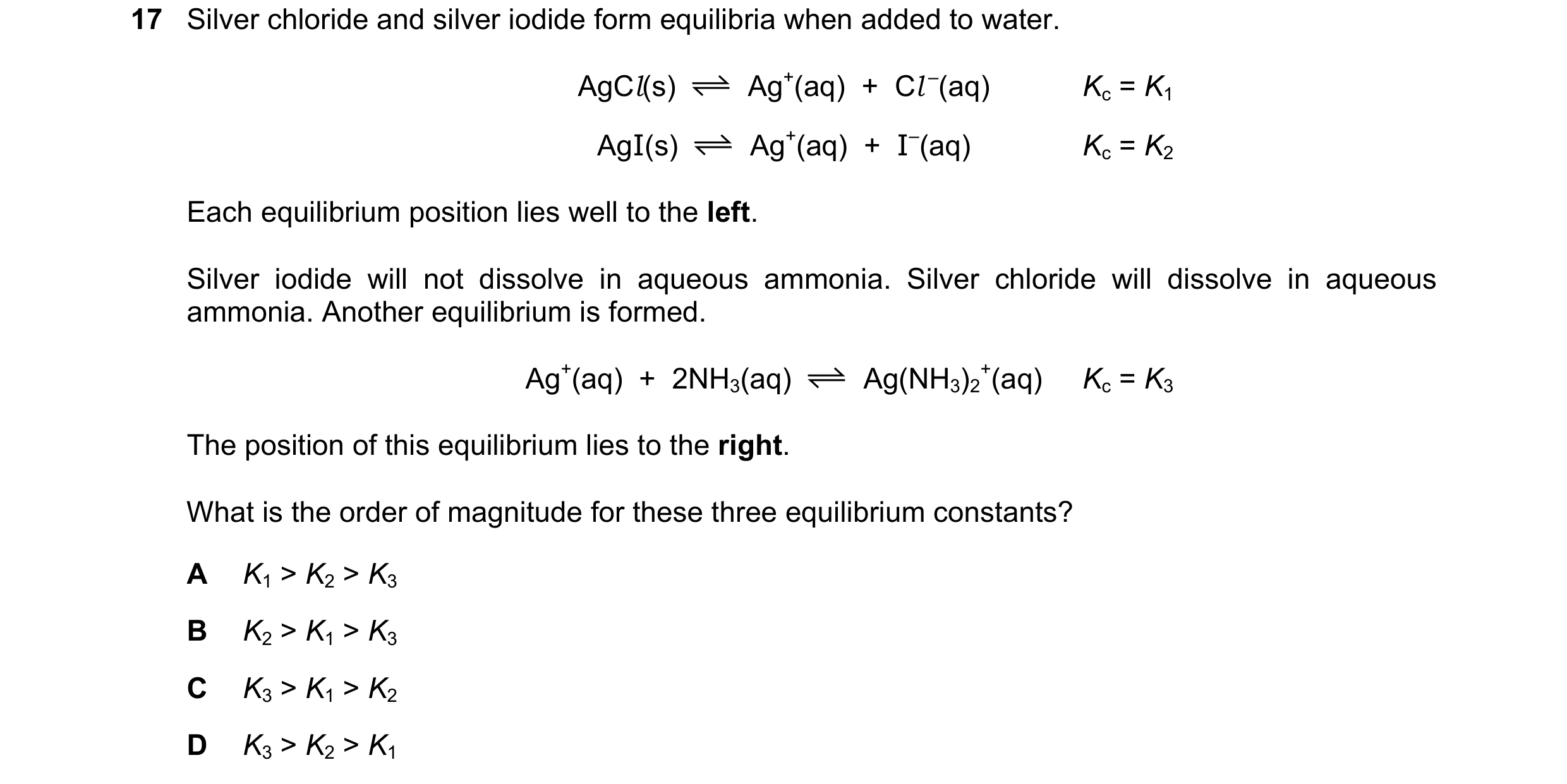
 12 / 22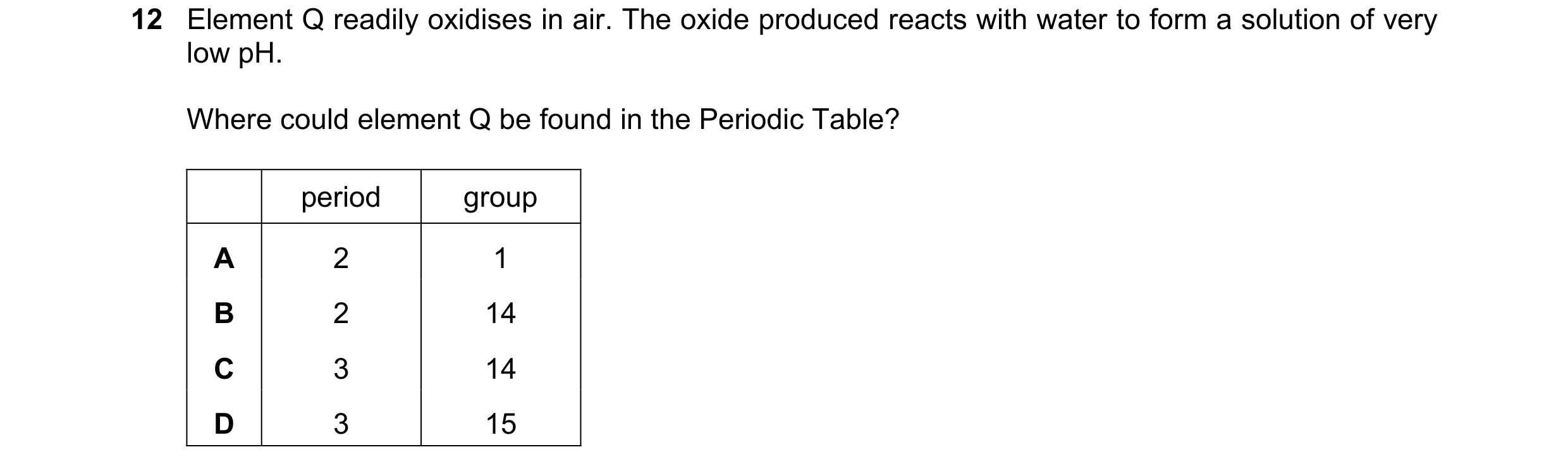

 13 / 22
![Question 59: Hydrated aluminium ions undergo the following reaction. [Al (H2O)6]3+(aq) + H2O(l) [Al (H2O)5OH]2+(aq) + H3O+(aq) Which statement about…](https://img.pastlit.com/crops/efa0ff93-1a5a-4304-ae94-8569926dbb44/q11.png)


 14 / 22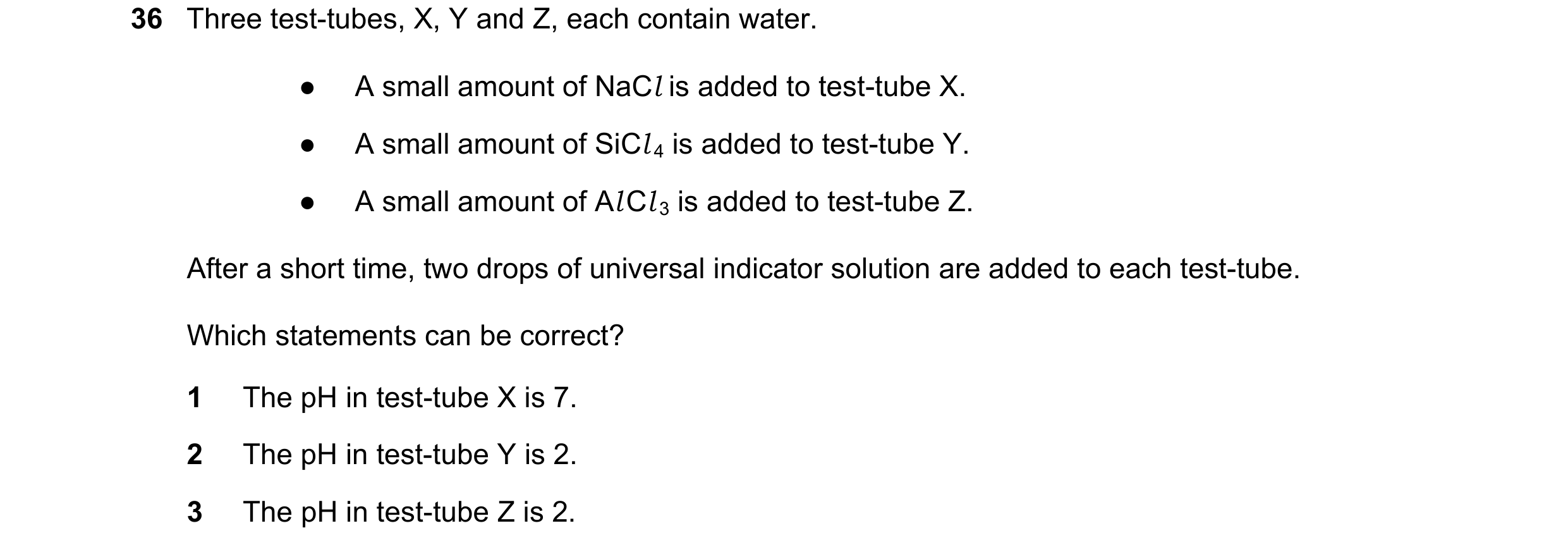

 15 / 22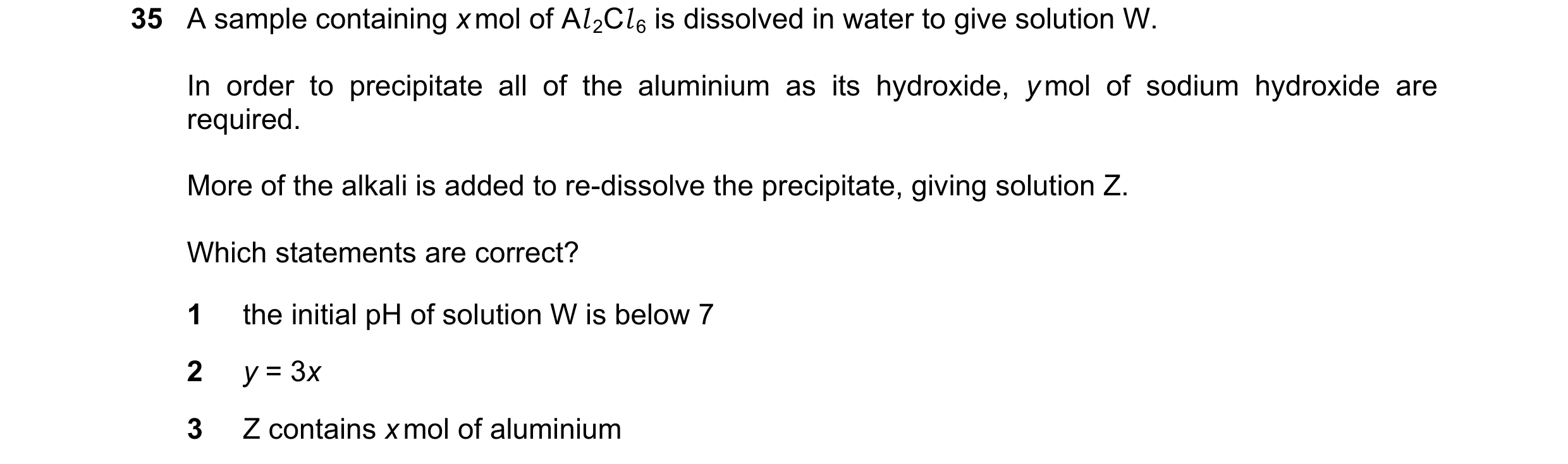

 16 / 22
 17 / 22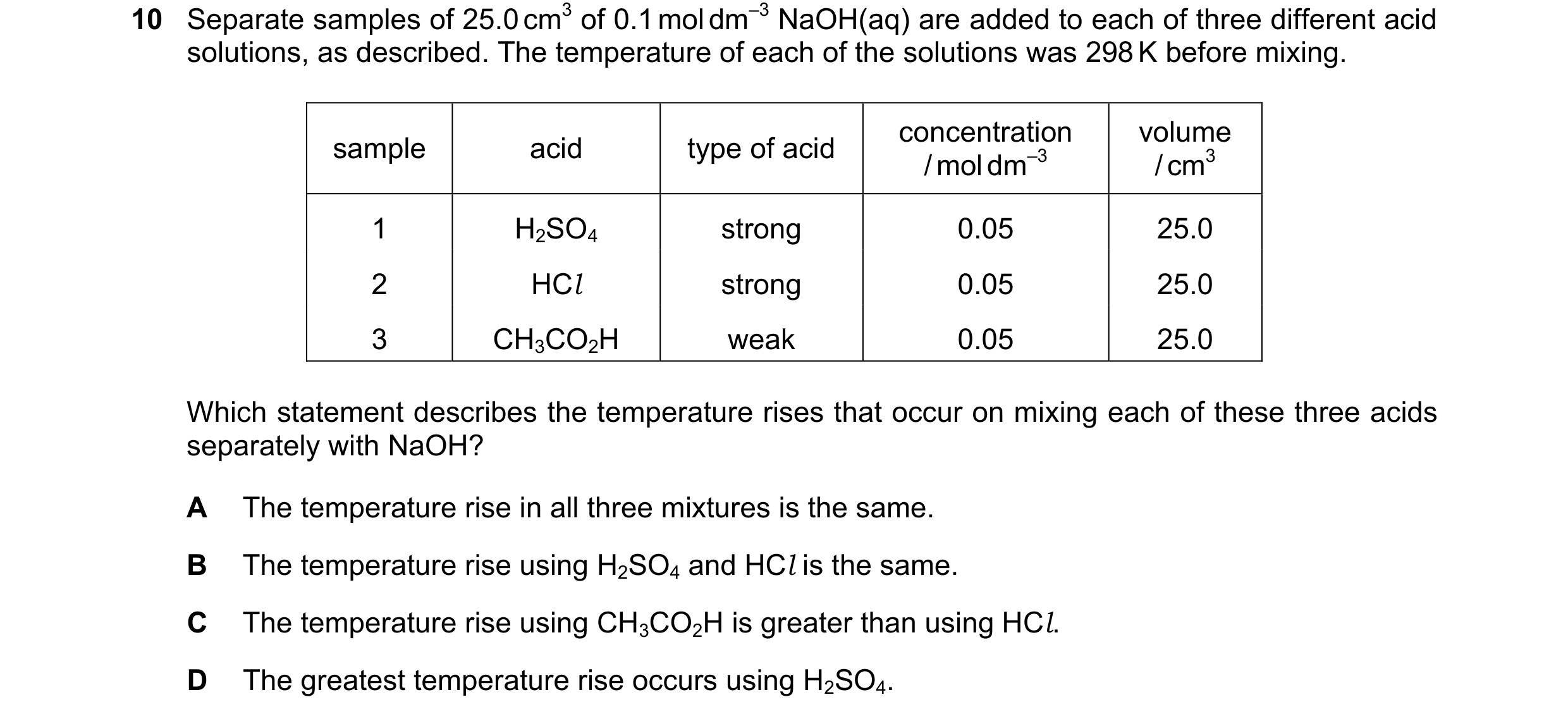
 18 / 22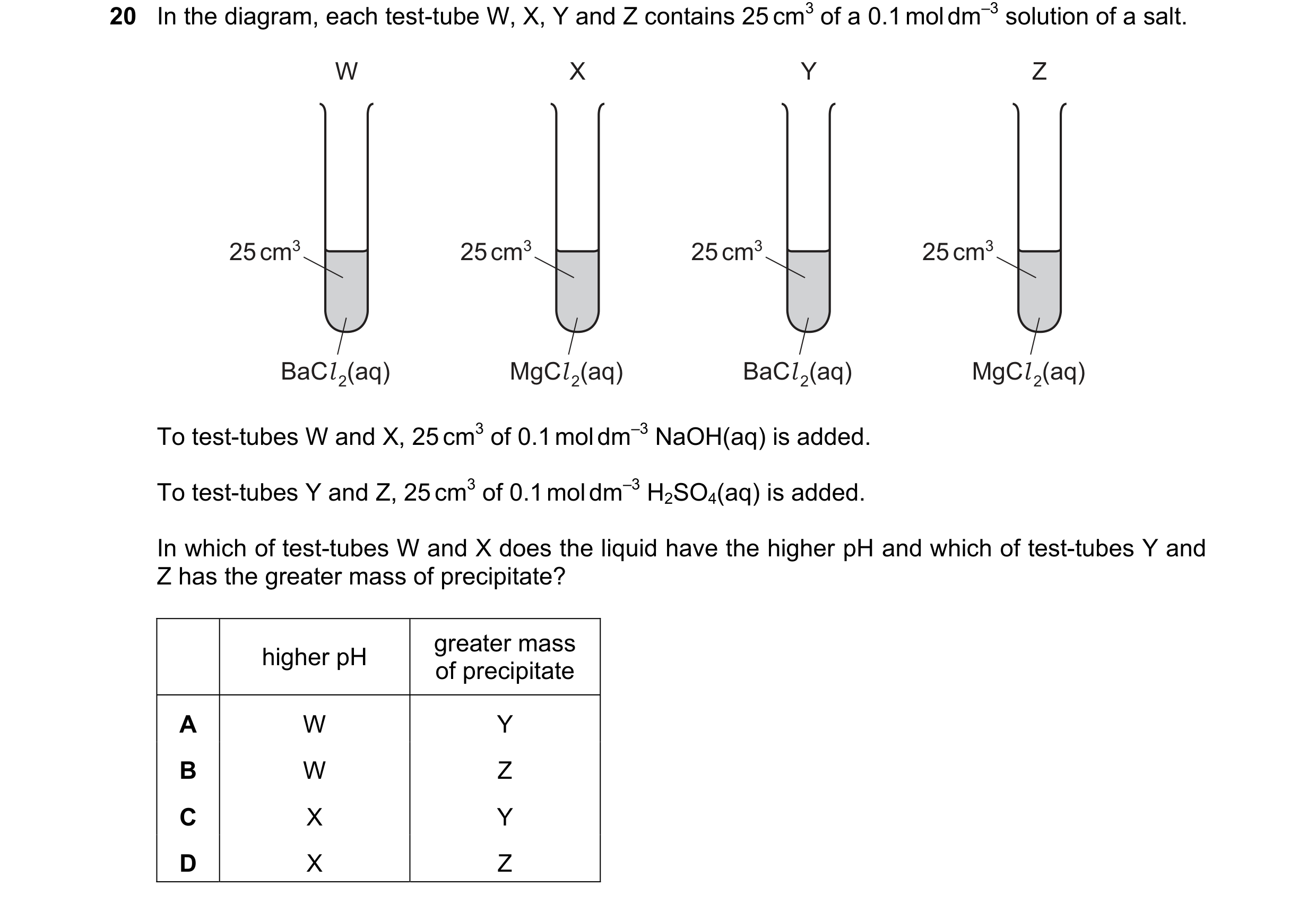
 19 / 22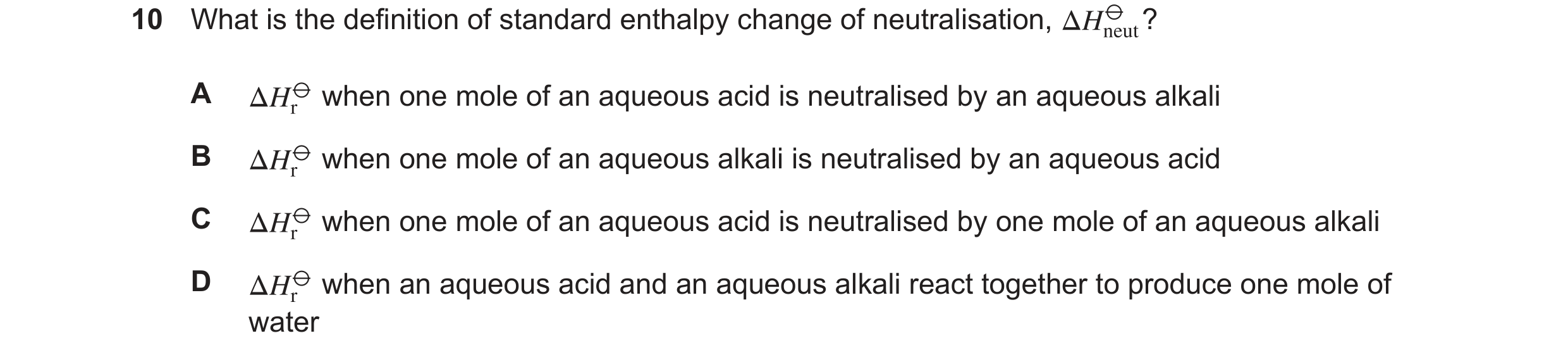
 20 / 22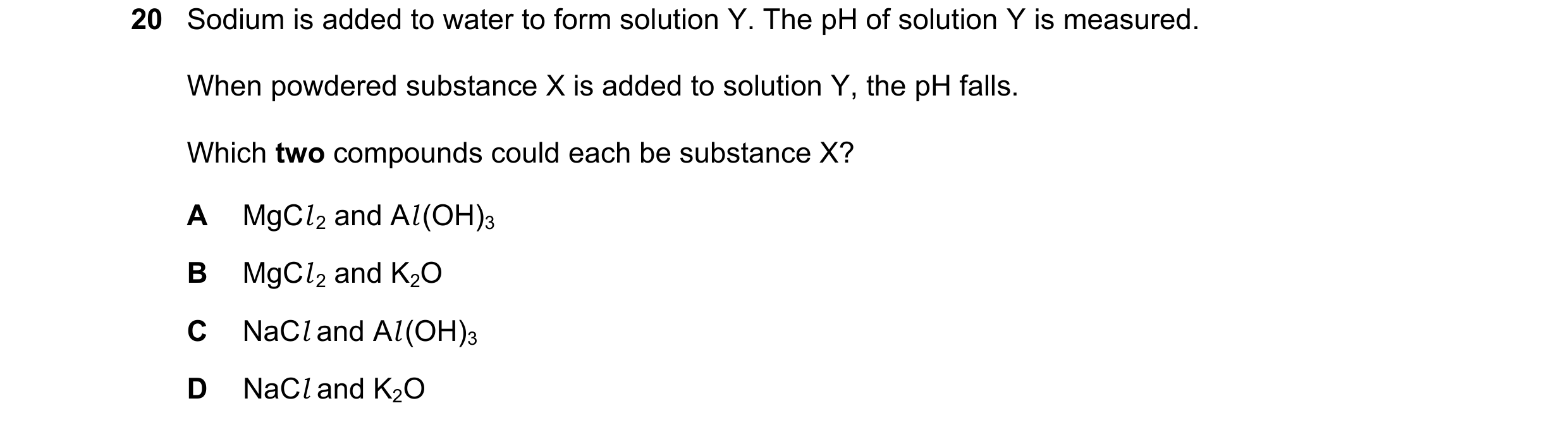
 21 / 22
 22 / 22