Questions as text
Q1 · An electric power tool is being used outdoors in a shower of rain 0654/11 May/June 2006
38 An electric power tool is being used outdoors in a shower of rain. What is the greatest hazard to the user? A The cable gets hot and causes burns. B The circuit-breaker cuts off the current. C The current passes through water and causes a shock. D The tool rusts.
1 marks
Answer: C
This question in 0654/11 May/June 2006
Q2 · A mains electrical circuit uses insulated copper cable and the cable overheats 0654/11 Oct/Nov 2007
36 A mains electrical circuit uses insulated copper cable and the cable overheats. To prevent the cable overheating, how should the cable be changed, and why? A Use thicker copper cable which has less resistance. B Use thicker insulation which stops the heat escaping. C Use thinner copper cable which has more resistance. D Use thinner insulation which allows less heat to escape.
1 marks
Answer: A
This question in 0654/11 Oct/Nov 2007
Q3 · An electric heater is connected to the mains using insulated copper wires 0654/11 Oct/Nov 2009
38 An electric heater is connected to the mains using insulated copper wires. The wires become very warm. What can be done to prevent so much heat being produced in the connecting wires? A Use thicker copper wires. B Use thinner copper wires. C Use thicker insulation. D Use thinner insulation.
1 marks
Answer: A
This question in 0654/11 Oct/Nov 2009
Q4 · A householder asks an electrician to install a mains electrical socket in her bathroom so… 0654/11 May/June 2010
34 A householder asks an electrician to install a mains electrical socket in her bathroom so that she may use a hairdryer there. The electrician refuses to do this because it would be dangerous. Why would installing the socket be dangerous? A The current drawn by the hairdryer would cause overheating in the cables. B The handling of electrical equipment in damp conditions could cause an electric shock. C The hot air produced by the hairdryer would cause the fuse to melt. D The temperature in the bathroom would damage the insulation.
1 marks
Answer: B
This question in 0654/11 May/June 2010
Q5 · A householder asks an electrician to install a mains electrical socket in her bathroom so… 0654/12 May/June 2010
38 A householder asks an electrician to install a mains electrical socket in her bathroom so that she may use a hairdryer there. The electrician refuses to do this because it would be dangerous. Why would installing the socket be dangerous? A The current drawn by the hairdryer would cause overheating in the cables. B The handling of electrical equipment in damp conditions could cause an electric shock. C The hot air produced by the hairdryer would cause the fuse to melt. D The temperature in the bathroom would damage the insulation.
1 marks
Answer: B
This question in 0654/12 May/June 2010
Q6 · The diagram shows four electric kettles plugged into a 4-way adaptor 0654/11 Oct/Nov 2010
34 The diagram shows four electric kettles plugged into a 4-way adaptor. An extension lead connects the adaptor to a single mains plug. The mains plug is designed to work without a fuse. extension lead mains plug adaptor Why is this use of the adaptor dangerous? A The extension lead connecting the adaptor to the mains plug will overheat. B The heating elements in the kettle will overheat. C The leads connecting the kettles to the adaptor will overheat. D The water in the kettles will overheat.
1 marks
Answer: A
This question in 0654/11 Oct/Nov 2010
Q7 · The diagram shows four electric kettles plugged into a 4-way adaptor 0654/12 Oct/Nov 2010
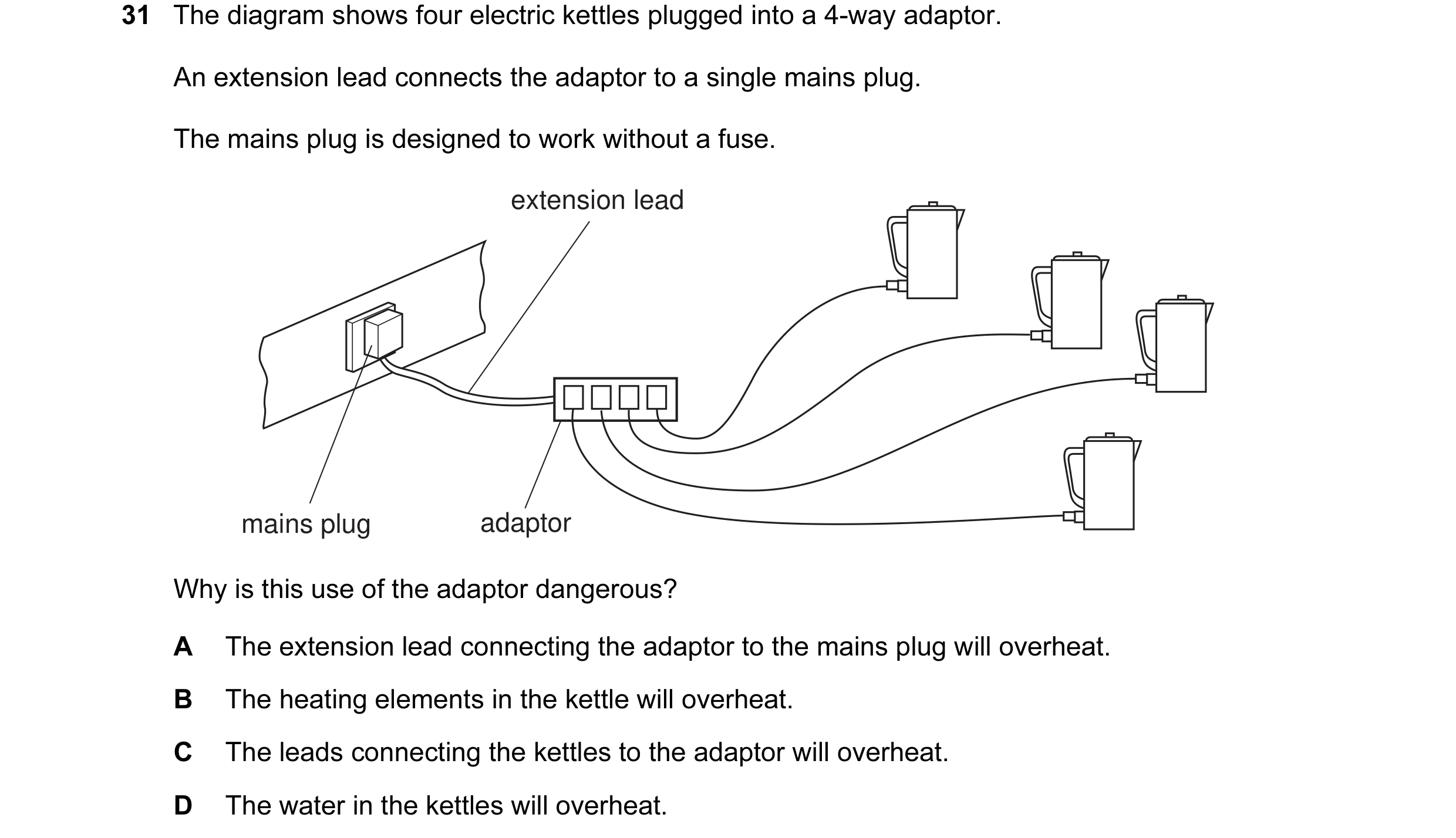
31 The diagram shows four electric kettles plugged into a 4-way adaptor. An extension lead connects the adaptor to a single mains plug. The mains plug is designed to work without a fuse. extension lead mains plug adaptor Why is this use of the adaptor dangerous? A The extension lead connecting the adaptor to the mains plug will overheat. B The heating elements in the kettle will overheat. C The leads connecting the kettles to the adaptor will overheat. D The water in the kettles will overheat.
1 marks
Answer: A
This question in 0654/12 Oct/Nov 2010
Q8 · The diagram shows four electric kettles plugged into a 4-way adaptor 0654/13 Oct/Nov 2010
38 The diagram shows four electric kettles plugged into a 4-way adaptor. An extension lead connects the adaptor to a single mains plug. The mains plug is designed to work without a fuse. extension lead mains plug adaptor Why is this use of the adaptor dangerous? A The extension lead connecting the adaptor to the mains plug will overheat. B The heating elements in the kettle will overheat. C The leads connecting the kettles to the adaptor will overheat. D The water in the kettles will overheat.
1 marks
Answer: A
This question in 0654/13 Oct/Nov 2010
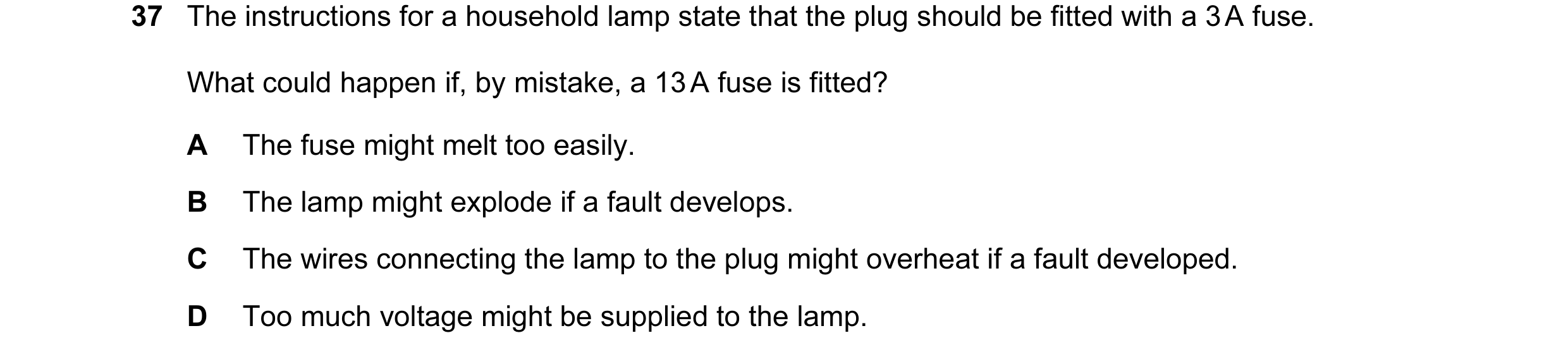
Q9 · The instructions for a household lamp state that the plug should be fitted with a 3 A fuse 0654/11 May/June 2012
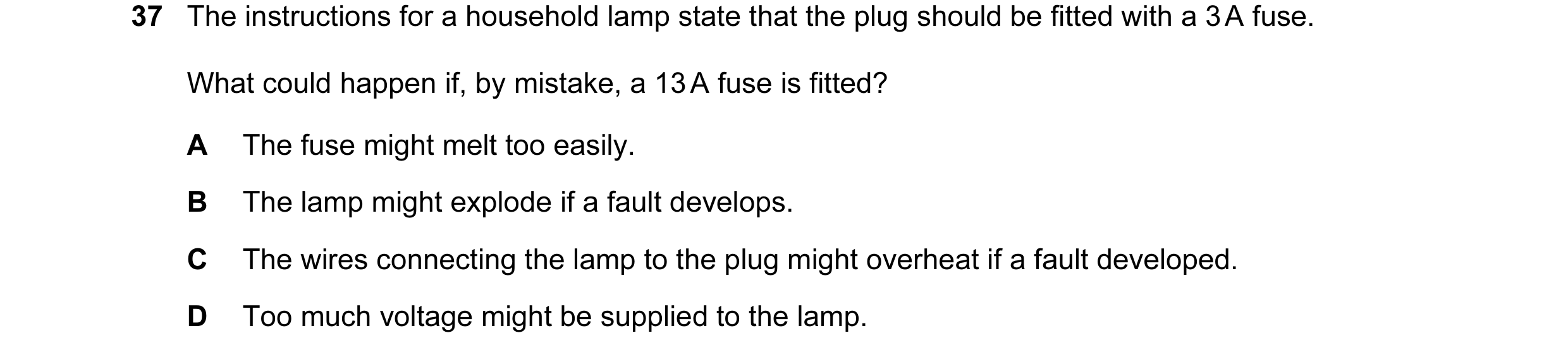
37 The instructions for a household lamp state that the plug should be fitted with a 3 A fuse. What could happen if, by mistake, a 13 A fuse is fitted? A The fuse might melt too easily. B The lamp might explode if a fault develops. C The wires connecting the lamp to the plug might overheat if a fault developed. D Too much voltage might be supplied to the lamp.
1 marks
Answer: C
This question in 0654/11 May/June 2012
Q10 · The instructions for a household lamp state that the plug should be fitted with a 3 A fuse 0654/12 May/June 2012
37 The instructions for a household lamp state that the plug should be fitted with a 3 A fuse. What could happen if, by mistake, a 13 A fuse is fitted? A The fuse might melt too easily. B The lamp might explode if a fault develops. C The wires connecting the lamp to the plug might overheat if a fault developed. D Too much voltage might be supplied to the lamp.
1 marks
Answer: C
This question in 0654/12 May/June 2012
Q11 · The instructions for a household lamp state that the plug should be fitted with a 3 A fuse 0654/13 May/June 2012
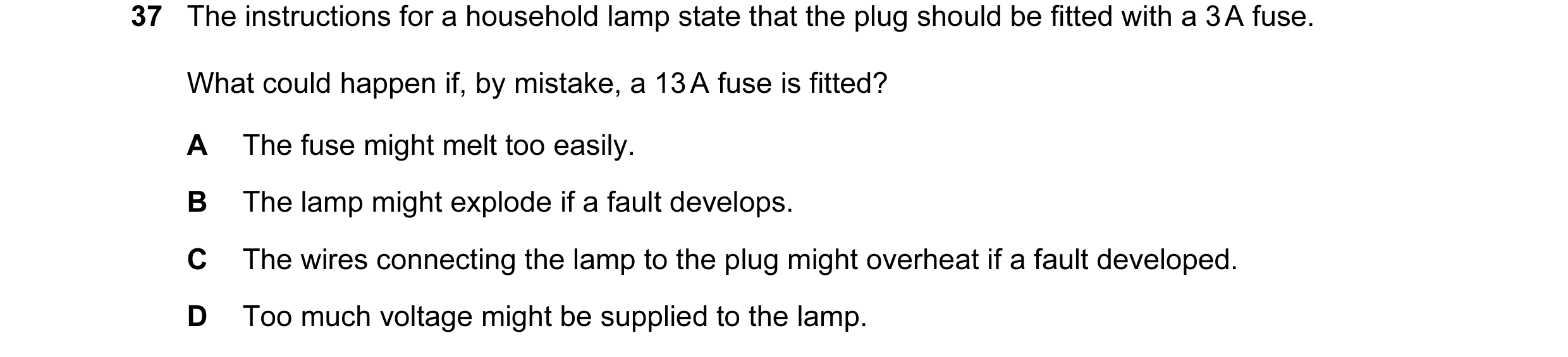
37 The instructions for a household lamp state that the plug should be fitted with a 3 A fuse. What could happen if, by mistake, a 13 A fuse is fitted? A The fuse might melt too easily. B The lamp might explode if a fault develops. C The wires connecting the lamp to the plug might overheat if a fault developed. D Too much voltage might be supplied to the lamp.
1 marks
Answer: C
This question in 0654/13 May/June 2012
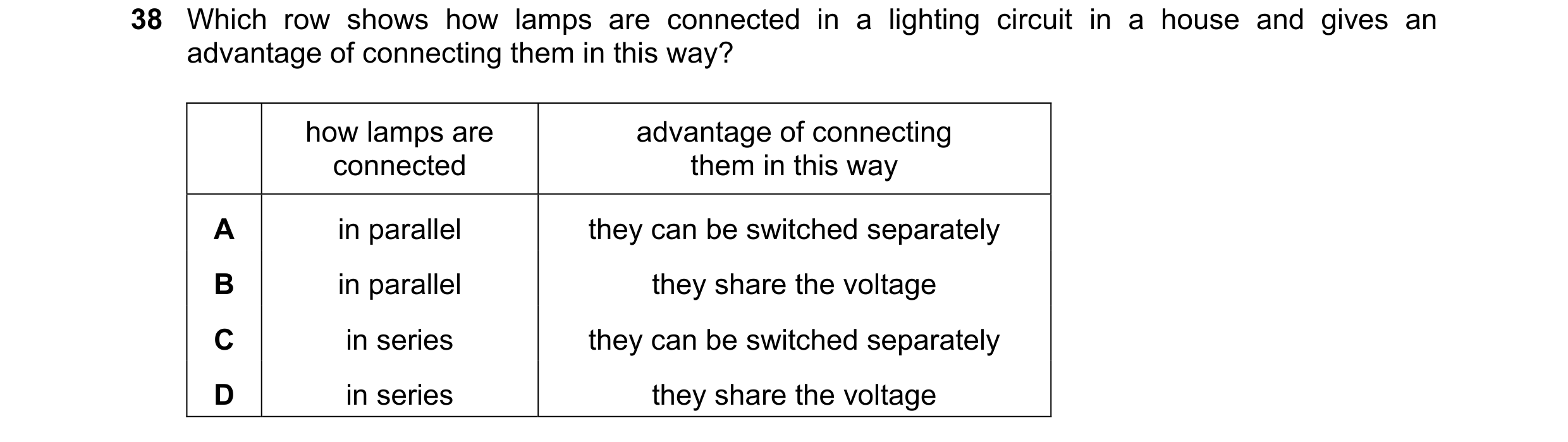
Q12 · Which row shows how lamps are connected in a domestic lighting circuit, and gives an… 0654/13 Oct/Nov 2013
39 Which row shows how lamps are connected in a domestic lighting circuit, and gives an advantage of connecting them in this way? how lamps are advantage of connecting connected them in this way A in parallel they can be switched separately B in parallel they share the voltage C in series they can be switched separately D in series they share the voltage
1 marks
Answer: A
This question in 0654/13 Oct/Nov 2013
Q13 · An electrical extension block has four sockets, a cable which can safely take a current… 0654/12 May/June 2014
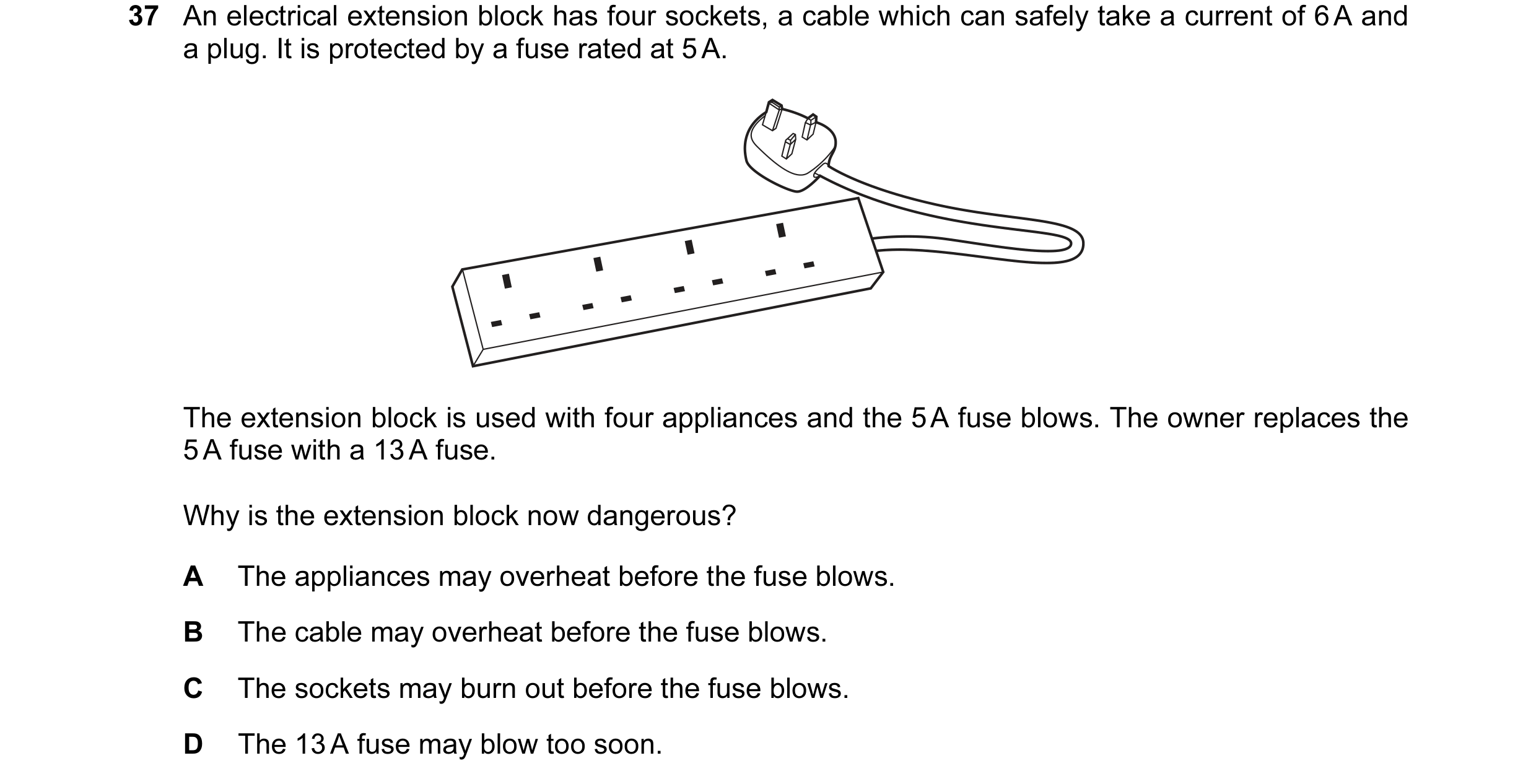
37 An electrical extension block has four sockets, a cable which can safely take a current of 6 A and a plug. It is protected by a fuse rated at 5 A. The extension block is used with four appliances and the 5 A fuse blows. The owner replaces the 5 A fuse with a 13 A fuse. Why is the extension block now dangerous? A The appliances may overheat before the fuse blows. B The cable may overheat before the fuse blows. C The sockets may burn out before the fuse blows. D The 13 A fuse may blow too soon.
1 marks
Answer: B
This question in 0654/12 May/June 2014
Q14 · What is the symbol for a fuse? 0654/12 May/June 2015
38 What is the symbol for a fuse? A B C D
1 marks
Answer: C
This question in 0654/12 May/June 2015
Q15 · The diagrams show two possible ways in which a fuse and a lamp can be connected in a… 0654/13 May/June 2015
38 The diagrams show two possible ways in which a fuse and a lamp can be connected in a circuit. The current in the lamp is 2.0 A. diagram 1 diagram 2 A fault develops. The current in the lamp increases, and the fuse blows. Which row gives the correct position of the fuse, and the effect of the fuse when it blows? correct position effect A as in diagram 1 reduces current to 0 B as in diagram 1 reduces current to 2.0 A C as in diagram 2 reduces current to 0 D as in diagram 2 reduces current to 2.0 A
1 marks
Answer: C
This question in 0654/13 May/June 2015
Q16 · A student constructs four circuits, each containing a fuse 0654/12 Oct/Nov 2015
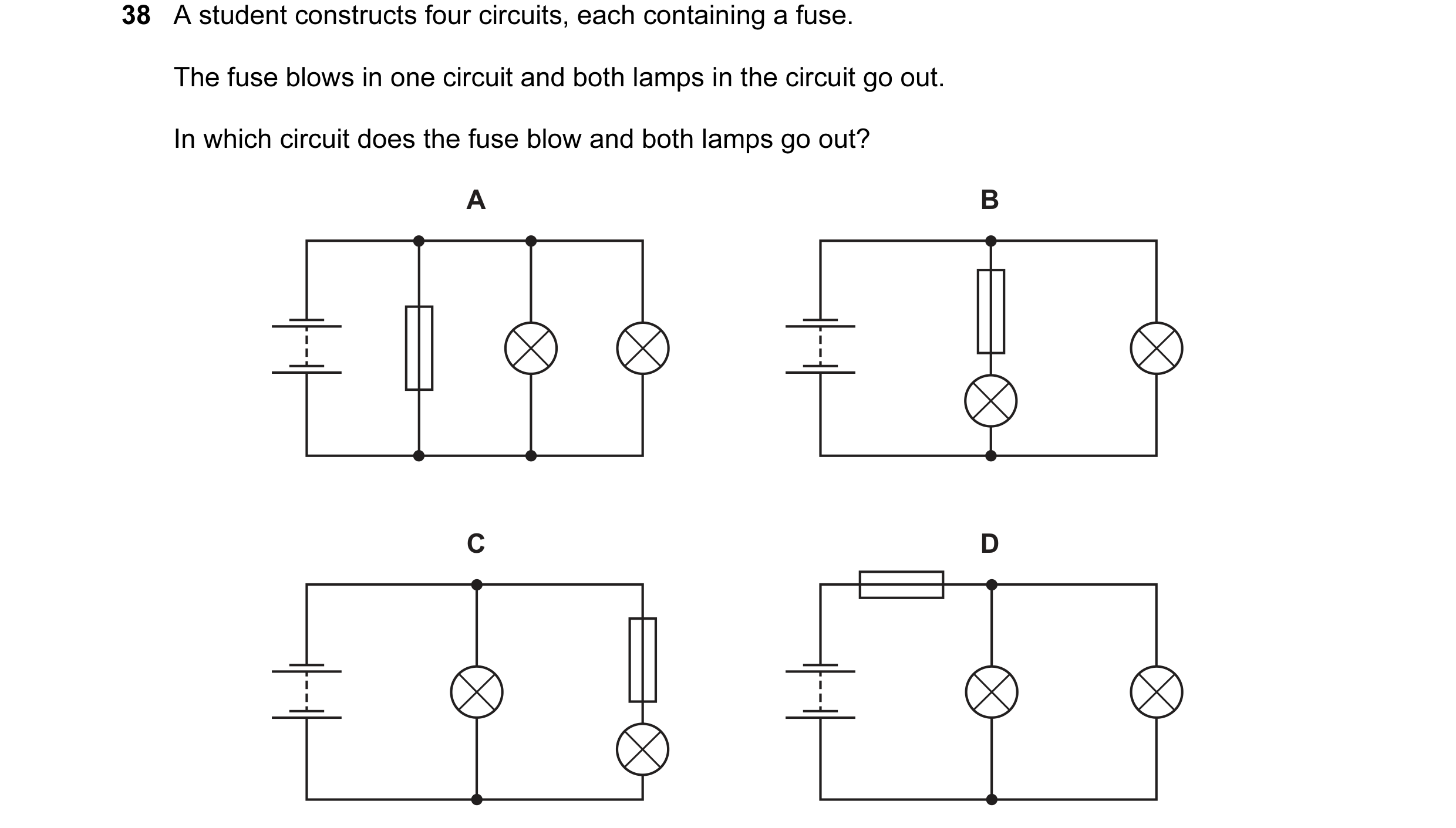
38 A student constructs four circuits, each containing a fuse. The fuse blows in one circuit and both lamps in the circuit go out. In which circuit does the fuse blow and both lamps go out? A B C D
1 marks
Answer: D
This question in 0654/12 Oct/Nov 2015
Q17 · A certain electrical appliance is powered from a mains supply 0654/13 Oct/Nov 2015
38 A certain electrical appliance is powered from a mains supply. The appliance normally uses a current of 3 A, but the current briefly rises to 4 A at the instant the appliance is switched on. The cable to the appliance is designed for currents up to 6 A. A fuse is used to protect the circuit. What should be the rating of the fuse? A 1 A B 3 A C 5 A D 13 A
1 marks
Answer: C
This question in 0654/13 Oct/Nov 2015
Q18 · A fuse is a safety device for use in an electrical appliance 0654/11 May/June 2016
38 A fuse is a safety device for use in an electrical appliance. How does a fuse affect a circuit when the current in it becomes higher than the rated value for the fuse? A It completely stops the current. B It reduces the current to the rated value for the fuse. C It reduces the thermal insulation around the wires. D It sends the current to the outer case of the appliance.
1 marks
Answer: A
This question in 0654/11 May/June 2016
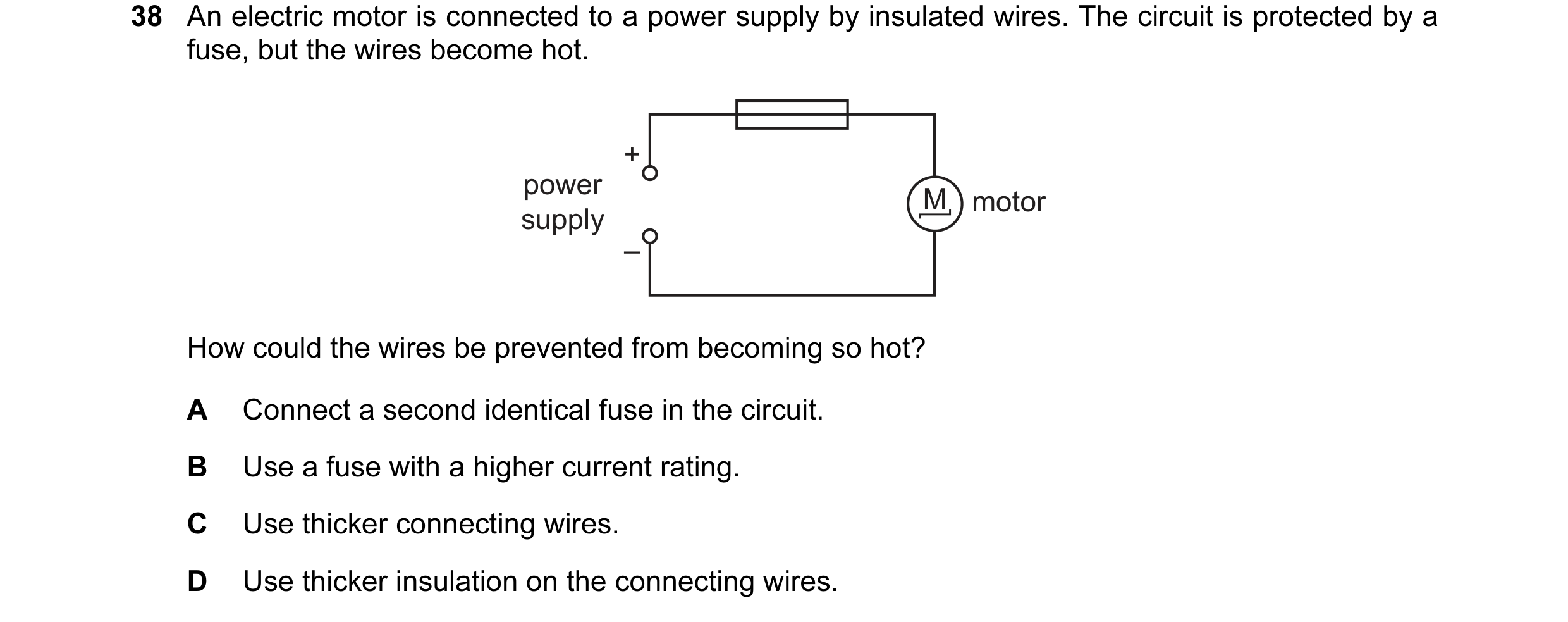
Q19 · An electric motor is connected to a power supply by insulated wires 0654/13 May/June 2016
38 An electric motor is connected to a power supply by insulated wires. The circuit is protected by a fuse, but the wires become hot. + power M motor supply – How could the wires be prevented from becoming so hot? A Connect a second identical fuse in the circuit. B Use a fuse with a higher current rating. C Use thicker connecting wires. D Use thicker insulation on the connecting wires.
1 marks
Answer: C
This question in 0654/13 May/June 2016
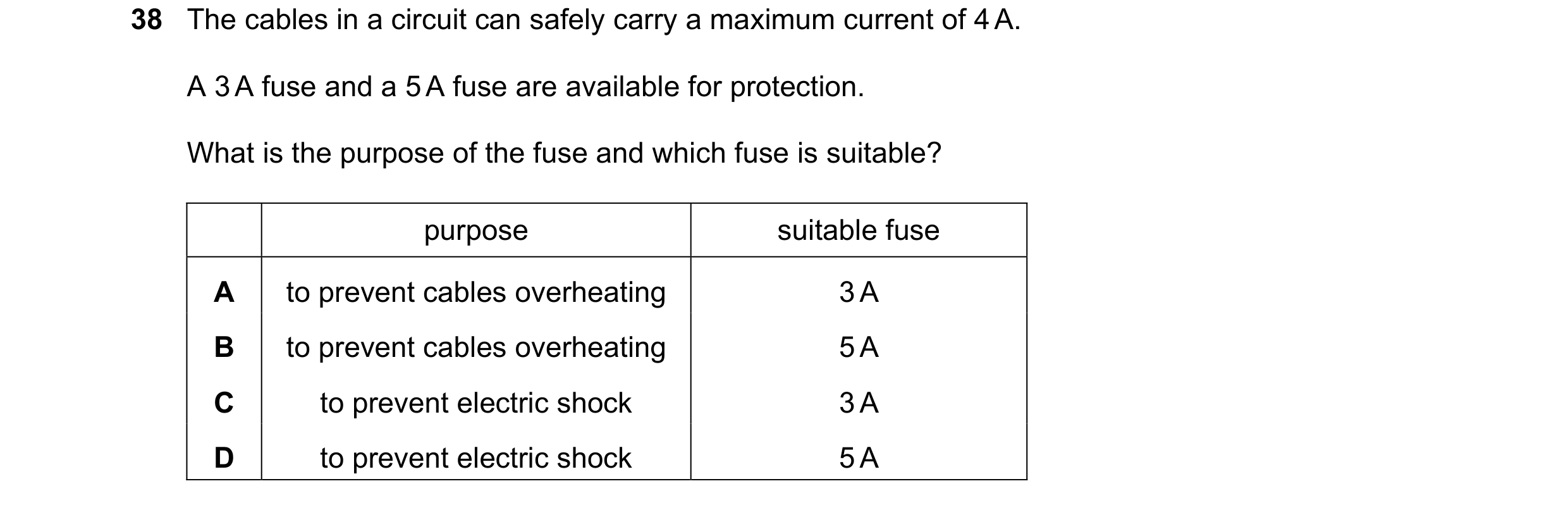
Q20 · The cables in a circuit can safely carry a maximum current of 4 A 0654/12 Oct/Nov 2016
38 The cables in a circuit can safely carry a maximum current of 4 A. A 3 A fuse and a 5 A fuse are available for protection. What is the purpose of the fuse and which fuse is suitable? purpose suitable fuse A to prevent cables overheating 3 A B to prevent cables overheating 5 A C to prevent electric shock 3 A D to prevent electric shock 5 A
1 marks
Answer: A
This question in 0654/12 Oct/Nov 2016
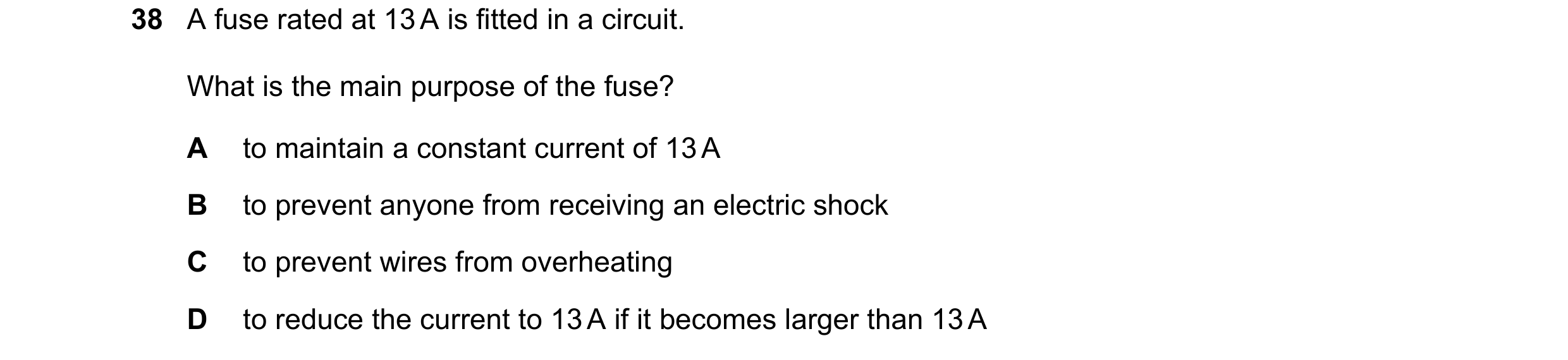
Q21 · A fuse rated at 13 A is fitted in a circuit 0654/11 May/June 2017
38 A fuse rated at 13 A is fitted in a circuit. What is the main purpose of the fuse? A to maintain a constant current of 13 A B to prevent anyone from receiving an electric shock C to prevent wires from overheating D to reduce the current to 13 A if it becomes larger than 13 A
1 marks
Answer: C
This question in 0654/11 May/June 2017
Q22 · A circuit contains a lamp and a fuse 0654/11 Oct/Nov 2018
39 A circuit contains a lamp and a fuse. There is a current of 2.0 A in the lamp and it operates normally. A fault develops in the lamp. The current in the circuit increases, and the fuse now blows. The diagrams show two circuits. diagram 1 diagram 2 Which is the circuit used and what is the effect of the fuse when it blows? circuit effect of fuse A diagram 1 reduces current to 0 B diagram 1 reduces current to 2.0 A C diagram 2 reduces current to 0 D diagram 2 reduces current to 2.0 A
1 marks
Answer: C
This question in 0654/11 Oct/Nov 2018
Q23 · A circuit contains a lamp and a fuse 0654/12 Oct/Nov 2018
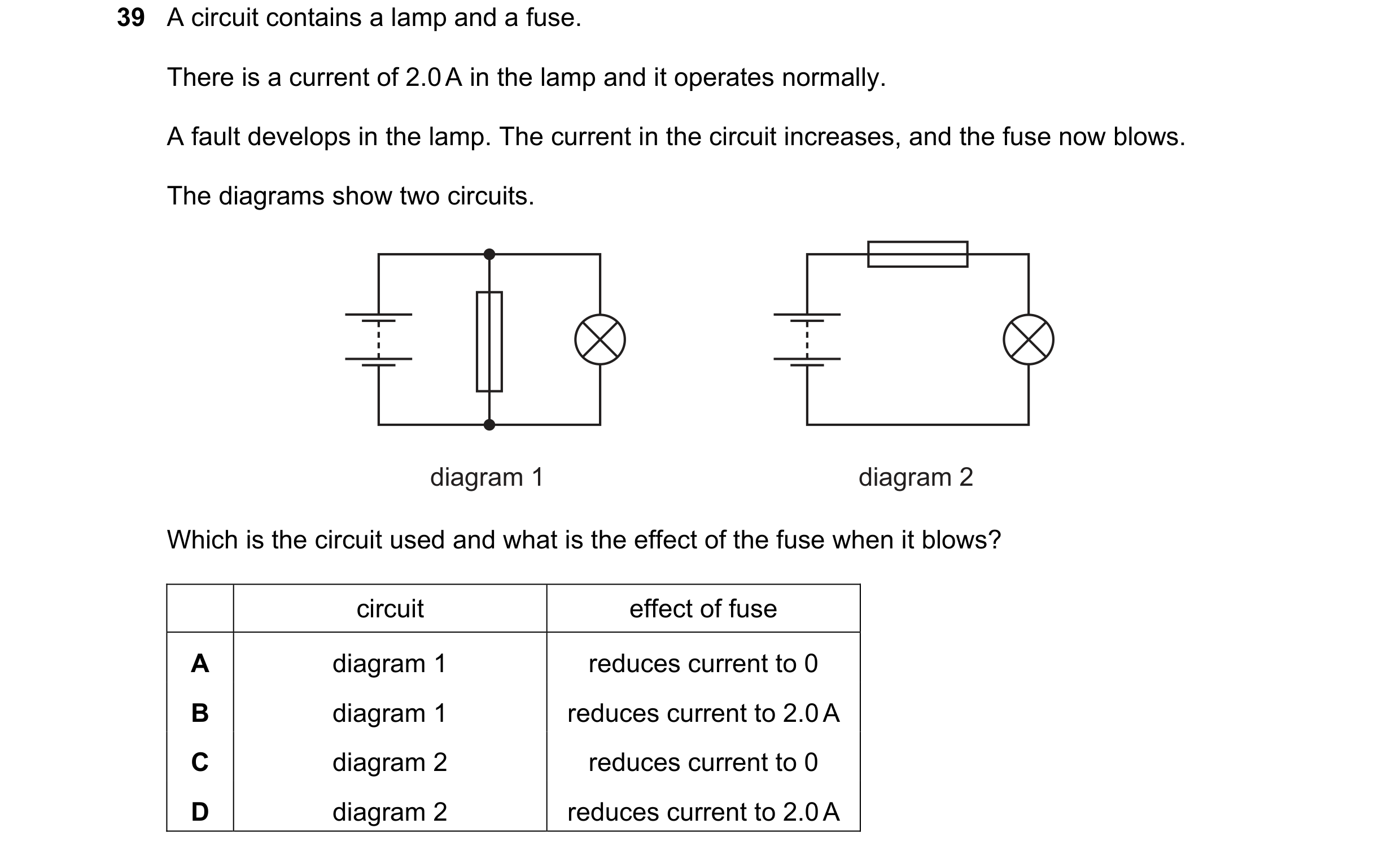
39 A circuit contains a lamp and a fuse. There is a current of 2.0 A in the lamp and it operates normally. A fault develops in the lamp. The current in the circuit increases, and the fuse now blows. The diagrams show two circuits. diagram 1 diagram 2 Which is the circuit used and what is the effect of the fuse when it blows? circuit effect of fuse A diagram 1 reduces current to 0 B diagram 1 reduces current to 2.0 A C diagram 2 reduces current to 0 D diagram 2 reduces current to 2.0 A
1 marks
Answer: C
This question in 0654/12 Oct/Nov 2018
Q24 · A circuit contains a lamp and a fuse 0654/13 Oct/Nov 2018
37 A circuit contains a lamp and a fuse. There is a current of 2.0 A in the lamp and it operates normally. A fault develops in the lamp. The current in the circuit increases, and the fuse now blows. The diagrams show two circuits. diagram 1 diagram 2 Which is the circuit used and what is the effect of the fuse when it blows? circuit effect of fuse A diagram 1 reduces current to 0 B diagram 1 reduces current to 2.0 A C diagram 2 reduces current to 0 D diagram 2 reduces current to 2.0 A
1 marks
Answer: C
This question in 0654/13 Oct/Nov 2018
Q25 · The diagram shows the connections to an electric heater 0654/12 May/June 2019
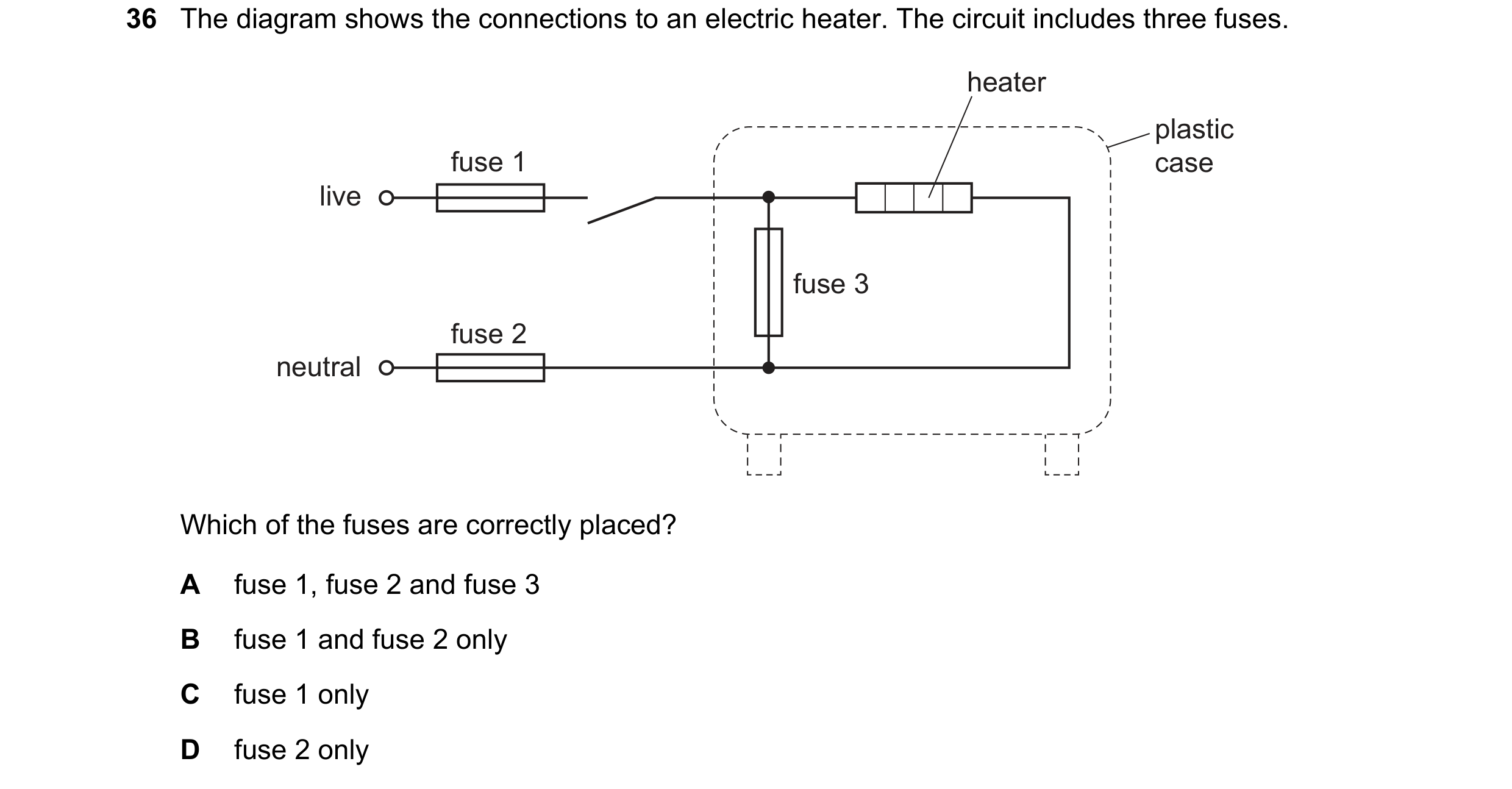
36 The diagram shows the connections to an electric heater. The circuit includes three fuses. heater plastic fuse 1 case live fuse 3 fuse 2 neutral Which of the fuses are correctly placed? A fuse 1, fuse 2 and fuse 3 B fuse 1 and fuse 2 only C fuse 1 only D fuse 2 only
1 marks
Answer: C
This question in 0654/12 May/June 2019
Q26 · The diagram shows the connections to an electric heater 0654/13 May/June 2019
36 The diagram shows the connections to an electric heater. The circuit includes three fuses. heater plastic fuse 1 case live fuse 3 fuse 2 neutral Which of the fuses are correctly placed? A fuse 1, fuse 2 and fuse 3 B fuse 1 and fuse 2 only C fuse 1 only D fuse 2 only
1 marks
Answer: C
This question in 0654/13 May/June 2019
Q27 · An electrical extension block has four sockets, a cable which can safely take a current… 0654/11 Oct/Nov 2019
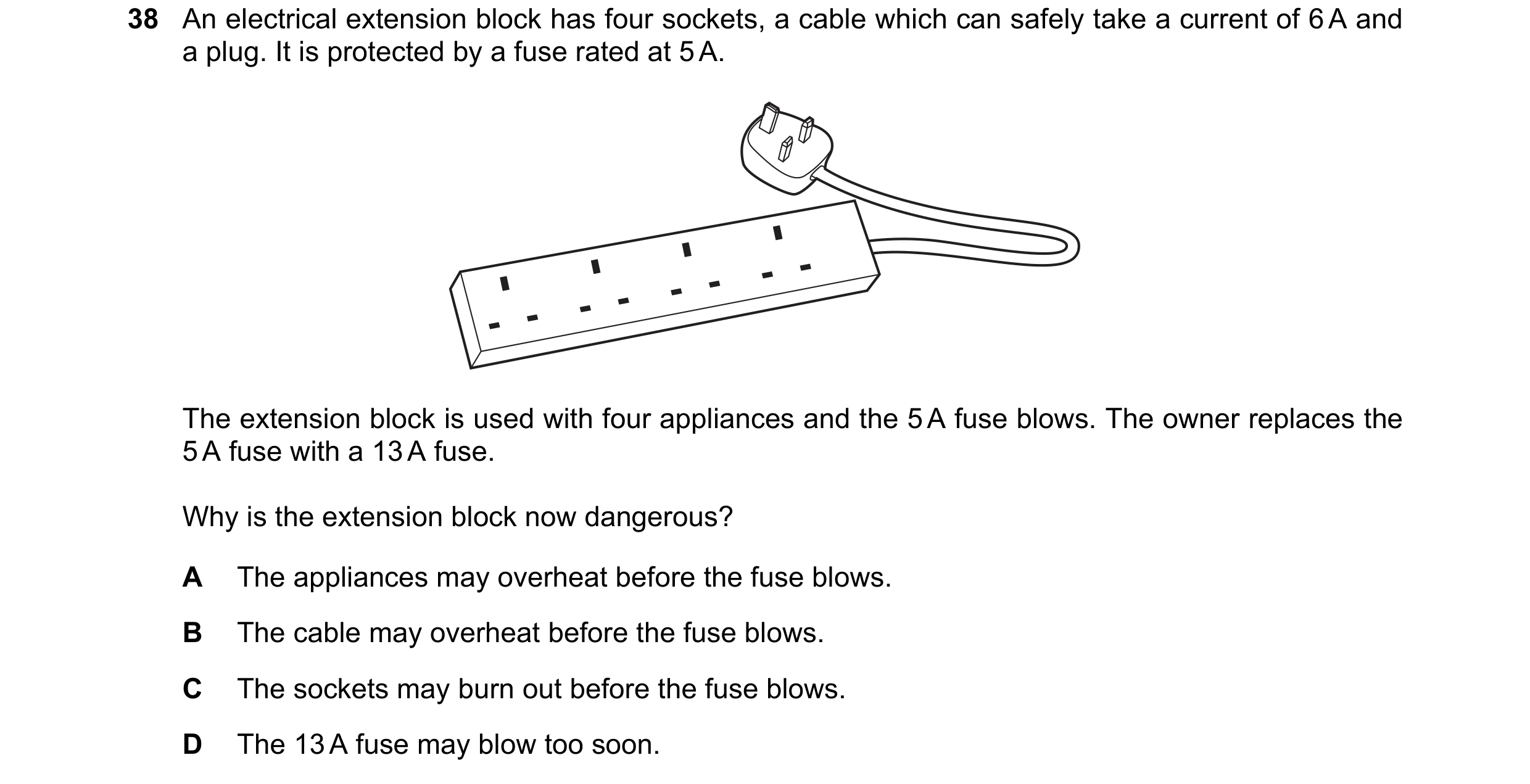
38 An electrical extension block has four sockets, a cable which can safely take a current of 6 A and a plug. It is protected by a fuse rated at 5 A. The extension block is used with four appliances and the 5 A fuse blows. The owner replaces the 5 A fuse with a 13 A fuse. Why is the extension block now dangerous? A The appliances may overheat before the fuse blows. B The cable may overheat before the fuse blows. C The sockets may burn out before the fuse blows. D The 13 A fuse may blow too soon.
1 marks
Answer: B
This question in 0654/11 Oct/Nov 2019
Q28 · An electrical extension block has four sockets, a cable which can safely take a current… 0654/12 Oct/Nov 2019
39 An electrical extension block has four sockets, a cable which can safely take a current of 6 A and a plug. It is protected by a fuse rated at 5 A. The extension block is used with four appliances and the 5 A fuse blows. The owner replaces the 5 A fuse with a 13 A fuse. Why is the extension block now dangerous? A The appliances may overheat before the fuse blows. B The cable may overheat before the fuse blows. C The sockets may burn out before the fuse blows. D The 13 A fuse may blow too soon.
1 marks
Answer: B
This question in 0654/12 Oct/Nov 2019
Q29 · An electrical extension block has four sockets, a cable which can safely take a current… 0654/13 Oct/Nov 2019
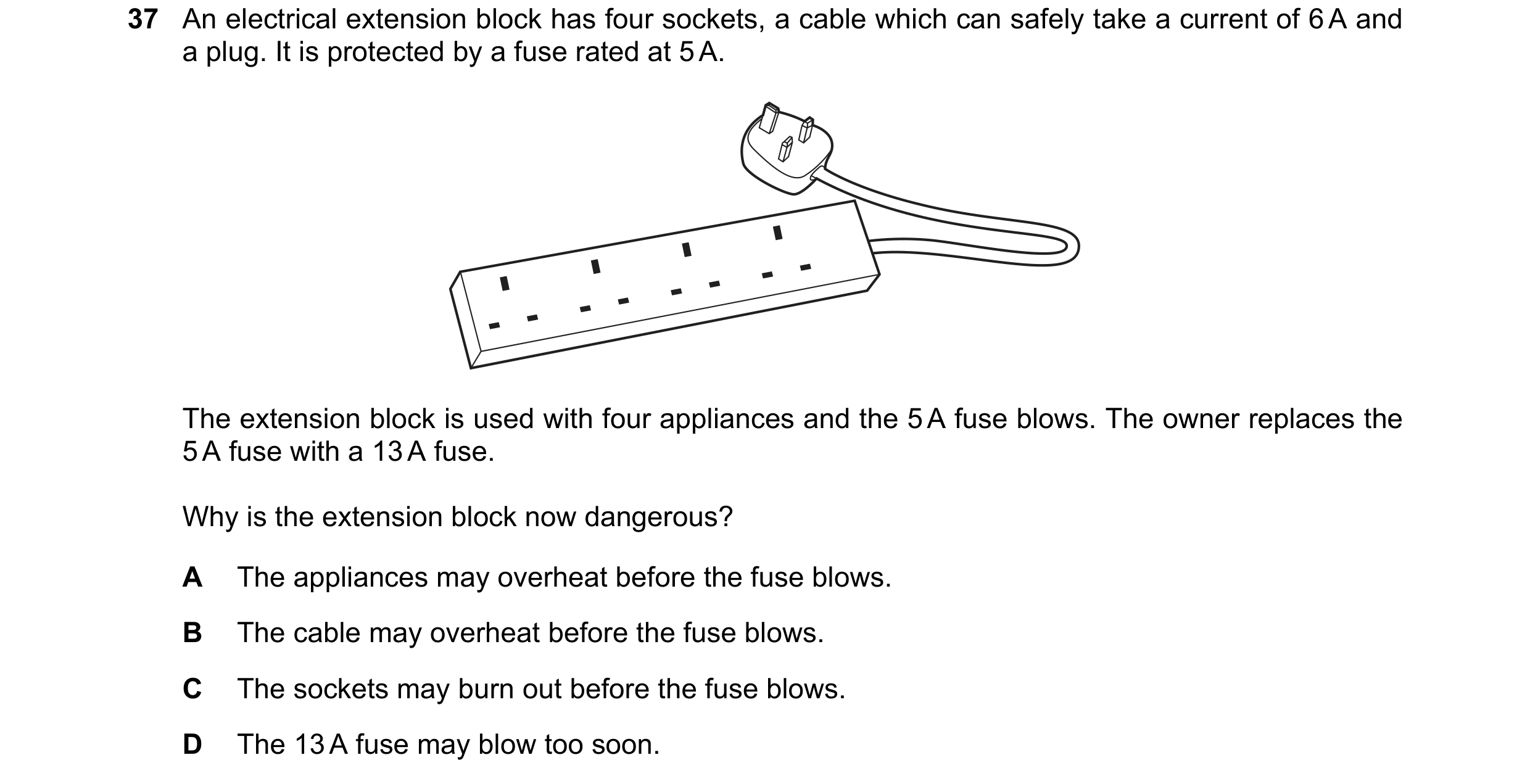
37 An electrical extension block has four sockets, a cable which can safely take a current of 6 A and a plug. It is protected by a fuse rated at 5 A. The extension block is used with four appliances and the 5 A fuse blows. The owner replaces the 5 A fuse with a 13 A fuse. Why is the extension block now dangerous? A The appliances may overheat before the fuse blows. B The cable may overheat before the fuse blows. C The sockets may burn out before the fuse blows. D The 13 A fuse may blow too soon.
1 marks
Answer: B
This question in 0654/13 Oct/Nov 2019
Q30 · A fuse is a safety device for use in an electrical circuit 0654/11 May/June 2020
38 A fuse is a safety device for use in an electrical circuit. The current in the circuit becomes greater than the rated value for the fuse. What happens? A The current decreases to zero. B The current decreases to the rated value for the fuse. C The thickness of the insulation around the wires increases. D The current is sent to the outer case of the appliance.
1 marks
Answer: A
This question in 0654/11 May/June 2020
Q31 · A fuse is a safety device for use in an electrical circuit 0654/12 May/June 2020
38 A fuse is a safety device for use in an electrical circuit. The current in the circuit becomes greater than the rated value for the fuse. What happens? A The current decreases to zero. B The current decreases to the rated value for the fuse. C The thickness of the insulation around the wires increases. D The current is sent to the outer case of the appliance.
1 marks
Answer: A
This question in 0654/12 May/June 2020
Q32 · A fuse is a safety device for use in an electrical circuit 0654/13 May/June 2020
37 A fuse is a safety device for use in an electrical circuit. The current in the circuit becomes greater than the rated value for the fuse. What happens? A The current decreases to zero. B The current decreases to the rated value for the fuse. C The thickness of the insulation around the wires increases. D The current is sent to the outer case of the appliance.
1 marks
Answer: A
This question in 0654/13 May/June 2020
Q33 · An electric kettle is designed so that the usual current in its heater is 9.0 A 0654/12 Oct/Nov 2020
37 An electric kettle is designed so that the usual current in its heater is 9.0 A. The owner of the kettle fits the plug with a fuse rated at 3 A. What happens when the kettle is filled with water and switched on? A The current in the circuit increases to greater than 9.0 A. B The fuse blows immediately and the kettle fails to operate. C The water reaches boiling point more quickly due to an increase in the voltage. D The water reaches boiling point more slowly due to a decrease in the current.
1 marks
Answer: B
This question in 0654/12 Oct/Nov 2020
Q34 · Fuses are used in domestic electric circuits 0654/13 Oct/Nov 2020
38 Fuses are used in domestic electric circuits. Which statement about fuses is correct? A A fuse is connected in the live wire. B A fuse is connected in the neutral wire. C A 3 A fuse produces a current of exactly 3 A in the circuit. D A 3 A fuse produces a minimum current of 3 A in the circuit.
1 marks
Answer: A
This question in 0654/13 Oct/Nov 2020
Q35 · Which symbol represents a fuse? 0654/12 Feb/March 2021
37 Which symbol represents a fuse? A B C D
1 marks
Answer: B
This question in 0654/12 Feb/March 2021
Q36 · A student connects the circuit shown 0654/11 May/June 2021
38 A student connects the circuit shown. fuse When the switch is closed the fuse blows and stops the current. What is a possible reason for this? A The current rating of the fuse is too high. B The current is too large. C The lamp is too dim. D The voltage is too small.
1 marks
Answer: B
This question in 0654/11 May/June 2021
Q37 · A student connects the circuit shown 0654/12 May/June 2021
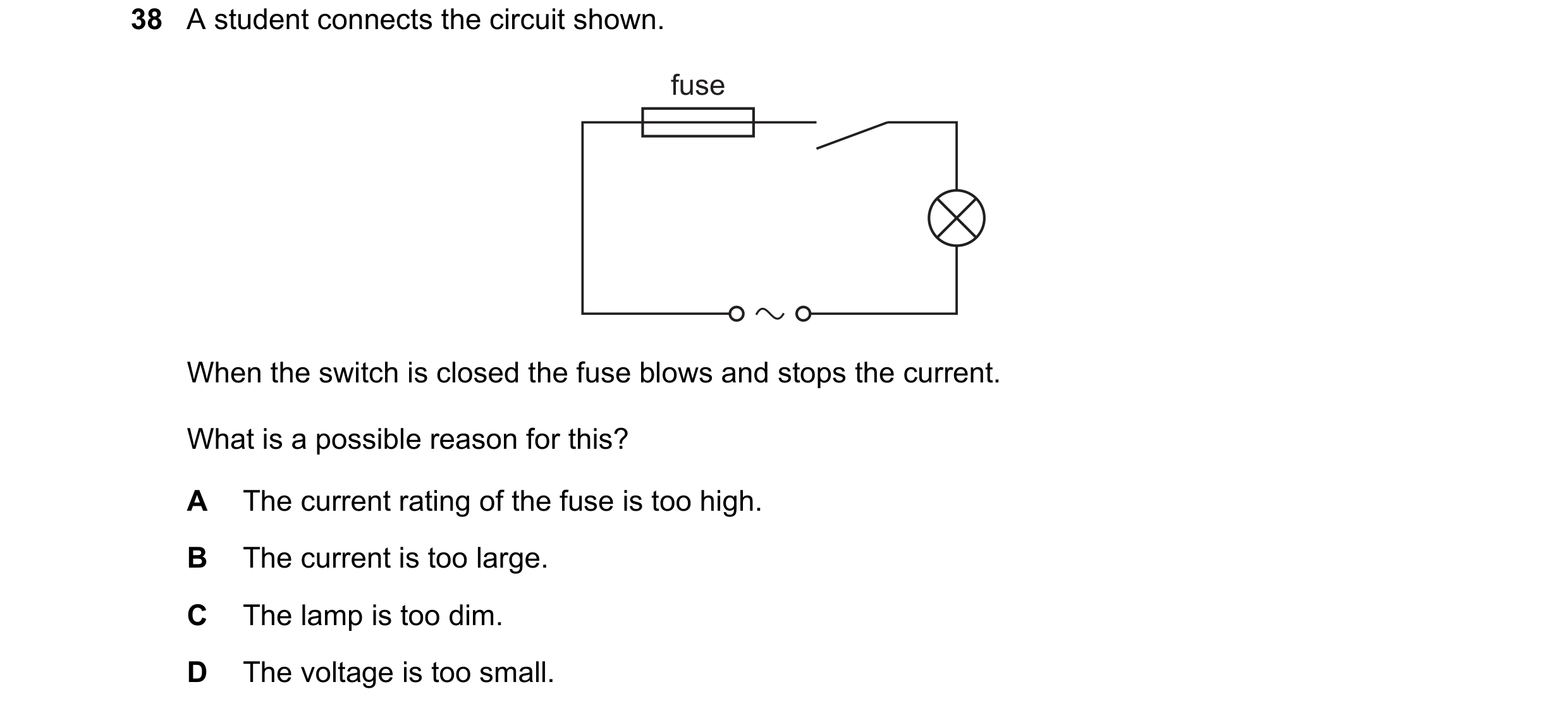
38 A student connects the circuit shown. fuse When the switch is closed the fuse blows and stops the current. What is a possible reason for this? A The current rating of the fuse is too high. B The current is too large. C The lamp is too dim. D The voltage is too small.
1 marks
Answer: B
This question in 0654/12 May/June 2021
Q38 · A student connects the circuit shown 0654/13 May/June 2021
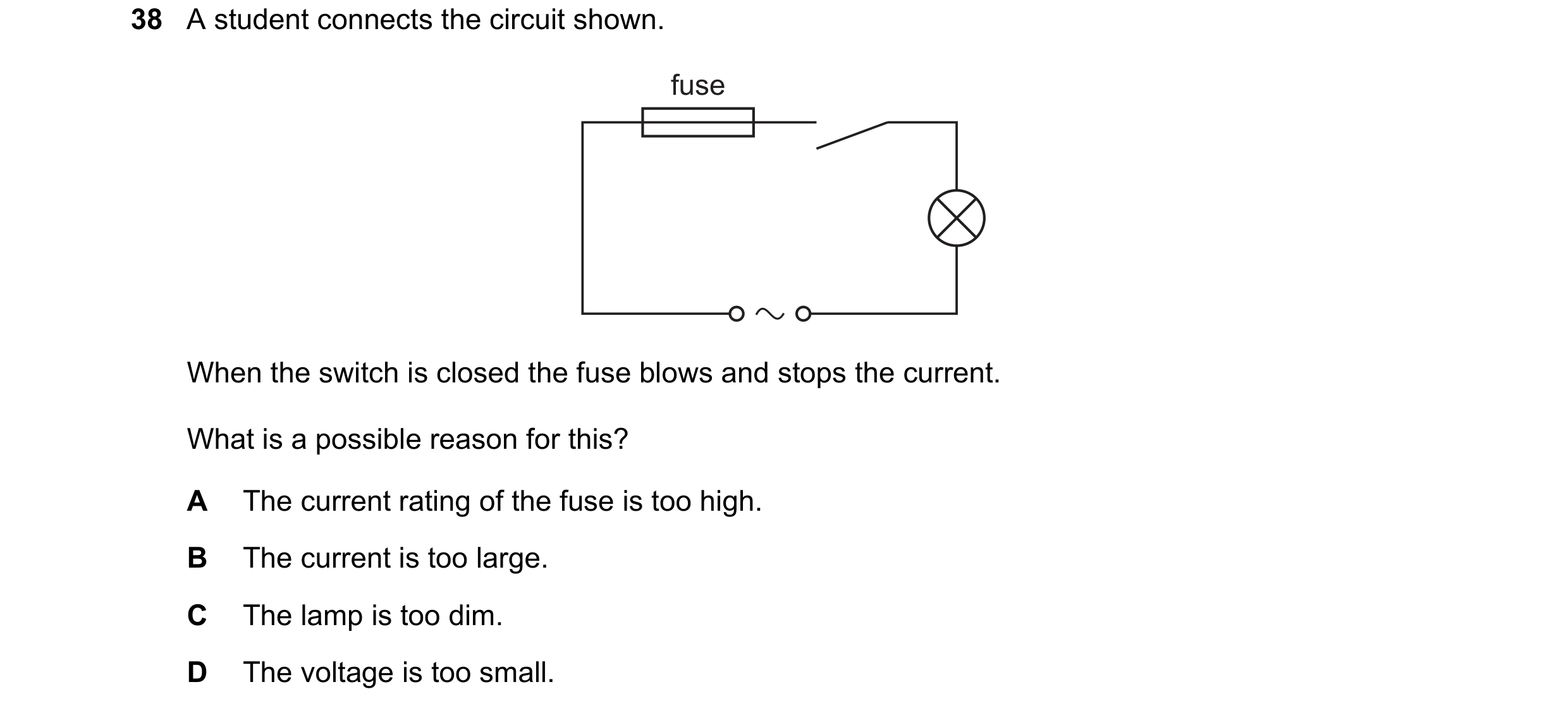
38 A student connects the circuit shown. fuse When the switch is closed the fuse blows and stops the current. What is a possible reason for this? A The current rating of the fuse is too high. B The current is too large. C The lamp is too dim. D The voltage is too small.
1 marks
Answer: B
This question in 0654/13 May/June 2021
Q39 · The table shows the usual current in each of four household appliances and the fuse used… 0654/11 Oct/Nov 2021
39 The table shows the usual current in each of four household appliances and the fuse used to protect each of them. The only fuses available are rated at 3 A, 5 A or 13 A. Which row shows an appliance that has been fitted with the most appropriate of the fuses available? appliance current / A fuse rating / A A hairdryer 5.5 5 B kettle 7.5 13 C lawnmower 5.0 3 D slow cooker 1.0 5
1 marks
Answer: B
This question in 0654/11 Oct/Nov 2021
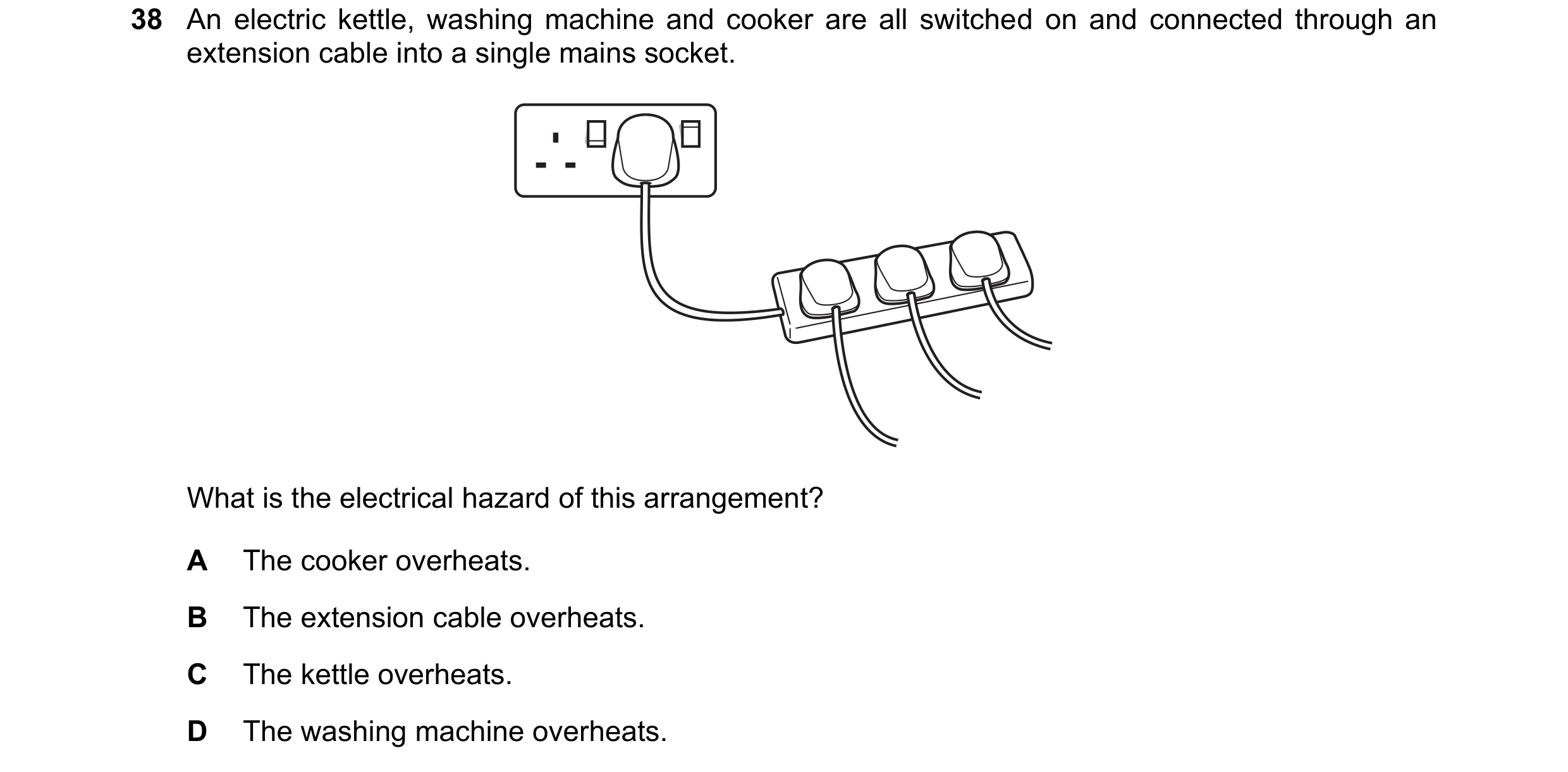
Q40 · An electric kettle, washing machine and cooker are all switched on and connected through… 0654/12 Oct/Nov 2021
38 An electric kettle, washing machine and cooker are all switched on and connected through an extension cable into a single mains socket. What is the electrical hazard of this arrangement? A The cooker overheats. B The extension cable overheats. C The kettle overheats. D The washing machine overheats.
1 marks
Answer: B
This question in 0654/12 Oct/Nov 2021
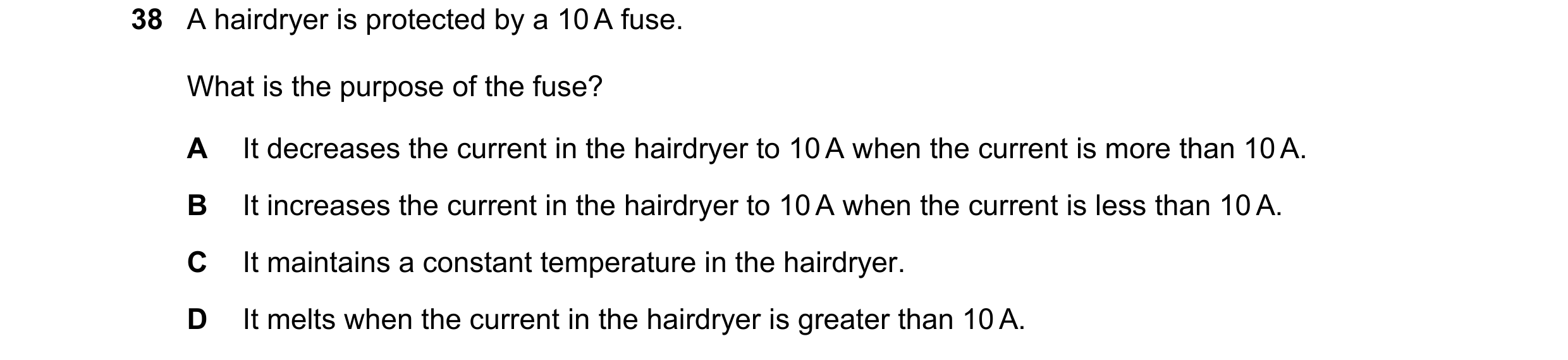
Q41 · A hairdryer is protected by a 10 A fuse 0654/13 Oct/Nov 2021
38 A hairdryer is protected by a 10 A fuse. What is the purpose of the fuse? A It decreases the current in the hairdryer to 10 A when the current is more than 10 A. B It increases the current in the hairdryer to 10 A when the current is less than 10 A. C It maintains a constant temperature in the hairdryer. D It melts when the current in the hairdryer is greater than 10 A.
1 marks
Answer: D
This question in 0654/13 Oct/Nov 2021
Q42 · An electrical extension block has four sockets, a cable which can safely take a current… 0654/12 Feb/March 2022
38 An electrical extension block has four sockets, a cable which can safely take a current of 6 A and a plug. It is protected by a fuse rated at 5 A. The extension block is used with four appliances and the 5 A fuse blows. The owner replaces the 5 A fuse with a 13 A fuse. Why is the extension block now dangerous? A The appliances may not receive enough current. B The cable may overheat before the fuse blows. C The sockets may burn out before the fuse blows. D The 13 A fuse may blow too soon.
1 marks
Answer: B
This question in 0654/12 Feb/March 2022
Q43 · A 240 V mains lamp operating normally has a working resistance of 480 0654/11 May/June 2022
38 A 240 V mains lamp operating normally has a working resistance of 480 . Which rating of fuse is most suitable to use with this lamp? A 0.4 A B 1 A C 2 A D 4 A
1 marks
Answer: B
This question in 0654/11 May/June 2022
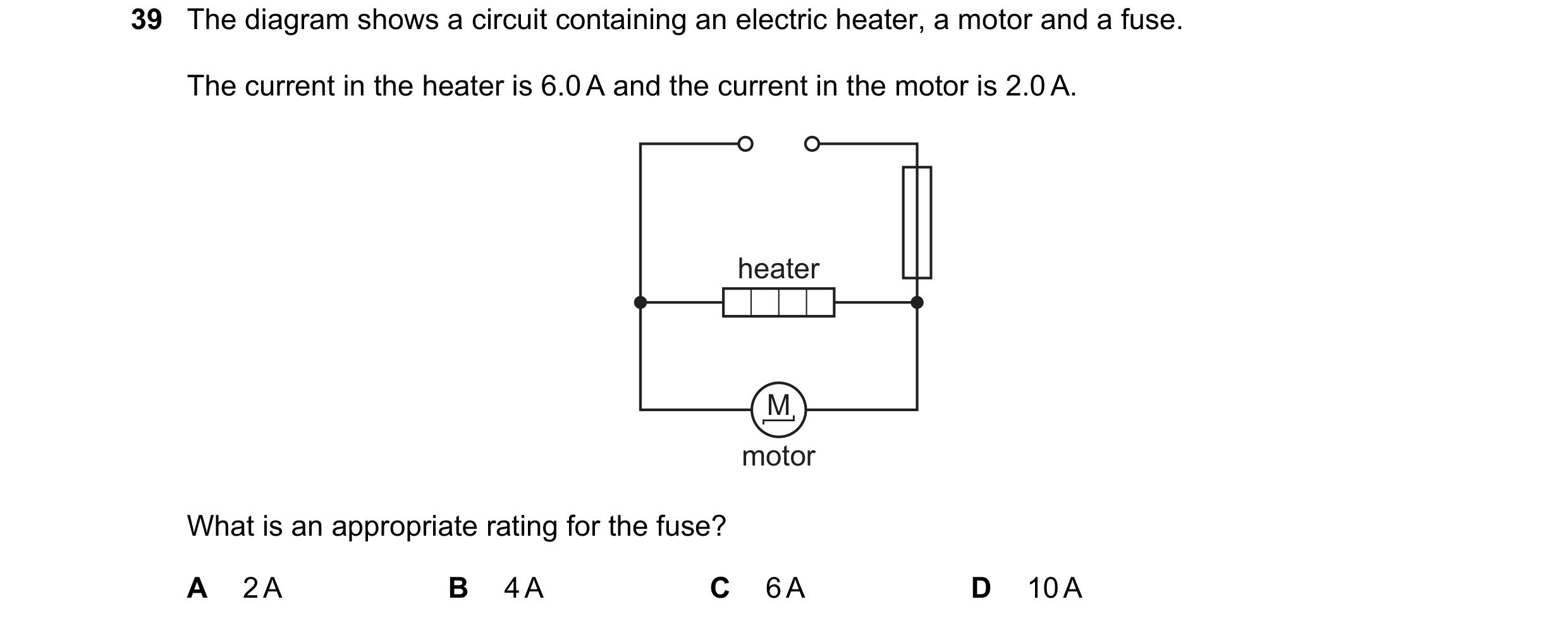
Q44 · The diagram shows a circuit containing an electric heater, a motor and a fuse 0654/12 May/June 2022
39 The diagram shows a circuit containing an electric heater, a motor and a fuse. The current in the heater is 6.0 A and the current in the motor is 2.0 A. heater M motor What is an appropriate rating for the fuse? A 2 A B 4 A C 6 A D 10 A
1 marks
Answer: D
This question in 0654/12 May/June 2022
Q45 · Which row shows how lamps are connected in a lighting circuit in a house and gives an… 0654/13 May/June 2022
38 Which row shows how lamps are connected in a lighting circuit in a house and gives an advantage of connecting them in this way? how lamps are advantage of connecting connected them in this way A in parallel they can be switched separately B in parallel they share the voltage C in series they can be switched separately D in series they share the voltage
1 marks
Answer: A
This question in 0654/13 May/June 2022
Q46 · The diagram shows a circuit containing an electric heater, a motor and a fuse 0654/13 May/June 2022
39 The diagram shows a circuit containing an electric heater, a motor and a fuse. The current in the heater is 6.0 A and the current in the motor is 2.0 A. heater M motor What is an appropriate rating for the fuse? A 2 A B 4 A C 6 A D 10 A
1 marks
Answer: D
This question in 0654/13 May/June 2022
Q47 · The current in an electric heater during normal use is 11 A 0654/11 Oct/Nov 2022
39 The current in an electric heater during normal use is 11 A. What is an appropriate rating for a fuse to protect the heater? A 3 A B 10 A C 13 A D 36 A
1 marks
Answer: C
This question in 0654/11 Oct/Nov 2022
Q48 · The maximum current in a food mixer during normal use is 3.1 A 0654/12 Oct/Nov 2022
39 The maximum current in a food mixer during normal use is 3.1 A. What is the most suitable rating for a fuse used to protect the mixer? A 1 A B 3 A C 5 A D 8 A
1 marks
Answer: C
This question in 0654/12 Oct/Nov 2022
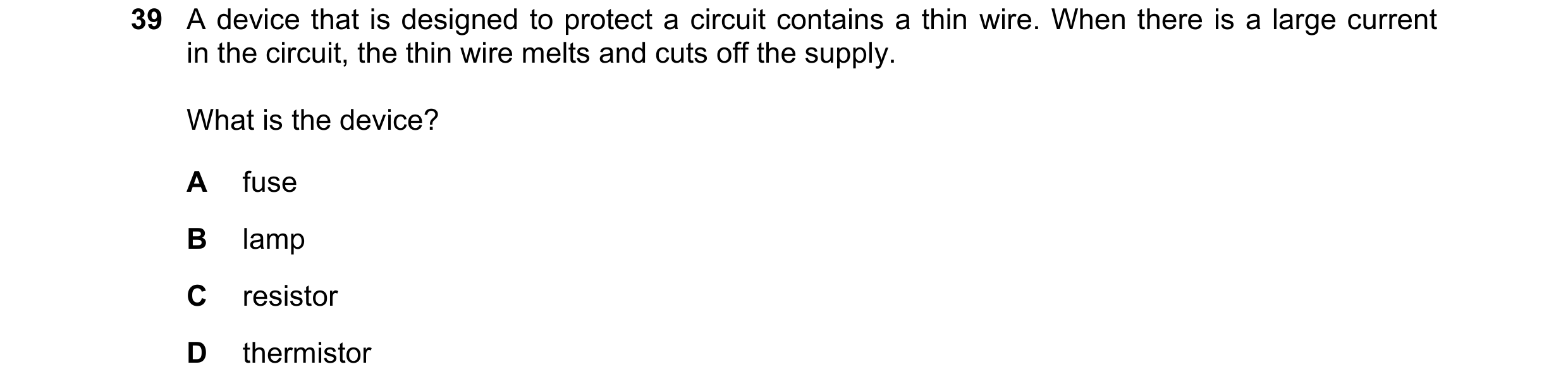
Q49 · A device that is designed to protect a circuit contains a thin wire 0654/13 Oct/Nov 2022
39 A device that is designed to protect a circuit contains a thin wire. When there is a large current in the circuit, the thin wire melts and cuts off the supply. What is the device? A fuse B lamp C resistor D thermistor
1 marks
Answer: A
This question in 0654/13 Oct/Nov 2022
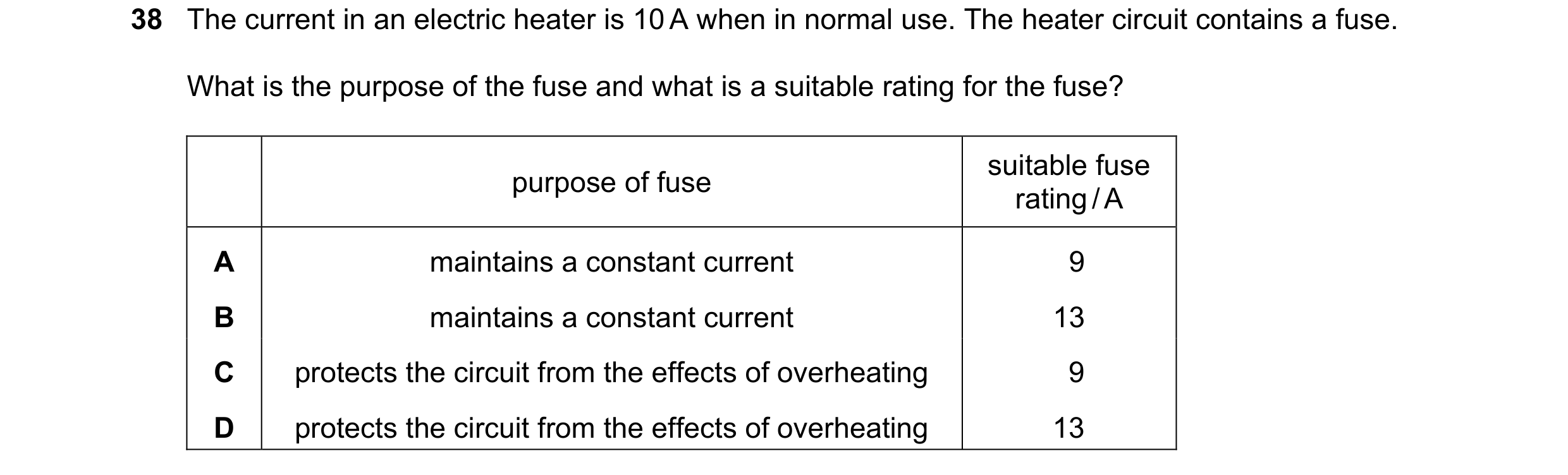
Q50 · The current in an electric heater is 10 A when in normal use 0654/12 Feb/March 2023
38 The current in an electric heater is 10 A when in normal use. The heater circuit contains a fuse. What is the purpose of the fuse and what is a suitable rating for the fuse? suitable fuse purpose of fuse rating / A A maintains a constant current 9 B maintains a constant current 13 C protects the circuit from the effects of overheating 9 D protects the circuit from the effects of overheating 13
1 marks
Answer: D
This question in 0654/12 Feb/March 2023
Q51 · Fuses are used in domestic electric circuits 0654/11 May/June 2023
38 Fuses are used in domestic electric circuits. Which statement about fuses is correct? A A fuse is connected in the live wire. B A fuse is connected in the neutral wire. C A 3.0 A fuse produces a current of exactly 3.0 A in the circuit. D A 3.0 A fuse produces a minimum current of 3.0 A in the circuit.
1 marks
Answer: A
This question in 0654/11 May/June 2023
Q52 · The current in an electric kettle used to boil water is 9.0 A 0654/11 Oct/Nov 2023
39 The current in an electric kettle used to boil water is 9.0 A. What is the most appropriate rating of fuse to use with this kettle? A 1 A B 3 A C 8 A D 13 A
1 marks
Answer: D
This question in 0654/11 Oct/Nov 2023
Q53 · What is the purpose of a fuse in an electric circuit? 0654/13 Oct/Nov 2023
38 What is the purpose of a fuse in an electric circuit? A to make the circuit more efficient B to protect the circuit from damage by a large current C to provide a constant current in the circuit D to provide a constant potential difference (p.d.) across the circuit
1 marks
Answer: B
This question in 0654/13 Oct/Nov 2023
Q54 · The current in an electric heater is 6.0 A when in normal use 0654/12 Feb/March 2024
37 The current in an electric heater is 6.0 A when in normal use. Four fuses with different ratings are available to protect the wire to the heater. Which fuse is most suitable? A 1 A B 5 A C 8 A D 20 A
1 marks
Answer: C
This question in 0654/12 Feb/March 2024
Q55 · The maximum current in an electric circuit is 10 A 0654/11 May/June 2024
38 The maximum current in an electric circuit is 10 A. What is the most appropriate rating of a fuse for this circuit? A 5 A B 9 A C 13 A D 25 A
1 marks
Answer: C
This question in 0654/11 May/June 2024
Q56 · An electrician has a box of identical fuses that do not have their rating marked on them 0654/12 Oct/Nov 2024
37 An electrician has a box of identical fuses that do not have their rating marked on them. They decide to test one of the fuses to determine its rating by gradually increasing the current in the fuse until it blows. Which diagram shows a fuse connected in a suitable circuit? A B A A C D A A
1 marks
Answer: D
This question in 0654/12 Oct/Nov 2024
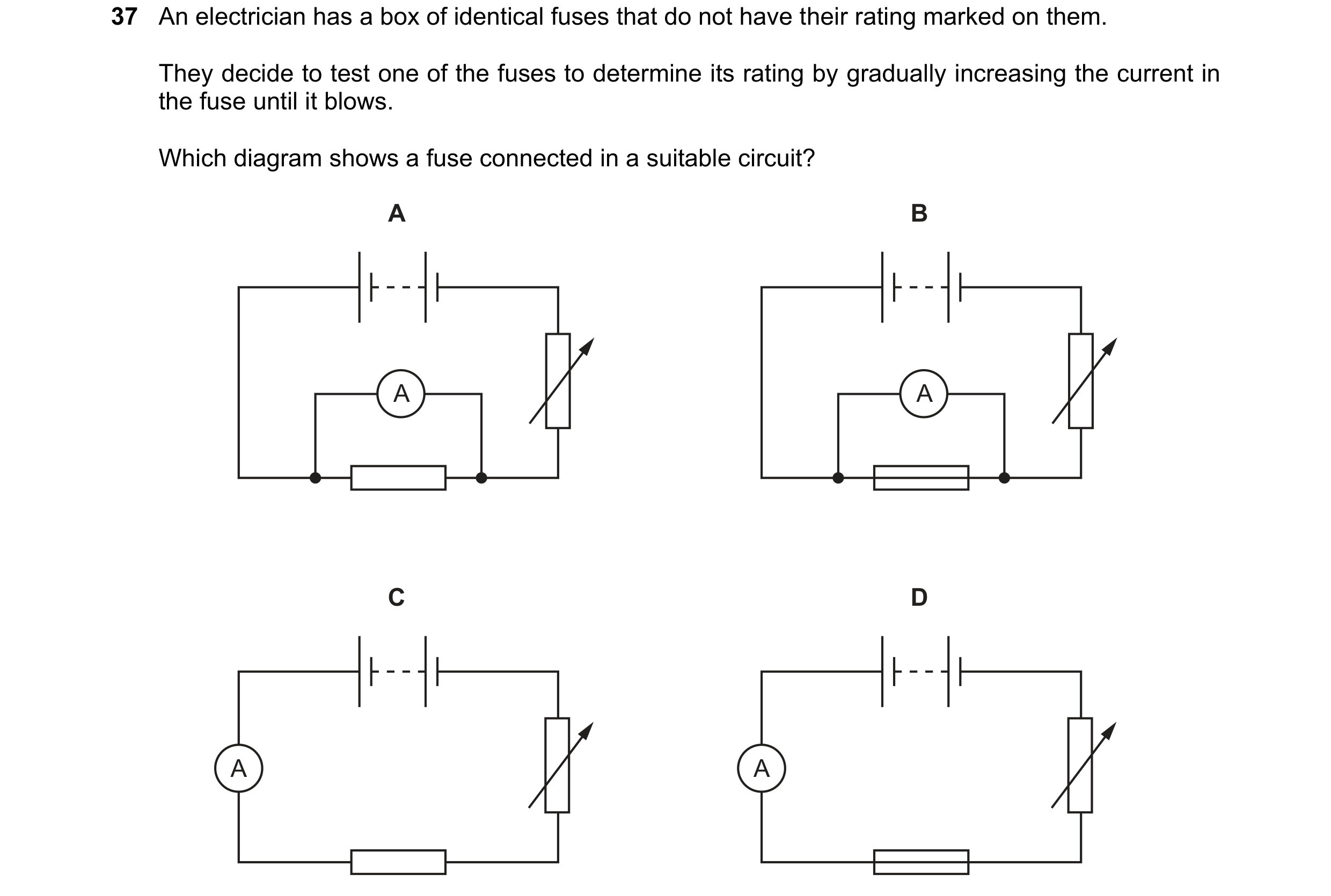
Q57 · An electrician has a box of identical fuses that do not have their rating marked on them 0654/13 Oct/Nov 2024
37 An electrician has a box of identical fuses that do not have their rating marked on them. They decide to test one of the fuses to determine its rating by gradually increasing the current in the fuse until it blows. Which diagram shows a fuse connected in a suitable circuit? A B A A C D A A
1 marks
Answer: D
This question in 0654/13 Oct/Nov 2024
Q58 · The voltage across an electric heater is 240 V and the current in the heater is 3.0 A 0654/11 May/June 2025
38 The voltage across an electric heater is 240 V and the current in the heater is 3.0 A. The heater is connected in a circuit with a fuse. Which fuse rating is the most suitable? A 1 A B 2 A C 5 A D 240 A
1 marks
Answer: C
This question in 0654/11 May/June 2025
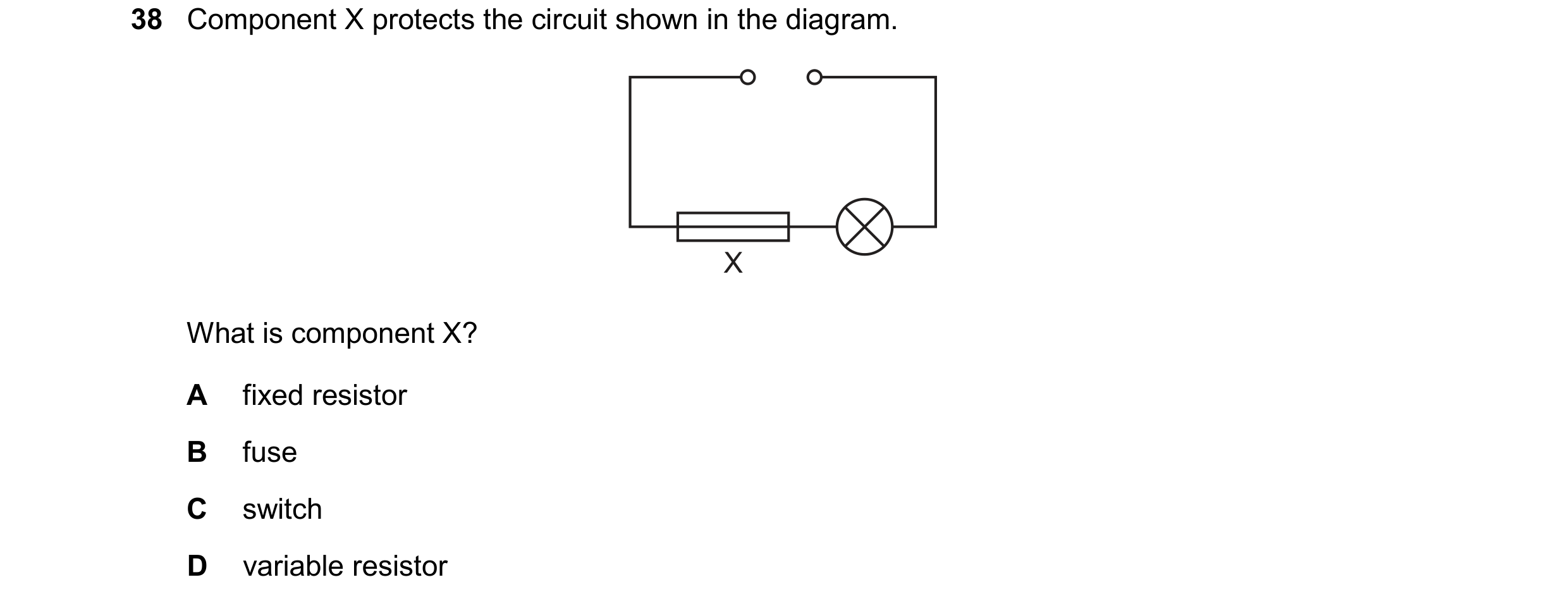
Q59 · Component X protects the circuit shown in the diagram 0654/11 Oct/Nov 2025
38 Component X protects the circuit shown in the diagram. X What is component X? A fixed resistor B fuse C switch D variable resistor
1 marks
Answer: B
This question in 0654/11 Oct/Nov 2025
 1 / 18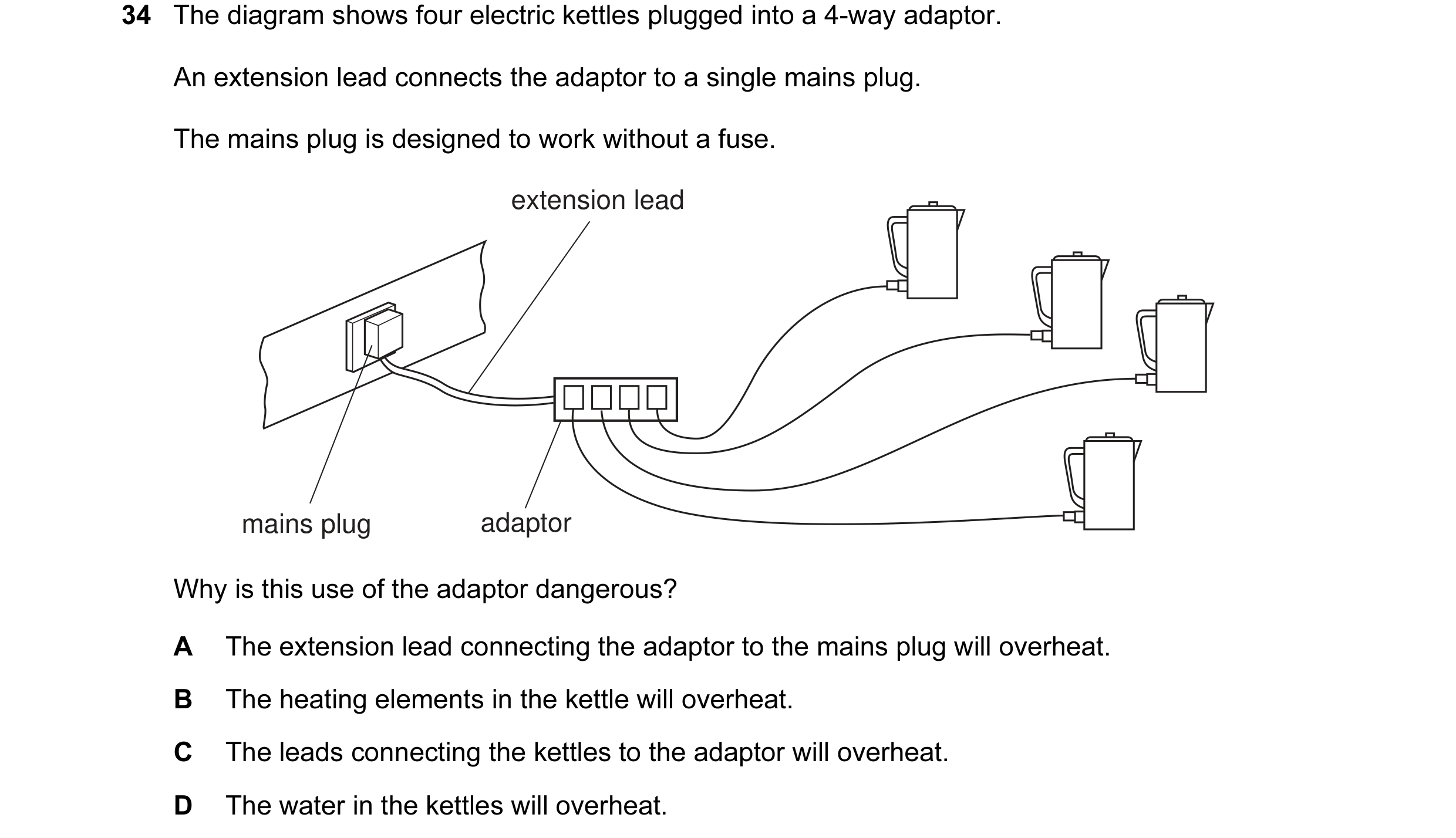
 2 / 18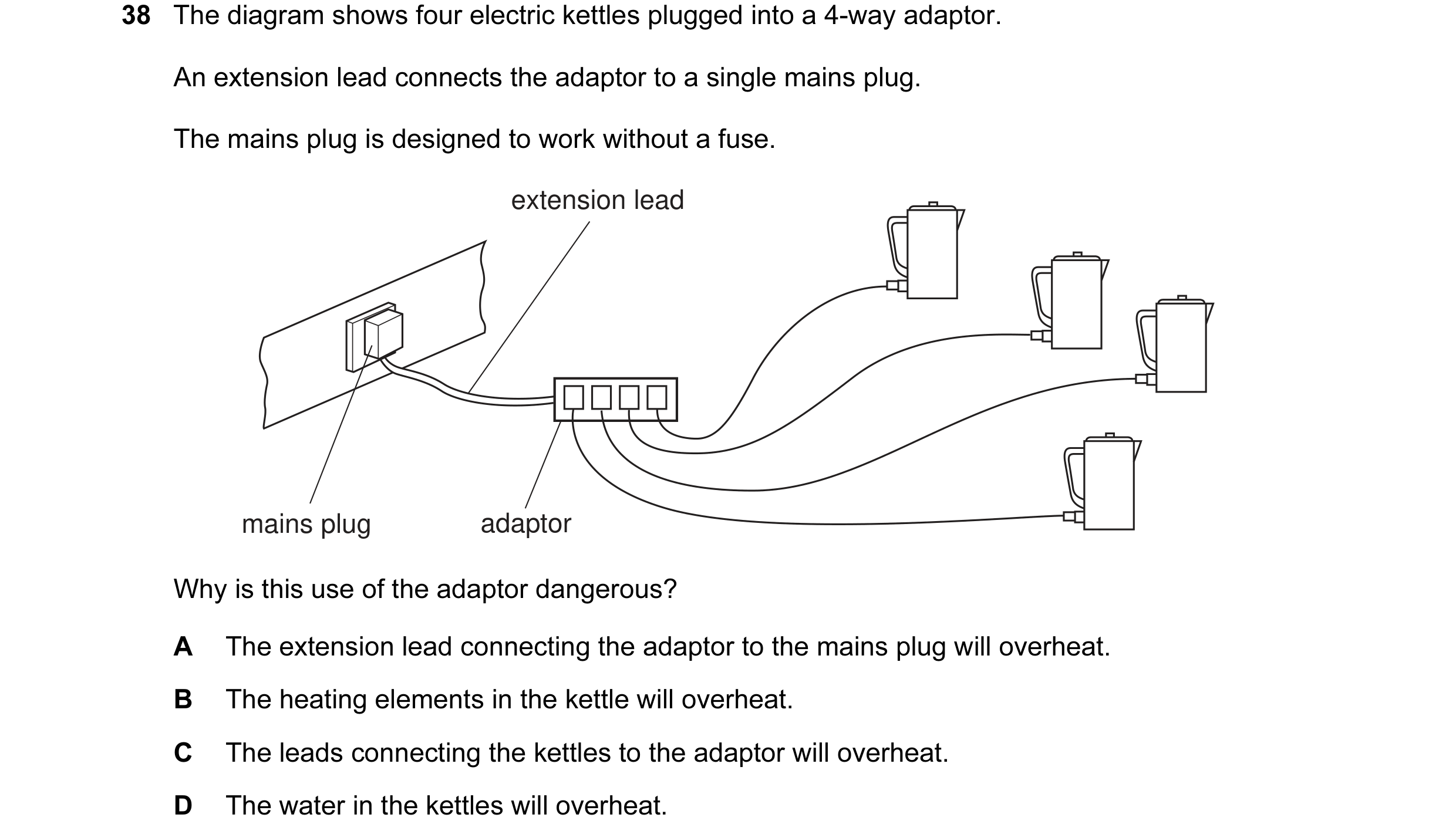
 3 / 18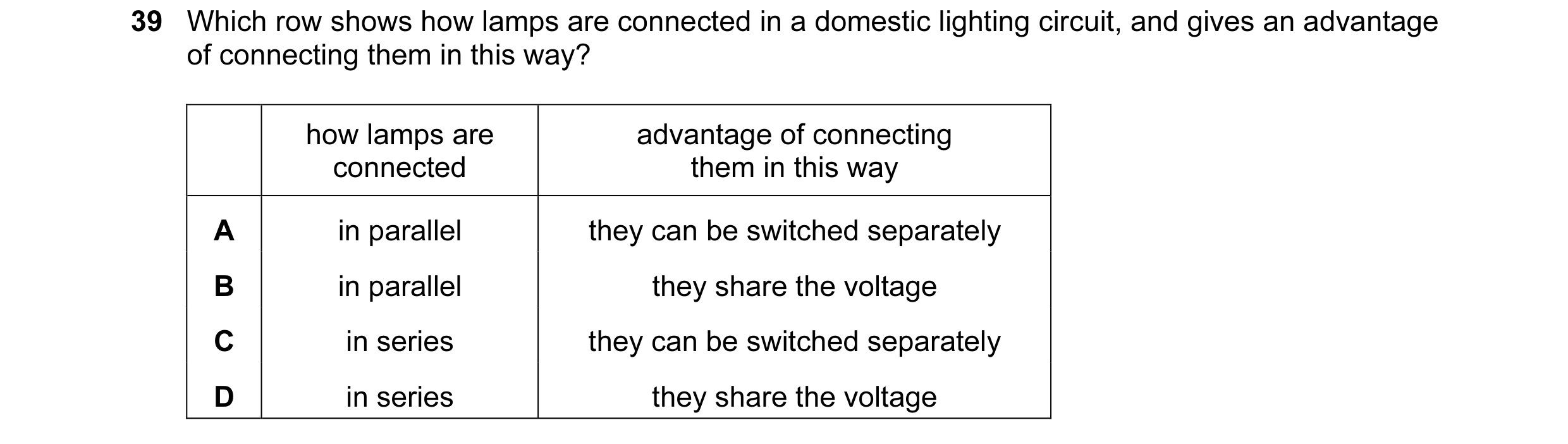
 4 / 18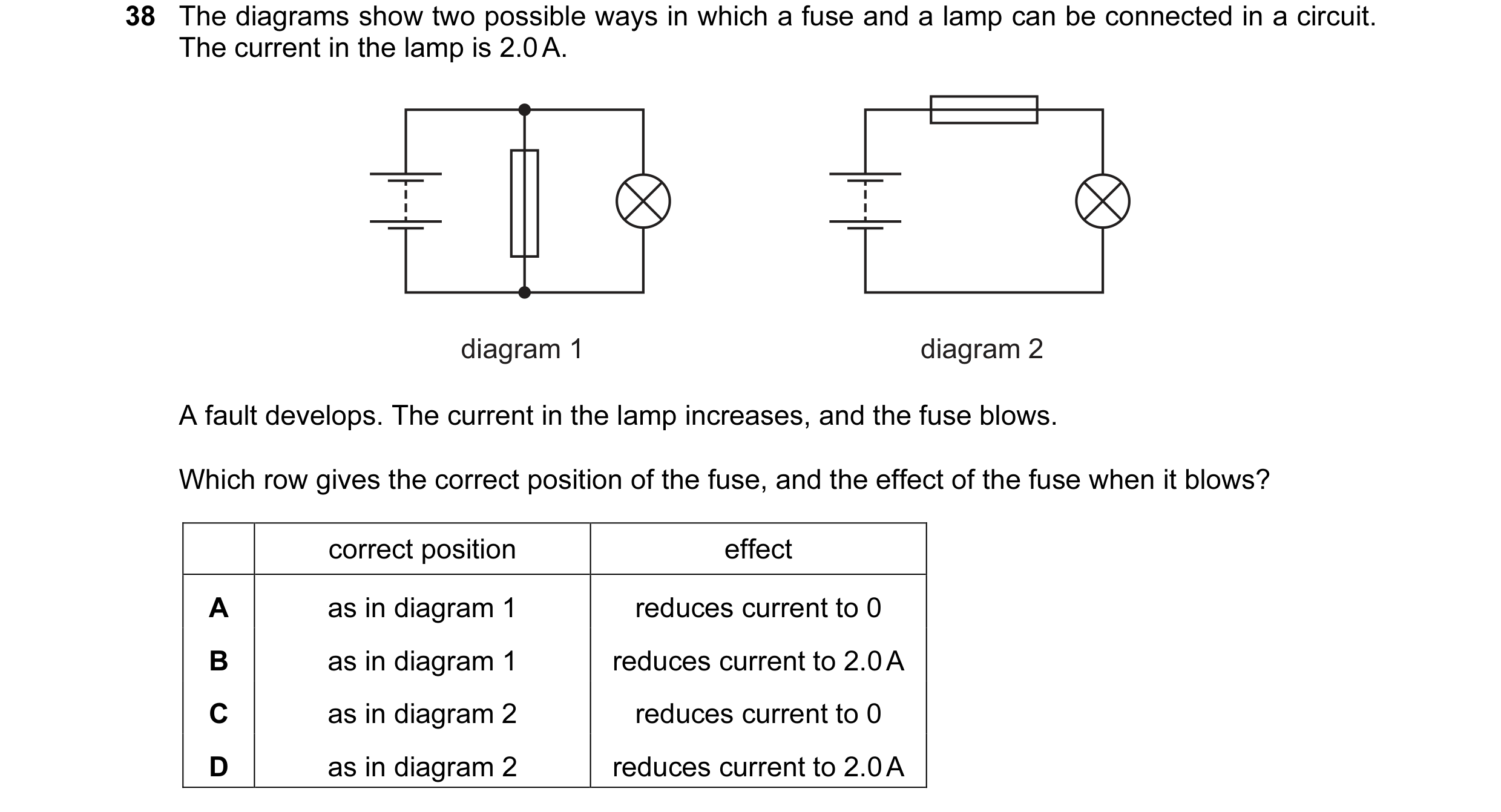
 5 / 18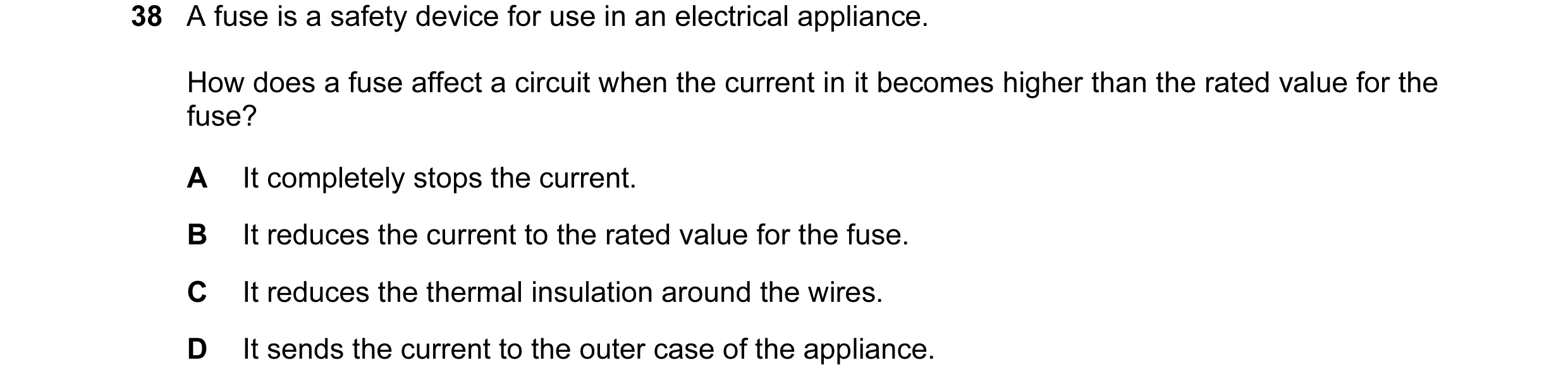
 6 / 18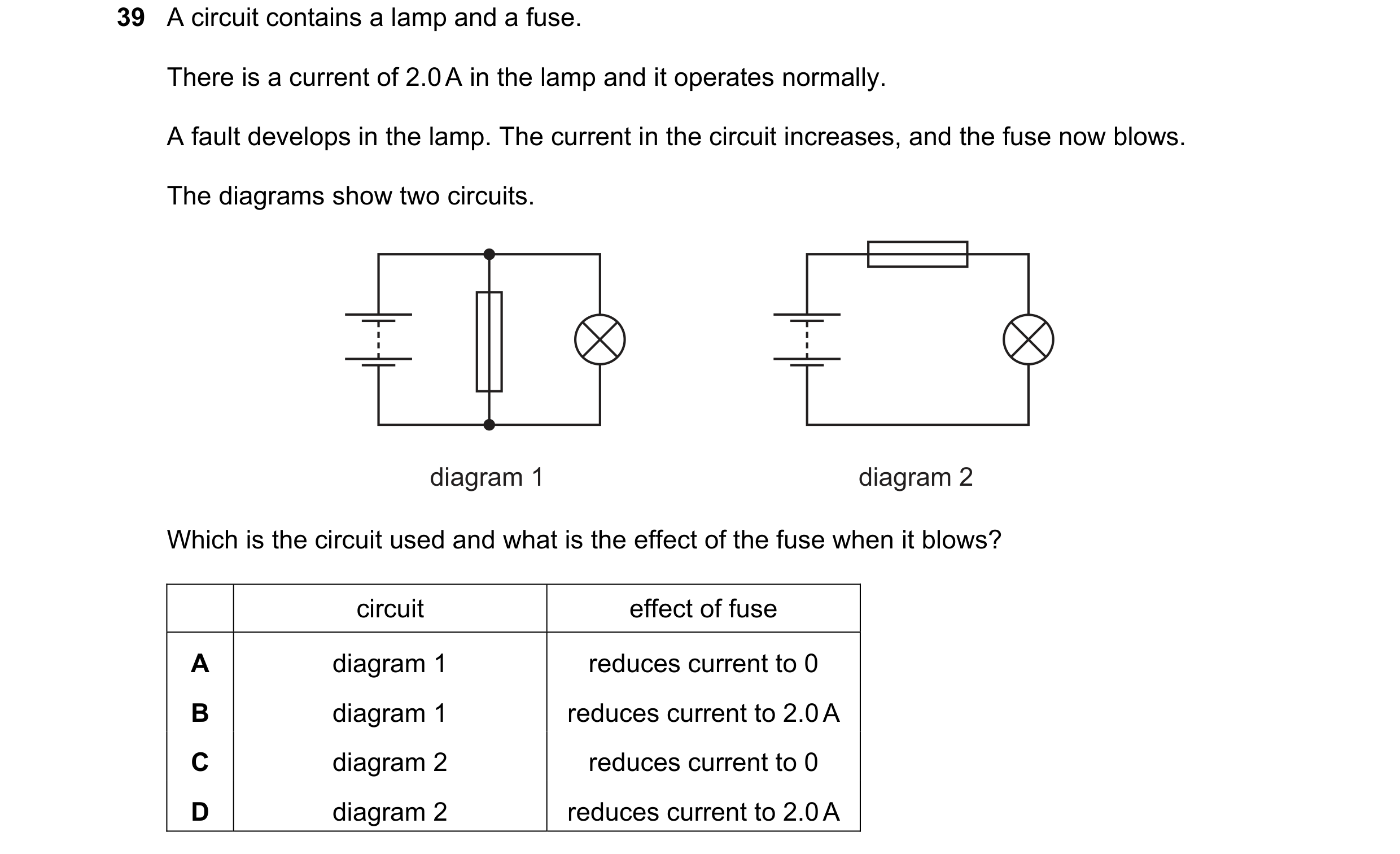
 7 / 18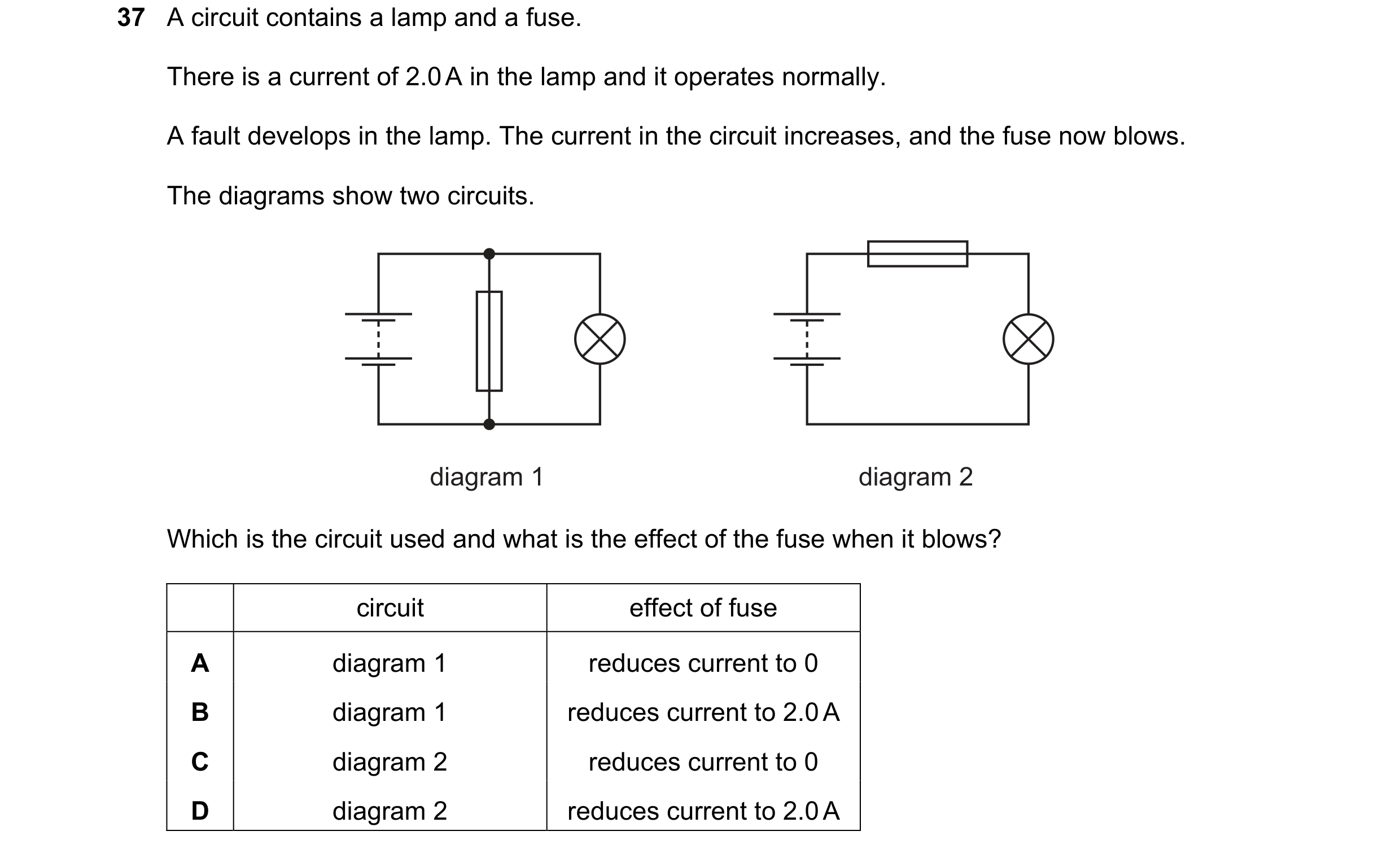
 8 / 18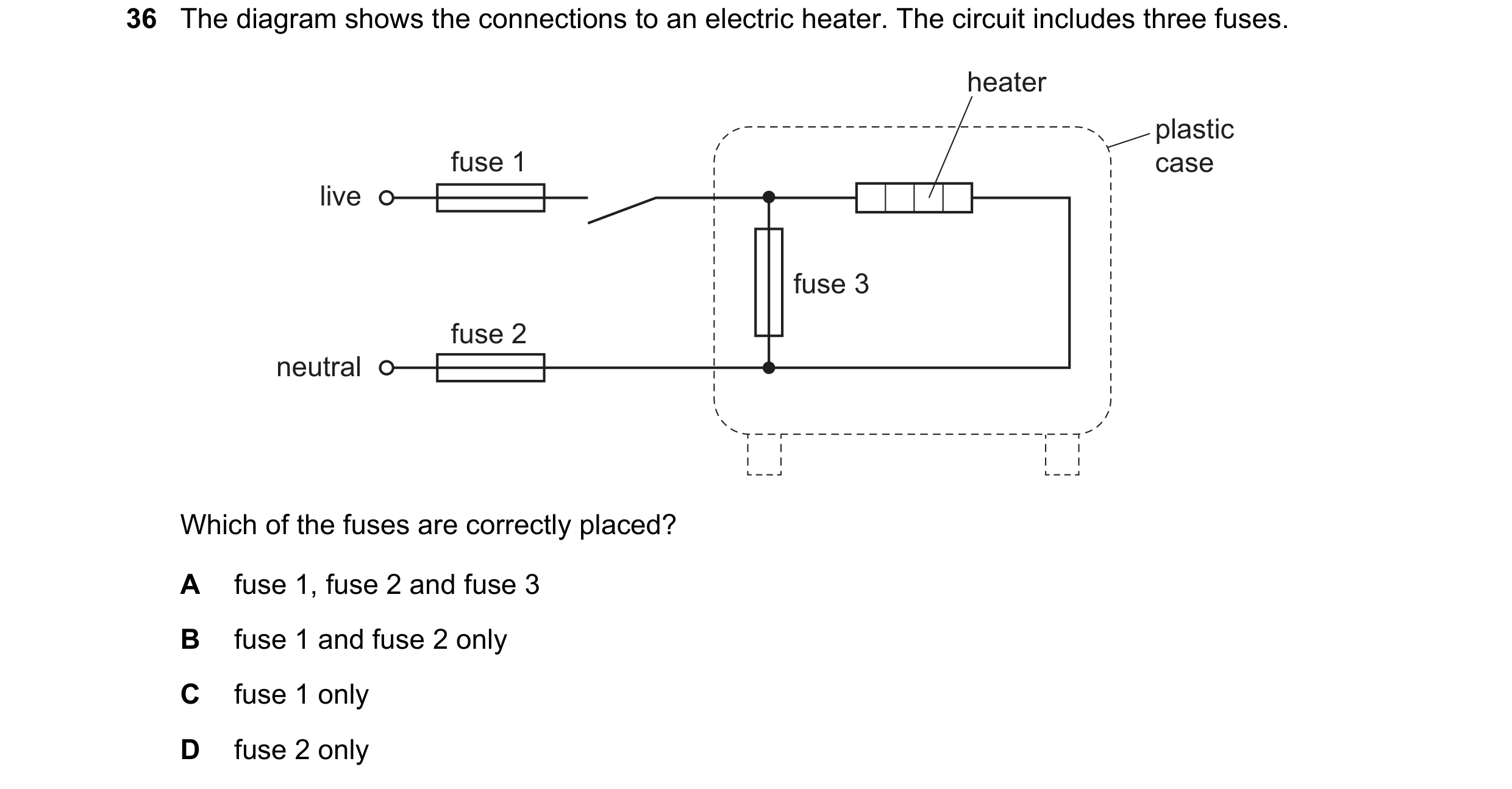
 9 / 18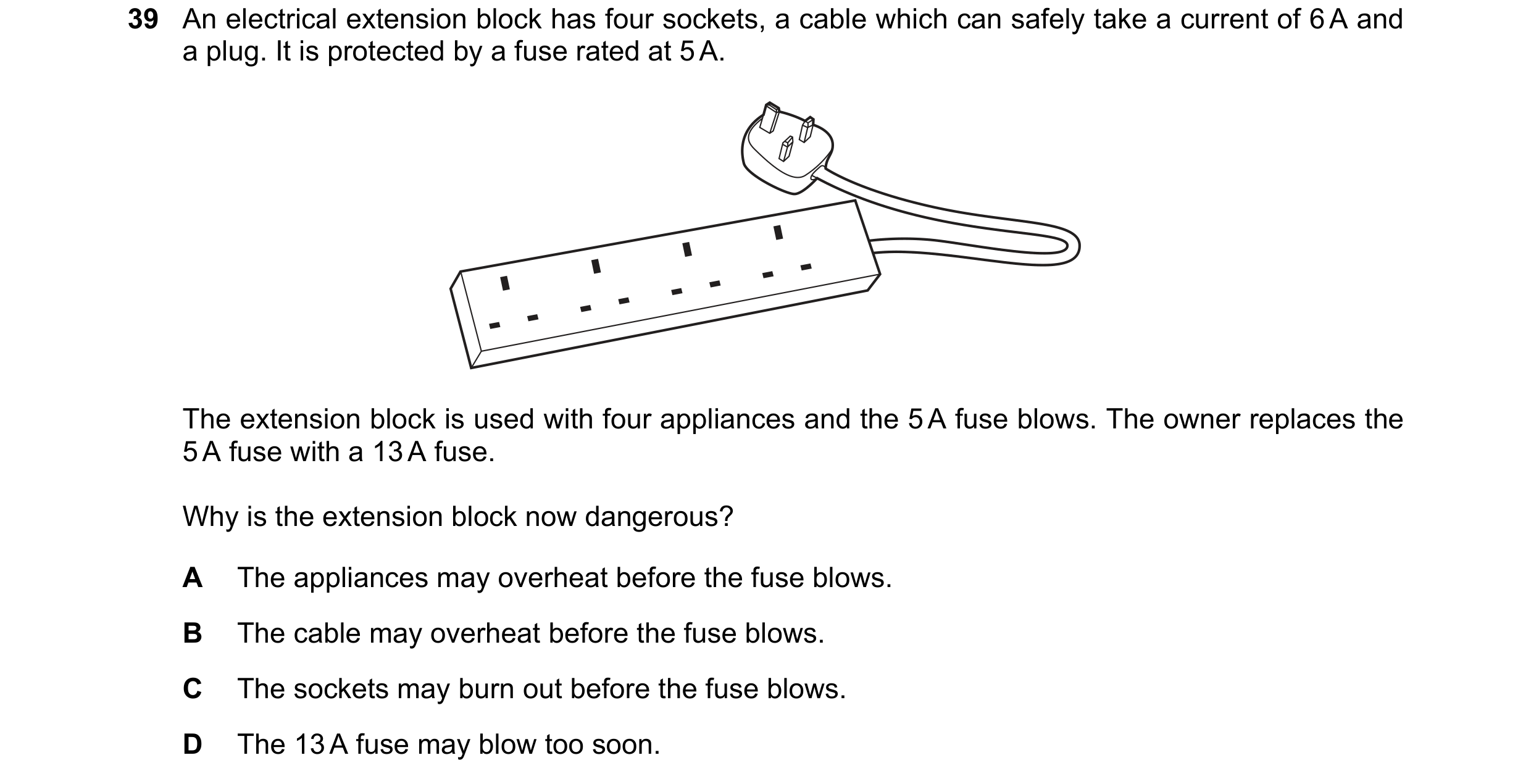
 10 / 18
 11 / 18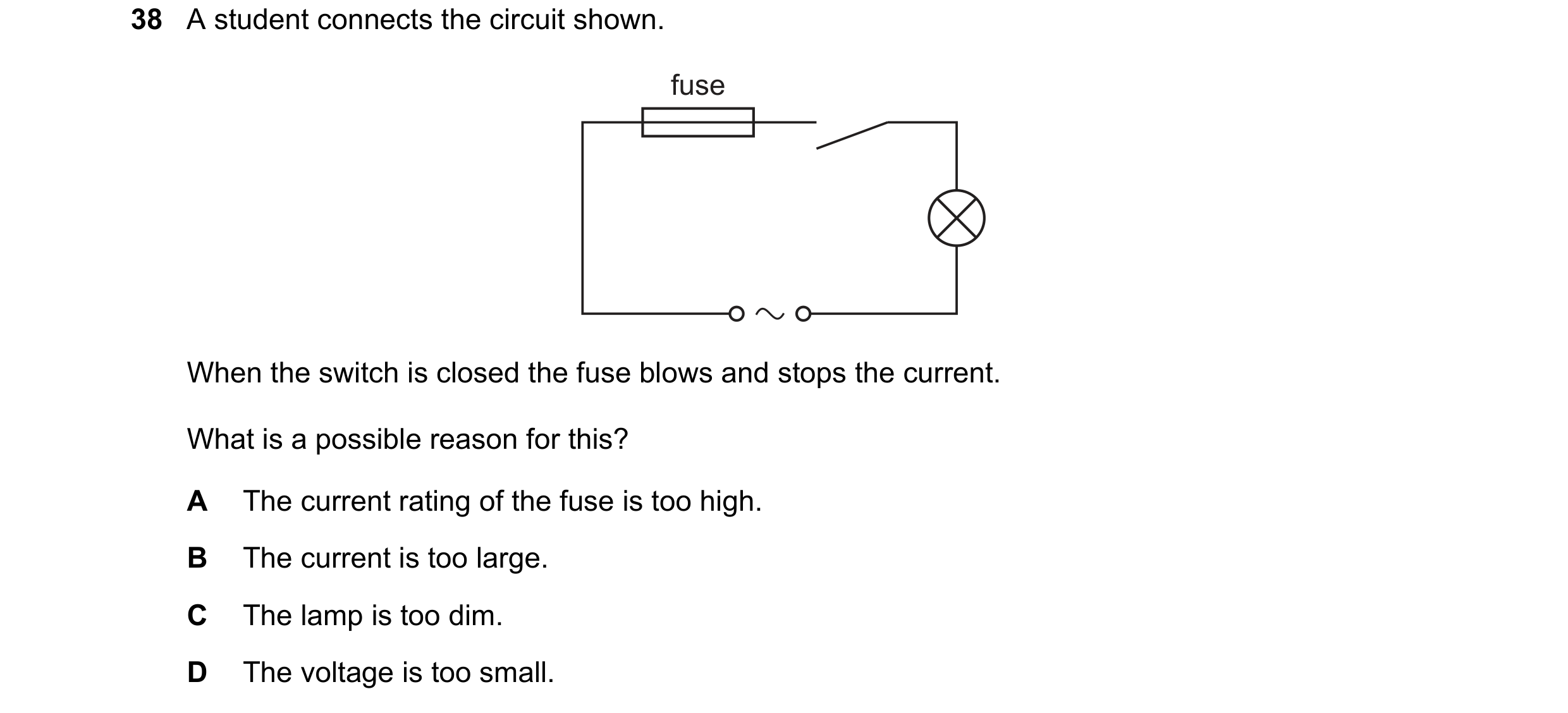
 12 / 18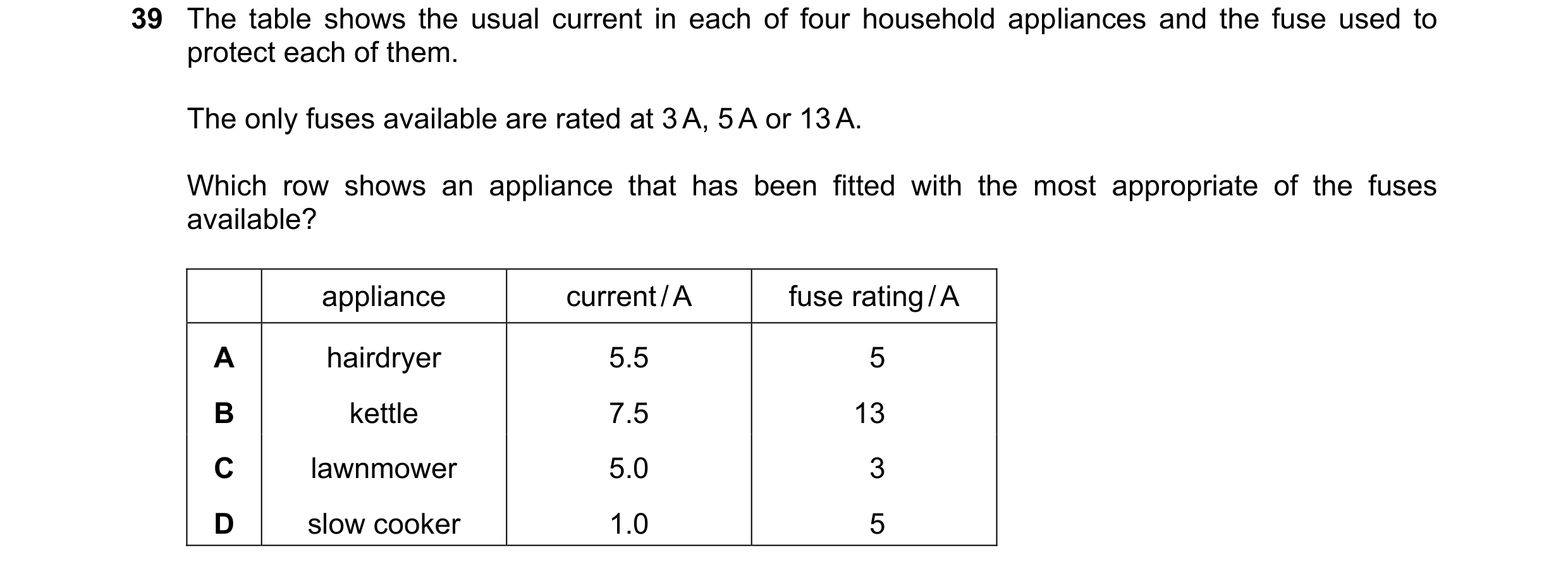
 13 / 18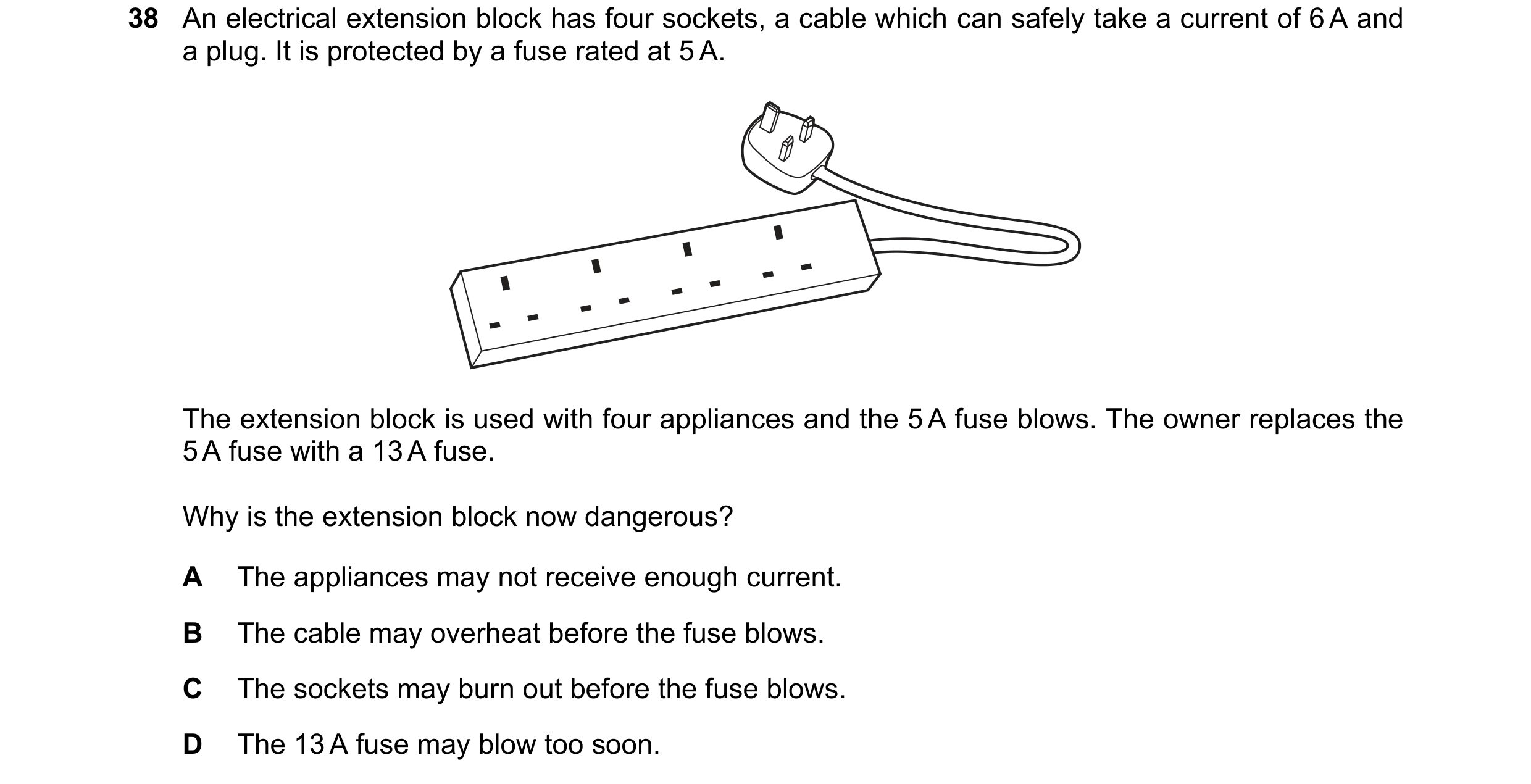

 14 / 18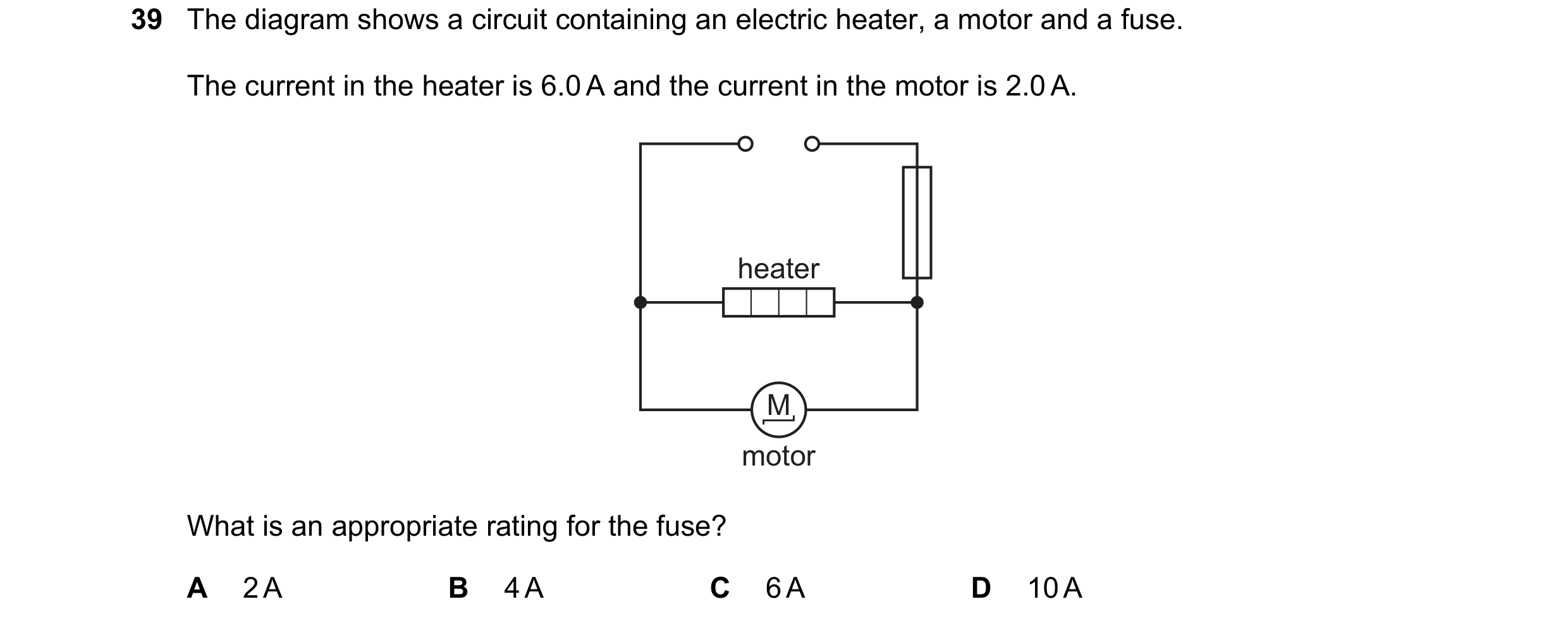


 15 / 18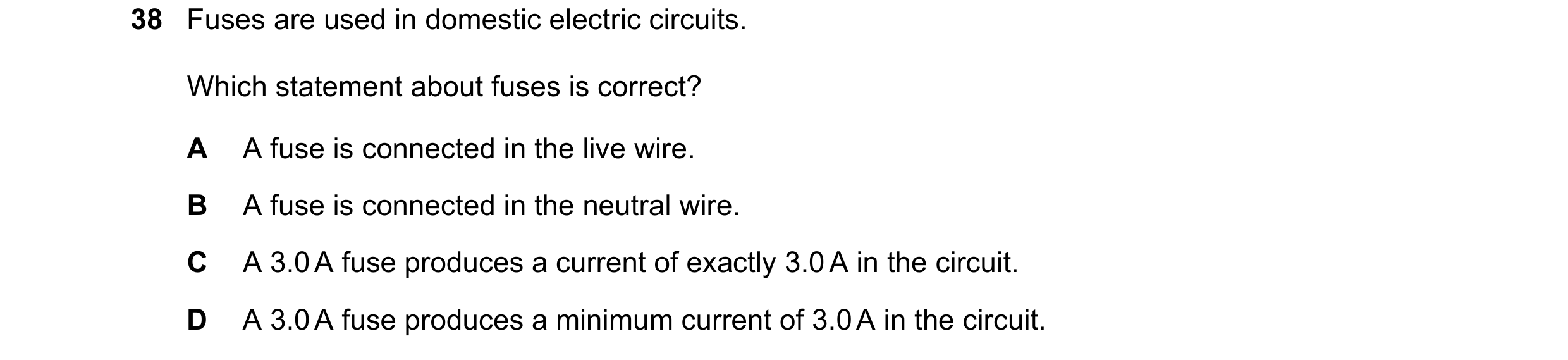



 16 / 18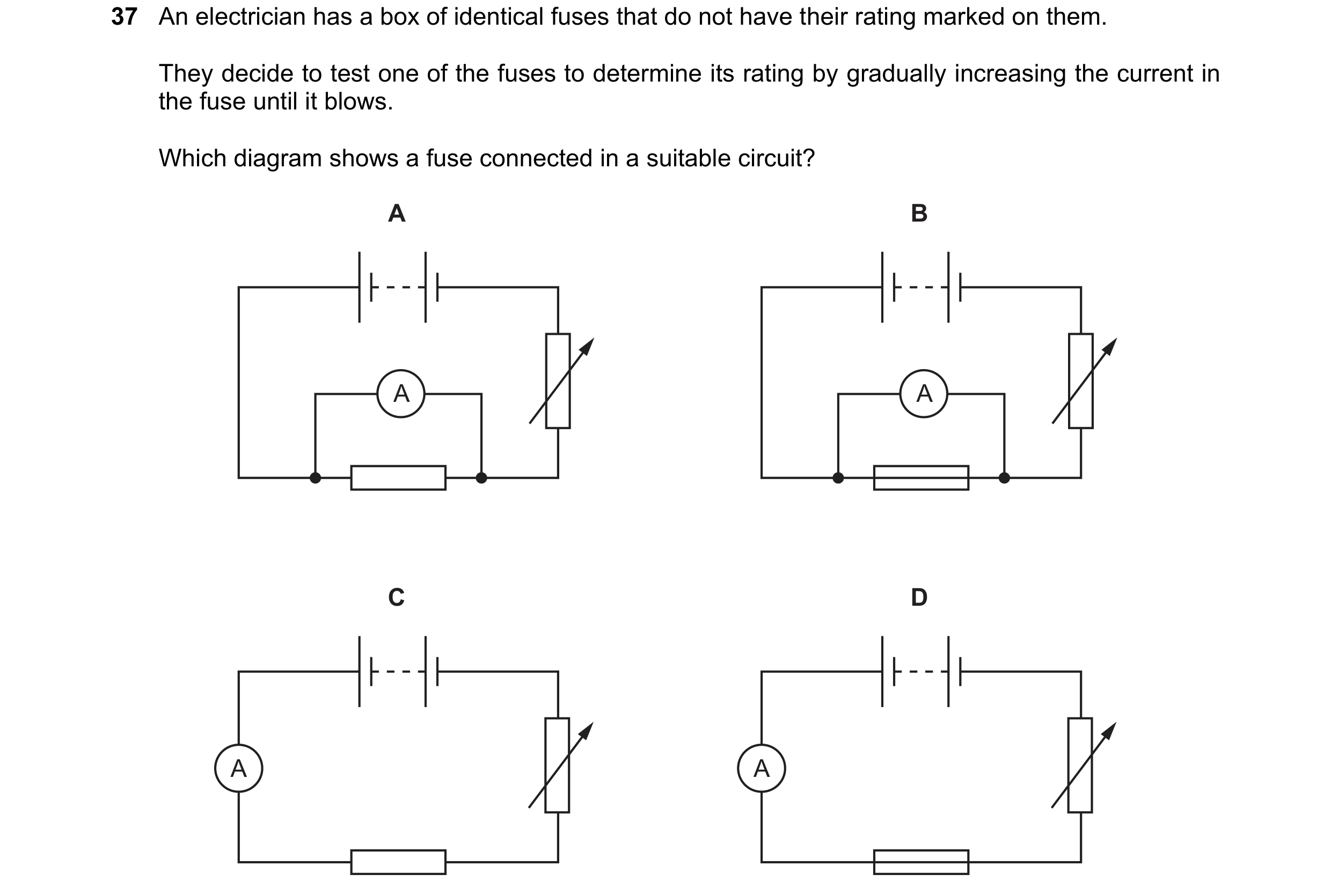
 17 / 18
 18 / 18